




WikiDwarfBOT (talk | contribs) Cleanup: Source modification. Information added. |
Improved wording and formatting |
||
| Line 1: | Line 1: | ||
{{short description|Indian | {{short description|Indian politician and ideologue (1883–1966)}} | ||
{{ | {{redirect2|Savarkar|Veer Savarkar|the 2001 Indian film|Veer Savarkar (film){{!}}''Veer Savarkar'' (film)|the biography|Savarkar (book){{!}}''Savarkar'' (book)|the 2024 film|Swatantrya Veer Savarkar (film){{!}}''Swatantrya Veer Savarkar'' (film)|other uses|Savarkar (surname)}} | ||
{{pp-semi-indef|small=yes}} | |||
{{use Indian English|date=June 2019}} | {{use Indian English|date=June 2019}} | ||
{{use dmy dates|date=May 2020}} | {{use dmy dates|date=May 2020}} | ||
{{Infobox person | {{Infobox person | ||
| honorific_prefix = | |||
| name = Vinayak Damodar Savarkar | | name = Vinayak Damodar Savarkar | ||
| image = | | image = Swatyantra Vir Savarkar.jpg | ||
| alt = Savarkar | | alt = Savarkar | ||
| caption = | | caption = Savarkar, {{circa|1910}} | ||
| birth_date = {{birth date|df=y|1883|5|28}} | | birth_date = {{birth date|df=y|1883|5|28}} | ||
| birth_place = | | birth_place = [[Bhagur]], British India | ||
| death_date = {{death date and age|df=y|1966|2|26|1883|4|1}} | | death_date = {{death date and age|df=y|1966|2|26|1883|4|1}} | ||
| death_place = [[Bombay]] | | death_place = [[Bombay]], India | ||
| known_for = [[Hindutva]] | | known_for = [[Hindutva]] | ||
| | | notable_works = ''[[Essentials of Hindutva]]'' | ||
| occupation | | occupation = {{hlist|Politician|ideologue}} | ||
| party = [[ | | party = [[Hindu Mahasabha]] | ||
| relatives = [[Ganesh Damodar Savarkar]] (brother) | | relatives = [[Ganesh Damodar Savarkar]] (brother) | ||
| signature = | | signature = | ||
}} | }} | ||
'''Vinayak Damodar Savarkar''' | '''Vinayak Damodar Savarkar'''{{efn|{{IPA|mr|ʋinaːjək d̪aːmoːd̪əɾ saːʋəɾkəɾ|IPA|Ma-VinayakDamodarSavarkar.ogg}}}} (28 May 1883 – 26 February 1966) was an Indian politician and ideologue<!-- do not add "freedom fighter" or other non-neutral terms here; see [[WP:LABEL]] -->. Savarkar developed the [[Hindu nationalist]] political ideology of [[Hindutva]] while confined at [[Ratnagiri]] in 1922. He was a leading figure in the [[Hindu Mahasabha]].<ref name=":0">{{cite encyclopedia | title=Overview of Vinayak Damodar Savarkar | encyclopedia=[[Encyclopædia Britannica]] | url=https://www.britannica.com/biography/Vinayak-Damodar-Savarkar | access-date=27 February 2020 | archive-date=25 July 2019 | archive-url=https://web.archive.org/web/20190725034949/https://www.britannica.com/biography/Vinayak-Damodar-Savarkar | url-status=live }}</ref><ref>{{cite web |url=https://www.britannica.com/biography/Vinayak-Damodar-Savarkar |title=Vinayak Damodar Savarkar | Biography, History, & Books | Britannica |access-date=27 February 2020 |archive-date=25 July 2019 |archive-url=https://web.archive.org/web/20190725034949/https://www.britannica.com/biography/Vinayak-Damodar-Savarkar |url-status=live }}</ref> | ||
Savarkar developed the [[Hindu nationalist]] political ideology of [[Hindutva]] while | |||
Savarkar began his political activities as a high school student and continued at [[Fergusson College]] in [[Pune]].{{sfn|Jaffrelot|2017|pp=127-182}} He and his brother founded a secret society called [[Abhinav Bharat Society]]. When Savarkar travelled to England for his law studies, he involved himself with organisations such as [[India House]] and the [[Free India Society]]. He also published books advocating complete Indian independence by revolutionary means.<ref name="newstodaynet1">{{cite web |author=V. Sundaram |title=remembering all the revolutionaries of 1857 |publisher=News Today INDIA TV |date=10 May 2008 |url=http://www.newstodaynet.com/col.php?section=20&catid=33&id=7318 |access-date=13 June 2010 |archive-url=https://web.archive.org/web/20100206113125/http://newstodaynet.com/col.php?section=20&catid=33&id=7318 |archive-date=6 February 2010 |url-status=dead}}</ref> One of the books he published called ''[[The Indian War of Independence (book)|The Indian War of Independence]]'' about the [[Indian Rebellion of 1857]] was banned in British India.<ref>{{Cite journal|last=Visana|first=Vikram|date=5 November 2020|title=Savarkar before Hindutva: Sovereignty, Republicanism, and Populism in India, c.1900–1920|url=https://www.cambridge.org/core/journals/modern-intellectual-history/article/abs/savarkar-before-hindutva-sovereignty-republicanism-and-populism-in-india-c19001920/90DC611F3F01B05C2FE4ECC61BECDC73|journal=Modern Intellectual History|volume=18|issue=4|language=en|pages=1106–1129|doi=10.1017/S1479244320000384|s2cid=224983230|issn=1479-2443|access-date=25 July 2021|archive-date=30 September 2021|archive-url=https://web.archive.org/web/20210930153956/https://www.cambridge.org/core/journals/modern-intellectual-history/article/abs/savarkar-before-hindutva-sovereignty-republicanism-and-populism-in-india-c19001920/90DC611F3F01B05C2FE4ECC61BECDC73|url-status=live|url-access=subscription}}</ref> | |||
In 1910, Savarkar was arrested by British authorities and deported back to India as a result of his involvement with India House. Upon returning to India, Savarkar was sentenced to 50 years of imprisonment in the [[Cellular Jail]] in the [[Andaman and Nicobar Islands]]. He was released in 1924 after writing a series of mercy petitions to the British colonial government.<ref>{{cite book | last=Jha | first=D.K. | title=Gandhi's Assassin: The Making of Nathuram Godse and His Idea of India | publisher=Penguin Random House India Private Limited | year=2022 | isbn=978-93-5492-168-1 | url=https://books.google.com/books?id=R_5REAAAQBAJ | access-date=2022-11-18 | page=25 | archive-date=19 November 2022 | archive-url=https://web.archive.org/web/20221119003450/https://books.google.com/books?id=R_5REAAAQBAJ | url-status=live }}</ref> Savarkar virtually ceased his criticism of British rule in India after he was released from jail.<ref>{{cite book | last=Devare | first=A. | title=History and the Making of a Modern Hindu Self | publisher=Taylor & Francis | year=2013 | isbn=978-1-136-19708-6 | url=https://books.google.com/books?id=1drfCgAAQBAJ&pg=PA168 | page=168 | access-date=19 November 2022 | archive-date=30 January 2024 | archive-url=https://web.archive.org/web/20240130151913/https://books.google.com/books?id=1drfCgAAQBAJ&pg=PA168#v=onepage&q&f=false | url-status=live }}</ref> After being released from his restriction to Ratnagiri district in 1937, Savarkar started traveling widely, becoming a prominent orator and writer who advocated for Hindu political and social unity. In his Ahmedabad speech, he supported the [[two-nation theory]].<ref name="Bombwall 1967">{{cite book | last=Bombwall | first=K.R. | title=The Foundations of Indian Federalism | publisher=Asia Publishing House | year=1967 | url=https://books.google.com/books?id=pFYLAQAAIAAJ | quote= It was Savarkar, and not Jinnah, who first propounded the two-nation theory. In his 1937 presidential address at the Ahmedabad session of the Hindu Mahasabha he declared: "there are two antagonistic nations... living side by side in India."|page=228}}</ref> The Hindu Mahasabha under Savarkar's leadership endorsed the idea of India as a ''[[Hindu Rashtra]] (Hindu nation''). | |||
In 1939, the ruling [[Indian National Congress]] (INC) resigned en masse over Britain declaring India a belligerent in [[World War II]]. The Hindu Mahasabha under Savarkar formed alliances with the [[All-India Muslim League]] and other non-INC parties to form government in many states. Subsequently, the INC, under Gandhi's leadership, launched the [[Quit India Movement]]; Savarkar boycotted the movement,<ref name="Bapu2013">{{cite book |author=Prabhu Bapu |title=Hindu Mahasabha in Colonial North India, 1915–1930: Constructing Nation and History |url=https://books.google.com/books?id=iUFalxUFFWkC&pg=PA103 |year=2013 |publisher=Routledge |isbn=978-0-415-67165-1 |pages=103– |access-date=13 February 2016 |archive-url=https://web.archive.org/web/20160103033815/https://books.google.com/books?id=iUFalxUFFWkC&pg=PA103 |archive-date=3 January 2016 |url-status=live }}</ref> writing a letter titled "''Stick to your Posts''" and recruiting Indians for the British war effort.{{sfn|McKean|1996|p=72}} In 1948, Savarkar was charged as a co-conspirator in the [[assassination of Mahatma Gandhi]]; he was acquitted by the court for lack of evidence.<ref name=":2">{{Cite web |last=Ashraf |first=Ajaz |date=2016-05-27 |title=History revisited: Was Veer Savarkar really all that brave? |url=https://scroll.in/article/808709/the-hollow-myth-of-veer-savarkar |access-date=2025-03-27 |website=Scroll.in |language=en}}</ref> | |||
== Life and career == | == Life and career == | ||
=== Early life === | === Early life === | ||
Savarkar was born into a [[Marathi people|Marathi]] Hindu [[Chitpavan Brahmin]] family on 28 May 1883 in [[Bhagur]], a village in the [[Nasik district]] of the [[Bombay Presidency]] of [[British India]]. Nasik district, now known by Nashik district, is in the present-day [[Indian state]] of [[Maharashtra]]. His parents were Damodar and Radhabai Savarkar.{{sfn|Sampath|2019|p={{page needed|date=April 2021}}}}{{sfn|Bhave|2009|pp=12–13}} Savarkar had two brothers named [[Ganesh Damodar Savarkar|Ganesh]] and Narayan, and a sister named Mainabai.{{sfn|Keer|1966|p=5}} He began his activism as a high school student.{{sfn|Jaffrelot|2017|pp=127-182}} At the age of 12, he led fellow students in an attack on the village mosque following [[Hinduism in India|Hindu]]-[[Islam in India|Muslim]] riots, stating: "We vandalised the mosque to our heart's content."{{sfn|Jyotirmaya Sharma|2011|p=128}}<ref>{{cite news |title=Savarkar, Modi's mentor: The man who thought Gandhi a sissy |url=https://www.economist.com/news/christmas-specials/21636599-controversial-mentor-hindu-right-man-who-thought-gandhi-sissy |access-date=22 December 2014 |newspaper=The Economist |date=20 December 2014 |archive-url=https://web.archive.org/web/20160206061243/http://www.economist.com/news/christmas-specials/21636599-controversial-mentor-hindu-right-man-who-thought-gandhi-sissy |archive-date=6 February 2016 |url-status=live }}</ref> In 1903, in the nearby city of [[Nasik]], Savarkar and Ganesh founded the Mitra Mela, an underground revolutionary organisation, which became [[Abhinav Bharat Society]] in 1906.<ref>{{Cite book |last=Tejani |first=Shabnum |url=https://books.google.com/books?id=L7sLEAAAQBAJ&pg=PA101 |title=Indian Secularism: A Social and Intellectual History, 1890-1950 |date=2021-01-05 |publisher=Indiana University Press |isbn=978-0-253-05832-4 |language=en |access-date=18 May 2022 |archive-date=26 May 2022 |archive-url=https://web.archive.org/web/20220526174131/https://books.google.com/books?id=L7sLEAAAQBAJ&pg=PA101 |url-status=live }}</ref> Abhinav Bharat's main objectives were to overthrow British rule and revive Hindu pride.<ref>{{Cite book |last=Bapu |first=Prabhu |url=https://books.google.com/books?id=iUFalxUFFWkC&pg=PA96 |title=Hindu Mahasabha in Colonial North India, 1915-1930: Constructing Nation and History |date=2013 |publisher=Routledge |isbn=978-0-415-67165-1 |language=en |access-date=18 May 2022 |archive-date=26 May 2022 |archive-url=https://web.archive.org/web/20220526174130/https://books.google.com/books?id=iUFalxUFFWkC&pg=PA96 |url-status=live }}</ref> | |||
===Student activist=== | ===Student activist=== | ||
[[File:The Savarkar brothers (Left to right) Narayan, Ganesh and Vinayak, with Shanta, sister Maina Kale and Yamuna.jpg|thumb|The Savarkar brothers ( | [[File:The Savarkar brothers (Left to right) Narayan, Ganesh and Vinayak, with Shanta, sister Maina Kale and Yamuna.jpg|thumb|The Savarkar brothers (left to right) Narayan, Ganesh and Vinayak, with Shanta, sister Maina Kale and Yamuna]] | ||
Savarkar continued his political activism as a student at [[Fergusson College]] in [[Pune]]. | Savarkar continued his political activism as a student at [[Fergusson College]] in [[Pune]]. | ||
Savarkar was greatly influenced by the radical | Savarkar was greatly influenced by the radical nationalist leader, [[Bal Gangadhar Tilak|Lokmanya Tilak]]. Tilak was in turn impressed with the young student and helped him obtain the Shivaji Scholarship in 1906 for his law studies in [[London]].{{sfn|Jaffrelot|2017|pp=127-182}}<ref>Kumar, M. (2006). History and Gender in Savarkar's Nationalist Writings. Social Scientist, 34(11/12), 33–50. http://www.jstor.org/stable/27644182 {{Webarchive|url=https://web.archive.org/web/20221126171440/https://www.jstor.org/stable/27644182 |date=26 November 2022 }}</ref> To protest against Bengal partition of 1905, Savarkar led foreign-clothes bonfire in India with other students in presence of [[Bal Gangadhar Tilak]].<ref>{{cite web | url=http://www.hindustantimes.com/cities/mumbai-news/when-dussehra-was-used-to-fuel-anger-against-british-rule-101664973649291-amp.html | title=When Dussehra was used to fuel anger against British rule | date=5 October 2022 }}</ref> | ||
====London years==== | ====London years==== | ||
In London, | In London, Savarkar got involved with organisations such as [[India House]] and the [[Free India Society]]. He also published books advocating complete Indian independence by revolutionary means.<ref name="newstodaynet1"/> One of the books he published called ''[[The Indian War of Independence (book)|The Indian War of Independence]]'' about the [[Indian Rebellion of 1857]] was banned by the British colonial authorities.<ref>{{Cite journal|last=Visana|first=Vikram|date=5 November 2020|title=Savarkar before Hindutva: Sovereignty, Republicanism, and Populism in India, c. 1900–1920|url=https://www.cambridge.org/core/journals/modern-intellectual-history/article/abs/savarkar-before-hindutva-sovereignty-republicanism-and-populism-in-india-c19001920/90DC611F3F01B05C2FE4ECC61BECDC73|journal=Modern Intellectual History|volume=18|issue=4|language=en|pages=1106–1129|doi=10.1017/S1479244320000384|s2cid=224983230|issn=1479-2443|access-date=25 July 2021|archive-date=30 September 2021|archive-url=https://web.archive.org/web/20210930153956/https://www.cambridge.org/core/journals/modern-intellectual-history/article/abs/savarkar-before-hindutva-sovereignty-republicanism-and-populism-in-india-c19001920/90DC611F3F01B05C2FE4ECC61BECDC73|url-status=live|url-access=subscription}}</ref> | ||
Savarkar was influenced by the life and thinking of Italian | Savarkar was influenced by the life and thinking of Italian nationalist leader, [[Giuseppe Mazzini]]. During his stay in London, Savarkar translated Mazzini's biography in Marathi.<ref>Kumar, M. (2006). [http://www.jstor.org/stable/27644182 History and Gender in Savarkar's Nationalist Writings. Social Scientist, 34(11/12), pp 33–50.] {{Webarchive|url=https://web.archive.org/web/20221126171440/https://www.jstor.org/stable/27644182 |date=26 November 2022 }}</ref> He also influenced thinking of a fellow student called [[Madanlal Dhingra]]. In 1909, Dhingra assassinated [[Curzon Wyllie]], a colonial officer. It is alleged by Mark Juergensmeyer<!--who's that? And why is it relevant what he claimed?--> that Savarkar supplied the gun which Dhingra used. Juergensmeyer further alleged that Savarkar supplied the words for Dhingra's last statement before he went to the gallows for the murder. Savarkar met [[Mohandas Gandhi]] for the first time in London shortly after Curzon-Wyllie's assassination. During his stay, Gandhi debated Savarkar and other nationalists in London on the futility of fighting the colonial state through acts of terrorism and guerilla warfare.<ref>Juergensmeyer, Mark. "Gandhi vs. Terrorism." Daedalus, vol. 136, no. 1, 2007, pp. 30–39. JSTOR, http://www.jstor.org/stable/20028087 {{Webarchive|url=https://web.archive.org/web/20220817212042/https://www.jstor.org/stable/20028087 |date=17 August 2022 }}. Accessed 17 Aug. 2022.</ref> | ||
==== Arrest and transportation to India ==== | ====Arrest and transportation to India==== | ||
Although his alleged crimes were committed both in Britain | In India, Ganesh Savarkar organised an armed revolt against the [[Indian Councils Act 1909|Morley-Minto reforms]] of 1909, and was sentenced to life imprisonment on the [[Andaman Islands]].{{sfn|Babli Sinha|2014|p=129}}<ref>Pandey, B. N. (1979). The Indian nationalist movement, 1885-1947: select documents. (No Title).|pages-=23-24 [https://books.google.com/books?id=KauwCwAAQBAJ&q=savarkar&pg=PR7] {{Webarchive|url=https://web.archive.org/web/20231018031654/https://books.google.com/books?id=KauwCwAAQBAJ&q=savarkar&pg=PR7|date=18 October 2023}}</ref> Around the same time Vinayak Savarkar was accused of participating in a conspiracy to overthrow British rule in India by organising murders of various officials.{{sfn|Chaturvedi|2022|p=114}} Hoping to evade arrest, Savarkar moved to [[Bhikaiji Cama]]'s home in Paris,{{sfn|Trehan|1991|p=23}} but against advice from his friends, returned to London. On 13 March 1910, he was arrested in London on multiple charges, including procurement and distribution of arms, waging war against the state, and delivering seditious speeches. At the time of his arrest, he was carrying several revolutionary texts, including copies of his own banned books. In addition, the British presented evidence that he had smuggled 20 [[Browning Arms Company|Browning]] handguns into India, one of which [[Anant Laxman Kanhere]] used to assassinate the Nasik district's collector [[A.M.T. Jackson]] in December 1909.{{sfn|Chaturvedi|2022|p=114}} During the trial of [[Nasik Conspiracy Case 1910]], government's advocate alleged that Savarkar was a moving part and inspiration behind assassination of Jackson. A Bombay court tried him in the Nasik conspiracy case and sentenced him for life-imprisonment and transported him to the notorious [[Cellular Jail]] of Andaman Island and forfeited his property.<ref>{{Cite news |title=सावररांनी... |url=https://www.bbc.com/marathi/india-42465309 |newspaper=BBC News मराठी |access-date=6 September 2023 |archive-date=30 January 2024 |archive-url=https://web.archive.org/web/20240130151926/https://www.bbc.com/marathi/india-42465309 |url-status=live }}</ref><ref>{{Cite web |title=Nasik Conspiracy Case 1910 |url=http://bombayhighcourt.nic.in/libweb/historicalcases/cases/Nasik_Conspiracy_Case_-1910.html |url-status=live |access-date=6 September 2023 |website=Bombay High court|archive-url=https://web.archive.org/web/20090409230639/http://bombayhighcourt.nic.in/libweb/historicalcases/cases/Nasik_Conspiracy_Case_-1910.html |archive-date=9 April 2009 }}</ref> | ||
Although his alleged crimes were committed both in Britain as well as India, the British decided to try him in India. He was subsequently put on the commercial ship SS ''Morea'' with a police escort for his transport to India. When the ship docked in the French Mediterranean port of [[Marseille]], Savarkar escaped by jumping from the ship's window, swam to the French shore, and asked for political asylum. Local French port officials ignored his pleas and handed him back to the police escort on ''Morea''. When the French government was informed of the incident, they asked for Savarkar to be brought back to France, and lodged an appeal with the [[Permanent Court of Arbitration]].<ref>{{Cite journal |date=1911 |title=The Savarkar Case |url=https://www.cambridge.org/core/journals/american-journal-of-international-law/article/abs/savarkar-case/37A389C99C443079E632279DB9E37D6E |journal=American Journal of International Law |language=en |volume=5 |issue=1 |pages=208–210 |doi=10.2307/2186778 |jstor=2186778 |issn=0002-9300|url-access=subscription }}</ref><ref>Hamilton, P. ed., 1999. The permanent court of arbitration: international arbitration and dispute resolution. Kluwer Law International BV.[https://books.google.com/books?id=cT_po79vQvsC&dq=savarkar+marseille&pg=PR11] {{Webarchive|url=https://web.archive.org/web/20230405013156/https://books.google.com/books?id=cT_po79vQvsC&dq=savarkar+marseille&pg=PR11|date=5 April 2023}}</ref>{{sfn|Chaturvedi|2022|p=114}} | |||
==== French Case before the Permanent Court of Arbitration ==== | ==== French Case before the Permanent Court of Arbitration ==== | ||
| Line 79: | Line 75: | ||
| italic title = no | | italic title = no | ||
}} | }} | ||
The Court held, firstly, that since there was a pattern of collaboration between the two countries regarding the possibility of Savarkar's escape in | Savarkar's arrest at Marseille caused the French government to lodge a protest against its British counterpart, arguing that Britain could not recover Savarkar unless it took appropriate legal proceedings for his rendition. The dispute came before the [[Permanent Court of Arbitration|Permanent Court of International Arbitration]] in 1910, and it gave its decision in 1911. The case excited much controversy as was reported widely by the French press, and it considered it involved an interesting international question of the right of asylum.{{sfn|Sampath|2019|p=276}} | ||
The Court held, firstly, that since there was a pattern of collaboration between the two countries regarding the possibility of Savarkar's escape in Marseille and there was neither force nor fraud in inducing the port authorities to return Savarkar to them, the British did not have to hand him back to the French for the latter to hold rendition proceedings. On the other hand, the tribunal also observed that there had been an "irregularity" in Savarkar's arrest and delivery over to his police escort.{{sfn|Goldie|1972|p=}} | |||
=== Trial and sentence === | === Trial and sentence === | ||
Arriving in [[Bombay]], Savarkar was taken to the [[ | Arriving in [[Bombay]], Savarkar was taken to the [[Yerawada Central Jail|Yervada Central Jail]] in [[Pune]]. The trial before the special tribunal was started on 10 September 1910.{{sfn|Palande|1958|p=456}} One of the charges on Savarkar was the abetment to murder of Nasik Collector [[A. M. T. Jackson]].{{sfn|Anderson|2003|p=}}{{sfn|Wagner|2010|p=14}} In July 1911, Savarkar was transported to [[Port Blair]] and imprisoned in [[Cellular Jail]].<ref>{{Cite journal |last=Bakhle |first=Janaki |year=2010 |title=Savarkar (1883–1966), Sedition and Surveillance: The Rule of Law in a Colonial Situation |journal=Social History |volume=35 |issue=1 |pages=51–75 |doi=10.1080/03071020903542286}}</ref> | ||
[[File:Savarkar_in_jail_clothes.jpg|thumb|Savarkar in jail clothes]] | |||
=== Prisoner in Andaman === | === Prisoner in Andaman === | ||
[[File:A statue of Vinayak Damodar Savarkar.jpg|thumb|A statue of Vinayak Damodar Savarkar at [[Cellular Jail]].]] | [[File:A statue of Vinayak Damodar Savarkar.jpg|thumb|A statue of Vinayak Damodar Savarkar at [[Cellular Jail]].]] | ||
====Clemency | ====Clemency petitions==== | ||
=====1911===== | =====1911===== | ||
| Line 95: | Line 92: | ||
=====1913===== | =====1913===== | ||
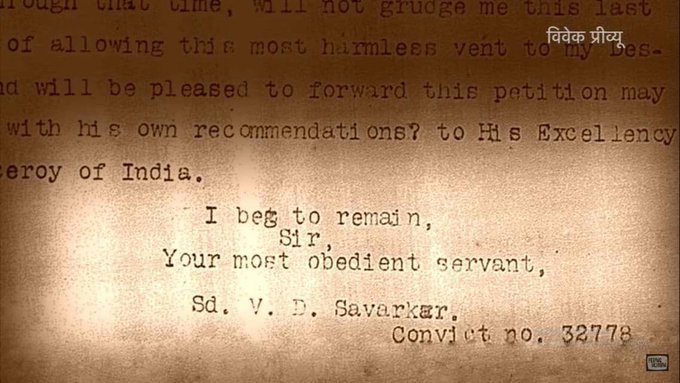
Savarkar submitted his next clemency petition on 14 November 1913 and presented it personally to the Home Member of the Governor General's council, Sir Reginald Craddock.{{sfn|Majumdar|1975|pp=211–213}} In his letter, he described himself as a "''[[Parable of the Prodigal Son|prodigal son]]''" longing to return to the "''parental doors of the government''".{{efn|He met Savarkar, who is said to have submitted a clemency plea in which he described himself as the "prodigal son" eager to return "to the parental doors of the Government"{{sfn|Takle|2016|p=}}}} He wrote that his release from the jail will recast the faith of many Indians in the British rule. Also, he said | Savarkar submitted his next clemency petition on 14 November 1913 and presented it personally to the Home Member of the Governor General's council, Sir Reginald Craddock.{{sfn|Majumdar|1975|pp=211–213}} In his letter, he described himself as a "''[[Parable of the Prodigal Son|prodigal son]]''" longing to return to the "''parental doors of the government''".{{efn|He met Savarkar, who is said to have submitted a clemency plea in which he described himself as the "prodigal son" eager to return "to the parental doors of the Government"{{sfn|Takle|2016|p=}}}} He wrote that his release from the jail will recast the faith of many Indians in the British rule. Also, he said {{blockquote|Moreover, my conversion to the constitutional line would bring back all those misled young men in India and abroad who were once looking up to me as their guide. I am ready to serve the government in any capacity they like, for as my conversion is conscientious so I hope my future conduct would be. By keeping me in jail, nothing can be got in comparison to what would be otherwise.<ref>{{cite news |url=http://timesofindia.indiatimes.com/india/Savarkar-had-begged-the-British-for-mercy/articleshow/8792427.cms |title=Savarkar had begged the British for mercy |work=The Times of India |date=3 May 2002 |access-date=29 May 2015 |archive-url=https://web.archive.org/web/20150531072350/http://timesofindia.indiatimes.com/india/Savarkar-had-begged-the-British-for-mercy/articleshow/8792427.cms |archive-date=31 May 2015 |url-status=live }}</ref>}} | ||
=====1917===== | =====1917===== | ||
In 1917, Savarkar submitted another clemency petition, this time for a general amnesty of all political prisoners. Savarkar was informed on 1 February 1918 that the clemency petition was placed before the British colonial government.{{sfn|Palande|1958|p=480}} In December 1919, there was a Royal proclamation by King | [[File:Most Obedient British Servant Savarkar's Petition.jpg|right|thumb|250px|Mercy petition by Veer Savarkar]] | ||
In 1917, Savarkar submitted another clemency petition, this time for a general amnesty of all political prisoners. Savarkar was informed on 1 February 1918 that the clemency petition was placed before the British colonial government.{{sfn|Palande|1958|p=480}} In December 1919, there was a Royal proclamation by [[King George V]]. The Paragraph 6 of this proclamation included a declaration of Royal clemency to political offenders.{{sfn|Palande|1958|p=469}} In view of Royal proclamation, Savarkar submitted his fourth clemency<ref>{{cite web|work=The Print|url=https://theprint.in/opinion/rahul-gandhi-must-reflect-why-indira-called-savarkar-patriot/307778/|title=Rahul Gandhi must reflect on why grandmother Indira called Savarkar a patriot|first=Vikram|last=Sampath|date=18 October 2019o|access-date=28 February 2021|archive-date=23 January 2021|archive-url=https://web.archive.org/web/20210123183748/https://theprint.in/opinion/rahul-gandhi-must-reflect-why-indira-called-savarkar-patriot/307778/|url-status=live}}</ref> petition to the British colonial government on 30 March 1920,{{sfn|Palande|1958|pp=472–476}} in which he stated that | |||
{{blockquote|So far from believing in the militant school of the [[Mikhail Bakunin|Bakunin]] type, I do not contribute even to the peaceful and philosophical anarchism of a Kuropatkin [sic.] or a [[Lev Tolstoy|Tolstoy]]. And as to my revolutionary tendencies in the past- it is not only now for the object of sharing the clemency but years before this have I informed of and written to the Government in my petitions (1918, 1914) about my firm intention to abide by the constitution and stand by it as soon as a beginning was made to frame it by Mr. Montagu. Since that the Reforms and then the Proclamation have only confirmed me in my views and recently I have publicly avowed my faith in and readiness to stand by the side of orderly and constitutional development.{{sfn|Noorani|2005|p=}}}} | |||
This petition was rejected on 12 July 1920 by the British colonial government.{{sfn|Palande|1958|p=477}} After considering the petition, the British colonial government contemplated releasing Ganesh Savarkar but not Vinayak Savarkar. The rationale for doing so was stated as follows{{sfn|Palande|1958|p=472}} | This petition was rejected on 12 July 1920 by the British colonial government.{{sfn|Palande|1958|p=477}} After considering the petition, the British colonial government contemplated releasing Ganesh Savarkar but not Vinayak Savarkar. The rationale for doing so was stated as follows{{sfn|Palande|1958|p=472}} | ||
| Line 104: | Line 103: | ||
Savarkar signed a statement endorsing his trial, verdict, and British law, and renouncing violence, a bargain for freedom. | Savarkar signed a statement endorsing his trial, verdict, and British law, and renouncing violence, a bargain for freedom. | ||
=== Ratnagiri years under | === Ratnagiri years under restrictions=== | ||
On 2 May 1921, the Savarkar brothers were | On 2 May 1921, the Savarkar brothers were transferred from Andaman to mainland India with Vinayak being sent to a jail in [[Ratnagiri]], and Ganesh to Bijapur Jail. During his incarceration in Ratnagiri jail in 1922, Vinayak wrote ''[[Essentials of Hindutva]]'' that formulated the political ideology of [[Hindutva]].{{sfn|McKean|1996|pp=73, 79, 85}} Ganesh Savarkar was unconditionally released from jail in 1922.<ref>Jha, D. (2023). Gandhi's Assassin: The Making of Nathuram Godse and His Idea of India. Verso Books.Page=23</ref> On 6 January 1924 Vinayak was released, but was restricted to [[Ratnagiri District]]. Soon after his release, he shifted his work towards Hindu nationalism. The colonial authorities provided a bungalow for him and he was allowed visitors.<ref name="Malgonkar Kapoor">{{cite book | last1=Malgonkar | first1=M. | last2=Kapoor | first2=P. | title=The Men Who Killed Gandhi | publisher=Roli Books | year=2008 | isbn=978-93-5194-083-8 | url=https://books.google.com/books?id=ucWsCAAAQBAJ&pg=PT41 | page=41 | access-date=25 March 2023 | archive-date=25 March 2023 | archive-url=https://web.archive.org/web/20230325174208/https://books.google.com/books?id=ucWsCAAAQBAJ&pg=PT41 | url-status=live }}</ref> He also received a pension of 60 rupees a month from the British government.<ref name="m639">{{cite web | last=Puniyani | first=Ram |authorlink=Ram Puniyani| title=When artistic freedom becomes a propaganda tool: Film on Hindu rightwing icon Veer Savarkar distorts history | website=South Asia Monitor | date=2023-06-06 | url=https://southasiamonitor.org/medley/when-artistic-freedom-becomes-propaganda-tool-film-hindu-rightwing-icon-veer-savarkar | access-date=2025-04-15}}</ref><ref name="o518">{{cite web | last=Fernandes | first=Erica | title=Veer Savarkar: BJP Icon's Apologies towards British Raj and the Allowance | website=ARY NEWS | date=2025-03-24 | url=https://arynews.tv/veer-savarkar-bjp-icons-apologies-towards-british-raj-and-the-allowance/ | access-date=2025-04-15}}</ref> [[Nathuram Godse]], who later assassinated Gandhi, met Savarkar for the first time as a nineteen-year-old in 1929.{{sfn|Andersen|1972|pp=673–682}} Savarkar became a prolific writer during his years of restricted freedom in Ratnagiri. His publishers, however, needed to have a disclaimer that they were wholly divorced from politics. Savarkar remained restricted to Ratnagiri district until 1937. At that time, he was unconditionally released by the newly elected government of [[1937 Bombay Presidency election|Bombay presidency]].{{sfn|Malgonkar|2008|p=13}} | ||
=== Leader of the Hindu Mahasabha === | === Leader of the Hindu Mahasabha === | ||
Savarkar as president of the Hindu Mahasabha, during the Second World War, advanced the slogan " | Savarkar as president of the Hindu Mahasabha, during the Second World War, advanced the slogan "Hinduise all Politics and Militarise Hindudom" and decided to support the British war effort in India seeking military training for the Hindus.<ref name="Pandey2006">{{cite book |author=Gyanendra Pandey |title=Routine violence: nations, fragments, histories |url=https://archive.org/details/routineviolencen0000pand |url-access=registration |access-date=3 March 2012 |year=2006 |publisher=Stanford University Press |isbn=978-0-8047-5264-0 |pages=[https://archive.org/details/routineviolencen0000pand/page/127 127]– }}</ref> When the Congress launched the ''[[Quit India]]'' movement in 1942, Savarkar criticised it and asked Hindus to stay active in the war effort and not disobey the government;<ref name="Rediff">{{cite web|title=Who was Veer Savarkar?|url=http://in.rediff.com/news/2004/aug/23spec1.htm|author=Amberish Diwanji |date=23 August 2004 |archive-url=https://web.archive.org/web/20060513095209/http://in.rediff.com/news/2004/aug/23spec1.htm |archive-date=13 May 2006|access-date=28 July 2006|url-status=live|format=PHP}}</ref> he also urged the Hindus to enlist in the armed forces to learn the "arts of war".<ref name="BaryBary1988">{{cite book |author1=Stephen N Hay, William Theodore De Bary |author2=William Theodore De Bary |title=Sources of Indian Tradition |url=https://books.google.com/books?id=MBWzV-TRXzkC&pg=PA880 |access-date=3 March 2012 |date=May 1988 |publisher=Motilal Banarsidass Publishers |isbn=978-81-208-0467-8 |pages=880– |archive-date=1 January 2014 |archive-url=https://web.archive.org/web/20140101212902/http://books.google.com/books?id=MBWzV-TRXzkC&pg=PA880 |url-status=live }}</ref> | ||
Hindu Mahasabha under Savarkar's leadership | Hindu Mahasabha under Savarkar's leadership organised ''Hindu Militarisation Boards'' which recruited armed forces for helping the British in [[World War 2]].{{sfn|McKean|1996|p=72}} | ||
He assailed the British proposals for transfer of power, attacking both the Congress and the British for making concessions to Muslim separatists. Soon after independence, [[Syama Prasad | He assailed the British proposals for transfer of power, attacking both the Congress and the British for making concessions to Muslim separatists. Soon after independence, [[Syama Prasad Mukherjee]] resigned as vice-president of the Hindu Mahasabha dissociating himself from its ''[[Akhand Bharat|Akhand Hindustan]]'' (''Undivided India'') plank, which implied undoing partition.<ref>{{cite web |author=G.S. Bhargava |title=Apotheosis of Jinnah? |work=The Tribune, Chandigarh |url=http://www.tribuneindia.com/2005/20050613/edit.htm |access-date=23 February 2010 |archive-url=https://web.archive.org/web/20100128040417/http://www.tribuneindia.com/2005/20050613/edit.htm |archive-date=28 January 2010 |url-status=live }}</ref> | ||
==== Opposition to Quit India Movement ==== | ==== Opposition to Quit India Movement ==== | ||
Under Savarkar, the [[Hindu Mahasabha]] openly opposed the call for the Quit India Movement and boycotted it officially.<ref name="Bapu2013" | Under Savarkar, the [[Hindu Mahasabha]] openly opposed the call for the Quit India Movement and boycotted it officially.<ref name="Bapu2013"/> Savarkar even went to the extent of writing a letter titled "''Stick to your Posts''", in which he instructed party members who happened to be "members of municipalities, local bodies, legislatures or those serving in the army ... to stick to their posts" across the country, and not to join the Quit India Movement at any cost.<ref name="Bapu2013"/> | ||
==== Alliance with Muslim League and others ==== | ==== Alliance with Muslim League and others ==== | ||
The [[Indian National Congress]] won a massive victory in the [[1937 Indian provincial elections]], decimating the [[All-India Muslim League|Muslim League]] and the Hindu Mahasabha. However, in 1939, the Congress ministries resigned in protest against Viceroy Lord Linlithgow's action of declaring India to be a belligerent in the Second World War without consulting the Indian people. This led to the Hindu Mahasabha, under Savarkar's presidency, joining hands with the Muslim League and other parties to form governments, in certain provinces. Such coalition governments were formed in Sindh, NWFP, and Bengal.{{sfn|Andersen|1972|pp=673–682}} | The [[Indian National Congress]] won a massive victory in the [[1937 Indian provincial elections]], decimating the [[All-India Muslim League|Muslim League]] and the Hindu Mahasabha. However, in 1939, the Congress ministries resigned in protest against Viceroy Lord Linlithgow's action of declaring India to be a belligerent in the Second World War without consulting the Indian people. This led to the Hindu Mahasabha, under Savarkar's presidency, joining hands with the Muslim League and other parties to form governments, in certain provinces. Such coalition governments were formed in Sindh, NWFP, and Bengal.{{sfn|Andersen|1972|pp=673–682}} | ||
In Sindh, Hindu Mahasabha members joined [[Ghulam Hussain Hidayatullah]]'s Muslim League government. In Savarkar's own words | In Sindh, Hindu Mahasabha members joined [[Ghulam Hussain Hidayatullah]]'s Muslim League government. In Savarkar's own words: | ||
In the [[North West Frontier Province]], Hindu Mahasabha members joined hands with Sardar Aurangzeb Khan of the Muslim League to form a government in 1943. The Mahasabha member of the cabinet was Finance Minister Mehar Chand Khanna.<ref name="Islam2006-2">{{cite book |author=Shamsul Islam |title=Religious Dimensions of Indian Nationalism: A Study of RSS |url=https://books.google.com/books?id=iaQjbO8SN48C&pg=PA313 |year=2006 |publisher=Media House |isbn=978-81-7495-236-3 |pages=313–}}</ref><ref name="Baxter1969">{{cite book |author=Craig Baxter |author-link = Craig Baxter|date=1969 |title=The jan Sangh: A biography of an Indian Political Party |url=https://archive.org/details/janasanghbiograp0000baxt |url-access=registration |publisher=University of Pennsylvania Press |page=[https://archive.org/details/janasanghbiograp0000baxt/page/20 20]|isbn = 9780812275834}}</ref> | {{blockquote|Witness the fact that only recently in Sind, the Sind-Hindu-Sabha on invitation had taken the responsibility of joining hands with the League itself in running coalition government<ref name="Savarkar1963">{{cite book |author=Vinayak Damodar Savarkar |date=1963 |title=Collected Works of V.d. Savarkar |publisher=Maharashtra Prantik Hindusabha |pages=479–480}}</ref><ref name="Islam2006-3">{{cite book |author=Shamsul Islam |title=Religious Dimensions of Indian Nationalism: A Study of RSS |url=https://books.google.com/books?id=iaQjbO8SN48C&pg=PA213 |year=2006 |publisher=Media House |isbn=978-81-7495-236-3 |pages=213–}}</ref><ref name="Aiyar2009">{{cite book |author=Mani Shankar Aiyar |title=A Time of Transition: Rajiv Gandhi to the 21st Century |url=https://books.google.com/books?id=cpzzxxCgpbcC&pg=PT75 |date=1 January 2009 |publisher=Penguin Books India |isbn=978-0-670-08275-9 |pages=75–}}</ref>}} | ||
In the [[North West Frontier Province]], Hindu Mahasabha members joined hands with [[Sardar Aurang Zeb Khan|Sardar Aurangzeb Khan]] of the Muslim League to form a government in 1943. The Mahasabha member of the cabinet was Finance Minister Mehar Chand Khanna.<ref name="Islam2006-2">{{cite book |author=Shamsul Islam |title=Religious Dimensions of Indian Nationalism: A Study of RSS |url=https://books.google.com/books?id=iaQjbO8SN48C&pg=PA313 |year=2006 |publisher=Media House |isbn=978-81-7495-236-3 |pages=313–}}</ref><ref name="Baxter1969">{{cite book |author=Craig Baxter |author-link = Craig Baxter|date=1969 |title=The jan Sangh: A biography of an Indian Political Party |url=https://archive.org/details/janasanghbiograp0000baxt |url-access=registration |publisher=University of Pennsylvania Press |page=[https://archive.org/details/janasanghbiograp0000baxt/page/20 20]|isbn = 9780812275834}}</ref> | |||
In Bengal, Hindu Mahasabha joined the [[Krishak Praja Party]] led Progressive Coalition ministry of [[Fazlul Haq]] in December 1941.<ref name="Sarkar">{{cite book |author=Sumit Sarkar |title=Modern India 1886–1947 |url=https://books.google.com/books?id=PJeKBAAAQBAJ&pg=PA349 |isbn=978-93-325-4085-9 |pages=349– |year=2014}}</ref> Savarkar appreciated the successful functioning of the coalition government.<ref name="Islam2006-3"/><ref name="Savarkar1963"/> | In Bengal, Hindu Mahasabha joined the [[Krishak Praja Party]] led Progressive Coalition ministry of [[Fazlul Haq]] in December 1941.<ref name="Sarkar">{{cite book |author=Sumit Sarkar |title=Modern India 1886–1947 |url=https://books.google.com/books?id=PJeKBAAAQBAJ&pg=PA349 |isbn=978-93-325-4085-9 |pages=349– |year=2014|publisher=Pearson Education India }}</ref> Savarkar appreciated the successful functioning of the coalition government.<ref name="Islam2006-3"/><ref name="Savarkar1963"/> | ||
=== Arrest and acquittal in Gandhi's assassination === | === Arrest and acquittal in Gandhi's assassination === | ||
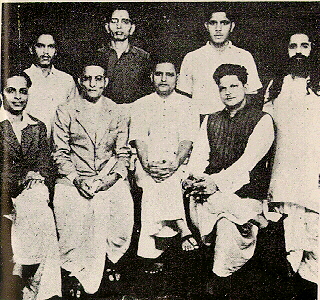
[[File:Nathuram.jpg|thumb|upright=1.35|A group photo of people accused in the Mahatma Gandhi's murder case. ''Standing'': [[Shankar Kistaiya]], [[Gopal Godse]], [[Madanlal Pahwa]], [[Digambar Badge]]. ''Sitting'': [[Narayan Apte]], | [[File:Nathuram.jpg|thumb|upright=1.35|A group photo of people accused in the Mahatma Gandhi's murder case. ''Standing'': [[Shankar Kistaiya]], [[Gopal Godse]], [[Madanlal Pahwa]], [[Digambar Badge]]. ''Sitting'': [[Narayan Apte]], Savarkar, [[Nathuram Godse]], [[Vishnu Ramkrishna Karkare|Vishnu Karkare]]]] | ||
{{See also|Assassination of Mahatma Gandhi}} | {{See also|Assassination of Mahatma Gandhi}} | ||
Following the assassination of Gandhi on 30 January 1948, police arrested the assassin [[Nathuram Godse]] and his alleged accomplices and conspirators. He was a member of the [[Hindu Mahasabha]] and of the [[Rashtriya Swayamsevak Sangh]]. Godse was the editor of ''Agrani – Hindu Rashtra'', a Marathi daily from Pune which was run by the company "The Hindu Rashtra Prakashan Ltd" (The Hindu Nation Publications). This company had contributions from such eminent persons as [[Gulabchand Hirachand]], [[Bhalji Pendharkar]], and [[Jugalkishore Birla]]. Savarkar had invested {{INR}} 15000 in the company. Savarkar, a former president of the Hindu Mahasabha, was arrested on 5 February 1948, from his house in [[Shivaji Park Residential Zone|Shivaji Park]], and kept under detention in the [[Arthur Road Jail|Arthur Road Prison]], Bombay. He was charged with murder, conspiracy to murder, and abetment to murder. | Following the assassination of Gandhi on 30 January 1948, police arrested the assassin [[Nathuram Godse]] and his alleged accomplices and conspirators. He was a member of the [[Hindu Mahasabha]] and of the [[Rashtriya Swayamsevak Sangh]]. Godse was the editor of ''Agrani – Hindu Rashtra'', a Marathi daily from Pune which was run by the company "The Hindu Rashtra Prakashan Ltd" (The Hindu Nation Publications). This company had contributions from such eminent persons as [[Gulabchand Hirachand]], [[Bhalji Pendharkar]], and [[Jugalkishore Birla]]. Savarkar had invested {{INR}} 15000 in the company. Savarkar, a former president of the Hindu Mahasabha, was arrested on 5 February 1948, from his house in [[Shivaji Park Residential Zone|Shivaji Park]], and kept under detention in the [[Arthur Road Jail|Arthur Road Prison]], Bombay. He was charged with murder, conspiracy to murder, and abetment to murder. The mass of papers seized from his house had revealed nothing that could remotely be connected with Gandhi's murder.<ref name="Malgonkar, M.">{{Cite book |title=The Men Who Killed Gandhi |author=Manohar Malgonkar |publisher=Lotus (Roli Books) |year=2008 |isbn=978-81-7436-617-7 |location=New Delhi |page=354}}</ref>{{rp|Chapter 12}} Due to lack of evidence, Savarkar was arrested under the Preventive Detention Act.<ref name="Malgonkar, M." />{{rp|Chapter 11}} | ||
==== Badge's testimony ==== | ==== Badge's testimony ==== | ||
Godse claimed full responsibility for planning and carrying out the assassination. However, according to the [[Turn state's evidence|Approver]] [[Digambar Badge]], on 17 January 1948, Nathuram Godse went to have a last ''darshan'' (audience/interview) with Savarkar in Bombay before the assassination. While Badge and Shankar waited outside, Nathuram and Apte went in. On coming out Apte told Badge that Savarkar blessed them "''Yashasvi houn ya''" ("''यशस्वी होऊन या''", be successful and return). Apte also said that Savarkar predicted that Gandhi's 100 years were over and there was no doubt that the task would be successfully finished.<ref>Abdul Gafoor Abdul Majeed Noorani (2002) ''Savarkar and Hindutva: the Godse connection '' LeftWord Books, {{ISBN|81-87496-28-2}}, {{ISBN|978-81-87496-28-1}} p. 4 & 114</ref><ref>''Mahatma Gandhi—the last phase, Volume 2'' Navajivan Pub. House, 1958 p.752</ref> However Badge's testimony was not accepted as the approver's evidence lacked independent corroboration and hence Savarkar was acquitted.{{ | Godse claimed full responsibility for planning and carrying out the assassination. However, according to the [[Turn state's evidence|Approver]] [[Digambar Badge]], on 17 January 1948, Nathuram Godse went to have a last ''darshan'' (audience/interview) with Savarkar in Bombay before the assassination. While Badge and Shankar waited outside, Nathuram and Apte went in. On coming out Apte told Badge that Savarkar blessed them "''Yashasvi houn ya''" ("''यशस्वी होऊन या''", be successful and return). Apte also said that Savarkar predicted that Gandhi's 100 years were over and there was no doubt that the task would be successfully finished.<ref>Abdul Gafoor Abdul Majeed Noorani (2002) ''Savarkar and Hindutva: the Godse connection '' LeftWord Books, {{ISBN|81-87496-28-2}}, {{ISBN|978-81-87496-28-1}} p. 4 & 114</ref><ref>''Mahatma Gandhi—the last phase, Volume 2'' Navajivan Pub. House, 1958 p.752</ref> However Badge's testimony was not accepted as the approver's evidence lacked independent corroboration and hence Savarkar was acquitted.{{citation needed|date=June 2023}} | ||
In the last week of August 1974, Mr. [[Manohar Malgonkar]] saw [[Digambar Badge|Digamber Badge]] several times and in particular, questioned him about the veracity of his testimony against Savarkar.<ref name="Malgonkar, M." />{{rp|Notes}} Badge insisted to Mr. [[Manohar Malgonkar]] that "even though he had blurted out the full story of the plot as far as he knew, without much persuasion, he had put up a valiant struggle against being made to testify against Savarkar".<ref name="Malgonkar, M." />{{rp|Chapter 12}} In the end, Badge gave in. He agreed to say on oath that he saw [[Nathuram Godse]] and Apte with Savarkar and that Savarkar, within Badge's hearing, had blessed their venture.<ref name="Malgonkar, M." />{{rp|Chapter 12}} | In the last week of August 1974, Mr. [[Manohar Malgonkar]] saw [[Digambar Badge|Digamber Badge]] several times and in particular, questioned him about the veracity of his testimony against Savarkar.<ref name="Malgonkar, M." />{{rp|Notes}} Badge insisted to Mr. [[Manohar Malgonkar]] that "even though he had blurted out the full story of the plot as far as he knew, without much persuasion, he had put up a valiant struggle against being made to testify against Savarkar".<ref name="Malgonkar, M." />{{rp|Chapter 12}} In the end, Badge gave in. He agreed to say on oath that he saw [[Nathuram Godse]] and Apte with Savarkar and that Savarkar, within Badge's hearing, had blessed their venture.<ref name="Malgonkar, M." />{{rp|Chapter 12}} | ||
| Line 139: | Line 139: | ||
==== Kapur commission ==== | ==== Kapur commission ==== | ||
{{See also|Kapur Commission}} | {{See also|Kapur Commission}} | ||
On 12 November 1964, at a religious program | On 12 November 1964, at a religious program organised in Pune to celebrate the release of [[Gopal Godse]], [[Madanlal Pahwa]] and [[Vishnu Ramkrishna Karkare|Vishnu Karkare]] from jail after the expiry of their sentences, G. V. Ketkar, grandson of [[Bal Gangadhar Tilak]],<ref>{{cite web |title=Interview: K. Ketkar |publisher=University of Cambridge, Centre of South Asian Studies |url=http://www.s-asian.cam.ac.uk/archive/audio/ketkar.html |access-date=29 August 2009 |archive-url=https://web.archive.org/web/20131202222351/http://www.s-asian.cam.ac.uk/archive/audio/ketkar.html |archive-date=2 December 2013 |url-status=dead}}</ref> former editor of [[Kesari (Marathi newspaper)|Kesari]] and then editor of "''Tarun Bharat''", who presided over the function, gave information of a conspiracy to kill Gandhi, about which he professed knowledge six months before the act. Ketkar was arrested. A public furor ensued both outside and inside the [[Maharashtra Legislative Assembly]] and both houses of the [[Indian parliament]]. Under the pressure of 29 members of parliament and public opinion the then Union home minister [[Gulzarilal Nanda]] appointed [[Gopal Swarup Pathak]], M. P. and a senior advocate of the Supreme Court of India as a Commission of Inquiry to re-investigate the conspiracy to murder Gandhi. The central government intended on conducting a thorough inquiry with the help of old records in consultation with the government of Maharashtra. Pathak was given three months to conduct his inquiry; subsequently, Jevanlal Kapur, a retired judge of the [[Supreme Court of India]], was appointed chairman of the commission.<ref name="Jain">{{Cite book |author=Jagdishchandra Jain |title=Gandhi the forgotten Mahatma |publisher=Mittal Publications |year=1987 |location=New Delhi |isbn=978-81-7099-037-6}}</ref> | ||
The commission's reinvestigation saw Savarkar's secretary and bodyguard to have testified that Savarkar met with Godse and Apte right before Gandhi was killed.<ref>{{cite book | last=Sitapati | first=V. | title=Jugalbandi: The BJP Before Modi | publisher=Penguin Random House India Private Limited | year=2020 | isbn=978-93-5305-989-7 | url=https://books.google.com/books?id=Hz0HEAAAQBAJ | page=46}}</ref> | The commission's reinvestigation saw Savarkar's secretary and bodyguard to have testified that Savarkar met with Godse and Apte right before Gandhi was killed.<ref>{{cite book | last=Sitapati | first=V. | title=Jugalbandi: The BJP Before Modi | publisher=Penguin Random House India Private Limited | year=2020 | isbn=978-93-5305-989-7 | url=https://books.google.com/books?id=Hz0HEAAAQBAJ | page=46 | access-date=19 November 2022 | archive-date=19 November 2022 | archive-url=https://web.archive.org/web/20221119003451/https://books.google.com/books?id=Hz0HEAAAQBAJ | url-status=live }}</ref> | ||
The commission was provided with evidence not produced in the court; especially the testimony of two of Savarkar's close aides – Appa Ramachandra Kasar, his bodyguard, and Gajanan Vishnu Damle, his secretary.<ref name="Savarkar and Gandhi">{{Cite magazine |author=A. G. Noorani |title=Savarkar and Gandhi |magazine=Frontline |date=15–28 March 2003 |volume=20 |issue=6 |url= http://www.hindu.com/fline/fl2006/stories/20030328003603400.htm|access-date=29 August 2009|archive-url= https://web.archive.org/web/20090822152732/http://www.hindu.com/fline/fl2006/stories/20030328003603400.htm |archive-date=22 August 2009 |url-status=live}}</ref> The testimony of Mr. Kasar and Mr. Damle was already recorded by [[Bombay]] police on 4 March 1948,<ref name="Kapur, J.L.">{{Cite book |url=https://archive.org/stream/JeevanlalKapoorCommissionReport/JeevanLalKapurCommissionReport_PART2-D#page/n16/mode/1up |title=Report of Commission of Inquiry into Conspiracy to Murder Mahatma |author=J. L. Kapur |publisher=Government of India |year=1969 |access-date=30 October 2018 |archive-url=https://web.archive.org/web/20160909235331/https://archive.org/stream/JeevanlalKapoorCommissionReport/JeevanLalKapurCommissionReport_PART2-D#page/n16/mode/1up |archive-date=9 September 2016 |url-status=live }}</ref>{{rp|317}} but apparently, these testimonies were not presented before the court during the trial. In these testimonies, it is said that Godse and Apte visited Savarkar on or about 23 or 24 January,<ref name="Kapur, J.L." />{{rp|317}} which was when they returned from Delhi after the bomb incident. Damle deposed that Godse and Apte saw Savarkar in the middle of January and sat with him (Savarkar) in his garden. The C. I. D. Bombay was keeping vigil on Savarkar from 21 to 30 January 1948.<ref name="Kapur, J.L." />{{rp|291–294}} The crime report from C. I. D. does not mention Godse or Apte meeting Savarkar during this time.<ref name="Kapur, J.L." />{{rp|291–294}} | The commission was provided with evidence not produced in the court; especially the testimony of two of Savarkar's close aides – Appa Ramachandra Kasar, his bodyguard, and Gajanan Vishnu Damle, his secretary.<ref name="Savarkar and Gandhi">{{Cite magazine |author=A. G. Noorani |title=Savarkar and Gandhi |magazine=Frontline |date=15–28 March 2003 |volume=20 |issue=6 |url= http://www.hindu.com/fline/fl2006/stories/20030328003603400.htm|access-date=29 August 2009|archive-url= https://web.archive.org/web/20090822152732/http://www.hindu.com/fline/fl2006/stories/20030328003603400.htm |archive-date=22 August 2009 |url-status=live}}</ref> The testimony of Mr. Kasar and Mr. Damle was already recorded by [[Bombay]] police on 4 March 1948,<ref name="Kapur, J.L.">{{Cite book |url=https://archive.org/stream/JeevanlalKapoorCommissionReport/JeevanLalKapurCommissionReport_PART2-D#page/n16/mode/1up |title=Report of Commission of Inquiry into Conspiracy to Murder Mahatma |author=J. L. Kapur |publisher=Government of India |year=1969 |access-date=30 October 2018 |archive-url=https://web.archive.org/web/20160909235331/https://archive.org/stream/JeevanlalKapoorCommissionReport/JeevanLalKapurCommissionReport_PART2-D#page/n16/mode/1up |archive-date=9 September 2016 |url-status=live }}</ref>{{rp|317}} but apparently, these testimonies were not presented before the court during the trial. In these testimonies, it is said that Godse and Apte visited Savarkar on or about 23 or 24 January,<ref name="Kapur, J.L." />{{rp|317}} which was when they returned from Delhi after the bomb incident. Damle deposed that Godse and Apte saw Savarkar in the middle of January and sat with him (Savarkar) in his garden. The C. I. D. Bombay was keeping vigil on Savarkar from 21 to 30 January 1948.<ref name="Kapur, J.L." />{{rp|291–294}} The crime report from C. I. D. does not mention Godse or Apte meeting Savarkar during this time.<ref name="Kapur, J.L." />{{rp|291–294}} | ||
| Line 152: | Line 152: | ||
After Gandhi's assassination, Savarkar's home in Dadar, Bombay was stoned by angry mobs. After he was acquitted of the allegations related to Gandhi's assassination and released from jail, Savarkar was arrested by the government for making "Hindu nationalist speeches"; he was released after agreeing to give up political activities. He continued addressing the social and cultural elements of Hindutva. He resumed political activism after the ban on it was lifted; it was however limited until his death in 1966 because of ill health. | After Gandhi's assassination, Savarkar's home in Dadar, Bombay was stoned by angry mobs. After he was acquitted of the allegations related to Gandhi's assassination and released from jail, Savarkar was arrested by the government for making "Hindu nationalist speeches"; he was released after agreeing to give up political activities. He continued addressing the social and cultural elements of Hindutva. He resumed political activism after the ban on it was lifted; it was however limited until his death in 1966 because of ill health. | ||
In 1956, he opposed [[B. R. Ambedkar]]'s conversion to Buddhism calling it a "useless act", to which Ambedkar responded by publicly questioning the use of epithet ‘''Veer''’ (meaning ''brave'') by Savarkar.<ref>{{cite web | title=RSS and Ambedkar: A Camaraderie That Never Existed | website=The Wire | date=2018-04-14 | url=https://thewire.in/politics/rss-ambedkar-camaraderie-fictional-narratives | access-date=2022-11-18}}</ref> | In 1956, he opposed [[B. R. Ambedkar]]'s conversion to Buddhism calling it a "useless act", to which Ambedkar responded by publicly questioning the use of epithet ‘''Veer''’ (meaning ''brave'') by Savarkar.<ref>{{cite web | title=RSS and Ambedkar: A Camaraderie That Never Existed | website=The Wire | date=2018-04-14 | url=https://thewire.in/politics/rss-ambedkar-camaraderie-fictional-narratives | access-date=2022-11-18 | archive-date=13 November 2022 | archive-url=https://web.archive.org/web/20221113131239/https://thewire.in/politics/rss-ambedkar-camaraderie-fictional-narratives | url-status=live }}</ref> | ||
On 22 November 1957, [[Raja Mahendra Pratap]] moved a bill in [[Lok Sabha]] to recognise the service to the country of people like Vir Savarkar, [[Barindra Kumar Ghosh]] and [[Bhupendranath Datta]]. But the bill was defeated with 48 votes favouring it and 75 against it. This bill was also supported by communist leader like [[A. K. Gopalan]].<ref>{{Cite web |last=Yadav |first=Shyamlal |date=2023-04-01 |title=Divided over Savarkar: Once upon a time, CPI MPs, Feroze Gandhi spoke up for him |url=https://indianexpress.com/article/political-pulse/savarkar-row-cpi-mp-feroze-gandhi-spoke-up-for-him-8532389/ |access-date=2023-04-02 |website=The Indian Express |language=en}}</ref><ref>{{Cite journal |title=Recognition (of Services to the country) Bill |url=https://eparlib.nic.in/handle/123456789/898871 |website=Lok Sabha Digital Library|date=18 July 2022 |last1=Gandhi |first1=Feroze |last2=Gopalan |first2=Ayillath Kuttieri |last3=Pai |first3=Bapu Nath |last4=Tyagi |first4=Mahavir |last5=Chaudhuri |first5=Tridib |last6=Datar |first6=Balwantrao Nageshrao |last7=Tahir |first7=Mohammad |last8=Sen |first8=Ashok Kumar |last9=Narasimhan |first9=C. R. |last10=Singh (Patiala) |first10=Hukum |last11=Pratap |first11=Mahendra }}</ref> | On 22 November 1957, [[Raja Mahendra Pratap]] moved a bill in [[Lok Sabha]] to recognise the service to the country of people like Vir Savarkar, [[Barindra Kumar Ghosh]] and [[Bhupendranath Datta]]. But the bill was defeated with 48 votes favouring it and 75 against it. This bill was also supported by communist leader like [[A. K. Gopalan]].<ref>{{Cite web |last=Yadav |first=Shyamlal |date=2023-04-01 |title=Divided over Savarkar: Once upon a time, CPI MPs, Feroze Gandhi spoke up for him |url=https://indianexpress.com/article/political-pulse/savarkar-row-cpi-mp-feroze-gandhi-spoke-up-for-him-8532389/ |access-date=2023-04-02 |website=The Indian Express |language=en |archive-date=2 April 2023 |archive-url=https://web.archive.org/web/20230402202827/https://indianexpress.com/article/political-pulse/savarkar-row-cpi-mp-feroze-gandhi-spoke-up-for-him-8532389/ |url-status=live }}</ref><ref>{{Cite journal |title=Recognition (of Services to the country) Bill |url=https://eparlib.nic.in/handle/123456789/898871 |website=Lok Sabha Digital Library |date=18 July 2022 |last1=Gandhi |first1=Feroze |last2=Gopalan |first2=Ayillath Kuttieri |last3=Pai |first3=Bapu Nath |last4=Tyagi |first4=Mahavir |last5=Chaudhuri |first5=Tridib |last6=Datar |first6=Balwantrao Nageshrao |last7=Tahir |first7=Mohammad |last8=Sen |first8=Ashok Kumar |last9=Narasimhan |first9=C. R. |last10=Singh (Patiala) |first10=Hukum |last11=Pratap |first11=Mahendra |access-date=2 April 2023 |archive-date=2 April 2023 |archive-url=https://web.archive.org/web/20230402184940/https://eparlib.nic.in/handle/123456789/898871 |url-status=live }}</ref> | ||
=== Death === | === Death === | ||
On 8 November 1963, Savarkar's wife, Yamunabai, died. On 1 February 1966, Savarkar renounced medicines, food, and water which | On 8 November 1963, Savarkar's wife, Yamunabai, died. On 1 February 1966, Savarkar renounced medicines, food, and water which was termed as ''[[Prayopavesa|prayopavesha]]'' (fast until death).<ref>Rationalism : Collected Works of Justice R.A. Jahagirdar (Retd.) (1927-2011) pg. 122</ref> Before his death, he had written an article titled "Atmahatya Nahi Atmaarpan" in which he argued that when one's life mission is over and the ability to serve society is left no more, it is better to end the life at will rather than waiting for death. His condition was described to have become as "extremely serious" before his death on 26 February 1966 at his residence in [[Bombay]] (now Mumbai), and that he faced difficulty in breathing; efforts to revive him failed, and was declared dead at 11:10 a.m. ([[Indian Standard Time|IST]]) that day. Prior to his death, Savarkar had asked his relatives to perform only his [[Funeral#Hindu|funeral]] and do away with the rituals of the 10th and 13th day of the Hindu faith.<ref>{{cite news |title=Savarkar dead |url=https://news.google.com/newspapers?id=YYplAAAAIBAJ&pg=219%2C831059 |access-date=28 February 2018 |work=The Indian Express |date=27 February 1966 |pages=1, 5 |archive-date=16 April 2021 |archive-url=https://web.archive.org/web/20210416035235/https://news.google.com/newspapers?id=YYplAAAAIBAJ&pg=219%2C831059 |url-status=live }}</ref> Accordingly, his last rites were performed at an electric crematorium in Bombay's Sonapur locality by his son Vishwas the following day.<ref>{{cite news |title=Savarkar's last journey |url=https://news.google.com/newspapers?nid=P9oYG7HA76QC&dat=19660228&printsec=frontpage&hl=en |access-date=28 February 2018 |newspaper=The Indian Express |agency=Press Trust of India |date=28 February 1966 |page=1 |archive-date=14 October 2021 |archive-url=https://web.archive.org/web/20211014021025/https://news.google.com/newspapers?nid=P9oYG7HA76QC&dat=19660228&printsec=frontpage&hl=en |url-status=live }}</ref> | ||
There was no official mourning by the | There was no official mourning by the [[Maharashtra Pradesh Congress Committee]] or the central government in Delhi during the time of his death. No minister from the Maharashtra Cabinet paid homage to Savarkar.{{sfn|McKean|1996|p=95}}{{#tag:ref|After his death, since Savarkar was championing militarisation, some thought that it would be fitting if his mortal remains were to be carried on a gun-carriage. A request to that effect was made to the then Defence Minister, [[Yashwantrao Chavan|Y.B. Chavan]]. But Chavan turned down the proposal and not a single minister from the Maharashtra Cabinet showed up to the cremation ground to pay homage to Savarkar. In New Delhi, the Speaker of the Lok Sabha turned down a request that it pay homage to Savarkar.|group=note}} The political indifference to Savarkar has also continued after his death.{{#tag:ref|When Y.B. Chavan, as the Home Minister of India, went to the Andaman Islands; he was asked whether he would like to visit Savarkar's jail but he was not interested.{{citation needed|reason=Your explanation here|date=January 2016}} When [[Morarji Desai]] visited as Prime Minister to the Andaman islands, he too refused to visit Savarkar in his prison cell.<ref name="kuru">J. Kuruvachira (2006) ''Hindu nationalists of modern India: a critical study of the intellectual genealogy of Hindutva'' Rawat Publications. {{ISBN|81-7033-995-2}}, {{ISBN|978-81-7033-995-3}}</ref>|group=note}} After the death of Nehru, the Congress government, under Prime Minister [[Lal Bahadur Shastri|Shastri]], started to pay him a monthly pension.{{sfn|McKean|1996|p=94}} | ||
The political indifference to Savarkar | |||
After the death of Nehru, the Congress government, under Prime Minister [[Lal Bahadur Shastri|Shastri]], started to pay him a monthly pension.{{sfn|McKean|1996|p=94}} | |||
== Religious and political views == | == Religious and political views == | ||
{{Conservatism in India|Politicians}} | |||
=== Hindutva === | |||
{{Main|Hindutva}} | |||
{{See also|Hindu nationalism}}In contrast with [[Dayananda Saraswati]], [[Swami Vivekananda]] and [[Sri Aurobindo]], who were "men of religion" who introduced reforms in the society and put Hinduism in front of the world, Savarkar formulated an extreme form of Hindu nationalism.{{sfn|Jyotirmaya Sharma|2011|p=127}} | |||
{{See also | |||
During his incarceration, Savarkar's views began turning increasingly towards Hindu cultural and political nationalism, and the next phase of his life remained dedicated to this cause.<ref name="Bio">{{cite web |author=Vinay Lal |date=22 October 2006 |url=http://www.sscnet.ucla.edu/southasia/History/Hindu_Rashtra/veer.html |title=Veer Savarkar – Ideologue of Hindutva |format=PHP |access-date=22 October 2006 |archive-url=https://web.archive.org/web/20060909130633/http://www.sscnet.ucla.edu/southasia/History/Hindu_Rashtra/veer.html |archive-date=9 September 2006 |url-status=dead }}</ref> In the brief period he spent at the Ratnagiri jail, Savarkar | During his incarceration, Savarkar's views began turning increasingly towards Hindu cultural and political nationalism, and the next phase of his life remained dedicated to this cause.<ref name="Bio">{{cite web |author=Vinay Lal |date=22 October 2006 |url=http://www.sscnet.ucla.edu/southasia/History/Hindu_Rashtra/veer.html |title=Veer Savarkar – Ideologue of Hindutva |format=PHP |access-date=22 October 2006 |archive-url=https://web.archive.org/web/20060909130633/http://www.sscnet.ucla.edu/southasia/History/Hindu_Rashtra/veer.html |archive-date=9 September 2006 |url-status=dead }}</ref> In the brief period he spent at the Ratnagiri jail, Savarkar published his ideological epigraph – ''[[Essentials of Hindutva]]'' in 1923.<ref name="Counterview">{{cite web |last=Representative |first=Our |date=24 January 2016 |title=Savarkar in Ahmedabad 'declared' two-nation theory in 1937, Jinnah followed 3 years later |url=https://www.counterview.net/2016/01/savarkar-in-ahmedabad-declared-support.html?m=1 |url-status=unfit |archive-url=https://web.archive.org/web/20200606024705/https://www.counterview.net/2016/01/savarkar-in-ahmedabad-declared-support.html |archive-date=6 June 2020 |website=Counterview}}</ref> In this work, Savarkar promotes a farsighted new vision of Hindu social and political consciousness. Savarkar began describing a "Hindu" as a patriotic inhabitant of [[Bharatavarsha]], venturing beyond a religious identity.<ref name="Bio" /> While emphasising the need for patriotic and social unity of all Hindu communities, he described [[Hinduism]], [[Jainism]], [[Sikhism]] and [[Buddhism]] as one and the same. He outlined his vision of a "[[Hindu Rashtra]]" (''Hindu Nation'') as "[[Akhand Bharat]]" (''United India''), purportedly stretching across the entire [[Indian subcontinent]].<ref>MISRA, AMALENDU. "SAVARKAR AND THE DISCOURSE ON ISLAM IN PRE-INDEPENDENT INDIA." Journal of Asian History, vol. 33, no. 2, 1999, pp. 142–84. JSTOR, http://www.jstor.org/stable/41933141 {{Webarchive|url=https://web.archive.org/web/20221028232051/https://www.jstor.org/stable/41933141 |date=28 October 2022 }}. Accessed 28 Oct. 2022.</ref> | ||
According to Sharma, Savarkar's celebration and justification of violence against [British] women and children in his description of the Mutiny of 1857, "transformed Hindutva into the very image of Islam that he defined and found so intolerably objectionable".{{sfn|Jyotirmaya Sharma|2011|p=148}} | According to Sharma, Savarkar's celebration and justification of violence against [British] women and children in his description of the Mutiny of 1857, "transformed Hindutva into the very image of Islam that he defined and found so intolerably objectionable".{{sfn|Jyotirmaya Sharma|2011|p=148}} | ||
Scholars, historians and Indian politicians have been divided in their interpretation of Savarkar's ideas. A self-described atheist,<ref name="Pramod_Kumar_1992">{{Cite book|chapter-url=http://idcindia.org/wp-content/themes/idc/pdf/3.communalism/TOWARDS%20UNDERSTANDING%20COMMUNALISM-DRP-1992.pdf|title=Towards Understanding Communalism|last=Chandra|first=Bipan|date=June 1992|publisher=Centre for Research in Rural and Industrial Development|isbn=978-81-85835-17-4|editor-last=Kumar|editor-first=Pramod|location=Chandigarh|page=384|chapter=Use Of History and Growth Of Communalism|oclc=27810012|author-link=Bipan Chandra|access-date=10 October 2019|archive-date=17 January 2020|archive-url=https://web.archive.org/web/20200117154249/http://idcindia.org/wp-content/themes/idc/pdf/3.communalism/TOWARDS%20UNDERSTANDING%20COMMUNALISM-DRP-1992.pdf|url-status=live}}</ref> Savarkar | Scholars, historians and Indian politicians have been divided in their interpretation of Savarkar's ideas. A self-described atheist,<ref name="Pramod_Kumar_1992">{{Cite book|chapter-url=http://idcindia.org/wp-content/themes/idc/pdf/3.communalism/TOWARDS%20UNDERSTANDING%20COMMUNALISM-DRP-1992.pdf|title=Towards Understanding Communalism|last=Chandra|first=Bipan|date=June 1992|publisher=Centre for Research in Rural and Industrial Development|isbn=978-81-85835-17-4|editor-last=Kumar|editor-first=Pramod|location=Chandigarh|page=384|chapter=Use Of History and Growth Of Communalism|oclc=27810012|author-link=Bipan Chandra|access-date=10 October 2019|archive-date=17 January 2020|archive-url=https://web.archive.org/web/20200117154249/http://idcindia.org/wp-content/themes/idc/pdf/3.communalism/TOWARDS%20UNDERSTANDING%20COMMUNALISM-DRP-1992.pdf|url-status=live}}</ref> Savarkar regarded being Hindu as a cultural and political identity. He often stressed social and community unity between Hindus, Sikhs, Buddhists and Jains, to the exclusion of Muslims and Christians. Savarkar saw Muslims and Christians as "misfits" in the Indian civilisation who could not truly be a part of the nation.<ref name="Clarke">{{cite book |title=Competing Fundamentalisms: Violent Extremism in Christianity, Islam, and Hinduism |year=2017 |author=Sathianathan Clarke |publisher=Westminster John Knox Press}}</ref> He argued that the holiest sites of Islam and Christianity are in the Middle East and not India, hence the loyalty of Muslims and Christians to India is divided.<ref name="Clarke" /><ref>{{cite book |title=Amar Akbar Anthony: Bollywood, Brotherhood, and the Nation |author=William Elison |url=https://books.google.com/books?id=qANuCwAAQBAJ&pg=PT149 |isbn=978-0-674-49599-9 |date=2016 |publisher=Harvard University Press |access-date=24 June 2017 |archive-date=14 October 2021 |archive-url=https://web.archive.org/web/20211014021015/https://books.google.com/books?id=qANuCwAAQBAJ&lpg=PT149 |url-status=live }}</ref> | ||
Focusing his energies on writing, Savarkar authored the ''Hindu Pad-pada-shahi''<ref name="Rediff" /> – a book documenting the [[Maratha empire]] – and ''My Transportation for Life'' – an account of his early revolutionary days, arrest, trial and incarceration.<ref>{{Cite book |title=My Transportation for Life |author=Vinayak Savarkar |publisher=Swatantryaveer Savarkar Rashtriya Smarak Trust |year=1984 |location=Mumbai (India) }}</ref> He also wrote and published a collection of poems, plays and novels. He also wrote a book named ''Majhi Janmathep'' ("My Life-term") about his experience in Andaman prison.<ref>{{Cite book |title=Mazi Janmathep |author=Vinayak Savarkar |publisher=Parchure Prakashan Mandir |year=1927 |isbn=978-81-86530-12-2 }}</ref> | Focusing his energies on writing, Savarkar authored the ''Hindu Pad-pada-shahi''<ref name="Rediff" /> – a book documenting the [[Maratha empire]] – and ''My Transportation for Life'' – an account of his early revolutionary days, arrest, trial and incarceration.<ref>{{Cite book |title=My Transportation for Life |author=Vinayak Savarkar |publisher=Swatantryaveer Savarkar Rashtriya Smarak Trust |year=1984 |location=Mumbai (India) }}</ref> He also wrote and published a collection of poems, plays and novels. He also wrote a book named ''Majhi Janmathep'' ("My Life-term") about his experience in Andaman prison.<ref>{{Cite book |title=Mazi Janmathep |author=Vinayak Savarkar |publisher=Parchure Prakashan Mandir |year=1927 |isbn=978-81-86530-12-2 }}</ref> | ||
=== Hindu orthodoxy === | === Hindu orthodoxy === | ||
He was an ardent critique of a number of Hindu religious practices he saw as irrational and viewed them as a hindrance to the material progress of the Hindus. He believed that religion is an unimportant aspect of "Hindu identity". | He was an ardent critique of a number of Hindu religious practices he saw as irrational and viewed them as a hindrance to the material progress of the Hindus. He believed that religion is an unimportant aspect of "Hindu identity". | ||
He was opposed to the [[Caste system in India|caste system]] and in his 1931 essay titled ''Seven Shackles of the Hindu Society,'' he wrote "One of the most important components of such injunctions of the past that we have blindly carried on and which deserves to be thrown in the dustbins of history is the rigid caste system".<ref>{{cite web|last=Sampath|first=Vikram|title=Savarkar wanted to smash caste system, cooked prawns and didn't worship the cow|url=https://theprint.in/opinion/savarkar-wanted-to-smash-caste-system-cooked-prawns-and-didnt-worship-the-cow/161016/|url-status=live|website=theprint.in|date=10 December 2018|access-date=11 July 2021|archive-date=3 February 2021|archive-url=https://web.archive.org/web/20210203054927/https://theprint.in/opinion/savarkar-wanted-to-smash-caste-system-cooked-prawns-and-didnt-worship-the-cow/161016/}}</ref>{{sfn|Sampath|2019|pp=481-482}} | He was opposed to the [[Caste system in India|caste system]] and in his 1931 essay titled ''Seven Shackles of the Hindu Society,'' he wrote "One of the most important components of such injunctions of the past that we have blindly carried on and which deserves to be thrown in the dustbins of history is the rigid caste system".<ref>{{cite web|last=Sampath|first=Vikram|title=Savarkar wanted to smash caste system, cooked prawns and didn't worship the cow|url=https://theprint.in/opinion/savarkar-wanted-to-smash-caste-system-cooked-prawns-and-didnt-worship-the-cow/161016/|url-status=live|website=theprint.in|date=10 December 2018|access-date=11 July 2021|archive-date=3 February 2021|archive-url=https://web.archive.org/web/20210203054927/https://theprint.in/opinion/savarkar-wanted-to-smash-caste-system-cooked-prawns-and-didnt-worship-the-cow/161016/}}</ref>{{sfn|Sampath|2019|pp=481-482}} | ||
However, in 1939, Savarkar assured that his party Hindu Mahasabha won't necessarily support entry of the [[Untouchability|untouchables]] into temples. Savarkar said, "Thus the Party will not introduce or support compulsory Legislature regarding Temple Entry by the untouchables etc. in old temples beyond the limit to which the non-Hindus are allowed by custom as in force today."<ref>{{cite book | last1=Savarkar | first1=V.D. | last2=Bhide | first2=Anant Sadashiv | title=Veer Savarkar's "Whirl-wind Propaganda.": Statements, Messages & Extracts from the President's Diary of His Propagandistic Tours, Interviews from December 1937 to October 1941 | year=1941 | url=https://books.google.com/books?id=kTIdAAAAMAAJ | page=128}}</ref><ref name="Islam 2022">{{cite web | last=Islam | first=Shamsul | title=Truth about Savarkar and caste | website=The Indian Express | date=2022-03-23 | url=https://indianexpress.com/article/opinion/columns/truth-about-savarkar-and-caste-7832134/}}</ref> | However, in 1939, Savarkar assured that his party Hindu Mahasabha won't necessarily support entry of the [[Untouchability|untouchables]] into temples. Savarkar said, "Thus the Party will not introduce or support compulsory Legislature regarding Temple Entry by the untouchables etc. in old temples beyond the limit to which the non-Hindus are allowed by custom as in force today."<ref>{{cite book | last1=Savarkar | first1=V.D. | last2=Bhide | first2=Anant Sadashiv | title=Veer Savarkar's "Whirl-wind Propaganda.": Statements, Messages & Extracts from the President's Diary of His Propagandistic Tours, Interviews from December 1937 to October 1941 | year=1941 | url=https://books.google.com/books?id=kTIdAAAAMAAJ | page=128 | access-date=1 May 2023 | archive-date=13 May 2023 | archive-url=https://web.archive.org/web/20230513091937/https://books.google.com/books?id=kTIdAAAAMAAJ | url-status=live }}</ref><ref name="Islam 2022">{{cite web | last=Islam | first=Shamsul | title=Truth about Savarkar and caste | website=The Indian Express | date=2022-03-23 | url=https://indianexpress.com/article/opinion/columns/truth-about-savarkar-and-caste-7832134/ | access-date=1 May 2023 | archive-date=1 May 2023 | archive-url=https://web.archive.org/web/20230501212438/https://indianexpress.com/article/opinion/columns/truth-about-savarkar-and-caste-7832134/ | url-status=live }}</ref> | ||
=== Constitution of India === | |||
{{See also|Constitution of India}} Savarkar in his book, ''"Women in Manusmriti"'', he wrote: "The worst about the new constitution of [[India|Bharat]] is that there is nothing Bharatiya (Indian) about it. [[Manusmriti]] is that scripture which is most worship-able after [[Vedas]] for our [[Hindu nationalism|Hindu Nation]] and which from ancient times has become the basis of our culture-customs, thought and practice. This book for centuries has codified the spiritual and divine march of our nation. Even today the rules which are followed by crores of [[Hindus]] in their lives and practice are based on [[Manusmriti]]."<ref>{{cite web|title=Ambedkar 'insulted' by Amit Shah: Did 'BJP's predecessors' burn Babasaheb's effigy, as Jairam Ramesh said?|date=20 January 2025 |url=https://indianexpress.com/article/explained/explained-politics/ambedkar-burn-effigy-amit-shah-9731980/lite/}}</ref> [[B. R. Ambedkar]], Chairman of the committee that drafted the [[Constitution of India]], criticised [[Manusmriti]] as responsible for [[caste system in India]].<ref name=nicholasdirks266>Nicholas Dirks (2001), ''Castes of Mind: Colonialism and the Making of Modern India'', Princeton University Press, {{ISBN|978-0691088952}}, pp. 266–269</ref> | |||
=== Fascism === | === Fascism === | ||
{{Fascism sidebar}} | {{Fascism sidebar}} | ||
{{ | {{Main|Fascism}} | ||
In a speech before | |||
In a speech on "India's foreign policy" before about 20,000 people in [[Pune]] on 1 August 1938, Savarkar stated that "India's foreign policy must not depend on 'isms'" and that [[Germany]] had the right to adopt [[Nazism]] and [[Fascist Italy|Italy]] to Fascism; such systems were suited to their national conditions and had contributed to their strength and consolidation. Savarkar criticised Nehru for denouncing Germany and Italy, proclaiming that "crores of Hindu Sanghatanists in India [..] cherish[ed] no ill-will towards Germany or Italy or [[Imperial Japan]]." He defended Germany's position on [[Czechoslovakia]], stating that Germany was justified in uniting Austrian and Sudeten Germans under its rule and that "the Germans under the Czechs wanted to join their kith and kin in Germany".<ref name="Casolari">{{cite journal|author=Marzia Casolari|title=Hindutva's Foreign Tie-Up in the 1930s: Archival Evidence|journal=Economic and Political Weekly|volume=35|issue=4|pages=222–224}}</ref> | |||
As [[World War II]] become imminent, Savarkar had initially advocated a policy of neutralism centered on India's geostrategic equations but his rhetoric grew coarser with time and he expressed consistent support for Hitler's policy about Jews.<ref name="Casolari" /><ref name=":1">{{Cite book|last=Bhatt|first=Chetan|title=Hindu Nationalism: Origins, Ideologies and Modern Myths|publisher=Routledge|year=2001|isbn=9781859733486|pages=107–108|language=}}</ref> In a speech on 14 October, it was suggested that Hitler's ways be adopted for dealing with Indian Muslims. On 11 December, he characterised the Jews as a communal force. Next March, Savarkar would welcome Germany's revival of Aryan culture, their appropriation of [[Swastika]], and the "crusade" against Aryan enemies; it was hoped that German victory would finally invigorate the Hindus of India.<ref name="Casolari" /> | |||
On 5 August 1939, Savarkar highlighted how a common strand of "thought, religion, language, and culture" was essential to nationality thus preventing the [[Germans]] and [[Jews]] from being considerable as one nation.<ref name="Casolari" /> By the year end, he was directly equating the [[Indian Muslims|Muslims of India]] with [[German Jews]]; in the words of Chetan Bhatt, both were suspected of harboring extra-national loyalties and became illegitimate presences in an organic nation.<ref name="Casolari" /><ref name=":1" /><ref>{{cite book|author=Yulia Egorova|title=Jews and India: Perceptions and Image|publisher=Routledge|year=2008|page=41}}</ref> These speeches circulated in German newspapers with Nazi Germany even allotting a point-of-contact person for engaging with Savarkar, who was making sincere efforts to forge a working relationship with the Nazis. Eventually, Savarkar would be gifted with a copy of [[Mein Kampf]].<ref name="Casolari" /> | |||
=== Nazis and Jews === | |||
Savarkar supported [[Anti-Jewish legislation in pre-war Nazi Germany|Hitler's anti-Jewish policy]]. In 1939, he deemed that "Germans and the Jews could not be regarded as a nation". In the same year, he compared [[Indian Muslims]] with the Jews of Germany by saying "Indian Muslims are on the whole more inclined to identify themselves and their interests with Muslims outside India than Hindus who live next door, like Jews in Germany".<ref name="Ravishankar">{{cite web | last=Ravishankar | first=Ra. | title=The real Sarvarkar | website=Frontline | date=2002-07-19 | url=https://frontline.thehindu.com/other/article30245603.ece | access-date=2023-10-19 | archive-date=20 November 2023 | archive-url=https://web.archive.org/web/20231120203021/https://frontline.thehindu.com/other/article30245603.ece | url-status=live }}</ref><ref name="Casolari218–228">{{cite journal | last=Casolari | first=Marzia | title=Hindutva's Foreign Tie-Up in the 1930s: Archival Evidence | journal=Economic and Political Weekly | volume=35 | issue=4 | year=2000 | issn=00129976<!--This provisional record has been produced before publication of the resource. The published resource has not yet been checked by the ISSN Network.It is only available to subscribing users. 23498846 --> | jstor=4408848 | pages=218–228 | url=http://www.jstor.org/stable/4408848 | access-date=2023-10-19 | archive-date=22 November 2023 | archive-url=https://web.archive.org/web/20231122131000/https://www.jstor.org/stable/4408848 | url-status=live }}</ref> | |||
In 1941, Savarkar [[Zionist antisemitism|supported Jews]] resettling their [[Land of Israel|fatherland of Israel]], in what he believed would defend the world against Islamic aggression.<ref name=":1" /><ref>{{cite book|author=M. Friedman|title=Partisan Histories: The Past in Contemporary Global Politics|author2=P. Kenney|publisher=Springer|page=115}}</ref> In his letter dated 19 December 1947, Savarkar celebrated "[[Israeli Declaration of Independence|the establishment of the independent Jewish State]] in [[Palestine (region)|Palestine]] on moral as well as political grounds" while adding that "the Jewish people bear no political ill-will towards [[Hindutva|Hindudom]]".<ref name="Anon. v651">{{cite web |title=God and Politics in Secular India |url=https://philarchive.org/archive/MARGAP-2 |access-date=2023-10-19}}</ref><ref>{{Cite web |last=Gupta |first=Anoop Kumar |title=Revisiting Indian Discourse on Zionism and Israel |url=http://blogs.timesofisrael.com/revisiting-indian-discourse-on-zionism-and-israel/ |access-date=2023-10-19 |website=blogs.timesofisrael.com |language=en-US |archive-date=21 November 2023 |archive-url=https://web.archive.org/web/20231121164521/https://blogs.timesofisrael.com/revisiting-indian-discourse-on-zionism-and-israel/ |url-status=live }}</ref> | |||
It remains unknown whether Savarkar withdrew his support for Nazi Germany after [[the Holocaust]] became common knowledge.<ref name=":1" /> However, on 15 January 1961 he had spoken favorably of Hitler's Nazism against Nehru's "cowardly democracy".<ref name=":1" /> | |||
=== Two-nation theory === | |||
= | In his earlier writings, Savarkar argued for "Indian independence from British rule", whereas in later writings he focused on "Hindu independence from Christians and Muslims".<ref name="Chaturvedi2010" /> In his 1909 book ''[[The Indian War of Independence (book)|The Indian War of Independence]]'', Savarkar emphasises [[Hindu-Muslim unity]], stating that they worked together for "freeing their country" during the [[1857 uprising]]. In his introduction to the book, Savarkar states that the feeling of hatred against the Muslims was necessary during [[Shivaji]]'s period, but it would be "unjust and foolish" to nurse such hatred now.{{sfn|Chaturvedi|2022|p=97}} | ||
By 1923, when his ''[[Essentials of Hindutva]]'' was published, Savarkar no longer emphasised the Hindu-Muslim unity, and primarily focused on "Hindus" rather than "Indians".{{sfn|Chaturvedi|2022|p=41}} His writings on Hindutva emerged immediately after he was moved from the [[Cellular Jail]] to a prison in Ratnagiri in 1921, and therefore, later scholars have speculated if his stay in these prisons contributed to a change in his views. These scholars point to Savarkar's claims that the Muslim warders at the Cellular Jail treated the Muslim prisoners favourably, while mistreating Hindus; the pan-Islamic [[Khilafat Movement]] may have also influenced his views about Muslims while he stayed at Ratnagiri during 1921–1923. According to [[Bhai Parmanand]], his fellow prisoner at the Cellular Jail during 1915–1920, Savarkar had already formed his ideas about Hindutva before they met.{{sfn|Chaturvedi|2022|p=42}} | |||
Savarkar in 1937 during the 19th session of the [[Hindu Mahasabha]] in Ahmedabad supported [[two-nation theory]].<ref name="counterview">{{cite web | url=https://www.counterview.net/2016/01/savarkar-in-ahmedabad-declared-support.html | title=Savarkar in Ahmedabad 'declared' two-nation theory in 1937, Jinnah followed 3 years later | date=24 January 2016 | access-date=18 October 2023 | archive-date=26 April 2023 | archive-url=https://web.archive.org/web/20230426154721/https://www.counterview.net/2016/01/savarkar-in-ahmedabad-declared-support.html | url-status=live }}</ref> He said: | |||
{{blockquote|There are two antagonistic nations living side by side in India. India cannot be assumed today to be a unitarian and homogenous nation. On the contrary, there are two nations in the main: the Hindus and the Muslims, in India.<ref>{{cite web | url=https://www.counterview.net/2016/01/savarkar-in-ahmedabad-declared-support.html | title=Savarkar in Ahmedabad 'declared' two-nation theory in 1937, Jinnah followed 3 years later | date=24 January 2016 | access-date=18 October 2023 | archive-date=26 April 2023 | archive-url=https://web.archive.org/web/20230426154721/https://www.counterview.net/2016/01/savarkar-in-ahmedabad-declared-support.html | url-status=live }}</ref>}} | |||
In the 1940s, the [[two-nation theory]] was supported by [[Muhammad Ali Jinnah]] and Savarkar.<ref>{{Cite book|url=http://archive.org/details/SomeRecentSpeechesAndWritingsOfMr.Jinnah-JamiluddinAhmad/page/n283|title=Some Recent Speeches and Writings of Mr. Jinnah |first=Jamiluddin |last=Ahmad|pages=283–284}}</ref> Savarkar declared on 15 August 1943, in Nagpur: | |||
{{blockquote|I have no quarrel with Mr Jinnah's two-nation theory. We Hindus are a nation by ourselves and it is a historical fact that Hindus and Muslims are two nations.<ref name="Mukherjee Ramaswamy">{{cite book | last1=Mukherjee | first1=S. | last2=Ramaswamy | first2=S. | title=Political Science Annual 1996 | publisher=Deep & Deep Publications | year=1996 | isbn=978-81-7100-833-9 | url=https://books.google.com/books?id=bO4aqix_0qkC | page=242 | access-date=18 October 2023 | archive-date=15 December 2023 | archive-url=https://web.archive.org/web/20231215111249/https://books.google.com/books?id=bO4aqix_0qkC | url-status=live }}</ref>}} | |||
Savarkar not only talked of Hindudom, Hindu Nation and Hindu Raj, but he wanted to depend upon the Sikhs in the Punjab to establish a Sikhistan. Savarkar assured the Sikhs that "when the Muslims woke from their day-dreams of Pakistan, they would see established instead a Sikhistan in the Punjab."<ref name="Islam 2006 p. 89">{{cite book | last=Islam | first=Shamsul | title=Savarkar Myths and Facts | publisher=Anamika Pub & Distributors| year=2006 | isbn=978-81-7495-234-9 | url=https://books.google.com/books?id=rNxGvlOoUvsC&pg=PA89| quote=However , led by his blind opposition to the Congress he was willing to let Sikhs organize as a separate community and nation. He went to the extent of allowing them to have their Sikhistan or separate Sikh homeland. | page=89}}</ref> Savarkar further instigated the Sikhs by claiming that Sikhs previously occupied Afghanistan when they were not many and now there are millions of Sikhs.<ref name="Malik 1997 p.">{{cite book | last=Malik | first=N.S. | title=The All India Muslim League, 1906-47 | publisher=National Book Foundation | year=1997 | url=https://books.google.com/books?id=CP9tAAAAMAAJ | page=574}}</ref> | |||
===Muslims=== | |||
Since his time in jail, Savarkar was known for his [[Islamophobia|anti-Muslim writings]].<ref name="Chaturvedi2003">{{cite journal |author=Vinayak Chaturvedi |title=Vinayak & me: Hindutva and the politics of naming |journal=Social History |volume=28 |issue=2 |year=2003 |pages=155–173 |doi=10.1080/0307102032000082525 |s2cid=143605490 |quote=Savarkar had acquired an important public reputation throughout India, especially within the Hindu Mahasabha, for his nationalist and anti-Muslim writings, for his patriotic actions in India and Britain, and for having spent the bulk of his adult life as a political prisoner.}}</ref><ref name="Chaturvedi2010">{{cite journal |author=Vinayak Chaturvedi |title=Rethinking knowledge with action: V. D. Savarkar, the Bhagavad Gita, and histories of warfare |journal=Modern Intellectual History |volume=7 |issue=2 |year=2010 |pages=417–435 [420] |doi=10.1017/S1479244310000144 |s2cid=145318807 |quote=As one of the intellectual founders of Hindu nationalism, Savarkar has emerged as the most controversial Indian political thinker of the last century, gaining notoriety for his program to "Hinduize Politics and Militarize Hindudom", for his anti-Muslim and anti-Christian politics, and for his advocacy of violence in everyday life.}}</ref> Historians including Rachel McDermott, [[Leonard A. Gordon]], [[Ainslie Embree]], Frances Pritchett and [[Dennis Dalton]] state that Savarkar promoted an [[Islamophobia|anti-Muslim]] form of Hindu nationalism.<ref>{{cite book |title=Sources of Indian Traditions: Modern India, Pakistan, and Bangladesh |editor1=Rachel Fell McDermott |editor2=Leonard A. Gordon |editor3=Ainslie T. Embree |editor4=Frances W. Pritchett |editor5=Dennis Dalton |publisher=[[Cambridge University Press]] | page=483 |year=2014 |isbn=978-0-231-13830-7}}</ref> | |||
Savarkar saw Muslims in the Indian police and military to be "potential traitors". He advocated that India reduce the number of Muslims in the military, police and public service and ban Muslims from owning or working in munitions factories.{{sfn|McKean|1996|p=89}} Savarkar criticised Gandhi for being concerned about Indian Muslims.{{efn|He described Mahatma Gandhi's nonviolence as "absolutely sinful" and criticized Gandhi's often-expressed concern for the well-being of India's Muslims.{{sfn|Elder|2009|p=880}}}} | |||
In his 1963 book ''Six Glorious Epochs of Indian History'', Savarkar says Muslims and Christians wanted to "destroy" Hinduism.<ref name="Chaturvedi2010" /> | In his 1963 book ''Six Glorious Epochs of Indian History'', Savarkar says Muslims and Christians wanted to "destroy" Hinduism.<ref name="Chaturvedi2010" /> | ||
| Line 214: | Line 229: | ||
=== Women === | === Women === | ||
In a 1937 speech, Savarkar said that "[[mysoginy|Kitchen and children were the main duties of women]]" and suggested that they have healthy children. Unlike [[Bal Gangadhar Tilak]] who said that women should not be allowed education at all as reading may make them "immoral" and "insubordinate," Savarkar held a less extreme view. Savarkar did not oppose the education of women but suggested that their education focus on how they could be good mothers and create a generation of patriotic children. In an essay titled "Women's beauty and duty," he stated that a woman's main duty was to her children, her home, and her country. As per Savarkar, any woman digressing from her domestic duties was "morally guilty of breach of trust."<ref name="BoehmerBoehmerChaudhuri2010">{{cite book | editor1 = Elleke Boehmer | editor2 = Professor of World Literature in English Elleke Boehmer | editor3 = Rosinka Chaudhuri | author = Vinayak Chaturvedi | date = 4 October 2010 | title = The Indian Postcolonial: A Critical Reader | publisher = Routledge | pages = 147–148 | isbn = 978-1-136-81957-5 | url = https://books.google.com/books?id=P_SrAgAAQBAJ&pg=PA148 | access-date = 9 October 2022 | archive-date = 9 October 2022 | archive-url = https://web.archive.org/web/20221009172026/https://books.google.com/books?id=P_SrAgAAQBAJ&pg=PA148 | url-status = live }}</ref> | |||
In his 1963 book ''Six Glorious Epochs of Indian History'', Savarkar advocated use of [[rape]] as political tool.<ref>{{cite book|title=Pluralism and Democracy in India: Debating the Hindu Right|page=292|url=https://books.google.com/books?id=FdgWBgAAQBAJ|author=Wendy Doniger, Martha Craven Nussbaum|year=2015 |publisher=Oxford University Press|isbn=978-0-19-539553-2 }}</ref> He accused Muslim women of actively supporting Muslim men's atrocities against Hindu women, Savarkar wrote that young and beautiful Muslim girls should be captured, converted and presented to Maratha warriors to reward them, stating that the Muslim ruler [[Tipu Sultan]] had similarly distributed Hindu girls among his warriors. He further wrote:<ref>{{cite journal |author=Megha Kumar |title=History and Gender in Savarkar's Nationalist Writings |journal=Social Scientist |year=2006 |volume=34 |issue=11–12 |pages=43–44 |jstor=27644182 }}</ref> | In his 1963 book ''Six Glorious Epochs of Indian History'', Savarkar advocated the use of [[rape]] as political tool.<ref>{{cite book|title=Pluralism and Democracy in India: Debating the Hindu Right|page=292|url=https://books.google.com/books?id=FdgWBgAAQBAJ|author=Wendy Doniger, Martha Craven Nussbaum|year=2015|publisher=Oxford University Press|isbn=978-0-19-539553-2|access-date=19 November 2022|archive-date=19 November 2022|archive-url=https://web.archive.org/web/20221119003455/https://books.google.com/books?id=FdgWBgAAQBAJ|url-status=live}}</ref> He accused Muslim women of actively supporting Muslim men's atrocities against Hindu women, Savarkar wrote that young and beautiful Muslim girls should be captured, [[Forced conversion|converted]] and presented to Maratha warriors to reward them, stating that the Muslim ruler [[Tipu Sultan]] had similarly distributed Hindu girls among his warriors. He further wrote:<ref>{{cite journal |author=Megha Kumar |title=History and Gender in Savarkar's Nationalist Writings |journal=Social Scientist |year=2006 |volume=34 |issue=11–12 |pages=43–44 |jstor=27644182 }}</ref> | ||
{{blockquote|Let the sultans and their peers take a pledge that in the event of a Hindu victory our molestation and detestable lot shall be avenged on the Muslim women. Once they are haunted with this dreadful apprehension that the Muslim women too, stand in the same predicament in the case the Hindus win, the future Muslim conquerors will never dare to think of such molestation of Hindu women.}} | |||
As per Sharma, based on Swami Ramdas's teaching, | As per Sharma, based on Swami Ramdas's teaching, Savarkar justifies the killing of countless British women and children in 1857. Sharma has translated some passages from "Savarkar Samgraha" which is originally in Savarkar's native language into English to give examples.<ref name="SharmaRaghuramaraju2012"/> | ||
In [[Jhansi]], 12 | In [[Jhansi]], 12 women along with 23 children and 75 men were killed. Savarkar calls this killing of the British whites as a ''Bali'' or "Holy Sacrifice."<ref name="SharmaRaghuramaraju2012">{{cite book | author1 = Jyotirmaya Sharma | author2 = A. Raghuramaraju | date = 6 December 2012 | title = Grounding Morality: Freedom, Knowledge and the Plurality of Cultures | publisher = Routledge | pages = 324–326 | isbn = 978-1-136-19826-7 | url = https://books.google.com/books?id=2vbFb2Yh7RAC&pg=PA324 | access-date = 10 October 2022 | archive-date = 10 October 2022 | archive-url = https://web.archive.org/web/20221010052315/https://books.google.com/books?id=2vbFb2Yh7RAC&pg=PA324 | url-status = live }}</ref> | ||
On page 202 of Volume 5, ''Savarkar Samgraha'', in his native language, Savarkar writes(translated by Sharma): | On page 202 of Volume 5, ''Savarkar Samgraha'', in his native language, Savarkar writes (translated by Sharma): | ||
{{blockquote|Women had little children in their laps and these children were clinging on to their mothers. These women, infants and older children were guilty of being ''white'' and were decapitated with a ''black'' sword<ref name="SharmaRaghuramaraju2012"/>}} | {{blockquote|Women had little children in their laps and these children were clinging on to their mothers. These women, infants and older children were guilty of being ''white'' and were decapitated with a ''black'' sword<ref name="SharmaRaghuramaraju2012"/>}} | ||
When some men, women and children were killed in the Ganga river, Savarkar describes this as a "celebration" of the anniversary of plassey on page 196.<ref name="SharmaRaghuramaraju2012"/> In Kanpur, when 150 children and women were killed he quotes unemotionally as per Sharma in his native language that | When some men, women and children were killed in the Ganga river, Savarkar describes this as a "celebration" of the anniversary of plassey on page 196.<ref name="SharmaRaghuramaraju2012"/> In Kanpur, when 150 children and women were killed he quotes unemotionally as per Sharma in his native language that "the butchers entered Bibigarh ..and sea of white blood spread all over."<ref name="SharmaRaghuramaraju2012"/> In another incident on 16 May, Savarkar describes the fate of English women and children as follows: | ||
{{blockquote|If some woman or child pleaded for mercy, people shouted: "Revenge for Meerut's chains, revenge for slavery, revenge for the ammunition shed. The vengeful sword then decapitated the pleading head<ref name="SharmaRaghuramaraju2012"/>}} | {{blockquote|If some woman or child pleaded for mercy, people shouted: "Revenge for Meerut's chains, revenge for slavery, revenge for the ammunition shed." The vengeful sword then decapitated the pleading head<ref name="SharmaRaghuramaraju2012"/>}} | ||
==Language and literature== | |||
During his stay at Ratnagiri, Savarkar worked on improving Marathi language, improving it's vocabulary and understanding through introduction of new words mainly derived from [[Sanskrit]] and older Prakrits. Savarkar is noted for his contributions to Marathi language and literature, particularly in the early twentieth century. His writings—including poetry, essays, and plays compiled in Samagra Savarkar Vangmaya—demonstrate his role in shaping modern Marathi prose and promoting literary nationalism {{sfn|Samagra Savarkar Vangmaya Vol. 1 pp. 45–60}}. He is credited with coining and popularising several modern political and administrative terms, as well as advocating linguistic standardisation and reform {{sfn|Savarkar (Book) vol.1, Vikram Sampath, | |||
2019 pp. 120–125}}. Studies of modern Marathi literature also place him among significant early twentieth-century writers who contributed to nationalist thought through literary expression {{sfn|Modern Marathi Literature: A History, pp. 210–212}}. Even critical scholarship acknowledges his efforts toward Sanskritisation and the creation of a unified linguistic identity {{sfn|Jyotirmaya Sharma, 2011 pp. 85–90}}. | |||
== Legacy == | == Legacy == | ||
[[File:Vinayak Damodar Savarkar 1970 stamp of India.jpg|thumb|Savarkar on 1970 stamp of India|left]]He is known among followers by the honorific prefix ''Veer'' meaning "brave" | [[File:Vinayak Damodar Savarkar 1970 stamp of India.jpg|thumb|Savarkar on 1970 stamp of India|left]] | ||
He is known among followers by the honorific prefix ''Veer'' meaning "brave",<ref>{{cite book |author=Ziya Us Salam |url=https://books.google.com/books?id=WrNcDwAAQBAJ&pg=PT32 |title=Of Saffron Flags and Skullcaps: Hindutva, Muslim Identity and the Idea of India |date=21 May 2018 |publisher=SAGE Publishing India |isbn=9789352807352 |pages= |access-date=24 September 2022 |archive-date=24 September 2022 |archive-url=https://web.archive.org/web/20220924135107/https://books.google.com/books?id=WrNcDwAAQBAJ&pg=PT32 |url-status=live }}</ref><ref name="MacleanElam2016">{{cite book |url=https://books.google.com/books?id=TnSFCwAAQBAJ&pg=PA14 |title=Revolutionary Lives in South Asia: Acts and Afterlives of Anticolonial Political Action |date=5 February 2016 |publisher=Routledge |isbn=978-1-317-63712-7 |editor1=Kama Maclean |pages=14– |editor2=J. David Elam |access-date=24 September 2022 |archive-date=24 September 2022 |archive-url=https://web.archive.org/web/20220924135106/https://books.google.com/books?id=TnSFCwAAQBAJ&pg=PA14 |url-status=live }}</ref><ref>{{cite web |title=Swatantra Veer Savarkar Sadashiva Rajaram Ranade : Vishnu Panicker : Free Download, Borrow, and Streaming : Internet Archive |url=https://archive.org/details/swatantraveersavarkarsadashivarajaramranade |access-date=2022-10-01}}</ref> a qualification which has been questioned by others.<ref>{{Cite web |last=Parulekar |first=Raju |date=2020-01-13 |title=Savarkar praised and called himself 'Veer' in biography penned by himself |url=https://www.nationalheraldindia.com/opinion/is-a-bharat-ratna-in-the-offing-the-real-savarkar-and-his-brave-admirers |access-date=2025-03-27 |website=National Herald |language=en}}</ref><ref name=":2">{{Cite web |last=Ashraf |first=Ajaz |date=2016-05-27 |title=History revisited: Was Veer Savarkar really all that brave? |url=https://scroll.in/article/808709/the-hollow-myth-of-veer-savarkar |access-date=2025-03-27 |website=Scroll.in |language=en}}</ref> He has also been called "one of the most divisive figures in Indian politics"<ref>Abhinay Deshpande (April 6, 2023), [https://www.thehindu.com/opinion/op-ed/the-fight-over-savarkars-legacy/article66704159.ece The fight over Savarkar’s legacy], The Hindu</ref> and "''the'' most controversial Indian political thinker of the twentieth century."<ref>Vinayak Chaturvedi (2022), [https://www.jstor.org/stable/jj.18252851 Hindutva and Violence: V. D. Savarkar and the Politics of History], SUNY</ref> | |||
The airport at [[Port Blair]], [[Andaman and Nicobar]]'s capital was renamed [[Veer Savarkar International Airport]] in 2002.<ref>{{cite news |agency=Press Trust of India |title=Port Blair airport gets Rs 450 cr quake-proof makeover |newspaper=Business Standard India |date=9 June 2009 |url=http://www.business-standard.com/article/economy-policy/port-blair-airport-gets-rs-450-cr-quake-proof-makeover-109060400190_1.html/ |access-date=20 February 2010 |archive-date=14 October 2021 |archive-url=https://web.archive.org/web/20211014020952/https://www.business-standard.com/article/economy-policy/port-blair-airport-gets-rs-450-cr-quake-proof-makeover-109060400190_1.html/ |url-status=live }}</ref> One of the commemorative [[blue plaque]]s affixed on India House fixed by the [[English Heritage|Historic Building and Monuments Commission for England]] reads "Vinayak Damodar Savarkar, 1883–1966, Indian patriot and philosopher lived here".<ref>{{cite web |title=Search Blue Plaques |publisher=Historic Building and Monuments Commission for England |url=http://www.english-heritage.org.uk/discover/blue-plaques/search/s/?page=2 |access-date=13 June 2010 |archive-date=14 October 2021 |archive-url=https://web.archive.org/web/20211014021029/https://www.english-heritage.org.uk/discover/blue-plaques/search/s/?page=2&page=2 |url-status=live }}</ref> | |||
* A commemorative postage stamp was released by government of India in 1970.<ref>{{cite web |url=https://www.indiatoday.in/india/story/savarkar-an-accomplished-man-played-part-in-freedom-struggle-singhvi-1611446-2019-10-21 |title=Savarkar an accomplished man, played part in freedom struggle: Abhishek Singhvi |date=21 October 2019 |website=India Today |access-date=18 December 2019 |archive-date=18 December 2019 |archive-url=https://web.archive.org/web/20191218003233/https://www.indiatoday.in/india/story/savarkar-an-accomplished-man-played-part-in-freedom-struggle-singhvi-1611446-2019-10-21 |url-status=live }}</ref><ref>{{cite web |title=Indian Postage Stamps - Stamps released in 1970 |website=indianpostagestamps.com |url=https://www.indianpostagestamps.com/gallery/1970.html |access-date=18 December 2019 |archive-date=21 October 2019 |archive-url=https://web.archive.org/web/20191021171215/http://www.indianpostagestamps.com/gallery/1970.html |url-status=live }}</ref> | * A commemorative postage stamp was released by government of India in 1970.<ref>{{cite web |url=https://www.indiatoday.in/india/story/savarkar-an-accomplished-man-played-part-in-freedom-struggle-singhvi-1611446-2019-10-21 |title=Savarkar an accomplished man, played part in freedom struggle: Abhishek Singhvi |date=21 October 2019 |website=India Today |access-date=18 December 2019 |archive-date=18 December 2019 |archive-url=https://web.archive.org/web/20191218003233/https://www.indiatoday.in/india/story/savarkar-an-accomplished-man-played-part-in-freedom-struggle-singhvi-1611446-2019-10-21 |url-status=live }}</ref><ref>{{cite web |title=Indian Postage Stamps - Stamps released in 1970 |website=indianpostagestamps.com |url=https://www.indianpostagestamps.com/gallery/1970.html |access-date=18 December 2019 |archive-date=21 October 2019 |archive-url=https://web.archive.org/web/20191021171215/http://www.indianpostagestamps.com/gallery/1970.html |url-status=live }}</ref> | ||
* A portrait of Savarkar was unveiled in the Indian Parliament in 2003.<ref>{{cite web|url=https://zeenews.india.com/home/president-unveils-savarkar-portrait-in-central-hall-of-parliament_82859.html|title=President unveils Savarkar portrait in Central Hall of Parliament|date=26 February 2003|website=Zee News|access-date=21 August 2020|archive-date=24 October 2020|archive-url=https://web.archive.org/web/20201024184248/https://zeenews.india.com/home/president-unveils-savarkar-portrait-in-central-hall-of-parliament_82859.html|url-status=live}}</ref> | * A portrait of Savarkar was unveiled in the Indian Parliament in 2003.<ref>{{cite web|url=https://zeenews.india.com/home/president-unveils-savarkar-portrait-in-central-hall-of-parliament_82859.html|title=President unveils Savarkar portrait in Central Hall of Parliament|date=26 February 2003|website=Zee News|access-date=21 August 2020|archive-date=24 October 2020|archive-url=https://web.archive.org/web/20201024184248/https://zeenews.india.com/home/president-unveils-savarkar-portrait-in-central-hall-of-parliament_82859.html|url-status=live}}</ref> | ||
* The [[Shiv Sena]] party has demanded that the Indian Government posthumously confer upon him India's highest civilian award, the [[Bharat Ratna]].<ref>{{cite news |title=Shiv Sena Demands Bharat Ratna for Veer Savarkar |url=http://news.biharprabha.com/2015/09/shiv-sena-demands-bharat-ratna-for-veer-savarkar/ |access-date=15 September 2015 |agency=ANI |publisher=news.biharprabha.com |date=15 September 2015 |archive-url=https://web.archive.org/web/20150926193958/http://news.biharprabha.com/2015/09/shiv-sena-demands-bharat-ratna-for-veer-savarkar/ |archive-date=26 September 2015 |url-status=live }}</ref> [[Uddhav Thackeray]], Shiv Sena chief, while reiterating this demand for Bharat Ratna in 2017, has also suggested that a replica of the prison cell where Savarkar was imprisoned should be built in Mumbai and the youth should be educated about Savarkar's contribution towards the 'Hindu Rashtra' and the Indian freedom struggle.<ref>[http://www.dnaindia.com/india/report-uddhav-thackeray-seeks-bharat-ratna-for-veer-savarkar-2413309 Uddhav Thackeray seeks 'Bharat Ratna' for Veer Savarkar] {{Webarchive|url=https://web.archive.org/web/20180812120601/http://www.dnaindia.com/india/report-uddhav-thackeray-seeks-bharat-ratna-for-veer-savarkar-2413309 |date=12 August 2018 }}. ''Daily News and Analysis''. (23 April 2017). Retrieved 17 December 2018.</ref> | * The [[Shiv Sena (1966–2022)|Shiv Sena]] party has demanded that the Indian Government posthumously confer upon him India's highest civilian award, the [[Bharat Ratna]].<ref>{{cite news |title=Shiv Sena Demands Bharat Ratna for Veer Savarkar |url=http://news.biharprabha.com/2015/09/shiv-sena-demands-bharat-ratna-for-veer-savarkar/ |access-date=15 September 2015 |agency=ANI |publisher=news.biharprabha.com |date=15 September 2015 |archive-url=https://web.archive.org/web/20150926193958/http://news.biharprabha.com/2015/09/shiv-sena-demands-bharat-ratna-for-veer-savarkar/ |archive-date=26 September 2015 |url-status=live }}</ref> [[Uddhav Thackeray]], Shiv Sena chief, while reiterating this demand for Bharat Ratna in 2017, has also suggested that a replica of the prison cell where Savarkar was imprisoned should be built in Mumbai and the youth should be educated about Savarkar's contribution towards the 'Hindu Rashtra' and the Indian freedom struggle.<ref>[http://www.dnaindia.com/india/report-uddhav-thackeray-seeks-bharat-ratna-for-veer-savarkar-2413309 Uddhav Thackeray seeks 'Bharat Ratna' for Veer Savarkar] {{Webarchive|url=https://web.archive.org/web/20180812120601/http://www.dnaindia.com/india/report-uddhav-thackeray-seeks-bharat-ratna-for-veer-savarkar-2413309 |date=12 August 2018 }}. ''Daily News and Analysis''. (23 April 2017). Retrieved 17 December 2018.</ref> | ||
[[File:The Prime Minister, Shri Narendra Modi paying homage at the portrait of Swatantryaveer Vinayak Damodar Savarkar, on his birth anniversary, at Parliament House, in New Delhi on May 28, 2014.jpg|thumb|PM Narendra Modi pays homage to Savarkar, on his birth anniversary, at Parliament House,New Delhi on 28 May 2014]] | [[File:The Prime Minister, Shri Narendra Modi paying homage at the portrait of Swatantryaveer Vinayak Damodar Savarkar, on his birth anniversary, at Parliament House, in New Delhi on May 28, 2014.jpg|thumb|PM Narendra Modi pays homage to Savarkar, on his birth anniversary, at Parliament House, New Delhi on 28 May 2014]] | ||
In 1926, two years after the release of Savarkar from the prison, a biography titled "''Life of Barrister Savarkar''" and authored by a certain "Chitragupta" was published. A revised version was published in 1939 with additions by Indra Prakash of the Hindu Mahasabha. A second edition of the book was published in 1987 by Veer Savarkar Prakashan, the official publisher of writings by Savarkar. In its preface, Ravindra Vaman Ramdas deduced that, "Chitragupta is none other than Veer Savarkar".{{sfn|Grover|1993|p=498}}{{sfn|Salam|2018|p=32}}<ref name="MacleanElam2016" /> | In 1926, two years after the release of Savarkar from the prison, a biography titled "''Life of Barrister Savarkar''" and authored by a certain "Chitragupta" was published. A revised version was published in 1939 with additions by Indra Prakash of the Hindu Mahasabha. A second edition of the book was published in 1987 by Veer Savarkar Prakashan, the official publisher of writings by Savarkar. In its preface, Ravindra Vaman Ramdas deduced that, "Chitragupta is none other than Veer Savarkar".{{sfn|Grover|1993|p=498}}{{sfn|Salam|2018|p=32}}<ref name="MacleanElam2016" /> | ||
=== In popular culture === | === In popular culture === | ||
*In the 1996 [[Malayalam]] movie ''[[Kaalapani]]'' directed by [[Priyadarshan]], the Hindi actor [[Annu Kapoor]] played the role of Savarkar.<ref>{{cite web | title=Magazine section - Saturday Extra | website=The Tribune | url=https://www.tribuneindia.com/2012/20120128/saturday/main3.htm | access-date=2022-11-19}}</ref> | * In the 1996 [[Malayalam]] movie ''[[Kaalapani]]'' directed by [[Priyadarshan]], the Hindi actor [[Annu Kapoor]] played the role of Savarkar.<ref>{{cite web | title=Magazine section - Saturday Extra | website=The Tribune | url=https://www.tribuneindia.com/2012/20120128/saturday/main3.htm | access-date=2022-11-19 | archive-date=19 November 2022 | archive-url=https://web.archive.org/web/20221119003833/https://www.tribuneindia.com/2012/20120128/saturday/main3.htm | url-status=live }}</ref> | ||
* The Marathi and Hindi music director and Savarkar follower, [[Sudhir Phadke]], and [[Ved Rahi]] made the biopic film ''[[Veer Savarkar (film)|Veer Savarkar]]'', which was released in 2001 after many years in production. Savarkar is portrayed by [[Shailendra Gaur]].<ref>[https://www.imdb.com/title/tt0303187 Veer Savarkar (2001)] {{Webarchive|url=https://web.archive.org/web/20170326154750/http://www.imdb.com/title/tt0303187/|date=26 March 2017}}. IMDb</ref><ref>{{cite web|date=6 September 2001|title=Cut to Cut|url=http://www.rediff.com/entertai/2001/sep/06news.htm|url-status=live|archive-url=https://web.archive.org/web/20120306002530/http://www.rediff.com/entertai/2001/sep/06news.htm|archive-date=6 March 2012|access-date=8 March 2012|work=Rediff}}</ref> | * The Marathi and Hindi music director and Savarkar follower, [[Sudhir Phadke]], and [[Ved Rahi]] made the biopic film ''[[Veer Savarkar (film)|Veer Savarkar]]'', which was released in 2001 after many years in production. Savarkar is portrayed by [[Shailendra Gaur]].<ref>[https://www.imdb.com/title/tt0303187 Veer Savarkar (2001)] {{Webarchive|url=https://web.archive.org/web/20170326154750/http://www.imdb.com/title/tt0303187/|date=26 March 2017}}. IMDb</ref><ref>{{cite web|date=6 September 2001|title=Cut to Cut|url=http://www.rediff.com/entertai/2001/sep/06news.htm|url-status=live|archive-url=https://web.archive.org/web/20120306002530/http://www.rediff.com/entertai/2001/sep/06news.htm|archive-date=6 March 2012|access-date=8 March 2012|work=Rediff}}</ref> | ||
*The 2015 Indian [[Marathi language|Marathi]]-language film ''What About Savarkar?'', directed by Rupesh Katare and Nitin Gawde, depicted the journey of a man's revenge against those who have disrespect Savarkar's name.<ref>{{cite web|last1=Deshmukh|first1=Gayatri|date=13 January 2017|title=Veer Savarkar seeks his revenge on screen|url=https://timesofindia.indiatimes.com/entertainment/marathi/movies/news/what-about-savarkar-shrikant-bhide-sara-shrawan/articleshow/41873531.cms|website=The Times of India|language=en|access-date=10 February 2021|archive-date=19 April 2021|archive-url=https://web.archive.org/web/20210419143331/https://timesofindia.indiatimes.com/entertainment/marathi/movies/news/what-about-savarkar-shrikant-bhide-sara-shrawan/articleshow/41873531.cms|url-status=live}}</ref> | * The 2015 Indian [[Marathi language|Marathi]]-language film ''What About Savarkar?'', directed by Rupesh Katare and Nitin Gawde, depicted the journey of a man's revenge against those who have disrespect Savarkar's name.<ref>{{cite web|last1=Deshmukh|first1=Gayatri|date=13 January 2017|title=Veer Savarkar seeks his revenge on screen|url=https://timesofindia.indiatimes.com/entertainment/marathi/movies/news/what-about-savarkar-shrikant-bhide-sara-shrawan/articleshow/41873531.cms|website=The Times of India|language=en|access-date=10 February 2021|archive-date=19 April 2021|archive-url=https://web.archive.org/web/20210419143331/https://timesofindia.indiatimes.com/entertainment/marathi/movies/news/what-about-savarkar-shrikant-bhide-sara-shrawan/articleshow/41873531.cms|url-status=live}}</ref> | ||
* The 2024 Indian [[List of Hindi films of 2024|Hindi]]-language film [[Swatantrya Veer Savarkar (film)|Swatantrya Veer Savarkar]] directed, co-written, co-produced and acted by [[Randeep Hooda]] depicted the life journey of Savarkar.<ref>{{Citation |last=Hooda |first=Randeep |title=Swatantrya Veer Savarkar |date=2024-03-22 |type=Biography, Drama |url=https://www.imdb.com/title/tt14753612/ |access-date=2024-03-18 |others=Randeep Hooda, Ankita Lokhande, Apinderdeep Singh |publisher=Anand Pandit Motion Pictures, Avak Films, Legend Global Studio}}</ref> | |||
==Books== | ===Books=== | ||
He wrote 38 books in English and Marathi | He wrote 38 books in English and Marathi.{{sfn|Goodrick-Clarke|1998|p=46}} | ||
==Notes== | |||
{{notelist}} | {{notelist}} | ||
{{reflist|group=note}} | {{reflist|group=note}} | ||
== | == References == | ||
{{reflist|colwidth=30em}} | {{reflist|colwidth=30em}} | ||
== | == Sources == | ||
{{refbegin | {{refbegin}} | ||
* {{citation |last=Anderson |first=C. |title=The politics of convict space: Indian penal settlements and the Andaman Islands |url=https://lra.le.ac.uk/handle/2381/28687 |year=2003 |publisher=Routledge (Taylor & Francis) |access-date=10 October 2019 |archive-date=10 October 2019 |archive-url=https://web.archive.org/web/20191010154818/https://lra.le.ac.uk/handle/2381/28687 |url-status=live }} | * {{citation |last=Anderson |first=C. |title=The politics of convict space: Indian penal settlements and the Andaman Islands |url=https://lra.le.ac.uk/handle/2381/28687 |year=2003 |publisher=Routledge (Taylor & Francis) |access-date=10 October 2019 |archive-date=10 October 2019 |archive-url=https://web.archive.org/web/20191010154818/https://lra.le.ac.uk/handle/2381/28687 |url-status=live }} | ||
* {{citation |last=Andersen |first=Walter |title=The Rashtriya Swayamsevak Sangh: III: Participation in Politics |journal=Economic and Political Weekly |volume=7 |issue=13 |year=1972 |pages=673–682 |jstor=4361179 }} | * {{citation |last=Andersen |first=Walter |title=The Rashtriya Swayamsevak Sangh: III: Participation in Politics |journal=Economic and Political Weekly |volume=7 |issue=13 |year=1972 |pages=673–682 |jstor=4361179 }} | ||
* {{citation |last=Bhave |first=Y. G |title=Vinayak Damodar Savarkar: The Much-maligned and Misunderstood Revolutionary and Freedom Fighter |url=https://books.google.com/books?id=oXXCVgmmudsC |year=2009 |publisher=Northern Book Centre |isbn=978-81-7211-266-0 |access-date=13 February 2016 |archive-date=16 April 2021 |archive-url=https://web.archive.org/web/20210416012206/https://books.google.com/books?id=oXXCVgmmudsC |url-status=live }} | * {{citation |last=Bhave |first=Y. G |title=Vinayak Damodar Savarkar: The Much-maligned and Misunderstood Revolutionary and Freedom Fighter |url=https://books.google.com/books?id=oXXCVgmmudsC |year=2009 |publisher=Northern Book Centre |isbn=978-81-7211-266-0 |access-date=13 February 2016 |archive-date=16 April 2021 |archive-url=https://web.archive.org/web/20210416012206/https://books.google.com/books?id=oXXCVgmmudsC |url-status=live }} | ||
* {{citation |last=Chandra |first=Bipan |title=India's Struggle for Independence |year=1989 |publisher=Penguin Books India |location=New Delhi |isbn=978-0-14-010781-4 }} | * {{citation |last=Chandra |first=Bipan |title=India's Struggle for Independence |year=1989 |publisher=Penguin Books India |location=New Delhi |isbn=978-0-14-010781-4 }} | ||
* {{cite book |last=Chaturvedi |first=Vinayak |title=Hindutva and Violence: V. D. Savarkar and the Politics of History |year=2022 |publisher=SUNY Press |isbn=9781438488776 |url=https://books.google.com/books?id=oiRbEAAAQBAJ }} | * {{cite book |last=Chaturvedi |first=Vinayak |title=Hindutva and Violence: V. D. Savarkar and the Politics of History |year=2022 |publisher=SUNY Press |isbn=9781438488776 |url=https://books.google.com/books?id=oiRbEAAAQBAJ |access-date=22 March 2023 |archive-date=8 April 2023 |archive-url=https://web.archive.org/web/20230408102714/https://books.google.com/books?id=oiRbEAAAQBAJ |url-status=live }} | ||
* {{citation |last=Elder |first=Joseph W. |editor-last=Cowen |editor-first=Robert |editor-last2=Kazamias |editor-first2=Andreas M. |title=Hinduism, Modernity and Knowledge: India |url=https://books.google.com/books?id=xCJFq4D4r-8C |year=2009 |chapter=International Handbook of Comparative Education |publisher=Springer Netherlands |isbn=978-1-4020-6403-6 |access-date=17 September 2017 |archive-date=16 April 2021 |archive-url=https://web.archive.org/web/20210416031822/https://books.google.com/books?id=xCJFq4D4r-8C |url-status=live }} | * {{citation |last=Elder |first=Joseph W. |editor-last=Cowen |editor-first=Robert |editor-last2=Kazamias |editor-first2=Andreas M. |title=Hinduism, Modernity and Knowledge: India |url=https://books.google.com/books?id=xCJFq4D4r-8C |year=2009 |chapter=International Handbook of Comparative Education |publisher=Springer Netherlands |isbn=978-1-4020-6403-6 |access-date=17 September 2017 |archive-date=16 April 2021 |archive-url=https://web.archive.org/web/20210416031822/https://books.google.com/books?id=xCJFq4D4r-8C |url-status=live }} | ||
* {{citation |last=Gier |first=Nicholas F. |title=The Origins of Religious Violence: An Asian Perspective |url=https://books.google.com/books?id=0LBhBAAAQBAJ |year=2014 |publisher=Lexington Books |isbn=978-0-7391-9222-1 }} | * {{citation |last=Gier |first=Nicholas F. |title=The Origins of Religious Violence: An Asian Perspective |url=https://books.google.com/books?id=0LBhBAAAQBAJ |year=2014 |publisher=Lexington Books |isbn=978-0-7391-9222-1 }} | ||
* {{citation |last=Goldie |first=Louis |title=Legal Aspects of the Refusal of Asylum by U.S. Coast Guard on 23 November, 1970 |url=http://www.lituanus.org/1972/72_3_04.htm |year=1972 |journal=Lithuanian Quarterly Journal of Arts and Sciences |volume=18 |issue=3 |access-date=19 April 2011 |archive-url=https://web.archive.org/web/20110630200010/http://www.lituanus.org/1972/72_3_04.htm |archive-date=30 June 2011 |url-status=live }} | * {{citation |last=Goldie |first=Louis |title=Legal Aspects of the Refusal of Asylum by U.S. Coast Guard on 23 November, 1970 |url=http://www.lituanus.org/1972/72_3_04.htm |year=1972 |journal=Lithuanian Quarterly Journal of Arts and Sciences |volume=18 |issue=3 |access-date=19 April 2011 |archive-url=https://web.archive.org/web/20110630200010/http://www.lituanus.org/1972/72_3_04.htm |archive-date=30 June 2011 |url-status=live }} | ||
* {{citation |last=Goodrick-Clarke |first=Nicholas |author-link=Nicholas Goodrick-Clarke |title=Hitler's Priestess: Savitri Devi, the Hindu-Aryan Myth | * {{citation |last=Goodrick-Clarke |first=Nicholas |author-link=Nicholas Goodrick-Clarke |title=Hitler's Priestess: Savitri Devi, the Hindu-Aryan Myth and Neo-Nazism |title-link=Hitler's Priestess |year=1998 |publisher=[[New York University Press]] |isbn=978-0-8147-3111-6 |language=en}} | ||
* {{citation |last=Grover |first=Verinder |title=V.D. Savarkar |url=https://books.google.com/books?id=AwmT2XjEXw0C |year=1993 |publisher=Deep & Deep Publications |isbn=978-81-7100-425-6 |language=en |access-date=15 October 2020 |archive-date=16 April 2021 |archive-url=https://web.archive.org/web/20210416014044/https://books.google.com/books?id=AwmT2XjEXw0C |url-status=live }} | * {{citation |last=Grover |first=Verinder |title=V.D. Savarkar |url=https://books.google.com/books?id=AwmT2XjEXw0C |year=1993 |publisher=Deep & Deep Publications |isbn=978-81-7100-425-6 |language=en |access-date=15 October 2020 |archive-date=16 April 2021 |archive-url=https://web.archive.org/web/20210416014044/https://books.google.com/books?id=AwmT2XjEXw0C |url-status=live }} | ||
* {{citation |url=https://books.google.com/books?id=iaQjbO8SN48C |title=Religious Dimensions of Indian Nationalism: A Study of RSS |last=Islam |first=Shamsul |date=2006 |publisher=Media House |isbn=978-81-7495-236-3 |language=en |access-date=13 February 2016 |archive-date=15 November 2019 |archive-url=https://web.archive.org/web/20191115132408/https://books.google.com/books?id=iaQjbO8SN48C |url-status=live }} | * {{citation |url=https://books.google.com/books?id=iaQjbO8SN48C |title=Religious Dimensions of Indian Nationalism: A Study of RSS |last=Islam |first=Shamsul |date=2006 |publisher=Media House |isbn=978-81-7495-236-3 |language=en |access-date=13 February 2016 |archive-date=15 November 2019 |archive-url=https://web.archive.org/web/20191115132408/https://books.google.com/books?id=iaQjbO8SN48C |url-status=live }} | ||
* {{citation |last=Jaffrelot |first=C. |title=The making of Indian revolutionaries (1885–1931). In Revolutionary Passions |year=2017 |publisher=Routledge }} | * {{citation |last=Jaffrelot |first=C. |title=The making of Indian revolutionaries (1885–1931). In Revolutionary Passions |year=2017 |publisher=Routledge }} | ||
* {{citation |last=Majumdar |first=R.C. |year=1975 |title=Penal Settlements in Andamans |location=New Delhi |publisher=Department of Culture (Government of India) }} | * {{citation |last=Majumdar |first=R.C. |year=1975 |title=Penal Settlements in Andamans |location=New Delhi |publisher=Department of Culture (Government of India) }} | ||
* {{citation |first=Manohar |last=Malgonkar |year=2008 |title=The Men Who Killed Gandhi |url=https://books.google.com/books?id=ucWsCAAAQBAJ |publisher=Roli Books |isbn=978-93-5194-083-8 |access-date=25 November 2019 |archive-date=16 April 2021 |archive-url=https://web.archive.org/web/20210416013937/https://books.google.com/books?id=ucWsCAAAQBAJ |url-status=live }} | * {{citation |first=Manohar |last=Malgonkar |year=2008 |title=The Men Who Killed Gandhi |url=https://books.google.com/books?id=ucWsCAAAQBAJ |publisher=Roli Books |isbn=978-93-5194-083-8 |access-date=25 November 2019 |archive-date=16 April 2021 |archive-url=https://web.archive.org/web/20210416013937/https://books.google.com/books?id=ucWsCAAAQBAJ |url-status=live }} | ||
| Line 308: | Line 328: | ||
}} | }} | ||
{{India House}} | {{India House}} | ||
{{Fascism}} | |||
{{Authority control}} | {{Authority control}} | ||
{{DEFAULTSORT:Savarkar, Vinayak Damodar}} | {{DEFAULTSORT:Savarkar, Vinayak Damodar}} | ||
[[Category:Vinayak Damodar Savarkar| ]] | [[Category:Vinayak Damodar Savarkar| ]] | ||
[[Category:Marathi-language poets]] | [[Category:Marathi-language poets]] | ||
[[Category:Hindutva]] | [[Category:Hindutva]] | ||
[[Category:Indian fascists]] | |||
[[Category:Hindu revivalist writers]] | [[Category:Hindu revivalist writers]] | ||
[[Category:India House]] | [[Category:India House]] | ||
[[Category:People acquitted of murder]] | [[Category:People acquitted of murder]] | ||
[[Category:1883 births]] | [[Category:1883 births]] | ||
[[Category:1966 deaths]] | [[Category:1966 deaths]] | ||
| Line 334: | Line 347: | ||
[[Category:Prisoners and detainees of British India]] | [[Category:Prisoners and detainees of British India]] | ||
[[Category:20th-century Indian philosophers]] | [[Category:20th-century Indian philosophers]] | ||
[[Category:Hindu Mahasabha politicians]] | [[Category:Hindu Mahasabha politicians]] | ||
[[Category: | [[Category:Politicians from Maharashtra]] | ||
[[Category:Writers from Maharashtra]] | |||
[[Category: | |||
[[Category:19th-century Indian male writers]] | [[Category:19th-century Indian male writers]] | ||
[[Category:Presidents of the Akhil Bharatiya Marathi Sahitya Sammelan]] | [[Category:Presidents of the Akhil Bharatiya Marathi Sahitya Sammelan]] | ||
[[Category:Mahatma Gandhi assassination conspirators]] | [[Category:Mahatma Gandhi assassination conspirators]] | ||
[[Category: | [[Category:Antisemitism in India]] | ||
Latest revision as of 18:37, 23 March 2026
Vinayak Damodar Savarkar | |
|---|---|
 Savarkar, c. 1910 | |
| Born | 28 May 1883 Bhagur, British India |
| Died | 26 February 1966 (aged 82) Bombay, India |
| Occupation |
|
| Known for | Hindutva |
Notable work | Essentials of Hindutva |
| Political party | Hindu Mahasabha |
| Relatives | Ganesh Damodar Savarkar (brother) |
Vinayak Damodar Savarkar[lower-alpha 1] (28 May 1883 – 26 February 1966) was an Indian politician and ideologue. Savarkar developed the Hindu nationalist political ideology of Hindutva while confined at Ratnagiri in 1922. He was a leading figure in the Hindu Mahasabha.[1][2]
Savarkar began his political activities as a high school student and continued at Fergusson College in Pune.[3] He and his brother founded a secret society called Abhinav Bharat Society. When Savarkar travelled to England for his law studies, he involved himself with organisations such as India House and the Free India Society. He also published books advocating complete Indian independence by revolutionary means.[4] One of the books he published called The Indian War of Independence about the Indian Rebellion of 1857 was banned in British India.[5]
In 1910, Savarkar was arrested by British authorities and deported back to India as a result of his involvement with India House. Upon returning to India, Savarkar was sentenced to 50 years of imprisonment in the Cellular Jail in the Andaman and Nicobar Islands. He was released in 1924 after writing a series of mercy petitions to the British colonial government.[6] Savarkar virtually ceased his criticism of British rule in India after he was released from jail.[7] After being released from his restriction to Ratnagiri district in 1937, Savarkar started traveling widely, becoming a prominent orator and writer who advocated for Hindu political and social unity. In his Ahmedabad speech, he supported the two-nation theory.[8] The Hindu Mahasabha under Savarkar's leadership endorsed the idea of India as a Hindu Rashtra (Hindu nation).
In 1939, the ruling Indian National Congress (INC) resigned en masse over Britain declaring India a belligerent in World War II. The Hindu Mahasabha under Savarkar formed alliances with the All-India Muslim League and other non-INC parties to form government in many states. Subsequently, the INC, under Gandhi's leadership, launched the Quit India Movement; Savarkar boycotted the movement,[9] writing a letter titled "Stick to your Posts" and recruiting Indians for the British war effort.[10] In 1948, Savarkar was charged as a co-conspirator in the assassination of Mahatma Gandhi; he was acquitted by the court for lack of evidence.[11]
Life and career[edit | edit source]
Early life[edit | edit source]
Savarkar was born into a Marathi Hindu Chitpavan Brahmin family on 28 May 1883 in Bhagur, a village in the Nasik district of the Bombay Presidency of British India. Nasik district, now known by Nashik district, is in the present-day Indian state of Maharashtra. His parents were Damodar and Radhabai Savarkar.[12][13] Savarkar had two brothers named Ganesh and Narayan, and a sister named Mainabai.[14] He began his activism as a high school student.[3] At the age of 12, he led fellow students in an attack on the village mosque following Hindu-Muslim riots, stating: "We vandalised the mosque to our heart's content."[15][16] In 1903, in the nearby city of Nasik, Savarkar and Ganesh founded the Mitra Mela, an underground revolutionary organisation, which became Abhinav Bharat Society in 1906.[17] Abhinav Bharat's main objectives were to overthrow British rule and revive Hindu pride.[18]
Student activist[edit | edit source]
_Narayan,_Ganesh_and_Vinayak,_with_Shanta,_sister_Maina_Kale_and_Yamuna.jpg)
Savarkar continued his political activism as a student at Fergusson College in Pune. Savarkar was greatly influenced by the radical nationalist leader, Lokmanya Tilak. Tilak was in turn impressed with the young student and helped him obtain the Shivaji Scholarship in 1906 for his law studies in London.[3][19] To protest against Bengal partition of 1905, Savarkar led foreign-clothes bonfire in India with other students in presence of Bal Gangadhar Tilak.[20]
London years[edit | edit source]
In London, Savarkar got involved with organisations such as India House and the Free India Society. He also published books advocating complete Indian independence by revolutionary means.[4] One of the books he published called The Indian War of Independence about the Indian Rebellion of 1857 was banned by the British colonial authorities.[21]
Savarkar was influenced by the life and thinking of Italian nationalist leader, Giuseppe Mazzini. During his stay in London, Savarkar translated Mazzini's biography in Marathi.[22] He also influenced thinking of a fellow student called Madanlal Dhingra. In 1909, Dhingra assassinated Curzon Wyllie, a colonial officer. It is alleged by Mark Juergensmeyer that Savarkar supplied the gun which Dhingra used. Juergensmeyer further alleged that Savarkar supplied the words for Dhingra's last statement before he went to the gallows for the murder. Savarkar met Mohandas Gandhi for the first time in London shortly after Curzon-Wyllie's assassination. During his stay, Gandhi debated Savarkar and other nationalists in London on the futility of fighting the colonial state through acts of terrorism and guerilla warfare.[23]
Arrest and transportation to India[edit | edit source]
In India, Ganesh Savarkar organised an armed revolt against the Morley-Minto reforms of 1909, and was sentenced to life imprisonment on the Andaman Islands.[24][25] Around the same time Vinayak Savarkar was accused of participating in a conspiracy to overthrow British rule in India by organising murders of various officials.[26] Hoping to evade arrest, Savarkar moved to Bhikaiji Cama's home in Paris,[27] but against advice from his friends, returned to London. On 13 March 1910, he was arrested in London on multiple charges, including procurement and distribution of arms, waging war against the state, and delivering seditious speeches. At the time of his arrest, he was carrying several revolutionary texts, including copies of his own banned books. In addition, the British presented evidence that he had smuggled 20 Browning handguns into India, one of which Anant Laxman Kanhere used to assassinate the Nasik district's collector A.M.T. Jackson in December 1909.[26] During the trial of Nasik Conspiracy Case 1910, government's advocate alleged that Savarkar was a moving part and inspiration behind assassination of Jackson. A Bombay court tried him in the Nasik conspiracy case and sentenced him for life-imprisonment and transported him to the notorious Cellular Jail of Andaman Island and forfeited his property.[28][29]
Although his alleged crimes were committed both in Britain as well as India, the British decided to try him in India. He was subsequently put on the commercial ship SS Morea with a police escort for his transport to India. When the ship docked in the French Mediterranean port of Marseille, Savarkar escaped by jumping from the ship's window, swam to the French shore, and asked for political asylum. Local French port officials ignored his pleas and handed him back to the police escort on Morea. When the French government was informed of the incident, they asked for Savarkar to be brought back to France, and lodged an appeal with the Permanent Court of Arbitration.[30][31][26]
French Case before the Permanent Court of Arbitration[edit | edit source]
| Savarkar | |
|---|---|
 | |
| Court | Permanent Court of Arbitration |
| Full case name | Arrest and Return of Savarkar (France v. Great Britain) |
| Decided | 24 February 1911 |
| Case history | |
| Prior action(s) | Accused of crime, evading arrest |
| Court membership | |
| Judges sitting | M. Beernaert, president, elected by panel Louis Renault Earl of Desart G. Gram Alexander de Savornin Lohman |
| Case opinions | |
| Decision by | Unanimous panel |
Savarkar's arrest at Marseille caused the French government to lodge a protest against its British counterpart, arguing that Britain could not recover Savarkar unless it took appropriate legal proceedings for his rendition. The dispute came before the Permanent Court of International Arbitration in 1910, and it gave its decision in 1911. The case excited much controversy as was reported widely by the French press, and it considered it involved an interesting international question of the right of asylum.[32]
The Court held, firstly, that since there was a pattern of collaboration between the two countries regarding the possibility of Savarkar's escape in Marseille and there was neither force nor fraud in inducing the port authorities to return Savarkar to them, the British did not have to hand him back to the French for the latter to hold rendition proceedings. On the other hand, the tribunal also observed that there had been an "irregularity" in Savarkar's arrest and delivery over to his police escort.[33]
Trial and sentence[edit | edit source]
Arriving in Bombay, Savarkar was taken to the Yervada Central Jail in Pune. The trial before the special tribunal was started on 10 September 1910.[34] One of the charges on Savarkar was the abetment to murder of Nasik Collector A. M. T. Jackson.[35][36] In July 1911, Savarkar was transported to Port Blair and imprisoned in Cellular Jail.[37]

Prisoner in Andaman[edit | edit source]

Clemency petitions[edit | edit source]
1911[edit | edit source]
Savarkar applied to the Bombay Government for certain concessions in connection with his sentences. However, by Government letter No. 2022, dated 4 April 1911, his application was rejected and he was informed that the question of remitting the second sentence of transportation for life would be considered in due course on the expiry of the first sentence of transportation for life.[38] A month after arriving in the Cellular Jail, Andaman and Nicobar Islands, Savarkar submitted his first clemency petition on 30 August 1911. This petition was rejected on 3 September 1911.[39]
1913[edit | edit source]
Savarkar submitted his next clemency petition on 14 November 1913 and presented it personally to the Home Member of the Governor General's council, Sir Reginald Craddock.[40] In his letter, he described himself as a "prodigal son" longing to return to the "parental doors of the government".[lower-alpha 2] He wrote that his release from the jail will recast the faith of many Indians in the British rule. Also, he said
Moreover, my conversion to the constitutional line would bring back all those misled young men in India and abroad who were once looking up to me as their guide. I am ready to serve the government in any capacity they like, for as my conversion is conscientious so I hope my future conduct would be. By keeping me in jail, nothing can be got in comparison to what would be otherwise.[42]
1917[edit | edit source]

In 1917, Savarkar submitted another clemency petition, this time for a general amnesty of all political prisoners. Savarkar was informed on 1 February 1918 that the clemency petition was placed before the British colonial government.[43] In December 1919, there was a Royal proclamation by King George V. The Paragraph 6 of this proclamation included a declaration of Royal clemency to political offenders.[44] In view of Royal proclamation, Savarkar submitted his fourth clemency[45] petition to the British colonial government on 30 March 1920,[46] in which he stated that
So far from believing in the militant school of the Bakunin type, I do not contribute even to the peaceful and philosophical anarchism of a Kuropatkin [sic.] or a Tolstoy. And as to my revolutionary tendencies in the past- it is not only now for the object of sharing the clemency but years before this have I informed of and written to the Government in my petitions (1918, 1914) about my firm intention to abide by the constitution and stand by it as soon as a beginning was made to frame it by Mr. Montagu. Since that the Reforms and then the Proclamation have only confirmed me in my views and recently I have publicly avowed my faith in and readiness to stand by the side of orderly and constitutional development.[47]
This petition was rejected on 12 July 1920 by the British colonial government.[48] After considering the petition, the British colonial government contemplated releasing Ganesh Savarkar but not Vinayak Savarkar. The rationale for doing so was stated as follows[49]
It may be observed that if Ganesh is released and Vinayak is retained in custody, the latter will become in some measure a hostage for the former, who will see that his own misconduct does not jeopardize his brother's chances of release at some future date.
Savarkar signed a statement endorsing his trial, verdict, and British law, and renouncing violence, a bargain for freedom.
Ratnagiri years under restrictions[edit | edit source]
On 2 May 1921, the Savarkar brothers were transferred from Andaman to mainland India with Vinayak being sent to a jail in Ratnagiri, and Ganesh to Bijapur Jail. During his incarceration in Ratnagiri jail in 1922, Vinayak wrote Essentials of Hindutva that formulated the political ideology of Hindutva.[50] Ganesh Savarkar was unconditionally released from jail in 1922.[51] On 6 January 1924 Vinayak was released, but was restricted to Ratnagiri District. Soon after his release, he shifted his work towards Hindu nationalism. The colonial authorities provided a bungalow for him and he was allowed visitors.[52] He also received a pension of 60 rupees a month from the British government.[53][54] Nathuram Godse, who later assassinated Gandhi, met Savarkar for the first time as a nineteen-year-old in 1929.[55] Savarkar became a prolific writer during his years of restricted freedom in Ratnagiri. His publishers, however, needed to have a disclaimer that they were wholly divorced from politics. Savarkar remained restricted to Ratnagiri district until 1937. At that time, he was unconditionally released by the newly elected government of Bombay presidency.[56]
Leader of the Hindu Mahasabha[edit | edit source]
Savarkar as president of the Hindu Mahasabha, during the Second World War, advanced the slogan "Hinduise all Politics and Militarise Hindudom" and decided to support the British war effort in India seeking military training for the Hindus.[57] When the Congress launched the Quit India movement in 1942, Savarkar criticised it and asked Hindus to stay active in the war effort and not disobey the government;[58] he also urged the Hindus to enlist in the armed forces to learn the "arts of war".[59]
Hindu Mahasabha under Savarkar's leadership organised Hindu Militarisation Boards which recruited armed forces for helping the British in World War 2.[10]
He assailed the British proposals for transfer of power, attacking both the Congress and the British for making concessions to Muslim separatists. Soon after independence, Syama Prasad Mukherjee resigned as vice-president of the Hindu Mahasabha dissociating himself from its Akhand Hindustan (Undivided India) plank, which implied undoing partition.[60]
Opposition to Quit India Movement[edit | edit source]
Under Savarkar, the Hindu Mahasabha openly opposed the call for the Quit India Movement and boycotted it officially.[9] Savarkar even went to the extent of writing a letter titled "Stick to your Posts", in which he instructed party members who happened to be "members of municipalities, local bodies, legislatures or those serving in the army ... to stick to their posts" across the country, and not to join the Quit India Movement at any cost.[9]
Alliance with Muslim League and others[edit | edit source]
The Indian National Congress won a massive victory in the 1937 Indian provincial elections, decimating the Muslim League and the Hindu Mahasabha. However, in 1939, the Congress ministries resigned in protest against Viceroy Lord Linlithgow's action of declaring India to be a belligerent in the Second World War without consulting the Indian people. This led to the Hindu Mahasabha, under Savarkar's presidency, joining hands with the Muslim League and other parties to form governments, in certain provinces. Such coalition governments were formed in Sindh, NWFP, and Bengal.[55]
In Sindh, Hindu Mahasabha members joined Ghulam Hussain Hidayatullah's Muslim League government. In Savarkar's own words:
Witness the fact that only recently in Sind, the Sind-Hindu-Sabha on invitation had taken the responsibility of joining hands with the League itself in running coalition government[61][62][63]
In the North West Frontier Province, Hindu Mahasabha members joined hands with Sardar Aurangzeb Khan of the Muslim League to form a government in 1943. The Mahasabha member of the cabinet was Finance Minister Mehar Chand Khanna.[64][65]
In Bengal, Hindu Mahasabha joined the Krishak Praja Party led Progressive Coalition ministry of Fazlul Haq in December 1941.[66] Savarkar appreciated the successful functioning of the coalition government.[62][61]
Arrest and acquittal in Gandhi's assassination[edit | edit source]

Following the assassination of Gandhi on 30 January 1948, police arrested the assassin Nathuram Godse and his alleged accomplices and conspirators. He was a member of the Hindu Mahasabha and of the Rashtriya Swayamsevak Sangh. Godse was the editor of Agrani – Hindu Rashtra, a Marathi daily from Pune which was run by the company "The Hindu Rashtra Prakashan Ltd" (The Hindu Nation Publications). This company had contributions from such eminent persons as Gulabchand Hirachand, Bhalji Pendharkar, and Jugalkishore Birla. Savarkar had invested ₹ 15000 in the company. Savarkar, a former president of the Hindu Mahasabha, was arrested on 5 February 1948, from his house in Shivaji Park, and kept under detention in the Arthur Road Prison, Bombay. He was charged with murder, conspiracy to murder, and abetment to murder. The mass of papers seized from his house had revealed nothing that could remotely be connected with Gandhi's murder.[67]:Chapter 12 Due to lack of evidence, Savarkar was arrested under the Preventive Detention Act.[67]:Chapter 11
Badge's testimony[edit | edit source]
Godse claimed full responsibility for planning and carrying out the assassination. However, according to the Approver Digambar Badge, on 17 January 1948, Nathuram Godse went to have a last darshan (audience/interview) with Savarkar in Bombay before the assassination. While Badge and Shankar waited outside, Nathuram and Apte went in. On coming out Apte told Badge that Savarkar blessed them "Yashasvi houn ya" ("यशस्वी होऊन या", be successful and return). Apte also said that Savarkar predicted that Gandhi's 100 years were over and there was no doubt that the task would be successfully finished.[68][69] However Badge's testimony was not accepted as the approver's evidence lacked independent corroboration and hence Savarkar was acquitted.[citation needed]
In the last week of August 1974, Mr. Manohar Malgonkar saw Digamber Badge several times and in particular, questioned him about the veracity of his testimony against Savarkar.[67]:Notes Badge insisted to Mr. Manohar Malgonkar that "even though he had blurted out the full story of the plot as far as he knew, without much persuasion, he had put up a valiant struggle against being made to testify against Savarkar".[67]:Chapter 12 In the end, Badge gave in. He agreed to say on oath that he saw Nathuram Godse and Apte with Savarkar and that Savarkar, within Badge's hearing, had blessed their venture.[67]:Chapter 12
Kapur commission[edit | edit source]
On 12 November 1964, at a religious program organised in Pune to celebrate the release of Gopal Godse, Madanlal Pahwa and Vishnu Karkare from jail after the expiry of their sentences, G. V. Ketkar, grandson of Bal Gangadhar Tilak,[70] former editor of Kesari and then editor of "Tarun Bharat", who presided over the function, gave information of a conspiracy to kill Gandhi, about which he professed knowledge six months before the act. Ketkar was arrested. A public furor ensued both outside and inside the Maharashtra Legislative Assembly and both houses of the Indian parliament. Under the pressure of 29 members of parliament and public opinion the then Union home minister Gulzarilal Nanda appointed Gopal Swarup Pathak, M. P. and a senior advocate of the Supreme Court of India as a Commission of Inquiry to re-investigate the conspiracy to murder Gandhi. The central government intended on conducting a thorough inquiry with the help of old records in consultation with the government of Maharashtra. Pathak was given three months to conduct his inquiry; subsequently, Jevanlal Kapur, a retired judge of the Supreme Court of India, was appointed chairman of the commission.[71]
The commission's reinvestigation saw Savarkar's secretary and bodyguard to have testified that Savarkar met with Godse and Apte right before Gandhi was killed.[72]
The commission was provided with evidence not produced in the court; especially the testimony of two of Savarkar's close aides – Appa Ramachandra Kasar, his bodyguard, and Gajanan Vishnu Damle, his secretary.[73] The testimony of Mr. Kasar and Mr. Damle was already recorded by Bombay police on 4 March 1948,[74]:317 but apparently, these testimonies were not presented before the court during the trial. In these testimonies, it is said that Godse and Apte visited Savarkar on or about 23 or 24 January,[74]:317 which was when they returned from Delhi after the bomb incident. Damle deposed that Godse and Apte saw Savarkar in the middle of January and sat with him (Savarkar) in his garden. The C. I. D. Bombay was keeping vigil on Savarkar from 21 to 30 January 1948.[74]:291–294 The crime report from C. I. D. does not mention Godse or Apte meeting Savarkar during this time.[74]:291–294
Justice Kapur concluded: "All these facts taken together were destructive of any theory other than the conspiracy to murder by Savarkar and his group."[73][75][76]
The arrest of Savarkar was mainly based on approver Digambar Badge's testimony. The commission did not re-interview Digambar Badge.[74] At the time of inquiry of the commission, Badge was alive and working in Bombay.
Later years[edit | edit source]
After Gandhi's assassination, Savarkar's home in Dadar, Bombay was stoned by angry mobs. After he was acquitted of the allegations related to Gandhi's assassination and released from jail, Savarkar was arrested by the government for making "Hindu nationalist speeches"; he was released after agreeing to give up political activities. He continued addressing the social and cultural elements of Hindutva. He resumed political activism after the ban on it was lifted; it was however limited until his death in 1966 because of ill health.
In 1956, he opposed B. R. Ambedkar's conversion to Buddhism calling it a "useless act", to which Ambedkar responded by publicly questioning the use of epithet ‘Veer’ (meaning brave) by Savarkar.[77]
On 22 November 1957, Raja Mahendra Pratap moved a bill in Lok Sabha to recognise the service to the country of people like Vir Savarkar, Barindra Kumar Ghosh and Bhupendranath Datta. But the bill was defeated with 48 votes favouring it and 75 against it. This bill was also supported by communist leader like A. K. Gopalan.[78][79]
Death[edit | edit source]
On 8 November 1963, Savarkar's wife, Yamunabai, died. On 1 February 1966, Savarkar renounced medicines, food, and water which was termed as prayopavesha (fast until death).[80] Before his death, he had written an article titled "Atmahatya Nahi Atmaarpan" in which he argued that when one's life mission is over and the ability to serve society is left no more, it is better to end the life at will rather than waiting for death. His condition was described to have become as "extremely serious" before his death on 26 February 1966 at his residence in Bombay (now Mumbai), and that he faced difficulty in breathing; efforts to revive him failed, and was declared dead at 11:10 a.m. (IST) that day. Prior to his death, Savarkar had asked his relatives to perform only his funeral and do away with the rituals of the 10th and 13th day of the Hindu faith.[81] Accordingly, his last rites were performed at an electric crematorium in Bombay's Sonapur locality by his son Vishwas the following day.[82]
There was no official mourning by the Maharashtra Pradesh Congress Committee or the central government in Delhi during the time of his death. No minister from the Maharashtra Cabinet paid homage to Savarkar.[83][note 1] The political indifference to Savarkar has also continued after his death.[note 2] After the death of Nehru, the Congress government, under Prime Minister Shastri, started to pay him a monthly pension.[85]
Religious and political views[edit | edit source]
Template:Conservatism in India
Hindutva[edit | edit source]
In contrast with Dayananda Saraswati, Swami Vivekananda and Sri Aurobindo, who were "men of religion" who introduced reforms in the society and put Hinduism in front of the world, Savarkar formulated an extreme form of Hindu nationalism.[86]
During his incarceration, Savarkar's views began turning increasingly towards Hindu cultural and political nationalism, and the next phase of his life remained dedicated to this cause.[87] In the brief period he spent at the Ratnagiri jail, Savarkar published his ideological epigraph – Essentials of Hindutva in 1923.[88] In this work, Savarkar promotes a farsighted new vision of Hindu social and political consciousness. Savarkar began describing a "Hindu" as a patriotic inhabitant of Bharatavarsha, venturing beyond a religious identity.[87] While emphasising the need for patriotic and social unity of all Hindu communities, he described Hinduism, Jainism, Sikhism and Buddhism as one and the same. He outlined his vision of a "Hindu Rashtra" (Hindu Nation) as "Akhand Bharat" (United India), purportedly stretching across the entire Indian subcontinent.[89]
According to Sharma, Savarkar's celebration and justification of violence against [British] women and children in his description of the Mutiny of 1857, "transformed Hindutva into the very image of Islam that he defined and found so intolerably objectionable".[90]
Scholars, historians and Indian politicians have been divided in their interpretation of Savarkar's ideas. A self-described atheist,[91] Savarkar regarded being Hindu as a cultural and political identity. He often stressed social and community unity between Hindus, Sikhs, Buddhists and Jains, to the exclusion of Muslims and Christians. Savarkar saw Muslims and Christians as "misfits" in the Indian civilisation who could not truly be a part of the nation.[92] He argued that the holiest sites of Islam and Christianity are in the Middle East and not India, hence the loyalty of Muslims and Christians to India is divided.[92][93]
Focusing his energies on writing, Savarkar authored the Hindu Pad-pada-shahi[58] – a book documenting the Maratha empire – and My Transportation for Life – an account of his early revolutionary days, arrest, trial and incarceration.[94] He also wrote and published a collection of poems, plays and novels. He also wrote a book named Majhi Janmathep ("My Life-term") about his experience in Andaman prison.[95]
Hindu orthodoxy[edit | edit source]
He was an ardent critique of a number of Hindu religious practices he saw as irrational and viewed them as a hindrance to the material progress of the Hindus. He believed that religion is an unimportant aspect of "Hindu identity".
He was opposed to the caste system and in his 1931 essay titled Seven Shackles of the Hindu Society, he wrote "One of the most important components of such injunctions of the past that we have blindly carried on and which deserves to be thrown in the dustbins of history is the rigid caste system".[96][97]
However, in 1939, Savarkar assured that his party Hindu Mahasabha won't necessarily support entry of the untouchables into temples. Savarkar said, "Thus the Party will not introduce or support compulsory Legislature regarding Temple Entry by the untouchables etc. in old temples beyond the limit to which the non-Hindus are allowed by custom as in force today."[98][99]
Constitution of India[edit | edit source]
Savarkar in his book, "Women in Manusmriti", he wrote: "The worst about the new constitution of Bharat is that there is nothing Bharatiya (Indian) about it. Manusmriti is that scripture which is most worship-able after Vedas for our Hindu Nation and which from ancient times has become the basis of our culture-customs, thought and practice. This book for centuries has codified the spiritual and divine march of our nation. Even today the rules which are followed by crores of Hindus in their lives and practice are based on Manusmriti."[100] B. R. Ambedkar, Chairman of the committee that drafted the Constitution of India, criticised Manusmriti as responsible for caste system in India.[101]
Fascism[edit | edit source]
In a speech on "India's foreign policy" before about 20,000 people in Pune on 1 August 1938, Savarkar stated that "India's foreign policy must not depend on 'isms'" and that Germany had the right to adopt Nazism and Italy to Fascism; such systems were suited to their national conditions and had contributed to their strength and consolidation. Savarkar criticised Nehru for denouncing Germany and Italy, proclaiming that "crores of Hindu Sanghatanists in India [..] cherish[ed] no ill-will towards Germany or Italy or Imperial Japan." He defended Germany's position on Czechoslovakia, stating that Germany was justified in uniting Austrian and Sudeten Germans under its rule and that "the Germans under the Czechs wanted to join their kith and kin in Germany".[102]
As World War II become imminent, Savarkar had initially advocated a policy of neutralism centered on India's geostrategic equations but his rhetoric grew coarser with time and he expressed consistent support for Hitler's policy about Jews.[102][103] In a speech on 14 October, it was suggested that Hitler's ways be adopted for dealing with Indian Muslims. On 11 December, he characterised the Jews as a communal force. Next March, Savarkar would welcome Germany's revival of Aryan culture, their appropriation of Swastika, and the "crusade" against Aryan enemies; it was hoped that German victory would finally invigorate the Hindus of India.[102]
On 5 August 1939, Savarkar highlighted how a common strand of "thought, religion, language, and culture" was essential to nationality thus preventing the Germans and Jews from being considerable as one nation.[102] By the year end, he was directly equating the Muslims of India with German Jews; in the words of Chetan Bhatt, both were suspected of harboring extra-national loyalties and became illegitimate presences in an organic nation.[102][103][104] These speeches circulated in German newspapers with Nazi Germany even allotting a point-of-contact person for engaging with Savarkar, who was making sincere efforts to forge a working relationship with the Nazis. Eventually, Savarkar would be gifted with a copy of Mein Kampf.[102]
Nazis and Jews[edit | edit source]
Savarkar supported Hitler's anti-Jewish policy. In 1939, he deemed that "Germans and the Jews could not be regarded as a nation". In the same year, he compared Indian Muslims with the Jews of Germany by saying "Indian Muslims are on the whole more inclined to identify themselves and their interests with Muslims outside India than Hindus who live next door, like Jews in Germany".[105][106]
In 1941, Savarkar supported Jews resettling their fatherland of Israel, in what he believed would defend the world against Islamic aggression.[103][107] In his letter dated 19 December 1947, Savarkar celebrated "the establishment of the independent Jewish State in Palestine on moral as well as political grounds" while adding that "the Jewish people bear no political ill-will towards Hindudom".[108][109]
It remains unknown whether Savarkar withdrew his support for Nazi Germany after the Holocaust became common knowledge.[103] However, on 15 January 1961 he had spoken favorably of Hitler's Nazism against Nehru's "cowardly democracy".[103]
Two-nation theory[edit | edit source]
In his earlier writings, Savarkar argued for "Indian independence from British rule", whereas in later writings he focused on "Hindu independence from Christians and Muslims".[110] In his 1909 book The Indian War of Independence, Savarkar emphasises Hindu-Muslim unity, stating that they worked together for "freeing their country" during the 1857 uprising. In his introduction to the book, Savarkar states that the feeling of hatred against the Muslims was necessary during Shivaji's period, but it would be "unjust and foolish" to nurse such hatred now.[111]
By 1923, when his Essentials of Hindutva was published, Savarkar no longer emphasised the Hindu-Muslim unity, and primarily focused on "Hindus" rather than "Indians".[112] His writings on Hindutva emerged immediately after he was moved from the Cellular Jail to a prison in Ratnagiri in 1921, and therefore, later scholars have speculated if his stay in these prisons contributed to a change in his views. These scholars point to Savarkar's claims that the Muslim warders at the Cellular Jail treated the Muslim prisoners favourably, while mistreating Hindus; the pan-Islamic Khilafat Movement may have also influenced his views about Muslims while he stayed at Ratnagiri during 1921–1923. According to Bhai Parmanand, his fellow prisoner at the Cellular Jail during 1915–1920, Savarkar had already formed his ideas about Hindutva before they met.[113]
Savarkar in 1937 during the 19th session of the Hindu Mahasabha in Ahmedabad supported two-nation theory.[114] He said:
There are two antagonistic nations living side by side in India. India cannot be assumed today to be a unitarian and homogenous nation. On the contrary, there are two nations in the main: the Hindus and the Muslims, in India.[115]
In the 1940s, the two-nation theory was supported by Muhammad Ali Jinnah and Savarkar.[116] Savarkar declared on 15 August 1943, in Nagpur:
I have no quarrel with Mr Jinnah's two-nation theory. We Hindus are a nation by ourselves and it is a historical fact that Hindus and Muslims are two nations.[117]
Savarkar not only talked of Hindudom, Hindu Nation and Hindu Raj, but he wanted to depend upon the Sikhs in the Punjab to establish a Sikhistan. Savarkar assured the Sikhs that "when the Muslims woke from their day-dreams of Pakistan, they would see established instead a Sikhistan in the Punjab."[118] Savarkar further instigated the Sikhs by claiming that Sikhs previously occupied Afghanistan when they were not many and now there are millions of Sikhs.[119]
Muslims[edit | edit source]
Since his time in jail, Savarkar was known for his anti-Muslim writings.[120][110] Historians including Rachel McDermott, Leonard A. Gordon, Ainslie Embree, Frances Pritchett and Dennis Dalton state that Savarkar promoted an anti-Muslim form of Hindu nationalism.[121]
Savarkar saw Muslims in the Indian police and military to be "potential traitors". He advocated that India reduce the number of Muslims in the military, police and public service and ban Muslims from owning or working in munitions factories.[122] Savarkar criticised Gandhi for being concerned about Indian Muslims.[lower-alpha 3]
In his 1963 book Six Glorious Epochs of Indian History, Savarkar says Muslims and Christians wanted to "destroy" Hinduism.[110]
Women[edit | edit source]
In a 1937 speech, Savarkar said that "Kitchen and children were the main duties of women" and suggested that they have healthy children. Unlike Bal Gangadhar Tilak who said that women should not be allowed education at all as reading may make them "immoral" and "insubordinate," Savarkar held a less extreme view. Savarkar did not oppose the education of women but suggested that their education focus on how they could be good mothers and create a generation of patriotic children. In an essay titled "Women's beauty and duty," he stated that a woman's main duty was to her children, her home, and her country. As per Savarkar, any woman digressing from her domestic duties was "morally guilty of breach of trust."[124]
In his 1963 book Six Glorious Epochs of Indian History, Savarkar advocated the use of rape as political tool.[125] He accused Muslim women of actively supporting Muslim men's atrocities against Hindu women, Savarkar wrote that young and beautiful Muslim girls should be captured, converted and presented to Maratha warriors to reward them, stating that the Muslim ruler Tipu Sultan had similarly distributed Hindu girls among his warriors. He further wrote:[126]
Let the sultans and their peers take a pledge that in the event of a Hindu victory our molestation and detestable lot shall be avenged on the Muslim women. Once they are haunted with this dreadful apprehension that the Muslim women too, stand in the same predicament in the case the Hindus win, the future Muslim conquerors will never dare to think of such molestation of Hindu women.
As per Sharma, based on Swami Ramdas's teaching, Savarkar justifies the killing of countless British women and children in 1857. Sharma has translated some passages from "Savarkar Samgraha" which is originally in Savarkar's native language into English to give examples.[127]
In Jhansi, 12 women along with 23 children and 75 men were killed. Savarkar calls this killing of the British whites as a Bali or "Holy Sacrifice."[127]
On page 202 of Volume 5, Savarkar Samgraha, in his native language, Savarkar writes (translated by Sharma):
Women had little children in their laps and these children were clinging on to their mothers. These women, infants and older children were guilty of being white and were decapitated with a black sword[127]
When some men, women and children were killed in the Ganga river, Savarkar describes this as a "celebration" of the anniversary of plassey on page 196.[127] In Kanpur, when 150 children and women were killed he quotes unemotionally as per Sharma in his native language that "the butchers entered Bibigarh ..and sea of white blood spread all over."[127] In another incident on 16 May, Savarkar describes the fate of English women and children as follows:
If some woman or child pleaded for mercy, people shouted: "Revenge for Meerut's chains, revenge for slavery, revenge for the ammunition shed." The vengeful sword then decapitated the pleading head[127]
Language and literature[edit | edit source]
During his stay at Ratnagiri, Savarkar worked on improving Marathi language, improving it's vocabulary and understanding through introduction of new words mainly derived from Sanskrit and older Prakrits. Savarkar is noted for his contributions to Marathi language and literature, particularly in the early twentieth century. His writings—including poetry, essays, and plays compiled in Samagra Savarkar Vangmaya—demonstrate his role in shaping modern Marathi prose and promoting literary nationalism [128]. He is credited with coining and popularising several modern political and administrative terms, as well as advocating linguistic standardisation and reform [129]. Studies of modern Marathi literature also place him among significant early twentieth-century writers who contributed to nationalist thought through literary expression [130]. Even critical scholarship acknowledges his efforts toward Sanskritisation and the creation of a unified linguistic identity [131].
Legacy[edit | edit source]

He is known among followers by the honorific prefix Veer meaning "brave",[132][133][134] a qualification which has been questioned by others.[135][11] He has also been called "one of the most divisive figures in Indian politics"[136] and "the most controversial Indian political thinker of the twentieth century."[137]
The airport at Port Blair, Andaman and Nicobar's capital was renamed Veer Savarkar International Airport in 2002.[138] One of the commemorative blue plaques affixed on India House fixed by the Historic Building and Monuments Commission for England reads "Vinayak Damodar Savarkar, 1883–1966, Indian patriot and philosopher lived here".[139]
- A commemorative postage stamp was released by government of India in 1970.[140][141]
- A portrait of Savarkar was unveiled in the Indian Parliament in 2003.[142]
- The Shiv Sena party has demanded that the Indian Government posthumously confer upon him India's highest civilian award, the Bharat Ratna.[143] Uddhav Thackeray, Shiv Sena chief, while reiterating this demand for Bharat Ratna in 2017, has also suggested that a replica of the prison cell where Savarkar was imprisoned should be built in Mumbai and the youth should be educated about Savarkar's contribution towards the 'Hindu Rashtra' and the Indian freedom struggle.[144]

In 1926, two years after the release of Savarkar from the prison, a biography titled "Life of Barrister Savarkar" and authored by a certain "Chitragupta" was published. A revised version was published in 1939 with additions by Indra Prakash of the Hindu Mahasabha. A second edition of the book was published in 1987 by Veer Savarkar Prakashan, the official publisher of writings by Savarkar. In its preface, Ravindra Vaman Ramdas deduced that, "Chitragupta is none other than Veer Savarkar".[145][146][133]
In popular culture[edit | edit source]
- In the 1996 Malayalam movie Kaalapani directed by Priyadarshan, the Hindi actor Annu Kapoor played the role of Savarkar.[147]
- The Marathi and Hindi music director and Savarkar follower, Sudhir Phadke, and Ved Rahi made the biopic film Veer Savarkar, which was released in 2001 after many years in production. Savarkar is portrayed by Shailendra Gaur.[148][149]
- The 2015 Indian Marathi-language film What About Savarkar?, directed by Rupesh Katare and Nitin Gawde, depicted the journey of a man's revenge against those who have disrespect Savarkar's name.[150]
- The 2024 Indian Hindi-language film Swatantrya Veer Savarkar directed, co-written, co-produced and acted by Randeep Hooda depicted the life journey of Savarkar.[151]
Books[edit | edit source]
He wrote 38 books in English and Marathi.[152]
Notes[edit | edit source]
- ↑ mr
- ↑ He met Savarkar, who is said to have submitted a clemency plea in which he described himself as the "prodigal son" eager to return "to the parental doors of the Government"[41]
- ↑ He described Mahatma Gandhi's nonviolence as "absolutely sinful" and criticized Gandhi's often-expressed concern for the well-being of India's Muslims.[123]
- ↑ After his death, since Savarkar was championing militarisation, some thought that it would be fitting if his mortal remains were to be carried on a gun-carriage. A request to that effect was made to the then Defence Minister, Y.B. Chavan. But Chavan turned down the proposal and not a single minister from the Maharashtra Cabinet showed up to the cremation ground to pay homage to Savarkar. In New Delhi, the Speaker of the Lok Sabha turned down a request that it pay homage to Savarkar.
- ↑ When Y.B. Chavan, as the Home Minister of India, went to the Andaman Islands; he was asked whether he would like to visit Savarkar's jail but he was not interested.[citation needed] When Morarji Desai visited as Prime Minister to the Andaman islands, he too refused to visit Savarkar in his prison cell.[84]
References[edit | edit source]
- ↑ "Overview of Vinayak Damodar Savarkar". Encyclopædia Britannica. Archived from the original on 25 July 2019. Retrieved 27 February 2020.
- ↑ "Vinayak Damodar Savarkar | Biography, History, & Books | Britannica". Archived from the original on 25 July 2019. Retrieved 27 February 2020.
- ↑ 3.0 3.1 3.2 Jaffrelot 2017, pp. 127-182.
- ↑ 4.0 4.1 V. Sundaram (10 May 2008). "remembering all the revolutionaries of 1857". News Today INDIA TV. Archived from the original on 6 February 2010. Retrieved 13 June 2010.
- ↑ Visana, Vikram (5 November 2020). "Savarkar before Hindutva: Sovereignty, Republicanism, and Populism in India, c.1900–1920". Modern Intellectual History. 18 (4): 1106–1129. doi:10.1017/S1479244320000384. ISSN 1479-2443. S2CID 224983230. Archived from the original on 30 September 2021. Retrieved 25 July 2021.
- ↑ Jha, D.K. (2022). Gandhi's Assassin: The Making of Nathuram Godse and His Idea of India. Penguin Random House India Private Limited. p. 25. ISBN 978-93-5492-168-1. Archived from the original on 19 November 2022. Retrieved 18 November 2022.
- ↑ Devare, A. (2013). History and the Making of a Modern Hindu Self. Taylor & Francis. p. 168. ISBN 978-1-136-19708-6. Archived from the original on 30 January 2024. Retrieved 19 November 2022.
- ↑ Bombwall, K.R. (1967). The Foundations of Indian Federalism. Asia Publishing House. p. 228.
It was Savarkar, and not Jinnah, who first propounded the two-nation theory. In his 1937 presidential address at the Ahmedabad session of the Hindu Mahasabha he declared: "there are two antagonistic nations... living side by side in India."
- ↑ 9.0 9.1 9.2 Prabhu Bapu (2013). Hindu Mahasabha in Colonial North India, 1915–1930: Constructing Nation and History. Routledge. pp. 103–. ISBN 978-0-415-67165-1. Archived from the original on 3 January 2016. Retrieved 13 February 2016.
- ↑ 10.0 10.1 McKean 1996, p. 72.
- ↑ 11.0 11.1 Ashraf, Ajaz (27 May 2016). "History revisited: Was Veer Savarkar really all that brave?". Scroll.in. Retrieved 27 March 2025.
- ↑ Sampath 2019, p. [page needed].
- ↑ Bhave 2009, pp. 12–13.
- ↑ Keer 1966, p. 5.
- ↑ Jyotirmaya Sharma 2011, p. 128.
- ↑ "Savarkar, Modi's mentor: The man who thought Gandhi a sissy". The Economist. 20 December 2014. Archived from the original on 6 February 2016. Retrieved 22 December 2014.
- ↑ Tejani, Shabnum (5 January 2021). Indian Secularism: A Social and Intellectual History, 1890-1950. Indiana University Press. ISBN 978-0-253-05832-4. Archived from the original on 26 May 2022. Retrieved 18 May 2022.
- ↑ Bapu, Prabhu (2013). Hindu Mahasabha in Colonial North India, 1915-1930: Constructing Nation and History. Routledge. ISBN 978-0-415-67165-1. Archived from the original on 26 May 2022. Retrieved 18 May 2022.
- ↑ Kumar, M. (2006). History and Gender in Savarkar's Nationalist Writings. Social Scientist, 34(11/12), 33–50. http://www.jstor.org/stable/27644182 Archived 26 November 2022 at the Wayback Machine
- ↑ "When Dussehra was used to fuel anger against British rule". 5 October 2022.
- ↑ Visana, Vikram (5 November 2020). "Savarkar before Hindutva: Sovereignty, Republicanism, and Populism in India, c. 1900–1920". Modern Intellectual History. 18 (4): 1106–1129. doi:10.1017/S1479244320000384. ISSN 1479-2443. S2CID 224983230. Archived from the original on 30 September 2021. Retrieved 25 July 2021.
- ↑ Kumar, M. (2006). History and Gender in Savarkar's Nationalist Writings. Social Scientist, 34(11/12), pp 33–50. Archived 26 November 2022 at the Wayback Machine
- ↑ Juergensmeyer, Mark. "Gandhi vs. Terrorism." Daedalus, vol. 136, no. 1, 2007, pp. 30–39. JSTOR, http://www.jstor.org/stable/20028087 Archived 17 August 2022 at the Wayback Machine. Accessed 17 Aug. 2022.
- ↑ Babli Sinha 2014, p. 129.
- ↑ Pandey, B. N. (1979). The Indian nationalist movement, 1885-1947: select documents. (No Title).|pages-=23-24 [1] Archived 18 October 2023 at the Wayback Machine
- ↑ 26.0 26.1 26.2 Chaturvedi 2022, p. 114.
- ↑ Trehan 1991, p. 23.
- ↑ "सावररांनी..." BBC News मराठी. Archived from the original on 30 January 2024. Retrieved 6 September 2023.
- ↑ "Nasik Conspiracy Case 1910". Bombay High court. Archived from the original on 9 April 2009. Retrieved 6 September 2023.
- ↑ "The Savarkar Case". American Journal of International Law. 5 (1): 208–210. 1911. doi:10.2307/2186778. ISSN 0002-9300. JSTOR 2186778.
- ↑ Hamilton, P. ed., 1999. The permanent court of arbitration: international arbitration and dispute resolution. Kluwer Law International BV.[2] Archived 5 April 2023 at the Wayback Machine
- ↑ Sampath 2019, p. 276.
- ↑ Goldie 1972.
- ↑ Palande 1958, p. 456.
- ↑ Anderson 2003.
- ↑ Wagner 2010, p. 14.
- ↑ Bakhle, Janaki (2010). "Savarkar (1883–1966), Sedition and Surveillance: The Rule of Law in a Colonial Situation". Social History. 35 (1): 51–75. doi:10.1080/03071020903542286.
- ↑ Palande 1958, p. 467.
- ↑ Palande 1958, p. 478.
- ↑ Majumdar 1975, pp. 211–213.
- ↑ Takle 2016.
- ↑ "Savarkar had begged the British for mercy". The Times of India. 3 May 2002. Archived from the original on 31 May 2015. Retrieved 29 May 2015.
- ↑ Palande 1958, p. 480.
- ↑ Palande 1958, p. 469.
- ↑ Sampath, Vikram (18 October 2019o). "Rahul Gandhi must reflect on why grandmother Indira called Savarkar a patriot". The Print. Archived from the original on 23 January 2021. Retrieved 28 February 2021.
- ↑ Palande 1958, pp. 472–476.
- ↑ Noorani 2005.
- ↑ Palande 1958, p. 477.
- ↑ Palande 1958, p. 472.
- ↑ McKean 1996, pp. 73, 79, 85.
- ↑ Jha, D. (2023). Gandhi's Assassin: The Making of Nathuram Godse and His Idea of India. Verso Books.Page=23
- ↑ Malgonkar, M.; Kapoor, P. (2008). The Men Who Killed Gandhi. Roli Books. p. 41. ISBN 978-93-5194-083-8. Archived from the original on 25 March 2023. Retrieved 25 March 2023.
- ↑ Puniyani, Ram (6 June 2023). "When artistic freedom becomes a propaganda tool: Film on Hindu rightwing icon Veer Savarkar distorts history". South Asia Monitor. Retrieved 15 April 2025.
- ↑ Fernandes, Erica (24 March 2025). "Veer Savarkar: BJP Icon's Apologies towards British Raj and the Allowance". ARY NEWS. Retrieved 15 April 2025.
- ↑ 55.0 55.1 Andersen 1972, pp. 673–682.
- ↑ Malgonkar 2008, p. 13.
- ↑ Gyanendra Pandey (2006). Routine violence: nations, fragments, histories. Stanford University Press. pp. 127–. ISBN 978-0-8047-5264-0. Retrieved 3 March 2012.
- ↑ 58.0 58.1 Amberish Diwanji (23 August 2004). "Who was Veer Savarkar?" (PHP). Archived from the original on 13 May 2006. Retrieved 28 July 2006.
- ↑ Stephen N Hay, William Theodore De Bary; William Theodore De Bary (May 1988). Sources of Indian Tradition. Motilal Banarsidass Publishers. pp. 880–. ISBN 978-81-208-0467-8. Archived from the original on 1 January 2014. Retrieved 3 March 2012.
- ↑ G.S. Bhargava. "Apotheosis of Jinnah?". The Tribune, Chandigarh. Archived from the original on 28 January 2010. Retrieved 23 February 2010.
- ↑ 61.0 61.1 Vinayak Damodar Savarkar (1963). Collected Works of V.d. Savarkar. Maharashtra Prantik Hindusabha. pp. 479–480.
- ↑ 62.0 62.1 Shamsul Islam (2006). Religious Dimensions of Indian Nationalism: A Study of RSS. Media House. pp. 213–. ISBN 978-81-7495-236-3.
- ↑ Mani Shankar Aiyar (1 January 2009). A Time of Transition: Rajiv Gandhi to the 21st Century. Penguin Books India. pp. 75–. ISBN 978-0-670-08275-9.
- ↑ Shamsul Islam (2006). Religious Dimensions of Indian Nationalism: A Study of RSS. Media House. pp. 313–. ISBN 978-81-7495-236-3.
- ↑ Craig Baxter (1969). The jan Sangh: A biography of an Indian Political Party. University of Pennsylvania Press. p. 20. ISBN 9780812275834.
- ↑ Sumit Sarkar (2014). Modern India 1886–1947. Pearson Education India. pp. 349–. ISBN 978-93-325-4085-9.
- ↑ 67.0 67.1 67.2 67.3 67.4 Manohar Malgonkar (2008). The Men Who Killed Gandhi. New Delhi: Lotus (Roli Books). p. 354. ISBN 978-81-7436-617-7.
- ↑ Abdul Gafoor Abdul Majeed Noorani (2002) Savarkar and Hindutva: the Godse connection LeftWord Books, ISBN 81-87496-28-2, ISBN 978-81-87496-28-1 p. 4 & 114
- ↑ Mahatma Gandhi—the last phase, Volume 2 Navajivan Pub. House, 1958 p.752
- ↑ "Interview: K. Ketkar". University of Cambridge, Centre of South Asian Studies. Archived from the original on 2 December 2013. Retrieved 29 August 2009.
- ↑ Jagdishchandra Jain (1987). Gandhi the forgotten Mahatma. New Delhi: Mittal Publications. ISBN 978-81-7099-037-6.
- ↑ Sitapati, V. (2020). Jugalbandi: The BJP Before Modi. Penguin Random House India Private Limited. p. 46. ISBN 978-93-5305-989-7. Archived from the original on 19 November 2022. Retrieved 19 November 2022.
- ↑ 73.0 73.1 A. G. Noorani (15–28 March 2003). "Savarkar and Gandhi". Frontline. Vol. 20, no. 6. Archived from the original on 22 August 2009. Retrieved 29 August 2009.
- ↑ 74.0 74.1 74.2 74.3 74.4 J. L. Kapur (1969). Report of Commission of Inquiry into Conspiracy to Murder Mahatma. Government of India. Archived from the original on 9 September 2016. Retrieved 30 October 2018.
- ↑ Rajesh Ramchandran (6 September 2004). "The Mastermind?". Outlook Magazine. Archived from the original on 25 October 2010.
- ↑ Badri Raina (29 August 2004). "RSS and the Gandhi murder". People's democracy. Communist Party of India (Marxist). Archived from the original on 12 August 2009. Retrieved 1 October 2009.
- ↑ "RSS and Ambedkar: A Camaraderie That Never Existed". The Wire. 14 April 2018. Archived from the original on 13 November 2022. Retrieved 18 November 2022.
- ↑ Yadav, Shyamlal (1 April 2023). "Divided over Savarkar: Once upon a time, CPI MPs, Feroze Gandhi spoke up for him". The Indian Express. Archived from the original on 2 April 2023. Retrieved 2 April 2023.
- ↑ Gandhi, Feroze; Gopalan, Ayillath Kuttieri; Pai, Bapu Nath; Tyagi, Mahavir; Chaudhuri, Tridib; Datar, Balwantrao Nageshrao; Tahir, Mohammad; Sen, Ashok Kumar; Narasimhan, C. R.; Singh (Patiala), Hukum; Pratap, Mahendra (18 July 2022). "Recognition (of Services to the country) Bill". Lok Sabha Digital Library. Archived from the original on 2 April 2023. Retrieved 2 April 2023.
- ↑ Rationalism : Collected Works of Justice R.A. Jahagirdar (Retd.) (1927-2011) pg. 122
- ↑ "Savarkar dead". The Indian Express. 27 February 1966. pp. 1, 5. Archived from the original on 16 April 2021. Retrieved 28 February 2018.
- ↑ "Savarkar's last journey". The Indian Express. Press Trust of India. 28 February 1966. p. 1. Archived from the original on 14 October 2021. Retrieved 28 February 2018.
- ↑ McKean 1996, p. 95.
- ↑ J. Kuruvachira (2006) Hindu nationalists of modern India: a critical study of the intellectual genealogy of Hindutva Rawat Publications. ISBN 81-7033-995-2, ISBN 978-81-7033-995-3
- ↑ McKean 1996, p. 94.
- ↑ Jyotirmaya Sharma 2011, p. 127.
- ↑ 87.0 87.1 Vinay Lal (22 October 2006). "Veer Savarkar – Ideologue of Hindutva". Archived from the original (PHP) on 9 September 2006. Retrieved 22 October 2006.
- ↑ Representative, Our (24 January 2016). "Savarkar in Ahmedabad 'declared' two-nation theory in 1937, Jinnah followed 3 years later". Counterview. Archived from the original on 6 June 2020.
- ↑ MISRA, AMALENDU. "SAVARKAR AND THE DISCOURSE ON ISLAM IN PRE-INDEPENDENT INDIA." Journal of Asian History, vol. 33, no. 2, 1999, pp. 142–84. JSTOR, http://www.jstor.org/stable/41933141 Archived 28 October 2022 at the Wayback Machine. Accessed 28 Oct. 2022.
- ↑ Jyotirmaya Sharma 2011, p. 148.
- ↑ Chandra, Bipan (June 1992). "Use Of History and Growth Of Communalism" (PDF). In Kumar, Pramod (ed.). Towards Understanding Communalism. Chandigarh: Centre for Research in Rural and Industrial Development. p. 384. ISBN 978-81-85835-17-4. OCLC 27810012. Archived (PDF) from the original on 17 January 2020. Retrieved 10 October 2019.
- ↑ 92.0 92.1 Sathianathan Clarke (2017). Competing Fundamentalisms: Violent Extremism in Christianity, Islam, and Hinduism. Westminster John Knox Press.
- ↑ William Elison (2016). Amar Akbar Anthony: Bollywood, Brotherhood, and the Nation. Harvard University Press. ISBN 978-0-674-49599-9. Archived from the original on 14 October 2021. Retrieved 24 June 2017.
- ↑ Vinayak Savarkar (1984). My Transportation for Life. Mumbai (India): Swatantryaveer Savarkar Rashtriya Smarak Trust.
- ↑ Vinayak Savarkar (1927). Mazi Janmathep. Parchure Prakashan Mandir. ISBN 978-81-86530-12-2.
- ↑ Sampath, Vikram (10 December 2018). "Savarkar wanted to smash caste system, cooked prawns and didn't worship the cow". theprint.in. Archived from the original on 3 February 2021. Retrieved 11 July 2021.
- ↑ Sampath 2019, pp. 481-482.
- ↑ Savarkar, V.D.; Bhide, Anant Sadashiv (1941). Veer Savarkar's "Whirl-wind Propaganda.": Statements, Messages & Extracts from the President's Diary of His Propagandistic Tours, Interviews from December 1937 to October 1941. p. 128. Archived from the original on 13 May 2023. Retrieved 1 May 2023.
- ↑ Islam, Shamsul (23 March 2022). "Truth about Savarkar and caste". The Indian Express. Archived from the original on 1 May 2023. Retrieved 1 May 2023.
- ↑ "Ambedkar 'insulted' by Amit Shah: Did 'BJP's predecessors' burn Babasaheb's effigy, as Jairam Ramesh said?". 20 January 2025.
- ↑ Nicholas Dirks (2001), Castes of Mind: Colonialism and the Making of Modern India, Princeton University Press, ISBN 978-0691088952, pp. 266–269
- ↑ 102.0 102.1 102.2 102.3 102.4 102.5 Marzia Casolari. "Hindutva's Foreign Tie-Up in the 1930s: Archival Evidence". Economic and Political Weekly. 35 (4): 222–224.
- ↑ 103.0 103.1 103.2 103.3 103.4 Bhatt, Chetan (2001). Hindu Nationalism: Origins, Ideologies and Modern Myths. Routledge. pp. 107–108. ISBN 9781859733486.
- ↑ Yulia Egorova (2008). Jews and India: Perceptions and Image. Routledge. p. 41.
- ↑ Ravishankar, Ra. (19 July 2002). "The real Sarvarkar". Frontline. Archived from the original on 20 November 2023. Retrieved 19 October 2023.
- ↑ Casolari, Marzia (2000). "Hindutva's Foreign Tie-Up in the 1930s: Archival Evidence". Economic and Political Weekly. 35 (4): 218–228. ISSN 0012-9976. JSTOR 4408848. Archived from the original on 22 November 2023. Retrieved 19 October 2023.
- ↑ M. Friedman; P. Kenney. Partisan Histories: The Past in Contemporary Global Politics. Springer. p. 115.
- ↑ "God and Politics in Secular India". Retrieved 19 October 2023.
- ↑ Gupta, Anoop Kumar. "Revisiting Indian Discourse on Zionism and Israel". blogs.timesofisrael.com. Archived from the original on 21 November 2023. Retrieved 19 October 2023.
- ↑ 110.0 110.1 110.2 Vinayak Chaturvedi (2010). "Rethinking knowledge with action: V. D. Savarkar, the Bhagavad Gita, and histories of warfare". Modern Intellectual History. 7 (2): 417–435 [420]. doi:10.1017/S1479244310000144. S2CID 145318807.
As one of the intellectual founders of Hindu nationalism, Savarkar has emerged as the most controversial Indian political thinker of the last century, gaining notoriety for his program to "Hinduize Politics and Militarize Hindudom", for his anti-Muslim and anti-Christian politics, and for his advocacy of violence in everyday life.
- ↑ Chaturvedi 2022, p. 97.
- ↑ Chaturvedi 2022, p. 41.
- ↑ Chaturvedi 2022, p. 42.
- ↑ "Savarkar in Ahmedabad 'declared' two-nation theory in 1937, Jinnah followed 3 years later". 24 January 2016. Archived from the original on 26 April 2023. Retrieved 18 October 2023.
- ↑ "Savarkar in Ahmedabad 'declared' two-nation theory in 1937, Jinnah followed 3 years later". 24 January 2016. Archived from the original on 26 April 2023. Retrieved 18 October 2023.
- ↑ Ahmad, Jamiluddin. Some Recent Speeches and Writings of Mr. Jinnah. pp. 283–284.
- ↑ Mukherjee, S.; Ramaswamy, S. (1996). Political Science Annual 1996. Deep & Deep Publications. p. 242. ISBN 978-81-7100-833-9. Archived from the original on 15 December 2023. Retrieved 18 October 2023.
- ↑ Islam, Shamsul (2006). Savarkar Myths and Facts. Anamika Pub & Distributors. p. 89. ISBN 978-81-7495-234-9.
However , led by his blind opposition to the Congress he was willing to let Sikhs organize as a separate community and nation. He went to the extent of allowing them to have their Sikhistan or separate Sikh homeland.
- ↑ Malik, N.S. (1997). The All India Muslim League, 1906-47. National Book Foundation. p. 574.
- ↑ Vinayak Chaturvedi (2003). "Vinayak & me: Hindutva and the politics of naming". Social History. 28 (2): 155–173. doi:10.1080/0307102032000082525. S2CID 143605490.
Savarkar had acquired an important public reputation throughout India, especially within the Hindu Mahasabha, for his nationalist and anti-Muslim writings, for his patriotic actions in India and Britain, and for having spent the bulk of his adult life as a political prisoner.
- ↑ Rachel Fell McDermott; Leonard A. Gordon; Ainslie T. Embree; Frances W. Pritchett; Dennis Dalton, eds. (2014). Sources of Indian Traditions: Modern India, Pakistan, and Bangladesh. Cambridge University Press. p. 483. ISBN 978-0-231-13830-7.
- ↑ McKean 1996, p. 89.
- ↑ Elder 2009, p. 880.
- ↑ Vinayak Chaturvedi (4 October 2010). Elleke Boehmer; Professor of World Literature in English Elleke Boehmer; Rosinka Chaudhuri (eds.). The Indian Postcolonial: A Critical Reader. Routledge. pp. 147–148. ISBN 978-1-136-81957-5. Archived from the original on 9 October 2022. Retrieved 9 October 2022.
- ↑ Wendy Doniger, Martha Craven Nussbaum (2015). Pluralism and Democracy in India: Debating the Hindu Right. Oxford University Press. p. 292. ISBN 978-0-19-539553-2. Archived from the original on 19 November 2022. Retrieved 19 November 2022.
- ↑ Megha Kumar (2006). "History and Gender in Savarkar's Nationalist Writings". Social Scientist. 34 (11–12): 43–44. JSTOR 27644182.
- ↑ 127.0 127.1 127.2 127.3 127.4 127.5 Jyotirmaya Sharma; A. Raghuramaraju (6 December 2012). Grounding Morality: Freedom, Knowledge and the Plurality of Cultures. Routledge. pp. 324–326. ISBN 978-1-136-19826-7. Archived from the original on 10 October 2022. Retrieved 10 October 2022.
- ↑ Samagra Savarkar Vangmaya Vol. 1 pp. 45–60.
- ↑ Savarkar (Book) vol.1, Vikram Sampath, 2019 pp. 120–125.
- ↑ Modern Marathi Literature: A History, pp. 210–212.
- ↑ Jyotirmaya Sharma, 2011 pp. 85–90.
- ↑ Ziya Us Salam (21 May 2018). Of Saffron Flags and Skullcaps: Hindutva, Muslim Identity and the Idea of India. SAGE Publishing India. ISBN 9789352807352. Archived from the original on 24 September 2022. Retrieved 24 September 2022.
- ↑ 133.0 133.1 Kama Maclean; J. David Elam, eds. (5 February 2016). Revolutionary Lives in South Asia: Acts and Afterlives of Anticolonial Political Action. Routledge. pp. 14–. ISBN 978-1-317-63712-7. Archived from the original on 24 September 2022. Retrieved 24 September 2022.
- ↑ "Swatantra Veer Savarkar Sadashiva Rajaram Ranade : Vishnu Panicker : Free Download, Borrow, and Streaming : Internet Archive". Retrieved 1 October 2022.
- ↑ Parulekar, Raju (13 January 2020). "Savarkar praised and called himself 'Veer' in biography penned by himself". National Herald. Retrieved 27 March 2025.
- ↑ Abhinay Deshpande (April 6, 2023), The fight over Savarkar’s legacy, The Hindu
- ↑ Vinayak Chaturvedi (2022), Hindutva and Violence: V. D. Savarkar and the Politics of History, SUNY
- ↑ "Port Blair airport gets Rs 450 cr quake-proof makeover". Business Standard India. Press Trust of India. 9 June 2009. Archived from the original on 14 October 2021. Retrieved 20 February 2010.
- ↑ "Search Blue Plaques". Historic Building and Monuments Commission for England. Archived from the original on 14 October 2021. Retrieved 13 June 2010.
- ↑ "Savarkar an accomplished man, played part in freedom struggle: Abhishek Singhvi". India Today. 21 October 2019. Archived from the original on 18 December 2019. Retrieved 18 December 2019.
- ↑ "Indian Postage Stamps - Stamps released in 1970". indianpostagestamps.com. Archived from the original on 21 October 2019. Retrieved 18 December 2019.
- ↑ "President unveils Savarkar portrait in Central Hall of Parliament". Zee News. 26 February 2003. Archived from the original on 24 October 2020. Retrieved 21 August 2020.
- ↑ "Shiv Sena Demands Bharat Ratna for Veer Savarkar". news.biharprabha.com. ANI. 15 September 2015. Archived from the original on 26 September 2015. Retrieved 15 September 2015.
- ↑ Uddhav Thackeray seeks 'Bharat Ratna' for Veer Savarkar Archived 12 August 2018 at the Wayback Machine. Daily News and Analysis. (23 April 2017). Retrieved 17 December 2018.
- ↑ Grover 1993, p. 498.
- ↑ Salam 2018, p. 32.
- ↑ "Magazine section - Saturday Extra". The Tribune. Archived from the original on 19 November 2022. Retrieved 19 November 2022.
- ↑ Veer Savarkar (2001) Archived 26 March 2017 at the Wayback Machine. IMDb
- ↑ "Cut to Cut". Rediff. 6 September 2001. Archived from the original on 6 March 2012. Retrieved 8 March 2012.
- ↑ Deshmukh, Gayatri (13 January 2017). "Veer Savarkar seeks his revenge on screen". The Times of India. Archived from the original on 19 April 2021. Retrieved 10 February 2021.
- ↑ Hooda, Randeep (22 March 2024), Swatantrya Veer Savarkar (Biography, Drama), Randeep Hooda, Ankita Lokhande, Apinderdeep Singh, Anand Pandit Motion Pictures, Avak Films, Legend Global Studio, retrieved 18 March 2024
- ↑ Goodrick-Clarke 1998, p. 46.
Sources[edit | edit source]
- Anderson, C. (2003), The politics of convict space: Indian penal settlements and the Andaman Islands, Routledge (Taylor & Francis), archived from the original on 10 October 2019, retrieved 10 October 2019
- Andersen, Walter (1972), "The Rashtriya Swayamsevak Sangh: III: Participation in Politics", Economic and Political Weekly, 7 (13): 673–682, JSTOR 4361179
- Bhave, Y. G (2009), Vinayak Damodar Savarkar: The Much-maligned and Misunderstood Revolutionary and Freedom Fighter, Northern Book Centre, ISBN 978-81-7211-266-0, archived from the original on 16 April 2021, retrieved 13 February 2016
- Chandra, Bipan (1989), India's Struggle for Independence, New Delhi: Penguin Books India, ISBN 978-0-14-010781-4
- Chaturvedi, Vinayak (2022). Hindutva and Violence: V. D. Savarkar and the Politics of History. SUNY Press. ISBN 9781438488776. Archived from the original on 8 April 2023. Retrieved 22 March 2023.
- Elder, Joseph W. (2009), "International Handbook of Comparative Education", in Cowen, Robert; Kazamias, Andreas M. (eds.), Hinduism, Modernity and Knowledge: India, Springer Netherlands, ISBN 978-1-4020-6403-6, archived from the original on 16 April 2021, retrieved 17 September 2017
- Gier, Nicholas F. (2014), The Origins of Religious Violence: An Asian Perspective, Lexington Books, ISBN 978-0-7391-9222-1
- Goldie, Louis (1972), "Legal Aspects of the Refusal of Asylum by U.S. Coast Guard on 23 November, 1970", Lithuanian Quarterly Journal of Arts and Sciences, 18 (3), archived from the original on 30 June 2011, retrieved 19 April 2011
- Goodrick-Clarke, Nicholas (1998), Hitler's Priestess: Savitri Devi, the Hindu-Aryan Myth and Neo-Nazism, New York University Press, ISBN 978-0-8147-3111-6
- Grover, Verinder (1993), V.D. Savarkar, Deep & Deep Publications, ISBN 978-81-7100-425-6, archived from the original on 16 April 2021, retrieved 15 October 2020
- Islam, Shamsul (2006), Religious Dimensions of Indian Nationalism: A Study of RSS, Media House, ISBN 978-81-7495-236-3, archived from the original on 15 November 2019, retrieved 13 February 2016
- Jaffrelot, C. (2017), The making of Indian revolutionaries (1885–1931). In Revolutionary Passions, Routledge
- Majumdar, R.C. (1975), Penal Settlements in Andamans, New Delhi: Department of Culture (Government of India)
- Malgonkar, Manohar (2008), The Men Who Killed Gandhi, Roli Books, ISBN 978-93-5194-083-8, archived from the original on 16 April 2021, retrieved 25 November 2019
- McKean, Lise (1996), Divine Enterprise: Gurus and the Hindu Nationalist Movement, University of Chicago Press, ISBN 978-0-226-56009-0, archived from the original on 15 February 2017, retrieved 13 February 2016
- Misra, Amalendu (1999), "Savarkar and the Discourse on Islam in Pre-Independent India", Journal of Asian History, 33 (2): 142–184, JSTOR 41933141
- Noorani, A.G. (8 April 2005), "Savarkar's Mercy Petition", Frontline
- Palande, M.R., ed. (1958), Source Material for a History of the Freedom Movement of India (PDF), vol. 2, Maharashtra: Government of Maharashtra, archived (PDF) from the original on 14 October 2021, retrieved 25 January 2016
- Ranade, Sadashiv Rajaram (1924), A short biography of Swatantraveer Vinakarao Savarkar (in मराठी)
- Salam, Ziya Us (2018), Of Saffron Flags and Skullcaps: Hindutva, Muslim Identity and the Idea of India, SAGE Publishing India, ISBN 978-93-5280-735-2, archived from the original on 16 April 2021, retrieved 15 October 2020
- Sampath, Vikram (16 August 2019). Savarkar: Echoes from a Forgotten Past, 1883–1924. Penguin Random House India. ISBN 978-93-5305-614-8.
- Sharma, Jyotirmaya (2011), Hindutva: Exploring the Idea of Hindu Nationalism (3rd ed.), Penguin Books India, ISBN 978-0-14-341818-4
- Sinha, Babli (2014), South Asian Transnationalisms: Cultural Exchange in the Twentieth Century, Routledge, ISBN 978-1-135-71832-9, archived from the original on 3 June 2020, retrieved 17 September 2017
- Takle, Niranjan (24 January 2016), "The prodigal son", The Week, archived from the original on 14 February 2021, retrieved 19 February 2020
- Trehan, Jyoti (1991), Veer Savarkar: Thought and Action of Vinayak Damodar Savarkar, Deep & Deep Publications, ISBN 978-81-7100-322-8, archived from the original on 3 June 2020, retrieved 17 September 2017
- Wagner, Kim A. (2010), The Great Fear of 1857: Rumours, Conspiracies and the Making of the Indian Uprising, Peter Lang, ISBN 978-1-906165-27-7, archived from the original on 5 June 2020, retrieved 10 October 2019
- Wolf, Siegfried O. (January 2010), "Vinayak Damodar Savarkar's 'Strategic Agnosticism': A Compilation of his Socio-Political Philosophy and Worldview" (PDF), Heidelberg Papers in South Asian and Comparative Politics, South Asia Institute, Department of Political Science, Heidelberg University, ISSN 1617-5069, Working Paper No. 51, archived (PDF) from the original on 29 February 2020, retrieved 3 May 2021