








Ajay Kumar (talk | contribs) Created a new article |
BXIBerniece (talk | contribs) m Article updated with improved flow |
||
| Line 1: | Line 1: | ||
{{Short description|Legume grown for its edible bean}} | {{Short description|Legume grown for its edible bean}} | ||
{{Redirect|Soy}} | {{Redirect|Soy}} | ||
{{protection padlock|small=yes}} | |||
{{Use American English|date=September 2024}} | |||
{{cs1 config|name-list-style=vanc|display-authors=3}} | |||
{{Use mdy dates|date=March 2020}} | {{Use mdy dates|date=March 2020}} | ||
{{Speciesbox | {{Speciesbox | ||
| | | image = Soybean.USDA.jpg | ||
| | | image_upright = 0.7 | ||
| genus | | genus = Glycine | ||
| species | | species = max | ||
| authority | | authority = ([[Carl Linnaeus|L.]]) [[Elmer Drew Merrill|Merr.]] | ||
| synonyms | | synonyms = | ||
* '' | Of the species:<ref name=POWO_77142863-1>{{Cite POWO|title=''Glycine max'' (L.) Merr..|id=77142863-1|access-date=2025-11-20|mode=cs1}}</ref> | ||
* '' | * ''Phaseolus max'' <small>L.</small> | ||
* '' | * ''Phaseolus sordidus'' <small>Salisb., nom. superfl.</small> | ||
* ''Soja max'' <small>([[Carl Linnaeus|L.]]) [[Charles Vancouver Piper|Piper]]</small> | |||
Of ''Glycine max'' subsp. ''max'':<ref name=POWO_920989-1>{{Cite POWO|title=''Glycine max'' subsp. ''max'' (Siebold & Zucc.) H.Ohashi|id=920989-1|access-date=2025-11-20|mode=cs1}}</ref> | |||
* ''Glycine hispida'' <small>([[Conrad Moench|Moench]]) [[Carl Maximowicz|Maxim.]]</small> | * ''Glycine hispida'' <small>([[Conrad Moench|Moench]]) [[Carl Maximowicz|Maxim.]]</small> | ||
* ''Soja angustifolia'' <small>Miq.</small> | * ''Soja angustifolia'' <small>Miq.</small> | ||
* ''Soja hispida'' <small>Moench</small> | * ''Soja hispida'' <small>Moench</small> | ||
* ''Soja japonica'' <small>[[Gaetano Savi|Savi]]</small> | * ''Soja japonica'' <small>[[Gaetano Savi|Savi]]</small> | ||
* ''Soja max'' <small> | * ''Soja viridis'' <small>Savi</small> | ||
Of ''Glycine max'' subsp. ''soja'':<ref name=POWO_920989-1/> | |||
* ''Dolichos soja'' <small>L.</small> | |||
* ''Glycine soja'' <small>sensu [[auctorum|auct.]]</small> | |||
* ''Soja soja'' <small>[[Gustav Karl Wilhelm Hermann Karsten|H. Karst.]]</small> | * ''Soja soja'' <small>[[Gustav Karl Wilhelm Hermann Karsten|H. Karst.]]</small> | ||
* '' | * ''Glycine ussuriensis'' <small>Regel & Maack</small> | ||
}} | }} | ||
{{Infobox Chinese | {{Infobox Chinese | ||
| Line 42: | Line 46: | ||
|kana=ダイズ | |kana=ダイズ | ||
|romaji=daizu | |romaji=daizu | ||
|hanja=大豆 | |hanja=大豆<br />白太 | ||
|hangul=대두(or 메주콩 | |hangul=대두<br />백태(or 흰콩)<br />메주콩 | ||
|rr=daedu(or mejukong) | |lk="large bean"<br />"white bean"<br />"bean for [[meju]]" | ||
|rr=daedu<br />baektae(or huinkong)<br />mejukong | |||
|qn=đậu tương (or đỗ tương)<br />đậu nành | |||
|chuhan=豆漿 | |||
|chunom=豆𥢃 | |||
}} | }} | ||
The '''soybean''', '''soy bean''', or '''soya bean''' ('''''Glycine max''''')<ref>{{cite web |url=http://www.plantnames.unimelb.edu.au/Sorting/Glycine.html#max |title=''Glycine max'' |publisher=[[Multilingual Multiscript Plant Name Database]] |access-date=16 February 2012}}</ref> is a species of [[legume]] native to [[East Asia]], widely grown for its edible [[bean]]. Soy is a [[staple crop]], the world's most grown legume, and an important [[animal feed]].<ref name="rotundo" /> | |||
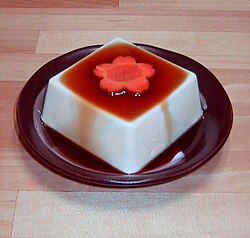
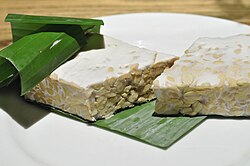
Soy is a key source of food, useful both for its protein and oil content. [[Soybean oil]] is widely used in cooking, as well as in industry. Traditional unfermented food uses of soybeans include [[edamame]], as well as [[soy milk]], from which [[tofu]] and [[tofu skin]] are made. Fermented soy foods include [[soy sauce]], [[fermented bean paste]], [[nattō]], and [[tempeh]]. Fat-free (defatted) soybean meal is a significant and cheap source of protein for animal feeds and many [[TV dinner|packaged meals]].<ref name="rotundo">{{cite journal |vauthors=Rotundo JL, Marshall R, McCormick R, Truong SK, Styles D, Gerde JA, Gonzalez-Escobar E, Carmo-Silva E, Janes-Bassett V, Logue J, Annicchiarico P, de Visser C, Dind A, Dodd IC, Dye L, Long SP, Lopes MS, Pannecoucque J, Reckling M, Rushton J, Schmid N, Shield I, Signor M, Messina CD, Rufino MC |title=European soybean to benefit people and the environment |journal=Scientific Reports |volume=14 |issue=1 |article-number=7612 |date=March 2024 |pmid=38556523 |pmc=10982307 |doi=10.1038/s41598-024-57522-z|bibcode=2024NatSR..14.7612R }}</ref> For example, soybean products, such as [[textured vegetable protein]] (TVP), are ingredients in many meat and [[dairy]] substitutes.<ref name=rotundo/><ref name=Riaz2006>{{cite book |last=Riaz |first=Mian N. |title=Soy Applications in Food |publisher=CRC Press |location=Boca Raton, FL |year=2006 |isbn=978-0-8493-2981-4 }}</ref> Soy-based foods are traditionally associated with East Asian cuisines, and still constitute a major part of East Asian diets, but processed soy products are increasingly used in Western cuisines. | |||
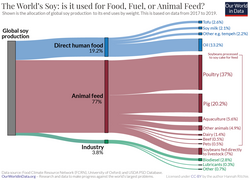
Soy was [[Domestication|domesticated]] from the [[Glycine soja|wild soybean]] ''(Glycine soja)'' in north-central China between 6,000 and 9,000 years ago.<ref name=":5">{{Cite journal |last1=Sedivy |first1=Eric J. |last2=Wu |first2=Faqiang |last3=Hanzawa |first3=Yoshie |date=2017 |title=Soybean domestication: the origin, genetic architecture and molecular bases |url=https://onlinelibrary.wiley.com/doi/abs/10.1111/nph.14418 |journal=New Phytologist |language=en |volume=214 |issue=2 |pages=539–553 |doi=10.1111/nph.14418 |pmid=28134435 |bibcode=2017NewPh.214..539S |issn=1469-8137}}</ref> Brazil and the United States lead the world in modern soy production. The majority of soybeans [[Genetically modified soybean|are genetically modified]],<ref>{{cite web |title=Pocket K No. 16: Global Status of Commercialized Biotech/GM Crops in 2014 |url=http://www.isaaa.org/resources/publications/pocketk/16/ |access-date=23 February 2016 |website=isaaa.org |publisher=International Service for the Acquisition of Agri-biotech Applications}}</ref> usually for either insect, herbicide, or drought resistance. Three-quarters of soy is used to feed livestock, which in turn go to feed humans. Increasing demand for meat has substantially increased soy production since the 1980s, and contributed to deforestation in the [[Amazon rainforest|Amazon]]. | |||
Soybeans contain significant amounts of [[phytic acid]], [[dietary minerals]] and [[B vitamins]]. [[ | Soybeans contain significant amounts of [[phytic acid]], [[dietary minerals]] and [[B vitamins]]. Soy may reduce the risk of cancer and heart disease. Some people are [[Soy allergy|allergic to soy]]. Soy is a [[complete protein]] and therefore important in the diets of many [[Vegetarianism|vegetarians]] and [[Veganism|vegans]]. In [[internet culture]], the association of soy with vegans and the misconception that soy increases [[estrogen]] production have led to "[[soy boy]]" being used as a derogatory term.<ref>{{Cite news |last=Reynolds |first=George |date=2019-10-25 |title=Why do people hate vegans? |url=https://www.theguardian.com/lifeandstyle/2019/oct/25/why-do-people-hate-vegans |access-date=2025-06-11 |work=The Guardian |language=en-GB |issn=0261-3077}}</ref> | ||
==Etymology== | ==Etymology== | ||
The word "soy" | The word "soy" derives from the Japanese ''soi'', a [[Kagoshima dialect]] variant of ''shōyu'',<ref>{{Cite OED|soy|6140796016}}</ref> which in turn comes from the Chinese ''jiangyou'' (醬油), meaning "soy sauce".<ref>{{cite web |url=https://www.jlect.com/entry/3689/shoi/ |title=しょい |website=JLECT |access-date=November 3, 2025}}</ref> | ||
The name of the genus, ''Glycine'', comes from [[Carl Linnaeus|Linnaeus]]. When naming the genus, Linnaeus observed that one of the species formerly within the genus, which has since been reclassified to the genus ''[[Apios]]'', had a sweet root. Based on the sweetness, the Greek word for sweet, ''glykós'', was Latinized.<ref name=":1">{{Cite journal |last1=Hymowitz |first1=T. |last2=Newell |first2=C.A. |date=1981-07-01 |title=Taxonomy of the genus ''Glycine'', domestication and uses of soybeans |journal=[[Economic Botany]] |language=en |volume=35 |issue=3 |pages=272–88 |doi=10.1007/BF02859119 |bibcode=1981EcBot..35..272H |s2cid=21509807 }}</ref> The genus name is not related to the amino acid [[glycine]].{{Citation needed|date=July 2021}} | |||
==Description== | ==Description== | ||
{{More citations needed section|date=July 2021}} | {{More citations needed section|date=July 2021}} | ||
Like most plants, soybeans grow in distinct [[Plant morphology|morphological]] stages as they develop from seeds into fully mature | |||
Like most plants, soybeans grow in distinct [[Plant morphology|morphological]] stages as they develop from seeds into fully mature plants. | |||
===Germination=== | ===Germination=== | ||
The first stage of growth is [[germination]], a method which first becomes apparent as a seed's [[radicle]] emerges.<ref name=MP197Chapter2>{{cite book |last1=Purcell |first1=Larry C. |last2=Salmeron |first2=Montserrat |last3=Ashlock |first3=Lanny |title=Arkansas Soybean Production Handbook – MP197 |date=2014 |chapter=Chapter 2 |chapter-url=http://www.uaex.edu/publications/pdf/mp197/chapter2.pdf |publisher=University of Arkansas Cooperative Extension Service|location=Little Rock|pages=1–8 |url=http://www.uaex.edu/publications/mp-197.aspx |access-date=21 February 2016 |archive-date=March 4, 2016 |archive-url=https://web.archive.org/web/20160304011452/http://www.uaex.edu/publications/mp-197.aspx | The first stage of growth is [[germination]], a method which first becomes apparent as a seed's [[radicle]] emerges.<ref name=MP197Chapter2>{{cite book |last1=Purcell |first1=Larry C. |last2=Salmeron |first2=Montserrat |last3=Ashlock |first3=Lanny |title=Arkansas Soybean Production Handbook – MP197 |date=2014 |chapter=Chapter 2 |chapter-url=http://www.uaex.edu/publications/pdf/mp197/chapter2.pdf |publisher=University of Arkansas Cooperative Extension Service|location=Little Rock|pages=1–8 |url=http://www.uaex.edu/publications/mp-197.aspx |access-date=21 February 2016 |archive-date=March 4, 2016 |archive-url=https://web.archive.org/web/20160304011452/http://www.uaex.edu/publications/mp-197.aspx }}</ref> This is the first stage of root growth and occurs within the first 48 hours under ideal growing conditions. The first [[photosynthesis|photosynthetic]] structures, the [[cotyledon]]s, develop from the [[hypocotyl]], the first plant structure to emerge from the soil. These cotyledons both act as leaves and as a source of nutrients for the immature plant, providing the seedling nutrition for its first 7 to 10 days.<ref name=MP197Chapter2 /> | ||
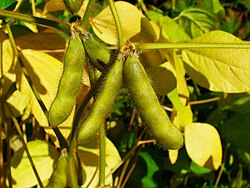
[[File:Glycine max 003.JPG| | [[File:Glycine max 003.JPG|thumb|Fruits/pods]] | ||
===Maturation=== | ===Maturation=== | ||
The first true leaves develop as a pair of [[Leaf#Divisions of the blade|single blades]].<ref name=MP197Chapter2 /> Subsequent to this first pair, mature [[Plant stem|nodes]] form compound leaves with three blades. Mature [[trifoliolate]] leaves, having three to four [[leaflet (botany)|leaflets]] per leaf, are often between {{convert|6|and|15|cm|in|frac=2|abbr=on}} long and {{convert|2|and|7|cm|in|frac=2|abbr=on}} broad. Under ideal conditions, stem growth continues, producing new nodes every four days. Before flowering, roots can grow {{convert|2|cm|in|frac=8|abbr=on}} per day. If [[rhizobia]] are present, [[root nodule|root nodulation]] begins by the time the third node appears. Nodulation typically continues for 8 weeks before the [[Rhizobia#Infection and signal exchange|symbiotic infection]] process stabilizes.<ref name=MP197Chapter2 /> The final characteristics of a soybean plant are variable, with factors such as genetics, [[soil quality]], and climate affecting its form; however, fully mature soybean plants are generally between {{convert|50|and|125|cm|in|-1|abbr=on}} in height<ref name=MP197Chapter19>{{cite book |last1=Purcell |first1=Larry C. |last2=Salmeron |first2=Montserrat |last3=Ashlock |first3=Lanny |title=Arkansas Soybean Production Handbook – MP197 |date=2000 |chapter=Chapter 19: Soybean Facts |chapter-url=http://www.uaex.edu/publications/pdf/mp197/chapter19.pdf |publisher=University of Arkansas Cooperative Extension Service |location=Little Rock, AR |page=1 |url=http://www.uaex.edu/publications/mp-197.aspx |access-date=5 September 2016 |archive-date=March 4, 2016 |archive-url=https://web.archive.org/web/20160304011452/http://www.uaex.edu/publications/mp-197.aspx | The first true leaves develop as a pair of [[Leaf#Divisions of the blade|single blades]].<ref name=MP197Chapter2 /> Subsequent to this first pair, mature [[Plant stem|nodes]] form compound leaves with three blades. Mature [[trifoliolate]] leaves, having three to four [[leaflet (botany)|leaflets]] per leaf, are often between {{convert|6|and|15|cm|in|frac=2|abbr=on}} long and {{convert|2|and|7|cm|in|frac=2|abbr=on}} broad. Under ideal conditions, stem growth continues, producing new nodes every four days. Before flowering, roots can grow {{convert|2|cm|in|frac=8|abbr=on}} per day. If [[rhizobia]] are present, [[root nodule|root nodulation]] begins by the time the third node appears. Nodulation typically continues for 8 weeks before the [[Rhizobia#Infection and signal exchange|symbiotic infection]] process stabilizes.<ref name=MP197Chapter2 /> The final characteristics of a soybean plant are variable, with factors such as genetics, [[soil quality]], and climate affecting its form; however, fully mature soybean plants are generally between {{convert|50|and|125|cm|in|-1|abbr=on}} in height<ref name=MP197Chapter19>{{cite book |last1=Purcell |first1=Larry C. |last2=Salmeron |first2=Montserrat |last3=Ashlock |first3=Lanny |title=Arkansas Soybean Production Handbook – MP197 |date=2000 |chapter=Chapter 19: Soybean Facts |chapter-url=http://www.uaex.edu/publications/pdf/mp197/chapter19.pdf |publisher=University of Arkansas Cooperative Extension Service |location=Little Rock, AR |page=1 |url=http://www.uaex.edu/publications/mp-197.aspx |access-date=5 September 2016 |archive-date=March 4, 2016 |archive-url=https://web.archive.org/web/20160304011452/http://www.uaex.edu/publications/mp-197.aspx }}</ref> and have rooting depths between {{convert|75|and|150|cm|in|-1|abbr=on}}.<ref>{{cite book |last1=Bennett |first1=J. Michael |last2=Rhetoric |first2=Emeritus |last3=Hicks |first3=Dale R. |last4=Naeve |first4=Seth L. |last5=Bennett |first5=Nancy Bush |title=The Minnesota Soybean Field Book |date=2014 |publisher=[[University of Minnesota Extension]]|location=St Paul, MN |page=33 |url=http://www.extension.umn.edu/agriculture/soybean/docs/minnesota-soybean-field-book.pdf |access-date=16 September 2016 |archive-url=https://web.archive.org/web/20130930151502/http://www1.extension.umn.edu/agriculture/soybean/docs/minnesota-soybean-field-book.pdf |archive-date=September 30, 2013 }}</ref> | ||
===Flowering=== | ===Flowering=== | ||
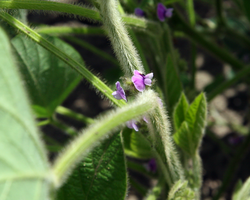
Flowering is [[Photoperiodism|triggered by day length]], often beginning once days become shorter than 12.8 hours.<ref name=MP197Chapter2 /> This trait is highly variable however, with different [[Variety (botany)|varieties]] reacting differently to changing day length.<ref>{{cite book |last1=Shurtleff |first1=William |author-link=William Shurtleff |last2=Aoyagi |first2=Akiko |author-link2=Akiko Aoyagi |title=History of Soybeans and Soyfoods in Sweden, Norway, Denmark and Finland (1735–2015): Extensively Annotated Bibliography and Sourcebook |date=2015 |publisher=Soyinfo Center|location=Lafayette|isbn=978-1-928914-80-8 |page=490 |url=https://books.google.com/books?id=0gtpCgAAQBAJ&pg=PA490}}</ref> Soybeans form inconspicuous, self-fertile flowers which are borne in the [[axil]] of the leaf and are white, pink or purple. Though they do not require pollination, they are attractive to bees, because they produce nectar that is high in sugar content.<ref>{{Cite web |last=Reisig |first=Dominic |title=Soybean flowering, pollination, and bees |url=http://www.ncagr.gov/pollinators/documents/DominicReisig-NCPollinatorProtectionSoybeans.pdf |website=[[North Carolina Department of Agriculture & Consumer Services]]}}</ref> Depending on the soybean variety, node growth may cease once flowering begins. Strains that continue nodal development after flowering are termed "[[Indeterminate growth|indeterminates]]" and are best suited to climates with longer growing seasons.<ref name=MP197Chapter2 /> Often soybeans drop their leaves before the seeds are fully mature. | Flowering is [[Photoperiodism|triggered by day length]], often beginning once days become shorter than 12.8 hours.<ref name=MP197Chapter2 /> This trait is highly variable however, with different [[Variety (botany)|varieties]] reacting differently to changing day length.<ref>{{cite book |last1=Shurtleff |first1=William |author-link=William Shurtleff |last2=Aoyagi |first2=Akiko |author-link2=Akiko Aoyagi |title=History of Soybeans and Soyfoods in Sweden, Norway, Denmark and Finland (1735–2015): Extensively Annotated Bibliography and Sourcebook |date=2015 |publisher=Soyinfo Center|location=Lafayette|isbn=978-1-928914-80-8 |page=490 |url=https://books.google.com/books?id=0gtpCgAAQBAJ&pg=PA490}}</ref> Soybeans form inconspicuous, self-fertile flowers which are borne in the [[axil]] of the leaf and are white, pink or purple. Though they do not require pollination, they are attractive to bees, because they produce nectar that is high in sugar content.<ref>{{Cite web |last=Reisig |first=Dominic |title=Soybean flowering, pollination, and bees |url=http://www.ncagr.gov/pollinators/documents/DominicReisig-NCPollinatorProtectionSoybeans.pdf |website=[[North Carolina Department of Agriculture & Consumer Services]] |access-date=July 15, 2021 |archive-date=June 28, 2021 |archive-url=https://web.archive.org/web/20210628160525/http://www.ncagr.gov/pollinators/documents/DominicReisig-NCPollinatorProtectionSoybeans.pdf }}</ref> Depending on the soybean variety, node growth may cease once flowering begins. Strains that continue nodal development after flowering are termed "[[Indeterminate growth|indeterminates]]" and are best suited to climates with longer growing seasons.<ref name=MP197Chapter2 /> Often soybeans drop their leaves before the seeds are fully mature. | ||
[[File:Soybean flowers.png| | [[File:Soybean flowers.png|thumb|Small, purple flowers]] | ||
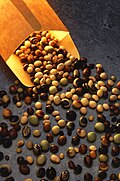
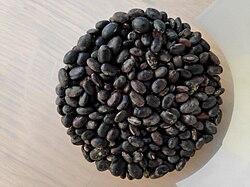
The fruit is a hairy pod that grows in clusters of three to five, each pod is {{convert|3|–|8|cm|in|frac=2|abbr=on}} long and usually contains two to four (rarely more) [[seed]]s 5–11 mm in diameter. Soybean seeds come in a wide variety of sizes and [[husk|hull]] colors such as black, brown, yellow, and green.<ref name=MP197Chapter19 /> Variegated and bicolored seed coats are also common. | The fruit is a hairy pod that grows in clusters of three to five, each pod is {{convert|3|–|8|cm|in|frac=2|abbr=on}} long and usually contains two to four (rarely more) [[seed]]s 5–11 mm in diameter. Soybean seeds come in a wide variety of sizes and [[husk|hull]] colors such as black, brown, yellow, and green.<ref name=MP197Chapter19 /> Variegated and bicolored seed coats are also common. | ||
===Seed resilience=== | ===Seed resilience=== | ||
[[File:Soybeanvarieties.jpg|thumb|Bean varieties]] | |||
The hull of the mature bean is hard, water-resistant, and protects the [[cotyledon]] and [[hypocotyl]] (or "germ") from damage. If the seed coat is cracked, the seed will not [[germinate]]. The scar, visible on the seed coat, is called the [[Hilum (biology)|hilum]] (colors include black, brown, buff, gray and yellow) and at one end of the hilum is the [[Micropyle (botany)|micropyle]], or small opening in the seed coat which can allow the absorption of water for sprouting. | The hull of the mature bean is hard, water-resistant, and protects the [[cotyledon]] and [[hypocotyl]] (or "germ") from damage. If the seed coat is cracked, the seed will not [[germinate]]. The scar, visible on the seed coat, is called the [[Hilum (biology)|hilum]] (colors include black, brown, buff, gray and yellow) and at one end of the hilum is the [[Micropyle (botany)|micropyle]], or small opening in the seed coat which can allow the absorption of water for sprouting. | ||
Some seeds such as soybeans containing very high levels of [[soy protein|protein]] can undergo [[desiccation]], yet survive and revive after water absorption. [[A. Carl Leopold]] began studying this capability at the [[Boyce Thompson Institute for Plant Research]] at [[Cornell University]] in the mid-1980s. He found soybeans and corn to have a range of soluble [[carbohydrate]]s protecting the seed's cell viability.<ref>{{cite journal |pages=225–30 |doi=10.1104/pp.100.1.225 |title=Maturation Proteins and Sugars in Desiccation Tolerance of Developing Soybean Seeds |year=1992 |last1=Blackman |first1=S.A. |last2=Obendorf |first2=R.L. |last3=Leopold |first3=A.C. |journal=[[Plant Physiology (journal)|Plant Physiology]] |volume=100 |pmid=16652951 |issue=1 |pmc=1075542}}</ref> Patents were awarded to him in the early 1990s on techniques for protecting biological membranes and proteins in the dry state. | Some seeds such as soybeans containing very high levels of [[soy protein|protein]] can undergo [[desiccation]], yet survive and revive after water absorption. [[A. Carl Leopold]] began studying this capability at the [[Boyce Thompson Institute for Plant Research]] at [[Cornell University]] in the mid-1980s. He found soybeans and corn to have a range of soluble [[carbohydrate]]s protecting the seed's cell viability.<ref>{{cite journal |pages=225–30 |doi=10.1104/pp.100.1.225 |title=Maturation Proteins and Sugars in Desiccation Tolerance of Developing Soybean Seeds |year=1992 |last1=Blackman |first1=S.A. |last2=Obendorf |first2=R.L. |last3=Leopold |first3=A.C. |journal=[[Plant Physiology (journal)|Plant Physiology]] |volume=100 |pmid=16652951 |issue=1 |pmc=1075542}}</ref> Patents were awarded to him in the early 1990s on techniques for protecting biological membranes and proteins in the dry state. | ||
=== | === Chemistry === | ||
Dry soybeans contain 36% [[protein (nutrient)|protein]] and 20% [[fat]] in form of [[soybean oil]] by weight. The remainder consists of 30% [[carbohydrate]]s, 9% water and 5% [[Ash (analytical chemistry)|ash]].<ref>See ''[[#Nutrition|Nutrition]]'' table</ref> | |||
Soybeans comprise approximately 8% seed coat or hull, 90% [[cotyledon]]s and 2% [[hypocotyl]] axis or germ.<ref>{{Cite book |title=Encyclopedia of Grain Science |last=Corke, Walker and Wrigley |publisher=[[Academic Press]] |year=2004 |isbn=978-0-12-765490-4}}</ref>{{Page needed|date=November 2015}} | |||
== Taxonomy == | |||
The genus ''Glycine'' may be divided into two subgenera, ''[[Glycine (subgenus)|Glycine]]'' and ''[[Soja (subgenus)|Soja]]''. The subgenus ''Soja'' includes the cultivated soybean, ''G. max'', and the wild soybean, treated either as a separate species ''[[Glycine soja|G. soja]]'',<ref name="SingNelsChun06">{{cite book |last1=Singh |first1=Ram J. |url=https://books.google.com/books?id=lQ9bcjETlrIC&pg=PA15 |title=Genetic Resources, Chromosome Engineering, and Crop Improvement: Oilseed Crops, Volume 4 |last2=Nelson |first2=Randall L. |last3=Chung |first3=Gyuhwa |date=November 2, 2006 |publisher=Taylor & Francis |isbn=978-0-8493-3639-3 |location=[[London]] |page=15}}</ref> or as the subspecies ''G. max'' subsp. ''soja''.<ref name="POWO_920989-1">{{cite web |title=''Glycine max subsp. soja'' (Siebold & Zucc.) H.Ohashi |url=https://powo.science.kew.org/taxon/urn:lsid:ipni.org:names:920989-1 |access-date=2023-01-28 |work=Plants of the World Online |publisher=Royal Botanic Gardens, Kew}}</ref> The cultivated and wild soybeans are [[Annual plant|annuals]]. The wild soybean is native to [[China]], [[Japan]], [[Korea]] and [[Russia]].<ref name="SingNelsChun06" /> The subgenus ''Glycine'' consists of at least 25 wild [[perennial]] species: for example, ''[[Glycine canescens|G. canescens]]'' and ''[[Glycine tomentella|G. tomentella]]'', both found in [[Australia]] and [[Papua New Guinea]].<ref>{{cite conference |last=Hymowitz |first=Theodore |date=August 9, 1995 |editor-last=Sinclair |editor-first=J.B. |editor2-last=Hartman |editor2-first=G.L. |title=Evaluation of Wild Perennial ''Glycine'' Species and Crosses For Resistance to Phakopsora |location=[[Urbana, IL]], US |publisher=National Soybean Research Laboratory |pages=33–37 |book-title=Proceedings of the Soybean Rust Workshop}}</ref><ref>{{cite journal |last1=Newell |first1=C.A. |last2=Hymowitz |first2=T. |date=March 1983 |title=Hybridization in the Genus ''Glycine'' Subgenus ''Glycine'' Willd. (Leguminosae, Papilionoideae) |journal=[[American Journal of Botany]] |volume=70 |issue=3 |pages=334–48 |doi=10.2307/2443241 |jstor=2443241}}</ref> Perennial soybean (''[[Neonotonia wightii]]'') belongs to a different genus. It originated in Africa and is now a widespread pasture crop in the tropics.<ref>Heuzé V., Tran G., Giger-Reverdin S., Lebas F., 2015. Perennial soybean (''Neonotonia wightii''). Feedipedia, a programme by [[Institut national de la recherche agronomique|INRA]], [[CIRAD]], Association Française de Zootechnie and [[FAO]]. https://www.feedipedia.org/node/293 Last updated on September 30, 2015, 15:09</ref><ref>{{Cite web |title=''Neonotonia wightii'' in Global Plants on JSTOR |url=https://plants.jstor.org/compilation/Neonotonia.wightii |website=Global Plants on JSTOR}}</ref><ref>{{cite web |title=Factsheet – ''Neonotonia wightii'' |url=http://www.tropicalforages.info/key/Forages/Media/Html/Neonotonia_wightii.htm |archive-url=https://web.archive.org/web/20170601233037/http://tropicalforages.info/key/Forages/Media/Html/Neonotonia_wightii.htm |archive-date=June 1, 2017 |access-date=January 19, 2014 |work=tropicalforages.info}}</ref> | |||
Like some other crops of long domestication, the relationship of the modern soybean to wild-growing species can no longer be traced with any degree of certainty.<ref>{{cite book |author1=Shekhar, Hossain |url=https://books.google.com/books?id=H2m_DAAAQBAJ&q=the+relationship+of+the+modern+soybean+to+wild-growing+species+can+no+longer+be+traced+with+any+degree+of+certainty&pg=PA223 |title=Exploring the Nutrition and Health Benefits of Functional Foods |author2=Uddin, Howlader |author3=Zakir Hossain |author4=Kabir, Yearul |date=July 22, 2016 |publisher=IGI Global |isbn=978-1-5225-0592-1 |page=223 |access-date=22 November 2017}}</ref> It is a [[cultigen]] with a very large number of [[cultivar]]s.<ref>{{cite journal |author1=Ghulam Raza |author2=Mohan B. Singh |author3=Prem L. Bhalla |date=June 11, 2017 |editor1-last=Atanassov |editor1-first=Atanas |title=In Vitro Plant Regeneration from Commercial Cultivars of Soybean |journal=[[BioMed Research International]] |volume=2017 |article-number=7379693 |doi=10.1155/2017/7379693 |pmc=5485301 |pmid=28691031 |doi-access=free}}</ref> | |||
=== | ===Subspecies=== | ||
{{ | {{As of|2025|November}}, [[Plants of the World Online]] accepted the following subspecies:<ref name=POWO_60450240-2/> | ||
*''Glycine max'' subsp. ''formosana'' <small>(Hosok.) Tateishi & H.Ohashi</small> | |||
*''Glycine max'' nothosubsp. ''gracilis'' <small>(Skvortsov) H.Ohashi</small> = ''G. max'' subsp. ''max'' × ''G. max'' subsp. ''soja'' | |||
*''Glycine max'' subsp. ''max'' | |||
*''Glycine max'' subsp. ''soja'' <small>(Siebold & Zucc.) H.Ohashi</small> | |||
== Ecology == | |||
Like many legumes, soybeans can [[nitrogen fixation|fix atmospheric nitrogen]], due to the presence of [[symbiosis|symbiotic]] bacteria from the [[Rhizobia]] group.<ref>{{cite web |author=Jim Deacon |date=April 5, 2023 |title=The Nitrogen cycle and Nitrogen fixation |url=http://www.biology.ed.ac.uk/archive/jdeacon/microbes/nitrogen.htm |archive-url=https://web.archive.org/web/20130116214211/http://www.biology.ed.ac.uk/archive/jdeacon/microbes/nitrogen.htm |archive-date=January 16, 2013 |access-date=November 6, 2012 |publisher=Institute of Cell and Molecular Biology, The University of Edinburgh}}</ref> | |||
== Cultivation == | |||
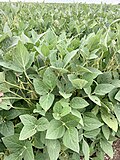
[[File:Soy beans.jpg|thumb|Soybean crops in [[Minnesota]]]] | |||
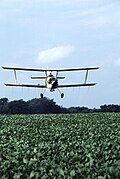
[[File:AreialSeedingPlane.jpg|thumb|A [[cropduster]] sprays soy plants|alt=[[Biplane]], US field, [[cropduster|cropdusting]]]] | |||
{{More citations needed section|date=July 2021}} | |||
Soybeans are globally important agricultural crops, grown as a major source of protein and [[Soybean oil|oil]]. It prefers fertile, well-drained soils and requires a warm temperate climate with adequate rainfall or irrigation. Soybeans are mainly grown in the United States, Brazil, and Argentina.<ref>{{cite web |title=FAOSTAT |url=https://www.fao.org/faostat/en/#data/QCL/visualize |website=Food and Agriculture Organization of the United Nations |access-date=November 21, 2025}}</ref> | |||
It is usually planted in straight rows using modern machinery, and pests and weeds must be controlled to maintain the crop. After maturity, it is harvested using mechanized harvesting machines. Soybeans are used in the production of many food and industrial products, such as [[tofu]], oils, and feed, in addition to their role in improving soil fertility by [[Nitrogen fixation|fixing nitrogen]]. | |||
===Conditions=== | |||
[[File:Sembrado de soja en argentina.jpg|upright=1.2|thumb|Mature row planted soy in Argentina|alt=Fields in [[Argentina]]]] | |||
Cultivation is successful in climates with hot summers, with optimum growing conditions in mean temperatures of {{convert|20|to|30|C|F|round=5}}; temperatures of below {{convert|20|C|F|round=5}} and over {{convert|40|C|F|round=5}} stunt growth significantly. They can grow in a wide range of soils, with optimum growth in moist [[Alluvium|alluvial soil]]s with good organic content. Soybeans, like most legumes, perform [[nitrogen fixation]] by establishing a [[symbiotic]] relationship with the bacterium ''[[Bradyrhizobium japonicum]]'' ([[synonym (taxonomy)|syn.]] ''Rhizobium japonicum''; Jordan 1982). This ability to fix nitrogen allows farmers to reduce nitrogen [[fertilizer]] use and increase yields when growing other crops in [[Crop rotation|rotation]] with soy.<ref>{{Cite web |title=The Corn and Soybean Rotation Effect - Wisconsin Corn Agronomy |url=http://corn.agronomy.wisc.edu/AA/A014.aspx |website=corn.agronomy.wisc.edu |access-date=2020-05-17 |archive-date=August 7, 2020 |archive-url=https://web.archive.org/web/20200807071753/http://corn.agronomy.wisc.edu/AA/A014.aspx }}</ref> There may be some trade-offs, however, in the long-term abundance of [[Soil organic matter|organic material in soils]] where soy and other crops (for example, [[Maize|corn]]) are grown in rotation.<ref>{{Cite web |title=Corn and soybean rotation could pose long-term tradeoffs for soil health |url=https://phys.org/news/2019-10-corn-soybean-rotation-pose-long-term.html |website=phys.org |language=en |access-date=2020-05-17}}</ref> For best results, though, an inoculum of the correct strain of bacteria should be mixed with the soybean (or any legume) seed before planting. Modern crop [[cultivar]]s generally reach a height of around {{convert|1|m|ft|0|abbr=on}}, and take 80–120 days from sowing to harvesting. | |||
Cultivation is successful in climates with hot summers, with optimum growing conditions in mean temperatures of {{convert|20|to|30|C|F|round=5}}; temperatures of below {{convert|20|C|F|round=5}} and over {{convert|40|C|F|round=5}} stunt growth significantly. They can grow in a wide range of soils, with optimum growth in moist [[Alluvium|alluvial soil]]s with good organic content. Soybeans, like most legumes, perform [[nitrogen fixation]] by establishing a [[symbiotic]] relationship with the bacterium ''[[Bradyrhizobium japonicum]]'' ([[synonym (taxonomy)|syn.]] ''Rhizobium japonicum''; Jordan 1982). This ability to fix nitrogen allows farmers to reduce nitrogen [[fertilizer]] use and increase yields when growing other crops in [[Crop rotation|rotation]] with soy.<ref>{{Cite web |title=The Corn and Soybean Rotation Effect - Wisconsin Corn Agronomy |url=http://corn.agronomy.wisc.edu/AA/A014.aspx |website=corn.agronomy.wisc.edu |access-date=2020-05-17}}</ref> There may be some trade-offs, however, in the long-term abundance of [[Soil organic matter|organic material in soils]] where soy and other crops (for example, [[Maize|corn]]) are grown in rotation.<ref>{{Cite web |title=Corn and soybean rotation could pose long-term tradeoffs for soil health |url=https://phys.org/news/2019-10-corn-soybean-rotation-pose-long-term.html |website=phys.org |language=en |access-date=2020-05-17}}</ref> For best results, though, an inoculum of the correct strain of bacteria should be mixed with the soybean (or any legume) seed before planting. Modern crop [[cultivar]]s generally reach a height of around {{convert|1|m|ft|0|abbr=on}}, and take 80–120 days from sowing to harvesting. | |||
===Soils=== | ===Soils=== | ||
Soil scientists [[Edson Lobato]] (Brazil), [[Andrew McClung]] (U.S.), and [[Alysson Paolinelli]] (Brazil) were awarded the 2006 [[World Food Prize]] for transforming the ecologically biodiverse savannah of the [[Cerrado]] region of Brazil into highly productive cropland that could grow profitable soybeans.<ref>{{ | Soil scientists [[Edson Lobato]] (Brazil), [[Andrew McClung]] (U.S.), and [[Alysson Paolinelli]] (Brazil) were awarded the 2006 [[World Food Prize]] for transforming the ecologically biodiverse savannah of the [[Cerrado]] region of Brazil into highly productive cropland that could grow profitable soybeans.<ref>{{cite web |url=https://www.worldfoodprize.org/en/laureates/20002009_laureates/2006_lobato_mcclung_paolinelli/ |title=2006: Lobato, McClung, Paolinelli |work=[[World Food Prize]]}}</ref><ref>{{cite news |first = Susan|last = Lang|title = Cornell Alumnus Andrew Colin McClung Reaps 2006 World Food Prize|url = https://www.news.cornell.edu/stories/June06/World.Food.prize.ssl.html|work =Chronicle Online |publisher = Cornell University|date = June 21, 2006|access-date =February 18, 2012}}</ref><ref>{{cite web|url=http://e360.yale.edu/feature/the_cerrado_brazils_other_biodiversity_hotspot_loses_ground/2393/|title=The Cerrado: Brazil's Other Biodiverse Region Loses Ground|date=April 14, 2011|last=Pearce|first=Fred|publisher=Yale University|access-date=February 18, 2012|archive-date=September 13, 2016|archive-url=https://web.archive.org/web/20160913030125/http://e360.yale.edu/feature/the_cerrado_brazils_other_biodiversity_hotspot_loses_ground/2393/}}</ref><ref>{{Cite journal | doi=10.1023/A:1024191913296|title = The success of BNF in soybean in Brazil| journal=[[Plant and Soil]]| volume=252| pages=1–9|year = 2003|last1 = Alves|first1 = Bruno J.R.| last2=Boddey| first2=Robert M.| last3=Urquiaga| first3=Segundo| issue=1 | bibcode=2003PlSoi.252....1A |s2cid = 10143668}}</ref> | ||
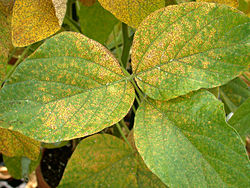
[[File:Soybean rust.jpg|upright=0.9|thumb|[[Soybean rust]]]] | [[File:Soybean rust.jpg|upright=0.9|thumb|A leaf affected by [[Soybean rust]]]] | ||
===Contamination concerns=== | ===Contamination concerns=== | ||
Human [[sewage sludge]] can be used as fertilizer to grow soybeans. Soybeans grown in sewage sludge likely contain elevated concentrations of metals.<ref>{{cite journal|title=Molybdenum Uptake by Forage Crops Grown on Sewage Sludge-Amended Soils in the Field and Greenhouse|url= | Human [[sewage sludge]] can be used as fertilizer to grow soybeans. Soybeans grown in sewage sludge likely contain elevated concentrations of metals.<ref>{{cite journal|title=Molybdenum Uptake by Forage Crops Grown on Sewage Sludge-Amended Soils in the Field and Greenhouse|url=https://soilandwater.bee.cornell.edu/publications/McBrideJEQ00.pdf|journal=[[Journal of Environmental Quality]]|date=May–June 2000|volume=29|issue=3|last1=McBride|first1=M.B.|last2=Richards|first2=B.K.|last3=Steenhuis|first3=T.|last4=Spiers|first4=G.|pages=848–54|doi=10.2134/jeq2000.00472425002900030021x|bibcode=2000JEnvQ..29..848M }}</ref><ref>{{cite journal|title=Residual Effects of Sewage Sludge on Soybean: II. Accumulation of Soil and Symbiotically Fixed Nitrogen|journal=[[Journal of Environmental Quality]]|date=December 9, 1985|volume=16|issue=2|last1=Heckman|first1=J.R.|last2=Angle|first2=J.S.|last3=Chaney|first3=R.L.|pages=118–24|doi=10.2134/jeq1987.00472425001600020005x}}</ref> | ||
===Pests=== | ===Pests=== | ||
| Line 228: | Line 138: | ||
Soybean plants are vulnerable to a wide range of [[bacterial crop disease|bacterial diseases]], [[fungal crop disease|fungal diseases]], [[viral crop disease|viral diseases]], and parasites. | Soybean plants are vulnerable to a wide range of [[bacterial crop disease|bacterial diseases]], [[fungal crop disease|fungal diseases]], [[viral crop disease|viral diseases]], and parasites. | ||
The primary bacterial diseases include [[bacterial blight]], [[bacterial pustule]] and [[downy mildew]] affecting the soybean plant.<ref>{{Cite web|url=https://gardenandme.com/soybean/|title=Soybean plant - How to grow, care, pest control and uses of soybeans|date=June 5, 2020|website=Garden And Me}}</ref> | The primary bacterial diseases include [[bacterial blight]], [[bacterial pustule]] and [[downy mildew]] affecting the soybean plant.<ref>{{Cite web|url=https://gardenandme.com/soybean/|title=Soybean plant - How to grow, care, pest control and uses of soybeans|date=June 5, 2020|website=Garden And Me}}</ref> | ||
==== | The [[Japanese beetle]] ('''''Popillia japonica''''') poses a significant threat to agricultural crops, including soybeans, due to its voracious feeding habits. Found commonly in both urban and suburban areas, these beetles are frequently observed in agricultural landscapes where they can cause considerable damage to crops like corn, soybeans, and various fruits.<ref>{{Cite web |title=Japanese beetle - Popillia japonica |url=https://entnemdept.ufl.edu/creatures/orn/beetles/japanese_beetle.htm |access-date=2024-04-25 |website=entnemdept.ufl.edu}}</ref><ref>{{Cite web |title=EENY350/IN630: Japanese Beetle, Popillia japonica Newman (Insecta: Coleoptera: Scarabaeidae) |url=https://edis.ifas.ufl.edu/publication/IN630 |access-date=2024-04-25 |website=Ask IFAS - Powered by EDIS |language=en-US}}</ref> | ||
[[Soybean cyst nematode]] (SCN) is the worst pest of soybean in the US. Losses of 30%<ref name="Missouri" /> or 40%<ref group="RM" name="Tylka-40-sympt"> | [[Soybean cyst nematode]] (SCN) is the worst pest of soybean in the US. Losses of 30%<ref name="Missouri" /> or 40%<ref group="RM" name="Tylka-40-sympt">"You can literally have 40% yield loss with no symptoms," says Greg Tylka, [[Iowa State University Extension|Iowa State University (ISU) Extension]] nematologist.</ref> are common even without symptoms. | ||
The [[Helicoverpa zea|corn earworm moth and bollworm]] (Helicoverpa zea) is a common and destructive pest of soybean growth in Virginia.<ref>Herbert, Ames, Cathy Hull, and Eric Day. "Corn Earworm Biology and Management in Soybeans." [[Virginia Cooperative Extension]], [[Virginia State University]] (2009).</ref> | The [[Helicoverpa zea|corn earworm moth and bollworm]] (Helicoverpa zea) is a common and destructive pest of soybean growth in Virginia.<ref>Herbert, Ames, Cathy Hull, and Eric Day. "Corn Earworm Biology and Management in Soybeans." [[Virginia Cooperative Extension]], [[Virginia State University]] (2009).</ref> | ||
Soybeans are consumed by [[whitetail deer]] which may damage soybean plants through feeding, trampling and bedding, reducing [[crop yield]]s by as much as 15%.<ref name="ag">{{cite web|url=https://www.morningagclips.com/controlling-white-tailed-deer-in-soybeans|title=Controlling white-tailed deer in soybeans|date=16 January 2018|publisher=Morning AgClips – Michigan|access-date=9 May 2019}}</ref> [[Groundhog]]s are also a common pest in soybean fields, living in burrows underground and feeding nearby. One den of groundhogs can consume a tenth to a quarter of an acre of soybeans.<ref name="brant">{{cite web|url=https://www.lancasterfarming.com/news/columnists/soybean-farmers-warranted-in-waging-war-on-groundhogs/article_f6e6a210-2995-521f-8655-aa19efe373c3.html|title=Soybean Farmers Warranted in Waging War on Groundhogs|date=9 September 2016|publisher=[[Lancaster Farming]]|author=Brant, Jesse D|access-date=9 May 2019}}</ref> [[animal repellent|Chemical repellents]] or [[firearm]]s are effective for controlling pests in soybean fields.<ref name=ag/><ref name=brant/> | Soybeans are consumed by [[whitetail deer]] which may damage soybean plants through feeding, trampling and bedding, reducing [[crop yield]]s by as much as 15%.<ref name="ag">{{cite web|url=https://www.morningagclips.com/controlling-white-tailed-deer-in-soybeans|title=Controlling white-tailed deer in soybeans|date=16 January 2018|publisher=Morning AgClips – Michigan|access-date=9 May 2019}}</ref> [[Groundhog]]s are also a common pest in soybean fields, living in burrows underground and feeding nearby. One den of groundhogs can consume a tenth to a quarter of an acre of soybeans.<ref name="brant">{{cite web|url=https://www.lancasterfarming.com/news/columnists/soybean-farmers-warranted-in-waging-war-on-groundhogs/article_f6e6a210-2995-521f-8655-aa19efe373c3.html|title=Soybean Farmers Warranted in Waging War on Groundhogs|date=9 September 2016|publisher=[[Lancaster Farming]]|author=Brant, Jesse D|access-date=9 May 2019}}</ref> [[animal repellent|Chemical repellents]] or [[firearm]]s are effective for controlling pests in soybean fields.<ref name=ag/><ref name=brant/> | ||
{{anchor|Fungus|Funguses}} | {{anchor|Fungi|Fungus|Funguses}} | ||
Soybeans suffer from the fungus ''[[Pythium spinosum]]'' in [[Arkansas]] and [[Indiana]] (United States), and China.<ref name="P-spinosum-US-Nat-Fung-Coll">{{cite web | |||
Soybeans suffer from ''[[Pythium spinosum]]'' in [[Arkansas]] and [[Indiana]] (United States), and China.<ref name="P-spinosum-US-Nat-Fung-Coll"> | |||
{{cite web | |||
| title=U.S. National Fungus Collections Database results | | title=U.S. National Fungus Collections Database results | ||
| website=Fungal Databases, [[U.S. National Fungus Collections]] | | website=Fungal Databases, [[U.S. National Fungus Collections]] | ||
| Line 252: | Line 155: | ||
| url=http://nt.ars-grin.gov/fungaldatabases/new_allViewGenBank.cfm?thisName=Pythium%20spinosum&organismtype=Fungus | | url=http://nt.ars-grin.gov/fungaldatabases/new_allViewGenBank.cfm?thisName=Pythium%20spinosum&organismtype=Fungus | ||
| access-date=2020-12-08 | | access-date=2020-12-08 | ||
}}{{Dead link|date=November 2023 |bot=InternetArchiveBot |fix-attempted=yes }}</ref> | |||
</ref> | |||
In Japan and the United States, the [[Soybean dwarf virus]] (SbDV) causes a disease in soybeans and is transmitted by aphids.<ref name="harrison2005">{{Cite journal |last1=Harrison |first1=Barbara |last2=Steinlage |first2=Todd A. |last3=Domier |first3=Leslie L. |last4=D'Arcy |first4=Cleora J. |date=January 2005 |title=Incidence of Soybean dwarf virus and Identification of Potential Vectors in Illinois |journal=Plant Disease |language=en |volume=89 |issue=1 |pages=28–32 |doi=10.1094/PD-89-0028 |doi-access=free |pmid=30795280 |bibcode=2005PlDis..89...28H |issn=0191-2917 }}</ref> | |||
===Cultivars=== | ===Cultivars=== | ||
====Disease resistant cultivars==== | ====Disease resistant cultivars==== | ||
[[plant disease resistance|Resistant varieties]] are available. In Indian cultivars, Nataraj ''et al.'' 2020 find that anthracnose caused by ''[[Colletotrichum truncatum]]'' is resisted by a combination of 2 | [[plant disease resistance|Resistant varieties]] are available. In Indian cultivars, Nataraj ''et al.'' 2020 find that anthracnose caused by ''[[Colletotrichum truncatum]]'' is resisted by a combination of 2 major genes.<ref name="identification">{{Cite journal|issue=4|pages=393–409|year=2021|volume=22|last1=Boufleur|first1=Thais R.|last2=Ciampi-Guillardi|first2=Maisa|last3=Tikami|first3=Ísis|last4=Rogério|first4=Flávia|last5=Thon|first5=Michael R.|last6=Sukno|first6=Serenella A.|last7=Massola Júnior|first7=Nelson S.|last8=Baroncelli|first8=Riccardo|journal=[[Molecular Plant Pathology]]|s2cid=231969160|pmid=33609073|pmc=7938629|doi=10.1111/mpp.13036|title=Soybean anthracnose caused by ''Colletotrichum'' species: Current status and future prospects|bibcode=2021MolPP..22..393B }}</ref><ref>{{Cite journal|issue=6|volume=67|year=2020|last1=Nataraj|first1=Vennampally|last2=Maranna|first2=Shivakumar|last3=Kumawat|first3=Giriraj|last4=Gupta|first4=Sanjay|last5=Rajput|first5=Laxman Singh|last6=Kumar|first6=Sanjeev|last7=Sharma|first7=Amar Nath|last8=Bhatia|first8=Virender Singh|journal=Genetic Resources and Crop Evolution|s2cid=211730576|doi=10.1007/s10722-020-00917-4|pages=1449–1456|title=Genetic inheritance and identification of germplasm sources for anthracnose resistance in soybean [''Glycine max'' (L.) Merr.]|bibcode=2020GRCEv..67.1449N }} | ||
</ref> | </ref> | ||
=====PI 88788===== | =====PI 88788===== | ||
The vast majority of cultivars in the US have [[soybean cyst nematode resistance]] (SCN resistance), but rely on [[soybean cyst nematode#PI 88788|only one breeding line (PI 88788)]] as their sole source of resistance.<ref group="RM" name="PI-88788">Reliance on the main genetic source of SCN resistance (PI 88788)may be helping SCN to overcome SCN-resistant varieties. Out of 807 resistant varieties listed by ISU this year, just 18 had a genetic background outside of PI 88788. | The vast majority of cultivars in the US have [[soybean cyst nematode resistance]] (SCN resistance), but rely on [[soybean cyst nematode#PI 88788|only one breeding line (PI 88788)]] as their sole source of resistance.<ref group="RM" name="PI-88788">Reliance on the main genetic source of SCN resistance (PI 88788)may be helping SCN to overcome SCN-resistant varieties. Out of 807 resistant varieties listed by ISU this year, just 18 had a genetic background outside of PI 88788. "We have lots of varieties to pick from, but the genetic background is not as diverse as we would like it to be," says Tylka.</ref> (The resistance genes provided by PI 88788, {{Visible anchor|Peking}}, and {{Visible anchor|PI 90763}} were [[genome mapping|characterized]] in 1997.)<ref name="Concibido-et-al-1997">{{cite journal|issue=1|last1=Concibido|first1=Vergel C.|last2=Lange|first2=Douglas A.|last3=Denny|first3=Roxanne L.|last4=Orf|first4=James H.|last5=Young|first5=Nevin D.|title=Genome Mapping of Soybean Cyst Nematode Resistance Genes in 'Peking', PI 90763, and PI 88788 Using DNA Markers|journal=[[Crop Science (journal)|Crop Science]]|volume=37|year=1997|doi=10.2135/cropsci1997.0011183x003700010046x|pages=258–264}}</ref> As a result, for example, in 2012 only 18 cultivars out of 807 recommended by the [[Iowa State University Extension]] had any ancestry outside of PI 88788. By 2020 the situation was still about the same: Of 849 there were 810 with some ancestry from PI 88788,<ref name="Iowa-other-resist">{{cite web | title=Soybean varieties with SCN resistance other than PI 88788 | website=Integrated Crop Management | publisher=[[Iowa State University#Birth of cooperative extension|Iowa State University Extension]] | url=http://crops.extension.iastate.edu/cropnews/2020/12/soybean-varieties-scn-resistance-other-pi-88788 | access-date=2021-03-12}}</ref><ref name="Iowa-resist">{{cite web | title=SCN-resistant Soybean Varieties for Iowa - By the Numbers | website=Integrated Crop Management | publisher=[[Iowa State University#Birth of cooperative extension|Iowa State University Extension]] | url=http://crops.extension.iastate.edu/cropnews/2020/11/scn-resistant-soybean-varieties-iowa-numbers | access-date=2021-03-12}}</ref> 35 from Peking, and only 2 from PI 89772. (On the question of exclusively PI 88788 ancestry, that number was not available for 2020.)<ref name="Iowa-resist" /> That was speculated to be in 2012<ref group="RM" name="overcome-resis">There have been cases where SCN has clipped yields of SCN-resistant varieties. Reliance on the main genetic source of SCN resistance (PI 88788)may be helping SCN to overcome SCN-resistant varieties.</ref>—and was clearly by 2020<ref name="Iowa-other-resist" />—producing SCN populations that are virulent on PI 88788. | ||
==Production== | === Production === | ||
{{main|List of countries by soybean production}} | {{main|List of countries by soybean production}} | ||
{| | {{owidslider | ||
|start = 2023 | |||
| | |list = Template:OWID/soybean production#gallery | ||
|location = commons | |||
|caption = | |||
| | |title = | ||
| {{BRA}} | | |language = | ||
| | |file = [[File:soybean production, World, 2023 (cropped).svg|link=|thumb|upright=1.6|Soybean production]] | ||
|startingView = World | |||
| | }} | ||
| | {{Table alignment}} | ||
{{Infobox agricultural production | |||
| | |year=2019 | ||
|plant=Soybean | |||
| | |country1= {{BRA}} | ||
|amount1=122 | |||
| | |country2= {{USA}} | ||
|amount2= 113 | |||
|country3= {{ARG}} | |||
| | |amount3=49 | ||
|country4= {{CHN}} | |||
[[File: | |amount4=20 | ||
In 2020, world production of soybeans was over 353 million tonnes, led by Brazil and the United States combined with 66% of the total (table). Production has dramatically increased across the globe since the 1960s, but particularly in South America after a cultivar that grew well in low latitudes was developed in the 1980s.<ref>{{Cite journal|last1=Cattelan|first1=Alexandre José|last2= | |country5= {{IND}} | ||
|amount5=11 | |||
|country6= {{PAR}} | |||
|amount6=11 | |||
|world=353 | |||
|source= [[Food and Agriculture Organization Corporate Statistical Database|FAOSTAT]]<ref name="faostat19">{{cite web|publisher=United Nations, Food and Agriculture Organization, Statistics Division, FAOSTAT|title=Soybean production in 2019, Crops/World regions/Production quantity (from pick lists)|url=http://www.fao.org/faostat/en/#data/QC/|access-date=8 February 2021|date=2019}}</ref> | |||
}} | |||
[[File:Soybean fields in the United States.webp|thumb|Map of soybean fields in the United States]] | |||
In 2020, world production of soybeans was over 353 million tonnes, led by Brazil and the United States combined with 66% of the total (table). Production has dramatically increased across the globe since the 1960s, but particularly in South America after a cultivar that grew well in low latitudes was developed in the 1980s.<ref>{{Cite journal|last1=Cattelan|first1=Alexandre José|last2=Dall'Agnol|first2=Amélio|date=2018-01-01|title=The rapid soybean growth in Brazil|url=https://www.ocl-journal.org/articles/ocl/abs/2018/01/ocl170039/ocl170039.html|journal=[[OCL (journal)|OCL]]|language=en|volume=25|issue=1|pages=D102|doi=10.1051/ocl/2017058|doi-access=free}}</ref> The rapid growth of the industry has been primarily fueled by large increases in [[Western pattern diet|worldwide demand for meat]] products, particularly in developing countries like China, which alone accounts for more than 60% of imports.<ref>{{Cite web|title=OEC - Soybeans (HS92: 1201) Product Trade, Exporters and Importers|url=https://oec.world/en/profile/hs92/1201/|website=oec.world|language=en|access-date=2020-05-17|archive-date=April 4, 2020|archive-url=https://web.archive.org/web/20200404122328/https://oec.world/en/profile/hs92/1201/}}</ref> Soy is a [[staple crop]]; global soy production accounts for four times more legume production than all other legumes combined.<ref>{{Cite web |title=U.S. Grown Soy {{!}} Soy Nutrition Institute |url=https://sniglobal.org/us-grown-soy/ |access-date=2025-06-11 |website=SNI Global |language=en-US}}</ref> | |||
===Environmental issues=== | ==== Environmental issues ==== | ||
In spite of the Amazon "Soy Moratorium", soy production continues to play a significant role in [[deforestation]] when its indirect impacts are taken into account, as land used to grow soy continues to increase. This land either comes from [[pasture]] land (which increasingly supplants forested areas), or areas outside the Amazon not covered by the moratorium, such as the [[Cerrado]] region. Roughly one-fifth of deforestation can be attributed to expanding land use to produce oilseeds, primarily for soy and [[palm oil]], whereas the expansion of [[beef]] production accounts for 41%. The main driver of deforestation is the global demand for meat, which in turn requires huge tracts of land to grow feed crops for livestock.<ref>{{cite journal |url=https://ourworldindata.org/drivers-of-deforestation |title=Drivers of Deforestation |last=Ritchie |first=Hannah |date= February 9, 2021|journal=[[Our World in Data]] |access-date=March 20, 2021 | {{See also|Deforestation of the Amazon rainforest}} | ||
In spite of the [[Amazon soy moratorium|Amazon "Soy Moratorium"]], soy production continues to play a significant role in [[deforestation]] when its indirect impacts are taken into account, as land used to grow soy continues to increase. This land either comes from [[pasture]] land (which increasingly supplants forested areas), or areas outside the Amazon not covered by the moratorium, such as the [[Cerrado]] region. Roughly one-fifth of deforestation can be attributed to expanding land use to produce oilseeds, primarily for soy and [[palm oil]], whereas the expansion of [[beef]] production accounts for 41%. The main driver of deforestation is the global demand for meat, which in turn requires huge tracts of land to grow feed crops for livestock.<ref>{{cite journal |url=https://ourworldindata.org/drivers-of-deforestation |title=Drivers of Deforestation |last=Ritchie |first=Hannah |author1-link=Hannah Ritchie |date= February 9, 2021|journal=[[Our World in Data]] |access-date=March 20, 2021 }}</ref> Around 80% of the global soybean crop is used to feed livestock.<ref>{{cite news |last= Liotta|first= Edoardo|date=August 23, 2019 |title=Feeling Sad About the Amazon Fires? Stop Eating Meat|url=https://www.vice.com/en/article/feeling-sad-about-the-amazon-fires-stop-eating-meat/ |work=[[Vice Media|Vice]] |access-date=August 25, 2019|quote=Soy is the most important protein in animal feed, with 80 percent of the world's soybean crop fed to livestock.}}</ref> | |||
==History== | == History == | ||
{{More citations needed section|date=July 2021}} | {{More citations needed section|date=July 2021}} | ||
Soybeans were a crucial crop in East Asia long before written records began.<ref>Shurtleff, William; Aoyagi, Akiko. 2013. History of Whole Dry Soybeans, Used as Beans, or Ground, Mashed or Flaked (240 BCE to 2013). Lafayette, California. 950 pp.</ref> The origin of soy | Soybeans were a crucial crop in East Asia long before written records began.<ref>Shurtleff, William; Aoyagi, Akiko. 2013. History of Whole Dry Soybeans, Used as Beans, or Ground, Mashed or Flaked (240 BCE to 2013). Lafayette, California. 950 pp.</ref> The origin of soy cultivation remains scientifically debated. The closest living relative of the soybean is ''[[Glycine soja]]'' (previously called ''G. ussuriensis''), a legume native to central China.<ref>{{cite encyclopedia |url=https://www.britannica.com/plant/soybean |title=Soybean |encyclopedia=[[Encyclopædia Britannica]] |date=2025-06-19 |access-date=2025-07-05}}</ref> Genomic data increasingly supports a single domestication event in north-central China between 6,000 and 9,000 years ago, although some evidence suggests a more complex scenario involving low-intensity pre-domestication cultivation across multiple locations in East Asia, followed by the eventual dominance of the Chinese lineage.<ref name=":5" /> | ||
The first unambiguously domesticated, [[cultigen]]-sized soybean was discovered in Korea at the [[Mumun pottery period|Mumun]]-period Daundong site.<ref name="Lee-et-al- | There is evidence for soybean domestication between 7000 and 6600 BC in China, between 5000 and 3000 BC in Japan and 1000 BC in Korea.<ref name="Lee-et-al-20112">{{cite journal |last1=Lee |first1=Gyoung-Ah |last2=Crawford |first2=Gary W. |last3=Liu |first3=Li |last4=Sasaki |first4=Yuka |last5=Chen |first5=Xuexiang |date=November 4, 2011 |title=Archaeological Soybean (''Glycine max'') in East Asia: Does Size Matter? |journal=[[PLOS ONE]] |volume=6 |issue=11 |article-number=e26720 |bibcode=2011PLoSO...626720L |doi=10.1371/journal.pone.0026720 |pmc=3208558 |pmid=22073186 |doi-access=free}}</ref> The first unambiguously domesticated, [[cultigen]]-sized soybean was discovered in Korea at the [[Mumun pottery period|Mumun]]-period Daundong site.<ref name="Lee-et-al-20112"/><ref name="Stark-2017">{{cite book|last1=Stark|first1=Miriam T.|title=Archaeology of Asia|publisher=John Wiley & Sons|isbn=978-1-4051-5303-4|page=81|url=https://books.google.com/books?id=z4_bT2SJ-HUC&pg=PA81|access-date=18 April 2017|language=en|date=15 April 2008}}</ref> Prior to [[Fermentation (food)|fermented]] products such as fermented black soybeans (''[[douchi]]''), ''jiang'' (Chinese miso), [[soy sauce]], [[tempeh]], [[nattō]], and [[miso]], soy was considered sacred for its beneficial effects in [[crop rotation]], and it was eaten by itself, and as [[bean curd]] and [[soy milk]]. | ||
Soybeans were introduced to [[Java]] in [[Malay Archipelago]] circa 13th century or probably earlier. By the 17th century through their trade with Far East, soybeans and its products were traded by European traders (Portuguese, Spanish, and Dutch) in Asia, and reached Indian Subcontinent by this period.{{citation needed|date=July 2022}} By the 18th century, soybeans were introduced to the Americas and Europe from China. Soy was introduced to Africa from China in the late 19th century, and is now widespread across the continent. | Soybeans were introduced to [[Java]] in [[Malay Archipelago]] circa 13th century or probably earlier. By the 17th century through their trade with Far East, soybeans and its products were traded by European traders (Portuguese, Spanish, and Dutch) in Asia, and reached Indian Subcontinent by this period.{{citation needed|date=July 2022}} By the 18th century, soybeans were introduced to the Americas and Europe from China. Soy was introduced to Africa from China in the late 19th century, and is now widespread across the continent. | ||
| Line 309: | Line 217: | ||
[[File:Leiden University Library - Seikei Zusetsu vol. 18, page 023 - 穭豆 - Glycine max (L.) Merr., 1804.jpg|thumb|''[[Seikei Zusetsu]]'' (1804)|alt=[[Botanical illustration]], ''[[Seikei Zusetsu]]'' (1804)]] | [[File:Leiden University Library - Seikei Zusetsu vol. 18, page 023 - 穭豆 - Glycine max (L.) Merr., 1804.jpg|thumb|''[[Seikei Zusetsu]]'' (1804)|alt=[[Botanical illustration]], ''[[Seikei Zusetsu]]'' (1804)]] | ||
Soy was most likely domesticated 6,000–9,000 years ago in the region between the [[Yellow River]] and the [[Huai River]] in China.<ref name=":5" /> The earliest documented evidence for the use of ''Glycine'' of any kind comes from charred plant remains of wild soybean recovered from Jiahu in [[Henan province]], a [[Neolithic]] site occupied between 9,000 and 7,800 years ago.<ref name="Lee-et-al-20112"/> An abundance of archaeological charred soybean specimens have been found centered around this region.<ref>Zhao Z. 2004. "Floatation: a paleobotanic method in field archaeology". [[Archaeology (journal)|Archaeology]] 3: 80–87.</ref> | |||
Soybeans became an important crop by the [[Zhou dynasty]] (c. 1046–256 BC) in China. According to an ancient Chinese myth, in 2853 BC, the legendary [[Shennong|Emperor Shennong]] of China proclaimed that five plants were sacred: soybeans, rice, wheat, barley, and [[millet]].<ref>{{cite web|url=http://www.soya.be/history-of-soybeans.php|title=History of Soybeans|publisher=Soya – Information about Soy and Soya Products|access-date=February 18, 2012}}</ref> Early Chinese records mention that soybeans were a gift from the region of the [[Yangtze River delta]] and Southeast China.<ref name="Britannica Educational Publishing p. 48">The History of Agriculture By Britannica Educational Publishing, p. 48</ref> However, there is no archaeological evidence that soybeans were domesticated in southern China, and it appears that soy was unknown there prior to the [[Han dynasty]].<ref name="Lee-et-al-20112"/> | |||
The oldest preserved soybeans resembling modern varieties in size and shape were found in [[archaeological site]]s in [[Korea]] dated about 1000 BC.<ref name="Britannica Educational Publishing p. 48"/><ref name=stark>{{cite book |last=Stark|first=Miriam T. |title=Archaeology of Asia (Blackwell Studies in Global Archaeology) |publisher=Wiley-Blackwell |location=Hoboken, NJ |year=2005 |url=https://books.google.com/books?id=PoDFdOstSNwC&pg=PA81|page=81|isbn=978-1-4051-0213-1|access-date=February 18, 2012}}</ref> [[Radiocarbon dating]] of soybean samples recovered through [[flotation (archaeology)|flotation]] during excavations at the Early [[Mumun]] period Okbang site in Korea indicated soybean was cultivated as a food crop in around 1000–900 BC.<ref name=stark /> Soybeans from the Jōmon period in Japan from 3000 BC<ref name="Lee-et-al-20112"/> are also significantly larger than wild varieties.<ref name="Lee-et-al-20112"/><ref>Shurtleff, William; Aoyagi, Akiko. 2012. ''History of Soybeans and Soyfoods in Japan''. Lafayette, California.</ref> The earliest Japanese textual reference to the soybean is in the classic ''[[Kojiki]]'' (''Records of Ancient Matters''), which was completed in 712 CE. | |||
===Southeast Asia=== | ===Southeast Asia=== | ||
Soybeans were mentioned as ''kadêlê'' (modern [[Indonesian language|Indonesian]] term: {{Lang|id|kedelai}})<ref>{{Cite | Soybeans were mentioned as ''kadêlê'' (modern [[Indonesian language|Indonesian]] term: {{Lang|id|kedelai}})<ref>{{Cite news|url=https://dictionary.cambridge.org/dictionary/indonesian-english/kedelai|title=kedelai translate Indonesian to English: Cambridge Dictionary|website=dictionary.cambridge.org|language=en|access-date=2018-01-21}}</ref> in an [[old Javanese]] manuscript, Serat [[Sri Tanjung]], which dates to 12th- to 13th-century [[Java]].<ref name="Historia">{{cite web | title=Sejarah Tempe | author=Hendri F. Isnaeni | date=9 July 2014 | publisher=Historia | url=http://historia.id/kuliner/sejarah-tempe | language=id | access-date=21 January 2018 | archive-date=March 27, 2018 | archive-url=https://web.archive.org/web/20180327002807/http://historia.id/kuliner/sejarah-tempe }}</ref> By the 13th century, the soybean had arrived and cultivated in Indonesia; it probably arrived much earlier however, carried by traders or merchants from Southern China.<ref>{{cite book|url=http://www.soyinfocenter.com/books/139|title=History of Soybeans and Soyfoods in Southeast Asia (1770–2010)|publisher=Soy Info Center|access-date=February 18, 2012|isbn=978-1-928914-30-3|first1=William|last1=Shurtleff|first2=Akiko|last2=Aoyagi|year=2010}}</ref> | ||
The earliest known reference to it as "[[tempeh]]" appeared in 1815 in the [[Serat Centhini]] manuscript.<ref>''The Book of Tempeh'', 2nd ed., by W. Shurtleff and A. Aoyagi (2001, Ten Speed Press, p. 145)</ref> The development of tempeh fermented soybean cake probably took place earlier, circa 17th century in Java. | The earliest known reference to it as "[[tempeh]]" appeared in 1815 in the [[Serat Centhini]] manuscript.<ref>''The Book of Tempeh'', 2nd ed., by W. Shurtleff and A. Aoyagi (2001, Ten Speed Press, p. 145)</ref> The development of tempeh fermented soybean cake probably took place earlier, circa 17th century in Java. | ||
| Line 325: | Line 231: | ||
By the 1600s, soy sauce spread from southern Japan across the region through the [[Dutch East India Company]] (VOC). | By the 1600s, soy sauce spread from southern Japan across the region through the [[Dutch East India Company]] (VOC). | ||
[[File:Soya Bean.jpg|thumb|From a high-altitude area of [[Nepal]]]] | [[File:Soya Bean.jpg|thumb|From a high-altitude area of [[Nepal]]]] | ||
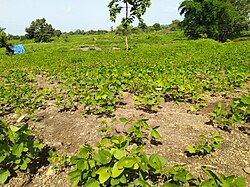
[[File:Soyabean field.jpg|thumb|[[India]]|alt=Field in India]] | [[File:Soyabean field.jpg|thumb|Young plants in [[India]]|alt=Field in India]] | ||
While the origins and history of Soybean cultivation in the [[Eastern Himalayas]] is debated, it was potentially introduced from southern [[China]], more specifically [[Yunnan]] province.<ref>{{cite book |last1=Shurtleff |first1=William |url=http://www.soyinfocenter.com/books/140 |title=History of Soybeans and Soyfoods in South Asia / Indian Subcontinent (1656–2010) |last2=Aoyagi |first2=Akiko |publisher=Soy Info Center |year=2010 |isbn=978-1-928914-31-0 |access-date=February 18, 2012}}</ref><ref name=":4">{{Cite journal |last=Tamang |first=Jyoti Prakash |date=September 2024 |title=Unveiling kinema: blending tradition and science in the Himalayan fermented soya delicacy |journal=Journal of Ethnic Foods |volume=11 |issue=1 |article-number=29 |doi=10.1186/s42779-024-00247-1 |doi-access=free |issn=2352-619X}}</ref> Alternatively, it could have reached here through traders from [[Indonesia]] via [[Myanmar]]. [[Northeast India]] is viewed as a passive micro-centre within the soybean secondary gene centre. Central India is considered a tertiary gene centre particularly the area encompassing Madhya Pradesh which is also the country largest soybean producer.<ref name=":4" /> | |||
===Iberia=== | ===Iberia=== | ||
[[Nippo Jisho|Vocabvlario da Lingoa de Iapam]], a Japanese-Portuguese dictionary, was compiled and published in 1603 by Jesuit priests in Nagasaki. It contains short but clear definitions for about 20 words related to soyfoods—the first in any European language. | |||
The Luso-Hispanic traders were familiar with soybeans and soybean product through their trade with Far East since at least the 17th century. However, it was not until the late 19th century that the first attempt to cultivate soybeans in the Iberian peninsula was undertaken. In 1880, the soybean was first cultivated in Portugal in the [[Botanical Garden of the University of Coimbra|Botanical Gardens at Coimbra]] (Crespi 1935). | The Luso-Hispanic traders were familiar with soybeans and soybean product through their trade with Far East since at least the 17th century. However, it was not until the late 19th century that the first attempt to cultivate soybeans in the Iberian peninsula was undertaken. In 1880, the soybean was first cultivated in Portugal in the [[Botanical Garden of the University of Coimbra|Botanical Gardens at Coimbra]] (Crespi 1935). | ||
| Line 345: | Line 251: | ||
| isbn = 978-0-8078-4613-1 | | isbn = 978-0-8078-4613-1 | ||
| publisher = University of North Carolina Press | | publisher = University of North Carolina Press | ||
| page = 147}}</ref> The first "New World" soybean crop was grown on [[Skidaway Island, Georgia]], in 1765 by Henry Yonge from seeds given him by Samuel Bowen.<ref>{{Cite journal|last=Hymowitz|first=T.|date=1970-10-01|title=On the domestication of the soybean|journal=[[Economic Botany]]|language=en|volume=24|issue=4|pages=408–21|doi=10.1007/BF02860745|s2cid=26735964}}</ref><ref>{{cite web|url=http://www.caes.uga.edu/extension/irwin/anr/Vol29.1.pdf.pdf |archive-url=https://web.archive.org/web/20150923195804/http://www.caes.uga.edu/extension/irwin/anr/Vol29.1.pdf.pdf |archive-date=September 23, 2015 |publisher=Georgia Soybean News |website=caes.uga.edu |title=Another First for Georgia Agriculture |author=Roger Boerma |page=5 |volume=1 |issue=1 | | page = 147}}</ref> The first "New World" soybean crop was grown on [[Skidaway Island, Georgia]], in 1765 by Henry Yonge from seeds given him by Samuel Bowen.<ref>{{Cite journal|last=Hymowitz|first=T.|date=1970-10-01|title=On the domestication of the soybean|journal=[[Economic Botany]]|language=en|volume=24|issue=4|pages=408–21|doi=10.1007/BF02860745|bibcode=1970EcBot..24..408H |s2cid=26735964|url=http://elartu.tntu.edu.ua/handle/lib/43629 }}</ref><ref>{{cite web|url=http://www.caes.uga.edu/extension/irwin/anr/Vol29.1.pdf.pdf |archive-url=https://web.archive.org/web/20150923195804/http://www.caes.uga.edu/extension/irwin/anr/Vol29.1.pdf.pdf |archive-date=September 23, 2015 |publisher=Georgia Soybean News |website=caes.uga.edu |title=Another First for Georgia Agriculture |author=Roger Boerma |page=5 |volume=1 |issue=1 }}</ref><ref>{{cite web|url=https://news.google.com/newspapers?nid=360&dat=19940831&id=9eMyAAAAIBAJ&pg=6901,2669493&hl=en|publisher=The Rockmart Journal|title=Soybeans planted first in Georgia|date=21 August 1994|website=Google News Archive}}</ref> Bowen grew soy near [[Savannah, Georgia]], possibly using funds from Flint, and made soy sauce for sale to England.<ref name="Coastalfields Press">{{cite book|title=Eat Your Food! Gastronomical Glory from Garden to Gut: A Coastalfields Cookbook, Nutrition Textbook, Farming Manual and Sports Manual|url=https://books.google.com/books?id=BtZ2oNGyv6AC&pg=PR2|access-date=4 May 2013|date=April 2007|publisher=Coastalfields Press|isbn=978-0-9785944-8-0}}</ref> Although soybean was introduced into North America in 1765, for the next 155 years, the crop was grown primarily for [[forage]].<ref>{{cite web |url=http://www.nsrl.uiuc.edu/aboutsoy/history4.html |title=About Soy - Soybeans: The Success Story - p.4|date=November 22, 2003 |website=National Soybean Research Laboratory - [[University of Illinois Urbana-Champaign]] |archive-url=https://web.archive.org/web/20031122134643/http://www.nsrl.uiuc.edu/aboutsoy/history4.html |archive-date=November 22, 2003 }}</ref> | ||
In 1831, the first soy product "a few dozen India Soy" [sauce] arrived in Canada. Soybeans were probably first cultivated in Canada by 1855, and definitely in 1895 at [[Ontario Agricultural College]].<ref>{{cite book|url=http://www.soyinfocenter.com/books/137|title=History of Soybeans and Soyfoods in Canada (1831–2010)|publisher=Soy Info Center|access-date=February 18, 2012|isbn=978-1-928914-28-0|first1=William|last1=Shurtleff|first2=Akiko|last2=Aoyagi|year=2010}}</ref> | In 1831, the first soy product "a few dozen India Soy" [sauce] arrived in Canada. Soybeans were probably first cultivated in Canada by 1855, and definitely in 1895 at [[Ontario Agricultural College]].<ref>{{cite book|url=http://www.soyinfocenter.com/books/137|title=History of Soybeans and Soyfoods in Canada (1831–2010)|publisher=Soy Info Center|access-date=February 18, 2012|isbn=978-1-928914-28-0|first1=William|last1=Shurtleff|first2=Akiko|last2=Aoyagi|year=2010}}</ref> | ||
It was not until [[Lafayette Mendel]] and [[Thomas Burr Osborne (chemist)|Thomas Burr Osborne]] showed that the nutritional value of soybean seeds could be increased by cooking, moisture or heat, that soy went from a farm animal feed to a human food.<ref>{{cite web |url=http://www.aces.uiuc.edu/vista/html_pubs/irspsm91/kunitz.html|title=The Kunitz Soybean Variety|work=uiuc.edu|date=2018-02-20|first = Theodore|last =Hymowitz}}</ref><ref>{{cite web|url=http://cropsci.illinois.edu/news/scientists-create-new-low-allergen-soybean|title= Scientists create new low-allergen soybean|work=illinois.edu | It was not until [[Lafayette Mendel]] and [[Thomas Burr Osborne (chemist)|Thomas Burr Osborne]] showed that the nutritional value of soybean seeds could be increased by cooking, moisture or heat, that soy went from a farm animal feed to a human food.<ref>{{cite web|url=http://www.aces.uiuc.edu/vista/html_pubs/irspsm91/kunitz.html|title=The Kunitz Soybean Variety|work=uiuc.edu|date=2018-02-20|first=Theodore|last=Hymowitz|access-date=June 8, 2015|archive-date=February 20, 2018|archive-url=https://web.archive.org/web/20180220194714/http://www.aces.uiuc.edu/vista/html_pubs/irspsm91/kunitz.html}}</ref><ref>{{cite web|url=http://cropsci.illinois.edu/news/scientists-create-new-low-allergen-soybean|title= Scientists create new low-allergen soybean|work=illinois.edu|archive-url=https://web.archive.org/web/20150605195117/http://cropsci.illinois.edu/news/scientists-create-new-low-allergen-soybean|archive-date=June 5, 2015}}</ref> | ||
William Morse is considered the "father" of modern soybean agriculture in America. | [[William Joseph Morse]] is considered the "father" of modern soybean agriculture in America. In 1910, he and [[Charles Piper]] began to popularize what was regarded as a relatively unknown Oriental peasant crop in America into a "golden bean", with the soybean becoming one of America's largest and most nutritious farm crops.<ref>{{cite web|url=http://www.soyinfocenter.com/HSS/morse_and_piper.php|title=William J. Morse and Charles V. Piper|work=soyinfocenter.com|first1= William |last1=Shurtleff |first2=Akiko|last2= Aoyagi|date =2004}}</ref><ref>{{cite web|url= http://www.soyinfocenter.com/books/147|title=William J. Morse – History of His Work with Soybeans and Soyfoods (1884–1959) – SoyInfo Center |publisher=soyinfocenter.com}}</ref><ref>{{cite book |last1=Piper |first1=Charles V. |author1-link=Charles Piper |last2=Morse |first2=William J. |year=1923 |title=The Soybean |url=https://books.google.com/books?id=6hRCAAAAYAAJ |series=Agricultural and Biological Publications |location=New York |publisher=McGraw-Hill Book Company |oclc=252589754 |via=Google Books}}</ref> | ||
[[File:Soybeans 2021 US map.pdf| | [[File:Soybeans 2021 US map.pdf|thumb|alt=Planted area 2021 US map by state|left]] | ||
Prior to the 1920s in the US, the soybean was mainly a [[forage]] crop, a source of oil, meal (for feed) and industrial products, with very little used as food. However, it took on an important role after World War I. During the [[Great Depression]], the drought-stricken ([[Dust Bowl]]) regions of the United States were able to use soy to regenerate their soil because of its nitrogen-fixing properties. Farms were increasing production to meet with government demands, and [[Henry Ford]] became a promoter of soybeans.<ref name=":3">{{Cite news|url=https://www.bloomberg.com/opinion/articles/2019-12-07/history-of-soybeans-in-u-s-could-take-turn-in-trump-s-trade-war?srnd=premium|title=How Soybeans Became Ubiquitous |newspaper=Bloomberg.com |date=December 7, 2019 |publisher=Bloomberg News |access-date=2019-12-07}}</ref> In 1931, Ford hired chemists [[Robert Boyer (chemist)|Robert Boyer]] and Frank Calvert to produce [[artificial silk]]. They succeeded in making a textile fiber of spun soy protein fibers, hardened or tanned in a [[formaldehyde]] bath, which was given the name [[Azlon]]. It never reached the commercial market. Soybean oil was used by [[Ford Motor Company|Ford]] in [[Soy paint|paint]] for the automobiles,<ref name="Schwarcz">{{cite book |author=Joe Schwarcz|title=The Fly in the Ointment: 63 Fascinating Commentaries on the Science of Everyday Life |url=https://books.google.com/books?id=rmIbClRzfeoC&pg=PA193 |access-date=4 May 2013 |year=2004 |publisher=ECW Press |isbn=978-1-55022-621-8|page=193}}</ref> as well as a fluid for shock absorbers. | Prior to the 1920s in the US, the soybean was mainly a [[forage]] crop, a source of oil, meal (for feed) and industrial products, with very little used as food. However, it took on an important role after World War I. During the [[Great Depression]], the drought-stricken ([[Dust Bowl]]) regions of the United States were able to use soy to regenerate their soil because of its nitrogen-fixing properties. Farms were increasing production to meet with government demands, and [[Henry Ford]] became a promoter of soybeans.<ref name=":3">{{Cite news|url=https://www.bloomberg.com/opinion/articles/2019-12-07/history-of-soybeans-in-u-s-could-take-turn-in-trump-s-trade-war?srnd=premium|title=How Soybeans Became Ubiquitous |newspaper=Bloomberg.com |date=December 7, 2019 |publisher=Bloomberg News |access-date=2019-12-07}}</ref> In 1931, Ford hired chemists [[Robert Boyer (chemist)|Robert Boyer]] and Frank Calvert to produce [[artificial silk]]. They succeeded in making a textile fiber of spun soy protein fibers, hardened or tanned in a [[formaldehyde]] bath, which was given the name [[Azlon]]. It never reached the commercial market. Soybean oil was used by [[Ford Motor Company|Ford]] in [[Soy paint|paint]] for the automobiles,<ref name="Schwarcz">{{cite book |author=Joe Schwarcz|title=The Fly in the Ointment: 63 Fascinating Commentaries on the Science of Everyday Life |url=https://books.google.com/books?id=rmIbClRzfeoC&pg=PA193 |access-date=4 May 2013 |year=2004 |publisher=ECW Press |isbn=978-1-55022-621-8|page=193}}</ref> as well as a fluid for shock absorbers. | ||
During World War II, soybeans became important in both North America and Europe chiefly as substitutes for other protein foods and as a source of edible oil. During the war, the soybean was discovered as [[fertilizer]] due to [[nitrogen fixation]] by the [[United States Department of Agriculture]]. | |||
Prior to the 1970s, Asian-Americans and Seventh-Day Adventists were essentially the only users of soy foods in the United States.<ref>{{Cite book |last=Roth |first=Matthew |year=2018 |title=Magic Bean: The Rise of Soy in America |location=Lawrence, KS |publisher=University Press of Kansas|page=109 |isbn=978-0-7006-2633-5 |oclc=1012618664 }}</ref> "The soy foods movement began in small pockets of the counterculture, notably the Tennessee commune named simply [[The Farm (Tennessee)|The Farm]], but by the mid-1970s a vegetarian revival helped it gain momentum and even popular awareness through books such as [[William Shurtleff|''The Book of Tofu'']]."<ref>{{Cite book |last=Roth |first=Matthew |year=2018 |title=Magic Bean: The Rise of Soy in America |location=Lawrence, KS |publisher=University Press of Kansas|page=201 |isbn=978-0-7006-2633-5 |oclc=1012618664 }}</ref> | Prior to the 1970s, Asian-Americans and Seventh-Day Adventists were essentially the only users of soy foods in the United States.<ref>{{Cite book |last=Roth |first=Matthew |year=2018 |title=Magic Bean: The Rise of Soy in America |location=Lawrence, KS |publisher=University Press of Kansas|page=109 |isbn=978-0-7006-2633-5 |oclc=1012618664 }}</ref> "The soy foods movement began in small pockets of the counterculture, notably the Tennessee commune named simply [[The Farm (Tennessee)|The Farm]], but by the mid-1970s a vegetarian revival helped it gain momentum and even popular awareness through books such as [[William Shurtleff|''The Book of Tofu'']]."<ref>{{Cite book |last=Roth |first=Matthew |year=2018 |title=Magic Bean: The Rise of Soy in America |location=Lawrence, KS |publisher=University Press of Kansas|page=201 |isbn=978-0-7006-2633-5 |oclc=1012618664 }}</ref> | ||
Although practically unseen in 1900, by 2000 soybean plantings covered more than 70 million acres,<ref>{{Cite book |last=Roth |first=Matthew |year=2018 |title=Magic Bean: The Rise of Soy in America |location=Lawrence, KS |publisher=University Press of Kansas|page=8 |isbn=978-0-7006-2633-5 |oclc=1012618664 }}</ref> second only to corn, and it became America's largest cash crop.{{citation needed|date=February 2022}} In 2021, 87,195 acres were planted, with the largest acreage in the states of Illinois, Iowa, and Minnesota.<ref>{{cite web |title=2021 Soybean Planted Area (000) Acres and Percent Change from Previous Year |url=https://www.nass.usda.gov/Charts_and_Maps/graphics/soyacm.pdf |website=USDA-National Agricultural Statistics Service |publisher=USDA |access-date=4 February 2022 |date=12 January 2022}}</ref> | Although practically unseen in 1900, by 2000 soybean plantings covered more than 70 million acres,<ref>{{Cite book |last=Roth |first=Matthew |year=2018 |title=Magic Bean: The Rise of Soy in America |location=Lawrence, KS |publisher=University Press of Kansas|page=8 |isbn=978-0-7006-2633-5 |oclc=1012618664 }}</ref> second only to corn, and it became America's largest cash crop.{{citation needed|date=February 2022}} In 2021, 87,195,000 acres were planted, with the largest acreage in the states of Illinois, Iowa, and Minnesota.<ref>{{cite web |title=2021 Soybean Planted Area (000) Acres and Percent Change from Previous Year |url=https://www.nass.usda.gov/Charts_and_Maps/graphics/soyacm.pdf |website=USDA-National Agricultural Statistics Service |publisher=USDA |access-date=4 February 2022 |date=12 January 2022}}</ref> | ||
===Caribbean and West Indies=== | ===Caribbean and West Indies=== | ||
| Line 365: | Line 273: | ||
===Mediterranean area=== | ===Mediterranean area=== | ||
The soybean was first cultivated in Italy by 1760 in the Botanical Garden of Turin. During the 1780s, it was grown in at least three other botanical gardens in Italy.<ref>Shurtleff, W.; Aoyagi, A. (2015). ''History of Soybeans and Soyfoods in Italy (1597–2015)''. Lafayette, California: Soyinfo Center. 618 pp. (1,381 references; 93 photos and illustrations. Free online.)</ref> The first soybean product, soy oil, arrived in [[Anatolia]] during 1909 under [[Ottoman Empire]].<ref name=":2">{{Cite book|url=https://books.google.com/books?id=urb6IPmxwU8C&q=soybean+turkey&pg=PA7|title=History of Soybeans and Soyfoods in the Middle East: Extensively Annotated Bibliography and Sourcebook|last1=Shurtleff|first1=William|last2=Aoyagi|first2=Akiko|date=2008|publisher=Soyinfo Center|isbn= | The soybean was first cultivated in Italy by 1760 in the Botanical Garden of Turin. During the 1780s, it was grown in at least three other botanical gardens in Italy.<ref>Shurtleff, W.; Aoyagi, A. (2015). ''History of Soybeans and Soyfoods in Italy (1597–2015)''. Lafayette, California: Soyinfo Center. 618 pp. (1,381 references; 93 photos and illustrations. Free online.)</ref> The first soybean product, soy oil, arrived in [[Anatolia]] during 1909 under [[Ottoman Empire]].<ref name=":2">{{Cite book|url=https://books.google.com/books?id=urb6IPmxwU8C&q=soybean+turkey&pg=PA7|title=History of Soybeans and Soyfoods in the Middle East: Extensively Annotated Bibliography and Sourcebook|last1=Shurtleff|first1=William|last2=Aoyagi|first2=Akiko|date=2008|publisher=Soyinfo Center|isbn=978-1-928914-15-0|language=en}}</ref> The first clear cultivation occurred in 1931.<ref name=":2" /> This was also the first time that soybeans were cultivated in Middle East.<ref name=":2" /> By 1939, soybeans were cultivated in Greece.<ref>Matagrin. 1939. "Le Soja et les Industries du Soja," p. 47–48</ref><ref>Shurtleff, W.; Aoyagi, A. 2015. "History of Soybeans and Soyfoods in Greece, the European Union and Small Western European Countries (1939–2015)." Lafayette, California: Soyinfo Center. 243 pp. (462 references; 20 photos and illustrations. Free online. {{ISBN|978-1-928914-81-5}}).</ref> | ||
===Australia=== | ===Australia=== | ||
Wild soybeans were discovered in northeastern Australia in 1770 by explorers Banks and Solander. In 1804, the first soyfood product ("Fine India Soy" [sauce]) was sold in Sydney. In 1879, the first domesticated soybeans arrived in Australia, a gift of the Minister of the Interior Department, Japan.<ref>{{cite book|url=http://www.soyinfocenter.com/books/138|title=History of Soybeans and Soyfoods in Australia, New Zealand and Oceania (1770–2010)|publisher=Soy Info Center|access-date=February 18, 2012|isbn=978-1-928914-29-7|first1=William|last1=Shurtleff|first2=Akiko|last2=Aoyagi|year=2010}}</ref> | Wild soybeans were discovered in northeastern Australia in 1770 by explorers Banks and Solander. In 1804, the first soyfood product ("Fine India Soy" [sauce]) was sold in Sydney. In 1879, the first domesticated soybeans arrived in Australia, a gift of the Minister of the Interior Department, Japan.<ref>{{cite book|url=http://www.soyinfocenter.com/books/138|title=History of Soybeans and Soyfoods in Australia, New Zealand and Oceania (1770–2010)|publisher=Soy Info Center|access-date=February 18, 2012|isbn=978-1-928914-29-7|first1=William|last1=Shurtleff|first2=Akiko|last2=Aoyagi|year=2010}}</ref> | ||
=== | ===France=== | ||
The soybean was first cultivated in France by 1779 (and perhaps as early as 1740). The two key early people and organizations introducing the soybean to France were the Society of Acclimatization (starting in 1855) and [[Li Shizeng|Li Yu-ying]] (from 1910). Li started a large tofu factory, where the first commercial soyfoods in France were made.<ref>Shurtleff, W.; Aoyagi, A.; 2015. "History of Soybeans and Soyfood in France (1665–2015)". Lafayette, California; Soyinfo Center. 1,202 pp. (3,405 references; 145 photos and illustrations. Free online).</ref> | The soybean was first cultivated in France by 1779 (and perhaps as early as 1740). The two key early people and organizations introducing the soybean to France were the Society of Acclimatization (starting in 1855) and [[Li Shizeng|Li Yu-ying]] (from 1910). Li started a large tofu factory, where the first commercial soyfoods in France were made.<ref>Shurtleff, W.; Aoyagi, A.; 2015. "History of Soybeans and Soyfood in France (1665–2015)". Lafayette, California; Soyinfo Center. 1,202 pp. (3,405 references; 145 photos and illustrations. Free online).</ref> | ||
| Line 388: | Line 296: | ||
The soybean first arrived in South America in Argentina in 1882.<ref>{{cite book|url=http://www.soyinfocenter.com/books/132|title=History of Soybeans and Soyfoods in South America (1882–2009)|publisher=Soy Info Center|access-date=February 18, 2012|isbn=978-1-928914-23-5|first1=William|last1=Shurtleff|first2=Akiko|last2=Aoyagi|year=2009}}</ref> | The soybean first arrived in South America in Argentina in 1882.<ref>{{cite book|url=http://www.soyinfocenter.com/books/132|title=History of Soybeans and Soyfoods in South America (1882–2009)|publisher=Soy Info Center|access-date=February 18, 2012|isbn=978-1-928914-23-5|first1=William|last1=Shurtleff|first2=Akiko|last2=Aoyagi|year=2009}}</ref> | ||
Andrew McClung showed in the early 1950s that with soil amendments the [[Cerrado]] region of Brazil would grow soybeans.<ref>{{cite web|url= | Andrew McClung showed in the early 1950s that with soil amendments the [[Cerrado]] region of Brazil would grow soybeans.<ref>{{cite web|url=https://www.news.cornell.edu/stories/2006/06/cornellian-reaps-2006-world-food-prize|title=Cornell alumnus Andrew Colin McClung reaps 2006 World Food Prize|publisher=news.cornell.edu – Cornell Chronicle}}</ref> In June 1973, when soybean futures markets mistakenly portended a major shortage, the [[Presidency of Richard Nixon|Nixon administration]] imposed an embargo on soybean exports. It lasted only a week, but Japanese buyers felt that they could not rely on U.S. supplies, and the rival Brazilian soybean industry came into existence.<ref>{{Cite web|url=https://www.agpolicy.org/weekcol/217.html|title=Policy Pennings, by Daryll E. Ray, Agricultural Policy Analysis Center|website=www.agpolicy.org|access-date=2019-12-07}}</ref><ref name=":3" /> This led Brazil to become the world's largest producer of soybeans in 2020, with 131 million tons.<ref>[https://revistagloborural.globo.com/Noticias/Agricultura/noticia/2020/06/brasil-deve-colher-131-milhoes-de-toneladas-de-soja-na-safra-202021-aponta-usda.html Brasil deve colher 131 milhões de toneladas de soja na safra 2020/21, aponta USDA]</ref> | ||
Industrial soy production in South America is characterized by wealthy management who live far away from the production site which they manage remotely. In Brazil, these managers depend heavily on advanced technology and machinery, and agronomic practices such as zero tillage, high pesticide use, and intense fertilization. One contributing factor is the increased attention on the Brazilian [[Cerrado]] in [[Bahia]], Brazil by US farmers in the early 2000s. This was due to rising values of scarce farmland and high production costs in the US Midwest. There were many promotions of the Brazilian Cerrado by US farm producer magazines and market consultants who portrayed it as having cheap land with ideal production conditions, with infrastructure being the only thing it was lacking. These same magazines also presented Brazilian soy as inevitably out-competing American soy. Another draw to investing was the insider information about the climate and market in Brazil. A few dozen American farmers purchased varying amounts of land by a variety of means including finding investors and selling off land holdings. Many followed the [[Ethanol fuel|ethanol]] company model and formed an [[Limited liability company|LLC]] with investments from neighboring farmers, friends, and family while some turned to investment companies. Some soy farmers either [[Liquidation|liquidated]] their Brazilian assets or switched to remote management from the US to return to farming there and implement new farming and business practices to make their US farms more productive. Others planned to sell their now expensive Bahia land to buy land cheaper land in the frontier regions of [[Piauí]] or [[Tocantins]] to create more soybean farms.<ref>{{Cite journal |last=Ofstehage |first=Andrew L. |date=2018-05-10 |title=Financialization of work, value, and social organization among transnational soy farmers in the Brazilian Cerrado |journal=Economic Anthropology |volume=5 |issue=2 |pages=274–285 |doi=10.1002/sea2.12123 |issn=2330-4847}}</ref> | |||
==Genetics== | ==Genetics== | ||
Chinese [[landrace]]s were found to have a slightly higher diversity than inbred lines by Li ''et al.'', 2010.<ref name="Hinze-et-al-2017" /> Specific locus amplified fragment sequencing (SLAF-seq) has been used by Han ''et al.'', 2015 to study the genetic history of the [[crop domestication|domestication process]], perform [[genome-wide association study|genome-wide association studies]] (GWAS) of [[agronomic trait|agronomically relevant traits]], and produce [[high-density linkage map]]s.<ref name="Rasheed-et-al-2017">{{cite journal | last1=Rasheed | first1=Awais | last2=Hao | first2=Yuanfeng | last3=Xia | first3=Xianchun | last4=Khan | first4=Awais | last5=Xu | first5=Yunbi | last6=Varshney | first6=Rajeev K. | last7=He | first7=Zhonghu | title=Crop Breeding Chips and Genotyping Platforms: Progress, Challenges, and Perspectives | journal=[[Molecular Plant]] | volume=10 | issue=8 | year=2017 | doi=10.1016/j.molp.2017.06.008 | pages=1047–1064 | s2cid=33780984 | pmid=28669791}}</ref> An [[SNP array]] was developed by Song ''et al.'', 2013 and has been used for research and [[crop breeding|breeding]];<ref name="Hulse-Kemp-et-al-2015">{{cite journal | |||
Chinese [[landrace]]s were found to have a slightly higher genetic diversity than inbred lines by Li ''et al.'', 2010.<ref name="Hinze-et-al-2017" /> Specific locus amplified fragment sequencing (SLAF-seq) has been used by Han ''et al.'', 2015 to study the genetic history of the [[crop domestication|domestication process]], perform [[genome-wide association study|genome-wide association studies]] (GWAS) of [[agronomic trait|agronomically relevant traits]], and produce [[high-density linkage map]]s.<ref name="Rasheed-et-al-2017">{{cite journal | last1=Rasheed | first1=Awais | last2=Hao | first2=Yuanfeng | last3=Xia | first3=Xianchun | last4=Khan | first4=Awais | last5=Xu | first5=Yunbi | last6=Varshney | first6=Rajeev K. | last7=He | first7=Zhonghu | title=Crop Breeding Chips and Genotyping Platforms: Progress, Challenges, and Perspectives | journal=[[Molecular Plant]] | volume=10 | issue=8 | year=2017 | doi=10.1016/j.molp.2017.06.008 | pages=1047–1064 | s2cid=33780984 | pmid=28669791| doi-access=free | bibcode=2017MPlan..10.1047R }}</ref> An [[SNP array]] was developed by Song ''et al.'', 2013 and has been used for research and [[crop breeding|breeding]];<ref name="Hulse-Kemp-et-al-2015">{{cite journal | last1=Hulse-Kemp | first1=Amanda M|last2=Lemm | first2=Jana | last3=Plieske | first3=Joerg | last4=Ashrafi | first4=Hamid | last5=Buyyarapu | first5=Ramesh | last6=Fang | first6=David D | last7=Frelichowski | first7=James | last8=Giband | first8=Marc | last9=Hague | first9=Steve | last10=Hinze | first10=Lori L | last11=Kochan | first11=Kelli J | last12=Riggs | first12=Penny K | last13=Scheffler | first13=Jodi A | last14=Udall | first14=Joshua A | last15=Ulloa | first15=Mauricio | last16=Wang | first16=Shirley S | last17=Zhu | first17=Qian-Hao | last18=Bag | first18=Sumit K | last19=Bhardwaj | first19=Archana | last20=Burke | first20=John J | last21=Byers | first21=Robert L | last22=Claverie | first22=Michel | last23=Gore | first23=Michael A | last24=Harker | first24=David B | last25=Islam | first25=Mohammad Sariful | last26=Jenkins | first26=Johnie N | last27=Jones | first27=Don C | last28=Lacape | first28=Jean-Marc | last29=Llewellyn | first29=Danny J | last30=Percy | first30=Richard G | last31=Pepper | first31=Alan E | last32=Poland | first32=Jesse A | last33=Mohan Rai | first33=Krishan | last34=Sawant | first34=Samir V | last35=Singh | first35=Sunil Kumar | last36=Spriggs | first36=Andrew | last37=Taylor | first37=Jen M | last38=Wang | first38=Fei | last39=Yourstone | first39=Scott M | last40=Zheng | first40=Xiuting | last41=Lawley | first41=Cindy T | last42=Ganal | first42=Martin W | last43=Van Deynze | first43=Allen | last44=Wilson | first44=Iain W | last45=Stelly | first45=David M | title=Development of a 63K SNP Array for Cotton and High-Density Mapping of Intraspecific and Interspecific Populations of ''Gossypium'' spp. | journal=G3: Genes, Genomes, Genetics | volume=5 | issue=6 | date=2015-06-01 | doi=10.1534/g3.115.018416 | pages=1187–1209 | pmid=25908569 | pmc=4478548 | s2cid=11590488}}</ref> the same team applied their array in Song ''et al.'', 2015 against the USDA Soybean Germplasm Collection and obtained mapping data that are expected to yield [[association mapping]] data for such traits.<ref name="Hinze-et-al-2017">{{cite journal|last1=Hinze | first1=Lori L. | last2=Hulse-Kemp | first2=Amanda M. | last3=Wilson | first3=Iain W. | last4=Zhu | first4=Qian-Hao | last5=Llewellyn | first5=Danny J. | last6=Taylor | first6=Jen M. | last7=Spriggs | first7=Andrew | last8=Fang | first8=David D. | last9=Ulloa | first9=Mauricio | last10=Burke | first10=John J. | last11=Giband | first11=Marc | last12=Lacape | first12=Jean-Marc | last13=Van Deynze | first13=Allen | last14=Udall | first14=Joshua A. | last15=Scheffler | first15=Jodi A. | last16=Hague | first16=Steve | last17=Wendel | first17=Jonathan F. | last18=Pepper | first18=Alan E. | last19=Frelichowski | first19=James | last20=Lawley | first20=Cindy T. | last21=Jones | first21=Don C. | last22=Percy | first22=Richard G. | last23=Stelly | first23=David M. | title=Diversity analysis of cotton (''Gossypium hirsutum'' L.) germplasm using the CottonSNP63K Array | journal=BMC Plant Biology | volume=17 | issue=1 | date=2017-02-03 | page=37 | doi=10.1186/s12870-017-0981-y | pmid=28158969 | pmc=5291959 | s2cid=3969205 | doi-access=free | bibcode=2017BMCPB..17...37H }}</ref> | |||
{{Vanchor|Rpp1-R1}} is a [[crop fungal disease resistance gene|resistance gene]] against [[soybean rust]].<ref name="Show-Me-Your-ID" /> Rpp1-R1 is an [[R gene]] (NB-LRR) providing resistance against the rust pathogen ''[[Phakopsora pachyrhizi]]''.<ref name="Show-Me-Your-ID" /> Its synthesis product includes a [[ULP1 protease]].<ref name="Show-Me-Your-ID"> | {{Vanchor|Rpp1-R1}} is a [[crop fungal disease resistance gene|resistance gene]] against [[soybean rust]].<ref name="Show-Me-Your-ID" /> Rpp1-R1 is an [[R gene]] (NB-LRR) providing resistance against the rust pathogen ''[[Phakopsora pachyrhizi]]''.<ref name="Show-Me-Your-ID" /> Its synthesis product includes a [[ULP1 protease]].<ref name="Show-Me-Your-ID"> | ||
| Line 416: | Line 327: | ||
}}</ref> | }}</ref> | ||
Qijian ''et al.'', 2017 provides the {{Vanchor|SoySNP50K}} [[gene array]].<ref name = "Array" > | Qijian ''et al.'', 2017 provides the {{Vanchor|SoySNP50K}} [[gene array]].<ref name = "Array" >{{Cite journal | issue = 8 | volume = 10 | year = 2017 | last1=Rasheed | first1=Awais | last2=Hao | first2=Yuanfeng | last3=Xia | first3=Xianchun | last4=Khan | first4=Awais | last5=Xu | first5=Yunbi | last6=Varshney | first6=Rajeev K. | last7=He | first7=Zhonghu |s2cid=33780984|pmid=28669791|doi=10.1016/j.molp.2017.06.008|pages=1047–1064|title=Crop Breeding Chips and Genotyping Platforms: Progress, Challenges, and Perspectives | journal=[[Molecular Plant]] | doi-access=free | bibcode = 2017MPlan..10.1047R }}</ref><ref>{{ Cite journal | issue = 1 | volume = 8 | year = 2013 | journal = [[PLoS ONE]] | last1 = Song | first1 = Qijian | last2 = Hyten | first2 = David | last3 = Jia | first3 = Gaofeng | last4 = Quigley | first4 = Charles | last5 = Fickus | first5 = Edward | last6 = Nelson | first6 = Randall | last7 = Cregan | first7 = Perry | article-number = e54985 | s2cid = 1850673 | pmc = 3555945 | pmid = 23372807 | doi = 10.1371/journal.pone.0054985 | title = Development and Evaluation of SoySNP50K, a High-Density Genotyping Array for Soybean | bibcode = 2013PLoSO...854985S | doi-access = free }}</ref> | ||
</ref> | |||
===Genetic modification=== | ===Genetic modification=== | ||
{{further|Genetically modified soybean}} | {{further|Genetically modified soybean}} | ||
[[File:Multicolor soybeans in Hale Township.jpg|thumb|Different varieties of being grown together]] | [[File:Multicolor soybeans in Hale Township.jpg|thumb|Different varieties of soybeans being grown together]] | ||
Soybeans are one of the "[[Biotechnology|biotech]] food" crops that have been [[Genetically modified food|genetically modified]], and genetically modified soybeans are being used in an increasing number of products. In 1995, [[Monsanto]] company introduced [[Genetically modified crops|glyphosate-tolerant]] soybeans that have been genetically modified to be resistant to Monsanto's [[glyphosate]] herbicides through substitution of the ''[[Agrobacterium]] sp.'' (strain CP4) [[gene]] EPSP (5-enolpyruvyl shikimic acid-3-phosphate) synthase. The substituted version is not sensitive to [[glyphosate]].<ref>{{cite journal |pages=1451–61 |doi=10.2135/cropsci1995.0011183X003500050032x |title=Development, Identification, and Characterization of a Glyphosate-Tolerant Soybean Line |year=1995 |last1=Padgette |first1=S.R. |last2=Kolacz |first2=K.H. |last3=Delannay |first3=X. |last4=Re |first4=D.B. |last5=Lavallee |first5=B.J. |last6=Tinius |first6=C.N. |last7=Rhodes |first7=W.K. |last8=Otero |first8=Y.I. |last9=Barry |first9=G.F. | Soybeans are one of the "[[Biotechnology|biotech]] food" crops that have been [[Genetically modified food|genetically modified]], and genetically modified soybeans are being used in an increasing number of products. In 1995, [[Monsanto]] company introduced [[Genetically modified crops|glyphosate-tolerant]] soybeans that have been genetically modified to be resistant to Monsanto's [[glyphosate]] herbicides through substitution of the ''[[Agrobacterium]] sp.'' (strain CP4) [[gene]] EPSP (5-enolpyruvyl shikimic acid-3-phosphate) synthase. The substituted version is not sensitive to [[glyphosate]].<ref>{{cite journal |pages=1451–61 |doi=10.2135/cropsci1995.0011183X003500050032x |title=Development, Identification, and Characterization of a Glyphosate-Tolerant Soybean Line |year=1995 |last1=Padgette |first1=S.R. |last2=Kolacz |first2=K.H. |last3=Delannay |first3=X. |last4=Re |first4=D.B. |last5=Lavallee |first5=B.J. |last6=Tinius |first6=C.N. |last7=Rhodes |first7=W.K. |last8=Otero |first8=Y.I. |last9=Barry |first9=G.F. |journal=[[Crop Science (journal)|Crop Science]]|volume=35 |issue=5}}</ref> | ||
In 1997, about 8% of all soybeans cultivated for the commercial market in the United States were genetically modified. In 2010, the figure was 93%.<ref>National Agricultural Statistics Board annual report, June 30, 2010. Retrieved July 23, 2010.</ref> As with other glyphosate-tolerant crops, concern is expressed over damage to [[biodiversity]].<ref>{{cite book |last= Liu |first= KeShun |title= Soybeans: Chemistry, Technology, and Utilization |url= https://archive.org/details/soybeanschemistr00liuk |url-access= limited |year=1997 |publisher= Springer |location=Berlin|isbn= 978-0-8342-1299-2 |page= [https://archive.org/details/soybeanschemistr00liuk/page/n555 532]}}</ref> A 2003 study<ref>{{cite journal |doi=10.2135/cropsci2003.0409 |author=Sneller CH |title=Impact of Transgenic Genotypes and Subdivision on Diversity Within Elite North American Soybean Germplasm |journal=[[Crop Science (journal)|Crop Science]]|volume=43 |pages=409–14 |year=2003}}</ref> concluded the "Roundup Ready" (RR) gene had been bred into so many different soybean cultivars, there had been little decline in genetic diversity, but "diversity was limited among elite lines from some companies". | In 1997, about 8% of all soybeans cultivated for the commercial market in the United States were genetically modified. In 2010, the figure was 93%.<ref>National Agricultural Statistics Board annual report, June 30, 2010. Retrieved July 23, 2010.</ref> As with other glyphosate-tolerant crops, concern is expressed over damage to [[biodiversity]].<ref>{{cite book |last= Liu |first= KeShun |title= Soybeans: Chemistry, Technology, and Utilization |url= https://archive.org/details/soybeanschemistr00liuk |url-access= limited |year=1997 |publisher= Springer |location=Berlin|isbn= 978-0-8342-1299-2 |page= [https://archive.org/details/soybeanschemistr00liuk/page/n555 532]}}</ref> A 2003 study<ref>{{cite journal |doi=10.2135/cropsci2003.0409 |author=Sneller CH |title=Impact of Transgenic Genotypes and Subdivision on Diversity Within Elite North American Soybean Germplasm |journal=[[Crop Science (journal)|Crop Science]]|volume=43 |pages=409–14 |year=2003}}</ref> concluded the "Roundup Ready" (RR) gene had been bred into so many different soybean cultivars, there had been little decline in genetic diversity, but "diversity was limited among elite lines from some companies". | ||
| Line 433: | Line 338: | ||
The widespread use of such types of GM soybeans in the Americas has caused problems with exports to some regions. GM crops require extensive certification before they can be legally imported into the [[European Union]], where there is considerable supplier and consumer reluctance to use GM products for consumer or animal use. Difficulties with [[Co-existence of genetically modified and conventional crops and derived food and feed|coexistence]] and subsequent traces of cross-contamination of non-GM stocks have caused shipments to be rejected and have put a premium on non-GM soy.<ref>{{cite news|title= EU Caught in Quandary Over GMO Animal Feed Imports |newspaper=The Guardian|date= December 7, 2007}}</ref> | The widespread use of such types of GM soybeans in the Americas has caused problems with exports to some regions. GM crops require extensive certification before they can be legally imported into the [[European Union]], where there is considerable supplier and consumer reluctance to use GM products for consumer or animal use. Difficulties with [[Co-existence of genetically modified and conventional crops and derived food and feed|coexistence]] and subsequent traces of cross-contamination of non-GM stocks have caused shipments to be rejected and have put a premium on non-GM soy.<ref>{{cite news|title= EU Caught in Quandary Over GMO Animal Feed Imports |newspaper=The Guardian|date= December 7, 2007}}</ref> | ||
A 2006 [[United States Department of Agriculture]] report found the adoption of genetically engineered (GE) soy, corn and cotton reduced the amount of pesticides used overall, but did result in a slightly greater amount of [[herbicide]]s used for soy specifically. The use of GE soy was also associated with greater [[No-till farming|conservation tillage]], indirectly leading to better soil conservation, as well as increased income from off-farming sources due to the greater ease with which the crops can be managed. Though the overall estimated benefits of the adoption of GE soybeans in the United States was $310 million, the majority of this benefit was experienced by the companies selling the seeds (40%), followed by biotechnology firms (28%) and farmers (20%).<ref>{{cite web| publisher = United States Department of Agriculture|url=http://www.ers.usda.gov/publications/eib11/eib11.pdf|archive-url=https://web.archive.org/web/20100614154639/http://www.ers.usda.gov/publications/eib11/eib11.pdf|archive-date=2010-06-14 | A 2006 [[United States Department of Agriculture]] report found the adoption of genetically engineered (GE) soy, corn and cotton reduced the amount of pesticides used overall, but did result in a slightly greater amount of [[herbicide]]s used for soy specifically. The use of GE soy was also associated with greater [[No-till farming|conservation tillage]], indirectly leading to better soil conservation, as well as increased income from off-farming sources due to the greater ease with which the crops can be managed. Though the overall estimated benefits of the adoption of GE soybeans in the United States was $310 million, the majority of this benefit was experienced by the companies selling the seeds (40%), followed by biotechnology firms (28%) and farmers (20%).<ref>{{cite web| publisher = United States Department of Agriculture|url=http://www.ers.usda.gov/publications/eib11/eib11.pdf|archive-url=https://web.archive.org/web/20100614154639/http://www.ers.usda.gov/publications/eib11/eib11.pdf|archive-date=2010-06-14 |title = The First Decade of Genetically Engineered Crops in the United States |last = Fernandez-Cornejo | first = J. | author2 = Caswell, Margriet|date = April 1, 2006|access-date=February 18, 2012}}</ref> The patent on glyphosate-tolerant soybeans expired in 2014,<ref>{{cite news|url=https://www.nytimes.com/2009/12/18/business/18seed.html|title=As Patent Ends, a Seed's Use Will Survive|date=December 18, 2009|newspaper=The New York Times|last1=Pollack|first1=Andrew}}</ref> so benefits can be expected to shift.<ref>{{Cite web|url=http://extension.udel.edu/kentagextension/2008/11/18/soybean-seed-decisions-2009/|archive-url=https://archive.today/20150408022806/http://extension.udel.edu/kentagextension/2008/11/18/soybean-seed-decisions-2009/|archive-date=April 8, 2015|title=Cooperative Extension ‹ Log In}}</ref> | ||
== Adverse effects == | |||
==Uses== | === Soy allergy === | ||
[[File:Global-soy-production-to-end-use.png| | {{Main|Soy allergy}} | ||
[[File:TofuWithSoySauceAndCarrot.jpg|thumb|[[Tofu]] and [[soy sauce]]]] | Allergy to soy is common, and the food is listed with other foods that commonly cause allergy, such as milk, eggs, peanuts, tree nuts, and shellfish. The problem has been reported among younger children, and the diagnosis of soy allergy is often based on symptoms reported by parents and results of skin tests or blood tests for allergy. Only a few reported studies have attempted to confirm allergy to soy by direct challenge with the food under controlled conditions.<ref>{{cite journal |last=Cantani |first=A. |author2=Lucenti P. |date=August 1997 |title=Natural History of Soy Allergy and/or Intolerance in Children, and Clinical Use of Soy-protein Formulas |journal=Pediatric Journal of Allergy and Clinical Immunology |volume=8 |issue=2 |pages=59–74 |doi=10.1111/j.1399-3038.1997.tb00146.x |pmid=9617775 |s2cid=35264190}}<!--the title contains and/or, don't change it--></ref> It is very difficult to give a reliable estimate of the true prevalence of soy allergy in the general population. To the extent that it does exist, soy allergy may cause cases of [[urticaria]] and [[angioedema]], usually within minutes to hours of ingestion. In rare cases, true [[anaphylaxis]] may also occur. The reason for the discrepancy is likely that soy proteins, the causative factor in [[allergy]], are far less potent at triggering allergy symptoms than the proteins of peanut and shellfish.<ref>{{cite journal |last=Cordle |first=C.T. |date=May 2004 |title=Soy Protein Allergy: Incidence and Relative Severity |journal=[[Journal of Nutrition]] |volume=134 |issue=5 |pages=1213S–19S |doi=10.1093/jn/134.5.1213S |pmid=15113974 |doi-access=free}}</ref> An allergy test that is positive demonstrates that the immune system has formed IgE antibodies to soy proteins. However, this is only a factor when soy proteins reach the blood without being digested, in sufficient quantities to reach a threshold to provoke actual symptoms. | ||
Among the [[legume]]s, the soybean is valued for its high (38–45%) [[protein]] content as well as its high (approximately 20%) oil content. Soybeans are the most valuable agricultural export of the United States.<ref>{{Cite web|title = Top U.S. Agricultural Exports in 2017|url = https://www.fas.usda.gov/data/top-us-agricultural-exports-2017|website = US [[Foreign Agricultural Service]]| date=March 23, 2018 |access-date = 2019-05-01}}</ref> Approximately 85% of the world's soybean crop is processed into soybean meal and soybean oil, the remainder processed in other ways or eaten whole.<ref>{{cite web|url=http://www.soyatech.com/soy_facts.htm|title=Soy Facts|publisher=Soyatech|access-date=Jan 24, 2017 | |||
Soy can also trigger symptoms via [[food intolerance]], a situation where no allergic mechanism can be proven. One scenario is seen in very young infants who have vomiting and [[Diarrhea|diarrhoea]] when fed soy-based formula, which resolves when the formula is withdrawn. Older infants can suffer a more severe disorder with vomiting, diarrhoea that may be bloody, [[anemia]], weight loss and failure to thrive. The most common cause of this unusual disorder is a sensitivity to cow's milk, but soy formulas can also be the trigger. The precise mechanism is unclear and it could be immunologic, although not through the IgE-type antibodies that have the leading role in urticaria and anaphylaxis. However, it is also self-limiting and will often disappear in the [[toddler]] years.<ref>{{cite journal |last=Sampson |first=H.A. |date=May 1999 |title=Food Allergy, Part 1: Immunopathogenesis and Clinical Disorders |url=http://www.jacionline.org/article/S0091674999704112/pdf |journal=The Journal of Allergy and Clinical Immunology |volume=103 |issue=5 |pages=717–728 |doi=10.1016/S0091-6749(99)70411-2 |pmid=10329801 |bibcode=1999JACI..103..717S }}</ref> | |||
In the [[European Union]], identifying the presence of soy either as an ingredient or unintended contaminant in packaged food is compulsory. The regulation (EC) 1169/2011 on food-labeling lists 14 allergens, including soy, in packaged food must be clearly indicated on the label as part of the list of ingredients, using a distinctive typography (such as bold type or capital letters).<ref>{{cite web |date=25 October 2011 |title=Regulation (EG) 1169/2011 |url=https://eur-lex.europa.eu/legal-content/EN/TXT/?uri=CELEX:32011R1169 |access-date=7 October 2020 |publisher=Eur-Lex - European Union Law, European Union}}</ref> | |||
===Thyroid function=== | |||
One review noted that soy-based foods may inhibit absorption of thyroid hormone medications required for treatment of [[hypothyroidism]].<ref>{{cite journal |last1=Messina |first1=M |last2=Redmond |first2=G |year=2006 |title=Effects of soy protein and soybean isoflavones on thyroid function in healthy adults and hypothyroid patients: A review of the relevant literature |journal=[[Thyroid (journal)|Thyroid]] |volume=16 |issue=3 |pages=249–58 |doi=10.1089/thy.2006.16.249 |pmid=16571087}}</ref> A 2015 scientific review by the [[European Food Safety Authority]] concluded that intake of isoflavones from supplements did not affect thyroid hormone levels in [[postmenopausal]] women.<ref>{{cite journal |year=2015 |title=Risk assessment for peri- and postmenopausal women taking food supplements containing isolated isoflavones |url=https://www.efsa.europa.eu/en/efsajournal/pub/4246 |journal=[[EFSA Journal]] |volume=13 |issue=10 |page=4246 |doi=10.2903/j.efsa.2015.4246 |doi-access=free}}</ref> | |||
== Uses == | |||
[[File:Global-soy-production-to-end-use.png|thumb|upright=1.4|Breakdown of what the world's soy was used for in 2018]] | |||
[[File:TofuWithSoySauceAndCarrot.jpg|thumb|[[Tofu]] and [[soy sauce]], both made from soy beans]] | |||
Among the [[legume]]s, the soybean is valued for its high (38–45%) [[protein]] content as well as its high (approximately 20%) oil content. Soybeans are the most valuable agricultural export of the United States.<ref>{{Cite web|title = Top U.S. Agricultural Exports in 2017|url = https://www.fas.usda.gov/data/top-us-agricultural-exports-2017|website = US [[Foreign Agricultural Service]]|date = March 23, 2018|access-date = 2019-05-01|archive-date = May 1, 2019|archive-url = https://web.archive.org/web/20190501071813/https://www.fas.usda.gov/data/top-us-agricultural-exports-2017}}</ref> Approximately 85% of the world's soybean crop is processed into soybean meal and soybean oil, the remainder processed in other ways or eaten whole.<ref>{{cite web|url=http://www.soyatech.com/soy_facts.htm|title=Soy Facts|publisher=Soyatech|access-date=Jan 24, 2017|archive-url=https://web.archive.org/web/20170112075924/http://www.soyatech.com/soy_facts.htm|archive-date=January 12, 2017}}</ref> | |||
Soybeans can be broadly classified as "vegetable" (garden) or field (oil) types. Vegetable types cook more easily, have a mild, nutty flavor, and better texture, are larger in size, higher in protein, and are lower in oil than field types. [[Tofu]], [[soy milk]], and [[soy sauce]] are among the top edible commodities made using soybeans. Producers prefer the higher protein cultivars bred from vegetable soybeans originally brought to the United States in the late 1930s. The "garden" cultivars are generally not suitable for mechanical combine harvesting because there is a tendency for the pods to shatter upon reaching maturity. | Soybeans can be broadly classified as "vegetable" (garden) or field (oil) types. Vegetable types cook more easily, have a mild, nutty flavor, and better texture, are larger in size, higher in protein, and are lower in oil than field types. [[Tofu]], [[soy milk]], and [[soy sauce]] are among the top edible commodities made using soybeans. Producers prefer the higher protein cultivars bred from vegetable soybeans originally brought to the United States in the late 1930s. The "garden" cultivars are generally not suitable for mechanical combine harvesting because there is a tendency for the pods to shatter upon reaching maturity. | ||
===Nutrition=== | |||
{{further|Soy protein}} | |||
{{nutritionalvalue | |||
| name=Soybean, mature seeds, raw | |||
| water=8.54 g | |||
| cholesterol=0 mg | |||
| kJ=1866 | |||
| protein=36.49 g | |||
| fat=19.94 g | |||
| satfat=2.884 g | |||
| monofat = 4.404 g | |||
| polyfat = 11.255 g | |||
| omega3fat=1.330 g | |||
| omega6fat=9.925 g | |||
| carbs=30.16 g | |||
| fiber=9.3 g | |||
| sugars=7.33 g | |||
| calcium_mg=277 | |||
| copper_mg = 1.658 | |||
| iron_mg=15.7 | |||
| magnesium_mg=280 | |||
| phosphorus_mg=704 | |||
| potassium_mg=1797 | |||
| sodium_mg=2 | |||
| manganese_mg=2.517 | |||
| zinc_mg=4.89 | |||
| vitC_mg=6.0 | |||
| thiamin_mg=0.874 | |||
| riboflavin_mg=0.87 | |||
| niacin_mg=1.623 | |||
| pantothenic_mg=0.793 | |||
| vitB6_mg=0.377 | |||
| folate_ug=375 | |||
| choline_mg=115.9 | |||
| vitA_ug=1 | |||
| vitE_mg=0.85 | |||
| vitK_ug=47 | |||
<!-- amino acids --> | |||
| tryptophan=0.591 g | |||
| threonine=1.766 g | |||
| isoleucine=1.971 g | |||
| leucine=3.309 g | |||
| lysine=2.706 g | |||
| methionine=0.547 g | |||
| cystine=0.655 g | |||
| phenylalanine=2.122 g | |||
| tyrosine=1.539 g | |||
| valine=2.029 g | |||
| arginine=3.153 g | |||
| histidine=1.097 g | |||
| alanine=1.915 g | |||
| aspartic acid=5.112 g | |||
| glutamic acid=7.874 g | |||
| glycine=1.880 g | |||
| proline=2.379 g | |||
| serine=2.357 g | |||
| note=[https://fdc.nal.usda.gov/food-details/174270/nutrients Link to USDA FoodData Central Entry] | |||
}} | |||
A 100-gram reference quantity of raw soybeans supplies {{convert|1866|kJ|kcal|abbr=off}} of [[food energy]] and are 9% water, 30% [[carbohydrate]]s, 20% total [[fat]] and 36% [[protein (nutrient)|protein]]. | |||
[[Peanut]]s are the only [[legume]]s with a higher fat content (48%) and calorie count (2,385 kJ). They contain less carbohydrates (21%), protein (25%) and dietary fiber (9%). | |||
Soybeans are a rich source of [[essential nutrient]]s, providing in a 100-gram serving (raw, for reference) high contents of the [[Daily Value]] (DV) especially for protein (36% DV), [[dietary fiber]] (37%), [[iron]] (121%), [[manganese]] (120%), [[phosphorus]] (101%) and several [[B vitamins]], including [[folate]] (94%) (table). High contents also exist for [[vitamin K]], [[magnesium]], [[zinc]] and [[potassium]]. | |||
For human consumption, soybeans must be processed prior to consumption–either by cooking, roasting, or fermenting–to destroy the [[trypsin inhibitor]]s ([[serine protease inhibitor]]s).<ref>{{Cite journal |title=Enzymatic Reduction of Anti-nutritional Factors in Fermenting Soybeans by Lactobacillus plantarum Isolates from Fermenting Cereals |journal=Nigerian Food Journal |last1=Adeyemo |first1=S.M. |issue=2 |volume=31 |pages=84–90 |last2=Onilude |first2=A.A. |publisher=[[Elsevier]] |year=2013|doi=10.1016/S0189-7241(15)30080-1 |doi-access=free }}</ref> Raw soybeans, including the immature green form, are toxic to all [[monogastric]] animals.{{sfn|Circle|Smith|1972|pp=104, 163}} | |||
====Protein==== | |||
{{further|Complete protein|Protein quality|Soy protein}} | |||
Most soy protein is a relatively heat-stable storage protein. This heat stability enables soy food products requiring high temperature cooking, such as [[tofu]], [[soy milk]] and [[textured vegetable protein]] (soy flour) to be made. [[Soy protein]] is essentially identical to the protein of other [[legume]] seeds and [[pulse (legume)|pulse]]s.<ref>{{cite journal |last1=Derbyshire |first1=E. |last2=Wright |first2=D.J. |last3=Boulter |first3=D. |title=Legumin and Vicilin, Storage Proteins of Legume Seeds |journal=[[Phytochemistry (journal)|Phytochemistry]] |volume=15 |issue=1 |pages=3–24 |year=1976 |doi=10.1016/S0031-9422(00)89046-9|bibcode=1976PChem..15....3D }}</ref><ref>{{cite journal |pmid=16748534 |pmc=1274878 |year=1949 |last1=Danielsson |first1=C.E. |title=Seed Globulins of the Gramineae and Leguminosae |volume=44 |issue=4 |pages=387–400 |journal=The Biochemical Journal |doi=10.1042/bj0440387 }}</ref> | |||
Soy is a good source of protein for vegetarians and [[Veganism|vegans]] or for people who want to reduce the amount of meat they eat, according to the [[Food and Drug Administration (United States)|US Food and Drug Administration]]:<ref name="fda-chd">{{Cite web |url=https://www.gpo.gov/fdsys/pkg/FR-1999-10-26/pdf/99-27693.pdf |title=Food Labeling: Health Claims; Soy Protein and Coronary Heart Disease; Docket No. 98P–0683 |publisher=US Food and Drug Administration; Federal Register, Vol. 64, No. 206 |location=Washington, DC |date=26 October 1999}}</ref> | |||
{{Blockquote|Soy protein products can be good substitutes for animal products because, unlike some other beans, soy offers a 'complete' protein profile. ... Soy protein products can replace animal-based foods—which also have complete proteins but tend to contain more fat, especially saturated fat—without requiring major adjustments elsewhere in the diet.}} | |||
Although soybeans have high protein content, soybeans also contain high levels of [[Protease inhibitor (biology)|protease inhibitors]], which can prevent digestion.<ref name="pmid16001874">{{cite journal |vauthors=Gilani GS, Cockell KA, Sepehr E |title=Effects of antinutritional factors on protein digestibility and amino acid availability in foods |journal=[[Journal of AOAC International]] |volume=88 |issue=3 |pages=967–987 |year=2005 |doi=10.1093/jaoac/88.3.967 |url=https://www.researchgate.net/publication/7742226 |pmid=16001874 |doi-access=free }}</ref> Protease inhibitors are reduced by cooking soybeans, and are present in low levels in soy products such as [[tofu]] and [[soy milk]].<ref name="pmid16001874" /> | |||
The [[PDCAAS|Protein Digestibility Corrected Amino Acid Score]] (PDCAAS) of soy protein is the nutritional equivalent of meat, eggs, and [[casein]] for human growth and health. Soybean protein isolate has a [[biological value]] of 74, whole soybeans 96, soybean milk 91, and eggs 97.<ref name="1991Report">{{cite book|title=Protein Quality Evaluation: Report of the Joint FAO/WHO Expert Consultation|publisher=Food and Agriculture Organization of the United Nations (Food and Nutrition Paper No. 51)|location=Bethesda, MD |year=1989|isbn=978-92-5-103097-4}}</ref> | |||
[[File:Graded Seed.jpg|upright=0.9|thumb|Graded seed]] | |||
All [[spermatophytes]], except for the family of grasses and cereals ([[Poaceae]]), contain 7S ([[vicilin]]) and 11S ([[legumin]]) soy protein-like globulin storage proteins; or only one of these [[globulin]] proteins. S denotes [[Svedberg]], sedimentation coefficients. Oats and rice are anomalous in that they also contain a majority of soybean-like protein.<ref name="Seed Proteins 1999">Seed Proteins; Peter R. Shewery and Rod Casey (Eds) 1999. Kluwer Academic Publishers, Dordrecht, The Netherlands</ref> Cocoa, for example, contains the 7S globulin, which contributes to cocoa/chocolate taste and aroma,<ref>{{cite web |url=http://openagricola.nal.usda.gov/Record/IND44131228 |title=Subunit structure of the vicilin-like globular storage... |work=usda.gov |archive-url=https://web.archive.org/web/20150707233616/http://openagricola.nal.usda.gov/Record/IND44131228 |archive-date=July 7, 2015 }}</ref><ref>{{cite web |url=http://openagricola.nal.usda.gov/Record/IND20412524 |title=Cocoa-specific aroma precursors are generated by proteolytic... |work=usda.gov |archive-url=https://web.archive.org/web/20150707234934/http://openagricola.nal.usda.gov/Record/IND20412524 |archive-date=July 7, 2015 }}</ref><ref>{{Cite web |last=Barringer |first=Sheryl |date=February 3, 2010 |url=http://library.osu.edu/assets/Uploads/ScienceCafe/Barringer020310.pdf |title=The Chemistry of Chocolate Flavor |website=[[Ohio State University]] |access-date=August 24, 2013 |archive-date=March 24, 2012 |archive-url=https://web.archive.org/web/20120324131437/http://library.osu.edu/assets/Uploads/ScienceCafe/Barringer020310.pdf |quote=Two proteases: aspartic endopeptidase and serine carboxy-(exo)peptidase on vicilin (7S)-class globulin storage proteins.}}</ref> whereas coffee beans (coffee grounds) contain the 11S globulin responsible for coffee's aroma and flavor.<ref>{{cite journal |title=Comparative Proteomical Analysis of Zygotic Embryo and Endosperm from ''Coffea arabica'' Seeds |first1=Lívia L. |last1=Koshino |first2=Clarissa P. |last2=Gomes |first3=Luciano P. |last3=Silva |first4=Mirian T.S. |last4=Eira |first5=Carlos |last5=Bloch Jr. |first6=Octávio L. |last6=Franco |first7=Ângela |last7=Mehta |date=November 26, 2008 |journal=[[J. Agric. Food Chem.]] |volume=56 |issue=22 |pages=10922–26 |doi=10.1021/jf801734m |pmid=18959416 |bibcode=2008JAFC...5610922K |url=http://www.alice.cnptia.embrapa.br/alice/handle/doc/190361}}</ref><ref>{{cite journal |first1=Lívia L. |last1=Koshino |first2=Clarissa P. |last2=Gomes |first3=Luciano P. |last3=Silva |first4=Mirian T. S. |last4=Eira |first5=Carlos Jr. |last5=Bloch |first6=Octávio L. |last6=Franco |first7=Ângela |last7=Mehta |date=November 26, 2008 |title=Comparative Proteomical Analysis of Zygotic Embryo and Endosperm from Coffea arabica Seeds |journal=[[Journal of Agricultural and Food Chemistry]] |volume=56 |issue=22 |pages=10922–10926 |url=http://www.alice.cnptia.embrapa.br/bitstream/doc/880533/1/Comparativeproteomical.pdf |access-date=August 24, 2013 |archive-url=https://web.archive.org/web/20131203144038/http://www.alice.cnptia.embrapa.br/bitstream/doc/880533/1/Comparativeproteomical.pdf |archive-date=December 3, 2013 |doi=10.1021/jf801734m |pmid=18959416 |bibcode=2008JAFC...5610922K }}</ref> | |||
Vicilin and legumin proteins belong to the [[cupin superfamily]], a large family of functionally diverse proteins that have a common origin and whose evolution can be followed from bacteria to eukaryotes including animals and higher plants.<ref>{{cite journal |title=Evolution of seed storage globulins and cupin superfamily |doi=10.1134/S0026893311030162 |volume=45 |issue=4 |journal=[[Molecular Biology (journal)|Molecular Biology]] |pages=529–35 |year=2011 |last1=Shutov |first1=A.D. |pmid=21954589 |s2cid=26111362 }}</ref> | |||
2S [[albumins]] form a major group of homologous storage proteins in many [[dicot]] species and in some [[monocots]] but not in grasses (cereals).<ref name="ReferenceA">{{cite journal |last1=Youle |first1=RJ |last2=Huang |first2=AHC |year=1981 |title=Occurrence of low molecular weight and high cysteine containing albumin storage proteins in oilseed of diverse species |journal=[[American Journal of Botany]] |volume=68 |issue=1 |pages=44–48 |doi=10.2307/2442990 |jstor=2442990 }}</ref> Soybeans contain a small but significant 2S storage protein.<ref>{{cite journal |pmc=2570561 |pmid=18949071 |doi= 10.2174/1874091X00802010016 |doi-access=free|volume=2 |title=2S Albumin Storage Proteins: What Makes them Food Allergens? |year=2008 |journal=[[Open Biochemistry Journal]] |pages=16–28 |last1=Moreno |first1=FJ |last2=Clemente |first2=A}}</ref><ref name="Seber-et-al-2012">{{cite journal |pmc=3326064 |pmid=22514740 |doi=10.1371/journal.pone.0035409 |volume=7 |issue=4 |title=Scalable purification and characterization of the anticancer lunasin peptide from soybean |year=2012 |journal=[[PLOS ONE]] |article-number=e35409 |last1=Seber |first1=LE |last2=Barnett |first2=BW |last3=McConnell |first3=EJ |bibcode=2012PLoSO...735409S |doi-access=free }}</ref><ref>{{Cite web |url=https://www.sciencedaily.com/releases/2009/12/091202153946.htm |title=Soy peptide lunasin has anti-cancer, anti-inflammatory properties |website=ScienceDaily}}</ref> 2S albumin are grouped in the [[prolamin]] superfamily.<ref>{{cite web |url=http://www.meduniwien.ac.at/allergens/allfam/factsheet.php?allfam_id=AF050 |title=AllFam – AllFam Allergen Family Factsheet |work=meduniwien.ac.at |archive-url=https://web.archive.org/web/20160304045912/http://www.meduniwien.ac.at/allergens/allfam/factsheet.php?allfam_id=AF050 |archive-date=March 4, 2016 }}</ref> Other allergenic proteins included in this 'superfamily' are the non-specific [[plant lipid transfer proteins]], [[alpha amylase inhibitor]], [[trypsin inhibitors]], and prolamin storage proteins of cereals and grasses.<ref name="Seed Proteins 1999" /> | |||
[[Peanut]]s, for instance, contain 20% 2S albumin but only 6% 7S globulin and 74% 11S.<ref name="ReferenceA" /> It is the high 2S albumin and low 7S globulin that is responsible for the relatively low lysine content of peanut protein compared to soy protein. | |||
====Carbohydrates==== | |||
The principal soluble [[carbohydrate]]s of mature soybeans are the disaccharide [[sucrose]] (range 2.5–8.2%), the trisaccharide [[raffinose]] (0.1–1.0%) composed of one sucrose molecule connected to one molecule of [[galactose]], and the tetrasaccharide [[stachyose]] (1.4 to 4.1%) composed of one sucrose connected to two molecules of galactose.{{Citation needed|date=December 2019|reason=removed citation associated with a predatory publisher}} While the [[oligosaccharide]]s raffinose and stachyose protect the viability of the soybean seed from desiccation (see above section on physical characteristics) they are not digestible sugars, so contribute to [[flatulence]] and abdominal discomfort in humans and other [[monogastric]] animals, comparable to the disaccharide [[trehalose]]. Undigested oligosaccharides are broken down in the intestine by native microbes, producing gases such as [[carbon dioxide]], [[hydrogen]], and [[methane]]. | |||
Since soluble soy carbohydrates are found in the [[soy whey|whey]] and are broken down during fermentation, soy concentrate, soy protein isolates, tofu, soy sauce, and sprouted soybeans are without flatus activity. On the other hand, there may be some beneficial effects to ingesting oligosaccharides such as raffinose and stachyose, namely, encouraging indigenous [[Bifidobacterium|bifidobacteria]] in the colon against putrefactive bacteria. | |||
The insoluble carbohydrates in soybeans consist of the complex polysaccharides [[cellulose]], [[hemicellulose]], and [[pectin]]. The majority of soybean carbohydrates can be classed as belonging to [[dietary fiber]]. | |||
====Fats==== | |||
Raw soybeans are 20% fat, including [[saturated fat]] (3%), [[monounsaturated fat]] (4%) and polyunsaturated fat, mainly as [[linoleic acid]] (table). | |||
Within [[soybean oil]] or the [[lipid]] portion of the seed is contained four [[phytosterol]]s: [[stigmasterol]], [[sitosterol]], [[campesterol]], and [[brassicasterol]] accounting for about 2.5% of the lipid fraction; and which can be converted into [[steroid hormone]]s.{{Citation needed|date=December 2019|reason=removed citation associated with a predatory publisher}} Additionally soybeans are a rich source of [[sphingolipid]]s.<ref>{{cite journal |title=Sphingolipids in Food and the Emerging Importance of Sphingolipids to Nutrition |first1=Hubert |last1=Vesper |first2=Eva-Maria |last2=Schmelz |first3=Mariana N. |last3=Nikolova-Karakashian |first4=Dirck L. |last4=Dillehay |first5=Daniel V. |last5=Lynch |first6=Alfred H. |last6=Merrill |date=July 1, 1999 |journal=[[Journal of Nutrition]] |volume=129 |issue=7 |pages=1239–50 |pmid=10395583 |doi=10.1093/jn/129.7.1239 |doi-access=free}}</ref> | |||
====Other constituents==== | |||
Soy contains [[isoflavone]]s—[[polyphenol]]ic compounds, produced by legumes including peanuts and [[chickpea]]s. Isoflavones are closely related to [[flavonoid]]s found in other plants, vegetables and flowers.<ref name=lpi/> | |||
Soy contains the [[phytoestrogen]] [[coumestans]], also are found in beans and split-peas, with the best sources being alfalfa, clover, and soybean sprouts. [[Coumestrol]], an isoflavone [[coumarin]] derivative, is the only coumestan in foods.<ref>{{cite journal |pmid=11823590 |date=February 2002 |last1=De Kleijn |first1=M.J. |last2=Van Der Schouw |first2=Y.T. |last3=Wilson |first3=P.W. |last4=Grobbee |first4=D.E. |last5=Jacques |first5=P.F. |title=Dietary Intake of Phytoestrogens is Associated With a Favorable Metabolic Cardiovascular Risk Profile in Postmenopausal U.S. Women: The Framingham Study |volume=132 |issue=2 |pages=276–82 | journal=The Journal of Nutrition |doi=10.1093/jn/132.2.276 |doi-access=free }}</ref><ref>{{cite journal |pages=S31–S38 |doi=10.1079/BJN2002794 |pmid=12725654 |title=Phyto-oestrogen Database of Foods and Average Intake in Finland |date=June 2003 |last1=Valsta |first1=L.M. |last2=Kilkkinen |first2=A. |last3=Mazur |first3=W. |last4=Nurmi |first4=T. |last5=Lampi |first5=A-M. |last6=Ovaskainen |first6=M-L. |last7=Korhonen |first7=T. |last8=Adlercreutz |first8=H. |last9=Pietinen |first9=P. |journal=[[British Journal of Nutrition]] |volume=89 |issue=5 |bibcode=2003BrJN...89S..31V |s2cid=14175754 |doi-access=free }}</ref> | |||
[[Saponins]], a class of natural [[surfactants]] (soaps), are sterols that are present in small amounts in various [[whole food|plant foods]], including soybeans, other [[legume]]s, and cereals, such as oats.<ref name="Hu">{{cite journal |last1=Hu |first1=Chengshen |last2=Wong |first2=Wing-Tak |last3=Wu |first3=Runyu |last4=Lai |first4=Wing-Fu |title=Biochemistry and use of soybean isoflavones in functional food development |journal=[[Critical Reviews in Food Science and Nutrition]] |date=5 July 2019 |volume=60 |issue=12 |doi=10.1080/10408398.2019.1630598 |pages=2098–2112 |pmid=31272191 |s2cid=195806006 |hdl=10397/101521 |hdl-access=free }}</ref><ref>{{cite journal |pmid=25286183 |pmc=4266039 |year=2014 |last1=Moses |first1=T |title=Metabolic and functional diversity of saponins, biosynthetic intermediates and semi-synthetic derivatives |journal=[[Critical Reviews in Biochemistry and Molecular Biology]] |volume=49 |issue=6 |pages=439–62 |last2=Papadopoulou |first2=K.K. |last3=Osbourn |first3=A |author-link3=Anne Osbourn |doi=10.3109/10409238.2014.953628}}</ref> | |||
===Comparison to other major staple foods=== | |||
The following table shows the nutrient content of green soybean and other major staple foods, each in respective raw form on a [[Dry matter#Dry matter basis|dry weight basis]] to account for their different water contents. Raw soybeans, however, are not edible and cannot be digested. These must be sprouted, or prepared and cooked for human consumption. In sprouted and cooked form, the relative nutritional and anti-nutritional contents of each of these grains is remarkably different from that of raw form of these grains reported in this table. The nutritional value of soybean and each cooked staple depends on the processing and the method of cooking: boiling, frying, roasting, baking, etc. | |||
{{Comparison of major staple foods}} | |||
===Soybean oil=== | ===Soybean oil=== | ||
{{Main|Soybean oil}} | {{Main|Soybean oil}} | ||
Soybean seed contains 18–19% oil.<ref name=":0" /> To extract soybean oil from seed, the soybeans are cracked, adjusted for moisture content, rolled into flakes, and solvent-extracted with commercial hexane.<ref>{{cite journal | last1=Friedrich | first1=John | last2=Gary | first2=R | title=Characterization of soybean oil extracted by supercritical carbon dioxide and hexane. | url=https://pubs.acs.org/doi/10.1021/jf00109a044 | journal=[[Journal of Agricultural and Food Chemistry]]| year=1982 | volume=30 | issue=1 | pages=192–193 | doi=10.1021/jf00109a044 }}</ref> The oil is then refined, blended for different applications, and sometimes hydrogenated. Soybean oils, both liquid and partially hydrogenated, are exported abroad, sold as "vegetable oil," or end up in a wide variety of processed foods. | Soybean seed contains 18–19% oil.<ref name=":0" /> To extract soybean oil from seed, the soybeans are cracked, adjusted for moisture content, rolled into flakes, and solvent-extracted with commercial hexane.<ref>{{cite journal | last1=Friedrich | first1=John | last2=Gary | first2=R | title=Characterization of soybean oil extracted by supercritical carbon dioxide and hexane. | url=https://pubs.acs.org/doi/10.1021/jf00109a044 | journal=[[Journal of Agricultural and Food Chemistry]]| year=1982 | volume=30 | issue=1 | pages=192–193 | doi=10.1021/jf00109a044 | bibcode=1982JAFC...30..192F | url-access=subscription }}</ref> The oil is then refined, blended for different applications, and sometimes hydrogenated. Soybean oils, both liquid and partially hydrogenated, are exported abroad, sold as "vegetable oil," or end up in a wide variety of processed foods. | ||
===Soybean meal=== | ===Soybean meal=== | ||
{{Main|Soybean meal}} | {{Main|Soybean meal}} | ||
[[Soybean meal]], or soymeal, is the material remaining after solvent extraction of oil from soybean flakes, with a 50% [[soy protein]] content. The meal is 'toasted' (a [[misnomer]] because the heat treatment is with moist steam) and ground in a [[hammer mill]]. Ninety-seven percent of soybean meal production globally is used as livestock feed.<ref name=":0">{{Cite web|title = Livestock's long shadow: environmental issues and options|url = http://www.fao.org/docrep/010/a0701e/a0701e00.HTM|website = www.fao.org|access-date = 2016-01-15}}</ref> Soybean meal is also used in some [[dog food]]s.<ref name="Lusas">{{cite journal|first1 = Edmund W.|last1 = Lusas|first2 = Mian N.|last2 = Riaz|year = 1995|url = http://jn.nutrition.org/content/125/3_Suppl/573S.full.pdf|title = Soy Protein Products: Processing and Use|journal=[[Journal of Nutrition]]|volume = 125|issue = 125|pages = 573S–80S|doi = 10.1093/jn/125.3_Suppl.573S | [[Soybean meal]], or soymeal, is the material remaining after solvent extraction of oil from soybean flakes, with a 50% [[soy protein]] content. The meal is 'toasted' (a [[misnomer]] because the heat treatment is with moist steam) and ground in a [[hammer mill]]. Ninety-seven percent of soybean meal production globally is used as livestock feed.<ref name=":0">{{Cite web|title = Livestock's long shadow: environmental issues and options|url = http://www.fao.org/docrep/010/a0701e/a0701e00.HTM|website = www.fao.org|access-date = 2016-01-15}}</ref> Soybean meal is also used in some [[dog food]]s.<ref name="Lusas">{{cite journal|first1 = Edmund W.|last1 = Lusas|first2 = Mian N.|last2 = Riaz|year = 1995|url = http://jn.nutrition.org/content/125/3_Suppl/573S.full.pdf|title = Soy Protein Products: Processing and Use|journal=[[Journal of Nutrition]]|volume = 125|issue = 125|pages = 573S–80S|doi = 10.1093/jn/125.3_Suppl.573S|pmid = 7884536|access-date = January 20, 2013|archive-url = https://web.archive.org/web/20121207023240/http://jn.nutrition.org/content/125/3_Suppl/573S.full.pdf|archive-date = December 7, 2012}}</ref> | ||
===Livestock feed=== | ===Livestock feed=== | ||
One of the major uses of soybeans globally is as livestock feed, predominantly in the form of soybean meal. In the European Union, for example, though it does not make up most of the weight of livestock [[Animal feed|feed]], soybean meal provides around 60% of the protein fed to livestock.<ref>{{Cite web|title=Soybean meal {{!}} Feedipedia|url=https://www.feedipedia.org/node/674|website=www.feedipedia.org|access-date=2020-05-17}}</ref> In the United States | One of the major uses of soybeans globally is as livestock feed, predominantly in the form of soybean meal. In the European Union, for example, though it does not make up most of the weight of livestock [[Animal feed|feed]], soybean meal provides around 60% of the protein fed to livestock.<ref>{{Cite web|title=Soybean meal {{!}} Feedipedia|url=https://www.feedipedia.org/node/674|website=www.feedipedia.org|access-date=2020-05-17}}</ref> In the United States, 70 percent of soybean production is used for animal feed, with poultry being the number one livestock sector of soybean consumption.<ref>{{cite web | url=https://www.usda.gov/sites/default/files/documents/coexistence-soybeans-factsheet.pdf | title=USDA Coexistence Fact Sheet Soybeans | author=<!--Not stated--> | date=Feb 12, 2015 | website=www.usda.gov | access-date=Jan 11, 2023 | archive-date=February 17, 2023 | archive-url=https://web.archive.org/web/20230217112456/https://www.usda.gov/sites/default/files/documents/coexistence-soybeans-factsheet.pdf }}</ref> [[Vernal grass|Spring grasses]] are rich in omega-3 fatty acids, whereas soy is predominantly omega-6. The soybean hulls, which mainly consist of the outer coats of the beans removed before oil extraction, can also be fed to livestock and whole soybean seeds after processing.<ref>Heuzé V., Thiollet H., Tran G., Lessire M., Lebas F., 2017. Soybean hulls. Feedipedia, a program by INRA, CIRAD, AFZ, and FAO. https://www.feedipedia.org/node/719</ref><ref>Heuzé V., Tran G., Nozière P., Lessire M., Lebas F., 2017. Soybean seeds. Feedipedia, a program by INRA, CIRAD, AFZ, and FAO. https://www.feedipedia.org/node/42 Last updated on July 4, 2017, 10:37</ref> | ||
===Food for human consumption=== | ===Food for human consumption=== | ||
[[File:Tempeh 003.jpg|thumb|[[Tempeh]]]] | [[File:Tempeh 003.jpg|thumb|[[Tempeh]]]] | ||
In addition to their use in livestock feed, soybean products are widely used for human consumption. Common soybean products include [[soy sauce]], [[soy milk]], [[tofu]], [[ | In addition to their use in livestock feed, soybean products are widely used for human consumption. Common soybean products include [[soy sauce]], [[soy milk]], [[tofu]], [[Soybean meal|soy meal]], [[#Flour|soy flour]], [[textured vegetable protein]] (TVP), [[soy curls]], [[tempeh]], soy [[lecithin]] and [[#Oil|soybean oil]]. Soybeans may also be eaten with minimal processing, for example, in the Japanese food {{Nihongo|''[[edamame]]''|枝豆|edamame}}, in which immature soybeans are boiled whole in their pods and served with [[edible salt|salt]]. | ||
[[File:Aesthetic meal maker of Salem.jpg|thumb|Soy chunks]] | [[File:Aesthetic meal maker of Salem.jpg|thumb|Soy chunks]] | ||
In China, Japan, Vietnam and [[Korea]], soybean and soybean products are a standard part of the diet.<ref>{{cite journal | last1=Lindsay | first1=Shirley | last2=Lora | first2=G | title=Considering soy | url=https://www.nwhjournal.org/article/S1091-5923(15)30123-0/abstract | journal=Nursing for Women's Health| volume=2 | issue=1 | pages=41–44 }}</ref> [[Tofu]] (豆腐 ''dòufu'') is thought to have originated in China, along with [[soy sauce]] and several varieties of [[soybean paste]] used as seasonings.{{citation needed|date=October 2013}} Japanese foods made from soya include ''[[miso]]'' ({{Lang|ja|味噌}}), ''[[nattō]]'' ({{Lang|ja|納豆}}), ''[[kinako]]'' ({{Lang|ja|黄粉}}) and ''edamame'' ({{Lang|ja|枝豆}}), as well as products made with tofu such as [[atsuage]] and [[aburaage]]. In China, whole dried soybeans are sold in supermarkets and used to cook various dishes, usually after rehydration by soaking in water; they find their use in soup or as a savory dish. In [[Korean cuisine]], soybean sprouts ( | [[File:Soybeans 01.jpg|thumb|Beans for sale at a [[supermarket]] in [[China]]]] | ||
[[File:Bhatmaas.jpg|upright=0.9|thumb|[[Bhatmaas]] – [[Nepal]]i fried soybeans]] | |||
In China, Japan, Vietnam and [[Korea]], soybean and soybean products are a standard part of the diet.<ref>{{cite journal | last1=Lindsay | first1=Shirley | last2=Lora | first2=G | title=Considering soy | url=https://www.nwhjournal.org/article/S1091-5923(15)30123-0/abstract | journal=Nursing for Women's Health| date=1998 | volume=2 | issue=1 | pages=41–44 | doi=10.1111/j.1552-6356.1998.tb00990.x | pmid=9526302 }}</ref> [[Tofu]] (豆腐 ''dòufu'') is thought to have originated in China, along with [[soy sauce]] and several varieties of [[soybean paste]] used as seasonings.{{citation needed|date=October 2013}} Japanese foods made from soya include ''[[miso]]'' ({{Lang|ja|味噌}}), ''[[nattō]]'' ({{Lang|ja|納豆}}), ''[[kinako]]'' ({{Lang|ja|黄粉}}) and ''edamame'' ({{Lang|ja|枝豆}}), as well as products made with tofu such as [[atsuage]] and [[aburaage]]. In China, whole dried soybeans are sold in supermarkets and used to cook various dishes, usually after rehydration by soaking in water; they find their use in soup or as a savory dish. In [[Korean cuisine]], soybean sprouts ({{ill|콩나물|ko|vertical-align=sup}} ''[[kongnamul]]'') are used in a variety of dishes, and soybeans are the base ingredient in ''[[doenjang]]'', ''[[cheonggukjang]]'' and [[Kanjang|''ganjang'']]. In Vietnam, soybeans are used to make soybean paste (''[[tương]]'') in the North with the most popular products are ''tương Bần'', ''tương Nam Đàn'', ''tương Cự Đà'' as a garnish for ''[[phở]]'' and ''[[gỏi cuốn]]'' dishes, as well as tofu ({{Lang|vi|đậu hũ}} or {{Lang|vi|đậu phụ}} or {{Lang|vi|tàu hũ}}), soy sauce ({{Lang|vi|nước tương}}), soy milk ({{Lang|vi|nước đậu}} in the North or {{Lang|vi|sữa đậu nành}} in the South), and {{Lang|vi|đậu hũ nước đường}} (tofu sweet soup). | |||
====Flour====<!--[[:Soy flour]] redirects here--> | ====Flour====<!--[[:Soy flour]] redirects here--> | ||
{{Commons category|Soy powder|Soybean flour}} <!--Anticipate future spin-off of separate article--> | |||
Soy flour refers to soybeans ground finely enough to pass through a 100-mesh or smaller screen where special care was taken during desolventizing (not toasted) to minimize [[denaturation (biochemistry)|denaturation]] of the protein to retain a high [[protein dispersibility index]], for uses such as [[food extrusion]] of [[textured vegetable protein]].<ref>{{cite journal | last1=Shao | first1=Suquin | title=Tracking isoflavones: From soybean to soy flour, soy protein isolates to functional soy bread. | journal=Journal of Functional Foods| year=2009 | volume=1 | issue=1 | pages=119–127 | doi=10.1016/j.jff.2008.09.013 | doi-access=free }}</ref> It is the starting material for soy concentrate and protein isolate production. | Soy flour refers to soybeans ground finely enough to pass through a 100-mesh or smaller screen where special care was taken during desolventizing (not toasted) to minimize [[denaturation (biochemistry)|denaturation]] of the protein to retain a high [[protein dispersibility index]], for uses such as [[food extrusion]] of [[textured vegetable protein]].<ref>{{cite journal | last1=Shao | first1=Suquin | title=Tracking isoflavones: From soybean to soy flour, soy protein isolates to functional soy bread. | journal=Journal of Functional Foods| year=2009 | volume=1 | issue=1 | pages=119–127 | doi=10.1016/j.jff.2008.09.013 | doi-access=free }}</ref> It is the starting material for soy concentrate and protein isolate production. | ||
Soy flour can also be made by roasting the soybean, removing the coat (hull), and grinding it into flour. Soy flour is manufactured with different fat levels.{{sfn|Lim|2012|p=637}} Alternatively, raw soy flour omits the roasting step. | Soy flour can also be made by roasting the soybean, removing the coat (hull), and grinding it into flour. Soy flour is manufactured with different fat levels.{{sfn|Lim|2012|p=637}} Alternatively, raw soy flour omits the roasting step. | ||
* Defatted soy flour is obtained from [[solvent]] [[extraction (chemistry)|extracted]] flakes and contains less than 1% oil.{{sfn|Lim|2012|p=637}} | * Defatted soy flour is obtained from [[solvent]] [[extraction (chemistry)|extracted]] flakes and contains less than 1% oil.{{sfn|Lim|2012|p=637}} | ||
* "Natural or full-fat soy flour is made from unextracted, dehulled beans and contains about 18% to 20% oil."{{sfn|Lim|2012|p=637}} Its high oil content requires the use of a specialized Alpine Fine Impact Mill to grind rather than the usual [[hammer mill]]. Full-fat soy flour has a lower protein concentration than defatted flour. Extruded | * "Natural or full-fat soy flour is made from unextracted, dehulled beans and contains about 18% to 20% oil."{{sfn|Lim|2012|p=637}} Its high oil content requires the use of a specialized Alpine Fine Impact Mill to grind rather than the usual [[hammer mill]]. Full-fat soy flour has a lower protein concentration than defatted flour. Extruded full-fat soy flour, ground in an Alpine mill, can replace/extend eggs in baking and cooking.<ref>{{cite journal | doi=10.1007/BF02664977 | volume=41 | issue=9 | title=Production and nutritional evaluation of extrusion-cooked full-fat soybean flour | journal=[[Journal of the American Oil Chemists' Society]]| pages=607–14 | year=1964 | last1 = Mustakas | first1 = G.C.| s2cid=84967811 }}</ref><ref>{{cite book|title=World Protein Resources|year=1966|volume=57|pages=101–11|doi=10.1021/ba-1966-0057.ch008|chapter = Full-Fat Soybean Flours by Continuous Extrusion Cooking|series = Advances in Chemistry|last1 = Mustakas|first1 = GUS C.|last2=Griffin|first2=Edward L.|last3=Sohns|first3=Virgil E.|isbn=978-0-8412-0058-6}}</ref> Full-fat soy flour is a component of [[Cornell bread]].<ref>{{cite web |url=https://cornell-classic.univcomm.cornell.edu/search/?tab=facts&id=188 |title=Cornell Bread |website=Cornell University |date=May 9, 2015 |archive-url=https://web.archive.org/web/20150509122617/http://cornell-classic.univcomm.cornell.edu/search/?tab=facts&id=188 |archive-date=May 9, 2015 }}</ref><ref>{{cite web|url=http://www.motherearthnews.com/real-food/whole-wheat-bread-mccays-miracle-loaf-zmaz81sozhun.aspx|title=Whole Wheat Bread Recipe: McCay's Miracle Loaf – Real Food |date=September 1981 |publisher=Mother Earth News}}</ref><ref>{{Cite web|url=https://www.chicagotribune.com/1987/05/21/cornell-bread-a-heavyweight-when-it-comes-to-nutrition-and-fiber/|title=Cornell Bread A Heavyweight When It Comes To Nutrition And Fiber|website=[[Chicago Tribune]] |date=May 21, 1987 }}</ref> | ||
* Low-fat soy flour is made by adding some oil back into defatted soy flour. Fat levels range from 4.5% to 9%.{{sfn|Lim|2012|p=637}} | * Low-fat soy flour is made by adding some oil back into defatted soy flour. Fat levels range from 4.5% to 9%.{{sfn|Lim|2012|p=637}} | ||
* High-fat soy flour can also be produced by adding back soybean oil to defatted flour, usually at 15%.<ref>{{Cite web|url=https://www.fao.org/3/t0532e/t0532e05.htm|title=Technology of production of edible flours and protein products from soybeans. Chapter 4.|website=www.fao.org}}</ref> | * High-fat soy flour can also be produced by adding back soybean oil to defatted flour, usually at 15%.<ref>{{Cite web|url=https://www.fao.org/3/t0532e/t0532e05.htm|title=Technology of production of edible flours and protein products from soybeans. Chapter 4.|website=www.fao.org}}</ref> | ||
| Line 481: | Line 511: | ||
''[[Kinako]]'' is a soy flour used in [[Japanese cuisine]]. | ''[[Kinako]]'' is a soy flour used in [[Japanese cuisine]]. | ||
{{resize|''Section reference'': {{harvtxt|Smith | {{resize|''Section reference'': {{harvtxt|Circle|Smith|1972|p=442|note=Reference for soy flour section}}}} | ||
{{anchor|Soy-based infant formula}} | {{anchor|Soy-based infant formula}} | ||
| Line 487: | Line 517: | ||
Soy-based [[infant formula]] (SBIF) is sometimes given to infants who are not being strictly breastfed; it can be useful for infants who are either allergic to pasteurized cow milk proteins or who are being fed a [[Veganism|vegan]] diet. It is sold in powdered, ready-to-feed, and concentrated liquid forms. | Soy-based [[infant formula]] (SBIF) is sometimes given to infants who are not being strictly breastfed; it can be useful for infants who are either allergic to pasteurized cow milk proteins or who are being fed a [[Veganism|vegan]] diet. It is sold in powdered, ready-to-feed, and concentrated liquid forms. | ||
Some reviews have expressed the opinion that more research is needed to determine what effect the phytoestrogens in soybeans may have on infants.<ref>{{cite journal |pmid=14599051 |year=2003 |last1=Miniello |first1=VL |last2=Moro |first2=GE |last3=Tarantino |first3=M |last4=Natile |first4=M |last5=Granieri |first5=L |last6=Armenio |first6=L |title=Soy-based Formulas and Phyto-oestrogens: A Safety Profile |volume=91 |issue=441 |pages=93–100 |journal=[[Acta Paediatrica]]|doi=10.1111/j.1651-2227.2003.tb00655.x|s2cid=25762109 }}</ref> Diverse studies have concluded there are no adverse effects in human growth, development, or reproduction as a result of the consumption of soy-based infant formula.<ref>{{cite journal |pages=191–96 |doi=10.1515/JPEM.2004.17.2.191 |title=Soy Protein Formulas in Children: No Hormonal Effects in Long-term Feeding |year=2004 |last1=Giampietro |first1=P.G. |last2=Bruno |first2=G. |last3=Furcolo |first3=G. |last4=Casati |first4=A. |last5=Brunetti |first5=E. |last6=Spadoni |first6=G.L. |last7=Galli |first7=E. |journal=Journal of Pediatric Endocrinology and Metabolism|volume=17 |issue=2 |pmid=15055353|s2cid=43304969 }}</ref><ref>{{cite journal |pages=807–14 |doi=10.1001/jama.286.7.807 |title=Exposure to Soy-Based Formula in Infancy and Endocrinological and Reproductive Outcomes in Young Adulthood |year=2001 |last1=Strom |first1=B.L. |journal=JAMA: The Journal of the American Medical Association |volume=286 |issue=7 |pmid=11497534 |last2=Schinnar |first2=R |last3=Ziegler |first3=EE |last4=Barnhart |first4=KT |last5=Sammel |first5=MD |last6=MacOnes |first6=GA |last7=Stallings |first7=VA |last8=Drulis |first8=JM |last9=Nelson |first9=SE| | Some reviews have expressed the opinion that more research is needed to determine what effect the phytoestrogens in soybeans may have on infants.<ref>{{cite journal |pmid=14599051 |year=2003 |last1=Miniello |first1=VL |last2=Moro |first2=GE |last3=Tarantino |first3=M |last4=Natile |first4=M |last5=Granieri |first5=L |last6=Armenio |first6=L |title=Soy-based Formulas and Phyto-oestrogens: A Safety Profile |volume=91 |issue=441 |pages=93–100 |journal=[[Acta Paediatrica]]|doi=10.1111/j.1651-2227.2003.tb00655.x|s2cid=25762109 }}</ref> Diverse studies have concluded there are no adverse effects in human growth, development, or reproduction as a result of the consumption of soy-based infant formula.<ref>{{cite journal |pages=191–96 |doi=10.1515/JPEM.2004.17.2.191 |title=Soy Protein Formulas in Children: No Hormonal Effects in Long-term Feeding |year=2004 |last1=Giampietro |first1=P.G. |last2=Bruno |first2=G. |last3=Furcolo |first3=G. |last4=Casati |first4=A. |last5=Brunetti |first5=E. |last6=Spadoni |first6=G.L. |last7=Galli |first7=E. |journal=Journal of Pediatric Endocrinology and Metabolism|volume=17 |issue=2 |pmid=15055353|s2cid=43304969 }}</ref><ref>{{cite journal |pages=807–14 |doi=10.1001/jama.286.7.807 |title=Exposure to Soy-Based Formula in Infancy and Endocrinological and Reproductive Outcomes in Young Adulthood |year=2001 |last1=Strom |first1=B.L. |journal=JAMA: The Journal of the American Medical Association |volume=286 |issue=7 |pmid=11497534 |last2=Schinnar |first2=R |last3=Ziegler |first3=EE |last4=Barnhart |first4=KT |last5=Sammel |first5=MD |last6=MacOnes |first6=GA |last7=Stallings |first7=VA |last8=Drulis |first8=JM |last9=Nelson |first9=SE|bibcode=2001JAMA..286..807S |doi-access=free }}</ref><ref name=Nutri>{{cite journal |first1=Russell J. |last1=Merritt |first2=Belinda H. |last2=Jenks |title=Safety of Soy-Based Infant Formulas Containing Isoflavones: The Clinical Evidence |journal=The Journal of Nutrition|pmid=15113975 |year=2004 |volume=134 |issue=5 |pages=1220S–24S|doi=10.1093/jn/134.5.1220S |doi-access=free }}</ref> One of these studies, published in the ''[[Journal of Nutrition]]'',<ref name=Nutri /> concludes that there are: | ||
<blockquote>... no clinical concerns with respect to nutritional adequacy, sexual development, neurobehavioral development, immune development, or thyroid disease. SBIFs provide complete nutrition that adequately supports normal infant growth and development. FDA has accepted SBIFs as safe for use as the sole source of nutrition.</blockquote> | <blockquote>... no clinical concerns with respect to nutritional adequacy, sexual development, neurobehavioral development, immune development, or thyroid disease. SBIFs provide complete nutrition that adequately supports normal infant growth and development. FDA has accepted SBIFs as safe for use as the sole source of nutrition.</blockquote> | ||
====Meat and dairy alternatives and extenders==== | ====Meat and dairy alternatives and extenders==== | ||
[[File:Chives Cream Sheese.jpg|thumb|[[ | [[File:Braised bean curd rolls and imitation chicken.jpg|thumb|Chinese vegetarian chicken made of rolled [[tofu skin]]]] | ||
[[File:Chives Cream Sheese.jpg|thumb|Soy-based [[cream cheese]] alternative with [[chives]]|alt=Package of a soy-based [[cream cheese]] alternative with [[chives]]]] | |||
Soybeans can be processed to produce a texture and appearance similar to many other foods. For example, soybeans are the primary ingredient in many [[dairy product]] substitutes (e.g., [[soy milk]], [[margarine]], soy ice cream, [[soy yogurt]], [[soy cheese]], and soy cream cheese) and meat alternatives (e.g. [[veggie burgers]]). These substitutes are readily available in most supermarkets. Soy milk does not naturally contain significant amounts of digestible [[calcium]]. Many manufacturers of soy milk sell calcium-enriched products, as well. | Soybeans can be processed to produce a texture and appearance similar to many other foods. For example, soybeans are the primary ingredient in many [[dairy product]] substitutes (e.g., [[soy milk]], [[margarine]], soy ice cream, [[soy yogurt]], [[soy cheese]], and soy cream cheese) and meat alternatives (e.g. [[veggie burgers]]). These substitutes are readily available in most supermarkets. Soy milk does not naturally contain significant amounts of digestible [[calcium]]. Many manufacturers of soy milk sell calcium-enriched products, as well. | ||
Soy products also are used as a low-cost substitute for meat and poultry products.<ref>{{cite book |author=Hoogenkamp, Henk W. |title=Soy Protein and Formulated Meat Products |publisher=CABI Publishing |location=Wallingford, Oxon|year=2005 |page=14 |isbn=978-0-85199-864-0|url=https://books.google.com/books?id=IRIRBOd_oTcC&q=soy+protein |access-date=February 18, 2012}}</ref><ref>{{cite book |last=Endres|first=Joseph G.|title=Soy Protein Products |publisher=AOCS Publishing |location=Champaign-Urbana, IL |year=2001 |pages=43–44 |isbn=978-1-893997-27-1 |url=https://books.google.com/books?id=3RNa1vS0sZYC&q=Soy+Protein+Products++endres&pg=PA15 |access-date=February 18, 2012}}</ref> Food service, retail and institutional (primarily school lunch and correctional) facilities regularly use such "extended" products. The extension may result in diminished flavor, but fat and cholesterol are reduced. Vitamin and mineral fortification can be used to make soy products nutritionally equivalent to animal protein; the protein quality is already roughly equivalent. The soy-based meat substitute [[textured vegetable protein]] has been used for more than 50 years as a way of inexpensively extending [[ground beef]] without reducing its nutritional value.<ref name=Riaz2006 /><ref>{{cite book |last1=Circle|first1=Sidney Joseph|last2=Smith|first2=Allan H. |title=Soybeans: Chemistry and Technology |publisher=Avi Publishing |location=Westport, CT|year=1972 |pages=7, 350 |isbn=978-0-87055-111-6|url=https://books.google.com/books?id=A3NRAAAAMAAJ | Soy products also are used as a low-cost substitute for meat and poultry products.<ref>{{cite book |author=Hoogenkamp, Henk W. |title=Soy Protein and Formulated Meat Products |publisher=CABI Publishing |location=Wallingford, Oxon|year=2005 |page=14 |isbn=978-0-85199-864-0|url=https://books.google.com/books?id=IRIRBOd_oTcC&q=soy+protein |access-date=February 18, 2012}}</ref><ref>{{cite book |last=Endres|first=Joseph G.|title=Soy Protein Products |publisher=AOCS Publishing |location=Champaign-Urbana, IL |year=2001 |pages=43–44 |isbn=978-1-893997-27-1 |url=https://books.google.com/books?id=3RNa1vS0sZYC&q=Soy+Protein+Products++endres&pg=PA15 |access-date=February 18, 2012}}</ref> Food service, retail and institutional (primarily school lunch and correctional) facilities regularly use such "extended" products. The extension may result in diminished flavor, but fat and cholesterol are reduced. Vitamin and mineral fortification can be used to make soy products nutritionally equivalent to animal protein; the protein quality is already roughly equivalent. The soy-based meat substitute [[textured vegetable protein]] has been used for more than 50 years as a way of inexpensively extending [[ground beef]] without reducing its nutritional value.<ref name=Riaz2006 /><ref>{{cite book |last1=Circle|first1=Sidney Joseph|last2=Smith|first2=Allan H. |title=Soybeans: Chemistry and Technology |publisher=Avi Publishing |location=Westport, CT|year=1972 |pages=7, 350 |isbn=978-0-87055-111-6|url=https://books.google.com/books?id=A3NRAAAAMAAJ |access-date=February 18, 2012}}</ref><ref>{{cite book |last=Liu|first=KeShun |title=Soybeans: Chemistry, Technology, and Utilization |publisher=Aspen Publishers |location=Gaithersburg, MD |year=1997 |page= 69|isbn=978-0-8342-1299-2 |url= https://books.google.com/books?id=Plmi4WfHos4C&q=reducing+nutritional+value|access-date=February 18, 2012}}</ref> | ||
In China and Taiwan, soy milk (known as ''[[doujiang]]'') is a traditional breakfast staple consumed for centuries. It is often perceived as a healthier, more natural alternative to cow's milk, which is a more recent addition to the local diet. Fresh soy milk is commonly distinguished from processed, packaged versions (''dounai'').<ref>{{Cite web |last=Wei |first=Clarissa |date=2016-02-15 |title=How America Killed Soy Milk |url=https://www.eater.com/2016/2/15/10995808/america-soymilk-fresh |access-date=2026-03-19 |website=Eater |language=en-US}}</ref> | |||
====Soy nut butter==== | ====Soy nut butter==== | ||
The soybean is used to make a product called soy [[nut butter]] which is similar in texture to peanut butter.<ref>{{cite web | url=http://www.soyfoods.org/soy-products/soy-fact-sheets/soy-nut-butter-fact-sheet | title=Soy fact sheets: soy nut butter | publisher=Soyfoods Association of North America, Washington, DC | date=2016 | access-date=1 November 2016 | archive-date=January 31, 2018 | archive-url=https://web.archive.org/web/20180131081150/http://www.soyfoods.org/soy-products/soy-fact-sheets/soy-nut-butter-fact-sheet | The soybean is used to make a product called soy [[nut butter]] which is similar in texture to peanut butter.<ref>{{cite web | url=http://www.soyfoods.org/soy-products/soy-fact-sheets/soy-nut-butter-fact-sheet | title=Soy fact sheets: soy nut butter | publisher=Soyfoods Association of North America, Washington, DC | date=2016 | access-date=1 November 2016 | archive-date=January 31, 2018 | archive-url=https://web.archive.org/web/20180131081150/http://www.soyfoods.org/soy-products/soy-fact-sheets/soy-nut-butter-fact-sheet }}</ref> | ||
==== Sweetened soybean ==== | ==== Sweetened soybean ==== | ||
Sweet-boiled beans are popular in Japan and Korea, and the sweet-boiled soybeans are called "Daizu no {{ | Sweet-boiled beans are popular in Japan and Korea, and the sweet-boiled soybeans are called "Daizu no {{interlanguage link|Nimame|ja|煮豆}}" in Japan and Kongjorim ({{langx|ko|콩조림}}) in Korea. Sweet-boiled beans are even used in sweetened buns, especially in {{interlanguage link|Mame Pan|ja|豆パン}}. | ||
The boiled and pasted edamame, called {{ | The boiled and pasted edamame, called {{interlanguage link|Zunda|ja|ずんだ}}, is used as one of the [[Sweet bean paste]]s in [[Wagashi|Japanese confections]]. | ||
==== Coffee substitute ==== | ==== Coffee substitute ==== | ||
| Line 509: | Line 542: | ||
===Other products=== | ===Other products=== | ||
[[File:Display of soybean wax candle in Texas store.jpg|thumb| | [[File:Display of soybean wax candle in Texas store.jpg|thumb|Soy candles for sale in Texas|alt=Display of soybean wax candle in Texas store]] | ||
Soybeans with black hulls are used in Chinese fermented black beans, ''[[douchi]]'', not to be confused with [[black turtle bean]]s. | Soybeans with black hulls are used in Chinese fermented black beans, ''[[douchi]]'', not to be confused with [[black turtle bean]]s. | ||
Soybeans are also used in industrial products, including oils, soap, cosmetics, [[resin]]s, plastics, inks, crayons, [[solvent]]s, and clothing. Soybean oil is the primary source of [[biodiesel]] in the United States, accounting for 80% of domestic biodiesel production.<ref>{{cite web|title=Sustainability Fact Sheet|publisher=National Biodiesel Board|date= April 2008|url=http://biodiesel.org/resources/sustainability/pdfs/SustainabilityFactSheet.pdf|access-date=February 18, 2012}}</ref> Soybeans have also been used since 2001 as fermenting stock in the manufacture of a brand of [[vodka]].<ref>{{cite web|url=http://www.martinimuse.com/vodka_brands_and_types.shtml|title=How Vodka is Made|publisher=Martini Muse|access-date=February 18, 2012}}</ref> In 1936, Ford Motor Company developed a method where soybeans and fibers were rolled together producing a soup which was then pressed into various parts for their cars, from the distributor cap to knobs on the dashboard. Ford also informed in public relation releases that in 1935 over five million acres (20,000 km{{sup|2}}) was dedicated to growing soybeans in the United States.<ref name="PM Apr 1936">{{cite journal |title=Soy Bean Soup is Pressed into Auto Parts |journal=[[Popular Mechanics]]|volume=64 |issue=4 |page=513 |date=April 1936 |url=https://books.google.com/books?id=lNsDAAAAMBAJ&pg=PA513 }}</ref> | Soybeans are also used in industrial products, including oils, soap, cosmetics, [[resin]]s, plastics, inks, crayons, [[solvent]]s, and clothing. Soybean oil is the primary source of [[biodiesel]] in the United States, accounting for 80% of domestic biodiesel production.<ref>{{cite web|title=Sustainability Fact Sheet|publisher=National Biodiesel Board|date=April 2008|url=http://biodiesel.org/resources/sustainability/pdfs/SustainabilityFactSheet.pdf|access-date=February 18, 2012|archive-date=May 28, 2008|archive-url=https://wayback.archive-it.org/all/20080528055311/http://biodiesel.org/resources/sustainability/pdfs/SustainabilityFactSheet.pdf}}</ref> Soybeans have also been used since 2001 as fermenting stock in the manufacture of a brand of [[vodka]].<ref>{{cite web|url=http://www.martinimuse.com/vodka_brands_and_types.shtml|title=How Vodka is Made|publisher=Martini Muse|access-date=February 18, 2012}}</ref> In 1936, Ford Motor Company developed a method where soybeans and fibers were rolled together producing a soup which was then pressed into various parts for their cars, from the distributor cap to knobs on the dashboard. Ford also informed in public relation releases that in 1935 over five million acres (20,000 km{{sup|2}}) was dedicated to growing soybeans in the United States.<ref name="PM Apr 1936">{{cite journal |title=Soy Bean Soup is Pressed into Auto Parts |journal=[[Popular Mechanics]]|volume=64 |issue=4 |page=513 |date=April 1936 |url=https://books.google.com/books?id=lNsDAAAAMBAJ&pg=PA513 }}</ref> | ||
== | ===Potential health benefits=== | ||
<!-- Note to editors: if you rewrite this article to claim that studies have shown soy to have harmful levels of estrogen, make sure those studies actually examined soy beans and soy-based foods, and not some sort of phytoestrogen concentrate. --> | <!-- Note to editors: if you rewrite this article to claim that studies have shown soy to have harmful levels of estrogen, make sure those studies actually examined soy beans and soy-based foods, and not some sort of phytoestrogen concentrate. --> | ||
| Line 526: | Line 559: | ||
====Gastrointestinal and colorectal cancer==== | ====Gastrointestinal and colorectal cancer==== | ||
Reviews of preliminary clinical trials on people with [[colorectal cancer|colorectal]] or [[gastrointestinal cancer]] suggest that soy isoflavones may have a slight protective effect against such cancers.<ref name="Yu">{{cite journal | last1=Yu | first1=Yi | last2=Jing | first2=Xiaoli | last3=Li | first3=Hui | last4=Zhao | first4=Xiang | last5=Wang | first5=Dongping | title=Soy isoflavone consumption and colorectal cancer risk: a systematic review and meta-analysis | journal=[[Scientific Reports]]| volume=6 | issue=1 | | Reviews of preliminary clinical trials on people with [[colorectal cancer|colorectal]] or [[gastrointestinal cancer]] suggest that soy isoflavones may have a slight protective effect against such cancers.<ref name="Yu">{{cite journal | last1=Yu | first1=Yi | last2=Jing | first2=Xiaoli | last3=Li | first3=Hui | last4=Zhao | first4=Xiang | last5=Wang | first5=Dongping | title=Soy isoflavone consumption and colorectal cancer risk: a systematic review and meta-analysis | journal=[[Scientific Reports]]| volume=6 | issue=1 | article-number=25939 | year=2016 | doi=10.1038/srep25939 | pmid=27170217|pmc=4864327| bibcode=2016NatSR...625939Y }}</ref><ref name="Tse">{{cite journal | last1=Tse | first1=Genevieve | last2=Eslick | first2=Guy D. | title=Soy and isoflavone consumption and risk of gastrointestinal cancer: a systematic review and meta-analysis | journal=[[European Journal of Nutrition]]| volume=55 | issue=1 | date=30 December 2014 | doi=10.1007/s00394-014-0824-7 | pages=63–73|pmid=25547973| s2cid=32112249 }}</ref> | ||
====Prostate cancer==== | ====Prostate cancer==== | ||
A 2016 review concluded that "current evidence from [[observational study|observational studies]] and small clinical trials is not robust enough to understand whether soy protein or isoflavone supplements may help prevent or inhibit the progression of prostate cancer."<ref name=lpi/> A 2010 review showed that neither soy foods nor isoflavone supplements alter measures of bioavailable [[testosterone]] or [[estrogen]] concentrations in men.<ref>{{cite journal |pages=997–1007 |doi=10.1016/j.fertnstert.2009.04.038 |title=Clinical studies show no effects of soy protein or isoflavones on reproductive hormones in men: Results of a meta-analysis |year=2010 |last1=Hamilton-Reeves |first1=Jill M. |last2=Vazquez |first2=Gabriela |last3=Duval |first3=Sue J. |last4=Phipps |first4=William R. |last5=Kurzer |first5=Mindy S. |last6=Messina |first6=Mark J. |journal=[[Fertility and Sterility]]|volume=94 |issue=3 |pmid=19524224}}</ref> Soy consumption has been shown to have no effect on the levels and quality of [[sperm]].<ref>{{cite journal |pages=2095–2104 |doi=10.1016/j.fertnstert.2010.03.002 |title=Soybean isoflavone exposure does not have feminizing effects on men: A critical examination of the clinical evidence |year=2010 |last1=Messina |first1=Mark |journal=[[Fertility and Sterility]]|volume=93 |issue=7 |pmid=20378106|doi-access=free }}</ref> [[Meta-analysis|Meta-analyses]] on the association between soy consumption and prostate cancer risk in men concluded that dietary soy may lower the risk of prostate cancer.<ref>{{cite journal |first1=Lin |last1=Yan |first2=Edward L |last2=Spitznagel |title=Soy consumption and prostate cancer risk in men: a revisit of a meta-analysis |journal=The American Journal of Clinical Nutrition|pmid=19211820 |doi=10.3945/ajcn.2008.27029 |year=2009 |volume=89 |issue=4 |pages=1155–63|doi-access=free }}</ref><ref name="vandie">{{cite journal | last1=van Die | first1=MD | last2=Bone | first2=KM | last3=Williams | first3=SG | last4=Pirotta | first4=MV | title=Soy and soy isoflavones in prostate cancer: a systematic review and meta-analysis of randomized controlled trials. | journal=[[BJU International]]| volume=113 | issue=5b | year=2014 | pmid=24053483 | doi=10.1111/bju.12435 | pages=E119–30| s2cid=39315041 }}</ref> | A 2016 review concluded that "current evidence from [[observational study|observational studies]] and small clinical trials is not robust enough to understand whether soy protein or [[isoflavone]] supplements may help prevent or inhibit the progression of [[prostate cancer]]."<ref name=lpi/> A 2010 review showed that neither soy foods nor isoflavone supplements alter measures of bioavailable [[testosterone]] or [[estrogen]] concentrations in men.<ref>{{cite journal |pages=997–1007 |doi=10.1016/j.fertnstert.2009.04.038 |title=Clinical studies show no effects of soy protein or isoflavones on reproductive hormones in men: Results of a meta-analysis |year=2010 |last1=Hamilton-Reeves |first1=Jill M. |last2=Vazquez |first2=Gabriela |last3=Duval |first3=Sue J. |last4=Phipps |first4=William R. |last5=Kurzer |first5=Mindy S. |last6=Messina |first6=Mark J. |journal=[[Fertility and Sterility]]|volume=94 |issue=3 |pmid=19524224|doi-access=free }}</ref> Soy consumption has been shown to have no effect on the levels and quality of [[sperm]].<ref>{{cite journal |pages=2095–2104 |doi=10.1016/j.fertnstert.2010.03.002 |title=Soybean isoflavone exposure does not have feminizing effects on men: A critical examination of the clinical evidence |year=2010 |last1=Messina |first1=Mark |journal=[[Fertility and Sterility]]|volume=93 |issue=7 |pmid=20378106|doi-access=free }}</ref> [[Meta-analysis|Meta-analyses]] on the association between soy consumption and prostate cancer risk in men concluded that dietary soy may lower the risk of prostate cancer.<ref>{{cite journal |first1=Lin |last1=Yan |first2=Edward L |last2=Spitznagel |title=Soy consumption and prostate cancer risk in men: a revisit of a meta-analysis |journal=The American Journal of Clinical Nutrition|pmid=19211820 |doi=10.3945/ajcn.2008.27029 |year=2009 |volume=89 |issue=4 |pages=1155–63|doi-access=free }}</ref><ref name="vandie">{{cite journal | last1=van Die | first1=MD | last2=Bone | first2=KM | last3=Williams | first3=SG | last4=Pirotta | first4=MV | title=Soy and soy isoflavones in prostate cancer: a systematic review and meta-analysis of randomized controlled trials. | journal=[[BJU International]]| volume=113 | issue=5b | year=2014 | pmid=24053483 | doi=10.1111/bju.12435 | pages=E119–30| s2cid=39315041 }}</ref> | ||
===Cardiovascular health=== | ===Cardiovascular health=== | ||
The [[Food and Drug Administration]] (FDA) granted the following health claim for soy: "25 grams of soy protein a day, as part of a diet low in saturated fat and cholesterol, may reduce the risk of [[heart disease]]."<ref name=fda-chd/> One serving | The [[Food and Drug Administration]] (FDA) granted the following health claim for soy: "25 grams of soy protein a day, as part of a diet low in [[saturated fat]] and [[cholesterol]], may reduce the risk of [[heart disease]]."<ref name=fda-chd/> One serving of {{cups|1|US}} of soy milk, for instance, contains 6 or 7 grams of soy protein. | ||
An [[American Heart Association]] (AHA) review of a decade long study of soy protein benefits did not recommend [[isoflavone]] supplementation. The review panel also found that soy isoflavones have not been shown to reduce post-menopausal "hot flashes" and the efficacy and safety of isoflavones to help prevent cancers of the breast, uterus or prostate is in question. AHA concluded that "many soy products should be beneficial to cardiovascular and overall health because of their high content of [[polyunsaturated fat]]s, fiber, vitamins, and minerals and low content of saturated fat".<ref name="cardio" /> Other studies found that soy protein consumption could lower the [[concentration]] of [[low-density lipoprotein]]s (LDL) transporting fats in the extracellular water to [[Cell (biology)|cells]].<ref>{{cite journal |first1=David J.A. |last1=Jenkins |first2=Arash |last2=Mirrahimi |first3=Korbua |last3=Srichaikul |first4=Claire E. |last4=Berryman |first5=Li |last5=Wang |first6=Amanda |last6=Carleton |first7=Shahad |last7=Abdulnour |first8=John L. |last8=Sievenpiper |first9=Cyril W.C. |last9=Kendall |title=Soy Protein Reduces Serum Cholesterol by Both Intrinsic and Food Displacement Mechanisms |journal=The Journal of Nutrition|date=December 2010 |volume=140 |issue=12 |pages=2302S–11S |doi=10.3945/jn.110.124958|pmid=20943954|doi-access=free }}</ref><ref>{{cite journal |pmid=18534601 |date=September 2008 |last1=Harland |first1=J.I. |last2=Haffner |first2=T.A. |title=Systematic Review, Meta-analysis and Regression of Randomised Controlled Trials Reporting an Association Between an Intake of Circa 25 g Soya Protein Per Day and Blood Cholesterol |volume=200 |issue=1 |pages=13–27 |doi=10.1016/j.atherosclerosis.2008.04.006 |journal=[[Atherosclerosis (journal)|Atherosclerosis]]}}</ref> | |||
===Research by constituent=== | ===Research by constituent=== | ||
====Lignans==== | ====Lignans==== | ||
Plant [[lignans]] are associated with high fiber foods such as cereal brans and beans are the principal precursor to mammalian lignans which have an ability to bind to human estrogen sites. Soybeans are a significant source of mammalian lignan precursor [[secoisolariciresinol]] containing 13–273 | Plant [[lignans]] are associated with high fiber foods such as cereal brans and beans are the principal precursor to mammalian lignans which have an ability to bind to human estrogen sites. Soybeans are a significant source of mammalian lignan precursor [[secoisolariciresinol]] containing 13–273 μg/100 g dry weight.<ref>{{cite journal |pmid=10702603 |date=March 2000 |last1=Adlercreutz |first1=H. |last2=Mazur |first2=W. |last3=Bartels |first3=P. |last4=Elomaa |first4=V. |last5=Watanabe |first5=S. |last6=Wähälä |first6=K. |last7=Landström |first7=M. |last8=Lundin |first8=E. |last9=Bergh |first9=A.|title=Phytoestrogens and Prostate Disease |volume=130 |issue=3 |pages=658S–59S |journal=The Journal of Nutrition|doi=10.1093/jn/130.3.658S |doi-access=free }}</ref> | ||
====Phytochemicals==== | ====Phytochemicals==== | ||
{{See also|Phytochemicals}} | {{See also|Phytochemicals}} | ||
Soybeans and processed soy foods are among the richest foods in total [[phytoestrogen]]s (wet basis per 100 g), which are present primarily in the form of the [[isoflavone]]s, [[daidzein]] and [[genistein]].<ref name="lpi">{{cite web | url=http://lpi.oregonstate.edu/mic/dietary-factors/phytochemicals/soy-isoflavones | title=Soy isoflavones | publisher=Micronutrient Information Center, Linus Pauling Institute, Oregon State University, Corvallis | date=2016 | access-date=4 March 2021}}</ref><ref>{{cite journal |pages=184–201 |doi=10.1207/s15327914nc5402_5 |title=Phytoestrogen Content of Foods Consumed in Canada, Including Isoflavones, Lignans, and Coumestan |year=2006 |last1=Thompson |first1=Lilian U. |last2=Boucher |first2=Beatrice A. |last3=Liu |first3=Zhen |last4=Cotterchio |first4=Michelle |last5=Kreiger |first5=Nancy |journal=[[Nutrition and Cancer]]|volume=54 |issue=2 |pmid=16898863|s2cid=60328 }}</ref> Because most naturally occurring phytoestrogens act as [[selective estrogen receptor modulators]], or SERMs, which do not necessarily act as direct agonists of estrogen receptors, normal consumption of foods that contain these phytoestrogens should not provide sufficient amounts to elicit a physiological response in humans.<ref name="pmid11352776">{{cite journal |pages=613–18 |doi=10.1042/CS20000212 |title=Effect of a Phytoestrogen Food Supplement on Reproductive Health in Normal Males |date=June 2001 |last1=Mitchell |first1=Julie H. |last2=Cawood |first2=Elizabeth |last3=Kinniburgh |first3=David |last4=Provan |first4=Anne |last5=Collins |first5=Andrew R. |last6=Irvine |first6=D. Stewart |journal=[[Clinical Science (journal)|Clinical Science]]|volume=100 |issue=6 |pmid=11352776}}</ref><ref>{{ cite journal | last1 = Oseni | first1 = T | last2 = Patel | first2 = R | last3 = Pyle | first3 = J | last4 = Jordan | first4 = VC | year = 2008 | title = Selective Estrogen Receptor Modulators and Phytoestrogens. |journal=[[Planta Med]]| volume = 74 | issue = 13 | pages = 1656–65 | doi = 10.1055/s-0028-1088304 | pmid = 18843590 | pmc = 2587438 }}</ref> The major product of daidzein microbial metabolism is [[equol]].<ref name="pmid30614249">{{cite journal | vauthors=Luca SV, Macovei I, Bujor A, Trifan A | title=Bioactivity of dietary polyphenols: The role of metabolites | journal=[[Critical Reviews in Food Science and Nutrition]] | volume=60 | issue=4 | pages=626–659 | year=2020 | doi = 10.1080/10408398.2018.1546669 | pmid=30614249| s2cid=58651581 }}</ref> Only 33% of Western Europeans have a [[microbiome]] that produces equol, compared to 50–55% of Asians.<ref name="pmid30614249" /> | Soybeans and processed soy foods are among the richest foods in total [[phytoestrogen]]s (wet basis per 100 g), which are present primarily in the form of the [[isoflavone]]s, [[daidzein]] and [[genistein]].<ref name="lpi">{{cite web | url=http://lpi.oregonstate.edu/mic/dietary-factors/phytochemicals/soy-isoflavones | title=Soy isoflavones | publisher=Micronutrient Information Center, Linus Pauling Institute, Oregon State University, Corvallis | date=2016 | access-date=4 March 2021}}</ref><ref>{{cite journal |pages=184–201 |doi=10.1207/s15327914nc5402_5 |title=Phytoestrogen Content of Foods Consumed in Canada, Including Isoflavones, Lignans, and Coumestan |year=2006 |last1=Thompson |first1=Lilian U. |last2=Boucher |first2=Beatrice A. |last3=Liu |first3=Zhen |last4=Cotterchio |first4=Michelle |last5=Kreiger |first5=Nancy |journal=[[Nutrition and Cancer]]|volume=54 |issue=2 |pmid=16898863|s2cid=60328 }}</ref> Because most naturally occurring phytoestrogens act as [[selective estrogen receptor modulators]], or SERMs, which do not necessarily act as direct agonists of estrogen receptors, normal consumption of foods that contain these phytoestrogens should not provide sufficient amounts to elicit a physiological response in humans.<ref name="pmid11352776">{{cite journal |pages=613–18 |doi=10.1042/CS20000212 |title=Effect of a Phytoestrogen Food Supplement on Reproductive Health in Normal Males |date=June 2001 |last1=Mitchell |first1=Julie H. |last2=Cawood |first2=Elizabeth |last3=Kinniburgh |first3=David |last4=Provan |first4=Anne |last5=Collins |first5=Andrew R. |last6=Irvine |first6=D. Stewart |journal=[[Clinical Science (journal)|Clinical Science]]|volume=100 |issue=6 |pmid=11352776}}</ref><ref>{{ cite journal | last1 = Oseni | first1 = T | last2 = Patel | first2 = R | last3 = Pyle | first3 = J | last4 = Jordan | first4 = VC | year = 2008 | title = Selective Estrogen Receptor Modulators and Phytoestrogens. |journal=[[Planta Med]]| volume = 74 | issue = 13 | pages = 1656–65 | doi = 10.1055/s-0028-1088304 | pmid = 18843590 | pmc = 2587438 | bibcode = 2008PlMed..74.1656O }}</ref> The major product of daidzein microbial metabolism is [[equol]].<ref name="pmid30614249">{{cite journal | vauthors=Luca SV, Macovei I, Bujor A, Trifan A | title=Bioactivity of dietary polyphenols: The role of metabolites | journal=[[Critical Reviews in Food Science and Nutrition]] | volume=60 | issue=4 | pages=626–659 | year=2020 | doi = 10.1080/10408398.2018.1546669 | pmid=30614249| bibcode=2020CRFSN..60..626L | s2cid=58651581 }}</ref> Only 33% of Western Europeans have a [[microbiome]] that produces equol, compared to 50–55% of Asians.<ref name="pmid30614249" /> | ||
Soy isoflavones—[[polyphenol]]ic compounds that are also produced by other legumes like peanuts and [[chickpea]]s<ref name=lpi/>—are under preliminary research. As of 2016, no [[causality|cause-and-effect]] relationship has been shown in [[clinical research]] to indicate that soy isoflavones lower the risk of cardiovascular diseases.<ref name=lpi/><ref name="cardio">{{cite journal |date=February 21, 2006|pages=1034–44 |doi=10.1161/CIRCULATIONAHA.106.171052 |title=Soy Protein, Isoflavones, and Cardiovascular Health: An American Heart Association Science Advisory for Professionals from the Nutrition Committee|last1=Sacks |first1=F.M. |journal=[[Circulation (journal)|Circulation]]|volume=113 |issue=7 |pmid=16418439 |last2=Lichtenstein |first2=A. |last3=Van Horn |first3=L. |last4=Harris |first4=W. |last5=Kris-Etherton |first5=P. |last6=Winston |first6=M. |author7=American Heart Association Nutrition Committee|doi-access=free }}</ref><ref>{{cite journal | title=Isoflavones for hypercholesterolaemia in adults |vauthors=Qin Y, Niu K, Zeng Y, Liu P, Yi L, Zhang T, Zhang QY, Zhu JD, Mi MT | journal=[[Cochrane Database of Systematic Reviews]]| year=2013 | volume=2013 | issue=6 | | Soy isoflavones—[[polyphenol]]ic compounds that are also produced by other legumes like peanuts and [[chickpea]]s<ref name=lpi/>—are under preliminary research. As of 2016, no [[causality|cause-and-effect]] relationship has been shown in [[clinical research]] to indicate that soy isoflavones lower the risk of cardiovascular diseases.<ref name=lpi/><ref name="cardio">{{cite journal |date=February 21, 2006|pages=1034–44 |doi=10.1161/CIRCULATIONAHA.106.171052 |title=Soy Protein, Isoflavones, and Cardiovascular Health: An American Heart Association Science Advisory for Professionals from the Nutrition Committee|last1=Sacks |first1=F.M. |journal=[[Circulation (journal)|Circulation]]|volume=113 |issue=7 |pmid=16418439 |last2=Lichtenstein |first2=A. |last3=Van Horn |first3=L. |last4=Harris |first4=W. |last5=Kris-Etherton |first5=P. |last6=Winston |first6=M. |author7=American Heart Association Nutrition Committee|bibcode=2006Circu.113.1034S |doi-access=free }}</ref><ref>{{cite journal | title=Isoflavones for hypercholesterolaemia in adults |vauthors=Qin Y, Niu K, Zeng Y, Liu P, Yi L, Zhang T, Zhang QY, Zhu JD, Mi MT | journal=[[Cochrane Database of Systematic Reviews]]| year=2013 | volume=2013 | issue=6 | article-number=CD009518 | doi=10.1002/14651858.CD009518.pub2 | pmid=23744562|pmc=10163823 }}</ref> | ||
====Phytic acid==== | ====Phytic acid==== | ||
| Line 563: | Line 585: | ||
==In culture== | ==In culture== | ||
Although observations of soy consumption | Although observations of soy consumption inducing [[gynecomastia]] on men<ref>{{cite journal |last1=Jorge Martinez, Jack E Lewi |title=An unusual case of gynecomastia associated with soy product consumption |journal=[[Endocrine Practice]]|date=2008|volume=14 |issue=4 |pages=415–418 |doi=10.4158/EP.14.4.415 |pmid=18558591 }}</ref> are not conclusive,<ref>{{cite journal |author=Glenn D. Braunstein |author2=James R. Klinenberg |title=Environmental Gynecomastia |journal=[[Endocrine Practice]]|volume=14 |number=4 |pages=409–411 |date=1 May 2008 | url=https://www.endocrinepractice.org/article/S1530-891X(20)43301-4/fulltext |doi=10.4158/EP.14.4.409|pmid=18558589 |url-access=subscription }}</ref> a pejorative term, "[[soy boy]]", has emerged to describe perceived emasculated young men with [[Femininity|feminine]] traits.<ref>{{Cite web|url=https://www.independent.co.uk/life-style/soy-boy-insult-what-is-definition-far-right-men-masculinity-women-a8027816.html |archive-url=https://ghostarchive.org/archive/20220524/https://www.independent.co.uk/life-style/soy-boy-insult-what-is-definition-far-right-men-masculinity-women-a8027816.html |archive-date=May 24, 2022 |url-access=subscription |url-status=live|title=Soy Boy: What is this new online insult used by the far right?|first=Rachel|last=Hosie|website=The Independent|date=September 30, 2020}}</ref>{{Americana Poster|Soy bean|year=1920}} | ||
{{Americana Poster|Soy bean|year=1920}} | |||
==See also== | ==See also== | ||
{{Portal|Food}} | |||
{{div col|small=yes|colwidth=20em}} | {{div col|small=yes|colwidth=20em}} | ||
* [[Fodder#Common plants specifically grown for fodder|Alternative fodders]] | * [[Fodder#Common plants specifically grown for fodder|Alternative fodders]] | ||
| Line 598: | Line 605: | ||
==References== | ==References== | ||
{{Reflist|refs= | {{Reflist|refs= | ||
<ref name="Missouri">{{Cite web|url=https://extension.missouri.edu/publications/g4450|title=Soybean Cyst Nematode: Diagnosis and Management|website=extension.missouri.edu}}</ref> | <ref name="Missouri">{{Cite web|url=https://extension.missouri.edu/publications/g4450|title=Soybean Cyst Nematode: Diagnosis and Management|website=extension.missouri.edu|date=August 2010 }}</ref> | ||
}} | }} | ||
{{reflist|group="RM"}} | {{reflist|group="RM"}} | ||
=== Works cited === | |||
*{{Cite book| last1 = Lim | first1 = T. K. | chapter = Glycine max | doi = 10.1007/978-94-007-1764-0_79 | title = Edible Medicinal and Non-Medicinal Plants | pages = 634–714 | year = 2012 | publisher = Springer| location = Dordrecht, NL| isbn = 978-94-007-1763-3 }} | |||
{{Soy}} | {{Soy}} | ||
| Line 616: | Line 626: | ||
[[Category:Edible legumes]] | [[Category:Edible legumes]] | ||
[[Category:Energy crops]] | [[Category:Energy crops]] | ||
[[Category: | [[Category:Fabales of Asia]] | ||
[[Category:Fiber plants]] | [[Category:Fiber plants]] | ||
[[Category:Fodder]] | [[Category:Fodder]] | ||
[[Category:Glycine (plant)]] | |||
[[Category:Japanese cuisine]] | [[Category:Japanese cuisine]] | ||
[[Category:Korean cuisine]] | [[Category:Korean cuisine]] | ||
[[Category:Nitrogen-fixing crops]] | |||
[[Category:Phaseoleae]] | [[Category:Phaseoleae]] | ||
[[Category:Soy products|Soy products]] | [[Category:Soy products|Soy products]] | ||
[[Category:Taxa named by Elmer Drew Merrill]] | [[Category:Taxa named by Elmer Drew Merrill]] | ||
Latest revision as of 08:49, 23 March 2026
| Soybean | |
|---|---|

| |
Scientific classification 
| |
| : | [[Template:Taxonomy/Glycine]] |
| Species: | |
| Binomial name | |
| Template:Taxonomy/GlycineGlycine max | |
| Synonyms | |
|
Of the species:[1] Of Glycine max subsp. max:[2]
Of Glycine max subsp. soja:[2] | |
| Soybean |
|---|
The soybean, soy bean, or soya bean (Glycine max)[3] is a species of legume native to East Asia, widely grown for its edible bean. Soy is a staple crop, the world's most grown legume, and an important animal feed.[4]
Soy is a key source of food, useful both for its protein and oil content. Soybean oil is widely used in cooking, as well as in industry. Traditional unfermented food uses of soybeans include edamame, as well as soy milk, from which tofu and tofu skin are made. Fermented soy foods include soy sauce, fermented bean paste, nattō, and tempeh. Fat-free (defatted) soybean meal is a significant and cheap source of protein for animal feeds and many packaged meals.[4] For example, soybean products, such as textured vegetable protein (TVP), are ingredients in many meat and dairy substitutes.[4][5] Soy-based foods are traditionally associated with East Asian cuisines, and still constitute a major part of East Asian diets, but processed soy products are increasingly used in Western cuisines.
Soy was domesticated from the wild soybean (Glycine soja) in north-central China between 6,000 and 9,000 years ago.[6] Brazil and the United States lead the world in modern soy production. The majority of soybeans are genetically modified,[7] usually for either insect, herbicide, or drought resistance. Three-quarters of soy is used to feed livestock, which in turn go to feed humans. Increasing demand for meat has substantially increased soy production since the 1980s, and contributed to deforestation in the Amazon.
Soybeans contain significant amounts of phytic acid, dietary minerals and B vitamins. Soy may reduce the risk of cancer and heart disease. Some people are allergic to soy. Soy is a complete protein and therefore important in the diets of many vegetarians and vegans. In internet culture, the association of soy with vegans and the misconception that soy increases estrogen production have led to "soy boy" being used as a derogatory term.[8]
Etymology[edit | edit source]
The word "soy" derives from the Japanese soi, a Kagoshima dialect variant of shōyu,[9] which in turn comes from the Chinese jiangyou (醬油), meaning "soy sauce".[10]
The name of the genus, Glycine, comes from Linnaeus. When naming the genus, Linnaeus observed that one of the species formerly within the genus, which has since been reclassified to the genus Apios, had a sweet root. Based on the sweetness, the Greek word for sweet, glykós, was Latinized.[11] The genus name is not related to the amino acid glycine.[citation needed]
Description[edit | edit source]
 | This section needs more citations. (July 2021) |
Like most plants, soybeans grow in distinct morphological stages as they develop from seeds into fully mature plants.
Germination[edit | edit source]
The first stage of growth is germination, a method which first becomes apparent as a seed's radicle emerges.[12] This is the first stage of root growth and occurs within the first 48 hours under ideal growing conditions. The first photosynthetic structures, the cotyledons, develop from the hypocotyl, the first plant structure to emerge from the soil. These cotyledons both act as leaves and as a source of nutrients for the immature plant, providing the seedling nutrition for its first 7 to 10 days.[12]

Maturation[edit | edit source]
The first true leaves develop as a pair of single blades.[12] Subsequent to this first pair, mature nodes form compound leaves with three blades. Mature trifoliolate leaves, having three to four leaflets per leaf, are often between 6 and 15 cm (2+1⁄2 and 6 in) long and 2 and 7 cm (1 and 3 in) broad. Under ideal conditions, stem growth continues, producing new nodes every four days. Before flowering, roots can grow 2 cm (3⁄4 in) per day. If rhizobia are present, root nodulation begins by the time the third node appears. Nodulation typically continues for 8 weeks before the symbiotic infection process stabilizes.[12] The final characteristics of a soybean plant are variable, with factors such as genetics, soil quality, and climate affecting its form; however, fully mature soybean plants are generally between 50 and 125 cm (20 and 50 in) in height[13] and have rooting depths between 75 and 150 cm (30 and 60 in).[14]
Flowering[edit | edit source]
Flowering is triggered by day length, often beginning once days become shorter than 12.8 hours.[12] This trait is highly variable however, with different varieties reacting differently to changing day length.[15] Soybeans form inconspicuous, self-fertile flowers which are borne in the axil of the leaf and are white, pink or purple. Though they do not require pollination, they are attractive to bees, because they produce nectar that is high in sugar content.[16] Depending on the soybean variety, node growth may cease once flowering begins. Strains that continue nodal development after flowering are termed "indeterminates" and are best suited to climates with longer growing seasons.[12] Often soybeans drop their leaves before the seeds are fully mature.

The fruit is a hairy pod that grows in clusters of three to five, each pod is 3–8 cm (1–3 in) long and usually contains two to four (rarely more) seeds 5–11 mm in diameter. Soybean seeds come in a wide variety of sizes and hull colors such as black, brown, yellow, and green.[13] Variegated and bicolored seed coats are also common.
Seed resilience[edit | edit source]

The hull of the mature bean is hard, water-resistant, and protects the cotyledon and hypocotyl (or "germ") from damage. If the seed coat is cracked, the seed will not germinate. The scar, visible on the seed coat, is called the hilum (colors include black, brown, buff, gray and yellow) and at one end of the hilum is the micropyle, or small opening in the seed coat which can allow the absorption of water for sprouting.
Some seeds such as soybeans containing very high levels of protein can undergo desiccation, yet survive and revive after water absorption. A. Carl Leopold began studying this capability at the Boyce Thompson Institute for Plant Research at Cornell University in the mid-1980s. He found soybeans and corn to have a range of soluble carbohydrates protecting the seed's cell viability.[17] Patents were awarded to him in the early 1990s on techniques for protecting biological membranes and proteins in the dry state.
Chemistry[edit | edit source]
Dry soybeans contain 36% protein and 20% fat in form of soybean oil by weight. The remainder consists of 30% carbohydrates, 9% water and 5% ash.[18] Soybeans comprise approximately 8% seed coat or hull, 90% cotyledons and 2% hypocotyl axis or germ.[19][page needed]
Taxonomy[edit | edit source]
The genus Glycine may be divided into two subgenera, Glycine and Soja. The subgenus Soja includes the cultivated soybean, G. max, and the wild soybean, treated either as a separate species G. soja,[20] or as the subspecies G. max subsp. soja.[2] The cultivated and wild soybeans are annuals. The wild soybean is native to China, Japan, Korea and Russia.[20] The subgenus Glycine consists of at least 25 wild perennial species: for example, G. canescens and G. tomentella, both found in Australia and Papua New Guinea.[21][22] Perennial soybean (Neonotonia wightii) belongs to a different genus. It originated in Africa and is now a widespread pasture crop in the tropics.[23][24][25]
Like some other crops of long domestication, the relationship of the modern soybean to wild-growing species can no longer be traced with any degree of certainty.[26] It is a cultigen with a very large number of cultivars.[27]
Subspecies[edit | edit source]
As of November 2025[update], Plants of the World Online accepted the following subspecies:[28]
- Glycine max subsp. formosana (Hosok.) Tateishi & H.Ohashi
- Glycine max nothosubsp. gracilis (Skvortsov) H.Ohashi = G. max subsp. max × G. max subsp. soja
- Glycine max subsp. max
- Glycine max subsp. soja (Siebold & Zucc.) H.Ohashi
Ecology[edit | edit source]
Like many legumes, soybeans can fix atmospheric nitrogen, due to the presence of symbiotic bacteria from the Rhizobia group.[29]
Cultivation[edit | edit source]


| This section needs more citations. (July 2021) |
Soybeans are globally important agricultural crops, grown as a major source of protein and oil. It prefers fertile, well-drained soils and requires a warm temperate climate with adequate rainfall or irrigation. Soybeans are mainly grown in the United States, Brazil, and Argentina.[30]
It is usually planted in straight rows using modern machinery, and pests and weeds must be controlled to maintain the crop. After maturity, it is harvested using mechanized harvesting machines. Soybeans are used in the production of many food and industrial products, such as tofu, oils, and feed, in addition to their role in improving soil fertility by fixing nitrogen.
Conditions[edit | edit source]

Cultivation is successful in climates with hot summers, with optimum growing conditions in mean temperatures of 20 to 30 °C (70 to 85 °F); temperatures of below 20 °C (70 °F) and over 40 °C (105 °F) stunt growth significantly. They can grow in a wide range of soils, with optimum growth in moist alluvial soils with good organic content. Soybeans, like most legumes, perform nitrogen fixation by establishing a symbiotic relationship with the bacterium Bradyrhizobium japonicum (syn. Rhizobium japonicum; Jordan 1982). This ability to fix nitrogen allows farmers to reduce nitrogen fertilizer use and increase yields when growing other crops in rotation with soy.[31] There may be some trade-offs, however, in the long-term abundance of organic material in soils where soy and other crops (for example, corn) are grown in rotation.[32] For best results, though, an inoculum of the correct strain of bacteria should be mixed with the soybean (or any legume) seed before planting. Modern crop cultivars generally reach a height of around 1 m (3 ft), and take 80–120 days from sowing to harvesting.
Soils[edit | edit source]
Soil scientists Edson Lobato (Brazil), Andrew McClung (U.S.), and Alysson Paolinelli (Brazil) were awarded the 2006 World Food Prize for transforming the ecologically biodiverse savannah of the Cerrado region of Brazil into highly productive cropland that could grow profitable soybeans.[33][34][35][36]

Contamination concerns[edit | edit source]
Human sewage sludge can be used as fertilizer to grow soybeans. Soybeans grown in sewage sludge likely contain elevated concentrations of metals.[37][38]
Pests[edit | edit source]
Soybean plants are vulnerable to a wide range of bacterial diseases, fungal diseases, viral diseases, and parasites.
The primary bacterial diseases include bacterial blight, bacterial pustule and downy mildew affecting the soybean plant.[39]
The Japanese beetle (Popillia japonica) poses a significant threat to agricultural crops, including soybeans, due to its voracious feeding habits. Found commonly in both urban and suburban areas, these beetles are frequently observed in agricultural landscapes where they can cause considerable damage to crops like corn, soybeans, and various fruits.[40][41]
Soybean cyst nematode (SCN) is the worst pest of soybean in the US. Losses of 30%[42] or 40%[RM 1] are common even without symptoms.
The corn earworm moth and bollworm (Helicoverpa zea) is a common and destructive pest of soybean growth in Virginia.[43]
Soybeans are consumed by whitetail deer which may damage soybean plants through feeding, trampling and bedding, reducing crop yields by as much as 15%.[44] Groundhogs are also a common pest in soybean fields, living in burrows underground and feeding nearby. One den of groundhogs can consume a tenth to a quarter of an acre of soybeans.[45] Chemical repellents or firearms are effective for controlling pests in soybean fields.[44][45]
Soybeans suffer from the fungus Pythium spinosum in Arkansas and Indiana (United States), and China.[46]
In Japan and the United States, the Soybean dwarf virus (SbDV) causes a disease in soybeans and is transmitted by aphids.[47]
Cultivars[edit | edit source]
Disease resistant cultivars[edit | edit source]
Resistant varieties are available. In Indian cultivars, Nataraj et al. 2020 find that anthracnose caused by Colletotrichum truncatum is resisted by a combination of 2 major genes.[48][49]
PI 88788[edit | edit source]
The vast majority of cultivars in the US have soybean cyst nematode resistance (SCN resistance), but rely on only one breeding line (PI 88788) as their sole source of resistance.[RM 2] (The resistance genes provided by PI 88788, Peking, and PI 90763 were characterized in 1997.)[50] As a result, for example, in 2012 only 18 cultivars out of 807 recommended by the Iowa State University Extension had any ancestry outside of PI 88788. By 2020 the situation was still about the same: Of 849 there were 810 with some ancestry from PI 88788,[51][52] 35 from Peking, and only 2 from PI 89772. (On the question of exclusively PI 88788 ancestry, that number was not available for 2020.)[52] That was speculated to be in 2012[RM 3]—and was clearly by 2020[51]—producing SCN populations that are virulent on PI 88788.
Production[edit | edit source]
| Top Soybean producers | |
|---|---|
| in 2019 | |
| Numbers in million tonnes | |
1.  Brazil Brazil | 122 (34.56%) |
2.  United States United States | 113 (32.01%) |
3.  Argentina Argentina | 49 (13.88%) |
4.  China China | 20 (5.67%) |
5.  India India | 11 (3.12%) |
6.  Paraguay Paraguay | 11 (3.12%) |
| World total | 353 |
| Source: FAOSTAT[53] | |

In 2020, world production of soybeans was over 353 million tonnes, led by Brazil and the United States combined with 66% of the total (table). Production has dramatically increased across the globe since the 1960s, but particularly in South America after a cultivar that grew well in low latitudes was developed in the 1980s.[54] The rapid growth of the industry has been primarily fueled by large increases in worldwide demand for meat products, particularly in developing countries like China, which alone accounts for more than 60% of imports.[55] Soy is a staple crop; global soy production accounts for four times more legume production than all other legumes combined.[56]
Environmental issues[edit | edit source]
In spite of the Amazon "Soy Moratorium", soy production continues to play a significant role in deforestation when its indirect impacts are taken into account, as land used to grow soy continues to increase. This land either comes from pasture land (which increasingly supplants forested areas), or areas outside the Amazon not covered by the moratorium, such as the Cerrado region. Roughly one-fifth of deforestation can be attributed to expanding land use to produce oilseeds, primarily for soy and palm oil, whereas the expansion of beef production accounts for 41%. The main driver of deforestation is the global demand for meat, which in turn requires huge tracts of land to grow feed crops for livestock.[57] Around 80% of the global soybean crop is used to feed livestock.[58]
History[edit | edit source]
| This section needs more citations. (July 2021) |
Soybeans were a crucial crop in East Asia long before written records began.[59] The origin of soy cultivation remains scientifically debated. The closest living relative of the soybean is Glycine soja (previously called G. ussuriensis), a legume native to central China.[60] Genomic data increasingly supports a single domestication event in north-central China between 6,000 and 9,000 years ago, although some evidence suggests a more complex scenario involving low-intensity pre-domestication cultivation across multiple locations in East Asia, followed by the eventual dominance of the Chinese lineage.[6]
There is evidence for soybean domestication between 7000 and 6600 BC in China, between 5000 and 3000 BC in Japan and 1000 BC in Korea.[61] The first unambiguously domesticated, cultigen-sized soybean was discovered in Korea at the Mumun-period Daundong site.[61][62] Prior to fermented products such as fermented black soybeans (douchi), jiang (Chinese miso), soy sauce, tempeh, nattō, and miso, soy was considered sacred for its beneficial effects in crop rotation, and it was eaten by itself, and as bean curd and soy milk.
Soybeans were introduced to Java in Malay Archipelago circa 13th century or probably earlier. By the 17th century through their trade with Far East, soybeans and its products were traded by European traders (Portuguese, Spanish, and Dutch) in Asia, and reached Indian Subcontinent by this period.[citation needed] By the 18th century, soybeans were introduced to the Americas and Europe from China. Soy was introduced to Africa from China in the late 19th century, and is now widespread across the continent.
East Asia[edit | edit source]
_Merr.,_1804.jpg)
Soy was most likely domesticated 6,000–9,000 years ago in the region between the Yellow River and the Huai River in China.[6] The earliest documented evidence for the use of Glycine of any kind comes from charred plant remains of wild soybean recovered from Jiahu in Henan province, a Neolithic site occupied between 9,000 and 7,800 years ago.[61] An abundance of archaeological charred soybean specimens have been found centered around this region.[63]
Soybeans became an important crop by the Zhou dynasty (c. 1046–256 BC) in China. According to an ancient Chinese myth, in 2853 BC, the legendary Emperor Shennong of China proclaimed that five plants were sacred: soybeans, rice, wheat, barley, and millet.[64] Early Chinese records mention that soybeans were a gift from the region of the Yangtze River delta and Southeast China.[65] However, there is no archaeological evidence that soybeans were domesticated in southern China, and it appears that soy was unknown there prior to the Han dynasty.[61]
The oldest preserved soybeans resembling modern varieties in size and shape were found in archaeological sites in Korea dated about 1000 BC.[65][66] Radiocarbon dating of soybean samples recovered through flotation during excavations at the Early Mumun period Okbang site in Korea indicated soybean was cultivated as a food crop in around 1000–900 BC.[66] Soybeans from the Jōmon period in Japan from 3000 BC[61] are also significantly larger than wild varieties.[61][67] The earliest Japanese textual reference to the soybean is in the classic Kojiki (Records of Ancient Matters), which was completed in 712 CE.
Southeast Asia[edit | edit source]
Soybeans were mentioned as kadêlê (modern Indonesian term: kedelai)[68] in an old Javanese manuscript, Serat Sri Tanjung, which dates to 12th- to 13th-century Java.[69] By the 13th century, the soybean had arrived and cultivated in Indonesia; it probably arrived much earlier however, carried by traders or merchants from Southern China.[70]
The earliest known reference to it as "tempeh" appeared in 1815 in the Serat Centhini manuscript.[71] The development of tempeh fermented soybean cake probably took place earlier, circa 17th century in Java.
Indian subcontinent[edit | edit source]
By the 1600s, soy sauce spread from southern Japan across the region through the Dutch East India Company (VOC).


While the origins and history of Soybean cultivation in the Eastern Himalayas is debated, it was potentially introduced from southern China, more specifically Yunnan province.[72][73] Alternatively, it could have reached here through traders from Indonesia via Myanmar. Northeast India is viewed as a passive micro-centre within the soybean secondary gene centre. Central India is considered a tertiary gene centre particularly the area encompassing Madhya Pradesh which is also the country largest soybean producer.[73]
Iberia[edit | edit source]
Vocabvlario da Lingoa de Iapam, a Japanese-Portuguese dictionary, was compiled and published in 1603 by Jesuit priests in Nagasaki. It contains short but clear definitions for about 20 words related to soyfoods—the first in any European language.
The Luso-Hispanic traders were familiar with soybeans and soybean product through their trade with Far East since at least the 17th century. However, it was not until the late 19th century that the first attempt to cultivate soybeans in the Iberian peninsula was undertaken. In 1880, the soybean was first cultivated in Portugal in the Botanical Gardens at Coimbra (Crespi 1935).
In about 1910 in Spain the first attempts at Soybean cultivation were made by the Count of San Bernardo, who cultivated soybeans on his estates at Almillo (in southwest Spain) about 48 miles east-northeast of Seville.[74]
North America[edit | edit source]
Soybeans were first introduced to North America from China in 1765, by Samuel Bowen, a former East India Company sailor who had visited China in conjunction with James Flint, the first Englishman legally permitted by the Chinese authorities to learn Chinese.[75] The first "New World" soybean crop was grown on Skidaway Island, Georgia, in 1765 by Henry Yonge from seeds given him by Samuel Bowen.[76][77][78] Bowen grew soy near Savannah, Georgia, possibly using funds from Flint, and made soy sauce for sale to England.[79] Although soybean was introduced into North America in 1765, for the next 155 years, the crop was grown primarily for forage.[80]
In 1831, the first soy product "a few dozen India Soy" [sauce] arrived in Canada. Soybeans were probably first cultivated in Canada by 1855, and definitely in 1895 at Ontario Agricultural College.[81]
It was not until Lafayette Mendel and Thomas Burr Osborne showed that the nutritional value of soybean seeds could be increased by cooking, moisture or heat, that soy went from a farm animal feed to a human food.[82][83]
William Joseph Morse is considered the "father" of modern soybean agriculture in America. In 1910, he and Charles Piper began to popularize what was regarded as a relatively unknown Oriental peasant crop in America into a "golden bean", with the soybean becoming one of America's largest and most nutritious farm crops.[84][85][86]
Prior to the 1920s in the US, the soybean was mainly a forage crop, a source of oil, meal (for feed) and industrial products, with very little used as food. However, it took on an important role after World War I. During the Great Depression, the drought-stricken (Dust Bowl) regions of the United States were able to use soy to regenerate their soil because of its nitrogen-fixing properties. Farms were increasing production to meet with government demands, and Henry Ford became a promoter of soybeans.[87] In 1931, Ford hired chemists Robert Boyer and Frank Calvert to produce artificial silk. They succeeded in making a textile fiber of spun soy protein fibers, hardened or tanned in a formaldehyde bath, which was given the name Azlon. It never reached the commercial market. Soybean oil was used by Ford in paint for the automobiles,[88] as well as a fluid for shock absorbers.
During World War II, soybeans became important in both North America and Europe chiefly as substitutes for other protein foods and as a source of edible oil. During the war, the soybean was discovered as fertilizer due to nitrogen fixation by the United States Department of Agriculture.
Prior to the 1970s, Asian-Americans and Seventh-Day Adventists were essentially the only users of soy foods in the United States.[89] "The soy foods movement began in small pockets of the counterculture, notably the Tennessee commune named simply The Farm, but by the mid-1970s a vegetarian revival helped it gain momentum and even popular awareness through books such as The Book of Tofu."[90]
Although practically unseen in 1900, by 2000 soybean plantings covered more than 70 million acres,[91] second only to corn, and it became America's largest cash crop.[citation needed] In 2021, 87,195,000 acres were planted, with the largest acreage in the states of Illinois, Iowa, and Minnesota.[92]
Caribbean and West Indies[edit | edit source]
The soybean arrived in the Caribbean in the form of soy sauce made by Samuel Bowen in Savannah, Georgia, in 1767. It remains only a minor crop there, but its uses for human food are growing steadily.[93]
Mediterranean area[edit | edit source]
The soybean was first cultivated in Italy by 1760 in the Botanical Garden of Turin. During the 1780s, it was grown in at least three other botanical gardens in Italy.[94] The first soybean product, soy oil, arrived in Anatolia during 1909 under Ottoman Empire.[95] The first clear cultivation occurred in 1931.[95] This was also the first time that soybeans were cultivated in Middle East.[95] By 1939, soybeans were cultivated in Greece.[96][97]
Australia[edit | edit source]
Wild soybeans were discovered in northeastern Australia in 1770 by explorers Banks and Solander. In 1804, the first soyfood product ("Fine India Soy" [sauce]) was sold in Sydney. In 1879, the first domesticated soybeans arrived in Australia, a gift of the Minister of the Interior Department, Japan.[98]
France[edit | edit source]
The soybean was first cultivated in France by 1779 (and perhaps as early as 1740). The two key early people and organizations introducing the soybean to France were the Society of Acclimatization (starting in 1855) and Li Yu-ying (from 1910). Li started a large tofu factory, where the first commercial soyfoods in France were made.[99]
Africa[edit | edit source]
The soybean first arrived in Africa via Egypt in 1857.[100] Soya Meme (Baked Soya) is produced in the village called Bame Awudome near Ho, the capital of the Volta Region of Ghana, by the Ewe people of Southeastern Ghana and southern Togo.
Central Europe[edit | edit source]
In 1873, Professor Friedrich J. Haberlandt first became interested in soybeans when he obtained the seeds of 19 soybean varieties at the Vienna World Exposition (Wiener Weltausstellung). He cultivated these seeds in Vienna, and soon began to distribute them throughout Central and Western Europe. In 1875, he first grew the soybeans in Vienna, then in early 1876 he sent samples of seeds to seven cooperators in central Europe, who planted and tested the seeds in the spring of 1876, with good or fairly good results in each case.[101] Most of the farmers who received seeds from him cultivated them, then reported their results. Starting in February 1876, he published these results first in various journal articles, and finally in his magnum opus, Die Sojabohne (The Soybean) in 1878.[101] In northern Europe, lupin (lupine) is known as the "soybean of the north".[102]
Central Asia[edit | edit source]
The soybean is first in cultivated Transcaucasia in Central Asia in 1876, by the Dungans. This region has never been important for soybean production.[103]
Central America[edit | edit source]
The first reliable reference to the soybean in this region dates from Mexico in 1877.[104]
South America[edit | edit source]
The soybean first arrived in South America in Argentina in 1882.[105]
Andrew McClung showed in the early 1950s that with soil amendments the Cerrado region of Brazil would grow soybeans.[106] In June 1973, when soybean futures markets mistakenly portended a major shortage, the Nixon administration imposed an embargo on soybean exports. It lasted only a week, but Japanese buyers felt that they could not rely on U.S. supplies, and the rival Brazilian soybean industry came into existence.[107][87] This led Brazil to become the world's largest producer of soybeans in 2020, with 131 million tons.[108]
Industrial soy production in South America is characterized by wealthy management who live far away from the production site which they manage remotely. In Brazil, these managers depend heavily on advanced technology and machinery, and agronomic practices such as zero tillage, high pesticide use, and intense fertilization. One contributing factor is the increased attention on the Brazilian Cerrado in Bahia, Brazil by US farmers in the early 2000s. This was due to rising values of scarce farmland and high production costs in the US Midwest. There were many promotions of the Brazilian Cerrado by US farm producer magazines and market consultants who portrayed it as having cheap land with ideal production conditions, with infrastructure being the only thing it was lacking. These same magazines also presented Brazilian soy as inevitably out-competing American soy. Another draw to investing was the insider information about the climate and market in Brazil. A few dozen American farmers purchased varying amounts of land by a variety of means including finding investors and selling off land holdings. Many followed the ethanol company model and formed an LLC with investments from neighboring farmers, friends, and family while some turned to investment companies. Some soy farmers either liquidated their Brazilian assets or switched to remote management from the US to return to farming there and implement new farming and business practices to make their US farms more productive. Others planned to sell their now expensive Bahia land to buy land cheaper land in the frontier regions of Piauí or Tocantins to create more soybean farms.[109]
Genetics[edit | edit source]
Chinese landraces were found to have a slightly higher genetic diversity than inbred lines by Li et al., 2010.[110] Specific locus amplified fragment sequencing (SLAF-seq) has been used by Han et al., 2015 to study the genetic history of the domestication process, perform genome-wide association studies (GWAS) of agronomically relevant traits, and produce high-density linkage maps.[111] An SNP array was developed by Song et al., 2013 and has been used for research and breeding;[112] the same team applied their array in Song et al., 2015 against the USDA Soybean Germplasm Collection and obtained mapping data that are expected to yield association mapping data for such traits.[110]
Rpp1-R1 is a resistance gene against soybean rust.[113] Rpp1-R1 is an R gene (NB-LRR) providing resistance against the rust pathogen Phakopsora pachyrhizi.[113] Its synthesis product includes a ULP1 protease.[113]
Qijian et al., 2017 provides the SoySNP50K gene array.[114][115]
Genetic modification[edit | edit source]

Soybeans are one of the "biotech food" crops that have been genetically modified, and genetically modified soybeans are being used in an increasing number of products. In 1995, Monsanto company introduced glyphosate-tolerant soybeans that have been genetically modified to be resistant to Monsanto's glyphosate herbicides through substitution of the Agrobacterium sp. (strain CP4) gene EPSP (5-enolpyruvyl shikimic acid-3-phosphate) synthase. The substituted version is not sensitive to glyphosate.[116]
In 1997, about 8% of all soybeans cultivated for the commercial market in the United States were genetically modified. In 2010, the figure was 93%.[117] As with other glyphosate-tolerant crops, concern is expressed over damage to biodiversity.[118] A 2003 study[119] concluded the "Roundup Ready" (RR) gene had been bred into so many different soybean cultivars, there had been little decline in genetic diversity, but "diversity was limited among elite lines from some companies".
The widespread use of such types of GM soybeans in the Americas has caused problems with exports to some regions. GM crops require extensive certification before they can be legally imported into the European Union, where there is considerable supplier and consumer reluctance to use GM products for consumer or animal use. Difficulties with coexistence and subsequent traces of cross-contamination of non-GM stocks have caused shipments to be rejected and have put a premium on non-GM soy.[120]
A 2006 United States Department of Agriculture report found the adoption of genetically engineered (GE) soy, corn and cotton reduced the amount of pesticides used overall, but did result in a slightly greater amount of herbicides used for soy specifically. The use of GE soy was also associated with greater conservation tillage, indirectly leading to better soil conservation, as well as increased income from off-farming sources due to the greater ease with which the crops can be managed. Though the overall estimated benefits of the adoption of GE soybeans in the United States was $310 million, the majority of this benefit was experienced by the companies selling the seeds (40%), followed by biotechnology firms (28%) and farmers (20%).[121] The patent on glyphosate-tolerant soybeans expired in 2014,[122] so benefits can be expected to shift.[123]
Adverse effects[edit | edit source]
Soy allergy[edit | edit source]
Allergy to soy is common, and the food is listed with other foods that commonly cause allergy, such as milk, eggs, peanuts, tree nuts, and shellfish. The problem has been reported among younger children, and the diagnosis of soy allergy is often based on symptoms reported by parents and results of skin tests or blood tests for allergy. Only a few reported studies have attempted to confirm allergy to soy by direct challenge with the food under controlled conditions.[124] It is very difficult to give a reliable estimate of the true prevalence of soy allergy in the general population. To the extent that it does exist, soy allergy may cause cases of urticaria and angioedema, usually within minutes to hours of ingestion. In rare cases, true anaphylaxis may also occur. The reason for the discrepancy is likely that soy proteins, the causative factor in allergy, are far less potent at triggering allergy symptoms than the proteins of peanut and shellfish.[125] An allergy test that is positive demonstrates that the immune system has formed IgE antibodies to soy proteins. However, this is only a factor when soy proteins reach the blood without being digested, in sufficient quantities to reach a threshold to provoke actual symptoms.
Soy can also trigger symptoms via food intolerance, a situation where no allergic mechanism can be proven. One scenario is seen in very young infants who have vomiting and diarrhoea when fed soy-based formula, which resolves when the formula is withdrawn. Older infants can suffer a more severe disorder with vomiting, diarrhoea that may be bloody, anemia, weight loss and failure to thrive. The most common cause of this unusual disorder is a sensitivity to cow's milk, but soy formulas can also be the trigger. The precise mechanism is unclear and it could be immunologic, although not through the IgE-type antibodies that have the leading role in urticaria and anaphylaxis. However, it is also self-limiting and will often disappear in the toddler years.[126]
In the European Union, identifying the presence of soy either as an ingredient or unintended contaminant in packaged food is compulsory. The regulation (EC) 1169/2011 on food-labeling lists 14 allergens, including soy, in packaged food must be clearly indicated on the label as part of the list of ingredients, using a distinctive typography (such as bold type or capital letters).[127]
Thyroid function[edit | edit source]
One review noted that soy-based foods may inhibit absorption of thyroid hormone medications required for treatment of hypothyroidism.[128] A 2015 scientific review by the European Food Safety Authority concluded that intake of isoflavones from supplements did not affect thyroid hormone levels in postmenopausal women.[129]
Uses[edit | edit source]


Among the legumes, the soybean is valued for its high (38–45%) protein content as well as its high (approximately 20%) oil content. Soybeans are the most valuable agricultural export of the United States.[130] Approximately 85% of the world's soybean crop is processed into soybean meal and soybean oil, the remainder processed in other ways or eaten whole.[131]
Soybeans can be broadly classified as "vegetable" (garden) or field (oil) types. Vegetable types cook more easily, have a mild, nutty flavor, and better texture, are larger in size, higher in protein, and are lower in oil than field types. Tofu, soy milk, and soy sauce are among the top edible commodities made using soybeans. Producers prefer the higher protein cultivars bred from vegetable soybeans originally brought to the United States in the late 1930s. The "garden" cultivars are generally not suitable for mechanical combine harvesting because there is a tendency for the pods to shatter upon reaching maturity.
Nutrition[edit | edit source]
A 100-gram reference quantity of raw soybeans supplies 1,866 kilojoules (446 kilocalories) of food energy and are 9% water, 30% carbohydrates, 20% total fat and 36% protein. Peanuts are the only legumes with a higher fat content (48%) and calorie count (2,385 kJ). They contain less carbohydrates (21%), protein (25%) and dietary fiber (9%).
Soybeans are a rich source of essential nutrients, providing in a 100-gram serving (raw, for reference) high contents of the Daily Value (DV) especially for protein (36% DV), dietary fiber (37%), iron (121%), manganese (120%), phosphorus (101%) and several B vitamins, including folate (94%) (table). High contents also exist for vitamin K, magnesium, zinc and potassium.
For human consumption, soybeans must be processed prior to consumption–either by cooking, roasting, or fermenting–to destroy the trypsin inhibitors (serine protease inhibitors).[132] Raw soybeans, including the immature green form, are toxic to all monogastric animals.[133]
Protein[edit | edit source]
Most soy protein is a relatively heat-stable storage protein. This heat stability enables soy food products requiring high temperature cooking, such as tofu, soy milk and textured vegetable protein (soy flour) to be made. Soy protein is essentially identical to the protein of other legume seeds and pulses.[134][135]
Soy is a good source of protein for vegetarians and vegans or for people who want to reduce the amount of meat they eat, according to the US Food and Drug Administration:[136]
Soy protein products can be good substitutes for animal products because, unlike some other beans, soy offers a 'complete' protein profile. ... Soy protein products can replace animal-based foods—which also have complete proteins but tend to contain more fat, especially saturated fat—without requiring major adjustments elsewhere in the diet.
Although soybeans have high protein content, soybeans also contain high levels of protease inhibitors, which can prevent digestion.[137] Protease inhibitors are reduced by cooking soybeans, and are present in low levels in soy products such as tofu and soy milk.[137]
The Protein Digestibility Corrected Amino Acid Score (PDCAAS) of soy protein is the nutritional equivalent of meat, eggs, and casein for human growth and health. Soybean protein isolate has a biological value of 74, whole soybeans 96, soybean milk 91, and eggs 97.[138]

All spermatophytes, except for the family of grasses and cereals (Poaceae), contain 7S (vicilin) and 11S (legumin) soy protein-like globulin storage proteins; or only one of these globulin proteins. S denotes Svedberg, sedimentation coefficients. Oats and rice are anomalous in that they also contain a majority of soybean-like protein.[139] Cocoa, for example, contains the 7S globulin, which contributes to cocoa/chocolate taste and aroma,[140][141][142] whereas coffee beans (coffee grounds) contain the 11S globulin responsible for coffee's aroma and flavor.[143][144]
Vicilin and legumin proteins belong to the cupin superfamily, a large family of functionally diverse proteins that have a common origin and whose evolution can be followed from bacteria to eukaryotes including animals and higher plants.[145]
2S albumins form a major group of homologous storage proteins in many dicot species and in some monocots but not in grasses (cereals).[146] Soybeans contain a small but significant 2S storage protein.[147][148][149] 2S albumin are grouped in the prolamin superfamily.[150] Other allergenic proteins included in this 'superfamily' are the non-specific plant lipid transfer proteins, alpha amylase inhibitor, trypsin inhibitors, and prolamin storage proteins of cereals and grasses.[139]
Peanuts, for instance, contain 20% 2S albumin but only 6% 7S globulin and 74% 11S.[146] It is the high 2S albumin and low 7S globulin that is responsible for the relatively low lysine content of peanut protein compared to soy protein.
Carbohydrates[edit | edit source]
The principal soluble carbohydrates of mature soybeans are the disaccharide sucrose (range 2.5–8.2%), the trisaccharide raffinose (0.1–1.0%) composed of one sucrose molecule connected to one molecule of galactose, and the tetrasaccharide stachyose (1.4 to 4.1%) composed of one sucrose connected to two molecules of galactose.[citation needed] While the oligosaccharides raffinose and stachyose protect the viability of the soybean seed from desiccation (see above section on physical characteristics) they are not digestible sugars, so contribute to flatulence and abdominal discomfort in humans and other monogastric animals, comparable to the disaccharide trehalose. Undigested oligosaccharides are broken down in the intestine by native microbes, producing gases such as carbon dioxide, hydrogen, and methane.
Since soluble soy carbohydrates are found in the whey and are broken down during fermentation, soy concentrate, soy protein isolates, tofu, soy sauce, and sprouted soybeans are without flatus activity. On the other hand, there may be some beneficial effects to ingesting oligosaccharides such as raffinose and stachyose, namely, encouraging indigenous bifidobacteria in the colon against putrefactive bacteria.
The insoluble carbohydrates in soybeans consist of the complex polysaccharides cellulose, hemicellulose, and pectin. The majority of soybean carbohydrates can be classed as belonging to dietary fiber.
Fats[edit | edit source]
Raw soybeans are 20% fat, including saturated fat (3%), monounsaturated fat (4%) and polyunsaturated fat, mainly as linoleic acid (table).
Within soybean oil or the lipid portion of the seed is contained four phytosterols: stigmasterol, sitosterol, campesterol, and brassicasterol accounting for about 2.5% of the lipid fraction; and which can be converted into steroid hormones.[citation needed] Additionally soybeans are a rich source of sphingolipids.[151]
Other constituents[edit | edit source]
Soy contains isoflavones—polyphenolic compounds, produced by legumes including peanuts and chickpeas. Isoflavones are closely related to flavonoids found in other plants, vegetables and flowers.[152]
Soy contains the phytoestrogen coumestans, also are found in beans and split-peas, with the best sources being alfalfa, clover, and soybean sprouts. Coumestrol, an isoflavone coumarin derivative, is the only coumestan in foods.[153][154]
Saponins, a class of natural surfactants (soaps), are sterols that are present in small amounts in various plant foods, including soybeans, other legumes, and cereals, such as oats.[155][156]
Comparison to other major staple foods[edit | edit source]
The following table shows the nutrient content of green soybean and other major staple foods, each in respective raw form on a dry weight basis to account for their different water contents. Raw soybeans, however, are not edible and cannot be digested. These must be sprouted, or prepared and cooked for human consumption. In sprouted and cooked form, the relative nutritional and anti-nutritional contents of each of these grains is remarkably different from that of raw form of these grains reported in this table. The nutritional value of soybean and each cooked staple depends on the processing and the method of cooking: boiling, frying, roasting, baking, etc. Template:Comparison of major staple foods
Soybean oil[edit | edit source]
Soybean seed contains 18–19% oil.[157] To extract soybean oil from seed, the soybeans are cracked, adjusted for moisture content, rolled into flakes, and solvent-extracted with commercial hexane.[158] The oil is then refined, blended for different applications, and sometimes hydrogenated. Soybean oils, both liquid and partially hydrogenated, are exported abroad, sold as "vegetable oil," or end up in a wide variety of processed foods.
Soybean meal[edit | edit source]
Soybean meal, or soymeal, is the material remaining after solvent extraction of oil from soybean flakes, with a 50% soy protein content. The meal is 'toasted' (a misnomer because the heat treatment is with moist steam) and ground in a hammer mill. Ninety-seven percent of soybean meal production globally is used as livestock feed.[157] Soybean meal is also used in some dog foods.[159]
Livestock feed[edit | edit source]
One of the major uses of soybeans globally is as livestock feed, predominantly in the form of soybean meal. In the European Union, for example, though it does not make up most of the weight of livestock feed, soybean meal provides around 60% of the protein fed to livestock.[160] In the United States, 70 percent of soybean production is used for animal feed, with poultry being the number one livestock sector of soybean consumption.[161] Spring grasses are rich in omega-3 fatty acids, whereas soy is predominantly omega-6. The soybean hulls, which mainly consist of the outer coats of the beans removed before oil extraction, can also be fed to livestock and whole soybean seeds after processing.[162][163]
Food for human consumption[edit | edit source]

In addition to their use in livestock feed, soybean products are widely used for human consumption. Common soybean products include soy sauce, soy milk, tofu, soy meal, soy flour, textured vegetable protein (TVP), soy curls, tempeh, soy lecithin and soybean oil. Soybeans may also be eaten with minimal processing, for example, in the Japanese food Lua error in Module:Nihongo at line 206: attempt to call field '_transl' (a nil value)., in which immature soybeans are boiled whole in their pods and served with salt.


In China, Japan, Vietnam and Korea, soybean and soybean products are a standard part of the diet.[164] Tofu (豆腐 dòufu) is thought to have originated in China, along with soy sauce and several varieties of soybean paste used as seasonings.[citation needed] Japanese foods made from soya include miso (味噌), nattō (納豆), kinako (黄粉) and edamame (枝豆), as well as products made with tofu such as atsuage and aburaage. In China, whole dried soybeans are sold in supermarkets and used to cook various dishes, usually after rehydration by soaking in water; they find their use in soup or as a savory dish. In Korean cuisine, soybean sprouts (콩나물 [ko] kongnamul) are used in a variety of dishes, and soybeans are the base ingredient in doenjang, cheonggukjang and ganjang. In Vietnam, soybeans are used to make soybean paste (tương) in the North with the most popular products are tương Bần, tương Nam Đàn, tương Cự Đà as a garnish for phở and gỏi cuốn dishes, as well as tofu (đậu hũ or đậu phụ or tàu hũ), soy sauce (nước tương), soy milk (nước đậu in the North or sữa đậu nành in the South), and đậu hũ nước đường (tofu sweet soup).
Flour[edit | edit source]
Soy flour refers to soybeans ground finely enough to pass through a 100-mesh or smaller screen where special care was taken during desolventizing (not toasted) to minimize denaturation of the protein to retain a high protein dispersibility index, for uses such as food extrusion of textured vegetable protein.[165] It is the starting material for soy concentrate and protein isolate production.
Soy flour can also be made by roasting the soybean, removing the coat (hull), and grinding it into flour. Soy flour is manufactured with different fat levels.[166] Alternatively, raw soy flour omits the roasting step.
- Defatted soy flour is obtained from solvent extracted flakes and contains less than 1% oil.[166]
- "Natural or full-fat soy flour is made from unextracted, dehulled beans and contains about 18% to 20% oil."[166] Its high oil content requires the use of a specialized Alpine Fine Impact Mill to grind rather than the usual hammer mill. Full-fat soy flour has a lower protein concentration than defatted flour. Extruded full-fat soy flour, ground in an Alpine mill, can replace/extend eggs in baking and cooking.[167][168] Full-fat soy flour is a component of Cornell bread.[169][170][171]
- Low-fat soy flour is made by adding some oil back into defatted soy flour. Fat levels range from 4.5% to 9%.[166]
- High-fat soy flour can also be produced by adding back soybean oil to defatted flour, usually at 15%.[172]
Soy lecithin can be added (up to 15%) to soy flour to make lecithinated soy flour. It increases dispersibility and gives it emulsifying properties.[166]
Soy flour has 50% protein and 5% fiber. It has higher levels of protein, thiamine, riboflavin, phosphorus, calcium, and iron than wheat flour. It does not contain gluten.[166] As a result, yeast-raised breads made with soy flour are dense in texture. Among many uses, soy flour thickens sauces, prevents staling in baked food, and reduces oil absorption during frying. Baking food with soy flour gives it tenderness, moistness, a rich color, and a fine texture.[166]
Soy grits are similar to soy flour, except the soybeans have been toasted and cracked into coarse pieces.
Kinako is a soy flour used in Japanese cuisine.
Section reference: Circle & Smith (1972, p. 442)
Soy-based infant formula[edit | edit source]
Soy-based infant formula (SBIF) is sometimes given to infants who are not being strictly breastfed; it can be useful for infants who are either allergic to pasteurized cow milk proteins or who are being fed a vegan diet. It is sold in powdered, ready-to-feed, and concentrated liquid forms.
Some reviews have expressed the opinion that more research is needed to determine what effect the phytoestrogens in soybeans may have on infants.[173] Diverse studies have concluded there are no adverse effects in human growth, development, or reproduction as a result of the consumption of soy-based infant formula.[174][175][176] One of these studies, published in the Journal of Nutrition,[176] concludes that there are:
... no clinical concerns with respect to nutritional adequacy, sexual development, neurobehavioral development, immune development, or thyroid disease. SBIFs provide complete nutrition that adequately supports normal infant growth and development. FDA has accepted SBIFs as safe for use as the sole source of nutrition.
Meat and dairy alternatives and extenders[edit | edit source]


Soybeans can be processed to produce a texture and appearance similar to many other foods. For example, soybeans are the primary ingredient in many dairy product substitutes (e.g., soy milk, margarine, soy ice cream, soy yogurt, soy cheese, and soy cream cheese) and meat alternatives (e.g. veggie burgers). These substitutes are readily available in most supermarkets. Soy milk does not naturally contain significant amounts of digestible calcium. Many manufacturers of soy milk sell calcium-enriched products, as well.
Soy products also are used as a low-cost substitute for meat and poultry products.[177][178] Food service, retail and institutional (primarily school lunch and correctional) facilities regularly use such "extended" products. The extension may result in diminished flavor, but fat and cholesterol are reduced. Vitamin and mineral fortification can be used to make soy products nutritionally equivalent to animal protein; the protein quality is already roughly equivalent. The soy-based meat substitute textured vegetable protein has been used for more than 50 years as a way of inexpensively extending ground beef without reducing its nutritional value.[5][179][180]
In China and Taiwan, soy milk (known as doujiang) is a traditional breakfast staple consumed for centuries. It is often perceived as a healthier, more natural alternative to cow's milk, which is a more recent addition to the local diet. Fresh soy milk is commonly distinguished from processed, packaged versions (dounai).[181]
Soy nut butter[edit | edit source]
The soybean is used to make a product called soy nut butter which is similar in texture to peanut butter.[182]
Sweetened soybean[edit | edit source]
Sweet-boiled beans are popular in Japan and Korea, and the sweet-boiled soybeans are called "Daizu no Nimame" in Japan and Kongjorim (Korean: 콩조림) in Korea. Sweet-boiled beans are even used in sweetened buns, especially in Mame Pan.
The boiled and pasted edamame, called Zunda, is used as one of the Sweet bean pastes in Japanese confections.
Coffee substitute[edit | edit source]
Roasted and ground soybeans can be a caffeine-free substitute for coffee. After the soybeans are roasted and ground, they look similar to regular coffee beans or can be used as a powder similar to instant coffee, with the aroma and flavor of roasted soybeans.[183]
Other products[edit | edit source]

Soybeans with black hulls are used in Chinese fermented black beans, douchi, not to be confused with black turtle beans.
Soybeans are also used in industrial products, including oils, soap, cosmetics, resins, plastics, inks, crayons, solvents, and clothing. Soybean oil is the primary source of biodiesel in the United States, accounting for 80% of domestic biodiesel production.[184] Soybeans have also been used since 2001 as fermenting stock in the manufacture of a brand of vodka.[185] In 1936, Ford Motor Company developed a method where soybeans and fibers were rolled together producing a soup which was then pressed into various parts for their cars, from the distributor cap to knobs on the dashboard. Ford also informed in public relation releases that in 1935 over five million acres (20,000 km2) was dedicated to growing soybeans in the United States.[186]
Potential health benefits[edit | edit source]
Reducing risk of cancer[edit | edit source]
According to the American Cancer Society, "There is growing evidence that eating traditional soy foods such as tofu may lower the risk of cancers of the breast, prostate, or endometrium (lining of the uterus), and there is some evidence it may lower the risk of certain other cancers." There is insufficient research to indicate whether taking soy dietary supplements (e.g., as a pill or capsule) has any effect on health or cancer risk.[187]
As of 2018, rigorous dietary clinical research in people with cancer has proved inconclusive.[152][188][189][190][191]
Breast cancer[edit | edit source]
Although considerable research has examined the potential for soy consumption to lower the risk of breast cancer in women, as of 2016 there is insufficient evidence to reach a conclusion about a relationship between soy consumption and any effects on breast cancer.[152] A 2011 meta-analysis stated: "Our study suggests soy isoflavones intake is associated with a significant reduced risk of breast cancer incidence in Asian populations, but not in Western populations."[192]
Gastrointestinal and colorectal cancer[edit | edit source]
Reviews of preliminary clinical trials on people with colorectal or gastrointestinal cancer suggest that soy isoflavones may have a slight protective effect against such cancers.[188][189]
Prostate cancer[edit | edit source]
A 2016 review concluded that "current evidence from observational studies and small clinical trials is not robust enough to understand whether soy protein or isoflavone supplements may help prevent or inhibit the progression of prostate cancer."[152] A 2010 review showed that neither soy foods nor isoflavone supplements alter measures of bioavailable testosterone or estrogen concentrations in men.[193] Soy consumption has been shown to have no effect on the levels and quality of sperm.[194] Meta-analyses on the association between soy consumption and prostate cancer risk in men concluded that dietary soy may lower the risk of prostate cancer.[195][191]
Cardiovascular health[edit | edit source]
The Food and Drug Administration (FDA) granted the following health claim for soy: "25 grams of soy protein a day, as part of a diet low in saturated fat and cholesterol, may reduce the risk of heart disease."[136] One serving of Template:Cups of soy milk, for instance, contains 6 or 7 grams of soy protein.
An American Heart Association (AHA) review of a decade long study of soy protein benefits did not recommend isoflavone supplementation. The review panel also found that soy isoflavones have not been shown to reduce post-menopausal "hot flashes" and the efficacy and safety of isoflavones to help prevent cancers of the breast, uterus or prostate is in question. AHA concluded that "many soy products should be beneficial to cardiovascular and overall health because of their high content of polyunsaturated fats, fiber, vitamins, and minerals and low content of saturated fat".[196] Other studies found that soy protein consumption could lower the concentration of low-density lipoproteins (LDL) transporting fats in the extracellular water to cells.[197][198]
Research by constituent[edit | edit source]
Lignans[edit | edit source]
Plant lignans are associated with high fiber foods such as cereal brans and beans are the principal precursor to mammalian lignans which have an ability to bind to human estrogen sites. Soybeans are a significant source of mammalian lignan precursor secoisolariciresinol containing 13–273 μg/100 g dry weight.[199]
Phytochemicals[edit | edit source]
Soybeans and processed soy foods are among the richest foods in total phytoestrogens (wet basis per 100 g), which are present primarily in the form of the isoflavones, daidzein and genistein.[152][200] Because most naturally occurring phytoestrogens act as selective estrogen receptor modulators, or SERMs, which do not necessarily act as direct agonists of estrogen receptors, normal consumption of foods that contain these phytoestrogens should not provide sufficient amounts to elicit a physiological response in humans.[201][202] The major product of daidzein microbial metabolism is equol.[203] Only 33% of Western Europeans have a microbiome that produces equol, compared to 50–55% of Asians.[203]
Soy isoflavones—polyphenolic compounds that are also produced by other legumes like peanuts and chickpeas[152]—are under preliminary research. As of 2016, no cause-and-effect relationship has been shown in clinical research to indicate that soy isoflavones lower the risk of cardiovascular diseases.[152][196][204]
Phytic acid[edit | edit source]
Soybeans contain phytic acid, which may act as a chelating agent and inhibit mineral absorption, especially for diets already low in minerals.[205]
In culture[edit | edit source]
Although observations of soy consumption inducing gynecomastia on men[206] are not conclusive,[207] a pejorative term, "soy boy", has emerged to describe perceived emasculated young men with feminine traits.[208]
See also[edit | edit source]
Further reading[edit | edit source]
- da Silva, Claiton Marcio; de Majo, Claudio, eds. The Age of the Soybean: An Environmental History of Soy during the Great Acceleration (White Horse Press, 2022) online review
References[edit | edit source]
- ↑ "Glycine max (L.) Merr." Plants of the World Online. Royal Botanic Gardens, Kew. Retrieved November 20, 2025.
- ↑ 2.0 2.1 2.2 "Glycine max subsp. max (Siebold & Zucc.) H.Ohashi". Plants of the World Online. Royal Botanic Gardens, Kew. Retrieved November 20, 2025. Cite error: Invalid
<ref>tag; name "POWO_920989-1" defined multiple times with different content - ↑ "Glycine max". Multilingual Multiscript Plant Name Database. Retrieved February 16, 2012.
- ↑ 4.0 4.1 4.2 Rotundo JL, Marshall R, McCormick R, et al. (March 2024). "European soybean to benefit people and the environment". Scientific Reports. 14 (1) 7612. Bibcode:2024NatSR..14.7612R. doi:10.1038/s41598-024-57522-z. PMC 10982307. PMID 38556523.
- ↑ 5.0 5.1 Riaz MN (2006). Soy Applications in Food. Boca Raton, FL: CRC Press. ISBN 978-0-8493-2981-4.
- ↑ 6.0 6.1 6.2 Sedivy EJ, Wu F, Hanzawa Y (2017). "Soybean domestication: the origin, genetic architecture and molecular bases". New Phytologist. 214 (2): 539–553. Bibcode:2017NewPh.214..539S. doi:10.1111/nph.14418. ISSN 1469-8137. PMID 28134435.
- ↑ "Pocket K No. 16: Global Status of Commercialized Biotech/GM Crops in 2014". isaaa.org. International Service for the Acquisition of Agri-biotech Applications. Retrieved February 23, 2016.
- ↑ Reynolds G (October 25, 2019). "Why do people hate vegans?". The Guardian. ISSN 0261-3077. Retrieved June 11, 2025.
- ↑ "soy". Oxford English Dictionary (Online ed.). Oxford University Press. Template:OEDsub
- ↑ "しょい". JLECT. Retrieved November 3, 2025.
- ↑ Hymowitz T, Newell C (July 1, 1981). "Taxonomy of the genus Glycine, domestication and uses of soybeans". Economic Botany. 35 (3): 272–88. Bibcode:1981EcBot..35..272H. doi:10.1007/BF02859119. S2CID 21509807.
- ↑ 12.0 12.1 12.2 12.3 12.4 12.5 Purcell LC, Salmeron M, Ashlock L (2014). "Chapter 2". Arkansas Soybean Production Handbook – MP197. Little Rock: University of Arkansas Cooperative Extension Service. pp. 1–8. Archived from the original (PDF) on March 4, 2016. Retrieved February 21, 2016.
- ↑ 13.0 13.1 Purcell LC, Salmeron M, Ashlock L (2000). "Chapter 19: Soybean Facts". Arkansas Soybean Production Handbook – MP197. Little Rock, AR: University of Arkansas Cooperative Extension Service. p. 1. Archived from the original (PDF) on March 4, 2016. Retrieved September 5, 2016.
- ↑ Bennett JM, Rhetoric E, Hicks DR, et al. (2014). The Minnesota Soybean Field Book (PDF). St Paul, MN: University of Minnesota Extension. p. 33. Archived from the original (PDF) on September 30, 2013. Retrieved September 16, 2016.
- ↑ Shurtleff W, Aoyagi A (2015). History of Soybeans and Soyfoods in Sweden, Norway, Denmark and Finland (1735–2015): Extensively Annotated Bibliography and Sourcebook. Lafayette: Soyinfo Center. p. 490. ISBN 978-1-928914-80-8.
- ↑ Reisig D. "Soybean flowering, pollination, and bees" (PDF). North Carolina Department of Agriculture & Consumer Services. Archived from the original (PDF) on June 28, 2021. Retrieved July 15, 2021.
- ↑ Blackman S, Obendorf R, Leopold A (1992). "Maturation Proteins and Sugars in Desiccation Tolerance of Developing Soybean Seeds". Plant Physiology. 100 (1): 225–30. doi:10.1104/pp.100.1.225. PMC 1075542. PMID 16652951.
- ↑ See Nutrition table
- ↑ Corke, Walker and Wrigley (2004). Encyclopedia of Grain Science. Academic Press. ISBN 978-0-12-765490-4.
- ↑ 20.0 20.1 Singh RJ, Nelson RL, Chung G (November 2, 2006). Genetic Resources, Chromosome Engineering, and Crop Improvement: Oilseed Crops, Volume 4. London: Taylor & Francis. p. 15. ISBN 978-0-8493-3639-3.
- ↑ Hymowitz T (August 9, 1995). "Evaluation of Wild Perennial Glycine Species and Crosses For Resistance to Phakopsora". In Sinclair J, Hartman G (eds.). Proceedings of the Soybean Rust Workshop. Urbana, IL, US: National Soybean Research Laboratory. pp. 33–37.
- ↑ Newell C, Hymowitz T (March 1983). "Hybridization in the Genus Glycine Subgenus Glycine Willd. (Leguminosae, Papilionoideae)". American Journal of Botany. 70 (3): 334–48. doi:10.2307/2443241. JSTOR 2443241.
- ↑ Heuzé V., Tran G., Giger-Reverdin S., Lebas F., 2015. Perennial soybean (Neonotonia wightii). Feedipedia, a programme by INRA, CIRAD, Association Française de Zootechnie and FAO. https://www.feedipedia.org/node/293 Last updated on September 30, 2015, 15:09
- ↑ "Neonotonia wightii in Global Plants on JSTOR". Global Plants on JSTOR.
- ↑ "Factsheet – Neonotonia wightii". tropicalforages.info. Archived from the original on June 1, 2017. Retrieved January 19, 2014.
- ↑ Shekhar, Hossain, Uddin, Howlader, Zakir Hossain, et al. (July 22, 2016). Exploring the Nutrition and Health Benefits of Functional Foods. IGI Global. p. 223. ISBN 978-1-5225-0592-1. Retrieved November 22, 2017.
- ↑ Ghulam Raza, Mohan B. Singh, Prem L. Bhalla (June 11, 2017). Atanassov A (ed.). "In Vitro Plant Regeneration from Commercial Cultivars of Soybean". BioMed Research International. 2017 7379693. doi:10.1155/2017/7379693. PMC 5485301. PMID 28691031.
- ↑ Cite error: Invalid
<ref>tag; no text was provided for refs namedPOWO_60450240-2 - ↑ Jim Deacon (April 5, 2023). "The Nitrogen cycle and Nitrogen fixation". Institute of Cell and Molecular Biology, The University of Edinburgh. Archived from the original on January 16, 2013. Retrieved November 6, 2012.
- ↑ "FAOSTAT". Food and Agriculture Organization of the United Nations. Retrieved November 21, 2025.
- ↑ "The Corn and Soybean Rotation Effect - Wisconsin Corn Agronomy". corn.agronomy.wisc.edu. Archived from the original on August 7, 2020. Retrieved May 17, 2020.
- ↑ "Corn and soybean rotation could pose long-term tradeoffs for soil health". phys.org. Retrieved May 17, 2020.
- ↑ "2006: Lobato, McClung, Paolinelli". World Food Prize.
- ↑ Lang S (June 21, 2006). "Cornell Alumnus Andrew Colin McClung Reaps 2006 World Food Prize". Chronicle Online. Cornell University. Retrieved February 18, 2012.
- ↑ Pearce F (April 14, 2011). "The Cerrado: Brazil's Other Biodiverse Region Loses Ground". Yale University. Archived from the original on September 13, 2016. Retrieved February 18, 2012.
- ↑ Alves BJ, Boddey RM, Urquiaga S (2003). "The success of BNF in soybean in Brazil". Plant and Soil. 252 (1): 1–9. Bibcode:2003PlSoi.252....1A. doi:10.1023/A:1024191913296. S2CID 10143668.
- ↑ McBride M, Richards B, Steenhuis T, et al. (May–June 2000). "Molybdenum Uptake by Forage Crops Grown on Sewage Sludge-Amended Soils in the Field and Greenhouse" (PDF). Journal of Environmental Quality. 29 (3): 848–54. Bibcode:2000JEnvQ..29..848M. doi:10.2134/jeq2000.00472425002900030021x.
- ↑ Heckman J, Angle J, Chaney R (December 9, 1985). "Residual Effects of Sewage Sludge on Soybean: II. Accumulation of Soil and Symbiotically Fixed Nitrogen". Journal of Environmental Quality. 16 (2): 118–24. doi:10.2134/jeq1987.00472425001600020005x.
- ↑ "Soybean plant - How to grow, care, pest control and uses of soybeans". Garden And Me. June 5, 2020.
- ↑ "Japanese beetle - Popillia japonica". entnemdept.ufl.edu. Retrieved April 25, 2024.
- ↑ "EENY350/IN630: Japanese Beetle, Popillia japonica Newman (Insecta: Coleoptera: Scarabaeidae)". Ask IFAS - Powered by EDIS. Retrieved April 25, 2024.
- ↑ "Soybean Cyst Nematode: Diagnosis and Management". extension.missouri.edu. August 2010.
- ↑ Herbert, Ames, Cathy Hull, and Eric Day. "Corn Earworm Biology and Management in Soybeans." Virginia Cooperative Extension, Virginia State University (2009).
- ↑ 44.0 44.1 "Controlling white-tailed deer in soybeans". Morning AgClips – Michigan. January 16, 2018. Retrieved May 9, 2019.
- ↑ 45.0 45.1 Brant, Jesse D (September 9, 2016). "Soybean Farmers Warranted in Waging War on Groundhogs". Lancaster Farming. Retrieved May 9, 2019.
- ↑ "U.S. National Fungus Collections Database results". Fungal Databases, U.S. National Fungus Collections. December 8, 2020. Retrieved December 8, 2020.[permanent dead link]
- ↑ Harrison B, Steinlage TA, Domier LL, et al. (January 2005). "Incidence of Soybean dwarf virus and Identification of Potential Vectors in Illinois". Plant Disease. 89 (1): 28–32. Bibcode:2005PlDis..89...28H. doi:10.1094/PD-89-0028. ISSN 0191-2917. PMID 30795280.
- ↑ Boufleur TR, Ciampi-Guillardi M, Tikami Í, et al. (2021). "Soybean anthracnose caused by Colletotrichum species: Current status and future prospects". Molecular Plant Pathology. 22 (4): 393–409. Bibcode:2021MolPP..22..393B. doi:10.1111/mpp.13036. PMC 7938629. PMID 33609073. S2CID 231969160.
- ↑ Nataraj V, Maranna S, Kumawat G, et al. (2020). "Genetic inheritance and identification of germplasm sources for anthracnose resistance in soybean [Glycine max (L.) Merr.]". Genetic Resources and Crop Evolution. 67 (6): 1449–1456. Bibcode:2020GRCEv..67.1449N. doi:10.1007/s10722-020-00917-4. S2CID 211730576.
- ↑ Concibido VC, Lange DA, Denny RL, et al. (1997). "Genome Mapping of Soybean Cyst Nematode Resistance Genes in 'Peking', PI 90763, and PI 88788 Using DNA Markers". Crop Science. 37 (1): 258–264. doi:10.2135/cropsci1997.0011183x003700010046x.
- ↑ 51.0 51.1 "Soybean varieties with SCN resistance other than PI 88788". Integrated Crop Management. Iowa State University Extension. Retrieved March 12, 2021.
- ↑ 52.0 52.1 "SCN-resistant Soybean Varieties for Iowa - By the Numbers". Integrated Crop Management. Iowa State University Extension. Retrieved March 12, 2021.
- ↑ "Soybean production in 2019, Crops/World regions/Production quantity (from pick lists)". United Nations, Food and Agriculture Organization, Statistics Division, FAOSTAT. 2019. Retrieved February 8, 2021.
- ↑ Cattelan AJ, Dall'Agnol A (January 1, 2018). "The rapid soybean growth in Brazil". OCL. 25 (1): D102. doi:10.1051/ocl/2017058.
- ↑ "OEC - Soybeans (HS92: 1201) Product Trade, Exporters and Importers". oec.world. Archived from the original on April 4, 2020. Retrieved May 17, 2020.
- ↑ "U.S. Grown Soy | Soy Nutrition Institute". SNI Global. Retrieved June 11, 2025.
- ↑ Ritchie H (February 9, 2021). "Drivers of Deforestation". Our World in Data. Retrieved March 20, 2021.
- ↑ Liotta E (August 23, 2019). "Feeling Sad About the Amazon Fires? Stop Eating Meat". Vice. Retrieved August 25, 2019.
Soy is the most important protein in animal feed, with 80 percent of the world's soybean crop fed to livestock.
- ↑ Shurtleff, William; Aoyagi, Akiko. 2013. History of Whole Dry Soybeans, Used as Beans, or Ground, Mashed or Flaked (240 BCE to 2013). Lafayette, California. 950 pp.
- ↑ "Soybean". Encyclopædia Britannica. June 19, 2025. Retrieved July 5, 2025.
- ↑ 61.0 61.1 61.2 61.3 61.4 61.5 Lee GA, Crawford GW, Liu L, et al. (November 4, 2011). "Archaeological Soybean (Glycine max) in East Asia: Does Size Matter?". PLOS ONE. 6 (11) e26720. Bibcode:2011PLoSO...626720L. doi:10.1371/journal.pone.0026720. PMC 3208558. PMID 22073186.
- ↑ Stark MT (April 15, 2008). Archaeology of Asia. John Wiley & Sons. p. 81. ISBN 978-1-4051-5303-4. Retrieved April 18, 2017.
- ↑ Zhao Z. 2004. "Floatation: a paleobotanic method in field archaeology". Archaeology 3: 80–87.
- ↑ "History of Soybeans". Soya – Information about Soy and Soya Products. Retrieved February 18, 2012.
- ↑ 65.0 65.1 The History of Agriculture By Britannica Educational Publishing, p. 48
- ↑ 66.0 66.1 Stark MT (2005). Archaeology of Asia (Blackwell Studies in Global Archaeology). Hoboken, NJ: Wiley-Blackwell. p. 81. ISBN 978-1-4051-0213-1. Retrieved February 18, 2012.
- ↑ Shurtleff, William; Aoyagi, Akiko. 2012. History of Soybeans and Soyfoods in Japan. Lafayette, California.
- ↑ "kedelai translate Indonesian to English: Cambridge Dictionary". dictionary.cambridge.org. Retrieved January 21, 2018.
- ↑ Hendri F. Isnaeni (July 9, 2014). "Sejarah Tempe" (in Bahasa Indonesia). Historia. Archived from the original on March 27, 2018. Retrieved January 21, 2018.
- ↑ Shurtleff W, Aoyagi A (2010). History of Soybeans and Soyfoods in Southeast Asia (1770–2010). Soy Info Center. ISBN 978-1-928914-30-3. Retrieved February 18, 2012.
- ↑ The Book of Tempeh, 2nd ed., by W. Shurtleff and A. Aoyagi (2001, Ten Speed Press, p. 145)
- ↑ Shurtleff W, Aoyagi A (2010). History of Soybeans and Soyfoods in South Asia / Indian Subcontinent (1656–2010). Soy Info Center. ISBN 978-1-928914-31-0. Retrieved February 18, 2012.
- ↑ 73.0 73.1 Tamang JP (September 2024). "Unveiling kinema: blending tradition and science in the Himalayan fermented soya delicacy". Journal of Ethnic Foods. 11 (1) 29. doi:10.1186/s42779-024-00247-1. ISSN 2352-619X.
- ↑ Shurtleff, W.; Aoyagi, A. 2015. "History of Soybeans and Soyfoods in Spain and Portugal (1603–2015)." Lafayette, California: Soyinfo Center. (624 references; 23 photos and illustrations. Free online.)
- ↑ Chaplin J (1996). An Anxious Pursuit: Agricultural Innovation and Modernity in the Lower South, 1730–1815. University of North Carolina Press. p. 147. ISBN 978-0-8078-4613-1.
- ↑ Hymowitz T (October 1, 1970). "On the domestication of the soybean". Economic Botany. 24 (4): 408–21. Bibcode:1970EcBot..24..408H. doi:10.1007/BF02860745. S2CID 26735964.
- ↑ Roger Boerma. "Another First for Georgia Agriculture" (PDF). caes.uga.edu. Georgia Soybean News. p. 5. Archived from the original (PDF) on September 23, 2015.
- ↑ "Soybeans planted first in Georgia". Google News Archive. The Rockmart Journal. August 21, 1994.
- ↑ Eat Your Food! Gastronomical Glory from Garden to Gut: A Coastalfields Cookbook, Nutrition Textbook, Farming Manual and Sports Manual. Coastalfields Press. April 2007. ISBN 978-0-9785944-8-0. Retrieved May 4, 2013.
- ↑ "About Soy - Soybeans: The Success Story - p.4". National Soybean Research Laboratory - University of Illinois Urbana-Champaign. November 22, 2003. Archived from the original on November 22, 2003.
- ↑ Shurtleff W, Aoyagi A (2010). History of Soybeans and Soyfoods in Canada (1831–2010). Soy Info Center. ISBN 978-1-928914-28-0. Retrieved February 18, 2012.
- ↑ Hymowitz T (February 20, 2018). "The Kunitz Soybean Variety". uiuc.edu. Archived from the original on February 20, 2018. Retrieved June 8, 2015.
- ↑ "Scientists create new low-allergen soybean". illinois.edu. Archived from the original on June 5, 2015.
- ↑ Shurtleff W, Aoyagi A (2004). "William J. Morse and Charles V. Piper". soyinfocenter.com.
- ↑ "William J. Morse – History of His Work with Soybeans and Soyfoods (1884–1959) – SoyInfo Center". soyinfocenter.com.
- ↑ Piper CV, Morse WJ (1923). The Soybean. Agricultural and Biological Publications. New York: McGraw-Hill Book Company. OCLC 252589754 – via Google Books.
- ↑ 87.0 87.1 "How Soybeans Became Ubiquitous". Bloomberg.com. Bloomberg News. December 7, 2019. Retrieved December 7, 2019.
- ↑ Joe Schwarcz (2004). The Fly in the Ointment: 63 Fascinating Commentaries on the Science of Everyday Life. ECW Press. p. 193. ISBN 978-1-55022-621-8. Retrieved May 4, 2013.
- ↑ Roth M (2018). Magic Bean: The Rise of Soy in America. Lawrence, KS: University Press of Kansas. p. 109. ISBN 978-0-7006-2633-5. OCLC 1012618664.
- ↑ Roth M (2018). Magic Bean: The Rise of Soy in America. Lawrence, KS: University Press of Kansas. p. 201. ISBN 978-0-7006-2633-5. OCLC 1012618664.
- ↑ Roth M (2018). Magic Bean: The Rise of Soy in America. Lawrence, KS: University Press of Kansas. p. 8. ISBN 978-0-7006-2633-5. OCLC 1012618664.
- ↑ "2021 Soybean Planted Area (000) Acres and Percent Change from Previous Year" (PDF). USDA-National Agricultural Statistics Service. USDA. January 12, 2022. Retrieved February 4, 2022.
- ↑ Shurtleff W, Aoyagi A. History of Soybeans and Soyfoods in the Caribbean / West Indies (1767–2008). Soy Info Center. Retrieved February 18, 2012.
- ↑ Shurtleff, W.; Aoyagi, A. (2015). History of Soybeans and Soyfoods in Italy (1597–2015). Lafayette, California: Soyinfo Center. 618 pp. (1,381 references; 93 photos and illustrations. Free online.)
- ↑ 95.0 95.1 95.2 Shurtleff W, Aoyagi A (2008). History of Soybeans and Soyfoods in the Middle East: Extensively Annotated Bibliography and Sourcebook. Soyinfo Center. ISBN 978-1-928914-15-0.
- ↑ Matagrin. 1939. "Le Soja et les Industries du Soja," p. 47–48
- ↑ Shurtleff, W.; Aoyagi, A. 2015. "History of Soybeans and Soyfoods in Greece, the European Union and Small Western European Countries (1939–2015)." Lafayette, California: Soyinfo Center. 243 pp. (462 references; 20 photos and illustrations. Free online. ISBN 978-1-928914-81-5).
- ↑ Shurtleff W, Aoyagi A (2010). History of Soybeans and Soyfoods in Australia, New Zealand and Oceania (1770–2010). Soy Info Center. ISBN 978-1-928914-29-7. Retrieved February 18, 2012.
- ↑ Shurtleff, W.; Aoyagi, A.; 2015. "History of Soybeans and Soyfood in France (1665–2015)". Lafayette, California; Soyinfo Center. 1,202 pp. (3,405 references; 145 photos and illustrations. Free online).
- ↑ Shurtleff W, Aoyagi A (2009). History of Soybeans and Soyfoods in Africa (1857–2009). Soy Info Center. ISBN 978-1-928914-25-9. Retrieved February 18, 2012.
- ↑ 101.0 101.1 Shurtleff, W.; Aoyagi, A. 2015. "History of Soybeans and Soyfoods in Austria and Switzerland (1781–2015)." Lafayette, California: Soyinfo Center. 705 pp. (1444 references; 128 photos and illustrations). Free online. ISBN 978-1-928914-77-8.
- ↑ Ross K (November 16, 2011). "Soy Substitute Edges Its Way Into European Meals". New York Times. Retrieved February 28, 2015.
- ↑ Shurtleff W, Aoyagi A. History of Soybeans and Soyfoods in Central Asia (1876–2008). Soy Info Center. Retrieved February 18, 2012.
- ↑ Shurtleff W, Aoyagi A. "History of Soybeans and Soyfoods in Mexico and Central America (1877–2009)". Soy Info Center. Retrieved February 18, 2012.
- ↑ Shurtleff W, Aoyagi A (2009). History of Soybeans and Soyfoods in South America (1882–2009). Soy Info Center. ISBN 978-1-928914-23-5. Retrieved February 18, 2012.
- ↑ "Cornell alumnus Andrew Colin McClung reaps 2006 World Food Prize". news.cornell.edu – Cornell Chronicle.
- ↑ "Policy Pennings, by Daryll E. Ray, Agricultural Policy Analysis Center". www.agpolicy.org. Retrieved December 7, 2019.
- ↑ Brasil deve colher 131 milhões de toneladas de soja na safra 2020/21, aponta USDA
- ↑ Ofstehage AL (May 10, 2018). "Financialization of work, value, and social organization among transnational soy farmers in the Brazilian Cerrado". Economic Anthropology. 5 (2): 274–285. doi:10.1002/sea2.12123. ISSN 2330-4847.
- ↑ 110.0 110.1 Hinze LL, Hulse-Kemp AM, Wilson IW, et al. (February 3, 2017). "Diversity analysis of cotton (Gossypium hirsutum L.) germplasm using the CottonSNP63K Array". BMC Plant Biology. 17 (1): 37. Bibcode:2017BMCPB..17...37H. doi:10.1186/s12870-017-0981-y. PMC 5291959. PMID 28158969. S2CID 3969205.
- ↑ Rasheed A, Hao Y, Xia X, et al. (2017). "Crop Breeding Chips and Genotyping Platforms: Progress, Challenges, and Perspectives". Molecular Plant. 10 (8): 1047–1064. Bibcode:2017MPlan..10.1047R. doi:10.1016/j.molp.2017.06.008. PMID 28669791. S2CID 33780984.
- ↑ Hulse-Kemp AM, Lemm J, Plieske J, et al. (June 1, 2015). "Development of a 63K SNP Array for Cotton and High-Density Mapping of Intraspecific and Interspecific Populations of Gossypium spp". G3: Genes, Genomes, Genetics. 5 (6): 1187–1209. doi:10.1534/g3.115.018416. PMC 4478548. PMID 25908569. S2CID 11590488.
- ↑ 113.0 113.1 113.2 Marchal C, Michalopoulou VA, Zou Z, et al. (2022). "Show me your ID: NLR immune receptors with integrated domains in plants". Essays in Biochemistry. 66 (5): 527–539. doi:10.1042/ebc20210084. PMC 9528084. PMID 35635051.
- ↑ Rasheed A, Hao Y, Xia X, et al. (2017). "Crop Breeding Chips and Genotyping Platforms: Progress, Challenges, and Perspectives". Molecular Plant. 10 (8): 1047–1064. Bibcode:2017MPlan..10.1047R. doi:10.1016/j.molp.2017.06.008. PMID 28669791. S2CID 33780984.
- ↑ Song Q, Hyten D, Jia G, et al. (2013). "Development and Evaluation of SoySNP50K, a High-Density Genotyping Array for Soybean". PLoS ONE. 8 (1) e54985. Bibcode:2013PLoSO...854985S. doi:10.1371/journal.pone.0054985. PMC 3555945. PMID 23372807. S2CID 1850673.
- ↑ Padgette S, Kolacz K, Delannay X, et al. (1995). "Development, Identification, and Characterization of a Glyphosate-Tolerant Soybean Line". Crop Science. 35 (5): 1451–61. doi:10.2135/cropsci1995.0011183X003500050032x.
- ↑ National Agricultural Statistics Board annual report, June 30, 2010. Retrieved July 23, 2010.
- ↑ Liu K (1997). Soybeans: Chemistry, Technology, and Utilization. Berlin: Springer. p. 532. ISBN 978-0-8342-1299-2.
- ↑ Sneller CH (2003). "Impact of Transgenic Genotypes and Subdivision on Diversity Within Elite North American Soybean Germplasm". Crop Science. 43: 409–14. doi:10.2135/cropsci2003.0409.
- ↑ "EU Caught in Quandary Over GMO Animal Feed Imports". The Guardian. December 7, 2007.
- ↑ Fernandez-Cornejo J, Caswell, Margriet (April 1, 2006). "The First Decade of Genetically Engineered Crops in the United States" (PDF). United States Department of Agriculture. Archived from the original (PDF) on June 14, 2010. Retrieved February 18, 2012.
- ↑ Pollack A (December 18, 2009). "As Patent Ends, a Seed's Use Will Survive". The New York Times.
- ↑ "Cooperative Extension ‹ Log In".
{{cite web}}: CS1 maint: deprecated archival service (link) - ↑ Cantani A, Lucenti P. (August 1997). "Natural History of Soy Allergy and/or Intolerance in Children, and Clinical Use of Soy-protein Formulas". Pediatric Journal of Allergy and Clinical Immunology. 8 (2): 59–74. doi:10.1111/j.1399-3038.1997.tb00146.x. PMID 9617775. S2CID 35264190.
- ↑ Cordle C (May 2004). "Soy Protein Allergy: Incidence and Relative Severity". Journal of Nutrition. 134 (5): 1213S–19S. doi:10.1093/jn/134.5.1213S. PMID 15113974.
- ↑ Sampson H (May 1999). "Food Allergy, Part 1: Immunopathogenesis and Clinical Disorders". The Journal of Allergy and Clinical Immunology. 103 (5): 717–728. Bibcode:1999JACI..103..717S. doi:10.1016/S0091-6749(99)70411-2. PMID 10329801.
- ↑ "Regulation (EG) 1169/2011". Eur-Lex - European Union Law, European Union. October 25, 2011. Retrieved October 7, 2020.
- ↑ Messina M, Redmond G (2006). "Effects of soy protein and soybean isoflavones on thyroid function in healthy adults and hypothyroid patients: A review of the relevant literature". Thyroid. 16 (3): 249–58. doi:10.1089/thy.2006.16.249. PMID 16571087.
- ↑ "Risk assessment for peri- and postmenopausal women taking food supplements containing isolated isoflavones". EFSA Journal. 13 (10): 4246. 2015. doi:10.2903/j.efsa.2015.4246.
- ↑ "Top U.S. Agricultural Exports in 2017". US Foreign Agricultural Service. March 23, 2018. Archived from the original on May 1, 2019. Retrieved May 1, 2019.
- ↑ "Soy Facts". Soyatech. Archived from the original on January 12, 2017. Retrieved January 24, 2017.
- ↑ Adeyemo S, Onilude A (2013). "Enzymatic Reduction of Anti-nutritional Factors in Fermenting Soybeans by Lactobacillus plantarum Isolates from Fermenting Cereals". Nigerian Food Journal. 31 (2). Elsevier: 84–90. doi:10.1016/S0189-7241(15)30080-1.
- ↑ Circle & Smith 1972, pp. 104, 163.
- ↑ Derbyshire E, Wright D, Boulter D (1976). "Legumin and Vicilin, Storage Proteins of Legume Seeds". Phytochemistry. 15 (1): 3–24. Bibcode:1976PChem..15....3D. doi:10.1016/S0031-9422(00)89046-9.
- ↑ Danielsson C (1949). "Seed Globulins of the Gramineae and Leguminosae". The Biochemical Journal. 44 (4): 387–400. doi:10.1042/bj0440387. PMC 1274878. PMID 16748534.
- ↑ 136.0 136.1 "Food Labeling: Health Claims; Soy Protein and Coronary Heart Disease; Docket No. 98P–0683" (PDF). Washington, DC: US Food and Drug Administration; Federal Register, Vol. 64, No. 206. October 26, 1999.
- ↑ 137.0 137.1 Gilani GS, Cockell KA, Sepehr E (2005). "Effects of antinutritional factors on protein digestibility and amino acid availability in foods". Journal of AOAC International. 88 (3): 967–987. doi:10.1093/jaoac/88.3.967. PMID 16001874.
- ↑ Protein Quality Evaluation: Report of the Joint FAO/WHO Expert Consultation. Bethesda, MD: Food and Agriculture Organization of the United Nations (Food and Nutrition Paper No. 51). 1989. ISBN 978-92-5-103097-4.
- ↑ 139.0 139.1 Seed Proteins; Peter R. Shewery and Rod Casey (Eds) 1999. Kluwer Academic Publishers, Dordrecht, The Netherlands
- ↑ "Subunit structure of the vicilin-like globular storage..." usda.gov. Archived from the original on July 7, 2015.
- ↑ "Cocoa-specific aroma precursors are generated by proteolytic..." usda.gov. Archived from the original on July 7, 2015.
- ↑ Barringer S (February 3, 2010). "The Chemistry of Chocolate Flavor" (PDF). Ohio State University. Archived from the original (PDF) on March 24, 2012. Retrieved August 24, 2013.
Two proteases: aspartic endopeptidase and serine carboxy-(exo)peptidase on vicilin (7S)-class globulin storage proteins.
- ↑ Koshino LL, Gomes CP, Silva LP, et al. (November 26, 2008). "Comparative Proteomical Analysis of Zygotic Embryo and Endosperm from Coffea arabica Seeds". J. Agric. Food Chem. 56 (22): 10922–26. Bibcode:2008JAFC...5610922K. doi:10.1021/jf801734m. PMID 18959416.
- ↑ Koshino LL, Gomes CP, Silva LP, et al. (November 26, 2008). "Comparative Proteomical Analysis of Zygotic Embryo and Endosperm from Coffea arabica Seeds" (PDF). Journal of Agricultural and Food Chemistry. 56 (22): 10922–10926. Bibcode:2008JAFC...5610922K. doi:10.1021/jf801734m. PMID 18959416. Archived from the original (PDF) on December 3, 2013. Retrieved August 24, 2013.
- ↑ Shutov A (2011). "Evolution of seed storage globulins and cupin superfamily". Molecular Biology. 45 (4): 529–35. doi:10.1134/S0026893311030162. PMID 21954589. S2CID 26111362.
- ↑ 146.0 146.1 Youle RJ, Huang A (1981). "Occurrence of low molecular weight and high cysteine containing albumin storage proteins in oilseed of diverse species". American Journal of Botany. 68 (1): 44–48. doi:10.2307/2442990. JSTOR 2442990.
- ↑ Moreno FJ, Clemente A (2008). "2S Albumin Storage Proteins: What Makes them Food Allergens?". Open Biochemistry Journal. 2: 16–28. doi:10.2174/1874091X00802010016. PMC 2570561. PMID 18949071.
- ↑ Seber LE, Barnett BW, McConnell EJ (2012). "Scalable purification and characterization of the anticancer lunasin peptide from soybean". PLOS ONE. 7 (4) e35409. Bibcode:2012PLoSO...735409S. doi:10.1371/journal.pone.0035409. PMC 3326064. PMID 22514740.
- ↑ "Soy peptide lunasin has anti-cancer, anti-inflammatory properties". ScienceDaily.
- ↑ "AllFam – AllFam Allergen Family Factsheet". meduniwien.ac.at. Archived from the original on March 4, 2016.
- ↑ Vesper H, Schmelz EM, Nikolova-Karakashian MN, et al. (July 1, 1999). "Sphingolipids in Food and the Emerging Importance of Sphingolipids to Nutrition". Journal of Nutrition. 129 (7): 1239–50. doi:10.1093/jn/129.7.1239. PMID 10395583.
- ↑ 152.0 152.1 152.2 152.3 152.4 152.5 152.6 "Soy isoflavones". Micronutrient Information Center, Linus Pauling Institute, Oregon State University, Corvallis. 2016. Retrieved March 4, 2021.
- ↑ De Kleijn M, Van Der Schouw Y, Wilson P, et al. (February 2002). "Dietary Intake of Phytoestrogens is Associated With a Favorable Metabolic Cardiovascular Risk Profile in Postmenopausal U.S. Women: The Framingham Study". The Journal of Nutrition. 132 (2): 276–82. doi:10.1093/jn/132.2.276. PMID 11823590.
- ↑ Valsta L, Kilkkinen A, Mazur W, et al. (June 2003). "Phyto-oestrogen Database of Foods and Average Intake in Finland". British Journal of Nutrition. 89 (5): S31–S38. Bibcode:2003BrJN...89S..31V. doi:10.1079/BJN2002794. PMID 12725654. S2CID 14175754.
- ↑ Hu C, Wong WT, Wu R, et al. (July 5, 2019). "Biochemistry and use of soybean isoflavones in functional food development". Critical Reviews in Food Science and Nutrition. 60 (12): 2098–2112. doi:10.1080/10408398.2019.1630598. hdl:10397/101521. PMID 31272191. S2CID 195806006.
- ↑ Moses T, Papadopoulou K, Osbourn A (2014). "Metabolic and functional diversity of saponins, biosynthetic intermediates and semi-synthetic derivatives". Critical Reviews in Biochemistry and Molecular Biology. 49 (6): 439–62. doi:10.3109/10409238.2014.953628. PMC 4266039. PMID 25286183.
- ↑ 157.0 157.1 "Livestock's long shadow: environmental issues and options". www.fao.org. Retrieved January 15, 2016.
- ↑ Friedrich J, Gary R (1982). "Characterization of soybean oil extracted by supercritical carbon dioxide and hexane". Journal of Agricultural and Food Chemistry. 30 (1): 192–193. Bibcode:1982JAFC...30..192F. doi:10.1021/jf00109a044.
- ↑ Lusas EW, Riaz MN (1995). "Soy Protein Products: Processing and Use" (PDF). Journal of Nutrition. 125 (125): 573S–80S. doi:10.1093/jn/125.3_Suppl.573S. PMID 7884536. Archived from the original (PDF) on December 7, 2012. Retrieved January 20, 2013.
- ↑ "Soybean meal | Feedipedia". www.feedipedia.org. Retrieved May 17, 2020.
- ↑ "USDA Coexistence Fact Sheet Soybeans" (PDF). www.usda.gov. February 12, 2015. Archived from the original (PDF) on February 17, 2023. Retrieved January 11, 2023.
- ↑ Heuzé V., Thiollet H., Tran G., Lessire M., Lebas F., 2017. Soybean hulls. Feedipedia, a program by INRA, CIRAD, AFZ, and FAO. https://www.feedipedia.org/node/719
- ↑ Heuzé V., Tran G., Nozière P., Lessire M., Lebas F., 2017. Soybean seeds. Feedipedia, a program by INRA, CIRAD, AFZ, and FAO. https://www.feedipedia.org/node/42 Last updated on July 4, 2017, 10:37
- ↑ Lindsay S, Lora G (1998). "Considering soy". Nursing for Women's Health. 2 (1): 41–44. doi:10.1111/j.1552-6356.1998.tb00990.x. PMID 9526302.
- ↑ Shao S (2009). "Tracking isoflavones: From soybean to soy flour, soy protein isolates to functional soy bread". Journal of Functional Foods. 1 (1): 119–127. doi:10.1016/j.jff.2008.09.013.
- ↑ 166.0 166.1 166.2 166.3 166.4 166.5 166.6 Lim 2012, p. 637.
- ↑ Mustakas G (1964). "Production and nutritional evaluation of extrusion-cooked full-fat soybean flour". Journal of the American Oil Chemists' Society. 41 (9): 607–14. doi:10.1007/BF02664977. S2CID 84967811.
- ↑ Mustakas GC, Griffin EL, Sohns VE (1966). "Full-Fat Soybean Flours by Continuous Extrusion Cooking". World Protein Resources. Advances in Chemistry. Vol. 57. pp. 101–11. doi:10.1021/ba-1966-0057.ch008. ISBN 978-0-8412-0058-6.
- ↑ "Cornell Bread". Cornell University. May 9, 2015. Archived from the original on May 9, 2015.
- ↑ "Whole Wheat Bread Recipe: McCay's Miracle Loaf – Real Food". Mother Earth News. September 1981.
- ↑ "Cornell Bread A Heavyweight When It Comes To Nutrition And Fiber". Chicago Tribune. May 21, 1987.
- ↑ "Technology of production of edible flours and protein products from soybeans. Chapter 4". www.fao.org.
- ↑ Miniello VL, Moro GE, Tarantino M, et al. (2003). "Soy-based Formulas and Phyto-oestrogens: A Safety Profile". Acta Paediatrica. 91 (441): 93–100. doi:10.1111/j.1651-2227.2003.tb00655.x. PMID 14599051. S2CID 25762109.
- ↑ Giampietro P, Bruno G, Furcolo G, et al. (2004). "Soy Protein Formulas in Children: No Hormonal Effects in Long-term Feeding". Journal of Pediatric Endocrinology and Metabolism. 17 (2): 191–96. doi:10.1515/JPEM.2004.17.2.191. PMID 15055353. S2CID 43304969.
- ↑ Strom B, Schinnar R, Ziegler EE, et al. (2001). "Exposure to Soy-Based Formula in Infancy and Endocrinological and Reproductive Outcomes in Young Adulthood". JAMA: The Journal of the American Medical Association. 286 (7): 807–14. Bibcode:2001JAMA..286..807S. doi:10.1001/jama.286.7.807. PMID 11497534.
- ↑ 176.0 176.1 Merritt RJ, Jenks BH (2004). "Safety of Soy-Based Infant Formulas Containing Isoflavones: The Clinical Evidence". The Journal of Nutrition. 134 (5): 1220S–24S. doi:10.1093/jn/134.5.1220S. PMID 15113975.
- ↑ Hoogenkamp, Henk W. (2005). Soy Protein and Formulated Meat Products. Wallingford, Oxon: CABI Publishing. p. 14. ISBN 978-0-85199-864-0. Retrieved February 18, 2012.
- ↑ Endres JG (2001). Soy Protein Products. Champaign-Urbana, IL: AOCS Publishing. pp. 43–44. ISBN 978-1-893997-27-1. Retrieved February 18, 2012.
- ↑ Circle SJ, Smith AH (1972). Soybeans: Chemistry and Technology. Westport, CT: Avi Publishing. pp. 7, 350. ISBN 978-0-87055-111-6. Retrieved February 18, 2012.
- ↑ Liu K (1997). Soybeans: Chemistry, Technology, and Utilization. Gaithersburg, MD: Aspen Publishers. p. 69. ISBN 978-0-8342-1299-2. Retrieved February 18, 2012.
- ↑ Wei C (February 15, 2016). "How America Killed Soy Milk". Eater. Retrieved March 19, 2026.
- ↑ "Soy fact sheets: soy nut butter". Soyfoods Association of North America, Washington, DC. 2016. Archived from the original on January 31, 2018. Retrieved November 1, 2016.
- ↑ William Shurtleff, Akiko Aoyagi (2013). History of Whole Dry Soybeans, Used as Beans, or Ground, Mashed or Flaked (240 BCE to 2013); see page 254. Soyinfo Center. ISBN 978-1-928914-57-0.
- ↑ "Sustainability Fact Sheet" (PDF). National Biodiesel Board. April 2008. Archived from the original (PDF) on May 28, 2008. Retrieved February 18, 2012.
- ↑ "How Vodka is Made". Martini Muse. Retrieved February 18, 2012.
- ↑ "Soy Bean Soup is Pressed into Auto Parts". Popular Mechanics. 64 (4): 513. April 1936.
- ↑ "How Your Diet May Affect Your Risk of Breast Cancer". American Cancer Society. October 1, 2018. Retrieved March 16, 2019.
- ↑ 188.0 188.1 Yu Y, Jing X, Li H, et al. (2016). "Soy isoflavone consumption and colorectal cancer risk: a systematic review and meta-analysis". Scientific Reports. 6 (1) 25939. Bibcode:2016NatSR...625939Y. doi:10.1038/srep25939. PMC 4864327. PMID 27170217.
- ↑ 189.0 189.1 Tse G, Eslick GD (December 30, 2014). "Soy and isoflavone consumption and risk of gastrointestinal cancer: a systematic review and meta-analysis". European Journal of Nutrition. 55 (1): 63–73. doi:10.1007/s00394-014-0824-7. PMID 25547973. S2CID 32112249.
- ↑ "Soy: How Your Diet May Affect Your Risk of Breast Cancer". American Cancer Society. October 1, 2018. Retrieved May 9, 2019.
- ↑ 191.0 191.1 van Die MD, Bone KM, Williams SG, et al. (2014). "Soy and soy isoflavones in prostate cancer: a systematic review and meta-analysis of randomized controlled trials". BJU International. 113 (5b): E119–30. doi:10.1111/bju.12435. PMID 24053483. S2CID 39315041.
- ↑ Dong JY, Qin LQ (January 2011). "Soy Isoflavones Consumption and Risk of Breast Cancer Incidence or Recurrence: A Meta-analysis of Prospective Studies". Breast Cancer Research and Treatment. 125 (2): 315–323. doi:10.1007/s10549-010-1270-8. PMID 21113655. S2CID 13647788.
- ↑ Hamilton-Reeves JM, Vazquez G, Duval SJ, et al. (2010). "Clinical studies show no effects of soy protein or isoflavones on reproductive hormones in men: Results of a meta-analysis". Fertility and Sterility. 94 (3): 997–1007. doi:10.1016/j.fertnstert.2009.04.038. PMID 19524224.
- ↑ Messina M (2010). "Soybean isoflavone exposure does not have feminizing effects on men: A critical examination of the clinical evidence". Fertility and Sterility. 93 (7): 2095–2104. doi:10.1016/j.fertnstert.2010.03.002. PMID 20378106.
- ↑ Yan L, Spitznagel EL (2009). "Soy consumption and prostate cancer risk in men: a revisit of a meta-analysis". The American Journal of Clinical Nutrition. 89 (4): 1155–63. doi:10.3945/ajcn.2008.27029. PMID 19211820.
- ↑ 196.0 196.1 Sacks F, Lichtenstein A, Van Horn L, et al. (February 21, 2006). "Soy Protein, Isoflavones, and Cardiovascular Health: An American Heart Association Science Advisory for Professionals from the Nutrition Committee". Circulation. 113 (7): 1034–44. Bibcode:2006Circu.113.1034S. doi:10.1161/CIRCULATIONAHA.106.171052. PMID 16418439.
- ↑ Jenkins DJ, Mirrahimi A, Srichaikul K, et al. (December 2010). "Soy Protein Reduces Serum Cholesterol by Both Intrinsic and Food Displacement Mechanisms". The Journal of Nutrition. 140 (12): 2302S–11S. doi:10.3945/jn.110.124958. PMID 20943954.
- ↑ Harland J, Haffner T (September 2008). "Systematic Review, Meta-analysis and Regression of Randomised Controlled Trials Reporting an Association Between an Intake of Circa 25 g Soya Protein Per Day and Blood Cholesterol". Atherosclerosis. 200 (1): 13–27. doi:10.1016/j.atherosclerosis.2008.04.006. PMID 18534601.
- ↑ Adlercreutz H, Mazur W, Bartels P, et al. (March 2000). "Phytoestrogens and Prostate Disease". The Journal of Nutrition. 130 (3): 658S–59S. doi:10.1093/jn/130.3.658S. PMID 10702603.
- ↑ Thompson LU, Boucher BA, Liu Z, et al. (2006). "Phytoestrogen Content of Foods Consumed in Canada, Including Isoflavones, Lignans, and Coumestan". Nutrition and Cancer. 54 (2): 184–201. doi:10.1207/s15327914nc5402_5. PMID 16898863. S2CID 60328.
- ↑ Mitchell JH, Cawood E, Kinniburgh D, et al. (June 2001). "Effect of a Phytoestrogen Food Supplement on Reproductive Health in Normal Males". Clinical Science. 100 (6): 613–18. doi:10.1042/CS20000212. PMID 11352776.
- ↑ Oseni T, Patel R, Pyle J, et al. (2008). "Selective Estrogen Receptor Modulators and Phytoestrogens". Planta Med. 74 (13): 1656–65. Bibcode:2008PlMed..74.1656O. doi:10.1055/s-0028-1088304. PMC 2587438. PMID 18843590.
- ↑ 203.0 203.1 Luca SV, Macovei I, Bujor A, et al. (2020). "Bioactivity of dietary polyphenols: The role of metabolites". Critical Reviews in Food Science and Nutrition. 60 (4): 626–659. Bibcode:2020CRFSN..60..626L. doi:10.1080/10408398.2018.1546669. PMID 30614249. S2CID 58651581.
- ↑ Qin Y, Niu K, Zeng Y, et al. (2013). "Isoflavones for hypercholesterolaemia in adults". Cochrane Database of Systematic Reviews. 2013 (6) CD009518. doi:10.1002/14651858.CD009518.pub2. PMC 10163823. PMID 23744562.
- ↑ Committee on Food Protection, Food and Nutrition Board, National Research Council (1973). "Phytates". Toxicants Occurring Naturally in Foods. Washington, DC: National Academy of Sciences. pp. 363–71. ISBN 978-0-309-02117-3.
{{cite book}}: CS1 maint: multiple names: authors list (link) - ↑ Jorge Martinez, Jack E Lewi (2008). "An unusual case of gynecomastia associated with soy product consumption". Endocrine Practice. 14 (4): 415–418. doi:10.4158/EP.14.4.415. PMID 18558591.
- ↑ Glenn D. Braunstein, James R. Klinenberg (May 1, 2008). "Environmental Gynecomastia". Endocrine Practice. 14 (4): 409–411. doi:10.4158/EP.14.4.409. PMID 18558589.
- ↑ Hosie R (September 30, 2020). "Soy Boy: What is this new online insult used by the far right?". The Independent. Archived from the original on May 24, 2022.
- ↑ "You can literally have 40% yield loss with no symptoms," says Greg Tylka, Iowa State University (ISU) Extension nematologist.
- ↑ Reliance on the main genetic source of SCN resistance (PI 88788)may be helping SCN to overcome SCN-resistant varieties. Out of 807 resistant varieties listed by ISU this year, just 18 had a genetic background outside of PI 88788. "We have lots of varieties to pick from, but the genetic background is not as diverse as we would like it to be," says Tylka.
- ↑ There have been cases where SCN has clipped yields of SCN-resistant varieties. Reliance on the main genetic source of SCN resistance (PI 88788)may be helping SCN to overcome SCN-resistant varieties.
Works cited[edit | edit source]
- Lim TK (2012). "Glycine max". Edible Medicinal and Non-Medicinal Plants. Dordrecht, NL: Springer. pp. 634–714. doi:10.1007/978-94-007-1764-0_79. ISBN 978-94-007-1763-3.
- Pages using the JsonConfig extension
- Articles needing additional references from July 2021
- Soybeans
- Chinese cuisine
- Crops
- Crops originating from China
- Edible legumes
- Energy crops
- Fabales of Asia
- Fiber plants
- Fodder
- Glycine (plant)
- Japanese cuisine
- Korean cuisine
- Nitrogen-fixing crops
- Phaseoleae
- Soy products
- Taxa named by Elmer Drew Merrill