



m Movebot moved page Talk:Manasa to Manasa without leaving a redirect: BP:MOVE |
m Enhanced content and organization |
||
| Line 1: | Line 1: | ||
{{ | {{Short description|Hindu folk goddess of snakes}} | ||
{{for|the town in Neemuch district, India|Manasa, Madhya Pradesh}} | |||
{{More citations needed|date=August 2025}} | |||
{{EngvarB|date=November 2017}} | |||
{{Use dmy dates|date=November 2017}} | |||
{{Infobox deity | {{Infobox deity | ||
| type = Hindu | | type = Hindu | ||
| image = Manasa | | image = Manasa Devi.jpg | ||
| caption = A 20th century print of Manasa | |||
| name = Manasa | | name = Manasa | ||
| affiliation = [[Shaivism]], [[Devi]], [[Nāga]] | |||
| other_names = maroi / mare / monoxa ([[Assamese language|Assamese]]), monośa / ceṅmuṛi kani ([[Bengali language|Bengali]]), mwrwi / kani deu / monosa ([[Hajong language|Hajong]]) | |||
| affiliation = [[Devi]], [[Nāga]] | | god_of = Goddess of Serpents | ||
| | |||
| god_of = Goddess of | |||
| siblings = [[Vasuki]] | | siblings = [[Vasuki]] | ||
| children = [[Astika (Hinduism)|Astika]] | | children = [[Astika (Hinduism)|Astika]] | ||
| | | spouse = [[Jaratkaru]] | ||
| | | mount = [[Swan]] | ||
| | | mantra = Ōṁ hrīṁ śrīṁ klīṁ aiṁ manasādēvyai svāhā | ||
| parents = | | Assamese = | ||
| gender = [[Female]] | |||
| texts = [[Manasamangal Kāvya]] | |||
| festivals = [[Naga Panchami]] | |||
| tree = [[Cactus]] | |||
| parents = | |||
* [[Kashyapa]] and [[Kadru]] (according to scriptures) | |||
* [[Shiva]] (according to ''Mangalakavyas'') | |||
}} | }} | ||
== | '''Manasa''' ({{Langx|sa|मनसा|translit=Manasā}}) is a [[devi|Hindu goddess]] of snakes.<ref>{{Cite web |last=www.wisdomlib.org |date=2012-06-29 |title=Manasa Devi, Manasā Devī: 1 definition |url=https://www.wisdomlib.org/definition/manasa-devi |access-date=2022-11-20 |website=www.wisdomlib.org |language=en |archive-date=20 November 2022 |archive-url=https://web.archive.org/web/20221120061636/https://www.wisdomlib.org/definition/manasa-devi |url-status=live }}</ref> She is worshipped mainly in [[Bihar]], [[Odisha]], [[Bengal]], [[Andhra Pradesh]], [[Chhattisgarh]], [[Jharkhand]], [[Uttarakhand]], [[Uttar Pradesh]], [[Haryana]], [[Punjab, India|Punjab]], [[Rajasthan]], [[Assam]] and other parts of [[Northeast India|northeastern India]], chiefly for the prevention and cure of snakebite, and also for fertility and prosperity. In [[Hindu texts]], Manasa is the daughter of sage [[Kashyapa]], sister of [[Vasuki]]—king of Nāgas (serpents)—and wife of sage [[Jaratkaru]]. She is the mother of the sage [[Astika (Hinduism)|Astika]].{{Sfn|Wilkins|2004|p=395}} | ||
In regional tradition, her stories emphasise her bad temper and unhappiness, due to rejection by her father, [[Shiva]], and her husband (Jaratkaru), and the hate of her stepmother [[Chandi]] (Shiva's wife, identified with [[Parvati]] in this context). Manasa is depicted as kind to her devotees, but harsh toward people who refuse to worship her.{{Sfn|McDaniel|2004|p=148}} Denied full godhood due to her mixed parentage, Manasa's aim was to fully establish her authority as a goddess, and to acquire steadfast human devotees.<ref>{{cite book |title= Myths and Legends of India|author = Radice, William|author-link = William Radice|year= 2001|publisher= Viking Penguin Books Ltd.|isbn= 9780670049370|pages= 130–8}}</ref> | |||
== | == Names == | ||
[[ | In the epic ''[[Mahabharata]]'' where Manasa is referred in passing mention, she is known as Jaratkaru.{{Sfn|Chakravarty|2022|p=56}} Her most popular name Manasa (lit. "mind-borne") originates from the ''[[Puranas]]'', where she is the mind-borne daughter of the sage Kashyapa.{{Sfn|Chakravarty|2022|p=56}} She is also known as Padmavati in the ''Mangalkavyas'' of Bengal and ''Padmapurana'' of Assam, where the seed of Shiva from the earth reaches the subterranean land of the serpents via the stalk of a lotus (''padma'').{{Sfn|Chakravarty|2022|p=57}} Her epithets also include ''Vishahari'' (''Bishohori'', the destroyer of poison), ''[[Ayoni#Mythology|Ayonisambhava]] (''one not born of a woman) and ''Nityā'' (eternal).{{Sfn|Dowson|2003|p=196}}{{Sfn|Chakravarty|2022|p=57}} Manasa is known by various regional names - Nagmati (Goddess of snakes) in Bihar, Mare (the goddess of disease) and Barmati in Assam.{{Sfn|Chakravarty|2022|p=57}} | ||
=== | ==Origin== | ||
Bhattacharya and Sen suggest that Manasa originated in South India as a non-Vedic and non-Aryan goddess and is related to the [[Kannada]] folk snake-goddess Manchamma.{{sfn|Dimock|1962|pp=315-6}} Manasa was originally an [[Adivasi]] (tribal) goddess. She was accepted in the pantheon worshipped by Hindu groups. Later, Dimock suggests that although snake worship is found in the [[Vedas]] (the earliest Hindu scriptures), Manasa - a human goddess of snakes - has "little basis" in early Hinduism.{{sfn|Dimock|1962|pp=312-3}} Bhattacharya suggests another influence on Manasa being the poison-curing [[Mahayana Buddhist]] goddess, Janguli. Janguli shares her swan vehicle and her "poison-destroyer" epithet with Manasa. A theory suggests that Janguli may have been influenced by the Kirata-giri ("the conqueror of all poisons") of the ''[[Atharvaveda]]''.{{sfn|Dimock|1962|p=316-7}} According to McDaniel, she was included in the higher-caste Hindu pantheon, where she is now regarded as a Hindu goddess rather than a tribal one.<ref name="McDaniel p.148">McDaniel p.148</ref> | |||
{{ | |||
[[Category:Hindu | According to Tate, Manasa as Jaratkaru was initially recognized as a daughter of the sage [[Kashyapa]] and [[Kadru]], the mother of all [[Nāga|naga]]s in the epic ''[[Mahabharata]]''.{{sfn|Dimock|1962|pp=313-4}}<ref name="tate"/> According to Bhattacharya, the Jaratkaru of the Mahabharata is not the Manasa popular in Bengal.{{sfn|Dimock|1962|p=315}} | ||
By the 14th century, Manasa was identified as the goddess of fertility and marriage rites and was assimilated into the [[Shaiva]] pantheon, related to the god Shiva. Myths glorified her by describing that she saved Shiva after he drank the poison, and venerated her as the "remover of poison". Her popularity grew and spread to southern India, and the cult of her followers began to rival the earliest Shaivism (the cult of Shiva). As a consequence, stories attributing Manasa's birth to Shiva emerged and ultimately Shaivism adopted this indigenous goddess into the Brahmanical tradition of mainstream Hinduism.<ref name="tate">{{cite book |title= Sacred Places of Goddess: 108 Destinations|author = Tate, Karen|year= 2005|publisher= CCC Publishing|isbn= 1888729112|page=194}}</ref> Alternatively, Vasudev suggests that the Bengali tale of Manasa reflects rivalry between Shaivism and the goddess-centric [[Shaktism]].{{sfn|Dimock|1962|p=311}} | |||
==Iconography== | |||
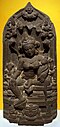
[[File:Bangladesh o india orientale, la dea serpente manasa, XI secolo.jpg|thumb| Manasa with her husband [[Jaratkaru]] and son Astika flanked by [[Nāga|Nagas]], 11th century [[Pala Empire|Pala period]] statue from [[Bengal]]]] | |||
Manasa is depicted as a beautiful woman with a golden complexion (hence the nickname Gauri, Golden) and smiling face. She wears red garments and gold jewellery. She has four arms, with her upper right hand holding a [[Shankha|shankh]] (conch) and her left hand holding her favorite flower - a lotus. Her lower left hand holds a snake and the right lower right hand displays ''[[Abhayamudra]]'' (gesture of fearlessness). She is covered with snakes, sitting on a [[lotus platform]] (thus known by her epithet ''Padmalaya'') or standing upon a snake. She is sheltered by the canopy of the hoods of seven [[cobra]]s. Sometimes, she is depicted with a child (assumed to be her son, [[Astika (mythology)|Astika]]) on her lap. Her ''[[vahana]]'' (mount) is a swan. She is also accompanied by Neta (Neto), her female companion.{{Sfn|Wilkins|2004|p=395}}<ref>{{cite book |title= Mythlogical Bonds Between East and West|author = Chaplin, Dorothea |year= 2007|publisher= READ BOOKS|isbn= 9781406739862|pages= 28}}</ref>{{Sfn|Chakravarty|2022|p=58}} | |||
In [[Bengal]], she is rarely seen with her husband, Jaratkaru. In some of her idols she is shown with [[Behula]] and Lakshminder. | |||
==Legend== | |||
===Mahabharata=== | |||
The ''[[Mahabharata]]'' mentions Manasa (known here as Jaratkaru) in passing reference in the tale of Jaratkaru and Astika.{{Sfn|Chakravarty|2022|p=56}} Sage [[Jaratkaru]] practised severe austerities and had decided to abstain from marriage. Once, he came across a group of men hanging from a tree upside down. These men were his [[Pitrs|ancestors]], who were doomed to misery as their children had not performed their last rites. So, they advised Jaratkaru to marry and have a son who could free them of those miseries by performing the ceremonies. [[Vasuki]] offered his sister Manasa's hand to Jaratkaru. Manasa gave birth to a son, [[Astika (mythology)|Astika]], who freed his ancestors. Astika also helped in saving the naga race from destruction when King [[Janamejaya]] decided to exterminate them by sacrificing them in his [[yajna]], called the [[Sarpa Satra|sarpa satra]].<ref>Wilkins p.396</ref> | |||
===Puranas=== | |||
[[File:India, Calcutta, Kalighat painting, 19th century - Manasa, The Snake Goddess - 2003.106 - Cleveland Museum of Art.tif|thumb|[[Kalighat painting]] of goddess Manasā standing on a snake with a few wrapped in her hand, [[Cleveland Museum of Art]]]] | |||
The ''[[Purana]]''s are the first scriptures to speak about her birth. They declare that sage Kashyapa is her father, not Shiva as described in the later ''[[Mangalkavya]]''s. Once, when serpents and reptiles had created chaos on the Earth, Kashyapa created the goddess Manasa from his mind (''mana''). The creator god [[Brahma]] made her the presiding deity of snakes and reptiles. Manasa gained control over the earth, by the power of [[mantra]]s she chanted. Manasa then propitiated the god Shiva, who told her to please the god [[Krishna]]. Upon being pleased, Krishna granted her divine [[Siddhi]] powers and ritually worshipped her, making her an established goddess.<ref name = "purana"/> | |||
Kashyapa married Manasa to sage [[Jaratkaru]], who agreed to marry her on the condition that he would leave her if she disobeyed him. Once, when Jaratkaru was awakened by Manasa, he became upset with her because she awakened him too late for worship, and so he left her temporarily.<ref name = "purana">{{cite book |title= Tales from the Puranas|author = Sharma, Mahesh|year= 2005|publisher= Diamond Pocket Books (P) Ltd.|isbn= 81-288-1040-5|pages= 38–40}}</ref> | |||
===Mangalkavyas=== | |||
The ''[[Mangalkavya]]''s were devotional paeans to local deities such as Manasa, composed in Bengal between the 13th and the 18th centuries. The ''[[Manasamangal Kāvya|Manasa Mangalkavya]]'' by [[Vijay Gupta (poet)|Vijay Gupta]] (Bijoy Gupta, late 15th century){{Sfn|Chakravarty|2022|p=56}} and ''Manasa Vijaya'' (1495) by [[Bipradas Pipilai]] trace the origin and myths of the goddess. However these stray further from Puranaic references probably due to creative licenses exercised. At least fifteen Mangalkavyas dedicated to Manasa are known. Scholar D. C. Sen traced fifty-one versions of her tale.{{sfn|Dimock|1962|p=309}} The ''Padmapurana'' by [[Kamrupi literature#Legends|Sukavi Narayandev]] (17th century) is well-known in Assam, especially performed in [[Ojapali]] dance.{{Sfn|Chakravarty|2022|p=56}} | |||
According to ''Manasa Vijaya'', Manasa was born when a statue of a girl that had been sculpted by Vasuki's mother which was touched by [[Shiva]]'s seed. Vasuki accepted Manasa as his sister, and granted her the charge of poison that was produced when King [[Prithu]] milked the Earth as a cow. When Shiva saw Manasa, he was attracted to her, but she proved to him that he was her father. Shiva took Manasa to his home where his wife, [[Parvati|Chandi]], suspected Manasa of being Shiva's [[concubine]] or co-wife, and insulted Manasa and burnt her left eye, leaving Manasa half-blind.<ref>{{Cite web |date=2008-04-15 |title=Manasa: the Hindu Snake Goddess {{!}} Mahavidya |url=http://mahavidya.ca/2008/04/15/manasa-the-hindu-snake-goddess/ |access-date=2025-01-24 |language=en-US}}</ref> Later, when Shiva was dying of poison, Manasa cured him. On one occasion, when Chandi kicked her, Manasa rendered her senseless with a glance of her poison eye. Finally, tired of quarrels between Manasa and Chandi, Shiva deserted Manasa under a tree, but created a companion for her from his tears of remorse, called Neto or Netā.<ref>McDaniel (2004) pp. 149-50</ref> | |||
Later, the sage Jaratkaru married Manasa, but Chandi ruined Manasa's wedding night. Chandi advised Manasa to wear snake ornaments and then threw a frog in the bridal chamber which caused the snakes to run around the chamber. As a consequence, the terrified Jaratkaru ran away from the house. After few days, he returned and Astika, their son, was born.<ref>McDaniel (2004) p. 150</ref> | |||
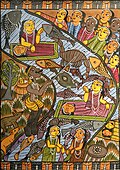
[[File:Manasa Mangal.jpg|thumb|A scene from Manasa Mangal.]] | |||
Accompanied by her adviser, Neto, Manasa descended to earth to see human devotees. She was initially mocked by the people but then Manasa forced them to worship her by raining calamity on those who denied her power. She managed to convert people from different walks of life, including the [[Muslim]] ruler Hasan, but failed to convert [[Chand Sadagar]]. Manasa wanted to become a mainstream goddess like [[Lakshmi]] or [[Saraswati]]. To get there, she had to achieve the worship of Chand Sadagar who was extremely adamant and took oath not to worship Manasa. Thus to gain his fear and insecurity, Manasa one by one killed his six sons. At last Manasa conspired against two dancers of Indras Court who loved each other, [[Aniruddha|Anirudha]] and [[Uṣā|Usha]]. Anirudh had to take birth as Lakhinder, Chand and Sanaka's seventh son. Usha took birth as Behula and married him. Manasa killed him but Behula floated on water for nine months with the dead body of her husband and finally brought back the lives of the seven sons and the lost prosperity of Chand. At last, he yielded by offering a flower to the goddess with his left hand without even looking at her. This gesture made Manasa so happy that she resurrected all of Chand's sons and restored his fame and fortunes. The ''Mangal kavyas'' say that after this, the worship of Manasa was popular forever.<ref>{{cite book |title= Myths of the Hindus and Buddhists|author = Coomaraswamy, Ananda K.|author2=Sister Nivedita |year= 2003|publisher= Kessinger Publishing|isbn= 0-7661-4515-8|pages= 324–30|author2-link = Sister Nivedita|author-link = Ananda Coomaraswamy}}</ref> | |||
The ''Manasa Mangalkavya'' attributes Manasa's difficulty in attracting devotees to an unjust curse she gave to Chand in his previous life. Chand then retaliated with a counter-curse that worshipping her would not be popular on earth unless he worshipped her also.<ref>McDaniel p.152</ref> | |||
[[Ananda K. Coomaraswamy]] and [[Sister Nivedita]] say, "[The] legend of [Chand Sadagar and] Manasā Devī, [...] who must be as old as the [[Mycenaean Greece|Mykenean]] stratum in Asiatic society, reflects the conflict between the religion of Shiva and that of female local deities in Bengal. Afterwards Manasā or Padmā was recognized as a form of ''[[Shakti]]'', [...] and her worship accepted by [[Shaiva]]s. She is a phase of the mother-divinity who for so many worshippers is nearer and dearer than the far-off and impersonal Shiva...".<ref> | |||
{{cite book |title= Myths of the Hindus and Buddhists|author = Coomaraswamy, Ananda K.|author2=Sister Nivedita |year= 2003|publisher= Kessinger Publishing|isbn= 0-7661-4515-8|pages= 330|author2-link = Sister Nivedita|author-link = Ananda Coomaraswamy}}</ref> | |||
==Worship== | |||
[[File:Manasa puja on the day of Dashahara at a bedi of Euphorbia Neriifolia.jpg|thumb|Manasa puja on the day of Dashahara at a bedi of [[Euphorbia neriifolia]], in [[West Bengal]].]] | |||
[[File:Women with the Manasa Silamurti at Birbhum in 2021.jpg|thumb|Women with the Manasa [[Shaligram|Sila (murti)]] during puja at [[Birbhum]] in 2021]] | |||
Generally, Manasa is worshipped without an image.<ref>{{Cite journal |last=Bhattacharyya |first=Asutosh |date=1965 |title=The Serpent as a Folk-Deity in Bengal |url=https://www.jstor.org/stable/1177595 |journal=Asian Folklore Studies |volume=24 |issue=1 |pages=1–10 |doi=10.2307/1177595 |issn=0385-2342|url-access=subscription }}</ref> A branch of a cactus tree, an earthen pot or an earthen snake image is worshipped as the goddess,{{Sfn|Wilkins|2004|p=395}} though images of Manasa are worshipped too. She is worshipped for protection from and cure of snake bites.<ref>{{Cite book |last=Lochtefeld |first=James G. |url=https://www.google.com/books/edition/The_Illustrated_Encyclopedia_of_Hinduism/AbWazgEACAAJ?hl=en |title=The Illustrated Encyclopedia of Hinduism: A-M |date=2002 |publisher=Rosen |isbn=978-0-8239-3179-8 |pages=415 |language=en}}</ref><ref>{{Cite book |last=Roshen |first=Dalal |url=https://www.google.com/books/edition/Hinduism/QcLdoAEACAAJ?hl=en |title=Hinduism: An Alphabetical Guide |date=2014 |publisher=Penguin Books India PVT, Limited |isbn=978-0-14-342317-1 |pages=547 |language=en}}</ref>[[File:Manasa debi Manasa ghot.jpg|thumb|Snake Idol of Goddess Manasa]] | |||
In South Bengal, she is ritually worshipped in the local temples as well as in the houses. Almost every Hindu household has a dedicated shrine for goddess Manasa along with Lord Vishnu (Hari), the duo represented by the branch of cactus tree and tulsi tree respectively.{{Citation needed|date=July 2025}} | |||
The goddess is widely worshipped in the rainy season (especially months of Shravan and Bhadra), when the snakes are most active. Manasa is also a very important fertility deity, and her blessings are invoked for child bearing. She is commonly worshipped alongside her female companion Neta, who is considered a manifestation of her destructive power.<ref>{{Cite journal |last=Jash |first=Pranabananda |date=1986 |title=The Cult of Manasa in Bengal |url=https://www.jstor.org/stable/44141538 |journal=Proceedings of the Indian History Congress |volume=47 |pages=170 |issn=2249-1937}}</ref>{{sfn|Dimock|1962}}{{Sfn|Chakravarty|2022|p=55}} Described as a vindicative goddess in Bengal's Mangalkavyas, Manasa is required to be pleased to avoid her wrath, manifested as snake bite, disease, childlessness or starvation.{{Sfn|Chakravarty|2022|p=55}} | |||
In North Bengal, among the Rajbanshis, Manasa (called Bishohora, Bishohori or Padmavati) is one of the most important goddesses, and her ''thaan'' (shrine) may be found in the courtyard of almost every agrarian household. Among the lower-caste Hindus of East Bengal (present-day Bangladesh) too, she is worshipped with great pomp.{{Citation needed|date=July 2025}} | |||
Manasa is an especially important deity in Bengal for the mercantile castes. This is because Chando of the ''Manasamangal'' was the first to initiate her worship, and Behula, the heroine of the ''Manasamangal'' was a daughter of the Saha clan (a powerful trading community).{{Citation needed|date=July 2025}} | |||
Manasa is the prime deity of Anga Region, specially in Anga's capital, Champa (now Bhagalpur). It is believed that the story of Chand Saudagar and Behula started from this very place.<ref>{{Cite web|url=http://lrc.bih.nic.in/Gazetteer/Bhagalpur/chapter-II.pdf%26ved%3D2ahUKEwj04d6WzNzyAhUObn0KHaFJCMcQFnoECCQQAQ%26usg%3DAOvVaw3aRw7DUSAkS6nf8jgETuZ7|title=Government of Bihar|website=Lrc.bih.nic.in|access-date=1 September 2021|archive-date=6 September 2021|archive-url=https://web.archive.org/web/20210906144420/http://lrc.bih.nic.in/Gazetteer/Bhagalpur/chapter-II.pdf%26ved%3D2ahUKEwj04d6WzNzyAhUObn0KHaFJCMcQFnoECCQQAQ%26usg%3DAOvVaw3aRw7DUSAkS6nf8jgETuZ7|url-status=dead}}</ref> In the old quarters of Champanagar in the city, stands an enormous temple of Manasa. Several artefacts and sculptures found in and around the place made locals believed that it was where Chand Saudagar had his Rajbari. A recent excavation has also found "Loha- Bashor ghor" or "Bashor ghor", the building made specifically for the wedding night of [[Lakhendar]] and [[Behula]].<ref>{{Cite web|url=https://www.livehindustan.com/bihar/bhagalpur/story-history-of-angh-mother-vishahari-worship-and-bihula-is-a-witness-of-vishahari-worship-2693163.html|title=मां विषहरी पूजा: बिहुला विषहरी की गाथा का साक्षी है अंग का इतिहास|website=Livehindustan.com|access-date=1 September 2021|archive-date=6 September 2021|archive-url=https://web.archive.org/web/20210906144420/https://www.livehindustan.com/bihar/bhagalpur/story-history-of-angh-mother-vishahari-worship-and-bihula-is-a-witness-of-vishahari-worship-2693163.html|url-status=live}}</ref> The [[Angika]] lokgatha, "Behula Bishari Lokgatha" and the regional art, [[Manjusha Art|Manjusha]] Chitrakatha is full flegedly based on the chronicles of Manasa and the hardships of [[Behula]].<ref>{{Cite web |url=http://manjushaart.in/%26ved%3D2ahUKEwirgrKMzdzyAhVVaCsKHR8wCSYQFnoECDwQAQ%26usg%3DAOvVaw278WRp-OHCAh9DHKZqvizg%26cshid%3D1630459028878 |access-date=13 July 2022 |title=Archived copy |archive-date=6 September 2021 |archive-url=https://web.archive.org/web/20210906144422/http://manjushaart.in/%26ved%3D2ahUKEwirgrKMzdzyAhVVaCsKHR8wCSYQFnoECDwQAQ%26usg%3DAOvVaw278WRp-OHCAh9DHKZqvizg%26cshid%3D1630459028878 |url-status=dead }}</ref> Every year, from 16 to 19 August, [[Bhagalpur division|Bhagalpur]] springs up like a scented flower to worship the local guardian Manasa and commemorate the wedding of [[Behula]]<ref>{{Cite web|url=https://www.jagran.com/bihar/bhagalpur-bihula-wishhari-worship-will-start-in-bhagalpur-from-16-july-read-full-story-of-bihula-wishhari-21824099.html|title=Bihula Wishhari worship: अंग प्रदेश के खास लोकपर्व का 16 जुलाई से आगाज, पढ़ें- बिहुला विषहरी की कहानी|website=Jagran.com|access-date=1 September 2021|archive-date=6 September 2021|archive-url=https://web.archive.org/web/20210906144419/https://www.jagran.com/bihar/bhagalpur-bihula-wishhari-worship-will-start-in-bhagalpur-from-16-july-read-full-story-of-bihula-wishhari-21824099.html|url-status=live}}</ref> | |||
[[File:Mansa Puja in Bhagalpur.jpg|thumb|Mansa Puja at Deepnagar chowk in Bhagalpur]] | |||
Manasa is also worshipped extensively in Assam, and a form of Oja-Pali (musical folk theatre) is dedicated entirely to her myth.<ref>{{Cite web |last=www.wisdomlib.org |date=2022-03-10 |title=Folk Theatre (b): Ojapali |url=https://www.wisdomlib.org/hinduism/essay/puppetry-in-assam/d/doc1085347.html?utm_source=chatgpt.com |access-date=2025-07-18 |website=www.wisdomlib.org |language=en}}</ref>{{AI-retrieved source|date=March 2026|checked=no}} | |||
Manasa is ceremonially worshipped on [[Nag Panchami]] - a festival of snake worship in the Hindu month of [[Shraavana|Shravan]] (July–August). Hindu women observe a fast ([[vrata]]) on this day and offer milk at snake holes.<ref>McDaniel (2002) p.55-57</ref> Manasa devi is worshipped between November and February each year since 120 years at the Manasa Devi mandir at Lala bagan, Kolkata. | |||
==Notable temples== | |||
<gallery> | |||
File:Mansa Devi Temple, Haridwar.JPG|[[Mansa Devi Temple, Haridwar]] | |||
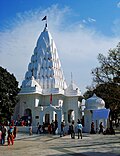
File:A temple in Mansa Devi temple complex, Panchkula near Chandigarh.jpg|[[Mata Mansa Devi Mandir]], [[Panchkula]], near [[Chandigarh]]. | |||
File:Manasa mandir.jpg|Mansa Devi Temple, [[Kandra]], Jharkhand | |||
File:Manasha Mandir, (Lala Bagan) Simla Street, Kolkata.jpg|Manasha Puja at Lala Bagan, Simla Street, Kolkata. | |||
</gallery> | |||
* Shri Manasa Devi Temple (Swayambu), Kasimpet(Manasavaram), Karimnagar, Telangana | |||
*Ma Manasha Mandir, Fulidanga, Tarapith - West Bengal | |||
* Mansa Bishari Temple, [[Bhagalpur, Bihar]] | |||
* Mansa Devi Temple, [[Mukkamala, West Godavari, Andhra Pradesh]] | |||
* Mansa Devi Temple, [[Naidupeta, Nellore, Andhra Pradesh]] | |||
* Mansa Devi Temple, [[Tilaru, Srikakulam, Andhra Pradesh]] | |||
* Mansa Devi Temple, [[Dornipadu, Kurnool, Andhra Pradesh]] | |||
* Mansa Devi Temple, Kanumalapalle, [[Kadapa, Andhra Pradesh]] | |||
* Mansa Devi Temple, Chinadugam, [[Srikakulam, Andhra Pradesh]] | |||
* Mansa Devi Temple, [[Kurnool, Andhra Pradesh]] | |||
* Mansa Devi Temple, [[Nellore, Andhra Pradesh]] | |||
* Mansa Devi Temple, Thurpu Rompidodla, [[Nellore, Andhra Pradesh]] | |||
* Mansa Devi Temple, Vadluru, [[West Godavari, Andhra Pradesh]] | |||
* Ma Manasha Mandir, [[Lake Town, Kolkata, West Bengal]] | |||
* Ma Manasha Mandir, Halshi Bagan, (Lala Bagan) Simla Street, [[Kolkata]], [[West Bengal]] | |||
* Ma Manasa Mandir, Gopinagar, Khamarchandi, Haripal, Hooghly, West Bengal | |||
* Ma Manasa Mandir, Jakpur, Paschim Medinipur, West Bengal | |||
==See also== | |||
* [[Shesha]] | |||
* [[Vasuki]] | |||
* [[Kadru]] | |||
* [[Takshaka]] | |||
* [[Karkotaka]] | |||
==Notes== | |||
===Citations=== | |||
{{reflist}} | |||
===Bibliography=== | |||
* {{cite book|title=Offering Flowers, Feeding Skulls: Popular Goddess Worship in West Benegal|first= June|last= McDaniel|year= 2004|publisher= Oxford University Press, US|pages= 368 |isbn= 0-19-516790-2 }} | |||
* {{cite book|title=Hindu Mythology, Vedic and Puranic |first=W. J.|last= Wilkins|year=2004|publisher= Kessinger Publishing|pages=428|isbn= 0-7661-8881-7 |edition=First published: 1882}} | |||
* {{cite book|title=Making Virtuous Daughters and Wives: An Introduction to Women's Brata Rituals in Bengali Folk Religion|first= June|last= McDaniel|year= 2002|publisher= SUNY Press|pages= 144|isbn=0-7914-5565-3}} | |||
* {{Cite journal |jstor = 1062059|title = The Goddess of Snakes in Medieval Bengali Literature|journal = History of Religions|volume = 1|issue = 2|pages = 307–321|last1 = Dimock|first1 = Edward C.|year = 1962|doi = 10.1086/462451|s2cid = 162313578}} | |||
* {{cite book|title=Classical Dictionary of Hindu Mythology and Religion, Geography, History|first=John|last=Dowson|year=2003|publisher=Kessinger Publishing|pages=|isbn=0-7661-7589-8}} | |||
* {{Cite book |last=Chakravarty |first=Saumitra |title=The Goddess Re-discovered: Gender and Sexuality in Religious Texts of Medieval Bengal |year=2022 |publisher=Taylor & Francis |isbn=978-1-000-63287-3 |language=en}} | |||
==External links== | |||
{{Commons category|Manasā}} | |||
{{Authority control}} | |||
[[Category:Fertility goddesses]] | |||
[[Category:Hindu goddesses]] | |||
[[Category:Nāgas]] | |||
[[Category:Characters in the Mahabharata]] | |||
[[Category:Snake goddesses]] | |||
[[Category:Hindu folk deities]] | |||
[[Category:Children of Shiva]] | |||
[[Category:Health goddesses]] | |||
[[Category:Childhood goddesses]] | |||
[[Category:Children of Kashyapa]] | |||
Latest revision as of 02:03, 12 March 2026
 | This article needs more citations. (August 2025) |
| Manasa | |
|---|---|
Goddess of Serpents | |
 A 20th century print of Manasa | |
| Other names | maroi / mare / monoxa (Assamese), monośa / ceṅmuṛi kani (Bengali), mwrwi / kani deu / monosa (Hajong) |
| Affiliation | Shaivism, Devi, Nāga |
| Mantra | Ōṁ hrīṁ śrīṁ klīṁ aiṁ manasādēvyai svāhā |
| Tree | Cactus |
| Mount | Swan |
| Texts | Manasamangal Kāvya |
| Gender | Female |
| Festivals | Naga Panchami |
| Personal information | |
| Parents | |
| Siblings | Vasuki |
| Spouse | Jaratkaru |
| Children | Astika |
Manasa (Sanskrit: मनसा, romanized: Manasā) is a Hindu goddess of snakes.[1] She is worshipped mainly in Bihar, Odisha, Bengal, Andhra Pradesh, Chhattisgarh, Jharkhand, Uttarakhand, Uttar Pradesh, Haryana, Punjab, Rajasthan, Assam and other parts of northeastern India, chiefly for the prevention and cure of snakebite, and also for fertility and prosperity. In Hindu texts, Manasa is the daughter of sage Kashyapa, sister of Vasuki—king of Nāgas (serpents)—and wife of sage Jaratkaru. She is the mother of the sage Astika.[2]
In regional tradition, her stories emphasise her bad temper and unhappiness, due to rejection by her father, Shiva, and her husband (Jaratkaru), and the hate of her stepmother Chandi (Shiva's wife, identified with Parvati in this context). Manasa is depicted as kind to her devotees, but harsh toward people who refuse to worship her.[3] Denied full godhood due to her mixed parentage, Manasa's aim was to fully establish her authority as a goddess, and to acquire steadfast human devotees.[4]
Names[edit | edit source]
In the epic Mahabharata where Manasa is referred in passing mention, she is known as Jaratkaru.[5] Her most popular name Manasa (lit. "mind-borne") originates from the Puranas, where she is the mind-borne daughter of the sage Kashyapa.[5] She is also known as Padmavati in the Mangalkavyas of Bengal and Padmapurana of Assam, where the seed of Shiva from the earth reaches the subterranean land of the serpents via the stalk of a lotus (padma).[6] Her epithets also include Vishahari (Bishohori, the destroyer of poison), Ayonisambhava (one not born of a woman) and Nityā (eternal).[7][6] Manasa is known by various regional names - Nagmati (Goddess of snakes) in Bihar, Mare (the goddess of disease) and Barmati in Assam.[6]
Origin[edit | edit source]
Bhattacharya and Sen suggest that Manasa originated in South India as a non-Vedic and non-Aryan goddess and is related to the Kannada folk snake-goddess Manchamma.[8] Manasa was originally an Adivasi (tribal) goddess. She was accepted in the pantheon worshipped by Hindu groups. Later, Dimock suggests that although snake worship is found in the Vedas (the earliest Hindu scriptures), Manasa - a human goddess of snakes - has "little basis" in early Hinduism.[9] Bhattacharya suggests another influence on Manasa being the poison-curing Mahayana Buddhist goddess, Janguli. Janguli shares her swan vehicle and her "poison-destroyer" epithet with Manasa. A theory suggests that Janguli may have been influenced by the Kirata-giri ("the conqueror of all poisons") of the Atharvaveda.[10] According to McDaniel, she was included in the higher-caste Hindu pantheon, where she is now regarded as a Hindu goddess rather than a tribal one.[11]
According to Tate, Manasa as Jaratkaru was initially recognized as a daughter of the sage Kashyapa and Kadru, the mother of all nagas in the epic Mahabharata.[12][13] According to Bhattacharya, the Jaratkaru of the Mahabharata is not the Manasa popular in Bengal.[14]
By the 14th century, Manasa was identified as the goddess of fertility and marriage rites and was assimilated into the Shaiva pantheon, related to the god Shiva. Myths glorified her by describing that she saved Shiva after he drank the poison, and venerated her as the "remover of poison". Her popularity grew and spread to southern India, and the cult of her followers began to rival the earliest Shaivism (the cult of Shiva). As a consequence, stories attributing Manasa's birth to Shiva emerged and ultimately Shaivism adopted this indigenous goddess into the Brahmanical tradition of mainstream Hinduism.[13] Alternatively, Vasudev suggests that the Bengali tale of Manasa reflects rivalry between Shaivism and the goddess-centric Shaktism.[15]
Iconography[edit | edit source]

Manasa is depicted as a beautiful woman with a golden complexion (hence the nickname Gauri, Golden) and smiling face. She wears red garments and gold jewellery. She has four arms, with her upper right hand holding a shankh (conch) and her left hand holding her favorite flower - a lotus. Her lower left hand holds a snake and the right lower right hand displays Abhayamudra (gesture of fearlessness). She is covered with snakes, sitting on a lotus platform (thus known by her epithet Padmalaya) or standing upon a snake. She is sheltered by the canopy of the hoods of seven cobras. Sometimes, she is depicted with a child (assumed to be her son, Astika) on her lap. Her vahana (mount) is a swan. She is also accompanied by Neta (Neto), her female companion.[2][16][17]
In Bengal, she is rarely seen with her husband, Jaratkaru. In some of her idols she is shown with Behula and Lakshminder.
Legend[edit | edit source]
Mahabharata[edit | edit source]
The Mahabharata mentions Manasa (known here as Jaratkaru) in passing reference in the tale of Jaratkaru and Astika.[5] Sage Jaratkaru practised severe austerities and had decided to abstain from marriage. Once, he came across a group of men hanging from a tree upside down. These men were his ancestors, who were doomed to misery as their children had not performed their last rites. So, they advised Jaratkaru to marry and have a son who could free them of those miseries by performing the ceremonies. Vasuki offered his sister Manasa's hand to Jaratkaru. Manasa gave birth to a son, Astika, who freed his ancestors. Astika also helped in saving the naga race from destruction when King Janamejaya decided to exterminate them by sacrificing them in his yajna, called the sarpa satra.[18]
Puranas[edit | edit source]
The Puranas are the first scriptures to speak about her birth. They declare that sage Kashyapa is her father, not Shiva as described in the later Mangalkavyas. Once, when serpents and reptiles had created chaos on the Earth, Kashyapa created the goddess Manasa from his mind (mana). The creator god Brahma made her the presiding deity of snakes and reptiles. Manasa gained control over the earth, by the power of mantras she chanted. Manasa then propitiated the god Shiva, who told her to please the god Krishna. Upon being pleased, Krishna granted her divine Siddhi powers and ritually worshipped her, making her an established goddess.[19]
Kashyapa married Manasa to sage Jaratkaru, who agreed to marry her on the condition that he would leave her if she disobeyed him. Once, when Jaratkaru was awakened by Manasa, he became upset with her because she awakened him too late for worship, and so he left her temporarily.[19]
Mangalkavyas[edit | edit source]
The Mangalkavyas were devotional paeans to local deities such as Manasa, composed in Bengal between the 13th and the 18th centuries. The Manasa Mangalkavya by Vijay Gupta (Bijoy Gupta, late 15th century)[5] and Manasa Vijaya (1495) by Bipradas Pipilai trace the origin and myths of the goddess. However these stray further from Puranaic references probably due to creative licenses exercised. At least fifteen Mangalkavyas dedicated to Manasa are known. Scholar D. C. Sen traced fifty-one versions of her tale.[20] The Padmapurana by Sukavi Narayandev (17th century) is well-known in Assam, especially performed in Ojapali dance.[5]
According to Manasa Vijaya, Manasa was born when a statue of a girl that had been sculpted by Vasuki's mother which was touched by Shiva's seed. Vasuki accepted Manasa as his sister, and granted her the charge of poison that was produced when King Prithu milked the Earth as a cow. When Shiva saw Manasa, he was attracted to her, but she proved to him that he was her father. Shiva took Manasa to his home where his wife, Chandi, suspected Manasa of being Shiva's concubine or co-wife, and insulted Manasa and burnt her left eye, leaving Manasa half-blind.[21] Later, when Shiva was dying of poison, Manasa cured him. On one occasion, when Chandi kicked her, Manasa rendered her senseless with a glance of her poison eye. Finally, tired of quarrels between Manasa and Chandi, Shiva deserted Manasa under a tree, but created a companion for her from his tears of remorse, called Neto or Netā.[22]
Later, the sage Jaratkaru married Manasa, but Chandi ruined Manasa's wedding night. Chandi advised Manasa to wear snake ornaments and then threw a frog in the bridal chamber which caused the snakes to run around the chamber. As a consequence, the terrified Jaratkaru ran away from the house. After few days, he returned and Astika, their son, was born.[23]

Accompanied by her adviser, Neto, Manasa descended to earth to see human devotees. She was initially mocked by the people but then Manasa forced them to worship her by raining calamity on those who denied her power. She managed to convert people from different walks of life, including the Muslim ruler Hasan, but failed to convert Chand Sadagar. Manasa wanted to become a mainstream goddess like Lakshmi or Saraswati. To get there, she had to achieve the worship of Chand Sadagar who was extremely adamant and took oath not to worship Manasa. Thus to gain his fear and insecurity, Manasa one by one killed his six sons. At last Manasa conspired against two dancers of Indras Court who loved each other, Anirudha and Usha. Anirudh had to take birth as Lakhinder, Chand and Sanaka's seventh son. Usha took birth as Behula and married him. Manasa killed him but Behula floated on water for nine months with the dead body of her husband and finally brought back the lives of the seven sons and the lost prosperity of Chand. At last, he yielded by offering a flower to the goddess with his left hand without even looking at her. This gesture made Manasa so happy that she resurrected all of Chand's sons and restored his fame and fortunes. The Mangal kavyas say that after this, the worship of Manasa was popular forever.[24]
The Manasa Mangalkavya attributes Manasa's difficulty in attracting devotees to an unjust curse she gave to Chand in his previous life. Chand then retaliated with a counter-curse that worshipping her would not be popular on earth unless he worshipped her also.[25]
Ananda K. Coomaraswamy and Sister Nivedita say, "[The] legend of [Chand Sadagar and] Manasā Devī, [...] who must be as old as the Mykenean stratum in Asiatic society, reflects the conflict between the religion of Shiva and that of female local deities in Bengal. Afterwards Manasā or Padmā was recognized as a form of Shakti, [...] and her worship accepted by Shaivas. She is a phase of the mother-divinity who for so many worshippers is nearer and dearer than the far-off and impersonal Shiva...".[26]
Worship[edit | edit source]


Generally, Manasa is worshipped without an image.[27] A branch of a cactus tree, an earthen pot or an earthen snake image is worshipped as the goddess,[2] though images of Manasa are worshipped too. She is worshipped for protection from and cure of snake bites.[28][29]

In South Bengal, she is ritually worshipped in the local temples as well as in the houses. Almost every Hindu household has a dedicated shrine for goddess Manasa along with Lord Vishnu (Hari), the duo represented by the branch of cactus tree and tulsi tree respectively.[citation needed]
The goddess is widely worshipped in the rainy season (especially months of Shravan and Bhadra), when the snakes are most active. Manasa is also a very important fertility deity, and her blessings are invoked for child bearing. She is commonly worshipped alongside her female companion Neta, who is considered a manifestation of her destructive power.[30][31][32] Described as a vindicative goddess in Bengal's Mangalkavyas, Manasa is required to be pleased to avoid her wrath, manifested as snake bite, disease, childlessness or starvation.[32]
In North Bengal, among the Rajbanshis, Manasa (called Bishohora, Bishohori or Padmavati) is one of the most important goddesses, and her thaan (shrine) may be found in the courtyard of almost every agrarian household. Among the lower-caste Hindus of East Bengal (present-day Bangladesh) too, she is worshipped with great pomp.[citation needed]
Manasa is an especially important deity in Bengal for the mercantile castes. This is because Chando of the Manasamangal was the first to initiate her worship, and Behula, the heroine of the Manasamangal was a daughter of the Saha clan (a powerful trading community).[citation needed]
Manasa is the prime deity of Anga Region, specially in Anga's capital, Champa (now Bhagalpur). It is believed that the story of Chand Saudagar and Behula started from this very place.[33] In the old quarters of Champanagar in the city, stands an enormous temple of Manasa. Several artefacts and sculptures found in and around the place made locals believed that it was where Chand Saudagar had his Rajbari. A recent excavation has also found "Loha- Bashor ghor" or "Bashor ghor", the building made specifically for the wedding night of Lakhendar and Behula.[34] The Angika lokgatha, "Behula Bishari Lokgatha" and the regional art, Manjusha Chitrakatha is full flegedly based on the chronicles of Manasa and the hardships of Behula.[35] Every year, from 16 to 19 August, Bhagalpur springs up like a scented flower to worship the local guardian Manasa and commemorate the wedding of Behula[36]

Manasa is also worshipped extensively in Assam, and a form of Oja-Pali (musical folk theatre) is dedicated entirely to her myth.[37][AI-retrieved source]
Manasa is ceremonially worshipped on Nag Panchami - a festival of snake worship in the Hindu month of Shravan (July–August). Hindu women observe a fast (vrata) on this day and offer milk at snake holes.[38] Manasa devi is worshipped between November and February each year since 120 years at the Manasa Devi mandir at Lala bagan, Kolkata.
Notable temples[edit | edit source]
-
-
-
 Mansa Devi Temple, Kandra, Jharkhand
 -
 Manasha Puja at Lala Bagan, Simla Street, Kolkata.


_Simla_Street,_Kolkata.jpg)
- Shri Manasa Devi Temple (Swayambu), Kasimpet(Manasavaram), Karimnagar, Telangana
- Ma Manasha Mandir, Fulidanga, Tarapith - West Bengal
- Mansa Bishari Temple, Bhagalpur, Bihar
- Mansa Devi Temple, Mukkamala, West Godavari, Andhra Pradesh
- Mansa Devi Temple, Naidupeta, Nellore, Andhra Pradesh
- Mansa Devi Temple, Tilaru, Srikakulam, Andhra Pradesh
- Mansa Devi Temple, Dornipadu, Kurnool, Andhra Pradesh
- Mansa Devi Temple, Kanumalapalle, Kadapa, Andhra Pradesh
- Mansa Devi Temple, Chinadugam, Srikakulam, Andhra Pradesh
- Mansa Devi Temple, Kurnool, Andhra Pradesh
- Mansa Devi Temple, Nellore, Andhra Pradesh
- Mansa Devi Temple, Thurpu Rompidodla, Nellore, Andhra Pradesh
- Mansa Devi Temple, Vadluru, West Godavari, Andhra Pradesh
- Ma Manasha Mandir, Lake Town, Kolkata, West Bengal
- Ma Manasha Mandir, Halshi Bagan, (Lala Bagan) Simla Street, Kolkata, West Bengal
- Ma Manasa Mandir, Gopinagar, Khamarchandi, Haripal, Hooghly, West Bengal
- Ma Manasa Mandir, Jakpur, Paschim Medinipur, West Bengal
See also[edit | edit source]
Notes[edit | edit source]
Citations[edit | edit source]
- ↑ www.wisdomlib.org (29 June 2012). "Manasa Devi, Manasā Devī: 1 definition". www.wisdomlib.org. Archived from the original on 20 November 2022. Retrieved 20 November 2022.
- ↑ 2.0 2.1 2.2 Wilkins 2004, p. 395.
- ↑ McDaniel 2004, p. 148.
- ↑ Radice, William (2001). Myths and Legends of India. Viking Penguin Books Ltd. pp. 130–8. ISBN 9780670049370.
- ↑ 5.0 5.1 5.2 5.3 5.4 Chakravarty 2022, p. 56.
- ↑ 6.0 6.1 6.2 Chakravarty 2022, p. 57.
- ↑ Dowson 2003, p. 196.
- ↑ Dimock 1962, pp. 315-6.
- ↑ Dimock 1962, pp. 312-3.
- ↑ Dimock 1962, p. 316-7.
- ↑ McDaniel p.148
- ↑ Dimock 1962, pp. 313-4.
- ↑ 13.0 13.1 Tate, Karen (2005). Sacred Places of Goddess: 108 Destinations. CCC Publishing. p. 194. ISBN 1888729112.
- ↑ Dimock 1962, p. 315.
- ↑ Dimock 1962, p. 311.
- ↑ Chaplin, Dorothea (2007). Mythlogical Bonds Between East and West. READ BOOKS. p. 28. ISBN 9781406739862.
- ↑ Chakravarty 2022, p. 58.
- ↑ Wilkins p.396
- ↑ 19.0 19.1 Sharma, Mahesh (2005). Tales from the Puranas. Diamond Pocket Books (P) Ltd. pp. 38–40. ISBN 81-288-1040-5.
- ↑ Dimock 1962, p. 309.
- ↑ "Manasa: the Hindu Snake Goddess | Mahavidya". 15 April 2008. Retrieved 24 January 2025.
- ↑ McDaniel (2004) pp. 149-50
- ↑ McDaniel (2004) p. 150
- ↑ Coomaraswamy, Ananda K.; Sister Nivedita (2003). Myths of the Hindus and Buddhists. Kessinger Publishing. pp. 324–30. ISBN 0-7661-4515-8.
- ↑ McDaniel p.152
- ↑ Coomaraswamy, Ananda K.; Sister Nivedita (2003). Myths of the Hindus and Buddhists. Kessinger Publishing. p. 330. ISBN 0-7661-4515-8.
- ↑ Bhattacharyya, Asutosh (1965). "The Serpent as a Folk-Deity in Bengal". Asian Folklore Studies. 24 (1): 1–10. doi:10.2307/1177595. ISSN 0385-2342.
- ↑ Lochtefeld, James G. (2002). The Illustrated Encyclopedia of Hinduism: A-M. Rosen. p. 415. ISBN 978-0-8239-3179-8.
- ↑ Roshen, Dalal (2014). Hinduism: An Alphabetical Guide. Penguin Books India PVT, Limited. p. 547. ISBN 978-0-14-342317-1.
- ↑ Jash, Pranabananda (1986). "The Cult of Manasa in Bengal". Proceedings of the Indian History Congress. 47: 170. ISSN 2249-1937.
- ↑ Dimock 1962.
- ↑ 32.0 32.1 Chakravarty 2022, p. 55.
- ↑ "Government of Bihar". Lrc.bih.nic.in. Archived from the original on 6 September 2021. Retrieved 1 September 2021.
- ↑ "मां विषहरी पूजा: बिहुला विषहरी की गाथा का साक्षी है अंग का इतिहास". Livehindustan.com. Archived from the original on 6 September 2021. Retrieved 1 September 2021.
- ↑ "Archived copy". Archived from the original on 6 September 2021. Retrieved 13 July 2022.
{{cite web}}: CS1 maint: archived copy as title (link) - ↑ "Bihula Wishhari worship: अंग प्रदेश के खास लोकपर्व का 16 जुलाई से आगाज, पढ़ें- बिहुला विषहरी की कहानी". Jagran.com. Archived from the original on 6 September 2021. Retrieved 1 September 2021.
- ↑ www.wisdomlib.org (10 March 2022). "Folk Theatre (b): Ojapali". www.wisdomlib.org. Retrieved 18 July 2025.
- ↑ McDaniel (2002) p.55-57
Bibliography[edit | edit source]
- McDaniel, June (2004). Offering Flowers, Feeding Skulls: Popular Goddess Worship in West Benegal. Oxford University Press, US. p. 368. ISBN 0-19-516790-2.
- Wilkins, W. J. (2004). Hindu Mythology, Vedic and Puranic (First published: 1882 ed.). Kessinger Publishing. p. 428. ISBN 0-7661-8881-7.
- McDaniel, June (2002). Making Virtuous Daughters and Wives: An Introduction to Women's Brata Rituals in Bengali Folk Religion. SUNY Press. p. 144. ISBN 0-7914-5565-3.
- Dimock, Edward C. (1962). "The Goddess of Snakes in Medieval Bengali Literature". History of Religions. 1 (2): 307–321. doi:10.1086/462451. JSTOR 1062059. S2CID 162313578.
- Dowson, John (2003). Classical Dictionary of Hindu Mythology and Religion, Geography, History. Kessinger Publishing. ISBN 0-7661-7589-8.
- Chakravarty, Saumitra (2022). The Goddess Re-discovered: Gender and Sexuality in Religious Texts of Medieval Bengal. Taylor & Francis. ISBN 978-1-000-63287-3.
External links[edit | edit source]
- Pages using the JsonConfig extension
- Articles needing additional references from August 2025
- Wikipedia articles needing factual verification from March 2026
- Fertility goddesses
- Hindu goddesses
- Nāgas
- Characters in the Mahabharata
- Snake goddesses
- Hindu folk deities
- Children of Shiva
- Health goddesses
- Childhood goddesses
- Children of Kashyapa