
CleanupBot (talk | contribs) m →top: clean up, fix date in {{use Indian English}} |
m Updated formatting and improved readability |
||
| Line 1: | Line 1: | ||
{{Use Indian English|date= | {{Short description|Mound located in the Indian state of Uttar Pradesh}} | ||
{{Use dmy dates|date= | {{Use Indian English|date=December 2015}} | ||
{{Use dmy dates|date=December 2015}} | |||
{{Infobox ancient site | {{Infobox ancient site | ||
| native_name = Jaini Mound | | native_name = Jaini Mound | ||
| image = [[File: | | image = [[File:Kankali Tila.jpg|300px]]<br>General view of the excavations at Kankali Tila in January 1889<br>[[File:Mathura archaeological sites.jpg|300px]]<br>Kankali Mound in Map of Mathura (1901) | ||
| | | coordinates = {{coord|27.491389|N|77.673889|E|region:IN-UP_type:landmark|format=dms|display=it}} | ||
| | |||
{{OSM Location map | {{OSM Location map | ||
| coord = {{coord|27.491389|N|77.673889|E}} <!-- Map center --> | | coord = {{coord|27.491389|N|77.673889|E}} <!-- Map center --> | ||
| float = | | float = center | ||
| zoom = 13 | | zoom = 13 | ||
| width = 270 <!-- width and height of the frame. numeric input - do not add px --> | | width = 270 <!-- width and height of the frame. numeric input - do not add px --> | ||
| height = 200 | | height = 200 | ||
| mark-coord1 = {{coord|27.491389|N|77.673889|E}} | | mark-coord1 = {{coord|27.491389|N|77.673889|E}} | ||
| mark1 = Archaeological site icon (red).svg | | mark1 = Archaeological site icon (red).svg | ||
| mark-size1 = 12 | | mark-size1 = 12 | ||
}} | }} | ||
'''''Kankali Tila''''' (also '''Kankali mound''' or '''Jaini mound''') is a [[mound]] located at [[Mathura]] in the Indian state of [[Uttar Pradesh]]. The name of the mound is derived from a modern temple of Hindu goddess Kankali. The famous | Kankali Tila in Mathura | ||
| alt = Kankali Tila | |||
| caption = | |||
| map_type = India#India Uttar Pradesh#Asia | |||
| relief=yes | |||
}} | |||
{{Multiple image | |||
| perrow = 2 | |||
| image1=Parsvanatha ayagapata, Mathura circa 15 CE.jpg | |||
| caption1= Pārśvanātha āyāgapaṭa, a tablet of homage to [[Parshvanatha]], dates back to 15 CE | |||
| image2=Ayagapata votive plate Kankali Tila.jpg | |||
| caption2=''Ayagapata'' votive plate excavated from Kankali Tila, c. 25-50 CE | |||
| image3=Kankali Tila plate of Sodasa.jpg | |||
| caption3=[[Kankali Tila tablet of Sodasa|A Kankali Tila plate]], with an inscription mentioning the year 42 of the reign of [[Northern Satraps]] ruler [[Sodasa]].<ref name="Smith">The Jain stûpa and other antiquities of Mathurâ by Smith, Vincent Arthur [https://archive.org/details/cu31924012251140 Plate XIV]</ref> | |||
| image4=Kankali Tila Ayagapata without inscription.jpg | |||
| caption4=Dhanamitra Ayagapata, c. 25 CE | |||
}} | |||
{{Multiple image | |||
| perrow = 2 | |||
| image1=Kankali Tila inscription of Sodasa.jpg | |||
| caption1=The inscription mentioned in [[Kankali Tila tablet of Sodasa]].<ref>{{cite book |last1=Chandra |first1=Ramaprasad |title=Memoirs of the archaeological survey of India no.1-5 |date=1919 |page=[https://archive.org/details/in.gov.ignca.59235/page/n26 22] |url=https://archive.org/details/in.gov.ignca.59235|language=en}}</ref> | |||
| image2=Kankali Tila inscription of Kanishka Year 5 and Year 7.jpg | |||
| caption2= Kankali Tila inscription of [[Kanishka]], Year 5 and 7 | |||
}} | |||
{{Jainism}} | |||
'''''Kankali Tila''''' (also '''Kankali mound''' or '''Jaini mound''') is a [[mound]] located at [[Mathura]] in the Indian state of [[Uttar Pradesh]]. The name of the mound is derived from a modern temple of Hindu goddess Kankali. The famous [[Jain stupa]] was excavated here in 1890-91 by [[Alois Anton Führer]] (Dr. Führer).{{sfn|Smith|1901|p=Introduction}} | |||
The mound almost rectangular in shape is 500 feet long by 350 feet broad.{{sfn|Smith|1901|p=Introduction}} ''Kankali Tila'' brought forth many treasures of [[Jain art]]. The archaeological findings testifies the existence of two [[Jain temple]]s and ''[[stupas]]''. Numerous [[Jain sculpture]]s, ''Ayagapattas'' (tablet of homage),{{sfn|Das|1980|p=171}} pillars, crossbeams and lintels were found during archaeological excavations. | ==Images and inscriptions== | ||
Some of the sculptures are provided with inscriptions that report on the contemporary society and organization of the [[Jain community]]. | The mound almost rectangular in shape is 500 feet long by 350 feet broad.{{sfn|Smith|1901|p=Introduction}} ''Kankali Tila'' brought forth many treasures of [[Jain art]]. The archaeological findings testifies the existence of two [[Jain temple]]s and ''[[stupas]]''. Numerous [[Jain sculpture]]s, ''[[Ayagapata|Ayagapattas]]'' (tablet of homage),{{sfn|Das|1980|p=171}} pillars, crossbeams and lintels were found during archaeological excavations.{{cn|date=October 2025}} Some of the sculptures are provided with inscriptions that report on the contemporary society and organization of the [[Jain community]].{{cn|date=October 2025}} Most sculptures could be dated from the 2nd century BC to the 12th century CE, thus representing a continuous period of about 14 centuries during which [[Jainism]] flourished at [[Mathura]]. These sculptures are now housed in the [[State Museum Lucknow]] and in the [[Mathura Museum]].{{cn|date=October 2025}} | ||
Images of [[Rishabhanatha]], first ''tirthankara'' in Jainism, dating back to 100 BCE were found along with images of Nilanjana's dance in his court.{{sfn|Cort|2010|p=25}} Images of [[Neminatha]], 22nd ''[[tirthankara]]'' in Jainism, is found in Kankali Tila dating back to [[Kushan Empire|Kushan]] period depicts him as a cousin of [[Krishna]] and [[Balarama]].{{sfn|Vyas|1995|p=19}} Headless image of [[Parsvanatha]], 23rd ''tirthankara'' in Jainism, is dated from 100 BCE to 75 BCE.{{sfn|Cort|2010|p=25}} | |||
== Excavation == | == Excavation == | ||
[[Alexander Cunningham]] worked at the western end in March and November 1871. The objects found by Mr. Cunningham were all Jain, with the exception of one ten-armed Brahmanical figure. Mr. Growse operated on the northern portion in 1875. In Volume XVII of the "Reports" (page 111), Mr. Cunningham noted that in the season of 1881-82 he dug up many Jain figures, including one inscribed with the name of [[Vardhamana]], the last of the 24 Jain ''[[Tirthankara]]''.{{sfn|Smith|1901|p=2}} | |||
[[Alexander Cunningham]] worked at the western end in March and November 1871. The objects found by Mr. Cunningham were all Jain, with the exception of one ten-armed Brahmanical figure. | |||
Mr. Growse operated on the northern portion in 1875. In Volume XVII of the "Reports" (page 111), Mr. Cunningham noted that in the season of 1881-82 he dug up many Jain figures, including one inscribed with the name of [[Vardhamana]], the last of the 24 Jain ''[[Tirthankara]]''.{{sfn|Smith|1901|p=2}} | Dr. Burgess and Dr. Fuhrer extended the excavations to the eastern end at different times from 1887 to 1896. Mr. Harding, a predecessor of Mr. Growse as Magistrate of Mathura, also made some excavations. The excavations at Kankali Tila acted as a testimony to the claims made by Jains regarding the great antiquity of their religion.{{sfn|Thomas|1877|p=80}} | ||
Dr. Burgess and Dr. Fuhrer extended the excavations to the eastern end at different times from 1887 to 1896. Mr. Harding, a predecessor of Mr. Growse as Magistrate of Mathura, also made some excavations. | |||
The excavations at Kankali Tila acted as a testimony to the claims made by Jains regarding the great antiquity of their religion.{{sfn|Thomas|1877|p=80}} | |||
== Significance == | == Significance == | ||
The sculptures and the inscriptions found at Kankali Tila suggest that in that period a clear Digambar-Shwetabar division had not risen. The Tirthankar images are all unclothed and monks are represented as not wearing a loincloth, but with cloth on one forearm. The names of divisions of the monastic orders match exactly with those given in the | The sculptures and the inscriptions found at Kankali Tila suggest that in that period a clear Digambar-Shwetabar division had not risen. The Tirthankar images are all unclothed and monks are represented as not wearing a loincloth, but with cloth on one forearm as described in ancient [[Śvetāmbara]] texts such as the [[Ācārāṅga Sūtra]] and the [[Kalpa Sūtra]]. The names of divisions of the monastic orders in inscriptions found at the ''Kankali Tila'' match exactly with those given in the ancient [[Śvetāmbara]] text [[Kalpa Sūtra|Kalpasutra]].<ref>The Jaina Stupa at Mathura: Art and Icons, Renuka Porwal, Prachya Vidyapeeth, Shajapur, 2016</ref> | ||
== Gallery == | == Gallery == | ||
<gallery> | <gallery> | ||
File:Mahaveer.jpg|A quadruple Jain Image | |||
Mahaveer.jpg|A quadruple Jain Image | File:Four Fold Jain Image with Suparshvanath and Three Other Tirthankaras - Circa 1st Century CE - ACCN 00-B-67 - Government Museum - Mathura 2013-02-24 6023.JPG|Quadruple Jain Image, excavated from Kankali Tila, c. 1st century CE | ||
Four Fold Jain Image with Suparshvanath and Three Other Tirthankaras - Circa 1st Century CE - ACCN 00-B-67 - Government Museum - Mathura 2013-02-24 6023.JPG|Quadruple Jain Image, excavated from Kankali Tila, c. 1st century CE | File:Jain Tablet Homage Set-up by Vasu the Daughter of Courtesan Lavana Sobhika - Circa 1st Century CE - Kankali Mound - ACCN 00-Q-7 - Government Museum - Mathura 2013-02-24 5987.JPG| Jain Tablet Homage Set-up by Vasu the daughter of Courtesan Lavana Sobhika - Circa 1st Century CE - Kankali Mound (ACCN 00-Q-7 - Government Museum, Mathura) | ||
Jain Tablet Homage Set-up by Vasu the Daughter of Courtesan Lavana Sobhika - Circa 1st Century CE - Kankali Mound - ACCN 00-Q-7 - Government Museum - Mathura 2013-02-24 | File:Zina in Meditation - Kushan Period - ACCN 00-863 - Government Museum - Mathura 2013-02-24 5978.JPG|Jina in meditation, [[Kushan art]] | ||
Zina in Meditation - Kushan Period - ACCN 00-863 - Government Museum - Mathura 2013-02-24 5978.JPG|Jina in meditation | |||
File:Quadruple Jain Images.jpg|Three Quadruple images of Tirthankar excavated from Kankali Tila, c. 42 BCE(V.S. 15) | File:Quadruple Jain Images.jpg|Three Quadruple images of Tirthankar excavated from Kankali Tila, c. 42 BCE(V.S. 15) | ||
File:Jain images (Kankali Tila).jpg|Images of Tirthankar Mahavira excavated from Kankali Tila | File:Jain images (Kankali Tila).jpg|Images of Tirthankar Mahavira excavated from Kankali Tila | ||
File:Colossal Head of Jina - Gupta Period - Kankali Mound - ACCN 00-B-61 - Government Museum - Mathura 2013-02-23 5454.JPG|Colossal Head of Jineshvara (Gupta Period) | File:Colossal Head of Jina - Gupta Period - Kankali Mound - ACCN 00-B-61 - Government Museum - Mathura 2013-02-23 5454.JPG|Colossal Head of Jineshvara (Gupta Period) | ||
File:Jain Tirthankara Naminath - Circa 12th Century CE - ACCN 00-B-77 - Government Museum - Mathura 2013-02-23 5080.JPG|Jain Tirthankara Lord Naminatha - (Circa 12th Century CE) ACCN 00-B-77. Government Museum Mathura | |||
File:Jain Tirthankara Parsvanatha - Post Gupta Period - Kosi Kalan - ACCN 18-1505 - Government Museum - Mathura 2013-02-23 5407.JPG|Tirthankara Lord Parsvanatha (Post Gupta Period) - Kosi Kalan ACCN 18-1505 Government Museum Mathura | |||
Jain Tirthankara Naminath - Circa 12th Century CE - ACCN 00-B-77 - Government Museum - Mathura 2013-02-23 5080.JPG|Jain Tirthankara Lord Naminatha - (Circa 12th Century CE) ACCN 00-B-77. Government Museum Mathura | File:Jain Tirthankara Neminath - Circa 12th Century CE - ACCN 00-B-77 - Government Museum - Mathura 2013-02-23 5079.jpg|Tirthankara Lord Neminatha (Circa 12th Century CE) ACCN 00-B-77 Government Museum Mathura | ||
Jain Tirthankara Parsvanatha - Post Gupta Period - Kosi Kalan - ACCN 18-1505 - Government Museum - Mathura 2013-02-23 5407.JPG|Tirthankara Lord Parsvanatha (Post Gupta Period) - Kosi Kalan ACCN 18-1505 Government Museum Mathura | File:Tirthankara Head - Kushan Period - ACCN 18-1536 - Government Museum - Mathura 2013-02-24 6040.JPG | ||
Jain Tirthankara Neminath - Circa 12th Century CE - ACCN 00-B-77 - Government Museum - Mathura 2013-02-23 5079.jpg|Tirthankara Lord Neminatha (Circa 12th Century CE) ACCN 00-B-77 Government Museum Mathura | |||
Tirthankara Head - Kushan Period - ACCN 18-1536 - Government Museum - Mathura 2013-02-24 6040.JPG | |||
File:Jain votive plaque.jpg|Jain votive plaque (c. 200 CE) | File:Jain votive plaque.jpg|Jain votive plaque (c. 200 CE) | ||
File: | File:Pillars Kankali Tila.jpg|Pillars | ||
Pillars Kankali Tila.jpg|Pillars | File:Ambika - Mediaeval Period - ACCN 00-D-7 - Government Museum - Mathura 2013-02-23 5409.JPG|Jain Yakshini Ambika (Mediaeval Period) Government Museum Mathura | ||
Ambika - Mediaeval Period - ACCN 00-D-7 - Government Museum - Mathura 2013-02-23 5409.JPG|Jain Yakshini Ambika (Mediaeval Period) Government Museum Mathura | File:Jain statue dated Samvat 1134 (1077 CE), Kankali Tila, Mathura.jpg|Jain statue inscribed [[Samvat]] 1134 (1077 CE), about 60 years after the sack of Mathura by [[Mahmud of Ghazni]]. Kankali Tila, Mathura.<ref>{{cite book|title=The Jain Stupa And Other Antiquities Of Mathura|date=1901|page=[https://archive.org/details/in.ernet.dli.2015.61190/page/n24 53]|url=https://archive.org/details/in.ernet.dli.2015.61190|language=en}}</ref> | ||
File:Jain statue dated Samvat 1134 (1077 CE), Kankali Tila, Mathura.jpg|Jain statue inscribed [[Samvat]] 1134 (1077 CE), about 60 years after the sack of Mathura by [[Mahmud of Ghazni]]. Kankali Tila, Mathura.<ref>{{cite book|title=The Jain Stupa And Other Antiquities Of Mathura|date=1901|page=[https://archive.org/details/in.ernet.dli.2015.61190/page/n24 53]|url=https://archive.org/details/in.ernet.dli.2015.61190}}</ref> | |||
</gallery> | </gallery> | ||
== See also == | == See also == | ||
{{ | {{stack|{{portal|India|Architecture}}}} | ||
* [[ | * [[List of Monuments of National Importance in Agra circle]] | ||
* [[Chausa hoard]] | |||
== References == | == References == | ||
===Citations=== | |||
{{Reflist}} | {{Reflist}} | ||
== Sources == | === Sources === | ||
*{{citation| | * {{citation |last=Cort |first=John E. |author-link=John E. Cort |title=Framing the Jina: Narratives of Icons and Idols in Jain History |url=https://books.google.com/books?id=MDBpq23-0QoC |publisher=[[Oxford University Press]] |year=2010 |orig-year=1953 |isbn=978-0-19-538502-1 }} | ||
*{{citation|title=Early Inscriptions of Mathurā | * {{citation |last=Das |first=Kalyani |title=Early Inscriptions of Mathurā |url=https://books.google.com/books?id=UuwLAAAAIAAJ |year=1980 }} | ||
*{{citation|last=Thomas|first=Edward|title=Jainism or The early faith of Asoka|journal=Nature|volume=16|issue=407|pages=329|url=https://archive.org/details/jainism_00thom|year=1877|publisher=London, Trübner & co.|location=London|bibcode= 1877Natur..16..329.|doi=10.1038/016329a0|doi-access=free}} | * {{citation |last=Smith |first=Vincent Arthur |title=The Jain stupa and other antiquities of Mathura |year=1901 |url=https://archive.org/details/cu31924012251140 |publisher=Allahabad, Printed by KFrank Luker, Superintendent, Government Press, North-Western Provinces and Oudh }} | ||
* {{citation |last=Thomas |first=Edward |title=Jainism or The early faith of Asoka |journal=Nature |volume=16 |issue=407 |pages=329 |url=https://archive.org/details/jainism_00thom |year=1877 |publisher=London, Trübner & co. |location=London |bibcode= 1877Natur..16..329. |doi=10.1038/016329a0 |doi-access=free }} | |||
* {{citation |editor-last=Vyas |editor-first=Dr. R. T. |author-link=R.T. Vyas |url={{Google books|fETebHcHKogC|plainurl=yes}} |title=Studies in Jaina Art and Iconography and Allied Subjects |publisher=The Director, Oriental Institute, on behalf of the Registrar, M.S. University of Baroda, Vadodara |year=1995 |isbn=81-7017-316-7 }} | |||
== External links == | |||
{{commons category|Kankali Tila}} | |||
{{Jain history}} | |||
{{Jainism topics}} | {{Jainism topics}} | ||
{{ | {{Authority control}} | ||
[[Category: | [[Category:Jain architecture]] | ||
[[Category:Mathura]] | [[Category:Mathura]] | ||
[[Category:Mathura art]] | [[Category:Mathura art]] | ||
[[Category:Monuments of National Importance in Uttar Pradesh]] | |||
Latest revision as of 12:43, 24 October 2025
Jaini Mound | |
 General view of the excavations at Kankali Tila in January 1889  Kankali Mound in Map of Mathura (1901) | |
  Shown within India Kankali Tila (Uttar Pradesh)  Kankali Tila (Asia) | |
| Coordinates | 27°29′29″N 77°40′26″E / 27.491389°N 77.673889°E
Lua error in Module:OSM_Location_map at line 1984: attempt to index field 'wikibase' (a nil value). Kankali Tila in Mathura |
|---|---|


| Part of a series on |
| Jainism |
|---|
 |
Kankali Tila (also Kankali mound or Jaini mound) is a mound located at Mathura in the Indian state of Uttar Pradesh. The name of the mound is derived from a modern temple of Hindu goddess Kankali. The famous Jain stupa was excavated here in 1890-91 by Alois Anton Führer (Dr. Führer).[3]
Images and inscriptions[edit | edit source]
The mound almost rectangular in shape is 500 feet long by 350 feet broad.[3] Kankali Tila brought forth many treasures of Jain art. The archaeological findings testifies the existence of two Jain temples and stupas. Numerous Jain sculptures, Ayagapattas (tablet of homage),[4] pillars, crossbeams and lintels were found during archaeological excavations.[citation needed] Some of the sculptures are provided with inscriptions that report on the contemporary society and organization of the Jain community.[citation needed] Most sculptures could be dated from the 2nd century BC to the 12th century CE, thus representing a continuous period of about 14 centuries during which Jainism flourished at Mathura. These sculptures are now housed in the State Museum Lucknow and in the Mathura Museum.[citation needed]
Images of Rishabhanatha, first tirthankara in Jainism, dating back to 100 BCE were found along with images of Nilanjana's dance in his court.[5] Images of Neminatha, 22nd tirthankara in Jainism, is found in Kankali Tila dating back to Kushan period depicts him as a cousin of Krishna and Balarama.[6] Headless image of Parsvanatha, 23rd tirthankara in Jainism, is dated from 100 BCE to 75 BCE.[5]
Excavation[edit | edit source]
Alexander Cunningham worked at the western end in March and November 1871. The objects found by Mr. Cunningham were all Jain, with the exception of one ten-armed Brahmanical figure. Mr. Growse operated on the northern portion in 1875. In Volume XVII of the "Reports" (page 111), Mr. Cunningham noted that in the season of 1881-82 he dug up many Jain figures, including one inscribed with the name of Vardhamana, the last of the 24 Jain Tirthankara.[7]
Dr. Burgess and Dr. Fuhrer extended the excavations to the eastern end at different times from 1887 to 1896. Mr. Harding, a predecessor of Mr. Growse as Magistrate of Mathura, also made some excavations. The excavations at Kankali Tila acted as a testimony to the claims made by Jains regarding the great antiquity of their religion.[8]
Significance[edit | edit source]
The sculptures and the inscriptions found at Kankali Tila suggest that in that period a clear Digambar-Shwetabar division had not risen. The Tirthankar images are all unclothed and monks are represented as not wearing a loincloth, but with cloth on one forearm as described in ancient Śvetāmbara texts such as the Ācārāṅga Sūtra and the Kalpa Sūtra. The names of divisions of the monastic orders in inscriptions found at the Kankali Tila match exactly with those given in the ancient Śvetāmbara text Kalpasutra.[9]
Gallery[edit | edit source]
-
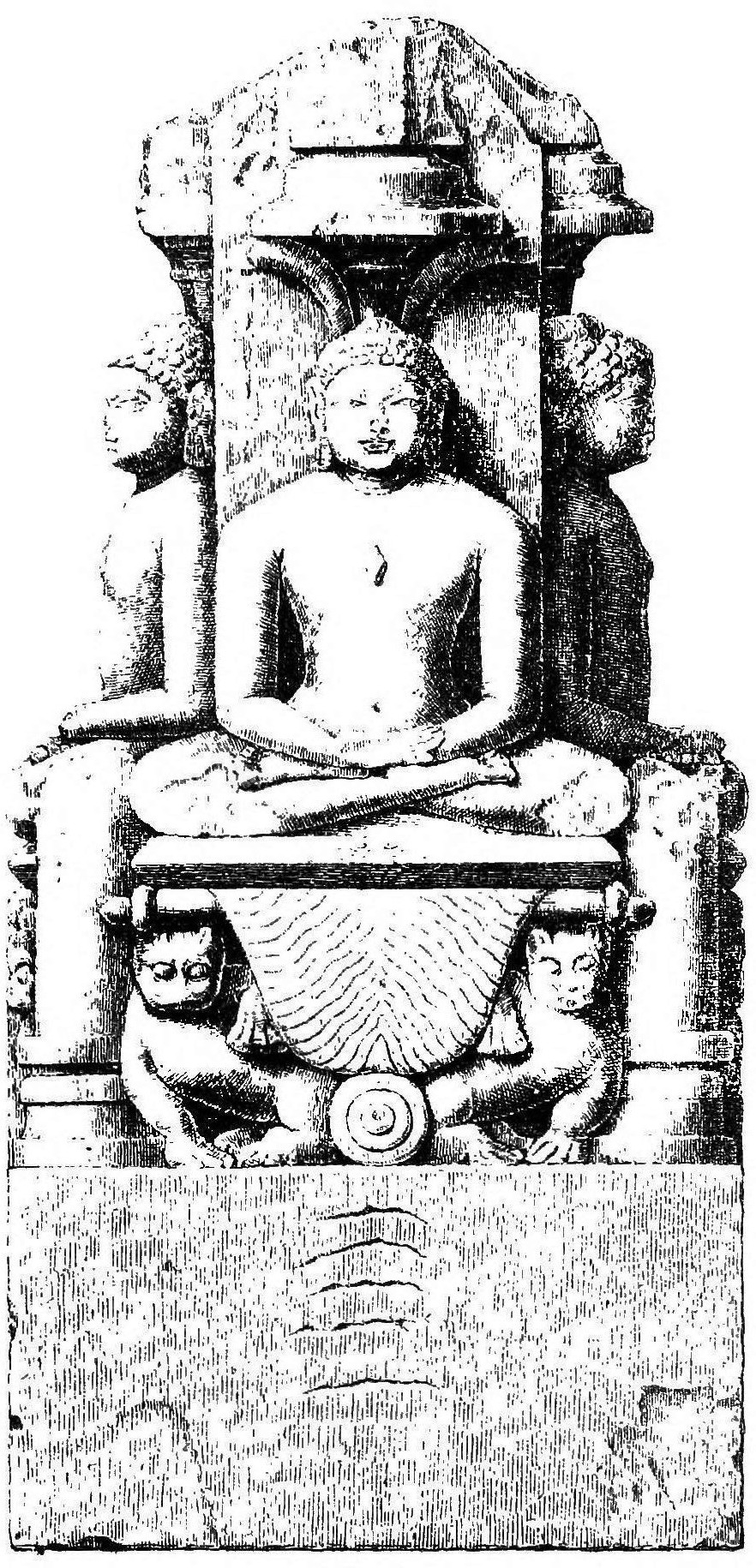 A quadruple Jain Image
 -
 Quadruple Jain Image, excavated from Kankali Tila, c. 1st century CE
 -
 Jain Tablet Homage Set-up by Vasu the daughter of Courtesan Lavana Sobhika - Circa 1st Century CE - Kankali Mound (ACCN 00-Q-7 - Government Museum, Mathura)
 -
 Jina in meditation, Kushan art
 -
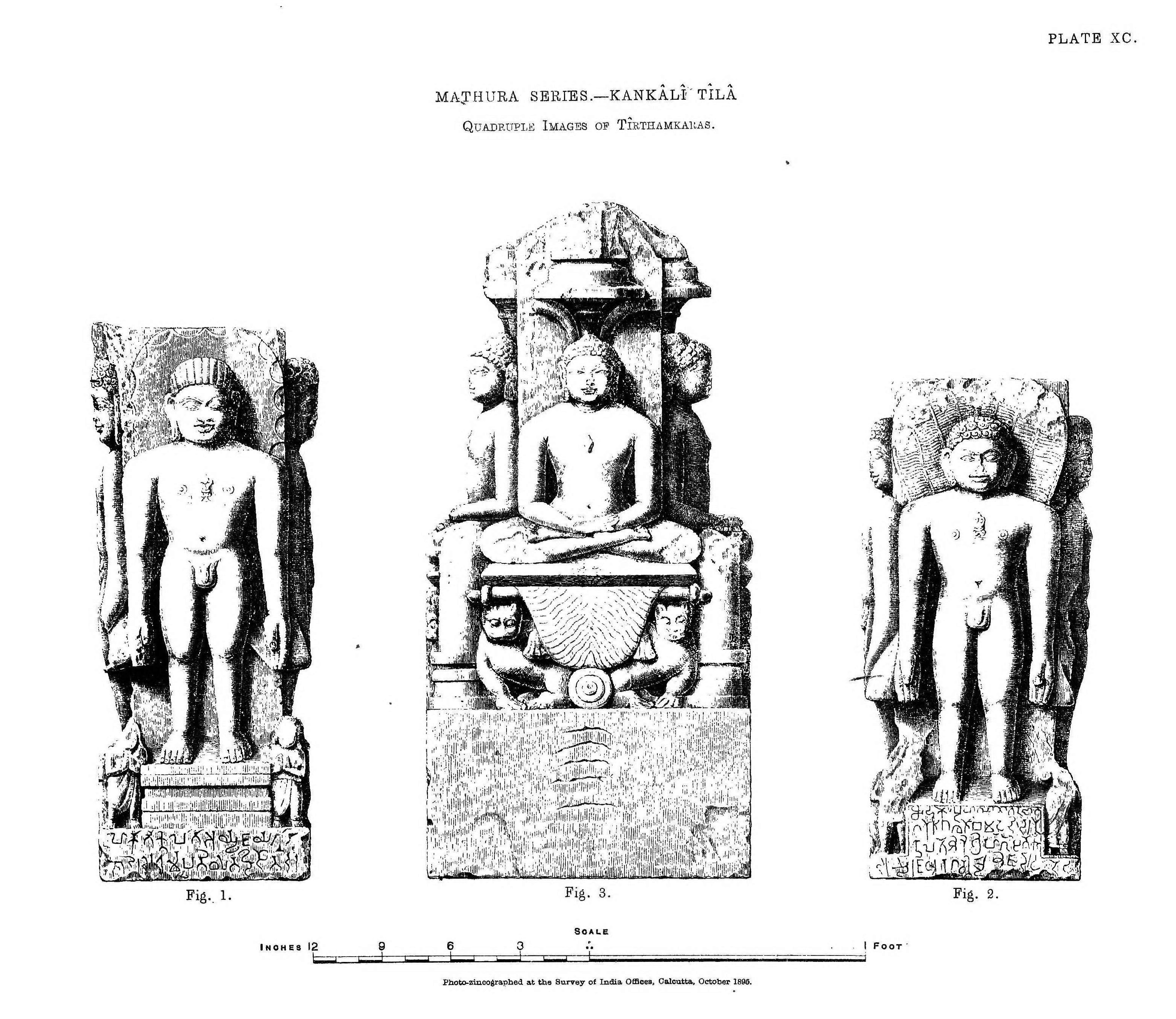 Three Quadruple images of Tirthankar excavated from Kankali Tila, c. 42 BCE(V.S. 15)
 -
 Images of Tirthankar Mahavira excavated from Kankali Tila
 -
 Colossal Head of Jineshvara (Gupta Period)
 -
 Jain Tirthankara Lord Naminatha - (Circa 12th Century CE) ACCN 00-B-77. Government Museum Mathura
 -
 Tirthankara Lord Parsvanatha (Post Gupta Period) - Kosi Kalan ACCN 18-1505 Government Museum Mathura
 -
 Tirthankara Lord Neminatha (Circa 12th Century CE) ACCN 00-B-77 Government Museum Mathura
 -

-
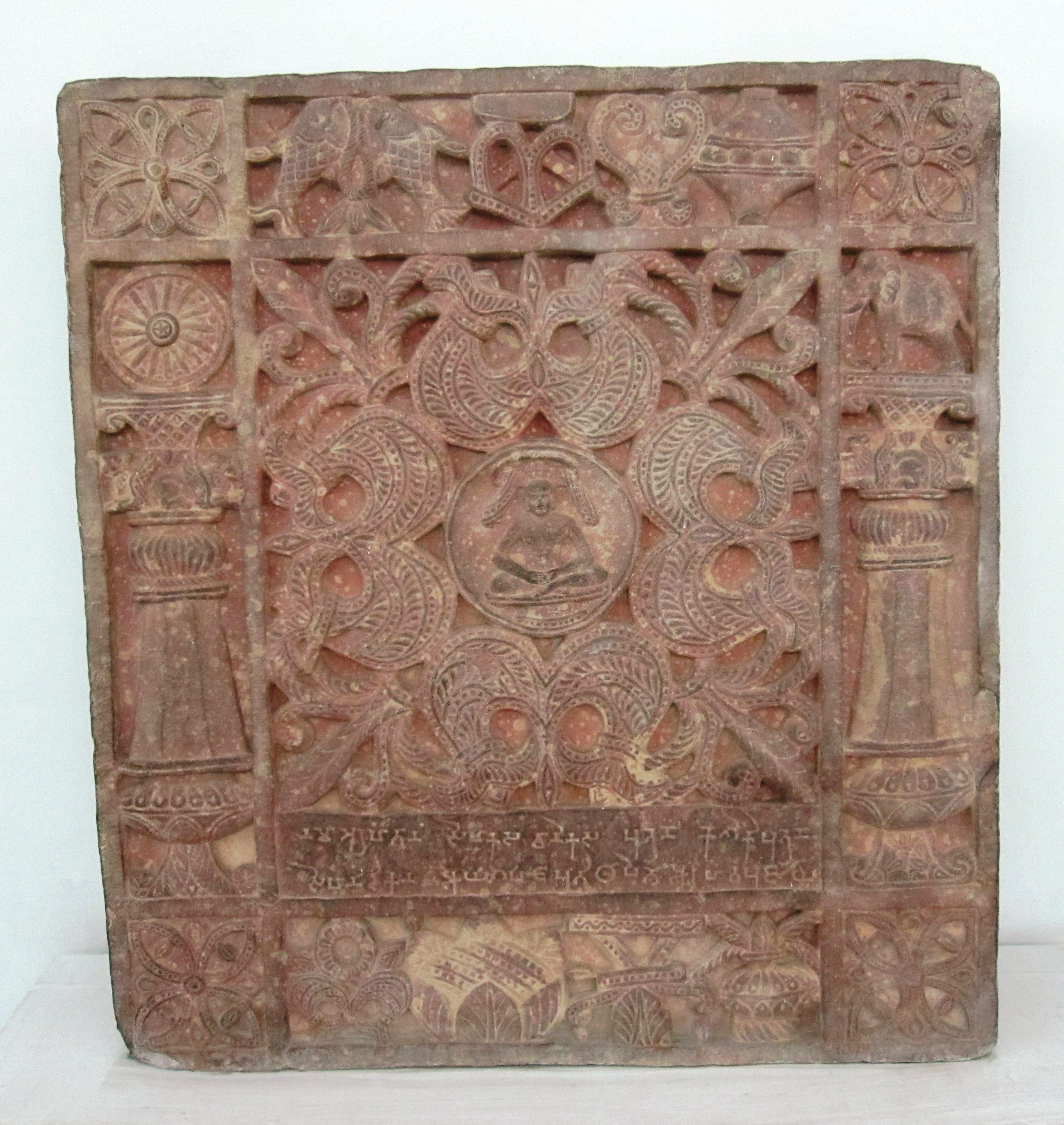 Jain votive plaque (c. 200 CE)
 -
 Pillars
 -
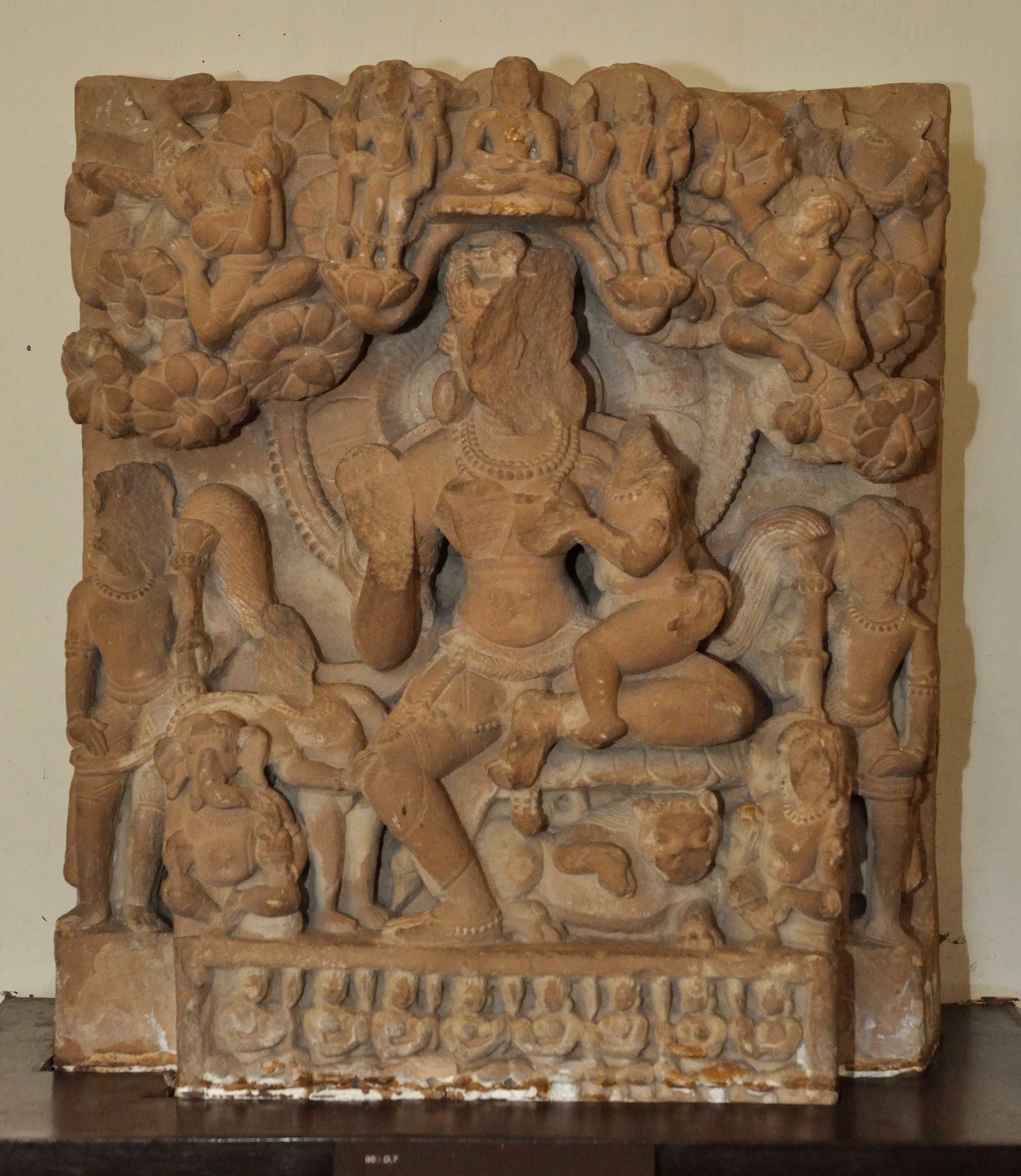 Jain Yakshini Ambika (Mediaeval Period) Government Museum Mathura
 -
![Jain statue inscribed Samvat 1134 (1077 CE), about 60 years after the sack of Mathura by Mahmud of Ghazni. Kankali Tila, Mathura.[10]](https://storage.googleapis.com/smartcommons/commons/6/6d/Jain_statue_dated_Samvat_1134_%281077_CE%29%2C_Kankali_Tila%2C_Mathura.jpg) Jain statue inscribed Samvat 1134 (1077 CE), about 60 years after the sack of Mathura by Mahmud of Ghazni. Kankali Tila, Mathura.[10]
Jain statue inscribed Samvat 1134 (1077 CE), about 60 years after the sack of Mathura by Mahmud of Ghazni. Kankali Tila, Mathura.[10]


.jpg)


![Jain statue inscribed Samvat 1134 (1077 CE), about 60 years after the sack of Mathura by Mahmud of Ghazni. Kankali Tila, Mathura.[10]](/wiki/File:Jain_statue_dated_Samvat_1134_(1077_CE),_Kankali_Tila,_Mathura.jpg)
See also[edit | edit source]

References[edit | edit source]
Citations[edit | edit source]
- ↑ The Jain stûpa and other antiquities of Mathurâ by Smith, Vincent Arthur Plate XIV
- ↑ Chandra, Ramaprasad (1919). Memoirs of the archaeological survey of India no.1-5. p. 22.
- ↑ 3.0 3.1 Smith 1901, p. Introduction.
- ↑ Das 1980, p. 171.
- ↑ 5.0 5.1 Cort 2010, p. 25.
- ↑ Vyas 1995, p. 19.
- ↑ Smith 1901, p. 2.
- ↑ Thomas 1877, p. 80.
- ↑ The Jaina Stupa at Mathura: Art and Icons, Renuka Porwal, Prachya Vidyapeeth, Shajapur, 2016
- ↑ The Jain Stupa And Other Antiquities Of Mathura. 1901. p. 53.
Sources[edit | edit source]
- Cort, John E. (2010) [1953], Framing the Jina: Narratives of Icons and Idols in Jain History, Oxford University Press, ISBN 978-0-19-538502-1
- Das, Kalyani (1980), Early Inscriptions of Mathurā
- Smith, Vincent Arthur (1901), The Jain stupa and other antiquities of Mathura, Allahabad, Printed by KFrank Luker, Superintendent, Government Press, North-Western Provinces and Oudh
- Thomas, Edward (1877), "Jainism or The early faith of Asoka", Nature, 16 (407), London: London, Trübner & co.: 329, Bibcode:1877Natur..16..329., doi:10.1038/016329a0
- Vyas, Dr. R. T., ed. (1995), Studies in Jaina Art and Iconography and Allied Subjects, The Director, Oriental Institute, on behalf of the Registrar, M.S. University of Baroda, Vadodara, ISBN 81-7017-316-7
External links[edit | edit source]
| Gods | |||||
|---|---|---|---|---|---|
| Philosophy | |||||
| Branches |
| ||||
| Practices | |||||
| Literature | |||||
| Symbols |
| ||||
| Ascetics | |||||
| Scholars | |||||
| Community | |||||
| Jainism in |
| ||||
| Jainism and | |||||
| Dynasties and empires | |||||
| Related | |||||
| Lists | |||||
| Navboxes | |||||

