






No edit summary |
m Content refined for better accuracy |
||
| Line 1: | Line 1: | ||
{{Short description|Emperor of | {{Short description|Emperor of Vijayanagara from 1509 to 1529}} | ||
{{Redirect|Sri Krishna Deva Raya|the 1970 film|Sri Krishnadevaraya (film)}} | {{Redirect|Sri Krishna Deva Raya|the 1970 film|Sri Krishnadevaraya (film)}} | ||
{{protection padlock|small=yes}} | |||
{{Use Indian English|date=December 2021}} | {{Use Indian English|date=December 2021}} | ||
{{Use dmy dates|date=November 2022}} | {{Use dmy dates|date=November 2022}} | ||
{{Infobox royalty | {{Infobox royalty | ||
| name = Krishnadevaraya | | name = Krishnadevaraya | ||
| title = | | title = [[Maharajadhiraja]]<br />Kannada Rajya Rama Ramana<br />[[Andhra]] Bhoja<br />Dakshinasamudradhiswara<br />Mooru Rayara Ganda<ref name="ReferenceA">Advanced Study in the History of Medieval India by Jl Mehta p. 118</ref><br />Abhinava-Bhoja<ref>{{Cite book |last=Pollock |first=Sheldon |url=https://books.google.com/books?id=0UCh7r2TjQIC&pg=PA179 |title=The Language of the Gods in the World of Men: Sanskrit, Culture, and Power in Premodern India |publisher=[[University of California Press]] |year=2003 |isbn=0-5202-4500-8 |page=179 |author-link=Sheldon Pollock}}</ref><br />Gaubrahmana Pratipalaka | ||
| image = Chinnadevi, Krishnadevaraya, Tirumaladevi statues at Chandragiri Museum.jpg | | image = Chinnadevi, Krishnadevaraya, Tirumaladevi statues at Chandragiri Museum.jpg | ||
| caption =Sculpture of Krishnadevaraya and his wives at [[Chandragiri Fort, Andhra Pradesh|Chandragiri Museum]] | | caption = Sculpture of Krishnadevaraya and his wives at [[Chandragiri Fort, Andhra Pradesh|Chandragiri Museum]] | ||
| succession = [[Vijayanagara | | succession = [[List of Vijayanagara emperors|Emperor of Vijayanagara]] | ||
| reign = 26 July 1509 – 17 October 1529<ref>{{Cite book |last=Srinivasan |first=C. R. |url=https://books.google.com/books?id=dJEcAAAAMAAJ |title=Kanchipuram Through the Ages |publisher=Agam Kala Prakashan |year=1979 |page=200 |oclc=5834894 |accessdate=25 July 2014 | | coronation = 23/24 January 1510{{efn|name="Coronation"|According to an inscription at a temple in Hampi, Krishnadevaraya's coronation was on 14 Magha 1431 [[Shaka era|Shaka Samvat]]. However, this [[tithi]] (lunar day) falls on both 23 and 24 January 1510.<ref name="u335">{{cite journal | last=Sewell | first=R. | title=The Kings of Vijayanagara, A.D. 1486-1509 | journal=The Journal of the Royal Asiatic Society of Great Britain and Ireland | publisher=[Cambridge University Press, Royal Asiatic Society of Great Britain and Ireland] | year=1915 | issn=0035-869X | jstor=25189336 | pages=383–395 | url=http://www.jstor.org/stable/25189336 | access-date=22 October 2024}}</ref>}} | ||
| reign = {{Nowrap|26 July 1509 – 17 October 1529}}<ref>{{Cite book |last=Srinivasan |first=C. R. |url=https://books.google.com/books?id=dJEcAAAAMAAJ |title=Kanchipuram Through the Ages |publisher=Agam Kala Prakashan |year=1979 |isbn = 819429374X |page=200 |oclc=5834894 |accessdate=25 July 2014}}</ref> | |||
| predecessor = [[Viranarasimha Raya]] | | predecessor = [[Viranarasimha Raya]] | ||
| successor = [[Achyuta Deva Raya]] | | successor = [[Achyuta Deva Raya]] | ||
| birth_date = {{ | | birth_date = {{Birth date|1471|01|17|df=yes}} | ||
| birth_place = [[Vijayanagara]], [[Vijayanagara Empire]] <br /> ( | | birth_place = [[Vijayanagara]], [[Vijayanagara Empire]]<br />(present-day [[Hampi]], [[Karnataka]], [[India]]) | ||
| death_date = {{ | | death_date = {{Death date and age|1529|10|17|1471|01|17|df=yes}} | ||
| death_place = [[Vijayanagara]], [[Vijayanagara Empire]] <br /> ( | | death_place = [[Vijayanagara]], [[Vijayanagara Empire]]<br />(present-day [[Hampi]], [[Karnataka]], [[India]]) | ||
| issue = * Tirumalumba (from Tirumala Devi) | | issue = * Tirumalumba (from Tirumala Devi) | ||
* Vengalamba (from Chinna Devi) | * Vengalamba (from Chinna Devi) | ||
* Tirumala Raya (from Tirumala Devi)<ref>{{Cite book |last1=Sivasankaranarayana |first1=Bh. |url=https://books.google.com/books?id=GJphAAAAIAAJ |title=Andhra Pradesh District Gazetteers: Anantapur |last2=Rajagopal |first2=M. V. |last3=Ramesan |first3=N. |publisher=Director of Print. and Stationery at the Government Secretariat Press, copies can be had from:Government Publication Bureau |year=1970 |page=63}}{{ | * Tirumala Raya (from Tirumala Devi)<ref>{{Cite book |last1=Sivasankaranarayana |first1=Bh. |url=https://books.google.com/books?id=GJphAAAAIAAJ |title=Andhra Pradesh District Gazetteers: Anantapur |last2=Rajagopal |first2=M. V. |last3=Ramesan |first3=N. |publisher=Director of Print. and Stationery at the Government Secretariat Press, copies can be had from:Government Publication Bureau |year=1970 |oclc = | ||
42803386|page=63}}</ref>(Crowned in 1524 at the age of 6 years, but died on 1525<ref>{{cite book|title=History of Tirupati: The Thiruvengadam Temple, Volume 2|url=https://books.google.com/books?id=sZLXAAAAMAAJ&q=son+death|publisher=Tirumala Tirupati Devasthanams|author=T. K. T. Viraraghavacharya|page=469|year=1997}}</ref>) | |||
| father = [[Tuluva Narasa Nayaka]] | | father = [[Tuluva Narasa Nayaka]] | ||
| mother = Nagala Devi | | mother = Nagala Devi | ||
| religion = [[ | | signature = Krishnadevaraya signature.png | ||
| queen = [[Tirumala Devi]]<br /> | | religion = [[Sri Vaishnavism]] | ||
| queen = [[Tirumala Devi]]<br />Chinna Devi<br />Annapurna Devi | |||
| dynasty = [[Tuluva dynasty|Tuluva]] | | dynasty = [[Tuluva dynasty|Tuluva]] | ||
| module = {{Infobox military person | |||
| embed = yes | |||
| allegiance = [[Vijayanagara Empire]] | |||
| serviceyears = 1509–1529 | |||
| rank = | |||
| battles = {{Hidden | |||
|See list | |||
|{{Tree list}} | |||
* [[Krishnadevaraya's Deccan Expedition]] | |||
** [[Battle of Diwani]] | |||
** Battle of Koilkonda | |||
** Capture of Raichur | |||
** Siege of Gulbarga | |||
** Siege of Bidar | |||
* Vijayanagara–Gajapati War | |||
** Siege of Udayagiri | |||
** Siege of Kondavidu | |||
** Battle of Meduru | |||
** Capture of Kondavidu | |||
** Capture of Kondapalli | |||
** Conquest of Kalinga | |||
* [[Battle of Raichur]] | |||
{{Tree list/end}} | |||
}} | }} | ||
}} | |||
'''Krishnadevaraya''' (17 January 1471 | }} | ||
'''Krishnadevaraya''' (17 January 1471 – 17 October 1529) was emperor of the [[Vijayanagara Empire]] from 1509 to 1529 and the third ruler of the [[Tuluva dynasty]]. Widely regarded as one of the greatest rulers in Indian history, he presided over the empire at its political and cultural zenith and is remembered as an iconic figure by many Indians.<ref>Tabasum Bhanu (2015) [https://ijcrt.org/papers/IJCRT1133330.pdf Sri krishnadevaraya 1509-1529.made vijayanagara a military power in the south an overview] ''IJCRT'' 3(4)</ref> Following the decline of the [[Delhi Sultanate]], he ruled the largest and most powerful empire in India during his time.<ref name="k302">Keay, John, India: A History, New York: [[HarperCollins|Harper Collins]], 2000, p. 302</ref> | |||
Krishnadevaraya's reign was marked by military expansion and political consolidation. He became the dominant ruler of the Indian peninsula by defeating the sultans of [[Sultanate of Bijapur|Bijapur]], [[Sultanate of Golconda|Golconda]], the [[Bahmani Kingdom|Bahmani Sultanate]], and the [[Gajapati Empire|Gajapatis]] of [[Odisha]], making him one of the most powerful Hindu monarchs in Indian history.<ref name="ReferenceA" /> Major campaigns during his reign included the [[Krishnadevaraya's Bahmani expedition|conquest]] of the [[Raichur Doab]] in 1512, the subjugation of Odisha in 1514, and a decisive victory against the Sultan of Bijapur in 1520. On many occasions, the king changed battle plans abruptly, turning a losing battle into victory. | |||
When the [[List of emperors of the Mughal Empire|Mughal emperor]] [[Babur]] surveyed the rulers of India, he considered Krishnadevaraya the most powerful, ruling over the most extensive empire in the subcontinent.<ref name="k302" /> Portuguese travellers [[Domingo Paes]] and [[Duarte Barbosa]], who visited his court, described him as an able administrator and an exceptional military commander who personally led campaigns and tended to wounded soldiers. The poet [[Nandi Thimmana|Mukku Timmana]] praised him as the "Destroyer of the Turks".<ref name="Vijayanagara Voices p.124">Vijayanagara Voices: Exploring South Indian History and Hindu Literature William Joseph Jackson: p. 124</ref> Krishnadevaraya was guided by his trusted prime minister [[Timmarusu]], whom he credited as the architect of his rise to the throne, and was also advised by the witty poet [[Tenali Rama|Tenali Ramakrishna]]. | |||
His reign is also regarded as a golden age of [[Telugu literature]], and he was a distinguished patron of arts and scholarship. Krishnadevaraya himself composed the [[Telugu language|Telugu]] poetic work ''[[Amuktamalyada]]'', celebrated for its literary and devotional value. His court was home to the [[Ashtadiggajas]]—eight legendary Telugu poets—including [[Allasani Peddana]] and Mukku Timmana. Literary activity flourished not only in Telugu but also in [[Sanskrit]], [[Kannada]], and [[Tamil language|Tamil]] under his patronage, making his court a major cultural hub of the era. | |||
Krishnadevaraya was conferred with several honorific titles such as ''Andhra Bhoja'' ("[[Bhoja]] of [[Andhra]]"), ''Karnatakaratna Simhasanadeeshwara'' ("Lord of the Jewelled Throne of Karnataka"), ''Mooru Rayara Ganda'' ("Lord of Three Kings"), ''Kannada Rajya Rama Ramana'' ("Lord of the Kannada Empire"), and ''Gaubrahmana Pratipalaka'' ("Protector of Cows and Brahmins"). | |||
==Early life== | == Early life == | ||
Krishnadevaraya was the son of [[Tuluva Narasa Nayaka]]<ref name="parents">Prof K.A.N. Sastri, ''History of South India, From Prehistoric times to fall of Vijayanagar'', 1955, pp. 250, 258</ref><ref>{{Cite book |last=Pollock |first=Sheldon |url=https://books.google.com/books?id=740AqMUW8WQC |title=Forms of Knowledge in Early Modern Asia: Explorations in the Intellectual History of India and Tibet, 1500–1800 |year=2011 |publisher=[[Duke University Press]] |isbn=978-0822349044 |location=Durham and London |page=72 |oclc=1171392877 |author-link=Sheldon Pollock}}</ref> and his queen Nagamamba.<ref>{{Cite book |url=https://books.google.com/books?id=8nJDAAAAYAAJ |title=Indian Antiquary |publisher=Swati Publications |year=1985 |editor-last=Temple |editor-first=Richard Carnac |editor-link=Richard Carnac Temple |volume=27 |location=Delhi |orig-year=1899 |isbn=0548806756 |page=276 |quote=Nộisimha had two sons, Viranşisinha and Kșishộarâya, the former by one of his queens Tippâmbân, Nagamâmbâ.}}</ref><ref>{{Cite book |last=Mallappa |first=T. N. |url=https://books.google.com/books?id=6KA5AQAAIAAJ |title=Kriyasakti Vidyaranya |publisher=Department of Publications & Extension Lectures, [[Bangalore University]] |year=1974 |location=Bangalore |page=149 |oclc=2202269 |quote=In those days, king was regarded as God Vishnu, but in the case of Krishnadevaraya, such a feeling could not be expected as he was the son of an usurper of the kingdom by his concubine.}}{{ISBN missing|date=January 2022}}</ref> Tuluva Narasa Nayaka was an army commander under [[Saluva Narasimha Deva Raya]], who later took control to prevent the disintegration of the empire and established the [[Tuluva dynasty]] of the Vijayanagara Empire. He ascended the throne after the death of his half-brother Viranarasimha.<ref name="o497">{{cite web | author=M. H. RĀMA SHARMA| title=Full text of "THE HISTORY OF VIJAYANAGAR EMPIRE VOL.1" | website=Internet Archive | date=23 October 2016 | url=https://archive.org/stream/dli.bengal.10689.12385/10689.12385_djvu.txt | access-date=18 February 2025}}</ref> He was married to [[Srirangapatna]]'s princess [[Tirumala Devi]] and his royal dancer from [[Kodagu]], Chinna Devi.<ref name="o497" /> He was father to Tirumalamba (from Tirumala Devi), Vengalamba (from Chinna Devi) and Tirumala Raya (from Tirumala Devi). His daughters were married to Prince [[Rama Raya (statesman)|Rama Raya]] of Vijayanagara and his brother Prince [[Tirumala Deva Raya|Tirumala Deva]] Raya.<ref name="o497" /> | |||
==Military career== | == Military career == | ||
His main enemies were the [[Bahmani Sultanate | His main enemies were the [[Bahmani Sultanate]], the [[Deccan Sultanates]], the [[Gajapati Kingdom|Gajapatis]] of [[Odisha]], who had been involved in constant conflict since the rule of [[Saluva Narasimha Deva Raya]], and Portugal, a rising maritime power which controlled much of the sea trade.<ref>{{Cite book |last=H. V. Sreenivasa Murthy, R. Ramakrishnan |url=https://books.google.com/books?id=g09uAAAAMAAJ |title=A History of Karnataka, from the Earliest Times to the Present Day |publisher=S. Chand |year=1977 |page=188}}</ref> | ||
===Success in Deccan=== | === Success in the Deccan === | ||
{{Main|Krishnadevaraya's Deccan Expedition}} | |||
The raid and plunder of Vijayanagara towns and villages by the Deccan sultans came to an end during the Raya's rule. In 1509, Krishnadevaraya's armies [[Battle of Diwani|clashed]] with them and [[Mahmood Shah Bahmani II|Sultan Mahmud]] was severely injured and defeated.<ref>{{Cite book |last=P. Sree Rama Sarma |title=A History of the Vijayanagar Empire |publisher=Prabhakar Publications |year=1992 |page=135 |quote=The invaders were checked at Diwani (Unidentified). In a hotly contested battle fought at Diwani the Sultan himself was thrown off his horse. He sustained serious injuries.}}</ref> [[Yusuf Adil Shah]] was killed and the [[Raichur Doab]] was annexed. Taking advantage of the victory, the Raya reunited [[Bidar Sultanate|Bidar]], [[Kalaburagi|Gulbarga]], and [[Adil Shahi dynasty|Bijapur]] into Vijayanagara and earned the title "establisher of the Yavana kingdom" when he released Sultan Mahmud and made him de facto ruler.<ref>{{Cite book |url=https://books.google.com/books?id=d5RPAQAAMAAJ |title=Karnataka State Gazetteer: Dharwad District (including Gadag and Haveri Districts) |publisher=Office of the Chief Editor, Karnataka Gazetteer |year=1993 |page=53}}</ref> The Sultan of Golconda [[Sultan Quli Qutb Shah]] was defeated by Timmarusu, the prime minister of Krishnadevaraya.<ref>{{Cite book |last=P. Raghunadha Rao |title=Ancient and Medieval history of Andhra Pradesh |publisher=Sterling Publishers |year=1993 |page=87 |quote=Timmarasu himself took command, defeated the Golconda army and captured its commander Madurl Mulk}}</ref> In 1513, Krishnadevaraya personally engaged in battle with Golconda Sultan Quli Qutb Shah at Pangal. The Vijayanagar army suffered defeat at the hands of the Golconda forces, resulting in the capture of the Pangal fort from Vijayanagar. As a consequence, Raya was compelled to retreat.<ref>{{Cite book |last=Cohen |first=B. |url=https://books.google.com/books?id=sZKHDAAAQBAJ |title=Kingship and Colonialism in India's Deccan 1850–1948 |date=2007 |publisher=Springer |isbn=978-0-230-60344-8 |pages=47 |language=en |quote=Vijayanagar king Krishnadevaraya opted to march against the Qutb Shah leader. He came with 30,000 horses and 3,000 foot soldiers. Quli Qutb responded, and the two armies met at Pangal where the Vijayanagar army had encamped. In battle, the Golconda forces were successful, forcing the retreat of Krishnadevaraya who left behind a small force to defend the fort. The fort occupants held out for nearly two months before capitulating to the besieging Qutb Shah forces.}}</ref> | |||
The | |||
=== War with Kalinga === | |||
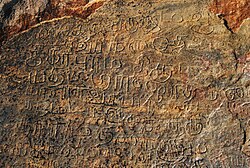
[[File:Kannada inscription of Krishnadeva Raya (1513 AD) at the Krishna temple in Hampi.JPG|thumb|upright|Kannada inscription, dated 1513 CE, of Krishnadevaraya at the Krishna temple in Hampi describes his victories against the Gajapati Kingdom of [[Odisha]].]] | |||
The [[Gajapati Empire|Gajapatis]] of Odisha ruled a vast land comprising parts of [[Bengal]], [[Coastal Andhra|Andhra]], and [[Odisha]].<ref>{{Cite book |last=Panigrahi |first=Krishna Chandra |title=History of Orissa |pages=191, 194–196}}</ref> Krishnadevaraya's success at Ummatur provided the necessary impetus to carry his campaign into the coastal Andhra region, which was under the control of the Gajapati king [[Prataparudra Deva]]. The Vijayanagara army laid siege to the [[Udayagiri, Nellore district|Udayagiri]] fort in 1512.<ref>{{Cite book |last=N. K. Sahu, P. K. Mishra, Jagna Kumar Sahu |title=History of Orissa |publisher=Nalanola |year=1981 |page=234 |quote=Krishnadevaraya started his expedition against Udayagiri early in A.D. 1512.}}</ref> The campaign lasted for a year before the Gajapati army disintegrated due to starvation.<ref>{{Cite book |title=Life and Achievements of Sri Krishnadevaraya |publisher=Directorate of Archaeology and Museums, Government of Karnataka |year=2011 |page=48 |quote=Starving the defenders into surrender seemed to be the only way open to the Raya.}}</ref> Krishnadevaraya offered prayers at [[Tirumala Venkateswara Temple|Tirupati]] thereafter, along with his wives Tirumala Devi and Chinnama Devi.<ref>{{Cite book |title=Life and Achievements of Sri Krishnadevaraya |publisher=Directorate of Archaeology and Museums, Government of Karnataka |year=2010 |page=48 |quote=A relieved Raya left for the capital and on the way visited the temple of Tirupati and gave numerous gifts to the Lord in gratefulness for the victory at Udaygiri.}}</ref> The Gajapati army was then met at [[Kondaveedu Fort|Kondaveedu]]. The armies of Vijayanagara, after establishing a siege for a few months, began to retreat due to heavy casualties.<ref>{{Cite book |url=https://books.google.com/books?id=d9NZ9VmTYloC |title=Life and Achievements of Sri Krishnadevaraya |publisher=Directorate of Archaeology and Museums, Government of Karnataka |year=2010 |page=47 |quote=The Raya's soldiers had to virtually blast their way through huge boulders to go anywhere near the foot of the fort wall … The Gajapati did such a fine job of defending the fort that the siege dragged on for fourteen months.}}</ref> [[Timmarusu]] discovered a secret entrance to the unguarded eastern gate of the fort and launched a night attack. This culminated with the capture of the fort and the imprisonment of Prince Virabhadra, the son of Prataparudra Deva.<ref>{{Cite book |last=Achintya Kumar Deb |url=https://books.google.com/books?id=_s8XAAAAIAAJ |title=The Bhakti Movement in Orissa: A Comprehensive History |publisher=Kalyani Devi |year=1984 |page=27 |quote=Pratapurdradeva could not protect it [Kondaveedu Fort] and he surrendered several military and civil officers, including Virabhadra, son of Prataparudredeva were taken captives by the king of Vijayanagar.}}</ref> Vasireddy Mallikharjuna Nayaka took over as governor of [[Kondaveedu Fort|Kondaveedu]] thereafter.<ref>{{Cite web |title=Imperial Gazetteer 2 of India, Volume 15, pp. 393 – Imperial Gazetteer of India – Digital South Asia Library |url=https://dsal.uchicago.edu/reference/gazetteer/pager.html?volume=15&objectid=DS405.1.I34_V15_399.gif |access-date=2021-05-10 |website=dsal.uchicago.edu}}</ref> | |||
Krishnadevaraya | Krishnadevaraya planned an invasion of [[Kalinga (historical region)|Kalinga]], but Prataparudra learned of this plan and formulated his own plan to defeat the former at the fort of [[Kalinganagar]]. Timmarusu discovered Prataparudra's plan by bribing a Telugu deserter from the service of Prataparudra. When the Vijayanagara Empire did invade, Prataprudra was driven to [[Cuttack]], the capital of the [[Gajapati Kingdom]].<ref>{{Cite book |last=Andhra Pradesh (India). Dept. of Archaeology |title=Andhra Pradesh Government Archaeological Series |publisher=Government of Andhra Pradesh |year=1962 |page=15 |quote=Krishnadevaraya went as far as Cuttack}}</ref> Prataparudra eventually surrendered to the Vijayanagara Empire, and gave his daughter, Princess Jaganmohini, in marriage to Krishnadevaraya.<ref>{{Cite book |last=N. Saraswathi Nanaiah |url=https://books.google.com/books?id=K1AqAAAAYAAJ |title=The Position of Women During Vijayanagara Period, 1336–1646 |publisher=Southern Printers |year=1992 |page=135 |quote=When Krishnadeva Raya won against Gajapathi, he gave a lot of dowry to Krishnadeva Raya and gave his}}</ref> Krishnadevaraya returned all the lands that the Vijayanagara Empire had captured north of the [[Krishna River]]; this made the Krishna river the boundary between the Vijayanagara and Gajapati Kingdoms.<ref>{{Cite book |last=K. Jayasree |url=https://books.google.com/books?id=MQbtAAAAMAAJ |title=Agrarian Economy in Andhra under Vijayanagar |publisher=Navrang |year=1991 |isbn=978-8170130840 |page=21 |quote=Krishnadevaraya returned all the territory north of the river Krishna to Prataparudra Gajapati.}}</ref> | ||
===Final | Krishnadevaraya established friendly relations with the [[Portuguese India|Portuguese]] in [[Goa]] in 1510.<ref>{{Cite book |last=Bowman |first=John |title=Columbia Chronologies of Asian History and Culture |publisher=Columbia University Press |year=2000 |isbn=978-0231500043 |page=272 |quote=Krishnadevaraya pursues friendly relations with Europeans, granting Portuguese trading rights in exchange for access to trade goods.}}</ref> The Emperor obtained guns and Arabian horses from the Portuguese merchants.<ref>{{Cite book |last=Powell |first=Salem |url=https://archive.org/details/magillsguidetomi0000unse/page/1609 |title=Magill's Guide to Military History |publisher=Salem Press |year=2001 |isbn=978-0893560140 |page=[https://archive.org/details/magillsguidetomi0000unse/page/1609 1609] |quote=the importation and use of Arabian war horses and guns [by the Vijayanagara Empire]. |url-access=registration}}</ref><ref>{{Cite book |last=Directorate of Archaeology and Museums |title=Life and Achievements of Sri Krishnadevaraya |publisher=Government of Karnataka |year=2010 |page=267 |quote=The rulers of Vijayanagara and Bahmanis mainly depended on Portuguese and Arabs for the import of quality horses for military operations.}}</ref> He also utilized Portuguese expertise to improve the water supply to the Vijayanagara capital.<ref>{{Cite book |last=I. M. Muthanna |url=https://books.google.com/books?id=uCYdAAAAMAAJ |title=Karnataka, History, Administration & Culture |year=1962 |page=38 |quote=He [Krishnadevaraya] erected a huge embankement near Hosept with the assistance of the Portuguese engineers.}}</ref> | ||
=== Final conflicts === | |||
{{see also|Battle of Raichur}} | {{see also|Battle of Raichur}} | ||
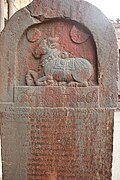
[[File: Kannada inscription of Krishnadeva Raya (1524 AD) at Ananthasayana temple in Ananthasayanagudi.JPG|thumb|right|upright|Kannada inscription dated 1524 A.D., of | [[File: Kannada inscription of Krishnadeva Raya (1524 AD) at Ananthasayana temple in Ananthasayanagudi.JPG|thumb|right|upright|Kannada inscription dated 1524 A.D., of Krishnadevaraya at the Anathasayana temple in Anathasayanagudi near Hampi. The temple was built in memory of his deceased son{{Citation needed|date=January 2022}}]] | ||
The complicated alliances of the empire and the five [[Deccan sultanates]] meant that he was continually at war. In one campaign, he defeated [[Golconda]] and captured its commander Madurul-Mulk, crushed [[Bijapur Sultanate|Bijapur]] and its sultan [[Ismail Adil Shah]],<ref>{{Cite book |last=PSR (Standard Issue) |title=Portuguese Studies Review, Vol. 16, No. 2 |publisher=Baywolf Press |year=2009 |page=27 |quote= | The complicated alliances of the empire and the five [[Deccan sultanates]] meant that he was continually at war. In one campaign, he defeated [[Golconda]] and captured its commander Madurul-Mulk, crushed [[Bijapur Sultanate|Bijapur]] and its sultan [[Ismail Adil Shah]],<ref>{{Cite book |last=PSR (Standard Issue) |title=Portuguese Studies Review, Vol. 16, No. 2 |publisher=Baywolf Press |year=2009 |page=27 |quote=In 1520, Ismail Adil Shah recaptured the Raichur Doab from Vijayanagara. In May 1520, Krishnadevaraya sent his forces to Raichur and in the battle that ensued, Adil Shah was defeated and his forces were routed.}}</ref> and restored the [[Bahmani]] sultanate to the son of {{nowrap|Muhammad Shah II}}.<ref>{{Cite book |last=Sharma |first=L.P |url=https://books.google.com/books?id=18EKAQAAIAAJ |title=History of Medieval India (1000–1740 A.D.) |publisher=Konark Publishers |year=1987 |isbn=978-8122000429 |quote=However, he [Krishnadevaraya] returned after placing on the throne the eldest son of Muhammad Shah II.}}</ref>{{page needed|date=July 2020}} | ||
The highlight of his conquests occurred on 19 May 1520 where he secured [[Raichur Fort]] from Ismail Adil Shah after a difficult siege in which 16,000 Vijayanagara soldiers were killed. The exploits of the military commander, [[Pemmasani Ramalinga Nayudu]] of the [[Pemmasani Nayaks]], during the [[Battle of Raichur]] were distinguished and lauded by Krishnadevaraya.<ref> | The highlight of his conquests occurred on 19 May 1520 where he secured [[Raichur Fort]] from Ismail Adil Shah after a difficult siege in which 16,000 Vijayanagara soldiers were killed. The exploits of the military commander, [[Pemmasani Ramalinga Nayudu]] of the [[Pemmasani Nayaks]], during the [[Battle of Raichur]] were distinguished and lauded by Krishnadevaraya.<ref>{{Cite book |last=G. Surya Prakash Rao |title=Krishnadeva Raya: The Great Poet-emperor of Vijayanagara |publisher=Potti Sreeramulu Telugu University |year=2004 |page=36 |quote=in this battle, Pemmasani Ramalinga Naidu, the Kamma chief of Gandikota family, distinguished himself from the Vijayanagara side.}} | ||
* {{Cite book|title=Vijayanagara Voices: Exploring South Indian History and Hindu Literature|last=Jackson|first=William|publisher=Routledge|year=2016|isbn= | * {{Cite book|title=Vijayanagara Voices: Exploring South Indian History and Hindu Literature|last=Jackson|first=William|publisher=Routledge|year=2016|isbn=978-1317001935|pages=Ramalinga Nayadu received a token gift from the king|quote=124}} | ||
* ''Tidings of the king : a translation and ethnohistorical analysis of the Rāyavācakamu''. Wagoner, Phillip B., | * ''Tidings of the king : a translation and ethnohistorical analysis of the Rāyavācakamu''. Wagoner, Phillip B., Honolulu: University of Hawaii Press. 1993. {{ISBN|0585338191}}. {{OCLC|45885573}}. p. 59: Quote: "Pemmasani Ramalinga Nayudu bravely offers to counter this move of the Turks by going with his men to infiltrate their camp." | ||
* "Journal of the Andhra Historical Society". ''Andhra Historical Research Society, Rajahmundry, Madras, Andhra Historical Research Society''. Volume 30: 91 "Ramalingatiayudu, who succeeded his father, was one of the most redoubtable warriors- in the court of Krishnadgvarlya. ... Rachuru (Raichur) and other strong places with his [Pemmasani Ramalinga] own men and prepared to proceed against the city of Golconda. ... Pemmasani Ramalinganayudu entered the thickest of the fight". 1964. | * "Journal of the Andhra Historical Society". ''Andhra Historical Research Society, Rajahmundry, Madras, Andhra Historical Research Society''. Volume 30: 91 "Ramalingatiayudu, who succeeded his father, was one of the most redoubtable warriors- in the court of Krishnadgvarlya. ... Rachuru (Raichur) and other strong places with his [Pemmasani Ramalinga] own men and prepared to proceed against the city of Golconda. ... Pemmasani Ramalinganayudu entered the thickest of the fight". 1964. | ||
* Rajasekhara, Sindigi (2008). ''The Map Approach to Vijayanagara history''. University of Michigan and Sujatha Publications. p. 34.</ref> It is said that 700,000 | * Rajasekhara, Sindigi (2008). ''The Map Approach to Vijayanagara history''. University of Michigan and Sujatha Publications. p. 34.</ref> It is said that 700,000 foot soldiers, 32,600 cavalry, and 550 elephants were used.<ref>{{Cite book |last=Reddy |first=Kittu |title=History of India: A New Approach |publisher=Standard Publishers |year=2003 |page=184 |quote=It is said that his army consisted of about a million men, with over 700,000 fighting men and 550 elephants …}}</ref> A Portuguese contingent <ref>{{Cite web|url=https://www.britannica.com/biography/Ismail-Adil-Shah|title=Ismāʿīl ʿĀdil Shāh | Bijāpur ruler | Britannica|website=www.britannica.com|accessdate=5 December 2023}}</ref> commanded by Cristovão de Figueiredo<ref>{{Cite web |date=15 December 2009 |title=Portuguese Studies Review, Vol. 16, No. 2 |url=https://books.google.com/books?id=ZSiaBAAAQBAJ&q=Raichur+Portuguese&pg=PA27}}</ref> with the use of fireweapons helped to conquer the fortress. | ||
Krishnadevaraya was brutal towards Bahmani Generals of Raichur. Many [[Bahmani Sultanate|Bahmani]] generals lost their lands. The other Muslim kings sent envoys to the emperor on hearing of his success and received a haughty reply.{{citation needed|date=April 2019}} | Krishnadevaraya was brutal towards Bahmani Generals of Raichur. Many [[Bahmani Sultanate|Bahmani]] generals lost their lands. The other Muslim kings sent envoys to the emperor on hearing of his success and received a haughty reply.{{citation needed|date=April 2019}} The king conveyed that if Adil Shah would come to him, do obeisance, and kiss his foot, his lands would be restored to him. The submission never took place. Krishnadevaraya then led his army as far north as [[Bijapur, Karnataka|Bijapur]] and occupied it.{{sfn|Eaton|2013|p=292}}<ref>{{citation |title=Vijayanagara, Progress of Research |url=https://books.google.com/books?id=fStuAAAAMAAJ |pages=200 |year=1996 |publisher=Directorate of Archaeology & Museums}}</ref> He imprisoned three sons of a former king of the [[Bahmani]] dynasty, who had been held captive by the Adil Shah and he proclaimed the eldest as king of the [[Deccan]].<ref>{{Cite book |last=Sandhu |first=Gurcharn Singh |title=Military History of Medieval India |publisher=Vision Books |year=2003 |page=342}}</ref> | ||
Finally, in his last battle, he razed to the ground the fortress of [[Gulburga]], the early capital of the [[Bahmani]] sultanate. | Finally, in his last battle, he razed to the ground the fortress of [[Gulburga]], the early capital of the [[Bahmani]] sultanate. | ||
== Later life and death == | |||
==Internal affairs== | In 1524, Krishnadevaraya made his son Tirumala Raya the ''Yuvaraja'' (crown prince). The prince did not survive for long, as he was poisoned soon after.<ref>{{Cite book |last=Pandurang Bhimarao Desai |title=A History of Karnataka: From Pre-history to Unification |publisher=Kannada Research Institute, Karnataka University |year=1970 |page=371 |quote=Raya crowned his six-years-old son Tirumala as yuvaraja and introduced him to the affairs of the state But within one year the young prince died. It was reported that he was a victim of poison...}}</ref> Suspecting [[Timmarusu]], Krishnadevaraya had him blinded.<ref>{{Cite book |last=P. Raghunadha Rao |title=Ancient and Medieval history of Andhra Pradesh |publisher=Sterling Publishers |year=1993 |page=88 |quote=Krishnadeva Raya learnt that his son was poisoned by Timma, the son of his great minister Timmarasu. Both the son and father were captured and blinded.}}</ref> At the same time, Krishnadevaraya was preparing for an attack on [[Belgaum]], which was in the Adil Shah's possession. Around this time, Krishnadevaraya fell ill and eventually died on 17 October 1529, succeeded by his brother, [[Achyuta Deva Raya]].<ref>{{Cite book |last1=Pran Nath Chopra |url=https://books.google.com/books?id=Y7fUHMEDAyEC&pg=PA93 |title=A Comprehensive History of India: Comprehensive history of medieval India |last2=B.N. Puri |last3=M.N. Das |publisher=Sterling Publishers |year=2003 |isbn=9788120725089 |page=93 |via=Google Books}}</ref> | ||
== Internal affairs == | |||
[[Image:View of dilapidated main mantapa at the Vitthala templein Hampi.jpg|250px|thumb|[[Vitthala]] temple with musical pillars, Hoysala style multigonal base [[Hampi]]]] | [[Image:View of dilapidated main mantapa at the Vitthala templein Hampi.jpg|250px|thumb|[[Vitthala]] temple with musical pillars, Hoysala style multigonal base [[Hampi]]]] | ||
During his reign he kept strict control over his ministers, and dealt severely with any minister who committed misdeeds.<ref name="India p.94">A Comprehensive History of India: Comprehensive history of medieval India by B.N. Puri, M.N. Das p.94</ref> He abolished obnoxious taxes such as the marriage fee.<ref name="India p.94" /> To increase revenues, he brought new lands under cultivation, ordering the [[deforestation]] of some areas<ref name="India p.94" /> and undertook a large-scale work to obtain water for irrigation around | During his reign he kept strict control over his ministers, and dealt severely with any minister who committed misdeeds.<ref name="India p.94">A Comprehensive History of India: Comprehensive history of medieval India by B.N. Puri, M.N. Das p. 94</ref> He abolished obnoxious taxes such as the marriage fee.<ref name="India p.94" /> To increase revenues, he brought new lands under cultivation, ordering the [[deforestation]] of some areas<ref name="India p.94" /> and undertook a large-scale work to obtain water for irrigation around Vijayanagara.<ref>Economic History of Medieval India, 1200–1500 p. 194</ref><ref>History of Medieval India: From 1000 A.D. to 1707 A.D. by Radhey Shyam Chaurasia p. 111</ref> Foreign travellers such as Paes, Nunez and Barbosa who visited Vijayanagara spoke highly of the efficiency of his administration and the prosperity of the people during his reign.<ref name="India p.94" /> | ||
The administration of the empire was carried along the lines indicated in his [[Amuktamalyada]]. He was of the opinion that | The administration of the empire was carried along the lines indicated in his ''[[Amuktamalyada]]''. He was of the opinion that a king should always rule with an eye towards [[Dharma]]. His concern for the welfare of the people is amply proved by his extensive annual tours all over the empire, during which he studied everything personally and tried to redress the grievances of the people and punish evildoers. With regard to the promotion of the economic progress of his people, Krishnadevaraya says, | ||
<blockquote>The extent of the kingdom is the means for the acquisition of wealth.<ref name="reference">Medieval Indian History by Krishnaji Nageshrao Chitnis p. 82</ref> Therefore even if the land is limited in extent, excavate tanks and canals and increase the prosperity of the poor by leasing him the land for low ari and koru, so that you may obtain wealth as well as religious merit.<ref name="reference" /> </blockquote> | |||
==Art and literature== | == Art and literature == | ||
[[File:Kannada inscription (1509 AD) of Krishnadeva Raya at entrance to mantapa of Virupaksha temple in Hampi.JPG | [[File:Kannada inscription (1509 AD) of Krishnadeva Raya at entrance to mantapa of Virupaksha temple in Hampi.JPG|thumb|242x242px|[[Kannada]] inscription describing the coronation of Krishnadevaraya at the entrance to Virupaksha temple, Hampi]] | ||
[[File:Sri Ranganayaka Swamy temple Srirangapur, Wanaparthy Telangana, India - 7.jpg | [[File:Sri Ranganayaka Swamy temple Srirangapur, Wanaparthy Telangana, India - 7.jpg|thumb|Sculpture of Ranganayaka ([[Ranganatha]]) at [[Ranganathaswamy Temple, Srirangam|Ranganathaswamy Temple]] in [[Srirangam]]. ]] | ||
Krishnadevaraya was noted to be linguistically neutral as he ruled a multilingual empire. He is known to have patronised poets and issued inscriptions in languages as varied as [[ | Krishnadevaraya was noted to be linguistically neutral as he ruled a multilingual empire. He is known to have patronised poets and issued inscriptions in languages as varied as [[Kannada]], [[Sanskrit]], [[Telugu language|Telugu]] and [[Tamil language|Tamil]]. Krishnadevaraya himself was a polyglot, fluent in [[Kannada]], [[Sanskrit]], [[Telugu language|Telugu]] and [[Tamil language|Tamil]]. The official language of the [[Vijayanagara Empire|Vijayanagara]] court was [[Kannada]].{{sfn|Dr. Suryanath U. Kamat|2001|p=166}} | ||
Krishnadevaraya patronized literature in various languages. The rule of | Krishnadevaraya patronized literature in various languages. The rule of Krishnadevaraya was an age of prolific literature in many languages, although it is particularly known as a golden age of Telugu literature. Many Telugu, Kannada, Sanskrit, and Tamil poets enjoyed the patronage of the emperor, who was fluent in many languages.<ref>{{Cite web |url=http://www.hindu.com/2010/09/14/stories/2010091462650700.htm |title=The Hindu : Andhra Pradesh / Tirupati News : Krishnadevaraya was Telugu: V-C |access-date=22 September 2012 |archive-date=21 April 2013 |archive-url=https://web.archive.org/web/20130421082022/http://www.hindu.com/2010/09/14/stories/2010091462650700.htm |url-status=dead }}</ref><ref>{{Cite web |title=The Hindu : Entertainment Chennai / Music : Genius of Vaidyanatha Iyer |url=http://www.hindu.com/thehindu/fr/2005/12/30/stories/2005123002710600.htm |url-status=dead |archive-url=https://web.archive.org/web/20060914104423/http://www.hindu.com/thehindu/fr/2005/12/30/stories/2005123002710600.htm |archive-date=14 September 2006}}</ref> The king himself composed an epic Telugu poem [[Amuktamalyada]]. His Sanskrit works include ''Madalasa Charita'', ''Satyavadu Parinaya'', ''Rasamanjari'', and ''Jambavati Kalyana.'' | ||
The Telugu poet Mukku Timmanna praised him as a great general and stated: "O Krishnaraya, you Man-Lion. You destroyed the Turks from far away with just your great name's power. Oh Lord of the elephant king, just from seeing you the multitude of elephants ran away in horror.<ref name="Vijayanagara Voices p.124" /> | The Telugu poet Mukku Timmanna praised him as a great general and stated: | ||
{{Blockquote|"O Krishnaraya, you Man-Lion. You destroyed the Turks from far away with just your great name's power. Oh Lord of the elephant king, just from seeing you the multitude of elephants ran away in horror."<ref name="Vijayanagara Voices p.124" />}} | |||
===Telugu literature=== | === Telugu literature === | ||
{{main|Astadiggajas}} | {{main|Astadiggajas}} | ||
[[File:Model of court in Sri Krishnadevaraya asthanam.jpg|thumb|277x277px|[[Ashtadiggajas]] in the court of | [[File:Model of court in Sri Krishnadevaraya asthanam.jpg|thumb|277x277px|[[Ashtadiggajas]] in the court of Krishnadevaraya.]] | ||
The rule of | The rule of Krishnadevaraya is known as a golden age of Telugu literature. Eight Telugu poets were regarded as eight pillars of his literary assembly and known as [[Ashtadiggajas]]. Krishnadevaraya himself composed an epic Telugu poem ''[[Amuktamalyada]]''.<ref name="Jayapalan">{{cite book|author=N. Jayapalan|url=https://books.google.com/books?id=6L6avTlqJNYC|title=History of India|publisher=Atlantic Publishers & Distributors (P) Limited|year=2001|isbn=978-8171569281|page=92}}</ref> | ||
During the reign of Krishnadevaraya Telugu culture and literature flourished | During the reign of Krishnadevaraya, Telugu culture and literature flourished. The great emperor was himself a celebrated poet due to his composition of ''Amuktamalyada''.<ref name="Chenchiah"/> In the olden days, it was believed that eight elephants were holding the earth in eight different directions. The title "Ashtadiggaja" celebrates this belief and hence the court was also called Bhuvana Vijayam ({{Lit|Conquest of the World}}). This period of the empire is known as the "Prabandha Period," because of the quality of the [[Prabandha (Telugu)|prabandha]] literature it produced.<ref name="Chenchiah">{{cite book|author=P. Chenchiah|url=https://www.rarebooksocietyofindia.org/book_archive/196174216674_10151098305701675.pdf|title=A History of Telugu Literature|publisher=The Association Press and the Oxford University Press|year=1928|isbn=|page=69}}</ref> | ||
* [[Allasani Peddana]] is considered to be the greatest and given the title of ''Andhra Kavita Pitamaha'' (the father of Telugu poetry). ''Svarocisha Sambhava'' or ''Manucharita'', his popular prabandha work, was dedicated to Krishnadevaraya | * [[Allasani Peddana]] is considered to be the greatest and given the title of ''Andhra Kavita Pitamaha'' ({{Lit|the father of Telugu poetry}}). ''Svarocisha Sambhava'' or ''Manucharita'', his popular prabandha work, was dedicated to Krishnadevaraya | ||
* [[Nandi Thimmana]] wrote [[Parijatapaharanamu|Parijathapaharanam]] | * [[Nandi Thimmana]] wrote ''[[Parijatapaharanamu|Parijathapaharanam]]'' | ||
* [[Madayyagari Mallana]] wrote ''Rajasekhara Charitramu'' | * [[Madayyagari Mallana]] wrote ''Rajasekhara Charitramu'' | ||
* [[Dhurjati]] wrote ''Kalahasti Mahatyamu'' | * [[Dhurjati]] wrote ''[[Kalahasti Mahatyamu]]'' and ''[[Kalahastisvara Satakamu]]'' | ||
* [[Ayyalaraju Ramabhadrudu]] wrote ''Sakalakatha Sangraha'' and ''Ramaabhyudayamu'' | * [[Ayyalaraju Ramabhadrudu]] wrote ''Sakalakatha Sangraha'' and ''Ramaabhyudayamu'' | ||
* [[Pingali Surana]] wrote ''Raghava Pandaviyamu'', ''Kalapurnodayam'' and ''Prabhavate Pradyamana'' | * [[Pingali Surana]] wrote ''Raghava Pandaviyamu'', ''Kalapurnodayam'' and ''Prabhavate Pradyamana'' | ||
:: | ::– ''Raghavapandaveeyamu'' is a dual work with double meaning built into the text, describing both the [[Ramayana]] and the [[Mahabharata]]. | ||
:: | ::– ''Kalapurnodayam'' ("full bloom of art") has been considered the first original poetic novel in [[Telugu literature]] | ||
* Battumurthy, alias [[Ramarajabhushanudu]], wrote ''Kavyalankarasangrahamu'', ''Vasucharitra'', ''Narasabhupaliyam'' and ''Harischandranalopakhyanamu'', a dual work which tells simultaneously the story of King [[Harishchandra]] and [[Nala]] and [[Damayanti]] | * Battumurthy, alias [[Ramarajabhushanudu]], wrote ''Kavyalankarasangrahamu'', ''Vasucharitra'', ''Narasabhupaliyam'' and ''Harischandranalopakhyanamu'', a dual work which tells simultaneously the story of King [[Harishchandra]] and [[Nala]] and [[Damayanti]] | ||
* [[Tenali Ramakrishna]] first wrote ''Udbhataradhya Charitramu,'' a [[Shaivite]] work. However, he later converted to [[Vaishnavism]] and wrote the Vaishnava devotional texts ''Panduranga Mahatmyamu'', and ''Ghatikachala Mahatmyamu.'' [[Tenali Rama]] remains one of the most popular folk figures in India today, a quick-witted courtier ready even to outwit the all-powerful emperor. | * [[Tenali Ramakrishna]] first wrote ''Udbhataradhya Charitramu,'' a [[Shaivite]] work. However, he later converted to [[Vaishnavism]] and wrote the Vaishnava devotional texts ''Panduranga Mahatmyamu'', and ''Ghatikachala Mahatmyamu.'' [[Tenali Rama]] remains one of the most popular folk figures in India today, a quick-witted courtier ready even to outwit the all-powerful emperor. | ||
| Line 99: | Line 139: | ||
Other well-known poets were Sankusala Nrisimha Kavi, who wrote ''Kavikarna Rasayana'',<ref name="Chenchiah"/> Chintalapudi Ellaya, who wrote ''Radhamadhavavilasa'' and ''Vishnumayavilasa'', the poet [[Molla (poet)|Molla]], who wrote a version of the ''[[Ramayana]]'',<ref name="Chenchiah"/> Kamsali Rudrakavi, who wrote ''Nirankusopakhyana'',<ref name="Chenchiah"/> and Addamki Gangadhara, who wrote ''Tapatlsamvarana''<ref name="Chenchiah"/> and ''[[Basava Purana|Basavapurana]]''.{{clarify|translated maybe? article on the purana says otherwise|date=December 2021}} Manumanchi Bhatta wrote a scientific work on [[veterinary science]] called ''Haya lakshanasara''.<ref name="Chenchiah"/> | Other well-known poets were Sankusala Nrisimha Kavi, who wrote ''Kavikarna Rasayana'',<ref name="Chenchiah"/> Chintalapudi Ellaya, who wrote ''Radhamadhavavilasa'' and ''Vishnumayavilasa'', the poet [[Molla (poet)|Molla]], who wrote a version of the ''[[Ramayana]]'',<ref name="Chenchiah"/> Kamsali Rudrakavi, who wrote ''Nirankusopakhyana'',<ref name="Chenchiah"/> and Addamki Gangadhara, who wrote ''Tapatlsamvarana''<ref name="Chenchiah"/> and ''[[Basava Purana|Basavapurana]]''.{{clarify|translated maybe? article on the purana says otherwise|date=December 2021}} Manumanchi Bhatta wrote a scientific work on [[veterinary science]] called ''Haya lakshanasara''.<ref name="Chenchiah"/> | ||
===Kannada literature=== | === Kannada literature === | ||
He patronised | He patronised several Kannada poets. Among them was Mallanarya, who wrote ''Veera-shaivamruta'', ''Bhava-chinta-ratna'' and ''Satyendra Chola-kathe''; Chatu Vittalanatha who wrote ''Bhagavatha''; and Timmanna Kavi wrote a eulogy of his king in ''Krishna Raya Bharata''.<ref name="Kannada1">Dr. S.U. Kamat, ''Concise history of Karnataka'', pp. 157–189</ref><ref name="Kannada2">Prof K.A.N. Sastri, ''History of South India'' pp. 355–366</ref> [[Vyasatirtha]], the noted [[Dvaita]] saint from Mysore (of the [[Madhva tradition]]) was the emperor's ''Rajaguru'' ("royal guru").<ref name="rajguru">Krishna Deva Raya considered the saint his ''Kula-devata'' and highly honored him. ''A Concise History of Karnataka'' p. 178, Dr. S.U. Kamath, [http://www.dvaita.org/scholars/vyasaraja/] {{Webarchive|url=https://web.archive.org/web/20160328105033/http://dvaita.org/scholars/vyasaraja/ |date=28 March 2016 }} ''Haridasas of Karnataka'', Madhusudana Rao CR, ''History of South India'', p. 324, Prof. K.A.N. Sastri</ref> The writing ''Krishna Deva Rayana Dinachari'' in Kannada is a recently discovered work.<ref name="dina">''A Concise History of Karnataka'', Dr. S.U. Kamath, p. 157</ref> The record highlights the contemporary society during Krishnadevaraya's time in his personal diary. However, it is not yet clear if the record was written by the king himself. | ||
[[Purandara Dasa]] | [[Purandara Dasa]], widely considered the father of Carnatic music, was closely associated with the empire. He extolled the Madhwa philosophy in his compositions and was a disciple of the ''Rajaguru'' of the emperor. According to Sambamoorthy,<ref>[https://web.archive.org/web/20081015050102/http://www.hindu.com/fr/2006/10/20/stories/2006102000060300.htm Friday Review Chennai and Tamil Nadu. Columns: An authority on Purandara Dasa]. ''The Hindu''. 20 October 2006.</ref> He was born as Srinivasa, and had his formal initiation by Vyasatirtha took place around 1525 when he was about 40 years of age when he was given the name Purandara Dasa. Purandara Dasa traveled extensively in southern India composing and rendering them in praise of the deity [[Vishnu|Purandara Vittala]]. He spent his last years in Hampi where he rendered his compositions in Krishnadevaraya's court. | ||
===Tamil literature=== | === Tamil literature === | ||
[[File:செவரப்பூண்டி கிருஷ்ணதேவராயர் கல்வெட்டு.JPG|thumbnail|Tamil inscription of Krishnadevaraya, Severappoondi | [[File:செவரப்பூண்டி கிருஷ்ணதேவராயர் கல்வெட்டு.JPG|thumbnail|Tamil inscription of Krishnadevaraya, Severappoondi]] | ||
Krishnadevaraya patronised the Tamil poet [[Haridasa]], and [[Tamil literature]] soon began to flourish as the years passed by.<ref name="Tamil1">Dr. S.U. Kamat, ''Concise history of Karnataka'', pp. 157–189, ''History of South India'', pp. 331–354, Prof. K.A.N. Sastri</ref> | |||
===Sanskrit literature=== | === Sanskrit literature === | ||
In Sanskrit, [[Vyasatirtha]] wrote '' | In Sanskrit, [[Vyasatirtha]] wrote ''Bhedojjivana'', ''Tatparyachandrika'', ''Nyayamrita'' (a work directed against the [[Advaita Vedanta|Advaita]] philosophy) and ''Tarkatandava''. Krishnadevaraya, himself an accomplished scholar, wrote ''Madalasa Charita'', ''Satyavadu Parinaya'' and ''Rasamanjari'' and ''Jambavati Kalyana''.<ref name="Kannada1"/><ref name="sanskrit2">Prof K.A.N. Sastri, ''History of South India'' pp. 239–280</ref><ref name="sanskrit4">Prof K.A.N. Sastri, ''History of South India'' pp. 309–330</ref> | ||
==Religion and culture== | == Religion and culture == | ||
[[File:Tirumala overview.jpg|thumb|Tirumala Temple and [[Vaikuntam Queue Complex]] (semicircular building in the foreground) as seen from Srivari Padalu on Narayanagiri hill]] | [[File:Tirumala overview.jpg|thumb|Tirumala Temple and [[Vaikuntam Queue Complex]] (semicircular building in the foreground) as seen from Srivari Padalu on Narayanagiri hill]] | ||
[[File:Copper Jital coin of the Vijayanagar Empire, struck during the reign of Krishnadevaraya.jpg|thumb|Copper Jital coin of the Vijayanagar Empire, struck during the reign of Krishnadevaraya, having the [[Garuda]] motif on obverse.]] | |||
[[File:Stamp of India - 2011 - Colnect 218767 - Temple God and Coins.jpeg|thumb|[[India Post]] released a commemorative miniature sheet to mark the completion of 500 years of Krishnadevaraya's coronation.]] | |||
Krishnadevaraya respected all sects of [[Hinduism]]. He is known to have encouraged and supported various sects and their places of worship.<ref name=":0">{{Cite book |last=Jackson |first=William J. |url=https://books.google.com/books?id=QymrCwAAQBAJ |title=Vijayanagara Voices: Exploring South Indian History and Hindu Literature |date=2016|publisher=Routledge |isbn=978-1-317-00193-5 |page=175 |language=en}}</ref> He rebuilt the [[Virupaksha Temple, Hampi|Virupaksha Temple]] and other Shiva shrines. He gave land grants to the temples of [[Venkateswara Temple, Tirumala|Tirumala]], [[Mallikarjuna Temple, Srisailam|Srisailam]], [[Amararama|Amaravati]], [[Nataraja Temple, Chidambaram|Chidambaram]], [[Ahobilam]], and [[Arunachalesvara Temple|Tiruvannamalai]].<ref name=":0" /> He lavished on the [[Tirumala Venkateswara Temple]] numerous objects of priceless value, ranging from diamond studded crowns to golden swords to nine kinds of precious gems.<ref>{{Cite book |last1=Reddy |first1=Pedarapu Chenna |url=https://books.google.com/books?id=ZtSgDOQp8N4C |title=Gifts and Grants by Sri Krishnadevaraya: During His Visit to the Temples in Andhradesa |last2=Subrahmanyam |first2=B. |date=2011 |publisher=Department of Archaeology and Museums, Government of Andhra Pradesh |page=148 |language=en}}</ref> Krishnadevaraya made [[Venkateswara|Venkateshwara]] his patron deity.<ref name=":1">{{Cite book |last=Rao |first=Ajay K. |url=https://books.google.com/books?id=70uvBAAAQBAJ |title=Re-figuring the Ramayana as Theology: A History of Reception in Premodern India |date=2014 |publisher=Routledge |isbn=978-1-134-07742-7 |pages=101–102 |language=en}}</ref> He visited the temple seven times.<ref name=":1" /> Out of the around 1,250 temple epigraphs published by the Tirumala Devasthanam, 229 are attributed to Krishnadevaraya.<ref name=":1" /> A statue of Krishnadevaraya with two of his wives is found at the temple complex of Tirumala.<ref>{{Cite book |last=Jackson |first=William J. |url=https://books.google.com/books?id=BP5jAAAAMAAJ |title=Vijaynagar Visions: Religious Experience and Cultural Creativity in a South Indian Empire |date=2007|publisher=OUP India |isbn=978-0-19-568320-2 |page=176 |language=en}}</ref> These statues are still visible at the temple at the exit. He also contributed in building parts of the [[Srisailam]] temple complex where he had rows of [[mandapa]]s built.<ref>{{Cite book |last1=Reddy |first1=Pedarapu Chenna |url=https://books.google.com/books?id=ZtSgDOQp8N4C |title=Gifts and Grants by Sri Krishnadevaraya: During His Visit to the Temples in Andhradesa |last2=Subrahmanyam |first2=B. |date=2011 |publisher=Department of Archaeology and Museums, Government of Andhra Pradesh |pages=99 |language=en}}</ref> | |||
{{ | [[Sri Vaishnavism|Sri Vaishnava]]s claim that Krishnadevaraya himself was formally initiated into the Sri Vaishnava tradition, which is why he wrote the Telugu work ''Amuktamalyada'' on [[Andal]], a female Tamil Sri Vaishnava saint.<ref name=":1" /> They claim that Venkata Tathacharya of the Sri Vaishnava sect was Krishnadevaraya's ''rajaguru,'' and he was considered influential.<ref name=":1" /> But the [[Dvaita Vedanta|Madhva]] text ''Vyasayogicarita'', biography of the Madhva seer [[Vyasatirtha]], says that he was the ''kulaguru'' of Krishnadevaraya. A manuscript from Madras Oriental Manuscript Library which is from a book written by Krishnadevaya himself in which Krishnadevaraya himself wrote that Vyasatirtha is his Rajaguru.<ref>{{cite web|title=Nagari Script|url=https://www.tnarch.gov.in/nagari-script|publisher=Department of Archeology, Government of Tamil Nadu}}</ref> | ||
== See also == | == See also == | ||
* [[ | * [[Tuluva dynasty]] | ||
== Notes == | |||
{{Notelist}} | |||
==References== | == References == | ||
{{ | {{Reflist}} | ||
== Sources == | == Sources == | ||
{{Refbegin}} | {{Refbegin}} | ||
* Smith, Vincent, ''Oxford History of India'', | * {{citation |last=Eaton |first=Richard M. |chapter=‘Kiss My Foot,’ Said the King: Firearms, Diplomacy and the Battle for Raichur, 1520 |editor1=Richard M. Eaton |editor2=Munis D. Faruqui |editor3=David Gilmartin |editor4=Sunil Kumar |title=Expanding Frontiers in South Asian and World History: Essays in Honour of John F. Richards |chapter-url=https://books.google.com/books?id=h0_xhdCScQkC&pg=PA275 |date=2013 |publisher=Cambridge University Press |isbn=978-1-107-03428-0 |pages=275–298}} | ||
* Dr. Suryanath U. Kamat | * Smith, Vincent, ''Oxford History of India'', 4th ed., pp. 306–307, 312–313. | ||
* Prof K.A. Nilakanta Sastri, History of South India, From Prehistoric times to fall of Vijayanagar, 1955, OUP, New Delhi (Reprinted 2002) | * {{citation| last=Dr. Suryanath U. Kamat| title=Concise history of Karnataka|date=2001|publisher=MCC, Bangalore (Reprinted 2002)}} | ||
* Prof K.A. Nilakanta Sastri, ''History of South India, From Prehistoric times to fall of Vijayanagar'', 1955, OUP, New Delhi (Reprinted 2002) | |||
{{Refend}} | {{Refend}} | ||
==External links== | == External links == | ||
{{Commons}} | {{Commons}} | ||
* [http://www.vepachedu.org/krishnarayalu.htm The Golden Era of Telugu Literature] from the Vepachedu Educational Foundation | * [http://www.vepachedu.org/krishnarayalu.htm The Golden Era of Telugu Literature] from the Vepachedu Educational Foundation | ||
* [https://web.archive.org/web/20130526232808/http://www.tirumala.org/maintemple_tour_pratima.htm Krishnadevaraya's complex at Tirupati] | * [https://web.archive.org/web/20130526232808/http://www.tirumala.org/maintemple_tour_pratima.htm Krishnadevaraya's complex at Tirupati] | ||
* [https://web.archive.org/web/20060223065439/http://www.tirumala.org/pg_history.htm Statues of Krishnadevaraya and his wives at Tirupati.] | * [https://web.archive.org/web/20060223065439/http://www.tirumala.org/pg_history.htm Statues of Krishnadevaraya and his wives at Tirupati.] | ||
* [http://www.vijayanagaracoins.com/htm/krishna.htm Gold coins issued during Krishnadevaraya's reign] | * [http://www.vijayanagaracoins.com/htm/krishna.htm Gold coins issued during Krishnadevaraya's reign] {{Webarchive|url=https://web.archive.org/web/20120920085540/http://www.vijayanagaracoins.com/htm/krishna.htm |date=20 September 2012 }} | ||
* [[gutenberg:3310|A Forgotten Empire (Vijayanagara): a contribution to the history of India]] (Translation of the ''Chronica dos reis de Bisnaga'' written by Domingos Paes and Fernão Nunes about 1520 and 1535, respectively, with a historical introduction by Robert Sewell) | |||
{{S-start}} | {{S-start}} | ||
| Line 149: | Line 192: | ||
[[Category:Indian monarchs]] | [[Category:Indian monarchs]] | ||
[[Category: | [[Category:Vijayanagara emperors]] | ||
[[Category:People from Karnataka]] | [[Category:People from Karnataka]] | ||
[[Category: | [[Category:Tuluva dynasty]] | ||
[[Category:1529 deaths]] | [[Category:1529 deaths]] | ||
[[Category:Indian Hindus]] | [[Category:Indian Hindus]] | ||
| Line 159: | Line 202: | ||
[[Category:Indian military leaders]] | [[Category:Indian military leaders]] | ||
[[Category:Vijayanagara poets]] | [[Category:Vijayanagara poets]] | ||
[[Category:1471 births]] | |||
Latest revision as of 21:57, 23 March 2026
| Krishnadevaraya | |
|---|---|
| Maharajadhiraja Kannada Rajya Rama Ramana Andhra Bhoja Dakshinasamudradhiswara Mooru Rayara Ganda[1] Abhinava-Bhoja[2] Gaubrahmana Pratipalaka | |
 Sculpture of Krishnadevaraya and his wives at Chandragiri Museum | |
| Emperor of Vijayanagara | |
| Reign | 26 July 1509 – 17 October 1529[3] |
| Coronation | 23/24 January 1510[lower-alpha 1] |
| Predecessor | Viranarasimha Raya |
| Successor | Achyuta Deva Raya |
| Born | 17 January 1471 Vijayanagara, Vijayanagara Empire (present-day Hampi, Karnataka, India) |
| Died | 17 October 1529 (aged 58) Vijayanagara, Vijayanagara Empire (present-day Hampi, Karnataka, India) |
| Consort | Tirumala Devi Chinna Devi Annapurna Devi |
| Issue | |
| Dynasty | Tuluva |
| Father | Tuluva Narasa Nayaka |
| Mother | Nagala Devi |
| Religion | Sri Vaishnavism |
| Signature |  |
| Military career | |
| Allegiance | Vijayanagara Empire |
| Years of service | 1509–1529 |
| Battles/wars | See list
|
Krishnadevaraya (17 January 1471 – 17 October 1529) was emperor of the Vijayanagara Empire from 1509 to 1529 and the third ruler of the Tuluva dynasty. Widely regarded as one of the greatest rulers in Indian history, he presided over the empire at its political and cultural zenith and is remembered as an iconic figure by many Indians.[7] Following the decline of the Delhi Sultanate, he ruled the largest and most powerful empire in India during his time.[8]
Krishnadevaraya's reign was marked by military expansion and political consolidation. He became the dominant ruler of the Indian peninsula by defeating the sultans of Bijapur, Golconda, the Bahmani Sultanate, and the Gajapatis of Odisha, making him one of the most powerful Hindu monarchs in Indian history.[1] Major campaigns during his reign included the conquest of the Raichur Doab in 1512, the subjugation of Odisha in 1514, and a decisive victory against the Sultan of Bijapur in 1520. On many occasions, the king changed battle plans abruptly, turning a losing battle into victory.
When the Mughal emperor Babur surveyed the rulers of India, he considered Krishnadevaraya the most powerful, ruling over the most extensive empire in the subcontinent.[8] Portuguese travellers Domingo Paes and Duarte Barbosa, who visited his court, described him as an able administrator and an exceptional military commander who personally led campaigns and tended to wounded soldiers. The poet Mukku Timmana praised him as the "Destroyer of the Turks".[9] Krishnadevaraya was guided by his trusted prime minister Timmarusu, whom he credited as the architect of his rise to the throne, and was also advised by the witty poet Tenali Ramakrishna.
His reign is also regarded as a golden age of Telugu literature, and he was a distinguished patron of arts and scholarship. Krishnadevaraya himself composed the Telugu poetic work Amuktamalyada, celebrated for its literary and devotional value. His court was home to the Ashtadiggajas—eight legendary Telugu poets—including Allasani Peddana and Mukku Timmana. Literary activity flourished not only in Telugu but also in Sanskrit, Kannada, and Tamil under his patronage, making his court a major cultural hub of the era.
Krishnadevaraya was conferred with several honorific titles such as Andhra Bhoja ("Bhoja of Andhra"), Karnatakaratna Simhasanadeeshwara ("Lord of the Jewelled Throne of Karnataka"), Mooru Rayara Ganda ("Lord of Three Kings"), Kannada Rajya Rama Ramana ("Lord of the Kannada Empire"), and Gaubrahmana Pratipalaka ("Protector of Cows and Brahmins").
Early life[edit | edit source]
Krishnadevaraya was the son of Tuluva Narasa Nayaka[10][11] and his queen Nagamamba.[12][13] Tuluva Narasa Nayaka was an army commander under Saluva Narasimha Deva Raya, who later took control to prevent the disintegration of the empire and established the Tuluva dynasty of the Vijayanagara Empire. He ascended the throne after the death of his half-brother Viranarasimha.[14] He was married to Srirangapatna's princess Tirumala Devi and his royal dancer from Kodagu, Chinna Devi.[14] He was father to Tirumalamba (from Tirumala Devi), Vengalamba (from Chinna Devi) and Tirumala Raya (from Tirumala Devi). His daughters were married to Prince Rama Raya of Vijayanagara and his brother Prince Tirumala Deva Raya.[14]
Military career[edit | edit source]
His main enemies were the Bahmani Sultanate, the Deccan Sultanates, the Gajapatis of Odisha, who had been involved in constant conflict since the rule of Saluva Narasimha Deva Raya, and Portugal, a rising maritime power which controlled much of the sea trade.[15]
Success in the Deccan[edit | edit source]
The raid and plunder of Vijayanagara towns and villages by the Deccan sultans came to an end during the Raya's rule. In 1509, Krishnadevaraya's armies clashed with them and Sultan Mahmud was severely injured and defeated.[16] Yusuf Adil Shah was killed and the Raichur Doab was annexed. Taking advantage of the victory, the Raya reunited Bidar, Gulbarga, and Bijapur into Vijayanagara and earned the title "establisher of the Yavana kingdom" when he released Sultan Mahmud and made him de facto ruler.[17] The Sultan of Golconda Sultan Quli Qutb Shah was defeated by Timmarusu, the prime minister of Krishnadevaraya.[18] In 1513, Krishnadevaraya personally engaged in battle with Golconda Sultan Quli Qutb Shah at Pangal. The Vijayanagar army suffered defeat at the hands of the Golconda forces, resulting in the capture of the Pangal fort from Vijayanagar. As a consequence, Raya was compelled to retreat.[19]
War with Kalinga[edit | edit source]
_at_the_Krishna_temple_in_Hampi.JPG)
The Gajapatis of Odisha ruled a vast land comprising parts of Bengal, Andhra, and Odisha.[20] Krishnadevaraya's success at Ummatur provided the necessary impetus to carry his campaign into the coastal Andhra region, which was under the control of the Gajapati king Prataparudra Deva. The Vijayanagara army laid siege to the Udayagiri fort in 1512.[21] The campaign lasted for a year before the Gajapati army disintegrated due to starvation.[22] Krishnadevaraya offered prayers at Tirupati thereafter, along with his wives Tirumala Devi and Chinnama Devi.[23] The Gajapati army was then met at Kondaveedu. The armies of Vijayanagara, after establishing a siege for a few months, began to retreat due to heavy casualties.[24] Timmarusu discovered a secret entrance to the unguarded eastern gate of the fort and launched a night attack. This culminated with the capture of the fort and the imprisonment of Prince Virabhadra, the son of Prataparudra Deva.[25] Vasireddy Mallikharjuna Nayaka took over as governor of Kondaveedu thereafter.[26]
Krishnadevaraya planned an invasion of Kalinga, but Prataparudra learned of this plan and formulated his own plan to defeat the former at the fort of Kalinganagar. Timmarusu discovered Prataparudra's plan by bribing a Telugu deserter from the service of Prataparudra. When the Vijayanagara Empire did invade, Prataprudra was driven to Cuttack, the capital of the Gajapati Kingdom.[27] Prataparudra eventually surrendered to the Vijayanagara Empire, and gave his daughter, Princess Jaganmohini, in marriage to Krishnadevaraya.[28] Krishnadevaraya returned all the lands that the Vijayanagara Empire had captured north of the Krishna River; this made the Krishna river the boundary between the Vijayanagara and Gajapati Kingdoms.[29]
Krishnadevaraya established friendly relations with the Portuguese in Goa in 1510.[30] The Emperor obtained guns and Arabian horses from the Portuguese merchants.[31][32] He also utilized Portuguese expertise to improve the water supply to the Vijayanagara capital.[33]
Final conflicts[edit | edit source]
_at_Ananthasayana_temple_in_Ananthasayanagudi.JPG)
The complicated alliances of the empire and the five Deccan sultanates meant that he was continually at war. In one campaign, he defeated Golconda and captured its commander Madurul-Mulk, crushed Bijapur and its sultan Ismail Adil Shah,[34] and restored the Bahmani sultanate to the son of Muhammad Shah II.[35][page needed]
The highlight of his conquests occurred on 19 May 1520 where he secured Raichur Fort from Ismail Adil Shah after a difficult siege in which 16,000 Vijayanagara soldiers were killed. The exploits of the military commander, Pemmasani Ramalinga Nayudu of the Pemmasani Nayaks, during the Battle of Raichur were distinguished and lauded by Krishnadevaraya.[36] It is said that 700,000 foot soldiers, 32,600 cavalry, and 550 elephants were used.[37] A Portuguese contingent [38] commanded by Cristovão de Figueiredo[39] with the use of fireweapons helped to conquer the fortress.
Krishnadevaraya was brutal towards Bahmani Generals of Raichur. Many Bahmani generals lost their lands. The other Muslim kings sent envoys to the emperor on hearing of his success and received a haughty reply.[citation needed] The king conveyed that if Adil Shah would come to him, do obeisance, and kiss his foot, his lands would be restored to him. The submission never took place. Krishnadevaraya then led his army as far north as Bijapur and occupied it.[40][41] He imprisoned three sons of a former king of the Bahmani dynasty, who had been held captive by the Adil Shah and he proclaimed the eldest as king of the Deccan.[42]
Finally, in his last battle, he razed to the ground the fortress of Gulburga, the early capital of the Bahmani sultanate.
Later life and death[edit | edit source]
In 1524, Krishnadevaraya made his son Tirumala Raya the Yuvaraja (crown prince). The prince did not survive for long, as he was poisoned soon after.[43] Suspecting Timmarusu, Krishnadevaraya had him blinded.[44] At the same time, Krishnadevaraya was preparing for an attack on Belgaum, which was in the Adil Shah's possession. Around this time, Krishnadevaraya fell ill and eventually died on 17 October 1529, succeeded by his brother, Achyuta Deva Raya.[45]
Internal affairs[edit | edit source]

During his reign he kept strict control over his ministers, and dealt severely with any minister who committed misdeeds.[46] He abolished obnoxious taxes such as the marriage fee.[46] To increase revenues, he brought new lands under cultivation, ordering the deforestation of some areas[46] and undertook a large-scale work to obtain water for irrigation around Vijayanagara.[47][48] Foreign travellers such as Paes, Nunez and Barbosa who visited Vijayanagara spoke highly of the efficiency of his administration and the prosperity of the people during his reign.[46]
The administration of the empire was carried along the lines indicated in his Amuktamalyada. He was of the opinion that a king should always rule with an eye towards Dharma. His concern for the welfare of the people is amply proved by his extensive annual tours all over the empire, during which he studied everything personally and tried to redress the grievances of the people and punish evildoers. With regard to the promotion of the economic progress of his people, Krishnadevaraya says,
The extent of the kingdom is the means for the acquisition of wealth.[49] Therefore even if the land is limited in extent, excavate tanks and canals and increase the prosperity of the poor by leasing him the land for low ari and koru, so that you may obtain wealth as well as religious merit.[49]
Art and literature[edit | edit source]
_of_Krishnadeva_Raya_at_entrance_to_mantapa_of_Virupaksha_temple_in_Hampi.JPG)

Krishnadevaraya was noted to be linguistically neutral as he ruled a multilingual empire. He is known to have patronised poets and issued inscriptions in languages as varied as Kannada, Sanskrit, Telugu and Tamil. Krishnadevaraya himself was a polyglot, fluent in Kannada, Sanskrit, Telugu and Tamil. The official language of the Vijayanagara court was Kannada.[50]
Krishnadevaraya patronized literature in various languages. The rule of Krishnadevaraya was an age of prolific literature in many languages, although it is particularly known as a golden age of Telugu literature. Many Telugu, Kannada, Sanskrit, and Tamil poets enjoyed the patronage of the emperor, who was fluent in many languages.[51][52] The king himself composed an epic Telugu poem Amuktamalyada. His Sanskrit works include Madalasa Charita, Satyavadu Parinaya, Rasamanjari, and Jambavati Kalyana.
The Telugu poet Mukku Timmanna praised him as a great general and stated:
"O Krishnaraya, you Man-Lion. You destroyed the Turks from far away with just your great name's power. Oh Lord of the elephant king, just from seeing you the multitude of elephants ran away in horror."[9]
Telugu literature[edit | edit source]

The rule of Krishnadevaraya is known as a golden age of Telugu literature. Eight Telugu poets were regarded as eight pillars of his literary assembly and known as Ashtadiggajas. Krishnadevaraya himself composed an epic Telugu poem Amuktamalyada.[53]
During the reign of Krishnadevaraya, Telugu culture and literature flourished. The great emperor was himself a celebrated poet due to his composition of Amuktamalyada.[54] In the olden days, it was believed that eight elephants were holding the earth in eight different directions. The title "Ashtadiggaja" celebrates this belief and hence the court was also called Bhuvana Vijayam (lit. 'Conquest of the World'). This period of the empire is known as the "Prabandha Period," because of the quality of the prabandha literature it produced.[54]
- Allasani Peddana is considered to be the greatest and given the title of Andhra Kavita Pitamaha (lit. 'the father of Telugu poetry'). Svarocisha Sambhava or Manucharita, his popular prabandha work, was dedicated to Krishnadevaraya
- Nandi Thimmana wrote Parijathapaharanam
- Madayyagari Mallana wrote Rajasekhara Charitramu
- Dhurjati wrote Kalahasti Mahatyamu and Kalahastisvara Satakamu
- Ayyalaraju Ramabhadrudu wrote Sakalakatha Sangraha and Ramaabhyudayamu
- Pingali Surana wrote Raghava Pandaviyamu, Kalapurnodayam and Prabhavate Pradyamana
- – Raghavapandaveeyamu is a dual work with double meaning built into the text, describing both the Ramayana and the Mahabharata.
- – Kalapurnodayam ("full bloom of art") has been considered the first original poetic novel in Telugu literature
- Battumurthy, alias Ramarajabhushanudu, wrote Kavyalankarasangrahamu, Vasucharitra, Narasabhupaliyam and Harischandranalopakhyanamu, a dual work which tells simultaneously the story of King Harishchandra and Nala and Damayanti
- Tenali Ramakrishna first wrote Udbhataradhya Charitramu, a Shaivite work. However, he later converted to Vaishnavism and wrote the Vaishnava devotional texts Panduranga Mahatmyamu, and Ghatikachala Mahatmyamu. Tenali Rama remains one of the most popular folk figures in India today, a quick-witted courtier ready even to outwit the all-powerful emperor.
Other well-known poets were Sankusala Nrisimha Kavi, who wrote Kavikarna Rasayana,[54] Chintalapudi Ellaya, who wrote Radhamadhavavilasa and Vishnumayavilasa, the poet Molla, who wrote a version of the Ramayana,[54] Kamsali Rudrakavi, who wrote Nirankusopakhyana,[54] and Addamki Gangadhara, who wrote Tapatlsamvarana[54] and Basavapurana.[clarification needed] Manumanchi Bhatta wrote a scientific work on veterinary science called Haya lakshanasara.[54]
Kannada literature[edit | edit source]
He patronised several Kannada poets. Among them was Mallanarya, who wrote Veera-shaivamruta, Bhava-chinta-ratna and Satyendra Chola-kathe; Chatu Vittalanatha who wrote Bhagavatha; and Timmanna Kavi wrote a eulogy of his king in Krishna Raya Bharata.[55][56] Vyasatirtha, the noted Dvaita saint from Mysore (of the Madhva tradition) was the emperor's Rajaguru ("royal guru").[57] The writing Krishna Deva Rayana Dinachari in Kannada is a recently discovered work.[58] The record highlights the contemporary society during Krishnadevaraya's time in his personal diary. However, it is not yet clear if the record was written by the king himself.
Purandara Dasa, widely considered the father of Carnatic music, was closely associated with the empire. He extolled the Madhwa philosophy in his compositions and was a disciple of the Rajaguru of the emperor. According to Sambamoorthy,[59] He was born as Srinivasa, and had his formal initiation by Vyasatirtha took place around 1525 when he was about 40 years of age when he was given the name Purandara Dasa. Purandara Dasa traveled extensively in southern India composing and rendering them in praise of the deity Purandara Vittala. He spent his last years in Hampi where he rendered his compositions in Krishnadevaraya's court.
Tamil literature[edit | edit source]

Krishnadevaraya patronised the Tamil poet Haridasa, and Tamil literature soon began to flourish as the years passed by.[60]
Sanskrit literature[edit | edit source]
In Sanskrit, Vyasatirtha wrote Bhedojjivana, Tatparyachandrika, Nyayamrita (a work directed against the Advaita philosophy) and Tarkatandava. Krishnadevaraya, himself an accomplished scholar, wrote Madalasa Charita, Satyavadu Parinaya and Rasamanjari and Jambavati Kalyana.[55][61][62]
Religion and culture[edit | edit source]


Krishnadevaraya respected all sects of Hinduism. He is known to have encouraged and supported various sects and their places of worship.[63] He rebuilt the Virupaksha Temple and other Shiva shrines. He gave land grants to the temples of Tirumala, Srisailam, Amaravati, Chidambaram, Ahobilam, and Tiruvannamalai.[63] He lavished on the Tirumala Venkateswara Temple numerous objects of priceless value, ranging from diamond studded crowns to golden swords to nine kinds of precious gems.[64] Krishnadevaraya made Venkateshwara his patron deity.[65] He visited the temple seven times.[65] Out of the around 1,250 temple epigraphs published by the Tirumala Devasthanam, 229 are attributed to Krishnadevaraya.[65] A statue of Krishnadevaraya with two of his wives is found at the temple complex of Tirumala.[66] These statues are still visible at the temple at the exit. He also contributed in building parts of the Srisailam temple complex where he had rows of mandapas built.[67]
Sri Vaishnavas claim that Krishnadevaraya himself was formally initiated into the Sri Vaishnava tradition, which is why he wrote the Telugu work Amuktamalyada on Andal, a female Tamil Sri Vaishnava saint.[65] They claim that Venkata Tathacharya of the Sri Vaishnava sect was Krishnadevaraya's rajaguru, and he was considered influential.[65] But the Madhva text Vyasayogicarita, biography of the Madhva seer Vyasatirtha, says that he was the kulaguru of Krishnadevaraya. A manuscript from Madras Oriental Manuscript Library which is from a book written by Krishnadevaya himself in which Krishnadevaraya himself wrote that Vyasatirtha is his Rajaguru.[68]
See also[edit | edit source]
Notes[edit | edit source]
- ↑ According to an inscription at a temple in Hampi, Krishnadevaraya's coronation was on 14 Magha 1431 Shaka Samvat. However, this tithi (lunar day) falls on both 23 and 24 January 1510.[4]
References[edit | edit source]
- ↑ 1.0 1.1 Advanced Study in the History of Medieval India by Jl Mehta p. 118
- ↑ Pollock, Sheldon (2003). The Language of the Gods in the World of Men: Sanskrit, Culture, and Power in Premodern India. University of California Press. p. 179. ISBN 0-5202-4500-8.
- ↑ Srinivasan, C. R. (1979). Kanchipuram Through the Ages. Agam Kala Prakashan. p. 200. ISBN 819429374X. OCLC 5834894. Retrieved 25 July 2014.
- ↑ Sewell, R. (1915). "The Kings of Vijayanagara, A.D. 1486-1509". The Journal of the Royal Asiatic Society of Great Britain and Ireland. [Cambridge University Press, Royal Asiatic Society of Great Britain and Ireland]: 383–395. ISSN 0035-869X. JSTOR 25189336. Retrieved 22 October 2024.
- ↑ Sivasankaranarayana, Bh.; Rajagopal, M. V.; Ramesan, N. (1970). Andhra Pradesh District Gazetteers: Anantapur. Director of Print. and Stationery at the Government Secretariat Press, copies can be had from:Government Publication Bureau. p. 63. OCLC 42803386.
- ↑ T. K. T. Viraraghavacharya (1997). History of Tirupati: The Thiruvengadam Temple, Volume 2. Tirumala Tirupati Devasthanams. p. 469.
- ↑ Tabasum Bhanu (2015) Sri krishnadevaraya 1509-1529.made vijayanagara a military power in the south an overview IJCRT 3(4)
- ↑ 8.0 8.1 Keay, John, India: A History, New York: Harper Collins, 2000, p. 302
- ↑ 9.0 9.1 Vijayanagara Voices: Exploring South Indian History and Hindu Literature William Joseph Jackson: p. 124
- ↑ Prof K.A.N. Sastri, History of South India, From Prehistoric times to fall of Vijayanagar, 1955, pp. 250, 258
- ↑ Pollock, Sheldon (2011). Forms of Knowledge in Early Modern Asia: Explorations in the Intellectual History of India and Tibet, 1500–1800. Durham and London: Duke University Press. p. 72. ISBN 978-0822349044. OCLC 1171392877.
- ↑ Temple, Richard Carnac, ed. (1985) [1899]. Indian Antiquary. Vol. 27. Delhi: Swati Publications. p. 276. ISBN 0548806756.
Nộisimha had two sons, Viranşisinha and Kșishộarâya, the former by one of his queens Tippâmbân, Nagamâmbâ.
- ↑ Mallappa, T. N. (1974). Kriyasakti Vidyaranya. Bangalore: Department of Publications & Extension Lectures, Bangalore University. p. 149. OCLC 2202269.
In those days, king was regarded as God Vishnu, but in the case of Krishnadevaraya, such a feeling could not be expected as he was the son of an usurper of the kingdom by his concubine.
[ISBN missing] - ↑ 14.0 14.1 14.2 M. H. RĀMA SHARMA (23 October 2016). "Full text of "THE HISTORY OF VIJAYANAGAR EMPIRE VOL.1"". Internet Archive. Retrieved 18 February 2025.
- ↑ H. V. Sreenivasa Murthy, R. Ramakrishnan (1977). A History of Karnataka, from the Earliest Times to the Present Day. S. Chand. p. 188.
- ↑ P. Sree Rama Sarma (1992). A History of the Vijayanagar Empire. Prabhakar Publications. p. 135.
The invaders were checked at Diwani (Unidentified). In a hotly contested battle fought at Diwani the Sultan himself was thrown off his horse. He sustained serious injuries.
- ↑ Karnataka State Gazetteer: Dharwad District (including Gadag and Haveri Districts). Office of the Chief Editor, Karnataka Gazetteer. 1993. p. 53.
- ↑ P. Raghunadha Rao (1993). Ancient and Medieval history of Andhra Pradesh. Sterling Publishers. p. 87.
Timmarasu himself took command, defeated the Golconda army and captured its commander Madurl Mulk
- ↑ Cohen, B. (2007). Kingship and Colonialism in India's Deccan 1850–1948. Springer. p. 47. ISBN 978-0-230-60344-8.
Vijayanagar king Krishnadevaraya opted to march against the Qutb Shah leader. He came with 30,000 horses and 3,000 foot soldiers. Quli Qutb responded, and the two armies met at Pangal where the Vijayanagar army had encamped. In battle, the Golconda forces were successful, forcing the retreat of Krishnadevaraya who left behind a small force to defend the fort. The fort occupants held out for nearly two months before capitulating to the besieging Qutb Shah forces.
- ↑ Panigrahi, Krishna Chandra. History of Orissa. pp. 191, 194–196.
- ↑ N. K. Sahu, P. K. Mishra, Jagna Kumar Sahu (1981). History of Orissa. Nalanola. p. 234.
Krishnadevaraya started his expedition against Udayagiri early in A.D. 1512.
{{cite book}}: CS1 maint: multiple names: authors list (link) - ↑ Life and Achievements of Sri Krishnadevaraya. Directorate of Archaeology and Museums, Government of Karnataka. 2011. p. 48.
Starving the defenders into surrender seemed to be the only way open to the Raya.
- ↑ Life and Achievements of Sri Krishnadevaraya. Directorate of Archaeology and Museums, Government of Karnataka. 2010. p. 48.
A relieved Raya left for the capital and on the way visited the temple of Tirupati and gave numerous gifts to the Lord in gratefulness for the victory at Udaygiri.
- ↑ Life and Achievements of Sri Krishnadevaraya. Directorate of Archaeology and Museums, Government of Karnataka. 2010. p. 47.
The Raya's soldiers had to virtually blast their way through huge boulders to go anywhere near the foot of the fort wall … The Gajapati did such a fine job of defending the fort that the siege dragged on for fourteen months.
- ↑ Achintya Kumar Deb (1984). The Bhakti Movement in Orissa: A Comprehensive History. Kalyani Devi. p. 27.
Pratapurdradeva could not protect it [Kondaveedu Fort] and he surrendered several military and civil officers, including Virabhadra, son of Prataparudredeva were taken captives by the king of Vijayanagar.
- ↑ "Imperial Gazetteer 2 of India, Volume 15, pp. 393 – Imperial Gazetteer of India – Digital South Asia Library". dsal.uchicago.edu. Retrieved 10 May 2021.
- ↑ Andhra Pradesh (India). Dept. of Archaeology (1962). Andhra Pradesh Government Archaeological Series. Government of Andhra Pradesh. p. 15.
Krishnadevaraya went as far as Cuttack
- ↑ N. Saraswathi Nanaiah (1992). The Position of Women During Vijayanagara Period, 1336–1646. Southern Printers. p. 135.
When Krishnadeva Raya won against Gajapathi, he gave a lot of dowry to Krishnadeva Raya and gave his
- ↑ K. Jayasree (1991). Agrarian Economy in Andhra under Vijayanagar. Navrang. p. 21. ISBN 978-8170130840.
Krishnadevaraya returned all the territory north of the river Krishna to Prataparudra Gajapati.
- ↑ Bowman, John (2000). Columbia Chronologies of Asian History and Culture. Columbia University Press. p. 272. ISBN 978-0231500043.
Krishnadevaraya pursues friendly relations with Europeans, granting Portuguese trading rights in exchange for access to trade goods.
- ↑ Powell, Salem (2001). Magill's Guide to Military History. Salem Press. p. 1609. ISBN 978-0893560140.
the importation and use of Arabian war horses and guns [by the Vijayanagara Empire].
- ↑ Directorate of Archaeology and Museums (2010). Life and Achievements of Sri Krishnadevaraya. Government of Karnataka. p. 267.
The rulers of Vijayanagara and Bahmanis mainly depended on Portuguese and Arabs for the import of quality horses for military operations.
- ↑ I. M. Muthanna (1962). Karnataka, History, Administration & Culture. p. 38.
He [Krishnadevaraya] erected a huge embankement near Hosept with the assistance of the Portuguese engineers.
- ↑ PSR (Standard Issue) (2009). Portuguese Studies Review, Vol. 16, No. 2. Baywolf Press. p. 27.
In 1520, Ismail Adil Shah recaptured the Raichur Doab from Vijayanagara. In May 1520, Krishnadevaraya sent his forces to Raichur and in the battle that ensued, Adil Shah was defeated and his forces were routed.
- ↑ Sharma, L.P (1987). History of Medieval India (1000–1740 A.D.). Konark Publishers. ISBN 978-8122000429.
However, he [Krishnadevaraya] returned after placing on the throne the eldest son of Muhammad Shah II.
- ↑ G. Surya Prakash Rao (2004). Krishnadeva Raya: The Great Poet-emperor of Vijayanagara. Potti Sreeramulu Telugu University. p. 36.
in this battle, Pemmasani Ramalinga Naidu, the Kamma chief of Gandikota family, distinguished himself from the Vijayanagara side.
- Jackson, William (2016). Vijayanagara Voices: Exploring South Indian History and Hindu Literature. Routledge. pp. Ramalinga Nayadu received a token gift from the king. ISBN 978-1317001935.
124
- Tidings of the king : a translation and ethnohistorical analysis of the Rāyavācakamu. Wagoner, Phillip B., Honolulu: University of Hawaii Press. 1993. ISBN 0585338191. OCLC 45885573. p. 59: Quote: "Pemmasani Ramalinga Nayudu bravely offers to counter this move of the Turks by going with his men to infiltrate their camp."
- "Journal of the Andhra Historical Society". Andhra Historical Research Society, Rajahmundry, Madras, Andhra Historical Research Society. Volume 30: 91 "Ramalingatiayudu, who succeeded his father, was one of the most redoubtable warriors- in the court of Krishnadgvarlya. ... Rachuru (Raichur) and other strong places with his [Pemmasani Ramalinga] own men and prepared to proceed against the city of Golconda. ... Pemmasani Ramalinganayudu entered the thickest of the fight". 1964.
- Rajasekhara, Sindigi (2008). The Map Approach to Vijayanagara history. University of Michigan and Sujatha Publications. p. 34.
- Jackson, William (2016). Vijayanagara Voices: Exploring South Indian History and Hindu Literature. Routledge. pp. Ramalinga Nayadu received a token gift from the king. ISBN 978-1317001935.
- ↑ Reddy, Kittu (2003). History of India: A New Approach. Standard Publishers. p. 184.
It is said that his army consisted of about a million men, with over 700,000 fighting men and 550 elephants …
- ↑ "Ismāʿīl ʿĀdil Shāh | Bijāpur ruler | Britannica". www.britannica.com. Retrieved 5 December 2023.
- ↑ "Portuguese Studies Review, Vol. 16, No. 2". 15 December 2009.
- ↑ Eaton 2013, p. 292.
- ↑ Vijayanagara, Progress of Research, Directorate of Archaeology & Museums, 1996, p. 200
- ↑ Sandhu, Gurcharn Singh (2003). Military History of Medieval India. Vision Books. p. 342.
- ↑ Pandurang Bhimarao Desai (1970). A History of Karnataka: From Pre-history to Unification. Kannada Research Institute, Karnataka University. p. 371.
Raya crowned his six-years-old son Tirumala as yuvaraja and introduced him to the affairs of the state But within one year the young prince died. It was reported that he was a victim of poison...
- ↑ P. Raghunadha Rao (1993). Ancient and Medieval history of Andhra Pradesh. Sterling Publishers. p. 88.
Krishnadeva Raya learnt that his son was poisoned by Timma, the son of his great minister Timmarasu. Both the son and father were captured and blinded.
- ↑ Pran Nath Chopra; B.N. Puri; M.N. Das (2003). A Comprehensive History of India: Comprehensive history of medieval India. Sterling Publishers. p. 93. ISBN 9788120725089 – via Google Books.
- ↑ 46.0 46.1 46.2 46.3 A Comprehensive History of India: Comprehensive history of medieval India by B.N. Puri, M.N. Das p. 94
- ↑ Economic History of Medieval India, 1200–1500 p. 194
- ↑ History of Medieval India: From 1000 A.D. to 1707 A.D. by Radhey Shyam Chaurasia p. 111
- ↑ 49.0 49.1 Medieval Indian History by Krishnaji Nageshrao Chitnis p. 82
- ↑ Dr. Suryanath U. Kamat 2001, p. 166.
- ↑ "The Hindu : Andhra Pradesh / Tirupati News : Krishnadevaraya was Telugu: V-C". Archived from the original on 21 April 2013. Retrieved 22 September 2012.
- ↑ "The Hindu : Entertainment Chennai / Music : Genius of Vaidyanatha Iyer". Archived from the original on 14 September 2006.
- ↑ N. Jayapalan (2001). History of India. Atlantic Publishers & Distributors (P) Limited. p. 92. ISBN 978-8171569281.
- ↑ 54.0 54.1 54.2 54.3 54.4 54.5 54.6 P. Chenchiah (1928). A History of Telugu Literature (PDF). The Association Press and the Oxford University Press. p. 69.
- ↑ 55.0 55.1 Dr. S.U. Kamat, Concise history of Karnataka, pp. 157–189
- ↑ Prof K.A.N. Sastri, History of South India pp. 355–366
- ↑ Krishna Deva Raya considered the saint his Kula-devata and highly honored him. A Concise History of Karnataka p. 178, Dr. S.U. Kamath, [1] Archived 28 March 2016 at the Wayback Machine Haridasas of Karnataka, Madhusudana Rao CR, History of South India, p. 324, Prof. K.A.N. Sastri
- ↑ A Concise History of Karnataka, Dr. S.U. Kamath, p. 157
- ↑ Friday Review Chennai and Tamil Nadu. Columns: An authority on Purandara Dasa. The Hindu. 20 October 2006.
- ↑ Dr. S.U. Kamat, Concise history of Karnataka, pp. 157–189, History of South India, pp. 331–354, Prof. K.A.N. Sastri
- ↑ Prof K.A.N. Sastri, History of South India pp. 239–280
- ↑ Prof K.A.N. Sastri, History of South India pp. 309–330
- ↑ 63.0 63.1 Jackson, William J. (2016). Vijayanagara Voices: Exploring South Indian History and Hindu Literature. Routledge. p. 175. ISBN 978-1-317-00193-5.
- ↑ Reddy, Pedarapu Chenna; Subrahmanyam, B. (2011). Gifts and Grants by Sri Krishnadevaraya: During His Visit to the Temples in Andhradesa. Department of Archaeology and Museums, Government of Andhra Pradesh. p. 148.
- ↑ 65.0 65.1 65.2 65.3 65.4 Rao, Ajay K. (2014). Re-figuring the Ramayana as Theology: A History of Reception in Premodern India. Routledge. pp. 101–102. ISBN 978-1-134-07742-7.
- ↑ Jackson, William J. (2007). Vijaynagar Visions: Religious Experience and Cultural Creativity in a South Indian Empire. OUP India. p. 176. ISBN 978-0-19-568320-2.
- ↑ Reddy, Pedarapu Chenna; Subrahmanyam, B. (2011). Gifts and Grants by Sri Krishnadevaraya: During His Visit to the Temples in Andhradesa. Department of Archaeology and Museums, Government of Andhra Pradesh. p. 99.
- ↑ "Nagari Script". Department of Archeology, Government of Tamil Nadu.

Sources[edit | edit source]
- Eaton, Richard M. (2013), "'Kiss My Foot,' Said the King: Firearms, Diplomacy and the Battle for Raichur, 1520", in Richard M. Eaton; Munis D. Faruqui; David Gilmartin; Sunil Kumar (eds.), Expanding Frontiers in South Asian and World History: Essays in Honour of John F. Richards, Cambridge University Press, pp. 275–298, ISBN 978-1-107-03428-0
- Smith, Vincent, Oxford History of India, 4th ed., pp. 306–307, 312–313.
- Dr. Suryanath U. Kamat (2001), Concise history of Karnataka, MCC, Bangalore (Reprinted 2002)
- Prof K.A. Nilakanta Sastri, History of South India, From Prehistoric times to fall of Vijayanagar, 1955, OUP, New Delhi (Reprinted 2002)
External links[edit | edit source]
- The Golden Era of Telugu Literature from the Vepachedu Educational Foundation
- Krishnadevaraya's complex at Tirupati
- Statues of Krishnadevaraya and his wives at Tirupati.
- Gold coins issued during Krishnadevaraya's reign Archived 20 September 2012 at the Wayback Machine
- A Forgotten Empire (Vijayanagara): a contribution to the history of India (Translation of the Chronica dos reis de Bisnaga written by Domingos Paes and Fernão Nunes about 1520 and 1535, respectively, with a historical introduction by Robert Sewell)
| Preceded by Viranarasimha Raya |
Vijayanagara empire 1509–1529 |
Succeeded by Achyuta Deva Raya |