









m Removed empty portal template using script |
Content refreshed with new edits |
||
| Line 1: | Line 1: | ||
{{Short description|Tenth Sikh | {{Short description|Tenth Sikh guru from 1675 to 1708}} | ||
{{ | {{Redirect|Gobind Singh|the recipient of the Victoria Cross|Gobind Singh (VC)|the Malaysian politician|Gobind Singh Deo}} | ||
{{pp-vandalism|small=yes}} | |||
{{Use dmy dates|date=October | {{Use dmy dates|date=October 2024}} | ||
{{Use Indian English|date=December 2019}} | {{Use Indian English|date=December 2019}} | ||
{{Infobox religious biography | {{Infobox religious biography | ||
| period = 1675–1708 | |||
| religion = [[Sikhism]] | | religion = [[Sikhism]] | ||
| name = Guru Gobind Singh | | name = Guru Gobind Singh | ||
| native_name = ਗੁਰੂ ਗੋਬਿੰਦ ਸਿੰਘ | | native_name = ਗੁਰੂ ਗੋਬਿੰਦ ਸਿੰਘ | ||
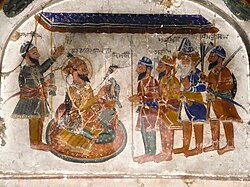
| image = Guru Gobind Singh | | image = Painting of Guru Gobind Singh, found within the Anandpuri Hazuri Bir codex of the Dasam Granth, ca.1690's–1700's (detail).jpg | ||
| alt = Guru Gobind Singh | | alt = Guru Gobind Singh | ||
| caption = Contemporary painting of Guru Gobind Singh (seated) found within a Dasam Granth manuscript of [[Anandpur Sahib]] | | caption = Contemporary painting of Guru Gobind Singh (seated) found within a Dasam Granth manuscript of [[Anandpur Sahib]] | ||
| birth_name = Gobind | | birth_name = Gobind Das | ||
| birth_date = 22 December 1666 | | birth_date = 22 December 1666<ref name=eos/> | ||
| birth_place = [[Patna Sahib]], [[ | | birth_place = [[Patna Sahib]], [[Bihar Subah]], [[Mughal Empire]] | ||
| death_date = {{death date and age|1708|10|07|1666|12|22|df=yes}} | | death_date = {{death date and age|1708|10|07|1666|12|22|df=yes}} | ||
| death_place = [[Hazur Sahib]], [[Subah#List of Subahs of the Mughal Empire| | | death_place = [[Hazur Sahib]], [[Nanded]], [[Subah#List of Subahs of the Mughal Empire|Bidar Subah]], Mughal Empire | ||
| other_names = ''Tenth Nanak'' | | other_names = ''Tenth Nanak''<ref>{{Cite book |last1=Singh |first1=Pashaura |url=https://books.google.com/books?id=8I0NAwAAQBAJ&pg=PA311 |title=The Oxford Handbook of Sikh Studies |last2=Fenech |first2=Louis E. |publisher=[[Oxford University Press]] |year=2014 |isbn=978-0-19-969930-8 |page=311}}</ref><br>''Tenth Master'' <br>''Dashmesh Pita'' | ||
| known_for = * Founding the [[Khalsa]] | | known_for = * Founding the [[Khalsa]]<ref name="MandairShackle2013p25" /> | ||
/ | * [[Dasam Granth]]<ref name="aarweb.org">{{cite web |url=https://aarweb.org/AARMBR/AARMBR/Publications-and-News-/Book-Series/Books/Religion-in-Translation-Series/Debating-the-Dasam-Granth.aspx#:~:text=The%20controversy%20stems%20from%20two,liaisons%20between%20men%20and%20women. |title=Debating the Dasam Granth |website=aarweb.org |access-date=20 January 2024}}</ref> | ||
* [[ | * Composing the Sikh national anthem [[Deh Shiva Bar Mohe Eha]]<ref name=":1" /><ref>{{Cite book |last=Dilgeer |first=Harjinder Singh |title=The Sikh Reference Book |publisher=Sikh Educational Trust for Sikh University Centre, Denmark |year=1997 |isbn=9780969596424 |pages=94 |quote=Some Sikhs, out of ignorance, began using " deh shiva bar mohe ihai shubh karman te kabhoon na taron ... " as the Sikh national anthem.}}</ref> | ||
* [[ | * [[Zafarnama (letter)|Zafarnamah]] "a letter of victory" to the Mughal Emperor [[Aurangzeb]] after the Battle of Chamkaur | ||
* [[ | * Founded the Sikh festival of [[Hola Mohalla]] | ||
* [[ | * Writing [[Mittar Pyare nu]] shabad | ||
* [[ | * Writing hymn [[Deh Shiva Bar Mohe Eha]] | ||
* [[ | * Establishing a Democratic quintet [[Panj Pyare]]<ref name="Celebrating life">{{Cite book |last=Williams |first=Victoria |title=Celebrating life customs around the world : from baby showers to funerals |publisher=ABC-CLIO |year=2016 |isbn=978-1-4408-3658-9 |location=Santa Barbara, California |pages=70 |chapter=Dastaar Bandi and Amrit Sanchar, Sikhism |oclc=956633929 |quote=During the ceremony the amrit is accompanied by a solemn oath in the presence of Sri Guru Granth Sahib and Panj Pyare, or the five beloved ones. Panj Pyare is a quintet of initiated Sikh men or women that act as leaders within the Sikh community. The Panj Pyare oversee the Amrit Sanchar ceremony by preparing the initiates and administering the amrit to those ready to be initiated}}</ref><ref name=":1" /> | ||
* [[ | * Giving 52 Hukams at Nanded [[The 52 Hukams of Guru Gobind Singh]]<ref>{{cite book|last=Singh|first=Balawindara|title=Fifty-Two Commandments Of Guru Gobind Singh|year=2004|publisher=Singh Bros.|page=9|location=Michigan, US}}</ref><ref>{{cite book|last=Singh|first=Satbir|title=Aad Sikh Te Aad Sakhian|year=1991|publisher=New Book Company|location=Jalandhar}}</ref> | ||
* [[ | * Ordaining the [[Five Ks]]<ref>{{cite news |url=http://www.worldsikh.org/what_is_the_kirpan |title=What is the kirpan? |newspaper=World Sikh Organization of Canada |access-date=18 March 2015 |archive-url=https://web.archive.org/web/20150402114654/http://www.worldsikh.org/what_is_the_kirpan |archive-date=2 April 2015 |url-status=live}}</ref> | ||
* [[ | * The jaikara or slogan [[Bole So Nihal]]<ref>{{Cite web |title=Bole So Nihal {{!}} Asian Ethnic Religion {{!}} Religious Comparison |url=https://www.scribd.com/document/80513870/Bole-So-Nihal |access-date=7 December 2017 |language=en |via=Scribd}}</ref> | ||
* [[ | | predecessor = [[Guru Tegh Bahadur]] | ||
| successor = [[Guru Granth Sahib]] | |||
* [[ | | spouse = [[Mata Jito|Mata Ajeet Kaur]]<br>[[Mata Sundari|Mata Sundar Kaur]]<br>[[Mata Sahib Kaur]]<ref name=dalbirsingh144/> | ||
* | | children = * [[Ajit Singh (Sikhism)|Ajit Singh]] | ||
* | * [[Jujhar Singh]] | ||
* [[Zorawar Singh (Sikhism)|Zorawar Singh]] | |||
* [[Fateh Singh (Sikhism)|Fateh Singh]] | |||
* Zorawar Singh Palit (Adopted)<ref name="The encyclopaedia of Sikhism">{{cite book |last1=Singh |first1=Harbans |title=The encyclopaedia of Sikhism |date=1992–1998 |publisher=Punjabi University |location=Patiala |isbn=9788173805301 |volume=4 |pages=463–464}}</ref> | |||
| parents = * [[Guru Tegh Bahadur]] | |||
* [[Mata Gujri]] | |||
| death_cause = [[Assassination]]<ref name="FenechMcleodp9" /><ref name="Grewal1998p78" /> | |||
| signature = Autograph_(neeshan)_of_Guru_Gobind_Singh.png | |||
| battles = Wars | |||
* [[Hill States-Sikh Wars]] | |||
Battles | |||
* [[Battle of Anandpur (1682)]] | |||
* [[Battle of Anandpur (1685)]] | |||
* [[Battle of Bhangani]] | * [[Battle of Bhangani]] | ||
* [[Battle of Nadaun]] | * [[Battle of Nadaun]] | ||
* [[Battle of Guler (1696)]] | * [[Battle of Guler (1696)]] | ||
* [[Battle of Anandpur (1699)]] | |||
* [[Battle of Anandpur (1700)]] | * [[Battle of Anandpur (1700)]] | ||
* [[Battle of | * [[First siege of Anandpur]] | ||
* [[Battle of Taragarh]] | |||
* [[Battle of Basoli]] | * [[Battle of Basoli]] | ||
* [[First Battle of Chamkaur]] | * [[First Battle of Chamkaur]] | ||
* [[First Battle of Anandpur (1704)]] | * [[First Battle of Anandpur (1704)]] | ||
* [[Second | * [[Second siege of Anandpur]] | ||
* [[Battle of Sarsa]] | * [[Battle of Sarsa]] | ||
* [[Second Battle of Chamkaur (1704)]] | * [[Second Battle of Chamkaur (1704)]] | ||
* [[Battle of Muktsar]] | * [[Battle of Muktsar]] | ||
* | * Battle of Baghaur | ||
* [[Battle of Jajau]] | |||
| commands = [[File:Akal Sena Flag.svg|20px]]Supreme Commander of [[Akal Sena]] (1675–1699)<br/>[[File:Sikh flag.jpg|20 px]]Supreme Commander of [[Khalsa Fauj]] (1699–1708) <br/>[[File:Sikh flag.jpg|20 px]] Supreme Commander of [[Khalsa Panth]] (Eternal) | |||
| founder = [[File:Sikh flag.jpg|20 px]] [[Khalsa]] | |||
| | |||
[[File:Sikh flag.jpg|20 px]] [[Khalsa Fauj]] | |||
| pen_name = Shyam<br>Ram<br>Kaal<br>Gobind Das<br>Nanak<br>Gobind Singh<br>Shah Gobind<ref name="Gandhi 1978 607">{{Cite book |last=Gandhi |first=Surjit Singh |url=https://books.google.com/books?id=k-sJAQAAIAAJ&q=guru+gobind+singh+pen+name |title=History of the Sikh Gurus: A Comprehensive Study |date=1978 |publisher=Gur Das Kapur |pages=607 |language=en}}</ref><ref name="ReferenceA">In the last stanza of [[Chaupai Sahib]] Guru Gobind Singh refers to himself as Gobind Das</ref><ref name="Singh 2015 66, 68, 77">{{Cite book |last=Singh |first=Kamalroop |title=The Grańth of Guru Gobind Singh : essays, lectures, and translations |date=2015 |others=Gurinder Singh Mann |isbn=978-0-19-945897-4 |edition=1st |location=New Delhi |pages=66, 68, 77 |oclc=932463542}}</ref> | |||
| | |||
}} | }} | ||
'''Guru Gobind Singh''' ({{IPA | '''Guru Gobind Singh''' ({{IPA|pa|gʊɾuː goːbɪn̪d̪ᵊ sɪ́ŋgᵊ}}; born '''Gobind Das''';{{efn|His birth name being Gobind Rai is apocryphal.}} 22 December 1666 – 7 October 1708)<ref name="eos">{{Cite web |last=Ganda Singh |title=Gobind Singh, Guru (1666–1708) |url=https://archive.org/details/TheEncyclopediaOfSikhism-VolumeIiE-l/page/n101 |url-status=live |archive-url=https://web.archive.org/web/20170729230458/http://www.learnpunjabi.org/eos/index.aspx |archive-date=29 July 2017 |access-date=7 March 2016 |website=Encyclopaedia of Sikhism |publisher=Punjabi University Patiala}}</ref><ref name=colesambhip36/> was the tenth and last human [[Sikh gurus|Sikh Guru]].<ref name=":0" />{{Efn|In 1708, the Guruship was passed on to the holy Sikh scripture, [[Guru Granth Sahib]], which is now considered the living Guru by the followers of the Sikh faith.<ref>{{cite book |title=The Sikhs : faith, philosophy & folk |year=1998 |url=https://archive.org/details/sikhsfaithphilos0000gurb |url-access=registration |publisher=Lustre Press |isbn=9788174360373}}</ref>}} He was a warrior, poet, and philosopher. In 1675, at the age of nine, he was formally made the leader of the [[Sikhs]] after his father [[Guru Tegh Bahadur]]—the ninth Sikh Guru—was executed by the emperor [[Aurangzeb]].<ref name=":0">{{Cite book |last=Mayled |first=Jon |url=https://archive.org/details/sikhism0000mayl_l1v5 |title=Sikhism |publisher=Heinemann |year=2002 |isbn=978-0-435-33627-1 |page=[https://archive.org/details/sikhism0000mayl_l1v5/page/12 12] |url-access=registration}}</ref>{{efn|Jenkins, Grewal, and Olson state Tegh Bahadur was executed for refusing to convert to Islam.{{sfn|Jenkins|2000|p=200}}{{sfn|Grewal|1998|p=72}}{{sfn|Olson|2007|p=23}} Whereas, Truschke states Tegh Bahadur was executed for causing unrest in the Punjab.{{sfn|Truschke|2017|pp=54–55}}}} His four biological sons died during his lifetime—two in battle and two executed by the [[Mughal Empire|Mughal]] administrator [[Wazir Khan (Sirhind)|Wazir Khan]].<ref name="Routledge">{{Cite book |last1=Seiple |first1=Chris |url=https://books.google.com/books?id=u48rUnVEHbEC&pg=PA93 |title=The Routledge Handbook of Religion and Security |last2=Hoover |first2=Dennis |last3=Otis |first3=Pauletta |publisher=Routledge |year=2013 |isbn=978-0-415-66744-9 |pages=93}};<br />{{Cite book |last=Richards |first=John F. |url=https://books.google.com/books?id=HHyVh29gy4QC |title=The Mughal Empire |publisher=Cambridge University Press |year=1995 |isbn=978-0-521-56603-2 |pages=255–258}}</ref><ref>{{Cite journal |date=1972 |title=The Sikh Review |journal=Sikh Cultural Centre |volume=20 |issue=218–229 |page=28}}</ref><ref>{{Cite book |last=Hardip Singh Syan |url=https://books.google.com/books?id=9RzzxcEL4C0C |title=Sikh Militancy in the Seventeenth Century: Religious Violence in Mughal and Early Modern India |publisher=I.B. Tauris |year=2013 |isbn=978-1-78076-250-0 |pages=218–222}}</ref> | ||
Among his notable contributions to [[Sikhism]] are founding the '' | Among his notable contributions to [[Sikhism]] are founding the ''Sikh'' warrior community called ''[[Khalsa]]'' in 1699<ref name="MandairShackle2013p25">{{Cite book |last1=Mandair |first1=Arvind-Pal Singh |url=https://books.google.com/books?id=D8xdAgAAQBAJ |title=Sikh Religion, Culture and Ethnicity |last2=Shackle |first2=Christopher |last3=Singh |first3=Gurharpal |publisher=Routledge |year=2013 |isbn=978-1-136-84627-4 |pages=25–28}}</ref><ref name="BBC">{{Cite web |date=26 October 2009 |title=BBC Religions – Sikhism |url=https://www.bbc.co.uk/religion/religions/sikhism/people/gobindsingh.shtml |url-status=live |archive-url=https://web.archive.org/web/20110123020041/http://www.bbc.co.uk/religion/religions/sikhism/people/gobindsingh.shtml |archive-date=23 January 2011 |access-date=30 July 2011 |publisher=BBC}}</ref><ref>{{Cite book |last=Dhavan |first=P |url=https://books.google.com/books?id=-7HJ5idB8_QC&pg=PA45 |title=When Sparrows Became Hawks: The Making of the Sikh Warrior Tradition, 1699–1799 |publisher=Oxford University Press |year=2011 |isbn=978-0-19-975655-1 |pages=3–4}}</ref> and introducing ''[[the Five Ks]]'', the five articles of faith that Khalsa Sikhs wear at all times. Guru Gobind Singh is credited with the ''[[Dasam Granth]]'' whose hymns are a sacred part of Sikh prayers and Khalsa rituals.<ref name=britdasam/><ref name="McLeod1990" /> He is also credited as the one who finalized and enshrined the ''[[Guru Granth Sahib]]'' as Sikhism's primary holy religious scripture and the eternal [[Guru]].<ref name="MandairShackle2013p11" /><ref name="shelke199">{{Cite book |last=Shelke |first=Christopher |url=https://books.google.com/books?id=rmr71DjRNV8C |title=Divine covenant: rainbow of religions and cultures |publisher=Gregorian Press |year=2009 |isbn=978-88-7839-143-7 |page=199}}</ref> He also established the concept of ''[[Khalsa#Guruship of the Khalsa (Guru Panth)|Guru Panth]]'' as his spiritual successor, however this manner of guruship is seldom evoked today.<ref name=":02">{{Cite book |last=McLeod |first=W. H. |title=The A to Z of Sikhism |date=24 July 2009 |publisher=Scarecrow Press |isbn=9780810863446 |pages=84–86 |quote=Guru Gobind Singh is traditionally believed to have announced that the personal transmission would end at his death, but that the mystical Guru would remain embodied in the scripture and the corporate Panth. ... GURU PANTH. The Guru Panth was a doctrine particularly suited to the circumstances of the 18th century, providing an effective means of decision making for Sikhs who were divided into several misls. When unification was achieved under Ranjit Singh the practice of eliciting corporate decisions from the Panth was discarded. The doctrine is still maintained today, and efforts are occasionally made to seek the Guru's will by this means. It is, however, seldom invoked. The voice of the Guru is much more commonly sought through the words of the Guru Granth.}}</ref> | ||
==Family and early life== | ==Family and early life== | ||
[[File:GuruGobindBirthPlace.jpg|thumb|left|Guru Gobind Singh's birthplace in Patna, Bihar | [[File:GuruGobindBirthPlace.jpg|thumb|left|Guru Gobind Singh's birthplace in Patna, Bihar]] | ||
[[File:Guru Tegh Bahadar and a young Gobind Rai at the Anandpur Darbar.jpg|thumb|[[Guru Tegh Bahadur|Guru Tegh Bahadar]] and a young Gobind | [[File:Guru Tegh Bahadar and a young Gobind Rai at the Anandpur Darbar.jpg|thumb|[[Guru Tegh Bahadur|Guru Tegh Bahadar]] and a young Gobind Das at the [[Anandpur Sahib|Anandpur Darbar]]]] | ||
Gobind Singh was the only son of [[Guru Tegh Bahadur]], the ninth [[Sikh guru]], and [[Mata Gujri]]. | [[File:Artistic depiction of "Dusht Daman", the alleged previous incarnation of Guru Gobind Singh as narrated in the "Bachittar Natak".jpg|thumb|287x287px|Artistic depiction of "Dusht Daman", the alleged previous incarnation of Guru Gobind Singh as narrated in the "Bachittar Natak"]] | ||
Gobind Singh was the only son of [[Guru Tegh Bahadur]], the ninth [[Sikh guru]], and [[Mata Gujri]].<ref>{{Cite web |title=Happy Guru Gobind Singh Jayanti: Wishes, Pics, Facebook Messages To Share |url=https://www.ndtv.com/india-news/happy-guru-gobind-singh-jayanti-2021-wishes-messages-pics-sms-status-for-whatsapp-facebook-2355113 |access-date=20 January 2021 |website=NDTV.com}}</ref> He was born into the [[Sodhi]] clan of the Punjabi [[Khatri]] community. He was born in [[Patna]], [[Bihar]] on 22 December 1666 while his father was visiting [[Bengal]] and [[Assam]].<ref name=eos/> According to Desi Calendar, his birth date is Seven days after the New Moon Day in the Lunar Month of Poh (also called Poh Sudi 7 ਪੰਜਾਬੀ- ਪੋਹ ਸੁਦੀ ੭). His birth name was Gobind Das and a shrine named [[Takht Sri Patna Sahib|Takht Sri Patna Harimandar Sahib]] marks the site of the house where he was born and spent the first four years of his life.<ref name=eos/> In 1670, his family returned to Punjab, and in March 1672, they moved to Chakk Nanaki in the Himalayan foothills of north India, called the Sivalik range, where he was schooled.<ref name=eos/><ref name="BBC" /> | |||
Tegh Bahadur was petitioned by [[Kashmiri Pandit]]s<ref name="pslf">{{Cite book |last1=Singh |first1=Pashaura |title=The Oxford handbook of Sikh studies |last2=Fenech |first2=Louis |publisher=Oxford University Press |year=2014 |isbn=978-0-19-969930-8 |location=Oxford |pages=445}}</ref> in 1675 for protection from the fanatic persecution by Iftikar Khan, the [[Mughal Empire|Mughal]] governor of Kashmir under Mughal Emperor [[Aurangzeb]].<ref name=eos/> Tegh Bahadur considered a peaceful resolution by meeting Aurangzeb, but was cautioned by his advisors that his life may be at risk. The young Gobind Das – to be known as Gobind Singh after 1699<ref name="colesambhip36">{{Cite book |last1=Owen Cole |first1=William |title=The Sikhs: Their Religious Beliefs and Practice |last2=Piara Singh Sambhi |publisher=Sussex Academic Press |year=1995 |page=36}}</ref> – advised his father that no one was more worthy to lead and make a sacrifice than him.<ref name=eos/> His father made the attempt, but was arrested then publicly beheaded in [[Delhi]] on 11 November 1675 under the orders of Aurangzeb for refusing to convert to [[Islam]] and the ongoing conflicts between Sikhism and the Islamic Empire.<ref>{{Cite book |last=Seiple |first=Chris |title=The Routledge handbook of religion and security |publisher=Routledge |year=2013 |isbn=978-0-415-66744-9 |location=New York |page=96}}</ref><ref>{{Cite book |last=Pashaura Singh and Louis Fenech |title=The Oxford handbook of Sikh studies |publisher=Oxford University Press |year=2014 |isbn=978-0-19-969930-8 |location=Oxford |pages=236–237}}</ref> Before dying, Tegh Bahadur wrote a letter to Gobind Das (the letter was called Mahalla Dasven and it is part of the [[Guru Granth Sahib]]) as one last test to find the next Guru, after his father's martyrdom he was made the tenth Sikh Guru on [[Vaisakhi]] on 29 March 1676.<ref name="Hansra2007">{{Cite book |last=Hansra |first=Harkirat S. |url=https://books.google.com/books?id=RDlMUfGiEO8C&pg=PA28 |title=Liberty at Stake:sikhs: the Most Visible |publisher=iUniverse |year=2007 |isbn=978-0-595-43222-6 |pages=28–29}}</ref> | |||
The education of | The education of Gobind Singh continued after he became the 10th Guru, both in reading and writing as well as martial arts such as horse riding and archery. The Guru learned [[Persian language|Farsi]] in a year and at the age of 6 started training in martial arts.<ref>{{Cite book |last=Singh |first=Kesar |title=Bansavalinama |publisher=Singh Brothers |year=1997 |isbn=81-7205-175-1 |pages=125–126 |language=Punjabi}}</ref> In 1684, he wrote the [[Chandi di Var]] in Punjabi language – a legendary war between the good and the evil, where the good stands up against injustice and tyranny, as described in the ancient [[Sanskrit literature|Sanskrit text]] [[Markandeya Purana]].<ref name=eos/> He stayed in Paonta, near the banks of river [[Yamuna]], until 1685.<ref name=eos/> | ||
[[File:Guru_Gobind_Singh_at_age_23.jpg|thumb|From Bhai Rupa | [[File:Guru_Gobind_Singh_at_age_23.jpg|thumb|From the Bhai Rupa Collection, depiction of the Guru during adolescence]] | ||
Guru Gobind Singh had three wives: | Guru Gobind Singh had three wives:<ref name="dalbirsingh144">{{Cite book |last=Dhillon |first=Dr Dalbir Singh |url=https://books.google.com/books?id=osnkLKPMWykC&pg=PA144 |title=Sikhism – Origin and Development |date=1988 |publisher=Atlantic Publishers and Distributors |page=144 |archive-url=https://web.archive.org/web/20160917230548/https://books.google.co.uk/books?id=osnkLKPMWykC&pg=PA144 |archive-date=17 September 2016 |url-status=live}}</ref><ref>{{Cite book |last1=Jones |first1=Constance A. |url=https://books.google.com/books?id=OgMmceadQ3gC |title=Encyclopedia of Hinduism |last2=Ryan |first2=James D. |date=2007 |publisher=Facts on File, Inc. |isbn=978-0-8160-5458-9 |location=New York |page=417 |archive-url=https://web.archive.org/web/20160923030417/https://books.google.co.uk/books?id=OgMmceadQ3gC&pg=PA417&dq=guru+gobind+singh+three+wives&hl=en&ei=8ri0To_TCsKIrAfqpInoAw&sa=X&oi=book_result&ct=result&redir_esc=y#v=onepage&q=guru%20gobind%20singh%20three%20wives&f=false |archive-date=23 September 2016 |url-status=live}}</ref> | ||
*At age 10, he married [[Mata Jito]] on 21 June 1677 at Basantgaṛh, 10 km north of Anandpur. The couple had three sons: [[Jujhar Singh]] (b. 1691), [[Zorawar Singh (Sikhism)|Zorawar Singh]] (b. 1696) and [[Fateh Singh (Sikhism)|Fateh Singh]] (b. 1699). | *At age 10, he married [[Mata Jito|Jito]] on 21 June 1677 at Basantgaṛh, 10&nbsp;km north of Anandpur. The couple had three sons: [[Jujhar Singh]] (b. 1691), [[Zorawar Singh (Sikhism)|Zorawar Singh]] (b. 1696), and [[Fateh Singh (Sikhism)|Fateh Singh]] (b. 1699).<ref>{{Cite web |last=Ashok |first=Shamsher Singh |title=Jitojo Mata |url=http://www.learnpunjabi.org/eos/index.aspx |url-status=live |archive-url=https://web.archive.org/web/20170729230458/http://www.learnpunjabi.org/eos/index.aspx |archive-date=29 July 2017 |access-date=14 September 2016 |website=Encyclopaedia of Sikhism |publisher=Punjabi University Patiala}}</ref> | ||
* | *At age 17, he married [[Mata Sundari|Sundari]] on 4 April 1684 at Anandpur. The couple had one son, [[Ajit Singh (Sikhism)|Ajit Singh]] (b. 1687).<ref>{{cite web |title=Sundari Mata |url=https://www.sikhiwiki.org/index.php/Mata_Sunder_Kaur |date=9 December 2019 |access-date=17 August 2022}}</ref> | ||
* | *At age 33, he married [[Mata Sahib Kaur|Sahib Devan]] on 15 April 1700 at Anandpur. They had no children, but she had an influential role in Sikhism. Guru Gobind Singh proclaimed her as the ''Mother of the Khalsa''.<ref>{{Cite web |last=Ashok |first=Shamsher Singh |title=Sahib Devan |url=http://www.learnpunjabi.org/eos/index.aspx |url-status=live |archive-url=https://web.archive.org/web/20170729230458/http://www.learnpunjabi.org/eos/index.aspx |archive-date=29 July 2017 |access-date=16 August 2016 |website=Encyclopaedia of Sikhism |publisher=Punjabi University Patiala}}</ref> The Guru initially rejected her marriage proposal as he was already married and had four sons. The Sangat and the Guru's family agreed to the marriage. However, Gobind Singh made it clear that his relationship with Sahib Diwan will be spiritual and not physical.<ref>{{Cite web |date=19 December 2000 |title=Sahib Devan |url=https://www.thesikhencyclopedia.com/biographical/famous-women/sahib-devan/ |access-date=25 March 2022 |website=The Sikh Encyclopedia |language=en-US}}</ref> | ||
The life example and leadership of | The life example and leadership of Gobind Singh have been of historical importance to the Sikhs. He institutionalized the [[Khalsa]] (literally, Pure Ones), who played the key role in protecting the Sikhs long after his death, such as during the nine invasions of Panjab and the attacks by [[Ahmad Shah Durrani|Ahmad Shah Abdali]] from Afghanistan between 1747 and 1769.<ref name=colesambhip36/> | ||
=== Birth name === | |||
While his birth name is commonly acknowledged as being "Gobind Rai", [[J. S. Grewal|J.S Grewal]] and W.H McLeod, among other scholars, point out that hukamnamas and documents issued by his father, Guru Tegh Bahadur, mention him as "Gobind Das". According to McLeod, "Gobind Rai" was an exonym used within Muslim sources.{{refn|<ref name="books.google.com">{{harvnb|Grewal|1998|p=[https://books.google.com/books?id=2_nryFANsoYC&pg=PA70 70]}}: "Though historians generally refer to the young Gobind as Gobind Rai, in the hukamnamas of Guru Tegh Bahadur he is referred to as Gobind Das."</ref><ref>{{Cite book |last=Grewal |first=J. S. |url=https://books.google.com/books?id=YDLNDwAAQBAJ&pg=PT45 |title=Guru Gobind Singh (1666–1708): Master of the White Hawk |date= 2019 |publisher=Oxford University Press |isbn=978-0-19-099038-1 |pages=45 |language=en}}</ref>}}<ref name="Cole 2004 68">{{Cite book |last=Cole |first=W. Owen |url=https://books.google.com/books?id=KVhwDwAAQBAJ&pg=PT68 |title=Understanding Sikhism |date=2004 |publisher=Dunedin Academic Press Ltd |isbn=978-1-906716-91-2 |pages=68 |language=en |quote=Guru Gobind Singh's name was Gobind Das or sometimes said to be Gobind Rai, but from the founding of the Khalsa he is known to be Guru Gobind Singh.}}</ref><ref name="McLeod 1997 47">{{Cite book |last=McLeod |first=W. H. |url=https://archive.org/details/sikhism00mcle/page/46/mode/2up?view=theater |title=Sikhism |date=1997 |publisher=Penguin Books |isbn=978-0-14-025260-6 |pages=47 |language=en |quote=Gobind Das was the original name of the Tenth Guru, at least so it seems. Muslim sources generally refer to him as Gobind Rai, but documents issued by his father, Guru Tegh Bahadur, give his name as Gobind Das.}}</ref><ref name="ReferenceB">Guru Gobind Singh in the final verse of his composition, [[Chaupai (Sikhism)|Chaupai Sahib]], refers to himself as Gobind Das.</ref><ref name="Holt 2022 164">{{Cite book |last=Holt |first=James D. |url=https://books.google.com/books?id=izucEAAAQBAJ&pg=PT164 |title=Understanding Sikhism: A Guide for Teachers |date=2022 |publisher=Bloomsbury Publishing |isbn=978-1-350-26319-2 |pages=164 |language=en}}</ref> | |||
=== Birth year === | |||
Whilst the commonly accepted birth year for the guru is 1666, some sources record his birth year as being 1661.<ref>{{Cite book |title=Punjab History Conference |publisher=Department of Punjab Historical Studies, Punjabi University |year=1989 |volume=22 |pages=86}}</ref> [[Sikh Studies|Sikhologist]] Louis E. Fenech believes 1661 is more likely to be the true birth year of the guru as it lines up more reliably with events later in his life regarding his coming-of-age and leadership in 1679.<ref>{{Cite book |last=Fenech |first=Louis E. |title=The Sikh Zafar-namah of Guru Gobind Singh: A Discursive Blade in the Heart of the Mughal Empire |date=7 February 2013 |publisher=Oxford University Press |isbn=9780199931439 |pages=145 |chapter=Notes}}</ref> | |||
==Founding the Khalsa== | ==Founding the Khalsa== | ||
[[File:GuruGobindSinghJiGurdwaraBhaiThanSingh.jpg|thumb|A Fresco of Guru Gobind Singh and The [[Panj Piare]] in Gurdwara Bhai Than Singh built in the reign of Maharaja [[Ranjit Singh]] | [[File:GuruGobindSinghJiGurdwaraBhaiThanSingh.jpg|thumb|A Fresco of Guru Gobind Singh and The [[Panj Piare]] in Gurdwara Bhai Than Singh built in the reign of Maharaja [[Ranjit Singh]]]] | ||
In 1699, | In 1699, Guru Gobind Singh requested the Sikhs to congregate at [[Anandpur Sahib|Anandpur]] on [[Vaisakhi]] (the annual spring [[harvest festival]]).<ref name="Cynthia_Mahmood_Faith_Baisakhi">{{Cite book |last=Mahmood |first=Cynmthia Keppley |title=Fighting for faith and nation dialogues with Sikh militants |publisher=University of Pennsylvania Press |year=1996 |isbn=978-0-8122-1592-2 |location=Philadelphia |pages=43–45 |oclc=44966032}}</ref> According to the Sikh tradition, he asked for a volunteer. One came forward, whom he took inside a tent. The Guru returned to the crowd alone with a bloody sword.<ref name="Cynthia_Mahmood_Faith_Baisakhi" /> He asked for another volunteer and repeated the same process of returning from the tent without anyone and with a bloodied sword four more times. After the fifth volunteer went with him into the tent, the Guru returned with all five volunteers, all safe. He called them the ''[[Panj Pyare]]'' and the first Khalsa in the Sikh tradition.<ref>{{Cite book |last=Macauliffe |first=Max Arthur |url=http://dx.doi.org/10.1017/cbo9781139506595 |title=The Sikh Religion |date=2009 |publisher=Cambridge University Press |isbn=978-1-139-50659-5 |location=Cambridge |doi=10.1017/cbo9781139506595}}</ref> | ||
Gobind Singh then mixed water and sugar into an iron bowl, stirring it with a double-edged sword to prepare what he called [[Amrita|Amrit]] ("nectar"). He then administered this to the ''Panj Pyare'', accompanied by recitations from the Adi Granth, thus founding the ''khande ka pahul'' (baptization ceremony) of a Khalsa – a warrior community.<ref name="Cynthia_Mahmood_Faith_Baisakhi" /><ref>{{Cite book |last=Dhavan |first=P |url=https://books.google.com/books?id=-7HJ5idB8_QC |title=When Sparrows Became Hawks: The Making of the Sikh Warrior Tradition, 1699–1799 |publisher=Oxford University Press |year=2011 |isbn=978-0-19-975655-1 |page=49}}</ref> The Guru also gave them a new surname "[[Singh]]" (lion). After the first five Khalsa had been baptized, the Guru asked the five to baptize him as a Khalsa. This made the Guru the sixth Khalsa, and his name changed from Guru Gobind Das to Guru Gobind Singh.<ref name="Cynthia_Mahmood_Faith_Baisakhi" /> This initiation ceremony replaced the charan pahul ritual practiced by the previous gurus, in which an initiate would drink the water either the Guru or a [[masand]] of the guru had dipped their right toe in.<ref>{{Cite book |last1=Singh |first1=Pashaura |url=https://books.google.com/books?id=7YwNAwAAQBAJ |title=The Oxford Handbook of Sikh Studies |last2=Fenech |first2=Louis E. |date=2014 |publisher=Oxford University Press |isbn=978-0-19-100411-7 |pages=595 |language=en}}</ref><ref>{{Cite book |last1=Hawley |first1=John Stratton |url=https://books.google.com/books?id=tAO0bIu5tvYC&pg=PA176 |title=Studying the Sikhs: Issues for North America |last2=Mann |first2=Gurinder Singh |date=1993 |publisher=State University of New York Press |isbn=978-1-4384-0619-0 |pages=176 |language=en}}</ref> | |||
[[File:Sikh Articles of Faith.JPG|thumb|right|Kanga, Kara and Kirpan – three of the five Ks]] | [[File:Sikh Articles of Faith.JPG|thumb|right|Kanga, Kara and Kirpan – three of the five Ks]] | ||
Gobind Singh initiated the [[Five K's]] tradition of the Khalsa,<ref name="colesambhip37">{{Cite book |last1=Cole |first1=W. Owen |url=https://archive.org/details/sikhs00cole |title=The Sikhs: Their Religious Beliefs and Practices |last2=Sambhi, Piara Singh |publisher=Routledge |year=1978 |isbn=0-7100-8842-6 |page=[https://archive.org/details/sikhs00cole/page/37 37] |url-access=registration}}</ref> | |||
* '''[[Kesh (Sikhism)|Kesh]]''': uncut hair. | * '''[[Kesh (Sikhism)|Kesh]]''': uncut hair. | ||
* '''[[Kangha]]''': a wooden comb. | * '''[[Kangha]]''': a wooden comb. | ||
* '''[[Kara (Sikhism)|Kara]]''': an iron or steel bracelet worn on the wrist. | * '''[[Kara (Sikhism)|Kara]]''': an iron or steel bracelet worn on the wrist. | ||
* '''[[Kirpan]]''': a sword | * '''[[Kirpan]]''': a sword. | ||
* '''[[Kacchera]]''': short breeches. | * '''[[Kacchera]]''': short breeches. | ||
He also announced a code of discipline for Khalsa warriors. Tobacco, eating 'halal' meat (a way of slaughtering in which the animal's throat is slit open and it is left to bleed before being slaughtered), fornication and adultery were forbidden. | He also announced a code of discipline for Khalsa warriors. Tobacco, eating 'halal' meat (a way of slaughtering in which the animal's throat is slit open and it is left to bleed before being slaughtered), fornication, and adultery were forbidden.<ref name=colesambhip37/><ref name="johnkoller313">{{Cite book |last=John M Koller |url=https://books.google.com/books?id=lgg3DAAAQBAJ&pg=PA313 |title=The Indian Way: An Introduction to the Philosophies & Religions of India |publisher=Routledge |year=2016 |isbn=978-1-315-50740-8 |pages=312–313}}</ref> The Khalsas also agreed to never interact with those who followed rivals or their successors.<ref name=colesambhip37/> The co-initiation of men and women from different castes into the ranks of Khalsa also institutionalized the principle of equality in Sikhism regardless of one's caste or gender.<ref name=johnkoller313/> Gobind Singh's significance to the Sikh tradition has been high, for he institutionalized the Khalsa, resisted the ongoing persecution by the Mughal Empire, and continued the defence of dharma—of which he meant "True Religion"—against the assault of Aurangzeb.<ref>{{Cite book |last1=Cole |first1=W. Owen |url=https://archive.org/details/sikhs00cole |title=The Sikhs: Their Religious Beliefs and Practices |last2=Sambhi, Piara Singh |publisher=Routledge & Kegan Paul |year=1978 |isbn=0-7100-8842-6 |location=London |page=[https://archive.org/details/sikhs00cole/page/36 36-37] |url-access=registration |no-pp=true}}</ref> | ||
[[File:2 Sri Kesgarh Takhat Anandpur Sahib Khalsa birthplace Himalayan foothills in view Punjab India.jpg|thumb|left |upright| [[Anandpur Sahib]] gurdwara, Punjab, the birthplace of [[Khalsa]]]] | [[File:2 Sri Kesgarh Takhat Anandpur Sahib Khalsa birthplace Himalayan foothills in view Punjab India.jpg|thumb|left |upright| [[Anandpur Sahib]] gurdwara, Punjab, the birthplace of [[Khalsa]]]] | ||
He introduced ideas that indirectly challenged the discriminatory taxes imposed by the Mughal authorities. For example, Aurangzeb had imposed taxes on non-Muslims that were collected from the Sikhs as well, the [[jizya]] (poll tax on non-Muslims), pilgrim tax, and ''Bhaddar'' tax – the last being a tax to be paid by anyone following the Hindu ritual of shaving the head after the death of a loved one and cremation. | He introduced ideas that indirectly challenged the discriminatory taxes imposed by the Mughal authorities. For example, Aurangzeb had imposed taxes on non-Muslims that were collected from the Sikhs as well, the [[jizya]] (poll tax on non-Muslims), pilgrim tax, and ''Bhaddar'' tax – the last being a tax to be paid by anyone following the Hindu ritual of shaving the head after the death of a loved one and cremation.<ref name="MandairShackle2013p25" /> Guru Gobind Singh declared that Khalsa does not need to continue this practice, because ''Bhaddar'' is not [[dharma|dharam]], but a ''bharam'' (illusion).<ref name="MandairShackle2013p25" /><ref>{{Cite book |last=Dhavan |first=P |url=https://books.google.com/books?id=-7HJ5idB8_QC |title=When Sparrows Became Hawks: The Making of the Sikh Warrior Tradition, 1699–1799 |publisher=Oxford University Press |year=2011 |isbn=978-0-19-975655-1 |pages=43–44}}</ref> Not shaving the head also meant not having to pay the taxes by Sikhs who lived in Delhi and other parts of the Mughal Empire.<ref name="MandairShackle2013p25" /> However, the new code of conduct also led to internal disagreements between Sikhs in the 18th century, particularly between the Nanakpanthi and the Khalsa.<ref name="MandairShackle2013p25" /> | ||
Gobind Singh had a deep respect for the Khalsa and stated that there is no difference between the True Guru and the ''sangat'' (panth).<ref>{{Cite book |last1=Cole |first1=W. Owen |url=https://archive.org/details/sikhs00cole |title=The Sikhs: Their Religious Beliefs and Practices |last2=Sambhi, Piara Singh |publisher=Routledge & Kegan Paul |year=1978 |isbn=0-7100-8842-6 |location=London |pages=[https://archive.org/details/sikhs00cole/page/38 38–39] |url-access=registration}}</ref> Before his founding of the Khalsa, the Sikh movement had used the Sanskrit word ''Sisya'' (literally, disciple or student), but the favored term thereafter became Khalsa.<ref name="Oberoi1994p59" /> Additionally, prior to the Khalsa, the Sikh congregations across India had a system of ''Masands'' appointed by the Sikh Gurus. The ''Masands'' led the local Sikh communities and temples and collected wealth and donations for the Sikh cause.<ref name="Oberoi1994p59" /> Gobind Singh concluded that the ''Masands'' system had become corrupt; he abolished them and introduced a more centralized system with the help of Khalsa, which was under his direct supervision.<ref name="Oberoi1994p59">{{Cite book |last=Oberoi |first=Harjot |url=https://books.google.com/books?id=1NKC9g2ayJEC |title=The Construction of Religious Boundaries: Culture, Identity, and Diversity in the Sikh Tradition |publisher=University of Chicago Press |year=1994 |isbn=978-0-226-61592-9 |pages=59–62}}</ref> These developments created two groups of Sikhs, those who initiated as Khalsa, and others who remained Sikhs but did not undertake the initiation.<ref name="Oberoi1994p59" /> The Khalsa Sikhs saw themselves as a separate religious entity, while the [[Nanakpanthi]] Sikhs retained their different perspective.<ref>{{Cite book |last=Oberoi |first=Harjot |url=https://books.google.com/books?id=1NKC9g2ayJEC |title=The Construction of Religious Boundaries: Culture, Identity, and Diversity in the Sikh Tradition |publisher=University of Chicago Press |year=1994 |isbn=978-0-226-61592-9 |pages=24, 77–78, 89–90}}</ref><ref>{{Cite book |last1=Mandair |first1=Arvind-Pal S. |url=https://books.google.com/books?id=79ZcAgAAQBAJ |title=Sikh Religion, Culture and Ethnicity |last2=Shackle |first2=Christopher |last3=Singh |first3=Gurharpal |publisher=Routledge |year=2013 |isbn=978-1-136-84634-2 |pages=30–33}}</ref> | |||
The Khalsa warrior community tradition started by Guru Gobind Singh has contributed to modern scholarly debate on pluralism within Sikhism. His tradition has survived | The Khalsa warrior community tradition started by Guru Gobind Singh has contributed to modern scholarly debate on pluralism within Sikhism. His tradition has survived to contemporary times, with initiated Sikh referred to as Khalsa Sikh, while those who do not get baptized referred to as Sahajdhari Sikhs.<ref name="SinghFenech2014p23">{{Cite book |last1=Singh |first1=Pashaura |url=https://books.google.com/books?id=7YwNAwAAQBAJ |title=The Oxford Handbook of Sikh Studies |last2=Fenech |first2=Louis E. |publisher=Oxford University Press |year=2014 |isbn=978-0-19-100411-7 |pages=23–24}}</ref><ref>{{Cite book |last1=Fenech |first1=Louis E. |url=https://books.google.com/books?id=xajcAwAAQBAJ |title=Historical Dictionary of Sikhism |last2=W. H. McLeod |publisher=Rowman & Littlefield |year=2014 |isbn=978-1-4422-3601-1 |pages=84–85}}</ref><ref>{{Cite book |last1=Jacobsen |first1=Knut A. |url=https://books.google.com/books?id=fU8BAQAAQBAJ&pg=PA142 |title=Sikhs Across Borders: Transnational Practices of European Sikhs |last2=Myrvold |first2=Kristina |publisher=Bloomsbury Publishing |year=2012 |isbn=978-1-4411-0358-1 |pages=142–147, 156–157}}</ref> | ||
=== Guru Panth === | |||
Whilst Guru Gobind Singh passed on the mantle of guruship to both the ''Guru Granth'' and ''Guru Panth'', the practice of Guru Panth was prevalent in the 18th century during the era of the [[Sikh Confederacy]] but fell into obscurity during the rise of [[Ranjit Singh]].<ref name=":02" /> Today, Guru Panth is rarely evoked, being overshadowed by the more popular ''Guru Granth''.<ref name=":02" /> | |||
==Sikh scriptures== | ==Sikh scriptures== | ||
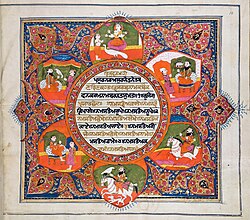
[[File:Dasam Granth frontispiece British Library Manuscript Or 6298 1825-1850 CE.jpg|thumb|The [[Dasam Granth]] is attributed to Guru Gobind Singh. It incorporates among other things the warrior-saint mythologies of ancient India. | [[File:Dasam Granth frontispiece British Library Manuscript Or 6298 1825-1850 CE.jpg|thumb|The [[Dasam Granth]] is attributed to Guru Gobind Singh. It incorporates among other things the warrior-saint mythologies of ancient India.<ref>{{Cite book |last=Rinehart |first=Robin |url=https://books.google.com/books?id=58AVDAAAQBAJ |title=Debating the Dasam Granth |publisher=Oxford University Press |year=2011 |isbn=978-0-19-975506-6 |pages=59–62}}</ref><ref>{{Cite book |last=Murphy |first=Anne |url=https://books.google.com/books?id=r13hjYfoI6MC&pg=PA96 |title=The Materiality of the Past: History and Representation in Sikh Tradition |publisher=Oxford University Press |year=2012 |isbn=978-0-19-991629-0 |pages=96}}</ref>]] | ||
<blockquote>Piara Singh Padam in his Sri Guru Gobind Singh Ji de Darbari Ratan highlights that Guru Gobind Singh gave as much regard to the pen as to the sword.<ref>{{Cite book |last=Grewal |first=J.S |title=Guru Gobind Singh (1666–1708) Master of the White Hawk}}</ref></blockquote> | |||
Guru Gobind Singh is credited in the Sikh tradition with finalizing the Kartarpur Pothi (manuscript) of the ''[[Guru Granth Sahib]]'' – the primary scripture of Sikhism. | Guru Gobind Singh is credited in the Sikh tradition with finalizing the Kartarpur Pothi (manuscript) of the ''[[Guru Granth Sahib]]'' – the primary scripture of Sikhism.<ref name="MandairShackle2013p11" /> The final version did not accept the extraneous hymns in other versions and included the compositions of his father Guru Tegh Bahadur.<ref name="MandairShackle2013p11">{{Cite book |last1=Mandair |first1=Arvind-Pal Singh |url=https://books.google.com/books?id=D8xdAgAAQBAJ |title=Sikh Religion, Culture and Ethnicity |last2=Shackle |first2=Christopher |last3=Singh |first3=Gurharpal |publisher=Routledge |year=2013 |isbn=978-1-136-84627-4 |pages=11–12, 17–19}}</ref> Gobind Singh also declared this text to be the eternal Guru for Sikhs.<ref name=shelke199/><ref>{{Cite web |title=Adi Granth {{!}} Sikh sacred scripture |url=https://www.britannica.com/topic/Adi-Granth-Sikh-sacred-scripture |access-date=20 January 2021 |website=Encyclopedia Britannica |language=en}}</ref> | ||
Gobind Singh is also credited with the ''[[Dasam Granth]]''.<ref name="britdasam">{{Cite web|title=Dasam Granth &#124; Sikh writings &#124; Britannica|url=https://www.britannica.com/topic/Dasam-Granth|access-date=29 March 2023|website=www.britannica.com|language=en}}</ref> It is a controversial [[religious text]] considered to be the second scripture by some Sikhs, and of disputed authority to other Sikhs.<ref name="SinghFenech2014p136">{{Cite book |last=Rinehart |first=Robin |url=https://books.google.com/books?id=8I0NAwAAQBAJ |title=The Oxford Handbook of Sikh Studies |publisher=Oxford University Press |year=2014 |isbn=978-0-19-969930-8 |editor-last=Pashaura Singh and Louis E Fenech |pages=136–138}}</ref><ref name="McLeod1990">{{Cite book |last=McLeod |first=W. H. |url=https://books.google.com/books?id=7xIT7OMSJ44C |title=Textual Sources for the Study of Sikhism |publisher=University of Chicago Press |year=1990 |isbn=978-0-226-56085-4 |author-link=W. H. McLeod}}, pp. 2, 67</ref> The standard edition of the text contains 1,428 pages with 17,293 verses in 18 sections.<ref name="SinghFenech2014p136" /><ref name="hss54">{{Cite book |last=Singha |first=H. S. |url=https://books.google.com/books?id=gqIbJz7vMn0C |title=The Encyclopedia of Sikhism (over 1000 Entries) |publisher=Hemkunt Press |year=2000 |isbn=978-81-7010-301-1}}, pp. 53–54</ref> The ''Dasam Granth'' includes hymns, mythological tales from [[Hindu texts]],<ref name=britdasam/> a celebration of the feminine in the form of goddess [[Durga]],<ref name="Nesbitt2016p107">{{Cite book |last=Nesbitt |first=Eleanor |url=https://books.google.com/books?id=zD8SDAAAQBAJ |title=Sikhism: A Very Short Introduction |publisher=Oxford University Press |year=2016 |isbn=978-0-19-106277-3 |pages=107–109}}</ref> fables dealing with [[kaam|sexuality]],<ref name=britdasam/> an autobiography, secular stories from the [[Puranas]] and the ''[[Mahabharata]]'', letters to others such as the [[Mughal Empire|Mughal emperor]], as well as reverential discussion of warriors and theology.<ref name="SinghFenech2014p136" /><ref>Christopher Shackle and Arvind Mandair (2005), Teachings of the Sikh Gurus, Routledge, {{ISBN|978-0415266048}}, p. xx</ref><ref>{{Cite book |last=Deol |first=J |url=https://books.google.com/books?id=D8xdAgAAQBAJ |title=Sikh Religion, Culture and Ethnicity |publisher=Routledge |year=2013 |isbn=978-1-136-84627-4 |editor-last=Arvind-Pal Singh Mandair |pages=30–34 |display-editors=etal}}</ref> | |||
In his writings, Guru Gobind Singh uses a variety of pen names such as Shyam, Raam, Kaal, Gobind Das, Gobind Singh, Nanak, and Shah Gobind.<ref name="Gandhi 1978 607"/><ref name="ReferenceA"/><ref name="Singh 2015 66, 68, 77"/> | |||
According to the Bansavlinama, written in 1755 by Kesar Singh Chibbar,<ref>{{Cite web |last=Gujral |first=Maninder S. |date=19 December 2000 |title=Bansavalinama Dasan Patshahian Ka |url=https://www.thesikhencyclopedia.com/sikh-scriptures-and-literature/eighteenth-century-literature/bansavalinama-dasan-patshahian-ka/ |access-date=1 October 2022 |website=The Sikh Encyclopedia |language=en-US}}</ref> Sikhs requested that Gobind Singh merge Dasam Granth with the Guru Granth Sahib. Gobind Singh responded to the request by saying, "This is the Adi Guru Granth; The root book. That one (Dasam Granth) is only for my diversion. Let this be kept in the mind and let the two stay separate."<ref>{{Cite book |last=Singh |first=Kesar |title=Bansavalinama |pages=161}}</ref><ref>{{Cite web |last=Gujral |first=Maninder S. |date=19 December 2000 |title=Dasam Granth |url=https://www.thesikhencyclopedia.com/sikh-scriptures-and-literature/sri-guru-granth-sahib-and-guru-gobind-singhs-bani/dasam-granth/ |access-date=1 October 2022 |website=The Sikh Encyclopedia |language=en-US}}</ref> | |||
The ''Dasam Granth'' has a significant role in the initiation and the daily life of devout Khalsa Sikhs.<ref>Christopher Shackle and Arvind Mandair (2005), Teachings of the Sikh Gurus, Routledge, {{ISBN|978-0415266048}}, pp. xvii–xx</ref><ref>J Deol (2000), Sikh Religion, Culture and Ethnicity (Editors: AS Mandair, C Shackle, G Singh), Routledge, {{ISBN|978-0700713899}}, pp. 31–33</ref> Parts of its compositions such as the [[Jaap Sahib]], [[Tav-Prasad Savaiye]] and [[Chaupai (Sikhism)|Benti Chaupai]] are the daily prayers ([[Nitnem]]) and sacred liturgical verses used in the initiation of Khalsa Sikhs.<ref name="McLeod1990" /><ref name="JacobsenMyrvold2012p233">{{Cite book |last1=Jacobsen |first1=Knut A. |url=https://books.google.com/books?id=ZdZLAQAAQBAJ&pg=PA234 |title=Sikhs Across Borders: Transnational Practices of European Sikhs |last2=Myrvold |first2=Kristina |publisher=A&C Black |year=2012 |isbn=978-1-4411-1387-0 |pages=233–234}}</ref><ref>Robert Zaehner (1988), The Hutchinson Encyclopedia of Living Faiths, Hutchinson, {{ISBN|978-0091735760}}, pp. 426–427</ref> | |||
[[File:Charitropakhyan - Invocation, Stanza 1-2 in the hand of Guru Gobind Singh.jpg|thumb|The handwriting of Guru Gobind Singh while writing ''Gurmukhi.'' Displayed here is the first chapter of the ''Charitropakhyan.'']] | |||
==Wars== | ==Wars== | ||
Guru Gobind Singh believed in a | The period following the execution of Guru Tegh Bahadur – the father of Guru Gobind Singh, was a period where the Mughal Empire under Aurangzeb was an increasingly hostile enemy of the Sikh people.<ref name="ReichbergSyse2014p673">{{Cite book |last=Brekke |first=Torkel |url=https://books.google.com/books?id=t3CFAwAAQBAJ |title=Religion, War, and Ethics: A Sourcebook of Textual Traditions |publisher=Cambridge University Press |year=2014 |isbn=978-1-139-95204-0 |editor-last=Gregory M. Reichberg and Henrik Syse |pages=673–674}}</ref> The Sikh resisted, led by Gobind Singh, and the Muslim-Sikh conflicts peaked during this period.<ref name="ReichbergSyse2014p673" /> Both Mughal administration and Aurangzeb's army had an active interest in Gobind Singh. Aurangzeb issued an order to exterminate Gobind Singh and his family.<ref>{{Cite book |last=J. S. Grewal |url=https://archive.org/details/sikhsofpunjab0000grew |title=The Sikhs of the Punjab |publisher=Cambridge University Press |year=1998 |isbn=978-0-521-63764-0 |page=[https://archive.org/details/sikhsofpunjab0000grew/page/62 62] |url-access=registration}}, Quote: "Aurangzeb took an active interest in the issue of succession, passed orders for the execution of Guru Tegh Bahadur, and at one time ordered total extirpation of Guru Gobind Singh and his family".</ref> | ||
Gobind Singh believed in a [[Dharamyudh (Sikhism)|Dharamyudh]] (war in defence of righteousness), something that is fought as a last resort, neither out of a wish for revenge nor for greed nor for any destructive goals.<ref name="Wright2003p153" /> To the Guru, one must be prepared to die to stop tyranny, end persecution, and to defend one's own religious values.<ref name="Wright2003p153">{{Cite book |last=Christopher J. H. Wright |url=https://books.google.com/books?id=xW33ZuBnNC0C&pg=PA153 |title=God and Morality |publisher=Oxford University Press |year=2003 |isbn=978-0-19-914839-4 |pages=153}}</ref> He led fourteen wars with these objectives, but never took captives nor damaged anyone's place of worship.<ref name="Wright2003p153" /> | |||
=== | ===Battles=== | ||
[[File: GuruGobind Singh.jpg|thumb|upright|Guru Gobind Singh with his horse]] | {{See also|List of Battles of Guru Gobind Singh}}[[File:GuruGobind Singh.jpg|thumb|upright|Guru Gobind Singh with his horse]] | ||
Guru Gobind Singh fought | Guru Gobind Singh fought 21 battles against the [[Mughal Empire]] and the kings of [[Sivalik Hills|Siwalik Hills]]. | ||
* [[Battle of | * [[Battle of Anandpur (1682)]] Bhim Chand attacks Gobind Singh. | ||
* [[Battle of Nadaun | * [[Battle of Anandpur (1685)|Battle Of Anandpur (1685)]] Bhim Chand attacks Gobind Singh once again | ||
In 1693, Aurangzeb was fighting the Hindu Marathas in the Deccan region of India, and he issued orders that Guru Gobind Singh and Sikhs should be prevented from gathering in Anandpur in large numbers. | * [[Battle of Bhangani|Battle of Bhangani (1688)]], which states chapter 8 of Gobind Singh's ''Bicitra Natak'', when Fateh Shah, along with mercenary commanders Hayat Khan and Najabat Khan,<ref name="Grewal1998p73">{{Cite book |last=J. S. Grewal |url=https://archive.org/details/sikhsofpunjab0000grew |title=The Sikhs of the Punjab |publisher=Cambridge University Press |year=1998 |isbn=978-0-521-63764-0 |pages=[https://archive.org/details/sikhsofpunjab0000grew/page/73 73]–74 |url-access=registration}}</ref> attacked his forces without any purpose. The Guru was aided by the forces of Kripal (his maternal uncle) and a Brahmin named Daya Ram, both of whom he praises as heroes in his text.<ref>{{Cite book |last=Nikky-Guninder Kaur Singh |url=https://books.google.com/books?id=squPx387FuwC |title=Birth of the Khalsa, The: A Feminist Re-Memory of Sikh Identity |publisher=State University of New York Press |year=2012 |isbn=978-0-7914-8266-7 |pages=26–28}}</ref> The Guru's cousin named Sango Shah was killed in the battle, a cousin from [[Guru Hargobind]]'s daughter.<ref name="Grewal1998p73" /> | ||
* [[Battle of | * [[Battle of Nadaun|Battle of Nadaun (1691)]], against the Islamic armies of Mian Khan and his son Alif Khan, who were defeated by the allied forces of Gobind Singh, Bhim Chand and other [[Hindu king]]s of Himalayan foothills.<ref>{{Cite book |last=Jaques |first=Tony |url=https://books.google.com/books?id=Dh6jydKXikoC |title=Dictionary of Battles and Sieges: F–O |publisher=Greenwood |year=2007 |isbn=978-0-313-33538-9 |pages=704}}</ref> The non-Muslims aligned to the Guru had refused to pay tribute to the Islamic officials based in Jammu.<ref name="Grewal1998p73" /> | ||
* In 1693, Aurangzeb was fighting the Hindu Marathas in the Deccan region of India, and he issued orders that Guru Gobind Singh and Sikhs should be prevented from gathering in Anandpur in large numbers.<ref name="Grewal1998p73" /><ref name="Fenech2013p14">{{Cite book |last=Fenech |first=Louis E. |url=https://books.google.com/books?id=aUUfAQAAQBAJ |title=The Sikh Zafar-namah of Guru Gobind Singh: A Discursive Blade in the Heart of the Mughal Empire |publisher=Oxford University Press |year=2013 |isbn=978-0-19-993145-3 |pages=14}}</ref> | |||
* [[Battle of Anandpur ( | * [[Battle of Anandpur (1695)]] Mughals attack Gobind Singh at Anandpur | ||
* [[Battle of Guler (1696)]], first against the Muslim commander Dilawar Khan's son Rustam Khan, near Sutlej river, where the Guru teamed up with the [[Hindu king]] of Guler and routed the Muslim army.<ref name="Jaques2007p420" /> The commander sent his general Hussain Khan against the armies of the Guru and the Guler kingdom, a war fought near Pathankot, and Hussain Khan was defeated and killed by the joint forces.<ref name="Jaques2007p420">{{Cite book |last=Jaques |first=Tony |url=https://books.google.com/books?id=Dh6jydKXikoC |title=Dictionary of Battles and Sieges: F–O |publisher=Greenwood |year=2007 |isbn=978-0-313-33538-9 |pages=420}}</ref> | |||
After the creation of the Khalsa the Hill Rajas, who had previously lost in battle to Guru Gobind Singh, sent a petition to Delhi requesting they act immediately and join them in battle against the Guru.l<ref>{{Cite book |last=Singh |first=Guru Gobind |url=https://books.google.com/books?id=NnbebvjLAPUC&dq=aurangzeb+guru+gobind+1693&pg=PT16 |title=Zafarnama |date=2015 |publisher=Penguin UK |isbn=978-81-8475-595-4 |language=en}}</ref> | |||
* [[ | * [[Battle of Anandpur (1699)]], was against two Rajas of the hills. | ||
* [[Battle of Anandpur (1700)]], against the Mughal army of Aurangzeb, who had sent 10,000 soldiers, in response to the Hill Rajas letter, under the command of Painda Khan and Dina Beg.<ref name="Jaques2007p48" /> In direct combat between Gobind Singh and Painda Khan, the latter was killed. His death led to the Mughal army fleeing the battlefield.<ref name="Jaques2007p48" /> | |||
* [[First siege of Anandpur]], The hill Rajas of northern Punjab regrouped after defeat at Anandpur the previous year and resumed their campaign against Gobind Singh, joining forces with Gujar and other tribesmens to besiege Anandpur, northeast of Ludhiana. Gujar leader Jagatullah was killed on the first day and the Rajas were driven off after a brilliant defence led by the Guru's son Ajit Singh.<ref name="Jaques2007p48">{{Cite book |last=Jaques |first=Tony |url=https://books.google.com/books?id=3amnMPTPP5MC |title=Dictionary of Battles and Sieges: A–E |publisher=Greenwood Publishing |year=2007 |isbn=978-0-313-33537-2 |pages=48–49}}</ref><ref name="Rinehart2011p22" /><ref name="Fenech2013p14" /> | |||
* [[Battle of Taragarh]] was a battle fought in defence during the Siege of Anandpur. | |||
* [[Battle of Basoli]] (1702), against the Mughal army; named after the kingdom of Basoli whose Raja Dharampul supported the Guru in the battle.<ref name="Jaques2007p112">{{Cite book |last=Jaques |first=Tony |url=https://books.google.com/books?id=Dh6jydKXikoC |title=Dictionary of Battles and Sieges: F–O |publisher=Greenwood |year=2007 |isbn=978-0-313-33538-9 |pages=112}}</ref> The Mughal army was supported by rival kingdom of Kahlur led by Raja Ajmer Chand. The battle ended when the two sides reached a tactical peace.<ref name="Jaques2007p112" /> | |||
* [[First Battle of Chamkaur|First Battle of Chamkaur (1702)]], Mughal Army was repulsed.<ref name="Jaques2007p48" /> | |||
* [[First Battle of Anandpur (1704)]], Mughal Emperor Aurangzeb sent a fresh force into northern Punjab under General Saiyad Khan, later replaced by Ramjan Khan. Ramjan was mortally wounded in further very heavy fighting around the Sikh stronghold at Anandpur, northeast of Ludhiana, and his force again withdrew.<ref name="Jaques2007p48" /> | |||
* [[Second Battle of Anandpur|Second siege of Anandpur]], According to scholars, this siege was triggered by the proliferation of armed Sikhs in Anandpur, the increasing numbers creating a shortage of supplies. This led the Sikhs to raid local villages for supplies, food, and forage, which in turn dramatically frustrated the local pahari rajas who forged alliances and mounted an attack on Guru Gobind Singh's patrimony.<ref>{{Cite book |last1=Malhotra |first1=Anshu |url=https://books.google.com/books?id=_vQtDwAAQBAJ&pg=PT135 |title=Punjab Reconsidered: History, Culture, and Practice |last2=Mir |first2=Farina |date=2012 |publisher=Oxford University Press |isbn=978-0-19-908877-5 |pages=135 |language=en}}</ref><ref name="Grewal1998p73" /> The Mughal general was fatally wounded by Sikh soldiers, and the army withdrew. Aurangzeb then sent a larger army with two generals, Wazir Khan and Zaberdast Khan in May 1704, to destroy the Sikh resistance.<ref name="Jaques2007p48" /> The approach the Islamic army took in this battle was to lay a protracted siege against Anandpur, from May to December, cutting off all food and other supplies moving in and out, along with repeated battles.<ref name="FenechMcleodp9">{{Cite book |last1=Fenech |first1=Louis E. |url=https://books.google.com/books?id=xajcAwAAQBAJ |title=Historical Dictionary of Sikhism |last2=W. H. McLeod |publisher=Rowman & Littlefield |year=2014 |isbn=978-1-4422-3601-1 |pages=9}}</ref> Some Sikh men deserted the Guru during the Anandpur siege in 1704 and escaped to their homes where their women shamed them and they rejoined the Guru's army and died fighting with him in 1705.<ref>{{Cite book |last=Fenech |first=Louis E. |url=https://books.google.com/books?id=FI3XAAAAMAAJ |title=Martyrdom in the Sikh Tradition: Playing the "game of Love" |publisher=Oxford University Press |year=2000 |isbn=978-0-19-564947-5 |pages=92}}</ref><ref name="mcleod2009p43">{{Cite book |last=W. H. McLeod |url=https://books.google.com/books?id=vgixwfeCyDAC |title=The A to Z of Sikhism |publisher=Scarecrow |year=2009 |isbn=978-0-8108-6344-6 |pages=43}}</ref> Towards the end, the Guru, his family, and followers accepted an offer by Aurangzeb of safe passage out of Anandpur.<ref name="Prithi_PS_History">{{Cite book |last=Singh |first=Prithi Pal |title=The History of Sikh Gurus |publisher=Lotus Books |year=2007 |isbn=978-81-8382-075-2 |pages=128–147}}</ref> However, as they left Anandpur in two batches, they were attacked, and one of the batches with Mata Gujari and Guru's two sons – Zorawar Singh aged 8 and Fateh Singh aged 5 – were taken captive by the Mughal army.<ref name="Rinehart2011p22">{{Cite book |last=Rinehart |first=Robin |url=https://books.google.com/books?id=58AVDAAAQBAJ |title=Debating the Dasam Granth |publisher=Oxford University Press |year=2011 |isbn=978-0-19-975506-6 |pages=22–23}}</ref><ref name="syanp220" /> Both his children were executed by burying them alive into a wall.<ref name="FenechMcleodp9" /><ref>{{Cite book |last=Nikky-Guninder Kaur Singh |url=https://books.google.com/books?id=w8yWAwAAQBAJ&pg=PT84 |title=Sikhism: An Introduction |publisher=I.B. Tauris |year=2011 |isbn=978-0-85773-549-2 |pages=84–85}}</ref> The grandmother Mata Gujari died there as well.<ref name="Rinehart2011p22" /> | |||
* [[Battle of Sarsa]] (1704), against the Mughal army led by general Wazir Khan; the Muslim commander had conveyed Aurangzeb's promise of a safe passage to Guru Gobind Singh and his family in early December.<ref name="syanp220">{{Cite book |last=Hardip Singh Syan |url=https://books.google.com/books?id=9RzzxcEL4C0C |title=Sikh Militancy in the Seventeenth Century: Religious Violence in Mughal and Early Modern India |publisher=I.B. Tauris |year=2013 |isbn=978-1-78076-250-0 |pages=220–222}}</ref> However, when the Guru accepted the offer and left, Wazir Khan took captives, executed them and pursued the Guru.<ref name="Jaques2007p914" /> The retreating troops he was with were repeatedly attacked from behind, with heavy casualties to the Sikhs, particularly while crossing the Sarsa river.<ref name="Jaques2007p914">{{Cite book |last=Jaques |first=Tony |url=https://books.google.com/books?id=3amnMPTPP5MC |title=Dictionary of Battles and Sieges: A–E |publisher=Greenwood Publishing |year=2007 |isbn=978-0-313-33537-2 |pages=914}}</ref> | |||
* [[Battle of Chamkaur (1704)]] Regarded as one of the most important battles in Sikh history. It was against the Mughal army led by Nahar Khan;<ref name="fenechmcleod218">{{Cite book |last1=Fenech |first1=Louis E. |url=https://books.google.com/books?id=xajcAwAAQBAJ |title=Historical Dictionary of Sikhism |last2=W. H. McLeod |publisher=Rowman & Littlefield |year=2014 |isbn=978-1-4422-3601-1 |pages=218}}</ref> the Muslim commander was killed,<ref name=fenechmcleod218/> while on Sikh side the remaining two elder sons of the Guru – Ajit Singh and Jujhar Singh, along with other Sikh soldiers were killed in this battle.<ref>{{Cite book |last=Raju |first=Karam Singh |title=Guru Gobind Singh: Prophet of peace |year=1999 |publisher=Sanbun Publishers |isbn=9380213646}}</ref><ref name="Rinehart2011p22" /><ref>{{Cite book |last1=Fenech |first1=Louis E. |url=https://books.google.com/books?id=xajcAwAAQBAJ&pg=PA79 |title=Historical Dictionary of Sikhism |last2=W. H. McLeod |publisher=Rowman & Littlefield |year=2014 |isbn=978-1-4422-3601-1 |pages=79}}</ref> | |||
* [[Battle of Muktsar]] (1705), the Guru's army was re-attacked by the Mughal army, being hunted down by general Wazir Khan, in the arid area of Khidrana-ki-Dhab. The Mughals were blocked again, but with many losses of Sikh lives – particularly the famous ''Chalis Mukte'' (literally, the "forty liberated ones"),<ref name=mcleod2009p43/> and this was the last battle led by Guru Gobind Singh.<ref name="Grewal1998p78" /> The place of battle called Khidrana was renamed about a 100 years later by [[Ranjit Singh]] to Mukt-sar (literally, "lake of liberation"), after the term "Mukt" ([[moksha]]) of the ancient Indian tradition, in honour of those who gave their lives for the cause of liberation.<ref>{{Cite book |last=Sir Lepel Henry Griffin |url=https://archive.org/details/ranjitsnghandsi00grifgoog |title=Ranjit Síngh and the Sikh Barrier Between Our Growing Empire and Central Asia |publisher=Oxford University Press |year=1898 |pages=[https://archive.org/details/ranjitsnghandsi00grifgoog/page/n61 55]–56}}</ref> | |||
* Battle of Baghaur (1707) was fought against the Raja of Bhghaur and the locals of the area. It began over a dispute when some camels of the Guru went and ate the trees of a local gardener. The gardener took the camels and the rider hostage. Sikh negotiated for the release but he refused which led to a battle.<ref>{{Cite book |last=Singh |first=Dalip |title=Life of Sri Guru Gobind Singh Ji |publisher=CSJS |year=2015 |isbn=978-81-7601-480-9 |edition=6th |pages=174 |language=English}}</ref> | |||
* [[Battle of Jajau]] (1707) was fought between [[Muhammad Azam Shah|Azam Shah]] and [[Bahadur Shah I|Bhadur Shah]] over the Mughal throne. Bahdur Shah sought Guru Gobind Singh's assistance. Gobind Singh provided assistance and is said to have killed Azam Shah in battle.<ref>{{Cite book |last=Gandhi |first=Surjit |title=A Historian's Approach to Guru Gobind Singh |date=2023 |isbn=978-8172053062 |pages=323|publisher=Singh Bros. }}</ref> | |||
===Mughal accounts=== | ===Mughal accounts=== | ||
The Muslim historians of the Mughal court wrote about Guru Gobind Singh as well as the geopolitics of the times he lived in, and these official Persian accounts were readily available and the basis of colonial era English-language description of Sikh history. | The Muslim historians of the Mughal court wrote about Guru Gobind Singh as well as the geopolitics of the times he lived in, and these official Persian accounts were readily available and the basis of colonial era English-language description of Sikh history.<ref name=Dhavanp165/><ref>{{Cite book |last=Murphy |first=Anne |url=https://books.google.com/books?id=r13hjYfoI6MC |title=The Materiality of the Past: History and Representation in Sikh Tradition |publisher=Oxford University Press |year=2012 |isbn=978-0-19-991629-0 |pages=110–113}}</ref> | ||
[[File:Jaap Sahib - The first ang (page) with the opening stanza in the hand of Guru Gobind Singh.webp|thumb|The first page (Panna, or Ang) of the Jaap Sahib, the beginning composition of the Dasam Granth, in the hand of the Guru]] | |||
According to Dhavan, the Persian texts that were composed by Mughal court historians during the lifetime of Gobind Singh were hostile to him but presented the Mughal perspective.<ref name="Dhavanp165">{{Cite book |last=Dhavan |first=P |url=https://books.google.com/books?id=-7HJ5idB8_QC |title=When Sparrows Became Hawks: The Making of the Sikh Warrior Tradition, 1699–1799 |publisher=Oxford University Press |year=2011 |isbn=978-0-19-975655-1 |pages=165–167, 13–24}}</ref> They believed that the religious Guru tradition of Sikhs had been corrupted by him, through the creation of a military order willing to resist the [[Army of the Mughal Empire|imperial army]].<ref name=Dhavanp165/> Dhavan writes that some Persian writers who wrote decades or a century after the death of Gobind Singh evolved from relying entirely on court histories of the Mughals which disparage the Guru, to including stories from the Sikh ''gurbilas'' text that praise the Guru.<ref name=Dhavanp165/><ref>{{Cite book |last=Murphy |first=Anne |url=https://books.google.com/books?id=WWysAgAAQBAJ&pg=PA47 |title=Time, History and the Religious Imaginary in South Asia |publisher=Routledge |year=2012 |isbn=978-1-136-70729-2 |pages=47–50}}</ref> | |||
The Mughal accounts suggest that the Muslim commanders viewed the Sikh ''panth'' as one divided into sects with different loyalties.<ref>{{Cite book |last=Dhavan |first=P |url=https://books.google.com/books?id=-7HJ5idB8_QC&pg=PA45 |title=When Sparrows Became Hawks: The Making of the Sikh Warrior Tradition, 1699–1799 |publisher=Oxford University Press |year=2011 |isbn=978-0-19-975655-1 |pages=51–53}}</ref> | |||
The Mughal accounts suggest that the Muslim commanders viewed the Sikh ''panth'' as one divided into sects with different loyalties. | |||
=== Relationship with other religious groups === | === Relationship with other religious groups === | ||
{{Main|Sikh Rehat Maryada}} | {{Main|Sikh Rehat Maryada}} | ||
As a result of the violent hostility between the Sikhs and the Mughal armies, Guru Gobind Singh ordered the social segregation | As a result of the violent hostility between the Sikhs and the Mughal armies, Guru Gobind Singh ordered the social segregation between the Khalsa and the Muslims, the sentiments of which are reiterated in the contemporary and posthumous rahit-namas. To a lesser extent, injunctions were also made prohibiting the partake in certain Hindu rituals and beliefs as well as against schismatic Sikh factions opposed to the orthodox Khalsa community.{{refn|<ref>{{Cite book |last=Nesbitt |first=Eleanor M. |url=https://books.google.com/books?id=XebnCwAAQBAJ&pg=PA118 |title=Sikhism: A Very Short Introduction |date=2016 |publisher=Oxford University Press |isbn=978-0-19-874557-0 |pages=59–60, 118 |language=en}}</ref><ref>{{Cite book |last=Morgan |first=Peggy |url=https://books.google.com/books?id=vt-qBgAAQBAJ&pg=PA120 |title=Ethical Issues in Six Religious Traditions |date=2007 |publisher=Edinburgh University Press |isbn=978-0-7486-3002-8 |pages=120 |language=en |quote=Ever since the time of Guru Gobind Singh (d. ce 1708), codes of conduct (rahitnamas), for example Rahitnama Bhai Chaupa and Prem Sumarg, have been in circulation. These laid down the behaviour required of Sikhs. The eighteenth and nineteenth-century rahitnamas reflected their period, and one clear purpose was the social segregation of Sikhs and Muslims.}}</ref><ref>{{Cite book |last1=Fenech |first1=Louis E. |url=https://books.google.com/books?id=xajcAwAAQBAJ&pg=PA214 |title=Historical Dictionary of Sikhism |last2=McLeod |first2=W. H. |date=2014 |publisher=Rowman & Littlefield |isbn=978-1-4422-3601-1 |pages=214 |language=en}}</ref><ref>{{Cite book |last=Oberoi |first=Harjot |url=https://books.google.com/books?id=1NKC9g2ayJEC&pg=PA68 |title=The Construction of Religious Boundaries: Culture, Identity, and Diversity in the Sikh Tradition |date=1994 |publisher=University of Chicago Press |isbn=978-0-226-61593-6 |pages=68 |language=en}}</ref>}}{{refn|<ref>{{Cite book |last1=Cush |first1=Denise |url=https://books.google.com/books?id=kzPgCgAAQBAJ&pg=PA792 |title=Encyclopedia of Hinduism |last2=Robinson |first2=Catherine |last3=York |first3=Michael |date=2012 |publisher=Routledge |isbn=978-1-135-18979-2 |pages=792 |language=en}}</ref><ref>{{Cite book |last=Coward |first=Harold G. |url=https://books.google.com/books?id=rA278MzR5-kC&pg=PA283 |title=Modern Indian Responses to Religious Pluralism |date=1987 |publisher=State University of New York Press |isbn=978-0-7914-9992-4 |pages=283 |language=en}}</ref><ref>{{Cite book |last=Cook |first=Michael |url=https://books.google.com/books?id=F3CYDwAAQBAJ&pg=PA238 |title=Ancient Religions, Modern Politics: The Islamic Case in Comparative Perspective |date=2016 |publisher=Princeton University Press |isbn=978-0-691-17334-4 |pages=238 |language=en}}</ref><ref>{{Cite book |last=Grewal |first=J. S. |url=https://books.google.com/books?id=YDLNDwAAQBAJ&pg=PT96 |title=Guru Gobind Singh (1666–1708): Master of the White Hawk |date= 2019 |publisher=Oxford University Press |isbn=978-0-19-099038-1 |pages=96 |language=en}}</ref><ref>{{Cite book |last1=Malhotra |first1=Anshu |url=https://books.google.com/books?id=PdvDCgAAQBAJ&pg=PT195 |title=Speaking of the Self: Gender, Performance, and Autobiography in South Asia |last2=Lambert-Hurley |first2=Siobhan |date=2015 |publisher=Duke University Press |isbn=978-0-8223-7497-8 |pages=195 |language=en |quote=From the time of the establishment of the Khalsa in 1699, some from within the Sikhs, more specifically the Khalsa, tried to create religious norms and codes of behavior that worked toward imparting a distinct Sikh identity partly by distancing from the Muslims. A stream within the Khalsa set about creating codes of conduct, the rahit literature, that began "othering" the Muslim/Turak (used interchangeably), passing tenets that included the avoidance of halal meat associated with the Muslims, and sleeping with Muslim women.}}</ref>}} | ||
==Post- | == Post-war years == | ||
[[File:GGS Marg Map.jpg|thumb|left|GGS Marg Map]] | [[File:GGS Marg Map.jpg|thumb|left|GGS Marg Map]] | ||
After the Second Battle of Anandpur in 1704, the Guru and his remaining soldiers moved and stayed in different spots including hidden in places such as the Machhiwara jungle of southern Panjab. | After the Second Battle of Anandpur in 1704, the Guru and his remaining soldiers moved and stayed in different spots including hidden in places such as the Machhiwara jungle of southern Panjab.<ref name=syanp220/> | ||
Some of the various spots in north, west, and central India where the Guru lived after 1705, include Hehar with Kirpal Das (maternal uncle), Manuke, Mehdiana, Chakkar, Takhtupura, and Madhe and Dina ([[Malwa (Punjab)]] region). He stayed with relatives or trusted Sikhs such as the three grandsons of Rai Jodh, a devotee of [[Guru Har Gobind]]. | Some of the various spots in north, west, and central India where the Guru lived after 1705, include Hehar with Kirpal Das (maternal uncle), Manuke, Mehdiana, Chakkar, Takhtupura, and Madhe and Dina ([[Malwa (Punjab)|Malwa]] region). He stayed with relatives or trusted Sikhs such as the three grandsons of Rai Jodh, a devotee of [[Guru Har Gobind]].<ref>{{Cite book |last=Johar |first=Surinder Singh |title=Holy Sikh shrines |publisher=M D Publications |year=1998 |isbn=978-81-7533-073-3 |location=New Delhi |page=63 |oclc=44703461}}</ref> | ||
===Zafarnama=== | ===Zafarnama=== | ||
{{Main|Zafarnama (letter)}} | {{Main|Zafarnama (letter)}} | ||
Guru Gobind Singh saw the war conduct of Aurangzeb and his army against his family and his people as a betrayal of a promise, unethical, unjust, and impious. | Guru Gobind Singh saw the war conduct of Aurangzeb and his army against his family and his people as a betrayal of a promise, unethical, unjust, and impious.<ref name=syanp220/> After all of Gobind Singh's children had been killed by the Mughal army and the battle of Muktsar, the Guru wrote a defiant letter in Persian to Aurangzeb, titled ''Zafarnama'' (literally, "epistle of victory"), a letter which the Sikh tradition considers important towards the end of the 19th century.<ref name=syanp220/><ref>{{Cite book |last=W. H. McLeod |url=https://books.google.com/books?id=vgixwfeCyDAC |title=The A to Z of Sikhism |publisher=Scarecrow |year=2009 |isbn=978-0-8108-6344-6 |pages=xxv, 52, 214–215}}</ref><ref>{{Cite book |last=Murphy |first=Anne |url=https://books.google.com/books?id=r13hjYfoI6MC |title=The Materiality of the Past: History and Representation in Sikh Tradition |publisher=Oxford University Press |year=2012 |isbn=978-0-19-991629-0 |pages=73}}</ref> | ||
The Guru's letter was stern yet conciliatory to Aurangzeb. He indicted the Mughal Emperor and his commanders in spiritual terms, and accused them of a lack of morality both in governance and in the conduct of war. | The Guru's letter was stern yet conciliatory to Aurangzeb. He indicted the Mughal Emperor and his commanders in spiritual terms, and accused them of a lack of morality both in governance and in the conduct of war.<ref name="Hadley2001p20" /> The letter predicted that the Mughal Empire would soon end, because it persecutes, and is full of abuse, falsehood, and immorality. The letter is spiritually rooted in Gobind Singh's beliefs about justice and dignity without fear.<ref name="Hadley2001p20">{{Cite book |last=Hadley |first=Michael L. |url=https://books.google.com/books?id=Z33Hn02GOwIC |title=Spiritual Roots of Restorative Justice, The |publisher=State University of New York Press |year=2001 |isbn=978-0-7914-9114-0 |pages=20, 207–214}}</ref> | ||
==Death of family members== | |||
[[File:Pariwar vichhora gurudwara.jpg|thumb|Gurudwara [[Parivar Vichora]] Sahib, Majri, Punjab where Guru's mother and younger sahibzaade got separated from him<ref name="amar1">{{Cite book |last=Dahiya |first=Amardeep |url=https://books.google.com/books?id=UA09BAAAQBAJ |title=Founder of the Khalsa: The Life and Times of Guru Gobind Singh |publisher=Hay House, Inc |year=2014 |isbn=9789381398616 |page=183}}</ref>]] | |||
{{See also|Saka Sirhind}} | |||
Guru and his two elder sons had escaped the siege of Anandpur in December 1704 and reached [[Chamkaur]], but they were pursued by a large Mughal army. | Guru Gobind Singh's four sons, also referred to as Chaar Sahibzaade (the four princes), were killed during his lifetime – the elder two in a battle with [[Mughal Empire|Mughal]]s, and the younger two executed by the Mughal governor of [[Sirhind-Fategarh|Sirhind]].<ref name="Routledge"/> The Guru and his two elder sons had escaped the [[Second siege of Anandpur|siege of Anandpur]] in December 1704 and reached [[Chamkaur]], but they were pursued by a large Mughal army.<ref name="TK" /> In the ensuing battle, Guru's elder sons, also called the 'Vaade Sahibzaade' fought bravely, but the Mughal army was much larger and well equipped.<ref name="Statesman">{{Cite web |date=23 December 2021 |title=Chaar Sahibzaade: The unforgettable history of Sikh heroism and sacrifice |url=https://www.thestatesman.com/features/chaar-sahibzaade-unforgettable-history-sikh-heroism-sacrifice-1503032667.html |website=The Statesman}}</ref> | ||
While Guru was taken to a safe place, | While the Guru was taken to a safe place, his elder sons, [[Ajit Singh (Sikhism)|Sahibzada Ajit Singh]] aged 17, and [[Jujhar Singh]] aged 13 were killed in the [[Battle of Chamkaur]] in December 1704 against the Mughal army.<ref name="FenechMcleodp9" /> | ||
Gobind Singh's mother Mata Gujri and his two younger sons got separated from him after escaping the Mughal siege of Anandpur in December 1704; and were later arrested by the forces of [[Wazir Khan (Sirhind)|Wazir Khan]], the Mughal governor of Sirhind.<ref name="TK">{{Cite book |last=Anand |first=TK |url=https://books.google.com/books?id=Ru4uDAAAQBAJ |title=Essence of Sikhism – 7 |publisher=Madhubun Books |year=2005 |isbn=9788125919483 |page=63}}</ref> The younger pair, called the 'Chotte Sahibzaade', along with their grandmother were imprisoned in an Open Tower (Thanda Burj), in chilling winter days.<ref name="Statesman" /> Around 26 and 27 December 1704, the younger sons, [[Fateh Singh (Sikhism)|Sahibzada Fateh Singh]] aged 6 and [[Zorawar Singh (Sikhism)|Zorawar Singh]] aged 9, were offered a safe passage if they converted to Islam, which they refused; and subsequently, [[Wazir Khan (Sirhind)|Wazir Khan]] ordered them to be [[Immurement|bricked alive]] in the wall.<ref>{{Cite book |last=Singh |first=PrithiPal |url=https://books.google.com/books?id=EhGkVkhUuqoC |title=The History of Sikh Gurus |year=2006 |isbn=9788183820752}}</ref><ref>{{Cite book |last=Dahiya |first=Amardeep |url=https://books.google.com/books?id=UA09BAAAQBAJ |title=Founder of the Khalsa: The Life and Times of Guru Gobind Singh |publisher=Hay House, Inc |year=2014 |isbn=9789381398616 |page=186}}</ref> Gujri fainted on hearing about her grandsons' death and died shortly thereafter.<ref name="TK" /> | |||
His adopted son Zorawar Singh | His adopted son Zorawar Singh Palit whose real name is unknown died in 1708 near [[Chittorgarh Fort]] in a skirmish with local soldiers.<ref name="The encyclopaedia of Sikhism"/> According to Sainapati, Zorawar Singh Palit had managed to escape in the Battle of Chamkaur and later met the Guru in [[Rajputana]] after which he got in a minor scuffle at [[Chittorgarh]] and died.<ref>Kulwant Singh summarizing a chapter of Gur Sobha in his English translation of Gur Sobha said, "Zorawar Singh had escaped from the battle of Chamkaur and had met the Guru in Rajputana. It was this Zorawar Singh who was killed at [[Chittorgarh|Chittor]] in a minor scuffle."</ref> | ||
According to Sikh historians, Guru Gobind Singh took the harsh news about the execution of his sons with stoic calm, and wrote | According to Sikh historians, Guru Gobind Singh took the harsh news about the execution of his sons, Fateh Singh and Zorawar Singh, with stoic calm, and wrote "What use is it to put out a few sparks when you raise a mighty flame instead?".<ref>{{Cite book |last=Singh |first=Khushwant |url=https://books.google.com/books?id=PfSISgAACAAJ |title=A History of the Sikhs, Volume 1: 1469–1839 |publisher=Oxford India Collection |year=1977 |isbn=9780195606003 |page=81}}</ref> | ||
== | == Death == | ||
[[File:Cremation of Guru Gobind Singh at Nanded.jpg|thumb|Cremation of Guru Gobind Singh at Nanded]] | [[File:Cremation of Guru Gobind Singh at Nanded.jpg|thumb|Cremation of Guru Gobind Singh at Nanded]] | ||
[[File:Takht Shri Hazoor Sahib Gurudwara Nanded.JPG|right|thumb|[[Takht Sri Hazur Sahib]], [[Nanded]], built over the place where Guru Gobind Singh was cremated in 1708 | [[File:Takht Shri Hazoor Sahib Gurudwara Nanded.JPG|right|thumb|[[Takht Sri Hazur Sahib]], [[Nanded]], built over the place where Guru Gobind Singh was cremated in 1708. The inner chamber is called ''Angitha Sahib''.]] | ||
Aurangzeb died in 1707, and immediately a succession struggle began between his sons who attacked each other. | Aurangzeb died in 1707, and immediately a succession struggle began between his sons who attacked each other.<ref name="Dhavan2011p45" /> Guru Gobind Singh supported [[Bahadur Shah I]] in the [[Battle of Jajau]] by sending 200–300 Sikhs under Bhai Dharam Singh and later joining the battle themselves.<ref>{{Cite book |last=Gandhi |first=Surjit |title=A Historian's Approach to Guru Gobind Singh |year=2004 |isbn=8172053061 |pages=323, 324}}</ref> According to Sikh sources it was Guru Gobind Singh who killed [[Muhammad Azam Shah|Azam Shah]],<ref>{{Cite book |title=A Historian's Approach to Guru Gobind Singh |pages=324}}</ref><ref>Gurbilas Patashahi 10 Chapter 19</ref> while according to Mughal sources, it was [[Isa Khan Munj]].<ref>{{Cite book |last=Irvine |first=William |url=https://books.google.com/books?id=ak5oFjTys8MC&pg=PA33 |title=Later Mughal |date=1971 |publisher=Atlantic Publishers & Distri |language=en}}</ref> The official successor Bahadur Shah invited Guru Gobind Singh with his army to meet him in person in the Deccan region of India for reconciliation. Guru Gobind Singh hoped to get Anandpur, his former stronghold back, and remained close to the imperial camp for nearly a year. His appeals for the restoration of his lands turned out to be ineffectual however as Bahadur Shah went on postponing any restoration to the [[Status quo ante bellum|status quo ante]] as he was not willing to offend either the Guru or the hill rajas.<ref name="FenechMcleodp9" /><ref name="Dhavan2011p45">{{Cite book |last=Dhavan |first=P |url=https://books.google.com/books?id=-7HJ5idB8_QC&pg=PA45 |title=When Sparrows Became Hawks: The Making of the Sikh Warrior Tradition, 1699–1799 |publisher=Oxford University Press |year=2011 |isbn=978-0-19-975655-1 |pages=45–46}}</ref>{{sfn|Grewal|1998|p=79}}<ref>{{Cite book |last1=Metcalf |first1=Barbara D. |url=https://books.google.com/books?id=c7UgAwAAQBAJ&pg=PA33 |title=A Concise History of Modern India |last2=Metcalf |first2=Thomas R. |year= 2012 |publisher=Cambridge University Press |isbn=978-1-139-53705-6 |page=33 |language=en}}</ref> | ||
[[Wazir Khan (Sirhind)|Wazir Khan]], a | [[Wazir Khan (Sirhind)|Wazir Khan]], a Mughal army commander and the [[Nawab]] of [[Sirhind-Fategarh|Sirhind]], against whose army the Guru had fought several wars,<ref name="Grewal1998p78" /> commissioned two Afghans, Jamshed Khan, and Wasil Beg, to follow the Guru's army as it moved for the meeting with Bahadur Shah, and then [[assassination|assassinate]] the Guru. The two secretly pursued the Guru whose troops were in the Deccan area of India, and entered the camp when the Sikhs had been stationed near river [[Godavari River|Godavari]] for months.<ref name="Syan2013p223">{{Cite book |last=Hardip Singh Syan |url=https://books.google.com/books?id=9RzzxcEL4C0C |title=Sikh Militancy in the Seventeenth Century: Religious Violence in Mughal and Early Modern India |publisher=I.B. Tauris |year=2013 |isbn=978-1-78076-250-0 |pages=222–223}}</ref> They gained access to the Guru and Jamshed Khan stabbed him two times resulting in a fatal wound at [[Nanded]].<ref name="FenechMcleodp9" /><ref name="pri">{{Cite book |last=Singh |first=Prithi Pal |title=The history of Sikh Gurus |date=2007 |publisher=Lotus Press |isbn=978-81-8382-075-2 |page=158}}</ref><ref>{{Cite book |last=Singh |first=Santhok |title=Suraj Granth |publisher=CSJS |pages=486 |language=Punjabi |translator-last=Singh |translator-first=Sodhi Teja}}</ref> Some scholars state that the assassin who killed Guru Gobind Singh may not have been sent by Wazir Khan, but was instead sent by the Mughal army that was staying nearby.<ref name="Grewal1998p78">{{Cite book |last=J. S. Grewal |url=https://archive.org/details/sikhsofpunjab0000grew |title=The Sikhs of the Punjab |publisher=Cambridge University Press |year=1998 |isbn=978-0-521-63764-0 |pages=[https://archive.org/details/sikhsofpunjab0000grew/page/78 78]–79 |url-access=registration}}</ref> | ||
According to Senapati's ''Sri Gur Sobha'', an early 18th-century writer, the fatal wounds of the Guru was one below his heart. The Guru fought back and killed the assassin, while the assassin's companion was killed by the Sikh guards as he tried to escape. | According to Senapati's ''Sri Gur Sobha'', an early 18th-century writer, the fatal wounds of the Guru was one below his heart. The Guru fought back and killed the assassin, while the assassin's companion was killed by the Sikh guards as he tried to escape.<ref name="Syan2013p223" /> | ||
The Guru died of his wounds a few days later on 7 October 1708{{refn |However Hardip Singh Syan gives the date as 18 October 1708. | The Guru died of his wounds a few days later on 7 October 1708.{{refn |However Hardip Singh Syan gives the date as 18 October 1708.<ref name="Syan2013p223" />}} His death fuelled a long and bitter war of the Sikhs with the Mughals.<ref name="Syan2013p223" /> | ||
According to the Bansavalinama by Kesar Singh Chibber written in 1768, the Guru's last words were, "The Granth is the Guru and it will bring you to [[God in Sikhism|Akal]]. The Guru is the Khalsa and the Khalsa is the Guru. The seat has been given to Sri Sahib [[Mata Sahib Kaur|Mata Devi]]. Love each other and expand the community. Follow the words of the Granth. The Sikh that follows Sikhi shall be with the Guru. Follow the conduct of the Guru. Always remain with [[Waheguru]]." | According to the Bansavalinama by Kesar Singh Chibber written in 1768, the Guru's last words were, "The Granth is the Guru and it will bring you to [[God in Sikhism|Akal]]. The Guru is the Khalsa and the Khalsa is the Guru. The seat has been given to Sri Sahib [[Mata Sahib Kaur|Mata Devi]]. Love each other and expand the community. Follow the words of the Granth. The Sikh that follows Sikhi shall be with the Guru. Follow the conduct of the Guru. Always remain with [[Waheguru]]."<ref>{{Cite book |last=Singh |first=Kesar |title=Bansavalinama |publisher=Singh Brothers |pages=189–190 |language=Punjabi}}</ref> | ||
== Dohra Mahalla Dasvan (10) == | |||
[[File:Historical handwritten Guru Granth Sahib manuscript, where 'Dohra' Mahalla 10 (Dasvan) is included 04.jpg|thumb|''Dohra'' of Guru Gobind Singh, as recorded in a copy of an Adi Granth, dated 1707 CE and autographed (containing a 'nisan') by Guru Gobind Singh, where 'Dohra' Mahalla 10 (Dasvan) is included. This is given as evidence of Guru Gobind Singh being the author of a ''Dohra'' (rhyming couplet) line contained at the end of the scripture on p. 1429.]] | |||
While it is generally believed that Guru Gobind Singh did not add any of his own compositions to the [[Guru Granth Sahib]], there are some who argue that a single rhyming couplet, known as a ''Dohra'', of the tenth Guru, titled ''Dohra Mahalla Dasvan'' (10), near the end of the scripture on page 1429 is the work of Guru Gobind Singh.<ref name=":1">{{Cite book |title=Sikh art and literature |date=1999 |publisher=Routledge |others=Kerry, Brown |isbn=0-415-20288-4 |location=London |page=198 |oclc=39765536}}</ref><ref>{{Cite journal |last=Singh |first=Anurag |date=December 2018 |title=Punjab: Cradle of Indian Civilization and Khalsa of Guru Gobind Singh |url=https://ggscw.ac.in/Downloads/Gyankosh%20Vol%201.pdf |journal=Gyankosh: An Interdisciplinary e-Journal |volume=1 |pages=29}}</ref><ref>Singh, Pashaura. "Fearlessness and human justice: Exploring Guru Tegh Bahadur’s teachings and sacrifice from a fresh perspective." ''Sikh Formations'' 17.4 (2021): 409–434.</ref> | |||
The composition in-question is as follows:<ref>{{Cite web |title=Guru Granth Sahib |url=http://www.searchgurbani.com/guru-granth-sahib/ang-by-ang |access-date=18 January 2023 |website=www.searchgurbani.com |page=1429 |language=en}}</ref><ref>{{Cite web |last=Khalsa |first=Harjinder Singh |date=17 February 2017 |title='Dohra' Mahalla 10 |url=http://www.sikhnet.com/news/dohra-mahalla-10 |access-date=18 January 2023 |website=SikhNet |language=en}}</ref> | |||
{{Blockquote|text=ਮਹਲਾ ੧੦:<br>Mahalla 10:<br>ਬਲੁ ਹੋਆ ਬੰਧਨ ਛੁਟੇ ਸਭੁ ਕਿਛੁ ਹੋਤ ਉਪਾਇ ॥<br>My strength has been restored, and my bonds have been broken; now, I can do everything.<br>ਨਾਨਕ ਸਭੁ ਕਿਛੁ ਤੁਮਰੈ ਹਾਥ ਮੈ ਤੁਮ ਹੀ ਹੋਤ ਸਹਾਇ ॥੫੪॥<br>Nanak: everything is in Your hands, Lord; You are my Helper and Support. {{!}}{{!}}54{{!}}{{!}}}}According to Trilochan Singh, Guru Tegh Bahadur sent a letter in the form of a [[Shloka|''sloka'']] to the young Gobind Das while incarcerated in Delhi by Aurangzeb, delivered personally to the young child by Bhai Uda and Pundit Kirpa Ram:<ref name="Guru Tegh">{{Cite book |last=Singh |first=Trilochan |title=Guru Tegh Bahadur, Prophet and Martyr: A Biography |publisher=Gurdwara Parbandhak Committee |year=1967 |pages=317, 325 |chapter=Chapter XXIV}}</ref> | |||
{{Blockquote|text=All human power has failed,<br>Humanity groans in chains; <br>Moral efforts are of no avail;<br>Lord, save them O save<br>With Thy Merciful aid,<br>As Thou didst save<br>The drowning elephant that prayed!|author=Guru Tegh Bahadur|title=''Guru Granth Sahib''}} | |||
It was a test of the potential successor to the Guruship. Gobind Das, who was writing from Anandpur, replied with a ''dohra'', which affirmed his readiness to succeed as the next Sikh guru and calmed any apprehensions that the Sikhs of the time felt about the prospect.<ref name="Guru Tegh" /> Guru Tegh Bahadur knew his son was prepared to the take the reins and lead the Sikh community after his death.<ref name="Guru Tegh" /> After reading his son's reply, Guru Tegh Bahadur sent a final message to his son:<ref name="Guru Tegh" /> | |||
{{Blockquote|text=The Word of God shall ever abide,<br>The Saints shall ever survive;<br>Guru Gobind’s glory shall ever remain;<br>Few and rare are those O Nanak,<br>Who contemplate His Name|author=Guru Tegh Bahadur|title=''Guru Granth Sahib''}} | |||
This story is recorded in the account of Bhai Mani Singh written in his ''Sikhan di Bhagat Mal'' composition.<ref name="Guru Tegh" /> The story is further recounted in other historical sources, such as ''[[Suraj Prakash]]'', ''Mehma Prakash'', and Kesar Singh Chibber's ''Bansavalinama''.<ref name="Guru Tegh" /> The [[Shiromani Gurdwara Parbandhak Committee|SGPC]], for unknown reasons, decided to not ascribe the dohra to Guru Gobind Singh when it standardized the Guru Granth Sahib, which it subsequently publishes without it, despite the dohra being ascribed to the tenth Guru in many 17th and 18th century manuscripts of the Guru Granth Sahib, including many of which bear a signature of the tenth Guru.<ref name="Guru Tegh" /> | |||
== Factional views == | |||
=== Namdhari === | |||
The [[Namdhari]] [[Sects of Sikhism|sect]] believes that Guru Gobind Singh did not die in 1708 but rather continued to live on under the alias and pseudonym of 'Ajapal Singh' and passed on the guruship to [[Satguru Balak Singh|Balak Singh]] at the age of 146 in the year 1812.<ref name=":12">{{Cite book |last1=Copeman |first1=Jacob |title=Gurus and Media: Sound, Image, Machine, Text and the Digital |last2=Longkumer |first2=Arkotong |last3=Duggal |first3=Koonal |date=25 September 2023 |publisher=UCL Press |isbn=9781800085541 |pages=219–220 |chapter=Namdharis}}</ref><ref>{{Cite book |last1=Cole |first1=W. Owen |title=A Popular Dictionary of Sikhism: Sikh Religion and Philosophy |last2=Sambhi |first2=Piara Singh |date=15 August 2005 |publisher=Routledge |isbn=9781135797607 |edition=Reprint |pages=114}}</ref> | |||
=== Radha Soami === | |||
Some of the [[Radha Soami]] movement, a [[Contemporary Sant Mat movements|contemporary Sant Mat]] tradition, have linked Guru Gobind Singh, and therefore the lineage of Sikh gurus, to [[Tulsi Sahib]] of Hathras by claiming that Guru Gobind Singh passed on leadership to a supposed individual named Ratnagar Rao, who then passed on the mastership to Tulsi Sahib of Hathras.<ref name=":2">{{Cite book |last=Lane |first=David Christopher |title=The Sound Current Tradition: A Historical Overview |date=14 July 2022 |publisher=Cambridge University Press |isbn=9781009052870 |chapter=3: The Ruhani Satsang Influence}}</ref> The group postulates that Guru Gobind Singh visited a ruling family of [[Peshwa]]s whilst he was in the [[Deccan Plateau]], which is how Tulsi Sahib became acquainted with the Sikh guru after he stayed with the family.<ref name=":3">{{Cite book |last=Juergensmeyer |first=Mark |title=Radhasoami Reality: The Logic of a Modern Faith |publisher=Princeton University Press |year=1991 |isbn=9780691010922 |edition=illustrated, reprint |pages=31–32}}</ref> There is no evidence that Ratnagar Rao existed; this claim likely originated with [[Kirpal Singh]] to connect the Radha Soami movement to Sikhism.<ref name=":2" /> A connection between Guru Gobind Singh and Tulsi Sahib is not widely accepted by Radha Soami branches aside from the [[Ruhani Satsang]] branch.<ref name=":3" /> | |||
== In popular culture == | == In popular culture == | ||
Indian films about Guru Gobind Singh include:<ref>{{Cite book |last1=Singh |first1=Pashaura |url=https://books.google.com/books?id=8I0NAwAAQBAJ&pg=PA478 |title=The Oxford Handbook of Sikh Studies |last2=Fenech |first2=Louis E. |date=2014 |publisher=OUP Oxford |isbn=978-0-19-969930-8 |page=478}}</ref> | |||
*''Sarbans Dani Guru Gobind Singh'' | *''Sarbans Dani Guru Gobind Singh'' is a 1998 Indian [[Punjabi language|Punjabi]]-language drama film directed by Ram Maheshwari. He is not directly portrayed by an actor. | ||
*''[[Chaar Sahibzaade]]'', a 2014 Indian computer-animated film by [[Harry Baweja]] | *''[[Chaar Sahibzaade]]'', a 2014 Indian computer-animated film by [[Harry Baweja]], is about his sons [[Ajit Singh (Sikhism)|Ajit Singh]], [[Jujhar Singh]], [[Zorawar Singh (Sikhism)|Zorawar Singh]], and [[Fateh Singh (Sikhism)|Fateh Singh]]. | ||
*''[[Chaar Sahibzaade: Rise of Banda Singh Bahadur]]'', a 2016 Indian computer-animated film by Harry | *''[[Chaar Sahibzaade: Rise of Banda Singh Bahadur]]'', a 2016 Indian computer-animated film by Harry Bawej, is a sequel to ''[[Chaar Sahibzaade]]'' about [[Baba Banda Singh Bahadur]]'s fight against the Mughals under Guru Gobind Singh. | ||
==See also== | ==See also== | ||
{{Portal|India|Biography|Punjab}} | |||
* [[List of places named after Guru Gobind Singh]] | * [[List of places named after Guru Gobind Singh]] | ||
* [[The 52 Hukams of Guru Gobind Singh]] | |||
* [[Bhai Jiwan Singh]] | * [[Bhai Jiwan Singh]] | ||
* [[Banda Singh Bahadur]] | * [[Banda Singh Bahadur]] | ||
| Line 224: | Line 265: | ||
'''Bibliography''' | '''Bibliography''' | ||
*{{Cite book |last=Grewal |first=J. S. |title=The Sikhs of the Punjab |publisher=Cambridge University Press |year=1998 |isbn=978-0-521-63764-0 |volume=2-3 |page=72}} | *{{Cite book |last=Grewal |first=J. S. |title=The Sikhs of the Punjab |publisher=Cambridge University Press |year=1998 |isbn=978-0-521-63764-0 |volume=2-3 |page=72}} | ||
*{{Cite book |last=Jenkins |first=Everett |url=https://books.google.com/books?id=kSYkCQAAQBAJ&pg=PA200 |title=The Muslim Diaspora (Volume 2, | *{{Cite book |last=Jenkins |first=Everett |url=https://books.google.com/books?id=kSYkCQAAQBAJ&pg=PA200 |title=The Muslim Diaspora (Volume 2, 1500–1799): A Comprehensive Chronology of the Spread of Islam in Asia, Africa, Europe and the Americas |publisher=McFarland |year=2000 |isbn=978-1-4766-0889-1 |pages=200}} | ||
*{{Cite book |last=Olson |first=Carl |title=The Many Colors of Hinduism: A Thematic-historical Introduction |publisher=Rutgers University Press |year=2007}} | *{{Cite book |last=Olson |first=Carl |title=The Many Colors of Hinduism: A Thematic-historical Introduction |publisher=Rutgers University Press |year=2007}} | ||
*{{Cite book |last=Truschke |first=Audrey |title=Aurangzeb: The Life and Legacy of India's Most Controversial King |publisher=Stanford University Press |year=2017}} | *{{Cite book |last=Truschke |first=Audrey |title=Aurangzeb: The Life and Legacy of India's Most Controversial King |publisher=Stanford University Press |year=2017}} | ||
| Line 238: | Line 279: | ||
*{{commons category-inline}} | *{{commons category-inline}} | ||
*{{wikiquote-inline}} | *{{wikiquote-inline}} | ||
{{Jathedars of Damdami Taksal}} | |||
{{s-start}} | {{s-start}} | ||
| Line 255: | Line 298: | ||
[[Category:Sikh warriors]] | [[Category:Sikh warriors]] | ||
[[Category:Sikh gurus|Gobind Singh]] | [[Category:Sikh gurus|Gobind Singh]] | ||
[[Category:Writers from Patna]] | [[Category:Writers from Patna]] | ||
[[Category:Poets from Bihar]] | [[Category:Poets from Bihar]] | ||
[[Category:17th-century Indian poets]] | [[Category:17th-century Indian poets]] | ||
[[Category:17th-century Indian philosophers]] | |||
[[Category:18th-century Indian philosophers]] | |||
[[Category:18th-century Indian poets]] | [[Category:18th-century Indian poets]] | ||
[[Category:Guru Gobind Singh]] | |||
[[Category:Indian male poets]] | |||
[[Category:Indian male non-fiction writers]] | |||
[[Category:17th-century Indian male writers]] | |||
[[Category:18th-century Indian male writers]] | |||
Revision as of 00:32, 24 December 2025
Guru Gobind Singh | |
|---|---|
ਗੁਰੂ ਗੋਬਿੰਦ ਸਿੰਘ | |
.jpg) Contemporary painting of Guru Gobind Singh (seated) found within a Dasam Granth manuscript of Anandpur Sahib | |
| Other names | Tenth Nanak<ref>Singh, Pashaura; Fenech, Louis E. (2014). The Oxford Handbook of Sikh Studies. Oxford University Press. p. 311. ISBN 978-0-19-969930-8.</ref><br>Tenth Master <br>Dashmesh Pita |
| Personal | |
| Born | Gobind Das 22 December 1666<ref name=eos/> |
| Died | 7 October 1708 (aged 41) |
| Cause of death | Assassination<ref name="FenechMcleodp9" /><ref name="Grewal1998p78" /> |
| Religion | Sikhism |
| Spouse | Mata Ajeet Kaur<br>Mata Sundar Kaur<br>Mata Sahib Kaur<ref name=dalbirsingh144/> |
| Children |
|
| Parents | |
| Known for |
|
| Other names | Tenth Nanak<ref>Singh, Pashaura; Fenech, Louis E. (2014). The Oxford Handbook of Sikh Studies. Oxford University Press. p. 311. ISBN 978-0-19-969930-8.</ref><br>Tenth Master <br>Dashmesh Pita |
| Pen name | Shyam<br>Ram<br>Kaal<br>Gobind Das<br>Nanak<br>Gobind Singh<br>Shah Gobind<ref name="Gandhi 1978 607">Gandhi, Surjit Singh (1978). History of the Sikh Gurus: A Comprehensive Study. Gur Das Kapur. p. 607.</ref><ref name="ReferenceA">In the last stanza of Chaupai Sahib Guru Gobind Singh refers to himself as Gobind Das</ref><ref name="Singh 2015 66, 68, 77">Singh, Kamalroop (2015). The Grańth of Guru Gobind Singh : essays, lectures, and translations. Gurinder Singh Mann (1st ed.). New Delhi. pp. 66, 68, 77. ISBN 978-0-19-945897-4. OCLC 932463542.{{cite book}}: CS1 maint: location missing publisher (link)</ref> |
| Signature | _of_Guru_Gobind_Singh.png) |
| Military service | |
| Commands |  Supreme Commander of Akal Sena (1675–1699)<br/> Supreme Commander of Akal Sena (1675–1699)<br/> Supreme Commander of Khalsa Fauj (1699–1708) <br/> Supreme Commander of Khalsa Panth (Eternal) Supreme Commander of Khalsa Fauj (1699–1708) <br/> Supreme Commander of Khalsa Panth (Eternal) |
| Battles/wars | Wars
Battles
|
| Founder of | Khalsa
Khalsa Fauj |
| Religious career | |
| Period in office | 1675–1708 |
| Predecessor | Guru Tegh Bahadur |
| Successor | Guru Granth Sahib |
Guru Gobind Singh (Punjabi pronunciation: [gʊɾuː goːbɪn̪d̪ᵊ sɪ́ŋgᵊ]; born Gobind Das;[lower-alpha 1] 22 December 1666 – 7 October 1708)<ref name="eos">Ganda Singh. "Gobind Singh, Guru (1666–1708)". Encyclopaedia of Sikhism. Punjabi University Patiala. Archived from the original on 29 July 2017. Retrieved 7 March 2016.</ref><ref name=colesambhip36/> was the tenth and last human Sikh Guru.<ref name=":0" />[lower-alpha 2] He was a warrior, poet, and philosopher. In 1675, at the age of nine, he was formally made the leader of the Sikhs after his father Guru Tegh Bahadur—the ninth Sikh Guru—was executed by the emperor Aurangzeb.<ref name=":0">Mayled, Jon (2002). Sikhism. Heinemann. p. 12. ISBN 978-0-435-33627-1.</ref>[lower-alpha 3] His four biological sons died during his lifetime—two in battle and two executed by the Mughal administrator Wazir Khan.<ref name="Routledge">Seiple, Chris; Hoover, Dennis; Otis, Pauletta (2013). The Routledge Handbook of Religion and Security. Routledge. p. 93. ISBN 978-0-415-66744-9.;<br />Richards, John F. (1995). The Mughal Empire. Cambridge University Press. pp. 255–258. ISBN 978-0-521-56603-2.</ref><ref>"The Sikh Review". Sikh Cultural Centre. 20 (218–229): 28. 1972.</ref><ref>Hardip Singh Syan (2013). Sikh Militancy in the Seventeenth Century: Religious Violence in Mughal and Early Modern India. I.B. Tauris. pp. 218–222. ISBN 978-1-78076-250-0.</ref>
Among his notable contributions to Sikhism are founding the Sikh warrior community called Khalsa in 1699<ref name="MandairShackle2013p25">Mandair, Arvind-Pal Singh; Shackle, Christopher; Singh, Gurharpal (2013). Sikh Religion, Culture and Ethnicity. Routledge. pp. 25–28. ISBN 978-1-136-84627-4.</ref><ref name="BBC">"BBC Religions – Sikhism". BBC. 26 October 2009. Archived from the original on 23 January 2011. Retrieved 30 July 2011.</ref><ref>Dhavan, P (2011). When Sparrows Became Hawks: The Making of the Sikh Warrior Tradition, 1699–1799. Oxford University Press. pp. 3–4. ISBN 978-0-19-975655-1.</ref> and introducing the Five Ks, the five articles of faith that Khalsa Sikhs wear at all times. Guru Gobind Singh is credited with the Dasam Granth whose hymns are a sacred part of Sikh prayers and Khalsa rituals.<ref name=britdasam/><ref name="McLeod1990" /> He is also credited as the one who finalized and enshrined the Guru Granth Sahib as Sikhism's primary holy religious scripture and the eternal Guru.<ref name="MandairShackle2013p11" /><ref name="shelke199">Shelke, Christopher (2009). Divine covenant: rainbow of religions and cultures. Gregorian Press. p. 199. ISBN 978-88-7839-143-7.</ref> He also established the concept of Guru Panth as his spiritual successor, however this manner of guruship is seldom evoked today.<ref name=":02">McLeod, W. H. (24 July 2009). The A to Z of Sikhism. Scarecrow Press. pp. 84–86. ISBN 9780810863446. Guru Gobind Singh is traditionally believed to have announced that the personal transmission would end at his death, but that the mystical Guru would remain embodied in the scripture and the corporate Panth. ... GURU PANTH. The Guru Panth was a doctrine particularly suited to the circumstances of the 18th century, providing an effective means of decision making for Sikhs who were divided into several misls. When unification was achieved under Ranjit Singh the practice of eliciting corporate decisions from the Panth was discarded. The doctrine is still maintained today, and efforts are occasionally made to seek the Guru's will by this means. It is, however, seldom invoked. The voice of the Guru is much more commonly sought through the words of the Guru Granth.
</ref>
Family and early life


Gobind Singh was the only son of Guru Tegh Bahadur, the ninth Sikh guru, and Mata Gujri.<ref>"Happy Guru Gobind Singh Jayanti: Wishes, Pics, Facebook Messages To Share". NDTV.com. Retrieved 20 January 2021.</ref> He was born into the Sodhi clan of the Punjabi Khatri community. He was born in Patna, Bihar on 22 December 1666 while his father was visiting Bengal and Assam.<ref name=eos/> According to Desi Calendar, his birth date is Seven days after the New Moon Day in the Lunar Month of Poh (also called Poh Sudi 7 ਪੰਜਾਬੀ- ਪੋਹ ਸੁਦੀ ੭). His birth name was Gobind Das and a shrine named Takht Sri Patna Harimandar Sahib marks the site of the house where he was born and spent the first four years of his life.<ref name=eos/> In 1670, his family returned to Punjab, and in March 1672, they moved to Chakk Nanaki in the Himalayan foothills of north India, called the Sivalik range, where he was schooled.<ref name=eos/><ref name="BBC" />
Tegh Bahadur was petitioned by Kashmiri Pandits<ref name="pslf">Singh, Pashaura; Fenech, Louis (2014). The Oxford handbook of Sikh studies. Oxford: Oxford University Press. p. 445. ISBN 978-0-19-969930-8.</ref> in 1675 for protection from the fanatic persecution by Iftikar Khan, the Mughal governor of Kashmir under Mughal Emperor Aurangzeb.<ref name=eos/> Tegh Bahadur considered a peaceful resolution by meeting Aurangzeb, but was cautioned by his advisors that his life may be at risk. The young Gobind Das – to be known as Gobind Singh after 1699<ref name="colesambhip36">Owen Cole, William; Piara Singh Sambhi (1995). The Sikhs: Their Religious Beliefs and Practice. Sussex Academic Press. p. 36.</ref> – advised his father that no one was more worthy to lead and make a sacrifice than him.<ref name=eos/> His father made the attempt, but was arrested then publicly beheaded in Delhi on 11 November 1675 under the orders of Aurangzeb for refusing to convert to Islam and the ongoing conflicts between Sikhism and the Islamic Empire.<ref>Seiple, Chris (2013). The Routledge handbook of religion and security. New York: Routledge. p. 96. ISBN 978-0-415-66744-9.</ref><ref>Pashaura Singh and Louis Fenech (2014). The Oxford handbook of Sikh studies. Oxford: Oxford University Press. pp. 236–237. ISBN 978-0-19-969930-8.</ref> Before dying, Tegh Bahadur wrote a letter to Gobind Das (the letter was called Mahalla Dasven and it is part of the Guru Granth Sahib) as one last test to find the next Guru, after his father's martyrdom he was made the tenth Sikh Guru on Vaisakhi on 29 March 1676.<ref name="Hansra2007">Hansra, Harkirat S. (2007). Liberty at Stake:sikhs: the Most Visible. iUniverse. pp. 28–29. ISBN 978-0-595-43222-6.</ref>
The education of Gobind Singh continued after he became the 10th Guru, both in reading and writing as well as martial arts such as horse riding and archery. The Guru learned Farsi in a year and at the age of 6 started training in martial arts.<ref>Singh, Kesar (1997). Bansavalinama (in Punjabi). Singh Brothers. pp. 125–126. ISBN 81-7205-175-1.{{cite book}}: CS1 maint: unrecognized language (link)</ref> In 1684, he wrote the Chandi di Var in Punjabi language – a legendary war between the good and the evil, where the good stands up against injustice and tyranny, as described in the ancient Sanskrit text Markandeya Purana.<ref name=eos/> He stayed in Paonta, near the banks of river Yamuna, until 1685.<ref name=eos/>

Guru Gobind Singh had three wives:<ref name="dalbirsingh144">Dhillon, Dr Dalbir Singh (1988). Sikhism – Origin and Development. Atlantic Publishers and Distributors. p. 144. Archived from the original on 17 September 2016.</ref><ref>Jones, Constance A.; Ryan, James D. (2007). Encyclopedia of Hinduism. New York: Facts on File, Inc. p. 417. ISBN 978-0-8160-5458-9. Archived from the original on 23 September 2016.</ref>
- At age 10, he married Jito on 21 June 1677 at Basantgaṛh, 10 km north of Anandpur. The couple had three sons: Jujhar Singh (b. 1691), Zorawar Singh (b. 1696), and Fateh Singh (b. 1699).<ref>Ashok, Shamsher Singh. "Jitojo Mata". Encyclopaedia of Sikhism. Punjabi University Patiala. Archived from the original on 29 July 2017. Retrieved 14 September 2016.</ref>
- At age 17, he married Sundari on 4 April 1684 at Anandpur. The couple had one son, Ajit Singh (b. 1687).<ref>"Sundari Mata". 9 December 2019. Retrieved 17 August 2022.</ref>
- At age 33, he married Sahib Devan on 15 April 1700 at Anandpur. They had no children, but she had an influential role in Sikhism. Guru Gobind Singh proclaimed her as the Mother of the Khalsa.<ref>Ashok, Shamsher Singh. "Sahib Devan". Encyclopaedia of Sikhism. Punjabi University Patiala. Archived from the original on 29 July 2017. Retrieved 16 August 2016.</ref> The Guru initially rejected her marriage proposal as he was already married and had four sons. The Sangat and the Guru's family agreed to the marriage. However, Gobind Singh made it clear that his relationship with Sahib Diwan will be spiritual and not physical.<ref>"Sahib Devan". The Sikh Encyclopedia. 19 December 2000. Retrieved 25 March 2022.</ref>
The life example and leadership of Gobind Singh have been of historical importance to the Sikhs. He institutionalized the Khalsa (literally, Pure Ones), who played the key role in protecting the Sikhs long after his death, such as during the nine invasions of Panjab and the attacks by Ahmad Shah Abdali from Afghanistan between 1747 and 1769.<ref name=colesambhip36/>
Birth name
While his birth name is commonly acknowledged as being "Gobind Rai", J.S Grewal and W.H McLeod, among other scholars, point out that hukamnamas and documents issued by his father, Guru Tegh Bahadur, mention him as "Gobind Das". According to McLeod, "Gobind Rai" was an exonym used within Muslim sources.Cite error: Invalid <ref> tag; refs with no name must have content<ref name="Cole 2004 68">Cole, W. Owen (2004). Understanding Sikhism. Dunedin Academic Press Ltd. p. 68. ISBN 978-1-906716-91-2. Guru Gobind Singh's name was Gobind Das or sometimes said to be Gobind Rai, but from the founding of the Khalsa he is known to be Guru Gobind Singh.
</ref><ref name="McLeod 1997 47">McLeod, W. H. (1997). Sikhism. Penguin Books. p. 47. ISBN 978-0-14-025260-6. Gobind Das was the original name of the Tenth Guru, at least so it seems. Muslim sources generally refer to him as Gobind Rai, but documents issued by his father, Guru Tegh Bahadur, give his name as Gobind Das.
</ref><ref name="ReferenceB">Guru Gobind Singh in the final verse of his composition, Chaupai Sahib, refers to himself as Gobind Das.</ref><ref name="Holt 2022 164">Holt, James D. (2022). Understanding Sikhism: A Guide for Teachers. Bloomsbury Publishing. p. 164. ISBN 978-1-350-26319-2.</ref>
Birth year
Whilst the commonly accepted birth year for the guru is 1666, some sources record his birth year as being 1661.<ref>Punjab History Conference. Vol. 22. Department of Punjab Historical Studies, Punjabi University. 1989. p. 86.</ref> Sikhologist Louis E. Fenech believes 1661 is more likely to be the true birth year of the guru as it lines up more reliably with events later in his life regarding his coming-of-age and leadership in 1679.<ref>Fenech, Louis E. (7 February 2013). "Notes". The Sikh Zafar-namah of Guru Gobind Singh: A Discursive Blade in the Heart of the Mughal Empire. Oxford University Press. p. 145. ISBN 9780199931439.</ref>
Founding the Khalsa

In 1699, Guru Gobind Singh requested the Sikhs to congregate at Anandpur on Vaisakhi (the annual spring harvest festival).<ref name="Cynthia_Mahmood_Faith_Baisakhi">Mahmood, Cynmthia Keppley (1996). Fighting for faith and nation dialogues with Sikh militants. Philadelphia: University of Pennsylvania Press. pp. 43–45. ISBN 978-0-8122-1592-2. OCLC 44966032.</ref> According to the Sikh tradition, he asked for a volunteer. One came forward, whom he took inside a tent. The Guru returned to the crowd alone with a bloody sword.<ref name="Cynthia_Mahmood_Faith_Baisakhi" /> He asked for another volunteer and repeated the same process of returning from the tent without anyone and with a bloodied sword four more times. After the fifth volunteer went with him into the tent, the Guru returned with all five volunteers, all safe. He called them the Panj Pyare and the first Khalsa in the Sikh tradition.<ref>Macauliffe, Max Arthur (2009). The Sikh Religion. Cambridge: Cambridge University Press. doi:10.1017/cbo9781139506595. ISBN 978-1-139-50659-5.</ref>
Gobind Singh then mixed water and sugar into an iron bowl, stirring it with a double-edged sword to prepare what he called Amrit ("nectar"). He then administered this to the Panj Pyare, accompanied by recitations from the Adi Granth, thus founding the khande ka pahul (baptization ceremony) of a Khalsa – a warrior community.<ref name="Cynthia_Mahmood_Faith_Baisakhi" /><ref>Dhavan, P (2011). When Sparrows Became Hawks: The Making of the Sikh Warrior Tradition, 1699–1799. Oxford University Press. p. 49. ISBN 978-0-19-975655-1.</ref> The Guru also gave them a new surname "Singh" (lion). After the first five Khalsa had been baptized, the Guru asked the five to baptize him as a Khalsa. This made the Guru the sixth Khalsa, and his name changed from Guru Gobind Das to Guru Gobind Singh.<ref name="Cynthia_Mahmood_Faith_Baisakhi" /> This initiation ceremony replaced the charan pahul ritual practiced by the previous gurus, in which an initiate would drink the water either the Guru or a masand of the guru had dipped their right toe in.<ref>Singh, Pashaura; Fenech, Louis E. (2014). The Oxford Handbook of Sikh Studies. Oxford University Press. p. 595. ISBN 978-0-19-100411-7.</ref><ref>Hawley, John Stratton; Mann, Gurinder Singh (1993). Studying the Sikhs: Issues for North America. State University of New York Press. p. 176. ISBN 978-1-4384-0619-0.</ref>

Gobind Singh initiated the Five K's tradition of the Khalsa,<ref name="colesambhip37">Cole, W. Owen; Sambhi, Piara Singh (1978). The Sikhs: Their Religious Beliefs and Practices. Routledge. p. 37. ISBN 0-7100-8842-6.</ref>
- Kesh: uncut hair.
- Kangha: a wooden comb.
- Kara: an iron or steel bracelet worn on the wrist.
- Kirpan: a sword.
- Kacchera: short breeches.
He also announced a code of discipline for Khalsa warriors. Tobacco, eating 'halal' meat (a way of slaughtering in which the animal's throat is slit open and it is left to bleed before being slaughtered), fornication, and adultery were forbidden.<ref name=colesambhip37/><ref name="johnkoller313">John M Koller (2016). The Indian Way: An Introduction to the Philosophies & Religions of India. Routledge. pp. 312–313. ISBN 978-1-315-50740-8.</ref> The Khalsas also agreed to never interact with those who followed rivals or their successors.<ref name=colesambhip37/> The co-initiation of men and women from different castes into the ranks of Khalsa also institutionalized the principle of equality in Sikhism regardless of one's caste or gender.<ref name=johnkoller313/> Gobind Singh's significance to the Sikh tradition has been high, for he institutionalized the Khalsa, resisted the ongoing persecution by the Mughal Empire, and continued the defence of dharma—of which he meant "True Religion"—against the assault of Aurangzeb.<ref>Cole, W. Owen; Sambhi, Piara Singh (1978). The Sikhs: Their Religious Beliefs and Practices. London: Routledge & Kegan Paul. 36-37. ISBN 0-7100-8842-6.</ref>

He introduced ideas that indirectly challenged the discriminatory taxes imposed by the Mughal authorities. For example, Aurangzeb had imposed taxes on non-Muslims that were collected from the Sikhs as well, the jizya (poll tax on non-Muslims), pilgrim tax, and Bhaddar tax – the last being a tax to be paid by anyone following the Hindu ritual of shaving the head after the death of a loved one and cremation.<ref name="MandairShackle2013p25" /> Guru Gobind Singh declared that Khalsa does not need to continue this practice, because Bhaddar is not dharam, but a bharam (illusion).<ref name="MandairShackle2013p25" /><ref>Dhavan, P (2011). When Sparrows Became Hawks: The Making of the Sikh Warrior Tradition, 1699–1799. Oxford University Press. pp. 43–44. ISBN 978-0-19-975655-1.</ref> Not shaving the head also meant not having to pay the taxes by Sikhs who lived in Delhi and other parts of the Mughal Empire.<ref name="MandairShackle2013p25" /> However, the new code of conduct also led to internal disagreements between Sikhs in the 18th century, particularly between the Nanakpanthi and the Khalsa.<ref name="MandairShackle2013p25" />
Gobind Singh had a deep respect for the Khalsa and stated that there is no difference between the True Guru and the sangat (panth).<ref>Cole, W. Owen; Sambhi, Piara Singh (1978). The Sikhs: Their Religious Beliefs and Practices. London: Routledge & Kegan Paul. pp. 38–39. ISBN 0-7100-8842-6.</ref> Before his founding of the Khalsa, the Sikh movement had used the Sanskrit word Sisya (literally, disciple or student), but the favored term thereafter became Khalsa.<ref name="Oberoi1994p59" /> Additionally, prior to the Khalsa, the Sikh congregations across India had a system of Masands appointed by the Sikh Gurus. The Masands led the local Sikh communities and temples and collected wealth and donations for the Sikh cause.<ref name="Oberoi1994p59" /> Gobind Singh concluded that the Masands system had become corrupt; he abolished them and introduced a more centralized system with the help of Khalsa, which was under his direct supervision.<ref name="Oberoi1994p59">Oberoi, Harjot (1994). The Construction of Religious Boundaries: Culture, Identity, and Diversity in the Sikh Tradition. University of Chicago Press. pp. 59–62. ISBN 978-0-226-61592-9.</ref> These developments created two groups of Sikhs, those who initiated as Khalsa, and others who remained Sikhs but did not undertake the initiation.<ref name="Oberoi1994p59" /> The Khalsa Sikhs saw themselves as a separate religious entity, while the Nanakpanthi Sikhs retained their different perspective.<ref>Oberoi, Harjot (1994). The Construction of Religious Boundaries: Culture, Identity, and Diversity in the Sikh Tradition. University of Chicago Press. pp. 24, 77–78, 89–90. ISBN 978-0-226-61592-9.</ref><ref>Mandair, Arvind-Pal S.; Shackle, Christopher; Singh, Gurharpal (2013). Sikh Religion, Culture and Ethnicity. Routledge. pp. 30–33. ISBN 978-1-136-84634-2.</ref>
The Khalsa warrior community tradition started by Guru Gobind Singh has contributed to modern scholarly debate on pluralism within Sikhism. His tradition has survived to contemporary times, with initiated Sikh referred to as Khalsa Sikh, while those who do not get baptized referred to as Sahajdhari Sikhs.<ref name="SinghFenech2014p23">Singh, Pashaura; Fenech, Louis E. (2014). The Oxford Handbook of Sikh Studies. Oxford University Press. pp. 23–24. ISBN 978-0-19-100411-7.</ref><ref>Fenech, Louis E.; W. H. McLeod (2014). Historical Dictionary of Sikhism. Rowman & Littlefield. pp. 84–85. ISBN 978-1-4422-3601-1.</ref><ref>Jacobsen, Knut A.; Myrvold, Kristina (2012). Sikhs Across Borders: Transnational Practices of European Sikhs. Bloomsbury Publishing. pp. 142–147, 156–157. ISBN 978-1-4411-0358-1.</ref>
Guru Panth
Whilst Guru Gobind Singh passed on the mantle of guruship to both the Guru Granth and Guru Panth, the practice of Guru Panth was prevalent in the 18th century during the era of the Sikh Confederacy but fell into obscurity during the rise of Ranjit Singh.<ref name=":02" /> Today, Guru Panth is rarely evoked, being overshadowed by the more popular Guru Granth.<ref name=":02" />
Sikh scriptures

<blockquote>Piara Singh Padam in his Sri Guru Gobind Singh Ji de Darbari Ratan highlights that Guru Gobind Singh gave as much regard to the pen as to the sword.<ref>Grewal, J.S. Guru Gobind Singh (1666–1708) Master of the White Hawk.</ref></blockquote> Guru Gobind Singh is credited in the Sikh tradition with finalizing the Kartarpur Pothi (manuscript) of the Guru Granth Sahib – the primary scripture of Sikhism.<ref name="MandairShackle2013p11" /> The final version did not accept the extraneous hymns in other versions and included the compositions of his father Guru Tegh Bahadur.<ref name="MandairShackle2013p11">Mandair, Arvind-Pal Singh; Shackle, Christopher; Singh, Gurharpal (2013). Sikh Religion, Culture and Ethnicity. Routledge. pp. 11–12, 17–19. ISBN 978-1-136-84627-4.</ref> Gobind Singh also declared this text to be the eternal Guru for Sikhs.<ref name=shelke199/><ref>"Adi Granth | Sikh sacred scripture". Encyclopedia Britannica. Retrieved 20 January 2021.</ref>
Gobind Singh is also credited with the Dasam Granth.<ref name="britdasam">"Dasam Granth | Sikh writings | Britannica". www.britannica.com. Retrieved 29 March 2023.</ref> It is a controversial religious text considered to be the second scripture by some Sikhs, and of disputed authority to other Sikhs.<ref name="SinghFenech2014p136">Rinehart, Robin (2014). Pashaura Singh and Louis E Fenech (ed.). The Oxford Handbook of Sikh Studies. Oxford University Press. pp. 136–138. ISBN 978-0-19-969930-8.</ref><ref name="McLeod1990">McLeod, W. H. (1990). Textual Sources for the Study of Sikhism. University of Chicago Press. ISBN 978-0-226-56085-4., pp. 2, 67</ref> The standard edition of the text contains 1,428 pages with 17,293 verses in 18 sections.<ref name="SinghFenech2014p136" /><ref name="hss54">Singha, H. S. (2000). The Encyclopedia of Sikhism (over 1000 Entries). Hemkunt Press. ISBN 978-81-7010-301-1., pp. 53–54</ref> The Dasam Granth includes hymns, mythological tales from Hindu texts,<ref name=britdasam/> a celebration of the feminine in the form of goddess Durga,<ref name="Nesbitt2016p107">Nesbitt, Eleanor (2016). Sikhism: A Very Short Introduction. Oxford University Press. pp. 107–109. ISBN 978-0-19-106277-3.</ref> fables dealing with sexuality,<ref name=britdasam/> an autobiography, secular stories from the Puranas and the Mahabharata, letters to others such as the Mughal emperor, as well as reverential discussion of warriors and theology.<ref name="SinghFenech2014p136" /><ref>Christopher Shackle and Arvind Mandair (2005), Teachings of the Sikh Gurus, Routledge, ISBN 978-0415266048, p. xx</ref><ref>Deol, J (2013). Arvind-Pal Singh Mandair; et al. (eds.). Sikh Religion, Culture and Ethnicity. Routledge. pp. 30–34. ISBN 978-1-136-84627-4.</ref>
In his writings, Guru Gobind Singh uses a variety of pen names such as Shyam, Raam, Kaal, Gobind Das, Gobind Singh, Nanak, and Shah Gobind.<ref name="Gandhi 1978 607"/><ref name="ReferenceA"/><ref name="Singh 2015 66, 68, 77"/>
According to the Bansavlinama, written in 1755 by Kesar Singh Chibbar,<ref>Gujral, Maninder S. (19 December 2000). "Bansavalinama Dasan Patshahian Ka". The Sikh Encyclopedia. Retrieved 1 October 2022.</ref> Sikhs requested that Gobind Singh merge Dasam Granth with the Guru Granth Sahib. Gobind Singh responded to the request by saying, "This is the Adi Guru Granth; The root book. That one (Dasam Granth) is only for my diversion. Let this be kept in the mind and let the two stay separate."<ref>Singh, Kesar. Bansavalinama. p. 161.</ref><ref>Gujral, Maninder S. (19 December 2000). "Dasam Granth". The Sikh Encyclopedia. Retrieved 1 October 2022.</ref>
The Dasam Granth has a significant role in the initiation and the daily life of devout Khalsa Sikhs.<ref>Christopher Shackle and Arvind Mandair (2005), Teachings of the Sikh Gurus, Routledge, ISBN 978-0415266048, pp. xvii–xx</ref><ref>J Deol (2000), Sikh Religion, Culture and Ethnicity (Editors: AS Mandair, C Shackle, G Singh), Routledge, ISBN 978-0700713899, pp. 31–33</ref> Parts of its compositions such as the Jaap Sahib, Tav-Prasad Savaiye and Benti Chaupai are the daily prayers (Nitnem) and sacred liturgical verses used in the initiation of Khalsa Sikhs.<ref name="McLeod1990" /><ref name="JacobsenMyrvold2012p233">Jacobsen, Knut A.; Myrvold, Kristina (2012). Sikhs Across Borders: Transnational Practices of European Sikhs. A&C Black. pp. 233–234. ISBN 978-1-4411-1387-0.</ref><ref>Robert Zaehner (1988), The Hutchinson Encyclopedia of Living Faiths, Hutchinson, ISBN 978-0091735760, pp. 426–427</ref>

Wars
The period following the execution of Guru Tegh Bahadur – the father of Guru Gobind Singh, was a period where the Mughal Empire under Aurangzeb was an increasingly hostile enemy of the Sikh people.<ref name="ReichbergSyse2014p673">Brekke, Torkel (2014). Gregory M. Reichberg and Henrik Syse (ed.). Religion, War, and Ethics: A Sourcebook of Textual Traditions. Cambridge University Press. pp. 673–674. ISBN 978-1-139-95204-0.</ref> The Sikh resisted, led by Gobind Singh, and the Muslim-Sikh conflicts peaked during this period.<ref name="ReichbergSyse2014p673" /> Both Mughal administration and Aurangzeb's army had an active interest in Gobind Singh. Aurangzeb issued an order to exterminate Gobind Singh and his family.<ref>J. S. Grewal (1998). The Sikhs of the Punjab. Cambridge University Press. p. 62. ISBN 978-0-521-63764-0., Quote: "Aurangzeb took an active interest in the issue of succession, passed orders for the execution of Guru Tegh Bahadur, and at one time ordered total extirpation of Guru Gobind Singh and his family".</ref>
Gobind Singh believed in a Dharamyudh (war in defence of righteousness), something that is fought as a last resort, neither out of a wish for revenge nor for greed nor for any destructive goals.<ref name="Wright2003p153" /> To the Guru, one must be prepared to die to stop tyranny, end persecution, and to defend one's own religious values.<ref name="Wright2003p153">Christopher J. H. Wright (2003). God and Morality. Oxford University Press. p. 153. ISBN 978-0-19-914839-4.</ref> He led fourteen wars with these objectives, but never took captives nor damaged anyone's place of worship.<ref name="Wright2003p153" />
Battles

Guru Gobind Singh fought 21 battles against the Mughal Empire and the kings of Siwalik Hills.
- Battle of Anandpur (1682) Bhim Chand attacks Gobind Singh.
- Battle Of Anandpur (1685) Bhim Chand attacks Gobind Singh once again
- Battle of Bhangani (1688), which states chapter 8 of Gobind Singh's Bicitra Natak, when Fateh Shah, along with mercenary commanders Hayat Khan and Najabat Khan,<ref name="Grewal1998p73">J. S. Grewal (1998). The Sikhs of the Punjab. Cambridge University Press. pp. 73–74. ISBN 978-0-521-63764-0.</ref> attacked his forces without any purpose. The Guru was aided by the forces of Kripal (his maternal uncle) and a Brahmin named Daya Ram, both of whom he praises as heroes in his text.<ref>Nikky-Guninder Kaur Singh (2012). Birth of the Khalsa, The: A Feminist Re-Memory of Sikh Identity. State University of New York Press. pp. 26–28. ISBN 978-0-7914-8266-7.</ref> The Guru's cousin named Sango Shah was killed in the battle, a cousin from Guru Hargobind's daughter.<ref name="Grewal1998p73" />
- Battle of Nadaun (1691), against the Islamic armies of Mian Khan and his son Alif Khan, who were defeated by the allied forces of Gobind Singh, Bhim Chand and other Hindu kings of Himalayan foothills.<ref>Jaques, Tony (2007). Dictionary of Battles and Sieges: F–O. Greenwood. p. 704. ISBN 978-0-313-33538-9.</ref> The non-Muslims aligned to the Guru had refused to pay tribute to the Islamic officials based in Jammu.<ref name="Grewal1998p73" />
- In 1693, Aurangzeb was fighting the Hindu Marathas in the Deccan region of India, and he issued orders that Guru Gobind Singh and Sikhs should be prevented from gathering in Anandpur in large numbers.<ref name="Grewal1998p73" /><ref name="Fenech2013p14">Fenech, Louis E. (2013). The Sikh Zafar-namah of Guru Gobind Singh: A Discursive Blade in the Heart of the Mughal Empire. Oxford University Press. p. 14. ISBN 978-0-19-993145-3.</ref>
- Battle of Anandpur (1695) Mughals attack Gobind Singh at Anandpur
- Battle of Guler (1696), first against the Muslim commander Dilawar Khan's son Rustam Khan, near Sutlej river, where the Guru teamed up with the Hindu king of Guler and routed the Muslim army.<ref name="Jaques2007p420" /> The commander sent his general Hussain Khan against the armies of the Guru and the Guler kingdom, a war fought near Pathankot, and Hussain Khan was defeated and killed by the joint forces.<ref name="Jaques2007p420">Jaques, Tony (2007). Dictionary of Battles and Sieges: F–O. Greenwood. p. 420. ISBN 978-0-313-33538-9.</ref>
After the creation of the Khalsa the Hill Rajas, who had previously lost in battle to Guru Gobind Singh, sent a petition to Delhi requesting they act immediately and join them in battle against the Guru.l<ref>Singh, Guru Gobind (2015). Zafarnama. Penguin UK. ISBN 978-81-8475-595-4.</ref>
- Battle of Anandpur (1699), was against two Rajas of the hills.
- Battle of Anandpur (1700), against the Mughal army of Aurangzeb, who had sent 10,000 soldiers, in response to the Hill Rajas letter, under the command of Painda Khan and Dina Beg.<ref name="Jaques2007p48" /> In direct combat between Gobind Singh and Painda Khan, the latter was killed. His death led to the Mughal army fleeing the battlefield.<ref name="Jaques2007p48" />
- First siege of Anandpur, The hill Rajas of northern Punjab regrouped after defeat at Anandpur the previous year and resumed their campaign against Gobind Singh, joining forces with Gujar and other tribesmens to besiege Anandpur, northeast of Ludhiana. Gujar leader Jagatullah was killed on the first day and the Rajas were driven off after a brilliant defence led by the Guru's son Ajit Singh.<ref name="Jaques2007p48">Jaques, Tony (2007). Dictionary of Battles and Sieges: A–E. Greenwood Publishing. pp. 48–49. ISBN 978-0-313-33537-2.</ref><ref name="Rinehart2011p22" /><ref name="Fenech2013p14" />
- Battle of Taragarh was a battle fought in defence during the Siege of Anandpur.
- Battle of Basoli (1702), against the Mughal army; named after the kingdom of Basoli whose Raja Dharampul supported the Guru in the battle.<ref name="Jaques2007p112">Jaques, Tony (2007). Dictionary of Battles and Sieges: F–O. Greenwood. p. 112. ISBN 978-0-313-33538-9.</ref> The Mughal army was supported by rival kingdom of Kahlur led by Raja Ajmer Chand. The battle ended when the two sides reached a tactical peace.<ref name="Jaques2007p112" />
- First Battle of Chamkaur (1702), Mughal Army was repulsed.<ref name="Jaques2007p48" />
- First Battle of Anandpur (1704), Mughal Emperor Aurangzeb sent a fresh force into northern Punjab under General Saiyad Khan, later replaced by Ramjan Khan. Ramjan was mortally wounded in further very heavy fighting around the Sikh stronghold at Anandpur, northeast of Ludhiana, and his force again withdrew.<ref name="Jaques2007p48" />
- Second siege of Anandpur, According to scholars, this siege was triggered by the proliferation of armed Sikhs in Anandpur, the increasing numbers creating a shortage of supplies. This led the Sikhs to raid local villages for supplies, food, and forage, which in turn dramatically frustrated the local pahari rajas who forged alliances and mounted an attack on Guru Gobind Singh's patrimony.<ref>Malhotra, Anshu; Mir, Farina (2012). Punjab Reconsidered: History, Culture, and Practice. Oxford University Press. p. 135. ISBN 978-0-19-908877-5.</ref><ref name="Grewal1998p73" /> The Mughal general was fatally wounded by Sikh soldiers, and the army withdrew. Aurangzeb then sent a larger army with two generals, Wazir Khan and Zaberdast Khan in May 1704, to destroy the Sikh resistance.<ref name="Jaques2007p48" /> The approach the Islamic army took in this battle was to lay a protracted siege against Anandpur, from May to December, cutting off all food and other supplies moving in and out, along with repeated battles.<ref name="FenechMcleodp9">Fenech, Louis E.; W. H. McLeod (2014). Historical Dictionary of Sikhism. Rowman & Littlefield. p. 9. ISBN 978-1-4422-3601-1.</ref> Some Sikh men deserted the Guru during the Anandpur siege in 1704 and escaped to their homes where their women shamed them and they rejoined the Guru's army and died fighting with him in 1705.<ref>Fenech, Louis E. (2000). Martyrdom in the Sikh Tradition: Playing the "game of Love". Oxford University Press. p. 92. ISBN 978-0-19-564947-5.</ref><ref name="mcleod2009p43">W. H. McLeod (2009). The A to Z of Sikhism. Scarecrow. p. 43. ISBN 978-0-8108-6344-6.</ref> Towards the end, the Guru, his family, and followers accepted an offer by Aurangzeb of safe passage out of Anandpur.<ref name="Prithi_PS_History">Singh, Prithi Pal (2007). The History of Sikh Gurus. Lotus Books. pp. 128–147. ISBN 978-81-8382-075-2.</ref> However, as they left Anandpur in two batches, they were attacked, and one of the batches with Mata Gujari and Guru's two sons – Zorawar Singh aged 8 and Fateh Singh aged 5 – were taken captive by the Mughal army.<ref name="Rinehart2011p22">Rinehart, Robin (2011). Debating the Dasam Granth. Oxford University Press. pp. 22–23. ISBN 978-0-19-975506-6.</ref><ref name="syanp220" /> Both his children were executed by burying them alive into a wall.<ref name="FenechMcleodp9" /><ref>Nikky-Guninder Kaur Singh (2011). Sikhism: An Introduction. I.B. Tauris. pp. 84–85. ISBN 978-0-85773-549-2.</ref> The grandmother Mata Gujari died there as well.<ref name="Rinehart2011p22" />
- Battle of Sarsa (1704), against the Mughal army led by general Wazir Khan; the Muslim commander had conveyed Aurangzeb's promise of a safe passage to Guru Gobind Singh and his family in early December.<ref name="syanp220">Hardip Singh Syan (2013). Sikh Militancy in the Seventeenth Century: Religious Violence in Mughal and Early Modern India. I.B. Tauris. pp. 220–222. ISBN 978-1-78076-250-0.</ref> However, when the Guru accepted the offer and left, Wazir Khan took captives, executed them and pursued the Guru.<ref name="Jaques2007p914" /> The retreating troops he was with were repeatedly attacked from behind, with heavy casualties to the Sikhs, particularly while crossing the Sarsa river.<ref name="Jaques2007p914">Jaques, Tony (2007). Dictionary of Battles and Sieges: A–E. Greenwood Publishing. p. 914. ISBN 978-0-313-33537-2.</ref>
- Battle of Chamkaur (1704) Regarded as one of the most important battles in Sikh history. It was against the Mughal army led by Nahar Khan;<ref name="fenechmcleod218">Fenech, Louis E.; W. H. McLeod (2014). Historical Dictionary of Sikhism. Rowman & Littlefield. p. 218. ISBN 978-1-4422-3601-1.</ref> the Muslim commander was killed,<ref name=fenechmcleod218/> while on Sikh side the remaining two elder sons of the Guru – Ajit Singh and Jujhar Singh, along with other Sikh soldiers were killed in this battle.<ref>Raju, Karam Singh (1999). Guru Gobind Singh: Prophet of peace. Sanbun Publishers. ISBN 9380213646.</ref><ref name="Rinehart2011p22" /><ref>Fenech, Louis E.; W. H. McLeod (2014). Historical Dictionary of Sikhism. Rowman & Littlefield. p. 79. ISBN 978-1-4422-3601-1.</ref>
- Battle of Muktsar (1705), the Guru's army was re-attacked by the Mughal army, being hunted down by general Wazir Khan, in the arid area of Khidrana-ki-Dhab. The Mughals were blocked again, but with many losses of Sikh lives – particularly the famous Chalis Mukte (literally, the "forty liberated ones"),<ref name=mcleod2009p43/> and this was the last battle led by Guru Gobind Singh.<ref name="Grewal1998p78" /> The place of battle called Khidrana was renamed about a 100 years later by Ranjit Singh to Mukt-sar (literally, "lake of liberation"), after the term "Mukt" (moksha) of the ancient Indian tradition, in honour of those who gave their lives for the cause of liberation.<ref>Sir Lepel Henry Griffin (1898). Ranjit Síngh and the Sikh Barrier Between Our Growing Empire and Central Asia. Oxford University Press. pp. 55–56.</ref>
- Battle of Baghaur (1707) was fought against the Raja of Bhghaur and the locals of the area. It began over a dispute when some camels of the Guru went and ate the trees of a local gardener. The gardener took the camels and the rider hostage. Sikh negotiated for the release but he refused which led to a battle.<ref>Singh, Dalip (2015). Life of Sri Guru Gobind Singh Ji (6th ed.). CSJS. p. 174. ISBN 978-81-7601-480-9.</ref>
- Battle of Jajau (1707) was fought between Azam Shah and Bhadur Shah over the Mughal throne. Bahdur Shah sought Guru Gobind Singh's assistance. Gobind Singh provided assistance and is said to have killed Azam Shah in battle.<ref>Gandhi, Surjit (2023). A Historian's Approach to Guru Gobind Singh. Singh Bros. p. 323. ISBN 978-8172053062.</ref>
Mughal accounts
The Muslim historians of the Mughal court wrote about Guru Gobind Singh as well as the geopolitics of the times he lived in, and these official Persian accounts were readily available and the basis of colonial era English-language description of Sikh history.<ref name=Dhavanp165/><ref>Murphy, Anne (2012). The Materiality of the Past: History and Representation in Sikh Tradition. Oxford University Press. pp. 110–113. ISBN 978-0-19-991629-0.</ref>
_with_the_opening_stanza_in_the_hand_of_Guru_Gobind_Singh.webp)
According to Dhavan, the Persian texts that were composed by Mughal court historians during the lifetime of Gobind Singh were hostile to him but presented the Mughal perspective.<ref name="Dhavanp165">Dhavan, P (2011). When Sparrows Became Hawks: The Making of the Sikh Warrior Tradition, 1699–1799. Oxford University Press. pp. 165–167, 13–24. ISBN 978-0-19-975655-1.</ref> They believed that the religious Guru tradition of Sikhs had been corrupted by him, through the creation of a military order willing to resist the imperial army.<ref name=Dhavanp165/> Dhavan writes that some Persian writers who wrote decades or a century after the death of Gobind Singh evolved from relying entirely on court histories of the Mughals which disparage the Guru, to including stories from the Sikh gurbilas text that praise the Guru.<ref name=Dhavanp165/><ref>Murphy, Anne (2012). Time, History and the Religious Imaginary in South Asia. Routledge. pp. 47–50. ISBN 978-1-136-70729-2.</ref>
The Mughal accounts suggest that the Muslim commanders viewed the Sikh panth as one divided into sects with different loyalties.<ref>Dhavan, P (2011). When Sparrows Became Hawks: The Making of the Sikh Warrior Tradition, 1699–1799. Oxford University Press. pp. 51–53. ISBN 978-0-19-975655-1.</ref>
Relationship with other religious groups
As a result of the violent hostility between the Sikhs and the Mughal armies, Guru Gobind Singh ordered the social segregation between the Khalsa and the Muslims, the sentiments of which are reiterated in the contemporary and posthumous rahit-namas. To a lesser extent, injunctions were also made prohibiting the partake in certain Hindu rituals and beliefs as well as against schismatic Sikh factions opposed to the orthodox Khalsa community.[5][6]
Post-war years

After the Second Battle of Anandpur in 1704, the Guru and his remaining soldiers moved and stayed in different spots including hidden in places such as the Machhiwara jungle of southern Panjab.<ref name=syanp220/>
Some of the various spots in north, west, and central India where the Guru lived after 1705, include Hehar with Kirpal Das (maternal uncle), Manuke, Mehdiana, Chakkar, Takhtupura, and Madhe and Dina (Malwa region). He stayed with relatives or trusted Sikhs such as the three grandsons of Rai Jodh, a devotee of Guru Har Gobind.<ref>Johar, Surinder Singh (1998). Holy Sikh shrines. New Delhi: M D Publications. p. 63. ISBN 978-81-7533-073-3. OCLC 44703461.</ref>
Zafarnama
Guru Gobind Singh saw the war conduct of Aurangzeb and his army against his family and his people as a betrayal of a promise, unethical, unjust, and impious.<ref name=syanp220/> After all of Gobind Singh's children had been killed by the Mughal army and the battle of Muktsar, the Guru wrote a defiant letter in Persian to Aurangzeb, titled Zafarnama (literally, "epistle of victory"), a letter which the Sikh tradition considers important towards the end of the 19th century.<ref name=syanp220/><ref>W. H. McLeod (2009). The A to Z of Sikhism. Scarecrow. pp. xxv, 52, 214–215. ISBN 978-0-8108-6344-6.</ref><ref>Murphy, Anne (2012). The Materiality of the Past: History and Representation in Sikh Tradition. Oxford University Press. p. 73. ISBN 978-0-19-991629-0.</ref>
The Guru's letter was stern yet conciliatory to Aurangzeb. He indicted the Mughal Emperor and his commanders in spiritual terms, and accused them of a lack of morality both in governance and in the conduct of war.<ref name="Hadley2001p20" /> The letter predicted that the Mughal Empire would soon end, because it persecutes, and is full of abuse, falsehood, and immorality. The letter is spiritually rooted in Gobind Singh's beliefs about justice and dignity without fear.<ref name="Hadley2001p20">Hadley, Michael L. (2001). Spiritual Roots of Restorative Justice, The. State University of New York Press. pp. 20, 207–214. ISBN 978-0-7914-9114-0.</ref>
Death of family members

Guru Gobind Singh's four sons, also referred to as Chaar Sahibzaade (the four princes), were killed during his lifetime – the elder two in a battle with Mughals, and the younger two executed by the Mughal governor of Sirhind.<ref name="Routledge"/> The Guru and his two elder sons had escaped the siege of Anandpur in December 1704 and reached Chamkaur, but they were pursued by a large Mughal army.<ref name="TK" /> In the ensuing battle, Guru's elder sons, also called the 'Vaade Sahibzaade' fought bravely, but the Mughal army was much larger and well equipped.<ref name="Statesman">"Chaar Sahibzaade: The unforgettable history of Sikh heroism and sacrifice". The Statesman. 23 December 2021.</ref> While the Guru was taken to a safe place, his elder sons, Sahibzada Ajit Singh aged 17, and Jujhar Singh aged 13 were killed in the Battle of Chamkaur in December 1704 against the Mughal army.<ref name="FenechMcleodp9" />
Gobind Singh's mother Mata Gujri and his two younger sons got separated from him after escaping the Mughal siege of Anandpur in December 1704; and were later arrested by the forces of Wazir Khan, the Mughal governor of Sirhind.<ref name="TK">Anand, TK (2005). Essence of Sikhism – 7. Madhubun Books. p. 63. ISBN 9788125919483.</ref> The younger pair, called the 'Chotte Sahibzaade', along with their grandmother were imprisoned in an Open Tower (Thanda Burj), in chilling winter days.<ref name="Statesman" /> Around 26 and 27 December 1704, the younger sons, Sahibzada Fateh Singh aged 6 and Zorawar Singh aged 9, were offered a safe passage if they converted to Islam, which they refused; and subsequently, Wazir Khan ordered them to be bricked alive in the wall.<ref>Singh, PrithiPal (2006). The History of Sikh Gurus. ISBN 9788183820752.</ref><ref>Dahiya, Amardeep (2014). Founder of the Khalsa: The Life and Times of Guru Gobind Singh. Hay House, Inc. p. 186. ISBN 9789381398616.</ref> Gujri fainted on hearing about her grandsons' death and died shortly thereafter.<ref name="TK" />
His adopted son Zorawar Singh Palit whose real name is unknown died in 1708 near Chittorgarh Fort in a skirmish with local soldiers.<ref name="The encyclopaedia of Sikhism"/> According to Sainapati, Zorawar Singh Palit had managed to escape in the Battle of Chamkaur and later met the Guru in Rajputana after which he got in a minor scuffle at Chittorgarh and died.<ref>Kulwant Singh summarizing a chapter of Gur Sobha in his English translation of Gur Sobha said, "Zorawar Singh had escaped from the battle of Chamkaur and had met the Guru in Rajputana. It was this Zorawar Singh who was killed at Chittor in a minor scuffle."</ref>
According to Sikh historians, Guru Gobind Singh took the harsh news about the execution of his sons, Fateh Singh and Zorawar Singh, with stoic calm, and wrote "What use is it to put out a few sparks when you raise a mighty flame instead?".<ref>Singh, Khushwant (1977). A History of the Sikhs, Volume 1: 1469–1839. Oxford India Collection. p. 81. ISBN 9780195606003.</ref>
Death


Aurangzeb died in 1707, and immediately a succession struggle began between his sons who attacked each other.<ref name="Dhavan2011p45" /> Guru Gobind Singh supported Bahadur Shah I in the Battle of Jajau by sending 200–300 Sikhs under Bhai Dharam Singh and later joining the battle themselves.<ref>Gandhi, Surjit (2004). A Historian's Approach to Guru Gobind Singh. pp. 323, 324. ISBN 8172053061.</ref> According to Sikh sources it was Guru Gobind Singh who killed Azam Shah,<ref>A Historian's Approach to Guru Gobind Singh. p. 324.</ref><ref>Gurbilas Patashahi 10 Chapter 19</ref> while according to Mughal sources, it was Isa Khan Munj.<ref>Irvine, William (1971). Later Mughal. Atlantic Publishers & Distri.</ref> The official successor Bahadur Shah invited Guru Gobind Singh with his army to meet him in person in the Deccan region of India for reconciliation. Guru Gobind Singh hoped to get Anandpur, his former stronghold back, and remained close to the imperial camp for nearly a year. His appeals for the restoration of his lands turned out to be ineffectual however as Bahadur Shah went on postponing any restoration to the status quo ante as he was not willing to offend either the Guru or the hill rajas.<ref name="FenechMcleodp9" /><ref name="Dhavan2011p45">Dhavan, P (2011). When Sparrows Became Hawks: The Making of the Sikh Warrior Tradition, 1699–1799. Oxford University Press. pp. 45–46. ISBN 978-0-19-975655-1.</ref>[7]<ref>Metcalf, Barbara D.; Metcalf, Thomas R. (2012). A Concise History of Modern India. Cambridge University Press. p. 33. ISBN 978-1-139-53705-6.</ref>
Wazir Khan, a Mughal army commander and the Nawab of Sirhind, against whose army the Guru had fought several wars,<ref name="Grewal1998p78" /> commissioned two Afghans, Jamshed Khan, and Wasil Beg, to follow the Guru's army as it moved for the meeting with Bahadur Shah, and then assassinate the Guru. The two secretly pursued the Guru whose troops were in the Deccan area of India, and entered the camp when the Sikhs had been stationed near river Godavari for months.<ref name="Syan2013p223">Hardip Singh Syan (2013). Sikh Militancy in the Seventeenth Century: Religious Violence in Mughal and Early Modern India. I.B. Tauris. pp. 222–223. ISBN 978-1-78076-250-0.</ref> They gained access to the Guru and Jamshed Khan stabbed him two times resulting in a fatal wound at Nanded.<ref name="FenechMcleodp9" /><ref name="pri">Singh, Prithi Pal (2007). The history of Sikh Gurus. Lotus Press. p. 158. ISBN 978-81-8382-075-2.</ref><ref>Singh, Santhok. Suraj Granth (in Punjabi). Translated by Singh, Sodhi Teja. CSJS. p. 486.{{cite book}}: CS1 maint: unrecognized language (link)</ref> Some scholars state that the assassin who killed Guru Gobind Singh may not have been sent by Wazir Khan, but was instead sent by the Mughal army that was staying nearby.<ref name="Grewal1998p78">J. S. Grewal (1998). The Sikhs of the Punjab. Cambridge University Press. pp. 78–79. ISBN 978-0-521-63764-0.</ref>
According to Senapati's Sri Gur Sobha, an early 18th-century writer, the fatal wounds of the Guru was one below his heart. The Guru fought back and killed the assassin, while the assassin's companion was killed by the Sikh guards as he tried to escape.<ref name="Syan2013p223" />
The Guru died of his wounds a few days later on 7 October 1708.Cite error: Invalid <ref> tag; refs with no name must have content His death fuelled a long and bitter war of the Sikhs with the Mughals.<ref name="Syan2013p223" />
According to the Bansavalinama by Kesar Singh Chibber written in 1768, the Guru's last words were, "The Granth is the Guru and it will bring you to Akal. The Guru is the Khalsa and the Khalsa is the Guru. The seat has been given to Sri Sahib Mata Devi. Love each other and expand the community. Follow the words of the Granth. The Sikh that follows Sikhi shall be with the Guru. Follow the conduct of the Guru. Always remain with Waheguru."<ref>Singh, Kesar. Bansavalinama (in Punjabi). Singh Brothers. pp. 189–190.{{cite book}}: CS1 maint: unrecognized language (link)</ref>
Dohra Mahalla Dasvan (10)
_is_included_04.jpg)
While it is generally believed that Guru Gobind Singh did not add any of his own compositions to the Guru Granth Sahib, there are some who argue that a single rhyming couplet, known as a Dohra, of the tenth Guru, titled Dohra Mahalla Dasvan (10), near the end of the scripture on page 1429 is the work of Guru Gobind Singh.<ref name=":1">Sikh art and literature. Kerry, Brown. London: Routledge. 1999. p. 198. ISBN 0-415-20288-4. OCLC 39765536.{{cite book}}: CS1 maint: others (link)</ref><ref>Singh, Anurag (December 2018). "Punjab: Cradle of Indian Civilization and Khalsa of Guru Gobind Singh" (PDF). Gyankosh: An Interdisciplinary e-Journal. 1: 29.</ref><ref>Singh, Pashaura. "Fearlessness and human justice: Exploring Guru Tegh Bahadur’s teachings and sacrifice from a fresh perspective." Sikh Formations 17.4 (2021): 409–434.</ref>
The composition in-question is as follows:<ref>"Guru Granth Sahib". www.searchgurbani.com. p. 1429. Retrieved 18 January 2023.</ref><ref>Khalsa, Harjinder Singh (17 February 2017). "'Dohra' Mahalla 10". SikhNet. Retrieved 18 January 2023.</ref>
ਮਹਲਾ ੧੦:<br>Mahalla 10:<br>ਬਲੁ ਹੋਆ ਬੰਧਨ ਛੁਟੇ ਸਭੁ ਕਿਛੁ ਹੋਤ ਉਪਾਇ ॥<br>My strength has been restored, and my bonds have been broken; now, I can do everything.<br>ਨਾਨਕ ਸਭੁ ਕਿਛੁ ਤੁਮਰੈ ਹਾਥ ਮੈ ਤੁਮ ਹੀ ਹੋਤ ਸਹਾਇ ॥੫੪॥<br>Nanak: everything is in Your hands, Lord; You are my Helper and Support. ||54||
According to Trilochan Singh, Guru Tegh Bahadur sent a letter in the form of a sloka to the young Gobind Das while incarcerated in Delhi by Aurangzeb, delivered personally to the young child by Bhai Uda and Pundit Kirpa Ram:<ref name="Guru Tegh">Singh, Trilochan (1967). "Chapter XXIV". Guru Tegh Bahadur, Prophet and Martyr: A Biography. Gurdwara Parbandhak Committee. pp. 317, 325.</ref>
All human power has failed,<br>Humanity groans in chains; <br>Moral efforts are of no avail;<br>Lord, save them O save<br>With Thy Merciful aid,<br>As Thou didst save<br>The drowning elephant that prayed!
— Guru Tegh Bahadur, Guru Granth Sahib
It was a test of the potential successor to the Guruship. Gobind Das, who was writing from Anandpur, replied with a dohra, which affirmed his readiness to succeed as the next Sikh guru and calmed any apprehensions that the Sikhs of the time felt about the prospect.<ref name="Guru Tegh" /> Guru Tegh Bahadur knew his son was prepared to the take the reins and lead the Sikh community after his death.<ref name="Guru Tegh" /> After reading his son's reply, Guru Tegh Bahadur sent a final message to his son:<ref name="Guru Tegh" />
The Word of God shall ever abide,<br>The Saints shall ever survive;<br>Guru Gobind’s glory shall ever remain;<br>Few and rare are those O Nanak,<br>Who contemplate His Name
— Guru Tegh Bahadur, Guru Granth Sahib
This story is recorded in the account of Bhai Mani Singh written in his Sikhan di Bhagat Mal composition.<ref name="Guru Tegh" /> The story is further recounted in other historical sources, such as Suraj Prakash, Mehma Prakash, and Kesar Singh Chibber's Bansavalinama.<ref name="Guru Tegh" /> The SGPC, for unknown reasons, decided to not ascribe the dohra to Guru Gobind Singh when it standardized the Guru Granth Sahib, which it subsequently publishes without it, despite the dohra being ascribed to the tenth Guru in many 17th and 18th century manuscripts of the Guru Granth Sahib, including many of which bear a signature of the tenth Guru.<ref name="Guru Tegh" />
Factional views
Namdhari
The Namdhari sect believes that Guru Gobind Singh did not die in 1708 but rather continued to live on under the alias and pseudonym of 'Ajapal Singh' and passed on the guruship to Balak Singh at the age of 146 in the year 1812.<ref name=":12">Copeman, Jacob; Longkumer, Arkotong; Duggal, Koonal (25 September 2023). "Namdharis". Gurus and Media: Sound, Image, Machine, Text and the Digital. UCL Press. pp. 219–220. ISBN 9781800085541.</ref><ref>Cole, W. Owen; Sambhi, Piara Singh (15 August 2005). A Popular Dictionary of Sikhism: Sikh Religion and Philosophy (Reprint ed.). Routledge. p. 114. ISBN 9781135797607.</ref>
Radha Soami
Some of the Radha Soami movement, a contemporary Sant Mat tradition, have linked Guru Gobind Singh, and therefore the lineage of Sikh gurus, to Tulsi Sahib of Hathras by claiming that Guru Gobind Singh passed on leadership to a supposed individual named Ratnagar Rao, who then passed on the mastership to Tulsi Sahib of Hathras.<ref name=":2">Lane, David Christopher (14 July 2022). "3: The Ruhani Satsang Influence". The Sound Current Tradition: A Historical Overview. Cambridge University Press. ISBN 9781009052870.</ref> The group postulates that Guru Gobind Singh visited a ruling family of Peshwas whilst he was in the Deccan Plateau, which is how Tulsi Sahib became acquainted with the Sikh guru after he stayed with the family.<ref name=":3">Juergensmeyer, Mark (1991). Radhasoami Reality: The Logic of a Modern Faith (illustrated, reprint ed.). Princeton University Press. pp. 31–32. ISBN 9780691010922.</ref> There is no evidence that Ratnagar Rao existed; this claim likely originated with Kirpal Singh to connect the Radha Soami movement to Sikhism.<ref name=":2" /> A connection between Guru Gobind Singh and Tulsi Sahib is not widely accepted by Radha Soami branches aside from the Ruhani Satsang branch.<ref name=":3" />
In popular culture
Indian films about Guru Gobind Singh include:<ref>Singh, Pashaura; Fenech, Louis E. (2014). The Oxford Handbook of Sikh Studies. OUP Oxford. p. 478. ISBN 978-0-19-969930-8.</ref>
- Sarbans Dani Guru Gobind Singh is a 1998 Indian Punjabi-language drama film directed by Ram Maheshwari. He is not directly portrayed by an actor.
- Chaar Sahibzaade, a 2014 Indian computer-animated film by Harry Baweja, is about his sons Ajit Singh, Jujhar Singh, Zorawar Singh, and Fateh Singh.
- Chaar Sahibzaade: Rise of Banda Singh Bahadur, a 2016 Indian computer-animated film by Harry Bawej, is a sequel to Chaar Sahibzaade about Baba Banda Singh Bahadur's fight against the Mughals under Guru Gobind Singh.
See also

- List of places named after Guru Gobind Singh
- The 52 Hukams of Guru Gobind Singh
- Bhai Jiwan Singh
- Banda Singh Bahadur
References
Informational notes
- ↑ His birth name being Gobind Rai is apocryphal.
- ↑ In 1708, the Guruship was passed on to the holy Sikh scripture, Guru Granth Sahib, which is now considered the living Guru by the followers of the Sikh faith.<ref>The Sikhs : faith, philosophy & folk. Lustre Press. 1998. ISBN 9788174360373.</ref>
- ↑ Jenkins, Grewal, and Olson state Tegh Bahadur was executed for refusing to convert to Islam.[1][2][3] Whereas, Truschke states Tegh Bahadur was executed for causing unrest in the Punjab.[4]
Citations
- ↑ Jenkins 2000, p. 200.
- ↑ Grewal 1998, p. 72.
- ↑ Olson 2007, p. 23.
- ↑ Truschke 2017, pp. 54–55.
- ↑ <ref>Nesbitt, Eleanor M. (2016). Sikhism: A Very Short Introduction. Oxford University Press. pp. 59–60, 118. ISBN 978-0-19-874557-0.</ref><ref>Morgan, Peggy (2007). Ethical Issues in Six Religious Traditions. Edinburgh University Press. p. 120. ISBN 978-0-7486-3002-8.
Ever since the time of Guru Gobind Singh (d. ce 1708), codes of conduct (rahitnamas), for example Rahitnama Bhai Chaupa and Prem Sumarg, have been in circulation. These laid down the behaviour required of Sikhs. The eighteenth and nineteenth-century rahitnamas reflected their period, and one clear purpose was the social segregation of Sikhs and Muslims.
</ref><ref>Fenech, Louis E.; McLeod, W. H. (2014). Historical Dictionary of Sikhism. Rowman & Littlefield. p. 214. ISBN 978-1-4422-3601-1.</ref><ref>Oberoi, Harjot (1994). The Construction of Religious Boundaries: Culture, Identity, and Diversity in the Sikh Tradition. University of Chicago Press. p. 68. ISBN 978-0-226-61593-6.</ref> - ↑ <ref>Cush, Denise; Robinson, Catherine; York, Michael (2012). Encyclopedia of Hinduism. Routledge. p. 792. ISBN 978-1-135-18979-2.</ref><ref>Coward, Harold G. (1987). Modern Indian Responses to Religious Pluralism. State University of New York Press. p. 283. ISBN 978-0-7914-9992-4.</ref><ref>Cook, Michael (2016). Ancient Religions, Modern Politics: The Islamic Case in Comparative Perspective. Princeton University Press. p. 238. ISBN 978-0-691-17334-4.</ref><ref>Grewal, J. S. (2019). Guru Gobind Singh (1666–1708): Master of the White Hawk. Oxford University Press. p. 96. ISBN 978-0-19-099038-1.</ref><ref>Malhotra, Anshu; Lambert-Hurley, Siobhan (2015). Speaking of the Self: Gender, Performance, and Autobiography in South Asia. Duke University Press. p. 195. ISBN 978-0-8223-7497-8.
From the time of the establishment of the Khalsa in 1699, some from within the Sikhs, more specifically the Khalsa, tried to create religious norms and codes of behavior that worked toward imparting a distinct Sikh identity partly by distancing from the Muslims. A stream within the Khalsa set about creating codes of conduct, the rahit literature, that began "othering" the Muslim/Turak (used interchangeably), passing tenets that included the avoidance of halal meat associated with the Muslims, and sleeping with Muslim women.
</ref> - ↑ Grewal 1998, p. 79.
Bibliography
- Grewal, J. S. (1998). The Sikhs of the Punjab. Vol. 2–3. Cambridge University Press. p. 72. ISBN 978-0-521-63764-0.
- Jenkins, Everett (2000). The Muslim Diaspora (Volume 2, 1500–1799): A Comprehensive Chronology of the Spread of Islam in Asia, Africa, Europe and the Americas. McFarland. p. 200. ISBN 978-1-4766-0889-1.
- Olson, Carl (2007). The Many Colors of Hinduism: A Thematic-historical Introduction. Rutgers University Press.
- Truschke, Audrey (2017). Aurangzeb: The Life and Legacy of India's Most Controversial King. Stanford University Press.
Further reading
- Deora, Man Singh (1989). Guru Gobind Singh: a literary survey. New Delhi: Anmol Publications. ISBN 978-81-7041-160-4. OCLC 21280295.
- Singh, Gobind; Jasbir Kaur Ahuja (1996). The Zafarnama of Guru Gobind Singh. Mumbai: Bharatiya Vidya Bhavan. OCLC 42966940.
- Singh, Prof. Surinderjit, Guru Gobind Singh's Zafarnamah Transliteration and Poetic Rendering in English. Singh Brothers, Amritsar. 2003. ISBN 81-7205-272-3.
- Sri Dasam Granth Sahib: Questions and Answers: The book on Sri Dasam Granth Sahib
External links
Template:Jathedars of Damdami Taksal
| Preceded by Guru Tegh Bahadur |
Sikh Guru 11 November 1675 – 7 October 1708 |
Succeeded by Guru Granth Sahib |
| Family | |
|---|---|
| The Leader | |
| The Soldier | |
| The Saint | |
| Associates | |
| Opponents |
|
| Places | |
| Gurudwaras | |
 Sikhism portal Sikhism portal | |
- Pages using the JsonConfig extension
- Pages with Punjabi IPA
- 1666 births
- 1708 deaths
- Sikh warriors
- Sikh gurus
- Writers from Patna
- Poets from Bihar
- 17th-century Indian poets
- 17th-century Indian philosophers
- 18th-century Indian philosophers
- 18th-century Indian poets
- Guru Gobind Singh
- Indian male poets
- Indian male non-fiction writers
- 17th-century Indian male writers
- 18th-century Indian male writers