




m Removed empty portal template using script |
Updated and refined page content |
||
| Line 1: | Line 1: | ||
{{ | {{Short description|Prime Minister of Pakistan from 1947 to 1951}} | ||
{{Redirect|Liaqat Ali}} | {{Redirect|Liaqat Ali}} | ||
{{Use dmy dates|date=November | {{Use dmy dates|date=November 2025}} | ||
{{Use Pakistani English|date=October 2021}} | {{Use Pakistani English|date=October 2021}} | ||
{{Infobox officeholder | {{Infobox officeholder | ||
| honorific_prefix = ''Shaheed-e- | | honorific_prefix = ''Shaheed-e-Millatt'' | ||
| name = Liaquat Ali Khan | | name = Liaquat Ali Khan | ||
| native_name = | | native_name = لیاقت علی خان | ||
| native_name_lang = ur | |||
| image = Liaquat Ali Khan 1945.jpg | | image = Liaquat Ali Khan 1945.jpg | ||
| | | caption = Official portrait, {{circa|1945}} | ||
| | |||
| order = 1st | | order = 1st | ||
| office = Prime Minister of Pakistan | | office = Prime Minister of Pakistan | ||
| Line 16: | Line 15: | ||
| term_end = 16 October 1951 | | term_end = 16 October 1951 | ||
| monarch = [[George VI]] | | monarch = [[George VI]] | ||
| governor-general = [[Muhammad Ali Jinnah]] (1947–1948) | | governor-general = [[Muhammad Ali Jinnah]] (1947–1948) <br> [[Khawaja Nazimuddin]] (1948–1951) | ||
| predecessor = ''Position established'' | | predecessor = ''Position established'' | ||
| successor = [[Khawaja Nazimuddin]] | | successor = [[Khawaja Nazimuddin]] | ||
| order2 = 1st [[Minister of Foreign Affairs (Pakistan)|Minister of Foreign Affairs]] | | order2 = 1st [[Minister of Foreign Affairs (Pakistan)|Minister of Foreign Affairs]] | ||
| office2 = | | office2 = | ||
| term_start2 = 15 August 1947 | | term_start2 = 15 August 1947 | ||
| term_end2 = 27 December 1949 | | term_end2 = 27 December 1949 | ||
| deputy2 = [[Mohammed | | deputy2 = [[Mohammed Ikramullah]] | ||
| predecessor2 = ''Office established'' | | predecessor2 = ''Office established'' | ||
| successor2 = [[Muhammad | | successor2 = [[Muhammad Zafarullah Khan]] | ||
| order4 = [[Ministry of States and Frontier Regions (Pakistan)|Minister for Kashmir and Frontier Affairs]] | |||
| office4 = | | office4 = | ||
| term_start4 = 15 August 1947 | | term_start4 = 15 August 1947 | ||
| Line 41: | Line 37: | ||
| term_end5 = 14 August 1947 | | term_end5 = 14 August 1947 | ||
| monarch5 = [[George VI]] | | monarch5 = [[George VI]] | ||
| governor_general5 = [[Archibald Wavell, 1st Earl Wavell|Archibald Wavell]] (1943–1947) | | governor_general5 = [[Archibald Wavell, 1st Earl Wavell|Archibald Wavell]] (1943–1947) <br> [[Louis Mountbatten, 1st Earl Mountbatten of Burma|Lord Mountbatten]] (1947) | ||
| vicepresident5 = [[Jawaharlal Nehru]] | | vicepresident5 = [[Jawaharlal Nehru]] | ||
| predecessor5 = ''Office established'' | | predecessor5 = ''Office established'' | ||
| successor5 = ''Office abolished'' | | successor5 = ''Office abolished'' | ||
| order6 = [[Muslim League (Pakistan)|President of the Pakistan Muslim League]] | |||
| office6 = | | office6 = | ||
| term_start6 = 11 September 1948 | | term_start6 = 11 September 1948 | ||
| term_end6 = 17 October 1951 | | term_end6 = 17 October 1951 | ||
| predecessor6 = [[Muhammad Ali Jinnah]] | | predecessor6 = [[Muhammad Ali Jinnah]] | ||
| successor6 = [[Khawaja Nazimuddin]] | | successor6 = [[Khawaja Nazimuddin]] | ||
| birth_date = {{birth date|df=no|1895|10|01}} | | birth_date = {{birth date|df=no|1895|10|01}} | ||
| birth_place = [[Karnal]], [[Punjab Province (British India)|Punjab]], [[British India]] | | birth_place = [[Karnal]], [[Punjab Province (British India)|Punjab]], [[British India]] {{small|(present-day [[Haryana]], [[India]])}} | ||
| death_date = {{death date and age|df=yes|1951|10|16|1895|10|01}} | | death_date = {{death date and age|df=yes|1951|10|16|1895|10|01}} | ||
| death_place = [[Rawalpindi]], [[West Punjab]], [[Dominion of | | death_place = [[Rawalpindi]], [[West Punjab]], [[Dominion of Pakistan]] | ||
| death_cause = [[#Assassination|Assassination]] | | death_cause = [[#Assassination|Assassination]] | ||
| resting_place = [[Mazar-e-Quaid]] | | resting_place = [[Mazar-e-Quaid]] | ||
| resting_place_coordinates = | | resting_place_coordinates = | ||
| nationality = [[British Raj| British Indian]] (1895–1947) | | nationality = [[British Raj|British Indian]] (1895–1947)<br />[[Pakistani people|Pakistani]] (1947–1951) | ||
| party = | | party = [[All-India Muslim League]] (1921–1947)<br/>[[Muslim League (Pakistan)|Pakistan Muslim League]] (1947–1951) | ||
| spouse = {{marriage|[[Ra'ana Liaquat Ali Khan]]|1932|1951}} | | spouse = {{marriage|[[Ra'ana Liaquat Ali Khan]]|1932|1951}} | ||
| alma_mater = [[Aligarh Muslim University]]<br />{{small|([[Bachelor of Science|BSc]] in [[Political science|Polysci]])}}<br />[[Oxford University]]<br />{{small|([[Bachelor of Laws|LL.B.]] in [[Jurisprudence]])}} | |||
| alma_mater = [[Aligarh Muslim University]] | |||
| office1 = 1st [[Minister of Defence (Pakistan)|Minister of Defence]] | | office1 = 1st [[Minister of Defence (Pakistan)|Minister of Defence]] | ||
| termstart1 = 15 August 1947 | | termstart1 = 15 August 1947 | ||
| Line 124: | Line 63: | ||
| predecessor1 = ''Office established'' | | predecessor1 = ''Office established'' | ||
| successor1 = [[Khawaja Nazimuddin]] | | successor1 = [[Khawaja Nazimuddin]] | ||
| children = {{hlist|Wilayat|Akbar|Ashraf}} | |||
}} | }} | ||
{{Liaquat Ali Khan sidebar}} | |||
'''Liaquat Ali Khan'''{{Efn|{{langx|ur|لیاقت علی خان}}}} (1 October 1895{{Snd}}16 October 1951) was a Pakistani lawyer, politician and statesman who served as the first [[prime minister of Pakistan]] from 1947 until [[assassination of Liaquat Ali Khan|his assassination in 1951]]. He played a key role in consolidating the state of Pakistan, much as [[Muhammad Ali Jinnah]] did in founding it. A leading figure in the [[Pakistan Movement]], he is revered as '''Quaid-e-Millat''' ("Leader of the Nation") and '''Shaheed-e-Millat''' ("Martyr of the Nation"). | |||
Khan was born in [[Karnal]], [[Haryana]], to a wealthy family. His grandfather, Nawab Ahmad Ali, provided significant support to the British during the [[Indian Rebellion of 1857|Mutiny uprising of 1857–1858]], earning him substantial rewards in the form of prestigious honours and complete remission of rent. Khan was educated at the [[Aligarh Muslim University]] and the [[University of Oxford]]. After first being invited to the [[Indian National Congress]], he later opted to join the [[All-India Muslim League]] led by [[Muhammad Ali Jinnah]], an [[List of Indian independence activists|Indian independence activist]] who later advocated for [[India–Pakistan relations|a separate Muslim nation-state out of Hindu-majority India]]. Khan assisted Jinnah in the campaign for what would become known as the [[Pakistan Movement]] and was known as his 'right hand'. He was a [[Islam and democracy|democratic political theorist]] who promoted [[Parliamentary sovereignty|parliamentarism]] in [[British Raj|British India]].<ref>{{cite journal |title=Liyāḳat ʿAlī K̲h̲ān |journal=Encyclopaedia of Islam New Edition Online (EI-2 English) |date=2012 |doi=10.1163/1573-3912_islam_sim_4678 |url=https://doi.org/10.1163/1573-3912_islam_SIM_4678 |publisher=Brill |language=en|url-access=subscription }}</ref> | |||
Khan's premiership oversaw the beginning of the [[Cold War]], in which Khan's foreign policy sided with the [[United States]]-led [[Western Bloc]] over the [[Soviet Union]]-led [[Eastern Bloc]]. He promulgated the [[Objectives Resolution]] in 1949, which stipulated Pakistan to be an [[Islam and democracy|Islamic democracy]]. He also held [[Cabinet of Pakistan|cabinet portfolio]] as the first [[Minister of Foreign Affairs (Pakistan)|foreign minister]], [[Minister of Defence (Pakistan)|defence minister]], and [[Ministry of States and Frontier Regions (Pakistan)|frontier regions minister]] from 1947 until his assassination in 1951. Prior to the part, Khan briefly tenured as [[Minister of Finance|Finance minister of British India]] in the [[Interim Government of India|Interim Government]] that undertook independence of [[Independence of Pakistan|Pakistan]] and [[Independence of India|India]], led by [[Louis Mountbatten, 1st Earl Mountbatten of Burma|Louis Mountbatten]], the then-[[Governor-General of India|Viceroy of India]]. In March 1951, he survived [[Rawalpindi conspiracy|an attempted coup]] by [[Socialism in Pakistan|left-wing political opponents]] and segments of the [[Pakistan Armed Forces|Pakistani military]]. While delivering a speech in the [[Liaqat National Bagh|Company Bagh]] of [[Rawalpindi]], Khan was shot dead by an Afghan militant [[Said Akbar Babrak|Said Akbar]] for unknown reasons. | |||
==Early life and education== | |||
Nawabzada Liaquat Ali Khan was born on 1 October 1895 into a Muslim Jat family in the [[Karnal]], [[Punjab Province (British India)|Punjab Province]] with root in Talera village of [[Jansath]] Tehsil in [[Muzaffarnagar District]] of present day-[[Uttar Pradesh]].<ref name=Lentz1995>{{cite book |last1=Lentz |first1=Harris M. |title=Heads of States and Governments Since 1945 |date=1995 |publisher=[[Routledge]] |location=Abingdon, Oxon |isbn=1884964443 |page=1968 |chapter-url=https://books.google.com/books?id=RwfKAgAAQBAJ&pg=PA1968 |language=en |chapter=Pakistan, Islamic Republic of}}</ref><ref name="Kazmi 2003 xv">{{cite book|last=Kazmi|first=Muhammad Raza|title=Liaquat Ali Khan: His Life and Work|year=2003|publisher=[[Oxford University Press]]|isbn=978-0-19-579788-6|page=xv|url=https://books.google.com/books?id=xBduAAAAMAAJ}}</ref> He was the second of four sons of the wealthy land owner Rukn-ud-Daulah Shamsher Jung Nawab Bahadur Rustam Ali Khan of Karnal and his wife, Mahmoodah Begum, the daughter of Nawab Quaher Ali Khan of Rajpur in [[Saharanpur district|Saharanpur]].<ref name="Kazmi 2003 xv"/><ref name=Long1984>{{cite journal |last1=Long |first1=Roger D. |title=The Early Life of the Quaid-i-Millat Liquat Ali Khan |journal=Journal of the Pakistan Historical Society |date=1 October 1984 |volume=32 |issue=4 |page=269 |url=https://www.proquest.com/openview/c7d96ed788056cbe891db4d81c9dc6f1/1?pq-origsite=gscholar&cbl=1819375 |publisher=[[Pakistan Historical Society]] |location=[[Karachi]] |language=en|url-access=subscription}}</ref><ref name=Allana1969>{{cite book |last1=Allana |first1=G. |title=Eminent Muslim freedom fighters 1562–1947: Twenty one great lives |date=1969 |publisher=[[Neeraj Publishing House]]|location=Delhi |pages=281–294|url=https://archive.org/details/dli.bengal.10689.12691/page/n295/mode/2up}}</ref> He received his early education at home before attending school in Karnal.<ref name=Allana1969/><ref name=Burki2011>{{cite ODNB |last1=Burki |first1=Shahid Javed |title=Oxford Dictionary of National Biographies|chapter=Liaqat Ali Khan (1895–1951), prime minister of Pakistan |date=2011 |doi=10.1093/ref:odnb/34527 |chapter-url=https://www.oxforddnb.com/display/10.1093/ref:odnb/9780198614128.001.0001/odnb-9780198614128-e-34527 |language=en}}</ref><ref>{{Cite web |last=Naqvi |first=Jawed |date=13 October 2020 |title=Partition short-changed the poor |url=https://www.dawn.com/news/1584812 |access-date=24 January 2022 |website=Dawn |language=en}}</ref><ref>{{Cite web |title=Remembering Nawabzada Liaquat Ali Khan |url=https://www.thenews.com.pk/print/381360-remembering-nawabzada-liaquat-ali-khan |access-date=24 January 2022 |website=The News |date=16 October 2018 |language=en}}</ref> Khan was instructed in the [[Quran|Qur’an]] and [[hadith]] and was also given music lessons, learning to play the [[Pump organ|harmonium]] and [[flute]]; in addition, he developed an interest in singing and theatre.<ref name=":1">{{Cite book |last=Khan |first=Liaquat Ali |title="Dear Mr. Jinnah": selected correspondence and speeches of Liaquat Ali Khan, 1937-1947 |last2=Long |first2=Roger D. |last3= |first3= |date=2004 |publisher=Oxford University Press |isbn=978-0-19-597709-7 |location=Karachi |pages=XV}}</ref> From an early age he showed strong religious devotion, choosing to observe the [[Ramadan]] fast at the age of four and participating in [[tazia]] processions during [[Muharram]], even organizing and leading his own ''tazia'' at a young age.<ref name=":2" /> | |||
Despite being "courteous, affable and socially popular" and coming from an aristocratic family known for its philanthropy, his biographer Muhammad Reza Kazimi notes that little is known of his early life and that which | Despite being "courteous, affable and socially popular" and coming from an aristocratic family known for its philanthropy, his biographer Muhammad Reza Kazimi notes that little is known of his early life and that which has to be pieced together from snippets of mostly hagiographic writings. The family claimed a Persian origin going back to [[Khosrow I|Nausherwan the Just]], the Sasanian king of Persia, although this may be apocryphal, and were settled in Uttar Pradesh by the time of the birth of his grandfather, Nawab Ahmad Ali Khan.<ref name=Kazmi2003>{{cite book|last=Kazmi|first=Muhammad Raza|title=Liaquat Ali Khan: His Life and Work|year=2003|publisher=Oxford University Press|isbn=978-0-19-579788-6|pages=3–4|url=https://books.google.com/books?id=xBduAAAAMAAJ&pg=PA3}}</ref> They had adopted the [[Urdu|Urdu language]].<ref name=Shah1997>{{Cite book|url=https://books.google.com/books?id=7czT4fipTyoC&pg=PA51|title=The Foreign Policy of Pakistan: Ethnic Impacts on Diplomacy 1971–1994|last=Shah|first=Mehtab Ali|publisher=I.B. TAURUS|year=1997|isbn=978-1860641695|page=51}}</ref> Khan identified as a [[Punjabi Muslims|Punjabi]].<ref name=":1" /> | ||
According to his family, | According to his family, Khan gained sufficient prestige that the British [[East India Company]] recognised him with titles such as ''Rukun-al-Daulah'', ''Shamsher Jang'' and ''Nawab Bahadur'', which they say were later inherited by his sons. The validity of those titles has been questioned because the family estates in Uttar Pradesh were diminished as a result of the [[Indian Rebellion of 1857]], after which Uttar Pradesh itself ceased to be an autonomous area.<ref>{{cite book|last=Kazmi|first=Muhammad Raza|title=Liaquat Ali Khan: His Life and Work|year=2003|publisher=Oxford University Press|isbn=978-0-19-579788-6|pages=4–5|url=https://books.google.com/books?id=xBduAAAAMAAJ&pg=PA4}}</ref> His family had deep respect for the Indian Muslim thinker and philosopher [[Sir Syed Ahmed Khan|Syed Ahmad Khan]], and his father had a desire for young Liaquat Ali Khan to be educated in the British educational system. He was sent to [[Aligarh Muslim University]] (AMU), where he earned degrees in law and political science.<ref>{{Cite book |last=Khan |first=Feisal |title=Islamic banking in Pakistan: Shariah-compliant finance and the quest to make Pakistan more Islamic |date=2015 |isbn=978-1-317-36652-2 |location=New York |oclc=933433178}}</ref> | ||
In 1913, Khan attended the [[Muhammadan Anglo-Oriental College]] (now [[Aligarh Muslim University]]), graduating with a [[Bachelor of Science|BSc]] degree in [[Political science]] and [[Bachelor of Law|LLB]] in 1918, and married his cousin, Jehangira Begum, also in 1918, however the couple later separated.<ref>{{Cite book |last=VERMA |first=RAJ GOPAL SINGH |title=LADY OF TWO NATIONS : life and times of raana liaqat ali khan. |date=2022 |publisher=GLOBAL COLLECTIVE PUB |isbn=978-1-954021-87-7 |location=[S.l.] |oclc=1266643358}}</ref> At Aligarh, he expanded his range of interests, captaining the cricket team and learning to play [[chess]]; he also continued his musical education by studying [[Hindustani classical music|classical Hindustani]] vocal music and taking [[piano]] lessons.<ref name=":2" /> After the death of his father in 1919, he attended [[University of Oxford|Oxford University]]'s [[Exeter College, Oxford|Exeter College]] to pursue his higher education.<ref name=Lentz1995/> In 1921, Khan was awarded the [[Master of Law]] in Law and Justice, by the college faculty who also conferred on him a [[Bronze Medallion (United Kingdom)|Bronze Medallion]].{{citation needed|date=January 2017}} While a graduate student at Oxford, Khan actively participated in student unions and was elected Treasurer of the [[Oxford Majlis|Majlis Society]]—a student union founded by Indian students to promote the Indian students' rights at the university.<ref>{{Cite web |title=Liaquat Ali Khan {{!}} Making Britain |url=https://university.open.ac.uk/research-projects/making-britain/content/liaquat-ali-khan |access-date=18 August 2025 |website=university.open.ac.uk}}</ref> He was [[called to the Bar]] at the [[Inner Temple]] of [[London]] in 1922 but never practised.<ref name=":2">{{cite book|last=Kazmi|first=Muhammad Raza|title=Liaquat Ali Khan: His Life and Work|year=2003|publisher=Oxford University Press|isbn=978-0-19-579788-6|pages=7–9|url=https://books.google.com/books?id=xBduAAAAMAAJ&pg=PA8}}</ref> | |||
In 1913, | |||
==Political activism in British India== | ==Political activism in British India== | ||
Khan returned to India in 1923, entering in [[Politics of India|national politics]], determined to eradicate what he viewed as the injustice and ill-treatment of Indian Muslims under the [[British Indian Department]] and by the [[British government]].<ref>{{Cite book |last=Tripathi |first=Amales |title=Indian National Congress and the struggle for freedom, 1885–1947 |date=2014 |isbn=978-0-19-809055-7 |location=New Delhi, India |oclc=893721656}}</ref> His political philosophy strongly emphasised a [[India–Pakistan Confederation|united India]], first gradually believing in [[Indian nationalism]]. The Congress leadership approached Khan to become a part of the party, but after attending the meeting with [[Jawaharlal Nehru]], Khan's political views and ambitions gradually changed. Khan refused, informing the Congress Party about his decision, and instead joining the [[All-India Muslim League|Muslim League]] in 1923, led under another lawyer [[Muhammad Ali Jinnah]] who called for an annual session meeting in May 1924 in Lahore where the goals, boundaries, party programs, vision, and revival of the League, was an initial party agenda and was carefully discussed at the Lahore caucus. At this meeting, Khan was among those who attended this conference, and recommending the new goals for the party.{{citation needed|date=January 2017}} | |||
===United Province legislation=== | ===United Province legislation=== | ||
Khan was elected to the provisional legislative council in the [[1926 Indian general election|1926 elections]] from the rural Muslim [[constituency]] of [[Muzaffarnagar district|Muzaffarnagar]]. Khan embarked his parliamentary career, representing the [[United Provinces of Agra and Oudh|United Provinces]] at the [[Legislative Council]] in 1926. In 1932, he was unanimously elected Deputy President of UP Legislative Council.<ref>{{Cite web |last=OpenLibrary.org |title=Liaquat Ali Khan and the freedom movement (1997 edition)|url=https://openlibrary.org/works/OL1759224W/Liaquat_Ali_Khan_and_the_freedom_movement |access-date=12 August 2022 |website=Open Library |language=en}}</ref> | |||
During this time, Khan intensified his support for Muslim-dominated populations, often raising the problems and challenges faced by the Muslim communities in the United Province. Khan joined academician [[Ziauddin Ahmed|Sir Ziauddin Ahmed]], taking to organise the Muslim students' communities into one student union, advocating for the provisional rights of the Muslim state. His strong advocacy for Muslims' rights had brought him into national prominence and significant respect was also gained from Hindu communities whom he fought for at higher levels of the government. Khan remained the elected member of the UP Legislative Council until 1940, when he was elected to the [[Central Legislative Assembly]]; he participated actively, and was the influential member in legislative affairs, where his recommendations would also be noted by other members.{{citation needed|date=August 2020}} | |||
During this time, | |||
During his parliamentary career, Khan established his reputation as "eloquent, principled and honest spokesman" who would never compromise on his principles even in the face of severe odds. Khan, on several occasions, used his influence and good offices for the resolution of communal tension.<ref name="Directorate-Press of the Story of Pakistan">{{cite web|title=Liaquat Ali Khan (Part II)|url=http://www.storyofpakistan.com/person.asp?perid=P010&Pg=2|work=Story of Pakistan|publisher=Directorate-Press of the Story of Pakistan|access-date=30 January 2012|archive-url=https://web.archive.org/web/20120205061910/http://www.storyofpakistan.com/person.asp?perid=P010&Pg=2|archive-date=5 February 2012|url-status=dead}}</ref> | |||
=== | ===Joining the Muslim League=== | ||
Khan rose to become one of the influential members of the Muslim League and was one of the central figures in the Muslim League delegation that attended the National Convention held at [[Calcutta]]. Earlier, the British Government had formed the ''[[Simon Commission]]'' to recommend the constitutional and territorial reforms to the British Government. The commission, compromising seven British Members of Parliament, headed under its Chairman [[Sir John Simon]], met briefly with the Congress Party and Muslim League leaders. The commission had introduced the system of [[dyarchy]] to govern the provinces of British India, but these revisions met with harsh criticism and clamour by the Indian public. [[Motilal Nehru]] presented his [[Nehru Report]] to counter British charges.<ref name="Atlantic Publisher and Distributors">{{cite book|last=Ikram|first=S. M. |author-link=S. M. Ikram|title=Indian Muslims and Partition of India|year=1992|publisher=Atlantic Publisher and Distributors|location=New Delhi|pages=432|url=https://books.google.com/books?id=7q9EubOYZmwC&q=liaquat+ali+khan+Simon+commission&pg=PA473|isbn=9788171563746}}</ref> | |||
In December 1928, Khan and Jinnah decided to discuss the [[Nehru Report]]. In 1930, Khan and Jinnah attended the [[Round Table Conferences (India)|First Round Table Conference]] which ended in disaster, leading Jinnah to depart from British India to the UK.<ref name="political career">{{cite web|url=http://www.storyofpakistan.com/person.asp?perid=P010&Pg=3|title=Liaquat Ali Khan [1895–1951]: Political career|access-date=16 October 2006 |archive-url=https://web.archive.org/web/20061118032402/http://www.storyofpakistan.com/person.asp?perid=P010&Pg=3|archive-date=18 November 2006|url-status=dead}}</ref> In 1932, Khan married for a second time to [[Begum Ra'ana Liaquat Ali Khan|Begum Ra'ana]] who was a prominent economist and academic who became an influential figure in the Pakistan movement.<ref>{{cite book |title=Fatima Jinnah |first=M. Reza |last=Pirbhai |publisher=Cambridge University Press |page=68 |year=2017 |isbn=978-1-10813-172-8}}</ref> | |||
In his party presidential address delivered at the Provisional Muslim Education Conference at AMU in 1932, Khan expressed the view that Muslims had "distinct [c]ulture of their own and had the (every) right to persevere it".<ref name="Atlantic Publisher and Distributors"/> At this conference, Khan announced that:{{blockquote|"But, days of rapid communalism, in this country (British India) are numbered.., and we shall ere witnessed long the united Hindu-Muslim India anxious to persevere and maintain all that rich and valuable heritage which the contact of two great cultures bequeathed us. We all believe in the great destiny of our common motherland to achieve which common assets are but invaluable."<ref name="Atlantic Publisher and Distributors"/>}} | |||
Soon, he and his new wife departed to England | Soon, he and his new wife departed to England but did not terminate his connections with the Muslim League. With Khan departing, the Muslim League's parliamentary wing disintegrated, with many Muslim members joining the either Democratic Party, originally organised by Khan in 1930, and the Congress Party. At the deputation in England, Khan made close study of organising the political parties and would soon return to his country with Jinnah.<ref name="Atlantic Publisher and Distributors"/> | ||
In 1930, Jinnah urged Prime Minister [[Ramsay MacDonald]] and his [[Viceroy of India|Viceroy]] [[Lord Irwin]] to convene a [[Round Table Conferences (India)#Third Round Table Conference (November – December 1932)|Round Table Conferences]] in London. In spite of what Jinnah was expecting, the conference was a complete failure, forcing Jinnah to retire from national politics and permanently settle in London and practise law before the [[Privy Council of the United Kingdom|Privy Council]]. | In 1930, Jinnah urged Prime Minister [[Ramsay MacDonald]] and his [[Viceroy of India|Viceroy]] [[Lord Irwin]] to convene a [[Round Table Conferences (India)#Third Round Table Conference (November – December 1932)|Round Table Conferences]] in London. In spite of what Jinnah was expecting, the conference was a complete failure, forcing Jinnah to retire from national politics and permanently settle in London and practise law before the [[Privy Council of the United Kingdom|Privy Council]].<ref name="thenews">[http://www.jang.com.pk/thenews/spedition/liaqat_ali_khan/page4.htm.html Liaquat Ali Khan: A worthy successor to the Quaid, Prof Dr M Yakub Mughal] {{Webarchive|url=https://web.archive.org/web/20071231102749/http://www.jang.com.pk/thenews/spedition/liaqat_ali_khan/page4.htm.html |date=31 December 2007 }}, [[The News International]] Special Edition. Retrieved on 31 December 2006.</ref><ref name="Oriental Academy, 1970">{{cite book|last=Ziauddin Ahmad|title=Liaquat Ali Khan, leader and statesman|year=1970|publisher=Oriental Academy, 1970|location=Islamabad, Pakistan|url=https://books.google.com/books?id=0zsuAAAAMAAJ&q=liaquat+ali+khan+round+table}}</ref>{{page needed|date=April 2018}} | ||
During this time, | During this time, Khan and his wife joined Jinnah, with Khan practising economic law and his wife joining the faculty of economics at the local college. The couple spent most of their time convincing Jinnah to return to British India to unite the scattered Muslim League mass into one full force. Meanwhile, [[Choudhry Rahmat Ali]] coined the term ''Pakistan'' in his famous pamphlet ''[[Now or Never; Are We to Live or Perish Forever?]]''<ref name="Oriental Academy, 1970"/>{{page needed|date=April 2018}} | ||
==Pakistan | === Pakistan Movement === | ||
{{more citations needed section|date=June 2025}} | |||
{{Main|Pakistan Movement|Indian independence movement|Pakistan Resolution}} | {{Main|Pakistan Movement|Indian independence movement|Pakistan Resolution}} | ||
When | In 1930, Jinnah, along with his sister Fatima and daughter Dina, decided to settle in London. When the Muslim India and the All India Muslim League became a divided house, Liaquat and his wife Ra'na went to England and met with Jinnah and his family in July 1933 at their Hampstead residence in London. There they convinced him to return to India to save the Muslims from further division. Jinnah returned to India in December 1934 and started to reorganize the [[All-India Muslim League]]. In 1936, the annual session of the League met in Bombay (now [[Mumbai]]). In the open session on 12 April 1936, Jinnah moved a resolution proposing Khan as the Honorary General Secretary. The resolution was unanimously adopted and he held the office until the establishment of Pakistan in 1947. In 1940, Khan was made the deputy leader of the Muslim League Parliamentary party. Jinnah was not able to take active part in the proceedings of the Assembly due to his heavy political workload. Khan stood in his place. | ||
[[File: | During this period, Khan was also the Honorary General Secretary of the Muslim League, the deputy leader of their party, Convenor of the Action Committee of the Muslim League, Chairman of the Central Parliamentary Board and the managing director of the newspaper ''[[Dawn (newspaper)|Dawn]]''. The [[Pakistan Resolution]] was adopted in 1940 at the Lahore session of the Muslim League. The same year elections were held for the central legislative assembly which were contested by Khan from the [[Bareilly|Barielly]] constituency. He was elected without contest. When the twenty-eighth session of the League met in Madras (now [[Chennai]]) on 12 April 1941, Jinnah told party members that the ultimate aim was to obtain Pakistan. In this session, Khan moved a resolution incorporating the objectives of the Pakistan Resolution in the aims and objectives of the Muslim League. The resolution was seconded and passed unanimously. | ||
[[File:Darband 1948, Governer frontier and PM.jpg|right|thumb|Khan (second left, first row) and his wife, [[Ra'ana Liaquat Ali Khan|Ra'ana]] (far right, first row), meeting with Nawab [[Muhammad Farid Khan]] of [[Amb State|Amb]], 1948.]] | |||
In 1945–46, mass elections were held in India and Khan won the Central Legislature election from the [[Meerut]] Constituency in the United Provinces. He was also elected Chairman of the League's Central Parliamentary Board. The Muslim League won 87% of seats reserved for Muslims of British India.<ref name="Bajwa130">{{cite book |first=Farooq Naseem |last=Bajwa |title=Pakistan: A Historical and Contemporary Look |publisher=Oxford University Press |page=130 |isbn=0-19-579843-0 |year=2002}}</ref> He assisted Jinnah in his negotiations with the members of the Cabinet Mission and the leaders of the Congress during the final phases of the Freedom Movement and it was decided that an interim government would be formed consisting of members of the Congress, the Muslim League and minority leaders. When the Government asked the Muslim League to send five nominees for representation in the interim government, Khan was asked to lead the League group in the cabinet. He was given the portfolio of finance.{{citation needed|date=April 2018}} The other four men nominated by the League were [[Ibrahim Ismail Chundrigar]], [[Ghazanfar Ali Khan]], [[Abdur Rab Nishtar]], and [[Jogendra Nath Mandal]].<ref>[http://pakistan.gov.pk/Quaid/leader15.htm The Leader – Government of Pakistan] {{webarchive|url=https://web.archive.org/web/20081226144123/http://www.pakistan.gov.pk/Quaid/leader15.htm |date=26 December 2008 }}</ref> By this point, the British government and the Indian National Congress had both accepted the idea of Pakistan, which came into existence on 14 August 1947.<ref name="political career"/> | |||
On the internal front, Khan, faced with socialist nationalist challenges and different religious ideologies saw the country fall into more unrest. Problems with Soviet Union and Soviet bloc further escalated after Khan failed to make a visit to Soviet Union, | ==Prime Minister of Pakistan (1947–1951)== | ||
{{See also|Ali Khan administration}}After independence, Khan was appointed the first [[Prime Minister of Pakistan]] by the founding fathers of Pakistan. The country was born during the initial beginning of the [[Cold War (1947–1953)|extensive competition]] between the two world superpowers, the United States and [[Soviet Union]]. Khan faced with mounted challenges and difficulties while trying to administer the country. Khan and the Muslim League faced dual competitions with socialists in West-Pakistan and, the communists in East Pakistan. The Muslim League found it difficult to compete with socialists in West Pakistan, and lost considerable support in favor of socialists led by Marxist leader [[Faiz Ahmad Faiz]]. In East Pakistan, the Muslim League's political base was eliminated by both the newly-formed [[All-Pakistan Awami League]] led by [[Huseyn Shaheed Suhrawardy]] and the [[Communist Party of Pakistan]] led by [[Sajjad Zaheer]]. On the internal front, Khan, faced with socialist nationalist challenges and different religious ideologies saw the country fall into more unrest. Problems with Soviet Union and Soviet bloc further escalated after Khan failed to make a visit to Soviet Union, despite his intentions. Khan envisioned a non-aligned foreign policy, however despite some initiatives, the country became more dependent on the United States and this ultimately influenced Khan's policy towards the Western bloc.<ref name="Oxford University Press, 2003"/> | |||
His government faced serious challenges including the dispute over [[Kashmir]] with India, forcing Khan to approach his counterpart the Prime Minister of India [[Jawaharlal Nehru]]. A [[Liaquat-Nehru Pact|settlement]] was reached to end the fighting, while Nehru also referred the issue to the [[United Nations]]. Ali Khan sent the recommendation to Jinnah to appoint [[Abdul Rashid (Chief Justice)|Abdul Rashid]] as the country's first [[Chief Justice of Pakistan|Chief Justice]], and Justice [[Abdur Rahim (judge)|Abdur Rahim]] as President of the Constitutional Assembly, both of them were also founding fathers of Pakistan. Some of the earliest reforms Khan took were to centralise the Muslim League, and he planned and prepared the Muslim League to become the leading authority of Pakistan. | His government faced serious challenges including the dispute over [[Kashmir]] with India, forcing Khan to approach his counterpart the Prime Minister of India [[Jawaharlal Nehru]]. A [[Liaquat-Nehru Pact|settlement]] was reached to end the fighting, while Nehru also referred the issue to the [[United Nations]]. Ali Khan sent the recommendation to Jinnah to appoint [[Abdul Rashid (Chief Justice)|Abdul Rashid]] as the country's first [[Chief Justice of Pakistan|Chief Justice]], and Justice [[Abdur Rahim (judge)|Abdur Rahim]] as President of the Constitutional Assembly, both of them were also founding fathers of Pakistan. Some of the earliest reforms Khan took were to centralise the Muslim League, and he planned and prepared the Muslim League to become the leading authority of Pakistan.<ref name="Oxford University Press, 2003">{{cite book|last=Kazmi|first=Muhammad Raza|title=Liaquat Ali Khan: his life and work|year=2003|publisher=Oxford University Press, 2003|location=United Kingdom|isbn=978-0-19-579788-6|pages=354|url=https://books.google.com/books?id=xBduAAAAMAAJ&q=liaquat+ali+khan}}</ref> | ||
The ''[[Daily Times (Pakistan)|Daily Times]]'', a leading English-language newspaper, held | The ''[[Daily Times (Pakistan)|Daily Times]]'', a leading English-language newspaper, held Khan responsible for [[Religion and politics|mixing]] religion and politics, pointing out, ''"Liaquat Ali Khan had no constituency in the country, his hometown was left behind in India. Bengalis were a majority in the newly created state of Pakistan and this was a painful reality for him"''. According to the ''Daily Times'', Khan and his legal team restrained from writing down the constitution, the reason being simple: The Bengali demographic majority would have been granted political power and, Liaquat Ali Khan would have been sent out of the prime minister's office. The [[Secularism in Pakistan|Secularists]] also held him responsible for promoting the [[Islam in Pakistan|Right-wing]] political forces controlling the country in the name of Islam and further politicised the Islam, despite its true nature.<ref name="The Daily Times, 2010">{{cite news|last=Shahid|first=Riaz|title=Reassessing Liaquat Ali Khan's role|url=http://www.dailytimes.com.pk/default.asp?page=2010\02\15\story_15-2-2010_pg3_6|access-date=31 January 2012|newspaper=The Daily Times|date=15 February 2010}}</ref> | ||
=== | ===Economy=== | ||
{{Main|Five-Year Plans of Pakistan}} | {{Main|Five-Year Plans of Pakistan}} | ||
[[File:Begum Liaquat Ali Meets President of MIT.jpg|thumb|right|Prime minister Ali Khan meeting with President and faculty of the [[Massachusetts Institute of Technology|MIT]] in May 1950.]]In 1947, Khan and his Finance minister [[Malik Ghulam Muhammad|Malick Ghulam]] proposed the idea of [[Five-Year Plans of Pakistan|Five-Year Plans]], by putting the country's economic system on investment and [[capitalism]] grounds. Focusing on an initial [[Planned economy|planned economic]] system under the directives of private sector and consortium industries in 1948, economic planning began to take place during his time in office, but soon collapsed partly because of unsystematic and inadequate staffing. Khan's economic policies were soon heavily dependent on United States [[U.S. aid to Pakistan|aid]] to the country. In spite of planning an independent economic policy, Khan's economic policies focused on the United States' aid programme, on the other hand, Nehru focused on socialism and went on to be a part of [[Non Aligned Movement]].<ref name="United States Government">{{cite web|title=Pakistan: Problems at Independence|url=http://lcweb2.loc.gov/cgi-bin/query/r?frd/cstdy:@field%28DOCID+pk0024%29|work=April 1994|publisher=United States Government|access-date=30 January 2012}}</ref> An important event during his premiership was the establishment of a [[National Bank of Pakistan|National Bank]] in November 1949, and the installation of a paper currency mill in Karachi.<ref name="Prime minister">{{cite web|url=http://www.storyofpakistan.com/articletext.asp?artid=A134&Pg=2|title=Liaquat Ali Khan: The Prime minister 2, Story of Pakistan|access-date=16 October 2006 |archive-url=https://web.archive.org/web/20060511193229/http://www.storyofpakistan.com/articletext.asp?artid=A134&Pg=2|archive-date=11 May 2006|url-status=dead}}</ref> Unlike his [[Indian Prime Minister|Indian counterpart]] [[Jawaharlal Nehru]], under Khan Pakistan's economy was planned, but also an open free market economy.<ref name="United States Government" /> | |||
Khan's government authorised the establishment of the [[University of Sindh|Sindh University]]. Under his government, science infrastructure was slowly built but he continued inviting Muslim scientists and engineers from India to Pakistan, believing it essential for Pakistan's future progress. | === Education === | ||
Khan took initiatives to develop educational infrastructure, [[Science in Pakistan|science and technology]] in the country, with the intention of carrying the vision of successful development of science and technology to aid the essential foreign policy of Pakistan. In 1947, with Jinnah inviting physicist [[Rafi Muhammad Chaudhry]] to Pakistan, Liaquat Ali Khan called upon chemist [[Salimuzzaman Siddiqui]], awarding him citizenship, and appointing him as his first [[Government of Pakistan|government]] [[Ministry of Science and Technology (Pakistan)|science adviser]] in 1950. Khan called physicist and mathematician [[Raziuddin Siddiqui]], asking him to plan and establish educational research institutes in the country. Khan asked [[Ziauddin Ahmed]] to draft the national educational policy, which was submitted to his office in November 1947, and a road map to establishing education in the country was quickly adopted by Khan's government.<ref name="The Dawn Newspapers">{{cite news |last=Bhatnagar |first=Arun |date=20 November 2011 |title=A leaf from history: Pioneers in science |url=http://www.dawn.com/2011/11/20/a-leaf-from-history-pioneers-in-science.html |access-date=30 January 2012 |newspaper=[[Dawn (newspaper)|Dawn]]}}</ref> Khan's government authorised the establishment of the [[University of Sindh|Sindh University]]. Under his government, science infrastructure was slowly built but he continued inviting Muslim scientists and engineers from India to Pakistan, believing it essential for Pakistan's future progress.<ref name="The Dawn Newspapers" /> | |||
=== Constitutional reforms === | |||
{{Main|Annex to the Constitution of Pakistan}} | |||
=== Constitutional | During his early days in office, Khan first adopted the [[Government of India Act 1935]] to administer the country, although his lawmakers and legislators continued to work on a different document of governance. Finally in 1949 after Jinnah's death, Prime Minister Khan intensified his vision to establish an Islamic-based system in the country, presenting the [[Objectives Resolution]]—a prelude to future constitutions, in the [[Pakistan Constituent Assembly|Constituent Assembly]].<ref name="Press Directorate of the Story of Pakistan, Constitutional history">{{cite web|title=Objectives Resolution is passed [1949]|url=http://www.storyofpakistan.com/articletext.asp?artid=A054&Pg=1|work=Story of Pakistan Foundation|publisher=Press Directorate of the Story of Pakistan, Constitutional history|access-date=30 January 2012|url-status=dead|archive-url=https://web.archive.org/web/20101219104102/http://storyofpakistan.com/articletext.asp?artid=A054&Pg=1|archive-date=19 December 2010}}</ref> The house passed it on 12 March 1949, but it was met with criticism from his [[Law Minister of Pakistan|Law Minister]] [[Jogendra Nath Mandal]] who argued against it.<ref>{{cite book|last1=Tan|first1=Tai Yong|last2=Kudaisya |first2=Gyanesh|title=The Aftermath of Partition in South Asia|year=2000|publisher=Routledge|isbn=0-415-17297-7|url=https://books.google.com/books?id=_06RhhECfeQC}}</ref>{{page needed|date=July 2020}} Severe criticism were also raised by MP [[Ayaz Amir]] On the other hand, Liquat Ali Khan described as this bill as the "Magna Carta" of Pakistan's constitutional history.<ref name="1df">{{cite web|url=http://www.eias.org/publications/briefing/2002/bp23pakistan.pdf|title=Pakistan at fifty-five: From Jinnah to Musharraf|access-date=25 January 2007 |archive-url=https://web.archive.org/web/20070207231234/http://www.eias.org/publications/briefing/2002/bp23pakistan.pdf|archive-date=7 February 2007|url-status=dead}}</ref> Khan called it "the most important occasion in the life of this country, next in importance, only to the achievement of independence". Under his leadership, a team of legislators also drafted the first report of the Basic Principle Committee and work began on the second report.<ref name="Press Directorate of the Story of Pakistan, Constitutional history"/> | ||
{{ | |||
=== Foreign policy === | |||
=== | ==== Kashmir dispute ==== | ||
{{Main|Indo-Pakistani War of 1947}} | {{Main|Indo-Pakistani War of 1947}} | ||
[[File:Liaquat Ali Khan RPAF 1950.jpg|thumb|Khan inspecting the [[Royal Pakistan Air Force]]'s fleet at the [[PAF Base Masroor|RPAF Station Mauripur]] in [[Karachi]]—accompanied by RPAF Commander-in-Chief [[Richard Atcherley]] and Wing Commander [[Nur Khan]]—during [[Independence Day (Pakistan)|Independence Day]] celebrations, 1950]] | |||
At a meeting of the [[Partition of India|Partition]] Council, Khan had rejected an offer from [[Vallabhbhai Patel]] regarding [[Kashmir]] and [[Hyderabad State]]. Patel had offered Kashmir to Pakistan in exchange for Pakistan relinquishing its claim to Hyderabad. Ali rejected this offer, preferring to keep Hyderabad, ignoring that the distance between the two would prevent Hyderabad's accession to Pakistan in any case. Pakistani statesman [[Shaukat Hayat Khan]] resigned in protest of this folly; Hyderabad went to India anyway after the two nations went to war over Kashmir.<ref>{{Cite web|url=https://www.nationalheraldindia.com/book-extract/when-neither-indian-nor-pakistan-wanted-kashmir|title=When neither India nor Pakistan wanted Kashmir|website=The National Herald|date=July 2018|language=en|access-date=29 December 2019}}</ref><ref>{{Cite web|url=https://scroll.in/article/884176/patel-wanted-hyderabad-for-india-not-kashmir-but-junagadh-was-the-wild-card-that-changed-the-game|title=Patel wanted Hyderabad for India, not Kashmir – but Junagadh was the wild card that changed the game|last=Gandhi|first=Rajmohan|website=Scroll.in|date=27 June 2018 |language=en-US|access-date=29 December 2019}}</ref> | |||
Soon after appointing a new government, Pakistan entered a war with India over Kashmir. The British commander of the [[Pakistan Army]] General [[Frank Messervy|Sir Frank Walter Messervy]] refused to attack the Indian army units. When General [[Douglas Gracey]] was appointed the commander in chief of the Pakistan Army, Liaquat Ali Khan ordered the independent units of the Pakistan Army to intervene in the conflict. On the Kashmir issue, Khan and Jinnah's policy reflected "Pakistan's alliance with [the] U.S and United Kingdom" against "Indian imperialism" and "Soviet expansion". However, it is revealed by historians that differences and disagreement with Jinnah arose over the Kashmir issue. Jinnah's strategy to liberate Kashmir was to use military force. Thus, Jinnah's strategy was to "kill two birds with one stone", namely decapitate India by controlling Kashmir, and to find a domestic solution through foreign and military intervention.<ref name="Routeledge Publications">{{cite book|last=Kapur|first=Ashok|title=Pakistan in Crisis|year=1991|publisher=Routledge|isbn=0-203-19287-7|pages=1–10, 24–50|url=https://books.google.com/books?id=4S153oESj08C&pg=PA1}}</ref> | |||
= | Regarding Khan's personal accounts and views, the prime minister preferred a "harder diplomatic" and "less military stance".<ref name="Routeledge Publications"/> The prime minister sought a dialogue with his counterpart, and agreed to resolve the dispute of [[Kashmir]] in a peaceful manner through the efforts of the [[United Nations]]. According to this agreement a ceasefire was effected in Kashmir on 1 January 1949. It was decided that a free and impartial plebiscite would be held under the supervision of the UN.<ref name="gf">{{cite web|url=http://www.kashmiri-cc.ca/un/sc21apr48.htm|title=RESOLUTION 47 (1948) ON THE INDIA-PAKISTAN QUESTION|access-date=25 January 2007|url-status=dead|archive-url=https://web.archive.org/web/20070218165219/http://www.kashmiri-cc.ca/un/sc21apr48.htm|archive-date=18 February 2007}}</ref> The prime minister's diplomatic stance was met with hostility by the [[Pakistan Armed Forces]] and the socialists and communists, notably the mid-higher level command who would later sponsor an alleged coup led by the communists and socialists against his government.<ref name="Routeledge Publications"/> | ||
==== Cold War ==== | |||
{{Main|Pakistan–Soviet Union relations|United States-Pakistan relations|China–Pakistan relations|Pakistan-Poland relations|Non-Aligned Movement}} | {{Main|Pakistan–Soviet Union relations|United States-Pakistan relations|China–Pakistan relations|Pakistan-Poland relations|Non-Aligned Movement}} | ||
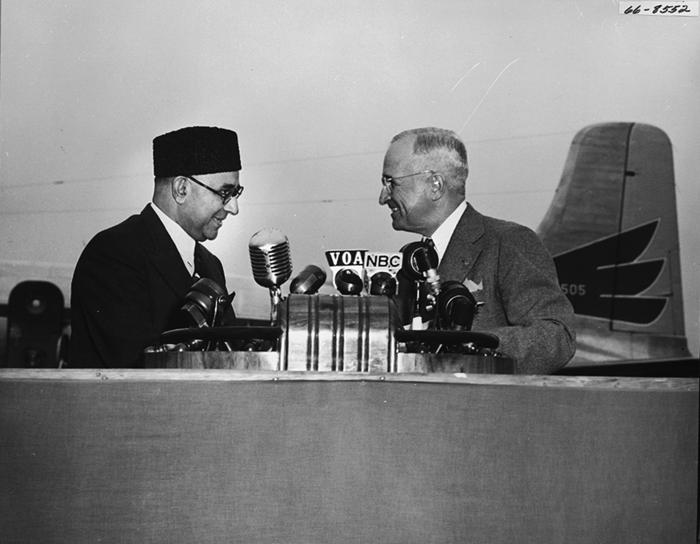
In 1949, the Soviet Union's leader, Joseph Stalin, sent an invitation to | In 1949, the Soviet Union's leader, [[Joseph Stalin]], sent an invitation to Khan to visit the country, followed by a U.S. invitation after they learned of the Soviet move. In May 1950, Khan paid a state visit to the United States after being persuaded to snap ties with the Soviet Union, and set the course of Pakistan's foreign policy toward closer ties with the West, despite it being the Soviet Union who sent its invitation of Khan to visit the country first.<ref name="Cambridge University">{{cite book|title=The Truman Presidency|last=Lacey|first=Michael James|year=1991|publisher=Cambridge University Press|isbn=0-521-40773-7|page=[https://archive.org/details/trumanpresidency0000unse/page/358 358]|url=https://archive.org/details/trumanpresidency0000unse/page/358}}</ref> The visit further cemented strong ties between the two countries and brought them closer.<ref name="Syed Mohammad Zulqarnain Ziad">{{cite journal|last=Zaidi|first=Syed Mohammad Zulqarnain|title=The Assassination of Prime minister Liaquat Ali Khan: The Fateful Journey|url=http://www.nihcr.edu.pk/Latest_English_Journal/4.%20THE%20ASSASSINATION.pdf|journal=Pakistan Journal of History and Culture |volume=XXXI |issue=1 |year=2010}}</ref>[[File:Nawabzada Liaquat Ali Khan President Truman.jpg|right|thumb|Khan with U.S. President [[Harry S. Truman]] in [[Washington, D.C.]], May 1950]]According to many sources, Khan's formulated policies were focused on [[Movement of Non-Aligned Countries]], and his trip to U.S. in 1950, Khan had made clear that Pakistan's foreign policy was neutrality.<ref name="Cambridge University" /> As a newly born nation with trouble in planning the economy, Khan asked the U.S. for economic and moral support to enable it to stand on its feet. The United States gladly accepted the offer and continued its aid throughout the years. But ties deteriorated after the United States asked Khan to send two combat divisions to support U.S. military operations in the Korean War. Khan wanted to send the divisions but asked the U.S. for assurances on Kashmir, which the U.S. declined to give. Khan decided not to send Pakistani forces to Korea, a clear indication that Pakistan was working towards the Non-Aligned Movement. The United States began work on a policy to keep Pakistan impartial, and India on the other hand, remained a keystone to bringing stability in South Asia. By June and July 1951, Pakistan's relations with U.S. deteriorated further, with Nehru visiting the United States, pressuring Pakistan to recall her troops from Kashmir.<ref name="Syed Mohammad Zulqarnain Ziad" /> | ||
{{Rquote|left|Pakistan cannot afford to wait. She must take her friends where she finds them...!|Liaquat Ali Khan calling the Soviet Union and China.| | {{Rquote|left|Pakistan cannot afford to wait. She must take her friends where she finds them...!|Liaquat Ali Khan calling the Soviet Union and China.|<ref name="The Dawn Newspaper, 17 October 2010">{{cite news|last=Aminv|first=Shahid M. |title=The foreign policy of Liaquat Ali Khan|url=http://www.dawn.com/2010/10/17/the-foreign-policy-of-liaquat-ali-khan-2.html|access-date=31 January 2012|work=[[Dawn (newspaper)|Dawn]]|date=17 October 2010}}</ref> }} | ||
Khan began to develop tighter relations with the [[ | Khan began to develop tighter relations with the Soviet Union, [[China]], [[People's Republic of Poland|Poland]], and [[Pahlavi Iran|Iran]] under its Prime Minister [[Mohammed Mossadegh]] as well. Khan sent invitations to Stalin and the Polish Communist leader [[Władysław Gomułka]] to visit the country. However, the visits never happened after Khan was assassinated and Stalin died. In 1948, Pakistan established relations with the Soviet Union, and an agreement was announced a month later. The offing of U.S. trade had frustrated Khan who sent career [[Foreign Service of Pakistan|FSO]] [[Jamsheed Marker]] as [[:Category:Ambassadors of Pakistan to the Soviet Union|Pakistan Ambassador to the Soviet Union]], a few months later, a Soviet ambasaddor, arrived in Pakistan, with her large staff and accompanied military attaches. In 1950, Khan established relations with China by sending his ambassador, making Pakistan to become first Muslim country to establish relations with China, a move which further dismayed the United States. While in Iran, Khan spoke with the Soviet Ambassador. Moscow promptly extended an invitation to him to visit the Soviet Union.<ref name="The Dawn Newspaper, 17 October 2010"/> | ||
=== | ==== The Commonwealth ==== | ||
[[File:Minister presidenten Attlee, Ali Khan, Chifley en Malan op bezoek bij koning George VI, RP-F-F01480.jpg|thumb|Khan with [[George VI]] of the [[United Kingdom]], British Prime Minister [[Clement Attlee]], Australian Prime Minister [[Ben Chifley]], and South African Prime Minister [[D. F. Malan]] at the [[1951 Commonwealth Prime Ministers' Conference]] in London]] | |||
Khan was initially apathetic about Pakistan's membership in the [[British Commonwealth|British Commonwealth of Nations]] due to the attitude of other Commonwealth leaders to the [[Partition of India]].<ref name=":0">{{Cite journal |last=Hasan |first=K. Sarwar |date=2008 |title=The Foreign Policy of Liaquat Ali Khan |url=https://www.jstor.org/stable/23726004 |journal=Pakistan Horizon |volume=61 |issue=1/2 |pages=37–52 |jstor=23726004 |issn=0030-980X}}</ref> However, he was hopeful that Pakistan's membership would produce benefits, particularly regarding a resolution to the Kashmir dispute with India. For this reason, Khan refused to attend the [[1951 Commonwealth Prime Ministers' Conference]] in [[London]] unless the conference would discuss Kashmir.<ref name=":0" /> | |||
==== Muslim world ==== | |||
Khan was a major supporter of unity within the [[Islamic world]], advocating for the independence of Muslim nations from [[European colonialism]].<ref name=":0" /> He provided diplomatic support to [[Indonesia]] during the [[Indonesian National Revolution]], declaring a public holiday in Pakistan on the occasion of Indonesia's independence. Furthermore, he visited several countries such as [[Kingdom of Egypt|Egypt]], [[Second Syrian Republic|Syria]], [[Kingdom of Iraq|Iraq]], and [[Pahlavi Iran|Iran]], alongside inviting [[Mohammad Reza Pahlavi]] to Pakistan in 1950 on an extensive state visit.<ref name=":0" /> | |||
[[ | During Khan's premiership, Pakistan's relationship with neighbouring [[Kingdom of Afghanistan|Afghanistan]] was tense due to the latter's opposition to Pakistan's entry into the [[United Nations]]. Afghanistan also supported the [[Faqir of Ipi]], a Pashtun tribal leader who revolted in [[Waziristan]], with the goal of seizing [[Pashtunistan]] from Pakistan.<ref>{{Cite book |last=Leake |first=Elisabeth |url=https://books.google.com/books?id=EUulDQAAQBAJ |title=The Defiant Border: The Afghan-Pakistan Borderlands in the Era of Decolonization, 1936–65 |date=2017 |publisher=Cambridge University Press |isbn=978-1-107-12602-2 |language=en}}</ref> In 1951, Khan was assassinated by [[Sayyid Akbar Babrak]], an Afghan national.<ref>{{Cite book |url=https://books.google.com/books?id=M-APAAAAIAAJ |title=Collier's ... Year Book Covering the Year ... |date=1952 |publisher=P.F. Collier & Son. |language=en}}</ref> | ||
=== Domestic struggles === | |||
Khan's ability to run the country was put in doubt and great questions were raised by the [[Pakistan Communist Party|communists]] and [[Pakistan Socialist Party|socialists]] active in the country.<ref name="Routeledge Publications"/> In 1947–48 period, Ali Khan-Jinnah relations was contentious, and the senior military leadership and Jinnah himself became critical of Khan's government.<ref>{{cite book|last=Kapur|first=Ashok|title=Pakistan in Crisis|year=1991|publisher=Routledge|isbn=0-203-19287-7|pages=1–10|url=https://books.google.com/books?id=4S153oESj08C&pg=PA1}}</ref> In his last months, Jinnah came to believe that his Prime Minister Khan was a weak prime minister—highly ambitious—and not loyal to Jinnah and his vision in his dying days.<ref name="Routeledge Publications"/> | |||
The death of Jinnah was announced in 1948, as a new cabinet was also re-established. Ali Khan faced the problem of religious minorities during late 1949 and early 1950, and observers feared that India and Pakistan were about to fight their second war in the first three years of their independence. At this time, Ali Khan met Indian Prime Minister [[Jawaharlal Nehru]] to sign the [[Liaquat-Nehru Pact]] in 1950. The pact was an effort to improve relations and reduce tension between India and Pakistan, and to protect the religious minorities on both sides of the border.{{citation needed|date=July 2020}} | The death of Jinnah was announced in 1948, as a new cabinet was also re-established. Ali Khan faced the problem of religious minorities during late 1949 and early 1950, and observers feared that India and Pakistan were about to fight their second war in the first three years of their independence. At this time, Ali Khan met Indian Prime Minister [[Jawaharlal Nehru]] to sign the [[Liaquat-Nehru Pact]] in 1950. The pact was an effort to improve relations and reduce tension between India and Pakistan, and to protect the religious minorities on both sides of the border.{{citation needed|date=July 2020}} | ||
Khan did not take over the office of [[Governor-General of Pakistan|Governor-General]], instead appointing [[Khawaja Nazimuddin]], a Bengali statesman from [[East Pakistan|East-Pakistan]]. When Jinnah died, he had held three major positions: Governor-General; President of Muslim League; and the [[Constituent Assembly of Pakistan|Constituent Assembly]] of which he served both its president and legal adviser. Although Ali Khan was a legislator and lawyer, he lacked Jinnah's political stature.<ref name="Routeledge Publications"/> | |||
Differences and problems also leveled up with the [[Pakistan Armed Forces]], and a local and native section of Pakistan Army was completely hostile towards Ali Khan's diplomatic approach with India. The existence of high level opposition was revealed in the [[Rawalpindi conspiracy]], sponsored by | Differences and problems also leveled up with the [[Pakistan Armed Forces]], and a local and native section of Pakistan Army was completely hostile towards Ali Khan's diplomatic approach with India. The existence of high level opposition was revealed in the [[Rawalpindi conspiracy]], sponsored by Chief of General Staff [[Akbar Khan (Pakistani general)|Akbar Khan]], and headed by communist leader [[Faiz Ahmad Faiz]]. Another difference came when Khan also intensified policies to make the country a parliamentary democracy and federal republic. During his tenure, Khan supervised the promulgation of the ''October Objectives'' in 1949 which passed by the Constituent Assembly. The document was aimed as an Islamic, democratic and federal constitution and government. Disagreement existed about the approach and methods to realise these aims.<ref name="Routeledge Publications"/> | ||
The third major difference was itself in the | The third major difference was itself in the Muslim League; the party had weak political structure with no public base ground or support. Its activities reveled in high factionalism, low commitment to resolve public problems, corruption and incompetency of planning social and economic programs. In East Pakistan, Ali Khan's lack of attention for the development of the Bengali section of the state brought about a bad juncture for the prime minister and his party, where its ideology was vague. In terms of its political base, it was both weak and narrow, and could not compete in [[West Pakistan|West-Pakistan]] as well as in [[East Pakistan|East-Pakistan]] where traditional families were endowed with enormous political power. In West Pakistan, the Muslim League failed to compete against the [[Pakistan Socialist Party|socialists]], and in East Pakistan the [[Pakistan Communist Party|communists]].<ref name="Routeledge Publications"/> | ||
===1951 military scandal=== | ==== 1951 military scandal ==== | ||
Khan's relation with [[General (United Kingdom)|General]] Sir [[Douglas Gracey]] deteriorated, prompting General Gracey to retire soon after the conflict. In January 1951, Khan approved the appointment of General [[Ayub Khan (Field Marshal)|Ayub Khan]] to succeed Gracey as the first native [[Commander-in-Chief of the Pakistan Army]]. During this time the socialists gained a significant amount of support. Senior military leaders and prominent socialists plotted to overthrow the government of Ali Khan. Those involved reportedly included [[Chief of General Staff (Pakistan)|Chief of General Staff]] Major General [[Akbar Khan (Pakistan)|Akbar Khan]] and Marxist-socialist politician [[Faiz Ahmad Faiz]], the leaders of the coup plot. The [[Pakistan Army Corps of Military Police|Military Police]] arrested many in the military services; more than 14 officers were charged for plotting the coup. The [[Rawalpindi Conspiracy Case|Rawalpindi Conspiracy]], as it became known, was the first attempted coup in Pakistan's history. The arrested conspirators were tried in secret and given lengthy jail sentences.<ref name="Bajwa154-155">{{cite book|first=Farooq Naseem |last=Bajwa |title=Pakistan: A Historical and Contemporary Look |publisher=Oxford University Press |pages=154–155 |isbn=0-19-579843-0 |year=2002}}</ref> | |||
==Assassination== | |||
{{Main|Assassination of Liaquat Ali Khan}} | |||
On 16 October 1951, Khan was shot twice in the chest while he was addressing a gathering of 100,000 at Company Bagh (Company Gardens), [[Rawalpindi]].<ref name="tribune">{{cite news |url=https://tribune.com.pk/story/93713/unexplained-assassinations/|title=Unexplained assassinations, Benazir's assassination changed Pakistan's future, but there are others that have altered the course of history |newspaper=[[The Express Tribune]] |first1=Zarrar |last1=Khuhro |date=27 December 2010|access-date=24 November 2018}}</ref><ref name="dawn">{{cite news|url=https://www.dawn.com/news/281990|title=Liaquat Bagh adds to its gory history|newspaper=[[Dawn (newspaper)|Dawn]]|date=28 December 2007|access-date=24 November 2018}}</ref> The police immediately shot the presumed murderer who was later identified as professional assassin [[Said Akbar Babrak|Said Akbar]].<ref name="dawn" /> Khan was rushed to a hospital and given a blood transfusion, but he succumbed to his injuries. Said Akbar Babrak was an Afghan national from the [[Pashtuns|Pashtun]] [[Zadran (Pashtun tribe)|Zadran tribe]].<ref>{{cite news |url=http://www.dailytimes.com.pk/default.asp?page=story_28-9-2004_pg7_47 |title=Did govt pay for Liaqat Ali Khan's casket? |date=28 September 2004 |first1=Shahzad |last1=Raza |work=[[Daily Times (Pakistan)]] |access-date=1 May 2010 |archive-url=https://web.archive.org/web/20110607031908/http://www.dailytimes.com.pk/default.asp?page=story_28-9-2004_pg7_47 |archive-date=7 June 2011}}</ref> He was known to Pakistani police prior to the assassination of Liaquat Ali Khan. The exact motive behind the assassination has never been fully revealed and much speculation surrounds it.<ref>{{cite web|url=http://www.gulfnews.com/opinion/columns/world/10329078.html|title=Key moment for Pakistan|last=Ahmed|first=Ashfaq|date=7 July 2009|access-date=18 July 2009 |work=Gulfnews|archive-url=https://web.archive.org/web/20090707233740/http://www.gulfnews.com/opinion/columns/world/10329078.html|archive-date=7 July 2009|url-status=dead}}</ref> A major overseas newspaper and an Urdu daily published in [[Bhopal]], India, saw a US hand behind the assassination.<ref name=ArabNews>{{Cite news|url=http://www.arabnews.com/node/287940|title=Declassified Papers Shed Light on US Role in Liaquat's Murder|last=Husain|first=Syed|date=18 July 2006|work=Arab News newspaper|archive-url=https://web.archive.org/web/20120519070912/https://www.arabnews.com/node/287940|url-status=dead|archive-date=19 May 2012|access-date=28 June 2025}}</ref> | |||
On 16 October 1951, Khan was shot twice in the chest while he was addressing a gathering of 100,000 at Company Bagh (Company Gardens), [[Rawalpindi]]. | |||
Said Akbar Babrak was an Afghan national from the Pashtun Zadran tribe. | |||
Upon his death, Khan was given the honorific title of | Upon his death, Khan was given the honorific title of '''Shaheed-e-Millat''' ("Martyr of the Nation"). He is buried at [[Mazar-e-Quaid]], the mausoleum built for Jinnah in [[Karachi]].<ref>{{Cite book |last=SHUKLA |first=RAJEEV |title=SCARS OF 1947 : real partition stories. |date=2021 |publisher=INDIA VIKING |isbn=978-0-670-09567-4 |location=[S.l.] |oclc=1292470044}}</ref> The Municipal Park, where he was assassinated, was renamed [[Liaquat Bagh]] (''Bagh'' means Garden) in his honor. It is the same location where ex-Prime Minister [[Benazir Bhutto]] was [[Assassination of Benazir Bhutto|assassinated]] in 2007.<ref>{{cite news|title=Doctor relives father's fate after Bhutto attack |url=http://in.reuters.com/article/topNews/idINIndia-31172420071230 |archive-url=https://web.archive.org/web/20071231195112/http://in.reuters.com/article/topNews/idINIndia-31172420071230 |url-status=dead |archive-date=31 December 2007 |publisher=Reuters |date=30 December 2007 |access-date=18 July 2009}}</ref> | ||
==First cabinet and appointments== | ==First cabinet and appointments== | ||
{{Main|Liaquat Ali Khan government}} | |||
{| cellpadding="1" cellspacing="4" style="margin:3px; background:#f8f8f8; border:1px solid #aaa; float:left;" | {| cellpadding="1" cellspacing="4" style="margin:3px; background:#f8f8f8; border:1px solid #aaa; float:left;" | ||
| Line 271: | Line 204: | ||
|align="left"|[[Finance Minister of Pakistan|Treasury]], [[Economic Coordination Committee|Economic]]||align="left"|[[Malik Ghulam Muhammad|Malik Ghulam]]||align="left"|1947–1954 | |align="left"|[[Finance Minister of Pakistan|Treasury]], [[Economic Coordination Committee|Economic]]||align="left"|[[Malik Ghulam Muhammad|Malik Ghulam]]||align="left"|1947–1954 | ||
|- | |- | ||
|align="left"|[[Law Minister of Pakistan|Law]], [[Ministry of Justice (Pakistan)|Justice]], [[Ministry of Labour (Pakistan)| | |align="left"|[[Law Minister of Pakistan|Law]], [[Ministry of Justice (Pakistan)|Justice]], [[Ministry of Labour (Pakistan)|Labour]]||align="left"|[[Jogendra Nath Mandal]]||align="left"|1947–1951 | ||
|- | |- | ||
|align="left"|[[Ministry of Interior (Pakistan)|Interior]]||[[Khwaja Shahabuddin]]||align="left"|1948–1951 | |align="left"|[[Ministry of Interior (Pakistan)|Interior]]||[[Khwaja Shahabuddin]]||align="left"|1948–1951<br/> | ||
|- | |- | ||
|align="left"|[[Defence Secretary of Pakistan|Defence]]||align="left"|[[Iskander Mirza]]||align="left"|1947–1954 | |align="left"|[[Defence Secretary of Pakistan|Defence]]||align="left"|[[Iskander Mirza]]||align="left"|1947–1954 | ||
| Line 290: | Line 223: | ||
==Legacy== | ==Legacy== | ||
[[File:LAKhan with family.jpg|thumb|right| | [[File:LAKhan with family.jpg|thumb|right|Khan with his family, 1949]] | ||
Khan is Pakistan's longest serving [[Prime Minister of Pakistan|Prime Minister]] spending 1,524 days in power.<ref>{{cite news |url=http://dawn.com/2012/06/20/gilani-loses-record-of-longest-serving-pakistan-pm/ |title=Gilani loses record of longest-serving Pakistan PM] |work=[[Dawn (newspaper)|Dawn]] |date=19 June 2012 |first1=Khawar |last1=Ghumman |access-date=3 August 2013}}</ref> His legacy was built up as a man who was the "martyr for [[Democracy in Pakistan|democracy]]" in the newly founded country. Many in Pakistan saw him as a man who sacrificed his life to preserve the parliamentary system of government. After his death, his wife remained an influential figure in the Pakistani foreign service and was [[Governor of Sindh]] Province in the 1970s. Khan's assassination remains unsolved. Popularly, he is known as '''Quaid-i-Millat''' (''Leader of the Nation'') and '''Shaheed-i-Millat''' (''Martyr of the Nation''), by his supporters. His assassination was a first political murder of any civilian leader in Pakistan, and Liaqat Ali Khan is remembered fondly by most Pakistanis. In an editorial written by ''[[Daily Jang]]'', the media summed up that "his name will remain shining forever on the horizon of Pakistan".<ref name="thenews"/> | |||
In Pakistan, Khan is regarded as [[Muhammad Ali Jinnah|Jinnah's]] "right hand man" and heir apparent. His role in filling in the vacuum created by Jinnah's death is seen as decisive in tackling critical problems during Pakistan's fledgling years and in devising measures for the consolidation of Pakistan. After his death, the government of Pakistan released a commemorative stamp and his face is printed on postage stamps across the country.<ref name="thenews"/> His former personal residence is located at Jansath Tehsil of [[Muzaffarnagar, Uttar Pradesh]] about 80&nbsp;km from his ancestral estate and is now being considered by the Uttar Pradesh government to be opened as a tourist destination.<ref name=bungalow>{{Cite news|url=https://www.indiatoday.in/india/north/story/former-pak-pm-liaquat-ali-khan-indian-heritage-muzaffarnagar-118045-2012-10-07|work=India Today|date=8 October 2012|title=Former Pak PMs Liaquat Ali Khans bungalow discovered in Muzaffarnagar, UP govt wants it as tourist destination|access-date=30 September 2017}}</ref> | |||
==Eponyms== | |||
*[[Liaquat National Memorial Library|Liaquat National Library]], Pakistan's largest library and open-source library, named after him. | |||
*[[Liaquat National Memorial Library|Liaquat National Library]], | |||
*[[Liaquat University of Medical and Health Sciences]], medical university established in the memory of Liaquat Ali Khan. | *[[Liaquat University of Medical and Health Sciences]], medical university established in the memory of Liaquat Ali Khan. | ||
*[[Liaquat National Hospital]], government hospital named after Liaquat Ali Khan. | *[[Liaquat National Hospital]], government hospital named after Liaquat Ali Khan. | ||
| Line 310: | Line 239: | ||
==Assessment of foreign policy== | ==Assessment of foreign policy== | ||
Others argue that Khan had wanted Pakistan to remain neutral in the [[Cold War]], as declared three days after Pakistan's independence when he declared that Pakistan would take no sides in the conflict of ideologies between the nations. | Others argue that Khan had wanted Pakistan to remain neutral in the [[Cold War]], as declared three days after Pakistan's independence when he declared that Pakistan would take no sides in the conflict of ideologies between the nations.<ref name="Burke147">''New York Times 18 August 1947'', cited by S.M. Burke, pg. 147.</ref> Former serviceman Shahid M. Amin has argued that the Soviets themselves could not settle convenient dates for a visit, and that, even during his visit to the United States, Liaquat had declared his intention to visit the [[Soviet Union]]. Amin also notes that "Failure to visit a country in response to its invitations has hardly ever become the cause of long-term estrangement".<ref>{{cite book |first=Shahid M. |last=Amin |title=Pakistan's Foreign Policy: A Reappraisal |date=February 2003 |pages=41–42 |publisher=Oxford University Press |isbn=0-19-579801-5}}</ref> | ||
== | ==In popular culture== | ||
In Pakistan | In Pakistan, many documentaries, stage and television dramas have been produced to enlighten Liaqat Ali Khan's struggle. Internationally, Ali Khan's character was portrayed by actor [[Shakeel|Yousuf "Shakeel" Kamal]] in the 1998 film ''[[Jinnah (film)|Jinnah]]''.<ref name="Film Jinnah">{{cite web|url=https://www.imdb.com/title/tt0183306/|title=Jinnah (1998)|website=[[IMDb]]|access-date=25 January 2007}}</ref> | ||
==See also== | ==See also== | ||
{{Portal|Conservatism|Biography|Pakistan|Punjab}} | |||
* [[Conservatism in Pakistan]] | * [[Conservatism in Pakistan]] | ||
* [[Pakistan Muslim League (N)|Pakistan Muslim League]] | * [[Pakistan Muslim League (N)|Pakistan Muslim League]] | ||
* [[History of Pakistan]] | * [[History of Pakistan]] | ||
* [[List of unsolved murders ( | * [[List of unsolved murders (1900–1979)]] | ||
* [[Cold War (1947–53)|History of Cold War (1947–1953)]] | * [[Cold War (1947–53)|History of Cold War (1947–1953)]] | ||
* [[State within a state]] | * [[State within a state]] | ||
* [[Pakistani political families]] | * [[Pakistani political families]] | ||
* [[Sack of Pakistani consulates in Afghanistan 1955]] | |||
== Notes == | == Notes == | ||
| Line 332: | Line 262: | ||
==Further reading== | ==Further reading== | ||
{{ | *{{cite news|url=https://www.dawn.com/news/1362909|title=The much misunderstood Premier|work=Dr. Muhammad Reza Kazimi|publisher=[[Dawn News]]}} | ||
*{{cite book|last=Kazmi|first=Muhammad Raza|title=Liaquat Ali Khan and the freedom movement|location=Lahore|publisher= Pakistan Study Centre|year=1997|asin=B0006FBFSA}} | *{{cite book|last=Kazmi|first=Muhammad Raza|title=Liaquat Ali Khan and the freedom movement|location=Lahore|publisher= Pakistan Study Centre|year=1997|asin=B0006FBFSA}} | ||
*{{cite book|last=Wolpert|first=Stanley|author-link=Stanley Wolpert|title=Dear Mr. Jinnah': Selected Correspondence and Speeches of Liaquat Ali Khan, 1937 – 1947 |location=United Kingdom|publisher= Oxford University Press|year=2005|isbn=978-0-19-597709-7}} | *{{cite book|last=Wolpert|first=Stanley|author-link=Stanley Wolpert|title=Dear Mr. Jinnah': Selected Correspondence and Speeches of Liaquat Ali Khan, 1937 – 1947 |location=United Kingdom|publisher= Oxford University Press|year=2005|isbn=978-0-19-597709-7}} | ||
*{{cite book|last=Hay|first=Stephen|title=Sources of Indian Tradition: Modern India and Pakistan |location=United States|publisher=Columbia University Press |year=1988|isbn=0-231-06415-2}} | *{{cite book|last=Hay|first=Stephen|title=Sources of Indian Tradition: Modern India and Pakistan |location=United States|publisher=Columbia University Press |year=1988|isbn=0-231-06415-2}} | ||
*{{cite book|last=Jone|first=Owen Bennett|title=Pakistan: An eye of storm|location=Yale University, U.S.|publisher=Yale University Press|year=2002|isbn=978-0-300-09760-3|url-access=registration|url=https://archive.org/details/pakistaneyeofsto00benn}} | *{{cite book|last=Jone|first=Owen Bennett|title=Pakistan: An eye of storm|location=Yale University, U.S.|publisher=Yale University Press|year=2002|isbn=978-0-300-09760-3|url-access=registration|url=https://archive.org/details/pakistaneyeofsto00benn}} | ||
==External links== | ==External links== | ||
{{Commons category}} | |||
{{Wikiquote}} | |||
* [http://www.trumanlibrary.org/photographs/ Pictures of Liaquat Ali Khan's Visit to the USA]—type Pakistan in the search bar. | * [http://www.trumanlibrary.org/photographs/ Pictures of Liaquat Ali Khan's Visit to the USA]—type Pakistan in the search bar. | ||
| Line 370: | Line 299: | ||
[[Category:1895 births]] | [[Category:1895 births]] | ||
[[Category:1951 deaths]] | [[Category:1951 deaths]] | ||
[[Category: | [[Category:Muhajir people]] | ||
[[Category:Aligarh Muslim University alumni]] | [[Category:Aligarh Muslim University alumni]] | ||
[[Category:Alumni of Exeter College, Oxford]] | [[Category:Alumni of Exeter College, Oxford]] | ||
[[Category:Faculty of Law, Aligarh Muslim University alumni]] | [[Category:Faculty of Law, Aligarh Muslim University alumni]] | ||
[[Category:All India Muslim League | [[Category:All-India Muslim League politicians]] | ||
[[Category:Members of the Central Legislative Assembly of India]] | [[Category:Members of the Central Legislative Assembly of India]] | ||
[[Category:Leaders of the Pakistan Movement]] | [[Category:Leaders of the Pakistan Movement]] | ||
[[Category:Indian people of World War II]] | [[Category:Indian people of World War II]] | ||
[[Category: | [[Category:Ministers of finance of India]] | ||
[[Category:Pakistani people of | [[Category:Pakistani people of Haryanvi descent]] | ||
[[Category:Prime | [[Category:Prime ministers of Pakistan]] | ||
[[Category:Pakistani MNAs 1947–1954]] | [[Category:Pakistani MNAs 1947–1954]] | ||
[[Category:First Pakistani Cabinet]] | [[Category:First Pakistani Cabinet]] | ||
[[Category:Pakistani anti-communists]] | [[Category:Pakistani anti-communists]] | ||
[[Category: | [[Category:Ministers for foreign affairs of Pakistan]] | ||
[[Category: | [[Category:Ministers of defence of Pakistan]] | ||
[[Category:Assassinated | [[Category:Assassinated prime ministers]] | ||
[[Category:Deaths by firearm in Pakistan]] | [[Category:Deaths by firearm in Pakistan]] | ||
[[Category:Unsolved murders in Pakistan]] | [[Category:Unsolved murders in Pakistan]] | ||
[[Category:Members of the Constituent Assembly of Pakistan]] | [[Category:Members of the Constituent Assembly of Pakistan]] | ||
[[Category:1950s assassinated | [[Category:Politicians assassinated in the 1950s]] | ||
[[Category:Pakistani politicians assassinated in the 20th century]] | |||
[[Category:People from Punjab Province (British India)]] | |||
[[Category:People murdered in Punjab, Pakistan]] | |||
Revision as of 14:24, 16 March 2026
Shaheed-e-Millatt Liaquat Ali Khan | |
|---|---|
لیاقت علی خان | |
 Official portrait, c. 1945 | |
| 1st Prime Minister of Pakistan | |
| In office 15 August 1947 – 16 October 1951 | |
| Monarch | George VI |
| Governor-General | Muhammad Ali Jinnah (1947–1948) <br> Khawaja Nazimuddin (1948–1951) |
| Preceded by | Position established |
| Succeeded by | Khawaja Nazimuddin |
| 1st Minister of Defence | |
| In office 15 August 1947 – 16 October 1951 | |
| Preceded by | Office established |
| Succeeded by | Khawaja Nazimuddin |
| 1st Minister of Foreign Affairs | |
| In office 15 August 1947 – 27 December 1949 | |
| Deputy | Mohammed Ikramullah |
| Preceded by | Office established |
| Succeeded by | Muhammad Zafarullah Khan |
| Minister for Kashmir and Frontier Affairs | |
| In office 15 August 1947 – 16 October 1951 | |
| Preceded by | Office established |
| Succeeded by | Mahmud Hussain |
| Minister of Finance of British India | |
| In office 29 October 1946 – 14 August 1947 | |
| Monarch | George VI |
| Governor General | Archibald Wavell (1943–1947) <br> Lord Mountbatten (1947) |
| Vice President | Jawaharlal Nehru |
| Preceded by | Office established |
| Succeeded by | Office abolished |
| President of the Pakistan Muslim League | |
| In office 11 September 1948 – 17 October 1951 | |
| Preceded by | Muhammad Ali Jinnah |
| Succeeded by | Khawaja Nazimuddin |
| Personal details | |
| Born | 1 October 1895 Karnal, Punjab, British India (present-day Haryana, India) |
| Died | 16 October 1951 (aged 56) Rawalpindi, West Punjab, Dominion of Pakistan |
| Cause of death | Assassination |
| Resting place | Mazar-e-Quaid |
| Nationality | British Indian (1895–1947)<br />Pakistani (1947–1951) |
| Political party | All-India Muslim League (1921–1947)<br/>Pakistan Muslim League (1947–1951) |
| Spouse(s) | |
| Children |
|
| Alma mater | Aligarh Muslim University<br />(BSc in Polysci)<br />Oxford University<br />(LL.B. in Jurisprudence) |
Template:Liaquat Ali Khan sidebar Liaquat Ali Khan[lower-alpha 1] (1 October 1895 – 16 October 1951) was a Pakistani lawyer, politician and statesman who served as the first prime minister of Pakistan from 1947 until his assassination in 1951. He played a key role in consolidating the state of Pakistan, much as Muhammad Ali Jinnah did in founding it. A leading figure in the Pakistan Movement, he is revered as Quaid-e-Millat ("Leader of the Nation") and Shaheed-e-Millat ("Martyr of the Nation").
Khan was born in Karnal, Haryana, to a wealthy family. His grandfather, Nawab Ahmad Ali, provided significant support to the British during the Mutiny uprising of 1857–1858, earning him substantial rewards in the form of prestigious honours and complete remission of rent. Khan was educated at the Aligarh Muslim University and the University of Oxford. After first being invited to the Indian National Congress, he later opted to join the All-India Muslim League led by Muhammad Ali Jinnah, an Indian independence activist who later advocated for a separate Muslim nation-state out of Hindu-majority India. Khan assisted Jinnah in the campaign for what would become known as the Pakistan Movement and was known as his 'right hand'. He was a democratic political theorist who promoted parliamentarism in British India.<ref>"Liyāḳat ʿAlī K̲h̲ān". Encyclopaedia of Islam New Edition Online (EI-2 English). Brill. 2012. doi:10.1163/1573-3912_islam_sim_4678.</ref>
Khan's premiership oversaw the beginning of the Cold War, in which Khan's foreign policy sided with the United States-led Western Bloc over the Soviet Union-led Eastern Bloc. He promulgated the Objectives Resolution in 1949, which stipulated Pakistan to be an Islamic democracy. He also held cabinet portfolio as the first foreign minister, defence minister, and frontier regions minister from 1947 until his assassination in 1951. Prior to the part, Khan briefly tenured as Finance minister of British India in the Interim Government that undertook independence of Pakistan and India, led by Louis Mountbatten, the then-Viceroy of India. In March 1951, he survived an attempted coup by left-wing political opponents and segments of the Pakistani military. While delivering a speech in the Company Bagh of Rawalpindi, Khan was shot dead by an Afghan militant Said Akbar for unknown reasons.
Early life and education
Nawabzada Liaquat Ali Khan was born on 1 October 1895 into a Muslim Jat family in the Karnal, Punjab Province with root in Talera village of Jansath Tehsil in Muzaffarnagar District of present day-Uttar Pradesh.<ref name=Lentz1995>Lentz, Harris M. (1995). "Pakistan, Islamic Republic of". Heads of States and Governments Since 1945. Abingdon, Oxon: Routledge. p. 1968. ISBN 1884964443.</ref><ref name="Kazmi 2003 xv">Kazmi, Muhammad Raza (2003). Liaquat Ali Khan: His Life and Work. Oxford University Press. p. xv. ISBN 978-0-19-579788-6.</ref> He was the second of four sons of the wealthy land owner Rukn-ud-Daulah Shamsher Jung Nawab Bahadur Rustam Ali Khan of Karnal and his wife, Mahmoodah Begum, the daughter of Nawab Quaher Ali Khan of Rajpur in Saharanpur.<ref name="Kazmi 2003 xv"/><ref name=Long1984>Long, Roger D. (1 October 1984). "The Early Life of the Quaid-i-Millat Liquat Ali Khan". Journal of the Pakistan Historical Society. 32 (4). Karachi: Pakistan Historical Society: 269.</ref><ref name=Allana1969>Allana, G. (1969). Eminent Muslim freedom fighters 1562–1947: Twenty one great lives. Delhi: Neeraj Publishing House. pp. 281–294.</ref> He received his early education at home before attending school in Karnal.<ref name=Allana1969/><ref name=Burki2011>Burki, Shahid Javed (2011). "Liaqat Ali Khan (1895–1951), prime minister of Pakistan". Oxford Dictionary of National Biographies. Oxford Dictionary of National Biography (online ed.). Oxford University Press. doi:10.1093/ref:odnb/34527. Template:ODNBsub</ref><ref>Naqvi, Jawed (13 October 2020). "Partition short-changed the poor". Dawn. Retrieved 24 January 2022.</ref><ref>"Remembering Nawabzada Liaquat Ali Khan". The News. 16 October 2018. Retrieved 24 January 2022.</ref> Khan was instructed in the Qur’an and hadith and was also given music lessons, learning to play the harmonium and flute; in addition, he developed an interest in singing and theatre.<ref name=":1">Khan, Liaquat Ali; Long, Roger D. (2004). "Dear Mr. Jinnah": selected correspondence and speeches of Liaquat Ali Khan, 1937-1947. Karachi: Oxford University Press. pp. XV. ISBN 978-0-19-597709-7.</ref> From an early age he showed strong religious devotion, choosing to observe the Ramadan fast at the age of four and participating in tazia processions during Muharram, even organizing and leading his own tazia at a young age.<ref name=":2" />
Despite being "courteous, affable and socially popular" and coming from an aristocratic family known for its philanthropy, his biographer Muhammad Reza Kazimi notes that little is known of his early life and that which has to be pieced together from snippets of mostly hagiographic writings. The family claimed a Persian origin going back to Nausherwan the Just, the Sasanian king of Persia, although this may be apocryphal, and were settled in Uttar Pradesh by the time of the birth of his grandfather, Nawab Ahmad Ali Khan.<ref name=Kazmi2003>Kazmi, Muhammad Raza (2003). Liaquat Ali Khan: His Life and Work. Oxford University Press. pp. 3–4. ISBN 978-0-19-579788-6.</ref> They had adopted the Urdu language.<ref name=Shah1997>Shah, Mehtab Ali (1997). The Foreign Policy of Pakistan: Ethnic Impacts on Diplomacy 1971–1994. I.B. TAURUS. p. 51. ISBN 978-1860641695.</ref> Khan identified as a Punjabi.<ref name=":1" />
According to his family, Khan gained sufficient prestige that the British East India Company recognised him with titles such as Rukun-al-Daulah, Shamsher Jang and Nawab Bahadur, which they say were later inherited by his sons. The validity of those titles has been questioned because the family estates in Uttar Pradesh were diminished as a result of the Indian Rebellion of 1857, after which Uttar Pradesh itself ceased to be an autonomous area.<ref>Kazmi, Muhammad Raza (2003). Liaquat Ali Khan: His Life and Work. Oxford University Press. pp. 4–5. ISBN 978-0-19-579788-6.</ref> His family had deep respect for the Indian Muslim thinker and philosopher Syed Ahmad Khan, and his father had a desire for young Liaquat Ali Khan to be educated in the British educational system. He was sent to Aligarh Muslim University (AMU), where he earned degrees in law and political science.<ref>Khan, Feisal (2015). Islamic banking in Pakistan: Shariah-compliant finance and the quest to make Pakistan more Islamic. New York. ISBN 978-1-317-36652-2. OCLC 933433178.{{cite book}}: CS1 maint: location missing publisher (link)</ref>
In 1913, Khan attended the Muhammadan Anglo-Oriental College (now Aligarh Muslim University), graduating with a BSc degree in Political science and LLB in 1918, and married his cousin, Jehangira Begum, also in 1918, however the couple later separated.<ref>VERMA, RAJ GOPAL SINGH (2022). LADY OF TWO NATIONS : life and times of raana liaqat ali khan. [S.l.]: GLOBAL COLLECTIVE PUB. ISBN 978-1-954021-87-7. OCLC 1266643358.</ref> At Aligarh, he expanded his range of interests, captaining the cricket team and learning to play chess; he also continued his musical education by studying classical Hindustani vocal music and taking piano lessons.<ref name=":2" /> After the death of his father in 1919, he attended Oxford University's Exeter College to pursue his higher education.<ref name=Lentz1995/> In 1921, Khan was awarded the Master of Law in Law and Justice, by the college faculty who also conferred on him a Bronze Medallion.[citation needed] While a graduate student at Oxford, Khan actively participated in student unions and was elected Treasurer of the Majlis Society—a student union founded by Indian students to promote the Indian students' rights at the university.<ref>"Liaquat Ali Khan | Making Britain". university.open.ac.uk. Retrieved 18 August 2025.</ref> He was called to the Bar at the Inner Temple of London in 1922 but never practised.<ref name=":2">Kazmi, Muhammad Raza (2003). Liaquat Ali Khan: His Life and Work. Oxford University Press. pp. 7–9. ISBN 978-0-19-579788-6.</ref>
Political activism in British India
Khan returned to India in 1923, entering in national politics, determined to eradicate what he viewed as the injustice and ill-treatment of Indian Muslims under the British Indian Department and by the British government.<ref>Tripathi, Amales (2014). Indian National Congress and the struggle for freedom, 1885–1947. New Delhi, India. ISBN 978-0-19-809055-7. OCLC 893721656.{{cite book}}: CS1 maint: location missing publisher (link)</ref> His political philosophy strongly emphasised a united India, first gradually believing in Indian nationalism. The Congress leadership approached Khan to become a part of the party, but after attending the meeting with Jawaharlal Nehru, Khan's political views and ambitions gradually changed. Khan refused, informing the Congress Party about his decision, and instead joining the Muslim League in 1923, led under another lawyer Muhammad Ali Jinnah who called for an annual session meeting in May 1924 in Lahore where the goals, boundaries, party programs, vision, and revival of the League, was an initial party agenda and was carefully discussed at the Lahore caucus. At this meeting, Khan was among those who attended this conference, and recommending the new goals for the party.[citation needed]
United Province legislation
Khan was elected to the provisional legislative council in the 1926 elections from the rural Muslim constituency of Muzaffarnagar. Khan embarked his parliamentary career, representing the United Provinces at the Legislative Council in 1926. In 1932, he was unanimously elected Deputy President of UP Legislative Council.<ref>OpenLibrary.org. "Liaquat Ali Khan and the freedom movement (1997 edition)". Open Library. Retrieved 12 August 2022.</ref>
During this time, Khan intensified his support for Muslim-dominated populations, often raising the problems and challenges faced by the Muslim communities in the United Province. Khan joined academician Sir Ziauddin Ahmed, taking to organise the Muslim students' communities into one student union, advocating for the provisional rights of the Muslim state. His strong advocacy for Muslims' rights had brought him into national prominence and significant respect was also gained from Hindu communities whom he fought for at higher levels of the government. Khan remained the elected member of the UP Legislative Council until 1940, when he was elected to the Central Legislative Assembly; he participated actively, and was the influential member in legislative affairs, where his recommendations would also be noted by other members.[citation needed]
During his parliamentary career, Khan established his reputation as "eloquent, principled and honest spokesman" who would never compromise on his principles even in the face of severe odds. Khan, on several occasions, used his influence and good offices for the resolution of communal tension.<ref name="Directorate-Press of the Story of Pakistan">"Liaquat Ali Khan (Part II)". Story of Pakistan. Directorate-Press of the Story of Pakistan. Archived from the original on 5 February 2012. Retrieved 30 January 2012.</ref>
Joining the Muslim League
Khan rose to become one of the influential members of the Muslim League and was one of the central figures in the Muslim League delegation that attended the National Convention held at Calcutta. Earlier, the British Government had formed the Simon Commission to recommend the constitutional and territorial reforms to the British Government. The commission, compromising seven British Members of Parliament, headed under its Chairman Sir John Simon, met briefly with the Congress Party and Muslim League leaders. The commission had introduced the system of dyarchy to govern the provinces of British India, but these revisions met with harsh criticism and clamour by the Indian public. Motilal Nehru presented his Nehru Report to counter British charges.<ref name="Atlantic Publisher and Distributors">Ikram, S. M. (1992). Indian Muslims and Partition of India. New Delhi: Atlantic Publisher and Distributors. p. 432. ISBN 9788171563746.</ref>
In December 1928, Khan and Jinnah decided to discuss the Nehru Report. In 1930, Khan and Jinnah attended the First Round Table Conference which ended in disaster, leading Jinnah to depart from British India to the UK.<ref name="political career">"Liaquat Ali Khan [1895–1951]: Political career". Archived from the original on 18 November 2006. Retrieved 16 October 2006.</ref> In 1932, Khan married for a second time to Begum Ra'ana who was a prominent economist and academic who became an influential figure in the Pakistan movement.<ref>Pirbhai, M. Reza (2017). Fatima Jinnah. Cambridge University Press. p. 68. ISBN 978-1-10813-172-8.</ref>
In his party presidential address delivered at the Provisional Muslim Education Conference at AMU in 1932, Khan expressed the view that Muslims had "distinct [c]ulture of their own and had the (every) right to persevere it".<ref name="Atlantic Publisher and Distributors"/> At this conference, Khan announced that:
Error: No text given for quotation (or equals sign used in the actual argument to an unnamed parameter)
Soon, he and his new wife departed to England but did not terminate his connections with the Muslim League. With Khan departing, the Muslim League's parliamentary wing disintegrated, with many Muslim members joining the either Democratic Party, originally organised by Khan in 1930, and the Congress Party. At the deputation in England, Khan made close study of organising the political parties and would soon return to his country with Jinnah.<ref name="Atlantic Publisher and Distributors"/>
In 1930, Jinnah urged Prime Minister Ramsay MacDonald and his Viceroy Lord Irwin to convene a Round Table Conferences in London. In spite of what Jinnah was expecting, the conference was a complete failure, forcing Jinnah to retire from national politics and permanently settle in London and practise law before the Privy Council.<ref name="thenews">Liaquat Ali Khan: A worthy successor to the Quaid, Prof Dr M Yakub Mughal Archived 31 December 2007 at the Wayback Machine, The News International Special Edition. Retrieved on 31 December 2006.</ref><ref name="Oriental Academy, 1970">Ziauddin Ahmad (1970). Liaquat Ali Khan, leader and statesman. Islamabad, Pakistan: Oriental Academy, 1970.</ref>[page needed]
During this time, Khan and his wife joined Jinnah, with Khan practising economic law and his wife joining the faculty of economics at the local college. The couple spent most of their time convincing Jinnah to return to British India to unite the scattered Muslim League mass into one full force. Meanwhile, Choudhry Rahmat Ali coined the term Pakistan in his famous pamphlet Now or Never; Are We to Live or Perish Forever?<ref name="Oriental Academy, 1970"/>[page needed]
Pakistan Movement
 | This section needs additional citations for verification. (June 2025) |
In 1930, Jinnah, along with his sister Fatima and daughter Dina, decided to settle in London. When the Muslim India and the All India Muslim League became a divided house, Liaquat and his wife Ra'na went to England and met with Jinnah and his family in July 1933 at their Hampstead residence in London. There they convinced him to return to India to save the Muslims from further division. Jinnah returned to India in December 1934 and started to reorganize the All-India Muslim League. In 1936, the annual session of the League met in Bombay (now Mumbai). In the open session on 12 April 1936, Jinnah moved a resolution proposing Khan as the Honorary General Secretary. The resolution was unanimously adopted and he held the office until the establishment of Pakistan in 1947. In 1940, Khan was made the deputy leader of the Muslim League Parliamentary party. Jinnah was not able to take active part in the proceedings of the Assembly due to his heavy political workload. Khan stood in his place.
During this period, Khan was also the Honorary General Secretary of the Muslim League, the deputy leader of their party, Convenor of the Action Committee of the Muslim League, Chairman of the Central Parliamentary Board and the managing director of the newspaper Dawn. The Pakistan Resolution was adopted in 1940 at the Lahore session of the Muslim League. The same year elections were held for the central legislative assembly which were contested by Khan from the Barielly constituency. He was elected without contest. When the twenty-eighth session of the League met in Madras (now Chennai) on 12 April 1941, Jinnah told party members that the ultimate aim was to obtain Pakistan. In this session, Khan moved a resolution incorporating the objectives of the Pakistan Resolution in the aims and objectives of the Muslim League. The resolution was seconded and passed unanimously.

In 1945–46, mass elections were held in India and Khan won the Central Legislature election from the Meerut Constituency in the United Provinces. He was also elected Chairman of the League's Central Parliamentary Board. The Muslim League won 87% of seats reserved for Muslims of British India.<ref name="Bajwa130">Bajwa, Farooq Naseem (2002). Pakistan: A Historical and Contemporary Look. Oxford University Press. p. 130. ISBN 0-19-579843-0.</ref> He assisted Jinnah in his negotiations with the members of the Cabinet Mission and the leaders of the Congress during the final phases of the Freedom Movement and it was decided that an interim government would be formed consisting of members of the Congress, the Muslim League and minority leaders. When the Government asked the Muslim League to send five nominees for representation in the interim government, Khan was asked to lead the League group in the cabinet. He was given the portfolio of finance.[citation needed] The other four men nominated by the League were Ibrahim Ismail Chundrigar, Ghazanfar Ali Khan, Abdur Rab Nishtar, and Jogendra Nath Mandal.<ref>The Leader – Government of Pakistan Archived 26 December 2008 at the Wayback Machine</ref> By this point, the British government and the Indian National Congress had both accepted the idea of Pakistan, which came into existence on 14 August 1947.<ref name="political career"/>
Prime Minister of Pakistan (1947–1951)
After independence, Khan was appointed the first Prime Minister of Pakistan by the founding fathers of Pakistan. The country was born during the initial beginning of the extensive competition between the two world superpowers, the United States and Soviet Union. Khan faced with mounted challenges and difficulties while trying to administer the country. Khan and the Muslim League faced dual competitions with socialists in West-Pakistan and, the communists in East Pakistan. The Muslim League found it difficult to compete with socialists in West Pakistan, and lost considerable support in favor of socialists led by Marxist leader Faiz Ahmad Faiz. In East Pakistan, the Muslim League's political base was eliminated by both the newly-formed All-Pakistan Awami League led by Huseyn Shaheed Suhrawardy and the Communist Party of Pakistan led by Sajjad Zaheer. On the internal front, Khan, faced with socialist nationalist challenges and different religious ideologies saw the country fall into more unrest. Problems with Soviet Union and Soviet bloc further escalated after Khan failed to make a visit to Soviet Union, despite his intentions. Khan envisioned a non-aligned foreign policy, however despite some initiatives, the country became more dependent on the United States and this ultimately influenced Khan's policy towards the Western bloc.<ref name="Oxford University Press, 2003"/>
His government faced serious challenges including the dispute over Kashmir with India, forcing Khan to approach his counterpart the Prime Minister of India Jawaharlal Nehru. A settlement was reached to end the fighting, while Nehru also referred the issue to the United Nations. Ali Khan sent the recommendation to Jinnah to appoint Abdul Rashid as the country's first Chief Justice, and Justice Abdur Rahim as President of the Constitutional Assembly, both of them were also founding fathers of Pakistan. Some of the earliest reforms Khan took were to centralise the Muslim League, and he planned and prepared the Muslim League to become the leading authority of Pakistan.<ref name="Oxford University Press, 2003">Kazmi, Muhammad Raza (2003). Liaquat Ali Khan: his life and work. United Kingdom: Oxford University Press, 2003. p. 354. ISBN 978-0-19-579788-6.</ref>
The Daily Times, a leading English-language newspaper, held Khan responsible for mixing religion and politics, pointing out, "Liaquat Ali Khan had no constituency in the country, his hometown was left behind in India. Bengalis were a majority in the newly created state of Pakistan and this was a painful reality for him". According to the Daily Times, Khan and his legal team restrained from writing down the constitution, the reason being simple: The Bengali demographic majority would have been granted political power and, Liaquat Ali Khan would have been sent out of the prime minister's office. The Secularists also held him responsible for promoting the Right-wing political forces controlling the country in the name of Islam and further politicised the Islam, despite its true nature.<ref name="The Daily Times, 2010">Shahid, Riaz (15 February 2010). "Reassessing Liaquat Ali Khan's role". The Daily Times. Retrieved 31 January 2012.</ref>
Economy

In 1947, Khan and his Finance minister Malick Ghulam proposed the idea of Five-Year Plans, by putting the country's economic system on investment and capitalism grounds. Focusing on an initial planned economic system under the directives of private sector and consortium industries in 1948, economic planning began to take place during his time in office, but soon collapsed partly because of unsystematic and inadequate staffing. Khan's economic policies were soon heavily dependent on United States aid to the country. In spite of planning an independent economic policy, Khan's economic policies focused on the United States' aid programme, on the other hand, Nehru focused on socialism and went on to be a part of Non Aligned Movement.<ref name="United States Government">"Pakistan: Problems at Independence". April 1994. United States Government. Retrieved 30 January 2012.</ref> An important event during his premiership was the establishment of a National Bank in November 1949, and the installation of a paper currency mill in Karachi.<ref name="Prime minister">"Liaquat Ali Khan: The Prime minister 2, Story of Pakistan". Archived from the original on 11 May 2006. Retrieved 16 October 2006.</ref> Unlike his Indian counterpart Jawaharlal Nehru, under Khan Pakistan's economy was planned, but also an open free market economy.<ref name="United States Government" />
Education
Khan took initiatives to develop educational infrastructure, science and technology in the country, with the intention of carrying the vision of successful development of science and technology to aid the essential foreign policy of Pakistan. In 1947, with Jinnah inviting physicist Rafi Muhammad Chaudhry to Pakistan, Liaquat Ali Khan called upon chemist Salimuzzaman Siddiqui, awarding him citizenship, and appointing him as his first government science adviser in 1950. Khan called physicist and mathematician Raziuddin Siddiqui, asking him to plan and establish educational research institutes in the country. Khan asked Ziauddin Ahmed to draft the national educational policy, which was submitted to his office in November 1947, and a road map to establishing education in the country was quickly adopted by Khan's government.<ref name="The Dawn Newspapers">Bhatnagar, Arun (20 November 2011). "A leaf from history: Pioneers in science". Dawn. Retrieved 30 January 2012.</ref> Khan's government authorised the establishment of the Sindh University. Under his government, science infrastructure was slowly built but he continued inviting Muslim scientists and engineers from India to Pakistan, believing it essential for Pakistan's future progress.<ref name="The Dawn Newspapers" />
Constitutional reforms
During his early days in office, Khan first adopted the Government of India Act 1935 to administer the country, although his lawmakers and legislators continued to work on a different document of governance. Finally in 1949 after Jinnah's death, Prime Minister Khan intensified his vision to establish an Islamic-based system in the country, presenting the Objectives Resolution—a prelude to future constitutions, in the Constituent Assembly.<ref name="Press Directorate of the Story of Pakistan, Constitutional history">"Objectives Resolution is passed [1949]". Story of Pakistan Foundation. Press Directorate of the Story of Pakistan, Constitutional history. Archived from the original on 19 December 2010. Retrieved 30 January 2012.</ref> The house passed it on 12 March 1949, but it was met with criticism from his Law Minister Jogendra Nath Mandal who argued against it.<ref>Tan, Tai Yong; Kudaisya, Gyanesh (2000). The Aftermath of Partition in South Asia. Routledge. ISBN 0-415-17297-7.</ref>[page needed] Severe criticism were also raised by MP Ayaz Amir On the other hand, Liquat Ali Khan described as this bill as the "Magna Carta" of Pakistan's constitutional history.<ref name="1df">"Pakistan at fifty-five: From Jinnah to Musharraf" (PDF). Archived from the original (PDF) on 7 February 2007. Retrieved 25 January 2007.</ref> Khan called it "the most important occasion in the life of this country, next in importance, only to the achievement of independence". Under his leadership, a team of legislators also drafted the first report of the Basic Principle Committee and work began on the second report.<ref name="Press Directorate of the Story of Pakistan, Constitutional history"/>
Foreign policy
Kashmir dispute

At a meeting of the Partition Council, Khan had rejected an offer from Vallabhbhai Patel regarding Kashmir and Hyderabad State. Patel had offered Kashmir to Pakistan in exchange for Pakistan relinquishing its claim to Hyderabad. Ali rejected this offer, preferring to keep Hyderabad, ignoring that the distance between the two would prevent Hyderabad's accession to Pakistan in any case. Pakistani statesman Shaukat Hayat Khan resigned in protest of this folly; Hyderabad went to India anyway after the two nations went to war over Kashmir.<ref>"When neither India nor Pakistan wanted Kashmir". The National Herald. July 2018. Retrieved 29 December 2019.</ref><ref>Gandhi, Rajmohan (27 June 2018). "Patel wanted Hyderabad for India, not Kashmir – but Junagadh was the wild card that changed the game". Scroll.in. Retrieved 29 December 2019.</ref>
Soon after appointing a new government, Pakistan entered a war with India over Kashmir. The British commander of the Pakistan Army General Sir Frank Walter Messervy refused to attack the Indian army units. When General Douglas Gracey was appointed the commander in chief of the Pakistan Army, Liaquat Ali Khan ordered the independent units of the Pakistan Army to intervene in the conflict. On the Kashmir issue, Khan and Jinnah's policy reflected "Pakistan's alliance with [the] U.S and United Kingdom" against "Indian imperialism" and "Soviet expansion". However, it is revealed by historians that differences and disagreement with Jinnah arose over the Kashmir issue. Jinnah's strategy to liberate Kashmir was to use military force. Thus, Jinnah's strategy was to "kill two birds with one stone", namely decapitate India by controlling Kashmir, and to find a domestic solution through foreign and military intervention.<ref name="Routeledge Publications">Kapur, Ashok (1991). Pakistan in Crisis. Routledge. pp. 1–10, 24–50. ISBN 0-203-19287-7.</ref>
Regarding Khan's personal accounts and views, the prime minister preferred a "harder diplomatic" and "less military stance".<ref name="Routeledge Publications"/> The prime minister sought a dialogue with his counterpart, and agreed to resolve the dispute of Kashmir in a peaceful manner through the efforts of the United Nations. According to this agreement a ceasefire was effected in Kashmir on 1 January 1949. It was decided that a free and impartial plebiscite would be held under the supervision of the UN.<ref name="gf">"RESOLUTION 47 (1948) ON THE INDIA-PAKISTAN QUESTION". Archived from the original on 18 February 2007. Retrieved 25 January 2007.</ref> The prime minister's diplomatic stance was met with hostility by the Pakistan Armed Forces and the socialists and communists, notably the mid-higher level command who would later sponsor an alleged coup led by the communists and socialists against his government.<ref name="Routeledge Publications"/>
Cold War
In 1949, the Soviet Union's leader, Joseph Stalin, sent an invitation to Khan to visit the country, followed by a U.S. invitation after they learned of the Soviet move. In May 1950, Khan paid a state visit to the United States after being persuaded to snap ties with the Soviet Union, and set the course of Pakistan's foreign policy toward closer ties with the West, despite it being the Soviet Union who sent its invitation of Khan to visit the country first.<ref name="Cambridge University">Lacey, Michael James (1991). The Truman Presidency. Cambridge University Press. p. 358. ISBN 0-521-40773-7.</ref> The visit further cemented strong ties between the two countries and brought them closer.<ref name="Syed Mohammad Zulqarnain Ziad">Zaidi, Syed Mohammad Zulqarnain (2010). "The Assassination of Prime minister Liaquat Ali Khan: The Fateful Journey" (PDF). Pakistan Journal of History and Culture. XXXI (1).</ref>

According to many sources, Khan's formulated policies were focused on Movement of Non-Aligned Countries, and his trip to U.S. in 1950, Khan had made clear that Pakistan's foreign policy was neutrality.<ref name="Cambridge University" /> As a newly born nation with trouble in planning the economy, Khan asked the U.S. for economic and moral support to enable it to stand on its feet. The United States gladly accepted the offer and continued its aid throughout the years. But ties deteriorated after the United States asked Khan to send two combat divisions to support U.S. military operations in the Korean War. Khan wanted to send the divisions but asked the U.S. for assurances on Kashmir, which the U.S. declined to give. Khan decided not to send Pakistani forces to Korea, a clear indication that Pakistan was working towards the Non-Aligned Movement. The United States began work on a policy to keep Pakistan impartial, and India on the other hand, remained a keystone to bringing stability in South Asia. By June and July 1951, Pakistan's relations with U.S. deteriorated further, with Nehru visiting the United States, pressuring Pakistan to recall her troops from Kashmir.<ref name="Syed Mohammad Zulqarnain Ziad" />
Pakistan cannot afford to wait. She must take her friends where she finds them...!
— Liaquat Ali Khan calling the Soviet Union and China.
Khan began to develop tighter relations with the Soviet Union, China, Poland, and Iran under its Prime Minister Mohammed Mossadegh as well. Khan sent invitations to Stalin and the Polish Communist leader Władysław Gomułka to visit the country. However, the visits never happened after Khan was assassinated and Stalin died. In 1948, Pakistan established relations with the Soviet Union, and an agreement was announced a month later. The offing of U.S. trade had frustrated Khan who sent career FSO Jamsheed Marker as Pakistan Ambassador to the Soviet Union, a few months later, a Soviet ambasaddor, arrived in Pakistan, with her large staff and accompanied military attaches. In 1950, Khan established relations with China by sending his ambassador, making Pakistan to become first Muslim country to establish relations with China, a move which further dismayed the United States. While in Iran, Khan spoke with the Soviet Ambassador. Moscow promptly extended an invitation to him to visit the Soviet Union.<ref name="The Dawn Newspaper, 17 October 2010"/>
The Commonwealth

Khan was initially apathetic about Pakistan's membership in the British Commonwealth of Nations due to the attitude of other Commonwealth leaders to the Partition of India.<ref name=":0">Hasan, K. Sarwar (2008). "The Foreign Policy of Liaquat Ali Khan". Pakistan Horizon. 61 (1/2): 37–52. ISSN 0030-980X. JSTOR 23726004.</ref> However, he was hopeful that Pakistan's membership would produce benefits, particularly regarding a resolution to the Kashmir dispute with India. For this reason, Khan refused to attend the 1951 Commonwealth Prime Ministers' Conference in London unless the conference would discuss Kashmir.<ref name=":0" />
Muslim world
Khan was a major supporter of unity within the Islamic world, advocating for the independence of Muslim nations from European colonialism.<ref name=":0" /> He provided diplomatic support to Indonesia during the Indonesian National Revolution, declaring a public holiday in Pakistan on the occasion of Indonesia's independence. Furthermore, he visited several countries such as Egypt, Syria, Iraq, and Iran, alongside inviting Mohammad Reza Pahlavi to Pakistan in 1950 on an extensive state visit.<ref name=":0" />
During Khan's premiership, Pakistan's relationship with neighbouring Afghanistan was tense due to the latter's opposition to Pakistan's entry into the United Nations. Afghanistan also supported the Faqir of Ipi, a Pashtun tribal leader who revolted in Waziristan, with the goal of seizing Pashtunistan from Pakistan.<ref>Leake, Elisabeth (2017). The Defiant Border: The Afghan-Pakistan Borderlands in the Era of Decolonization, 1936–65. Cambridge University Press. ISBN 978-1-107-12602-2.</ref> In 1951, Khan was assassinated by Sayyid Akbar Babrak, an Afghan national.<ref>Collier's ... Year Book Covering the Year ... P.F. Collier & Son. 1952.</ref>
Domestic struggles
Khan's ability to run the country was put in doubt and great questions were raised by the communists and socialists active in the country.<ref name="Routeledge Publications"/> In 1947–48 period, Ali Khan-Jinnah relations was contentious, and the senior military leadership and Jinnah himself became critical of Khan's government.<ref>Kapur, Ashok (1991). Pakistan in Crisis. Routledge. pp. 1–10. ISBN 0-203-19287-7.</ref> In his last months, Jinnah came to believe that his Prime Minister Khan was a weak prime minister—highly ambitious—and not loyal to Jinnah and his vision in his dying days.<ref name="Routeledge Publications"/>
The death of Jinnah was announced in 1948, as a new cabinet was also re-established. Ali Khan faced the problem of religious minorities during late 1949 and early 1950, and observers feared that India and Pakistan were about to fight their second war in the first three years of their independence. At this time, Ali Khan met Indian Prime Minister Jawaharlal Nehru to sign the Liaquat-Nehru Pact in 1950. The pact was an effort to improve relations and reduce tension between India and Pakistan, and to protect the religious minorities on both sides of the border.[citation needed]
Khan did not take over the office of Governor-General, instead appointing Khawaja Nazimuddin, a Bengali statesman from East-Pakistan. When Jinnah died, he had held three major positions: Governor-General; President of Muslim League; and the Constituent Assembly of which he served both its president and legal adviser. Although Ali Khan was a legislator and lawyer, he lacked Jinnah's political stature.<ref name="Routeledge Publications"/>
Differences and problems also leveled up with the Pakistan Armed Forces, and a local and native section of Pakistan Army was completely hostile towards Ali Khan's diplomatic approach with India. The existence of high level opposition was revealed in the Rawalpindi conspiracy, sponsored by Chief of General Staff Akbar Khan, and headed by communist leader Faiz Ahmad Faiz. Another difference came when Khan also intensified policies to make the country a parliamentary democracy and federal republic. During his tenure, Khan supervised the promulgation of the October Objectives in 1949 which passed by the Constituent Assembly. The document was aimed as an Islamic, democratic and federal constitution and government. Disagreement existed about the approach and methods to realise these aims.<ref name="Routeledge Publications"/>
The third major difference was itself in the Muslim League; the party had weak political structure with no public base ground or support. Its activities reveled in high factionalism, low commitment to resolve public problems, corruption and incompetency of planning social and economic programs. In East Pakistan, Ali Khan's lack of attention for the development of the Bengali section of the state brought about a bad juncture for the prime minister and his party, where its ideology was vague. In terms of its political base, it was both weak and narrow, and could not compete in West-Pakistan as well as in East-Pakistan where traditional families were endowed with enormous political power. In West Pakistan, the Muslim League failed to compete against the socialists, and in East Pakistan the communists.<ref name="Routeledge Publications"/>
1951 military scandal
Khan's relation with General Sir Douglas Gracey deteriorated, prompting General Gracey to retire soon after the conflict. In January 1951, Khan approved the appointment of General Ayub Khan to succeed Gracey as the first native Commander-in-Chief of the Pakistan Army. During this time the socialists gained a significant amount of support. Senior military leaders and prominent socialists plotted to overthrow the government of Ali Khan. Those involved reportedly included Chief of General Staff Major General Akbar Khan and Marxist-socialist politician Faiz Ahmad Faiz, the leaders of the coup plot. The Military Police arrested many in the military services; more than 14 officers were charged for plotting the coup. The Rawalpindi Conspiracy, as it became known, was the first attempted coup in Pakistan's history. The arrested conspirators were tried in secret and given lengthy jail sentences.<ref name="Bajwa154-155">Bajwa, Farooq Naseem (2002). Pakistan: A Historical and Contemporary Look. Oxford University Press. pp. 154–155. ISBN 0-19-579843-0.</ref>
Assassination
On 16 October 1951, Khan was shot twice in the chest while he was addressing a gathering of 100,000 at Company Bagh (Company Gardens), Rawalpindi.<ref name="tribune">Khuhro, Zarrar (27 December 2010). "Unexplained assassinations, Benazir's assassination changed Pakistan's future, but there are others that have altered the course of history". The Express Tribune. Retrieved 24 November 2018.</ref><ref name="dawn">"Liaquat Bagh adds to its gory history". Dawn. 28 December 2007. Retrieved 24 November 2018.</ref> The police immediately shot the presumed murderer who was later identified as professional assassin Said Akbar.<ref name="dawn" /> Khan was rushed to a hospital and given a blood transfusion, but he succumbed to his injuries. Said Akbar Babrak was an Afghan national from the Pashtun Zadran tribe.<ref>Raza, Shahzad (28 September 2004). "Did govt pay for Liaqat Ali Khan's casket?". Daily Times (Pakistan). Archived from the original on 7 June 2011. Retrieved 1 May 2010.</ref> He was known to Pakistani police prior to the assassination of Liaquat Ali Khan. The exact motive behind the assassination has never been fully revealed and much speculation surrounds it.<ref>Ahmed, Ashfaq (7 July 2009). "Key moment for Pakistan". Gulfnews. Archived from the original on 7 July 2009. Retrieved 18 July 2009.</ref> A major overseas newspaper and an Urdu daily published in Bhopal, India, saw a US hand behind the assassination.<ref name=ArabNews>Husain, Syed (18 July 2006). "Declassified Papers Shed Light on US Role in Liaquat's Murder". Arab News newspaper. Archived from the original on 19 May 2012. Retrieved 28 June 2025.</ref>
Upon his death, Khan was given the honorific title of Shaheed-e-Millat ("Martyr of the Nation"). He is buried at Mazar-e-Quaid, the mausoleum built for Jinnah in Karachi.<ref>SHUKLA, RAJEEV (2021). SCARS OF 1947 : real partition stories. [S.l.]: INDIA VIKING. ISBN 978-0-670-09567-4. OCLC 1292470044.</ref> The Municipal Park, where he was assassinated, was renamed Liaquat Bagh (Bagh means Garden) in his honor. It is the same location where ex-Prime Minister Benazir Bhutto was assassinated in 2007.<ref>"Doctor relives father's fate after Bhutto attack". Reuters. 30 December 2007. Archived from the original on 31 December 2007. Retrieved 18 July 2009.</ref>
First cabinet and appointments
| The Ali Khan Cabinet | ||
|---|---|---|
| Ministerial office | Officer holder | Term |
| Prime minister | Liaquat Ali Khan | 1947–1951 |
| Foreign Affairs | Sir Zafrullah Khan | 1947–1954 |
| Treasury, Economic | Malik Ghulam | 1947–1954 |
| Law, Justice, Labour | Jogendra Nath Mandal | 1947–1951 |
| Interior | Khwaja Shahabuddin | 1948–1951<br/> |
| Defence | Iskander Mirza | 1947–1954 |
| Science advisor | Salimuzzaman Siddiqui | 1951–1959 |
| Education, Health | Fazal Ilahi Chaudhry | 1947–1956 |
| Finance, Statistics | Sir Victor Turner | 1947–1951 |
| Minorities, Women | Sheila Irene Pant | 1947–1951 |
| Communications | Abdur Rab Nishtar | 1947–1951 |
Legacy

Khan is Pakistan's longest serving Prime Minister spending 1,524 days in power.<ref>Ghumman, Khawar (19 June 2012). "Gilani loses record of longest-serving Pakistan PM]". Dawn. Retrieved 3 August 2013.</ref> His legacy was built up as a man who was the "martyr for democracy" in the newly founded country. Many in Pakistan saw him as a man who sacrificed his life to preserve the parliamentary system of government. After his death, his wife remained an influential figure in the Pakistani foreign service and was Governor of Sindh Province in the 1970s. Khan's assassination remains unsolved. Popularly, he is known as Quaid-i-Millat (Leader of the Nation) and Shaheed-i-Millat (Martyr of the Nation), by his supporters. His assassination was a first political murder of any civilian leader in Pakistan, and Liaqat Ali Khan is remembered fondly by most Pakistanis. In an editorial written by Daily Jang, the media summed up that "his name will remain shining forever on the horizon of Pakistan".<ref name="thenews"/>
In Pakistan, Khan is regarded as Jinnah's "right hand man" and heir apparent. His role in filling in the vacuum created by Jinnah's death is seen as decisive in tackling critical problems during Pakistan's fledgling years and in devising measures for the consolidation of Pakistan. After his death, the government of Pakistan released a commemorative stamp and his face is printed on postage stamps across the country.<ref name="thenews"/> His former personal residence is located at Jansath Tehsil of Muzaffarnagar, Uttar Pradesh about 80 km from his ancestral estate and is now being considered by the Uttar Pradesh government to be opened as a tourist destination.<ref name=bungalow>"Former Pak PMs Liaquat Ali Khans bungalow discovered in Muzaffarnagar, UP govt wants it as tourist destination". India Today. 8 October 2012. Retrieved 30 September 2017.</ref>
Eponyms
- Liaquat National Library, Pakistan's largest library and open-source library, named after him.
- Liaquat University of Medical and Health Sciences, medical university established in the memory of Liaquat Ali Khan.
- Liaquat National Hospital, government hospital named after Liaquat Ali Khan.
- Liaquat National Garden, government-owned garden where Liaquat Ali Khan was assassinated.
- Liaquat Pur, census-designated town-city named after Liaquat Ali Khan.
- Liaquat Pur Railway Station, a railway station in Liaquatpur also named after Liaquat Ali Khan.
- Liaquatabad Town, a populated town in Karachi named after Liaquat Ali Khan.
Assessment of foreign policy
Others argue that Khan had wanted Pakistan to remain neutral in the Cold War, as declared three days after Pakistan's independence when he declared that Pakistan would take no sides in the conflict of ideologies between the nations.<ref name="Burke147">New York Times 18 August 1947, cited by S.M. Burke, pg. 147.</ref> Former serviceman Shahid M. Amin has argued that the Soviets themselves could not settle convenient dates for a visit, and that, even during his visit to the United States, Liaquat had declared his intention to visit the Soviet Union. Amin also notes that "Failure to visit a country in response to its invitations has hardly ever become the cause of long-term estrangement".<ref>Amin, Shahid M. (February 2003). Pakistan's Foreign Policy: A Reappraisal. Oxford University Press. pp. 41–42. ISBN 0-19-579801-5.</ref>
In popular culture
In Pakistan, many documentaries, stage and television dramas have been produced to enlighten Liaqat Ali Khan's struggle. Internationally, Ali Khan's character was portrayed by actor Yousuf "Shakeel" Kamal in the 1998 film Jinnah.<ref name="Film Jinnah">"Jinnah (1998)". IMDb. Retrieved 25 January 2007.</ref>
See also
- Conservatism in Pakistan
- Pakistan Muslim League
- History of Pakistan
- List of unsolved murders (1900–1979)
- History of Cold War (1947–1953)
- State within a state
- Pakistani political families
- Sack of Pakistani consulates in Afghanistan 1955
Notes
- ↑ Script error: The function "langx" does not exist.
References
Further reading
- "The much misunderstood Premier". Dr. Muhammad Reza Kazimi. Dawn News.
- Kazmi, Muhammad Raza (1997). Liaquat Ali Khan and the freedom movement. Lahore: Pakistan Study Centre. ASIN B0006FBFSA.
- Wolpert, Stanley (2005). Dear Mr. Jinnah': Selected Correspondence and Speeches of Liaquat Ali Khan, 1937 – 1947. United Kingdom: Oxford University Press. ISBN 978-0-19-597709-7.
- Hay, Stephen (1988). Sources of Indian Tradition: Modern India and Pakistan. United States: Columbia University Press. ISBN 0-231-06415-2.
- Jone, Owen Bennett (2002). Pakistan: An eye of storm. Yale University, U.S.: Yale University Press. ISBN 978-0-300-09760-3.
External links
- Pictures of Liaquat Ali Khan's Visit to the USA—type Pakistan in the search bar.
| Political offices | ||
|---|---|---|
| New office | Minister of Finance of India 1946–1947 |
Succeeded by Shanmukham Chetty |
| Prime Minister of Pakistan 1947–1951 |
Succeeded by Khawaja Nazimuddin | |
| Minister of Defence of Pakistan 1947–1951 | ||
| Minister of Foreign Affairs of Pakistan 1947 |
Succeeded by Muhammad Zafarullah Khan | |
Template:Liaquat Ali Khan Template:PakistaniPMs Template:Foreign Minister of Pakistan
.jpg)

