| caption = {{nowrap|Collection of [[Jewish ceremonial art|Judaica]] (clockwise from top):}}<br />Candlesticks for [[Shabbat]], a cup for [[Handwashing in Judaism|ritual handwashing]], a [[Chumash (Judaism)|Chumash]] and a [[Hebrew Bible|Tanakh]], a [[Yad]], a [[shofar]], and an [[Jewish ceremonial art#Sukkot items|etrog box]].
| area = [[Israel]] and [[Jewish diaspora|worldwide as minorities]]
| language = [[Biblical Hebrew]] and [[Biblical Aramaic]]
| founder = [[Abraham]] and [[Moses]] (according to tradition){{sfn|Mendes-Flohr|2005|p=}}{{sfn|Levenson|2012|p=3}}
| founded_date = {{circa|6th century BCE}}
| founded_place = [[History of ancient Israel and Judah|Judah]]
| separated_from = [[Yahwism]]
| separations = [[Samaritanism]]<br />[[Mandaeism]]<br />[[Christianity]]{{efn|Christianity originated in 1st-century [[Judea (Roman province)|Judea]] from the [[Jewish Christian]] sect of [[Second Temple Judaism]].<ref name="Ehrman 2005">{{cite book |last=Ehrman |first=Bart D. |author-link=Bart D. Ehrman |year=2005 |orig-date=2003 |title=Lost Christianities: The Battles for Scripture and the Faiths We Never Knew |chapter=At Polar Ends of the Spectrum: Early Christian Ebionites and Marcionites |chapter-url=https://books.google.com/books?id=URdACxKubDIC&pg=PA95 |location=[[Oxford]] |publisher=[[Oxford University Press]] |pages=95–112 |doi=10.1017/s0009640700110273 |isbn=978-0-19-518249-1 |lccn=2003053097 |s2cid=152458823 |access-date=20 January 2021 |issn = 0009-6407}}</ref><ref name="Hurtado 2005">{{cite book |last=Hurtado |first=Larry W. |author-link=Larry Hurtado |year=2005 |chapter=How on Earth Did Jesus Become a God? Approaches to Jesus-Devotion in Earliest Christianity |chapter-url=https://books.google.com/books?id=Xi5xIxgnNgcC&pg=PA13 |title=How on Earth Did Jesus Become a God? Historical Questions about Earliest Devotion to Jesus |location=[[Grand Rapids, Michigan]] and [[Cambridge|Cambridge, UK]] |publisher=[[Wm. B. Eerdmans]] |pages=13–55 |isbn=978-0-8028-2861-3 |access-date=20 July 2021}}</ref><ref>{{cite book |last=Freeman |first=Charles |author-link=Charles Freeman (historian) |year=2010 |title=A New History of Early Christianity |chapter=Breaking Away: The First Christianities |chapter-url=https://books.google.com/books?id=5_in-6VLgRoC&pg=PA31 |location=[[New Haven, Connecticut|New Haven]] and [[London]] |publisher=[[Yale University Press]] |pages=31–46 |doi=10.12987/9780300166583 |isbn=978-0-300-12581-8 |jstor=j.ctt1nq44w |lccn=2009012009 |s2cid=170124789 |access-date=20 January 2021}}</ref><ref>{{cite book |last=Wilken |first=Robert Louis |year=2013 |title=The First Thousand Years: A Global History of Christianity |chapter=Beginning in Jerusalem |chapter-url=https://books.google.com/books?id=iW1-JImrwQUC&pg=PA6 |location=[[New Haven, Connecticut|New Haven]] and [[London]] |publisher=[[Yale University Press]] |pages=6–16 |isbn=978-0-300-11884-1 |jstor=j.ctt32bd7m |lccn=2012021755 |s2cid=160590164 |access-date=20 January 2021}}</ref><ref>{{cite book |author-last=Lietaert Peerbolte |author-first=Bert Jan |year=2013 |chapter=How Antichrist Defeated Death: The Development of Christian Apocalyptic Eschatology in the Early Church |editor1-last=Krans |editor1-first=Jan |editor2-last=Lietaert Peerbolte |editor2-first=L. J. |editor3-last=Smit |editor3-first=Peter-Ben |editor4-last=Zwiep |editor4-first=Arie W. |title=Paul, John, and Apocalyptic Eschatology: Studies in Honour of Martinus C. de Boer |location=[[Leiden]] |publisher=[[Brill Publishers]] |series=[[Novum Testamentum|Novum Testamentum: Supplements]] |volume=149 |pages=238–255 |chapter-url=https://books.google.com/books?id=MoKxIeOTkqYC&pg=PA238 |doi=10.1163/9789004250369_016 |isbn=978-90-04-25026-0 |issn=0167-9732 |s2cid=191738355 |access-date=13 February 2021}}</ref>}}
| number_of_followers = {{circa|14.8 million}}<ref>{{Cite web |last=Fahmy |first=Conrad Hackett, Marcin Stonawski, Yunping Tong, Stephanie Kramer, Anne Shi and Dalia |date=2025-06-09 |title=How the Global Religious Landscape Changed From 2010 to 2020 |url=https://www.pewresearch.org/religion/2025/06/09/how-the-global-religious-landscape-changed-from-2010-to-2020/ |access-date=2025-06-10 |website=Pew Research Center |language=en-US}}</ref> {{increase}} (referred to as [[Jews]], 2025)
}}
{{Judaism|expanded=all}}
{{Religion sidebar}}
'''Judaism''' ({{langx|he|rtl=yes|translit=Yahăḏūṯ |יַהֲדוּת}}) is an [[Abrahamic religions|Abrahamic]], [[Monotheism|monotheistic]], [[ethnic religion]] that comprises the collective spiritual, cultural, and legal traditions of [[Jews|the Jewish people]].<ref name="JEjudaism">{{JewishEncyclopedia|author-link1= Kaufmann Kohler |last1=Kohler |first1=Kaufmann |title=Judaism|url=http://www.jewishencyclopedia.com/articles/9028-judaism}}</ref>{{sfn|Jacobs|2007|p=511 quote: "Judaism, the religion, philosophy, and way of life of the Jews."}}{{sfn|Schiffman|2003|p=3}} [[Religious Jews]] regard Judaism as their means of observing the [[Mosaic covenant]], which they believe was established between [[God in Judaism|God]] and the Jewish people.<ref>{{cite web |last1=Posner |first1=Menachem |title=What is Judaism |url=https://www.chabad.org/library/article_cdo/aid/3710122/jewish/What-Is-Judaism.htm#Who |website=Chabad |access-date=January 15, 2026}}</ref><ref name="Knowledge Resources: Judaism" /> The religion is considered one of the earliest monotheistic religions.
Judaism as a religion and culture is founded upon a diverse body of texts, traditions, theologies, and worldviews. Among Judaism's core texts are the [[Torah]] ({{langx|hbo|rtl=yes|translation=Teaching|תּוֹרָה}}), the ''[[Nevi'im]]'' ({{langx|hbo|rtl=yes|label=none|translation=Prophets|נְבִיאִים}}), and the ''[[Ketuvim]]'' ({{langx|hbo|rtl=yes|label=none|translation=Writings|כְּתוּבִים}}), which together compose the [[Hebrew Bible]]. In [[Modern Hebrew]], the Hebrew Bible is often referred to as the ''Tanakh'' ({{langx|translit=Tanaḵ|label=none|he|rtl=yes|תַּנַ׳׳ךּ}})—an acronym of its constituent divisions—or the ''Miqra'' ({{langx|he|label=none|rtl=yes|translit=Miqrāʾ|translation=[that which is] called out|מִקְרָא}}). With some differences in order and content, what [[Christianity]] calls the [[Old Testament]] has the same books as the Hebrew Bible.
In addition to scripture, Jewish religious texts include the [[Oral Torah]] ({{langx|he|label=none|rtl=yes|translation=Torah of the mouth|translit=Tōrā šebbəʿal-pe|תּוֹרָה שֶׁבְּעַל־פֶּה}}), comprising the [[Mishnah]], [[Talmud]], [[Tosefta]], and Jewish legal ''[[Midrash]]im'' ({{lang|he|rtl=yes|מִדְרָשִׁים}}, 'Studies' or 'Expositions'); ''[[Halakha]]'' ({{langx|label=none|he|rtl=yes|translation=the Way|הֲלָכָה}}), or Jewish law; ''[[Aggadah]]'' ({{langx|label=none|translation=Narrative|he|rtl=yes|אָגָּדָה}}); and [[History of responsa in Judaism|responsa]]. The Hebrew word ''torah'' can mean "teaching", "law", or "instruction",<ref name="Aish.com">{{cite news |last1=Fried |first1=Yerachmiel |title=What is Torah?. |url=https://aish.com/what-is-torah/ |access-date=11 March 2022 |publisher=Aish |date=18 August 2011 |archive-date=11 March 2022 |archive-url=https://web.archive.org/web/20220311174152/https://aish.com/what-is-torah/ |url-status=live }}</ref> but "Torah" can also be used as a general term for any Jewish text or teaching that expands or elaborates on the original [[Five Books of Moses]]. Representing the core of the Jewish spiritual and religious tradition, the Torah is both a term and a set of teachings that are explicitly self-positioned as encompassing at least seventy—and potentially infinite—facets and interpretations.<ref name="Bamidbar Rabah">{{cite web |title=Bamidbar Rabah |url=https://www.sefaria.org/sheets/22645?lang=bi |website=sefaria.org |publisher=sefaria |access-date=11 March 2022 |archive-date=11 March 2022 |archive-url=https://web.archive.org/web/20220311174951/https://www.sefaria.org/sheets/22645?lang=bi |url-status=live}}</ref> Judaism's texts, traditions, and values strongly influenced later Abrahamic religions, including [[Christianity]] and [[Islam]].<ref name="Islam, Judaism, and Christianity: Theological and Historical Affiliations" /><ref name="The Historical Muhammad" /> [[Hebraism]], like [[Hellenistic period|Hellenism]], significantly influenced [[Western civilization]] as a key background element in the development of [[early Christianity]].<ref name="Cambridge University Historical Series">Cambridge University Historical Series, ''An Essay on Western Civilization in Its Economic Aspects'', p.40: Hebraism, like Hellenism, has been an all-important factor in the development of Western Civilization; Judaism, as the precursor of Christianity, has indirectly had had much to do with shaping the ideals and morality of western nations since the christian era.</ref>
There are a variety of [[Jewish religious movements]], most of which emerged from [[Rabbinic Judaism]],{{sfn|Neusner|Avery-Peck|2003|pp=78–92}}{{sfn|Schiffman|2003|p=}}<ref name="Brabbinic">{{cite encyclopedia |url=https://www.britannica.com/topic/rabbinic-judaism |title=Rabbinic Judaism |encyclopedia=[[Encyclopædia Britannica]] Online |access-date=2020-11-07 |url-access=subscription |archive-date=12 June 2020 |archive-url=https://web.archive.org/web/20200612181058/https://www.britannica.com/topic/Rabbinic-Judaism |url-status=live}}</ref> which holds that God revealed his laws and commandments to [[Moses]] on [[Mount Sinai (Bible)|Mount Sinai]] in both the Written Torah ({{langx|he|rtl=yes|label=none|translit=Tōrā šebbīḵṯāv|תּוֹרָה שֶׁבִּכְתָב}}) and Oral Torah.<ref name="What is the oral Torah?" /> Historically, all or part of this assertion was challenged by groups like the [[Sadducees#General|Sadducees]] and practitioners of [[Hellenistic Judaism]] during the [[Second Temple period]];{{sfn|Neusner|Avery-Peck|2003|pp=58–77}}{{sfn|Schiffman|2003|p=}}<ref name="Bsadducee">{{cite encyclopedia |url=https://www.britannica.com/topic/Sadducee |title=Sadducee |encyclopedia=[[Encyclopædia Britannica]] Online |access-date=2020-11-07 |url-access=subscription |archive-date=8 March 2021 |archive-url=https://web.archive.org/web/20210308032107/https://www.britannica.com/topic/Sadducee |url-status=live }}</ref> the [[Karaite Judaism#Karaite interpretations of the Torah|Karaites]]; and among segments of the modern non-Orthodox denominations.<ref name="JEkaraites" /> Some modern branches of Judaism, such as [[Humanistic Judaism]], may be considered [[secular]] or [[nontheistic]].<ref name="Mendes-Flohr2000">{{cite book |surname=Mendes-Flohr |given=Paul |author-link=Paul R. Mendes-Flohr |chapter=Secular Forms of Jewishness |editor-surname=Neusner |editor-given=Jacob |editor-link=Jacob Neusner |editor2-surname=Avery-Peck |editor2-given=Alan J. |title=The Blackwell Companion to Judaism |year=2003 |orig-date=2000 |edition=Reprint |pages=461–476 |publisher=Blackwell Publ. |place=Malden, Mass |chapter-url={{Google books|id=bEyD_MaeqP4C|plainurl=y|page=461|keywords=|text=}} |url=https://books.google.com/books?id=bEyD_MaeqP4C |isbn=1-57718-058-5 |access-date=10 July 2023 |archive-date=10 July 2023 |archive-url=https://web.archive.org/web/20230710092803/https://books.google.com/books?id=bEyD_MaeqP4C |url-status=live }}</ref>{{sfn|Karesh|Hurvitz|2005|p=221|loc="Humanistic Judaism"}}<ref>{{cite journal |last=Ackerman |first=Ari |title=Eliezer Schweid on the Religious Dimension of a Secular Jewish Renewal |date=May 2010 |journal=Modern Judaism |volume=30 |issue=2 |pages=209–228 |doi=10.1093/mj/kjq005 |jstor=40604707 |s2cid=143106665 |issn=0276-1114}}</ref><ref>Troen, Ilan (April 2016). ''[https://www.researchgate.net/publication/295688653_Secular_Judaism_in_Israel Secular Judaism in Israel]'', {{Webarchive|url=https://web.archive.org/web/20230731050337/https://www.researchgate.net/publication/295688653_Secular_Judaism_in_Israel |date=31 July 2023 }}, [[Society (journal)|Society]], Vol. 53, Issue 2.</ref> Today, the largest Jewish religious movements are [[Orthodox Judaism]] (including [[Haredi Judaism|Haredi]] and [[Modern Orthodox Judaism|Modern Orthodox]] Jews), [[Conservative Judaism]], and [[Reform Judaism]]. Major sources of difference between these groups are their approaches to ''Halakha'' (Jewish law), [[rabbinic authority]], and [[Rabbinic literature]], and the significance of the [[State of Israel]].{{sfn|Rudavsky|1979}}{{sfn|Raphael|1984}}{{sfn|Jacobs|2007|p=}}{{sfn|Mendes-Flohr|2005|p=}} Orthodox Judaism maintains that the Torah and ''Halakha'' are explicitly divine in origin, eternal, and unalterable, and that they should be strictly followed.{{sfn|Rudavsky|1979|pp=218–270, 367–402}}{{sfn|Raphael|1984|pp=125–176}}{{sfn|Neusner|Avery-Peck|2003|pp=311–333}}{{sfn|Jacobs|2003|loc="Orthodox Judaism"}} Conservative and Reform Judaism are more liberal, with Conservative Judaism generally promoting a more traditionalist interpretation of Judaism's requirements than Reform Judaism.{{sfn|Rudavsky|1979|pp=317–346}}{{sfn|Raphael|1984|pp=79–124}}{{sfn|Neusner|Avery-Peck|2003|pp=334–353}}{{sfn|Jacobs|2003|loc="Conservative Judaism"}} A typical Reform position is that ''Halakha'' should be viewed as a set of general guidelines rather than as a set of restrictions and obligations whose observance is required of all Jews.{{sfn|Rudavsky|1979|pp=156–185, 285–316}}{{sfn|Raphael|1984|pp=1–78}}{{sfn|Neusner|Avery-Peck|2003|pp=291–310}}{{sfn|Jacobs|2003|loc="Reform Judaism"}}{{sfn|Karesh|Hurvitz|2005|pp=419–422|loc="Reform Judaism"}} Historically, rabbinical courts known as ''batei din'' ({{langx|he|rtl=yes|label=none|translation=houses of judgement|בָּתֵּי דִּין}}; {{singular}} ''[[beit din]]'') enforced ''Halakha''. ''Batei din'' are still existent, but the practice of Judaism is mostly voluntary.<ref name="Britannica Online Encyclopedia: Bet Din" /> Authority on theological and legal matters is not vested in any one person or organization but in the Jewish texts and the [[rabbi]]s and scholars who interpret them.
Jews are an [[ethnoreligious group]]<ref name="Ethnoreligious" /> including those born Jewish and those who have [[Gerim (Jewish religious category)|converted to Judaism]]. In 2025, the world Jewish population was estimated at 14.8 million, although religious observance varies from strict to non-existent.<ref>{{cite report |editor1-last=Dashefsky |editor1-first=Arnold |editor-link1=Arnold Dashefsky |editor2-last=Della-Pergola |editor2-first=Sergio |editor-link2=Sergio Della Pergola |editor3-last=Sheskin |editor3-first=Ira |date=2021 |title=World Jewish Population |url=https://www.jewishdatabank.org/api/download/?studyId=1185&mediaId=bjdb%5c2021_World_Jewish_Population_AJYB_(DellaPergola)_DB_Public.pdf |publisher=[[Berman Jewish DataBank]] |access-date=4 September 2023 |archive-date=6 September 2023 |archive-url=https://web.archive.org/web/20230906084243/https://www.jewishdatabank.org/api/download/?studyId=1185&mediaId=bjdb%5C2021_World_Jewish_Population_AJYB_(DellaPergola)_DB_Public.pdf |url-status=live }}</ref><ref>{{cite book|author1=Ernest Krausz|author2=Gitta Tulea|title=Jewish Survival: The Identity Problem at the Close of the Twentieth Century; [... International Workshop at Bar-Ilan University on the 18th and 19th of March, 1997]|url=https://books.google.com/books?id=dnxv-Mlz0JIC&pg=PA90|publisher=Transaction Publishers|year=1997|isbn=978-1-4128-2689-1|pages=90–}} "A person born Jewish who refutes Judaism may continue to assert a Jewish identity, and if he or she does not convert to another religion, even religious Jews will recognize the person as a Jew"</ref>
==Etymology==
{{see also|Ioudaios}}
[[File:Stattler-Machabeusze.jpg|thumb|''Maccabees'' by [[Wojciech Stattler]] (1842)]]
The term ''Judaism'' derives from {{lang|la|Iudaismus}}, a Latinized form of the Ancient Greek ''[[Ioudaismos]]'' ({{langx|grc-x-koine|Ἰουδαϊσμός}}, from the verb {{lang|grc|ἰουδαΐζειν}} {{gloss|to side with or imitate the [Judeans]}}).<ref name="LSJverb">{{LSJ|*)ioudai/zw|ἰουδαΐζειν|ref|mLSJ}}</ref> Its ultimate source is the biblical "Yehudah" ({{Langx|hbo|יהוּדָה|Yəhūda|label=none|rtl=yes}}), the Hebrew name for [[Judah (son of Jacob)|Judah, son of Jacob]], and the namesake of the [[tribe of Judah]], the [[Judah (region)|region of Judah]], and the [[Kingdom of Judah]].<ref name="bibleinterp_mason3" /><ref name="askoxford8" /> The term {{tlit|grc|Ioudaismos}} first appears in the [[Koine Greek]] book of [[2 Maccabees]] in the 2nd century BCE (specifically 2 Maccabees 2:21, 8:1 and 14:38).<ref name=":0">{{Cite web |last=Schwartz |first=Daniel R. |date=2021 |title=Judea versus Judaism: Between 1 and 2 Maccabees |url=https://www.thetorah.com/article/judea-versus-judaism-between-1-and-2-maccabees |archive-url=https://web.archive.org/web/20240316100256/https://www.thetorah.com/article/judea-versus-judaism-between-1-and-2-maccabees |archive-date=March 16, 2024 |website=TheTorah.com}}</ref> In the context of the age and period, it meant "seeking or forming part of a cultural entity".<ref name=influence /> It resembled its antonym {{tlit|grc|Hellenismos}}, a word signifying submission to [[Hellenistic period|Hellenistic]] cultural norms. The conflict between {{tlit|grc|Ioudaismos}} and {{tlit|grc|Hellenismos}} lay behind the [[Maccabean Revolt]]; hence, the term {{tlit|grc|Ioudaismos}}.<ref name=influence>{{cite book|url=https://books.google.com/books?id=2q6qTb-A7GwC&pg=RA1-PA39 |first=Oskar |last=Skarsaune |author-link=Oskar Skarsaune | title=In the Shadow of the Temple: Jewish Influences on Early Christianity|publisher=InterVarsity Press|pages=39ff |access-date=22 August 2010|isbn=978-0-8308-2670-4|year=2002}}</ref>
[[Rabbi]] [[Shaye J. D. Cohen]] writes in his book ''The Beginnings of Jewishness'':
{{blockquote|We are tempted, of course, to translate [''Ioudaïsmós''] as "Judaism," but this translation is too narrow, because in this first occurrence of the term, ''Ioudaïsmós'' has not yet been reduced to the designation of a religion. It means rather "the aggregate of all those characteristics that makes Judaeans Judaean (or Jews Jewish)." Among these characteristics, to be sure, are practices and beliefs that we would today call "religious," but these practices and beliefs are not the sole content of the term. Thus ''Ioudaïsmós'' should be translated not as "Judaism" but as Judaeanness.<ref>Shaye J.D. Cohen 1999 ''The Beginnings of Jewishness: Boundaries, Varieties, Uncertainties'' University of California Press. 105–106</ref>}}
[[Daniel R. Schwartz]], however, argues that "Judaism", especially in the context of the [[books of the Maccabees]], refers to the religion, not the culture and politics of the Judean state. He believes it reflected the ideological divide between the [[Pharisees]] and [[Sadducees]] and, implicitly, anti-Hasmonean and pro-Hasmonean factions in Judean society.<ref name=":0" />
According to the ''Oxford English Dictionary'', the earliest citation of the term in English was in [[Robert Fabyan]]'s 1516 book ''The New Chronicles of England and France'', in which "Judaism" is described as "the profession or practice of the Jewish religion; the religious system or polity of the Jews".<ref>"He anon renouncyd his Iudaisme or Moysen Lawe, And was cristenyd, and lyued after as a Cristen Man." (Robert Fabian, ''New Chronicles of England and France'', reprint London 1811, p. 334.)</ref> "Judaism" as a direct translation of the Latin {{tlit|la|Iudaismus}} first appears in a Christian 1611 English translation of 2 Maccabees 2:21: "Those that behaved themselves manfully to their honour for ''Iudaisme''."<ref name="dictionary" />
==Biblical and Talmudic narrative==
===The covenant with Abraham in the book of Genesis===
A large portion of the Hebrew Bible recounts the [[Hebrews]]' relationship with God from their earliest traditions through the [[Second Temple period]] (i.e., until roughly 70 CE, when the [[Siege of Jerusalem (70 CE)|Temple was destroyed]]). [[Abraham]], initially called Abram ({{langx|label=none|hbo|rtl=yes|אַבְרָם|translit=Avram}}), is presented as the ancestor of the [[Israelites]], the descendants of [[Jacob]]—whose name is changed to Israel ({{langx|hbo|rtl=yes|label=none|translit=Yīsrāʾēl|יִשְׂרָאֵל}}) in [[Genesis 32]]:29—and thus the Hebrews.<ref>{{Tanakhverse|Genesis|32:29}}</ref> In the [[patriarchal age]], God establishes a [[Covenant (biblical)|covenant]] with Abraham that includes the institution of circumcision ({{langx|label=none|he|rtl=yes|translit=[[brit milah]]|translation=covenant of circumcision|בְּרִית מִילָה}}) as a sign of that covenant, established when Abraham was 99 years old; the requirement to circumcise the males of his household is recorded in [[Genesis 17]]:10–14.<ref>{{Tanakhverse|Genesis|17:10–14}}</ref> God changes Abram's name to Abraham in Genesis 17:5 and Sarai's ({{langx|label=none|hbo|rtl=yes|שָׂרָי}}) name to [[Sarah]] ({{langx|label=none|hbo|rtl=yes|שָׂרָה}}).<ref>{{Tanakhverse|Genesis|17:5–15}}</ref> Sarah is promised to bear a son in her old age, and that son, [[Isaac]] ({{langx|label=none|hbo|rtl=yes|translit=Yīṣḥāq|יִצְחָק}}), will be the child of the covenant and Abraham's heir, whose descendants will inherit the land often called [[Canaan]].<ref>{{Cite web |title=An in depth summary and analysis of Abraham and the Covenant of Circumcision, Genesis, Chapter 17 |url=https://scriptureinsight.org/study/genesis/17 |access-date=2024-12-17 |website=Scripture Insight |language=en}}</ref>
===The Torah, ''Nevi'im'', and ''Ketuvim''===
[[File:Moses_and_burning_bush.jpeg|thumb|A painting of [[Moses]] decorates the [[Dura-Europos synagogue]] dating from 244 CE]]
In the [[book of Exodus]], the second book of the Hebrew Bible, the descendants of Isaac's son Jacob were enslaved in [[Ancient Egypt|Egypt]] during a period of harsh oppression. God, appearing to Moses in a divine vision through a [[burning bush]] on [[Mount Horeb]], commands him to lead the Hebrews out of bondage. God inflicts [[ten plagues]] upon Egypt—such as the Nile turning to blood, swarms of locusts, and the death of the firstborn—to persuade [[Pharaohs in the Bible|Pharaoh]] to release the Hebrews. After the final plague, Pharaoh relents, and the Hebrews begin their escape, known as [[the Exodus]]. They travel across the desert and arrive at [[Mount Sinai (Bible)|Mount Sinai]], where God bestows the commandments, laws, and teachings that will define the moral and spiritual foundation of the Israelite community, as recounted in the subsequent chapters.<ref>{{Cite web |title=The Tanakh – REL 2300: Introduction to Contemporary World Religions |url=https://www.anthrocervone.org/worldreligions/the-tanakh/ |access-date=2024-12-17 |language=en-US}}</ref><ref>{{Cite web |date=2021-07-07 |title=The Tanakh Explained: The Hebrew Bible vs. The Christian Bible |url=https://alabasterco.com/blogs/education/tanakah-vs-christian-bible |access-date=2024-12-17 |website=Alabaster Co |language=en}}</ref> These books, together with the ''[[Nevi'im]]'' and ''[[Ketuvim]]'', are known as Written Torah, as opposed to the Oral Torah, which refers to the Mishnah, Talmud, and halakhic ''Midrashim''.<ref>{{Cite web |date=2024-02-23 |title=The Tanakh: The Jewish Bible {{!}} Religions Facts |url=https://religionsfacts.com/the-tanakh-the-jewish-bible/ |access-date=2024-12-17 |language=en-US |archive-date=19 December 2024 |archive-url=https://web.archive.org/web/20241219184326/https://religionsfacts.com/the-tanakh-the-jewish-bible/ |url-status=dead }}</ref> The ''Nevi'im'' are comprised of historical narratives and prophetic writings, focusing on the Israelites' settlements in Canaan. The ''Ketuvim'', a diverse collection of books including the [[book of Psalms]], [[book of Proverbs]], and [[book of Esther]], covers poetic and prose philosophical writings that deviate from the more literalist style of the other books.<ref>{{Cite web |title=Ketuvim (Writings) |url=https://www.myjewishlearning.com/article/ketuvim-writings/ |access-date=2024-12-17 |website=My Jewish Learning |language=en-US}}</ref>
===The Talmud===
Rabbinic tradition holds that the details and interpretation of the Oral Torah were originally unwritten traditions based on the [[Law given to Moses at Sinai]]. However, as the [[persecution of Jews]] increased in intensity and frequency and the details of the Oral Torah were in danger of being forgotten, [[Judah ha-Nasi]] compiled them into the Mishnah, which was redacted {{circa|200 CE}}. The Talmud is a compilation of the Mishnah and [[Gemara]], rabbinic commentaries redacted over the next three centuries. The Gemara originated in two major centers of Jewish scholarship: [[Talmudic academies in Syria Palaestina|Palestine]] and [[Talmudic academies in Babylonia|Babylonia]] ([[Lower Mesopotamia]]).<ref name="jewishencyclopedia.com">{{cite encyclopedia|url=http://www.jewishencyclopedia.com/articles/14213-talmud|title=Talmud|encyclopedia=Jewish Encyclopedia|author=Wilhelm Bacher|access-date=16 September 2015|archive-date=3 May 2019|archive-url=https://web.archive.org/web/20190503060143/http://www.jewishencyclopedia.com/articles/14213-talmud|url-status=live}}</ref> Correspondingly, two bodies of analysis developed, and two compilations of the Talmud were created. The older compilation is called the [[Jerusalem Talmud]]. It was compiled sometime during the 4th century in Palestine.<ref name="jewishencyclopedia.com"/>
==Historical analysis of the Bible==
According to critical scholars (see [[Biblical criticism]]), the Torah consists of inconsistent texts edited together in a way that calls attention to divergent accounts.<ref name="yehezkal" />{{page needed|date=July 2017}}<ref name="biblical" /><ref name="speiser" /> Several of these scholars, such as Martin Rose and [[John Bright (biblical scholar)|John Bright]], suggest that during the [[First Temple]] period the people of Israel believed that each nation had its own version of a god viewed as superior to all other gods.<ref name="history" />{{page needed|date=July 2017}}<ref name="history12" />{{page needed|date=July 2017}} Some suggest that strict monotheism developed during the [[Babylonian captivity]] following the [[Siege of Jerusalem (587 BC)|First Temple’s destruction]], perhaps in reaction to [[Zoroastrian]] dualism.<ref name="ephraim" /> In this view, it was only by the [[Hellenistic period]] that most Jews came to believe that their god was the only god and that the notion of a bounded Jewish nation identical with the Jewish religion formed.<ref name="beginnings" /> [[John Day (biblical scholar)|John Day]] argues that the origins of biblical [[Yahweh]], [[El (deity)|El]], [[Asherah]], and [[Ba'al]], may be rooted in earlier [[Canaanite religion]], which was centered on a pantheon of gods much like in [[Greek mythology]].<ref name="goddesses" />
[[File:Kingdoms_of_Israel_and_Judah_map_830.svg|right|thumb|200x200px|[[History of ancient Israel and Judah|Kingdoms of Israel and Judah]] map [[900 BC]].]]
According to the Hebrew Bible, the [[United Kingdom of Israel]] was established under [[Saul the King]] and continued under [[King David]] and [[Solomon]], with its capital being [[Jerusalem]]. After Solomon's reign, the nation split into two kingdoms, the [[Kingdom of Israel (Samaria)|Kingdom of Israel]] in the north and the [[Kingdom of Judah]] in the south. The Kingdom of Israel was destroyed around 720 BCE, when it was conquered by the [[Neo-Assyrian Empire]];<ref name="Broshi 2001 174">{{cite book |last=Broshi |first=Maguen |url=https://books.google.com/books?id=etTUEorS1zMC&pg=PAPA174 |title=Bread, Wine, Walls and Scrolls |publisher=Bloomsbury Publishing |year=2001 |isbn=978-1-84127-201-6 |page=174 |archive-date=10 February 2023 |archive-url=https://web.archive.org/web/20230210203455/https://books.google.com/books?id=etTUEorS1zMC&pg=PAPA174 |url-status=live }}</ref> many people were taken captive from the capital [[Samaria (ancient city)|Samaria]] to [[Media (region)|Media]] and the [[Khabur (Euphrates)|Khabur River]] valley. The Kingdom of Judah continued as an independent state until it was conquered by [[Nebuchadnezzar II]] of the [[Neo-Babylonian Empire]] in 586–87 BCE.
===Babylonian captivity, return, and Second Temple===
The Babylonians destroyed Jerusalem and the First Temple, forcing the Israelites into the Babylonian captivity in what is regarded as the first [[Jewish diaspora]]. Many of the Israelites returned to their homeland—an event known as the [[return to Zion]]—after the [[fall of Babylon]] was accomplished by the Persian [[Achaemenid Empire]] seventy years later. The [[Second Temple]] was constructed, and religious practices were resumed.
During the early years of the Second Temple, the highest religious authority was the [[Great Assembly]], led by [[Ezra]]. Among other accomplishments of the Great Assembly, the last books of the Hebrew Bible were written at this time and [[Development of the Hebrew Bible canon|the canon sealed]].{{Citation needed|date=April 2025}} [[Hellenistic Judaism]] spread to [[Ptolemaic Egypt]] from the 3rd century BCE, and its creation sparked widespread controversy in Jewish communities, starting "conflicts within Jewish communities about accommodating the cultures of occupying powers."{{sfn|Neusner|Avery-Peck|2003|pp=58–77}}{{sfn|Karesh|Hurvitz|2005|p=507}}
During the [[First Jewish–Roman War]] (66–73 CE), the [[Roman Empire|Romans]] sacked Jerusalem and destroyed the Second Temple.
===Post-Temple Judaism===
{{see also|Bar Kokhba revolt}}
Later, Roman emperor [[Hadrian]] built a pagan idol on the [[Temple Mount]] and prohibited circumcision. These acts of ethnocide provoked the [[Bar Kokhba revolt]] (132–136 CE), after which the Romans banned [[Torah study]] and the celebration of [[Jewish holidays]] and forcibly removed virtually all Jews from Judea. In 200 CE, however, Jews were granted Roman citizenship and Judaism was recognized as a ''[[religio licita]]'' ("legitimate religion") until the rise of [[Gnosticism]] and [[early Christianity]] in the fourth century.
Following the destruction of Jerusalem and the expulsion of the Jews, Jewish worship stopped being centrally organized around the Temple; prayer took the place of sacrifice; worship was conducted within the Jewish communities of the diaspora; and the authority of [[Rabbinic Judaism|rabbis]] who acted as teachers and leaders of individual communities was established.{{sfn|Neusner|Avery-Peck|2003|pp=78–92}}{{sfn|Schiffman|2003|p=}}
[[File:Western wall jerusalem night.jpg|thumb|The [[Western Wall]] in [[Jerusalem]] is a remnant of the wall encircling the [[Second Temple]]. The [[Temple Mount]] is the holiest site in Judaism.]]
====Judaism in pre-Islamic Arabia====
[[Judaism in pre-Islamic Arabia]] goes back to the pre-Christian period, and was concentrated in the northwest and south. In the fourth century, the ruling class of the [[Himyarite Kingdom]] of [[Pre-Islamic Arabia|pre-Islamic South Arabia]] converted to Judaism. This situation lasted until the early sixth century, when the [[Aksumite invasion of Himyar]], instigated by the massacre of [[Najran]], led to a transition to [[Christendom|Christian domination]].<ref>{{Cite book |last=Robin |first=Christian Julien |title=The Cambridge history of Judaism |date=2021 |publisher=Cambridge university press |isbn=978-0-521-51717-1 |editor-last=Ackerman-Lieberman |editor-first=Phillip Isaac |location=Cambridge |pages= |chapter=Judaism in pre-Islamic Arabia}}</ref>
==Defining characteristics and principles of faith==
{{Further|God in Judaism}}
[[File:FULL-bodleian 32-000 kennicott-1 8a.jpg|thumb|[[Kennicott Bible]], a 1476 Spanish Tanakh]]
Unlike other ancient Near Eastern gods, the Jewish God is portrayed as unitary and solitary; consequently, the Jewish God's principal relationships are not with other gods, but with the world, and more specifically, with the people he created.<ref>{{Cite book|url=https://books.google.com/books?id=V8KGDwAAQBAJ&q=Nahum++1969+Understanding+Genesis|title=Understanding Genesis|last=Sarna|first=Nahum M.|date=1966|publisher=Schocken Books|isbn=978-0-8052-0253-3|pages=9–10, 14|access-date=20 October 2020|archive-date=10 February 2023|archive-url=https://web.archive.org/web/20230210203455/https://books.google.com/books?id=V8KGDwAAQBAJ&q=Nahum++1969+Understanding+Genesis|url-status=live}}</ref> Judaism thus begins with [[ethical monotheism]]: the belief that God is one ({{langx|hbo|rtl=yes|label=none|translit=haššēm ʾeḥād|translation=the Name [is] one|הַשֵּׁם אֶחָד}}) and concerned with the actions of humankind.<ref name="google1" /> According to the Hebrew Bible, God promised Abraham that he would make of his offspring a great nation.<ref name="everlasting" /> Many generations later, he commanded the Israelites to love and worship only one God; that is, the Jewish nation is to reciprocate God's concern for the world.<ref name="deuteronomy" /> He also commanded the Jewish people to love one another; that is, Jews are to imitate God's love for people.<ref name="leviticus" />
Thus, although there is an esoteric tradition in Judaism in [[Kabbalah]], Conservative rabbi and scholar [[Max Kadushin]] has characterized normative Judaism as "normal mysticism", because it involves everyday personal experiences of God through ways or modes that are common to all Jews.<ref name="publishing" /> This is played out through the observance of the ''Halakha'' and given verbal expression in the [[List of Jewish prayers and blessings|''Birkhot Ha-Mizvot'']] ({{langx|he|label=none|rtl=yes|translation=Blessings [of] the Mitzvot|בִּרְכוֹת הַמּצְווֹת}}), the short blessings recited every time a positive commandment is to be fulfilled:
{{blockquote|The ordinary, familiar, everyday things and occurrences we have, constitute occasions for the experience of God. Such things as one's daily sustenance, the very day itself, are felt as manifestations of God's loving-kindness, calling for the ''Berakhot''. ''[[Kedusha]]h'', holiness, which is nothing else than the imitation of God, is concerned with daily conduct, with being gracious and merciful, with keeping oneself from defilement by idolatry, adultery, and the shedding of blood. The ''Birkat Ha-Mitzwot'' evokes the consciousness of holiness at a rabbinic rite, but the objects employed in the majority of these rites are non-holy and of general character, while the several holy objects are [[Theurgy|non-theurgic]]. And not only do ordinary things and occurrences bring with them the experience of God. Everything that happens to a man evokes that experience, evil as well as good, for a ''Berakah'' is said also at evil tidings. Hence, although the experience of God is like none other, the ''occasions'' for experiencing Him, for having a consciousness of Him, are manifold, even if we consider only those that call for Berakot.<ref name="publishing2" />}}
Whereas [[Jewish philosophers]] often debate whether God is [[Immanence|immanent]] or [[Transcendence (religion)|transcendent]], and whether people have free will or their lives are determined, ''Halakha'' is a system through which Jews act to recognize God in the world. Ethical monotheism is central in all sacred or normative texts of Judaism. However, monotheism has not always been followed in practice. The Hebrew Bible records and repeatedly condemns the widespread worship of other gods in [[Kingdom of Israel (united monarchy)|ancient Israel]].<ref name="mechon-mamre" /> In the [[Classical antiquity|Greco-Roman era]], many different interpretations of monotheism existed in Judaism, including the interpretations that gave rise to Christianity.<ref name="The Jewish roots of Christological monotheism: papers from the St. Andrews conference on the historical origins of the worship of Jesus" />
Moreover, some have argued that Judaism is a non-creedal religion that does not require one to believe in God.<ref>{{Cite web|url=https://www.researchgate.net/publication/283487502 |title=Is There a Jewish Theology or Not?|last=Maimes|first=Steven |date=Jan 2013|via=ResearchGate|access-date=19 November 2018}}</ref><ref>{{Cite news|url=https://www.myjewishlearning.com/article/must-a-jew-believe-in-god/|title=Must a Jew Believe in God?|last=Septimus|first=Daniel|work=My Jewish Learning|access-date=19 Nov 2018|publisher=70 / Faces Media|archive-date=25 April 2019|archive-url=https://web.archive.org/web/20190425200432/https://www.myjewishlearning.com/article/must-a-jew-believe-in-god/|url-status=live}}</ref> For some, observance of ''Halakha'' is more important than belief in God ''per se''.<ref name="jovanovich" /> The debate about whether one can speak of authentic or normative Judaism is not only a debate among religious Jews but also among historians.{{sfn|Langton|2011|pp=161–4}}
===Core tenets===
{{Main|Jewish principles of faith}}
{{about|the Jewish religion|more information about the Jewish people|Jew}}
{{Quote box
| width = 35%
| align = right
| quote = Maimonides' 13 principles of faith, summarized:<ref>{{cite web |last1=Goldstein |first1=Meir |title=Foundations of Jewish Belief: Maimonides 13 Principles of Faith |url=https://www.sefaria.org/sheets/472256.9?lang=bi&with=AboutSheet&lang2=en |website=sefaria.org |access-date=8 May 2025}}</ref>
#There is a God
#There is one God
#God has no physical body
#God is eternal
#Only God may be worshipped
#Prophecy: God communicates with humans
#Moses was the greatest of the prophets
#Torah comes from God
#The Torah is the authentic word of God and may not be changed
#God is aware of all our deeds
#God rewards the righteous and punishes the wicked
#The Messiah will come
#The dead will be resurrected}}
'''Judaism''' ([[Hebrew language|Hebrew]]: יהדות) is the world's oldest [[Abrahamic religion]]. It is almost 4,000 years old and originated in Israel. There are about 15 million followers. They are called [[Jew]]s or Jewish people.<ref>[http://www.jewfaq.org/populatn.htm Judaism 101: Jewish population]</ref> It is the oldest [[monotheism|monotheistic]] religion. The Torah is the most important [[holy]] book of Judaism. The [[law]]s and [[wikt:lesson|teachings]] of Judaism come from the [[Torah]], the first five books of the [[Hebrew Bible]] and [[Oral law|oral]] [[wikt:tradition|tradition]]s. Some of these were first [[Oral law|oral]] [[wikt:tradition|tradition]]s and later written in the [[Mishnah]], the [[Talmud]], and other works.
Judaism does not possess fixed, universally binding articles of faith, in the same sense as those instituted by Christianity and Islam, though some are incorporated into the liturgy to a certain extent.<ref name="JEarticles">{{JewishEncyclopedia|author-link1=Kaufmann Kohler |last1=Kohler |first1=Kaufmann |author-link2=Emil G. Hirsch |last2=Hirsch |first2=Emil G. |title=Articles of Faith|url=http://www.jewishencyclopedia.com/articles/1832-articles-of-faith}}</ref>{{sfn|Berlin|2011|pp=217–18|loc="Dogma"}} Scholars throughout [[Jewish history]] have proposed numerous formulations of Judaism's core tenets, all of which have met with criticism.<ref name="JEarticles" />{{sfn|Jacobs|2007|p=}}<ref name="montpelier" /> In the 12th century, [[Maimonides]] developed his [[13 principles of faith]], which is the most widely accepted formulation.<ref name="JEarticles" />{{sfn|Jacobs|2007|p=}} According to Maimonides, any Jew who rejects even one of these principles would be considered an [[Apostasy in Judaism|apostate]] and a [[Heresy in Judaism|heretic]].<ref name="mesora" /><ref name="Maimonides, 13 Principles of Faith" /> Jewish scholars have held points of view diverging in various ways from Maimonides's principles.<ref name="learning" /><ref name="The JPS guide to Jewish traditions" /> Thus, within [[Reform Judaism]] only the first five principles are endorsed.{{sfn|Mendes-Flohr|2005|p=}}
Both [[Christianity]] and [[Islam]] are related to Judaism. These religions accept the belief in one [[God]] and the moral teachings of the Hebrew [[Bible]] (Old Testament), which includes the Torah or "תורה."
In Maimonides's time, his list of tenets was criticized by [[Hasdai Crescas]] and [[Joseph Albo]]. Albo and [[Abraham ben David]] argued that Maimonides' principles contained too many items that, while true, were not fundamentals of the faith.<ref name="JEarticles" />{{sfn|Jacobs|2007|p=}} Along these lines, the ancient Jewish historian [[Josephus]] emphasized practice and observances rather than theology, associating apostasy with a failure to observe ''Halakha'' and maintaining that the requirements for [[conversion to Judaism]] included [[circumcision]] and adherence to traditional customs. Maimonides' principles were largely ignored over the next few centuries.<ref name="medieval" /> Later, two poetic restatements of these principles (e.g., ''[[Ani Ma'amin]]'' and ''[[Yigdal]]'') became integrated into many Jewish liturgies,<ref name="JEarticles" />{{sfn|Mendes-Flohr|2005|p=}}<ref name="The Thirteen Principles of the Jewish Faith" /> leading to their eventual near-universal acceptance.<ref name="What Do Jews Believe?" /><ref name="traditions" />
== Basic beliefs==
The oldest instance of the [[Karaite Judaism|Karaite]] movement's formulation of articles of faith is found in the work of the 12th century figure [[Judah Hadassi]]:
{{Quote box|width=35%|align=right|quote=
{{blockquote|(1) God is the Creator of all created beings; (2) He is premundane and has no peer or associate; (3) the whole universe is created; (4) God called Moses and the other Prophets of the Biblical canon; (5) the Law of Moses alone is true; (6) to know the language of the Bible is a religious duty; (7) the Temple at Jerusalem is the palace of the world's Ruler; (8) belief in Resurrection contemporaneous with the advent of the Messiah; (9) final judgment; (10) retribution.|sign=Judah ben Elijah Hadassi|source=''Eshkol ha-Kofer''<ref name="JEarticles" />{{sfn|Berlin|2011|pp=217–18|loc="Dogma"}}}}
::::::'''Thirteen Principles of Faith'''
[[Maimonides]] was a [[wikt:fame|famous]] Jewish teacher of the [[12th century]]. He [[Wikt:list|listed]] thirteen of the main [[wikt:believe|beliefs]] in Judaism. These were called the “[[wikt:principle|Principles]] of [[wikt:faith|Faith]].”<ref name=Birnbaum50>{{cite book |title=A Book of Jewish Concepts|url=https://archive.org/details/bookofjewishconc00birn|last=Birnbaum|first=Philip|chapter=Principles of Faith |year=1975 |publisher=Hebrew Publishing Company|location=New York |isbn= 088482876X |pages=[https://archive.org/details/bookofjewishconc00birn/page/50 50]-51 }}</ref><ref>{{cite web|url=http://www.chabad.org/library/article.asp?AID=332555|title=The Thirteen Principles |access-date=29 June 2007| author=Maimonides}}</ref>
In modern times, Judaism lacks a centralized authority that dictates orthodoxies. Because of this, many variations on basic beliefs are considered within the scope of Judaism.<ref name="learning" /> Even so, all [[Jewish religious movements]] are, to a greater or lesser extent, based on the principles of the Hebrew Bible and various commentaries, including the Talmud and ''Midrash''. Judaism also universally recognizes the biblical [[Covenant (biblical)|covenant]] between God and the [[Patriarchs (Bible)|patriarch]] Abraham, as well as the additional aspects of the covenant revealed to [[Moses]], who is considered Judaism's greatest [[prophet]].<ref name="learning" /><ref name="ontario" /><ref name="How Do You Know the Exodus Really Happened?" /> In the Mishnah, a core text of [[Rabbinic Judaism]], acceptance of the divine origins of this covenant is considered an essential aspect of Judaism, and those who reject the covenant forfeit their share in the [[Jewish eschatology#World to come|world to come]].<ref name="sacred-texts" />
#God is the [[wikt:make|Maker]] and the [[wikt:king|King]] of the world.
Establishing the core tenets of Judaism in the modern era is even more challenging, given the numerous and diverse contemporary Jewish religious movements. Even if restricting the problem to the most influential intellectual trends of the nineteenth and twentieth centuries, the matter remains complicated. Thus, for instance, Rav [[Joseph B. Soloveitchik]]'s (associated with [[Modern Orthodox Judaism]]) answer to modernity is constituted upon the identification of Judaism with following the ''Halakha'', whereas its ultimate goal is to bring holiness down to the world. Rabbi [[Mordecai Kaplan]], the originator of [[Reconstructionist Judaism]], abandons the idea of religion for the sake of identifying [[Judaism as a civilization]], and by means of the latter term and secular translation of the core ideas, he tries to embrace as many Jewish movements as possible. In turn, [[Solomon Schechter]]'s [[Conservative Judaism]] was identical with the tradition understood as the interpretation of Torah, in itself being the history of the creative interpretation and reinterpretation of the Hebrew Bible and ''Halakha''. Finally, [[David Philipson]] draws the outlines of the Reform movement by opposing it to the strict and traditional rabbinical approach and thus comes to conclusions somewhat similar to that of the Conservative movement.{{sfn|Mendes-Flohr|2005|p=}}<ref>{{Cite book |chapter-url=https://www.academia.edu/15006583 |chapter=Some Remarks on the Self-Images of the Modern Judaism. Textual Analysis |last=Kosior |first=Wojciech |title=Filozofia kultury |year=2015 |location=Kraków |pages=91–106 |editor= Piotr Mróz | publisher= Uniwersytet Jagielloński |archive-date=17 August 2021 |archive-url=https://web.archive.org/web/20210817034301/https://www.academia.edu/15006583 |url-status=live }}</ref>
# There is only one God, and God is the only one who is and will ever be God.
#God has no [[body]] or [[wikt:physical|physical]] [[wikt:form|form]] and nothing else is like God.
==Religious texts==
#God is eternal – God has always [[wikt:exist|existed]] and will live forever.
[[File:Aleppo_Codex_(Deut).jpg|thumb|[[Aleppo Codex]], a Tanakh produced in [[Tiberias]] in the 10th century]]
#Only God can answer people’s [[prayer]]s and people must only pray to God.
The following is a basic, structured list of the central works of Jewish practice and thought:
#God will not change the Torah and will not give another Torah.
** Jewish Biblical [[exegesis]] (also see Midrash below)
#God knows the actions and [[wikt: thought|thoughts]] of people.
* Works of the Talmudic Era (classic rabbinic literature)
#God [[wikt:reward|rewards]] and [[wikt:punish|punishes]] people for the things they do.
** [[Mishnah]] and commentaries
#The [[Messiah]] will come.
** [[Tosefta]] and the [[minor tractates]]
#God will make dead people live again when God chooses to.
** [[Talmud]]:
*** The [[Talmud#Babylonian Talmud|Babylonian Talmud]] and commentaries
*** [[Jerusalem Talmud]] and commentaries
* [[Midrash]]ic literature:
** [[Midrash Halakha|Halakhic Midrash]]
** [[Midrash#Aggadic midrashim|Aggadic Midrash]]
* [[Halakha|Halakhic]] literature
** Major codes of Jewish law and custom
*** [[Mishneh Torah]] and commentaries
*** [[Arba'ah Turim|Tur]] and commentaries
*** [[Shulchan Aruch]] and commentaries
** [[Responsa]] literature
* Thought and ethics
** [[Jewish philosophy]]
** [[Musar literature]] and other works of [[Jewish ethics]]
** [[Kabbalah]]
** [[Hasidic Judaism|Hasidic]] works
* [[Siddur]] and [[Jewish services|Jewish liturgy]]
* ''[[Piyyut]]'' (Classical Jewish poetry)
[[File:PikiWiki_Israel_44790_Tisha_BAv_at_the_Western_Wall.JPG|thumb|A man holds up a [[Sephardi Jews|Sephardi]]-style torah at the [[Western Wall]], Jerusalem]]
===Legal literature===
{{Main|Halakha}}
The basis of ''halakha'' and tradition is the [[Torah]] (also known as the [[Pentateuch]] or the Five Books of Moses). According to rabbinic tradition, there are [[613 mitzvot|613 commandments]] in the Torah. Some of these laws are directed only to men or to women, some only to the ancient priestly groups, the [[Kohen|Kohanim]] and [[Levite|Leviyim]] (members of the tribe of [[Levi]]), some only to farmers within the Land of Israel. Many laws were only applicable when the [[Temple in Jerusalem]] existed, and only 369 of these commandments are still applicable today.<ref>{{Cite web|url=http://www.chabad.org/library/article_cdo/aid/541686/jewish/How-Many-of-the-Torahs-Commandments-Still-Apply.htm|title=How Many of the Torah's Commandments Still Apply?|last=Danzinger|first=Eliezer|website=Chabad.org|access-date=5 June 2017|archive-date=15 June 2017|archive-url=https://web.archive.org/web/20170615042210/http://www.chabad.org/library/article_cdo/aid/541686/jewish/How-Many-of-the-Torahs-Commandments-Still-Apply.htm|url-status=live}}</ref>{{better source needed|date=May 2022}}
While there have been Jewish groups whose beliefs and practices were based on the written text of the Torah alone (e.g., the [[Sadducees]], and the [[Karaite Judaism|Karaites]]), most Jews follow the [[Oral law#Oral law in Judaism|oral law]]. These oral traditions were transmitted by the [[Pharisees|Pharisee]] school of thought in ancient Judaism and later recorded in writing and expanded upon by the rabbis.
According to Rabbinical Jewish tradition, God gave both the Written Law (the [[Torah]]) and the [[Oral Torah]] to Moses on [[Biblical Mount Sinai|Mount Sinai]]. The Oral law is the oral tradition as relayed by God to Moses and from him, transmitted and taught to the sages ([[rabbi]]nic leaders) of each subsequent generation.
For centuries, the Torah existed only as a written text transmitted alongside the oral tradition. Fearing that the oral teachings might be forgotten, Rabbi [[Judah haNasi]] undertook the mission of consolidating the various opinions into one body of law which became known as the ''Mishnah''.<ref>Codex Judaica Kantor 2006, p. 146" (as cited on [[Judah haNasi]])</ref>
The Mishnah consists of 63 tractates that codify ''halakha'', the basis of the Talmud. According to [[Abraham ben David]], the ''[[Mishnah]]'' was compiled by Rabbi [[Judah the Prince|Judah haNasi]] after the destruction of Jerusalem, in [[anno mundi]] 3949, which corresponds to 189 CE.<ref>Abraham ben David, ''Seder Ha-Kabbalah Leharavad'', Jerusalem 1971, p.16 (Hebrew) (as cited on [[Judah haNasi]])</ref>
Over the next four centuries, the Mishnah was discussed and debated in both the world's major Jewish communities (in Israel and [[History of the Jews in Iraq|Babylonia]]). The commentaries from each of these communities were eventually compiled into the two Talmuds, the Jerusalem Talmud (''Talmud Yerushalmi'') and the Babylonian Talmud (''Talmud Bavli''). These have been further expounded upon by the commentaries of various Torah scholars throughout the ages.
In the text of the Torah, many words are left undefined, and many procedures are mentioned without explanation or instructions. Such phenomena are sometimes offered to support the view that the Written Law has always been transmitted alongside a parallel oral tradition, thereby suggesting that the reader is already familiar with the details from other, i.e., oral, sources.<ref>{{Cite web|url=http://www.aishdas.org/student/oral.htm|title=Proofs for the Oral Law|last=Student|first=Gil|website=The AishDas Society|access-date=5 June 2017|archive-date=3 March 2016|archive-url=https://web.archive.org/web/20160303180308/http://www.aishdas.org/student/oral.htm|url-status=live}}</ref>
''Halakha'', the rabbinic Jewish way of life, is then based on a combined reading of the Torah and the oral tradition—the Mishnah, the halakhic Midrash, the Talmud, and its commentaries. The ''halakha'' has developed slowly, through a precedent-based system. The literature of questions to rabbis, and their considered answers, is referred to as [[responsa]] (Hebrew {{Transliteration|he|Sheelot U-Teshuvot}}). Over time, as practices develop, codes of ''halakha'' are written that are based on the responsa; the most important code, the [[Shulchan Aruch]], largely determines Orthodox religious practice today.
===Jewish philosophy===
{{Main|Jewish philosophy}}
[[File:Córdoba_2015_10_23_2637_(25613156304).jpg|thumb|Statue of [[Maimonides]] in [[Córdoba, Spain|Córdoba]], Spain]]
Jewish philosophy refers to the conjunction between serious study of philosophy and Jewish theology. Major Jewish philosophers include [[Philo|Philo of Alexandria]], [[Solomon ibn Gabirol]], [[Saadia Gaon]], [[Judah Halevi]], [[Maimonides]], and [[Gersonides]]. Major changes occurred in response to the [[Age of Enlightenment|Enlightenment]] (late 18th to early 19th century), leading to the emergence of post-Enlightenment Jewish philosophers. Modern Jewish philosophy encompasses both Orthodox and non-Orthodox perspectives. Notable among Orthodox Jewish philosophers are [[Eliyahu Eliezer Dessler]], [[Joseph B. Soloveitchik]], and [[Yitzchok Hutner]]. Well-known non-Orthodox Jewish philosophers include [[Martin Buber]], [[Franz Rosenzweig]], [[Mordecai Kaplan]], [[Abraham Joshua Heschel]], [[Will Herberg]], and [[Emmanuel Lévinas]].
===Rabbinic hermeneutics===
{{Quote box
| width = 35%
| align = right
| quote = 13 Principles of Hermeneutics:
# A law that operates under certain conditions will surely be operative in other situations where the same conditions are present in a more acute form
# A law operating in one situation will also be operative in another situation if the text characterizes both situations in identical terms.
# A law that clearly expresses the purpose it was meant to serve will also apply to other situations where the identical purpose may be served.
# When illustrative particulars follow a general rule, only those particulars are to be embraced by it.
# A law that begins with specifying particular cases, and then proceeds to an all-embracing generalization, is to be applied to particulars cases not specified but logically falling into the same generalization.
# A law that begins with a generalization as to its intended applications, then continues with the specification of particular cases, and then concludes with a restatement of the generalization, can be applied only to the particular cases specified.
# The rules about a generalization being followed or preceded by specifying particulars (rules 4 and 5) will not apply if it is apparent that the specification of the particular cases or the statement of the generalization is meant purely for achieving a greater clarity of language.
# A particular case already covered in a generalization that is nevertheless treated separately suggests that the same particularized treatment be applied to all other cases that are covered in that generalization.
# A penalty specified for a general category of wrongdoing is not to be automatically applied to a particular case that is withdrawn from the general rule to be specifically prohibited, but without any mention of the penalty.
# A general prohibition followed by a specified penalty may be followed by a particular case, normally included in the generalization, with a modification in the penalty, either toward easing it or making it more severe.
# A case logically falling into a general law but treated separately remains outside the provisions of the general law except in those instances where it is specifically included in them.
# Obscurities in Biblical texts may be cleared up from the immediate context or from subsequently occurring passages
# Contradictions in Biblical passages may be removed through the mediation of other passages.
The three main beliefs at the center of Judaism are Monotheism, Identity, and [[covenant]] (an agreement between God and God's people).
[[Orthodox Judaism|Orthodox]] and many other [[Jews]] do not believe that the revealed [[Torah]] consists solely of its written contents, but of its interpretations as well. The study of [[Torah]] (in its widest sense, including both poetry, narrative, and law, and both the Hebrew Bible and the Talmud) is, in Judaism, itself a sacred act of central importance. For the sages of the [[Mishnah]] and Talmud, and for their successors today, the study of Torah was therefore not merely a means to learn the contents of God's revelation, but an end in itself. According to the Talmud:
{{blockquote|These are the things for which a person enjoys the dividends in this world while the principal remains for the person to enjoy in the world to come; they are: honoring parents, loving deeds of kindness, and making peace between one person and another. But the study of the Torah is equal to them all. (Talmud Shabbat 127a).}}
In Judaism, "the study of [[Torah]] can be a means of experiencing God".<ref name="publishing3" /> Reflecting on the contribution of the [[Amoraim]] and [[Tanaim]] to contemporary Judaism, Professor Jacob Neusner observed:
{{blockquote|The rabbi's logical and rational inquiry is not mere logic-chopping. It is a most serious and substantive effort to locate in trivialities the fundamental principles of the revealed will of God to guide and sanctify the most specific and concrete actions in the workaday world. ... Here is the mystery of Talmudic Judaism: the alien and remote conviction that the intellect is an instrument not of unbelief and desacralization but of sanctification.<ref name="invitation" />}}
To study the Written Torah and the Oral Torah in light of each other is thus also to study ''how'' to study the word of God.
In the study of Torah, the sages formulated and followed various [[logic]]al and [[hermeneutics|hermeneutical]] principles. According to David Stern, all Rabbinic hermeneutics rest on two basic axioms:
{{blockquote|first, the belief in the omni-significance of Scripture, in the meaningfulness of its every word, letter, even (according to one famous report) scribal flourish; second, the claim of the essential unity of Scripture as the expression of the single divine will.<ref name="indeterminacy" />}}
These two principles make possible a great variety of interpretations. According to the Talmud:
{{blockquote|A single verse has several meanings, but no two verses hold the same meaning. It was taught in the school of R. Ishmael: 'Behold, My word is like fire—declares the Lord—and like a hammer that shatters rock' (Jer 23:29). Just as this hammer produces many sparks (when it strikes the rock), so a single verse has several meanings." (Talmud Sanhedrin 34a).}}
The most important teaching of Judaism is that there is one God, who wants people to do what is [[wikt:just#Adjective|just]] and [[wikt:compassion|compassionate]]. Judaism teaches that a person serves God by learning the holy books and doing what they teach. These teachings include both [[ritual]] actions and [[ethics]]. Judaism teaches that all people are made in the [[image]] of God and deserve to be treated with [[wikt:dignity|dignity]] and [[wikt:respect|respect]].
Observant Jews thus view the Torah as dynamic, because it contains within it a host of interpretations.<ref name="indeterminacy4" />
===One God===
According to Rabbinic tradition, all valid interpretations of the [[written Torah]] were revealed to Moses at Sinai in oral form and handed down from teacher to pupil (the oral revelation is, in effect, coextensive with the Talmud itself). When different rabbis forwarded conflicting interpretations, they sometimes appealed to hermeneutic principles to legitimize their arguments; some rabbis claim that these principles were themselves revealed by God to Moses at Sinai.<ref name="indeterminacy5" />
The main teachings of Judaism are about God, that there is only one God. According to Judaism, only God [[creating|created]] the [[universe]] and only God [[wikt:control|controls]] it. Jewish people refer to God by [[Names of God in Judaism|many names]]. The most holy name for God in Judaism is "[[YHWH|Yahweh]]", though most Jews avoid saying this name aloud due to how holy it is. Judaism also teaches that God is [[wikt:spirit|spiritual]] and not [[wikt:physical|physical]].<ref name=ERP1>{{cite book |last1= Mendes-Flohr|first1= Paul|editor1-first= Thomas|editor1-last= Riggs |title= Encyclopedia of Religious Practices|volume=1: Religions and Denominations|year=2006 |publisher= Gale|location= Detroit |page=423-453 |chapter= Judaism}}</ref><ref name=Donin18>{{cite book |title= To Be a Jew: A Guide to Jewish Observance in Contemporary Life |last= Donin |first= Hayim Halevy |chapter=The Cornerstones of Judaism: Israel–Its God |year= 1991|publisher= HarperCollins |location= New York |isbn=978-0465086320 |pages=18=23}}</ref>
Thus, [[Hillel the Elder|Hillel]] called attention to seven commonly used hermeneutical principles in the interpretation of laws ([[baraita]] at the beginning of [[Sifra]]); [[R. Ishmael]], thirteen (baraita at the beginning of Sifra; this collection is largely an amplification of that of Hillel).<ref name="introduction" /> [[Eliezer b. Jose ha-Gelili]] listed 32, largely used for the exegesis of narrative elements of Torah. All the hermeneutic rules scattered through the [[Talmudim]] and [[Midrashim]] have been collected by [[Malbim]] in ''Ayyelet ha-Shachar'', the introduction to his commentary on the [[Sifra]]. Nevertheless, R. Ishmael's 13 principles are perhaps the ones most widely known; they constitute an important, and one of Judaism's earliest, contributions to [[logic]], [[hermeneutics]], and [[jurisprudence]].<ref name="introduction6" /> [[Judah Hadassi]] incorporated Ishmael's principles into Karaite Judaism in the 12th century.<ref name="introduction7" /> Today, R. Ishmael's 13 principles are incorporated into the Jewish prayer book to be read by observant Jews daily.<ref name="jerusalem" /><ref name="congregations" /><ref name="publications" /><ref name="publication" />
Jews believe that God is one – a [[wikt: unity|unity]]: God is one [[wikt:whole|whole]], complete being. God cannot be [[wikt: divide|divided]] into parts and people cannot say how God looks in words; they can only say how God is and what God does.<ref name=Birnbaum35>{{cite book |title=A Book of Jewish Concepts |url=https://archive.org/details/bookofjewishconc00birn |last=Birnbaum |first=Philip |chapter=God (chapter) |year=1975 |publisher=Hebrew Publishing Company |location=New York |isbn=088482876X |page= [https://archive.org/details/bookofjewishconc00birn/page/35 35]}}</ref>
==Jewish identity==
Jews believe that all [[wikt: goodness|goodness]] and [[morality]] is from God. God is [[wikt: interested|interested]] in what people do and that God [[wikt:watch|watches]] what they do.<ref name=BCJ>{{cite book |title=The Blackwell Companion to Judaism |last=Neuser |first=Jacob |author2=Avery-Peck, Alan |year=2003 |publisher=Blackwell |isbn=9781577180593 |page=3 |url= https://books.google.com/books?id=asYoIwz9z2UC&dq=The+Blackwell+Companion+to+Judaism++By+Jacob+Neusner,+Alan+Avery-Peck&pg=PA230 }}</ref><ref name=Wilkinson>{{cite book |title=Religions |last=Wilkinson |first=Philip |year=2008 |publisher=Metro Books|chapter=Judaism |location=New York |isbn=978-1-4351-2132-4 |pages=66–83 }}</ref>
===Distinction between Jews as a people and Judaism===
According to [[Daniel Boyarin]], the underlying distinction between religion and ethnicity is foreign to Judaism itself, and is one form of the dualism between spirit and flesh that has its origin in [[Plato]]nic philosophy and that permeated [[Hellenistic Judaism]].<ref name="A radical Jew: Paul and the politics of identity" /> Consequently, in his view, Judaism does not fit easily into conventional Western categories, such as religion, ethnicity, or culture. Boyarin suggests that this in part reflects the fact that much of Judaism's more than 3,000-year history predates the rise of Western culture and occurred outside the West (that is, Europe, particularly medieval and modern Europe). During this time, Jews experienced slavery, anarchic and theocratic self-government, conquest, occupation, and exile. In the Jewish diaspora, they were in contact with, and influenced by, ancient Egyptian, Babylonian, Persian, and Hellenic cultures, as well as modern movements such as the Enlightenment (see [[Haskalah]]) and the rise of nationalism, which would bear fruit in the form of a Jewish state in their ancient homeland, the Land of Israel. Thus, Boyarin has argued that "Jewishness disrupts the very categories of identity, because it is not national, not genealogical, not religious, but all of these, in dialectical tension."<ref name="A radical Jew: Paul and the politics of identity10" />
Judaism teaches that all people are made in the [[wikt: image|image]] of God. This is why people must be treated with [[wikt:dignity|dignity]] and [[wikt:respect|respect]]. A person [[wikt: serve|serves]] God by being like God. This means that they must do what is [[wikt: fair|fair]] and [[wikt:justice|just]], show [[mercy]], and [[wikt: behave|behave]] with [[wikt: kindness|kindness]] and [[love]] for people.<ref name=Birnbaum35/><ref name= J10BIp9>{{cite book |title=Judaism's 10 Best Ideas |last= Green |first= Arthur |year= 2014 |publisher= Jewish Lights Publishing|location= Woodstock, VT |isbn=978-1-58023-803-8 |pages=9–17}}</ref>
In contrast to this point of view, practices such as [[Humanistic Judaism]] reject the religious aspects of Judaism, while retaining certain cultural traditions.
Judaism says that God [[wikt:exist|exists]] forever, that God is everywhere, and that God knows everything. God is above [[nature]] (“supernatural”) but God is in the world and hears those who pray to God and will answer them. God is the main [[wikt: power|power]] in the universe.<ref name=Birnbaum35/>
===Who is a Jew?===
{{Main|Who is a Jew?}}
Judaism teaches that God [[wikt:allow|allows]] people to choose what to do – this is called “[[free will]].” Free will is the freedom to do whatever a person wants, but that they must be responsible for their own actions. People are [[wikt: responsible|responsible]] for their actions. God [[wikt:reward|rewards]] people who do good, and will [[wikt:punish|punish]] those who do wrong. God gives a person a reward or a punishment in this world, but God gives the final reward or punishment to the [[soul]] of the person after their death.<ref name=Birnbaum600>{{cite book |title=A Book of Jewish Concepts |url=https://archive.org/details/bookofjewishconc00birn |last= Birnbaum |first=Philip |chapter=Reward and Punishment |year=1975 |publisher= Hebrew Publishing Company |location= New York |isbn= 088482876X |page= [https://archive.org/details/bookofjewishconc00birn/page/600 600] }}</ref>
According to [[Rabbinic Judaism]], a Jew is anyone who was either born of a Jewish mother or who [[Conversion to Judaism|converted to Judaism]] in accordance with ''halakha''<ref>{{cite web |last1=Freeman |first1=Tzvi |title=What is a Jew |url=https://www.chabad.org/library/article_cdo/aid/3854897/jewish/What-Is-a-Jew.htm |website=Chabad |access-date=January 15, 2026}}</ref>. [[Reconstructionist Judaism]] and the larger denominations of worldwide [[Reform Judaism|Progressive Judaism]] (also known as Liberal or Reform Judaism) accept the child as Jewish if one of the parents is Jewish, if the parents raise the child with a Jewish identity, but not the smaller regional branches.{{Clarify|date=December 2015}} All mainstream forms of Judaism today are open to sincere converts, although conversion has traditionally been discouraged since the time of the Talmud. The conversion process is evaluated by an authority, and the convert is examined on his or her sincerity and knowledge.<ref name="Who is a Jew?" /> Converts are called "ben Abraham" or "bat Abraham", (son or daughter of Abraham). Conversions have on occasion been overturned. In 2008, Israel's highest religious court invalidated the conversion of 40,000 Jews, mostly from Russian immigrant families, even though they had been approved by an Orthodox rabbi.<ref>Samuel G. Freedman, [https://www.nytimes.com/2015/02/07/us/strains-grow-between-israel-and-many-jews-in-the-us.html "Strains Grow Between Israel and Many Jews in the U.S."] {{Webarchive|url=https://web.archive.org/web/20210309013811/https://www.nytimes.com/2015/02/07/us/strains-grow-between-israel-and-many-jews-in-the-us.html |date=9 March 2021 }} ''[[The New York Times]]'', 6 February 2015</ref>
===Jews===
Rabbinical Judaism maintains that a Jew, whether by birth or conversion, is a Jew forever. Thus a Jew who claims to be an atheist or converts to another religion is still considered by traditional Judaism to be Jewish. According to some sources, the Reform movement has maintained that a Jew who has converted to another religion is no longer a Jew,<ref name="university" /> and the Israeli Government has also taken that stance after Supreme Court cases and statutes.<ref name="Law of Return 5710-1950" /> However, the Reform movement has indicated that this is not so cut and dried, and different situations call for consideration and differing actions. For example, Jews who have converted under duress may be permitted to return to Judaism "without any action on their part but their desire to rejoin the Jewish community" and "A proselyte who has become an apostate remains, nevertheless, a Jew".<ref name="Jacob, Walter (1987). Contemporary American Reform Responsa. Mars, PA: Publishers Choice Book Mfg." />
Jews believe that God made an [[wikt: agreement|agreement]] called a “covenant” with [[Abraham]], the [[wikt:ancestor|ancestor]] of the Jewish people. The Bible says that God [[wikt:promise|promised]] to [[wikt:bless|bless]] Abraham and his [[wikt:descendant|descendants]] if they [[wikt:worship|worshipped]] God and were [[wikt:faithful|faithful]] to God. God made this covenant with Abraham's son, [[Isaac]], and with Isaac's son, [[Jacob]]. God gave Jacob another name, Israel. This is how Jacob’s descendants got the name the “Children of Israel” or “[[Israelite]]s.” God later gave the [[Torah]] to the Israelites through their leader, [[Moses]]. The Torah told the Israelites how to live and build their [[community]]. God gave the Israelites the [[Ten Commandments]] and other laws in the Torah (613 in total).<ref name=MJL_C>{{cite web|last1=Greenberg|first1=Irving|title=The Covenant & God|url=http://www.myjewishlearning.com/holidays/Jewish_Holidays/Shavuot/Themes_and_Theology/Covenant_Binds_God.shtml|website=My Jewish Learning|access-date=23 June 2014}}</ref>
The Jews are [[wikt:sometimes|sometimes]] called the “[[wikt:choose|Chosen]] People". This is because the Bible says God told them, “You will be to Me a [[wikt:kingdom|kingdom]] of priests and a [[holy]] [[nation]]” (Exodus 19:6) and “For you are a holy people to the Lord your God, and the Lord chose you to be God's own [[wikt:special|special]] nation out of all peoples on the earth” (Deuteronomy 14:2). Jews understand that this means they have special [[wikt:duty|duties]] and [[wikt:responsibility|responsibilities]] [[wikt:command|commanded]] by God. For example, Jews must [[wikt:build|build]] a [[Justice|just]] [[society]] and [[wikt:serve|serve]] only God. Jews believe that this [[wikt:agreement|covenant]] works in two ways: if they follow God’s laws, God will give them God's love and [[protection]], but they are also responsible for their [[sin]]s – bad actions – and disobeying what God told them. Jews believe that they must teach other people that God exists and that God wants all people to do good actions. Jews believe that their [[wikt:job|job]] in the world is to be "a light to the nations" (Isiah 49:6) by [[wikt:show|showing]] the people of the world [[wikt:way|ways]] to make the world a [[wikt:better|better]] place.<ref name=ERP1/><ref name= Birnbaum70>{{cite book |title=A Book of Jewish Concepts |url=https://archive.org/details/bookofjewishconc00birn |last=Birnbaum |first=Philip |chapter=Attah Behartanu |year=1975 |publisher= Hebrew Publishing Company |location=New York |isbn= 088482876X |pages= [https://archive.org/details/bookofjewishconc00birn/page/70 70]-72}}</ref>
[[Karaite Judaism]] believes that Jewish identity can only be transmitted by patrilineal descent. Although a minority of modern Karaites believe that Jewish identity requires that both parents be Jewish, and not only the father. They argue that only patrilineal descent can transmit Jewish identity on the grounds that all descent in the Torah went according to the male line.<ref name="JEkaraites" />
Jews believe that God has given them a [[wikt:special|special]] [[wikt:job|job]] which is to [[wikt:repair|repair]] the world. Their job is to make the world a [[wikt:better|better]] place with more good in it. They must use the things in the world to [[wikt:increase|increase]] good and come closer to God. They call this “''tikkun olam''” – repairing the world. Jews see themselves and all people as [[wikt:partner|partners]] with God. People must repair the world in any way they can – to find ways to [[wikt:lessen|lessen]] [[wikt: suffering|suffering]] of people and animals, to make more peace, bring [[wikt: respect|respect]] between people and [[wikt:protect|protect]] the earth’s [[environment]] from [[wikt: destruction|destruction]].<ref name= J10BIp29>{{cite book |title=Judaism's 10 Best Ideas |last= Green |first= Arthur |year= 2014 |publisher= Jewish Lights Publishing |location= Woodstock, VT |isbn=978-1-58023-803-8 |pages=29–35}}</ref><ref name=MJL_TO>{{cite web|title=Tikkun Olam: Repairing the World |url=http://www.myjewishlearning.com/practices/Ethics/Caring_For_Others/Tikkun_Olam_Repairing_the_World_.shtml|website=My Jewish Learning|access-date=23 June 2014}}</ref>
The question of what determines Jewish identity in the State of Israel was given new impetus when, in the 1950s, [[David Ben-Gurion]] requested opinions on ''mihu Yehudi'' ("Who is a Jew") from Jewish religious authorities and intellectuals worldwide in order to settle citizenship questions. This is still not settled, and occasionally resurfaces in [[Politics of Israel|Israeli politics]].
Jews do not try to [[wikt:convince|convince]] other people to believe in Judaism. Jews believe they have a special job to show the world that God [[wikt:exist|exists]], but people do not have to be Jewish to [[wikt:follow|follow]] God. All people can serve God by following the [[Seven Commandments of the Children of Noah|Seven Commandments (rules) given to Noah]]. But, Judaism [[wikt: accept|accepts]] people who [[wikt: choose|choose]] to [[Religious conversion|change their religion]] to Judaism.<ref name= Birnbaum134>{{cite book |title=A Book of Jewish Concepts |url=https://archive.org/details/bookofjewishconc00birn |last=Birnbaum |first=Philip |chapter= Proselytes |year=1975 |publisher= Hebrew Publishing Company |location=New York |isbn= 088482876X |pages= [https://archive.org/details/bookofjewishconc00birn/page/132 132]-134}}</ref>
Historical definitions of [[Jewish identity]] have traditionally been based on ''halakhic'' definitions of matrilineal descent, and ''halakhic'' conversions. Historical definitions of who is a Jew date back to the codification of the Oral Torah into the Babylonian Talmud, around 200 [[Common Era|CE]]. Interpretations of sections of the Tanakh, such as [[Book of Deuteronomy|Deuteronomy]] 7:1–5, by Jewish sages, are used as a warning against [[Interfaith marriage in Judaism|intermarriage]] between Jews and [[Canaan#Canaanites|Canaanites]] because "[the non-Jewish husband] will cause your child to turn away from Me and they will worship the gods (i.e., idols) of others."<ref>{{bibleverse|Deuteronomy|7:1–5}}</ref> Leviticus 24 says that the son in a marriage between a Hebrew woman and an [[Egyptians|Egyptian]] man is "of the community of Israel."<ref>{{bibleverse|Leviticus|24:10}}</ref> This is complemented by Ezra 10, where Israelites returning from Babylon vow to put aside their [[gentile]] wives and their children.<ref>{{bibleverse|Ezra|10:2–3}}</ref><ref>{{cite web|url=http://www.shamash.org/lists/scj-faq/HTML/faq/10-11.html|archive-url=https://web.archive.org/web/19961018024300/http://shamash.org/lists/scj-faq/HTML/faq/10-11.html|archive-date=18 October 1996|title=What is the origin of Matrilineal Descent?|access-date=9 January 2009|date=4 September 2003|publisher=Shamash.org}}</ref><ref>{{cite web|url=http://www.torah.org/qanda/seequanda.php?id=318 |title=What is the source of the law that a child is Jewish only if its mother is Jewish? |access-date=9 January 2009 |publisher=Torah.org |archive-url=https://web.archive.org/web/20081224205847/http://www.torah.org/qanda/seequanda.php?id=318 |archive-date=24 December 2008 }}</ref> A popular theory is that the rape of Jewish women in captivity brought about the law of Jewish identity being inherited through the maternal line, although scholars challenge this theory citing the Talmudic establishment of the law from the pre-exile period.<ref name="Klein2016">{{cite book|url=https://books.google.com/books?id=0BC_DAAAQBAJ&pg=PA6|title=Lost Jews: The Struggle for Identity Today|author=Emma Klein|year= 2016|publisher=Springer|isbn=978-1-349-24319-8|pages=6–}}</ref><ref name="Schott2010">{{cite book|url=https://books.google.com/books?id=6iFx-wHhMJMC&pg=PA67|title=Birth, Death, and Femininity: Philosophies of Embodiment|author=Robin May Schott|year=2010|publisher=Indiana University Press|isbn=978-0-253-00482-6|pages=67–|access-date=6 April 2018|archive-date=10 February 2023|archive-url=https://web.archive.org/web/20230210203459/https://books.google.com/books?id=6iFx-wHhMJMC&pg=PA67|url-status=live}}</ref> Since the anti-religious ''[[Haskalah]]'' movement of the late 18th and 19th centuries, ''halakhic'' interpretations of Jewish identity have been challenged.<ref>Dosick (2007), pp. 56–57.</ref>
===Torah and ''Mitzvot''===
===Jewish demographics===
Jews believe that God tells them in the [[Torah]] the way of life that they must follow. The Torah says God wants the people of Israel to walk in God's ways, to love God, and to serve God, and to keep God’s [[wikt:commandment|commandments]] (Deut. 10:12–13). [[wikt:action|Actions]] are more important than [[belief]]s and beliefs must be made into actions.
{{Main|Jewish population by country}}
These actions are called “''mitzvot''” in Hebrew (singular: a ''mitzvah'' מִצְוָה). Sometimes they are called “[[law]]s,” "rules" or “commandments”. Many people think of a mitzvah as "a good act," or "a good thing to do." There are 613 ''mitzvot'' in the Torah. Jews believe that the Torah gives ''mitzvot'' for all people; all people must keep seven laws that were taught to Noah and his children after the flood. The Jews must keep 613 mitzvot, which are listed in the Torah. The rabbis counted 365 ''mitzvot'' that Jews must not do ([[wikt:negative|negative]] ''mitzvot''), and 248 ''mitzvot'' that Jews must do ([[wikt:positive|positive]] ''mitzvot''). Some ''mitzvot'' are for everyday life, and some are only for special times, such as Jewish holidays. Many of the 613 ''mitzvot'' are about the [[Holy Temple]] in Jerusalem and cannot be done now, since the Temple was destroyed.<ref>{{cite web|url=http://www.jewfaq.org/613.htm|title=A List of the 613 Mitzvot (Commandments)|access-date=2007-06-29|author=Tracey Rich}}</ref>
The total number of Jews worldwide is difficult to assess because the definition of "who is a Jew" is problematic; not all Jews identify themselves as Jewish, and some who identify as Jewish are not considered so by other Jews. According to the ''Jewish Year Book'' (1901), the global Jewish population in 1900 was around 11 million. The latest available data is from the World Jewish Population Survey of 2002 and the Jewish Year Calendar (2005). In 2002, according to the Jewish Population Survey, there were 13.3 million Jews around the world. The Jewish Year Calendar cites 14.6 million. It is 0.25% of world population.{{sfn|Mendes-Flohr|2005|p=}}
Some of the ''mitzvot'' are about how people must act to other people. For example, they must give [[Charity (practice)|charity]] to a [[wikt:poor|poor]] person, or help a person who is in [[danger]]. They must not steal or lie. These are [[Ethics|ethical]] and [[Morality|moral]] ''mitzvot''.
Jewish population growth is currently near zero percent, with 0.3% growth from 2000 to 2001. The overall growth rate of [[Israeli Jews|Jews in Israel]] is 1.7% annually, and is consistently growing through [[natural population growth]] and extensive immigration.<ref>{{Cite web|url=http://www.israelnationalnews.com/News/News.aspx/164179|title=Data: Arab Growth Slows, Still Higher than Jewish Rate|date=14 January 2013|publisher=Israel National News|access-date=6 September 2014|archive-date=26 August 2018|archive-url=https://web.archive.org/web/20180826113031/http://www.israelnationalnews.com/News/News.aspx/164179|url-status=live}}</ref> The [[Jewish diaspora|diaspora countries]], by contrast, have low Jewish birth rates, an increasingly elderly age composition, high rates of [[Interfaith marriage in Judaism|interreligious marriage]] and a negative balance of people leaving Judaism versus those joining.<ref>{{Citation|last=DellaPergola|first=Sergio|chapter=World Jewish Population, 2015|date=2016|volume=115|pages=273–364|editor-last=Dashefsky|editor-first=Arnold|publisher=Springer International Publishing|doi=10.1007/978-3-319-24505-8_7|isbn=978-3-319-24503-4|editor2-last=Sheskin|editor2-first=Ira M.|title=American Jewish Year Book 2015 }}</ref>
Some ''mitzvot'' are about how people must act towards God. For example, they must respect God’s name, or not work on the [[Sabbath]]. These are [[Religion|religious]] or [[ritual]] ''mitzvot''. Jews believe that God tells them to do both ethical and religious acts.<ref name=ERP1/><ref name= Birnbaum390>{{cite book |title=A Book of Jewish Concepts |url=https://archive.org/details/bookofjewishconc00birn |last=Birnbaum |first=Philip |chapter= Mitzvah |year=1975 |publisher= Hebrew Publishing Company |location=New York |isbn= 088482876X |pages= [https://archive.org/details/bookofjewishconc00birn/page/390 390]-391}}</ref>
In 2022, the world Jewish population was estimated at 15.2 million, with the majority living in one of two countries: Israel and the United States.<ref>{{cite web|first=Judy|last=Maltz|url=https://www.haaretz.com/israel-news/2022-04-26/ty-article/world-jewish-population-totals-15-2-million-with-nearly-half-in-israel/00000180-66f6-d5ca-a986-7eff58900000|title=World Jewish Population Totals 15.2 Million – With Nearly Half in Israel|date=26 April 2022|publisher=Haaretz|access-date=26 June 2023|archive-date=26 June 2023|archive-url=https://web.archive.org/web/20230626023319/https://www.haaretz.com/israel-news/2022-04-26/ty-article/world-jewish-population-totals-15-2-million-with-nearly-half-in-israel/00000180-66f6-d5ca-a986-7eff58900000|url-status=live}}</ref> About 46.6% of all Jews resided in [[Israel]] (6.9 million) and another 6 million Jews resided in the United States, with most of the remainder living in Europe, and other groups spread throughout Canada, Latin America, Asia, Africa, and Australia.<ref>{{cite web|url=https://www.timesofisrael.com/israels-jewish-population-passes-7-million-on-eve-of-rosh-hashanah/|title=Israel's Jewish population passes 7 million on eve of Rosh Hashanah|date=25 April 2022|publisher=Times of israel|access-date=26 June 2023|archive-date=26 June 2023|archive-url=https://web.archive.org/web/20230626022400/https://www.timesofisrael.com/israels-jewish-population-passes-7-million-on-eve-of-rosh-hashanah/|url-status=live}}</ref>
Jewish demographics represent diverse historical and cultural trajectories.<ref>{{Cite web |title=Types of Jews |url=https://www.myjewishlearning.com/article/types-of-jews/ |access-date=2024-11-18 |website=My Jewish Learning |language=en-US}}</ref> [[Ashkenazi Jews]], [[Sephardic Jews]], Ethiopian Jews ([[Beta Israel]]), [[Mizrahi Jews]], and [[Romaniote Jews]], may possess unique customs and practices.<ref>{{Cite web |title=Jewish Ethnicity {{!}} People, History & Ethnic Groups |url=https://study.com/academy/lesson/jewish-ethnic-groups.html |access-date=2024-11-18 |website=study.com}}</ref>
Jews see ''mitzvot'' as acts that sanctify – bring [[Holy|holiness]] – to the world and bring people and the world closer to God. Jews do the ''mitzvot'' to sanctify the physical world and the things in it, such as food and [[drink]], clothing, and natural activities such as sex, work, or seeing [[wikt: beautiful|beautiful]] [[wikt:sight|sights]]. Before doing many acts, such as eating, Jews say a blessing – a short [[prayer]] – that God makes and gives a person the things that they need for life. In Judaism, life is most holy and [[wikt: important|important]]. A Jew must stop doing other ''mitzvot'' of the Torah to help [[wikt:save|save]] another person’s life.<ref name=ERP1/>
In Israel, the classification of Jewish observance into categories like [[Haredi Judaism|Haredi]], [[Religious Zionism|Dati]], [[Masortim|Masorti]], and [[Hiloni]] was developed by sociologists and researchers studying the religious and cultural landscape of Israeli society. These distinctions emerged from surveys and studies conducted by the Israel Central Bureau of Statistics and scholars such as Shmuel Sandler, who explored how religious practices varied among different segments of the Jewish population. The categories were created to better understand the range of religious adherence, from the ultra-Orthodox Haredim to the secular Hilonim, with Dati and Masorti representing intermediary groups.<ref>{{Cite web |last=Mitchell |first=Travis |date=2016-03-08 |title=4. Religious commitment |url=https://www.pewresearch.org/religious-landscape-study/2016/03/08/religious-commitment/ |access-date=2024-11-18 |website=Pew Research Center's Religion & Public Life Project |language=en-US}}</ref>
Jews believe that they must do the ''mitzvot'' with [[happiness]] and [[joy]] because the Bible says “Serve God with joy; come before God with singing” (Psalms 100:2). Doing a ''mitzvah'' helps a person come close to God and that makes the person happy. A group of Jews called the [[Hasidic Judaism|Hasidim]] say this is the best way to live. They say that [[worry]]ing takes people away from joy and they will not see the beauty and good in the world.<ref name= J10BIp3>{{cite book |title=Judaism's 10 Best Ideas |last= Green |first= Arthur |year= 2014 |publisher= Jewish Lights Publishing |location= Woodstock, VT |isbn=978-1-58023-803-8 |pages=3–8}}</ref>
=== 2020 population estimate===
[[File:2020+ Proportion of people in world religions.svg |thumb |Global percentage of adherents by religion. Jews comprise about 0.2% of the world's population.<ref name=Pew_20250609>{{cite web |last1=Hackett |first1=Conrad |last2=Stonawski |first2=Marcin |last3=Tong |first3=Yunping |last4=Kramer |first4=Stephanie |last5=Shi |first5=Anne |last6=Fahmy |first6=Dalia |title=How the Global Religious Landscape Changed From 2010 to 2020 |url=https://www.pewresearch.org/religion/2025/06/09/how-the-global-religious-landscape-changed-from-2010-to-2020/ |publisher=Pew Research Center |archive-url=https://web.archive.org/web/20260222070137/https://www.pewresearch.org/religion/2025/06/09/how-the-global-religious-landscape-changed-from-2010-to-2020/ |archive-date=22 February 2026 |date=9 June 2025 |url-status=live |quote=Source: Pew Research Center estimates based on more than 2,700 censuses and surveys. "How the Global Religious Landscape Changed From 2010 to 2020"}}</ref>]]
According to Pew Research Center (2020), about 85% of the global Jewish population of 14,780,000 is concentrated in two countries: [[Israel]] and the [[United States]], which are the only nations with Jewish populations exceeding one million. Jews constitute 0.2% of the world's population. Outside of these two primary countries, the nations with the largest Jewish populations, in descending order, are [[France]], [[Canada]], the [[United Kingdom]], [[Argentina]], and [[Russia]].<ref>{{Cite web|url=https://www.pewresearch.org/religion/2025/06/09/jewish-population-change/|title=How the Global Religious Landscape Changed From 2010 to 2020: 8. Jewish population change|date=9 June 2025|access-date=10 February 2026|website=[[Pew Research Center]]}}</ref> Even though Jewish birth rates are similar to the global average, the overall population has grown more slowly because it is older on average. By 2010, about one in three Jews worldwide was aged 50 or above, giving Jews the largest proportion of older adults among major religious groups.<ref name="Pew_20250609" />
Many ''mitzvot'' in the Torah are about the [[Land of Israel]]. The [[Talmud]] and later books call these ''mitzvot'' “commandments [[wikt:connect|connected]] to the Land” because Jews can only do them in the Land of Israel. For example, Jews give [[gift]]s to the poor or the priests from their [[wikt:field|fields]] every year, and before the Temple was destroyed, take fruit or animals to the [[Temple in Jerusalem]], and must stop working on the land every seven years (the “shmittah” – sabbatical year).<ref name= Birnbaum390/><ref name=J101LOI>{{cite web|last1=Rich|first1=Tracey|title=The Land of Israel|url=http://www.jewfaq.org/israel.htm|website=Judaism 101|access-date=23 June 2014}}</ref>
Jewish communities are highly concentrated geographically: 96% live in the ten countries with the largest Jewish populations, totaling 14.2 million people. About 500,000 Jews live elsewhere in the world.<ref name="Pew_20250609" /> Today, roughly 27,000 Jews reside in Muslim-majority countries,<ref>{{Cite book|last=Rosenberg|first=Jerry M.|url=https://books.google.com/books?id=bdAdAAAAQBAJ&pg=PA44|title=The Rebirth of the Middle East|date=28 September 2009|publisher=Hamilton Books|isbn=978-0-7618-4846-2|language=en}}</ref> mainly in [[Turkey]] (14,200),<ref>{{cite book|title=Kinship and Consent: Jewish Political Tradition and Its Contemporary Uses| first1=Daniel|last1= L. Elazar |year= 2020| isbn= 9781000677782| page =|publisher=Routledge|quote=Today Turkish Jewry remains the largest Jewish community in the Muslim world.}}</ref> [[Iran]] (9,100), and [[Azerbaijan]] (5,000). In the Arab world, the biggest Jewish populations are found in [[Morocco]] (2,000), [[Tunisia]] (1,000), and the [[United Arab Emirates]] (500).<ref>{{cite web|title=Jewish Population Rises to 15.7 Million Worldwide in 2023|url=https://www.jewishagency.org/jewish-population-rises-to-15-7-million-worldwide-in-2023/?|publisher=Jewish Agency|date=15 September 2023}}</ref>
===The Land of Israel===
Regionally, the Jewish population increased in the [[Middle East and North Africa]] (up 18% to nearly 7 million), and grew slightly in Asia-Pacific (2%) and North America (1%). It declined in [[sub-Saharan Africa]] (down 37% to 50,000), [[Latin America]]–[[Caribbean]] (down 12% to 390,000), and [[Europe]] (down 8% to 1.3 million). Despite these shifts, Jews remained a small and generally stable share of regional populations.<ref name="Pew_20250609" />
The [[Land of Israel]] is holy in Judaism. A Jewish belief is that God [[Creating|created]] the [[Earth]] from [[Mount Moriah]] in [[Jerusalem]] in the Land of Israel, and God is always [[wikt:Close|closest]] to this land. Jews believe that this land is where God told the Jewish people to build a [[society]] to [[wikt:serve|serve]] God, and many ''mitzvot'' ([[wikt:commandment|commandments]]) in the [[Torah]] are about the Land of Israel.<ref name=J101LOI/><ref>{{cite web|last1=Schweid|first1=Eliezer|title=Significance of the Land of Israel in the Bible|url=http://www.myjewishlearning.com/israel/Jewish_Thought/Biblical_and_Rabbinic/In_the_Bible.shtml|website=My Jewish Learning}}</ref><ref>{{cite book|last1=Blidstein|first1=Gerald Y.|title=Encyclopaedia Judaica, Vol. 6|date=2007|publisher=Thomson Gale|pages=574–575|edition=2nd|chapter=Even Shetiyyah}}</ref>
==Jewish religious movements==
{{Main|Jewish religious movements}}
{{Multiple image
| align =
| direction = vertical
| total_width =
| image1 = Israel Broadcasting service at Shaarei Tsedek 026.jpg
| alt1 =
| caption1 = Sephardi-style Torah scroll
| image2 = Ingwiller Synagoge 733.jpg
| caption2 = Ashkenazi-style Torah
scroll}}
The Jewish people believe their [[history]] as a [[nation]] begins with [[Abraham]]. The story of Abraham in the Torah begins when God tells Abraham to leave his country. God [[promise]]s Abraham and his [[wikt:descendent|descendants]] a new home in the land of [[Canaan]]. This is now known as the Land of Israel. It is named after Abraham's grandson, Jacob, who was also called Israel and who was the father of the twelve tribes. This is where the name “Land of Israel” comes from. The land is also called “the Promised Land” because in the Torah, God promises to give the land to the children of Abraham ({{Bibleverse||Gen|12:7|HE}}, {{Bibleverse||Gen|13:15|HE}}, {{Bibleverse||Gen|15:18|HE}}, {{Bibleverse||Gen|17:8|HE}}).<ref name=J101LOI/><ref name= Birnbaum62>{{cite book |title=A Book of Jewish Concepts |url=https://archive.org/details/bookofjewishconc00birn |last=Birnbaum |first=Philip |chapter= Eretz Yisrael |year=1975 |publisher=Hebrew Publishing Company |location= New York Company |isbn= 088482876X |pages=[https://archive.org/details/bookofjewishconc00birn/page/62 62]-66}}</ref>
===Rabbinic Judaism===
Rabbinic Judaism (or in some older sources, Rabbinism;<ref>{{Cite web |title=RABBI |url=https://www.jewishencyclopedia.com/articles/12494 |access-date=2023-10-04 |website=www.jewishencyclopedia.com |quote=After the foundation for a scientific treatment of Jewish history and religion had been laid by Leopold Zunz and his colaborers, a number of enthusiastic young rabbis, struggling against the most violent opposition, strove to bring about a reconciliation of ''rabbinism'' with the modern scientific spirit |archive-date=10 October 2023 |archive-url=https://web.archive.org/web/20231010133923/https://www.jewishencyclopedia.com/articles/12494 |url-status=live }}</ref> Hebrew: "Yahadut Rabanit" – יהדות רבנית) has been the mainstream form of Judaism since the 6th century CE, after the codification of the Talmud. It is characterised by the belief that the [[Written Torah]] (Written Law) cannot be correctly interpreted without reference to the Oral Torah and the voluminous literature specifying what behavior is sanctioned by the Law.{{sfn|Neusner|Avery-Peck|2003|pp=78–92}}{{sfn|Schiffman|2003|p=}}<ref name="Brabbinic" />
The rabbis of the Talmud [[wikt:understand|understood]] from the Torah ({{Bibleverse||Num|33:53|HE}}) that it is a “mitzvah” for Jews to live in the land of Israel. They saw living outside of Israel as not [[wikt:natural|natural]] for a Jew. Jews often called the land outside of Israel "galut." This is usually translated as "[[diaspora]]" (a place where people are [[wikt:scattered|scattered]]), but the word more closely means "[[exile]]".<ref name=J101LOI/><ref name=Donin12>{{cite book |title= To Be a Jew: A Guide to Jewish Observance in Contemporary Life |url= https://archive.org/details/isbn_9784650862416 |last= Donin |first= Hayim Halevy |chapter=The Cornerstones of Judaism: Israel–Its Land |year= 1972|publisher= Basic Books |location= New York |isbn=0465-08624-1 |pages=12=18}}</ref>
The [[Jewish Enlightenment]] of the late 18th century resulted in the division of Western Jewry (primarily, the [[Ashkenazi Jews|Ashkenazi]], but also western part of [[Sephardic Jews|Sephardim]] and [[Italian Jews|Italian rite Jews]], a.k.a. ''Italkim'', and Greek [[Romaniote Jews]]—both last groups are considered distinct from Ashkenazim and Sephardim) into religious movements or denominations, especially in North America and Anglophone countries. The main denominations today outside Israel (where the situation is rather different){{sfn|Deshen|Liebman|Shokeid|2017}} are Orthodox, Conservative, and Reform. The notion "traditional Judaism" includes the Orthodox with Conservative{{sfn|Jacobs|2007|p=}} or solely the Orthodox Jews:{{sfn|Rudavsky|1979|pp=98–115}}{{sfn|Mendes-Flohr|2005|p=}}
[[File:Haredi (Orthodox) Jewish Couples at Bus Stop - Outside Old City - Jerusalem (5684561290).jpg|thumb|Two Haredi Jewish couples at a bus stop in Jerusalem]] [[File:PikiWiki Israel 29771 Kiryat Belz.jpg|thumb|Hasids at front of [[Belz Great Synagogue]], Jerusalem]]
* [[Orthodox Judaism]] holds that both the Written and Oral Torah were divinely revealed to [[Moses]] and that the laws within it are binding and unchanging. Orthodox Jews generally consider commentaries on the ''[[Shulchan Aruch]]'' (a condensed codification of ''halakha'' that largely favoured Sephardic traditions) to be the definitive codification of ''halakha''. Orthodoxy places a high importance on [[13 Principles of Faith|Maimonides' 13 principles]] as a definition of Jewish faith.
===The Messiah and Saving The World===
:Orthodoxy is often divided into [[Haredi Judaism]] and [[Modern Orthodox Judaism]]. Haredi is less accommodating to modernity and has less interest in non-Jewish disciplines, and it may be distinguished from [[Modern Orthodox Judaism]] in practice by its styles of dress and more stringent practices. Subsets of Haredi Judaism along both ethnic and ideological lines include [[Hardal]] ("Nationalist Haredi" within [[Religious Zionism]]); [[Hasidic Judaism]], which is rooted in the [[Kabbalah]] and distinguished by reliance on a [[Rebbe]]{{sfn|Jacobs|2003|loc="Rebbe, Hasidic"}} or religious teacher; their traditionalist opponents the ''[[Misnagdim]]'' (also known as Lithuanian or ''Lita'im''); and [[Sephardic Haredi]] Judaism, which emerged among [[Sephardic]] and [[Mizrahi Jews|Mizrahi]] (Asian and North African) Jews in Israel.{{sfn|Rudavsky|1979|pp=218–270, 367–402}}{{sfn|Raphael|1984|pp=125–176}}{{sfn|Nadler|1997}}{{sfn|Neusner|Avery-Peck|2003|pp=311–333}}{{sfn|Jacobs|2003|loc="Orthodox Judaism"}}{{sfn|Zohar|2005|p=}}{{sfn|Segal|2008|pp=113–117}} "Centrist" Orthodoxy ([[Joseph B. Soloveitchik]]) is sometimes also distinguished.{{sfn|Segal|2008|pp=121–123}}
The story of leaving Egypt, called the [[Exodus]], is very [[wikt: important|important]] in the way the Jewish people [[wikt: understand|understand the world.]] The Torah tells how God took a group of [[Slavery|slaves]], the [[Israelites]], from slavery, and tells them how to be God's [[partnership|partner]] to build the world. Jews see this story as a [[wikt:model|model]] for the whole [[world]]. In the future, the whole world will change, and all the people of the world will serve the one God. This will be God’s kingdom on Earth. They believe the whole of Jewish history, and world history, is part of this [[wikt:process|process]].<ref name=Birnbaum394>{{cite book |title=A Book of Jewish Concepts |url=https://archive.org/details/bookofjewishconc00birn |last=Birnbaum |first=Philip |chapter=Messiah |year=1975 |publisher= Hebrew Publishing Company |location= New York |isbn= 088482876X |page=[https://archive.org/details/bookofjewishconc00birn/page/600 600] }}</ref>
[[File:Rabot - Torah.JPG|thumb|Conservative women rabbis, Israel]]
* [[Conservative Judaism]] (known as ''Masorti Judaism'' outside North America and Israel) is characterized by a commitment to traditional ''halakha'' and customs, including observance of [[Shabbat]] and [[kashrut]], a deliberately non-fundamentalist teaching of Jewish principles of faith, a positive attitude toward modern culture, and an acceptance of both traditional rabbinic and modern scholarship when considering Jewish religious texts. Conservative Judaism teaches that ''halakha'' is not static, but has always developed in response to changing conditions. It holds that the Torah is a divine document written by prophets inspired by God and reflecting his will, but rejects the Orthodox position that it was dictated by God to Moses.{{sfn|Rudavsky|1979|pp=317–346}}{{sfn|Raphael|1984|pp=79–124}}{{sfn|Gillman|1993}}{{sfn|Neusner|Avery-Peck|2003|pp=334–353}}{{sfn|Jacobs|2003|loc="Conservative Judaism"}}{{sfn|Elazar|Geffen|2012|p=}}<ref name="Torah MiSinai:Conservative Views" /><ref name="Conservative Judaism" /> Conservative Judaism holds that the Oral Law is divine and normative, but holds that both the Written and Oral Law may be interpreted by the rabbis to reflect modern sensibilities and suit modern conditions.
* [[Reform Judaism]], called Liberal or Progressive Judaism in many countries, defines Judaism in relatively universalist terms, rejects most of the ritual and ceremonial laws of the [[Torah]] while observing moral laws, and emphasizes the ethical call of the [[Nevi'im|Prophets]]. Reform Judaism has developed an egalitarian prayer service in the vernacular (along with Hebrew in many cases) and emphasizes personal connection to Jewish tradition.{{sfn|Rudavsky|1979|pp=156–185, 285–316}}{{sfn|Raphael|1984|pp=1–78}}{{sfn|Meyer|1988|pp=177–194}}{{sfn|Neusner|Avery-Peck|2003|pp=291–310}}{{sfn|Jacobs|2003|loc="Reform Judaism"}}{{sfn|Karesh|Hurvitz|2005|pp=419–422|loc="Reform Judaism"}}
* [[Reconstructionist Judaism]], like Reform Judaism, does not hold that ''halakha'', as such, requires observance, but unlike Reform, Reconstructionist thought emphasizes the role of the community in deciding what observances to follow. It is sometimes recognized as the fourth major stream of Judaism.{{sfn|Rudavsky|1979|pp=347–366}}{{sfn|Raphael|1984|pp=177–194}}{{sfn|Wertheimer|1993|p=169}}{{sfn|Jacobs|2003|loc="Reconstructionism"}}{{sfn|Mendes-Flohr|2005}}{{sfn|Karesh|Hurvitz|2005|pp=416–418|loc="Reconstructionist Judaism"}}
* [[Jewish Renewal]] is a recent North American movement which focuses on spirituality and social justice but does not address issues of ''halakha''. Men and women participate equally in prayer.<ref name="Magid2005">{{cite encyclopedia |surname=Magid |given=Shaul |author-link=Shaul Magid |year=2005 |title=Jewish Renewal Movement |editor-surname=Jones |editor-given=Lindsay |encyclopedia=The Encyclopedia of Religion |place=Farmington Hills, Mi |publisher=Macmillan Reference USA |edition=2nd |volume=7 |pages=4868–74 |format=PDF |url=https://www.academia.edu/41218249 |isbn=0-02-865740-3 |access-date=19 June 2023 |archive-date=7 April 2023 |archive-url=https://web.archive.org/web/20230407073638/https://www.academia.edu/41218249 |url-status=live }}</ref>{{sfn|Segal|2008|pp=123–129}}
* [[Humanistic Judaism]] is a small non-theistic movement centered in North America and Israel that emphasizes [[Jewish culture]] and history as the sources of Jewish identity.{{sfn|Karesh|Hurvitz|2005|p=221|loc="Humanistic Judaism"}}<ref>{{cite encyclopedia |entry=Humanistic Judaism |surname=Cohn-Sherbok |given=Dan |author-link=Dan Cohn-Sherbok |title=Encyclopedia of new religious movements |pages=288–289 |publisher=Routledge |year=2006 |editor-surname=Clarke |editor-given=Peter B. |editor-link=Peter B. Clarke |place=London; New York |url={{Google books|id=heeCAgAAQBAJ|plainurl=y|page=|keywords=|text=}} |isbn=9-78-0-415-26707-6}}</ref>
* [[Subbotniks]] (Sabbatarians) are a movement of Jews of [[Russians|Russian]] ethnic origin in the 18th–20th centuries, the majority of whom belonged to Rabbinic and Karaite Judaism.<ref>{{JewishEncyclopedia |author-link=Herman Rosenthal |surname=Rosenthal |given=Herman |surname2=Hurwitz |given2=S. |entry=Subbotniki ("Sabbatarians") |entry-url=http://www.jewishencyclopedia.com/articles/14094-subbotniki}}</ref><ref>{{cite book |author-link=Glenn Dynner |last=Dynner |first=Glenn |title=Holy Dissent: Jewish and Christian Mystics in Eastern Europe |place=Detroit, Mi |publisher=Wayne State University Press |year=2011 |url={{Google books|id=bYnlGaeUBx0C|plainurl=y|page=358|keywords=|text=}} |isbn=978-0-8143-3597-0 |pages=358–359 |archive-date=2023-02-10 |archive-url=https://web.archive.org/web/20230210203459/https://books.google.com/books?id=bYnlGaeUBx0C&pg=PT358 |url-status=live}}</ref> Many settled in the [[Holy Land]] as part of the Zionist [[First Aliyah]] in order to escape oppression in the Russian Empire and later mostly intermarried with other Jews, their descendants included [[Alexander Zaïd]], Major-General Alik Ron,<ref>{{cite news |url=http://www.ynetnews.com/articles/0,7340,L-3992298,00.html |title=Russia's Subbotnik Jews get rabbi |author=Weiss, Ruchama |author2=Brackman, Levi |publisher=Israel Jewish Scene |date=9 December 2010 |access-date=2015-08-22 |archive-url=https://web.archive.org/web/20210501183834/https://www.ynetnews.com/articles/0,7340,L-3992298,00.html |url-status=live |archive-date=2021-05-01}}</ref> and the mother of [[Ariel Sharon]].<ref>{{cite news |url=http://www.ynetnews.com/articles/0,7340,L-4497612,00.html |title=Subbotnik Jews to resume aliyah |author=Eichner, Itamar |publisher=Israel Jewish Scene |date=11 March 2014 |access-date=2014-04-09 |archive-url=https://web.archive.org/web/20140409152315/http://www.ynetnews.com/articles/0,7340,L-4497612,00.html |url-status=live |archive-date=2014-04-09}}</ref>
The [[prophet]]s taught that God would send a person to the world who would help all the people of the world see that God is the maker, ruler of the world and has supreme power. This person is called the [[Messiah]]. The word Messiah comes from the [[Hebrew language|Hebrew]] word ''mashiah'', which means "the [[wikt:anoint|anointed]] one". The Book of [[Isaiah]] says the Messiah will be a [[wikt:just#Adjective|just]] king who will [[wikt:unite|unite]] the Jewish people and lead them in God's way. The Messiah will also unite all the people of the world to serve God. People will act with [[justice]] and [[wikt: kindness|kindness]], and the whole world will be filled with [[peace]].<ref name=Birnbaum394/>
====Sephardic and Mizrahi Judaism====
{{see also|Sephardic Haredim|Sephardic law and customs}}
[[File:Synagogue_de_la_Ghriba_Djerba_11.jpg|thumb|[[El Ghriba synagogue]] in [[Djerba]], Tunisia]]
Jews still wait for the Messiah to come. They believe that this will be a person. Other Jews believe in a future time when justice and peace will come through the [[wikt:cooperate|cooperation]] of all people and the help of God.<ref name=Wilkinson/>
While [[Minhag|traditions and customs]] vary between discrete communities, it can be said that [[Sephardi]] (Iberian, for example, most [[History of the Jews in France|Jews from France]] and [[Sephardic Jews in the Netherlands|the Netherlands]]) and [[Mizrahi Jews|Mizrahi]] (Oriental) Jewish communities do not generally adhere to the "movement" framework popular in and among [[Ashkenazi]] Jewry.<ref>{{cite web |last=Elazar|first=Daniel|title=Can Sephardic Judaism be Reconstructed?|url=http://www.jcpa.org/dje/articles3/sephardic.htm|website=Jerusalem Center for Public Affairs|access-date=2018-05-15|archive-date=22 October 2006|archive-url=https://web.archive.org/web/20061022155306/http://www.jcpa.org/dje/articles3/sephardic.htm|url-status=live}}</ref> Historically, Sephardi and Mizrahi communities have eschewed denominations in favour of a "big tent" approach.<ref>{{cite news |last=Jager |first=Elliot |title=Sephardi Judaism Straining to Stay Non-Denominational|url=https://www.jpost.com/Jerusalem-Report/Sephardi-Judaism-Straining-to-Stay-Non-Denominational-513181|newspaper=The Jerusalem Post |access-date=2018-05-15|archive-date=16 May 2018|archive-url=https://web.archive.org/web/20180516014757/https://www.jpost.com/Jerusalem-Report/Sephardi-Judaism-Straining-to-Stay-Non-Denominational-513181|url-status=live}}</ref> This is particularly the case in contemporary Israel, which is home to the largest communities of Sephardi and Mizrahi Jews in the world. (However, individual Sephardi and Mizrahi Jews or some their communities may be members of or attend synagogues that do adhere to one Ashkenazi-inflected movement or another.){{sfn|Zohar|2005|p=}} Among the pioneers of Reform Judaism in the 1820s there was the Sephardic congregation [[Kahal Kadosh Beth Elohim|Beth Elohim]] in [[Charleston, South Carolina]].{{sfn|Meyer|1988|pp=232–235}} A part of the European Sephardim were also linked with the Judaic modernization.<ref>{{cite journal |surname=Ferziger |given=Adam S. |author-link=Adam Ferziger |title=Between 'Ashkenazi' and Sepharad: An Early Modern German Rabbinic Response to Religious Pluralism in the Spanish-Portuguese Community |journal=Studia Rosenthaliana |publisher=Amsterdam University Press |date=Spring 2001 |volume=35 |number=1 |pages=7–22 |url=https://www.academia.edu/36844984 |jstor=41482436 |access-date=6 July 2023 |archive-date=16 July 2023 |archive-url=https://web.archive.org/web/20230716001528/https://www.academia.edu/36844984 |url-status=live }}</ref>
[[File:Hildesheim Synagogenmahnmal 3.jpg|thumb|The [[Star of David]] and the seven-armed [[candle]] holder (''[[Menorah (Temple)|menorah]]'') are symbols of Jews and Judaism. The [[cube]] in this picture stands in the place of an old [[synagogue]]. It was made to remember [[the Holocaust]].]]
Sephardi and Mizrahi observance of Judaism tends toward the traditional (Orthodox) and [[Nusach (Jewish custom)|prayer rites]] are reflective of this, with the text of each rite being largely unchanged since their respective inception. Observant Sephardim may follow the teachings of a particular rabbi or school of thought; for example, the Sephardic [[Chief Rabbinate of Israel|Chief Rabbi of Israel]].{{sfn|Zohar|2005|p=}}{{sfn|Deshen|Liebman|Shokeid|2017|loc=Part 5 "The Sephardic Pattern"}}{{sfn|Berlin|2011|p=166|loc="Chief Rabbinate"}}
== Writings ==
====Jewish movements in Israel====
{{Main|Religion in Israel}}
Jews believe that to know what God wants them to do, they must [[wikt:study|study]] the books of Torah and its laws and do what they teach. These include both laws about how to behave to other people and how to serve God.<ref name=Birnbaum35/>
In Israel, as in the West, Judaism is also divided into major Orthodox, Conservative and Reform traditions.<ref name="Tabory1990">{{cite book |year=2004 |orig-date=1990 |surname=Tabory |given=Ephraim |chapter=Reform and Conservative Judaism in Israel |title=Social Foundations of Judaism |editor-surname=Goldscheider |editor-given=Calvin |editor-surname2=Neusner |editor-given2=Jacob |editor-link2=Jacob Neusner |place=Eugene, Or |publisher=Wipf and Stock Publ. |edition=Reprint |pages=240–258 |chapter-url= |url=https://books.google.com/books?id=2TxLAwAAQBAJ |isbn=1-59244-943-3 |access-date=24 June 2023 |archive-date=24 June 2023 |archive-url=https://web.archive.org/web/20230624193459/https://books.google.com/books?id=2TxLAwAAQBAJ |url-status=live }}</ref>{{sfn|Deshen|Liebman|Shokeid|2017|loc=Ch. 18 "Americans in the Israeli Reform and Conservative Denominations"}}<ref name="Beit-Hallahmi">{{cite encyclopedia |surname=Beit-Hallahmi |given=Benjamin |author-link=Benjamin Beit-Hallahmi |entry=Jewish Religious Life in State of Israel |editor-surname=Berlin |editor-given=Adele |editor-link=Adele Berlin |title=The Oxford Dictionary of the Jewish Religion |edition=2nd |pages=385–387 |entry-url={{Google books|id=hKAaJXvUaUoC|plainurl=y|page=385|keywords=|text=}} |year=2011 |publisher=Oxford University Press |place=Oxford; New York |url={{Google books|id=hKAaJXvUaUoC|plainurl=y}} |isbn=978-0-19-975927-9}}</ref> At the same time, for statistical and practical purposes, a different division of society is used there on the basis of a person's attitude to religion.
The two most important groups of books in Judaism are the [[Bible]] and the [[Talmud]]. The beliefs and actions of Judaism come from these books. Jewish teachers and scholars wrote more books, called [[commentary|commentaries]]. They explain and say more about what is written in the Bible and Talmud.
Most Jewish Israelis classify themselves as "[[Jewish secularism|secular]]" (''[[hiloni]]''), "traditional" (''[[masortim|masorti]]''), "religious" (''[[Orthodox Judaism|dati]]'') or "ultra-religious" (''[[Haredi Judaism|haredi]]'').<ref name="Beit-Hallahmi" /><ref name="Kedem">{{cite book |surname=Kedem |given=Peri |chapter=Demensions of Jewish Religiosity |year=2017 |orig-date=1995 |editor-surname=Deshen |editor-given=Shlomo |editor-surname2=Liebman |editor-given2=Charles S. |editor-link2=Charles Liebman |editor-surname3=Shokeid |editor-given3=Moshe |editor-link3=Moshe Shokeid |title=Israeli Judaism: The Sociology of Religion in Israel |series=Studies of Israeli Society, 7 |place=London; New York |publisher=Routledge |pages=33–62 |edition=Reprint |chapter-url={{Google books|id=XCNHDwAAQBAJ|plainurl=y|page=33}} |url=https://books.google.com/books?id=XCNHDwAAQBAJ |isbn=978-1-56000-178-2 |access-date=7 July 2023 |archive-date=7 July 2023 |archive-url=https://web.archive.org/web/20230707163510/https://books.google.com/books?id=XCNHDwAAQBAJ |url-status=live }}</ref> The term "secular" is more popular as a self-description among Israeli families of western (European) origin, whose Jewish identity may be a very powerful force in their lives, but who see it as largely independent of traditional religious belief and practice. This portion of the population largely ignores organized religious life, be it of the official Israeli rabbinate (Orthodox) or of the liberal movements common to diaspora Judaism (Reform, Conservative).
===The Torah ===
The term "traditional" (''masorti'') is most common as a self-description among Israeli families of "eastern" origin (i.e., the Middle East, Central Asia, and North Africa). This term, as commonly used, has nothing to do with Conservative Judaism, which also names itself "Masorti" outside North America. Only a few authors, like Elliot Nelson Dorff, consider the American Conservative (masorti) movement and Israeli masorti sector to be one and the same.{{sfn|Berlin|2011|p=350}} There is a great deal of ambiguity in the ways "secular" and "traditional" are used in Israel: they often overlap, and they cover an extremely wide range in terms of worldview and practical religious observance. The term "Orthodox" is not popular in Israeli discourse, although the percentage of Jews who come under that category is far greater than in the Jewish diaspora. What would be called "Orthodox" in the diaspora includes what is commonly called ''dati'' (religious, including [[Religious Zionism|religious zionist]]) or ''haredi'' (ultra-Orthodox) in Israel.<ref name="Beit-Hallahmi" /><ref name="Kedem" /> The former term includes what is called "religious Zionism" or the "National Orthodox" community, as well as what has become known over the past decade or so as ''haredi-leumi'' ([[nationalism|nationalist]] ''haredi''), or "Hardal", which combines a largely ''haredi'' lifestyle with nationalist ideology. (Some people, in [[Yiddish]], also refer to observant Orthodox Jews as ''[[frum]]'', as opposed to ''frei'' (more liberal Jews)).{{sfn|Deshen|Liebman|Shokeid|2017|loc=Part 4 "Nationalist Orthodoxy"}}
The [[Torah]] is the most important of all Jewish writings. The first five books of the [[Hebrew Bible]] (known to Christians as the "Old Testament") make up the Torah. The Torah contains the basic laws of Judaism and describes the history of the Jews until the death of [[Moses]]. Jewish [[wikt:tradition|tradition]] says that God told Moses what to write in the Torah, which is also called the [[Five Books of Moses]]. Religious Jews believe that Moses brought the [[Ten Commandments]] and the [[Torah]] down from [[Mount Sinai]]. The Ten Commandments are special because they were heard by all of the Jewish people at Mount Sinai. However, in traditional Judaism, all of the 613 ''mitzvot'' in the Torah are equally important.
Jews divide the Hebrew Bible into three parts and call it the [[Tanakh]]. The three parts are the [[Torah]], which is the first five books; the [[Nevi'im]], which are the books of the [[prophets]]; and the Ketuvim, meaning the Writings, which are other books of history and [[wikt:moral|moral]] teachings.
===Karaites and Samaritans===
[[Karaite Judaism]] defines itself as the remnants of the non-Rabbinic Jewish sects of the [[Second Temple]] period, such as the [[Sadducees]]. The Karaites ("Scripturalists") accept only the Hebrew Bible and what they view as the [[Peshat]] ("simple" meaning); they do not accept non-biblical writings as authoritative. Some European Karaites do not see themselves as part of the Jewish community at all, although most do.<ref name="JEkaraites">{{JewishEncyclopedia|first1=Kaufmann |last1=Kohler |author-link1=Kaufmann Kohler |first2=Abraham|last2=Harkavy| author-link2= Abraham Harkavy |title=Karaites and Karaism|url=http://www.jewishencyclopedia.com/articles/9211-karaites-and-karaism}}</ref>
===Talmud===
The [[Samaritans]], a very small community located entirely around [[Mount Gerizim]] in the [[Nablus]]/[[Shechem]] region of the [[West Bank]] and in [[Holon]], near [[Tel Aviv]] in Israel, regard themselves as the descendants of the Israelites of the Iron Age [[Kingdom of Israel (Samaria)|kingdom of Israel]]. Their religious practices are based on the literal text of the written [[Torah]] (Five Books of Moses), which they view as the only authoritative scripture (with a special regard also for the [[Book of Joshua (Samaritan)|Samaritan Book of Joshua]]).
Rabbinic Jews also believe that there is another part of the Torah besides the five books of Moses. It is called the [[Mishnah]], also called the Oral Torah or Oral Law. It explains how to follow the laws written in the 5 books. There is a commentary (explanation) of the Mishnah, called the [[Gemara]]. Together, the Mishna and the Gemara make up the [[Talmud]]. But [[Karaite Judaism|Karaite Jews]] believe that there is no additional Torah besides the five books of Moses.
[[File:Beta_Israeli_Kahen_at_the_Western_Wall.jpg|thumb|Beta Israeli [[Kahen]] at the Western Wall]]
Traditional Jews believe that God gave the written Torah and the oral Torah to Moses and that Moses told it to the Jewish people, and that it is the same today as it was back then. Traditional Jews also believe that all of the commandments must still be followed today.
===Haymanot (Ethiopian Judaism)===
{{See also|Haymanot|Beta Israel}}
Haymanot (meaning "religion" in Ge'ez and Amharic) refers the Judaism practiced by Ethiopian Jews. This version of Judaism differs substantially from Rabbinic, Karaite, and Samaritan Judaisms, Ethiopian Jews having diverged from their coreligionists earlier. Sacred scriptures (the Orit) are written in Ge'ez, not Hebrew, and dietary laws are based strictly on the text of the Orit, without explication from ancillary commentaries. Holidays also differ, with some Rabbinic holidays not observed in Ethiopian Jewish communities, and some additional holidays, like [[Sigd]].
Liberal Jews believe that the Torah was inspired by God but written by human beings. Liberal Jews believe that all of the ethical laws in the Torah must still be followed, but many ritual laws do not need to be followed today.
=== Noahide (''B'nei Noah'' movement) ===
{{Further|Noahidism}}
[[Noahidism]] is a [[Jewish religious movements|Jewish]] [[New religious movement|religious movement]] based on the [[Seven Laws of Noah]] and their traditional interpretations within [[Rabbinic Judaism]]. According to the ''halakha'', non-Jews ([[gentiles]]) are not obligated to [[Conversion to Judaism|convert to Judaism]], but they are required to observe the Seven Laws of Noah to be assured of a place in the [[Jewish eschatology#World to come|world to come (olam ha-ba)]], the final reward of the righteous. The divinely ordained penalty for violating any of the Laws of Noah is discussed in the Talmud, but in practical terms it is subject to the working legal system which is established by the society at large. Those who subscribe to the observance of the Noahide covenant are referred to as {{Transliteration|he|B'nei Noach}} (Hebrew: {{lang|he|בני נח}}, 'Children of Noah') or ''Noahides'' ([[Help:IPA/English|/ˈnoʊ.ə.haɪds/]]). Supporting organizations have been established around the world over the past decades by both Noahides and Orthodox Jews.<ref>{{cite journal |last=Feldman |first=Rachel Z. |date=August 2018 |title=The Children of Noah: Has Messianic Zionism Created a New World Religion? |url=https://muse.jhu.edu/article/737561/pdf |journal=[[Nova Religio|Nova Religio: The Journal of Alternative and Emergent Religions]] |volume=22 |issue=1 |pages=115–128 |doi=10.1525/nr.2018.22.1.115 |s2cid=149940089 |format=PDF |via=[[Project MUSE]] |access-date=18 December 2020 |archive-date=26 May 2021 |archive-url=https://web.archive.org/web/20210526150243/https://muse.jhu.edu/article/737561/pdf |url-status=live |url-access=subscription }}</ref>
It is considered good in Judaism to talk about the commandments and to try to understand how to follow them. The Talmud has many stories about Rabbis who argued about the commandments. Over time, some opinions have become the rule for everyone. Some rules are still being argued about. Jews praise logical argument and looking for truth.
Historically, the Hebrew term ''B'nei Noach'' has applied to all non-Jews as descendants of Noah. However, nowadays it's primarily used to refer specifically to those non-Jews who observe the Seven Laws of Noah.
There is no single leader of Judaism who can decide how to follow the commandments or what to believe. Even though Jews believe different things and they disagree about the rules, they are still one religion and one people.
==Jewish observances==
==Daily way of life==
===Jewish ethics===
{{Main|Jewish ethics}}
[[File:Tora JMW.jpg|thumb|An old torah]]
Jewish ethics may be guided by ''[[Halakha|halakhic]]'' traditions, by [[Jewish etiquette|customs of etiquette]], by other moral principles, or by central Jewish virtues. Jewish ethical practice is typically understood to be marked by values such as justice, truth, peace, loving-kindness ([[chesed]]), compassion, humility, and self-respect. Specific Jewish ethical practices include practices of charity ([[tzedakah]]) and refraining from negative speech ([[lashon hara]]). Proper ethical practices regarding sexuality and many other issues are subjects of dispute among Jews.
=== Kashrut: Jewish food laws ===
===Prayers===
Jews who follow the religious rules called "kashrut" only eat some types of food that are prepared by special rules. Food that a Jew can eat is called ''[[kosher]]'' food.<ref>{{cite web|url=http://www.jewfaq.org/kashrut.htm|title=Kashrut: Jewish Dietary Laws|author=Tracey Rich|access-date=2007-06-29}}</ref>
{{Main|Jewish prayer}}
Traditional Jews are very careful about kashrut. They usually cannot eat many foods in non-kosher restaurants or in the home of someone who does not keep kosher. Sometimes, this makes it hard to visit people or to do business. People help avoid this problem by choosing to dine with Traditional Jews in a kosher restaurant or serve them kosher food in their home.
[[File:YemeniJew1914.jpg|thumbnail|upright=0.9|right|A Yemenite Jew at morning prayers, wearing a [[kippah]] skullcap, prayer shawl and [[tefillin]]]]
Traditionally, Jews recite prayers three times daily, [[Shacharit]], [[Mincha]], and [[Ma'ariv]] with a fourth prayer, [[Mussaf]] added on [[Shabbat]] and [[Jewish holiday|holidays]]. At the heart of each service is the ''[[Amidah]]'' or ''Shemoneh Esrei''. Another key prayer in many services is the declaration of faith, the ''[[Shema Yisrael]]'' (or ''Shema''). The ''Shema'' is the recitation of a verse from the Torah ([[Deuteronomy]] 6:4): ''Shema Yisrael Adonai Eloheinu Adonai Echad''—"Hear, O Israel! The Lord is our God! The Lord is One!"
Liberal Jews are not so careful about kosher, although some of them may keep some rules.
[[File:For alive and fallen (The Western Wall).jpg|thumb|An Israeli female soldier prays at the Western Wall]]
Most of the prayers in a traditional Jewish service can be recited in solitary prayer, although communal prayer is preferred. Communal prayer requires a [[quorum]] of ten adult Jews, called a ''[[minyan]]''. In nearly all Orthodox and a few Conservative circles, only male Jews are counted toward a ''minyan''; most Conservative Jews and members of other Jewish denominations count female Jews as well.
==== Kosher foods ====
In addition to prayer services, observant traditional Jews recite [[List of Jewish prayers and blessings|prayers and benedictions]] throughout the day when [[List of Jewish prayers and blessings#Everyday prayers and blessings|performing various acts]]. Prayers are recited upon [[Modeh ani|waking up in the morning]], before eating or drinking different foods, [[Birkat Hamazon|after eating a meal]], and so on.
* Jews can eat any fresh fruit or vegetables that do not have any insects on or in them.
* Jews can eat any fish that has scales and fins. This includes fish like [[salmon]] and [[tuna]]. They cannot eat [[seafood]] like [[shrimp]], [[lobster]], or [[mussel]]s.
*Jews can eat meat of any animal that chews its [[cud]] (food which has already been partly [[digestion|digested]]), and has split hooves. For example, [[cow]]s, [[sheep]], [[deer]], and [[goat]]s. However, the meat must be slaughtered and prepared in a specific way to be kosher.
* Jews can eat many common birds such as [[chicken]]s and [[turkey]]s and [[duck]]. The birds must also be slaughtered and prepared in a specific way. Jews can't eat [[birds of prey]], like [[vultures]].
* Foods sold in stores or restaurants must be checked by a Jew who is an expert in [[Kashrut]]. The name for this person is "[[mashgiach]]," or kosher overseer. He makes sure that the kosher rules were kept. Foods bought at the store often have a symbol called a [[hechsher]] on them to tell the customer that the food have been checked. Many everyday foods have a hechsher.
* [[Honey]] is an insect product made by bees, but it is kosher.
* It is a well-known myth that kosher food must be blessed by a [[rabbi]], a rabb<nowiki/>i cannot bless a food and make it Kosher.
==== Non-kosher foods ====
The approach to prayer varies among the Jewish denominations. Differences can include the texts of prayers, the frequency of prayer, the number of prayers recited at various religious events, the use of musical instruments and choral music, and whether prayers are recited in the traditional liturgical languages or the vernacular. In general, Orthodox and Conservative congregations adhere most closely to tradition, and Reform and Reconstructionist synagogues are more likely to incorporate translations and contemporary writings in their services. Also, in most Conservative synagogues, and all Reform and Reconstructionist congregations, women participate in prayer services on an [[Egalitarianism|equal basis]] with men, including roles traditionally filled only by men, such as [[Torah reading|reading from the Torah]]. In addition, many Reform temples use musical accompaniment such as organs and mixed choirs.
* Some call non-kosher foods "Treifah," meaning "torn." This is because the Torah says not to eat an animal that has been killed or torn by another animal.
* Jews cannot eat animals that do not have split hooves or animals that do not chew their cud. Unlike cows and sheep, [[pigs]] have split hooves, but do not chew their cud and are therefore not kosher.
* Jews cannot eat [[rodents]], [[reptiles]] or [[amphibians]].
* Jews cannot eat any sea animal that does not have scales and fins. For example, [[shark]]s, [[eel]]s, [[crab]]s, [[shrimp]] and [[lobster]]s are not kosher.
* Jews cannot eat birds that eat meat like vultures, which are mentioned in a list in the Torah.
* Jews cannot eat any insects, except for a few types of [[Cricket (insect)|crickets]] or [[locusts]].
==== Other kosher rules ====
===Religious clothing===
There are other rules for kosher food as well.
[[File:Flickr_-_The_Israel_Project_-_Jerusalem.jpg|thumb|Jewish boys wearing [[tzitzit]] and [[Kippah|kippot]] play soccer in Jerusalem]]
* Animals must be killed in a certain way, including using a fast strike across the neck with a very sharp blade which makes sure that the animal dies quickly.
[[File:Praying_at_the_Western_Wall.jpg|thumb|Men wearing [[tallit]]ot pray at the Western Wall]]
* All the blood must be removed from an animal before the meat is eaten. This is done by soaking and salting the meat.
{{Further|Jewish religious clothing|kippah|tzitzit|tefillin}}
* A Jew cannot eat a meal that has both meat and milk in it. This comes from the rule (in the Torah) that a Jew must not cook a young goat in its mother's milk. Because of this, Jews use separate dishes and utensils for foods that have meat in it, and foods that have milk in it.
A ''[[kippah]]'' (Hebrew: כִּפָּה, plural ''kippot''; Yiddish: יאַרמלקע, ''yarmulke'') is a slightly rounded brimless skullcap worn by many Jews while praying, eating, reciting blessings, or studying Jewish religious texts, and at all times by some Jewish men. In Orthodox communities, only men wear kippot; in non-Orthodox communities, some women also wear kippot. ''Kippot'' range in size from a small round beanie that covers only the back of the head to a large, snug cap that covers the whole crown.
* After eating meat, many Jews do not drink milk products before a time period between 1 to 6 hours has passed.
* Kosher food must be cooked in a kitchen for actual kosher food. If the kitchen has been used to cook non-kosher food, such as rabbit and pig then the kitchen must be cleaned in a special way before it can be used to cook kosher food.
==Holidays==
''[[Tzitzit]]'' (Hebrew: צִיציִת) ([[Ashkenazi Hebrew|Ashkenazi pronunciation]]: ''tzitzis'') are special knotted "fringes" or "tassels" found on the four corners of the ''[[tallit]]'' (Hebrew: טַלִּית) (Ashkenazi pronunciation: ''tallis''), or prayer [[shawl]]. The ''tallit'' is worn by Jewish men and some Jewish women during the prayer service. Customs vary regarding when a Jew begins wearing a tallit. In the Sephardi community, boys wear a tallit from bar mitzvah age. In some Ashkenazi communities, it is customary to wear one only after marriage. A ''tallit katan'' (small tallit) is a fringed garment worn under the clothing throughout the day. In some Orthodox circles, the fringes are allowed to hang freely outside the clothing.
[[File:GOOD SHABBES -.jpg|200px|thumb|Jewish women light candles to welcome the Sabbath and holidays]]
=== Shabbat ===
[[Tefillin]] (Hebrew: תְפִלִּין), known in English as phylacteries (from the Greek word φυλακτήριον, meaning ''safeguard'' or ''amulet''), are two square leather boxes containing biblical verses, attached to the forehead and wound around the left arm by leather straps. They are worn during weekday morning prayer by observant Jewish men and some Jewish women.<ref name="publishers" />
{{main|Shabbat}}
One of the commandments is to keep the Jewish Sabbath, or ''Shabbat''. Shabbat starts every Friday at sunset and ends on Saturday at nightfall. Shabbat is a day of rest to thank God for making the universe.
The tradition of resting on Shabbat comes from the Torah. According to the Torah, God created the world in six days and on the seventh day, Shabbat, He rested. Many Jews go to their [[temple]] or [[synagogue]] to pray on Shabbat.
A ''[[kittel]]'' (Yiddish: קיטל), a white knee-length overgarment, is worn by prayer leaders and some observant traditional Jews on the [[High Holidays]]. It is traditional for the head of the household to wear a kittel at the Passover seder in some communities, and some grooms wear one under the wedding canopy. Jewish males are buried in a ''tallit'' and sometimes also a ''kittel'' which are part of the ''[[tachrichim]]'' (burial garments).
Religious Jews follow special rules on Shabbat. These rules require Jews not to do creative work on Shabbat. One reason for this is to give people a break from all the things that make them busy during the week. This helps them focus more on appreciating God, their family, and the rest of creation. Also it reminds people that God is the creator and ruler of the world; and no matter how great a person's creative power is, it cannot compare with God's creation of the universe and everything in it. Many of these categories of creative work include actions that people might not think of as work. For instance, on Shabbat a Jew cannot:
===Jewish holidays===
{{Main|Jewish holiday}}
Jewish holidays are special days in the Jewish calendar, which celebrate moments in Jewish history, as well as central themes in the relationship between God and the world, such as [[Creation myth|creation]], [[revelation]], and [[salvation|redemption]].
====Shabbat====
{{Main|Shabbat}}
[[File:Shabbat Challos.jpg|upright=1.15|right|thumb|Two braided Shabbat [[challah|challot]] placed under an embroidered [[challah cover]] at the start of the Shabbat meal]]
''[[Shabbat]]'', the weekly day of rest lasting from shortly before sundown on Friday night to nightfall on Saturday night, commemorates God's day of rest after six days of creation. It plays a pivotal role in Jewish practice and is governed by a large corpus of religious law. At sundown on Friday, the woman of the house welcomes the Shabbat by lighting two or more candles and reciting a blessing. The evening meal begins with the Kiddush, a blessing recited aloud over a cup of wine, and the Mohtzi, a blessing recited over the bread. It is customary to have [[challah]], two braided loaves of bread, on the table. During Shabbat, Jews are forbidden to engage in any activity that falls under [[39 categories of activity prohibited on Shabbat|39 categories of ''melakhah'']], translated literally as "work". In fact, the activities banned on the Sabbath are not "work" in the usual sense: They include such actions as lighting a fire, writing, using money and carrying in the public domain. The prohibition of lighting a fire has been extended in the modern era to driving a car, which involves burning fuel and using electricity.<ref name="JEsabbath">{{JewishEncyclopedia|author-link1=Emil G. Hirsch |last1=Hirsch |first1=Emil G. |display-authors=etal |title=Sabbath|url=http://www.jewishencyclopedia.com/articles/12962-sabbath}}</ref>
====Three pilgrimage festivals====
{{Main|Shalosh regalim}}
Jewish holy days (''chaggim''), celebrate landmark events in Jewish history, such as the [[Exodus from Egypt]] and the giving of the Torah, and sometimes mark the change of seasons and transitions in the agricultural cycle. The three major festivals, Sukkot, Passover and Shavuot, are called "regalim" (derived from the Hebrew word "regel", or foot). On the three regalim, it was customary for the Israelites to make pilgrimages to Jerusalem to offer sacrifices in the Temple:
* [[File:Farhi_Haggadah_736756_0024.tif|thumb|A [[haggadah]] used by the Jewish community of Cairo in Arabic]] [[Passover]] (''Pesach'') is a week-long holiday beginning on the evening of the 14th day of [[Nisan]] (the first month in the Hebrew calendar), that commemorates the [[Book of Exodus|Exodus]] from Egypt. Outside Israel, Passover is celebrated for eight days. In ancient times, it coincided with the barley harvest. It is the only holiday that centers on home-service, the [[Passover Seder|Seder]]. [[leavening agent|Leavened]] products ([[chametz]]) are removed from the house prior to the holiday and are not consumed throughout the week. Homes are thoroughly cleaned to ensure no bread or bread by-products remain, and a symbolic burning of the last vestiges of chametz is conducted on the morning of the Seder. [[Matzah|Matzo]] is eaten instead of bread.
* [[Shavuot]] ("Pentecost" or "Feast of Weeks") celebrates the revelation of the [[Torah]] to the [[Israelite]]s on Mount Sinai. Also known as the Festival of Bikurim, or first fruits, it coincided in biblical times with the wheat harvest. Shavuot customs include all-night study marathons known as Tikkun Leil Shavuot, eating dairy foods (cheesecake and blintzes are special favorites), reading the Book of Ruth, decorating homes and synagogues with greenery, and wearing white clothing, symbolizing purity.
* [[File:Sukkoth_-_IZE10160.jpg|thumb|A [[sukkah]]]] [[Sukkot]] ("Tabernacles" or "The Festival of Booths") commemorates the Israelites' forty years of wandering through the desert on their way to the Promised Land. It is celebrated through the construction of temporary booths called ''sukkot'' (sing. ''[[sukkah]]'') that represent the temporary shelters of the Israelites during their wandering. It coincides with the fruit harvest and marks the end of the agricultural cycle. Jews around the world eat in ''sukkot'' for seven days and nights. Sukkot concludes with [[Shemini Atzeret]], where Jews begin to pray for rain and [[Simchat Torah]], "Rejoicing of the Torah", a holiday which marks reaching the end of the Torah reading cycle and beginning all over again. The occasion is celebrated with singing and dancing with the Torah scrolls. Shemini Atzeret and Simchat Torah are technically considered to be a separate holiday and not a part of Sukkot.
[[File:Breaking_of_Yom_Kippur_fast_with_Roti_and_Samosas_(8034851404).jpg|thumb|Jews in Mumbai break the Yom Kippur fast with [[roti]] and [[samosa]]s]]
====High Holy Days====
{{Main|High Holidays}}
The High Holidays (''Yamim Noraim'' or "Days of Awe") revolve around judgment and forgiveness:
* [[Rosh Hashanah]], (also ''Yom Ha-Zikkaron'' or "Day of Remembrance", and ''Yom Teruah'', or "Day of the Sounding of the [[Shofar]]"). Rosh Hashanah is the Jewish New Year (literally, "head of the year"), although it falls on the first day of the seventh month of the [[Hebrew calendar]], [[Tishri]]. Rosh Hashanah marks the beginning of the 10-day period of atonement leading up to Yom Kippur, during which Jews are commanded to search their souls and make amends for sins committed, intentionally or not, throughout the year. Holiday customs include blowing the shofar, or ram's horn, in the synagogue, eating apples and honey, and saying blessings over a variety of symbolic foods, such as pomegranates.
* [[Yom Kippur]], ("Day of Atonement") is the holiest day of the Jewish year. It is a day of communal fasting and praying for forgiveness for one's sins. Observant Jews spend the entire day in the synagogue, sometimes with a short break in the afternoon, reciting prayers from a special holiday prayerbook called a "Machzor". Many non-religious Jews make a point of attending synagogue services and fasting on Yom Kippur. On the eve of Yom Kippur, before candles are lit, a prefast meal, the "[[seuda mafseket]]", is eaten. Synagogue services on the eve of Yom Kippur begin with the Kol Nidre prayer. It is customary to wear white on Yom Kippur, especially for Kol Nidre, and leather shoes are not worn. The following day, prayers are held from morning to evening. The final prayer service, called "Ne'ilah", ends with a long blast of the shofar.
====Purim====
{{Main|Purim}}
[[File:Jerusalem Purim street scene.jpg|right|thumb|Purim street scene in Jerusalem]]
[[File:Hanukkah-US-Military-GITMO-Dec-28-08.jpg|thumb|Jewish personnel of the US Navy light candles on Hanukkah]]
[[Purim]] (Hebrew: {{Audio|He-Purim.ogg|פורים}} {{Transliteration|he|Pûrîm}} "[[Cleromancy|lots]]") is a joyous Jewish holiday that commemorates the deliverance of the [[Persian Jews]] from the plot of the evil [[Haman (Bible)|Haman]], who sought to [[genocide|exterminate]] them, as recorded in the biblical [[Book of Esther]]. It is characterized by public recitation of the Book of Esther, mutual gifts of food and drink, [[Alms|charity]] to the poor, and a celebratory meal (Esther 9:22). Other customs include drinking wine, eating special pastries called [[hamantash]]en, dressing up in masks and costumes, and organizing carnivals and parties.
Purim has celebrated annually on the 14th of the Hebrew month of [[Adar]], which occurs in February or March of the Gregorian calendar.
====Hanukkah====
{{Main|Hanukkah}}
[[Hanukkah]] ({{langx|he|חֲנֻכָּה}}, "dedication") also known as the Festival of Lights, is an eight-day Jewish holiday that starts on the 25th day of [[Kislev]] ([[Hebrew calendar]]). The festival is observed in Jewish homes by the kindling of lights on each of the festival's eight nights, one on the first night, two on the second night and so on.
The holiday was called Hanukkah (meaning "dedication") because it marks the re-dedication of the Temple after its desecration by [[Antiochus IV Epiphanes]]. Spiritually, Hanukkah commemorates the "Miracle of the Oil". According to the Talmud, at the re-dedication of the [[Temple in Jerusalem]] following the victory of the [[Maccabees]] over the [[Seleucid Empire]], there was only enough consecrated oil to fuel the eternal flame in the Temple for one day. Miraculously, the oil burned for eight days—which was the length of time it took to press, prepare and consecrate new oil.
Hanukkah is not mentioned in the Bible and was never considered a major holiday in Judaism, but it has become much more visible and widely celebrated in modern times, mainly because it falls around the same time as Christmas and has national Jewish overtones that have been emphasized since the establishment of the State of Israel.
====Fast days====
{{Main|Tisha B'Av|Seventeenth of Tamuz|10th of Tevet|Tzom Gedaliah}}
[[Tisha B'Av]] ({{langx|he|תשעה באב}} or {{lang|he|ט׳ באב}}, "the Ninth of [[Av (month)|Av]]") is a day of mourning and fasting commemorating the destruction of the [[First Temple|First]] and [[Second Temple]]s, and in later times, the [[Alhambra Decree|expulsion of the Jews from Spain]].
There are three more minor Jewish fast days that commemorate various stages of the destruction of the Temples. They are the [[Seventeenth of Tamuz|17th Tamuz]], the [[10th of Tevet]] and [[Tzom Gedaliah]] (the 3rd of Tishrei).
====Israeli holidays====
{{Main|Yom Hashoah|Yom Hazikaron|Yom Ha'atzmaut}}
The modern holidays of [[Yom Ha-shoah]] (Holocaust Remembrance Day), [[Yom Hazikaron]] (Israeli Memorial Day) and [[Yom Ha'atzmaut]] (Israeli Independence Day) commemorate the horrors of the [[Holocaust]], the fallen soldiers of Israel and victims of terrorism, and Israeli independence, respectively.
There are some who prefer to commemorate those who were killed in the Holocaust on the [[Tenth of Tevet#Day of general kaddish|10th of Tevet]].
[[File:ReadingOfTheTorah.jpg|thumb|A man reads a torah using a [[yad]]]]
===Torah readings===
{{Main|Torah reading}}
The core of festival and [[Shabbat]] prayer services is the public reading of the [[Torah]], along with connected readings from the other books of the Tanakh, called [[Haftarah]]. Over the course of a year, the whole Torah is read, with the cycle starting over in the autumn, on [[Simchat Torah]].
===Synagogues and religious buildings===
{{Main|Synagogue}}
[[File:Aškenaška_sinagoga_(14143483781).jpg|thumb|The [[Sarajevo Synagogue]] in [[Sarajevo]], [[Bosnia and Herzegovina]]]]
[[File:Jerusalem Great Synagogue05.jpg|thumb|[[Great Synagogue (Jerusalem)]]]]
Synagogues are Jewish houses of prayer and study. They usually contain separate rooms for prayer (the main sanctuary), smaller rooms for study, and often an area for community or educational use. There is no set blueprint for synagogues and the architectural shapes and interior designs of synagogues vary greatly. The Reform movement mostly refer to their synagogues as temples. Some traditional features of a synagogue are:
[[File:Congregation_Emanu-El_of_the_City_New_York.jpg|thumb|[[Congregation Emanu-El of New York]]]]
* The [[ark (synagogue)|ark]] (called ''aron ha-kodesh'' by [[Ashkenazi Jews|Ashkenazim]] and ''hekhal'' by [[Sephardi Jews|Sephardim]]) where the [[Torah]] scrolls are kept (the ark is often closed with an ornate curtain (''[[parochet]]'') outside or inside the ark doors);
* The elevated reader's platform (called ''[[Bema#Judaism|bimah]]'' by Ashkenazim and ''tebah'' by Sephardim), where the Torah is read (and services are conducted in Sephardi synagogues);
* The [[sanctuary lamp|eternal light]] (''ner tamid''), a continually lit lamp or lantern used as a reminder of the constantly lit [[Menorah (Temple)|menorah]] of the [[Temple in Jerusalem]]
* The pulpit, or ''amud'', a lectern facing the Ark where the [[hazzan]] or prayer leader stands while praying.
In addition to synagogues, other buildings of significance in Judaism include [[yeshiva]]s, or institutions of Jewish learning, and [[mikvah]]s, which are ritual baths.
===Dietary laws: ''kashrut''===
{{Main|Kashrut}}
The Jewish dietary laws are known as ''[[kashrut]]''. Food prepared in accordance with them is termed [[kosher foods|kosher]], and food that is not kosher is also known as ''treifah'' or ''treif''. People who observe these laws are colloquially said to be "keeping kosher".<ref name="JEdietary">{{JewishEncyclopedia|author-link1=Solomon Schechter |last1=Schechter |first1=Solomon |display-authors=etal |title=Dietary Laws|url=http://www.jewishencyclopedia.com/articles/5191-dietary-laws}}</ref>{{sfn|Berlin|2011|pp=212–14|loc="Dietary Laws"}}
Many of the laws apply to animal-based foods. For example, in order to be considered kosher, mammals must have split [[hooves]] and [[ruminants|chew their cud]]. The [[pig]] is arguably the most well-known example of a non-kosher animal.<ref name="The Kosher Pig?" /> Although it has split hooves, it does not chew its cud. For [[seafood]] to be kosher, the animal must have [[fins]] and [[Scale (zoology)|scales]]. Certain types of seafood, such as [[shellfish]], [[crustaceans]], and [[eel]]s, are therefore considered non-kosher. Concerning birds, a list of non-kosher species is given in the [[Torah]]. The exact [[translations]] of many of the species have not survived, and some non-kosher birds' identities are no longer certain. However, [[traditions]] exist about the ''kashrut'' status of a few birds. For example, both [[chickens]] and [[turkeys]] are permitted in most communities. Other types of animals, such as [[amphibians]], [[reptiles]], and most [[insects]], are prohibited altogether.<ref name="JEdietary" />
In addition to the requirement that the species be considered kosher, meat and poultry (but not fish) must come from a healthy animal slaughtered in a process known as ''[[shechitah]]''. Without the proper [[Animal slaughter|slaughtering]] practices even an otherwise kosher animal will be rendered ''treif''. The slaughtering process is intended to be quick and relatively painless to the animal. Forbidden parts of animals include the [[blood]], some [[fat]]s, and the area in and around the [[sciatic nerve]].<ref name="JEdietary" />
''Halakha'' also forbids the consumption of meat and dairy products together. The waiting period between eating meat and eating dairy varies by the order in which they are consumed and by community and can extend for up to six hours. Based on the Biblical injunction against cooking a kid in its mother's milk, this rule is mostly derived from the Oral Torah, the Talmud and Rabbinic law. Chicken and other kosher birds are considered the same as meat under the laws of ''kashrut'', but the prohibition is rabbinic, not biblical.<ref name="shulchan" />
The use of [[Dishware|dishes]], serving utensils, and [[oven]]s may make food ''treif'' that would otherwise be kosher. Utensils that have been used to prepare non-kosher food, or dishes that have held meat and are now used for dairy products, render the food ''treif'' under certain conditions.<ref name="JEdietary" />
Furthermore, all Orthodox and some Conservative authorities forbid the consumption of processed [[grape]] products made by non-Jews, due to ancient [[pagan]] practices of using wine in rituals. Some Conservative authorities permit wine and grape juice made without rabbinic supervision.<ref name="rabbinicalassembly" />
The Torah does not give specific reasons for most of the laws of ''kashrut''. However, a number of explanations have been offered, including maintaining ritual purity, teaching impulse control, encouraging obedience to God, improving health, reducing [[cruelty to animals]] and preserving the distinctness of the Jewish community.<ref name="JEdietary" /> The various categories of dietary laws may have developed for different reasons, and some may exist for multiple reasons. For example, people are forbidden from consuming the blood of birds and mammals because, according to the Torah, this is where animal souls are contained. In contrast, the Torah forbids Israelites from eating non-kosher species because "they are unclean".<ref name="leviticus11" /> The [[Kabbalah]] describes sparks of holiness that are released by the act of eating kosher foods but are too tightly bound in non-kosher foods to be released by eating.<ref name="JEdietary" />
Survival concerns supersede all the laws of ''kashrut'', as they do for most ''halakhot''.<ref name="jewishmag" /><ref name="biu" />
===Laws of ritual purity===
{{Main|Tumah}}
The Tanakh describes circumstances in which a person who is ''tahor'' or ritually pure may become ''tamei'' or ritually impure. Some of these circumstances are contact with human [[corpses]] or [[grave (burial)|graves]], seminal flux, vaginal flux, [[menstruation]], and contact with people who have become impure from any of these.<ref name="leviticus15" /><ref name="bamidbar" /> In Rabbinic Judaism, [[Kohanim]], members of the hereditary [[caste]] that served as [[priests]] in the time of the Temple, are mostly restricted from entering grave sites and touching dead bodies.<ref name="Torah tidbits" /> During the Temple period, such priests ([[Kohanim]]) were required to eat their bread offering ([[Terumah]]) in a state of ritual purity, which laws eventually led to more rigid laws being enacted, such as [[Handwashing in Judaism|hand-washing]] which became a requisite of all Jews before consuming ordinary bread.{{sfn|Neusner|1993}}{{sfn|Fonrobert|2005}}{{sfn|Berlin|2011|loc="Purity and Unpurity, Ritual"}}
====Family purity====
[[File:Fauteuil de circoncision ("Fauteuil d'Elie").jpg|thumb|upright=1.15|18th-century circumcision chair [[Musée d'Art et d'Histoire du Judaïsme|Museum of Jewish Art and History]]]]
{{Main|Niddah}}
{{See also|Women in Judaism}}
An important subcategory of the ritual purity laws relates to the segregation of menstruating [[women]]. These laws are also known as ''[[niddah]]'', literally "separation", or family purity. Vital aspects of ''halakha'' for traditionally observant Jews, they are not usually followed by Jews in liberal denominations.<ref name="JEniddah">{{JewishEncyclopedia|author-link1=Wilhelm Bacher|last1=Bacher|first1=Wilhelm|author-link2=Jacob Zallel Lauterbach|last2=Lauterbach|first2=Jacob Zallel |title=Niddah|url=http://www.jewishencyclopedia.com/articles/11529-niddah}}</ref>
Especially in [[Orthodox Judaism]], the Biblical laws are augmented by Rabbinical injunctions. For example, the [[Torah]] mandates that a woman in her normal menstrual period must abstain from [[sexual intercourse]] for seven days. A woman whose menstruation is prolonged must continue to abstain for seven more days after bleeding has stopped.<ref name=leviticus15 /> The Rabbis conflated ordinary ''niddah'' with this extended menstrual period, known in the Torah as ''[[zavah]]'', and mandated that a woman may not have sexual intercourse with her husband from the time she begins her [[Menstrual cycle|menstrual]] flow until seven days after it ends. In addition, [[Rabbinical law]] forbids the [[husband]] from touching or sharing a bed with his wife during this period. Afterwards, purification can occur in a ritual bath called a [[mikveh]]<ref name="JEniddah" />
Traditional [[Ethiopian Jews]] keep menstruating women in separate huts and, similar to Karaite practice, do not allow menstruating women into their [[temples]] because of a temple's special sanctity. Emigration to Israel and the influence of other Jewish denominations have led to Ethiopian Jews adopting more normative Jewish practices.<ref name="Karaites" /><ref name="Women and water: menstruation in Jewish life and law" />
[[File:PikiWiki_Israel_32596_Bar_mitzva.jpg|thumb|Two boys wearing [[tallit]] at a [[Bar and bat mitzvah|bar mitzvah]]. The torah is visible in the foreground.]]
===Life-cycle events===
Life-cycle events, or [[rites of passage]], occur throughout a Jew's life that serves to strengthen Jewish identity and bind him/her to the entire community:
* {{lang|he|[[Brit milah]]}} – Welcoming male babies into the covenant through the rite of [[circumcision]] on their eighth day of life. The baby boy is also given his Hebrew name in the ceremony. A naming ceremony intended as a parallel ritual for girls, named ''[[zeved habat]]'' or brit bat, enjoys limited popularity.
* [[Bar Mitzvah / Bat Mitzvah|Bar mitzvah and Bat mitzvah]] – This passage from childhood to adulthood takes place when a female Jew is twelve and a male Jew is thirteen years old among Orthodox and some Conservative congregations. In the Reform movement, both girls and boys have their bat/bar mitzvah at age thirteen. This is often commemorated by having the new adults, male only in the Orthodox tradition, lead the congregation in prayer and publicly read a "portion" of the Torah.
* [[Jewish views on marriage|Marriage]] – Marriage is an extremely important lifecycle event and an ideal human state.{{sfn|Jacobs|2003|loc="Marriage"}} A wedding takes place under a ''[[chuppah]]'', or wedding canopy, which symbolizes a happy house. At the end of the ceremony, the groom breaks a glass with his foot, symbolizing the continuous mourning for the destruction of the Temple, and the scattering of the Jewish people. An [[interfaith marriage in Judaism|intermarriage]] is prohibited, except as within Reform Judaism:{{sfn|Berlin|2011|pp=381–2|loc="Intermarriage"}}
[[File:Moshe Rynecki- Le Get (divorce).jpg|thumb|''Le Get'' (The Divorce) by [[Moshe Rynecki]], {{circa|1930}}]]
* [[Divorce]] – Divorce is allowed in accordance with Halakha. The divorce ceremony involves the husband giving the short {{lang|he|[[Get (divorce document)|get]]}} document written in Aramaic into the hand of the wife in rabbinical court, that is all. But, since the 11th century among the Ashkenazim and many Sephardim a divorce became prohibited against will of a wife, than a man had way for [[polygamy]].{{sfn|Berlin|2011|pp=216–7|loc="Divorce"}} The ''get'' contains declaration: "You are hereby permitted to all men."
* [[Bereavement in Judaism|Death and Mourning]] ({{lang|he|Avelut}}) – The ''Torah'' requires burial as soon as possible, even for executed criminals.<ref>[[Deuteronomy]] 21:23</ref> Judaism has a multi-staged [[mourning]] practice. The first stage is called the [[shiva (Judaism)|shiva]] (literally "seven", observed for one week) during which it is traditional to sit at home and be comforted by friends and family, the second is the ''shloshim'' (observed for one month) and for those who have lost one of their parents, there is a third stage, ''avelut yud bet chodesh'', which is observed for eleven months.{{sfn|Berlin|2011|pp=205–6|loc="Death"}} A [[cremation]] within Orthodox Judaism permitted only by some leading rabbis in West Europe.{{sfn|Berlin|2011|pp=193–4|loc="Cremation"}}
==Community leadership==
===Classical priesthood===
[[File:Jewish Children with their Teacher in Samarkand.jpg|thumb|Jewish students with their teacher in [[Samarkand]], [[Uzbekistan]] {{Circa|1910}}.]]
The role of the priesthood in Judaism has significantly diminished since the destruction of the [[Second Temple]] in 70 CE when priests attended to the Temple and sacrifices. The priesthood is an inherited position, and although priests no longer have any but ceremonial duties, they are still honoured in many Jewish communities. Many Orthodox Jewish communities believe that they will be needed again for a future [[Third Temple]] and need to remain in readiness for future duty:
* [[Kohen]] (priest) – patrilineal descendant of [[Aaron]], brother of [[Moses]]. In the Temple, the ''kohanim'' were charged with performing the sacrifices. Today, a Kohen is the first one called up at the reading of the Torah, performs the [[Priestly Blessing]], as well as complying with other unique laws and ceremonies, including the ceremony of redemption of the first-born.
* Levi ([[Levite]]) – Patrilineal descendant of [[Levi]] the son of [[Jacob]]. In the [[Temple in Jerusalem]], the levites sang [[Psalms]], performed construction, maintenance, janitorial, and guard duties, assisted the priests, and sometimes interpreted the law and Temple ritual to the public. Today, a Levite is called up second to the reading of the Torah.
===Prayer leaders===
[[File:Magen_David_Synagogue_Interiors_after_restoration.jpg|thumb|[[Magen David Synagogue (Kolkata)|Magen David Synagogue]] in Kolkata, India]]
From the time of the [[Mishnah]] and Talmud to the present, Judaism has required specialists or authorities for the practice of very few rituals or ceremonies. A Jew can fulfill most requirements for prayer by himself. Some activities—reading the [[Torah]] and ''[[haftarah]]'' (a supplementary portion from the Prophets or Writings), the prayer for mourners, the blessings for bridegroom and bride, the complete grace after meals—require a ''[[minyan]]'', the presence of ten Jews.
The most common professional clergy in a [[synagogue]] are:
* [[Rabbi]] of a congregation – Jewish scholar who is charged with answering the legal questions of a congregation. This role requires ordination by the congregation's preferred authority (i.e., from a respected Orthodox rabbi or, if the congregation is Conservative or Reform, from academic seminaries). A congregation does not necessarily require a rabbi. Some congregations have a rabbi but also allow members of the congregation to act as ''shatz'' or ''baal kriyah'' (see below).
** Hassidic ''[[Rebbe]]'' – rabbi who is the head of a [[Hasidic Judaism|Hasidic]] dynasty.
* [[Hazzan]] (note: the "h" denotes [[voiceless pharyngeal fricative]]) (cantor) – a trained vocalist who acts as ''shatz''. Chosen for a good voice, knowledge of traditional tunes, understanding of the meaning of the prayers and sincerity in reciting them. A congregation does not need to have a dedicated hazzan.
Jewish prayer services do involve two specified roles, which are sometimes, but not always, filled by a rabbi or hazzan in many congregations. In other congregations these roles are filled on an ad-hoc basis by members of the congregation who lead portions of services on a rotating basis:
* Shaliach tzibur or ''Shatz'' (leader—literally "agent" or "representative"—of the congregation) leads those assembled in prayer and sometimes prays on behalf of the community. When a ''shatz'' recites a prayer on behalf of the congregation, he is ''not'' acting as an intermediary but rather as a facilitator. The entire congregation participates in the recital of such prayers by saying ''amen'' at their conclusion; it is with this act that the ''shatz's'' prayer becomes the prayer of the congregation. Any adult capable of reciting the prayers clearly may act as ''shatz''. In Orthodox congregations and some Conservative congregations, only men can be prayer leaders, but all [[Progressive Judaism|Progressive]] communities now allow women to serve in this function.
* The Baal kriyah or ''baal koreh'' (master of the reading) reads the weekly [[Torah]] portion. The requirements for being the ''baal kriyah'' are the same as those for the ''shatz''. These roles are not mutually exclusive. The same person is often qualified to fill more than one role and often does. Often there are several people capable of filling these roles and different services (or parts of services) will be led by each.
Many congregations, especially larger ones, also rely on a:
* [[Gabbai]] (sexton) – Calls people up to the Torah, appoints the ''shatz'' for each prayer session if there is no standard ''shatz'', and makes certain that the synagogue is kept clean and supplied.
The three preceding positions are usually voluntary and considered an honour. Since the [[Age of Enlightenment|Enlightenment]] large synagogues have often adopted the practice of hiring rabbis and hazzans to act as ''shatz'' and ''baal kriyah'', and this is still typically the case in many Conservative and Reform congregations. However, in most Orthodox synagogues these positions are filled by laypeople on a rotating or ad-hoc basis. Although most congregations hire one or more Rabbis, the use of a professional hazzan is generally declining in American congregations, and the use of professionals for other offices is rarer still.
[[File:Jewish_scribe_writing_the_Torah.jpg|thumb|A [[Yemenite Jews|Yemeni]] sofer writing a torah in the 1930s]]
===Specialized religious roles===
* ''[[Beth din#Officers of a beth din|Dayan]]'' (judge) – An ordained rabbi with special legal training who belongs to a ''[[beth din]]'' (rabbinical court). In Israel, religious courts handle marriage and divorce cases, conversion and financial disputes in the Jewish community.
* [[Mohel]] (circumciser) – An expert in the laws of circumcision who has received training from a previously qualified ''mohel'' and performs the ''[[brit milah]]'' (circumcision).
* [[shechita|Shochet]] (ritual slaughterer) – In order for meat to be kosher, it must be slaughtered by a ''shochet'' who is an expert in the laws of kashrut and has been trained by another ''shochet.''
* [[Sofer (scribe)|Sofer]] (scribe) – [[Torah]] scrolls, ''[[tefillin]]'' (phylacteries), ''[[mezuzah|mezuzot]]'' (scrolls put on doorposts), and ''gittin'' (bills of divorce) must be written by a ''sofer'' who is an expert in Hebrew calligraphy and has undergone rigorous training in the laws of writing sacred texts.
* [[Rosh yeshiva]] – A Torah scholar who runs a [[yeshiva]].
* [[Mashgiach ruchani|Mashgiach/Mashgicha]] of a yeshiva – Depending on which yeshiva, might either be the person responsible for ensuring attendance and proper conduct, or even supervise the emotional and spiritual welfare of the students and give lectures on [[Mussar movement|mussar]] (Jewish ethics).
* [[Mashgiach|Mashgiach/Mashgicha]] – Supervises manufacturers of kosher food, importers, caterers and restaurants to ensure that the food is kosher. Must be an expert in the laws of [[kashrut]] and trained by a rabbi, if not a rabbi himself or herself.
===Historical Jewish groupings (to 1700)===
Around the 1st century CE, there were several small Jewish sects: the [[Pharisees]], [[Sadducees]], [[Zealots]], [[Essenes]], and [[early Christianity|Christians]]. After the destruction of the Second Temple in 70 CE, these sects vanished.{{sfn|Schiffman|2003|p=}}<ref>{{cite book|author1=Sara E. Karesh|author2=Mitchell M. Hurvitz|title=Encyclopedia of Judaism|url=https://books.google.com/books?id=Z2cCZBDm8F8C&pg=PA444|year=2005|publisher=Infobase Publishing|isbn=978-0-8160-6982-8|pages=444–|quote=The Sadducees disappeared when the second Temple was destroyed in the year 70 C.E and Pharisaic Judaism became the preeminent Jewish sect.|access-date=5 April 2018|archive-date=10 February 2023|archive-url=https://web.archive.org/web/20230210203459/https://books.google.com/books?id=Z2cCZBDm8F8C&pg=PA444|url-status=live}}</ref> Christianity survived, but by breaking with Judaism and [[Schism (religion)|becoming a separate religion]]; the [[Pharisees]] survived but in the form of [[Rabbinic Judaism]] (today, known simply as "Judaism").{{sfn|Schiffman|2003|p=}} The [[Sadducees]] rejected the [[Revelation|divine inspiration]] of the [[Nevi'im|Prophets]] and the [[Ketuvim|Writings]], relying only on the [[Torah]] as divinely inspired. Consequently, a number of other core tenets of the Pharisees' belief system (which became the basis for modern Judaism), were also dismissed by the Sadducees. (The [[Samaritans]] practiced a similar religion, which is traditionally considered separate from Judaism.)
Like the Sadducees who relied only on the Torah, some Jews in the 8th and 9th centuries rejected the authority and divine inspiration of the oral law as recorded in the [[Mishnah]] (and developed by later rabbis in the two Talmuds), relying instead only upon the Tanakh. These included the [[Isunians]], the [[Yudganites]], the [[Malikites]],{{Clarify|reason=|date=September 2021|text=|pre-text=|post-text=}} and others. They soon developed oral traditions of their own, which differed from the rabbinic traditions, and eventually formed the [[Karaism|Karaite]] sect. Karaites exist in small numbers today, mostly living in Israel. Rabbinical and Karaite Jews each hold that the others are Jews, but that the other faith is erroneous.
Over a long time, Jews formed distinct ethnic groups in several different geographic areas—amongst others, the Ashkenazi Jews (of [[Central Europe|central]] and Eastern Europe), the [[Sephardi Jews]] (of Spain, Portugal, and North Africa), the [[Beta Israel]] of Ethiopia, the [[Yemenite Jews]] from the southern tip of the Arabian Peninsula, and the [[Cochin Jews|Malabari and Cochin Jews]] from Kerala. Many of these groups have developed differences in their prayers, traditions and accepted canons; however, these distinctions are mainly the result of their being formed at some cultural distance from normative (rabbinic) Judaism, rather than based on any doctrinal dispute.
===Persecutions===
{{Main|Persecution of Jews|Antisemitism|History of antisemitism}}
[[Antisemitism]] arose during the [[Middle Ages]], in the form of persecutions, [[pogrom]]s, [[forced conversion]]s, expulsions, social restrictions and [[ghetto]]ization.
This was different in quality from the repressions of Jews which had occurred in ancient times. Ancient repressions were politically motivated and Jews were treated the same as members of other ethnic groups. With the rise of the Churches, the main motive for attacks on Jews changed from politics to religion and the religious motive for such attacks was specifically derived from Christian views about Jews and Judaism.<ref name="History, religion, and antisemitism" /> During the [[Middle Ages]], Jewish people who lived under Muslim rule generally experienced tolerance and integration,<ref name="Cohen, Mark R 1991">Cohen, Mark R. "[https://archive.today/20140820234902/http://www.academia.edu/6560487/Neo_lachrymose_Conception_of_Jewish-Arab_History The Neo-Lachrymose Conception of Jewish-Arab History]." ''Tikkun'' 6.3 (1991)</ref> but there were occasional outbreaks of violence like [[Almohads#Status of non-Muslims|Almohad's persecutions]].<ref name="ugr">Amira K. Bennison and María Ángeles Gallego. "[http://www.ugr.es/~estsemi/miscelanea/57/3.Gallego.08,33-51.pdf Jewish Trading in Fes On The Eve of the Almohad Conquest] {{Webarchive|url=https://web.archive.org/web/20160303202838/http://www.ugr.es/~estsemi/miscelanea/57/3.Gallego.08,33-51.pdf |date=3 March 2016 }}." MEAH, sección Hebreo 56 (2007), 33–51</ref>
===Hasidism===
{{Main|Hasidic Judaism}}
Hasidic Judaism was founded by [[Yisroel ben Eliezer (The Baal Shem Tov)|Yisroel ben Eliezer]] (1700–1760), also known as the ''Ba'al Shem Tov'' (or ''Besht''). It originated in a time of persecution of the Jewish people when European Jews had turned inward to Talmud study; many felt that most expressions of Jewish life had become too "academic", and that they no longer had any emphasis on spirituality or joy. Its adherents favoured small and informal gatherings called [[Shtiebel]], which, in contrast to a traditional synagogue, could be used both as a place of worship and for celebrations involving dancing, eating, and socializing.<ref>{{Cite book|title=How and Why Did Hasidism Spread?|last=Stampfer|first=Shaul|location=The Hebrew University of Jerusalem|pages=205–207}}</ref> Ba'al Shem Tov's disciples attracted many followers; they themselves established numerous Hasidic sects across Europe. Unlike other religions, which typically expanded through word of mouth or by use of print, Hasidism spread largely owing to [[Tzadik]]s, who used their influence to encourage others to follow the movement. Hasidism appealed to many Europeans because it was easy to learn, did not require full immediate commitment, and presented a compelling spectacle.<ref>{{Cite book|title=How and Why Did Hasidism Spread?|last=Stampfer|first=Shaul|location=The Hebrew University of Jerusalem, Jerusalem, Israel|pages=202–204}}</ref> Hasidic Judaism eventually became the way of life for many Jews in Eastern Europe. Waves of Jewish immigration in the 1880s carried it to the United States. The movement itself claims to be nothing new, but a ''refreshment'' of original Judaism. As some have put it: ''"they merely re-emphasized that which the generations had lost"''. Nevertheless, early on there was a serious schism between Hasidic and non-Hasidic Jews. European Jews who rejected the Hasidic movement were dubbed by the Hasidim as [[Misnagdim]], ({{lit|opponents}}). Some of the reasons for the rejection of Hasidic Judaism were the exuberance of Hasidic worship, its deviation from tradition in ascribing infallibility and miracles to their leaders, and the concern that it might become a messianic sect. Over time differences between the Hasidim and their opponents have slowly diminished and both groups are now considered part of Haredi Judaism.
===The Enlightenment and new religious movements===
{{Main|Haskalah|Jewish religious movements}}
In the late 18th century CE, Europe was swept by a group of intellectual, social and political movements known as the [[Age of Enlightenment|Enlightenment]]. The Enlightenment led to reductions in the European laws that prohibited Jews to interact with the wider secular world, thus allowing Jews access to secular education and experience. A parallel Jewish movement, [[Haskalah]] or the "Jewish Enlightenment", began, especially in Central Europe and Western Europe, in response to both the Enlightenment and these new freedoms. It placed an emphasis on integration with secular society and a pursuit of non-religious knowledge through reason. With the promise of political emancipation, many Jews saw no reason to continue to observe ''halakha'' and increasing numbers of Jews assimilated into Christian Europe. Modern religious movements of Judaism all formed in reaction to this trend.
In Central Europe, followed by Great Britain and the United States, [[Reform Judaism|Reform (or Liberal) Judaism]] developed, relaxing legal obligations (especially those that limited Jewish relations with non-Jews), emulating [[Protestant]] decorum in prayer, and emphasizing the ethical values of Judaism's Prophetic tradition. [[Modern Orthodox Judaism]] developed in reaction to Reform Judaism, by leaders who argued that Jews could participate in public life as citizens equal to Christians while maintaining the observance of ''halakha''. Meanwhile, in the United States, wealthy Reform Jews helped European scholars, who were Orthodox in practice but critical (and skeptical) in their study of the Bible and Talmud, to establish a seminary to train rabbis for immigrants from Eastern Europe. These left-wing Orthodox rabbis were joined by right-wing Reform rabbis who felt that ''halakha'' should not be entirely abandoned, to form the [[Conservative Judaism|Conservative movement]]. Orthodox Jews who opposed the Haskalah formed [[Haredi Orthodox Judaism]]. After massive movements of Jews following [[The Holocaust]] and the creation of the state of Israel, these movements have competed for followers from among traditional Jews in or from other countries.
===Spectrum of observance===
[[File:The_National_Library_of_Israel_-_The_Daily_Prayers_translated_from_Hebrew_to_Marathi_1388495_2340601-10-0007_WEB.jpg|thumb|Judaism is practiced around the world. This is an 1889 [[siddur]] published in Hebrew and [[Marathi language|Marathi]] for use by the [[Bene Israel]] community]]
Jewish religious practice varies widely through all levels of observance. According to the 2001 edition of the [[National Jewish Population Survey]], in the United States' Jewish community—the world's second largest—4.3 million Jews out of 5.1 million had some sort of connection to the religion.<ref>{{cite web |url=http://www.jewishdatabank.org/studies/details.cfm?StudyID=307 |title=National Jewish Population Survey (NJPS) 2000–01 |access-date=8 May 2017 |archive-date=25 May 2017 |archive-url=https://web.archive.org/web/20170525151442/http://www.jewishdatabank.org/studies/details.cfm?StudyID=307 |url-status=live }}</ref> Of that population of connected Jews, 80% participated in some sort of Jewish religious observance, but only 48% belonged to a congregation, and fewer than 16% attend regularly.<ref name="harrisinteractive" />
== Judaism and ecology ==
Ecological concerns are deeply rooted in the Jewish tradition. The natural world plays a central role in Jewish law, literature, liturgy, and other practices. In [[Jewish law]] ([[halakhah]]), ecological concerns are reflected in several instances. These include, the Biblical protection for fruit trees, rules in the [[Mishnah]] against harming the public domain, [[Talmud]]ic debate over noise and smoke damages, and contemporary responsa on [[agricultural pollution]].<ref name="IN">Eva, Nahid,{{cite news | last = | first = | title =Topic: Judaism and Environmentalism| newspaper =| location = | pages = | language = | publisher =Academia.edu| date =| url =https://www.academia.edu/3841586 | accessdate =15 May 2025}}</ref> The rule of ''tza'ar ba'alei hayyim'' is a restriction on cruelty to animals.<ref>Rabbi David Sears,{{cite news | last = | first = | title =Teaching #3: Compassion for all Creatures, Longer Article for Deeper Study| newspaper =| location = | pages = | language = | publisher =Jewish Eco Seminars | date =| url =https://www.jewishecoseminars.com//compassion-for-all-creatures-longer-article/ | accessdate =15 May 2025}}</ref>
Although the [[Bible]] and [[Rabbinic Judaism|rabbinic]] tradition have put Judaism on an anthropocentric path, creation-centered or eco-centric interpretations of Judaism can also be found throughout [[Jewish history]].<ref>Rabbi Lawrence Troster,{{cite news | last = | first = | title =Ten Teachings on Judaism and the Environment | newspaper =| location = | pages = | language = | publisher =Sefaria: a Living Library of Jewish Texts Online| date =| url =https://www.sefaria.org/sheets/114041?lang=bi | accessdate =15 May 2025}}</ref> Many theologians regard the land as a primary partner of Jewish covenant, and Judaism, especially the practices described in the [[Torah]], may be regarded as the expression of a fully indigenous, earth-centered tradition.<ref>{{cite news | last = | first = | title =Judaism Introduction| newspaper =| location = | pages = | language = | publisher =Yale Forum on Religion and Ecology| date =| url =https://fore.yale.edu/Publications/Books/Religions-World-and-Ecology-Book-Series/Judaism-Table-Contents/Judaism| accessdate =15 May 2025}}</ref>
Since the 1970s, hundreds of articles and books have been written on the topic of [[Judaism and environmentalism]], and the moral obligation to care for God’s Earth and its creatures. The article "Judaism and the Ecological Crisis"<ref>Katz Eric,{{cite news | last = | first = | title =Judaism and the Ecological Crisis| newspaper =| location = | pages = | language = | date =| url =https://www.proquest.com/openview/cb0443ea42753193d616638d8cf8c749/1?cbl=1821557&pq-origsite=gscholar| accessdate =15 May 2025| via = ProQuest}}</ref> and Dr. Eilon Schwartz’s "Bal Tashchit: A Jewish Environmental Precept" note about the Jewish concept of Bal Tashchit, which prohibits unnecessary waste and encourages the sustainable use of resources.<ref>Eilon Schwartz,{{cite news | last = | first = | title =Bal Tashchit: A Jewish Environmental Precept| newspaper =| location = | pages = | language = | publisher =Philpapers| date =| url =https://philpapers.org/rec/SCHBTA| accessdate =15 May 2025}}</ref> Dr. Hava Tirosh-Samuelson, in a 2001 essay titled "Nature in the Sources of Judaism", notes how a Jewish perspective on nature is rooted in the belief that the universe is the creation of God.<ref>Tirosh-Samuelson, Hava. "Nature in the Sources of Judaism." Daedalus, vol. 130, no. 4, 2001, pp. 99–124.</ref>
Scores of books have been published on Jewish teachings and environmental stewardship. Among them are "Eco Bible: Volume 1: An Ecological Commentary on Genesis and Exodus", and "Eco Bible: Volume 2: An Ecological Commentary on Leviticus, Numbers, and Deuteronomy".<ref>Yonatan Neril and Leo Dee,{{cite news | last = | first = | title =Eco Bible: Volume 1 and Volume 2: An Ecological Commentary| newspaper =| location = | pages = | language = | publisher =The Interfaith Center for Sustainable Development| date =| url =https://interfaithsustain.com/ecobible/ | accessdate =15 May 2025}}</ref>
==Judaism and other religions==
===Christianity and Judaism===
{{Main|Christianity and Judaism}}
{{See also|Christianity and antisemitism|Christian–Jewish reconciliation}}
[[File:Sinagoga_de_Santa_María_la_Blanca_2_Toledo.jpg|thumb|The 12th-century [[Synagogue of Santa María la Blanca]] in [[Toledo, Spain]], was converted to a church shortly after anti-Jewish [[pogrom]]s in 1391]]
[[Christianity]] was originally a sect of [[Second Temple Judaism]], but the two religions [[Split of early Christianity and Judaism|diverged in the first century]]. The differences between Christianity and Judaism originally centered on whether Jesus was the Jewish Messiah, but eventually became irreconcilable. Major differences between the two faiths include the nature of the Messiah, of [[Atonement in Judaism|atonement]] and [[Jewish views on sin|sin]], the status of God's commandments to Israel, and perhaps most significantly, of the [[God in Judaism|nature of God]] himself. Due to these differences, Judaism traditionally regards Christianity as ''[[shituf]]'' ({{langx|he|rtl=yes|label=none|translation=association|שִׁתּוּף}}), or worship of the God of Israel in an incompletely monotheistic manner (e.g., deifying Jesus in addition to the one God). Christianity has traditionally regarded Judaism as [[Supersessionism|obsolete]] with the invention of Christianity and Jews as a people replaced by the Church. However, a Christian belief in [[dual-covenant theology]] emerged as a phenomenon following Christian reflection on how the religion's theology influenced [[the Holocaust]] and [[Nazism]].<ref>R. Kendall Soulen, ''The God of Israel and Christian Theology'', (Minneapolis: Fortress, 1996) {{ISBN|978-0-8006-2883-3}}</ref>
Since the time of the [[History of Christianity during the Middle Ages|Middle Ages]], the [[Catholic Church]] upheld the ''[[Sicut Judaeis|Constitutio pro Judæis]]'' (Formal Statement on the Jews), which stated: {{blockquote|We decree that no Christian shall use violence to force them to be baptized, so long as they are unwilling and refuse.…Without the judgment of the political authority of the land, no Christian shall presume to wound them or kill them or rob them of their money or change the good customs that they have thus far enjoyed in the place where they live."<ref name="BaskinSeeskin2010">{{cite book|last1=Baskin|first1=Judith R.|last2=Seeskin|first2=Kenneth|title=The Cambridge Guide to Jewish History, Religion, and Culture|year=2010|publisher=Cambridge University Press|isbn=978-0-521-86960-7|page=120}}</ref>}}
Until [[Jewish emancipation]] in the late 18th and the 19th century, Jews in Christian lands were subject to humiliating legal restrictions and limitations. They included provisions requiring Jews to wear specific and identifying clothing such as the [[Jewish hat]] and the [[yellow badge]], restricting Jews to certain cities and towns or in certain parts of towns ([[Jewish ghettos in Europe|ghettos]]), and forbidding Jews to enter certain trades (e.g., selling new clothes in medieval [[Sweden]]). Disabilities also included special taxes levied on Jews, exclusion from public life, restraints on the performance of religious ceremonies, and linguistic censorship. Some countries went even further and completely expelled Jews—for example, the English [[Edict of Expulsion]] in 1290 (Jews were readmitted in 1655) and [[expulsion of the Jews from Spain]] in 1492 (who were readmitted in 1868). The first Jewish settlers in North America arrived in the Dutch colony of [[New Amsterdam]] in 1654; they were forbidden to hold public office, open a retail shop, or establish a synagogue. When the colony was seized by the British in 1664, Jewish rights remained unchanged; by 1671, [[Asser Levy]] was the first Jew to serve on a jury in North America.<ref name=gotham>[[Edwin G. Burrows|Burrows, Edwin G.]] & [[Mike Wallace (historian)|Wallace, Mike]]. ''[[Gotham: A History of New York City to 1898]]''. New York: Oxford University Press, 1999. pp. 60, 133–134</ref> In 1791, [[French Revolution|Revolutionary France]] was the first country to abolish disabilities altogether, followed by [[Prussia]] in 1848. [[Emancipation of the Jews in the United Kingdom]] was achieved in 1858 after an almost 30-year struggle championed by [[Isaac Lyon Goldsmid]],<ref>{{cite encyclopedia|url=https://www.britannica.com/EBchecked/topic/237923/Sir-Isaac-Lyon-Goldsmid-1st-Baronet#ref213807|title=Sir Isaac Lyon Goldsmid, 1st Baronet|encyclopedia=[[Encyclopædia Britannica]]|url-access=subscription|access-date=23 June 2022|archive-date=27 April 2014|archive-url=https://web.archive.org/web/20140427062024/http://www.britannica.com/EBchecked/topic/237923/Sir-Isaac-Lyon-Goldsmid-1st-Baronet#ref213807|url-status=live}}</ref> with Jews given the right to sit in parliament with the passing of the [[Jews Relief Act 1858]]. The newly created [[German Empire]] in 1871 abolished Jewish disabilities in Germany, which were reinstated in the [[Nuremberg Laws]] in 1935.
Jewish life in Christian lands was marred by [[blood libel]]s, expulsions, [[forced conversion]]s, and massacres. Religious prejudice fueled hostility against Jews in Europe. Christian rhetoric and antipathy towards Jews developed in the [[Apostolic Age|early years of Christianity]] and was reinforced by ever-increasing anti-Jewish measures over the ensuing centuries. The action taken by Christians against Jews included acts of violence and murder, culminating in the Holocaust.<ref name="HarriesAfter" />{{rp|21}}<ref name="Kung" />{{rp|169}}<ref name="Dawidowicz" /> These attitudes were reinforced by Christian preaching, in art and popular teaching for two millennia which expressed contempt for Jews,<ref name=JCPSHorst>Jerusalem Center for Public Affairs. 5 May 2009. [http://jcpa.org/article/the-origins-of-christian-anti-semitism/ The Origins of Christian Anti-Semitism: Interview with Pieter van der Horst] {{Webarchive|url=https://web.archive.org/web/20180726170352/http://jcpa.org/article/the-origins-of-christian-anti-semitism/ |date=26 July 2018 }}</ref> as well as statutes which were designed to humiliate and stigmatise Jews, such as those of the ''[[Judensau]]'' motif. The [[Nazi Party]] was known for its [[Kirchenkampf|persecution of Christian churches]]; many of them, such as the Protestant [[Confessing Church]] and the Catholic Church,<ref>Gill, Anton (1994). An Honourable Defeat; A History of the German Resistance to Hitler. Heinemann Mandarin. 1995 paperback {{ISBN|978-0-434-29276-9}}; p. 57</ref> as well as [[Quakers]] and [[Jehovah's Witnesses]], aided and rescued Jews who were being targeted by the antireligious régime.<ref name="Gottfried2001">{{cite book|last=Gottfried|first=Ted|title=Heroes of the Holocaust|url=https://archive.org/details/isbn_9780761317173|url-access=registration|access-date=14 January 2017|year=2001|publisher=Twenty-First Century Books|isbn=978-0-7613-1717-3|pages=[https://archive.org/details/isbn_9780761317173/page/24 24]–25|quote=Some groups that are known to have helped Jews were religious in nature. One of these was the Confessing Church, a Protestant denomination formed in May 1934, the year after Hitler became chancellor of Germany. One of its goals was to repeal the Nazi law "which required that the civil service would be purged of all those who were either Jewish or of partly Jewish descent." Another was to help those "who suffered through repressive laws, or violence." About 7,000 of the 17,000 Protestant clergy in Germany joined the Confessing Church. Much of their work has gone unrecognized, but two who will never forget them are Max Krakauer and his wife. Sheltered in sixty-six houses and helped by more than eighty individuals who belonged to the Confessing Church, they owe them their lives. German Catholic churches went out of their way to protect Catholics of Jewish ancestry. More inclusive was the principled stand taken by Catholic Bishop Clemens Count von Galen of Munster. He publicly denounced the Nazi slaughter of Jews and actually succeeded in having the problem halted for a short time.…Members of the Society of Friends—German Quakers working with organizations of Friends from other countries—were particularly successful in rescuing Jews.…Jehovah's Witnesses, themselves targeted for concentration camps, also provided help to Jews.}}</ref>
The attitude of Christians and Christian churches toward the Jewish people and Judaism has changed in a mostly positive direction since [[World War II]]. Pope [[John Paul II]] and the Catholic Church have "upheld the Church's acceptance of the continuing and permanent [[Jews as the chosen people|election]] of the Jewish people" as well as a [[Dual-covenant theology|reaffirmation of the covenant]] between [[God in Christianity|God]] and the Jews.<ref name="Wigoder1988">{{cite book|last=Wigoder|first=Geoffrey|title=Jewish-Christian Relations Since the Second World War|url=https://books.google.com/books?id=9N9RAQAAIAAJ&pg=PA87|access-date=14 January 2017|year=1988|publisher=Manchester University Press|language=en|isbn=978-0-7190-2639-3|page=87|archive-date=10 February 2023|archive-url=https://web.archive.org/web/20230210203500/https://books.google.com/books?id=9N9RAQAAIAAJ&pg=PA87|url-status=live}}</ref> In December 2015, the [[Holy See|Vatican]] released a 10,000-word document that, among other things, stated that Catholics should work with Jews to fight antisemitism.<ref name="news.va">{{cite web|url=http://www.news.va/en/news/vatican-issues-new-document-on-christian-jewish-di|title=Vatican issues new document on Christian-Jewish dialogue|access-date=14 January 2017|archive-date=13 November 2017|archive-url=https://web.archive.org/web/20171113203040/http://www.news.va/en/news/vatican-issues-new-document-on-christian-jewish-di}}</ref>
In [[continental Europe]], Judaism is heavily associated with and most often thought of as [[Orthodox Judaism]].<ref>{{Cite book |last1=Queen II |first1=Edward L. |title=The Encyclopedia of American Religious History |last2=Prothero |first2=Stephen R. |last3=Shattuck Jr. |first3=Gardiner H. |publisher=Proseworks |year=1996 |isbn=0-8160-3545-8 |volume=2 |location=New York |page=485 |author-link2=Stephen Prothero}}</ref>
===Islam and Judaism===
{{Main|Islam and Judaism}}
[[File:Essaouira_-_Fontaine_publique.jpg|thumb|Muslim women in the [[mellah]] of [[Essaouira]]]]
[[File:Cropped_داخل_المعبد_اليهودي_بمجمع_الأديان_مصر_القديمة.jpg|thumb|The bimah of the [[Ben Ezra Synagogue]] in Cairo, Egypt]]
Both Judaism and [[Islam]] trace their origins to the patriarch Abraham, and they are therefore considered [[Abrahamic religions]]. In both Jewish and [[Muslim]] tradition, the Jewish and [[Arab peoples]] are descended from the two sons of Abraham—[[Isaac]] and [[Ishmael]], respectively. While both religions are [[Monotheism|monotheistic]] and share many commonalities, they differ based on the fact that Jews do not consider [[Jesus in Islam|Jesus]] or [[Muhammad]] to be prophets, among many other reasons. The adherents of the religions have interacted with each other since the 7th century, when [[Islam]] originated and spread in the [[Arabian Peninsula]]. The period under the [[Ummayad]] and the [[Abbasid]] caliphates between 712 and 1066 has been called the [[Golden age of Jewish culture in Spain]]. Non-Muslim monotheists living in these countries, including Jews, were known as ''[[dhimmis]]''. Dhimmis were allowed to practice their own religions and administer their own internal affairs, but they were subject to certain restrictions that were not imposed on Muslims.<ref name="Lewis-84" /> For example, they had to pay the [[jizya]], a per capita tax imposed on free adult non-Muslim males,<ref name="Lewis-84" /> and they were also forbidden to bear arms or testify in court cases involving Muslims.<ref name="lewis14" /> Many of the laws regarding dhimmis were highly symbolic. For example, dhimmis in some countries were required to wear [[Yellow badge|distinctive clothing]], a practice not found in either the [[Quran]] or the [[hadiths]] but invented in [[Early Middle Ages|early medieval]] [[Baghdad]] and inconsistently enforced.<ref name="lewis15" /> Jews in Muslim countries were not entirely free from persecution—for example, many were killed, exiled or forcibly converted in the 12th century, in [[Persia]], and by the rulers of the [[Almohad]] dynasty in North Africa and [[Al-Andalus]],<ref name="stillman" /> as well as by the Zaydi imams of Yemen in the 17th century (see [[Mawza Exile]]). At times, Jews were also restricted in their choice of residence—in [[Morocco]], for example, Jews were confined to walled quarters ([[mellah]]s) beginning in the 15th century and increasingly since the early 19th century.<ref name="lewis16" />
In the mid-20th century, [[Jewish exodus from Arab and Muslim countries|Jews were expelled]] from nearly all of the Arab countries.<ref>Shumsky, Dmitry. (12 September 2012) [https://www.haaretz.com/opinion/recognize-jews-as-refugees-from-arab-countries-1.464535 "Recognize Jews as refugees from Arab countries"] {{Webarchive|url=https://web.archive.org/web/20130714015124/http://www.haaretz.com/opinion/recognize-jews-as-refugees-from-arab-countries-1.464535 |date=14 July 2013 }}. ''Haaretz''. Retrieved on 28 July 2013.</ref><ref>Meir, Esther. (9 October 2012) [https://www.haaretz.com/opinion/the-truth-about-the-expulsion.premium-1.468823 "The truth about the expulsion"] {{Webarchive|url=https://web.archive.org/web/20131011092041/http://www.haaretz.com/opinion/the-truth-about-the-expulsion.premium-1.468823 |date=11 October 2013 }}. ''Haaretz''. Retrieved on 28 July 2013.</ref> Most have chosen to live in Israel. Today, antisemitic themes including [[Holocaust denial]] have become commonplace in the propaganda of Islamic movements such as [[Hizbullah]] and [[Hamas]], in the pronouncements of various agencies of the [[Islamic Republic of Iran]], and even in the newspapers and other publications of [[Refah Partisi]].<ref name="Lewis_MEQ">{{cite journal |url=http://www.meforum.org/396/muslim-anti-semitism |pages=43–49 |title=Muslim Anti-Semitism |first=Bernard |last=Lewis |journal=Middle East Quarterly |date=June 1998 |access-date=13 August 2009 |archive-date=25 June 2009 |archive-url=https://web.archive.org/web/20090625062233/http://www.meforum.org/396/muslim-anti-semitism |url-status=live }}</ref>
===Syncretic movements incorporating Judaism===
Some movements in other religions include elements of Judaism. Among Christianity, there are a number of denominations of ancient and contemporary [[Judaizers]]. The most well-known of these is [[Messianic Judaism]], a religious movement, which arose in the 1960s,<ref name=Feher1998p140 /><ref name=Ariel2006p191b /><ref name=Ariel2006p194a /><ref name =Meltonp373a /> In this, elements of the messianic traditions in Judaism,<ref>{{Interlanguage link|Vittorio Lanternari|it}} [https://www.jstor.org/stable/1062037 'Messianism: Its Historical Origin and Morphology,'] {{Webarchive|url=https://web.archive.org/web/20210421080954/https://www.jstor.org/stable/1062037 |date=21 April 2021 }} [[History of Religions]] Vol. 2, No. 1 (Summer, 1962), pp. 52–72:'the same messianic complex which originated in Judaism and was confirmed in Christianity.' p. 53</ref><ref>Michael L. Morgan, Steven Weitzman, (eds.,) [https://books.google.com/books?id=d3OPBQAAQBAJ&pg=PA1 ''Rethinking the Messianic Idea in Judaism,''] {{Webarchive|url=https://web.archive.org/web/20230210203500/https://books.google.com/books?id=d3OPBQAAQBAJ&pg=PA1 |date=10 February 2023 }} [[Indiana University Press]] 2014 {{isbn|978-0-253-01477-1}} p. 1. [[Gershom Scholem]] considered 'the messianic dimensions of the Kabbalah and of rabbinic Judaism as a central feature of a Jewish philosophy of history.'</ref> are incorporated in, and melded with the [[Christianity#Beliefs|tenets of Christianity]].<ref name =Meltonp373a /><ref name=Ariel2006p191a /><ref name=Ariel2006p194b /><ref name="Sherbok_179" /><ref name=Ariel2000p223 /> The movement generally states that [[Jesus]] is the Jewish Messiah, that he is one of the [[Trinity|Three Divine Persons]],<ref name="UMJC-3" /><ref name="Trinitarianism" /> and that [[Salvation (Christianity)|salvation]] is only achieved through acceptance of Jesus as one's savior.<ref name="JeC3" /> Some members of Messianic Judaism argue that it is a sect of Judaism.<ref name="MJSelfID" /> Jewish organizations of every denomination reject this, stating that Messianic Judaism is a Christian sect, because it teaches creeds which are identical to those of [[Pauline Christianity]], and because the conditions for the Messiah to have come accordingly within traditional Jewish thought have not yet been met.<ref>{{Cite web |last=Moss |first=Aron |title=Can a Jew believe in Jesus? |url=https://www.chabad.org/library/article_cdo/aid/160992/jewish/Can-a-Jew-believe-in-Jesus.htm |access-date=September 22, 2023 |archive-date=10 October 2023 |archive-url=https://web.archive.org/web/20231010133031/https://www.chabad.org/library/article_cdo/aid/160992/jewish/Can-a-Jew-believe-in-Jesus.htm |url-status=live }}</ref><ref name="Denominations" /> Another religious movement is the [[Black Hebrew Israelite]] group, which not to be confused with less syncretic [[Black Judaism]] (a constellation of movements which, depending on their adherence to normative Jewish tradition, receive varying degrees of recognition by the broader Jewish community).
Other examples of [[syncretism]] include [[Semitic neopaganism]], loosely organized sects which incorporate [[paganism|pagan]], [[Goddess movement]] or [[Wicca]]n beliefs with some Jewish religious practices;<ref name="RaphaelMelissa">{{cite journal |surname=Raphael |given=Melissa |date=April 1998 |title=Goddess Religion, Postmodern Jewish Feminism, and the Complexity of Alternative Religious Identities |journal=[[Nova Religio]] |volume=1 |issue=2 |pages=198–215 |doi=10.1525/nr.1998.1.2.198 |url=https://online.ucpress.edu/nr/article-abstract/1/2/198/70030/Goddess-Religion-Postmodern-Jewish-Feminism-and?redirectedFrom=PDF |url-access=registration |access-date=17 July 2023 |archive-date=17 July 2023 |archive-url=https://web.archive.org/web/20230717021926/https://online.ucpress.edu/nr/article-abstract/1/2/198/70030/Goddess-Religion-Postmodern-Jewish-Feminism-and?redirectedFrom=PDF |url-status=live }}</ref> [[Jewish Buddhist]]s, another loosely organized group that incorporates elements of [[Buddhism]] and other Asian spirituality in their faith.<ref>{{cite book |surname=Cohn-Sherbok |given=Dan |author-link=Dan Cohn-Sherbok |chapter=Jewish Buddhists |title=Judaism Today |year=2010 |publisher=Continuum |place=London; New York |pages=98–100 |chapter-url={{Google books|id=kw8SBwAAQBAJ|plainurl=y|page=98|keywords=|text=}} |url=https://books.google.com/books?id=kw8SBwAAQBAJ |isbn=978-0-8264-3829-4 |access-date=17 July 2023 |archive-date=28 June 2023 |archive-url=https://web.archive.org/web/20230628053238/https://books.google.com/books?id=kw8SBwAAQBAJ |url-status=live }}</ref>
Some [[Jewish Renewal|Renewal Jews]] borrow freely and openly from Buddhism, [[Sufism]], [[Native American religions]], and other faiths.<ref name="Magid2005" />{{sfn|Segal|2008|pp=123–129}}
The [[Kabbalah Centre]], which employs teachers from multiple religions, is a one of "[[New Age]] Judaism" movements{{sfn|Neusner|Avery-Peck|2003|pp=354–370|loc="New Age Judaism"}} that claims to popularize the [[kabbalah]], part of the [[Jewish mysticism|Jewish esoteric tradition]].<ref>{{cite book |surname=Myers |given=Jody Elizabeth |title=Kabbalah and the spiritual quest: the Kabbalah Centre in America |place=Westport, Conn |publisher=Praeger |year=2007 |isbn=978-0-275-98940-8 |url= https://archive.org/details/kabbalahspiritua0000myer |url-access=registration}}</ref>
==Criticism==
{{Main|Criticism of Judaism}}
Criticism of Judaism may include those that require [[Historical revisionism|revisionism]] to classical Orthodox Judaism, such as that of the modernized denomination of [[Reconstructionist Judaism]] as established by American rabbi [[Mordecai Kaplan]], who believed that classical Orthodox Judaism is outdated as a religious belief on its own, and should represent [[Judaism as a civilization]].<ref name="delusion">{{cite book
}}</ref><ref>{{Cite news |last=Seeman |first=Isadore |title=Reconstructionist Judaism |url=https://www.washingtonpost.com/archive/opinions/1999/09/21/reconstructionist-judaism/ec2210ea-38b6-45a6-bf09-f8f247e83b40/ |url-status=live |archive-url=https://web.archive.org/web/20240424034031/https://www.washingtonpost.com/archive/opinions/1999/09/21/reconstructionist-judaism/ec2210ea-38b6-45a6-bf09-f8f247e83b40/ |archive-date=April 24, 2024 |access-date=April 23, 2024 |newspaper=Washington Post |quote=In the 1930s Rabbi Mordecai Kaplan recognized that many Jews were losing interest in religious observance, except perhaps for the high holidays. As a cogent philosopher and the leader of a congregation in New York, Rabbi Kaplan began to evolve a fresh approach to Jewish belief and practice... The essence of Reconstructionism is that Judaism is not just a religion but an evolving religious civilization. Reconstructionists believe in the importance of music, art, dance, the Hebrew language, a dedication to the State of Israel and a sense of Jewish peoplehood...}}</ref>
On the other hand, some proponents of classical Orthodox Judaism, such as [[Neturei Karta]] and similar groups, strongly oppose the growing accommodation to [[Types of Zionism|political Zionism]] by [[Haredi Jewish]] groups, such as [[Agudat Yisrael]]; a previously [[anti-Zionist]] proponent of Orthodox Haredi Judaism whom the Neturei Karta see as betraying Orthodoxy, in the belief that Judaism should never be conflated with the politics of Zionism.<ref>{{Cite web |title=Neturei Karta |url=https://www.jewishvirtuallibrary.org/neturei-karta-2 |access-date=2024-04-08 |website=www.jewishvirtuallibrary.org |quote=Neturei Karta (Aramaic: "Guardians of the City") is a group of Orthodox Jews which rejects Zionism and the establishment of the State of Israel. They believe that the true Israel can only be reestablished with the coming of the Messiah.}}</ref><ref>{{Cite web |last=Harb |first=Ali |title='Anti-Zionism is antisemitism,' US House asserts in 'dangerous' resolution |url=https://www.aljazeera.com/news/2023/12/6/anti-zionism-is-antisemitism-us-house-asserts-in-dangerous-resolution |access-date=2024-04-08 |website=Al Jazeera |language=en |quote=In the US, Palestinian rights supporters have long rejected conflations of Zionism with Judaism, noting that many Jewish Americans identify as anti-Zionist. "Opposing the policies of the government of Israel and Netanyahu's extremism is not antisemitic. Speaking up for human rights and a ceasefire to save lives should never be condemned," Palestinian American Congresswoman Rashida Tlaib said in a social media post on Tuesday, explaining her vote against the resolution.}}</ref><ref>{{Cite news |last=Santos |first=Fernanda |date=2007-01-15 |title=New York Rabbi Finds Friends in Iran and Enemies at Home |url=https://www.nytimes.com/2007/01/15/nyregion/15rabbi.html |access-date=2024-04-08 |work=The New York Times |language=en-US |issn=0362-4331 |quote=... Rabbi Yisroel Dovid Weiss, spokesman and assistant director of a small anti-Zionist group with a foothold in this town in Rockland County, home to one of the nation's largest communities of Hasidic Jews... "we had to let the world know, especially the Arab world and the Muslim world, that we are not their enemies," he said in an interview, a Palestinian flag with the phrase "A Jew Not a Zionist," written in Hebrew, English and Arabic pinned to the lapel of his coat...}}</ref>
Orthodox Jewish [[public intellectual]] and [[polymath]] [[Yeshayahu Leibowitz]], in contrast, believed in the [[separation of synagogue and state]],<ref>{{Cite web |date=2019-06-22 |title=Yeshayahu Leibowitz: Idol smasher or idol maker? |url=https://www.jpost.com/opinion/yeshayahu-leibowitz-idol-smasher-or-idol-maker-593342 |access-date=2024-05-13 |website=[[The Jerusalem Post]] |language=en |quote=Smashing idols was Leibowitz’s mission. And there were many idols to smash: Reform Judaism, Jewish nationalism, Kabbalah, the mystical and messianic insights of Religious Zionism’s Abraham Isaac Kook, the notion that the mitzvot are grounded in moral principles. |issn=0792-822X}}</ref> and regarded [[Reform Judaism]] as a "historical distortion of the Jewish religion".<ref>{{Cite news |last=Greenberg |first=Joel |date=1994-08-19 |title=Yeshayahu Leibowitz, 91, Iconoclastic Israeli Thinker |url=https://www.nytimes.com/1994/08/19/obituaries/yeshayahu-leibowitz-91-iconoclastic-israeli-thinker.html |access-date=2024-05-13 |work=The New York Times |language=en-US |issn=0362-4331 |quote=A staunch believer in the separation of state from religion, he argued that the blend of religion and politics in Israel corrupted the faith... He taught at the Hebrew University in Jerusalem for 36 years, lecturing in biochemistry, neurophysiology, philosophy and the history of science... A volume of his work was published in English under the title “Judaism, Human Values and the Jewish State” by Harvard University Press in 1992.}}</ref>
==See also==
{{Portal|Judaism|Religion}}
* [[Heaven in Judaism]]
* [[List of 21st-century religious leaders#Judaism]]
* [[List of religious organizations#Jewish organizations]]
* [[Judaism by country]]
* [[Outline of Judaism]]
==Notes==
{{Notelist}}
== Footnotes ==
{{sfn whitelist|CITEREFJacobs2007}}
{{Reflist|30em|refs=
<!-- Not in use
<ref name="Population of Jews">''14.3 million'' (core Jewish population) to ''17.4 million'' (including non-Jews who have a Jewish parent), according to:
* {{cite news|title=Worldwide Jewry numbers 14 million|url=http://www.ynetnews.com/articles/0,7340,L-4324677,00.html|publisher=Ynet|access-date=21 October 2013}}
* {{cite web|author=Daniel J. Elazar|title=How Strong is Orthodox Judaism – Really? The Demographics of Jewish Religious Identification|url=http://www.jcpa.org/dje/articles2/demographics.htm|work=[[Jerusalem Center for Public Affairs]]|access-date=20 September 2013}}
* {{cite web|url=http://www.pewforum.org/2012/12/18/global-religious-landscape-jew/|work=[[Pew Research Center]]|title= The Global Religious Landscape – Jews|date=18 December 2012|access-date=31 October 2013}}</ref>
<ref name="Knowledge Resources: Judaism">{{cite web |url=http://berkleycenter.georgetown.edu/resources/traditions/judaism |title=Knowledge Resources: Judaism |publisher=[[Berkley Center for Religion, Peace, and World Affairs]] |access-date=22 November 2011 |archive-url=https://web.archive.org/web/20110827210045/http://berkleycenter.georgetown.edu/resources/traditions/judaism |archive-date=27 August 2011 }}</ref>
<ref name="tanakh">{{cite news|url=http://www.ou.org/about/judaism/tanakh.htm |archive-url=https://web.archive.org/web/20010219104140/http://www.ou.org/about/judaism/tanakh.htm |archive-date=19 February 2001 |publisher=Union of Orthodox Jewish Congregations in America |title=Judaism 101: A Glossary of Basic Jewish Terms and Concepts |date=12 April 2006 }}</ref>
<ref name="A radical Jew: Paul and the politics of identity">{{cite book |last = Boyarin |first = Daniel |title = A radical Jew: Paul and the politics of identity |url = http://www.escholarship.org/editions/view%3bjsessionid=CVFQtGjpR4aPh1TA?docId=ft7w10086w&query=&brand=ucpress |access-date = 15 June 2006 |year= 1994 |publisher = University of California Press |location = Berkeley |isbn = 978-0-520-08592-3 |lccn = 93036269 |pages = 13–38 |chapter = Introduction |chapter-url = http://content.cdlib.org/xtf/view?docId=ft7w10086w&chunk.id=introduction&toc.depth=1&toc.id=introduction&brand=ucpress |quote = Paul was motivated by a Hellenistic desire for the One, which among other things produced an ideal of a universal human essence, beyond difference and hierarchy. This universal humanity, however, was predicated (and still is) on the dualism of the flesh and the spirit, such that while the body is particular, marked through practice as Jew or Greek, and through anatomy as male or female, the spirit is universal. Paul did not, however, reject the body—as did, for instance, the gnostics—but rather promoted a system whereby the body had its place, albeit subordinated to the spirit. Paul's anthropological dualism was matched by a hermeneutical dualism as well. Just as the human being is divided into a fleshy and a spiritual component, so also is language itself. It is composed of outer, material signs and inner, spiritual significations. When this is applied to the religious system that Paul inherited, the physical, fleshy signs of the Torah, of historical Judaism, are re-interpreted as symbols of that which Paul takes to be universal requirements and possibilities for humanity. |archive-date = 10 February 2023 |archive-url = https://web.archive.org/web/20230210203503/https://publishing.cdlib.org/ucpressebooks/view%3Bjsessionid=CVFQtGjpR4aPh1TA?docId=ft7w10086w&query=&brand=ucpress |url-status = live }}</ref>
<ref name="A radical Jew: Paul and the politics of identity10">{{cite book |last = Boyarin |first = Daniel |title = A radical Jew: Paul and the politics of identity |year = 1994 |publisher = University of California Press |location = Berkeley |isbn = 978-0-520-08592-3 |chapter = Answering the Mail |chapter-url = http://content.cdlib.org/xtf/view?docId=ft7w10086w&chunk.id=ch10&toc.depth=1&toc.id=ch10&brand=ucpress |quote = Jewishness disrupts the very categories of identity, because it is not national, not genealogical, not religious, but all of these, in dialectical tension with one another. |access-date = 16 June 2006 |archive-date = 10 February 2023 |archive-url = https://web.archive.org/web/20230210203503/https://publishing.cdlib.org/ucpressebooks/view?docId=ft7w10086w&chunk.id=ch10&toc.depth=1&toc.id=ch10&brand=ucpress |url-status = live }}</ref>
<ref name="Britannica Online Encyclopedia: Bet Din">{{cite encyclopedia |url=https://www.britannica.com/EBchecked/topic/63134/bet-din |title=Bet Din |encyclopedia=[[Encyclopædia Britannica]] Online |access-date=2010-08-22 |url-access=subscription |archive-date=27 April 2015 |archive-url=https://web.archive.org/web/20150427092415/http://www.britannica.com/EBchecked/topic/63134/bet-din |url-status=live }}</ref>
<ref name="Conservative Judaism">{{cite web |url=http://www.jewlicious.com/2005/06/conservative-judaism/ |title=Conservative Judaism |publisher=Jewlicious |quote=We therefore understand this term as a metaphor to mean that the Torah is divine and that it reflects God's will. |date=16 June 2005 |access-date=13 April 2009 |archive-date=3 December 2016 |archive-url=https://web.archive.org/web/20161203124813/http://jewlicious.com/2005/06/conservative-judaism/ |url-status=live }}</ref>
<ref name="Ethnoreligious">See, for example, [[Deborah Dash Moore]], ''American Jewish Identity Politics'', University of Michigan Press, 2008, p. 303; Ewa Morawska, ''Insecure Prosperity: Small-Town Jews in Industrial America, 1890–1940'', Princeton University Press, 1999. p. 217; Peter Y. Medding, ''Values, interests and identity: Jews and politics in a changing world'', Volume 11 of Studies in contemporary Jewry, Oxford University Press, 1995, p. 64; Ezra Mendelsohn, ''People of the city: Jews and the urban challenge'', Volume 15 of Studies in contemporary Jewry, Oxford University Press, 1999, p. 55; [[L. Sandy Maisel]], [[Ira Forman]], eds., ''Jews in American politics: essays'', [[Rowman & Littlefield]], 2004, p. 158; [[Seymour Martin Lipset]], ''American Exceptionalism: A Double-Edged Sword'', W.W. Norton & Company, 1997, p. 169.</ref>
<ref name="History, religion, and antisemitism">{{cite book | last = Langmuir | first = Gavin | title = History, religion, and antisemitism | publisher = University of California Press | year = 1993 | isbn = 978-0-520-07728-7}}</ref>
<ref name="How Do You Know the Exodus Really Happened?">{{cite web |url=http://jewishinspiration.com/tape.php?tape_id=41 |title=How Do You Know the Exodus Really Happened? |author= Rietti, Rabbi Jonathan |archive-url=https://web.archive.org/web/20040918062910/http://jewishinspiration.com/tape.php?tape_id=41 |archive-date=18 September 2004}} The word "''emunah''" has been translated incorrectly by the King James Bible as merely "belief" or "faith", when in actuality, it means ''conviction'', which is a much more emphatic knowledge of God based on experience.</ref>
<ref name="Islam, Judaism, and Christianity: Theological and Historical Affiliations">{{cite book|author=Heribert Busse|title=Islam, Judaism, and Christianity: Theological and Historical Affiliations |publisher=Markus Wiener Publishers |year= 1998 |pages=63–112| isbn=978-1-55876-144-5}}</ref>
<ref name="Jacob, Walter (1987). Contemporary American Reform Responsa. Mars, PA: Publishers Choice Book Mfg.">{{cite book|url=https://books.google.com/books?id=6YbKqlxCZdsC&pg=PA100 |last=Jacob |first=Walter |title=Contemporary American Reform Responsa |location=Mars, PA |publisher=Central Conference of American Rabbis |access-date=28 September 2011|isbn=978-0-88123-003-1|year=1987|pages=100–106}}</ref>
<ref name="Karaites">{{cite encyclopedia |url=http://www.encyclopedia.com/doc/1G2-3458001508.html |title=Karaites |encyclopedia=Encyclopedia.com |access-date=22 August 2010 |archive-date=23 May 2010 |archive-url=https://web.archive.org/web/20100523150434/http://www.encyclopedia.com/doc/1G2-3458001508.html |url-status=live }}</ref>
<ref name="Law of Return 5710-1950">{{cite web|url=http://www.mfa.gov.il/MFA/MFAArchive/1950_1959/Law%20of%20Return%205710-1950 |title=Law of Return 5710-1950 |access-date=22 October 2007 |year=2007 |publisher=Israel Ministry of Foreign Affairs |archive-url=https://web.archive.org/web/20071006035045/http://www.mfa.gov.il/MFA/MFAArchive/1950_1959/Law%20of%20Return%205710-1950 |archive-date=6 October 2007}}</ref>
<ref name="Maimonides, 13 Principles of Faith">{{cite web |url=http://www.aish.com/sp/ph/48923722.html |title=Maimonides, 13 Principles of Faith |quote=According to the Rambam, their acceptance defines the minimum requirement necessary for one to relate to the Almighty and His Torah as a member of the People of Israel |publisher=Aish HaTorah |author=Rabbi Mordechai Blumenfeld |work=aishcom |date=9 May 2009 |access-date=13 August 2009 |archive-date=27 September 2019 |archive-url=https://web.archive.org/web/20190927055733/https://www.aish.com/sp/ph/48923722.html |url-status=live }}</ref>
<ref name="bibleinterp_mason3">{{Cite web|url=https://bibleinterp.arizona.edu/articles/mason3|title=Methods and Categories: Judaism and Gospel|last=Mason|first=Steve|date=Aug 2009|website=bibleinterp.arizona.edu|access-date=19 November 2018|archive-date=29 July 2020|archive-url=https://web.archive.org/web/20200729033722/https://bibleinterp.arizona.edu/articles/mason3|url-status=live}}</ref>
<!--
<ref name="Religion & Ethics – Judaism">{{cite web |url=http://www.bbc.co.uk/religion/religions/judaism/ |title=Religion & Ethics – Judaism |publisher=BBC |access-date=22 August 2010 |archive-date=23 October 2018 |archive-url=https://web.archive.org/web/20181023222613/http://www.bbc.co.uk/religion/religions/judaism/ |url-status=live }}</ref>
-->
<ref name="The Historical Muhammad">{{cite book|author=Irving M. Zeitlin|title=The Historical Muhammad |publisher=[[Polity (publisher)|Polity]] |year= 2007 |pages=92–93| isbn=978-0-7456-3999-4}}</ref>
<ref name="The JPS guide to Jewish traditions">{{cite book |url=https://books.google.com/books?id=_qGHi_9K154C&pg=RA13-PA509|title=The JPS guide to Jewish traditions |author=Ronald L. Eisenberg |page=509 |isbn=978-0-8276-0760-6 |quote=The concept of "dogma" is…not a basic idea in Judaism.|publisher=Jewish Publication Society |year=2004}}</ref>
<ref name="The Jewish roots of Christological monotheism: papers from the St. Andrews conference on the historical origins of the worship of Jesus">{{cite book|url=https://books.google.com/books?id=9ST5wISvTaQC&q=Jewish+monotheism|title=The Jewish roots of Christological monotheism: papers from the St. Andrews conference on the historical origins of the worship of Jesus|editor1-first=Carey C.|editor1-last=Newman|editor2-first=James R.|editor2-last=Davila|editor3-first=Gladys S.|editor3-last=Lewis|publisher=Brill|access-date=22 August 2010|isbn=978-90-04-11361-9|year=1999|archive-date=18 April 2021|archive-url=https://web.archive.org/web/20210418075120/https://books.google.com/books?id=9ST5wISvTaQC&q=Jewish+monotheism|url-status=live}}</ref>
<ref name="The Kosher Pig?">{{cite web |url=http://www.meaningfullife.com/torah/parsha/vayikra/shemini/The_Kosher_Pig.php |title=The Kosher Pig? |author=Chaya Shuchat |date=25 June 2015 |quote=It is also the most quintessentially "treif" of animals, with its name being nearly synonymous with non-kosher…Although far from alone in the litany of non-kosher animals, the pig seems to stand in a class of its own. |access-date=1 November 2009 |archive-date=23 March 2010 |archive-url=https://web.archive.org/web/20100323031149/http://www.meaningfullife.com/torah/parsha/vayikra/shemini/The_Kosher_Pig.php |url-status=live }}</ref>
<ref name="The Thirteen Principles of the Jewish Faith">{{cite web |url=http://www.hebrew4christians.net/Scripture/Shloshah-Asar_Ikkarim/shloshah-asar_ikkarim.html |title=The Thirteen Principles of the Jewish Faith |publisher=Hebrew4Christians |access-date=22 August 2010 |archive-date=25 May 2017 |archive-url=https://web.archive.org/web/20170525144323/http://www.hebrew4christians.net/Scripture/Shloshah-Asar_Ikkarim/shloshah-asar_ikkarim.html |url-status=live }}</ref>
<ref name="Torah MiSinai:Conservative Views">{{cite web |url=http://masortiworld.org/faq/theology-%20beliefs/torah-misinai.html |archive-url=https://web.archive.org/web/20070713183805/http://masortiworld.org/faq/theology-%20beliefs/torah-misinai.html |archive-date=13 July 2007 |title=Torah MiSinai:Conservative Views |publisher=Masorti World |author=Robert Gordis |work=A Modern Approach to a Living Halachah |quote=The Torah is an emanation of God…This conception does not mean, for us, that the process of revelation consisted of dictation by God.}}</ref>
<ref name="Torah tidbits">{{cite web |author=Avi Kehat |url=http://www.ou.org/torah/tt/5767/shemot67/mikdash.htm |archive-url=https://web.archive.org/web/20070317042450/http://www.ou.org/torah/tt/5767/shemot67/mikdash.htm |archive-date=17 March 2007 |title=Torah tidbits |publisher=Ou.org |access-date=22 August 2010 }}</ref>
<ref name="What Do Jews Believe?">{{cite web |url=http://www.mechon-mamre.org/jewfaq/beliefs.htm |title=What Do Jews Believe? |publisher=Mechon Mamre |quote=The closest that anyone has ever come to creating a widely accepted list of Jewish beliefs is Maimonides' thirteen principles of faith. |access-date=13 April 2009 |archive-date=6 April 2009 |archive-url=https://web.archive.org/web/20090406081613/http://www.mechon-mamre.org/jewfaq/beliefs.htm |url-status=live }}</ref>
<ref name="What is the oral Torah?">{{cite web |url=http://www.torah.org/learning/basics/primer/torah/oraltorah.html |title=What is the oral Torah? |publisher=Torah.org |access-date=22 August 2010 |archive-date=12 January 2002 |archive-url=https://web.archive.org/web/20020112052251/http://www.torah.org/learning/basics/primer/torah/oraltorah.html |url-status=live }}</ref>
<ref name="Who is a Jew?">{{Cite book|last=Kertzer|first=Morris|title=What is a Jew?|publisher=Touchstone|location=New York|year=1996|isbn=0-684-84298-X|url-access=registration|url=https://archive.org/details/whatisjew00morr}} and {{Cite book|last=Siedman|first=Lauren |title=What Makes Someone a Jew?|publisher=Jewish Lights Publishing|location=Woodstock, Vermont|year=2007|isbn=978-1-58023321-7}}
</ref>
<ref name="Women and water: menstruation in Jewish life and law">{{cite book|last=Wasserfall|first=Rahel|title=Women and water: menstruation in Jewish life and law|publisher=Brandeis University Press|year=1999|isbn=978-0-87451-960-0}}</ref>
<ref name="beginnings">Shaye Cohen ''The beginnings of Jewishness''</ref>
<ref name="biblical">Robert Alter ''The Art of Biblical Poetry''</ref>
<ref name="biu">{{cite web |url=http://www.biu.ac.il/JH/Parasha/shmini/lict.html |title=Weekly Pamphlet #805 |author=Y. Lichtenshtein M.A. |publisher=[[Bar-Ilan University]], Faculty of Jewish Studies, Rabbinical office |quote=…certain prohibitions become allowed without a doubt because of lifethreatening circumstances, like for example eating non-kosher food |access-date=3 November 2009 |archive-date=14 May 2011 |archive-url=https://web.archive.org/web/20110514183103/http://www.biu.ac.il/JH/Parasha/shmini/lict.html |url-status=live }}</ref>
<ref name="congregations">Chief Rabbi Sir Jonathan Sacks, 2006 ''The Koren Sacks Siddur: Hebrew/English Prayer Book: The Authorized Daily Prayer Book of the United Hebrew Congregations of the Commonwealth'' London: Harper Collins Publishers pp. 54–55</ref>
<ref name="deuteronomy">[[Book of Exodus|Exodus]] 20:3 "You shall have no other gods before me; {{bibleverse|Deut.||6:5|HE}} [[Deuteronomy]] 6:5 "Love the LORD your God with all your heart and with all your soul and with all your strength."</ref>
<ref name="dictionary">The Oxford English Dictionary.</ref>
<ref name="everlasting">{{bibleverse|Gen.||17:3–8|HE}} [[Book of Genesis|Genesis]] 17: 3–8: Abram fell facedown, and God said to him, "As for me, this is my covenant with you: You will be the father of many nations. No longer will you be called Abram; your name will be Abraham, for I have made you a father of many nations. I will make you very fruitful; I will make nations of you, and kings will come from you. I will establish my covenant as an everlasting covenant between me and you and your descendants after you for the generations to come, to be your God and the God of your descendants after you. The whole land of Canaan, where you are now an alien, I will give as an everlasting possession to you and your descendants after you; and I will be their God;" {{bibleverse|Gen.||22:17–18|HE}} Genesis 22: 17–18: I will surely bless you and make your descendants as numerous as the stars in the sky and as the sand on the seashore. Your descendants will take possession of the cities of their enemies, and through your offspring, all nations on earth will be blessed, because you have obeyed me."</ref>
<ref name="goddesses">John Day ''Yahweh and the Gods and Goddesses of Canaan'', p. 68.</ref>
<!-- Not in use
<ref name="google">''Settings of silver: an introduction to Judaism'' [https://books.google.com/books?id=pAkE0GkHCoEC&pg=PA59 p. 59] by Stephen M. Wylen, Paulist Press, 2000</ref>
Not in use-->
<ref name="google1">{{cite book |chapter-url=https://books.google.com/books?id=asYoIwz9z2UC&pg=PA230 |first=Jacob |last=Neusner |chapter=Defining Judaism |editor1-first=Jacob |editor1-last=Neusner |editor2-first=Alan |editor2-last=Avery-Peck |title=The Blackwell companion to Judaism |publisher=Blackwell |year=2003 |page=3 |access-date=22 August 2010 |isbn=978-1-57718-059-3 |archive-date=10 February 2023 |archive-url=https://web.archive.org/web/20230210203503/https://books.google.com/books?id=asYoIwz9z2UC&pg=PA230 |url-status=live }}</ref>
<!--<ref name="google9">{{cite book|url=https://books.google.com/books?id=2q6qTb-A7GwC&pg=RA1-PA39&dq=Greek+origins+of+Iudaismos |author=Oscar Sakrsaune|title=In the Shadow of the Temple: Jewish Influences on Early Christianity|publisher=InterVarsity Press |access-date=22 August 2010|isbn=978-0-8308-2670-4|year=2002}}</ref> -->
<ref name="harrisinteractive">{{cite web|url=http://www.harrisinteractive.com/vault/Harris-Interactive-Poll-Research-While-Most-Americans-Believe-in-God-Only-36-pct-A-2003-10.pdf |title=While Most Americans Believe in God, Only 36% Attend a Religious Service Once a Month or More Often|first=Humphrey|last=Taylor|publisher=HarrisInteractive|date=15 October 2003|access-date=1 January 2010 |archive-url=https://web.archive.org/web/20110109031643/http://www.harrisinteractive.com/vault/Harris-Interactive-Poll-Research-While-Most-Americans-Believe-in-God-Only-36-pct-A-2003-10.pdf |archive-date=9 January 2011}}</ref>
<ref name="history">John Bright ''A History of Israel''</ref>
<ref name="history12">Martin Noth ''The History of Israel''</ref>
<ref name="indeterminacy">Stern, David "Midrash and Indeterminacy" in ''Critical Inquiry'', Vol. 15, No. 1 (Autumn, 1988), p. 151.</ref>
<ref name="indeterminacy4">Neusner, Jacob 2003 ''Invitation to the Talmud'' Stipf and Son, Oregon xvii-vix; Steinsaltz, Adin 1976 ''The Essential Talmud'' New York: Basic Books. 3–9; Strack, Hermann 1980 ''Introduction to the Midrash and Talmud'' New York: Atheneum. 95; Stern, David "Midrash and Indeterminacy" in ''Critical Inquiry'', Vol. 15, No. 1 (Autumn, 1988), pp. 132–161</ref>
<ref name="indeterminacy5">Stern, David "Midrash and Indeterminacy" in ''Critical Inquiry'', Vol. 15, No. 1 (Autumn, 1988), p. 147.</ref>
<ref name="introduction">Cohen, Abraham 1949 ''Everyman's Talmud'' New York: E.P. Dutton & Co. xxiv; Strack, Hermann 1980 ''Introduction to the Midrash and Talmud'' New York: Atheneum. 95</ref>
<ref name="introduction6">Cohen, Abraham 1949 ''Everyman's Talmud'' New York: E.P. Dutton & Co. xxiv; Steinsaltz, Adin 1976 ''The Essential Talmud'' New Yorki: Basic Books. 222; Strack, Hermann 1980 ''Introduction to the Midrash and Talmud'' New York: Atheneum. 95</ref>
<ref name="introduction7">Strack, Hermann 1980 ''Introduction to the Midrash and Talmud'' New York: Atheneum. p. 95</ref>
<ref name="invitation">Neusner, Jacob 2003 ''Invitation to the Talmud'' Stipf and Son, Oregon xvii–xxii</ref>
<ref name="jerusalem">סדור רינת ישראל לבני חוײל Jerusalem: 1974, pp. 38–39</ref>
<ref name="jewishmag">[http://www.jewishmag.com/136mag/uk_rationing/uk_rationing.htm Jewish life in WWII England] {{Webarchive|url=https://web.archive.org/web/20100202121713/http://jewishmag.com/136mag/uk_rationing/uk_rationing.htm |date=2 February 2010 }}: "there was a…special dispensation…that allowed Jews serving in the armed services to eat "non-kosher" when no Jewish food was available; that deviation from halacha was allowed 'in order to save a human life including your own.'"</ref>
<ref name="jovanovich">Steinberg, Milton 1947 ''Basic Judaism'' New York: Harcourt Brace Jovanovich. p. 36</ref>
<ref name="learning">{{cite web |url=http://www.myjewishlearning.com/beliefs/Theology/Thinkers_and_Thought/Doctrine_and_Dogma/The_Middle_Ages/Principles_of_Faith.shtml |title=The Thirteen Principles of Faith |author=Daniel Septimus |publisher=MyJewishLearning.com |access-date=13 April 2009 |archive-date=3 April 2015 |archive-url=https://web.archive.org/web/20150403004645/http://www.myjewishlearning.com/beliefs/Theology/Thinkers_and_Thought/Doctrine_and_Dogma/The_Middle_Ages/Principles_of_Faith.shtml |url-status=live }}</ref>
<ref name="leviticus">{{bibleverse|Lev.||19:18|HE}} [[Leviticus]] 19:18: {{"'}}Do not seek revenge or bear a grudge against one of your people, but love your neighbor as yourself. I am the Lord"</ref>
<ref name="mechon-mamre">The [[Books of Kings|Books of Melachim (Kings)]] and [[Book of Isaiah|Book of Yeshaiahu (Isaiah)]] in the Tanakh contain a few of the many Biblical accounts of Israelite kings and segments of ancient Israel's population worshiping other gods. For example: King Solomon's "wives turned away his heart after other gods…[and he] did that which was evil in the sight of the LORD, and went not fully after the LORD" (elaborated in 1 Melachim 11:4–10); King Ahab "went and served Baal, and worshiped him…And Ahab made the Asherah [a pagan place of worship]; and Ahab did yet more to provoke the LORD, the God of Israel, than all the kings of Israel that were before him" (1 Melachim 16:31–33); the prophet [[Isaiah]] condemns the people who "prepare a table for [the idol] Fortune, and that offer mingled wine in full measure unto [the idol] Destiny" (Yeshaiahu 65:11–12). Translation: JPS ([[Jewish Publication Society]]) edition of the Tanakh, from 1917, available at [http://www.mechon-mamre.org/e/et/et0.htm Mechon Mamre] {{Webarchive|url=https://web.archive.org/web/20100612191925/http://mechon-mamre.org/e/et/et0.htm |date=12 June 2010 }}.</ref>
<ref name="medieval">Dogma in Medieval Jewish Thought, Menachem Kellner.</ref>
<ref name="mesora">{{cite web |url=http://www.mesora.org/13principles.html |title=Maimonides' 13 Foundations of Judaism |publisher=Mesora |quote=However if he rejects one of these fundamentals he leaves the nation and is a denier of the fundamentals and is called a heretic, a denier, etc. |access-date=13 April 2009 |archive-date=23 April 2016 |archive-url=https://web.archive.org/web/20160423015645/http://www.mesora.org/13principles.html |url-status=live }}</ref>
<ref name="montpelier">Rabbi S. of Montpelier, Yad Rama, Y. Alfacher, Rosh Amanah.</ref>
<ref name="ontario">{{cite web |url=http://www.religioustolerance.org/jud_desc.htm |title=Description of Judaism, Ontario Consultants on Religious Tolerance |publisher=Religioustolerance.org |access-date=22 August 2010 |archive-date=5 November 2020 |url-status=usurped |archive-url=https://web.archive.org/web/20201105234706/http://www.religioustolerance.org/jud_desc.htm }}</ref>
<ref name="publishing3">Kadushin, Max 1972 ''The Rabbinic Mind'' New York: Bloch Publishing. p. 213</ref>
<ref name="rabbinicalassembly">Elliot Dorff, {{cite web|url=http://rabbinicalassembly.org/teshuvot/docs/19861990/dorff_wines.pdf |title=On the Use of All Wines |archive-url=https://web.archive.org/web/20091222083350/http://www.rabbinicalassembly.org/teshuvot/docs/19861990/dorff_wines.pdf |archive-date=22 December 2009}} {{small|(2.19 MB)}}, YD 123:1.1985, pp. 11–15.</ref>
<ref name="sacred-texts">M. San 10:1. Translation available here [http://sacred-texts.com/jud/tsa/tsa37.htm] {{Webarchive|url=https://web.archive.org/web/20100414001914/http://www.sacred-texts.com/jud/tsa/tsa37.htm |date=14 April 2010 }}.</ref>
<ref name="traditions">The JPS guide to Jewish traditions, p. 510, "The one that eventually secured almost universal acceptance was the Thirteen Principles of faith"</ref>
<ref name="translated">''The Prayer book: Weekday, Sabbath, and Festival'' translated and arranged by Ben Zion Bokser. New York: Hebrew Publishing Company. pp. 9–10</ref>
<!--unused<ref name="uncertainties">{{Cite book|title=The beginnings of Jewishness: boundaries, varieties, uncertainties|last=Cohen|first=Shaye J. D.|date=1999|publisher=University of California Press|isbn={{Format ISBN|978-0520211414}}|location=Berkeley|oclc=39727721}}</ref>-->
<ref name="university">Heschel, Susannah (1998) Abraham Geiger and the Jewish Jesus. Chicago: University of Chicago Press. p. 157. {{ISBN|0-226-32959-3}}</ref>
<ref name="yehezkal">Yehezkal Kauffman, ''The Religion of Israel''</ref>
<ref name="Ariel2000p223">{{cite book
|last= Ariel
|first= Yaakov S.
|title= Evangelizing the chosen people: missions to the Jews in America, 1880–2000
|chapter= Chapter 20: The Rise of Messianic Judaism
|quote= Messianic Judaism, although it advocated the idea of an independent movement of Jewish converts, remained the offspring of the missionary movement, and the ties would never be broken. The rise of Messianic Judaism was, in many ways, a logical outcome of the ideology and rhetoric of the movement to evangelize the Jews as well as its early sponsorship of various forms of Hebrew Christian expressions. The missions have promoted the message that Jews who had embraced Christianity were not betraying their heritage or even their faith but were actually fulfilling their true Jewish selves by becoming Christians. The missions also promoted the dispensationalist idea that the Church equals the body of the true Christian believers and that Christians were defined by their acceptance of Jesus as their personal Savior and not by their affiliations with specific denominations and particular liturgies or modes of prayer. Missions had been using Jewish symbols in their buildings and literature and called their centers by Hebrew names such as Emanuel or Beth Sar Shalom. Similarly, the missions' publications featured Jewish religious symbols and practices such as the lighting of a menorah. Although missionaries to the Jews were alarmed when they first confronted the more assertive and independent movement of Messianic Judaism, it was they who were responsible for its conception and indirectly for its birth. The ideology, rhetoric, and symbols they had promoted for generations provided the background for the rise of a new movement that missionaries at first rejected as going too far but later accepted and even embraced.
}}</ref>
<ref name="Ariel2006p191a">{{cite book
|last = Ariel
|first = Yaakov<!--''not'' the Yaakov Ariel with a Bharatpedia entry-->
|editor1-last=Gallagher
|editor1-first=Eugene V.
|editor2-last=Ashcraft
|editor2-first=W. Michael
|title= Jewish and Christian Traditions
|series= Introduction to New and Alternative Religions in America
|volume= 2
|year= 2006
|publisher= [[Greenwood Publishing Group]]
|location= Westport, CN
|isbn= 978-0-275-98714-5
|oclc= 315689134
|page= 191
|chapter= Judaism and Christianity Unite! The Unique Culture of Messianic Judaism
|quote=While Christianity started in the first century of the Common Era as a Jewish group, it quickly separated from Judaism and claimed to replace it; ever since the relationship between the two traditions has often been strained. But in the twentieth century groups of young Jews claimed that they had overcome the historical differences between the two religions and amalgamated Jewish identity and customs with the Christian faith.
|lccn = 2006022954}}</ref>
<ref name="Ariel2006p191b">{{cite book
|last = Ariel
|first = Yaakov<!--NOT the Yaakov Ariel with a Bharatpedia entry-->
|editor1-last=Gallagher
|editor1-first=Eugene V.
|editor2-last=Ashcraft
|editor2-first=W. Michael
|title= Jewish and Christian Traditions
|series= Introduction to New and Alternative Religions in America
|volume= 2
|year= 2006
|publisher= [[Greenwood Publishing Group]]
|location= Westport, CN
|isbn= 978-0-275-98714-5
|oclc= 315689134
|page= 191
|chapter= Judaism and Christianity Unite! The Unique Culture of Messianic Judaism
|quote=In the late 1960s and 1970s, both Jews and Christians in the United States were surprised to see the rise of a vigorous movement of Jewish Christians or Christian Jews.
|lccn = 2006022954}}</ref>
<ref name="Ariel2006p194a">{{cite book
|last = Ariel
|first = Yaakov<!--NOT the Yaakov Ariel with a Bharatpedia entry-->
|editor1-last=Gallagher
|editor1-first=Eugene V.
|editor2-last=Ashcraft
|editor2-first=W. Michael
|title= Jewish and Christian Traditions
|series= Introduction to New and Alternative Religions in America
|volume= 2
|year= 2006
|publisher= [[Greenwood Publishing Group]]
|location= Westport, CN
|isbn= 978-0-275-98714-5
|oclc= 315689134
|page= 194
|chapter= Judaism and Christianity Unite! The Unique Culture of Messianic Judaism
|quote=The Rise of Messianic Judaism. In the first phase of the movement, during the early and mid-1970s, Jewish converts to Christianity established several congregations at their own initiative. Unlike the previous communities of Jewish Christians, Messianic Jewish congregations were largely independent of control from missionary societies or Christian denominations, even though they still wanted the acceptance of the larger evangelical community.
|lccn = 2006022954}}</ref>
<ref name="Ariel2006p194b">{{cite book
|last = Ariel
|first = Yaakov<!--NOT the Yaakov Ariel with a Bharatpedia entry-->
|editor1-last=Gallagher
|editor1-first=Eugene V.
|editor2-last=Ashcraft
|editor2-first=W. Michael
|title= Jewish and Christian Traditions
|series= Introduction to New and Alternative Religions in America
|volume= 2
|year= 2006
|publisher= [[Greenwood Publishing Group]]
|location= Westport, CN
|isbn= 978-0-275-98714-5
|oclc= 315689134
|pages= 194–195
|chapter= Judaism and Christianity Unite! The Unique Culture of Messianic Judaism
|quote=When the term resurfaced in Israel in the 1940s and 1950s, it designated all Jews who accepted Christianity in its Protestant evangelical form. Missionaries such as the Southern Baptist Robert Lindsey noted that for Israeli Jews, the term ''nozrim'', "Christians" in Hebrew, meant, almost automatically, an alien, hostile religion. Because such a term made it nearly impossible to convince Jews that Christianity was their religion, missionaries sought a more neutral term, one that did not arouse negative feelings. They chose ''Meshichyim'', Messianic, to overcome the suspicion and antagonism of the term ''nozrim''. ''Meshichyim'' as a term also had the advantage of emphasizing messianism as a major component of the Christian evangelical belief that the missions and communities of Jewish converts to Christianity propagated. It conveyed the sense of a new, innovative religion rather that''{{sic}}'' an old, unfavorable one. The term was used in reference to those Jews who accepted Jesus as their personal savior, and did not apply to Jews accepting Roman Catholicism who in Israel have called themselves Hebrew Christians. The term Messianic Judaism was adopted in the United States in the early 1970s by those converts to evangelical Christianity who advocated a more assertive attitude on the part of converts towards their Jewish roots and heritage.
|quote=Jews do not accept Jesus as the messiah because:<br />#Jesus did not fulfill the messianic prophecies. #Jesus did not embody the personal qualifications of the Messiah. #Biblical verses "referring" to Jesus are mistranslations. #Jewish belief is based on national revelation.
|publisher=[[United Synagogue of Conservative Judaism]]
|quote=Hebrew Christian, Jewish Christian, Jew for Jesus, Messianic Jew, Fulfilled Jew. The name may have changed over the course of time, but all of the names reflect the same phenomenon: one who asserts that s/he is straddling the theological fence between Christianity and Judaism, but in truth is firmly on the Christian side.…we must affirm as did the Israeli Supreme Court in the well-known Brother Daniel case that to adopt Christianity is to have crossed the line out of the Jewish community.
|quote=Missionary Impossible, an imaginative video and curriculum guide for teachers, educators, and rabbis to teach Jewish youth how to recognize and respond to "Jews-for-Jesus," "Messianic Jews," and other Christian proselytizers, has been produced by six rabbinic students at Hebrew Union College-Jewish Institute of Religion's Cincinnati School. The students created the video as a tool for teaching why Jewish college and high school youth and Jews in intermarried couples are primary targets of Christian missionaries.
;[[Reconstructionist Judaism|Reconstructionist]]/[[Jewish Renewal|Renewal]]:{{cite web
|url=https://www.aleph.org/faq.htm
|title=FAQ's About Jewish Renewal
|access-date=20 December 2007
|year=2007
|publisher=Aleph.org
|quote='''''What is ALEPH's position on so called messianic Judaism?''''' ALEPH has a policy of respect for other spiritual traditions, but objects to deceptive practices and will not collaborate with denominations which actively target Jews for recruitment. Our position on so-called "Messianic Judaism" is that it is Christianity and its proponents would be more honest to call it that.
<ref name="Feher1998p140">Feher, Shoshanah. ''Passing over Easter: Constructing the Boundaries of Messianic Judaism'', Rowman Altamira, 1998, {{ISBN|978-0-7619-8953-0}}, [https://books.google.com/books?id=HJRNlnUmWZwC&pg=PA140 p. 140]. "This interest in developing a Jewish ethnic identity may not be surprising when we consider the 1960s, when Messianic Judaism arose."</ref>
| quote = To convert to the Jewish sect of HaDerech, accepting Yeshua as your King is the first act after one's heart turns toward HaShem and His Torah—as one can not obey a commandment of God if they first do not love God, and we love God by following his Messiah. Without first accepting Yeshua as the King and thus obeying Him, then getting circumcised for the purpose of Jewish conversion only gains you access to the Jewish community. It means nothing when it comes to inheriting a place in the World to Come....Getting circumcised apart from desiring to be obedient to HaShem, and apart from accepting Yeshua as your King, is nothing but a surgical procedure, or worse, could lead to you believe that Jewish identity grants you a portion in the World to Come—at which point, what good is Messiah Yeshua, the Word of HaShem to you? He would have died for nothing!...As a convert from the nations, part of your obligation in keeping the Covenant, if you are a male, is to get circumcised in fulfillment of the commandment regarding circumcision. Circumcision is not an absolute requirement of being a Covenant member (that is, being made righteous before HaShem, and thus obtaining eternal life), but it is a requirement of obedience to God's commandments, because circumcision is commanded for those who are of the seed of Abraham, whether born into the family, adopted, or converted....If after reading all of this you understand what circumcision is, and that is an act of obedience, rather than an act of gaining favor before HaShem for the purpose of receiving eternal life, then if you are male believer in Yeshua the Messiah for the redemption from death, the consequence of your sin of rebellion against Him, then pursue circumcision, and thus conversion into Judaism, as an act of obedience to the Messiah.
<ref name="Meltonp373a">{{cite encyclopedia |editor-surname=Melton |editor-given=J. Gordon |editor-link=J. Gordon Melton |year=2005 |entry=Messianic Judaism |title=Encyclopedia of Protestantism |place=New York |publisher=Facts On File |series=Encyclopedia of World Religions |page=373 |entry-url={{Google books|id=bW3sXBjnokkC|plainurl=y|page=373|keywords=|text=}} |url={{Google books|id=bW3sXBjnokkC|plainurl=y}} |isbn=0-8160-5456-8 |quote="Messianic Judaism is a Protestant movement that emerged in the last half of the 20th century among believers who were ethnically Jewish but had adopted an Evangelical Christian faith.…By the 1960s, a new effort to create a culturally Jewish Protestant Christianity emerged among individuals who began to call themselves Messianic Jews."}}</ref>
| quote = This then is who Yeshua is: He is not just a man, and as a man, he is not from Adam, but from God. He is the Word of HaShem, the Memra, the Davar, the Righteous One, he didn't become righteous, he is righteous. He is called God's Son, he is the agent of HaShem called HaShem, and he is "HaShem" who we interact with and not die.
|publisher = [[Union of Messianic Jewish Congregations]]
|quote = 1. We believe the Bible is the inspired, the only infallible, authoritative Word of G-d.<br />2. We believe that there is one G-d, eternally existent in three persons, Father, Son and Holy Spirit.<br />3. We believe in the deity of the L-RD Yeshua, the Messiah, in His virgin birth, in His sinless life, in His miracles, in His vicarious and atoning death through His shed blood, in His bodily resurrection, in His ascension to the right hand of the Father, and in His personal return in power and glory.
<ref name="HarriesAfter">Richard Harries. ''After the evil: Christianity and Judaism in the shadow of the Holocaust''. Oxford University Press, 2003. {{ISBN|978-0-19-926313-4}}</ref>
<ref name="Kung">Hans Küng. ''On Being a Christian''. Doubleday, Garden City, NY, 1976 {{ISBN|978-0-385-02712-0}}</ref>
<ref name="Dawidowicz">Lucy Dawidowicz ''The War Against the Jews, 1933–1945''. First published 1975; this Bantam edition 1986, p. 23. {{ISBN|0-553-34532-X}}</ref>
}}
* Use [[electricity|electrical]] machines like [[phone]]s, [[computer]]s, or a [[TV]]
== Bibliography ==
* Buy or sell things
* Put on or off a fire or a light
* Drive a car or ride a [[bicycle]]
* [[Cook]]
* Write
* Build or fix things
Traditional Jews are very careful about Shabbat. It is a special day. They clean their houses and prepare special food for Shabbat. They dress in their nicest clothes. They sing songs and say extra prayers in the synagogue. They have dinner and lunch with their families. Many families also invite guests for dinner and for lunch. They eat special food, and sing together traditional Shabbat songs. On Shabbat afternoon people study Judaism together or just visit friends.
=== Selected cited works ===
<!-- No URL without text access -->
{{Refbegin|30em|indent=yes}}
* {{cite book |surname=Adler |given=Yonatan |title=The Origins of Judaism: An Archaeological-Historical Reappraisal |place=New Haven, Conn |publisher=Yale University Press |year=2022 |isbn=978-0-300-25490-7 |url=https://books.google.com/books?id=k8KREAAAQBAJ |access-date=16 July 2023 |archive-date=21 May 2023 |archive-url=https://web.archive.org/web/20230521074421/https://books.google.com/books?id=k8KREAAAQBAJ |url-status=live }}
* {{cite book |surname=Albertz |given=Rainer |title=A History of Israelite Religion. Vol. 1: From the Beginnings to the End of the Monarchy |translator=John Bowden |edition=Reprint |place=Louisville, Kentucky |publisher=Westminster John Knox |year=1994a |orig-date=1992 |url={{Google books|id=GJS7BwAAQBAJ|plainurl=y|page=|keywords=|text=}} |isbn=0-664-21846-6 }}
* {{cite book |surname=Albertz |first=Rainer |title=A History of Israelite Religion. Vol. 2: From the Exile to the Maccabees |translator=John Bowden |edition=Reprint |place=Louisville, Kentucky |publisher=Westminster John Knox |year=1994b |orig-date=1992 |isbn=0-664-21847-4 |url={{Google books|id=z5O7BwAAQBAJ|plainurl=y|page=|keywords=|text=}} }}
* {{cite encyclopedia |editor-surname=Berlin |editor-given=Adele |editor-link=Adele Berlin |title=The Oxford Dictionary of the Jewish Religion |edition=2nd |year=2011 |url={{Google books|id=hKAaJXvUaUoC|plainurl=y|page=|keywords=|text=}} |publisher=Oxford University Press |place=Oxford; New York |isbn=978-0-19-975927-9 }}
* {{cite book |surname=Boyarin |given=Daniel |author-link=Daniel Boyarin |title=A Radical Jew: Paul and the Politics of Identity |url=http://www.escholarship.org/editions/view%3bjsessionid=CVFQtGjpR4aPh1TA?docId=ft7w10086w&query=&brand=ucpress |year=1994 |publisher=University of California Press |place=Berkeley, Ca |isbn=978-0-520-08592-3 |lccn=93036269 |access-date=13 August 2009 |archive-date=10 February 2023 |archive-url=https://web.archive.org/web/20230210203503/https://publishing.cdlib.org/ucpressebooks/view%3Bjsessionid=CVFQtGjpR4aPh1TA?docId=ft7w10086w&query=&brand=ucpress |url-status=live }}
* {{cite book |editor-surname=Cohen |editor-given=Arthur A. |editor-link=Arthur A. Cohen |editor2-surname=Mendes-Flohr |editor2-given=Paul |editor2-link=Paul R. Mendes-Flohr |title=20th Century Jewish Religious Thought: Original Essays on Critical Concepts, Movements, and Beliefs |url={{Google books|id=i4VnjMQsUU0C|plainurl=y|page=|keywords=|text=}} |year=2009 |orig-date=1987 |place=Philadelphia, Pa |publisher=Jewish Publication Society |isbn=978-0-8276-0892-4 }}
* Day, John (2000). ''Yahweh and the Gods and Goddesses of Canaan''. Chippenham: Sheffield Academic Press.
* {{cite book |year=2017 |orig-date=1995 |editor-surname=Deshen |editor-given=Shlomo |editor-surname2=Liebman |editor-given2=Charles S. |editor-link2=Charles Liebman |editor-surname3=Shokeid |editor-given3=Moshe |editor-link3=Moshe Shokeid |title=Israeli Judaism: The Sociology of Religion in Israel |series=Studies of Israeli Society, 7 |place=London; New York |publisher=Routledge |edition=Reprint |url=https://books.google.com/books?id=XCNHDwAAQBAJ |isbn=978-1-56000-178-2 |access-date=7 July 2023 |archive-date=7 July 2023 |archive-url=https://web.archive.org/web/20230707163510/https://books.google.com/books?id=XCNHDwAAQBAJ |url-status=live }}
* [[William G. Dever|Dever, William G.]] (2005). ''Did God Have a Wife?''. Grand Rapids, Mich.: Wm. B. Eerdmans Publ.
* {{cite book |surname=Dorff |given=Elliot N. |surname2=Rosett |given2=Arthur |title=A Living Tree: The Roots and Growth of Jewish Law |place=Albany, NY |publisher=SUNY Press |year=1988 |url=https://books.google.com/books?id=YId1U1DuTjUC |isbn=0-88706-459-0 |access-date=31 July 2023 |archive-date=31 July 2023 |archive-url=https://web.archive.org/web/20230731112239/https://books.google.com/books?id=YId1U1DuTjUC |url-status=live }}
* {{cite book |surname=Dosick |given=Wayne |title=Living Judaism: The Complete Guide to Jewish Belief, Tradition and Practice |url=https://archive.org/details/livingjudaismcom00dosi |url-access=registration |year=2007 |publisher=HarperCollins |place=New York |isbn=978-0-06-062179-7 }}
* {{cite book |surname=Elazar |given=Daniel J. |given2=Rela Mintz |surname2=Geffen |author-link=Daniel J. Elazar |title=The Conservative Movement in Judaism: Dilemmas and Opportunities |publisher=SUNY Press |year=2012 |location=Albany, NY |isbn=978-0-7914-9202-4 |url={{Google books|id=6Lg6BmMTZGIC|plainurl=y|page=|keywords=|text=}} }}
* [[Israel Finkelstein|Finkelstein, Israel]] (1996). "Ethnicity and Origin of the Iron I Settlers in the Highlands of Canaan: Can the Real Israel Please Stand Up?" The ''Biblical Archaeologist'', 59(4).
* {{cite encyclopedia |surname=Fonrobert |given=Charlotte Elisheva |author-link=Charlotte Fonrobert |entry=Purification in Judaism |title=Encyclopedia of Religion: 15-volume Set |editor=Jones, Lindsay |edition=2nd |place=Detroit, Mi |publisher=MacMillan Reference USA |year=2005 |volume= |pages= |entry-url=https://www.encyclopedia.com/environment/encyclopedias-almanacs-transcripts-and-maps/purification-purification-judaism |via=[[Encyclopedia.com]] |access-date=16 July 2023 |archive-date=16 July 2023 |archive-url=https://web.archive.org/web/20230716001429/https://www.encyclopedia.com/environment/encyclopedias-almanacs-transcripts-and-maps/purification-purification-judaism |url-status=live }}
* {{cite book |surname=Gillman |given=Neil |author-link=Neil Gillman |title=Conservative Judaism: The New Century |year=1993 |publisher=Behrman House |place=New York |url=https://books.google.com/books?id=J0U-JxuuuKYC |isbn=0-87441-547-0 |access-date=15 June 2023 |archive-date=21 June 2023 |archive-url=https://web.archive.org/web/20230621030608/https://books.google.com/books?id=J0U-JxuuuKYC |url-status=live }}
* {{cite book |year=2009 |editor-surname=Gitelman |editor-given=Zvi |editor-link=Zvi Gitelman |title=Religion or Ethnicity? Jewish Identities in Evolution |place=New Brunswick, NJ |publisher=Rutgers University Press |isbn=978-0-8135-4450-2}}
* {{cite book |surname=Goldenberg |given=Robert |title=The Origins of Judaism: From Canaan to the Rise of Islam |year=2007 |place=Cambridge |publisher=Cambridge University Press |isbn=978-0-521-84453-6}}
* {{cite book |year=2004 |orig-date=1990 |editor-surname=Goldscheider |editor-given=Calvin |editor-surname2=Neusner |editor-given2=Jacob |editor-link2=Jacob Neusner |title=Social Foundations of Judaism |place=Eugene, Or |publisher=Wipf and Stock Publ. |edition=Reprint |isbn=1-59244-943-3 |url=https://books.google.com/books?id=2TxLAwAAQBAJ |access-date=24 June 2023 |archive-date=24 June 2023 |archive-url=https://web.archive.org/web/20230624193459/https://books.google.com/books?id=2TxLAwAAQBAJ |url-status=live }}
* {{cite book |surname=Gurock |given=Jeffrey S. |year=1996 |author-link=Jeffrey S. Gurock |title=American Jewish Orthodoxy in Historical Perspective |place=Hoboken, NJ |publisher=KTAV Publ. House |url=https://books.google.com/books?id=yWyxwAdgHWMC |isbn=0-88125-567-X |access-date=30 June 2023 |archive-date=30 June 2023 |archive-url=https://web.archive.org/web/20230630013416/https://books.google.com/books?id=yWyxwAdgHWMC |url-status=live }}
* {{cite book |surname=Gurock |given=Jeffrey S. |year=2009 |author-link=Jeffrey S. Gurock |title=Orthodox Jews in America |place=Bloomington, In |publisher=Indiana University Press |url=https://books.google.com/books?id=MKyLmWOSCPoC |isbn=978-0-253-35291-0 |access-date=5 July 2023 |archive-date=4 July 2023 |archive-url=https://web.archive.org/web/20230704045201/https://books.google.com/books?id=MKyLmWOSCPoC |url-status=live }}
* Guttmann, Julius (1964). Trans. by David Silverman, ''Philosophies of Judaism''. Philadelphia, Pa: Jewish Publication Society.
* Holtz, Barry W. (ed.), ''Back to the Sources: Reading the Classic Jewish Texts''. Summit Books.
* {{cite book |surname=Jacobs |given=Louis |author-link=Louis Jacobs |title=The Jewish Religion: A Companion |place=Oxford; New York |publisher=Oxford University Press |year=1995 |isbn=0-19-826463-1 |oclc=31938398}}
* {{cite encyclopedia |year=2003 |surname=Jacobs |given=Louis |author-link=Louis Jacobs |title=A Concise Companion to the Jewish Religion |format=Online Version |publisher=Oxford University Press |isbn=978-0-19-172644-6 |url=https://www.oxfordreference.com/display/10.1093/acref/9780192800886.001.0001/acref-9780192800886 |url-access=subscription |access-date=13 July 2023 |archive-date=13 July 2023 |archive-url=https://web.archive.org/web/20230713041407/https://www.oxfordreference.com/display/10.1093/acref/9780192800886.001.0001/acref-9780192800886 |url-status=live }}
* [[Paul Johnson (writer)|Johnson, Paul]] (1988). ''A History of the Jews''. HarperCollins.
* {{cite encyclopedia |surname=Karesh |given=Sara E. |surname2=Hurvitz |given2=Mitchell M. |year=2005 |title=Encyclopedia of Judaism |place=New York |publisher=Facts On File |series=Encyclopedia of World Religions. [[J. Gordon Melton]], Series Editor |isbn=0-8160-5457-6 |url={{Google books|id=Z2cCZBDm8F8C|plainurl=y|page=|keywords=|text=}} }}
* Khanbaghi, A. (2006). ''The Fire, the Star and the Cross: Minority Religions in Medieval and Early Modern Iran''. IB Tauris.
* {{cite book |surname=Langton |given=Daniel R. |title=Normative Judaism? Jews, Judaism and Jewish Identity |publisher=Gorgias Press |year=2011 |isbn=978-1-60724-161-4}}
* {{cite book |last=Levenson |first=Jon Douglas |author-link=Jon D. Levenson |title=Inheriting Abraham: The Legacy of the Patriarch in Judaism, Christianity, and Islam |year=2012 |place=Princeton, NJ; Oxford |publisher=Princeton University Press |url=https://books.google.com/books?id=EUO2Mhd-drcC |isbn=978-0-691-15569-2 |access-date=4 June 2023 |archive-date=4 June 2023 |archive-url=https://web.archive.org/web/20230604005111/https://books.google.com/books?id=EUO2Mhd-drcC |url-status=live }}
* {{cite book |last=Lewis |first=Bernard |author-link=Bernard Lewis |year=1984 |title=The Jews of Islam |location=Princeton, NJ; Oxford |publisher=Princeton University Press |isbn=0-691-00807-8}}
* {{cite book |last=Lewis |first=Bernard |author-link=Bernard Lewis |year=1999 |title=Semites and Anti-Semites: An Inquiry into Conflict and Prejudice |publisher=W. W. Norton & Co |isbn=0-393-31839-7}}
* [[Egon Mayer|Mayer, Egon]]; Kosmin, Barry; Keysar, Ariela. "The American Jewish Identity Survey", a subset of ''The American Religious Identity Survey'', City University of New York Graduate Center. An article on this survey is printed in ''The New York Jewish Week'', 2 November 2001.
* {{cite encyclopedia |surname=Mendes-Flohr |given=Paul |author-link=Paul R. Mendes-Flohr |editor=Thomas Riggs |entry=Judaism |year=2005 |entry-url=https://www.encyclopedia.com/philosophy-and-religion/judaism/judaism/judaism |title=Worldmark Encyclopedia of Religious Practices |place=Farmington Hills, Mi |publisher=Thomson Gale |volume=1 |isbn=978-0-7876-6611-8 |via=[[Encyclopedia.com]] |access-date=29 November 2020 |archive-date=10 June 2023 |archive-url=https://web.archive.org/web/20230610122657/https://www.encyclopedia.com/philosophy-and-religion/judaism/judaism/judaism |url-status=live }}
* {{cite book |surname=Meyer |given=Michael A. |author-link=Michael A. Meyer |title=Response to Modernity: A History of the Reform Movement in Judaism |publisher=Oxford University Press |year=1988 |place=New York |isbn=978-0-19-505167-4 |url={{Google books|id=M12toEjI5PEC|plainurl=y|page=|keywords=|text=}} }}
* {{cite book |surname=Nadler |given=Allan |author-link=Allan Nadler |title=The Faith of the Mithnagdim: Rabbinic Responses to Hasidic Rapture |year=1997 |location=Baltimore, Md |publisher=Johns Hopkins University Press |series=Johns Hopkins Jewish studies |isbn=978-0-8018-6182-6}}
* {{cite book |surname=Neusner |given=Jacob |author-link=Jacob Neusner |title=A Short History of Judaism: Three Meals, Three Epochs |year=1992 |place=Minneapolis, Mn |publisher=Fortress Press |isbn=0-8006-2552-8 |url=https://books.google.com/books?id=5Z3oZVjrDcgC |access-date=25 June 2023 |archive-date=25 June 2023 |archive-url=https://web.archive.org/web/20230625095320/https://books.google.com/books?id=5Z3oZVjrDcgC |url-status=live }}
* {{cite book |surname=Neusner |given=Jacob |author-link=Jacob Neusner |title=Purity in Rabbinic Judaism. A Systematic Account of the Sources, Media, Effects, and Removal of Uncleanness |series=South Florida Studies in the History of Judaism, 95 |year=1993 |place=Atlanta, Ga |publisher=Scholars Press |isbn=1-55540-929-6}}
* {{cite book |year=2003 |orig-date=2000 |editor-surname=Neusner |editor-given=Jacob |editor-link=Jacob Neusner |editor2-surname=Avery-Peck |editor2-given=Alan J. |title=The Blackwell Companion to Judaism |edition=Reprint |publisher=Blackwell Publ. |place=Malden, Mass |url=https://books.google.com/books?id=bEyD_MaeqP4C |isbn=1-57718-058-5 |access-date=10 July 2023 |archive-date=10 July 2023 |archive-url=https://web.archive.org/web/20230710092803/https://books.google.com/books?id=bEyD_MaeqP4C |url-status=live }}
* {{cite book |surname=Raphael |given=Marc Lee |title=Profiles in American Judaism: the Reform, Conservative, Orthodox, and Reconstructionist traditions in historical perspective |year=1984 |publisher=Harper & Row |place=San Francisco, Ca |isbn=0-06066801-6 |url=https://archive.org/details/profilesinameric00raph |url-access=registration }}
* {{cite book |surname=Rosenak |given=Michael |author-link=Michael Rosenak |title=Commandments and Concerns: Jewish Religious Education in Secular Society |place=Philadelphia, Pa |year=1987 |publisher=Jewish Publ. Society |url=https://books.google.com/books?id=q6D1GFBSptcC |isbn=0-8276-0279-0 |access-date=31 July 2023 |archive-date=31 July 2023 |archive-url=https://web.archive.org/web/20230731113937/https://books.google.com/books?id=q6D1GFBSptcC |url-status=live }}
* {{cite book |surname=Rudavsky |given=David |title=Modern Jewish Religious Movements: A History of Emancipation and Abjustment |edition=3rd rev. |year=1979 |orig-date=1967 |place=New York |publisher=Behrman House |url=https://archive.org/details/modernjewishreli0000ruda/page/n8/mode/1up |url-access=registration |isbn=0-87441-286-2 }}
* {{cite book |last=Schiffman |first=Lawrence H. |author-link=Lawrence Schiffman |editor1=Jon Bloomberg |editor2=Samuel Kapustin |title=Understanding Second Temple and Rabbinic Judaism |publisher=KTAV Publ. House |year=2003 |location=Jersey, NJ |isbn=978-0-88125-813-4 |url={{Google books|id=nQDkLzQimk8C|plainurl=y|page=|keywords=|text=}} }}
* {{cite book |surname=Segal |given=Eliezer |title=Judaism: The e-Book |url={{Google books|id=fdiZZqE0hkkC|plainurl=y|page=|keywords=|text=}} |year=2008 |place=State College, Pa |publisher=Journal of Buddhist Ethics Online Books |isbn=978-09801633-1-5 }}
* Simon, Reeva; Laskier, Michael; Reguer, Sara (eds.) (2002). ''The Jews of the Middle East and North Africa In Modern Times'', New York: Columbia University Press.
* {{cite encyclopedia |year=1901–1906 |editor-surname=Singer |editor-given=Isidore |editor-link=Isidore Singer |display-editors=etal |title=[[The Jewish Encyclopedia|The Jewish Encyclopedia: A Descriptive Record of the History, Religion, Literature, and Customs of the Jewish People from the Earliest Times to the Present Day]]
|place=New York |publisher=Funk & Wagnalls |volume=1–12}} [http://www.jewishencyclopedia.com Online version] {{Webarchive|url=https://web.archive.org/web/20121206210430/http://jewishencyclopedia.com/ |date=6 December 2012 }}
* {{cite book |last=Stillman |first=Norman |author-link=Norman Stillman |year=1979 |title=The Jews of Arab Lands: A History and Source Book |location=Philadelphia, Pa |publisher=Jewish Publication Society |isbn=0-8276-0198-0}}
* {{cite book |year=2018 |orig-date=1999 |editor-surname=Visotzky |editor-given=Burton L. |editor-link=Burton Visotzky |editor-surname2=Fishman |editor-given2=David E. |editor-link2=David Fishman |title=From Mesopotamia to Modernity: Ten Introductions to Jewish History and Literature |place=London; New York |publisher=Routledge |edition=Reprint |url=https://books.google.com/books?id=x1JPDwAAQBAJ |isbn=978-0-8133-6717-0 |access-date=9 July 2023 |archive-date=8 July 2023 |archive-url=https://web.archive.org/web/20230708222500/https://books.google.com/books?id=x1JPDwAAQBAJ |url-status=live }}
* Walsh, J.P.M. (1987). ''The Mighty from Their Thrones''. Eugene, Or: Wipf and Stock Publ.
* {{cite book |year=2008 |editor-surname=Waxman |editor-given=Chaim I. |editor-link=Chaim I. Waxman |title=Religious Zionism Post Disengagement: Future Directions |series=Orthodox Forum Series |place=New York |publisher=Michael Scharf Publ. Trust, Yeshiva University Press |url=https://repository.yu.edu/handle/20.500.12202/4529 |isbn=978-1-60280-022-9 |access-date=6 July 2023 |archive-date=5 July 2023 |archive-url=https://web.archive.org/web/20230705180452/https://repository.yu.edu/handle/20.500.12202/4529 |url-status=live }}
* {{cite book |year=1993 |editor-surname=Wertheimer |editor-given=Jack |editor-link=Jack Wertheimer |title=The Modern Jewish Experience: A Reader's Guide |place=New York; London |publisher=NYU Press |url=https://books.google.com/books?id=-G8TCgAAQBAJ |isbn=0-8147-9261-8 |access-date=9 June 2023 |archive-date=9 June 2023 |archive-url=https://web.archive.org/web/20230609070712/https://books.google.com/books?id=-G8TCgAAQBAJ |url-status=live }}
* {{cite book |surname=Yaron |given=Y. |given2=Joe |surname2=Pessah |given3=Avraham |surname3=Qanaï |author3-link=Avraham Qanaï |given4=Yosef |surname4=El-Gamil |title=An Introduction to Karaite Judaism: History, Theology, Practice and Culture |publisher=Qirqisani Center |year=2003 |location=Albany, NY |isbn=978-0-9700775-4-7}}
* {{cite book |editor-surname=Zohar |editor-given=Zion |title=Sephardic and Mizrahi Jewry: From the Golden Age of Spain to Modern Times |year=2005 |place=New York; London |publisher=NYU Press |url={{Google books|id=H6K1IcaHwd0C|plainurl=y|page=|keywords=|text=}} |isbn=0-8147-9705-9 }}
{{Refend}}
Liberal Jews do not follow those rules. Some do go to synagogue, visit friends, or have special meals. But they may also talk on the phone, drive cars, and go shopping.
=== Further reading ===
'''Encyclopedias'''
* {{cite encyclopedia |editor-surname=Berlin |editor-given=Adele |editor-link=Adele Berlin |title=The Oxford Dictionary of the Jewish Religion |edition=2nd |year=2011 |url={{Google books|id=hKAaJXvUaUoC|plainurl=y|page=|keywords=|text=}} |publisher=Oxford University Press |place=Oxford; New York |isbn=978-0-19-975927-9 |ref=none}}
* {{cite encyclopedia |year=2003 |surname=Jacobs |given=Louis |author-link=Louis Jacobs |title=A Concise Companion to the Jewish Religion |format=Online Version |publisher=Oxford University Press |isbn=978-0-19-172644-6 |url=https://www.oxfordreference.com/display/10.1093/acref/9780192800886.001.0001/acref-9780192800886 |url-access=subscription |ref=none}}
* {{cite encyclopedia |surname=Karesh |given=Sara E. |surname2=Hurvitz |given2=Mitchell M. |year=2005 |title=Encyclopedia of Judaism |place=New York |publisher=Facts On File |series=Encyclopedia of World Religions. [[J. Gordon Melton]], Series Editor |isbn=0-8160-5457-6 |url={{Google books|id=Z2cCZBDm8F8C|plainurl=y|page=|keywords=|text=}} |ref=none}}
* {{cite encyclopedia |year=1999 |editor-surname=Neusner |editor-given=Jacob |editor-link=Jacob Neusner |editor-surname2=Avery-Peck |editor-given2=Alan J. |editor-surname3=Green |editor-given3=William Scott |title=The Encyclopedia of Judaism |place=Leiden; New York |publisher=Brill; Continuum |url=https://brill.com/view/package/9789004105836 |url-access=subscription |volume=1–3 |isbn=978-90-04-10583-6 |ref=none}}
* {{cite encyclopedia |surname=Neusner |given=Jacob |author-link=Jacob Neusner |title=The Halakhah: An Encyclopaedia of the Law of Judaism |series=The Brill Reference Library of Judaism |volume=1–5 |year=2000 |place=Leiden |publisher=Brill |isbn=90-04-11617-6 |ref=none}}
* {{cite encyclopedia |surname=Neusner |given=Jacob |author-link=Jacob Neusner |surname2=Avery-Peck |given2=Alan J. |title=The Routledge Dictionary of Judaism |year=2004 |format=e-Book |place=New York; London |publisher=Routledge |isbn=0-203-63391-1 |url={{Google books|id=1m6CAgAAQBAJ|plainurl=y}} |ref=none}}
* {{cite encyclopedia |year=1901–1906 |editor-surname=Singer |editor-given=Isidore |editor-link=Isidore Singer |display-editors=etal |title=[[The Jewish Encyclopedia|The Jewish Encyclopedia: A Descriptive Record of the History, Religion, Literature, and Customs of the Jewish People from the Earliest Times to the Present Day]]
|place=New York |publisher=Funk & Wagnalls |volume=1–12 |ref=none}} [http://www.jewishencyclopedia.com Online version]
* {{cite encyclopedia |editor-surname=Skolnik |editor-given=Fred |editor-link=Fred Skolnik |title=[[Encyclopaedia Judaica]] |volume=1–22 |edition=2nd rev. |year=2007 |publisher=Macmillan Reference USA |place=Farmington Hills, Mi |isbn=978-002-865-928-2 |ref=none}}
== Important points in a Jewish life: ==
'''General works'''
*Birth
* {{cite book |surname=Cohn-Sherbok |given=Dan |author-link=Dan Cohn-Sherbok |title=Judaism: History, Belief, and Practice |place=London; New York |publisher=Routledge |year=2003 |url={{Google books|id=dMbVhwqAnhkC|plainurl=y}} |isbn=0-415-23660-6 |ref=none}}
* [[Brit milah|Brit Milah]] (for boys) a [[circumcision]] ceremony when a boy is 8 days old. It includes naming the baby. Some non-Orthodox Jews practice [[Brit shalom (naming ceremony)|Brit Shalom]], a baby naming ceremony for Jewish boys without circumcision.
* {{cite book |surname=Dosick |given=Wayne |title=Living Judaism: The Complete Guide to Jewish Belief, Tradition and Practice |url=https://archive.org/details/livingjudaismcom00dosi |url-access=registration|year=2007|publisher=HarperCollins |place=New York |isbn=978-0-06-062179-7 |ref=none}}
* [[Pidyon haben]] (for boys) is when a father does a special ceremony to redeem his wife's first son from the Temple, as originally all firstborn boys were sent to serve in the Temple. Levites (a tribe of Israel) and Cohanim (priests) do not do this ritual.
* {{cite book |surname=Jacobs |given=Louis |author-link=Louis Jacobs |title=The Jewish Religion: A Companion |place=Oxford; New York |publisher=Oxford University Press |year=1995 |isbn=0-19-826463-1 |oclc=31938398 |ref=none}}
* [[Bar and Bat Mitzvah|Bat Mitzvah]] (for girls) a 'coming of age' ceremony when a girl turns 12 (13 for some Jews). Bat Mitzvah means "daughter of the mitvah" or "daughter of the commandments" in Hebrew. Once a girl turns 12 (or 13), she is considered a woman and is expected to follow Jewish law. A ceremony is not required. Bat Mitzvah not only refers to the ceremony, but also to the girl herself.
* {{cite book |surname=de Lange |given=Nicholas |year=2002 |orig-date=2000 |author-link=Nicholas de Lange |title=An Introduction to Judaism |publisher=Cambridge University Press |place=Cambridge |isbn=0-521-46073-5 |url-access=registration |url=https://archive.org/details/introductiontoju00nich |ref=none}}
* [[Bar and Bat Mitzvah|Bar Mitzvah]] (for boys) a 'coming of age' ceremony when a boy turns 13. It includes reading the [[Torah]] and special prayers. Bar Mitzvah means "son of the mitzvah" or "son of the commandments" in [[Hebrew language|Hebrew]]. Once a boy turns 13, he is considered a man and is expected to follow Jewish law. A ceremony is not required. Bar Mitzvah not only refers to the ceremony, but also to the boy himself.
* {{cite book |surname=Neusner |given=Jacob |author-link=Jacob Neusner |title=An Introduction to Judaism: A Textbook and Reader |place=Louisville, Kentucky |publisher=Westminster/John Knox Press |year=1991 |url={{Google books|id=6M8oxDql1KIC|plainurl=y}} |isbn=0-664-25348-2 |ref=none}}
* [[Marriage]]
* {{cite book |year=2003 |orig-date=2000 |editor-surname=Neusner |editor-given=Jacob |editor-link=Jacob Neusner |editor2-surname=Avery-Peck |editor2-given=Alan J. |title=The Blackwell Companion to Judaism |edition=Reprint |publisher=Blackwell Publ. |place=Malden, Mass |url={{Google books|id=bEyD_MaeqP4C|plainurl=y|page=|keywords=|text=}} |isbn=1-57718-058-5 |ref=none}}
* Having Children
* {{cite book |surname=Segal |given=Eliezer |title=Judaism: The e-Book |url={{Google books|id=fdiZZqE0hkkC|plainurl=y}} |year=2008 |place=State College, Pa |publisher=Journal of Buddhist Ethics Online Books |isbn=978-09801633-1-5 |ref=none}}
* Death
* {{cite book |year=1993 |editor-surname=Wertheimer |editor-given=Jack |editor-link=Jack Wertheimer |title=The Modern Jewish Experience: A Reader's Guide |place=New York; London |publisher=NYU Press |url={{Google books|id=-G8TCgAAQBAJ|plainurl=y}} |isbn=0-8147-9261-8 |ref=none}}
== Kinds of Judaism ==
'''Regional contemporary'''
* {{cite book |year=2017 |orig-date=1995 |editor-surname=Deshen |editor-given=Shlomo |editor-surname2=Liebman |editor-given2=Charles S. |editor-link2=Charles Liebman |editor-surname3=Shokeid |editor-given3=Moshe |editor-link3=Moshe Shokeid |title=Israeli Judaism: The Sociology of Religion in Israel |series=Studies of Israeli Society, 7 |place=London; New York |publisher=Routledge |edition=Reprint |url={{Google books|id=XCNHDwAAQBAJ|plainurl=y|page=|keywords=|text=}} |isbn=978-1-56000-178-2 |ref=none}}
* {{cite book |year=1990 |surname=Liebman |given=Charles S. |author-link=Charles Liebman |surname2=Cohen |given2=Steven Martin |author-link2=Steven M. Cohen |title=Two Worlds of Judaism: The Israeli and American Experiences |place=New Haven, Conn |publisher=Yale University Press |isbn=978-0-300-04726-4 |ref=none}}
* {{cite book |surname=Raphael |given=Marc Lee |title=Judaism in America |publisher=Columbia University Press |place=New York |year=2003 |isbn=0-231-12060-5 |url=https://archive.org/details/judaisminamerica00raph |url-access=registration |ref=none}}
* {{cite book |surname=Rebhum |given=Uzi |year=2016 |title=Jews and the American Religious Landscape |place=New York |publisher=Columbia University Press |url={{Google books|id=cb6lDAAAQBAJC|plainurl=y|page=}} |isbn=978-0-231-17826-6 |ref=none }}{{Dead link|date=September 2023 |bot=InternetArchiveBot |fix-attempted=yes }}
* {{cite book |surname=Wertheimer |given=Jack |author-link=Jack Wertheimer |title=The New American Judaism: How Jews Practice Their Religion Today |place=Princeton, NJ; Oxford |publisher=Princeton University Press |year=2018 |url={{Google books|id=1DthDwAAQBAJ|plainurl=y|page=|keywords=|text=}} |isbn=978-0-691-18129-5 |ref=none}}
For a very long time, most Jews in Europe believed the same basic things about Judaism. Jews in other lands had different beliefs and customs than European Jews. About 200 years ago, a small group of Jews in Germany decided to stop believing in many parts of Judaism and try to become more "modern" and more like Germans. Those Jews were called Reform Jews.
==External links==
{{Sister project links|Judaism|voy=Judaism}}
<!--========================{{No more links}}============================
| PLEASE BE CAUTIOUS IN ADDING MORE LINKS TO THIS ARTICLE. Bharatpedia |
| is not a collection of links nor should it be used for advertising. |
| |
| Excessive or inappropriate links WILL BE DELETED. |
| See [[Bharatpedia:External links]] & [[Bharatpedia:Spam]] for details. |
| |
| If there are already plentiful links, please propose additions or |
| replacements on this article's discussion page, or submit your link |
| to the relevant category at the Open Directory Project (dmoz.org) |
| and link back to that category using the {{dmoz}} template. |
==={{No more links}}=========-->
[[File:Orthodox Jews in Leopoldstadt 1915.JPG|thumb|Orthodox Jews in 1915]]
'''General'''
Today there are three main kinds of Judaism: [[Reform Judaism|Reform]], [[Conservative Judaism|Conservative]], and [[Orthodox Judaism|Orthodox]] Judaism. There are also kinds with a smaller number of people, such as [[Reconstructionist Judaism]], and [[Karaite Judaism]]. Each group has its own practices according to how it understands the Jewish laws. For example, Reform (also called Liberal or Progressive) Judaism encourages people to choose the ways to be Jewish that mean the most to them based on the traditions. Reform Judaism teaches Jews to focus on the ethical laws of Judaism. Conservative Judaism developed after Reform Judaism. The leaders of Conservative Judaism felt that Reform Judaism was too radical. They wanted to conserve (protect) Jewish tradition instead of reforming (changing) it. Orthodox Jews do not believe that Reform or Conservative Judaism are correct because they believe that the laws given by God are timeless, and can't be changed.
* [http://www.jewishencyclopedia.com Online version] of ''[[The Jewish Encyclopedia]]'' (1901–1906)
* [https://www.learnreligions.com/judaism-4684864 About Judaism] by ''[[Dotdash]]'' (formerly ''About.com'')
* [https://web.archive.org/web/20070520062334/http://shamash.org/trb/judaism.html Shamash's Judaism and Jewish Resources]
In the most recent survey of Jews in the United States in 2000-2001, it was found that 35% of American Jews say they are Reform, 27% say they are Conservative, 10% say they are Orthodox, 2% say they are Reconstructionist and 25% do not say what type they are.
'''Orthodox'''
* [https://www.aish.com/ Aish HaTorah]
* [https://www.chabad.org/ Chabad]
* [https://ohr.edu/ Ohr Somayach]
* [https://www.ou.org/ Orthodox Judaism – The Orthodox Union]
* [http://www.acs.ucalgary.ca/~elsegal/363_Transp/08_Orthodoxy.html The Various Types of Orthodox Judaism] {{Webarchive|url=https://web.archive.org/web/20051103102409/http://www.acs.ucalgary.ca/~elsegal/363_Transp/08_Orthodoxy.html |date=3 November 2005 }}
In Israel, almost all Jews go to Orthodox synagogues. There are very few Reform or Conservative synagogues, but there has been a steady increase since 2009. In Israel, Jews do not call themselves Reform, Conservative, or Orthodox. Instead, they mostly call themselves "Haredi" (completely religious) "Dati" (basically religious), "Masorati" (traditional/conservative) or "Chiloni" (secular). Surveys suggest about 20% of Israelis say they are secular, 25% say they are Dati or Haredi and 55% say they are traditional.
'''Traditional/Conservadox'''
* [http://www.utj.org/ Union for Traditional Judaism]
== Names of God ==
'''Conservative'''
{{main|The Names of God in Judaism}}
* [https://web.archive.org/web/20160420025531/http://www.uscj.org/index1.html The United Synagogue of Conservative Judaism]
Names are very important in Judaism. Many Jews believe that a name not only tells you who someone is, but also tells you something about them. Names of God are very special in Judaism, so Jews do not write them or speak them fully but use other words instead. That is why some Jews write G-d, with a "-" instead of an "o."
* [http://www.masorti.org/ Masorti (Conservative) Movement in Israel]
* [http://www.usy.org/ United Synagogue Youth]
''HaShem'' Means "The Name". It is the word Jews use most often when not praying to talk about God.
'''Reform/Progressive'''
* [http://www.urj.org/ The Union for Reform Judaism (USA)]
''Elohim'' means "one who is strong enough to do everything." This name is used when talking about God's power to create or God's [[:wikt:justice|justice]]. This tells us that God is the creator and that God rules the world with [[:wikt:justice|just]] laws.
'''Renewal'''
* [https://www.aleph.org/ ALEPH: Alliance for Jewish Renewal]
* [http://ohalah.org/ OHALAH Association of Rabbis for Jewish Renewal]
The two names above are so special that Orthodox Jews use these names only when they pray and read the [[Torah]]. When they are not praying or reading the Torah, they say "Hashem" (The Name) or "Elokim".
'''Humanistic'''
* [http://www.shj.org/ Society for Humanistic Judaism]
''God'' - Some Jews write "God" by replacing the "o" with a dash, like this: "G-d". They do this because God's name is very holy so they are not allowed to throw away a piece of paper with "God" written on it. However, if by accident "God" is written, then the paper can be disposed of in a special way and buried in a special place. Others say that "God" is just an [[English language|English]] word, not Hebrew, and so it is not holy.
'''Karaite'''
* [http://www.karaite-korner.org/ World Movement for Karaite Judaism]
''YHWH'' ("Yehovah"/"Yahweh") is the most sacred name of God in Hebrew, and is not pronounced by most Jews. No one knows where the name came from, or what exactly it means. It looks like the [[Hebrew language|Hebrew]] word "hayah," which is the [[verb]] "to be." (According to Hebrew scripture, when Moses asked God who God was, God told Moses ''I am that I am/I am who I am.'') Jews believe that the name YHWH shows that God is endless. Instead of trying to say it, most Jews say "''haShem''", which means "The Name." Some people pronounce this name as ''Yahweh'', or ''Jehovah''. Scholars of religion sometimes refer to "YHWH" as ''the Tetragrammaton'', from Greek wo.
'''Jewish religious literature and texts'''
* [http://www.mechon-mamre.org/i/t/t0.htm Complete Tanakh] {{Webarchive|url=https://web.archive.org/web/20181120092142/http://www.mechon-mamre.org/i/t/t0.htm |date=20 November 2018 }} (in Hebrew, with vowels).
* [http://www.mechon-mamre.org/p/pt/pt0.htm Parallel Hebrew-English Tanakh] {{Webarchive|url=https://web.archive.org/web/20090210134451/http://mechon-mamre.org/p/pt/pt0.htm |date=10 February 2009 }}
* [http://www.mechon-mamre.org/e/et/et0.htm English Tanakh] {{Webarchive|url=https://web.archive.org/web/20100612191925/http://mechon-mamre.org/e/et/et0.htm |date=12 June 2010 }} from the 1917 Jewish Publication Society version.
* [http://www.torah.org/ Torah.org] (also known as ''Project Genesis'') – contains Torah commentaries and studies of Tanakh, along with Jewish ethics, philosophy, holidays and other classes.
* [http://www.e-daf.com/ The complete formatted Talmud online] – audio files of lectures for each page from an Orthodox viewpoint are provided in French, English, Yiddish and Hebrew. Reload the page for an image of a page of the Talmud.
See also [[Torah database]] for links to more Judaism e-texts.
== References ==
'''Wikimedia Torah study projects'''
{{reflist}}
Text study projects at [[:s:Wikisource|Wikisource]]. In many instances, the Hebrew versions of these projects are more fully developed than the English.
* [[Mikraot Gedolot]] (Rabbinic Bible) in [[:s:he:מקראות גדולות|Hebrew]] [[:s:he:מ"ג איכה א א|(sample)]] and [[:s:Mikraot Gedolot|English]] [[:s:MG Numbers 1:1|(sample)]].
* [[Hebrew cantillation|Cantillation]] at the "Vayavinu Bamikra" Project in [[:s:he:ויבינו במקרא|Hebrew]] (lists nearly 200 recordings) and [[:s:Vayavinu Bamikra|English]].
* [[Mishnah]] in [[:s:he:משנה|Hebrew]] [[:s:he:ברכות פרק א משנה א|(sample)]] and [[:s:Mishnah|English]] [[:s:Mishnah Berakhot 1:1|(sample)]].
* [[Shulchan Aruch]] in [[:s:he:שולחן ערוך|Hebrew]] and [[:s:Shulchan Aruch|English]] (Hebrew text with English translation).
== External links ==
{{Jews and Judaism}}
{{commonscat}}
{{Religion topics}}
* [http://www.chabad.org A large website for Jewish people]
* [http://www.dinur.org/1.html?rsID=219 The Jewish History Resource Center] Project of the Dinur Center for Research in Jewish History; The Hebrew University of Jerusalem.
* [http://www.jewishencyclopedia.com/view.jsp?artid=666&letter=J&search=Judaism Judaism article from the 1901-1906 ''Jewish Encyclopedia'']
* [http://www.jewishvirtuallibrary.org/ The Jewish Virtual Library]
* [http://www.ou.org/ Orthodox Judaism - The Orthodox Union: Official website]
* [http://www.uscj.org/index1.html The United Synagogues of Conservative Judaism: Official website] {{Webarchive|url=https://web.archive.org/web/20160420025531/http://www.uscj.org/index1.html |date=2016-04-20 }}
* [http://www.askmoses.com/ Askmoses.com: Orthodox Judaism site that explains a lot of the basics of Judaism.] {{Webarchive|url=https://web.archive.org/web/20190902022924/http://www.askmoses.com/ |date=2019-09-02 }}
* [http://www.jrf.org/ Jewish Reconstructionist Federation: Official website]
* [http://www.chabad.org/article.asp?AID=63255 The Judaica Press Complete Tanach with Rashi in English]
* [http://www.torah.org/ Torah.org]. (also known as ''Project Genesis'') Contains Torah commentaries and studies of Tanakh, along with Jewish ethics, philosophy, holidays and other classes.
* [http://www.e-daf.com/ The complete formatted Talmud online]. Interpretative videos for each page from an Orthodox viewpoint are provided in French, English, Yiddish and Hebrew.
* [http://www.religioustolerance.org/judaism.htm/ Religious Tolerance- Judaism]
Judaism (Script error: The function "langx" does not exist.) is an Abrahamic, monotheistic, ethnic religion that comprises the collective spiritual, cultural, and legal traditions of the Jewish people.[3][4][5]Religious Jews regard Judaism as their means of observing the Mosaic covenant, which they believe was established between God and the Jewish people.[6][7] The religion is considered one of the earliest monotheistic religions.
Judaism as a religion and culture is founded upon a diverse body of texts, traditions, theologies, and worldviews. Among Judaism's core texts are the Torah (Script error: The function "langx" does not exist.), the Nevi'im (Script error: The function "langx" does not exist.), and the Ketuvim (Script error: The function "langx" does not exist.), which together compose the Hebrew Bible. In Modern Hebrew, the Hebrew Bible is often referred to as the Tanakh (Script error: The function "langx" does not exist.)—an acronym of its constituent divisions—or the Miqra (Script error: The function "langx" does not exist.). With some differences in order and content, what Christianity calls the Old Testament has the same books as the Hebrew Bible.
In addition to scripture, Jewish religious texts include the Oral Torah (Script error: The function "langx" does not exist.), comprising the Mishnah, Talmud, Tosefta, and Jewish legal Midrashim (מִדְרָשִׁים, 'Studies' or 'Expositions'); Halakha (Script error: The function "langx" does not exist.), or Jewish law; Aggadah (Script error: The function "langx" does not exist.); and responsa. The Hebrew word torah can mean "teaching", "law", or "instruction",[8] but "Torah" can also be used as a general term for any Jewish text or teaching that expands or elaborates on the original Five Books of Moses. Representing the core of the Jewish spiritual and religious tradition, the Torah is both a term and a set of teachings that are explicitly self-positioned as encompassing at least seventy—and potentially infinite—facets and interpretations.[9] Judaism's texts, traditions, and values strongly influenced later Abrahamic religions, including Christianity and Islam.[10][11]Hebraism, like Hellenism, significantly influenced Western civilization as a key background element in the development of early Christianity.[12]
There are a variety of Jewish religious movements, most of which emerged from Rabbinic Judaism,[13][14][15] which holds that God revealed his laws and commandments to Moses on Mount Sinai in both the Written Torah (Script error: The function "langx" does not exist.) and Oral Torah.[16] Historically, all or part of this assertion was challenged by groups like the Sadducees and practitioners of Hellenistic Judaism during the Second Temple period;[17][14][18] the Karaites; and among segments of the modern non-Orthodox denominations.[19] Some modern branches of Judaism, such as Humanistic Judaism, may be considered secular or nontheistic.[20][21][22][23] Today, the largest Jewish religious movements are Orthodox Judaism (including Haredi and Modern Orthodox Jews), Conservative Judaism, and Reform Judaism. Major sources of difference between these groups are their approaches to Halakha (Jewish law), rabbinic authority, and Rabbinic literature, and the significance of the State of Israel.[24][25][26][1] Orthodox Judaism maintains that the Torah and Halakha are explicitly divine in origin, eternal, and unalterable, and that they should be strictly followed.[27][28][29][30] Conservative and Reform Judaism are more liberal, with Conservative Judaism generally promoting a more traditionalist interpretation of Judaism's requirements than Reform Judaism.[31][32][33][34] A typical Reform position is that Halakha should be viewed as a set of general guidelines rather than as a set of restrictions and obligations whose observance is required of all Jews.[35][36][37][38][39] Historically, rabbinical courts known as batei din (Script error: The function "langx" does not exist.; Template:Singularbeit din) enforced Halakha. Batei din are still existent, but the practice of Judaism is mostly voluntary.[40] Authority on theological and legal matters is not vested in any one person or organization but in the Jewish texts and the rabbis and scholars who interpret them.
Jews are an ethnoreligious group[41] including those born Jewish and those who have converted to Judaism. In 2025, the world Jewish population was estimated at 14.8 million, although religious observance varies from strict to non-existent.[42][43]
We are tempted, of course, to translate [Ioudaïsmós] as "Judaism," but this translation is too narrow, because in this first occurrence of the term, Ioudaïsmós has not yet been reduced to the designation of a religion. It means rather "the aggregate of all those characteristics that makes Judaeans Judaean (or Jews Jewish)." Among these characteristics, to be sure, are practices and beliefs that we would today call "religious," but these practices and beliefs are not the sole content of the term. Thus Ioudaïsmós should be translated not as "Judaism" but as Judaeanness.[49]
Daniel R. Schwartz, however, argues that "Judaism", especially in the context of the books of the Maccabees, refers to the religion, not the culture and politics of the Judean state. He believes it reflected the ideological divide between the Pharisees and Sadducees and, implicitly, anti-Hasmonean and pro-Hasmonean factions in Judean society.[47]
According to the Oxford English Dictionary, the earliest citation of the term in English was in Robert Fabyan's 1516 book The New Chronicles of England and France, in which "Judaism" is described as "the profession or practice of the Jewish religion; the religious system or polity of the Jews".[50] "Judaism" as a direct translation of the Latin Template:Tlit first appears in a Christian 1611 English translation of 2 Maccabees 2:21: "Those that behaved themselves manfully to their honour for Iudaisme."[51]
Biblical and Talmudic narrative
The covenant with Abraham in the book of Genesis
A large portion of the Hebrew Bible recounts the Hebrews' relationship with God from their earliest traditions through the Second Temple period (i.e., until roughly 70 CE, when the Temple was destroyed). Abraham, initially called Abram (Script error: The function "langx" does not exist.), is presented as the ancestor of the Israelites, the descendants of Jacob—whose name is changed to Israel (Script error: The function "langx" does not exist.) in Genesis 32:29—and thus the Hebrews.[52] In the patriarchal age, God establishes a covenant with Abraham that includes the institution of circumcision (Script error: The function "langx" does not exist.) as a sign of that covenant, established when Abraham was 99 years old; the requirement to circumcise the males of his household is recorded in Genesis 17:10–14.[53] God changes Abram's name to Abraham in Genesis 17:5 and Sarai's (Script error: The function "langx" does not exist.) name to Sarah (Script error: The function "langx" does not exist.).[54] Sarah is promised to bear a son in her old age, and that son, Isaac (Script error: The function "langx" does not exist.), will be the child of the covenant and Abraham's heir, whose descendants will inherit the land often called Canaan.[55]
In the book of Exodus, the second book of the Hebrew Bible, the descendants of Isaac's son Jacob were enslaved in Egypt during a period of harsh oppression. God, appearing to Moses in a divine vision through a burning bush on Mount Horeb, commands him to lead the Hebrews out of bondage. God inflicts ten plagues upon Egypt—such as the Nile turning to blood, swarms of locusts, and the death of the firstborn—to persuade Pharaoh to release the Hebrews. After the final plague, Pharaoh relents, and the Hebrews begin their escape, known as the Exodus. They travel across the desert and arrive at Mount Sinai, where God bestows the commandments, laws, and teachings that will define the moral and spiritual foundation of the Israelite community, as recounted in the subsequent chapters.[56][57] These books, together with the Nevi'im and Ketuvim, are known as Written Torah, as opposed to the Oral Torah, which refers to the Mishnah, Talmud, and halakhic Midrashim.[58] The Nevi'im are comprised of historical narratives and prophetic writings, focusing on the Israelites' settlements in Canaan. The Ketuvim, a diverse collection of books including the book of Psalms, book of Proverbs, and book of Esther, covers poetic and prose philosophical writings that deviate from the more literalist style of the other books.[59]
The Talmud
Rabbinic tradition holds that the details and interpretation of the Oral Torah were originally unwritten traditions based on the Law given to Moses at Sinai. However, as the persecution of Jews increased in intensity and frequency and the details of the Oral Torah were in danger of being forgotten, Judah ha-Nasi compiled them into the Mishnah, which was redacted c. 200 CE. The Talmud is a compilation of the Mishnah and Gemara, rabbinic commentaries redacted over the next three centuries. The Gemara originated in two major centers of Jewish scholarship: Palestine and Babylonia (Lower Mesopotamia).[60] Correspondingly, two bodies of analysis developed, and two compilations of the Talmud were created. The older compilation is called the Jerusalem Talmud. It was compiled sometime during the 4th century in Palestine.[60]
Historical analysis of the Bible
According to critical scholars (see Biblical criticism), the Torah consists of inconsistent texts edited together in a way that calls attention to divergent accounts.[61][page needed][62][63] Several of these scholars, such as Martin Rose and John Bright, suggest that during the First Temple period the people of Israel believed that each nation had its own version of a god viewed as superior to all other gods.[64][page needed][65][page needed] Some suggest that strict monotheism developed during the Babylonian captivity following the First Temple’s destruction, perhaps in reaction to Zoroastrian dualism.[66] In this view, it was only by the Hellenistic period that most Jews came to believe that their god was the only god and that the notion of a bounded Jewish nation identical with the Jewish religion formed.[67]John Day argues that the origins of biblical Yahweh, El, Asherah, and Ba'al, may be rooted in earlier Canaanite religion, which was centered on a pantheon of gods much like in Greek mythology.[68]
The Babylonians destroyed Jerusalem and the First Temple, forcing the Israelites into the Babylonian captivity in what is regarded as the first Jewish diaspora. Many of the Israelites returned to their homeland—an event known as the return to Zion—after the fall of Babylon was accomplished by the Persian Achaemenid Empire seventy years later. The Second Temple was constructed, and religious practices were resumed.
During the early years of the Second Temple, the highest religious authority was the Great Assembly, led by Ezra. Among other accomplishments of the Great Assembly, the last books of the Hebrew Bible were written at this time and the canon sealed.[citation needed]Hellenistic Judaism spread to Ptolemaic Egypt from the 3rd century BCE, and its creation sparked widespread controversy in Jewish communities, starting "conflicts within Jewish communities about accommodating the cultures of occupying powers."[17][70]
Later, Roman emperor Hadrian built a pagan idol on the Temple Mount and prohibited circumcision. These acts of ethnocide provoked the Bar Kokhba revolt (132–136 CE), after which the Romans banned Torah study and the celebration of Jewish holidays and forcibly removed virtually all Jews from Judea. In 200 CE, however, Jews were granted Roman citizenship and Judaism was recognized as a religio licita ("legitimate religion") until the rise of Gnosticism and early Christianity in the fourth century.
Following the destruction of Jerusalem and the expulsion of the Jews, Jewish worship stopped being centrally organized around the Temple; prayer took the place of sacrifice; worship was conducted within the Jewish communities of the diaspora; and the authority of rabbis who acted as teachers and leaders of individual communities was established.[13][14]
Unlike other ancient Near Eastern gods, the Jewish God is portrayed as unitary and solitary; consequently, the Jewish God's principal relationships are not with other gods, but with the world, and more specifically, with the people he created.[72] Judaism thus begins with ethical monotheism: the belief that God is one (Script error: The function "langx" does not exist.) and concerned with the actions of humankind.[73] According to the Hebrew Bible, God promised Abraham that he would make of his offspring a great nation.[74] Many generations later, he commanded the Israelites to love and worship only one God; that is, the Jewish nation is to reciprocate God's concern for the world.[75] He also commanded the Jewish people to love one another; that is, Jews are to imitate God's love for people.[76]
Thus, although there is an esoteric tradition in Judaism in Kabbalah, Conservative rabbi and scholar Max Kadushin has characterized normative Judaism as "normal mysticism", because it involves everyday personal experiences of God through ways or modes that are common to all Jews.[77] This is played out through the observance of the Halakha and given verbal expression in the Birkhot Ha-Mizvot (Script error: The function "langx" does not exist.), the short blessings recited every time a positive commandment is to be fulfilled:
The ordinary, familiar, everyday things and occurrences we have, constitute occasions for the experience of God. Such things as one's daily sustenance, the very day itself, are felt as manifestations of God's loving-kindness, calling for the Berakhot. Kedushah, holiness, which is nothing else than the imitation of God, is concerned with daily conduct, with being gracious and merciful, with keeping oneself from defilement by idolatry, adultery, and the shedding of blood. The Birkat Ha-Mitzwot evokes the consciousness of holiness at a rabbinic rite, but the objects employed in the majority of these rites are non-holy and of general character, while the several holy objects are non-theurgic. And not only do ordinary things and occurrences bring with them the experience of God. Everything that happens to a man evokes that experience, evil as well as good, for a Berakah is said also at evil tidings. Hence, although the experience of God is like none other, the occasions for experiencing Him, for having a consciousness of Him, are manifold, even if we consider only those that call for Berakot.[78]
Whereas Jewish philosophers often debate whether God is immanent or transcendent, and whether people have free will or their lives are determined, Halakha is a system through which Jews act to recognize God in the world. Ethical monotheism is central in all sacred or normative texts of Judaism. However, monotheism has not always been followed in practice. The Hebrew Bible records and repeatedly condemns the widespread worship of other gods in ancient Israel.[79] In the Greco-Roman era, many different interpretations of monotheism existed in Judaism, including the interpretations that gave rise to Christianity.[80]
Moreover, some have argued that Judaism is a non-creedal religion that does not require one to believe in God.[81][82] For some, observance of Halakha is more important than belief in God per se.[83] The debate about whether one can speak of authentic or normative Judaism is not only a debate among religious Jews but also among historians.[84]
Maimonides' 13 principles of faith, summarized:[85]
There is a God
There is one God
God has no physical body
God is eternal
Only God may be worshipped
Prophecy: God communicates with humans
Moses was the greatest of the prophets
Torah comes from God
The Torah is the authentic word of God and may not be changed
God is aware of all our deeds
God rewards the righteous and punishes the wicked
The Messiah will come
The dead will be resurrected
Judaism does not possess fixed, universally binding articles of faith, in the same sense as those instituted by Christianity and Islam, though some are incorporated into the liturgy to a certain extent.[86][87] Scholars throughout Jewish history have proposed numerous formulations of Judaism's core tenets, all of which have met with criticism.[86][26][88] In the 12th century, Maimonides developed his 13 principles of faith, which is the most widely accepted formulation.[86][26] According to Maimonides, any Jew who rejects even one of these principles would be considered an apostate and a heretic.[89][90] Jewish scholars have held points of view diverging in various ways from Maimonides's principles.[91][92] Thus, within Reform Judaism only the first five principles are endorsed.[1]
In Maimonides's time, his list of tenets was criticized by Hasdai Crescas and Joseph Albo. Albo and Abraham ben David argued that Maimonides' principles contained too many items that, while true, were not fundamentals of the faith.[86][26] Along these lines, the ancient Jewish historian Josephus emphasized practice and observances rather than theology, associating apostasy with a failure to observe Halakha and maintaining that the requirements for conversion to Judaism included circumcision and adherence to traditional customs. Maimonides' principles were largely ignored over the next few centuries.[93] Later, two poetic restatements of these principles (e.g., Ani Ma'amin and Yigdal) became integrated into many Jewish liturgies,[86][1][94] leading to their eventual near-universal acceptance.[95][96]
The oldest instance of the Karaite movement's formulation of articles of faith is found in the work of the 12th century figure Judah Hadassi:
(1) God is the Creator of all created beings; (2) He is premundane and has no peer or associate; (3) the whole universe is created; (4) God called Moses and the other Prophets of the Biblical canon; (5) the Law of Moses alone is true; (6) to know the language of the Bible is a religious duty; (7) the Temple at Jerusalem is the palace of the world's Ruler; (8) belief in Resurrection contemporaneous with the advent of the Messiah; (9) final judgment; (10) retribution.
— Judah ben Elijah Hadassi, Eshkol ha-Kofer[86][87]
In modern times, Judaism lacks a centralized authority that dictates orthodoxies. Because of this, many variations on basic beliefs are considered within the scope of Judaism.[91] Even so, all Jewish religious movements are, to a greater or lesser extent, based on the principles of the Hebrew Bible and various commentaries, including the Talmud and Midrash. Judaism also universally recognizes the biblical covenant between God and the patriarch Abraham, as well as the additional aspects of the covenant revealed to Moses, who is considered Judaism's greatest prophet.[91][97][98] In the Mishnah, a core text of Rabbinic Judaism, acceptance of the divine origins of this covenant is considered an essential aspect of Judaism, and those who reject the covenant forfeit their share in the world to come.[99]
Establishing the core tenets of Judaism in the modern era is even more challenging, given the numerous and diverse contemporary Jewish religious movements. Even if restricting the problem to the most influential intellectual trends of the nineteenth and twentieth centuries, the matter remains complicated. Thus, for instance, Rav Joseph B. Soloveitchik's (associated with Modern Orthodox Judaism) answer to modernity is constituted upon the identification of Judaism with following the Halakha, whereas its ultimate goal is to bring holiness down to the world. Rabbi Mordecai Kaplan, the originator of Reconstructionist Judaism, abandons the idea of religion for the sake of identifying Judaism as a civilization, and by means of the latter term and secular translation of the core ideas, he tries to embrace as many Jewish movements as possible. In turn, Solomon Schechter's Conservative Judaism was identical with the tradition understood as the interpretation of Torah, in itself being the history of the creative interpretation and reinterpretation of the Hebrew Bible and Halakha. Finally, David Philipson draws the outlines of the Reform movement by opposing it to the strict and traditional rabbinical approach and thus comes to conclusions somewhat similar to that of the Conservative movement.[1][100]
The basis of halakha and tradition is the Torah (also known as the Pentateuch or the Five Books of Moses). According to rabbinic tradition, there are 613 commandments in the Torah. Some of these laws are directed only to men or to women, some only to the ancient priestly groups, the Kohanim and Leviyim (members of the tribe of Levi), some only to farmers within the Land of Israel. Many laws were only applicable when the Temple in Jerusalem existed, and only 369 of these commandments are still applicable today.[102][better source needed]
While there have been Jewish groups whose beliefs and practices were based on the written text of the Torah alone (e.g., the Sadducees, and the Karaites), most Jews follow the oral law. These oral traditions were transmitted by the Pharisee school of thought in ancient Judaism and later recorded in writing and expanded upon by the rabbis.
According to Rabbinical Jewish tradition, God gave both the Written Law (the Torah) and the Oral Torah to Moses on Mount Sinai. The Oral law is the oral tradition as relayed by God to Moses and from him, transmitted and taught to the sages (rabbinic leaders) of each subsequent generation.
For centuries, the Torah existed only as a written text transmitted alongside the oral tradition. Fearing that the oral teachings might be forgotten, Rabbi Judah haNasi undertook the mission of consolidating the various opinions into one body of law which became known as the Mishnah.[103]
The Mishnah consists of 63 tractates that codify halakha, the basis of the Talmud. According to Abraham ben David, the Mishnah was compiled by Rabbi Judah haNasi after the destruction of Jerusalem, in anno mundi 3949, which corresponds to 189 CE.[104]
Over the next four centuries, the Mishnah was discussed and debated in both the world's major Jewish communities (in Israel and Babylonia). The commentaries from each of these communities were eventually compiled into the two Talmuds, the Jerusalem Talmud (Talmud Yerushalmi) and the Babylonian Talmud (Talmud Bavli). These have been further expounded upon by the commentaries of various Torah scholars throughout the ages.
In the text of the Torah, many words are left undefined, and many procedures are mentioned without explanation or instructions. Such phenomena are sometimes offered to support the view that the Written Law has always been transmitted alongside a parallel oral tradition, thereby suggesting that the reader is already familiar with the details from other, i.e., oral, sources.[105]
Halakha, the rabbinic Jewish way of life, is then based on a combined reading of the Torah and the oral tradition—the Mishnah, the halakhic Midrash, the Talmud, and its commentaries. The halakha has developed slowly, through a precedent-based system. The literature of questions to rabbis, and their considered answers, is referred to as responsa (Hebrew Sheelot U-Teshuvot). Over time, as practices develop, codes of halakha are written that are based on the responsa; the most important code, the Shulchan Aruch, largely determines Orthodox religious practice today.
A law that operates under certain conditions will surely be operative in other situations where the same conditions are present in a more acute form
A law operating in one situation will also be operative in another situation if the text characterizes both situations in identical terms.
A law that clearly expresses the purpose it was meant to serve will also apply to other situations where the identical purpose may be served.
When illustrative particulars follow a general rule, only those particulars are to be embraced by it.
A law that begins with specifying particular cases, and then proceeds to an all-embracing generalization, is to be applied to particulars cases not specified but logically falling into the same generalization.
A law that begins with a generalization as to its intended applications, then continues with the specification of particular cases, and then concludes with a restatement of the generalization, can be applied only to the particular cases specified.
The rules about a generalization being followed or preceded by specifying particulars (rules 4 and 5) will not apply if it is apparent that the specification of the particular cases or the statement of the generalization is meant purely for achieving a greater clarity of language.
A particular case already covered in a generalization that is nevertheless treated separately suggests that the same particularized treatment be applied to all other cases that are covered in that generalization.
A penalty specified for a general category of wrongdoing is not to be automatically applied to a particular case that is withdrawn from the general rule to be specifically prohibited, but without any mention of the penalty.
A general prohibition followed by a specified penalty may be followed by a particular case, normally included in the generalization, with a modification in the penalty, either toward easing it or making it more severe.
A case logically falling into a general law but treated separately remains outside the provisions of the general law except in those instances where it is specifically included in them.
Obscurities in Biblical texts may be cleared up from the immediate context or from subsequently occurring passages
Contradictions in Biblical passages may be removed through the mediation of other passages.
Orthodox and many other Jews do not believe that the revealed Torah consists solely of its written contents, but of its interpretations as well. The study of Torah (in its widest sense, including both poetry, narrative, and law, and both the Hebrew Bible and the Talmud) is, in Judaism, itself a sacred act of central importance. For the sages of the Mishnah and Talmud, and for their successors today, the study of Torah was therefore not merely a means to learn the contents of God's revelation, but an end in itself. According to the Talmud:
These are the things for which a person enjoys the dividends in this world while the principal remains for the person to enjoy in the world to come; they are: honoring parents, loving deeds of kindness, and making peace between one person and another. But the study of the Torah is equal to them all. (Talmud Shabbat 127a).
In Judaism, "the study of Torah can be a means of experiencing God".[107] Reflecting on the contribution of the Amoraim and Tanaim to contemporary Judaism, Professor Jacob Neusner observed:
The rabbi's logical and rational inquiry is not mere logic-chopping. It is a most serious and substantive effort to locate in trivialities the fundamental principles of the revealed will of God to guide and sanctify the most specific and concrete actions in the workaday world. ... Here is the mystery of Talmudic Judaism: the alien and remote conviction that the intellect is an instrument not of unbelief and desacralization but of sanctification.[108]
To study the Written Torah and the Oral Torah in light of each other is thus also to study how to study the word of God.
In the study of Torah, the sages formulated and followed various logical and hermeneutical principles. According to David Stern, all Rabbinic hermeneutics rest on two basic axioms:
first, the belief in the omni-significance of Scripture, in the meaningfulness of its every word, letter, even (according to one famous report) scribal flourish; second, the claim of the essential unity of Scripture as the expression of the single divine will.[109]
These two principles make possible a great variety of interpretations. According to the Talmud:
A single verse has several meanings, but no two verses hold the same meaning. It was taught in the school of R. Ishmael: 'Behold, My word is like fire—declares the Lord—and like a hammer that shatters rock' (Jer 23:29). Just as this hammer produces many sparks (when it strikes the rock), so a single verse has several meanings." (Talmud Sanhedrin 34a).
Observant Jews thus view the Torah as dynamic, because it contains within it a host of interpretations.[110]
According to Rabbinic tradition, all valid interpretations of the written Torah were revealed to Moses at Sinai in oral form and handed down from teacher to pupil (the oral revelation is, in effect, coextensive with the Talmud itself). When different rabbis forwarded conflicting interpretations, they sometimes appealed to hermeneutic principles to legitimize their arguments; some rabbis claim that these principles were themselves revealed by God to Moses at Sinai.[111]
Thus, Hillel called attention to seven commonly used hermeneutical principles in the interpretation of laws (baraita at the beginning of Sifra); R. Ishmael, thirteen (baraita at the beginning of Sifra; this collection is largely an amplification of that of Hillel).[112]Eliezer b. Jose ha-Gelili listed 32, largely used for the exegesis of narrative elements of Torah. All the hermeneutic rules scattered through the Talmudim and Midrashim have been collected by Malbim in Ayyelet ha-Shachar, the introduction to his commentary on the Sifra. Nevertheless, R. Ishmael's 13 principles are perhaps the ones most widely known; they constitute an important, and one of Judaism's earliest, contributions to logic, hermeneutics, and jurisprudence.[113]Judah Hadassi incorporated Ishmael's principles into Karaite Judaism in the 12th century.[114] Today, R. Ishmael's 13 principles are incorporated into the Jewish prayer book to be read by observant Jews daily.[115][116][117][118]
Jewish identity
Distinction between Jews as a people and Judaism
According to Daniel Boyarin, the underlying distinction between religion and ethnicity is foreign to Judaism itself, and is one form of the dualism between spirit and flesh that has its origin in Platonic philosophy and that permeated Hellenistic Judaism.[119] Consequently, in his view, Judaism does not fit easily into conventional Western categories, such as religion, ethnicity, or culture. Boyarin suggests that this in part reflects the fact that much of Judaism's more than 3,000-year history predates the rise of Western culture and occurred outside the West (that is, Europe, particularly medieval and modern Europe). During this time, Jews experienced slavery, anarchic and theocratic self-government, conquest, occupation, and exile. In the Jewish diaspora, they were in contact with, and influenced by, ancient Egyptian, Babylonian, Persian, and Hellenic cultures, as well as modern movements such as the Enlightenment (see Haskalah) and the rise of nationalism, which would bear fruit in the form of a Jewish state in their ancient homeland, the Land of Israel. Thus, Boyarin has argued that "Jewishness disrupts the very categories of identity, because it is not national, not genealogical, not religious, but all of these, in dialectical tension."[120]
In contrast to this point of view, practices such as Humanistic Judaism reject the religious aspects of Judaism, while retaining certain cultural traditions.
According to Rabbinic Judaism, a Jew is anyone who was either born of a Jewish mother or who converted to Judaism in accordance with halakha[121]. Reconstructionist Judaism and the larger denominations of worldwide Progressive Judaism (also known as Liberal or Reform Judaism) accept the child as Jewish if one of the parents is Jewish, if the parents raise the child with a Jewish identity, but not the smaller regional branches.[clarification needed] All mainstream forms of Judaism today are open to sincere converts, although conversion has traditionally been discouraged since the time of the Talmud. The conversion process is evaluated by an authority, and the convert is examined on his or her sincerity and knowledge.[122] Converts are called "ben Abraham" or "bat Abraham", (son or daughter of Abraham). Conversions have on occasion been overturned. In 2008, Israel's highest religious court invalidated the conversion of 40,000 Jews, mostly from Russian immigrant families, even though they had been approved by an Orthodox rabbi.[123]
Rabbinical Judaism maintains that a Jew, whether by birth or conversion, is a Jew forever. Thus a Jew who claims to be an atheist or converts to another religion is still considered by traditional Judaism to be Jewish. According to some sources, the Reform movement has maintained that a Jew who has converted to another religion is no longer a Jew,[124] and the Israeli Government has also taken that stance after Supreme Court cases and statutes.[125] However, the Reform movement has indicated that this is not so cut and dried, and different situations call for consideration and differing actions. For example, Jews who have converted under duress may be permitted to return to Judaism "without any action on their part but their desire to rejoin the Jewish community" and "A proselyte who has become an apostate remains, nevertheless, a Jew".[126]
Karaite Judaism believes that Jewish identity can only be transmitted by patrilineal descent. Although a minority of modern Karaites believe that Jewish identity requires that both parents be Jewish, and not only the father. They argue that only patrilineal descent can transmit Jewish identity on the grounds that all descent in the Torah went according to the male line.[19]
The question of what determines Jewish identity in the State of Israel was given new impetus when, in the 1950s, David Ben-Gurion requested opinions on mihu Yehudi ("Who is a Jew") from Jewish religious authorities and intellectuals worldwide in order to settle citizenship questions. This is still not settled, and occasionally resurfaces in Israeli politics.
Historical definitions of Jewish identity have traditionally been based on halakhic definitions of matrilineal descent, and halakhic conversions. Historical definitions of who is a Jew date back to the codification of the Oral Torah into the Babylonian Talmud, around 200 CE. Interpretations of sections of the Tanakh, such as Deuteronomy 7:1–5, by Jewish sages, are used as a warning against intermarriage between Jews and Canaanites because "[the non-Jewish husband] will cause your child to turn away from Me and they will worship the gods (i.e., idols) of others."[127] Leviticus 24 says that the son in a marriage between a Hebrew woman and an Egyptian man is "of the community of Israel."[128] This is complemented by Ezra 10, where Israelites returning from Babylon vow to put aside their gentile wives and their children.[129][130][131] A popular theory is that the rape of Jewish women in captivity brought about the law of Jewish identity being inherited through the maternal line, although scholars challenge this theory citing the Talmudic establishment of the law from the pre-exile period.[132][133] Since the anti-religious Haskalah movement of the late 18th and 19th centuries, halakhic interpretations of Jewish identity have been challenged.[134]
The total number of Jews worldwide is difficult to assess because the definition of "who is a Jew" is problematic; not all Jews identify themselves as Jewish, and some who identify as Jewish are not considered so by other Jews. According to the Jewish Year Book (1901), the global Jewish population in 1900 was around 11 million. The latest available data is from the World Jewish Population Survey of 2002 and the Jewish Year Calendar (2005). In 2002, according to the Jewish Population Survey, there were 13.3 million Jews around the world. The Jewish Year Calendar cites 14.6 million. It is 0.25% of world population.[1]
Jewish population growth is currently near zero percent, with 0.3% growth from 2000 to 2001. The overall growth rate of Jews in Israel is 1.7% annually, and is consistently growing through natural population growth and extensive immigration.[135] The diaspora countries, by contrast, have low Jewish birth rates, an increasingly elderly age composition, high rates of interreligious marriage and a negative balance of people leaving Judaism versus those joining.[136]
In 2022, the world Jewish population was estimated at 15.2 million, with the majority living in one of two countries: Israel and the United States.[137] About 46.6% of all Jews resided in Israel (6.9 million) and another 6 million Jews resided in the United States, with most of the remainder living in Europe, and other groups spread throughout Canada, Latin America, Asia, Africa, and Australia.[138]
Jewish demographics represent diverse historical and cultural trajectories.[139]Ashkenazi Jews, Sephardic Jews, Ethiopian Jews (Beta Israel), Mizrahi Jews, and Romaniote Jews, may possess unique customs and practices.[140]
In Israel, the classification of Jewish observance into categories like Haredi, Dati, Masorti, and Hiloni was developed by sociologists and researchers studying the religious and cultural landscape of Israeli society. These distinctions emerged from surveys and studies conducted by the Israel Central Bureau of Statistics and scholars such as Shmuel Sandler, who explored how religious practices varied among different segments of the Jewish population. The categories were created to better understand the range of religious adherence, from the ultra-Orthodox Haredim to the secular Hilonim, with Dati and Masorti representing intermediary groups.[141]
2020 population estimate
Global percentage of adherents by religion. Jews comprise about 0.2% of the world's population.[142]
According to Pew Research Center (2020), about 85% of the global Jewish population of 14,780,000 is concentrated in two countries: Israel and the United States, which are the only nations with Jewish populations exceeding one million. Jews constitute 0.2% of the world's population. Outside of these two primary countries, the nations with the largest Jewish populations, in descending order, are France, Canada, the United Kingdom, Argentina, and Russia.[143] Even though Jewish birth rates are similar to the global average, the overall population has grown more slowly because it is older on average. By 2010, about one in three Jews worldwide was aged 50 or above, giving Jews the largest proportion of older adults among major religious groups.[142]
Jewish communities are highly concentrated geographically: 96% live in the ten countries with the largest Jewish populations, totaling 14.2 million people. About 500,000 Jews live elsewhere in the world.[142] Today, roughly 27,000 Jews reside in Muslim-majority countries,[144] mainly in Turkey (14,200),[145]Iran (9,100), and Azerbaijan (5,000). In the Arab world, the biggest Jewish populations are found in Morocco (2,000), Tunisia (1,000), and the United Arab Emirates (500).[146]
Regionally, the Jewish population increased in the Middle East and North Africa (up 18% to nearly 7 million), and grew slightly in Asia-Pacific (2%) and North America (1%). It declined in sub-Saharan Africa (down 37% to 50,000), Latin America–Caribbean (down 12% to 390,000), and Europe (down 8% to 1.3 million). Despite these shifts, Jews remained a small and generally stable share of regional populations.[142]
Rabbinic Judaism (or in some older sources, Rabbinism;[147] Hebrew: "Yahadut Rabanit" – יהדות רבנית) has been the mainstream form of Judaism since the 6th century CE, after the codification of the Talmud. It is characterised by the belief that the Written Torah (Written Law) cannot be correctly interpreted without reference to the Oral Torah and the voluminous literature specifying what behavior is sanctioned by the Law.[13][14][15]
The Jewish Enlightenment of the late 18th century resulted in the division of Western Jewry (primarily, the Ashkenazi, but also western part of Sephardim and Italian rite Jews, a.k.a. Italkim, and Greek Romaniote Jews—both last groups are considered distinct from Ashkenazim and Sephardim) into religious movements or denominations, especially in North America and Anglophone countries. The main denominations today outside Israel (where the situation is rather different)[148] are Orthodox, Conservative, and Reform. The notion "traditional Judaism" includes the Orthodox with Conservative[26] or solely the Orthodox Jews:[149][1]
Two Haredi Jewish couples at a bus stop in JerusalemHasids at front of Belz Great Synagogue, Jerusalem
Orthodox Judaism holds that both the Written and Oral Torah were divinely revealed to Moses and that the laws within it are binding and unchanging. Orthodox Jews generally consider commentaries on the Shulchan Aruch (a condensed codification of halakha that largely favoured Sephardic traditions) to be the definitive codification of halakha. Orthodoxy places a high importance on Maimonides' 13 principles as a definition of Jewish faith.
Conservative Judaism (known as Masorti Judaism outside North America and Israel) is characterized by a commitment to traditional halakha and customs, including observance of Shabbat and kashrut, a deliberately non-fundamentalist teaching of Jewish principles of faith, a positive attitude toward modern culture, and an acceptance of both traditional rabbinic and modern scholarship when considering Jewish religious texts. Conservative Judaism teaches that halakha is not static, but has always developed in response to changing conditions. It holds that the Torah is a divine document written by prophets inspired by God and reflecting his will, but rejects the Orthodox position that it was dictated by God to Moses.[31][32][155][33][34][156][157][158] Conservative Judaism holds that the Oral Law is divine and normative, but holds that both the Written and Oral Law may be interpreted by the rabbis to reflect modern sensibilities and suit modern conditions.
Reform Judaism, called Liberal or Progressive Judaism in many countries, defines Judaism in relatively universalist terms, rejects most of the ritual and ceremonial laws of the Torah while observing moral laws, and emphasizes the ethical call of the Prophets. Reform Judaism has developed an egalitarian prayer service in the vernacular (along with Hebrew in many cases) and emphasizes personal connection to Jewish tradition.[35][36][159][37][38][39]
Reconstructionist Judaism, like Reform Judaism, does not hold that halakha, as such, requires observance, but unlike Reform, Reconstructionist thought emphasizes the role of the community in deciding what observances to follow. It is sometimes recognized as the fourth major stream of Judaism.[160][161][162][163][1][164]
Jewish Renewal is a recent North American movement which focuses on spirituality and social justice but does not address issues of halakha. Men and women participate equally in prayer.[165][166]
Humanistic Judaism is a small non-theistic movement centered in North America and Israel that emphasizes Jewish culture and history as the sources of Jewish identity.[21][167]
Subbotniks (Sabbatarians) are a movement of Jews of Russian ethnic origin in the 18th–20th centuries, the majority of whom belonged to Rabbinic and Karaite Judaism.[168][169] Many settled in the Holy Land as part of the Zionist First Aliyah in order to escape oppression in the Russian Empire and later mostly intermarried with other Jews, their descendants included Alexander Zaïd, Major-General Alik Ron,[170] and the mother of Ariel Sharon.[171]
While traditions and customs vary between discrete communities, it can be said that Sephardi (Iberian, for example, most Jews from France and the Netherlands) and Mizrahi (Oriental) Jewish communities do not generally adhere to the "movement" framework popular in and among Ashkenazi Jewry.[172] Historically, Sephardi and Mizrahi communities have eschewed denominations in favour of a "big tent" approach.[173] This is particularly the case in contemporary Israel, which is home to the largest communities of Sephardi and Mizrahi Jews in the world. (However, individual Sephardi and Mizrahi Jews or some their communities may be members of or attend synagogues that do adhere to one Ashkenazi-inflected movement or another.)[152] Among the pioneers of Reform Judaism in the 1820s there was the Sephardic congregation Beth Elohim in Charleston, South Carolina.[174] A part of the European Sephardim were also linked with the Judaic modernization.[175]
Sephardi and Mizrahi observance of Judaism tends toward the traditional (Orthodox) and prayer rites are reflective of this, with the text of each rite being largely unchanged since their respective inception. Observant Sephardim may follow the teachings of a particular rabbi or school of thought; for example, the Sephardic Chief Rabbi of Israel.[152][176][177]
In Israel, as in the West, Judaism is also divided into major Orthodox, Conservative and Reform traditions.[178][179][180] At the same time, for statistical and practical purposes, a different division of society is used there on the basis of a person's attitude to religion.
Most Jewish Israelis classify themselves as "secular" (hiloni), "traditional" (masorti), "religious" (dati) or "ultra-religious" (haredi).[180][181] The term "secular" is more popular as a self-description among Israeli families of western (European) origin, whose Jewish identity may be a very powerful force in their lives, but who see it as largely independent of traditional religious belief and practice. This portion of the population largely ignores organized religious life, be it of the official Israeli rabbinate (Orthodox) or of the liberal movements common to diaspora Judaism (Reform, Conservative).
The term "traditional" (masorti) is most common as a self-description among Israeli families of "eastern" origin (i.e., the Middle East, Central Asia, and North Africa). This term, as commonly used, has nothing to do with Conservative Judaism, which also names itself "Masorti" outside North America. Only a few authors, like Elliot Nelson Dorff, consider the American Conservative (masorti) movement and Israeli masorti sector to be one and the same.[182] There is a great deal of ambiguity in the ways "secular" and "traditional" are used in Israel: they often overlap, and they cover an extremely wide range in terms of worldview and practical religious observance. The term "Orthodox" is not popular in Israeli discourse, although the percentage of Jews who come under that category is far greater than in the Jewish diaspora. What would be called "Orthodox" in the diaspora includes what is commonly called dati (religious, including religious zionist) or haredi (ultra-Orthodox) in Israel.[180][181] The former term includes what is called "religious Zionism" or the "National Orthodox" community, as well as what has become known over the past decade or so as haredi-leumi (nationalistharedi), or "Hardal", which combines a largely haredi lifestyle with nationalist ideology. (Some people, in Yiddish, also refer to observant Orthodox Jews as frum, as opposed to frei (more liberal Jews)).[183]
Karaites and Samaritans
Karaite Judaism defines itself as the remnants of the non-Rabbinic Jewish sects of the Second Temple period, such as the Sadducees. The Karaites ("Scripturalists") accept only the Hebrew Bible and what they view as the Peshat ("simple" meaning); they do not accept non-biblical writings as authoritative. Some European Karaites do not see themselves as part of the Jewish community at all, although most do.[19]
The Samaritans, a very small community located entirely around Mount Gerizim in the Nablus/Shechem region of the West Bank and in Holon, near Tel Aviv in Israel, regard themselves as the descendants of the Israelites of the Iron Age kingdom of Israel. Their religious practices are based on the literal text of the written Torah (Five Books of Moses), which they view as the only authoritative scripture (with a special regard also for the Samaritan Book of Joshua).
Haymanot (meaning "religion" in Ge'ez and Amharic) refers the Judaism practiced by Ethiopian Jews. This version of Judaism differs substantially from Rabbinic, Karaite, and Samaritan Judaisms, Ethiopian Jews having diverged from their coreligionists earlier. Sacred scriptures (the Orit) are written in Ge'ez, not Hebrew, and dietary laws are based strictly on the text of the Orit, without explication from ancillary commentaries. Holidays also differ, with some Rabbinic holidays not observed in Ethiopian Jewish communities, and some additional holidays, like Sigd.
Noahidism is a Jewishreligious movement based on the Seven Laws of Noah and their traditional interpretations within Rabbinic Judaism. According to the halakha, non-Jews (gentiles) are not obligated to convert to Judaism, but they are required to observe the Seven Laws of Noah to be assured of a place in the world to come (olam ha-ba), the final reward of the righteous. The divinely ordained penalty for violating any of the Laws of Noah is discussed in the Talmud, but in practical terms it is subject to the working legal system which is established by the society at large. Those who subscribe to the observance of the Noahide covenant are referred to as B'nei Noach (Hebrew: בני נח, 'Children of Noah') or Noahides (/ˈnoʊ.ə.haɪds/). Supporting organizations have been established around the world over the past decades by both Noahides and Orthodox Jews.[184]
Historically, the Hebrew term B'nei Noach has applied to all non-Jews as descendants of Noah. However, nowadays it's primarily used to refer specifically to those non-Jews who observe the Seven Laws of Noah.
Jewish ethics may be guided by halakhic traditions, by customs of etiquette, by other moral principles, or by central Jewish virtues. Jewish ethical practice is typically understood to be marked by values such as justice, truth, peace, loving-kindness (chesed), compassion, humility, and self-respect. Specific Jewish ethical practices include practices of charity (tzedakah) and refraining from negative speech (lashon hara). Proper ethical practices regarding sexuality and many other issues are subjects of dispute among Jews.
A Yemenite Jew at morning prayers, wearing a kippah skullcap, prayer shawl and tefillin
Traditionally, Jews recite prayers three times daily, Shacharit, Mincha, and Ma'ariv with a fourth prayer, Mussaf added on Shabbat and holidays. At the heart of each service is the Amidah or Shemoneh Esrei. Another key prayer in many services is the declaration of faith, the Shema Yisrael (or Shema). The Shema is the recitation of a verse from the Torah (Deuteronomy 6:4): Shema Yisrael Adonai Eloheinu Adonai Echad—"Hear, O Israel! The Lord is our God! The Lord is One!"
An Israeli female soldier prays at the Western Wall
Most of the prayers in a traditional Jewish service can be recited in solitary prayer, although communal prayer is preferred. Communal prayer requires a quorum of ten adult Jews, called a minyan. In nearly all Orthodox and a few Conservative circles, only male Jews are counted toward a minyan; most Conservative Jews and members of other Jewish denominations count female Jews as well.
The approach to prayer varies among the Jewish denominations. Differences can include the texts of prayers, the frequency of prayer, the number of prayers recited at various religious events, the use of musical instruments and choral music, and whether prayers are recited in the traditional liturgical languages or the vernacular. In general, Orthodox and Conservative congregations adhere most closely to tradition, and Reform and Reconstructionist synagogues are more likely to incorporate translations and contemporary writings in their services. Also, in most Conservative synagogues, and all Reform and Reconstructionist congregations, women participate in prayer services on an equal basis with men, including roles traditionally filled only by men, such as reading from the Torah. In addition, many Reform temples use musical accompaniment such as organs and mixed choirs.
Religious clothing
Jewish boys wearing tzitzit and kippot play soccer in JerusalemMen wearing tallitot pray at the Western Wall
A kippah (Hebrew: כִּפָּה, plural kippot; Yiddish: יאַרמלקע, yarmulke) is a slightly rounded brimless skullcap worn by many Jews while praying, eating, reciting blessings, or studying Jewish religious texts, and at all times by some Jewish men. In Orthodox communities, only men wear kippot; in non-Orthodox communities, some women also wear kippot. Kippot range in size from a small round beanie that covers only the back of the head to a large, snug cap that covers the whole crown.
Tzitzit (Hebrew: צִיציִת) (Ashkenazi pronunciation: tzitzis) are special knotted "fringes" or "tassels" found on the four corners of the tallit (Hebrew: טַלִּית) (Ashkenazi pronunciation: tallis), or prayer shawl. The tallit is worn by Jewish men and some Jewish women during the prayer service. Customs vary regarding when a Jew begins wearing a tallit. In the Sephardi community, boys wear a tallit from bar mitzvah age. In some Ashkenazi communities, it is customary to wear one only after marriage. A tallit katan (small tallit) is a fringed garment worn under the clothing throughout the day. In some Orthodox circles, the fringes are allowed to hang freely outside the clothing.
Tefillin (Hebrew: תְפִלִּין), known in English as phylacteries (from the Greek word φυλακτήριον, meaning safeguard or amulet), are two square leather boxes containing biblical verses, attached to the forehead and wound around the left arm by leather straps. They are worn during weekday morning prayer by observant Jewish men and some Jewish women.[185]
A kittel (Yiddish: קיטל), a white knee-length overgarment, is worn by prayer leaders and some observant traditional Jews on the High Holidays. It is traditional for the head of the household to wear a kittel at the Passover seder in some communities, and some grooms wear one under the wedding canopy. Jewish males are buried in a tallit and sometimes also a kittel which are part of the tachrichim (burial garments).
Jewish holidays are special days in the Jewish calendar, which celebrate moments in Jewish history, as well as central themes in the relationship between God and the world, such as creation, revelation, and redemption.
Two braided Shabbat challot placed under an embroidered challah cover at the start of the Shabbat meal
Shabbat, the weekly day of rest lasting from shortly before sundown on Friday night to nightfall on Saturday night, commemorates God's day of rest after six days of creation. It plays a pivotal role in Jewish practice and is governed by a large corpus of religious law. At sundown on Friday, the woman of the house welcomes the Shabbat by lighting two or more candles and reciting a blessing. The evening meal begins with the Kiddush, a blessing recited aloud over a cup of wine, and the Mohtzi, a blessing recited over the bread. It is customary to have challah, two braided loaves of bread, on the table. During Shabbat, Jews are forbidden to engage in any activity that falls under 39 categories of melakhah, translated literally as "work". In fact, the activities banned on the Sabbath are not "work" in the usual sense: They include such actions as lighting a fire, writing, using money and carrying in the public domain. The prohibition of lighting a fire has been extended in the modern era to driving a car, which involves burning fuel and using electricity.[186]
Jewish holy days (chaggim), celebrate landmark events in Jewish history, such as the Exodus from Egypt and the giving of the Torah, and sometimes mark the change of seasons and transitions in the agricultural cycle. The three major festivals, Sukkot, Passover and Shavuot, are called "regalim" (derived from the Hebrew word "regel", or foot). On the three regalim, it was customary for the Israelites to make pilgrimages to Jerusalem to offer sacrifices in the Temple:
File:Farhi Haggadah 736756 0024.tifPassover (Pesach) is a week-long holiday beginning on the evening of the 14th day of Nisan (the first month in the Hebrew calendar), that commemorates the Exodus from Egypt. Outside Israel, Passover is celebrated for eight days. In ancient times, it coincided with the barley harvest. It is the only holiday that centers on home-service, the Seder. Leavened products (chametz) are removed from the house prior to the holiday and are not consumed throughout the week. Homes are thoroughly cleaned to ensure no bread or bread by-products remain, and a symbolic burning of the last vestiges of chametz is conducted on the morning of the Seder. Matzo is eaten instead of bread.
Shavuot ("Pentecost" or "Feast of Weeks") celebrates the revelation of the Torah to the Israelites on Mount Sinai. Also known as the Festival of Bikurim, or first fruits, it coincided in biblical times with the wheat harvest. Shavuot customs include all-night study marathons known as Tikkun Leil Shavuot, eating dairy foods (cheesecake and blintzes are special favorites), reading the Book of Ruth, decorating homes and synagogues with greenery, and wearing white clothing, symbolizing purity.
A sukkahSukkot ("Tabernacles" or "The Festival of Booths") commemorates the Israelites' forty years of wandering through the desert on their way to the Promised Land. It is celebrated through the construction of temporary booths called sukkot (sing. sukkah) that represent the temporary shelters of the Israelites during their wandering. It coincides with the fruit harvest and marks the end of the agricultural cycle. Jews around the world eat in sukkot for seven days and nights. Sukkot concludes with Shemini Atzeret, where Jews begin to pray for rain and Simchat Torah, "Rejoicing of the Torah", a holiday which marks reaching the end of the Torah reading cycle and beginning all over again. The occasion is celebrated with singing and dancing with the Torah scrolls. Shemini Atzeret and Simchat Torah are technically considered to be a separate holiday and not a part of Sukkot.
Jews in Mumbai break the Yom Kippur fast with roti and samosas
The High Holidays (Yamim Noraim or "Days of Awe") revolve around judgment and forgiveness:
Rosh Hashanah, (also Yom Ha-Zikkaron or "Day of Remembrance", and Yom Teruah, or "Day of the Sounding of the Shofar"). Rosh Hashanah is the Jewish New Year (literally, "head of the year"), although it falls on the first day of the seventh month of the Hebrew calendar, Tishri. Rosh Hashanah marks the beginning of the 10-day period of atonement leading up to Yom Kippur, during which Jews are commanded to search their souls and make amends for sins committed, intentionally or not, throughout the year. Holiday customs include blowing the shofar, or ram's horn, in the synagogue, eating apples and honey, and saying blessings over a variety of symbolic foods, such as pomegranates.
Yom Kippur, ("Day of Atonement") is the holiest day of the Jewish year. It is a day of communal fasting and praying for forgiveness for one's sins. Observant Jews spend the entire day in the synagogue, sometimes with a short break in the afternoon, reciting prayers from a special holiday prayerbook called a "Machzor". Many non-religious Jews make a point of attending synagogue services and fasting on Yom Kippur. On the eve of Yom Kippur, before candles are lit, a prefast meal, the "seuda mafseket", is eaten. Synagogue services on the eve of Yom Kippur begin with the Kol Nidre prayer. It is customary to wear white on Yom Kippur, especially for Kol Nidre, and leather shoes are not worn. The following day, prayers are held from morning to evening. The final prayer service, called "Ne'ilah", ends with a long blast of the shofar.
Purim street scene in JerusalemJewish personnel of the US Navy light candles on Hanukkah
Purim (Hebrew: פורים (help·info)Pûrîm "lots") is a joyous Jewish holiday that commemorates the deliverance of the Persian Jews from the plot of the evil Haman, who sought to exterminate them, as recorded in the biblical Book of Esther. It is characterized by public recitation of the Book of Esther, mutual gifts of food and drink, charity to the poor, and a celebratory meal (Esther 9:22). Other customs include drinking wine, eating special pastries called hamantashen, dressing up in masks and costumes, and organizing carnivals and parties.
Purim has celebrated annually on the 14th of the Hebrew month of Adar, which occurs in February or March of the Gregorian calendar.
Hanukkah (Script error: The function "langx" does not exist., "dedication") also known as the Festival of Lights, is an eight-day Jewish holiday that starts on the 25th day of Kislev (Hebrew calendar). The festival is observed in Jewish homes by the kindling of lights on each of the festival's eight nights, one on the first night, two on the second night and so on.
The holiday was called Hanukkah (meaning "dedication") because it marks the re-dedication of the Temple after its desecration by Antiochus IV Epiphanes. Spiritually, Hanukkah commemorates the "Miracle of the Oil". According to the Talmud, at the re-dedication of the Temple in Jerusalem following the victory of the Maccabees over the Seleucid Empire, there was only enough consecrated oil to fuel the eternal flame in the Temple for one day. Miraculously, the oil burned for eight days—which was the length of time it took to press, prepare and consecrate new oil.
Hanukkah is not mentioned in the Bible and was never considered a major holiday in Judaism, but it has become much more visible and widely celebrated in modern times, mainly because it falls around the same time as Christmas and has national Jewish overtones that have been emphasized since the establishment of the State of Israel.
There are three more minor Jewish fast days that commemorate various stages of the destruction of the Temples. They are the 17th Tamuz, the 10th of Tevet and Tzom Gedaliah (the 3rd of Tishrei).
The modern holidays of Yom Ha-shoah (Holocaust Remembrance Day), Yom Hazikaron (Israeli Memorial Day) and Yom Ha'atzmaut (Israeli Independence Day) commemorate the horrors of the Holocaust, the fallen soldiers of Israel and victims of terrorism, and Israeli independence, respectively.
There are some who prefer to commemorate those who were killed in the Holocaust on the 10th of Tevet.
The core of festival and Shabbat prayer services is the public reading of the Torah, along with connected readings from the other books of the Tanakh, called Haftarah. Over the course of a year, the whole Torah is read, with the cycle starting over in the autumn, on Simchat Torah.
Synagogues are Jewish houses of prayer and study. They usually contain separate rooms for prayer (the main sanctuary), smaller rooms for study, and often an area for community or educational use. There is no set blueprint for synagogues and the architectural shapes and interior designs of synagogues vary greatly. The Reform movement mostly refer to their synagogues as temples. Some traditional features of a synagogue are:
The ark (called aron ha-kodesh by Ashkenazim and hekhal by Sephardim) where the Torah scrolls are kept (the ark is often closed with an ornate curtain (parochet) outside or inside the ark doors);
The elevated reader's platform (called bimah by Ashkenazim and tebah by Sephardim), where the Torah is read (and services are conducted in Sephardi synagogues);
The pulpit, or amud, a lectern facing the Ark where the hazzan or prayer leader stands while praying.
In addition to synagogues, other buildings of significance in Judaism include yeshivas, or institutions of Jewish learning, and mikvahs, which are ritual baths.
The Jewish dietary laws are known as kashrut. Food prepared in accordance with them is termed kosher, and food that is not kosher is also known as treifah or treif. People who observe these laws are colloquially said to be "keeping kosher".[187][188]
Many of the laws apply to animal-based foods. For example, in order to be considered kosher, mammals must have split hooves and chew their cud. The pig is arguably the most well-known example of a non-kosher animal.[189] Although it has split hooves, it does not chew its cud. For seafood to be kosher, the animal must have fins and scales. Certain types of seafood, such as shellfish, crustaceans, and eels, are therefore considered non-kosher. Concerning birds, a list of non-kosher species is given in the Torah. The exact translations of many of the species have not survived, and some non-kosher birds' identities are no longer certain. However, traditions exist about the kashrut status of a few birds. For example, both chickens and turkeys are permitted in most communities. Other types of animals, such as amphibians, reptiles, and most insects, are prohibited altogether.[187]
In addition to the requirement that the species be considered kosher, meat and poultry (but not fish) must come from a healthy animal slaughtered in a process known as shechitah. Without the proper slaughtering practices even an otherwise kosher animal will be rendered treif. The slaughtering process is intended to be quick and relatively painless to the animal. Forbidden parts of animals include the blood, some fats, and the area in and around the sciatic nerve.[187]
Halakha also forbids the consumption of meat and dairy products together. The waiting period between eating meat and eating dairy varies by the order in which they are consumed and by community and can extend for up to six hours. Based on the Biblical injunction against cooking a kid in its mother's milk, this rule is mostly derived from the Oral Torah, the Talmud and Rabbinic law. Chicken and other kosher birds are considered the same as meat under the laws of kashrut, but the prohibition is rabbinic, not biblical.[190]
The use of dishes, serving utensils, and ovens may make food treif that would otherwise be kosher. Utensils that have been used to prepare non-kosher food, or dishes that have held meat and are now used for dairy products, render the food treif under certain conditions.[187]
Furthermore, all Orthodox and some Conservative authorities forbid the consumption of processed grape products made by non-Jews, due to ancient pagan practices of using wine in rituals. Some Conservative authorities permit wine and grape juice made without rabbinic supervision.[191]
The Torah does not give specific reasons for most of the laws of kashrut. However, a number of explanations have been offered, including maintaining ritual purity, teaching impulse control, encouraging obedience to God, improving health, reducing cruelty to animals and preserving the distinctness of the Jewish community.[187] The various categories of dietary laws may have developed for different reasons, and some may exist for multiple reasons. For example, people are forbidden from consuming the blood of birds and mammals because, according to the Torah, this is where animal souls are contained. In contrast, the Torah forbids Israelites from eating non-kosher species because "they are unclean".[192] The Kabbalah describes sparks of holiness that are released by the act of eating kosher foods but are too tightly bound in non-kosher foods to be released by eating.[187]
Survival concerns supersede all the laws of kashrut, as they do for most halakhot.[193][194]
The Tanakh describes circumstances in which a person who is tahor or ritually pure may become tamei or ritually impure. Some of these circumstances are contact with human corpses or graves, seminal flux, vaginal flux, menstruation, and contact with people who have become impure from any of these.[195][196] In Rabbinic Judaism, Kohanim, members of the hereditary caste that served as priests in the time of the Temple, are mostly restricted from entering grave sites and touching dead bodies.[197] During the Temple period, such priests (Kohanim) were required to eat their bread offering (Terumah) in a state of ritual purity, which laws eventually led to more rigid laws being enacted, such as hand-washing which became a requisite of all Jews before consuming ordinary bread.[198][199][200]
An important subcategory of the ritual purity laws relates to the segregation of menstruating women. These laws are also known as niddah, literally "separation", or family purity. Vital aspects of halakha for traditionally observant Jews, they are not usually followed by Jews in liberal denominations.[201]
Especially in Orthodox Judaism, the Biblical laws are augmented by Rabbinical injunctions. For example, the Torah mandates that a woman in her normal menstrual period must abstain from sexual intercourse for seven days. A woman whose menstruation is prolonged must continue to abstain for seven more days after bleeding has stopped.[195] The Rabbis conflated ordinary niddah with this extended menstrual period, known in the Torah as zavah, and mandated that a woman may not have sexual intercourse with her husband from the time she begins her menstrual flow until seven days after it ends. In addition, Rabbinical law forbids the husband from touching or sharing a bed with his wife during this period. Afterwards, purification can occur in a ritual bath called a mikveh[201]
Traditional Ethiopian Jews keep menstruating women in separate huts and, similar to Karaite practice, do not allow menstruating women into their temples because of a temple's special sanctity. Emigration to Israel and the influence of other Jewish denominations have led to Ethiopian Jews adopting more normative Jewish practices.[202][203]
Two boys wearing tallit at a bar mitzvah. The torah is visible in the foreground.
Life-cycle events
Life-cycle events, or rites of passage, occur throughout a Jew's life that serves to strengthen Jewish identity and bind him/her to the entire community:
Brit milah – Welcoming male babies into the covenant through the rite of circumcision on their eighth day of life. The baby boy is also given his Hebrew name in the ceremony. A naming ceremony intended as a parallel ritual for girls, named zeved habat or brit bat, enjoys limited popularity.
Bar mitzvah and Bat mitzvah – This passage from childhood to adulthood takes place when a female Jew is twelve and a male Jew is thirteen years old among Orthodox and some Conservative congregations. In the Reform movement, both girls and boys have their bat/bar mitzvah at age thirteen. This is often commemorated by having the new adults, male only in the Orthodox tradition, lead the congregation in prayer and publicly read a "portion" of the Torah.
Marriage – Marriage is an extremely important lifecycle event and an ideal human state.[204] A wedding takes place under a chuppah, or wedding canopy, which symbolizes a happy house. At the end of the ceremony, the groom breaks a glass with his foot, symbolizing the continuous mourning for the destruction of the Temple, and the scattering of the Jewish people. An intermarriage is prohibited, except as within Reform Judaism:[205]
Divorce – Divorce is allowed in accordance with Halakha. The divorce ceremony involves the husband giving the short get document written in Aramaic into the hand of the wife in rabbinical court, that is all. But, since the 11th century among the Ashkenazim and many Sephardim a divorce became prohibited against will of a wife, than a man had way for polygamy.[206] The get contains declaration: "You are hereby permitted to all men."
The Bereavement (Yahrtzeit) Hasidic tish, Bnei Brak, Israel
Death and Mourning (Avelut) – The Torah requires burial as soon as possible, even for executed criminals.[207] Judaism has a multi-staged mourning practice. The first stage is called the shiva (literally "seven", observed for one week) during which it is traditional to sit at home and be comforted by friends and family, the second is the shloshim (observed for one month) and for those who have lost one of their parents, there is a third stage, avelut yud bet chodesh, which is observed for eleven months.[208] A cremation within Orthodox Judaism permitted only by some leading rabbis in West Europe.[209]
The role of the priesthood in Judaism has significantly diminished since the destruction of the Second Temple in 70 CE when priests attended to the Temple and sacrifices. The priesthood is an inherited position, and although priests no longer have any but ceremonial duties, they are still honoured in many Jewish communities. Many Orthodox Jewish communities believe that they will be needed again for a future Third Temple and need to remain in readiness for future duty:
Kohen (priest) – patrilineal descendant of Aaron, brother of Moses. In the Temple, the kohanim were charged with performing the sacrifices. Today, a Kohen is the first one called up at the reading of the Torah, performs the Priestly Blessing, as well as complying with other unique laws and ceremonies, including the ceremony of redemption of the first-born.
Levi (Levite) – Patrilineal descendant of Levi the son of Jacob. In the Temple in Jerusalem, the levites sang Psalms, performed construction, maintenance, janitorial, and guard duties, assisted the priests, and sometimes interpreted the law and Temple ritual to the public. Today, a Levite is called up second to the reading of the Torah.
From the time of the Mishnah and Talmud to the present, Judaism has required specialists or authorities for the practice of very few rituals or ceremonies. A Jew can fulfill most requirements for prayer by himself. Some activities—reading the Torah and haftarah (a supplementary portion from the Prophets or Writings), the prayer for mourners, the blessings for bridegroom and bride, the complete grace after meals—require a minyan, the presence of ten Jews.
The most common professional clergy in a synagogue are:
Rabbi of a congregation – Jewish scholar who is charged with answering the legal questions of a congregation. This role requires ordination by the congregation's preferred authority (i.e., from a respected Orthodox rabbi or, if the congregation is Conservative or Reform, from academic seminaries). A congregation does not necessarily require a rabbi. Some congregations have a rabbi but also allow members of the congregation to act as shatz or baal kriyah (see below).
Hassidic Rebbe – rabbi who is the head of a Hasidic dynasty.
Hazzan (note: the "h" denotes voiceless pharyngeal fricative) (cantor) – a trained vocalist who acts as shatz. Chosen for a good voice, knowledge of traditional tunes, understanding of the meaning of the prayers and sincerity in reciting them. A congregation does not need to have a dedicated hazzan.
Jewish prayer services do involve two specified roles, which are sometimes, but not always, filled by a rabbi or hazzan in many congregations. In other congregations these roles are filled on an ad-hoc basis by members of the congregation who lead portions of services on a rotating basis:
Shaliach tzibur or Shatz (leader—literally "agent" or "representative"—of the congregation) leads those assembled in prayer and sometimes prays on behalf of the community. When a shatz recites a prayer on behalf of the congregation, he is not acting as an intermediary but rather as a facilitator. The entire congregation participates in the recital of such prayers by saying amen at their conclusion; it is with this act that the shatz's prayer becomes the prayer of the congregation. Any adult capable of reciting the prayers clearly may act as shatz. In Orthodox congregations and some Conservative congregations, only men can be prayer leaders, but all Progressive communities now allow women to serve in this function.
The Baal kriyah or baal koreh (master of the reading) reads the weekly Torah portion. The requirements for being the baal kriyah are the same as those for the shatz. These roles are not mutually exclusive. The same person is often qualified to fill more than one role and often does. Often there are several people capable of filling these roles and different services (or parts of services) will be led by each.
Many congregations, especially larger ones, also rely on a:
Gabbai (sexton) – Calls people up to the Torah, appoints the shatz for each prayer session if there is no standard shatz, and makes certain that the synagogue is kept clean and supplied.
The three preceding positions are usually voluntary and considered an honour. Since the Enlightenment large synagogues have often adopted the practice of hiring rabbis and hazzans to act as shatz and baal kriyah, and this is still typically the case in many Conservative and Reform congregations. However, in most Orthodox synagogues these positions are filled by laypeople on a rotating or ad-hoc basis. Although most congregations hire one or more Rabbis, the use of a professional hazzan is generally declining in American congregations, and the use of professionals for other offices is rarer still.
Dayan (judge) – An ordained rabbi with special legal training who belongs to a beth din (rabbinical court). In Israel, religious courts handle marriage and divorce cases, conversion and financial disputes in the Jewish community.
Mohel (circumciser) – An expert in the laws of circumcision who has received training from a previously qualified mohel and performs the brit milah (circumcision).
Shochet (ritual slaughterer) – In order for meat to be kosher, it must be slaughtered by a shochet who is an expert in the laws of kashrut and has been trained by another shochet.
Sofer (scribe) – Torah scrolls, tefillin (phylacteries), mezuzot (scrolls put on doorposts), and gittin (bills of divorce) must be written by a sofer who is an expert in Hebrew calligraphy and has undergone rigorous training in the laws of writing sacred texts.
Mashgiach/Mashgicha of a yeshiva – Depending on which yeshiva, might either be the person responsible for ensuring attendance and proper conduct, or even supervise the emotional and spiritual welfare of the students and give lectures on mussar (Jewish ethics).
Mashgiach/Mashgicha – Supervises manufacturers of kosher food, importers, caterers and restaurants to ensure that the food is kosher. Must be an expert in the laws of kashrut and trained by a rabbi, if not a rabbi himself or herself.
Historical Jewish groupings (to 1700)
Around the 1st century CE, there were several small Jewish sects: the Pharisees, Sadducees, Zealots, Essenes, and Christians. After the destruction of the Second Temple in 70 CE, these sects vanished.[14][210] Christianity survived, but by breaking with Judaism and becoming a separate religion; the Pharisees survived but in the form of Rabbinic Judaism (today, known simply as "Judaism").[14] The Sadducees rejected the divine inspiration of the Prophets and the Writings, relying only on the Torah as divinely inspired. Consequently, a number of other core tenets of the Pharisees' belief system (which became the basis for modern Judaism), were also dismissed by the Sadducees. (The Samaritans practiced a similar religion, which is traditionally considered separate from Judaism.)
Like the Sadducees who relied only on the Torah, some Jews in the 8th and 9th centuries rejected the authority and divine inspiration of the oral law as recorded in the Mishnah (and developed by later rabbis in the two Talmuds), relying instead only upon the Tanakh. These included the Isunians, the Yudganites, the Malikites,[clarification needed] and others. They soon developed oral traditions of their own, which differed from the rabbinic traditions, and eventually formed the Karaite sect. Karaites exist in small numbers today, mostly living in Israel. Rabbinical and Karaite Jews each hold that the others are Jews, but that the other faith is erroneous.
Over a long time, Jews formed distinct ethnic groups in several different geographic areas—amongst others, the Ashkenazi Jews (of central and Eastern Europe), the Sephardi Jews (of Spain, Portugal, and North Africa), the Beta Israel of Ethiopia, the Yemenite Jews from the southern tip of the Arabian Peninsula, and the Malabari and Cochin Jews from Kerala. Many of these groups have developed differences in their prayers, traditions and accepted canons; however, these distinctions are mainly the result of their being formed at some cultural distance from normative (rabbinic) Judaism, rather than based on any doctrinal dispute.
This was different in quality from the repressions of Jews which had occurred in ancient times. Ancient repressions were politically motivated and Jews were treated the same as members of other ethnic groups. With the rise of the Churches, the main motive for attacks on Jews changed from politics to religion and the religious motive for such attacks was specifically derived from Christian views about Jews and Judaism.[211] During the Middle Ages, Jewish people who lived under Muslim rule generally experienced tolerance and integration,[212] but there were occasional outbreaks of violence like Almohad's persecutions.[213]
Hasidic Judaism was founded by Yisroel ben Eliezer (1700–1760), also known as the Ba'al Shem Tov (or Besht). It originated in a time of persecution of the Jewish people when European Jews had turned inward to Talmud study; many felt that most expressions of Jewish life had become too "academic", and that they no longer had any emphasis on spirituality or joy. Its adherents favoured small and informal gatherings called Shtiebel, which, in contrast to a traditional synagogue, could be used both as a place of worship and for celebrations involving dancing, eating, and socializing.[214] Ba'al Shem Tov's disciples attracted many followers; they themselves established numerous Hasidic sects across Europe. Unlike other religions, which typically expanded through word of mouth or by use of print, Hasidism spread largely owing to Tzadiks, who used their influence to encourage others to follow the movement. Hasidism appealed to many Europeans because it was easy to learn, did not require full immediate commitment, and presented a compelling spectacle.[215] Hasidic Judaism eventually became the way of life for many Jews in Eastern Europe. Waves of Jewish immigration in the 1880s carried it to the United States. The movement itself claims to be nothing new, but a refreshment of original Judaism. As some have put it: "they merely re-emphasized that which the generations had lost". Nevertheless, early on there was a serious schism between Hasidic and non-Hasidic Jews. European Jews who rejected the Hasidic movement were dubbed by the Hasidim as Misnagdim, (lit. 'opponents'). Some of the reasons for the rejection of Hasidic Judaism were the exuberance of Hasidic worship, its deviation from tradition in ascribing infallibility and miracles to their leaders, and the concern that it might become a messianic sect. Over time differences between the Hasidim and their opponents have slowly diminished and both groups are now considered part of Haredi Judaism.
In the late 18th century CE, Europe was swept by a group of intellectual, social and political movements known as the Enlightenment. The Enlightenment led to reductions in the European laws that prohibited Jews to interact with the wider secular world, thus allowing Jews access to secular education and experience. A parallel Jewish movement, Haskalah or the "Jewish Enlightenment", began, especially in Central Europe and Western Europe, in response to both the Enlightenment and these new freedoms. It placed an emphasis on integration with secular society and a pursuit of non-religious knowledge through reason. With the promise of political emancipation, many Jews saw no reason to continue to observe halakha and increasing numbers of Jews assimilated into Christian Europe. Modern religious movements of Judaism all formed in reaction to this trend.
In Central Europe, followed by Great Britain and the United States, Reform (or Liberal) Judaism developed, relaxing legal obligations (especially those that limited Jewish relations with non-Jews), emulating Protestant decorum in prayer, and emphasizing the ethical values of Judaism's Prophetic tradition. Modern Orthodox Judaism developed in reaction to Reform Judaism, by leaders who argued that Jews could participate in public life as citizens equal to Christians while maintaining the observance of halakha. Meanwhile, in the United States, wealthy Reform Jews helped European scholars, who were Orthodox in practice but critical (and skeptical) in their study of the Bible and Talmud, to establish a seminary to train rabbis for immigrants from Eastern Europe. These left-wing Orthodox rabbis were joined by right-wing Reform rabbis who felt that halakha should not be entirely abandoned, to form the Conservative movement. Orthodox Jews who opposed the Haskalah formed Haredi Orthodox Judaism. After massive movements of Jews following The Holocaust and the creation of the state of Israel, these movements have competed for followers from among traditional Jews in or from other countries.
Spectrum of observance
Judaism is practiced around the world. This is an 1889 siddur published in Hebrew and Marathi for use by the Bene Israel community
Jewish religious practice varies widely through all levels of observance. According to the 2001 edition of the National Jewish Population Survey, in the United States' Jewish community—the world's second largest—4.3 million Jews out of 5.1 million had some sort of connection to the religion.[216] Of that population of connected Jews, 80% participated in some sort of Jewish religious observance, but only 48% belonged to a congregation, and fewer than 16% attend regularly.[217]
Judaism and ecology
Ecological concerns are deeply rooted in the Jewish tradition. The natural world plays a central role in Jewish law, literature, liturgy, and other practices. In Jewish law (halakhah), ecological concerns are reflected in several instances. These include, the Biblical protection for fruit trees, rules in the Mishnah against harming the public domain, Talmudic debate over noise and smoke damages, and contemporary responsa on agricultural pollution.[218] The rule of tza'ar ba'alei hayyim is a restriction on cruelty to animals.[219]
Although the Bible and rabbinic tradition have put Judaism on an anthropocentric path, creation-centered or eco-centric interpretations of Judaism can also be found throughout Jewish history.[220] Many theologians regard the land as a primary partner of Jewish covenant, and Judaism, especially the practices described in the Torah, may be regarded as the expression of a fully indigenous, earth-centered tradition.[221]
Since the 1970s, hundreds of articles and books have been written on the topic of Judaism and environmentalism, and the moral obligation to care for God’s Earth and its creatures. The article "Judaism and the Ecological Crisis"[222] and Dr. Eilon Schwartz’s "Bal Tashchit: A Jewish Environmental Precept" note about the Jewish concept of Bal Tashchit, which prohibits unnecessary waste and encourages the sustainable use of resources.[223] Dr. Hava Tirosh-Samuelson, in a 2001 essay titled "Nature in the Sources of Judaism", notes how a Jewish perspective on nature is rooted in the belief that the universe is the creation of God.[224]
Scores of books have been published on Jewish teachings and environmental stewardship. Among them are "Eco Bible: Volume 1: An Ecological Commentary on Genesis and Exodus", and "Eco Bible: Volume 2: An Ecological Commentary on Leviticus, Numbers, and Deuteronomy".[225]
Christianity was originally a sect of Second Temple Judaism, but the two religions diverged in the first century. The differences between Christianity and Judaism originally centered on whether Jesus was the Jewish Messiah, but eventually became irreconcilable. Major differences between the two faiths include the nature of the Messiah, of atonement and sin, the status of God's commandments to Israel, and perhaps most significantly, of the nature of God himself. Due to these differences, Judaism traditionally regards Christianity as shituf (Script error: The function "langx" does not exist.), or worship of the God of Israel in an incompletely monotheistic manner (e.g., deifying Jesus in addition to the one God). Christianity has traditionally regarded Judaism as obsolete with the invention of Christianity and Jews as a people replaced by the Church. However, a Christian belief in dual-covenant theology emerged as a phenomenon following Christian reflection on how the religion's theology influenced the Holocaust and Nazism.[226]
We decree that no Christian shall use violence to force them to be baptized, so long as they are unwilling and refuse.…Without the judgment of the political authority of the land, no Christian shall presume to wound them or kill them or rob them of their money or change the good customs that they have thus far enjoyed in the place where they live."[227]
Until Jewish emancipation in the late 18th and the 19th century, Jews in Christian lands were subject to humiliating legal restrictions and limitations. They included provisions requiring Jews to wear specific and identifying clothing such as the Jewish hat and the yellow badge, restricting Jews to certain cities and towns or in certain parts of towns (ghettos), and forbidding Jews to enter certain trades (e.g., selling new clothes in medieval Sweden). Disabilities also included special taxes levied on Jews, exclusion from public life, restraints on the performance of religious ceremonies, and linguistic censorship. Some countries went even further and completely expelled Jews—for example, the English Edict of Expulsion in 1290 (Jews were readmitted in 1655) and expulsion of the Jews from Spain in 1492 (who were readmitted in 1868). The first Jewish settlers in North America arrived in the Dutch colony of New Amsterdam in 1654; they were forbidden to hold public office, open a retail shop, or establish a synagogue. When the colony was seized by the British in 1664, Jewish rights remained unchanged; by 1671, Asser Levy was the first Jew to serve on a jury in North America.[228] In 1791, Revolutionary France was the first country to abolish disabilities altogether, followed by Prussia in 1848. Emancipation of the Jews in the United Kingdom was achieved in 1858 after an almost 30-year struggle championed by Isaac Lyon Goldsmid,[229] with Jews given the right to sit in parliament with the passing of the Jews Relief Act 1858. The newly created German Empire in 1871 abolished Jewish disabilities in Germany, which were reinstated in the Nuremberg Laws in 1935.
Jewish life in Christian lands was marred by blood libels, expulsions, forced conversions, and massacres. Religious prejudice fueled hostility against Jews in Europe. Christian rhetoric and antipathy towards Jews developed in the early years of Christianity and was reinforced by ever-increasing anti-Jewish measures over the ensuing centuries. The action taken by Christians against Jews included acts of violence and murder, culminating in the Holocaust.[230]:21[231]:169[232] These attitudes were reinforced by Christian preaching, in art and popular teaching for two millennia which expressed contempt for Jews,[233] as well as statutes which were designed to humiliate and stigmatise Jews, such as those of the Judensau motif. The Nazi Party was known for its persecution of Christian churches; many of them, such as the Protestant Confessing Church and the Catholic Church,[234] as well as Quakers and Jehovah's Witnesses, aided and rescued Jews who were being targeted by the antireligious régime.[235]
The attitude of Christians and Christian churches toward the Jewish people and Judaism has changed in a mostly positive direction since World War II. Pope John Paul II and the Catholic Church have "upheld the Church's acceptance of the continuing and permanent election of the Jewish people" as well as a reaffirmation of the covenant between God and the Jews.[236] In December 2015, the Vatican released a 10,000-word document that, among other things, stated that Catholics should work with Jews to fight antisemitism.[237]
Both Judaism and Islam trace their origins to the patriarch Abraham, and they are therefore considered Abrahamic religions. In both Jewish and Muslim tradition, the Jewish and Arab peoples are descended from the two sons of Abraham—Isaac and Ishmael, respectively. While both religions are monotheistic and share many commonalities, they differ based on the fact that Jews do not consider Jesus or Muhammad to be prophets, among many other reasons. The adherents of the religions have interacted with each other since the 7th century, when Islam originated and spread in the Arabian Peninsula. The period under the Ummayad and the Abbasid caliphates between 712 and 1066 has been called the Golden age of Jewish culture in Spain. Non-Muslim monotheists living in these countries, including Jews, were known as dhimmis. Dhimmis were allowed to practice their own religions and administer their own internal affairs, but they were subject to certain restrictions that were not imposed on Muslims.[239] For example, they had to pay the jizya, a per capita tax imposed on free adult non-Muslim males,[239] and they were also forbidden to bear arms or testify in court cases involving Muslims.[240] Many of the laws regarding dhimmis were highly symbolic. For example, dhimmis in some countries were required to wear distinctive clothing, a practice not found in either the Quran or the hadiths but invented in early medievalBaghdad and inconsistently enforced.[241] Jews in Muslim countries were not entirely free from persecution—for example, many were killed, exiled or forcibly converted in the 12th century, in Persia, and by the rulers of the Almohad dynasty in North Africa and Al-Andalus,[242] as well as by the Zaydi imams of Yemen in the 17th century (see Mawza Exile). At times, Jews were also restricted in their choice of residence—in Morocco, for example, Jews were confined to walled quarters (mellahs) beginning in the 15th century and increasingly since the early 19th century.[243]
In the mid-20th century, Jews were expelled from nearly all of the Arab countries.[244][245] Most have chosen to live in Israel. Today, antisemitic themes including Holocaust denial have become commonplace in the propaganda of Islamic movements such as Hizbullah and Hamas, in the pronouncements of various agencies of the Islamic Republic of Iran, and even in the newspapers and other publications of Refah Partisi.[246]
Syncretic movements incorporating Judaism
Some movements in other religions include elements of Judaism. Among Christianity, there are a number of denominations of ancient and contemporary Judaizers. The most well-known of these is Messianic Judaism, a religious movement, which arose in the 1960s,[247][248][249][250] In this, elements of the messianic traditions in Judaism,[251][252] are incorporated in, and melded with the tenets of Christianity.[250][253][254][255][256] The movement generally states that Jesus is the Jewish Messiah, that he is one of the Three Divine Persons,[257][258] and that salvation is only achieved through acceptance of Jesus as one's savior.[259] Some members of Messianic Judaism argue that it is a sect of Judaism.[260] Jewish organizations of every denomination reject this, stating that Messianic Judaism is a Christian sect, because it teaches creeds which are identical to those of Pauline Christianity, and because the conditions for the Messiah to have come accordingly within traditional Jewish thought have not yet been met.[261][262] Another religious movement is the Black Hebrew Israelite group, which not to be confused with less syncretic Black Judaism (a constellation of movements which, depending on their adherence to normative Jewish tradition, receive varying degrees of recognition by the broader Jewish community).
Criticism of Judaism may include those that require revisionism to classical Orthodox Judaism, such as that of the modernized denomination of Reconstructionist Judaism as established by American rabbi Mordecai Kaplan, who believed that classical Orthodox Judaism is outdated as a religious belief on its own, and should represent Judaism as a civilization.[267][268]
On the other hand, some proponents of classical Orthodox Judaism, such as Neturei Karta and similar groups, strongly oppose the growing accommodation to political Zionism by Haredi Jewish groups, such as Agudat Yisrael; a previously anti-Zionist proponent of Orthodox Haredi Judaism whom the Neturei Karta see as betraying Orthodoxy, in the belief that Judaism should never be conflated with the politics of Zionism.[269][270][271]
↑Fried, Yerachmiel (18 August 2011). "What is Torah?". Aish. Archived from the original on 11 March 2022. Retrieved 11 March 2022.
↑"Bamidbar Rabah". sefaria.org. sefaria. Archived from the original on 11 March 2022. Retrieved 11 March 2022.
↑Heribert Busse (1998). Islam, Judaism, and Christianity: Theological and Historical Affiliations. Markus Wiener Publishers. pp. 63–112. ISBN978-1-55876-144-5.
↑Cambridge University Historical Series, An Essay on Western Civilization in Its Economic Aspects, p.40: Hebraism, like Hellenism, has been an all-important factor in the development of Western Civilization; Judaism, as the precursor of Christianity, has indirectly had had much to do with shaping the ideals and morality of western nations since the christian era.
↑See, for example, Deborah Dash Moore, American Jewish Identity Politics, University of Michigan Press, 2008, p. 303; Ewa Morawska, Insecure Prosperity: Small-Town Jews in Industrial America, 1890–1940, Princeton University Press, 1999. p. 217; Peter Y. Medding, Values, interests and identity: Jews and politics in a changing world, Volume 11 of Studies in contemporary Jewry, Oxford University Press, 1995, p. 64; Ezra Mendelsohn, People of the city: Jews and the urban challenge, Volume 15 of Studies in contemporary Jewry, Oxford University Press, 1999, p. 55; L. Sandy Maisel, Ira Forman, eds., Jews in American politics: essays, Rowman & Littlefield, 2004, p. 158; Seymour Martin Lipset, American Exceptionalism: A Double-Edged Sword, W.W. Norton & Company, 1997, p. 169.
↑Shaye J.D. Cohen 1999 The Beginnings of Jewishness: Boundaries, Varieties, Uncertainties University of California Press. 105–106
↑"He anon renouncyd his Iudaisme or Moysen Lawe, And was cristenyd, and lyued after as a Cristen Man." (Robert Fabian, New Chronicles of England and France, reprint London 1811, p. 334.)
↑Robin, Christian Julien (2021). "Judaism in pre-Islamic Arabia". In Ackerman-Lieberman, Phillip Isaac (ed.). The Cambridge history of Judaism. Cambridge: Cambridge university press. ISBN978-0-521-51717-1.
↑Neusner, Jacob (2003). "Defining Judaism". In Neusner, Jacob; Avery-Peck, Alan (eds.). The Blackwell companion to Judaism. Blackwell. p. 3. ISBN978-1-57718-059-3. Archived from the original on 10 February 2023. Retrieved 22 August 2010.
↑Gen. 17:3–8Genesis 17: 3–8: Abram fell facedown, and God said to him, "As for me, this is my covenant with you: You will be the father of many nations. No longer will you be called Abram; your name will be Abraham, for I have made you a father of many nations. I will make you very fruitful; I will make nations of you, and kings will come from you. I will establish my covenant as an everlasting covenant between me and you and your descendants after you for the generations to come, to be your God and the God of your descendants after you. The whole land of Canaan, where you are now an alien, I will give as an everlasting possession to you and your descendants after you; and I will be their God;" Gen. 22:17–18 Genesis 22: 17–18: I will surely bless you and make your descendants as numerous as the stars in the sky and as the sand on the seashore. Your descendants will take possession of the cities of their enemies, and through your offspring, all nations on earth will be blessed, because you have obeyed me."
↑Exodus 20:3 "You shall have no other gods before me; Deut. 6:5Deuteronomy 6:5 "Love the LORD your God with all your heart and with all your soul and with all your strength."
↑Lev. 19:18Leviticus 19:18: Template:"'Do not seek revenge or bear a grudge against one of your people, but love your neighbor as yourself. I am the Lord"
↑Kadushin, Max, 1972 The Rabbinic Mind. New York: Bloch Publishing Company. p. 194
↑Kadushin, Max, 1972 The Rabbinic Mind. New York: Bloch Publishing Company. p. 203
↑The Books of Melachim (Kings) and Book of Yeshaiahu (Isaiah) in the Tanakh contain a few of the many Biblical accounts of Israelite kings and segments of ancient Israel's population worshiping other gods. For example: King Solomon's "wives turned away his heart after other gods…[and he] did that which was evil in the sight of the LORD, and went not fully after the LORD" (elaborated in 1 Melachim 11:4–10); King Ahab "went and served Baal, and worshiped him…And Ahab made the Asherah [a pagan place of worship]; and Ahab did yet more to provoke the LORD, the God of Israel, than all the kings of Israel that were before him" (1 Melachim 16:31–33); the prophet Isaiah condemns the people who "prepare a table for [the idol] Fortune, and that offer mingled wine in full measure unto [the idol] Destiny" (Yeshaiahu 65:11–12). Translation: JPS (Jewish Publication Society) edition of the Tanakh, from 1917, available at Mechon MamreArchived 12 June 2010 at the Wayback Machine.
↑Septimus, Daniel. "Must a Jew Believe in God?". My Jewish Learning. 70 / Faces Media. Archived from the original on 25 April 2019. Retrieved 19 November 2018.
↑Steinberg, Milton 1947 Basic Judaism New York: Harcourt Brace Jovanovich. p. 36
↑Rabbi S. of Montpelier, Yad Rama, Y. Alfacher, Rosh Amanah.
↑"Maimonides' 13 Foundations of Judaism". Mesora. Archived from the original on 23 April 2016. Retrieved 13 April 2009. However if he rejects one of these fundamentals he leaves the nation and is a denier of the fundamentals and is called a heretic, a denier, etc.
↑Rabbi Mordechai Blumenfeld (9 May 2009). "Maimonides, 13 Principles of Faith". aishcom. Aish HaTorah. Archived from the original on 27 September 2019. Retrieved 13 August 2009. According to the Rambam, their acceptance defines the minimum requirement necessary for one to relate to the Almighty and His Torah as a member of the People of Israel
↑"What Do Jews Believe?". Mechon Mamre. Archived from the original on 6 April 2009. Retrieved 13 April 2009. The closest that anyone has ever come to creating a widely accepted list of Jewish beliefs is Maimonides' thirteen principles of faith.
↑The JPS guide to Jewish traditions, p. 510, "The one that eventually secured almost universal acceptance was the Thirteen Principles of faith"
↑Rietti, Rabbi Jonathan. "How Do You Know the Exodus Really Happened?". Archived from the original on 18 September 2004. The word "emunah" has been translated incorrectly by the King James Bible as merely "belief" or "faith", when in actuality, it means conviction, which is a much more emphatic knowledge of God based on experience.
↑The Prayer book: Weekday, Sabbath, and Festival translated and arranged by Ben Zion Bokser. New York: Hebrew Publishing Company. pp. 9–10
↑Kadushin, Max 1972 The Rabbinic Mind New York: Bloch Publishing. p. 213
↑Neusner, Jacob 2003 Invitation to the Talmud Stipf and Son, Oregon xvii–xxii
↑Stern, David "Midrash and Indeterminacy" in Critical Inquiry, Vol. 15, No. 1 (Autumn, 1988), p. 151.
↑Neusner, Jacob 2003 Invitation to the Talmud Stipf and Son, Oregon xvii-vix; Steinsaltz, Adin 1976 The Essential Talmud New York: Basic Books. 3–9; Strack, Hermann 1980 Introduction to the Midrash and Talmud New York: Atheneum. 95; Stern, David "Midrash and Indeterminacy" in Critical Inquiry, Vol. 15, No. 1 (Autumn, 1988), pp. 132–161
↑Stern, David "Midrash and Indeterminacy" in Critical Inquiry, Vol. 15, No. 1 (Autumn, 1988), p. 147.
↑Cohen, Abraham 1949 Everyman's Talmud New York: E.P. Dutton & Co. xxiv; Strack, Hermann 1980 Introduction to the Midrash and Talmud New York: Atheneum. 95
↑Cohen, Abraham 1949 Everyman's Talmud New York: E.P. Dutton & Co. xxiv; Steinsaltz, Adin 1976 The Essential Talmud New Yorki: Basic Books. 222; Strack, Hermann 1980 Introduction to the Midrash and Talmud New York: Atheneum. 95
↑Strack, Hermann 1980 Introduction to the Midrash and Talmud New York: Atheneum. p. 95
↑סדור רינת ישראל לבני חוײל Jerusalem: 1974, pp. 38–39
↑Chief Rabbi Sir Jonathan Sacks, 2006 The Koren Sacks Siddur: Hebrew/English Prayer Book: The Authorized Daily Prayer Book of the United Hebrew Congregations of the Commonwealth London: Harper Collins Publishers pp. 54–55
↑Nosson Scherman 2003 The Complete Artscroll Siddur Third Edition Brooklyn, NY: Mesorah Publications pp. 49–53
↑Rabbi Schneur Zalman of Liadi, Nissen Mangel, 2003 Siddur Tehillat Hashem Kehot Publication Society. pp. 24–25
↑Boyarin, Daniel (1994). "Introduction". A radical Jew: Paul and the politics of identity. Berkeley: University of California Press. pp. 13–38. ISBN978-0-520-08592-3. LCCN93036269. Archived from the original on 10 February 2023. Retrieved 15 June 2006. Paul was motivated by a Hellenistic desire for the One, which among other things produced an ideal of a universal human essence, beyond difference and hierarchy. This universal humanity, however, was predicated (and still is) on the dualism of the flesh and the spirit, such that while the body is particular, marked through practice as Jew or Greek, and through anatomy as male or female, the spirit is universal. Paul did not, however, reject the body—as did, for instance, the gnostics—but rather promoted a system whereby the body had its place, albeit subordinated to the spirit. Paul's anthropological dualism was matched by a hermeneutical dualism as well. Just as the human being is divided into a fleshy and a spiritual component, so also is language itself. It is composed of outer, material signs and inner, spiritual significations. When this is applied to the religious system that Paul inherited, the physical, fleshy signs of the Torah, of historical Judaism, are re-interpreted as symbols of that which Paul takes to be universal requirements and possibilities for humanity.
↑Boyarin, Daniel (1994). "Answering the Mail". A radical Jew: Paul and the politics of identity. Berkeley: University of California Press. ISBN978-0-520-08592-3. Archived from the original on 10 February 2023. Retrieved 16 June 2006. Jewishness disrupts the very categories of identity, because it is not national, not genealogical, not religious, but all of these, in dialectical tension with one another.
↑Freeman, Tzvi. "What is a Jew". Chabad. Retrieved 15 January 2026.
↑DellaPergola, Sergio (2016), "World Jewish Population, 2015", in Dashefsky, Arnold; Sheskin, Ira M. (eds.), American Jewish Year Book 2015, vol. 115, Springer International Publishing, pp. 273–364, doi:10.1007/978-3-319-24505-8_7, ISBN978-3-319-24503-4
↑Mitchell, Travis (8 March 2016). "4. Religious commitment". Pew Research Center's Religion & Public Life Project. Retrieved 18 November 2024.
↑ 142.0142.1142.2142.3Hackett, Conrad; Stonawski, Marcin; Tong, Yunping; Kramer, Stephanie; Shi, Anne; Fahmy, Dalia (9 June 2025). "How the Global Religious Landscape Changed From 2010 to 2020". Pew Research Center. Archived from the original on 22 February 2026. Source: Pew Research Center estimates based on more than 2,700 censuses and surveys. "How the Global Religious Landscape Changed From 2010 to 2020"
↑L. Elazar, Daniel (2020). Kinship and Consent: Jewish Political Tradition and Its Contemporary Uses. Routledge. ISBN9781000677782. Today Turkish Jewry remains the largest Jewish community in the Muslim world.
↑"RABBI". www.jewishencyclopedia.com. Archived from the original on 10 October 2023. Retrieved 4 October 2023. After the foundation for a scientific treatment of Jewish history and religion had been laid by Leopold Zunz and his colaborers, a number of enthusiastic young rabbis, struggling against the most violent opposition, strove to bring about a reconciliation of rabbinism with the modern scientific spirit
↑Robert Gordis. "Torah MiSinai:Conservative Views". A Modern Approach to a Living Halachah. Masorti World. Archived from the original on 13 July 2007. The Torah is an emanation of God…This conception does not mean, for us, that the process of revelation consisted of dictation by God.
↑"Conservative Judaism". Jewlicious. 16 June 2005. Archived from the original on 3 December 2016. Retrieved 13 April 2009. We therefore understand this term as a metaphor to mean that the Torah is divine and that it reflects God's will.
↑Weiss, Ruchama; Brackman, Levi (9 December 2010). "Russia's Subbotnik Jews get rabbi". Israel Jewish Scene. Archived from the original on 1 May 2021. Retrieved 22 August 2015.
↑Tabory, Ephraim (2004) [1990]. "Reform and Conservative Judaism in Israel". In Goldscheider, Calvin; Neusner, Jacob (eds.). Social Foundations of Judaism (Reprint ed.). Eugene, Or: Wipf and Stock Publ. pp. 240–258. ISBN1-59244-943-3. Archived from the original on 24 June 2023. Retrieved 24 June 2023.
↑Chaya Shuchat (25 June 2015). "The Kosher Pig?". Archived from the original on 23 March 2010. Retrieved 1 November 2009. It is also the most quintessentially "treif" of animals, with its name being nearly synonymous with non-kosher…Although far from alone in the litany of non-kosher animals, the pig seems to stand in a class of its own.
↑Jewish life in WWII EnglandArchived 2 February 2010 at the Wayback Machine: "there was a…special dispensation…that allowed Jews serving in the armed services to eat "non-kosher" when no Jewish food was available; that deviation from halacha was allowed 'in order to save a human life including your own.'"
↑Y. Lichtenshtein M.A. "Weekly Pamphlet #805". Bar-Ilan University, Faculty of Jewish Studies, Rabbinical office. Archived from the original on 14 May 2011. Retrieved 3 November 2009. …certain prohibitions become allowed without a doubt because of lifethreatening circumstances, like for example eating non-kosher food
↑Sara E. Karesh; Mitchell M. Hurvitz (2005). Encyclopedia of Judaism. Infobase Publishing. pp. 444–. ISBN978-0-8160-6982-8. Archived from the original on 10 February 2023. Retrieved 5 April 2018. The Sadducees disappeared when the second Temple was destroyed in the year 70 C.E and Pharisaic Judaism became the preeminent Jewish sect.
↑Langmuir, Gavin (1993). History, religion, and antisemitism. University of California Press. ISBN978-0-520-07728-7.
↑R. Kendall Soulen, The God of Israel and Christian Theology, (Minneapolis: Fortress, 1996) ISBN978-0-8006-2883-3
↑Baskin, Judith R.; Seeskin, Kenneth (2010). The Cambridge Guide to Jewish History, Religion, and Culture. Cambridge University Press. p. 120. ISBN978-0-521-86960-7.
↑Gill, Anton (1994). An Honourable Defeat; A History of the German Resistance to Hitler. Heinemann Mandarin. 1995 paperback ISBN978-0-434-29276-9; p. 57
↑Gottfried, Ted (2001). Heroes of the Holocaust. Twenty-First Century Books. pp. 24–25. ISBN978-0-7613-1717-3. Retrieved 14 January 2017. Some groups that are known to have helped Jews were religious in nature. One of these was the Confessing Church, a Protestant denomination formed in May 1934, the year after Hitler became chancellor of Germany. One of its goals was to repeal the Nazi law "which required that the civil service would be purged of all those who were either Jewish or of partly Jewish descent." Another was to help those "who suffered through repressive laws, or violence." About 7,000 of the 17,000 Protestant clergy in Germany joined the Confessing Church. Much of their work has gone unrecognized, but two who will never forget them are Max Krakauer and his wife. Sheltered in sixty-six houses and helped by more than eighty individuals who belonged to the Confessing Church, they owe them their lives. German Catholic churches went out of their way to protect Catholics of Jewish ancestry. More inclusive was the principled stand taken by Catholic Bishop Clemens Count von Galen of Munster. He publicly denounced the Nazi slaughter of Jews and actually succeeded in having the problem halted for a short time.…Members of the Society of Friends—German Quakers working with organizations of Friends from other countries—were particularly successful in rescuing Jews.…Jehovah's Witnesses, themselves targeted for concentration camps, also provided help to Jews.
↑Queen II, Edward L.; Prothero, Stephen R.; Shattuck Jr., Gardiner H. (1996). The Encyclopedia of American Religious History. Vol. 2. New York: Proseworks. p. 485. ISBN0-8160-3545-8.
↑Lewis, Bernard (June 1998). "Muslim Anti-Semitism". Middle East Quarterly: 43–49. Archived from the original on 25 June 2009. Retrieved 13 August 2009.
↑Feher, Shoshanah. Passing over Easter: Constructing the Boundaries of Messianic Judaism, Rowman Altamira, 1998, ISBN978-0-7619-8953-0, p. 140. "This interest in developing a Jewish ethnic identity may not be surprising when we consider the 1960s, when Messianic Judaism arose."
↑Ariel, Yaakov (2006). "Judaism and Christianity Unite! The Unique Culture of Messianic Judaism". In Gallagher, Eugene V.; Ashcraft, W. Michael (eds.). Jewish and Christian Traditions. Introduction to New and Alternative Religions in America. Vol. 2. Westport, CN: Greenwood Publishing Group. p. 194. ISBN978-0-275-98714-5. LCCN2006022954. OCLC315689134. The Rise of Messianic Judaism. In the first phase of the movement, during the early and mid-1970s, Jewish converts to Christianity established several congregations at their own initiative. Unlike the previous communities of Jewish Christians, Messianic Jewish congregations were largely independent of control from missionary societies or Christian denominations, even though they still wanted the acceptance of the larger evangelical community.
↑ 250.0250.1Melton, J. Gordon, ed. (2005). "Messianic Judaism". Encyclopedia of Protestantism. Encyclopedia of World Religions. New York: Facts On File. p. 373. ISBN0-8160-5456-8. Messianic Judaism is a Protestant movement that emerged in the last half of the 20th century among believers who were ethnically Jewish but had adopted an Evangelical Christian faith.…By the 1960s, a new effort to create a culturally Jewish Protestant Christianity emerged among individuals who began to call themselves Messianic Jews.
↑Ariel, Yaakov (2006). "Judaism and Christianity Unite! The Unique Culture of Messianic Judaism". In Gallagher, Eugene V.; Ashcraft, W. Michael (eds.). Jewish and Christian Traditions. Introduction to New and Alternative Religions in America. Vol. 2. Westport, CN: Greenwood Publishing Group. p. 191. ISBN978-0-275-98714-5. LCCN2006022954. OCLC315689134. While Christianity started in the first century of the Common Era as a Jewish group, it quickly separated from Judaism and claimed to replace it; ever since the relationship between the two traditions has often been strained. But in the twentieth century groups of young Jews claimed that they had overcome the historical differences between the two religions and amalgamated Jewish identity and customs with the Christian faith.
↑Ariel, Yaakov (2006). "Judaism and Christianity Unite! The Unique Culture of Messianic Judaism". In Gallagher, Eugene V.; Ashcraft, W. Michael (eds.). Jewish and Christian Traditions. Introduction to New and Alternative Religions in America. Vol. 2. Westport, CN: Greenwood Publishing Group. pp. 194–195. ISBN978-0-275-98714-5. LCCN2006022954. OCLC315689134. When the term resurfaced in Israel in the 1940s and 1950s, it designated all Jews who accepted Christianity in its Protestant evangelical form. Missionaries such as the Southern Baptist Robert Lindsey noted that for Israeli Jews, the term nozrim, "Christians" in Hebrew, meant, almost automatically, an alien, hostile religion. Because such a term made it nearly impossible to convince Jews that Christianity was their religion, missionaries sought a more neutral term, one that did not arouse negative feelings. They chose Meshichyim, Messianic, to overcome the suspicion and antagonism of the term nozrim. Meshichyim as a term also had the advantage of emphasizing messianism as a major component of the Christian evangelical belief that the missions and communities of Jewish converts to Christianity propagated. It conveyed the sense of a new, innovative religion rather that [sic] an old, unfavorable one. The term was used in reference to those Jews who accepted Jesus as their personal savior, and did not apply to Jews accepting Roman Catholicism who in Israel have called themselves Hebrew Christians. The term Messianic Judaism was adopted in the United States in the early 1970s by those converts to evangelical Christianity who advocated a more assertive attitude on the part of converts towards their Jewish roots and heritage.
↑Ariel, Yaakov S. (2000). "Chapter 20: The Rise of Messianic Judaism". Evangelizing the chosen people: missions to the Jews in America, 1880–2000. Chapel Hill: University of North Carolina Press. p. 223. ISBN978-0-8078-4880-7. OCLC43708450. Retrieved 10 August 2010. Messianic Judaism, although it advocated the idea of an independent movement of Jewish converts, remained the offspring of the missionary movement, and the ties would never be broken. The rise of Messianic Judaism was, in many ways, a logical outcome of the ideology and rhetoric of the movement to evangelize the Jews as well as its early sponsorship of various forms of Hebrew Christian expressions. The missions have promoted the message that Jews who had embraced Christianity were not betraying their heritage or even their faith but were actually fulfilling their true Jewish selves by becoming Christians. The missions also promoted the dispensationalist idea that the Church equals the body of the true Christian believers and that Christians were defined by their acceptance of Jesus as their personal Savior and not by their affiliations with specific denominations and particular liturgies or modes of prayer. Missions had been using Jewish symbols in their buildings and literature and called their centers by Hebrew names such as Emanuel or Beth Sar Shalom. Similarly, the missions' publications featured Jewish religious symbols and practices such as the lighting of a menorah. Although missionaries to the Jews were alarmed when they first confronted the more assertive and independent movement of Messianic Judaism, it was they who were responsible for its conception and indirectly for its birth. The ideology, rhetoric, and symbols they had promoted for generations provided the background for the rise of a new movement that missionaries at first rejected as going too far but later accepted and even embraced.
↑"What are the Standards of the UMJC?". Union of Messianic Jewish Congregations. June 1998. Archived from the original on 20 October 2015. Retrieved 3 May 2015. 1. We believe the Bible is the inspired, the only infallible, authoritative Word of G-d. 2. We believe that there is one G-d, eternally existent in three persons, Father, Son and Holy Spirit. 3. We believe in the deity of the L-RD Yeshua, the Messiah, in His virgin birth, in His sinless life, in His miracles, in His vicarious and atoning death through His shed blood, in His bodily resurrection, in His ascension to the right hand of the Father, and in His personal return in power and glory.
↑Israel b. Betzalel (2009). "Trinitarianism". JerusalemCouncil.org. Archived from the original on 27 April 2009. Retrieved 3 July 2009. This then is who Yeshua is: He is not just a man, and as a man, he is not from Adam, but from God. He is the Word of HaShem, the Memra, the Davar, the Righteous One, he didn't become righteous, he is righteous. He is called God's Son, he is the agent of HaShem called HaShem, and he is "HaShem" who we interact with and not die.
↑"Do I need to be Circumcised?". JerusalemCouncil.org. 10 February 2009. Archived from the original on 6 August 2010. Retrieved 18 August 2010. To convert to the Jewish sect of HaDerech, accepting Yeshua as your King is the first act after one's heart turns toward HaShem and His Torah—as one can not obey a commandment of God if they first do not love God, and we love God by following his Messiah. Without first accepting Yeshua as the King and thus obeying Him, then getting circumcised for the purpose of Jewish conversion only gains you access to the Jewish community. It means nothing when it comes to inheriting a place in the World to Come....Getting circumcised apart from desiring to be obedient to HaShem, and apart from accepting Yeshua as your King, is nothing but a surgical procedure, or worse, could lead to you believe that Jewish identity grants you a portion in the World to Come—at which point, what good is Messiah Yeshua, the Word of HaShem to you? He would have died for nothing!...As a convert from the nations, part of your obligation in keeping the Covenant, if you are a male, is to get circumcised in fulfillment of the commandment regarding circumcision. Circumcision is not an absolute requirement of being a Covenant member (that is, being made righteous before HaShem, and thus obtaining eternal life), but it is a requirement of obedience to God's commandments, because circumcision is commanded for those who are of the seed of Abraham, whether born into the family, adopted, or converted....If after reading all of this you understand what circumcision is, and that is an act of obedience, rather than an act of gaining favor before HaShem for the purpose of receiving eternal life, then if you are male believer in Yeshua the Messiah for the redemption from death, the consequence of your sin of rebellion against Him, then pursue circumcision, and thus conversion into Judaism, as an act of obedience to the Messiah.
↑"Jewish Conversion – Giyur". JerusalemCouncil.org. 2009. Retrieved 5 February 2009. We recognize the desire of people from the nations to convert to Judaism, through HaDerech (The Way)(Messianic Judaism), a sect of Judaism.
Simmons, Shraga (9 May 2009). "Why Jews Don't Believe in Jesus". aishcom. Aish HaTorah. Archived from the original on 27 September 2016. Retrieved 28 July 2010. Jews do not accept Jesus as the messiah because: #Jesus did not fulfill the messianic prophecies. #Jesus did not embody the personal qualifications of the Messiah. #Biblical verses "referring" to Jesus are mistranslations. #Jewish belief is based on national revelation.
Waxman, Jonathan (2006). "Messianic Jews Are Not Jews". United Synagogue of Conservative Judaism. Archived from the original on 28 June 2006. Retrieved 14 February 2007. Hebrew Christian, Jewish Christian, Jew for Jesus, Messianic Jew, Fulfilled Jew. The name may have changed over the course of time, but all of the names reflect the same phenomenon: one who asserts that s/he is straddling the theological fence between Christianity and Judaism, but in truth is firmly on the Christian side.…we must affirm as did the Israeli Supreme Court in the well-known Brother Daniel case that to adopt Christianity is to have crossed the line out of the Jewish community.
"Missionary Impossible". Hebrew Union College. 9 August 1999. Archived from the original on 28 September 2006. Retrieved 14 February 2007. Missionary Impossible, an imaginative video and curriculum guide for teachers, educators, and rabbis to teach Jewish youth how to recognize and respond to "Jews-for-Jesus," "Messianic Jews," and other Christian proselytizers, has been produced by six rabbinic students at Hebrew Union College-Jewish Institute of Religion's Cincinnati School. The students created the video as a tool for teaching why Jewish college and high school youth and Jews in intermarried couples are primary targets of Christian missionaries.
"FAQ's About Jewish Renewal". Aleph.org. 2007. Archived from the original on 23 October 2014. Retrieved 20 December 2007. What is ALEPH's position on so called messianic Judaism? ALEPH has a policy of respect for other spiritual traditions, but objects to deceptive practices and will not collaborate with denominations which actively target Jews for recruitment. Our position on so-called "Messianic Judaism" is that it is Christianity and its proponents would be more honest to call it that.
↑Seeman, Isadore. "Reconstructionist Judaism". Washington Post. Archived from the original on 24 April 2024. Retrieved 23 April 2024. In the 1930s Rabbi Mordecai Kaplan recognized that many Jews were losing interest in religious observance, except perhaps for the high holidays. As a cogent philosopher and the leader of a congregation in New York, Rabbi Kaplan began to evolve a fresh approach to Jewish belief and practice... The essence of Reconstructionism is that Judaism is not just a religion but an evolving religious civilization. Reconstructionists believe in the importance of music, art, dance, the Hebrew language, a dedication to the State of Israel and a sense of Jewish peoplehood...
↑"Neturei Karta". www.jewishvirtuallibrary.org. Retrieved 8 April 2024. Neturei Karta (Aramaic: "Guardians of the City") is a group of Orthodox Jews which rejects Zionism and the establishment of the State of Israel. They believe that the true Israel can only be reestablished with the coming of the Messiah.
↑Harb, Ali. "'Anti-Zionism is antisemitism,' US House asserts in 'dangerous' resolution". Al Jazeera. Retrieved 8 April 2024. In the US, Palestinian rights supporters have long rejected conflations of Zionism with Judaism, noting that many Jewish Americans identify as anti-Zionist. "Opposing the policies of the government of Israel and Netanyahu's extremism is not antisemitic. Speaking up for human rights and a ceasefire to save lives should never be condemned," Palestinian American Congresswoman Rashida Tlaib said in a social media post on Tuesday, explaining her vote against the resolution.
↑Santos, Fernanda (15 January 2007). "New York Rabbi Finds Friends in Iran and Enemies at Home". The New York Times. ISSN0362-4331. Retrieved 8 April 2024. ... Rabbi Yisroel Dovid Weiss, spokesman and assistant director of a small anti-Zionist group with a foothold in this town in Rockland County, home to one of the nation's largest communities of Hasidic Jews... "we had to let the world know, especially the Arab world and the Muslim world, that we are not their enemies," he said in an interview, a Palestinian flag with the phrase "A Jew Not a Zionist," written in Hebrew, English and Arabic pinned to the lapel of his coat...
↑"Yeshayahu Leibowitz: Idol smasher or idol maker?". The Jerusalem Post. 22 June 2019. ISSN0792-822X. Retrieved 13 May 2024. Smashing idols was Leibowitz's mission. And there were many idols to smash: Reform Judaism, Jewish nationalism, Kabbalah, the mystical and messianic insights of Religious Zionism's Abraham Isaac Kook, the notion that the mitzvot are grounded in moral principles.
↑Greenberg, Joel (19 August 1994). "Yeshayahu Leibowitz, 91, Iconoclastic Israeli Thinker". The New York Times. ISSN0362-4331. Retrieved 13 May 2024. A staunch believer in the separation of state from religion, he argued that the blend of religion and politics in Israel corrupted the faith... He taught at the Hebrew University in Jerusalem for 36 years, lecturing in biochemistry, neurophysiology, philosophy and the history of science... A volume of his work was published in English under the title "Judaism, Human Values and the Jewish State" by Harvard University Press in 1992.
Finkelstein, Israel (1996). "Ethnicity and Origin of the Iron I Settlers in the Highlands of Canaan: Can the Real Israel Please Stand Up?" The Biblical Archaeologist, 59(4).
Lewis, Bernard (1999). Semites and Anti-Semites: An Inquiry into Conflict and Prejudice. W. W. Norton & Co. ISBN0-393-31839-7.
Mayer, Egon; Kosmin, Barry; Keysar, Ariela. "The American Jewish Identity Survey", a subset of The American Religious Identity Survey, City University of New York Graduate Center. An article on this survey is printed in The New York Jewish Week, 2 November 2001.
Nadler, Allan (1997). The Faith of the Mithnagdim: Rabbinic Responses to Hasidic Rapture. Johns Hopkins Jewish studies. Baltimore, Md: Johns Hopkins University Press. ISBN978-0-8018-6182-6.
Neusner, Jacob (1993). Purity in Rabbinic Judaism. A Systematic Account of the Sources, Media, Effects, and Removal of Uncleanness. South Florida Studies in the History of Judaism, 95. Atlanta, Ga: Scholars Press. ISBN1-55540-929-6.
Simon, Reeva; Laskier, Michael; Reguer, Sara (eds.) (2002). The Jews of the Middle East and North Africa In Modern Times, New York: Columbia University Press.
Neusner, Jacob (2000). The Halakhah: An Encyclopaedia of the Law of Judaism. The Brill Reference Library of Judaism. Vol. 1–5. Leiden: Brill. ISBN90-04-11617-6.
Torah.org (also known as Project Genesis) – contains Torah commentaries and studies of Tanakh, along with Jewish ethics, philosophy, holidays and other classes.
The complete formatted Talmud online – audio files of lectures for each page from an Orthodox viewpoint are provided in French, English, Yiddish and Hebrew. Reload the page for an image of a page of the Talmud.
See also Torah database for links to more Judaism e-texts.
Wikimedia Torah study projects
Text study projects at Wikisource. In many instances, the Hebrew versions of these projects are more fully developed than the English.

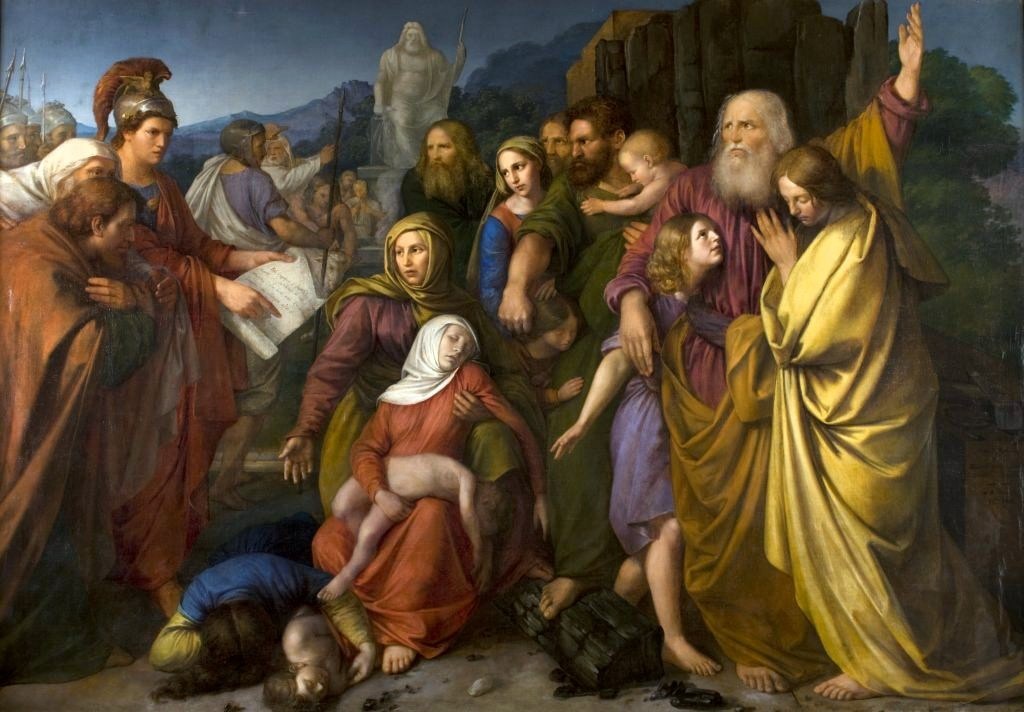

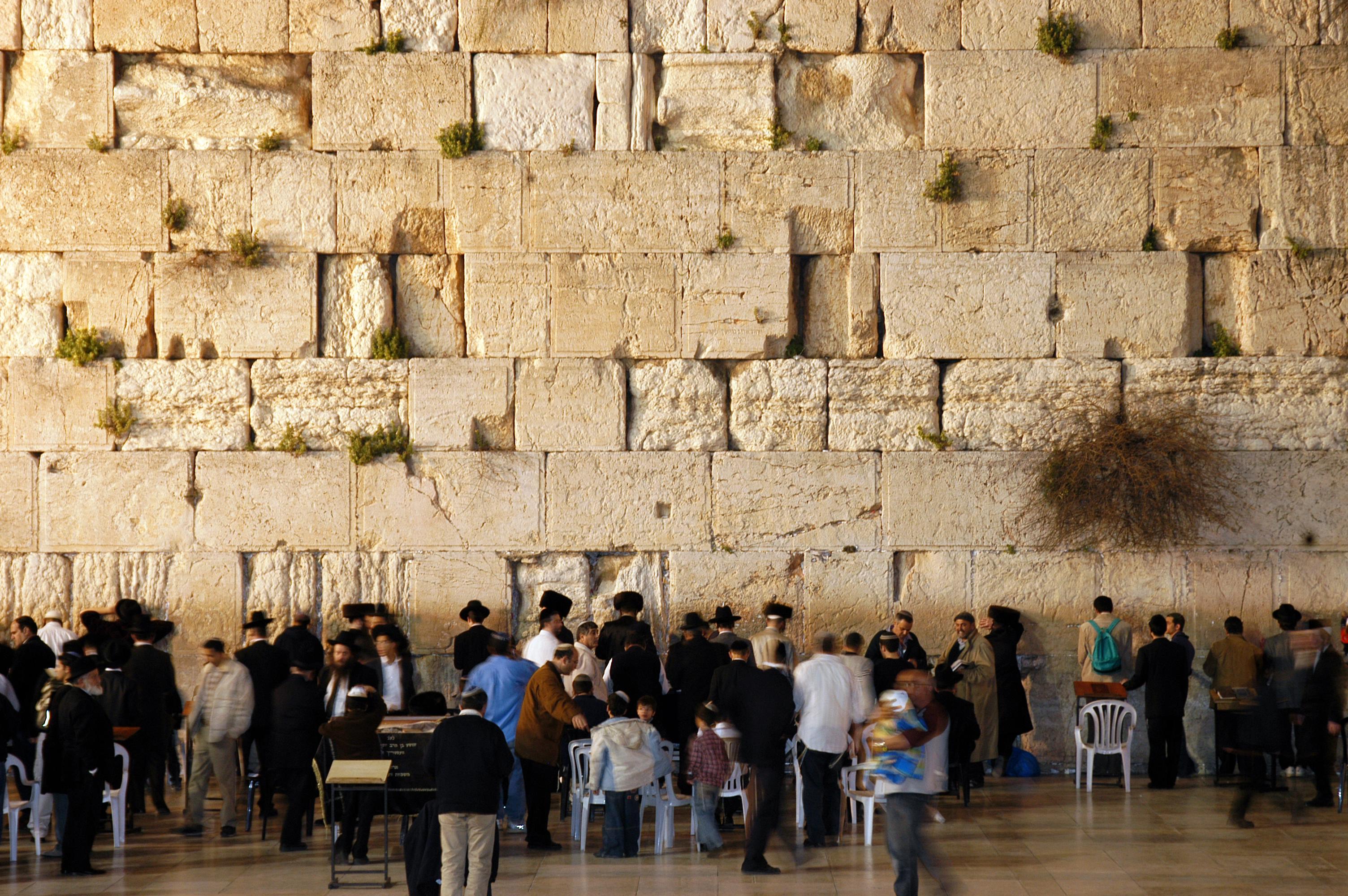


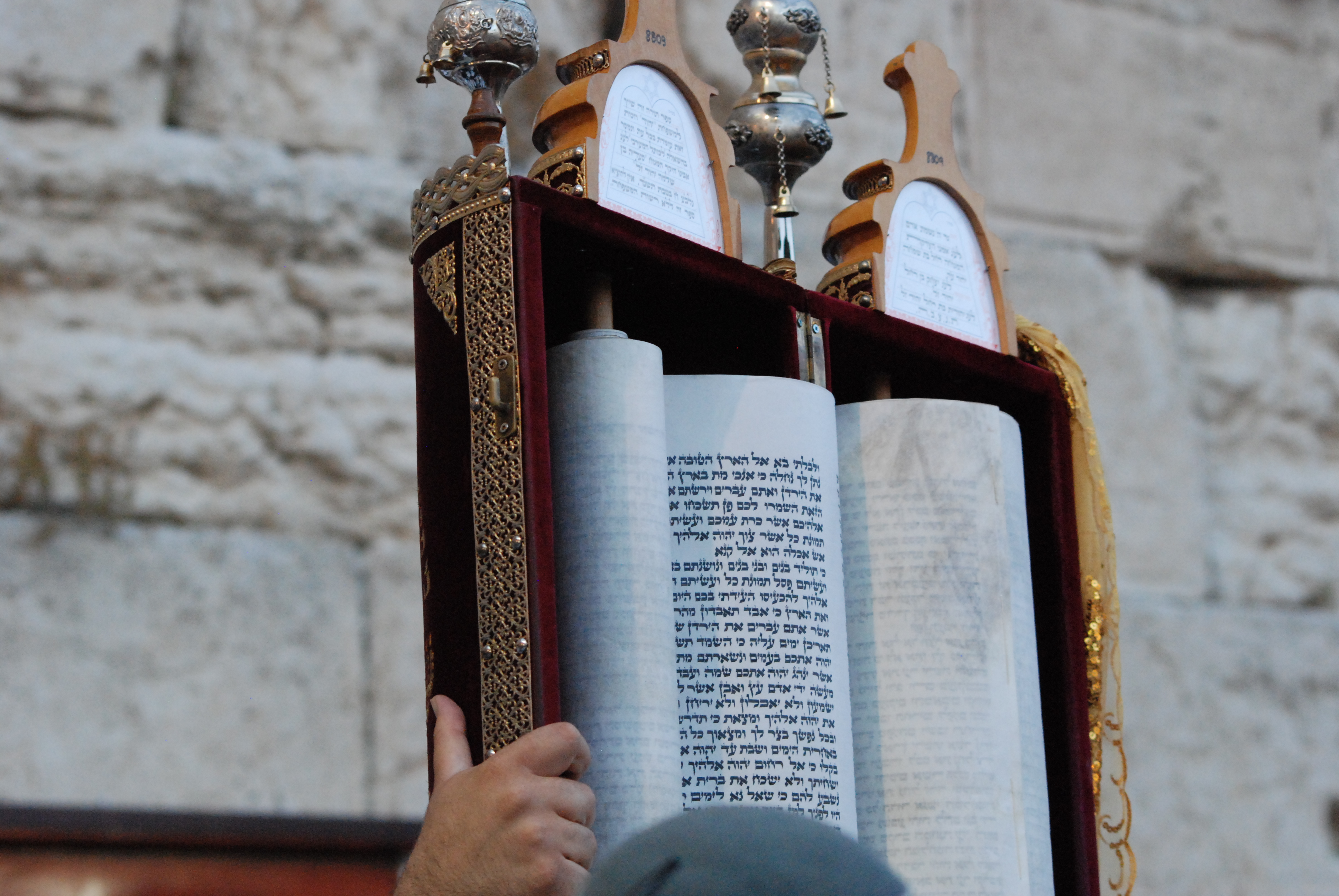


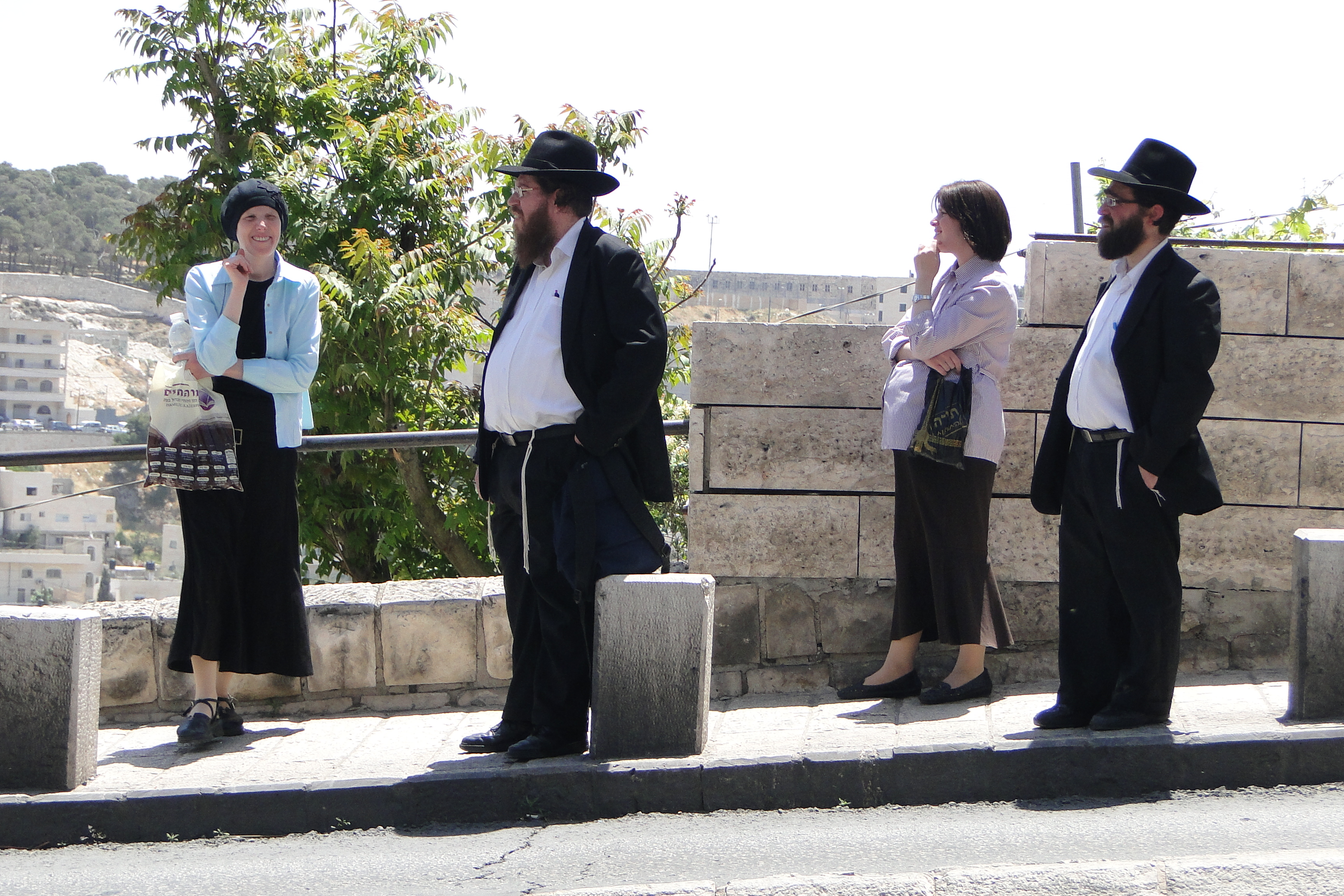

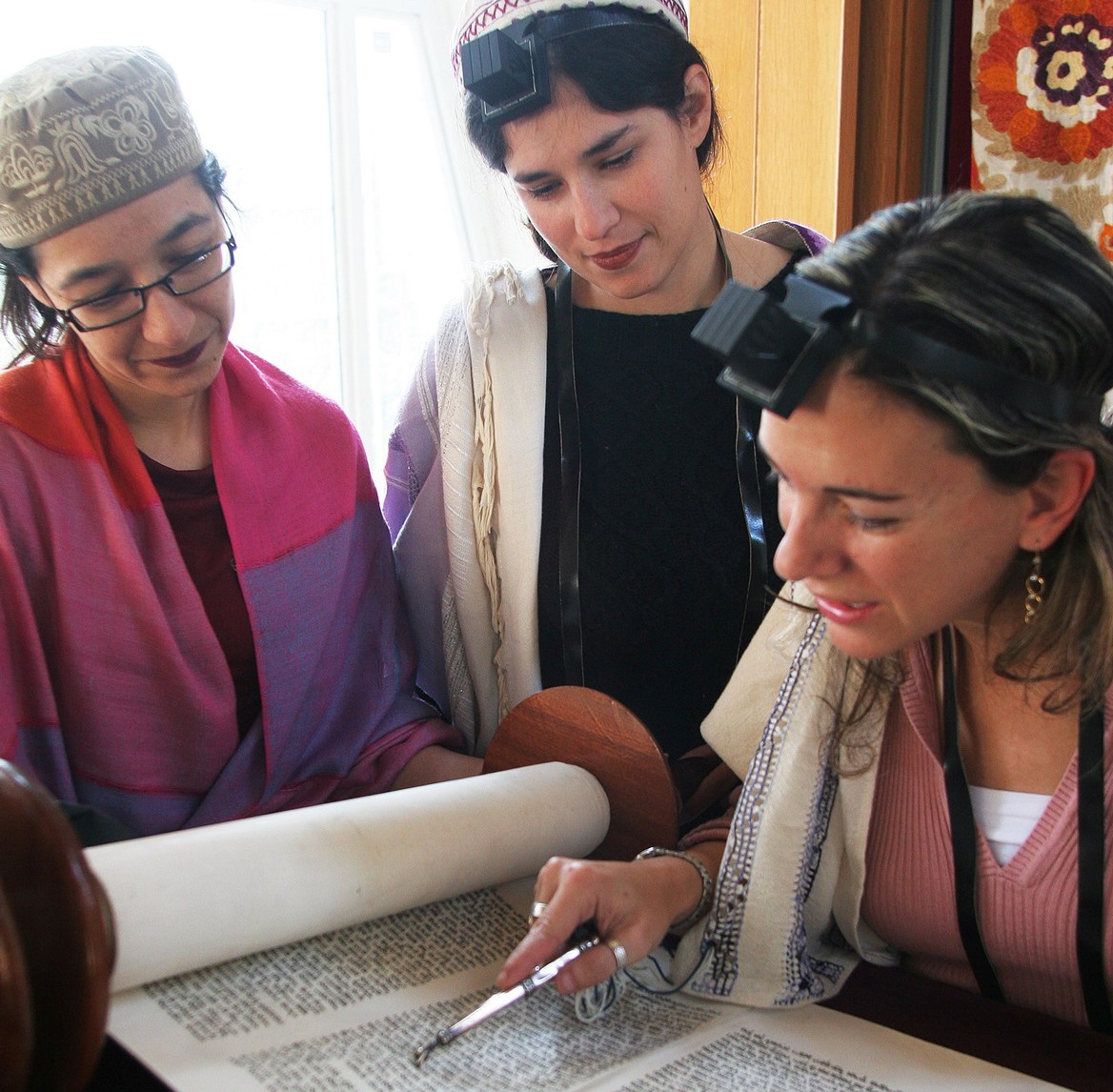


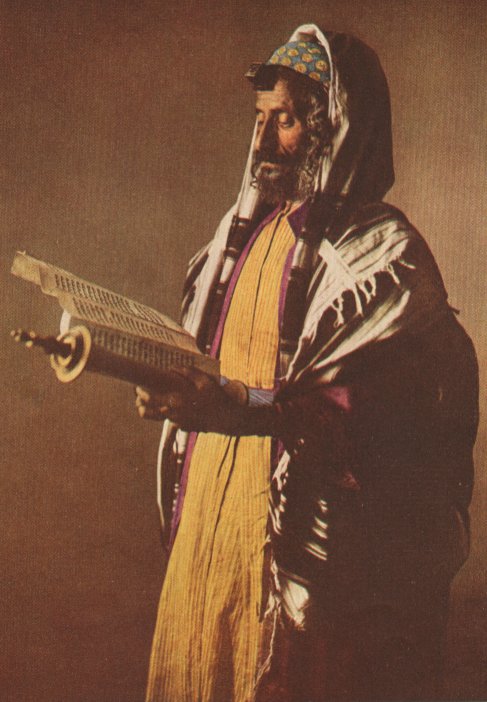
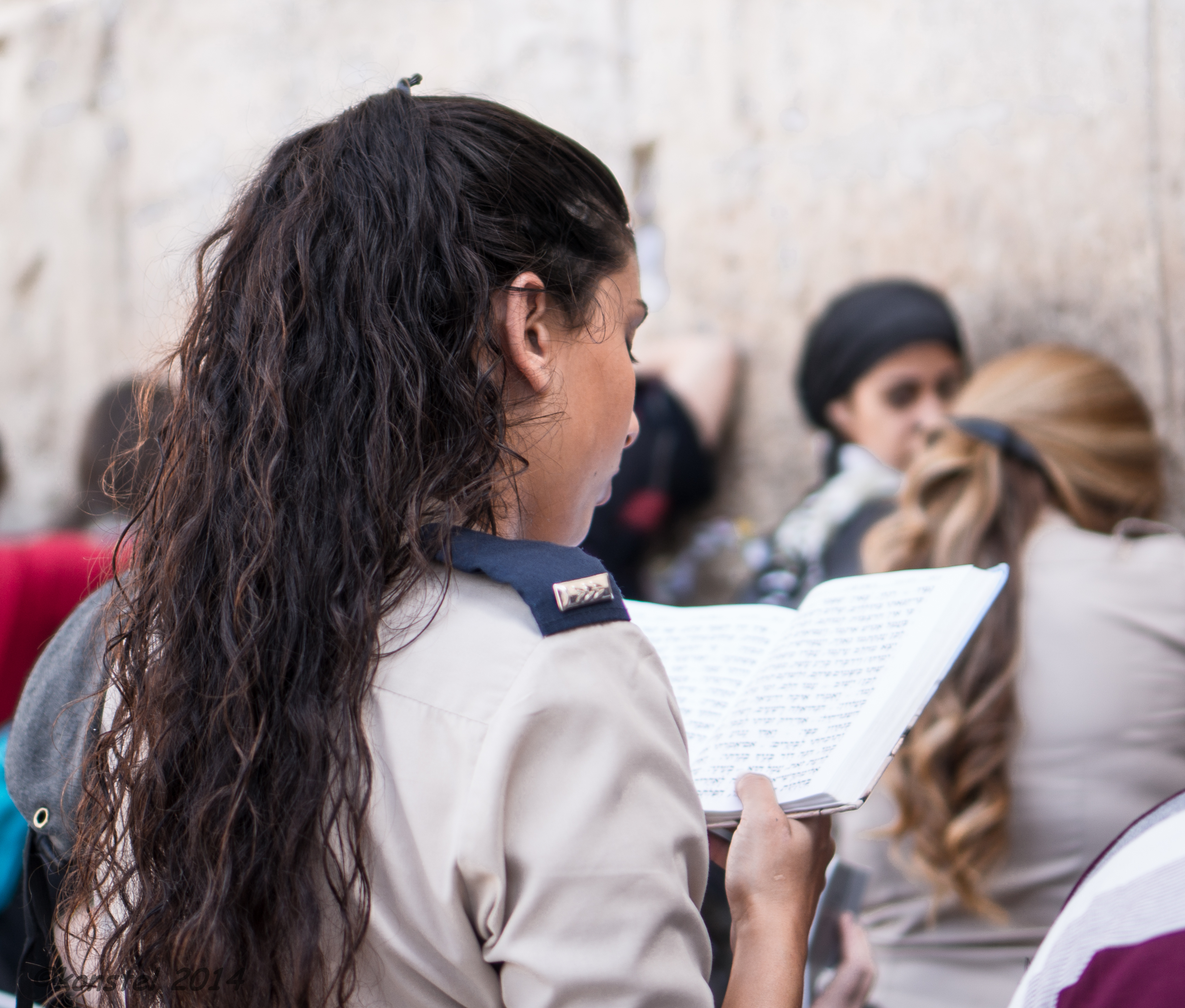




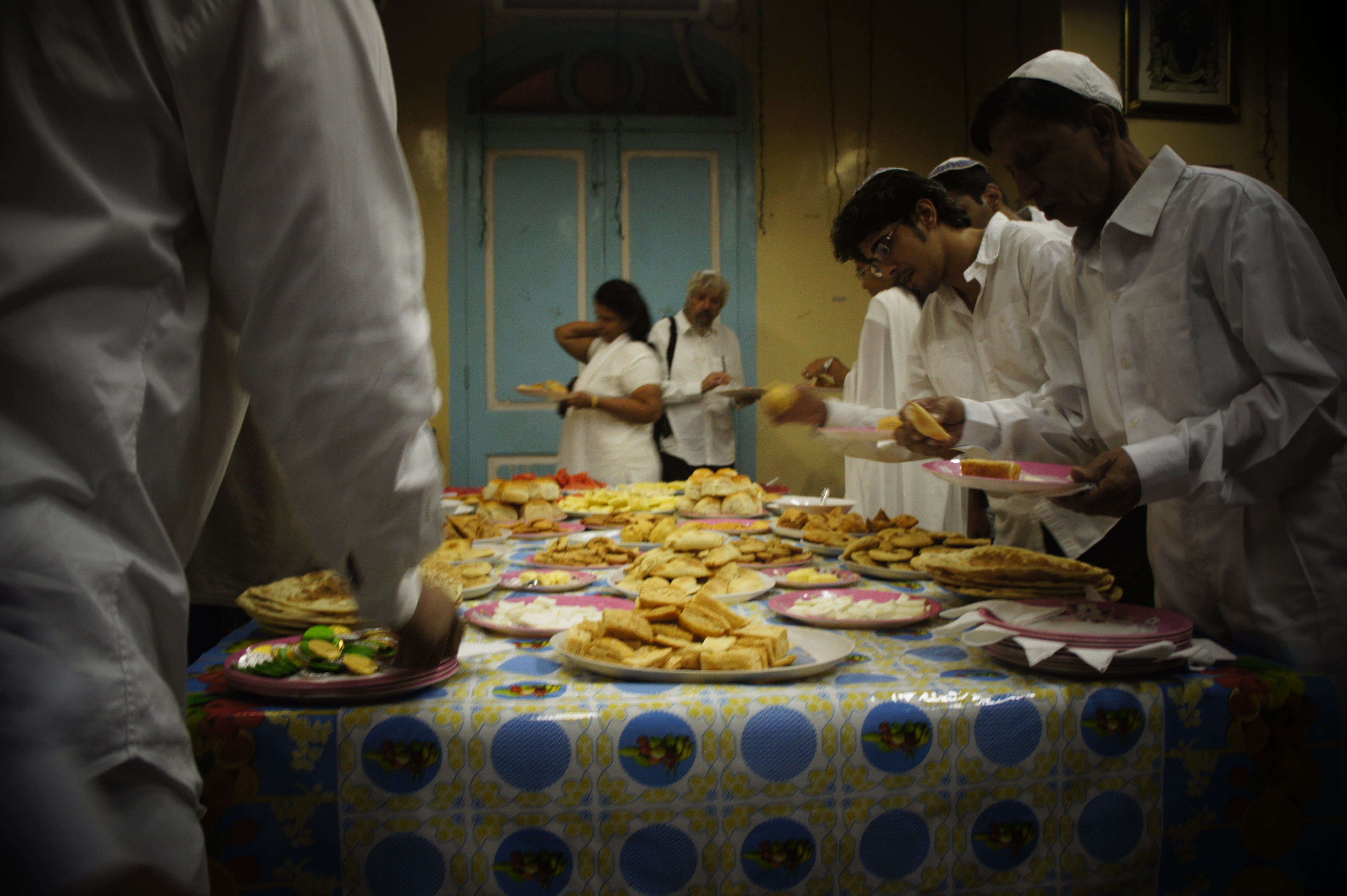
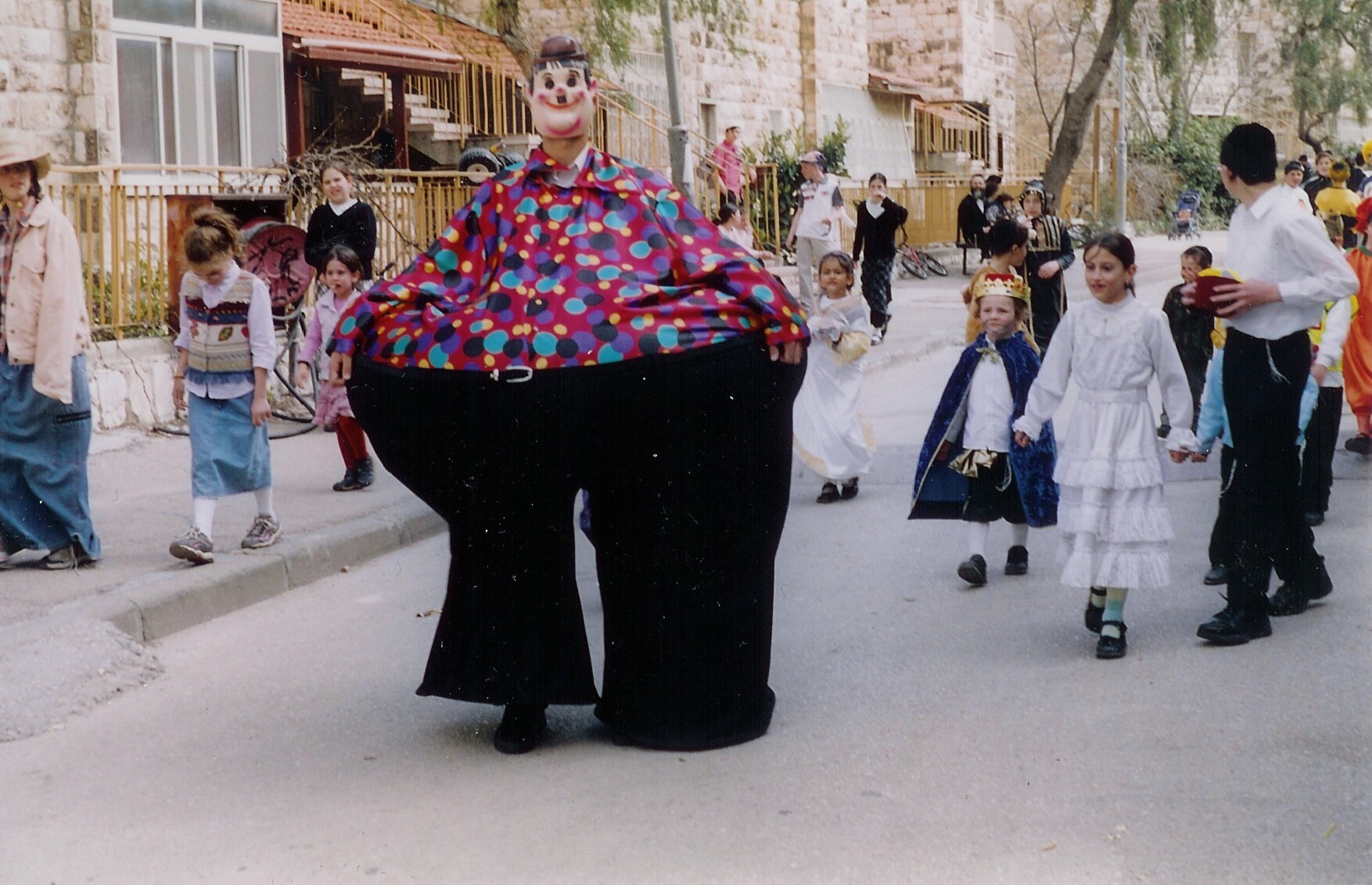


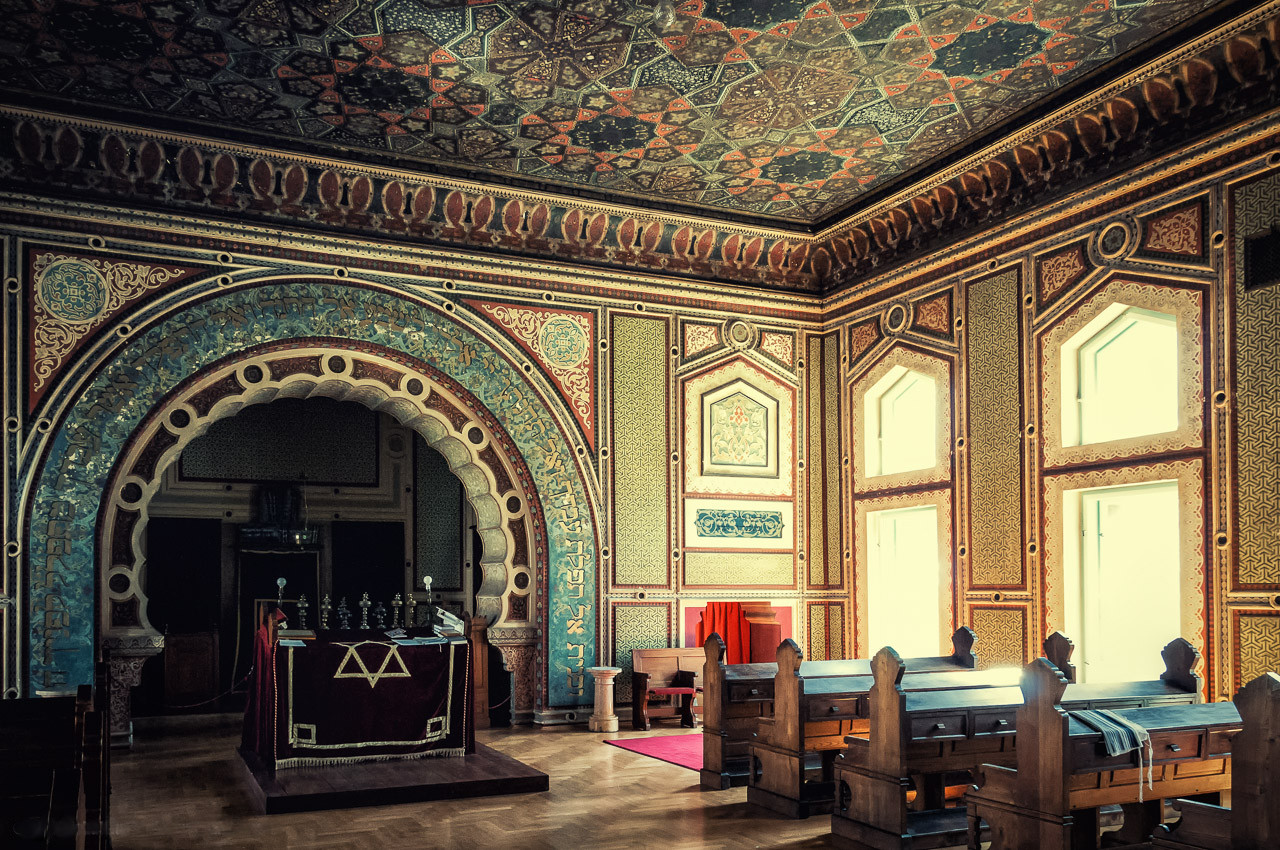
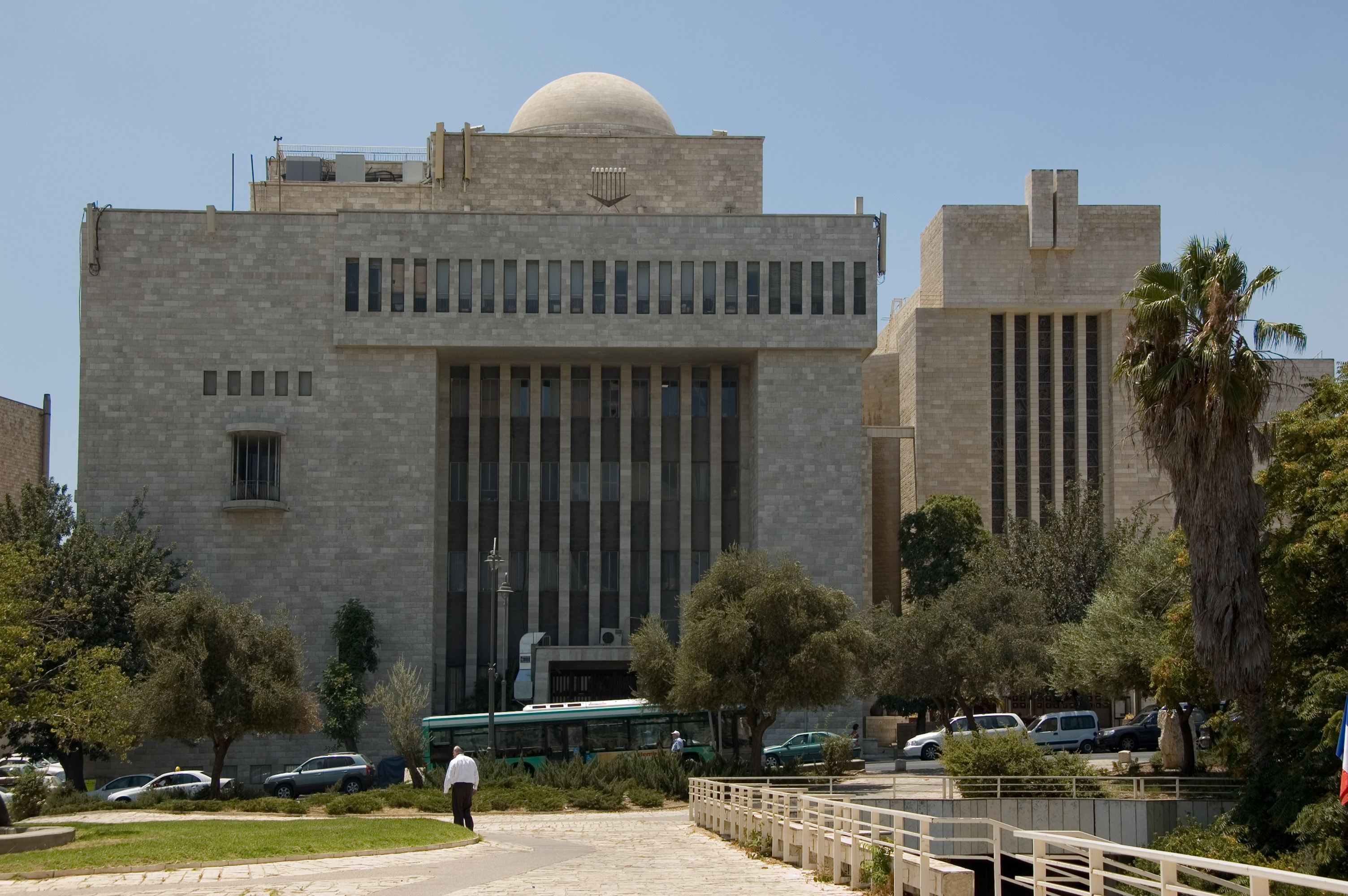

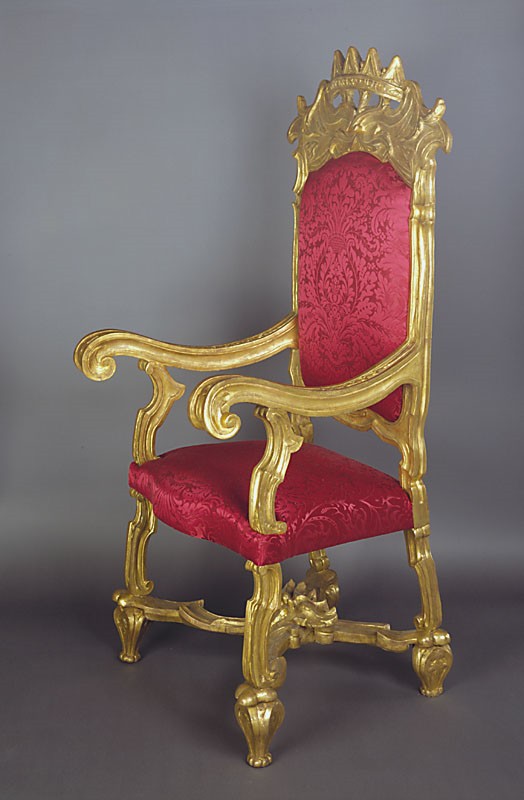

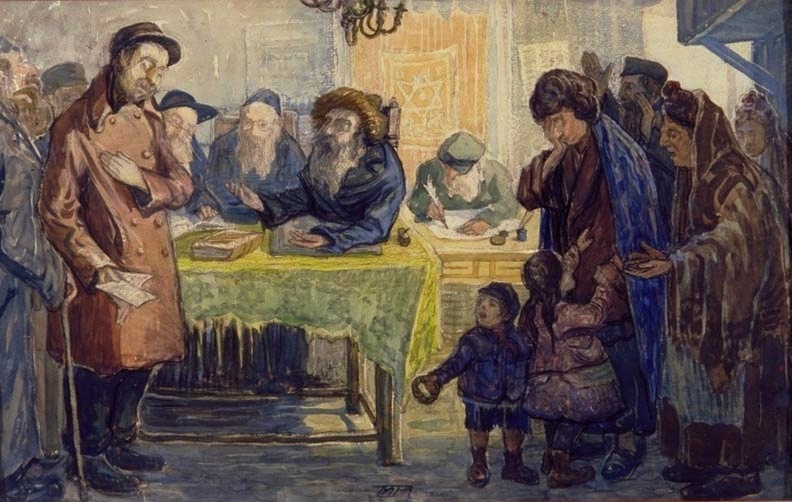


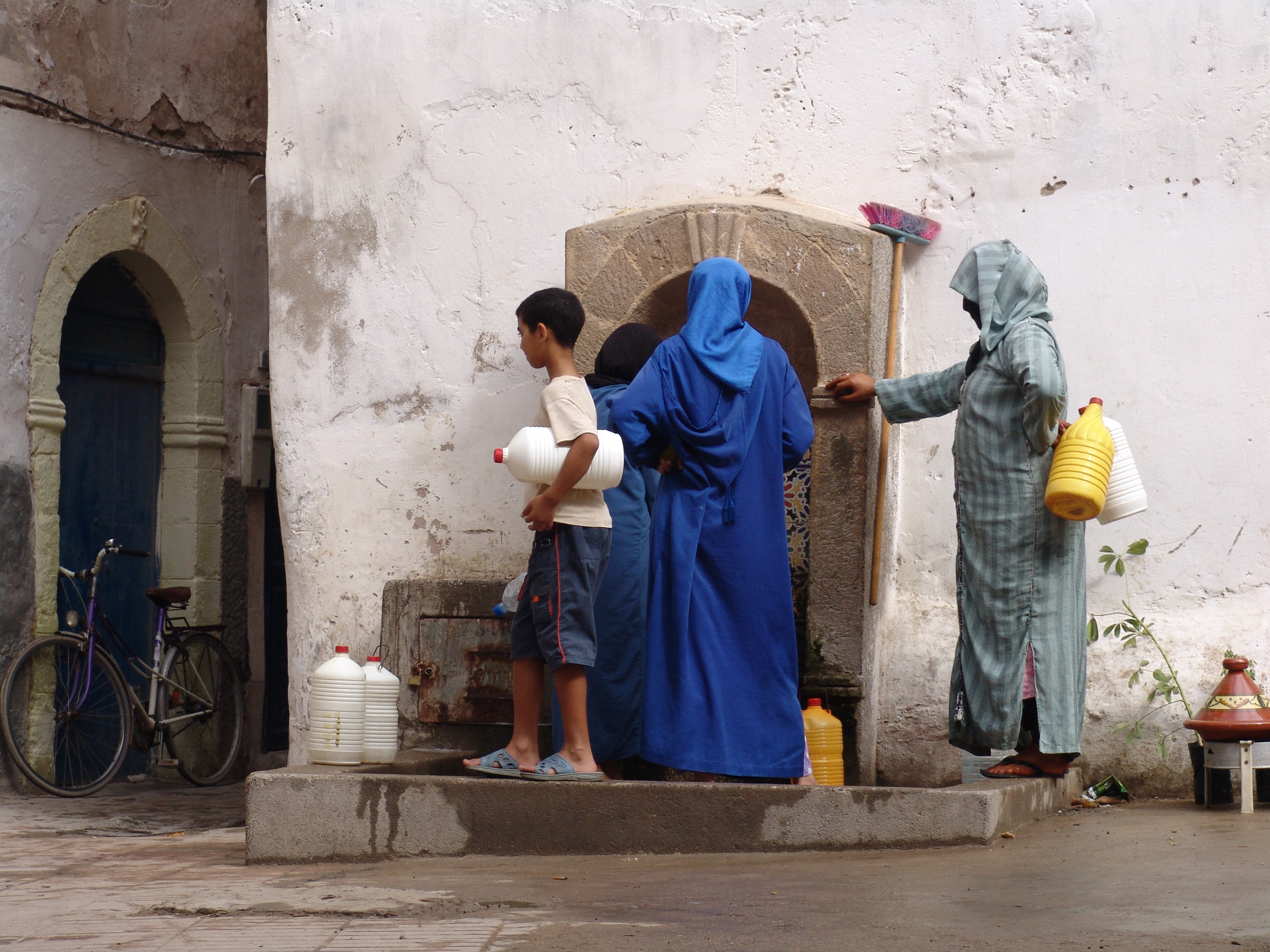


.jpg)

.jpg)


_Jewish_Couples_at_Bus_Stop_-_Outside_Old_City_-_Jerusalem_(5684561290).jpg)


.jpg)


.jpg)


 פורים (help·info) Pûrîm "lots") is a joyous Jewish holiday that commemorates the deliverance of the Persian Jews from the plot of the evil Haman, who sought to exterminate them, as recorded in the biblical Book of Esther. It is characterized by public recitation of the Book of Esther, mutual gifts of food and drink, charity to the poor, and a celebratory meal (Esther 9:22). Other customs include drinking wine, eating special pastries called hamantashen, dressing up in masks and costumes, and organizing carnivals and parties.

.jpg)


.jpg)

.jpg)


