

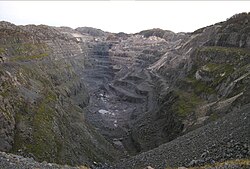


Ajay Kumar (talk | contribs) Created a new article |
minor changes |
||
| Line 1: | Line 1: | ||
{{Short description|Titanium-iron oxide mineral}} | {{Short description|Titanium-iron(II) oxide mineral}} | ||
{{Use dmy dates|date=April 2022}} | {{Use dmy dates|date=April 2022}} | ||
{{Infobox mineral | {{Infobox mineral | ||
| Line 9: | Line 9: | ||
| imagesize = | | imagesize = | ||
| caption = Ilmenite from Miass, Ilmen Mts, Chelyabinsk Oblast', Southern Urals, Urals Region, Russia. 4.5 x 4.3 x 1.5 cm | | caption = Ilmenite from Miass, Ilmen Mts, Chelyabinsk Oblast', Southern Urals, Urals Region, Russia. 4.5 x 4.3 x 1.5 cm | ||
| formula = | | formula = Iron(II) titanium oxide, {{Chem2|Fe^{II}TiO3}} | ||
| IMAsymbol = Ilm<ref>{{Cite journal|last=Warr|first=L.N.|date=2021|title=IMA–CNMNC approved mineral symbols|journal=Mineralogical Magazine|volume=85|issue=3|pages=291–320|doi=10.1180/mgm.2021.43|bibcode=2021MinM...85..291W|s2cid=235729616|doi-access=free}}</ref> | | IMAsymbol = Ilm<ref>{{Cite journal|last=Warr|first=L.N.|date=2021|title=IMA–CNMNC approved mineral symbols|journal=Mineralogical Magazine|volume=85|issue=3|pages=291–320|doi=10.1180/mgm.2021.43|bibcode=2021MinM...85..291W|s2cid=235729616|doi-access=free}}</ref> | ||
| strunz = 4.CB.05 | | strunz = 4.CB.05 | ||
| Line 20: | Line 20: | ||
| habit = Granular to massive and lamellar exsolutions in hematite or magnetite | | habit = Granular to massive and lamellar exsolutions in hematite or magnetite | ||
| twinning = {0001} simple, {10{{overline|1}}1} lamellar | | twinning = {0001} simple, {10{{overline|1}}1} lamellar | ||
| cleavage = | | cleavage = Absent; parting on {0001} and {10{{overline|1}}1} | ||
| fracture = Conchoidal to subconchoidal | | fracture = [[Conchoidal fracture|Conchoidal]] to subconchoidal | ||
| tenacity = Brittle | | tenacity = Brittle | ||
| mohs = 5–6 | | mohs = 5–6 | ||
| Line 27: | Line 27: | ||
| refractive = | | refractive = | ||
| opticalprop = Uniaxial (–) | | opticalprop = Uniaxial (–) | ||
| birefringence = Strong; O | | birefringence = Strong; O: pinkish brown, E: dark brown (bireflectance) | ||
| pleochroism = | | pleochroism = | ||
| streak = Black | | streak = Black | ||
| Line 37: | Line 37: | ||
| solubility = | | solubility = | ||
| diaphaneity = Opaque | | diaphaneity = Opaque | ||
| other = | | other = Weakly magnetic; [[Liquidus and solidus|Liquidus]] = 1710°C ([[peritectic]]) <ref>Eriksen et al. (2007). "Equilibrium between Liquid Fe-Ti-O Slags and Metallic Iron." Steel Research International. Vol 78. No. 9. {{doi|10.1002/srin.200706268}}</ref> | ||
| references = <ref>{{cite web |last1=Barthelmy |first1=David |title=Ilmenite Mineral Data |url= | | references = <ref>{{cite web |last1=Barthelmy |first1=David |title=Ilmenite Mineral Data |url=https://webmineral.com/data/Ilmenite.shtml |website=Mineralogy Database |publisher=Webmineral.com |access-date=12 February 2022 |date=2014}}</ref><ref name="HBM">{{cite book |editor-first1=John W. |editor-last1=Anthony |editor-first2=Richard A. |editor-last2=Bideaux |editor-first3=Kenneth W. |editor-last3=Bladh |editor-first4=Monte C. |editor-last4=Nichols |title=Handbook of Mineralogy |publisher=Mineralogical Society of America |location=Chantilly, VA, USA |url=http://rruff.geo.arizona.edu/doclib/hom/ilmenite.pdf |access-date=12 February 2022 |chapter=Ilmenite}}</ref><ref name="Mindat">{{mindat|id=2013|name=Ilmenite}}</ref> | ||
}} | }} | ||
'''Ilmenite''' is a titanium-iron [[oxide mineral]] with the idealized formula {{ | '''Ilmenite''' is a titanium-iron(II) [[oxide mineral]] with the idealized formula {{Chem2|FeTiO3}}. It is a weakly magnetic black or steel-gray solid. Ilmenite is the most important [[ore]] of [[titanium]]<ref>Heinz Sibum, Volker Günther, Oskar Roidl, Fathi Habashi, Hans Uwe Wolf, "Titanium, Titanium Alloys, and Titanium Compounds" in Ullmann's Encyclopedia of Industrial Chemistry 2005, Wiley-VCH, Weinheim. {{doi|10.1002/14356007.a27_095}}</ref> and the main source of [[titanium dioxide]], which is used as white [[pigment]] in paints, printing inks,<ref>{{Cite web|url=http://www.sanbohk.com/uploadfiles/2014-2/2014211105416156.pdf|title=Sachtleben RDI-S|access-date=2018-12-25|archive-date=2018-12-25|archive-url=https://web.archive.org/web/20181225130335/http://www.sanbohk.com/uploadfiles/2014-2/2014211105416156.pdf|url-status=dead}}</ref> fabrics, plastics, paper, sunscreen, food and cosmetics.<ref>{{Cite web|url=http://www.mineralcommodities.com/products/|title=Products|website=Mineral Commodities Ltd|access-date=2016-08-08}}</ref> | ||
== Structure and properties == | == Structure and properties == | ||
Ilmenite is a heavy (specific gravity 4.7), moderately hard (Mohs hardness 5.6 to 6), opaque black mineral with a submetallic luster.<ref name=KleinHurlbut1993/> It is almost always massive, with thick tabular crystals being quite rare. It shows no discernible cleavage, breaking instead with a conchoidal to uneven fracture.<ref name=Sinkankas1964/> | Ilmenite is a heavy (specific gravity 4.7), moderately hard ([[Mohs hardness]] 5.6 to 6), opaque black mineral with a submetallic luster.<ref name="KleinHurlbut1993" /> It is almost always massive, with thick tabular crystals being quite rare. It shows no discernible cleavage, breaking instead with a conchoidal to uneven fracture.<ref name="Sinkankas1964" /> | ||
Ilmenite crystallizes in the [[trigonal]] system with space group ''R''{{overline|3}}.<ref name=Nesse2000>{{cite book |last1=Nesse |first1=William D. |title=Introduction to mineralogy |date=2000 |publisher=Oxford University Press |location=New York |isbn=9780195106916 |pages=366–367}}</ref><ref name=HBM/> The ilmenite [[crystal structure]] consists of an ordered derivative of the [[corundum]] structure; in corundum all cations are identical but in ilmenite Fe<sup>2+</sup> and Ti<sup>4+</sup> ions occupy alternating layers perpendicular to the trigonal c axis. | Ilmenite crystallizes in the [[trigonal]] system with space group ''R''{{overline|3}}.<ref name="Nesse2000">{{cite book |last1=Nesse |first1=William D. |title=Introduction to mineralogy |date=2000 |publisher=Oxford University Press |location=New York |isbn=9780195106916 |pages=366–367}}</ref><ref name="HBM" /> The ilmenite [[crystal structure]] consists of an ordered derivative of the [[corundum]] structure; in corundum all cations are identical but in ilmenite Fe<sup>2+</sup> and Ti<sup>4+</sup> ions occupy alternating layers perpendicular to the trigonal c axis. | ||
Pure ilmenite is [[paramagnetic]] (showing only very weak attraction to a magnet), but ilmenite forms [[solid solution]]s with [[hematite]] that are weakly [[ferromagnetic]] and so are noticeably attracted to a magnet. Natural deposits of ilmenite usually contain intergrown or exsolved [[magnetite]] that also contribute to its ferromagnetism.<ref name=KleinHurlbut1993>{{cite book |last1=Klein |first1=Cornelis |last2=Hurlbut |first2=Cornelius S. Jr. |title=Manual of mineralogy : (after James D. Dana) |date=1993 |publisher=Wiley |location=New York |isbn=047157452X |edition=21st |pages=380–381}}</ref | Pure ilmenite is [[paramagnetic]] (showing only very weak attraction to a magnet), but ilmenite forms [[solid solution]]s with [[hematite]] that are weakly [[ferromagnetic]] and so are noticeably attracted to a magnet. Natural deposits of ilmenite usually contain intergrown or exsolved [[magnetite]] that also contribute to its ferromagnetism.<ref name="KleinHurlbut1993">{{cite book |last1=Klein |first1=Cornelis |last2=Hurlbut |first2=Cornelius S. Jr. |title=Manual of mineralogy : (after James D. Dana) |date=1993 |publisher=Wiley |location=New York |isbn=047157452X |edition=21st |pages=380–381}}</ref> | ||
Ilmenite is distinguished from hematite by its less intensely black color and duller appearance and its black [[Streak (mineralogy)|streak]], and from magnetite by its weaker magnetism.<ref name="Sinkankas1964">{{cite book |last1=Sinkankas |first1=John |title=Mineralogy for amateurs. |date=1964 |publisher=Van Nostrand |location=Princeton, N.J. |isbn=0442276249 |pages=328–329}}</ref><ref name="KleinHurlbut1993" /> | |||
<gallery> | <gallery> | ||
Image:Ilmenite.GIF|Crystal structure of ilmenite | Image:Ilmenite.GIF|Crystal structure of ilmenite | ||
File:Ilmenite-65675.jpg|Ilmenite from Froland, Aust-Agder, Norway; 4.1 | File:Ilmenite-65675.jpg|Ilmenite from Froland, Aust-Agder, Norway; 4.1 × 4.1 × 3.8 cm | ||
File:Ilmenite and hematite under normal light.jpg|Ilmenite and hematite under normal light | File:Ilmenite and hematite under normal light.jpg|Ilmenite and hematite under normal light | ||
File:Ilmenite and hematite under polarized light.jpg|Ilmenite and hematite under polarized light | File:Ilmenite and hematite under polarized light.jpg|Ilmenite and hematite under polarized light | ||
</gallery> | </gallery> | ||
==Discovery== | == Discovery == | ||
In 1791 [[William Gregor]] discovered a deposit of black sand in a stream that runs through the valley just south of the village of [[Manaccan]] ([[Cornwall]]), and identified for the first time titanium as one of the constituents of the main mineral in the sand.<ref>Gregor, William (1791) "Beobachtungen und Versuche über den Menakanit, einen in Cornwall gefundenen magnetischen Sand" (Observations and experiments regarding menaccanite [i.e., ilmenite], a magnetic sand found in Cornwall), ''Chemische Annalen'' …, '''1''', [https://books.google.com/books?id=ZFAyAQAAMAAJ&pg=PA40 pp. 40–54], [https://books.google.com/books?id=ZFAyAQAAMAAJ&pg=PA103 103–119.]</ref><ref>{{cite book|title=Nature's Building Blocks: An A-Z Guide to the Elements|last1=Emsley|first1=John|publisher=Oxford University Press|year=2001|location=Oxford, England, UK|isbn=978-0-19-850340-8 |chapter=Titanium |chapter-url=https://books.google.com/books?id=j-Xu07p3cKwC|url-access=registration|url=https://archive.org/details/naturesbuildingb0000emsl}}</ref><ref>{{cite book |last1=Woodford |first1=Chris|author1-link=Chris Woodford (author) |title=Titanium |date=2003 |publisher=Benchmark Books |location=New York |isbn=9780761414612 |page=7 |url=https://books.google.com/books?id=84W_FvfskTsC&dq=history+of+titanium&pg=PA4 |access-date=22 February 2022}}</ref> Gregor named this mineral '''''manaccanite'''''.<ref>{{cite journal |last1=Habashi |first1=Fathi |title=Historical Introduction to Refractory Metals |journal=Mineral Processing and Extractive Metallurgy Review |date=January 2001 |volume=22 |issue=1 |pages=25–53 |doi=10.1080/08827509808962488|bibcode=2001MPEMR..22...25H |s2cid=100370649 }}</ref> The same mineral was found in the [[Ilmensky Mountains]], near [[Miass]], [[Russia]], and named ''ilmenite''.<ref name=Sinkankas1964/> | In 1791, [[William Gregor]] discovered a deposit of black sand in a stream that runs through the valley just south of the village of [[Manaccan]] ([[Cornwall]]), and identified for the first time titanium as one of the constituents of the main mineral in the sand.<ref>Gregor, William (1791) "Beobachtungen und Versuche über den Menakanit, einen in Cornwall gefundenen magnetischen Sand" (Observations and experiments regarding menaccanite [i.e., ilmenite], a magnetic sand found in Cornwall), ''Chemische Annalen'' …, '''1''', [https://books.google.com/books?id=ZFAyAQAAMAAJ&pg=PA40 pp. 40–54], [https://books.google.com/books?id=ZFAyAQAAMAAJ&pg=PA103 103–119.]</ref><ref>{{cite book|title=Nature's Building Blocks: An A-Z Guide to the Elements|last1=Emsley|first1=John|publisher=Oxford University Press|year=2001|location=Oxford, England, UK|isbn=978-0-19-850340-8 |chapter=Titanium |chapter-url=https://books.google.com/books?id=j-Xu07p3cKwC|url-access=registration|url=https://archive.org/details/naturesbuildingb0000emsl}}</ref><ref>{{cite book |last1=Woodford |first1=Chris|author1-link=Chris Woodford (author) |title=Titanium |date=2003 |publisher=Benchmark Books |location=New York |isbn=9780761414612 |page=7 |url=https://books.google.com/books?id=84W_FvfskTsC&dq=history+of+titanium&pg=PA4 |access-date=22 February 2022}}</ref> Gregor named this mineral '''''manaccanite'''''.<ref>{{cite journal |last1=Habashi |first1=Fathi |title=Historical Introduction to Refractory Metals |journal=Mineral Processing and Extractive Metallurgy Review |date=January 2001 |volume=22 |issue=1 |pages=25–53 |doi=10.1080/08827509808962488|bibcode=2001MPEMR..22...25H |s2cid=100370649 }}</ref> The same mineral was found in the [[Ilmensky Mountains]], near [[Miass]], [[Russia]], and named ''ilmenite''.<ref name="Sinkankas1964" /> | ||
== Mineral chemistry == | == Mineral chemistry == | ||
Pure ilmenite has the composition {{chem2|FeTiO3}}. However, ilmenite most often contains appreciable quantities of magnesium and manganese and up to 6 [[wt%]] of hematite, {{chem2|Fe2O3}}, substituting for {{chem2|FeTiO3}} in the crystal structure. Thus the | Pure ilmenite has the composition {{chem2|FeTiO3}}. However, ilmenite most often contains appreciable quantities of magnesium and manganese and up to 6 [[wt%]] of hematite, {{chem2|Fe2O3}}, substituting for {{chem2|FeTiO3}} in the crystal structure. Thus the complete chemical formula can be expressed as {{chem2|(Fe,Mg,Mn,Ti)O3}}.<ref name="KleinHurlbut1993" /> Ilmenite forms a solid solution with [[geikielite]] ({{Chem|Mg||Ti||O|3}}) and [[pyrophanite]] ({{Chem|Mn||Ti||O|3}}) which are magnesian and manganiferous end-members of the solid solution series.<ref name="HBM" /> | ||
Although ilmenite is typically close to the ideal {{Chem|Fe||Ti||O|3}} composition, with minor mole percentages of Mn and Mg,<ref name=HBM/> the ilmenites of [[kimberlite]]s usually contain substantial amounts of geikielite molecules,<ref>{{cite journal |last1=Wyatt |first1=Bruce A. |last2=Baumgartner |first2=Mike |last3=Anckar |first3=Eva |last4=Grutter |first4=Herman |title=Compositional classification of "kimberlitic" and "non-kimberlitic" ilmenite |journal=Lithos |date=September 2004 |volume=77 |issue=1–4 |pages=819–840 |doi=10.1016/j.lithos.2004.04.025|bibcode=2004Litho..77..819W |s2cid=140539776 }}</ref> and in some highly differentiated [[felsic]] rocks ilmenites may contain significant amounts of pyrophanite molecules.<ref name=SasakiEtal2003>{{cite journal |last1=Sasaki |first1=Kazuhiro |last2=Nakashima |first2=Kazuo |last3=Kanisawa |first3=Satoshi |title=Pyrophanite and high Mn ilmenite discovered in the Cretaceous Tono pluton, NE Japan |journal=Neues Jahrbuch für Mineralogie - Monatshefte |date=15 July 2003 |volume=2003 |issue=7 |pages=302–320 |doi=10.1127/0028-3649/2003/2003-0302}}</ref> | Although ilmenite is typically close to the ideal {{Chem|Fe||Ti||O|3}} composition, with minor mole percentages of Mn and Mg,<ref name="HBM" /> the ilmenites of [[kimberlite]]s usually contain substantial amounts of geikielite molecules,<ref>{{cite journal |last1=Wyatt |first1=Bruce A. |last2=Baumgartner |first2=Mike |last3=Anckar |first3=Eva |last4=Grutter |first4=Herman |title=Compositional classification of "kimberlitic" and "non-kimberlitic" ilmenite |journal=Lithos |date=September 2004 |volume=77 |issue=1–4 |pages=819–840 |doi=10.1016/j.lithos.2004.04.025|bibcode=2004Litho..77..819W |s2cid=140539776 }}</ref> and in some highly differentiated [[felsic]] rocks ilmenites may contain significant amounts of pyrophanite molecules.<ref name="SasakiEtal2003">{{cite journal |last1=Sasaki |first1=Kazuhiro |last2=Nakashima |first2=Kazuo |last3=Kanisawa |first3=Satoshi |title= Pyrophanite and high Mn ilmenite discovered in the Cretaceous Tono pluton, NE Japan|journal=Neues Jahrbuch für Mineralogie - Monatshefte |date=15 July 2003 |volume=2003 |issue=7 |pages=302–320 |doi=10.1127/0028-3649/2003/2003-0302}}</ref> | ||
At temperatures above {{convert|950|C||sp=us}}, there is a complete solid solution between ilmenite and | At temperatures above {{convert|950|C||sp=us}}, there is a complete solid solution between ilmenite and hematite. There is a [[miscibility gap]] at lower temperatures, resulting in a coexistence of these two minerals in rocks but no solid solution.<ref name="KleinHurlbut1993" /> This coexistence may result in exsolution lamellae in cooled ilmenites with more iron in the system than can be homogeneously accommodated in the crystal lattice.<ref>{{cite book |last1=Weibel |first1=Rikke |last2=Friis |first2=Henrik |title=Heavy Minerals in Use |chapter=Chapter 10 Alteration of Opaque Heavy Minerals as a Reflection of the Geochemical Conditions in Depositional and Diagenetic Environments |series=Developments in Sedimentology |date=2007 |volume=58 |pages=277–303 |doi=10.1016/S0070-4571(07)58010-6|bibcode=2007DevS...58..277W |isbn=9780444517531 }}</ref> Ilmenite containing 6 to 13 percent {{chem2|Fe2O3}} is sometimes described as ''ferrian ilmenite''.<ref name="BuddingtonLindsley1964">{{cite journal |last1=Buddington |first1=A. F. |last2=Lindsley |first2=D. H. |title=Iron-Titanium Oxide Minerals and Synthetic Equivalents |journal=Journal of Petrology |date=1 January 1964 |volume=5 |issue=2 |pages=310–357 |doi=10.1093/petrology/5.2.310}}</ref><ref name="MurphyFrick2006">{{cite book |last1=Murphy |first1=P. |last2=Frick |first2=L. |year=2006 |chapter=Titanium |title=Industrial minerals & rocks: commodities, markets, and uses |editor-last1=Kogel |editor-first1=J. |publisher=SME |pages=987–1003 |isbn=9780873352338 |url=https://books.google.com/books?id=zNicdkuulE4C&q=Titanium |access-date=21 February 2022}}</ref> | ||
Ilmenite [[Metasomatism|alters]] or [[Weathering|weathers]] to form the | Ilmenite [[Metasomatism|alters]] or [[Weathering|weathers]] to form the pseudo-mineral [[leucoxene]], a fine-grained yellowish to grayish or brownish material<ref name="KleinHurlbut1993" /><ref>{{cite journal |last1=Mücke |first1=A. |last2=Bhadra Chaudhuri |first2=J.N. |title=The continuous alteration of ilmenite through pseudorutile to leucoxene |journal=Ore Geology Reviews |date=February 1991 |volume=6 |issue=1 |pages=25–44 |doi=10.1016/0169-1368(91)90030-B|bibcode=1991OGRv....6...25M }}</ref> enriched to 70% or more of {{chem2|TiO2}}.<ref name="MurphyFrick2006" /> Leucoxene is an important source of titanium in [[heavy mineral sands ore deposits]].<ref name="VanGosenEtal2014">{{cite journal |last1=Van Gosen |first1=Bradley S. |last2=Fey |first2=David L. |last3=Shah |first3=Anjana K. |last4=Verplanck |first4=Philip L. |last5=Hoefen |first5=Todd M. |title=Deposit model for heavy-mineral sands in coastal environments |journal=U.S. Geological Survey Scientific Investigations Report |series=Scientific Investigations Report |date=2014 |volume=201--5070-L |page=13 |doi=10.3133/sir20105070L|doi-access=free |bibcode=2014usgs.rept...13V }}</ref> | ||
== Paragenesis == | == Paragenesis == | ||
Ilmenite is a common accessory mineral found in [[metamorphic rock|metamorphic]] and [[igneous rock]]s.<ref name=HBM/> It is found in large concentrations in [[layered intrusion]]s where it forms as part of a [[cumulate rock|cumulate]] layer within the intrusion. Ilmenite generally occurs in these cumulates together with [[orthopyroxene]]<ref>{{cite | Ilmenite is a common accessory mineral found in [[metamorphic rock|metamorphic]] and [[igneous rock]]s.<ref name="HBM" /> It is found in large concentrations in [[layered intrusion]]s where it forms as part of a [[cumulate rock|cumulate]] layer within the intrusion. Ilmenite generally occurs in these cumulates together with [[orthopyroxene]]<ref>{{cite book |last1=Wilson |first1=J.R. |last2=Robins |first2=B. |last3=Nielsen |first3=F.M. |last4=Duchesne |first4=J.C. |last5=Vander Auwera |first5=J. |title=Layered Intrusions |chapter=The Bjerkreim-Sokndal Layered Intrusion, Southwest Norway |journal=Developments in Petrology |date=1996 |volume=15 |pages=231–255 |doi=10.1016/S0167-2894(96)80009-1|bibcode=1996DevPe..15..231W |hdl=2268/550 |isbn=9780444817686 |hdl-access=free }}</ref> or in combination with [[plagioclase]] and [[apatite]] (''[[nelsonite]]'').<ref>{{cite journal |last1=Charlier |first1=Bernard |last2=Sakoma |first2=Emmanuel |last3=Sauvé |first3=Martin |last4=Stanaway |first4=Kerry |last5=Auwera |first5=Jacqueline Vander |last6=Duchesne |first6=Jean-Clair |title=The Grader layered intrusion (Havre-Saint-Pierre Anorthosite, Quebec) and genesis of nelsonite and other Fe–Ti–P ores |journal=Lithos |date=March 2008 |volume=101 |issue=3–4 |pages=359–378 |doi=10.1016/j.lithos.2007.08.004|bibcode=2008Litho.101..359C |hdl=2268/1893 |hdl-access=free }}</ref> | ||
[[Magnesium|Magnesian]] ilmenite is formed in | [[Magnesium|Magnesian]] ilmenite is formed in kimberlites as part of the MARID association of minerals ([[mica]]-[[amphibole]]-[[rutile]]-ilmenite-[[diopside]]) assemblage of [[Biotite|glimmerite]] [[xenolith]]s.<ref>{{cite journal |last1=Dawson |first1=J.Barry |last2=Smith |first2=Joseph V. |title=The MARID (mica-amphibole-rutile-ilmenite-diopside) suite of xenoliths in kimberlite |journal=Geochimica et Cosmochimica Acta |date=February 1977 |volume=41 |issue=2 |pages=309–323 |doi=10.1016/0016-7037(77)90239-3|bibcode=1977GeCoA..41..309D |doi-access=free }}</ref> [[Manganese|Manganiferous]] ilmenite is found in [[granite|granitic]] rocks<ref name="SasakiEtal2003" /> and also in [[carbonatite]] intrusions where it may also contain anomalously high amounts of [[niobium]].<ref>{{cite journal |last1=Cordeiro |first1=Pedro F.O. |last2=Brod |first2=José A. |last3=Dantas |first3=Elton L. |last4=Barbosa |first4=Elisa S.R. |title=Mineral chemistry, isotope geochemistry and petrogenesis of niobium-rich rocks from the Catalão I carbonatite-phoscorite complex, Central Brazil |journal=Lithos |date=August 2010 |volume=118 |issue=3–4 |pages=223–237 |doi=10.1016/j.lithos.2010.04.007|bibcode=2010Litho.118..223C }}</ref> | ||
Many [[mafic]] | Many [[mafic]] igneous rocks contain grains of intergrown magnetite and ilmenite, formed by the [[oxidation]] of [[ulvospinel]].<ref name="BuddingtonLindsley1964" /> | ||
== Processing and consumption == | == Processing and consumption == | ||
| Line 85: | Line 83: | ||
Most ilmenite is mined for [[titanium dioxide]] production.<ref>{{Cite web|url=http://www.mineralcommodities.com/products/industry-fundamentals/|title=Industry Fundamentals|website=Mineral Commodities Ltd|access-date=2016-08-08|archive-date=2016-10-07|archive-url=https://web.archive.org/web/20161007145819/http://www.mineralcommodities.com/products/industry-fundamentals/|url-status=dead}}</ref> Ilmenite and titanium dioxide are used in the production of [[titanium]] metal.<ref>{{Cite journal|last=Kroll|first=W|title=The production of ductile titanium|journal= Transactions of the Electrochemical Society|volume=78|pages=35–47|doi=10.1149/1.3071290|year=1940}}</ref><ref>{{Cite journal|last=Seki|first=Ichiro|title=Reduction of titanium dioxide to metallic titanium by nitridization and thermal decomposition|url=https://www.jstage.jst.go.jp/article/matertrans/58/3/58_MK201601/_pdf|journal=Materials Transactions|volume=58|issue= 3|pages=361–366|doi=10.2320/matertrans.MK201601|year=2017|doi-access=free}}</ref> | Most ilmenite is mined for [[titanium dioxide]] production.<ref>{{Cite web|url=http://www.mineralcommodities.com/products/industry-fundamentals/|title=Industry Fundamentals|website=Mineral Commodities Ltd|access-date=2016-08-08|archive-date=2016-10-07|archive-url=https://web.archive.org/web/20161007145819/http://www.mineralcommodities.com/products/industry-fundamentals/|url-status=dead}}</ref> Ilmenite and titanium dioxide are used in the production of [[titanium]] metal.<ref>{{Cite journal|last=Kroll|first=W|title=The production of ductile titanium|journal= Transactions of the Electrochemical Society|volume=78|pages=35–47|doi=10.1149/1.3071290|year=1940}}</ref><ref>{{Cite journal|last=Seki|first=Ichiro|title=Reduction of titanium dioxide to metallic titanium by nitridization and thermal decomposition|url=https://www.jstage.jst.go.jp/article/matertrans/58/3/58_MK201601/_pdf|journal=Materials Transactions|volume=58|issue= 3|pages=361–366|doi=10.2320/matertrans.MK201601|year=2017|doi-access=free}}</ref> | ||
Titanium dioxide is most used as a white pigment and the major consuming industries for TiO<sub>2</sub> | Titanium dioxide is most used as a white [[pigment]], and the major consuming industries for TiO<sub>2</sub> pigments are paints and surface coatings, plastics, and paper and paperboard. Per capita consumption of TiO<sub>2</sub> in China is about 1.1 kilograms per year, compared with 2.7 kilograms for Western Europe and the United States.<ref>{{Cite web|url=https://ihsmarkit.com/products/titanium-dioxide-chemical-economics-handbook.html|title=Titanium Dioxide Chemical Economics Handbook |work=IHS Markit }}</ref> | ||
[[File:Estimated world production of titanium concentrate by mineral source in metric tons, 2015–2019.png|thumb|Estimated world production of titanium concentrate by mineral source in metric tons, 2015–2019. Titanium concentrate is mainly obtained from the processing of ilmenite mineral, followed by titaniferous slags and natural rutile.]] | |||
Ilmenite can be converted into pigment grade | Titanium is the ninth most abundant element on Earth and represents about 0.6 percent of the Earth's crust. Ilmenite is commonly processed to obtain a titanium concentrate, which is called "synthetic rutile" if it contains more than 90 percent TiO<sub>2</sub>, or more generally "titaniferous slags" if it has a lower TiO<sub>2</sub> content. More than 80 percent of the estimated global production of titanium concentrate is obtained from the processing of ilmenite, while 13 percent is obtained from titaniferous slags and 5 percent from rutile.<ref name=":0">{{Cite web |title=Patent Landscape Report |url=https://www.wipo.int/publications/en/details.jsp?id=4651&plang=EN |access-date=2023-10-19 |website=[[WIPO]] |doi=10.34667/tind.47029 |language=en |author1=World Intellectual Property Organization. |series=Patent Landscape Reports |date=2023 }}</ref> | ||
Ilmenite can be converted into pigment-grade titanium dioxide via either the sulfate process or the [[chloride process]].<ref name="Ullmann">{{Ullmann|author=Völz, Hans G. |display-authors=etal |title=Pigments, Inorganic|year=2006|doi=10.1002/14356007.a20_243.pub2}}</ref> Ilmenite can also be improved and purified to titanium dioxide in the form of rutile using the [[Becher process]].<ref>{{cite journal |last1=Welham |first1=N.J. |title=A parametric study of the mechanically activated carbothermic reduction of ilmenite |journal=Minerals Engineering |date=December 1996 |volume=9 |issue=12 |pages=1189–1200 |doi=10.1016/S0892-6875(96)00115-X|bibcode=1996MiEng...9.1189W }}</ref> | |||
Ilmenite ores can also be converted to liquid [[iron]] and a titanium-rich slag using a smelting process.<ref>{{citation| url = https://www.saimm.co.za/Journal/v108n01p035.pdf | title = Ilmenite smelting: the basics| first = P.C. |last = Pistorius | journal = The Journal of the South African Institute of Mining and Metallurgy | volume = 108 | date = Jan 2008 }}</ref> | Ilmenite ores can also be converted to liquid [[iron]] and a titanium-rich slag using a smelting process.<ref>{{citation| url = https://www.saimm.co.za/Journal/v108n01p035.pdf | title = Ilmenite smelting: the basics| first = P.C. |last = Pistorius | journal = The Journal of the South African Institute of Mining and Metallurgy | volume = 108 | date = Jan 2008 }}</ref> | ||
Steelmakers use ilmenite ore as a flux to line the [[blast furnace]] hearth refractory.<ref name="RTFT Products">{{cite web|title=Rio Tinto, Fer et Titane - Products|url=http://www.rtft.com/ENC/index_ourproducts.asp|publisher=Rio Tinto Group|access-date=19 Aug 2012|archive-date=6 May 2015|archive-url=https://web.archive.org/web/20150506221657/http://www.rtft.com/ENC/index_ourproducts.asp|url-status=dead}}</ref> | |||
Ilmenite can be used to produce [[ferrotitanium]] via an [[aluminothermic]] reduction.<ref name="FerroAlloy">{{cite book |title=Handbook of Ferroalloys: Theory and Technology |publisher=Elsevier |editor-last1=Gasik |editor-first1=Michael |year=2013 |location=London |pages=429 |isbn=978-0-08-097753-9}}</ref> | Ilmenite can be used to produce [[ferrotitanium]] via an [[aluminothermic]] reduction.<ref name="FerroAlloy">{{cite book |title=Handbook of Ferroalloys: Theory and Technology |publisher=Elsevier |editor-last1=Gasik |editor-first1=Michael |year=2013 |location=London |pages=429 |isbn=978-0-08-097753-9}}</ref> | ||
| Line 97: | Line 99: | ||
== Feedstock production == | == Feedstock production == | ||
{| class="wikitable" style="float:right; clear:right; margin:0 0 .5em 1em;" | {| class="wikitable" style="float:right; clear:right; margin:0 0 .5em 1em;" | ||
|+Various ilmenite feedstock grades.< | |+Various ilmenite feedstock grades.<ref>{{citation|last=Hayes|year=2011|first=Tony|title=Titanium Dioxide: A Shining Future Ahead|url=http://argex.ca/documents/Euro_Pacific_Canada_Titanium_Dioxide_August2011.pdf|publisher=Euro Pacific Canada|access-date=16 Aug 2012|page=5}}{{dead link|date=August 2018}}</ref> | ||
|- | |- | ||
! Feedstock || {{Chem|Ti||O|2}} Content || Process | ! Feedstock || {{Chem|Ti||O|2}} Content || Process | ||
| Line 109: | Line 111: | ||
| Ore || <50 || Smelting (slag) | | Ore || <50 || Smelting (slag) | ||
|- | |- | ||
| Synthetic rutile || | | Synthetic rutile || 88–95 || Chloride | ||
|- | |- | ||
| Chloride slag || | | Chloride slag || 85–95 || Chloride | ||
|- | |- | ||
| Sulfate slag || 80 || Sulfate | | Sulfate slag || 80 || Sulfate | ||
| Line 118: | Line 120: | ||
|+Estimated contained {{Chem|Ti||O|2}}. <br> production{{sfn|Hayes|2011|p=5}}<ref>USGS 2012 Survey, p. 174</ref><br><small>(Metric tpa x 1,000,</small><br><small>ilmenite & rutile)</small> | |+Estimated contained {{Chem|Ti||O|2}}. <br> production{{sfn|Hayes|2011|p=5}}<ref>USGS 2012 Survey, p. 174</ref><br><small>(Metric tpa x 1,000,</small><br><small>ilmenite & rutile)</small> | ||
|- | |- | ||
! Year || 2011 || | ! Year || 2011 || 2012–13 | ||
|- | |- | ||
! Country || USGS || Projected | ! Country || USGS || Projected | ||
| Line 159: | Line 161: | ||
|} | |} | ||
Most ilmenite is recovered from heavy mineral sands ore deposits, where the mineral is concentrated as a [[placer deposit]] and weathering reduces its iron content, increasing the percentage of titanium. However, ilmenite can also be recovered from "hard rock" titanium ore sources, such as [[ultramafic to mafic layered intrusions]] or [[anorthosite]] [[massif]]s. The ilmenite in layered intrusions is sometimes abundant, but it contains considerable intergrowths of magnetite that reduce its ore grade. Ilmenite from anorthosite massifs often | Most ilmenite is recovered from heavy mineral sands ore deposits, where the mineral is concentrated as a [[placer deposit]] and weathering reduces its iron content, increasing the percentage of titanium. However, ilmenite can also be recovered from "hard rock" titanium ore sources, such as [[ultramafic to mafic layered intrusions]] or [[anorthosite]] [[massif]]s. The ilmenite in layered intrusions is sometimes abundant, but it contains considerable intergrowths of magnetite that reduce its ore grade. Ilmenite from anorthosite massifs often contains large amounts of calcium or magnesium that render it unsuitable for the chloride process.<ref>{{cite book |last1=Murphy |first1=Philip |last2=Frick |first2=Louise |title=Industrial minerals & rocks: commodities, markets, and uses |date=2006 |publisher=Society for Mining, Metallurgy, and Exploration |location=Littleton, Colo. |isbn=9780873352338 |pages=990–991 |edition=7th |url=https://books.google.com/books?id=zNicdkuulE4C |access-date=23 February 2022 |chapter=Titanium |editor-first1=James M. |editor-last1=Barker |editor-first2=Jessica Elzea |editor-last2=Kogel |editor-first3=Nikhil C. |editor-last3=Trivedi |editor-first4=Stanley T. |editor-last4=Krukowski}}</ref> | ||
The proven reserves of ilmenite and rutile | The proven reserves of ilmenite and rutile ores are estimated to be between 423 and 600 million tonnes of titanium dioxide. The largest ilmenite deposits are in South Africa, India, the United States, Canada, Norway, Australia, Ukraine, Russia and Kazakhstan. Additional deposits are found in Bangladesh, Chile, Mexico and New Zealand.<ref>{{cite book |last1=Güther |first1=V. |last2=Sibum |first2=H. |last3=Roidl |first3=O. |last4=Habashi |first4=F. |last5=Wolf |first5=H |year= 2005 |chapter=Titanium, Titanium Alloys, and Titanium Compounds |title=Ullmann's Encyclopedia of Industrial Chemistry |publisher=Wiley InterScience |isbn=978-3-527-30673-2}}</ref> | ||
Australia was the world's largest ilmenite ore producer in 2011, with about 1.3 million tonnes of production, followed by South Africa, Canada, Mozambique, India, China, Vietnam, Ukraine, Norway, Madagascar and United States. | Australia was the world's largest ilmenite ore producer in 2011, with about 1.3 million tonnes of production, followed by South Africa, Canada, Mozambique, India, China, Vietnam, Ukraine, Norway, Madagascar and the United States. | ||
The top four ilmenite and rutile feedstock producers in 2010 were [[Rio Tinto Group]], [[Iluka Resources]], Exxaro and [[Kenmare Resources]], which collectively accounted for more than 60% of world's supplies.{{sfn|Hayes|2011|p=3}} | The top four ilmenite and rutile feedstock producers in 2010 were [[Rio Tinto Group]], [[Iluka Resources]], Exxaro and [[Kenmare Resources]], which collectively accounted for more than 60% of the world's supplies.{{sfn|Hayes|2011|p=3}} | ||
The world's two largest [[Open cast mining|open cast]] ilmenite mines are: | The world's two largest [[Open cast mining|open cast]] ilmenite mines are: | ||
* The [[Tellnes mine]] located in [[Sokndal]], [[Norway]], and run by Titania AS (owned by Kronos Worldwide Inc.) with 0.55 Mtpa capacity and 57 Mt contained {{Chem|Ti||O|2}} reserves. | * The [[Tellnes mine]] located in [[Sokndal]], [[Norway]], and run by Titania AS (owned by Kronos Worldwide Inc.) with 0.55 Mtpa capacity and 57 Mt contained {{Chem|Ti||O|2}} reserves. | ||
* The Rio Tinto Group's Lac Tio mine located near [[Havre Saint-Pierre]], Quebec in [[Canada]] with a 3 Mtpa capacity and 52 Mt reserves.<ref name="Lac Tio Page">{{cite web|title=Lac Tio Mine|url= | * The Rio Tinto Group's Lac Tio mine located near [[Havre Saint-Pierre]], Quebec, in [[Canada]] with a 3 Mtpa capacity and 52 Mt reserves.<ref name="Lac Tio Page">{{cite web|title=Lac Tio Mine|url=https://www.infomine.com/minesite/minesite.asp?site=lactio|publisher=InfoMine|access-date=16 Aug 2012}}</ref> | ||
Major mineral sands based ilmenite mining operations include: | Major mineral sands-based ilmenite mining operations include: | ||
* [[Richards Bay Minerals]] in [[South Africa]], majority-owned by the Rio Tinto Group. | * [[Richards Bay Minerals]] in [[South Africa]], majority-owned by the Rio Tinto Group. | ||
* [[Kenmare Resources]]' Moma mine in [[Mozambique]]. | * [[Kenmare Resources]]' Moma mine in [[Mozambique]]. | ||
* Iluka Resources' mining operations in Australia including Murray Basin, [[Eneabba, Western Australia|Eneabba]] and [[Capel, Western Australia|Capel]]. | * Iluka Resources' mining operations in Australia, including Murray Basin, [[Eneabba, Western Australia|Eneabba]] and [[Capel, Western Australia|Capel]]. | ||
* The Kerala Minerals & Metals Ltd (KMML), [[Indian Rare Earths Limited|Indian Rare Earths]] (IRE), VV Mineral mines in India. | * The Kerala Minerals & Metals Ltd (KMML), [[Indian Rare Earths Limited|Indian Rare Earths]] (IRE), VV Mineral mines in India. | ||
* TiZir Ltd.'s Grande Cote mine in [[Senegal]]<ref name="MDL Website">{{cite web|title=TiZir Limited|url=http://www.mineraldeposits.com.au/tizir/|publisher=Mineral Deposits Limited|access-date=16 Aug 2012|url-status=dead|archive-url=https://web.archive.org/web/20120818182108/http://www.mineraldeposits.com.au/tizir/|archive-date=2012-08-18}}</ref> | * TiZir Ltd.'s Grande Cote mine in [[Senegal]]<ref name="MDL Website">{{cite web|title=TiZir Limited|url=http://www.mineraldeposits.com.au/tizir/|publisher=Mineral Deposits Limited|access-date=16 Aug 2012|url-status=dead|archive-url=https://web.archive.org/web/20120818182108/http://www.mineraldeposits.com.au/tizir/|archive-date=2012-08-18}}</ref> | ||
| Line 180: | Line 182: | ||
Attractive major potential ilmenite deposits include: | Attractive major potential ilmenite deposits include: | ||
* The Karhujupukka magnetite-ilmenite deposit in Kolari, northern [[Finland]] with around 5 Mt reserves and ore containing about 6.2% titanium. | * The Karhujupukka magnetite-ilmenite deposit in Kolari, northern [[Finland]], with around 5 Mt reserves and ore containing about 6.2% titanium. | ||
* The Balla Balla magnetite-iron-titanium-vanadium ore deposit in the [[Pilbara]] of [[Western Australia]], which contains 456 million tonnes of [[cumulate rocks|cumulate]] ore horizon grading 45% {{Chem|Fe}}, 13.7% {{Chem|Ti||O|2}} and 0.64% {{Chem|V|2|O|5}}, one of the richest magnetite-ilmenite ore bodies in Australia<ref>{{Cite web | url=http://www.australianminesatlas.gov.au/aimr/commodity/vanadium.html |title = Vanadium | * The Balla Balla magnetite-iron-titanium-vanadium ore deposit in the [[Pilbara]] of [[Western Australia]], which contains 456 million tonnes of [[cumulate rocks|cumulate]] ore horizon grading 45% {{Chem|Fe}}, 13.7% {{Chem|Ti||O|2}} and 0.64% {{Chem|V|2|O|5}}, one of the richest magnetite-ilmenite ore bodies in Australia<ref>{{Cite web | url=http://www.australianminesatlas.gov.au/aimr/commodity/vanadium.html |title = Vanadium – AIMR 2011 – Australian Mines Atlas}}</ref> | ||
* The Coburn, WIM 50, Douglas, [[Pooncarie]] mineral sands deposits in [[Australia]]. | * The Coburn, WIM 50, Douglas, [[Pooncarie]] mineral sands deposits in [[Australia]]. | ||
* The Magpie titano-magnetite (iron-titanium-vanadium-chrome) deposits in eastern [[Quebec]] of [[Canada]] with about 1 billion tonnes containing about 43% Fe, 12% TiO<sub>2</sub>, 0.4% V<sub>2</sub>O<sub>5</sub>, and 2.2% Cr<sub>2</sub>O<sub>3</sub>. | * The Magpie titano-magnetite (iron-titanium-vanadium-chrome) deposits in eastern [[Quebec]] of [[Canada]] with about 1 billion tonnes containing about 43% Fe, 12% TiO<sub>2</sub>, 0.4% V<sub>2</sub>O<sub>5</sub>, and 2.2% Cr<sub>2</sub>O<sub>3</sub>. | ||
* The Longnose deposit in Northeast Minnesota is considered to be "the largest and richest ilmenite deposit in North America."<ref>{{Cite news|url= | * The Longnose deposit in Northeast Minnesota is considered to be "the largest and richest ilmenite deposit in North America."<ref>{{Cite news|url=https://www.mprnews.org/story/2017/05/26/titanium-range-breakthrough-could-lead-to-new-kind-of-mining-in-ne-minn-|title=Titanium Range? Breakthrough could lead to new kind of mining in NE Minn.|last=Kraker|first=Dan|access-date=2017-05-31}}</ref> | ||
[[File:Worldwide mining of the titanium-containing minerals ilmenite and rutile.png|thumb|Worldwide mining of the titanium-containing minerals ilmenite and rutile in thousand tonnes of TiO<sub>2</sub> equivalent by country, in 2020.]] | |||
In 2020, [[China]] had by far the highest titanium mining activity. About 35 percent of the world's ilmenite is mined in China, representing 33 percent of total titanium mineral mining (including ilmenite and rutile). [[South Africa]] and [[Mozambique]] are also important contributors, representing 13 percent and 12 percent of worldwide ilmenite mining, respectively. [[Australia]] represents 6 percent of the total ilmenite mining and 31 percent of rutile mining. [[Sierra Leone]] and [[Ukraine]] are also big contributors to rutile mining.<ref name=":0" /> | |||
China is the biggest producer of titanium dioxide, followed by the United States and Germany. China is also a leader in titanium metal production, but Japan, the Russian Federation, and Kazakhstan have emerged as significant contributors to this field. | |||
== Patenting activities == | |||
[[File:Relevant patent families describing titanium dioxide production from ilmenite, 2002–2021.png|thumb| | |||
Patent activity on titanium dioxide production from ilmenite has increased since 2012.]] | |||
[[Patent]]ing activity related to titanium dioxide production from ilmenite is rapidly increasing.<ref name=":0" /> Between 2002 and 2022, there have been 459 [[Patent family|patent families]] that describe the production of titanium dioxide from ilmenite, and this number is growing rapidly. The majority of these patents describe pre-treatment processes, such as smelting and magnetic separation, to increase the titanium concentration in low-grade ores, resulting in titanium concentrates or slags. Other patents describe processes for obtaining titanium dioxide, either through a direct hydrometallurgical process or via two industrially exploited processes: the sulfate process and the chloride process. | |||
Acid leaching might be used either as a pre-treatment or as part of a hydrometallurgical process to directly obtain titanium dioxide or synthetic rutile (>90 percent titanium dioxide, TiO<sub>2</sub>). The sulfate process represents 40 percent of the world's titanium dioxide production and is protected in 23 percent of patent families. The chloride process is only mentioned in 8 percent of patent families, although it provides 60 percent of the worldwide industrial production of titanium dioxide.<ref name=":0" /><br> | |||
Key contributors to patents on the production of titanium dioxide are companies from China, Australia and the United States, reflecting the major contribution of these countries to industrial production. Chinese companies [[Pangang Group Vanadium Titanium & Resources|Pangang]] and [[Lomon Billions]] Groups are the main contributors and hold diversified [[patent portfolio]]s covering both pre-treatment and the processes leading to a final product. | |||
==Lunar ilmenite== | In comparison, patenting activity related to titanium metal production from ilmenite remains stable.<ref name=":0" /> Between 2002 and 2022, there have been 92 patent families that describe the production of titanium metal from ilmenite, and this number has remained relatively steady. These patents describe the production of titanium metal starting from mineral ores, such as ilmenite, and from titanium dioxide (TiO<sub>2</sub>) and [[titanium tetrachloride]] (TiCl<sub>4</sub>), a chemical obtained as an intermediate in the chloride process. The starting materials are purified, if necessary, and then converted to titanium metal through a chemical reduction process using a reducing agent. Processes mainly differ regarding the reducing agent used to transform the starting material into titanium metal: magnesium is the most frequently cited reducing agent and the most exploited in industrial production.<br> | ||
Ilmenite has been found in [[Moon rock]]s,<ref | |||
Key players in the field are Japanese companies, in particular [[Toho Titanium Company Limited|Toho Titanium]] and [[Osaka Titanium Technologies]], both focusing on reduction using magnesium. Pangang also contributes to titanium metal production and holds patents describing reduction by molten salt electrolysis.<ref name=":0" /> | |||
== Lunar ilmenite == | |||
Ilmenite has been found in [[Moon rock|lunar samples]], particularly in high-Ti [[lunar mare]] [[basalt]]s common from [[Apollo 11]] and [[Apollo 17]] sites, and on average, constitutes up to 5% of lunar meteorites.<ref>Korotev, Randy. 2005 "Lunar geochemistry as told by lunar meteorites." Geochemistry. Vol 65. Pages 297–346. https://doi.org/10.1016/j.chemer.2005.07.001</ref> Ilmenite has been targeted for [[In situ resource utilization|ISRU]] [[water]] and [[oxygen]] extraction due to a simplistic reduction reaction which occurs with CO and H<sub>2</sub> buffers.<ref>Schluter & Cowley. "Review of techniques for in-situ oxygen extraction on the moon." Planetary and Space Science. Vol 181. https://doi.org/10.1016/j.pss.2019.104753</ref><ref>Perreault & Patience. "Ilmenite–CO reduction kinetics." Fuel. Vol 165, 166–172. https://doi.org/10.1016/j.fuel.2015.10.066</ref><ref>Muscatello, Tony. 2017. "Oxygen Extraction from Minerals" Presentation, NASA KSC Applied Chem lab. https://ntrs.nasa.gov/api/citations/20170001458/downloads/20170001458.pdf</ref> The [[European Space Agency]]'s [[VMMO]] mission, expected to launch in 2028, intends to map the distribution of ilmenite on the Moon.<ref>{{Cite web |title=VMMO |url=https://www.esa.int/Enabling_Support/Space_Engineering_Technology/Technology_CubeSats/VMMO |access-date=2025-08-26 |website=www.esa.int |language=en}}</ref><ref>{{Cite web |last=Gao |first=Yang |date=2019-08-29 |title=Building a moon base is a huge task – here are the tiny satellites that will pave the way |url=http://theconversation.com/building-a-moon-base-is-a-huge-task-here-are-the-tiny-satellites-that-will-pave-the-way-121581 |access-date=2025-08-26 |website=The Conversation |language=en-US}}</ref> | |||
== Sources == | |||
{{Free-content attribution | |||
| title = Production of titanium and titanium dioxide from ilmenite and related applications | |||
| publisher = WIPO | |||
| documentURL = https://www.wipo.int/edocs/pubdocs/en/wipo-pub-1077-23-en-patent-landscape-report-ilmenite.pdf | |||
| license = CC-BY | |||
}} | |||
== References == | == References == | ||
Latest revision as of 04:13, 17 February 2026
| Ilmenite | |
|---|---|
 Ilmenite from Miass, Ilmen Mts, Chelyabinsk Oblast', Southern Urals, Urals Region, Russia. 4.5 x 4.3 x 1.5 cm | |
| General | |
| Category | Oxide mineral |
| Formula (repeating unit) | Iron(II) titanium oxide, FeII TiO 3 |
| IMA symbol | Ilm[1] |
| Strunz classification | 4.CB.05 |
| Dana classification | 04.03.05.01 |
| Crystal system | Trigonal |
| Crystal class | Rhombohedral (Template:Overline) H-M symbol: (Template:Overline) |
| Space group | RTemplate:Overline (no. 148) |
| Unit cell | a = 5.08854(7) c = 14.0924(3) [Å]: Z = 6 |
| Identification | |
| Color | Iron-black; gray with a brownish tint in reflected light |
| Crystal habit | Granular to massive and lamellar exsolutions in hematite or magnetite |
| Twinning | {0001} simple, {10Template:Overline1} lamellar |
| Cleavage | Absent; parting on {0001} and {10Template:Overline1} |
| Fracture | Conchoidal to subconchoidal |
| Tenacity | Brittle |
| Mohs scale hardness | 5–6 |
| Luster | Metallic to submetallic |
| Streak | Black |
| Diaphaneity | Opaque |
| Specific gravity | 4.70–4.79 |
| Optical properties | Uniaxial (–) |
| Birefringence | Strong; O: pinkish brown, E: dark brown (bireflectance) |
| Other characteristics | Weakly magnetic; Liquidus = 1710°C (peritectic) [2] |
| References | [3][4][5] |
Ilmenite is a titanium-iron(II) oxide mineral with the idealized formula FeTiO
3. It is a weakly magnetic black or steel-gray solid. Ilmenite is the most important ore of titanium[6] and the main source of titanium dioxide, which is used as white pigment in paints, printing inks,[7] fabrics, plastics, paper, sunscreen, food and cosmetics.[8]
Structure and properties[edit | edit source]
Ilmenite is a heavy (specific gravity 4.7), moderately hard (Mohs hardness 5.6 to 6), opaque black mineral with a submetallic luster.[9] It is almost always massive, with thick tabular crystals being quite rare. It shows no discernible cleavage, breaking instead with a conchoidal to uneven fracture.[10]
Ilmenite crystallizes in the trigonal system with space group RTemplate:Overline.[11][4] The ilmenite crystal structure consists of an ordered derivative of the corundum structure; in corundum all cations are identical but in ilmenite Fe2+ and Ti4+ ions occupy alternating layers perpendicular to the trigonal c axis.
Pure ilmenite is paramagnetic (showing only very weak attraction to a magnet), but ilmenite forms solid solutions with hematite that are weakly ferromagnetic and so are noticeably attracted to a magnet. Natural deposits of ilmenite usually contain intergrown or exsolved magnetite that also contribute to its ferromagnetism.[9]
Ilmenite is distinguished from hematite by its less intensely black color and duller appearance and its black streak, and from magnetite by its weaker magnetism.[10][9]
-
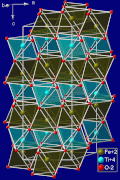 Crystal structure of ilmenite
 -
 Ilmenite from Froland, Aust-Agder, Norway; 4.1 × 4.1 × 3.8 cm
 -
 Ilmenite and hematite under normal light
 -
 Ilmenite and hematite under polarized light


Discovery[edit | edit source]
In 1791, William Gregor discovered a deposit of black sand in a stream that runs through the valley just south of the village of Manaccan (Cornwall), and identified for the first time titanium as one of the constituents of the main mineral in the sand.[12][13][14] Gregor named this mineral manaccanite.[15] The same mineral was found in the Ilmensky Mountains, near Miass, Russia, and named ilmenite.[10]
Mineral chemistry[edit | edit source]
Pure ilmenite has the composition FeTiO
3. However, ilmenite most often contains appreciable quantities of magnesium and manganese and up to 6 wt% of hematite, Fe
2O
3, substituting for FeTiO
3 in the crystal structure. Thus the complete chemical formula can be expressed as (Fe,Mg,Mn,Ti)O
3.[9] Ilmenite forms a solid solution with geikielite (Template:Chem) and pyrophanite (Template:Chem) which are magnesian and manganiferous end-members of the solid solution series.[4]
Although ilmenite is typically close to the ideal Template:Chem composition, with minor mole percentages of Mn and Mg,[4] the ilmenites of kimberlites usually contain substantial amounts of geikielite molecules,[16] and in some highly differentiated felsic rocks ilmenites may contain significant amounts of pyrophanite molecules.[17]
At temperatures above 950 °C (1,740 °F), there is a complete solid solution between ilmenite and hematite. There is a miscibility gap at lower temperatures, resulting in a coexistence of these two minerals in rocks but no solid solution.[9] This coexistence may result in exsolution lamellae in cooled ilmenites with more iron in the system than can be homogeneously accommodated in the crystal lattice.[18] Ilmenite containing 6 to 13 percent Fe
2O
3 is sometimes described as ferrian ilmenite.[19][20]
Ilmenite alters or weathers to form the pseudo-mineral leucoxene, a fine-grained yellowish to grayish or brownish material[9][21] enriched to 70% or more of TiO
2.[20] Leucoxene is an important source of titanium in heavy mineral sands ore deposits.[22]
Paragenesis[edit | edit source]
Ilmenite is a common accessory mineral found in metamorphic and igneous rocks.[4] It is found in large concentrations in layered intrusions where it forms as part of a cumulate layer within the intrusion. Ilmenite generally occurs in these cumulates together with orthopyroxene[23] or in combination with plagioclase and apatite (nelsonite).[24]
Magnesian ilmenite is formed in kimberlites as part of the MARID association of minerals (mica-amphibole-rutile-ilmenite-diopside) assemblage of glimmerite xenoliths.[25] Manganiferous ilmenite is found in granitic rocks[17] and also in carbonatite intrusions where it may also contain anomalously high amounts of niobium.[26]
Many mafic igneous rocks contain grains of intergrown magnetite and ilmenite, formed by the oxidation of ulvospinel.[19]
Processing and consumption[edit | edit source]

Most ilmenite is mined for titanium dioxide production.[27] Ilmenite and titanium dioxide are used in the production of titanium metal.[28][29]
Titanium dioxide is most used as a white pigment, and the major consuming industries for TiO2 pigments are paints and surface coatings, plastics, and paper and paperboard. Per capita consumption of TiO2 in China is about 1.1 kilograms per year, compared with 2.7 kilograms for Western Europe and the United States.[30]

Titanium is the ninth most abundant element on Earth and represents about 0.6 percent of the Earth's crust. Ilmenite is commonly processed to obtain a titanium concentrate, which is called "synthetic rutile" if it contains more than 90 percent TiO2, or more generally "titaniferous slags" if it has a lower TiO2 content. More than 80 percent of the estimated global production of titanium concentrate is obtained from the processing of ilmenite, while 13 percent is obtained from titaniferous slags and 5 percent from rutile.[31]
Ilmenite can be converted into pigment-grade titanium dioxide via either the sulfate process or the chloride process.[32] Ilmenite can also be improved and purified to titanium dioxide in the form of rutile using the Becher process.[33]
Ilmenite ores can also be converted to liquid iron and a titanium-rich slag using a smelting process.[34]
Steelmakers use ilmenite ore as a flux to line the blast furnace hearth refractory.[35]
Ilmenite can be used to produce ferrotitanium via an aluminothermic reduction.[36]
Feedstock production[edit | edit source]
| Feedstock | Template:Chem Content | Process |
|---|---|---|
| (%) | ||
| Ore | <55 | Sulfate |
| Ore | >55 | Chloride |
| Ore | <50 | Smelting (slag) |
| Synthetic rutile | 88–95 | Chloride |
| Chloride slag | 85–95 | Chloride |
| Sulfate slag | 80 | Sulfate |
| Year | 2011 | 2012–13 |
|---|---|---|
| Country | USGS | Projected |
| Australia | 1,300 | 247 |
| South Africa | 1,161 | 190 |
| Mozambique | 516 | 250 |
| Canada | 700 | |
| India | 574 | |
| China | 500 | |
| Vietnam | 490 | |
| Ukraine | 357 | |
| Senegal | - | 330 |
| Norway | 300 | |
| United States | 300 | |
| Madagascar | 288 | |
| Kenya | - | 246 |
| Sri Lanka | 62 | |
| Sierra Leone | 60 | |
| Brazil | 48 | |
| Other countries | 37 | |
| Total world | ~6,700 | ~1,250 |
Most ilmenite is recovered from heavy mineral sands ore deposits, where the mineral is concentrated as a placer deposit and weathering reduces its iron content, increasing the percentage of titanium. However, ilmenite can also be recovered from "hard rock" titanium ore sources, such as ultramafic to mafic layered intrusions or anorthosite massifs. The ilmenite in layered intrusions is sometimes abundant, but it contains considerable intergrowths of magnetite that reduce its ore grade. Ilmenite from anorthosite massifs often contains large amounts of calcium or magnesium that render it unsuitable for the chloride process.[40]
The proven reserves of ilmenite and rutile ores are estimated to be between 423 and 600 million tonnes of titanium dioxide. The largest ilmenite deposits are in South Africa, India, the United States, Canada, Norway, Australia, Ukraine, Russia and Kazakhstan. Additional deposits are found in Bangladesh, Chile, Mexico and New Zealand.[41]
Australia was the world's largest ilmenite ore producer in 2011, with about 1.3 million tonnes of production, followed by South Africa, Canada, Mozambique, India, China, Vietnam, Ukraine, Norway, Madagascar and the United States.
The top four ilmenite and rutile feedstock producers in 2010 were Rio Tinto Group, Iluka Resources, Exxaro and Kenmare Resources, which collectively accounted for more than 60% of the world's supplies.[42]
The world's two largest open cast ilmenite mines are:
- The Tellnes mine located in Sokndal, Norway, and run by Titania AS (owned by Kronos Worldwide Inc.) with 0.55 Mtpa capacity and 57 Mt contained Template:Chem reserves.
- The Rio Tinto Group's Lac Tio mine located near Havre Saint-Pierre, Quebec, in Canada with a 3 Mtpa capacity and 52 Mt reserves.[43]
Major mineral sands-based ilmenite mining operations include:
- Richards Bay Minerals in South Africa, majority-owned by the Rio Tinto Group.
- Kenmare Resources' Moma mine in Mozambique.
- Iluka Resources' mining operations in Australia, including Murray Basin, Eneabba and Capel.
- The Kerala Minerals & Metals Ltd (KMML), Indian Rare Earths (IRE), VV Mineral mines in India.
- TiZir Ltd.'s Grande Cote mine in Senegal[44]
- QIT Madagascar Minerals mine, majority-owned by the Rio Tinto Group, which began production in 2009 and is expected to produce 0.75 Mtpa of ilmenite, potentially expanding to 2 Mtpa in future phases.
Attractive major potential ilmenite deposits include:
- The Karhujupukka magnetite-ilmenite deposit in Kolari, northern Finland, with around 5 Mt reserves and ore containing about 6.2% titanium.
- The Balla Balla magnetite-iron-titanium-vanadium ore deposit in the Pilbara of Western Australia, which contains 456 million tonnes of cumulate ore horizon grading 45% Template:Chem, 13.7% Template:Chem and 0.64% Template:Chem, one of the richest magnetite-ilmenite ore bodies in Australia[45]
- The Coburn, WIM 50, Douglas, Pooncarie mineral sands deposits in Australia.
- The Magpie titano-magnetite (iron-titanium-vanadium-chrome) deposits in eastern Quebec of Canada with about 1 billion tonnes containing about 43% Fe, 12% TiO2, 0.4% V2O5, and 2.2% Cr2O3.
- The Longnose deposit in Northeast Minnesota is considered to be "the largest and richest ilmenite deposit in North America."[46]

In 2020, China had by far the highest titanium mining activity. About 35 percent of the world's ilmenite is mined in China, representing 33 percent of total titanium mineral mining (including ilmenite and rutile). South Africa and Mozambique are also important contributors, representing 13 percent and 12 percent of worldwide ilmenite mining, respectively. Australia represents 6 percent of the total ilmenite mining and 31 percent of rutile mining. Sierra Leone and Ukraine are also big contributors to rutile mining.[31]
China is the biggest producer of titanium dioxide, followed by the United States and Germany. China is also a leader in titanium metal production, but Japan, the Russian Federation, and Kazakhstan have emerged as significant contributors to this field.
Patenting activities[edit | edit source]

Patenting activity related to titanium dioxide production from ilmenite is rapidly increasing.[31] Between 2002 and 2022, there have been 459 patent families that describe the production of titanium dioxide from ilmenite, and this number is growing rapidly. The majority of these patents describe pre-treatment processes, such as smelting and magnetic separation, to increase the titanium concentration in low-grade ores, resulting in titanium concentrates or slags. Other patents describe processes for obtaining titanium dioxide, either through a direct hydrometallurgical process or via two industrially exploited processes: the sulfate process and the chloride process.
Acid leaching might be used either as a pre-treatment or as part of a hydrometallurgical process to directly obtain titanium dioxide or synthetic rutile (>90 percent titanium dioxide, TiO2). The sulfate process represents 40 percent of the world's titanium dioxide production and is protected in 23 percent of patent families. The chloride process is only mentioned in 8 percent of patent families, although it provides 60 percent of the worldwide industrial production of titanium dioxide.[31]
Key contributors to patents on the production of titanium dioxide are companies from China, Australia and the United States, reflecting the major contribution of these countries to industrial production. Chinese companies Pangang and Lomon Billions Groups are the main contributors and hold diversified patent portfolios covering both pre-treatment and the processes leading to a final product.
In comparison, patenting activity related to titanium metal production from ilmenite remains stable.[31] Between 2002 and 2022, there have been 92 patent families that describe the production of titanium metal from ilmenite, and this number has remained relatively steady. These patents describe the production of titanium metal starting from mineral ores, such as ilmenite, and from titanium dioxide (TiO2) and titanium tetrachloride (TiCl4), a chemical obtained as an intermediate in the chloride process. The starting materials are purified, if necessary, and then converted to titanium metal through a chemical reduction process using a reducing agent. Processes mainly differ regarding the reducing agent used to transform the starting material into titanium metal: magnesium is the most frequently cited reducing agent and the most exploited in industrial production.
Key players in the field are Japanese companies, in particular Toho Titanium and Osaka Titanium Technologies, both focusing on reduction using magnesium. Pangang also contributes to titanium metal production and holds patents describing reduction by molten salt electrolysis.[31]
Lunar ilmenite[edit | edit source]
Ilmenite has been found in lunar samples, particularly in high-Ti lunar mare basalts common from Apollo 11 and Apollo 17 sites, and on average, constitutes up to 5% of lunar meteorites.[47] Ilmenite has been targeted for ISRU water and oxygen extraction due to a simplistic reduction reaction which occurs with CO and H2 buffers.[48][49][50] The European Space Agency's VMMO mission, expected to launch in 2028, intends to map the distribution of ilmenite on the Moon.[51][52]
Sources[edit | edit source]
 This article incorporates text from a free content work. Licensed under CC-BY. Text taken from Production of titanium and titanium dioxide from ilmenite and related applications, WIPO.
References[edit | edit source]
- ↑ Warr, L.N. (2021). "IMA–CNMNC approved mineral symbols". Mineralogical Magazine. 85 (3): 291–320. Bibcode:2021MinM...85..291W. doi:10.1180/mgm.2021.43. S2CID 235729616.
- ↑ Eriksen et al. (2007). "Equilibrium between Liquid Fe-Ti-O Slags and Metallic Iron." Steel Research International. Vol 78. No. 9. doi:10.1002/srin.200706268
- ↑ Barthelmy, David (2014). "Ilmenite Mineral Data". Mineralogy Database. Webmineral.com. Retrieved 12 February 2022.
- ↑ 4.0 4.1 4.2 4.3 4.4 Anthony, John W.; Bideaux, Richard A.; Bladh, Kenneth W.; Nichols, Monte C. (eds.). "Ilmenite". Handbook of Mineralogy (PDF). Chantilly, VA, USA: Mineralogical Society of America. Retrieved 12 February 2022.
- ↑ Template:Mindat
- ↑ Heinz Sibum, Volker Günther, Oskar Roidl, Fathi Habashi, Hans Uwe Wolf, "Titanium, Titanium Alloys, and Titanium Compounds" in Ullmann's Encyclopedia of Industrial Chemistry 2005, Wiley-VCH, Weinheim. doi:10.1002/14356007.a27_095
- ↑ "Sachtleben RDI-S" (PDF). Archived from the original (PDF) on 25 December 2018. Retrieved 25 December 2018.
- ↑ "Products". Mineral Commodities Ltd. Retrieved 8 August 2016.
- ↑ 9.0 9.1 9.2 9.3 9.4 9.5 Klein, Cornelis; Hurlbut, Cornelius S. Jr. (1993). Manual of mineralogy : (after James D. Dana) (21st ed.). New York: Wiley. pp. 380–381. ISBN 047157452X.
- ↑ 10.0 10.1 10.2 Sinkankas, John (1964). Mineralogy for amateurs. Princeton, N.J.: Van Nostrand. pp. 328–329. ISBN 0442276249.
- ↑ Nesse, William D. (2000). Introduction to mineralogy. New York: Oxford University Press. pp. 366–367. ISBN 9780195106916.
- ↑ Gregor, William (1791) "Beobachtungen und Versuche über den Menakanit, einen in Cornwall gefundenen magnetischen Sand" (Observations and experiments regarding menaccanite [i.e., ilmenite], a magnetic sand found in Cornwall), Chemische Annalen …, 1, pp. 40–54, 103–119.
- ↑ Emsley, John (2001). "Titanium". Nature's Building Blocks: An A-Z Guide to the Elements. Oxford, England, UK: Oxford University Press. ISBN 978-0-19-850340-8.
- ↑ Woodford, Chris (2003). Titanium. New York: Benchmark Books. p. 7. ISBN 9780761414612. Retrieved 22 February 2022.
- ↑ Habashi, Fathi (January 2001). "Historical Introduction to Refractory Metals". Mineral Processing and Extractive Metallurgy Review. 22 (1): 25–53. Bibcode:2001MPEMR..22...25H. doi:10.1080/08827509808962488. S2CID 100370649.
- ↑ Wyatt, Bruce A.; Baumgartner, Mike; Anckar, Eva; Grutter, Herman (September 2004). "Compositional classification of "kimberlitic" and "non-kimberlitic" ilmenite". Lithos. 77 (1–4): 819–840. Bibcode:2004Litho..77..819W. doi:10.1016/j.lithos.2004.04.025. S2CID 140539776.
- ↑ 17.0 17.1 Sasaki, Kazuhiro; Nakashima, Kazuo; Kanisawa, Satoshi (15 July 2003). "Pyrophanite and high Mn ilmenite discovered in the Cretaceous Tono pluton, NE Japan". Neues Jahrbuch für Mineralogie - Monatshefte. 2003 (7): 302–320. doi:10.1127/0028-3649/2003/2003-0302.
- ↑ Weibel, Rikke; Friis, Henrik (2007). "Chapter 10 Alteration of Opaque Heavy Minerals as a Reflection of the Geochemical Conditions in Depositional and Diagenetic Environments". Heavy Minerals in Use. Developments in Sedimentology. Vol. 58. pp. 277–303. Bibcode:2007DevS...58..277W. doi:10.1016/S0070-4571(07)58010-6. ISBN 9780444517531.
- ↑ 19.0 19.1 Buddington, A. F.; Lindsley, D. H. (1 January 1964). "Iron-Titanium Oxide Minerals and Synthetic Equivalents". Journal of Petrology. 5 (2): 310–357. doi:10.1093/petrology/5.2.310.
- ↑ 20.0 20.1 Murphy, P.; Frick, L. (2006). "Titanium". In Kogel, J. (ed.). Industrial minerals & rocks: commodities, markets, and uses. SME. pp. 987–1003. ISBN 9780873352338. Retrieved 21 February 2022.
- ↑ Mücke, A.; Bhadra Chaudhuri, J.N. (February 1991). "The continuous alteration of ilmenite through pseudorutile to leucoxene". Ore Geology Reviews. 6 (1): 25–44. Bibcode:1991OGRv....6...25M. doi:10.1016/0169-1368(91)90030-B.
- ↑ Van Gosen, Bradley S.; Fey, David L.; Shah, Anjana K.; Verplanck, Philip L.; Hoefen, Todd M. (2014). "Deposit model for heavy-mineral sands in coastal environments". U.S. Geological Survey Scientific Investigations Report. Scientific Investigations Report. 201--5070-L: 13. Bibcode:2014usgs.rept...13V. doi:10.3133/sir20105070L.
- ↑ Wilson, J.R.; Robins, B.; Nielsen, F.M.; Duchesne, J.C.; Vander Auwera, J. (1996). "The Bjerkreim-Sokndal Layered Intrusion, Southwest Norway". Layered Intrusions. Vol. 15. pp. 231–255. Bibcode:1996DevPe..15..231W. doi:10.1016/S0167-2894(96)80009-1. hdl:2268/550. ISBN 9780444817686.
{{cite book}}:|journal=ignored (help) - ↑ Charlier, Bernard; Sakoma, Emmanuel; Sauvé, Martin; Stanaway, Kerry; Auwera, Jacqueline Vander; Duchesne, Jean-Clair (March 2008). "The Grader layered intrusion (Havre-Saint-Pierre Anorthosite, Quebec) and genesis of nelsonite and other Fe–Ti–P ores". Lithos. 101 (3–4): 359–378. Bibcode:2008Litho.101..359C. doi:10.1016/j.lithos.2007.08.004. hdl:2268/1893.
- ↑ Dawson, J.Barry; Smith, Joseph V. (February 1977). "The MARID (mica-amphibole-rutile-ilmenite-diopside) suite of xenoliths in kimberlite". Geochimica et Cosmochimica Acta. 41 (2): 309–323. Bibcode:1977GeCoA..41..309D. doi:10.1016/0016-7037(77)90239-3.
- ↑ Cordeiro, Pedro F.O.; Brod, José A.; Dantas, Elton L.; Barbosa, Elisa S.R. (August 2010). "Mineral chemistry, isotope geochemistry and petrogenesis of niobium-rich rocks from the Catalão I carbonatite-phoscorite complex, Central Brazil". Lithos. 118 (3–4): 223–237. Bibcode:2010Litho.118..223C. doi:10.1016/j.lithos.2010.04.007.
- ↑ "Industry Fundamentals". Mineral Commodities Ltd. Archived from the original on 7 October 2016. Retrieved 8 August 2016.
- ↑ Kroll, W (1940). "The production of ductile titanium". Transactions of the Electrochemical Society. 78: 35–47. doi:10.1149/1.3071290.
- ↑ Seki, Ichiro (2017). "Reduction of titanium dioxide to metallic titanium by nitridization and thermal decomposition". Materials Transactions. 58 (3): 361–366. doi:10.2320/matertrans.MK201601.
- ↑ "Titanium Dioxide Chemical Economics Handbook". IHS Markit.
- ↑ 31.0 31.1 31.2 31.3 31.4 31.5 World Intellectual Property Organization. (2023). "Patent Landscape Report". WIPO. Patent Landscape Reports. doi:10.34667/tind.47029. Retrieved 19 October 2023.
- ↑ Template:Ullmann
- ↑ Welham, N.J. (December 1996). "A parametric study of the mechanically activated carbothermic reduction of ilmenite". Minerals Engineering. 9 (12): 1189–1200. Bibcode:1996MiEng...9.1189W. doi:10.1016/S0892-6875(96)00115-X.
- ↑ Pistorius, P.C. (January 2008), "Ilmenite smelting: the basics" (PDF), The Journal of the South African Institute of Mining and Metallurgy, 108
- ↑ "Rio Tinto, Fer et Titane - Products". Rio Tinto Group. Archived from the original on 6 May 2015. Retrieved 19 August 2012.
- ↑ Gasik, Michael, ed. (2013). Handbook of Ferroalloys: Theory and Technology. London: Elsevier. p. 429. ISBN 978-0-08-097753-9.
- ↑ Hayes, Tony (2011), Titanium Dioxide: A Shining Future Ahead (PDF), Euro Pacific Canada, p. 5, retrieved 16 August 2012[dead link]
- ↑ Hayes 2011, p. 5.
- ↑ USGS 2012 Survey, p. 174
- ↑ Murphy, Philip; Frick, Louise (2006). "Titanium". In Barker, James M.; Kogel, Jessica Elzea; Trivedi, Nikhil C.; Krukowski, Stanley T. (eds.). Industrial minerals & rocks: commodities, markets, and uses (7th ed.). Littleton, Colo.: Society for Mining, Metallurgy, and Exploration. pp. 990–991. ISBN 9780873352338. Retrieved 23 February 2022.
- ↑ Güther, V.; Sibum, H.; Roidl, O.; Habashi, F.; Wolf, H (2005). "Titanium, Titanium Alloys, and Titanium Compounds". Ullmann's Encyclopedia of Industrial Chemistry. Wiley InterScience. ISBN 978-3-527-30673-2.
- ↑ Hayes 2011, p. 3.
- ↑ "Lac Tio Mine". InfoMine. Retrieved 16 August 2012.
- ↑ "TiZir Limited". Mineral Deposits Limited. Archived from the original on 18 August 2012. Retrieved 16 August 2012.
- ↑ "Vanadium – AIMR 2011 – Australian Mines Atlas".
- ↑ Kraker, Dan. "Titanium Range? Breakthrough could lead to new kind of mining in NE Minn". Retrieved 31 May 2017.
- ↑ Korotev, Randy. 2005 "Lunar geochemistry as told by lunar meteorites." Geochemistry. Vol 65. Pages 297–346. https://doi.org/10.1016/j.chemer.2005.07.001
- ↑ Schluter & Cowley. "Review of techniques for in-situ oxygen extraction on the moon." Planetary and Space Science. Vol 181. https://doi.org/10.1016/j.pss.2019.104753
- ↑ Perreault & Patience. "Ilmenite–CO reduction kinetics." Fuel. Vol 165, 166–172. https://doi.org/10.1016/j.fuel.2015.10.066
- ↑ Muscatello, Tony. 2017. "Oxygen Extraction from Minerals" Presentation, NASA KSC Applied Chem lab. https://ntrs.nasa.gov/api/citations/20170001458/downloads/20170001458.pdf
- ↑ "VMMO". www.esa.int. Retrieved 26 August 2025.
- ↑ Gao, Yang (29 August 2019). "Building a moon base is a huge task – here are the tiny satellites that will pave the way". The Conversation. Retrieved 26 August 2025.
Template:Titanium minerals Template:Titanium compounds Template:Ores Template:Iron compounds