




robot: Update article (please report if you notice any mistake or error in this edit) |
edit |
||
| Line 1: | Line 1: | ||
{{Short description| | {{Short description|Textile design with a teardrop motif}} | ||
{{Use dmy dates|date=April 2022}} | {{Use dmy dates|date=April 2022}} | ||
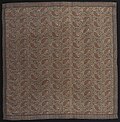
[[File:Shawl LACMA M.84.244.1.jpg|thumb|Shawl made in [[Paisley, Renfrewshire|Paisley]], Scotland, in imitation of [[Kashmir shawl]]s, | [[File:Shawl LACMA M.84.244.1.jpg|thumb|Shawl made in [[Paisley, Renfrewshire|Paisley]], Scotland, in imitation of [[Kashmir shawl]]s, {{circa| 1830}}]] | ||
'''Paisley''' or '''paisley pattern''' is an ornamental | '''Paisley''' or '''paisley pattern''' is an ornamental textile design using the ''[[Buta (ornament)|boteh]]'' ({{langx|fa|بته}}) or ''buta'', a teardrop-shaped motif with a curved upper end. Of [[Culture of Iran|Iranian/Persian]] origin, paisley designs became popular in the West in the 18th and 19th centuries, following imports of post-[[Mughal Empire]] versions of the design from India, especially in the form of [[Kashmir shawl]]s, and were then replicated locally.<ref>Dusenbury and Bier, 48–50</ref> | ||
The English name for the patterns comes from the town of [[Paisley, Renfrewshire|Paisley]], in the west of Scotland, a centre for textiles where paisley designs were reproduced using [[Jacquard machine|jacquard looms]].<ref>{{Cite web |title=Paisley: The story of a classic bohemian print |url=https://www.bbc.com/culture/article/20151021-paisley-behind-rocks-favourite-fashion |access-date=2024-02-23 |website=www.bbc.com|date=6 November 2017 }}</ref><ref>{{Cite news |date=2011-09-26 |title=A brief history of paisley |url=http://www.theguardian.com/fashion/gallery/2011/sep/26/paisley-london-fashion-week |access-date=2024-02-23 |work=The Guardian |issn=0261-3077}}</ref> | |||
[[Image:Persian Silk Brocade - Paisley - Persian Paisley - Seyyed Hossein Mozhgani - 1963.jpg|thumb|Persian silk brocade with gold and silver thread (''golabetoon''), woven in 1963.]] | |||
The pattern is still commonly seen in Britain, the United States, and other English-speaking countries on neckties, waistcoats, skirts, blouses and scarves, and remains popular in other items of clothing and textiles in [[Iran]] and [[South Asia|South]] and [[Central Asia]]n countries. | |||
The pattern is still commonly seen in Britain and other English-speaking countries on | |||
==Origins== | ==Origins== | ||
[[File:Shawl Fragment (India), 19th century (CH 18615341).jpg|thumb|Shawl fragment, India, | [[File:Shawl Fragment (India), 19th century (CH 18615341).jpg|thumb|Shawl fragment, India, 19th century]] | ||
Some design scholars | Some design scholars believe the ''buta'' is the convergence of a stylized floral spray and a [[Cupressus sempervirens|cypress]] tree: a [[Zoroastrian]] symbol of life and eternity.<ref name=ZT>{{Citation |url=http://www.zanzibartrading.com/indian_shawls.htm |title=Indian Hand Woven Jacquard Jamavar Shawls |publisher=Zanzibar Trading |access-date=2012-02-07 |archive-date=2012-01-18 |archive-url=https://web.archive.org/web/20120118083542/http://www.zanzibartrading.com/indian_shawls.htm |url-status=live }}.</ref> The "bent" cedar is also a sign of strength and resistance but modesty. The floral motif originated in the [[Sasanian Empire|Sasanian era]] (224–651), was used later in the [[Safavid Iran|Safavid era]] (1501–1736), and was a major textile pattern in Iran during the [[Qajar Iran|Qajar]] and [[Pahlavi Iran|Pahlavi]] eras. In these periods, the pattern was used to decorate royal regalia, crowns, and court garments, as well as textiles used by the general population.{{citation needed|date=May 2018}} [[Persian art|Persian]] and Central Asian designs usually range the motifs in orderly rows, with a plain background. | ||
=== Ancient Indo-Iranian origins === | === Ancient Indo-Iranian origins === | ||
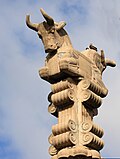
{{ | [[File:Perspolis.jpg|thumb|alt=Persian column|[[Persian column|Persian columns]] of [[Apadana]] in Iran have similar pattern on sides of the snout.{{cn|date=July 2025}}]] | ||
There is significant speculation as to the origins and symbolism of | There is significant speculation as to the origins and symbolism of ''boteh jegheh'', or "ancient motif", known in English as paisley.<ref name=":0">{{Cite journal|url=https://www.sid.ir/en/seminar/ViewPaper.aspx?id=8597 |title=A Glance at the Figure of Boteh Jegheh (Ancient Motif) |website=SID.ir |date=January 2016 |issue=1 |access-date=2019-12-05|archive-date=2020-09-10|archive-url=https://web.archive.org/web/20200910063336/https://www.sid.ir/en/seminar/ViewPaper.aspx?id=8597|url-status=live|last1=Masoumeh |first1=Bagheri Hasankiadeh }}</ref> With experts contesting different time periods for its emergence, to understand the proliferation in the popularity of boteh jegheh design and eventually Paisley, it is important to understand [[South Asian history]]. The early [[Indo-Iranians|Indo-Iranian]] people flourished in South Asia, where they eventually exchanged linguistic, cultural, and even religious similarities.<ref>{{Cite book|url=https://books.google.com/books?id=GXzycd3dT9kC&q=indo+iranian+peoples&pg=PA357|title=History of Civilizations of Central Asia|last1=Dani|first1=Ahmad Hasan|last2=Masson|first2=Vadim Mikhaĭlovich|date=1999|publisher=Motilal Banarsidass Publ.|isbn=978-81-208-1407-3 |access-date=2019-12-24|archive-date=2020-09-10|archive-url=https://web.archive.org/web/20200910063334/https://books.google.com/books?id=GXzycd3dT9kC&pg=PA357&dq=indo+iranian+peoples&hl=en#v=onepage&q=indo%20iranian%20peoples&f=false|url-status=live}}</ref> The ancient Indo-Iranian people shared a religion called [[Zoroastrianism]].<ref name=":1">{{Cite book|url=https://books.google.com/books?id=7oyiAgAAQBAJ&q=zoroastrian+religion+cypress+tree&pg=PP1|title=Pious Citizens: Reforming Zoroastrianism in India and Iran|last=Ringer|first=Monica|date=2011-12-13|publisher=Syracuse University Press|isbn=978-0-8156-5060-7 |access-date=2019-12-24|archive-date=2020-09-10|archive-url=https://web.archive.org/web/20200910063335/https://books.google.com/books?id=7oyiAgAAQBAJ&pg=PP1&dq=zoroastrian+religion+cypress+tree&hl=en#v=onepage&q=zoroastrian%20religion%20cypress%20tree&f=false|url-status=live}}</ref> Zoroastrianism, some experts{{Who|date=December 2020}} argue, served as one of the earliest influences for boteh jegheh's design with the shape representing the cypress tree, an ancient Zoroastrian religious symbol.<ref name=":1" /> Others{{Who|date=December 2020}} contest that the earliest representation of the pattern's shape comes from the later [[Sasanian Empire]].<ref name=":2">{{Cite web|url=https://www.paisley.org.uk/2013/01/roots-of-the-paisley-pattern/|title=Roots of the Paisley Pattern|last=McGuire|first=Brian|date=2013-01-24|website=Paisley Scotland|access-date=2019-12-04|archive-date=2019-12-05|archive-url=https://web.archive.org/web/20191205043614/https://www.paisley.org.uk/2013/01/roots-of-the-paisley-pattern/|url-status=live}}</ref> The design was representative of a tear drop.<ref name=":2" /> Some{{Who|date=December 2020}} will argue that ''boteh jegheh's'' origins stem from old religious beliefs and its meaning could symbolise the sun, a phoenix, or even an ancient Iranian religious sign for an eagle.<ref name=":0" /> Around the same time, a pattern called [[Buta (ornament)|''Boteh'']] was gaining popularity in Iran; the pattern was a floral design, and was used to represent elite status, mostly serving to decorate royal objects.<ref name=":2" /> The pattern was traditionally woven onto silk clothing using silver and gold material.<ref name=":2" /> | ||
== | == Spread of the pattern in South Asia == | ||
One of the earliest evidence of the pattern as it relates to Islamic culture has been found at Noh Gumba mosque, in the city of [[Balkh]] in Afghanistan, where it is believed that the pattern was included in the design as early as the 800s when the mosque was built. In early Iranian culture, the design was woven onto Termeh, one of the most valuable materials in early Iran where the design served to make clothing for the nobility. At this time, the Iranian nobility wore distinct uniforms called [[khalat]]; historically, the design was commonly found on the khalat uniforms.<ref name=":42" /> It is stated that at some point in the 1400s, Boteh was transported from Persia to Kashmir.<ref name=":32" /> | |||
In the same century, in the 1400s, some of the earliest recorded [[Kashmir shawl|Kashmir shawls]] were produced in India, records from the 1500s, during Emperor [[Akbar]]'s reign over the Mughal people in this area indicate that shawl making was already fashionable in India prior to Mughal conquest which took place in the early 1400s.<ref name=":52" /> It has been stated that during Emperor Akbars reign over the Mughal empire, boteh jegheh shawls were extremely popular and fashionable. While one shawl was traditionally worn previously, it was during the rule of Emperor Akbar that the emperor decided to wear two shawls at a time to serve as a status symbol. Along with wearing the shawls frequently, Emperor Akbar also used the shawls as gifts to other rulers and high officials.<ref name=":52" /> It is believed that by the 1700s, Kashmir shawls were produced in the image that someone today would associate with modern paisley.<ref name=":32" /> | |||
In | == Introduction of boteh jegheh to Western culture == | ||
In the 18th and 19th centuries, the [[East India Company|British East India Company]] introduced Kashmir shawls from India to England and Scotland, where they were extremely fashionable and soon duplicated.<ref>{{Cite web|url=http://www.bbc.com/culture/story/20151021-paisley-behind-rocks-favourite-fashion|title=Paisley: The story of a classic bohemian print|last=Baker|first=Lindsay|website=www.bbc.com|date=6 November 2017 |access-date=2019-12-05|archive-date=2019-12-03|archive-url=https://web.archive.org/web/20191203200905/http://www.bbc.com/culture/story/20151021-paisley-behind-rocks-favourite-fashion|url-status=live}}</ref> The first place in the Western world to imitate the design was the town of [[Paisley, Renfrewshire|Paisley]] in Scotland, Europe's top producer of textiles at this time.<ref>{{Cite web|url=http://www.macmillandictionaryblog.com/paisley|title=What is paisley? {{!}} Macmillan Dictionary Blog|date=3 May 2018|access-date=2019-12-05|archive-date=2019-12-05|archive-url=https://web.archive.org/web/20191205043616/http://www.macmillandictionaryblog.com/paisley|url-status=live}}</ref> Before being produced in Paisley, thus gaining its name in English-speaking culture, the paisley motif was originally referred to by Westerners simply as "pine and cone."<ref name=":32">{{Cite web|url=https://pdfslide.net/documents/buta-to-paisley-an-ongoing-journey-laureate-legal-terms-andpaisley-a-motif-.html|title=Buta to Paisley An ongoing Journey - Laureate Legal Terms and...Paisley A motif- * Intensively used in ... palm tree leaf Pearl Academy, ... In Kashmir the name used to describe this motif is buta or buti|website=pdfslide.net|access-date=2019-12-05|archive-date=2019-12-05|archive-url=https://web.archive.org/web/20191205043614/https://pdfslide.net/documents/buta-to-paisley-an-ongoing-journey-laureate-legal-terms-andpaisley-a-motif-.html|url-status=usurped}}</ref> European technological innovation in textile manufacturing made Western imitations of Kashmir shawls competitive with shawls from Kashmir.<ref name=":6">{{Cite journal|last=Maskiell|first=Michelle|title=Consuming Kashmir: Shawls and Empires, 1500-2000|journal=Journal of World History|volume=13|pages=27–65|doi=10.1353/jwh.2002.0019|year=2002|s2cid=144868279}}</ref> | |||
The | The shawls from India could be quite expensive at the time, but, with the industrial revolution taking place in Europe, paisley shawls were manufactured on a large scale, so lowering their price that they became commonplace among the middle class and boosting the design's popularity even more.<ref name=":32" /> While the Western world appropriated much of Eastern culture and design, the Boteh design was by far the most popular.<ref name=":6" /> Records indicate that [[William Moorcroft (explorer)|William Moorcroft]], an English businessman and explorer, visited the [[Himalayas|Himalayan mountains]] in the mid-1800s; upon his arrival, he was enthralled by Boteh-adorned Kashmir shawls and tried to arrange for entire families of Indian textile workers to move to the United Kingdom.<ref name=":52">{{Cite journal|last=Karpinski|first=Caroline|date=November 1963|title=Kashmir to Paisley|journal=The Metropolitan Museum of Art Bulletin|volume=22|issue=3|pages=116–123|doi=10.2307/3258212|jstor=3258212}}</ref> The earliest paisley shawls made in the United Kingdom, in Paisley, Scotland, were of fleece, a material with a soft, fluffy texture on one side. | ||
In Asia, the paisley shawls were primarily worn by males, often in formal or ceremonial contexts, but in Europe they were primarily worn instead by women.{{Citation needed|date=February 2024}}<ref>{{Cite web |last=radikls.com |title=A Passion for Paisley - The Story Behind this Iconic Motif |url=https://mistantiques.co.uk/a-passion-for-paisley-the-story-of-this-iconic-motif/ |access-date=2025-12-31 |website=Mist Antiques |language=en-GB}}</ref> While still closely resembling its original form, the paisley design would change once it began to be produced in Western culture, with different towns in the United Kingdom applying their own spin to the design.<ref name=":42">{{Cite web|url=http://guity-novin.blogspot.com/2018/07/chapter-92-history-of-paisley-or-boteh.html|title=A History of Graphic Design: Chapter 92 - A History of Paisley or Boteh Jegheh Design|last=Novin|first=Guity|website=A History of Graphic Design|access-date=2019-12-19|archive-date=2020-02-27|archive-url=https://web.archive.org/web/20200227170953/http://guity-novin.blogspot.com/2018/07/chapter-92-history-of-paisley-or-boteh.html|url-status=live}}</ref> | |||
In the | In the 1800s, European production of paisley increased, particularly in the Scottish town from which the pattern takes its modern name. Soldiers returning from the [[British Empire|colonies]] brought home [[cashmere wool]] shawls from India, and the [[British East India Company|East India Company]] imported more. The design was copied from the costly silk and wool Kashmir shawls and adapted first for use on handlooms, and, after 1820,<ref name="VICTORIANA">{{Citation |url=http://www.victoriana.com/library/paisley/shawl.html |title=Beyond the Fringe: Shawls of Paisley Design |first=Meg |last=Andrews |publisher=Victoriana |access-date=February 3, 2008 |archive-date=February 16, 2008 |archive-url=https://web.archive.org/web/20080216001719/http://www.victoriana.com/library/paisley/shawl.html |url-status=live }}. Heavily illustrated history of paisley fashions.</ref> on [[Jacquard loom]]s. The paisley pattern also appeared on European-made bandanas from the early 1800s, the patterns imitating Kashmir shawls.<ref name=":3">{{Cite web |last1=Magazine |first1=Smithsonian |last2=Hilgers |first2=Laura |title=The Global History of the Bandana |url=https://www.smithsonianmag.com/innovation/global-history-bandana-180976040/ |access-date=2023-06-19 |website=Smithsonian Magazine }}</ref> | ||
From roughly 1800 to 1850, the weavers of the town of [[Paisley, Renfrewshire|Paisley]] in [[Renfrewshire]], [[Scotland]], became the foremost producers of [[Paisley shawls]]. | From roughly 1800 to 1850, the weavers of the town of [[Paisley, Renfrewshire|Paisley]] in [[Renfrewshire]], [[Scotland]], became the foremost producers of [[Paisley shawls]]. Unique additions to their hand-looms and Jacquard looms allowed them to work in five colours when most weavers were producing paisley using only two.<ref name="VICTORIANA" /> The design became known as the ''Paisley pattern''. By 1860, Paisley could produce shawls with 15 colours, which was still only a quarter of the number used in the multicolour paisleys then still being imported from Kashmir.<ref name="VICTORIANA" /> In addition to the loom-woven fabric, the town of Paisley became a major site for the manufacture of printed [[cotton]] and [[wool]] in the 1800s, according to the [[Paisley Museum and Art Galleries]].<ref name="MUSUEM">{{Citation |contribution-url=http://www.aboutbritain.com/PaisleyMuseumAndArtGallery.htm |contribution=Paisley Museum and Art Gallery |title=About Britain |access-date=2008-02-03 |archive-date=2008-03-05 |archive-url=https://web.archive.org/web/20080305142201/http://www.aboutbritain.com/PaisleyMuseumAndArtGallery.htm |url-status=live }}.</ref> In this process, the paisley pattern was printed, rather than woven, onto other textiles, including cotton squares which were the precursors of the modern [[bandanna]]. Printed paisley was cheaper than the costly woven paisley, and this added to its popularity. The key places of printing paisley were Scotland and the [[Alsace]] region of France.<ref>{{Citation |contribution-url=http://www.musee-impression.com/gb/collection/xix.html |contribution=Printed ‘Paisley’ in the 19th Century |title=Le Musée de l'Impression sur Etoffes |trans-title=The Museum of Printed Textiles |access-date=February 3, 2008 |archive-date=March 5, 2015 |archive-url=https://web.archive.org/web/20150305023039/http://www.musee-impression.com/gb/collection/xix.html |url-status=live }}.</ref> The peak period of paisley as a fashionable design ended in the 1870s,<ref name=":7">{{Cite journal|last1=Welters|first1=Linda|last2=Beasley|first2=Elizabeth|last3=Dee-Collins|first3=Nicole|last4=Gilcrease|first4=Sallie|last5=Lukens|first5=Catherine|date=2017-01-01|title=Second Chances for Paisley Shawls|url=https://lib.dr.iastate.edu/itaa_proceedings/2017/posters/102|journal=International Textile and Apparel Association (ITAA) Annual Conference Proceedings|access-date=2019-12-19|archive-date=2019-12-05|archive-url=https://web.archive.org/web/20191205043613/https://lib.dr.iastate.edu/itaa_proceedings/2017/posters/102/|url-status=live}}</ref> perhaps as so many cheap printed versions were on the market. | ||
In addition to the loom-woven fabric, the town of Paisley became a major site for the manufacture of printed [[cotton]] and [[wool]] in the | |||
==Modern use== | |||
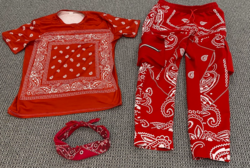
[[File:Paisley patterned clothes.png|thumb|328x328px|Paisley patterned clothing set]] | |||
The 1960s proved to be a time of great revival for the paisley design in Western culture. Popular culture in the United States developed a strong interest in eastern cultures, including many traditionally Indian styles. Paisley was one of them, being worn by recording artists such as [[The Beatles]], [[Queen (band)|Queen]], and [[David Bowie]]. | |||
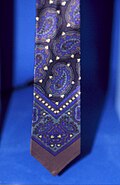
Today, the design remains common, appearing on jewellery, suit ties, pocket books, cake decorations, tattoos, mouse pads for computers, scarves, and dresses. Paisley bandanas, long used by cowboys,<ref>{{cite web |url=https://www.smithsonianmag.com/innovation/global-history-bandana-180976040/ |title=The Global History of the Bandana |last=Hilgers |first=Laura |date=November 2020 |website=Smithsonian Magazine |access-date=14 March 2024}}</ref> came in the latter twentieth century to be worn by many blue-collar laborers as protection from dust, and were sported by entertainers popular with such workers, such as the country musician [[Willie Nelson]].<ref>{{cite web |url=https://www.timeout.com/chicago/music/nine-things-you-didnt-know-about-willie-nelson |title=Nine-Things-You-Didnt-Know-About-Willie-Nelson |work=Time Out Chicago |date=6 June 2012 |access-date=2021-01-19 }}</ref> | |||
The motif also influences furniture design internationally, with many countries applying paisley decoration to wallpaper, pillows, curtains, bed spreads, and like furnishings.<ref name=":32" /> | |||
[[File:Tie (AM 1996.180.4-4).jpg|thumb|Modern paisley tie (before 1996)|319x319px]] | |||
== | === Music === | ||
[[File:Rolls Royce Phantom VI (23064272132).jpg|thumb|John Lennon's 1965 Rolls Royce Phantom V with a paisley design]] | |||
In the mid- to late 1960s, paisley became identified with [[psychedelia|psychedelic]] style and enjoyed mainstream popularity, partly due to The Beatles.<ref>{{Cite web |title=Paisley: The story of a classic bohemian print |date=6 November 2017 |url=http://www.bbc.com/culture/story/20151021-paisley-behind-rocks-favourite-fashion |url-status=live |archive-url=https://web.archive.org/web/20180527212927/http://www.bbc.com/culture/story/20151021-paisley-behind-rocks-favourite-fashion |archive-date=2018-05-27 |access-date=2018-05-31}}</ref> The style was particularly popular during the [[Summer of Love]] in 1967. | |||
The [[Fender Musical Instruments Corporation]] made a pink paisley version of their [[Telecaster]] guitar by putting paisley wallpaper onto the guitar bodies.<ref>{{Cite web |date=2009 |title=Paisley Teles |url=http://www.tdpri.com/wp-tdpri/resources/paisley-teles/ |archive-url=https://web.archive.org/web/20180612141914/http://www.tdpri.com/wp-tdpri/resources/paisley-teles/ |archive-date=12 June 2018 |publisher=Telecaster Discussion Page}}</ref><ref>{{Cite web |date=14 June 2011 |title=1968 Fender Paisley Telecaster and Telecaster Bass |url=https://www.premierguitar.com/articles/1968_Fender_Paisley_Telecaster_and_Telecaster_Bass |url-status=live |archive-url=https://web.archive.org/web/20191027134518/https://www.premierguitar.com/articles/1968_Fender_Paisley_Telecaster_and_Telecaster_Bass |archive-date=2019-10-27 |access-date=2018-06-10}}</ref> | |||
[[Prince (musician)|Prince]] paid tribute to the [[rock and roll]] history of paisley when he created the [[Paisley Park Records]] recording label and established [[Paisley Park|Paisley Park Studios]], both named after his 1985 song "[[Paisley Park (song)|Paisley Park]]". The [[Paisley Underground]] was a music scene active around the same time. | |||
=== Architecture === | |||
Paisley was a favorite design element of British-Indian architect [[Laurie Baker]]. He has made numerous drawings and collages of what he called "mango designs".<ref>{{cite web |url=http://www.indulekha.com/colours/2008/03/mango-mania-by-laurie-baker-1.html |title=INDULEKHA» GREEN | colours: MANGO MANIA by Laurie Baker » 1 |access-date=2016-01-09 |url-status=dead |archive-url=https://web.archive.org/web/20081002033712/http://www.indulekha.com/colours/2008/03/mango-mania-by-laurie-baker-1.html |archive-date=2008-10-02 }}</ref> He used to include the shape in the buildings he designed also.<ref>{{Cite web| url=http://www.livemint.com/Leisure/djP08vKPt2lHkjsInYkItN/The-mango-house.html| title=The mango house| work=mint| date=2008-07-24| access-date=2016-01-09| archive-date=2016-02-07| archive-url=https://web.archive.org/web/20160207045604/http://www.livemint.com/Leisure/djP08vKPt2lHkjsInYkItN/The-mango-house.html| url-status=live| last1=Burte| first1=Himanshu}}</ref> | |||
=== Sports === | |||
It was part of the emblem for the [[2020 FIFA U-17 Women's World Cup]], held in India.<ref>{{Cite web |title=FIFA Unveils Official Emblem For FIFA U-17 Women's World Cup In India |url=https://www.modernghana.com/sports/965550/fifa-unveils-official-emblem-for-fifa-u-17-womens.html}}</ref> The motif was chosen due to its common use in [[Pashmina (material)|Kasmiri Pashmina]] carpets.<ref>{{cite news |title=Vibrant official Emblem revealed as journey to FIFA U-17 Women's World Cup India 2020 begins |url=https://www.fifa.com/u17womensworldcup/news/vibrant-official-emblem-revealed-as-journey-to-fifa-u-17-women-s-world-cup-india |accessdate=3 November 2019 |work=FIFA |date=2 November 2019 |archive-url=https://web.archive.org/web/20191103015641/https://www.fifa.com/u17womensworldcup/news/vibrant-official-emblem-revealed-as-journey-to-fifa-u-17-women-s-world-cup-india |archive-date=3 November 2019 |url-status=dead }}</ref> | |||
==Other languages== | |||
In Persian, Boteh can be translated to shrub or bush, while in [[Kashmir]] it carried the same meaning but was referred to as Buta, or Bu.<ref name=":32" /> | |||
The modern [[French (language)|French]] words for paisley are ''{{lang|fr|boteh}}'' (meaning bush, cluster of leaves or a flower bud) <ref>{{Cite web|url=http://www.heritageinstitute.com/zoroastrianism/trade/paisley.htm|title=Boteh (Botteh, Paisley). Aryan Silk & Trade|website=www.heritageinstitute.com|access-date=2019-06-04|archive-date=2019-05-24|archive-url=https://web.archive.org/web/20190524113000/http://www.heritageinstitute.com/zoroastrianism/trade/paisley.htm|url-status=live}}</ref> in Persian as well as ''{{lang|fr|cachemire}}'' ({{Interlanguage link|Cachemire (tissu)|fr}}) and ''{{lang|fr|palme}}'' ("[[Arecaceae|palm]]", which – along with the [[pine]] and the [[cypress]] – is one of the traditional botanical motifs thought to have influenced the shape of the paisley element as it is now known).<ref name= ZT /> | |||
In various languages of Bangladesh, India and Pakistan, the design's name is related to the word for [[mango]]: | |||
* In [[Bengali language|Bengali]]: ''kalka''<ref>{{cite book| author= Zaman Niaz| title= The Art of KANTHA Embroidery| edition= Second Revised| year= 1993| page=82| publisher= The University Press Limited| location =Dhaka, Bangladesh| isbn= 978-984-05-1228-7}}</ref> | * In [[Bengali language|Bengali]]: ''kalka''<ref>{{cite book| author= Zaman Niaz| title= The Art of KANTHA Embroidery| edition= Second Revised| year= 1993| page=82| publisher= The University Press Limited| location =Dhaka, Bangladesh| isbn= 978-984-05-1228-7}}</ref> | ||
* In [[Telugu language|Telugu]]: ''mamidi pinde', young mango pattern | * In [[Kannada]]: ''Maavinakai, unripe mango'' | ||
* In [[Telugu language|Telugu]]: ''mamidi pinde'', young mango pattern | |||
* In [[Tamil language|Tamil]]: ''mankolam'', mango pattern | * In [[Tamil language|Tamil]]: ''mankolam'', mango pattern | ||
* In [[Marathi language|Marathi]]: ''koyari'', mango seed | * In [[Marathi language|Marathi]]: ''koyari'', mango seed | ||
* In [[Hindi]]/[[Urdu]]: '' | * In [[Sindhi language|Sindhi]]: ''aami or ambri,'' small mango. | ||
* In [[Punjabi language|Punjabi]]: ''ambi'', from ''amb'', mango | * In [[Hindi]]/[[Urdu]]: ''kairi'', means unripe mango<ref>{{cite journal |last=Pathak |first=Anamika |title=Mango-Kairi-Kalka-Paisley: Design in Indian art from architecture to textiles |url=https://www.globalinch.org/article/mango-kairi-kalka-paisley-design-inindian-art-from-architecture-to-textiles/ |journal=Asia InCH |volume=43 |issue=1 |year=2024 |quote='Kairi' (unripe mango) was adopted as design ... first seen as the decorative design in architecture ... later on, it was extensively used in textiles ... Kashmiri shawls.}}</ref> | ||
* In [[Punjabi language|Punjabi]]: ''ambi'', from ''amb'', mango.<ref>{{cite web |url=https://dsal.uchicago.edu/cgi-bin/app/singh_query.py?qs=ambi&matchtype=default |title=The Punjab Dictionary |date=22 January 1895 |access-date=2024-01-21}}</ref> | |||
In [[Chinese language|Chinese]], paisley is known as the "ham hock pattern" ({{lang-zh|s=火腿纹|p=huǒtuǐwén}}) in mainland [[China]], or "[[amoeba]] pattern" in [[Taiwan]] ({{lang-zh|s=|p=biànxíngchóng|t=變形蟲}}).{{Citation needed|date=October 2020}} In [[Russia]], this ornament is known as "cucumbers" ({{lang|ru|огурцы}}).<ref>{{cite web |last1=Vogelsang |first1=Willem |title=2. But what is paisley? |url=https://trc-leiden.nl/trc-digital-exhibition/index.php/from-buteh-to-paisley/item/264-2-but-what-is-paisley |website=trc-leiden.nl |language=en-gb}}</ref> | |||
==References== | ==References== | ||
{{ | '''Notes''' | ||
{{Reflist }} | |||
'''Bibliography''' | |||
{{ | * Dusenbury, Mary M.; Bier, Carol, ''Flowers, Dragons & Pine Trees: Asian Textiles in the Spencer Museum of Art'', 2004, Hudson Hills, {{ISBN|1555952380|9781555952389}}, [https://books.google.com/books?id=566AlluiHT0C&pg=PA48 p. 48] | ||
=== | '''Further reading''' | ||
* | * {{cite book |last=Irwin |first=John |title=The Kashmir Shawl |publisher=Victoria and Albert Museum |year=1973 |isbn=978-0-11-290164-8}}. | ||
* {{cite book |last=Levi-Strauss |first=Monique |title=The French Shawls |publisher=Dryad |year=1987 |isbn=978-0-85219-759-2}}. | |||
* {{cite book |last=Reilly |first=Valerie |title=The Paisley Pattern: The Official Illustrated History |publisher=Richard Drew |place=Glasgow |year=1987 |isbn=978-0-87905-317-8}}. | |||
== | ==External links== | ||
{{ | {{Commonscat-inline|Paisley pattern}} | ||
{{fabric}} | {{fabric}} | ||
| Line 94: | Line 101: | ||
[[Category:20th-century fashion]] | [[Category:20th-century fashion]] | ||
[[Category:21st-century fashion]] | [[Category:21st-century fashion]] | ||
[[Category:Hippie movement]] | |||
[[Category:Renfrewshire]] | [[Category:Renfrewshire]] | ||
[[Category:Persian culture]] | [[Category:Persian culture]] | ||
| Line 102: | Line 110: | ||
[[Category:Visual motifs]] | [[Category:Visual motifs]] | ||
[[Category:Paisley, Renfrewshire]] | [[Category:Paisley, Renfrewshire]] | ||
[[Category:Textile arts of Iran]] | |||
[[Category:Textile arts of Scotland]] | |||
Latest revision as of 06:34, 18 March 2026

Paisley or paisley pattern is an ornamental textile design using the boteh (Persian: بته) or buta, a teardrop-shaped motif with a curved upper end. Of Iranian/Persian origin, paisley designs became popular in the West in the 18th and 19th centuries, following imports of post-Mughal Empire versions of the design from India, especially in the form of Kashmir shawls, and were then replicated locally.[1]
The English name for the patterns comes from the town of Paisley, in the west of Scotland, a centre for textiles where paisley designs were reproduced using jacquard looms.[2][3]

The pattern is still commonly seen in Britain, the United States, and other English-speaking countries on neckties, waistcoats, skirts, blouses and scarves, and remains popular in other items of clothing and textiles in Iran and South and Central Asian countries.
Origins[edit | edit source]
,_19th_century_(CH_18615341).jpg)
Some design scholars believe the buta is the convergence of a stylized floral spray and a cypress tree: a Zoroastrian symbol of life and eternity.[4] The "bent" cedar is also a sign of strength and resistance but modesty. The floral motif originated in the Sasanian era (224–651), was used later in the Safavid era (1501–1736), and was a major textile pattern in Iran during the Qajar and Pahlavi eras. In these periods, the pattern was used to decorate royal regalia, crowns, and court garments, as well as textiles used by the general population.[citation needed] Persian and Central Asian designs usually range the motifs in orderly rows, with a plain background.
Ancient Indo-Iranian origins[edit | edit source]

There is significant speculation as to the origins and symbolism of boteh jegheh, or "ancient motif", known in English as paisley.[5] With experts contesting different time periods for its emergence, to understand the proliferation in the popularity of boteh jegheh design and eventually Paisley, it is important to understand South Asian history. The early Indo-Iranian people flourished in South Asia, where they eventually exchanged linguistic, cultural, and even religious similarities.[6] The ancient Indo-Iranian people shared a religion called Zoroastrianism.[7] Zoroastrianism, some experts[who?] argue, served as one of the earliest influences for boteh jegheh's design with the shape representing the cypress tree, an ancient Zoroastrian religious symbol.[7] Others[who?] contest that the earliest representation of the pattern's shape comes from the later Sasanian Empire.[8] The design was representative of a tear drop.[8] Some[who?] will argue that boteh jegheh's origins stem from old religious beliefs and its meaning could symbolise the sun, a phoenix, or even an ancient Iranian religious sign for an eagle.[5] Around the same time, a pattern called Boteh was gaining popularity in Iran; the pattern was a floral design, and was used to represent elite status, mostly serving to decorate royal objects.[8] The pattern was traditionally woven onto silk clothing using silver and gold material.[8]
Spread of the pattern in South Asia[edit | edit source]
One of the earliest evidence of the pattern as it relates to Islamic culture has been found at Noh Gumba mosque, in the city of Balkh in Afghanistan, where it is believed that the pattern was included in the design as early as the 800s when the mosque was built. In early Iranian culture, the design was woven onto Termeh, one of the most valuable materials in early Iran where the design served to make clothing for the nobility. At this time, the Iranian nobility wore distinct uniforms called khalat; historically, the design was commonly found on the khalat uniforms.[9] It is stated that at some point in the 1400s, Boteh was transported from Persia to Kashmir.[10]
In the same century, in the 1400s, some of the earliest recorded Kashmir shawls were produced in India, records from the 1500s, during Emperor Akbar's reign over the Mughal people in this area indicate that shawl making was already fashionable in India prior to Mughal conquest which took place in the early 1400s.[11] It has been stated that during Emperor Akbars reign over the Mughal empire, boteh jegheh shawls were extremely popular and fashionable. While one shawl was traditionally worn previously, it was during the rule of Emperor Akbar that the emperor decided to wear two shawls at a time to serve as a status symbol. Along with wearing the shawls frequently, Emperor Akbar also used the shawls as gifts to other rulers and high officials.[11] It is believed that by the 1700s, Kashmir shawls were produced in the image that someone today would associate with modern paisley.[10]
Introduction of boteh jegheh to Western culture[edit | edit source]
In the 18th and 19th centuries, the British East India Company introduced Kashmir shawls from India to England and Scotland, where they were extremely fashionable and soon duplicated.[12] The first place in the Western world to imitate the design was the town of Paisley in Scotland, Europe's top producer of textiles at this time.[13] Before being produced in Paisley, thus gaining its name in English-speaking culture, the paisley motif was originally referred to by Westerners simply as "pine and cone."[10] European technological innovation in textile manufacturing made Western imitations of Kashmir shawls competitive with shawls from Kashmir.[14]
The shawls from India could be quite expensive at the time, but, with the industrial revolution taking place in Europe, paisley shawls were manufactured on a large scale, so lowering their price that they became commonplace among the middle class and boosting the design's popularity even more.[10] While the Western world appropriated much of Eastern culture and design, the Boteh design was by far the most popular.[14] Records indicate that William Moorcroft, an English businessman and explorer, visited the Himalayan mountains in the mid-1800s; upon his arrival, he was enthralled by Boteh-adorned Kashmir shawls and tried to arrange for entire families of Indian textile workers to move to the United Kingdom.[11] The earliest paisley shawls made in the United Kingdom, in Paisley, Scotland, were of fleece, a material with a soft, fluffy texture on one side.
In Asia, the paisley shawls were primarily worn by males, often in formal or ceremonial contexts, but in Europe they were primarily worn instead by women.[citation needed][15] While still closely resembling its original form, the paisley design would change once it began to be produced in Western culture, with different towns in the United Kingdom applying their own spin to the design.[9]
In the 1800s, European production of paisley increased, particularly in the Scottish town from which the pattern takes its modern name. Soldiers returning from the colonies brought home cashmere wool shawls from India, and the East India Company imported more. The design was copied from the costly silk and wool Kashmir shawls and adapted first for use on handlooms, and, after 1820,[16] on Jacquard looms. The paisley pattern also appeared on European-made bandanas from the early 1800s, the patterns imitating Kashmir shawls.[17]
From roughly 1800 to 1850, the weavers of the town of Paisley in Renfrewshire, Scotland, became the foremost producers of Paisley shawls. Unique additions to their hand-looms and Jacquard looms allowed them to work in five colours when most weavers were producing paisley using only two.[16] The design became known as the Paisley pattern. By 1860, Paisley could produce shawls with 15 colours, which was still only a quarter of the number used in the multicolour paisleys then still being imported from Kashmir.[16] In addition to the loom-woven fabric, the town of Paisley became a major site for the manufacture of printed cotton and wool in the 1800s, according to the Paisley Museum and Art Galleries.[18] In this process, the paisley pattern was printed, rather than woven, onto other textiles, including cotton squares which were the precursors of the modern bandanna. Printed paisley was cheaper than the costly woven paisley, and this added to its popularity. The key places of printing paisley were Scotland and the Alsace region of France.[19] The peak period of paisley as a fashionable design ended in the 1870s,[20] perhaps as so many cheap printed versions were on the market.
Modern use[edit | edit source]

The 1960s proved to be a time of great revival for the paisley design in Western culture. Popular culture in the United States developed a strong interest in eastern cultures, including many traditionally Indian styles. Paisley was one of them, being worn by recording artists such as The Beatles, Queen, and David Bowie.
Today, the design remains common, appearing on jewellery, suit ties, pocket books, cake decorations, tattoos, mouse pads for computers, scarves, and dresses. Paisley bandanas, long used by cowboys,[21] came in the latter twentieth century to be worn by many blue-collar laborers as protection from dust, and were sported by entertainers popular with such workers, such as the country musician Willie Nelson.[22]
The motif also influences furniture design internationally, with many countries applying paisley decoration to wallpaper, pillows, curtains, bed spreads, and like furnishings.[10]
.jpg)
Music[edit | edit source]
.jpg)
In the mid- to late 1960s, paisley became identified with psychedelic style and enjoyed mainstream popularity, partly due to The Beatles.[23] The style was particularly popular during the Summer of Love in 1967.
The Fender Musical Instruments Corporation made a pink paisley version of their Telecaster guitar by putting paisley wallpaper onto the guitar bodies.[24][25]
Prince paid tribute to the rock and roll history of paisley when he created the Paisley Park Records recording label and established Paisley Park Studios, both named after his 1985 song "Paisley Park". The Paisley Underground was a music scene active around the same time.
Architecture[edit | edit source]
Paisley was a favorite design element of British-Indian architect Laurie Baker. He has made numerous drawings and collages of what he called "mango designs".[26] He used to include the shape in the buildings he designed also.[27]
Sports[edit | edit source]
It was part of the emblem for the 2020 FIFA U-17 Women's World Cup, held in India.[28] The motif was chosen due to its common use in Kasmiri Pashmina carpets.[29]
Other languages[edit | edit source]
In Persian, Boteh can be translated to shrub or bush, while in Kashmir it carried the same meaning but was referred to as Buta, or Bu.[10]
The modern French words for paisley are boteh (meaning bush, cluster of leaves or a flower bud) [30] in Persian as well as cachemire (Cachemire (tissu)) and palme ("palm", which – along with the pine and the cypress – is one of the traditional botanical motifs thought to have influenced the shape of the paisley element as it is now known).[4]
In various languages of Bangladesh, India and Pakistan, the design's name is related to the word for mango:
- In Bengali: kalka[31]
- In Kannada: Maavinakai, unripe mango
- In Telugu: mamidi pinde, young mango pattern
- In Tamil: mankolam, mango pattern
- In Marathi: koyari, mango seed
- In Sindhi: aami or ambri, small mango.
- In Hindi/Urdu: kairi, means unripe mango[32]
- In Punjabi: ambi, from amb, mango.[33]
In Chinese, paisley is known as the "ham hock pattern" (Chinese: 火腿纹; pinyin: huǒtuǐwén) in mainland China, or "amoeba pattern" in Taiwan (Chinese: 變形蟲; pinyin: biànxíngchóng).[citation needed] In Russia, this ornament is known as "cucumbers" (огурцы).[34]
References[edit | edit source]
Notes
- ↑ Dusenbury and Bier, 48–50
- ↑ "Paisley: The story of a classic bohemian print". www.bbc.com. 6 November 2017. Retrieved 23 February 2024.
- ↑ "A brief history of paisley". The Guardian. 26 September 2011. ISSN 0261-3077. Retrieved 23 February 2024.
- ↑ 4.0 4.1 Indian Hand Woven Jacquard Jamavar Shawls, Zanzibar Trading, archived from the original on 18 January 2012, retrieved 7 February 2012.
- ↑ 5.0 5.1 Masoumeh, Bagheri Hasankiadeh (January 2016). "A Glance at the Figure of Boteh Jegheh (Ancient Motif)". SID.ir (1). Archived from the original on 10 September 2020. Retrieved 5 December 2019.
- ↑ Dani, Ahmad Hasan; Masson, Vadim Mikhaĭlovich (1999). History of Civilizations of Central Asia. Motilal Banarsidass Publ. ISBN 978-81-208-1407-3. Archived from the original on 10 September 2020. Retrieved 24 December 2019.
- ↑ 7.0 7.1 Ringer, Monica (13 December 2011). Pious Citizens: Reforming Zoroastrianism in India and Iran. Syracuse University Press. ISBN 978-0-8156-5060-7. Archived from the original on 10 September 2020. Retrieved 24 December 2019.
- ↑ 8.0 8.1 8.2 8.3 McGuire, Brian (24 January 2013). "Roots of the Paisley Pattern". Paisley Scotland. Archived from the original on 5 December 2019. Retrieved 4 December 2019.
- ↑ 9.0 9.1 Novin, Guity. "A History of Graphic Design: Chapter 92 - A History of Paisley or Boteh Jegheh Design". A History of Graphic Design. Archived from the original on 27 February 2020. Retrieved 19 December 2019.
- ↑ 10.0 10.1 10.2 10.3 10.4 10.5 "Buta to Paisley An ongoing Journey - Laureate Legal Terms and...Paisley A motif- * Intensively used in ... palm tree leaf Pearl Academy, ... In Kashmir the name used to describe this motif is buta or buti". pdfslide.net. Archived from the original on 5 December 2019. Retrieved 5 December 2019.
- ↑ 11.0 11.1 11.2 Karpinski, Caroline (November 1963). "Kashmir to Paisley". The Metropolitan Museum of Art Bulletin. 22 (3): 116–123. doi:10.2307/3258212. JSTOR 3258212.
- ↑ Baker, Lindsay (6 November 2017). "Paisley: The story of a classic bohemian print". www.bbc.com. Archived from the original on 3 December 2019. Retrieved 5 December 2019.
- ↑ "What is paisley? | Macmillan Dictionary Blog". 3 May 2018. Archived from the original on 5 December 2019. Retrieved 5 December 2019.
- ↑ 14.0 14.1 Maskiell, Michelle (2002). "Consuming Kashmir: Shawls and Empires, 1500-2000". Journal of World History. 13: 27–65. doi:10.1353/jwh.2002.0019. S2CID 144868279.
- ↑ radikls.com. "A Passion for Paisley - The Story Behind this Iconic Motif". Mist Antiques. Retrieved 31 December 2025.
- ↑ 16.0 16.1 16.2 Andrews, Meg, Beyond the Fringe: Shawls of Paisley Design, Victoriana, archived from the original on 16 February 2008, retrieved 3 February 2008. Heavily illustrated history of paisley fashions.
- ↑ Magazine, Smithsonian; Hilgers, Laura. "The Global History of the Bandana". Smithsonian Magazine. Retrieved 19 June 2023.
- ↑ "Paisley Museum and Art Gallery", About Britain, archived from the original on 5 March 2008, retrieved 3 February 2008.
- ↑ "Printed 'Paisley' in the 19th Century", Le Musée de l'Impression sur Etoffes [The Museum of Printed Textiles], archived from the original on 5 March 2015, retrieved 3 February 2008.
- ↑ Welters, Linda; Beasley, Elizabeth; Dee-Collins, Nicole; Gilcrease, Sallie; Lukens, Catherine (1 January 2017). "Second Chances for Paisley Shawls". International Textile and Apparel Association (ITAA) Annual Conference Proceedings. Archived from the original on 5 December 2019. Retrieved 19 December 2019.
- ↑ Hilgers, Laura (November 2020). "The Global History of the Bandana". Smithsonian Magazine. Retrieved 14 March 2024.
- ↑ "Nine-Things-You-Didnt-Know-About-Willie-Nelson". Time Out Chicago. 6 June 2012. Retrieved 19 January 2021.
- ↑ "Paisley: The story of a classic bohemian print". 6 November 2017. Archived from the original on 27 May 2018. Retrieved 31 May 2018.
- ↑ "Paisley Teles". Telecaster Discussion Page. 2009. Archived from the original on 12 June 2018.
- ↑ "1968 Fender Paisley Telecaster and Telecaster Bass". 14 June 2011. Archived from the original on 27 October 2019. Retrieved 10 June 2018.
- ↑ "INDULEKHA» GREEN | colours: MANGO MANIA by Laurie Baker » 1". Archived from the original on 2 October 2008. Retrieved 9 January 2016.
- ↑ Burte, Himanshu (24 July 2008). "The mango house". mint. Archived from the original on 7 February 2016. Retrieved 9 January 2016.
- ↑ "FIFA Unveils Official Emblem For FIFA U-17 Women's World Cup In India".
- ↑ "Vibrant official Emblem revealed as journey to FIFA U-17 Women's World Cup India 2020 begins". FIFA. 2 November 2019. Archived from the original on 3 November 2019. Retrieved 3 November 2019.
- ↑ "Boteh (Botteh, Paisley). Aryan Silk & Trade". www.heritageinstitute.com. Archived from the original on 24 May 2019. Retrieved 4 June 2019.
- ↑ Zaman Niaz (1993). The Art of KANTHA Embroidery (Second Revised ed.). Dhaka, Bangladesh: The University Press Limited. p. 82. ISBN 978-984-05-1228-7.
- ↑ Pathak, Anamika (2024). "Mango-Kairi-Kalka-Paisley: Design in Indian art from architecture to textiles". Asia InCH. 43 (1).
'Kairi' (unripe mango) was adopted as design ... first seen as the decorative design in architecture ... later on, it was extensively used in textiles ... Kashmiri shawls.
- ↑ "The Punjab Dictionary". 22 January 1895. Retrieved 21 January 2024.
- ↑ Vogelsang, Willem. "2. But what is paisley?". trc-leiden.nl.
Bibliography
- Dusenbury, Mary M.; Bier, Carol, Flowers, Dragons & Pine Trees: Asian Textiles in the Spencer Museum of Art, 2004, Hudson Hills, ISBN 1555952380, 9781555952389, p. 48
Further reading
- Irwin, John (1973). The Kashmir Shawl. Victoria and Albert Museum. ISBN 978-0-11-290164-8..
- Levi-Strauss, Monique (1987). The French Shawls. Dryad. ISBN 978-0-85219-759-2..
- Reilly, Valerie (1987). The Paisley Pattern: The Official Illustrated History. Glasgow: Richard Drew. ISBN 978-0-87905-317-8..
External links[edit | edit source]
- Pages using the JsonConfig extension
- Articles containing French-language text
- 17th-century fashion
- 18th-century fashion
- 19th-century fashion
- 20th-century fashion
- 21st-century fashion
- Hippie movement
- Renfrewshire
- Persian culture
- Tamil culture
- Scottish design
- Scottish clothing
- Textile patterns
- Visual motifs
- Paisley, Renfrewshire
- Textile arts of Iran
- Textile arts of Scotland