

robot: Create/update articles. If there is a mistake please report on my talk page. |
Antoniomec (talk | contribs) mNo edit summary |
||
| Line 1: | Line 1: | ||
{{short description|Series of battles that shaped modern day Nepal}} | {{short description|Series of battles that shaped modern day Nepal}} | ||
{{Use dmy dates|date=March 2016}} | {{Use dmy dates|date=March 2016}} | ||
{{ | {{Infobox event | ||
{{ | | title = Unification of Nepal | ||
{{ | | image = Map of Greater Nepal (with part of ceded territory).jpg | ||
{{ | | image_upright = | ||
| caption = Himalayan territories unified by the Gorkhas | |||
| native_name = नेपालको एकीकरण | |||
| native_name_lang = ne | |||
| date = {{nowrap|[[Battle of Nuwakot|26 September 1744]] – [[Treaty of Sugauli|4 March 1816]]}}<br />({{Age in years, months and days|1744|9|26|1816|3|4}}) | |||
| location = {{flag|Kingdom of Nepal}} | |||
| type = [[:Category:National unifications|National unification]] | |||
| outcome = Gurkhas conquered the Malla kingdoms and unified Nepal | |||
}} | }} | ||
[[ | {{History of Nepal}} | ||
The '''unification of Nepal''' ({{Langx|ne|नेपालको एकीकरण|Nēpālakō ēkīkaraṇa|translit-std=ISO}}) was the process of building the modern [[Nepal|Nepalese state]], by invading fractured [[Malla kingdom]]s including the [[Baise Rajya]]'s 22 kingdoms and the [[Chaubisi Rajya]]'s 24 kingdoms. It began in 1743 CE (1799 [[Vikram Samvat|BS]]),<ref>{{cite web |last1=Mulmi |first1=Amish Raj |title=The Making of the Gorkha Empire: Part I – Land |url=https://www.recordnepal.com/the-making-of-the-gorkha-empire-part-i-%E2%80%93-land |access-date=21 December 2021 |website=The Record}}</ref> by [[Prithvi Narayan Shah]], King of [[Gorkha Kingdom|Gorkha]]. On 25 September 1768, he officially announced the creation of the [[Kingdom of Nepal]] and moved his capital from [[Gorkha Municipality|Gorkha]] to a city in [[Kathmandu Valley]].{{sfn|Pradhan|1991|p= 105}} | |||
The | The [[Shah dynasty]] that Prithvi Narayan Shah founded would go on to absorb the various warring Malla kingdoms that once occupied parts of present-day Nepal into a nation-state that stretched up to the [[Sutlej]] River in the west and Sikkim-Jalpaiguri in the east.{{sfn|Pradhan|1991|p= 153}}{{sfn|Whelpton|2005|p= 35}} Before the Gorkha Empire, the Kathmandu Valley was known as Nepal after the Nepal Mandala, the region's name in [[Newar language]]. | ||
The [[ | == Background == | ||
The regions that constitute present-day Nepal were scattered as numerous independent kingdoms prior to unification. The [[Kathmandu Valley]], then called [[Nepal Mandala]], alone contained three independent kingdoms: [[Kingdom of Kantipur|Kantipur]], [[Kingdom of Lalitpur|Lalitpur]], and [[Kingdom of Bhaktapur|Bhadgaon]]. [[Makwanpur District|Makwanpur]], to the south of the valley, was ruled by the Sen dynasty. To the east of the valley were two relatively larger kingdoms: Vijayapur, and Chaudandi.{{Sfn|Stiller|1973|p=37}} Both of these kingdoms once belonged to Makawanpur, but Mukunda Sena ({{Reign|1518|1553}}) had partitioned his kingdom among his sons and relatives and had divided the once large Makawanpur into various principalities.{{Sfn|Stiller|1973|p=36}} | |||
== | Between the rivers [[Trishuli River|Trishuli]] and [[Bheri River|Bheri]], known as the [[Gandaki Zone|Gandaki]] region, were the [[Chaubisi Rajya|Chaubisi]] principalities. Further west, in the [[Karnali Zone|Karnali]] region, were the [[Baise Rajya|Baise]] principalities. Baise and Chaubise literally translate to twenty-two and twenty-four kingdoms respectively, but the exact number of kingdoms wasn't the same as the regions' collective names. The Baises were once a part of the [[Khasa Kingdom|Khasa]] Kingdom, ruled by the Khas Mallas from the [[Sinja Valley|Sinja]] valley, before its fragmentation.{{Sfn|Regmi|1966|p=1–2}} The Chaubisi principalities belonged to various political entities. Some belonged to the Senas, some to the Khas Mallas, and some to the Shahis.{{Sfn|Regmi|1979|p=101}} | ||
These principalities experienced constant change and instability. Several kingdoms made leagues in order to protect themselves from foreign invasions and for mutual growth. However, due to the economic and geographic conditions prevalent at that time, disputes and battles between the kingdoms were frequent. The [[Malla dynasty (Nepal)|Malla]] kings of the valley engaged in incessant conflicts and skirmishes among themselves and had, at several instances, requested the intervention of Gorkha to settle their disputes.{{Sfn|Pradhan|1991|p=15}}{{Sfn|Stiller|1973|p=53–58}} | |||
== Battle campaigns == | |||
=== Nuwakot === | |||
{{main article|Battle of Nuwakot}} | {{main article|Battle of Nuwakot}} | ||
Prithvi Narayan Shah's annexation campaign began with the nearby kingdom of [[Nuwakot District|Nuwakot]]. Nuwakot marked the eastern boundary of the Gorkha Kingdom and was part of the trade route between Tibet and Kathmandu. It was also the western gateway to the Kathmandu | Prithvi Narayan Shah's annexation campaign began with the nearby kingdom of [[Nuwakot District|Nuwakot]]. Nuwakot marked the eastern boundary of the Gorkha Kingdom and was part of the trade route between Tibet and Kathmandu. It was also the western gateway to the Kathmandu Valley. [[Nara Bhupal Shah]], Prithvi Narayan Shah's father, had attempted to invade [[Nuwakot, Bagmati|Nuwakot]] in 1700, but failed. At that time, Nuwakot was under the administrative control of [[Kingdom of Kantipur|Kantipur]] (known today as [[Kathmandu]]). Kantipur supported Nuwakot against the invasion. Following his defeat, Nara Bhupal Shah gave up his efforts and handed administrative power over to his eldest son, [[Prithvi Narayan Shah]] and Chandraprabhawati, his eldest queen. | ||
In the very year of his coronation, Prithvi Narayan Shah sent Gorkhali troops under Kaji Biraj Thapa Magar to attack Nuwakot. The campaign failed. | In the very year of his coronation, Prithvi Narayan Shah sent Gorkhali troops under Kaji [[Biraj Thapa Magar]] to attack Nuwakot. The campaign failed. | ||
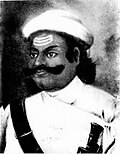
[[File:Bamshidhar Kalu Pande.jpg|thumb|upright|[[Kalu Pande]] wearing [[Khukuri]], a [[Pande family|Pande Chhetri]] aristocrat; [[Kaji (Nepal)|Kaji]] (Prime Minister and Army Chief) of [[Gorkha Kingdom]].]][[Kalu Pande]] was then made Commander-in-Chief of the Gorkhali Army. Kalu Pande advised Prithvi Narayan Shah to raise a standing army by conscripting men from other regions. A newly fortified Gorkhali force again attacked Nuwakot in 1744 from three sides and managed to capture the hill fort on September 26, 1744. | [[File:Bamshidhar Kalu Pande.jpg|thumb|upright|[[Kalu Pande]] wearing [[Khukuri]], a [[Pande family|Pande Chhetri]] aristocrat; [[Kaji (Nepal)|Kaji]] (Prime Minister and Army Chief) of [[Gorkha Kingdom]].]][[Kalu Pande]] was then made Commander-in-Chief of the Gorkhali Army. [[Jayant Rana|Jayant Rana Magar]] (former [[Kaji (Nepal)|Kaji]] of Gorkha) was made General of the kingdom of Kantipur by Jaya Prakash Malla to defend Nuwakot against Gorkha. Kalu Pande advised Prithvi Narayan Shah to raise a standing army by conscripting men from other regions. A newly fortified Gorkhali force again attacked Nuwakot in 1744 from three sides and managed to capture the hill fort on September 26, 1744. However, the next year, King [[Jaya Prakash Malla]] of Kantipur sent a force under [[Kashiram Thapa]] to retake the fort, after defeating the Gorkhali forces at Naldum. Kashiram was repelled and the Gorkhali seized permanent control of Nuwakot.{{sfn|Stiller|1973|p= 109}} | ||
== | === Tanahun === | ||
While Prithvi Narayan Shah was occupied with Nuwakot, Tanahun, a small kingdom to the west, took advantage of the king's absence to invade the Gorkha kingdom. Tanahun troops crossed the Chepe river and captured Sirhanchowk. | While Prithvi Narayan Shah was occupied with Nuwakot, Tanahun, a small kingdom to the west, took advantage of the king's absence to invade the Gorkha kingdom. Tanahun troops crossed the Chepe river and captured Sirhanchowk.{{sfn|Stiller|1973|p= 114}} But reinforcements from both Nuwakot and Gorkha managed to rout the invaders and considerably weaken Lamjung. | ||
Prithvi Narayan Shah wanted to use the occasion to invade Tanahun and annex it. However, he was advised against an open attack as King Tribikram Sen of Tanahun was an old friend of his father's. Prithvi Narayan Shah thus invited Tribikram Sen to the banks of the Trishuli river on the pretext of a friendly visit and then took him into custody. Tribikram Sen was imprisoned in Nuwakot and Tanahun was officially annexed to the burgeoning Gorkha Empire. | Prithvi Narayan Shah wanted to use the occasion to invade Tanahun and annex it. However, he was advised against an open attack as King Tribikram Sen of Tanahun was an old friend of his father's. Prithvi Narayan Shah thus invited Tribikram Sen to the banks of the Trishuli river on the pretext of a friendly visit and then took him into custody. Tribikram Sen was imprisoned in Nuwakot and Tanahun was officially annexed to the burgeoning Gorkha Empire. | ||
== | === Makwanpur and Hariharpur === | ||
{{Main|Battle of Makwanpur (1762)}} | {{Main|Battle of Makwanpur (1762)}} | ||
As part of his goal of taking the Kathmandu Valley, Prithvi Narayan had planned to first conquer all of the kingdoms and principalities surrounding the Kathmandu Valley. | As part of his goal of taking the Kathmandu Valley, Prithvi Narayan had planned to first conquer all of the kingdoms and principalities surrounding the Kathmandu Valley. | ||
| Line 33: | Line 48: | ||
After occupying the Makwanpur, the Gorkhali forces planned to take Hariharpur Gadhi, a strategic fort on a mountain ridge of the Mahabharat range, also south of Kathmandu. It controlled another route to the Kathmandu valley. On 4 October 1762, the Gorkhalis launched Hariharpur. The soldiers there fought valiantly against the Gorkha forces, but were ultimately forced to vacate the fort. About 500 soldiers from Hariharpur died in the battle.<ref name="nepalarmy" /> | After occupying the Makwanpur, the Gorkhali forces planned to take Hariharpur Gadhi, a strategic fort on a mountain ridge of the Mahabharat range, also south of Kathmandu. It controlled another route to the Kathmandu valley. On 4 October 1762, the Gorkhalis launched Hariharpur. The soldiers there fought valiantly against the Gorkha forces, but were ultimately forced to vacate the fort. About 500 soldiers from Hariharpur died in the battle.<ref name="nepalarmy" /> | ||
Digbardhan Sen sought the help of [[Mir Qasim]], the [[Nawabs of Bengal and Murshidabad|Nawab of Bengal]], to help defend against the Gorkhalis. Mir Qasim, sought to gain loot and plunder from the invasion, as he was using lavish gifts to get on the [[East India Company]]'s good side. In December 1762, he sent around 3,500 troops under Gurgin Khan, an Armenian man | Digbardhan Sen sought the help of [[Mir Qasim]], the [[Nawabs of Bengal and Murshidabad|Nawab of Bengal]], to help defend against the Gorkhalis. Mir Qasim, sought to gain loot and plunder from the invasion, as he was using lavish gifts to get on the [[East India Company]]'s good side. In December 1762, he sent around 3,500 troops under [[Gurgin Khan (Bengal)|Gurgin Khan]] (also known as Khoja Gregory), an Armenian man who had helped train Mir Qasim's army, to launch an attack on Makwanpur, which had only recently been captured by the Gorkhalis.<ref>{{Cite journal|last=Sarkar|first=S. C.|title=The Nepal Frontier in the Second Half of the 18th Century|date=1939|journal=Proceedings of the Indian History Congress|volume=3|pages=1605–1629|jstor=44252506|issn=2249-1937}}</ref><ref name=":2">{{Cite news|last=Basnyat|first=Prem Singh|title=How Nepal fought back|url=http://myrepublica.nagariknetwork.com/news/82789/|access-date=2020-09-06|website=My Republica|language=en}}</ref> | ||
Mir Qasim's forces arrived in Makwanpur in January 1763 and launched an attack on Dadhuwa Gadhi, one of three defensive positions the Gorkhalis had set up around Makwanpur fort. Gurgin Khan's 3,500 soldiers managed to capture Dadhuwa Gadhi from 400 or so Gorkha soldiers.<ref name=":2" /> On 21 January 1763, 3,300 of Gurgin Khan's soldiers launched an attack on Makwanpur palace. The Gorkhalis, under Prithvi Narayan's brother Nandu Shah, held off the invaders. Supplemented by reinforcements, the Gorkhalis counter-attacked Gurgin Khan in the dead of the night while his soldiers were asleep. The Gorkhalis managed to rout Gurgin Khan's forces, who retreated back to Bengal.<ref name=":2" /> | Mir Qasim's forces arrived in Makwanpur in January 1763 and launched an attack on Dadhuwa Gadhi, one of three defensive positions the Gorkhalis had set up around Makwanpur fort. Gurgin Khan's 3,500 soldiers managed to capture Dadhuwa Gadhi from 400 or so Gorkha soldiers.<ref name=":2" /> On 21 January 1763, 3,300 of Gurgin Khan's soldiers launched an attack on Makwanpur palace. The Gorkhalis, under Prithvi Narayan's brother Nandu Shah, held off the invaders. Supplemented by reinforcements, the Gorkhalis counter-attacked Gurgin Khan in the dead of the night while his soldiers were asleep. The Gorkhalis managed to rout Gurgin Khan's forces, who retreated back to Bengal.<ref name=":2" /> | ||
== | === Kathmandu Valley (Nepal Mandala) === | ||
{{Main|Battle of Kirtipur|Battle of Kathmandu|Battle of Lalitpur|Battle of Bhaktapur}} | {{Main|Battle of Kirtipur|Battle of Kathmandu|Battle of Lalitpur|Battle of Bhaktapur}} | ||
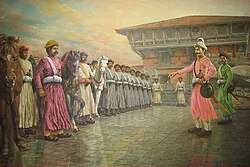
The Shah kings had long set their sights on the Nepal Valley, now also known as [[Kathmandu Valley]], which was host to three wealthy but constantly warring city-states ruled by the [[Malla (Nepal)|Malla dynasty]]. After conquering Nuwakot, which was the western gateway to the Kathmandu Valley, the Gokhalis aimed for [[Kirtipur]] as their next target. Kirtipur was a small fortified city on the outskirts of the three major city-states ruled by Newar Malla kings. [[File:Gorkha3.jpg|thumb|Gorkhali soldiers preparing war against Kathmandu Valley]] | The Shah kings had long set their sights on the Nepal Valley, now also known as [[Kathmandu Valley]], which was host to three wealthy but constantly warring city-states ruled by the [[Malla (Nepal)|Malla dynasty]]. After conquering Nuwakot, which was the western gateway to the Kathmandu Valley, the Gokhalis aimed for [[Kirtipur]] as their next target. Kirtipur was a small fortified city on the outskirts of the three major city-states ruled by Newar Malla kings. [[File:Gorkha3.jpg|thumb|Gorkhali soldiers preparing war against Kathmandu Valley]] | ||
Despite his initial assessment that the valley kings were well prepared and the Gorkhalis were not, Kalu Pande agreed to lead the battle. In 1757, The Gorkhalis set up a base on Naikap to mount their assault on Kirtipur. They were armed with swords, bows and [[musket]]s.<ref name="Vansittart, Eden 1896">Vansittart, Eden (1896). ''Notes on Nepal''. Asian Educational Services. {{ISBN|978-81-206-0774-3}}. p. 34.</ref> The two forces fought on the plain of Tyangla Phant in the northwest of [[Kirtipur]]. Kalu Pande was killed in the battle while Prithvi Narayan himself narrowly escaped with his life into the surrounding hills disguised as a [[saint]].<ref>{{cite news |last=Majupuria |first=Trilok Chandra |title=Kirtipur: The Ancient Town on the Hill |url=http://www.nepal-traveller.com/index.php?action=articledetail&id=259 |access-date=18 October 2012 |newspaper=Nepal Traveller |date=March 2011 |archive-url=https://web.archive.org/web/20151117014432/http://www.nepal-traveller.com/index.php?action=articledetail&id=259 |archive-date=17 November 2015 |url-status=dead |df=dmy-all }}</ref | Despite his initial assessment that the valley kings were well prepared and the Gorkhalis were not, Kalu Pande agreed to lead the battle. In 1757, The Gorkhalis set up a base on Naikap to mount their assault on Kirtipur. They were armed with swords, bows and [[musket]]s.<ref name="Vansittart, Eden 1896">Vansittart, Eden (1896). ''Notes on Nepal''. Asian Educational Services. {{ISBN|978-81-206-0774-3}}. p. 34.</ref> The two forces fought on the plain of Tyangla Phant in the northwest of [[Kirtipur]]. Kalu Pande was killed in the battle while Prithvi Narayan himself narrowly escaped with his life into the surrounding hills disguised as a [[saint]].<ref>{{cite news |last=Majupuria |first=Trilok Chandra |title=Kirtipur: The Ancient Town on the Hill |url=http://www.nepal-traveller.com/index.php?action=articledetail&id=259 |access-date=18 October 2012 |newspaper=Nepal Traveller |date=March 2011 |archive-url=https://web.archive.org/web/20151117014432/http://www.nepal-traveller.com/index.php?action=articledetail&id=259 |archive-date=17 November 2015 |url-status=dead |df=dmy-all }}</ref>{{sfn|Wright|1877|p= 227}} | ||
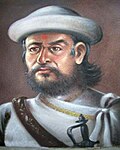
In 1764, Prithvi Narayan assaulted Kirtipur a second time. The attacking forces were under the command of Surapratap Shah, Prithvi Narayan's brother. The Gorkhalis were defeated once again and Surapratap lost his right eye to an arrow while scaling the city. A noble of Lalitpur named Danuvanta crossed over to Shah's side and let the Gorkhalis into the town. | In 1764, Prithvi Narayan assaulted Kirtipur a second time. The attacking forces were under the command of Surapratap Shah, Prithvi Narayan's brother. The Gorkhalis were defeated once again and Surapratap lost his right eye to an arrow while scaling the city. A noble of Lalitpur named Danuvanta crossed over to Shah's side and let the Gorkhalis into the town.{{sfn|Kirkpatrick|1811|p= 382–386}}<ref>{{cite news|date=24–30 November 2000|title=The city of good deeds|newspaper=Nepali Times|url=http://nepalitimes.com/issue/18/Culture/9018|access-date=18 October 2012}}</ref>[[File:Ram Krishna Kunwar.jpg|thumb|''[[Sardar]]'' [[Ram Krishna Kunwar]], senior military commander of Gorkhali forces]] | ||
The victory in the Battle of Kirtipur made | The victory in the Battle of Kirtipur made Shah's two-decade-long effort to take possession of the Kathmandu Valley possible. | ||
After the fall of Kirtipur, Shah took the city-state of [[Kathmandu]] in 1768. That same year he also took possession of Lalitpur. In 1769 he took possession of [[Bhaktapur]] | After the fall of Kirtipur, Shah took the city-state of [[Kathmandu]] in 1768. That same year he also took possession of Lalitpur. In 1769 he took possession of [[Bhaktapur]], completing his conquest of the Nepal Valley.{{sfn|Kirkpatrick|1811|p= 385}} In a letter to [[Ram Krishna Kunwar]], King Prithvi Narayan Shah was unhappy at the death of Kaji [[Kalu Pande]] in [[Kirtipur]] and thought it was impossible to conquer [[Kathmandu Valley]] after the death of Kalu Pande.{{sfn|Vaidya|1993|p=151}} After the annexation of Kathmandu Valley, King [[Prithvi Narayan Shah]] praised in his letter about the valour and wisdom shown by Ramkrishna in the annexation of Kathmandu, Lalitpur and Bhaktapur (i.e. the Nepal valley at the time) in 1768-69 A.D.{{sfn|Regmi|1972|p=95}} Similarly, [[Vamsharaj Pande]], Kalu Pande's eldest son, was the army commander who led attack of Gorkhali side on the [[Battle of Bhaktapur]] on 14 April 1769 A.D.{{sfn|Vaidya|1993|p=163}} | ||
After his conquest of the Kathmandu Valley, Prithvi Narayan Shah conquered other smaller territories south of the valley to keep other smaller fiefdoms near his Gurkha state out of British rule. After his kingdom spread from north to south, he made Kantipur the capital of the expanded country, which was then known as the Kingdom of Gorkha (Gorkha Samrajya). | After his conquest of the Kathmandu Valley, Prithvi Narayan Shah conquered other smaller territories south of the valley to keep other smaller fiefdoms near his Gurkha state out of British rule. After his kingdom spread from north to south, he made Kantipur the capital of the expanded country, which was then known as the Kingdom of Gorkha (Gorkha Samrajya).{{sfn|Bindloss|2010|p= 37}}<ref>[http://kathmandupost.ekantipur.com/printedition/news/2016-02-28/less-of-a-hero.html Less of a hero]</ref> | ||
== | === Sen Kingdom === | ||
{{main|Limbuwan–Gorkha war}} | {{main|Limbuwan–Gorkha war}} | ||
[[File:Abhiman Singh Basnyat.jpg|thumb|''[[Mulkaji]]'' [[Abhiman Singh Basnyat]], a military commander and later [[Mulkaji|Chief Minister (Mulkaji)]]]] | [[File:Abhiman Singh Basnyat.jpg|thumb|''[[Mulkaji]]'' [[Abhiman Singh Basnyat]], a military commander and later [[Mulkaji|Chief Minister (Mulkaji)]]]] | ||
| Line 56: | Line 71: | ||
==Post death of Prithvi Narayan Shah== | ==Post death of Prithvi Narayan Shah== | ||
In 1775 A.D., the conqueror king [[Prithvi Narayan Shah]], who expanded the [[Gorkha Kingdom]] into the Kingdom of Nepal died at Devighat, Nuwakot.{{sfn|Bibhag|1990|p=73}} [[Swarup Singh Karki]], a shrewd Gorkhali courtier from a [[Chhetri]] family of Eastern Nepal,{{sfn|Singh|1997|p=142}} marched with an army to Nuwakot to confine Prince [[Bahadur Shah of Nepal]] who was then mourning the death of his father former King [[Prithvi Narayan Shah]].{{sfn|Bibhag|1990|p=73}} He confined Bahadur Shah and Prince [[Dal Mardan Shah]] with consent from newly reigning King [[Pratap Singh Shah]] who was considered to have no distinction of right and wrong.{{sfn|Bibhag|1990|p=73}} In the annual Pajani (renewal) of that year, Swarup Singh was promoted to the position of [[Kaji (Nepal)|Kaji]] along with [[Abhiman Singh Basnyat]], [[Amar Singh Thapa]] and Parashuram Thapa.{{sfn|Bibhag|1990|p=73}} In [[Falgun]] 1832 [[Bikram Samvat|B.S.]], he succeeded in exiling Bahadur Shah, Dal Mardan Shah and Guru Gajraj Mishra on three heinous charges.{{sfn|Bibhag|1990|p=74}} The reign of King Pratap Singh was characterized by the constant rivalry between Swarup and [[Vamsharaj Pande]], a member of the leading [[Pande family (Nepal)|Pande family]] of Gorkha.{{sfn|Shaha|1990|p=43}} The document dated [[Bikram Samvat]] 1833 [[Bhadra]] Vadi 3 Roj 6 (i.e. Friday 2 August 1776), shows that he had carried the title of [[Dewan]] along with Vamsharaj Pande.{{sfn| | In 1775 A.D., the conqueror king [[Prithvi Narayan Shah]], who expanded the [[Gorkha Kingdom]] into the Kingdom of Nepal died at Devighat, Nuwakot.{{sfn|Bibhag|1990|p=73}} [[Swarup Singh Karki]], a shrewd Gorkhali courtier from a [[Chhetri]] family of Eastern Nepal,{{sfn|Singh|1997|p=142}} marched with an army to Nuwakot to confine Prince [[Bahadur Shah of Nepal]] who was then mourning the death of his father former King [[Prithvi Narayan Shah]].{{sfn|Bibhag|1990|p=73}} He confined Bahadur Shah and Prince [[Dal Mardan Shah]] with consent from newly reigning King [[Pratap Singh Shah]] who was considered to have no distinction of right and wrong.{{sfn|Bibhag|1990|p=73}} In the annual Pajani (renewal) of that year, Swarup Singh was promoted to the position of [[Kaji (Nepal)|Kaji]] along with [[Abhiman Singh Basnyat]], [[Amar Singh Thapa]] and Parashuram Thapa.{{sfn|Bibhag|1990|p=73}} In [[Falgun]] 1832 [[Bikram Samvat|B.S.]], he succeeded in exiling Bahadur Shah, Dal Mardan Shah and Guru Gajraj Mishra on three heinous charges.{{sfn|Bibhag|1990|p=74}} The reign of King Pratap Singh was characterized by the constant rivalry between Swarup and [[Vamsharaj Pande]], a member of the leading [[Pande family (Nepal)|Pande family]] of Gorkha.{{sfn|Shaha|1990|p=43}} The document dated [[Bikram Samvat]] 1833 [[Bhadra]] Vadi 3 Roj 6 (i.e. Friday 2 August 1776), shows that he had carried the title of [[Dewan]] along with Vamsharaj Pande.{{sfn|Regmi|1975a|p=272}} King [[Pratap Singh Shah]] died on 22 November 1777 A.D.{{sfn|Karmacharya|2005|p=36}} leaving his infant son [[Rana Bahadur Shah]] as the [[King of Nepal]].{{sfn|Regmi|1975a|p=285}} [[Sarbajit Rana Magar]] was made a [[Kaji (Nepal)|Kaji]] along with [[Balbhadra Shah]] and [[Vamsharaj Pande]]{{sfn|Shaha|1990|p=46}} while [[Daljit Shah]] was chosen as Chief Chautariya.{{sfn|Regmi|1975a|p=285}}{{sfn|Shaha|1990|p=46}} Historian [[Dilli Raman Regmi]] asserts that [[Sarbajit Rana Magar]] was chosen as [[Mulkaji|Chief Kazi]] (equivalent to [[Prime Minister of Nepal]]).{{sfn|Regmi|1975a|p=285}} Historian [[Rishikesh Shah]] asserts that Sarbajit Rana Magar was the head of the Nepalese government for a short period in 1778.{{sfn|Shaha|2001|p=21}} Afterwards, rivalry arose between Prince [[Bahadur Shah of Nepal]] and [[Queen Rajendra of Nepal|Queen Rajendra Laxmi]]. In the rivalry, Sarbajit Rana led the followers of the Queen opposed to Sriharsh Pant who led the followers of Bahadur Shah.<ref name="himalaya">{{cite web|url=http://himalaya.socanth.cam.ac.uk/collections/journals/ancientnepal/pdf/ancient_nepal_121-122_01.pdf |title=Journal |website=himalaya.socanth.cam.ac.uk }}</ref> The group of Bharadars (officers) led by Sarbajit Rana poisoned the ears of Rajendra Laxmi against Bahadur Shah.{{sfn|Rana|1978|p=6}} Rajendra Laxmi succeeded in the confinement of Prince Bahadur Shah with the help of her new minister Sarbajit Rana.{{sfn|Regmi|1975b|p=214}} Guru Gajraj Mishra came to rescue Bahadur Shah on the condition that Bahadur Shah should leave the country.{{sfn|Regmi|1975b|p=214}}{{sfn|T.U. History Association|1977|p=5}} Also, his rival Sriharsh Pant was branded outcast and expelled instead of execution which was prohibited for [[Brahmin]]s.<ref name="himalaya"/> | ||
Prince Bahadur Shah confined his sister-in-law Queen Rajendra Laxmi on the charge of having illicit relation with Sarbajit{{sfn|Regmi| | Prince Bahadur Shah confined his sister-in-law [[Queen Rajendra of Nepal|Queen Rajendra Laxmi]] on the charge of having illicit relation with [[Sarbajit Rana Magar]]{{sfn|Regmi|1975a|p=215}} on 31 August 1778.{{sfn|Karmacharya|2005|p=36}}{{sfn|Regmi|1975a|p=294}}{{sfn|Bajracharya|1992|p=21}} Subsequently, Sarbajit was executed inside the palace by Prince Bahadur Shah{{sfn|Regmi|1975b|p=215}}{{sfn|Bibhag|1990|p=76}} with the help of male servants of the royal palace.{{sfn|Regmi|1975b|p=215}} Historian Bhadra Ratna Bajracharya asserts that it was actually Chautariya Daljit Shah who led the opposing group against Sarbajit Rana Magar and Rajendra Laxmi.{{sfn|Bajracharya|1992|pp=21–22}} The letter dated [[Bikram Samvat|B.S.]] 1835 [[Bhadra (Nepali calendar)|Bhadra]] Sudi 11 Roj 4 (1778 A.D.) to Narayan Malla and Vrajabasi Pande asserts the death of Sarbajit under misconduct and the appointment of Bahadur Shah as [[regent]].{{sfn|Karmacharya|2005|p=36}} The death of [[Sarbajit Rana Magar]] is considered to have marked the initiation of court conspiracies and massacres in the newly unified Kingdom of Nepal.{{sfn|T.U. History Association|1977|p=5}} Historian [[Baburam Acharya]] points that the sanctions against Queen Rajendra Laxmi under moral misconduct was a mistake of Bahadur Shah. Similarly, the murder of [[Sarbajit Rana Magar]] was condemned by many historians as an act of injustice.{{sfn|Bajracharya|1992|p=22}} | ||
[[Vamsharaj Pande]], once Dewan of Nepal and son of the popular commander [[Kalu Pande]], was beheaded on the conspiracy of [[Queen Rajendra of Nepal|Queen Rajendra Laxmi]] with his support.{{sfn|Karmacharya|2005|p=46}}{{sfn|Shaha|2001|p=62}} In the special tribunal meeting at Bhandarkhal garden, east of Kathmandu Durbar, Swaroop Singh held Vamsharaj liable for letting the King of Parbat, Kirtibam Malla to run away in the battle a year ago.{{sfn|Bajracharya|1992|p=35}} He had a fiery conversation with Vamsharaj before Vamsharaj was declared guilty and was subsequently executed by beheading on the tribunal.<ref name="himalaya"/> Historian [[Rishikesh Shah]] and Ganga Karmacharya claim that he was executed in March 1785.{{sfn|Karmacharya|2005|p=46}}{{sfn|Shaha|2001|p=62}} Bhadra Ratna Bajracharya and Tulsi Ram Vaidya claim that he was executed on 21 April 1785.{{sfn|Bajracharya|1992|p=35}}<ref name="himalaya"/> On 2 July 1785, his stiff opponent Prince Regent [[Bahadur Shah of Nepal]] was arrested and on the eleventh day of imprisonment on 13 July, his only supporter Queen Rajendra Laxmi died.{{sfn|Karmacharya|2005|p=46}}{{sfn|Shaha|2001|p=62}} Then onwards, Bahadur Shah took over the regency of his nephew King [[Rana Bahadur Shah]]{{sfn|Pradhan|2012|p=10}} and on the first moments of his regency ordered Swaroop Singh who was in [[Pokhara]] to be beheaded there {{sfn|Bibhag|1990|p=77}}{{sfn|Shaha|2001|p=63}} on the charges of [[treason]].{{sfn|Hamal|1995|p=81}} He had gone to Kaski to join Daljit Shah's military campaign of Kaski fearing retaliation of the old courtiers due to his conspiracy against Vamsharaj. He was executed on 24th [[Shrawan (Nepali calendar)|Shrawan]] 1842 [[Bikram Samvat|B.S]].{{sfn|Bibhag|1990|p=77}} | [[Vamsharaj Pande]], once Dewan of Nepal and son of the popular commander [[Kalu Pande]], was beheaded on the conspiracy of [[Queen Rajendra of Nepal|Queen Rajendra Laxmi]] with his support.{{sfn|Karmacharya|2005|p=46}}{{sfn|Shaha|2001|p=62}} In the special tribunal meeting at Bhandarkhal garden, east of Kathmandu Durbar, Swaroop Singh held Vamsharaj liable for letting the King of Parbat, Kirtibam Malla to run away in the battle a year ago.{{sfn|Bajracharya|1992|p=35}} He had a fiery conversation with Vamsharaj before Vamsharaj was declared guilty and was subsequently executed by beheading on the tribunal.<ref name="himalaya"/> Historian [[Rishikesh Shah]] and Ganga Karmacharya claim that he was executed in March 1785.{{sfn|Karmacharya|2005|p=46}}{{sfn|Shaha|2001|p=62}} Bhadra Ratna Bajracharya and Tulsi Ram Vaidya claim that he was executed on 21 April 1785.{{sfn|Bajracharya|1992|p=35}}<ref name="himalaya"/> On 2 July 1785, his stiff opponent Prince Regent [[Bahadur Shah of Nepal]] was arrested and on the eleventh day of imprisonment on 13 July, his only supporter Queen Rajendra Laxmi died.{{sfn|Karmacharya|2005|p=46}}{{sfn|Shaha|2001|p=62}} Then onwards, Bahadur Shah took over the regency of his nephew King [[Rana Bahadur Shah]]{{sfn|Pradhan|2012|p=10}} and on the first moments of his regency ordered Swaroop Singh who was in [[Pokhara]] to be beheaded there {{sfn|Bibhag|1990|p=77}}{{sfn|Shaha|2001|p=63}} on the charges of [[treason]].{{sfn|Hamal|1995|p=81}} He had gone to Kaski to join Daljit Shah's military campaign of Kaski fearing retaliation of the old courtiers due to his conspiracy against Vamsharaj. He was executed on 24th [[Shrawan (Nepali calendar)|Shrawan]] 1842 [[Bikram Samvat|B.S]].{{sfn|Bibhag|1990|p=77}} | ||
==Tibetan conflict== | ==Tibetan conflict== | ||
{{ | {{Further|Sino-Nepalese War}} | ||
After the death of Prithvi Narayan Shah, the Shah dynasty began to expand their kingdom into what is present day North India. Between 1788 and 1791, Nepal invaded [[Tibet under Qing rule|Tibet]] and robbed the [[Tashi Lhunpo Monastery]] in [[Shigatse]]. Tibet sought help from the Chinese imperial court and the [[Qianlong Emperor]] of the Chinese [[Qing dynasty]] appointed [[Fuk'anggan]] commander-in-chief of the Tibetan campaign. Heavy damages were inflicted on both sides. The Nepali forces retreated step by step back to Nuwakot to stretch Sino-Tibetan forces uncomfortably. The Chinese launched uphill attack during the daylight and failed to succeed due to strong counterattack with [[Khukuri]] at Nuwakot.<ref name="nepalarmythree">{{Cite web|url=http://www.nepalarmy.mil.np/history.php?page=three|title=Nepal and Tibetan conflict|publisher=Official website of Nepal Army}}</ref> The Chinese army suffered a major setback when they tried to cross a monsoon-flooded Betrawati, close to the Gorkhali palace in Nuwakot. | After the death of Prithvi Narayan Shah, the Shah dynasty began to expand their kingdom into what is present day North India. Between 1788 and 1791, Nepal invaded [[Tibet under Qing rule|Tibet]] and robbed the [[Tashi Lhunpo Monastery]] in [[Shigatse]]. Tibet sought help from the Chinese imperial court and the [[Qianlong Emperor]] of the Chinese [[Qing dynasty]] appointed [[Fuk'anggan]] commander-in-chief of the Tibetan campaign. Heavy damages were inflicted on both sides. The Nepali forces retreated step by step back to Nuwakot to stretch Sino-Tibetan forces uncomfortably. The Chinese launched uphill attack during the daylight and failed to succeed due to strong counterattack with [[Khukuri]] at Nuwakot.<ref name="nepalarmythree">{{Cite web|url=http://www.nepalarmy.mil.np/history.php?page=three|title=Nepal and Tibetan conflict|publisher=Official website of Nepal Army}}</ref> The Chinese army suffered a major setback when they tried to cross a monsoon-flooded Betrawati, close to the Gorkhali palace in Nuwakot.{{sfn|Stiller|1971|p= 207}} A stalemate ensued when [[Fuk'anggan]] was keen to protect his troops and wanted to negotiate at Nuwakot. The treaty was more favorable to the Chinese side and prescribed that Nepal had to pay tributes to the Chinese emperor.<ref name="nepalarmythree"/> | ||
== | ==Timeline of unification== | ||
The | The timeline of unification is given in the following table.<ref>{{cite book |last1=Baral|first1=Leeanateshaw Sharma |title=Life and Writings of Prthvinarayan Shah |date=1964 |publisher=University of London}}</ref> | ||
{| class="wikitable" | {{static row numbers}} | ||
{| class="wikitable sortable static-row-numbers static-row-header-text" | |||
|- | |- | ||
! Date | !Date | ||
!Date in BS! | !Date in [[Vikram Samvat|BS]] | ||
!class="unsortable" |Description | |||
|- | |- | ||
| 1742 | | 1742 | ||
|1799|| Prithvi | |1799|| Prithvi Narayan Shah (PNS) becomes King of Gorkha after death of his father | ||
|- | |- | ||
| 1742 | | 1742 | ||
| Line 89: | Line 106: | ||
|- | |- | ||
| 1754 | | 1754 | ||
| || Dolakha, Sindhupalchowk, Dahachowk and Naldum annexed. | |1811 || Dolakha, Sindhupalchowk, Dahachowk and Naldum annexed. | ||
|- | |- | ||
| 1757 | | 1757 | ||
| Line 95: | Line 112: | ||
|- | |- | ||
| 1758 | | 1758 | ||
| || Gorkha makes peace treaty with Kathmandu | |1815 || Gorkha makes peace treaty with Kathmandu | ||
|- | |- | ||
| 1759 | | 1759 | ||
| || Captures Shivapuri | |1816 || Captures Shivapuri | ||
|- | |- | ||
| 1761 | | 1761 | ||
| || Chaule and Kahule is captured | |1818 || Chaule and Kahule is captured | ||
|- | |- | ||
| 1762 | | 1762 | ||
| || [[Battle of Makwanpur (1762)|Makwanpur annexed]], Sindhuli annexed | |1819 || [[Battle of Makwanpur (1762)|Makwanpur annexed]], Sindhuli annexed | ||
|- | |- | ||
| 1763 | | 1763 | ||
| || Pharping, Bisankhu, Dhulikhel, Banepa, Sanga, Ranikot, Nala, Parevakot and Kavilaspur annexed | |1820 || Pharping, Bisankhu, Dhulikhel, Banepa, Sanga, Ranikot, Nala, Parevakot and Kavilaspur annexed | ||
|- | |- | ||
| 1764 | | 1764 | ||
| || Second battle of Kritipur. | |1821 || Second battle of Kritipur. | ||
|- | |- | ||
| 1765 | | 1765 | ||
| || Balaju, Lutikot annexed | |1822 || Balaju, Lutikot annexed | ||
|- | |- | ||
| 1766 | | 1766 | ||
| || Kritipur captured, Salimpa annexed. | |1823 || Kritipur captured, Salimpa annexed. | ||
|- | |- | ||
| 1767 | | 1767 | ||
| || Gurkha soldiers | |1824 || Gurkha soldiers defeat British soldiers at Sindhuli who came to help king of Kathmandu | ||
|- | |- | ||
| 1768 | | 1768 | ||
| || British India takes possession of Bara, Parsa and Hilwal | |1825 || British India takes possession of Bara, Parsa and Hilwal | ||
|- | |- | ||
| 1768 | | 1768 | ||
| || Gorkha repossess the territory. Annexes Bettia. | |1825 || Gorkha repossess the territory. Annexes Bettia. | ||
|- | |- | ||
| 1768 | | 1768 | ||
| Line 137: | Line 154: | ||
|- | |- | ||
| 1771 | | 1771 | ||
| || Kaski and Sapta gandaki region are annexed | |1828 || Kaski and Sapta gandaki region are annexed | ||
|- | |- | ||
| 1771 | | 1771 | ||
| || Manpang, Chang, Darhung, Manmul, Ranrung, Jyamire, Grihakot, Kyangmi, Bhirkot, Garahu, Painyu, Dhuvakot were annexed. | |1828 || Manpang, Chang, Darhung, Manmul, Ranrung, Jyamire, Grihakot, Kyangmi, Bhirkot, Garahu, Painyu, Dhuvakot were annexed. | ||
|- | |- | ||
| 1773 | | 1773 | ||
| || Rava, Cisankhu, Dingla was annexed | |1830 || Rava, Cisankhu, Dingla was annexed | ||
|- | |- | ||
| 1774 | | 1774 | ||
| || Majuva, Kalum, Mahadinga Pauva is annexed | |1831 || Majuva, Kalum, Mahadinga Pauva is annexed | ||
|- | |- | ||
| 1774 | | 1774 | ||
| || Chainpur, Vijaypur, area up to Tista river annexed | |1831 || Chainpur, Vijaypur, area up to Tista river annexed | ||
|- | |- | ||
| 1775 | | 1775 | ||
| | |1832|| PNS dies. [[Pratap Singh Shah]] became King. Rajendra Laxmi takes the incharge of unification. | ||
|- | |- | ||
| 1782 | | 1782 | ||
| | |1840||1839 BS. Lamjung and Tanahu is annexed. | ||
|- | |- | ||
| 1785 | | 1785 | ||
| | |1843||Rajendra Laxmi dies in 1842 BS. [[Prince Bahadur Shah of Nepal|Bahadhur Shah]] takes incharge of unification. | ||
|- | |- | ||
| 1786 | | 1786 | ||
| | |1844|| Bheri ara is annexed | ||
|- | |- | ||
| 1789 | | 1789 | ||
| | |1847|| Jumla is annexed | ||
|- | |- | ||
| 1790 | | 1790 | ||
| | |1848|| Doti, Kumaun and Srinagar, Garwal, Hindur, Besahr, Chamba 12 and 18 Thakurai (currently India) is annexed (1847 BS) | ||
|- | |- | ||
| 1792 | | 1792 | ||
| | |1850 || Nepal–Sino war starts | ||
|- | |- | ||
| | | 1814 | ||
| | |1872 || British India captures Butwal. But Gurkha army takes control the next month. This causes Nepal–Anglo war. Kumaun and Gadwal comes in control of British India. (1814) | ||
|- | |- | ||
| 1815 | | 1815 | ||
| | |1873 || [[Sugauli Treaty]] is signed | ||
|- | |- | ||
| 1860 | | 1860 | ||
| | |1918 || Janga Bahdhur becomes successful to return part of Terai to Nepal (''[[Naya Muluk]]'') from British India | ||
|} | |} | ||
| Line 188: | Line 204: | ||
==References== | ==References== | ||
{{reflist}} | {{reflist}} | ||
===Works cited=== | |||
* {{citation |last=Bajracharya |first=Bhadra Ratna |title=Bahadur Shah, the regent of Nepal, 1785–1794 A.D. |publisher=Anmol Publications |year=1992 |isbn=9788170416432 |location=Nepal |url=https://books.google.com/books?id=2oxuAAAAMAAJ |access-date=15 September 2020 |archive-date=15 January 2023 |archive-url=https://web.archive.org/web/20230115131808/https://books.google.com/books?id=2oxuAAAAMAAJ |url-status=live}} | |||
* {{Citation |first=Puratattva |last=Bibhag |title=Ancient Nepal |volume=116–122 |year=1990 |publisher=Puratattva Bibhag (Archaeology Department) |url=https://books.google.com/books?id=xlJQAQAAMAAJ |access-date=15 September 2020 |archive-date=15 January 2023 |archive-url=https://web.archive.org/web/20230115131811/https://books.google.com/books?id=xlJQAQAAMAAJ |url-status=live}} | |||
* {{cite book |last=Hamal |first=Lakshman B. |year=1995 |title=Military history of Nepal |publisher=Sharda Pustak Mandir |page=125 |oclc=32779233}} | |||
* {{citation |last=Karmacharya |first=Ganga |title=Queens in Nepalese Politics: an account of roles of Nepalese queens in state affairs, 1775–1846 |publisher=Educational Publishing House |year=2005 |isbn=978-999463393-7 |location=Nepal |url=https://books.google.com/books?id=6G5uAAAAMAAJ |access-date=15 September 2020 |archive-date=15 January 2023 |archive-url=https://web.archive.org/web/20230115131807/https://books.google.com/books?id=6G5uAAAAMAAJ |url-status=live}} | |||
* {{citation |last=Pradhan |first=Kumar L. |title=Thapa Politics in Nepal: With Special Reference to Bhim Sen Thapa, 1806–1839 |publisher=Concept Publishing Company |year=2012 |isbn=9788180698132 |location=New Delhi |pages=278 |url=https://books.google.com/books?id=7PP1yElRzIUC}} | |||
* {{citation |last=Rana |first=Pramode S.J.B. |title=Rana Nepal: An Insider's View |year=1978 |publisher=R. Rana |url=https://books.google.com/books?id=TdJBAAAAYAAJ&q=sarbajit+rana |access-date=15 September 2020 |archive-date=15 January 2023 |archive-url=https://web.archive.org/web/20230115131808/https://books.google.com/books?id=TdJBAAAAYAAJ&q=sarbajit+rana |url-status=live}} | |||
* {{cite book |last=Regmi |first=Mahesh Chandra |year=1972 |title=Regmi Research Series |volume=04 |publisher=Regmi Research Centre |url=http://himalaya.socanth.cam.ac.uk/collections/journals/regmi/pdf/Regmi_04.pdf}} | |||
* {{Citation |first=Mahesh Chandra |last=Regmi |title=Regmi Research Series |volume=7 |year=1975b |publisher=Regmi Research Centre |url=https://books.google.com/books?id=cB3jAAAAMAAJ |access-date=15 September 2020 |archive-date=15 January 2023 |archive-url=https://web.archive.org/web/20230115131811/https://books.google.com/books?id=cB3jAAAAMAAJ |url-status=live}} | |||
* {{Citation |last=Regmi |first=D.R. |year=1975a |title=Modern Nepal |url=https://books.google.com/books?id=TChuAAAAMAAJ&q=bhagirath+panth |isbn=9780883864913}} | |||
* {{Citation |last=Shaha |first=Rishikesh |title=Modern Nepal 1769–1885 |year=1990 |publisher=Riverdale Company |isbn=0-913215-64-3 |url=https://books.google.com/books?id=Y3NuAAAAMAAJ}} | |||
* {{Citation |last=Shaha |first=Rishikesh |title=An Introduction of Nepal |location=Kathmandu |year=2001 |publisher=Ratna Pustak Bhandar |url=https://books.google.com/books?id=kmwwAQAAIAAJ |access-date=15 September 2020 |archive-date=15 January 2023 |archive-url=https://web.archive.org/web/20230115131814/https://books.google.com/books?id=kmwwAQAAIAAJ |url-status=live}} | |||
* {{cite book |first=Nagendra Kr |last=Singh |title=Nepal: Refugee to Ruler: A Militant Race of Nepal |publisher=APH Publishing |year=1997 |isbn=9788170248477 |access-date=November 7, 2012 |url=https://books.google.com/books?id=Aaog6bnQlNYC}} | |||
* {{Citation |author=T.U. History Association |title=Voice of History |volume=3 |year=1977 |publisher=Tribhuwan University History Association |url=https://books.google.com/books?id=topdAAAAIAAJ&q=brajnath |access-date=28 November 2020 |archive-date=15 January 2023 |archive-url=https://web.archive.org/web/20230115131811/https://books.google.com/books?id=topdAAAAIAAJ&q=brajnath |url-status=live}} | |||
* {{citation |last=Vaidya |first=Tulsi Ram |title=Prithvinaryan Shah, the founder of Nepal |year=1993 |publisher=Anmol Publications |isbn=9788170417019 |url=https://books.google.com/books?id=jSVwAAAAMAAJ}} | |||
* {{Cite book |last=Pradhan, Kumar|title=The Gorkha conquests : the process and consequences of the unification of Nepal, with particular reference to eastern Nepal |date=1991 |publisher=Oxford University Press |isbn=978-0-19-562723-7 |location=Calcutta |oclc=24874742}} | |||
* {{Cite book|last=Whelpton, John.|title=A history of Nepal|date=2005|publisher=Cambridge University Press|isbn=0-521-80026-9|location=Cambridge|oclc=55502658}} | |||
* {{cite book|last=Wright|first=Daniel|date=1877|url=https://archive.org/stream/HistoryOfNepal/HistoryOfNepaldanielWright#page/n269/mode/2up|title=History of Nepal|publisher=New Delhi: Asian Educational Services|access-date=7 November 2012}} | |||
* {{cite book|last=Kirkpatrick|first=Colonel|url=https://archive.org/details/bub_gb_ijxAAAAAYAAJ|title=An Account of the Kingdom of Nepaul|publisher=London: William Miller|year=1811|access-date=17 October 2012}} | |||
* {{Cite book|last=Stiller, Ludwig F.|title=The rise of the house of Gorkha|year=1973|isbn=978-9937-711-00-5|edition=Revised|location=Kathmandu, Nepal|oclc=1089599390}} | |||
* {{cite book|last=Bindloss, Joseph |url=https://books.google.com/books?id=wiIw2_WFwC4C&pg=PA37|title=Nepal|year= 2010|publisher=Lonely Planet Publications|isbn=978-1-74220-361-4}} | |||
* {{cite book |last=Regmi |first=Mahesh Chandra |year=1979 |title=Regmi Research Series |volume=11 |publisher=Regmi Research Centre |url=http://himalaya.socanth.cam.ac.uk/collections/journals/regmi/pdf/Regmi_11.pdf}} | |||
* {{Cite book |last=Regmi |first=D.R. |title=Medieval Nepal |publisher=Firma K.L. Mukhopadhyay |year=1966 |location=Calcutta}} | |||
==Further reading== | ==Further reading== | ||
| Line 197: | Line 237: | ||
[[Category:Unification of Nepal| ]] | [[Category:Unification of Nepal| ]] | ||
[[Category: | [[Category:18th century in Nepal]] | ||
[[Category:Gurkhas]] | [[Category:Gurkhas]] | ||
[[Category:National unifications]] | [[Category:National unifications|Nepal]] | ||
Latest revision as of 14:17, 17 February 2026
.jpg) Himalayan territories unified by the Gorkhas | |
| Native name | नेपालको एकीकरण |
|---|---|
| Date | 26 September 1744 – 4 March 1816 (71 years, 5 months and 7 days) |
| Location | Template:Country data Kingdom of Nepal |
| Type | National unification |
| Outcome | Gurkhas conquered the Malla kingdoms and unified Nepal |
| History of Nepal |
|---|
 |
The unification of Nepal (Nepali: नेपालको एकीकरण, romanized: Nēpālakō ēkīkaraṇa) was the process of building the modern Nepalese state, by invading fractured Malla kingdoms including the Baise Rajya's 22 kingdoms and the Chaubisi Rajya's 24 kingdoms. It began in 1743 CE (1799 BS),[1] by Prithvi Narayan Shah, King of Gorkha. On 25 September 1768, he officially announced the creation of the Kingdom of Nepal and moved his capital from Gorkha to a city in Kathmandu Valley.[2]
The Shah dynasty that Prithvi Narayan Shah founded would go on to absorb the various warring Malla kingdoms that once occupied parts of present-day Nepal into a nation-state that stretched up to the Sutlej River in the west and Sikkim-Jalpaiguri in the east.[3][4] Before the Gorkha Empire, the Kathmandu Valley was known as Nepal after the Nepal Mandala, the region's name in Newar language.
Background[edit | edit source]
The regions that constitute present-day Nepal were scattered as numerous independent kingdoms prior to unification. The Kathmandu Valley, then called Nepal Mandala, alone contained three independent kingdoms: Kantipur, Lalitpur, and Bhadgaon. Makwanpur, to the south of the valley, was ruled by the Sen dynasty. To the east of the valley were two relatively larger kingdoms: Vijayapur, and Chaudandi.[5] Both of these kingdoms once belonged to Makawanpur, but Mukunda Sena (r. 1518–1553) had partitioned his kingdom among his sons and relatives and had divided the once large Makawanpur into various principalities.[6]
Between the rivers Trishuli and Bheri, known as the Gandaki region, were the Chaubisi principalities. Further west, in the Karnali region, were the Baise principalities. Baise and Chaubise literally translate to twenty-two and twenty-four kingdoms respectively, but the exact number of kingdoms wasn't the same as the regions' collective names. The Baises were once a part of the Khasa Kingdom, ruled by the Khas Mallas from the Sinja valley, before its fragmentation.[7] The Chaubisi principalities belonged to various political entities. Some belonged to the Senas, some to the Khas Mallas, and some to the Shahis.[8]
These principalities experienced constant change and instability. Several kingdoms made leagues in order to protect themselves from foreign invasions and for mutual growth. However, due to the economic and geographic conditions prevalent at that time, disputes and battles between the kingdoms were frequent. The Malla kings of the valley engaged in incessant conflicts and skirmishes among themselves and had, at several instances, requested the intervention of Gorkha to settle their disputes.[9][10]
Battle campaigns[edit | edit source]
Nuwakot[edit | edit source]
Prithvi Narayan Shah's annexation campaign began with the nearby kingdom of Nuwakot. Nuwakot marked the eastern boundary of the Gorkha Kingdom and was part of the trade route between Tibet and Kathmandu. It was also the western gateway to the Kathmandu Valley. Nara Bhupal Shah, Prithvi Narayan Shah's father, had attempted to invade Nuwakot in 1700, but failed. At that time, Nuwakot was under the administrative control of Kantipur (known today as Kathmandu). Kantipur supported Nuwakot against the invasion. Following his defeat, Nara Bhupal Shah gave up his efforts and handed administrative power over to his eldest son, Prithvi Narayan Shah and Chandraprabhawati, his eldest queen.
In the very year of his coronation, Prithvi Narayan Shah sent Gorkhali troops under Kaji Biraj Thapa Magar to attack Nuwakot. The campaign failed.

Kalu Pande was then made Commander-in-Chief of the Gorkhali Army. Jayant Rana Magar (former Kaji of Gorkha) was made General of the kingdom of Kantipur by Jaya Prakash Malla to defend Nuwakot against Gorkha. Kalu Pande advised Prithvi Narayan Shah to raise a standing army by conscripting men from other regions. A newly fortified Gorkhali force again attacked Nuwakot in 1744 from three sides and managed to capture the hill fort on September 26, 1744. However, the next year, King Jaya Prakash Malla of Kantipur sent a force under Kashiram Thapa to retake the fort, after defeating the Gorkhali forces at Naldum. Kashiram was repelled and the Gorkhali seized permanent control of Nuwakot.[11]
Tanahun[edit | edit source]
While Prithvi Narayan Shah was occupied with Nuwakot, Tanahun, a small kingdom to the west, took advantage of the king's absence to invade the Gorkha kingdom. Tanahun troops crossed the Chepe river and captured Sirhanchowk.[12] But reinforcements from both Nuwakot and Gorkha managed to rout the invaders and considerably weaken Lamjung.
Prithvi Narayan Shah wanted to use the occasion to invade Tanahun and annex it. However, he was advised against an open attack as King Tribikram Sen of Tanahun was an old friend of his father's. Prithvi Narayan Shah thus invited Tribikram Sen to the banks of the Trishuli river on the pretext of a friendly visit and then took him into custody. Tribikram Sen was imprisoned in Nuwakot and Tanahun was officially annexed to the burgeoning Gorkha Empire.
Makwanpur and Hariharpur[edit | edit source]
As part of his goal of taking the Kathmandu Valley, Prithvi Narayan had planned to first conquer all of the kingdoms and principalities surrounding the Kathmandu Valley.
Sensing danger, King Digbardhan Sen and his minister Kanak Singh Baniya of Makwanpur sent their families to safer grounds before they were encircled by the Gorkhalis, who launched an attack on 17 August 1762. The battle lasted for around eight hours and while Makwanpur was annexed, King Digbardhan and Kanak Singh escaped to Hariharpur Gadhi.[13]
After occupying the Makwanpur, the Gorkhali forces planned to take Hariharpur Gadhi, a strategic fort on a mountain ridge of the Mahabharat range, also south of Kathmandu. It controlled another route to the Kathmandu valley. On 4 October 1762, the Gorkhalis launched Hariharpur. The soldiers there fought valiantly against the Gorkha forces, but were ultimately forced to vacate the fort. About 500 soldiers from Hariharpur died in the battle.[13]
Digbardhan Sen sought the help of Mir Qasim, the Nawab of Bengal, to help defend against the Gorkhalis. Mir Qasim, sought to gain loot and plunder from the invasion, as he was using lavish gifts to get on the East India Company's good side. In December 1762, he sent around 3,500 troops under Gurgin Khan (also known as Khoja Gregory), an Armenian man who had helped train Mir Qasim's army, to launch an attack on Makwanpur, which had only recently been captured by the Gorkhalis.[14][15]
Mir Qasim's forces arrived in Makwanpur in January 1763 and launched an attack on Dadhuwa Gadhi, one of three defensive positions the Gorkhalis had set up around Makwanpur fort. Gurgin Khan's 3,500 soldiers managed to capture Dadhuwa Gadhi from 400 or so Gorkha soldiers.[15] On 21 January 1763, 3,300 of Gurgin Khan's soldiers launched an attack on Makwanpur palace. The Gorkhalis, under Prithvi Narayan's brother Nandu Shah, held off the invaders. Supplemented by reinforcements, the Gorkhalis counter-attacked Gurgin Khan in the dead of the night while his soldiers were asleep. The Gorkhalis managed to rout Gurgin Khan's forces, who retreated back to Bengal.[15]
Kathmandu Valley (Nepal Mandala)[edit | edit source]
The Shah kings had long set their sights on the Nepal Valley, now also known as Kathmandu Valley, which was host to three wealthy but constantly warring city-states ruled by the Malla dynasty. After conquering Nuwakot, which was the western gateway to the Kathmandu Valley, the Gokhalis aimed for Kirtipur as their next target. Kirtipur was a small fortified city on the outskirts of the three major city-states ruled by Newar Malla kings.

Despite his initial assessment that the valley kings were well prepared and the Gorkhalis were not, Kalu Pande agreed to lead the battle. In 1757, The Gorkhalis set up a base on Naikap to mount their assault on Kirtipur. They were armed with swords, bows and muskets.[16] The two forces fought on the plain of Tyangla Phant in the northwest of Kirtipur. Kalu Pande was killed in the battle while Prithvi Narayan himself narrowly escaped with his life into the surrounding hills disguised as a saint.[17][18]
In 1764, Prithvi Narayan assaulted Kirtipur a second time. The attacking forces were under the command of Surapratap Shah, Prithvi Narayan's brother. The Gorkhalis were defeated once again and Surapratap lost his right eye to an arrow while scaling the city. A noble of Lalitpur named Danuvanta crossed over to Shah's side and let the Gorkhalis into the town.[19][20]

The victory in the Battle of Kirtipur made Shah's two-decade-long effort to take possession of the Kathmandu Valley possible.
After the fall of Kirtipur, Shah took the city-state of Kathmandu in 1768. That same year he also took possession of Lalitpur. In 1769 he took possession of Bhaktapur, completing his conquest of the Nepal Valley.[21] In a letter to Ram Krishna Kunwar, King Prithvi Narayan Shah was unhappy at the death of Kaji Kalu Pande in Kirtipur and thought it was impossible to conquer Kathmandu Valley after the death of Kalu Pande.[22] After the annexation of Kathmandu Valley, King Prithvi Narayan Shah praised in his letter about the valour and wisdom shown by Ramkrishna in the annexation of Kathmandu, Lalitpur and Bhaktapur (i.e. the Nepal valley at the time) in 1768-69 A.D.[23] Similarly, Vamsharaj Pande, Kalu Pande's eldest son, was the army commander who led attack of Gorkhali side on the Battle of Bhaktapur on 14 April 1769 A.D.[24]
After his conquest of the Kathmandu Valley, Prithvi Narayan Shah conquered other smaller territories south of the valley to keep other smaller fiefdoms near his Gurkha state out of British rule. After his kingdom spread from north to south, he made Kantipur the capital of the expanded country, which was then known as the Kingdom of Gorkha (Gorkha Samrajya).[25][26]
Sen Kingdom[edit | edit source]

King Prithvi Narayan Shah had deployed Sardar Ram Krishna Kunwar to the invasion of Kirant regional areas comprising; Pallo Kirant (Limbuwan), Wallo Kirant and Majh Kirant (Khambuwan).[27] On 29 August 1772, Ram Krishna crossed the Dudhkoshi river to invade the lands of King Karna Sen of Kirant and the Saptari region[23] with fellow commander Abhiman Singh Basnyat.[28] He crossed the Arun River to reach Chainpur.[29] Later, he achieved victory over the rulers of the Kirant region.[30] King Prithvi Narayan Shah bestowed 22 pairs of Shirpau (special headgear) on Ram Krishna Kunwar in appreciation of his victory over the rulers of the Kirant region.[30]
Post death of Prithvi Narayan Shah[edit | edit source]
In 1775 A.D., the conqueror king Prithvi Narayan Shah, who expanded the Gorkha Kingdom into the Kingdom of Nepal died at Devighat, Nuwakot.[31] Swarup Singh Karki, a shrewd Gorkhali courtier from a Chhetri family of Eastern Nepal,[32] marched with an army to Nuwakot to confine Prince Bahadur Shah of Nepal who was then mourning the death of his father former King Prithvi Narayan Shah.[31] He confined Bahadur Shah and Prince Dal Mardan Shah with consent from newly reigning King Pratap Singh Shah who was considered to have no distinction of right and wrong.[31] In the annual Pajani (renewal) of that year, Swarup Singh was promoted to the position of Kaji along with Abhiman Singh Basnyat, Amar Singh Thapa and Parashuram Thapa.[31] In Falgun 1832 B.S., he succeeded in exiling Bahadur Shah, Dal Mardan Shah and Guru Gajraj Mishra on three heinous charges.[33] The reign of King Pratap Singh was characterized by the constant rivalry between Swarup and Vamsharaj Pande, a member of the leading Pande family of Gorkha.[34] The document dated Bikram Samvat 1833 Bhadra Vadi 3 Roj 6 (i.e. Friday 2 August 1776), shows that he had carried the title of Dewan along with Vamsharaj Pande.[35] King Pratap Singh Shah died on 22 November 1777 A.D.[36] leaving his infant son Rana Bahadur Shah as the King of Nepal.[37] Sarbajit Rana Magar was made a Kaji along with Balbhadra Shah and Vamsharaj Pande[38] while Daljit Shah was chosen as Chief Chautariya.[37][38] Historian Dilli Raman Regmi asserts that Sarbajit Rana Magar was chosen as Chief Kazi (equivalent to Prime Minister of Nepal).[37] Historian Rishikesh Shah asserts that Sarbajit Rana Magar was the head of the Nepalese government for a short period in 1778.[39] Afterwards, rivalry arose between Prince Bahadur Shah of Nepal and Queen Rajendra Laxmi. In the rivalry, Sarbajit Rana led the followers of the Queen opposed to Sriharsh Pant who led the followers of Bahadur Shah.[40] The group of Bharadars (officers) led by Sarbajit Rana poisoned the ears of Rajendra Laxmi against Bahadur Shah.[41] Rajendra Laxmi succeeded in the confinement of Prince Bahadur Shah with the help of her new minister Sarbajit Rana.[42] Guru Gajraj Mishra came to rescue Bahadur Shah on the condition that Bahadur Shah should leave the country.[42][43] Also, his rival Sriharsh Pant was branded outcast and expelled instead of execution which was prohibited for Brahmins.[40]
Prince Bahadur Shah confined his sister-in-law Queen Rajendra Laxmi on the charge of having illicit relation with Sarbajit Rana Magar[44] on 31 August 1778.[36][45][46] Subsequently, Sarbajit was executed inside the palace by Prince Bahadur Shah[47][48] with the help of male servants of the royal palace.[47] Historian Bhadra Ratna Bajracharya asserts that it was actually Chautariya Daljit Shah who led the opposing group against Sarbajit Rana Magar and Rajendra Laxmi.[49] The letter dated B.S. 1835 Bhadra Sudi 11 Roj 4 (1778 A.D.) to Narayan Malla and Vrajabasi Pande asserts the death of Sarbajit under misconduct and the appointment of Bahadur Shah as regent.[36] The death of Sarbajit Rana Magar is considered to have marked the initiation of court conspiracies and massacres in the newly unified Kingdom of Nepal.[43] Historian Baburam Acharya points that the sanctions against Queen Rajendra Laxmi under moral misconduct was a mistake of Bahadur Shah. Similarly, the murder of Sarbajit Rana Magar was condemned by many historians as an act of injustice.[50]
Vamsharaj Pande, once Dewan of Nepal and son of the popular commander Kalu Pande, was beheaded on the conspiracy of Queen Rajendra Laxmi with his support.[51][52] In the special tribunal meeting at Bhandarkhal garden, east of Kathmandu Durbar, Swaroop Singh held Vamsharaj liable for letting the King of Parbat, Kirtibam Malla to run away in the battle a year ago.[53] He had a fiery conversation with Vamsharaj before Vamsharaj was declared guilty and was subsequently executed by beheading on the tribunal.[40] Historian Rishikesh Shah and Ganga Karmacharya claim that he was executed in March 1785.[51][52] Bhadra Ratna Bajracharya and Tulsi Ram Vaidya claim that he was executed on 21 April 1785.[53][40] On 2 July 1785, his stiff opponent Prince Regent Bahadur Shah of Nepal was arrested and on the eleventh day of imprisonment on 13 July, his only supporter Queen Rajendra Laxmi died.[51][52] Then onwards, Bahadur Shah took over the regency of his nephew King Rana Bahadur Shah[54] and on the first moments of his regency ordered Swaroop Singh who was in Pokhara to be beheaded there [55][56] on the charges of treason.[57] He had gone to Kaski to join Daljit Shah's military campaign of Kaski fearing retaliation of the old courtiers due to his conspiracy against Vamsharaj. He was executed on 24th Shrawan 1842 B.S.[55]
Tibetan conflict[edit | edit source]
After the death of Prithvi Narayan Shah, the Shah dynasty began to expand their kingdom into what is present day North India. Between 1788 and 1791, Nepal invaded Tibet and robbed the Tashi Lhunpo Monastery in Shigatse. Tibet sought help from the Chinese imperial court and the Qianlong Emperor of the Chinese Qing dynasty appointed Fuk'anggan commander-in-chief of the Tibetan campaign. Heavy damages were inflicted on both sides. The Nepali forces retreated step by step back to Nuwakot to stretch Sino-Tibetan forces uncomfortably. The Chinese launched uphill attack during the daylight and failed to succeed due to strong counterattack with Khukuri at Nuwakot.[58] The Chinese army suffered a major setback when they tried to cross a monsoon-flooded Betrawati, close to the Gorkhali palace in Nuwakot.[59] A stalemate ensued when Fuk'anggan was keen to protect his troops and wanted to negotiate at Nuwakot. The treaty was more favorable to the Chinese side and prescribed that Nepal had to pay tributes to the Chinese emperor.[58]
Timeline of unification[edit | edit source]
The timeline of unification is given in the following table.[60]
| Date | Date in BS | Description |
|---|---|---|
| 1742 | 1799 | Prithvi Narayan Shah (PNS) becomes King of Gorkha after death of his father |
| 1742 | 1800 | First battle of Nuwakot. PNS loses the battle. |
| 1743 | 1801 | PNS brings weapons from Benaras and trains army |
| 1743 | 1801 | Unification starts |
| 1744 | 1801 | Second battle of Nuwakot. It is annexed but returned to Kathmandu in 1745. |
| 1754 | 1811 | Dolakha, Sindhupalchowk, Dahachowk and Naldum annexed. |
| 1757 | 1814 | First battle of Kritipur. PNS loses the battle. Kalu Pande dies. |
| 1758 | 1815 | Gorkha makes peace treaty with Kathmandu |
| 1759 | 1816 | Captures Shivapuri |
| 1761 | 1818 | Chaule and Kahule is captured |
| 1762 | 1819 | Makwanpur annexed, Sindhuli annexed |
| 1763 | 1820 | Pharping, Bisankhu, Dhulikhel, Banepa, Sanga, Ranikot, Nala, Parevakot and Kavilaspur annexed |
| 1764 | 1821 | Second battle of Kritipur. |
| 1765 | 1822 | Balaju, Lutikot annexed |
| 1766 | 1823 | Kritipur captured, Salimpa annexed. |
| 1767 | 1824 | Gurkha soldiers defeat British soldiers at Sindhuli who came to help king of Kathmandu |
| 1768 | 1825 | British India takes possession of Bara, Parsa and Hilwal |
| 1768 | 1825 | Gorkha repossess the territory. Annexes Bettia. |
| 1768 | 1825 | Kathmandu, Patan is annexed |
| 1769 | 1826 | Bhatgaun is annexed |
| 1769 | 1826 | Kathmandu is declared as the capital |
| 1771 | 1828 | Kaski and Sapta gandaki region are annexed |
| 1771 | 1828 | Manpang, Chang, Darhung, Manmul, Ranrung, Jyamire, Grihakot, Kyangmi, Bhirkot, Garahu, Painyu, Dhuvakot were annexed. |
| 1773 | 1830 | Rava, Cisankhu, Dingla was annexed |
| 1774 | 1831 | Majuva, Kalum, Mahadinga Pauva is annexed |
| 1774 | 1831 | Chainpur, Vijaypur, area up to Tista river annexed |
| 1775 | 1832 | PNS dies. Pratap Singh Shah became King. Rajendra Laxmi takes the incharge of unification. |
| 1782 | 1840 | 1839 BS. Lamjung and Tanahu is annexed. |
| 1785 | 1843 | Rajendra Laxmi dies in 1842 BS. Bahadhur Shah takes incharge of unification. |
| 1786 | 1844 | Bheri ara is annexed |
| 1789 | 1847 | Jumla is annexed |
| 1790 | 1848 | Doti, Kumaun and Srinagar, Garwal, Hindur, Besahr, Chamba 12 and 18 Thakurai (currently India) is annexed (1847 BS) |
| 1792 | 1850 | Nepal–Sino war starts |
| 1814 | 1872 | British India captures Butwal. But Gurkha army takes control the next month. This causes Nepal–Anglo war. Kumaun and Gadwal comes in control of British India. (1814) |
| 1815 | 1873 | Sugauli Treaty is signed |
| 1860 | 1918 | Janga Bahdhur becomes successful to return part of Terai to Nepal (Naya Muluk) from British India |
See also[edit | edit source]
References[edit | edit source]
- ↑ Mulmi, Amish Raj. "The Making of the Gorkha Empire: Part I – Land". The Record. Retrieved 21 December 2021.
- ↑ Pradhan 1991, p. 105.
- ↑ Pradhan 1991, p. 153.
- ↑ Whelpton 2005, p. 35.
- ↑ Stiller 1973, p. 37.
- ↑ Stiller 1973, p. 36.
- ↑ Regmi 1966, p. 1–2.
- ↑ Regmi 1979, p. 101.
- ↑ Pradhan 1991, p. 15.
- ↑ Stiller 1973, p. 53–58.
- ↑ Stiller 1973, p. 109.
- ↑ Stiller 1973, p. 114.
- ↑ 13.0 13.1 "Nepali Army | नेपाली सेना".
- ↑ Sarkar, S. C. (1939). "The Nepal Frontier in the Second Half of the 18th Century". Proceedings of the Indian History Congress. 3: 1605–1629. ISSN 2249-1937. JSTOR 44252506.
- ↑ 15.0 15.1 15.2 Basnyat, Prem Singh. "How Nepal fought back". My Republica. Retrieved 6 September 2020.
- ↑ Vansittart, Eden (1896). Notes on Nepal. Asian Educational Services. ISBN 978-81-206-0774-3. p. 34.
- ↑ Majupuria, Trilok Chandra (March 2011). "Kirtipur: The Ancient Town on the Hill". Nepal Traveller. Archived from the original on 17 November 2015. Retrieved 18 October 2012.
- ↑ Wright 1877, p. 227.
- ↑ Kirkpatrick 1811, p. 382–386.
- ↑ "The city of good deeds". Nepali Times. 24–30 November 2000. Retrieved 18 October 2012.
- ↑ Kirkpatrick 1811, p. 385.
- ↑ Vaidya 1993, p. 151.
- ↑ 23.0 23.1 Regmi 1972, p. 95.
- ↑ Vaidya 1993, p. 163.
- ↑ Bindloss 2010, p. 37.
- ↑ Less of a hero
- ↑ Hamal 1995, p. 180.
- ↑ Vaidya 1993, p. 165.
- ↑ Vaidya 1993, p. 167.
- ↑ 30.0 30.1 Hamal 1995, p. 181.
- ↑ 31.0 31.1 31.2 31.3 Bibhag 1990, p. 73.
- ↑ Singh 1997, p. 142.
- ↑ Bibhag 1990, p. 74.
- ↑ Shaha 1990, p. 43.
- ↑ Regmi 1975a, p. 272.
- ↑ 36.0 36.1 36.2 Karmacharya 2005, p. 36.
- ↑ 37.0 37.1 37.2 Regmi 1975a, p. 285.
- ↑ 38.0 38.1 Shaha 1990, p. 46.
- ↑ Shaha 2001, p. 21.
- ↑ 40.0 40.1 40.2 40.3 "Journal" (PDF). himalaya.socanth.cam.ac.uk.
- ↑ Rana 1978, p. 6.
- ↑ 42.0 42.1 Regmi 1975b, p. 214.
- ↑ 43.0 43.1 T.U. History Association 1977, p. 5.
- ↑ Regmi 1975a, p. 215.
- ↑ Regmi 1975a, p. 294.
- ↑ Bajracharya 1992, p. 21.
- ↑ 47.0 47.1 Regmi 1975b, p. 215.
- ↑ Bibhag 1990, p. 76.
- ↑ Bajracharya 1992, pp. 21–22.
- ↑ Bajracharya 1992, p. 22.
- ↑ 51.0 51.1 51.2 Karmacharya 2005, p. 46.
- ↑ 52.0 52.1 52.2 Shaha 2001, p. 62.
- ↑ 53.0 53.1 Bajracharya 1992, p. 35.
- ↑ Pradhan 2012, p. 10.
- ↑ 55.0 55.1 Bibhag 1990, p. 77.
- ↑ Shaha 2001, p. 63.
- ↑ Hamal 1995, p. 81.
- ↑ 58.0 58.1 "Nepal and Tibetan conflict". Official website of Nepal Army.
- ↑ Stiller 1971, p. 207.
- ↑ Baral, Leeanateshaw Sharma (1964). Life and Writings of Prthvinarayan Shah. University of London.
Works cited[edit | edit source]
- Bajracharya, Bhadra Ratna (1992), Bahadur Shah, the regent of Nepal, 1785–1794 A.D., Nepal: Anmol Publications, ISBN 9788170416432, archived from the original on 15 January 2023, retrieved 15 September 2020
- Bibhag, Puratattva (1990), Ancient Nepal, vol. 116–122, Puratattva Bibhag (Archaeology Department), archived from the original on 15 January 2023, retrieved 15 September 2020
- Hamal, Lakshman B. (1995). Military history of Nepal. Sharda Pustak Mandir. p. 125. OCLC 32779233.
- Karmacharya, Ganga (2005), Queens in Nepalese Politics: an account of roles of Nepalese queens in state affairs, 1775–1846, Nepal: Educational Publishing House, ISBN 978-999463393-7, archived from the original on 15 January 2023, retrieved 15 September 2020
- Pradhan, Kumar L. (2012), Thapa Politics in Nepal: With Special Reference to Bhim Sen Thapa, 1806–1839, New Delhi: Concept Publishing Company, p. 278, ISBN 9788180698132
- Rana, Pramode S.J.B. (1978), Rana Nepal: An Insider's View, R. Rana, archived from the original on 15 January 2023, retrieved 15 September 2020
- Regmi, Mahesh Chandra (1972). Regmi Research Series (PDF). Vol. 04. Regmi Research Centre.
- Regmi, Mahesh Chandra (1975b), Regmi Research Series, vol. 7, Regmi Research Centre, archived from the original on 15 January 2023, retrieved 15 September 2020
- Regmi, D.R. (1975a), Modern Nepal, ISBN 9780883864913
- Shaha, Rishikesh (1990), Modern Nepal 1769–1885, Riverdale Company, ISBN 0-913215-64-3
- Shaha, Rishikesh (2001), An Introduction of Nepal, Kathmandu: Ratna Pustak Bhandar, archived from the original on 15 January 2023, retrieved 15 September 2020
- Singh, Nagendra Kr (1997). Nepal: Refugee to Ruler: A Militant Race of Nepal. APH Publishing. ISBN 9788170248477. Retrieved 7 November 2012.
- T.U. History Association (1977), Voice of History, vol. 3, Tribhuwan University History Association, archived from the original on 15 January 2023, retrieved 28 November 2020
- Vaidya, Tulsi Ram (1993), Prithvinaryan Shah, the founder of Nepal, Anmol Publications, ISBN 9788170417019
- Pradhan, Kumar (1991). The Gorkha conquests : the process and consequences of the unification of Nepal, with particular reference to eastern Nepal. Calcutta: Oxford University Press. ISBN 978-0-19-562723-7. OCLC 24874742.
- Whelpton, John. (2005). A history of Nepal. Cambridge: Cambridge University Press. ISBN 0-521-80026-9. OCLC 55502658.
- Wright, Daniel (1877). History of Nepal. New Delhi: Asian Educational Services. Retrieved 7 November 2012.
{{cite book}}: CS1 maint: publisher location (link) - Kirkpatrick, Colonel (1811). An Account of the Kingdom of Nepaul. London: William Miller. Retrieved 17 October 2012.
{{cite book}}: CS1 maint: publisher location (link) - Stiller, Ludwig F. (1973). The rise of the house of Gorkha (Revised ed.). Kathmandu, Nepal. ISBN 978-9937-711-00-5. OCLC 1089599390.
{{cite book}}: CS1 maint: location missing publisher (link) - Bindloss, Joseph (2010). Nepal. Lonely Planet Publications. ISBN 978-1-74220-361-4.
- Regmi, Mahesh Chandra (1979). Regmi Research Series (PDF). Vol. 11. Regmi Research Centre.
- Regmi, D.R. (1966). Medieval Nepal. Calcutta: Firma K.L. Mukhopadhyay.
Further reading[edit | edit source]
- Fr. Giuseppe. (1799). An account of the kingdom of Nepal. Asiatic Researches. Vol 2. (1799). pp. 307–322.
- Reed, David. (2002). The Rough Guide to Nepal. DK Publishing, Inc.
- Wright, Daniel, History of Nepal. New Delhi-Madras, Asian Educational Services, 1990