










m Removing protection template from an unprotected page |
page fix |
||
| Line 1: | Line 1: | ||
{{Short description|Country in the Horn of Africa}} | {{Short description|Country in the Horn of Africa}} | ||
{{Patronymic names||Naming conventions in Ethiopia | {{About|the country|other uses||the genus of moths|Ethopia}} | ||
{{ | {{Patronymic names||Naming conventions in Eritrea and Ethiopia}} | ||
{{Pp-move|small=yes}} | |||
{{Protection padlock|small=yes}} | |||
{{Use dmy dates|date=May 2022}} | |||
{{Cs1 config|name-list-style=vanc}} | |||
{{Infobox country | |||
| conventional_long_name = Federal Democratic Republic of Ethiopia | | conventional_long_name = Federal Democratic Republic of Ethiopia | ||
| common_name = Ethiopia | | common_name = Ethiopia | ||
| native_name = | | native_name = {{native name|am|የኢትዮጵያ ፌዴራላዊ ዴሞክራሲያዊ ሪፐብሊክ |italics=no}}<br/>{{resize|80%|{{nobold|{{transliteration|gez|Yäʾityop̣p̣yawi Federalawi Demokrasiyawi Ripäblik}}}}}} | ||
|titlestyle = | |||
|{{Infobox | {{collapsible list | ||
| subbox = yes | | titlestyle = text-align:center;line-height:normal;font-size:86%; | ||
| bodystyle = font-size: | | title = in other official languages | ||
| {{Infobox | |||
| subbox=yes | |||
| bodystyle=font-size:77%;font-weight:normal; | |||
| rowclass1 = mergedrow | | rowclass1 = mergedrow | ||
| label1 | | label1 = [[Afar language|Afar]]: | ||
| data1 | | data1 = {{lang|aa|Itiyoppiya Federalih Demokrasih Ummuno}} | ||
| rowclass2 = mergedrow | |||
| label2 = [[Arabic]]: | |||
| data2 = {{lang|ar|جمهورية إثيوبيا الاتحادية الديمقراطية}} | |||
| rowclass3 = mergedrow | |||
| label3 = [[Oromo language|Oromo]]: | |||
| data3 = {{lang|om|Rippabliikii Federaalawaa Dimokraatawaa Itoophiyaa}} | |||
| rowclass4 = mergedrow | |||
| label4 = [[Somali language|Somali]]: | |||
| data4 = {{lang|so|Jamhuuriyadda Dimuqraadiga Federaalka Itoobiya}} | |||
| rowclass5 = mergedrow | |||
| label5 = [[Tigrinya language|Tigrinya]]: | |||
| data5 = {{lang|ti|ናይኢትዮጵያ ፌዴራላዊ ዴሞክራሲያዊ ሪፐብሊክ}}{{Efn|group=lower-alpha|<small>Romanized:</small> ''Nayəʾitəyop̣əya Federalawi Demokərasiyawi Ripsäbəlikə''}} | |||
}} | |||
}} | }} | ||
| p1 = | |||
| flag_p1 = Flag of Ethiopia (1991-1996).svg| | |||
| image_flag = Flag of Ethiopia.svg | | image_flag = Flag of Ethiopia.svg | ||
| image_coat = Emblem of Ethiopia.svg | | image_coat = Emblem of Ethiopia.svg | ||
| symbol_type = Emblem | | symbol_type = Emblem | ||
| national_anthem = <br />{{lang|am|ወደፊት | | national_anthem = <br />{{lang|am|ወደፊት ገሥግሺ ፣ ውድ እናት ኢትዮጵያ}}<br />"Wedefīt Gesigishī Wid Inat ītiyop'ya"<br />({{Langx|en|"[[March Forward, Dear Mother Ethiopia]]"}})<br /><div style="display:inline-block;margin-top:0.4em;">{{center|[[File:Wedefit Gesgeshi Widd Innat Ittyoppya.ogg]]}}</div> | ||
| image_map = Ethiopia (Africa orthographic projection).svg | | image_map = {{Switcher|[[File: Ethiopia (Africa orthographic projection).svg|frameless]]|Show globe|[[File:Location Ethiopia AU Africa.svg|upright=1.15|frameless]]|Show map of Africa|default=1}} | ||
| capital = [[Addis Ababa]] | | capital = [[Addis Ababa]] | ||
| coordinates = {{Coord|9|1|N|38|45|E|type:city}} | | largest_city = Addis Ababa | ||
| coordinates = {{Coord|9|1|N|38|45|E|type:city(2,700,000)_region:ET-AA}} | |||
| official_languages = [[Afar language|Afar]] | | official_languages = {{hlist|[[Afar language|Afar]]|[[Amharic]]|[[Oromo language|Oromo]]|[[Somali language|Somali]]|[[Tigrinya language|Tigrinya]]<ref name="Ventures">{{cite web |title=Ethiopia to Add 4 more Official Languages to Foster Unity |url=https://venturesafrica.com/ethiopia-to-add-4-more-official-languages-to-foster-unity/ |website=Ventures Africa |date=4 March 2020 |archive-url=https://web.archive.org/web/20200314003546/https://venturesafrica.com/ethiopia-to-add-4-more-official-languages-to-foster-unity/ |archive-date=14 March 2020 |url-status=live |access-date=2 February 2021 |vauthors=Emi I}}</ref><ref name="Nazret">{{cite web |title=Ethiopia is adding four more official languages to Amharic as political instability mounts |url=https://www.nazret.com/2020/03/07/ethiopia-is-adding-four-more-official-languages-to-amharic-as-political-instability-mounts/ |website=Nazret |archive-date=17 August 2021 |archive-url=https://web.archive.org/web/20210817225007/https://www.nazret.com/2020/03/07/ethiopia-is-adding-four-more-official-languages-to-amharic-as-political-instability-mounts/ |access-date=2 February 2021}}</ref><ref name="africanews.com" />}} | ||
| languages_type = {{nowrap|'''[[Regional language]]s'''}}<ref name="africa.upenn.edu">{{ | | languages_type = {{nowrap|'''[[Regional language]]s'''}}<ref name="africa.upenn.edu">{{Cite web |url=https://www.africa.upenn.edu/Hornet/Ethiopian_Constitution.html |title=Ethiopian Constitution |website=www.africa.upenn.edu}}</ref> | ||
| ethnic_groups = {{plainlist| | | ethnic_groups = {{plainlist| | ||
* 34.5% [[Oromo people|Oromo]] | * 34.5% [[Oromo people|Oromo]] | ||
| Line 47: | Line 67: | ||
| languages2_type = Foreign languages | | languages2_type = Foreign languages | ||
| languages2 = | | languages2 = | ||
| ethnic_groups_year = 2007<ref name="CSA">{{cite web|title=Table 2.2 Percentage distribution of major ethnic groups: 2007|page=16|url=http://www.csa.gov.et/pdf/Cen2007_firstdraft.pdf|work=Summary and Statistical Report of the 2007 Population and Housing Census Results|publisher=Population Census Commission|access-date=14 December 2020|archive-url=https://web.archive.org/web/20090325050115/http://www.csa.gov.et/pdf/Cen2007_firstdraft.pdf|archive-date=25 March 2009}}</ref><ref name="2007Census" /> | | ethnic_groups_year = 2007<ref name="CSA">{{cite web |title=Table 2.2 Percentage distribution of major ethnic groups: 2007 |page=16 |url=http://www.csa.gov.et/pdf/Cen2007_firstdraft.pdf |work=Summary and Statistical Report of the 2007 Population and Housing Census Results |publisher=Population Census Commission |access-date=14 December 2020 |archive-url=https://web.archive.org/web/20090325050115/http://www.csa.gov.et/pdf/Cen2007_firstdraft.pdf |archive-date=25 March 2009}}</ref><ref name="2007Census" /> | ||
| religion = {{ublist | | religion = {{ublist | ||
|item_style=white-space; | |item_style=white-space; | ||
| Line 53: | Line 73: | ||
* 67.3% [[Christianity in Ethiopia|Christianity]] | * 67.3% [[Christianity in Ethiopia|Christianity]] | ||
** 43.8% [[Ethiopian Orthodox Church|Ethiopian Orthodoxy]] | ** 43.8% [[Ethiopian Orthodox Church|Ethiopian Orthodoxy]] | ||
** 22.8% [[P'ent'ay]] | ** 22.8% [[P'ent'ay]] | ||
** 0.7% other [[Christians|Christian]] | ** 0.7% other [[Christians|Christian]] | ||
{{Tree list/end}} | {{Tree list/end}} | ||
|31.3% [[Islam in Ethiopia|Islam]] | |31.3% [[Islam in Ethiopia|Islam]] | ||
|0.6% [[Traditional African religion| | |0.6% [[Traditional African religion|traditional faiths]] | ||
|0.8% [[Religion in Ethiopia|others]] / [[Irreligion|none]] | |0.8% [[Religion in Ethiopia|others]]/[[Irreligion|none]] | ||
}} | }} | ||
| religion_year = 2016<ref>{{ | | religion_year = 2016<ref>{{Cite CIA World Factbook |country=Ethiopia |access-date=19 July 2021}}</ref> | ||
| border_p2 = Eritea, Kenya, Sudan, South Sudan, Djibouti, Somalia | |||
| demonym = [[Ethiopians|Ethiopian]] | | demonym = [[Ethiopians|Ethiopian]] | ||
| government_type = [[ | | government_type = Federal [[parliamentary republic]]<ref>{{Cite web |url=https://globalafrica.isp.msu.edu/files/5015/5916/5319/TedVestal.pdf |title=Zenawism as ethnic-federalism}}</ref> under an [[authoritarianism|authoritarian]] government<ref>{{Cite web |title=Is Ethiopia Democratic? A Bureaucratic Authoritarian Regime |url=https://www.journalofdemocracy.org/articles/a-bureaucratic-authoritarian-regime/ |access-date=2025-03-25 |website=Journal of Democracy |language=en-US}}</ref><ref>{{Cite web |title=Ethiopia: Freedom in the World 2021 Country Report |url=https://freedomhouse.org/country/ethiopia/freedom-world/2021 |access-date=2025-03-25 |website=Freedom House |language=en}}</ref> | ||
| leader_title1 = [[President of Ethiopia|President]] | | leader_title1 = [[President of Ethiopia|President]] | ||
| leader_name1 = [[ | | leader_name1 = [[Taye Atske Selassie]] | ||
| leader_title2 = [[Prime Minister of Ethiopia|Prime Minister]] | | leader_title2 = [[Prime Minister of Ethiopia|Prime Minister]] | ||
| leader_name2 = [[Abiy Ahmed]] | | leader_name2 = [[Abiy Ahmed]] | ||
| leader_title3 = [[Deputy Prime Minister of Ethiopia|Deputy Prime Ministers]] | |||
| leader_name3 = [[Temesgen Tiruneh]]<br />[[Adem Farah]] | |||
| leader_title4 = [[Federal Supreme Court of Ethiopia|Chief Justice of the Federal Supreme Court]] | |||
| leader_name4 = [[Tewodros Mihret]] | |||
| legislature = [[Federal Parliamentary Assembly]] | | legislature = [[Federal Parliamentary Assembly]] | ||
| upper_house = [[House of Federation]] | | upper_house = [[House of Federation]] | ||
| Line 81: | Line 106: | ||
| established_event5 = [[Italian Ethiopia|Occupied and annexed]] into [[Italian East Africa]] | | established_event5 = [[Italian Ethiopia|Occupied and annexed]] into [[Italian East Africa]] | ||
| established_date5 = 9 May 1936 | | established_date5 = 9 May 1936 | ||
| established_event6 = [[Anglo-Ethiopian Agreement]] | | established_event6 = [[Anglo-Ethiopian Agreement|Re-establishment of independence]] | ||
| established_date6 = 31 January 1942 | | established_date6 = 31 January 1942 | ||
| area_km2 = 1,104,300 | |||
| area_km2 = 1,104,300 | |||
| area_rank = 26th <!-- Should match [[List of countries and dependencies by area]] --> | | area_rank = 26th <!-- Should match [[List of countries and dependencies by area]] --> | ||
| area_sq_mi = 426, | | area_sq_mi = 426,373 <!-- Do not remove per [[WP:MOSNUM]] --> | ||
| percent_water = 0.7 | | percent_water = 0.7 | ||
| population_estimate = | | population_estimate = 135,500,000<ref>{{Cite web |url=https://www.unfpa.org/data/world-population/ET |title=Ethiopia Population 2025 - United Nations Population Fund |publisher=United Nations Population Fund |access-date=February 2, 2026}}</ref><ref>{{Cite web |url=https://population.un.org/dataportal/data/indicators/49/locations/231/start/2025/end/2026/table/pivotbylocation?df=89ae8967-12de-4efa-81d2-417484e8a9ef |title=Total Population by Sex: Ethiopia |publisher=United Nations Population Division |access-date=February 6, 2025}}</ref> | ||
| population_estimate_year = | | population_estimate_year = 2025 | ||
| population_estimate_rank = | | population_estimate_rank = 10th | ||
| population_census = 73,750,932 | | population_census = {{IncreaseNeutral}} 73,750,932<ref name="2007Census" /> | ||
| population_census_year = 2007 | | population_census_year = 2007 | ||
| population_density_km2 = 92.7 | | population_density_km2 = 92.7 | ||
| population_density_sq_mi = 240.1 <!-- Do not remove per [[WP:MOSNUM]] --> | | population_density_sq_mi = 240.1 <!-- Do not remove per [[WP:MOSNUM]] --> | ||
| population_density_rank = 123rd | | population_density_rank = 123rd | ||
| GDP_PPP = {{increase}} $ | | GDP_PPP = {{increase}} $434.44 billion<ref name="IMFWEO.ET">{{cite web |url=https://www.imf.org/en/Publications/WEO/weo-database/2024/April/weo-report?c=644,&s=NGDPD,PPPGDP,NGDPDPC,PPPPC,&sy=2022&ey=2029&ssm=0&scsm=1&scc=0&ssd=1&ssc=0&sic=0&sort=country&ds=.&br=1 |title=World Economic Outlook Database, April 2024 Edition. (Ethiopia) |publisher=[[International Monetary Fund]] |website=www.imf.org |date=16 April 2024 |access-date=17 April 2024}}</ref> | ||
| GDP_PPP_year = | | GDP_PPP_year = 2024 | ||
| GDP_PPP_rank = 55th | | GDP_PPP_rank = 55th | ||
| GDP_PPP_per_capita = {{increase}} $ | | GDP_PPP_per_capita = {{increase}} $4,050<ref name="IMFWEO.ET" /> | ||
| GDP_PPP_per_capita_rank = 159th | | GDP_PPP_per_capita_rank = 159th | ||
| GDP_nominal = {{ | | GDP_nominal = {{decrease}} $145.03 billion<ref name="IMFWEO.ET" /> | ||
| GDP_nominal_year = | | GDP_nominal_year = 2024 | ||
| GDP_nominal_rank = 59th | | GDP_nominal_rank = 59th | ||
| GDP_nominal_per_capita = {{ | | GDP_nominal_per_capita = {{decrease}} $1,350<ref name="IMFWEO.ET" /> | ||
| GDP_nominal_per_capita_rank = 159th | | GDP_nominal_per_capita_rank = 159th | ||
| Gini = 35.0 <!--number only--> | | Gini = 35.0 <!--number only--> | ||
| Gini_year = 2015 | | Gini_year = 2015 | ||
| Gini_change = increase<!--increase/decrease/steady--> | | Gini_change = increase<!--increase/decrease/steady--> | ||
| Gini_ref = <ref name="wb-gini">{{cite web |url=https://www.cia.gov/the-world-factbook/field/gini-index-coefficient-distribution-of-family-income/country-comparison/ |title=Gini Index coefficient |publisher=CIA World Factbook |access-date=16 July 2021}}</ref> | | Gini_ref = <ref name="wb-gini">{{cite web |url=https://www.cia.gov/the-world-factbook/field/gini-index-coefficient-distribution-of-family-income/country-comparison/ |archive-url=https://web.archive.org/web/20210717071854/https://www.cia.gov/the-world-factbook/field/gini-index-coefficient-distribution-of-family-income/country-comparison |archive-date=2021-07-17 |title=Gini Index coefficient |publisher=CIA World Factbook |access-date=16 July 2021}}</ref> | ||
| HDI = 0. | | HDI = 0.492 <!-- number only --> | ||
| HDI_year = | | HDI_year = 2022<!-- Please use the year to which the data refers, not the publication year --> | ||
| HDI_change = increase <!-- increase/decrease/steady --> | | HDI_change = increase <!-- increase/decrease/steady --> | ||
| HDI_ref = <ref name="UNHDR">{{cite web|url=https://hdr.undp.org/system/files/documents/global-report-document/ | | HDI_ref = <ref name="UNHDR">{{cite web |url=https://hdr.undp.org/system/files/documents/global-report-document/hdr2023-24reporten.pdf |title=Human Development Report 2023/24 |language=en |publisher=[[United Nations Development Programme]] |date=13 March 2024 |access-date=13 March 2024}}</ref> | ||
| HDI_rank = | | HDI_rank = 176th | ||
| currency = [[Ethiopian birr|Birr]] | | currency = [[Ethiopian birr|Birr]] | ||
| currency_code = ETB | | currency_code = ETB | ||
| Line 126: | Line 145: | ||
| utc_offset_DST = | | utc_offset_DST = | ||
| time_zone_DST = | | time_zone_DST = | ||
| date_format = dd/mm/yyyy | |||
| drives_on = right | | drives_on = right | ||
| calling_code = [[+251]] | | calling_code = [[+251]] | ||
| cctld = [[.et]] | | cctld = [[.et]] | ||
}} | }} | ||
<!-- Please DO NOT enlarge the lede further by adding additional detail to it since it is already too long. Instead, add additional detail to the appropriate subsection much further below! --> | |||
'''Ethiopia'''{{Efn|group=lower-alpha|{{ulist|{{langx|am|ኢትዮጵያ|Ītyōṗṗyā}} {{IPA|am|i.tjo.p'ja|pron}}|{{langx|om|Itiyoophiyaa}}|{{langx|so|Itoobiya}}|{{langx|ar|إثيوبيا}}|{{langx|ti|ኢትዮጵያ|Ítiyop'iya}}|{{langx|aa|Itiyoppiya}}}}}}, officially the '''Federal Democratic Republic of Ethiopia''', is a [[landlocked country]] located in the [[Horn of Africa]] region of [[East Africa]]. It shares borders with [[Eritrea]] to the north, [[Djibouti]] to the northeast, [[Somalia]] to the east, [[Kenya]] to the south, [[South Sudan]] to the west, and [[Sudan]] to the northwest. Ethiopia covers a land area of {{Convert|1,104,300|km2|sqmi}}.<ref>{{Cite CIA World Factbook |date=8 October 2024 |country=Ethiopia |access-date=22 October 2024}}</ref> {{As of|2025}}, it has around 135 million inhabitants, making it the [[List of countries and dependencies by population|14th-most populous]] country.<ref name=":10">{{Cite web |title=Population by Country (2025) |url=https://www.worldometers.info/world-population/population-by-country/ |access-date=2025-10-09 |website=Worldometer |language=en}}</ref> The national capital and largest city, [[Addis Ababa]], lies several kilometres west of the [[East African Rift]] that splits the country into the [[African Plate|African]] and [[Somali Plate|Somali]] tectonic plates.<ref name="CIA2">{{Cite CIA World Factbook |country=Ethiopia |access-date=5 April 2021}}</ref> | |||
[[Early modern human|Anatomically modern humans]] emerged from modern-day Ethiopia.<ref>{{Cite book |last=Kessler |first=David F. |title=The Falashas: a Short History of the Ethiopian Jews |date=2012 |publisher=Routledge |isbn=978-1-283-70872-2 |oclc=819506475}}</ref><ref>{{Cite journal |last=Hopkin |first=Michael |date=16 February 2005 |title=Ethiopia is top choice for cradle of ''Homo sapiens'' |journal=[[Nature (journal)|Nature]] |doi=10.1038/news050214-10 |issn=0028-0836}}</ref><ref>{{Cite journal |last1=Li |first1=J.Z. |last2=Absher |first2=D.M. |last3=Tang |first3=H. |last4=Southwick |first4=A.M. |last5=Casto |first5=A.M. |last6=Ramachandran |first6=S. |last7=Cann |first7=H.M. |last8=Barsh |first8=G.S. |last9=Feldman |first9=M. |last10=Cavalli-Sforza |first10=L.L. |last11=Myers |first11=R.M. |year=2008 |title=Worldwide Human Relationships Inferred from Genome-Wide Patterns of Variation |journal=[[Science (journal)|Science]] |volume=319 |issue=5866 |pages=1100–04 |bibcode=2008Sci...319.1100L |doi=10.1126/science.1153717 |pmid=18292342 |s2cid=53541133}}</ref><ref>{{cite news |date=21 February 2008 |title=Humans Moved From Africa Across Globe, DNA Study Says |publisher=[[Bloomberg News]] |url=https://www.bloomberg.com/apps/news?pid=newsarchive&sid=awJVkvnk8KjM |access-date=16 March 2009 |archive-url=https://web.archive.org/web/20110629125652/http://www.bloomberg.com/apps/news?pid=newsarchive&sid=awJVkvnk8KjM |archive-date=29 June 2011}}</ref><ref>{{cite web |last=Kaplan |first=Karen |date=21 February 2008 |title=Around the world from Addis Ababa |url=http://www.startribune.com/world/15860017.html |archive-url=https://web.archive.org/web/20130603122801/http://www.startribune.com/world/15860017.html |archive-date=3 June 2013 |access-date=16 March 2009 |work=[[Los Angeles Times]]}}</ref> In 980 BC, the Kingdom of [[Dʿmt|D'mt]] extended its realm over Eritrea and the northern region of Ethiopia, while the [[Kingdom of Aksum]] maintained a unified civilization in the region for 900 years. Christianity arrived to the kingdom in 330 AD,<ref>{{Cite journal |last=Moore |first=Dale H. |date=1936 |title=Christianity in Ethiopia |url=https://archive.org/details/sim_church-history_1936-09_5_3/page/270 |journal=Church History |volume=5 |issue=3 |pages=271–284 |doi=10.2307/3160789 |jstor=3160789 |s2cid=162029676 |issn=0009-6407}}</ref> while Islam influenced during the [[Migration to Abyssinia|first Hijra]] in 615.<ref>{{Cite journal |last=Abbink |first=Jon |date=1998 |title=An Historical-Anthropological Approach to Islam in Ethiopia: Issues of Identity and Politics |journal=Journal of African Cultural Studies |volume=11 |issue=2 |pages=109–124 |doi=10.1080/13696819808717830 |jstor=1771876 |hdl=1887/9486 |issn=1369-6815 |hdl-access=free}}</ref> After the collapse of Aksum in 960, the [[Zagwe dynasty]] ruled the north-central parts of Ethiopia. The [[Shewa|Shewan]] usurper, [[Yekuno Amlak]], overthrew the dynasty in 1270 at the [[Battle of Ansata]], inaugurating the [[Ethiopian Empire]] and the [[Solomonic dynasty]] – asserting its lineage through Aksumite legitimacy by the biblical [[Solomon]] and [[Queen of Sheba]], and [[Menelik I]] was the first emperor. By the 14th century, the empire had grown in prestige through territorial expansion and fighting against adjacent territories; most notably, the [[Ethiopian–Adal War]] (1529–1543) contributed to fragmentation of the empire, which ultimately fell under a decentralization known as ''[[Zemene Mesafint]]'' in the mid-18th century. [[Emperor of Ethiopia|Emperor]] [[Tewodros II]] ended ''Zemene Mesafint'' at the beginning of his reign in 1855, marking the reunification and modernization of Ethiopia.<ref>{{Cite web |date=12 April 2022 |title=Ethnicity and Power in Ethiopia |url=https://era.ed.ac.uk/bitstream/id/1299/Vaughanphd.pdf |access-date=18 April 2022 |archive-date=1 June 2023 |archive-url=https://web.archive.org/web/20230601225532/https://era.ed.ac.uk/bitstream/id/1299/vaughanphd.pdf |url-status=dead }}</ref> | |||
Since the late 19th century, it resisted foreign invasions and [[Menelik II's conquests|expanded its territory]] under Emperor [[Menelik II]], remaining independent during the [[Scramble for Africa]] and forming its current borders. Ethiopia lost its sovereignty in 1936, when [[Kingdom of Italy|Italy]] under [[Italian fascism|fascism]] invaded and annexed it with former colony of [[Italian Eritrea|Eritrea]] and [[Italian Somaliland|Somaliland]], later forming [[Italian East Africa]]. In 1941, during [[World War II]], it was [[East African campaign (World War II)|occupied by the British Army]], and its full sovereignty was [[Anglo-Ethiopian Agreement#Negotiating a new agreement|restored in 1944]]. The [[Derg]], a Soviet-backed military junta, took power in 1974 after [[1974 Ethiopian coup d'état|deposing]] Emperor [[Haile Selassie]] and the Solomonic dynasty, and ruled the country for nearly 17 years amidst the [[Ethiopian Civil War]]. Following the [[Fall of the Derg|dissolution of the Derg]] in 1991, the [[Ethiopian People's Revolutionary Democratic Front]] (EPRDF) dominated the country with a [[1995 Constitution of Ethiopia|new constitution]] and [[Ethnic federalism#Ethiopia|ethnic-based federalism]]. Since then, Ethiopia has suffered from prolonged and unsolved [[Ethnic discrimination in Ethiopia|inter-ethnic clashes]] and political instability marked by [[authoritarianism]]. From 2018, regional and ethnically based factions carried out armed attacks in [[Ethiopian civil conflict (2018–present)|multiple ongoing wars throughout Ethiopia]].<ref name=BBC1120>{{Cite news |author=BBC Staff |date=3 November 2020 |title=Ethiopia attack: Dozens 'rounded up and killed' in Oromia state |language=en |work=BBC |url=https://www.bbc.com/news/world-africa-54787034 |access-date=25 May 2021}}</ref> | |||
Ethiopia is a [[Multinational state|multi-ethnic state]] with over 80 different [[List of ethnic groups in Ethiopia|ethnic groups]]. [[Christianity]] is the most widely professed faith in the country, with the largest denomination being the Ethiopian Orthodox Tewahedo Church, followed by [[Islam in Ethiopia|Islam]] and a small percentage of [[Traditional African religion|traditional faiths]]. The country is a founding member of the UN, the headquarters of the [[African Union Commission]], and many other global [[non-governmental organization]]s focused on Africa, also becoming a full member of [[BRICS]] in 2024.<ref>{{cite news |title=Egypt, Iran, Saudi Arabia, UAE, Ethiopia formally join BRICS |url=https://www.dailynewsegypt.com/2024/01/01/egypt-iran-saudi-arabia-uae-ethiopia-formally-join-brics/ |access-date=1 January 2024 |work=Daily News Egypt |date=1 January 2024}}</ref> Ethiopia is one of the [[least developed countries]] but is sometimes considered an [[emerging power]],<ref>{{Cite web |title=5 reasons why Ethiopia could be the next global economy to watch |url=https://www.weforum.org/agenda/2019/09/5-reasons-why-ethiopia-could-be-the-next-global-economy-to-watch/ |access-date=10 March 2022 |website=World Economic Forum |date=6 September 2019 |language=en}}</ref><ref>{{Cite web |last=Africa |first=Somtribune |date=29 August 2020 |title=Ethiopia Can Be Africa's Next Superpower |url=https://www.somtribune.com/2020/08/29/ethiopia-can-be-africas-next-superpower/ |access-date=10 March 2022 |website=SomTribune |language=en-GB|archive-url=https://web.archive.org/web/20201211200601/https://www.somtribune.com/2020/08/29/ethiopia-can-be-africas-next-superpower/|archive-date=2020-12-11}}</ref> having the [[List of African countries by GDP growth|fastest economic growth]] in [[sub-Saharan Africa]]n countries because of [[foreign direct investment]] in expansion of agricultural and manufacturing industries; [[Agriculture in Ethiopia|agriculture]] is the country's largest economic sector, accounting for over 37% of the [[gross domestic product]] as of 2022. Though the Ethiopian economy has experienced consistent growth, in terms of [[per capita income]] and the [[List of countries by Human Development Index|Human Development Index]] the country remains among the poorest in Africa.<ref>{{Cite web |title=Overview |url=https://www.worldbank.org/en/country/ethiopia/overview |access-date=23 December 2021 |website=World Bank}}</ref> Ethiopia faces numerous challenges, including high rates of [[Poverty in Ethiopia|poverty]], [[Human rights in Ethiopia|human rights]] violations, widespread [[Ethnic discrimination in Ethiopia|ethnic discrimination]], and a literacy rate of 60%.<ref>{{Cite web |title=GAL country profile - Ethiopia |url=https://www.uil.unesco.org/sites/default/files/medias/files/2022/03/GAL%20Country%20profile%20-%20Ethiopia.pdf |archive-url=https://web.archive.org/web/20250206214715/https://www.uil.unesco.org/sites/default/files/medias/files/2022/03/GAL%20Country%20profile%20-%20Ethiopia.pdf |archive-date=6 February 2025 |access-date=2025-02-21 |website=www.uil.unesco.org |url-status=live}}</ref><ref>{{cite web |title=Literacy rate, adult total (% of people ages 15 and above) - Ethiopia |url=https://data.worldbank.org/indicator/SE.ADT.LITR.ZS?locations=ET |website=World Bank |access-date=20 January 2026}}</ref><ref name=":2">{{Cite web |date=2023 |title=Multidimensional Poverty Index 2023: Ethiopia |url=https://hdr.undp.org/sites/default/files/Country-Profiles/MPI/ETH.pdf |access-date=21 December 2024 |website=United Nations Development Programme}}</ref> | |||
==Etymology== | ==Etymology== | ||
{{ | {{See also|Aethiopia}} | ||
Tradition holds that the name Ethiopia (ኢትዮጵያ) comes from the name of the first King of Ethiopia, Ethiop, or [[Ethiopis]]. | |||
Ayele Berkerie explains: <blockquote>According to an Ethiopian tradition, the term Ethiopia is derived from the word Ethiopis, a name of the Ethiopian king, the seventh in the ancestral lines. Metshafe Aksum or the Ethiopian Book of Aksum identifies Itiopis as the twelfth king of Ethiopia and the father of Aksumawi. The Ethiopians pronounce Ethiopia እትዮጵያ with a Sades or the sixth sound እ as in incorporate and the graph ጰ has no equivalent in English or Latin graphs. Ethiopis is believed to be the twelfth direct descendant of Adam. His father is identified as Kush, while his grandfather is known as Kam.<ref>{{Cite journal |last=Bekerie |first=Ayele |date=2004 |title=Ethiopica: Some Historical Reflections on the Origin of the Word Ethiopia |journal=International Journal of Ethiopian Studies |volume=1 |issue=2 |pages=110–121 |jstor=27828841 |issn=1543-4133}}</ref></blockquote>In the 15th-century Ge'ez ''[[Book of Axum]]'', the name is ascribed to a legendary individual called ''[[Ethiopis|Ityopp'is]]''. He was an extra-biblical son of [[Cush (Bible)|Cush, son of Ham]], said to have founded the city of [[Axum]].<ref name="Agrvt">{{cite book |url=https://books.google.com/books?id=QWBPAQAAIAAJ |title=Africa Geoscience Review, Volume 10 |date=2003 |publisher=Rock View International |page=366 |access-date=9 August 2014}}</ref> | |||
The [[Greek language|Greek]] name Αἰθιοπία (from {{lang|grc|Αἰθίοψ}}, "an Ethiopian") is a compound word, later explained as derived from the Greek words {{lang|grc|αἴθω}} and {{lang|grc|ὤψ}} (''eithō'' "I burn" + ''ōps'' "face"). According to the [[A Greek–English Lexicon|Liddell-Scott Jones Greek-English Lexicon]], the designation properly translates as ''burnt-face'' in noun form and ''red-brown'' in adjectival form.<ref>{{cite encyclopedia |title=A Greek-English Lexicon |publisher=Perseus |url=https://www.perseus.tufts.edu/hopper/text?doc=Perseus%3Atext%3A1999.04.0057%3Aentry%3D%232329&redirect=true |access-date=16 March 2009 |last2=Scott |first2=Robert |contribution=Aithiops |first1=Henry George |last1=Liddell}}</ref> The historian [[Herodotus]] used the appellation to denote those parts of Africa south of the [[Sahara]] that were then known within the [[Ecumene]] (habitable world).<ref name="Herodotus1">For all references to Ethiopia in Herodotus, see: [https://www.perseus.tufts.edu/hopper/nebrowser?query=Perseus%3Atext%3A1999.01.0126&id=tgn%2C7000489 this list] at the [[Perseus Project]].</ref> The earliest mention of the term is found in the works of [[Homer]], where it is used to refer to two people groups, one in Africa and one in the east from eastern Turkey to India.<ref>Homer, ''Odyssey'' 1.22–4.</ref> This Greek name was borrowed into [[Amharic]] as ኢትዮጵያ, ''ʾĪtyōṗṗyā''. | |||
In English, and generally outside of Ethiopia, the country was historically known as Abyssinia. This toponym was derived from the Latinized form of the ancient ''Habash''.<ref>{{cite book|last1=Schoff|first1=Wilfred Harvey|title=The Periplus of the Erythraean Sea: travel and trade in the Indian Ocean|date=1912|publisher=Longmans, Green, and Co.|page=62 | In [[Ancient Greece|Greco]]-[[Roman Empire|Roman]] epigraphs, ''Aethiopia'' was a specific toponym for ancient [[Nubia]].<ref name="Hatke">{{cite book |last1=Hatke |first1=George |url=https://books.google.com/books?id=PA4UCgAAQBAJ&pg=PA52 |title=Aksum and Nubia: Warfare, Commerce, and Political Fictions in Ancient Northeast Africa |date=2013 |publisher=NYU Press |isbn=978-0-8147-6066-6 |pages=52–53}}</ref> At least as early as {{Circa|850}},<ref>[[Etymologicum Genuinum]] s.v. Αἰθιοπία; see also [[Aethiopia]]</ref> the name ''Aethiopia'' also occurs in many translations of the [[Old Testament]] in allusion to Nubia. The ancient [[Hebrew language|Hebrew]] texts identify Nubia instead as [[Kingdom of Kush|Kush]].<ref>Cp. Ezekiel 29:10</ref> However, in the [[New Testament]], the Greek term Aithiops does occur, referring to a servant of the [[Kandake]], the queen of Kush.<ref>Acts 8:27</ref> | ||
Following the Hellenic and biblical traditions, the [[Monumentum Adulitanum]], a 3rd-century inscription belonging to the [[Kingdom of Aksum|Aksumite Empire]], indicates that Aksum's ruler governed an area that was flanked to the west by the territory of Ethiopia and Sasu. The Aksumite King [[Ezana of Axum|Ezana]] eventually conquered Nubia the following century, and the Aksumites thereafter appropriated the designation "Ethiopians" for their own kingdom. In the [[Geʽez|Ge'ez]] version of the Ezana inscription, Aἰθίοπες is equated with the unvocalized ''Ḥbšt'' and ''Ḥbśt'' (Ḥabashat), and denotes for the first time the highland inhabitants of Aksum. This new [[demonym]] was subsequently rendered as ''ḥbs'' ('Aḥbāsh) in [[Sabaean language|Sabaic]] and as ''Ḥabasha'' in [[Arabic]].<ref name="Hatke" /> Derivatives of this are used in some languages that use loanwords from Arabic, for example in [[Malay language|Malay]] ''Habsyah''.{{cn|date=October 2025}} | |||
In English, and generally outside of Ethiopia, the country was historically known as [[Abyssinia]]. This toponym was derived from the Latinized form of the ancient ''Habash''.<ref>{{cite book |last1=Schoff |first1=Wilfred Harvey |url=https://archive.org/stream/periplusoferythr00schouoft#page/62/mode/2up |title=The Periplus of the Erythraean Sea: travel and trade in the Indian Ocean |date=1912 |publisher=Longmans, Green, and Co. |page=62 |access-date=28 September 2016}}</ref> | |||
==History== | ==History== | ||
{{Main|History of Ethiopia}} | {{Main|History of Ethiopia}} | ||
{{further|Ethiopian historiography}} | {{further|Ethiopian historiography}} | ||
=== Prehistory === | === Prehistory === | ||
{{Main | {{Contains special characters|Ethiopic}}{{Main|Prehistoric Ethiopia}} | ||
[[File:Homo Sapiens Idaltu.JPG|thumb|A ''[[Herto Man|Homo sapiens idaltu]]'' hominid skull]] | [[File:Homo Sapiens Idaltu.JPG|thumb|A ''[[Herto Man|Homo sapiens idaltu]]'' hominid skull]] | ||
Several important finds have propelled Ethiopia and the surrounding region to the forefront of [[Paleontology|palaeontology]]. The oldest [[Hominidae|hominid]] discovered to date in Ethiopia is the 4.2 million-year-old ''[[Ardipithecus|Ardipithecus ramidus]]'' ([[Ardi]]) found by [[Tim D. White]] in 1994.<ref name="OldestHuman">{{cite news|url=http://www.cnn.com/2009/TECH/science/10/01/oldest.human.skeleton/index.html | Several important finds have propelled Ethiopia and the surrounding region to the forefront of [[Paleontology|palaeontology]]. The oldest [[Hominidae|hominid]] discovered to date in Ethiopia is the 4.2 million-year-old ''[[Ardipithecus|Ardipithecus ramidus]]'' ([[Ardi]]) found by [[Tim D. White]] in 1994.<ref name="OldestHuman">{{cite news |last=Ansari |first=Azadeh |date=7 October 2009 |title=Oldest human skeleton offers new clues to evolution |url=http://www.cnn.com/2009/TECH/science/10/01/oldest.human.skeleton/index.html |access-date=2 March 2011 |newspaper=CNN.com/technology}}</ref> The most well-known hominid discovery is ''[[Australopithecus afarensis]]'' ([[Lucy (hominid)|Lucy]]). Known locally as ''Dinkinesh'', the specimen was found in the [[Awash Valley]] of [[Afar Region]] in 1974 by [[Donald Johanson]], and is one of the most complete and best-preserved adult [[Australopithecus|Australopithecine]] fossils ever uncovered. Lucy's taxonomic name refers to the region where the discovery was made. This hominid is estimated to have lived 3.2 million years ago.<ref>{{cite web |title=Mother of man – 3.2 million years ago |url=https://www.bbc.co.uk/sn/prehistoric_life/human/human_evolution/mother_of_man1.shtml |access-date=16 March 2009 |publisher=Bbc.co.uk}}</ref><ref name="Dinkinesh">{{cite book |last1=Johanson |first1=Donald C. |title=Lucy's Legacy: The Quest for Human Origins |last2=Wong |first2=Kate |date=2010 |publisher=Crown Publishing Group |isbn=978-0-307-39640-2 |pages=8–9}}</ref><ref name="iho1">{{cite web |date=15 June 2016 |title=Institute of Human Origins: Lucy's Story |url=https://iho.asu.edu/about/lucys-story |access-date=23 March 2017|archive-url=https://web.archive.org/web/20190328030651/https://iho.asu.edu/about/lucys-story|archive-date=2019-03-28}}</ref> | ||
Ethiopia is also considered one of the earliest sites of the emergence of [[Early modern human|anatomically modern humans]], ''[[Human|Homo sapiens]]''. The oldest of these local fossil finds, the [[Omo remains]], were excavated in the southwestern [[Omo Kibish Formation|Omo Kibish]] area and have been dated to the [[Middle Paleolithic]], around 200,000 years ago.<ref name=Mcdougall2005>{{Cite journal| first1 = I.| last2 = Brown | Ethiopia is also considered one of the earliest sites of the emergence of [[Early modern human|anatomically modern humans]], ''[[Human|Homo sapiens]]''. The oldest of these local fossil finds, the [[Omo remains]], were excavated in the southwestern [[Omo Kibish Formation|Omo Kibish]] area and have been dated to the [[Middle Paleolithic]], around 200,000 years ago.<ref name="Mcdougall2005">{{Cite journal |last1=Mcdougall |first1=I. |last2=Brown |first2=H. |last3=Fleagle |first3=G. |date=Feb 2005 |title=Stratigraphic placement and age of modern humans from Kibish, Ethiopia |url=http://doc.rero.ch/record/15078/files/PAL_E2238.pdf |journal=Nature |volume=433 |issue=7027 |pages=733–36 |bibcode=2005Natur.433..733M |doi=10.1038/nature03258 |pmid=15716951 |s2cid=1454595}}</ref> Additionally, skeletons of ''[[Herto Man|Homo sapiens idaltu]]'' were found at a site in the [[Middle Awash]] valley. Dated to approximately 160,000 years ago, they may represent an extinct subspecies of ''Homo sapiens'', or the immediate ancestors of anatomically modern humans.<ref>{{Cite journal |last1=White |first1=T.D. |last2=Asfaw |first2=B. |last3=Degusta |first3=D. |last4=Gilbert |first4=H. |last5=Richards |first5=G.D. |last6=Suwa |first6=G. |last7=Clark Howell |first7=F. |year=2003 |title=Pleistocene Homo sapiens from Middle Awash, Ethiopia |journal=Nature |volume=423 |issue=6941 |pages=742–47 |bibcode=2003Natur.423..742W |doi=10.1038/nature01669 |pmid=12802332 |s2cid=4432091}}</ref> Archaic ''Homo sapiens'' fossils excavated at the [[Jebel Irhoud]] site in Morocco have since been dated to an earlier period, about 300,000 years ago,<ref>{{cite journal |last=Callaway |first=Ewan |date=7 June 2017 |title=Oldest ''Homo sapiens'' fossil claim rewrites our species' history |url=http://www.nature.com/news/oldest-homo-sapiens-fossil-claim-rewrites-our-species-history-1.22114 |journal=[[Nature (journal)|Nature]] |doi=10.1038/nature.2017.22114 |access-date=5 July 2017 |url-access=subscription |doi-access=free}}</ref> while Omo-Kibish I (Omo I) from southern Ethiopia is the oldest anatomically modern ''Homo sapiens'' skeleton currently known (196 ± 5 kya).<ref>{{Cite journal |last1=Hammond |first1=Ashley S. |last2=Royer |first2=Danielle F. |last3=Fleagle |first3=John G. |date=Jul 2017 |title=The Omo-Kibish I pelvis |journal=Journal of Human Evolution |volume=108 |pages=199–219 |doi=10.1016/j.jhevol.2017.04.004 |issn=1095-8606 |pmid=28552208 |doi-access=free |bibcode=2017JHumE.108..199H}}</ref> | ||
According to some | According to some anthropologists, the first [[Afroasiatic languages|Afroasiatic]]-speaking populations arrived in the region during the ensuing [[Neolithic]] era from the family's proposed [[Afroasiatic homeland|urheimat]] ("original homeland") in the [[Nile|Nile Valley]],<ref name="Zarins">{{cite journal |last=Zarins |first=Juris |year=1990 |title=Early Pastoral Nomadism and the Settlement of Lower Mesopotamia |journal=Bulletin of the American Schools of Oriental Research |volume=280 |issue=280 |pages=31–65 |doi=10.2307/1357309 |jstor=1357309 |s2cid=163491760}}</ref> or the [[Near East]].<ref name="Aane">{{Cite journal |last1=Diamond |first1=J. |last2=Bellwood |first2=P. |year=2003 |title=Farmers and Their Languages: The First Expansions |url=http://faculty.bennington.edu/%7Ekwoods/classes/enviro-hist/diamond%20agriculture%20and%20language.pdf |journal=Science |type=Submitted manuscript |volume=300 |issue=5619 |pages=597–603 |bibcode=2003Sci...300..597D |citeseerx=10.1.1.1013.4523 |doi=10.1126/science.1078208 |jstor=3834351 |pmid=12714734 |s2cid=13350469}}</ref> The majority of scholars today propose that the Afroasiatic family developed in northeast Africa because of the higher diversity of lineages in that region, a telltale sign of linguistic origin.<ref name="Blench143144">{{cite book |last1=Blench |first1=R. |url=https://books.google.com/books?id=esFy3Po57A8C |title=Archaeology, Language, and the African Past |date=2006 |publisher=Rowman Altamira |isbn=978-0-7591-0466-2 |pages=143–44}}</ref><ref>{{Cite book |last=Güldemann |first=Tom |title=The Languages and Linguistics of Africa |publisher=De Gruyter Mouton |year=2018 |isbn=978-3-11-042606-9 |page=311 |language=EN}}</ref><ref>{{Cite book |last=Campbell |first=Lyle |title=Historical Linguistics, Fourth Edition |publisher=The MIT Press |year=2021 |isbn=978-0-262-54218-0 |pages=399–400 |language=English}}</ref> | ||
In 2019, archaeologists discovered a 30,000-year-old [[Middle Stone Age]] rock shelter at the [[Fincha Habera, Ethiopia|Fincha Habera]] site in [[Bale Mountains]] at an elevation of {{convert|3469|m|abbr=off}} above sea level. At this high altitude humans are susceptible both to [[Hypoxemia#Environmental oxygen|hypoxia]] and to extreme weather. According to a study published in the journal ''[[Science (journal)|Science]]'', this dwelling is proof of the earliest permanent human occupation at high altitude yet discovered. Thousands of animal bones, hundreds of stone tools, and ancient fireplaces were discovered, revealing a diet that featured giant [[Spalacidae|mole rat]]s.<ref>{{Cite news|url=https://www.nytimes.com/2019/08/08/science/humans-high-altitude-ethiopia.html| | In 2019, archaeologists discovered a 30,000-year-old [[Middle Stone Age]] rock shelter at the [[Fincha Habera, Ethiopia|Fincha Habera]] site in [[Bale Mountains]] at an elevation of {{convert|3469|m|abbr=off}} above sea level. At this high altitude, humans are susceptible both to [[Hypoxemia#Environmental oxygen|hypoxia]] and to extreme weather. According to a study published in the journal ''[[Science (journal)|Science]]'', this dwelling is proof of the earliest permanent human occupation at high altitude yet discovered. Thousands of animal bones, hundreds of stone tools, and ancient fireplaces were discovered, revealing a diet that featured giant [[Spalacidae|mole rat]]s.<ref>{{Cite news |last=Zimmer |first=Carl |date=8 August 2019 |title=In the Ethiopian Mountains, Ancient Humans Were Living the High Life |url=https://www.nytimes.com/2019/08/08/science/humans-high-altitude-ethiopia.html |access-date=16 August 2019 |work=[[The New York Times]] |language=en-US |issn=0362-4331}}</ref><ref>{{Cite web |last=Katz |first=Brigit |title=Archaeologists Uncover Evidence of an Ancient High-Altitude Human Dwelling |url=https://www.smithsonianmag.com/smart-news/found-earliest-evidence-high-altitude-home-humans-180972878/ |access-date=16 August 2019 |website=Smithsonian |language=en}}</ref><ref>{{Cite web |last=Smith |first=Kiona N. |date=9 August 2019 |title=The first people to live at high elevations snacked on giant mole rats |url=https://arstechnica.com/science/2019/08/ethiopia-provides-the-earliest-evidence-of-people-living-at-altitude/ |access-date=16 August 2019 |website=Ars Technica |language=en-us}}</ref><ref>{{Cite web |author=Charles Q. Choi |date=9 August 2019 |title=Earliest Evidence of Human Mountaineers Found in Ethiopia |url=https://www.livescience.com/earliest-evidence-human-mountaineers.html |access-date=16 August 2019 |website=livescience.com |language=en}}</ref><ref>{{Cite web |last=Dvorsky |first=George |date=9 August 2019 |title=This Rock Shelter in Ethiopia May Be the Earliest Evidence of Humans Living in the Mountains |url=https://gizmodo.com/this-rock-shelter-in-ethiopia-may-be-the-earliest-evide-1837104167 |access-date=16 August 2019 |website=Gizmodo |language=en-US}}</ref><ref>{{Cite web |title=Earliest evidence of high-altitude living found in Ethiopia |url=https://www.upi.com/Science_News/2019/08/09/Earliest-evidence-of-high-altitude-living-found-in-Ethiopia/9561565318908/ |access-date=16 August 2019 |website=UPI |language=en}}</ref><ref>{{Cite journal |last1=Miehe |first1=Georg |last2=Opgenoorth |first2=Lars |last3=Zech |first3=Wolfgang |last4=Woldu |first4=Zerihun |last5=Vogelsang |first5=Ralf |last6=Veit |first6=Heinz |last7=Nemomissa |first7=Sileshi |last8=Negash |first8=Agazi |last9=Nauss |first9=Thomas |date=9 August 2019 |title=Middle Stone Age foragers resided in high elevations of the glaciated Bale Mountains, Ethiopia |journal=Science |language=en |volume=365 |issue=6453 |pages=583–587 |bibcode=2019Sci...365..583O |doi=10.1126/science.aaw8942 |issn=0036-8075 |pmid=31395781 |s2cid=199505803}}</ref> | ||
Evidence of some of the earliest known stone-tipped projectile weapons (a characteristic tool of ''Homo sapiens''), the stone tips of javelins or throwing spears, were discovered in 2013 at the Ethiopian site of [[Gademotta]], which date to around 279,000 years ago.<ref name="SahlePLOS1">{{Cite journal |last1=Sahle |first1=Y. |last2=Hutchings |first2=W. K. |last3=Braun |first3=D. R. |last4=Sealy |first4=J. C. |last5=Morgan |first5=L. E. |last6=Negash |first6=A. |last7=Atnafu |first7=B. |editor1-last=Petraglia |editor1-first=Michael D |title=Earliest Stone-Tipped Projectiles from the Ethiopian Rift Date to >279,000 Years Ago | Evidence of some of the earliest known stone-tipped projectile weapons (a characteristic tool of ''Homo sapiens''), the stone tips of javelins or throwing spears, were discovered in 2013 at the Ethiopian site of [[Gademotta]], which date to around 279,000 years ago.<ref name="SahlePLOS1">{{Cite journal |last1=Sahle |first1=Y. |last2=Hutchings |first2=W. K. |last3=Braun |first3=D. R. |last4=Sealy |first4=J. C. |last5=Morgan |first5=L. E. |last6=Negash |first6=A. |last7=Atnafu |first7=B. |year=2013 |editor1-last=Petraglia |editor1-first=Michael D |title=Earliest Stone-Tipped Projectiles from the Ethiopian Rift Date to >279,000 Years Ago |journal=PLOS ONE |volume=8 |issue=11 |article-number=e78092 |bibcode=2013PLoSO...878092S |doi=10.1371/journal.pone.0078092 |pmc=3827237 |pmid=24236011 |doi-access=free}}</ref> In 2019, additional Middle Stone Age projectile weapons were found at Aduma, dated 100,000–80,000 years ago, in the form of points considered likely to belong to darts delivered by spear throwers.<ref name="Sahle">{{Cite journal |vauthors=Sahle Y, Brooks AS |year=2018 |title=Assessment of complex projectiles in the early Late Pleistocene at Aduma, Ethiopia |journal=PLOS ONE |volume=14 |issue=5 |article-number=e0216716 |bibcode=2019PLoSO..1416716S |doi=10.1371/journal.pone.0216716 |pmc=6508696 |pmid=31071181 |doi-access=free}}</ref> | ||
===Antiquity=== | ===Antiquity=== | ||
{{Main|Dʿmt|Kingdom of Aksum}} | {{Main|Dʿmt|Kingdom of Aksum}} | ||
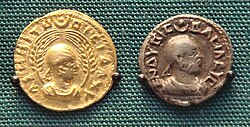
[[File:KingEndybisEthiopia227-235CE.jpg|thumb|[[Aksumite currency]] of the [[Axumite kings|Aksumite king]] [[Endybis]], 227–35, at the [[British Museum]]{{Efn|The inscriptions in [[Ancient Greek]] read {{lang|grc|ΑΞΩΜΙΤΩ ΒΑϹΙΛΕΥϹ}} ("King of Axum") and {{lang|grc|ΕΝΔΥΒΙϹ ΒΑϹΙΛΕΥϹ}} ("King Endybis"); Greek was the ''[[lingua franca]]'' by that time, so its use in coins simplified foreign trade.}}]] | |||
Around 316 | In 980 BC, [[Dʿmt]] was established in present-day [[Eritrea]] and the northern part of Ethiopia in the Tigray region, and is widely believed to be the successor state to [[Land of Punt|Punt]]. This polity's capital was located at [[Yeha]] in what is now northern Ethiopia. Most modern historians consider this civilization to be a native Ethiopian one, although in earlier times many suggested it was [[Sabaeans|Sabaean]]-influenced because of the latter's hegemony of the [[Red Sea]].<ref name="Munro-Hay57">[[#Munro-Hay|Munro-Hay]], p. 57</ref> | ||
Other scholars regard Dʿmt as the result of a union of Afroasiatic-speaking cultures of the Cushitic and Semitic branches; namely, local [[Agaw people]]s and Sabaeans from Southern Arabia. However, [[Geʽez|Ge'ez]], the ancient Semitic language of Ethiopia, is thought to have developed independently from the [[Sabaean language]]. As early as 2000 BC, other Semitic speakers were living in Ethiopia and Eritrea where Ge'ez developed.<ref>Tamrat, Taddesse (1972) ''Church and State in Ethiopia: 1270–1527''. London: Oxford University Press, pp. 5–13.</ref><ref>Uhlig, Siegbert (ed.) (2005) ''[[Encyclopaedia Aethiopica]]'', "Ge'ez". Wiesbaden: Harrassowitz Verlag, p. 732.</ref> Sabaean influence is now thought to have been minor, limited to a few localities, and disappearing after a few decades or a century. It may have been a trading or military colony in alliance with the Ethiopian civilization of Dʿmt or some other proto-Axumite state.<ref name="Munro-Hay57" /> | |||
[[File:The Kingdom of Aksum.png|thumb|The [[Kingdom of Aksum|Empire of Axum]] at its peak in the 6th century]] | |||
After the fall of Dʿmt during the 4th century BC, the Ethiopian plateau came to be dominated by smaller successor kingdoms. In the 1st century AD, the [[Kingdom of Aksum]] emerged in what is now Tigray Region and Eritrea. According to the medieval ''[[Book of Axum]]'', the kingdom's first capital, Mazaber, was built by Itiyopis, son of Cush.<ref name="Agrvt" /> Aksum would later at times extend its rule into Yemen on the other side of the Red Sea.<ref>{{cite book |last=Phillipson |first=David W. |title=Ancient Ethiopia. Aksum: Its Antecedents and Successors |publisher=The British Museum Press |year=1998 |isbn=978-0-7141-2763-7 |pages=7, 48–50}}</ref> The Persian prophet [[Mani (prophet)|Mani]] listed Axum with Rome, Persia, and China as one of the four great powers of his era, during the 3rd century.<ref>[[#Munro-Hay|Munro-Hay]], p. 13</ref> It is also believed that there was a connection between Egyptian and Ethiopian churches. There is faint evidence that the Aksumites were associated with the [[Queen of Sheba]], via their royal inscription.<ref name=":5">{{Cite web |title=Solomonic Descent in Ethiopian History |url=https://www.worldhistory.org/article/1875/solomonic-descent-in-ethiopian-history/ |access-date=20 December 2021 |website=World History Encyclopedia |date=18 November 2021 |language=en}}</ref> | |||
Around 316 AD, [[Frumentius]] and his brother Edesius from [[Tyre, Lebanon|Tyre]] accompanied their uncle on a voyage to Ethiopia. When the vessel stopped at a Red Sea port, the natives killed all the travellers except the two brothers, who were taken to the court as [[Slavery in Ethiopia|slaves]]. They were given positions of trust by the monarch, and they converted members of the royal court to Christianity. Frumentius became the first bishop of Aksum.<ref name="isbn0-313-32273-2">{{cite book |author=Adejumobi, Saheed A. |url=https://books.google.com/books?id=3Un6_LGIEyQC&pg=PA171 |title=The history of Ethiopia |publisher=Greenwood Press |year=2007 |isbn=978-0-313-32273-0 |location=Westport, CN |page=171}}</ref> A coin dated to 324 shows that Ethiopia was the second country to officially adopt Christianity (after Armenia did so in 301), although the religion may have been at first confined to court circles; it was the first major power to do so. The Aksumites were accustomed to the Greco-Roman sphere of influence, but they embarked on significant cultural ties and trade connections between the [[Indian subcontinent]] and the Roman Empire via the [[Silk Road]], primarily exporting [[Ivory trade|ivory]], tortoise shell, gold and emeralds, and importing silk and spices.<ref name=":5" /><ref name="britishmuseum.org">{{cite web |last1=The British Museum |last2=The CarAf Centre |title=The wealth of Africa – The kingdom of Aksum – Teachers' notes |url=https://www.britishmuseum.org/pdf/KingdomOfAksum_TeachersNotes.pdf |archive-url=https://web.archive.org/web/20191104191259/https://www.britishmuseum.org/pdf/KingdomOfAksum_TeachersNotes.pdf |archive-date=4 November 2019 |website=BritishMuseum.org}}</ref> The country's gold production in 2015 is 9 metric tons.<ref>{{Cite web |title=Gold production |url=https://ourworldindata.org/grapher/gold-production?tab=table |archive-url=https://web.archive.org/web/20231129233804/https://ourworldindata.org/grapher/gold-production?tab=table |archive-date=29 November 2023 |access-date=2024-12-19 |website=Our World in Data |url-status=live}}</ref> | |||
===Middle Ages=== | ===Middle Ages=== | ||
{{Main|Ethiopia in the Middle Ages}} | {{Main|Ethiopia in the Middle Ages}} | ||
[[ | The kingdom adopted the name "Ethiopia" during the reign of [[Ezana of Axum|Ezana]] in the 4th century. After the conquest of [[Kingdom of Kush]] in 330, the Aksumite territory reached its peak between the 5th and 6th centuries.<ref name="Munro-Hay57" /> This period was interrupted by several incursions into the South Arabian protectorate, including [[Jews|Jewish]] [[Dhu Nuwas]] of the [[Himyarite Kingdom]] and the [[Aksumite–Persian wars]]. In 575, the Aksumites [[Sasanian reconquest of Yemen|besieged and retook Sana'a]] following the assassination of its governor [[Sayf ibn Dhi Yazan|Sayf ibn Dhī Yazan]]. The Red Sea was left to the [[Rashidun Caliphate]] in 646, and the port city of [[Adulis]] was plundered by Arab Muslims in the 8th century; along with irrevocable [[land degradation]], claimed [[climate change (general concept)|climate change]] and sporadic rainfall precipitation from 730 to 760,<ref>Karl W. Butzer, "Rise and Fall of Axum, Ethiopia: A Geo-Archaeological Interpretation", ''American Antiquity'' 46, (July 1981), p. 495</ref> these factors likely caused the kingdom to decline in power as part of an important trade route.<ref name="Munro-Hay57" /><ref name=":12">{{Cite web |title=Kingdom of Abyssinia |url=https://www.worldhistory.org/Kingdom_of_Abyssinia/ |access-date=9 January 2022 |website=World History Encyclopedia |date=9 April 2019 |language=en}}</ref> Aksum came to an end in 960 when [[Gudit|Queen Gudit]] defeated the last king of Aksum.<ref>{{Cite web |date=9 January 2022 |title=A New History Changes the Balance of Power Between Ethiopia and Medieval Europe |url=https://www.smithsonianmag.com/history/new-history-changes-balance-power-between-ethiopia-and-medieval-europe-180978084/}}</ref> In response, the remnant of the Aksumite population to shift into the southern region and establish the [[Zagwe dynasty]], changing its capital to [[Lalibela]].<ref>{{Cite web |title=Ethiopia The Zagwe Dynasty – Flags, Maps, Economy, History, Climate, Natural Resources, Current Issues, International Agreements, Population, Social Statistics, Political System |url=https://photius.com/countries/ethiopia/society/ethiopia_society_the_zagwe_dynasty.html |access-date=16 December 2021 |website=photius.com}}</ref> Zagwe's rule ended when an [[Amhara people|Amhara]] noble man [[Yekuno Amlak]] revolted against King [[Yetbarak]] and established the [[Ethiopian Empire]] (known by exonym "Abyssinia"). | ||
[[File:Bete Medhane Alem in Lalibela.JPG|thumb|201x201px|[[Biete Medhane Alem]], built during [[Zagwe dynasty]] in the Middle Ages ]] | |||
The Ethiopian Empire initiated territorial expansion under the leadership of [[Amda Seyon I]]. He launched campaigns against his Muslim adversaries to the east, resulting in a significant shift in the balance of power in favor of the Christians for the next two centuries. After Amda Seyon's successful eastern campaigns, most of the Muslim principalities in the [[Horn of Africa]] came under the suzerainty of the Ethiopian Empire. Stretching from [[Gojjam]] to the Somali Coast in [[Zeila|Zelia]].<ref>{{Cite book |last=Pankhurst |first=Richard |title=History of Ethiopian Towns |publisher=Steiner |year=1982 |isbn=978-3-515-03204-9}}</ref> Among these Muslim entities was the [[Sultanate of Ifat]]. During the reign of Emperor [[Zara Yaqob]], the Ethiopian Empire reached its pinnacle. His rule was marked by the consolidation of territorial acquisitions from earlier rulers, the oversight of the construction of numerous churches and monasteries, the active promotion of literature and art, and the strengthening of central imperial authority.<ref>{{cite book |url=https://books.google.com/books?id=YeKwW3vzQMUC&q=amda+seyon+victory+ifat&pg=PA283 |title=UNESCO General History of Africa |date=3 November 1992 |publisher=University of California Press |isbn=978-0-520-06698-4 |page=283}}</ref><ref name=":3b">{{Cite book |last=Abir |first=Mordechai |url=https://books.google.com/books?id=7fArBgAAQBAJ&pg=PA11 |title=Ethiopia and the Red Sea: The Rise and Decline of the Solomonic Dynasty and Muslim European Rivalry in the Region |date=2013-10-28 |publisher=Routledge |isbn=978-1-136-28090-0 |pages=22–70 |language=en}}</ref>{{sfn|Connel|Killion|2011|p=160}} Ifat's successor, the [[Adal Sultanate]],<ref>{{cite book |last1=Mohammed |first1=Abdul Kader |url=https://books.google.com/books?id=jwjX_yVT7AoC&q=adal+sultanate&pg=PA170 |title=The Saho of Eritrea: Ethnic Identity and National Consciousness |publisher=LIT Verlag Münster |year=2013 |isbn=978-3-643-90332-7 |page=170}}</ref> tried to conquer Ethiopia during the [[Ethiopian–Adal War]], but was ultimately defeated at the 1543 [[Battle of Wayna Daga]].<ref>Fortunes of Africa: A 5,000 Year History of Wealth, Greed and Endeavour By Martin Meredith, In the Land of Prestor John, chapter 11</ref> | |||
By the 16th century, an influx of migration by ethnic [[Oromo people|Oromo]] into northern parts of the region fragmented the empire's power. Embarking from present-day [[Guji Zone|Guji]] and [[Borena Zone]], the Oromos were largely motivated by several folkloric conceptions—beginning with ''Moggaasaa''<ref>{{Cite book |last=Hassen |first=Mohammed |title=The Oromo and the Christian Kingdom of Ethiopia, 1300–1700 |date=2017 |publisher=James Currey |isbn=978-1-84701-161-9 |language=English |oclc=962017017}}</ref> and ''Liqimssa''—many of whom related to their raids. This persisted until ''gada'' of Meslé.{{sfn|Pankhurst|1997|p=301}}<ref name=":8">{{Cite web |title=Ethiopia: The Trials of the Christian Kingdom and the Decline of Imperial Power ~a HREF="/et_00_00.html#et_01_02" |url=http://memory.loc.gov/frd/etsave/et_01_02.html |access-date=31 December 2021 |website=memory.loc.gov}}</ref> According to [[Bahrey|Abba Bahrey]], the earliest expansion occurred under Emperor [[Dawit II]] ([[Luba Melbah|''luba'' Melbah]]), when they encroached to [[Bale Province, Ethiopia|Bale]] before invading Adal Sultanate.<ref name="Reference">{{Cite web |title=Oromo: Migration and Expansion: Sixteenth and Seventeenth Centuries |url=http://www.worldhistory.biz/sundries/32403-oromo-migration-and-expansion-sixteenth-and-seventeenth-centuries.html|archive-url=https://web.archive.org/web/20180117133933/http://www.worldhistory.biz/sundries/32403-oromo-migration-and-expansion-sixteenth-and-seventeenth-centuries.html|archive-date=2018-01-17}}</ref> | |||
Ethiopia saw major diplomatic contact with Portugal from the 17th century, mainly related to religion. Beginning in 1555,<ref>{{Cite book |last=Cohen |first=Leonardo |url=https://books.google.com/books?id=4Zs3CcC2eLoC&q=the+jesuit+in+ethiopia+1555 |title=The Missionary Strategies of the Jesuits in Ethiopia (1555–1632) |date=2009 |publisher=Otto Harrassowitz Verlag |isbn=978-3-447-05892-6 |language=en}}</ref> Portuguese Jesuits attempted to develop Roman Catholicism as the state religion. After several failures, they sent several missionaries in 1603, including the most influential, Spanish Jesuit [[Pedro Páez|Pedro Paez]].<ref>{{Cite web |title=Latin Letters of Jesuits -Wendy Laura Belcher |url=https://wendybelcher.com/african-literature/latin-letters-of-jesuits/ |access-date=4 February 2022 |website=wendybelcher.com}}</ref> Under Emperor [[Susenyos I]], Roman Catholicism became the state religion of the Ethiopian Empire in 1622.<ref name="Parfitt2019">{{cite book |last=Parfitt |first=Rose |url=https://books.google.com/books?id=JOeADwAAQBAJ&pg=PA225 |title=The Process of International Legal Reproduction: Inequality, Historiography, Resistance |date=17 January 2019 |publisher=Cambridge University Press |isbn=978-1-316-51519-8 |pages=225–}}</ref> This decision caused an uprising by the Orthodox populace.<ref name="berndl2005">{{Cite book |last=Berndl |first=Klaus |url=https://archive.org/details/nationalgeograph0000unse_m8x7/page/333/mode/2up |title=National Geographic Visual History of the World |publisher=National Geographic Society |year=2005 |isbn=978-0-7922-3695-5 |page=333 |language=en}}</ref> | |||
===Early Modern Period (1632–1855)=== | |||
{{Main|Gondarine period|Zemene Mesafint}} | |||
[[File:Paris, Bibliothèque nationale de France, Ethiopien d'Abbadie 215, folio 1r.JPEG|thumb|left|A copy of 17th century philosophical and [[ethical]] treatise by [[Ethiopian]] philosopher [[Zara Yaqob]]]] | |||
[[File:Fasil Ghebbi IV (23869587160).jpg|thumb|Fasil Ghebbi, one of the key castles of the [[Gondarine period]]]] | |||
In 1632, Emperor [[Fasilides]] halted Roman Catholic state administration, restoring [[Orthodox Tewahedo]] as the state religion.<ref name="Parfitt2019" /> Fasilides' reign solidified imperial power, relocating the capital to [[Gondar]] in 1636, marking the beginning of the "[[Gondarine period]]".<ref>See Solomon Getamun, ''History of the City of Gondar'' (Africa World Press, 2005), pp.1–4</ref> He reclaimed lands, and exiled [[Jesuits]] to [[Fremona]]. During his rule, Fasilides constructed the iconic royal fortress, [[Fasil Ghebbi]], built forty-four churches,<ref>Getamun, ''City of Gondar'', p. 5</ref> and revived [[Ethiopian art]]. He is also credited with building seven stone bridges over the [[Blue Nile River]].<ref>Pankhurst, ''Economic History of Ethiopia'' (Addis Ababa: Haile Selassie University Press, 1968), pp. 297f</ref> | |||
Gondar's power declined after the death of [[Iyasu I]] in 1706. Following [[Iyasu II]]'s death in 1755, Empress [[Mentewab]] brought her brother, [[Ras (title)|Ras]] Wolde Leul, to Gondar, making him Ras Bitwaded. This led to regnal conflict between Mentewab's ''Quaregnoch'' and the Wollo group led by Wubit. In 1767, Ras [[Mikael Sehul]], a regent in [[Tigray Province]], seized Gondar, killing the child [[Iyoas I]] in 1769, the reigning emperor, and installed 70-year-old [[Yohannes II]].<ref>{{Cite web |title=Gondar Period |url=https://ethiopianhistory.com/Gondar_Period/ |access-date=2022-06-05 |website=ethiopianhistory.com}}</ref> | |||
Between 1769 and 1855, Ethiopia witnessed the [[Zemene Mesafint]] or "Age of Princes," a period of isolation. Emperors became figureheads, controlled by regional lords and noblemen like ''Ras'' Mikael Sehul, Ras [[Wolde Selassie]] of Tigray, and by the [[Yejju]] Oromo dynasty of the [[Zemene Mesafint#Wara Sheh rulers (Yejju) (1784–1855)|Wara Sheh]], including Ras [[Gugsa of Yejju]]. Before the Zemene Mesafint, Emperor Iyoas I had introduced the Oromo language (''Afaan Oromo'') at court, replacing Amharic.<ref>{{cite book |author=Pankhurst, Richard |title=The Ethiopian Royal Chronicles |publisher=Oxford University Press |year=1967 |location=London |pages=139–143}}</ref><ref>{{cite web |date=23 April 1996 |title=Political Program of the Oromo People's Congress (OPC) |url=http://gargaaraoromopc.org/OPC_Program.aspx |archive-url=https://web.archive.org/web/20090307213227/http://gargaaraoromopc.org/OPC_Program.aspx |archive-date=7 March 2009 |access-date=16 March 2009 |publisher=Gargaaraoromopc.org}}</ref> | |||
=== Age of Imperialism (1855–1916) === | |||
{{main|British expedition to Abyssinia|Menelik's Invasions|Egyptian–Ethiopian War|First Italo-Ethiopian War|Mahdist War}} | |||
From 1885 to 1889 (under [[Yohannes IV]]), Ethiopia joined the [[Mahdist War]] allied to Britain, | {{Multiple image | ||
| direction = horizontal | |||
| image1 = Téwodros II - 2.jpg | |||
| caption1 = Emperor [[Tewodros II]] (r. 1855–1868) brought an end to Zemene Mesafint. | |||
| image2 = Menelik - Adoua-2 (cropped).jpg | |||
| caption2 = Emperor [[Menelik II]] defended Ethiopia's sovereignty during the age of imperialism. | |||
| total_width = 320 | |||
}}Ethiopian isolationism ended following a British mission that concluded with an alliance between the two nations, but it was not until 1855 that the Amhara kingdoms of northern Ethiopia (Gondar, [[Gojjam]], and [[Shewa]]) were briefly united after the power of the emperor was restored beginning with the reign of [[Tewodros II]].<ref name="Middleton2015">{{cite book |last=Middleton |first=John |url=https://books.google.com/books?id=R63ACQAAQBAJ&pg=PA39 |title=World Monarchies and Dynasties |date=1 June 2015 |publisher=Routledge |isbn=978-1-317-45158-7 |pages=39–}}</ref><ref>{{Cite book |last=Tibebu |first=Teshale |title=Oxford Research Encyclopedia of African History |date=June 2018 |isbn=978-0-19-027773-4 |chapter=Ethiopia in the Nineteenth Century |doi=10.1093/acrefore/9780190277734.013.279 |chapter-url=https://oxfordre.com/africanhistory/view/10.1093/acrefore/9780190277734.001.0001/acrefore-9780190277734-e-279}}</ref> Tewodros II began a process of consolidation, centralisation, and state-building that would be continued by succeeding emperors. This process reduced the power of regional rulers, restructured the empire's administration, and created a professional army. These changes created the basis for establishing the effective sovereignty and territorial integrity of the Ethiopian state.<ref>{{cite book |last1=Keller |first1=Edmond J. |url=https://www.sscnet.ucla.edu/polisci/faculty/keller/papers/SelectedPub/EthiopiaState.pdf |archive-url=https://web.archive.org/web/20180219015314/http://www.sscnet.ucla.edu/polisci/faculty/keller/papers/SelectedPub/EthiopiaState.pdf |archive-date=19 February 2018 |title=Borders, Nationalism, and the African State |date=2005 |publisher=Lynne Rienner Publishers |isbn=978-1-58826-340-7 |editor1-last=Laremont |editor1-first=Ricardo René |pages=89–92 |chapter=Making and Remaking State and Nation in Ethiopia}}</ref> In 1875 and 1876, Ottoman and Egyptian forces, accompanied by many European and American advisors, twice [[Egyptian–Ethiopian War|invaded Abyssinia]] but were initially defeated.<ref>[http://vislardica.com/VisImperica/Wars/vi_egypt_abyssinia.htm The Egyptians in Abyssinia] {{webarchive|url=https://web.archive.org/web/20111226155100/http://vislardica.com/VisImperica/Wars/vi_egypt_abyssinia.htm|date=26 December 2011}}. Vislardica.com. Retrieved on 3 March 2012.</ref> From 1885 to 1889 (under [[Yohannes IV]]), Ethiopia joined the [[Mahdist War]] allied to Britain, the Ottomans, and Egypt against the Sudanese Mahdist State. In 1887, [[Menelik II]], king of [[Shewa]], invaded the [[Emirate of Harar]] after his victory at the [[Battle of Chelenqo]].<ref>{{cite journal |last1=Caulk |first1=Richard |year=1971 |title=The Occupation of Harar: January 1887 |journal=Journal of Ethiopian Studies |volume=9 |issue=2 |pages=1–20 |jstor=41967469}}</ref> On 10 March 1889, Yohannes IV was killed by the Sudanese Khalifah Abdullah's army whilst leading his army in the [[Battle of Gallabat]].<ref>{{Cite book |last=Lipschutz |first=Mark |title=Dictionary of African historical biography |date=1986 |publisher=University of California Press |others=Rasmussen, R. Kent |isbn=978-0-520-06611-3 |edition=2nd ed., expanded and updated |location=Berkeley |page=1 |oclc=14069361}}</ref> | |||
Ethiopia, in roughly its current form, began under the reign of Menelik II, who was Emperor from 1889 until his death in 1913. From his base in the central province of Shewa, Menelik set out to annex territories to the south, east, and west<ref name="ReferenceA">{{Cite journal |last1=Young |first1=J. |year=1998 |title=Regionalism and democracy in Ethiopia |journal=Third World Quarterly |volume=19 |issue=2 |pages=191–204 |doi=10.1080/01436599814415 |jstor=3993156}}</ref> — areas inhabited by the Oromo, [[Sidama people|Sidama]], Gurage, [[Welayta people|Welayta]], and other peoples.<ref name="igg">International Crisis Group, "Ethnic Federalism and its Discontents". Issue 153 of ''ICG Africa'' report (4 September 2009) p. 2; Italy lost over 4,600 nationals in this battle.</ref> He achieved this with the help of ''Ras'' [[Gobana Dacche]]'s Shewan Oromo militia, which occupied lands that had not been held since [[Ahmad ibn Ibrahim al-Ghazi]]'s war, as well as other areas that had never been under Ethiopian rule.<ref>{{cite journal |author=Keefer, Edward C. |year=1973 |title=Great Britain and Ethiopia 1897–1910: Competition for Empire |journal=International Journal of African Studies |volume=6 |issue=3 |pages=468–74 |doi=10.2307/216612 |jstor=216612}}</ref> | |||
Ethiopia in roughly its current form began under the reign of Menelik II, who was Emperor from 1889 until his death in 1913. From his base in the central province of Shewa, Menelik set out to annex territories to the south, east, and west<ref name="ReferenceA">{{Cite journal |last1=Young |first1=J. |year=1998 |title=Regionalism and democracy in Ethiopia |journal=Third World Quarterly |volume=19 |issue=2 |pages=191–204 |doi=10.1080/01436599814415 |jstor=3993156}}</ref> — areas inhabited by the Oromo, [[Sidama people|Sidama]], Gurage, [[Welayta people|Welayta]], and other peoples.<ref name=igg/> He achieved this with the help of ''Ras'' [[Gobana Dacche]]'s Shewan Oromo militia, which occupied lands that had not been held since Ahmad ibn Ibrahim al-Ghazi's war, as well as other areas that had never been under Ethiopian rule.<ref>{{cite journal |title=Great Britain and Ethiopia 1897–1910: Competition for Empire | |||
For his leadership, despite opposition from more traditional elements of society, Menelik II was heralded as a national hero. He had signed the [[Treaty of Wuchale]] with Italy in May 1889, by which Italy would recognize Ethiopia's sovereignty so long as Italy could control an area north of Ethiopia (now part of modern Eritrea). In return, Italy was to provide Menelik with weapons and support him as emperor. The Italians used the time between the signing of the treaty and its ratification by the Italian government to expand their territorial claims. This [[First | For his leadership, despite opposition from more traditional elements of society, Menelik II was heralded as a national hero. He had signed the [[Treaty of Wuchale]] with Italy in May 1889, by which Italy would recognize Ethiopia's sovereignty so long as Italy could control an area north of Ethiopia (now part of modern Eritrea). In return, Italy was to provide Menelik with weapons and support him as emperor. The Italians used the time between the signing of the treaty and its ratification by the Italian government to expand their territorial claims. This [[First Italo-Ethiopian War]] culminated in the [[Battle of Adwa]] on 1 March 1896, in which Italy's colonial forces were defeated by the Ethiopians.<ref name="igg" /><ref>Negash, Tekeste. [https://books.google.com/books?id=txsoS39UplMC Eritrea and Ethiopia : The Federal Experience]. Uppsala, Sweden: Nordiska Afrikainstitutet (2005) {{ISBN|1-56000-992-6}} pp. 13–14</ref> During this time, about a third of the population died in the [[Famines in Ethiopia|Great Ethiopian Famine]] (1888 to 1892),<ref>[https://web.archive.org/web/20090211211756/http://www.time.com/time/magazine/article/0,9171,966291-3,00.html "Famine Hunger stalks Ethiopia once again – and aid groups fear the worst"]. ''[[Time (magazine)|Time]]''. 21 December 1987.</ref><ref>{{Cite journal |last1=Pankhurst |first1=R. |year=1966 |title=The Great Ethiopian Famine of 1888–1892: A New Assessment |journal=Journal of the History of Medicine and Allied Sciences |volume=21 |issue=2 |pages=95–124 |doi=10.1093/jhmas/XXI.2.95 |pmid=5326887}}</ref> and the [[1890s African rinderpest epizootic|rinderpest]] swept through the area, destroying much of the herd economy. On 11 October 1897, Ethiopia adopted the [[Pan-African colours|colours of the pan-African flag]] with green, yellow and red stripes in representation of [[pan-Africanist]] ideology. | ||
===Haile Selassie I era (1916–1974)=== | ===Haile Selassie I era (1916–1974)=== | ||
{{ | {{main|Second Italo-Ethiopian War|Italian Ethiopia|Italian East Africa|Federation of Ethiopia and Eritrea|Eritrean War of Independence}} | ||
[[File:Ethiopian Soldiers Korean War.jpg|thumb|Ethiopian troops sent by the government under the [[Haile Selassie|Emperor Haile Selassie I]] during the [[Korean War]] fighting for South Korean independence]] | |||
[[File:Emperor Haile Selassie I with President FDR.jpg|thumb|[[Haile Selassie|Emperor Haile Selassie I]] with U.S. president [[Franklin D. Roosevelt]] during the end of World War II]] | |||
The early 20th century was marked by the reign of Emperor [[Haile Selassie]] (''Ras Tafari''). He came to power after [[Lij Iyasu]] was deposed, and undertook [[Modernization under Haile Selassie|a nationwide modernization campaign]] from 1916 when he was made a ''Ras'' and Regent (''Inderase'') for the [[Queen regnant|Empress Regnant]] [[Zewditu]], and became the ''de facto'' ruler of the Ethiopian Empire. Following Zewditu's death, on 2 November 1930, he succeeded her as emperor.<ref>{{Cite web |last=Broich |first=Tobias |date=2017 |title=U.S. and Soviet Foreign Aid during the Cold War – A Case Study of Ethiopia |url=https://www.merit.unu.edu/publications/publications-search/ |website=The United Nations University – Maastricht Economic and Social Research Institute on Innovation and Technology (UNU-MERIT) |access-date=19 October 2018 |archive-date=15 September 2014 |archive-url=https://web.archive.org/web/20140915183529/http://www.merit.unu.edu/publications/publications-search/}}</ref> In 1931, Haile Selassie endowed Ethiopia with [[1931 Constitution of Ethiopia|its first constitution]] in emulation of Imperial Japan's [[Meiji Constitution|1890 Constitution]].<ref>Asnake Kefale, [[Tomasz Kamusella]] and Christopher Van der Beken. 2021. ''Eurasian Empires as Blueprints for Ethiopia: From Ethnolinguistic Nation-State to Multiethnic Federation''. London: Routledge, pp. 23–34.</ref> | |||
The independence of Ethiopia was interrupted by the [[Second Italo-Ethiopian War]], beginning when it was invaded by [[Kingdom of Italy#Fascist regime (1922–1943)|Italy]] in early October 1935, and by subsequent Italian rule of the country (1936–1941) after Italian victory in the war.<ref>Clapham, Christopher (2005) "Ḫaylä Śəllase" in Siegbert von Uhlig, ed., ''Encyclopaedia Aethiopica: D-Ha''. Wiesbaden:Harrassowitz Verlag. pp. 1062–1063.</ref> Italy, however, never managed to secure the country in its totality, due to resistance from the [[Arbegnoch]]; this made Ethiopia, along with [[Liberia]], the only African countries to never be fully colonized.<ref>{{Cite book |last=Pankhurst |first=Richard |title=The Ethiopians: A History |date=September 24, 2001 |publisher=[[Blackwell Publishing|Blackwell]] |isbn=0-631-22493-9 |edition=2nd |page=256}}</ref><ref>{{Cite book |last=Tibebu |first=Teshale |title=The Making of Modern Ethiopia: 1896-1974 |date=1995 |publisher=[[RedSeaPr]] |isbn=1-56902-001-9 |page=145}}</ref> Following the entry of Italy into [[World War II]], [[British Empire]] forces, together with the Arbegnoch, liberated Ethiopia in the course of the [[East African campaign (World War II)|East African campaign]] in 1941. The country was placed under [[Occupied Enemy Territory Administration (Ethiopia)|British military administration]], and then Ethiopia's full [[sovereignty]] was restored with the signing of the [[Anglo-Ethiopian Agreement]] in December 1944.<ref>Clapham, "Ḫaylä Śəllase", ''Encyclopaedia Aethiopica'', p. 1063.</ref> | |||
On 24 October 1945, Ethiopia became a founding member of the [[United Nations]]. In 1952, Haile Selassie orchestrated a [[Federation of Ethiopia and Eritrea|federation with Eritrea]]. He dissolved this in 1962 and annexed Eritrea, resulting in the [[Eritrean War of Independence]].<ref>{{Cite web |title=16. Ethiopia/Eritrea (1950-1993) |url=https://uca.edu/politicalscience/home/research-projects/dadm-project/sub-saharan-africa-region/ethiopiaeritrea-1950-1993/ |access-date=2025-06-27 |website=uca.edu |language=en-US}}</ref> Haile Selassie also played a leading role in the formation of the [[Organisation of African Unity]] (OAU).<ref>{{Cite web |date=7 August 2009 |title=(1963) Haile Selassie, "Towards African Unity" |url=https://blackpast.org/1963-haile-selassie-towards-african-unity |website=BlackPast.org}}</ref> Opinion within Ethiopia turned against Haile Selassie, owing to the worldwide [[1973 oil crisis]] causing a sharp increase in gasoline prices starting on 13 February 1974, leading to student and worker protests.<ref>[[#Valdes Vivo|Valdes Vivo]], p. 115.</ref> The feudal oligarchical cabinet of [[Aklilu Habte-Wold]] was toppled, and a new government was formed with [[Endelkachew Makonnen]] serving as Prime Minister.<ref>[[#Valdes Vivo|Valdes Vivo]], p. 21.</ref> | |||
=== | ===Derg era (1974–1991)=== | ||
{{ | {{see also|Ethiopian Revolution|Derg|People's Democratic Republic of Ethiopia|Ethiopian Civil War|Red Terror (Ethiopia){{!}}Red Terror|1983–1985 famine in Ethiopia}} | ||
[[File: | [[File:Mengistu Haile Mariam 3.jpg|thumb|[[Mengistu Haile Mariam]] was sentenced to death [[Trial in absentia|''in absentia'']] for committing [[Red Terror (Ethiopia)|crimes during his rule]].|164x164px]] | ||
Haile Selassie's rule ended on 12 September 1974, when he was [[1974 Ethiopian coup d'état|deposed]] by the [[Derg]], a committee made up of military and police officers.<ref>{{Cite news |date=13 September 1974 |title=REMOVAL IS QUIET |url=https://www.nytimes.com/1974/09/13/archives/removal-is-quiet.html |access-date=17 June 2021 |work=The New York Times |language=en-US |issn=0362-4331 |agency=Reuters}}</ref> After the execution of [[Massacre of the Sixty|60 former government and military officials]],<ref>{{Cite news |date=24 November 1974 |title=Ethiopia Executes 60 Former Officials, Including 2 Premiers and Military Chief |url=https://www.nytimes.com/1974/11/24/archives/ethiopia-executes-60-former-officials-including-2-premiers-and.html |access-date=17 June 2021 |work=The New York Times |language=en-US |issn=0362-4331 |agency=Reuters}}</ref> the new [[Provisional Military Administrative Council]] abolished the monarchy in March 1975 and established Ethiopia as a [[Marxist-Leninist state]].<ref>{{Cite news |date=22 March 1975 |title=Ethiopia's Military Government Abolishes Monarchy and Titles |url=https://www.nytimes.com/1975/03/22/archives/ethiopias-military-government-abolishes-monarchy-and-titles.html |access-date=17 June 2021 |work=The New York Times |language=en-US |issn=0362-4331}}</ref> The abolition of [[feudalism]], increased [[literacy]], [[nationalization]], and sweeping [[land reform]] including the [[Resettlement and villagization in Ethiopia|resettlement and villagization]] from the [[Ethiopian Highlands]] became priorities.<ref>{{Cite book |last=ʼAndārgāčaw Ṭerunah |title=The Ethiopian revolution, 1974–1987: a transformation from an aristocratic to a totalitarian autocracy |date=1993 |publisher=Cambridge University Press |others=Thomas Leiper Kane Collection |isbn=0-521-43082-8 |location=Cambridge |oclc=25316141}}</ref> | |||
After a power struggle in 1977, [[Mengistu Haile Mariam]] gained undisputed leadership of the Derg.<ref>{{Cite news |last=Kaufman |first=Michael T. |date=15 November 1977 |title=Ethiopian Official Is Believed to Have Been Executed |url=https://www.nytimes.com/1977/11/15/archives/ethiopian-official-is-believed-to-have-been-executed.html |access-date=17 June 2021 |work=The New York Times |language=en-US |issn=0362-4331}}</ref> In 1977, Somalia, which had previously been receiving assistance and arms from the [[USSR]], invaded Ethiopia in the [[Ogaden War]], capturing part of the [[Ogaden]] region. Ethiopia recovered it after it began receiving massive military aid from the Soviet bloc countries.<ref>{{cite book |last=Dagne |first=Haile Gabriel |title=The commitment of the German Democratic Republic in Ethiopia: a study based on Ethiopian sources |publisher=Global Lit. |year=2006 |isbn=978-3-8258-9535-8 |location=London}}</ref><ref>{{cite web |title=The Mengistu Regime and Its Impact |url=https://memory.loc.gov/frd/etsave/et_01_08.html |website=Library of Congress|archive-url=https://web.archive.org/web/20180105051009/https://memory.loc.gov/frd/etsave/et_01_08.html|archive-date=2018-01-05}}</ref><ref>{{cite news |last=Oberdorfer |first=Don |date=March 1978 |title=The Superpowers and the Ogaden War |url=https://www.washingtonpost.com/archive/politics/1978/03/05/the-superpowers-and-the-ogaden-war/00f60ef2-01b4-4cd3-8c5f-e545df388def/ |newspaper=The Washington Post}}</ref> By the end of the seventies, Mengistu presided over the second-largest army in all of [[sub-Saharan Africa]], as well as a formidable [[Ethiopian Air Force|air force]] and navy. | |||
In 1976–78, up to 500,000 were killed as a result of the [[Red Terror (Ethiopia)|Red Terror]],<ref name="BBC">{{cite web |date=22 December 1999 |title=US admits helping Mengistu escape |url=https://news.bbc.co.uk/2/hi/africa/575405.stm |access-date=13 December 2017 |website=BBC}}</ref> a violent [[political repression]] campaign by the Derg against various opposition groups.<ref name="Black Book2">''[[The Black Book of Communism]]'', pp. 687–95</ref><ref>{{cite news |last=Ottaway |first=David B. |date=21 March 1979 |title=Addis Ababa Emerges From a Long, Bloody War |url=https://www.washingtonpost.com/archive/politics/1979/03/21/addis-ababa-emerges-from-a-long-bloody-war/263ac7da-0f96-444c-ab87-03c80bb1632a/ |access-date=13 December 2017 |newspaper=The Washington Post}}</ref><ref>{{cite magazine |last=Katz |first=Donald R. |date=21 September 1978 |title=Ethiopia After the Revolution: Vultures in the Land of Sheba |url=https://www.rollingstone.com/culture/features/ethiopia-after-the-revolution-vultures-return-to-the-land-of-sheba-19780921 |archive-url=https://web.archive.org/web/20180226211913/https://www.rollingstone.com/culture/features/ethiopia-after-the-revolution-vultures-return-to-the-land-of-sheba-19780921 |archive-date=26 February 2018 |access-date=13 December 2017 |magazine=Rolling Stone}}</ref> In 1987, the Derg dissolved itself and established the [[People's Democratic Republic of Ethiopia]] (PDRE) upon the adoption of the [[1987 Constitution of Ethiopia]].<ref>Asnake Kefale, [[Tomasz Kamusella]] and Christopher Van der Beken. 2021. ''Eurasian Empires as Blueprints for Ethiopia: From Ethnolinguistic Nation-State to Multiethnic Federation''. London: Routledge, pp 35–43</ref> A [[1983–1985 famine in Ethiopia|1983–85 famine]] affected around 8 million people, resulting in 1 million dead. Insurrections against [[Authoritarianism|authoritarian]] rule sprang up, particularly in the northern regions of Eritrea and Tigray. The [[Tigray People's Liberation Front]] (TPLF) merged with other ethnically based opposition movements in 1989, to form the [[Ethiopian People's Revolutionary Democratic Front]] (EPRDF).<ref>{{cite book |last=Stapleton |first=Timothy J. |title=A History of Genocide in Africa |publisher=ABC-CLIO |year=2017 |isbn=978-1-4408-3052-5 |page=163}}</ref> | |||
The collapse of [[Marxism–Leninism]] during the [[revolutions of 1989]] coincided with the Soviet Union stopping aid to Ethiopia altogether in 1990.<ref>{{cite web |title=Foreign Policy |url=https://memory.loc.gov/frd/etsave/et_04_08.html |website=Library of Congress – American Memory: Remaining Collections.|archive-url=https://web.archive.org/web/20180107221459/https://memory.loc.gov/frd/etsave/et_04_08.html|archive-date=2018-01-07}}</ref><ref>{{cite web |last=Crowell Anderson-Jaquest |first=Tommie |date=May 2002 |title=Restructuring the Soviet–Ethiopian Relationship: A Csse Study in Asymmetric Exchange |url=http://etheses.lse.ac.uk/2110/1/U613342.pdf |website=London School of Economics and Political Science}}</ref><ref>Archived at [https://ghostarchive.org/varchive/youtube/20211211/hltKrT_5q08 Ghostarchive]{{cbignore}} and the [https://web.archive.org/web/20210325145732/https://www.youtube.com/watch?v=hltKrT_5q08 Wayback Machine]{{cbignore}}: {{Citation |title=Mengistu Haile Mariam Interview (1990) |date=13 June 2020 |url=https://www.youtube.com/watch?v=hltKrT_5q08 |access-date=17 June 2021 |language=en}}{{cbignore}}</ref> EPRDF forces advanced on Addis Ababa in May 1991, and Mengistu fled the country and was granted asylum in Zimbabwe.<ref>{{cite web |last=Tessema |first=Seleshi |date=November 2017 |title=ADDIS ABABA |url=https://www.aa.com.tr/en/africa/ethiopians-follow-zimbabwe-events-with-mengistu-in-mind/968413 |website=Anadolu Agency}}</ref><ref>{{cite news |date=August 2018 |title=Why a photo of Mengistu has proved so controversial |url=https://www.bbc.com/news/world-africa-45043811 |website=BBC News}}</ref> | |||
===<span id="AnchorFederal">Federal Democratic Republic (1991–present)</span>=== | ===<span id="AnchorFederal">Federal Democratic Republic (1991–present)</span>=== | ||
{{main | {{main|History of the Federal Democratic Republic of Ethiopia}} | ||
{{Further|Eritrean–Ethiopian border conflict|Ethiopian civil conflict (2018–present)|Tigray war}}{{See also|1993 Eritrean independence referendum}} | |||
[[File: | [[File:Meles Zenawi - World Economic Forum on Africa 2012.jpg|thumb|Meles Zenawi, a panelist at [[World Economic Forum]] on Africa 2012]] | ||
In July 1991, the EPRDF convened a National Conference to establish the [[Transitional Government of Ethiopia]] composed of an 87-member Council of Representatives and guided by a national charter that functioned as a transitional constitution.{{sfn|Lyons|1996|pp=121–23}} In 1994, a new constitution was written that established a parliamentary republic with a bicameral legislature and a judicial system.<ref name="Constitution2">{{cite web|title=Article 5|url=http://www.wipo.int/edocs/lexdocs/laws/en/et/et007en.pdf|access-date=2 July 2015|work=Ethiopian Constitution|publisher=WIPO | In July 1991, the EPRDF convened a National Conference to establish the [[Transitional Government of Ethiopia]] composed of an 87-member [[Council of Representatives of Ethiopia|Council of Representatives]] and guided by a national charter that functioned as a transitional constitution.{{sfn|Lyons|1996|pp=121–23}} In 1994, a new constitution was written that established a parliamentary republic with a bicameral legislature and a judicial system.<ref name="Constitution2">{{cite web |title=Article 5 |url=http://www.wipo.int/edocs/lexdocs/laws/en/et/et007en.pdf |access-date=2 July 2015 |work=Ethiopian Constitution |publisher=WIPO}}</ref> | ||
In April 1993, [[Eritrea]] gained independence from Ethiopia after a [[1993 Eritrean independence referendum|national referendum]].<ref>{{Cite news |date=25 May 1993 |title=Eritrea Marks Independence After Years Under Ethiopia | In April 1993, [[Eritrea]] gained independence from Ethiopia after a [[1993 Eritrean independence referendum|national referendum]].<ref>{{Cite news |date=25 May 1993 |title=Eritrea Marks Independence After Years Under Ethiopia |url=https://www.nytimes.com/1993/05/25/world/eritrea-marks-independence-after-years-under-ethiopia.html |access-date=2 July 2021 |work=The New York Times |language=en-US |issn=0362-4331 |agency=Associated Press}}</ref> In May 1998, a border dispute with Eritrea led to the [[Eritrean–Ethiopian War]], which lasted until June 2000 and cost both countries an estimated $1 million a day.<ref>{{Cite web |date=18 May 2000 |title=Will arms ban slow war? |url=https://news.bbc.co.uk/1/hi/world/africa/750789.stm |url-status=live |archive-url=https://web.archive.org/web/20030127075853/https://news.bbc.co.uk/1/hi/world/africa/750789.stm |archive-date=27 January 2003 |access-date=12 January 2017 |publisher=[[BBC News]]}}</ref> This had a negative effect on Ethiopia's economy, and a [[Eritrean–Ethiopian border conflict|border conflict]] between the two countries would continue [[2018 Eritrea–Ethiopia summit|until 2018]].<ref>{{Cite news |date=7 August 2001 |title=War 'devastated' Ethiopian economy |url=https://news.bbc.co.uk/1/hi/world/africa/1476618.stm |url-status=live |archive-url=https://web.archive.org/web/20160704131529/http://news.bbc.co.uk/2/hi/africa/1476618.stm |archive-date=4 July 2016 |access-date=12 January 2017 |website=BBC News}}</ref><ref name=":1">{{cite news |date=9 July 2018 |title=Ethiopia and Eritrea declare end of war |url=https://www.bbc.com/news/world-africa-44764597 |work=BBC News}}</ref> As of 2018, further [[Ethiopian civil conflict (2018–present)|civil war in Ethiopia]] continues, mainly due to destabilization of the country. | ||
[[Human rights in Ethiopia#Ethnic violence|Ethnic violence rose]] during the late 2010s and early 2020s,<ref>{{cite journal |date=17 September 2018 |title=At least 23 die in weekend of Ethiopia ethnic violence |url=http://www.dailystar.com.lb/News/World/2018/Sep-17/463632-at-least-23-die-in-weekend-of-ethiopia-ethnic-violence.ashx |journal=The Daily Star |archive-url=https://web.archive.org/web/20181002001149/http://www.dailystar.com.lb/News/World/2018/Sep-17/463632-at-least-23-die-in-weekend-of-ethiopia-ethnic-violence.ashx |archive-date=2 October 2018 |access-date=30 September 2018}}</ref><ref>{{cite news |last1=Ahmed |first1=Hadra |last2=Goldstein |first2=Joseph |date=24 September 2018 |title=Thousands Are Arrested in Ethiopia After Ethnic Violence |url=https://www.nytimes.com/2018/09/24/world/africa/ethiopia-ethnic-violence-arrests.html |access-date=27 April 2019 |newspaper=The New York Times}}</ref> with various clashes and conflicts leading to millions of Ethiopians being displaced.<ref name="irinnews">{{cite news |date=8 November 2017 |title=Ethnic violence displaces hundreds of thousands of Ethiopians |url=http://www.irinnews.org/analysis/2017/11/08/ethnic-violence-displaces-hundreds-thousands-ethiopians |publisher=irinnews.com}}</ref><ref>{{Cite web |title=12 killed in latest attack in western Ethiopia |url=https://www.news24.com/news24/africa/news/12-killed-in-latest-attack-in-western-ethiopia-20201013 |access-date=26 December 2020 |website=News24 |language=en-US}}</ref><ref>{{citation |title=Fano Will Not Lay Down Arms If Demands Are Not Met: Chairman |url=https://www.ezega.com/News/NewsDetails/7856/Fano-Will-Not-Lay-Down-Arms-If-Demands-Are-Not-Met-Chairman |access-date=28 March 2020}}</ref> | |||
==== Abiy | The federal government decided that elections for 2020 (later being [[2021 Ethiopian general election|rescheduled to 2021]]) be cancelled, due to health and safety concerns about [[COVID-19 pandemic in Ethiopia|COVID-19]].<ref>{{Cite web |title=Ethiopian parliament allows PM Abiy to stay in office beyond term |url=https://www.aljazeera.com/news/2020/06/ethiopian-parliament-pm-abiy-stay-office-term-200610195337702.html |access-date=10 September 2020 |website=www.aljazeera.com}}</ref> The [[Tigray Region]]'s TPLF opposed this, and [[2020 Tigray regional election|proceeded to hold elections]] anyway on 9 September 2020.<ref>{{Cite web |date=9 September 2020 |title=Ethiopia's Tigray region defies PM Abiy with 'illegal' election |url=https://www.france24.com/en/20200909-ethiopia-s-tigray-region-defies-pm-abiy-with-illegal-election-1 |access-date=10 September 2020 |website=France 24 |language=en}}</ref><ref>{{Cite web |title=Ethiopia's Tigray region holds vote, defying Abiy's federal gov't |url=https://www.aljazeera.com/news/2020/09/ethiopia-tigray-region-votes-defying-federal-government-pm-200909055237684.html |access-date=10 September 2020 |website=www.aljazeera.com}}</ref> Relations between the federal government and Tigray deteriorated rapidly,<ref>{{cite news |date=15 November 2020 |title=Ethiopia Tigray crisis: Rockets hit outskirts of Eritrea capital |url=https://www.bbc.com/news/world-africa-54942546 |work=BBC News}}</ref> and in November 2020, Ethiopia began a military offensive in Tigray in response to [[Northern Command attacks (Ethiopia)|attacks on army units stationed]] there, marking the beginning of the [[Tigray war]].<ref>{{cite news |date=14 November 2020 |title=Ethiopia Tigray crisis: Rights commission to investigate 'mass killings' |url=https://www.bbc.com/news/world-africa-54941833 |work=BBC News}}</ref><ref>{{cite news |date=15 November 2020 |title=Ethiopia: Tigray leader confirms bombing Eritrean capital |url=https://www.aljazeera.com/news/2020/11/15/rockets-fired-from-ethiopias-tigray-region-hit-eritrean-capital |work=Al-Jazeera}}</ref> By March 2022, as many as 500,000 people had died as a result of [[War crimes in the Tigray war|violence]] and [[Famine in northern Ethiopia (2020–present)|famine]].<ref>{{cite news |date=15 March 2022 |title=Tigray war has seen up to half a million dead from violence and starvation, say researchers |url=https://www.theglobeandmail.com/world/article-tigray-war-has-seen-up-to-half-a-million-dead-from-violence-and/ |work=The Globe and Mail}}</ref><ref>{{cite news |date=23 March 2022 |title=The World's Deadliest War Isn't in Ukraine, But in Ethiopia |url=https://www.washingtonpost.com/business/the-worlds-deadliest-war-isnt-in-ukraine-but-in-ethiopia/2022/03/22/eaf4b83c-a9b6-11ec-8a8e-9c6e9fc7a0de_story.html |newspaper=The Washington Post}}</ref><ref>{{Cite web |last1=Chothia |first1=Farouk |last2=Bekit |first2=Teklemariam |date=19 October 2022 |title=Ethiopia civil war: Hyenas scavenge on corpses as Tigray forces retreat |url=https://www.bbc.com/news/world-africa-63291747 |url-status=live |archive-url=https://web.archive.org/web/20221022032616/https://www.bbc.com/news/world-africa-63291747 |archive-date=22 October 2022 |website=[[BBC News]]}}</ref> After a number of [[Tigrayan peace process|peace and mediation proposals]] in the intervening years, Ethiopia and the Tigrayan rebel forces agreed to a [[Ethiopia–Tigray peace agreement|cessation of hostilities on 2 November 2022]].<ref>{{Cite news |last1=Winning |first1=Alexander |last2=Cocks |first2=Tim |date=2022-11-02 |title=Parties in Ethiopia conflict agree to cease hostilities |url=https://www.reuters.com/world/africa/african-union-parties-ethiopia-conflict-have-agreed-cease-hostilities-2022-11-02/ |work=Reuters |language=en}}</ref> Coupled with [[OLA insurgency]], the federal government relations with Fano militias, who previously allied to the government in the Tigray War, deteriorated in mid-2023, resulting in a [[War in Amhara|war in the Amhara Region]]. According to reports conducted by the [[Ethiopian Human Rights Commission]] (EHRC), mass human rights violations carried out by ENDF troops including door-to-door searches, extrajudicial killings, massacres and detentions. Notable incident includes the [[Merawi massacre]] in early 2024, which left 50 to 100 residents dead in [[Merawi, Ethiopia|Merawi]] town in Amhara.<ref>{{Cite news |date=2024-02-13 |title=Amhara conflict: Ethiopians massacred in their homes by government troops |url=https://www.bbc.com/news/world-africa-68283799 |access-date=2024-05-18 |language=en-GB}}</ref><ref>{{Cite web |last=Account |date=2024-02-16 |title=Statement on the Indiscriminate Massacre of the Residents of Merawi in Ethiopia |url=https://borkena.com/2024/02/16/ethiopia-statement-on-the-indiscriminate-massacre-of-the-residents-of-merawi/ |access-date=2024-05-18 |website=Borkena Ethiopian News |language=en-US}}</ref> | ||
{{ | |||
==Geography== | |||
{{Main|Geography of Ethiopia}} | |||
[[ | [[File:Ethiopia relief location map.jpg|thumb|Relief map of Ethiopia]] | ||
At {{convert|426372.61|sqmi|km2|0|order=flip}},<ref name="CIA World Factbook">{{cite web |title=CIA World Factbook – Rank Order – Area |url=https://www.cia.gov/library/publications/the-world-factbook/rankorder/2147rank.html |archive-url=https://web.archive.org/web/20140209041128/https://www.cia.gov/library/publications/the-world-factbook/rankorder/2147rank.html |archive-date=9 February 2014 |access-date=2 February 2008}}</ref> Ethiopia is the world's 26th-largest country, comparable in size to [[Bolivia]]. It lies between the [[3rd parallel north]] and the [[15th parallel north]] and longitudes [[33rd meridian east]] and [[48th meridian east]]. | |||
The | The major portion of Ethiopia lies in the [[Horn of Africa]], which is the easternmost part of the African landmass. The territories that have frontiers with Ethiopia are Eritrea to the north and then, moving in a clockwise direction, Djibouti, Somalia, Kenya, South Sudan and Sudan. Within Ethiopia is a vast highland complex of mountains and dissected plateaus divided by the [[Great Rift Valley, Ethiopia|Great Rift Valley]], which runs generally southwest to northeast and is surrounded by lowlands, [[steppe]]s, or semi-desert. There is a great diversity of terrain with wide variations in climate, soils, natural vegetation and settlement patterns. | ||
Ethiopia is an ecologically diverse country, ranging from the deserts along the eastern border to the tropical forests in the south to extensive [[Afromontane]] in the northern and southwestern parts. [[Lake Tana]] in the north is the source of the [[Blue Nile]]. It also has many [[endemism|endemic]] species, notably the [[gelada]], the [[walia ibex]] and the [[Ethiopian wolf]] ("Simien fox"). The wide range of altitude has given the country a variety of ecologically distinct areas, and this has helped to encourage the evolution of endemic species in ecological isolation. | |||
The | The nation is a land of geographical contrasts, ranging from the vast fertile west, with its forests and numerous rivers, to the world's hottest settlement of [[Dallol, Ethiopia|Dallol]] in its north. The [[Ethiopian Highlands]] are the largest continuous mountain ranges in Africa, and the [[Sof Omar Caves]] contains the largest cave on the continent. Ethiopia also has the second-largest number of [[List of World Heritage Sites in Africa|UNESCO World Heritage Sites]] in Africa.<ref>{{Cite web |title=UNESCO World Heritage Centre – World Heritage List |url=https://whc.unesco.org/en/list/&search=&searchSites=&search_by_country=&search_yearinscribed=&themes=&criteria_restrication=&media=&description=&order=region |website=UNESCO World Heritage Centre}}</ref> | ||
===Climate=== | |||
{{Main|Climate of Ethiopia|Climate change in Ethiopia}} | |||
[[File:Köppen climate types of Ethiopia.svg|thumb|Köppen climate classification of Ethiopia]] | |||
The predominant climate type is tropical monsoon, with wide topographic-induced variation. The [[Ethiopian Highlands]] cover most of the country and have a climate which is generally considerably cooler than other regions at similar proximity to the Equator. Most of the country's major cities are located at elevations of around {{convert|2000|–|2500|m|ft|0|abbr=on}} above sea level, including historic capitals such as Gondar and Axum. The modern capital, Addis Ababa, is situated on the foothills of [[Mount Entoto]] at an elevation of around {{convert|2400|m}}. It experiences a mild climate year round. With temperatures fairly uniform year round, the seasons in Addis Ababa are largely defined by rainfall: a dry season from October to February, a light rainy season from March to May, and a heavy rainy season from June to September. The average annual rainfall is approximately {{convert|1200|mm}}. | |||
There are on average seven hours of sunshine per day. The dry season is the sunniest time of the year, though even at the height of the rainy season in July and August there are still usually several hours per day of bright sunshine. The average annual temperature in Addis Ababa is {{convert|16|°C|°F|1}}, with daily maximum temperatures averaging {{convert|20|-|25|°C|°F|1}} throughout the year, and overnight lows averaging {{convert|5|-|10|°C|°F|1}}. | |||
Most major cities and tourist sites in Ethiopia lie at a similar elevation to Addis Ababa and have a comparable climate. In less elevated regions, particularly the lower lying [[Ethiopian xeric grasslands and shrublands]] in the east of Ethiopia, the climate can be significantly hotter and drier. [[Dallol, Ethiopia|Dallol]], in the [[Danakil Depression]] in this eastern zone, has the world's highest average annual temperature of {{convert|34|°C|°F|1}}. | |||
{{ | [[File:Blue Nile Falls, Ethiopia (51625800835).jpg|thumb|The [[Blue Nile Falls|Blue Nile falls]] during winter provides over 86 percent of the Nile river's water coming from melted snow in the [[Simien Mountains National Park|Simien mountains]] below 0.<ref>{{Cite web |date=15 January 2023 |title=Does It Snow In Ethiopia [Winter Travel] |url=https://offseasonbackpack.com/does-it-snow-in-ethiopia/|archive-url=https://web.archive.org/web/20230926224634/https://offseasonbackpack.com/does-it-snow-in-ethiopia/|archive-date=2023-09-26}}</ref><ref>{{Cite web |title=While Egypt Struggles, Ethiopia Builds over the Blue Nile: Controversies and the Way Forward |url=https://www.brookings.edu/articles/while-egypt-struggles-ethiopia-builds-over-the-blue-nile-controversies-and-the-way-forward/ |website=Brookings.edu}}</ref>]] | ||
| | |||
| | |||
| | |||
| | |||
| | |||
Ethiopia is vulnerable to many of the [[effects of climate change]]. These include increases in temperature and changes in precipitation.<ref name="Misiani2020">{{cite journal |last1=Misiani |first1=Herbert O. |last2=Finney |first2=Declan L. |last3=Segele |first3=Zewdu T. |last4=Marsham |first4=John H. |last5=Tadege |first5=Abebe |last6=Artan |first6=Guleid |last7=Atheru |first7=Zachary |title=Circulation Patterns Associated with Current and Future Rainfall over Ethiopia and South Sudan from a Convection-Permitting Model |journal=Atmosphere |date=12 December 2020 |volume=11 |issue=12 |page=1352 |doi=10.3390/atmos11121352 |doi-access=free |bibcode=2020Atmos..11.1352M}}</ref> [[Climate change in Ethiopia]] threatens food security and the economy, which is agriculture based.<ref>{{Cite journal |last=Gezie |first=Melese |date=1 January 2019 |editor-last=Moral |editor-first=Manuel Tejada |title=Farmer's response to climate change and variability in Ethiopia: A review |journal=Cogent Food & Agriculture |volume=5 |issue=1 |article-number=1613770 |bibcode=2019CogFA...513770G |doi=10.1080/23311932.2019.1613770 |s2cid=155380174 |doi-access=free}}</ref> Many Ethiopians have been forced to leave their homes and travel as far as the Gulf, Southern Africa and Europe.<ref>{{Cite web |date=6 December 2019 |title=Ethiopia, Climate Change and Migration: A little more knowledge and a more nuanced perspective could greatly benefit thinking on policy – Ethiopia |url=https://reliefweb.int/report/ethiopia/ethiopia-climate-change-and-migration-little-more-knowledge-and-more-nuanced |access-date=28 November 2020 |website=ReliefWeb |language=en}}</ref> | |||
Since April 2019, the Ethiopian Prime Minister Abiy Ahmed has promoted [[Beautifying Sheger]], a development project that aims to reduce the negative effects of climate change – among other things – in the capital city Addis Ababa.<ref>{{Cite web |last1=Dahir |first1=Abdi Latif |date=5 March 2019 |title=Ethiopia is launching a global crowdfunding campaign to give its capital a green facelift |url=https://qz.com/africa/1565355/ethiopias-abiy-to-hold-dinner-to-make-addis-ababa-greener-city/ |access-date=23 May 2019 |website=Quartz Africa |language=en}}</ref> In the following May, the government held "Dine for Sheger", a fundraising event in order to cover some of the $1 billion needed through the public.<ref>{{Cite news |date=20 May 2019 |title=Ethiopia PM hosts 'most expensive dinner' |url=https://www.bbc.com/news/world-africa-48342569 |access-date=23 May 2019 |language=en-GB}}</ref> $25 million was raised through the expensive event, both through the cost of attending and donations.<ref>{{Cite web |last=AfricaNews |date=14 May 2019 |title=Ethiopia PM raises over $25m for project to beautify Addis Ababa |url=https://www.africanews.com/2019/05/14/ethiopia-pm-raises-over-25m-for-project-to-beautify-addis-ababa/ |access-date=23 May 2019 |website=Africanews |language=en}}</ref> Two Chinese railway companies under the [[Belt and Road Initiative]] between China and Ethiopia had supplied funds to develop 12 of the total 56 kilometres.<ref>{{Cite web |last=Addisstandard |date=25 April 2019 |title=News: China's reprieve on interest-free loan only |url=https://addisstandard.com/news-chinas-reprieve-on-interest-free-loan-only/ |access-date=23 May 2019 |website=Addis Standard |language=en-US}}</ref> | |||
===Biodiversity=== | |||
{{Main|Wildlife of Ethiopia}} | |||
{{see also|Environmental issues in Ethiopia|Deforestation in Ethiopia}} | |||
[[File:Capra walie 87176348.jpg|thumb|A [[Walia ibex|Walia Ibex]] in [[Simien Mountains National Park]], one of the national symbols of Ethiopia, found only in the north of the country]] | |||
Ethiopia is a global centre of avian diversity. To date more than 856 bird species have been recorded in Ethiopia, twenty of which are endemic to the country.<ref>{{cite web |last=Lepage |first=Denis |title=Bird Checklists of the World |url=http://avibase.bsc-eoc.org/checklist.jsp?region=et&list=clements |access-date=6 October 2013 |publisher=Avibase}}</ref> Sixteen species are endangered or critically endangered. Many of these birds feed on butterflies, like the ''[[Bicyclus anynana]]''.<ref>Bicyclus, Site of Markku Savela</ref>{{Full citation needed|date=March 2021}} | |||
Historically, throughout the African continent, wildlife populations have been rapidly declining due to logging, civil wars, pollution, poaching, and other human factors.<ref>Bakerova, Katarina et al. (1991) Wildlife Parks Animals Africa. Retrieved 24 May 2008, from the [http://www.africanculturalcenter.org/3_0wildlife.html African Cultural Center] {{webarchive|url=https://web.archive.org/web/20110205045029/http://www.africanculturalcenter.org/3_0wildlife.html|date=5 February 2011}}.</ref> A 17-year-long civil war, along with severe drought, negatively affected Ethiopia's environmental conditions, leading to even greater habitat degradation.<ref>Encyclopedia of Nations. [http://www.nationsencyclopedia.com/Africa/Ethiopia-ENVIRONMENT.html Ethiopia Environment].</ref> Habitat destruction is a factor that leads to endangerment. When changes to a habitat occur rapidly, animals do not have time to adjust. Human impact threatens many species, with greater threats expected as a result of climate change induced by [[greenhouse gas]]es.<ref>Kurpis, Lauren (2002). [http://www.endangeredspecie.com/Ways_To_Help.htm How to Help Endangered Species] {{webarchive|url=https://web.archive.org/web/20110304003612/http://www.endangeredspecie.com/Ways_To_Help.htm|date=4 March 2011}}. Endangeredspecie.com</ref> With carbon dioxide emissions in 2010 of 6,494,000 tonnes, Ethiopia contributes just 0.02% to the annual human-caused release of greenhouse gases.<ref>United Nations Statistics Division, [http://mdgs.un.org/unsd/mdg/SeriesDetail.aspx?srid=749&crid= Millennium Development Goals indicators]: Carbon dioxide emissions ({{CO2}}), thousand tonnes of {{CO2}} (collected by CDIAC) Human-produced, direct emissions of carbon dioxide only. Excludes other greenhouse gases; [[land use, land-use change, and forestry]] (LULUCF); and natural background flows of {{CO2}} (See also: Carbon cycle)</ref> | |||
Ethiopia has 31 [[endemic]] species of mammals.<ref name="Massicot">Massicot, Paul (2005). [http://www.animalinfo.org/country/ethiopia.htm Animal Info-Ethiopia].</ref> Ethiopia has many species listed as critically endangered and vulnerable to global extinction. The threatened species in Ethiopia can be broken down into three categories (based on [[IUCN]] ratings): [[critically endangered]], [[endangered species|endangered]], and [[vulnerable species|vulnerable]].<ref name="Massicot" /> | |||
[[ | |||
Ethiopia | Ethiopia is one of the eight fundamental and independent [[centres of origin]] for cultivated plants in the world.<ref>{{Cite journal |last1=Khoury |first1=Colin K. |last2=Achicanoy |first2=Harold A. |last3=Bjorkman |first3=Anne D. |last4=Navarro-Racines |first4=Carlos |last5=Guarino |first5=Luigi |last6=Flores-Palacios |first6=Ximena |last7=Engels |first7=Johannes M.M. |last8=Wiersema |first8=John H. |last9=Dempewolf |first9=Hannes |date=15 June 2016 |title=Origins of food crops connect countries worldwide |journal=Proc. R. Soc. B |volume=283 |issue=1832 |article-number=20160792 |doi=10.1098/rspb.2016.0792 |pmc=4920324}}</ref> However, [[deforestation]] is a major concern for Ethiopia as studies suggest loss of forest contributes to soil erosion, loss of nutrients in the soil, loss of animal habitats, and reduction in biodiversity. At the beginning of the 20th century, around 420,000 km<sup>2</sup> (or 35%) of Ethiopia's land was covered by trees, but recent research indicates that forest cover is now approximately 11.9% of the area.<ref>Mongabay.com Ethiopia statistics. (n.d). Retrieved 18 November 2006, from [http://rainforests.mongabay.com/deforestation/2000/Ethiopia.htm Rainforests.mongabay.com]</ref> The country had a 2018 [[Forest Landscape Integrity Index]] mean score of 7.16/10, ranking it 50th globally out of 172 countries.<ref name="FLII-Supplementary">{{cite journal |last1=Grantham |first1=H. S. |last2=Duncan |first2=A. |last3=Evans |first3=T. D. |last4=Jones |first4=K. R. |last5=Beyer |first5=H. L. |last6=Schuster |first6=R. |last7=Walston |first7=J. |last8=Ray |first8=J. C. |last9=Robinson |first9=J. G. |last10=Callow |first10=M. |last11=Clements |first11=T. |last12=Costa |first12=H. M. |last13=DeGemmis |first13=A. |last14=Elsen |first14=P. R. |last15=Ervin |first15=J. |year=2020 |title=Anthropogenic modification of forests means only 40% of remaining forests have high ecosystem integrity – Supplementary Material |journal=Nature Communications |volume=11 |issue=1 |page=5978 |bibcode=2020NatCo..11.5978G |doi=10.1038/s41467-020-19493-3 |issn=2041-1723 |pmc=7723057 |pmid=33293507 |doi-access=free |last16=Franco |first16=P. |last17=Goldman |first17=E. |last18=Goetz |first18=S. |last19=Hansen |first19=A. |last20=Hofsvang |first20=E. |last21=Jantz |first21=P. |last22=Jupiter |first22=S. |last23=Kang |first23=A. |last24=Langhammer |first24=P. |last25=Laurance |first25=W. F. |last26=Lieberman |first26=S. |last27=Linkie |first27=M. |last28=Malhi |first28=Y. |last29=Maxwell |first29=S. |last30=Mendez |first30=M. |last31=Mittermeier |first31=R. |last32=Murray |first32=N. J. |last33=Possingham |first33=H. |last34=Radachowsky |first34=J. |last35=Saatchi |first35=S. |last36=Samper |first36=C. |last37=Silverman |first37=J. |last38=Shapiro |first38=A. |last39=Strassburg |first39=B. |last40=Stevens |first40=T. |last41=Stokes |first41=E. |last42=Taylor |first42=R. |last43=Tear |first43=T. |last44=Tizard |first44=R. |last45=Venter |first45=O. |last46=Visconti |first46=P. |last47=Wang |first47=S. |last48=Watson |first48=J. E. M.}}</ref> | ||
Ethiopia | Ethiopia loses an estimated 1,410 km<sup>2</sup> of natural forests each year due to firewood collection, conversion to farmland, overgrazing, and use of forest wood for building material. Between 1990 and 2005 the country lost approximately 21,000 km<sup>2</sup> of forests.<ref>{{cite web |date=4 February 2006 |title=Ethiopia: Environmental Profile |url=https://rainforests.mongabay.com/20ethiopia.htm |access-date=29 November 2020 |publisher=Mongabay}}</ref> Current government programs to control deforestation consist of education, promoting reforestation programs, and providing raw materials which are alternatives to timber. In rural areas the government also provides non-timber fuel sources and access to non-forested land to promote agriculture without destroying forest habitat.<ref>{{cite book |last=Iyyer |first=Chaitanya |url=https://books.google.com/books?id=1Bls24MgPuMC&pg=PA16 |title=Land Management: Challenges & Strategies |publisher=Global India Publications |year=2009 |isbn=978-93-80228-48-8 |page=16}}</ref> | ||
Organizations such as SOS and Farm Africa are working with the federal government and local governments to create a system of forest management.<ref>Parry, J (2003). Tree choppers become tree planters. Appropriate Technology, 30(4), 38–39. Retrieved 22 November 2006, from ABI/INFORM Global database. (Document ID: 538367341).</ref> | |||
==Government and politics== | |||
=== Government ===<!-- Please add new information to relevant articles of the series, not here --> | |||
{{Main|Government of Ethiopia|Law of Ethiopia|Judiciary of Ethiopia}} | |||
{{See also|Rulers and Heads of State of Ethiopia}} | |||
[[File:Ethiopian Parliament.jpg|thumb|[[House of Peoples' Representatives]] is the lower house of the Ethiopian [[Federal Parliamentary Assembly]].]] | |||
Ethiopia is a [[Federalism|federal]] [[parliamentary republic]], wherein the [[Prime Minister of Ethiopia|Prime Minister]] is the [[head of government]], and the [[President of Ethiopia|President]] is the [[head of state]] but with largely ceremonial powers. [[Executive power]] is exercised by the government and federal [[legislative power]] vested in both the government and the two chambers of parliament. The [[House of Federation]] is the upper chamber of the bicameral legislature with 108 seats, and the lower chamber is the [[House of Peoples' Representatives]] (HoPR) with 547 seats. The House of Federation is chosen by the regional councils whereas MPs of the HoPR are elected directly, in turn, they elect the president for a six-year term and the prime minister for a 5-year term.<ref>{{Cite web |title=Government |url=https://ethiopianembassy.org/government/ |access-date=2025-06-27 |website=Embassy of Ethiopia |language=en-US}}</ref> | |||
[[File:The Federal Supreme Court of Ethiopia.jpg|thumb|The [[Federal Supreme Court of Ethiopia|Federal Supreme Court]] is the highest court determining constitutionality of ordeals in the nation.]] | |||
The Ethiopian [[Judiciary of Ethiopia|judiciary]] consists of dual system with two court structures: the federal and state courts. The FDRE Constitution vested federal judicial authority to the [[Federal Supreme Court of Ethiopia|Federal Supreme Court]] which can overturn and review decisions of subordinate federal courts; itself has regular division assigned for fundamental [[Error (law)|errors of law]]. In addition, the Supreme Court can perform [[circuit court|circuit hearings]] in established five states at any states of federal levels or "area designated for its jurisdiction" if deemed "necessary for the efficient rendering of justice".<ref>{{Cite book |title=See Federal High Court Establishment Proclamation No.322/2003. Federal High Courts have been placed in the following states: Afar, Benshngul/Gumuz, Gambela, Somali, and SNNPR.}}</ref><ref>{{Cite book |title=Federal Courts Proclamation 25/1996, as amended by Federal Courts (Amendment) Proclamation 138/1998, Federal Courts (Amendment) Proclamation 254/2001, Federal Courts (Amendment) Proclamation 321/2003, and Federal Courts Proclamation (Reamendment) Proclamation 454/2005 (Federal Courts Proclamation), Article 24(3).}}</ref> | |||
The [[ | The Federal Supreme Proclamation granted three subject matter principles: laws, parties and place to federal court jurisdiction, first "cases arising under the [[1995 Constitution of Ethiopia|Constitution]], [[federal law]]s and [[international treaties]]", second over "parties specified by federal laws".<ref>{{Cite book |title=Federal Courts Proclamation 25/1996, Article 3}}</ref> | ||
On the basis of Article 78 of the 1994 Ethiopian Constitution, the judiciary is completely independent of the executive and the legislature.<ref>{{Cite web |url=http://www.civicwebs.com/cwvlib/constitutions/ethiopia/constitution_1994.htm |archive-url=https://web.archive.org/web/20080509194433/http://www.civicwebs.com/cwvlib/constitutions/ethiopia/constitution_1994.htm |title=Constitution of Ethiopia – 8 December 1994 |archive-date=9 May 2008}}</ref> To ensure this, the President and Vice President of the Supreme Court are appointed by Parliament on the nomination of Prime Minister. Once elected, the executive power has no authority to remove them from office. Other judges are nominated by the [[Federal Judicial Administration Council]] (FJAC) on the basis of transparent criteria and the Prime Minister's recommendation for appointment in the HoPR. In all cases, judges cannot be removed from their duty unless they retired, violated disciplinary rules, gross incompatibility, or inefficiency to unfit due to ill health. Contrary, the majority vote of HoPR have the right to sanction removal in federal judiciary level or state council in cases of state judges.<ref name=":7">{{Cite book |title=Ethiopia – Country Governance Profile EN.pdf |publisher=OSGE and OREB |date=March 2009 |page=14 |language=}}</ref> In 2015, the realities of this provision were questioned in a report prepared by [[Freedom House]].<ref>{{Cite web |url=https://freedomhouse.org/report/freedom-world/2015/ethiopia |title=Ethiopia |date=2015 |website=Freedom House |archive-url=https://web.archive.org/web/20170118081031/https://freedomhouse.org/report/freedom-world/2015/ethiopia |archive-date=18 January 2017 |access-date=8 January 2017}}</ref> | |||
=== | ===Politics=== | ||
{ | {| class="wikitable floatright" | ||
|- | |||
[[File: | | style="text-align:left;"| [[File:Taye Atske Selassie MFA Portrait.jpg|162px]] || style="text-align:left;" | [[File:Abiy Ahmed with LI Yong 2018 (cropped).jpeg|162px]] | ||
|- | |||
< | | style="text-align:center;"|[[Taye Atske Selassie]]<br /><small>[[President of Ethiopia|President]]<br />(representative head of state)</small> | ||
| style="text-align:center;"|[[Abiy Ahmed]]<br /><small>[[Prime Minister of Ethiopia|Prime Minister]]<br />(head of government)</small> | |||
|} | |||
Post-1995, Ethiopia's politics has been liberalized which promotes all-encompassing reforms to the country. Today, its economy is based on [[Mixed economy|mixed]], [[market economy|market-oriented]] principles.<ref name=":7" /> Ethiopia has twelve semi-autonomous administrative regions that have the power to raise and spend their own revenues.{{Citation needed|date=September 2023}} | |||
The [[1995 Ethiopian general election|first multiparty election]] took place in May 1995, which was won by the EPRDF.{{Sfn|Lyons|1996|p=142}} The president of the transitional government, EPRDF leader [[Meles Zenawi]], became the first [[Prime Minister of Ethiopia|Prime Minister]] of the Federal Democratic Republic of Ethiopia, and [[Negasso Gidada]] was elected its president.<ref>{{Cite news |date=25 June 2001 |title=President expelled from ruling party |work=IRIN |url=http://www.irinnews.org/report/22561/ethiopia-president-expelled-ruling-party |access-date=7 November 2017}}</ref> Meles' government was consistently re-elected; however, these results were heavily criticized by international observers, and denounced by the opposition as fraudulent.<ref name="FH Ethiopia">{{cite web |year=2007 |title=Map of Freedom 2007 |url=http://www.freedomhouse.org/report/freedom-world/2007/ethiopia?page=22&year=2007&country=7175 |archive-url=https://web.archive.org/web/20130909123107/http://www.freedomhouse.org/report/freedom-world/2007/ethiopia?page=22&year=2007&country=7175 |archive-date=9 September 2013 |access-date=25 December 2007 |publisher=Freedom House}}</ref> | |||
[[ | Meles died on 20 August 2012 in Brussels, where he was being treated for an unspecified illness.<ref>{{cite news |date=21 August 2012 |title=Ethiopian Prime Minister Meles has died: state television |work=Reuters |url=https://www.reuters.com/article/us-ethiopia-meles-idUSBRE87K04K20120821}}</ref> Deputy Prime Minister [[Hailemariam Desalegn]] was appointed as a new prime minister until the [[Ethiopian general election, 2015|2015 elections]],<ref>{{cite news |last=Lough |first=Richard |date=22 August 2012 |title=Ethiopia acting PM to remain at helm until 2015 |work=Reuters |url=https://www.reuters.com/article/us-ethiopia-meles-leader-idUSBRE87L0B820120822}}</ref> and remained so afterwards with his party in control of every parliamentary seat.<ref name="AJE HD holds">{{Cite web |last=Malone |first=Barry |date=27 May 2015 |title=Profile: Ethiopia's 'placeholder' PM quietly holds on |url=http://www.aljazeera.com/news/2015/05/profile-ethiopias-placeholder-pm-quietly-holds-150527172136197.html |access-date=28 July 2015 |website=aljazeera.com |publisher=[[Al Jazeera English]]}}</ref> On 15 February 2018, Hailemariam [[Resignation of Hailemariam Desalegn|resigned]] as Prime Minister, following [[2014–2016 Oromo protests|years of protests]] and a [[2016–2018 Ethiopian state of emergency|state of emergency]].<ref name="Reuters1">{{cite news |last=Maasho |first=Aaron |date=8 August 2016 |title=At least 33 protesters killed in Ethiopia's Oromiya region: opposition |work=Reuters |url=https://af.reuters.com/article/topNews/idAFKCN10J0ZJ?sp=true |access-date=8 August 2016 |archive-url=https://web.archive.org/web/20170912011946/https://af.reuters.com/article/topNews/idAFKCN10J0ZJ?sp=true |archive-date=12 September 2017}}</ref><ref>{{cite news |date=16 February 2018 |title=Ethiopia declares state of emergency |work=BBC News |url=https://www.bbc.com/news/world-africa-43091248}}</ref><ref>{{Cite news |last=AfricaNews |title=Ethiopia declares 6 months state of emergency over Oromia protests |work=Africanews |url=http://www.africanews.com/2016/10/09/ethiopia-declares-6-months-state-of-emergency-over-oromia-protests// |access-date=7 November 2017 |archive-date=7 November 2017 |archive-url=https://web.archive.org/web/20171107172159/http://www.africanews.com/2016/10/09/ethiopia-declares-6-months-state-of-emergency-over-oromia-protests// |url-status=dead }}</ref> [[Abiy Ahmed]] became prime minister following Hailemariam's resignation. He made a historic visit to Eritrea in 2018, ending the state of conflict between the two countries,<ref name=":1" /> and was awarded the [[Nobel Peace Prize]] in 2019.<ref>{{cite news |date=16 October 2019 |title=Ethiopian Prime Minister wins the 2019 Nobel Peace Prize |work=CNN News |url=https://edition.cnn.com/videos/world/2019/10/11/ethiopian-prime-minister-abiy-ahmed-wins-2019-nobel-peace-prize-lon-orig.cnn}}</ref> | ||
According to the [[Democracy Index]] published by the United Kingdom-based [[Economist Intelligence Unit]] in late 2010, Ethiopia was an "authoritarian regime", ranking as the 118th-most democratic out of 167 countries.<ref>[http://graphics.eiu.com/PDF/Democracy_Index_2010_web.pdf The Economist Intelligence Unit's Index of Democracy 2010]. (PDF). Retrieved on 3 March 2012.</ref> Ethiopia had dropped 13 places on the list since 2008, and the 2010 report attributed the drop to the government's crackdown on opposition activities, media, and civil society before the [[Ethiopian general election, 2010|2010 parliamentary election]], which the report argued had made Ethiopia a [[Dominant-party system|''de facto'' one-party state]].<ref>[http://graphics.eiu.com/PDF/Democracy_Index_2010_web.pdf The Economist Intelligence Unit's Index of Democracy 2010]. (PDF). p.17. Retrieved on 3 March 2012.</ref> | |||
Accompanied by pervasive [[Ethnic discrimination in Ethiopia|internal and intercommunal conflicts in the 21st century]], the Ethiopian government resorted to authoritarian structure, severing democratic and human rights.<ref>{{Cite journal |last=Ottaway |first=Marina |date=1995 |title=The Ethiopian Transition: Democratization or New Authoritarianism? |journal=Northeast African Studies |volume=2 |issue=3 |pages=67–84 |doi=10.1353/nas.1995.0028 |jstor=41931114 |issn=0740-9133}}</ref> [[Freedom House]], who has worked on Ethiopia since 2008, indicates that Ethiopia is "Not Free" state due to very poor [[fundamental rights]] (political and civil liberties) recorded in both [[Ethiopian People's Revolutionary Democratic Front|EPRDF]] and [[Prosperity Party]] regimes.<ref>{{Cite web |title=Ethiopia: Country Profile |url=https://freedomhouse.org/country/ethiopia |access-date=2024-04-09 |website=Freedom House |language=en}}</ref><ref>{{Cite web |date=2021-11-03 |title=Failure to Stand for Democracy in Ethiopia Has Weakened Democracy Worldwide |url=https://peacediplomacy.org/2021/11/03/failure-to-stand-for-democracy-in-ethiopia/ |access-date=2024-04-09 |website=The Institute for Peace and Diplomacy - l'Institut pour la paix et la diplomatie |language=en-US}}</ref> Under Abiy Ahmed, Ethiopia is experiencing [[Democratic backsliding in Ethiopia|democratic backsliding]] since 2019 marked by turbulent period of [[Ethiopian civil conflict (2018–present)|internal conflict]], jailing opposition group members and limiting media freedom.<ref>{{Cite web |title=Ethiopia: Freedom in the World 2021 Country Report |url=https://freedomhouse.org/country/ethiopia/freedom-world/2021 |access-date=2024-04-09 |website=Freedom House |language=en}}</ref><ref>{{Cite web |last=Velasco |first=Guille |date=2022-04-01 |title=The Ethiopia of Abiy Ahmed and the Pending Transition |url=https://revistaidees.cat/en/the-ethiopia-of-abiy-ahmed-and-the-pending-transition/ |access-date=2024-04-09 |website=IDEES |language=en-US}}</ref><ref>{{Cite web |last=Gedamu |first=Yohannes |date=2020-06-16 |title=Abiy put Ethiopia on the road to democracy: but major obstacles still stand in the way |url=http://theconversation.com/abiy-put-ethiopia-on-the-road-to-democracy-but-major-obstacles-still-stand-in-the-way-140750 |access-date=2024-04-09 |website=The Conversation |language=en-US}}</ref> | |||
=== | ===Administrative divisions=== | ||
{{Main | {{Main|Subdivisions of Ethiopia|Regions of Ethiopia|List of zones of Ethiopia|Districts of Ethiopia|Wards of Ethiopia}} | ||
Ethiopia is [[Administrative division|administratively divided]] into four levels: [[Regions of Ethiopia|regions]], [[List of zones of Ethiopia|zones]], [[Districts of Ethiopia|districts]] (''woredas'') and [[Wards of Ethiopia|wards]] (''kebele'').<ref name="mula" /><ref name="mappr" /> The country comprises 12 regions and two city administrations under these regions, plenty of zones, woredas and neighbourhood administration: kebeles. The two federal-level city administrations are Addis Ababa and Dire Dawa.<ref name="Comparison">{{Cite journal |last1=Vértesy |first1=László |last2=Lemango |first2=Teketel |date=2022 |title=Comparison of local governments in Hungary and Ethiopia |url=https://www.researchgate.net/publication/361985359 |journal=De Iurisprudentia et Iure Publico |volume=XIII |issue=1–2 |pages=62–75 |issn=1789-0446 |via=ResearchGate}}</ref> | |||
[[File:Map of zones of Ethiopia.svg|thumb|center|upright=2.6|Map of [[Regions of Ethiopia|regions]] and [[list of zones of Ethiopia|zones]] of Ethiopia]] | [[File:Map of zones of Ethiopia.svg|thumb|center|upright=2.6|Map of [[Regions of Ethiopia|regions]] and [[list of zones of Ethiopia|zones]] of Ethiopia]] | ||
== | ===Foreign relations=== | ||
{{Main| | {{Main|Foreign relations of Ethiopia}} | ||
[[File:A Group photo of Leaders of G-8, Outreach five countries and Africa Outreach countries at G 8 Summit in Heiligendamm, Germany on June 08, 2007.jpg|thumb|Ethiopian [[Prime Minister of Ethiopia|Prime Minister]] [[Meles Zenawi]] (bottom row, fourth from left) in G8 Group meeting in 2007]] | |||
Ethiopia was historically a [[trading nation]] that exported goods such as [[gold]], [[ivory]], exotic animals, and [[incense]].<ref>{{Cite web |title=Land of Punt |url=https://ethiopianhistory.com/Land_of_Punt/ |access-date=29 January 2022 |website=ethiopianhistory.com}}</ref> Modern Ethiopian foreign relations began under [[Tewodros II|Emperor Tewodros II]], who during his reign sought to re-establish a cohesive Ethiopian state, but was thwarted by the [[1868 Expedition to Abyssinia|British expedition of 1868]].<ref>The political history of the Ethiopian community, and their struggle for ownership of this small monastery, is retold in Chris Proutky, ''Empress Taytu and Menelik II'' (Trenton: The Red Sea Press, 1986), pp. 247–256</ref> Since then, the country was seen as redundant by world powers until the opening of [[Suez Canal]] due to an influence of [[Mahdist War]].<ref>Although Bahru Zewde, ''A History of Modern Ethiopia'', second edition (Oxford: James Currey, 2001), believes that the Suez Canal brought strategic value to the Red Sea region (p. 73), Sven Rubenson, ''The Survival of Ethiopian Independence'' (Hollywood: Tsehai,1991) argues that only with the Mahdi War did the United Kingdom interest themselves once again in Ethiopia (pp. 283ff).</ref>{{clarify|date=August 2023}} | |||
[[File:African Union Headquarters Addis Ababa.jpg|thumb|The [[African Union Conference Center and Office Complex|African Union Headquarters]] located in [[Addis Ababa]]. Since its conception, Ethiopia is a founding member to the AU.]] | |||
Today, Ethiopia maintains strong relations with [[China–Ethiopia relations|China]], [[Ethiopia–Israel relations|Israel]], [[Ethiopia–Mexico relations|Mexico]], [[Ethiopia–Turkey relations|Turkey]] and [[Ethiopia–India relations|India]] as well as neighboring countries. Ethiopia is a strategic partner of Global [[War on Terrorism]] and [[African Growth and Opportunity Act]] (AGOA).<ref>{{Cite web |title=Ethiopia – Agoa.info – African Growth and Opportunity Act |url=https://agoa.info/profiles/ethiopia.html |access-date=1 January 2022 |website=agoa.info |archive-date=3 February 2023 |archive-url=https://web.archive.org/web/20230203164440/https://agoa.info/profiles/ethiopia.html |url-status=dead }}</ref> US. Former [[U.S. President]] [[Barack Obama]] was the first incumbent U.S. president to visit Ethiopia in July 2015; the speech he gave to the [[African Union]] during this trip focused on combatting Islamic terrorism.<ref>{{cite news |last1=Gregory |first1=Warner |title=Obama Becomes First Sitting U.S. President To Visit Ethiopia |url=https://www.npr.org/2015/07/27/426842540/obama-becomes-first-sitting-u-s-president-to-visit-ethiopia |publisher=National Public Radio |access-date=14 April 2021 |language=en}}</ref><ref>{{cite news |url=https://www.usatoday.com/story/news/world/2015/07/26/obama-visit-highlights-ethiopias-role-fighting-islamic-terrorists/30662123/ |work=USA Today |first=Tonny |last=Onyulo |title=Obama visit highlights Ethiopia's role in fighting Islamist terrorists |date=26 July 2015}}</ref> [[Emigration from Ethiopia]] is primarily directed towards Europe, including [[Ethiopians in Italy|Italy]], the [[Ethiopians in the United Kingdom|United Kingdom]] and [[Ethiopians in Sweden|Sweden]], as well as [[Ethiopian Canadians|Canada]] and [[Ethiopian Australians|Australia]], while emigration to the [[Middle East]] is primarily to [[Saudi Arabia]] and [[Israel]]. Ethiopia is founding member of the [[Group of 24]] (G-24), the [[Non-Aligned Movement]] and the [[Group of 77|G77]]. In 1963, the [[Organization of African Unity]], which later renamed itself the African Union, was founded in Addis Ababa, which today hosts the secretariat of the African Union, the [[African Union Commission]]. In addition, Ethiopia is also a member of the [[Pan African Chamber of Commerce and Industry]], the [[United Nations Economic Commission for Africa]], the [[African Standby Force]]<ref>{{cite web |url=https://www.peaceau.org/uploads/ex-cl-dec-681-xx-e.pdf |title=Decision on the Report of the Fifth Ordinary Session of the Specialized Technical Committee on Defence, Security and Safety Doc. EX.CL/698(XX) |publisher=African Union |access-date=14 August 2024}}</ref> and many of global [[NGO]]s focused on Africa. | |||
[[File:Abiy Ahmed with Vladimir Putin.jpg|left|thumb|Prime Minister [[Abiy Ahmed]] with Russian President [[Vladimir Putin]] in 2023]] | |||
Ethiopia's foreign relations with both [[Ethiopia–Sudan relations|Sudan]] and [[Egypt–Ethiopia relations|Egypt]] are somewhat fraught owing to the effects the [[Grand Ethiopian Renaissance Dam]] project, which was escalated in 2020, would have on [[Water resources law|water rights]] in the region.<ref>{{cite news |last1=Walsh |first1=Decian |date=9 February 2020 |title=For Thousands of Years, Egypt Controlled the Nile. A New Dam Threatens That |newspaper=The New York Times |url=https://www.nytimes.com/interactive/2020/02/09/world/africa/nile-river-dam.html |url-status=live |archive-url=https://web.archive.org/web/20200210015121/https://www.nytimes.com/interactive/2020/02/09/world/africa/nile-river-dam.html |archive-date=10 February 2020}}</ref><ref>{{cite news |date=27 June 2020 |title=An Egyptian cyber attack on Ethiopia by hackers is the latest strike over the Grand Dam |work=[[Quartz (publication)|Quartz]] |url=https://qz.com/africa/1874343/egypt-cyber-attack-on-ethiopia-is-strike-over-the-grand-dam/}}</ref> Despite six upstream countries (Ethiopia, [[Kenya]], [[Uganda]], [[Rwanda]], [[Burundi]], and [[Tanzania]]) signing the Nile Basin Initiative in 2010, Egypt and Sudan rejected a water sharing treaty, citing the reduction of amount of water to the [[Nile Basin]] and the challenge it would pose to their historic connection of [[water rights]].<ref>{{cite news |date=15 July 2020 |title=Row over Africa's largest dam in danger of escalating, warn scientists |work=Nature |url=https://www.nature.com/articles/d41586-020-02124-8}}</ref><ref>{{Cite web |title=Who Owns the Nile? Egypt, Sudan, and Ethiopia's History-Changing Dam |url=https://origins.osu.edu/article/who-owns-nile-egypt-sudan-and-ethiopia-s-history-changing-dam?language_content_entity=en |access-date=29 January 2022 |website=Origins |date=15 March 2013 |language=en}}</ref> In 2020, Prime Minister Abiy Ahmed warned that "No force can stop Ethiopia from building a dam. If there is need to go to war, we could get millions readied."<ref>{{cite news |date=8 July 2020 |title=Are Egypt and Ethiopia heading for a water war? |work=The Week |url=https://www.theweek.co.uk/107468/are-egypt-and-ethiopia-heading-for-a-water-war}}</ref> | |||
Ethiopia is | Ethiopia is one of the African countries that was a founding member of [[League of Nations]], which served as the predecessor for the [[United Nations]], since 1923. UN taskforces in Ethiopia deal primarily with humanitarian issues and development. Some of its agencies{{which|date=August 2023}} maintain regional ties with [[United Nations Economic Commission for Africa]] and the African Union. The UN prioritizes [[sustainable development]] in Ethiopia, including fighting poverty, sustainable economic growth, [[climate change policy]], educational and healthcare provisions, increasing employment, and environmental protection.<ref>{{Cite web |title=The United Nations in Ethiopia |url=https://ethiopia.un.org/en/about/about-the-un |access-date=3 January 2022 |website=United Nations Ethiopia |language=en}}</ref> | ||
===Military=== | |||
{{Main|Ethiopian National Defense Force|Military history of Ethiopia}} | |||
[[File:Ethiopian military serving under the African Union Mission in Somalia in sector 4 based at Beletweyne carried out live-fire drills.jpg|thumb|Ethiopian National Defense Force (ENDF) training under [[African Union Mission to Somalia|AMISOM]], 2021]] | |||
The Ethiopian army's origins and military traditions date back to the earliest [[history of Ethiopia]]. Due to Ethiopia's location between the Middle East and Africa, it has long been in the middle of Eastern and Western politics and has been subject to foreign invasions. In 1579, the [[Ottoman Empire]]'s attempt to expand from a coastal base at [[Massawa]] during the [[Ottoman conquest of Habesh]] was defeated.<ref>{{Cite book |title=The Rising Tide of Cultural Pluralism: The Nation-State at Bay? |last=Rothchild |first=Donald |publisher=University of Wisconsin Press |year=1994 |page=139}}</ref> The [[Army of the Ethiopian Empire]] was also able to defeat the Egyptians in 1876 at [[Battle of Gura|Gura]], led by Ethiopian Emperor [[Yohannes IV]].<ref>{{Cite web |url=http://www.ethiopiantreasures.co.uk/pages/yohannes.htm |title=Ethiopian Treasures - Emperor Yohannes IV, Battle of Metema - Ethiopia |website=www.ethiopiantreasures.co.uk}}</ref> Ethiopia only has 3 branches inside the military, consisting of the [[Ethiopian Ground Forces|Army]], [[Ethiopian Air Force|Airforce]], and a [[Ethiopian Navy|Navy]] although it is landlocked. With an annual budget of over $1 billion dollars, it is the largest armed force in East Africa, and one of the largest in Africa.<ref>{{Cite news |date=April 24, 2023 |title=Ethiopia's military spending in 2022 increased by 88% to $1 billion – research |url=https://addisstandard.com/asdailyscoop-ethiopias-military-spending-in-2022-increased-by-88-to-1-billion-research/ |work=[[Addis Standard]]}}</ref><ref>{{Cite news |last=Paravicini |first=Giulia |date=April 12, 2024 |title=Somalia refuses to accept Ethiopian naval base in breakaway region |url=https://www.reuters.com/world/africa/somalia-says-it-will-never-accept-ethiopian-naval-base-somaliland-2024-04-12/#:~:text=Somalia%20will%20never%20accept%20Ethiopia%27s%20plan%20to%20build,bilaterally%2C%20a%20senior%20Somali%20official%20said%20on%20Friday. |work=[[Reuters]]}}</ref> | |||
[[File: | {{Clear}} | ||
The | |||
The | |||
=== Law enforcement === | |||
Ethiopia has two main federal law enforcement agencies at the federal level, to which being the [[Ethiopian Federal Police]], and the [[National Intelligence and Security Service (Ethiopia)|National Intelligence Security Service]]. The [[National Intelligence and Security Service (Ethiopia)|NISS]] serving both as a spy agency and domestic law enforcement agency has national jurisdiction for counterterrorism, and foreign related counter espionage activities and protecting [[national security]]. It also has authority related to international economic crimes related of which to Ethiopia as a whole.<ref>{{Cite web |date=April 2, 2016 |title=National Intelligence and Security Services – Ethiopia |url=https://aoav.org.uk/2016/niss/ |website=Action On Armed Violence (AOAV)}}</ref><ref>{{Cite news |date=May 31, 2024 |title=Ethiopia, Republic Of Korea Agree To Jointly Combat Terrorism, Cross-Border Crimes |url=https://www.fanabc.com/english/ethiopia-republic-of-korea-agree-to-jointly-combat-terrorism-cross-border-crimes/ |work=[[Fana Broadcasting Corporation]]}}</ref> It alongside the [[Ethiopian Federal Police|EFP]] (Ethiopian Federal Police) who both enforce federal laws domestically and for the [[National Intelligence and Security Service (Ethiopia)|National Intelligence Security Service]] cooperate internationally and enforce border regulations and peoples and products coming in and out in Ethiopia.<ref name=":0">{{Cite web |title=Proclamation No. 804/2013 |url=https://chilot.wordpress.com/wp-content/uploads/2014/09/proclamation-no-804-2013-national-intellegence-and-security-services-establishment.pdf}}</ref> The EFP mostly enforcing non-international, and non-espionage crimes, enforcing [[Civil and political rights|civil rights]] related subjects of matter and domestic financial crimes. At the regional level Ethiopia has 12 regionals statewide police departments, and 2 federally chartered police forces, those being the Addis Ababa Police, and Dire Dawa Police forces.<ref name=":32">{{Cite book |last=USA |first=IBP |url=https://books.google.com/books?id=cAOuDwAAQBAJ&dq=Federal+Police+Commission+Ethiopia+establishment&pg=PA46 |title=Ethiopia Business Law Handbook Volume 1 Strategic Information and Basic Laws |date=August 2013 |publisher=Lulu.com |isbn=978-1-4387-6981-3 |language=en}}</ref><ref name=":13">{{Cite web |date=29 June 2022 |title=Ethiopian Federal Police |url=https://policehumanrightsresources.org/content/uploads/2017/09/Proclamation-720-of-2011-Ethiopian-Federal-Police-Commission.pdf?x96812 |website=FEDERAL NEGARIT GAZETA}}</ref> | |||
[[ | |||
[[ | |||
Ethiopia | |||
Ethiopia has | |||
==Economy== | ==Economy== | ||
{{Main|Economy of Ethiopia|Industrial sector in Ethiopia}} | {{Main|Economy of Ethiopia|Industrial sector in Ethiopia}} | ||
[[File:GDP per capita development of Ethiopia.svg|thumb|Development of GDP per capita]] | [[File:GDP per capita development of Ethiopia.svg|thumb|Development of GDP per capita]] | ||
Ethiopia registered the fastest economic growth under [[Premiership of Meles Zenawi|Meles Zenawi's administration]].<ref>{{Cite journal|date=24 March 2010|title="One Hundred Ways of Putting Pressure"|url=https://www.hrw.org/report/2010/03/24/one-hundred-ways-putting-pressure/violations-freedom-expression-and-association|access-date=27 July 2021|website=Human Rights Watch|language=en}}</ref> | Ethiopia registered the fastest economic growth under [[Premiership of Meles Zenawi|Meles Zenawi's administration]].<ref>{{Cite journal |date=24 March 2010 |title="One Hundred Ways of Putting Pressure" |url=https://www.hrw.org/report/2010/03/24/one-hundred-ways-putting-pressure/violations-freedom-expression-and-association |access-date=27 July 2021 |website=Human Rights Watch |language=en}}</ref> | ||
According to the [[IMF]], Ethiopia was one of the fastest growing economies in the world, registering over 10% economic growth from 2004 through 2009.<ref name="Outlook 2012">{{cite web|title=World Economic Outlook|url=http://www.imf.org/external/pubs/ft/weo/2012/02/pdf/text.pdf|publisher=IMF|access-date=13 January 2013}}</ref> It was the fastest-growing non-oil-dependent African economy in the years 2007 and 2008.<ref>{{cite web|title=Ethiopia: IMF Positive on Country's Growth Outlook|url=http://allafrica.com/stories/200706181790.html|publisher=allAfrica|access-date=13 January 2013}}</ref> In 2015, the World Bank highlighted that Ethiopia had witnessed rapid economic growth with real domestic product (GDP) growth averaging 10.9% between 2004 and 2014.<ref>{{Cite web|url=http://www.worldbank.org/en/country/ethiopia/publication/ethiopia-great-run-growth-acceleration-how-to-pace-it|title=With Continued Rapid Growth, Ethiopia is Poised to Become a Middle Income Country by 2025|access-date=24 June 2016}}</ref> | According to the [[IMF]], Ethiopia was one of the fastest growing economies in the world, registering over 10% economic growth from 2004 through 2009.<ref name="Outlook 2012">{{cite web |title=World Economic Outlook |url=http://www.imf.org/external/pubs/ft/weo/2012/02/pdf/text.pdf |publisher=IMF |access-date=13 January 2013}}</ref> It was the fastest-growing non-oil-dependent African economy in the years 2007 and 2008.<ref>{{cite web |title=Ethiopia: IMF Positive on Country's Growth Outlook |url=http://allafrica.com/stories/200706181790.html |publisher=allAfrica |access-date=13 January 2013|archive-url=https://web.archive.org/web/20180703045928/http://allafrica.com/stories/200706181790.html|archive-date=2018-07-03}}</ref> In 2015, the World Bank highlighted that Ethiopia had witnessed rapid economic growth with real domestic product (GDP) growth averaging 10.9% between 2004 and 2014.<ref>{{Cite web |url=http://www.worldbank.org/en/country/ethiopia/publication/ethiopia-great-run-growth-acceleration-how-to-pace-it |title=With Continued Rapid Growth, Ethiopia is Poised to Become a Middle Income Country by 2025 |access-date=24 June 2016}}</ref> | ||
In 2008 and 2011, Ethiopia's growth performance and considerable development gains were challenged by high [[inflation]] and a difficult [[balance of payments]] situation. Inflation surged to 40% in August 2011 because of loose [[monetary policy]], large [[civil service]] wage increase in early 2011, and high food prices.<ref name="Ethiopia Overview">{{cite web|url=http://www.worldbank.org/en/country/ethiopia/overview|title=Economic Overview|date=23 September 2015|publisher=[[World Bank]]|access-date=1 February 2016 | In 2008 and 2011, Ethiopia's growth performance and considerable development gains were challenged by high [[inflation]] and a difficult [[balance of payments]] situation. Inflation surged to 40% in August 2011 because of loose [[monetary policy]], large [[civil service]] wage increase in early 2011, and high food prices.<ref name="Ethiopia Overview">{{cite web |url=http://www.worldbank.org/en/country/ethiopia/overview |title=Economic Overview |date=23 September 2015 |publisher=[[World Bank]] |access-date=1 February 2016}}</ref> | ||
In spite of fast growth in recent years, GDP per capita is one of the lowest in the world, and the economy faces a number of serious structural problems. | In spite of fast growth in recent years, GDP per capita is one of the lowest in the world, and the economy faces a number of serious structural problems. Based on the most recent data from 2019, 68.7% of the population is affected by [[Multidimensional Poverty Index|multidimensional poverty]] and an additional 18.4% vulnerable to it.<ref name=":2" /> | ||
[[ | |||
===Energy and hydropower=== | With a focused investment in public infrastructure and industrial parks, Ethiopia is attempting to address its structural problems by becoming a hub for light manufacturing in Africa.<ref>{{Cite news |url=https://www.reuters.com/article/ethiopia-industrialoutput-idUSL8N1343EO20151109 |title=Ethiopia to launch four more industry parks within two years |date=9 November 2015 |newspaper=Reuters |access-date=24 June 2016}}</ref> In 2019 a law was passed allowing expatriate Ethiopians to invest in Ethiopia's financial service industry.<ref>{{Cite web |url=https://w7news.com/ethiopia-to-open-banks-for-ethiopian-investors-in-the-diaspora/ |title=Ethiopia to Open Banks for Ethiopian Investors in the Diaspora |last=Sze |first=Mari |website=W7 News |date=12 August 2019 |language=en-US |access-date=14 August 2019}}</ref> | ||
[[File:Ethiopian cargo ship at Port of Djibouti.jpg|thumb|An Ethiopian logistics shipping cargo docked at the Red Sea]] | |||
The Ethiopian constitution specifies that rights to own land belong only to "the state and the people", but citizens may lease land for up to 99 years, but are unable to mortgage or sell. Renting out land for a maximum of twenty years is allowed and this is expected to ensure that land goes to the most productive user.{{Citation needed|date=June 2025}} Land distribution and administration is considered an area where corruption is institutionalized, and facilitation payments as well as bribes are often demanded when dealing with land-related issues.<ref>{{cite web |title=Business Corruption in Ethiopia |url=http://www.business-anti-corruption.com/country-profiles/sub-saharan-africa/ethiopia/business-corruption-in-ethiopia.aspx |publisher=Business Anti-Corruption Portal |access-date=8 April 2014 |archive-url=https://web.archive.org/web/20140406173808/http://www.business-anti-corruption.com/country-profiles/sub-saharan-africa/ethiopia/business-corruption-in-ethiopia.aspx |archive-date=6 April 2014}}</ref> As there is no land ownership, infrastructural projects are most often simply done without asking the land users, which then end up being displaced and without a home or land. A lot of anger and distrust sometimes results in public protests. In addition, agricultural productivity remains low, and frequent droughts still beset the country, also leading to internal displacement.<ref>{{cite web |url=http://www.terradaily.com/reports/Six_million_children_threatened_by_Ethiopia_drought_UN_999.html |title=Six million children threatened by Ethiopia drought: UN |publisher=Terradaily.com |access-date=16 March 2009}}</ref> | |||
=== Energy and hydropower === | |||
{{see also|Energy in Ethiopia|List of power stations in Ethiopia}} | {{see also|Energy in Ethiopia|List of power stations in Ethiopia}} | ||
Ethiopia has 14 major rivers flowing from its highlands, including the Nile. It has the largest water reserves in Africa. {{as of|2012}}, hydroelectric plants represented around 88.2% of the total installed electricity generating capacity. | Ethiopia has 14 major rivers flowing from its highlands, including the Nile. It has the largest water reserves in Africa. {{as of|2012}}, hydroelectric plants represented around 88.2% of the total installed electricity generating capacity. | ||
[[File:GERD 3.jpg|thumb|upright=1.1|The [[Grand Ethiopian Renaissance Dam]] constructed between 2011 and 2023, set to be the largest dam in Africa]] | |||
The remaining electrical power was generated from fossil fuels (8.3%) and renewable sources (3.6%). | The remaining electrical power was generated from fossil fuels (8.3%) and renewable sources (3.6%). | ||
The electrification rate for the total population in 2016 was 42%, with 85% coverage in urban areas and 26% coverage in rural areas. {{as of|2016}}, total electricity production was 11.15 TW⋅h and consumption was 9.062 TW⋅h. There were 0.166 TW⋅h of electricity exported, 0 kW⋅h imported, and 2.784 GW of installed generating capacity.<ref name="CIA2"/> | The electrification rate for the total population in 2016 was 42%, with 85% coverage in urban areas and 26% coverage in rural areas. {{as of|2016}}, total electricity production was 11.15 TW⋅h and consumption was 9.062 TW⋅h. There were 0.166 TW⋅h of electricity exported, 0 kW⋅h imported, and 2.784 GW of installed generating capacity.<ref name="CIA2"/> | ||
[[File: | <!-- Deleted image removed: [[File:Grand Ethiopian Reniassnce Dam.jpg|thumb|The [[Grand Ethiopian Renaissance Dam]] the biggest Dam in Africa and one of the biggest in the World]] --> | ||
Ethiopia delivers roughly 81% of water volume to the Nile through the river basins of the [[Blue Nile]], [[Sobat River]] and [[Atbara]]. In 1959, Egypt and Sudan signed a bilateral treaty, the [[Water politics in the Nile Basin|1959 Nile Waters Agreement]], which gave both countries exclusive maritime rights over the Nile waters. Ever since, Egypt has discouraged almost all projects in Ethiopia that sought to use the local Nile tributaries. This had the effect of discouraging external financing of hydropower and irrigation projects in western Ethiopia, thereby impeding water resource-based economic development projects. However, Ethiopia is in the process of constructing a large 6,450 MW hydroelectric dam on the Blue Nile river. | Ethiopia delivers roughly 81% of water volume to the Nile through the river basins of the [[Blue Nile]], [[Sobat River]] and [[Atbara]]. In 1959, Egypt and Sudan signed a bilateral treaty, the [[Water politics in the Nile Basin|1959 Nile Waters Agreement]], which gave both countries exclusive maritime rights over the Nile waters. Ever since, Egypt has discouraged almost all projects in Ethiopia that sought to use the local Nile tributaries. This had the effect of discouraging external financing of hydropower and irrigation projects in western Ethiopia, thereby impeding water resource-based economic development projects. However, Ethiopia is in the process of constructing a large 6,450 MW hydroelectric dam on the Blue Nile river. Completed in 2023, this [[Grand Ethiopian Renaissance Dam]] is slated to be the largest hydroelectric power station in Africa.<ref>{{Cite web |url=http://www.cnn.com/2012/05/31/business/ethiopia-grand-renaissance-dam/index.html |title=Ethiopia powers on with controversial dam project |first1=Victoria |last1=Eastwood |first2=Nima |last2=Elbagir |website=[[CNN]] |date=31 May 2012 |access-date=24 June 2016}}</ref> The [[Gilgel Gibe III Dam|Gibe III]] hydroelectric project is so far the largest in the country with an installed capacity of 1,870 MW. For the year 2017–18 (2010 E.C) this hydroelectric dam generated 4,900 GW⋅h.<ref>{{Cite web |url=http://www.hydroworld.com/articles/2015/10/power-generation-begins-at-1-870-mw-gibe-iii-hydroelectric-project-in-ethiopia.html |title=Power generation begins at 1,870-MW Gibe III hydroelectric project in Ethiopia |website=www.hydroworld.com |access-date=24 June 2016 |archive-date=15 August 2016 |archive-url=https://web.archive.org/web/20160815154045/http://www.hydroworld.com/articles/2015/10/power-generation-begins-at-1-870-mw-gibe-iii-hydroelectric-project-in-ethiopia.html}}</ref> | ||
The [[Gilgel Gibe III Dam|Gibe III]] hydroelectric project is so far the largest in the country with an installed capacity of 1,870 MW. For the year 2017–18 (2010 E.C) this hydroelectric dam generated 4,900 GW⋅h.<ref>{{Cite web|url=http://www.hydroworld.com/articles/2015/10/power-generation-begins-at-1-870-mw-gibe-iii-hydroelectric-project-in-ethiopia.html|title=Power generation begins at 1,870-MW Gibe III hydroelectric project in Ethiopia|website=www.hydroworld.com|access-date=24 June 2016}}</ref> | |||
===Agriculture=== | ===Agriculture=== | ||
{{Main | {{Main|Agriculture in Ethiopia}} | ||
Exports are almost entirely agricultural commodities (with the exception of [[ | Agriculture constitutes around 85% of the labour force. However, the service sector represents the largest portion of the [[gross domestic product|GDP]].<ref name="CIA2"/> Many other economic activities depend on agriculture, including marketing, processing, and export of agricultural products. Production is overwhelmingly by small-scale farmers and enterprises, and a large part of commodity exports are provided by the small agricultural cash-crop sector. Principal crops include [[coffea|coffee]], [[legume]]s, [[rapeseed|oilseeds]], [[cereal]]s, potatoes, [[sugarcane]], and vegetables. Ethiopia is also a [[Center of origin|Vavilov]] centre of diversity for domesticated crops, including [[Ensete ventricosum|enset]],<ref>{{Cite journal |last1=Wilkin |first1=Paul |last2=Demissew |first2=Sebsebe |last3=Willis |first3=Kathy |last4=Woldeyes |first4=Feleke |last5=Davis |first5=Aaron P. |last6=Molla |first6=Ermias L. |last7=Janssens |first7=Steven |last8=Kallow |first8=Simon |last9=Berhanu |first9=Admas |title=Enset in Ethiopia: a poorly characterized but resilient starch staple |journal=Annals of Botany |volume=123 |issue=5 |pages=747–766 |language=en |doi=10.1093/aob/mcy214 |pmid=30715125 |pmc=6526316 |year=2019}}</ref> [[Coffee bean|coffee]], okra and [[teff]]. | ||
Exports are almost entirely agricultural commodities (with the exception of [[gold]] exports), and coffee is the largest foreign exchange earner. Ethiopia is Africa's second biggest [[maize]] producer.<ref>{{cite news |title=Get the gangsters out of the food chain |newspaper=The Economist |date=7 June 2007 |url=https://www.economist.com/middle-east-and-africa/2007/06/07/get-the-gangsters-out-of-the-food-chain |access-date=2 February 2008}}</ref> According to UN estimations, the per capita GDP of Ethiopia has reached $357 {{As of|2011|lc=y}}.<ref name="auto">{{Cite news |title=National Accounts Estimates of Main Aggregates |publisher=The United Nations Statistics Division |url=http://data.un.org/Data.aspx?d=SNAAMA&f=grID%3a101%3bcurrID%3aUSD%3bpcFlag%3a1 |access-date=12 November 2013}}</ref> | |||
===Exports=== | ===Exports=== | ||
{{Main|Coffee production in Ethiopia}} | {{Main|Coffee production in Ethiopia}} | ||
{{multiple image | {{multiple image | ||
| align = right | | align = right | ||
| direction = vertical | | direction = vertical | ||
| image1 = Addis | | image1 = ET Addis asv2018-01 img07 Light Rail (cropped2).jpg | ||
| caption1 = | | caption1 = The [[Addis Ababa Light Rail]] system carries over 50,000 passengers a day.<ref>{{cite web |last=Tikuye |first=Eyob |url=https://www.thereporterethiopia.com/30044/ |title=Fixing Addis light rail may cost at least $60 million |work=[[The Reporter (Ethiopia)]] |date=21 January 2023 |access-date=10 March 2024}}</ref> | ||
| image2 = ET-ASK - Ras Dashen - Ethiopian Airlines - Boeing 777-360ER - MSN 44550 - VGHS.jpg | | image2 = ET-ASK - Ras Dashen - Ethiopian Airlines - Boeing 777-360ER - MSN 44550 - VGHS.jpg | ||
| caption2 = Ethiopia's biggest company [[Ethiopian Airlines]] which has an annual revenue of 6.1 billion dollars making it the 14th biggest airlines in revenue | | caption2 = Ethiopia's biggest company [[Ethiopian Airlines]], which has an annual revenue of 6.1 billion dollars and making it the 14th biggest airlines in revenue, contributes to the country's export business.<ref>{{cite web |last=Mengesha |first=Selamawit |url=https://www.thereporterethiopia.com/34753/ |title=Ethiopian Airlines flies high with 20% increase in earnings despite global challenges |work=[[The Reporter (Ethiopia)]] |date=15 June 2023 |access-date=10 March 2024}}</ref> | ||
| image3 = Ethio Telecom (25070216192).jpg | | image3 = Ethio Telecom (25070216192).jpg | ||
| caption3 = [[Ethio Telecom]] is one of the country's biggest companies which generates over a billion dollars annually{{ | | caption3 = [[Ethio Telecom]] is one of the country's biggest companies which generates over a billion dollars annually.<ref>{{cite web |url=https://www.reuters.com/business/media-telecom/ethio-telecom-forecasts-19-rise-revenue-202324-2023-07-28/ |title=Ethio Telecom forecasts 19% rise in revenue in 2023/24 |work=[[Reuters]] |date=28 July 2023 |access-date=10 March 2024}}</ref> | ||
| width3 = 210 | | width3 = 210 | ||
| width1 = 210 | | width1 = 210 | ||
| Line 459: | Line 437: | ||
}} | }} | ||
Ethiopia is often considered as the birthplace of [[coffee]] since cultivation began in the 9th century.<ref name=":6" /> Exports from Ethiopia in the 2009–2010 financial year totalled US$1.4 billion.<ref>''The Economist'' 22 May 2010, page 49</ref> Ethiopia produces more coffee than any other nation on the continent.<ref>{{cite news|title=Starbucks in Ethiopia coffee vow |url= | Ethiopia is often considered as the birthplace of [[coffee]] since cultivation began in the 9th century.<ref name=":6">{{Cite web |title=Ethiopian Coffee Culture – Legend, History and Customs |url=https://www.thespruceeats.com/ethiopian-coffee-culture-765829 |access-date=25 December 2021 |website=The Spruce Eats |language=en |archive-date=3 February 2023 |archive-url=https://web.archive.org/web/20230203175842/https://www.thespruceeats.com/ethiopian-coffee-culture-765829 |url-status=dead }}</ref> Exports from Ethiopia in the 2009–2010 financial year totalled US$1.4 billion.<ref>''The Economist'' 22 May 2010, page 49</ref> Ethiopia produces more coffee than any other nation on the continent.<ref>{{cite news |title=Starbucks in Ethiopia coffee vow |url=https://news.bbc.co.uk/2/hi/business/6225514.stm |publisher=BBC |date=21 June 2007 |access-date=21 June 2007}}</ref> "Coffee provides a livelihood for close to 15 million Ethiopians, 16% of the population. Farmers in the eastern part of the country, where a warming climate is already impacting production, have struggled in recent years, and many are currently reporting largely failed harvests as a result of a prolonged drought".<ref>{{Cite web |url=https://www.bbc.co.uk/news/resources/idt-fa38cb91-bdc0-4229-8cae-1d5c3b447337 |title=Coffee under threat |first=Nassos |last=Stylianou |website=BBC News}}</ref> | ||
Ethiopia also has the | Ethiopia also has the fifth largest inventory of [[Arado cattle|cattle]].<ref>{{Cite web |url=http://www.cattlenetwork.com/world-cattle-inventory-ranking-countries-fao |title=World Cattle Inventory: Ranking of countries (FAO) |website=Cattle Network |last=Cook |first=Rob |date=2 September 2015 |publisher=Farm Journal |archive-url=https://web.archive.org/web/20170131065120/http://www.cattlenetwork.com/world-cattle-inventory-ranking-countries-fao |archive-date=31 January 2017 |access-date=8 January 2017}}</ref> Other main export commodities are [[khat]], gold, leather products, and oilseeds. Recent development of the [[floriculture]] sector means Ethiopia is poised to become one of the top flower and plant exporters in the world.<ref>{{cite news |title=Ethiopia's flower trade in full bloom |url=http://www.mg.co.za/articlePage.aspx?articleid=264689&area=/breaking_news/breaking_news__business/ |quote=Floriculture has become a flourishing business in Ethiopia in the past five years, with the industry's exports earnings set to grow to $100-million by 2007, a five-fold increase on the $20-million earned in 2005. Ethiopian flower exports could generate an estimated $300-million within two to three years, according to the head of the government export-promotion department, Melaku Legesse. |work=[[Mail & Guardian]] |date=19 February 2006 |access-date=21 June 2007 |archive-url=https://web.archive.org/web/20070418195017/http://www.mg.co.za/articlePage.aspx?articleid=264689&area=%2Fbreaking_news%2Fbreaking_news__business%2F |archive-date=18 April 2007}}</ref> | ||
Cross-border trade by pastoralists is often informal and beyond state control and regulation. In [[East Africa]], over 95% of cross-border trade is through unofficial channels. The unofficial trade of live cattle, camels, sheep, and goats from Ethiopia sold to [[Somalia]], [[Djibouti]], and [[Kenya]] generates an estimated total value of | Cross-border trade by pastoralists is often informal and beyond state control and regulation. In [[East Africa]], over 95% of cross-border trade is through unofficial channels. The unofficial trade of live cattle, camels, sheep, and goats from Ethiopia sold to [[Somalia]], [[Djibouti]], and [[Kenya]] generates an estimated total value of US$250–300 million annually (100 times more than the official figure).<ref name=ODI>Pavanello, Sara 2010. [http://www.odi.org.uk/resources/details.asp?id=4997&title=working-across-borders-harnessing-potential-cross-border-activities-improve-livelihood-security-horn-africa-drylands Working across borders – Harnessing the potential of cross-border activities to improve livelihood security in the Horn of Africa drylands] {{webarchive |url=https://web.archive.org/web/20101112224025/http://www.odi.org.uk/resources/details.asp?id=4997&title=working-across-borders-harnessing-potential-cross-border-activities-improve-livelihood-security-horn-africa-drylands |date=12 November 2010}}. London: Overseas Development Institute</ref> | ||
This trade helps lower food prices, increase food security, relieve border tensions, and promote regional integration.<ref name=ODI/> However, the unregulated and undocumented nature of this trade runs risks, such as allowing disease to spread more easily across national borders. Furthermore, the government of Ethiopia is purportedly unhappy with lost tax revenue and foreign exchange revenues.<ref name=ODI/> Recent initiatives have sought to document and regulate this trade.<ref name=ODI/> | This trade helps lower food prices, increase food security, relieve border tensions, and promote regional integration.<ref name=ODI/> However, the unregulated and undocumented nature of this trade runs risks, such as allowing disease to spread more easily across national borders. Furthermore, the government of Ethiopia is purportedly unhappy with lost tax revenue and foreign exchange revenues.<ref name=ODI/> Recent initiatives have sought to document and regulate this trade.<ref name=ODI/> | ||
With the private sector growing slowly, designer leather products like bags are becoming a big export business, with Taytu becoming the first luxury designer label in the country.<ref>{{cite news |first=Victoria |last=Averill |title=Ethiopia's designs on leather trade |url= | With the private sector growing slowly, designer [[Fashion in Ethiopia|fashion]] and leather products like bags are becoming a big export business, with Taytu becoming the first luxury designer label in the country.<ref>{{cite news |first=Victoria |last=Averill |title=Ethiopia's designs on leather trade |url=https://news.bbc.co.uk/2/hi/business/6703551.stm |quote=The label inside the luxuriously soft black leather handbag reads Taytu: Made In Ethiopia. But the embroidered print on the outside, the chunky bronze rings attached to the fashionably short straps and the oversized "it" bag status all scream designer chic. |publisher=BBC |date=31 May 2007 |access-date=21 June 2007}}</ref> Additional small-scale export products include cereals, pulses, cotton, sugarcane, potatoes, and hides. With the construction of various new dams and growing hydroelectric power projects around the country, Ethiopia also plans to export electric power to its neighbours.<ref>{{cite web |url=http://english.people.com.cn/200604/12/eng20060412_257767.html |title=Largest hydro electric power plant goes smoothly |publisher=English.people.com.cn |date=12 April 2006 |access-date=2 June 2010}}</ref><ref>{{cite web |url=http://www.addistribune.com/Archives/2004/02/27-02-04/New.htm |title=Hydroelectric Power Plant built |publisher=Addistribune.com |access-date=16 March 2009 |archive-url=https://web.archive.org/web/20100103085843/http://www.addistribune.com/Archives/2004/02/27-02-04/New.htm |archive-date=3 January 2010}}</ref> | ||
Most regard Ethiopia's large water resources and potential as its "white oil" and its coffee resources as "black gold".<ref>{{cite web|url=http://www.ethiopianreporter.com/modules.php?name=News&file=article&sid=7303 |title=The "white oil" of Ethiopia |access-date=2 February 2007 | Most regard Ethiopia's large water resources and potential as its "white oil" and its coffee resources as "black gold".<ref>{{cite web |url=http://www.ethiopianreporter.com/modules.php?name=News&file=article&sid=7303 |title=The "white oil" of Ethiopia |access-date=2 February 2007 |archive-url=https://web.archive.org/web/20070928055936/http://www.ethiopianreporter.com/modules.php?name=News&file=article&sid=7303 |archive-date=28 September 2007}}. ethiopianreporter.com</ref><ref>{{cite web |author=Independent Online |url=http://www.int.iol.co.za/index.php?set_id=1&click_id=87&art_id=qw1145360700509B231 |date=18 April 2006 |title=Ethiopia hopes to power neighbors with dams |publisher=Int.iol.co.za |access-date=16 March 2009 |archive-url=https://web.archive.org/web/20060612203747/http://www.int.iol.co.za/index.php?set_id=1&click_id=87&art_id=qw1145360700509B231 |archive-date=12 June 2006}}</ref> | ||
===Transport=== | ===Transport=== | ||
{{Main|Transport in Ethiopia}} | {{Main|Transport in Ethiopia}} | ||
Ethiopia had 58 airports {{As of|2012|lc=y}},<ref name="CIA2"/> and 61 {{as of|2016|lc=y}}.<ref>{{Cite web|url=http://airport-authority.com/browse-ET|title=List of all airports in Ethiopia|website=airport-authority.com|access-date=25 March 2016}}</ref> Among these, the [[Bole International Airport]] in Addis Ababa and the [[Aba Tenna Dejazmach Yilma International Airport]] in Dire Dawa accommodate international flights. | Two trans-African automobile routes pass through Ethiopia: the [[Cairo-Cape Town Highway]] and the [[N'Djamena-Djibouti Highway]]. Ethiopia has 926 km of electrified {{RailGauge|1435mm}} [[standard gauge]] railways, 656 km for the [[Addis Ababa–Djibouti Railway]] between Addis Ababa and the [[Port of Djibouti]] (via [[Awash, Ethiopia|Awash]])<ref>{{Cite web |title=Ethiopia–Djibouti electric railway line opens |url=http://www.railwaygazette.com/news/infrastructure/single-view/view/ethiopia-djibouti-railway-inaugurated.html |website=railwaygazette.com |date=5 October 2016 |access-date=5 October 2016 |archive-date=7 October 2016 |archive-url=https://web.archive.org/web/20161007214940/http://www.railwaygazette.com/news/infrastructure/single-view/view/ethiopia-djibouti-railway-inaugurated.html}}</ref> and 270 km for the [[Awash–Hara Gebeya Railway]] between Addis Ababa and the [[twin cities]] of [[Dessie]]/[[Kombolcha]].<ref name="AKH">{{cite web |url=http://akhrailway.com/index.php/about-project/project-summary |title=Project Summary |date=January 2017 |publisher=AKH Project owners |access-date=13 August 2017 |archive-url=https://web.archive.org/web/20170802170326/http://akhrailway.com/index.php/about-project/project-summary |archive-date=2 August 2017}}</ref> | ||
Ethiopia had 58 airports {{As of|2012|lc=y}},<ref name="CIA2"/> and 61 {{as of|2016|lc=y}}.<ref>{{Cite web |url=http://airport-authority.com/browse-ET |title=List of all airports in Ethiopia |website=airport-authority.com |access-date=25 March 2016}}</ref> Among these, the [[Bole International Airport]] in Addis Ababa and the [[Aba Tenna Dejazmach Yilma International Airport]] in Dire Dawa accommodate international flights. | |||
===Science and technology=== | |||
{{Main|Science and technology in Ethiopia}} | |||
{{See also|List of Ethiopian scientists}} | |||
{{multiple image | |||
| align = right | |||
| image1 = Portrait-aklilu-lemma-11.jpg | |||
| width1 = 125 | |||
| caption1 = Pathobiologist [[Aklilu Lemma]]. In 1964, he discovered an [[Alternative medicine|alternative]] treatment for [[schistosomiasis]], known as snail fever.<ref>{{Cite web |title=Aklilu Lemma |url=https://rightlivelihood.org/the-change-makers/find-a-laureate/aklilu-lemma/ |access-date=9 January 2022 |website=Right Livelihood |language=en}}</ref> | |||
| image2 = Zeresenay Alemseged (2013-01).JPG | |||
| width2 = 125 | |||
| caption2 = Paleoanthropologist [[Zeresenay Alemseged]] in 2013. He was best known for discovering fossilized [[hominin]] called ''[[Selam (Australopithecus)|Selam]]'' or "Lucy's baby" in December 2000.<ref>{{Cite web |title=Zeresenay Alemseged – National Geographic Society |url=https://www.nationalgeographic.org/find-explorers/zeresenay-alemseged |access-date=9 January 2022 |website=www.nationalgeographic.org |language=en |archive-date=11 January 2022 |archive-url=https://web.archive.org/web/20220111091755/https://www.nationalgeographic.org/find-explorers/zeresenay-alemseged}}</ref> | |||
}} | |||
Science and technology in Ethiopia emerging as progressive due to lack of organized institutions. Manufacturing and service providers often place themselves in [[competitive programming]] in order to advance innovative and technological solutions through in-house arenas.{{clarify|date=January 2024}} The [[Ethiopian Space Science and Technology Institute|Ethiopian Space Science and Technology]] is responsible for conducting multifaceted tasks regarding space and technology. In addition, Ethiopia also launched 70 kg ET-RSS1 multi-spectral remote sensing satellite in December 2019. The President Sahle-Work Zewde told prior in October 2019 that "the satellite will provide all the necessary data on changes in climate and weather-related phenomena that would be used for the country's key targets in agriculture, forestry as well as natural resources protection initiatives." By January 2020, satellite manufacturing, assembling, integrating and testing began. This would also incremented facility built by French company funded by European Investment Bank (EIB). The main observatory Entoto Observatory and Space Science Research Center (EORC) allocated space programmes. The Ethiopian Biotechnology Institute is a part of Scientific Research & Development Services Industry, responsible for environmental and climate conservation.<ref>{{Cite web |title=Science And Technology |url=https://www.miceethiopia.com/science-and-technology/ |access-date=23 December 2021 |website=MICE Ethiopia |language=en-US |archive-date=23 December 2021 |archive-url=https://web.archive.org/web/20211223102515/https://www.miceethiopia.com/science-and-technology/}}</ref> Numerous profound scientists have contributed degree of honours and reputations. Some are [[Kitaw Ejigu]], [[Mulugeta Bekele]], [[Aklilu Lemma]], [[Gebisa Ejeta]] and [[Melaku Worede]]. Computer scientist [[Timnit Gebru]], named one of [[Time (magazine)|Time's]] most influential people in 2022, was born in Ethiopia.<ref>{{cite magazine |date=23 May 2022 |title=Timnit Gebru: The 100 Most Influential People of 2022 |url=https://time.com/collection/100-most-influential-people-2022/6177822/timnit-gebru/ |access-date=23 March 2024 |magazine=Time |language=en |archive-date=6 June 2022 |archive-url=https://web.archive.org/web/20220606213204/https://time.com/collection/100-most-influential-people-2022/6177822/timnit-gebru/ |url-status=dead }}</ref> | |||
Ethiopia is known for the use of [[traditional medicine]] since millennia. The first epidemic that occurred in Ethiopia was in 849, causing the Aksumite Emperor Abba Yohannes evicted from place due to "God's punishment for misdeeds". {{Clarification needed|reason=Unclear wording, possibly bad English|date=June 2025}} The first traditional medicinal remedy was claimed to be derived from this catastrophe, but the exact source is debated. Though it differs among ethnic groups, traditional medicine often implements herbs, spiritual healing, bone-setting and minor surgical procedures in treating disease.<ref>{{Cite web |title=Ethiopian Traditional Medications and their Interactions with Conventional Drugs |url=https://ethnomed.org/resource/ethiopian-traditional-and-herbal-medications-and-their-interactions-with-conventional-drugs/ |access-date=31 January 2022 |website=EthnoMed |language=en-US}}</ref> | |||
Ethiopia was ranked 134th in the [[Global Innovation Index]] in 2025.<ref>{{Cite web |title=GII Innovation Ecosystems & Data Explorer 2025 |url=https://www.wipo.int/gii-ranking/en/ethiopia |access-date=2025-10-16 |website=WIPO}}</ref><ref>{{Cite book |last1=Dutta |first1=Soumitra |url=https://www.wipo.int/web-publications/global-innovation-index-2025/en/index.html |title=Global Innovation Index 2025: Innovation at a Crossroads |last2=Lanvin |first2=Bruno |publisher=[[World Intellectual Property Organization]] |year=2025 |isbn=978-92-805-3797-0 |page=19 |language=en |doi=10.34667/tind.58864 |access-date=2025-10-17}}</ref> | |||
==Demographics== | ==Demographics== | ||
{{Main|Demographics of Ethiopia}} | {{Main|Demographics of Ethiopia}} | ||
{{ | |||
{{See also|Ethiopians|List of ethnic groups in Ethiopia}} | |||
{{bar box | {{bar box | ||
|width=280px|float=right|titlebar=#ddd | |width=280px|float=right|titlebar=#ddd | ||
| Line 505: | Line 499: | ||
|caption=Population in millions according to 2007 Census<ref name="2007Census" /> | |caption=Population in millions according to 2007 Census<ref name="2007Census" /> | ||
}} | }} | ||
Ethiopia is the most populous landlocked country in the world.<ref name="ciawfb">{{ | Ethiopia is the most populous landlocked country in the world.<ref name="ciawfb">{{Cite CIA World Factbook |country=Ethiopia |section=Geography |access-date=30 August 2021 |quote=landlocked – entire coastline along the Red Sea was lost with the de jure independence of Eritrea on 24 May 1993; Ethiopia is, therefore, the most populous landlocked country in the world}}</ref> Its total population has grown substantially in recent decades, rising from 38.1 million in 1983 to 135 million in 2025.<ref name=":10" /><ref>{{Cite web |title=World Bank Open Data |url=https://data.worldbank.org/ |access-date=2025-10-09 |website=World Bank Open Data}}</ref> The 2050 Ethiopia population forecast is 225 million.<ref>{{Cite web |title=Ethiopia Population (2025) |url=https://www.worldometers.info/world-population/ethiopia-population/ |access-date=2025-10-09 |website=Worldometer |language=en}}</ref> According to UN estimations in 2013, life expectancy had improved substantially over time, with male life expectancy reported to be 56 years and for women 60 years.<ref name="auto" /> | ||
Its total population has grown from 38.1 million in 1983 to | |||
Ethiopia's population is highly diverse, containing over 80 different ethnic groups, the four largest of which are the [[Oromo people|Oromo]], [[Amhara people|Amhara]], [[Somalis|Somali]] and [[Tigrayans]]. According to the Ethiopian national census of 2007, the [[Oromo people|Oromo]] are the largest ethnic group in Ethiopia, at 34.4% of the nation's population. The [[Amhara people|Amhara]] represent 27.0% of the country's inhabitants, while [[Somalis]] and [[Tigrayans]] represent 6.2% and 6.1% of the population respectively.<ref name="2007Census" /> | |||
[[Afroasiatic languages|Afroasiatic-speaking]] communities make up the majority of the population. Among these, Semitic speakers often collectively refer to themselves as the [[Habesha people]]. The [[Arabic]] form of this term (''al-Ḥabasha'') is the etymological basis of "Abyssinia", the former name of Ethiopia in English and other European languages.<ref>{{cite web |date=9 August 1926 |title=Abyssinia: Ethiopian Protest |url=http://www.time.com/time/europe/timetrails/selassie/hs260809.html |archive-url=https://web.archive.org/web/20040206124546/http://www.time.com/time/europe/timetrails/selassie/hs260809.html |archive-date=6 February 2004 |access-date=5 June 2005 |work=[[Time Europe]]}}</ref> | |||
In 2009, Ethiopia hosted a population of refugees and asylum seekers numbering approximately 135,200. The majority of this population came from Somalia (approximately 64,300 persons), Eritrea (41,700) and Sudan (25,900). The Ethiopian government required nearly all refugees to live in refugee camps.<ref name="World Refugee Survey 2009">{{cite news |date=19 June 2008 |title=World Refugee Survey 2008 |url=http://www.refugees.org/resources/refugee-warehousing/archived-world-refugee-surveys/2009-wrs-country-updates/ethiopia.html |archive-url=https://web.archive.org/web/20120502073801/http://www.refugees.org/resources/refugee-warehousing/archived-world-refugee-surveys/2009-wrs-country-updates/ethiopia.html |archive-date=2 May 2012 |publisher=U.S. Committee for Refugees and Immigrants}}</ref> | |||
===Urbanization=== | |||
{{Main|List of cities and towns in Ethiopia|Urbanization in Ethiopia}} | |||
[[File:AddisView.jpg|thumb|[[Sheger Park]] is the largest park in the country, hosting hundreds of thousands of visitors a year since its opening.]] | |||
Population growth, migration, and urbanization are all straining both governments' and ecosystems' capacity to provide people with basic services.<ref>Racin, L. (4 March 2008) [http://www.wilsoncenter.org/event/future-shock-how-environmental-change-and-human-impact-are-changing-the-global-map "Future Shock: How Environmental Change and Human Impact Are Changing the Global Map"]. Woodrow Wilson International Center for Scholars.</ref> Urbanization has steadily been increasing in Ethiopia, with two periods of significantly rapid growth. First, in 1936–1941 during the Italian occupation under Mussolini's fascist government, and then from 1967 to 1975 when the populations of urban areas tripled.<ref name="countrystudies1991">Ofcansky, T and Berry, L. "Ethiopia: A Country Study". Edited by Washington: GPO for the Library of Congress, 1991. [http://countrystudies.us/ethiopia Countrystudies.us]</ref> | |||
In | In 1936, Italy annexed Ethiopia, building infrastructure to connect major cities, and a dam providing power and water.<ref name="Accessed 15 May 2008">Shivley, K. "Addis Ababa, Ethiopia" [http://www.macalester.edu/courses/geog61/kshively/index.html Macalester.edu] {{Webarchive|url=https://web.archive.org/web/20170211101151/https://www.macalester.edu/courses/geog61/kshively/index.html|date=11 February 2017}}. Retrieved 15 May 2008.</ref> This, along with the influx of Italians and labourers, was the major cause of rapid growth during this period. The second period of growth was from 1967 to 1975, when rural populations migrated to towns seeking work and better living conditions.<ref name="countrystudies1991" /> | ||
This pattern slowed due to the 1975 Land Reform program instituted by the government, which provided incentives for people to stay in rural areas. As people moved from rural areas to the cities, there were fewer people to grow food for the population. The Land Reform Act was meant to increase agriculture since food production was not keeping up with population growth over the period of 1970–1983. This program encouraged the formation of peasant associations, large villages based on agriculture. The legislation did lead to an increase in food production, although there is debate over the cause; it may be related to weather conditions more than the reform.<ref name="Anderson, Frank 1991. Pages 159-175">{{Cite journal |doi=10.1016/0169-5150(91)90022-D |title=Development of agriculture in Ethiopia since the 1975 land reform |journal=Agricultural Economics |volume=6 |issue=2 |pages=159–75 |year=1991 |last1=Belete |first1=A. |url=http://ageconsearch.umn.edu/record/172821/files/agec1991-1992v006i002a004.pdf}}</ref> Urban populations have continued to grow with an 8.1% increase from 1975 to 2000. | |||
{{Largest cities or towns of Ethiopia}}As of at least 2024, Ethiopia is one of the most rapidly urbanizing countries in the world, although its population is still largely rural.<ref name=":Curtis&Klaus">{{Cite book |last1=Curtis |first1=Simon |title=The Belt and Road City: Geopolitics, Urbanization, and China's Search for a New International Order |last2=Klaus |first2=Ian |publisher=[[Yale University Press]] |isbn=978-0-300-26690-0 |location=New Haven and London |publication-date=2024 |page=135 |doi=10.2307/jj.11589102 |jstor=jj.11589102}}</ref> | |||
====Rural and urban life==== | |||
{{Main|Rural flight in Ethiopia}} | |||
[[File:Addis Ababa sky view.jpg|thumb|240x240px|Over 6 million residents live in [[Addis Ababa]], the financial epicenter of the country.]] | |||
[[File:Elders at health worker training (5762508115).jpg|thumb|240x240px|A group of men gather in a rural village for health training.]] | |||
Migration to urban areas is usually motivated by the hope of better lives. In peasant associations, daily life is a struggle to survive. About 16% of the population in Ethiopia lives on less than one dollar per day (2008). Only 65% of rural households in Ethiopia consume the [[World Health Organization]]'s (WHO's) minimum standard of food per day (2,200 kilocalories), with 42% of children under five years old being underweight.<ref name="Crawley">Crawley, Mike. [http://www.idrc.ca/EN/Resources/Publications/Pages/ArticleDetails.aspx?PublicationID=587 "Breaking the Cycle of Poverty in Ethiopia"] {{Webarchive|url=https://web.archive.org/web/20120625131910/http://www.idrc.ca/EN/Resources/Publications/Pages/ArticleDetails.aspx?PublicationID=587|date=25 June 2012}}. April 2003. International Development Research Centre. Retrieved on 24 May 2008</ref> | |||
Most poor families (75%) share their sleeping quarters with livestock, and 40% of children sleep on the floor, where nighttime temperatures average 5 degrees Celsius in the cold season.<ref name="Crawley" /> The average family size is six or seven, living in a 30 square metre mud and thatch hut, with less than two hectares of land to cultivate.<ref name="Crawley" /> | |||
The peasant associations face a cycle of poverty. Since the landholdings are so small, farmers cannot allow the land to lie fallow, which reduces soil fertility.<ref name="Crawley" /> This [[land degradation]] reduces the production of fodder for livestock, which causes low milk yields.<ref name="Crawley" /> Since the community burns livestock manure as fuel, rather than plowing the nutrients back into the land, the crop production is reduced.<ref name="Crawley" /> The low productivity of agriculture leads to inadequate incomes for farmers, hunger, malnutrition and disease. These unhealthy farmers have difficulty working the land and the productivity drops further.<ref name="Crawley" /> | |||
Although conditions are drastically better in cities, all of Ethiopia suffers from poverty and [[Water supply and sanitation in Ethiopia|poor sanitation]]. However, poverty in Ethiopia fell from 44% to 29.6% during 2000–2011, according to the World Bank.<ref>{{Cite web |title=Poverty in Ethiopia Down 33 Percent Since 2000 |url=http://www.worldbank.org/en/news/press-release/2015/01/20/poverty-ethiopia-down-33-percent |access-date=24 June 2016}}</ref> In the capital city of Addis Ababa, 55% of the population used to live in slums.<ref name="Accessed 15 May 2008" /> Now, however, a construction boom in both the private and the public sector has led to a dramatic improvement in living standards in major cities, particularly in Addis Ababa. Notably, government-built condominium housing complexes have sprung up throughout the city, benefiting close to 600,000 individuals.<ref>{{Cite web |title=Condominium housing in Ethiopia |url=http://www.mwud.gov.et/c/document_library/get_file?uuid=a27abebf-66ba-473c-a618-89d3c1a180ed&groupId=10136 |archive-url=https://web.archive.org/web/20170104064529/http://www.mwud.gov.et/c/document_library/get_file?uuid=a27abebf-66ba-473c-a618-89d3c1a180ed&groupId=10136 |archive-date=4 January 2017}}</ref> Sanitation is the most pressing need in the city, with most of the population lacking access to waste treatment facilities. This contributes to the spread of illness through unhealthy water.<ref name="Accessed 15 May 2008" /> | |||
Despite the urban living conditions, residents of Addis Ababa are more financially secure than those living in peasant associations, owing to their increased educational and economic opportunities. Unlike rural children, 69% of urban children are enrolled in primary school, and 35% are eligible to attend secondary school.{{clarify|date=December 2016}}<ref name="Accessed 15 May 2008" /> Addis Ababa has its own [[Addis Ababa University|university]] as well as its own [[secondary school]]s. The literacy rate in Addis Ababa is 82% as of 2008.<ref name="Accessed 15 May 2008" /> | |||
[[ | |||
Many NGOs (non-governmental organizations) are working to solve this problem; however, most are far apart, uncoordinated, and working in isolation. The Sub-Saharan Africa NGO Consortium is attempting to coordinate efforts. | |||
===Languages=== | |||
{{Main|Languages of Ethiopia}} | |||
{{Pie chart | {{Pie chart | ||
|thumb = right | | thumb = right | ||
|caption = | | caption = [[Languages of Ethiopia]] {{As of|2007|lc=y}} Census:<ref name="2007Census" /> | ||
|label1 = [[ | | label1 = [[Oromo language|Oromo]] | ||
|value1 = | | value1 = 33.8 | ||
|color1 = | | color1 = Green | ||
| | | label2 = [[Amharic]] | ||
| | | value2 = 29.3 | ||
| | | color2 = Yellow | ||
| | | label3 = [[Somali language|Somali]] | ||
| | | value3 = 6.2 | ||
| | | color3 = Red | ||
| | | label4 = [[Tigrinya language|Tigrinya]] | ||
| | | value4 = 5.9 | ||
| | | color4 = Blue | ||
|label5 = [[ | | label5 = [[Sidamo language|Sidamo]] | ||
|value5 = 0 | | value5 = 4.0 | ||
|color5 = | | color5 = Purple | ||
|label6 = | | label6 = [[Wolaytta language|Wolaytta]] | ||
|value6 = 0. | | value6 = 2.2 | ||
| | | color6 = Black | ||
| label7 = [[Gurage languages|Gurage]] | |||
| value7 = 2.0 | |||
| color7 = Brown | |||
| label8 = [[Afar language|Afar]] | |||
| value8 = 1.7 | |||
| color8 = Orange | |||
| label9 = [[Hadiyya language|Hadiyya]] | |||
| value9 = 1.7 | |||
| color9 = Teal | |||
| label10 = [[Gamo-Gofa-Dawro language|Gamo]] | |||
| value10 = 1.5 | |||
| color10 = pink | |||
| other = yes | |||
| other-label = [[Languages of Ethiopia#Overview|Other languages]] | |||
| other-color = grey | |||
}} | }} | ||
According to [[Glottolog]], there are 109 languages spoken in Ethiopia, while ''[[Ethnologue]]'' lists 90 individual languages spoken in the country.<ref>{{Cite web |title=Glottolog 4.8 - Languages of Ethiopia |url=https://glottolog.org/glottolog/language.map.html?country=ET#5/9.532/29.115 |access-date=2023-08-30 |website=glottolog.org}}</ref><ref name="Ethnologue">{{cite web |title=Languages of Ethiopia |url=http://www.ethnologue.com/country/ET |url-status=live |archive-url=https://web.archive.org/web/20251115153416/http://www.ethnologue.com/country/ET |archive-date=15 November 2025 |access-date=9 February 2013 |work=Ethnologue |publisher=SIL International}}</ref> Most people in the country speak [[Afroasiatic languages]] of the [[Cushitic languages|Cushitic]] or [[Semitic languages|Semitic]] branches. The former includes the [[Oromo language]], spoken by the [[Oromo people|Oromo]], and [[Somali language|Somali]], spoken by the [[Somalis]]; the latter includes [[Amharic]], spoken by the [[Amhara people|Amhara]], and [[Tigrinya language|Tigrinya]], spoken by the [[Tigrayans]]. Together, these four groups make up about three-quarters of Ethiopia's population. Other Afroasiatic languages with a significant number of speakers include the Cushitic [[Sidamo language|Sidamo]], [[Afar language|Afar]], [[Hadiyya language|Hadiyya]] and [[Agaw languages]], as well as the Semitic [[Gurage languages]], [[Harari language|Harari]], [[Silt'e language|Silt'e]], and [[Argobba language|Argobba]] languages.<ref name="2007Census" /> [[Arabic]], which also belongs to the Afroasiatic family, is likewise spoken in some areas.<ref>{{cite book |last1=Yigezu |first1=Moges |url=https://books.google.com/books?id=2Is2nUM-5UQC&pg=PA143 |title=Language Ideologies and Challenges of Multilingual Education in Ethiopia |date=2012 |publisher=African Books Collective |isbn=978-99944-55-47-8 |page=143}}</ref> | |||
English is the most widely spoken foreign language, the medium of instruction in secondary schools and all tertiary education; federal laws are also published in British English in the [[Federal Negarit Gazeta]] including the 1995 constitution.<ref name="FDRE">{{cite web |last1=FDRE |title=Federal Negarit Gazeta Establishment Proclamation |url=https://www.fsc.gov.et/Content/Negarit%20Gazeta/Negarit%20Gazeta/Gazeta-1987/Proc%20No.%203-1995%20Federal%20Negarit%20Gazeta%20Establishment%20.pdf |archive-url=https://web.archive.org/web/20191104223222/https://www.fsc.gov.et/Content/Negarit%20Gazeta/Negarit%20Gazeta/Gazeta-1987/Proc%20No.%203-1995%20Federal%20Negarit%20Gazeta%20Establishment%20.pdf |archive-date=4 November 2019 |access-date=27 May 2021 |publisher=Federal Democratic Republic of Ethiopia}}</ref> | |||
Amharic was the language of primary school instruction, but has been replaced in many areas by regional languages such as Oromo, Somali or Tigrinya.<ref name="Llicuv">{{cite book |url=https://books.google.com/books?id=PNEiAQAAMAAJ |title=Language, literature, and identity |publisher=Cuvillier |year=2006 |isbn=978-3-86537-839-2 |editor1=Mpoche, Kizitus |pages=163–64 |editor2=Mbuh, Tennu}}</ref> All languages enjoy equal state recognition in the [[1995 Constitution of Ethiopia]].<ref name="Constitution2" /> | |||
====Script==== | |||
Ethiopia's principal orthography is the [[Ge'ez script]]. Employed as an [[abugida]] for several of the country's languages, it first came into usage in the 6th and 5th centuries BC as an [[abjad]] to transcribe the Semitic [[Ge'ez language]].<ref>Fattovich, Rodolfo (2003) "Akkälä Guzay" in von Uhlig, Siegbert, ed. ''Encyclopaedia Aethiopica: A-C''. Weissbaden: Otto Harrassowitz KG, p.169.</ref> Ge'ez now serves as the liturgical language of both the [[Ethiopian Orthodox Tewahedo Church|Ethiopian Orthodox Tewahedo]] and [[Eritrean Orthodox Tewahedo Church|Eritrean Orthodox Tewahedo]] Churches. During the 1980s, the Ethiopic character set was computerized. It is today part of the [[Unicode]] standard as Ethiopic, [[Ethiopic Extended]], [[Ethiopic Supplement]] and [[Ethiopic Extended-A]]. | |||
Other [[writing system]]s have also been used over the years by different Ethiopian communities. The latter include [[Bakri Sapalo]]'s script for [[Oromo language|Oromo]].<ref name="HH-551">{{Cite journal |last1=Hayward |first1=R.J. |last2=Hassan |first2=M. |year=2009 |title=The Oromo orthography of Shaykh Bakri Saṗalō |journal=Bulletin of the School of Oriental and African Studies |volume=44 |issue=3 |page=550 |doi=10.1017/S0041977X00144209 |jstor=616613 |s2cid=162289324}}</ref> | |||
===Religion=== | |||
{{Main|Religion in Ethiopia}} | |||
{{Pie chart | |||
| thumb = right | |||
| caption = Religions in Ethiopia (ARDA 2020 est.):<ref>{{Cite web |url=https://www.thearda.com/world-religion/national-profiles?u=78c |title=Religions in Ethiopia | Arda |website=www.thearda.com |access-date=28 October 2025}}</ref> | |||
| label1 = [[Eastern Christianity|Orthodox]] | |||
=== | | value1 = 37.52 | ||
| color1 = Light Blue | |||
[[ | | label2 = [[Protestant]] | ||
| value2 = 20.39 | |||
| color2 = Blue | |||
| label3 = [[Christianity|Other Christian]] | |||
| value3 = 2.96 | |||
| color3 = Dark Blue | |||
| label4 = [[Sunni]] | |||
| value4 = 32.47 | |||
| color4 = Green | |||
| label5 = [[Shia]] | |||
| value5 = .1 | |||
| color5 = Light Green | |||
| label6 = [[African Traditional Religion|Ethnic Religion]] | |||
| value6 = 6.41 | |||
| color6 = Brown | |||
| label7 = [[Irreligion|None]] | |||
| value7 = 0.1 | |||
| color7 = Black | |||
| label8 = Other | |||
| value8 = .15 | |||
| color8 = White | |||
}} | |||
According to the 2007 National Census, Christians make up 62.8% of the country's population, Muslims 33.9%, practitioners of traditional faiths 2.6%, and other religions 0.6%.<ref name="2007Census" /> The ratio of the Christian to Muslim population has largely remained stable when compared to previous censuses conducted decades ago.<ref name="bx">{{Cite web |last=Abegaz |first=Berhanu |date=1 June 2005 |title=Ethiopia: A Model Nation of Minorities |url=http://bxabeg.people.wm.edu/Ethiopia.Census%20Portrait.pdf |access-date=27 July 2017}}</ref> Sunnis form the majority of Muslims with [[non-denominational Muslim]]s being the second largest group of Muslims, and [[Shia Islam|the Shia]] are a minority. Sunnis are largely [[Shafi'i]]s or [[Salafi movement|Salafis]]; there are also many [[Sufism|Sufis]] there.<ref>Pew Forum on Religious & Public life. 9{{nbsp}}August 2012. Retrieved 29 October 2013</ref> | |||
Ethiopia has close historical ties with all three of the world's major [[Abrahamic religions]]. In the 4th century, the Ethiopian empire was one of the first in the world to officially adopt Christianity as the state religion. As a result of the resolutions of the [[Council of Chalcedon]], in 451 the [[miaphysitism|Miaphysites]], which included the vast majority of Christians in Egypt and Ethiopia, were accused of [[monophysitism]] and designated as heretics under the common name of [[Coptic Orthodox Church of Alexandria|Coptic Christianity]] (see [[Oriental Orthodoxy]]).<ref name="first seven">{{cite book |last=Davis |first=Leo Donald |url=https://archive.org/details/firstsevenec_davi_1990_000_6702418/page/342 |title=The First Seven Ecumenical Councils (325–787): Their History and Theology (Theology and Life Series 21) |publisher=Michael Glazier/Liturgical Press |year=1990 |isbn=978-0-8146-5616-7 |location=Collegeville, MN |page=[https://archive.org/details/firstsevenec_davi_1990_000_6702418/page/342 342]}}</ref> | |||
The [[Ethiopian Orthodox Tewahedo Church]] is part of [[Oriental Orthodoxy]]. It is by far the largest Christian denomination, although a number of [[P'ent'ay]] ([[Protestantism|Protestant]]) churches have recently gained ground. Since 1930, a relatively small [[Ethiopian Catholic Church]] has existed in [[full communion]] with Rome, with adherents making up less than 1% of the total population.<ref name="bx" /> | |||
[[Islam in Ethiopia]] dates back to the founding of the religion in 622 when a group of Muslims were counselled by [[Muhammad]] to escape persecution in [[Mecca]]. The disciples subsequently [[migrated to Abyssinia]] via modern-day Eritrea, which was at the time ruled by [[Ashama ibn-Abjar]], a pious Christian emperor.<ref name="Ofcansky">{{cite book |last=Thomas P. Ofcansky |first=LaVerle Berry |url=https://books.google.com/books?id=R3M0V0VfgiMC |title=Ethiopia: A Country Study |publisher=Kessinger Publishing |year=2004 |isbn=978-1-4191-1857-9 |pages=130–41}}</ref> | |||
The | |||
===Health=== | ===Health=== | ||
| Line 633: | Line 630: | ||
[[File:Child mortality in Sub-Saharan Africa and Ethiopia.svg|thumb|Declining child mortality in Sub-Saharan Africa and Ethiopia since 1950]] | [[File:Child mortality in Sub-Saharan Africa and Ethiopia.svg|thumb|Declining child mortality in Sub-Saharan Africa and Ethiopia since 1950]] | ||
The [[ | Only a minority of Ethiopians are born in hospitals, while most are born in rural households. Those who are expected to give birth at home have elderly women serve as midwives who assist with the delivery.<ref>(Kater, 2000).</ref> The "WHO estimates that a majority of maternal fatalities and disabilities could be prevented if deliveries were to take place at well-equipped health centres, with adequately trained staff".<ref>(Dorman et al., 2009, p. 622).</ref> [[Birth rate]]s, [[infant mortality rate]]s, and [[death rate]]s are lower in cities than in rural areas due to better access to education, medicines, and hospitals.<ref name="Accessed 15 May 2008" /> Life expectancy is better in cities compared to rural areas, but there have been significant improvements witnessed throughout the country as of 2016, the average Ethiopian living to be 62.2 years old, according to a [[UNDP]] report.<ref>{{Cite web |title=Ethiopia MDG Report (2014) |url=http://www.et.undp.org/content/ethiopia/en/home/library/mdg/EthiopiaMDG2014.html |access-date=1 July 2016 |website=UNDP in Ethiopia |archive-date=29 July 2016 |archive-url=https://web.archive.org/web/20160729030811/http://www.et.undp.org/content/ethiopia/en/home/library/mdg/EthiopiaMDG2014.html |url-status=dead }}</ref> Despite sanitation being a problem, use of improved water sources is also on the rise; 81% in cities compared to 11% in rural areas. | ||
Ethiopia's main health problems are said to be communicable (contagious) diseases worsened by poor sanitation and [[malnutrition]]. Over 58 million people (nearly half the population) do not have access to clean water as of 2023.<ref>{{Cite web|title = WaterAid UK – Where we work – Ethiopia|url = http://www.wateraid.org/uk/where-we-work/page/ethiopia|website = www.wateraid.org| | Ethiopia's main health problems are said to be communicable (contagious) diseases worsened by poor sanitation and [[malnutrition]]. Over 58 million people (nearly half the population) do not have access to clean water as of 2023.<ref>{{Cite web |title=WaterAid UK – Where we work – Ethiopia |url=http://www.wateraid.org/uk/where-we-work/page/ethiopia |access-date=16 May 2015 |website=www.wateraid.org |archive-date=10 August 2017 |archive-url=https://web.archive.org/web/20170810103934/http://www.wateraid.org/uk/where-we-work/page/ethiopia |url-status=dead }}</ref> These problems are exacerbated by the shortage of trained doctors and nurses and health facilities.<ref>{{cite web |title=Ethiopia – Health and Welfare |url=http://countrystudies.us/ethiopia/75.htm |access-date=16 March 2009 |publisher=Countrystudies.us}}</ref> The [[World Health Organization]]'s 2006 World Health Report gives a figure of 1,936 physicians (for 2003), which comes to about 2.6 per 100,000.<ref>{{cite web |title=Global distribution of health workers in WHO Member States |url=https://www.who.int/whr/2006/annex/06_annex4_en.pdf |access-date=2 February 2008 |work=The World Health Report 2006 |publisher=World Health Organization|archive-url=https://web.archive.org/web/20110202190732/https://www.who.int/whr/2006/annex/06_annex4_en.pdf|archive-date=2011-02-02}}</ref> | ||
The National Mental Health Strategy, published in 2012, introduced the development of policy designed to improve mental health care in Ethiopia. This strategy mandated that mental health be integrated into the primary health care system.<ref>{{Cite web |date=14 August 2014 |title=National Mental Health Strategy of Ethiopia |url=https://www.mhinnovation.net/resources/national-mental-health-strategy-ethiopia |website=Mental Health Innovation Network}}</ref> However, the success of the National Mental Health Strategy has been limited. For example, the burden of depression is estimated to have increased 34.2% from 2007 to 2017.<ref>{{Cite web |date=9 September 2015 |title=Ethiopia |url=http://www.healthdata.org/ethiopia |website=Institute for Health Metrics and Evaluation}}</ref> Furthermore, the prevalence of stigmatizing attitudes, inadequate leadership and co-ordination of efforts, as well as a lack of mental health awareness in the general population, all remain as obstacles to successful mental health care.<ref>{{Cite journal |last1=Hanlon |first1=Charlotte |last2=Eshetu |first2=Tigist |last3=Alemayehu |first3=Daniel |last4=Fekadu |first4=Abebaw |last5=Semrau |first5=Maya |last6=Thornicroft |first6=Graham |last7=Kigozi |first7=Fred |last8=Marais |first8=Debra Leigh |last9=Petersen |first9=Inge |last10=Alem |first10=Atalay |date=8 June 2017 |title=Health system governance to support scale up of mental health care in Ethiopia: a qualitative study |journal=International Journal of Mental Health Systems |volume=11 |article-number=38 |doi=10.1186/s13033-017-0144-4 |pmc=5465569 |pmid=28603550 |doi-access=free}}</ref> | |||
In the 2024 Global Hunger Index (GHI), Ethiopia ranks 102nd out of 127 countries and has a score of 26.2, which indicates a serious level of hunger.<ref>{{Cite web |title=Global Hunger Index Scores by 2024 GHI Rank |url=https://www.globalhungerindex.org/ranking.html |access-date=2024-12-17 |website=Global Hunger Index (GHI) - peer-reviewed annual publication designed to comprehensively measure and track hunger at the global, regional, and country levels |language=en}}</ref> | |||
===Education=== | ===Education=== | ||
{{Main|Education in Ethiopia}} | {{Main|Education in Ethiopia}} | ||
{{See also|Higher education in Ethiopia}} | {{See also|Higher education in Ethiopia}} | ||
[[File:Parco dell'università di addis abeba, 09.jpg|thumb|Entrance of [[Addis Ababa University]]]] | [[File:Parco dell'università di addis abeba, 09.jpg|thumb|Entrance of [[Addis Ababa University]]]] | ||
The current system follows school expansion schemes which are very similar to the system in the rural areas during the 1980s, with an addition of deeper regionalization, providing rural education in students' own languages starting at the elementary level, and with more budgetary financing allocated to the education sector. Public education is free at primary levels and usually offers between age 7 and 12. The sequence of general education in Ethiopia is six years of primary school, then four years of lower secondary school followed by two years of higher secondary school.<ref>{{cite book |last1=Teferra |first1=Damtew |url=https://books.google.com/books?id=RROdAAAAMAAJ |title=African Higher Education: An International Reference Handbook |last2=Altbach |first2=Philip G. |publisher=Indiana University Press |year=2003 |isbn=978-0-253-34186-0 |pages=316–25}}</ref> | |||
The current system follows school expansion schemes which are very similar to the system in the rural areas during the 1980s, with an addition of deeper regionalization, providing rural education in students' own languages starting at the elementary level, and with more budgetary financing allocated to the education sector. Public education is free at primary levels and usually offers between age 7 and 12. The sequence of general education in Ethiopia is six years of primary school, then four years of lower secondary school followed by two years of higher secondary school.<ref>{{cite book|last1=Teferra|first1=Damtew | |||
The Ethiopian education is governed by the [[Ministry of Education (Ethiopia)|Ministry of Education]] and its cycle consists of a 4+4+2+2 system; elementary education consists of eight years, divided into two cycles of four years, and four years of secondary education, divided into two stages of two years.<ref>{{Cite web |date=2018-11-15 |title=Education in Ethiopia |url=https://wenr.wes.org/2018/11/education-in-ethiopia |access-date=2022-08-04 |website=WENR |language=en-US}}</ref> National exams are conducted by the [[National Educational Assessment and Examination Agency|National Education Assessment and Examination Agency]] (NEAEA). Since 2018, there are two national exams: the [[Ethiopian General Secondary Education Certificate Examination]] (EGSECE), also known as Grade 10 national exam and Grade 12 national exam.<ref>{{Cite web |title=Ethiopian National Exam Result 2022–2023 |url=http://www.neaeagovet.com/national-exam/ |access-date=2022-08-04 |website=NEAEA 2022 |language=en-US}}</ref> | |||
The Ethiopian education is governed by [[Ministry of Education (Ethiopia)|Ministry of Education]] and its cycle consists 4+4+2+2 system; elementary education consists of eight years, divided into two cycles of four years, and four years of secondary education, divided into two stages of two years.<ref>{{Cite web |date=2018-11-15 |title=Education in Ethiopia |url=https://wenr.wes.org/2018/11/education-in-ethiopia |access-date=2022-08-04 |website=WENR |language=en-US}}</ref> National exams are conducted by the [[National Educational Assessment and Examination Agency|National Education Assessment and Examination Agency]] (NEAEA). Since 2018, there are two national exams: the [[Ethiopian General Secondary Education Certificate Examination]] (EGSECE), also known as Grade 10 national exam and Grade 12 national exam.<ref>{{Cite web |title=Ethiopian National Exam Result 2022–2023 |url=http://www.neaeagovet.com/national-exam/ |access-date=2022-08-04 |website=NEAEA 2022 |language=en-US}}</ref> | |||
[[File:Top floor of the first science museum in Ethiopia.jpg|thumb|The [[Ethiopia Museum of Art and Science|Addis Ababa Science Museum of Art and Science]] serves as the country's biggest hub which showcases the country's newest innovations.]] | |||
Access to education in Ethiopia has improved significantly. Approximately three million people were in primary school in 1994–95 but by 2008–09, primary enrolment had risen to 15.5 million – an increase of over 500%.<ref>{{cite web|last1=Engel|first1=Jakob|title=Ethiopia's progress in education: A rapid and equitablension of access – Summary|url=http://www.developmentprogress.org/sites/developmentprogress.org/files/case-study-summary/ethiopia_web_master_final_summary.pdf | As of 2022, there are 83 universities, 42 public universities, and more than 35 higher education institutions. Foreign students constitute 16,305 in higher education level. The overall number of tertiary students in both public and private institutions exploded by more than 2,000 percent, from 34,000 in 1991 to 757,000 in 2014, per UIS data.<ref name="stategov">{{Cite web |title=List of Ethiopian Public Universities |url=https://photos.state.gov/libraries/ethiopia/956093/PDF%20Files/List%20of%20Ethiopian%20Public%20Universities.pdf |archive-url=https://web.archive.org/web/20180913112452/https://photos.state.gov/libraries/ethiopia/956093/PDF%20Files/List%20of%20Ethiopian%20Public%20Universities.pdf |archive-date=13 September 2018}}</ref><ref>According to the [https://ewkete.com/2019/05/30/growth-of-education/ UN's UNESCO] and other's a larger number of private higher education institutions are growing in numbers</ref> Access to education in Ethiopia has improved significantly. Approximately three million people were in primary school in 1994–95 but by 2008–09, primary enrolment had risen to 15.5 million – an increase of over 500%.<ref>{{cite web |last1=Engel |first1=Jakob |title=Ethiopia's progress in education: A rapid and equitablension of access – Summary |url=http://www.developmentprogress.org/sites/developmentprogress.org/files/case-study-summary/ethiopia_web_master_final_summary.pdf |archive-url=https://web.archive.org/web/20150518095615/http://www.developmentprogress.org/sites/developmentprogress.org/files/case-study-summary/ethiopia_web_master_final_summary.pdf |archive-date=18 May 2015 |access-date=13 May 2015 |website=Development Progress |publisher=Overseas Development Institute}}</ref> In 2013–14, Ethiopia had witnessed a significant boost in gross enrolment across all regions.<ref>{{Cite web |last=IIEP-UNESCO |date=2017 |title=Search Result: Ethiopia's plans and policies |url=http://planipolis.iiep.unesco.org/en/search/site?f[0]=im_field_countries%3A1076 |website=Planipolis}}</ref> The national GER was 104.8% for boys, 97.8% for girls and 101.3% across both sexes.<ref>{{Cite book |last=UNESCO |url=http://unesdoc.unesco.org/images/0023/002317/231724e.pdf |title=National EFA review, 2015 |publisher=UNESCO |year=2015 |page=8}}</ref> | ||
The literacy rate has increased in recent years: according to the 1994 census, the literacy rate in Ethiopia was 23.4%.<ref name="Ethnologue"/> In 2007 it was estimated to be 39% (male 49.1% and female 28.9%).<ref> | The literacy rate has increased in recent years: according to the 1994 census, the literacy rate in Ethiopia was 23.4%.<ref name="Ethnologue" /> In 2007 it was estimated to be 39% (male 49.1% and female 28.9%).<ref>{{cite web |url=https://www.cia.gov/library/publications/the-world-factbook/fields/2103.html |title=Literacy |archive-url=https://web.archive.org/web/20161124171442/https://www.cia.gov/library/publications/the-world-factbook/fields/2103.html |archive-date=24 November 2016 |work=The World Factbook}}</ref> A report by [[UNDP]] in 2011 showed that the literacy rate in Ethiopia was 46.7%. The same report also indicated that the female literacy rate had increased from 27 to 39 per cent from 2004 to 2011, and the male literacy rate had increased from 49 to 59 per cent over the same period for persons 10 years and older.<ref>{{Cite journal |last1=Nations |first1=United |date=January 2015 |title=National Human Development Report 2015 Ethiopia |website=United Nations Human Development Reports |url=http://hdr.undp.org/en/content/national-human-development-report-2015-ethiopia |access-date=24 December 2015}}</ref> By 2015, the literacy rate had further increased, to 49.1% (57.2% male and 41.1% female).<ref>{{cite web |last=UIS |title=Education |url=http://data.uis.unesco.org/Index.aspx?DataSetCode=EDULIT_DS&popupcustomise=true&lang=en |website=data.uis.unesco.org}}</ref> | ||
==Culture== | ==Culture== | ||
{{Main|Culture of Ethiopia}} | {{Main|Culture of Ethiopia}} | ||
The | [[File:Ethiopia IMG 5782 Addis Abeba (25052967317).jpg|thumb|Cultural performance in Addis Ababa]] | ||
The [[culture of Ethiopia]] is diverse, consisting of the local population, an interaction of Semitic, Cushitic and less populous Nilo-Saharan speaking people, which is evolved from first millennium BC. The dominant Semitic-speaking groups such as [[Tigrayans]], [[Amhara people|Amharas]] and [[Gurage people|Gurage]], are distinguished by their feudal tradition, hierarchical structure and agrarian life. This is rooted partly from [[South Arabia]] as a result of back migration, while the southern Cushitic ([[Oromo people|Oromo]] and [[Somalis|Somali]]) are strong adherents to [[egalitarianism]] and pastoral life. Other traditions from the [[Kafficho people|Kafficho]], [[Sidama people|Sidamo]], and [[Afar people|Afar]] peoples are also present.<ref>{{Cite journal |last1=Lewis |first1=I. M. |date=27 August 1976 |title=The peoples and cultures of Ethiopia |url=https://royalsocietypublishing.org/doi/10.1098/rspb.1976.0061 |journal=Proceedings of the Royal Society of London. Series B. Biological Sciences |language=en |volume=194 |issue=1114 |pages=7–16 |bibcode=1976RSPSB.194....7L |doi=10.1098/rspb.1976.0061 |issn=0080-4649 |pmid=11482 |s2cid=46723065 |url-access=subscription}}</ref> | |||
=== | === Holidays === | ||
{{main | {{main|Public holidays in Ethiopia}} | ||
[[File:Ethiopian New Year Landscape. Photo Taken on September 11 2010 Ethiopian Calendar. Ethiopian indigenous flower "Adey Abeba" Sheeps seen grazing.jpg|thumb|The Ethiopian New Year or [[Enkutatash]] is celebrated with the [[Bidens macroptera|adey abeba]] flower symbolising a new beginning, each year across the country.]] | |||
Ethiopia has 6 patriotic and public holidays and 9 major religious holidays given government recognition. The year (Gregorian calendar) starts with [[Ethiopian Christmas]] on January 7, it also has [[Timkat|Epiphany]] or Timkat on January 19 or 20 depending on if the year is a leap, which celebrates the baptism of [[Jesus|Jesus Christ]] by [[John the Baptist]]. Timkat is recognized by the United Nations as part of its "[[UNESCO Intangible Cultural Heritage Lists|Intangible Cultural Heritage Lists]]" which are designated for important cultural and religious holidays.<ref>{{cite web |title=Festivals & Holidays |url=http://www.ethioembassy.org.uk/fact%20file/a-z/festivals.htm |archive-url=https://web.archive.org/web/20160304101405/http://www.ethioembassy.org.uk/fact%20file/a-z/festivals.htm |archive-date=4 March 2016 |access-date=30 September 2016 |website=www.ethioembassy.org.uk}}</ref><ref>{{Cite web |title=UNESCO - Ethiopian epiphany |url=https://ich.unesco.org/en/RL/ethiopian-epiphany-01491 |access-date=2024-02-07 |website=ich.unesco.org |language=en}}</ref> Three holidays are movable like [[Ramadan]], [[Good Friday]] and [[Easter]] of which two are in spring and Ramadan in Islamic celebrations. Other holidays include [[Mawlid]] which begins on the 12th or 17th on the Islamic calendar depending on which Muslim denomination is the celebrator, nonetheless due to the fact that the majority of Ethiopian Muslims are Sunni it is thus celebrated on the 12th day on the third month on the Islamic calendar which is in September. Other include [[Eid al-Fitr]] and [[Eid al-Adha]] for other Islamic holidays whilst for Christians, the finding of the true cross or otherwise is called [[Meskel]].<ref>[[Eid al-Fitr]], [[Eid al-Adha]] are traditional trans-national holidays celebrated across the Islam world. Meskel being celebrated in other places but Ethiopia primary giving a huge emphasis on such. [https://www.unesco.org/archives/multimedia/document-3521 <nowiki>[1]</nowiki>]</ref><ref name=":05">{{Cite web |last=Abdo |first=Mohammed |title=Legal Pluralism Vs. Human Rights Issues: Sharia Courts and Human Rights Concerns in the Light of the Federal /constitution of Ethiopia |url=https://biblio.ugent.be/publication/3160168/file/5874552.pdf}}</ref><ref>[[Ramadan]] is a moveable holiday [https://www.smithsonianmag.com/arts-culture/ramadana-moveable-fast-66315554/ <nowiki>[1]</nowiki>] [https://www.brandeis.edu/spiritual-life/resources/guide-to-observances/ramadan.html#:~:text=Since%20there%20are%2012%20lunar,11%20days%20per%20solar%20year. <nowiki>[2]</nowiki>] Good Friday and Easter are included [https://britishonlinearchives.com/posts/category/notable-days/751/good-friday-2024#:~:text=Due%20to%20it%20always%20preceding,calendar%20for%20Eastern%20Orthodox%20Christians. <nowiki>[3]</nowiki>] [https://www.bbc.com/news/magazine-35880795 <nowiki>[4]</nowiki>] of which all of whom are celebrated across the Ethiopian Christian and Muslim communities</ref> | |||
[[File: | |||
The | |||
For public holidays the first of which falls on the calendar is [[Adwa Victory Day]] on 2 March, commemorating [[Menelik II|Emperor Menelik II]]'s victory over the attempted but failed colonization efforts of Italy in 1896. Others follow, such as the [[International Workers' Day]] on the 1st of May, the [[Ethiopian Patriots' Victory Day]] for celebrating the return of Emperor Haile Selassie I and thus the liberation of fascist Italian occupation on the 5th of May and the [[Downfall of the Derg (holiday)|Downfall of the Derg]] on the 28th of May, a recent holiday promoted to a public status by the ruling government after 1991. And the most prominent of public holidays is [[Enkutatash]] which is the largest, celebrating the [[Enkutatash|Ethiopian new year]] on September 11 or 12, which is approximately 7–8 years behind the rest of the world, depending on if the year is a leap, and thus behind ultimately the Georgian calendar by several years. [[Defense Day (Ethiopia)|Defense Day]] also exists for celebrating service men on the 26th of October the last holiday in the Gregorian calendar.<ref>{{Cite web |title=Holiday Calendar |url=https://et.usembassy.gov/holiday-calendar/ |website=U.S Embassy in Ethiopia}}</ref> | |||
Nonetheless other festivals and holidays like the honoring of Saint Yohannes and others are celebrated across the country including [[Irreechaa|Irrecha]] celebrated by the [[Oromo people|Oromo community]].<ref>{{Cite web |title=Ethiopian Festival |url=https://www.evisa.gov.et/ethiopianfestival |website=eVISA}}</ref><ref>[[Irreechaa|Irrecha]] celebrated by the Oromo ethnic group is a huge holiday attracting large portions of the population and is given government de-facto recognition as a holiday. [https://addisstandard.com/irreecha-what-it-is-and-what-it-isnt/#:~:text=Irrecha%20and%20its%20rituals%20are%20performed%20based%20on%20natural%20cycle <nowiki>[1]</nowiki>][https://www.ena.et/web/eng/w/en_38770 <nowiki>[2]</nowiki>]</ref> | |||
[[ | |||
=== Art and architecture === | |||
{{main|Ethiopian art|Architecture of Ethiopia}} | |||
[[File:The Last Judgement by Afewerk Tekle at St. George's Cathedral.jpg|thumb|[[Afewerk Tekle]]'s "The Last Judgment" at [[St. George's Cathedral, Addis Ababa|St. George's Capel]]]] | |||
[[Ethiopian art|Arts of Ethiopia]] were largely influenced by Christian iconography throughout much of its history. This consisted of [[illuminated manuscripts]], [[painting]], [[Ethiopian cross|crosses]], [[icon]]s and other [[metalwork]] such as crowns. Most historical arts were commissioned by the Ethiopian Orthodox Tewahedo Church, the state religion for a millennium. The earlier Aksumite period arts were stone carvings as evidenced in their stelae, though there is no surviving Christian art from this era. As Christianity was introduced, its iconography was partly influenced by [[Byzantine Empire|Byzantine art]]. Most remaining arts beyond the early modern period were ruined as a result of invasion of the [[Adal Sultanate]] in the [[Ethiopian Highlands]], but were revived by Catholic emissaries.{{Citation needed|date=June 2025}} The [[Western art|Western]] intervention in Ethiopian art began in the 20th century, while also maintaining traditional Ethiopian character. Some notable contemporary Ethiopian artists include [[Afewerk Tekle]], [[Lemma Guya]], [[Martha Nasibù]], [[Ale Felege Selam]] and others.<ref>The 20th century has resulted in Ethiopia connecting towards the world with students of art learning the styles of western art, most notably [[Afewerk Tekle]] a laureate and others during the end of Menelik's reign and other monarchs right after</ref><ref>Ethiopia has produced many reputable contemporary painters and muralists, most notable among whom is Laureate [[Afewerk Tekle]]</ref> | |||
[[File:Stelae, Aksum, Ethiopia (7158408756).jpg|left|thumb|The [[Kingdom of Aksum|Aksumite Steles]] served as official markers for the [[Emperor of Ethiopia|Emperors of Ethiopia]] during the time of the [[Aksumite Empire]].]] | |||
Ethiopian architecture like the "Bete Medhane Alem" or "House of our Saviour" is one of the 12 churches in [[Lalibela]] built under Emperor [[Lalibela (Emperor of Ethiopia)|Lalibela I]]. [[Gebre Meskel Lalibela|Emperor Lalibela I]] commissioned large portions of the Lalibela church complex promptly named after him. This was largely attested to the inspiration for Ethiopia during the medieval times due to blockage from Jerusalem by Muslim conquests to replicate its own form of a "new Jerusalem" at a national level. Perhaps one of the most notable architectures in antiquity was founded during the Dʿmt period. [[Ashlar masonry]] was an archetype of [[South Arabia]]n architecture with the most architectural structure similarity.<ref>{{Cite web |date=27 April 2015 |title=The Use of DMT in Early Masonic Ritual |url=https://realitysandwich.com/the-use-of-dmt-in-early-masonic-ritual/ |access-date=2 January 2022 |website=Reality Sandwich |language=en-US}}</ref><ref>[[Lalibela]] was mainly built as a 'new Jerusalem' for Ethiopian pilgrims set to go to Jerusalem nonetheless barred from by Muslim conquests [https://timesofindia.indiatimes.com/travel/destinations/the-rock-churches-of-lalibela/articleshow/34769471.cms <nowiki>[1]</nowiki>] [https://www.bbc.com/travel/article/20170817-ethiopias-miraculous-underground-churches <nowiki>[2]</nowiki>] [https://www.cbsnews.com/news/lalibela-11-churches-each-sculpted-out-of-a-single-block-of-stone-800-years-ago-60-minutes-2019-12-01/ <nowiki>[3]</nowiki>]</ref> | |||
=== | The Aksumite continued to flourish its architecture around the 4th century CE. Aksumite stelae commonly used single block and rocks. The Tomb of the False Door built for Aksumite emperors used monolithic style.<ref>{{Cite web |date=19 February 2021 |title=Aksumite architecture: Architecture of Ethiopia |url=https://www.re-thinkingthefuture.com/architectural-styles/a3377-aksumite-architecture-architecture-of-ethiopia/ |access-date=2 January 2022 |website=Rethinking The Future |language=en-US}}</ref> The [[Lalibela]] civilization was largely of Aksumite influence, but the layer of stones or wood is quite different for some dwellings.<ref>{{Cite web |title=Architecture of Aksun and Lalibela |url=http://kolibri.teacherinabox.org.au/modules/en-boundless/www.boundless.com/art-history/textbooks/boundless-art-history-textbook/africa-before-1800-ce-17/architecture-of-the-sub-saharan-civilizations-116/architecture-of-aksun-and-lalibela-506-6634/index.html |archive-url=https://web.archive.org/web/20220102060408/http://kolibri.teacherinabox.org.au/modules/en-boundless/www.boundless.com/art-history/textbooks/boundless-art-history-textbook/africa-before-1800-ce-17/architecture-of-the-sub-saharan-civilizations-116/architecture-of-aksun-and-lalibela-506-6634/index.html |archive-date=2 January 2022 |access-date=2 January 2022 |website=kolibri.teacherinabox.org.au}}</ref> | ||
In the Gondarine period, the architecture of Ethiopia was influenced by Baroque, Arab, Turkish and Gujarati Indian styles independently taught by Portuguese emissaries in the 16th and 17th centuries.{{Citation needed|date=June 2025}} Examples include the imperial fortress [[Fasil Ghebbi]], which is influenced by a mix of these styles. The medieval architecture also affected the later 19th- and 20th-century era.<ref>{{Cite web |last1=Alòs-Moner |first1=Andreu Martínez |title=Gondarine Art and Architecture (HaAh 523) – Course Syllabus |url=https://www.academia.edu/11314717}}</ref> | |||
{{ | |||
===Literature=== | |||
{{main|Ethiopian literature|Ethiopian philosophy}} | |||
{{multiple image | |||
| perrow = 2 | |||
| total_width = 300 | |||
| caption_align = center | |||
{{ | | align = right | ||
| image1 = Baalu Girma.jpg | |||
| caption1 = {{font|size=100%|text=[[Baalu Girma]] (1939–1984), novelist and critic; author of ''[[Oromay|The End]]''<ref>{{cite web |last=Teweldebirhan |first=Seble |url=https://www.ezega.com/News/NewsDetails/3442/Remembering-Baalu-Girma |title=Remembering Baalu Girma |work=Ezega |date=21 April 2013 |access-date=29 September 2024}}</ref>}} | |||
| image2 = Haddis Alemayehu.png | |||
| caption2 = {{font|size=100%|text=[[Haddis Alemayehu]] (1910–2003), foreign minister and novelist; author of ''[[Love to the Grave]]''<ref>{{cite journal |last=Ayele |first=Tesfaye |title=Haddis Alemayehu's Vision of the Old World: Literary Realism and the Tragedy of History in the Amharic Novel Fikir iske Mekabir |journal=[[Cambridge University]] |date=1 September 2023 |volume=10 |issue=3 |pages=353–376 |doi=10.1017/pli.2023.26 |doi-access=free}}</ref>}} | |||
}} | |||
[[ | [[Ethiopian literature]] traces back to the Aksumite period in the 4th century, mostly religious motifs. In royal inscriptions, it employed both [[Geʽez script|Ge'ez]] and [[Greek language|Greek]] language, but the latter was discontinued in 350.{{Citation needed|date=June 2025}} Unlike most Sub-Saharan African countries, Ethiopia has an ancient distinct language, the Ge'ez, which dominated political and educational aspects. In spite of the current political instability in the country endangering cultural heritage of these works, preservation has improved in recent years.<ref name=":4">{{Cite journal |last=Nosnitsin |first=Denis |date=2012 |title=Ethiopian Manuscripts and Ethiopian Manuscript Studies. A brief Overview and Evaluation |url=https://www.persee.fr/doc/galim_0753-5015_2012_num_58_1_1993 |journal=Gazette du livre médiéval |volume=58 |issue=1 |pages=1–16 |doi=10.3406/galim.2012.1993}}</ref> | ||
=== | During and the approximate time of the [[Middle Ages]] composers such as [[Abba Gorgoryos]] and [[Giyorgis of Segla]] have influenced Ethiopian languages such as writing one of the earliest instances of [[Amharic]] and dictionaries of Ge'ez and such. Also encompassing religious hymns and doctrine justifications regarding issues in the Ethiopian Orthodox church and practices.<ref name="HeldmanSeyon">{{cite book |author1=Marilyn Eiseman Heldman |url=https://books.google.com/books?id=KmTQt--tqjMC&pg=PA75 |title=The Marian Icons of the Painter Frē Ṣeyon: A Study of Fifteenth-century Ethiopian Art, Patronage, and Spirituality |author2=Frē Ṣeyon |publisher=Otto Harrassowitz Verlag |year=1994 |isbn=978-3-447-03540-8 |page=75}}</ref><ref name=":02">{{Cite journal |last=Smidt |first=Wolbert G.C. |date=2015 |title=Gorgoryos and Ludolf: The Ethiopian and German Fore-Fathers of Ethiopian Studies: An Ethiopian scholar's 1652 visit to Thuringia |url=http://www.ityopis.org/Issues-Extra_files/ityopis-extra-smidt1.pdf |journal=ITYOP̣IS: Northeast African Journal of Social Sciences and Humanities |archive-url=https://web.archive.org/web/20160810125109/http://www.ityopis.org/Issues-Extra_files/ityopis-extra-smidt1.pdf |archive-date=2016-08-10}}</ref> | ||
{{ | |||
The [[ | The Ethiopian literary works mostly consisted of handwritten [[codex]] (branna, or ብራና in Amharic). It is prepared by gathering parchment leaves and sewing to stick together. The codex size varies considerably depending on volumes and preparation. For example, pocket size codex lengthens 45 cm, which is heavier in weight. Historians speculated that archaic codex existed in Ethiopia. Today manuscripts resembling primitive codex are still evident for existence where parchment leaves are convenient for writing.<ref name=":4" /> | ||
[[ | Another notable writing book is protective (or magic) [[scroll]], serving as written amulet. Some of these were intended for magical purpose, for example ''ketab'' is used for magical defence. Scrolls were typically produced by ''[[debtera]]'', non-ordained clergy expertise on [[exorcism]] and healings. About 30 cm scroll is portable whereas 2 cm is often unrolled and hanged to the walls of houses. Scrolls emulating original medium of Ethiopia literature is highly disputed, where there is overwhelming evidence that Ge'ez language books were written in codex. In lesser, Ethiopia used accordion books (called ''sensul'') which were dated to late 15th or 16th century, made up of folded parchment paper, with or without cover. Those books usually contain pictorial representation of life and death of religious figures, or significant texts have also juxtaposed.<ref name=":4" /> | ||
[[Baalu Girma]] and [[Haddis Alemayehu]] have been noted as the most influential novelist in Ethiopian history. Girma giving a critique of the communist government in the 80s in Ethiopia in his works. Haddis Alemayehu giving rise to one of the first examinations of [[Realism (international relations)|realism]] and a [[Romance novel|romance]] tragedy in his works of novel and having influenced the sphere of Ethiopian intellectual community.<ref>{{Cite journal |last=Adera |first=Taddesse |date=1995 |title=From Apologist to Critic: The Dilemma of Bealu Girma |journal=Northeast African Studies |volume=2 |issue=1 |pages=135–144 |doi=10.1353/nas.1995.0030 |jstor=41931195}}</ref><ref>{{Cite news |last=Getachew |first=Fitsum |date=March 2, 2015 |title=Ethiopia: Haddis Alemayehu - the Unique Personality in Ethiopian Literature |url=https://allafrica.com/stories/201503030351.html#:~:text=Evaluated%20from%20the%20point%20of%20view%20of%20the%20person's%20exceptionally |work=[[The Ethiopian Herald]]}}</ref> | |||
Ethiopia is highly popularized in [[poetry]]. Most poets recount past events, social unrests, poverty and famine. ''[[Qene]]'' is the most used element of Ethiopian poetry – regarded as a form of Amharic poetry, though the term generally refers to any poems. True qene requires advanced ingenious mindset. By providing two metaphorical words, i.e. one with obvious clues and the other is too convoluted conundrum, one must answer parallel meanings. Thus, this is called ''sem ena work'' (gold and wax).<ref name=":9">{{Cite web |last=Aga |first=Mark T. |title=20 Of The Best Poets And Poems of Ethiopia (Qene included) — allaboutETHIO |url=https://allaboutethio.com/20-must-read-poems-of-ethiopia-best-ethiopian-poetry.html |access-date=18 December 2021 |website=allaboutethio.com |language=en}}</ref> The most notable poets are [[Tsegaye Gabre-Medhin|Tsegaye Gebre-Medhin]],<ref>{{Cite web |title=Tsegaye gebre medhin - Wendy Laura Belcher |url=https://wendybelcher.com/african-literature/tsegaye-gebre-medhin/ |access-date=2025-06-27 |website=wendybelcher.com}}</ref> [[Kebede Michael]] and [[Mengistu Lemma]].<ref>{{Cite web |title=Mengistu Lemma |url=https://www.poetrytranslation.org/poet/mengistu-lemma/ |access-date=2025-06-27 |website=Poetry Translation Centre |language=en-US}}</ref> | |||
Ethiopian philosophy has been superlatively prolific since ancient times in Africa, though offset of [[Ancient Greek philosophy|Greek]] and [[Patristic]] philosophy. The best known philosophical revival was in the early modern period figures such as [[Zera Yacob (philosopher)|Zera Yacob]] (1599–1692) and his student [[Walda Heywat]], who wrote ''[[Hatata]]'' (''Inquiry'') in 1667 as an argument for the [[existence of God]]. | |||
| | |||
===Music=== | ===Music=== | ||
{{Main|Music of Ethiopia}} | {{Main|Music of Ethiopia}} | ||
{{See also|Ethiopian Golden Age of music}} | {{See also|Ethiopian Golden Age of music}} | ||
[[File:Yared.jpg|thumb|[[Yared]] in a piece of 15th century Ethiopian sacred art holding a mequamia (prayer stick)]] | [[File:Yared.jpg|thumb|[[Yared]] in a piece of 15th century Ethiopian sacred art holding a mequamia (prayer stick)]] | ||
The [[music of Ethiopia]] is extremely diverse, with each of the country's 80 ethnic groups being associated with unique sounds. Ethiopian music uses a distinct [[Musical mode|modal system]] that is [[Pentatonic scale|pentatonic]], with characteristically long intervals between some notes. As with many other aspects of Ethiopian culture and tradition, tastes in music and lyrics are strongly linked with those in neighbouring Eritrea, Somalia, Djibouti, and Sudan.<ref name="Abdullahi">{{cite book |last=Abdullahi |first=Mohamed Diriye |title=Culture and Customs of Somalia | The [[music of Ethiopia]] is extremely diverse, with each of the country's 80 ethnic groups being associated with unique sounds. Ethiopian music uses a distinct [[Musical mode|modal system]] that is [[Pentatonic scale|pentatonic]], with characteristically long intervals between some notes. As with many other aspects of Ethiopian culture and tradition, tastes in music and lyrics are strongly linked with those in neighbouring Eritrea, Somalia, Djibouti, and Sudan.<ref name="Abdullahi">{{cite book |last=Abdullahi |first=Mohamed Diriye |url=https://books.google.com/books?id=2Nu918tYMB8C&pg=PA170 |title=Culture and Customs of Somalia |publisher=Greenwood Publishing Group |year=2001 |isbn=978-0-313-31333-2 |page=170 |quote=Somali music, a unique kind of music that might be mistaken at first for music from nearby countries such as Ethiopia, the Sudan, or even Arabia, can be recognized by its own tunes and styles.}}</ref><ref name="Tekle">{{cite book |last=Tekle |first=Amare |url=https://books.google.com/books?id=xbQTEF0rd7wC&pg=PA197 |title=Eritrea and Ethiopia: from conflict to cooperation |publisher=The Red Sea Press |year=1994 |isbn=978-0-932415-97-4 |page=197 |quote=Djibouti, Eritrea, Ethiopia, Somalia and Sudan have significant similarities emanating not only from culture, religion, traditions, history and aspirations ... They appreciate similar foods and spices, beverages and sweets, fabrics and tapestry, lyrics and music, and jewellery and fragrances.}}</ref> Traditional singing in Ethiopia presents diverse styles of [[polyphony]] ([[heterophony]], [[drone (music)|drone]], imitation, and [[counterpoint]]). Traditionally, lyricism in Ethiopian song writing is strongly associated with views of patriotism or national pride, romance, friendship, and a unique type of memoire known as ''[[tizita]]''. | ||
Saint [[Yared]], a 6th-century Aksumite composer, is widely regarded as the forerunner of traditional music of Eritrea and Ethiopia, creating liturgical music of the Ethiopian and [[Eritrean Orthodox Tewahedo Church | Saint [[Yared]], a 6th-century Aksumite composer, is widely regarded as the forerunner of traditional music of Eritrea and Ethiopia, creating liturgical music of the Ethiopian and [[Eritrean Orthodox Tewahedo Church]].<ref>{{Cite web |title=About St. Yared – St. Yared Ethiopian Cuisine & Coffeehaus – Indianapolis IN |url=https://www.styaredcuisine.com/about.html |access-date=25 December 2021 |website=www.styaredcuisine.com}}</ref> | ||
Modern music traced back to the reign of Emperor Haile Selassie, where 40 Armenian orphans called [[Arba Lijoch]] arrived from [[Jerusalem]] to Addis Ababa. By 1924, the band was almost established as orchestral; but after World War II, several similar bands emerged such as Imperial Bodyguard Band, Army Band, and Police Band.<ref>{{Cite web|last=Aga|first=Mark T.|title=Music in Ethiopia — allaboutETHIO|url=https://allaboutethio.com/tmusic.html|access-date=9 January 2022|website=allaboutethio.com|language=en}}</ref> | Modern music is traced back to the reign of Emperor Haile Selassie, where 40 Armenian orphans called [[Arba Lijoch]] arrived from [[Jerusalem]] to Addis Ababa. By 1924, the band was almost established as orchestral; but after World War II, several similar bands emerged such as Imperial Bodyguard Band, Army Band, and Police Band.<ref>{{Cite web |last=Aga |first=Mark T. |title=Music in Ethiopia — allaboutETHIO |url=https://allaboutethio.com/tmusic.html |access-date=9 January 2022 |website=allaboutethio.com |language=en}}</ref> | ||
In the 1960s and 1970s, traditional infused modern Ethiopian music was revived in what is known as the "[[Ethiopian Golden Age of music|Golden Age]]". Several notable musical artists emerged thereafter, for example, [[Tilahun Gessesse]], [[Alemayehu Eshete]], [[Bizunesh Bekele]], [[Muluken Melesse]] and [[Mahmoud Ahmed]]. It also employed tradition style called ''tizita''. During the Derg regime, these artists were prohibited to perform in the country and often forced into exile in North America and Europe, mixing with jazz and funk influences. For example, Roha Band, [[Walias Band]], and Ethio Stars. By this time, [[Neway Debebe]] was critical of the Derg government.<ref name=":9" /> | In the 1960s and 1970s, traditional infused modern Ethiopian music was revived in what is known as the "[[Ethiopian Golden Age of music|Golden Age]]". Several notable musical artists emerged thereafter, for example, [[Tilahun Gessesse]], [[Alemayehu Eshete]], [[Bizunesh Bekele]], [[Muluken Melesse]] and [[Mahmoud Ahmed]]. It also employed tradition style called ''tizita''. During the Derg regime, these artists were prohibited to perform in the country and often forced into exile in North America and Europe, mixing with jazz and funk influences. For example, Roha Band, [[Walias Band]], and Ethio Stars. By this time, [[Neway Debebe]] was critical of the Derg government.<ref name=":9" /> | ||
Modern music became developed shortly in the 1990s and 2000s. In this period, the most popular artists were [[Aster Aweke]], [[Gigi (singer)|Gigi]] and [[Teddy Afro]]. Ethiopian music further modernized in the next decade, employing electronic type and more popular. DJ [[Rophnan]] was renowned for pioneering EDM after releasing his debut album ''Reflection'' in 2018.<ref name=":9" /> | Modern music became developed shortly in the 1990s and 2000s. In this period, the most popular artists were [[Aster Aweke]], [[Gigi (singer)|Gigi]] and [[Teddy Afro]]. Ethiopian music further modernized in the next decade, employing electronic type and more popular. DJ [[Rophnan]] was renowned for pioneering EDM after releasing his debut album ''Reflection'' in 2018.<ref name=":9" /> | ||
===Calendar=== | |||
{{Main|Ethiopian calendar|Oromo calendar}} | |||
Ethiopia has several local calendars. The most widely known is the [[Ethiopian calendar]], also known as the Ge'ez calendar, and written with the ancient [[Ge'ez script]], one of the oldest alphabets still in use in the world.<ref name="Wilfpag">{{cite book |last=Page |first=Willie F. |url=https://books.google.com/books?id=gK1aAAAAYAAJ |title=Encyclopedia of African history and culture: African kingdoms (500 to 1500), Volume 2 |publisher=Facts on File |year=2001 |isbn=978-0-8160-4472-6 |page=230}}</ref> It is based on the older Alexandrian or [[Coptic calendar]], which in turn derives from the [[Egyptian calendar]]. Like the Coptic calendar, the Ethiopian calendar has twelve months of exactly 30 days each plus five or six [[epagomenal]] days, which form a thirteenth month. The Ethiopian months begin on the same days as those of the Coptic calendar, but their names are in Ge'ez.<ref>{{cite journal |last=Tamrat |first=Tadesse |date=2008 |title=Ethiopian Calendar & Millennia Highlights |journal=International Journal of Ethiopian Studies |volume=3 |issue=2 |pages=177–88 |jstor=27828897}}</ref> | |||
Like the [[Julian calendar]], the sixth epagomenal day—which in essence is a [[leap day]]—is added every four years without exception on 29 August of the Julian calendar, six months before the Julian leap day. Thus, the first day of the Ethiopian year, 1{{nbsp}}Mäskäräm, for years between 1901 and 2099 (inclusive), is usually 11 September ([[Gregorian calendar|Gregorian]]), but falls on 12 September in years before the Gregorian leap year. It is approximately seven years and three months behind the Gregorian calendar because of an alternate calculation in determining the date of the [[Annunciation]] of Jesus.<ref name="auto1">{{Cite news |date=2021-09-10 |title=Ethiopia: The country where a year lasts 13 months |url=https://www.bbc.com/news/world-africa-57443424 |access-date=2022-09-17 |publisher=[[BBC News]] |language=en-GB}}</ref> | |||
Another calendrical system was developed around 300 BC by the [[Oromo people]]. A lunar-stellar calendar, this [[Oromo calendar]] relies on astronomical observations of the moon in conjunction with seven particular stars or constellations. Oromo months (stars/lunar phases) are ''Bittottessa'' (Iangulum), ''Camsa'' (Pleiades), ''Bufa'' (Aldebarran), ''Waxabajjii'' (Belletrix), ''Obora Gudda'' (Central Orion-Saiph), ''Obora Dikka'' (Sirius), ''Birra'' (full moon), ''Cikawa'' (gibbous moon), ''Sadasaa'' (quarter moon), ''Abrasa'' (large crescent), ''Ammaji'' (medium crescent), and ''Gurrandala'' (small crescent).<ref>{{cite web |last=Doyle |first=Lawrence R |title=The Borana Calendar Reinterpreted |url=http://www.tusker.com/Archaeo/art.currentanthro.htm |archive-url=https://web.archive.org/web/20081029073246/http://www.tusker.com/Archaeo/art.currentanthro.htm |archive-date=29 October 2008 |work=tusker.com}}</ref> | |||
===Media=== | |||
{{main|Communications in Ethiopia|Media in Ethiopia}} | |||
[[File:Ethiopian Television.JPG|thumb|The [[ETV (Ethiopia)|Ethiopian Broadcasting Corporation]], former headquarters in Addis Ababa|left]] | |||
The [[Ethiopian Broadcasting Corporation]] (EBC), formerly known as ETV, is the [[state media]]. Radio broadcasting was commenced earlier in 1935 before the television service began in 1962 with assistance of British firm Thomson and Emperor Haile Selassie.<ref name="africanews.com" /> Since 2015, EBC has upgraded its studios with modernized transmission. | |||
[[Kana TV]] is the most popular TV channel in Ethiopia.<ref>{{cite web |last=Jeffrey |first=James |date=21 December 2017 |title=Ethiopia's New Addiction – And What It Says About Media Freedom |url=http://www.ipsnews.net/2017/12/ethiopias-new-addiction-says-media-freedom/#:~:text=%E2%80%9CKana%E2%80%9D%20translates%20as%20something%20between,of%20the%20prime%20time%20market |access-date=28 June 2021 |work=Inter Press Service News Agency}}</ref> It is mainly known for [[Dubbing (filmmaking)|dubbing]] foreign content into [[Amharic]]. Over several decades, the state television has served as the major mass media until in the late 2000s, when [[EBS TV (Ethiopia)|EBS TV]] launched as the first private television channel. Moreover, numerous private channels were commenced in 2016, culminating in the growth of privately owned media companies in the country. As an example, [[Fana TV]] has been the largest TV network since its launch in 2017. | |||
The most widely circulated newspapers in Ethiopia are [[Addis Fortune]], [[Capital Ethiopia]], [[Ethiopian Reporter]], Addis Zemen (''Amharic'') and [[Ethiopian Herald]].<ref>There are only a few newspapers with high circulation, these include the [https://www.bbc.com/news/world-africa-13349401 Reporter, Addis Fortune, the Capital and the state-owned Ethiopian Herald] Although statistical data regarding Ethiopian newspapers are readily available their noteworthy presence in Ethiopia and such is attested for.</ref> | |||
The sole internet service provider is the national telecommunications firm [[Ethio telecom]]. A large portion of users in the country access the internet through mobile devices.<ref name=":3">{{Cite news |last=Gaffey |first=Conor |date=1 June 2017 |title=Why has Ethiopia pulled its mobile internet access again? |url=http://www.newsweek.com/ethiopia-internet-blocked-618806 |access-date=14 August 2017 |work=Newsweek}}</ref> {{as of|2016|July}}, there are around 4.29 million people who have internet access at their home as compared to a quarter of a million users a decade before that.<ref>{{Cite web |date=1 July 2016 |title=Ethiopia Internet Users |url=http://www.internetlivestats.com/internet-users/ethiopia/ |website=Internet Live Stats}}</ref> The Ethiopian government has at times intentionally shut down internet service in the country or restricted access to certain social media sites during periods of political unrest. In August 2016, following protest and demonstration in the Oromia Region, all access to the internet was shut down for a period of two days.<ref>{{Cite news |date=22 August 2016 |title=What is behind Ethiopia's wave of protests? |url=https://www.bbc.com/news/world-africa-36940906 |access-date=14 August 2017 |work=BBC News}}</ref> In June 2017, the government shut down access to the internet for mobile users during a period that coincided with the administration of university entrance examination. Although the reason for the restriction was not confirmed by the government,<ref name=":3" /> the move was similar to a measure taken during the same period in 2016, after a leak of test questions.<ref>{{Cite web |date=11 July 2016 |title=Ethiopia blocks social media sites over exam leak |url=http://www.aljazeera.com/news/2016/07/ethiopia-blocks-social-media-sites-exam-leak-160711183939642.html |access-date=14 August 2017 |website=Al Jazeera}}</ref><ref>{{Cite news |last=Sharkov |first=Damien |date=12 July 2016 |title=Ethiopia has shut down social media and here's why |url=http://www.newsweek.com/ethiopia-blocks-social-media-facebook-twitter-instagram-scandal-479581 |access-date=14 August 2017 |work=Newsweek}}</ref> | |||
===Cinema=== | ===Cinema=== | ||
{{main | {{main|Cinema of Ethiopia}} | ||
{{Multiple image | |||
| total_width = 150 | | total_width = 150 | ||
| image1 = Ruth Negga by Gage Skidmore 3.jpg | | image1 = Ruth Negga by Gage Skidmore 3.jpg | ||
| Line 766: | Line 754: | ||
| image2 = | | image2 = | ||
| alt2 = | | alt2 = | ||
| caption1 = [[Ruth Negga]] is an Ethiopian-born actress | | caption1 = [[Ruth Negga]] is an Ethiopian-born actress. | ||
| caption2 = | | caption2 = | ||
}} | }} | ||
The first cinema was introduced in 1898, three years after the first world film was projected. Cinematic artifacts ascribed by Italian minister {{ill|Federico Ciccodicola|it}} which then offered to Emperor Menelik II. The early 20th century appearance with spectacle was around 1909 and embraced by documentary or biographical films. ''Au de Menilek'' was the first film directed by Charles Martel. The first 16mm black-and-white film dedicated to coronation of Emperor [[Zewditu]], then coronation of Emperor Haile Selassie was filmed. The 1990s saw international booming of Ethiopian films. The most influential people in this era were [[Haile Gerima]], [[Salem Mekuria]], Yemane Demissie, and [[Teshome Gabriel]]. Films began modernized in the 2000s and implemented [[Amharic]] language. The most internationally grossed films are ''[[Selanchi]]'', ''[[Difret]]'', ''[[Lamb (2015 Ethiopian film)|Lamb]]'', ''[[Prince of Love]]'' and ''[[Lambadina]]''. The modern era saw several reoccurring actors including [[Selam Tesfaye]], [[Fryat Yemane]], [[Hanan Tarik]], [[Mahder Assefa]], [[Amleset Muchie]] and [[Ruth Negga]]. | The first cinema was introduced in 1898, three years after the first world film was projected. Cinematic artifacts ascribed by Italian minister {{ill|Federico Ciccodicola|it}} which then offered to Emperor Menelik II. The early 20th century appearance with spectacle was around 1909 and embraced by documentary or biographical films. ''Au de Menilek'' was the first film directed by Charles Martel. The first 16mm black-and-white film dedicated to coronation of Emperor [[Zewditu]], then coronation of Emperor Haile Selassie was filmed. The 1990s saw international booming of Ethiopian films. The most influential people in this era were [[Haile Gerima]], [[Salem Mekuria]], Yemane Demissie, and [[Teshome Gabriel]]. Films began modernized in the 2000s and implemented [[Amharic]] language. The most internationally grossed films are ''[[Selanchi]]'', ''[[Difret]]'', ''[[Lamb (2015 Ethiopian film)|Lamb]]'', ''[[Prince of Love]]'' and ''[[Lambadina]]''. The modern era saw several reoccurring actors including [[Selam Tesfaye]], [[Fryat Yemane]], [[Hanan Tarik]], [[Mahder Assefa]], [[Amleset Muchie]] and [[Ruth Negga]]. | ||
One of the most prestigious film award is [[Gumma Film Awards]] held in Addis Ababa. The award, which was started in 2014, broadcast on live television in some stations.<ref>{{cite web |date=5 July 2022 |title=Gumma Film Awards |url=https://addisstandard.com/the-gumma-film-award/?amp=1 |website=Addis Standard}}</ref> Festivals including [[Addis International Film Festival]] and the [[Ethiopian International Film Festival]] showcase amateur and professional filmmakers works; the latter being voted by judges. They were established in 2007<ref>{{cite web |title=Addis International Film Festival | One of the most prestigious film award is [[Gumma Film Awards]] held in Addis Ababa. The award, which was started in 2014, broadcast on live television in some stations.<ref>{{cite web |date=5 July 2022 |title=Gumma Film Awards |url=https://addisstandard.com/the-gumma-film-award/?amp=1 |website=Addis Standard |vauthors=Standard A}}</ref> Festivals including [[Addis International Film Festival]] and the [[Ethiopian International Film Festival]] showcase amateur and professional filmmakers works; the latter being voted by judges. They were established in 2007<ref>{{cite web |title=Addis International Film Festival |website=Human Rights Film Network |url=https://www.humanrightsfilmnetwork.org/filmfestival/addis-international-film-festival |access-date=2022-07-05|archive-url=https://web.archive.org/web/20180806193600/https://www.humanrightsfilmnetwork.org/filmfestival/addis-international-film-festival|archive-date=2018-08-06}}</ref> and 2005 respectively.<ref>{{cite web |title=Ethiopian International Film Festival |url=https://ethiopianfilminitiative.org/index.php?option=com_content&view=article&id=470:the-ethiopian-international-film-festival&catid=68&Itemid=113 |access-date=2022-07-05 |website=ethiopianfilminitiative.org |archive-date=5 July 2023 |archive-url=https://web.archive.org/web/20230705210553/https://ethiopianfilminitiative.org/index.php?option=com_content&view=article&id=470:the-ethiopian-international-film-festival&catid=68&Itemid=113 |url-status=dead }}</ref> | ||
===Cuisine=== | |||
{{Main|Ethiopian cuisine}} | |||
{{See also|List of Ethiopian dishes and foods}} | |||
[[File:Injera with eight kinds of stew.jpg|thumb|This meal consisting of {{transliteration|am|[[injera]]}} and several kinds of {{transliteration|am|[[Wat (food)|wat]]}} (stew) is typical of Ethiopian cuisine.]] | |||
The best-known [[Ethiopian cuisine]] consists of various types of thick meat [[stew]]s, known as {{transliteration|am|[[wat (food)|wat]]}} in Ethiopian culture, and vegetable side dishes served on top of [[injera]], a large [[sourdough]] [[flatbread]] made of [[teff]] flour. This is not eaten with utensils, but instead the injera is used to scoop up the entrées and side dishes. Almost universally in Ethiopia, it is common to eat from the same dish in the middle of the table with a group of people. It is also a common custom to feed others with one's own hands—a tradition referred to as {{transliteration|am|gursha}}.<ref>{{cite web |date=1 December 2011 |title=The Simpsons Episode Well-Received by Ethiopians On Social Media |url=http://www.tadias.com/12/01/2011/the-simpsons-episode-well-received-by-ethiopians-on-social-media-elsewhere/ |work=Tadias Magazine}}</ref> Traditional Ethiopian cuisine employs no [[pork]], as it is forbidden in [[Ethiopian Orthodox]] Christian and Islamic faiths; Ethiopian Orthodox Christians also [[Fasting and abstinence in the Ethiopian Orthodox Tewahedo Church|fast from meat]] on Wednesdays, Fridays, and the daysleading up to Easter and Christmas.<ref>{{cite journal |last1=Seleshe |first1=Semeneh |last2=Jo |first2=Cheorun |last3=Lee |first3=Mooha |date=2014 |title=Meat Consumption Culture in Ethiopia |journal=Korean Journal for Food Science of Animal Resources |volume=34 |issue=1 |pages=7–13 |doi=10.5851/kosfa.2014.34.1.7 |issn=2234-246X |pmc=4597829 |pmid=26760739}}</ref> | |||
{{transliteration|om|[[Fit-fit#Kitcha fit-fit|Chechebsa]]}}, {{transliteration|om|[[marqa]]}}, {{transliteration|om|[[chukko]]}}, {{transliteration|om|[[michirra]]}}, and {{transliteration|om|[[dhanga]]}} are the most popular dishes from the [[Oromo people]]. [[Kitfo]], which originated among the [[Gurage people]], is one of the country's most popular delicacies. In addition, {{transliteration|am|[[Wat_(food)#Doro_wat|doro wat]]}} ({{langx|am|ዶሮ ወጥ}}) and {{transliteration|ti|[[tsebehi derho]]}} ({{langx|ti|ጽብሒ ድርሆ}}), are other popular dishes, originating from northwestern Ethiopia.<ref>{{Cite web |last=Jeffrey |first=James |date=2019-02-06 |title=Ethiopian food: The 15 greatest dishes |url=https://www.cnn.com/travel/article/ethiopian-food-best-dishes-africa |access-date=2025-06-27 |website=CNN |language=en}}</ref> {{transliteration|ti|[[Tihlo]]}} ({{lang|am|ጥሕሎ}}), a type of [[dumpling]] prepared from roasted barley flour and originating from the [[Tigray Region]], is now very popular in [[Amhara Region|Amhara]] and spreading further south.<ref>{{cite web |title=Culture of the people of Tigrai |url=http://www.tigraionline.com/bahlina.html |access-date=3 January 2013 |publisher=Tigrai Online}}</ref> | |||
===Sport=== | ===Sport=== | ||
{{Main|Sport in Ethiopia}} | {{Main|Sport in Ethiopia}} | ||
[[File:Abebe Bikila 1968c.jpg|thumb|[[Abebe Bikila]], Ethiopia's first [[Olympic gold medalist]]|246x246px]] | |||
The main sports in Ethiopia are [[track and field]] (particularly [[long distance running]]) and football. Ethiopian athletes have won many [[Olympic Games|Olympic]] gold medals in track and field, most of them in long distance running.<ref>{{cite web |title=Ethiopian Olympic Committee |url=http://www.olympic.org/ethiopia |access-date=3 January 2013 |publisher=International Olympic Committee}}</ref> [[Abebe Bikila]] became the first athlete from a [[Sub-Saharan Africa|Sub-Saharan]] country to win an Olympic gold medal when he won the [[Marathon]] at the 1960 Rome Olympic Games in a world record time of 2:15:16.<ref>{{cite news |last=Bloor |first=Steven |date=25 April 2012 |title=50 stunning Olympic moments: Abebe Bikila's 1960 marathon victory – in pictures |url=https://www.theguardian.com/sport/gallery/2012/apr/25/athletics-olympics-2012 |access-date=14 October 2019 |work=The Guardian |language=en-GB |issn=0261-3077}}</ref><ref>{{cite web |date=13 October 2019 |title=Athletics – Abebe Bikila (ETH) |url=https://www.olympic.org/news/barefooted-bikila-steps-in-for-heroic-marathon-triumph |access-date=14 October 2019 |website=International Olympic Committee |language=en}}</ref> | |||
Ethiopia has Sub-Saharan Africa's longest basketball tradition as it established a [[Ethiopia national basketball team|national basketball team]] in 1949. | The [[Ethiopia national football team]] was one of four founding members of the [[Confederation of African Football]] and won the [[Africa Cup of Nations]] in [[1962 African Cup of Nations|1962]].<ref>{{cite news |last1=Mehrish |first1=Akshat |date=31 October 2022 |title=History makers: Ethiopia's role in the creation of CAF, AFCON |url=https://www.fifa.com/fifaplus/en/articles/history-makers-ethiopias-role-in-the-creation-of-caf-afcon |access-date=1 January 2024 |publisher=FIFA}}</ref> Ethiopia has Sub-Saharan Africa's longest basketball tradition as it established a [[Ethiopia national basketball team|national basketball team]] in 1949.{{Citation needed|date=June 2025}} | ||
{{ | {{Clear}} | ||
==See also== | ==See also== | ||
{{Portal|Ethiopia|Africa}} | |||
* [[Outline of Ethiopia]] | * [[Outline of Ethiopia]] | ||
| Line 792: | Line 789: | ||
==References== | ==References== | ||
===Citations=== | ===Citations=== | ||
<references> | |||
<ref name="mappr">{{cite web |url=https://www.mappr.co/political-maps/ethiopia/ |title=Ethiopia Political Map and Regions | Mappr |date=January 14, 2019 |website=www.mappr.co}}</ref> | |||
<ref name="mappr">{{cite web|url=https://www.mappr.co/political-maps/ethiopia/|title=Ethiopia Political Map and Regions | Mappr|date=January 14, 2019 |website=www.mappr.co}}</ref> | <ref name="mula">{{cite journal |title=Ethnic Identity Politics and the Restructuring of Administrative Units in Ethiopia |author=Mulatu Wubneh |year=2017 |journal=International Journal of Ethiopian Studies |volume=11 |issue=1 & 2 |pages=105–138 |jstor=26586251}}</ref> | ||
<ref name="2007Census">{{cite web |title=Country Level |url=http://www.csa.gov.et/index.php/census-report/census-tables/category/301-census-tables?download=655:countrylevel |archive-url=https://web.archive.org/web/20190208061518/http://www.csa.gov.et/index.php/census-report/census-tables/category/301-census-tables?download=655:countrylevel |archive-date=8 February 2019 |work=2007 Population and Housing Census of Ethiopia |publisher=[[Central Statistical Agency (Ethiopia)|CSA]] |date=13 July 2010 |access-date=18 January 2013}}</ref> | |||
<ref name="mula">{{cite journal | <ref name="africanews.com">{{cite news |last1=Shaban |first1=Abdurahman |title=One to five: Ethiopia gets four new federal working languages |url=https://www.africanews.com/2020/03/04/one-to-five-ethiopia-gets-four-new-federal-working-languages// |agency=Africa News |archive-date=15 December 2020 |archive-url=https://web.archive.org/web/20201215231030/https://www.africanews.com/2020/03/04/one-to-five-ethiopia-gets-four-new-federal-working-languages// |access-date=23 October 2020}}</ref> | ||
</references> | |||
<ref name="2007Census">{{cite web |title=Country Level |url=http://www.csa.gov.et/index.php/census-report/census-tables/category/301-census-tables?download=655:countrylevel |archive-url=https://web.archive.org/web/20190208061518/http://www.csa.gov.et/index.php/census-report/census-tables/category/301-census-tables?download=655:countrylevel | |||
<ref name="africanews.com">{{cite news |last1=Shaban |first1=Abdurahman |title=One to five: Ethiopia gets four new federal working languages |url=https://www.africanews.com/2020/03/04/one-to-five-ethiopia-gets-four-new-federal-working-languages// |agency=Africa News |archive-date=15 December 2020 |archive-url=https://web.archive.org/web/20201215231030/https://www.africanews.com/2020/03/04/one-to-five-ethiopia-gets-four-new-federal-working-languages// | |||
=== General sources=== | ===General sources=== | ||
{{refbegin}} | {{refbegin}} | ||
* {{cite book |ref=Abir |author=Abir, Mordechai |title = Ethiopia: The Era of the Princes; The Challenge of Islam and the Re-unification of the Christian Empire (1769–1855) |location = London, England |publisher=Longmans |year= 1968}} | * {{cite book |ref=Abir |author=Abir, Mordechai |title=Ethiopia: The Era of the Princes; The Challenge of Islam and the Re-unification of the Christian Empire (1769–1855) |location=London, England |publisher=Longmans |year=1968}} | ||
* {{cite book |ref=Beshah |author1=Beshah, Girma |author2=Aregay, Merid Wolde |title=The Question of the Union of the Churches in Luso-Ethiopian Relations (1500–1632) |location = Lisbon |publisher= Junta de Investigações do Ultramar and Centro de Estudos Históricos Ultramarinos |year=1964}} | * {{cite book |ref=Beshah |author1=Beshah, Girma |author2=Aregay, Merid Wolde |title=The Question of the Union of the Churches in Luso-Ethiopian Relations (1500–1632) |location=Lisbon |publisher=Junta de Investigações do Ultramar and Centro de Estudos Históricos Ultramarinos |year=1964}} | ||
*{{cite book |title=Historical Dictionary of Eritrea |last1=Connel |first1=Dan |last2=Killion |first2=Tom |year=2011 |publisher=The Scarecrow |isbn=978- | * {{cite book |title=Historical Dictionary of Eritrea |last1=Connel |first1=Dan |last2=Killion |first2=Tom |year=2011 |publisher=The Scarecrow |isbn=978-0-8108-5952-4}} | ||
* {{cite journal |last=Lyons |first=Terrence |year=1996 |title=Closing the Transition: the May 1995 Elections in Ethiopia |url=https://www.academia.edu/9622394 |journal=The Journal of Modern African Studies |volume=34 |issue=1 |pages=121–42 |doi=10.1017/S0022278X00055233|s2cid=155079488 }} | * {{cite journal |last=Lyons |first=Terrence |year=1996 |title=Closing the Transition: the May 1995 Elections in Ethiopia |url=https://www.academia.edu/9622394 |journal=The Journal of Modern African Studies |volume=34 |issue=1 |pages=121–42 |doi=10.1017/S0022278X00055233 |s2cid=155079488}} | ||
* {{cite book |ref=Munro-Hay |author=Munro-Hay, Stuart |year=1991 |url=http://www.dskmariam.org/artsandlitreature/litreature/pdf/aksum.pdf |title=Aksum: An African Civilization of Late Antiquity |location=Edinburgh |publisher=University Press |isbn=978-0-7486-0106-6 |access-date=3 March 2012 |archive-date=23 January 2013 |archive-url=https://web.archive.org/web/20130123223427/http://www.dskmariam.org/artsandlitreature/litreature/pdf/aksum.pdf | * {{cite book |ref=Munro-Hay |author=Munro-Hay, Stuart |year=1991 |url=http://www.dskmariam.org/artsandlitreature/litreature/pdf/aksum.pdf |title=Aksum: An African Civilization of Late Antiquity |location=Edinburgh |publisher=University Press |isbn=978-0-7486-0106-6 |access-date=3 March 2012 |archive-date=23 January 2013 |archive-url=https://web.archive.org/web/20130123223427/http://www.dskmariam.org/artsandlitreature/litreature/pdf/aksum.pdf}} | ||
* {{Cite book |last=Pankhurst |first=Richard |title=The Ethiopian Borderlands: Essays in Regional History from Ancient Times to the End of the 18th Century |year=1997 |url=https://books.google.com/books?id=zpYBD3bzW1wC |publisher=The Red Sea Press |isbn= | * {{Cite book |last=Pankhurst |first=Richard |title=The Ethiopian Borderlands: Essays in Regional History from Ancient Times to the End of the 18th Century |year=1997 |url=https://books.google.com/books?id=zpYBD3bzW1wC |publisher=The Red Sea Press |isbn=978-0-932415-19-6 |language=en}} | ||
* {{cite book |ref=Valdes Vivo|author=Valdes Vivo, Raul |title=Ethiopia's Revolution |publisher=International Publishers |location = New York, NY |year= 1977|isbn=978-0-7178-0556-3}} | * {{cite book |ref=Valdes Vivo |author=Valdes Vivo, Raul |title=Ethiopia's Revolution |publisher=International Publishers |location=New York, NY |year=1977 |isbn=978-0-7178-0556-3}} | ||
{{refend}} | {{refend}} | ||
==Further reading== | ==Further reading== | ||
{{Refbegin}} | {{Refbegin}} | ||
* {{cite book|last1=Campbell|first1=Gwyn|last2=Miers|first2=Suzanne|last3=Miller|first3=Joseph|title=Women and Slavery: Africa, the Indian Ocean world, and the medieval north Atlantic|url=https://books.google.com/books?id=Jgm69dJt4DcC&pg=PA219|year=2007|publisher=Ohio University Press|isbn=978-0-8214-1723-2}} | * {{cite book |last1=Campbell |first1=Gwyn |last2=Miers |first2=Suzanne |last3=Miller |first3=Joseph |title=Women and Slavery: Africa, the Indian Ocean world, and the medieval north Atlantic |url=https://books.google.com/books?id=Jgm69dJt4DcC&pg=PA219 |year=2007 |publisher=Ohio University Press |isbn=978-0-8214-1723-2}} | ||
* {{Cite EB1911|wstitle= Abyssinia | volume= 1 |last2= Gleichen |first2= Albert Edward Wilfred |author2-link= Lord Edward Gleichen |last1= Cana |first1= Frank Richardson | * {{Cite EB1911|wstitle= Abyssinia | volume= 1 |last2= Gleichen |first2= Albert Edward Wilfred |author2-link= Lord Edward Gleichen |last1= Cana |first1= Frank Richardson | pages = 82–95 |short= 1 }} | ||
* Deguefé, Taffara (2006). ''Minutes of an Ethiopian Century'', Shama Books, Addis Ababa, {{ISBN|99944-0-003-7}}. | * Deguefé, Taffara (2006). ''Minutes of an Ethiopian Century'', Shama Books, Addis Ababa, {{ISBN|99944-0-003-7}}. | ||
* {{Cite book |last=Henze |first=Paul B. |title=Layers of Time: A History of Ethiopia |year=2004 |publisher=Shama Books |isbn=978-1-931253-28-4}} | |||
* Hoskins, G. A. (1835), ''[https://www.gutenberg.org/ebooks/74151 Travels in Ethiopia]'', above the second cataract of the Nile: exhibiting the state of that country, and its various inhabitants, under the dominion of Mohammed Ali. | |||
* Hugues Fontaine, ''Un Train en Afrique. African Train'', Centre Français des Études Éthiopiennes / Shama Books. Édition bilingue français / anglais. Traduction : Yves-Marie Stranger. Postface : Jean-Christophe Belliard. Avec des photographies de Matthieu Germain Lambert et Pierre Javelot. Addis Abeba, 2012, {{ISBN|978-99944-867-1-7}}. English and French. [http://www.africantrain.org/ UN TRAIN EN AFRIQUE] | * Hugues Fontaine, ''Un Train en Afrique. African Train'', Centre Français des Études Éthiopiennes / Shama Books. Édition bilingue français / anglais. Traduction : Yves-Marie Stranger. Postface : Jean-Christophe Belliard. Avec des photographies de Matthieu Germain Lambert et Pierre Javelot. Addis Abeba, 2012, {{ISBN|978-99944-867-1-7}}. English and French. [http://www.africantrain.org/ UN TRAIN EN AFRIQUE] | ||
* {{cite book |last1=Keller |first1=Edmond |title=Revolutionary Ethiopia From Empire to People's Republic |date=1991 |publisher=Indiana University Press |isbn=978-0-253-20646-6}} | |||
* {{cite book |last1=Keller |first1=Edmond |title=Revolutionary Ethiopia From Empire to People's Republic |date=1991 |publisher=Indiana University Press |isbn= | * {{Cite book |last=Marcus |first=Harold G. |title=The Life and Times of Menelik II: Ethiopia, 1844–1913 |year=1975 |publisher=Clarendon |location=Oxford}} Reprint, Trenton, NJ: Red Sea, 1995. {{ISBN|1-56902-009-4}}. | ||
* {{Cite book|last=Marcus |first=Harold G. |title=The Life and Times of Menelik II: Ethiopia, 1844–1913 |year=1975 |publisher=Clarendon |location=Oxford}} Reprint, Trenton, NJ: Red Sea, 1995. {{ISBN|1-56902-009-4}}. | * {{Cite book |last=Marcus |first=Harold G. |title=A History of Ethiopia |edition=updated |year=2002 |publisher=University of California Press |location=Berkeley |isbn=978-0-520-22479-7}} | ||
* {{Cite book|last=Marcus |first=Harold G. |title=A History of Ethiopia |edition=updated |year=2002 |publisher=University of California Press |location=Berkeley |isbn=978-0-520-22479-7}} | |||
* Mauri, Arnaldo (2010). ''Monetary developments and decolonization in Ethiopia'', Acta Universitatis Danubius Œconomica, VI, n. 1/2010, pp. 5–16. [http://journals.univ-danubius.ro/index.php/oeconomica/article/view/337-319 Monetary Developments and Decolonization in Ethiopia] and WP [http://ideas.repec.org./p/mil/wpdepa/2010-15.html Monetary developments and decolonization in Ethiopia] | * Mauri, Arnaldo (2010). ''Monetary developments and decolonization in Ethiopia'', Acta Universitatis Danubius Œconomica, VI, n. 1/2010, pp. 5–16. [http://journals.univ-danubius.ro/index.php/oeconomica/article/view/337-319 Monetary Developments and Decolonization in Ethiopia] and WP [http://ideas.repec.org./p/mil/wpdepa/2010-15.html Monetary developments and decolonization in Ethiopia] | ||
* {{Cite book|last=Mockler |first=Anthony |title=Haile Selassie's War |year=1984 |publisher=Random House |location=New York}} Reprint, New York: Olive Branch, 2003. {{ISBN|0-902669-53-2}}. | * {{Cite book |last=Mockler |first=Anthony |title=Haile Selassie's War |year=1984 |publisher=Random House |location=New York}} Reprint, New York: Olive Branch, 2003. {{ISBN|0-902669-53-2}}. | ||
* [[Dervla Murphy|Murphy, Dervla]] (1968). ''[[In Ethiopia with a Mule]]''. London: Century, 1984, cop. 1968. ''N.B''.: An account of the author's travels in Ethiopia. 280 p., ill. with a b&w map. {{ISBN|0-7126-3044-9}} | * [[Dervla Murphy|Murphy, Dervla]] (1968). ''[[In Ethiopia with a Mule]]''. London: Century, 1984, cop. 1968. ''N.B''.: An account of the author's travels in Ethiopia. 280 p., ill. with a b&w map. {{ISBN|0-7126-3044-9}} | ||
* {{Cite book|last=Rubenson|first=Sven|title=The Survival of Ethiopian Independence|edition=4th|year=2003|publisher=Tsehai|location=Hollywood, CA |isbn=978-0-9723172-7-6}} | * {{Cite book |last=Rubenson |first=Sven |title=The Survival of Ethiopian Independence |edition=4th |year=2003 |publisher=Tsehai |location=Hollywood, CA |isbn=978-0-9723172-7-6}} | ||
* {{Cite book|last=Selassie I. |first=Haile |title=My Life and Ethiopia's Progress: The Autobiography of Emperor Haile Selassie I |author-link=Haile Selassie I of Ethiopia |others=Translated by Edward Ullendorff |year=1999 |publisher=Frontline |location=Chicago |isbn=978-0-948390-40-1}} | * {{Cite book |last=Selassie I. |first=Haile |title=My Life and Ethiopia's Progress: The Autobiography of Emperor Haile Selassie I |author-link=Haile Selassie I of Ethiopia |others=Translated by Edward Ullendorff |year=1999 |publisher=Frontline |location=Chicago |isbn=978-0-948390-40-1}} | ||
* Siegbert Uhlig, et al. (eds.) (2003). ''[[Encyclopaedia | * Siegbert Uhlig, et al. (eds.) (2003). ''[[Encyclopaedia Aethiopica]]'', Vol. 1: A–C. Wiesbaden: Harrassowitz Verlag. | ||
* Siegbert Uhlig, et al. (eds.) (2005). ''Encyclopaedia | * Siegbert Uhlig, et al. (eds.) (2005). ''Encyclopaedia Aethiopica'', Vol. 2: D–Ha. Wiesbaden: Harrassowitz Verlag. | ||
* Siegbert Uhlig, et al. (eds.) (2007). ''Encyclopaedia | * Siegbert Uhlig, et al. (eds.) (2007). ''Encyclopaedia Aethiopica'', Vol. 3: He–N. Wiesbaden: Harrassowitz Verlag. | ||
* Siegbert Uhlig & Alessandro Bausi, et al. (eds.) (2010). ''[[Encyclopaedia | * Siegbert Uhlig & Alessandro Bausi, et al. (eds.) (2010). ''[[Encyclopaedia Aethiopica]]'', Vol. 4: O–X. Wiesbaden: Harrassowitz Verlag. | ||
* Alessandro Bausi & S. Uhlig, et al. (eds.) (2014). ''[[Encyclopaedia | * Alessandro Bausi & S. Uhlig, et al. (eds.) (2014). ''[[Encyclopaedia Aethiopica]]'', Vol. 5: Y–Z and addenda, corrigenda, overview tables, maps and general index. Wiesbaden: Harrassowitz Verlag. | ||
* {{Cite book |last=Zewde |first=Bahru |title=A History of Modern Ethiopia, 1855–1991 |edition=2nd |year=2001 |publisher=Ohio University Press |location=Athens, OH |isbn=978-0-8214-1440-8 |url=https://archive.org/details/historyofmoderne00bahr}} | * {{Cite book |last=Zewde |first=Bahru |title=A History of Modern Ethiopia, 1855–1991 |edition=2nd |year=2001 |publisher=Ohio University Press |location=Athens, OH |isbn=978-0-8214-1440-8 |url=https://archive.org/details/historyofmoderne00bahr}} | ||
* {{Country study}} | * {{Country study}} | ||
| Line 852: | Line 836: | ||
{{Sister project links|n=Category:Ethiopia|s=Category:Ethiopia|v=no|voy=Ethiopia|species=no|m=no|mw=no|collapsible=collapsed}} | {{Sister project links|n=Category:Ethiopia|s=Category:Ethiopia|v=no|voy=Ethiopia|species=no|m=no|mw=no|collapsible=collapsed}} | ||
{{Scholia|topic}} | {{Scholia|topic}} | ||
* | * {{Cite CIA World Factbook |country=Ethiopia}} | ||
* [https://www.bbc.co.uk/news/world-africa-13349398 BBC Ethiopia Profile] | * [https://www.bbc.co.uk/news/world-africa-13349398 BBC Ethiopia Profile] | ||
* [http://wits.worldbank.org/CountryProfile/Country/ETH/Year/2012/Summary World Bank Ethiopia Summary Trade Statistics] | * [http://wits.worldbank.org/CountryProfile/Country/ETH/Year/2012/Summary World Bank Ethiopia Summary Trade Statistics] | ||
* [http://www.ifs.du.edu/ifs/frm_CountryProfile.aspx?Country=ET Key Development Forecasts for Ethiopia] from [[International Futures]]. | * [http://www.ifs.du.edu/ifs/frm_CountryProfile.aspx?Country=ET Key Development Forecasts for Ethiopia] from [[International Futures]]. | ||
* [https://www.state.gov/countries-areas/ethiopia Ethiopia pages – U.S. Dept. of State] (which includes current State Dept. press releases and reports on Ethiopia) | * [https://www.state.gov/countries-areas/ethiopia Ethiopia pages – U.S. Dept. of State] (which includes current State Dept. press releases and reports on Ethiopia) | ||
{{Coord|9|N|39|E|display=title}} | |||
{{Ethiopia topics}} | {{Ethiopia topics}} | ||
| Line 869: | Line 854: | ||
}} | }} | ||
{{Authority control}} | {{Authority control}} | ||
[[Category:Ethiopia| ]] | [[Category:Ethiopia| ]] | ||
[[Category:BRICS nations]] | |||
[[Category:Countries in Africa]] | [[Category:Countries in Africa]] | ||
[[Category:East | [[Category:Countries in East Africa]] | ||
[[Category:Federal republics]] | [[Category:Federal republics]] | ||
[[Category:Horn African countries]] | [[Category:Horn African countries]] | ||
[[Category:Landlocked countries]] | [[Category:Landlocked countries]] | ||
[[Category:Least developed countries]] | [[Category:Least developed countries]] | ||
[[Category:1270s establishments]] | |||
[[Category:States and territories established in 1270]] | |||
[[Category:Member states of the African Union]] | [[Category:Member states of the African Union]] | ||
[[Category:Member states of the United Nations]] | [[Category:Member states of the United Nations]] | ||
Revision as of 01:27, 15 March 2026
Federal Democratic Republic of Ethiopia | |
|---|---|
 Flag
 Emblem
| |
| Anthem: ወደፊት ገሥግሺ ፣ ውድ እናት ኢትዮጵያ "Wedefīt Gesigishī Wid Inat ītiyop'ya" (English: "March Forward, Dear Mother Ethiopia") | |
.svg)  | |
| Capital and largest city | Addis Ababa 9°1′N 38°45′E / 9.017°N 38.750°E |
| Official languages | |
| Ethnic groups | |
| Religion (2016[7]) |
|
| Demonym | Ethiopian |
| Government | Federal parliamentary republic[8] under an authoritarian government[9][10] |
| Taye Atske Selassie | |
| Abiy Ahmed | |
| Temesgen Tiruneh Adem Farah | |
| Tewodros Mihret | |
| Legislature | Federal Parliamentary Assembly |
| House of Federation | |
| House of Peoples' Representatives | |
| Formation | |
| 1270 | |
| 7 May 1769 | |
| 11 February 1855 | |
| 1904 | |
| 9 May 1936 | |
| 31 January 1942 | |
| Area | |
• Total | 1,104,300 km2 (426,400 sq mi) (26th) |
• Water (%) | 0.7 |
| Population | |
• 2025 estimate | 135,500,000[11][12] (10th) |
• 2007 census |  73,750,932[6] 73,750,932[6] |
• Density | 92.7/km2 (240.1/sq mi) (123rd) |
| GDP (PPP) | 2024 estimate |
• Total |  $434.44 billion[13] (55th) $434.44 billion[13] (55th) |
• Per capita | $4,050[13] (159th) |
| GDP (nominal) | 2024 estimate |
• Total |  $145.03 billion[13] (59th) $145.03 billion[13] (59th) |
• Per capita | $1,350[13] (159th) |
| Gini (2015) |  35.0[14] 35.0[14]medium inequality |
| HDI (2022) | 0.492[15] low (176th) |
| Currency | Birr (ETB) |
| Time zone | UTC+3 (EAT) |
| Date format | dd/mm/yyyy |
| Calling code | +251 |
| ISO 3166 code | ET |
| Internet TLD | .et |
Ethiopia[lower-alpha 2], officially the Federal Democratic Republic of Ethiopia, is a landlocked country located in the Horn of Africa region of East Africa. It shares borders with Eritrea to the north, Djibouti to the northeast, Somalia to the east, Kenya to the south, South Sudan to the west, and Sudan to the northwest. Ethiopia covers a land area of 1,104,300 square kilometres (426,400 sq mi).[16] As of 2025[update], it has around 135 million inhabitants, making it the 14th-most populous country.[17] The national capital and largest city, Addis Ababa, lies several kilometres west of the East African Rift that splits the country into the African and Somali tectonic plates.[18]
Anatomically modern humans emerged from modern-day Ethiopia.[19][20][21][22][23] In 980 BC, the Kingdom of D'mt extended its realm over Eritrea and the northern region of Ethiopia, while the Kingdom of Aksum maintained a unified civilization in the region for 900 years. Christianity arrived to the kingdom in 330 AD,[24] while Islam influenced during the first Hijra in 615.[25] After the collapse of Aksum in 960, the Zagwe dynasty ruled the north-central parts of Ethiopia. The Shewan usurper, Yekuno Amlak, overthrew the dynasty in 1270 at the Battle of Ansata, inaugurating the Ethiopian Empire and the Solomonic dynasty – asserting its lineage through Aksumite legitimacy by the biblical Solomon and Queen of Sheba, and Menelik I was the first emperor. By the 14th century, the empire had grown in prestige through territorial expansion and fighting against adjacent territories; most notably, the Ethiopian–Adal War (1529–1543) contributed to fragmentation of the empire, which ultimately fell under a decentralization known as Zemene Mesafint in the mid-18th century. Emperor Tewodros II ended Zemene Mesafint at the beginning of his reign in 1855, marking the reunification and modernization of Ethiopia.[26]
Since the late 19th century, it resisted foreign invasions and expanded its territory under Emperor Menelik II, remaining independent during the Scramble for Africa and forming its current borders. Ethiopia lost its sovereignty in 1936, when Italy under fascism invaded and annexed it with former colony of Eritrea and Somaliland, later forming Italian East Africa. In 1941, during World War II, it was occupied by the British Army, and its full sovereignty was restored in 1944. The Derg, a Soviet-backed military junta, took power in 1974 after deposing Emperor Haile Selassie and the Solomonic dynasty, and ruled the country for nearly 17 years amidst the Ethiopian Civil War. Following the dissolution of the Derg in 1991, the Ethiopian People's Revolutionary Democratic Front (EPRDF) dominated the country with a new constitution and ethnic-based federalism. Since then, Ethiopia has suffered from prolonged and unsolved inter-ethnic clashes and political instability marked by authoritarianism. From 2018, regional and ethnically based factions carried out armed attacks in multiple ongoing wars throughout Ethiopia.[27]
Ethiopia is a multi-ethnic state with over 80 different ethnic groups. Christianity is the most widely professed faith in the country, with the largest denomination being the Ethiopian Orthodox Tewahedo Church, followed by Islam and a small percentage of traditional faiths. The country is a founding member of the UN, the headquarters of the African Union Commission, and many other global non-governmental organizations focused on Africa, also becoming a full member of BRICS in 2024.[28] Ethiopia is one of the least developed countries but is sometimes considered an emerging power,[29][30] having the fastest economic growth in sub-Saharan African countries because of foreign direct investment in expansion of agricultural and manufacturing industries; agriculture is the country's largest economic sector, accounting for over 37% of the gross domestic product as of 2022. Though the Ethiopian economy has experienced consistent growth, in terms of per capita income and the Human Development Index the country remains among the poorest in Africa.[31] Ethiopia faces numerous challenges, including high rates of poverty, human rights violations, widespread ethnic discrimination, and a literacy rate of 60%.[32][33][34]
Etymology
Tradition holds that the name Ethiopia (ኢትዮጵያ) comes from the name of the first King of Ethiopia, Ethiop, or Ethiopis.
Ayele Berkerie explains:
According to an Ethiopian tradition, the term Ethiopia is derived from the word Ethiopis, a name of the Ethiopian king, the seventh in the ancestral lines. Metshafe Aksum or the Ethiopian Book of Aksum identifies Itiopis as the twelfth king of Ethiopia and the father of Aksumawi. The Ethiopians pronounce Ethiopia እትዮጵያ with a Sades or the sixth sound እ as in incorporate and the graph ጰ has no equivalent in English or Latin graphs. Ethiopis is believed to be the twelfth direct descendant of Adam. His father is identified as Kush, while his grandfather is known as Kam.[35]
In the 15th-century Ge'ez Book of Axum, the name is ascribed to a legendary individual called Ityopp'is. He was an extra-biblical son of Cush, son of Ham, said to have founded the city of Axum.[36]
The Greek name Αἰθιοπία (from Αἰθίοψ, "an Ethiopian") is a compound word, later explained as derived from the Greek words αἴθω and ὤψ (eithō "I burn" + ōps "face"). According to the Liddell-Scott Jones Greek-English Lexicon, the designation properly translates as burnt-face in noun form and red-brown in adjectival form.[37] The historian Herodotus used the appellation to denote those parts of Africa south of the Sahara that were then known within the Ecumene (habitable world).[38] The earliest mention of the term is found in the works of Homer, where it is used to refer to two people groups, one in Africa and one in the east from eastern Turkey to India.[39] This Greek name was borrowed into Amharic as ኢትዮጵያ, ʾĪtyōṗṗyā.
In Greco-Roman epigraphs, Aethiopia was a specific toponym for ancient Nubia.[40] At least as early as c. 850,[41] the name Aethiopia also occurs in many translations of the Old Testament in allusion to Nubia. The ancient Hebrew texts identify Nubia instead as Kush.[42] However, in the New Testament, the Greek term Aithiops does occur, referring to a servant of the Kandake, the queen of Kush.[43]
Following the Hellenic and biblical traditions, the Monumentum Adulitanum, a 3rd-century inscription belonging to the Aksumite Empire, indicates that Aksum's ruler governed an area that was flanked to the west by the territory of Ethiopia and Sasu. The Aksumite King Ezana eventually conquered Nubia the following century, and the Aksumites thereafter appropriated the designation "Ethiopians" for their own kingdom. In the Ge'ez version of the Ezana inscription, Aἰθίοπες is equated with the unvocalized Ḥbšt and Ḥbśt (Ḥabashat), and denotes for the first time the highland inhabitants of Aksum. This new demonym was subsequently rendered as ḥbs ('Aḥbāsh) in Sabaic and as Ḥabasha in Arabic.[40] Derivatives of this are used in some languages that use loanwords from Arabic, for example in Malay Habsyah.[citation needed]
In English, and generally outside of Ethiopia, the country was historically known as Abyssinia. This toponym was derived from the Latinized form of the ancient Habash.[44]
History
Prehistory


Several important finds have propelled Ethiopia and the surrounding region to the forefront of palaeontology. The oldest hominid discovered to date in Ethiopia is the 4.2 million-year-old Ardipithecus ramidus (Ardi) found by Tim D. White in 1994.[45] The most well-known hominid discovery is Australopithecus afarensis (Lucy). Known locally as Dinkinesh, the specimen was found in the Awash Valley of Afar Region in 1974 by Donald Johanson, and is one of the most complete and best-preserved adult Australopithecine fossils ever uncovered. Lucy's taxonomic name refers to the region where the discovery was made. This hominid is estimated to have lived 3.2 million years ago.[46][47][48]
Ethiopia is also considered one of the earliest sites of the emergence of anatomically modern humans, Homo sapiens. The oldest of these local fossil finds, the Omo remains, were excavated in the southwestern Omo Kibish area and have been dated to the Middle Paleolithic, around 200,000 years ago.[49] Additionally, skeletons of Homo sapiens idaltu were found at a site in the Middle Awash valley. Dated to approximately 160,000 years ago, they may represent an extinct subspecies of Homo sapiens, or the immediate ancestors of anatomically modern humans.[50] Archaic Homo sapiens fossils excavated at the Jebel Irhoud site in Morocco have since been dated to an earlier period, about 300,000 years ago,[51] while Omo-Kibish I (Omo I) from southern Ethiopia is the oldest anatomically modern Homo sapiens skeleton currently known (196 ± 5 kya).[52]
According to some anthropologists, the first Afroasiatic-speaking populations arrived in the region during the ensuing Neolithic era from the family's proposed urheimat ("original homeland") in the Nile Valley,[53] or the Near East.[54] The majority of scholars today propose that the Afroasiatic family developed in northeast Africa because of the higher diversity of lineages in that region, a telltale sign of linguistic origin.[55][56][57]
In 2019, archaeologists discovered a 30,000-year-old Middle Stone Age rock shelter at the Fincha Habera site in Bale Mountains at an elevation of 3,469 metres (11,381 feet) above sea level. At this high altitude, humans are susceptible both to hypoxia and to extreme weather. According to a study published in the journal Science, this dwelling is proof of the earliest permanent human occupation at high altitude yet discovered. Thousands of animal bones, hundreds of stone tools, and ancient fireplaces were discovered, revealing a diet that featured giant mole rats.[58][59][60][61][62][63][64]
Evidence of some of the earliest known stone-tipped projectile weapons (a characteristic tool of Homo sapiens), the stone tips of javelins or throwing spears, were discovered in 2013 at the Ethiopian site of Gademotta, which date to around 279,000 years ago.[65] In 2019, additional Middle Stone Age projectile weapons were found at Aduma, dated 100,000–80,000 years ago, in the form of points considered likely to belong to darts delivered by spear throwers.[66]
Antiquity

In 980 BC, Dʿmt was established in present-day Eritrea and the northern part of Ethiopia in the Tigray region, and is widely believed to be the successor state to Punt. This polity's capital was located at Yeha in what is now northern Ethiopia. Most modern historians consider this civilization to be a native Ethiopian one, although in earlier times many suggested it was Sabaean-influenced because of the latter's hegemony of the Red Sea.[67]
Other scholars regard Dʿmt as the result of a union of Afroasiatic-speaking cultures of the Cushitic and Semitic branches; namely, local Agaw peoples and Sabaeans from Southern Arabia. However, Ge'ez, the ancient Semitic language of Ethiopia, is thought to have developed independently from the Sabaean language. As early as 2000 BC, other Semitic speakers were living in Ethiopia and Eritrea where Ge'ez developed.[68][69] Sabaean influence is now thought to have been minor, limited to a few localities, and disappearing after a few decades or a century. It may have been a trading or military colony in alliance with the Ethiopian civilization of Dʿmt or some other proto-Axumite state.[67]
After the fall of Dʿmt during the 4th century BC, the Ethiopian plateau came to be dominated by smaller successor kingdoms. In the 1st century AD, the Kingdom of Aksum emerged in what is now Tigray Region and Eritrea. According to the medieval Book of Axum, the kingdom's first capital, Mazaber, was built by Itiyopis, son of Cush.[36] Aksum would later at times extend its rule into Yemen on the other side of the Red Sea.[70] The Persian prophet Mani listed Axum with Rome, Persia, and China as one of the four great powers of his era, during the 3rd century.[71] It is also believed that there was a connection between Egyptian and Ethiopian churches. There is faint evidence that the Aksumites were associated with the Queen of Sheba, via their royal inscription.[72]
Around 316 AD, Frumentius and his brother Edesius from Tyre accompanied their uncle on a voyage to Ethiopia. When the vessel stopped at a Red Sea port, the natives killed all the travellers except the two brothers, who were taken to the court as slaves. They were given positions of trust by the monarch, and they converted members of the royal court to Christianity. Frumentius became the first bishop of Aksum.[73] A coin dated to 324 shows that Ethiopia was the second country to officially adopt Christianity (after Armenia did so in 301), although the religion may have been at first confined to court circles; it was the first major power to do so. The Aksumites were accustomed to the Greco-Roman sphere of influence, but they embarked on significant cultural ties and trade connections between the Indian subcontinent and the Roman Empire via the Silk Road, primarily exporting ivory, tortoise shell, gold and emeralds, and importing silk and spices.[72][74] The country's gold production in 2015 is 9 metric tons.[75]
Middle Ages
The kingdom adopted the name "Ethiopia" during the reign of Ezana in the 4th century. After the conquest of Kingdom of Kush in 330, the Aksumite territory reached its peak between the 5th and 6th centuries.[67] This period was interrupted by several incursions into the South Arabian protectorate, including Jewish Dhu Nuwas of the Himyarite Kingdom and the Aksumite–Persian wars. In 575, the Aksumites besieged and retook Sana'a following the assassination of its governor Sayf ibn Dhī Yazan. The Red Sea was left to the Rashidun Caliphate in 646, and the port city of Adulis was plundered by Arab Muslims in the 8th century; along with irrevocable land degradation, claimed climate change and sporadic rainfall precipitation from 730 to 760,[76] these factors likely caused the kingdom to decline in power as part of an important trade route.[67][77] Aksum came to an end in 960 when Queen Gudit defeated the last king of Aksum.[78] In response, the remnant of the Aksumite population to shift into the southern region and establish the Zagwe dynasty, changing its capital to Lalibela.[79] Zagwe's rule ended when an Amhara noble man Yekuno Amlak revolted against King Yetbarak and established the Ethiopian Empire (known by exonym "Abyssinia").

The Ethiopian Empire initiated territorial expansion under the leadership of Amda Seyon I. He launched campaigns against his Muslim adversaries to the east, resulting in a significant shift in the balance of power in favor of the Christians for the next two centuries. After Amda Seyon's successful eastern campaigns, most of the Muslim principalities in the Horn of Africa came under the suzerainty of the Ethiopian Empire. Stretching from Gojjam to the Somali Coast in Zelia.[80] Among these Muslim entities was the Sultanate of Ifat. During the reign of Emperor Zara Yaqob, the Ethiopian Empire reached its pinnacle. His rule was marked by the consolidation of territorial acquisitions from earlier rulers, the oversight of the construction of numerous churches and monasteries, the active promotion of literature and art, and the strengthening of central imperial authority.[81][82][83] Ifat's successor, the Adal Sultanate,[84] tried to conquer Ethiopia during the Ethiopian–Adal War, but was ultimately defeated at the 1543 Battle of Wayna Daga.[85]
By the 16th century, an influx of migration by ethnic Oromo into northern parts of the region fragmented the empire's power. Embarking from present-day Guji and Borena Zone, the Oromos were largely motivated by several folkloric conceptions—beginning with Moggaasaa[86] and Liqimssa—many of whom related to their raids. This persisted until gada of Meslé.[87][88] According to Abba Bahrey, the earliest expansion occurred under Emperor Dawit II (luba Melbah), when they encroached to Bale before invading Adal Sultanate.[89]
Ethiopia saw major diplomatic contact with Portugal from the 17th century, mainly related to religion. Beginning in 1555,[90] Portuguese Jesuits attempted to develop Roman Catholicism as the state religion. After several failures, they sent several missionaries in 1603, including the most influential, Spanish Jesuit Pedro Paez.[91] Under Emperor Susenyos I, Roman Catholicism became the state religion of the Ethiopian Empire in 1622.[92] This decision caused an uprising by the Orthodox populace.[93]
Early Modern Period (1632–1855)

.jpg)
In 1632, Emperor Fasilides halted Roman Catholic state administration, restoring Orthodox Tewahedo as the state religion.[92] Fasilides' reign solidified imperial power, relocating the capital to Gondar in 1636, marking the beginning of the "Gondarine period".[94] He reclaimed lands, and exiled Jesuits to Fremona. During his rule, Fasilides constructed the iconic royal fortress, Fasil Ghebbi, built forty-four churches,[95] and revived Ethiopian art. He is also credited with building seven stone bridges over the Blue Nile River.[96]
Gondar's power declined after the death of Iyasu I in 1706. Following Iyasu II's death in 1755, Empress Mentewab brought her brother, Ras Wolde Leul, to Gondar, making him Ras Bitwaded. This led to regnal conflict between Mentewab's Quaregnoch and the Wollo group led by Wubit. In 1767, Ras Mikael Sehul, a regent in Tigray Province, seized Gondar, killing the child Iyoas I in 1769, the reigning emperor, and installed 70-year-old Yohannes II.[97]
Between 1769 and 1855, Ethiopia witnessed the Zemene Mesafint or "Age of Princes," a period of isolation. Emperors became figureheads, controlled by regional lords and noblemen like Ras Mikael Sehul, Ras Wolde Selassie of Tigray, and by the Yejju Oromo dynasty of the Wara Sheh, including Ras Gugsa of Yejju. Before the Zemene Mesafint, Emperor Iyoas I had introduced the Oromo language (Afaan Oromo) at court, replacing Amharic.[98][99]
Age of Imperialism (1855–1916)

.jpg)
Ethiopian isolationism ended following a British mission that concluded with an alliance between the two nations, but it was not until 1855 that the Amhara kingdoms of northern Ethiopia (Gondar, Gojjam, and Shewa) were briefly united after the power of the emperor was restored beginning with the reign of Tewodros II.[100][101] Tewodros II began a process of consolidation, centralisation, and state-building that would be continued by succeeding emperors. This process reduced the power of regional rulers, restructured the empire's administration, and created a professional army. These changes created the basis for establishing the effective sovereignty and territorial integrity of the Ethiopian state.[102] In 1875 and 1876, Ottoman and Egyptian forces, accompanied by many European and American advisors, twice invaded Abyssinia but were initially defeated.[103] From 1885 to 1889 (under Yohannes IV), Ethiopia joined the Mahdist War allied to Britain, the Ottomans, and Egypt against the Sudanese Mahdist State. In 1887, Menelik II, king of Shewa, invaded the Emirate of Harar after his victory at the Battle of Chelenqo.[104] On 10 March 1889, Yohannes IV was killed by the Sudanese Khalifah Abdullah's army whilst leading his army in the Battle of Gallabat.[105]
Ethiopia, in roughly its current form, began under the reign of Menelik II, who was Emperor from 1889 until his death in 1913. From his base in the central province of Shewa, Menelik set out to annex territories to the south, east, and west[106] — areas inhabited by the Oromo, Sidama, Gurage, Welayta, and other peoples.[107] He achieved this with the help of Ras Gobana Dacche's Shewan Oromo militia, which occupied lands that had not been held since Ahmad ibn Ibrahim al-Ghazi's war, as well as other areas that had never been under Ethiopian rule.[108]
For his leadership, despite opposition from more traditional elements of society, Menelik II was heralded as a national hero. He had signed the Treaty of Wuchale with Italy in May 1889, by which Italy would recognize Ethiopia's sovereignty so long as Italy could control an area north of Ethiopia (now part of modern Eritrea). In return, Italy was to provide Menelik with weapons and support him as emperor. The Italians used the time between the signing of the treaty and its ratification by the Italian government to expand their territorial claims. This First Italo-Ethiopian War culminated in the Battle of Adwa on 1 March 1896, in which Italy's colonial forces were defeated by the Ethiopians.[107][109] During this time, about a third of the population died in the Great Ethiopian Famine (1888 to 1892),[110][111] and the rinderpest swept through the area, destroying much of the herd economy. On 11 October 1897, Ethiopia adopted the colours of the pan-African flag with green, yellow and red stripes in representation of pan-Africanist ideology.
Haile Selassie I era (1916–1974)


The early 20th century was marked by the reign of Emperor Haile Selassie (Ras Tafari). He came to power after Lij Iyasu was deposed, and undertook a nationwide modernization campaign from 1916 when he was made a Ras and Regent (Inderase) for the Empress Regnant Zewditu, and became the de facto ruler of the Ethiopian Empire. Following Zewditu's death, on 2 November 1930, he succeeded her as emperor.[112] In 1931, Haile Selassie endowed Ethiopia with its first constitution in emulation of Imperial Japan's 1890 Constitution.[113] The independence of Ethiopia was interrupted by the Second Italo-Ethiopian War, beginning when it was invaded by Italy in early October 1935, and by subsequent Italian rule of the country (1936–1941) after Italian victory in the war.[114] Italy, however, never managed to secure the country in its totality, due to resistance from the Arbegnoch; this made Ethiopia, along with Liberia, the only African countries to never be fully colonized.[115][116] Following the entry of Italy into World War II, British Empire forces, together with the Arbegnoch, liberated Ethiopia in the course of the East African campaign in 1941. The country was placed under British military administration, and then Ethiopia's full sovereignty was restored with the signing of the Anglo-Ethiopian Agreement in December 1944.[117]
On 24 October 1945, Ethiopia became a founding member of the United Nations. In 1952, Haile Selassie orchestrated a federation with Eritrea. He dissolved this in 1962 and annexed Eritrea, resulting in the Eritrean War of Independence.[118] Haile Selassie also played a leading role in the formation of the Organisation of African Unity (OAU).[119] Opinion within Ethiopia turned against Haile Selassie, owing to the worldwide 1973 oil crisis causing a sharp increase in gasoline prices starting on 13 February 1974, leading to student and worker protests.[120] The feudal oligarchical cabinet of Aklilu Habte-Wold was toppled, and a new government was formed with Endelkachew Makonnen serving as Prime Minister.[121]
Derg era (1974–1991)

Haile Selassie's rule ended on 12 September 1974, when he was deposed by the Derg, a committee made up of military and police officers.[122] After the execution of 60 former government and military officials,[123] the new Provisional Military Administrative Council abolished the monarchy in March 1975 and established Ethiopia as a Marxist-Leninist state.[124] The abolition of feudalism, increased literacy, nationalization, and sweeping land reform including the resettlement and villagization from the Ethiopian Highlands became priorities.[125]
After a power struggle in 1977, Mengistu Haile Mariam gained undisputed leadership of the Derg.[126] In 1977, Somalia, which had previously been receiving assistance and arms from the USSR, invaded Ethiopia in the Ogaden War, capturing part of the Ogaden region. Ethiopia recovered it after it began receiving massive military aid from the Soviet bloc countries.[127][128][129] By the end of the seventies, Mengistu presided over the second-largest army in all of sub-Saharan Africa, as well as a formidable air force and navy.
In 1976–78, up to 500,000 were killed as a result of the Red Terror,[130] a violent political repression campaign by the Derg against various opposition groups.[131][132][133] In 1987, the Derg dissolved itself and established the People's Democratic Republic of Ethiopia (PDRE) upon the adoption of the 1987 Constitution of Ethiopia.[134] A 1983–85 famine affected around 8 million people, resulting in 1 million dead. Insurrections against authoritarian rule sprang up, particularly in the northern regions of Eritrea and Tigray. The Tigray People's Liberation Front (TPLF) merged with other ethnically based opposition movements in 1989, to form the Ethiopian People's Revolutionary Democratic Front (EPRDF).[135]
The collapse of Marxism–Leninism during the revolutions of 1989 coincided with the Soviet Union stopping aid to Ethiopia altogether in 1990.[136][137][138] EPRDF forces advanced on Addis Ababa in May 1991, and Mengistu fled the country and was granted asylum in Zimbabwe.[139][140]
Federal Democratic Republic (1991–present)

In July 1991, the EPRDF convened a National Conference to establish the Transitional Government of Ethiopia composed of an 87-member Council of Representatives and guided by a national charter that functioned as a transitional constitution.[141] In 1994, a new constitution was written that established a parliamentary republic with a bicameral legislature and a judicial system.[142]
In April 1993, Eritrea gained independence from Ethiopia after a national referendum.[143] In May 1998, a border dispute with Eritrea led to the Eritrean–Ethiopian War, which lasted until June 2000 and cost both countries an estimated $1 million a day.[144] This had a negative effect on Ethiopia's economy, and a border conflict between the two countries would continue until 2018.[145][146] As of 2018, further civil war in Ethiopia continues, mainly due to destabilization of the country.
Ethnic violence rose during the late 2010s and early 2020s,[147][148] with various clashes and conflicts leading to millions of Ethiopians being displaced.[149][150][151]
The federal government decided that elections for 2020 (later being rescheduled to 2021) be cancelled, due to health and safety concerns about COVID-19.[152] The Tigray Region's TPLF opposed this, and proceeded to hold elections anyway on 9 September 2020.[153][154] Relations between the federal government and Tigray deteriorated rapidly,[155] and in November 2020, Ethiopia began a military offensive in Tigray in response to attacks on army units stationed there, marking the beginning of the Tigray war.[156][157] By March 2022, as many as 500,000 people had died as a result of violence and famine.[158][159][160] After a number of peace and mediation proposals in the intervening years, Ethiopia and the Tigrayan rebel forces agreed to a cessation of hostilities on 2 November 2022.[161] Coupled with OLA insurgency, the federal government relations with Fano militias, who previously allied to the government in the Tigray War, deteriorated in mid-2023, resulting in a war in the Amhara Region. According to reports conducted by the Ethiopian Human Rights Commission (EHRC), mass human rights violations carried out by ENDF troops including door-to-door searches, extrajudicial killings, massacres and detentions. Notable incident includes the Merawi massacre in early 2024, which left 50 to 100 residents dead in Merawi town in Amhara.[162][163]
Geography

At 1,104,300 square kilometres (426,372.61 sq mi),[164] Ethiopia is the world's 26th-largest country, comparable in size to Bolivia. It lies between the 3rd parallel north and the 15th parallel north and longitudes 33rd meridian east and 48th meridian east.
The major portion of Ethiopia lies in the Horn of Africa, which is the easternmost part of the African landmass. The territories that have frontiers with Ethiopia are Eritrea to the north and then, moving in a clockwise direction, Djibouti, Somalia, Kenya, South Sudan and Sudan. Within Ethiopia is a vast highland complex of mountains and dissected plateaus divided by the Great Rift Valley, which runs generally southwest to northeast and is surrounded by lowlands, steppes, or semi-desert. There is a great diversity of terrain with wide variations in climate, soils, natural vegetation and settlement patterns.
Ethiopia is an ecologically diverse country, ranging from the deserts along the eastern border to the tropical forests in the south to extensive Afromontane in the northern and southwestern parts. Lake Tana in the north is the source of the Blue Nile. It also has many endemic species, notably the gelada, the walia ibex and the Ethiopian wolf ("Simien fox"). The wide range of altitude has given the country a variety of ecologically distinct areas, and this has helped to encourage the evolution of endemic species in ecological isolation.
The nation is a land of geographical contrasts, ranging from the vast fertile west, with its forests and numerous rivers, to the world's hottest settlement of Dallol in its north. The Ethiopian Highlands are the largest continuous mountain ranges in Africa, and the Sof Omar Caves contains the largest cave on the continent. Ethiopia also has the second-largest number of UNESCO World Heritage Sites in Africa.[165]
Climate

The predominant climate type is tropical monsoon, with wide topographic-induced variation. The Ethiopian Highlands cover most of the country and have a climate which is generally considerably cooler than other regions at similar proximity to the Equator. Most of the country's major cities are located at elevations of around 2,000–2,500 m (6,562–8,202 ft) above sea level, including historic capitals such as Gondar and Axum. The modern capital, Addis Ababa, is situated on the foothills of Mount Entoto at an elevation of around 2,400 metres (7,900 ft). It experiences a mild climate year round. With temperatures fairly uniform year round, the seasons in Addis Ababa are largely defined by rainfall: a dry season from October to February, a light rainy season from March to May, and a heavy rainy season from June to September. The average annual rainfall is approximately 1,200 millimetres (47 in).
There are on average seven hours of sunshine per day. The dry season is the sunniest time of the year, though even at the height of the rainy season in July and August there are still usually several hours per day of bright sunshine. The average annual temperature in Addis Ababa is 16 °C (60.8 °F), with daily maximum temperatures averaging 20–25 °C (68.0–77.0 °F) throughout the year, and overnight lows averaging 5–10 °C (41.0–50.0 °F).
Most major cities and tourist sites in Ethiopia lie at a similar elevation to Addis Ababa and have a comparable climate. In less elevated regions, particularly the lower lying Ethiopian xeric grasslands and shrublands in the east of Ethiopia, the climate can be significantly hotter and drier. Dallol, in the Danakil Depression in this eastern zone, has the world's highest average annual temperature of 34 °C (93.2 °F).
.jpg)
Ethiopia is vulnerable to many of the effects of climate change. These include increases in temperature and changes in precipitation.[168] Climate change in Ethiopia threatens food security and the economy, which is agriculture based.[169] Many Ethiopians have been forced to leave their homes and travel as far as the Gulf, Southern Africa and Europe.[170]
Since April 2019, the Ethiopian Prime Minister Abiy Ahmed has promoted Beautifying Sheger, a development project that aims to reduce the negative effects of climate change – among other things – in the capital city Addis Ababa.[171] In the following May, the government held "Dine for Sheger", a fundraising event in order to cover some of the $1 billion needed through the public.[172] $25 million was raised through the expensive event, both through the cost of attending and donations.[173] Two Chinese railway companies under the Belt and Road Initiative between China and Ethiopia had supplied funds to develop 12 of the total 56 kilometres.[174]
Biodiversity

Ethiopia is a global centre of avian diversity. To date more than 856 bird species have been recorded in Ethiopia, twenty of which are endemic to the country.[175] Sixteen species are endangered or critically endangered. Many of these birds feed on butterflies, like the Bicyclus anynana.[176][full citation needed]
Historically, throughout the African continent, wildlife populations have been rapidly declining due to logging, civil wars, pollution, poaching, and other human factors.[177] A 17-year-long civil war, along with severe drought, negatively affected Ethiopia's environmental conditions, leading to even greater habitat degradation.[178] Habitat destruction is a factor that leads to endangerment. When changes to a habitat occur rapidly, animals do not have time to adjust. Human impact threatens many species, with greater threats expected as a result of climate change induced by greenhouse gases.[179] With carbon dioxide emissions in 2010 of 6,494,000 tonnes, Ethiopia contributes just 0.02% to the annual human-caused release of greenhouse gases.[180]
Ethiopia has 31 endemic species of mammals.[181] Ethiopia has many species listed as critically endangered and vulnerable to global extinction. The threatened species in Ethiopia can be broken down into three categories (based on IUCN ratings): critically endangered, endangered, and vulnerable.[181]
Ethiopia is one of the eight fundamental and independent centres of origin for cultivated plants in the world.[182] However, deforestation is a major concern for Ethiopia as studies suggest loss of forest contributes to soil erosion, loss of nutrients in the soil, loss of animal habitats, and reduction in biodiversity. At the beginning of the 20th century, around 420,000 km2 (or 35%) of Ethiopia's land was covered by trees, but recent research indicates that forest cover is now approximately 11.9% of the area.[183] The country had a 2018 Forest Landscape Integrity Index mean score of 7.16/10, ranking it 50th globally out of 172 countries.[184]
Ethiopia loses an estimated 1,410 km2 of natural forests each year due to firewood collection, conversion to farmland, overgrazing, and use of forest wood for building material. Between 1990 and 2005 the country lost approximately 21,000 km2 of forests.[185] Current government programs to control deforestation consist of education, promoting reforestation programs, and providing raw materials which are alternatives to timber. In rural areas the government also provides non-timber fuel sources and access to non-forested land to promote agriculture without destroying forest habitat.[186]
Organizations such as SOS and Farm Africa are working with the federal government and local governments to create a system of forest management.[187]
Government and politics
Government

Ethiopia is a federal parliamentary republic, wherein the Prime Minister is the head of government, and the President is the head of state but with largely ceremonial powers. Executive power is exercised by the government and federal legislative power vested in both the government and the two chambers of parliament. The House of Federation is the upper chamber of the bicameral legislature with 108 seats, and the lower chamber is the House of Peoples' Representatives (HoPR) with 547 seats. The House of Federation is chosen by the regional councils whereas MPs of the HoPR are elected directly, in turn, they elect the president for a six-year term and the prime minister for a 5-year term.[188]

The Ethiopian judiciary consists of dual system with two court structures: the federal and state courts. The FDRE Constitution vested federal judicial authority to the Federal Supreme Court which can overturn and review decisions of subordinate federal courts; itself has regular division assigned for fundamental errors of law. In addition, the Supreme Court can perform circuit hearings in established five states at any states of federal levels or "area designated for its jurisdiction" if deemed "necessary for the efficient rendering of justice".[189][190]
The Federal Supreme Proclamation granted three subject matter principles: laws, parties and place to federal court jurisdiction, first "cases arising under the Constitution, federal laws and international treaties", second over "parties specified by federal laws".[191]
On the basis of Article 78 of the 1994 Ethiopian Constitution, the judiciary is completely independent of the executive and the legislature.[192] To ensure this, the President and Vice President of the Supreme Court are appointed by Parliament on the nomination of Prime Minister. Once elected, the executive power has no authority to remove them from office. Other judges are nominated by the Federal Judicial Administration Council (FJAC) on the basis of transparent criteria and the Prime Minister's recommendation for appointment in the HoPR. In all cases, judges cannot be removed from their duty unless they retired, violated disciplinary rules, gross incompatibility, or inefficiency to unfit due to ill health. Contrary, the majority vote of HoPR have the right to sanction removal in federal judiciary level or state council in cases of state judges.[193] In 2015, the realities of this provision were questioned in a report prepared by Freedom House.[194]
Politics
 |
.jpeg)
|
| Taye Atske Selassie President (representative head of state) |
Abiy Ahmed Prime Minister (head of government) |
Post-1995, Ethiopia's politics has been liberalized which promotes all-encompassing reforms to the country. Today, its economy is based on mixed, market-oriented principles.[193] Ethiopia has twelve semi-autonomous administrative regions that have the power to raise and spend their own revenues.[citation needed]
The first multiparty election took place in May 1995, which was won by the EPRDF.[195] The president of the transitional government, EPRDF leader Meles Zenawi, became the first Prime Minister of the Federal Democratic Republic of Ethiopia, and Negasso Gidada was elected its president.[196] Meles' government was consistently re-elected; however, these results were heavily criticized by international observers, and denounced by the opposition as fraudulent.[197]
Meles died on 20 August 2012 in Brussels, where he was being treated for an unspecified illness.[198] Deputy Prime Minister Hailemariam Desalegn was appointed as a new prime minister until the 2015 elections,[199] and remained so afterwards with his party in control of every parliamentary seat.[200] On 15 February 2018, Hailemariam resigned as Prime Minister, following years of protests and a state of emergency.[201][202][203] Abiy Ahmed became prime minister following Hailemariam's resignation. He made a historic visit to Eritrea in 2018, ending the state of conflict between the two countries,[146] and was awarded the Nobel Peace Prize in 2019.[204]
According to the Democracy Index published by the United Kingdom-based Economist Intelligence Unit in late 2010, Ethiopia was an "authoritarian regime", ranking as the 118th-most democratic out of 167 countries.[205] Ethiopia had dropped 13 places on the list since 2008, and the 2010 report attributed the drop to the government's crackdown on opposition activities, media, and civil society before the 2010 parliamentary election, which the report argued had made Ethiopia a de facto one-party state.[206]
Accompanied by pervasive internal and intercommunal conflicts in the 21st century, the Ethiopian government resorted to authoritarian structure, severing democratic and human rights.[207] Freedom House, who has worked on Ethiopia since 2008, indicates that Ethiopia is "Not Free" state due to very poor fundamental rights (political and civil liberties) recorded in both EPRDF and Prosperity Party regimes.[208][209] Under Abiy Ahmed, Ethiopia is experiencing democratic backsliding since 2019 marked by turbulent period of internal conflict, jailing opposition group members and limiting media freedom.[210][211][212]
Administrative divisions
Ethiopia is administratively divided into four levels: regions, zones, districts (woredas) and wards (kebele).[213][214] The country comprises 12 regions and two city administrations under these regions, plenty of zones, woredas and neighbourhood administration: kebeles. The two federal-level city administrations are Addis Ababa and Dire Dawa.[215]

Foreign relations

Ethiopia was historically a trading nation that exported goods such as gold, ivory, exotic animals, and incense.[216] Modern Ethiopian foreign relations began under Emperor Tewodros II, who during his reign sought to re-establish a cohesive Ethiopian state, but was thwarted by the British expedition of 1868.[217] Since then, the country was seen as redundant by world powers until the opening of Suez Canal due to an influence of Mahdist War.[218][clarification needed]

Today, Ethiopia maintains strong relations with China, Israel, Mexico, Turkey and India as well as neighboring countries. Ethiopia is a strategic partner of Global War on Terrorism and African Growth and Opportunity Act (AGOA).[219] US. Former U.S. President Barack Obama was the first incumbent U.S. president to visit Ethiopia in July 2015; the speech he gave to the African Union during this trip focused on combatting Islamic terrorism.[220][221] Emigration from Ethiopia is primarily directed towards Europe, including Italy, the United Kingdom and Sweden, as well as Canada and Australia, while emigration to the Middle East is primarily to Saudi Arabia and Israel. Ethiopia is founding member of the Group of 24 (G-24), the Non-Aligned Movement and the G77. In 1963, the Organization of African Unity, which later renamed itself the African Union, was founded in Addis Ababa, which today hosts the secretariat of the African Union, the African Union Commission. In addition, Ethiopia is also a member of the Pan African Chamber of Commerce and Industry, the United Nations Economic Commission for Africa, the African Standby Force[222] and many of global NGOs focused on Africa.

Ethiopia's foreign relations with both Sudan and Egypt are somewhat fraught owing to the effects the Grand Ethiopian Renaissance Dam project, which was escalated in 2020, would have on water rights in the region.[223][224] Despite six upstream countries (Ethiopia, Kenya, Uganda, Rwanda, Burundi, and Tanzania) signing the Nile Basin Initiative in 2010, Egypt and Sudan rejected a water sharing treaty, citing the reduction of amount of water to the Nile Basin and the challenge it would pose to their historic connection of water rights.[225][226] In 2020, Prime Minister Abiy Ahmed warned that "No force can stop Ethiopia from building a dam. If there is need to go to war, we could get millions readied."[227]
Ethiopia is one of the African countries that was a founding member of League of Nations, which served as the predecessor for the United Nations, since 1923. UN taskforces in Ethiopia deal primarily with humanitarian issues and development. Some of its agencies[which?] maintain regional ties with United Nations Economic Commission for Africa and the African Union. The UN prioritizes sustainable development in Ethiopia, including fighting poverty, sustainable economic growth, climate change policy, educational and healthcare provisions, increasing employment, and environmental protection.[228]
Military

The Ethiopian army's origins and military traditions date back to the earliest history of Ethiopia. Due to Ethiopia's location between the Middle East and Africa, it has long been in the middle of Eastern and Western politics and has been subject to foreign invasions. In 1579, the Ottoman Empire's attempt to expand from a coastal base at Massawa during the Ottoman conquest of Habesh was defeated.[229] The Army of the Ethiopian Empire was also able to defeat the Egyptians in 1876 at Gura, led by Ethiopian Emperor Yohannes IV.[230] Ethiopia only has 3 branches inside the military, consisting of the Army, Airforce, and a Navy although it is landlocked. With an annual budget of over $1 billion dollars, it is the largest armed force in East Africa, and one of the largest in Africa.[231][232]
Law enforcement
Ethiopia has two main federal law enforcement agencies at the federal level, to which being the Ethiopian Federal Police, and the National Intelligence Security Service. The NISS serving both as a spy agency and domestic law enforcement agency has national jurisdiction for counterterrorism, and foreign related counter espionage activities and protecting national security. It also has authority related to international economic crimes related of which to Ethiopia as a whole.[233][234] It alongside the EFP (Ethiopian Federal Police) who both enforce federal laws domestically and for the National Intelligence Security Service cooperate internationally and enforce border regulations and peoples and products coming in and out in Ethiopia.[235] The EFP mostly enforcing non-international, and non-espionage crimes, enforcing civil rights related subjects of matter and domestic financial crimes. At the regional level Ethiopia has 12 regionals statewide police departments, and 2 federally chartered police forces, those being the Addis Ababa Police, and Dire Dawa Police forces.[236][237]
Economy

Ethiopia registered the fastest economic growth under Meles Zenawi's administration.[238] According to the IMF, Ethiopia was one of the fastest growing economies in the world, registering over 10% economic growth from 2004 through 2009.[239] It was the fastest-growing non-oil-dependent African economy in the years 2007 and 2008.[240] In 2015, the World Bank highlighted that Ethiopia had witnessed rapid economic growth with real domestic product (GDP) growth averaging 10.9% between 2004 and 2014.[241]
In 2008 and 2011, Ethiopia's growth performance and considerable development gains were challenged by high inflation and a difficult balance of payments situation. Inflation surged to 40% in August 2011 because of loose monetary policy, large civil service wage increase in early 2011, and high food prices.[242]
In spite of fast growth in recent years, GDP per capita is one of the lowest in the world, and the economy faces a number of serious structural problems. Based on the most recent data from 2019, 68.7% of the population is affected by multidimensional poverty and an additional 18.4% vulnerable to it.[34]
With a focused investment in public infrastructure and industrial parks, Ethiopia is attempting to address its structural problems by becoming a hub for light manufacturing in Africa.[243] In 2019 a law was passed allowing expatriate Ethiopians to invest in Ethiopia's financial service industry.[244]

The Ethiopian constitution specifies that rights to own land belong only to "the state and the people", but citizens may lease land for up to 99 years, but are unable to mortgage or sell. Renting out land for a maximum of twenty years is allowed and this is expected to ensure that land goes to the most productive user.[citation needed] Land distribution and administration is considered an area where corruption is institutionalized, and facilitation payments as well as bribes are often demanded when dealing with land-related issues.[245] As there is no land ownership, infrastructural projects are most often simply done without asking the land users, which then end up being displaced and without a home or land. A lot of anger and distrust sometimes results in public protests. In addition, agricultural productivity remains low, and frequent droughts still beset the country, also leading to internal displacement.[246]
Energy and hydropower
Ethiopia has 14 major rivers flowing from its highlands, including the Nile. It has the largest water reserves in Africa. As of 2012[update], hydroelectric plants represented around 88.2% of the total installed electricity generating capacity.

The remaining electrical power was generated from fossil fuels (8.3%) and renewable sources (3.6%).
The electrification rate for the total population in 2016 was 42%, with 85% coverage in urban areas and 26% coverage in rural areas. As of 2016[update], total electricity production was 11.15 TW⋅h and consumption was 9.062 TW⋅h. There were 0.166 TW⋅h of electricity exported, 0 kW⋅h imported, and 2.784 GW of installed generating capacity.[18] Ethiopia delivers roughly 81% of water volume to the Nile through the river basins of the Blue Nile, Sobat River and Atbara. In 1959, Egypt and Sudan signed a bilateral treaty, the 1959 Nile Waters Agreement, which gave both countries exclusive maritime rights over the Nile waters. Ever since, Egypt has discouraged almost all projects in Ethiopia that sought to use the local Nile tributaries. This had the effect of discouraging external financing of hydropower and irrigation projects in western Ethiopia, thereby impeding water resource-based economic development projects. However, Ethiopia is in the process of constructing a large 6,450 MW hydroelectric dam on the Blue Nile river. Completed in 2023, this Grand Ethiopian Renaissance Dam is slated to be the largest hydroelectric power station in Africa.[247] The Gibe III hydroelectric project is so far the largest in the country with an installed capacity of 1,870 MW. For the year 2017–18 (2010 E.C) this hydroelectric dam generated 4,900 GW⋅h.[248]
Agriculture
Agriculture constitutes around 85% of the labour force. However, the service sector represents the largest portion of the GDP.[18] Many other economic activities depend on agriculture, including marketing, processing, and export of agricultural products. Production is overwhelmingly by small-scale farmers and enterprises, and a large part of commodity exports are provided by the small agricultural cash-crop sector. Principal crops include coffee, legumes, oilseeds, cereals, potatoes, sugarcane, and vegetables. Ethiopia is also a Vavilov centre of diversity for domesticated crops, including enset,[249] coffee, okra and teff.
Exports are almost entirely agricultural commodities (with the exception of gold exports), and coffee is the largest foreign exchange earner. Ethiopia is Africa's second biggest maize producer.[250] According to UN estimations, the per capita GDP of Ethiopia has reached $357 as of 2011[update].[251]
Exports
.jpg)

.jpg)
Ethiopia is often considered as the birthplace of coffee since cultivation began in the 9th century.[255] Exports from Ethiopia in the 2009–2010 financial year totalled US$1.4 billion.[256] Ethiopia produces more coffee than any other nation on the continent.[257] "Coffee provides a livelihood for close to 15 million Ethiopians, 16% of the population. Farmers in the eastern part of the country, where a warming climate is already impacting production, have struggled in recent years, and many are currently reporting largely failed harvests as a result of a prolonged drought".[258]
Ethiopia also has the fifth largest inventory of cattle.[259] Other main export commodities are khat, gold, leather products, and oilseeds. Recent development of the floriculture sector means Ethiopia is poised to become one of the top flower and plant exporters in the world.[260]
Cross-border trade by pastoralists is often informal and beyond state control and regulation. In East Africa, over 95% of cross-border trade is through unofficial channels. The unofficial trade of live cattle, camels, sheep, and goats from Ethiopia sold to Somalia, Djibouti, and Kenya generates an estimated total value of US$250–300 million annually (100 times more than the official figure).[261]
This trade helps lower food prices, increase food security, relieve border tensions, and promote regional integration.[261] However, the unregulated and undocumented nature of this trade runs risks, such as allowing disease to spread more easily across national borders. Furthermore, the government of Ethiopia is purportedly unhappy with lost tax revenue and foreign exchange revenues.[261] Recent initiatives have sought to document and regulate this trade.[261]
With the private sector growing slowly, designer fashion and leather products like bags are becoming a big export business, with Taytu becoming the first luxury designer label in the country.[262] Additional small-scale export products include cereals, pulses, cotton, sugarcane, potatoes, and hides. With the construction of various new dams and growing hydroelectric power projects around the country, Ethiopia also plans to export electric power to its neighbours.[263][264]
Most regard Ethiopia's large water resources and potential as its "white oil" and its coffee resources as "black gold".[265][266]
Transport
Two trans-African automobile routes pass through Ethiopia: the Cairo-Cape Town Highway and the N'Djamena-Djibouti Highway. Ethiopia has 926 km of electrified 1,435 mm (4 ft 8+1⁄2 in) standard gauge railways, 656 km for the Addis Ababa–Djibouti Railway between Addis Ababa and the Port of Djibouti (via Awash)[267] and 270 km for the Awash–Hara Gebeya Railway between Addis Ababa and the twin cities of Dessie/Kombolcha.[268]
Ethiopia had 58 airports as of 2012[update],[18] and 61 as of 2016[update].[269] Among these, the Bole International Airport in Addis Ababa and the Aba Tenna Dejazmach Yilma International Airport in Dire Dawa accommodate international flights.
Science and technology

.JPG)
Science and technology in Ethiopia emerging as progressive due to lack of organized institutions. Manufacturing and service providers often place themselves in competitive programming in order to advance innovative and technological solutions through in-house arenas.[clarification needed] The Ethiopian Space Science and Technology is responsible for conducting multifaceted tasks regarding space and technology. In addition, Ethiopia also launched 70 kg ET-RSS1 multi-spectral remote sensing satellite in December 2019. The President Sahle-Work Zewde told prior in October 2019 that "the satellite will provide all the necessary data on changes in climate and weather-related phenomena that would be used for the country's key targets in agriculture, forestry as well as natural resources protection initiatives." By January 2020, satellite manufacturing, assembling, integrating and testing began. This would also incremented facility built by French company funded by European Investment Bank (EIB). The main observatory Entoto Observatory and Space Science Research Center (EORC) allocated space programmes. The Ethiopian Biotechnology Institute is a part of Scientific Research & Development Services Industry, responsible for environmental and climate conservation.[272] Numerous profound scientists have contributed degree of honours and reputations. Some are Kitaw Ejigu, Mulugeta Bekele, Aklilu Lemma, Gebisa Ejeta and Melaku Worede. Computer scientist Timnit Gebru, named one of Time's most influential people in 2022, was born in Ethiopia.[273]
Ethiopia is known for the use of traditional medicine since millennia. The first epidemic that occurred in Ethiopia was in 849, causing the Aksumite Emperor Abba Yohannes evicted from place due to "God's punishment for misdeeds". [clarification needed] The first traditional medicinal remedy was claimed to be derived from this catastrophe, but the exact source is debated. Though it differs among ethnic groups, traditional medicine often implements herbs, spiritual healing, bone-setting and minor surgical procedures in treating disease.[274]
Ethiopia was ranked 134th in the Global Innovation Index in 2025.[275][276]
Demographics
Ethiopia is the most populous landlocked country in the world.[277] Its total population has grown substantially in recent decades, rising from 38.1 million in 1983 to 135 million in 2025.[17][278] The 2050 Ethiopia population forecast is 225 million.[279] According to UN estimations in 2013, life expectancy had improved substantially over time, with male life expectancy reported to be 56 years and for women 60 years.[251]
Ethiopia's population is highly diverse, containing over 80 different ethnic groups, the four largest of which are the Oromo, Amhara, Somali and Tigrayans. According to the Ethiopian national census of 2007, the Oromo are the largest ethnic group in Ethiopia, at 34.4% of the nation's population. The Amhara represent 27.0% of the country's inhabitants, while Somalis and Tigrayans represent 6.2% and 6.1% of the population respectively.[6]
Afroasiatic-speaking communities make up the majority of the population. Among these, Semitic speakers often collectively refer to themselves as the Habesha people. The Arabic form of this term (al-Ḥabasha) is the etymological basis of "Abyssinia", the former name of Ethiopia in English and other European languages.[280]
In 2009, Ethiopia hosted a population of refugees and asylum seekers numbering approximately 135,200. The majority of this population came from Somalia (approximately 64,300 persons), Eritrea (41,700) and Sudan (25,900). The Ethiopian government required nearly all refugees to live in refugee camps.[281]
Urbanization

Population growth, migration, and urbanization are all straining both governments' and ecosystems' capacity to provide people with basic services.[282] Urbanization has steadily been increasing in Ethiopia, with two periods of significantly rapid growth. First, in 1936–1941 during the Italian occupation under Mussolini's fascist government, and then from 1967 to 1975 when the populations of urban areas tripled.[283]
In 1936, Italy annexed Ethiopia, building infrastructure to connect major cities, and a dam providing power and water.[284] This, along with the influx of Italians and labourers, was the major cause of rapid growth during this period. The second period of growth was from 1967 to 1975, when rural populations migrated to towns seeking work and better living conditions.[283]
This pattern slowed due to the 1975 Land Reform program instituted by the government, which provided incentives for people to stay in rural areas. As people moved from rural areas to the cities, there were fewer people to grow food for the population. The Land Reform Act was meant to increase agriculture since food production was not keeping up with population growth over the period of 1970–1983. This program encouraged the formation of peasant associations, large villages based on agriculture. The legislation did lead to an increase in food production, although there is debate over the cause; it may be related to weather conditions more than the reform.[285] Urban populations have continued to grow with an 8.1% increase from 1975 to 2000. Template:Largest cities or towns of EthiopiaAs of at least 2024, Ethiopia is one of the most rapidly urbanizing countries in the world, although its population is still largely rural.[286]
Rural and urban life

.jpg)
Migration to urban areas is usually motivated by the hope of better lives. In peasant associations, daily life is a struggle to survive. About 16% of the population in Ethiopia lives on less than one dollar per day (2008). Only 65% of rural households in Ethiopia consume the World Health Organization's (WHO's) minimum standard of food per day (2,200 kilocalories), with 42% of children under five years old being underweight.[287]
Most poor families (75%) share their sleeping quarters with livestock, and 40% of children sleep on the floor, where nighttime temperatures average 5 degrees Celsius in the cold season.[287] The average family size is six or seven, living in a 30 square metre mud and thatch hut, with less than two hectares of land to cultivate.[287]
The peasant associations face a cycle of poverty. Since the landholdings are so small, farmers cannot allow the land to lie fallow, which reduces soil fertility.[287] This land degradation reduces the production of fodder for livestock, which causes low milk yields.[287] Since the community burns livestock manure as fuel, rather than plowing the nutrients back into the land, the crop production is reduced.[287] The low productivity of agriculture leads to inadequate incomes for farmers, hunger, malnutrition and disease. These unhealthy farmers have difficulty working the land and the productivity drops further.[287]
Although conditions are drastically better in cities, all of Ethiopia suffers from poverty and poor sanitation. However, poverty in Ethiopia fell from 44% to 29.6% during 2000–2011, according to the World Bank.[288] In the capital city of Addis Ababa, 55% of the population used to live in slums.[284] Now, however, a construction boom in both the private and the public sector has led to a dramatic improvement in living standards in major cities, particularly in Addis Ababa. Notably, government-built condominium housing complexes have sprung up throughout the city, benefiting close to 600,000 individuals.[289] Sanitation is the most pressing need in the city, with most of the population lacking access to waste treatment facilities. This contributes to the spread of illness through unhealthy water.[284]
Despite the urban living conditions, residents of Addis Ababa are more financially secure than those living in peasant associations, owing to their increased educational and economic opportunities. Unlike rural children, 69% of urban children are enrolled in primary school, and 35% are eligible to attend secondary school.[clarification needed][284] Addis Ababa has its own university as well as its own secondary schools. The literacy rate in Addis Ababa is 82% as of 2008.[284]
Many NGOs (non-governmental organizations) are working to solve this problem; however, most are far apart, uncoordinated, and working in isolation. The Sub-Saharan Africa NGO Consortium is attempting to coordinate efforts.
Languages
According to Glottolog, there are 109 languages spoken in Ethiopia, while Ethnologue lists 90 individual languages spoken in the country.[290][291] Most people in the country speak Afroasiatic languages of the Cushitic or Semitic branches. The former includes the Oromo language, spoken by the Oromo, and Somali, spoken by the Somalis; the latter includes Amharic, spoken by the Amhara, and Tigrinya, spoken by the Tigrayans. Together, these four groups make up about three-quarters of Ethiopia's population. Other Afroasiatic languages with a significant number of speakers include the Cushitic Sidamo, Afar, Hadiyya and Agaw languages, as well as the Semitic Gurage languages, Harari, Silt'e, and Argobba languages.[6] Arabic, which also belongs to the Afroasiatic family, is likewise spoken in some areas.[292]
English is the most widely spoken foreign language, the medium of instruction in secondary schools and all tertiary education; federal laws are also published in British English in the Federal Negarit Gazeta including the 1995 constitution.[293]
Amharic was the language of primary school instruction, but has been replaced in many areas by regional languages such as Oromo, Somali or Tigrinya.[294] All languages enjoy equal state recognition in the 1995 Constitution of Ethiopia.[142]
Script
Ethiopia's principal orthography is the Ge'ez script. Employed as an abugida for several of the country's languages, it first came into usage in the 6th and 5th centuries BC as an abjad to transcribe the Semitic Ge'ez language.[295] Ge'ez now serves as the liturgical language of both the Ethiopian Orthodox Tewahedo and Eritrean Orthodox Tewahedo Churches. During the 1980s, the Ethiopic character set was computerized. It is today part of the Unicode standard as Ethiopic, Ethiopic Extended, Ethiopic Supplement and Ethiopic Extended-A.
Other writing systems have also been used over the years by different Ethiopian communities. The latter include Bakri Sapalo's script for Oromo.[296]
Religion
- Orthodox (37.5%)
- Protestant (20.4%)
- Other Christian (2.96%)
- Sunni (32.5%)
- Shia (0.10%)
- Ethnic Religion (6.41%)
- None (0.10%)
- Other (0.15%)
According to the 2007 National Census, Christians make up 62.8% of the country's population, Muslims 33.9%, practitioners of traditional faiths 2.6%, and other religions 0.6%.[6] The ratio of the Christian to Muslim population has largely remained stable when compared to previous censuses conducted decades ago.[298] Sunnis form the majority of Muslims with non-denominational Muslims being the second largest group of Muslims, and the Shia are a minority. Sunnis are largely Shafi'is or Salafis; there are also many Sufis there.[299]
Ethiopia has close historical ties with all three of the world's major Abrahamic religions. In the 4th century, the Ethiopian empire was one of the first in the world to officially adopt Christianity as the state religion. As a result of the resolutions of the Council of Chalcedon, in 451 the Miaphysites, which included the vast majority of Christians in Egypt and Ethiopia, were accused of monophysitism and designated as heretics under the common name of Coptic Christianity (see Oriental Orthodoxy).[300]
The Ethiopian Orthodox Tewahedo Church is part of Oriental Orthodoxy. It is by far the largest Christian denomination, although a number of P'ent'ay (Protestant) churches have recently gained ground. Since 1930, a relatively small Ethiopian Catholic Church has existed in full communion with Rome, with adherents making up less than 1% of the total population.[298]
Islam in Ethiopia dates back to the founding of the religion in 622 when a group of Muslims were counselled by Muhammad to escape persecution in Mecca. The disciples subsequently migrated to Abyssinia via modern-day Eritrea, which was at the time ruled by Ashama ibn-Abjar, a pious Christian emperor.[301]
Health

Only a minority of Ethiopians are born in hospitals, while most are born in rural households. Those who are expected to give birth at home have elderly women serve as midwives who assist with the delivery.[302] The "WHO estimates that a majority of maternal fatalities and disabilities could be prevented if deliveries were to take place at well-equipped health centres, with adequately trained staff".[303] Birth rates, infant mortality rates, and death rates are lower in cities than in rural areas due to better access to education, medicines, and hospitals.[284] Life expectancy is better in cities compared to rural areas, but there have been significant improvements witnessed throughout the country as of 2016, the average Ethiopian living to be 62.2 years old, according to a UNDP report.[304] Despite sanitation being a problem, use of improved water sources is also on the rise; 81% in cities compared to 11% in rural areas.
Ethiopia's main health problems are said to be communicable (contagious) diseases worsened by poor sanitation and malnutrition. Over 58 million people (nearly half the population) do not have access to clean water as of 2023.[305] These problems are exacerbated by the shortage of trained doctors and nurses and health facilities.[306] The World Health Organization's 2006 World Health Report gives a figure of 1,936 physicians (for 2003), which comes to about 2.6 per 100,000.[307]
The National Mental Health Strategy, published in 2012, introduced the development of policy designed to improve mental health care in Ethiopia. This strategy mandated that mental health be integrated into the primary health care system.[308] However, the success of the National Mental Health Strategy has been limited. For example, the burden of depression is estimated to have increased 34.2% from 2007 to 2017.[309] Furthermore, the prevalence of stigmatizing attitudes, inadequate leadership and co-ordination of efforts, as well as a lack of mental health awareness in the general population, all remain as obstacles to successful mental health care.[310]
In the 2024 Global Hunger Index (GHI), Ethiopia ranks 102nd out of 127 countries and has a score of 26.2, which indicates a serious level of hunger.[311]
Education

The current system follows school expansion schemes which are very similar to the system in the rural areas during the 1980s, with an addition of deeper regionalization, providing rural education in students' own languages starting at the elementary level, and with more budgetary financing allocated to the education sector. Public education is free at primary levels and usually offers between age 7 and 12. The sequence of general education in Ethiopia is six years of primary school, then four years of lower secondary school followed by two years of higher secondary school.[312]
The Ethiopian education is governed by the Ministry of Education and its cycle consists of a 4+4+2+2 system; elementary education consists of eight years, divided into two cycles of four years, and four years of secondary education, divided into two stages of two years.[313] National exams are conducted by the National Education Assessment and Examination Agency (NEAEA). Since 2018, there are two national exams: the Ethiopian General Secondary Education Certificate Examination (EGSECE), also known as Grade 10 national exam and Grade 12 national exam.[314]

As of 2022, there are 83 universities, 42 public universities, and more than 35 higher education institutions. Foreign students constitute 16,305 in higher education level. The overall number of tertiary students in both public and private institutions exploded by more than 2,000 percent, from 34,000 in 1991 to 757,000 in 2014, per UIS data.[315][316] Access to education in Ethiopia has improved significantly. Approximately three million people were in primary school in 1994–95 but by 2008–09, primary enrolment had risen to 15.5 million – an increase of over 500%.[317] In 2013–14, Ethiopia had witnessed a significant boost in gross enrolment across all regions.[318] The national GER was 104.8% for boys, 97.8% for girls and 101.3% across both sexes.[319]
The literacy rate has increased in recent years: according to the 1994 census, the literacy rate in Ethiopia was 23.4%.[291] In 2007 it was estimated to be 39% (male 49.1% and female 28.9%).[320] A report by UNDP in 2011 showed that the literacy rate in Ethiopia was 46.7%. The same report also indicated that the female literacy rate had increased from 27 to 39 per cent from 2004 to 2011, and the male literacy rate had increased from 49 to 59 per cent over the same period for persons 10 years and older.[321] By 2015, the literacy rate had further increased, to 49.1% (57.2% male and 41.1% female).[322]
Culture
.jpg)
The culture of Ethiopia is diverse, consisting of the local population, an interaction of Semitic, Cushitic and less populous Nilo-Saharan speaking people, which is evolved from first millennium BC. The dominant Semitic-speaking groups such as Tigrayans, Amharas and Gurage, are distinguished by their feudal tradition, hierarchical structure and agrarian life. This is rooted partly from South Arabia as a result of back migration, while the southern Cushitic (Oromo and Somali) are strong adherents to egalitarianism and pastoral life. Other traditions from the Kafficho, Sidamo, and Afar peoples are also present.[323]
Holidays

Ethiopia has 6 patriotic and public holidays and 9 major religious holidays given government recognition. The year (Gregorian calendar) starts with Ethiopian Christmas on January 7, it also has Epiphany or Timkat on January 19 or 20 depending on if the year is a leap, which celebrates the baptism of Jesus Christ by John the Baptist. Timkat is recognized by the United Nations as part of its "Intangible Cultural Heritage Lists" which are designated for important cultural and religious holidays.[324][325] Three holidays are movable like Ramadan, Good Friday and Easter of which two are in spring and Ramadan in Islamic celebrations. Other holidays include Mawlid which begins on the 12th or 17th on the Islamic calendar depending on which Muslim denomination is the celebrator, nonetheless due to the fact that the majority of Ethiopian Muslims are Sunni it is thus celebrated on the 12th day on the third month on the Islamic calendar which is in September. Other include Eid al-Fitr and Eid al-Adha for other Islamic holidays whilst for Christians, the finding of the true cross or otherwise is called Meskel.[326][327][328]
For public holidays the first of which falls on the calendar is Adwa Victory Day on 2 March, commemorating Emperor Menelik II's victory over the attempted but failed colonization efforts of Italy in 1896. Others follow, such as the International Workers' Day on the 1st of May, the Ethiopian Patriots' Victory Day for celebrating the return of Emperor Haile Selassie I and thus the liberation of fascist Italian occupation on the 5th of May and the Downfall of the Derg on the 28th of May, a recent holiday promoted to a public status by the ruling government after 1991. And the most prominent of public holidays is Enkutatash which is the largest, celebrating the Ethiopian new year on September 11 or 12, which is approximately 7–8 years behind the rest of the world, depending on if the year is a leap, and thus behind ultimately the Georgian calendar by several years. Defense Day also exists for celebrating service men on the 26th of October the last holiday in the Gregorian calendar.[329]
Nonetheless other festivals and holidays like the honoring of Saint Yohannes and others are celebrated across the country including Irrecha celebrated by the Oromo community.[330][331]
Art and architecture

Arts of Ethiopia were largely influenced by Christian iconography throughout much of its history. This consisted of illuminated manuscripts, painting, crosses, icons and other metalwork such as crowns. Most historical arts were commissioned by the Ethiopian Orthodox Tewahedo Church, the state religion for a millennium. The earlier Aksumite period arts were stone carvings as evidenced in their stelae, though there is no surviving Christian art from this era. As Christianity was introduced, its iconography was partly influenced by Byzantine art. Most remaining arts beyond the early modern period were ruined as a result of invasion of the Adal Sultanate in the Ethiopian Highlands, but were revived by Catholic emissaries.[citation needed] The Western intervention in Ethiopian art began in the 20th century, while also maintaining traditional Ethiopian character. Some notable contemporary Ethiopian artists include Afewerk Tekle, Lemma Guya, Martha Nasibù, Ale Felege Selam and others.[332][333]
.jpg)
Ethiopian architecture like the "Bete Medhane Alem" or "House of our Saviour" is one of the 12 churches in Lalibela built under Emperor Lalibela I. Emperor Lalibela I commissioned large portions of the Lalibela church complex promptly named after him. This was largely attested to the inspiration for Ethiopia during the medieval times due to blockage from Jerusalem by Muslim conquests to replicate its own form of a "new Jerusalem" at a national level. Perhaps one of the most notable architectures in antiquity was founded during the Dʿmt period. Ashlar masonry was an archetype of South Arabian architecture with the most architectural structure similarity.[334][335]
The Aksumite continued to flourish its architecture around the 4th century CE. Aksumite stelae commonly used single block and rocks. The Tomb of the False Door built for Aksumite emperors used monolithic style.[336] The Lalibela civilization was largely of Aksumite influence, but the layer of stones or wood is quite different for some dwellings.[337]
In the Gondarine period, the architecture of Ethiopia was influenced by Baroque, Arab, Turkish and Gujarati Indian styles independently taught by Portuguese emissaries in the 16th and 17th centuries.[citation needed] Examples include the imperial fortress Fasil Ghebbi, which is influenced by a mix of these styles. The medieval architecture also affected the later 19th- and 20th-century era.[338]
Literature


Ethiopian literature traces back to the Aksumite period in the 4th century, mostly religious motifs. In royal inscriptions, it employed both Ge'ez and Greek language, but the latter was discontinued in 350.[citation needed] Unlike most Sub-Saharan African countries, Ethiopia has an ancient distinct language, the Ge'ez, which dominated political and educational aspects. In spite of the current political instability in the country endangering cultural heritage of these works, preservation has improved in recent years.[341]
During and the approximate time of the Middle Ages composers such as Abba Gorgoryos and Giyorgis of Segla have influenced Ethiopian languages such as writing one of the earliest instances of Amharic and dictionaries of Ge'ez and such. Also encompassing religious hymns and doctrine justifications regarding issues in the Ethiopian Orthodox church and practices.[342][343]
The Ethiopian literary works mostly consisted of handwritten codex (branna, or ብራና in Amharic). It is prepared by gathering parchment leaves and sewing to stick together. The codex size varies considerably depending on volumes and preparation. For example, pocket size codex lengthens 45 cm, which is heavier in weight. Historians speculated that archaic codex existed in Ethiopia. Today manuscripts resembling primitive codex are still evident for existence where parchment leaves are convenient for writing.[341]
Another notable writing book is protective (or magic) scroll, serving as written amulet. Some of these were intended for magical purpose, for example ketab is used for magical defence. Scrolls were typically produced by debtera, non-ordained clergy expertise on exorcism and healings. About 30 cm scroll is portable whereas 2 cm is often unrolled and hanged to the walls of houses. Scrolls emulating original medium of Ethiopia literature is highly disputed, where there is overwhelming evidence that Ge'ez language books were written in codex. In lesser, Ethiopia used accordion books (called sensul) which were dated to late 15th or 16th century, made up of folded parchment paper, with or without cover. Those books usually contain pictorial representation of life and death of religious figures, or significant texts have also juxtaposed.[341]
Baalu Girma and Haddis Alemayehu have been noted as the most influential novelist in Ethiopian history. Girma giving a critique of the communist government in the 80s in Ethiopia in his works. Haddis Alemayehu giving rise to one of the first examinations of realism and a romance tragedy in his works of novel and having influenced the sphere of Ethiopian intellectual community.[344][345]
Ethiopia is highly popularized in poetry. Most poets recount past events, social unrests, poverty and famine. Qene is the most used element of Ethiopian poetry – regarded as a form of Amharic poetry, though the term generally refers to any poems. True qene requires advanced ingenious mindset. By providing two metaphorical words, i.e. one with obvious clues and the other is too convoluted conundrum, one must answer parallel meanings. Thus, this is called sem ena work (gold and wax).[346] The most notable poets are Tsegaye Gebre-Medhin,[347] Kebede Michael and Mengistu Lemma.[348]
Ethiopian philosophy has been superlatively prolific since ancient times in Africa, though offset of Greek and Patristic philosophy. The best known philosophical revival was in the early modern period figures such as Zera Yacob (1599–1692) and his student Walda Heywat, who wrote Hatata (Inquiry) in 1667 as an argument for the existence of God.
Music

The music of Ethiopia is extremely diverse, with each of the country's 80 ethnic groups being associated with unique sounds. Ethiopian music uses a distinct modal system that is pentatonic, with characteristically long intervals between some notes. As with many other aspects of Ethiopian culture and tradition, tastes in music and lyrics are strongly linked with those in neighbouring Eritrea, Somalia, Djibouti, and Sudan.[349][350] Traditional singing in Ethiopia presents diverse styles of polyphony (heterophony, drone, imitation, and counterpoint). Traditionally, lyricism in Ethiopian song writing is strongly associated with views of patriotism or national pride, romance, friendship, and a unique type of memoire known as tizita.
Saint Yared, a 6th-century Aksumite composer, is widely regarded as the forerunner of traditional music of Eritrea and Ethiopia, creating liturgical music of the Ethiopian and Eritrean Orthodox Tewahedo Church.[351]
Modern music is traced back to the reign of Emperor Haile Selassie, where 40 Armenian orphans called Arba Lijoch arrived from Jerusalem to Addis Ababa. By 1924, the band was almost established as orchestral; but after World War II, several similar bands emerged such as Imperial Bodyguard Band, Army Band, and Police Band.[352]
In the 1960s and 1970s, traditional infused modern Ethiopian music was revived in what is known as the "Golden Age". Several notable musical artists emerged thereafter, for example, Tilahun Gessesse, Alemayehu Eshete, Bizunesh Bekele, Muluken Melesse and Mahmoud Ahmed. It also employed tradition style called tizita. During the Derg regime, these artists were prohibited to perform in the country and often forced into exile in North America and Europe, mixing with jazz and funk influences. For example, Roha Band, Walias Band, and Ethio Stars. By this time, Neway Debebe was critical of the Derg government.[346]
Modern music became developed shortly in the 1990s and 2000s. In this period, the most popular artists were Aster Aweke, Gigi and Teddy Afro. Ethiopian music further modernized in the next decade, employing electronic type and more popular. DJ Rophnan was renowned for pioneering EDM after releasing his debut album Reflection in 2018.[346]
Calendar
Ethiopia has several local calendars. The most widely known is the Ethiopian calendar, also known as the Ge'ez calendar, and written with the ancient Ge'ez script, one of the oldest alphabets still in use in the world.[353] It is based on the older Alexandrian or Coptic calendar, which in turn derives from the Egyptian calendar. Like the Coptic calendar, the Ethiopian calendar has twelve months of exactly 30 days each plus five or six epagomenal days, which form a thirteenth month. The Ethiopian months begin on the same days as those of the Coptic calendar, but their names are in Ge'ez.[354]
Like the Julian calendar, the sixth epagomenal day—which in essence is a leap day—is added every four years without exception on 29 August of the Julian calendar, six months before the Julian leap day. Thus, the first day of the Ethiopian year, 1 Mäskäräm, for years between 1901 and 2099 (inclusive), is usually 11 September (Gregorian), but falls on 12 September in years before the Gregorian leap year. It is approximately seven years and three months behind the Gregorian calendar because of an alternate calculation in determining the date of the Annunciation of Jesus.[355]
Another calendrical system was developed around 300 BC by the Oromo people. A lunar-stellar calendar, this Oromo calendar relies on astronomical observations of the moon in conjunction with seven particular stars or constellations. Oromo months (stars/lunar phases) are Bittottessa (Iangulum), Camsa (Pleiades), Bufa (Aldebarran), Waxabajjii (Belletrix), Obora Gudda (Central Orion-Saiph), Obora Dikka (Sirius), Birra (full moon), Cikawa (gibbous moon), Sadasaa (quarter moon), Abrasa (large crescent), Ammaji (medium crescent), and Gurrandala (small crescent).[356]
Media

The Ethiopian Broadcasting Corporation (EBC), formerly known as ETV, is the state media. Radio broadcasting was commenced earlier in 1935 before the television service began in 1962 with assistance of British firm Thomson and Emperor Haile Selassie.[3] Since 2015, EBC has upgraded its studios with modernized transmission.
Kana TV is the most popular TV channel in Ethiopia.[357] It is mainly known for dubbing foreign content into Amharic. Over several decades, the state television has served as the major mass media until in the late 2000s, when EBS TV launched as the first private television channel. Moreover, numerous private channels were commenced in 2016, culminating in the growth of privately owned media companies in the country. As an example, Fana TV has been the largest TV network since its launch in 2017.
The most widely circulated newspapers in Ethiopia are Addis Fortune, Capital Ethiopia, Ethiopian Reporter, Addis Zemen (Amharic) and Ethiopian Herald.[358]
The sole internet service provider is the national telecommunications firm Ethio telecom. A large portion of users in the country access the internet through mobile devices.[359] As of July 2016[update], there are around 4.29 million people who have internet access at their home as compared to a quarter of a million users a decade before that.[360] The Ethiopian government has at times intentionally shut down internet service in the country or restricted access to certain social media sites during periods of political unrest. In August 2016, following protest and demonstration in the Oromia Region, all access to the internet was shut down for a period of two days.[361] In June 2017, the government shut down access to the internet for mobile users during a period that coincided with the administration of university entrance examination. Although the reason for the restriction was not confirmed by the government,[359] the move was similar to a measure taken during the same period in 2016, after a leak of test questions.[362][363]
Cinema

The first cinema was introduced in 1898, three years after the first world film was projected. Cinematic artifacts ascribed by Italian minister Federico Ciccodicola which then offered to Emperor Menelik II. The early 20th century appearance with spectacle was around 1909 and embraced by documentary or biographical films. Au de Menilek was the first film directed by Charles Martel. The first 16mm black-and-white film dedicated to coronation of Emperor Zewditu, then coronation of Emperor Haile Selassie was filmed. The 1990s saw international booming of Ethiopian films. The most influential people in this era were Haile Gerima, Salem Mekuria, Yemane Demissie, and Teshome Gabriel. Films began modernized in the 2000s and implemented Amharic language. The most internationally grossed films are Selanchi, Difret, Lamb, Prince of Love and Lambadina. The modern era saw several reoccurring actors including Selam Tesfaye, Fryat Yemane, Hanan Tarik, Mahder Assefa, Amleset Muchie and Ruth Negga.
One of the most prestigious film award is Gumma Film Awards held in Addis Ababa. The award, which was started in 2014, broadcast on live television in some stations.[364] Festivals including Addis International Film Festival and the Ethiopian International Film Festival showcase amateur and professional filmmakers works; the latter being voted by judges. They were established in 2007[365] and 2005 respectively.[366]
Cuisine

The best-known Ethiopian cuisine consists of various types of thick meat stews, known as wat in Ethiopian culture, and vegetable side dishes served on top of injera, a large sourdough flatbread made of teff flour. This is not eaten with utensils, but instead the injera is used to scoop up the entrées and side dishes. Almost universally in Ethiopia, it is common to eat from the same dish in the middle of the table with a group of people. It is also a common custom to feed others with one's own hands—a tradition referred to as gursha.[367] Traditional Ethiopian cuisine employs no pork, as it is forbidden in Ethiopian Orthodox Christian and Islamic faiths; Ethiopian Orthodox Christians also fast from meat on Wednesdays, Fridays, and the daysleading up to Easter and Christmas.[368]
Chechebsa, marqa, chukko, michirra, and dhanga are the most popular dishes from the Oromo people. Kitfo, which originated among the Gurage people, is one of the country's most popular delicacies. In addition, doro wat (Amharic: ዶሮ ወጥ) and tsebehi derho (Tigrinya: ጽብሒ ድርሆ), are other popular dishes, originating from northwestern Ethiopia.[369] Tihlo (ጥሕሎ), a type of dumpling prepared from roasted barley flour and originating from the Tigray Region, is now very popular in Amhara and spreading further south.[370]
Sport

The main sports in Ethiopia are track and field (particularly long distance running) and football. Ethiopian athletes have won many Olympic gold medals in track and field, most of them in long distance running.[371] Abebe Bikila became the first athlete from a Sub-Saharan country to win an Olympic gold medal when he won the Marathon at the 1960 Rome Olympic Games in a world record time of 2:15:16.[372][373]
The Ethiopia national football team was one of four founding members of the Confederation of African Football and won the Africa Cup of Nations in 1962.[374] Ethiopia has Sub-Saharan Africa's longest basketball tradition as it established a national basketball team in 1949.[citation needed]
See also
Notes
- ↑ Romanized: Nayəʾitəyop̣əya Federalawi Demokərasiyawi Ripsäbəlikə
- ↑ Template:Ulist
- ↑ The inscriptions in Ancient Greek read ΑΞΩΜΙΤΩ ΒΑϹΙΛΕΥϹ ("King of Axum") and ΕΝΔΥΒΙϹ ΒΑϹΙΛΕΥϹ ("King Endybis"); Greek was the lingua franca by that time, so its use in coins simplified foreign trade.
References
Citations
- ↑ Emi I (4 March 2020). "Ethiopia to Add 4 more Official Languages to Foster Unity". Ventures Africa. Archived from the original on 14 March 2020. Retrieved 2 February 2021.
- ↑ "Ethiopia is adding four more official languages to Amharic as political instability mounts". Nazret. Archived from the original on 17 August 2021. Retrieved 2 February 2021.
- ↑ 3.0 3.1 Shaban A. "One to five: Ethiopia gets four new federal working languages". Africa News. Archived from the original on 15 December 2020. Retrieved 23 October 2020.
- ↑ "Ethiopian Constitution". www.africa.upenn.edu.
- ↑ "Table 2.2 Percentage distribution of major ethnic groups: 2007" (PDF). Summary and Statistical Report of the 2007 Population and Housing Census Results. Population Census Commission. p. 16. Archived from the original (PDF) on 25 March 2009. Retrieved 14 December 2020.
- ↑ 6.0 6.1 6.2 6.3 6.4 6.5 6.6 "Country Level". 2007 Population and Housing Census of Ethiopia. CSA. 13 July 2010. Archived from the original on 8 February 2019. Retrieved 18 January 2013.
- ↑ "Ethiopia". The World Factbook (2021 ed.). Central Intelligence Agency. Retrieved 19 July 2021.
- ↑ "Zenawism as ethnic-federalism" (PDF).
- ↑ "Is Ethiopia Democratic? A Bureaucratic Authoritarian Regime". Journal of Democracy. Retrieved 25 March 2025.
- ↑ "Ethiopia: Freedom in the World 2021 Country Report". Freedom House. Retrieved 25 March 2025.
- ↑ "Ethiopia Population 2025 - United Nations Population Fund". United Nations Population Fund. Retrieved 2 February 2026.
- ↑ "Total Population by Sex: Ethiopia". United Nations Population Division. Retrieved 6 February 2025.
- ↑ 13.0 13.1 13.2 13.3 "World Economic Outlook Database, April 2024 Edition. (Ethiopia)". www.imf.org. International Monetary Fund. 16 April 2024. Retrieved 17 April 2024.
- ↑ "Gini Index coefficient". CIA World Factbook. Archived from the original on 17 July 2021. Retrieved 16 July 2021.
- ↑ "Human Development Report 2023/24" (PDF). United Nations Development Programme. 13 March 2024. Retrieved 13 March 2024.
- ↑ "Ethiopia". The World Factbook (2024 ed.). Central Intelligence Agency. 8 October 2024. Retrieved 22 October 2024.
- ↑ 17.0 17.1 "Population by Country (2025)". Worldometer. Retrieved 9 October 2025.
- ↑ 18.0 18.1 18.2 18.3 "Ethiopia". The World Factbook (2021 ed.). Central Intelligence Agency. Retrieved 5 April 2021.
- ↑ Kessler DF (2012). The Falashas: a Short History of the Ethiopian Jews. Routledge. ISBN 978-1-283-70872-2. OCLC 819506475.
- ↑ Hopkin M (16 February 2005). "Ethiopia is top choice for cradle of Homo sapiens". Nature. doi:10.1038/news050214-10. ISSN 0028-0836.
- ↑ Li J, Absher D, Tang H, Southwick A, Casto A, Ramachandran S, Cann H, Barsh G, Feldman M, Cavalli-Sforza L, Myers R (2008). "Worldwide Human Relationships Inferred from Genome-Wide Patterns of Variation". Science. 319 (5866): 1100–04. Bibcode:2008Sci...319.1100L. doi:10.1126/science.1153717. PMID 18292342. S2CID 53541133.
- ↑ "Humans Moved From Africa Across Globe, DNA Study Says". Bloomberg News. 21 February 2008. Archived from the original on 29 June 2011. Retrieved 16 March 2009.
- ↑ Kaplan K (21 February 2008). "Around the world from Addis Ababa". Los Angeles Times. Archived from the original on 3 June 2013. Retrieved 16 March 2009.
- ↑ Moore DH (1936). "Christianity in Ethiopia". Church History. 5 (3): 271–284. doi:10.2307/3160789. ISSN 0009-6407. JSTOR 3160789. S2CID 162029676.
- ↑ Abbink J (1998). "An Historical-Anthropological Approach to Islam in Ethiopia: Issues of Identity and Politics". Journal of African Cultural Studies. 11 (2): 109–124. doi:10.1080/13696819808717830. hdl:1887/9486. ISSN 1369-6815. JSTOR 1771876.
- ↑ "Ethnicity and Power in Ethiopia" (PDF). 12 April 2022. Archived from the original (PDF) on 1 June 2023. Retrieved 18 April 2022.
- ↑ BBC Staff (3 November 2020). "Ethiopia attack: Dozens 'rounded up and killed' in Oromia state". BBC. Retrieved 25 May 2021.
- ↑ "Egypt, Iran, Saudi Arabia, UAE, Ethiopia formally join BRICS". Daily News Egypt. 1 January 2024. Retrieved 1 January 2024.
- ↑ "5 reasons why Ethiopia could be the next global economy to watch". World Economic Forum. 6 September 2019. Retrieved 10 March 2022.
- ↑ Africa S (29 August 2020). "Ethiopia Can Be Africa's Next Superpower". SomTribune. Archived from the original on 11 December 2020. Retrieved 10 March 2022.
- ↑ "Overview". World Bank. Retrieved 23 December 2021.
- ↑ "GAL country profile - Ethiopia" (PDF). www.uil.unesco.org. Archived (PDF) from the original on 6 February 2025. Retrieved 21 February 2025.
- ↑ "Literacy rate, adult total (% of people ages 15 and above) - Ethiopia". World Bank. Retrieved 20 January 2026.
- ↑ 34.0 34.1 "Multidimensional Poverty Index 2023: Ethiopia" (PDF). United Nations Development Programme. 2023. Retrieved 21 December 2024.
- ↑ Bekerie A (2004). "Ethiopica: Some Historical Reflections on the Origin of the Word Ethiopia". International Journal of Ethiopian Studies. 1 (2): 110–121. ISSN 1543-4133. JSTOR 27828841.
- ↑ 36.0 36.1 Africa Geoscience Review, Volume 10. Rock View International. 2003. p. 366. Retrieved 9 August 2014.
- ↑ Liddell HG, Scott R. "Aithiops". A Greek-English Lexicon. Perseus. Retrieved 16 March 2009.
- ↑ For all references to Ethiopia in Herodotus, see: this list at the Perseus Project.
- ↑ Homer, Odyssey 1.22–4.
- ↑ 40.0 40.1 Hatke G (2013). Aksum and Nubia: Warfare, Commerce, and Political Fictions in Ancient Northeast Africa. NYU Press. pp. 52–53. ISBN 978-0-8147-6066-6.
- ↑ Etymologicum Genuinum s.v. Αἰθιοπία; see also Aethiopia
- ↑ Cp. Ezekiel 29:10
- ↑ Acts 8:27
- ↑ Schoff WH (1912). The Periplus of the Erythraean Sea: travel and trade in the Indian Ocean. Longmans, Green, and Co. p. 62. Retrieved 28 September 2016.
- ↑ Ansari A (7 October 2009). "Oldest human skeleton offers new clues to evolution". CNN.com/technology. Retrieved 2 March 2011.
- ↑ "Mother of man – 3.2 million years ago". Bbc.co.uk. Retrieved 16 March 2009.
- ↑ Johanson DC, Wong K (2010). Lucy's Legacy: The Quest for Human Origins. Crown Publishing Group. pp. 8–9. ISBN 978-0-307-39640-2.
- ↑ "Institute of Human Origins: Lucy's Story". 15 June 2016. Archived from the original on 28 March 2019. Retrieved 23 March 2017.
- ↑ Mcdougall I, Brown H, Fleagle G (February 2005). "Stratigraphic placement and age of modern humans from Kibish, Ethiopia" (PDF). Nature. 433 (7027): 733–36. Bibcode:2005Natur.433..733M. doi:10.1038/nature03258. PMID 15716951. S2CID 1454595.
- ↑ White T, Asfaw B, Degusta D, Gilbert H, Richards G, Suwa G, Clark Howell F (2003). "Pleistocene Homo sapiens from Middle Awash, Ethiopia". Nature. 423 (6941): 742–47. Bibcode:2003Natur.423..742W. doi:10.1038/nature01669. PMID 12802332. S2CID 4432091.
- ↑ Callaway E (7 June 2017). "Oldest Homo sapiens fossil claim rewrites our species' history". Nature. doi:10.1038/nature.2017.22114. Retrieved 5 July 2017.
- ↑ Hammond AS, Royer DF, Fleagle JG (July 2017). "The Omo-Kibish I pelvis". Journal of Human Evolution. 108: 199–219. Bibcode:2017JHumE.108..199H. doi:10.1016/j.jhevol.2017.04.004. ISSN 1095-8606. PMID 28552208.
- ↑ Zarins J (1990). "Early Pastoral Nomadism and the Settlement of Lower Mesopotamia". Bulletin of the American Schools of Oriental Research. 280 (280): 31–65. doi:10.2307/1357309. JSTOR 1357309. S2CID 163491760.
- ↑ Diamond J, Bellwood P (2003). "Farmers and Their Languages: The First Expansions" (PDF). Science (Submitted manuscript). 300 (5619): 597–603. Bibcode:2003Sci...300..597D. CiteSeerX 10.1.1.1013.4523. doi:10.1126/science.1078208. JSTOR 3834351. PMID 12714734. S2CID 13350469.
- ↑ Blench R (2006). Archaeology, Language, and the African Past. Rowman Altamira. pp. 143–44. ISBN 978-0-7591-0466-2.
- ↑ Güldemann T (2018). The Languages and Linguistics of Africa. De Gruyter Mouton. p. 311. ISBN 978-3-11-042606-9.
- ↑ Campbell L (2021). Historical Linguistics, Fourth Edition. The MIT Press. pp. 399–400. ISBN 978-0-262-54218-0.
- ↑ Zimmer C (8 August 2019). "In the Ethiopian Mountains, Ancient Humans Were Living the High Life". The New York Times. ISSN 0362-4331. Retrieved 16 August 2019.
- ↑ Katz B. "Archaeologists Uncover Evidence of an Ancient High-Altitude Human Dwelling". Smithsonian. Retrieved 16 August 2019.
- ↑ Smith KN (9 August 2019). "The first people to live at high elevations snacked on giant mole rats". Ars Technica. Retrieved 16 August 2019.
- ↑ Charles Q. Choi (9 August 2019). "Earliest Evidence of Human Mountaineers Found in Ethiopia". livescience.com. Retrieved 16 August 2019.
- ↑ Dvorsky G (9 August 2019). "This Rock Shelter in Ethiopia May Be the Earliest Evidence of Humans Living in the Mountains". Gizmodo. Retrieved 16 August 2019.
- ↑ "Earliest evidence of high-altitude living found in Ethiopia". UPI. Retrieved 16 August 2019.
- ↑ Miehe G, Opgenoorth L, Zech W, Woldu Z, Vogelsang R, Veit H, Nemomissa S, Negash A, Nauss T (9 August 2019). "Middle Stone Age foragers resided in high elevations of the glaciated Bale Mountains, Ethiopia". Science. 365 (6453): 583–587. Bibcode:2019Sci...365..583O. doi:10.1126/science.aaw8942. ISSN 0036-8075. PMID 31395781. S2CID 199505803.
- ↑ Sahle Y, Hutchings WK, Braun DR, Sealy JC, Morgan LE, Negash A, Atnafu B (2013). Petraglia MD (ed.). "Earliest Stone-Tipped Projectiles from the Ethiopian Rift Date to >279,000 Years Ago". PLOS ONE. 8 (11) e78092. Bibcode:2013PLoSO...878092S. doi:10.1371/journal.pone.0078092. PMC 3827237. PMID 24236011.
- ↑ Sahle Y, Brooks AS (2018). "Assessment of complex projectiles in the early Late Pleistocene at Aduma, Ethiopia". PLOS ONE. 14 (5) e0216716. Bibcode:2019PLoSO..1416716S. doi:10.1371/journal.pone.0216716. PMC 6508696. PMID 31071181.
- ↑ 67.0 67.1 67.2 67.3 Munro-Hay, p. 57
- ↑ Tamrat, Taddesse (1972) Church and State in Ethiopia: 1270–1527. London: Oxford University Press, pp. 5–13.
- ↑ Uhlig, Siegbert (ed.) (2005) Encyclopaedia Aethiopica, "Ge'ez". Wiesbaden: Harrassowitz Verlag, p. 732.
- ↑ Phillipson DW (1998). Ancient Ethiopia. Aksum: Its Antecedents and Successors. The British Museum Press. pp. 7, 48–50. ISBN 978-0-7141-2763-7.
- ↑ Munro-Hay, p. 13
- ↑ 72.0 72.1 "Solomonic Descent in Ethiopian History". World History Encyclopedia. 18 November 2021. Retrieved 20 December 2021.
- ↑ Adejumobi, Saheed A. (2007). The history of Ethiopia. Westport, CN: Greenwood Press. p. 171. ISBN 978-0-313-32273-0.
- ↑ The British Museum, The CarAf Centre. "The wealth of Africa – The kingdom of Aksum – Teachers' notes" (PDF). BritishMuseum.org. Archived from the original (PDF) on 4 November 2019.
- ↑ "Gold production". Our World in Data. Archived from the original on 29 November 2023. Retrieved 19 December 2024.
- ↑ Karl W. Butzer, "Rise and Fall of Axum, Ethiopia: A Geo-Archaeological Interpretation", American Antiquity 46, (July 1981), p. 495
- ↑ "Kingdom of Abyssinia". World History Encyclopedia. 9 April 2019. Retrieved 9 January 2022.
- ↑ "A New History Changes the Balance of Power Between Ethiopia and Medieval Europe". 9 January 2022.
- ↑ "Ethiopia The Zagwe Dynasty – Flags, Maps, Economy, History, Climate, Natural Resources, Current Issues, International Agreements, Population, Social Statistics, Political System". photius.com. Retrieved 16 December 2021.
- ↑ Pankhurst R (1982). History of Ethiopian Towns. Steiner. ISBN 978-3-515-03204-9.
- ↑ UNESCO General History of Africa. University of California Press. 3 November 1992. p. 283. ISBN 978-0-520-06698-4.
- ↑ Abir M (28 October 2013). Ethiopia and the Red Sea: The Rise and Decline of the Solomonic Dynasty and Muslim European Rivalry in the Region. Routledge. pp. 22–70. ISBN 978-1-136-28090-0.
- ↑ Connel & Killion 2011, p. 160.
- ↑ Mohammed AK (2013). The Saho of Eritrea: Ethnic Identity and National Consciousness. LIT Verlag Münster. p. 170. ISBN 978-3-643-90332-7.
- ↑ Fortunes of Africa: A 5,000 Year History of Wealth, Greed and Endeavour By Martin Meredith, In the Land of Prestor John, chapter 11
- ↑ Hassen M (2017). The Oromo and the Christian Kingdom of Ethiopia, 1300–1700. James Currey. ISBN 978-1-84701-161-9. OCLC 962017017.
- ↑ Pankhurst 1997, p. 301.
- ↑ "Ethiopia: The Trials of the Christian Kingdom and the Decline of Imperial Power ~a HREF="/et_00_00.html#et_01_02"". memory.loc.gov. Retrieved 31 December 2021.
- ↑ "Oromo: Migration and Expansion: Sixteenth and Seventeenth Centuries". Archived from the original on 17 January 2018.
- ↑ Cohen L (2009). The Missionary Strategies of the Jesuits in Ethiopia (1555–1632). Otto Harrassowitz Verlag. ISBN 978-3-447-05892-6.
- ↑ "Latin Letters of Jesuits -Wendy Laura Belcher". wendybelcher.com. Retrieved 4 February 2022.
- ↑ 92.0 92.1 Parfitt R (17 January 2019). The Process of International Legal Reproduction: Inequality, Historiography, Resistance. Cambridge University Press. pp. 225–. ISBN 978-1-316-51519-8.
- ↑ Berndl K (2005). National Geographic Visual History of the World. National Geographic Society. p. 333. ISBN 978-0-7922-3695-5.
- ↑ See Solomon Getamun, History of the City of Gondar (Africa World Press, 2005), pp.1–4
- ↑ Getamun, City of Gondar, p. 5
- ↑ Pankhurst, Economic History of Ethiopia (Addis Ababa: Haile Selassie University Press, 1968), pp. 297f
- ↑ "Gondar Period". ethiopianhistory.com. Retrieved 5 June 2022.
- ↑ Pankhurst, Richard (1967). The Ethiopian Royal Chronicles. London: Oxford University Press. pp. 139–143.
- ↑ "Political Program of the Oromo People's Congress (OPC)". Gargaaraoromopc.org. 23 April 1996. Archived from the original on 7 March 2009. Retrieved 16 March 2009.
- ↑ Middleton J (1 June 2015). World Monarchies and Dynasties. Routledge. pp. 39–. ISBN 978-1-317-45158-7.
- ↑ Tibebu T (June 2018). "Ethiopia in the Nineteenth Century". Oxford Research Encyclopedia of African History. doi:10.1093/acrefore/9780190277734.013.279. ISBN 978-0-19-027773-4.
- ↑ Keller EJ (2005). "Making and Remaking State and Nation in Ethiopia". In Laremont RR (ed.). Borders, Nationalism, and the African State (PDF). Lynne Rienner Publishers. pp. 89–92. ISBN 978-1-58826-340-7. Archived from the original (PDF) on 19 February 2018.
- ↑ The Egyptians in Abyssinia Archived 26 December 2011 at the Wayback Machine. Vislardica.com. Retrieved on 3 March 2012.
- ↑ Caulk R (1971). "The Occupation of Harar: January 1887". Journal of Ethiopian Studies. 9 (2): 1–20. JSTOR 41967469.
- ↑ Lipschutz M (1986). Dictionary of African historical biography. Rasmussen, R. Kent (2nd ed., expanded and updated ed.). Berkeley: University of California Press. p. 1. ISBN 978-0-520-06611-3. OCLC 14069361.
- ↑ Young J (1998). "Regionalism and democracy in Ethiopia". Third World Quarterly. 19 (2): 191–204. doi:10.1080/01436599814415. JSTOR 3993156.
- ↑ 107.0 107.1 International Crisis Group, "Ethnic Federalism and its Discontents". Issue 153 of ICG Africa report (4 September 2009) p. 2; Italy lost over 4,600 nationals in this battle.
- ↑ Keefer, Edward C. (1973). "Great Britain and Ethiopia 1897–1910: Competition for Empire". International Journal of African Studies. 6 (3): 468–74. doi:10.2307/216612. JSTOR 216612.
- ↑ Negash, Tekeste. Eritrea and Ethiopia : The Federal Experience. Uppsala, Sweden: Nordiska Afrikainstitutet (2005) ISBN 1-56000-992-6 pp. 13–14
- ↑ "Famine Hunger stalks Ethiopia once again – and aid groups fear the worst". Time. 21 December 1987.
- ↑ Pankhurst R (1966). "The Great Ethiopian Famine of 1888–1892: A New Assessment". Journal of the History of Medicine and Allied Sciences. 21 (2): 95–124. doi:10.1093/jhmas/XXI.2.95. PMID 5326887.
- ↑ Broich T (2017). "U.S. and Soviet Foreign Aid during the Cold War – A Case Study of Ethiopia". The United Nations University – Maastricht Economic and Social Research Institute on Innovation and Technology (UNU-MERIT). Archived from the original on 15 September 2014. Retrieved 19 October 2018.
- ↑ Asnake Kefale, Tomasz Kamusella and Christopher Van der Beken. 2021. Eurasian Empires as Blueprints for Ethiopia: From Ethnolinguistic Nation-State to Multiethnic Federation. London: Routledge, pp. 23–34.
- ↑ Clapham, Christopher (2005) "Ḫaylä Śəllase" in Siegbert von Uhlig, ed., Encyclopaedia Aethiopica: D-Ha. Wiesbaden:Harrassowitz Verlag. pp. 1062–1063.
- ↑ Pankhurst R (24 September 2001). The Ethiopians: A History (2nd ed.). Blackwell. p. 256. ISBN 0-631-22493-9.
- ↑ Tibebu T (1995). The Making of Modern Ethiopia: 1896-1974. RedSeaPr. p. 145. ISBN 1-56902-001-9.
- ↑ Clapham, "Ḫaylä Śəllase", Encyclopaedia Aethiopica, p. 1063.
- ↑ "16. Ethiopia/Eritrea (1950-1993)". uca.edu. Retrieved 27 June 2025.
- ↑ "(1963) Haile Selassie, "Towards African Unity"". BlackPast.org. 7 August 2009.
- ↑ Valdes Vivo, p. 115.
- ↑ Valdes Vivo, p. 21.
- ↑ "REMOVAL IS QUIET". The New York Times. Reuters. 13 September 1974. ISSN 0362-4331. Retrieved 17 June 2021.
- ↑ "Ethiopia Executes 60 Former Officials, Including 2 Premiers and Military Chief". The New York Times. Reuters. 24 November 1974. ISSN 0362-4331. Retrieved 17 June 2021.
- ↑ "Ethiopia's Military Government Abolishes Monarchy and Titles". The New York Times. 22 March 1975. ISSN 0362-4331. Retrieved 17 June 2021.
- ↑ ʼAndārgāčaw Ṭerunah (1993). The Ethiopian revolution, 1974–1987: a transformation from an aristocratic to a totalitarian autocracy. Thomas Leiper Kane Collection. Cambridge: Cambridge University Press. ISBN 0-521-43082-8. OCLC 25316141.
- ↑ Kaufman MT (15 November 1977). "Ethiopian Official Is Believed to Have Been Executed". The New York Times. ISSN 0362-4331. Retrieved 17 June 2021.
- ↑ Dagne HG (2006). The commitment of the German Democratic Republic in Ethiopia: a study based on Ethiopian sources. London: Global Lit. ISBN 978-3-8258-9535-8.
- ↑ "The Mengistu Regime and Its Impact". Library of Congress. Archived from the original on 5 January 2018.
- ↑ Oberdorfer D (March 1978). "The Superpowers and the Ogaden War". The Washington Post.
- ↑ "US admits helping Mengistu escape". BBC. 22 December 1999. Retrieved 13 December 2017.
- ↑ The Black Book of Communism, pp. 687–95
- ↑ Ottaway DB (21 March 1979). "Addis Ababa Emerges From a Long, Bloody War". The Washington Post. Retrieved 13 December 2017.
- ↑ Katz DR (21 September 1978). "Ethiopia After the Revolution: Vultures in the Land of Sheba". Rolling Stone. Archived from the original on 26 February 2018. Retrieved 13 December 2017.
- ↑ Asnake Kefale, Tomasz Kamusella and Christopher Van der Beken. 2021. Eurasian Empires as Blueprints for Ethiopia: From Ethnolinguistic Nation-State to Multiethnic Federation. London: Routledge, pp 35–43
- ↑ Stapleton TJ (2017). A History of Genocide in Africa. ABC-CLIO. p. 163. ISBN 978-1-4408-3052-5.
- ↑ "Foreign Policy". Library of Congress – American Memory: Remaining Collections. Archived from the original on 7 January 2018.
- ↑ Crowell Anderson-Jaquest T (May 2002). "Restructuring the Soviet–Ethiopian Relationship: A Csse Study in Asymmetric Exchange" (PDF). London School of Economics and Political Science.
- ↑ Archived at Ghostarchive and the Wayback Machine: Mengistu Haile Mariam Interview (1990), 13 June 2020, retrieved 17 June 2021
- ↑ Tessema S (November 2017). "ADDIS ABABA". Anadolu Agency.
- ↑ "Why a photo of Mengistu has proved so controversial". BBC News. August 2018.
- ↑ Lyons 1996, pp. 121–23.
- ↑ 142.0 142.1 "Article 5" (PDF). Ethiopian Constitution. WIPO. Retrieved 2 July 2015.
- ↑ "Eritrea Marks Independence After Years Under Ethiopia". The New York Times. Associated Press. 25 May 1993. ISSN 0362-4331. Retrieved 2 July 2021.
- ↑ "Will arms ban slow war?". BBC News. 18 May 2000. Archived from the original on 27 January 2003. Retrieved 12 January 2017.
- ↑ "War 'devastated' Ethiopian economy". BBC News. 7 August 2001. Archived from the original on 4 July 2016. Retrieved 12 January 2017.
- ↑ 146.0 146.1 "Ethiopia and Eritrea declare end of war". BBC News. 9 July 2018.
- ↑ "At least 23 die in weekend of Ethiopia ethnic violence". The Daily Star. 17 September 2018. Archived from the original on 2 October 2018. Retrieved 30 September 2018.
- ↑ Ahmed H, Goldstein J (24 September 2018). "Thousands Are Arrested in Ethiopia After Ethnic Violence". The New York Times. Retrieved 27 April 2019.
- ↑ "Ethnic violence displaces hundreds of thousands of Ethiopians". irinnews.com. 8 November 2017.
- ↑ "12 killed in latest attack in western Ethiopia". News24. Retrieved 26 December 2020.
- ↑ Fano Will Not Lay Down Arms If Demands Are Not Met: Chairman, retrieved 28 March 2020
- ↑ "Ethiopian parliament allows PM Abiy to stay in office beyond term". www.aljazeera.com. Retrieved 10 September 2020.
- ↑ "Ethiopia's Tigray region defies PM Abiy with 'illegal' election". France 24. 9 September 2020. Retrieved 10 September 2020.
- ↑ "Ethiopia's Tigray region holds vote, defying Abiy's federal gov't". www.aljazeera.com. Retrieved 10 September 2020.
- ↑ "Ethiopia Tigray crisis: Rockets hit outskirts of Eritrea capital". BBC News. 15 November 2020.
- ↑ "Ethiopia Tigray crisis: Rights commission to investigate 'mass killings'". BBC News. 14 November 2020.
- ↑ "Ethiopia: Tigray leader confirms bombing Eritrean capital". Al-Jazeera. 15 November 2020.
- ↑ "Tigray war has seen up to half a million dead from violence and starvation, say researchers". The Globe and Mail. 15 March 2022.
- ↑ "The World's Deadliest War Isn't in Ukraine, But in Ethiopia". The Washington Post. 23 March 2022.
- ↑ Chothia F, Bekit T (19 October 2022). "Ethiopia civil war: Hyenas scavenge on corpses as Tigray forces retreat". BBC News. Archived from the original on 22 October 2022.
- ↑ Winning A, Cocks T (2 November 2022). "Parties in Ethiopia conflict agree to cease hostilities". Reuters.
- ↑ "Amhara conflict: Ethiopians massacred in their homes by government troops". 13 February 2024. Retrieved 18 May 2024.
- ↑ Account (16 February 2024). "Statement on the Indiscriminate Massacre of the Residents of Merawi in Ethiopia". Borkena Ethiopian News. Retrieved 18 May 2024.
- ↑ "CIA World Factbook – Rank Order – Area". Archived from the original on 9 February 2014. Retrieved 2 February 2008.
- ↑ "UNESCO World Heritage Centre – World Heritage List". UNESCO World Heritage Centre.
- ↑ "Does It Snow In Ethiopia [Winter Travel]". 15 January 2023. Archived from the original on 26 September 2023.
- ↑ "While Egypt Struggles, Ethiopia Builds over the Blue Nile: Controversies and the Way Forward". Brookings.edu.
- ↑ Misiani HO, Finney DL, Segele ZT, Marsham JH, Tadege A, Artan G, Atheru Z (12 December 2020). "Circulation Patterns Associated with Current and Future Rainfall over Ethiopia and South Sudan from a Convection-Permitting Model". Atmosphere. 11 (12): 1352. Bibcode:2020Atmos..11.1352M. doi:10.3390/atmos11121352.
- ↑ Gezie M (1 January 2019). Moral MT (ed.). "Farmer's response to climate change and variability in Ethiopia: A review". Cogent Food & Agriculture. 5 (1) 1613770. Bibcode:2019CogFA...513770G. doi:10.1080/23311932.2019.1613770. S2CID 155380174.
- ↑ "Ethiopia, Climate Change and Migration: A little more knowledge and a more nuanced perspective could greatly benefit thinking on policy – Ethiopia". ReliefWeb. 6 December 2019. Retrieved 28 November 2020.
- ↑ Dahir AL (5 March 2019). "Ethiopia is launching a global crowdfunding campaign to give its capital a green facelift". Quartz Africa. Retrieved 23 May 2019.
- ↑ "Ethiopia PM hosts 'most expensive dinner'". 20 May 2019. Retrieved 23 May 2019.
- ↑ AfricaNews (14 May 2019). "Ethiopia PM raises over $25m for project to beautify Addis Ababa". Africanews. Retrieved 23 May 2019.
- ↑ Addisstandard (25 April 2019). "News: China's reprieve on interest-free loan only". Addis Standard. Retrieved 23 May 2019.
- ↑ Lepage D. "Bird Checklists of the World". Avibase. Retrieved 6 October 2013.
- ↑ Bicyclus, Site of Markku Savela
- ↑ Bakerova, Katarina et al. (1991) Wildlife Parks Animals Africa. Retrieved 24 May 2008, from the African Cultural Center Archived 5 February 2011 at the Wayback Machine.
- ↑ Encyclopedia of Nations. Ethiopia Environment.
- ↑ Kurpis, Lauren (2002). How to Help Endangered Species Archived 4 March 2011 at the Wayback Machine. Endangeredspecie.com
- ↑ United Nations Statistics Division, Millennium Development Goals indicators: Carbon dioxide emissions (CO
2), thousand tonnes of CO
2 (collected by CDIAC) Human-produced, direct emissions of carbon dioxide only. Excludes other greenhouse gases; land use, land-use change, and forestry (LULUCF); and natural background flows of CO
2 (See also: Carbon cycle) - ↑ 181.0 181.1 Massicot, Paul (2005). Animal Info-Ethiopia.
- ↑ Khoury CK, Achicanoy HA, Bjorkman AD, Navarro-Racines C, Guarino L, Flores-Palacios X, Engels JM, Wiersema JH, Dempewolf H (15 June 2016). "Origins of food crops connect countries worldwide". Proc. R. Soc. B. 283 (1832) 20160792. doi:10.1098/rspb.2016.0792. PMC 4920324.
- ↑ Mongabay.com Ethiopia statistics. (n.d). Retrieved 18 November 2006, from Rainforests.mongabay.com
- ↑ Grantham HS, Duncan A, Evans TD, Jones KR, Beyer HL, Schuster R, Walston J, Ray JC, Robinson JG, Callow M, Clements T, Costa HM, DeGemmis A, Elsen PR, Ervin J, Franco P, Goldman E, Goetz S, Hansen A, Hofsvang E, Jantz P, Jupiter S, Kang A, Langhammer P, Laurance WF, Lieberman S, Linkie M, Malhi Y, Maxwell S, Mendez M, Mittermeier R, Murray NJ, Possingham H, Radachowsky J, Saatchi S, Samper C, Silverman J, Shapiro A, Strassburg B, Stevens T, Stokes E, Taylor R, Tear T, Tizard R, Venter O, Visconti P, Wang S, Watson JE (2020). "Anthropogenic modification of forests means only 40% of remaining forests have high ecosystem integrity – Supplementary Material". Nature Communications. 11 (1): 5978. Bibcode:2020NatCo..11.5978G. doi:10.1038/s41467-020-19493-3. ISSN 2041-1723. PMC 7723057. PMID 33293507.
- ↑ "Ethiopia: Environmental Profile". Mongabay. 4 February 2006. Retrieved 29 November 2020.
- ↑ Iyyer C (2009). Land Management: Challenges & Strategies. Global India Publications. p. 16. ISBN 978-93-80228-48-8.
- ↑ Parry, J (2003). Tree choppers become tree planters. Appropriate Technology, 30(4), 38–39. Retrieved 22 November 2006, from ABI/INFORM Global database. (Document ID: 538367341).
- ↑ "Government". Embassy of Ethiopia. Retrieved 27 June 2025.
- ↑ See Federal High Court Establishment Proclamation No.322/2003. Federal High Courts have been placed in the following states: Afar, Benshngul/Gumuz, Gambela, Somali, and SNNPR.
- ↑ Federal Courts Proclamation 25/1996, as amended by Federal Courts (Amendment) Proclamation 138/1998, Federal Courts (Amendment) Proclamation 254/2001, Federal Courts (Amendment) Proclamation 321/2003, and Federal Courts Proclamation (Reamendment) Proclamation 454/2005 (Federal Courts Proclamation), Article 24(3).
- ↑ Federal Courts Proclamation 25/1996, Article 3.
- ↑ "Constitution of Ethiopia – 8 December 1994". Archived from the original on 9 May 2008.
- ↑ 193.0 193.1 Ethiopia – Country Governance Profile EN.pdf. OSGE and OREB. March 2009. p. 14.
- ↑ "Ethiopia". Freedom House. 2015. Archived from the original on 18 January 2017. Retrieved 8 January 2017.
- ↑ Lyons 1996, p. 142.
- ↑ "President expelled from ruling party". IRIN. 25 June 2001. Retrieved 7 November 2017.
- ↑ "Map of Freedom 2007". Freedom House. 2007. Archived from the original on 9 September 2013. Retrieved 25 December 2007.
- ↑ "Ethiopian Prime Minister Meles has died: state television". Reuters. 21 August 2012.
- ↑ Lough R (22 August 2012). "Ethiopia acting PM to remain at helm until 2015". Reuters.
- ↑ Malone B (27 May 2015). "Profile: Ethiopia's 'placeholder' PM quietly holds on". aljazeera.com. Al Jazeera English. Retrieved 28 July 2015.
- ↑ Maasho A (8 August 2016). "At least 33 protesters killed in Ethiopia's Oromiya region: opposition". Reuters. Archived from the original on 12 September 2017. Retrieved 8 August 2016.
- ↑ "Ethiopia declares state of emergency". BBC News. 16 February 2018.
- ↑ AfricaNews. "Ethiopia declares 6 months state of emergency over Oromia protests". Africanews. Archived from the original on 7 November 2017. Retrieved 7 November 2017.
- ↑ "Ethiopian Prime Minister wins the 2019 Nobel Peace Prize". CNN News. 16 October 2019.
- ↑ The Economist Intelligence Unit's Index of Democracy 2010. (PDF). Retrieved on 3 March 2012.
- ↑ The Economist Intelligence Unit's Index of Democracy 2010. (PDF). p.17. Retrieved on 3 March 2012.
- ↑ Ottaway M (1995). "The Ethiopian Transition: Democratization or New Authoritarianism?". Northeast African Studies. 2 (3): 67–84. doi:10.1353/nas.1995.0028. ISSN 0740-9133. JSTOR 41931114.
- ↑ "Ethiopia: Country Profile". Freedom House. Retrieved 9 April 2024.
- ↑ "Failure to Stand for Democracy in Ethiopia Has Weakened Democracy Worldwide". The Institute for Peace and Diplomacy - l'Institut pour la paix et la diplomatie. 3 November 2021. Retrieved 9 April 2024.
- ↑ "Ethiopia: Freedom in the World 2021 Country Report". Freedom House. Retrieved 9 April 2024.
- ↑ Velasco G (1 April 2022). "The Ethiopia of Abiy Ahmed and the Pending Transition". IDEES. Retrieved 9 April 2024.
- ↑ Gedamu Y (16 June 2020). "Abiy put Ethiopia on the road to democracy: but major obstacles still stand in the way". The Conversation. Retrieved 9 April 2024.
- ↑ Mulatu Wubneh (2017). "Ethnic Identity Politics and the Restructuring of Administrative Units in Ethiopia". International Journal of Ethiopian Studies. 11 (1 & 2): 105–138. JSTOR 26586251.
- ↑ "Ethiopia Political Map and Regions | Mappr". www.mappr.co. 14 January 2019.
- ↑ Vértesy L, Lemango T (2022). "Comparison of local governments in Hungary and Ethiopia". De Iurisprudentia et Iure Publico. XIII (1–2): 62–75. ISSN 1789-0446 – via ResearchGate.
- ↑ "Land of Punt". ethiopianhistory.com. Retrieved 29 January 2022.
- ↑ The political history of the Ethiopian community, and their struggle for ownership of this small monastery, is retold in Chris Proutky, Empress Taytu and Menelik II (Trenton: The Red Sea Press, 1986), pp. 247–256
- ↑ Although Bahru Zewde, A History of Modern Ethiopia, second edition (Oxford: James Currey, 2001), believes that the Suez Canal brought strategic value to the Red Sea region (p. 73), Sven Rubenson, The Survival of Ethiopian Independence (Hollywood: Tsehai,1991) argues that only with the Mahdi War did the United Kingdom interest themselves once again in Ethiopia (pp. 283ff).
- ↑ "Ethiopia – Agoa.info – African Growth and Opportunity Act". agoa.info. Archived from the original on 3 February 2023. Retrieved 1 January 2022.
- ↑ Gregory W. "Obama Becomes First Sitting U.S. President To Visit Ethiopia". National Public Radio. Retrieved 14 April 2021.
- ↑ Onyulo T (26 July 2015). "Obama visit highlights Ethiopia's role in fighting Islamist terrorists". USA Today.
- ↑ "Decision on the Report of the Fifth Ordinary Session of the Specialized Technical Committee on Defence, Security and Safety Doc. EX.CL/698(XX)" (PDF). African Union. Retrieved 14 August 2024.
- ↑ Walsh D (9 February 2020). "For Thousands of Years, Egypt Controlled the Nile. A New Dam Threatens That". The New York Times. Archived from the original on 10 February 2020.
- ↑ "An Egyptian cyber attack on Ethiopia by hackers is the latest strike over the Grand Dam". Quartz. 27 June 2020.
- ↑ "Row over Africa's largest dam in danger of escalating, warn scientists". Nature. 15 July 2020.
- ↑ "Who Owns the Nile? Egypt, Sudan, and Ethiopia's History-Changing Dam". Origins. 15 March 2013. Retrieved 29 January 2022.
- ↑ "Are Egypt and Ethiopia heading for a water war?". The Week. 8 July 2020.
- ↑ "The United Nations in Ethiopia". United Nations Ethiopia. Retrieved 3 January 2022.
- ↑ Rothchild D (1994). The Rising Tide of Cultural Pluralism: The Nation-State at Bay?. University of Wisconsin Press. p. 139.
- ↑ "Ethiopian Treasures - Emperor Yohannes IV, Battle of Metema - Ethiopia". www.ethiopiantreasures.co.uk.
- ↑ "Ethiopia's military spending in 2022 increased by 88% to $1 billion – research". Addis Standard. 24 April 2023.
- ↑ Paravicini G (12 April 2024). "Somalia refuses to accept Ethiopian naval base in breakaway region". Reuters.
- ↑ "National Intelligence and Security Services – Ethiopia". Action On Armed Violence (AOAV). 2 April 2016.
- ↑ "Ethiopia, Republic Of Korea Agree To Jointly Combat Terrorism, Cross-Border Crimes". Fana Broadcasting Corporation. 31 May 2024.
- ↑ "Proclamation No. 804/2013" (PDF).
- ↑ USA I (August 2013). Ethiopia Business Law Handbook Volume 1 Strategic Information and Basic Laws. Lulu.com. ISBN 978-1-4387-6981-3.
- ↑ "Ethiopian Federal Police" (PDF). FEDERAL NEGARIT GAZETA. 29 June 2022.
- ↑ ""One Hundred Ways of Putting Pressure"". Human Rights Watch. 24 March 2010. Retrieved 27 July 2021.
- ↑ "World Economic Outlook" (PDF). IMF. Retrieved 13 January 2013.
- ↑ "Ethiopia: IMF Positive on Country's Growth Outlook". allAfrica. Archived from the original on 3 July 2018. Retrieved 13 January 2013.
- ↑ "With Continued Rapid Growth, Ethiopia is Poised to Become a Middle Income Country by 2025". Retrieved 24 June 2016.
- ↑ "Economic Overview". World Bank. 23 September 2015. Retrieved 1 February 2016.
- ↑ "Ethiopia to launch four more industry parks within two years". Reuters. 9 November 2015. Retrieved 24 June 2016.
- ↑ Sze M (12 August 2019). "Ethiopia to Open Banks for Ethiopian Investors in the Diaspora". W7 News. Retrieved 14 August 2019.
- ↑ "Business Corruption in Ethiopia". Business Anti-Corruption Portal. Archived from the original on 6 April 2014. Retrieved 8 April 2014.
- ↑ "Six million children threatened by Ethiopia drought: UN". Terradaily.com. Retrieved 16 March 2009.
- ↑ Eastwood V, Elbagir N (31 May 2012). "Ethiopia powers on with controversial dam project". CNN. Retrieved 24 June 2016.
- ↑ "Power generation begins at 1,870-MW Gibe III hydroelectric project in Ethiopia". www.hydroworld.com. Archived from the original on 15 August 2016. Retrieved 24 June 2016.
- ↑ Wilkin P, Demissew S, Willis K, Woldeyes F, Davis AP, Molla EL, Janssens S, Kallow S, Berhanu A (2019). "Enset in Ethiopia: a poorly characterized but resilient starch staple". Annals of Botany. 123 (5): 747–766. doi:10.1093/aob/mcy214. PMC 6526316. PMID 30715125.
- ↑ "Get the gangsters out of the food chain". The Economist. 7 June 2007. Retrieved 2 February 2008.
- ↑ 251.0 251.1 "National Accounts Estimates of Main Aggregates". The United Nations Statistics Division. Retrieved 12 November 2013.
- ↑ Tikuye E (21 January 2023). "Fixing Addis light rail may cost at least $60 million". The Reporter (Ethiopia). Retrieved 10 March 2024.
- ↑ Mengesha S (15 June 2023). "Ethiopian Airlines flies high with 20% increase in earnings despite global challenges". The Reporter (Ethiopia). Retrieved 10 March 2024.
- ↑ "Ethio Telecom forecasts 19% rise in revenue in 2023/24". Reuters. 28 July 2023. Retrieved 10 March 2024.
- ↑ "Ethiopian Coffee Culture – Legend, History and Customs". The Spruce Eats. Archived from the original on 3 February 2023. Retrieved 25 December 2021.
- ↑ The Economist 22 May 2010, page 49
- ↑ "Starbucks in Ethiopia coffee vow". BBC. 21 June 2007. Retrieved 21 June 2007.
- ↑ Stylianou N. "Coffee under threat". BBC News.
- ↑ Cook R (2 September 2015). "World Cattle Inventory: Ranking of countries (FAO)". Cattle Network. Farm Journal. Archived from the original on 31 January 2017. Retrieved 8 January 2017.
- ↑ "Ethiopia's flower trade in full bloom". Mail & Guardian. 19 February 2006. Archived from the original on 18 April 2007. Retrieved 21 June 2007.
Floriculture has become a flourishing business in Ethiopia in the past five years, with the industry's exports earnings set to grow to $100-million by 2007, a five-fold increase on the $20-million earned in 2005. Ethiopian flower exports could generate an estimated $300-million within two to three years, according to the head of the government export-promotion department, Melaku Legesse.
- ↑ 261.0 261.1 261.2 261.3 Pavanello, Sara 2010. Working across borders – Harnessing the potential of cross-border activities to improve livelihood security in the Horn of Africa drylands Archived 12 November 2010 at the Wayback Machine. London: Overseas Development Institute
- ↑ Averill V (31 May 2007). "Ethiopia's designs on leather trade". BBC. Retrieved 21 June 2007.
The label inside the luxuriously soft black leather handbag reads Taytu: Made In Ethiopia. But the embroidered print on the outside, the chunky bronze rings attached to the fashionably short straps and the oversized "it" bag status all scream designer chic.
- ↑ "Largest hydro electric power plant goes smoothly". English.people.com.cn. 12 April 2006. Retrieved 2 June 2010.
- ↑ "Hydroelectric Power Plant built". Addistribune.com. Archived from the original on 3 January 2010. Retrieved 16 March 2009.
- ↑ "The "white oil" of Ethiopia". Archived from the original on 28 September 2007. Retrieved 2 February 2007.. ethiopianreporter.com
- ↑ Independent Online (18 April 2006). "Ethiopia hopes to power neighbors with dams". Int.iol.co.za. Archived from the original on 12 June 2006. Retrieved 16 March 2009.
- ↑ "Ethiopia–Djibouti electric railway line opens". railwaygazette.com. 5 October 2016. Archived from the original on 7 October 2016. Retrieved 5 October 2016.
- ↑ "Project Summary". AKH Project owners. January 2017. Archived from the original on 2 August 2017. Retrieved 13 August 2017.
- ↑ "List of all airports in Ethiopia". airport-authority.com. Retrieved 25 March 2016.
- ↑ "Aklilu Lemma". Right Livelihood. Retrieved 9 January 2022.
- ↑ "Zeresenay Alemseged – National Geographic Society". www.nationalgeographic.org. Archived from the original on 11 January 2022. Retrieved 9 January 2022.
- ↑ "Science And Technology". MICE Ethiopia. Archived from the original on 23 December 2021. Retrieved 23 December 2021.
- ↑ "Timnit Gebru: The 100 Most Influential People of 2022". Time. 23 May 2022. Archived from the original on 6 June 2022. Retrieved 23 March 2024.
- ↑ "Ethiopian Traditional Medications and their Interactions with Conventional Drugs". EthnoMed. Retrieved 31 January 2022.
- ↑ "GII Innovation Ecosystems & Data Explorer 2025". WIPO. Retrieved 16 October 2025.
- ↑ Dutta S, Lanvin B (2025). Global Innovation Index 2025: Innovation at a Crossroads. World Intellectual Property Organization. p. 19. doi:10.34667/tind.58864. ISBN 978-92-805-3797-0. Retrieved 17 October 2025.
- ↑ "Ethiopia § Geography". The World Factbook (2021 ed.). Central Intelligence Agency. Retrieved 30 August 2021.
landlocked – entire coastline along the Red Sea was lost with the de jure independence of Eritrea on 24 May 1993; Ethiopia is, therefore, the most populous landlocked country in the world
- ↑ "World Bank Open Data". World Bank Open Data. Retrieved 9 October 2025.
- ↑ "Ethiopia Population (2025)". Worldometer. Retrieved 9 October 2025.
- ↑ "Abyssinia: Ethiopian Protest". Time Europe. 9 August 1926. Archived from the original on 6 February 2004. Retrieved 5 June 2005.
- ↑ "World Refugee Survey 2008". U.S. Committee for Refugees and Immigrants. 19 June 2008. Archived from the original on 2 May 2012.
- ↑ Racin, L. (4 March 2008) "Future Shock: How Environmental Change and Human Impact Are Changing the Global Map". Woodrow Wilson International Center for Scholars.
- ↑ 283.0 283.1 Ofcansky, T and Berry, L. "Ethiopia: A Country Study". Edited by Washington: GPO for the Library of Congress, 1991. Countrystudies.us
- ↑ 284.0 284.1 284.2 284.3 284.4 284.5 Shivley, K. "Addis Ababa, Ethiopia" Macalester.edu Archived 11 February 2017 at the Wayback Machine. Retrieved 15 May 2008.
- ↑ Belete A (1991). "Development of agriculture in Ethiopia since the 1975 land reform" (PDF). Agricultural Economics. 6 (2): 159–75. doi:10.1016/0169-5150(91)90022-D.
- ↑ Curtis S, Klaus I (2024). The Belt and Road City: Geopolitics, Urbanization, and China's Search for a New International Order. New Haven and London: Yale University Press. p. 135. doi:10.2307/jj.11589102. ISBN 978-0-300-26690-0. JSTOR jj.11589102.
- ↑ 287.0 287.1 287.2 287.3 287.4 287.5 287.6 Crawley, Mike. "Breaking the Cycle of Poverty in Ethiopia" Archived 25 June 2012 at the Wayback Machine. April 2003. International Development Research Centre. Retrieved on 24 May 2008
- ↑ "Poverty in Ethiopia Down 33 Percent Since 2000". Retrieved 24 June 2016.
- ↑ "Condominium housing in Ethiopia". Archived from the original on 4 January 2017.
- ↑ "Glottolog 4.8 - Languages of Ethiopia". glottolog.org. Retrieved 30 August 2023.
- ↑ 291.0 291.1 "Languages of Ethiopia". Ethnologue. SIL International. Archived from the original on 15 November 2025. Retrieved 9 February 2013.
- ↑ Yigezu M (2012). Language Ideologies and Challenges of Multilingual Education in Ethiopia. African Books Collective. p. 143. ISBN 978-99944-55-47-8.
- ↑ FDRE. "Federal Negarit Gazeta Establishment Proclamation" (PDF). Federal Democratic Republic of Ethiopia. Archived from the original (PDF) on 4 November 2019. Retrieved 27 May 2021.
- ↑ Mpoche, Kizitus, Mbuh, Tennu, eds. (2006). Language, literature, and identity. Cuvillier. pp. 163–64. ISBN 978-3-86537-839-2.
- ↑ Fattovich, Rodolfo (2003) "Akkälä Guzay" in von Uhlig, Siegbert, ed. Encyclopaedia Aethiopica: A-C. Weissbaden: Otto Harrassowitz KG, p.169.
- ↑ Hayward R, Hassan M (2009). "The Oromo orthography of Shaykh Bakri Saṗalō". Bulletin of the School of Oriental and African Studies. 44 (3): 550. doi:10.1017/S0041977X00144209. JSTOR 616613. S2CID 162289324.
- ↑ "Religions in Ethiopia | Arda". www.thearda.com. Retrieved 28 October 2025.
- ↑ 298.0 298.1 Abegaz B (1 June 2005). "Ethiopia: A Model Nation of Minorities" (PDF). Retrieved 27 July 2017.
- ↑ Pew Forum on Religious & Public life. 9 August 2012. Retrieved 29 October 2013
- ↑ Davis LD (1990). The First Seven Ecumenical Councils (325–787): Their History and Theology (Theology and Life Series 21). Collegeville, MN: Michael Glazier/Liturgical Press. p. 342. ISBN 978-0-8146-5616-7.
- ↑ Thomas P Ofcansky LB (2004). Ethiopia: A Country Study. Kessinger Publishing. pp. 130–41. ISBN 978-1-4191-1857-9.
- ↑ (Kater, 2000).
- ↑ (Dorman et al., 2009, p. 622).
- ↑ "Ethiopia MDG Report (2014)". UNDP in Ethiopia. Archived from the original on 29 July 2016. Retrieved 1 July 2016.
- ↑ "WaterAid UK – Where we work – Ethiopia". www.wateraid.org. Archived from the original on 10 August 2017. Retrieved 16 May 2015.
- ↑ "Ethiopia – Health and Welfare". Countrystudies.us. Retrieved 16 March 2009.
- ↑ "Global distribution of health workers in WHO Member States" (PDF). The World Health Report 2006. World Health Organization. Archived from the original (PDF) on 2 February 2011. Retrieved 2 February 2008.
- ↑ "National Mental Health Strategy of Ethiopia". Mental Health Innovation Network. 14 August 2014.
- ↑ "Ethiopia". Institute for Health Metrics and Evaluation. 9 September 2015.
- ↑ Hanlon C, Eshetu T, Alemayehu D, Fekadu A, Semrau M, Thornicroft G, Kigozi F, Marais DL, Petersen I, Alem A (8 June 2017). "Health system governance to support scale up of mental health care in Ethiopia: a qualitative study". International Journal of Mental Health Systems. 11 38. doi:10.1186/s13033-017-0144-4. PMC 5465569. PMID 28603550.
- ↑ "Global Hunger Index Scores by 2024 GHI Rank". Global Hunger Index (GHI) - peer-reviewed annual publication designed to comprehensively measure and track hunger at the global, regional, and country levels. Retrieved 17 December 2024.
- ↑ Teferra D, Altbach PG (2003). African Higher Education: An International Reference Handbook. Indiana University Press. pp. 316–25. ISBN 978-0-253-34186-0.
- ↑ "Education in Ethiopia". WENR. 15 November 2018. Retrieved 4 August 2022.
- ↑ "Ethiopian National Exam Result 2022–2023". NEAEA 2022. Retrieved 4 August 2022.
- ↑ "List of Ethiopian Public Universities" (PDF). Archived from the original (PDF) on 13 September 2018.
- ↑ According to the UN's UNESCO and other's a larger number of private higher education institutions are growing in numbers
- ↑ Engel J. "Ethiopia's progress in education: A rapid and equitablension of access – Summary" (PDF). Development Progress. Overseas Development Institute. Archived from the original (PDF) on 18 May 2015. Retrieved 13 May 2015.
- ↑ IIEP-UNESCO (2017). "Search Result: Ethiopia's plans and policies". Planipolis.
- ↑ UNESCO (2015). National EFA review, 2015 (PDF). UNESCO. p. 8.
- ↑ "Literacy". The World Factbook. Archived from the original on 24 November 2016.
- ↑ Nations U (January 2015). "National Human Development Report 2015 Ethiopia". United Nations Human Development Reports. Retrieved 24 December 2015.
- ↑ UIS. "Education". data.uis.unesco.org.
- ↑ Lewis IM (27 August 1976). "The peoples and cultures of Ethiopia". Proceedings of the Royal Society of London. Series B. Biological Sciences. 194 (1114): 7–16. Bibcode:1976RSPSB.194....7L. doi:10.1098/rspb.1976.0061. ISSN 0080-4649. PMID 11482. S2CID 46723065.
- ↑ "Festivals & Holidays". www.ethioembassy.org.uk. Archived from the original on 4 March 2016. Retrieved 30 September 2016.
- ↑ "UNESCO - Ethiopian epiphany". ich.unesco.org. Retrieved 7 February 2024.
- ↑ Eid al-Fitr, Eid al-Adha are traditional trans-national holidays celebrated across the Islam world. Meskel being celebrated in other places but Ethiopia primary giving a huge emphasis on such. [1]
- ↑ Abdo M. "Legal Pluralism Vs. Human Rights Issues: Sharia Courts and Human Rights Concerns in the Light of the Federal /constitution of Ethiopia" (PDF).
- ↑ Ramadan is a moveable holiday [1] [2] Good Friday and Easter are included [3] [4] of which all of whom are celebrated across the Ethiopian Christian and Muslim communities
- ↑ "Holiday Calendar". U.S Embassy in Ethiopia.
- ↑ "Ethiopian Festival". eVISA.
- ↑ Irrecha celebrated by the Oromo ethnic group is a huge holiday attracting large portions of the population and is given government de-facto recognition as a holiday. [1][2]
- ↑ The 20th century has resulted in Ethiopia connecting towards the world with students of art learning the styles of western art, most notably Afewerk Tekle a laureate and others during the end of Menelik's reign and other monarchs right after
- ↑ Ethiopia has produced many reputable contemporary painters and muralists, most notable among whom is Laureate Afewerk Tekle
- ↑ "The Use of DMT in Early Masonic Ritual". Reality Sandwich. 27 April 2015. Retrieved 2 January 2022.
- ↑ Lalibela was mainly built as a 'new Jerusalem' for Ethiopian pilgrims set to go to Jerusalem nonetheless barred from by Muslim conquests [1] [2] [3]
- ↑ "Aksumite architecture: Architecture of Ethiopia". Rethinking The Future. 19 February 2021. Retrieved 2 January 2022.
- ↑ "Architecture of Aksun and Lalibela". kolibri.teacherinabox.org.au. Archived from the original on 2 January 2022. Retrieved 2 January 2022.
- ↑ Alòs-Moner AM. "Gondarine Art and Architecture (HaAh 523) – Course Syllabus".
- ↑ Teweldebirhan S (21 April 2013). "Remembering Baalu Girma". Ezega. Retrieved 29 September 2024.
- ↑ Ayele T (1 September 2023). "Haddis Alemayehu's Vision of the Old World: Literary Realism and the Tragedy of History in the Amharic Novel Fikir iske Mekabir". Cambridge University. 10 (3): 353–376. doi:10.1017/pli.2023.26.
- ↑ 341.0 341.1 341.2 Nosnitsin D (2012). "Ethiopian Manuscripts and Ethiopian Manuscript Studies. A brief Overview and Evaluation". Gazette du livre médiéval. 58 (1): 1–16. doi:10.3406/galim.2012.1993.
- ↑ Marilyn Eiseman Heldman, Frē Ṣeyon (1994). The Marian Icons of the Painter Frē Ṣeyon: A Study of Fifteenth-century Ethiopian Art, Patronage, and Spirituality. Otto Harrassowitz Verlag. p. 75. ISBN 978-3-447-03540-8.
- ↑ Smidt WG (2015). "Gorgoryos and Ludolf: The Ethiopian and German Fore-Fathers of Ethiopian Studies: An Ethiopian scholar's 1652 visit to Thuringia" (PDF). ITYOP̣IS: Northeast African Journal of Social Sciences and Humanities. Archived from the original (PDF) on 10 August 2016.
- ↑ Adera T (1995). "From Apologist to Critic: The Dilemma of Bealu Girma". Northeast African Studies. 2 (1): 135–144. doi:10.1353/nas.1995.0030. JSTOR 41931195.
- ↑ Getachew F (2 March 2015). "Ethiopia: Haddis Alemayehu - the Unique Personality in Ethiopian Literature". The Ethiopian Herald.
- ↑ 346.0 346.1 346.2 Aga MT. "20 Of The Best Poets And Poems of Ethiopia (Qene included) — allaboutETHIO". allaboutethio.com. Retrieved 18 December 2021.
- ↑ "Tsegaye gebre medhin - Wendy Laura Belcher". wendybelcher.com. Retrieved 27 June 2025.
- ↑ "Mengistu Lemma". Poetry Translation Centre. Retrieved 27 June 2025.
- ↑ Abdullahi MD (2001). Culture and Customs of Somalia. Greenwood Publishing Group. p. 170. ISBN 978-0-313-31333-2.
Somali music, a unique kind of music that might be mistaken at first for music from nearby countries such as Ethiopia, the Sudan, or even Arabia, can be recognized by its own tunes and styles.
- ↑ Tekle A (1994). Eritrea and Ethiopia: from conflict to cooperation. The Red Sea Press. p. 197. ISBN 978-0-932415-97-4.
Djibouti, Eritrea, Ethiopia, Somalia and Sudan have significant similarities emanating not only from culture, religion, traditions, history and aspirations ... They appreciate similar foods and spices, beverages and sweets, fabrics and tapestry, lyrics and music, and jewellery and fragrances.
- ↑ "About St. Yared – St. Yared Ethiopian Cuisine & Coffeehaus – Indianapolis IN". www.styaredcuisine.com. Retrieved 25 December 2021.
- ↑ Aga MT. "Music in Ethiopia — allaboutETHIO". allaboutethio.com. Retrieved 9 January 2022.
- ↑ Page WF (2001). Encyclopedia of African history and culture: African kingdoms (500 to 1500), Volume 2. Facts on File. p. 230. ISBN 978-0-8160-4472-6.
- ↑ Tamrat T (2008). "Ethiopian Calendar & Millennia Highlights". International Journal of Ethiopian Studies. 3 (2): 177–88. JSTOR 27828897.
- ↑ "Ethiopia: The country where a year lasts 13 months". BBC News. 10 September 2021. Retrieved 17 September 2022.
- ↑ Doyle LR. "The Borana Calendar Reinterpreted". tusker.com. Archived from the original on 29 October 2008.
- ↑ Jeffrey J (21 December 2017). "Ethiopia's New Addiction – And What It Says About Media Freedom". Inter Press Service News Agency. Retrieved 28 June 2021.
- ↑ There are only a few newspapers with high circulation, these include the Reporter, Addis Fortune, the Capital and the state-owned Ethiopian Herald Although statistical data regarding Ethiopian newspapers are readily available their noteworthy presence in Ethiopia and such is attested for.
- ↑ 359.0 359.1 Gaffey C (1 June 2017). "Why has Ethiopia pulled its mobile internet access again?". Newsweek. Retrieved 14 August 2017.
- ↑ "Ethiopia Internet Users". Internet Live Stats. 1 July 2016.
- ↑ "What is behind Ethiopia's wave of protests?". BBC News. 22 August 2016. Retrieved 14 August 2017.
- ↑ "Ethiopia blocks social media sites over exam leak". Al Jazeera. 11 July 2016. Retrieved 14 August 2017.
- ↑ Sharkov D (12 July 2016). "Ethiopia has shut down social media and here's why". Newsweek. Retrieved 14 August 2017.
- ↑ Standard A (5 July 2022). "Gumma Film Awards". Addis Standard.
- ↑ "Addis International Film Festival". Human Rights Film Network. Archived from the original on 6 August 2018. Retrieved 5 July 2022.
- ↑ "Ethiopian International Film Festival". ethiopianfilminitiative.org. Archived from the original on 5 July 2023. Retrieved 5 July 2022.
- ↑ "The Simpsons Episode Well-Received by Ethiopians On Social Media". Tadias Magazine. 1 December 2011.
- ↑ Seleshe S, Jo C, Lee M (2014). "Meat Consumption Culture in Ethiopia". Korean Journal for Food Science of Animal Resources. 34 (1): 7–13. doi:10.5851/kosfa.2014.34.1.7. ISSN 2234-246X. PMC 4597829. PMID 26760739.
- ↑ Jeffrey J (6 February 2019). "Ethiopian food: The 15 greatest dishes". CNN. Retrieved 27 June 2025.
- ↑ "Culture of the people of Tigrai". Tigrai Online. Retrieved 3 January 2013.
- ↑ "Ethiopian Olympic Committee". International Olympic Committee. Retrieved 3 January 2013.
- ↑ Bloor S (25 April 2012). "50 stunning Olympic moments: Abebe Bikila's 1960 marathon victory – in pictures". The Guardian. ISSN 0261-3077. Retrieved 14 October 2019.
- ↑ "Athletics – Abebe Bikila (ETH)". International Olympic Committee. 13 October 2019. Retrieved 14 October 2019.
- ↑ Mehrish A (31 October 2022). "History makers: Ethiopia's role in the creation of CAF, AFCON". FIFA. Retrieved 1 January 2024.
General sources
- Abir, Mordechai (1968). Ethiopia: The Era of the Princes; The Challenge of Islam and the Re-unification of the Christian Empire (1769–1855). London, England: Longmans.
- Beshah, Girma, Aregay, Merid Wolde (1964). The Question of the Union of the Churches in Luso-Ethiopian Relations (1500–1632). Lisbon: Junta de Investigações do Ultramar and Centro de Estudos Históricos Ultramarinos.
- Connel D, Killion T (2011). Historical Dictionary of Eritrea. The Scarecrow. ISBN 978-0-8108-5952-4.
- Lyons T (1996). "Closing the Transition: the May 1995 Elections in Ethiopia". The Journal of Modern African Studies. 34 (1): 121–42. doi:10.1017/S0022278X00055233. S2CID 155079488.
- Munro-Hay, Stuart (1991). Aksum: An African Civilization of Late Antiquity (PDF). Edinburgh: University Press. ISBN 978-0-7486-0106-6. Archived from the original (PDF) on 23 January 2013. Retrieved 3 March 2012.
- Pankhurst R (1997). The Ethiopian Borderlands: Essays in Regional History from Ancient Times to the End of the 18th Century. The Red Sea Press. ISBN 978-0-932415-19-6.
- Valdes Vivo, Raul (1977). Ethiopia's Revolution. New York, NY: International Publishers. ISBN 978-0-7178-0556-3.
Further reading
- Campbell G, Miers S, Miller J (2007). Women and Slavery: Africa, the Indian Ocean world, and the medieval north Atlantic. Ohio University Press. ISBN 978-0-8214-1723-2.
- Cana FR, Gleichen AE (1911). . Encyclopædia Britannica. Vol. 1 (11th ed.). pp. 82–95.
- Deguefé, Taffara (2006). Minutes of an Ethiopian Century, Shama Books, Addis Ababa, ISBN 99944-0-003-7.
- Henze PB (2004). Layers of Time: A History of Ethiopia. Shama Books. ISBN 978-1-931253-28-4.
- Hoskins, G. A. (1835), Travels in Ethiopia, above the second cataract of the Nile: exhibiting the state of that country, and its various inhabitants, under the dominion of Mohammed Ali.
- Hugues Fontaine, Un Train en Afrique. African Train, Centre Français des Études Éthiopiennes / Shama Books. Édition bilingue français / anglais. Traduction : Yves-Marie Stranger. Postface : Jean-Christophe Belliard. Avec des photographies de Matthieu Germain Lambert et Pierre Javelot. Addis Abeba, 2012, ISBN 978-99944-867-1-7. English and French. UN TRAIN EN AFRIQUE
- Keller E (1991). Revolutionary Ethiopia From Empire to People's Republic. Indiana University Press. ISBN 978-0-253-20646-6.
- Marcus HG (1975). The Life and Times of Menelik II: Ethiopia, 1844–1913. Oxford: Clarendon. Reprint, Trenton, NJ: Red Sea, 1995. ISBN 1-56902-009-4.
- Marcus HG (2002). A History of Ethiopia (updated ed.). Berkeley: University of California Press. ISBN 978-0-520-22479-7.
- Mauri, Arnaldo (2010). Monetary developments and decolonization in Ethiopia, Acta Universitatis Danubius Œconomica, VI, n. 1/2010, pp. 5–16. Monetary Developments and Decolonization in Ethiopia and WP Monetary developments and decolonization in Ethiopia
- Mockler A (1984). Haile Selassie's War. New York: Random House. Reprint, New York: Olive Branch, 2003. ISBN 0-902669-53-2.
- Murphy, Dervla (1968). In Ethiopia with a Mule. London: Century, 1984, cop. 1968. N.B.: An account of the author's travels in Ethiopia. 280 p., ill. with a b&w map. ISBN 0-7126-3044-9
- Rubenson S (2003). The Survival of Ethiopian Independence (4th ed.). Hollywood, CA: Tsehai. ISBN 978-0-9723172-7-6.
- Selassie I H (1999). My Life and Ethiopia's Progress: The Autobiography of Emperor Haile Selassie I. Translated by Edward Ullendorff. Chicago: Frontline. ISBN 978-0-948390-40-1.
- Siegbert Uhlig, et al. (eds.) (2003). Encyclopaedia Aethiopica, Vol. 1: A–C. Wiesbaden: Harrassowitz Verlag.
- Siegbert Uhlig, et al. (eds.) (2005). Encyclopaedia Aethiopica, Vol. 2: D–Ha. Wiesbaden: Harrassowitz Verlag.
- Siegbert Uhlig, et al. (eds.) (2007). Encyclopaedia Aethiopica, Vol. 3: He–N. Wiesbaden: Harrassowitz Verlag.
- Siegbert Uhlig & Alessandro Bausi, et al. (eds.) (2010). Encyclopaedia Aethiopica, Vol. 4: O–X. Wiesbaden: Harrassowitz Verlag.
- Alessandro Bausi & S. Uhlig, et al. (eds.) (2014). Encyclopaedia Aethiopica, Vol. 5: Y–Z and addenda, corrigenda, overview tables, maps and general index. Wiesbaden: Harrassowitz Verlag.
- Zewde B (2001). A History of Modern Ethiopia, 1855–1991 (2nd ed.). Athens, OH: Ohio University Press. ISBN 978-0-8214-1440-8.
- Template:Country study
- Template:CIA World Factbook
External links
- "Ethiopia". The World Factbook (2025 ed.). Central Intelligence Agency.
- BBC Ethiopia Profile
- World Bank Ethiopia Summary Trade Statistics
- Key Development Forecasts for Ethiopia from International Futures.
- Ethiopia pages – U.S. Dept. of State (which includes current State Dept. press releases and reports on Ethiopia)


- Articles containing Ancient Greek (to 1453)-language text
- Pages using the JsonConfig extension
- Ethiopia
- BRICS nations
- Countries in Africa
- Countries in East Africa
- Federal republics
- Horn African countries
- Landlocked countries
- Least developed countries
- 1270s establishments
- States and territories established in 1270
- Member states of the African Union
- Member states of the United Nations