



Ajay Kumar (talk | contribs) Created a new article |
cleanup |
||
| Line 4: | Line 4: | ||
== History == | == History == | ||
The Himachali cap | [[File:Stamp of India - 2017 - Colnect 753869 - Himachali Cap.jpeg|200px|left|thumb|2017 Indian stamp depicting the cap]] | ||
The Himachali cap is historically related to [[Kinnaur district|Kinnaur]] that was formerly part of the Bushahr Kingdom. It reached other parts of [[Himachal Pradesh]] via the [[princely state]] of [[Bushahr]] and [[Kullu]], since Bushahr kingdom traded with many neighboring regions Including Tibet. The weaving style and materials used for these caps differ from each other. Kinnaur's traditional cap also called Thepang, feature two distinct velvet variations: Maroon and green. | |||
== Material and Shape == | == Material and Shape == | ||
| Line 11: | Line 12: | ||
== Traditional wear == | == Traditional wear == | ||
[[File:Kinnauri Nati dance.jpg|thumb|[[Nati (dance)|Nati dance]] being performed with traditional [[Kinnaur district|Kinnauri]] attire]] | [[File:Kinnauri Nati dance.jpg|thumb|[[Nati (dance)|Nati dance]] being performed with traditional [[Kinnaur district|Kinnauri]] attire]] | ||
The Himachali cap is an ingrained part of daily wear in Himachal, and it is commonly worn during local festivities, religious functions and marriages.<ref>{{Cite web|last=Verma|first=Shruti|date=2018-02-02|title=The Himachali cap: Culture, legacy and heritage|url=http://www.himvani.com/47431/himachali-cap-culture-legacy-heritage/|access-date=2021-01-17|website=HimVani|language=en-US}}</ref><ref name=":0" /> Himachali caps are a representation of cultural identity. People in Himachal consider the cap as a point of pride,<ref>{{Cite book|last=Wagner|first=Anja|url=https://books.google.com/books?id=oWVFAAAAQBAJ|title=The Gaddi Beyond Pastoralism: Making Place in the Indian Himalayas|date=2013-06-01|publisher=Berghahn Books|isbn=978-0-85745-930-5|location=|pages=34|language=en}}</ref> like a turban for [[Sikhs]] in [[Punjab, India|Punjab]]. This topi (Hindi for cap) is a representation of HP’s cultural identity and is considered a symbol of pride for the Himachalis.<ref>{{Cite web |title="Traditional Himachali Caps": A Symbol of Heritage |url=https://holidayshunt.com/traditional-himachali-caps-a-symbol-of-heritage/ |access-date=2025-01-07 |website=www.holidayshunt.com}}</ref> | |||
=== Political identity === | === Political identity === | ||
| Line 31: | Line 32: | ||
File:Virbhadra Singh HP.jpg|[[Virbhadra Singh]] in Himachali cap. | File:Virbhadra Singh HP.jpg|[[Virbhadra Singh]] in Himachali cap. | ||
File:JRThakur.jpg|[[Jai Ram Thakur]] in Himachali cap. | File:JRThakur.jpg|[[Jai Ram Thakur]] in Himachali cap. | ||
File:Himachali Caps (87069779).jpeg|Himachali Caps | File:Himachali Caps (87069779).jpeg|Himachali Caps | ||
</gallery> | </gallery> | ||
== See also == | == See also == | ||
* [[List of hat styles]] | |||
* [[Himachal Pradesh]] | * [[Himachal Pradesh]] | ||
* [[Rampur chaddar]] | * [[Rampur chaddar]] | ||
Latest revision as of 16:59, 9 November 2025

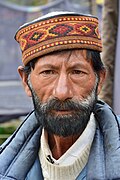
Himachali cap (Bushehri topi, Pahari topi, Kinnauri topi) is a distinctive headdress associated with Himachal Pradesh's culture. It is a part of the traditional dress of many Pahari inhabitants.[1][2][3][4]
History[edit | edit source]

The Himachali cap is historically related to Kinnaur that was formerly part of the Bushahr Kingdom. It reached other parts of Himachal Pradesh via the princely state of Bushahr and Kullu, since Bushahr kingdom traded with many neighboring regions Including Tibet. The weaving style and materials used for these caps differ from each other. Kinnaur's traditional cap also called Thepang, feature two distinct velvet variations: Maroon and green.
Material and Shape[edit | edit source]
Himachali caps are one of the popular arts and crafts of Himachal Pradesh. The Himachali cap is usually made of wool, and the shape is typically round or boat shape.[5]
Traditional wear[edit | edit source]

The Himachali cap is an ingrained part of daily wear in Himachal, and it is commonly worn during local festivities, religious functions and marriages.[6][5] Himachali caps are a representation of cultural identity. People in Himachal consider the cap as a point of pride,[7] like a turban for Sikhs in Punjab. This topi (Hindi for cap) is a representation of HP’s cultural identity and is considered a symbol of pride for the Himachalis.[8]
Political identity[edit | edit source]
—Prem Kumar Dhumal tweeted for Narendra Modi when he dressed in Himachali cap with a maroon band during his visit to Israel.[9]
The colour of the Himachali caps has been an indicator of political loyalties in the hill state for a long period of time with Congress party leaders like Virbhadra Singh donning caps with green band and the rival BJP leader Prem Kumar Dhumal wearing a cap with maroon band.[10][11][12][13][14][15][16]
Gallery[edit | edit source]
-
 Narendra Modi in Himachali cap
 -
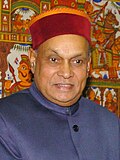 Prem Kumar Dhumal in Himachali cap.
 -
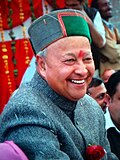 Virbhadra Singh in Himachali cap.
 -
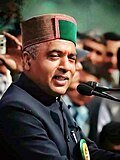 Jai Ram Thakur in Himachali cap.
 -
 Himachali Caps
.jpg)


.jpeg)
See also[edit | edit source]
References[edit | edit source]
- ↑ Broadcasting, India Ministry of Information and (1956). Himachal Pradesh. Tourist Division, Ministry of Transport. p. 22. ISBN 978-81-7199-465-6.
- ↑ Shaikh, Ameen (2019-04-01). ShaikhSpear in Himachal. Mountain Walker Private Limited. p. 173. ISBN 978-81-940505-0-6.
- ↑ "Himachali Cap (Topi) -Buy Kullu, Shimla, Kinnauri and Malana Cap". HimalayanKraft. Retrieved 2021-01-16.
- ↑ "The Himachali cap - Culture, legacy and heritage Issues and analysis @ abhipedia Powered by ABHIMANU IAS". abhipedia.abhimanu.com. Retrieved 2021-01-16.
- ↑ 5.0 5.1 Broadcasting, India Ministry of Information and (1956). Himachal Pradesh. Tourist Division, Ministry of Transport. pp. 128, 129. ISBN 978-81-7199-465-6.
- ↑ Verma, Shruti (2018-02-02). "The Himachali cap: Culture, legacy and heritage". HimVani. Retrieved 2021-01-17.
- ↑ Wagner, Anja (2013-06-01). The Gaddi Beyond Pastoralism: Making Place in the Indian Himalayas. Berghahn Books. p. 34. ISBN 978-0-85745-930-5.
- ↑ ""Traditional Himachali Caps": A Symbol of Heritage". www.holidayshunt.com. Retrieved 2025-01-07.
- ↑ Gaurav Bisht (6 July 2017). "PM Modi's cap in Israel takes political hue in Himachal". Hindustan Times. Archived from the original on 13 March 2018. Retrieved 12 March 2018.
- ↑ IANS (2017-10-29). "War of caps: State which flaunts political loyalty on its head (Himachal Polls)". Business Standard India. Retrieved 2021-05-25.
- ↑ SHARMA, NIDHI. "In Himachal Pradesh, it is maroon for BJP and green for Congress". The Economic Times. Retrieved 2021-05-25.
- ↑ Archana Phull (14 January 2018). "Cap likely on 'cap politics' in Himachal Pradesh". The Statesman. Archived from the original on 13 March 2018. Retrieved 12 March 2018.
- ↑ "Cap's colour denotes political leanings!". Hindustan Times. 2008-07-08. Retrieved 2021-05-25.
- ↑ "As BJP-Congress battle heats up in Himachal Pradesh, people flaunt their political 'colours' on their headgear". Firstpost. 2017-10-29. Retrieved 2021-05-25.
- ↑ Service, Tribune News. "Short film '... Kissa Topi Ka' has message for voters". Tribuneindia News Service. Retrieved 2021-06-14.
- ↑ "Himachal topi leaves Chief Minister Virbhadra Singh fuming at function". The Indian Express. 2017-09-13. Retrieved 2021-06-14.
 | This clothing-related article is a stub. You can help Bharatpedia by expanding it. |