



>SilkTork Remove Britannica template from External links per WP:ELNO#1 |
m robot: Create/update articles. If there is a mistake please report on my talk page. |
||
| Line 1: | Line 1: | ||
{{Short description| | {{Short description|Machete associated with the Gurkhas of Nepal}} | ||
{{ | {{hatnote|"Khukri", "Khukuri" and "Kukuri" redirect here. For other uses, see [[Kukri (disambiguation)]].}} | ||
{{Infobox weapon | {{Infobox weapon | ||
| name = Kukri | | name = Kukri | ||
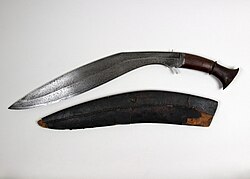
| image = Knife (Kukri) with Sheath MET 36.25.831a b 001 Apr2017.jpg | | image = Knife (Kukri) with Sheath MET 36.25.831a b 001 Apr2017.jpg | ||
| caption = A kukri with sheath | | image_size = 300 | ||
| origin = [[ | | caption = A kukri with sheath | ||
| type = [[Edged and bladed weapons|Bladed melee weapon]], [[utility knife|utility tool]] | | origin = [[Gorkha Kingdom]] | ||
| is_bladed = Yes | | type = [[Edged and bladed weapons|Bladed melee weapon]], [[utility knife|utility tool]] | ||
| is_bladed = Yes | |||
| used_by = [[Gurkha]]s {{small|(natively)}} | | service = {{circa|7th century}} – present<ref>{{Cite web|date=2006|title=Kukri History: Khukuri House|url=https://www.khukuriblades.com/kukri_history/#:~:text=But%20other%20suggest%20that%20the,Nepal,%20originated%20in%20ancient%20times.|url-status=live|archive-url=https://web.archive.org/web/20200529044937/https://khukuriblades.com/kukri_history/|archive-date=29 May 2020|access-date=8 November 2020|website=www.khukuriblades.com}}</ref> | ||
| wars = {{ubl | | used_by = [[Gurkha]]s and [[Kirati]]s{{small|(natively)}} | ||
| wars = {{ubl | |||
| [[Anglo-Nepalese War|Gurkha War]] | | [[Anglo-Nepalese War|Gurkha War]] | ||
| [[Anglo-Afghan Wars|Anglo−Afghan Wars]] | | [[Anglo-Afghan Wars|Anglo−Afghan Wars]] | ||
| Line 22: | Line 20: | ||
| [[Sino-Indian War|1962 Sino−Indian War]] | | [[Sino-Indian War|1962 Sino−Indian War]] | ||
| [[Indo-Pakistani War of 1965|Second Indo−Pakistani War]] | | [[Indo-Pakistani War of 1965|Second Indo−Pakistani War]] | ||
| [[Nathu La and Cho La clashes|1967 | | [[Nathu La and Cho La clashes|1967 Sino-Indian War]] | ||
| [[Indo-Pakistani War of 1971|Third Indo−Pakistani War]] | | [[Indo-Pakistani War of 1971|Third Indo−Pakistani War]] | ||
| [[Falklands War]] | | [[Falklands War]] | ||
| Line 28: | Line 26: | ||
| [[Afghanistan conflict (1978–present)|War in Afghanistan (1978–present)]] | | [[Afghanistan conflict (1978–present)|War in Afghanistan (1978–present)]] | ||
}} | }} | ||
| weight = {{cvt|450|-|900|g|lb|0}} | |||
| length = {{cvt|40|-|45|cm}} | |||
| width = | |||
| height = | |||
| blade_type = | |||
| hilt_type = | |||
| sheath_type = | |||
| weight = {{cvt|450|-|900|g|lb|0}} | | head_type = | ||
| length = {{cvt|40|-|45|cm}} | | haft_type = | ||
| width = | |||
| height = | |||
| blade_type = | |||
| hilt_type = | |||
| sheath_type = | |||
| head_type = | |||
| haft_type = | |||
}} | }} | ||
The '''kukri''' ({{IPAc-en|Lang|ˈ|k|ʊ|k|r|i}})<ref>{{Cite web|title=Kukri {{!}} Meaning of Kukri by Lexico|url=https://www.lexico.com/definition/kukri|website=Lexico Dictionaries {{!}} English|language=en|access-date=2020-06-01}}</ref> or '''khukuri''' ({{lang-ne|[[:ne:खुकुरी|खुकुरी]]}}, {{IPA-ne|kʰukuri|pron}}) is a type of [[machete]] | The '''kukri''' ({{IPAc-en|Lang|ˈ|k|ʊ|k|r|i}})<ref>{{Cite web|title=Kukri {{!}} Meaning of Kukri by Lexico|url=https://www.lexico.com/definition/kukri|archive-url=https://web.archive.org/web/20200621034713/https://www.lexico.com/definition/kukri|url-status=dead|archive-date=21 June 2020|website=Lexico Dictionaries {{!}} English|language=en|access-date=2020-06-01}}</ref> or '''khukuri''' ({{lang-ne|[[:ne:खुकुरी|खुकुरी]]}}, {{IPA-ne|kʰukuri|pron}}) is a type of [[machete]] with a distinct recurve in its blade. It serves multiple purposes as a [[melee weapon]] and also as a regular cutting tool throughout most of [[South Asia]]. The ''kukri'', ''khukri'', and ''kukkri'' spellings are of [[Indian English]] origin,<ref>{{cite book |title=Illustrated Oxford Dictionary |publisher=Dorling Kindersley |year=1998 |location=Great Britain |isbn=140532029-X}}</ref>{{better source needed|date=February 2021}} with the original [[Nepalese English]] spelling being ''khukuri''.{{Citation needed|date=November 2020}} | ||
Originating from the [[Indian subcontinent]], the kukri is the national weapon of [[Nepal]], traditionally serving the role of a basic [[utility knife]] for the [[Nepali language|Nepali]]-speaking [[Gurkha]]s,<ref>{{Cite web|last=Latter|first=Mick|date=2013-03-26|title=The Kukri|url=https://www.gurkhabde.com/the-kukri/|access-date=2022-01-29|website=Welcome to the Gurkha Brigade Association|language=en-GB}}</ref> and consequently is a characteristic weapon of the [[Nepali Army]].<ref>{{Cite web|last=Latter|first=Mick|date=2013-03-26|title=The Kukri|url=https://www.gurkhabde.com/the-kukri/|access-date=2022-01-29|website=Welcome to the Gurkha Brigade Association|language=en-GB}}</ref> | |||
== | There have been, and still are many myths surrounding the kukri since its earliest recorded use in the 7th century—most notably that a traditional custom revolves around the blade in which it must draw blood, owing to its sole purpose as a fighting weapon, before being sheathed. However, they are frequently used as regular utility tools.<ref>{{Cite web|url=https://vcgca.org/our-people/profile/19/rambahadur-limbu|title=The VC and GC Association|last=Association|first=Victoria Cross and George Cross|website=vcgca.org|language=en|access-date=2020-03-25}}</ref><ref name="Latter">{{Cite web|url=https://www.gurkhabde.com/the-kukri/|title=The Kukri|last=Latter|first=Mick|date=2013-03-26|website=Welcome to the Gurkha Brigade Association|language=en-GB|access-date=2020-03-25}}</ref> | ||
Researchers trace the origins of the blade back to the domestic [[sickle]] and the prehistoric bent stick used for hunting and later in hand-to-hand combat.<ref name=Burton>{{cite book |title=The Book of the Sword |author=Richard Francis Burton |publisher=Dover |year=1987 |location=London |isbn=0-486-25434-8 |url-access=registration |url=https://archive.org/details/bookofsword00burt |author-link=Richard Francis Burton }}</ref> Similar implements have existed in several forms throughout the Indian subcontinent and were used both as weapons and as tools, such as for sacrificial rituals.{{citation needed|date=February 2018}} [[Richard Francis Burton|Burton]] (1884) writes that the [[British Museum]] housed a large kukri-like falchion inscribed with writing in [[Pali]].<ref>{{cite web |title=The Book of the Sword, by Richard F. Burton—A Project Gutenberg eBook |url=https://www.gutenberg.org/files/61751/61751-h/61751-h.htm |website=www.gutenberg.org |access-date=25 August 2020}}</ref> Among the oldest existing kukri are those belonging to Drabya Shah (c. 1559), housed in the National Museum of Nepal in [[Kathmandu]]. | == History == | ||
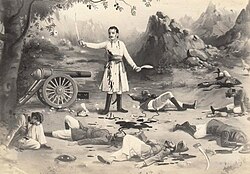
[[File:Gambhir Singh Rayamajhi.jpg|thumb|left|Colonel Gambhir Singh Rayamajhi Kshetri, a [[Gorkha Kingdom|Gorkhali]] Commander armed with a Khukuri in his left hand and [[Talwar]] on his right]] | |||
Researchers trace the origins of the blade back to the domestic [[sickle]] and the prehistoric bent stick used for hunting and later in hand-to-hand combat.<ref name=Burton>{{cite book |title=The Book of the Sword |author=Richard Francis Burton |publisher=Dover |year=1987 |location=London |isbn=0-486-25434-8 |url-access=registration |url=https://archive.org/details/bookofsword00burt |author-link=Richard Francis Burton }}</ref> Similar implements have existed in several forms throughout the Indian subcontinent and were used both as weapons and as tools, such as for sacrificial rituals.{{citation needed|date=February 2018}} It might have derived from the ancient Indian saber called ''nistrimsa'' (निस्त्रिंश), itself possibly based on the Greek [[kopis]] brought by [[Alexander the Great]]'s forces to India in the 4th century BC.<ref>{{cite book|author=Duncan Head|title=Armies of the Macedonian and Punic Wars, 359 BC to 146 BC: Organisation, Tactics, Dress and Weapons|date=1982|publisher=[[University of Michigan]]|isbn=9780904417265|page=136}}</ref> [[Richard Francis Burton|Burton]] (1884) writes that the [[British Museum]] housed a large kukri-like falchion inscribed with writing in [[Pali]].<ref>{{cite web |title=The Book of the Sword, by Richard F. Burton—A Project Gutenberg eBook |url=https://www.gutenberg.org/files/61751/61751-h/61751-h.htm |website=www.gutenberg.org |access-date=25 August 2020}}</ref> Among the oldest existing kukri are those belonging to Drabya Shah (c. 1559), housed in the National Museum of Nepal in [[Kathmandu]]. | |||
The kukri came to be known to the Western world when the [[East India Company]] came into conflict with the growing [[Gorkha Kingdom]], culminating in the [[Gurkha War]] of 1814–1816.{{citation needed|date=February 2013}} It gained literary attention in the 1897 novel ''[[Dracula]]'' by Irish author [[Bram Stoker]]. Despite the popular image of Dracula having a stake driven through his heart at the conclusion of a climactic battle between Dracula's bodyguards and the heroes, Mina's narrative describes his throat being sliced through by Jonathan Harker's kukri and his heart pierced by Quincey Morris's [[Bowie knife]].<ref>Stoker, Dacre and Ian Holt (2009). ''Dracula the Un-Dead''. Penguin Group. p. 306.</ref> | The kukri came to be known to the Western world when the [[East India Company]] came into conflict with the growing [[Gorkha Kingdom]], culminating in the [[Gurkha War]] of 1814–1816.{{citation needed|date=February 2013}} It gained literary attention in the 1897 novel ''[[Dracula]]'' by Irish author [[Bram Stoker]]. Despite the popular image of Dracula having a stake driven through his heart at the conclusion of a climactic battle between Dracula's bodyguards and the heroes, Mina's narrative describes his throat being sliced through by Jonathan Harker's kukri and his heart pierced by Quincey Morris's [[Bowie knife]].<ref>Stoker, Dacre and Ian Holt (2009). ''Dracula the Un-Dead''. Penguin Group. p. 306.</ref> | ||
| Line 63: | Line 52: | ||
All Gurkha troops are issued with two kukris, a Service No.1 (ceremonial) and a Service No.2 (exercise); in modern times members of the [[Brigade of Gurkhas]] receive training in its use. The weapon gained fame in the Gurkha War and its continued use through both [[World War I]] and [[World War II]] enhanced its reputation among both Allied troops and enemy forces. Its acclaim was demonstrated in North Africa by one unit's situation report. It reads: "Enemy losses: ten killed, our nil. Ammunition expenditure nil."<ref>Reagan, Geoffrey (1992). ''Military Anecdotes''. Guinness Publishing. {{ISBN|0-85112-519-0}}. p. 180.</ref> | All Gurkha troops are issued with two kukris, a Service No.1 (ceremonial) and a Service No.2 (exercise); in modern times members of the [[Brigade of Gurkhas]] receive training in its use. The weapon gained fame in the Gurkha War and its continued use through both [[World War I]] and [[World War II]] enhanced its reputation among both Allied troops and enemy forces. Its acclaim was demonstrated in North Africa by one unit's situation report. It reads: "Enemy losses: ten killed, our nil. Ammunition expenditure nil."<ref>Reagan, Geoffrey (1992). ''Military Anecdotes''. Guinness Publishing. {{ISBN|0-85112-519-0}}. p. 180.</ref> | ||
== Design == | |||
[[File:Rai-Kirati Shaman in Eastern Nepal.jpg|thumb|A [[Rai people|Rai]]-[[Kirati people|Kirati]] priest man wearing Kukri in his waist]] | |||
The kukri is designed primarily for chopping. The shape varies a great deal from being quite straight to highly curved with angled or smooth spines. There are substantial variations in dimensions and blade thickness depending on intended tasks as well as the region of origin and the smith that produced it. As a general guide the spines vary from {{cvt|5|-|10|mm|frac=16}} at the handle, and can taper to {{cvt|2|mm|frac=16}} by the point while the blade lengths can vary from {{cvt|26|-|38|cm}} for general use.{{citation needed|date=August 2016}} | The kukri is designed primarily for chopping. The shape varies a great deal from being quite straight to highly curved with angled or smooth spines. There are substantial variations in dimensions and blade thickness depending on intended tasks as well as the region of origin and the smith that produced it. As a general guide the spines vary from {{cvt|5|-|10|mm|frac=16}} at the handle, and can taper to {{cvt|2|mm|frac=16}} by the point while the blade lengths can vary from {{cvt|26|-|38|cm}} for general use.{{citation needed|date=August 2016}} | ||
| Line 72: | Line 60: | ||
Another factor that affects its weight and balance is the construction of the blade. To reduce weight while keeping strength, the blade might be hollow forged, or a [[Fuller (weapon)|fuller]] is created. Kukris are made with several different types of fuller including ''tin Chira'' (triple fuller), ''Dui Chira'' (double fuller), ''Ang Khola'' (single fuller), or basic non-tapered spines with a large bevelled edge. | Another factor that affects its weight and balance is the construction of the blade. To reduce weight while keeping strength, the blade might be hollow forged, or a [[Fuller (weapon)|fuller]] is created. Kukris are made with several different types of fuller including ''tin Chira'' (triple fuller), ''Dui Chira'' (double fuller), ''Ang Khola'' (single fuller), or basic non-tapered spines with a large bevelled edge. | ||
[[File:1-4th_Gurkhas_at_kit_inspection_showing_kukris_(Photo_24-98).jpg|thumb|left|Gurkhas at kit inspection showing kukri in France during World War I]] | |||
Kukri blades usually have a notch (''karda'', ''kauda'', ''Gaudi'', ''Kaura'', or ''Cho'') at the base of the blade. Various reasons are given for this, both practical and ceremonial: that it makes blood and sap drop off the blade rather than running onto the handle and thereby prevent the handle from becoming slippery;<ref>{{cite episode |title=Episode 3 |url=https://www.bbc.co.uk/i/p00jvf2t/ |access-date=8 August 2013 |series=In the Highest Tradition |last=Wooldridge |first=Ian |author-link=Ian Wooldridge |network=[[BBC]] |station=[[BBC Two]] |airdate=20 November 1989 |time=13 minutes 25 seconds |quote=Here if I may describe, you see a little pattern there, which some people say that it has got some religious significance, but I doubt very much. In fact, that is just so that when you have blood on the kukri, it just sort of naturally drips there, it doesn't get onto your hand and starts clogging up and that is what it is for, that little nick there.}}</ref> that it delineates the end of the blade whilst sharpening; that it is a symbol representing a cows' foot, or [[Shiva]]; that it can catch another blade or kukri in combat. The notch may also represent the teats of a cow, a reminder that the kukri should not be used to kill a cow, an animal revered and worshipped by Hindus. {{citation needed|reason=Relief cut for differential tempered edge|date=July 2016}} The notch may also be used as a catch, to hold tight against a belt, or to bite onto twine to be suspended.{{original research inline|date=August 2016}} | Kukri blades usually have a notch (''karda'', ''kauda'', ''Gaudi'', ''Kaura'', or ''Cho'') at the base of the blade. Various reasons are given for this, both practical and ceremonial: that it makes blood and sap drop off the blade rather than running onto the handle and thereby prevent the handle from becoming slippery;<ref>{{cite episode |title=Episode 3 |url=https://www.bbc.co.uk/i/p00jvf2t/ |access-date=8 August 2013 |series=In the Highest Tradition |last=Wooldridge |first=Ian |author-link=Ian Wooldridge |network=[[BBC]] |station=[[BBC Two]] |airdate=20 November 1989 |time=13 minutes 25 seconds |quote=Here if I may describe, you see a little pattern there, which some people say that it has got some religious significance, but I doubt very much. In fact, that is just so that when you have blood on the kukri, it just sort of naturally drips there, it doesn't get onto your hand and starts clogging up and that is what it is for, that little nick there.}}</ref> that it delineates the end of the blade whilst sharpening; that it is a symbol representing a cows' foot, or [[Shiva]]; that it can catch another blade or kukri in combat. The notch may also represent the teats of a cow, a reminder that the kukri should not be used to kill a cow, an animal revered and worshipped by Hindus. {{citation needed|reason=Relief cut for differential tempered edge|date=July 2016}} The notch may also be used as a catch, to hold tight against a belt, or to bite onto twine to be suspended.{{original research inline|date=August 2016}} | ||
| Line 79: | Line 69: | ||
The traditional handle attachment in Nepal is the partial [[Tang (tools)|tang]], although the more modern versions have the stick tang which has become popular.{{citation needed|date=August 2016}} The full tang is mainly used on some military models but has not become widespread in Nepal itself.{{citation needed|date=August 2016}} | The traditional handle attachment in Nepal is the partial [[Tang (tools)|tang]], although the more modern versions have the stick tang which has become popular.{{citation needed|date=August 2016}} The full tang is mainly used on some military models but has not become widespread in Nepal itself.{{citation needed|date=August 2016}} | ||
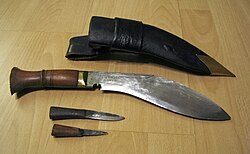
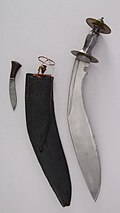
The kukri typically comes in either a decorated wooden scabbard or one which is wrapped in leather. Traditionally, the scabbard also holds two smaller blades: an unsharpened '' | The kukri typically comes in either a decorated wooden scabbard or one which is wrapped in leather. Traditionally, the scabbard also holds two smaller blades: an unsharpened ''chakmak'' to burnish the blade, and another accessory blade called a ''karda''. Some older style scabbards include a pouch for carrying flint or dry tinder.{{citation needed|date=August 2016}} | ||
== Manufacture == | |||
[[File:Gurkha IOC 3.jpg|thumb|upright|A Gurkha officer of the [[Gurkha Contingent]], [[Singapore Police Force]] patrols around [[Raffles City Singapore|Raffles City]] during the [[117th IOC Session]]. He wears the distinctively tilted [[Hat Terrai Gurkha]]; the kukri can be seen attached to the back of his belt]] | |||
The Biswakarma [[Kami (caste)]] are the traditional inheritors of the art of kukri-making.<ref name="kami">{{Cite web|url=https://himalayan-imports.com/kami.html|title=Kamis, Khukuri makers of Nepal|website=himalayan-imports.com|access-date=10 December 2019}}</ref> Modern kukri blades are often forged from [[spring steel]], sometimes collected from recycled [[Suspension (vehicle)|truck suspension units]].<ref name="kami"/> The [[tang (tools)|tang]] of the blade usually extends all the way through to the end of the handle;{{citation needed|date=August 2016}} the small portion of the tang that projects through the end of the handle are hammered flat to secure the blade. Kukri blades have a hard, tempered edge and a softer spine. This enables them to maintain a sharp edge, yet tolerate impacts. | The Biswakarma [[Kami (caste)]] are the traditional inheritors of the art of kukri-making.<ref name="kami">{{Cite web|url=https://himalayan-imports.com/kami.html|title=Kamis, Khukuri makers of Nepal|website=himalayan-imports.com|access-date=10 December 2019}}</ref> Modern kukri blades are often forged from [[spring steel]], sometimes collected from recycled [[Suspension (vehicle)|truck suspension units]].<ref name="kami"/> The [[tang (tools)|tang]] of the blade usually extends all the way through to the end of the handle;{{citation needed|date=August 2016}} the small portion of the tang that projects through the end of the handle are hammered flat to secure the blade. Kukri blades have a hard, tempered edge and a softer spine. This enables them to maintain a sharp edge, yet tolerate impacts. | ||
| Line 91: | Line 82: | ||
Kukri scabbards are usually made of wood or metal with an animal skin or metal or wood covering. The leather work is often done by a ''[[Sirki|Sarki]]''. | Kukri scabbards are usually made of wood or metal with an animal skin or metal or wood covering. The leather work is often done by a ''[[Sirki|Sarki]]''. | ||
== | == Use == | ||
The kukri is effective as a chopping weapon, due to its weight, and slashing weapon, because the curved shape creates a "wedge" effect which causes the blade to cut effectively and deeper. Because the blade bends towards the opponent, the user need not angle the wrist while executing a chopping motion.{{citation needed|date=April 2017}} Unlike a straight-edged sword, the center of mass combined with the angle of the blade allow the kukri to slice as it chops.{{citation needed|date=April 2017}} The edge slides across the target's surface while the center of mass maintains momentum as the blade moves through the target's cross-section. This gives the kukri a penetrative force disproportional to its length. The design enables the user to inflict deep wounds and to penetrate bone.{{citation needed|date=April 2017}} | The kukri is effective as a chopping weapon, due to its weight, and slashing weapon, because the curved shape creates a "wedge" effect which causes the blade to cut effectively and deeper. Because the blade bends towards the opponent, the user need not angle the wrist while executing a chopping motion.{{citation needed|date=April 2017}} Unlike a straight-edged sword, the center of mass combined with the angle of the blade allow the kukri to slice as it chops.{{citation needed|date=April 2017}} The edge slides across the target's surface while the center of mass maintains momentum as the blade moves through the target's cross-section. This gives the kukri a penetrative force disproportional to its length. The design enables the user to inflict deep wounds and to penetrate bone.{{citation needed|date=April 2017}} | ||
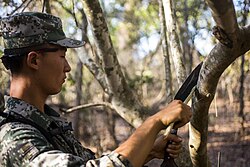
While most famed from use in the military, the kukri is the most commonly used multipurpose tool in the fields and homes in Nepal. Its use has varied from building, clearing, chopping firewood, digging, slaughtering animals for food, cutting meat and vegetables, skinning animals, and opening cans. Its use as a general farm and household tool disproves the often stated "taboo" that the weapon cannot be sheathed "until it has drawn blood".<ref name="Latter"/> | While most famed from use in the military, the kukri is the most commonly used multipurpose tool in the fields and homes in Nepal. Its use has varied from building, clearing, chopping firewood, digging, slaughtering animals for food, cutting meat and vegetables, skinning animals, and opening cans. Its use as a general farm and household tool disproves the often stated "taboo" that the weapon cannot be sheathed "until it has drawn blood".<ref name="Latter"/> | ||
| Line 104: | Line 91: | ||
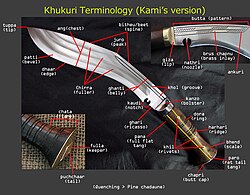
==Anatomy== | ==Anatomy== | ||
= | {{unreferenced|section|date=December 2022}} | ||
[[File:Kukri, karda & chakmak.jpg|thumb|A kukri (Top) with the traditional karda (middle) and chakmak (bottom). The karda and chakmak are used as a utility knife and a sharpening tool respectively]] | |||
[[File:Khukuri_knife_and_scabbard.jpg|thumb|Kukri knife and scabbard on display at the [[Imperial War Museum North]]]] | |||
[[File:Rai_ethnic_people_Sayachongma_Ritual.jpg|thumb|upright|Kukri using in traditional ritualistic performance by [[Rai people]]]] | |||
; Blade: | |||
* Keeper (''Hira Jornu''): Spade/diamond shaped metal/brass plate used to seal the butt cap. | * Keeper (''Hira Jornu''): Spade/diamond shaped metal/brass plate used to seal the butt cap. | ||
* Butt Cap (''Chapri''): Thick metal/brass plate used to secure the handle to the tang. | * Butt Cap (''Chapri''): Thick metal/brass plate used to secure the handle to the tang. | ||
| Line 124: | Line 116: | ||
* Tang Tail (''Puchchar''): Last point of the kukri blade. | * Tang Tail (''Puchchar''): Last point of the kukri blade. | ||
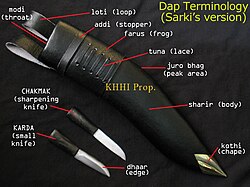
; Scabbard: | |||
* Frog (''Faras''): Belt holder specially made of thick leather (2 mm to 4 mm) encircling the scabbard close towards the throat. | * Frog (''Faras''): Belt holder specially made of thick leather (2 mm to 4 mm) encircling the scabbard close towards the throat. | ||
* Upper Edge (''Mathillo Bhaag''): Spine of the scabbard where holding should be done when handling a kukri. | * Upper Edge (''Mathillo Bhaag''): Spine of the scabbard where holding should be done when handling a kukri. | ||
| Line 135: | Line 127: | ||
* Lower Edge (''Tallo Bhag''): Belly/curvature of the scabbard. | * Lower Edge (''Tallo Bhag''): Belly/curvature of the scabbard. | ||
==Classification== | == Classification == | ||
[[File:Rai_People_Mundumic_Ritualistic_religious_tradition.jpg|thumb|left|Kukri in traditional religious worship of [[Rai people]]]] | |||
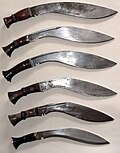
Kukris can be broadly classified into two types: Eastern and Western. The Eastern blades are originated and named according to the towns and villages of [[Eastern Nepal]].{{citation needed|date=March 2020}} The Eastern Khukuris are Angkhola Khukuri, Bhojpure Khukuri, Chainpure Khukuri, Cheetlange (Chitlange) Khukuri, Chirwa (Chiruwa) Khukuri, Dhankute Khukuri, Ganjawla Khukuri, Panawala Khukuri, Sirupate Khukuri translates as ''Siru'' grass leaf like.<ref>{{Cite web | url=http://www.kukrimart.com | title=Kukri Mart - Handmade Genuine Gurkhas Knives and original Nepalese Khukuris}}</ref> Khukuris made in locations like [[Chainpur, Kosi|Chainpur]], [[Bhojpur, Nepal|Bhojpur]], and [[Dhankuta]] in Eastern Nepal are excellent and ornate knives.<ref>Visit Nepal '98: By The Official Travel Manual of Visit Nepal '98 VNY'98 Secretariat, 1998</ref> | Kukris can be broadly classified into two types: Eastern and Western. The Eastern blades are originated and named according to the towns and villages of [[Eastern Nepal]].{{citation needed|date=March 2020}} The Eastern Khukuris are Angkhola Khukuri, Bhojpure Khukuri, Chainpure Khukuri, Cheetlange (Chitlange) Khukuri, Chirwa (Chiruwa) Khukuri, Dhankute Khukuri, Ganjawla Khukuri, Panawala Khukuri, Sirupate Khukuri translates as ''Siru'' grass leaf like.<ref>{{Cite web | url=http://www.kukrimart.com | title=Kukri Mart - Handmade Genuine Gurkhas Knives and original Nepalese Khukuris}}</ref> Khukuris made in locations like [[Chainpur, Kosi|Chainpur]], [[Bhojpur, Nepal|Bhojpur]], and [[Dhankuta]] in Eastern Nepal are excellent and ornate knives.<ref>Visit Nepal '98: By The Official Travel Manual of Visit Nepal '98 VNY'98 Secretariat, 1998</ref> | ||
Western blades are generally broader. Occasionally the Western style is called ''Budhuna'', (referring to a fish with a large head), or ''baspate'' (bamboo leaf) which refers to blades just outside the proportions of the normal ''Sirupate'' blade. Despite the classification of Eastern and Western, both styles of kukri appear to be used in all areas of Nepal. | Western blades are generally broader. Occasionally the Western style is called ''Budhuna'', (referring to a fish with a large head), or ''baspate'' (bamboo leaf) which refers to blades just outside the proportions of the normal ''Sirupate'' blade. Despite the classification of Eastern and Western, both styles of kukri appear to be used in all areas of Nepal. | ||
| Line 141: | Line 135: | ||
There is Khukuri named after Gorkhali General [[Amar Singh Thapa]] called Amar Singh Thapa Khukuri. This Khukuri is modelled on the real Khukuri used by the Gorkhali General.<ref>{{Cite web|url=https://www.bladeforums.com/threads/wednesday-evening-with-amar-singh-thapa-khukuri.674412/|title= Wednesday evening with Amar Singh Thapa Khukuri|website=bladeforums.com|access-date=17 January 2018}}</ref> The real Khukuri used by Amar Singh Thapa is archived at [[National Museum of Nepal]] and is more curvy in nature than other traditions.<ref>{{Cite web|url=https://www.pinterest.com/pin/7881368076018402/|title= Weapons (Kukri, Katar, Kora) of Amar Singh Thapa in National Museum of Nepal, Kathmandu |website=pinterest.com|access-date=17 January 2018}}</ref> | There is Khukuri named after Gorkhali General [[Amar Singh Thapa]] called Amar Singh Thapa Khukuri. This Khukuri is modelled on the real Khukuri used by the Gorkhali General.<ref>{{Cite web|url=https://www.bladeforums.com/threads/wednesday-evening-with-amar-singh-thapa-khukuri.674412/|title= Wednesday evening with Amar Singh Thapa Khukuri|website=bladeforums.com|access-date=17 January 2018}}</ref> The real Khukuri used by Amar Singh Thapa is archived at [[National Museum of Nepal]] and is more curvy in nature than other traditions.<ref>{{Cite web|url=https://www.pinterest.com/pin/7881368076018402/|title= Weapons (Kukri, Katar, Kora) of Amar Singh Thapa in National Museum of Nepal, Kathmandu |website=pinterest.com|access-date=17 January 2018}}</ref> | ||
== | == Military adoption == | ||
{{ | The kukri is in standard service with various regiments and units within the [[Indian Army]], such as the [[Assam Rifles]], the [[Kumaon Regiment]], the [[The Garhwal Rifles|Garhwal Rifles]] and the various [[Gorkha regiments (India)|Gorkha regiments]]. Outside of its native region of South Asia, the kukri also is in service with the [[Brigade of Gurkhas]] in the [[British Army]] and [[Gurkha Contingent]] of the [[Singapore Police Force]].<ref>{{Cite web|last=Patial|first=R.C.|date=2019-10-17|title=Knowing The Khukri|url=https://salute.co.in/knowing-the-khukri/|url-status=live|archive-url=https://web.archive.org/web/20201108074936/https://salute.co.in/knowing-the-khukri/|archive-date=8 November 2020|access-date=8 November 2020|website=Salute To The Indian Soldier − Magazine|language=en-US}}</ref><ref>{{Cite web|last=Dutta|first=Sujan|date=19 July 2019|title=I Witnessed the Kargil War. That's Why I Won't Celebrate It.|url=https://thewire.in/security/kargil-war-20-years|url-status=live|archive-url=https://web.archive.org/web/20201031171016/https://thewire.in/security/kargil-war-20-years|archive-date=31 October 2020|access-date=8 November 2020|website=The Wire − India}}</ref> The kukri is the staple weapon of all Gurkha military regiments and units throughout the world, so much so that some [[English language|English]]-speakers refer to the weapon as a "Gurkha blade" or "Gurkha knife".<ref>{{Cite web|last=Gurung|first=Tim I.|date=2018-04-06|title=A brief history of the Gurkha's knife – the kukri|url=https://asiatimes.com/2018/04/brief-history-gurkhas-knife-kukri/|access-date=2020-11-08|website=Asia Times|language=en-US}}</ref> The kukri often appears in [[Nepalis|Nepalese]] [[heraldry]] and is used in many traditional, [[Hinduism|Hindu]]-centric rites such as [[wedding]] ceremonies.<ref>{{Cite web|date=2014|title=BBC - A History of the World - Object : The Fisher Kukri|url=http://www.bbc.co.uk/ahistoryoftheworld/objects/FzDrekacQHusof2P4WULgw#:~:text=The%20Kukri%20is%20the%20national%20symbol%20of%20Nepal.,-It%20is%20a&text=At%20Dashain,%20the%20Hindu%20religious,the%20national%20symbol%20of%20Nepal.|url-status=live|archive-url=https://web.archive.org/web/20201017172851/http://www.bbc.co.uk/ahistoryoftheworld/objects/FzDrekacQHusof2P4WULgw|archive-date=17 October 2020|access-date=8 November 2020|website=www.bbc.co.uk}}</ref> | ||
==See also== | == See also == | ||
* [[ | |||
* [[Bolo knife]] | |||
* [[Falcata]] | * [[Falcata]] | ||
* [[Husa knife]] | * [[Husa knife]] | ||
* [[Khopesh]] | * [[Khopesh]] | ||
* [[Klewang]] | |||
* [[Kopis]] | * [[Kopis]] | ||
* [[Puukko]] | |||
* [[Parang (knife)]] | * [[Parang (knife)]] | ||
==References== | == References == | ||
{{ | |||
{{refs}} | |||
== External links == | == External links == | ||
* {{ | |||
* {{commonscat-inline}} | |||
{{Knives}} | {{Knives}} | ||
{{Use British English|date=January 2022}} | |||
{{Use dmy dates|date=October 2019}} | |||
[[Category:Blade weapons]] | [[Category:Blade weapons]] | ||
[[Category:Gurkhas]] | [[Category:Gurkhas]] | ||
[[Category:Military knives]] | [[Category:Military knives]] | ||
[[Category:Nepalese culture]] | [[Category:Nepalese culture]] | ||
Revision as of 18:08, 22 December 2022
| Kukri | |
|---|---|
_with_Sheath_MET_36.25.831a_b_001_Apr2017.jpg) A kukri with sheath | |
| Type | Bladed melee weapon, utility tool |
| Place of origin | Gorkha Kingdom |
| Service history | |
| In service | c. 7th century – present[1] |
| Used by | Gurkhas and Kiratis (natively) |
| Wars | |
| Specifications | |
| Mass | 450–900 g (1–2 lb) |
| Length | 40–45 cm (16–18 in) |
The kukri (English: /ˈkʊkri/)[2] or khukuri (Nepali: खुकुरी, Template:IPA-ne) is a type of machete with a distinct recurve in its blade. It serves multiple purposes as a melee weapon and also as a regular cutting tool throughout most of South Asia. The kukri, khukri, and kukkri spellings are of Indian English origin,[3][better source needed] with the original Nepalese English spelling being khukuri.[citation needed]
Originating from the Indian subcontinent, the kukri is the national weapon of Nepal, traditionally serving the role of a basic utility knife for the Nepali-speaking Gurkhas,[4] and consequently is a characteristic weapon of the Nepali Army.[5]
There have been, and still are many myths surrounding the kukri since its earliest recorded use in the 7th century—most notably that a traditional custom revolves around the blade in which it must draw blood, owing to its sole purpose as a fighting weapon, before being sheathed. However, they are frequently used as regular utility tools.[6][7]
History

Researchers trace the origins of the blade back to the domestic sickle and the prehistoric bent stick used for hunting and later in hand-to-hand combat.[8] Similar implements have existed in several forms throughout the Indian subcontinent and were used both as weapons and as tools, such as for sacrificial rituals.[citation needed] It might have derived from the ancient Indian saber called nistrimsa (निस्त्रिंश), itself possibly based on the Greek kopis brought by Alexander the Great's forces to India in the 4th century BC.[9] Burton (1884) writes that the British Museum housed a large kukri-like falchion inscribed with writing in Pali.[10] Among the oldest existing kukri are those belonging to Drabya Shah (c. 1559), housed in the National Museum of Nepal in Kathmandu.
The kukri came to be known to the Western world when the East India Company came into conflict with the growing Gorkha Kingdom, culminating in the Gurkha War of 1814–1816.[citation needed] It gained literary attention in the 1897 novel Dracula by Irish author Bram Stoker. Despite the popular image of Dracula having a stake driven through his heart at the conclusion of a climactic battle between Dracula's bodyguards and the heroes, Mina's narrative describes his throat being sliced through by Jonathan Harker's kukri and his heart pierced by Quincey Morris's Bowie knife.[11]
All Gurkha troops are issued with two kukris, a Service No.1 (ceremonial) and a Service No.2 (exercise); in modern times members of the Brigade of Gurkhas receive training in its use. The weapon gained fame in the Gurkha War and its continued use through both World War I and World War II enhanced its reputation among both Allied troops and enemy forces. Its acclaim was demonstrated in North Africa by one unit's situation report. It reads: "Enemy losses: ten killed, our nil. Ammunition expenditure nil."[12]
Design

The kukri is designed primarily for chopping. The shape varies a great deal from being quite straight to highly curved with angled or smooth spines. There are substantial variations in dimensions and blade thickness depending on intended tasks as well as the region of origin and the smith that produced it. As a general guide the spines vary from 5–10 mm (3⁄16–3⁄8 in) at the handle, and can taper to 2 mm (1⁄16 in) by the point while the blade lengths can vary from 26–38 cm (10–15 in) for general use.[citation needed]
A kukri designed for general purpose is commonly 40–45 cm (16–18 in) in overall length and weighs approximately 450–900 g (1–2 lb). Larger examples are impractical for everyday use and are rarely found except in collections or as ceremonial weapons. Smaller ones are of more limited utility, but very easy to carry.
Another factor that affects its weight and balance is the construction of the blade. To reduce weight while keeping strength, the blade might be hollow forged, or a fuller is created. Kukris are made with several different types of fuller including tin Chira (triple fuller), Dui Chira (double fuller), Ang Khola (single fuller), or basic non-tapered spines with a large bevelled edge.
.jpg)
Kukri blades usually have a notch (karda, kauda, Gaudi, Kaura, or Cho) at the base of the blade. Various reasons are given for this, both practical and ceremonial: that it makes blood and sap drop off the blade rather than running onto the handle and thereby prevent the handle from becoming slippery;[13] that it delineates the end of the blade whilst sharpening; that it is a symbol representing a cows' foot, or Shiva; that it can catch another blade or kukri in combat. The notch may also represent the teats of a cow, a reminder that the kukri should not be used to kill a cow, an animal revered and worshipped by Hindus. [citation needed] The notch may also be used as a catch, to hold tight against a belt, or to bite onto twine to be suspended.[original research?]
The handles are most often made of hardwood or water buffalo horn, but ivory, bone, and metal handles have also been produced. The handle quite often has a flared butt that allows better retention in draw cuts and chopping. Most handles have metal bolsters and butt plates which are generally made of brass or steel.
The traditional handle attachment in Nepal is the partial tang, although the more modern versions have the stick tang which has become popular.[citation needed] The full tang is mainly used on some military models but has not become widespread in Nepal itself.[citation needed]
The kukri typically comes in either a decorated wooden scabbard or one which is wrapped in leather. Traditionally, the scabbard also holds two smaller blades: an unsharpened chakmak to burnish the blade, and another accessory blade called a karda. Some older style scabbards include a pouch for carrying flint or dry tinder.[citation needed]
Manufacture

The Biswakarma Kami (caste) are the traditional inheritors of the art of kukri-making.[14] Modern kukri blades are often forged from spring steel, sometimes collected from recycled truck suspension units.[14] The tang of the blade usually extends all the way through to the end of the handle;[citation needed] the small portion of the tang that projects through the end of the handle are hammered flat to secure the blade. Kukri blades have a hard, tempered edge and a softer spine. This enables them to maintain a sharp edge, yet tolerate impacts.
Kukri handles, usually made from hardwood or buffalo horn, are often fastened with a kind of tree sap called laha (also known as "Himalayan epoxy"). With a wood or horn handle, the tang may be heated and burned into the handle to ensure a tight fit, since only the section of handle which touches the blade is burned away. In more modern kukri, handles of cast aluminium or brass are press-fitted to the tang; as the hot metal cools it shrinks, locking onto the blade. Some kukri (such as the ones made by contractors for the modern Indian Army), have a very wide tang with handle slabs fastened on by two or more rivets, commonly called a full tang (panawal) configuration.
Traditional profiling of the blade edge is performed by a two-man team; one spins a grinding wheel forwards and backwards by means of a rope wound several times around an axle while the sharpener applies the blade. The wheel is made by hand from fine river sand bound by laha, the same adhesive used to affix the handle to the blade. Routine sharpening is traditionally accomplished by passing a chakmak over the edge in a manner similar to that used by chefs to steel their knives.
Kukri scabbards are usually made of wood or metal with an animal skin or metal or wood covering. The leather work is often done by a Sarki.
Use
The kukri is effective as a chopping weapon, due to its weight, and slashing weapon, because the curved shape creates a "wedge" effect which causes the blade to cut effectively and deeper. Because the blade bends towards the opponent, the user need not angle the wrist while executing a chopping motion.[citation needed] Unlike a straight-edged sword, the center of mass combined with the angle of the blade allow the kukri to slice as it chops.[citation needed] The edge slides across the target's surface while the center of mass maintains momentum as the blade moves through the target's cross-section. This gives the kukri a penetrative force disproportional to its length. The design enables the user to inflict deep wounds and to penetrate bone.[citation needed]
While most famed from use in the military, the kukri is the most commonly used multipurpose tool in the fields and homes in Nepal. Its use has varied from building, clearing, chopping firewood, digging, slaughtering animals for food, cutting meat and vegetables, skinning animals, and opening cans. Its use as a general farm and household tool disproves the often stated "taboo" that the weapon cannot be sheathed "until it has drawn blood".[7]
The kukri is versatile. It can function as a smaller knife by using the narrower part of the blade, closest to the handle. The heavier and wider end of the blade, towards the tip, functions as an axe or a small shovel.
Anatomy
 |


- Blade
- Keeper (Hira Jornu): Spade/diamond shaped metal/brass plate used to seal the butt cap.
- Butt Cap (Chapri): Thick metal/brass plate used to secure the handle to the tang.
- Tang (Paro): Rear piece of the blade that goes through the handle.
- Bolster (Kanjo): Thick metal/brass round shaped plate between blade and handle made to support and reinforce the fixture.
- Spine (Beet): Thickest blunt edge of the blade.
- Fuller/Groove (Khol): Straight groove or deep line that runs along part of the upper spine.
- Peak (Juro): Highest point of the blade.
- Main body (Ang): Main surface or panel of the blade.
- Fuller (Chirra): Curvature/hump in the blade made to absorb impact and to reduce unnecessary weight.
- Tip (Toppa): The starting point of the blade.
- Edge (Dhaar): Sharp edge of the blade.
- Belly (Bhundi): Widest part/area of the blade.
- Bevel (Patti): Slope from the main body until the sharp edge.
- Notch (Cho): A distinctive cut (numeric '3 '-like shape) in the edge. Used as a stopper when sharpening with the chakmak.
- Ricasso (Ghari): Blunt area between the notch and bolster.
- Rings (Harhari): Round circles in the handle.
- Rivet (Khil): Steel or metal bolt to fasten or secure tang to the handle.
- Tang Tail (Puchchar): Last point of the kukri blade.
- Scabbard
- Frog (Faras): Belt holder specially made of thick leather (2 mm to 4 mm) encircling the scabbard close towards the throat.
- Upper Edge (Mathillo Bhaag): Spine of the scabbard where holding should be done when handling a kukri.
- Lace (Tuna): A leather cord used to sew or attach two ends of the frog. Especially used in army types.
- Main Body (Sharir): The main body or surface of the scabbard. Generally made in semi oval shape.
- Chape (Khothi): Pointed metallic tip of the scabbard. Used to protect the naked tip of a scabbard.
- Loop (Golie): Round leather room/space where a belt goes through attached/fixed to the keeper with steel rivets.
- Throat (Mauri): Entrance towards the interior of the scabbard for the blade.
- Strap/Ridge (Bhunti): Thick raw leather encircling the scabbard made to create a hump to secure the frog from moving or wobbling (not available in this pic).
- Lower Edge (Tallo Bhag): Belly/curvature of the scabbard.
Classification

Kukris can be broadly classified into two types: Eastern and Western. The Eastern blades are originated and named according to the towns and villages of Eastern Nepal.[citation needed] The Eastern Khukuris are Angkhola Khukuri, Bhojpure Khukuri, Chainpure Khukuri, Cheetlange (Chitlange) Khukuri, Chirwa (Chiruwa) Khukuri, Dhankute Khukuri, Ganjawla Khukuri, Panawala Khukuri, Sirupate Khukuri translates as Siru grass leaf like.[15] Khukuris made in locations like Chainpur, Bhojpur, and Dhankuta in Eastern Nepal are excellent and ornate knives.[16] Western blades are generally broader. Occasionally the Western style is called Budhuna, (referring to a fish with a large head), or baspate (bamboo leaf) which refers to blades just outside the proportions of the normal Sirupate blade. Despite the classification of Eastern and Western, both styles of kukri appear to be used in all areas of Nepal.
There is Khukuri named after Gorkhali General Amar Singh Thapa called Amar Singh Thapa Khukuri. This Khukuri is modelled on the real Khukuri used by the Gorkhali General.[17] The real Khukuri used by Amar Singh Thapa is archived at National Museum of Nepal and is more curvy in nature than other traditions.[18]
Military adoption
The kukri is in standard service with various regiments and units within the Indian Army, such as the Assam Rifles, the Kumaon Regiment, the Garhwal Rifles and the various Gorkha regiments. Outside of its native region of South Asia, the kukri also is in service with the Brigade of Gurkhas in the British Army and Gurkha Contingent of the Singapore Police Force.[19][20] The kukri is the staple weapon of all Gurkha military regiments and units throughout the world, so much so that some English-speakers refer to the weapon as a "Gurkha blade" or "Gurkha knife".[21] The kukri often appears in Nepalese heraldry and is used in many traditional, Hindu-centric rites such as wedding ceremonies.[22]
See also
References
External links
- ↑ "Kukri History: Khukuri House". www.khukuriblades.com. 2006. Archived from the original on 29 May 2020. Retrieved 8 November 2020.
- ↑ "Kukri | Meaning of Kukri by Lexico". Lexico Dictionaries | English. Archived from the original on 21 June 2020. Retrieved 1 June 2020.
- ↑ Illustrated Oxford Dictionary. Great Britain: Dorling Kindersley. 1998. ISBN 140532029-X.
- ↑ Latter, Mick (26 March 2013). "The Kukri". Welcome to the Gurkha Brigade Association. Retrieved 29 January 2022.
- ↑ Latter, Mick (26 March 2013). "The Kukri". Welcome to the Gurkha Brigade Association. Retrieved 29 January 2022.
- ↑ Association, Victoria Cross and George Cross. "The VC and GC Association". vcgca.org. Retrieved 25 March 2020.
- ↑ 7.0 7.1 Latter, Mick (26 March 2013). "The Kukri". Welcome to the Gurkha Brigade Association. Retrieved 25 March 2020.
- ↑ Richard Francis Burton (1987). The Book of the Sword. London: Dover. ISBN 0-486-25434-8.
- ↑ Duncan Head (1982). Armies of the Macedonian and Punic Wars, 359 BC to 146 BC: Organisation, Tactics, Dress and Weapons. University of Michigan. p. 136. ISBN 9780904417265.
- ↑ "The Book of the Sword, by Richard F. Burton—A Project Gutenberg eBook". www.gutenberg.org. Retrieved 25 August 2020.
- ↑ Stoker, Dacre and Ian Holt (2009). Dracula the Un-Dead. Penguin Group. p. 306.
- ↑ Reagan, Geoffrey (1992). Military Anecdotes. Guinness Publishing. ISBN 0-85112-519-0. p. 180.
- ↑ "Episode 3". In the Highest Tradition. BBC. BBC Two. 20 November 1989. Event occurs at 13 minutes 25 seconds. “Here if I may describe, you see a little pattern there, which some people say that it has got some religious significance, but I doubt very much. In fact, that is just so that when you have blood on the kukri, it just sort of naturally drips there, it doesn't get onto your hand and starts clogging up and that is what it is for, that little nick there.”
- ↑ 14.0 14.1 "Kamis, Khukuri makers of Nepal". himalayan-imports.com. Retrieved 10 December 2019.
- ↑ "Kukri Mart - Handmade Genuine Gurkhas Knives and original Nepalese Khukuris".
- ↑ Visit Nepal '98: By The Official Travel Manual of Visit Nepal '98 VNY'98 Secretariat, 1998
- ↑ "Wednesday evening with Amar Singh Thapa Khukuri". bladeforums.com. Retrieved 17 January 2018.
- ↑ "Weapons (Kukri, Katar, Kora) of Amar Singh Thapa in National Museum of Nepal, Kathmandu". pinterest.com. Retrieved 17 January 2018.
- ↑ Patial, R.C. (17 October 2019). "Knowing The Khukri". Salute To The Indian Soldier − Magazine. Archived from the original on 8 November 2020. Retrieved 8 November 2020.
- ↑ Dutta, Sujan (19 July 2019). "I Witnessed the Kargil War. That's Why I Won't Celebrate It". The Wire − India. Archived from the original on 31 October 2020. Retrieved 8 November 2020.
- ↑ Gurung, Tim I. (6 April 2018). "A brief history of the Gurkha's knife – the kukri". Asia Times. Retrieved 8 November 2020.
- ↑ "BBC - A History of the World - Object : The Fisher Kukri". www.bbc.co.uk. 2014. Archived from the original on 17 October 2020. Retrieved 8 November 2020.