




Created page with "{{Use dmy dates|date=November 2018}} {{Use Indian English|date=November 2018}} {{More citations needed|date=March 2009}} {{Infobox military unit | unit_name = Rajputana Rifles..." |
robot: Create/upgrade articles. If there is a mistake please report on my talk page. |
||
| Line 1: | Line 1: | ||
{{Use dmy dates|date=November | {{Short description|Rifle regiment of the Indian Army}} | ||
{{Use Indian English|date=November | {{Use dmy dates|date=November 2022}} | ||
{{More citations needed|date=March | {{Use Indian English|date=November 2022}} | ||
{{More citations needed|date=March 2022}} | |||
{{Infobox military unit | {{Infobox military unit | ||
| unit_name = Rajputana Rifles | | unit_name = Rajputana Rifles | ||
| image = Rajputana Rifles Insignia. | | image = Rajputana Rifles Insignia (India).svg | ||
| image_size = | | image_size = 150px | ||
| caption = Regimental Insignia of the Rajputana Rifles | | caption = Regimental Insignia of the Rajputana Rifles | ||
| dates = 10 January 1775 | | dates = 10 January 1775 – present | ||
| country = {{flag|India}} | | country = {{flag|India}} | ||
| branch = {{ | | branch = {{army|India}} | ||
| type = Line Infantry | | type = Line Infantry | ||
| command_structure = | | command_structure = | ||
| Line 15: | Line 16: | ||
| size = 25 battalions | | size = 25 battalions | ||
| garrison = [[Delhi Cantonment]] | | garrison = [[Delhi Cantonment]] | ||
| commander1 =Lt Gen [[ | | commander1 =Lt Gen [[C P Cariappa]]<ref>{{cite web|url=http://www.egazette.nic.in/WriteReadData/2020/223002.pdf|title=Gazette of India No 45|date=2020-11-07|access-date=2020-11-24}}</ref> | ||
| commander1_label =Colonel of the regiment | | commander1_label =Colonel of the regiment | ||
| nickname = RajRif | | nickname = RajRif | ||
| Line 26: | Line 27: | ||
}} | }} | ||
The '''Rajputana Rifles''' is the oldest [[rifle regiment]] | The '''Rajputana Rifles''' is the oldest [[rifle regiment]] of the [[Indian Army]]. It was originally a part of the [[British Indian Army]], when six previously existing regiments were amalgamated to form six battalions of the '''6th Rajputana Rifles'''. In 1945, the numeral designation was dropped from the title and in 1947 the regiment was transferred to the newly independent [[Indian Army]]. Since independence, the regiment has been involved in a number of conflicts against Pakistan, as well as contributing to the Custodian Force (India) in Korea under the aegis of the United Nations in 1953–54 and to the UN Mission to the Congo in 1962. As a [[rifle regiment]], it uses a bugle horn as its insignia, the same as the British [[Light Division (United Kingdom)|Light Division]], but unlike its British counterparts, the Rajputana Rifles march at the same march pace used in the Indian Army as a whole. | ||
==Etymology== | ==Etymology== | ||
The name Rajputana Rifles is derived from northwest, and the word [[Rajputana]] | {{Unreferenced section|date=August 2021}} | ||
The name Rajputana Rifles is derived from northwest, and the word [[Rajputana]] , a historic region in northwest India that is roughly coextensive with the modern Indian state of [[Rajasthan]], as well as small sections of [[Madhya Pradesh]] and [[Gujarat]]. It is based on the word ''Rajaputra'', meaning "son of a king, which came in 6th century. The name Rajputana means "land of the Rajputs". The [[Aravalli Range]] crosses the southern part of the region from northeast to southwest. The northwestern part is largely the [[Thar desert]], but to the southeast, the land is extremely fertile. Rajput power rose here between the 6th and 13th centuries, and the princes resisted the early Muslim incursions, which began in the 11th century. Rajput power reached its peak in the early 15th century, but the area fell to the [[Mughal Empire|Mughals]] when [[Akbar]] captured the [[Chittor Fort]] in 1568. But the Rajputana was safe due to mutual understanding with mughals.From their seat at [[Ajmer]] the Mughals ruled Rajputana until the early 18th century. The [[Maratha Empire|Maratha]]s held feudatories in the region from c. 1750 to 1818, when it passed to Great Britain. When Britishers came Rajputs did treaty.The Rajput princely states came under British protection by treaties in the early 19th century; most of the area was formed into Rajasthan state in 1948. Under the British, Rajputana included more than 20 princely states, notably [[Bikaner State|Bikaner]], [[Jaipur State|Jaipur]], [[Jodhpur State|Jodhpur]], [[Udaipur State|Udaipur]], and [[Ajmer State|Ajmer]]. The internal autonomy of many of the states was guaranteed. | |||
The Rajputana Rifles is a | ==Recruitment== | ||
The Rajputana Rifles is a multi class regiment from niet region . 50% recruits from the [[Jats|Jats]] and 50% from [[Rajputs|Rajputs]] which are recruited in equal proportion.<ref name="Hasnain">{{cite news |last=Hasnain |first=Syed Ata |title=Demand for new caste-, faith- or ethnicity-based regiments for Indian Army not in consonance with policy or national interest |url=https://www.firstpost.com/india/demand-for-new-caste-faith-or-ethnicity-based-regiments-for-indian-army-not-in-consonance-with-policy-or-national-interest-6494681.html |access-date=17 December 2020 |work=[[Firstpost]] |date=22 April 2019 |archive-url=https://archive.today/20200723142534/https://www.firstpost.com/india/demand-for-new-caste-faith-or-ethnicity-based-regiments-for-indian-army-not-in-consonance-with-policy-or-national-interest-6494681.html |archive-date=23 July 2020 |url-status=live }}</ref><ref name="Pandit">{{cite news |last=Pandit |first=Rajat |title=Netas look for brownie points over Army |url=https://timesofindia.indiatimes.com/india/Netas-look-for-brownie-points-over-Army/articleshow/4392467.cms |access-date=17 December 2020 |work=Times of India |agency=TNN |date=13 April 2009 |archive-url=https://archive.today/20200723143705/https://timesofindia.indiatimes.com/india/Netas-look-for-brownie-points-over-Army/articleshow/4392467.cms |archive-date=23 July 2020 |url-status=live }}</ref> | |||
==Lineage== | ==Lineage== | ||
| Line 51: | Line 54: | ||
==History== | ==History== | ||
{{expand section|date=March | {{expand section|date=March 2022}} | ||
[[File:Rajputana Rifles assault on Meiktila.jpg|thumb|right|Men of the regiment during the [[Battle of Meiktila and Mandalay|Battle of Meiktila]], Burma 1945]] | [[File:Rajputana Rifles assault on Meiktila.jpg|thumb|right|Men of the regiment during the [[Battle of Meiktila and Mandalay|Battle of Meiktila]], Burma 1945]] | ||
In 1817 the 4th battalion met the [[Maratha Empire|Marathas]] at the [[Battle of Khadki]]. The defence earned the regiment the battle honor of "Khadki". In 1856–57 the 1st, 2nd, and 4th battalions were together in the [[Anglo-Persian War|Persian]] theatre of operations. In 1856 Capt. [[John Augustus Wood]] of the 2nd battalion (then the 20th Bombay Native Infantry) was awarded the [[Victoria Cross]] for storming [[Bushire]] Fort.<ref>Sharma 1990, pp. 97–98.</ref> This was the first Victoria Cross to be won in an Indian unit.<ref>Mackenzie 1951, p. 131.</ref> Sub. Maj Mohammed Sharief and Sub. Peer Bhatt were recommended for the Victoria Cross for their actions in the same battle but were turned down as at that time the medal category was not open to Indians.<ref>Sharma 1990, p. 98.</ref><ref>Until 1911, the [[Indian Order of Merit]] was the highest gallantry award that Indian soldiers were eligible for. After 1911, the Victoria Cross was extended to all soldiers of the British Empire.</ref> | In 1817 the 4th battalion met the [[Maratha Empire|Marathas]] at the [[Battle of Khadki]]. The defence earned the regiment the battle honor of "Khadki". In 1856–57 the 1st, 2nd, and 4th battalions were together in the [[Anglo-Persian War|Persian]] theatre of operations. In 1856 Capt. [[John Augustus Wood]] of the 2nd battalion (then the 20th Bombay Native Infantry) was awarded the [[Victoria Cross]] for storming [[Bushire]] Fort.<ref>Sharma 1990, pp. 97–98.</ref> This was the first Victoria Cross to be won in an Indian unit.<ref>Mackenzie 1951, p. 131.</ref> Sub. Maj Mohammed Sharief and Sub. Peer Bhatt were recommended for the Victoria Cross for their actions in the same battle but were turned down as at that time the medal category was not open to Indians.<ref>Sharma 1990, p. 98.</ref><ref>Until 1911, the [[Indian Order of Merit]] was the highest gallantry award that Indian soldiers were eligible for. After 1911, the Victoria Cross was extended to all soldiers of the British Empire.</ref> | ||
| Line 61: | Line 64: | ||
During [[World War II]] the regiment was expanded to thirteen battalions and served in the Middle East, Burma and Malaya.<ref>Sharma 1990, pp. 106–109.</ref> The 4th battalion had the distinction of earning two Victoria Crosses during this conflict.<ref>Sharma 1990, p. 106.</ref> | During [[World War II]] the regiment was expanded to thirteen battalions and served in the Middle East, Burma and Malaya.<ref>Sharma 1990, pp. 106–109.</ref> The 4th battalion had the distinction of earning two Victoria Crosses during this conflict.<ref>Sharma 1990, p. 106.</ref> | ||
Over the course of its existence, members of the regiment have received six [[Victoria Cross]]es, two [[Military Cross]]es, one [[Param Vir Chakra]], three [[Ashok Chakra Award|Ashok Chakra]]s, one [[Padma Bhushan]], fourteen [[Param Vishisht Seva Medal]]s, ten [[Maha Vir Chakra]]s, eleven [[Kirti Chakra]]s, 18 [[Ati Vishisht Seva Medal]]s, two [[Uttam Yudh Seva Medal]], 50 [[Vir Chakra]]s, 28 [[Shaurya Chakra]]s, 122 [[Sena Medal]]s (including Bar), 39 [[Vishisht Seva Medal]]s, three [[Yudh Seva Medal]]s, 85 [[Mentioned in dispatches|Mentions-in-Dispatches]] and 55 [[Arjun Award]]s.<ref name=Sharma97>Sharma 1990, p. 97. and {{cite web |url=http://www.bharat-rakshak.com/LAND-FORCES/Units/Infantry/104-Raj-Rif.html |title= | Over the course of its existence, members of the regiment have received six [[Victoria Cross]]es, two [[Military Cross]]es, one [[Param Vir Chakra]], three [[Ashok Chakra Award|Ashok Chakra]]s, one [[Padma Bhushan]], fourteen [[Param Vishisht Seva Medal]]s, ten [[Maha Vir Chakra]]s, eleven [[Kirti Chakra]]s, 18 [[Ati Vishisht Seva Medal]]s, two [[Uttam Yudh Seva Medal]], 50 [[Vir Chakra]]s, 28 [[Shaurya Chakra]]s, 122 [[Sena Medal]]s (including Bar), 39 [[Vishisht Seva Medal]]s, three [[Yudh Seva Medal]]s, 85 [[Mentioned in dispatches|Mentions-in-Dispatches]] and 55 [[Arjun Award]]s.<ref name=Sharma97>Sharma 1990, p. 97. and {{cite web |url=http://www.bharat-rakshak.com/LAND-FORCES/Units/Infantry/104-Raj-Rif.html |title=Bharat Rakshak :: Land Forces Site - the Rajputana Rifles |access-date=2011-08-20 |url-status=dead |archive-url=https://web.archive.org/web/20110711194150/http://www.bharat-rakshak.com/LAND-FORCES/Units/Infantry/104-Raj-Rif.html |archive-date=2011-07-11 }}</ref> | ||
==Units== | ==Units== | ||
[[File:The President, Shri Ram Nath Kovind with the Indian Army Band Contingents (participants of the Beating Retreat Ceremony) and Provost Outrides, at Rashtrapati Bhavan, in New Delhi on January 30, 2018.jpg|alt=Members of the | [[File:The President, Shri Ram Nath Kovind with the Indian Army Band Contingents (participants of the Beating Retreat Ceremony) and Provost Outrides, at Rashtrapati Bhavan, in New Delhi on January 30, 2018.jpg|alt=Members of the Rajputana Rifles.|thumb|President [[Ram Nath Kovind]] with members of the Band of the Rajputana Rifles following the [[Beating Retreat]], [[Rashtrapati Bhavan]], 30 January 2018.]] | ||
[[File:Stamp of India - 2018 - Colnect 820147 - Bicentenary of the Rajputana Rifles.jpeg|thumb|300px|Postage stamp released in 2018 to commemorate the Bicentenary of the Third Battalion of Rajputana Rifles.]] | [[File:Stamp of India - 2018 - Colnect 820147 - Bicentenary of the Rajputana Rifles.jpeg|thumb|300px|Postage stamp released in 2018 to commemorate the Bicentenary of the Third Battalion of Rajputana Rifles.]] | ||
[[File:Stamp of India - 2020 - Colnect 942482 - Bicentenary of the Fourth Battalion of Rajputana Rifles.jpeg|thumb|300px|Postage stamp released in 2020 to commemorate the Bicentenary of the Fourth Battalion of Rajputana Rifles.]] | [[File:Stamp of India - 2020 - Colnect 942482 - Bicentenary of the Fourth Battalion of Rajputana Rifles.jpeg|thumb|300px|Postage stamp released in 2020 to commemorate the Bicentenary of the Fourth Battalion of Rajputana Rifles.]] | ||
| Line 105: | Line 108: | ||
==Gallantry Awards== | ==Gallantry Awards== | ||
{{ | {{unreferenced section|date=September 2022}} | ||
*Coy Hav. Maj. [[Piru Singh]] - [[Param Vir Chakra]], 6 Raj Rif | *Coy Hav. Maj. [[Piru Singh]] - [[Param Vir Chakra]], 6 Raj Rif | ||
*Coy. Hav. Maj. [[Chhelu Ram]] - [[Victoria Cross]], 6 Raj Rif | *Coy. Hav. Maj. [[Chhelu Ram]] - [[Victoria Cross]], 6 Raj Rif | ||
| Line 115: | Line 118: | ||
* Nk. [[Neeraj Kumar Singh]] - [[Ashoka Chakra]], 13 Raj Rif | * Nk. [[Neeraj Kumar Singh]] - [[Ashoka Chakra]], 13 Raj Rif | ||
* Capt. Umaid Singh - [[Ashoka Chakra]], 19 Raj Rif | * Capt. Umaid Singh - [[Ashoka Chakra]], 19 Raj Rif | ||
* Capt. (Later Col) [[Karni Singh Rathore]] - [[Kirti Chakra]], 17 Raj Rif, (Sawaiman Guards) | |||
* Maj (Later Brig) JK Tomar - Vir Chakra, 9 Raj Rif | |||
* [http://www.captainvijyantthapar.com Capt. Vijayant Thapar] - [[Vir Chakra]], 2 Raj Rif | * [http://www.captainvijyantthapar.com Capt. Vijayant Thapar] - [[Vir Chakra]], 2 Raj Rif | ||
*Col. Daljit Singh Randhawa - [[Military Cross]], Vishisht Seva Medal, 5/6 Raj Rif | *Col. Daljit Singh Randhawa - [[Military Cross]], Vishisht Seva Medal, 5/6 Raj Rif | ||
Revision as of 19:38, 24 December 2022
 | This article needs more citations. (March 2022) |
| Rajputana Rifles | |
|---|---|
.svg) Regimental Insignia of the Rajputana Rifles | |
| Active | 10 January 1775 – present |
| Country |  India India |
| Branch |  Indian Army Indian Army |
| Type | Line Infantry |
| Role | Infantry |
| Size | 25 battalions |
| Garrison/HQ | Delhi Cantonment |
| Nickname(s) | RajRif |
| Motto(s) | Veer Bhogya Vasundhara (वीर भोग्य वसुंधरा ) "The Brave Shall Inherit the Earth" Raja Ramchandra Ki Jai "Hail Lord Raja Ramachandra" |
| Battle honours | Poonch, Hajipir, Charwa, Basantar and Myanamati, ladi gali, Tololing |
| Commanders | |
| Colonel of the regiment | Lt Gen C P Cariappa[1] |
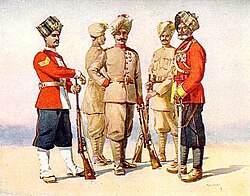
The Rajputana Rifles is the oldest rifle regiment of the Indian Army. It was originally a part of the British Indian Army, when six previously existing regiments were amalgamated to form six battalions of the 6th Rajputana Rifles. In 1945, the numeral designation was dropped from the title and in 1947 the regiment was transferred to the newly independent Indian Army. Since independence, the regiment has been involved in a number of conflicts against Pakistan, as well as contributing to the Custodian Force (India) in Korea under the aegis of the United Nations in 1953–54 and to the UN Mission to the Congo in 1962. As a rifle regiment, it uses a bugle horn as its insignia, the same as the British Light Division, but unlike its British counterparts, the Rajputana Rifles march at the same march pace used in the Indian Army as a whole.
Etymology
|
The name Rajputana Rifles is derived from northwest, and the word Rajputana , a historic region in northwest India that is roughly coextensive with the modern Indian state of Rajasthan, as well as small sections of Madhya Pradesh and Gujarat. It is based on the word Rajaputra, meaning "son of a king, which came in 6th century. The name Rajputana means "land of the Rajputs". The Aravalli Range crosses the southern part of the region from northeast to southwest. The northwestern part is largely the Thar desert, but to the southeast, the land is extremely fertile. Rajput power rose here between the 6th and 13th centuries, and the princes resisted the early Muslim incursions, which began in the 11th century. Rajput power reached its peak in the early 15th century, but the area fell to the Mughals when Akbar captured the Chittor Fort in 1568. But the Rajputana was safe due to mutual understanding with mughals.From their seat at Ajmer the Mughals ruled Rajputana until the early 18th century. The Marathas held feudatories in the region from c. 1750 to 1818, when it passed to Great Britain. When Britishers came Rajputs did treaty.The Rajput princely states came under British protection by treaties in the early 19th century; most of the area was formed into Rajasthan state in 1948. Under the British, Rajputana included more than 20 princely states, notably Bikaner, Jaipur, Jodhpur, Udaipur, and Ajmer. The internal autonomy of many of the states was guaranteed.
Recruitment
The Rajputana Rifles is a multi class regiment from niet region . 50% recruits from the Jats and 50% from Rajputs which are recruited in equal proportion.[2][3]
Lineage
The regiment's origins lie in the 18th century when the East India Company (HEIC) recruited Rajputs to protect its operations. The impressive performance of French local units which were composed of local recruits mixed with French officers, helped the HEIC to decide that it needed to do something similar. In January 1775, it raised its first local infantry units which included the 5th Battalion, Bombay Sepoys, which is considered to be the oldest rifle regiment of the Indian Army.[4] The 5th Battalion was successively redesignated as 9th Battalion Bombay Sepoys in 1778; 2nd Battalion, 2nd Regiment of Bombay Native Infantry in 1796; 4th Regiment of Bombay Native Infantry in 1824, and then 4th Regiment Native Infantry (Rifle Corps) in 1881.[5] It thus became the first rifle regiment of the British Indian Army.[4] In 1899 the battalion was once more renamed as 4th Regiment (1st Battalion Rifle Corps) Bombay Infantry and again in 1901 as 4th Bombay Rifles.[5]
In Kitchener's 1903 reorganisation of the Indian Army, 4th Bombay Rifles became 104th Wellesley's Rifles, to commemorate the fact that the regiment had been commanded in 1800 by Arthur Wellesley (later the Duke of Wellington).[6] In the further re-organisation in 1921, six regiments were brought together to form six battalions of the 6th Rajputana Rifles Regiment:

- 1st Battalion - 104th Wellesley's Rifles
- 2nd Battalion - 120th Rajputana Infantry
- 3rd Battalion - 122nd Rajputana Infantry
- 4th Battalion - 123rd Outram's Rifles
- 5th Battalion - 125th Napier's Rifles
- 10th (Training) Battalion - 13th Rajputs (The Shekhawati Regiment).
- 18th Battalion - (Saurashtra Rifles)[7]
In 1945 the regiments of the British Indian Army dropped the numeral in their titles and so the Rajputana Rifles assumed its current name. In 1947 after the partition of India the regiment was allocated to the newly formed Indian Army. In 1949, the 1st battalion was transferred to the newly raised Brigade of the Guards, becoming the 3rd battalion, Brigade of the Guards.
History
![[icon]](/wiki/File:Wiki_letter_w_cropped.svg) | This section needs expansion. You can help by adding to it. (March 2022) |

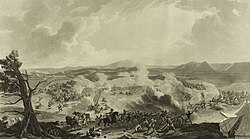
In 1817 the 4th battalion met the Marathas at the Battle of Khadki. The defence earned the regiment the battle honor of "Khadki". In 1856–57 the 1st, 2nd, and 4th battalions were together in the Persian theatre of operations. In 1856 Capt. John Augustus Wood of the 2nd battalion (then the 20th Bombay Native Infantry) was awarded the Victoria Cross for storming Bushire Fort.[8] This was the first Victoria Cross to be won in an Indian unit.[9] Sub. Maj Mohammed Sharief and Sub. Peer Bhatt were recommended for the Victoria Cross for their actions in the same battle but were turned down as at that time the medal category was not open to Indians.[10][11]
In 1878–1880, during the Second Afghan War, the 1st battalion marched 145 miles in 5 days from Quetta to Kandahar and laid siege to the city. In 1900–1902, the 3rd battalion was part of a force used to contain the Boxer Rebellion in China.
World War I saw the regiment fight in battlefields from France to Palestine. The 5th battalion was in all theatres of the war and participated in General Allenby’s march to recapture Jerusalem.
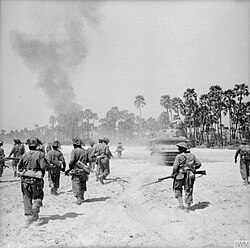
During World War II the regiment was expanded to thirteen battalions and served in the Middle East, Burma and Malaya.[12] The 4th battalion had the distinction of earning two Victoria Crosses during this conflict.[13]
Over the course of its existence, members of the regiment have received six Victoria Crosses, two Military Crosses, one Param Vir Chakra, three Ashok Chakras, one Padma Bhushan, fourteen Param Vishisht Seva Medals, ten Maha Vir Chakras, eleven Kirti Chakras, 18 Ati Vishisht Seva Medals, two Uttam Yudh Seva Medal, 50 Vir Chakras, 28 Shaurya Chakras, 122 Sena Medals (including Bar), 39 Vishisht Seva Medals, three Yudh Seva Medals, 85 Mentions-in-Dispatches and 55 Arjun Awards.[4]
Units
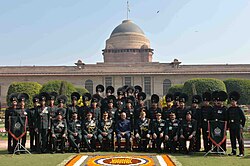
_and_Provost_Outrides,_at_Rashtrapati_Bhavan,_in_New_Delhi_on_January_30,_2018.jpg)


- 2nd Battalion (formerly 120th Rajputana Infantry)
- 3rd Battalion (formerly 122nd Rajputana Infantry)
- 4th Battalion (formerly 123rd Outram's Rifles)
- 5th Battalion (formerly 125th Napier's Rifles)
- 6th Battalion (Param Vir Chakra Paltan)
- 7th Battalion (Mynamati Battalion)
- 8th Battalion
- 9th Battalion
- 11th Battalion
- 12th Battalion (formerly 31st Rajputana Rifles)
- 13th Battalion
- 14th Battalion
- 15th Battalion
- 16th Battalion
- 17th Battalion (former Imperial Service Troops)
- 18th Battalion (former Saurashtra Rifles Nawanagar State Forces)
- 19th Battalion
- 20th Battalion
- 21st Battalion
- 22nd Battalion
- 9 Rashtriya Rifles
- 18 Rashtriya Rifles
- 43 Rashtriya Rifles
- 57 Rashtriya Rifles
Others:
- 1st Battalion is now 3rd Battalion, Brigade of the Guards
- 18th Battalion is now 11th Mechanised Infantry Regiment
- 23rd Battalion was transformed in 2013 into the 23rd Battalion, Parachute Regiment
- 105 Infantry Battalion (TA) Rajputana Rifles – Delhi Cantonment, New Delhi
- 128 Infantry Battalion (TA) Rajputana Rifles Eco - Jaisalmer, Rajasthan
Alliances
 United Kingdom - The 22nd (Cheshire) Regiment; 5th Bn
Rajputana Rifles Regimental Museum
The Rajputana Rifles Regimental Museum in the Rajputana Rifles Centre is located inside the Delhi Cantonment. The museum covers the rich history of the regiment in the most modern fashion. The museum is around 7000 square feet in size and covers the history of the regiment from its inception. The museum exhibits weapons and uniforms and narrates the history through large format images and audiovisual film. The museum was designed and conceived by Holistic Design a Delhi-based design studio headed by Nikhil Bhardwaj who specializes in designing museums and exhibitions. Col. M. S. Niranjan of the 19th battalion was the director of the museum project. It is rated as the finest military museum in India and even compared to the Imperial War Museum in London.
Gallantry Awards
|
- Coy Hav. Maj. Piru Singh - Param Vir Chakra, 6 Raj Rif
- Coy. Hav. Maj. Chhelu Ram - Victoria Cross, 6 Raj Rif
- Maj. Padmapani Acharya - Maha Vir Chakra, 2 Raj Rif
- Maj. Vivek Gupta - Maha Vir Chakra, 2 Raj Rif
- Nk. Digendra Kumar - Maha Vir Chakra, 2 Raj Rif
- Capt. Neikezhakuo Kenguruse - Maha Vir Chakra, 2 Raj Rif
- Hav. Rajesh Kumar - Ashoka Chakra, 11 Raj Rif
- Nk. Neeraj Kumar Singh - Ashoka Chakra, 13 Raj Rif
- Capt. Umaid Singh - Ashoka Chakra, 19 Raj Rif
- Capt. (Later Col) Karni Singh Rathore - Kirti Chakra, 17 Raj Rif, (Sawaiman Guards)
- Maj (Later Brig) JK Tomar - Vir Chakra, 9 Raj Rif
- Capt. Vijayant Thapar - Vir Chakra, 2 Raj Rif
- Col. Daljit Singh Randhawa - Military Cross, Vishisht Seva Medal, 5/6 Raj Rif
- Lt. Gen. Abhay Krishna - Param Vishisht Seva Medal, Uttam Yudh Seva Medal, Ati Vishisht Seva Medal, Sena Medal, Vishisht Seva Medal
- Col. Magod Basappa Ravindranath - Vir Chakra, 2 Raj Rif
- Capt. Mohammed Haneef Uddin -Vir Chakra, 11 Raj Rif
- Maj.Gen Shivkaran Alok Dubey Yudh Seva medal, Maha Vir Chakra, 22 Raj Rif
- Hav. Sugan Singh Maha Vir Chakra, 7 RAJ RIF
- LNK NO 20976 IDSM 4TH OUTRMN'S RAJPUTANA RIFLES
References
- ↑ "Gazette of India No 45" (PDF). 7 November 2020. Retrieved 24 November 2020.
- ↑ Hasnain, Syed Ata (22 April 2019). "Demand for new caste-, faith- or ethnicity-based regiments for Indian Army not in consonance with policy or national interest". Firstpost. Retrieved 17 December 2020.
{{cite news}}: CS1 maint: deprecated archival service (link) - ↑ Pandit, Rajat (13 April 2009). "Netas look for brownie points over Army". Times of India. TNN. Retrieved 17 December 2020.
{{cite news}}: CS1 maint: deprecated archival service (link) - ↑ 4.0 4.1 4.2 Sharma 1990, p. 97. and "Bharat Rakshak :: Land Forces Site - the Rajputana Rifles". Archived from the original on 11 July 2011. Retrieved 20 August 2011.
- ↑ 5.0 5.1 Britishempire.co.uk - 104th Wellesley's Rifles
- ↑ Mackenzie 1951, p. 25.
- ↑ Sharma 1990, pp. 104–105.
- ↑ Sharma 1990, pp. 97–98.
- ↑ Mackenzie 1951, p. 131.
- ↑ Sharma 1990, p. 98.
- ↑ Until 1911, the Indian Order of Merit was the highest gallantry award that Indian soldiers were eligible for. After 1911, the Victoria Cross was extended to all soldiers of the British Empire.
- ↑ Sharma 1990, pp. 106–109.
- ↑ Sharma 1990, p. 106.
- Singh, Colonel Dr Narendar (2019) ''Third Battalion The Rajputana Rifles 'Waffadar Paltan' Volume 1 1818-1920 (New Delhi: Pentagon Press) ISBN 978-93-86618-92-4
- Singh, Colonel Dr Narendar (2020) ''Third Battalion The Rajputana Rifles 'Gods Own' Volume 2 1921-2018 (New Delhi: Pentagon Press) ISBN 978-81-944659-2-8
External links

- Pages using the JsonConfig extension
- Articles needing additional references from March 2022
- Articles needing additional references from August 2021
- Articles needing additional references from September 2022
- Military units and formations established in 1775
- British Indian Army infantry regiments
- Infantry regiments of the Indian Army from 1947
- Rifle regiments
- Units of the Indian Peace Keeping Force