|
|
| Line 1: |
Line 1: |
| {{short description|Country in Southern Africa}}
| | {{Use dmy dates|date=May 2019}} |
| {{about|the country|the geographical area|Southern Africa|other uses}}
| |
| {{pp-vandalism|small=yes}}
| |
| {{pp-move-indef|small=yes}}
| |
| {{Use South African English|date=April 2021}}
| |
| {{Use dmy dates|date=March 2022}} | |
| {{Infobox country | | {{Infobox country |
| | conventional_long_name = Republic of South Africa | | | conventional_long_name = Republic of South Africa |
| | common_name = South Africa | | | common_name = South Africa |
| | native_name = {{collapsible list | | | native_name = {{collapsible list |
| | titlestyle = background:transparent;text-align:center;line-height:normal;font-size:86%; | | | titlestyle = background:transparent;text-align:center;line-height:normal;font-size:84%; |
| | title = 10 other official names<ref name="constitution">{{cite book|url=https://www.concourt.org.za/images/phocadownload/the_text/english-2013.pdf|title=The Constitution of the Republic of South Africa|publisher=Constitutional Court of South Africa|year=2013|edition=2013 English version|access-date=17 April 2020|archive-date=23 August 2018|archive-url=https://web.archive.org/web/20180823174423/https://www.concourt.org.za/images/phocadownload/the_text/english-2013.pdf|url-status=live}}</ref> | | | title = 10 other official names<ref>{{cite web |url=http://www.constitutionalcourt.org.za/site/theconstitution/thetext.htm |title=The Constitution |publisher=Constitutional Court of South Africa |accessdate=3 September 2009}}</ref> |
| | {{Infobox | | | {{Infobox |
| | subbox=yes | | | subbox=yes |
| Line 19: |
Line 14: |
| | rowclass2 = mergedrow | | | rowclass2 = mergedrow |
| | label2 = [[Xhosa language|Xhosa]]: | | | label2 = [[Xhosa language|Xhosa]]: |
| | data2 = {{lang|ss|iRiphabhlikhi yoMzantsi Afrika}} | | | data2 = {{lang|xh|iRiphabliki yomZantsi Afrika}} |
| | rowclass3 = mergedrow | | | rowclass3 = mergedrow |
| | label3 = [[Afrikaans]]: | | | label3 = [[Afrikaans]]: |
| | data3 = {{lang|af|Republiek van Suid-Afrika}} | | | data3 = {{lang|af|Republiek van Suid-Afrika}} |
| | rowclass4 = mergedrow | | | rowclass4 = mergedrow |
| | label4 = [[Northern Sotho language|Pedi]]: | | | label4 = [[Northern Sotho language|Northern Sotho]]: |
| | data4 = {{lang|nso|Repabliki ya Afrika-Borwa}} | | | data4 = {{lang|nso|Repabliki ya Afrika-Borwa}} |
| | rowclass5 = mergedrow | | | rowclass5 = mergedrow |
| | label5 = [[Sotho language|Southern Sotho]]: | | | label5 = [[Tswana language|Tswana]]: |
| | data5 = {{lang|st|Rephaboliki ya Afrika Borwa}} | | | data5 = {{lang|tn|Rephaboliki ya Aforika Borwa}} |
| | rowclass6 = mergedrow | | | rowclass6 = mergedrow |
| | label6 = [[Tswana language|Tswana]]: | | | label6 = [[Sotho language|Sotho]]: |
| | data6 = {{lang|tn|Rephaboliki ya Aforika Borwa}} | | | data6 = {{lang|st|Rephaboliki ya Afrika Borwa}} |
| | rowclass7 = mergedrow | | | rowclass7 = mergedrow |
| | label7 = [[Tsonga language|Tsonga]]: | | | label7 = [[Tsonga language|Tsonga]]: |
| | data7 = {{lang|ts|Riphabliki ya Afrika Dzonga}} | | | data7 = {{lang|ts|Riphabliki ra Afrika Dzonga}} |
| | rowclass8 = mergedrow | | | rowclass8 = mergedrow |
| | label8 = [[Swazi language|Swati]]: | | | label8 = [[Swazi language|Swazi]]: |
| | data8 = {{lang|sw|iRiphabhulikhi yaseNingizimu-Afrika}} | | | data8 = {{lang|ss|iRiphabhulikhi yeNingizimu Afrika}} |
| | rowclass9 = mergedrow | | | rowclass9 = mergedrow |
| | label9 = [[Venda language|Venda]]: | | | label9 = [[Venda language|Venda]]: |
| | data9 = {{lang|ve|Riphabuḽiki ya Afurika Tshipembe}} | | | data9 = {{lang|ve|Riphabuḽiki ya Afurika Tshipembe}} |
| | rowclass10 = mergedrow | | | rowclass10 = mergedrow |
| | label10 = [[Southern Ndebele language|Southern Ndebele]]: | | | label10 = [[Southern Ndebele language|Southern Ndebele]]: |
| | data10 = {{lang|nr|iRiphabliki yeSewula Afrika}} | | | data10 = {{lang|nr|iRiphabliki yeSewula Afrika}} |
| }} | | }} |
| }} | | }} |
| | image_flag = Flag of South Africa.svg | | | image_flag = Flag of South Africa.svg |
| | alt_flag = | | | alt_flag = |
| | flag2_border = | | | flag2_border = |
| | image_coat = Coat of arms of South Africa.svg | | | image_coat = Coat of arms of South Africa (heraldic).svg |
| | alt_coat = | | | alt_coat = |
| | symbol_type = Coat of arms | | | symbol_type = Coat of arms |
| | national_motto = "{{lang|xam|ǃke e꞉ ǀxarra ǁke}}" ([[ǀXam language|ǀXam]])<br />"[[Unity in Diversity]]" | | | national_motto = "ǃke e꞉ ǀxarra ǁke" {{small|([[ǀXam language|ǀXam]])}}<br />{{small|"[[Unity in Diversity]]"}} |
| | national_anthem = "[[National anthem of South Africa]]" <div style="padding-top:0.5em;" class="center">[[File:South Africa National Anthem.ogg]]</div> | | | national_anthem = "[[National anthem of South Africa]]" <div style="padding-top:0.5em;" class="center">[[File:South Africa National Anthem.ogg]]</div> |
| | image_map = {{Switcher|[[File:South Africa (orthographic projection).svg|frameless]]|Show globe| | | | image_map = Location South Africa AU Africa.svg |
| [[File:South Africa adm location map.svg|frameless]]|Show map of South Africa|default=1}} | | | map_caption = {{map caption|countryprefix=|location_color=dark blue|region=the [[African Union]]|region_color=light blue}} |
| | map_caption =
| | | image_map2 = South Africa - Location Map (2013) - ZAF - UNOCHA.svg |
| | image_map2 = | | | capital = {{unbulleted list |[[Pretoria]] {{small|(executive)}} |[[Bloemfontein]] {{small|(judicial)}} |[[Cape Town]] {{small|(legislative)}}}} |
| | capital = {{unbulleted list |[[Pretoria]] (executive)<ref name="South Africa at a glance">{{cite web |title=South Africa at a glance {{!}} South African Government |url=https://www.gov.za/about-sa/south-africa-glance |website=www.gov.za |access-date=18 June 2020 |archive-date=26 May 2020 |archive-url=https://web.archive.org/web/20200526163527/https://www.gov.za/about-sa/south-africa-glance |url-status=live }}</ref>|[[Cape Town]] (legislative)<ref name="South Africa at a glance" />|[[Bloemfontein]] (judicial)<ref name="South Africa at a glance" />}} | | | largest_city = {{nowrap|[[Johannesburg]]<ref>{{cite web |url=http://www.citypopulation.de/World.html |title=Principal Agglomerations of the World |publisher=Citypopulation.de |accessdate=30 October 2011}}</ref><!--end nowrap:-->}} |
| | largest_city = {{nowrap|[[Johannesburg]]<ref>{{cite web |url=http://www.citypopulation.de/World.html |title=Principal Agglomerations of the World |publisher=Citypopulation.de |access-date=30 October 2011 |archive-date=25 December 2018 |archive-url=https://web.archive.org/web/20181225073559/http://www.citypopulation.de/World.html |url-status=live }}</ref><!--end nowrap:-->}} | | | official_languages = '''[[Languages of South Africa|11 languages]]''' |
| | population_estimate = 60,142,978<ref>{{Cite web|url=http://www.statssa.gov.za/publications/P0302/P03022021.pdf|title=Mid-year population estimates|date=19 July 2021|publisher=Statistics South Africa|access-date=19 July 2021|url-status=live|archive-url=https://web.archive.org/web/20190729223342/http://www.statssa.gov.za/publications/P0302/P03022019.pdf|archive-date=29 July 2019}}</ref>
| |
| | population_census = 51,770,560<ref name=cib11/>{{rp|18}}
| |
| | population_estimate_year = 2021
| |
| | population_estimate_rank = 23rd
| |
| | population_census_year = 2011
| |
| | population_density_km2 = 42.4
| |
| | population_density_sq_mi =
| |
| | population_density_rank = 169th
| |
| | ethnic_groups_year = 2019<ref>{{Cite web|url=http://www.statssa.gov.za/publications/P0302/P03022019.pdf|title=Mid-year population estimates|date=29 July 2019|publisher=Statistics South Africa|access-date=29 July 2019|url-status=live|archive-url=https://web.archive.org/web/20190729223342/http://www.statssa.gov.za/publications/P0302/P03022019.pdf|archive-date=29 July 2019}}</ref>
| |
| | official_languages = '''[[Languages of South Africa|11 languages]]'''<ref name="constitution" /> | |
| {{plainlist | | | {{plainlist | |
| * [[South African English|English]] | | * [[Zulu language|Zulu]] |
| * [[Zulu language|Zulu]] | | * [[Xhosa language|Xhosa]] |
| | * [[Afrikaans]] |
| | * [[English language|English]] |
| | * [[Northern Sotho language|Northern Sotho]] |
| | * [[Tswana language|Tswana]] |
| | * [[Sotho language|Sotho]] |
| | * [[Tsonga language|Tsonga]] |
| * [[Swazi language|Swazi]] | | * [[Swazi language|Swazi]] |
| * [[Afrikaans]] | | * [[Venda language|Venda]] |
| * [[Northern Sotho language|Sepedi]]
| | * [[Southern Ndebele language|Southern Ndebele]]<!-- Official languages ordered by native speakers --> |
| * [[Sotho language|Sesotho]]
| |
| * [[Tswana language|Setswana]]
| |
| * [[Tsonga language|Xitsonga]]
| |
| * [[Xhosa language|Xhosa]]
| |
| * [[Venda language|Tshivenda]]
| |
| * [[Southern Ndebele language|Ndebele]] | |
| }} | | }} |
| {{collapsible list | | {{collapsible list |
| | titlestyle = background:transparent;text-align:left;padding-left:0.5em;font-size:100%;<!--size of [show]/[hide] link--> | | | titlestyle = background:transparent;text-align:left;padding-left:0.5em;font-size:100%;<!--size of [show]/[hide] link--> |
| | liststyle = text-align:left;white-space:nowrap; | | | liststyle = text-align:left;white-space:nowrap; |
| | title=Languages with special status<ref name="constitution.1.6">{{cite book|url=https://www.concourt.org.za/images/phocadownload/the_text/english-2013.pdf|title=The Constitution of the Republic of South Africa|publisher=Constitutional Court of South Africa|year=2013|edition=2013 English version|at=ch. 1, s. 6|access-date=17 April 2020|archive-date=23 August 2018|archive-url=https://web.archive.org/web/20180823174423/https://www.concourt.org.za/images/phocadownload/the_text/english-2013.pdf|url-status=live}}</ref>|[[Khoi languages]]| [[Nama language|Nama]]|[[San languages]]|[[South African Sign Language]]|[[German language|German]]|[[Greek language|Greek]]|[[Gujarati language|Gujarati]]|[[Hindi]]|[[Portuguese language|Portuguese]]|[[Telugu language|Telugu]]|[[Tamil language|Tamil]]|[[Urdu]]|[[Arabic]]|[[Hebrew language|Hebrew]]|[[Sanskrit]] | | | title=Languages with special status<ref name="constitution.1.6">{{cite book|url=https://www.concourt.org.za/images/phocadownload/the_text/english-2013.pdf|title=The Constitution of the Republic of South Africa|publisher=Constitutional Court of South Africa|year=2013|edition=2013 English version|at=ch. 1, s. 6|access-date=17 April 2020|archive-date=23 August 2018|archive-url=https://web.archive.org/web/20180823174423/https://www.concourt.org.za/images/phocadownload/the_text/english-2013.pdf|url-status=live}}</ref>|[[Arabic]]|[[German language|German]]|[[Greek language|Greek]]|[[Gujarati language|Gujarati]]|[[Hebrew language|Hebrew]]|[[Hindi]]|[[Khoi languages]]|[[Nama language|Nama]]|[[Portuguese language|Portuguese]]|[[San languages]]|[[Sanskrit]]|[[South African Sign Language]]|[[Tamil language|Tamil]]|[[Telugu language|Telugu]]|[[Urdu]] |
| }} | | }} |
| | regional_languages =
| |
| | languages2_type = | | | languages2_type = |
| | languages2 = | | | languages2 = |
| | ethnic_groups = {{unbulleted list | | | ethnic_groups = {{unbulleted list |
| | {{nowrap|80.7% [[Bantu peoples in South Africa|Black]]}} | | | {{nowrap|80.2% [[Bantu peoples in South Africa|Black]]}} |
| | 8.8% [[Coloureds|Coloured]] | | | 8.8% [[Cape Coloureds|Coloured]] |
| | 7.9% [[White South Africans|White]] | | | 8.4% [[European South African|White]] |
| | 2.6% [[Asian (South Africa)|Asian]] | | | 2.5% [[Asian South African|Asian]] |
| }} | | }} |
| | religion = {{ublist |item_style=white-space:nowrap; | | | ethnic_groups_year = 2014<ref>{{Cite web|url=http://beta2.statssa.gov.za/publications/P0302/P03022014.pdf|archive-url=https://web.archive.org/web/20140808032616/http://beta2.statssa.gov.za/publications/P0302/P03022014.pdf|url-status=dead|archive-date=8 August 2014|title=Mid-year population estimates 2014|date=31 July 2014|location=South Africa|publisher=Statistics South Africa|access-date=8 August 2014}}</ref> |
| |78.0% [[Christianity in South Africa|Christianity]]
| | | religion = See ''[[Religion in South Africa]]'' |
| |—58.3% [[Protestantism]]
| | | demonym = [[South Africans|South African]] |
| |—19.7% Other [[List of Christian denominations|Christian]]
| | | government_type = [[Unitary state|Unitary]] [[Dominant-party system|dominant-party]] [[Parliamentary system|parliamentary]] [[republic|constitutional republic]] |
| |10.9% [[Irreligion in South Africa|No religion]]
| |
| |4.4% [[African traditional religion|Traditional faiths]]
| |
| |1.6% [[Islam in South Africa|Islam]]
| |
| |1.0% [[Hinduism in South Africa|Hinduism]]
| |
| |2.7% Others
| |
| |1.4% Undetermined}}
| |
| | religion_year = 2016
| |
| | religion_ref = <ref>{{Cite web|url=https://www.datafirst.uct.ac.za/dataportal/index.php/catalog/611|title=South Africa – Community Survey 2016|website=www.datafirst.uct.ac.za|access-date=25 November 2018|archive-date=25 November 2018|archive-url=https://web.archive.org/web/20181125204526/https://www.datafirst.uct.ac.za/dataportal/index.php/catalog/611|url-status=live}}</ref>
| |
| | demonym = South African | |
| | government_type = [[Unitary state|Unitary]] [[Dominant-party system|dominant-party]] [[List of countries by system of government#Parliamentary republics with an executive presidency|parliamentary republic with an executive presidency]] | |
| | leader_title1 = [[President of South Africa|President]] | | | leader_title1 = [[President of South Africa|President]] |
| | leader_name1 = [[Cyril Ramaphosa]] | | | leader_name1 = [[Cyril Ramaphosa]] |
| | leader_title2 = [[Deputy President of South Africa|Deputy President]] | | | leader_title2 = [[Deputy President of South Africa|Deputy President]] |
| | leader_name2 = [[David Mabuza]] | | | leader_name2 = [[David Mabuza]] |
| | leader_title3 = [[National Council of Provinces#Chairpersons|Chairperson of the National Council]]
| |
| | leader_name3 = [[Amos Masondo]]
| |
| | leader_title4 = [[Speaker of the National Assembly of South Africa|Speaker of the National Assembly]]
| |
| | leader_name4 = [[Nosiviwe Mapisa-Nqakula]]
| |
| | leader_title5 = [[Chief Justice of South Africa|Chief Justice]]
| |
| | leader_name5 = [[Ray Zondo|Raymond Zondo]]
| |
| | legislature = [[Parliament of South Africa|Parliament]] | | | legislature = [[Parliament of South Africa|Parliament]] |
| | upper_house = [[National Council of Provinces|National Council]] | | | upper_house = [[National Council of Provinces|National Council]] |
| Line 130: |
Line 98: |
| | established_event2 = [[Statute of Westminster 1931|Self-governance]] | | | established_event2 = [[Statute of Westminster 1931|Self-governance]] |
| | established_date2 = 11 December 1931 | | | established_date2 = 11 December 1931 |
| | established_event3 = [[1960 South African republic referendum|Republic]] | | | established_event3 = [[South African referendum, 1960|Republic]] |
| | established_date3 = 31 May 1961 | | | established_date3 = 31 May 1961 |
| | established_event4 = [[Apartheid|Apartheid legislation repealed]] | | | established_event4 = |
| | established_date4 = 17 June 1991 | | | established_date4 = |
| | established_event5 = [[1994 South African general election|Democratisation]]
| |
| | established_date5 = 27 April 1994
| |
| | established_event6 = [[Constitution of South Africa|Current constitution]]
| |
| | established_date6 = 4 February 1997
| |
| | area_km2 = 1,221,037 | | | area_km2 = 1,221,037 |
| | area_footnote = | | | area_footnote = |
| Line 143: |
Line 107: |
| | area_sq_mi = 471,443 | | | area_sq_mi = 471,443 |
| | percent_water = 0.380 | | | percent_water = 0.380 |
| | GDP_PPP = {{increase}} $924 billion<ref name="IMF 2021">{{cite web|url=https://www.imf.org/en/Publications/WEO/weo-database/2021/October/weo-report?c=199,&s=NGDPD,PPPGDP,NGDPDPC,PPPPC,&sy=2019&ey=2026&ssm=0&scsm=1&scc=0&ssd=1&ssc=0&sic=0&sort=country&ds=.&br=1|title=World Economic Outlook Database, October 2021|publisher=[[International Monetary Fund]]|access-date=15 October 2021|archive-date=7 December 2021|archive-url=https://web.archive.org/web/20211207044916/https://www.imf.org/en/Publications/WEO/weo-database/2021/October/weo-report?c=199,&s=NGDPD,PPPGDP,NGDPDPC,PPPPC,&sy=2019&ey=2026&ssm=0&scsm=1&scc=0&ssd=1&ssc=0&sic=0&sort=country&ds=.&br=1|url-status=live}}</ref> | | | population_estimate = 57,725,600<ref>{{Cite web |url=http://www.statssa.gov.za/publications/P0302/P03022018.pdf |title=Mid-year population estimates |date=2018-07-23 |website=www.statssa.gov.za |access-date=2018-07-23}}</ref> |
| | GDP_PPP_year = 2022 | | | population_census = 51,770,560{{rp|18}} |
| | GDP_PPP_rank = 32nd | | | population_estimate_year = 2018 |
| | GDP_PPP_per_capita = {{increase}} $15,361<ref name="IMF 2021"/> | | | population_estimate_rank = 24th |
| | GDP_PPP_per_capita_rank = 96th | | | population_census_year = 2011 |
| | GDP_nominal = {{increase}} $419 billion<ref name="IMF 2021"/> | | | population_density_km2 = 42.4 |
| | GDP_nominal_year = 2022 | | | population_density_sq_mi = |
| | | population_density_rank = 169th |
| | | GDP_PPP = {{nowrap|$813.100 billion<ref name="IMFWEOZA">{{cite web |url=https://www.imf.org/external/pubs/ft/weo/2019/01/weodata/weorept.aspx?sy=2019&ey=2024&scsm=1&ssd=1&sort=country&ds=.&br=1&pr1.x=68&pr1.y=5&c=199&s=NGDPD%2CPPPGDP%2CNGDPDPC%2CPPPPC&grp=0&a= |title=South Africa - Report for Selected Countries and Subjects |publisher=International Monetary Fund |date= April 2019|accessdate=29 June 2019}}</ref><!--end nowrap:-->}} |
| | | GDP_PPP_year = 2019 |
| | | GDP_PPP_rank = 30th |
| | | GDP_PPP_per_capita = $13,865<ref name="IMFWEOZA"/> |
| | | GDP_PPP_per_capita_rank = 89th |
| | | GDP_nominal = {{nowrap|$371.298 billion<ref name="IMFWEOZA"/>}} |
| | | GDP_nominal_year = 2019 |
| | GDP_nominal_rank = 33rd | | | GDP_nominal_rank = 33rd |
| | GDP_nominal_per_capita = {{increase}} $6,979<ref name="IMF 2021"/> | | | GDP_nominal_per_capita = $6,331<ref name="IMFWEOZA"/> |
| | GDP_nominal_per_capita_rank = 89th | | | GDP_nominal_per_capita_rank = 86th |
| | Gini = 63.0 <!--number only--> | | | Gini = 63.0 <!--number only--> |
| | Gini_year = 2014 | | | Gini_year = 2014 |
| | Gini_change = decrease <!--increase/decrease/steady--> | | | Gini_change = decrease <!--increase/decrease/steady--> |
| | Gini_ref = <ref name="wb-gini">{{cite web |url=https://data.worldbank.org/indicator/SI.POV.GINI?locations=ZA |title=Gini Index |publisher=World Bank |access-date=25 September 2018 |archive-date=29 May 2020 |archive-url=https://web.archive.org/web/20200529083011/https://data.worldbank.org/indicator/SI.POV.GINI?locations=ZA |url-status=live }}</ref> | | | Gini_ref = <ref name="wb-gini">{{cite web |url=https://data.worldbank.org/indicator/SI.POV.GINI?locations=ZA |title=Gini Index |publisher=World Bank |accessdate=25 September 2018}}</ref> |
| | Gini_rank = <!-- 2nd --><!-- hid rank as source not clear --> | | | Gini_rank = <!-- 2nd --><!-- hid rank as source not clear --> |
| | HDI = 0.709 <!--number only--> | | | HDI = 0.699 <!--number only--> |
| | HDI_year = 2019<!-- Please use the year to which the data refers, not the publication year--> | | | HDI_year = 2017<!-- Please use the year to which the data refers, not the publication year--> |
| | HDI_change = increase <!--increase/decrease/steady--> | | | HDI_change = increase <!--increase/decrease/steady--> |
| | HDI_ref = <ref name="UNHDR">{{cite web|url=http://hdr.undp.org/sites/default/files/hdr2020.pdf|title=Human Development Report 2020|language=en|publisher=[[United Nations Development Programme]]|date=15 December 2020|access-date=15 December 2020|archive-date=15 December 2020|archive-url=https://web.archive.org/web/20201215063955/http://hdr.undp.org/sites/default/files/hdr2020.pdf|url-status=live}}</ref> | | | HDI_ref = <ref name="HDI">{{cite web |url=http://www.hdr.undp.org/en/2018-update |title=2018 Human Development Report |year=2018 |accessdate=14 September 2018 |publisher=United Nations Development Programme |archive-date=14 September 2018 |archive-url=https://web.archive.org/web/20180914203906/http://hdr.undp.org/en/2018-update |url-status=dead }}</ref> |
| | HDI_rank = 114th | | | HDI_rank = 113th |
| | currency = [[South African rand]] | | | currency = [[South African rand]] |
| | currency_code = ZAR | | | currency_code = ZAR |
| Line 171: |
Line 143: |
| | time_zone_DST = | | | time_zone_DST = |
| | antipodes = | | | antipodes = |
| | date_format = Short formats: | | | date_format = |
| * yyyy/mm/dd<ref>{{Cite web|title=Data Source Comparison for en-ZA|url=https://www.localeplanet.com/compare/en-ZA/index.html|access-date=5 May 2021|website=www.localeplanet.com|archive-date=16 August 2021|archive-url=https://web.archive.org/web/20210816213516/https://www.localeplanet.com/compare/en-ZA/index.html|url-status=live}}</ref>
| | | drives_on = [[Right- and left-hand traffic|left]] |
| * yyyy-mm-dd<ref>{{Cite web|title=Data Source Comparison for af-ZA|url=https://www.localeplanet.com/compare/af-ZA/index.html|access-date=5 May 2021|website=www.localeplanet.com|archive-date=5 May 2021|archive-url=https://web.archive.org/web/20210505092248/https://www.localeplanet.com/compare/af-ZA/index.html|url-status=live}}</ref>
| |
| | drives_on = left | |
| | calling_code = [[+27]] | | | calling_code = [[+27]] |
| | iso3166code = ZA | | | iso3166code = |
| | cctld = [[.za]] | | | cctld = [[.za]] |
| | today =
| |
| }}
| |
|
| |
| '''South Africa''', officially the '''Republic of South Africa''' ('''RSA'''), is the [[Southern Africa|southernmost]] country in Africa. South Africa is bounded to the south by {{convert|2798|km|mi}} of coastline that stretch along the [[Atlantic Ocean|South Atlantic]] and [[Indian Ocean]]s;<ref>{{cite web |url=http://www.samsa.org.za/ |title=South African Maritime Safety Authority |publisher=South African Maritime Safety Authority |access-date=16 June 2008 |archive-date=29 December 2008 |archive-url=https://web.archive.org/web/20081229120804/http://www.samsa.org.za/ |url-status=live }}</ref><ref>{{cite web |url=https://www.cia.gov/library/publications/the-world-factbook/fields/2060.html |website=The World Factbook |title=Coastline |publisher=CIA |access-date=16 June 2008 |archive-date=16 July 2017 |archive-url=https://web.archive.org/web/20170716042040/https://www.cia.gov/library/publications/the-world-factbook/fields/2060.html |url-status=dead }}</ref><ref name=safacts>{{cite web |url=http://www.southafrica.info/about/facts.htm |title=South Africa Fast Facts |publisher=SouthAfrica.info |date=April 2007 |access-date=14 June 2008 |url-status=dead |archive-url=https://web.archive.org/web/20080719213531/http://www.southafrica.info/about/facts.htm |archive-date=19 July 2008}}</ref> to the north by the neighbouring countries of [[Namibia]], [[Botswana]], and [[Zimbabwe]]; and to the east and northeast by [[Mozambique]] and [[Eswatini]] and it surrounds the [[Enclave and exclave|enclaved country]] of [[Lesotho]].<ref>{{cite web |author=[[Guy Arnold]] |url=http://www.britannica.com/eb/article-9113829/LESOTHO |title=Lesotho: Year In Review 1996 – Britannica Online Encyclopedia |website=Encyclopædia Britannica |access-date=30 October 2011 |archive-date=15 June 2013 |archive-url=https://web.archive.org/web/20130615085933/http://www.britannica.com/EBchecked/topic/337131/Lesotho-Year-In-Review-1996 |url-status=live }}</ref> It is the southernmost country on the mainland of the [[Old World]], and the most populous country located entirely south of the equator. South Africa is a biodiversity hotspot, with a diversity of unique biomes and plant and animal life. With over [[Demographics of South Africa|60 million people]], the country is the world's [[List of countries by population|23rd-most populous nation]] and covers an area of {{convert|1221037|km2|mi2|abbr=off}}. South Africa has three capital cities, with the executive, judicial and legislative branches of government based in [[Pretoria]], [[Bloemfontein]] and [[Cape Town]] respectively. The largest city is [[Johannesburg]].
| |
|
| |
| About 81% of the population are [[Black South Africans]].<ref name="safacts" /> The remaining population consists of Africa's largest communities of [[European peoples|European]] ([[White South Africans]]), [[Asian people|Asian]] ([[Indian South Africans]] and [[Chinese South Africans]]), and [[Multiracial]] ([[Coloureds|Coloured South Africans]]) ancestry. South Africa is a [[multiethnic society]] encompassing a wide [[Culture of South Africa|variety of cultures]], [[Languages of South Africa|languages]], and [[Religion in South Africa|religions]]. Its pluralistic makeup is reflected in the [[Constitution of South Africa|constitution]]'s recognition of 11 official languages, the fourth-highest number in the world.<ref name=safacts /> According to the 2011 census, the two most spoken first languages are [[Zulu language|Zulu]] (22.7%) and [[Xhosa language|Xhosa]] (16.0%).<ref name=cib11>{{cite book |title=Census 2011: Census in brief |url=http://www.statssa.gov.za/census/census_2011/census_products/Census_2011_Census_in_brief.pdf |publisher=Statistics South Africa |location=Pretoria |year=2012 |isbn=978-0621413885 |archive-url=https://web.archive.org/web/20150513171240/http://www.statssa.gov.za/census/census_2011/census_products/Census_2011_Census_in_brief.pdf |archive-date=13 May 2015 |url-status=live |pages=23–25 }}</ref> The two next ones are of European origin: [[Afrikaans]] (13.5%) developed from [[Dutch language|Dutch]] and serves as the first language of most [[Coloured]] and [[White South African|White]] South Africans; [[South African English|English]] (9.6%) reflects the legacy of [[British colonialism]], and is commonly used in public and commercial life.
| |
|
| |
| The country is one of the few in Africa never to have had a [[coup d'état]], and [[Elections in South Africa|regular elections]] have been held for almost a century. However, the vast majority of black South Africans were not [[enfranchised]] until 1994. During the 20th century, the black majority sought to claim more rights from the dominant white minority, which played a large role in the country's recent [[History of South Africa|history]] and politics. The [[National Party (South Africa)|National Party]] imposed [[apartheid]] in 1948, institutionalising previous racial segregation. After a long and sometimes violent [[Internal resistance to apartheid|struggle]] by the [[African National Congress]] (ANC) and other anti-apartheid activists both inside and outside the country, the repeal of discriminatory laws began in the mid-1980s. Since 1994, all ethnic and linguistic groups have held political representation in the country's [[liberal democracy]], which comprises a [[parliamentary republic]] and [[Provinces of South Africa|nine provinces]]. South Africa is often referred to as the "[[rainbow nation]]" to describe the country's multicultural diversity, especially in the wake of apartheid.<ref>{{cite news |url=http://news.bbc.co.uk/2/hi/africa/7512700.stm |title=Rainbow Nation – dream or reality? |access-date=10 August 2013 |work=BBC News |date=18 July 2008 |archive-date=8 September 2013 |archive-url=https://web.archive.org/web/20130908141212/http://news.bbc.co.uk/2/hi/africa/7512700.stm |url-status=live }}</ref>
| |
|
| |
| South Africa is an upper-[[middle power]] in international affairs; it maintains significant [[Regional power|regional influence]] and is a member of both the [[Commonwealth of Nations]] and [[G20]].<ref>{{cite journal|last1=Cooper|first1=Andrew F|last2=Antkiewicz|first2=Agata|last3=Shaw|first3=Timothy M|title=Lessons from/for BRICSAM about South-North Relations at the Start of the 21st Century: Economic Size Trumps All Else?|journal=[[International Studies Review]]|date=10 December 2007|volume=9|issue=4|pages=675, 687|doi=10.1111/j.1468-2486.2007.00730.x}}</ref><ref name="Lynch2010">{{cite book|first=David A.|last=Lynch|title=Trade and Globalization: An Introduction to Regional Trade Agreements|url=https://books.google.com/books?id=-MH-GEL425AC&pg=PA51|access-date=25 August 2013|year=2010|publisher=Rowman & Littlefield|quote=Southern Africa is home to the other of sub-Saharan Africa's regional powers: South Africa. South Africa is more than just a regional power; it is currently the most developed and economically powerful country in Africa, and now it is able to use that influence in Africa more than during the days of apartheid (white rule), when it was ostracised.|isbn=978-0-7425-6689-7|page=51|archive-date=11 October 2013|archive-url=https://web.archive.org/web/20131011173913/http://books.google.com/books?id=-MH-GEL425AC&pg=PA51|url-status=live}}</ref> It is a [[developing country]], ranking 114th on the [[Human Development Index]]. It has been classified by the [[World Bank]] as a [[newly industrialised country]], with the [[List of African countries by GDP (nominal)|second-largest economy]] in Africa, and the [[List of countries by GDP (nominal)|33rd-largest in the world]].<ref>{{cite web |url=http://data.worldbank.org/country/south-africa |title=South Africa |publisher=World Bank |access-date=23 July 2021 |archive-date=1 November 2011 |archive-url=https://web.archive.org/web/20111101050034/http://data.worldbank.org/country/south-africa |url-status=live }}</ref><ref name="Waugh2000">{{cite book|first=David|last=Waugh|title=Geography: An Integrated Approach|chapter-url=https://books.google.com/books?id=7GH0KZZthGoC|access-date=24 August 2013|year=2000|publisher=Nelson Thornes|isbn=978-0-17-444706-1|pages=563, 576–579, 633, 640|chapter=Manufacturing industries (chapter 19), World development (chapter 22)|archive-date=11 October 2013|archive-url=https://web.archive.org/web/20131011173925/http://books.google.com/books?id=7GH0KZZthGoC|url-status=live}}</ref> South Africa also has the most [[List of World Heritage Sites in Africa|UNESCO World Heritage Sites]] in Africa. Since the end of apartheid, government accountability and quality of life have substantially improved in South Africa.<ref>{{Cite book|last=Lieberman|first=Evan|url=https://press.princeton.edu/books/hardcover/9780691203003/until-we-have-won-our-liberty|title=Until We Have Won Our Liberty|date=2022|publisher=Princeton University Press|isbn=978-0-691-20300-3|language=en|access-date=25 November 2021|archive-date=24 November 2021|archive-url=https://web.archive.org/web/20211124200625/https://press.princeton.edu/books/hardcover/9780691203003/until-we-have-won-our-liberty|url-status=live}}</ref> However, crime, poverty and [[Inequality in post-apartheid South Africa|inequality]] remain widespread, with about a quarter of the population unemployed and living on less than US$1.25 a day as of 2008.<ref>{{cite news |url=https://www.bloomberg.com/apps/news?pid=20601116&sid=aoB7RbcZCRfU |title=South Africa's Unemployment Rate Increases to 23.5% |publisher=Bloomberg |date=5 May 2009 |access-date=30 May 2010 }}</ref><ref>{{cite web|url=http://hdr.undp.org/en/media/HDI_2008_EN_Tables.pdf |title=HDI |publisher=UNDP |url-status=dead |archive-url=https://web.archive.org/web/20081219191319/http://hdr.undp.org/en/media/HDI_2008_EN_Tables.pdf |archive-date=19 December 2008 }}</ref>
| |
|
| |
| == Name ==
| |
| {{See also|Official names of South Africa}}
| |
| The name "South Africa" is derived from the country's geographic location at the southern tip of Africa. Upon formation, the country was named the [[Union of South Africa]] in English and {{lang|nl|Unie van Zuid-Afrika}} in [[Dutch language|Dutch]], reflecting its origin from the unification of four formerly separate British colonies. Since 1961, the long formal name in English has been the "Republic of South Africa" and {{lang|af|Republiek van Suid-Afrika}} in [[Afrikaans]]. Since 1994, the country has had an official name in each of its [[Languages of South Africa|11 official languages]].
| |
|
| |
| '''Mzansi''', derived from the [[Xhosa language|Xhosa]] noun {{lang|xh|uMzantsi}} meaning "south", is a [[Colloquialism|colloquial name]] for South Africa,<ref>{{cite book|editor1-first=Sarah|editor2-first=Achille|last=Livermon|first=Xavier|title=Johannesburg: The Elusive Metropolis|chapter=Sounds in the City|year=2008|publisher=Duke University Press|location=Durham|isbn=978-0-8223-8121-1|page=283|chapter-url=https://books.google.com/books?id=hNONyzwm420C|quote=''Mzansi'' is another black urban vernacular term popular with the youth and standing for South Africa.|editor-last=Nuttall|editor2-last=Mbembé|access-date=5 January 2016|archive-date=2 May 2019|archive-url=https://web.archive.org/web/20190502074447/https://books.google.com/books?id=hNONyzwm420C|url-status=live}}</ref><ref>{{cite web|title=Mzansi DiToloki |url=http://www.deafsa.co.za/mzansi_ditoloki/ |publisher=Deaf Federation of South Africa |access-date=15 January 2014 |quote=uMzantsi in Xhosa means 'south', Mzansi means this country, South Africa |url-status=dead |archive-url=https://web.archive.org/web/20140116135926/http://www.deafsa.co.za/mzansi_ditoloki/ |archive-date=16 January 2014 }}</ref> while some [[Pan-Africanism|Pan-Africanist]] political parties prefer the term "[[Azania]]".<ref>{{Cite news|url=http://www.voanews.com/content/south-african-party-says-call-it-azania/1855679.html|title=South African Party Says Call Their Country 'Azania'|last=Taylor|first=Darren|newspaper=VOA|access-date=18 February 2017|language=en|archive-date=24 June 2016|archive-url=https://web.archive.org/web/20160624200956/http://www.voanews.com/content/south-african-party-says-call-it-azania/1855679.html|url-status=live}}</ref>
| |
|
| |
| == History ==
| |
| {{Main|History of South Africa}}
| |
|
| |
| === Prehistoric archaeology ===
| |
| [[File:South Africa - population migrations.svg|thumb|left|Migrations that formed the modern [[Rainbow nation]]]]
| |
| South Africa contains some of the oldest archaeological and [[human fossil|human-fossil]] sites in the world.<ref>{{cite book|last= Wymer|first= John|author2= Singer, R|year= 1982|title= The Middle Stone Age at Klasies River Mouth in South Africa|location= Chicago|publisher= University of Chicago Press|isbn= 978-0-226-76103-9}}</ref><ref>{{cite web|title= Guide to Klasies River|page= 11|year= 2001|url= http://academic.sun.ac.za/archaeology/KRguide2001.PDF|author= Deacon, HJ|publisher= Stellenbosch University|access-date= 5 September 2009|archive-date= 21 February 2011|archive-url= https://web.archive.org/web/20110221195519/http://academic.sun.ac.za/archaeology/KRguide2001.PDF|url-status= live}}</ref><ref>{{Cite web|url=https://whc.unesco.org/en/list/915/|title=Fossil Hominid Sites of South Africa|first=UNESCO World Heritage|last=Centre|website=UNESCO World Heritage Centre|access-date=26 December 2019|archive-date=4 December 2019|archive-url=https://web.archive.org/web/20191204231517/https://whc.unesco.org/en/list/915|url-status=live}}</ref> Archaeologists have recovered extensive [[fossil]] remains from a series of caves in [[Gauteng Province]]. The area, a [[UNESCO World Heritage Site]], has been branded "the [[Cradle of Humankind]]". The sites include [[Sterkfontein]], one of the richest sites for [[hominin]] fossils in the world. Other sites include [[Swartkrans]], [[Gondolin Cave]], [[Kromdraai]], [[Coopers Cave]] and [[Malapa]]. [[Raymond Dart]] identified the first hominin fossil discovered in Africa, the [[Taung Child]] (found near [[Taung]]) in 1924. Further hominin remains have come from the sites of [[Makapansgat]] in [[Limpopo]] Province, [[Cornelia, Free State|Cornelia]] and [[Florisbad]] in the [[Free State (South African province)|Free State Province]], [[Border Cave]] in [[KwaZulu-Natal Province]], [[Klasies River Mouth]] in Eastern Cape Province and [[Pinnacle Point]], [[Elandsfontein cranium|Elandsfontein]] and Die Kelders Cave in [[Western Cape Province]].
| |
|
| |
| These finds suggest that various hominid species existed in South Africa from about three million years ago, starting with ''[[Australopithecus africanus]]''.<ref>{{cite web|url= http://www.yale.edu/ynhti/curriculum/units/1979/6/79.06.02.x.html|title= Hominid Evolution|publisher= Yale-New Haven Teachers Institute|first= Stephen P.|last= Broker|access-date= 19 June 2008|archive-date= 7 April 2008|archive-url= https://web.archive.org/web/20080407181350/http://www.yale.edu/ynhti/curriculum/units/1979/6/79.06.02.x.html|url-status= live}}</ref> There followed species including ''[[Australopithecus sediba]]'', ''[[Homo ergaster]]'', ''[[Homo erectus]]'', ''[[Homo rhodesiensis]]'', ''[[Homo helmei]]'', ''[[Homo naledi]]'' and modern humans (''[[Homo sapiens]]''). [[Modern humans]] have [[Pinnacle Point|inhabited Southern Africa]] for at least 170,000 years.
| |
|
| |
| Various researchers have located [[pebble tool]]s within the [[Vaal River]] valley.<ref name=Langer>{{cite book | title = An Encyclopedia of World History | editor-last = Langer | editor-first = William L. | edition = 5th | publisher = Houghton Mifflin Company | location = Boston | year = 1972 | isbn = 978-0-395-13592-1 | page = [https://archive.org/details/encyclopediaworl00will/page/9 9] | url = https://archive.org/details/encyclopediaworl00will/page/9 }}</ref><ref>
| |
| {{cite book
| |
| | last1 = Leakey
| |
| | first1 = Louis Seymour Bazett
| |
| | author-link1 = Louis Seymour Bazett Leakey
| |
| | chapter = Stone Age cultures of South Africa
| |
| | title = Stone age Africa: an outline of prehistory in Africa
| |
| | chapter-url = https://books.google.com/books?id=FsEiAAAAMAAJ
| |
| | edition = reprint
| |
| | publisher = Negro Universities Press
| |
| | publication-date = 1936
| |
| | page = 79
| |
| | access-date = 21 February 2018
| |
| | quote = In 1929, during a brief visit to the Transvaal, I myself found a number of pebble tools in some of the terrace gravels of the Vaal River, and similar finds have been recorded by Wayland, who visited South Africa, and by van Riet Lowe and other South African prehistorians.
| |
| | year = 1936
| |
| | isbn = 9780837120225
| |
| }} | | }} |
| </ref>
| |
|
| |
| === Bantu expansion ===
| |
| [[File:MapungubweHill.jpg|thumb|[[Mapungubwe Hill]], the site of the former capital of the [[Kingdom of Mapungubwe]]]]
| |
| Settlements of [[Bantu-speaking peoples of South Africa|Bantu-speaking peoples]], who were iron-using [[agriculturists]] and [[herder|herdsmen]], were already present south of the [[Limpopo River]] (now the northern border with [[Botswana]] and [[Zimbabwe]]) by the 4th or 5th century [[Current Era|CE]] (see [[Bantu expansion]]). They displaced, conquered, and absorbed the original [[Khoisan]] speakers, the [[Khoikhoi]] and [[Bushmen|San]] peoples. The Bantu slowly moved south. The earliest [[ironworks]] in modern-day KwaZulu-Natal Province are believed to date from around 1050. The southernmost group was the [[Xhosa people]], whose language incorporates certain linguistic traits from the earlier Khoisan people. The Xhosa reached the [[Great Fish River]], in today's Eastern Cape Province. As they migrated, these larger [[Iron Age]] populations displaced or assimilated earlier peoples.
| |
| In [[Mpumalanga]] Province, several stone circles have been found along with the stone arrangement that has been named [[Adam's Calendar]], and the ruins are thought to be created by the [[Bokoni|Bakone]], a [[Northern Sotho language|Northern Sotho]] people.<ref>{{Cite web|last=Alfred|first=Luke|title=The Bakoni: From prosperity to extinction in a generation|url=https://www.news24.com/citypress/news/the-bakoni-from-prosperity-to-extinction-in-a-generation-20180703|access-date=13 September 2020|website=Citypress|archive-date=20 October 2020|archive-url=https://web.archive.org/web/20201020040304/https://www.news24.com/citypress/news/the-bakoni-from-prosperity-to-extinction-in-a-generation-20180703|url-status=live}}</ref><ref>{{Cite web|title=Adam's Calendar in Waterval Boven, Mpumalanga|url=https://www.sa-venues.com/things-to-do/mpumalanga/adams-calendar/|access-date=13 September 2020|website=www.sa-venues.com|archive-date=17 December 2020|archive-url=https://web.archive.org/web/20201217065507/https://www.sa-venues.com/things-to-do/mpumalanga/adams-calendar/|url-status=live}}</ref>
| |
|
| |
| === Portuguese exploration ===
| |
| {{see also|Portuguese discoveries}}
| |
| [[File:F. Benda-The planting of cross by Bartholomew Dias in 1488-0681 (cropped).jpg|thumb|left|Portuguese explorer [[Bartolomeu Dias]] planting the cross at [[Cape Point]] after being the first to successfully round the [[Cape of Good Hope]].]]
| |
|
| |
| At the time of European contact, the dominant ethnic group was Bantu-speaking peoples who migrated from other parts of Africa about one thousand years before. The two major historic groups were the [[Xhosa people|Xhosa]] and [[Zulu people]]s.<!-- estimated population? -->
| |
|
| |
| In 1487, the Portuguese explorer [[Bartolomeu Dias]] led the first European voyage to land in southern Africa.<ref name=domville-25>{{cite book|last=Domville-Fife|first=C.W.|title=The encyclopedia of the British Empire the first encyclopedic record of the greatest empire in the history of the world ed|year=1900|publisher=Rankin|location=London|page=25|url=https://archive.org/stream/encyclopediaofbr01domvuoft#page/24/mode/2up}}</ref> On 4 December, he landed at [[Walfisch Bay]] (now known as [[Walvis Bay]] in present-day Namibia). This was south of the furthest point reached in 1485 by his predecessor, the Portuguese navigator {{lang|pt|[[Diogo Cão]]}} ([[Cape Cross]], north of the bay). Dias continued down the western coast of southern Africa. After 8 January 1488, prevented by storms from proceeding along the coast, he sailed out of sight of land and passed the southernmost point of Africa without seeing it. He reached as far up the eastern coast of Africa as, what he called, {{lang|pt|Rio do Infante}}, probably the present-day [[Groot River (Eastern Cape)|Groot River]], in May 1488, but on his return he saw the Cape, which he first named {{lang|pt|Cabo das Tormentas}} ('Cape of Storms'). His King, [[John II of Portugal|John II]], renamed the point {{lang|pt|Cabo da Boa Esperança}}, or [[Cape of Good Hope]], as it led to the riches of the [[East Indies]].<ref>{{cite book |last1=Mackenzie |first1=W. Douglas |last2=Stead |first2=Alfred |title=South Africa: Its History, Heroes, and Wars |publisher=The Co-Operative Publishing Company |location=Chicago |year=1899}}</ref> Dias' feat of navigation was later immortalised in [[Luís de Camões]]' Portuguese epic poem, ''[[Os Lusíadas|The Lusiads]]'' (1572).
| |
|
| |
| === Dutch colonisation ===
| |
| {{Main|Dutch Cape Colony|Boer Republics}}
| |
| [[File:Charles Bell - Jan van Riebeeck se aankoms aan die Kaap.jpg|thumb|[[Charles Davidson Bell]]'s 19th-century painting of [[Jan van Riebeeck]], who founded the first European settlement in South Africa, arrives in [[Table Bay]] in 1652]]
| |
| By the early 17th century, Portugal's maritime power was starting to decline, and English and Dutch merchants competed to oust Lisbon from its lucrative monopoly on the spice trade.<ref name="Pakeman">{{cite book | last = Pakeman, SA| title = Nations of the Modern World: Ceylon|edition= 1964|pages= 18–19 | publisher = Frederick A Praeger, Publishers| asin= B0000CM2VW}}</ref> Representatives of the [[British East India Company]] did call sporadically at the Cape in search of provisions as early as 1601, but later came to favour [[Ascension Island]] and [[St. Helena]] as alternative ports of refuge.<ref name="Kaap">{{cite book |first1=Alexander |last1=Wilmot |author2=John Centlivres Chase |name-list-style=amp | title = History of the Colony of the Cape of Good Hope: From Its Discovery to the Year 1819 |edition= 2010 |pages= 1–548 | publisher = Claremont: David Philip (Pty) Ltd| isbn= 978-1-144-83015-9}}</ref> Dutch interest was aroused after 1647, when two employees of the [[Dutch East India Company]] ([[Verenigde Oostindische Compagnie|VOC]]) were shipwrecked at the Cape for several months. The sailors were able to survive by obtaining fresh water and meat from the natives.<ref name="Kaap" /> They also sowed vegetables in the fertile soil.<ref name="zastudy">{{cite book|last=Kaplan|first=Irving|title=Area Handbook for the Republic of South Africa|pages=46–771|url=http://files.eric.ed.gov/fulltext/ED056947.pdf|access-date=30 May 2015|archive-date=28 April 2015|archive-url=https://web.archive.org/web/20150428004403/http://files.eric.ed.gov/fulltext/ED056947.pdf|url-status=live}}</ref> Upon their return to Holland, they reported favourably on the Cape's potential as a "warehouse and garden" for provisions to stock passing ships for long voyages.<ref name="Kaap" />
| |
|
| |
| In 1652, a century and a half after the discovery of the Cape sea route, [[Jan van Riebeeck]] established a {{Wikt-lang|en|victual|victualling}} station at the [[Cape of Good Hope]], at what would become [[Cape Town]], on behalf of the Dutch East India Company.<ref>{{cite web|url=http://courses.wcupa.edu/jones/his311/timeline/t-19saf.htm|title=African History Timeline|publisher=West Chester University of Pennsylvania|access-date=16 June 2008|archive-date=7 January 2009|archive-url=https://web.archive.org/web/20090107070748/http://courses.wcupa.edu/jones/his311/timeline/t-19saf.htm|url-status=dead}}</ref><ref name=Hunt1>{{cite book|last=Hunt|first=John|editor-last=Campbell|editor-first=Heather-Ann|title=Dutch South Africa: Early Settlers at the Cape, 1652–1708|date=2005|pages=13–35|publisher=University of Pennsylvania Press|location=Philadelphia|isbn=978-1-904744-95-5}}</ref> In time, the Cape became home to a large population of {{lang|nl|vrijlieden}}, also known as {{lang|nl|vrijburgers}} ({{lit.|free citizens}}), former company employees who stayed in Dutch territories overseas after serving their contracts.<ref name=Hunt1 /> Dutch traders also brought thousands of [[slavery|enslaved people]] to the fledgling colony from [[Indonesia]], [[Madagascar]], and parts of eastern Africa.<ref name="Worden">{{cite book | last = Worden| first = Nigel| title = Slavery in Dutch South Africa|edition= 2010|pages= 40–43 | publisher = Cambridge University Press| isbn = 978-0-521-15266-2| date = 5 August 2010}}</ref> Some of the earliest mixed race communities in the country were formed between {{lang|nl|vrijburgers}}, enslaved people, and indigenous peoples.<ref name="zimstudy">{{cite book|last=Nelson|first=Harold|title=Zimbabwe: A Country Study|pages=237–317}}</ref> This led to the development of a new ethnic group, the [[Cape Coloured]]s, most of whom adopted the Dutch language and Christian faith.<ref name="zimstudy" />
| |
|
| |
| The eastward expansion of Dutch colonists ushered in a series of wars with the southwesterly migrating Xhosa tribe, known as the [[Xhosa Wars]], as both sides competed for the pastureland near the [[Great Fish River]], which the colonists desired for grazing cattle.<ref name=Stapleton2>{{cite book|last=Stapleton|first=Timothy|title=A Military History of South Africa: From the Dutch-Khoi Wars to the End of Apartheid|date=2010|pages=4–6|publisher=Praeger Security International|location=Santa Barbara|isbn=978-0-313-36589-8}}</ref> ''Vrijburgers'' who became independent farmers on the frontier were known as ''[[Boers]]'', with some adopting semi-nomadic lifestyles being denoted as {{lang|nl|[[trekboers]]}}.<ref name=Stapleton2 /> The Boers formed loose [[militia]]s, which they termed ''[[commando]]s'', and forged alliances with Khoisan peoples to repel Xhosa raids.<ref name=Stapleton2 /> Both sides launched bloody but inconclusive offensives, and sporadic violence, often accompanied by livestock theft, remained common for several decades.<ref name=Stapleton2 />
| |
|
| |
| ===British colonisation and the Great Trek===
| |
| {{Main|Invasion of the Cape Colony|Cape Colony|Great Trek|British Bechuanaland|Colony of Natal}}
| |
|
| |
| Great Britain occupied Cape Town between 1795 and 1803 to prevent it from falling under the control of the [[French First Republic]], which had invaded the [[Low Countries]].<ref name=Stapleton2 /> After briefly returning to Dutch rule under the [[Batavian Republic]] in 1803, the Cape was occupied again by the British in 1806.<ref name="Keegan">{{cite book | last = Keegan| first = Timothy| title = Colonial South Africa and the Origins of the Racial Order| year = 1996| url = https://archive.org/details/colonialsouthafr0000keeg| url-access = registration|edition= 1996|pages= [https://archive.org/details/colonialsouthafr0000keeg/page/85 85–86] | publisher = David Philip Publishers (Pty) Ltd| isbn = 978-0-8139-1735-1}}</ref> Following the end of the [[Napoleonic Wars]], it was formally ceded to Great Britain and became an integral part of the [[British Empire]].<ref name=Lloyd1>{{cite book|last=Lloyd|first=Trevor Owen|title=The British Empire, 1558–1995|date=1997|pages=201–203|publisher=Oxford University Press|location=Oxford|isbn=978-0-19-873133-7}}</ref> British emigration to South Africa began around 1818, subsequently culminating in the arrival of the [[1820 Settlers]].<ref name=Lloyd1 /> The new colonists were induced to settle for a variety of reasons, namely to increase the size of the European workforce and to bolster frontier regions against Xhosa incursions.<ref name=Lloyd1 />
| |
|
| |
|
| [[File:Charles Bell - Zoeloe-aanval op 'n Boerelaer - 1838.jpg|thumb|Depiction of a [[Weenen massacre|Zulu attack]] on a Boer camp in February 1838]] | | The '''Republic of South Africa''' is a [[country]] in the southern [[region]] of [[Africa]]. About fifty-seven [[million]] people live there. South Africa is next to [[Namibia]], [[Botswana]], [[Zimbabwe]], [[Mozambique]], [[Lesotho]], and [[eSwatini]]. |
|
| |
|
| In the first two decades of the 19th century, the Zulu people grew in power and expanded their territory under their leader, [[Shaka]].<ref>{{cite web|url=http://www.historynet.com/wars_conflicts/19_century/3032216.html?page=4&c=y |title=Shaka: Zulu Chieftain |publisher=Historynet.com |access-date=30 October 2011 |url-status=dead |archive-url=https://web.archive.org/web/20080209113856/http://www.historynet.com/wars_conflicts/19_century/3032216.html?page=4&c=y |archive-date= 9 February 2008 }}</ref> Shaka's warfare indirectly led to the {{lang|zu|[[Mfecane]]}} ('crushing'), in which 1,000,000 to 2,000,000 people were killed and the inland plateau was devastated and depopulated in the early 1820s.<ref>{{cite web |url=http://www.britannica.com/EBchecked/topic/537814/Shaka/537814rellinks/Related-Links |title=Shaka (Zulu chief) |website=Encyclopædia Britannica |access-date=30 October 2011 |archive-date=11 January 2012 |archive-url=https://web.archive.org/web/20120111043550/http://www.britannica.com/EBchecked/topic/537814/Shaka/537814rellinks/Related-Links |url-status=live }}</ref><ref>{{cite book|author=W. D. Rubinstein|title=Genocide: A History|url=https://books.google.com/books?id=nMMAk4VwLLwC&pg=PA22|access-date=26 June 2013|year=2004|publisher=Pearson Longman|isbn=978-0-582-50601-5|page=22|archive-date=8 August 2013|archive-url=https://web.archive.org/web/20130808075142/http://books.google.com/books?id=nMMAk4VwLLwC&pg=PA22|url-status=live}}</ref> An offshoot of the Zulu, the [[Northern Ndebele people|Matabele]] people created a larger empire that included large parts of the [[highveld]] under their king [[Mzilikazi]].
| | The biggest [[city]] of South Africa is [[Johannesburg]]. The country has three [[Capital (city)|capitals]] for different purposes. They are [[Cape Town]], [[Pretoria]], and [[Bloemfontein]]. This is because the [[government]] is based in Pretoria, the [[parliament]] is in Cape Town and the Supreme Court is in Bloemfontein.<ref>{{cite book |title= Family Flip Quiz Geography|last1= Gifford|first1= Clive|authorlink= |first2= Lisa|last2= Clayden|year= 2002|publisher= Miles Kelly Publishing|location= Bardfield Centre, Great Bardfield, Essex, CM7 4SL|isbn= 1-84236-146-5|pages= |url= }}</ref> |
|
| |
|
| During the early 1800s, many Dutch settlers departed from the [[Cape Colony]], where they had been subjected to British control, in a series of migrant groups who came to be known as {{lang|nl|[[Voortrekkers]]}}, meaning "pathfinders" or "pioneers". They migrated to the future [[Natal (province)|Natal]], Free State, and [[Transvaal (province)|Transvaal]] regions. The Boers founded the [[Boer Republics]]: the [[South African Republic]] (now Gauteng, Limpopo, Mpumalanga and [[North West Province (South Africa)|North West]] provinces), the [[Natalia Republic]] (KwaZulu-Natal), and the [[Orange Free State]] (Free State).
| | There are 11 [[national language]]s. They are [[Afrikaans]], [[English Language|English]], Ndebele, Xhosa, [[Zulu language|Zulu]], Swati, Setswana, Sesotho, Sesotho sa Leboa, Venda and Tsonga. They are also known as National Lexicography Units (NLUs). Because of all the languages, the country has an [[wikt:official|official]] name in each language. |
|
| |
|
| The discovery of diamonds in 1867 and gold in 1884 in the interior started the [[Mineral Revolution]] and increased economic growth and immigration. This intensified British efforts to gain control over the indigenous peoples. The struggle to control these important economic resources was a factor in relations between Europeans and the indigenous population and also between the Boers and the British.<ref>{{cite book|author=Williams, Garner F|title=The Diamond Mines of South Africa, Vol II|year=1905|publisher=B. F Buck & Co.|location=New York|pages=Chapter XX|url=http://www.farlang.com/diamonds/williams_diamond_mines_2/page_285|access-date=27 November 2008|archive-date=31 July 2012|archive-url=https://archive.today/20120731083954/http://www.farlang.com/diamonds/williams_diamond_mines_2/page_285|url-status=dead}}</ref>
| | One of South Africa's most well known people is [[Nelson Mandela]]. He was its [[President of South Africa|president]] from 1994 until 1999. He died in 2013 at the age of 95. The current president is [[Cyril Ramaphosa]]. |
|
| |
|
| On 16 May 1876, [[Thomas François Burgers|President Thomas François Burgers]] of the South African Republic ([[Transvaal Colony|Transvaal]]) declared war against [[Sekhukhune]] and the [[Pedi people|Pedi]]. Sekhukhune managed to defeat the Transvaal army on 1 August 1876. Another attack by the ''Lydenburg Volunteer Corps'' was also repulsed. On 16 February 1877, the two parties signed a peace treaty at [[Botshabelo, Mpumalanga|Botshabelo]].<ref>{{Cite web|title=South African Military History Society – Journal- THE SEKUKUNI WARS|url=http://samilitaryhistory.org/vol025hk.html|access-date=15 August 2020|website=samilitaryhistory.org|archive-date=23 July 2020|archive-url=https://web.archive.org/web/20200723053419/http://samilitaryhistory.org/vol025hk.html|url-status=live}}</ref> The Boers' inability to subdue Sekhukhune and the Pedi led to the departure of Burgers in favour of [[Paul Kruger]] and the British annexation of the South African Republic ([[Transvaal Colony|Transvaal]]) on 12 April 1877 by [[Theophilus Shepstone]], secretary for native affairs of [[Colony of Natal|Natal]]. In 1878 and 1879 three British attacks were successfully repelled until [[Garnet Wolseley, 1st Viscount Wolseley|Garnet Wolseley]] defeated Sekhukhune in November 1879 with an army of 2,000 British soldiers, Boers and 10,000 Swazis.
| | [[Lions]], [[cheetahs]], [[zebras]]. [[giraffes]], and many [[species]] of [[antelope]], live in South Africa. |
|
| |
|
| The [[Anglo-Zulu War]] was fought in 1879 between the [[United Kingdom of Great Britain and Ireland|United Kingdom]] and the [[Zulu Kingdom]]. Following [[Lord Carnarvon]]'s successful introduction of [[Canadian Confederation|federation in Canada]], it was thought that similar political effort, coupled with military campaigns, might succeed with the African kingdoms, tribal areas and [[Boer republics]] in South Africa. In 1874, [[Henry Bartle Frere]] was sent to South Africa as the British [[High Commissioner for Southern Africa|High Commissioner]] to bring such plans into being. Among the obstacles were the presence of the independent states of the Boers, and the [[Zulu Kingdom|Kingdom of Zululand]]'s army. The Zulu nation defeated the British at the [[Battle of Isandlwana]]. Eventually, though, Zululand lost the war, resulting in the termination of the Zulu nation's independence.
| | In terms of its resources, South Africa is one of the richest countries in Africa. |
|
| |
|
| ===Boer Wars=== | | ==History== |
| {{Main|First Boer War|Second Boer War}}
| | The first [[Europe]]an people to come to '''South Africa''' were Portuguese explorers. In 1487, [[Bartolomeu Dias]] found what he called the "Cape of Storms". The [[king]] of [[Portugal]] changed it to "[[Cape of Good Hope]]". He called it this because the cape gave the Portuguese a new chance to find a sea route to [[India]]. |
| [[File:Boers 1881.gif|thumb|The First Boer War was a rebellion of [[Boer]]s against the [[Transvaal Colony|British rule in the Transvaal]] that re-established their independence.]] | |
|
| |
|
| The [[Boer Republics]] successfully resisted British encroachments during the [[First Boer War]] (1880–1881) using [[guerrilla warfare]] tactics, which were well-suited to local conditions. The British returned with greater numbers, more experience, and new strategy in the [[Second Boer War]] (1899–1902) and, although they suffered heavy casualties through [[Attrition warfare|attrition]], they were ultimately successful. Over 27,000 Boer women and children died in the [[British concentration camps]].<ref>{{cite news |title=5 of the worst atrocities carried out by the British Empire |url=https://www.independent.co.uk/news/uk/home-news/worst-atrocities-british-empire-amritsar-boer-war-concentration-camp-mau-mau-a6821756.html |work=The Independent |date=19 January 2016 |access-date=22 September 2019 |archive-date=27 September 2019 |archive-url=https://web.archive.org/web/20190927142647/https://www.independent.co.uk/news/uk/home-news/worst-atrocities-british-empire-amritsar-boer-war-concentration-camp-mau-mau-a6821756.html |url-status=live }}</ref>
| | In 1652, [[Jan van Riebeeck]] [[colony|colonized]] the Cape. He started the camp for the [[Dutch East India Company]]. This was so that they could give fresh food to ships on their way to the south of [[Asia]]. There were very few [[wikt:native|native]] people living in the Cape. Because of this, slaves were brought from [[Indonesia]], [[Madagascar]] and [[India]] to work at the colony. In 1795, [[Great Britain]] took the Cape from the [[Dutch East India Company]], to stop [[France]] from taking it. The British gave it back in 1803 but then [[Annexation|annexed]] the Cape in 1807 when the [[Dutch East India Company]] went bankrupt. |
|
| |
|
| South Africa's urban population grew rapidly from the end of the nineteenth century onward. After the devastation of the Second Anglo-Boer War, Dutch-descendant Boer farmers fled into cities from the devastated [[Transvaal Colony|Transvaal]] and [[Orange Free State]] territories to become the class of the white urban poor.<ref name=":0">{{Cite journal|last=Ogura|first=Mitsuo|date=1996|title=Urbanization and Apartheid in South Africa: Influx Controls and Their Abolition|journal=The Developing Economies|language=en|volume=34|issue=4|pages=402–423|doi=10.1111/j.1746-1049.1996.tb01178.x|pmid=12292280|issn=1746-1049|doi-access=free}}</ref> | | Diamonds were found in South Africa in 1867. Gold was found in 1884. This made a great number of people to come to South Africa from Europe. They were hoping to make money. |
|
| |
|
| === Independence ===
| | The [[First Boer War]] happened in 1880-1881. The war was between the British and the [[Boers]] Republics. At that time, the British had the Cape. The Boer Republics were established when Dutch settlers moved north in the [[Great Trek]]. The British lost the war and came back 8 years later in 1899. They won this [[Second Boer War]] in 1902. The British had brought many more soldiers the second time. The Boers had no chance of winning. On 31 May 1910 the Union of South Africa was made from the Cape and Natal colonies. It was also made from [[Free State|Orange Free State]] and the [[Transvaal]]. These were two Boer Republics. |
| {{See also|Military history of South Africa during World War I|Military history of South Africa during World War II}}
| |
| Within the country, anti-British policies among white South Africans focused on independence. During the Dutch and British colonial years, [[racial segregation]] was mostly informal, though some legislation was enacted to control the settlement and movement of indigenous people, including the [[Native Location Act of 1879]] and the system of [[pass laws]].<ref>{{cite book|last=Bond|first=Patrick|title=Cities of gold, townships of coal: essays on South Africa's new urban crisis|publisher=Africa World Press|year=1999|page=140|isbn=978-0-86543-611-4}}</ref><ref>{{cite report|last=Cape of Good Hope (South Africa). Parliament House.|year=1906|title=Report of the Select Committee on Location Act|publisher=Cape Times Limited|url=https://archive.org/details/reportoftheselec00capeiala|access-date=30 July 2009}}</ref><ref>{{cite report|author=Godley, Godfrey |author2=Welsh, Archibald |author3=Thomson, William |author4=Hemsworth, H. D.|year=1920|title=Report of the Inter-departmental committee on the native pass laws|url=https://archive.org/stream/reportofinterdep00sout#page/2/mode/1up|publisher=Cape Times Limited|page=2}}</ref><ref>{{cite report|last=Great Britain Colonial Office; Transvaal (Colony). Governor (1901–1905: Milner)|date=January 1902|title=Papers relating to legislation affecting natives in the Transvaal|publisher=His Majesty's Stationery Office|url=https://archive.org/details/transvaalpapersr00grea}}</ref><ref>{{cite book|last=De Villiers|first=John Abraham Jacob|title=The Transvaal|publisher=Chatto & Windus|location=London|year=1896|pages=[https://archive.org/details/transvaal00devi/page/30 30] (n46)|url=https://archive.org/details/transvaal00devi|access-date=30 July 2009}}</ref>
| |
|
| |
|
| Eight years after the end of the Second Boer War and after four years of negotiation, an act of the British Parliament ([[South Africa Act 1909]]) granted nominal independence, while creating the [[Union of South Africa]] on 31 May 1910. The Union was a [[dominion]] that included the former territories of the [[Cape Colony|Cape]], [[Transvaal Colony|Transvaal]] and [[Colony of Natal|Natal]] colonies, as well as the Orange Free State republic.<ref>{{Cite EB1911|first=Frank Richardson |last=Cana |wstitle=South Africa |volume=25 |page=467}}</ref>
| | South Africa gained greater independence with the Statute of Westminster, enacted in 1931 by the Parliament of the Kingdom of Great Britain and Northern Ireland. |
|
| |
|
| The [[Natives' Land Act]] of 1913 severely restricted the ownership of land by blacks; at that stage they controlled only seven percent of the country. The amount of land reserved for [[indigenous peoples]] was later marginally increased.<ref>{{cite web|url=http://www.sahistory.org.za/pages/chronology/thisday/1913-06-19.htm |title=Native Land Act |publisher=South African Institute of Race Relations |date=19 June 1913 |url-status=dead |archive-url=https://web.archive.org/web/20101014095049/http://www.sahistory.org.za/pages/chronology/thisday/1913-06-19.htm |archive-date=14 October 2010 }}</ref>
| | In 1961 South Africa became completely independent when the voters voted in a referendum to become a republic, severing all links to the Kingdom of Great Britain and Northern Ireland. |
|
| |
|
| In 1931, the union became fully sovereign from the United Kingdom with the passage of the [[Statute of Westminster 1931|Statute of Westminster]], which abolished the last powers of the [[Parliament of the United Kingdom]] to legislate on the country. Only three other African countries - Liberia, Ethiopia, and Egypt had been independent prior to that point. In 1934, the [[South African Party]] and [[National Party (South Africa)|National Party]] merged to form the [[United Party (South Africa)|United Party]], seeking reconciliation between Afrikaners and English-speaking whites. In 1939, the party split over the entry of the Union into [[World War II]] as an [[Military history of South Africa during World War II|ally of the United Kingdom]], a move which the National Party followers strongly opposed. | | In 1994 the government transitioned from a white minority government to a black majority government. |
| | |
| === Beginning of apartheid ===
| |
| {{Main|Apartheid}}
| |
| [[File:ApartheidSignEnglishAfrikaans.jpg|thumb|"For use by white persons" – apartheid sign in English and Afrikaans]]
| |
| | |
| In 1948, the National Party was elected to power. It strengthened the racial segregation begun under Dutch and British colonial rule. Taking Canada's [[Indian Act]] as a framework,<ref>Gloria Galloway, [https://www.theglobeandmail.com/news/politics/chiefs-reflect-on-apartheid-and-first-nations-as-atleo-visits-mandela-memorial/article15902124/ "Chiefs Reflect on Apartheid"] {{Webarchive|url=https://web.archive.org/web/20190502050752/https://www.theglobeandmail.com/news/politics/chiefs-reflect-on-apartheid-and-first-nations-as-atleo-visits-mandela-memorial/article15902124/ |date=2 May 2019 }}, ''The Globe and Mail'', 11 December 2013</ref> the [[Nationalism|nationalist]] government classified all peoples into three races ''(Whites, Blacks, Indians and Coloured people (people of mixed race))'' and developed rights and limitations for each. The white minority (less than 20%)<ref>Beinart, William (2001). ''Twentieth-century South Africa.'' Oxford University Press. p. 202. {{ISBN|978-0-19-289318-5}}.</ref> controlled the vastly larger black majority. The legally institutionalised segregation became known as ''[[apartheid]]''. While whites enjoyed the highest [[standard of living]] in all of Africa, comparable to [[First World]] Western nations, the black majority remained disadvantaged by almost every standard, including income, education, housing, and life expectancy.<ref>{{Cite web |title=apartheid {{!}} South Africa, Definition, Facts, Beginning, & End {{!}} Britannica |url=https://www.britannica.com/topic/apartheid |access-date=2022-05-15 |website=www.britannica.com |language=en}}</ref> The [[Freedom Charter]], adopted in 1955 by the [[Congress Alliance]], demanded a non-racial society and an end to discrimination.
| |
| | |
| === Republic ===
| |
| On 31 May 1961, the country became a republic following [[South African republic referendum, 1960|a referendum]] (only open to white voters) which narrowly passed;<ref>{{cite web|title=Hendrik Frensch Verwoerd|url=http://www.sahistory.org.za/people/hendrik-frensch-verwoerd|publisher=South African History Online|quote=On 5 October 1960 a referendum was held in which White voters were asked: "Do you support a republic for the Union?" – 52 percent voted 'Yes'.|access-date=9 March 2013|archive-date=29 November 2017|archive-url=https://web.archive.org/web/20171129002322/http://www.sahistory.org.za/people/hendrik-frensch-verwoerd|url-status=live}}</ref> the British-dominated [[Natal Province|Natal]] province largely voted against the proposal. [[Queen Elizabeth II]] lost the title [[Queen of South Africa]], and the last [[Governor-General of the Union of South Africa|Governor-General]], [[Charles Robberts Swart]], became [[State President of South Africa|State President]]. As a concession to the [[Westminster system]], the appointment of the president remained an appointment by parliament, and virtually powerless until [[P. W. Botha]]'s [[South African Constitution of 1983|Constitution Act of 1983]], which eliminated the office of [[Prime Minister of South Africa|Prime Minister]] and instated a near-unique "strong presidency" [[Parliamentary system|responsible to parliament]]. Pressured by other [[Commonwealth of Nations]] countries, South Africa withdrew from the organisation in 1961 and rejoined it only in 1994.
| |
| | |
| Despite [[Internal resistance to apartheid|opposition]] both within and outside the country, the government legislated for a continuation of apartheid. The security forces cracked down on internal dissent, and violence became widespread, with anti-apartheid organisations such as the [[African National Congress]] (ANC), the [[Azanian People's Organisation]] (AZAPO), and the [[Pan Africanist Congress of Azania|Pan-Africanist Congress]] (PAC) carrying out guerrilla warfare<ref name="Biko1">{{cite book|last1=Gibson|first1=Nigel|last2=Alexander|first2=Amanda|last3=Mngxitama|first3=Andile|title=Biko Lives! Contesting the Legacies of Steve Biko|date=2008|page=138|publisher=Palgrave Macmillan|location=Hampshire|isbn=978-0-230-60649-4}}</ref> and urban [[sabotage]].<ref name="Switzer">{{cite book | url=https://books.google.com/books?id=bUvA7PHnCrUC&q=breytenbach+dakar&pg=PA415 | title=South Africa's Resistance Press: Alternative Voices in the Last Generation Under Apartheid. Issue 74 of Research in international studies: Africa series | publisher=Ohio University Press | author=Switzer, Les | year=2000 | page=2 | isbn=978-0-89680-213-1 | access-date=19 October 2020 | archive-date=11 December 2020 | archive-url=https://web.archive.org/web/20201211144708/https://books.google.com/books?id=bUvA7PHnCrUC&q=breytenbach+dakar&pg=PA415 | url-status=live }}</ref> The three rival resistance movements also engaged in occasional inter-factional clashes as they jockeyed for domestic influence.<ref name="Mitchell">{{cite book|last1=Mitchell|first1=Thomas|title=Native vs Settler: Ethnic Conflict in Israel/Palestine, Northern Ireland and South Africa|date=2008|pages=194–196|publisher=Greenwood Publishing Group|location=Westport|isbn=978-0-313-31357-8}}</ref> Apartheid became increasingly controversial, and several countries began to [[boycott]] business with the South African government because of its racial policies. These measures were later extended to [[international sanctions]] and the [[Disinvestment from South Africa|divestment of holdings]] by foreign investors.<ref name="Bridgland">{{cite book |first=Fred |last=Bridgland |title=The War for Africa: Twelve months that transformed a continent |year=1990 |publisher=Ashanti Publishing |location=Gibraltar |page=32 |isbn=978-1-874800-12-5}}</ref><ref name="Landgren">{{cite book| first = Signe| last = Landgren| title = Embargo Disimplemented: South Africa's Military Industry| edition = 1989| pages = [https://archive.org/details/embargodisimplem0000land/page/6 6–10]| publisher = Oxford University Press| isbn = 978-0-19-829127-5| year = 1989| url = https://archive.org/details/embargodisimplem0000land/page/6}}</ref>
| |
| | |
| In the late 1970s, South Africa [[South Africa and weapons of mass destruction|initiated a programme of nuclear weapons development]]. In the following decade, it produced six deliverable nuclear weapons.<ref>{{cite web |url=http://www.nti.org/e_research/profiles/SAfrica/Nuclear/index.html |title=South Africa Profile |publisher=Nti.org |access-date=30 October 2011 |archive-url=https://web.archive.org/web/20111002055442/http://www.nti.org/e_research/profiles/SAfrica/Nuclear/index.html |archive-date=2 October 2011 |url-status=dead }}</ref><ref>{{cite web |first=John |last=Pike |url=http://www.globalsecurity.org/wmd/world/rsa/nuke.htm |title=Nuclear Weapons Program (South Africa) |publisher=Globalsecurity.org |access-date=30 October 2011 |archive-date=25 May 2011 |archive-url=https://web.archive.org/web/20110525053022/http://www.globalsecurity.org/wmd/world/rsa/nuke.htm |url-status=live }}</ref>
| |
| | |
| === End of apartheid ===
| |
| {{Further|History of South Africa (1994–present)}}
| |
| [[File:Frederik de Klerk with Nelson Mandela - World Economic Forum Annual Meeting Davos 1992.jpg|thumb|upright=1.25|[[F. W. de Klerk|FW de Klerk]] and [[Nelson Mandela]] shake hands in January 1992]]
| |
| The [[Mahlabatini Declaration of Faith]], signed by [[Mangosuthu Buthelezi]] and [[Harry Schwarz]] in 1974, enshrined the principles of [[peaceful transition of power]] and equality for all, the first of such agreements by black and white political leaders in South Africa. Ultimately, [[F. W. de Klerk|FW de Klerk]] opened bilateral discussions with [[Nelson Mandela]] in 1993 for a transition of policies and government.
| |
| | |
| In 1990, the National Party government took the first step towards dismantling discrimination when it lifted the ban on the ANC and other political organisations. It released Nelson Mandela from prison after 27 years of serving a sentence for sabotage. A [[Negotiations to end apartheid in South Africa|negotiation process]] followed. With approval from the white electorate in a [[South African apartheid referendum, 1992|1992 referendum]], the government continued negotiations to end apartheid. South Africa also destroyed its nuclear arsenal and acceded to the [[Nuclear Non-Proliferation Treaty]]. South Africa held its first universal [[South African general election, 1994|elections in 1994]], which the ANC won by an overwhelming majority. It has been in power ever since. The country rejoined the [[Commonwealth of Nations]] and became a member of the [[Southern African Development Community]] (SADC).
| |
| | |
| In post-apartheid South Africa, unemployment remained high. While many blacks have risen to middle or upper classes, the overall unemployment rate of black people worsened between 1994 and 2003 by official metrics, but declined significantly using expanded definitions.<ref name="sach3" /> Poverty among whites, which was previously rare, increased.<ref>{{cite web |url=http://www.mg.co.za/article/2008-04-18-zuma-surprised-at-level-of-white-poverty |title=Zuma surprised at level of white poverty |website=Mail & Guardian |date=18 April 2008 |access-date=30 May 2010 |archive-date=29 July 2013 |archive-url=https://web.archive.org/web/20130729140129/http://www.mg.co.za/article/2008-04-18-zuma-surprised-at-level-of-white-poverty |url-status=live }}</ref> In addition, the current government has struggled to achieve the monetary and fiscal discipline to ensure both redistribution of wealth and economic growth. The United Nations (UN) [[Human Development Index]] (HDI) of South Africa rose steadily until the mid-1990s,<ref>{{cite web|url=http://hdrstats.undp.org/countries/country_fact_sheets/cty_fs_ZAF.html |title=South Africa |year=2006 |publisher=United Nations Development Programme |website=Human Development Report |access-date=28 November 2007 |url-status=dead |archive-url=https://web.archive.org/web/20071129203325/http://hdrstats.undp.org/countries/country_fact_sheets/cty_fs_ZAF.html |archive-date=29 November 2007 }}</ref> then fell from 1995 to 2005, before recovering its 1995 peak in 2013.<ref>{{Cite web|url=http://hdr.undp.org/sites/default/files/2015_human_development_report.pdf|title=2015 United Nations Human Development Report|access-date=5 August 2018}}{{dead link|date=June 2022|bot=medic}}{{cbignore|bot=medic}}</ref> The fall is in large part attributable to the [[HIV/AIDS in South Africa|South African HIV/AIDS pandemic]] which saw South African life expectancy fall from a high point of 62.25 years in 1992 to a low of 52.57 in 2005,<ref>{{Cite web|url=https://data.worldbank.org/indicator/SP.DYN.LE00.IN?locations=ZA|title=South African Life Expectancy at Birth, World Bank|access-date=5 August 2018|archive-date=6 August 2018|archive-url=https://web.archive.org/web/20180806024743/https://data.worldbank.org/indicator/SP.DYN.LE00.IN?locations=ZA|url-status=live}}</ref> and the failure of the government to take steps to address the pandemic in its early years.<ref>{{cite web|url=http://www.sairr.org.za/wsc/pstory.htx?storyID=428|title=Ridicule succeeds where leadership failed on AIDS|publisher=South African Institute of Race Relations|date=10 November 2006}}{{dead link|date=May 2019|bot=medic}}{{cbignore|bot=medic}}</ref>
| |
| | |
| In May 2008, riots left over 60 people dead.<ref name="Broke-on-Broke Violence">{{cite web|url=http://www.slate.com/id/2193949/|title=Broke-on-Broke Violence|access-date=6 July 2011|archive-date=8 September 2011|archive-url=https://web.archive.org/web/20110908002524/http://www.slate.com/id/2193949/|url-status=live}}</ref> The [[Centre on Housing Rights and Evictions]] estimated that over 100,000 people were driven from their homes.<ref>{{cite web|url=http://www.abahlali.org/node/3612|title=COHRE statement on Xenophobic Attacks|access-date=6 July 2011|archive-date=18 January 2012|archive-url=https://web.archive.org/web/20120118140918/http://www.abahlali.org/node/3612|url-status=live}}</ref> The targets were mainly [[Immigration to South Africa|legal]] and [[Illegal immigration to South Africa|illegal migrants]], and refugees seeking asylum, but a third of the victims were South African citizens.<ref name="Broke-on-Broke Violence" /> In a 2006 survey, the South African Migration Project concluded that South Africans are more opposed to immigration than any other national group.<ref>{{cite book|author1=Southern African Migration Project |author2=Institute for Democracy in South Africa |author3=Queen's University |editor=Jonathan Crush |title=The perfect storm: the realities of xenophobia in contemporary South Africa |url=http://www.queensu.ca/samp/sampresources/samppublications/policyseries/Acrobat50.pdf |access-date=26 June 2013 |year=2008 |publisher=Idasa |isbn=978-1-920118-71-6 |page=1 |url-status=dead |archive-url=https://web.archive.org/web/20130730044247/http://www.queensu.ca/samp/sampresources/samppublications/policyseries/Acrobat50.pdf |archive-date=30 July 2013 }}</ref> The [[United Nations High Commissioner for Refugees|UN High Commissioner for Refugees]] in 2008 reported over 200,000 refugees applied for asylum in South Africa, almost four times as many as the year before.<ref name="unhcr.org">{{cite web |author=United Nations High Commissioner for Refugees |url=http://www.unhcr.org/4cd96a569.html |title=UNHCR Global Appeal 2011 – South Africa |publisher=UNHCR |access-date=30 October 2011 |archive-date=11 May 2013 |archive-url=https://web.archive.org/web/20130511000002/http://www.unhcr.org/4cd96a569.html |url-status=live }}</ref> These people were mainly from [[Zimbabwe]], though many also come from [[Burundi]], [[Democratic Republic of the Congo]], [[Rwanda]], [[Eritrea]], [[Ethiopia]] and [[Somalia]].<ref name="unhcr.org" /> Competition over jobs, business opportunities, public services and housing has led to tension between refugees and host communities.<ref name="unhcr.org" /> While [[xenophobia]] in South Africa is still a [[Xenophobia in South Africa|problem]], recent violence has not been as widespread as initially feared.<ref name="unhcr.org" /> Nevertheless, as South Africa continues to grapple with racial issues, one of the proposed solutions has been to [[Culture change|pass legislation]], such as the pending [[The Prevention and Combating of Hate Crimes and Hate Speech Bill|Hate Crimes and Hate Speech Bill]], to uphold South Africa's ban on racism and commitment to equality.<ref>Harris, Bronwyn (2004). ''Arranging prejudice: Exploring hate crime in post-apartheid South Africa''. Cape Town.</ref><ref>Traum, Alexander (2014). "Contextualising the hate speech debate: the United States and South Africa". ''The Comparative and International Law Journal of Southern Africa''. '''47''' (1): 64–88.</ref>
| |
|
| |
|
| == Geography == | | == Geography == |
| {{Main|Geography of South Africa}}
| | [[File:South Africa sat.jpg|[[Satellite imagery|Satellite]] picture of South Africa|left|frameless]] |
| [[File:Southern African Central Plateau.jpg|thumb|upright=1.25| The Central Plateau edged by the [[Great Escarpment, Southern Africa|Great Escarpment]], and the [[Cape Fold Belt]] | | South Africa is found at the southernmost [[wikt:region|region]] of Africa, with a long coastline that reaches more than {{convert|abbr=on|2500|km|mi|0}} and along [[two]] oceans (the South [[Atlantic Ocean|Atlantic]] and the [[Indian Ocean|Indian]]). At {{convert|abbr=on|1219912|km2|mi2}},<ref>{{cite web|url=https://www.cia.gov/library/publications/the-world-factbook/rankorder/2147rank.html?countryName=South%20Africa&countryCode=sf®ionCode=af&rank=32#sf|title=Country Comparison|work=World Factbook|publisher=CIA|access-date=2010-04-09|archive-date=2011-05-01|archive-url=https://web.archive.org/web/20110501164719/https://www.cia.gov/library/publications/the-world-factbook/rankorder/2147rank.html?countryName=South%20Africa&countryCode=sf®ionCode=af&rank=32#sf|url-status=dead}}</ref> South Africa is the 25th-largest country in the world and is almost the size of [[Colombia]]. [[Njesuthi]] in the [[Drakensberg]] at {{convert|abbr=on|3408|m|ft}} is the highest part in South Africa. |
| ]]
| |
| [[File:Regions of South Africa 1.png|thumb|right|upright=1.25|The thick line traces the [[Great Escarpment, Southern Africa|Great Escarpment]] bordering the central plateau; the line's red portion is the [[Drakensberg]]. The Escarpment rises to its highest, over {{convert|abbr=on|3000|m|ft}}, where it separates [[KwaZulu-Natal]] and [[Lesotho]]. No regions on the map have well-defined borders except where the Escarpment or a mountain range forms a clear dividing line]]
| |
| | |
| South Africa is in southernmost Africa, with a coastline that stretches more than {{convert|abbr=on|2500|km|mi|0}} and along two oceans (the South Atlantic and the Indian). At {{convert|abbr=on|1219912|km2|sqmi}},<ref>{{Cite web |title=Country Comparison |url=https://www.cia.gov/library/publications/the-world-factbook/rankorder/2147rank.html?countryName=South%20Africa&countryCode=sf®ionCode=af&rank=32#sf |website=World Factbook |publisher=CIA |access-date=4 September 2009 |archive-date=1 May 2011 |archive-url=https://web.archive.org/web/20110501164719/https://www.cia.gov/library/publications/the-world-factbook/rankorder/2147rank.html?countryName=South%20Africa&countryCode=sf®ionCode=af&rank=32#sf |url-status=dead }}</ref> South Africa is the 24th-largest country in the world.<ref>{{Cite web |title=United Nations Statistics Division – Demographic and Social Statistics |url=https://unstats.un.org/unsd/demographic/products/dyb/dyb2015.htm |access-date=12 December 2017 |website=unstats.un.org |archive-date=8 July 2018 |archive-url=https://web.archive.org/web/20180708191849/https://unstats.un.org/unsd/demographic/products/dyb/dyb2015.htm |url-status=live }}</ref> It is about the same size as [[Colombia]], twice the size of France, three times as big as Japan, four times the size of Italy and five times the size of the United Kingdom.<ref>{{Cite news |date=23 November 2017 |title=How big is South Africa? |language=en-GB |work=South Africa Gateway |url=https://southafrica-info.com/how-big-is-south-africa/ |url-status=dead |access-date=12 December 2017 |archive-url=https://web.archive.org/web/20171212084551/https://southafrica-info.com/how-big-is-south-africa/ |archive-date=12 December 2017}}</ref>
| |
| | |
| [[Mafadi]] in the [[Drakensberg]] at {{convert|abbr=on|3450|m|ft}} is the highest peak in South Africa. Excluding the [[Prince Edward Islands]], the country lies between latitudes [[22nd parallel south|22°]] and [[35th parallel south|35°S]], and longitudes [[16th meridian east|16°]] and [[33rd meridian east|33°E]]. | |
| | |
| The interior of South Africa consists of a large, in most places almost flat, plateau with an altitude of between {{convert|abbr=on|1000|m|ft}} and {{convert|abbr=on|2100|m|ft}}, highest in the east and sloping gently downwards towards the west and north, and slightly lso to the south and south-west.<ref>McCarthy, T. & Rubidge, B. (2005). ''The story of earth and life''. p. 263, 267–268. Struik Publishers, Cape Town.</ref> This plateau is surrounded by the [[Great Escarpment, Southern Africa|Great Escarpment]]<ref name="Altas">Atlas of Southern Africa. (1984). p. 13. Readers Digest Association, Cape Town</ref> whose eastern, and highest, stretch is known as the Drakensberg.<ref>Encyclopædia Britannica (1975); Micropaedia Vol. III, p. 655. Helen Hemingway Benton Publishers, Chicago.</ref>
| |
| | |
| The south and south-western parts of the plateau (at approximately 1,100{{ndash}}1,800{{nbsp}}m above sea level), and the adjoining plain below (at approximately 700{{ndash}}800{{nbsp}}m above sea level{{snds}}see map on the right) is known as the [[Karoo|Great Karoo]], which consists of sparsely populated [[scrubland]]. To the north, the Great Karoo fades into the even drier and more arid Bushmanland, which eventually becomes the [[Kalahari]] desert in the very north-west of the country. The mid-eastern, and highest part of the plateau is known as the [[Highveld]]. This relatively well-watered area is home to a great proportion of the country's commercial farmlands and contains its largest conurbation (Gauteng). To the north of Highveld, from about the 25°{{nbsp}}30'{{nbsp}}S line of latitude, the plateau slopes downwards into the [[Bushveld]], which ultimately gives way to the Limpopo lowlands or [[Veld#Highveld and Lowveld|Lowveld]].<ref name="Altas" />
| |
| | |
| The coastal belt, below the Great Escarpment, moving clockwise from the northeast, consists of the Limpopo Lowveld, which merges into the Mpumalanga Lowveld, below the Mpumalanga Drakensberg (the eastern portion of the Great Escarpment).<ref>Atlas of Southern Africa. (1984). p. 186. Readers Digest Association, Cape Town</ref> This is hotter, drier and less intensely cultivated than the Highveld above the escarpment.<ref name="Altas" /> The [[Kruger National Park]], located in the provinces of Limpopo and Mpumalanga in northeastern South Africa, occupies a large portion of the Lowveld covering 19,633 square kilometres (7,580 sq mi.)<ref name="Kruger National Park">{{Cite web |title=Kruger National Park |url=http://www.africa.com/south-africa/travel/what-to-do/ |url-status=dead |archive-url=https://web.archive.org/web/20141218164142/http://www.africa.com/south-africa/travel/what-to-do/ |archive-date=18 December 2014 |access-date=16 December 2014 |publisher=Africa.com}}</ref> South of the Lowveld the annual rainfall increases as one enters KwaZulu-Natal Province, which, especially near the coast, is [[Subtropics|subtropically]] hot and humid. The KwaZulu-Natal–Lesotho international border is formed by the highest portion of the Great Escarpment, or Drakensberg, which reaches an altitude of over {{convert|abbr=on|3000|m|ft}}.<ref>Atlas of Southern Africa. (1984). p. 151. Readers Digest Association, Cape Town</ref> The climate at the foot of this part of the Drakensberg is temperate.
| |
| [[File:South Africa - Drakensberg (16261357780).jpg|thumb|alt=Image depicting the Drakensberg|[[Drakensberg]], the eastern and highest portion of the [[Great Escarpment, Southern Africa|Great Escarpment]] which surrounds the east, south and western borders of the central plateau of Southern Africa]]
| |
| | |
| The coastal belt below the south and south-western stretches of the Great Escarpment contains several ranges of [[Cape Fold Belt|Cape Fold Mountains]] which run parallel to the coast, separating the Great Escarpment from the ocean.<ref>McCarthy, T. & Rubidge, B. (2005). ''The story of earth and life''. p. 194. Struik Publishers, Cape Town.</ref><ref name="geological map">Geological map of South Africa, Lesotho and Swaziland (1970). Council for Geoscience, Geological Survey of South Africa.</ref> (These parallel ranges of fold mountains are shown on the map, above left. Note the course of the Great Escarpment to the north of these mountain ranges.) The land (at approximately 400{{ndash}}500{{nbsp}}m above sea level) between two of these ranges of fold mountains in the south (i.e. between the [[Outeniqua Mountains|Outeniqua]] and [[Langeberg]] ranges to the south and the [[Swartberg]] range to the north) is known as the [[Karoo|Little Karoo]],<ref name="Altas" /> which consists of semi-desert scrubland similar to that of the Great Karoo, except that its northern strip along the foothills of the Swartberg Mountains, has a somewhat higher rainfall and is, therefore, more cultivated than the Great Karoo. The Little Karoo is historically, and still, famous for its ostrich farming around the town of [[Oudtshoorn]]. The lowland area (700{{ndash}}800{{nbsp}}m above sea level) to the north of the Swartberg mountain range up to the Great Escarpment is the lowland part of the Great Karoo (see map at top right), which is climatically and botanically almost indistinguishable from the Karoo above the Great Escarpment. The narrow coastal strip between the most seaward Cape Fold Mountain range (i.e., the Langeberg{{ndash}}Outeniqua mountains) and the ocean has a moderately high year-round rainfall, especially in the [[George, Western Cape|George]]-[[Knysna]]-[[Plettenberg Bay]] region, which is known as the [[Garden Route]]. It is famous for the most extensive areas of indigenous forests in South Africa (a generally forest-poor country).
| |
| | |
| In the south-west corner of the country, the [[Cape Peninsula]] forms the southernmost tip of the coastal strip which borders the Atlantic Ocean and ultimately terminates at the country's border with Namibia at the [[Orange River]]. The Cape Peninsula has a [[Mediterranean climate]], making it and its immediate surrounds the only portion of [[Sub-Saharan Africa|Africa south of the Sahara]] which receives most of its rainfall in winter.<ref>Encyclopædia Britannica (1975); Micropaedia Vol. VI, p. 750. Helen Hemingway Benton Publishers, Chicago.</ref><ref name="Altas1">Atlas of Southern Africa. (1984). p. 19. Readers Digest Association, Cape Town</ref> The greater [[City of Cape Town|Cape Town metropolitan area]] is situated on the Cape Peninsula and is home to 3.7{{nbsp}}million people according to the 2011 population census. It is the country's legislative capital.
| |
|
| |
|
| [[File:Namaqualand, Goegap 0035.jpg|thumb|left|Spring flowers in [[Namaqualand]]]] | | [[File:Drakensburgmountains.jpg|thumb|The Drakensberg mountains, the highest mountain range in South Africa]]The back of South Africa is a big and flat. It is a very [[Population|populated]] [[scrubland]], the Karoo, which is drier towards the northwest along the Namib desert. The eastern coastline however, is well-watered, which makes a [[climate]] kind of like the tropics. |
|
| |
|
| The coastal belt to the north of the Cape Peninsula is bounded on the west by the Atlantic Ocean and the first row of north–south running Cape Fold Mountains to the east. The Cape Fold Mountains peter out at about the 32°{{nbsp}}S line of latitude,<ref name="geological map" /> after which the Great Escarpment itself bounds the coastal plain. The most southerly portion of this coastal belt is known as the [[Swartland]] and Malmesbury Plain, which is an important wheat growing region, relying on winter rains. The region further north is known as [[Namaqualand]],<ref>Atlas of Southern Africa. (1984). p. 113. Readers Digest Association, Cape Town</ref> which becomes more and more arid as one approaches the [[Orange River]]. The little rain that falls tends to fall in winter,<ref name="Altas1" /> which results in one of the world's most spectacular displays of flowers carpeting huge stretches of [[veld]] in spring (August{{ndash}}September).
| | To the north of Johannesburg, the [[wikt:altitude|altitude]] drops beyond the {{broken wikt link|escarpment|escarpment}} of the Highveld. It then turns into the lower lying Bushveld, an area of mixed dry forest and a lot of [[animal|wildlife]]. East of the Highveld, beyond the eastern escarpment, the Lowveld reaches towards the Indian Ocean. It has mostly high [[temperature]]s, and is also the location of subtropical agriculture. |
| | |
| South Africa also has one possession, the small [[Subantarctic|sub-Antarctic]] [[archipelago]] of the Prince Edward Islands, consisting of [[Marion Island]] ({{convert|abbr=on|290|km2|sqmi|disp=or}}) and Prince Edward Island ({{convert|abbr=on|45|km2|sqmi|disp=or}}) (not to be confused with the [[Prince Edward Island|Canadian province of the same name]]).
| |
|
| |
|
| === Climate === | | === Climate === |
| {{Main|Climate of South Africa}}
| | South Africa has a mostly [[temperate climate]]. It is surrounded by the Atlantic and Indian Oceans on three sides, and is located in the climatically milder [[southern hemisphere]]. Average [[wikt:elevation|elevation]] is higher towards the north (towards the [[equator]]) and further inland. Because of this [[wikt:vary|varied]] [[topography]] and oceanic influence, different parts of South Africa have different climates. |
| [[File:Koppen-Geiger Map ZAF present.svg|thumb|upright=1.25|[[Köppen climate classification|Köppen climate types]] of South Africa]]
| |
| South Africa has a generally [[temperate climate]] because it is surrounded by the Atlantic and Indian Oceans on three sides, because it is located in the climatically milder [[Southern Hemisphere]], and because its average elevation rises steadily toward the north (toward the [[equator]]) and further inland. This varied topography and oceanic influence result in a great variety of climatic zones. The climatic zones range from the extreme desert of the southern [[Namib Desert|Namib]] in the farthest northwest to the lush subtropical climate in the east along the border with Mozambique and the Indian Ocean. Winters in South Africa occur between June and August. | |
|
| |
|
| The extreme southwest has a climate similar to that of the Mediterranean Sea with wet winters and hot, dry summers, hosting the famous [[fynbos]] [[biome]] of [[shrubland]] and [[Albany thickets|thicket]]. This area also produces much of the wine in South Africa. This region is also particularly known for its wind, which blows intermittently almost all year. The severity of this wind made passing around the Cape of Good Hope particularly treacherous for sailors, causing many shipwrecks. Further east on the south coast, rainfall is distributed more evenly throughout the year, producing a green landscape. This area is popularly known as the [[Garden Route]].
| | There is a [[desert]] in the southern Namib in the farthest northwest and [[subtropical]] climate in the east along the [[Mozambique]] border and the Indian ocean. From the east, the land quickly rises over mountains towards the back [[plateau]] known as the Highveld. Even though South Africa is thought as semi-arid, there is a difference in climate as well as topography. |
|
| |
|
| The Free State is particularly flat because it lies centrally on the high plateau. North of the [[Vaal River]], the Highveld becomes better watered and does not experience subtropical extremes of heat. Johannesburg, in the centre of the Highveld, is at {{convert|abbr=on|1740|m|ft|0}} above sea level and receives an annual rainfall of {{convert|abbr=on|760|mm|in|1}}. Winters in this region are cold, although snow is rare. | | The southwest has a climate similar to that of the [[Mediterranean]] with mild, moderately wet winters and hot, dry summers. This area also makes much of the wine in South Africa. This [[wikt:region|region]] is also mostly known for its [[wind]], which blows almost all year. The wind can sometimes be severe when passing around the [[Cape of Good Hope]] mostly gets bad for sailors, making many shipwrecks. Further east on the south coast, rainfall falls more evenly throughout the year, making a green landscape. This area is popularly known as the [[Garden Route]]. |
|
| |
|
| The high [[Drakensberg]] mountains, which form the south-eastern escarpment of the Highveld, offer limited skiing in winter. The coldest place on mainland South Africa is Buffelsfontein in the Eastern Cape, where a temperature of {{convert|abbr=on|-20.1|C|F}} was recorded in 2013.<ref>{{Cite web |date=1 July 2018 |title=These are the lowest ever temperatures recorded in South Africa |url=https://www.thesouthafrican.com/lifestyle/lowest-temperature-recorded-south-africa/ |access-date=11 September 2020 |website=The South African |language=en-US |archive-date=11 September 2020 |archive-url=https://web.archive.org/web/20200911142956/https://www.thesouthafrican.com/lifestyle/lowest-temperature-recorded-south-africa/ |url-status=live }}</ref> The Prince Edward Islands have colder average annual temperatures, but Buffelsfontein has colder extremes. The deep interior of mainland South Africa has the hottest temperatures: a temperature of {{convert|abbr=on|51.7|C|F|2}} was recorded in 1948 in the Northern Cape Kalahari near [[Upington, Northern Cape|Upington]],<ref>{{Cite web |title=South Africa's geography |url=http://www.safrica.info/about/geography/geography.htm |url-status=dead |archive-url=https://web.archive.org/web/20100608121736/http://www.safrica.info/about/geography/geography.htm |archive-date=8 June 2010 |access-date=30 October 2011 |publisher=Safrica.info}}</ref> but this temperature is unofficial and was not recorded with standard equipment, the official highest temperature is {{convert|abbr=on|48.8|C|F|2}} at [[Vioolsdrif]] in January 1993.<ref>{{Cite book |url=https://books.google.com/books?id=SMdzAAAAMAAJ |title=South Africa yearbook |publisher=South African Communication Service |year=1997 |isbn=9780797035447 |page=3 |access-date=14 October 2015 |archive-date=24 January 2016 |archive-url=https://web.archive.org/web/20160124000311/https://books.google.com/books?id=SMdzAAAAMAAJ |url-status=live }}</ref> | | The [[Orange Free State]] is mostly flat, because it lies in the center of the high plateau. North of the Vaal River, the Highveld becomes better watered and does not get subtropical heat. Johannesburg, in the center of the Highveld, is at 1,740 [[meter|m]] (5,709 [[foot (unit of length)|ft]]) and gets a yearly rainfall of 740 [[millimeter|mm]] (29.9 [[inch|in]]). Winters in this region are cold, although [[snow]] is rare. |
|
| |
|
| [[Climate change in South Africa]] is leading to increased temperatures and rainfall variability. Evidence shows that [[extreme weather]] events are becoming more prominent due to climate change.<ref name=":4">Republic of South Africa, ''[https://www.environment.gov.za/sites/default/files/docs/nationalclimatechange_adaptationstrategy_ue10november2019.pdf National Climate Change Adaptation Strategy (NCCAS)] {{Webarchive|url=https://web.archive.org/web/20210612014043/https://www.environment.gov.za/sites/default/files/docs/nationalclimatechange_adaptationstrategy_ue10november2019.pdf |date=12 June 2021 }},'' Version UE10, 13 November 2019.</ref> This is a critical concern for South Africans as [[climate change]] will affect the overall status and wellbeing of the country, for example with regards to [[water resources]]. Speedy environmental changes are resulting in clear effects on the community and environmental level in different ways and aspects, starting with air quality, to temperature and [[Weather|weather patterns]], reaching out to food security and disease burden.<ref>{{Cite web|title=International Journal of Environmental Research and Public Health|url=https://www.mdpi.com/journal/ijerph|access-date=26 November 2020|website=www.mdpi.com|language=en|archive-date=10 June 2021|archive-url=https://web.archive.org/web/20210610212414/https://www.mdpi.com/journal/ijerph|url-status=live}}</ref> South Africa contributes considerable {{CO2}} [[emission of greenhouse gases|emissions]], being the 14th largest emitter of CO2.<ref name=":32">{{Cite web|date=15 October 2018|title=The Carbon Brief Profile: South Africa|url=https://www.carbonbrief.org/the-carbon-brief-profile-south-africa|access-date=3 August 2020|website=Carbon Brief|language=en|archive-date=9 May 2021|archive-url=https://web.archive.org/web/20210509123731/https://www.carbonbrief.org/the-carbon-brief-profile-south-africa|url-status=live}}</ref> This is in large part due to its energy system relying heavily on [[coal]] and [[oil]].<ref name=":32"/> As part of its international commitments, South Africa has pledged to peak emissions between 2020 and 2025.<ref name=":32"/>
| | === Plants and wildlife === |
| | [[File:Fynbos.jpg|thumb|left|Fynbos, an [[ecozone]] unique to South Africa, near [[Cape Town]]]] |
| | South Africa is ranked sixth out of the world’s 17 megadiverse countries,<ref>{{cite web|last=|first=|date=|title=Biodiversity of the world by countries|url=http://www.institutoaqualung.com.br/info_biodiversidade23.html|url-status=dead|archive-url=https://web.archive.org/web/20040806050616/http://www.institutoaqualung.com.br/info_biodiversidade23.html|archive-date=August 6, 2004|access-date=|website=|language=Portuguese}}</ref> with more than 20,000 different kinds of plants, or about 10% of all the known species of plants on Earth, making it very rich in plant [[biodiversity]]. |
|
| |
|
| === Biodiversity ===
| | The most common [[biome]] in South Africa is the grassland, mostly on the Highveld. This is where [[Poaceae|grasses]], low shrubs, and acacia trees, mostly camel-thorn and whitethorn are more common than other plants. Plants become less common towards the northwest. This is because of low [[rain]]fall. There are many species of water-storing plants like aloes and euphorbias in the very hot and dry Namaqualand area. The grass and thorn [[savanna]] turns slowly into a bush savanna towards the north-east of the country, with more thick growth. There are many numbers of [[baobab]] trees in this area, near the northern end of Kruger National Park.<ref>[https://web.archive.org/web/20010410032655/http://www.southafrica-travel.net/pages/e_plants.htm Plants and Vegetation in South Africa], South Africa Online Travel Guide.</ref> |
| {{main|Biodiversity of South Africa}}
| |
| {{See also|Wildlife of South Africa|Protected areas of South Africa|Marine biodiversity of South Africa}}
| |
| South Africa signed the Rio [[Convention on Biological Diversity]] on 4 June 1994, and became a party to the convention on 2 November 1995.<ref>{{Cite web |title=List of Parties |url=http://www.cbd.int/convention/parties/list/ |access-date=8 December 2012 |archive-date=24 January 2011 |archive-url=https://web.archive.org/web/20110124005746/http://www.cbd.int/convention/parties/list/ |url-status=live }}</ref> It has subsequently produced a [[Biodiversity action plan|National Biodiversity Strategy and Action Plan]], which was received by the convention on 7 June 2006.<ref name="cbd.int">{{Cite web |title=South Africa's National Biodiversity Strategy and Action Plan |url=http://www.cbd.int/doc/world/cm/cm-nbsap-01-p1-en.pdf |access-date=10 December 2012 |archive-date=2 May 2013 |archive-url=https://web.archive.org/web/20130502141819/http://www.cbd.int/doc/world/cm/cm-nbsap-01-p1-en.pdf |url-status=live }}</ref> The country is ranked sixth out of the world's seventeen [[megadiverse countries]].<ref>{{Cite web |title=Biodiversity of the world by countries |url=http://institutoaqualung.com.br/info_biodiversidade23.html |url-status=dead |archive-url=https://web.archive.org/web/20101101120514/http://institutoaqualung.com.br/info_biodiversidade23.html |archive-date=1 November 2010 |access-date=30 May 2010 |publisher=Institutoaqualung.com.br}}</ref> [[Ecotourism in South Africa]] has become more prevalent in recent years, as a possible method of maintaining and improving biodiversity.
| |
|
| |
|
| ==== Animals ==== | | == Economy == |
| | | South Africa's economy is divided. It is divided between [[First World]] and [[Third World]] standards. The developed part of the economy is similar to that of most nations with wealth (for example, [[Britain]] or [[Australia]]). The rest of the economy is closer to that of poor nations, such as the [[Democratic Republic of the Congo]]. The main companies in South Africa are mining (mostly for gold and diamonds), [[car]] making, and [[Service Sector|service industries]], such as insurance. |
| [[File:South African Giraffes, fighting.jpg|thumb|[[South African giraffe]]s, Kruger National Park]]
| |
| Numerous mammals are found in the [[Bushveld]] including lions, [[African leopard]]s, [[South African cheetah]]s, [[southern white rhino]]s, [[blue wildebeest]], [[kudu]]s, [[impala]]s, [[hyena]]s, [[hippopotamus]]es and [[South African giraffe]]s. A significant extent of the Bushveld exists in the north-east including [[Kruger National Park]] and the [[Sabi Sand Game Reserve]], as well as in the far north in the [[Waterberg Biosphere]]. South Africa houses many [[endemic species]], among them the critically endangered [[riverine rabbit]] (''Bunolagus monticullaris'') in the Karoo.
| |
| | |
| ==== Fungi ====
| |
| Up to 1945, more than 4900 species of [[Fungus|fungi]] (including [[Lichen#Fungi|lichen-forming]] species) had been recorded.<ref>{{Cite journal |last1=Rong |first1=I. H. |last2=Baxter |first2=A. P. |year=2006 |title=The South African National Collection of Fungi: Celebrating a centenary 1905–2005 |journal=Studies in Mycology |volume=55 |pages=1–12 |doi=10.3114/sim.55.1.1 |pmc=2104721 |pmid=18490968}}</ref> In 2006, the number of fungi in South Africa was estimated at 200,000 species, but did not take into account fungi associated with insects.<ref>{{Cite journal |last1=Crous |first1=P. W. |last2=Rong |first2=I. H. |last3=Wood |first3=A. |last4=Lee |first4=S. |last5=Glen |first5=H. |last6=Botha |first6=W. l |last7=Slippers |first7=B. |last8=De Beer |first8=W. Z. |last9=Wingfield |first9=M. J. |last10=Hawksworth |first10=D. L. |year=2006 |title=How many species of fungi are there at the tip of Africa? |journal=Studies in Mycology |volume=55 |pages=13–33 |doi=10.3114/sim.55.1.13 |pmc=2104731 |pmid=18490969}}</ref> If correct, then the number of South African fungi dwarfs that of its plants. In at least some major South African ecosystems, an exceptionally high percentage of fungi are highly specific in terms of the plants with which they occur.<ref>{{Cite web |last1=Marincowitz, S. |last2=Crous, P.W. |last3=Groenewald J.Z. |last4=Wingfield, M.J. |year=2008 |title=Microfungi occurring on Proteaceae in the fynbos. CBS Biodiversity Series 7 |url=http://fabiserv.up.ac.za/webresources/pdf/02cccd42960c651fba2eee15dd3c180b.pdf |url-status=dead |archive-url=https://web.archive.org/web/20130729211209/http://fabiserv.up.ac.za/webresources/pdf/02cccd42960c651fba2eee15dd3c180b.pdf |archive-date=29 July 2013 |access-date=26 June 2013 |name-list-style=amp}}</ref> The country's Biodiversity Strategy and Action Plan does not mention fungi (including lichen-forming fungi).<ref name="cbd.int" />
| |
| | |
| ==== Plants ====
| |
| | |
| [[File:Forest outside of Durban.jpg|thumb|left|Subtropical forest near [[Durban]]]]
| |
| [[File:KNP Landscape.jpg|thumb|left|[[Lowveld]] vegetation of the [[Kruger National Park]]]]
| |
| With more than 22,000 different [[higher plants]], or about 9% of all the known species of plants on Earth,<ref>{{Cite book |last=Lambertini |first=Marco |title=A Anturalist's Guide to the Tropics |date=15 May 2000 |publisher=University Of Chicago Press |isbn=978-0-226-46828-0 |edition=Revised edition (15 May 2000) |page=46 |language=en |chapter=The Flora / The Richest Botany in the World}}</ref> South Africa is particularly rich in plant diversity. The most prevalent biome in South Africa is the [[grassland]], particularly on the Highveld, where the plant cover is dominated by different [[Poaceae|grasses]], low [[shrub]]s, and [[acacia tree]]s, mainly [[Camelthorn tree|camel-thorn]] (''Vachellia erioloba''). Vegetation becomes even more sparse towards the northwest due to low [[precipitation (meteorology)|rainfall]]. There are numerous species of water-storing [[Succulent plant|succulents]], like [[aloe]]s and [[euphorbias]], in the very hot and dry Namaqualand area (According to the [[World Wide Fund for Nature|World Wildlife Fund]], South Africa is home to around a third of all succulent species).<ref name=":1">{{Cite news |last=Trenchard |first=Tommy |date=2021-07-31 |title=In South Africa, Poachers Now Traffic in Tiny Succulent Plants |language=en-US |work=The New York Times |url=https://www.nytimes.com/2021/07/31/world/africa/south-africa-poachers-tiny-succulent-plants.html |access-date=2022-06-27 |issn=0362-4331}}</ref> The grass and thorn [[savannah]] turns slowly into a bush savannah towards the north-east of the country, with denser growth. There are significant numbers of [[baobab]] trees in this area, near the northern end of Kruger National Park.<ref>{{Cite web |title=Plants and Vegetation in South Africa |url=http://www.southafrica-travel.net/pages/e_plants.htm |access-date=30 October 2011 |publisher=Southafrica-travel.net |archive-date=28 October 2011 |archive-url=https://web.archive.org/web/20111028175454/http://www.southafrica-travel.net/pages/e_plants.htm |url-status=live }}</ref>
| |
| | |
| The [[fynbos]] biome, which makes up the majority of the area and plant life in the [[Cape floristic region]], one of the six [[floral kingdom]]s, is located in a small region of the Western Cape and contains more than 9,000 of those species, making it among the richest regions on earth in terms of plant diversity. Most of the plants are [[evergreen]] hard-leaf plants with fine, needle-like leaves, such as the [[sclerophyllous]] plants. Another uniquely South African flowering plant group is the genus ''[[Protea]]''. There are around 130 different species of Protea in South Africa.
| |
| | |
| While South Africa has a great wealth of flowering plants, only one percent of South Africa is forest, almost exclusively in the humid [[KwaZulu-Cape coastal forest mosaic|coastal plain of KwaZulu-Natal]], where there are also areas of [[Southern Africa mangroves]] in river mouths. Even smaller reserves of forests are out of the reach of fire, known as [[Knysna-Amatole montane forests|montane forests]]. Plantations of imported tree species are predominant, particularly the non-native [[eucalyptus]] and [[pine]].
| |
| | |
| === Conservation issues ===
| |
| South Africa has lost a large area of natural habitat in the last four decades, primarily due to overpopulation, sprawling development patterns and deforestation during the 19th century. The country had a 2019 [[Forest Landscape Integrity Index]] mean score of 4.94/10, ranking it 112th globally out of 172 countries.<ref name="FLII-Supplementary">{{Cite journal |last1=Grantham |first1=H. S. |last2=Duncan |first2=A. |last3=Evans |first3=T. D. |last4=Jones |first4=K. R. |last5=Beyer |first5=H. L. |last6=Schuster |first6=R. |last7=Walston |first7=J. |last8=Ray |first8=J. C. |last9=Robinson |first9=J. G. |last10=Callow |first10=M. |last11=Clements |first11=T. |display-authors=1 |year=2020 |title=Anthropogenic modification of forests means only 40% of remaining forests have high ecosystem integrity – Supplementary Material |journal=Nature Communications |volume=11 |issue=1 |page=5978 |doi=10.1038/s41467-020-19493-3 |issn=2041-1723 |pmc=7723057 |pmid=33293507 |doi-access=free |last12=Costa |first12=H. M. |last13=DeGemmis |first13=A. |last14=Elsen |first14=P. R. |last15=Ervin |first15=J. |last16=Franco |first16=P. |last17=Goldman |first17=E. |last18=Goetz |first18=S. |last19=Hansen |first19=A. |last20=Hofsvang |first20=E. |last21=Jantz |first21=P. |last22=Jupiter |first22=S. |last23=Kang |first23=A. |last24=Langhammer |first24=P. |last25=Laurance |first25=W. F. |last26=Lieberman |first26=S. |last27=Linkie |first27=M. |last28=Malhi |first28=Y. |last29=Maxwell |first29=S. |last30=Mendez |first30=M. |last31=Mittermeier |first31=R. |last32=Murray |first32=N. J. |last33=Possingham |first33=H. |last34=Radachowsky |first34=J. |last35=Saatchi |first35=S. |last36=Samper |first36=C. |last37=Silverman |first37=J. |last38=Shapiro |first38=A. |last39=Strassburg |first39=B. |last40=Stevens |first40=T. |last41=Stokes |first41=E. |last42=Taylor |first42=R. |last43=Tear |first43=T. |last44=Tizard |first44=R. |last45=Venter |first45=O. |last46=Visconti |first46=P. |last47=Wang |first47=S. |last48=Watson |first48=J. E. M.}}</ref> South Africa is one of the worst affected countries in the world when it comes to invasion by [[alien species]] with many (e.g., [[Acacia mearnsii|black wattle]], [[Acacia saligna|Port Jackson willow]], ''[[Hakea]]'', ''[[Lantana]]'' and ''[[Jacaranda]]'') posing a significant threat to the native biodiversity and the already scarce water resources. The original [[Temperate broadleaf and mixed forests|temperate forest]] found by the first European settlers was exploited ruthlessly until only small patches remained. Currently, South African [[hardwood]] trees like [[real yellowwood]] (''Podocarpus latifolius''), [[Ocotea bullata|stinkwood]] (''Ocotea bullata''), and South African [[Olea laurifolia|black ironwood]] (''Olea laurifolia'') are under government protection. Statistics from the South African [[Department of Environmental Affairs]] show a record 1,215 rhinos were killed in 2014.<ref>{{Cite news |date=22 January 2015 |title=Progress in the war against poaching |work=Environmental Affairs |location=South Africa |url=https://www.environment.gov.za/mediarelease/molewa_waragainstpoaching2015 |url-status=dead |access-date=22 January 2015 |archive-url=https://web.archive.org/web/20150123231507/https://www.environment.gov.za/mediarelease/molewa_waragainstpoaching2015 |archive-date=23 January 2015}}</ref>
| |
| | |
| Given the fact that South Africa is home to a third of all succulent species, many endemic to the Karoo, it makes it a hotspot for plant poaching, leading to many species to be threatened with extinction.<ref name=":1" />
| |
| | |
| [[File:Cape Floral Region Protected Areas-114212.jpg|thumb|[[Cape Floral Region Protected Areas]]]]
| |
| [[Climate change]] is expected to bring considerable warming and drying to much of this already [[semi-arid region]], with greater frequency and intensity of extreme weather events such as [[heat wave]]s, flooding and drought. According to computer-generated [[climate modelling]] produced by the South African National Biodiversity Institute,<ref name="SANBI">{{Cite web |date=30 September 2011 |title=South African National Biodiversity Institute |url=http://www.sanbi.org/ |access-date=30 October 2011 |publisher=Sanbi.org |archive-date=1 September 2011 |archive-url=https://web.archive.org/web/20110901083818/http://www.sanbi.org/ |url-status=live }}</ref> parts of southern Africa will see an increase in temperature by about {{Convert|1|C-change|}} along the coast to more than {{Convert|4|C-change|}} in the already hot [[hinterland]] such as the Northern Cape in late spring and summertime by 2050. The [[Cape Floral Region]], being identified as one of the global [[biodiversity hotspots]], will be hit very hard by climate change. Drought, increased intensity and frequency of fire, and climbing temperatures are expected to push many rare species towards extinction. South Africa has published two national climate change reports in 2011 and 2016.<ref>{{Cite web |last=Department of Environment, Fisheries and Forestry South Africa |date=November 2017 |title=South Africa's Second National Climate Change Report |url=https://www.environment.gov.za/otherdocuments/reports/southafricas_secondnational_climatechange |access-date=17 May 2020 |archive-date=14 June 2020 |archive-url=https://web.archive.org/web/20200614170504/https://www.environment.gov.za/otherdocuments/reports/southafricas_secondnational_climatechange |url-status=live }}</ref>
| |
| | |
| == Politics and government ==
| |
| {{Main|Government of South Africa|Politics of South Africa|Law of South Africa|Human rights in South Africa}}
| |
| [[File:Uniegebou.jpg|thumb|alt=Photo of the Union Buildings|[[Union Buildings]] in Pretoria, seat of the executive]]
| |
| [[File:Houses of Parliament (Cape Town).jpg|thumb|Houses of [[Parliament of South Africa|Parliament]] in Cape Town, seat of the legislature]]
| |
| South Africa is a [[parliamentary republic]], although, unlike most such republics, the [[President of South Africa|President]] is both [[head of state]] and [[head of government]], and depends for his tenure on the [[Confidence and supply|confidence]] of [[Parliament of South Africa|Parliament]]. The executive, legislature and judiciary are all subject to the supremacy of the [[Constitution of South Africa|Constitution]], and the [[Courts of South Africa|superior courts]] have the power to strike down executive actions and acts of Parliament if they are unconstitutional.
| |
| | |
| The [[National Assembly of South Africa|National Assembly]], the lower house of Parliament, consists of 400 members and is elected every five years by a system of [[party-list proportional representation]]. The [[National Council of Provinces]], the upper house, consists of ninety members, with each of the nine [[provincial legislature (South Africa)|provincial legislatures]] electing ten members.
| |
| | |
| After each parliamentary election, the National Assembly elects one of its members as president; hence the President serves a term of office the same as that of the Assembly, normally five years. No President may serve more than two terms in office.<ref>{{cite news |url=https://www.economist.com/node/6772433 |title=Term Limits in Africa |newspaper=The Economist |date=6 April 2006 |access-date=26 June 2013 |archive-date=19 October 2013 |archive-url=https://web.archive.org/web/20131019194644/http://www.economist.com/node/6772433 |url-status=live }}</ref> The President appoints a [[Deputy President of South Africa|Deputy President]] and [[Minister (government)|ministers]] (each representing a [[Ministry (government department)|department]]) who form the [[Cabinet of South Africa|Cabinet]]. The National Assembly may remove the President and the Cabinet by a [[motion of no confidence]].
| |
| | |
| In the [[2019 South African general election|most recent election]], held on 8 May 2019, the ANC won 57.5% of the vote and 230 seats, while the main opposition, the [[Democratic Alliance (South Africa)|Democratic Alliance]] (DA), won 20.77% of the vote and 84 seats. The [[Economic Freedom Fighters]] (EFF), founded by [[Julius Malema]], former President of the ANC's Youth Wing ([[ANC Youth League]]) who was later expelled from the ANC, won 10.79% of the vote and 44 seats. The ANC has been the governing political party in South Africa since the end of [[apartheid]].
| |
| | |
| <!--Please do not change the name to Tshwane. Tshwane is the municipality which Pretoria is in. The administrative division is situated in Pretoria.-->
| |
| South Africa has no legally defined capital city. The fourth chapter of the [[Constitution of South Africa]], states that "The seat of Parliament is Cape Town, but an Act of Parliament enacted in accordance with section 76(1) and (5) may determine that the seat of Parliament is elsewhere."<ref>{{cite news|url=http://www.info.gov.za/documents/constitution/1996/96cons4.htm#42 |title=Chapter 4 – Parliament |date=19 August 2009 |access-date=3 August 2013 |url-status=dead |archive-url=https://web.archive.org/web/20130530232314/http://www.info.gov.za/documents/constitution/1996/96cons4.htm |archive-date=30 May 2013 }}</ref> The country's three branches of government are split over different cities. [[Cape Town]], as the seat of Parliament, is the legislative capital; [[Pretoria]], as the seat of the President and Cabinet, is the administrative capital; and [[Bloemfontein]], as the seat of the [[Supreme Court of Appeal of South Africa|Supreme Court of Appeal]], is the judicial capital; while the [[Constitutional Court of South Africa]] sits in [[Johannesburg]]. Most foreign embassies are located in Pretoria.
| |
| | |
| Since 2004, South Africa has had many thousands of popular protests, some violent, making it, according to one academic, the "most protest-rich country in the world".<ref>{{cite web |first=Imraan |last=Buccus |url=http://abahlali.org/node/1898 |title=Mercury: Rethinking the crisis of local democracy |publisher=Abahlali.org |access-date=30 October 2011 |archive-date=19 October 2011 |archive-url=https://web.archive.org/web/20111019160241/http://abahlali.org/node/1898 |url-status=live }}</ref> There have been a number of incidents of [[Political repression in post-Apartheid South Africa|political repression]] as well as threats of future repression in violation of the constitution, leading some analysts and [[civil society]] organisations to conclude that there is or could be a new climate of political repression,<ref>{{cite web |author=J. Duncan |url=http://www.sacsis.org.za/site/article/489.1 |title=The Return of State Repression |publisher=South African Civil Society Information Services |date=31 May 2010 |access-date=26 June 2013 |archive-url=https://web.archive.org/web/20130630181604/http://www.sacsis.org.za/site/article/489.1 |archive-date=30 June 2013 |url-status=dead }}</ref><ref>{{cite web |url=http://www.fxi.org.za/content/view/47/51/ |title=Increasing police repression highlighted by recent case |publisher=Freedom of Expression Institute |year=2006 |access-date=26 June 2013 |url-status=usurped |archive-url=https://web.archive.org/web/20130120181236/http://www.fxi.org.za/content/view/47/51/ |archive-date=20 January 2013}}</ref> or a decline in political tolerance.<ref>{{cite web |first=Imraan |last=Buccus |url=http://sabarometerblog.wordpress.com/archive/volume-eight-2010/political-tolerance-on-the-wane-in-south-africa/ |title=Political tolerance on the wane in South Africa |publisher=SA Reconciliation Barometer |year=2011 |access-date=26 June 2013 |archive-date=16 May 2020 |archive-url=https://web.archive.org/web/20200516211219/https://sabarometerblog.wordpress.com/archive/volume-eight-2010/political-tolerance-on-the-wane-in-south-africa/ |url-status=live }}</ref>
| |
| | |
| In 2008, South Africa placed fifth out of 48 [[sub-Saharan Africa]]n countries on the [[Ibrahim Index of African Governance]]. South Africa scored well in the categories of [[Rule of Law]], [[Transparency (social)|Transparency]] and Corruption, and [[Participation (decision making)|Participation]] and Human Rights, but was let down by its relatively poor performance in Safety and Security.<ref>{{cite web|title=South Africa's recent performance in the Ibrahim Index of African Governance |url=http://www.moibrahimfoundation.org/south-africa/ |publisher=Mo Ibrahim Foundation |access-date=16 February 2013 |url-status=dead |archive-url=https://web.archive.org/web/20130218132708/http://www.moibrahimfoundation.org/south-africa/ |archive-date=18 February 2013 }}</ref> In November 2006, South Africa became the first and only African country to legalise [[same-sex marriage]].<ref>{{cite news |url=http://news.bbc.co.uk/1/hi/6159991.stm |title=SA marriage law signed |work=BBC News |date=30 November 2006 |access-date=26 June 2013 |archive-date=20 November 2021 |archive-url=https://web.archive.org/web/20211120235651/http://news.bbc.co.uk/1/hi/6159991.stm |url-status=live }}</ref>
| |
| | |
| === Law ===
| |
| {{See also|Crime in South Africa}}
| |
| [[File:ConstitutionalCourtofSouthAfrica-entrance-20070622.jpg|thumb|alt=Photo of the Constitutional Court|[[Constitutional Court of South Africa|Constitutional Court]] in Johannesburg]]
| |
| The [[Constitution of South Africa]] is the supreme [[rule of law]] in the country. The primary sources of [[South African law]] are [[Roman-Dutch law|Roman-Dutch mercantile law]] and personal law and [[English Common law]], as imports of Dutch settlements and [[British colonialism]].<ref>{{cite web|url=http://www.llrx.com/features/southafrica.htm |title=Researching South African Law |access-date=23 June 2008 |first1=Pamela |last1=Snyman |first2=Amanda |last2=Barratt |name-list-style=amp |date=2 October 2002 |publisher=w/ Library Resource Xchange |url-status=dead |archive-url=https://web.archive.org/web/20080617154356/http://www.llrx.com/features/southafrica.htm |archive-date=17 June 2008 }}</ref> The first European based law in South Africa was brought by the Dutch East India Company and is called Roman-Dutch law. It was imported before the [[Codification (law)|codification]] of European law into the [[Napoleonic Code]] and is comparable in many ways to [[Scots law]]. This was followed in the 19th century by [[English law]], both [[Common law|common]] and [[Statutory law|statutory]]. After unification in 1910, South Africa had its own parliament which passed laws specific for South Africa, building on those previously passed for the individual member colonies.
| |
| | |
| The judicial system consists of the [[Magistrates' Courts of South Africa|magistrates' courts]], which hear lesser criminal cases and smaller civil cases; the [[High Court of South Africa|High Court]], which has divisions that serve as the courts of [[general jurisdiction]] for specific areas; the [[Supreme Court of Appeal of South Africa|Supreme Court of Appeal]]; and the [[Constitutional Court of South Africa|Constitutional Court]], which is the highest court.
| |
| [[File:Dying For Justice (8036294736).jpg|thumb|Soweto Pride 2012 participants protest against violence against lesbians. The country has strong human rights laws but some groups are still discriminated against. It is the first country in Africa to recognise [[same sex marriage]]]]
| |
| From April 2017 to March 2018, on average 57 murders were committed each day in South Africa.<ref>{{Cite web |url=https://businesstech.co.za/news/lifestyle/271997/heres-how-south-africas-crime-rate-compares-to-actual-warzones/ |title=Here's how South Africa's crime rate compares to actual warzones |author=Staff Writer |website=businesstech.co.za |language=en-US |access-date=19 July 2019 |archive-date=19 July 2019 |archive-url=https://web.archive.org/web/20190719182304/https://businesstech.co.za/news/lifestyle/271997/heres-how-south-africas-crime-rate-compares-to-actual-warzones/ |url-status=live }}</ref> In the year ended March 2017, there were 20,336 murders and the murder rate was 35.9 per 100,000 – over five times higher than the global average of 6.2 per 100,000.<ref>{{Cite web |url=https://dataunodc.un.org/GSH_app |title=Global Study on Homicide – Statistics and Data |website=dataunodc.un.org |access-date=19 July 2019 |archive-date=15 July 2019 |archive-url=https://web.archive.org/web/20190715203654/https://dataunodc.un.org/GSH_app |url-status=dead }}</ref> More than 526,000 South Africans were murdered from 1994 to 2019.<ref>{{cite news |last1=Gibson |first1=Douglas |title=SA's murder rate is worse than the coronavirus mortality rate |url=https://www.iol.co.za/news/opinion/sas-murder-rate-is-worse-than-the-coronavirus-mortality-rate-43987823 |agency=IOL |publisher=iol.co.za |date=3 March 2020 |access-date=4 August 2021 |archive-date=4 August 2021 |archive-url=https://web.archive.org/web/20210804174704/https://www.iol.co.za/news/opinion/sas-murder-rate-is-worse-than-the-coronavirus-mortality-rate-43987823 |url-status=live }}</ref> Middle-class South Africans seek security in [[gated community|gated communities]].<ref>{{cite web|last=K Landman |title=Gated communities in South Africa: Comparison of four case studies in Gauteng |url=http://www.csir.co.za/Built_environment/Planning_support_systems/gatedcomsa/docs/case_studies.pdf |archive-url=https://web.archive.org/web/20121021121623/http://www.csir.co.za/Built_environment/Planning_support_systems/gatedcomsa/docs/case_studies.pdf |url-status=dead |archive-date=21 October 2012 |publisher=Wits University |access-date=5 March 2013 }}</ref> The [[private security industry in South Africa]] is the largest in the world,<ref>{{cite web|title=South Africa has world's largest private security industry; needs regulation – Mthethwa|url=http://www.defenceweb.co.za/index.php?option=com_content&task=view&id=28306&Itemid=116|publisher=DefenceWeb|access-date=3 May 2013|archive-date=2 October 2013|archive-url=https://web.archive.org/web/20131002145031/http://www.defenceweb.co.za/index.php?option=com_content&task=view&id=28306&Itemid=116|url-status=live}}</ref> with nearly 9,000 registered companies and 400,000 registered active private security guards, more than the South African police and army combined.<ref>{{cite news|title=Bigger than the army: South Africa's private security forces|url=http://edition.cnn.com/2013/02/08/business/south-africa-private-security|publisher=CNN|access-date=3 May 2013|date=8 February 2013|archive-date=9 May 2013|archive-url=https://web.archive.org/web/20130509085630/http://edition.cnn.com/2013/02/08/business/south-africa-private-security|url-status=live}}</ref> Many emigrants from South Africa also state that crime was a major factor in their decision to leave.<ref>{{cite web|title=Afrikaner Farmers Migrating to Georgia|url=http://www.voanews.com/english/news/africa/Afrikaner-Farmers-Migrating-to-Georgia-129900258.html|publisher=VOA|access-date=3 May 2013|date=14 September 2011|archive-url=https://web.archive.org/web/20120131032701/http://www.voanews.com/english/news/africa/Afrikaner-Farmers-Migrating-to-Georgia-129900258.html|archive-date=31 January 2012|url-status=dead}}</ref> [[South African Farmer Murders|Crime against the farming community]] has continued to be a major problem.<ref>{{cite news|first=Adriana |last=Stuijt |url=http://www.digitaljournal.com/article/267463 |title=Two more S. African farmers killed: death toll now at 3,037 |publisher=Digital Journal |date=17 February 2009 |access-date=24 May 2011 |url-status=dead |archive-url=https://web.archive.org/web/20110520125757/http://www.digitaljournal.com/article/267463/ |archive-date=20 May 2011 }}</ref> In an attempt to reduce crime rate, the police arrested over 500 undocumented foreigners in a raid in August 2019.<ref>{{Cite web|url=https://www.cnn.com/2019/08/08/africa/foreigners-arrest-south-africa-intl/index.html|title=Police in South Africa arrest 560 'undocumented' foreigners in raid|first=Bukola|last=Adebayo|website=CNN|date=8 August 2019 |access-date=14 August 2019|archive-date=13 August 2019|archive-url=https://web.archive.org/web/20190813220233/https://www.cnn.com/2019/08/08/africa/foreigners-arrest-south-africa-intl/index.html|url-status=live}}</ref>
| |
| | |
| South Africa has a high rape rate, with 43,195 rapes reported in 2014/15, and an unknown number of [[sexual assault]]s going unreported.<ref name="africaCheckRapeStats">{{cite web|url=https://africacheck.org/factsheets/guide-rape-statistics-in-south-africa/|title=GUIDE: Rape statistics in South Africa – Africa Check|access-date=11 July 2018|archive-date=25 March 2019|archive-url=https://web.archive.org/web/20190325164521/https://africacheck.org/factsheets/guide-rape-statistics-in-south-africa/|url-status=live}}</ref> A 2009 survey of 1,738 men in KwaZulu-Natal and the Eastern Cape by the Medical Research Council found one in four men admitted to raping someone<ref>{{cite news | url=http://news.bbc.co.uk/1/hi/world/africa/8107039.stm | work=BBC News | title=South African rape survey shock | date=18 June 2009 | access-date=23 May 2010 | archive-date=17 August 2017 | archive-url=https://web.archive.org/web/20170817141650/http://news.bbc.co.uk/1/hi/world/africa/8107039.stm | url-status=live }}</ref> and another survey of 4,000 women in Johannesburg by CIET Africa found one in three said they had been raped in the past year.<ref name=bbc1>{{cite news |url=http://news.bbc.co.uk/2/hi/africa/258446.stm |title=South Africa's rape shock |work=BBC News |date=19 January 1999 |access-date=30 May 2010 |archive-date=2 April 2019 |archive-url=https://web.archive.org/web/20190402230527/http://news.bbc.co.uk/2/hi/africa/258446.stm |url-status=live }}</ref> Rape occurs most commonly within relationships, but many men and women say that rape cannot occur in relationships; however, one in four women reported having been abused by an intimate partner.<ref name=Abrahams>{{cite web|url=http://www.arsrc.org/downloads/sia/sep04/sep04.pdf|title=Sexual Violence Against Women in South Africa.|publisher=Sexuality in Africa 1.3|year=2004|access-date=29 February 2012|archive-date=18 October 2011|archive-url=https://web.archive.org/web/20111018202051/http://www.arsrc.org/downloads/sia/sep04/sep04.pdf|url-status=live}}</ref> Rapes are also perpetrated by children (some as young as ten).<ref name=medscape>{{cite web |url=http://www.medscape.com/viewarticle/444213 |title=Child rape in South Africa |publisher=Medscape |access-date=31 December 2010 |archive-date=29 December 2010 |archive-url=https://web.archive.org/web/20101229174131/http://www.medscape.com/viewarticle/444213 |url-status=live }}</ref> The incidence of [[Child sexual abuse|child and infant rape]] is among the highest in the world, largely as a result of the [[virgin cleansing myth]], and a number of high-profile cases (sometimes as young as eight months)<ref name=medscape /> have outraged the nation.<ref name=time>{{cite magazine|last=Perry |first=Alex |url=http://www.time.com/time/world/article/0,8599,1680715,00.html?xid=feed-yahoo-full-world |archive-url=https://web.archive.org/web/20090818063455/http://www.time.com/time/world/article/0,8599,1680715,00.html?xid=feed-yahoo-full-world |url-status=dead |archive-date=18 August 2009 |title=Oprah scandal rocks South Africa |magazine=Time |date=5 November 2007 |access-date=15 May 2011}}</ref>
| |
| | |
| Between 1994 and 2018, there were more than 500 [[Xenophobia|xenophobic]] [[Xenophobia in South Africa|attacks against foreigners]] in South Africa.<ref>{{cite news |title=After a Week of Xenophobic Attacks, South Africa Grapples for Answers |url=https://www.voanews.com/africa/after-week-xenophobic-attacks-south-africa-grapples-answers |work=VOA News |date=6 September 2019 |access-date=22 September 2019 |archive-date=22 September 2019 |archive-url=https://web.archive.org/web/20190922075016/https://www.voanews.com/africa/after-week-xenophobic-attacks-south-africa-grapples-answers |url-status=live }}</ref> The [[2019 Johannesburg riots]] were similar in nature and origin to the [[Xenophobia in South Africa#May 2008 riots|2008 xenophobic riots]] that also occurred in Johannesburg.<ref>{{Cite web|url=https://www.news24.com/SouthAfrica/News/gauteng-xenophobia-attacks-akin-to-2008-crisis-institute-of-race-relations-20190905|title=Gauteng xenophobia attacks akin to 2008 crisis – Institute of Race Relations|date=5 September 2019|website=News24|language=en|access-date=22 September 2019|archive-date=15 September 2019|archive-url=https://web.archive.org/web/20190915032441/https://www.news24.com/SouthAfrica/News/gauteng-xenophobia-attacks-akin-to-2008-crisis-institute-of-race-relations-20190905|url-status=dead}}</ref>
| |
| | |
| === Foreign relations ===
| |
| {{Main|Foreign relations of South Africa}}
| |
| | |
| As the Union of South Africa, the country was a founding member of the UN. The then Prime Minister [[Jan Smuts]] wrote the [[preamble to the United Nations Charter|preamble to the UN Charter]].<ref name="gildersleeve">{{cite magazine |url=http://www.columbia.edu/cu/alumni/Magazine/Summer2001/Gildersleeve.html |title=Virginia Gildersleeve: Opening the Gates (Living Legacies) |first=Rosalind |last=Rosenberg |date=Summer 2001 |magazine=Columbia Magazine |access-date=14 December 2009 |archive-date=2 January 2004 |archive-url=https://web.archive.org/web/20040102153832/http://www.columbia.edu/cu/alumni/Magazine/Summer2001/Gildersleeve.html |url-status=live }}</ref><ref name="Schlesinger">{{cite book |author=Schlesinger, Stephen E. |title=Act of Creation: The Founding of the United Nations: A Story of Superpowers, Secret Agents, Wartime Allies and Enemies, and Their Quest for a Peaceful World |publisher=Westview, Perseus Books Group |location=Cambridge, Massachusetts |year=2004 |pages=236–7 |isbn=978-0-8133-3275-8 }}</ref> South Africa is one of the founding members of the [[African Union]] (AU), and has the [[List of African countries by GDP (nominal)|third largest economy of all the members]]. It is also a founding member of the AU's [[New Partnership for Africa's Development]] (NEPAD).
| |
| | |
| South Africa has played a key role as a mediator in African conflicts over the last decade, such as in [[Burundi]], the [[Democratic Republic of Congo]] (DRC), the [[Comoros]], and Zimbabwe. After apartheid ended, South Africa was readmitted to the [[Commonwealth of Nations]]. The country is a member of the [[Group of 77]] and chaired the organisation in 2006. South Africa is also a member of the [[Southern African Development Community]] (SADC), [[South Atlantic Peace and Cooperation Zone]], [[Southern African Customs Union]] (SACU), [[Antarctic Treaty System]] (ATS), [[World Trade Organization]] (WTO), [[International Monetary Fund]] (IMF), [[G20 industrial nations|G20]], [[G8+5]], and the [[Port Management Association of Eastern and Southern Africa]].
| |
|
| |
|
| Former South African President [[Jacob Zuma]] and former Chinese President [[Hu Jintao]] upgraded bilateral ties between the two countries on 24 August 2010, when they signed the Beijing Agreement, which elevated South Africa's earlier "strategic partnership" with China to the higher level of "comprehensive strategic partnership" in both economic and political affairs, including the strengthening of exchanges between their respective ruling parties and legislatures.<ref>{{cite web |url=http://capetown.china-consulate.org/eng/gdxw/t726883.htm |title=China, South Africa upgrade relations to "comprehensive strategic partnership" |publisher=Capetown.china-consulate.org |date=25 August 2010 |access-date=26 June 2013 |archive-date=31 July 2013 |archive-url=https://web.archive.org/web/20130731050004/http://capetown.china-consulate.org/eng/gdxw/t726883.htm |url-status=live }}</ref><ref>{{cite web |url=http://www.southafrica.info/global/brics/brics-080411.htm |title=New era as South Africa joins BRICS |publisher=Southafrica.info |date=11 April 2011 |access-date=26 June 2013 |url-status=bot: unknown |archive-url=https://web.archive.org/web/20110418004139/http://www.southafrica.info/global/brics/brics-080411.htm |archive-date=18 April 2011}}</ref> In April 2011, South Africa formally joined the Brazil-Russia-India-China ([[BRICS]]) grouping of countries, identified by Zuma as the country's largest trading partners, and also the largest trading partners with Africa as a whole. Zuma asserted that BRICS member countries would also work with each other through the UN, the Group of Twenty (G20) and the India, Brazil South Africa ([[IBSA Dialogue Forum|IBSA]]) forum.<ref>{{cite web |url=http://www.southafrica.info/global/brics/brics-140411.htm |title=SA brings 'unique attributes' to BRICS |publisher=Southafrica.info |date=14 April 2011 |access-date=26 June 2013 |url-status=bot: unknown |archive-url=https://web.archive.org/web/20110709031314/http://www.southafrica.info/global/brics/brics-140411.htm |archive-date=9 July 2011}}</ref>
| | Unemployment is very high. Income inequality is about the same as [[Brazil]]. During 1995–2003, the number of older jobs went down. [[Informal economy|Informal jobs]] went up. Overall unemployment got worse.<ref name="sach3">{{cite web|url=http://imf.org/external/pubs/nft/2006/soafrica/eng/pasoafr/sach3.pdf|title=Post-Apartheid South Africa: the First Ten Years - Unemployment and the Labor Market|publisher=IMF}}</ref> The [[wikt:average|average]] South African household income went down a lot between 1995 and 2000. As for racial inequality, [[Statistics South Africa]] said that in 1995 the average white household earned four times as much as the average [[African Americans|black]] household. In 2000 the average white family was earning six times more than the average black household.<ref>[https://archive.today/20120714164740/https://innopac.up.ac.za/validate?url=http://0-www.sarpn.org.za.innopac.up.ac.za:80/documents/d0000164/page1.php SARPN - South Africa] at www.sarpn.org.za</ref> The action policies have seen a rise in black economic wealth. There is a developing black middle class.<ref>{{cite web|last=|first=|date=|title=Black middle class boosts car sales in South Africa: Mail & Guardian Online|url=http://www.mg.co.za/articlePage.aspx?articleid=261345&area=/breaking_news/breaking_news__business/|url-status=dead|archive-url=https://web.archive.org/web/20060206183624/http://www.mg.co.za/articlePage.aspx?articleid=261345&area=%2Fbreaking_news%2Fbreaking_news__business%2F|archive-date=February 6, 2006|access-date=|website=}}</ref><ref>[http://www.guardian.co.uk/world/2006/jan/22/southafrica.features Race against time]. The Observer. 22 January 2006.</ref> Other problems are crime, corruption, and HIV/AIDS. South Africa suffers from mostly heavy overall [[wikt:regulation|regulation]] compared to developed countries. <ref name="assessment2008">{{cite web|last=|first=|date=|title=Economic Assessment of South Africa 2008|url=http://www.oecd.org/document/11/0,3343,en_2649_33733_40977483_1_1_1_1,00.html|url-status=dead|archive-url=https://web.archive.org/web/20080827131409/http://www.oecd.org/document/11/0,3343,en_2649_33733_40977483_1_1_1_1,00.html|archive-date=August 27, 2008|access-date=|website=|publisher=OECD}}</ref> {{broken wikt link|Restrictive|Restrictive}} labor rules have added to the unemployment weakness.<ref name="sach3"/> |
|
| |
|
| === Military === | | == Population == |
| {{Main|South African National Defence Force}}
| | South Africa is a nation of about 50 [[million]] people of diverse [[wikt:origin|origin]]s, cultures, [[language]]s, and religions. The last census was held in 2001 and the next will be in 2011. Statistics South Africa had five racial categories by which people could classify themselves, the last of which, "unspecified/other" drew "not needed" responses, and these results were not counted.<ref name="Census2001">[https://web.archive.org/web/20040831200743/http://www.statssa.gov.za/census01/html/default.asp Census 2001], Statistics South Africa.</ref> The 2009 middle-year [[estimate]]d figures for the other categories were Black African at 79.3%, White at 9.1%, Colored at 9.0%, and [[Asian]] at 2.6%.<ref>{{cite web|url=http://www.statssa.gov.za/publications/P0302/P03022009.pdf|title=Midyear population estimates: 2009|publisher=Statistics South Africa|accessdate=23 February 2010}}</ref> |
| [[File:Roodewal Weapons Range - (8724689015).jpg|thumb|[[South African National Defence Force|SANDF]] soldiers]] | |
| The [[South African National Defence Force]] (SANDF) was created in 1994,<ref name="constitution-1993-224">{{cite web|url=http://www.info.gov.za/documents/constitution/93cons.htm#SECTION224 |title=Constitution of the Republic of South Africa Act 200 of 1993 (Section 224) |access-date=23 June 2008 |year=1993 |publisher=South African Government |url-status=dead |archive-url=https://web.archive.org/web/20080612100516/http://www.info.gov.za/documents/constitution/93cons.htm |archive-date=12 June 2008 }}</ref><ref>{{cite web|url=http://www.issafrica.org/Pubs/ASR/6No2/VanStade.html |title=Rationalisation in the SANDF: The Next Challenge |access-date=23 June 2008 |year=1997 |author=L. B. van Stade|publisher=Institute for Security Studies |url-status=dead |archive-url=https://web.archive.org/web/20160316204323/https://issafrica.org/pubs/asr/6no2/vanstade.html |archive-date=16 March 2016 }}</ref> as an [[Volunteer military|all-volunteer military]] composed of the former [[South African Defence Force]], the forces of the African nationalist groups ({{lang|xh|[[uMkhonto we Sizwe]]|italics=no}} and [[Azanian People's Liberation Army]]), and the former Bantustan defence forces.<ref name="constitution-1993-224" /> The SANDF is subdivided into four branches, the [[South African Army]], the [[South African Air Force]], the [[South African Navy]], and the [[South African Military Health Service]].<ref name="act-42-2002">{{cite web|url=http://www.info.gov.za/gazette/acts/2002/a42-02.pdf |title=Defence Act 42 of 2002 |access-date=23 June 2008 |date=12 February 2003 |publisher=South African Government |page=18 |archive-url=https://web.archive.org/web/20080624211758/http://www.info.gov.za/gazette/acts/2002/a42-02.pdf |archive-date=24 June 2008 |url-status=dead }}</ref> In recent years, the SANDF has become a major [[peacekeeping]] force in Africa,<ref name="dod-sep2005">{{cite web|url=http://www.dod.mil.za/media/media2005/sep/media_statements5sep2005.htm|title=Address by the Minister of Defence at a media breakfast at Defence Headquarters, Pretoria|access-date=23 June 2008|first=Mosiuoa|last=Lekota|date=5 September 2005|publisher=Department of Defence|archive-date=14 December 2007|archive-url=https://web.archive.org/web/20071214012305/http://www.dod.mil.za/media/media2005/sep/media_statements5sep2005.htm|url-status=dead}}</ref> and has been involved in operations in Lesotho, the DRC,<ref name="dod-sep2005" /> and Burundi,<ref name="dod-sep2005" /> amongst others. It has also served in multinational [[UN Peacekeeping forces]] such as the [[United Nations Force Intervention Brigade|UN Force Intervention Brigade]] for example.
| |
|
| |
|
| South Africa is the only African country to have successfully developed [[Nuclear weapons and South Africa|nuclear weapons]]. It became the first country (followed by Ukraine) with nuclear capability to voluntarily renounce and dismantle its programme and in the process signed the [[Nuclear Non-Proliferation Treaty]] in 1991.<ref name="fas-ocp27" /> South Africa undertook a [[South African nuclear program|nuclear weapons programme]] in the 1970s<ref name="fas-ocp27">{{cite web|url=https://fas.org/nuke/guide/rsa/nuke/ocp27.htm|title=Out of (South) Africa: Pretoria's Nuclear Weapons Experience|access-date=23 June 2008|author=Roy E. Horton III|date=October 1999|publisher=USAF Institute for National Security Studies|archive-date=6 May 2008|archive-url=https://web.archive.org/web/20080506144626/http://www.fas.org/nuke/guide/rsa/nuke/ocp27.htm|url-status=live}}</ref> According to former state president [[FW de Klerk]], the decision to build a "nuclear deterrent" was taken "as early as 1974 against a backdrop of a Soviet expansionist threat."<ref name="South Africa comes clean">{{cite book|author=Educational Foundation for Nuclear Science, Inc.|title=Bulletin of the Atomic Scientists|chapter-url=https://books.google.com/books?id=qQwAAAAAMBAJ&pg=PA3|access-date=26 June 2013|date=May 1993|publisher=Educational Foundation for Nuclear Science, Inc.|pages=3–4|chapter=South Africa comes clean|journal=Bulletin of the Atomic Scientists : Science and Public Affairs|issn=0096-3402|archive-date=11 October 2013|archive-url=https://web.archive.org/web/20131011173919/http://books.google.com/books?id=qQwAAAAAMBAJ&pg=PA3|url-status=live}}</ref> South Africa is [[Vela Incident|alleged to have conducted]] a nuclear test over the Atlantic in 1979,<ref>{{cite web|url=http://www.gwu.edu/~nsarchiv/NSAEBB/NSAEBB190/01.pdf|title=South Atlantic Nuclear Event (National Security Council, Memorandum)|access-date=23 June 2008|first=Christine|last=Dodson|date=22 October 1979|publisher=George Washington University under Freedom of Information Act Request|archive-date=29 June 2011|archive-url=https://web.archive.org/web/20110629172818/http://www.gwu.edu/~nsarchiv/NSAEBB/NSAEBB190/01.pdf|url-status=live}}</ref> although this is officially denied. Former president de Klerk maintained that South Africa had "never conducted a clandestine nuclear test."<ref name="South Africa comes clean" /> Six nuclear devices were completed between 1980 and 1990, but all were dismantled before South Africa signed the Nuclear Non-Proliferation Treaty in 1991.<ref name="South Africa comes clean" /> In 2017, South Africa signed the UN treaty on the [[Treaty on the Prohibition of Nuclear Weapons|Prohibition of Nuclear Weapons]].<ref>{{Cite web |url=https://treaties.un.org/Pages/ViewDetails.aspx?src=TREATY&mtdsg_no=XXVI-9&chapter=26&clang=_en |title=Chapter XXVI: Disarmament – No. 9 Treaty on the Prohibition of Nuclear Weapons |publisher=United Nations Treaty Collection |date=7 July 2017 |access-date=10 August 2019 |archive-date=13 August 2021 |archive-url=https://web.archive.org/web/20210813020027/https://treaties.un.org/Pages/ViewDetails.aspx?src=TREATY&mtdsg_no=XXVI-9&chapter=26&clang=_en |url-status=live }}</ref>
| | Even though the population of South Africa has grown in the past decade<ref name="Census2001"/><ref>{{cite web|last=|first=|date=|title=statssa.gov.za|url=http://www.statssa.gov.za/Publications/CS2007Basic/CS2007Basic.pdf|url-status=dead|archive-url=https://web.archive.org/web/20110221195700/http://www.statssa.gov.za/Publications/CS2007Basic/CS2007Basic.pdf|archive-date=February 21, 2011|access-date=|website=}}</ref> (mostly because of immigration), the country had an yearly population growth rate of −0.501% in 2008 (CIA est.), counting immigration. The CIA thinks that in 2009 South Africa's population started to grow again, at a rate of 0.281%. South Africa is home to an [[estimate]]d 5 million [[illegal immigrant]]s, counting about 3 million Zimbabweans.<ref>{{cite web|last=|first=|date=|title=Anti-immigrant violence spreads in South Africa, with attacks reported in Cape Town|url=http://www.iht.com/articles/2008/05/23/africa/23saf.php|url-status=dead|archive-url=https://web.archive.org/web/20080607094351/http://www.iht.com/articles/2008/05/23/africa/23saf.php|archive-date=June 7, 2008|access-date=|website=}}</ref><ref>{{cite web|url=http://news.sky.com/skynews/article/0,,30200-1277808,00.html|title=Escape From Mugabe: Zimbabwe's Exodus}}</ref><ref>{{cite web|last=|first=|date=|title=More illegals set to flood SA|url=http://www.fin24.com/articles/default/display_article.aspx?ArticleId=1518-25_2035097|url-status=dead|archive-url=https://web.archive.org/web/20090214052122/http://www.fin24.com/articles/default/display_article.aspx?ArticleId=1518-25_2035097|archive-date=February 14, 2009|access-date=|website=}}</ref> A [[series]] of anti-immigrant riots happened in South Africa beginning on 11 May 2008.<ref name="bbc">{{cite news|url=http://news.bbc.co.uk/1/hi/world/africa/7396868.stm|title=South African mob kills migrants|publisher=BBC|accessdate=19 May 2008 | date=12 May 2008}}</ref><ref>{{cite news|author=Barry Bearak|first=|date=23 May 2008|title=Immigrants Fleeing Fury of South African Mobs|work=The New York Times|url=https://www.nytimes.com/2008/05/23/world/africa/23safrica.html?_r=1&ref=africa&oref=slogin|url-status=live|accessdate=5 August 2008}}</ref> |
|
| |
|
| === Administrative divisions === | | ==Provinces== |
| {{Main|Administrative divisions of South Africa|Provinces of South Africa}}
| | [[File:Map of South Africa with English labels.svg|thumb|right|350px|Provinces of South Africa]] |
| [[File:Map of South Africa with English labels.svg|thumb|right|upright=1.5|[[Provinces of South Africa]]]] | |
| Each of the nine provinces is governed by a [[Unicameralism|unicameral]] [[provincial legislature (South Africa)|legislature]], which is elected every five years by [[party-list proportional representation]]. The legislature elects a [[Premier (South Africa)|Premier]] as head of government, and the Premier appoints an [[Executive Council (South Africa)|Executive Council]] as a provincial cabinet. The powers of provincial governments are limited to topics listed in the [[Constitution of South Africa|Constitution]]; these topics include such fields as health, education, public housing and transport.
| |
|
| |
|
| The provinces are in turn divided into 52 [[Districts of South Africa|districts]]: 8 [[Metropolitan municipality (South Africa)|metropolitan]] and 44 [[District municipality (South Africa)|district municipalities]]. The district municipalities are further subdivided into 205 [[Local municipality (South Africa)|local municipalities]]. The metropolitan municipalities, which govern the largest urban agglomerations, perform the functions of both district and local municipalities. | | South Africa is divided into 9 provinces. The provinces are in turn divided into 52 districts: 8 metropolitan and 44 district municipalities. The district municipalities are further divided into 226 local municipalities. |
|
| |
|
| {| class="wikitable sortable" style="text-align: right;" | | {| class="wikitable sortable" style="text-align: right;" |
| Line 435: |
Line 220: |
| ! Provincial capital | | ! Provincial capital |
| ! Largest city | | ! Largest city |
| ! Area (km<sup>2</sup>)<ref>{{cite book |title=Stats in Brief, 2010 |url=http://www.statssa.gov.za/publications/StatsInBrief/StatsInBrief2010.pdf |publisher=Statistics South Africa |location=Pretoria |year=2010 |isbn=978-0-621-39563-1 |page=3 |access-date=14 January 2011 |archive-date=20 August 2018 |archive-url=https://web.archive.org/web/20180820132652/http://www.statssa.gov.za/publications/StatsInBrief/StatsInBrief2010.pdf |url-status=live }}</ref> | | ! Area (km²)<ref>{{cite book |title=Stats in Brief, 2010 |url=http://www.statssa.gov.za/publications/StatsInBrief/StatsInBrief2010.pdf |publisher=Statistics South Africa |location=Pretoria |year=2010 |isbn=978-0-621-39563-1 |page=3}}</ref> |
| ! Population (2016)<ref name=2016CS>{{cite web |url=http://cs2016.statssa.gov.za/wp-content/uploads/2017/07/CS-in-brief-14-07-2017-with-cover_1.pdf |title=Community Survey 2016 In Brief |publisher=Statistics South Africa |access-date=28 April 2018 |archive-date=16 May 2018 |archive-url=https://web.archive.org/web/20180516231635/http://cs2016.statssa.gov.za/wp-content/uploads/2017/07/CS-in-brief-14-07-2017-with-cover_1.pdf |url-status=live }}</ref> | | ! Population (2011 est.)<ref>{{cite report |title=Mid-year population estimates, 2011 |url=http://www.statssa.gov.za/publications/P0302/P03022011.pdf |year=2011 |publisher=Statistics South Africa}}</ref> |
| ! Population (2020)<ref>''Stats in Brief, 2020'': Mid 2020 official estimates from Statistics South Africa, Pretoria.</ref>
| |
| |- | | |- |
| |align="left"| [[Eastern Cape]] ||align="left"|[[Bhisho]] ||align="left"|[[Port Elizabeth]] || 168,966 || 6,996,976 || 6,734,000 | | |align="left"| [[Eastern Cape]] ||align="left"|[[Bhisho]] ||align="left"|[[Port Elizabeth]] || 168,966 || 6,829,958 |
| |- | | |- |
| |align="left"|[[Free State (South African province)|Free State]] ||align="left"|[[Bloemfontein]] ||align="left"|Bloemfontein || 129,825 || 2,834,714 || 2,929,000 | | |align="left"|[[Free State (South African province)|Free State]] ||align="left"|[[Bloemfontein]] ||align="left"|Bloemfontein || 129,825 || 2,759,644 |
| |- | | |- |
| |align="left"|[[Gauteng]] ||align="left"|[[Johannesburg]] ||align="left"|Johannesburg || 18,178 || 13,399,724 || 15,488,000 | | |align="left"|[[Gauteng]] ||align="left"|[[Johannesburg]] ||align="left"|Johannesburg || 18,178 || 11,328,203 |
| |- | | |- |
| |align="left"|[[KwaZulu-Natal]] ||align="left"|[[Pietermaritzburg]] ||align="left"|[[Durban]] || 94,361 || 11,065,240 || 11,532,000 | | |align="left"|[[KwaZulu-Natal]] ||align="left"|[[Pietermaritzburg]] ||align="left"|[[Durban]] || 94,361 || 10,819,130 |
| |- | | |- |
| |align="left"|[[Limpopo]] ||align="left"|[[Polokwane]] ||align="left"|Polokwane || 125,754 || 5,799,090 || 5,853,000 | | |align="left"|[[Limpopo]] ||align="left"|[[Polokwane]] ||align="left"|Polokwane || 125,754 || 5,554,657 |
| |- | | |- |
| |align="left"|[[Mpumalanga]] ||align="left"|[[Mbombela]] ||align="left"|Mbombela || 76,495 || 4,335,964 || 4,680,000 | | |align="left"|[[Mpumalanga]] ||align="left"|[[Nelspruit]] ||align="left"|Nelspruit || 76,495 || 3,657,181 |
| |- | | |- |
| |align="left"|[[North West (South African province)|North West]] ||align="left"|[[Mahikeng]] ||align="left"|[[Klerksdorp]] || 104,882 || 3,748,435 || 4,109,000 | | |align="left"|[[North West (South African province)|North West]] ||align="left"|[[Mafikeng]] ||align="left"|[[Rustenburg]] || 104,882 || 3,253,390 |
| |- | | |- |
| |align="left"|[[Northern Cape]] ||align="left"|[[Kimberley, South Africa|Kimberley]] ||align="left"|Kimberley || 372,889 || 1,193,780 || 1,293,000 | | |align="left"|[[Northern Cape]] ||align="left"|[[Kimberley, South Africa|Kimberley]] ||align="left"|Kimberley || 372,889 || 1,096,731 |
| |- | | |- |
| |align="left"|[[Western Cape]] ||align="left"|[[Cape Town]] ||align="left"|Cape Town || 129,462 || 6,279,730 || 7,006,000 | | |align="left"|[[Western Cape]] ||align="left"|[[Cape Town]] ||align="left"|Cape Town || 129,462 || 5,287,863 |
| |} | | |} |
| [[File:Historica growth of South Africa.jpg|thumb|Change in per capita GDP of South Africa, 1700–2018. Figures are inflation-adjusted to 2011 International dollars.]] | | ==Major Cities== |
| | 1. [[Johannesburg]] |
|
| |
|
| == Economy ==
| | 2. [[Cape Town]] |
| {{Main|Economy of South Africa}}
| |
| [[File:Annual per capita personal income by race group in South Africa relative to white levels.svg|lang=en|upright=1.5|thumb|right|Annual [[per capita personal income]] by race group in South Africa relative to white levels]]
| |
| [[File:South Africa Product Exports (2019).svg|thumb|right|A proportional representation of South Africa exports, 2019]]
| |
| [[File:Johannesburg Stock Exchange.jpg|thumb|upright|The [[JSE Limited|Johannesburg Stock Exchange]] (JSE) is the largest [[stock exchange]] on the African continent]]
| |
| South Africa has a [[mixed economy]], the second largest in Africa after [[Nigeria]]. It also has a relatively high gross domestic product (GDP) per capita compared to other countries in sub-Saharan Africa (US$11,750 at [[purchasing power parity]] as of 2012). Despite this, South Africa is still burdened by a relatively high rate of poverty and unemployment, and is also ranked in the top ten countries in the world for [[income inequality]],<ref>{{cite web|url=http://hdrstats.undp.org/en/indicators/161.html |title=Inequality in income or expenditure / Gini index, Human Development Report 2007/08 |publisher=Hdrstats.undp.org |date=4 November 2010 |access-date=26 June 2013 |url-status=dead |archive-url=https://web.archive.org/web/20130116234423/http://hdrstats.undp.org/en/indicators/161.html |archive-date=16 January 2013 }}</ref><ref>{{cite web |url=https://www.cia.gov/library/publications/the-world-factbook/fields/2172.html |title=Distribution of family income – Gini index |publisher=Cia.gov |access-date=26 June 2013 |archive-date=13 June 2007 |archive-url=https://web.archive.org/web/20070613005439/https://www.cia.gov/library/publications/the-world-factbook/fields/2172.html |url-status=dead }}</ref><ref>{{cite web|url=http://www.iol.co.za/business/business-news/south-africa-has-widest-gap-between-rich-and-poor-1.707558 |title=South Africa has highest gap between rich and poor |publisher=Business Report |date=28 September 2009 |access-date=7 November 2010 |url-status=dead |archive-url=https://web.archive.org/web/20111023162404/http://www.iol.co.za/business/business-news/south-africa-has-widest-gap-between-rich-and-poor-1.707558 |archive-date=23 October 2011 }}</ref> measured by the [[Gini coefficient]]. In 2015, 71 percent of net wealth are held by 10 percent richest of the population, whereas 60 percent of the poorest held only 7 percent of the net wealth and the Gini coefficient was 0.63, whereas in 1996 was 0.61.<ref>{{cite web |url=https://www.worldbank.org/en/country/southafrica/overview |title=The World Bank In South Africa |access-date=17 May 2020 |archive-date=28 May 2020 |archive-url=https://web.archive.org/web/20200528020105/https://www.worldbank.org/en/country/southafrica/overview |url-status=live }}</ref>
| |
|
| |
|
| Unlike most of the world's poor countries, South Africa does not have a thriving [[informal economy]]. Only 15% of South African jobs are in the [[informal sector]], compared with around half in [[Economy of Brazil|Brazil]] and [[Economy of India|India]] and nearly three-quarters in [[Economy of Indonesia|Indonesia]]. The [[OECD|Organisation for Economic Co-operation and Development]] (OECD) attributes this difference to South Africa's widespread welfare system.<ref name="economist1">{{cite news|title=South Africa's economy: How it could do even better.|url=https://www.economist.com/node/16647365|newspaper=The Economist|access-date=17 October 2011|date=22 July 2010|archive-date=12 March 2012|archive-url=https://web.archive.org/web/20120312021959/http://www.economist.com/node/16647365|url-status=live}}</ref> [[World Bank]] research shows that South Africa has one of the widest gaps between per capita GDP versus its [[Human Development Index]] (HDI) ranking, with only [[Botswana]] showing a larger gap.<ref>{{cite web|title=DEPWeb: Beyond Economic Growth|url=http://www.worldbank.org/depweb/english/beyond/global/chapter15.html|publisher=The World Bank Group|access-date=17 October 2011|archive-date=6 November 2011|archive-url=https://web.archive.org/web/20111106020301/http://www.worldbank.org/depweb/english/beyond/global/chapter15.html|url-status=live}}</ref>
| | 3. [[Durban]] |
|
| |
|
| After 1994, government policy brought down inflation, stabilised public finances, and some foreign capital was attracted, however growth was still subpar.<ref name="assessment2008-2">{{cite web|url=http://www.oecd.org/document/63/0,3343,en_2649_34577_40981951_1_1_1_1,00.html |title=Economic Assessment of South Africa 2008: Achieving Accelerated and Shared Growth for South Africa |publisher=OECD |url-status=dead |archive-url=https://web.archive.org/web/20090809083550/http://www.oecd.org//document//63//0%2C3343%2Cen_2649_34577_40981951_1_1_1_1%2C00.html |archive-date= 9 August 2009 }}</ref> From 2004 onward, economic growth picked up significantly; both employment and [[capital formation]] increased.<ref name="assessment2008-2" /> During the presidency of [[Jacob Zuma]], the government increased the role of [[state-owned enterprise]]s (SOEs). Some of the biggest SOEs are [[Eskom]], the electric power monopoly, [[South African Airways]] (SAA), and [[Transnet]], the railroad and ports monopoly. Some of these SOEs have not been profitable, such as SAA, which has required bailouts totaling R30 billion (${{To USD|30|ZAF}} billion) over the 20 years preceding 2015.<ref>"Commanding Plights." ''The Economist'' 29 August 2015: 37–38. Print.</ref>
| | 4. [[Pretoria]] |
|
| |
|
| Principal international trading partners of South Africa—besides other African countries—include Germany, the United States, China, Japan, the United Kingdom and Spain.<ref name=factbook>{{cite web|url=https://www.cia.gov/the-world-factbook/countries/south-africa/|title=South Africa|website=The World Factbook|publisher=CIA|access-date=23 January 2021|archive-date=10 January 2021|archive-url=https://web.archive.org/web/20210110042951/https://www.cia.gov/the-world-factbook/countries/south-africa|url-status=live}}</ref>
| | == Society and culture == |
| | [[File:CuisineSouthAfrica.jpg|250px|thumb|Traditional South African cuisine]] |
| | [[File:SouthAfricaDecoratedHouses.jpg|250px|thumb|Decorated houses, Drakensberg Mountains]] |
| | It may be suggested that there is no single South African culture because of its [[ethnic]] [[wikt:diversity|diversity]]. Today, the diversity in foods from many cultures is enjoyed by all and marketed to tourists who wish to taste South African food. Food is not the only thing, music and dance is there too. |
|
| |
|
| The [[Agriculture in South Africa|South African agricultural industry]] contributes around 10% of formal employment, relatively low compared to other parts of Africa, as well as providing work for casual labourers and contributing around 2.6% of GDP for the nation.<ref name="HRW">{{cite book|title=Unequal protection the state response to violent crime on South African farms|year=2001|publisher=Human Rights Watch|isbn=978-1-56432-263-0|url=https://www.hrw.org/reports/2001/safrica2/|access-date=4 December 2016|archive-date=1 February 2017|archive-url=https://web.archive.org/web/20170201151617/https://www.hrw.org/reports/2001/safrica2/|url-status=live}}</ref> Due to the [[arid]]ity of the land, only 13.5% can be used for crop production, and only 3% is considered high potential land.<ref>{{cite book|last=Mohamed|first=Najma|editor=Ben Cousins|title=At the Crossroads: Land and Agrarian Reform in South Africa Into the 21st Century|year=2000|publisher=Programme for Land and Agrarian Studies (PLAAS)|isbn=978-1-86808-467-8|chapter=Greening Land and Agrarian Reform: A Case for Sustainable Agriculture}}</ref>
| | South African food is mostly meat-based and has [[wikt:spawn|spawned]] the South African social gathering known as a ''[[braai]]'', or [[barbecue]]. South Africa has also developed into a big wine maker. It has some of the best [[vineyard]]s lying in [[valley]]s around Stellenbosch, Franschoek, Paarl and Barrydale. |
|
| |
|
| In August 2013, South Africa was ranked as the top African Country of the Future by ''[[fDi magazine]]'' based on the country's [[economic potential]], labour environment, cost-effectiveness, infrastructure, business friendliness, and [[foreign direct investment]] strategy.<ref>{{cite web|url=http://www.fdiintelligence.com/Locations/Middle-East-Africa/African-Countries-of-the-Future-2013-14|title=African Countries of the Future 2013/14|publisher=fDiIntelligence.com|access-date=4 December 2013|archive-date=11 December 2013|archive-url=https://web.archive.org/web/20131211072835/http://www.fdiintelligence.com/Locations/Middle-East-Africa/African-Countries-of-the-Future-2013-14|url-status=live}}</ref>
| | South Africa is the only country of Africa with a significant ethnic European population and influence |
| | Most South African blacks still have poor lives. It is among these people, however, that cultural traditions live most strongly. This is because blacks have become [[city|urbanised]] and [[Western civilization|Westernised]], much parts of traditional culture have fallen. Urban blacks normally speak English or Afrikaans in addition to their native [[tongue]]. There are smaller but still important groups of speakers of [[Khoisan (language)|Khoisan]] languages who are not in the 11 official [[language]]s, but are one of the eight other officially recognized languages. |
|
| |
|
| The 2020 [[Financial Secrecy Index]] (FDI) ranks South Africa as the 58th safest tax haven in the world.<ref>{{Cite web|title=Financial Secrecy Index 2020: Narrative Report on South Africa|url=https://fsi.taxjustice.net/PDF/SouthAfrica.pdf|access-date=28 February 2021|website=[[Financial Secrecy Index]]|archive-date=17 April 2021|archive-url=https://web.archive.org/web/20210417064406/https://fsi.taxjustice.net/PDF/SouthAfrica.pdf|url-status=live}}</ref>
| | Members of middle class, who are mostly white but whose ranks are growing numbers of black, colored and Indian people,<ref>{{cite news|last=|first=|date=22 May 2007|title=Black middle class explodes|work=|publisher=FIN24|url=http://www.fin24.co.za/articles/default/display_article.aspx?Nav=ns&ArticleID=1518-25_2117122|url-status=dead|access-date=|archive-url=https://web.archive.org/web/20070822120841/http://www.fin24.co.za/articles/default/display_article.aspx?Nav=ns&ArticleID=1518-25_2117122|archive-date=August 22, 2007}}</ref> have lifestyles similar in many ways to that of people found in [[Western Europe]], [[North America]] and [[Australasia]]. Members of the middle class often study and work from foreign countries for greater exposure to the markets of the [[world]]. |
|
| |
|
| === Tourism === | | Approximately 9,800 Roma gypsies live in South Africa. |
| {{main|Tourism in South Africa}}
| | === Religion === |
| South Africa is a popular tourist destination, and a substantial amount of revenue comes from tourism.<ref>{{cite web|url=http://www.investec.com/NR/rdonlyres/13AEE8DD-1266-420D-B7BE-DCF92C12967F/4035/TourismUpdateOctober2005.pdf |title=SA Economic Research – Tourism Update |access-date=23 June 2008 |date=October 2005 |publisher=m/ Investec |archive-url=https://web.archive.org/web/20080624211743/http://www.investec.com/NR/rdonlyres/13AEE8DD-1266-420D-B7BE-DCF92C12967F/4035/TourismUpdateOctober2005.pdf |archive-date=24 June 2008 |url-status=dead }}</ref>
| | [[File:Graaff-Reinet GR3.jpg|thumb|left|Church in Graaff Reinet]] |
| | According to the 2001 national [[census]], Christians accounted for 79.7[[Percent|%]] of the [[population]]. This has Zion Christian (11.1%), [[Pentecostalism|Pentecostal]] (Charismatic) (8.2%), [[Roman Catholic]] (7.1%), [[Methodist]] (6.8%), Dutch Reformed (6.7%), [[Anglican]] (3.8%); members of other Christian churches accounted for another 36% of the population. [[Muslims]] accounted for 1.5% of the population, [[Hinduism]] about 1.3%, and [[Judaism]] 0.2%. 15.1% had no religious affiliation, 2.3% were other and 1.4% were unspecified.<ref name="state.gov">{{cite web|last=|first=|date=|title=South Africa - Section I. Religious Demography|url=http://www.state.gov/g/drl/rls/irf/2005/51496.htm|url-status=dead|archive-url=https://web.archive.org/web/20051110005227/http://www.state.gov/g/drl/rls/irf/2005/51496.htm|archive-date=November 10, 2005|accessdate=15 July 2006|website=|publisher=U.S. Department of State}}</ref><ref>For a discussion of Church membership statistics in South Africa please refer to Forster, D. "God's mission in our context, healing and transforming responses" in Forster, D and Bentley, W. ''Methodism in Southern Africa: A celebration of Wesleyan Mission''. Kempton Park. AcadSA publishers (2008:97-98)</ref> |
|
| |
|
| ===Mining=== | | === Sports === |
| {{main|Mining in South Africa}} | | {{further|South Africa at the Olympics}} |
| South Africa has always been a mining powerhouse. Diamond and gold production were in 2013 well down from their peaks, though South Africa is still number five in gold<ref name=usgs13>{{cite web|url=http://minerals.usgs.gov/minerals/pubs/commodity/gold/mcs-2013-gold.pdf|title=''U.S. Geological Survey, Mineral Commodity Summaries, January 2013''|website=USGS.gov|access-date=4 January 2018|archive-date=11 May 2013|archive-url=https://web.archive.org/web/20130511215912/http://minerals.usgs.gov/minerals/pubs/commodity/gold/mcs-2013-gold.pdf|url-status=live}}</ref> and remains a [[cornucopia]] of mineral riches. It is the world's largest producer<ref name="auto">{{cite web|url=http://minerals.usgs.gov/minerals/pubs/mcs/|title=USGS Minerals Information: Mineral Commodity Summaries|website=minerals.USGS.gov|access-date=4 January 2018|archive-date=7 December 2017|archive-url=https://web.archive.org/web/20171207190225/https://minerals.usgs.gov/minerals/pubs/mcs/|url-status=live}}</ref> of [[Chromium|chrome]], [[manganese]], [[platinum]], [[vanadium]] and [[vermiculite]]. It is the second largest producer<ref name="auto"/> of [[ilmenite]], [[palladium]], [[rutile]] and [[zirconium]]. It is also the world's third largest coal exporter.<ref name="platts.com">{{cite web|url=http://www.platts.com/Coal/highlights/2006/coalp_ee_091106.xml|title=''South Africa's coal future looks bright''|website=Platts.com|access-date=4 January 2018|archive-date=29 March 2013|archive-url=https://web.archive.org/web/20130329012315/http://www.platts.com/Coal/highlights/2006/coalp_ee_091106.xml|url-status=live}}</ref> South Africa is also a huge producer of iron ore; in 2012, it overtook India to become the world's third-biggest iron ore supplier to China, the world's largest consumers of iron ore.<ref name=mwsa>{{Citation
| | South Africa's most liked [[sport]]s are [[soccer]], [[rugby union]] and [[cricket]]. Other sports that are popular are [[swimming]], athletics, [[golf]], [[boxing]], [[tennis]] and netball. Soccer is the most liked among youth. There are other sports like [[basketball]], [[surfing]] and [[skateboard]]ing that are becoming more liked. |
| | url = http://www.miningweekly.com/article/sa-replaces-india-as-chinas-no-3-iron-ore-supplier-2013-01-21
| |
| | title = SA replaces India as China's No 3 iron-ore supplier
| |
| | year = 2013
| |
| | publisher = [[Mining Weekly]]
| |
| | publication-place = International
| |
| | access-date = 31 May 2021
| |
| | archive-date = 13 December 2020
| |
| | archive-url = https://web.archive.org/web/20201213113139/https://www.miningweekly.com/article/sa-replaces-india-as-chinas-no-3-iron-ore-supplier-2013-01-21
| |
| | url-status = live
| |
| }}</ref>
| |
| | |
| === Labour market ===
| |
| [[File:Graaff Fruit-Ceres packing.jpg|thumb|Workers packing pears for export in the [[Ceres, Western Cape|Ceres Valley]], Western Cape]]
| |
| From 1995 to 2003, the number of formal jobs decreased and informal jobs increased; overall unemployment worsened.<ref name="sach3">{{cite web|url=http://www.imf.org/external/pubs/nft/2006/soafrica/eng/pasoafr/sach3.pdf|title=Post-Apartheid South Africa: the First Ten Years – Unemployment and the Labor Market|publisher=IMF|access-date=16 February 2013|archive-date=29 July 2013|archive-url=https://web.archive.org/web/20130729103119/http://www.imf.org/external/pubs/nft/2006/soafrica/eng/pasoafr/sach3.pdf|url-status=live}}</ref> According to data published by the University of Cape Town, between 2017 and the end of 2020, South Africa had lost 55.73% of its middle-class earners, and the number of ultra-poor who earn below minimum wage had increased by 6.6 million individuals (54%).<ref>{{Cite web|author=Staff Writer|title=South Africa's middle-class is disappearing|url=https://businesstech.co.za/news/finance/509846/south-africas-middle-class-is-disappearing/|access-date=31 July 2021|language=en-US|archive-date=31 July 2021|archive-url=https://web.archive.org/web/20210731075232/https://businesstech.co.za/news/finance/509846/south-africas-middle-class-is-disappearing/|url-status=live}}</ref>
| |
| | |
| The government's [[Black Economic Empowerment]] (BEE) policies have drawn criticism from Neva Makgetla, lead economist for research and information at the [[Development Bank of Southern Africa]], for focusing "almost exclusively on promoting individual ownership by black people [which] does little to address broader economic disparities, though the rich may become more diverse."<ref>{{cite web |url=http://www.businessday.co.za/articles/Content.aspx?id=105049 |title=Inequality on scale found in SA bites like acid |first=Neva |last=Makgetla |website=Business Day |location=South Africa |date=31 March 2010 |access-date=26 June 2013 |archive-date=25 May 2012 |archive-url=https://web.archive.org/web/20120525230302/http://www.businessday.co.za/articles/Content.aspx?id=105049 |url-status=live }}</ref> Official [[affirmative action]] policies have seen a rise in black economic wealth and an emerging black middle class.<ref>{{cite web |url=http://mg.co.za/article/2006-01-15-black-middle-class-boosts-car-sales-in-south-africa |title=Black middle class boosts car sales in South Africa – Business – Mail & Guardian Online |website=Mail & Guardian |date=15 January 2006 |access-date=30 October 2011 |archive-date=19 June 2012 |archive-url=https://web.archive.org/web/20120619074340/http://mg.co.za/article/2006-01-15-black-middle-class-boosts-car-sales-in-south-africa |url-status=live }}</ref> Other problems include [[state ownership]] and [[State intervention|interference]], which impose high barriers to entry in many areas.<ref name="assessment2008">{{cite web|url=http://www.oecd.org/document/11/0,3343,en_2649_33733_40977483_1_1_1_1,00.html |title=Economic Assessment of South Africa 2008 |publisher=OECD |url-status=dead |archive-url=https://web.archive.org/web/20090423133919/http://www.oecd.org/document/11/0%2C3343%2Cen_2649_33733_40977483_1_1_1_1%2C00.html |archive-date=23 April 2009 }}</ref> Restrictive [[labour regulations]] have contributed to the unemployment malaise.<ref name="sach3" />
| |
| | |
| Along with many African nations, South Africa has been experiencing a [[brain drain]] in the past 20 years.<ref>{{cite journal|title=World Bank, IMF study 2004 |doi=10.1093/jae/ejh042 |date=3 December 2004 |last1=Collier|first1=P.|journal=[[Journal of African Economies]]|volume=13|pages=ii15–ii54|citeseerx=10.1.1.203.2508 }}</ref> and is almost certainly detrimental for the wellbeing of those reliant on the healthcare infrastructure.<ref>{{cite web |url=http://www.equinetafrica.org/bibl/docs/healthpersonnel.pdf |title=Health Personnel in Southern Africa: Confronting maldistribution and brain drain |access-date=30 May 2010 |url-status=dead |archive-url=https://web.archive.org/web/20110430024959/http://www.equinetafrica.org/bibl/docs/healthpersonnel.pdf |archive-date=30 April 2011}}</ref> The skills drain in South Africa tends to demonstrate racial contours given the skills distribution legacy of South Africa and has thus resulted in large white South African communities abroad.<ref>{{cite web |author=Haroon Bhorat |url=http://www.ilo.org/public/english/protection/migrant/download/imp/imp52e.pdf |title=Skilled Labour Migration from Developing Countries: Study on South and Southern Africa |publisher=International Labour Office |year=2002 |access-date=26 June 2013 |display-authors=etal |archive-date=21 February 2011 |archive-url=https://web.archive.org/web/20110221195515/http://www.ilo.org/public/english/protection/migrant/download/imp/imp52e.pdf |url-status=live }}</ref> However, the statistics which purport to show a brain drain are disputed and also do not account for [[repatriation]] and expiry of foreign work contracts. According to several surveys,<ref>{{cite news|title=South Africa's brain-drain generation returning home |url=http://articles.cnn.com/2010-11-18/world/south.africa.migration_1_south-africans-violent-crime-job-seekers?_s=PM:WORLD |publisher=CNN World |access-date=4 June 2011 |date=22 April 2009 |url-status=dead |archive-url=https://web.archive.org/web/20101216061534/http://articles.cnn.com/2010-11-18/world/south.africa.migration_1_south-africans-violent-crime-job-seekers?_s=PM%3AWORLD |archive-date=16 December 2010 }}</ref><ref>{{cite web|title=South Africa's brain drain reversing|url=http://www.timeslive.co.za/business/article535687.ece/South-Africas-brain-drain-reversing|publisher=Times Live|access-date=4 June 2011|archive-date=5 January 2012|archive-url=https://web.archive.org/web/20120105223407/http://www.timeslive.co.za/business/article535687.ece/South-Africas-brain-drain-reversing|url-status=live}}</ref> there has been a reverse in brain drain following the [[global financial crisis of 2008–2009]] and expiration of foreign work contracts. In the first quarter of 2011, confidence levels for graduate professionals were recorded at a level of 84% in a Professional Provident Society (PPS) survey.<ref>{{cite web|title=Graduates confident about SA|url=http://www.timeslive.co.za/local/article1041111.ece/Graduates-confident-about-SA|publisher=Times Live|access-date=4 June 2011|archive-date=5 January 2012|archive-url=https://web.archive.org/web/20120105211726/http://www.timeslive.co.za/local/article1041111.ece/Graduates-confident-about-SA|url-status=live}}</ref> Illegal immigrants are involved in informal trading.<ref>{{cite journal|url=http://www.iss.co.za/pubs/ASR/5No4/StrategigPerspectives.html |title=Strategic Perspectives on Illegal Immigration into South Africa |journal=African Security Review |volume=5 |issue=4 |year=1996 |author=Solomon, Hussein |doi=10.1080/10246029.1996.9627681 |page=3 |url-status=dead |archive-url=https://web.archive.org/web/20051019134404/http://www.iss.co.za/Pubs/ASR/5No4/StrategigPerspectives.html |archive-date=19 October 2005 }}</ref> Many immigrants to South Africa continue to live in poor conditions, and the immigration policy has become increasingly restrictive since the year 1994.<ref>{{cite web|url=http://www.queensu.ca/samp/sampresources/samppublications/policyseries/policy20.htm |title=The Brain Gain: Skilled Migrants and Immigration Policy in Post-Apartheid South Africa |author1=Mattes, Robert |author2=Crush, Jonathan |author3=Richmond, Wayne |name-list-style=amp |website=Southern African Migration Project, Queens College, Canada |url-status=dead |archive-url=https://web.archive.org/web/20051125214008/http://www.queensu.ca/samp/sampresources/samppublications/policyseries/policy20.htm |archive-date=25 November 2005 }}</ref>
| |
| | |
| The Human Rights Watch reported on 26 August 2019 about foreign national truck drivers being subjected to deadly attacks carried out by South African truck drivers. The organization urged the South African government to take immediate actions ensuring the safety of the foreign national truck drivers putting up with violence, harassment, intimidation, stoning, bombing, and shooting, by local truck drivers in the country.<ref>{{cite web|url=https://www.hrw.org/news/2019/08/26/south-africa-deadly-attacks-foreign-truck-drivers|title=South Africa: Deadly Attacks on Foreign Truck Drivers|date=26 August 2019|access-date=26 August 2019|publisher=Human Rights Watch|archive-date=3 September 2019|archive-url=https://web.archive.org/web/20190903105741/https://www.hrw.org/news/2019/08/26/south-africa-deadly-attacks-foreign-truck-drivers|url-status=live}}</ref>
| |
| | |
| === Science and technology ===
| |
| {{Main|Science and technology in South Africa}}
| |
| [[File:Mark Shuttleworth NASA.jpg|thumb|[[Mark Shuttleworth]] in space]]
| |
| Several important scientific and technological developments have originated in South Africa. South Africa was ranked 61st in the [[Global Innovation Index]] in 2021, up from 63rd in 2019.<ref>{{Cite web |title=Global Innovation Index 2021 |url=https://www.wipo.int/global_innovation_index/en/2021/|work=[[World Intellectual Property Organization]]|publisher=[[United Nations]]|access-date=5 March 2022 |language=en}}</ref><ref>{{Cite web|title=Global Innovation Index 2019|url=https://www.wipo.int/global_innovation_index/en/2019/index.html|access-date=2 September 2021|website=www.wipo.int|language=en|archive-date=2 September 2021|archive-url=https://web.archive.org/web/20210902101818/https://www.wipo.int/global_innovation_index/en/2019/index.html|url-status=live}}</ref><ref>{{Cite web|title=RTD - Item|url=https://ec.europa.eu/newsroom/rtd/items/691898|access-date=2 September 2021|website=ec.europa.eu|archive-date=2 September 2021|archive-url=https://web.archive.org/web/20210902140715/https://ec.europa.eu/newsroom/rtd/items/691898|url-status=live}}</ref><ref>{{Cite web|date=28 October 2013|title=Global Innovation Index|url=https://knowledge.insead.edu/entrepreneurship-innovation/global-innovation-index-2930|access-date=2 September 2021|website=INSEAD Knowledge|language=en|archive-date=2 September 2021|archive-url=https://web.archive.org/web/20210902101622/https://knowledge.insead.edu/entrepreneurship-innovation/global-innovation-index-2930|url-status=live}}</ref> The first human-to-human [[Heart transplantation|heart transplant]] was performed by cardiac surgeon [[Christiaan Barnard]] at [[Groote Schuur Hospital]] in December 1967, [[Max Theiler]] developed a [[Yellow fever vaccine|vaccine]] against [[yellow fever]], [[Allan McLeod Cormack]] pioneered [[X-ray computed tomography]] (CT scan), and [[Aaron Klug]] developed [[crystallographic electron microscopy]] techniques. With the exception of that of Barnard, all of these advancements were recognised with Nobel Prizes. [[Sydney Brenner]] won most recently, in 2002, for his pioneering work in [[molecular biology]].
| |
| | |
| [[Mark Shuttleworth]] founded an early Internet security company [[Thawte]], that was subsequently bought out by world-leader [[VeriSign]]. It is the expressed objective of the government to transition the economy to be more reliant on high technology, based on the realisation that South Africa cannot compete with Far Eastern economies in manufacturing, nor can the republic rely on its mineral wealth in perpetuity.
| |
| | |
| South Africa has cultivated a burgeoning [[astronomy]] community. It hosts the [[Southern African Large Telescope]], the largest [[optical telescope]] in the [[Southern Hemisphere]]. South Africa is currently building the [[Karoo Array Telescope]] as a pathfinder for the €1.5 billion [[Square Kilometre Array]] project.<ref>{{cite web|url=http://www.skatelescope.org/news/2nd-april-news/|title=SKA announces Founding Board and selects Jodrell Bank Observatory to host Project Office|publisher=SKA 2011|date=2 April 2011|access-date=14 April 2011|archive-date=29 October 2012|archive-url=https://web.archive.org/web/20121029041532/http://www.skatelescope.org/news/2nd-april-news/|url-status=live}}</ref> On 25 May 2012, it was announced that hosting of the Square Kilometer Array Telescope will be split over both the South African and the Australia and New Zealand sites.<ref name=autogenerated1>{{cite news | url=https://www.bbc.co.uk/news/science-environment-18194984 | title=Africa and Australasia to share Square Kilometre Array | publisher=BBC | date=25 May 2012 | access-date=20 June 2018 | archive-date=24 May 2020 | archive-url=https://web.archive.org/web/20200524232805/https://www.bbc.co.uk/news/science-environment-18194984 | url-status=live }}</ref>
| |
| | |
| === Water supply and sanitation ===
| |
| {{Main|Water supply and sanitation in South Africa}}
| |
| Two distinctive features of the South African water sector are the policy of free basic water and the existence of [[Water Board (South Africa)|water boards]], which are bulk water supply agencies that operate pipelines and sell water from reservoirs to municipalities. These features have led to significant problems concerning the financial sustainability of service providers, leading to a lack of attention to maintenance. Following the end of [[apartheid]], the country had made improvements in the levels of access to water as those with access increased from 66% to 79% from 1990 to 2010.<ref name="JMP">[[WHO]]/[[UNICEF]]:[[Joint Monitoring Programme for Water Supply and Sanitation]]:[http://www.wssinfo.org/data-estimates/table/ Data table South Africa] {{webarchive|url=https://web.archive.org/web/20140209002836/http://www.wssinfo.org/data-estimates/table/ |date= 9 February 2014 }}, 2010. Retrieved 3 November 2012</ref> Sanitation access increased from 71% to 79% during the same period.<ref name="JMP" /> However, water supply and sanitation in South Africa has come under increasing pressure in recent years despite a commitment made by the government to improve service standards and provide investment subsidies to the water industry.<ref>{{Cite web|url=http://www.newswise.com/articles/view/688965/?sc=c59|title=Professor Says Cape Town Crisis Should Serve as a 'Wakeup Call to All Major U.S. Cities'|website=www.newswise.com|access-date=14 June 2018|archive-date=14 June 2018|archive-url=https://web.archive.org/web/20180614121654/http://www.newswise.com/articles/view/688965/?sc=c59|url-status=live}}</ref>
| |
| | |
| The eastern parts of South Africa suffer from periodic droughts linked to the [[El Niño]] weather phenomenon.<ref name="whyCapeTownDroughtConversation">{{cite web|url=https://theconversation.com/why-cape-towns-drought-was-so-hard-to-forecast-84735|title=Why Cape Town's drought was so hard to forecast|first=Bruce|last=Hewitson|access-date=11 July 2018|archive-date=11 July 2018|archive-url=https://web.archive.org/web/20180711112014/https://theconversation.com/why-cape-towns-drought-was-so-hard-to-forecast-84735|url-status=live}}</ref> In early 2018, Cape Town, which has different weather patterns to the rest of the country,<ref name="whyCapeTownDroughtConversation"/> faced a water crisis as the city's water supply was predicted to run dry before the end of June. Water-saving measures were in effect that required each citizen to use less than {{Convert|50|l|gal}} a day.<ref>[https://www.bbc.com/news/amp/world-42982959 "The 11 cities most likely to run out of drinking water – like Cape Town"] {{Webarchive|url=https://web.archive.org/web/20180213225140/https://www.bbc.com/news/amp/world-42982959 |date=13 February 2018 }} 11 February 2018. BBC News.</ref>
| |
| | |
| In 2018, Cape Town rejected an offer from [[Israel]] to help it build [[desalination]] plants.<ref>[https://www.reuters.com/article/us-saundersonmeyer-drought-commentary/commentary-in-drought-hit-south-africa-the-politics-of-water-idUSKBN1FP226 In drought-hit South Africa, the politics of water] {{Webarchive|url=https://web.archive.org/web/20181122202625/https://www.reuters.com/article/us-saundersonmeyer-drought-commentary/commentary-in-drought-hit-south-africa-the-politics-of-water-idUSKBN1FP226 |date=22 November 2018 }}, Reuters, 25 January 2018</ref><ref>[https://www.wsj.com/articles/cape-town-may-dry-up-because-of-an-aversion-to-israel-1519254816 Cape Town May Dry Up Because of an Aversion to Israel] {{Webarchive|url=https://web.archive.org/web/20211214053920/https://www.wsj.com/articles/cape-town-may-dry-up-because-of-an-aversion-to-israel-1519254816 |date=14 December 2021 }}, Wall St. Journal, 21 February 2018</ref><ref>[https://www.aish.com/jw/me/The-Cape-Town-Water-Crisis-and-Hating-Israel.html The Cape Town Water Crisis and Hating Israel] {{Webarchive|url=https://web.archive.org/web/20211214053921/https://www.aish.com/jw/me/The-Cape-Town-Water-Crisis-and-Hating-Israel.html |date=14 December 2021 }}, aish, 11 February 2018</ref><ref>[https://www.jpost.com/Opinion/South-African-stupidity-540605 South African stupidity] {{Webarchive|url=https://web.archive.org/web/20211214053918/https://www.jpost.com/opinion/south-african-stupidity-540605 |date=14 December 2021 }}, Jerusalem Post, 3 February 2018</ref>
| |
| | |
| ==Transport==
| |
| {{Main|Transport in South Africa}}
| |
| Different methods of transport in South Africa include roads, railways, airports, water, and pipelines for petroleum oil. The majority of people in South Africa use informal [[Share taxi|minibus taxis]] as their main mode of transport. [[Bus rapid transit|BRT]] has been implemented in some South African cities in an attempt to provide more formalised and safer public transport services. These systems have been widely criticised due to their large capital and operating costs. A "freeway" is different from most countries as certain things are forbidden which include certain motorcycles, no hand signals, and motor tricycles. South Africa has many major ports including Cape Town, [[Durban]], and [[Port Elizabeth]] that allow ships and other boats to pass through, some carrying passengers and some carrying [[Oil tanker|petroleum tankers]].
| |
| | |
| ==Demographics==
| |
| {{Main|Demographics of South Africa}}
| |
| {{seealso|List of municipalities in South Africa}}
| |
| | |
| [[File:South Africa 2011 population density map (hex cells).svg|thumb|Map of population density in South Africa{{Clear}}
| |
| {{legend-col
| |
| |{{legend|#ffffcc|<1 /km<sup>2</sup>}}
| |
| |{{legend|#ffeda0|1–3 /km<sup>2</sup>}}
| |
| |{{legend|#fed976|3–10 /km<sup>2</sup>}}
| |
| |{{legend|#feb24c|10–30 /km<sup>2</sup>}}
| |
| |{{legend|#fd8d3c|30–100 /km<sup>2</sup>}}
| |
| |{{legend|#fc4e2a|100–300 /km<sup>2</sup>}}
| |
| |{{legend|#e31a1c|300–1000 /km<sup>2</sup>}}
| |
| |{{legend|#bc0026|1000–3000 /km<sup>2</sup>}}
| |
| |{{legend|#800026|>3000 /km<sup>2</sup>}}}}
| |
| ]] | |
| | |
| South Africa is a nation of about 60 million (2021) people of diverse origins, cultures, languages, and religions.<ref>{{cite web |url=http://www.statssa.gov.za/publications/P0302/P03022021.pdf |title=Mid-year population estimates 2021 |date=19 July 2021 |website=[[Statistics South Africa]] |access-date=19 July 2021 |archive-date=29 July 2019 |archive-url=https://web.archive.org/web/20190729223342/http://www.statssa.gov.za/publications/P0302/P03022019.pdf |url-status=live }}</ref> The last [[South African National Census of 2011|census]] was held in 2011, with estimates produced on an annual basis. South Africa is home to an estimated five million [[illegal immigrant]]s, including some three million Zimbabweans.<ref>{{cite web|url=http://www.iht.com/articles/2008/05/23/africa/23saf.php |title=Anti-immigrant violence spreads in South Africa, with attacks reported in Cape Town – The New York Times |website=[[International Herald Tribune]] |date=23 May 2008 |access-date=30 October 2011 |url-status=dead |archive-url=https://web.archive.org/web/20090221002431/http://www.iht.com/articles/2008/05/23/africa/23saf.php |archive-date=21 February 2009 }}</ref><ref>{{cite web|url=http://news.sky.com/story/573086/escape-from-mugabe-zimbabwes-exodus |title=Escape From Mugabe: Zimbabwe's Exodus |url-status=dead |archive-url=https://web.archive.org/web/20160124000311/http://news.sky.com/story/573086/escape-from-mugabe-zimbabwes-exodus |archive-date=24 January 2016 }}</ref><ref>{{cite web|url=http://www.fin24.com/articles/default/display_article.aspx?ArticleId=1518-25_2035097 |archive-url=https://web.archive.org/web/20090214052122/http://www.fin24.com/articles/default/display_article.aspx?ArticleId=1518-25_2035097 |archive-date=14 February 2009 |title=More illegals set to flood SA |publisher=Fin24 |access-date=30 October 2011 |url-status=dead }}</ref> A series of [[2008 South Africa riots|anti-immigrant riots]] occurred in South Africa beginning on 11 May 2008.<ref name="bbc">{{cite news|url=http://news.bbc.co.uk/1/hi/world/africa/7396868.stm|title=South African mob kills migrants|publisher=BBC|access-date=19 May 2008|date=12 May 2008|archive-date=13 March 2017|archive-url=https://web.archive.org/web/20170313001302/http://news.bbc.co.uk/1/hi/world/africa/7396868.stm|url-status=live}}</ref><ref>{{cite news|first=Barry|last=Bearak|title=Immigrants Fleeing Fury of South African Mobs|date=23 May 2008|work=The New York Times|url=https://www.nytimes.com/2008/05/23/world/africa/23safrica.html?_r=1&ref=africa&oref=slogin|access-date=5 August 2008|archive-date=1 May 2011|archive-url=https://web.archive.org/web/20110501055725/http://www.nytimes.com/2008/05/23/world/africa/23safrica.html?_r=1&ref=africa&oref=slogin|url-status=live}}</ref>
| |
| | |
| [[Statistics South Africa]] asks people to describe themselves in the census in terms of five [[Race (classification of human beings)|racial]] population groups.<ref>{{cite news|last=Lehohla |first=Pali |title=Debate over race and censuses not peculiar to SA |url=http://www.statssa.gov.za/news_archive/05may2005_1.asp |date=5 May 2005 |newspaper=Business Report |access-date=25 August 2013 |quote=Others pointed out that the repeal of the Population Registration Act in 1991 removed any legal basis for specifying 'race'. The Identification Act of 1997 makes no mention of race. On the other hand, the Employment Equity Act speaks of 'designated groups' being 'black people, women and people with disabilities'. The Act defines 'black' as referring to 'Africans, coloureds and Indians'. Apartheid and the racial identification which underpinned it explicitly linked race with differential access to resources and power. If the post-apartheid order was committed to remedying this, race would have to be included in surveys and censuses, so that progress in eradicating the consequences of apartheid could be measured and monitored. This was the reasoning that led to a 'self-identifying' question about 'race' or 'population group' in both the 1996 and 2001 population censuses, and in Statistics SA's household survey programme. |url-status=dead |archive-url=https://web.archive.org/web/20070814143522/http://www.statssa.gov.za/news_archive/05may2005_1.asp |archive-date=14 August 2007 }}</ref> The 2011 census figures for these groups were: [[Bantu peoples in South Africa|Black African]] at 79.2%, [[White South African|White]] at 8.9%, [[Cape Coloureds|Coloured]] at 8.9%, [[Indian South Africans|Indian or Asian]] at 2.5%, and Other/Unspecified at 0.5%.<ref name=cib11/>{{rp|21}} The first census in South Africa in 1911 showed that whites made up 22% of the population; this had declined to 16% by 1980.<ref>{{Cite book | author = Study Commission on U.S. Policy toward Southern Africa (U.S.) | title = South Africa: time running out: the report of the Study Commission on U.S. Policy Toward Southern Africa | url = https://books.google.com/books?id=sq43lnbklEUC&pg=PA42 | publisher = University of California Press | year = 1981 | page = 42 | isbn = 978-0-520-04547-7 | access-date = 14 October 2015 | archive-date = 24 January 2016 | archive-url = https://web.archive.org/web/20160124000311/https://books.google.com/books?id=sq43lnbklEUC&pg=PA42 | url-status = live }}</ref> | |
| | |
| South Africa hosts a sizeable refugee and asylum seeker population. According to the ''World Refugee Survey 2008'', published by the [[US Committee for Refugees and Immigrants]], this population numbered approximately 144,700 in 2007.<ref name="World Refugee Survey 2008" /> Groups of refugees and asylum seekers numbering over 10,000 included people from Zimbabwe (48,400), the DRC (24,800), and [[Somalia]] (12,900).<ref name="World Refugee Survey 2008" /> These populations mainly lived in Johannesburg, Pretoria, [[Durban]], Cape Town, and [[Port Elizabeth]].<ref name="World Refugee Survey 2008">{{cite news|title=World Refugee Survey 2008 |publisher=U.S. Committee for Refugees and Immigrants |date=19 June 2008 |url=http://www.refugees.org/resources/refugee-warehousing/archived-world-refugee-surveys/2008-world-refugee-survey.html |url-status=dead |archive-url=https://web.archive.org/web/20141019224639/http://www.refugees.org/resources/refugee-warehousing/archived-world-refugee-surveys/2008-world-refugee-survey.html |archive-date=19 October 2014 }}</ref>
| |
| | |
| === Languages ===
| |
| {{Main|Languages of South Africa}}
| |
| [[File:South Africa 2011 dominant language map (hex cells).svg|right|thumb|Map showing the dominant [[Languages of South Africa|South African languages]] by area
| |
| {{legend|#80b1d3|[[Zulu language|Zulu]] (22.7%)}}
| |
| {{legend|#fb8072|[[Xhosa language|Xhosa]] (16.0%)}}
| |
| {{legend|#8dd3c7|[[Afrikaans]] (13.5%)}}
| |
| {{legend|#ffffb3|[[South African English|English]] (9.6%)}}
| |
| {{legend|#fdb462|[[Northern Sotho language|Pedi]] (9.1%)}}
| |
| {{legend|#fccde5|[[Tswana language|Tswana]] (8.0%)}}
| |
| {{legend|#b3de69|[[Sotho language|Southern Sotho]] (7.6%)}}
| |
| {{legend|#ffed6f|[[Tsonga language|Tsonga]] (4.5%)}}
| |
| {{legend|#bc80bd|[[Swazi language|Swazi]] (2.5%)}}
| |
| {{legend|#ccebc5|[[Venda language|Venda]] (2.4%)}}
| |
| {{legend|#bebada|[[Southern Ndebele language|Southern Ndebele]] (2.1%)}}
| |
| {{legend|#d0d0d0|None dominant}}
| |
| {{legend|#ffffff|Areas of little or no population}}]]
| |
| | |
| South Africa has 11 official languages:<ref>{{cite web|url=http://www.fs.gov.za/Departments/SAC/Library/DEPART/lang_legislation1.htm |archive-url=https://web.archive.org/web/20121113225722/http://www.fs.gov.za/Departments/SAC/Library/DEPART/lang_legislation1.htm |archive-date=13 November 2012 |title=Constitution of South Africa, Chapter 1, Section 6 |publisher=Fs.gov.za |access-date=30 May 2010 |url-status=dead }}</ref> [[Zulu language|Zulu]], [[Xhosa language|Xhosa]], [[Afrikaans]], [[South African English|English]], [[Northern Sotho|Pedi]],<ref>{{Cite web|title=Constitution of the Republic of South Africa, 1996 – Chapter 1: Founding Provisions {{!}} South African Government|url=https://www.gov.za/documents/constitution/chapter-1-founding-provisions#5|access-date=26 July 2020|website=www.gov.za|archive-date=18 May 2019|archive-url=https://web.archive.org/web/20190518042037/https://www.gov.za/documents/constitution/chapter-1-founding-provisions#5|url-status=live}}</ref> [[Tswana language|Tswana]], [[Sotho language|Southern Sotho]], [[Tsonga language|Tsonga]], [[Swazi language|Swazi]], [[Venda language|Venda]], and [[Southern Ndebele language|Southern Ndebele]] (in order of first language speakers). In this regard it is fourth only to [[Bolivia]], [[Official languages of India|India]], and [[Zimbabwe]] in number. While all the languages are formally equal, some languages are spoken more than others. According to the 2011 census, the three most spoken first languages are Zulu (22.7%), Xhosa (16.0%), and Afrikaans (13.5%).<ref name=cib11>{{cite book |title=Census 2011: Census in brief |url=http://www.statssa.gov.za/census/census_2011/census_products/Census_2011_Census_in_brief.pdf |publisher=Statistics South Africa |location=Pretoria |year=2012 |isbn=978-0621413885 |archive-url=https://web.archive.org/web/20150513171240/http://www.statssa.gov.za/census/census_2011/census_products/Census_2011_Census_in_brief.pdf |archive-date=13 May 2015 |url-status=live |pages=23–25 }}</ref> Although English is recognised as the language of commerce and science, it is only the fourth most common home language, that of only 9.6% of South Africans in 2011; nevertheless, it has become the de facto [[lingua franca]] of the nation.<ref name="cib11" /> Estimates based on the 1991 census suggest just under half of South Africans can speak English.<ref>{{Cite web|url=https://www.brandsouthafrica.com/south-africa-fast-facts/geography-facts/languages|title=South Africa's languages|date=6 November 2007|access-date=21 February 2020|archive-date=26 June 2019|archive-url=https://web.archive.org/web/20190626173847/https://www.brandsouthafrica.com/south-africa-fast-facts/geography-facts/languages|url-status=live}}</ref> It is the second most commonly spoken language outside of the household, after Zulu.<ref>{{Cite web|url=https://businesstech.co.za/news/business/319760/these-are-the-most-spoken-languages-in-south-africa-in-2019/|title=These are the most-spoken languages in South Africa in 2019|author=Staff Writer|website=businesstech.co.za|access-date=21 February 2020|archive-date=21 February 2020|archive-url=https://web.archive.org/web/20200221184630/https://businesstech.co.za/news/business/319760/these-are-the-most-spoken-languages-in-south-africa-in-2019/|url-status=live}}</ref>
| |
|
| |
|
| The country also recognises several unofficial languages, including [[Fanagalo language|Fanagalo]], [[Khoe language|Khoe]], [[Lobedu language|Lobedu]], [[Nama language|Nama]], [[Northern Ndebele language|Northern Ndebele]], [[Phuthi language|Phuthi]], and [[South African Sign Language]].<ref>{{cite web |url=http://www.southafrica.info/about/people/language.htm |title=The languages of South Africa |publisher=SouthAfrica.info |date=4 February 1997 |access-date=7 November 2010 |url-status=bot: unknown |archive-url=https://web.archive.org/web/20110304001836/http://www.southafrica.info/about/people/language.htm |archive-date=4 March 2011}}</ref> These unofficial languages may be used in certain official uses in limited areas where it has been determined that these languages are prevalent.
| | [[File:GraemeSmith.jpg|thumb|Graeme Smith, [[South Africa national cricket team]]'s former captain]] |
| | Famous boxers from South Africa are Baby Jake Jacob Matlala, Vuyani Bungu, Welcome Ncita, Dingaan Thobela, Gerrie Coetzee and Brian Mitchell. There are football players who have played for major [[wikt:foreign|foreign]] clubs. Some of them are Lucas Radebe and Philemon Masinga (both were of [[Leeds United A.F.C.|Leeds United]]), Quinton Fortune (Atletico Madrid and [[Manchester United F.C.|Manchester United]]), Benni McCarthy (Ajax Amsterdam, [[F.C. Porto]] and [[Blackburn Rovers F.C.|Blackburn Rovers]]), Aaron Mokoena (Ajax Amsterdam, Blackburn Rovers and [[Portsmouth F.C.|Portsmouth]]), Delron Buckley ([[Borussia Dortmund]]) and Steven Pienaar (Ajax Amsterdam and [[Everton F.C.|Everton]]). South Africa made [[Formula One]] motor racing's 1979 world champion [[Jody Scheckter]]. Famous current cricket players are Herschelle Gibbs, Graeme Smith, Jacques Kallis, JP Duminy and more. Most of them also participate in the [[Indian Premier League]]. |
|
| |
|
| Many of the unofficial [[Khoisan languages|languages of the San and Khoekhoe]] peoples contain regional dialects stretching northwards into Namibia and Botswana, and elsewhere. These people, who are a physically distinct population from the Bantu people who make up most of the Black Africans in South Africa, have their own cultural identity based on their [[hunter-gatherer]] societies. They have been marginalised to a great extent, and the remainder of their languages are in danger of becoming [[Extinct language|extinct]].
| | South Africa has also made many world class rugby players. Some of them are Francois Pienaar, Joost van der Westhuizen, Danie Craven, Frik du Preez, Naas Botha, and Bryan Habana. South Africa hosted and won the 1995 Rugby World Cup at their first try. They won the 2007 Rugby World Cup in [[France]]. South Africa was only allowed to [[wikt:participate|participate]] from 1995 since the end of [[Apartheid]]. It followed the 1995 Rugby World Cup by hosting the 1996 African Cup of Nations. It had the [[nation]]al team, 'Bafana Bafana,' going on to win the [[tournament]]. It also hosted the 2003 Cricket World Cup. and the 2007 World Twenty20 Championship. Both of them were a great success. |
|
| |
|
| White South Africans may also speak [[European languages]], including [[Italian language|Italian]], [[Portuguese language|Portuguese]] (also spoken by black Angolans and [[Mozambique|Mozambicans]]), [[Dutch language|Dutch]], [[German language|German]], and [[Greek language|Greek]], while some Indian South Africans speak [[Languages of India|Indian languages]], such as [[Gujarati language|Gujarati]], [[Hindi language|Hindi]], [[Tamil language|Tamil]], [[Telugu language|Telugu]], and [[Urdu language|Urdu]]. [[French language|French]] is spoken in South Africa by migrants from [[Francophone Africa]].
| | In 2010, South Africa became the first African [[nation]] to host the [[2010 World Cup|FIFA World Cup]]. The [[South Africa national football team|national team]] has competed in three World Cups. It bid for the right to stage the [[2004 Olympic Games]], but finished third to [[Athens]]. South Africa is also well known for their [[South Africa national cricket team|cricket team]]. They are right now the world's number one in test match cricket. |
| | |
| === Religion ===
| |
| {{Main|Religion in South Africa}}
| |
| {{bar box
| |
| |title=Religion in South Africa (2010)<ref>{{cite web|url=http://www.globalreligiousfutures.org/countries/south-africa#/?affiliations_religion_id=11&affiliations_year=2010®ion_name=All+Countries&restrictions_year=2015|title=Religions in South Africa – PEW-GRF|website=www.globalreligiousfutures.org|access-date=9 December 2017|archive-date=10 July 2018|archive-url=https://web.archive.org/web/20180710102511/http://globalreligiousfutures.org/countries/south-africa#/?affiliations_religion_id=11&affiliations_year=2010®ion_name=All+Countries&restrictions_year=2015|url-status=live}}</ref>
| |
| |titlebar=
| |
| |left1=religion
| |
| |right1=percent
| |
| |float=right
| |
| |bars=
| |
| {{bar percent|[[Protestantism]]|#B57EDC|73.2}}
| |
| {{bar percent|[[Irreligion|No religion]]|black|14.9}}
| |
| {{bar percent|[[Catholicism]]|darkblue|7.4}}
| |
| {{bar percent|[[Islam]]|green|1.7}}
| |
| {{bar percent|[[Hinduism]]|orange|1.1}}
| |
| {{bar percent|Other faith|silver|1.7}}
| |
| }}
| |
| According to the 2001 census, Christians accounted for 79.8% of the population, with a majority of them being members of various [[Protestant]] [[Christian denomination|denominations]] (broadly defined to include [[Syncretism|syncretic]] [[African initiated churches]]) and a minority of [[Roman Catholics]] and other Christians. Christian category includes [[Zion Christian Church|Zion Christian]] (11.1%), [[Pentecostalism|Pentecostal]] ([[Charismatic movement|Charismatic]]) (8.2%), [[Roman Catholicism in South Africa|Roman Catholic]] (7.1%), [[Methodist Church of Southern Africa|Methodist]] (6.8%), [[Nederduits Gereformeerde Kerk|Dutch Reformed]] ({{lang-af|Nederduits Gereformeerde Kerk}}; 6.7%), and [[Anglican Church of Southern Africa|Anglican]] (3.8%). Members of remaining Christian churches accounted for another 36% of the population. [[Islam in South Africa|Muslims]] accounted for 1.5% of the population, [[Hinduism in South Africa|Hindus]] 1.2%,<ref name="state.gov" /> [[traditional African religion]] 0.3% and Judaism 0.2%. 15.1% had no religious affiliation, 0.6% were "other" and 1.4% were "unspecified."<ref name=factbook /><ref name="state.gov">{{cite web|url=https://2001-2009.state.gov/g/drl/rls/irf/2005/51496.htm|title=South Africa – Section I. Religious Demography|publisher=U.S. Department of State|access-date=15 July 2006|archive-date=14 June 2020|archive-url=https://web.archive.org/web/20200614133513/https://2001-2009.state.gov/g/drl/rls/irf/2005/51496.htm|url-status=live}}</ref><ref>{{cite book|first1=Wessel|last1=Bentley|author2=Dion Angus Forster|title=Methodism in Southern Africa: A Celebration of Wesleyan Mission|year=2008|publisher=AcadSA|isbn=978-1-920212-29-2|pages=97–98|chapter=God's mission in our context, healing and transforming responses}}</ref>
| |
| | |
| African initiated churches formed the largest of the Christian groups. It was believed that many of the persons who claimed no affiliation with any organised religion adhered to [[traditional African religion]]. There are an estimated 200,000 [[Traditional healers of South Africa|traditional healers]] in South Africa, and up to 60% of South Africans consult these healers,<ref>{{cite book|author=van Wyk, Ben-Erik |author2=van Oudtshoorn, Gericke N|year=1999|title=Medicinal Plants of South Africa|location=Pretoria|publisher=Briza Publications|isbn=978-1-875093-37-3|page=10}}</ref> generally called {{lang|bnt|sangoma}} ('diviner') or {{lang|bnt|inyanga}} ('herbalist'). These healers use a combination of [[Veneration of the dead|ancestral spiritual beliefs]] and a belief in the spiritual and medicinal properties of local fauna and flora, commonly known as [[Traditional African medicine|{{lang|bnt|muti|nocat=true}}]] ('medicine'), to facilitate healing in clients. Many peoples have syncretic religious practices combining Christian and indigenous influences.<ref name="DoS">{{cite web |url=https://2001-2009.state.gov/g/drl/rls/irf/2006/71325.htm |title=South Africa |publisher=State.gov |date=15 September 2006 |access-date=30 October 2011 |archive-date=14 June 2020 |archive-url=https://web.archive.org/web/20200614154706/https://2001-2009.state.gov/g/drl/rls/irf/2006/71325.htm |url-status=live }}</ref>
| |
| | |
| South African Muslims comprise mainly of those who are described as Coloureds and those who are described as [[Indian South African|Indians]]. They have been joined by black or white South African [[Religious conversion|converts]] as well as those from other parts of Africa.<ref name=csmonitor /> South African Muslims describe their faith as the fastest-growing religion of conversion in the country, with the number of black Muslims growing sixfold, from 12,000 in 1991 to 74,700 in 2004.<ref name=csmonitor>{{cite web |url=http://www.csmonitor.com/2002/0110/p13s1-woaf.html |title=In South Africa, many blacks convert to Islam / The Christian Science Monitor |website=The Christian Science Monitor |access-date=30 October 2011 |archive-date=30 July 2013 |archive-url=https://web.archive.org/web/20130730173053/http://www.csmonitor.com/2002/0110/p13s1-woaf.html |url-status=live }}</ref><ref>{{cite web |url=http://www.religionnewsblog.com/9398/muslims-say-their-faith-growing-fast-in-africa |title=Muslims say their faith growing fast in Africa |publisher=Religionnewsblog.com |access-date=7 November 2010 |archive-date=1 October 2010 |archive-url=https://web.archive.org/web/20101001060330/http://www.religionnewsblog.com/9398/muslims-say-their-faith-growing-fast-in-africa |url-status=live }}</ref>
| |
| | |
| South Africa is also home to a substantial [[History of the Jews in South Africa|Jewish population]], descended from [[History of the Jews in Europe|European Jews]] who arrived as a minority among other European settlers. This population peaked in the 1970s at 120,000, though only around 67,000 remain today, the rest having emigrated, mostly to Israel. Even so, these numbers make the Jewish community in South Africa the twelfth largest in the world.<ref>{{Citation | editor-last = Rebecca Weiner | editor-first = Rebecca Weiner | year = 2010 | publisher = [[Jewish Virtual Library]] | title = South African Jewish History and Information | format = PDF | url = https://www.jewishvirtuallibrary.org/jsource/vjw/South_Africa.html | access-date = 13 August 2010 | archive-date = 11 January 2017 | archive-url = https://web.archive.org/web/20170111051609/http://www.jewishvirtuallibrary.org/jsource/vjw/South_Africa.html | url-status = live }}</ref> | |
|
| |
|
| === Education === | | === Education === |
| {{Main|Education in South Africa}}
| | The main schools span the first seven years of schooling. In the age of [[Apartheid]], schools for blacks were subject to judgment through {{broken wikt link|inadequate|inadequate}} funding and so forth. Instruction can take place in [[Afrikaans]] as well. Public payment on education was at 5.4% of the 2002-05 GDP.<ref>{{Cite web |url=http://hdrstats.undp.org/en/countries/data_sheets/cty_ds_ZAF.html |title=Human Development Report 2009 - South Africa |access-date=2010-04-10 |archive-date=2010-04-15 |archive-url=https://web.archive.org/web/20100415010104/http://hdrstats.undp.org/en/countries/data_sheets/cty_ds_ZAF.html |url-status=dead }}</ref> |
| [[File:Mitchells-plain-schoolkids.jpg|thumb|Schoolchildren in [[Mitchell's Plain]]]]
| |
| The adult [[literacy rate]] in 2007 was 88.7%.<ref name=unescolit>{{cite web|title=National adult literacy rates (15+), youth literacy rates (15–24) and elderly literacy rates (65+)|url=http://stats.uis.unesco.org/unesco/TableViewer/tableView.aspx?ReportId=210|publisher=UNESCO Institute for Statistics|access-date=3 May 2013|archive-date=29 October 2013|archive-url=https://web.archive.org/web/20131029183908/http://stats.uis.unesco.org/unesco/TableViewer/tableView.aspx?ReportId=210|url-status=dead}}</ref> South Africa has a [[Three-tier education|three-tier system]] of education starting with primary school, followed by high school, and tertiary education in the form of (academic) universities and universities of technology. Learners have twelve years of formal schooling, from grade 1 to 12. Grade R, or grade 0, is a pre-primary foundation year.<ref name=edufacts0831>{{cite web|url=http://www.southafrica.info/services/education/edufacts.htm|title=A parent's guide to schooling|access-date=31 August 2010|archive-date=22 July 2010|archive-url=https://web.archive.org/web/20100722160229/http://www.southafrica.info/services/education/edufacts.htm|url-status=dead}}</ref> Primary schools span the first seven years of schooling.<ref>{{cite web|url=http://www.southafrica.info/about/education/education.htm |title=Education in South Africa |publisher=SouthAfrica.info |access-date=20 June 2010 |url-status=dead |archive-url=https://web.archive.org/web/20100617125606/http://www.southafrica.info/about/education/education.htm |archive-date=17 June 2010 }}</ref> High school education spans a further five years. The [[National Senior Certificate]] (NSC) examination takes place at the end of grade 12 and is necessary for tertiary studies at a [[List of universities in South Africa|South African university]].<ref name=edufacts0831 /> | |
| | |
| Public universities in South Africa are divided into three types: traditional universities, which offer theoretically oriented university degrees; [[University of Technology|universities of technology]] (formerly called ''[[technikon]]s''), which offer vocationally-oriented diplomas and degrees; and comprehensive universities, which offer both types of qualification. There are 23 public universities in South Africa: 11 traditional universities, 6 universities of technology and 6 comprehensive universities.
| |
| | |
| Under apartheid, schools for black people were subject to discrimination through inadequate funding and a separate syllabus called ''[[Bantu Education Act|Bantu Education]]'' which only taught skills sufficient to work as labourers.<ref>{{cite web |url=http://overcomingapartheid.msu.edu/sidebar.php?id=3 |title=Bantu Education |publisher=Overcoming Apartheid |access-date=20 June 2010 |archive-date=15 August 2020 |archive-url=https://web.archive.org/web/20200815013451/https://overcomingapartheid.msu.edu/sidebar.php?id=3 |url-status=live }}</ref>
| |
| | |
| In 2004, South Africa started reforming its tertiary education system, merging and incorporating small universities into larger institutions, and renaming all tertiary education institutions "university". By 2015, 1.4 million students in higher education have benefited from a financial aid scheme which was promulgated in 1999.<ref name=Cele>{{cite news |last1=Cele |first1=S'thembile; Masondo, Sipho |title=Shocking cost of SA's universities |url=http://www.fin24.com/Economy/Shocking-cost-of-SAs-universities-20150118 |access-date=19 January 2015 |agency=City Press |publisher=fin24.com |date=18 January 2015 |archive-date=19 January 2015 |archive-url=https://web.archive.org/web/20150119205443/http://www.fin24.com/Economy/Shocking-cost-of-SAs-universities-20150118 |url-status=live }}</ref>
| |
| | |
| === Health ===
| |
| {{Main|Health in South Africa|Healthcare in South Africa}}
| |
| [[File:Life expectancy in select African countries, 1950–2019.jpg|thumb|upright=1.5|Life expectancy in select Southern African countries, 1950–2019. [[HIV/AIDS]] has caused a fall in life expectancy.]]
| |
| According to the [[South African Institute of Race Relations]], the life expectancy in 2009 was 71 years for a white South African and 48 years for a black South African.<ref>{{Cite web|url=http://www.hsrc.ac.za/News-document-1426.phtml|archive-url=https://web.archive.org/web/20120516165837/http://www.hsrc.ac.za/News-document-1426.phtml|url-status=dead|title=Peoples Budget Coalition Comments on the 2011/12 Budget|archive-date=16 May 2012}}</ref> The healthcare spending in the country is about 9% of GDP.<ref name=smartpl>{{cite web|title='Clinic-in-a-Box' seeks to improve South African healthcare |url=http://www.smartplanet.com/blog/global-observer/-8216clinic-in-a-box-seeks-to-improve-south-african-healthcare/12844 |publisher=SmartPlanet |access-date=25 August 2013 |url-status=dead |archive-url=https://web.archive.org/web/20130730011508/http://www.smartplanet.com/blog/global-observer/-8216clinic-in-a-box-seeks-to-improve-south-african-healthcare/12844 |archive-date=30 July 2013 }}</ref>
| |
| | |
| About 84% of the population depends on the public healthcare system,<ref name=smartpl /> which is beset with chronic human resource shortages and limited resources.<ref name=icap>{{cite web|title=South Africa|url=http://icap.columbia.edu/where-we-work/south-africa|publisher=ICAP at Columbia University|access-date=25 August 2013|archive-date=13 July 2013|archive-url=https://web.archive.org/web/20130713041358/http://icap.columbia.edu/where-we-work/south-africa|url-status=live}}</ref>
| |
| | |
| About 20% of the population uses private healthcare.<ref name=fmhealth /> Only 16% of the population is covered by [[health insurance|medical aid schemes]].<ref name=medicl>{{cite web|title=What does the demand for healthcare look like in SA? |url=http://www.mediclinic.co.za/about/Documents/ECONEX%20NHInote%203.pdf |publisher=Mediclinic Southern Africa |access-date=25 August 2013 |url-status=dead |archive-url=https://web.archive.org/web/20131002145453/http://www.mediclinic.co.za/about/Documents/ECONEX%20NHInote%203.pdf |archive-date=2 October 2013 }}</ref> The rest pay for private care [[Out-of-pocket expenses|out-of-pocket]] or through in-hospital-only plans.<ref name=fmhealth>{{cite web|title=Motsoaledi to reform private health care|url=http://www.fm.co.za/fm/CoverStory/2013/07/04/motsoaledi-to-reform-private-health-care|publisher=Financial Mail|access-date=25 August 2013|archive-date=7 July 2013|archive-url=https://web.archive.org/web/20130707152200/http://www.fm.co.za/fm/CoverStory/2013/07/04/motsoaledi-to-reform-private-health-care|url-status=live}}</ref> The three dominant hospital groups, [[Mediclinic International|Mediclinic]], [[LIFE Healthcare Group|Life Healthcare]] and [[Netcare]], together control 75% of the private hospital market.<ref name=fmhealth />
| |
| | |
| ==== HIV/AIDS ====
| |
| {{outdated section|date=June 2022}}
| |
| {{Main|HIV/AIDS in South Africa}}
| |
| According to the 2015 [[UNAIDS]] Report, South Africa has an estimated seven million people living with HIV – more than any other country in the world.<ref>{{cite web|url=http://www.unaids.org/en/regionscountries/countries/southafrica|title=HIV and AIDS estimates (2015)|access-date=21 December 2014|archive-date=12 February 2015|archive-url=https://web.archive.org/web/20150212190759/http://www.unaids.org/en/regionscountries/countries/southafrica|url-status=live}}</ref> In 2018, HIV prevalence—the percentage of people living with HIV—among adults (15–49 years) was 20.4% and in the same year 71,000 people died from an AIDS-related illness.<ref>{{Cite web|url=https://www.unaids.org/en/regionscountries/countries/southafrica|title=South Africa|website=www.unaids.org|language=en|access-date=9 November 2019|archive-date=28 August 2019|archive-url=https://web.archive.org/web/20190828020358/https://www.unaids.org/en/regionscountries/countries/southafrica|url-status=live}}</ref>
| |
| | |
| A 2008 study revealed that HIV/AIDS infection in South Africa is distinctly divided along racial lines: 13.6% of blacks are HIV-positive, whereas only 0.3% of whites have the virus.<ref name="ten">{{cite web|title=South Africa HIV & AIDS Statistics|url=http://www.avert.org/south-africa-hiv-aids-statistics.htm|publisher=AVERT.org|access-date=6 May 2013|archive-date=16 October 2015|archive-url=https://web.archive.org/web/20151016190720/http://www.avert.org/south-africa-hiv-aids-statistics.htm|url-status=live}}</ref> Most deaths are experienced by economically active individuals, resulting in many [[AIDS orphan]]s who in many cases depend on the state for care and financial support.<ref name="avertaids">{{cite web|url=http://www.avert.org/aidsorphans.htm|title=AIDS orphans|publisher=Avert|access-date=8 October 2006|archive-date=7 July 2010|archive-url=https://web.archive.org/web/20100707054438/http://www.avert.org/aidsorphans.htm|url-status=live}}</ref> It is estimated that there are 1,200,000 orphans in South Africa.<ref name="avertaids" />
| |
| | |
| The link between HIV, a virus spread primarily by sexual contact, and AIDS was long [[AIDS denial|denied]] by former president [[Thabo Mbeki]] and his health minister [[Manto Tshabalala-Msimang]], who insisted that the many deaths in the country are due to [[Malnutrition in South Africa|malnutrition]], and hence poverty, and not HIV.<ref>{{cite web|url=http://www.afrol.com/articles/21094|title=Sack SA Health Minister – world's AIDS experts|publisher=afrol News|access-date=8 October 2006|archive-date=18 October 2006|archive-url=https://web.archive.org/web/20061018120544/http://www.afrol.com/articles/21094|url-status=live}}</ref> In 2007, in response to international pressure, the government made efforts to fight AIDS.<ref name="www.info.gov.za">{{cite web|url=http://www.info.gov.za/otherdocs/2007/aidsplan2007/situation_analysis.pdf |title=Situation Analysis. HIV & AIDS and STI Strategic Plan 2007–2011 |publisher=info.gov.za |access-date=26 June 2013 |url-status=dead |archive-url=https://web.archive.org/web/20130530221742/http://www.info.gov.za/otherdocs/2007/aidsplan2007/situation_analysis.pdf |archive-date=30 May 2013 }}</ref>
| |
| | |
| After the [[South African general election, 2009|2009 general elections]], former president [[Jacob Zuma]] appointed [[Aaron Motsoaledi|Dr Aaron Motsoaledi]] as the new health minister and committed his government to increasing funding for and widening the scope of HIV treatment,<ref>{{cite web|url=http://www.unpan.org/Regions/Africa/PublicAdministrationNews/tabid/113/mctl/ArticleView/ModuleId/1460/articleId/21146/Zuma-Announces-NHI-AIDS-Reforms.aspx|title=Zuma announces AIDS reforms|publisher=UNPAN|access-date=9 March 2010|archive-date=27 December 2015|archive-url=https://web.archive.org/web/20151227121601/http://www.unpan.org/Regions/Africa/PublicAdministrationNews/tabid/113/mctl/ArticleView/ModuleId/1460/articleId/21146/Zuma-Announces-NHI-AIDS-Reforms.aspx|url-status=dead}}</ref> and by 2015, South Africa had made significant progress, with the widespread availability of [[Anti-retroviral drugs|antiretroviral drugs]] resulted in an increase in life expectancy from 52.1 years to 62.5 years.<ref name="conversationHIVExcelled">{{cite web|url=https://theconversation.com/south-africa-has-excelled-in-treating-hiv-prevention-remains-a-disaster-51501|title=South Africa has excelled in treating HIV – prevention remains a disaster|first=Saiqa|last=Mullick|access-date=12 July 2018|archive-date=12 July 2018|archive-url=https://web.archive.org/web/20180712052403/https://theconversation.com/south-africa-has-excelled-in-treating-hiv-prevention-remains-a-disaster-51501|url-status=live}}</ref>
| |
| | |
| == Culture ==
| |
| {{Main|Culture of South Africa}}
| |
| [[File:Zoulous (Shakaland).jpg|thumb|[[Zulus]] in [[Natal Province|Natal]]]]
| |
| The South African black majority still has a substantial number of rural inhabitants who lead largely impoverished lives. It is among these people that cultural traditions survive most strongly; as blacks have become increasingly urbanised and [[Western world|Westernised]], aspects of traditional culture have declined. Members of the middle class, who are predominantly white but whose ranks include growing numbers of Black, Coloured and Indian people,<ref>{{cite news|url=http://www.fin24.co.za/articles/default/display_article.aspx?Nav=ns&ArticleID=1518-25_2117122 |archive-url=https://web.archive.org/web/20070822120841/http://www.fin24.co.za/articles/default/display_article.aspx?Nav=ns&ArticleID=1518-25_2117122 |archive-date=22 August 2007 |title=Black middle class explodes |date=22 May 2007 |publisher=FIN24 |url-status=dead }}</ref> have lifestyles similar in many respects to that of people found in Western Europe, North America and [[Australasia]].
| |
|
| |
|
| === Arts === | | == Military == |
| [[File:San Painting, Ukalamba Drakensberge 1.JPG|thumb|[[Rock painting]] of an [[Common eland|eland]], [[Drakensberg]]]] | | South Africa's [[military]] is the most powerful in southern Africa. South Africa spends more on its military than any of its neighboring countries do. They have very advanced [[weapon]]s as a result. South Africa used to have [[nuclear weapons]], but they were taken apart in 1993. |
| [[South African art]] includes the oldest art objects in the world, which were discovered in a South African cave, and dated from 75,000 years ago.<ref>{{cite news |url=https://www.theguardian.com/world/2004/apr/16/artsandhumanities.arts |title=World's Oldest Jewellery Found in Cave |publisher=Buzzle.com |access-date=16 April 2011 |location=London |first=Tim |last=Radford |date=16 April 2004 |archive-date=12 February 2021 |archive-url=https://web.archive.org/web/20210212095737/https://www.theguardian.com/world/2004/apr/16/artsandhumanities.arts |url-status=live }}</ref>
| |
| The scattered tribes of [[Khoisan]] peoples moving into South Africa from around 10,000 BC had their own fluent art styles seen today in a multitude of cave paintings. They were superseded by [[Bantu peoples|Bantu]]/[[Nguni people]]s with their own vocabularies of art forms. New forms of art evolved in the mines and townships: a dynamic art using everything from plastic strips to bicycle spokes. The Dutch-influenced folk art of the Afrikaner [[Trekboer|{{lang|af|trekboers|nocat=true}}]] and the urban white artists, earnestly following changing European traditions from the 1850s onwards, also contributed to this eclectic mix which continues to evolve today.
| |
|
| |
|
| [[File:Olive Schreiner.jpg|thumb|upright|[[Olive Schreiner]]]] | | == Related pages == |
| [[South African literature]] emerged from a unique social and political history. One of the first well known novels written by a black author in an African language was [[Sol Plaatje|Solomon Thekiso Plaatje]]'s ''[[Mhudi]]'', written in 1930. During the 1950s, ''[[Drum (South African magazine)|Drum]]'' magazine became a hotbed of political satire, fiction, and essays, giving a voice to urban black culture. | | * [[List of rivers of South Africa]] |
| | * [[South African Grand Prix]] |
| | * [[Port Elizabeth]] |
|
| |
|
| Notable white South African authors include [[Alan Paton]], who published the novel ''[[Cry, the Beloved Country]]'' in 1948. [[Nadine Gordimer]] became the first South African to be awarded the [[Nobel Prize for Literature]], in 1991. [[J. M. Coetzee|JM Coetzee]] won the Nobel Prize for Literature, in 2003. When awarding the prize, the [[Swedish Academy]] stated that Coetzee "in innumerable guises portrays the surprising involvement of the outsider."<ref name="Swedish Academy">{{cite news|url=http://nobelprize.org/nobel_prizes/literature/laureates/2003/press.html|title=The Nobel Prize in Literature: John Maxwell Coetzee|date=2 October 2003|publisher=Swedish Academy|access-date=2 August 2009|archive-date=7 March 2009|archive-url=https://web.archive.org/web/20090307025506/http://nobelprize.org/nobel_prizes/literature/laureates/2003/press.html|url-status=live}}</ref>
| | == Notes == |
| | | {{Reflist|group=Note}} |
| The plays of [[Athol Fugard]] have been regularly premiered in [[fringe theatre]]s in South Africa, London ([[Royal Court Theatre]]) and New York. [[Olive Schreiner]]'s ''[[The Story of an African Farm]]'' (1883) was a revelation in [[Victorian literature]]: it is heralded by many as introducing feminism into the novel form.
| |
| | |
| [[Breyten Breytenbach]] was jailed for his involvement with the guerrilla movement against apartheid. [[André Brink]] was the first Afrikaner writer to be [[banned book|banned]] by the government after he released the novel ''[[A Dry White Season (novel)|A Dry White Season]]''.
| |
| | |
| === Popular culture ===
| |
| The [[Media of South Africa|South African media]] sector is large, and South Africa is one of Africa's major media centres. While South Africa's many broadcasters and publications reflect the diversity of the population as a whole, the most commonly used language is English. However, all ten other official languages are represented to some extent or another.
| |
| | |
| There is great diversity in [[Music of South Africa|South African music]]. Black musicians have developed a unique style called [[Kwaito]], that is said to have taken over radio, television, and magazines.<ref>{{cite news|url=http://findarticles.com/p/articles/mi_m2822/is_3_28/ai_n15648564/pg_5 |title=South African music after Apartheid: kwaito, the "party politic," and the appropriation of gold as a sign of success |url-status=dead |archive-url=https://web.archive.org/web/20130613074154/http://findarticles.com/p/articles/mi_m2822/is_3_28/ai_n15648564/pg_5 |archive-date=13 June 2013 }}</ref> Of note is [[Brenda Fassie]], who launched to fame with her song "[[Weekend Special]]", which was sung in English. More famous traditional musicians include [[Ladysmith Black Mambazo]], while the [[Soweto String Quartet]] performs classical music with an African flavour. South Africa has produced world-famous jazz musicians, notably [[Hugh Masekela]], [[Jonas Gwangwa]], [[Abdullah Ibrahim]], [[Miriam Makeba]], [[Jonathan Butler]], [[Chris McGregor]], and [[Sathima Bea Benjamin]]. Afrikaans music covers multiple genres, such as the [[contemporary music|contemporary]] [[Steve Hofmeyr]], the [[punk rock]] band [[Fokofpolisiekar]], and the singer-songwriter [[Jeremy Loops]]. South African popular musicians that have found international success include [[Johnny Clegg]], rap-rave duo [[Die Antwoord]], and rock band [[Seether]].
| |
| | |
| Although few [[Cinema of South Africa|South African film]] productions are known outside South Africa itself, many foreign films have been produced about South Africa. Arguably, the most high-profile film portraying South Africa in recent years was ''[[District 9]]''. Other notable exceptions are the film {{lang|fly|[[Tsotsi]]}}, which won the [[Academy Award for Foreign Language Film]] at the [[78th Academy Awards]] in 2006, as well as {{lang|xh|[[U-Carmen e-Khayelitsha]]}}, which won the [[Golden Bear]] at the 2005 [[Berlin International Film Festival]]. In 2015, the [[Oliver Hermanus]] film [[The Endless River (film)|''The Endless River'']] became the first South African film selected for the [[Venice Film Festival]].
| |
| | |
| === Cuisine ===
| |
| {{Main|South African cuisine}}
| |
| [[File:Bobotie, South African dish.jpg|thumb|right|A plate of freshly prepared [[Babotie]], a meat-based meal which originated within South Africa.<ref name="Crais McClendon 2013 p. 64">{{cite book | last1=Crais | first1=C. | last2=McClendon | first2=T.V. | title=The South Africa Reader: History, Culture, Politics | publisher=Duke University Press | series=The World Readers | year=2013 | isbn=978-0-8223-7745-0 | url=https://books.google.com/books?id=pQf1AgAAQBAJ&pg=PA64 |page=64}}</ref><ref name=FromCurries>{{cite book |title=From Curries to Kebabs: Recipes from the Indian Spice Trail |page=184 |url=https://books.google.com/books?id=yAgfQ6uxhRgC&pg=184 |author=Jaffrey, Madhur |date=2003 |access-date=28 September 2015 |isbn=978-0609607046 |archive-date=13 May 2016 |archive-url=https://web.archive.org/web/20160513215613/https://books.google.com/books?id=yAgfQ6uxhRgC&pg=184 |url-status=live }}</ref>]]
| |
| South African cuisine is immensely diverse, and foods from a many different cultures and backgrounds are enjoyed by all communities, and especially marketed to tourists who wish to sample the large variety available.
| |
| | |
| [[South African cuisine]] is heavily meat-based and has spawned the distinctively South African social gathering known as the {{lang|af|[[braai]]}}, a variation of the [[barbecue]]. South Africa has also developed into a major wine producer, with some of the best [[vineyard]]s lying in valleys around [[Stellenbosch]], [[Franschhoek]], [[Paarl]] and [[Barrydale]].<ref>{{cite web |url=http://www.thewinedoctor.com/regionalguides/southafrica.shtml |title=South African Wine Guide: Stellenbosch, Constantia, Walker Bay and more |publisher=Thewinedoctor.com |access-date=30 October 2011 |archive-date=18 January 2013 |archive-url=https://web.archive.org/web/20130118223726/http://www.thewinedoctor.com/regionalguides/southafrica.shtml |url-status=live }}</ref>
| |
| | |
| === Sports ===
| |
| {{Main|Sport in South Africa}}
| |
| <!--- Note to editors: per [[WP:ENGVAR]], do not change "soccer" to "football", at least not without prior discussion on the talk page. --->
| |
| [[File:KAGISO RABADA (15519760378).jpg|thumb|left|alt=Kagiso Rabada, South African cricketer|[[Kagiso Rabada]], South African cricketer]]
| |
| South Africa's most popular sports are association football, [[rugby union]] and [[cricket]].<ref>{{cite web|url=http://www.southafrica.info/about/sport/sportsa.htm|title=Sport in South Africa|publisher=SouthAfrica.info|access-date=28 June 2010|url-status=dead|archive-url=https://web.archive.org/web/20100629152527/http://www.southafrica.info/about/sport/sportsa.htm|archive-date=29 June 2010}}</ref> Other sports with significant support are swimming, athletics, golf, boxing, tennis, [[ringball]], [[field hockey]] and [[netball]]. Although football (soccer) commands the greatest following among the youth, other sports like basketball, judo, surfing and skateboarding are becoming increasingly popular amongst the populace.<ref>[https://www.topendsports.com/world/countries/south-africa.htm Sport in South Africa] topendsports.com, accessed 3 December 2020.</ref>
| |
| | |
| Association football is the most popular sport in South Africa.<ref>{{Cite web |url=https://businesstech.co.za/news/lifestyle/103113/blacks-like-soccer-whites-like-rugby-in-sa/ |title=Blacks like soccer, whites like rugby in SA |access-date=27 May 2021 |archive-date=25 May 2021 |archive-url=https://web.archive.org/web/20210525104157/https://businesstech.co.za/news/lifestyle/103113/blacks-like-soccer-whites-like-rugby-in-sa/ |url-status=live }}</ref><ref>{{Cite web |url=https://www.enca.com/south-africa/sa-sport-not-unifier-it-once-was-survey |title=SA sport not the unifier it once was: survey |access-date=27 May 2021 |archive-date=25 May 2021 |archive-url=https://web.archive.org/web/20210525101120/https://www.enca.com/south-africa/sa-sport-not-unifier-it-once-was-survey |url-status=live }}</ref><ref>{{Cite web |url=https://punditarena.com/football/thepateam/cant-south-africa-produce-better-football-team/ |title=Analysis: Bafana Bafana Struggling To Make Needed Improvements |date=11 June 2016 |access-date=27 May 2021 |archive-date=25 May 2021 |archive-url=https://web.archive.org/web/20210525101142/https://punditarena.com/football/thepateam/cant-south-africa-produce-better-football-team/ |url-status=live }}</ref> Footballers who have played for major foreign clubs include [[Steven Pienaar]], [[Lucas Radebe]] and [[Philemon Masinga]], [[Benni McCarthy]], [[Aaron Mokoena]], and [[Delron Buckley]]. South Africa hosted the [[2010 FIFA World Cup]], and FIFA president [[Sepp Blatter]] awarded South Africa a grade 9 out of 10 for successfully hosting the event.<ref>{{cite web|last=Cooper |first=Billy |title=South Africa gets 9/10 for World Cup |url=http://www.mg.co.za/article/2010-07-12-sa-gest-910-for-world-cup |website=[[Mail & Guardian]] |date=12 July 2010 |access-date=9 September 2010 |url-status=dead |archive-url=https://web.archive.org/web/20100715063001/http://www.mg.co.za/article/2010-07-12-sa-gest-910-for-world-cup |archive-date=15 July 2010 }}</ref>
| |
| | |
| Famous boxing personalities include Baby Jake [[Jacob Matlala]], [[Vuyani Bungu]], [[Welcome Ncita]], [[Dingaan Thobela]], [[Corrie Sanders]], [[Gerrie Coetzee]] and [[Brian Mitchell (boxer)|Brian Mitchell]]. Durban surfer [[Jordy Smith]] won the 2010 Billabong J-Bay Open making him the highest ranked surfer in the world. South Africa produced [[Formula One]] motor racing's 1979 world champion [[Jody Scheckter]]. Famous active cricket players include [[Kagiso Rabada]], [[Quinton de Kock]], [[Dean Elgar]], [[Anrich Nortje]], [[Tabraiz Shamsi]] and [[Rassie van der Dussen]]; most also participate in the [[Indian Premier League]].
| |
| | |
| [[File:Springbok parade.jpg|thumb|right|The [[South Africa national rugby union team|Springboks]] in a bus parade after winning the [[2007 Rugby World Cup]]]]
| |
| South Africa has also produced numerous world class rugby players, including [[Francois Pienaar]], [[Joost van der Westhuizen]], [[Danie Craven]], [[Frik du Preez]], [[Naas Botha]], and [[Bryan Habana]]. South Africa has won the [[Rugby World Cup]] three times, tying New Zealand for the most Rugby World Cup wins. South Africa first won the [[1995 Rugby World Cup]], which it hosted. They went on to win the tournament again in 2007 and in 2019. It followed the 1995 Rugby World Cup by hosting the [[1996 African Cup of Nations]], with the national team, [[South Africa national football team|Bafana Bafana]], going on to win the tournament. It also hosted the [[2003 Cricket World Cup]], the [[ICC World Twenty20|2007 World Twenty20 Championship]]. South Africa's national cricket team, the [[South Africa national cricket team|Proteas]], has also won the inaugural edition of the [[1998 ICC KnockOut Trophy]] by defeating [[West Indies national cricket team|West Indies]] in the final. [[South Africa national blind cricket team|South Africa's national blind cricket team]] also went on to win the inaugural edition of the Blind Cricket World Cup in 1998.
| |
| | |
| In 2004, the swimming team of [[Roland Schoeman]], [[Lyndon Ferns]], [[Darian Townsend]] and [[Ryk Neethling]] won the gold medal at the [[2004 Summer Olympics|Olympic Games in Athens]], simultaneously breaking the world record in the 4×100 [[Freestyle Relay]]. [[Penny Heyns]] won Olympic Gold in the 1996 [[Atlanta Olympic Games]]. In 2012, [[Oscar Pistorius]] became the first double amputee sprinter to compete at the [[2012 Summer Olympics|Olympic Games in London]]. In golf, [[Gary Player]] is generally regarded as one of the greatest golfers of all time, having won the [[Grand Slam (golf)|Career Grand Slam]], one of five golfers to have done so. Other South African golfers to have won major tournaments include [[Bobby Locke]], [[Ernie Els]], [[Retief Goosen]], [[Tim Clark (golfer)|Tim Clark]], [[Trevor Immelman]], [[Louis Oosthuizen]] and [[Charl Schwartzel]].
| |
| | |
| == See also ==
| |
| {{portal|South Africa|Africa}}
| |
| * [[Outline of South Africa]]
| |
| * [[Telephone numbers in South Africa]]
| |
|
| |
|
| == References == | | == References == |
| {{Reflist}} | | {{reflist}} |
| | |
| == Further reading ==
| |
| {{refbegin}}
| |
| * ''A History of South Africa, Third Edition''. Leonard Thompson. [[Yale University Press]]. 2001. 384 pages. {{ISBN|0-300-08776-4}}.
| |
| * ''Economic Analysis and Policy Formulation for Post-Apartheid South Africa: Mission Report, Aug. 1991''. International Development Research Centre. IDRC Canada, 1991. vi, 46 p. Without ISBN
| |
| * ''Emerging Johannesburg: Perspectives on the Postapartheid City''. Richard Tomlinson, et al. 2003. 336 pages. {{ISBN|0-415-93559-8}}.
| |
| * ''Making of Modern South Africa: Conquest, Segregation and Apartheid''. Nigel Worden. 2000. 194 pages. {{ISBN|0-631-21661-8}}.
| |
| * ''South Africa: A Narrative History''. [[Frank Welsh (writer)|Frank Welsh]]. Kodansha America. 1999. 606 pages. {{ISBN|1-56836-258-7}}.
| |
| * ''South Africa in Contemporary Times''. [[Godfrey Mwakikagile]]. New Africa Press. 2008. 260 pages. {{ISBN|978-0-9802587-3-8}}.
| |
| * ''The Atlas of Changing South Africa''. A. J. Christopher. 2000. 216 pages. {{ISBN|0-415-21178-6}}.
| |
| * ''The Politics of the New South Africa''. Heather Deegan. 2000. 256 pages. {{ISBN|0-582-38227-0}}.
| |
| * ''Twentieth-Century South Africa''. William Beinart [[Oxford University Press]] 2001, 414 pages, {{ISBN|0-19-289318-1}}
| |
| {{refend}}
| |
|
| |
|
| == External links == | | == External links == |
| {{Sister project links|South Africa|voy=South Africa|species=South Africa|d=Q258}} | | {{Sister project links|South Africa|voy=South Africa}} |
| {{Scholia|country}}
| | * [http://www.gov.za Official government site] |
| * [http://www.gov.za/ Government of South Africa] | |
| * [https://www.cia.gov/the-world-factbook/countries/south-africa/ South Africa]. ''[[The World Factbook]]''. [[Central Intelligence Agency]].
| |
| * [https://web.archive.org/web/20081026035604/http://ucblibraries.colorado.edu/govpubs/for/southafrica.htm South Africa] from ''UCB Libraries GovPubs''
| |
| * [https://www.bbc.co.uk/news/world-africa-14094760 South Africa] from the [[BBC News]]
| |
| * {{wikiatlas|South Africa}}
| |
| * {{osmrelation-inline|87565}}
| |
|
| |
|
| {{South Africa topics}} | | {{Africa}} |
| {{Navboxes | | {{Commonwealth nations}} |
| |list=
| |
| {{Countries of Africa}}
| |
| {{G8 nations}}
| |
| {{G20}}
| |
| {{BRICS}}
| |
| {{World Trade Organization}}
| |
| {{Southern African Development Community}}
| |
| {{African Union}}
| |
| {{Countries and territories bordering the Indian Ocean}}
| |
| {{Peri-Antarctic countries and overseas territories}}
| |
| {{The Commonwealth}}
| |
| {{English official language clickable map}}
| |
| }}
| |
| <!--As featured article-->
| |
| {{coord|-30|25|display=title|type:country}}
| |
| {{Authority control}} | | {{Authority control}} |
|
| |
|
| | [[Category:English-speaking countries]] |
| [[Category:South Africa| ]] | | [[Category:South Africa| ]] |
| [[Category:BRICS nations]] | | [[Category:States and territories established in the 20th century]] |
| [[Category:Republics in the Commonwealth of Nations]]
| | [[Category:1910 establishments]] |
| [[Category:Countries in Africa]]
| | [[Category:1910s establishments in Africa]] |
| [[Category:English-speaking countries and territories]]
| |
| [[Category:G20 nations]]
| |
| [[Category:Member states of the African Union]]
| |
| [[Category:Member states of the Commonwealth of Nations]] | |
| [[Category:Member states of the United Nations]]
| |
| [[Category:Newly industrializing countries]]
| |
| [[Category:Southern African countries]]
| |
| [[Category:States and territories established in 1910]] | |


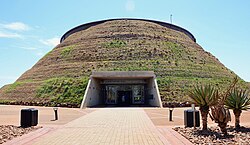


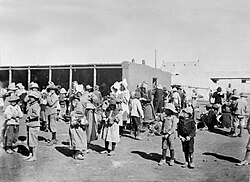


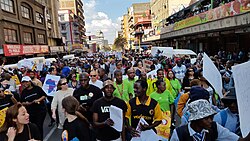
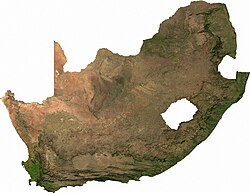

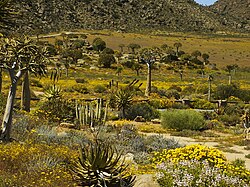
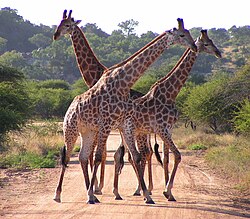
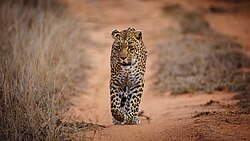
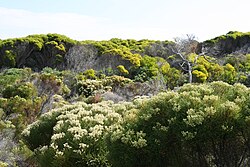
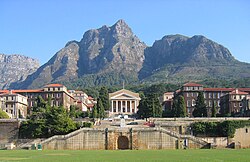
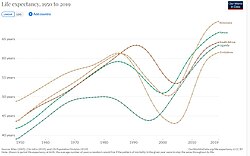
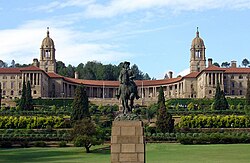
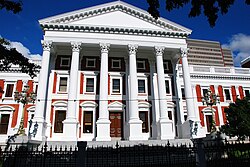

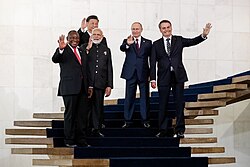
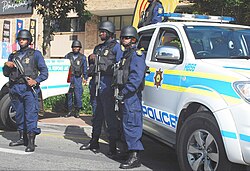

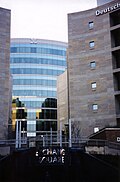
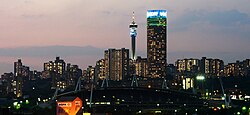
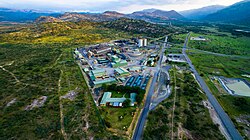

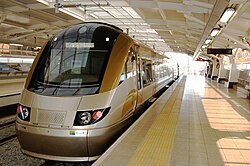

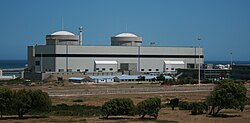

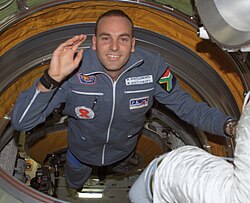
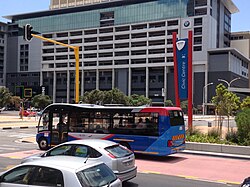

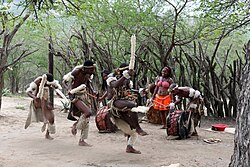


.svg)

_-_ZAF_-_UNOCHA.svg)
 63.0[7]
 0.699[8]


