



>Akk7a Corrections, added references |
m robot: Update article (please report if you notice any mistake or error in this edit) |
||
| Line 8: | Line 8: | ||
| image = Dogra Regiment Insignia.gif | | image = Dogra Regiment Insignia.gif | ||
| caption = Regimental Insignia of the Dogra Regiment | | caption = Regimental Insignia of the Dogra Regiment | ||
| dates = | | dates = 1877–present | ||
| country = {{flagicon|India}} [[India]] | | country = {{flagicon|India}} [[India]] | ||
| allegiance = | | allegiance = | ||
| Line 20: | Line 20: | ||
| nickname = Gentlemen Warriors | | nickname = Gentlemen Warriors | ||
| patron = | | patron = | ||
| motto = ''Kartavyam Anvatma (Duty Before Death) | | motto = ''Kartavyam Anvatma'' (Duty Before Death) | ||
| colors = ''Jwala Mata Ki Jai (Victory to Goddess Jwala) | | colors = ''Jwala Mata Ki Jai'' (Victory to Goddess Jwala) | ||
| colors_label = War Cry | | colors_label = War Cry | ||
| march = | | march = | ||
| mascot = Tiger | | mascot = Tiger | ||
| battles = <br>[[1st Anglo-Afghan War]]<br>[[2nd Anglo-Afghan War]]<br>[[World War I]]<br>[[World War II]]<br>[[Indo-Pakistani War of | | battles = <br>[[1st Anglo-Afghan War]]<br>[[2nd Anglo-Afghan War]]<br>[[World War I]]<br>[[World War II]]<br>[[Indo-Pakistani War of 1947–1948]]<br>[[Sino-Indian War]]<br>[[Indo-Pakistani War of 1965]]<br>[[Indo-Pakistani War of 1971]]<br>[[Kargil War]] | ||
| anniversaries = | | anniversaries = | ||
| decorations = 2 [[Victoria Cross]]<br> 44 [[Military Cross]]<br> | | decorations = 2 [[Victoria Cross]]<br> 44 [[Military Cross]]<br> 1 [[Ashoka Chakra]]<br> 13 [[Maha Vir Chakra]]s<br> 18 [[Kirti Chakra]]s<br> 16 [[Yudh Seva Medal]]<br> 46 [[Vir Chakra]]s and 1 Bar <br> 1 [[Padma Bhushan]] <br> 2 [[Padma Shri]] <br> 21 [[Uttam Yudh Seva Medal]]<br> 24 [[Param Vishisht Seva Medal]]<br> 38 [[Ati Vishisht Seva Medal]] and 3 bar <br> 58 [[Shaurya Chakra]]s<br> 337 [[Sena Medal]]s and 15 bar <br> 31 [[Vishisht Seva Medal]]<br> 89 Mention-in-Despatches and<br> 313 Chief of Army Staff Commendation Cards | ||
<!-- Commanders -->| current_commander = Lt General [[Jai Singh Nain]]<ref>{{cite | <!-- Commanders -->| current_commander = Lt General [[Jai Singh Nain]]<ref>{{cite news|url=https://economictimes.indiatimes.com/news/defence/lt-gen-ranbir-singh-avenges-death-of-soldiers-from-his-dogra-regiment/articleshow/54616578.cms|title=Lt Gen Ranbir Singh avenges death of soldiers from his Dogra regiment|newspaper=The Economic Times|date=2018-07-14|access-date=2021-05-30|last1=Pubby|first1=Manu}}</ref> | ||
| current_commander_label = | | current_commander_label = | ||
| ceremonial_chief = | | ceremonial_chief = | ||
| Line 43: | Line 43: | ||
==History== | ==History== | ||
The [[Dogra]]s, the inhabitants of 'Duggar' or Dogra land hail from the Indian states of [[Jammu and Kashmir (union territory)|Jammu and Kashmir]], [[Himachal Pradesh]] and the hilly regions of [[Punjab, India|Punjab]]. The Dogra Regiment traces its lineage to 1858, when the Agra Levy was raised by the [[British East India Company]] as part of the [[Bengal Army]]. The Dogras were added into the Bengal Army on the recommendation of Sir [[Frederick Roberts, 1st Earl Roberts|Fredrick Roberts]], the then commander-in-chief of India, who decided to add a Dogra regiment because he was impressed by the loyalty and soldierly qualities of Dogra troops.The Agra Levy was later renamed the [[38th Dogras]]. In 1887 the 37th (Dogra) Bengal Infantry was raised and later renamed the [[37th (Prince of Wales's Own) Dogras]]. In 1900 the 41st (Dogra) Bengal Infantry was raised and also later renamed the [[41st Dogras]]. In 1922 the Indian government reformed the army, moving from single battalion regiments to multi-battalion regiments.<ref>{{cite book|last=Sumner|first=Ian|title=The Indian Army 1914–1947|year=2001|publisher=Osprey Publishing|isbn=1-84176-196-6}}</ref> The 37th, 38th and 41st Dogras were all amalgamated into the [[17th Dogra Regiment]]. It dropped '17th' from its title in 1945 and was allocated to [[India]] upon its [[Indian independence movement|independence]] in 1947. | [[File:Sepoy, 37th Dogras Art.IWMART2348.jpg|thumb|300x300px|A sepoy of the 37th Dogras.]] | ||
The [[Dogra Rajput]]s, the inhabitants of 'Duggar' or Dogra land hail from the Indian states of [[Jammu and Kashmir (union territory)|Jammu and Kashmir]], [[Himachal Pradesh]] and the hilly regions of [[Punjab, India|Punjab]]. The Dogra Regiment traces its lineage to 1858, when the Agra Levy was raised by the [[British East India Company]] as part of the [[Bengal Army]]. The Dogras were added into the Bengal Army on the recommendation of Sir [[Frederick Roberts, 1st Earl Roberts|Fredrick Roberts]], the then commander-in-chief of India, who decided to add a Dogra regiment because he was impressed by the loyalty and soldierly qualities of Dogra troops.The Agra Levy was later renamed the [[38th Dogras]]. In 1887 the 37th (Dogra) Bengal Infantry was raised and later renamed the [[37th (Prince of Wales's Own) Dogras]]. In 1900 the 41st (Dogra) Bengal Infantry was raised and also later renamed the [[41st Dogras]]. In 1922 the Indian government reformed the army, moving from single battalion regiments to multi-battalion regiments.<ref>{{cite book|last=Sumner|first=Ian|title=The Indian Army 1914–1947|year=2001|publisher=Osprey Publishing|isbn=1-84176-196-6}}</ref>{{page needed|date=August 2021}} The 37th, 38th and 41st Dogras were all amalgamated into the [[17th Dogra Regiment]]. It dropped '17th' from its title in 1945 and was allocated to [[India]] upon its [[Indian independence movement|independence]] in 1947.{{citation needed|date=August 2021}} | |||
The 38th Dogras served in the [[siege of Malakand]] in 1897 and during the [[First World War]], served in [[Colony of Aden|Aden]], [[Suez]] and [[Mutasarrifate of Jerusalem|Palestine]] during the [[Battle of Megiddo (1918)|battle of Megiddo]]. The 37th Dogras took part in the [[Chitral Expedition]] in 1895 and during the First World War, fought in the [[Second Battle of Kut]] and the [[Fall of Baghdad (1917)|capture of Baghdad]] as part of the [[14th Indian Division]].<ref>British Official History of the Great War, Mesopotamia Campaign Vol. 4</ref> The 41st Dogras served in China from 1904 to 1908 as part of an international force, and then served on the [[Western Front (World War I)|Western Front]] and the [[Mesopotamia Campaign]] during World War I. | The 38th Dogras served in the [[siege of Malakand]] in 1897 and during the [[First World War]], served in [[Colony of Aden|Aden]], [[Suez]] and [[Mutasarrifate of Jerusalem|Palestine]] during the [[Battle of Megiddo (1918)|battle of Megiddo]]. The 37th Dogras took part in the [[Chitral Expedition]] in 1895 and during the First World War, fought in the [[Second Battle of Kut]] and the [[Fall of Baghdad (1917)|capture of Baghdad]] as part of the [[14th Indian Division]].<ref>British Official History of the Great War, Mesopotamia Campaign Vol. 4</ref> The 41st Dogras served in China from 1904 to 1908 as part of an international force, and then served on the [[Western Front (World War I)|Western Front]] and the [[Mesopotamia Campaign]] during World War I. | ||
| Line 62: | Line 63: | ||
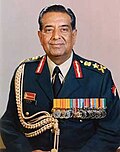
The regiment has produced one [[Chief of Army Staff (India)|Chief of Army Staff]], Gen. [[Nirmal Chander Vij]]. Vij also served as the 10th Colonel-in-Chief of the Dogra Regiment and the Dogra Scouts. | The regiment has produced one [[Chief of Army Staff (India)|Chief of Army Staff]], Gen. [[Nirmal Chander Vij]]. Vij also served as the 10th Colonel-in-Chief of the Dogra Regiment and the Dogra Scouts. | ||
[[File: | [[File:Highlanders and Dogras in a trench with dugouts Fauquissart, France (Photo 24-294).jpg|thumb|300x300px|Dogras (along with [[Scottish regiment|Highlanders]]) in a trench with dugouts; Fauquissart, France.]] | ||
===Indo-Pakistani War of 1947–48=== | ===Indo-Pakistani War of 1947–48=== | ||
| Line 70: | Line 71: | ||
===Sino-Indian War=== | ===Sino-Indian War=== | ||
{{main|Sino-Indian War}} | {{main|Sino-Indian War}} | ||
A company from the 4th battalion fought in the battle of [[Walong]] in November 1962 and suffered significant casualties against a vastly numerically superior Chinese force.<ref>http://www.bharat-rakshak.com/ARMY/history/1962war/263-walong.html</ref> | A company from the 4th battalion fought in the battle of [[Walong]] in November 1962 and suffered significant casualties against a vastly numerically superior Chinese force.<ref>{{Cite web|url=http://www.bharat-rakshak.com/ARMY/history/1962war/263-walong.html|title=Battle of Walong, 18 Oct - 16 Nov 1962 - Bharat Rakshak - Indian Army & Land Forces}}</ref> | ||
===Indo-Pakistani War of 1965=== | ===Indo-Pakistani War of 1965=== | ||
| Line 79: | Line 80: | ||
In recognition of this valour the battalion was awarded the battle honour Chand Tekri and theatre honour of Jammu and Kashmir 1965. | In recognition of this valour the battalion was awarded the battle honour Chand Tekri and theatre honour of Jammu and Kashmir 1965. | ||
2nd battalion, Dogra Regiment led the famed OP Hill attack on Nov 2nd 1965, to capture a strategic location in Mendhar area of Jammu and Kashmir. This is regarded as one of the bloodiest battles fought by the Indian Army. Maj GS Pall led the Delta company up the steep and open hill towards Kala Pathar, a frontal attack under heavy machine gun and mortar fire, with the hillside strewn with landmines, followed by Charlie and Alpha companies. Meanwhile 7th Battalion of Sikh Regiment and 5th Battalion of Sikh Li Regiment troops flanked the enemy. Dogras suffered heavy casualties throughout the night but refused to withdraw, eventually meeting up with the Sikh and Sikh Li troops for the capture. Many awards were earned posthumously, including Officers, JCOs and Jawans. 2rd Dogras earned a Battle Honour for this famed battle. An impressive memorial stands at the site today commemorating the battle and the bravery of 2nd Dogras. | |||
===Indo-Pakistani War of 1971=== | ===Indo-Pakistani War of 1971=== | ||
| Line 92: | Line 95: | ||
===UN Peacekeeping=== | ===UN Peacekeeping=== | ||
The Dogra Regiment has not only contributed to the [[United Nations]] Peacekeeping Forces in the [[Gaza Strip]], [[Korea]], and the [[Democratic Republic of the Congo|Congo]], but has also contributed in providing various military observers in various peace keeping operation around the globe. The 1st, 3rd and 9th battalions have participated in UN peacekeeping missions. | The Dogra Regiment has not only contributed to the [[United Nations]] Peacekeeping Forces in the [[Gaza Strip]], [[Korea]], and the [[Democratic Republic of the Congo|Congo]], but has also contributed in providing various military observers in various peace keeping operation around the globe. The 1st, 3rd and 9th battalions have participated in UN peacekeeping missions. | ||
[[File:Dogra Regiment UN.jpg|thumb|300x300px|Dogra Regiment troops, along with a Sikh non-Dogra Regiment soldier, on UN duty.]] | |||
==Recruitment== | ==Recruitment== | ||
Dogra regiment has a fixed class composition: 50 percent from [[Himachal Pradesh]], 25 percent from [[Jammu and Kashmir (union territory)|Jammu and Kashmir]], and a balance from [[Hoshiarpur district|Hoshiarpur]], [[Nawanshahr district|Nawanshahr]], [[Pathankot district|Pathankot]], and [[Rupnagar district|Rupnagar]] districts of [[Punjab, India|Punjab]]. Enlisting in army is seen as honourable pursuit for Dogras; soldiering has not only become a substantial part of the economic structure of the Dogra hills, but created social and cultural traditions built on the people's association with the army.<ref>{{cite web|url=https://news.abplive.com/news/india/dogra-regiment-a-fact-file-on-indian-armys-gentleman-warrior-who-hail-from-foothills-of-shivaliks-1320287|title=Dogra Regiment: A Fact-File On Indian Army's 'Gentleman Warriors' Who Hail From Shivaliks Foothills|date=2020-08-24|access-date=2021-05-30}}</ref> | |||
==Regimental Centre== | ==Regimental Centre== | ||
Initially, the Dogra battalions were raised in various different places by the British Indian Army, with each having their own depot. After the first World War, a common depot was formed, which was later termed the Training Battalion (later the 10th Battalion). In 1943, the Training Battalion ceased to exist and was renamed ''The Dogra Regimental Centre''. After independence, the regimental centre was established in [[Meerut]], [[Uttar Pradesh]] in 1952. It was moved to [[Faizabad Cantonment]], Uttar Pradesh, in June 1976, where it is currently located.<ref>{{cite web|url=https://www.philamart.com/Listing/Details/3080307/The-Dogra-Regimental-CentreIndian-Army-Postal-Cover-APO|title=The Dogra Regimental Centre Indian Army Postal Cover|date=2017-03-22|access-date=2021-05-30}}</ref> | Initially, the Dogra battalions were raised in various different places by the British Indian Army, with each having their own depot. After the first World War, a common depot was formed, which was later termed the Training Battalion (later the 10th Battalion). In 1943, the Training Battalion ceased to exist and was renamed ''The Dogra Regimental Centre''. After independence, the regimental centre was established in [[Meerut]], [[Uttar Pradesh]] in 1952. It was moved to [[Faizabad Cantonment]], Uttar Pradesh, in June 1976, where it is currently located.<ref>{{cite web|url=https://www.philamart.com/Listing/Details/3080307/The-Dogra-Regimental-CentreIndian-Army-Postal-Cover-APO|title=The Dogra Regimental Centre Indian Army Postal Cover|date=2017-03-22|access-date=2021-05-30}}</ref> | ||
==Units == | ==Units == | ||
[[File:The Dogra Regiment Marching Contingent passes through the Rajpath, on the occasion of the 69th Republic Day Parade 2018, in New Delhi on January 26, 2018.jpg|thumb|300x300px|The Dogra Regiment Marching Contingent passes through the Rajpath, on the occasion of the 69th Republic Day Parade 2018, in New Delhi.]] | |||
*2nd Battalion - The Great Second | *2nd Battalion - The Great Second | ||
*3rd Battalion – Mighty Third | *3rd Battalion – Mighty Third | ||
| Line 111: | Line 111: | ||
*8th Battalion - Elite Eight | *8th Battalion - Elite Eight | ||
*9th Battalion – Suadih Paltan | *9th Battalion – Suadih Paltan | ||
*10th Battalion | *10th Battalion- Shaktishali Dus | ||
*11th Battalion - Elite Eleven | *11th Battalion - Elite Eleven | ||
*12th Battalion – Towering Twelfth | *12th Battalion – Towering Twelfth | ||
| Line 141: | Line 141: | ||
*The 4th battalion has the additional honour of being the first battalion of the Indian Army to be deployed on the [[Siachen Glacier]]. | *The 4th battalion has the additional honour of being the first battalion of the Indian Army to be deployed on the [[Siachen Glacier]]. | ||
==Affiliations== | ==Affiliations== | ||
In the year 1990 affiliations of [[List of active Indian Navy ships|Indian Navy ships]] were being done with the Indian Army Regiments, [[INS Ranvijay]] was affiliated with the Dogra Regiment in 1997. Apart from this, the Dogras are also affiliated with the Regiment of Artillery (14 Medium Regiment and 15 Medium Regiment). | In the year 1990 affiliations of [[List of active Indian Navy ships|Indian Navy ships]] were being done with the Indian Army Regiments, [[INS Ranvijay]] was affiliated with the Dogra Regiment in 1997. Apart from this, the Dogras are also affiliated with the Regiment of Artillery (14 Medium Regiment and [[15 Medium Regiment (India)|15 Medium Regiment]]). | ||
==Battle honours== | ==Battle honours== | ||
Two battalions of the 17th Dogra Regiment (the 2nd and 3rd), also fought in the [[Malayan Campaign]]. After the [[Fall of Singapore]], a large number of the captured troops later went on to join the [[Indian National Army]].<ref>{{Harvnb|Fay|1993|p=137}}</ref> | Two battalions of the 17th Dogra Regiment (the 2nd and 3rd), also fought in the [[Malayan Campaign]]. After the [[Fall of Singapore]], a large number of the captured troops later went on to join the [[Indian National Army]].<ref>{{Harvnb|Fay|1993|p=137}}</ref> | ||
[[File:King's Colour, 2nd Battalion, 17th Dogra Regiment 1926-1947.jpg|thumb| | [[File:King's Colour, 2nd Battalion, 17th Dogra Regiment 1926-1947.jpg|thumb|300x300px|King's Colour 2/17th Dogra Regiment, 1926–1947]] | ||
===Pre-independence=== | ===Pre-independence=== | ||
| Line 187: | Line 185: | ||
*Kennedy Peak | *Kennedy Peak | ||
*[[Burma Campaign|Burma 1942–45]] | *[[Burma Campaign|Burma 1942–45]] | ||
===Post-independence=== | ===Post-independence=== | ||
*Jhangar 1947 | *Jhangar 1947 | ||
*Barwali 1947 | *Barwali 1947 | ||
| Line 212: | Line 206: | ||
*Ferozpur | *Ferozpur | ||
*Dera Baba Nanak | *Dera Baba Nanak | ||
==Colonels of the Dogra Regiment== | ==Colonels of the Dogra Regiment== | ||
[[File:General Nirmal Chander Vij.jpg|thumb|300x300px|Gen. N.C. Vij, the 20th Chief of Army Staff and the first Dogra Regiment officer to hold the title.]] | |||
* [[Lieutenant General (India)|Lieutenant General]] Kalwant Singh | * [[Lieutenant General (India)|Lieutenant General]] Kalwant Singh | ||
* Lieutenant General M.S. Pathania PVSM | * Lieutenant General M.S. Pathania PVSM | ||
| Line 232: | Line 224: | ||
* Lieutenant General A.K. Singh PVSM, AVSM, VSM, SM | * Lieutenant General A.K. Singh PVSM, AVSM, VSM, SM | ||
* Lieutenant General G.S. Dhillon PVSM, VSM, YSM, SM | * Lieutenant General G.S. Dhillon PVSM, VSM, YSM, SM | ||
* Brig Jagmohan Varma, SM, VSM | |||
* Lieutenant General [[Ranbir Singh (general)|Ranbir Singh]] AVSM**, YSM, SM | * Lieutenant General [[Ranbir Singh (general)|Ranbir Singh]] AVSM**, YSM, SM | ||
* Lieutenant General [[Jai Singh Nain]] AVSM,SM | * Lieutenant General [[Jai Singh Nain]] AVSM,SM | ||
==Gallantry Awards== | ==Gallantry Awards== | ||
Before Indian independence, the Dogras had to their credit two [[Victoria Cross]]es and 44 [[Military Cross]]es besides 312 other awards. | [[File:Shri Vijay Kumar receiving 2006 Arjuna Award for Shooting.jpg|thumb|300x300px|Vijay Kumar receiving the 2006 Arjuna Award for shooting.]] | ||
Before Indian independence, the Dogras had to their credit two [[Victoria Cross]]es and 44 [[Military Cross]]es besides 312 other awards including 2 unit Citations. Some awardees are like : | |||
* Brigadier [[John Alexander Sinton]] [[Victoria Cross|VC]] – 37th Dogras | * Brigadier [[John Alexander Sinton]] [[Victoria Cross|VC]] – 37th Dogras | ||
* Lance Naik [[Lala (VC)|Lala]] VC – 41st Dogras | * Lance Naik [[Lala (VC)|Lala]] VC – 41st Dogras | ||
* Major R.C. Dunlop [[Military Cross|MC]] | * Major R.C. Dunlop [[Military Cross|MC]] | ||
* Major R.C. Christie MC | * Major R.C. Christie MC | ||
| Line 259: | Line 250: | ||
*5th Battalion (2 unit citations) | *5th Battalion (2 unit citations) | ||
*7th Battalion | *7th Battalion | ||
*14th Battalion | *10th Battalion | ||
*14th Battalion | |||
*21st Battalion | |||
*11 Rashtriya Rifles | *11 Rashtriya Rifles | ||
*40 Rashtriya Rifles | *40 Rashtriya Rifles | ||
| Line 278: | Line 271: | ||
[[Category:Military units and formations established in 1877]] | [[Category:Military units and formations established in 1877]] | ||
[[Category:Dogra]] | [[Category:Dogra]] | ||
[[Category:1877 establishments in India]] | [[Category:1877 establishments in India]] | ||
Revision as of 17:05, 10 June 2022
 | This article may require cleanup to meet Bharatpedia's quality standards. The specific problem is: Unencyclopedic writing (March 2019) |
| Dogra Regiment | |
|---|---|
| File:Dogra Regiment Insignia.gif Regimental Insignia of the Dogra Regiment | |
| Active | 1877–present |
| Country |  India India |
| Branch |  Indian Army Indian Army |
| Type | Line Infantry |
| Regimental Centre | Faizabad, Uttar Pradesh |
| Nickname(s) | Gentlemen Warriors |
| Motto(s) | Kartavyam Anvatma (Duty Before Death) |
| War Cry | Jwala Mata Ki Jai (Victory to Goddess Jwala) |
| Mascot(s) | Tiger |
| Engagements | 1st Anglo-Afghan War 2nd Anglo-Afghan War World War I World War II Indo-Pakistani War of 1947–1948 Sino-Indian War Indo-Pakistani War of 1965 Indo-Pakistani War of 1971 Kargil War |
| Decorations | 2 Victoria Cross 44 Military Cross 1 Ashoka Chakra 13 Maha Vir Chakras 18 Kirti Chakras 16 Yudh Seva Medal 46 Vir Chakras and 1 Bar 1 Padma Bhushan 2 Padma Shri 21 Uttam Yudh Seva Medal 24 Param Vishisht Seva Medal 38 Ati Vishisht Seva Medal and 3 bar 58 Shaurya Chakras 337 Sena Medals and 15 bar 31 Vishisht Seva Medal 89 Mention-in-Despatches and 313 Chief of Army Staff Commendation Cards |
| Battle honours | Jhangar, Rajauri, Uri, Asal Uttar, Haji Pir, Raja Picquet, OP Hill, Siramani, Suadih, Dera Baba Nanak and Chandgram
Theatre Honours |
| Commanders | |
| Current commander | Lt General Jai Singh Nain[1] |
| Notable commanders | General Nirmal Chander Vij PVSM, UYSM, AVSM General Gopal Gurunath Bewoor Padma Bhushan, PVSM Lt Gen VK Jetley PVSM, UYSM, AVSM, VSM Lt Gen PN Hoon PVSM, AVSM, YSM Brigadier Mohammad Usman MVC |
| Insignia | |
| Regimental Insignia | Tiger revered as the mount of the Goddess Durga, who is a widely worshipped deity in the Dogra Hills |
The Dogra Regiment is an infantry regiment of the Indian Army. The regiment traces its roots directly from the 17th Dogra Regiment of the British Indian Army. When transferred to the Indian Army like its sister regiments, the numeral prefix (in the case of the Dogra Regiment, 17) was removed. Units of the Dogra Regiment have fought in all conflicts that independent India has been engaged in, making it one of the most prestigious and most decorated regiments of the Indian Army.
History

The Dogra Rajputs, the inhabitants of 'Duggar' or Dogra land hail from the Indian states of Jammu and Kashmir, Himachal Pradesh and the hilly regions of Punjab. The Dogra Regiment traces its lineage to 1858, when the Agra Levy was raised by the British East India Company as part of the Bengal Army. The Dogras were added into the Bengal Army on the recommendation of Sir Fredrick Roberts, the then commander-in-chief of India, who decided to add a Dogra regiment because he was impressed by the loyalty and soldierly qualities of Dogra troops.The Agra Levy was later renamed the 38th Dogras. In 1887 the 37th (Dogra) Bengal Infantry was raised and later renamed the 37th (Prince of Wales's Own) Dogras. In 1900 the 41st (Dogra) Bengal Infantry was raised and also later renamed the 41st Dogras. In 1922 the Indian government reformed the army, moving from single battalion regiments to multi-battalion regiments.[2][page needed] The 37th, 38th and 41st Dogras were all amalgamated into the 17th Dogra Regiment. It dropped '17th' from its title in 1945 and was allocated to India upon its independence in 1947.[citation needed]
The 38th Dogras served in the siege of Malakand in 1897 and during the First World War, served in Aden, Suez and Palestine during the battle of Megiddo. The 37th Dogras took part in the Chitral Expedition in 1895 and during the First World War, fought in the Second Battle of Kut and the capture of Baghdad as part of the 14th Indian Division.[3] The 41st Dogras served in China from 1904 to 1908 as part of an international force, and then served on the Western Front and the Mesopotamia Campaign during World War I.
In 1949, Karan Singh, son of Maharaja Hari Singh, the last maharaja of the princely state of Jammu and Kashmir, was appointed Regent by his father. He wrote the Dogra Regiment's regimental song, 'Dikhi Lai Dogra Desh'.
Perhaps the best compliment given to the Dogras has come from Field Marshal Sir William Slim who wrote to them thus:
The Dogra proved themselves yet again a hardened and courageous fighter. Like his predecessors, he has been proud of his military heritage and has shown himself well versed in the art of war. Nor did he fail to live up to his age old reputation of combining courage with modesty and good manners as a gentleman should. I know from personal experience that in an army with many fine battalions, the Dogras have not merely upheld their brilliant reputation, but have added lustre to the pages of history of both their own regiment and of the Indian Army.
— Field Marshal William Slim, 1st Viscount Slim
Formation
The regiment was formed in 1922 through the amalgamation of three separate regiments of Dogras into the 17th Dogra Regiment.[4] They were:
- 1st Battalion – formerly the 37th (Prince of Wales's Own) Dogras
- 2nd Battalion – formerly the 38th Dogras
- 3rd Battalion – formerly the 1st Battalion, 41st Dogras
- 10th (Training) Battalion – formerly the 2nd Battalion, 41st Dogras
The regiment has produced one Chief of Army Staff, Gen. Nirmal Chander Vij. Vij also served as the 10th Colonel-in-Chief of the Dogra Regiment and the Dogra Scouts.
.jpg)
Indo-Pakistani War of 1947–48
Pakistani raiders had besieged and reduced Skardu in early 1948.[5]:300–305 It was vital that Leh, the next likely target, be relieved before it was attacked by the raiders. Maj. Prithi Chand, along with a band of 40 volunteers from the 2nd battalion, Dogra Regiment, began a hazardous mid-winter ascent of the Zojila pass on 16 February 1948, with rifles and ammunition for the garrison. They reached Leh on 8 March, where an ad hoc force for defence was organised, followed soon by a Jammu and Kashmir State Forces detachment bringing additional weapons.[6]:195–199
Sino-Indian War
A company from the 4th battalion fought in the battle of Walong in November 1962 and suffered significant casualties against a vastly numerically superior Chinese force.[7]
Indo-Pakistani War of 1965
On September 2, 1965, the 3rd battalion, commanded by Lt. Col. R.B. Nair, was given the task to capture Point 7702 in Jammu and Kashmir. The brigade then planned two battalion attacks with the 2nd battalion, Sikh Regiment on the left to clear the Raja picket and the 3rd battalion, Dogra Regiment on the right to capture point 7702. The battalion left late in the evening on September 5, and successfully sneaked past Raja picket. The two leading companies were to assault from the left flank and cross the start line at 04:00 on September 6 under the able leadership of Maj. Greesh Chandra Verma and Capt. Gurdev Singh Bawa. B and C companies stormed point 7702 at 05:00 on September 6. After a fierce hand-to-hand and bunker-to-bunker fight, the enemy was uprooted from the strongly built defences and the post was captured by 05:45.
Maj. G.C. Verma was wounded in the head and refused to be evacuated. He breathed his last on seeing the success signal being fired from his pistol by Sub. Rattan Singh. Capt. G.S. Bawa, the other assaulting company commander was also wounded fatally while silencing an enemy MMG. The battalion lost two officers, one JCO and 14 ORs while 3 officers, 2 JCOs and 60 ORs were wounded in the battle. 39 men of enemy were killed and 5 were taken as POWs.
In recognition of this valour the battalion was awarded the battle honour Chand Tekri and theatre honour of Jammu and Kashmir 1965.
2nd battalion, Dogra Regiment led the famed OP Hill attack on Nov 2nd 1965, to capture a strategic location in Mendhar area of Jammu and Kashmir. This is regarded as one of the bloodiest battles fought by the Indian Army. Maj GS Pall led the Delta company up the steep and open hill towards Kala Pathar, a frontal attack under heavy machine gun and mortar fire, with the hillside strewn with landmines, followed by Charlie and Alpha companies. Meanwhile 7th Battalion of Sikh Regiment and 5th Battalion of Sikh Li Regiment troops flanked the enemy. Dogras suffered heavy casualties throughout the night but refused to withdraw, eventually meeting up with the Sikh and Sikh Li troops for the capture. Many awards were earned posthumously, including Officers, JCOs and Jawans. 2rd Dogras earned a Battle Honour for this famed battle. An impressive memorial stands at the site today commemorating the battle and the bravery of 2nd Dogras.
Indo-Pakistani War of 1971
On the eastern front, the 9th battalion was responsible for the fall of Suadih, a small village in East Pakistan that was a strong bastion of the Pakistan Army's most fortified position in the country. This led to the ultimate liberation of East Pakistan and a victory for the Indian Army. For this task, 9 Dogra was awarded the battle honour of Suadih.
The 5th battalion was posted in Asal Uttar, Punjab, where it was assigned to accord depth to the defences of Khem Karan.
Kargil War
The 5th battalion fought in the Kargil War to capture Tiger Hill.
UN Peacekeeping
The Dogra Regiment has not only contributed to the United Nations Peacekeeping Forces in the Gaza Strip, Korea, and the Congo, but has also contributed in providing various military observers in various peace keeping operation around the globe. The 1st, 3rd and 9th battalions have participated in UN peacekeeping missions.

Recruitment
Dogra regiment has a fixed class composition: 50 percent from Himachal Pradesh, 25 percent from Jammu and Kashmir, and a balance from Hoshiarpur, Nawanshahr, Pathankot, and Rupnagar districts of Punjab. Enlisting in army is seen as honourable pursuit for Dogras; soldiering has not only become a substantial part of the economic structure of the Dogra hills, but created social and cultural traditions built on the people's association with the army.[8]
Regimental Centre
Initially, the Dogra battalions were raised in various different places by the British Indian Army, with each having their own depot. After the first World War, a common depot was formed, which was later termed the Training Battalion (later the 10th Battalion). In 1943, the Training Battalion ceased to exist and was renamed The Dogra Regimental Centre. After independence, the regimental centre was established in Meerut, Uttar Pradesh in 1952. It was moved to Faizabad Cantonment, Uttar Pradesh, in June 1976, where it is currently located.[9]
Units

- 2nd Battalion - The Great Second
- 3rd Battalion – Mighty Third
- 4th Battalion - Char Satara
- 5th Battalion – Five The Formidable
- 6th Battalion - Soaring Six
- 7th Battalion - Unbeaten Seven
- 8th Battalion - Elite Eight
- 9th Battalion – Suadih Paltan
- 10th Battalion- Shaktishali Dus
- 11th Battalion - Elite Eleven
- 12th Battalion – Towering Twelfth
- 13th Battalion - Siramani
- 14th Battalion – Fabulous Fourteen
- 15th Battalion – Fighting Fifteenth
- 16th Battalion – Sovereign Sixteen
- 17th Battalion – Smashing Seventeen
- 18th Battalion – Ashok Chakra Paltan
- 19th Battalion – Dynamic Nineteen
- 20th Battalion - Leaping Tigers
- 21st Battalion - Roaring Twenty-one
- Dogra Scouts
- 11 Rashtriya Rifles
- 20 Rashtriya Rifles
- 40 Rashtriya Rifles
- 62 Rashtriya Rifles
The regiment also has 4 Territorial Army battalions.
- 112th Infantry Battalion (Territorial Army) (based at Jalandhar, Punjab)
- 153rd Infantry Battalion (Territorial Army) (based at Meerut, Uttar Pradesh)
- 159th Infantry Battalion (Territorial Army) (based at Thalela, Jammu and Kashmir)
- 130th Infantry Battalion (Territorial Army) (Ecological) (based at Shimla, Himachal Pradesh)
Other facts:
- 1st Battalion was transformed in 1981 into the 7th Battalion, Mechanised Infantry Regiment
- The battalions have participated in various UN missions; the 3rd battalion have served in Korea, the 1st battalion has served in Congo, the 9th battalion has served in Gaza and the 5th battalion has served in Sierra Leone. The 3rd battalion was the first-ever battalion of the Indian Army to go on a UN mission.
- The 4th battalion has the additional honour of being the first battalion of the Indian Army to be deployed on the Siachen Glacier.
Affiliations
In the year 1990 affiliations of Indian Navy ships were being done with the Indian Army Regiments, INS Ranvijay was affiliated with the Dogra Regiment in 1997. Apart from this, the Dogras are also affiliated with the Regiment of Artillery (14 Medium Regiment and 15 Medium Regiment).
Battle honours
Two battalions of the 17th Dogra Regiment (the 2nd and 3rd), also fought in the Malayan Campaign. After the Fall of Singapore, a large number of the captured troops later went on to join the Indian National Army.[10]

Pre-independence
Combined battle honours of 37th (Prince of Wales's Own) Dogras, 38th Dogras, 41st Dogras:[11]
- World War I
- La Bassée 1914
- Festubert 1914–1915
- Givenchy 1914
- Neuve Chapelle
- Aubers
- France and Flanders 1914–15
- Egypt 1915
- Megiddo
- Nablus
- Palestine 1918
- Tigris 1916
- Kut al-Amara 1917
- Wadi
- El Hanna
- Baghdad
- Mesopotamia 1915–18
- Aden
- Megiddo – 1918
- Nablus – 1918
- Palestine – 1918
- North-West Frontier 1915–1917
- Afghanistan 1919
- World War II
- Kota Bharu
- Malaya 1941–42
- Singapore 1941–42
- Donbaik
- Wrencat
- Nunshigum
- Magwe
- Kennedy Peak
- Burma 1942–45
Post-independence
- Jhangar 1947
- Barwali 1947
- Rajauri 1947
- Jammu and Kashmir 1947–48
- Hajipir
- Raja Picquet-Chand Tekri
- OP Hill (NL 1053)
- Tiger Hill-1999
- Uri
- Poonch
- Jammu and Kashmir 1965
- Asal Uttar
- Dograi
- Punjab 1965
- Suadhi
- Siramani
- Chauddagram
- East Pakistan 1971
- Ferozpur
- Dera Baba Nanak
Colonels of the Dogra Regiment

- Lieutenant General Kalwant Singh
- Lieutenant General M.S. Pathania PVSM
- Major General M.G. Hazari PVSM, AVSM
- Major General Mohan Lal PVSM
- Lieutenant General P.N. Hoon PVSM, AVSM, SM
- Lieutenant General V.K. Jetley PVSM, VSM
- Lieutenant General V.K. Sood PVSM, AVSM, PhD
- Lieutenant General Sher Amir Singh PVSM, AVSM
- Lieutenant General H.S. Bedi PVSM, VSM
- Lieutenant General Surjit Singh PVSM, AVSM, VSM
- General N.C. Vij PVSM, UYSM, AVSM, ADC
- Lieutenant General S.S. Sanga PVSM, AVSM, VSM, SM
- Lieutenant General J.K. Mohanty PVSM, UYSM, AVSM, VSM, SM, ADC
- Lieutenant General Jasbir Singh Dhaliwal PVSM, AVSM, VSM
- Lieutenant General A.K. Singh PVSM, AVSM, VSM, SM
- Lieutenant General G.S. Dhillon PVSM, VSM, YSM, SM
- Brig Jagmohan Varma, SM, VSM
- Lieutenant General Ranbir Singh AVSM**, YSM, SM
- Lieutenant General Jai Singh Nain AVSM,SM
Gallantry Awards

Before Indian independence, the Dogras had to their credit two Victoria Crosses and 44 Military Crosses besides 312 other awards including 2 unit Citations. Some awardees are like :
- Brigadier John Alexander Sinton VC – 37th Dogras
- Lance Naik Lala VC – 41st Dogras
- Major R.C. Dunlop MC
- Major R.C. Christie MC
- Subedar Narsinghu MC
- Lance Naik Janak Singh MC
- Lieutenant Colonel Prithi Chand MVC
- Brigadier Narinder Singh Sandhu MVC
- Capt Devinder Singh Ahlawat MVC
- Lieutenant Colonel Khushal Chand MVC
- Major Sandeep Shankla AC
- Colonel K.J. Singh SC**, SM
- Honorary Captain Vijay Kumar Sharma Padma Shri, AVSM, SM
- Colonel Anil Kumar KC
The following battalions of the regiment have also been awarded the Chief of Army Staff's Unit Citation:
- 2nd Battalion
- 5th Battalion (2 unit citations)
- 7th Battalion
- 10th Battalion
- 14th Battalion
- 21st Battalion
- 11 Rashtriya Rifles
- 40 Rashtriya Rifles
References
- ↑ Pubby, Manu (14 July 2018). "Lt Gen Ranbir Singh avenges death of soldiers from his Dogra regiment". The Economic Times. Retrieved 30 May 2021.
- ↑ Sumner, Ian (2001). The Indian Army 1914–1947. Osprey Publishing. ISBN 1-84176-196-6.
- ↑ British Official History of the Great War, Mesopotamia Campaign Vol. 4
- ↑ C.T. Atkinson, A history of the 1st (P.W.O.) Battalion: the Dogra Regiment 1887-1947, 37th Dogras, 1887-1923, 1st (P.W.O.) Bn., 17th Dogra Rgt., 1922-1945 (Southampton : printed for the subscribers by the Camelot Press, 1950).
- ↑ Prasad, S.N.; Dharm Pal (1987). History of Operations In Jammu and Kashmir 1947–1948. New Delhi: History Department, Ministry of Defence, Government of India. (printed at Thomson Press (India) Limited). p. 418..
- ↑ Sen, Maj Gen L. P. (1969). Slender Was the Thread: Kashmir Confrontation 1947–48. New Delhi: Orient Longman. p. 308. ISBN 0-86131-692-4. Retrieved 4 August 2010.
- ↑ "Battle of Walong, 18 Oct - 16 Nov 1962 - Bharat Rakshak - Indian Army & Land Forces".
- ↑ "Dogra Regiment: A Fact-File On Indian Army's 'Gentleman Warriors' Who Hail From Shivaliks Foothills". 24 August 2020. Retrieved 30 May 2021.
- ↑ "The Dogra Regimental Centre Indian Army Postal Cover". 22 March 2017. Retrieved 30 May 2021.
- ↑ Fay 1993, p. 137
- ↑ "Infantry Regiments: The cutting edge of Soldiering". 24 January 2018. Retrieved 30 May 2021.

