


imported>JimRenge |
m robot: Update article (please report if you notice any mistake or error in this edit) |
||
| Line 1: | Line 1: | ||
{{short description|Nature spirits associated with South Asian and Southeast Asian mythologies}} | {{short description|Nature spirits associated with South Asian and Southeast Asian mythologies}} | ||
{{other uses}} | {{other uses|Yaksha (disambiguation)}} | ||
{{More citations needed|date=August 2016}} | {{More citations needed|date=August 2016}} | ||
{{Use dmy dates|date= | {{Use dmy dates|date=April 2022}} | ||
{{Use Indian English|date=October 2019}} | {{Use Indian English|date=October 2019}} | ||
{{multiple image|perrow=2|total_width=350|caption_align=center | {{multiple image|perrow=2|total_width=350|caption_align=center | ||
| Line 12: | Line 12: | ||
| image2 = Mudgarpani Yaksha, Mathura, 100 BCE.jpg | | image2 = Mudgarpani Yaksha, Mathura, 100 BCE.jpg | ||
| caption2 = "[[Mudgarpani|Mudgarpani Yaksha]]", 100 BCE<ref name="SRQF88"/> | | caption2 = "[[Mudgarpani|Mudgarpani Yaksha]]", 100 BCE<ref name="SRQF88"/> | ||
| footer=<center>Remains of the colossal statues of the [[Parkham Yaksha]] (150 BCE) and the [[Mudgarpani]] ("Mace-holder") Yaksha (100 BCE), [[Mathura]]. These colossal statues stand around two metres tall.<ref name="SRQF88">Dated 100 BCE. {{cite book |last1=Quintanilla |first1=Sonya Rhie |title=History of Early Stone Sculpture at Mathura: Ca. 150 BCE – 100 CE |date=2007 |page=368, fig. 88 |publisher=BRILL |isbn=9789004155374 |url=https://books.google.com/books?id=X7Cb8IkZVSMC&pg=PA368 |language=en}}</ref> The Mudgarpani Yaksha holds a ''[[mudgar]]'' mace in the right hand, and the left hand used to support a small standing devotee or child joining hands in prayer.<ref>{{cite book |last1=Quintanilla |first1=Sonya Rhie |title=History of Early Stone Sculpture at Mathura: Ca. 150 BCE – 100 CE |date=2007 |publisher=BRILL |isbn=9789004155374 |page=365, fig. 85 |url=https://books.google.com/books?id=X7Cb8IkZVSMC&pg=PA365 |language=en}}</ref><ref>{{cite book |last1=Dalal |first1=Roshen |title=The Religions of India: A Concise Guide to Nine Major Faiths |date=2010 |publisher=Penguin Books India |isbn=978-0-14-341517-6 |page=398 |url=https://books.google.com/books?id=pNmfdAKFpkQC&pg=PA398 |language=en}}</ref><br>[[Art of Mathura]], [[Mathura Museum]]</center> | | footer=<center>Remains of the colossal statues of the [[Parkham Yaksha]] (150 BCE) and the [[Mudgarpani]] ("[[Mace (bludgeon)|Mace]]-holder") Yaksha (100 BCE), [[Mathura]]. These colossal statues stand around two metres tall.<ref name="SRQF88">Dated 100 BCE. {{cite book |last1=Quintanilla |first1=Sonya Rhie |title=History of Early Stone Sculpture at Mathura: Ca. 150 BCE – 100 CE |date=2007 |page=368, fig. 88 |publisher=BRILL |isbn=9789004155374 |url=https://books.google.com/books?id=X7Cb8IkZVSMC&pg=PA368 |language=en}}</ref> The Mudgarpani Yaksha holds a ''[[mudgar]]'' mace in the right hand, and the left hand used to support a small standing devotee or child joining hands in prayer.<ref>{{cite book |last1=Quintanilla |first1=Sonya Rhie |title=History of Early Stone Sculpture at Mathura: Ca. 150 BCE – 100 CE |date=2007 |publisher=BRILL |isbn=9789004155374 |page=365, fig. 85 |url=https://books.google.com/books?id=X7Cb8IkZVSMC&pg=PA365 |language=en}}</ref><ref>{{cite book |last1=Dalal |first1=Roshen |title=The Religions of India: A Concise Guide to Nine Major Faiths |date=2010 |publisher=Penguin Books India |isbn=978-0-14-341517-6 |page=398 |url=https://books.google.com/books?id=pNmfdAKFpkQC&pg=PA398 |language=en}}</ref><br>[[Art of Mathura]], [[Mathura Museum]]</center> | ||
}} | }} | ||
The '''yakshas''' ({{lang-sa|यक्ष}} {{lang|sa-Latn|yakṣa}}; {{lang-pi|yakkha|i=yes}}) are a broad class of nature-spirits, usually benevolent, but sometimes mischievous or capricious, connected with water, fertility, trees, the forest, treasure and wilderness.<ref>{{cite book |last1=Singh |title=A History of Ancient and Early Medieval India |date=2008 |publisher=Pearson Education |location=New Delhi|isbn=978-81-317-1120-0|page=430}}</ref><ref name="eb">{{Cite web|last=Stefon|first=Matt|title=Yaksha {{!}} Hindu mythology|url=https://www.britannica.com/topic/yaksha|url-status=live|access-date=15 July 2007|website=[[Encyclopedia Britannica]]|language=en}}</ref> They appear in [[Hindu texts|Hindu]], [[Jainism|Jain]] and [[Buddhist texts]], as well as ancient and medieval era temples of [[South Asia]] and [[Southeast Asia]] as guardian deities.<ref name=eb/><ref>{{cite book|author=Richard John Richards|title=South-east Asian Ceramics: Thai, Vietnamese, and Khmer: From the Collection of the Art Gallery of South Australia|url=https://books.google.com/books?id=D0DWAAAAMAAJ |year=1995 |publisher=Oxford University Press|isbn=978-967-65-3075-2 |pages=27, 67}}</ref> The feminine form of the word is '''{{IAST|yakṣī}}'''<ref>For {{lang|sa|यक्षी}} as the feminine of {{lang|sa|यक्षः}} see V. S. Apte, ''The Practical Sanskrit-English Dictionary'', p. 776.</ref> or '''[[yakshini]]''' ({{lang-sa|यक्षिणी}} {{lang|sa-Latn|yakṣiṇī}}; [[Pali]]:Yakkhini).<ref>For yakṣiṇī ({{lang|sa|यक्षिणी}}) as a regular Sanskrit term for a female yakṣa, and yakṣaṇī as a Buddhist variant, see [[Franklin Edgerton]], ''Buddhist Hybrid Sanskrit Grammar and Dictionary'', Vol. 2, Motilal Banarsidass, first Ed., 1953, p. 442.</ref> | The '''yakshas''' ({{lang-sa|यक्ष}} {{lang|sa-Latn|yakṣa}}; {{lang-pi|yakkha|i=yes}}) are a broad class of nature-spirits, usually benevolent, but sometimes mischievous or capricious, connected with water, fertility, trees, the forest, treasure and wilderness.<ref>{{cite book |last1=Singh |title=A History of Ancient and Early Medieval India |date=2008 |publisher=Pearson Education |location=New Delhi|isbn=978-81-317-1120-0|page=430}}</ref><ref name="eb">{{Cite web|last=Stefon|first=Matt|title=Yaksha {{!}} Hindu mythology|url=https://www.britannica.com/topic/yaksha|url-status=live|access-date=15 July 2007|website=[[Encyclopedia Britannica]]|language=en}}</ref> They appear in [[Hindu texts|Hindu]], [[Jainism|Jain]] and [[Buddhist texts]], as well as ancient and medieval era temples of [[South Asia]] and [[Southeast Asia]] as guardian deities.<ref name=eb/><ref>{{cite book|author=Richard John Richards|title=South-east Asian Ceramics: Thai, Vietnamese, and Khmer: From the Collection of the Art Gallery of South Australia|url=https://books.google.com/books?id=D0DWAAAAMAAJ |year=1995 |publisher=Oxford University Press|isbn=978-967-65-3075-2 |pages=27, 67}}</ref> The feminine form of the word is '''{{IAST|yakṣī}}'''<ref>For {{lang|sa|यक्षी}} as the feminine of {{lang|sa|यक्षः}} see V. S. Apte, ''The Practical Sanskrit-English Dictionary'', p. 776.</ref> or '''''[[yakshini]]''''' ({{lang-sa|यक्षिणी}} {{lang|sa-Latn|yakṣiṇī}}; [[Pali]]:Yakkhini).<ref>For yakṣiṇī ({{lang|sa|यक्षिणी}}) as a regular Sanskrit term for a female yakṣa, and yakṣaṇī as a Buddhist variant, see [[Franklin Edgerton]], ''Buddhist Hybrid Sanskrit Grammar and Dictionary'', Vol. 2, Motilal Banarsidass, first Ed., 1953, p. 442.</ref> | ||
In Hindu, Jain | In Hindu, Jain and Buddhist texts, the {{IAST|yakṣa}} has a dual personality. On the one hand, a {{IAST|yakṣa}} may be an inoffensive nature-[[fairy]], associated with woods and mountains; but there is also a darker version of the {{IAST|yakṣa}}, which is a kind of ghost ([[bhoot (ghost)|bhuta]]) that haunts the wilderness and waylays and devours travellers, similar to the [[rakshasa|{{IAST|rakṣasas}}]]. | ||
==Early yakshas== | |||
{{multiple image | {{multiple image | ||
| align = right|total_width=250 | | align = right|total_width=250 | ||
| Line 27: | Line 28: | ||
| alt2 = | | alt2 = | ||
| caption2 = | | caption2 = | ||
| footer = The ''yaksha'' are nature spirits who are benevolent, sometimes mischievous or capricious. Left: Yaksi | | footer = The ''yaksha'' are nature spirits who are benevolent, sometimes mischievous or capricious. Left: Yaksi from [[Bharhut]]; right: Yaksha from [[Pitalkhora]], c. 2nd century CE. | ||
}} | }} | ||
Several monumental yakshas are known from the time of the [[Maurya Empire]] period. They are variously dated from around the 3rd century BCE to the 1st century BCE. These statues are monumental (usually around 2 metres tall), and often bear inscriptions related to their identification as yakshas. They are considered as the first known monumental stone sculptures in India. Two of these monumental yakshas are known from [[Patna]], one from [[Vidisha]] and one from [[Parkham, Uttar-Pradesh|Parkham]], as well as one yakshini from Vidisha. The {{IAST|yakṣas}} may have originally been the [[tutelary deity]] of a city, district, lake, or well. Their worship, together with popular belief in [[Nāga|nagas]] (serpent deities), feminine fertility deities, and mother goddesses, may have had its origin among the early indigenous peoples of India. Yaksha worship coexisted with the priest-conducted sacrifices of the Vedic period.<ref>{{Cite web |title=yaksha {{!}} Hindu mythology {{!}} Britannica |url=https://www.britannica.com/topic/yaksha |access-date=9 April 2022 |website=www.britannica.com |language=en}}</ref> They were later viewed as the steward deities of the earth and the wealth buried beneath.<ref name="RDeC">{{cite book|title=Haunting the Buddha: Indian Popular Religions and the Formation of Buddhism|last=DeCaroli|first=Robert|year=2004|publisher=[[Oxford University Press]], US| isbn=978-0-19-516838-9}}</ref> | |||
Several monumental yakshas are known from the time of the [[Maurya Empire]] period. They are variously dated from around the 3rd century BCE to the 1st century BCE. These statues are monumental (usually around 2 metres tall), and often bear inscriptions related to their identification as yakshas. They are considered as the first known monumental stone sculptures in India. Two of these monumental yakshas are known from [[Patna]], one from [[Vidisha]] and one from [[Parkham, Uttar-Pradesh|Parkham]], as well as one yakshini from Vidisha. The {{IAST|yakṣas}} may have originally been the [[tutelary deity]] of | |||
In early Indian art, male {{IAST|yakṣas}} are portrayed either as fearsome [[warrior]]s or as portly, stout and [[dwarfism|dwarf-like]]. {{IAST|Yakṣiṇī}}s are portrayed as beautiful young women with happy round faces and full breasts and hips.{{citation needed|date=April 2021}} | In early Indian art, male {{IAST|yakṣas}} are portrayed either as fearsome [[warrior]]s or as portly, stout and [[dwarfism|dwarf-like]]. {{IAST|Yakṣiṇī}}s are portrayed as beautiful young women with happy round faces and full breasts and hips.{{citation needed|date=April 2021}} | ||
| Line 38: | Line 37: | ||
[[File:Kubera, the God of Riches LACMA M.69.13.8 (1 of 9).jpg|thumb|upright=0.75|Kubera, the God of Riches, [[LACMA]]]] | [[File:Kubera, the God of Riches LACMA M.69.13.8 (1 of 9).jpg|thumb|upright=0.75|Kubera, the God of Riches, [[LACMA]]]] | ||
{{Main|Kubera}} | {{Main|Kubera}} | ||
In Hindu, Buddhist and Jain | In Hindu, Buddhist and Jain Religion, [[Kubera]], the god of wealth and prosperity, is considered the king of the yakshas. He is regarded as the regent of the North ([[Guardians of the directions|Dikapāla]]) and a protector of the world ([[Lokapala|Lokapāla]]). | ||
His many epithets{{For example?|date=August 2019}} extol him as the overlord of numerous semi-divine species and the owner of the treasures of the world. | His many epithets{{For example?|date=August 2019}} extol him as the overlord of numerous semi-divine species and the owner of the treasures of the world. Kubera is often depicted with a plump body, adorned with jewels, carrying a money-pot and a club. His [[vahana]] (vehicle) is the [[Viverrinae|mongoose]]. He is often seen with [[Lakshmi]], the Hindu goddess of wealth, fortune and prosperity. | ||
In Buddhism, he is equated with [[Vaiśravaṇa]]. | In Buddhism, he is equated with [[Vaiśravaṇa]]. | ||
==Yakshas in Buddhism== | ==Yakshas in Buddhism== | ||
{{Buddhist term | {{Buddhist term | ||
| fontsize=100% | | fontsize=100% | ||
| Line 52: | Line 50: | ||
|pi=Yakkha | |pi=Yakkha | ||
|pi-Latn= | |pi-Latn= | ||
|my= | |my=ယက္ခ | ||
|my-Latn= | |my-Latn=yakkha | ||
|sa=यक्ष | |sa=यक्ष | ||
|sa-Latn=yakṣa | |sa-Latn=yakṣa | ||
| Line 68: | Line 66: | ||
|ta=இயக்கர் | |ta=இயக்கர் | ||
|ta-Latn=yākka | |ta-Latn=yākka | ||
|vi=dạ | |vi=dạ xoa | ||
|bo=གནོད་སྦྱིན་ | |bo=གནོད་སྦྱིན་ | ||
|bo-Latn=gnod-sbyin | |bo-Latn=gnod-sbyin | ||
| Line 74: | Line 72: | ||
|km-Latn=yoks | |km-Latn=yoks | ||
}} | }} | ||
[[File:Scroll painting of Atavaka, Unknown Artist, Japan, 14th century.jpg|thumb|right|200px|Painting of [[Āṭavaka]], a yaksha who challenged the Buddha]] | |||
In Buddhist literature, the {{IAST|yakṣa}} are the attendants of [[Vaiśravaṇa]], the guardian of the northern quarter, a beneficent [[deva (Buddhism)|god]] who protects the righteous. The term also refers to the [[Twelve Heavenly Generals]] who guard [[Bhaisajyaguru|{{IAST|Bhaiṣajyaguru}}]], the Medicine Buddha. | In Buddhist literature, the {{IAST|yakṣa}} are the attendants of [[Vaiśravaṇa]], the guardian of the northern quarter, a beneficent [[deva (Buddhism)|god]] who protects the righteous. The term also refers to the [[Twelve Heavenly Generals]] who guard [[Bhaisajyaguru|{{IAST|Bhaiṣajyaguru}}]], the Medicine Buddha. The yakshas of many Buddhist stories are ugly ogres, reborn in that form because of sins committed during their past lives as humans.<ref name=":0">{{Cite book|last1=Bhairav|first1=J. Furcifer|title=Ghosts, Monsters, and Demons of India|last2=Khanna|first2=Rakesh|publisher=Blaft Publications Pvt Ltd|year=2020|isbn=9789380636474|location=India|pages=417–418}}</ref> | ||
One such malevolent yaksha, Silesaloma, appears in the [[Jataka tales]] of the [[Pali]] Buddhist canon. In the story "Prince Five-Weapons and the Sticky-Haired Demon",<ref>{{Cite web|title=Prince Five-Weapons and Sticky-Hair|url=https://www.buddhanet.net/e-learning/buddhism/bt_5.htm|website=Buddhist Studies: Buddha Dharma Education Association & BuddhaNet}}</ref> Silesaloma is described as being the height of a palm tree, with sharp teeth and two yellow tusks, and a coat of thick, matted fur. A [[bodhisattva]] named Prince Panchayudha (Five-Weapons) attempted to kill Silesaloma, but all his attacks, from both his weapons and his bare hands, were thwarted by Silesaloma's sticky hair. Ultimately, Prince Panchayudha impressed Silesaloma with his bravery, and the yaksha decided to let him go. Panchayudha explained that Silesaloma's monstrous state was caused by wicked deeds from his past lives, and he taught the yaksha the [[five precepts]], after which Silesaloma renounced violence and transformed into a friendly forest spirit.<ref name=":0" /> | |||
The [[Mahamayuri|Mahāmāyūrīvidyārājñī]] Sūtra, a text that dates back to fourth century or earlier (translated from the [[Sanskrit]] by [[Kumarajiva]]), gives a large list of yakshas that reside in the classical cities of ancient India<ref>[V. S. Agravala, " Geographical Contents of Mahamayuri JUPHS, Vol. XV, Pt. ii, 1942, p. 28]</ref> who are invoked to seek the protection of the BuddhaDharma: | The [[Mahamayuri|Mahāmāyūrīvidyārājñī]] Sūtra, a text that dates back to fourth century or earlier (translated from the [[Sanskrit]] by [[Kumarajiva]]), gives a large list of yakshas that reside in the classical cities of ancient India<ref>[V. S. Agravala, " Geographical Contents of Mahamayuri JUPHS, Vol. XV, Pt. ii, 1942, p. 28]</ref> who are invoked to seek the protection of the BuddhaDharma: | ||
<blockquote style="background-color:none;margin-right:5em;margin-left:0em;border-left:solid 6px #FFE0BB;padding:1.0em"> | <blockquote style="background-color:none;margin-right:5em;margin-left:0em;border-left:solid 6px #FFE0BB;padding:1.0em"> | ||
| Line 115: | Line 114: | ||
==Yakshas in Jainism== | ==Yakshas in Jainism== | ||
[[File:' | [[File:Plaosan Temple Guardian.jpg|thumb|A yaksha as a gate guardian (''dvarapala'') at [[Plaosan]] temple in Indonesia]] | ||
[[Jainism|Jains]] mainly maintain [[cult image]]s of [[Arihant (Jainism)|Arihant]]s and [[Tirthankara]]s, who have conquered the inner passions and attained moksha. ''Yakshas'' and ''yakshinis'' are found in pair around the cult images of Jinas, serving as guardian deities. The ''yaksha'' is generally on the right-hand side of the Jina image while the ''yakshini'' is on the left-hand side. | [[File:Nswag, india, madhya pradesh, stele con yaksha-yakshini e jinas, XI sec..JPG|thumb|left|Yaksha and yakshini couple Sarvānubhūti and Kuṣmāṇḍinī, with the [[Tirthankaras]].]] | ||
[[Jainism|Jains]] mainly maintain [[cult image]]s of [[Arihant (Jainism)|Arihant]]s and [[Tirthankara]]s, who have conquered the inner passions and attained moksha. ''Yakshas'' and ''yakshinis'' are found in pair around the cult images of Jinas, serving as guardian deities. The ''yaksha'' is generally on the right-hand side of the Jina image while the ''yakshini'' is on the left-hand side. They are regarded mainly as devotees of the Jina and have supernatural powers. They are also wandering through the cycles of births and deaths just like the worldly souls, but have supernatural powers.<ref>Pramodaben Chitrabhanu, ''Jain symbols, Ceremonies and Practices''</ref> | |||
The Harivamsapurana (783 CE) refers to them as Shasandevatas. Initially among the yakshas, Manibhadra and Purnabadra yakshas and Bahuputrika yakshini were popular. The yaksha [[Manibhadra]] is worshipped by the Jains affiliated with the Tapa Gachchha. During tenth and thirteenth centuries yaksha Saarvanubhuti, or Sarvahna and yakshinis [[Chakreshvari]], [[Ambika (Jainism)|Ambika]], [[Padmavati (Jainism)|Padmavati]], and [[Jwalamalini]] became so popular that independent temples devoted to them were erected. | [[File:'Digambara Yaksha Sarvahna' from Karnataka, India, c. 900, Norton Simon Museum.JPG|thumbnail|'Digambara Yaksha Sarvahna', [[Norton Simon Museum]], {{circa|900 CE}}]] | ||
The Harivamsapurana (783 CE) refers to them as Shasandevatas. Initially among the yakshas, Manibhadra and Purnabadra yakshas and Bahuputrika yakshini were popular. The yaksha [[Manibhadra]] is worshipped by the Jains affiliated with the Tapa Gachchha. During tenth and thirteenth centuries yaksha Saarvanubhuti, or Sarvahna and yakshinis [[Chakreshvari]], [[Ambika (Jainism)|Ambika]], [[Padmavati (Jainism)|Padmavati]], and [[Jwalamalini]] became so popular that independent temples devoted to them were erected. | |||
Yakshas and yakshinis are common among the [[Murtipujaka]] [[Śvētāmbara]] and Bispanthi [[Digambara]] Jains. The [[Digambara Terapanth]] movement opposes their worship.<ref> | Yakshas and yakshinis are common among the [[Murtipujaka]] [[Śvētāmbara]] and Bispanthi [[Digambara]] Jains. The [[Digambara Terapanth]] movement opposes their worship.<ref>{{cite book |editor=Flügel, Peter |year=2006 |title=Studies in Jaina History and Culture: Disputes and eialogues |publisher=Routledge |page=352}}</ref><ref>{{cite web |title=Indian Antiquary |date=31 December 1903 |publisher=Popular Prakashan |url=https://books.google.com/books?id=vzNCAQAAMAAJ&q=Gomedha+yaksha&pg=PA496 |access-date=31 December 2019 |via=Google Books}}</ref> Among the Murtipujaka Śvētāmbaras, the [[Tristutik Gaccha]] sect (both historical founded by Silagana and Devabhadra, and the modern sect organised by [[Rajendrasuri]]) object to the worship of shruta-devatas.<ref>{{cite journal |last=Jain |first=Shalin |year=2012 |title=Divided identities: The Jain sects in medieval India |journal=Proceedings of the Indian History Congress |volume=73 |pages=450–460 |jstor=44156237 |url=https://www.jstor.org/stable/44156237 |via=JSTOR}}</ref> | ||
===Shasan devatas in Jainism=== | ===Shasan devatas in Jainism=== | ||
In Jainism, there are twenty-four yakshas and [[Yakshini#Yakshis in Jainism|twenty-four yakshis]] that serve as śāsanadevatās for the twenty-four tirthankaras:<ref>{{cite web |title=Twenty four Tirthankaras at a glance |website=jaindharmonline.com |url=http://www.jaindharmonline.com/tirthan/tirsum.htm |url-status=dead |access-date=27 April 2021 |archive-url=https://web.archive.org/web/20060712011129/http://www.jaindharmonline.com/tirthan/tirsum.htm |archive-date=12 July 2006}}</ref> These yakshas are as follows: | |||
In Jainism, there are twenty-four yakshas and [[Yakshini#Yakshis in Jainism|twenty-four yakshis]] that serve as śāsanadevatās for the twenty-four tirthankaras: | {{clear}} | ||
{{div col|colwidth= | {{div col begin|colwidth=15em}} | ||
*[[Gomukha]] | * [[Gomukha]] | ||
*Mahayaksha | * Mahayaksha | ||
*Trimukha | * Trimukha | ||
*Yaksheshvara or Yakshanayaka | * Yaksheshvara or Yakshanayaka | ||
*Tumbaru | * Tumbaru | ||
*Kusuma | * Kusuma | ||
*Varanandi or Matanga | * Varanandi or Matanga | ||
*Vijaya or Shyama | * Vijaya or Shyama | ||
*Ajita | * Ajita | ||
*Brahma or Brahmeshvara | * Brahma or Brahmeshvara | ||
*Ishvara or Yakset | * Ishvara or Yakset | ||
*Kumara | * Kumara | ||
*Dandapani | * Dandapani | ||
*Patala | * Patala | ||
*Kinnara | * Kinnara | ||
*Kimpurusha or Garuda | * Kimpurusha or Garuda | ||
*Gandharva | * Gandharva | ||
*Kendra or Yakshendra | * Kendra or Yakshendra | ||
*[[Kubera#Beyond Hinduism|Kubera]] | * [[Kubera#Beyond Hinduism|Kubera]] | ||
*Varuna | * Varuna | ||
*Bhrikuti | * Bhrikuti | ||
*Gomedha or Sarvahna | * Gomedha or Sarvahna | ||
*[[Dharanendra]] or Parshvayaksha | * [[Dharanendra]] or Parshvayaksha | ||
*Matanga{{div col end}} | * Matanga | ||
{{div col end}} | |||
{{clear}} | |||
==Yakshas in poems== | ==Yakshas in poems== | ||
In [[Kālidāsa]]'s poem ''[[Meghadūta]]'', for instance, the {{IAST|yakṣa}} narrator is a romantic figure, pining with love for his missing beloved. By contrast, in the didactic Hindu dialogue of the [[Yaksha Prashna|{{IAST|Yakṣapraśnāḥ}}]] "Questions of the {{IAST|Yakṣa}}", it is a [[tutelary deity|tutelary spirit]] of a lake that challenges [[Yudhishthira|{{IAST|Yudhiṣṭhira}}]]. | In [[Kālidāsa]]'s poem ''[[Meghadūta]]'', for instance, the {{IAST|yakṣa}} narrator is a romantic figure, pining with love for his missing beloved. By contrast, in the didactic Hindu dialogue of the [[Yaksha Prashna|{{IAST|Yakṣapraśnāḥ}}]] "Questions of the {{IAST|Yakṣa}}", it is a [[tutelary deity|tutelary spirit]] of a lake that challenges [[Yudhishthira|{{IAST|Yudhiṣṭhira}}]]. | ||
In ''[[Mahavamsa]]'' poem of Sri Lanka, a local population is given the term Yakkhas. [[Prince Vijaya]] encountered the royalty of the yakkhas' queen, [[Kuveni]], in her capital of [[Lanka]] pura | In ''[[Mahavamsa]]'' poem of Sri Lanka, a local population is given the term Yakkhas. [[Prince Vijaya]] encountered the royalty of the yakkhas' queen, [[Kuveni]], in her capital of [[Lanka]] pura and conquered them. | ||
==Yakshas in Thailand== | ==Yakshas in Thailand== | ||
| Line 163: | Line 166: | ||
==Gallery== | ==Gallery== | ||
<gallery | <gallery heights="250"> | ||
File:Sanchi 8-17.jpg|Yaksha couple standing on lotus leaves, the male (sic) holding a lotus bud and posed in shalabhanjika | File:Sanchi 8-17.jpg|Yaksha couple standing on lotus leaves, the male (sic) holding a lotus bud and posed in shalabhanjika | ||
File:Dvarapala Yaksha.JPG|Dvarapala Yaksha made of basalt. Statue found in Buddhist cave ([[Pitalkhora]]) and dates to 2nd century CE. On display in the [[Prince of Wales Museum]]. | File:Dvarapala Yaksha.JPG|Dvarapala Yaksha made of basalt. Statue found in Buddhist cave ([[Pitalkhora]]) and dates to 2nd century CE. On display in the [[Prince of Wales Museum]]. | ||
File:Mudgarpani Yaksha - Circa 2nd Century BCE - Bharnakalan - ACCN 87-145 - Government Museum - Mathura 2013-02-24 6146.JPG|Mudgarpani Yaksha, 2nd century BCE, Bharnakalan, [[Mathura Museum]]. | File:Mudgarpani Yaksha - Circa 2nd Century BCE - Bharnakalan - ACCN 87-145 - Government Museum - Mathura 2013-02-24 6146.JPG|Mudgarpani Yaksha, 2nd century BCE, Bharnakalan, [[Mathura Museum]]. | ||
File:Vidisha District Museum Yaksha.jpg|[[Vidisha]] Yaksha, 2nd century BCE, [[Vidisha Museum]]. | File:Vidisha District Museum Yaksha.jpg|[[Vidisha]] Yaksha, 2nd century BCE, [[Vidisha Museum]]. | ||
Revision as of 09:42, 1 July 2022
 | This article needs more citations. (August 2016) |


Art of Mathura, Mathura Museum
The yakshas (Sanskrit: यक्ष yakṣa; Pali: yakkha) are a broad class of nature-spirits, usually benevolent, but sometimes mischievous or capricious, connected with water, fertility, trees, the forest, treasure and wilderness.[4][5] They appear in Hindu, Jain and Buddhist texts, as well as ancient and medieval era temples of South Asia and Southeast Asia as guardian deities.[5][6] The feminine form of the word is yakṣī[7] or yakshini (Sanskrit: यक्षिणी yakṣiṇī; Pali:Yakkhini).[8]
In Hindu, Jain and Buddhist texts, the yakṣa has a dual personality. On the one hand, a yakṣa may be an inoffensive nature-fairy, associated with woods and mountains; but there is also a darker version of the yakṣa, which is a kind of ghost (bhuta) that haunts the wilderness and waylays and devours travellers, similar to the rakṣasas.
Early yakshas


Several monumental yakshas are known from the time of the Maurya Empire period. They are variously dated from around the 3rd century BCE to the 1st century BCE. These statues are monumental (usually around 2 metres tall), and often bear inscriptions related to their identification as yakshas. They are considered as the first known monumental stone sculptures in India. Two of these monumental yakshas are known from Patna, one from Vidisha and one from Parkham, as well as one yakshini from Vidisha. The yakṣas may have originally been the tutelary deity of a city, district, lake, or well. Their worship, together with popular belief in nagas (serpent deities), feminine fertility deities, and mother goddesses, may have had its origin among the early indigenous peoples of India. Yaksha worship coexisted with the priest-conducted sacrifices of the Vedic period.[9] They were later viewed as the steward deities of the earth and the wealth buried beneath.[10]
In early Indian art, male yakṣas are portrayed either as fearsome warriors or as portly, stout and dwarf-like. Yakṣiṇīs are portrayed as beautiful young women with happy round faces and full breasts and hips.[citation needed]
Kubera
.jpg)
In Hindu, Buddhist and Jain Religion, Kubera, the god of wealth and prosperity, is considered the king of the yakshas. He is regarded as the regent of the North (Dikapāla) and a protector of the world (Lokapāla).
His many epithetsTemplate:For example? extol him as the overlord of numerous semi-divine species and the owner of the treasures of the world. Kubera is often depicted with a plump body, adorned with jewels, carrying a money-pot and a club. His vahana (vehicle) is the mongoose. He is often seen with Lakshmi, the Hindu goddess of wealth, fortune and prosperity.
In Buddhism, he is equated with Vaiśravaṇa.
Yakshas in Buddhism
| Translations of Yaksha | |
|---|---|
| Sanskrit | यक्ष (IAST: yakṣa) |
| Pali | Yakkha |
| Burmese | ယက္ခ (MLCTS: yakkha) |
| Chinese | 夜叉 (Pinyin: yèchà) |
| Japanese | Template:Ruby-ja (rōmaji: yasha) |
| Khmer | យក្ស (UNGEGN: yoks) |
| Korean | 야차 (RR: yacha) |
| Sinhala | යක්ෂ (yakṣa) |
| Tibetan | གནོད་སྦྱིན་ (gnod-sbyin) |
| Tamil | இயக்கர் (yākka) |
| Thai | ยักษ์ (RTGS: yak) |
| Vietnamese | dạ xoa |
| Glossary of Buddhism | |

In Buddhist literature, the yakṣa are the attendants of Vaiśravaṇa, the guardian of the northern quarter, a beneficent god who protects the righteous. The term also refers to the Twelve Heavenly Generals who guard Bhaiṣajyaguru, the Medicine Buddha. The yakshas of many Buddhist stories are ugly ogres, reborn in that form because of sins committed during their past lives as humans.[11]
One such malevolent yaksha, Silesaloma, appears in the Jataka tales of the Pali Buddhist canon. In the story "Prince Five-Weapons and the Sticky-Haired Demon",[12] Silesaloma is described as being the height of a palm tree, with sharp teeth and two yellow tusks, and a coat of thick, matted fur. A bodhisattva named Prince Panchayudha (Five-Weapons) attempted to kill Silesaloma, but all his attacks, from both his weapons and his bare hands, were thwarted by Silesaloma's sticky hair. Ultimately, Prince Panchayudha impressed Silesaloma with his bravery, and the yaksha decided to let him go. Panchayudha explained that Silesaloma's monstrous state was caused by wicked deeds from his past lives, and he taught the yaksha the five precepts, after which Silesaloma renounced violence and transformed into a friendly forest spirit.[11]
The Mahāmāyūrīvidyārājñī Sūtra, a text that dates back to fourth century or earlier (translated from the Sanskrit by Kumarajiva), gives a large list of yakshas that reside in the classical cities of ancient India[13] who are invoked to seek the protection of the BuddhaDharma:
"The deity Krakucchanda resides in Pataliputra.
Aparajita resides in Sthuno.
The great yaksha Bhadra resides in Saila.
The great deity Manava resides in Uttara.
The great sage Vajrapani though lives in Rajagrha
Often dwells in Mount Grdhrakuta.
The deity Garuda resides in the Vipula mountain.
Citragupta resides in Citemukha.
The yaksha Vakula resides in Rajagrha.
...
The yaksha king Mahagiri resides in Girinagara.
The yaksha Vasava resides in Vaidisa.
The yaksha Karttikeya resides in Rohitaka.
This yaksha Kumara is renowned in the great city.
...
Vaisravana who resides in the city Alakavati,
Located along the jewelled stairway of the Buddha’s descent,
Is surrounded by billions of gods and goddesses.
Such yakshas command huge and powerful contingents of troops
To subjugate adversaries and enemies,
Conquering all.
They are famous throughout all directions.
Imbued with great dignity and virtue,
They come to aid
In the battles between the heavens and asuras.
These deities of virtues and great yaksha generals are located everywhere in Jambudvipa. They uphold and protect the Buddhadharma, generating compassion."
[14]
Yakshas in Jainism


Jains mainly maintain cult images of Arihants and Tirthankaras, who have conquered the inner passions and attained moksha. Yakshas and yakshinis are found in pair around the cult images of Jinas, serving as guardian deities. The yaksha is generally on the right-hand side of the Jina image while the yakshini is on the left-hand side. They are regarded mainly as devotees of the Jina and have supernatural powers. They are also wandering through the cycles of births and deaths just like the worldly souls, but have supernatural powers.[15]

The Harivamsapurana (783 CE) refers to them as Shasandevatas. Initially among the yakshas, Manibhadra and Purnabadra yakshas and Bahuputrika yakshini were popular. The yaksha Manibhadra is worshipped by the Jains affiliated with the Tapa Gachchha. During tenth and thirteenth centuries yaksha Saarvanubhuti, or Sarvahna and yakshinis Chakreshvari, Ambika, Padmavati, and Jwalamalini became so popular that independent temples devoted to them were erected.
Yakshas and yakshinis are common among the Murtipujaka Śvētāmbara and Bispanthi Digambara Jains. The Digambara Terapanth movement opposes their worship.[16][17] Among the Murtipujaka Śvētāmbaras, the Tristutik Gaccha sect (both historical founded by Silagana and Devabhadra, and the modern sect organised by Rajendrasuri) object to the worship of shruta-devatas.[18]
Shasan devatas in Jainism
In Jainism, there are twenty-four yakshas and twenty-four yakshis that serve as śāsanadevatās for the twenty-four tirthankaras:[19] These yakshas are as follows:
- Gomukha
- Mahayaksha
- Trimukha
- Yaksheshvara or Yakshanayaka
- Tumbaru
- Kusuma
- Varanandi or Matanga
- Vijaya or Shyama
- Ajita
- Brahma or Brahmeshvara
- Ishvara or Yakset
- Kumara
- Dandapani
- Patala
- Kinnara
- Kimpurusha or Garuda
- Gandharva
- Kendra or Yakshendra
- Kubera
- Varuna
- Bhrikuti
- Gomedha or Sarvahna
- Dharanendra or Parshvayaksha
- Matanga
Yakshas in poems
In Kālidāsa's poem Meghadūta, for instance, the yakṣa narrator is a romantic figure, pining with love for his missing beloved. By contrast, in the didactic Hindu dialogue of the Yakṣapraśnāḥ "Questions of the Yakṣa", it is a tutelary spirit of a lake that challenges Yudhiṣṭhira.
In Mahavamsa poem of Sri Lanka, a local population is given the term Yakkhas. Prince Vijaya encountered the royalty of the yakkhas' queen, Kuveni, in her capital of Lanka pura and conquered them.
Yakshas in Thailand

Yakshas (Thai: ยักษ์, RTGS: Yak) are an important element in Thai temple art and architecture.[20] They are common as guardians of the gates in Buddhist temples throughout the country since at least the 14th century. Ceramic sculptures of guardian yakshas were produced in Thailand, during the Sukhothai and Ayutthaya periods, between the 14th and 16th centuries, at several kiln complexes in northern Thailand. They are mostly depicted with a characteristic face, having big round bulging eyes and protruding fangs, as well as a green complexion. Yakshas and their female counterparts are common in the Buddhist literature of Thailand, such as in The Twelve Sisters and Phra Aphai Mani. As ogres, giants, and ogresses, yakshas are present as well in Thai folklore.
"ย ยักษ์" (yo yak) is also used as an illustration in order to name the letter ย, the 34th consonant of the Thai alphabet, according to the traditional letter symbols Thai children use to memorise the alphabet.[21]
Gallery
-
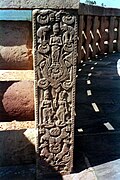 Yaksha couple standing on lotus leaves, the male (sic) holding a lotus bud and posed in shalabhanjika
 -
 Dvarapala Yaksha made of basalt. Statue found in Buddhist cave (Pitalkhora) and dates to 2nd century CE. On display in the Prince of Wales Museum.
 -
 Mudgarpani Yaksha, 2nd century BCE, Bharnakalan, Mathura Museum.
 -
 Vidisha Yaksha, 2nd century BCE, Vidisha Museum.
 -
 Gomedh and Ambika at Maharaja Chhatrasal Museum, 11th century


.JPG)
See also
References
- ↑ 1.0 1.1 Dated 100 BCE. Quintanilla, Sonya Rhie (2007). History of Early Stone Sculpture at Mathura: Ca. 150 BCE – 100 CE. BRILL. p. 368, fig. 88. ISBN 9789004155374.
- ↑ Quintanilla, Sonya Rhie (2007). History of Early Stone Sculpture at Mathura: Ca. 150 BCE – 100 CE. BRILL. p. 365, fig. 85. ISBN 9789004155374.
- ↑ Dalal, Roshen (2010). The Religions of India: A Concise Guide to Nine Major Faiths. Penguin Books India. p. 398. ISBN 978-0-14-341517-6.
- ↑ Singh (2008). A History of Ancient and Early Medieval India. New Delhi: Pearson Education. p. 430. ISBN 978-81-317-1120-0.
- ↑ 5.0 5.1 Stefon, Matt. "Yaksha | Hindu mythology". Encyclopedia Britannica. Retrieved 15 July 2007.
{{cite web}}: CS1 maint: url-status (link) - ↑ Richard John Richards (1995). South-east Asian Ceramics: Thai, Vietnamese, and Khmer: From the Collection of the Art Gallery of South Australia. Oxford University Press. pp. 27, 67. ISBN 978-967-65-3075-2.
- ↑ For यक्षी as the feminine of यक्षः see V. S. Apte, The Practical Sanskrit-English Dictionary, p. 776.
- ↑ For yakṣiṇī (यक्षिणी) as a regular Sanskrit term for a female yakṣa, and yakṣaṇī as a Buddhist variant, see Franklin Edgerton, Buddhist Hybrid Sanskrit Grammar and Dictionary, Vol. 2, Motilal Banarsidass, first Ed., 1953, p. 442.
- ↑ "yaksha | Hindu mythology | Britannica". www.britannica.com. Retrieved 9 April 2022.
- ↑ DeCaroli, Robert (2004). Haunting the Buddha: Indian Popular Religions and the Formation of Buddhism. Oxford University Press, US. ISBN 978-0-19-516838-9.
- ↑ 11.0 11.1 Bhairav, J. Furcifer; Khanna, Rakesh (2020). Ghosts, Monsters, and Demons of India. India: Blaft Publications Pvt Ltd. pp. 417–418. ISBN 9789380636474.
- ↑ "Prince Five-Weapons and Sticky-Hair". Buddhist Studies: Buddha Dharma Education Association & BuddhaNet.
- ↑ [V. S. Agravala, " Geographical Contents of Mahamayuri JUPHS, Vol. XV, Pt. ii, 1942, p. 28]
- ↑ "The Mahamayuri Vidyarajni Sutra 佛母大孔雀明王經". 10 June 2012. Retrieved 31 December 2019.
- ↑ Pramodaben Chitrabhanu, Jain symbols, Ceremonies and Practices
- ↑ Flügel, Peter, ed. (2006). Studies in Jaina History and Culture: Disputes and eialogues. Routledge. p. 352.
- ↑ "Indian Antiquary". Popular Prakashan. 31 December 1903. Retrieved 31 December 2019 – via Google Books.
- ↑ Jain, Shalin (2012). "Divided identities: The Jain sects in medieval India". Proceedings of the Indian History Congress. 73: 450–460. JSTOR 44156237 – via JSTOR.
- ↑ "Twenty four Tirthankaras at a glance". jaindharmonline.com. Archived from the original on 12 July 2006. Retrieved 27 April 2021.
- ↑ "Thai temples - page 2/7". www.thaiworldview.com. Retrieved 31 December 2019.
- ↑ "Thai Alphabet in Letters". www.thailandbuddy.com. Retrieved 31 December 2019.
Sources
- Dictionary of Hindu Lore and Legend (ISBN 0-500-51088-1) by Anna Dhallapiccola
External links
Hindu deities and texts | ||
|---|---|---|
| Gods |  | |
| Goddesses | ||
| Other deities | ||
| Texts | ||

