

>GreaterPonce665 m →Further reading: minor book ref update |
No edit summary |
||
| Line 30: | Line 30: | ||
{{BuddhasHolySites}} | {{BuddhasHolySites}} | ||
'''Panhalakaji Caves''' are situated in the [[Ratnagiri]] district of [[Maharashtra]] state, about | '''Panhalakaji Caves''' are situated in the [[Ratnagiri]] district of [[Maharashtra]] state, about 160 km south of [[Mumbai]]. This cave complex has around 30 [[Buddhism|Buddhist]] [[cave]]s.<ref name="ET Bureau">{{cite news|last=ET Bureau|title=Quick getaway: Dapoli, Saharanpur, Nanjagud|url=http://articles.economictimes.indiatimes.com/2013-04-18/news/38617616_1_saharanpur-lord-shiva-temples|accessdate=10 November 2013|newspaper=Economic Times|date=18 April 2013|agency=Bennett, Coleman & Co. Ltd.}}</ref> The [[Hinayana]] sect began carving caves in 3rd century AD, beginning with the [[stupa]] in the current Cave 5.<ref name=Mitra /> The caves have inscriptions in [[Dhamma]] and [[Devanagari]] script.<ref name="ET Bureau" /> In the 10-11th century AD another Buddhist group, a [[Vajrayana]] sect, established cave 10 with their deities ''Akshobhya'' and ''Mahachandaroshana''; and strengthened their practice in that region. ''Shiva'' and ''Ganpatya'' worshiping started at the site during [[Silahara]] rule.<ref name=Mitra /> There are total 29 caves out of which 28 are situated on the right bank of mou tain stream Kotjai. | ||
A list of important caves includes:<ref name=Mitra>{{cite book|last=Mitra|first=Debala|title=India Archaeology 1981-82|year=1984|publisher=Archaeological Survey of India, Government of India|location=New Delhi|pages=97, 98|url=http://asi.nic.in/nmma_reviews/Indian%20Archaeology%201981-82%20A%20Review.pdf|accessdate=10 November 2013|archive-url=https://web.archive.org/web/20131126135547/http://asi.nic.in/nmma_reviews/Indian%20Archaeology%201981-82%20A%20Review.pdf|archive-date=26 November 2013|url-status=dead}}</ref> | A list of important caves includes:<ref name=Mitra>{{cite book|last=Mitra|first=Debala|title=India Archaeology 1981-82|year=1984|publisher=Archaeological Survey of India, Government of India|location=New Delhi|pages=97, 98|url=http://asi.nic.in/nmma_reviews/Indian%20Archaeology%201981-82%20A%20Review.pdf|accessdate=10 November 2013|archive-url=https://web.archive.org/web/20131126135547/http://asi.nic.in/nmma_reviews/Indian%20Archaeology%201981-82%20A%20Review.pdf|archive-date=26 November 2013|url-status=dead}}</ref> | ||
| Line 39: | Line 39: | ||
<gallery> | <gallery> | ||
File: | File:Cave temple at panhaalekaji.jpg|Pillars | ||
File:Shilppatta.jpg|Frieze with elephants | File:Shilppatta.jpg|Frieze with elephants | ||
File:Panhalakaji Caves.jpg|Stone pillar | File:Panhalakaji Caves.jpg|Stone pillar | ||
File:Panhalakaji Caves1.jpg| | File:Panhalakaji Caves1.jpg|Stone carvings depicting various [[Mahasiddha]]s | ||
File:Panhalakaji Caves3.jpg|Stone carvings | |||
File:Panhalakaji Caves3.jpg|Stone | |||
</gallery> | </gallery> | ||
| Line 60: | Line 59: | ||
{{Portal|India}} | {{Portal|India}} | ||
{{Commons cat|Panhalakaji Caves}} | {{Commons cat|Panhalakaji Caves}} | ||
* [http://www.asimumbaicircle.com/images/rat_panhal-kaji-cavesmap_imgbig.jpg Map of Panhalakaji Caves] | * [https://web.archive.org/web/20131110115132/http://www.asimumbaicircle.com/images/rat_panhal-kaji-cavesmap_imgbig.jpg Map of Panhalakaji Caves] | ||
{{Indian Buddhist Caves}} | {{Indian Buddhist Caves}} | ||
Revision as of 20:11, 1 April 2022
| Panhalakaji Caves | |
|---|---|
 Panhalakaji Caves | |
| Coordinates | 17°38′44″N 73°14′42″E / 17.645678°N 73.245072°E |


| Pilgrimage to |
| Buddha's Holy Sites |
|---|
 |
| The Four Main Sites |
| Four Additional Sites |
| Other Sites |
| Later Sites |
Panhalakaji Caves are situated in the Ratnagiri district of Maharashtra state, about 160 km south of Mumbai. This cave complex has around 30 Buddhist caves.[1] The Hinayana sect began carving caves in 3rd century AD, beginning with the stupa in the current Cave 5.[2] The caves have inscriptions in Dhamma and Devanagari script.[1] In the 10-11th century AD another Buddhist group, a Vajrayana sect, established cave 10 with their deities Akshobhya and Mahachandaroshana; and strengthened their practice in that region. Shiva and Ganpatya worshiping started at the site during Silahara rule.[2] There are total 29 caves out of which 28 are situated on the right bank of mou tain stream Kotjai.
A list of important caves includes:[2]
- Cave 10 has and image of Maha-Chandraroshana. This deity is shown on the stupa which signifies the connection of Ratnagiri with ancient Buddhist sites of Orissa.
- Cave 14 has deities of Nath Pantha.
- Cave 19 has shivlinga in it. It has Hindu scriptures on its ceiling.
- Cave 29 was used by Nath Pantha and was renamed as Gaur Lena.
-
 Pillars
 -
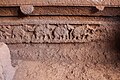 Frieze with elephants
 -
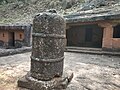 Stone pillar
 -
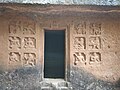 Stone carvings depicting various Mahasiddhas
 -
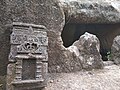 Stone carvings


How to reach
- By train: Nearest Rail station is Khed, Ratnagiri.[1]
- By road: Located on NH 4 highway near Dapoli.[1]
Further reading
Deshpande, Madhusudan Narhar (1986). The caves of Panhāle-Kājī (ancient Pranālaka): an art historical study of transition from Hinayana, Tantric Vajrayana to Nath Sampradāya (third to fourteenth century A.D.). New Delhi: Archaeological Survey of India. ASIN B0006EPMPS. OCLC 923371295. Retrieved 5 February 2021.
References
- ↑ 1.0 1.1 1.2 1.3 ET Bureau (18 April 2013). "Quick getaway: Dapoli, Saharanpur, Nanjagud". Economic Times. Bennett, Coleman & Co. Ltd. Retrieved 10 November 2013.
- ↑ 2.0 2.1 2.2 Mitra, Debala (1984). India Archaeology 1981-82 (PDF). New Delhi: Archaeological Survey of India, Government of India. pp. 97, 98. Archived from the original (PDF) on 26 November 2013. Retrieved 10 November 2013.
External links


| This Buddhism-related article is a stub. You can help Bharatpedia by expanding it. |
- Pages using the JsonConfig extension
- Wikipedia cave articles with unreferenced coordinates
- Buddhist caves in India
- Caves of Maharashtra
- Indian rock-cut architecture
- Former populated places in India
- Buddhist pilgrimage sites in India
- Caves containing pictograms in India
- Tourist attractions in Ratnagiri district
- Buddhism stubs