





>TrendSPLEND |
robot: Update article (please report if you notice any mistake or error in this edit) |
||
| Line 1: | Line 1: | ||
{{Short description|Elevated, dome-shaped pavilions in Indian architecture}} | {{Short description|Elevated, dome-shaped pavilions in Indian architecture}} | ||
{{Italic title}} | {{Italic title}} | ||
[[ | {{Use dmy dates|date=May 2022}} | ||
[[ | {{Use Indian English|date=May 2022}} | ||
'''''Chhatri''''' are elevated, dome-shaped [[pavilion]]s used as an element in [[Indo-Islamic architecture]]<ref name="chattri"/> and [[Indian architecture]]. Originating as a canopy above [[Mazar (mausoleum)|tombs]], | [[File:Chhatri Udaybhan Singh.jpg|thumb|Memorial chhatri of Jat Rana Udaybhanu Singh Maharaj at [[Dholpur]], [[Rajasthan, India]].]] | ||
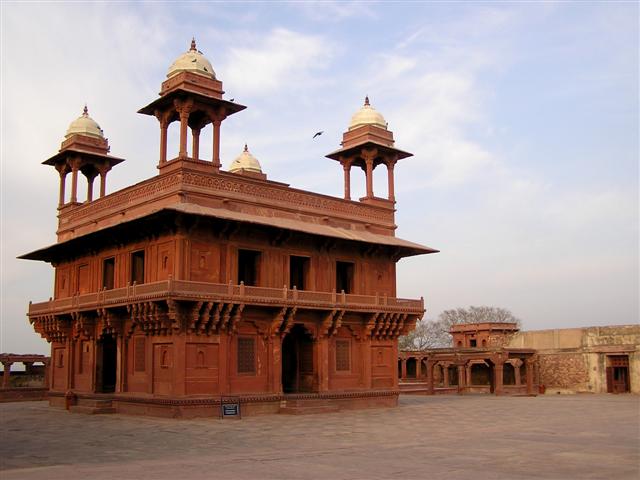
[[File:Audienzhalle.jpg|thumb|Chhatri set atop each corner of the Hall of Audience in [[Fatehpur Sikri]] palace complex.]] | |||
'''''Chhatri''''' are elevated, dome-shaped [[pavilion]]s used as an element in [[Indo-Islamic architecture]]<ref name="chattri"/> and [[Indian architecture]]. Originating as a canopy above [[Mazar (mausoleum)|tombs]], they served as decorative elements.<ref name="chattri"/> The earliest example of chhatri being used in the [[Indian Subcontinent]] were found in the [[Shrine of Ibrahim]] in [[Bhadreswar, Kutch|Bhadreswar]], constructed between 1159 and 1175 AD.<ref name="chattri">{{citation|url=https://www.jstor.org/stable/41928225|title= On the History of Style of the Tomb "Chattris" in the Islamic Architecture of Sind |journal=Central Asiatic Journal|author= Salome Zajadacz-Hastenrath|year= 2000 |volume= 44 |issue= 1 |pages= 131–157 |jstor= 41928225 }}</ref> | |||
Chhatri are found particularly within [[Mughal architecture]]. The most notable surviving examples today are to be found at [[Humayun's Tomb]] in [[Delhi]] and the [[Taj Mahal]] in [[Agra]]. The [[Berar sultanate]] in the [[Deccan sultanates|Deccan]] topped buildings in its various capitals with chhatri.<ref>{{cite book|author=Navina Najat Haidar, Marika Sardar|title=Sultans of Deccan India, 1500–1700: Opulence and Fantasy|date=13 April 2015|url=https://books.google.com/books?id=oi4nBwAAQBAJ&q=chhatri+deccan&pg=PA51|page=51|publisher=[[Metropolitan Museum of Art]]|isbn=9780300211108}}</ref> | |||
Chhatri have also been used in [[Rajasthan]] and other parts of the [[Indian Subcontinent]] by both [[Muslim]] and [[Hindu]] rulers. Its origins are, however, [[Indo-Islamic architecture|Indo-Islamic]].<ref name="chattri"/> | |||
Chhatri in [[Shekhawati]] may consist of a simple structure of one dome raised by four pillars to a building containing many domes and a basement with several rooms. In some places, the interior of the chhatri is painted in the same manner as the ''[[haveli]]''s (mansions) of the region. | |||
==In Rajasthan== | ==In Rajasthan== | ||
| Line 19: | Line 21: | ||
File:Barah Khamba Gumbat, Hindaun.jpg|Barah Khamba Chhatri at [[Jalsen Talab]] in [[Hindaun]] | File:Barah Khamba Gumbat, Hindaun.jpg|Barah Khamba Chhatri at [[Jalsen Talab]] in [[Hindaun]] | ||
</gallery> | </gallery> | ||
Many other | Many other chhatri exist in other parts of Rajasthan. Their locations include: | ||
*[[Jaipur]] – [[Gaitore]] Cenotaphs of the Maharajas of [[Jaipur]]. Set in a narrow valley, the cenotaphs of the former rulers of Jaipur consist of the somewhat typical chhatri or umbrella-shaped memorials. Sawai [[Jai Singh II]]'s Chhatri is particularly noteworthy because of the carvings that have been used to embellish it. | *[[Jaipur]] – [[Gaitore]] Cenotaphs of the Maharajas of [[Jaipur]]. Set in a narrow valley, the cenotaphs of the former rulers of Jaipur consist of the somewhat typical chhatri or umbrella-shaped memorials. Sawai [[Jai Singh II]]'s Chhatri is particularly noteworthy because of the carvings that have been used to embellish it. | ||
*[[Jodhpur]] – [[Jaswant Thada]], the white marble chhatri of Maharaja [[Jaswant Singh II]]. The Panchkunda Ki Chhatriyan at [[Mandore]] are a group of | *[[Jodhpur]] – [[Jaswant Thada]], the white marble chhatri of Maharaja [[Jaswant Singh II]]. The Panchkunda Ki Chhatriyan at [[Mandore]] are a group of chhatri built on early cremation grounds of Marwar royal family. | ||
*[[Bharatpur, India|Bharatpur]]- the cenotaphs of the members of the Jat royal family of Bharatpur, who perished whilst fighting against the British in 1825, are erected in the town of [[Govardhan hill|Govardhan]]. The chhatri of [[Maharaja Suraj Mal]] of Bharatpur has fine frescos illuminating the life of Surajmal, vividly depicting darbar and hunting scenes, royal processions and wars. | *[[Bharatpur, India|Bharatpur]]- the cenotaphs of the members of the Jat royal family of Bharatpur, who perished whilst fighting against the British in 1825, are erected in the town of [[Govardhan hill|Govardhan]]. The chhatri of [[Maharaja Suraj Mal]] of Bharatpur has fine frescos illuminating the life of Surajmal, vividly depicting darbar and hunting scenes, royal processions and wars. | ||
*[[Udaipur]]- Flanked by a row of enormous stone elephants, the [[Lake Pichola]] island has an impressive chhatri carved from gray blue stone, built by Maharana Jagat Singh. | *[[Udaipur]]- Flanked by a row of enormous stone elephants, the [[Lake Pichola]] island has an impressive chhatri carved from gray blue stone, built by Maharana Jagat Singh. | ||
| Line 33: | Line 35: | ||
===In Shekhawati=== | ===In Shekhawati=== | ||
Some of the best-known | Some of the best-known chhatri in the Shekhawati region of Rajasthan are located in the following cities and towns: | ||
*[[Ramgarh, Rajasthan|Ramgarh]] – Ram Gopal Poddar Chhatri | *[[Ramgarh, Rajasthan|Ramgarh]] – Ram Gopal Poddar Chhatri | ||
| Line 49: | Line 51: | ||
==In Madhya Pradesh== | ==In Madhya Pradesh== | ||
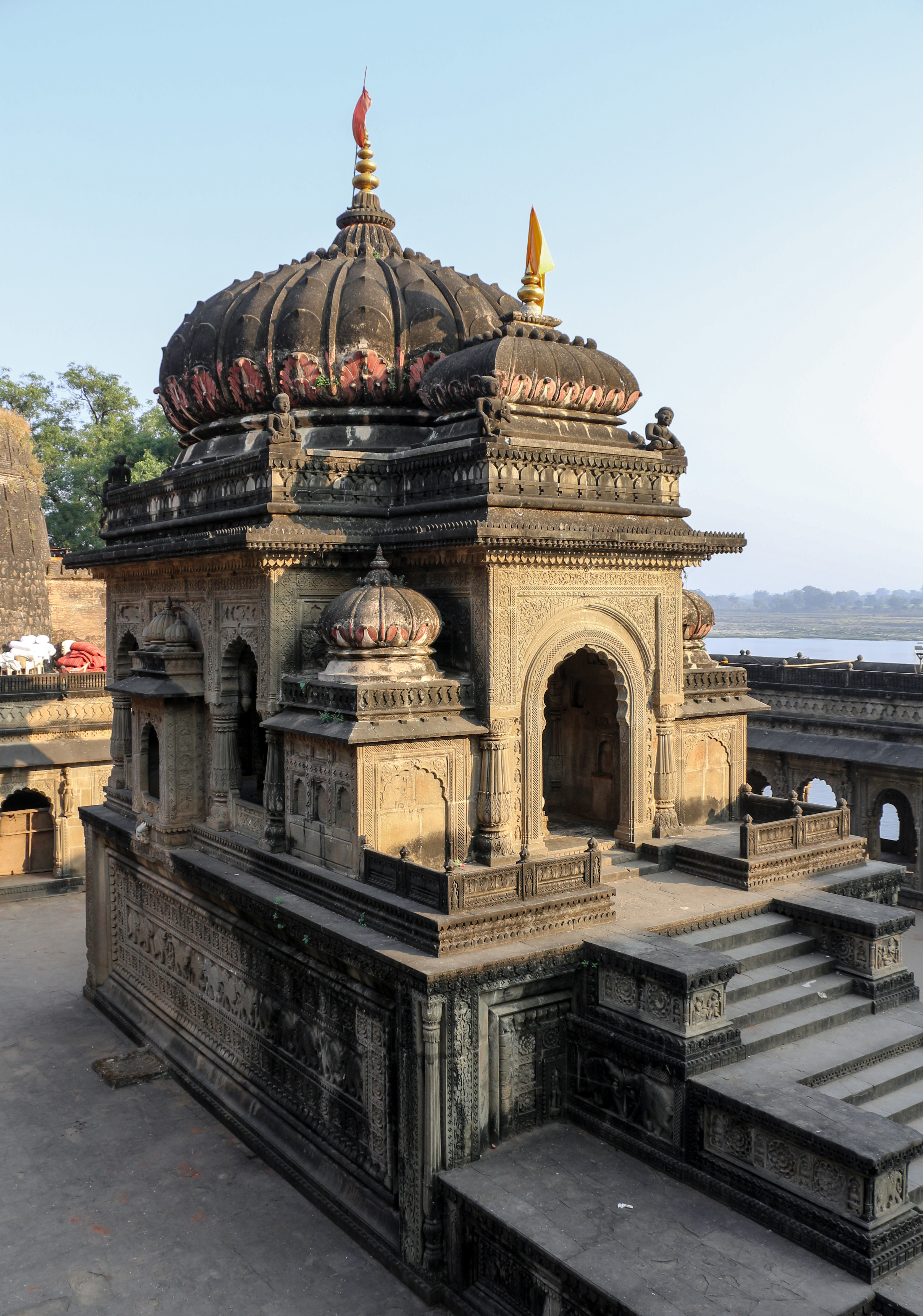
[[File:Chhatri of Vithoji 03.jpg|thumb|upright|Chhatri of [[Vithoji Rao Holkar|Vithoji]] in [[Maheshwar]].]] | [[File:Chhatri of Vithoji 03.jpg|thumb|upright|Chhatri of [[Vithoji Rao Holkar|Vithoji]] in [[Maheshwar]].]] | ||
The region of [[Madhya Pradesh]] is the site of several other notable | The region of [[Madhya Pradesh]] is the site of several other notable chhatri of its famous [[Maratha]] rulers: | ||
*[[Shujalpur]] – Tomb of [[Ranoji Scindia]], founder of the Scindia dynasty. Situated at Ranoganj, Shujalpur to [[Akodia]] Road. | *[[Shujalpur]] – Tomb of [[Ranoji Scindia]], founder of the Scindia dynasty. Situated at Ranoganj, Shujalpur to [[Akodia]] Road. | ||
*[[Shivpuri]] – Intricately embellished marble | *[[Shivpuri]] – Intricately embellished marble chhatri erected by Scindia rulers in Shivpuri. | ||
*[[Gwalior]] – Shrimati Balabai Maharaj Ladojirao Shitole Chhatri | *[[Gwalior]] – Shrimati Balabai Maharaj Ladojirao Shitole Chhatri | ||
*[[Gwalior]] – Rajrajendra Ramchandrarao Narsingh Shitole and wife Gunwantyaraje Ramchandrarao Shitole (princess of Gwalior) Chatri | *[[Gwalior]] – Rajrajendra Ramchandrarao Narsingh Shitole and wife Gunwantyaraje Ramchandrarao Shitole (princess of Gwalior) Chatri | ||
*[[Orchha]] – Elaborate | *[[Orchha]] – Elaborate chhatri of local Hindu kings | ||
*[[Gohad]] – The Jat rulers of Gohad constructed the chhatri of [[Maharaja Bhim Singh Rana]] on the Gwalior Fort. | *[[Gohad]] – The Jat rulers of Gohad constructed the chhatri of [[Maharaja Bhim Singh Rana]] on the Gwalior Fort. | ||
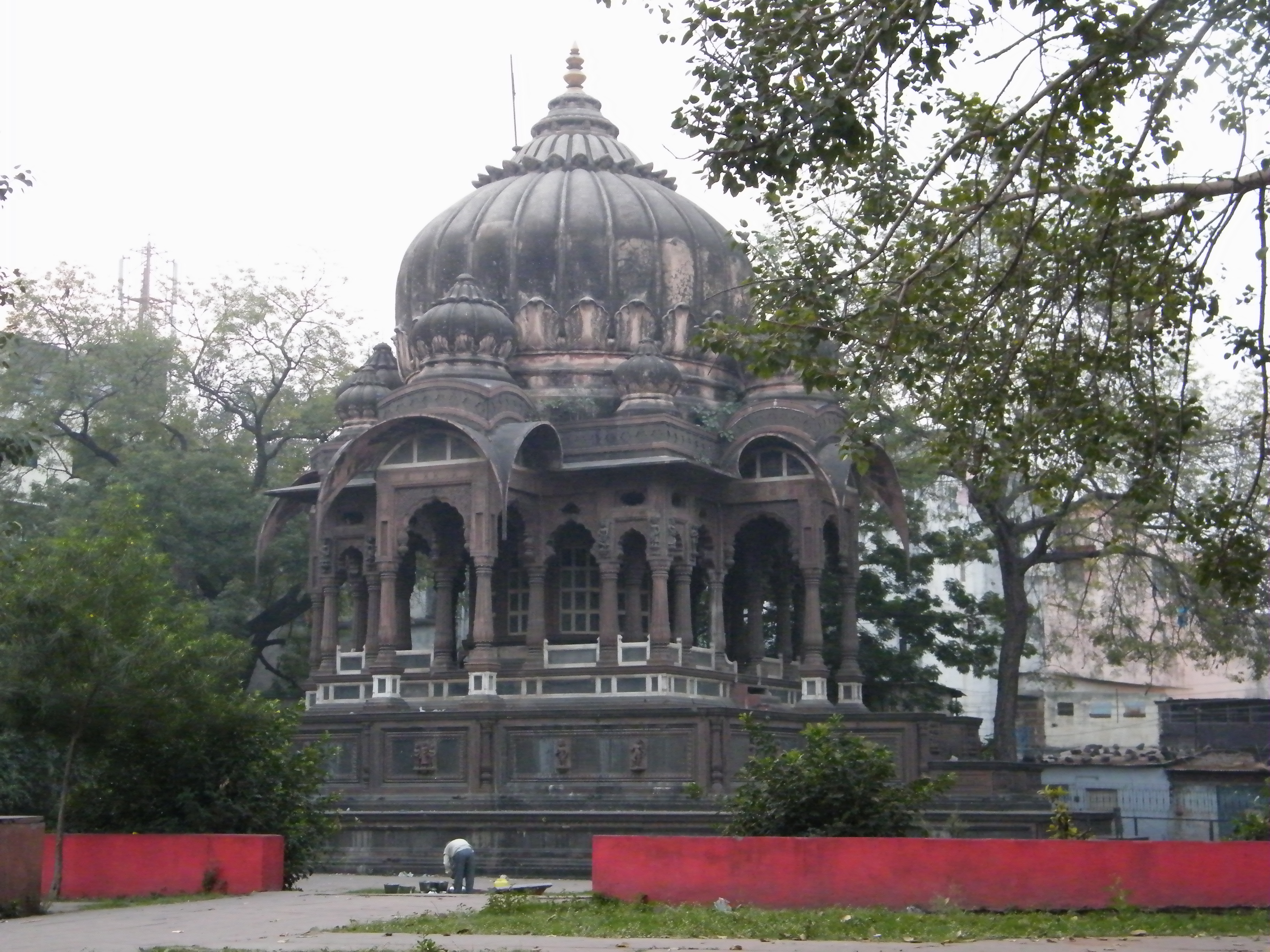
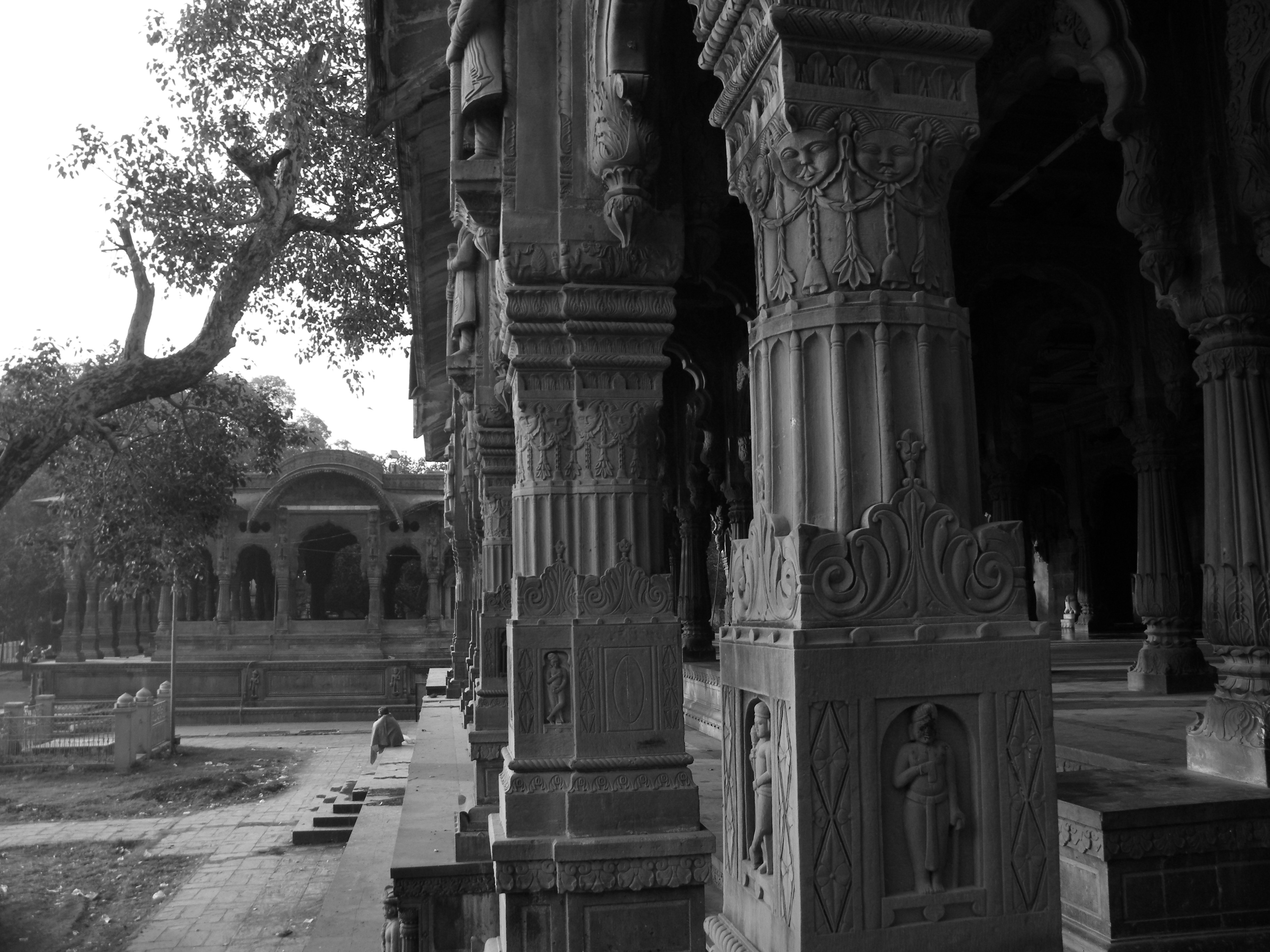
*[[Indore]] and [[Maheshwar]] – | *[[Indore]] and [[Maheshwar]] – Chhatri of [[Holkar]] rulers. | ||
*[[Alampur, Madhya Pradesh|Alampur]] – Maharani Ahilya Bai Holkar built the chhatri of Malhar Rao Holkar at Alampur in Bhind district in 1766. | *[[Alampur, Madhya Pradesh|Alampur]] – Maharani Ahilya Bai Holkar built the chhatri of Malhar Rao Holkar at Alampur in Bhind district in 1766. | ||
{| | {| | ||
| Line 63: | Line 65: | ||
| | | | ||
[[File:Indore Krishnapura Chhatri.JPG|thumb|150px|[[Krishnapura Chhatri]], [[Indore]]]] | [[File:Indore Krishnapura Chhatri.JPG|thumb|150px|[[Krishnapura Chhatri]], [[Indore]]]] | ||
| [[ | | [[File:Chhatri Indore.JPG|thumb|150px|Bolia Maharaj Ki Chhatri, [[Indore]]]] | ||
| [[File:Krishnapura Chhatri on Khan Riverbank.JPG|thumb|150px|Krishnapura Chhatri, [[Indore]]]] | | [[File:Krishnapura Chhatri on Khan Riverbank.JPG|thumb|150px|Krishnapura Chhatri, [[Indore]]]] | ||
| [[File:Krishnapura Chhatri from inside.JPG|thumb|140px|Inside view of Krishnapur Chhatri, [[Indore]]]] | | [[File:Krishnapura Chhatri from inside.JPG|thumb|140px|Inside view of Krishnapur Chhatri, [[Indore]]]] | ||
| Line 70: | Line 72: | ||
==Mughal architecture== | ==Mughal architecture== | ||
Chhatri were features in many buildings of [[Mughal architecture]]: | |||
*The [[Panch Mahal, Fatehpur Sikri]] is crowned with a domed | *The [[Panch Mahal, Fatehpur Sikri]] is crowned with a domed chhatri that overlooks the men's area.<ref name=panchmahal>{{cite book|author=Andrew Petersen|title=Dictionary of Islamic Architecture|date=11 March 2002|url=https://books.google.com/books?id=eIaEAgAAQBAJ&q=chatri+pavilion+islamic+architecture&pg=PA83|page=83|isbn=9781134613663}}</ref> | ||
==In Kutch== | ==In Kutch== | ||
[[File:Rao Lakhaji Chhatri.JPG|thumb|Rao Lakhaji Chhatri [[Bhuj]]]] | [[File:Rao Lakhaji Chhatri.JPG|thumb|Rao Lakhaji Chhatri [[Bhuj]]]] | ||
Chhatri can also be found in the outskirts of [[Bhuj]] city belonging mainly to [[Jadeja]] rulers of Kutch. The chhatri of Rao Lakhpatji is very famous for its intricate designs & carvings. Most of them but have been destroyed in the [[2001 Gujarat earthquake]]. The restoration work is going on. | |||
==Outside India== | ==Outside India== | ||
[[File:Tomb of Raja Rammohun Roy in Arnos Vale Cemetery, Bristol, England.jpg|thumb|Chhatri of [[Ram Mohan Roy]] in [[Arnos Vale Cemetery]], Bristol, England]] | [[File:Tomb of Raja Rammohun Roy in Arnos Vale Cemetery, Bristol, England.jpg|thumb|Chhatri of [[Ram Mohan Roy]] in [[Arnos Vale Cemetery]], Bristol, England]] | ||
There are two notable | There are two notable chhatri in the [[United Kingdom]], a country with strong historical links to India. One is a [[Chattri (Brighton)|cenotaph in Brighton]], dedicated to the Indian soldiers who died in the [[First World War]]. | ||
The other is in [[Arnos Vale Cemetery]] near [[Bristol]] and is a memorial to the distinguished Indian reformer [[Raja Ram Mohan Roy]], who died in that city. | The other is in [[Arnos Vale Cemetery]] near [[Bristol]] and is a memorial to the distinguished Indian reformer [[Raja Ram Mohan Roy]], who died in that city. | ||
| Line 85: | Line 87: | ||
==See also== | ==See also== | ||
*[[Cenotaph]] | *[[Cenotaph]] | ||
*[[Chahartaq (architecture)]] | *[[Chahartaq (architecture)]] | ||
*[[Cupola]] | *[[Cupola]] | ||
*[[Jaswant Ki Chhatri]] | |||
*[[Roof lantern]] | |||
{{For|the memorial to Indian soldiers in Brighton, England|Chattri, Brighton}} | {{For|the memorial to Indian soldiers in Brighton, England|Chattri, Brighton}} | ||
| Line 106: | Line 110: | ||
[[Category:Maratha architecture]] | [[Category:Maratha architecture]] | ||
[[Category:Mughal architecture]] | [[Category:Mughal architecture]] | ||
[[Category:Monuments and memorials in India]] | [[Category:Monuments and memorials in India]] | ||
[[Category:Hindi words and phrases]] | [[Category:Hindi words and phrases]] | ||
Revision as of 00:40, 7 June 2022


Chhatri are elevated, dome-shaped pavilions used as an element in Indo-Islamic architecture[1] and Indian architecture. Originating as a canopy above tombs, they served as decorative elements.[1] The earliest example of chhatri being used in the Indian Subcontinent were found in the Shrine of Ibrahim in Bhadreswar, constructed between 1159 and 1175 AD.[1]
Chhatri are found particularly within Mughal architecture. The most notable surviving examples today are to be found at Humayun's Tomb in Delhi and the Taj Mahal in Agra. The Berar sultanate in the Deccan topped buildings in its various capitals with chhatri.[2]
Chhatri have also been used in Rajasthan and other parts of the Indian Subcontinent by both Muslim and Hindu rulers. Its origins are, however, Indo-Islamic.[1]
Chhatri in Shekhawati may consist of a simple structure of one dome raised by four pillars to a building containing many domes and a basement with several rooms. In some places, the interior of the chhatri is painted in the same manner as the havelis (mansions) of the region.
In Rajasthan
-
 A 12th-century chatri, Jaisalmir
 -
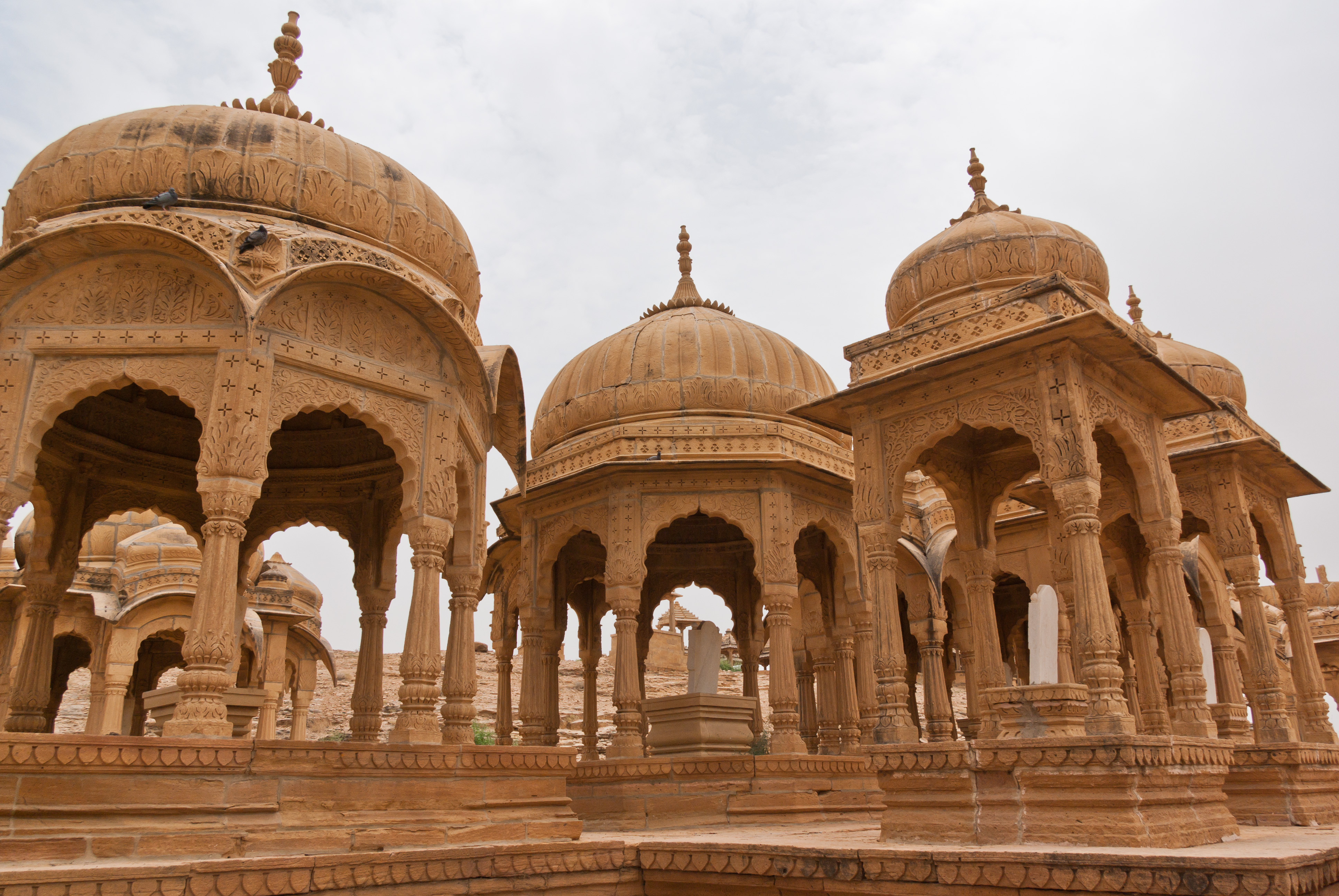 Bada Bagh at Jaisalmer
 -
 Chhatri at Rajgarh, Rajasthan
 -
Moosi Rani Ki Chhatri, Alwar
-
 Barah Khamba Chhatri at Jalsen Talab in Hindaun
.jpg)


Many other chhatri exist in other parts of Rajasthan. Their locations include:
- Jaipur – Gaitore Cenotaphs of the Maharajas of Jaipur. Set in a narrow valley, the cenotaphs of the former rulers of Jaipur consist of the somewhat typical chhatri or umbrella-shaped memorials. Sawai Jai Singh II's Chhatri is particularly noteworthy because of the carvings that have been used to embellish it.
- Jodhpur – Jaswant Thada, the white marble chhatri of Maharaja Jaswant Singh II. The Panchkunda Ki Chhatriyan at Mandore are a group of chhatri built on early cremation grounds of Marwar royal family.
- Bharatpur- the cenotaphs of the members of the Jat royal family of Bharatpur, who perished whilst fighting against the British in 1825, are erected in the town of Govardhan. The chhatri of Maharaja Suraj Mal of Bharatpur has fine frescos illuminating the life of Surajmal, vividly depicting darbar and hunting scenes, royal processions and wars.
- Udaipur- Flanked by a row of enormous stone elephants, the Lake Pichola island has an impressive chhatri carved from gray blue stone, built by Maharana Jagat Singh.
- Haldighati – A beautiful Chhatri with white marble columns, dedicated to Rana Pratap, stands here. Chetak Smarak, the cenotaph dedicated to Chetak, Rana Pratap's famous horse, is also noteworthy.
- Alwar – Moosi Maharani ki Chhatri is a beautiful red sandstone and white marble cenotaph of the rulers of Alwar.
- Bundi – Suraj Chhatri and Mordi Ki Chhatri, Chaurasi Khambon ki Chhatri, Bundi and Nath Ji ki Chhatri are located in Bundi. Rani Shyam Kumari wife of Raja Chhatrasal on the northern hill constructed the Suraj Chhatri and Mayuri the second wife of Chhatrasal on the southern hill erected Mordi Ki Chhatri.
- Jaisalmer – Bada Bagh, a complex with chhatris of Jai Singh II (d. 1743) and subsequent Maharajas of Jaisalmer.
- Bikaner – Devi Kund near Bikaner is the royal crematorium place with a number of cenotaphs. The chhatri of Maharaja Surat Singh is most imposing. It has the spectacular Rajput paintings on the ceilings.
- Ramgarh – Seth Ram Gopal Poddar Chhatri
- Nagaur – Nath Ji ki Chhatri, Amar Singh Rathore-ki-Chhatri
In Shekhawati
Some of the best-known chhatri in the Shekhawati region of Rajasthan are located in the following cities and towns:
- Ramgarh – Ram Gopal Poddar Chhatri
- Laxmangarh - Churiwala ki Chhatri
- Bissau – The Raj ki Chhatri of the Shekhawat Thakurs
- Parsurampura – Thakur Sardul Singh Shekhawat's chhatri
- Jhunjhunu – Chhatri of Shekhawat Rulers
- Dundlod – The beautiful chhatri of Ram Dutt Goenka
- Mukungarh – Shivdutta Ganeriwala Chhatri
- Churu – Taknet Chhatri
- Mahansar – The Sahaj Ram Poddar Chhatri
- Udaipurwati – Joki Das Shah ki Chhatri
- Fatehpur – Jagan Nath Singhania Chhatri
In Madhya Pradesh

The region of Madhya Pradesh is the site of several other notable chhatri of its famous Maratha rulers:
- Shujalpur – Tomb of Ranoji Scindia, founder of the Scindia dynasty. Situated at Ranoganj, Shujalpur to Akodia Road.
- Shivpuri – Intricately embellished marble chhatri erected by Scindia rulers in Shivpuri.
- Gwalior – Shrimati Balabai Maharaj Ladojirao Shitole Chhatri
- Gwalior – Rajrajendra Ramchandrarao Narsingh Shitole and wife Gunwantyaraje Ramchandrarao Shitole (princess of Gwalior) Chatri
- Orchha – Elaborate chhatri of local Hindu kings
- Gohad – The Jat rulers of Gohad constructed the chhatri of Maharaja Bhim Singh Rana on the Gwalior Fort.
- Indore and Maheshwar – Chhatri of Holkar rulers.
- Alampur – Maharani Ahilya Bai Holkar built the chhatri of Malhar Rao Holkar at Alampur in Bhind district in 1766.
 |
 |
 |
 |
Mughal architecture
Chhatri were features in many buildings of Mughal architecture:
- The Panch Mahal, Fatehpur Sikri is crowned with a domed chhatri that overlooks the men's area.[3]
In Kutch

Chhatri can also be found in the outskirts of Bhuj city belonging mainly to Jadeja rulers of Kutch. The chhatri of Rao Lakhpatji is very famous for its intricate designs & carvings. Most of them but have been destroyed in the 2001 Gujarat earthquake. The restoration work is going on.
Outside India

There are two notable chhatri in the United Kingdom, a country with strong historical links to India. One is a cenotaph in Brighton, dedicated to the Indian soldiers who died in the First World War.
The other is in Arnos Vale Cemetery near Bristol and is a memorial to the distinguished Indian reformer Raja Ram Mohan Roy, who died in that city.
See also
References
- ↑ 1.0 1.1 1.2 1.3 Salome Zajadacz-Hastenrath (2000), "On the History of Style of the Tomb "Chattris" in the Islamic Architecture of Sind", Central Asiatic Journal, 44 (1): 131–157, JSTOR 41928225
- ↑ Navina Najat Haidar, Marika Sardar (13 April 2015). Sultans of Deccan India, 1500–1700: Opulence and Fantasy. Metropolitan Museum of Art. p. 51. ISBN 9780300211108.
- ↑ Andrew Petersen (11 March 2002). Dictionary of Islamic Architecture. p. 83. ISBN 9781134613663.
External links
- ArchNet Dictionary of Islamic Architecture: Chatri
- Images of old chhatris Columbia University