

imported>Jellysandwich0 mNo edit summary |
robot: Update article (please report if you notice any mistake or error in this edit) |
||
| Line 1: | Line 1: | ||
{{short description|Hindu philosopher}} | {{short description|Hindu philosopher}} | ||
{{EngvarB|date=March 2015}} | {{EngvarB|date=March 2015}} | ||
| Line 5: | Line 4: | ||
{{Faith primary|date=March 2017}} | {{Faith primary|date=March 2017}} | ||
{{Infobox Hindu leader | {{Infobox Hindu leader | ||
| name = | | name = Aacharya Shree Vallabhacharya | ||
| image = Shri_mahaprabhuji.jpg | | image = Shri_mahaprabhuji.jpg | ||
| caption = | | caption = | ||
| Line 14: | Line 13: | ||
| death_place = [[Banaras]] (now in [[Uttar Pradesh]], India) | | death_place = [[Banaras]] (now in [[Uttar Pradesh]], India) | ||
| philosophy = [[Shuddhadvaita]], [[Pushtimarg]] | | philosophy = [[Shuddhadvaita]], [[Pushtimarg]] | ||
| founder = [[Pushtimarg]]<br>[[Shuddhadvaita]] | | founder = [[Pushtimarg]]<br />[[Shuddhadvaita]] | ||
| order = [[Vedanta]] | | order = [[Vedanta]] | ||
| children = | | children = Gopinathji and [[Gusainji|Vitthalnath]] | ||
}} | }} | ||
{{Vaishnavism}} | {{Vaishnavism}} | ||
{{Hindu philosophy}} | {{Hindu philosophy}} | ||
'''Vallabhacharya''' '''Mahaprabhu'''(1479–1531 CE), also known as '''Vallabha''', | '''Vallabhacharya''' '''Mahaprabhu'''(1479–1531 CE), also known as '''Vallabha, Mahaprabhuji''' and '''Vishnuswami''', or '''Vallabha Acharya''', is a [[Hindus|Hindu]] Indian saint and philosopher who founded the [[Krishna]]-centered [[Pushtimarg|PushtiMarg]] sect of [[Vaishnavism]] in the [[Braj|Braj(Vraj)]] region of [[India]],<ref name = "Shah1969">{{cite book | last = Shah | first = J.G. | year = 1969 | title = Shri Vallabhacharya: His Philosophy and Religion | publisher = Pushtimargiya Pustakalaya }}</ref> and the Vedanta philosophy of [[Shuddha advaita]] (Pure [[Nondualism|Non-dualism]]).<ref name="KankroliWebsiteArticle">{{cite web | title = Shuddha-advaita Brahmvaad - Philosophy of Shree Vallabhacharyaji | website = vallabhkankroli.org | url = http://vallabhkankroli.org/Shuddha-advaita_Brahmvaad.html | access-date = 2007-06-06 |archive-url = https://web.archive.org/web/20070927190853/http://vallabhkankroli.org/Shuddha-advaita_Brahmvaad.html <!-- Bot retrieved archive --> |archive-date = 2007-09-27}}</ref><ref name="Book1">{{cite book | last1 = Sharma | first1 = Govardhana | ||
| first2 = Pravinacandra Cimanalala | last2 = Parikha | title = Vedanta Cintamanih of Bharatamartanda Pandita | publisher = Param Publications | date = January 1993 | isbn = 81-86045-00-7 }}</ref> | | first2 = Pravinacandra Cimanalala | last2 = Parikha | title = Vedanta Cintamanih of Bharatamartanda Pandita | publisher = Param Publications | date = January 1993 | isbn = 81-86045-00-7 }}</ref><ref>{{Cite web |title=Shri Mad Vallabhacharya Mahaprabhuji {{!}} Shrinathji Temple, Nathdwara |url=https://www.nathdwaratemple.org/shrimahaprabhuji/shri-mad-vallabhacharya-mahaprabhuji |access-date=2022-05-30 |website=www.nathdwaratemple.org}}</ref><ref>{{Cite web |title=Shri Mahaprabhuji Shri Vallabhacharyaji Biography {{!}} Pushti Sanskar |url=https://pushtisanskar.org/about_shri_mahaprabhuji.php#:~:text=Shri%20Vallabhacharyaji%20is%20also%20known%20as%20shri%20Mahaprabhuji. |access-date=2022-05-30 |website=pushtisanskar.org}}</ref> | ||
He is the [[Jagadguru]] [[Acharya]] and [[Guru]] of the [[Pushtimarg|Pushti Marg]] bhakti tradition and [[Shuddhadvaita|Suddhadwait Brahmavad (Vedant Philosophy)]], which he founded after his own interpretation of the [[Vedanta]] philosophy.<ref name="Shah1969" /><ref name=":1" /><ref>{{Cite web |title=Shree Mahaprabhuji |url=http://www.shrinathdhamhaveli.org/acharya-shri/shree-mahaprabhuji/ |access-date=2022-05-30 |website=Shrinathdham Haveli |language=en-US}}</ref> | |||
Vallabhacharya was born in a [[Telugu Brahmin|Telugu Tailang]] [[Brahmin|Brahmin family]] that had been currently residing in [[Varanasi]], who escaped to [[Champaran, Chhattisgarh|Champaran]] of Chhattisgarh state while expecting shri Vallabha, expecting a [[Muslim conquests in the Indian subcontinent|Muslim invasion]] in [[Varanasi]], during the [[Bahlul Khan Lodi|late 15th century]].<ref name="jonesryan475"/> The name [[Vallabha (name)|Vallabha]] means the beloved or lover, and is a [[Vishnu Sahasranāma|name of Vishnu]] and Krishna. | |||
Vallabhacharya studied the [[Vedas]], [[Upanishads]], [[Puranas]], [[Hindu philosophy|Shat Darshan]] as a child, then travelled throughout the Indian subcontinent over 20 years.<ref name="jonesryan475" /> He became one of the important leaders of the devotional [[Bhakti movement]]. Vallabhacharya's mother was Illamma who was the daughter of a family priest serving the rulers of the empire of [[Vijayanagara]].<ref>{{cite book|author=Richard Barz |title=Bhakti Sect Of Vallabhacarya |url=https://archive.org/details/bhaktisectofvallabhacaryarichardbarzmrmlms_202003_574_W/page/n29/mode/2up |year=1992 |publisher=Motilal UK Books of India |isbn=978-8121505765 |pages=23}}</ref> The biographies written by his followers, just like those for other Bhakti leaders, claim that he won many philosophical scholarly debates against the followers of [[Adi Shankara|Adi Shankracharya]], [[Ramanuja]], [[Madhvacharya]] and others, had visions and miracles.<ref name="jonesryan475">{{cite book|author1=Constance Jones|author2=James D. Ryan|title=Encyclopedia of Hinduism|url=https://books.google.com/books?id=OgMmceadQ3gC |year=2006|publisher=Infobase|isbn=978-0-8160-7564-5 |pages=475–476 }}</ref> | |||
He authored many texts including the Anubhashya also | He rejected [[asceticism]] and monastic life, suggested that through loving devotion to God Krishna, any householder could achieve salvation – an idea that became influential all over India, proven by Vallabh Digvijay, Sampraday Pradep, Sampraday Kalpadrum and his 84 Baithakjis (Places of worship) in Uttar Pradesh, Rajasthan, Gujarat, Maharashtra, Tamil Nadu, Andhra Pradesh, Karnataka, Kerala, Uttaranchal, Madhya Pradesh, Orissa, Goa and various other parts of India.<ref>{{cite web |title=List of 84 Baithakjis |url=https://www.nathdwaratemple.org/shrimahaprabhuji/mahaprabhuji-baithaks}}</ref><ref name="AsherTalbot2006p111">{{cite book|author1=Catherine B. Asher|author2=Cynthia Talbot|title=India Before Europe|url=https://books.google.com/books?id=ZvaGuaJIJgoC&pg=PA111|year=2006|publisher=Cambridge University Press|isbn=978-0-521-80904-7|pages=111–112 }}</ref> He is associated with Vishnuswami Sampraday,<ref name="Beck2005">{{cite journal | last = Beck | first = Guy L | year = 2005 | title = Krishna as Loving Husband of God | journal = Alternative Krishnas: Regional and Vernacular Variations on a Hindu Deity | url = https://books.google.com/books?id=0SJ73GHSCF8C&q=Vallabha+Vishnuswami&pg=PA65 | access-date = 2008-04-12 | publisher = SUNY Press | isbn = 978-0-7914-6415-1}}</ref> and is the prominent Jagadguru Acharya of Rudra Sampradaya out of the four traditional Vaishnava Sampradayas.<ref name="Sharma1998">{{cite book | last = Sharma | first = V.P. | year = 1998 | title = The Sadhus and Indian Civilisation | publisher = Anmol Publications Pvt. Ltd.}}</ref> | ||
He authored many texts including but not limited to, the Anubhashya colloquially also called BrahmaSutrAnubhashya (his commentary on [[Vedanta Sutra|Brahm Sutra]]), [[Shodash Granth]] or sixteen '[[stotra]]s' (tracts) and several commentaries on the [[Bhagavata Purana]]. | |||
Vallabha's writings and [[kirtan]] compositions focus on baby Krishna and his childhood pranks with [[Yashoda]] (unconditional motherly love), as well as a youthful Krishna's protection of the good (divine grace) and his victory over demons and evils, all with allegory and symbolism.<ref name="AsherTalbot2006p111" /> | |||
His legacy is best preserved with the acharyas of his Pushtimarg Vallabh Sampraday, also in the [[Braj]] region, and particularly at [[Nathdwara]] and [[Dwarkadhish_Kankroli|Dwarkadhish Temple]] in Mewar region of India – are important Krishna pilgrimage center.<ref name="AsherTalbot2006p111" /> | |||
He is regarded as an incarnation of Agni (Vaishwanar Agni Swaroop of Shri Krishna's face).<ref name="Farquhar">{{cite book | last = Farquhar | first = John Nicol | year = 1984 | title = An outline of the Religious Literature of India | url = https://www.google.com/books/edition/Outline_of_the_Religious_Literature_of_I/lwggjSPrjxUC?hl=en&gbpv=1 | access-date = 19 May 2020 | publisher = Motilal Banarsidass Publishers Pvt. Ltd. | isbn = 978-8-1208-2086-9}}</ref><ref>{{cite web|url=https://www.nathdwaratemple.org/shrimahaprabhuji/mahaprabhuji-character |title=Nathdwara temple | publisher= Nathdwara temple | access-date=19 May 2020}}</ref> | |||
==Life== | ==Life== | ||
| Line 35: | Line 42: | ||
===Childhood=== | ===Childhood=== | ||
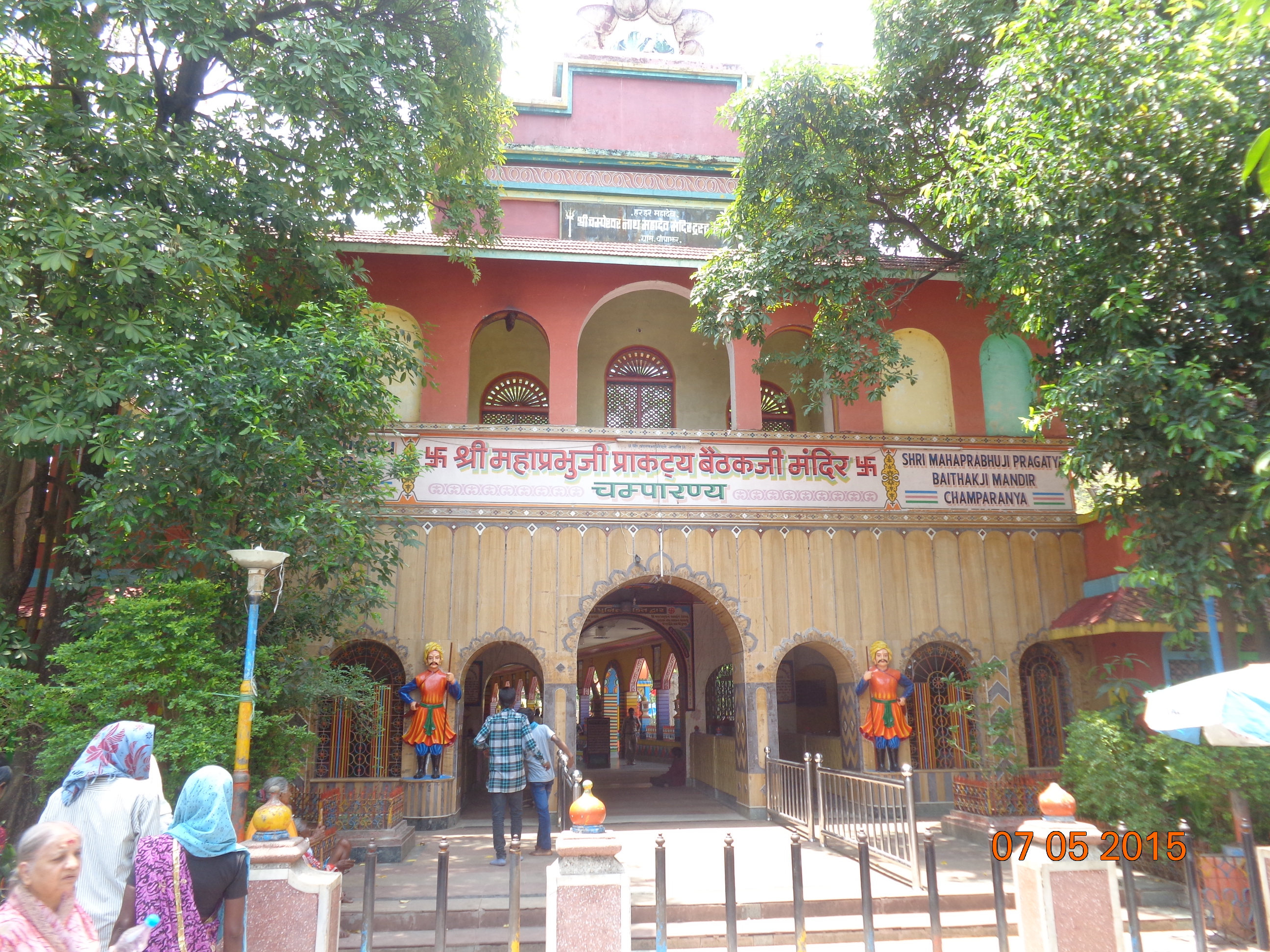
[[File:Prakatya baithakji mandir.JPG|thumb|Birthplace of Vallabhacharya, Prakatya [[Baithak]], Champaran|left]] | [[File:Prakatya baithakji mandir.JPG|thumb|Birthplace of Vallabhacharya, Prakatya [[Baithak]], Champaran|left]] | ||
The ancestors of Vallabhacharya hailed from the [[Andhra Pradesh|Andhra]] region and belonged to a long line of [[Telugu people|Telugu]] [[Vaidiki Brahmins]] known as [[Velanadu]] or Vellanatiya following the Vishnu Swami school of thought. According to devotional accounts, [[Krishna]] commanded his ancestor Yagnanarayana Bhatta that he would take birth in their family after completion of 100 [[Somayaga|Somayagnas]] (fire sacrifices). By the time of Yagnanarayana's descendant Lakshmana Bhatta who migrated to the holy town of [[Varanasi]], the family had completed 100 [[Somayaga|Somayagnas]]. Vallabhacharya was born to Shri Lakshmana Bhatta in 1479 CE (V.S. 1535) on the 11th day of the dark half of lunar month of [[Vaisakha|chaitra]] at [[Champaran, Chhattisgarh|Champaranya]], now in [[Chhattisgarh]] | The ancestors of Vallabhacharya hailed from the [[Andhra Pradesh|Andhra]] region and belonged to a long line of [[Somayajna|Somyagya]] Performing [[Telugu people|Telugu]] [[Vaidiki Brahmins]] known as [[Velanadu]] or Vellanatiya following the Vishnu Swami school of thought. According to devotional accounts, [[Krishna]] commanded his ancestor Yagnanarayana Bhatta that he would take birth in their family after completion of 100 [[Somayaga|Somayagnas]] (fire sacrifices). By the time of Yagnanarayana's descendant Lakshmana Bhatta who migrated to the holy town of [[Varanasi]], the family had completed 100 [[Somayaga|Somayagnas]]. Vallabhacharya was born to Shri Lakshmana Bhatta and his wife IllammaGaru in 1479 CE (V.S. 1535) on the 11th day of the dark half of lunar month of [[Vaisakha|chaitra]] at [[Champaran, Chhattisgarh|Champaranya]], now in [[Chhattisgarh]].<ref name = "Shah1969"/><ref name="iss">{{cite book | url=https://books.google.com/books?id=ZvJa5nTi3VsC&q=vallabhacharya&pg=PA189 | title=Indian Saints & Sages | publisher=Pustak Mahal | last = Prasoon | first = Shrikant | year=2009 | isbn=9788122310627}}</ref><ref>{{Cite book|last1=Jones|first1=Constance|url=https://books.google.com/books?id=OgMmceadQ3gC&q=vallabha+mother&pg=PA475|title=Encyclopedia of Hinduism|last2=Ryan|first2=James D.|date=2006|publisher=Infobase Publishing|isbn=978-0-8160-7564-5|pages=475|language=en}}</ref> | ||
The period surrounding Vallabhacharya's birth was a tumultuous one and most of northern and central India was being influenced by Muslim invaders. It was common for populations to migrate in order to flee from religious persecution and conversion. On one such occasion, Shri Lakshmana Bhatta had to urgently move out of Varanasi with his pregnant wife. Due to terror and physical strain of the flight suffered by the mother, there was a premature birth of the child, two months in advance. As the child did not show signs of life, the distressed parents placed | The period surrounding Vallabhacharya's birth was a tumultuous one and most of northern and central India was being influenced by [[Muslim conquests in the Indian subcontinent|Muslim invaders]]. It was common for populations to migrate in order to flee from religious persecution and conversion. On one such occasion, Shri Lakshmana Bhatta had to urgently move out of Varanasi with his pregnant wife. Due to terror and physical strain of the flight suffered by the mother, there was a premature birth of the child, two months in advance. As the child did not show signs of life, the distressed parents placed Vallabh under a tree wrapped in a piece of cloth. Krishna appeared in a dream before the parents of Vallabhacharya and signified that He Himself had taken birth as the child who they had left under a tree mistaken to be not alive. According to popular accounts, the parents rushed to the spot and were amazed to find their baby alive and protected by a circle of divine fire. The blessed mother extended her arms into the fire unscathed; she received from the fire the divine baby, gleefully to her bosom. The child was named Vallabha (meaning "the dear one" in [[Sanskrit]]).<ref name = "Shah1969"/> | ||
===Education=== | ===Education=== | ||
His education commenced at the age of seven with the study of four [[Vedas]]. He acquired mastery over the books expounding the six systems of [[Indian philosophy]]. He also learnt and studied philosophical systems of [[Adi Sankara]], [[Ramanuja]], [[Madhvacharya|Madhva]], [[Nimbarka]] along with the [[Buddhist]] | His education commenced at the age of seven with the study of four [[Vedas]], [[Upanishads|Upnishads]], [[Puranas]], [[Hindu philosophy|Shat Darshan]]. He acquired mastery over the books expounding the six systems of [[Indian philosophy]]. He also learnt and studied philosophical systems of [[Adi Sankara]], [[Ramanuja]], [[Madhvacharya|Madhva]], [[Nimbarka]] along with the [[Buddhist]], [[Jain]], [[Cārvāka]],etc schools. He was able to recite a hundred [[Mantra#Hinduism|mantra]]s, not only from beginning to end but also in reverse order. At Vyankateshwar and Lakshmana Balaji, he made a strong impression on the public as an embodiment of knowledge. He was now applauded as Bala Saraswati.<ref name = "Shah1969"/> | ||
After | After being finished all education at the young age of 11, he went to [[Vrindavan]].<ref name="iss" /> | ||
===Victory at Vijayanagara=== | ===Grand Victory at Vijayanagara=== | ||
In the court of king | In the court of king Krishnadevaraya of Vijaynagar Emipre, a debate was conducted at Vijayanagara between the Vaishnavaites of Madhva(followers of Madhvacharya) and Shankars(followers of Adi Shankracharya) over the philosophical question whether God is Dualistic or non-dualistic. Vallabhacharya participated in the discussion. | ||
At the age of 11, Vallabhacharya, who had earned an epithet of Bala Saraswati was given the opportunity to discuss the question.<ref>{{cite book|last=Jones|first=Constance|title=Encyclopedia of Hinduism|year=2007|publisher=Infobase Publishing|location=New York|isbn=978-0-8160-5458-9|pages=475}}</ref> The | At the age of 11, Vallabhacharya, who had earned an epithet of Bala Saraswati was given the opportunity to discuss the question.<ref>{{cite book|last=Jones|first=Constance|title=Encyclopedia of Hinduism|year=2007|publisher=Infobase Publishing|location=New York|isbn=978-0-8160-5458-9|pages=475}}</ref> The scholarly debate continued for 27 days in the conference hall and won the shastratha. He was honoured with the kanakabhishekam ceremony by the Emperor Krishnadevaraya and other acharyas and learned pandits on his grand victory. The titles of ‘Acharya’ and 'Jagadguru' (world preceptor) were conferred on him. He was offered vessels of gold weighing a hundred maunds. Vallabhacharya Mahaprabhu politely declined to accept them and distributed them among the poor learned brahmins and kept only seven gold mohurs. They were used for preparing the ornaments of Vithoba (Vitthalanatha) in Pandharpur.<ref name="iss"/><ref>{{Cite book |last=gujrat vidyapith library |url=http://archive.org/details/in.ernet.dli.2015.317487 |title=Vallabha Digvijay}}</ref> | ||
===Pilgrimage of India (prithvi parikrama)=== | ===Pilgrimage of India (prithvi parikrama)=== | ||
Vallabhacharya performed three pilgrimages of [[India]], barefoot. | Vallabhacharya performed three pilgrimages(Digvijay Yatra) of [[India]], barefoot. These three pilgrimages of [[India]] are known as Prithvi Parikrama or Vallabh Digvijay in Pushtimarg Literature. | ||
He wore a simple white [[dhoti]] and a Upparna a white | He wore a simple white [[dhoti]] and a Upparna a white upper garment cloth (known as {{transl|sa|Upavarna}}, literally "upper cloth" in [[Sanskrit]]) and make no use of his {{transl|sa|khadau}} (footwear). He gave discourses on [[Bhagavata]] at 84 places and explained the meanings of the Puranic text. This 84 places are known as [[Pushtimarg Baithak|Chaurāsi Baithak]] (चौरासी बैठक) and now they are places of pilgrimage. He stayed in [[Vrindavan|Vraja]] for four months in each year.<ref name="Shah1969" /><ref name="iss" /><ref>{{Cite book |last=gujrat vidyapith library |url=http://archive.org/details/in.ernet.dli.2015.317487 |title=Vallabha Digvijay}}</ref> | ||
===Establishment of Pushtimarg Vallabh Sampraday=== | ===Establishment of Pushtimarg Vallabh Sampraday=== | ||
[[File:Shrinathji discovered.jpg|thumb|220px| [[Vallabhacharya]] discovers [[Shrinathji]], at Mount [[Govardhan]].]] | [[File:Shrinathji discovered.jpg|thumb|220px| [[Vallabhacharya]] discovers [[Shrinathji]], at Mount [[Govardhan]].]] | ||
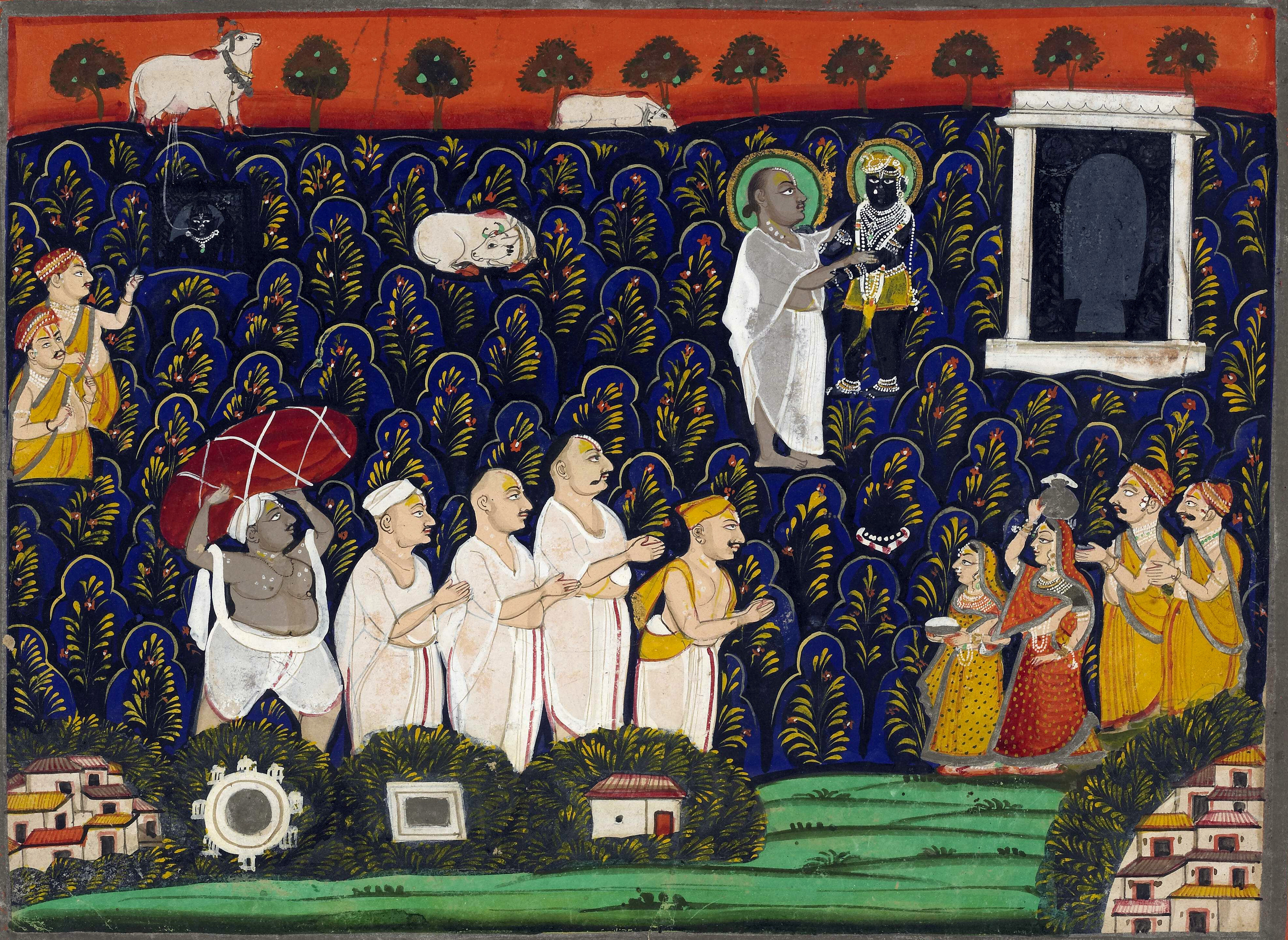
It is believed that when Vallabhacharya entered [[Gokula|shri Gokul]], he thought about the important question of restoring people to the right path of devotion. He meditated on [[Krishna]] who appeared | It is believed that when Vallabhacharya Mahaprabhu entered [[Gokula|shri Gokul]], he thought about the important question of restoring people to the right path of devotion. | ||
He meditated on [[Krishna]] who then directly appeared in front of him in the form of [[Shrinathji]],<ref name="Ojha1978">{{cite book | |||
| last = Ojha | first = P.N. | | last = Ojha | first = P.N. | ||
| year = 1978 | | year = 1978 | ||
| title = Aspects of Medieval Indian Society and Culture | | title = Aspects of Medieval Indian Society and Culture | ||
| publisher = BR Pub. Corp.; New Delhi: DK Publishers' Distributors | | publisher = BR Pub. Corp.; New Delhi: DK Publishers' Distributors | ||
}}</ref> and disclosed the 'Brahma Sambandha' (Sanskrit for "relation with Brahman, the supreme Godhead"), a [[mantra]] of self dedication or consecration of self to Krishna. During that time Damodardasa, his disciple, was sleeping next to him.<ref name=":0">http://www.nathdwara.in</ref> In the early morning, Vallabhacharya related this experience to Damodardasa and asked him — “Damala, did you hear any thing last night”? Damodaradasa replied that "I heard but was not able to understand." Vallabhacharya then explained the meaning of the mantra and at that time he became the first Vaishnava initiated by Vallabhacharya. | }}</ref> and disclosed the 'Brahma Sambandha' (Sanskrit for "relation with Brahman, the supreme Godhead"), a [[mantra]] of self dedication or consecration of self to Krishna. | ||
During that time Damodardasa, his disciple, was sleeping next to him.<ref name=":0">http://www.nathdwara.in {{Bare URL inline|date=June 2022}}</ref> In the early morning, Vallabhacharya related this experience to Damodardasa and asked him — “Damala, did you hear any thing last night”? Damodaradasa replied that "I heard but was not able to understand." Vallabhacharya then explained the meaning of the mantra and at that time he became the first Vaishnava initiated by Vallabhacharya. | |||
Vallabhacharya wanted to preach his message of devotion to God and God’s grace called [[Pushtimarg]] (path of grace). He undertook three pilgrimages of India. He performed the initiation ceremony of religious rite by conferring on them the ‘Nama Nivedana’ mantra or the ‘Brahma Sambandha’ mantra. | Vallabhacharya wanted to preach his message of devotion to God and God’s grace called [[Pushtimarg]] (path of grace). He undertook three pilgrimages of India. He performed the initiation ceremony of religious rite by conferring on them the ‘Nama Nivedana’ mantra or the ‘Brahma Sambandha’ mantra. Thousands of people became his disciples, but 84 devoted servants are most famous and their life has been documented in Pushtimarg literature as the ‘Story of 84 Vaishnavas’.<ref name = "Shah1969"/> He also met [[Vyas]] in his Himalayan cave and discussed Krishna and his flute.<ref name=":0" /> | ||
He created the Siddhant Rahashya granth telling word-to-word instructions he received regarding Brahma Sambandh that day. | He created the Siddhant Rahashya granth telling word-to-word instructions he received regarding Brahma Sambandh that day. | ||
===Personal life=== | ===Personal life=== | ||
He intended to remain a lifelong celibate but the deity-guru [[Vithoba]] of [[Pandharpur]] commanded him to marry and live the life of a householder, and Shrinathji himself said that He would be born as the second child of Vallabha, Gusaiji (as Vallabha's first child Gopinathji is the form of Balram). Obeying his | He intended to remain a lifelong celibate brahmachary but the deity-guru [[Vithoba]] of [[Pandharpur]] commanded him to marry and live the life of a [[Grihastha|householder]], and [[Shrinathji]] himself said that He would be born as the second child of Vallabha, [[Vitthalanatha|Gusaiji]] (as Vallabha's first child Gopinathji is the form of [[Balarama|Balram]]). | ||
Obeying this, following his caste traditions and practices, Vallabh married Mahalaxmi, a kashi resident girl of his own Tailang Velanadu Brahmin caste and had two sons, Gopinathji and [[Vitthalanatha|Vitthalnathji]] (also known as [[Gusainji]]).<ref name="Bryant2007">{{cite book|author=Edwin Francis Bryant|author-link=Edwin Bryant (author)|title=Krishna: A Sourcebook|url=https://books.google.com/books?id=0z02cZe8PU8C&pg=PA482|year=2007|publisher=Oxford University Press|location=New York|isbn=978-0-19-803400-1|page=482}}</ref><ref>{{cite journal|author=Kincaid, C. |title=Review: Imperial Farmans by K. M. Jhaveri |date=January 1933 |journal=Journal of the Royal Asiatic Society of Great Britain and Ireland |issue=1 |pages=131–132 |doi=10.1017/S0035869X00072543 |jstor=25194699}}{{Subscription required}}</ref><ref name=":1">{{Cite web|title=Mahaprabhuji Shri Vallabhacharya :: Heavenly Character {{!}} Shrinathji Temple, Nathdwara|url=https://www.nathdwaratemple.org/shrimahaprabhuji/mahaprabhuji-character|access-date=2022-01-20|website=www.nathdwaratemple.org}}</ref> | |||
===Death=== | ===Death=== | ||
At the age of 52, he | At the age of 52, he is said to have returned to [[Goloka|Goloka (Param Brahma Shri Krishna's heavenly adobe)]] via [[Samadhi#Hinduism|samadhi]] in the Ganga river in Hanuman Ghat of Kashi. | ||
Based on Pushti Marg literature, in about 1530 A.D., [[Shrinathji]] commanded Vallabhacharya to leave the worldly life and to come near | Based on Pushti Marg literature, in about 1530 A.D., [[Shrinathji]] commanded Vallabhacharya to leave the worldly life and to come near him. It is said that Shrinathji had previously expressed his wish on two different occasions. The third command was accepted by Vallabhacharya as the last verdict. | ||
He reached [[Varanasi|Kasi]] and according to Vedic traditions, formally renounced the world by taking Tridand Vaishnav [[Sanyasa]] and a vow of silence. He lived in a hut made of leaves on the [[Hanuman]] [[ghat]] for about a week. He spent his last days in contemplation of Krishna and suffered agonies of separation from him. | |||
His sons Gopinathji and Vithalnathji Gusaiji along with Shri Vallabh's all devotees, followers and admirers assembled near him for his last [[Darśana|darshan]]. When asked about his advice, Vallabhacharya scribbled three and a half Sanskrit verses in the sand by way of counsel. To complete this message, it is believed that Krishna Himself manifested visually on the spot and wrote in the form of a verse and a half. This collection of verses is known as ‘ShikshaSloki’ in Pushti Marg literature. | |||
Later he entered into the waters of the [[Ganges]] on the day of [[Rath Yatra]] (a festival that is celebrated on the second or third day of the bright side of the lunar month of ''Ashadha''). People are said to have witnessed a brilliant flame as he arose from the water and ascended to [[Goloka|Goloka(Param Brahma Shri Krishna's heavenly adobe)]] and was lost in the firmament. | |||
In Pushtimarg this episode is known as ''AsurVyamohLila''. ShriVallabh is [[Immortality|eternel and immortal]]. It is said that in his AsurVyamohLila (his travel to havely adobe), he left this world Earth and travelled to [[Goloka]] near [[Krishna]] to serve Krishna.<ref name="Shah1969" /><ref name="Ojha1978" /> | |||
==Works== | ==Works== | ||
Vallabhacharya composed many philosophical and devotional books during his lifetime which includes: | Vallabhacharya composed many philosophical and devotional books during his lifetime which includes: | ||
# Anubhashya or | # Anubhashya or BrahmSutrnubhashya – 4 cantos of commentaries on the [[Vedanta Sutra|Brahm Sutra]] of [[Ved Vyas]] | ||
# Tattvaarth Dip Nibandh – Essays on the fundamental principles of spirituality (3 chapters) | # Tattvaarth Dip Nibandh – Essays on the fundamental principles of spirituality (3 chapters) | ||
## Chapter 1: Shaastrarth Prakaran | ## Chapter 1: Shaastrarth Prakaran | ||
| Line 88: | Line 106: | ||
# Subodhini – Commentary on Shrimad Bhagavat Mahapuran (only cantos 1, 2, 3 and 10 are available) | # Subodhini – Commentary on Shrimad Bhagavat Mahapuran (only cantos 1, 2, 3 and 10 are available) | ||
# Shodash Granth – Sixteen short verse-type compositions to teach his followers about devotional life | # Shodash Granth – Sixteen short verse-type compositions to teach his followers about devotional life | ||
# Purvamimamsa-Bhashya-Karika | |||
# Bhashya on 7 Mimamsa Sutra | |||
# [[Madhurāṣṭakam|Madhurastakam]] | |||
Other than the above main literature, he also composed additional works such as Patravalamban, Madhurashtakam, Gayatribhashya, Purushottam Sahastranaam, Girirajdharyashtakam, Nandkumarashtakam, etc. | Other than the above main literature, he also composed additional works such as Patravalamban, Madhurashtakam, Gayatribhashya, Purushottam Sahastranaam, Girirajdharyashtakam, Nandkumarashtakam, etc.<ref>{{Cite web|title=Mahaprabhuji Shri Vallabhacharya :: Promote or illegal activity {{!}} Shrinathji Temple, Nathdwara|url=https://www.nathdwaratemple.org/shrimahaprabhuji/mahaprabhuji-literature|access-date=2022-01-20|website=www.nathdwaratemple.org}}</ref><ref>{{Cite web|title=Mahaprabhu Shri Vallabhacharyaji|url=https://pushtimarg.net/personalities/mahaprabhu-shri-vallabhacharyaji/|access-date=2022-01-20|website=Pusti|language=en-US}}</ref> | ||
===Commentaries and Verses (c. 1479–1531)=== | ===Commentaries and Verses (c. 1479–1531)=== | ||
He wrote elaborate commentaries on Sanskrit scriptures, the Brahma-Sutras (Anubhasya<ref>[https://archive.org/details/anubhashya014530mbp Anubhashya]</ref>), and Shreemad Bhagwatam (Shree Subodhini ji, Tattvarth Dip Nibandh). | He wrote elaborate commentaries on Sanskrit scriptures, the [[Brahma Sutras|Brahma-Sutras]] (Anubhasya<ref>[https://archive.org/details/anubhashya014530mbp Anubhashya]</ref>), GayatriBhashya(Bhashya Commentry on [[Gayatri Mantra]]), and [[Bhagavata Purana|Shreemad Bhagwatam]] (Shree Subodhini ji, Tattvarth Dip Nibandh's Bhagwatartha Prakaran). | ||
===Shodash Granthas=== | ===Shodash Granthas=== | ||
| Line 114: | Line 135: | ||
#Sannyasa-Nirnayah: ''Decision on taking Renunciation'' | #Sannyasa-Nirnayah: ''Decision on taking Renunciation'' | ||
#Nirodh-Lakshanam: Identifying characteristics of detachment | #Nirodh-Lakshanam: Identifying characteristics of detachment | ||
#Seva-Phalam: The reward of performing seva (worship) of the Lord | #Seva-Phalam: The reward of performing seva (worship) of the Lord<ref>{{Cite web|last=Webdunia|title=महाप्रभु वल्लभाचार्य का प्राकट्य दिवस|url=https://hindi.webdunia.com/indian-religion-sant-mahatma/shri-vallabhacharya-117042100049_1.html|access-date=2022-01-20|website=hindi.webdunia.com|language=hi}}</ref> | ||
;Postage Stamp | |||
On 14 April 1977, the [[India Post|Indian postal department]], [[Government of India]] issued in his honor, a commemorative stamp bearing the image of Vallabhacharya.<ref>{{Cite web|title=Mahaprabhu Vallabhacharya {{!}} 14-04-1977 {{!}} Philcent #937 SG #846, MJ No. 720 {{!}} Stamps {{!}} Mintage World|url=https://www.mintageworld.com/stamp/detail/920/|access-date=2022-01-20|website=www.mintageworld.com}}</ref><ref>{{Cite web|title=Postage Stamps:: Postage Stamps,Stamp issue calender 2014, Paper postage, Commemorative and definitive stamps, Service Postage Stamps, Philately Offices, Philatelic Bureaux and counters, Mint stamps|url=https://postagestamps.gov.in/Stamps_List.aspx#:~:text=A%20commemorative%20postage%20stamp%20on%C2%A0%20MAHAPRABHU%20VALLABHACHARYA%201479-1531|access-date=2022-01-20|website=postagestamps.gov.in}}</ref>{{citation needed|date=September 2021}} | |||
==See also== | ==See also== | ||
{{div col|colwidth=22em}} | {{div col|colwidth=22em}} | ||
*[[Bhagavata]] | *[[Bhagavata]] | ||
*[[ | *[[Vyasa]] | ||
*[[Champaran (Chhattisgarh)]] | *[[Champaran (Chhattisgarh)]] | ||
*[[Krishna]] | *[[Krishna]] | ||
*[[ | *[[Shrinathji]] | ||
*[[Para Brahman]] | *[[Para Brahman]] | ||
*[[Pushtimarg]] | *[[Pushtimarg]] | ||
*[[Ramanuja]] | *[[Ramanuja]] | ||
*[[Madhvacharya]] | |||
*[[Nimbarka]] | |||
*[[Shuddhadvaita]] | *[[Shuddhadvaita]] | ||
{{div col end}} | *[[Brahma Sutras]]{{div col end}} | ||
== References == | == References == | ||
Revision as of 18:32, 26 June 2022
Aacharya Shree Vallabhacharya | |
|---|---|
 | |
| Personal | |
| Born | 27 April 1479 |
| Died | 26 June 1531 (aged 52) Banaras (now in Uttar Pradesh, India) |
| Religion | Hinduism |
| Children | Gopinathji and Vitthalnath |
| Order | Vedanta |
| Founder of | Pushtimarg Shuddhadvaita |
| Philosophy | Shuddhadvaita, Pushtimarg |
| Part of a series on |
| Vaishnavism |
|---|
 |
 Hinduism portal Hinduism portal |
| Part of a series on | |
| Hindu philosophy | |
|---|---|
 | |
| Orthodox | |
|
|
|
| Heterodox | |
|
|
|
Vallabhacharya Mahaprabhu(1479–1531 CE), also known as Vallabha, Mahaprabhuji and Vishnuswami, or Vallabha Acharya, is a Hindu Indian saint and philosopher who founded the Krishna-centered PushtiMarg sect of Vaishnavism in the Braj(Vraj) region of India,[1] and the Vedanta philosophy of Shuddha advaita (Pure Non-dualism).[2][3][4][5]
He is the Jagadguru Acharya and Guru of the Pushti Marg bhakti tradition and Suddhadwait Brahmavad (Vedant Philosophy), which he founded after his own interpretation of the Vedanta philosophy.[1][6][7]
Vallabhacharya was born in a Telugu Tailang Brahmin family that had been currently residing in Varanasi, who escaped to Champaran of Chhattisgarh state while expecting shri Vallabha, expecting a Muslim invasion in Varanasi, during the late 15th century.[8] The name Vallabha means the beloved or lover, and is a name of Vishnu and Krishna.
Vallabhacharya studied the Vedas, Upanishads, Puranas, Shat Darshan as a child, then travelled throughout the Indian subcontinent over 20 years.[8] He became one of the important leaders of the devotional Bhakti movement. Vallabhacharya's mother was Illamma who was the daughter of a family priest serving the rulers of the empire of Vijayanagara.[9] The biographies written by his followers, just like those for other Bhakti leaders, claim that he won many philosophical scholarly debates against the followers of Adi Shankracharya, Ramanuja, Madhvacharya and others, had visions and miracles.[8]
He rejected asceticism and monastic life, suggested that through loving devotion to God Krishna, any householder could achieve salvation – an idea that became influential all over India, proven by Vallabh Digvijay, Sampraday Pradep, Sampraday Kalpadrum and his 84 Baithakjis (Places of worship) in Uttar Pradesh, Rajasthan, Gujarat, Maharashtra, Tamil Nadu, Andhra Pradesh, Karnataka, Kerala, Uttaranchal, Madhya Pradesh, Orissa, Goa and various other parts of India.[10][11] He is associated with Vishnuswami Sampraday,[12] and is the prominent Jagadguru Acharya of Rudra Sampradaya out of the four traditional Vaishnava Sampradayas.[13]
He authored many texts including but not limited to, the Anubhashya colloquially also called BrahmaSutrAnubhashya (his commentary on Brahm Sutra), Shodash Granth or sixteen 'stotras' (tracts) and several commentaries on the Bhagavata Purana.
Vallabha's writings and kirtan compositions focus on baby Krishna and his childhood pranks with Yashoda (unconditional motherly love), as well as a youthful Krishna's protection of the good (divine grace) and his victory over demons and evils, all with allegory and symbolism.[11]
His legacy is best preserved with the acharyas of his Pushtimarg Vallabh Sampraday, also in the Braj region, and particularly at Nathdwara and Dwarkadhish Temple in Mewar region of India – are important Krishna pilgrimage center.[11]
He is regarded as an incarnation of Agni (Vaishwanar Agni Swaroop of Shri Krishna's face).[14][15]
Life
Childhood

The ancestors of Vallabhacharya hailed from the Andhra region and belonged to a long line of Somyagya Performing Telugu Vaidiki Brahmins known as Velanadu or Vellanatiya following the Vishnu Swami school of thought. According to devotional accounts, Krishna commanded his ancestor Yagnanarayana Bhatta that he would take birth in their family after completion of 100 Somayagnas (fire sacrifices). By the time of Yagnanarayana's descendant Lakshmana Bhatta who migrated to the holy town of Varanasi, the family had completed 100 Somayagnas. Vallabhacharya was born to Shri Lakshmana Bhatta and his wife IllammaGaru in 1479 CE (V.S. 1535) on the 11th day of the dark half of lunar month of chaitra at Champaranya, now in Chhattisgarh.[1][16][17]
The period surrounding Vallabhacharya's birth was a tumultuous one and most of northern and central India was being influenced by Muslim invaders. It was common for populations to migrate in order to flee from religious persecution and conversion. On one such occasion, Shri Lakshmana Bhatta had to urgently move out of Varanasi with his pregnant wife. Due to terror and physical strain of the flight suffered by the mother, there was a premature birth of the child, two months in advance. As the child did not show signs of life, the distressed parents placed Vallabh under a tree wrapped in a piece of cloth. Krishna appeared in a dream before the parents of Vallabhacharya and signified that He Himself had taken birth as the child who they had left under a tree mistaken to be not alive. According to popular accounts, the parents rushed to the spot and were amazed to find their baby alive and protected by a circle of divine fire. The blessed mother extended her arms into the fire unscathed; she received from the fire the divine baby, gleefully to her bosom. The child was named Vallabha (meaning "the dear one" in Sanskrit).[1]
Education
His education commenced at the age of seven with the study of four Vedas, Upnishads, Puranas, Shat Darshan. He acquired mastery over the books expounding the six systems of Indian philosophy. He also learnt and studied philosophical systems of Adi Sankara, Ramanuja, Madhva, Nimbarka along with the Buddhist, Jain, Cārvāka,etc schools. He was able to recite a hundred mantras, not only from beginning to end but also in reverse order. At Vyankateshwar and Lakshmana Balaji, he made a strong impression on the public as an embodiment of knowledge. He was now applauded as Bala Saraswati.[1]
After being finished all education at the young age of 11, he went to Vrindavan.[16]
Grand Victory at Vijayanagara
In the court of king Krishnadevaraya of Vijaynagar Emipre, a debate was conducted at Vijayanagara between the Vaishnavaites of Madhva(followers of Madhvacharya) and Shankars(followers of Adi Shankracharya) over the philosophical question whether God is Dualistic or non-dualistic. Vallabhacharya participated in the discussion.
At the age of 11, Vallabhacharya, who had earned an epithet of Bala Saraswati was given the opportunity to discuss the question.[18] The scholarly debate continued for 27 days in the conference hall and won the shastratha. He was honoured with the kanakabhishekam ceremony by the Emperor Krishnadevaraya and other acharyas and learned pandits on his grand victory. The titles of ‘Acharya’ and 'Jagadguru' (world preceptor) were conferred on him. He was offered vessels of gold weighing a hundred maunds. Vallabhacharya Mahaprabhu politely declined to accept them and distributed them among the poor learned brahmins and kept only seven gold mohurs. They were used for preparing the ornaments of Vithoba (Vitthalanatha) in Pandharpur.[16][19]
Pilgrimage of India (prithvi parikrama)
Vallabhacharya performed three pilgrimages(Digvijay Yatra) of India, barefoot. These three pilgrimages of India are known as Prithvi Parikrama or Vallabh Digvijay in Pushtimarg Literature.
He wore a simple white dhoti and a Upparna a white upper garment cloth (known as Upavarna, literally "upper cloth" in Sanskrit) and make no use of his khadau (footwear). He gave discourses on Bhagavata at 84 places and explained the meanings of the Puranic text. This 84 places are known as Chaurāsi Baithak (चौरासी बैठक) and now they are places of pilgrimage. He stayed in Vraja for four months in each year.[1][16][20]
Establishment of Pushtimarg Vallabh Sampraday

It is believed that when Vallabhacharya Mahaprabhu entered shri Gokul, he thought about the important question of restoring people to the right path of devotion.
He meditated on Krishna who then directly appeared in front of him in the form of Shrinathji,[21] and disclosed the 'Brahma Sambandha' (Sanskrit for "relation with Brahman, the supreme Godhead"), a mantra of self dedication or consecration of self to Krishna.
During that time Damodardasa, his disciple, was sleeping next to him.[22] In the early morning, Vallabhacharya related this experience to Damodardasa and asked him — “Damala, did you hear any thing last night”? Damodaradasa replied that "I heard but was not able to understand." Vallabhacharya then explained the meaning of the mantra and at that time he became the first Vaishnava initiated by Vallabhacharya.
Vallabhacharya wanted to preach his message of devotion to God and God’s grace called Pushtimarg (path of grace). He undertook three pilgrimages of India. He performed the initiation ceremony of religious rite by conferring on them the ‘Nama Nivedana’ mantra or the ‘Brahma Sambandha’ mantra. Thousands of people became his disciples, but 84 devoted servants are most famous and their life has been documented in Pushtimarg literature as the ‘Story of 84 Vaishnavas’.[1] He also met Vyas in his Himalayan cave and discussed Krishna and his flute.[22]
He created the Siddhant Rahashya granth telling word-to-word instructions he received regarding Brahma Sambandh that day.
Personal life
He intended to remain a lifelong celibate brahmachary but the deity-guru Vithoba of Pandharpur commanded him to marry and live the life of a householder, and Shrinathji himself said that He would be born as the second child of Vallabha, Gusaiji (as Vallabha's first child Gopinathji is the form of Balram).
Obeying this, following his caste traditions and practices, Vallabh married Mahalaxmi, a kashi resident girl of his own Tailang Velanadu Brahmin caste and had two sons, Gopinathji and Vitthalnathji (also known as Gusainji).[23][24][6]
Death
At the age of 52, he is said to have returned to Goloka (Param Brahma Shri Krishna's heavenly adobe) via samadhi in the Ganga river in Hanuman Ghat of Kashi.
Based on Pushti Marg literature, in about 1530 A.D., Shrinathji commanded Vallabhacharya to leave the worldly life and to come near him. It is said that Shrinathji had previously expressed his wish on two different occasions. The third command was accepted by Vallabhacharya as the last verdict.
He reached Kasi and according to Vedic traditions, formally renounced the world by taking Tridand Vaishnav Sanyasa and a vow of silence. He lived in a hut made of leaves on the Hanuman ghat for about a week. He spent his last days in contemplation of Krishna and suffered agonies of separation from him.
His sons Gopinathji and Vithalnathji Gusaiji along with Shri Vallabh's all devotees, followers and admirers assembled near him for his last darshan. When asked about his advice, Vallabhacharya scribbled three and a half Sanskrit verses in the sand by way of counsel. To complete this message, it is believed that Krishna Himself manifested visually on the spot and wrote in the form of a verse and a half. This collection of verses is known as ‘ShikshaSloki’ in Pushti Marg literature.
Later he entered into the waters of the Ganges on the day of Rath Yatra (a festival that is celebrated on the second or third day of the bright side of the lunar month of Ashadha). People are said to have witnessed a brilliant flame as he arose from the water and ascended to Goloka(Param Brahma Shri Krishna's heavenly adobe) and was lost in the firmament.
In Pushtimarg this episode is known as AsurVyamohLila. ShriVallabh is eternel and immortal. It is said that in his AsurVyamohLila (his travel to havely adobe), he left this world Earth and travelled to Goloka near Krishna to serve Krishna.[1][21]
Works
Vallabhacharya composed many philosophical and devotional books during his lifetime which includes:
- Anubhashya or BrahmSutrnubhashya – 4 cantos of commentaries on the Brahm Sutra of Ved Vyas
- Tattvaarth Dip Nibandh – Essays on the fundamental principles of spirituality (3 chapters)
- Chapter 1: Shaastrarth Prakaran
- Chapter 2: Bhagavatarth Prakaran
- Chapter 3: Sarvanirnay Prakaran
- Subodhini – Commentary on Shrimad Bhagavat Mahapuran (only cantos 1, 2, 3 and 10 are available)
- Shodash Granth – Sixteen short verse-type compositions to teach his followers about devotional life
- Purvamimamsa-Bhashya-Karika
- Bhashya on 7 Mimamsa Sutra
- Madhurastakam
Other than the above main literature, he also composed additional works such as Patravalamban, Madhurashtakam, Gayatribhashya, Purushottam Sahastranaam, Girirajdharyashtakam, Nandkumarashtakam, etc.[25][26]
Commentaries and Verses (c. 1479–1531)
He wrote elaborate commentaries on Sanskrit scriptures, the Brahma-Sutras (Anubhasya[27]), GayatriBhashya(Bhashya Commentry on Gayatri Mantra), and Shreemad Bhagwatam (Shree Subodhini ji, Tattvarth Dip Nibandh's Bhagwatartha Prakaran).
Shodash Granthas
Also, in order to help devotees on this path of devotion, he wrote 16 pieces in verse which we know as the Shodasha Granthas. These came about as answers to devotees. The verses define the practical theology of Pushtimarga.
The Shodash Granthas (doctrines) serve as a lighthouse for devotees. They speak about increasing love for Shri Krishna through Seva (service) and Smarana (remembering). These doctrines are Mahaprabhu’s way of encouraging and inspiring devotees on this path of grace. The central message of the Shodasha Granthas is total surrender to the Lord. A Goswami can initiate an eager soul to this path of Shri Krishna’s loving devotion and service. The verses explain the types of devotees, the way to surrender and the reward for Seva, as well as other practical instructions. The devotee is nurtured by the Lord’s grace.
- Shree Yamunastakam: An ode to Shree Yamuna Maharani
- Baala Bodhah: A guide for beginners on the path of devotion
- Siddhant-Muktavali: A string of pearls consisting of the principles/fundamentals of Pushtimarg
- Pusti-Pravaha-Maryadabhedah: The different characteristics of the different types of souls (Receptivity of the Lord’s grace)
- Siddhant-Rahasya: The Secret behind the Principles
- Navratna : Nine jewels of instructions (Priceless instructions for a devotee)
- Antah-Karan-Prabodhah: Consoling one's Heart (Request to one’s own heart)
- Vivek-Dhairy-Aashray: Of discretion, patience and surrender
- Shree Krushna Aashray: Taking Shree Krushna’s shelter
- Chatuhshloki: A Four Verses (Verser) illustrating the four principles of life; Dharma, Arth, Kaam, Moksh of a Vaishnav
- Bhakti-Vardhini: Increase of devotion
- Jal-Bhed: Categories and qualities of a good speaker.
- Pancha-Padyaani: Five instructive verses on categories and qualities of a listner
- Sannyasa-Nirnayah: Decision on taking Renunciation
- Nirodh-Lakshanam: Identifying characteristics of detachment
- Seva-Phalam: The reward of performing seva (worship) of the Lord[28]
- Postage Stamp
On 14 April 1977, the Indian postal department, Government of India issued in his honor, a commemorative stamp bearing the image of Vallabhacharya.[29][30][citation needed]
See also
References
- ↑ 1.0 1.1 1.2 1.3 1.4 1.5 1.6 1.7 Shah, J.G. (1969). Shri Vallabhacharya: His Philosophy and Religion. Pushtimargiya Pustakalaya.
- ↑ "Shuddha-advaita Brahmvaad - Philosophy of Shree Vallabhacharyaji". vallabhkankroli.org. Archived from the original on 27 September 2007. Retrieved 6 June 2007.
- ↑ Sharma, Govardhana; Parikha, Pravinacandra Cimanalala (January 1993). Vedanta Cintamanih of Bharatamartanda Pandita. Param Publications. ISBN 81-86045-00-7.
- ↑ "Shri Mad Vallabhacharya Mahaprabhuji | Shrinathji Temple, Nathdwara". www.nathdwaratemple.org. Retrieved 30 May 2022.
- ↑ "Shri Mahaprabhuji Shri Vallabhacharyaji Biography | Pushti Sanskar". pushtisanskar.org. Retrieved 30 May 2022.
- ↑ 6.0 6.1 "Mahaprabhuji Shri Vallabhacharya :: Heavenly Character | Shrinathji Temple, Nathdwara". www.nathdwaratemple.org. Retrieved 20 January 2022.
- ↑ "Shree Mahaprabhuji". Shrinathdham Haveli. Retrieved 30 May 2022.
- ↑ 8.0 8.1 8.2 Constance Jones; James D. Ryan (2006). Encyclopedia of Hinduism. Infobase. pp. 475–476. ISBN 978-0-8160-7564-5.
- ↑ Richard Barz (1992). Bhakti Sect Of Vallabhacarya. Motilal UK Books of India. p. 23. ISBN 978-8121505765.
- ↑ "List of 84 Baithakjis".
- ↑ 11.0 11.1 11.2 Catherine B. Asher; Cynthia Talbot (2006). India Before Europe. Cambridge University Press. pp. 111–112. ISBN 978-0-521-80904-7.
- ↑ Beck, Guy L (2005). "Krishna as Loving Husband of God". Alternative Krishnas: Regional and Vernacular Variations on a Hindu Deity. SUNY Press. ISBN 978-0-7914-6415-1. Retrieved 12 April 2008.
- ↑ Sharma, V.P. (1998). The Sadhus and Indian Civilisation. Anmol Publications Pvt. Ltd.
- ↑ Farquhar, John Nicol (1984). An outline of the Religious Literature of India. Motilal Banarsidass Publishers Pvt. Ltd. ISBN 978-8-1208-2086-9. Retrieved 19 May 2020.
- ↑ "Nathdwara temple". Nathdwara temple. Retrieved 19 May 2020.
- ↑ 16.0 16.1 16.2 16.3 Prasoon, Shrikant (2009). Indian Saints & Sages. Pustak Mahal. ISBN 9788122310627.
- ↑ Jones, Constance; Ryan, James D. (2006). Encyclopedia of Hinduism. Infobase Publishing. p. 475. ISBN 978-0-8160-7564-5.
- ↑ Jones, Constance (2007). Encyclopedia of Hinduism. New York: Infobase Publishing. p. 475. ISBN 978-0-8160-5458-9.
- ↑ gujrat vidyapith library. Vallabha Digvijay.
- ↑ gujrat vidyapith library. Vallabha Digvijay.
- ↑ 21.0 21.1 Ojha, P.N. (1978). Aspects of Medieval Indian Society and Culture. BR Pub. Corp.; New Delhi: DK Publishers' Distributors.
- ↑ 22.0 22.1 http://www.nathdwara.in [bare URL]
- ↑ Edwin Francis Bryant (2007). Krishna: A Sourcebook. New York: Oxford University Press. p. 482. ISBN 978-0-19-803400-1.
- ↑ Kincaid, C. (January 1933). "Review: Imperial Farmans by K. M. Jhaveri". Journal of the Royal Asiatic Society of Great Britain and Ireland (1): 131–132. doi:10.1017/S0035869X00072543. JSTOR 25194699.(subscription required)
- ↑ "Mahaprabhuji Shri Vallabhacharya :: Promote or illegal activity | Shrinathji Temple, Nathdwara". www.nathdwaratemple.org. Retrieved 20 January 2022.
- ↑ "Mahaprabhu Shri Vallabhacharyaji". Pusti. Retrieved 20 January 2022.
- ↑ Anubhashya
- ↑ Webdunia. "महाप्रभु वल्लभाचार्य का प्राकट्य दिवस". hindi.webdunia.com (in हिन्दी). Retrieved 20 January 2022.
- ↑ "Mahaprabhu Vallabhacharya | 14-04-1977 | Philcent #937 SG #846, MJ No. 720 | Stamps | Mintage World". www.mintageworld.com. Retrieved 20 January 2022.
- ↑ "Postage Stamps:: Postage Stamps,Stamp issue calender 2014, Paper postage, Commemorative and definitive stamps, Service Postage Stamps, Philately Offices, Philatelic Bureaux and counters, Mint stamps". postagestamps.gov.in. Retrieved 20 January 2022.
Bibliography
- Sri Subodhini, first time English Translation, 25 Vols./ Delhi
- Barz, Richard K. The Bhakti Sect of Vallabhacarya. Delhi: Thomson Press. 1976
External links
- Works by or about Vallabha at Internet Archive
- Vallabha at Encyclopædia Britannica
- The Philosophy of Vallabha, Surendranath Dasgupta, 1940