



m 1 revision imported |
robot: Update article |
||
| Line 1: | Line 1: | ||
{{ | {{Short description|Traditional garment worn by men in the Indian subcontinent}} | ||
{{for|the far western region of Nepal|Doti}} | |||
[[File:Shad Suk Mysiem.JPG|thumb|right|Khasi folk dancers wearing "Jaiñboh" dhotis and other traditional garb.]] | |||
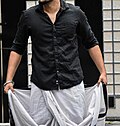
The '''dhoti''', also known as '''veshti''',<ref>{{Cite web |date=2020 |title=What is Veshti |url=https://www.rhythmdhotis.com/what-is-veshti/ |url-status=live |website=Rhythm Dhotis}}</ref> '''vetti''', '''dhuti''', '''mardani''', '''chaadra''', '''dhotar''', or '''Jaiñbohorpanchey''', is a type of [[sarong]], tied in a manner that outwardly resembles "loose [[trousers]]".<ref>{{Cite book|last=Company|first=Fideler|url=https://books.google.com/books?id=afYNAQAAIAAJ|title=Life in Other Lands|publisher=Fideler|year=1960|page=78|quote=It is arranged to look like a pair of baggy trousers. This garment is called a dhoti and is usually made of cotton.|access-date=3 January 2021}}</ref><ref>{{Cite book|last=Bhandari|first=Vandana|url=https://books.google.com/books?id=nckSAQAAIAAJ|title=Costume, Textiles and Jewellery [i.e. Jewelry] of India: Traditions in Rajasthan|publisher=Mercury Books|year=2005|isbn=9781904668893|page=105|quote=One of the reasons for the dhoti's enduring popularity is its loose trouser - like form , which is convenient and extremely well - suited to the tropical Indian climate .|access-date=3 January 2021}}</ref><ref>{{Cite book|last=K Parker|first=Lewis|url=https://books.google.com/books?id=0uIZaaoSKGYC|title=India|publisher=Rourke Book Company|year=1994|isbn=9781559160056|page=14|quote=Boys and men often wear a ''dhoti''. This is a piece of white cloth wound around the waist. ''Dhotis'' look like comfortable, baggy pants.|access-date=3 January 2021}}</ref> It is a lower garment forming part of the [[Folk_costume#South_Asia|national or ethnic costume]] for men in the [[Indian subcontinent]].<ref>{{Cite web|title=Indian Dhoti|url=https://www.indianmirror.com/culture/clothing/dhoti.html|url-status=live|archive-url=https://web.archive.org/web/20200729202155/https://www.indianmirror.com/culture/clothing/dhoti.html|archive-date=29 July 2020|access-date=3 January 2021|website=Indian Mirror}}</ref> The ''dhoti'' is fashioned out of a rectangular piece of unstitched cloth, usually around {{convert|4.5|m}} long, wrapped around the waist and the legs and knotted either in the front or the back. ''Dhotis'' come in plain or solid colours, silk ''dhotis'' with [[zari|embroidered borders]] are considered to be [[formal wear]]. The ''dhoti'' is touted as the male counterpart of the ''[[sari]]'' worn by females to religious and secular [[ceremonies]] ([[function hall|functions]]).<ref>{{Cite news|last=Avasthi|first=Vivek|date=14 January 2020|title=Sarees for women, dhoti for men: Officer's dress code for Kashi temple irks minister|language=English|work=The Federal|url=https://thefederal.com/news/sarees-for-women-dhoti-for-men-officers-dress-code-for-kashi-temple-irks-minister/|url-status=live|access-date=3 January 2021|archive-url=https://web.archive.org/web/20200805184620/https://thefederal.com/news/sarees-for-women-dhoti-for-men-officers-dress-code-for-kashi-temple-irks-minister/|archive-date=5 August 2020}}</ref> | |||
'''{{Lang|hi|Pitambar}}''' is a yellow silk dhoti, worn on auspicious occasions.<ref>{{Cite book|last=Henry|first=Baden Powell|url=https://books.google.com/books?id=r4wCfSUgjQQC&q=Pitambar+silk+cloth|title=Hand-book of the Economic Products of the Punjab (etc.): Forming ... to the hand-book of the economic products of the Punjab|date=1872|publisher=Engineering College Press|pages=65, 67|language=en}}</ref><ref>{{Cite book|last=Birdwood|first=George Christopher Molesworth|url=https://books.google.com/books?id=5XLdX1yTDh8C&dq=Mashru+was+permitted&pg=PA345|title=The Industrial Arts of India|date=1884|publisher=Chapman and Hall|pages=363|language=en}}</ref> | |||
''' | == Etymology == | ||
The word ''dhoti'' is derived from ''dhauti'' ([[Sanskrit language|Sanskrit]]: धौती), meaning to "cleanse or wash".<ref>{{Cite web|url=http://spokensanskrit.de/index.php?script=HK&beginning=0+&tinput=dhoti&trans=Translate&direction=AU|title=Sanskrit - Asien.net}}</ref> In the context of clothing, it simply refers to the cleansed garment which was worn as part of everyday attire<ref name=Ghurye>Govind Sadashiv Ghurye (1951) ''Indian Costume''</ref>{{rp|129}} The dhoti evolved from the ancient [[antriya]] which was passed through the legs, tucked at the back and covered the legs loosely, then flowed into long pleats at front of the legs, the same way it is worn today as formal dhoti.<ref name=Ghurye/>{{rp|130}} While informal dhoti wraps around both legs firmly, in this style the back side of dhoti is pulled to the front and tucked at the waist, before tucking the two loose ends at back, creating firmly fitted trouser-like dhoti that wraps around both legs.<ref>Indian Costume by [[G. S. Ghurye| Govind Sadashiv Ghurye]] 1966</ref><ref>Ancient Indian Costume By Roshen Alkazi 1996</ref> | |||
=== Names in India === | |||
[[File:In Welcome of Buddha - ACCN 34-2542 - Government Museum - Mathura 2013-02-24 5941.JPG|thumb|200px|Relief depicting men in anatariya and [[uttariya]], 1st century CE.]] | |||
[[File:A Manipuri Dancer in traditional Krishna attire.jpg|thumb|200px|Female dancer dressed as [[Krishna]] in yellow dhoti.]] | |||
[[ | The garment is known by various names, such as: | ||
[[ | {| class="wikitable" | ||
[[Category: | !colspan="2"| !! Language<br />{{nobold|or region}} | ||
[[Category:Pakistani | |- | ||
[[Category: | | धोती || ''Dhotī'' || [[Sanskrit]], [[Pali]] </tr> | ||
| धोती || ''Dhotī'' || [[Hindi languages|Hindi]] </tr> | |||
| मर्दानी || ''Mardaani'' || [[Hindi languages|Hindi]]</tr> | |||
| ਚਾਦਰਾ || ''Chaadra'' || [[Punjabi language|Punjabi]] </tr> | |||
| ଧୋତି || ''Dhotī'' || [[Odia language|Odia]] </tr> | |||
| ધૉતિયુ || ''Dhotiyu'' || [[Gujarati language|Gujarati]] </tr> | |||
| धोतर || ''Dhotar'' {{sup|a}}<br /> || [[Marathi language|Marathi]] </tr> | |||
| চুৰিয়া, <br/>ধুতি || ''Suriya'' <br/>''Dhuti''|| [[Assamese language|Assamese]] </tr> | |||
| ধুতি ||''Dhuti'' || [[Bengali language|Bengali]] </tr> | |||
| ಧೋತ್ರ <br /> ಕಚ್ಚೆ ಪಂಚೆ || ''Dhotra''<br />''Kachche Panche'' || [[Kannada language|Kannada]] </tr> | |||
| धोंतर,<br />आंगोस्तर,<br />आड नेसचे,<br />पुडवे <br /> || ''Dhontar''<br />''Angostar''<br />''Aad-neschey''<br />''Pudve'' || [[Konkani language|Konkani]] </tr> | |||
|മുണ്ട്||''Muṇṭ''|| [[Malayalam language|Malayalam]] </tr> | |||
|పంచ||''Panchā'' || [[Telugu language|Telugu]] </tr> | |||
|ధోవతి||''Dhovathi'' || [[Telugu language|Telugu]] </tr> | |||
|வேட்டி|| ''Vaetti'' ||[[Tamil language|Tamil]]</tr> | |||
| {{lang|ur|{{nq|دھوتی}}}} || ''Dhoti'' || [[Urdu language|Urdu]] </tr> | |||
|- | |||
|colspan="3"| {{longitem |{{small|{{sup|a}} In Marathi, a ''dhotar'' is not the same as a ''pancha'' (plural ''panche'').<br />{{pad|0.75em}}While the former is worn around the waist, the latter is normally<br />{{pad|0.75em}}used as a towel after a bath or shower (compare [[#Extra cloth|below]]).}} }} | |||
|} | |||
== Custom and usage == | |||
Dhoti is usually worn over a [[kaupinam]] or [[langot]], types of [[loincloth]] undergarments. | |||
{{multiple image | |||
| align = left | |||
| image1 = Indian Relief of Ashoka, circa 1st century BC, from the Amaravathi village, Guntur district, Andhra Pradesh (India), in the Guimet Museum (Paris).jpg | |||
| width1 = 200 | |||
| caption1 = <center>A Chakravati wears a ''pancha'' in an ancient style. First century BCE/CE. [[Amaravathi village, Guntur district]] ([[Musee Guimet]]).</center> | |||
| image2 = Didarganj_Yakshi_statue_in_the_Bihar_Museum.jpg | |||
| width2 = 112 | |||
| caption2 = <center>The [[Didarganj Yakshi]] depicting the ''dhoti wrap''.</center> | |||
}} | |||
The ''pancha'' is worn by many orthodox [[Jain]] men when they visit the temple for [[puja (Jainism)|puja]]; unstitched clothing is believed by some Jains to be "less permeable to pollution" and therefore more appropriate for religious rituals than other garments.<ref name=Cort>{{cite book |last=Cort |first=John E. |date=2001 |title=Jains in the World: Religious Values and Ideology in India |url=http://www.oxfordscholarship.com/view/10.1093/0195132343.001.0001/acprof-9780195132342 |publisher=Oxford University Press |page=221 |doi=10.1093/0195132343.001.0001 |isbn=9780195132342}}</ref> They also wear a loose, unstitched cloth, shorter than the ''pancha'', on top. | |||
[[International Society for Krishna Consciousness|Hare Krishna]], known for its distinctive dress code, prompts Western adherents to wear ''pancha'', usually of [[saffron]] or white cloth folded in a traditional style. [[Maharishi Mahesh Yogi]] was known for wearing a white silk dhoti.<ref name="Koppel">{{cite news |title=Maharishi Mahesh Yogi, a Guide On the Beatles' Spiritual Path, Dies |first=Lily |last=Koppel |work=New York Times |date=February 6, 2008 |page=C.10 |url=https://www.nytimes.com/2008/02/06/world/asia/06maharishi-1.html?_r=1}}</ref> | |||
In India, there's a distinction between the [[lungi]], a similar but smaller garment often worn by people at their home as it is more casual and comfortable than dhoti, and the more formal dhoti that is sometimes worn by politicians.<ref>{{Cite web|url=https://blogs.wsj.com/indiarealtime/2014/07/23/no-dhotis-please-were-indian/|title=No Dhotis Please, We're Indian|last=McLain|first=Sean|date=2014-07-23|website=Wall Street Journal|language=en-US|access-date=2017-11-03}}</ref> | |||
[[File:A news photo from 1939, showing Nehru, Gandhi, and Sardar Vallabhbhai Patel (to the right, in the foreground, wearing the dhoti) in Bombay.jpg|thumb|Gandhi, [[Jawaharlal Nehru]], [[Vallabhbhai Patel]] and fellow nationalist leaders can be seen wearing dhoti]] | |||
During the [[Indian independence movement]], weaving and wearing dhoti was a symbol of [[Swadeshi movement]]. [[Mahatma Gandhi]] adopted dhoti as his identity to identify with rural poor of India in 1921<ref>{{Cite web|url=https://www.ministerwhite.com/blogs/blogs/gandhi-weaving-a-nation-together/|title=Gandhi - Weaving a nation together |last=Sankaralingam|first=Sathrukkan|date=2020-09-02|website=Minister White Blog|language=en-US|access-date=2020-09-02}}</ref><ref>{{Cite web|title=What made Gandhiji wear only Loincloth or Dhoti|url=https://pib.gov.in/newsite/printrelease.aspx?relid=149833|access-date=2021-10-07|website=pib.gov.in}}</ref> | |||
{{clear}} | |||
== See also == | |||
{{div col|colwidth=18em}} | |||
* [[Khadi]] | |||
* [[Khādī Development and Village Industries Commission]] | |||
* [[Kilt]] | |||
* [[Lederhosen]] | |||
* [[Longyi]] | |||
* [[Lungi]] | |||
* [[Mundu]] | |||
* [[Malong]] | |||
* [[Sompot]] | |||
* [[Sompot Chong Kben]] | |||
* [[Sarong]] | |||
* [[Shendyt]] | |||
* [[Toga]] | |||
* [[Harem pants]] | |||
{{div col end}} | |||
== References == | |||
{{Commons category|Dhoti}} | |||
{{reflist}} | |||
{{Clothing in South Asia}} | |||
{{Folk costume}} | |||
[[Category:Hindu religious clothing]] | |||
[[Category:Indian clothing]] | |||
[[Category:Pakistani clothing]] | |||
[[Category:Skirts]] | |||
Revision as of 22:55, 8 May 2022

The dhoti, also known as veshti,[1] vetti, dhuti, mardani, chaadra, dhotar, or Jaiñbohorpanchey, is a type of sarong, tied in a manner that outwardly resembles "loose trousers".[2][3][4] It is a lower garment forming part of the national or ethnic costume for men in the Indian subcontinent.[5] The dhoti is fashioned out of a rectangular piece of unstitched cloth, usually around 4.5 metres (15 ft) long, wrapped around the waist and the legs and knotted either in the front or the back. Dhotis come in plain or solid colours, silk dhotis with embroidered borders are considered to be formal wear. The dhoti is touted as the male counterpart of the sari worn by females to religious and secular ceremonies (functions).[6]
Pitambar is a yellow silk dhoti, worn on auspicious occasions.[7][8]
Etymology
The word dhoti is derived from dhauti (Sanskrit: धौती), meaning to "cleanse or wash".[9] In the context of clothing, it simply refers to the cleansed garment which was worn as part of everyday attire[10]:129 The dhoti evolved from the ancient antriya which was passed through the legs, tucked at the back and covered the legs loosely, then flowed into long pleats at front of the legs, the same way it is worn today as formal dhoti.[10]:130 While informal dhoti wraps around both legs firmly, in this style the back side of dhoti is pulled to the front and tucked at the waist, before tucking the two loose ends at back, creating firmly fitted trouser-like dhoti that wraps around both legs.[11][12]
Names in India


The garment is known by various names, such as:
| Language or region | ||
|---|---|---|
| धोती | Dhotī | Sanskrit, Pali |
| धोती | Dhotī | Hindi |
| मर्दानी | Mardaani | Hindi |
| ਚਾਦਰਾ | Chaadra | Punjabi |
| ଧୋତି | Dhotī | Odia |
| ધૉતિયુ | Dhotiyu | Gujarati |
| धोतर | Dhotar a |
Marathi |
| চুৰিয়া, ধুতি |
Suriya Dhuti |
Assamese |
| ধুতি | Dhuti | Bengali |
| ಧೋತ್ರ ಕಚ್ಚೆ ಪಂಚೆ |
Dhotra Kachche Panche |
Kannada |
| धोंतर, आंगोस्तर, आड नेसचे, पुडवे |
Dhontar Angostar Aad-neschey Pudve |
Konkani |
| മുണ്ട് | Muṇṭ | Malayalam |
| పంచ | Panchā | Telugu |
| ధోవతి | Dhovathi | Telugu |
| வேட்டி | Vaetti | Tamil |
| دھوتی | Dhoti | Urdu |
a In Marathi, a dhotar is not the same as a pancha (plural panche).
While the former is worn around the waist, the latter is normally used as a towel after a bath or shower (compare below). | ||
Custom and usage
Dhoti is usually worn over a kaupinam or langot, types of loincloth undergarments.
,_in_the_Guimet_Museum_(Paris).jpg)

The pancha is worn by many orthodox Jain men when they visit the temple for puja; unstitched clothing is believed by some Jains to be "less permeable to pollution" and therefore more appropriate for religious rituals than other garments.[13] They also wear a loose, unstitched cloth, shorter than the pancha, on top.
Hare Krishna, known for its distinctive dress code, prompts Western adherents to wear pancha, usually of saffron or white cloth folded in a traditional style. Maharishi Mahesh Yogi was known for wearing a white silk dhoti.[14]
In India, there's a distinction between the lungi, a similar but smaller garment often worn by people at their home as it is more casual and comfortable than dhoti, and the more formal dhoti that is sometimes worn by politicians.[15]
_in_Bombay.jpg)
During the Indian independence movement, weaving and wearing dhoti was a symbol of Swadeshi movement. Mahatma Gandhi adopted dhoti as his identity to identify with rural poor of India in 1921[16][17]
See also
References
- ↑ "What is Veshti". Rhythm Dhotis. 2020.
{{cite web}}: CS1 maint: url-status (link) - ↑ Company, Fideler (1960). Life in Other Lands. Fideler. p. 78. Retrieved 3 January 2021.
It is arranged to look like a pair of baggy trousers. This garment is called a dhoti and is usually made of cotton.
{{cite book}}:|last=has generic name (help) - ↑ Bhandari, Vandana (2005). Costume, Textiles and Jewellery [i.e. Jewelry] of India: Traditions in Rajasthan. Mercury Books. p. 105. ISBN 9781904668893. Retrieved 3 January 2021.
One of the reasons for the dhoti's enduring popularity is its loose trouser - like form , which is convenient and extremely well - suited to the tropical Indian climate .
- ↑ K Parker, Lewis (1994). India. Rourke Book Company. p. 14. ISBN 9781559160056. Retrieved 3 January 2021.
Boys and men often wear a dhoti. This is a piece of white cloth wound around the waist. Dhotis look like comfortable, baggy pants.
- ↑ "Indian Dhoti". Indian Mirror. Archived from the original on 29 July 2020. Retrieved 3 January 2021.
- ↑ Avasthi, Vivek (14 January 2020). "Sarees for women, dhoti for men: Officer's dress code for Kashi temple irks minister". The Federal. Archived from the original on 5 August 2020. Retrieved 3 January 2021.
- ↑ Henry, Baden Powell (1872). Hand-book of the Economic Products of the Punjab (etc.): Forming ... to the hand-book of the economic products of the Punjab. Engineering College Press. pp. 65, 67.
- ↑ Birdwood, George Christopher Molesworth (1884). The Industrial Arts of India. Chapman and Hall. p. 363.
- ↑ "Sanskrit - Asien.net".
- ↑ 10.0 10.1 Govind Sadashiv Ghurye (1951) Indian Costume
- ↑ Indian Costume by Govind Sadashiv Ghurye 1966
- ↑ Ancient Indian Costume By Roshen Alkazi 1996
- ↑ Cort, John E. (2001). Jains in the World: Religious Values and Ideology in India. Oxford University Press. p. 221. doi:10.1093/0195132343.001.0001. ISBN 9780195132342.
- ↑ Koppel, Lily (February 6, 2008). "Maharishi Mahesh Yogi, a Guide On the Beatles' Spiritual Path, Dies". New York Times. p. C.10.
- ↑ McLain, Sean (2014-07-23). "No Dhotis Please, We're Indian". Wall Street Journal. Retrieved 2017-11-03.
- ↑ Sankaralingam, Sathrukkan (2020-09-02). "Gandhi - Weaving a nation together". Minister White Blog. Retrieved 2020-09-02.
- ↑ "What made Gandhiji wear only Loincloth or Dhoti". pib.gov.in. Retrieved 2021-10-07.