




CleanupBot (talk | contribs) →top: Add {{source}} tag |
->Wallflowernepal Removed Empty gallery and chaged position of notes |
||
| Line 1: | Line 1: | ||
{{Short description|Indo-Aryan ethno-linguistic group of Nepal and India}} | |||
{{pp|small=yes}} | |||
{{About|medieval and modern day Khas people|ancient Turanid group of same name|Khasas|medieval kingdom|Khasa Malla kingdom|native language of Khas people|Khas language}} | |||
{{Infobox ethnic group | {{Infobox ethnic group | ||
|group = Khas/ | | group = Khas/Khasia/Kus/Parbate/Pahari/Gorkhali | ||
| | | native_name = | ||
|population | | native_name_lang = | ||
|regions = | | image = Albumen Photograph of Khas Women from Nepal - 1880's.jpg | ||
|languages = [[Nepali language | | caption = Picture of Khas Women from Nepal in the 1880s | ||
| | | population = '''{{Circa|16 million|lk=yes}}'''<ref name=ethnologue1>{{cite web|url=http://www.ethnologue.com/18/language/npi/|title=Nepali (npi)|work=Ethnologue|access-date=6 October 2016}}</ref> | ||
| | | regions = [[Nepal]], [[India]], [[Bhutan]] | ||
| languages = [[Nepali language|Nepali (Khas kura)]] | |||
| rels = [[Hinduism in Nepal |Hinduism]] | |||
| related = [[Kumaoni people]], [[Garhwali people]], [[Pahari people (Nepal)|Pahari people]], | |||
| footnotes = | |||
}} | }} | ||
[[ | '''Khas people''' ({{IPAc-en|Lang|k|h|ɑː|s}}; {{lang-ne|खस}}) also called '''Khas and Arya'''{{#tag:ref|See<ref name="Khadka">{{Cite news|last=Khadka|first =Suman |url=http://kathmandupost.ekantipur.com/printedition/news/2015-02-25/drawing-caste-lines.html|title= Drawing caste lines|date=25 Feb 2015|newspaper= [[The Kathmandu Post]]}}</ref><ref name="thehimalayantimes.com">{{cite web|url=https://thehimalayantimes.com/nepal/khas-arya-quota-provision-civil-services-opposed/|title=Khas Arya quota provision in civil services opposed|date=10 November 2017|website=thehimalayantimes.com|access-date=1 May 2018}}</ref><ref>{{cite news|url=https://www.economist.com/news/asia/21731658-good-government-might-be-too-much-hope-nepals-election-may-last-bring-stability|title=Nepal's election may at last bring stability|newspaper=The Economist|access-date=1 May 2018}}</ref><ref>{{cite web|url=http://kathmandupost.ekantipur.com/ampnews/2018-03-28/pm-briefs-international-community.html|title=The Kathmandu Post -PM briefs international community|website=kathmandupost.ekantipur.com|access-date=6 April 2018}}</ref><ref>{{cite web|url=https://www.nepalitimes.com/from-the-nepali-press/quotable-quota/|title=Quotable quota|first=Nepali|last=Times|website=www.nepalitimes.com|access-date=1 May 2018}}</ref><ref>{{cite web|url=http://indianexpress.com/article/opinion/columns/kp-oli-swearing-in-ceremony-nepal-elections-5119820/|title=Next Door Nepal: Another chink in the wall|date=2 April 2018|website=indianexpress.com|access-date=1 May 2018}}</ref><ref>{{cite web|url=http://www.myrepublica.com/news/39123/?categoryId=81|title=Oli in balancing avatar|website=myrepublica.com|access-date=1 May 2018}}</ref><ref>{{cite web|url=https://asia.nikkei.com/Politics/Nepal-seeks-unity-from-its-first-local-elections-in-20-years|title=Nepal seeks unity from its first local elections in 20 years|website=Nikkei Asian Review|access-date=1 May 2018}}</ref><ref>{{cite web|url=https://thewire.in/politics/lessons-for-india-from-nepal-history-of-cow-slaughter|title=Lessons for India From Nepal's History of Banning Cow Slaughter - The Wire|website=The Wire|access-date=1 May 2018}}</ref><ref>{{cite web|url=http://kathmandupost.ekantipur.com/news/2018-04-07/what-does-high-caste-chauvinism-look-like.html|title=What does high caste chauvinism look like?|website=ekantipur.com|access-date=1 May 2018}}</ref>|name="khas arya"|group="nb"}} are an [[Indo-Aryan peoples|Indo-Aryan]]{{sfn|Hagen|Thapa|1998|p=114}} [[ethno-linguistic group]] native to South Asia, what is now present-day [[Nepal]] and [[Indian states]] of [[Uttarakhand]], [[West Bengal]] and [[Sikkim]].{{Citation needed|date=December 2020}}The Khas people speak the [[Khas language]]. They are also known as '''Parbatiyas/Parbates''' and '''Paharis/Pahadis''' or '''Gorkhali'''. The term ''Khas'' has now become obsolete, as the Khas people have adopted communal identities such as [[Thakuri]] and [[Chhetri]] because of the negative stereotypes associated with the term ''Khas''.{{sfn|William Brook Northey|C. J. Morris|1928|p=123}}{{sfn|K. S. Singh|2005|p=851}}{{sfn|Dor Bahadur Bista|1991|p=48}} | ||
According to the [[Constitution of Nepal]], western hill khas [[Bahun]]s, [[Chhetri]]s, [[Thakuri]]s, and [[Sannyasa|Sanyasis]] who are citizens of Nepal should be considered as Khas Arya for electoral purposes.<ref>{{Cite web|url=http://www.lawcommission.gov.np/en/archives/888|title=Part-8 Federal Legislature – Nepal Law Commission|language=en-US|access-date=2019-08-05}}</ref> | |||
== | ==Origin== | ||
= | They have been connected to the [[Khasas]] mentioned in the ancient Hindu literature.{{sfn|John T Hitchcock|1978|pp=112-119}} Historian Bal Krishna Sharma and [[Dor Bahadur Bista]] speculates that the Khas or Kus people were of [[Yuezhi]] Tribes from Cental Asia, Historian [[Baburam Acharya]] speculates that Khas are a sub-clan of Saka, a [[Central Asia]]<nowiki/>n clan that originated at Idavritt (modern day [[Kashmir]]) and later migrated to the hilly regions of West Nepal where they were called '''Paharis/Pahadis''' literally translating to '''hill-dwellers'''.{{sfn|Acharya|1975|p=199}}{{#tag:ref|Historian [[Baburam Acharya]] speculates that in the 3rd millennium BCE., there were two clans of '''[[Aryan|Arya]]''' in the northern [[Indian subcontinent]]; ''Aiḍa'' and ''Mānava''. ''Aiḍa'' who were named after their homeland ''Iḍavritt'' (modern day [[Kashmir]]), settled over [[Panjab]] and [[Gangetic plain|Ganga-Jamuna plain]] while ''Mānava'' settled over [[Awadh]] region. [[Chandravanshi]] kings like [[Bharata (Mahabharata)|Bharata]] and [[Yudhisthir]] belonged to ''Aiḍa'' while [[Suryavansha|Suryavanshi]] kings like [[Ramachandra]] belonged to ''Mānava''. Later, ''Aiḍa'' built dominion over [[Magadh]] while ''Mānava'' had dominion over [[Videha]].{{sfn|Acharya|1975|p=199}}|name="arya clan"|group="nb"}} Khas were living in the ''Idavaritt'' in the 3rd millennium BCE. and the original meaning of the term ''Khas'' was [[Raja]] (''Yoddha'').{{sfn|Acharya|1975|p=199}} He further speculates that Kashmir has been named from its local residents Khas as '''Khasmir'''.{{sfn|Acharya|1975|p=199}} In the 2nd millennium B.C.E., one group of Khas migrated towards [[Iran]] while the other group migrated east of [[Sutlej river]] settling only in the hill regions up to [[Bheri River]].{{sfn|Acharya|1975|p=200}} Historian Balkrishna Pokhrel contends that Khas were not the [[Vedic Aryan]]s but [[Turanid race|Turanid]] of the latter periods like the [[Gurjara]], [[Darada]], [[Saka|Shaka]], and [[Pallava]].{{sfn|Pokhrel|1973|p=229}} He further asserts that post-Vedic Aryans were akin to Vedic Aryans in terms of [[Indo-Aryan languages]] and [[Indian culture]].{{sfn|Pokhrel|1973|p=229}} | ||
[[Category: | == History == | ||
Khas are believed to have arrived in the western reaches of Nepal at the beginning of first-millennium B.C.{{sfn|Dor Bahadur Bista|1991|p=15}} or middle of first-millennium A.D.{{sfn|Sharma|1999|p=112}} from the north-west. It is likely that they absorbed people from different ethnic groups during this immigration.{{sfn|John T Hitchcock|1978|p=113}} They have been connected to the medieval [[Khasa Malla kingdom]].{{sfn|John T Hitchcock|1978|pp=112-119}} | |||
In the [[Kumaon division|Kumaon]] and [[Garhwal division|Garhwal]] regions of Uttarakhand in India, the Khas Brahmins and Khas Rajputs had a lower social status than the other Vedic Brahmins and Rajputs. However, in present-day western Nepal, they had the same status as the other Brahmins, possibly as a result of their political power in the Khasa Malla kingdom.{{sfn|John T Hitchcock|1978|pp=116-119}} | |||
[[File:Mandhata Shahi- SAKE-1612.jpg|thumb|Copper Inscription by King of [[Doti]], ''Raika'' Mandhata Shahi at [[Saka Era]] 1612 (शाके १६१२) (or 1747 [[Bikram Samvat]]) in old [[Khas language]] using [[Devanagari]] script]] | |||
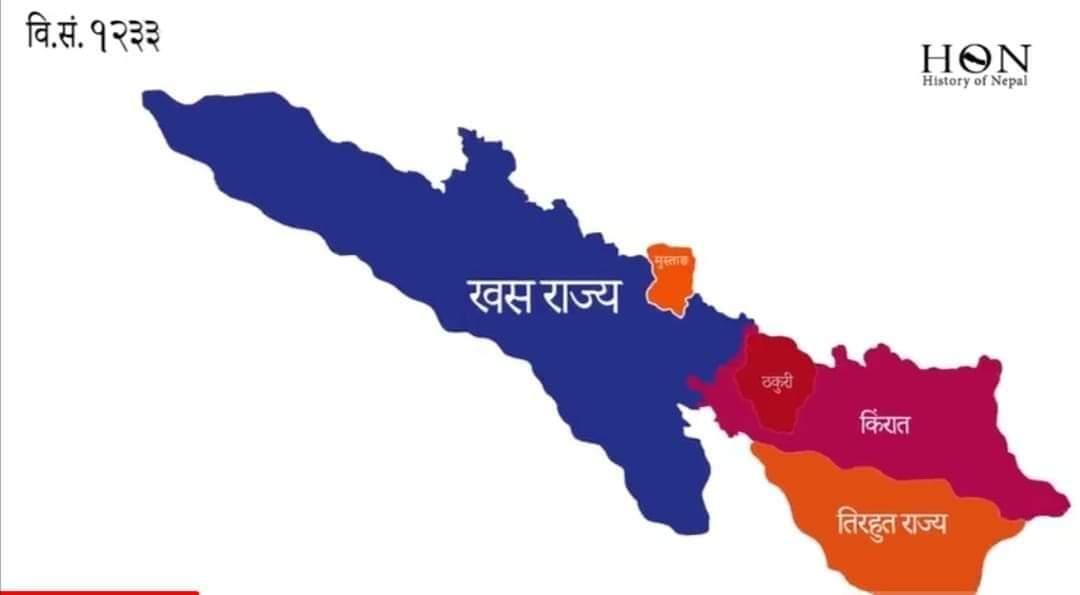
Until the 19th century, the [[Gorkha Kingdom|Gorkhali]] referred to their country as ''Khas Desh'' (Khas country).{{sfn|Richard Burghart|1984|p=107}} As they annexed the various neighboring countries (such as Newar of the [[Newar people]]) to the Gorkha kingdom, the terms such as ''Khas'' and ''Newar'' ceased to be used as the names of countries. The 1854 legal code (''Muluki Ain''), promulgated by the Nepali Prime Minister [[Jung Bahadur Rana]], himself a Khas,{{sfn|Dor Bahadur Bista|1991|p=37}} no longer referred to ''Khas'' as a country, rather as a ''[[jāti|jāt]]'' (species or community) within the Gorkha kingdom.{{sfn|Richard Burghart|1984|p=117}} | |||
[[File:Khas or pre-gorkha kingdom.jpg|thumb|Khas Kingdom]] | |||
[[File:A_Portrait_Of_Khas_Soldier_In_1815.jpg|thumb|A Portrait Of Khas/Chhetri Soldier 1815|left]] | |||
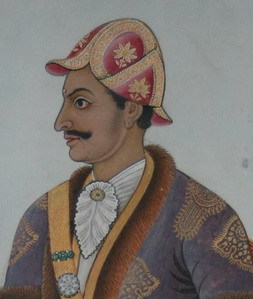
[[File:Bhimsen Thapa of Nepal (cropped).jpg|thumb|[[Mukhtiyar]] [[Bhimsen Thapa]], the widely accepted first Prime Minister of Nepal]] | |||
[[File:Ancestors of Tholung Family-1.jpg|thumb|Mother Of Jung Bahadur Rana]] | |||
The [[Shah dynasty]] of the Gorkha Kingdom, as well as the succeeding [[Rana dynasty]], spoke the [[Khas language]] (now called the Nepali language). However, they claimed to be Rajputs of Gorkha origin, rather than the native Khasas.{{sfn|Richard Burghart|1984|p=119}} Since outside Nepal, the Khas social status was seen as inferior to that of the Rajputs, the rulers started describing themselves as natives of the Hill country, rather than that of the Khas country. Most people, however, considered the terms ''Khas'' and ''Parbatiya'' (''Pahari/Pahadi'' or Hill people) as synonymous.{{sfn|Richard Burghart|1984|p=107}} | |||
Jung Bahadur also re-labeled the Khas ''jāt'' as [[Chhetri]] in present-day Nepal.{{sfn|Richard Burghart|1984|p=119}} Originally, the [[Brahmin]] immigrants from the [[Gangetic plain|plains]] considered the Khas as low-caste because of the latter's neglect of high-caste taboos (such as alcohol abstinence).{{sfn|Susan Thieme|2006|p=83}} The upper-class Khas people commissioned the [[Bahun]] (Brahmin) priests to initiate them into the high-caste Chhetri order and adopted high-caste manners. Other Khas families who could not afford to (or did not care to) pay the Bahun priests also attempted to assume the Chhetri status but were not recognized as such by others. They are now called Matwali (alcohol-drinker Khas) Chhetris.{{sfn|Dor Bahadur Bista|1991|p=48}} | |||
[[File:A portrait Khas- Goorkhali Soldiers IN 1820.jpg|thumb|A portrait Khas-Goorkhali Soldiers IN 1820|left]] | |||
[[File:Khas Gorkhas Soldiers IN Burma Front 1943.jpg|thumb|Khas Gorkhas Soldiers IN Burma Front 1943]] | |||
Because of the adoption of the ''Chhetri'' identity, the term ''Khas'' is rapidly becoming obsolete.{{sfn|William Brook Northey|C. J. Morris|1928|p=123}} According to [[Dor Bahadur Bista]] (1991), "the Khas have vanished from the ethnographic map of Nepal".{{sfn|Dor Bahadur Bista|1991|p=48}} | |||
==Communities== | |||
Historian Balkrishna Pokhrel writes the communities or caste in Khas group were [[Bahun|Brahman]], [[Chhetri]], [[Thakuri]], [[Sannyasa|Sannyasi]], [[Gharti]], [[Damai]], [[Kami (caste)|Kami]], [[Sarki (ethnic group)|Sarki]], [[Gandarbha|Gaine]], [[Gandarbha]], [[Badi people|Badi]], [[Kusunda people|Kusunda]], [[Raute people|Raute]], [[Kumal people|Kumal]], etc.{{sfn|Pokhrel|1973|p=229}} The tribal designation [[Khasas|Khas]] refers to in some contexts only to the Pawai/Matwali Khas group, [[Chhetri|Chhetri-]][[Thakuri]], but in other contexts may also include the low status (generally untouchable) occupational Khas groups such as [[Kami (caste)|Kāmi]] (blacksmiths), [[Damai|Damāi]] (tailors), and [[Sarki (ethnic group)|Sārki]] (shoemakers and leather workers).{{sfn|Whelpton|2005|p=31}} Khas people are addressed with the term ''Khayan'' or ''Parbatiya''{{sfn|Pokhrel|1973|p=229}} or ''Partyā'', ''Parbaté'' meaning hill-dweller by [[Newar]]s.{{sfn|Whelpton|2005|p=31}} The hill Khas tribe are in large part associated with the [[Gurkha|Gorkhali]] warriors.{{sfn|Whelpton|2005|p=31}} | |||
[[File:Khas or Kus group, Goorkha, dominant tribe, Nipal.jpg|thumb|Khas/Chhetri Tribe of Nepal]] | |||
==Language== | |||
The Khas people originally referred to their language as ''[[Khas language|Khas kurā]]'' (Khas speech), which was also known as ''Parbatiya'' (the language of the hill country). The Newar people used the term ''Khayan Bhaya'', ''Parbatiya''{{sfn|Pokhrel|1973|p=229}} and ''Gorkhali'' as a name for this language, as they identified it with the Gorkhali conquerors. The Gorkhalis themselves started using this term to refer to their language at a later stage.{{sfn|Richard Burghart|1984|p=118}} In an attempt to disassociate himself with his Khas past, the Rana monarch Jung Bahadur decreed that the term Gorkhali be used instead of ''Khas kurā'' to describe the language. Meanwhile, the [[British India]]n administrators had started using the term ''Nepal'' (after Newar) to refer to the Gorkha kingdom. In the 1930s, the Gorkha government also adopted this term to describe their country. Subsequently, the Khas language also came to be known as ''Nepali language''.{{sfn|Richard Burghart|1984|pp=118-119}} It has become a national language of Nepal and [[lingua franca]] among the majority of population of [[North Bengal]], [[Sikkim]] and [[Bhutan]].{{sfn|Pokhrel|1973|p=229}} | |||
[[File:Wikitongues- Safal speaking Nepali.webm|thumb|A Nepali speaker, recorded in [[Myanmar]].]] | |||
===Classification=== | |||
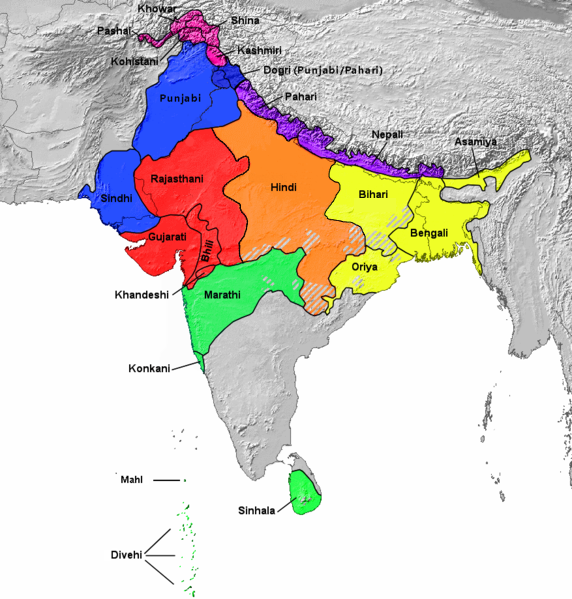
[[File:Major Indo-Aryan languages.png|thumb|[[Khas language]], Belongs to the [[Northern Indo-Aryan languages|Northern Indo-Aryan language group]] as shown as ''Nepali'', in purple]] | |||
Historian Balkrishna Pokhrel contends that the [[Khas language]] belonged to neither the [[Iranian Languages|Iranian]] language family, nor the [[Languages of India|Indian languages]], but to the mid [[Indo-Iranian languages]].{{sfn|Pokhrel|1973|p=229}} | |||
==Modern== | |||
===Nepal=== | |||
Modern-day Khas people are referred to as Khas Brahmin (commonly called as Khas [[Bahun]]), Matwali/Pawai Khas (commonly called as [[Khasas|Khas]] [[Chhetri]]), and [[Khasas|Khas]] Dalit.{{sfn|John T Hitchcock|1978|pp=116-119}} Khas people are popularly referred to in modern times as ''Khas and Arya''. | |||
===India=== | |||
{{see|Indian Gorkha}} | |||
In [[Kumaon District|Kumaon]] and [[Garhwal District|Garhwal]] regions of [[Uttarakhand]] in India, too, the term ''Khas'' has become obsolete. The Khas people of Kumaon termed as Kumaoni Jiagahari Rajput, after being elevated to the Rajput status by the [[Chand kings]]. The term Khas is almost obsolete, and people resent being addressed as Khas because of the negative stereotypes associated with this term.{{sfn|K. S. Singh|2005|p=851}} | |||
==Notable people== | |||
===Khas Malla rulers=== | |||
*[[Khasa Malla kingdom|Khas Malla rulers]] | |||
===Other Khas=== | |||
*[[Bir Bhadra Thapa]]{{sfn|Pradhan|2012|p=22}} | |||
*[[Amar Singh Thapa (Sardar)|Sanukaji Amar Singh Thapa]]{{sfn|Pradhan|2012|p=22}} | |||
*[[Bhimsen Thapa]]{{sfn|Pradhan|2012|p=22}} | |||
*[[Jung Bahadur Rana]]{{sfn|Dor Bahadur Bista|1991|p=37}} | |||
*[[Kalu Pande]] (Kaji) {{sfn|Pradhan|2012|p=22}} | |||
*[[Prithvi Narayan Shah]] | |||
*[[Shivaram Singh Basnyat]] (Badabir senapanti) <ref>{{Citation|title=BBBBB|date=2005-01-20|url=http://dx.doi.org/10.1201/9780203970843-60|work=Improvement of Buildings' Structural Quality by New Technologies|pages=520–522|publisher=CRC Press|doi=10.1201/9780203970843-60|isbn=978-0-429-22460-7|access-date=2021-07-02}}</ref> | |||
*[[Kehar Singh Basnyat]] | |||
*[[Damodar Pandey]] | |||
*[[Abhiman Singh Basnyat]] | |||
*[[Kirtiman Singh Basnyat]] | |||
*[[Bakhtawar Singh Basnyat]] | |||
*[[Dhokal Singh Basnyat]] | |||
*[[Rana Jang Pande]] | |||
[[File:A woman belonging to the Limboo community of Sikkim.jpg|thumb|A Khasa Female Photo From Pokhara At 1920]] | |||
==See Also== | |||
*[[Indian Gorkha]] | |||
*[[Nepali language]] | |||
== Notes == | |||
{{reflist|group=nb}} | |||
== References == | |||
{{reflist|30em}} | |||
==Bibliography== | |||
{{ref begin}} | |||
*{{citation | last = Acharya| first = Baburam | editor-last = Bhandari| editor-first = Devi Prasad | title = Itihas Kaalbhanda Pahile | journal = Purnima | volume = 8| issue = 1| location = Kathmandu | date = 1975 | url = http://himalaya.socanth.cam.ac.uk/collections/journals/purnima/pdf/Purnima_08_04.pdf}} | |||
* {{cite book |author=Dor Bahadur Bista |author-link=Dor Bahadur Bista |title=Fatalism and Development: Nepal's Struggle for Modernization |url=https://books.google.com/books?id=JzFROpFVYRAC&pg=PA48 |year=1991 |publisher=Orient Blackswan |isbn=978-81-250-0188-1 }} | |||
* {{cite book |author=John T Hitchcock |contribution=An Additional Perspective on the Nepali Caste System |editor=James F. Fisher |title=Himalayan Anthropology: The Indo-Tibetan Interface |url=https://books.google.com/books?id=B0C-IhEKrSEC&pg=PA113 |year=1978 |publisher=Walter de Gruyter |isbn=978-90-279-7700-7 }} | |||
*{{cite book|title=Toni Hagen's Nepal: The Kingdom in the Himalaya|author1=Toni Hagen|author2=Deepak Thapa|date=1998|publisher=Himal Books|url=https://books.google.com/books?id=9LFuAAAAMAAJ}} | |||
* {{cite book |author=K. S. Singh |title=People of India: Uttar Pradesh |url=https://books.google.com/books?id=bBdWAAAAYAAJ |year=2005 |publisher=Anthropological Survey of India |isbn=978-81-7304-114-3 }} | |||
*{{citation | last = Pokharel | first = Balkrishna | title = Ancient Khas Culture | journal = Regmi Research Series | volume = 5 | issue = 12 | pages = 229–236 | date = December 1, 1973 | orig-year = 1962 | url = http://himalaya.socanth.cam.ac.uk/collections/journals/regmi/pdf/Regmi_05.pdf }} | |||
*{{citation | last = Pradhan | first = Kumar L. | title = Thapa Politics in Nepal: With Special Reference to Bhim Sen Thapa, 1806–1839 | publisher = Concept Publishing Company | year = 2012 | isbn = 9788180698132 | location = New Delhi | page = 278 | url = https://books.google.com/books?id=7PP1yElRzIUC&q=the+assassination+of+rana+bahadur+shah }} | |||
* {{cite journal |author=Richard Burghart |title=The Formation of the Concept of Nation-State in Nepal |jstor=2056748 |journal=The Journal of Asian Studies |volume=44 |issue=1 |year=1984 |pages=101–125 |doi=10.2307/2056748}} | |||
* {{cite book |author=Susan Thieme |title=Social Networks and Migration: Far West Nepalese Labour Migrants in Delhi |url=https://books.google.com/books?id=1SQLdsejmkQC&pg=PA83 |year=2006 |publisher=LIT Verlag Münster |isbn=978-3-8258-9246-3 }} | |||
* {{cite book |author1=William Brook Northey |author2=C. J. Morris |title=The Gurkhas: Their Manners, Customs, and Country |url=https://books.google.com/books?id=aSaX09InyIoC&pg=PA123 |year=1928 |publisher=Asian Educational Services |isbn=978-81-206-1577-9 }} | |||
* {{Cite book| title = A History of Nepal| last1 = Whelpton | first1 = John| year = 2005 | publisher = Cambridge University Press | isbn = 978-0521804707 |url =https://books.google.com/books?id=WSo6PgAACAAJ}} | |||
* {{Cite book| title = The origin of caste system in Hinduism and its relevance in the present context| last = Sharma | first= Bal Krishna| year = 1999 | publisher = Indian Society for Promoting Christian Knowledge and Samdan Publishers | isbn= 9788172144968 |url =https://books.google.com/books?id=K1QqAAAAYAAJ}} | |||
*{{cite book | last = Adhikary | first = Surya Mani |title=The Khaśa kingdom: a trans-Himalayan empire of the middle age |url=https://books.google.com/books?id=cH5uAAAAMAAJ |year=1997 |publisher=Nirala |isbn=978-81-85693-50-7}} | |||
*{{Citation|author =D.R. Regmi |title= Medieval Nepal|volume= 1|publisher=Firma K.L. Mukhopadhyay |year=1965 |url=https://books.google.com/books?id=ST6QAAAAIAAJ}} | |||
*{{cite book | last = Thakur | first = Laxman S. |title=The Khasas An Early Indian Tribe |editor=K. K. Kusuman |work=A Panorama of Indian Culture: Professor A. Sreedhara Menon Felicitation Volume |url=https://books.google.com/books?id=z4JqgSUSXDsC&pg=PA285 |year=1990 |publisher=Mittal Publications |isbn=978-81-7099-214-1 |pages=285–293 }} | |||
*{{citation | last = Tucci | first = Giuseppe | title = Preliminary Report on Two Scientific Expeditions in Nepal | publisher = David Brown Book Company | year = 1956| isbn = 9788857526843| url = https://archive.org/details/in.gov.ignca.6480/}} | |||
{{ref end}} | |||
{{Ethnic groups in Nepal}} | |||
[[Category:Khas people| ]] | |||
[[Category:Indo-Aryan peoples]] | |||
[[Category:Ethnic groups in Nepal]] | |||
[[Category:Ethnic groups in India]] | [[Category:Ethnic groups in India]] | ||
[[Category: | [[Category:Himalayan peoples]] | ||
Revision as of 16:54, 13 November 2021
 Picture of Khas Women from Nepal in the 1880s | |
| Total population | |
|---|---|
| c. 16 million[1] | |
| Regions with significant populations | |
| Nepal, India, Bhutan | |
| Languages | |
| Nepali (Khas kura) | |
| Religion | |
| Hinduism | |
| Related ethnic groups | |
| Kumaoni people, Garhwali people, Pahari people, |
Khas people (English: /khɑːs/; Nepali: खस) also called Khas and Arya[nb 1] are an Indo-Aryan[12] ethno-linguistic group native to South Asia, what is now present-day Nepal and Indian states of Uttarakhand, West Bengal and Sikkim.[citation needed]The Khas people speak the Khas language. They are also known as Parbatiyas/Parbates and Paharis/Pahadis or Gorkhali. The term Khas has now become obsolete, as the Khas people have adopted communal identities such as Thakuri and Chhetri because of the negative stereotypes associated with the term Khas.[13][14][15]
According to the Constitution of Nepal, western hill khas Bahuns, Chhetris, Thakuris, and Sanyasis who are citizens of Nepal should be considered as Khas Arya for electoral purposes.[16]
Origin
They have been connected to the Khasas mentioned in the ancient Hindu literature.[17] Historian Bal Krishna Sharma and Dor Bahadur Bista speculates that the Khas or Kus people were of Yuezhi Tribes from Cental Asia, Historian Baburam Acharya speculates that Khas are a sub-clan of Saka, a Central Asian clan that originated at Idavritt (modern day Kashmir) and later migrated to the hilly regions of West Nepal where they were called Paharis/Pahadis literally translating to hill-dwellers.[18][nb 2] Khas were living in the Idavaritt in the 3rd millennium BCE. and the original meaning of the term Khas was Raja (Yoddha).[18] He further speculates that Kashmir has been named from its local residents Khas as Khasmir.[18] In the 2nd millennium B.C.E., one group of Khas migrated towards Iran while the other group migrated east of Sutlej river settling only in the hill regions up to Bheri River.[19] Historian Balkrishna Pokhrel contends that Khas were not the Vedic Aryans but Turanid of the latter periods like the Gurjara, Darada, Shaka, and Pallava.[20] He further asserts that post-Vedic Aryans were akin to Vedic Aryans in terms of Indo-Aryan languages and Indian culture.[20]
History
Khas are believed to have arrived in the western reaches of Nepal at the beginning of first-millennium B.C.[21] or middle of first-millennium A.D.[22] from the north-west. It is likely that they absorbed people from different ethnic groups during this immigration.[23] They have been connected to the medieval Khasa Malla kingdom.[17]
In the Kumaon and Garhwal regions of Uttarakhand in India, the Khas Brahmins and Khas Rajputs had a lower social status than the other Vedic Brahmins and Rajputs. However, in present-day western Nepal, they had the same status as the other Brahmins, possibly as a result of their political power in the Khasa Malla kingdom.[24]

Until the 19th century, the Gorkhali referred to their country as Khas Desh (Khas country).[25] As they annexed the various neighboring countries (such as Newar of the Newar people) to the Gorkha kingdom, the terms such as Khas and Newar ceased to be used as the names of countries. The 1854 legal code (Muluki Ain), promulgated by the Nepali Prime Minister Jung Bahadur Rana, himself a Khas,[26] no longer referred to Khas as a country, rather as a jāt (species or community) within the Gorkha kingdom.[27]


.jpg)

The Shah dynasty of the Gorkha Kingdom, as well as the succeeding Rana dynasty, spoke the Khas language (now called the Nepali language). However, they claimed to be Rajputs of Gorkha origin, rather than the native Khasas.[28] Since outside Nepal, the Khas social status was seen as inferior to that of the Rajputs, the rulers started describing themselves as natives of the Hill country, rather than that of the Khas country. Most people, however, considered the terms Khas and Parbatiya (Pahari/Pahadi or Hill people) as synonymous.[25]
Jung Bahadur also re-labeled the Khas jāt as Chhetri in present-day Nepal.[28] Originally, the Brahmin immigrants from the plains considered the Khas as low-caste because of the latter's neglect of high-caste taboos (such as alcohol abstinence).[29] The upper-class Khas people commissioned the Bahun (Brahmin) priests to initiate them into the high-caste Chhetri order and adopted high-caste manners. Other Khas families who could not afford to (or did not care to) pay the Bahun priests also attempted to assume the Chhetri status but were not recognized as such by others. They are now called Matwali (alcohol-drinker Khas) Chhetris.[15]


Because of the adoption of the Chhetri identity, the term Khas is rapidly becoming obsolete.[13] According to Dor Bahadur Bista (1991), "the Khas have vanished from the ethnographic map of Nepal".[15]
Communities
Historian Balkrishna Pokhrel writes the communities or caste in Khas group were Brahman, Chhetri, Thakuri, Sannyasi, Gharti, Damai, Kami, Sarki, Gaine, Gandarbha, Badi, Kusunda, Raute, Kumal, etc.[20] The tribal designation Khas refers to in some contexts only to the Pawai/Matwali Khas group, Chhetri-Thakuri, but in other contexts may also include the low status (generally untouchable) occupational Khas groups such as Kāmi (blacksmiths), Damāi (tailors), and Sārki (shoemakers and leather workers).[30] Khas people are addressed with the term Khayan or Parbatiya[20] or Partyā, Parbaté meaning hill-dweller by Newars.[30] The hill Khas tribe are in large part associated with the Gorkhali warriors.[30]

Language
The Khas people originally referred to their language as Khas kurā (Khas speech), which was also known as Parbatiya (the language of the hill country). The Newar people used the term Khayan Bhaya, Parbatiya[20] and Gorkhali as a name for this language, as they identified it with the Gorkhali conquerors. The Gorkhalis themselves started using this term to refer to their language at a later stage.[31] In an attempt to disassociate himself with his Khas past, the Rana monarch Jung Bahadur decreed that the term Gorkhali be used instead of Khas kurā to describe the language. Meanwhile, the British Indian administrators had started using the term Nepal (after Newar) to refer to the Gorkha kingdom. In the 1930s, the Gorkha government also adopted this term to describe their country. Subsequently, the Khas language also came to be known as Nepali language.[32] It has become a national language of Nepal and lingua franca among the majority of population of North Bengal, Sikkim and Bhutan.[20]
Classification

Historian Balkrishna Pokhrel contends that the Khas language belonged to neither the Iranian language family, nor the Indian languages, but to the mid Indo-Iranian languages.[20]
Modern
Nepal
Modern-day Khas people are referred to as Khas Brahmin (commonly called as Khas Bahun), Matwali/Pawai Khas (commonly called as Khas Chhetri), and Khas Dalit.[24] Khas people are popularly referred to in modern times as Khas and Arya.
India
In Kumaon and Garhwal regions of Uttarakhand in India, too, the term Khas has become obsolete. The Khas people of Kumaon termed as Kumaoni Jiagahari Rajput, after being elevated to the Rajput status by the Chand kings. The term Khas is almost obsolete, and people resent being addressed as Khas because of the negative stereotypes associated with this term.[14]
Notable people
Khas Malla rulers
Other Khas
- Bir Bhadra Thapa[33]
- Sanukaji Amar Singh Thapa[33]
- Bhimsen Thapa[33]
- Jung Bahadur Rana[26]
- Kalu Pande (Kaji) [33]
- Prithvi Narayan Shah
- Shivaram Singh Basnyat (Badabir senapanti) [34]
- Kehar Singh Basnyat
- Damodar Pandey
- Abhiman Singh Basnyat
- Kirtiman Singh Basnyat
- Bakhtawar Singh Basnyat
- Dhokal Singh Basnyat
- Rana Jang Pande

See Also
Notes
- ↑ See[2][3][4][5][6][7][8][9][10][11]
- ↑ Historian Baburam Acharya speculates that in the 3rd millennium BCE., there were two clans of Arya in the northern Indian subcontinent; Aiḍa and Mānava. Aiḍa who were named after their homeland Iḍavritt (modern day Kashmir), settled over Panjab and Ganga-Jamuna plain while Mānava settled over Awadh region. Chandravanshi kings like Bharata and Yudhisthir belonged to Aiḍa while Suryavanshi kings like Ramachandra belonged to Mānava. Later, Aiḍa built dominion over Magadh while Mānava had dominion over Videha.[18]
References
- ↑ "Nepali (npi)". Ethnologue. Retrieved 6 October 2016.
- ↑ Khadka, Suman (25 Feb 2015). "Drawing caste lines". The Kathmandu Post.
- ↑ "Khas Arya quota provision in civil services opposed". thehimalayantimes.com. 10 November 2017. Retrieved 1 May 2018.
- ↑ "Nepal's election may at last bring stability". The Economist. Retrieved 1 May 2018.
- ↑ "The Kathmandu Post -PM briefs international community". kathmandupost.ekantipur.com. Retrieved 6 April 2018.
- ↑ Times, Nepali. "Quotable quota". www.nepalitimes.com. Retrieved 1 May 2018.
- ↑ "Next Door Nepal: Another chink in the wall". indianexpress.com. 2 April 2018. Retrieved 1 May 2018.
- ↑ "Oli in balancing avatar". myrepublica.com. Retrieved 1 May 2018.
- ↑ "Nepal seeks unity from its first local elections in 20 years". Nikkei Asian Review. Retrieved 1 May 2018.
- ↑ "Lessons for India From Nepal's History of Banning Cow Slaughter - The Wire". The Wire. Retrieved 1 May 2018.
- ↑ "What does high caste chauvinism look like?". ekantipur.com. Retrieved 1 May 2018.
- ↑ Hagen & Thapa 1998, p. 114.
- ↑ 13.0 13.1 William Brook Northey & C. J. Morris 1928, p. 123.
- ↑ 14.0 14.1 K. S. Singh 2005, p. 851.
- ↑ 15.0 15.1 15.2 Dor Bahadur Bista 1991, p. 48.
- ↑ "Part-8 Federal Legislature – Nepal Law Commission". Retrieved 2019-08-05.
- ↑ 17.0 17.1 John T Hitchcock 1978, pp. 112-119.
- ↑ 18.0 18.1 18.2 18.3 Acharya 1975, p. 199.
- ↑ Acharya 1975, p. 200.
- ↑ 20.0 20.1 20.2 20.3 20.4 20.5 20.6 Pokhrel 1973, p. 229.
- ↑ Dor Bahadur Bista 1991, p. 15.
- ↑ Sharma 1999, p. 112.
- ↑ John T Hitchcock 1978, p. 113.
- ↑ 24.0 24.1 John T Hitchcock 1978, pp. 116-119.
- ↑ 25.0 25.1 Richard Burghart 1984, p. 107.
- ↑ 26.0 26.1 Dor Bahadur Bista 1991, p. 37.
- ↑ Richard Burghart 1984, p. 117.
- ↑ 28.0 28.1 Richard Burghart 1984, p. 119.
- ↑ Susan Thieme 2006, p. 83.
- ↑ 30.0 30.1 30.2 Whelpton 2005, p. 31.
- ↑ Richard Burghart 1984, p. 118.
- ↑ Richard Burghart 1984, pp. 118-119.
- ↑ 33.0 33.1 33.2 33.3 Pradhan 2012, p. 22.
- ↑ "BBBBB", Improvement of Buildings' Structural Quality by New Technologies, CRC Press, pp. 520–522, 2005-01-20, doi:10.1201/9780203970843-60, ISBN 978-0-429-22460-7, retrieved 2021-07-02
{{citation}}: CS1 maint: work parameter with ISBN (link)
Bibliography
- Acharya, Baburam (1975), Bhandari, Devi Prasad (ed.), "Itihas Kaalbhanda Pahile" (PDF), Purnima, 8 (1), Kathmandu
- Dor Bahadur Bista (1991). Fatalism and Development: Nepal's Struggle for Modernization. Orient Blackswan. ISBN 978-81-250-0188-1.
- John T Hitchcock (1978). "An Additional Perspective on the Nepali Caste System". In James F. Fisher (ed.). Himalayan Anthropology: The Indo-Tibetan Interface. Walter de Gruyter. ISBN 978-90-279-7700-7.
- Toni Hagen; Deepak Thapa (1998). Toni Hagen's Nepal: The Kingdom in the Himalaya. Himal Books.
- K. S. Singh (2005). People of India: Uttar Pradesh. Anthropological Survey of India. ISBN 978-81-7304-114-3.
- Pokharel, Balkrishna (December 1, 1973) [1962], "Ancient Khas Culture" (PDF), Regmi Research Series, 5 (12): 229–236
- Pradhan, Kumar L. (2012), Thapa Politics in Nepal: With Special Reference to Bhim Sen Thapa, 1806–1839, New Delhi: Concept Publishing Company, p. 278, ISBN 9788180698132
- Richard Burghart (1984). "The Formation of the Concept of Nation-State in Nepal". The Journal of Asian Studies. 44 (1): 101–125. doi:10.2307/2056748. JSTOR 2056748.
- Susan Thieme (2006). Social Networks and Migration: Far West Nepalese Labour Migrants in Delhi. LIT Verlag Münster. ISBN 978-3-8258-9246-3.
- William Brook Northey; C. J. Morris (1928). The Gurkhas: Their Manners, Customs, and Country. Asian Educational Services. ISBN 978-81-206-1577-9.
- Whelpton, John (2005). A History of Nepal. Cambridge University Press. ISBN 978-0521804707.
- Sharma, Bal Krishna (1999). The origin of caste system in Hinduism and its relevance in the present context. Indian Society for Promoting Christian Knowledge and Samdan Publishers. ISBN 9788172144968.
- Adhikary, Surya Mani (1997). The Khaśa kingdom: a trans-Himalayan empire of the middle age. Nirala. ISBN 978-81-85693-50-7.
- D.R. Regmi (1965), Medieval Nepal, vol. 1, Firma K.L. Mukhopadhyay
- Thakur, Laxman S. (1990). K. K. Kusuman (ed.). The Khasas An Early Indian Tribe. Mittal Publications. pp. 285–293. ISBN 978-81-7099-214-1.
{{cite book}}:|work=ignored (help) - Tucci, Giuseppe (1956), Preliminary Report on Two Scientific Expeditions in Nepal, David Brown Book Company, ISBN 9788857526843