



imported>Ka-Challang No edit summary |
->Ananda Sharmar |
||
| Line 23: | Line 23: | ||
==Early life== | ==Early life== | ||
Mir Jumla was born in Iran | Mir Jumla was born as Mir Mohammad Sayyid Ardistani in Iran in 1591 to a poor oil merchant of [[Isfahan]] named Mirza Hazaru. Although his parents were extremely poor, he had the opportunity to learn letters which propably lead him to find a job as a clerk under a diamond merchant who had connections with the [[Golconda Sultanate|Kingdom]] of [[Golkonda]].{{sfn|Richards|2005|p=155}}{{sfn|Sarkar|1951|loc= ''Early life of Mir Jumla'' pp. [https://archive.org/details/in.gov.ignca.15152/page/n27/mode/1up 1]}} (near present day city of [[Hyderabad, Telangana|Hyderabad]], Telangana, India). The region was famous for its diamond mines. Later he came to Golconda as early as before 1630. He emigrated to Golconda due to the financial debts exacted upon him by one Sheikh ul Islam and general misgovernance in his country.{{sfn|Journal of Bihar and Orissa Research Society|1942|loc=''Mir Jumla-Iran Correspondence pp.[https://archive.org/details/in.ernet.dli.2015.501844/page/n206/mode/1up 206]}} | ||
He started his own diamond business and got involved in maritime commercial endeavours which increased his prosperity. | |||
At the prospect of increasing his wealth, He brought presents to the king of [[Abdullah Qutub Shah|Golconda]] and secured his position in the Sultan's court.{{sfn|Irvine|1907|loc ='' Aurengzeb'' pp.[https://archive.org/details/in.ernet.dli.2015.529961/page/n350/mode/1up 232]}} | |||
Mir Jumla entered the service of the Sultan of Golconda and rose to the position of ''[[Vizier]]'' (Prime Minister) of the kingdom. He met and befriended the French traveller [[Jean-Baptiste Tavernier]] during this time.<ref>{{Cite book|last=Karim|first=Abdul|url=https://books.google.com/books?id=XERuAAAAMAAJ&q=mir+jumla+from+iran|title=History of Bengal: The reigns of Shah Jahan and Aurangzib|date=1995|publisher=Institute of Bangladesh Studies, University of Rajshahi|language=en}}</ref> Tavernier was a pioneer of European trade with [[India]] and Mir Jumla is mentioned prominently in his book ''Les Six Voyages de J. B. Tavernier'' (1676). | Mir Jumla entered the service of the Sultan of Golconda and rose to the position of ''[[Vizier]]'' (Prime Minister) of the kingdom. He met and befriended the French traveller [[Jean-Baptiste Tavernier]] during this time.<ref>{{Cite book|last=Karim|first=Abdul|url=https://books.google.com/books?id=XERuAAAAMAAJ&q=mir+jumla+from+iran|title=History of Bengal: The reigns of Shah Jahan and Aurangzib|date=1995|publisher=Institute of Bangladesh Studies, University of Rajshahi|language=en}}</ref> Tavernier was a pioneer of European trade with [[India]] and Mir Jumla is mentioned prominently in his book ''Les Six Voyages de J. B. Tavernier'' (1676). | ||
==Under the service of Golconda (1637-1655)== | |||
As Mir Jumla raised through the ranks of service, his proficiency in service and administration were generally proved when he administered trade at Port of [[Masulipatnam]]. On June 21st 1637, He was summoned to the [[Qutub Shahi]] court and by the 23rd, The sultan conferred the title of Sar-i-Khail (Lord of the Horses) on him {{sfn|Sarkar|1951|loc=''Wazir of Golconda'' pp. [https://archive.org/details/dli.ernet.108264/page/10/mode/1up 10] |}}.During this time, there was a quarrel between the [[Bijapur|Adil Shahi]] and the [[Qutub Shahi]] Sultans over the poesession over the former lands of the declining [[Vijayanagara]] Empire. At last both the Sultans agreed to divide the conquered land with 2/3 of the land going to the Adil Shahi while 1/3 of the land going to the Qutub Shahi. | |||
The furthest extent of the kingdom was Cumbam near the [[Kadapa]] district before Mir Jumla took over. In 1646, Mir Jumla invaded the [[Aravidu Dynasty|Kingdom of Chandragiri]]. The king at that time was [[Sriranga III|Sri Ranga]]. He conquered the forts of [[Udayagiri, Nellore district |Udayagiri]] and [[Chengalpattu|Chengleput]] and captured the whole of Kadapa district and expanded as far as [[Tirupati]] and [[Sri Kalahasti]]. He also laid siege to the dutch settlement at [[Pulicat]] until the [[Dutch East India company|Dutch]] offered submission to him. He further advanced and laid siege to the fort of [[Vellore]]. By the April of 1647, The king offered submission to him and promised to pay him tribute {{sfn|Sarkar|1952|loc=''Mir Jumla Conquers the entire Eastern Karnataka'' pp. [https://archive.org/details/dli.bengal.10689.12653/page/n142/mode/1up 119-121]}}{{sfn|Sarkar|1951|loc=''Mir Jumla Conquers Vellore'' pp. [https://archive.org/details/dli.ministry.16360/page/16/mode/1up 16-17]}} .In 1650 Mir Jumla conquered the nearly inaccessible [[Gandikota]] fort with the help of European Gunners from Timma Nayar.<ref>{{Citation|work=The Indian response to European technology and culture|editor-last1=Qaiser|editor-first1=Ahsan Jan|page=48|url=https://archive.org/details/in.ernet.dli.2015.108403/page/n63/mode/1up|title=Mir Jumla Captures Gandikota|publisher=Oxford University press|year=1982}}</ref>{{sfn|Sarkar|1951|loc=''Fort of Gandikota'' pp. | |||
[https://archive.org/details/dli.ernet.108264/page/48/mode/1up 48]}} | |||
Although there was success in conquering former lands of the Vijayanagara Empire he was unable to conquer the fort of [[Gingee]] from the nayaks and In 1648, Gingee fell to Bijapur{{sfn|Sarkar|1951|loc="Gingee" pp. | |||
[https://archive.org/details/dli.ernet.108264/page/45/mode/1up 45]}} | |||
During his stint in Karnatak, he amassed massive wealth by trading with diamonds. For the purpose of making 20 artillery pieces, he melted Hindu idols captured from temples with the help of his French Surgeon, Gunner and Gun founder M Claude Maille but was unable to melt the 6 Hindu idols that belonged to the temple of Gondikota.{{sfn|Sarkar|1951|loc=''Gondikota'' pp. | |||
[https://archive.org/details/dli.ernet.108264/page/82/mode/1up 82]}} | |||
<ref>{{Citation|work=The Travels of Jean Baptiste Tavernier in India|url=https://archive.org/details/travelsinindia00tave/page/n331/mode/1up|first=Valentine|last=Ball|year=1925|title =Mir Jumla melts the idols|page=232|publisher=Oxford University press}}</ref>.Later in his letter to Khalifa I Sultan, The Wazir of the [[Safavid]] sultan [[Shah Abbas II]] he said: | |||
<blockquote>''By God's grace and the Padshah's luck, The Banner of Islam has been flown over the Infidel Karnatak and that of Hinduism has been brought down. The entire body of rebels and rajas have been brought under my fold. The Voice of Islam and the practices of our saints have been spread here''. | |||
{{sfn|Journal of Bihar and Orissa research Society|1942|loc=''Mir Jumla-Iran Correspondence pp. | |||
[https://archive.org/details/in.ernet.dli.2015.501844/page/n205/mode/1up 193]}}</blockquote> | |||
He was also a good financier. He employed Telugu [[Niyogi|Niyogi Brāhmaṇas]] to collect revenue. He was able to collect 43 lakhs of Rupees from his domains which were rich in [[Diamonds]], [[Iron]], [[Saltpetre]] and [[Steel]]{{sfn|Sarkar|1951|loc="Civil Administration of Mir Jumla" pp. | |||
[https://archive.org/details/dli.ernet.108264/page/76/mode/1up 76]}}.By his enormous wealth, he was able to recruit [[Pathans]], [[Rajputs]], [[Afghans]] and [[Mughals]] in his campaign to Bijapur in 1652. In 1653-1654, in one of [[Aurengzeb|Aurengzeb's]] letters to [[Shah Jahan]], Aurengzeb cites a report of his agent Mohammad Amin where Mir Jumla is said to have maintained of force of 9000 Cavalry , 20000 infantry and his army filled with Iraqi and Arabi horses{{sfn|Sarkar|1951|loc="Mir Jumla's Army" pp. | |||
[https://archive.org/details/dli.ernet.108264/page/80/mode/1up 80-81]}}<ref>{{Citation|work=English translation of Adab-I-Alamgiri|editor-last1=Flynn|editor-first1=V J A|page=317|title=Letter 46|year=1971|url=https://archive.org/details/Adab-I-Alamgiri/page/317/mode/1up}}</ref> | |||
== Mughal maritime trade == | == Mughal maritime trade == | ||
| Line 74: | Line 94: | ||
{{Reflist}} | {{Reflist}} | ||
* Travels in India by Jean Baptiste Tavernier, Baron of Aubonne [http://www.columbia.edu/itc/mealac/pritchett/00generallinks/tavernier/] | * Travels in India by Jean Baptiste Tavernier, Baron of Aubonne [http://www.columbia.edu/itc/mealac/pritchett/00generallinks/tavernier/] | ||
* [https://www.livehistoryindia.com/story/cover-story/the-fantastic-mir-jumla/ The fantastic Mri Jumla by Akshay Cavan, 2017] | |||
* [https://www.thefridaytimes.com/persian-adventurer-in-india/ Persian adventurer in India by Parvez Mahmood, 2019] | |||
* [http://www.columbia.edu/itc/mealac/pritchett/00generallinks/tavernier/vol1_chapter10.html Of the kingdom of Golconda and the wars which it has carried on during the last few years.] | |||
==References== | ==References== | ||
* {{cite book |title=The Mughal Empire |first=John F. |last=Richards |publisher=Cambridge University Press |year=2005 }} | * {{cite book |title=The Mughal Empire |first=John F. |last=Richards |publisher=Cambridge University Press |year=2005 }} | ||
* The life of Mir Jumla, the general of Aurangzeb | * {{Cite book|title=The life of Mir Jumla, the general of Aurangzeb|editor-last1= Sarkar|editor-first1=Jagadish Narayan|publisher=Thacker and Spink|year=1951}} | ||
* {{Cite book|title=History of Aurangzeb Vol 1|editor-last1=Sarkar|editor-first1=Jadunath|publisher=Orient Longman Limited|year=1952}} | |||
* Atan Buragohain and his times: A history of Assam, from the invasion of Nawab Mir Jumla in 1662–63, to the termination of Assam-Mogul conflicts in 1682 by Surya Kumar Bhuyan [https://www.amazon.com/dp/B0006D0HAE/] | * Atan Buragohain and his times: A history of Assam, from the invasion of Nawab Mir Jumla in 1662–63, to the termination of Assam-Mogul conflicts in 1682 by Surya Kumar Bhuyan [https://www.amazon.com/dp/B0006D0HAE/] | ||
* {{Cite book|title= Storia De Mogor|first=William|last=Irvine|year=1907|publisher=John Murray}} | |||
*{{Cite book|title=Journal of Bihar and Orissa research Society|year=1942}} | |||
* The Mughal Throne: The Saga of India's Great Emperors by Abraham Eraly [https://www.amazon.com/dp/0753817586/] | * The Mughal Throne: The Saga of India's Great Emperors by Abraham Eraly [https://www.amazon.com/dp/0753817586/] | ||
* Mughal Warfare: Indian Frontiers and Highroads to Empire 1500–1700 (Warfare and History) by J.J.L. Gommans and Jos Gommans [https://www.amazon.com/dp/0415239893/] | * Mughal Warfare: Indian Frontiers and Highroads to Empire 1500–1700 (Warfare and History) by J.J.L. Gommans and Jos Gommans [https://www.amazon.com/dp/0415239893/] | ||
* Mediaeval India under Mohammedan Rule (A.D. 712–1764) by Stanley Lane-Poole [https://www.amazon.com/dp/1421227878/] | * Mediaeval India under Mohammedan Rule (A.D. 712–1764) by Stanley Lane-Poole [https://www.amazon.com/dp/1421227878/] | ||
Revision as of 16:27, 8 November 2021
 | This article has multiple issues. Please help improve it or discuss these issues on the talk page. (Learn how and when to remove these template messages)
|


Mir Jumla II | |
|---|---|
| Mu'azzam Khan, Khan-i-Khanan, Sipahsalar and Yar-i-Wafahdar | |
 | |
| Born | 1591 Ardistan, Ispahan |
| Died | 30 March 1663 (aged 71–72) Mankachar |
| Issue
Muhammad Amin Khan | |
.jpg)
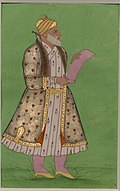
Mir Jumla II (1591 – 30 March 1663) was a prominent subahdar of Bengal under the Mughal Emperor Aurangzeb.[1]
Early life
Mir Jumla was born as Mir Mohammad Sayyid Ardistani in Iran in 1591 to a poor oil merchant of Isfahan named Mirza Hazaru. Although his parents were extremely poor, he had the opportunity to learn letters which propably lead him to find a job as a clerk under a diamond merchant who had connections with the Kingdom of Golkonda.[2][3] (near present day city of Hyderabad, Telangana, India). The region was famous for its diamond mines. Later he came to Golconda as early as before 1630. He emigrated to Golconda due to the financial debts exacted upon him by one Sheikh ul Islam and general misgovernance in his country.[4] He started his own diamond business and got involved in maritime commercial endeavours which increased his prosperity.
At the prospect of increasing his wealth, He brought presents to the king of Golconda and secured his position in the Sultan's court.[5] Mir Jumla entered the service of the Sultan of Golconda and rose to the position of Vizier (Prime Minister) of the kingdom. He met and befriended the French traveller Jean-Baptiste Tavernier during this time.[6] Tavernier was a pioneer of European trade with India and Mir Jumla is mentioned prominently in his book Les Six Voyages de J. B. Tavernier (1676).
Under the service of Golconda (1637-1655)
As Mir Jumla raised through the ranks of service, his proficiency in service and administration were generally proved when he administered trade at Port of Masulipatnam. On June 21st 1637, He was summoned to the Qutub Shahi court and by the 23rd, The sultan conferred the title of Sar-i-Khail (Lord of the Horses) on him [7].During this time, there was a quarrel between the Adil Shahi and the Qutub Shahi Sultans over the poesession over the former lands of the declining Vijayanagara Empire. At last both the Sultans agreed to divide the conquered land with 2/3 of the land going to the Adil Shahi while 1/3 of the land going to the Qutub Shahi.
The furthest extent of the kingdom was Cumbam near the Kadapa district before Mir Jumla took over. In 1646, Mir Jumla invaded the Kingdom of Chandragiri. The king at that time was Sri Ranga. He conquered the forts of Udayagiri and Chengleput and captured the whole of Kadapa district and expanded as far as Tirupati and Sri Kalahasti. He also laid siege to the dutch settlement at Pulicat until the Dutch offered submission to him. He further advanced and laid siege to the fort of Vellore. By the April of 1647, The king offered submission to him and promised to pay him tribute [8][9] .In 1650 Mir Jumla conquered the nearly inaccessible Gandikota fort with the help of European Gunners from Timma Nayar.[10][11] Although there was success in conquering former lands of the Vijayanagara Empire he was unable to conquer the fort of Gingee from the nayaks and In 1648, Gingee fell to Bijapur[12] During his stint in Karnatak, he amassed massive wealth by trading with diamonds. For the purpose of making 20 artillery pieces, he melted Hindu idols captured from temples with the help of his French Surgeon, Gunner and Gun founder M Claude Maille but was unable to melt the 6 Hindu idols that belonged to the temple of Gondikota.[13] [14].Later in his letter to Khalifa I Sultan, The Wazir of the Safavid sultan Shah Abbas II he said:
By God's grace and the Padshah's luck, The Banner of Islam has been flown over the Infidel Karnatak and that of Hinduism has been brought down. The entire body of rebels and rajas have been brought under my fold. The Voice of Islam and the practices of our saints have been spread here. [15]
He was also a good financier. He employed Telugu Niyogi Brāhmaṇas to collect revenue. He was able to collect 43 lakhs of Rupees from his domains which were rich in Diamonds, Iron, Saltpetre and Steel[16].By his enormous wealth, he was able to recruit Pathans, Rajputs, Afghans and Mughals in his campaign to Bijapur in 1652. In 1653-1654, in one of Aurengzeb's letters to Shah Jahan, Aurengzeb cites a report of his agent Mohammad Amin where Mir Jumla is said to have maintained of force of 9000 Cavalry , 20000 infantry and his army filled with Iraqi and Arabi horses[17][18]
Mughal maritime trade
Mir Jumla had his own ships and organised merchant fleets in the 1640s that sailed throughout Surat, Thatta, Arakan, Ayuthya, Balasore, Aceh, Melaka, Johore, Bantam, Makassar, Ceylon, Bandar Abbas, Mecca, Jeddah, Basra, Aden, Masqat, Mocha and the Maldives.[19]
Career in the Mughal Imperial Court
Prince Aurangzeb, the Mughal viceroy in the Deccan forwarded his cause and he got the protection of the Mughal Emperor Shah Jahan who honoured him with the title of Muazzam Khan, raised him to the rank of 6000 zat and 6000 sawar and appointed him the diwan-i-kul or the prime minister.[citation needed]
On his accession to the throne, Aurangzeb entrusted Mir Jumla with the task of dealing with Shah Shuja. Shuja was Auranzeb's brother and a contender to the Mughal throne. He was defeated in the Battle of Khajwa and took to flight[citation needed]. Mir Jumla pursued Shuja from Khajwa to Tanda and from Tanda to Dhaka (capital of the present day Bangladesh), where he arrived on 9 May 1660. The latter, however, had already left Dhaka, crossed the eastern border and ultimately found shelter with the king of Arakan (modern day Myanmar).[20]
Soon after his arrival at Dhaka, Mir Jumla received the imperial farman (decree) appointing him subahdar (governor) of Bengal[citation needed]. The emperor, in recognition of his services, honoured Mir Jumla with titles, rewards and increment of mansab (rank). He at once began reorganising the administration, which had become slack in the absence of Shuja during the war of succession, and disobedience and refractoriness had become prevalent. Reversing the action of Shuja who had transferred the capital to Rajmahal, he restored Dhaka to its former glory. He then paid attention to the administration of justice, dismissed dishonest Qazis (clerics and judges) and Mir Adils and replaced them with honest persons[citation needed]. According to Niccolai Manucci, Shuja fled back to Tripura with his surviving middle son Buland Akhtar whom Tripura king Nakshatra Roy alias Chhatra Narayan helped to reach Manipur by supplying elephants and a few guards for fear of Aurangzeb's pursuing army and informers. Shuja reached ultimately Manipur (Mekhli) in 1662 starting from Daccca in 1660 via Arakan and Tripura, according to Dr. John Peter Wade (An Account of Assam, 1800, p. 297). Manipur king Khunjaoba received him in 1662 and kept him secret of his identity and also Aurangzeb sent a three-man embassy (Ahaddis) to Manipur regarding the matter and Manipur king too reciprocated with a three-man embassy to the Mughal Court (A. Hakim Shah Khullakpam, 2008, The Manipur Governance To the Meitei Pangal or Manipuri Muslims, Imphal: Pearl, p. 56). Shuja was hiding for sometime in Shujalok (Kairang in east of Imphal of Manipur) and in Ukhrul hill of the present state, and returned to the valley in 1679 (R.K. Sanahal Singh, 1989, Pangal Thorakpa, Imphal: Liberty Publication). Since Shuja arrived on elephant supplied by Tripura king, he was also known as Shuna-i-pil (Sunarphul), meaning "officer-in-charge of elephants", among Manipuri annalists and in the puya, Nongsamei.(Ibid). He died sometime in 1691 and was buried at Shujalok (Janab Khan, 1972, Manipuri Muslims, Imphal: Shanti Press). (see also: How Shuja, Brother of Aurangzeb Died at Ukhrul (sic); Manipuri Muslims Socially Speaking).
Mir Jumla's construction activities in Dhaka and its suburbs resulted in two roads, two bridges and a network of forts, which were necessary for public welfare, strategic purposes, and speedy dispatch of troops, equipment and ammunition[citation needed]. A fort at Tangi-Jamalpur guarded one of the roads connecting Dhaka with the northern districts; it is now known as the Mymensingh Road[citation needed]. The other road led eastward, connecting the capital city with Fatulla (old Dhapa), where there were two forts, and by extension the road could lead up to Khizrpur where two other forts were situated. The Pagla bridge lies on this road off Fatulla.[citation needed] Some parts of the roads and forts built by Mir Jumla are still extant.[citation needed]
Northeastern frontier expedition
The most important aspect of Mir Jumla's rule in Bengal was his northeastern frontier policy, by which he conquered the frontier kingdoms of Kamrup (Kamarupa) and Assam[citation needed]. Koch Behar was a vassal state, but Raja Pran Narayan took advantage of the war of succession and shook off his allegiance. The Ahom king of Assam, Jayadhwaj Singha, occupied a part of Kamrup, which had earlier been integrated with the Bengal subah.[citation needed]
Mir Jumla advanced with a large army and navy against the enemy; he sent the main body of the troops and the navy towards Kamrup, while he himself proceeded against Koch Behar. On his approach, Pran Narayan evacuated the country and fled towards the hills[citation needed]. Koch Behar was occupied in about one month and a half and making administrative arrangements there, Mir Jumla came to join the advance party towards Kamrup.[citation needed]
The king of Assam was prudent enough to evacuate Kamrup, but Mir Jumla decided to conquer Assam also. Mir Jumla took 12,000 cavalry, 30,000 infantry, and a fleet of 323 ships and boats up river towards Assam—the naval contingent comprised Portuguese, English, and Dutch sailors.[citation needed]
An account of the campaign and the life during the times was presented by the Venetian adventurer Niccolao Manucci in his memoirs Storia do Mogor. This book was a reference for the work of the French historian François Catrou who wrote the 'Histoire Générale de l'Empire du Mogol' in 1715. Manucci also got acquainted with a Mughal Navy officer of British descent during the same period named Thomas Pratte[citation needed]. Pratte was appointed by Mir Jumla as an officer in the Mughal navy and used to collect war boats and procure gunpowder necessary for naval warfare.[citation needed]
Assam, in those days, was a big country and its physiography was much different from that of Bengal[citation needed]. But nothing daunted Mir Jumla. In less than six weeks' time, since his starting from Guwahati, Mir Jumla conquered up to Garhgaon, the capital of Assam.[citation needed]
Jungle warfare and counter-insurgency campaign
Beyond that the country was full of high hills and mountains, inaccessible for horses and troops, where the Ahom king took shelter. During the rains, the Mughals were locked in a few raised grounds, the roads were submerged, the streams and even the Nalahs (drains) swelled up to become big rivers..
Many armies would have disintegrated under these circumstances but under Mir Jumla's magnificent leadership, the Mughal army held firm and remained on the offensive.
After the rains were over, both Mir Jumla and the king of Assam agreed to sign a peace treaty. The terms of treaty implied that the Ahom king or Swargadeo would accept Mughal rule and both the Swargadeo and the Tipam king would offer their daughters to the Mughal harem (The Ahom princess was Ramani Gabharu, the sole daughter of the then Swargadeo, Jayadhwaj Singha. She later became the daughter-in-law of Emperor Aurangzeb as Rahmat Banu Begum). The Ahoms also had to pay a war indemnity and an annual tribute of 20 elephants. They also had to cede the western half of their kingdom from Guwahati to Manas river.
Death and legacy
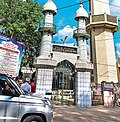
Mir Jumla died on his way back from the Assamese territory on 30 March 1663. His tomb located on a small hillock at Mankachar, Assam has been maintained over the centuries. It is near Garo Hills in the northeastern Indian state of Meghalaya. The tomb reflects a remarkably long grave and bears testimony to the tall height of Mir Jumla. There are two more unidentified graves beside the tomb of Mir Jumla said to be of two Pirs, i. e. of holy saints.
See also
- Hyderabadi Muslims
- Muslim culture of Hyderabad
- History of Hyderabad
- Mughal empire
- Emperor of India
- List of rulers of Bengal
- History of Bengal
Notes
- ↑ Karim, Abdul. "Mir Jumla". Banglapedia. Retrieved 27 July 2015.
- ↑ Richards 2005, p. 155.
- ↑ Sarkar 1951, Early life of Mir Jumla pp. 1.
- ↑ Journal of Bihar and Orissa Research Society 1942, Mir Jumla-Iran Correspondence pp.206.
- ↑ Irvine 1907, Aurengzeb pp.232.
- ↑ Karim, Abdul (1995). History of Bengal: The reigns of Shah Jahan and Aurangzib. Institute of Bangladesh Studies, University of Rajshahi.
- ↑ Sarkar 1951, Wazir of Golconda pp. 10.
- ↑ Sarkar 1952, Mir Jumla Conquers the entire Eastern Karnataka pp. 119-121.
- ↑ Sarkar 1951, Mir Jumla Conquers Vellore pp. 16-17.
- ↑ Qaiser, Ahsan Jan, ed. (1982), "Mir Jumla Captures Gandikota", The Indian response to European technology and culture, Oxford University press, p. 48
- ↑ Sarkar 1951, Fort of Gandikota pp. 48.
- ↑ Sarkar 1951, "Gingee" pp. 45.
- ↑ Sarkar 1951, Gondikota pp. 82.
- ↑ Ball, Valentine (1925), "Mir Jumla melts the idols", The Travels of Jean Baptiste Tavernier in India, Oxford University press, p. 232
- ↑ Journal of Bihar and Orissa research Society 1942, Mir Jumla-Iran Correspondence pp. 193.
- ↑ Sarkar 1951, "Civil Administration of Mir Jumla" pp. 76.
- ↑ Sarkar 1951, "Mir Jumla's Army" pp. 80-81.
- ↑ Flynn, V J A, ed. (1971), "Letter 46", English translation of Adab-I-Alamgiri, p. 317
- ↑ Pearson, M. (2007). The Indian Ocean. Routledge. ISBN 9780415445382. Retrieved 21 April 2015.
- ↑ [Sir Jadunath Sarkar, 1972, History of Aurangzeb, vol. 2, London: Orient Longman]
- Travels in India by Jean Baptiste Tavernier, Baron of Aubonne [1]
- The fantastic Mri Jumla by Akshay Cavan, 2017
- Persian adventurer in India by Parvez Mahmood, 2019
- Of the kingdom of Golconda and the wars which it has carried on during the last few years.
References
- Richards, John F. (2005). The Mughal Empire. Cambridge University Press.
- Sarkar, Jagadish Narayan, ed. (1951). The life of Mir Jumla, the general of Aurangzeb. Thacker and Spink.
- Sarkar, Jadunath, ed. (1952). History of Aurangzeb Vol 1. Orient Longman Limited.
- Atan Buragohain and his times: A history of Assam, from the invasion of Nawab Mir Jumla in 1662–63, to the termination of Assam-Mogul conflicts in 1682 by Surya Kumar Bhuyan [2]
- Irvine, William (1907). Storia De Mogor. John Murray.
- Journal of Bihar and Orissa research Society. 1942.
- The Mughal Throne: The Saga of India's Great Emperors by Abraham Eraly [3]
- Mughal Warfare: Indian Frontiers and Highroads to Empire 1500–1700 (Warfare and History) by J.J.L. Gommans and Jos Gommans [4]
- Mediaeval India under Mohammedan Rule (A.D. 712–1764) by Stanley Lane-Poole [5]
- The Mughal Nobility Under Aurangzeb by M. Athar Ali [6]