























→History: Trim see History of Brazil |
→Government and politics: Trimming to reduce the weight |
||
| Line 179: | Line 179: | ||
In 2020 the government of Brazil pledged to reduce its annual [[greenhouse gas]]es emissions by 43% by 2030. It also set as indicative target of reaching [[carbon neutrality]] by the year 2060 if the country gets 10 billion dollars per year.<ref>{{cite journal |last1=Felin |first1=Bruno |title=STATEMENT: Brazil Sets Weak 2030 Emission Reduction Target |url=https://www.wri.org/news/2020/12/statement-brazil-sets-weak-2030-emission-reduction-target |website=World Resources Institute |date=10 December 2020 |access-date=3 January 2021}}</ref> | In 2020 the government of Brazil pledged to reduce its annual [[greenhouse gas]]es emissions by 43% by 2030. It also set as indicative target of reaching [[carbon neutrality]] by the year 2060 if the country gets 10 billion dollars per year.<ref>{{cite journal |last1=Felin |first1=Bruno |title=STATEMENT: Brazil Sets Weak 2030 Emission Reduction Target |url=https://www.wri.org/news/2020/12/statement-brazil-sets-weak-2030-emission-reduction-target |website=World Resources Institute |date=10 December 2020 |access-date=3 January 2021}}</ref> | ||
== Economy == | == Economy == | ||
Revision as of 00:43, 13 September 2021
Federative Republic of Brazil República Federativa do Brasil (Portuguese) | |
|---|---|
 Flag
 Coat of arms
| |
| Motto: Ordem e Progresso (Portuguese) "Order and Progress" | |
| Anthem: Hino Nacional Brasileiro (Portuguese) "Brazilian National Anthem" | |
National seal
| |
 | |
| Capital | Brasília 15°47′S 47°52′W / 15.783°S 47.867°W |
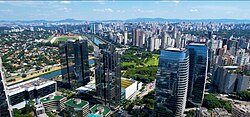
| Largest city | São Paulo 23°33′S 46°38′W / 23.550°S 46.633°W |
| Official language and national language | Portuguese[2] |
| Ethnic groups |
|
| Religion | 88.8% Christianity —64.6% Roman Catholic —22.2% Protestant —2.0% Other Christian 8.0% No religion 2.0% Spiritism 1.2% Other religions |
| Demonym | Brazilian |
| Government | Federal presidential constitutional republic |
| Jair Bolsonaro | |
| Hamilton Mourão | |
| Arthur Lira | |
| Rodrigo Pacheco | |
| Luiz Fux | |
| Legislature | National Congress |
| Federal Senate | |
| Chamber of Deputies | |
| Independence | |
• Declared | 7 September 1822 |
| 29 August 1825 | |
• Republic | 15 November 1889 |
| 5 October 1988 | |
| Area | |
• Total | 8,515,767 km2 (3,287,956 sq mi) (5th) |
• Water (%) | 0.65 |
| Population | |
• 2019 estimate | 210,147,125[7] (6th) |
• Density | 25/km2 (64.7/sq mi) (200th) |
| GDP (PPP) | 2021 estimate |
• Total |  $3.328 trillion[8] (8th) $3.328 trillion[8] (8th) |
• Per capita | $15,642[8] (84th) |
| GDP (nominal) | 2021 estimate |
• Total | $1.491 trillion[8] (13th) |
• Per capita | $7,010[8] (87th) |
| Gini (2019) |  53.4[9] 53.4[9]high inequality (10th) |
| HDI (2019) | 0.765[10] high (84th) |
| Currency | Real (R$) (BRL) |
| Time zone | UTC−2 to −5 (BRT) |
| Date format | dd/mm/yyyy (CE) |
| Calling code | +55 |
| ISO 3166 code | BR |
| Internet TLD | .br |

Brazil (Portuguese: Brasil; Brazilian Portuguese: [bɾaˈziw]),[nt 4] officially the Federative Republic of Brazil (Portuguese:  República Federativa do Brasil),[11] is the largest country in both South America and Latin America. At 8.5 million square kilometers (3.2 million square miles)[12] and with over 211 million people, Brazil is the world's fifth-largest country by area and the sixth most populous. Its capital is Brasília, and its most populous city is São Paulo. The federation is composed of the union of the 26 states and the Federal District. It is the largest country to have Portuguese as an official language and the only one in the Americas;[13][14] it is also one of the most multicultural and ethnically diverse nations, due to over a century of mass immigration from around the world;[15] as well as the most populous Roman Catholic-majority country.
Bounded by the Atlantic Ocean on the east, Brazil has a coastline of 7,491 kilometers (4,655 mi).[16] It borders all other countries in South America except Ecuador and Chile and covers 47.3% of the continent's land area.[17] Its Amazon basin includes a vast tropical forest, home to diverse wildlife, a variety of ecological systems, and extensive natural resources spanning numerous protected habitats.[16] This unique environmental heritage makes Brazil one of 17 megadiverse countries, and is the subject of significant global interest, as environmental degradation through processes like deforestation has direct impacts on global issues like climate change and biodiversity loss.
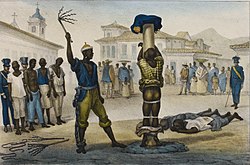
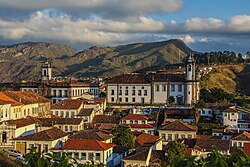
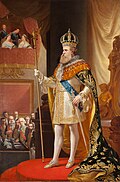
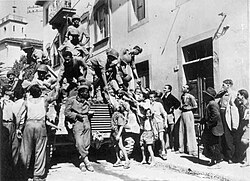
Brazil was inhabited by numerous tribal nations prior to the landing in 1500 of explorer Pedro Álvares Cabral, who claimed the area for the Portuguese Empire. Brazil remained a Portuguese colony until 1808 when the capital of the empire was transferred from Lisbon to Rio de Janeiro. In 1815, the colony was elevated to the rank of kingdom upon the formation of the United Kingdom of Portugal, Brazil and the Algarves. Independence was achieved in 1822 with the creation of the Empire of Brazil, a unitary state governed under a constitutional monarchy and a parliamentary system. The ratification of the first constitution in 1824 led to the formation of a bicameral legislature, now called the National Congress. The country became a presidential republic in 1889 following a military coup d'état. An authoritarian military junta came to power in 1964 and ruled until 1985, after which civilian governance resumed. Brazil's current constitution, formulated in 1988, defines it as a democratic federal republic.[18] Due to its rich culture and history, the country ranks thirteenth in the world by number of UNESCO World Heritage Sites.[19]
Brazil is classified as an upper-middle income economy by the World Bank[20] and a newly industrialized country,[21] with the largest share of global wealth in South America. It is considered an advanced emerging economy,[22] having the twelfth largest GDP in the world by nominal, and eighth by PPP measures.[23][24] It is one of the world's major breadbaskets, being the largest producer of coffee for the last 150 years.[25] Brazil is a regional and middle power,[26][27][28][26][28] and is also classified as an emerging power.[29][30][31][32] However, the country maintains high amounts of corruption, crime and social inequality. Brazil is a founding member of the United Nations, the G20, BRICS, Mercosul, Organization of American States, Organization of Ibero-American States and the Community of Portuguese Language Countries.
Etymology
The word "Brazil" likely comes from the Portuguese word for brazilwood, a tree that once grew plentifully along the Brazilian coast.[33] In Portuguese, brazilwood is called pau-brasil, with the word brasil commonly given the etymology "red like an ember," formed from brasa ("ember") and the suffix -il (from -iculum or -ilium).[34] As brazilwood produces a deep red dye, it was highly valued by the European textile industry and was the earliest commercially exploited product from Brazil.[35] Throughout the 16th century, massive amounts of brazilwood were harvested by indigenous peoples (mostly Tupi) along the Brazilian coast, who sold the timber to European traders (mostly Portuguese, but also French) in return for assorted European consumer goods.[36]
The official Portuguese name of the land, in original Portuguese records, was the "Land of the Holy Cross" (Terra da Santa Cruz),[37] but European sailors and merchants commonly called it simply the "Land of Brazil" (Terra do Brasil) because of the brazilwood trade.[38] The popular appellation eclipsed and eventually supplanted the official Portuguese name. Some early sailors called it the "Land of Parrots."[39]
In the Guarani language, an official language of Paraguay, Brazil is called "Pindorama". This was the name the indigenous population gave to the region, meaning "land of the palm trees."[40]
History
Geography

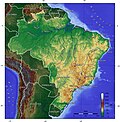
Brazil occupies a large area along the eastern coast of South America and includes much of the continent's interior,[41] sharing land borders with Uruguay to the south; Argentina and Paraguay to the southwest; Bolivia and Peru to the west; Colombia to the northwest; and Venezuela, Guyana, Suriname and France (French overseas region of French Guiana) to the north. It shares a border with every South American country except Ecuador and Chile.[16]
It also encompasses a number of oceanic archipelagos, such as Fernando de Noronha, Rocas Atoll, Saint Peter and Paul Rocks, and Trindade and Martim Vaz.[16] Its size, relief, climate, and natural resources make Brazil geographically diverse.[41] Including its Atlantic islands, Brazil lies between latitudes 6°N and 34°S, and longitudes 28° and 74°W.[16]
Brazil is the fifth largest country in the world, and third largest in the Americas, with a total area of 8,515,767.049 km2 (3,287,956 sq mi),[42] including 55,455 km2 (21,411 sq mi) of water.[16] It spans four time zones; from UTC−5 comprising the state of Acre and the westernmost portion of Amazonas, to UTC−4 in the western states, to UTC−3 in the eastern states (the national time) and UTC−2 in the Atlantic islands.[43]
Brazil is the longest country in the world, spanning 4,395 km (2,731 mi) from north to south. Brazil is also the only country in the world that has the equator and the Tropic of Capricorn running through it. Brazilian topography is also diverse and includes hills, mountains, plains, highlands, and scrublands. Much of the terrain lies between 200 metres (660 ft) and 800 metres (2,600 ft) in elevation.[44] The main upland area occupies most of the southern half of the country.[44] The northwestern parts of the plateau consist of broad, rolling terrain broken by low, rounded hills.[44]

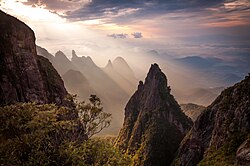
The southeastern section is more rugged, with a complex mass of ridges and mountain ranges reaching elevations of up to 1,200 metres (3,900 ft).[44] These ranges include the Mantiqueira and Espinhaço mountains and the Serra do Mar.[44] In the north, the Guiana Highlands form a major drainage divide, separating rivers that flow south into the Amazon Basin from rivers that empty into the Orinoco River system, in Venezuela, to the north. The highest point in Brazil is the Pico da Neblina at 2,994 metres (9,823 ft), and the lowest is the Atlantic Ocean.[16]
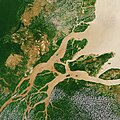
Brazil has a dense and complex system of rivers, one of the world's most extensive, with eight major drainage basins, all of which drain into the Atlantic.[45] Major rivers include the Amazon (the world's second-longest river and the largest in terms of volume of water), the Paraná and its major tributary the Iguaçu (which includes the Iguazu Falls), the Negro, São Francisco, Xingu, Madeira and Tapajós rivers.[45]
Climate
The climate of Brazil comprises a wide range of weather conditions across a large area and varied topography, but most of the country is tropical.[16] According to the Köppen system, Brazil hosts six major climatic subtypes: desert, equatorial, tropical, semiarid, oceanic and subtropical. The different climatic conditions produce environments ranging from equatorial rainforests in the north and semiarid deserts in the northeast, to temperate coniferous forests in the south and tropical savannas in central Brazil.[46] Many regions have starkly different microclimates.[47][48]
An equatorial climate characterizes much of northern Brazil. There is no real dry season, but there are some variations in the period of the year when most rain falls.[46] Temperatures average 25 °C (77 °F),[48] with more significant temperature variation between night and day than between seasons.[47]
Over central Brazil rainfall is more seasonal, characteristic of a savanna climate.[47] This region is as extensive as the Amazon basin but has a very different climate as it lies farther south at a higher altitude.[46] In the interior northeast, seasonal rainfall is even more extreme.[49]
The semiarid climatic region generally receives less than 800 millimetres (31.5 in) of rain,[49] most of which generally falls in a period of three to five months of the year[50] and occasionally less than this, creating long periods of drought.[47] Brazil's 1877–78 Grande Seca (Great Drought), the worst in Brazil's history,[51] caused approximately half a million deaths.[52] A similarly devastating drought occurred in 1915.[53]
South of Bahia, near the coasts, and more southerly most of the state of São Paulo, the distribution of rainfall changes, with rain falling throughout the year.[46] The south enjoys subtropical conditions, with cool winters and average annual temperatures not exceeding 18 °C (64.4 °F);[48] winter frosts and snowfall are not rare in the highest areas.[46][47]
Biodiversity and environment
_female_Piquiri_River_2.JPG)

Brazil's large territory comprises different ecosystems, such as the Amazon rainforest, recognized as having the greatest biological diversity in the world,[54] with the Atlantic Forest and the Cerrado, sustaining the greatest biodiversity.[55] In the south, the Araucaria pine forest grows under temperate conditions.[55] The rich wildlife of Brazil reflects the variety of natural habitats. Scientists estimate that the total number of plant and animal species in Brazil could approach four million, mostly invertebrates.[55]
Larger mammals include carnivores pumas, jaguars, ocelots, rare bush dogs, and foxes, and herbivores peccaries, tapirs, anteaters, sloths, opossums, and armadillos. Deer are plentiful in the south, and many species of New World monkeys are found in the northern rain forests.[55][56] Concern for the environment has grown in response to global interest in environmental issues.[57] Brazil's Amazon Basin is home to an extremely diverse array of fish species, including the red-bellied piranha.
.jpg)
By 2013, Brazil's "dramatic policy-driven reduction in Amazon Basin deforestation" was a "global exception in terms of forest change", according to scientific journal Science.[58]:852 From 2003 to 2011, compared to all other countries in the world, Brazil had the "largest decline in annual forest loss", as indicated in the study using high-resolution satellite maps showing global forest cover changes.[58]:850 The annual loss of forest cover decreased from a 2003/2004 record high of more than 40,000 square kilometres (4,000×103 ha; 9.9×10⁶ acres; 15,000 sq mi) to a 2010/2011 low of under 20,000 square kilometres (2,000×103 ha; 4.9×10⁶ acres; 7,700 sq mi),[58]:850 reversing widespread deforestation[58]:852 from the 1970s to 2003.
In 2017, preserved native vegetation occupies 61% of the Brazilian territory. Agriculture occupied only 8% of the national territory and pastures 19.7%. [59] In terms of comparison, in 2019, although 43% of the entire European continent has forests, only 3% of the total forest area in Europe is of native forest. [60]
In 2020 the government of Brazil pledged to reduce its annual greenhouse gases emissions by 43% by 2030. It also set as indicative target of reaching carbon neutrality by the year 2060 if the country gets 10 billion dollars per year.[61]
Economy
.svg)
Brazil is the largest national economy in Latin America, the world's ninth largest economy and the eighth largest in purchasing power parity (PPP) according to 2018 estimates. Brazil has a mixed economy with abundant natural resources. After rapid growth in preceding decades, the country entered an ongoing recession in 2014 amid a political corruption scandal and nationwide protests.
Its Gross domestic product (PPP) per capita was $15,919 in 2017[62] putting Brazil in the 77th position according to IMF data. Active in agricultural, mining, manufacturing and service sectors Brazil has a labor force of over 107 million (ranking 6th worldwide) and unemployment of 6.2% (ranking 64th worldwide).[63]
The country has been expanding its presence in international financial and commodities markets, and is one of a group of four emerging economies called the BRIC countries.[64] Brazil has been the world's largest producer of coffee for the last 150 years.[25] The country is a major exporter of soy, iron ore, pulp (cellulose), maize, beef, chicken meat, soybean meal, sugar, coffee, tobacco, cotton, orange juice, footwear, airplanes, cars, vehicle parts, gold, ethanol, semi-finished iron, among other products.[65][66]

_28mar09.jpg)
.jpg)
.jpg)

Brazil's diversified economy includes agriculture, industry, and a wide range of services.[70] Agriculture and allied sectors like forestry, logging and fishing accounted for 5.1% of the GDP in 2007.[71] Brazil is the largest producer of various agricultural commodities.[72] and also has a large cooperative sector that provides 50% of the food in the country.[73] The world's largest healthcare cooperative Unimed is also located in Brazil, and accounts for 32% of the healthcare insurance market in the country.[74]
Brazil is one of the largest producers of animal proteins in the world. In 2019, the country was the world's largest exporter of chicken meat.[75][76] It was also the world's second largest producer of beef,[77] third largest producer of milk,[78] fourth largest producer of pork[79] and seventh largest producer of eggs.[80]
In the mining sector, Brazil stands out in the extraction of iron ore (the second highest world exporter), copper, gold,[81] bauxite (one of the five largest producers in the world), manganese (one of the five largest producers in the world), tin (one of the largest producers in the world), niobium (concentrates 98% of reserves known to the world)[82] and nickel. In terms of precious stones, Brazil is the world's largest producer of amethyst, topaz, agate and one of the main producers of tourmaline, emerald, aquamarine and garnet.[83][84]
Industry in Brazil - from automobiles, steel and petrochemicals to computers, aircraft and consumer durables - accounted for 30.8% of the gross domestic product.[71] Industry is highly concentrated in metropolitan São Paulo, Rio de Janeiro, Campinas, Porto Alegre, and Belo Horizonte.[85] Brazil has become the fourth largest car market in the world.[86] Major export products include aircraft, electrical equipment, automobiles, ethanol, textiles, footwear, iron ore, steel, coffee, orange juice, soybeans and corned beef.[87] In total, Brazil ranks 23rd worldwide in value of exports. In the food industry, in 2019, Brazil was the second largest exporter of processed foods in the world.[88] In 2016, the country was the 2nd largest producer of pulp in the world and the 8th producer of paper.[89] In the footwear industry, in 2019, Brazil ranked 4th among world producers.[90] In 2019, the country was the 8th producer of vehicles and the 9th producer of steel in the world.[91][92][93] In 2018, the chemical industry of Brazil was the 8th in the world.[94][95][96] Although it was among the five largest world producers in 2013, Brazil's textile industry is very little integrated into world trade.[97]
The tertiary sector (trade and services) represented 75.8% of the country's GDP in 2018, according to the IBGE. The service sector was responsible for 60% of GDP and trade for 13%. It covers a wide range of activities: commerce, accommodation and catering, transport, communications, financial services, real estate activities and services provided to businesses, public administration (urban cleaning, sanitation, etc.) and other services such as education, social and health services, research and development, sports activities, etc., since it consists of activities complementary to other sectors.[98][99] Micro and small businesses represent 30% of the country's GDP. In the commercial sector, for example, they represent 53% of the GDP within the activities of the sector.[100]
Brazil pegged its currency, the real, to the U.S. dollar in 1994. However, after the East Asian financial crisis, the Russian default in 1998[101] and the series of adverse financial events that followed it, the Central Bank of Brazil temporarily changed its monetary policy to a managed float regime[102] scheme while undergoing a currency crisis, until definitively changing the exchange regime to free-float in January 1999.[103]
Brazil received an International Monetary Fund (IMF) rescue package in mid-2002 of $30.4 billion,[104] a record sum at the time. Brazil's central bank repaid the IMF loan in 2005, although it was not due to be repaid until 2006.[105] One of the issues the Central Bank of Brazil recently dealt with was an excess of speculative short-term capital inflows to the country, which may have contributed to a fall in the value of the U.S. dollar against the real during that period.[106] Nonetheless, foreign direct investment (FDI), related to long-term, less speculative investment in production, is estimated to be $193.8 billion for 2007.[107] Inflation monitoring and control currently plays a major part in the Central bank's role in setting short-term interest rates as a monetary policy measure.[108]
Corruption costs Brazil almost $41 billion a year alone in 2010, with 69.9% of the country's firms identifying the issue as a major constraint in successfully penetrating the global market.[109] Local government corruption is so prevalent that voters perceive it as a problem only if it surpasses certain levels, and only if a local media e.g. a radio station is present to divulge the findings of corruption charges.[110] Initiatives, like this exposure, strengthen awareness which is indicated by the Transparency International's Corruption Perceptions Index; ranking Brazil 69th out of 178 countries in 2012.[111] The purchasing power in Brazil is eroded by the so-called Brazil cost.[112]
Energy


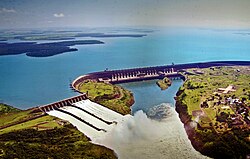
Brazil is the world's tenth largest energy consumer with much of its energy coming from renewable sources, particularly hydroelectricity and ethanol; the Itaipu Dam is the world's largest hydroelectric plant by energy generation,[113] and the country has other large plants like Belo Monte and Tucuruí. The first car with an ethanol engine was produced in 1978 and the first airplane engine running on ethanol in 2005.[114]
In total electricity generation, in 2019 Brazil reached 170,000 megawatts of installed capacity, more than 75% from renewable sources (the majority, hydroelectric plants).[115] In 2019, Brazil had 217 hydroelectric plants in operation, with an installed capacity of 98,581 MW, 60.16% of the country's energy generation.[116] Brazil is one of the 5 largest hydroelectric energy producers in the world (2nd place in 2017).[117]
As of June 2021,[ref] according to ONS, total installed capacity of wind power was 18.7 GW, with average capacity factor of 58%.[118] While the world average wind production capacity factors is 24.7%, there are areas in Northern Brazil, specially in Bahia State, where some wind farms record with average capacity factors over 60%;[119] the average capacity factor in the Northeast Region is 45% in the coast and 49% in the interior.[120]
In 2019, wind energy represented 9% of the energy generated in the country.[121] In 2019, it was estimated that the country had an estimated wind power generation potential of around 522 GW (this, only onshore), enough energy to meet three times the country's current demand.[122][123] Brazil is one of the 10 largest wind energy producers in the world (8th place in 2019, with 2.4% of world production).[124][125]
As of June 2021,[ref] according to ONS, total installed capacity of photovoltaic solar was 9.7 GW, with average capacity factor of 23%. Some of the most irradiated Brazilian States are Minas Gerais, Bahia and Goiás.[126][127] In 2019, solar power represented 1.27% of the energy generated in the country.[121] In 2020, Brazil was the 14th country in the world in terms of installed solar power (7.8 GW). [128]
In 2020, Brazil was the 2nd largest country in the world in the production of energy through biomass (energy production from solid biofuels and renewable waste), with 15,2 GW installed.[129]
Recent oil discoveries in the pre-salt layer have opened the door for a large increase in oil production.[130] The governmental agencies responsible for the energy policy are the Ministry of Mines and Energy, the National Council for Energy Policy, the National Agency of Petroleum, Natural Gas and Biofuels, and the National Agency of Electricity.[131] In the beginning of 2020, in the production of oil and natural gas, the country exceeded 4 million barrels of oil equivalent per day, for the first time. In January this year, 3.168 million barrels of oil per day and 138.753 million cubic meters of natural gas were extracted.[132]
Tourism


Tourism in Brazil is a growing sector and key to the economy of several regions of the country. The country had 6.36 million visitors in 2015, ranking in terms of the international tourist arrivals as the main destination in South America and second in Latin America after Mexico.[134] Revenues from international tourists reached US$6 billion in 2010, showing a recovery from the 2008–2009 economic crisis.[135] Historical records of 5.4 million visitors and US$6.8 billion in receipts were reached in 2011.[136][137] In the list of world tourist destinations, in 2018, Brazil was the 48th most visited country, with 6.6 million tourists (and revenues of 5.9 billion dollars).[138]
Natural areas are its most popular tourism product, a combination of ecotourism with leisure and recreation, mainly sun and beach, and adventure travel, as well as cultural tourism. Among the most popular destinations are the Amazon Rainforest, beaches and dunes in the Northeast Region, the Pantanal in the Center-West Region, beaches at Rio de Janeiro and Santa Catarina, cultural tourism in Minas Gerais and business trips to São Paulo.[139]
In terms of the 2015 Travel and Tourism Competitiveness Index (TTCI), which is a measurement of the factors that make it attractive to develop business in the travel and tourism industry of individual countries, Brazil ranked in the 28st place at the world's level, third in the Americas, after Canada and United States.[140][141]
Brazil's main competitive advantages are its natural resources, which ranked 1st on this criteria out of all countries considered, and ranked 23rd for its cultural resources, due to its many World Heritage sites. The TTCI report notes Brazil's main weaknesses: its ground transport infrastructure remains underdeveloped (ranked 116th), with the quality of roads ranking in 105th place; and the country continues to suffer from a lack of price competitiveness (ranked 114th), due in part to high ticket taxes and airport charges, as well as high prices and high taxation. Safety and security have improved significantly: 75th in 2011, up from 128th in 2008.[141]
Infrastructure
Science and technology

.jpg)
Technological research in Brazil is largely carried out in public universities and research institutes, with the majority of funding for basic research coming from various government agencies.[142] Brazil's most esteemed technological hubs are the Oswaldo Cruz Institute, the Butantan Institute, the Air Force's Aerospace Technical Center, the Brazilian Agricultural Research Corporation and the National Institute for Space Research.[143][144]
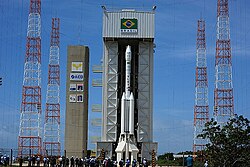
The Brazilian Space Agency has the most advanced space program in Latin America, with significant resources to launch vehicles, and manufacture of satellites.[145] Owner of relative technological sophistication, the country develops submarines, aircraft, as well as being involved in space research, having a Vehicle Launch Center Light and being the only country in the Southern Hemisphere the integrate team building International Space Station (ISS).[146]
The country is also a pioneer in the search for oil in deep water, from where it extracts 73% of its reserves. Uranium is enriched at the Resende Nuclear Fuel Factory, mostly for research purposes (as Brazil obtains 88% of its electricity from hydroelectricity[147]) and the country's first nuclear submarine was delivered in 2015 (by France).[148]
Brazil is one of the three countries in Latin America[149] with an operational Synchrotron Laboratory, a research facility on physics, chemistry, material science and life sciences, and Brazil is the only Latin American country to have a semiconductor company with its own fabrication plant, the CEITEC.[150] According to the Global Information Technology Report 2009–2010 of the World Economic Forum, Brazil is the world's 61st largest developer of information technology.[151] Brazil was ranked 62nd in the Global Innovation Index in 2020, up from 66th in 2019.[152][153][154][155]
Among the most renowned Brazilian inventors are priests Bartolomeu de Gusmão, Landell de Moura and Francisco João de Azevedo, besides Alberto Santos-Dumont,[156] Evaristo Conrado Engelberg,[157] Manuel Dias de Abreu,[158] Andreas Pavel[159] and Nélio José Nicolai.[160]
Brazilian science is represented by the likes of César Lattes (Brazilian physicist Pathfinder of Pi Meson),[161] Mário Schenberg (considered the greatest theoretical physicist of Brazil),[162] José Leite Lopes (only Brazilian physicist holder of the UNESCO Science Prize),[163] Artur Ávila (the first Latin American winner of the Fields Medal)[164] and Fritz Müller (pioneer in factual support of the theory of evolution by Charles Darwin).[165]
Transport

_-_panoramio_(cropped).jpg)
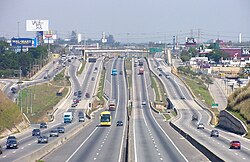
Brazilian roads are the primary carriers of freight and passenger traffic. The road system totaled 1.98 million km (1.23 million mi) in 2002. The total of paved roads increased from 35,496 km (22,056 mi) in 1967 to 215,000 km (133,595 mi) in 2018.[167][168] The country has about 14,000 km (8,699 mi) of divided highways, 5,000 km (3,107 mi) only in the State of São Paulo. Currently it's possible to travel from Rio Grande, in the extreme south of the country, to Brasília (2,580 km (1,603 mi)) or Casimiro de Abreu, in the state of Rio de Janeiro (2,045 km (1,271 mi)), only on divided highways. The first investments in road infrastructure have given up in the 1920s, the government of Washington Luís, being pursued in the governments of Getúlio Vargas and Eurico Gaspar Dutra.[169] President Juscelino Kubitschek (1956–61), who designed and built the capital Brasília, was another supporter of highways.[170]
Brazil's railway system has been declining since 1945, when emphasis shifted to highway construction. The total length of railway track was 30,875 km (19,185 mi) in 2002, as compared with 31,848 km (19,789 mi) in 1970. Most of the railway system belonged to the Federal Railroad Corporation RFFSA, which was privatized in 2007.[171] The São Paulo Metro was the first underground transit system in Brazil. The other metro systems are in Rio de Janeiro, Porto Alegre, Recife, Belo Horizonte, Brasília, Salvador and Fortaleza. The country has an extensive rail network of 28,538 kilometres (17,733 miles) in length, the tenth largest network in the world.[172] Currently, the Brazilian government, unlike the past, seeks to encourage this mode of transport; an example of this incentive is the project of the Rio–São Paulo high-speed rail, that will connect the two main cities of the country to carry passengers.
There are about 2,500 airports in Brazil, including landing fields: the second largest number in the world, after the United States.[173] São Paulo–Guarulhos International Airport, near São Paulo, is the largest and busiest airport with nearly 20 million passengers annually, while handling the vast majority of commercial traffic for the country.[174]
For freight transport waterways are of importance, e.g. the industrial zones of Manaus can be reached only by means of the Solimões–Amazonas waterway (3,250 kilometres or 2,020 miles in length, with a minimum depth of 6 metres or 20 feet*). The country also has 50,000 kilometres (31,000 miles) of waterways.[172] Coastal shipping links widely separated parts of the country. Bolivia and Paraguay have been given free ports at Santos. Of the 36 deep-water ports, Santos, Itajaí, Rio Grande, Paranaguá, Rio de Janeiro, Sepetiba, Vitória, Suape, Manaus and São Francisco do Sul are the most important.[175] Bulk carriers have to wait up to 18 days before being serviced, container ships 36.3 hours on average.[176]
Health

The Brazilian public health system, the Unified Health System (Sistema Único de Saúde – SUS), is managed and provided by all levels of government,[177] being the largest system of this type in the world.[178] On the other hand, private healthcare systems play a complementary role.[179]
Public health services are universal and offered to all citizens of the country for free. However, the construction and maintenance of health centers and hospitals are financed by taxes, and the country spends about 9% of its GDP on expenditures in the area. In 2012, Brazil had 1.85 doctors and 2.3 hospital beds for every 1,000 inhabitants.[180][181]
Despite all the progress made since the creation of the universal health care system in 1988, there are still several public health problems in Brazil. In 2006, the main points to be solved were the high infant (2.51%) and maternal mortality rates (73.1 deaths per 1000 births).[182]
The number of deaths from noncommunicable diseases, such as cardiovascular diseases (151.7 deaths per 100,000 inhabitants) and cancer (72.7 deaths per 100,000 inhabitants), also has a considerable impact on the health of the Brazilian population. Finally, external but preventable factors such as car accidents, violence and suicide caused 14.9% of all deaths in the country.[182] The Brazilian health system was ranked 125th among the 191 countries evaluated by the World Health Organization (WHO) in 2000.[183]
Education
The Federal Constitution and the Law of Guidelines and Bases of National Education determine that the Union, the states, the Federal District, and the municipalities must manage and organize their respective education systems. Each of these public educational systems is responsible for its own maintenance, which manages funds as well as the mechanisms and funding sources. The constitution reserves 25% of the state budget and 18% of federal taxes and municipal taxes for education.[184]

According to the IBGE, in 2019, the literacy rate of the population was 93.4%, meaning that 11,3 million (6,6% of population) people are still illiterate in the country, with some states like Rio de Janeiro and Santa Catarina reaching around 97% of literacy rate;[185] functional illiteracy has reached 21.6% of the population.[186] Illiteracy is higher in the Northeast, where 13.87% of the population is illiterate, while the South, has 3.3% of its population illiterate.[187][185]
Brazil's private institutions tend to be more exclusive and offer better quality education, so many high-income families send their children there. The result is a segregated educational system that reflects extreme income disparities and reinforces social inequality. However, efforts to change this are making impacts.[188]
The University of São Paulo is the second best university in Latin America, according to recent 2019 QS World University Rankings. Of the top 20 Latin American universities, eight are Brazilian. Most of them are public. Attending an institution of higher education is required by Law of Guidelines and Bases of Education. Kindergarten, elementary and medium education are required of all students.[189]
Media and communication

The Brazilian press was officially born in Rio de Janeiro on 13 May 1808 with the creation of the Royal Printing National Press by the Prince Regent Dom João.[191]
The Gazeta do Rio de Janeiro, the first newspaper published in the country, began to circulate on 10 September 1808.[192] The largest newspapers nowadays are Folha de S.Paulo, Super Notícia, O Globo and O Estado de S. Paulo.[193]
Radio broadcasting began on 7 September 1922, with a speech by then President Pessoa, and was formalized on 20 April 1923 with the creation of "Radio Society of Rio de Janeiro".[194]
Television in Brazil began officially on 18 September 1950, with the founding of TV Tupi by Assis Chateaubriand.[195] Since then television has grown in the country, creating large commercial broadcast networks such as Globo, SBT, RecordTV, Bandeirantes and RedeTV. Today it is the most important factor in popular culture of Brazilian society, indicated by research showing that as much as 67%[196][197] of the general population follow the same daily soap opera broadcast. Digital Television, using the SBTVD standard (based on the Japanese standard ISDB-T), was adopted on 29 June 2006 and launched on 2 November 2007.[198] In May 2010, the Brazilian government launched TV Brasil Internacional, an international television station, initially broadcasting to 49 countries.[199] Commercial television channels broadcast internationally include Globo Internacional, RecordTV Internacional and Band Internacional.
Demographics

The population of Brazil, as recorded by the 2008 PNAD, was approximately 190 million[200] (22.31 inhabitants per square kilometre or 57.8/sq mi), with a ratio of men to women of 0.95:1[201] and 83.75% of the population defined as urban.[202] The population is heavily concentrated in the Southeastern (79.8 million inhabitants) and Northeastern (53.5 million inhabitants) regions, while the two most extensive regions, the Center-West and the North, which together make up 64.12% of the Brazilian territory, have a total of only 29.1 million inhabitants.
The first census in Brazil was carried out in 1872 and recorded a population of 9,930,478.[203] From 1880 to 1930, 4 million Europeans arrived.[204] Brazil's population increased significantly between 1940 and 1970, because of a decline in the mortality rate, even though the birth rate underwent a slight decline. In the 1940s the annual population growth rate was 2.4%, rising to 3.0% in the 1950s and remaining at 2.9% in the 1960s, as life expectancy rose from 44 to 54 years[205] and to 72.6 years in 2007.[206] It has been steadily falling since the 1960s, from 3.04% per year between 1950 and 1960 to 1.05% in 2008 and is expected to fall to a negative value of –0.29% by 2050[207] thus completing the demographic transition.[208]
In 2008, the illiteracy rate was 11.48%[209] and among the youth (ages 15–19) 1.74%. It was highest (20.30%) in the Northeast, which had a large proportion of rural poor.[210] Illiteracy was high (24.18%) among the rural population and lower (9.05%) among the urban population.[211]
Race and ethnicity

According to the National Research by Household Sample (PNAD) of 2008, 48.43% of the population (about 92 million) described themselves as White; 43.80% (about 83 million) as Pardo (brown), 6.84% (about 13 million) as Black; 0.58% (about 1.1 million) as East Asian (officially called amarela or yellow); and 0.28% (about 536 thousand) as Amerindian (officially called indígena, Indigenous), while 0.07% (about 130 thousand) did not declare their race.[213]
In 2007, the National Indian Foundation estimated that Brazil has 67 different uncontacted tribes, up from their estimate of 40 in 2005. Brazil is believed to have the largest number of uncontacted peoples in the world.[214]
Since the arrival of the Portuguese in 1500, considerable genetic mixing between Amerindians, Europeans, and Africans has taken place in all regions of the country (with European ancestry being dominant nationwide according to the vast majority of all autosomal studies undertaken covering the entire population, accounting for between 65% to 77%).[215][216][217][218]
Brazilian society is more markedly divided by social class lines, although a high income disparity is found between race groups, so racism and classism can be conflated. Socially significant closeness to one racial group is taken in account more in the basis of appearance (phenotypes) rather than ancestry, to the extent that full siblings can pertain to different "racial" groups.[219]
- White (47.7%)
- Pardo (Multiracial) (43.1%)
- Black (7.60%)
- East Asian (1.10%)
- Natives (0.40%)
Socioeconomic factors are also significant, because a minority of pardos are likely to start declaring themselves White or Black if socially upward.[223] Skin color and facial features do not line quite well with ancestry (usually, Afro-Brazilians are evenly mixed and European ancestry is dominant in Whites and pardos with a significant non-European contribution, but the individual variation is great).[218][224][225][226]
The brown population (officially called pardo in Portuguese, also colloquially moreno)[227][228] is a broad category that includes caboclos (assimilated Amerindians in general, and descendants of Whites and Natives), mulatos (descendants of primarily Whites and Afro-Brazilians) and cafuzos (descendants of Afro-Brazilians and Natives).[227][228][229][230][231] People of considerable Amerindian ancestry form the majority of the population in the Northern, Northeastern and Center-Western regions.[232]
Higher percents of Blacks, mulattoes and tri-racials can be found in the eastern coast of the Northeastern region from Bahia to Paraíba[231][233] and also in northern Maranhão,[234][235] southern Minas Gerais[236] and in eastern Rio de Janeiro.[231][236] From the 19th century, Brazil opened its borders to immigration. About five million people from over 60 countries migrated to Brazil between 1808 and 1972, most of them of Portuguese, Italian, Spanish, German, Ukrainian, Polish, Jewish, Russian, Chinese, Japanese, and Arab origin.[237][238] Brazil has the second largest Jewish community in Latin America making up 0.06% of its population.[239]
Religion
- Catholicism (64.6%)
- Protestantism (22.2%)
- Spiritism (2.00%)
- Other (3.20%)
- No religion (8.00%)
Roman Catholicism is the country's predominant faith. Brazil has the world's largest Catholic population.[240][241] According to the 2010 Demographic Census (the PNAD survey does not inquire about religion), 64.63% of the population followed Roman Catholicism; 22.2% Protestantism; 2.0% Kardecist spiritism; 3.2% other religions, undeclared or undetermined; while 8.0% have no religion.[5]
Religion in Brazil was formed from the meeting of the Catholic Church with the religious traditions of enslaved African peoples and indigenous peoples.[242] This confluence of faiths during the Portuguese colonization of Brazil led to the development of a diverse array of syncretistic practices within the overarching umbrella of Brazilian Catholic Church, characterized by traditional Portuguese festivities,[243]
Religious pluralism increased during the 20th century,[244] and the Protestant community has grown to include over 22% of the population.[245] The most common Protestant denominations are Evangelical Pentecostal ones. Other Protestant branches with a notable presence in the country include the Baptists, Seventh-day Adventists, Lutherans and the Reformed tradition.[246]
However, in the last ten years Protestantism, particularly in forms of Pentecostalism and Evangelicalism, has spread in Brazil, while the proportion of Catholics has dropped significantly.[247] After Protestantism, individuals professing no religion are also a significant group, exceeding 8% of the population as of the 2010 census. The cities of Boa Vista, Salvador, and Porto Velho have the greatest proportion of Irreligious residents in Brazil. Teresina, Fortaleza, and Florianópolis were the most Roman Catholic in the country.[248] Greater Rio de Janeiro, not including the city proper, is the most irreligious and least Roman Catholic Brazilian periphery, while Greater Porto Alegre and Greater Fortaleza are on the opposite sides of the lists, respectively.[248]

In October 2009, the Brazilian Senate approved and enacted by the President of Brazil in February 2010, an agreement with the Vatican, in which the Legal Statute of the Catholic Church in Brazil is recognized. The agreement confirmed norms that were normally complied with regarding religious education in public elementary schools (which also ensures the teaching of other beliefs), marriage and spiritual assistance in prisons and hospitals. The project was criticized by parliamentarians who understood the end of the secular state with the approval of the agreement.[251][252]
Urbanization
According to IBGE (Brazilian Institute of Geography and Statistics) urban areas already concentrate 84.35% of the population, while the Southeast region remains the most populated one, with over 80 million inhabitants.[253] The largest urban agglomerations in Brazil are São Paulo, Rio de Janeiro, and Belo Horizonte – all in the Southeastern Region – with 21.1, 12.3, and 5.1 million inhabitants respectively.[254][255][256] The majority of state capitals are the largest cities in their states, except for Vitória, the capital of Espírito Santo, and Florianópolis, the capital of Santa Catarina.[257] Template:Largest urban agglomerations in Brazil
Language


The official language of Brazil is Portuguese[258] (Article 13 of the Constitution of the Federal Republic of Brazil), which almost all of the population speaks and is virtually the only language used in newspapers, radio, television, and for business and administrative purposes. Brazil is the only Portuguese-speaking nation in the Americas, making the language an important part of Brazilian national identity and giving it a national culture distinct from those of its Spanish-speaking neighbors.[259]
Brazilian Portuguese has had its own development, mostly similar to 16th-century Central and Southern dialects of European Portuguese[260] (despite a very substantial number of Portuguese colonial settlers, and more recent immigrants, coming from Northern regions, and in minor degree Portuguese Macaronesia), with a few influences from the Amerindian and African languages, especially West African and Bantu restricted to the vocabulary only.[261] As a result,[citation needed] the language is somewhat different, mostly in phonology, from the language of Portugal and other Portuguese-speaking countries (the dialects of the other countries, partly because of the more recent end of Portuguese colonialism in these regions, have a closer connection to contemporary European Portuguese). These differences are comparable to those between American and British English.[261]
In 1990, the Community of Portuguese Language Countries (CPLP), which included representatives from all countries with Portuguese as the official language, reached an agreement on the reform of the Portuguese orthography to unify the two standards then in use by Brazil on one side and the remaining lusophone countries on the other. This spelling reform went into effect in Brazil on 1 January 2009. In Portugal, the reform was signed into law by the President on 21 July 2008 allowing for a six-year adaptation period, during which both orthographies will co-exist. The remaining CPLP countries are free to establish their own transition timetables.[262]
The sign language law legally recognized in 2002,[263] (the law was regulated in 2005)[264] the use of the Brazilian Sign Language, more commonly known by its Portuguese acronym LIBRAS, in education and government services. The language must be taught as a part of the education and speech and language pathology curricula. LIBRAS teachers, instructors and translators are recognized professionals. Schools and health services must provide access ("inclusion") to deaf people.[265]

Minority languages are spoken throughout the nation. One hundred and eighty Amerindian languages are spoken in remote areas and a significant number of other languages are spoken by immigrants and their descendants.[261] In the municipality of São Gabriel da Cachoeira, Nheengatu (a currently endangered South American creole language – or an 'anti-creole', according to some linguists – with mostly Indigenous Brazilian languages lexicon and Portuguese-based grammar that, together with its southern relative língua geral paulista, once was a major lingua franca in Brazil,[266] being replaced by Portuguese only after governmental prohibition led by major political changes)Template:Overly detailed inline, Baniwa and Tucano languages had been granted co-official status with Portuguese.[267]
There are significant communities of German (mostly the Brazilian Hunsrückisch, a High German language dialect) and Italian (mostly the Talian, a Venetian dialect) origins in the Southern and Southeastern regions, whose ancestors' native languages were carried along to Brazil, and which, still alive there, are influenced by the Portuguese language.[268][269] Talian is officially a historic patrimony of Rio Grande do Sul,[270] and two German dialects possess co-official status in a few municipalities.[271] Italian is also recognized as ethnic language in the Santa Teresa microregion and Vila Velha (Espirito Santo state), and is taught as mandatory second language at school.[272]
Learning at least one second language (generally English or Spanish) is mandatory for all the 12 grades of the mandatory education system (primary and secondary education, there called ensino fundamental and ensino médio respectively). Brazil is the first country in South America to offer Esperanto to secondary students.[273]
Culture

The core culture of Brazil is derived from Portuguese culture, because of its strong colonial ties with the Portuguese Empire.[274] Among other influences, the Portuguese introduced the Portuguese language, Roman Catholicism and colonial architectural styles. The culture was, however, also strongly influenced by African, indigenous and non-Portuguese European cultures and traditions.[275]
Some aspects of Brazilian culture were influenced by the contributions of Italian, German and other European as well as Japanese, Jewish and Arab immigrants who arrived in large numbers in the South and Southeast of Brazil during the 19th and 20th centuries.[276] The indigenous Amerindians influenced Brazil's language and cuisine; and the Africans influenced language, cuisine, music, dance and religion.[277]
Brazilian art has developed since the 16th century into different styles that range from Baroque (the dominant style in Brazil until the early 19th century)[278][279] to Romanticism, Modernism, Expressionism, Cubism, Surrealism and Abstractionism. Brazilian cinema dates back to the birth of the medium in the late 19th century and has gained a new level of international acclaim since the 1960s.[280]
Architecture


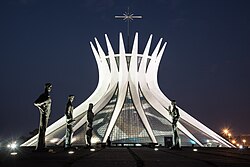
The architecture of Brazil is influenced by Europe, especially Portugal. It has a history that goes back 500 years to the time when Pedro Cabral discovered Brazil in 1500. Portuguese colonial architecture was the first wave of architecture to go to Brazil.[281] It is the basis for all Brazilian architecture of later centuries.[282] In the 19th century during the time of the Empire of Brazil, Brazil followed European trends and adopted Neoclassical and Gothic Revival architecture. Then in the 20th century especially in Brasilia, Brazil experimented with Modernist architecture.
The colonial architecture of Brazil dates to the early 16th century when Brazil was first explored, conquered and settled by the Portuguese. The Portuguese built architecture familiar to them in Europe in their aim to colonize Brazil. They built Portuguese colonial architecture which included churches, civic architecture including houses and forts in Brazilian cities and the countryside. During 19th century Brazilian architecture saw the introduction of more European styles to Brazil such as Neoclassical and Gothic Revival architecture. This was usually mixed with Brazilian influences from their own heritage which produced a unique form of Brazilian architecture. In the 1950s the modernist architecture was introduced when Brasilia was built as new federal capital in the interior of Brazil to help develop the interior. The architect Oscar Niemeyer idealized and built government buildings, churches and civic buildings in the modernist style.[283][284]
Music
The music of Brazil was formed mainly from the fusion of European and African elements.[285] Until the nineteenth century, Portugal was the gateway to most of the influences that built Brazilian music, although many of these elements were not of Portuguese origin, but generally European. The first was José Maurício Nunes Garcia, author of sacred pieces with influence of Viennese classicism.[286] The major contribution of the African element was the rhythmic diversity and some dances and instruments that had a bigger role in the development of popular music and folk, flourishing especially in the twentieth century.[285]
Popular music since the late eighteenth century began to show signs of forming a characteristically Brazilian sound, with samba considered the most typical and on the UNESCO cultural heritage list.[287] Maracatu and Afoxê are two Afro-Brazilian music traditions that have been popularized by their appearance in the annual Brazilian Carnivals.[288] The sport of capoeira is usually played with its own music referred to as capoeira music, which is usually considered to be a call-and-response type of folk music.[289] Forró is a type of folk music prominent during the Festa Junina in northeastern Brazil.[290] Jack A. Draper III, a professor of Portuguese at the University of Missouri,[291] argues that Forró was used as a way to subdue feelings of nostalgia for a rural lifestyle.[292]
Choro is a very popular music instrumental style. Its origins are in 19th-century Rio de Janeiro. In spite of the name, the style often has a fast and happy rhythm, characterized by virtuosity, improvisation, subtle modulations and full of syncopation and counterpoint.[293] Bossa nova is also a well-known style of Brazilian music developed and popularized in the 1950s and 1960s.[294] The phrase "bossa nova" means literally "new trend".[295] A lyrical fusion of samba and jazz, bossa nova acquired a large following starting in the 1960s.[296]
Literature

Brazilian literature dates back to the 16th century, to the writings of the first Portuguese explorers in Brazil, such as Pêro Vaz de Caminha, filled with descriptions of fauna, flora and commentary about the indigenous population that fascinated European readers.[297]
Brazil produced significant works in Romanticism – novelists like Joaquim Manuel de Macedo and José de Alencar wrote novels about love and pain. Alencar, in his long career, also treated indigenous people as heroes in the Indigenist novels O Guarani, Iracema and Ubirajara.[298] Machado de Assis, one of his contemporaries, wrote in virtually all genres and continues to gain international prestige from critics worldwide.[299][300][301]
Brazilian Modernism, evidenced by the Week of Modern Art in 1922, was concerned with a nationalist avant-garde literature,[302] while Post-Modernism brought a generation of distinct poets like João Cabral de Melo Neto, Carlos Drummond de Andrade, Vinicius de Moraes, Cora Coralina, Graciliano Ramos, Cecília Meireles, and internationally known writers dealing with universal and regional subjects like Jorge Amado, João Guimarães Rosa, Clarice Lispector and Manuel Bandeira.[303][304][305]
Cuisine


Brazilian cuisine varies greatly by region, reflecting the country's varying mix of indigenous and immigrant populations. This has created a national cuisine marked by the preservation of regional differences.[306] Examples are Feijoada, considered the country's national dish;[307] and regional foods such as beiju, feijão tropeiro, vatapá, moqueca, polenta (from Italian cuisine) and acarajé (from African cuisine).[308]
The national beverage is coffee and cachaça is Brazil's native liquor. Cachaça is distilled from sugar cane and is the main ingredient in the national cocktail, Caipirinha.[309]
A typical meal consists mostly of rice and beans with beef, salad, french fries and a fried egg.[310] Often, it is mixed with cassava flour (farofa). Fried potatoes, fried cassava, fried banana, fried meat and fried cheese are very often eaten in lunch and served in most typical restaurants.[311] Popular snacks are pastel (a fried pastry); coxinha (a variation of chicken croquete); pão de queijo (cheese bread and cassava flour / tapioca); pamonha (corn and milk paste); esfirra (a variation of Lebanese pastry); kibbeh (from Arabic cuisine); empanada (pastry) and empada, little salt pies filled with shrimps or heart of palm.
Brazil has a variety of desserts such as brigadeiros (chocolate fudge balls), bolo de rolo (roll cake with goiabada), cocada (a coconut sweet), beijinhos (coconut truffles and clove) and romeu e julieta (cheese with goiabada). Peanuts are used to make paçoca, rapadura and pé-de-moleque. Local common fruits like açaí, cupuaçu, mango, papaya, cocoa, cashew, guava, orange, lime, passionfruit, pineapple, and hog plum are turned in juices and used to make chocolates, ice pops and ice cream.[312]
Cinema

The Brazilian film industry began in the late 19th century, during the early days of the Belle Époque. While there were national film productions during the early 20th century, American films such as Rio the Magnificent were made in Rio de Janeiro to promote tourism in the city.[313] The films Limite (1931) and Ganga Bruta (1933), the latter being produced by Adhemar Gonzaga through the prolific studio Cinédia, were poorly received at release and failed at the box office, but are acclaimed nowadays and placed among the finest Brazilian films of all time.[314] The 1941 unfinished film It's All True was divided in four segments, two of which were filmed in Brazil and directed by Orson Welles; it was originally produced as part of the United States' Good Neighbor Policy during Getúlio Vargas' Estado Novo government.
During the 1960s, the Cinema Novo movement rose to prominence with directors such as Glauber Rocha, Nelson Pereira dos Santos, Paulo Cesar Saraceni and Arnaldo Jabor. Rocha's films Deus e o Diabo na Terra do Sol (1964) and Terra em Transe (1967) are considered to be some of the greatest and most influential in Brazilian film history.[315]
During the 1990s, Brazil saw a surge of critical and commercial success with films such as O Quatrilho (Fábio Barreto, 1995), O Que É Isso, Companheiro? (Bruno Barreto, 1997) and Central do Brasil (Walter Salles, 1998), all of which were nominated for the Academy Award for Best Foreign Language Film, the latter receiving a Best Actress nomination for Fernanda Montenegro. The 2002 crime film City of God, directed by Fernando Meirelles, was critically acclaimed, scoring 90% on Rotten Tomatoes,[316] being placed in Roger Ebert's Best Films of the Decade list[317] and receiving four Academy Award nominations in 2004, including Best Director. Notable film festivals in Brazil include the São Paulo and Rio de Janeiro International Film Festivals and the Gramado Festival.
Theatre

The theatre in Brazil has its origins in the period of Jesuit expansion when theater was used for the dissemination of Catholic doctrine in the 16th century. in the 17th and 18th centuries the first dramatists who appeared on the scene of European derivation was for court or private performances.[318] During the 19th century, dramatic theater gained importance and thickness, whose first representative was Luis Carlos Martins Pena (1813–1848), capable of describing contemporary reality. Always in this period the comedy of costume and comic production was imposed. Significant, also in the nineteenth century, was also the playwright Antônio Gonçalves Dias.[319] There were also numerous operas and orchestras. The Brazilian conductor Antônio Carlos Gomes became internationally known with operas like Il Guarany. At the end of the 19th century orchestrated dramaturgias became very popular and were accompanied with songs of famous artists like the conductress Chiquinha Gonzaga.[320]
Already in the early 20th century there was the presence of theaters, entrepreneurs and actor companies, but paradoxically the quality of the products staggered, and only in 1940 the Brazilian theater received a boost of renewal thanks to the action of Paschoal Carlos Magno and his student's theater, the comedians group and the Italian actors Adolfo Celi, Ruggero Jacobbi and Aldo Calvo, founders of the Teatro Brasileiro de Comedia. From the 1960s it was attended by a theater dedicated to social and religious issues and to the flourishing of schools of dramatic art. The most prominent authors at this stage were Jorge Andrade and Ariano Suassuna.[319]
Visual arts

Brazilian painting emerged in the late 16th century,[321] influenced by Baroque, Rococo, Neoclassicism, Romanticism, Realism, Modernism, Expressionism, Surrealism, Cubism and Abstracionism making it a major art style called Brazilian academic art.[322][323] The Missão Artística Francesa (French Artistic Mission) arrived in Brazil in 1816 proposing the creation of an art academy modeled after the respected Académie des Beaux-Arts, with graduation courses both for artists and craftsmen for activities such as modeling, decorating, carpentry and others and bringing artists like Jean-Baptiste Debret.[323]
Upon the creation of the Imperial Academy of Fine Arts, new artistic movements spread across the country during the 19th century and later the event called Week of Modern Art broke definitely with academic tradition in 1922 and started a nationalist trend which was influenced by modernist arts. Among the best-known Brazilian painters are Ricardo do Pilar and Manuel da Costa Ataíde (baroque and rococo), Victor Meirelles, Pedro Américo and Almeida Junior (romanticism and realism), Anita Malfatti, Ismael Nery, Lasar Segall, Emiliano di Cavalcanti, Vicente do Rego Monteiro, and Tarsila do Amaral (expressionism, surrealism and cubism), Aldo Bonadei, José Pancetti and Cândido Portinari (modernism).[324]
Sports

The most popular sport in Brazil is football.[325] The Brazilian men's national team is ranked among the best in the world according to the FIFA World Rankings, and has won the World Cup tournament a record five times.[326][327]
Volleyball, basketball, auto racing, and martial arts also attract large audiences. The Brazil men's national volleyball team, for example, currently holds the titles of the World League, World Grand Champions Cup, World Championship and the World Cup. In auto racing, three Brazilian drivers have won the Formula One world championship eight times.[328][329][330]
Some sport variations have their origins in Brazil: beach football,[331] futsal (indoor football)[332] and footvolley emerged in Brazil as variations of football. In martial arts, Brazilians developed Capoeira,[333] Vale tudo,[334] and Brazilian jiu-jitsu.[335]
Brazil has hosted several high-profile international sporting events, like the 1950 FIFA World Cup[336] and recently has hosted the 2014 FIFA World Cup, 2019 Copa América and 2021 Copa América .[337] The São Paulo circuit, Autódromo José Carlos Pace, hosts the annual Grand Prix of Brazil.[338] São Paulo organized the IV Pan American Games in 1963, and Rio de Janeiro hosted the XV Pan American Games in 2007.[339] On 2 October 2009, Rio de Janeiro was selected to host the 2016 Olympic Games and 2016 Paralympic Games, making it the first South American city to host the games[340] and second in Latin America, after Mexico City. Furthermore, the country hosted the FIBA Basketball World Cups in 1954 and 1963. At the 1963 event, the Brazil national basketball team won one of its two world championship titles.[341]
See also
Notes
- ↑ includes Arab Brazilian, Jewish Brazilian, and Romani Brazilian
- ↑ includes Caboclo, Mulatto, and Zambo
- ↑ The Brazilian census uses the term amarela (or yellow in English) to describe people of East Asian background, and therefore excludes those of other Asian origins, such as West Asians/Arabs and South Asians.
- ↑ European Portuguese: [bɾɐˈziɫ]
References
- ↑ Exército Brasileiro. "Hino à Bandeira Nacional" (in português). Archived from the original on 22 February 2014. Retrieved 29 January 2014.
- ↑ "Demographics". Brazilian Government. Archived from the original on 17 November 2011. Retrieved 8 October 2011.
- ↑ "Caracteristicas da População e dos Domicílios do Censo Demográfico 2010 – Cor ou raça" (PDF). Archived from the original (PDF) on 17 February 2012. Retrieved 7 April 2012.
- ↑ "South America :: BRAZIL". CIA The World Factbook. Retrieved 30 August 2017.
- ↑ 5.0 5.1 IBGE – Instituto Brasileiro de Geografia e Estatística (Brazilian Institute for Geography and Statistics). 2010 Census. Retrieved 7 August 2012.
- ↑ "2010 Population Census – General characteristics of population, religion and persons with disabilities (Portuguese)". ibge.gov.br (in português). 16 November 2012. Archived from the original on 16 November 2012. Retrieved 10 August 2019.
- ↑ Silva, Antonio Carlos Coutinho Gouvea da. "Projeções da População | Estatísticas | IBGE :: Instituto Brasileiro de Geografia e Estatística". ibge.gov.br (in português do Brasil). Retrieved 30 August 2018.
- ↑ 8.0 8.1 8.2 8.3 "World Economic Outlook Database, April 2021". IMF.org. International Monetary Fund. Retrieved 8 April 2021.
- ↑ "GINI index (World Bank estimate) – Brazil". World Bank. Retrieved 8 April 2021.
- ↑ "2019 Human Development Report" (PDF). United Nations Development Programme. 2019. Retrieved 9 December 2019.
- ↑ José María Bello (1966). A History of Modern Brazil: 1889–1964. Stanford University Press. p. 56. ISBN 978-0-8047-0238-6.
- ↑ "Área Territorial Brasileira" [Brazilian Territorial Area] (in português). Instituto Brasileiro de Geografia e Estatística. Archived from the original on 15 January 2012. Retrieved 4 May 2018.
Para a superfície do Brasil foi obtido o valor de 8.515.759,090 km2, publicado no DOU nº 124 de 30/06/2017, conforme Resolução Nº 02, de 29 de junho de 2017.
- ↑ Philander, S. George (2012). Encyclopedia of Global Warming and Climate Change, Second Edition. Vol. Vol. 1 (Second ed.). Los Angeles: Princeton University. p. 148. ISBN 978-1-4129-9261-9. OCLC 970592418.
{{cite book}}:|volume=has extra text (help) - ↑ Vallance, Monique M. (2012). "Preface and Observations on Contemporary Brazil". In Crocitti, John J. (ed.). Brazil Today: An Encyclopedia of Life in the Republic. Contributing editor Monique M. Vallance. ABC-CLIO. p. xxiii. ISBN 978-0-313-34672-9. OCLC 787850982.
- ↑ "Os migrantes de hoje". BBC Brasil. Retrieved 24 October 2018.
- ↑ 16.0 16.1 16.2 16.3 16.4 16.5 16.6 16.7 "Geography of Brazil". The World Factbook. Central Intelligence Agency. 1 May 2018. Geography > Coastline. Retrieved 4 May 2018.
- ↑ "Brazil – Land". Permanent Missions. United Nations. Geography. Archived from the original on 23 October 2014.
- ↑ "Brazilian Federal Constitution" (in português). Presidency of the Republic. 1988. Retrieved 3 June 2008. "Brazilian Federal Constitution". v-brazil.com. 2007. Archived from the original on 28 September 2018. Retrieved 3 June 2008.
Unofficial translate
- ↑ "UNESCO World Heritage Centre — World Heritage List". UNESCO. Retrieved 25 May 2012.
- ↑ "Country and Lending Groups". World Bank. Archived from the original on 18 March 2011. Retrieved 5 March 2011.
Uppermiddle Income defined as a per capita income between $3,976 – $12,275
- ↑ "World Economic Outlook Database, April 2019". IMF.org. International Monetary Fund. Retrieved 29 September 2019.
- ↑ "FTSE Country Classification" (PDF). FTSE Group. September 2018. Retrieved 20 November 2018.
- ↑ "International Monetary Fund". imf.org.
- ↑ "CIA – The World Factbook – Country Comparisons – GDP (purchasing power parity)". Cia.gov. Retrieved 25 January 2011.
- ↑ 25.0 25.1 Jeff Neilson; Bill Pritchard (2011). Value Chain Struggles. John Wiley & Sons. p. 102. ISBN 978-1-4443-5544-4.
- ↑ 26.0 26.1 Sean W. Burges (2016). Latin America and the Shifting Sands of Globalization. Routledge. pp. 114–15. ISBN 978-1-317-69658-2.
- ↑ M. Schaefer; J. Poffenbarger (2014). The Formation of the BRICS and its Implication for the United States: Emerging Together. Springer. p. 32. ISBN 978-1-137-38794-3.
- ↑ 28.0 28.1 Gardini, Gian Luca (2016). "Brazil: What Rise of What Power?". Bulletin of Latin American Research. 35: 5–19. doi:10.1111/blar.12417.
- ↑ FRIDE: The international arena and emerging powers: stabilising or destabilising forces? Archived 15 June 2016 at the Wayback Machine, Susanne Gratius, April 2008
- ↑ Peter Collecott (29 October 2011). "Brazil's Quest for Superpower Status". The Diplomatic Courier. Retrieved 10 August 2014.
- ↑ Clendenning, Alan (17 April 2008). "Booming Brazil could be world power soon". USA Today. The Associated Press. p. 2. Retrieved 12 December 2008.
- ↑ Jorge Dominguez; Byung Kook Kim (2013). Between Compliance and Conflict: East Asia Latin America and the New Pax Americana. Center for International Affairs, Harvard University. pp. 98–99. ISBN 978-1-136-76983-2.
- ↑ Fausto, Boris (1999). A Concise History of Brazil. Cambridge University Press. p. 9. ISBN 978-0-521-56526-4.
- ↑ Jon S. Vincent. (2003). Culture and Customs of Brazil. Greenwood Publishing Group. p. 36. ISBN 978-0-313-30495-8.
- ↑ Richard P. Tucker (2007). Insatiable Appetite: The Ecological Degradation of the Tropical World. University of Michigan. p. 186. ISBN 978-0-7425-5365-1.
- ↑ Wayne E. Lee (2011). Empires and Indigenes: Intercultural Alliance, Imperial Expansion, and Warfare in the Early Modern World. NYU Press. p. 196. ISBN 978-0-8147-6527-2.
- ↑ Daly, Charles P. (1880). "Maps and Map-making Before Mercator". The Popular Science Monthly. Bonnier Corporation. 473–495, see page 493. ISSN 0161-7370.
- ↑ Jean de Léry (1990). History of a Voyage to the Land of Brazil, Otherwise Called America. University of California Press. p. 242. ISBN 978-0-520-91380-6.
- ↑ Jayme A. Sokolow. (2003). The Great Encounter: Native Peoples and European Settlers in the Americas, 1492–1800. M.E. Sharpe. p. 84. ISBN 978-0-7656-0982-3.
- ↑ Maria Herrera-Sobek (2012). Celebrating Latino Folklore. ABC-CLIO. p. 155. ISBN 978-0-313-34340-7.
- ↑ 41.0 41.1 "Land and Resources". Encarta. MSN. Archived from the original on 28 October 2009. Retrieved 11 June 2008. [dubious ]
- ↑ Official Area (In Portuguese) Archived 15 January 2012 at WebCite IBGE: Instituto Brasileiro de Geografia e Estatística. Retrieved 8 January 2010.
- ↑ "Hora Legal Brasileira". Observatório Nacional. Archived from the original on 22 July 2011. Retrieved 28 December 2014.
- ↑ 44.0 44.1 44.2 44.3 44.4 "Natural Regions". Encarta. MSN. Archived from the original on 28 October 2009. Retrieved 11 June 2008. [dubious ]
- ↑ 45.0 45.1 "Rivers and Lakes". Encarta. MSN. Archived from the original on 28 October 2009. Retrieved 11 June 2008. [dubious ]
- ↑ 46.0 46.1 46.2 46.3 46.4 "Brazil". Country Guide. BBC Weather. Archived from the original on 8 February 2011. Retrieved 11 June 2008.
- ↑ 47.0 47.1 47.2 47.3 47.4 "Natural Regions". Encarta. MSN. Archived from the original on 29 October 2009. Retrieved 11 June 2008. [dubious ]
- ↑ 48.0 48.1 48.2 "Temperature in Brazil". Brazil Travel. Archived from the original on 12 June 2008. Retrieved 11 June 2008.
- ↑ 49.0 49.1 Embrapa. "Annual averages of Mandacaru Agro-meteorological station" (in português). Archived from the original on 20 August 2007. Retrieved 21 October 2008.
- ↑ "CPD: South America, Site SA19, Caatinga of North-eastern Brazil, Brazil". Botany.si.edu. Archived from the original on 6 June 2009. Retrieved 29 October 2009.
- ↑ "Drought, Smallpox, and Emergence of Leishmania braziliensis in Northeastern Brazil". Centers for Disease Control and Prevention (CDC).
- ↑ "Ó Gráda, C.: Famine: A Short History" Archived 12 January 2016 at the Wayback Machine. Princeton University Press.
- ↑ "Inland fishery enhancements". FAO.
- ↑ "One fifth of the world's freshwater". Amazon. World Wide Fund for Nature. 6 August 2007. Retrieved 12 June 2008.
- ↑ 55.0 55.1 55.2 55.3 "Plant and Animal Life". Encarta. MSN. Archived from the original on 29 October 2009. Retrieved 12 June 2008.
- ↑ "Atlantic Forest, Brazil". Map: Biodiversity hotspots. BBC News. 1 October 2004. Retrieved 12 June 2008.
- ↑ "Environmental Issues". Encarta. MSN. Archived from the original on 29 October 2009. Retrieved 12 June 2008.
- ↑ 58.0 58.1 58.2 58.3 Hansen, M. C.; Potapov, P. V.; Moore, R.; Hancher, M.; Turubanova, S. A.; Tyukavina, A.; Thau, D.; Stehman, S. V.; Goetz, S. J.; Loveland, T. R.; Kommareddy, A.; Egorov, A.; Chini, L.; Justice, C. O.; Townshend, J. R. G. (15 November 2013). "High-Resolution Global Maps of 21st-Century Forest Cover Change". Science. 342 (6160): 850–853. Bibcode:2013Sci...342..850H. doi:10.1126/science.1244693. PMID 24233722. S2CID 23541992.
- ↑ Preserved native vegetation occupies 61% of Brazil's area, says Embrapa
- ↑ How Europe has multiplied its forests and why this can be a problem
- ↑ Felin, Bruno (10 December 2020). "STATEMENT: Brazil Sets Weak 2030 Emission Reduction Target". World Resources Institute. Retrieved 3 January 2021.
- ↑ "Brazil". International Monetary Fund (IMF). Retrieved 1 April 2016.
- ↑ "Economy of Brazil". The World Factbook. Central Intelligence Agency. 2008. Retrieved 3 June 2008.
- ↑ O'Neill, Jim. "BRICs". Goldman Sachs. Retrieved 6 June 2008.
- ↑ "Fazcomex Tecnologia para Comércio Exterior – Soluções para Comex". Fazcomex | Tecnologia para Comércio Exterior.
- ↑ "Agronegócio tem oito entre os dez produtos líderes das exportações brasileiras em 2019". Avicultura Industrial.
- ↑ "Brasil será maior exportador agrícola mundial em 2024" (in português). EXAME. 1 July 2015. Archived from the original on 9 May 2018. Retrieved 9 May 2018.
- ↑ "Embraer vê clientes mais dispostos à compra de aviões". Exame Magazine. 10 October 2010. Retrieved 8 February 2014.
- ↑ "Forbes Global 2000". Retrieved 31 October 2020.
- ↑ Alok Bansal; Yogeshwari Phatak; I C Gupta; Rajendra Jain (2009). Transcending Horizons Through Innovative Global Practices. Excel Books. p. 29. ISBN 978-81-7446-708-9.
- ↑ 71.0 71.1 "Field Listing – GDP – composition by sector". The World Factbook. Central Intelligence Agency. 2008. Retrieved 9 June 2008.
- ↑ "FAOSTAT". www.fao.org.
- ↑ "How are agricultural co-operatives making a difference in Brazil? | ICA". ica.coop.
- ↑ "Why 20 million Brazilians rely on a co-operative for healthcare". 20 August 2015.
- ↑ "Conheça os 3 países que desafiam o Brasil nas exportações de frango". Avicultura Industrial.
- ↑ Formigoni, Ivan (30 May 2019). "Maiores exportadores de carne de frango entre 2015 e 2019".
- ↑ "IBGE: rebanho de bovinos tinha 218,23 milhões de cabeças em 2016 | BeefPoint". beefpoint.com.br.
- ↑ "Brasil é o 3º maior produtor de leite do mundo, superando o padrão Europeu em alguns municípios". 8 February 2020. Archived from the original on 17 September 2020. Retrieved 15 August 2020.
- ↑ "Principais países produtores de carne suína entre 2017 e 2019". 23 July 2019.
- ↑ "Brasil é sétimo maior produtor mundial de ovos". Avicultura Industrial.
- ↑ "Brasil extrai cerca de 2 gramas de ouro por habitante em 5 anos". R7.com. 29 June 2019.
- ↑ "Nióbio: G1 visita em MG complexo industrial do maior produtor do mundo". G1.
- ↑ "Serviço Geológico do Brasil". cprm.gov.br.
- ↑ "Rio Grande do Sul: o maior exportador de pedras preciosas do Brasil". Band.com.br.
- ↑ Paolo Maria Giordano; Francesco Lanzafame; Jörg Meyer-Stamer (2005). Asymmetries in Regional Integration And Local Development. IDB. p. 129. ISBN 978-1-59782-004-2.
- ↑ Gasnier, Mat (15 January 2012). "The 20 biggest car markets in the world: Russia on the up!". Best Selling Cars. Retrieved 17 November 2014.
- ↑ "The economy of heat". The Economist. 12 April 2007. Retrieved 6 June 2008.
- ↑ "Alimentos Processados | A indústria de alimentos e bebidas na sociedade brasileira atual". alimentosprocessados.com.br.
- ↑ "Produção nacional de celulose cai 6,6% em 2019, aponta Ibá". Valor Econômico.
- ↑ "Indústrias calçadistas em Franca, SP registram queda de 40% nas vagas de trabalho em 6 anos". G1.
- ↑ Comércio, Diário do (24 January 2020). "Minas Gerais produz 32,3% do aço nacional em 2019".
- ↑ "O novo mapa das montadoras, que agora rumam para o interior do País". 8 March 2019.
- ↑ "Indústria automobilística do Sul do Rio impulsiona superavit na economia". G1.
- ↑ "Indústria Química no Brasil" (PDF).
- ↑ "Estudo de 2018" (PDF).
- ↑ "Produção nacional da indústria de químicos cai 5,7% em 2019, diz Abiquim". economia.uol.com.br.
- ↑ "Industria Textil no Brasil".
- ↑ "Setor de serviços sustenta o crescimento do PIB de 2018". VEJA.
- ↑ "Produtividade e Comércio Exterior". SECINT e SEPEC.
- ↑ Pequenos negócios já representam 30% do Produto Interno Bruto do país
- ↑ Baig, Taimur; Goldfajn, Ilan (2000). "The Russian default and the contagion to Brazil" (PDF). IMF Working Paper. International Monetary Fund. Retrieved 6 June 2008.
- ↑ "Os impasses da política econômica brasileira nos anos 90". Revista FAAP. 2010. Retrieved 4 February 2015.
- ↑ Fraga, Arminio (2000). Monetary Policy During the Transition to a Floating Exchange Rate: Brazil's Recent Experience. International Monetary Fund. Retrieved 6 June 2008.
- ↑ Wheatley, Jonathan (2 September 2002). "Brazil: When an IMF Bailout Is Not Enough". Business Week. Retrieved 6 June 2008.
- ↑ "Brazil to pay off IMF debts early". BBC News. 14 December 2005. Retrieved 6 June 2008.
- ↑ Economic Quarterly (PDF). Institute of Applied Economic Research. 1 March 2007. p. 171. Archived from the original (PDF) on 27 May 2008. Retrieved 6 June 2008.
- ↑ "Capital Flows to Emerging Markets Set at Close to Record Levels" (Press release). The Institute of International Finance. 31 May 2007. Archived from the original on 13 July 2011. Retrieved 6 June 2008.
- ↑ IPCA, IPC-FIPE and IPC-BR: Methodological and Empirical Differences (PDF). Central Bank of Brazil. 2004. Retrieved 6 June 2008.
- ↑ "Brazil: Corruption Costs $41 Billion". Latin Business Chronicle. Archived from the original on 21 March 2013. Retrieved 22 March 2013.
- ↑ "Exposing corrupt politicians? the effect of Brazil's publicly released audits on electoral outcomes" (PDF). Quarterly Journal of Economics. May 2008. Retrieved 22 March 2013.
- ↑ "Corruption perceptions index". Transparency International. Archived from the original on 7 December 2012. Retrieved 22 March 2013.
- ↑ "Rousseff Crisis Spurred by Lula Debts as Brazil Boom Diminishes". Mobile.bloomberg.com. 27 September 2011. Archived from the original on 8 May 2012. Retrieved 7 April 2012.
- ↑ Michael Schmidt; Vincent Onyango; Dmytro Palekhov (2011). Implementing Environmental and Resource Management. Springer. p. 42. ISBN 978-3-540-77568-3.
- ↑ OECD; Organisation for Economic Co-operation and Development; Organisation for Economic Co-Operation and Development Staff (2001). OECD Economic Surveys: Brazil 2001. OECD Publishing. p. 193. ISBN 978-92-64-19141-9.
- ↑ "Brasil alcança 170 mil megawatts de capacidade instalada em 2019 – Sala de Imprensa – ANEEL". www.aneel.gov.br.
- ↑ "How many power generating plants do we have in Brazil?".
- ↑ "Brasil desponta como terceiro maior produtor de eletricidade das Américas • Abrapch". 24 March 2017.
- ↑ "Boletim Mensal de Geração Eólica Junho/2021" (PDF) (in português). Operador Nacional do Sistema Elétrico – ONS. 1 July 2021. pp. 6, 14. Retrieved 3 August 2021.
- ↑ "Brasil é o país com melhor fator de aproveitamento da energia eólica". Governo do Brasil (in português do Brasil). Archived from the original on 7 October 2018. Retrieved 7 October 2018.
- ↑ "Boletim Trimestral de Energia Eólica – Junho de 2020" (PDF) (in português do Brasil). Empresa de Pesquisa Energética. 23 June 2020. p. 4. Retrieved 24 October 2020.
- ↑ 121.0 121.1 "Quantas usinas geradoras de energia temos no Brasil?". CBIE. 5 April 2019.
- ↑ "Ventos promissores a caminho". revistapesquisa.fapesp.br.
- ↑ Brazilian onshore wind potential could be 880 GW, study indicates
- ↑ "GWEC Global Wind Report 2019". Global Wind Energy Council. 25 March 2020. pp. 25, 28. Retrieved 23 October 2020.
- ↑ "Global Wind Report 2019". Global Wind Energy Council. 25 March 2020. p. 10. Retrieved 23 October 2020.
- ↑ "Quais as melhores regiões do Brasil para geração de energia fotovoltaica? – Sharenergy". Sharenergy (in português do Brasil). 3 February 2017. Retrieved 7 October 2018.
- ↑ "Boletim Mensal de Geração Solar Fotovoltaica Junho/2021" (PDF) (in português). Operador Nacional do Sistema Elétrico – ONS. 1 July 2021. pp. 6, 13. Retrieved 3 August 2021.
- ↑ RENEWABLE CAPACITY STATISTICS 2021
- ↑ "RENEWABLE CAPACITY STATISTICS 2021 page 41" (PDF). Retrieved 24 May 2021.
- ↑ Lael Brainard; Leonardo Martinez-Diaz (2009). Brazil As an Economic Superpower?: Understanding Brazil's Changing Role in the Global Economy. Brookings Institution Press. p. 45. ISBN 978-0-8157-0365-5.
- ↑ OECD (2005). Economic Surveys: Brazil. OECD Publishing. p. 105. ISBN 978-92-64-00749-9.
- ↑ "Produção de petróleo e gás no Brasil ultrapassa 4 milhões de boe/d pela primeira vez". anp.gov.br.
- ↑ O Globo (18 March 2014). "Praia de Fernando de Noronha é eleita a mais bonita do mundo". Retrieved 4 January 2018.
- ↑ UNWTO Tourism Highlights. 2016. doi:10.18111/9789284418145. ISBN 978-92-844-1814-5.
- ↑ "UNWTO Tourism Highlights – 2011 Edition" (PDF). World Tourism Organization. June 2011. Archived from the original (PDF) on 5 January 2012. Retrieved 29 September 2011.
- ↑ "Estatisticas e Indicadores: Receita Cambial" (in português). Ministério do Turismo. 2012. Retrieved 13 February 2012.
- ↑ Ministério do Turismo (13 January 2012). "Turismo Brasileiro com novo recorde em 2011" (in português). No Pátio. Archived from the original on 22 August 2013. Retrieved 13 February 2012.
- ↑ Highlights of international tourism. 2019. doi:10.18111/9789284421152. ISBN 9789284421152.[permanent dead link]
- ↑ Guilherme Lohmann Palhares (2012). Tourism in Brazil: Environment, Management and Segments. Routledge. p. 126. ISBN 978-0-415-67432-4.
- ↑ "The Travel & Tourism Competitiveness Report 2015" (PDF). World Economic Forum. May 2015.
- ↑ 141.0 141.1 Jennifer Blanke; Thea Chiesa, eds. (2013). "Travel & Tourism Competitiveness Report 2013" (PDF). World Economic Forum, Geneva, Switzerland. Retrieved 14 April 2013. See Table 4, pp. 18–19 and Country/Economy Profile: Brazil, pp. 116–17.
- ↑ Organisation for Economic Co-operation and Development; Organisation for Economic Co-Operation and Development Staff (2006). OECD Economic Surveys: Brazil 2006. OECD Publishing. p. 94. ISBN 978-92-64-02999-6.
- ↑ United Nations Educational, Scientific (2010). UNESCO Science Report 2010: The Current Status of Science Around the World. UNESCO. pp. 110–18. ISBN 978-92-3-104132-7.
- ↑ Brian Harvey; Henk H.F. Smid; Thâeo Pirard (2010). Emerging Space Powers: The New Space Programs of Asia, the Middle East and South-America. Springer. p. 324. ISBN 978-1-4419-0874-2.
- ↑ Crocitti & Vallance (2012), p. 628.
- ↑ NASA Signs International Space Station Agreement With Brazil NASA.
- ↑ O.C. Ferreira. "O Sistema Elétrico Brasileiro". Retrieved 21 March 2013.
- ↑ "Confirmed: Agreement with France Includes the Brazilian Nuclear Submarine". Nonproliferation for Global Security Foundation. 23 December 2008. Retrieved 23 December 2008.
- ↑ "Rheinische Friedrich-Wilhelms-Universität". Elsa.physik.uni-bonn.de. 18 August 2008. Retrieved 30 October 2010.
- ↑ "CEITEC". Portal Brasil. Brasil.gov.br. Archived from the original on 17 November 2011. Retrieved 8 August 2011.
- ↑ "Brasil cai duas posições em ranking mundial", Folha de S.Paulo, 26 March 2010, retrieved 26 March 2010
- ↑ "Release of the Global Innovation Index 2020: Who Will Finance Innovation?". www.wipo.int. Retrieved 2 September 2021.
- ↑ "Global Innovation Index 2019". www.wipo.int. Retrieved 2 September 2021.
- ↑ "RTD - Item". ec.europa.eu. Retrieved 2 September 2021.
- ↑ "Global Innovation Index". INSEAD Knowledge. 28 October 2013. Retrieved 2 September 2021.
- ↑ "M. Santos Dumont Rounds Eiffel Tower" (PDF). The New York Times. 20 October 1901. Retrieved 29 December 2010.
- ↑ "Engelberg, Inc". Vintage Machinery. 2011. Retrieved 17 July 2011.
- ↑ Abreu, Manuel de, pag. 17 – Grande Enciclopédia Universal – edição de 1980 – Ed.Amazonas
- ↑ "Portable stereo's creator got his due, eventually". Archived from the original on 9 March 2009. Retrieved 16 December 2015.
- ↑ Exposição destaca centenário do CEFET-MG Sítio do Cefet-MG, acessado em 13 de novembro de 2010 Archived 13 August 2014 at the Wayback Machine
- ↑ Ministério da Ciência, Tecnologia e Inovação. "50 anos do Méson-Pi". Archived from the original on 26 May 2011. Retrieved 29 December 2010.
- ↑ "Centro Brasileiro de Pesquisas Físicas – Coleção Galileo: Textos de Física" (PDF). Archived from the original (PDF) on 31 March 2013. Retrieved 21 October 2014.
- ↑ "Atta-Ur-Rahman, José Leite Lopes and Juan Martín Maldacena receive UNESCO science prizes". UNESCOPRESS. Retrieved 21 October 2014.
- ↑ Brasileiro ganha a Medalha Fields, considerada o "Nobel da Matemática".
- ↑ West, David A. 2003. Fritz Müller: a naturalist in Brazil. Blacksburg: Pocahontas Press
- ↑ Fernanda Castello Branco. "As 11 estradas mais incríveis do Brasil". iG. Archived from the original on 11 April 2018. Retrieved 22 September 2014.
- ↑ "Road system in Brazil". Nationsencyclopedia.com. Retrieved 30 October 2010.
- ↑ "Anuário CNT do Transporte". anuariodotransporte.cnt.org.br.
- ↑ Pereira, L.A.G; Lessa, S.N.; Cardoso, A.D., Planejamento e Transporte Rodoviário no Brasil
- ↑ Sydney Alberto Latini; "A Implantação da Indústria Automobilística no Brasil"; Editora Alaúde 2007 ISBN 978-85-98497-55-6
- ↑ "OPrincipais ferrovias". Ministerio dos Transportes (in Portuguese) Archived 29 March 2013 at the Wayback Machine
- ↑ 172.0 172.1 Country Comparison to the World: Gini Index – Brazil The World Factbook. Retrieved on 3 April 2012.
- ↑ "Ociosidade atinge 70% dos principais aeroportos". O Globo, 12 August 2007. (in Portuguese)
- ↑ Guilherme Lohmann Palhares (2012). Tourism in Brazil: Environment, Management and Segments. Routledge. p. 48. ISBN 978-0-415-67432-4.
- ↑ "Mercado Brasileiro Terminais de Contêineres", Santos Brasil. (in Portuguese)
- ↑ G1, Fábio AmatoDo; Brasília, em (24 March 2013). "Navios esperam até 16 dias para atracar em porto do país, diz MDIC". Economia.
{{cite web}}: CS1 maint: numeric names: authors list (link) - ↑ Gerard Martin La Forgia; Bernard F. Couttolenc (2008). Hospital Performance in Brazil: The Search for Excellence. World Bank Publications. p. 17. ISBN 978-0-8213-7359-0.
- ↑ "20 Anos do SUS". Conselho Nacional de Saúde. Retrieved 13 April 2012.
- ↑ Lawrence F. Wolper (2004). Health Care Administration: Planning, Implementing, and Managing Organized Delivery Systems. Jones & Bartlett Learning. p. 33. ISBN 978-0-7637-3144-1.
- ↑ "Physicians (per 1,000 people)". World Health Organization's Global Health Workforce Statistics.
- ↑ "Hospital beds (per 1,000 people)". World Health Organization The World Bank.
- ↑ "Measuring overall health system performance for 191 countries" (PDF). World Health Organization. 2000. Retrieved 30 April 2014.
- ↑ Usa Ibp Usa (2005). Brazil: Tax Guide. Int'l Business Publications. p. 42. ISBN 978-0-7397-3279-3.
- ↑ 185.0 185.1 "IBGE: Analfabetismo cai no país, mas fica estagnado no Nordeste". Globo.com (in português).
- ↑ The Central Intelligence Agency (2010). The World Factbook 2010 (CIA 2009 ed.). Potomac Books, Inc. p. 143. ISBN 978-1-59797-541-4.
- ↑ World Bank (2001). Rural Poverty Alleviation in Brazil: Towards an Integrated Strategy. World Bank Publications. p. 40. ISBN 978-0-8213-5206-9.
- ↑ Laplane, Mario. "Efforts towards inclusion". D + C, Development and cooperation.
- ↑ "QS University Rankings Latin America". QS World University Rankings. Retrieved 11 November 2018.
- ↑ "Rede Globo se torna a 2ª maior emissora do mundo" (in português). O Fuxico. Retrieved 22 May 2012.
- ↑ Roberto Gonzalez Echevarría; Enrique Pupo-Walker (1996). The Cambridge History of Latin American Literature. Cambridge University Press. p. 13. ISBN 978-0-521-41035-9.
- ↑ Donald H. Johnston (2003). Encyclopedia of international media and communications. Vol. 3. Academic Press. p. 130. ISBN 978-0-12-387671-3.
- ↑ Jon S. Vincent (2003). Culture and Customs of Brazil. Greenwood Publishing Group. pp. 97–100. ISBN 978-0-313-30495-8.
- ↑ Bryan McCann (2004). Hello, Hello Brazil: Popular Music in the Making of Modern Brazil. Duke University Press. p. 22. ISBN 978-0-8223-3273-2.
- ↑ David Ward (2007). Television and Public Policy: Change and Continuity in an Era of Global Liberalization. Routledge. p. 28. ISBN 978-0-203-87728-9.
- ↑ "Um ponto de IBOPE equivale a quantas pessoas? E domicílios?". IBOPE. Archived from the original on 22 May 2013. Retrieved 23 March 2013.
- ↑ "Top 10 das novelas". MSN Brasil. Archived from the original on 7 May 2013. Retrieved 23 March 2013.
- ↑ Marcelo S. Alencar (2009). Digital Television Systems. Cambridge University Press. pp. 179–81. ISBN 978-0-521-89602-3.
- ↑ "Brazil launches international TV station for Africa". BBC News. 25 May 2010. Retrieved 30 October 2010.
- ↑ 2008 PNAD, IBGE. "População residente por situação, sexo e grupos de idade"
- ↑ 2008 PNAD, IBGE. "População residente por situação, sexo e grupos de idade"
- ↑ 2008 PNAD, IBGE. "População residente por situação, sexo e grupos de idade".
- ↑ "Brazil population reaches 190.8 million" Archived 9 August 2013 at the Wayback Machine. Brasil.gov.br.
- ↑ "Shaping Brazil: The Role of International Migration". Migration Policy Institute.
- ↑ José Alberto Magno de Carvalho, "Crescimento populacional e estrutura demográfica no Brasil" Archived 19 October 2016 at the Wayback Machine Belo Horizonte: UFMG/Cedeplar, 2004 (PDF file), p. 5.
- ↑ "Instituto Brasileiro de Geografia e Estatística". IBGE. 29 November 1999. Retrieved 25 January 2010.
- ↑ "Projeção da População do Brasil – Brazil's populational projection". IBGE. Retrieved 25 January 2010.
- ↑ Magno de Carvalho, "Crescimento populacional e estrutura demográfica no Brasil"[dead link], pp. 7–8.
- ↑ PNAD 2008, IBGE. "Pessoas de 5 anos ou mais de idade por situação, sexo, alfabetização e grupos de idade e grupos de idade".
- ↑ PNAD 2008, IBGE. "Pessoas de 5 anos ou mais de idade por situação, sexo, alfabetização e grupos de idade"
- ↑ PNAD 2008, IBGE. "Pessoas de 5 anos ou mais de idade por situação, sexo e alfabetização".
- ↑ "República Italiana". itamaraty.gov.br.
- ↑ 2008 PNAD, IBGE. "População residente por cor ou raça, situação e sexo".
- ↑ "In Amazonia, Defending the Hidden Tribes", The Washington Post (8 July 2007).
- ↑ De Assis Poiares, Lilian; De Sá Osorio, Paulo; Spanhol, Fábio Alexandre; Coltre, Sidnei César; Rodenbusch, Rodrigo; Gusmão, Leonor; Largura, Alvaro; Sandrini, Fabiano; Da Silva, Cláudia Maria Dornelles (2010). "Allele frequencies of 15 STRs in a representative sample of the Brazilian population" (PDF). Forensic Science International: Genetics. 4 (2): e61–63. doi:10.1016/j.fsigen.2009.05.006. PMID 20129458. Archived from the original (PDF) on 8 April 2011.
- ↑ Brazilian DNA is nearly 80% European, indicates study.
- ↑ NMO Godinho O impacto das migrações na constituição genética de populações latino-americanas Archived 6 July 2011 at the Wayback Machine. PhD Thesis, Universidade de Brasília (2008).
- ↑ 218.0 218.1 Pena, Sérgio D. J.; Di Pietro, Giuliano; Fuchshuber-Moraes, Mateus; Genro, Julia Pasqualini; Hutz, Mara H.; Kehdy Fde, Fernanda de Souza Gomes; Kohlrausch, Fabiana; Magno, Luiz Alexandre Viana; Montenegro, Raquel Carvalho; et al. (2011). Harpending, Henry (ed.). "The Genomic Ancestry of Individuals from Different Geographical Regions of Brazil Is More Uniform Than Expected". PLOS ONE. 6 (2): e17063. Bibcode:2011PLoSO...617063P. doi:10.1371/journal.pone.0017063. PMC 3040205. PMID 21359226.
{{cite journal}}: CS1 maint: article number as page number (link) - ↑ Parra, Flavia C.; Amado, Roberto C.; Lambertucci, José R.; Rocha, Jorge; Antunes, Carlos M.; Pena, Sérgio D. J. (7 January 2003). "Color and genomic ancestry in Brazilians". Proc Natl Acad Sci U S A. 100 (1): 177–82. Bibcode:2003PNAS..100..177P. doi:10.1073/pnas.0126614100. PMC 140919. PMID 12509516.
- ↑ "Tendências Demográficas: Uma análise da população com base nos resultados dos Censos Demográficos 1940 e 2000". Ibge.gov.br. Retrieved 7 April 2012.
- ↑ Antonio Carlos Lacerda (5 April 2011). "Demographical census reveals Brazil as older and less white". Port.pravda.ru. Archived from the original on 7 June 2011. Retrieved 7 April 2012.
- ↑ "Self-declared White Brazilians decrease in number, says IBGE". Fatimanews.com.br. Archived from the original on 16 January 2013. Retrieved 7 April 2012.
- ↑ RIBEIRO, Darcy. O Povo Brasileiro, Companhia de Bolso, fourth reprint, 2008 (2008).
- ↑ Negros de origem européia. afrobras.org.br
- ↑ Guerreiro-Junior, Vanderlei; Bisso-Machado, Rafael; Marrero, Andrea; Hünemeier, Tábita; Salzano, Francisco M.; Bortolini, Maria Cátira (2009). "Genetic signatures of parental contribution in black and white populations in Brazil". Genetics and Molecular Biology. 32 (1): 1–11. doi:10.1590/S1415-47572009005000001. PMC 3032968. PMID 21637639.
- ↑ Pena, S.D.J.; Bastos-Rodrigues, L.; Pimenta, J.R.; Bydlowski, S.P. (2009). "Genetic heritage variability of Brazilians in even regional averages, 2009 study". Brazilian Journal of Medical and Biological Research. 42 (10): 870–76. doi:10.1590/S0100-879X2009005000026. PMID 19738982.
- ↑ 227.0 227.1 Coelho (1996), p. 268.
- ↑ 228.0 228.1 Vesentini (1988), p. 117.
- ↑ Adas, Melhem Panorama geográfico do Brasil, 4th ed (São Paulo: Moderna, 2004), p. 268 ISBN 85-16-04336-3
- ↑ Azevedo (1971), pp. 2–3.
- ↑ 231.0 231.1 231.2 Moreira (1981), p. 108.
- ↑ Enciclopédia Barsa, vol. 4, pp. 254–55, 258, 265.
- ↑ Azevedo (1971), pp. 74–75.
- ↑ Enciclopédia Barsa, vol. 10 (Rio de Janeiro: Encyclopædia Britannica do Brasil, 1987), p. 355.
- ↑ Azevedo (1971), p. 74.
- ↑ 236.0 236.1 Azevedo (1971), p. 161.
- ↑ Maria Stella Ferreira-Levy (1974). "O papel da migração internacional na evolução da população brasileira (1872 a 1972)". Revista de Saúde Pública. 8 (supl): 49–90. doi:10.1590/S0034-89101974000500003., Table 2, p. 74. (in Portuguese)
- ↑ Zirin, 2014. Chapter 2, Section "The Beginning of the 'Mosaic' ".
- ↑ "The Jewish Community in Brazil". Beit Hatfutsot.
- ↑ "The Global Catholic Population". Pew Research Center. 13 February 2013. Retrieved 10 June 2020.
- ↑ "Brazil". International Religious Freedom Report. U.S. Department of State. 8 November 2005. Retrieved 8 June 2008.
- ↑ Kevin Boyle; Juliet Sheen (2013). Freedom of Religion and Belief: A World Report. Routledge. p. 211. ISBN 978-1-134-72229-7.
- ↑ "Brazil". Berkley Center for Religion, Peace, and World Affairs. Archived from the original on 25 August 2011. Retrieved 7 December 2011.
- ↑ Brian Morris (2006). Religion and Anthropology: A Critical Introduction. Cambridge University Press. p. 223. ISBN 978-0-521-85241-8.
- ↑ William Jeynes; David W. Robinson (2012). International Handbook of Protestant Education. Springer. p. 405. ISBN 978-94-007-2386-3.
- ↑ 2010 census results
- ↑ "Brazil". Berkley Center for Religion, Peace, and World Affairs. Archived from the original on 25 August 2011. Retrieved 7 December 2011. See drop-down essay on "The Growth of Religious Pluralism"
- ↑ 248.0 248.1 Do G1, em São Paulo (23 August 2011). "G1 – País tem menor nível de adeptos do catolicismo desde 1872, diz estudo – notícias em Brasil". G1.globo.com. Retrieved 7 April 2012.
{{cite web}}: CS1 maint: numeric names: authors list (link) - ↑ "Arms wide open" BBC, Retrieved 29 April 2017.
- ↑ "Religious statues: 10 of the world's most impressive" CNN, Retrieved 29 April 2017.
- ↑ "Senado aprova acordo com o Vaticano". O Globo. 2009. Retrieved 28 June 2020.
- ↑ "Decreto nº 7.107, de 11 de fevereiro de 2010". Casa Civil da Presidência da República. Retrieved 28 June 2020.
- ↑ "IDBGE" (in português). IBGE. 2011. Retrieved 8 October 2011.
- ↑ Cite error: Invalid
<ref>tag; no text was provided for refs namedconcentrações_urbanas - ↑ "Arranjos Populacionais e Concentrações Urbanas do Brasil" (PDF) (in português). Brazilian Institute of Geography and Statistics. p. 148. Retrieved 16 March 2017.
- ↑ "Estimativas da população residente no Brasil e Unidades da Federação com data de referência em 1º de julho de 2016" (PDF) (in português). Brazilian Institute of Geography and Statistics. Retrieved 16 March 2017.
- ↑ "Principal Cities". Encarta. MSN. Archived from the original on 29 October 2009. Retrieved 10 June 2008. [dubious ]
- ↑ "People of Brazil". The World Factbook. Central Intelligence Agency. 2008. Retrieved 3 June 2008.
- ↑ "Brazil – Language". countrystudies.us.
- ↑ "Learn About Portuguese Language". Sibila.com.br. Retrieved 7 April 2012.
- ↑ 261.0 261.1 261.2 "Languages of Brazil". Ethnologue. Retrieved 9 June 2008.
- ↑ Nash, Elizabeth (2 May 2008). "Portugal pays lip service to Brazil's supremacy". The Independent. London. Archived from the original on 24 June 2011. Retrieved 9 June 2008.
- ↑ LEI Nº 10.436, DE 24 DE ABRIL DE 2002. Presidência da República, Casa Civil, Subchefia para Assuntos Jurídicos. Retrieved on 19 May 2012.
- ↑ Brazilian decree nº 5626, 22 December 2005. Planalto.gov.br (23 December 2005). Retrieved on 19 May 2012.
- ↑ Charles J. Russo (2011). The Legal Rights of Students with Disabilities: International Perspectives. Rowman & Littlefield Publishers. p. 45. ISBN 978-1-4422-1085-1.
- ↑ Campbell, Lyle; Grondona, Verónica; Muysken, Peter (2012). "Contacts between indigenous languages in South America". The Indigenous Languages of South America: A Comprehensive Guide. Walter de Gruyter. p. 247. ISBN 978-3-11-025803-5.
Nheengatú (also called língua geral of Amazonia, or lingua Brasilica) originated in the 17th century in what are now the states of Pará Maranhão, as lingua franca on the basis of Tupinambá lexicon but with strong grammatical influence from Portuguese, also due to intervention by Jesuit missionaries [...] Around 1700 it was spoken in a large area in Brazil, as a contact language between whites and indians, but it lost some support with the expulsion of the Jesuits in 1758 [...] Its sister language in the colonial period was Língua Geral Paulista (in the state of São Paolo) a lingua franca which is now extinct.
- ↑ Rohter, Larry (28 August 2005). "Language Born of Colonialism Thrives Again in Amazon". New York Times. Retrieved 14 July 2008.
- ↑ "O alemão lusitano do Sul do Brasil". DW-World.de.
- ↑ "ELB". labeurb.unicamp.br.
- ↑ "Approvato il progetto che dichiara il 'Talian' come patrimonio del Rio Grande del Sud – Brasile". Sitoveneto. Archived from the original on 4 March 2012. Retrieved 9 March 2012.
- ↑ Patrick Stevenson (1997). The German Language and the Real World: Sociolinguistic, Cultural, and Pragmatic Perspectives on Contemporary German. Oxford University Press. p. 39. ISBN 978-0-19-823738-9.
- ↑ "Constituição de 1988 da República Federativa do Brasil/Título II – Wikisource". pt.m.wikisource.org.
- ↑ "Esperanto approved by Brazilian government as optional high school subject, mandatory if justified by demand". 19 September 2009. p. F30. Retrieved 30 October 2010.
- ↑ Teresa A. Meade (2009). A Brief History of Brazil. Infobase Publishing. p. 146. ISBN 978-0-8160-7788-5.
- ↑ David Levinson (1998). Ethnic Groups Worldwide: A Ready Reference Handbook. Greenwood Publishing Group. p. 325. ISBN 978-1-57356-019-1.
- ↑ Jeffrey Lesser (2013). Immigration, Ethnicity, and National Identity in Brazil, 1808 to the Present. Cambridge University Press. pp. 150–55. ISBN 978-0-521-19362-7.
- ↑ Freyre, Gilberto (1986). "The Afro-Brazilian experiment: African influence on Brazilian culture". UNESCO. Retrieved 8 June 2008.
{{cite news}}: CS1 maint: deprecated archival service (link) - ↑ Leandro Karnal, Teatro da fé: Formas de representação religiosa no Brasil e no México do século XVI, São Paulo, Editora Hucitec, 1998; available on fflch.usp.br Archived 24 July 2013 at the Wayback Machine
- ↑ "The Brazilian Baroque", Encyclopaedia Itaú Cultural Archived 30 April 2011 at the Wayback Machine
- ↑ Leslie Marsh (2012). Brazilian Women's Filmmaking: From Dictatorship to Democracy. University of Illinois Press. p. 3. ISBN 978-0-252-09437-8.
- ↑ Hue, Jorge de Souza (1999). Uma visão da arquitectura colonial no Brasil [A vision of Colonial Architecture in Brazil] (in Portuguese). Rio de Janeiro.
- ↑ Boxer, Charles Ralph (1962). The Golden Age of Brazil, 1695–1750: Growing Pains of a Colonial Society. University of California Press.
- ↑ Guimaraens, Cêça de. Arquitetura Archived 15 December 2008 at the Wayback Machine. Portal do Ministério das Relações Exteriores.
- ↑ Claro, Mauro. "Ambientes modernos. A casa modernista da Rua Santa Cruz, de Gregori Warchavchik, e outras casas da modernidade". In: Drops, 2008; 09 (025.03)
- ↑ 285.0 285.1 Duduka Da Fonseca; Bob Weiner (1991). Brazilian Rhythms for Drumset. Alfred Music Publishing. p. 7. ISBN 978-0-7692-0987-6.
- ↑ Donna M. Di Grazia (2013). Nineteenth-Century Choral Music. Routledge. p. 457. ISBN 978-1-136-29409-9.
- ↑ "UNESCO Culture Sector – Intangible Heritage – 2003 Convention". Unesco.org. Retrieved 4 June 2013.
- ↑ Larry Crook (2009). Focus: Music of Northeast Brazil. Taylor & Francis. p. 78. ISBN 978-0-415-96066-3.
- ↑ Peter Fryer (2000). Rhythms of Resistance: African Musical Heritage in Brazil. Pluto Press. p. 39. ISBN 978-0-7453-0731-2.
- ↑ "Brazil From A TO Z: FORRÓ". Brazilian Experience. 25 December 2015.
- ↑ "Jack A. Draper III". Romance Languages and Literatures: University of Missouri.
- ↑ Draper, Jack A., III (2010). Forró and redemptive regionalism from the Brazilian northeast: popular music in a culture of migration. New York: Lang. ISBN 978-1-4331-1076-4. OCLC 643568832.
{{cite book}}: CS1 maint: multiple names: authors list (link) - ↑ MacGowan, Chris; Pessanha, Ricardo (1998). The Brazilian Sound: Samba, Bossa Nova, and the Popular Music of Brazil. Temple University Press. pp. 159–61. ISBN 978-1-56639-545-8.
- ↑ MacGowan & Pessanha (1998), p. 6.
- ↑ Gayle Kassing (2007). History of Dance: An Interactive Arts Approach. Human Kinetics 10%. p. 236. ISBN 978-0-7360-6035-6.
- ↑ Michael Campbell (2011). Popular Music in America: The Beat Goes on. Cengage Learning. p. 299. ISBN 978-0-8400-2976-8.
- ↑ Crocitti & Vallance (2012), p. 360.
- ↑ "Brazilian Literature: An Introduction". Embassy of Brasil – Ottawa. Visited on 2 November 2009.
- ↑ Candido; Antonio. (1970) Vários escritos. São Paulo: Duas Cidades. p. 18
- ↑ Caldwell, Helen (1970) Machado de Assis: The Brazilian Master and his Novels. Berkeley, Los Angeles and London, University of California Press.
- ↑ Fernandez, Oscar Machado de Assis: The Brazilian Master and His Novels The Modern Language Journal, Vol. 55, No. 4 (Apr. 1971), pp. 255–56
- ↑ Beatriz Mugayar Kühl, Arquitetura do ferro e arquitetura ferroviária em São Paulo: reflexões sobre a sua preservação, p. 202. Atelie Editorial, 1998.
- ↑ Daniel Balderston and Mike Gonzalez, Encyclopedia of Latin American and Caribbean Literature, 1900–2003, p. 288. Routledge, 2004.
- ↑ Sayers, Portugal and Brazil in Transitn, "Literature". U of Minnesota Press, 1 January 1999.
- ↑ Marshall C. Eakin and Paulo Roberto de Almeida, Envisioning Brazil: A Guide to Brazilian Studies in the United States: "Literature, Culture and Civilization". University of Wisconsin Press, 31 October 2005.
- ↑ "Way of Life". Encarta. MSN. Archived from the original on 29 October 2009. Retrieved 8 June 2008.
- ↑ Roger, "Feijoada: The Brazilian national dish" Archived 29 November 2009 at the Wayback Machine braziltravelguide.com.
- ↑ Cascudo, Luis da Câmara. História da Alimentação no Brasil. São Paulo/Belo Horizonte: Editora USP/Itatiaia, 1983.
- ↑ Bayor, Ronald H. (2011). Multicultural America: An Encyclopedia of the Newest Americans. Georgia Institute of Technology. p. 181. ISBN 978-0-313-35786-2.
- ↑ Barbosa, Lívia (2007). "Feijão com arroz e arroz com feijão: o Brasil no prato dos brasileiros". Horizontes Antropológicos. 13 (28): 87–116. doi:10.1590/S0104-71832007000200005.
- ↑ Ferraccioli, Patrícia; Silveira, Eliane Augusta da (2010). "Cultural feeding influence on palative memories in the usual brazilian cuisine". Rev. Enferm. UERJ. 18 (2): 198–203.
- ↑ Freyre, Gilberto. Açúcar. Uma Sociologia do Doce, com Receitas de Bolos e Doces do Nordeste do Brasil. São Paulo, Companhia das Letras, 1997.
- ↑ "Rio the Magnificent (1932)". YouTube. Retrieved 19 October 2015.
- ↑ Larry, Rohter (9 November 2010). "Brazil's Best, Restored and Ready for a 21st-Century Audience". The New York Times. Retrieved 3 November 2010.
- ↑ Tose, Juliano. "Editorial". Contracampo – revista de cinema. Revista Contracampo. Retrieved 19 October 2015.
- ↑ "Cidade de Deus (City of God) (2003) – Rotten Tomatoes". Rotten Tomatoes. Flixter. Retrieved 19 October 2015.
- ↑ Ebert, Roger. "The best films of the decade". RogerEbert.com. Retrieved 19 October 2015.
- ↑ Padre Anchieta Brasil Escola.
- ↑ 319.0 319.1 "Brazilian Theatre: An Introduction". Ambasciata brasiliana a Ottawa. Archived from the original on 5 February 2012.
- ↑ O Teatro no Brasil Secretaria da Educação do Paraná.
- ↑ Louzada, Maria Alice & Louzada, Julio. Os Primeiros Momentos da Arte Brasileira Archived 6 July 2011 at the Wayback Machine. Júlio Louzada Artes Plásticas Brasil. Acesso 5 out 2010
- ↑ Leite, José Roberto Teixeira & Lemos, Carlos A.C. Os Primeiros Cem Anos, in Civita, Victor. Arte no Brasil. São Paulo: Abril Cultural, 1979
- ↑ 323.0 323.1 Biscardi & Rocha 2006
- ↑ Sevcenko, Nicolau. Pindorama revisitada: cultura e sociedade em tempos de virada. Série Brasil cidadão. Editora Peirópolis, 2000. pp. 39–47
- ↑ "Futebol, o esporte mais popular do Brasil, é destaque no Via Legal :: Notícias". Jusbrasil.com.br. Retrieved 16 April 2011.
- ↑ "Football in Brazil". Goal Programme. International Federation of Association Football. 15 April 2008. Retrieved 6 June 2008.
- ↑ Zirin, 2014. Chapter 4 "Futebol: The Journey from Daring to Fear"
- ↑ Donaldson, Gerald. "Emerson Fittipaldi". Hall of Fame. The Official Formula 1 Website. Retrieved 6 June 2008.
- ↑ Donaldson, Gerald. "Nelson Piquet". Hall of Fame. The Official Formula 1 Website. Retrieved 6 June 2008.
- ↑ Donaldson, Gerald. "Ayrton Senna". Hall of Fame. The Official Formula 1 Website. Retrieved 6 June 2008.
- ↑ "Beach Soccer". International Federation of Association Football. Retrieved 6 June 2008.
- ↑ "Futsal". International Federation of Association Football. Retrieved 6 June 2008.
- ↑ "The art of capoeira". BBC. 20 September 2006. Retrieved 6 June 2008.
- ↑ "Brazilian Vale Tudo". I.V.C. Archived from the original on 30 May 1998. Retrieved 6 June 2008.
- ↑ "International Brazilian Jiu-Jitsu Federation". International Brazilian Jiu-Jitsu Federation. Archived from the original on 20 April 2008. Retrieved 6 June 2008.
- ↑ "1950 FIFA World Cup Brazil". Previous FIFA World Cups. International Federation of Association Football. Retrieved 6 June 2008.
- ↑ "2014 FIFA World Cup Brazil". International Federation of Association Football. Archived from the original on 9 June 2008. Retrieved 6 June 2008.
- ↑ "The Official Formula 1 Website". Formula One Administration. Archived from the original on 4 June 2008. Retrieved 6 June 2008.
- ↑ Ming Li; Eric W. MacIntosh; Gonzalo A. Bravo (2011). International Sport Management. Human Kinetics – College of Business at Ohio University. p. 129. ISBN 978-1-4504-2241-3.
- ↑ "Olympics 2016: Tearful Pele and weeping Lula greet historic win for Rio", The Guardian, 2 October 2009.
- ↑ "FIBA World Championship History (pdf)" (PDF). FIBA. 1 January 2007. Retrieved 24 February 2012.
Bibliography
- Azevedo, Aroldo. O Brasil e suas regiões. São Paulo: Companhia Editora Nacional, 1971
- Barman, Roderick J. Citizen Emperor: Pedro II and the Making of Brazil, 1825–1891. Stanford: Stanford University Press, 1999. ISBN 0-8047-3510-7
- Biscardi, Afrânio; Rocha, Frederico Almeida (May 2006), "O Mecenato Artístico de D. Pedro II e o Projeto Imperial", 19&20 – A revista eletrônica de DezenoveVinte, vol. I, no. 1
- Boxer, Charles R.. The Portuguese Seaborne Empire (1969)
- O império marítimo português 1415–1825. São Paulo: Companhia das Letras, 2002. ISBN 85-359-0292-9
- Bueno, Eduardo. Brasil: uma História. São Paulo: Ática, 2003. ISBN 85-08-08213-4
- Calmon, Pedro. História da Civilização Brasileira. Brasília: Senado Federal, 2002
- Carvalho, José Murilo de. D. Pedro II. São Paulo: Companhia das Letras, 2007
- Coelho, Marcos Amorim. Geografia do Brasil. 4th ed. São Paulo: Moderna, 1996
- Diégues, Fernando. A revolução brasílica. Rio de Janeiro: Objetiva, 2004
- Enciclopédia Barsa. Volume 4: Batráquio – Camarão, Filipe. Rio de Janeiro: Encyclopædia Britannica do Brasil, 1987
- Ermakoff, George (2006). Rio de Janeiro – 1840–1900 – Uma crônica fotográfica (in português). Rio de Janeiro: G. Ermakoff Casa Editorial. ISBN 978-85-98815-05-3.
- Fausto, Boris and Devoto, Fernando J. Brasil e Argentina: Um ensaio de história comparada (1850–2002), 2nd ed. São Paulo: Editoria 34, 2005. ISBN 85-7326-308-3
- Gaspari, Elio. A ditadura envergonhada. São Paulo: Companhia das Letras, 2002. ISBN 85-359-0277-5
- Janotti, Aldo. O Marquês de Paraná: inícios de uma carreira política num momento crítico da história da nacionalidade. Belo Horizonte: Itatiaia, 1990
- Lyra, Heitor. História de Dom Pedro II (1825–1891): Ascenção (1825–1870). v. 1. Belo Horizonte: Itatiaia, 1977
- Lyra, Heitor. História de Dom Pedro II (1825–1891): Declínio (1880–1891). v. 3. Belo Horizonte: Itatiaia, 1977
- Lustosa, Isabel. D. Pedro I: um herói sem nenhum caráter. São Paulo: Companhia das letras, 2006. ISBN 85-359-0807-2
- Moreira, Igor A. G. O Espaço Geográfico, geografia geral e do Brasil. 18. Ed. São Paulo: Ática, 1981
- Munro, Dana Gardner. The Latin American Republics; A History. New York: D. Appleton, 1942.
- Peres, Damião (1949) O Descobrimento do Brasil por Pedro Álvares Cabral: antecedentes e intencionalidade Porto: Portucalense.
- Scheina, Robert L. Latin America: A Naval History, 1810–1987. Annapolis, MD: Naval Institute Press, 1987. ISBN 0-87021-295-8
- Stuart B. Schwartz Sovereignty and Society in Colonial Brazil (1973)
- Early Latin America (1983)
- Sugar Plantations in the Formation of Brazilian Society (1985)
- Skidmore, Thomas E. Brazil: Five Centuries of Change (Oxford University Press, 1999)
- Uma História do Brasil. 4th ed. São Paulo: Paz e Terra, 2003. ISBN 85-219-0313-8
- Souza, Adriana Barreto de. Duque de Caxias: o homem por trás do monumento. Rio de Janeiro: Civilização Brasileira, 2008. ISBN 978-85-200-0864-5.
- Template:Wikicite
- Vainfas, Ronaldo. Dicionário do Brasil Imperial. Rio de Janeiro: Objetiva, 2002. ISBN 85-7302-441-0
- Vesentini, José William. Brasil, sociedade e espaço – Geografia do Brasil. 7th Ed. São Paulo: Ática, 1988
- Vianna, Hélio. História do Brasil: período colonial, monarquia e república, 15th ed. São Paulo: Melhoramentos, 1994
- Zirin, Dave. Brazil's Dance with the Devil: The World Cup, The Olympics, and the Fight for Democracy Haymarket Books 2014. ISBN 978-1-60846-360-2
Further reading
- Alencastro Felipe, Luiz Felipe de. The Trade in the Living: The Formation of Brazil in the South Atlantic, Sixteenth to Seventeenth Centuries (SUNY Press, 2019) excerpt
- Alves, Maria Helena Moreira (1985). State and Opposition in Military Brazil. Austin, TX: University of Texas Press.
- Amann, Edmund (1990). The Illusion of Stability: The Brazilian Economy under Cardoso. World Development (pp. 1805–19).
- "Background Note: Brazil". US Department of State. Retrieved 16 June 2011.
- Bellos, Alex (2003). Futebol: The Brazilian Way of Life. London: Bloomsbury Publishing plc.
- Bethell, Leslie (1991). Colonial Brazil. Cambridge: CUP.
- Costa, João Cruz (1964). A History of Ideas in Brazil. Los Angeles, CA: University of California Press.
- Fausto, Boris (1999). A Concise History of Brazil. Cambridge: CUP.
- Furtado, Celso (1963). The Economic Growth of Brazil: A Survey from Colonial to Modern Times. Berkeley, CA: University of California Press.
- Leal, Victor Nunes (1977). Coronelismo: The Municipality and Representative Government in Brazil. Cambridge: CUP.
- Levine, Robert M. Historical Dictionary of Brazil (2019)
- Malathronas, John (2003). Brazil: Life, Blood, Soul. Chichester: Summersdale.
- Martinez-Lara, Javier (1995). Building Democracy in Brazil: The Politics of Constitutional Change. Macmillan.
- Prado Júnior, Caio (1967). The Colonial Background of Modern Brazil. Los Angeles, CA: University of California Press.
- Schneider, Ronald (1995). Brazil: Culture and Politics in a New Economic Powerhouse. Boulder Westview.
- Skidmore, Thomas E. (1974). Black into White: Race and Nationality in Brazilian Thought. Oxford: Oxford University Press. ISBN 978-0-19-501776-2.
- Wagley, Charles (1963). An Introduction to Brazil. New York, New York: Columbia University Press.
External links
Government
- Brazilian Federal Government
- Official Tourist Guide of Brazil
- Brazilian Institute of Geography and Statistics
 Wikimedia Atlas of Brazil
 Geographic data related to Brazil at OpenStreetMap


- Pages with plain IPA
- Pages using the JsonConfig extension
- Webarchive template webcite links
- Pages using Lang-xx templates
- Convert invalid options
- Brazil
- Countries in South America
- Federal constitutional republics
- Former Portuguese colonies
- Southern Cone countries
- G15 nations
- G20 nations
- Member states of Mercosur
- Member states of the Community of Portuguese Language Countries
- Member states of the United Nations
- Newly industrializing countries
- Portuguese-speaking countries and territories
- States and territories established in 1822
- BRICS nations
- E7 nations