

No edit summary Tags: Visual edit Mobile edit Mobile web edit |
m cleaned up content after review after review |
||
| Line 1: | Line 1: | ||
{{Short description|Ethnic group of India}} | {{Short description|Ethnic group of India}} | ||
{{Use dmy dates|date=May 2022}} | |||
{{Infobox ethnic group | {{Infobox ethnic group | ||
| group = Bhumij | | group = Bhumij | ||
| | | population = {{circa|1 million}} | ||
| | | total_year = 2011 | ||
| popplace = {{flag|India}} | | total_source = est | ||
| region2 = [[West Bengal]] | | total_ref = {{efn|The Bhumij are recognized as Scheduled Tribes in three states: Jharkhand, Odisha, and West Bengal, with a population of 869,653 according to the 2011 census.<ref>{{Cite web|url=http://www.censusindia.gov.in/2011census/PCA/ST.html|title=A-11 Individual Scheduled Tribe Primary Census Abstract Data and its Appendix|publisher=Office of the Registrar General & Census Commissioner, India|website=censusindia.gov.in|access-date=18 November 2017 |archive-url=https://web.archive.org/web/20200504134725/http://censusindia.gov.in/2011census/PCA/ST.html |archive-date=4 May 2020}}</ref> However, Bhumij residing in other administrative states and countries are not individually counted in the census; thus, [[Census in British India|colonial census]] figures are used to estimate their current total population.}} | ||
| pop2 = | | popplace = {{flag|India}}, {{flag|Bangladesh}} | ||
| region3 = [[Odisha]] | | region2 = [[West Bengal]] | ||
| pop3 = | | pop2 = 376,296 | ||
| region4 = [[ | | ref2 = <ref name=Stat2013>{{Cite web |title=Statistical profile of scheduled tribes in India 2013 |url=http://www.tribal.nic.in/ST/StatisticalProfileofSTs2013.pdf |website=tribal.nic.in |publisher=Minister of tribal affairs: statistics division, Govt of India}}</ref> | ||
| | | region3 = [[Odisha]] | ||
| | | pop3 = 283,909 | ||
| | | ref3 = <ref name=Stat2013/> | ||
| region6 = [[ | | region4 = | ||
| pop6 = | | pop4 = | ||
| languages = [[Bhumij language]]{{*}}Regional languages | | region5 = [[Jharkhand]] | ||
| religions = [[Sarnaism]]{{*}}[[Hinduism]] | | pop5 = 209,448 | ||
| related = [[Munda people|Munda]] {{•}}[[Kol people|Kol]] {{•}} [[Ho people|Ho]] {{•}} [[ | | ref5 = <ref name=Stat2013/> | ||
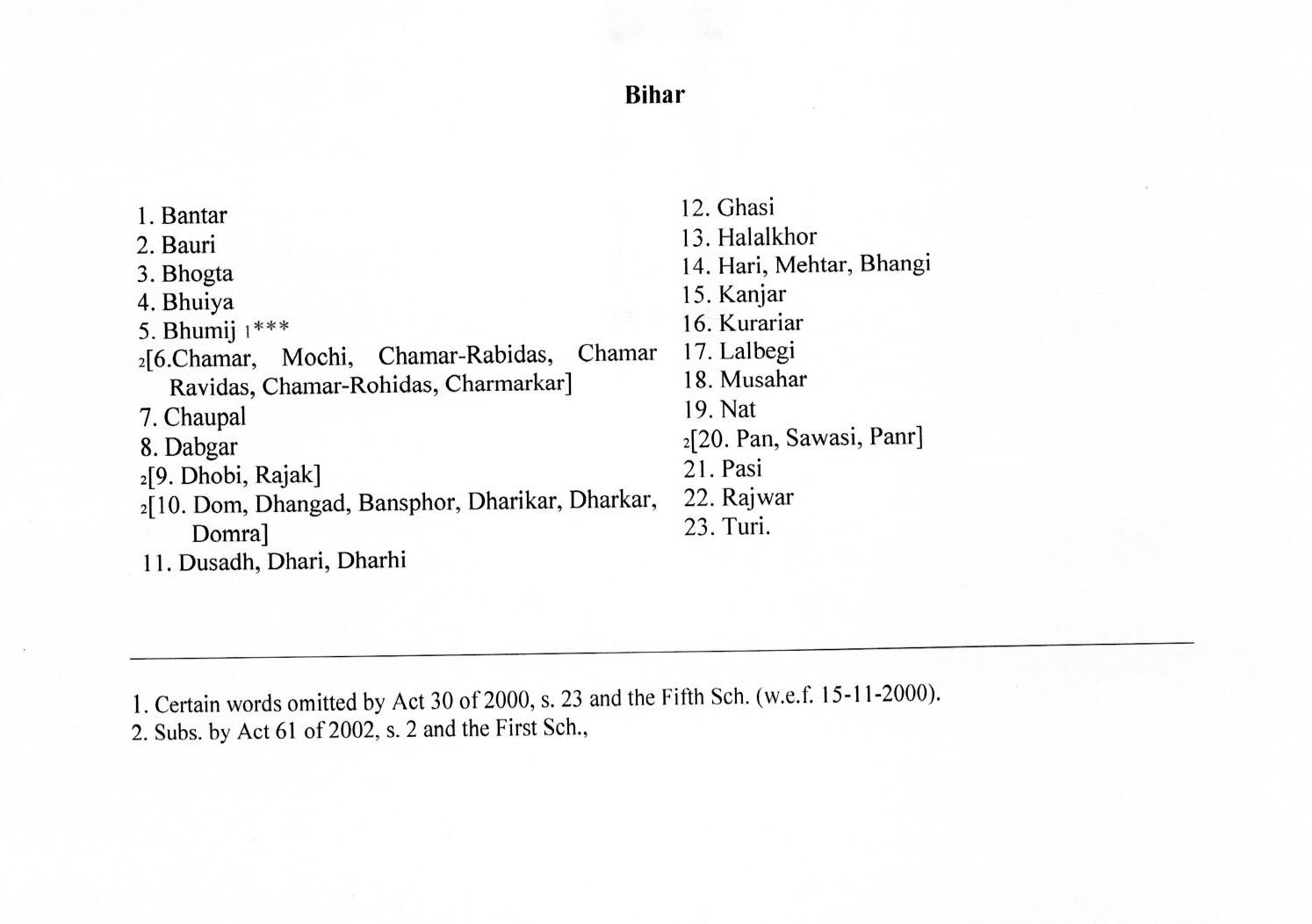
| native_name = | | region7 = [[Assam]] | ||
| native_name_lang = | | pop7 = 72,003 (1951, {{estimation}}) | ||
| | | ref7 = <ref>{{cite web|title=Estimated Population by Castes, 5. Assam – Census 1951 |year=1954 |url=https://censusindia.gov.in/nada/index.php/catalog/30196/download/33377/44094_1951_POP.pdf |publisher=Office of the Registrar General, India |page=12}}</ref> | ||
| | | region6 = [[Bihar]] | ||
| pop6 = 1,567 | |||
| ref6 = <ref name=BiharCensus11>{{cite web|title= A-10 Appendix: District wise scheduled caste population (Appendix)|url=https://censusindia.gov.in/nada/index.php/catalog/42891/download/46559/SC-10-PCA-A10-APPENDIX.xlsx |work=Census commission of India |year=2011}}</ref> | |||
| region8 = [[Tripura]] | |||
| pop8 = 755 (1951, {{estimation}}) | |||
| ref8 = <ref>{{cite web|title=Estimated Population by Castes, 7. Tripura – Census 1951 |year=1954 |url=https://censusindia.gov.in/nada/index.php/catalog/30195/download/33376/21102_1951_EST.pdf |publisher=Office of the Registrar General, India |page=11}}</ref> | |||
| region9 = {{flag|Bangladesh}} | |||
| pop9 = 9,664 (2021) | |||
| ref9 = <ref>{{Cite web |url=https://bbs.portal.gov.bd/sites/default/files/files/bbs.portal.gov.bd/page/b343a8b4_956b_45ca_872f_4cf9b2f1a6e0/2022-07-28-14-31-b21f81d1c15171f1770c661020381666.pdf |title=Table 1.4 Ethnic Population by Group and Sex |year=2021 |publisher=Bangladesh Bureau of Statistics |page=33 |language=bn |access-date=15 August 2022 |archive-date=13 August 2022 |archive-url=https://web.archive.org/web/20220813235827/https://bbs.portal.gov.bd/sites/default/files/files/bbs.portal.gov.bd/page/b343a8b4_956b_45ca_872f_4cf9b2f1a6e0/2022-07-28-14-31-b21f81d1c15171f1770c661020381666.pdf |url-status=live}}</ref> | |||
| languages = [[Bhumij language|Bhumij]]{{*}}[[#Language|Regional languages]] | |||
| religions = [[Sarnaism]]{{*}}[[Hinduism]] | |||
| related = [[Munda people|Munda]] {{•}} [[Kol people|Kol]] {{•}} [[Ho people|Ho]] {{•}} [[Santal]] | |||
| native_name = | |||
| native_name_lang = | |||
| image = Firkal slowly decaying martial dance of ChotaNagpur of Jharkhand performed at Central Park Delhi IMG 0934 02.jpg | |||
| caption = [[Firkal dance]] performed by Bhumij people | |||
}} | }} | ||
'''Bhumij''' | '''Bhumij''' (also transliterated as Bhumuj) is a [[Munda peoples|Munda]] [[ethnic group]] of India. They primarily live in the [[India]]n [[States and territories of India|states]] of [[West Bengal]], [[Odisha]], Assam and [[Jharkhand]], mostly in the old [[Singhbhum district]] and also in states like Bihar and Assam. A sizeable population is also found in [[Bangladesh]]. Bhumijas speak the [[Bhumij language]], an [[Austroasiatic language]], and use [[Ol Onal]] script for writing.<ref>{{cite web| url=https://omniglot.com/writing/olonal.htm|title= Ol Onal}}omniglot</ref> | ||
== Etymology == | == Overview == | ||
Bhumij means | === Etymology === | ||
Bhumij means "one who is born from the soil" and it is derived from word ''bhūmi'' (a land or soil).<ref name=":1">{{Cite book |last=Ota |first=A. B. |url=https://tribal.nic.in/repository/ViewDoc.aspx%3FRepositoryNo%3DTRI28-08-2017121302%26file%3DDocs/TRI28-08-2017121302.pdf |title=Bhumij |publisher=[[Scheduled Castes and Scheduled Tribes Research and Training Institute|Scheduled Castes and Scheduled Tribes Research and Training Institute, Bhubaneswar]] |year=2014 |isbn=978-93-80705-25-5}}</ref> According to N. Ramaswani, the word is etymologically ''Bhūm-jo'' meaning "people originating from Bhum areas, i.e. [[Singhbhum district|Singhbhum]], [[Dhalbhum]], [[Manbhum]], [[Barabhum]], etc.", [[Edward Tuite Dalton|Dalton]] also had claimed that Bhumijs were the original inhabitants of [[Dhalbhum]], [[Barabhum]], [[Patkum estate|Patkum]] and [[Baghmundi]].<ref>{{Cite book |last=N Ramaswamy |url=http://archive.org/details/dli.language.1596 |title=Bhumij Grammar |date=1992}}</ref> | |||
== | === Social structure === | ||
The social structure of the Bhumijas is characterized by its dynamism, incorporating both tribal traits inherited from their parent tribe, the [[Munda people|Munda]], and elements from caste-based society. During the colonial period, they were often labeled as Hinduized or semi-Hinduized tribes, and sometimes even identified as a distinct caste. In modern times, the Bhumij form part of the tribe-caste continuum society. Their society is characterised by nuclear family, patriliny, exogamy and hereditary headship of the village community. They follow Hindu practices of succession and inheritance. The Bhumij are divided into several geographical endogamous groups based on ancestral territory and occupation, such as ''[[Tamar block|Tamaliya]], Na-gadi, Astha, Choto Astha'' in Jharkhand; ''[[Barabhum|Barah Bhuiyan]], [[Singhbhum district|Deshua]], [[Haludpukur|Haldi Pukhria]], [[Tamar block|Tamadia]] Sikharia, Tharua'' in Odisha; ''[[Barabhum|Borabhui]], Mura, Mura bhumij, [[Chaibasa]] mura, Khanga mura, Kumpat mura, Manki bhumij'' in Assam; ''Bara, Bhoogol, Bhuiya, Kada kata, Manki, Nag, [[Patkum estate|Patkumia]], Sing'' in Tripura. In Mayurbhanj, segmentary Bhumija group are ''[[Tamar block|Tamaria]] Bhumij, Tamudia'' (this subgroup earlier notified as a [[Schedule Caste]] of Odisha<ref>{{Cite web |title=Tamudia |url=https://www.scstrti.in/index.php/communities/sc-communities/108-sc-communities/417-tamudia |access-date=2022-11-09 |publisher=[[Scheduled Castes and Scheduled Tribes Research and Training Institute|SCSTRTI]]|website=www.scstrti.in}}</ref>), ''[[Haludpukur|Haldipukuria]] Bhumij, [[Teli]] Bhumij, Desi or Dehuri Bhumij, [[Barah Bhuiyan Bhumij]]'' and ''[[Kol people|Kol]] Bhumij''.<ref name=":1" /> | |||
===Genetics=== | |||
According to genetic study conducted on Bhumij population on 2010, it was found that their 70% Y Haplogroups belongs to [[Haplogroup O-K18|O2a-M95]] found among population of [[Southeast Asia]] and [[Austro-Asiatic language]] speaker and rest belongs to Haplogroups found in India. Their mitrocondrial Haplogroups belongs [[Haplogroup M (mtDNA)]] found in Indian subcontinent.<ref>{{Cite thesis|url=https://www.researchgate.net/publication/305778265|title=Genetic study of Bhumij Tribe of Jharkhand using mitochondrial and Y chromosome DNA markers|author=Smita Kujur|year=2010|access-date=11 November 2022}}</ref>{{better source needed|date=October 2023}} | |||
=== Geographic distribution === | |||
[[File:Bhumij people distribution.svg|thumb|Distribution of Bhumij people, 2011 census]] | |||
The Bhumij are primarily inhabitants of [[Jharkhand]], [[West Bengal]], [[Odisha]], [[Assam]], and [[Bihar]]. Specifically they are thickly concentrated in [[East Singhbhum district|East Singhbhum]], [[Saraikela Kharsawan district|Saraikela kharsawan]] district of Jharkhand; [[Purulia]], [[Bankura]], [[Midnapore]] and [[24 Parganas]] district of [[West Bengal]]; [[Mayurbhanj district|Mayurbhanj]], [[Sundergarh|Sundargarh]], [[Keonjhar]], and [[Balasore]] district of [[Odisha]] and sporadically distributed in other parts those states. In [[Assam]], where they are very recent immigrants, their greatest concentration occurs in the [[Assam valley]]. Bhumijs are also found sporadically in [[Chhattisgarh]], [[Tripura]], [[Arunachal Pradesh]], [[Andaman and Nicobar]], [[Meghalaya]], [[Manipur]], [[Delhi]], [[Maharashtra]], [[Andhra Pradesh]] and [[Madhya Pradesh]]. | |||
In [[Bangladesh]], the Bhumij people came to the [[Sylhet region]] from [[Bihar]] as tea-labourers. They can be found in [[Sreemangal Upazila|Srimangal]] with a population of 3000. The Bhumijs lives in [[Sylhet Division|Sylhet]], [[Rajshahi Division|Rajshahi]], [[Khulna Division|Khulna]], [[Sreemangal Upazila|Srimangal]], [[Dhaka]] and [[Chittagong]] regions. They are divided into many clans (''killi'') such as Kaitra, Garur, Kasim, Bhugal, Baundra, Ban, Nag, Shona, Shar, Tresha, etc. Their Bhumij dialect is less and less spoken and Bengali is more widely spoken among the community.<ref name="bpedia">{{cite book|last=Jengcham|first=Subhash|title=Banglapedia: National Encyclopedia of Bangladesh|publisher=[[Asiatic Society of Bangladesh]]|chapter=Bhumij|chapter-url=https://en.banglapedia.org/index.php?title=Bhumij}}</ref><ref>{{cite web|url=https://www.silbangladesh.org/sites/ban/files/story_of_an_ancestors_belief.pdf |website=silbangladesh |title=STORY OF AN ANCESTOR'S BELIEF |date=2022}}</ref> | |||
The Bhumijs | |||
== History == | |||
Bhumij means "one who is born from the soil".<ref>{{Cite book |last=Ota |first=A. B. |url=https://tribal.nic.in/repository/ViewDoc.aspx%3FRepositoryNo%3DTRI28-08-2017121302%26file%3DDocs/TRI28-08-2017121302.pdf |title=Bhumij |publisher=[[Scheduled Castes and Scheduled Tribes Research and Training Institute|Scheduled Castes and Scheduled Tribes Research and Training Institute, Bhubaneswar]] |year=2014 |isbn=978-93-80705-25-5}}</ref> | |||
While those living nearer to [[Chota Nagpur Plateau]] still retain linguistic links with Mundari, those living further east and south have adopted Bengali and Oriya as their languages respectively. In [[Dhalbhum]] they are completely Hinduised. During British rule, or sometimes even earlier, many of the Bhumij became ''[[zamindars]]'' and some even secured the title of ''[[Raja]]''. Others were called ''[[Sardar]]''. However, all of them, having climbed the social ladder, proclaimed themselves to be [[Kshatriyas]], in keeping with the trends in the region.<ref name="Ghosh">Ghosh, Binoy, ''Paschim Banger Sanskriti'', (in Bengali), part I, 1976 edition, pp. 423-434, Prakash Bhaban</ref> | |||
=== Bhumij rebellion === | |||
{{Main|Bhumij rebellion}} | |||
{{See also|Chuar Rebellion}} | |||
The people in the surrounding areas were quite scared of them. The well known [[Chuar Rebellion|Chuar revolt]], a series of [[peasant rebellion]]s started between 1766 and 1816 by the inhabitants of the countryside surrounding the West Bengali settlements of [[Midnapore]], [[Bankura]] and [[Manbhum]] against the rule of the [[East India Company]] (EIC).<ref>{{Cite book |last=Bhattacherje |first=S. B. |url=https://books.google.com/books?id=oGVSvXuCsyUC&q=1766+Chuar&pg=SL1-PA97 |title=Encyclopaedia of Indian Events & Dates |date=2009-05-01 |publisher=Sterling Publishers Pvt. Ltd |isbn=978-81-207-4074-7 |language=en}}</ref> The rebels rose in revolt due to the exploitative land revenue policies of the EIC, which threatened their economic livelihoods. According to [[Lewis Sydney Steward O'Malley|L.S.S. O’Malley]], an EIC administrator who wrote the Bengal District Gazetteer, "In March 1766 Government resolved to send an expedition into the country west and north-west of Midnapore in order to coerce them into paying revenue, and to capture and demolish as many of their strongholds as possible." Amongst the many dispossessed Bhumij [[zamindar]]s, those who lent support to the rebels included royalty such as Jagannath Singh of [[Dhalbhum]], [[Durjan Singh]] of [[Raipur, Birbhum|Raipur]], Baidyanath Singh of [[Dhalbhum]], Mangal Singh of [[Panchet]], Lakshman Singh of [[Barabhum]], Raghunath Singh of [[Dhalbhum]], [[Ganga Narayan Singh|Ganga Narayan]] of [[Barabhum]], [[Rani Shiromani]] of [[Karnagarh]], Raja Madhu Singh of [[Manbhum]], Subal Singh of Kuilapal, Shyam Ganjam Singh of Dhadka, Raja Mohan Singh of Juriah, Lakshman Singh of Dulma, Sunder Narayana Singh and Phateh Singh.<ref name="sengupta">History of the Bengali-speaking People by Nitish Sengupta, first published 2001, second reprint 2002, UBS Publishers’ Distributors Pvt. Ltd. pages 187-188, {{ISBN|81-7476-355-4}}</ref> | |||
==Culture== | ==Culture== | ||
They also practice the martial art called [[Firkal dance|Firkal]], although it has been reduced to a single village among the Bhumij who perform it.<ref>{{Cite web|url=https://www.outlookindia.com/magazine/story/the-martial-dance-of-the-bhumij-still-survives-in-a-little-outback/218791|title=The martial dance of the Bhumij still survives in a little outback {{!}} Outlook India Magazine|website=Outlook (India)|access-date=28 February 2020}}</ref> | |||
[[File:Firkal slowly decaying martial dance of ChotaNagpur of Jharkhand IMG 1069 01.jpg|thumb|Firkal slowly displaying martial dance of ChotaNagpur of Jharkhand]] | |||
=== Language === | |||
{{Main|Bhumij language}} | |||
Bhumij is the language of the Munda subfamily of the [[Austroasiatic languages]], related to Ho, Mundari and Santali, spoken mainly in the Indian states [[Jharkhand]], [[Odisha]] and [[West Bengal]]. It is spoken by around 100,000 people in India.<ref>{{Cite web |title=Bhumij language and alphabet |url=https://omniglot.com/writing/bhumij.htm |access-date=19 April 2022 |website=omniglot.com}}</ref> Though many Bhumijs in West Bengal and Orissa are speaking Bengali and Odia respectively as their [[first language]]. | |||
In January 2019, Bhumij was accorded the status of second language in the state of [[Jharkhand]].<ref>{{cite news |title=Jharkhand notifies Bhumij as second state language |url=https://avenuemail.in/jharkhand-notifies-bhumij-as-second-state-language/ |access-date=17 April 2022 |work=The Avenue Mail |date=5 January 2019}}</ref> | |||
== Religion and festivals == | |||
The followers of [[Sarnaism]] among the Bhumij have been organising protests and petitions to have their religion recognised by the government of India in census forms.<ref>{{cite news|last=Kiro |first=Santosh Kumar |url=http://www.telegraphindia.com/1130819/jsp/jharkhand/story_17245599.jsp|archive-url=https://web.archive.org/web/20140104034353/http://www.telegraphindia.com/1130819/jsp/jharkhand/story_17245599.jsp |url-status=dead |archive-date=4 January 2014 |title=Delhi demo for Sarna identity |newspaper=The Telegraph |date= 19 August 2013}}</ref><ref>{{cite news|url=https://timesofindia.indiatimes.com/city/ranchi/Tribals-to-rally-for-inclusion-of-Sarna-religion-in-census/articleshow/19282700.cms |url-status=live |archive-date=2 October 2013 |archive-url=https://web.archive.org/web/20131002175305/http://articles.timesofindia.indiatimes.com/2013-03-30/ranchi/38144883_1_census-format-separate-sarna-religion-code-rally |title=Tribals to rally for inclusion of Sarna religion in census |newspaper=Times of India |date=30 March 2013}}</ref> | |||
==Official classification== | |||
Bhumijas have been designated as [[Scheduled Tribes]] in only three states—[[List of Scheduled Tribes in Odisha|Odisha]], [[Tribes of Jharkhand|Jharkhand]], and [[Scheduled Tribes in West Bengal|West Bengal]]—by the Government of India.<ref>{{cite web |title=List of Scheduled Tribes|url=http://www.tribal.nic.in/ST/LatestListofScheduledtribes.pdf |website=tribal.nic.in }}</ref> {{sic|In [[Bihar]], they are recognized as [[Scheduled Castes and Scheduled Tribes|Scheduled Castes]]}},<ref>{{cite web|title=List of Scheduled Castes State wise / UT wise list of Scheduled Castes updated up to 05-01-2023 |url=https://socialjustice.gov.in/common/76750 |website=socialjustice.gov.in |access-date=May 21, 2023}} [https://socialjustice.gov.in/writereaddata/UploadFile/Scan-0003.jpg Direct URL]</ref><ref>{{Cite web |date=2023-03-23 |title=203 castes in Bihar to choose from as 2nd leg of survey begins April 15 |url=https://www.hindustantimes.com/cities/patna-news/203-castes-in-bihar-to-choose-from-as-2nd-leg-of-survey-begins-april-15-101679588703223.html |access-date=2024-02-01 |website=Hindustan Times |language=en}}</ref> and in Tripura and Assam (as the [[Tea-garden community of Assam|Ex-tea garden community]]), they fall under the category of [[Other Backward Class]]es.<ref>{{Cite web |title=National Commission for Backward Classes |url=http://www.ncbc.nic.in/user_panel/GazetteResolution.aspx?Value=mPICjsL1aLvdd7KihswbYVoTSx7XDi4wmRFbGxg+5XKv5f0QbHfa+6IJiXsS0CcD |access-date=2023-05-25 |website=www.ncbc.nic.in}}</ref><ref>{{Cite web |title=CENTRAL LIST OF OBCs FOR THE STATE OF ASSAM |url=http://ncbc.nic.in/Writereaddata/cl/assam.pdf |website=ncbc.nic.in}}</ref> Those residing in other states and countries are considered part of the [[Forward caste|general population]]. However, the Bhumij were classified as [[Scheduled Castes]] before the Scheduled Castes and Scheduled Tribes Lists (Modification) Order of 1956. Until 2024, the Tamudia segment of the Bhumij tribe was designated as Scheduled Caste in Odisha, but it was subsequently recognized as Scheduled Tribes.<ref>{{Cite web |title=Parliament passes the Constitution (Jammu and Kashmir) Scheduled Tribes Order (Amendment) Bill 2024 |url=https://pib.gov.in/pib.gov.in/Pressreleaseshare.aspx?PRID=2004918 |access-date=2024-03-13 |website=pib.gov.in}}</ref><ref>{{Cite web |date=2024-02-09 |title=Odisha ST list gets two new entrants and offers relief to at least 50 sub-tribes |url=https://www.hindustantimes.com/india-news/odisha-st-list-gets-two-new-entrants-and-offers-relief-to-at-least-50-subtribes-101707490394584.html |access-date=2024-03-13 |website=Hindustan Times |language=en |url-access=subscription}}</ref> | |||
== Notable people == | |||
<!--Only add if the person has an article in English Wikipedia. Arrange entries alphabetically by LAST NAME--> | |||
* [[Durga Bhumij]] - politician | |||
* [[Haren Bhumij]] - politician | |||
* [[Jogeswar Bhumij]] - cricketer | |||
* [[Pranjal Bhumij]] - footballer | |||
* [[Gambhir Singh Mura]] - [[Padma Shri]] recipient and tribal [[Chhau dance|Chhau]] dancer | |||
* [[Amulya Sardar]] - politician | |||
* [[Hari Ram Sardar]] - politician | |||
* [[Maneka Sardar]] - politician | |||
* [[Sanatan Sardar]] - tribal leader and politician | |||
* [[Sanjib Sardar]] - politician | |||
* [[Rani Shiromani]] - queen of Karnagarh and leader of [[Chuar rebellion]] | |||
* Baidyanath Singh - leader of [[Chuar Rebellion]] | |||
* | |||
* [[Durjan Singh]] - leader of [[Chuar Rebellion]] | |||
* [[Ganga Narayan Singh]] - leader of [[Bhumij rebellion]] and [[Chuar Rebellion]] | |||
* Jagannath Singh Patar - leader of [[Chuar Rebellion]] | |||
* Raghunath Singh - leader of [[Chuar Rebellion]] | |||
* [[Shyam Ganjam Singh]] - leader of [[Chuar Rebellion]] | |||
* [[Subal Singh]] - leader of [[Chuar Rebellion]] | |||
==See also== | |||
*[[Bhumij language]] | |||
*[[Ganga Narayan Singh]] | |||
*[[Bhumij rebellion]] | |||
*[[Chuar Rebellion]] | |||
*[[Ol Onal]] | |||
==References== | ==References== | ||
===Footnotes=== | |||
{{notelist}} | |||
===Sources=== | |||
{{reflist}} | {{reflist}} | ||
{{Scheduled tribes of India}} | ===Bibliography=== | ||
{{Scheduled tribes of West Bengal}} | * {{Cite thesis |last=Kujur |first=Smita |date=2010 |title=Genetic study of Bhumij Tribe of Jharkhand using mitochondrial and Y chromosome DNA markers |url=https://www.researchgate.net/publication/305778265 |journal= |doi=10.13140/RG.2.1.1456.9200 |via=[[ResearchGate]]}} | ||
* {{Citation |last=Sarkar |first=Soma |title=Bhumij in a heterogeneous society: negotiating hierarchies and access to water in the Jungle Mahals of West Bengal |date=2022-01-01 |url=https://www.sciencedirect.com/science/article/pii/B9780323916035000191 |work=Indigenous People and Nature | |||
|pages=241–256 |editor-last=Chatterjee |editor-first=Uday |publisher=Elsevier |language=en |doi=10.1016/b978-0-323-91603-5.00019-1 |isbn=978-0-323-91603-5 |access-date=2022-08-21 |editor2-last=Kashyap |editor2-first=Anil |editor3-last=Everard |editor3-first=Mark |editor4-last=Panda |editor4-first=Gopal Krishna|url-access=subscription }} | |||
==Further reading== | |||
* {{Cite journal |last=Sinha |first=Surajit |title=Bhumij-Kshatriya Social Movement in South Manbhum |journal=Bulletin of the Department of Anthropology |url= https://www.academia.edu/4299966 |publisher= Calcutta University |volume=VIII |issue=2 |pages=9–32 |year=1959 |via=[[Academia.edu]]}} | |||
*{{Cite journal|last=Sinha |first=Surajit |url=http://archive.org/details/Continua.By.Sinha |title=Tribe–Caste and Tribe–Peasant Continua in Central India |date=1965 |journal=Man in India |volume=45 |issue=1 |pages=57–83}} | |||
* {{Cite journal |last=Sinha |first=Surajit |title= The media and nature of Hindu-Bhumij interactions|url=https://archive.org/details/in.ernet.dli.2015.98853/page/n47/ |journal=Journal of the Asiatic Society Letters and Science |volume= 23 |issue= 1–2 |date=1959|pages=23–37}} | |||
==External links== | |||
{{commons category|Bhumij people}} | |||
*{{Cite web |date=6 March 2018 |title="Bhumij Tribe" A Documentary Movie |url=https://m.youtube.com/watch?v=3u00wm4T26Y |access-date=13 May 2022 |website=[[YouTube]] |publisher=Ministry of tribal affairs, Govt of India |type=Video}} | |||
{{Scheduled tribes of India}}{{Scheduled tribes of West Bengal}} | |||
{{Scheduled tribes in Odisha}} | |||
{{Tribes of Jharkhand}} | {{Tribes of Jharkhand}} | ||
{{Ethnic groups in Bangladesh}} | |||
[[Category:Bhumij| ]] | |||
[[Category:Social groups of Assam]] | [[Category:Social groups of Assam]] | ||
[[Category:Scheduled Tribes of India]] | [[Category:Scheduled Tribes of India]] | ||
[[Category:Tribes of West Bengal]] | [[Category:Tribes of West Bengal]] | ||
[[Category:Social groups of Odisha]] | [[Category:Social groups of Odisha]] | ||
[[Category:Tribes of Jharkhand]] | |||
[[Category:Ethnic groups in Bangladesh]] | |||
[[Category:Social groups of West Bengal]] | [[Category:Social groups of West Bengal]] | ||
[[Category:Social groups of Jharkhand]] | |||
[[Category:Scheduled Tribes of Jharkhand]] | |||
[[Category:Scheduled Tribes of Bihar]] | |||
Latest revision as of 18:55, 12 December 2025
 Firkal dance performed by Bhumij people | |
| Total population | |
|---|---|
| c. 1 million[lower-alpha 1] (2011, est.) | |
| Regions with significant populations | |
 India, India,  Bangladesh Bangladesh | |
| West Bengal | 376,296[2] |
| Odisha | 283,909[2] |
| Jharkhand | 209,448[2] |
| Bihar | 1,567[3] |
| Assam | 72,003 (1951, est.)[4] |
| Tripura | 755 (1951, est.)[5] |
| Bangladesh | 9,664 (2021)[6] |
| Languages | |
| Bhumij • Regional languages | |
| Religion | |
| Sarnaism • Hinduism | |
| Related ethnic groups | |
| Munda • Kol • Ho • Santal | |
Bhumij (also transliterated as Bhumuj) is a Munda ethnic group of India. They primarily live in the Indian states of West Bengal, Odisha, Assam and Jharkhand, mostly in the old Singhbhum district and also in states like Bihar and Assam. A sizeable population is also found in Bangladesh. Bhumijas speak the Bhumij language, an Austroasiatic language, and use Ol Onal script for writing.[7]
Overview[edit | edit source]
Etymology[edit | edit source]
Bhumij means "one who is born from the soil" and it is derived from word bhūmi (a land or soil).[8] According to N. Ramaswani, the word is etymologically Bhūm-jo meaning "people originating from Bhum areas, i.e. Singhbhum, Dhalbhum, Manbhum, Barabhum, etc.", Dalton also had claimed that Bhumijs were the original inhabitants of Dhalbhum, Barabhum, Patkum and Baghmundi.[9]
Social structure[edit | edit source]
The social structure of the Bhumijas is characterized by its dynamism, incorporating both tribal traits inherited from their parent tribe, the Munda, and elements from caste-based society. During the colonial period, they were often labeled as Hinduized or semi-Hinduized tribes, and sometimes even identified as a distinct caste. In modern times, the Bhumij form part of the tribe-caste continuum society. Their society is characterised by nuclear family, patriliny, exogamy and hereditary headship of the village community. They follow Hindu practices of succession and inheritance. The Bhumij are divided into several geographical endogamous groups based on ancestral territory and occupation, such as Tamaliya, Na-gadi, Astha, Choto Astha in Jharkhand; Barah Bhuiyan, Deshua, Haldi Pukhria, Tamadia Sikharia, Tharua in Odisha; Borabhui, Mura, Mura bhumij, Chaibasa mura, Khanga mura, Kumpat mura, Manki bhumij in Assam; Bara, Bhoogol, Bhuiya, Kada kata, Manki, Nag, Patkumia, Sing in Tripura. In Mayurbhanj, segmentary Bhumija group are Tamaria Bhumij, Tamudia (this subgroup earlier notified as a Schedule Caste of Odisha[10]), Haldipukuria Bhumij, Teli Bhumij, Desi or Dehuri Bhumij, Barah Bhuiyan Bhumij and Kol Bhumij.[8]
Genetics[edit | edit source]
According to genetic study conducted on Bhumij population on 2010, it was found that their 70% Y Haplogroups belongs to O2a-M95 found among population of Southeast Asia and Austro-Asiatic language speaker and rest belongs to Haplogroups found in India. Their mitrocondrial Haplogroups belongs Haplogroup M (mtDNA) found in Indian subcontinent.[11][better source needed]
Geographic distribution[edit | edit source]

The Bhumij are primarily inhabitants of Jharkhand, West Bengal, Odisha, Assam, and Bihar. Specifically they are thickly concentrated in East Singhbhum, Saraikela kharsawan district of Jharkhand; Purulia, Bankura, Midnapore and 24 Parganas district of West Bengal; Mayurbhanj, Sundargarh, Keonjhar, and Balasore district of Odisha and sporadically distributed in other parts those states. In Assam, where they are very recent immigrants, their greatest concentration occurs in the Assam valley. Bhumijs are also found sporadically in Chhattisgarh, Tripura, Arunachal Pradesh, Andaman and Nicobar, Meghalaya, Manipur, Delhi, Maharashtra, Andhra Pradesh and Madhya Pradesh.
In Bangladesh, the Bhumij people came to the Sylhet region from Bihar as tea-labourers. They can be found in Srimangal with a population of 3000. The Bhumijs lives in Sylhet, Rajshahi, Khulna, Srimangal, Dhaka and Chittagong regions. They are divided into many clans (killi) such as Kaitra, Garur, Kasim, Bhugal, Baundra, Ban, Nag, Shona, Shar, Tresha, etc. Their Bhumij dialect is less and less spoken and Bengali is more widely spoken among the community.[12][13]
History[edit | edit source]
Bhumij means "one who is born from the soil".[14]
While those living nearer to Chota Nagpur Plateau still retain linguistic links with Mundari, those living further east and south have adopted Bengali and Oriya as their languages respectively. In Dhalbhum they are completely Hinduised. During British rule, or sometimes even earlier, many of the Bhumij became zamindars and some even secured the title of Raja. Others were called Sardar. However, all of them, having climbed the social ladder, proclaimed themselves to be Kshatriyas, in keeping with the trends in the region.[15]
Bhumij rebellion[edit | edit source]
The people in the surrounding areas were quite scared of them. The well known Chuar revolt, a series of peasant rebellions started between 1766 and 1816 by the inhabitants of the countryside surrounding the West Bengali settlements of Midnapore, Bankura and Manbhum against the rule of the East India Company (EIC).[16] The rebels rose in revolt due to the exploitative land revenue policies of the EIC, which threatened their economic livelihoods. According to L.S.S. O’Malley, an EIC administrator who wrote the Bengal District Gazetteer, "In March 1766 Government resolved to send an expedition into the country west and north-west of Midnapore in order to coerce them into paying revenue, and to capture and demolish as many of their strongholds as possible." Amongst the many dispossessed Bhumij zamindars, those who lent support to the rebels included royalty such as Jagannath Singh of Dhalbhum, Durjan Singh of Raipur, Baidyanath Singh of Dhalbhum, Mangal Singh of Panchet, Lakshman Singh of Barabhum, Raghunath Singh of Dhalbhum, Ganga Narayan of Barabhum, Rani Shiromani of Karnagarh, Raja Madhu Singh of Manbhum, Subal Singh of Kuilapal, Shyam Ganjam Singh of Dhadka, Raja Mohan Singh of Juriah, Lakshman Singh of Dulma, Sunder Narayana Singh and Phateh Singh.[17]
Culture[edit | edit source]
They also practice the martial art called Firkal, although it has been reduced to a single village among the Bhumij who perform it.[18]

Language[edit | edit source]
Bhumij is the language of the Munda subfamily of the Austroasiatic languages, related to Ho, Mundari and Santali, spoken mainly in the Indian states Jharkhand, Odisha and West Bengal. It is spoken by around 100,000 people in India.[19] Though many Bhumijs in West Bengal and Orissa are speaking Bengali and Odia respectively as their first language.
In January 2019, Bhumij was accorded the status of second language in the state of Jharkhand.[20]
Religion and festivals[edit | edit source]
The followers of Sarnaism among the Bhumij have been organising protests and petitions to have their religion recognised by the government of India in census forms.[21][22]
Official classification[edit | edit source]
Bhumijas have been designated as Scheduled Tribes in only three states—Odisha, Jharkhand, and West Bengal—by the Government of India.[23] In Bihar, they are recognized as Scheduled Castes [sic],[24][25] and in Tripura and Assam (as the Ex-tea garden community), they fall under the category of Other Backward Classes.[26][27] Those residing in other states and countries are considered part of the general population. However, the Bhumij were classified as Scheduled Castes before the Scheduled Castes and Scheduled Tribes Lists (Modification) Order of 1956. Until 2024, the Tamudia segment of the Bhumij tribe was designated as Scheduled Caste in Odisha, but it was subsequently recognized as Scheduled Tribes.[28][29]
Notable people[edit | edit source]
- Durga Bhumij - politician
- Haren Bhumij - politician
- Jogeswar Bhumij - cricketer
- Pranjal Bhumij - footballer
- Gambhir Singh Mura - Padma Shri recipient and tribal Chhau dancer
- Amulya Sardar - politician
- Hari Ram Sardar - politician
- Maneka Sardar - politician
- Sanatan Sardar - tribal leader and politician
- Sanjib Sardar - politician
- Rani Shiromani - queen of Karnagarh and leader of Chuar rebellion
- Baidyanath Singh - leader of Chuar Rebellion
- Durjan Singh - leader of Chuar Rebellion
- Ganga Narayan Singh - leader of Bhumij rebellion and Chuar Rebellion
- Jagannath Singh Patar - leader of Chuar Rebellion
- Raghunath Singh - leader of Chuar Rebellion
- Shyam Ganjam Singh - leader of Chuar Rebellion
- Subal Singh - leader of Chuar Rebellion
See also[edit | edit source]
References[edit | edit source]
Footnotes[edit | edit source]
- ↑ The Bhumij are recognized as Scheduled Tribes in three states: Jharkhand, Odisha, and West Bengal, with a population of 869,653 according to the 2011 census.[1] However, Bhumij residing in other administrative states and countries are not individually counted in the census; thus, colonial census figures are used to estimate their current total population.
Sources[edit | edit source]
- ↑ "A-11 Individual Scheduled Tribe Primary Census Abstract Data and its Appendix". censusindia.gov.in. Office of the Registrar General & Census Commissioner, India. Archived from the original on 4 May 2020. Retrieved 18 November 2017.
- ↑ 2.0 2.1 2.2 "Statistical profile of scheduled tribes in India 2013" (PDF). tribal.nic.in. Minister of tribal affairs: statistics division, Govt of India.
- ↑ "A-10 Appendix: District wise scheduled caste population (Appendix)". Census commission of India. 2011.
- ↑ "Estimated Population by Castes, 5. Assam – Census 1951" (PDF). Office of the Registrar General, India. 1954. p. 12.
- ↑ "Estimated Population by Castes, 7. Tripura – Census 1951" (PDF). Office of the Registrar General, India. 1954. p. 11.
- ↑ "Table 1.4 Ethnic Population by Group and Sex" (PDF) (in Bengali). Bangladesh Bureau of Statistics. 2021. p. 33. Archived (PDF) from the original on 13 August 2022. Retrieved 15 August 2022.
- ↑ "Ol Onal".omniglot
- ↑ 8.0 8.1 Ota, A. B. (2014). Bhumij (PDF). Scheduled Castes and Scheduled Tribes Research and Training Institute, Bhubaneswar. ISBN 978-93-80705-25-5.
- ↑ N Ramaswamy (1992). Bhumij Grammar.
- ↑ "Tamudia". www.scstrti.in. SCSTRTI. Retrieved 9 November 2022.
- ↑ Smita Kujur (2010). Genetic study of Bhumij Tribe of Jharkhand using mitochondrial and Y chromosome DNA markers (Thesis). Retrieved 11 November 2022.
- ↑ Jengcham, Subhash. "Bhumij". Banglapedia: National Encyclopedia of Bangladesh. Asiatic Society of Bangladesh.
- ↑ "STORY OF AN ANCESTOR'S BELIEF" (PDF). silbangladesh. 2022.
- ↑ Ota, A. B. (2014). Bhumij (PDF). Scheduled Castes and Scheduled Tribes Research and Training Institute, Bhubaneswar. ISBN 978-93-80705-25-5.
- ↑ Ghosh, Binoy, Paschim Banger Sanskriti, (in Bengali), part I, 1976 edition, pp. 423-434, Prakash Bhaban
- ↑ Bhattacherje, S. B. (1 May 2009). Encyclopaedia of Indian Events & Dates. Sterling Publishers Pvt. Ltd. ISBN 978-81-207-4074-7.
- ↑ History of the Bengali-speaking People by Nitish Sengupta, first published 2001, second reprint 2002, UBS Publishers’ Distributors Pvt. Ltd. pages 187-188, ISBN 81-7476-355-4
- ↑ "The martial dance of the Bhumij still survives in a little outback | Outlook India Magazine". Outlook (India). Retrieved 28 February 2020.
- ↑ "Bhumij language and alphabet". omniglot.com. Retrieved 19 April 2022.
- ↑ "Jharkhand notifies Bhumij as second state language". The Avenue Mail. 5 January 2019. Retrieved 17 April 2022.
- ↑ Kiro, Santosh Kumar (19 August 2013). "Delhi demo for Sarna identity". The Telegraph. Archived from the original on 4 January 2014.
- ↑ "Tribals to rally for inclusion of Sarna religion in census". Times of India. 30 March 2013. Archived from the original on 2 October 2013.
- ↑ "List of Scheduled Tribes" (PDF). tribal.nic.in.
- ↑ "List of Scheduled Castes State wise / UT wise list of Scheduled Castes updated up to 05-01-2023". socialjustice.gov.in. Retrieved 21 May 2023. Direct URL
- ↑ "203 castes in Bihar to choose from as 2nd leg of survey begins April 15". Hindustan Times. 23 March 2023. Retrieved 1 February 2024.
- ↑ "National Commission for Backward Classes". www.ncbc.nic.in. Retrieved 25 May 2023.
- ↑ "CENTRAL LIST OF OBCs FOR THE STATE OF ASSAM" (PDF). ncbc.nic.in.
- ↑ "Parliament passes the Constitution (Jammu and Kashmir) Scheduled Tribes Order (Amendment) Bill 2024". pib.gov.in. Retrieved 13 March 2024.
- ↑ "Odisha ST list gets two new entrants and offers relief to at least 50 sub-tribes". Hindustan Times. 9 February 2024. Retrieved 13 March 2024.
Bibliography[edit | edit source]
- Kujur, Smita (2010). Genetic study of Bhumij Tribe of Jharkhand using mitochondrial and Y chromosome DNA markers (Thesis). doi:10.13140/RG.2.1.1456.9200 – via ResearchGate.
- Sarkar, Soma (1 January 2022), Chatterjee, Uday; Kashyap, Anil; Everard, Mark; Panda, Gopal Krishna (eds.), "Bhumij in a heterogeneous society: negotiating hierarchies and access to water in the Jungle Mahals of West Bengal", Indigenous People and Nature, Elsevier, pp. 241–256, doi:10.1016/b978-0-323-91603-5.00019-1, ISBN 978-0-323-91603-5, retrieved 21 August 2022
{{citation}}: CS1 maint: work parameter with ISBN (link)
Further reading[edit | edit source]
- Sinha, Surajit (1959). "Bhumij-Kshatriya Social Movement in South Manbhum". Bulletin of the Department of Anthropology. VIII (2). Calcutta University: 9–32 – via Academia.edu.
- Sinha, Surajit (1965). "Tribe–Caste and Tribe–Peasant Continua in Central India". Man in India. 45 (1): 57–83.
- Sinha, Surajit (1959). "The media and nature of Hindu-Bhumij interactions". Journal of the Asiatic Society Letters and Science. 23 (1–2): 23–37.
External links[edit | edit source]
- ""Bhumij Tribe" A Documentary Movie". YouTube (Video). Ministry of tribal affairs, Govt of India. 6 March 2018. Retrieved 13 May 2022.