

m Removed empty portal template using script |
m brief refine formatting to improve readability also and improved wording |
||
| Line 1: | Line 1: | ||
{{see also|Ancient veena|Ancient Tamil music}} | {{Short description|Musical instrument}}{{About|the instrument|the Sri Lankan city named after the instrument|Jaffna}}{{see also|Ancient veena|Ancient Tamil music}} | ||
{{Use dmy dates|date= | {{Use dmy dates|date=August 2022}} | ||
{{Infobox instrument | |||
| name = Yazh | |||
| image = 2024-03-22 Burmis Swam, Villadi Yaaz, Villadi Naadmandal in Raja Dinkar Kelkar Museum, Pune.jpg | |||
| image_size = | |||
| alt = | |||
| caption = Three recreations of historical harps: ''Villadi Yaaz'' (center), ''Burmis Swam'' (left), ''Villadi Naadmandal'' (right). | |||
| background = | |||
| names = | |||
| classification = [[String instrument]] | |||
| hornbostel_sachs = [[List of musical instruments by Hornbostel–Sachs number: 322.11|322.11]] | |||
| hornbostel_sachs_desc = [[arched harp]] | |||
| inventors = | |||
| developed = | |||
| timbre = | |||
| volume = | |||
| attack = | |||
| decay = | |||
| range = | |||
| pitch = | |||
| related = {{bulleted list|[[African harp]]|[[Pin (harp)|Pin]] (Cambodian harp)|[[Saung]] (Burmese harp)|[[Ancient vina|harp-style Vina]]}} | |||
| musicians = Tharun Sekar | |||
| builders = Tharun Sekar<ref>{{cite magazine |last= Gershon|first= Livia|date= 26 April 2021|title= Listen to the First Song Ever Recorded on This Ancient, Harp-Like Instrument; Tharun Sekar, a luthier based in southern India, has painstakingly recreated the long-lost yazh|url= https://www.smithsonianmag.com/smart-news/hear-sound-ancient-indian-instrument-180977426/|magazine= Smithsonian Magazine|location= |publisher= Smithsonian|access-date=3 October 2022}}</ref> | |||
| articles = | |||
}} | |||
The | The '''yazh''' ({{langx|ta|யாழ்}}, also transliterated '''yāḻ''', {{IPA|ta|jaːɻ|pron}}) is a [[harp]] used in [[ancient Tamil music]]. It was strung with gut strings that ran from a curved ebony neck to a boat or trough-shaped resonator, the opening of which was a covered with skin for a soundboard. At the resonator the strings were attached to a string-bar or tuning bar with holes for strings that laid beneath of the soundboard and protruded through. The neck may also have been covered in hide.<ref name=grove>{{cite encyclopedia |author = Alastair Dick|editor-last= Sadie |editor-first=Stanley |entry= Yāl|encyclopedia= The New Grove Dictionary of Musical Instruments |year=1984 |id= Volume 3 |page=881 }}</ref><ref name=cornell>{{cite web |archive-url= https://web.archive.org/web/20100210134738/http://www.rso.cornell.edu/spicmacay/spicmacay_files/home_files/instr.html |archive-date= 10 February 2010 |url=https://www.rso.cornell.edu/spicmacay/spicmacay_files/home_files/instr.html |title=Musical instruments played in India |publisher=Chapter of SPICMACAY, Cornell University|access-date=16 November 2011 |quote= The yazh is an ancient Dravidian instrument, somewhat like a harp. It was named for the fact that the tip of stem of this instrument was carved into the head of the animal yaali (vyala in Sanskrit). The yazh was an open-stringed polyphonous instrument, with a wooden boat-shaped skin-covered resonator and an ebony stem. It was tuned by either pegs or rings of gut moved up and down the string...was displaced by the veena in the middle ages}}</ref><ref>{{cite news|title=Celebrating unheard melodies|url=http://www.thehindu.com/arts/magazine/article974391.ece|newspaper=The Hindu|date=25 December 2010|location=India |quote=Yazh (a form of harp)...Notes (svaras) are known as Narambu. Narambu are the gut strings used in the Yazh. Each string of the Yazh was tuned to one note therefore this association of Narambu to note.}}</ref> | ||
The | The arched harp was used in India since at least the 2nd century B.C.E., when a woman was sculpted with the instrument in a Buddhist artwork at [[Bharhut|Bhārut]].<ref name=ludvik227>{{cite book|author=Catherine Ludvík|title=Sarasvatī, Riverine Goddess of Knowledge: From the Manuscript-carrying Vīṇā-player to the Weapon-wielding Defender of the Dharma|url=https://books.google.com/books?id=4lsYKIXBOK0C&pg=PA227|year=2007|publisher=BRILL Academic|isbn=978-90-04-15814-6|pages=227–229}}</ref> Both the Indian [[ancient veena|harp-style ''veena'']] and the Tamil ''yazh'' declined starting in about the 7th century C.E., as [[Alapini vina|stick-zither style veenas]] rose to prominence.<ref name=grove/><ref name=cornell/> | ||
While use of the instrument died out in centuries past, artworks have preserved some knowledge of what the instruments looked like. Luthiers have begun to recreate the instrument. | |||
==Characteristics== | |||
*''Peri yazh'' – 21 strings | The instruments were built between 1 and 3 feet tall.<ref name=rajeswari/> Strings made of goat intestine were stretched and shaped to differing thicknesses for different notes.<ref name=rajeswari/> Bodies were carved from local woods, including ''emmaram'' (red wood) or ''pala maram'' (jackfruit) wood, and today red cedar is used.<ref name=rajeswari/> Soundboards were made of goatskin, glued to the body with a paste made of tamarind seeds.<ref name=rajeswari/> The sound bar beneath the soundboard, which the strings anchor to, was glued to the instrument's body with a lacquer called Arakku.<ref name=rajeswari/> | ||
*''Makara yazh'' – 19 strings | [[File:Kinnara playing a yazh, Kailasanathar Temple in Kanchipuram, India, ca 8th century CE.jpg|thumb|Kinnara playing a yazh, Kailasanathar Temple in Kanchipuram, India, ca. 8th century C.E.<ref>{{cite magazine |title= யாழ் என்னும் இசைக்கருவி – ஒரு பார்வை (translation from Tamil: Jaffna Musical Instrument – A View) |magazine= Varalaaru.com |author= லலிதாராம் (translation from Tamil: Lalitaram) |issue = 8 |date= 15 February – 14 March 2005|url= http://www.varalaaru.com/design/article.aspx?ArticleID=109}}</ref>]] | ||
Harps are tuned to [[Scale (music)|musical scales]], with each string being tuned to one note in the scale. According to literature, Tamil land was divided into five regions, each having its own scale (Paan) and variant of the instrument.<ref name=rajeswari>{{cite web |title= Yazh: rebirth with a twist|last= Rajeswari |first= Janani |access-date=1 October 2022|website=The Verandah Club|quote= ...five major types of Yazh based on the number of strings: Sengotti Yazh (seven strings to play seven swaras); Sagoda Yazh (14 strings); Makara Yazh (19 strings), Periyazh (containing 21-29 strings which was closer to the Veena on which one can play 27 notes) and the Seeryazh...ancient literature divided the land into five forms: Marutham, Mullai, Paalai, Neidhal and Kurunji. "It is believed that each of the regions had a Paan (ancient scale of music) and also a Yazh that was unique to it," says Tharun. |url= https://theverandahclub.com/article/yazh-rebirth-with-a-twist-287}}</ref> | |||
The Tamil poet [[Thiruvalluvar]] mentions yazh in his work ''[[Thirukkural]]''.<ref name="tamil">{{cite book |title=Tamil culture |editor=Xavier S. Thani Nayagam |publisher=Tamil Literature Society, Academy of Tamil Culture |date=1966 |series=Tamil (Indic people) |volume=12 |pages=208, 209 |language=en, ta}}</ref> Many major Tamil classical literary masterpieces written during [[Sangam period]] have mentioned the yazh. ''[[Silappatikaram]]'', written by a Tamil Chera prince [[Ilango Adigal]], mentions four kinds of yazhs:<ref name="yazh">{{cite book |last=Rangarajan |first=Haripriya |title=Jainism: art, architecture, literature & philosophy |editor1=Haripriya Rangarajan |editor2=G. Kamalakar |editor3=A. K. V. S. Reddy |editor4=M. Veerender |editor5=K. Venkatachalam |publisher=Sharada Publishing House |date=2001 |series=Religion / Jainism |page=142 |isbn=9788185616773 |language=en, ta}}</ref><ref name=rajeswari/> | |||
*''Peri yazh'' – 21-29 strings – large yazh | |||
*''Makara yazh'' – 19 strings – [[makara]] yazh | |||
*''Cakota yazh'' – 14 strings | *''Cakota yazh'' – 14 strings | ||
*''Cenkotti yazh'' – 7 strings | *''Cenkotti yazh'' – 7 strings | ||
The Tamil book [[Perumpāṇāṟṟuppaṭai]] says the strings of a yazh should not have any twists in them. Other Tamil literature which have mentions on yazh are [[Seevaga Sindhamani]] and [[Periya Puranam]].<ref>{{cite news |title=On the basics of conservation |url=http://www.hindu.com/fr/2009/12/04/stories/2009120450960100.htm |archive-url=https://archive.today/20130125072123/http://www.hindu.com/fr/2009/12/04/stories/2009120450960100.htm |url-status=dead |archive-date=25 January 2013 |date=4 December 2009 |newspaper=[[The Hindu]] |location=India}}</ref> In modern times [[Swami Vipulananda]] has written a book of scientific research in Tamil called the ''[[Yazh Nool]]'', detailing 6 different yazh harps.<ref>{{Cite web |url=http://tamilnation.co/hundredtamils/vipulananda.htm |title=One hundred Tamils of the 20th century: Swami Vipulananda (1892–1947)}}</ref> | The Tamil book [[Perumpāṇāṟṟuppaṭai]] says the strings of a yazh should not have any twists in them. Other Tamil literature which have mentions on yazh are [[Seevaga Sindhamani]] and [[Periya Puranam]].<ref>{{cite news |title=On the basics of conservation |url=http://www.hindu.com/fr/2009/12/04/stories/2009120450960100.htm |archive-url=https://archive.today/20130125072123/http://www.hindu.com/fr/2009/12/04/stories/2009120450960100.htm |url-status=dead |archive-date=25 January 2013 |date=4 December 2009 |newspaper=[[The Hindu]] |location=India}}</ref> In modern times [[Swami Vipulananda]] has written a book of scientific research in Tamil called the ''[[Yazh Nool]]'', detailing 6 different yazh harps.<ref>{{Cite web |url=http://tamilnation.co/hundredtamils/vipulananda.htm |title=One hundred Tamils of the 20th century: Swami Vipulananda (1892–1947)}}</ref> | ||
===Body shape=== | |||
The instrument may have a relationship with the mythological ''[[Yali (mythology)|yali]]'', the word for which (யாழி) is linguistically similar to the word for this arched harp (முகம்). Whatever relationship the words may or may not have linguistically, some researchers believe the mythological yali was carved into the tip of the yazh harp's neck.<ref name=cornell/> The relationship between a stringed instrument and the yali is not limited to this Tamil instrument, but also was mentioned by [[Śārṅgadeva]] in his [[Sangita Ratnakara]] as a feature of the [[Eka-tantri vina|ekatantri stick-zither veena]].<ref>{{cite web |title= Varieties of Veena |website= SARASWATHI VEENA(SARASWATI VEENA) |url=https://theveena.com/?page_id=445 |archive-url=https://web.archive.org/web/20221002114656/https://theveena.com/?page_id=445 |archive-date=2022-10-02 |quote= [paraphrased-translation placed online of parts of the Sangeeta Ratnakara of Sarngadeva]}}</ref> The modern [[Saraswati veena]] retains this feature.<ref name=intotovina>{{cite journal |title= An Introduction to the Vina |author= Karaikudi S. Subramanian |journal= Asian Music |volume= 16 |issue= 2 |date=Spring–Summer 1985 |pages= 9–13, 19 |publisher= University of Texas Press |doi = 10.2307/833772 |jstor= 833772 |url= https://www.jstor.org/stable/833772|url-access= subscription }}</ref> | |||
''Other types of yazh are:'' | |||
* ''Mayil Yazh'' – ''"resembling a peacock"''<ref>{{cite web |url=http://www.chennaimuseum.org/draft/gallery/02/01/musinst2.htm |title=Musical Instruments |page=2 |publisher=Government Museum, Chennai, India |access-date=16 November 2011 |url-status=dead |archive-url=https://web.archive.org/web/20110927234750/http://www.chennaimuseum.org/draft/gallery/02/01/musinst2.htm |archive-date=27 September 2011 }}</ref> | |||
* ''Vil Yazh'' – ''"shaped like a bow''"<ref>{{cite web |url=http://www.chennaimuseum.org/draft/gallery/02/01/musinst3.htm |title=Musical Instruments |page=3 |publisher=Government Museum, Chennai, India |access-date=16 November 2011 |url-status=dead |archive-url=https://web.archive.org/web/20110927234851/http://www.chennaimuseum.org/draft/gallery/02/01/musinst3.htm |archive-date=27 September 2011 }}</ref> | |||
The yazh was played in ''[[Meenakshi Temple|Madurai Meenakshi Amman Temple]]'' in early centuries. It was mentioned in ''[[Shaiva Thirumurai|ShaivaThirumurai]]'' 11th Pathigam. It was also played by the musician and poet ''Panapathirar'' ''({{ | The animal used in creating the instrument has an effect on its sound, affecting the instrument's dimensions which changes its sound.<ref name=rajeswari/> The shapes are both culturally aesthetic and lend themselves to incorporating the [[golden ratio]] curve into the arch of the instrument.<ref name=rajeswari/> | ||
==Literature== | |||
There is a city named for the yazh in the story of its founding, [[Jaffna]], known in Tamil as ''Yazhpanam''. A [[Sri Lankan Tamils|Sri Lankan Tamil]] legend recounts that a blind man ''Panan'' played on the Yazh so beautiful that he was given land from a king, which he named after himself, literally meaning ''"town of harper"''.<ref>{{cite book |url=https://books.google.com/books?id=VSUeAAAAIAAJ |title=Ceylon Sessional Papers |last=Pārlimēntuva |first=Ceylon |date=1957-01-01 |publisher=Government Press |language=en}}</ref><ref>{{cite book |url=https://books.google.com/books?id=S4_domy-aYsC&q=yalpanam&pg=PA4 |title=A Hand Book to the Jaffna Peninsula and a Souvenir of the Opening of the Railway to the North |last = Katiresu |first = Subramanier| date = 2004-01-01 |publisher=Asian Educational Services |isbn=9788120618725 |language=en}}</ref><ref name=Jaffna>{{Cite book |url=https://books.google.com/books?id=k9DpMY206bMC |title=Ancient Jaffna: Being a Research into the History of Jaffna from Very Early Times to the Portuguese Period |last1=Rasanayagam |first1=C. |last2=Rasanayagam |first2=Mudaliyar C. |date=1993-01-01 |publisher=Asian Educational Services |isbn=9788120602106 |language=en}}</ref> | |||
Not only seen in literature, Yazh are found in sculptures in the [[Darasuram]] and [[Thirumayam]] temples in Tamil Nadu and also in [[Amaravathi village, Guntur district]].<ref>{{cite news |title=Recreating treasures of the past |url=http://www.hindu.com/ms/2007/12/26/stories/2007122650010100.htm |archive-url=https://web.archive.org/web/20080821054545/http://www.hindu.com/ms/2007/12/26/stories/2007122650010100.htm |url-status=dead |archive-date=21 August 2008 |date=26 December 2007 |newspaper=[[The Hindu]] |location=India}}</ref> | |||
The yazh was played in ''[[Meenakshi Temple|Madurai Meenakshi Amman Temple]]'' in early centuries. It was mentioned in ''[[Shaiva Thirumurai|ShaivaThirumurai]]'' 11th Pathigam. It was also played by the musician and poet ''Panapathirar'' ''({{langx|ta|பாணபத்திரர்}})'' who is mentioned in religious devotional stories. | |||
==Gallery== | ==Gallery== | ||
<gallery> | <gallery> | ||
File:Yaarl.jpg|Modern reproduction of a ''Yazh'', an instrument used in [[Ancient Tamil music]]. This reproduction has a yali head carved into the curved neck. | |||
File:Yaaz.jpg|Modern recreations of the yazh/yal | File:Yaaz.jpg|Modern recreations of the yazh/yal | ||
File:Makarayazh woman.jpg|Modern illustration of Makara yal (Tamil: மகரயாழ்). | File:Makarayazh woman.jpg|Modern illustration of Makara yal (Tamil: மகரயாழ்). | ||
| Line 54: | Line 75: | ||
==External links == | ==External links == | ||
*[https://www.thehindu.com/society/a-veena-shaped-like-a-tortoise-vies-with-one-shaped-like-a-peacock-in-this-pune-museum/article24592527.ece | *[https://www.bbc.com/tamil/arts-and-culture-63031069 BBC video showing the instrument being played.] | ||
*[http://www.dailynews.lk/2017/06/21/features/119512/how-jaffna-got-name-yarlpanam Brief history of Jaffna and the yazh, Daily News, Sri Lankha] | *[https://www.thehindu.com/society/a-veena-shaped-like-a-tortoise-vies-with-one-shaped-like-a-peacock-in-this-pune-museum/article24592527.ece/ News article with prominent photo of Makara yazh] | ||
*[https://web.archive.org/web/20170729045035/http://www.dailynews.lk/2017/06/21/features/119512/how-jaffna-got-name-yarlpanam Brief history of Jaffna and the yazh, Daily News, Sri Lankha] | |||
*[https://www.joinpaperplanes.com/design-and-living/redesigning-the-yazh-ancient-string-instrument/ News story on re-creating yazh] | *[https://www.joinpaperplanes.com/design-and-living/redesigning-the-yazh-ancient-string-instrument/ News story on re-creating yazh] | ||
*[https://www.dtnext.in/ | *[https://web.archive.org/web/20210607000504/https://www.dtnext.in/news/topnews/2020/10/15003020/1256576/city-architect-redesigns-forgotten-musical-instruments.vpf Photo and news clip of modern re-created yazh] | ||
*[https://thesouthfirst.com/featured/sangam-literature-inspired-fusion-song-harmonises-tamil-nadus-yazh-and-armenias-duduk/ Music featuring Yazh] | |||
==References== | ==References== | ||
{{Portal|India|Music}} | |||
{{Reflist | {{Reflist}} | ||
{{Indian musical instruments}} | {{Indian musical instruments}} | ||
Latest revision as of 03:51, 20 August 2025
 Three recreations of historical harps: Villadi Yaaz (center), Burmis Swam (left), Villadi Naadmandal (right). | |
| Classification | String instrument |
|---|---|
| Hornbostel–Sachs classification | 322.11 (arched harp) |
| Related instruments | |
| |
| Musicians | |
| Tharun Sekar | |
| Builders | |
| Tharun Sekar[1] | |
The yazh (Tamil: யாழ், also transliterated yāḻ, pronounced [jaːɻ]) is a harp used in ancient Tamil music. It was strung with gut strings that ran from a curved ebony neck to a boat or trough-shaped resonator, the opening of which was a covered with skin for a soundboard. At the resonator the strings were attached to a string-bar or tuning bar with holes for strings that laid beneath of the soundboard and protruded through. The neck may also have been covered in hide.[2][3][4]
The arched harp was used in India since at least the 2nd century B.C.E., when a woman was sculpted with the instrument in a Buddhist artwork at Bhārut.[5] Both the Indian harp-style veena and the Tamil yazh declined starting in about the 7th century C.E., as stick-zither style veenas rose to prominence.[2][3]
While use of the instrument died out in centuries past, artworks have preserved some knowledge of what the instruments looked like. Luthiers have begun to recreate the instrument.
Characteristics[edit | edit source]
The instruments were built between 1 and 3 feet tall.[6] Strings made of goat intestine were stretched and shaped to differing thicknesses for different notes.[6] Bodies were carved from local woods, including emmaram (red wood) or pala maram (jackfruit) wood, and today red cedar is used.[6] Soundboards were made of goatskin, glued to the body with a paste made of tamarind seeds.[6] The sound bar beneath the soundboard, which the strings anchor to, was glued to the instrument's body with a lacquer called Arakku.[6]

Harps are tuned to musical scales, with each string being tuned to one note in the scale. According to literature, Tamil land was divided into five regions, each having its own scale (Paan) and variant of the instrument.[6]
The Tamil poet Thiruvalluvar mentions yazh in his work Thirukkural.[8] Many major Tamil classical literary masterpieces written during Sangam period have mentioned the yazh. Silappatikaram, written by a Tamil Chera prince Ilango Adigal, mentions four kinds of yazhs:[9][6]
- Peri yazh – 21-29 strings – large yazh
- Makara yazh – 19 strings – makara yazh
- Cakota yazh – 14 strings
- Cenkotti yazh – 7 strings
The Tamil book Perumpāṇāṟṟuppaṭai says the strings of a yazh should not have any twists in them. Other Tamil literature which have mentions on yazh are Seevaga Sindhamani and Periya Puranam.[10] In modern times Swami Vipulananda has written a book of scientific research in Tamil called the Yazh Nool, detailing 6 different yazh harps.[11]
Body shape[edit | edit source]
The instrument may have a relationship with the mythological yali, the word for which (யாழி) is linguistically similar to the word for this arched harp (முகம்). Whatever relationship the words may or may not have linguistically, some researchers believe the mythological yali was carved into the tip of the yazh harp's neck.[3] The relationship between a stringed instrument and the yali is not limited to this Tamil instrument, but also was mentioned by Śārṅgadeva in his Sangita Ratnakara as a feature of the ekatantri stick-zither veena.[12] The modern Saraswati veena retains this feature.[13]
Other types of yazh are:
The animal used in creating the instrument has an effect on its sound, affecting the instrument's dimensions which changes its sound.[6] The shapes are both culturally aesthetic and lend themselves to incorporating the golden ratio curve into the arch of the instrument.[6]
Literature[edit | edit source]
There is a city named for the yazh in the story of its founding, Jaffna, known in Tamil as Yazhpanam. A Sri Lankan Tamil legend recounts that a blind man Panan played on the Yazh so beautiful that he was given land from a king, which he named after himself, literally meaning "town of harper".[16][17][18]
Not only seen in literature, Yazh are found in sculptures in the Darasuram and Thirumayam temples in Tamil Nadu and also in Amaravathi village, Guntur district.[19]
The yazh was played in Madurai Meenakshi Amman Temple in early centuries. It was mentioned in ShaivaThirumurai 11th Pathigam. It was also played by the musician and poet Panapathirar (Tamil: பாணபத்திரர்) who is mentioned in religious devotional stories.
Gallery[edit | edit source]
-
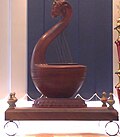 Modern reproduction of a Yazh, an instrument used in Ancient Tamil music. This reproduction has a yali head carved into the curved neck.
 -
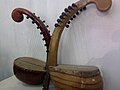 Modern recreations of the yazh/yal
 -
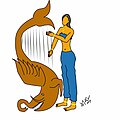 Modern illustration of Makara yal (Tamil: மகரயாழ்).
 -
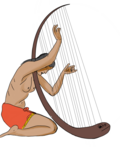 Woman playing a yal.
 -
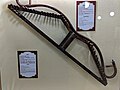 Virkodi yazh or vil yazh. A music theory proposes that a hunters bow was inspiration for the first stringed instruments in India. This is from Tamil Nadu.


External links[edit | edit source]
- BBC video showing the instrument being played.
- News article with prominent photo of Makara yazh
- Brief history of Jaffna and the yazh, Daily News, Sri Lankha
- News story on re-creating yazh
- Photo and news clip of modern re-created yazh
- Music featuring Yazh
References[edit | edit source]

- ↑ Gershon, Livia (26 April 2021). "Listen to the First Song Ever Recorded on This Ancient, Harp-Like Instrument; Tharun Sekar, a luthier based in southern India, has painstakingly recreated the long-lost yazh". Smithsonian Magazine. Smithsonian. Retrieved 3 October 2022.
- ↑ 2.0 2.1 Alastair Dick (1984). "Yāl". In Sadie, Stanley (ed.). The New Grove Dictionary of Musical Instruments. p. 881. Volume 3.
- ↑ 3.0 3.1 3.2 "Musical instruments played in India". Chapter of SPICMACAY, Cornell University. Archived from the original on 10 February 2010. Retrieved 16 November 2011.
The yazh is an ancient Dravidian instrument, somewhat like a harp. It was named for the fact that the tip of stem of this instrument was carved into the head of the animal yaali (vyala in Sanskrit). The yazh was an open-stringed polyphonous instrument, with a wooden boat-shaped skin-covered resonator and an ebony stem. It was tuned by either pegs or rings of gut moved up and down the string...was displaced by the veena in the middle ages
- ↑ "Celebrating unheard melodies". The Hindu. India. 25 December 2010.
Yazh (a form of harp)...Notes (svaras) are known as Narambu. Narambu are the gut strings used in the Yazh. Each string of the Yazh was tuned to one note therefore this association of Narambu to note.
- ↑ Catherine Ludvík (2007). Sarasvatī, Riverine Goddess of Knowledge: From the Manuscript-carrying Vīṇā-player to the Weapon-wielding Defender of the Dharma. BRILL Academic. pp. 227–229. ISBN 978-90-04-15814-6.
- ↑ 6.0 6.1 6.2 6.3 6.4 6.5 6.6 6.7 6.8 Rajeswari, Janani. "Yazh: rebirth with a twist". The Verandah Club. Retrieved 1 October 2022.
...five major types of Yazh based on the number of strings: Sengotti Yazh (seven strings to play seven swaras); Sagoda Yazh (14 strings); Makara Yazh (19 strings), Periyazh (containing 21-29 strings which was closer to the Veena on which one can play 27 notes) and the Seeryazh...ancient literature divided the land into five forms: Marutham, Mullai, Paalai, Neidhal and Kurunji. "It is believed that each of the regions had a Paan (ancient scale of music) and also a Yazh that was unique to it," says Tharun.
- ↑ லலிதாராம் (translation from Tamil: Lalitaram) (15 February – 14 March 2005). "யாழ் என்னும் இசைக்கருவி – ஒரு பார்வை (translation from Tamil: Jaffna Musical Instrument – A View)". Varalaaru.com. No. 8.
- ↑ Xavier S. Thani Nayagam, ed. (1966). Tamil culture. Tamil (Indic people) (in English and தமிழ்). Vol. 12. Tamil Literature Society, Academy of Tamil Culture. pp. 208, 209.
- ↑ Rangarajan, Haripriya (2001). Haripriya Rangarajan; G. Kamalakar; A. K. V. S. Reddy; M. Veerender; K. Venkatachalam (eds.). Jainism: art, architecture, literature & philosophy. Religion / Jainism (in English and தமிழ்). Sharada Publishing House. p. 142. ISBN 9788185616773.
- ↑ "On the basics of conservation". The Hindu. India. 4 December 2009.
{{cite news}}: CS1 maint: deprecated archival service (link) - ↑ "One hundred Tamils of the 20th century: Swami Vipulananda (1892–1947)".
- ↑ "Varieties of Veena". SARASWATHI VEENA(SARASWATI VEENA). Archived from the original on 2 October 2022.
[paraphrased-translation placed online of parts of the Sangeeta Ratnakara of Sarngadeva]
- ↑ Karaikudi S. Subramanian (Spring–Summer 1985). "An Introduction to the Vina". Asian Music. 16 (2). University of Texas Press: 9–13, 19. doi:10.2307/833772. JSTOR 833772.
- ↑ "Musical Instruments". Government Museum, Chennai, India. p. 2. Archived from the original on 27 September 2011. Retrieved 16 November 2011.
- ↑ "Musical Instruments". Government Museum, Chennai, India. p. 3. Archived from the original on 27 September 2011. Retrieved 16 November 2011.
- ↑ Pārlimēntuva, Ceylon (1 January 1957). Ceylon Sessional Papers. Government Press.
- ↑ Katiresu, Subramanier (1 January 2004). A Hand Book to the Jaffna Peninsula and a Souvenir of the Opening of the Railway to the North. Asian Educational Services. ISBN 9788120618725.
- ↑ Rasanayagam, C.; Rasanayagam, Mudaliyar C. (1 January 1993). Ancient Jaffna: Being a Research into the History of Jaffna from Very Early Times to the Portuguese Period. Asian Educational Services. ISBN 9788120602106.
- ↑ "Recreating treasures of the past". The Hindu. India. 26 December 2007. Archived from the original on 21 August 2008.
| Wind (Sushir) |  | |
|---|---|---|
| Plucked Stringed (Tat) | ||
| Bowed Stringed (Vitat) | ||
| Membranous Percussion (Avanaddh) | ||
| Non-Membranous Percussion (Ghan) | ||
| Other | ||
| Historical/ possibly extinct | ||