




m Removed empty portal template using script |
m quick corrected references to improve readability and updated info for accuracy |
||
| Line 1: | Line 1: | ||
{{ | {{Short description|Maharaja of Jammu and Kashmir from 1925 to 1952}} | ||
{{other uses|}} | {{other uses|}} | ||
{{ | {{pp-extended|small=yes}} | ||
{{Use dmy dates|date=February 2024}} | |||
{{Use Indian English|date=December 2023}} | |||
}} | |||
{{Use dmy dates|date= | |||
{{Use Indian English|date= | |||
{{Infobox royalty | {{Infobox royalty | ||
| name | | name = [[Sir]] Hari Singh Bahadur <br/> | ||
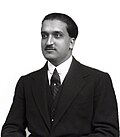
| image | | image = Sir Hari Singh Bahadur, Maharaja of Jammu and Kashmir, 1944.jpg | ||
| caption | | caption = Singh in 1944 | ||
| succession | | succession = [[Maharaja of Jammu and Kashmir]] | ||
| reign | | reign = 23 September 1925 – 17 November 1952 | ||
| predecessor = [[Pratap Singh of Jammu and Kashmir|Pratap Singh]] | | predecessor = [[Pratap Singh of Jammu and Kashmir|Pratap Singh]] | ||
| coronation | | coronation = 29 March 1926<ref>[https://www.alamy.com/coronation-of-sir-hari-singh-as-the-maharajah-of-kashmir-29-march-1926-image359836764.html Coronation of Sir Hari Singh as the Maharajah of Kashmir . 29 March 1926]</ref> | ||
| successor | | successor = ''Monarchy abolished'' | ||
| regent | | regent = [[Karan Singh]] (1949–1952) | ||
| issue | | issue = [[Karan Singh]] | ||
| spouses = {{Plainlist| | | spouses = {{Plainlist| | ||
* {{marriage|Sri Lal Kunverba Sahiba|1913|1915|end= | * {{marriage|Sri Lal Kunverba Sahiba|1913|1915|end=died}} | ||
* {{marriage| | * {{marriage|Princess Dhan Dei of Chamba|1915|1920|end=died}} | ||
* {{marriage|Dhanvant Kunveri Baiji|1923|end= | * {{marriage|Dhanvant Kunveri Baiji|1923|end=died}} | ||
* {{marriage|Tara Devi|1928|1950|end= | * {{marriage|Princess Tara Devi Katoch|1928|1950|end=separated}} | ||
}} | }} | ||
| house | | house = [[Dogra dynasty|Dogra]] | ||
| father | | father = Amar Singh | ||
| mother | | mother = Bhotiali Chib | ||
| birth_date | | birth_date = {{birth date|df=y|1895|9|}} | ||
| birth_place = [[Jammu]], [[Jammu and Kashmir (princely state)|Jammu and Kashmir]],(present-day [[Jammu and Kashmir (union territory)|Jammu and Kashmir]], | | birth_place = [[Jammu]], [[Jammu and Kashmir (princely state)|Jammu and Kashmir]], [[British Raj|British India]]<br />{{small|(present-day [[Jammu and Kashmir (union territory)|Jammu and Kashmir]], India)}} | ||
| death_date | | death_date = {{death date and age |df=y|1961|4|26 |1895|9|}} | ||
| death_place = [[Bombay]], | | death_place = [[Bombay]], Maharashtra, India<br />{{small|(present-day Mumbai)}} | ||
| religion | | religion = [[Hinduism]]{{sfn|Mridu Rai, Hindu Rulers, Muslim Subjects|2004}} | ||
| signature | | signature = | ||
}} | }} | ||
[[ | '''[[Sir]] Hari Singh Bahadur''' {{post-nominals|country=GBR|GCSI|GCIE|GCVO}} (September 1895 – 26 April 1961) was the last ruling [[Maharaja]] of the [[princely state]] of [[Jammu and Kashmir (princely state)|Jammu and Kashmir]] of the [[Dogra dynasty]].<ref>{{Cite web |last=Excelsior |first=Daily |date=2022-09-22 |title=Maharaja Hari Singh: A modern, progressive ruler |url=https://www.dailyexcelsior.com/maharaja-hari-singh-a-modern-progressive-ruler/ |access-date=2025-01-26 |website=Daily Excelsior |language=en-US}}</ref> | ||
Hari Singh was the son of Amar Singh and Bhotiali Chib. In 1923, following his uncle's death, Singh became the new Maharaja of Jammu and Kashmir. After [[Indian Independence Act 1947|Indian Independence]] in 1947, Singh wanted Jammu and Kashmir to remain as an independent kingdom. He acceded to the [[Dominion of India]] to get the support of Indian troops against an invasion by tribal armed men and the [[Pakistan Army]] into his state. Singh remained the titular Maharaja of the state until 1952, when the monarchy was abolished by the Indian government. After spending his final days in [[Bombay]], he died on 26 April 1961. | |||
Singh was a controversial ruler. He faced an [[1931 Kashmir agitation|agitation in Kashmir]] in 1931 and successful rebellions [[1947 Poonch rebellion|in Poonch]] and [[Operation Datta Khel|Gilgit-Baltistan]] in 1947. He was complicit in the [[1947 Jammu massacres]].<ref>{{cite book|title=Kashmir Narratives: Myths vs Facts of J&K|first=Ajay|last=Raina|year=2021|publisher=Sabre and Quill|isbn=978-9390372478}}</ref> | |||
== Early life == | |||
[[File:Amar Mahal Museum, Jammu.jpg|thumb|left|[[Amar Mahal Palace]], birthplace of Hari Singh]] | |||
Hari Singh was born in the [[Dogra Rajput]] royal family in September 1895 at the [[Amar Mahal]], Palace, Jammu. He was the only surviving son of Raja Amar Singh,<ref>General Sir Raja Amar Singh Jamwal : 14 January 1865 – 26 March 1909</ref> the brother of Maharaja [[Pratap Singh of Jammu and Kashmir|Pratap Singh]], then the [[Maharaja of Jammu and Kashmir]]. Since the Maharaja had no issue, Hari Singh was [[heir presumptive]] to the throne of Jammu and Kashmir. | |||
In 1903, Hari Singh served as a [[page of honour]] to [[Lord Curzon]] at the grand [[Delhi Durbar]]. At the age of 13, he was sent to [[Mayo College]] in [[Ajmer]]. A year later, in 1909, his father died and the British took a keen interest in his education, appointing Major H. K. Barr as his guardian. After Mayo College, Hari Singh went to the British-run [[Imperial Cadet Corps]] at [[Dehradun]] for military training.<ref name="Wakhlu 2004">{{cite book | last=Wakhlu | first=S.N. | title=Hari Singh: The Maharaja, the Man, the Times : a Biography of Maharaja Hari Singh of Jammu and Kashmir State, 1895-1961 | publisher=National Publishing House | year=2004 | isbn=978-81-214-0231-6 | url=https://books.google.com/books?id=DU5uAAAAMAAJ | page=32}}</ref> | |||
He was appointed the commander-in-chief of the [[Jammu and Kashmir State Forces|State Forces]] in 1915 by Maharaja Pratap Singh.<ref name="snedden">{{cite book |title=Understanding Kashmir and Kashmiris |first=Christopher |last=Snedden |publisher=Oxford University Press |year=2015 |isbn=978-1-84904-342-7 |page=128 |url=https://books.google.com/books?id=s5KMCwAAQBAJ&pg=PA128}}</ref> In the 1918 New Year's Honours list, he was appointed a [[Knight Commander]] of the [[Order of the British Empire]] (KBE). {{sfn|Jeffery|2019|pp=28}} | |||
===Beyond Borders: A Year in Europe=== | |||
Hari Singh made history by boarding the [[RMS Empress of India (1890)|SS Loyalty]], {{sfn|Jeffery|2019|pp=29}} owned by [[Scindia Steam Navigation Company Ltd.]], which departed from [[Bombay]] on 5 April 1919—the first international voyage by an Indian-flagged merchant ship to the [[United Kingdom]]. This milestone is commemorated annually in [[India]] as [[Indian maritime history#National Maritime Day|National Maritime Day]] since 1964.<ref>{{Cite web|title=National Maritime Day 2025|url=https://www.indiatoday.in/information/story/national-maritime-day-2025-62-years-of-indias-sea-power-and-progress-2704410-2025-04-05|publisher=India Today |access-date=18 May 2025}}</ref> Hari Singh disembarked at [[Marseille]] and took a train to Paris, where he stayed for a few days before arriving in the U.K. on 29 May 1919. He was first received by [[King George V]] at [[Sandringham House]], a monarch he had initially met during the [[Delhi Durbar]] Coronation,<ref>{{Cite web|title=BLACKMAIL CASE|url=https://trove.nla.gov.au/newspaper/article/40496770|publisher=Trove|access-date=20 May 2025}}</ref> initially he stayed at the [[Mandarin Oriental Hyde Park, London|Hyde Park Hotel in Knightsbridge]]. In August, at the [[Dublin Horse Show]], he spent £950,000 purchasing racehorses and ponies, hired well trained staff from [[County Kildare]] to tend to them—all of which were later sent to Kashmir. In September, he took up residence at [[Douglas Castle]] in [[Lanarkshire]], [[Scotland]], where he hosted refined hunting gatherings and tested his newly acquired automobiles for speed and endurance. Among the three high-powered cars he had earlier procured in London was a 60 kW all-electric [[Rolls-Royce Silver Ghost]], a symbol of both innovation and prestige before eventually settling at [[Crown London Aspinalls|27 Curzon Street in Mayfair]] for the winter.{{sfn|Jeffery|2019|pp=30-31}} | |||
On 12 December 1919, Hari Singh was received by the then [[Prince of Wales]] (later [[King Edward VIII]]) at [[St James's Palace]] during his study tour, which focused on understanding the functioning of government, particularly in the areas of transport, industry, education and sanitation.<ref>{{Cite book|title=Chancers|url= https://www.amazon.com/Chancers-Scandal-Blackmail-Enigma-Code-ebook/dp/B07WK3SZT8/|first=Barbara|last=Jeffery|year=2019|publisher=Amberley|isbn=9781445689784}}</ref> {{sfn|Jeffery|2019|pp=30}}He later returned to India from [[Marseille]] on 28 March 1920, eventually reaching [[Kashmir]] in May 1920.{{sfn|Jeffery|2019|pp=38}} | |||
[[File:Le prince de Galles à Jammu, le prince et le maharajah de Jammu (Pratap Singh, en compagnie, à droite, du) capitaine sir Hari Singh - btv1b530769320.jpg|thumb|center|Walking in front (L to R) Maharaja [[Pratap Singh of Jammu and Kashmir|Pratap Singh]] , [[Edward VIII]] and Hari Singh at [[Jammu]]]] | |||
In March 1922, the [[Prince of Wales]] undertook a reciprocal visit to [[Kashmir]], arriving by train in Jammu on the 2nd. He was received at the [[Jammu–Sialkot line|railway station]] by Maharaja Pratap Singh and Raja Hari Singh, and was then escorted to the Maharaja's cantonment camp at Satwari, as Jammu city was in the grip of a plague outbreak. After traveling through the region, he concluded his journey through the princely state and reached [[Peshawar]] by the 6th of March.<ref>{{Cite web|title=The Politics of Pageantry: Royal Tours and Imperial Pomp on the Periphery of EmpireFootnote|url=https://www.tandfonline.com/doi/full/|publisher=|access-date=22 May 2025}}</ref><ref>{{Cite web|title=2 March 1922. Maharaja Pratap Singh waiting for Prince of Whales at Jammu Railway Station|url=https://www.thedispatch.in/2-march-1922-maharaja-pratap-singh-waiting-for-prince-of-whales-at-jammu-railway-station/|publisher=Dispatch|access-date=21 May 2025}}</ref> | |||
==Reign== | |||
[[File:An Indian Durbar in 1926.webm|thumb|A film of the coronation of Maharaja Hari Singh at [[Mubarak Mandi Palace|Mubark Mandi palace]] in Jammu in 1926. In this film by [[Eastman Kodak]] it states, he is "wearing jewels valued at twenty million dollars" (approximately ${{Inflation|US|20000000|1926|r=-5|fmt=c}} in today's value).{{citation needed|date=May 2024}}|left]] | |||
Following the death of his uncle [[Pratap Singh of Jammu and Kashmir|Pratap Singh]] on 23 September 1925, Hari Singh served as the second Prime Minister (1925–1926) of [[Jammu and Kashmir (princely state)|Jammu and Kashmir]]. Hari Singh ascended the throne of Jammu and Kashmir in February 1926 under British intervention, who overruled Pratap Singh's choice of an adopted son, [[Jagatdev Singh|Raja Jagat Dev Singh]] of [[Poonch jagir|Poonch]].<ref>{{Cite book|title=Birth of a Tragedy: Kashmir, 1947|first=Alastair|last=Lamb|date=1994 |pages=58|publisher=Roxford Books |isbn=0907129072}}</ref><ref>{{Cite web|title=Pratap Singh's British Rule|date=3 March 2014 |url=https://kashmirlife.net/partap-singhs-british-rule-56245/|publisher=Kasmirlife|access-date=7 July 2022}}</ref> | |||
Hari Singh's coronation from 22 to 28 February 1926 was divided into two separate ceremonies - the first few days for the religious ceremonies and official programme in the latter part was set aside for hosting the European attendees.<ref>{{Cite web|title=Coronation of Maharaja Hari Singh|url=https://www.dailyexcelsior.com/coronation-of-hari-singh/|publisher=dailyexcelsior|access-date=7 July 2022}}</ref> | |||
After becoming the ruler, Hari Singh conducted free elections and formed the Praja Sabha [[Jammu and Kashmir Legislative Assembly]] to rule with laws implemented under [[Ranbir Penal Code]] (R.P.C) which Praja Sabha decreed.<ref>{{Cite web|title=Kashmir's Last Maharaja|url=https://kashmirlife.net/kashmirs-last-maharaja-1413/amp/|first=Masood|last=Hussain|date=2 May 2011|access-date=2 May 2011}}</ref> In April 1932, as per recommendations of the Glancy Commission, the Praja Sabha was established, made up of 75 members – 12 government officials, 16 state councillors, 14 nominated, and 33 elected (21 Muslims, 10 Hindus and 2 Sikhs). By September 1934 the elected members started making laws under the Praja Sabha which made Jammu and Kashmir a forerunner state for other Princely Indian States.{{sfn|Schofield, Kashmir in Conflict|2003|p=18}}{{sfn|Mridu Rai, Hindu Rulers, Muslim Subjects|2004|loc=Ch. 5, Sec. v (Constructing Kashmiriyat)}} On 7 September 1939 Maharaja Hari Singh and his law and Revenue Minister, Justice Sir Lal Gopal Mukherjee, a former judge of the Allahabad high court (1926–1934) who had served the state of Jammu and Kashmir from 1935 to 1940, produced a written constitution for Jammu and Kashmir which was the "pioneer" in the annals of Asia's constitutional history; despite the fact that it was anything but a people-friendly "Magna Carta" for the state.<ref>{{Cite news|title=Hari Singh's 1939 constitution in J&K marked a first in South Asia | |||
|url=https://www.deccanchronicle.com/opinion/op-ed/050919/hari-singhs-1939-constitution-in-jk-marked-a-first-in-south-asia.html|archive-url=https://web.archive.org/web/20190905011125/http://www.deccanchronicle.com/opinion/op-ed/050919/hari-singhs-1939-constitution-in-jk-marked-a-first-in-south-asia.html|url-status=dead|archive-date=5 September 2019|publisher=Deccan Chronicle|access-date=5 September 2019}}</ref> | |||
He made primary education compulsory in the state, introduced laws prohibiting child marriage, and opened places of worship to low [[Caste system in India|caste]] subjects.<ref>{{Cite book|title = IS God DEAD?????|url = https://books.google.com/books?id=nQniAgAAQBAJ&pg=PA25|publisher=Partridge Publishing|date = 1 February 2014|isbn = 978-1-48281-823-9 |first=Ragubhir Lal |last=Anand |page=26}}</ref> | |||
[[File:Maharajah de Jammu et Kashmir (à g.), maharajah de Bikaner (CN) - btv1b53236964f.jpg|thumb|center|(L to R) Maharaja Hari Singh and Maharaja [[Ganga Singh]] ([[Bikaner State|Bikaner]]) representing [[Chamber of Princes|Princes]] from India in First Round Table Conference in November 1930]] | |||
In 1930, Hari Singh attended the [[Round Table Conferences (India)|First Round Table Conference]] in London. He suggested that the Indian [[Princely state]]s should join an "All India Federation" and pleaded for equal status for Indians in the British Commonwealth of Nations.<ref name=table/> While replying to the inaugural address by [[King-Emperor George V]], Hari Singh said: {{blockquote|I must express our deep gratitude to His Most Gracious Majesty for the cordial welcome tendered to us and I pray that providence may grant us the vision and the will to realize the hopes expressed in the inspiring words uttered this morning by our beloved Emperor. This is the first occasion on which the Princes of India meet in person at a Conference Table along with the representatives of British India and His Majesty's Government to discuss the political future of India. ... I feel deeply gratified at the progress which has been made with the scheme of an All-India Federation as worked out in the Report of the Federal Structure Sub-Committee. But ever since the idea of a Federation was taken up in this Conference, some surprise has been expressed in various quarters in India and in England at the willingness of the Princes to join an All-India Federation. It is said that Princes have forced the pace and that in any case they should have opposed a Federation with British India. I have never disguised from my friends, my warm support of the idea of an All-India Federation.<ref name=table>{{Cite news|title=Remember Maharaja Hari Singh|url=https://www.dailyexcelsior.com/remember-maharaja-hari-singh/|publisher=Daily Excellsior|access-date=23 September 2017}}</ref>}} | |||
===Partition and accession=== | |||
[[File:The last Maharaja of Kashmir.jpg|thumb|Hari Singh in 1943]] | |||
In 1947, after India gained independence from British rule, Jammu and Kashmir had the option of joining one of the new dominions, India and Pakistan, or remaining independent. Hari Singh opted to remain independent for the immediate future since the dominions were beset with [[Partition of India|partition violence]] and he needed time to weigh the options in the context of his Muslim-majority population. He signed a [[Standstill agreement (India)|standstill agreement]] with Pakistan on 14 August 1947 and urged India to do the same, but India did not comply.<ref name=Malhotra>{{citation |last=Malhotra |first=Brig (Retd)V P |title=Security and Defence Related Treaties of India |url=https://books.google.com/books?id=Af2pCQAAQBAJ&pg=PA7 |year=2010 |publisher=Vij Books India Pvt Ltd |isbn=978-93-82573-16-6 |page=7 |access-date=9 February 2022 |archive-date=9 February 2022 |archive-url=https://web.archive.org/web/20220209183444/https://books.google.com/books?id=Af2pCQAAQBAJ&pg=PA7 |url-status=live }}</ref> On 6 October 1947, he faced an [[1947 Poonch rebellion|armed uprising in Poonch]] instigated by the [[All Jammu and Kashmir Muslim Conference|Muslim Conference]] party, followed by Pakistan-backed [[Pashtun tribal invasion of Kashmir|Pashtun tribal invasion]] at Muzaffarabad on 22 October 1947.<ref>{{citation |first=Sumit |last=Ganguly |title=Wars without End: The Indo-Pakistani Conflict |journal=The Annals of the American Academy of Political and Social Science |volume=541 |date=September 1995 |pages=167–178 |publisher=Sage Publications |doi=10.1177/0002716295541001012 |jstor=1048283 |s2cid=144787951 |ref={{sfnref|Ganguly, Wars without End|1995}}}}</ref> | |||
After attack Hari Singh appealed to India for help following the invasion.<ref>{{Cite web|url=http://www.jammu-kashmir.com/documents/harisingh47.html|title=Maharaja Hari Singh's Letter to Mountbatten|website=www.jammu-kashmir.com|access-date=10 January 2020}}</ref> India's British [[Governor-General of India|Governor-General]], [[Lord Mountbatten]], advised the Maharaja to accede to India before India could send its troops. The Maharaja signed the [[Instrument of Accession (Jammu and Kashmir)|Instrument of Accession]] on 26 October 1947, joining the princely state to the [[Dominion of India]].<ref>{{Cite book|title=India after Gandhi : the history of the world's largest democracy|last=Ramachandra.|first=Guha|date=1 January 2008|publisher=Harper Perennial|isbn=978-0060958589|oclc=474262656}}</ref><ref>Justice A. S. Anand, ''The Constitution of Jammu & Kashmir'' (5th edition, 2006), [https://books.google.com/books?id=wSXRUwNnMB0C&pg=PA67 page 67]</ref><ref>[http://www.parliament.uk/commons/lib/research/rp2004/rp04-028.pdf Kashmir, Research Paper 04/28 by Paul Bowers, House of Commons Library, United Kingdom.] {{webarchive|url=https://web.archive.org/web/20040728194805/http://www.parliament.uk/commons/lib/research/rp2004/rp04-028.pdf |date=28 July 2004 }}, page 46, 30 March 2004</ref> India sent troops to repel the invaders, which soon evolved into the [[Indo-Pakistani War of 1947|first Indo-Pakistan War]]. | |||
Pressure from Prime Minister [[Jawaharlal Nehru]] and Deputy Prime Minister [[Vallabhbhai Patel]] eventually compelled Singh to appoint his son and heir, [[Yuvaraja|Yuvraj]] (Crown Prince) [[Karan Singh]], as Prince Regent of Jammu and Kashmir in 1949, although he remained the titular Maharaja of the state until 1952 when the monarchy was abolished by Nehru's government. He was also forced to appoint the popular Kashmiri leader [[Sheikh Abdullah]] as the prime minister of Kashmir. He had a contentious relationship with both Nehru and Abdullah.<ref name="Ramachandra. 92">{{Cite book|title=India after Gandhi : the history of the world's largest democracy|last=Ramachandra.|first=Guha|date=1 January 2008|publisher=Harper Perennial|isbn=978-0060958589|pages=92|oclc=474262656}}</ref> Karan Singh was appointed 'Sadr-e-Riyasat' ('Head of State') in 1952 and [[Governor of Jammu and Kashmir|Governor of the State]] in 1964.<ref name="Ramachandra. 92"/> | |||
==During World War II== | |||
Singh | [[File:British War Cabinet including Churchill and Hari Singh the Maharaja of Jammu and Kashmir.jpg|thumb|center| | ||
During [[WWII]] Maharaja Hari Singh (standing fourth from left) alongside [[Feroz Khan Noon]] represented India in British [[War Cabinet]]]] | |||
[[File:Hari Singh Maharaja of Jammu Kashmir in Dover during World War II.jpg|thumb|center|Maharaja Hari Singh visiting coastal artillery guns at Dover]] | |||
[[File:THE MAHARAJAH OF KASHMIR VISITS W.A.A.F. BALLOON SITE.jpg|thumb|center|Maharaja Hari Singh visiting balloon launcher at London]] | |||
[[File:MAHARAJA OF KASHMIR VISITS A.A. GUN SITE.jpg|thumb|center|Maharaja Hari Singh scrutinising telescope of anti-aircraft guns]] | |||
[[File:THE MAHARAJAH OF KASHMIR INSPECTING FIGHTER JET AT AN AIR DEFENCE OF GREAT BRITAIN STATION.jpg|thumb|center|Maharaja Hari Singh inspecting [[Supermarine Spitfire]] Mk IX UTI]] | |||
Singh | In 1944, Maharaja Hari Singh had the honour of meeting [[Winston Churchill]] in England, for three months he attended several official meetings and inspected wartime efforts. His return journey in June took him through [[Iran]] aboard his [[Avro Anson]], where units of the [[Jammu and Kashmir Rifles|J&K State Forces]] were stationed, he was warmly welcomed in Srinagar by representatives of both major political parties — the [[All Jammu and Kashmir Muslim Conference]] and the [[Jammu & Kashmir National Conference]]; [[Sheikh Abdullah]] garlanded him and presented the [[Naya Kashmir|New Kashmir]] draft. That same year, the National Conference adopted the manifesto with mass public support, while [[Jinnah]]'s attempt to sway Abdullah toward the two-nation theory failed.<ref>{{Cite web|title=Maharaja Hari Singh|url=https://www.dailyexcelsior.com/maharaja-hari-singh/|publisher=Daily Excellsior|access-date=3 June 2025}}</ref> | ||
== | ==Final years and death== | ||
[[File:Caricature of Hari Singh.png|thumb|Caricature of Hari Singh by [[Emery Kelen]]]] | |||
After signing the instrument of accession with India, Hari Singh was banished from Jammu and Kashmir. He departed from Jammu on April 28, 1949, for New Delhi and never came back again, there on June 9, 1949, he signed a proclamation appointing his 18-year-old son, Yuvraj Karan Singh, as the Regent of Jammu and Kashmir. On June 20, 1949, his son arrived in Jammu as Regent, while the Maharaja left for Bombay the same day and settled there for the rest of his life.<ref>{{Cite book|title=Untold story of Jammu-Kashmir|first=Kuldeep Chand|last=Agnihotri|publisher=Prabhat Prakashan|year=2013|pages=270–271|isbn=9789350484531}}</ref> | |||
[[ | Maharaja Hari Singh's letter to President [[Rajendra Prasad]] dated 16–17 August 1952 from exile in [[Poona]], poured out his anguish, a passionate defence of his legacy, an indictment of broken promises, and a plea for justice amidst political betrayal.<ref name="Spoke">{{Cite web|title=Thus Spoke Maharaja Hari Singh|url=https://www.dailyexcelsior.com/thus-spoke-maharaja-hari-singh/|publisher=Daily Excelsior |access-date=5 July 2025}}</ref> | ||
Hari Singh | He died on 26 April 1961, after fourteen years of banishment. As per his will, Hari Singh's ashes were flown to Jammu in a chartered plane, scattered across Jammu and Kashmir, and immersed in the Tawi River at Jammu, with funds he had personally allocated for the purpose.<ref>{{Cite web|url=https://economictimes.indiatimes.com/news/politics-and-nation/dynasty-clash-in-kashmir-hari-singhs-grandson-ajatshatru-challenges-abdullahs/articleshow/18963571.cms |title=Dynasty clash in Kashmir: Hari Singh's grandson Ajatshatru challenges Abdullahs|work=The Economic Times |date=14 March 2013 |access-date=14 March 2013 |last1=Hussain |first1=Masood }}</ref><ref>{{Cite web |last=Service |first=Tribune News |title=Banished from his own land |url=https://www.tribuneindia.com/news/archive/features/banished-from-his-own-land-818375 |access-date=2022-06-29 |website=Tribuneindia News Service |language=en}}</ref><ref name="Spoke"/> | ||
After abdicating, Singh moved to Bombay with a $100,000 annual allowance and raised polo ponies. He famously kept one apartment under constant construction, fearing a prophecy that he'd die once it was finished.<ref name="India: The Shivering Maharajah">{{Cite web|title=India: The Shivering Maharajah|url=https://time.com/archive/6809973/india-the-shivering-maharajah/|publisher=Time|access-date=30 May 2025}}</ref> | |||
Maharaja | ==Legacy and memorials== | ||
===Tributes and memorials=== | |||
[[File:Statue of Maharaja Hari Singh at Jammu.jpg|thumb|Statue of Maharaja Hari Singh at Hari Singh Park, Jammu]] | |||
*On 13 April 1975, Prime Minister [[Indira Gandhi]] inaugurated [[Amar Mahal Palace|Amar Mahal Museum and Library]] in Jammu exhibiting 120 kg 'Dogra Gold Throne' on which Hari Singh once reigned. The French designed cheâteau constructed in 1890 was donated by Dr Karan Singh to Hari-Tara Charitable Trust on 15 January 1970, displays permanent painting galleries and encompasses 25,000 books of antique value.<ref>{{Cite web|url=http://www.jammu.com/jammu/about/local_sites.htm|title=Jammu:Amar Mahal Palace|access-date=2010-04-04| archive-url= https://web.archive.org/web/20100410055734/http://www.jammu.com/jammu/about/local_sites.htm| archive-date= 10 April 2010 | url-status= live}}</ref><ref>{{Cite web|url=http://www.karansingh.com/amml/about.htm|title=Amar Mahal Museum and Library|access-date=2010-04-01|publisher=Karansingh.com|archive-url=https://web.archive.org/web/20091223211645/http://www.karansingh.com/amml/about.htm|archive-date=23 December 2009|url-status=dead|df=dmy-all}}</ref><ref>{{Cite book|first1=Kishor |last1=Gandhi|last2=Singh |first2=Karan (Sadr-i-Riyasat of Jammu and Kashmir)|title= The Transition to a global society|page=251|access-date=2010-04-01|url=https://books.google.com/books?id=qQ1mAAAAMAAJ&q=The+Hari-Tara+Charitable+Trust|publisher= Allied Publishers|year=1991|isbn=81-7023-320-8}}</ref> | |||
*In 1983 Hari Singh's jewellery, which includes crowns, ceremonial swords, necklaces, bracelets, rings, bangles, robes, daggers, watches, and even toys stored in trunks to be turned into a museum, was revealed by Srinagar's Treasury office.<ref>{{Cite news|title=A Kashmir treasure is the subject of a big controversy|url=https://www.indiatoday.in/magazine/nation/story/19831115-major-controversy-ensues-on-ownership-of-Kashmir-treasure-771208-2013-07-12|publisher=India Today|access-date=27 June 2014}}</ref> | |||
*In November 1995, the Maharaja Hari Singh Memorial Cup was founded by [[Vikramaditya Singh (Jammu and Kashmir politician)|Vikramaditya Singh]], Chairman of the Royal Kashmir Polo Foundation which hosted the event till 2018. It was sanctioned by the [[Indian Polo Association]] as a 10–14 goal tournament and was held primarily during Delhi's Fall and Spring polo seasons, at [[New Delhi]], [[Jaipur]] and with occasional events in Jammu and Kashmir. Top teams included [[Jindal Steel & Power|Jindal Panther]],<ref>{{Cite web|title=JINDAL PANTHER LIFTED THE MAHARAJA HARI SINGH MEMORIAL CUP 2018|url=https://www.worldpolonews.com/2018/jindal-panther-lifted-the-maharaja-hari-singh-memorial-cup-2018/|publisher=wpn|access-date=14 July 2025}}</ref> [[Indian Army|Army]], [[Mundota Fort and Palace|Mundota Fort]], [[Sahara India Pariwar|Sahara Warriors]] and Royal Kashmir Polo.<ref>{{Cite web|title=Top teams for Hari Singh Polo Cup|url=https://www.tribuneindia.com/2003/20031122/ncr3.htm|publisher=Tribune India|access-date=13 July 2025}}</ref> | |||
* On 24 January 2000, Captain Dewan Singh and [[Padma Shri]] [[Punam Suri]] President [[D.A.V. College Managing Committee]] unveiled a bust of Hari Singh at Maharaja Hari Singh Agricultural Collegiate School MHAC, formerly Hari Singh's polo and horse racing ground.<ref>{{Cite web|title=MAHARAJA HARISINGH AGRICULTURAL COLLEGIATE SCHOOL, A UNIT OF DAV COLLEGE TRUST|url=https://mhacnagbani.com/699FC945-6F07-453E-A5CA-6C86F3536200/CMS/Page/About-School}}</ref> | |||
* In 2007, Chief Minister [[Ghulam Nabi Azad]] inaugurated the 'Hari Singh Janana Park' for women. It is landscaped by the Gardens and Floriculture Department at New Secretariat. | |||
* On 1 April 2012, the occasion of Ram Navami, Union Minister [[Ghulam Nabi Azad]] and MP [[Karan Singh]] unveiled a statue of Hari Singh near the Tawi bridge in Jammu.<ref>{{Cite web|title=Maharaja's Statue unveiled.|url=https://m.tribuneindia.com/2012/20120402/jmtrib.htm|work=The Tribune|access-date=2 April 2012}}</ref> | |||
* Sh [[Kavinder Gupta]] Mayor of Jammu Municipal Corporation erected a statue of Maharaja Hari Singh in standing posture near Bagh-e-Bahu Police Station adjoining junction crossings linking Gujjar Nagar Tawi Bridge, [[Jammu University]], Bagh-e-Bahu, Narwal<ref>{{Cite news|title=City's statues in a sorry state|url=https://www.dailyexcelsior.com/citys-statues-in-a-sorry-state/|publisher=[[Daily Excelsior]]|access-date= 27 April 2014}}</ref><ref>{{Cite news|title=Man behind the idea cold-shouldered|url=https://www.tribuneindia.com/2012/20120402/jmtrib.htm#2|work=The Tribune|access-date=1 April 2012}}</ref> | |||
* On 16 May 2018, Chief Minister [[Mehbooba Mufti]] along with Deputy Chief Minister [[Nirmal Kumar Singh|Dr Nirmal Singh]] inaugurated 'Maharaja Hari Singh Park' wherein statue of Maharaja Hari Singh in sitting posture is the main attraction of this park.<ref>{{Cite news|title=JDA sold Maharaja Hari Singh Park!|url=https://www.jagran.com/jammu-and-kashmir/jammu-jammu-development-authority-sold-maharaja-hari-singh-park-18705820.html|publisher=Dainik Jagran|access-date=2 December 2018}}</ref><ref>{{Cite news|title=Mehbooba inaugurates Hari Singh park in Jammu|url=https://www.business-standard.com/article/pti-stories/mehbooba-inaugurates-hari-singh-park-in-jammu-118031601191_1.html|publisher=Business Standard|access-date=16 March 2018}}</ref> | |||
* On 23 September 2019, the Amar Kshatriya Rajput Sabha (AKRS) installed a life-sized statue of Hari Singh on his 119th birthday at [[Samba]] district, near Veer Bhoomi Park.<ref>{{Cite web|title=Maharaja Hari Singh's statue unveiled on his 119th Birthday anniversary|url=http://www.earlytimes.in/newsdet.aspx?q=112539|publisher=Early Times|access-date=23 September 2019}}</ref> | |||
* On 23 September 2020, an audio-video song album in [[Dogri language|Dogri]] was released highlighting social reforms introduced by Hari Singh from 1930 onwards.<ref>{{Cite web|title=Album on Maharaja Hari Singh released|url=https://m.tribuneindia.com/news/j-k/album-on-hari-singh-released-145790|publisher=Tribune|access-date=24 September 2020}}</ref> | |||
* On 23 September 2021, Sh [[Ravinder Raina]] BJP Jammu President unveiled a statue of Hari Singh at Dr. [[Syama Prasad Mukherjee]] Bhawan, Sec. 3 Extn, Trikuta Nagar, Jammu, Jammu & Kashmir, the party headquarters.<ref>{{Cite magazine |first=Naseer |last=Ganai |date=4 February 2022 |title=Why Statues Of Dogra Kings Are Political Fodder For Kashmiri Politicians |url=https://www.outlookindia.com/magazine/story/india-news-why-statues-of-dogra-kings-are-political-fodder-for-kashmiri-politicians/305393 |magazine=Outlook |access-date=25 March 2022}}</ref> | |||
* 23 September 2022 is declared as public holiday on the birth anniversary of Maharaja Hari Singh under Negotiable Instrument Act, 1881 (Central Act 26 of 1881) across Union territory of Jammu and Kashmir.<ref>{{Cite news|title=J&K Govt announces public holiday as tribute to Maharaja Hari Singh|url=https://www.dailyexcelsior.com/jk-govt-announces-public-holiday-as-tribute-to-maharaja-hari-singh|publisher=Daily Excelsior|access-date=21 September 2022}}</ref> | |||
''Public Utilities bearing his name'' | |||
*'''Hari Singh School''', Kanji House Jammu since 1933, located next to [[Mubarak Mandi Palace]] is Govt. Education Department's co-educational [[Jammu and Kashmir Board of School Education|J&K Board]] affiliated school from 9th to 12th class.<ref>{{Cite web|title=HSS|url=https://www.schools.org.in/jammu/01131903410/hss-hari-singh.html}}</ref> | |||
*'''Sri Maharaja Hari Singh [[SMHS Hospital]] '''or Headwin Hospital Gole Market, Karan Nagar area of Srinagar since 1945, inaugurated by [[Viceroy of India]] [[Lord Wavell]], then subcontinent's biggest hospital, built by Hari Singh at the cost of Rupees Thirty five lakhs, now is a Government owned general hospital and medical college.<ref>{{Cite web|title=SMHS Hospital|url=https://m.greaterkashmir.com/article/smhs-hospital-a-haven-of-healing-and-hope/250385}}</ref> | |||
*'''Maharaja Hari Singh Agricultural Collegiate (MHAC) School''' Nagbani, P O Domana Jammu since 1967, a [[C.B.S.E]] affiliated residential as well as day boarding school.<ref>{{Cite web|title=MAHARAJA HARISINGH AGRICULTURAL COLLEGIATE SCHOOL, A UNIT OF DAV COLLEGE TRUST|url=https://mhacnagbani.com}}</ref> | |||
*'''Maharaja Hari Singh DAV Sr. Sec. School''' Akhnoor City since 1982 is a [[C.B.S.E]] affiliated school from nursery to 12th class.<ref>{{Cite web|title=MHS DAV Akhnoor|url=http://mhsdavakhnoor.org/29659E35-CA77-43D0-857F-7773B17ADEEE/CMS/Page/About-School}}</ref> | |||
*'''Maharaja Hari Singh DAV Sr. Sec. Public School''' Poonch Kanuyian since 1982 is a [[Jammu and Kashmir Board of School Education|J&K Board]] affiliated school from nursery to 12th class.<ref>{{Cite web|title =MHS DAV Poonch|url=http://mhsdavkpoonch.com}}</ref> | |||
*'''Maharaja Hari Singh DAV Sr. Sec. Public School''' R. S Pura since 1982 is a [[Jammu and Kashmir Board of School Education|J&K Board]] affiliated school from nursery to 12th class.<ref>{{Cite web|title =MHS DAV R. S Pura|url=http://davrspura.org/BCA7C9F5-07F6-4405-BF01-4466D3BE6152/CMS/Page/About-School}}</ref> | |||
*'''Government Hari Singh Higher Secondary School''' Prem Nagar via Residency Road Jammu, is a [[Jammu and Kashmir Board of School Education|J&K Board]] affiliated school from 1st to 12th standards and since 2018 an additional school for specially-abled children provisioned in new building with residential facilities.<ref>{{Cite news|title=Hari Singh HSS to be converted into school for special children|url=http://www.thenewsnow.co.in/newsdet.aspx?q=53402|access-date=27 May 2018}}</ref> | |||
*'''Government Hari Singh Higher Secondary School''' Anand Nagar Rd. (Camp) Bohri Jammu, is a [[Jammu and Kashmir Board of School Education|J&K Board]] affiliated school from 1st to 12th standards.<ref>{{Cite web|title =Government Hari Singh Higher Secondary School|date=17 August 2024 |url=https://risingkashmir.com/govt-hs-hss-bohri-celebrates-independence-day-with-patriotic-fervour}}</ref> | |||
''Commercial places bearing his name'' | |||
*'''Hari Singh High Street''' Srinagar, is named for him. It contains 105 gold adornment shops and numerous luxury item boutiques.<ref>{{Cite web|title=Jewellery Showrooms Hari Singh High Street|url=https://www.justdial.com/Srinagar/Jewellery-Showrooms-in-Hari-Singh-High-Street/nct-10282098}}</ref> | |||
*'''Hari Niwas Palace''' Jammu on the shores of [[River Tawi]], his Jammu guest house, is now run as a heritage hotel with views of the [[Trikuta Hills]] and [[Vaishno Devi]].<ref>{{Cite web|title= Hari Niwas|url=http://hariniwaspalace.in/}}</ref> | |||
*'''Hari Market''' Jammu is located on the outskirts of [[Raghunath Temple]] [[Jammu]] and is connected by multi-tier parking. The market primarily sells dried fruits and souvenirs.<ref>{{Cite web|title=Hari Market in Jammu|url=https://www.jammuonline.in/guide/hari-market-in-jammu}}</ref> | |||
==Personal life== | ==Personal life== | ||
[[File:Sir Hari Singh Bahadur, Maharaja of Jammu and Kashmir, 1920.jpg|thumb|upright=0.7|Hari Singh in 1920]] | |||
===Mr A.'s Blackmail case=== | |||
Maharaja Hari Singh, aged 24, on his maiden visit to Europe in 1919, unfamiliar with Western settings, fell victim to a "love trap" during his visit to Europe, where he was lured into a compromising situation by not so attractive woman named Maudie Robinson. The encounter was used for blackmail to avoid citation in a divorce case, reportedly with the silent support of British officials, leading to a demand for a large sum of money. A discreet settlement was ensured so that the incident never reaches court or subjects. A similar case involved Maharaja [[Sayajirao Gaekwad III]] of Baroda, who also faced scandal during a European trip, highlighting how Indian royals were vulnerable to such schemes abroad.<ref>{{Cite web|title=The Indian Maharajas in Love Traps|url=https://www.asian-voice.com/Opinion/Columnists/The-Indian-Maharajas-in-Love-Traps|publisher=|access-date=}}</ref> | |||
On 27 December 1919, Hari Singh handed over two cheques, B204561 and B204562 {{sfn|Jeffery|2019|pp=18}} totalling £300,000 (roughly £{{Inflation|UK-GDP|300000|1920|r=-5|fmt=c}} today) to his Irish [[aide-de-camp]] (ADC), Captain Charles William Augustus Arthur, who, in conspiracy with English criminals—Monty Newton, a notorious card sharp, and William Cooper Hobbs, a corrupt solicitor's clerk and the so-called "Mr Big" of London's underworld—betrayed and defrauded him. {{sfn|Jeffery|2019|pp=8-9}} | |||
As the real criminal conspiracy was orchestrated by others, Maudie Robinson's real husband demanded money taken under his name under threat of scandal. The case, Charles Ernest Robinson v [[Midland Bank]], was heard in the King's Bench Division of the [[Royal Courts of Justice]] on 19 November 1924, presided over by [[Charles Darling, 1st Baron Darling|Lord Justice Darling]]. Robinson's lawyers, son of [[Lord Halsbury]] and John Paul Valetta, alleged that they had received only £21,000 from an out of court settlements, claiming they had been unfairly deprived of the remainder by the bank. During the eight days of proceedings, efforts were made by the [[India Office]] to keep a certain individual's identity confidential by referring to him as "Mr. A." In court, [[John Simon, 1st Viscount Simon|Lord John Simon]]—representing the Midland Bank—vigorously defended the institution. Eventually, the truth emerged in court with the inputs from [[Scotland Yard]] detective Percy J. Smith.{{sfn|Jeffery|2019|pp=42-43}}<ref name="snedden"/> The court ruled in favor of the Bank, despite the jury exonerating Mr. Charles Earnest Robinson and Mrs. Maudie Robinson of conspiracy, stating that no one—innocent or not—can claim proceeds from a theft. So, Robinson lost the case even though he was found innocent of the conspiracy.{{sfn|Jeffery|2019|pp=82}} | |||
The courtroom proceedings drew massive public interest, with people queuing from early morning and the courtroom packed to the extent that witnesses struggled to reach the stand. Major newspapers like ''[[The Times]]'' and ''[[The Daily Telegraph]]'' dedicated full pages daily to the case, highlighting its sensational nature. Media magnates like [[Lord Beaverbrook]] and Sir [[Edward Hulton]] were reportedly stunned by how publicly the dramatic events unfolded. During the trial, Sir Hari was often described as an eastern potentate, and suspicion extended to all Asian royalty, who were seen as opposing secrecy.{{sfn|Jeffery|2019|pp=44,86}} | |||
The name of Mr. A's ADC was revealed after his arrest on 2 December, awaiting trials in [[Palais de Justice, Paris|Palais de Justice]], imprisoned at [[La Santé prison]] (France), but Mr. A's identity remained a secret despite wide speculation in Paris. On 3 December 1924, the India Office finally permitted the disclosure of his name. It was first announced on the London radio station [[2LO]], which interrupted its music programme for the news.{{sfn|Jeffery|2019|pp=86}}{{sfn|Katoch|2025|pp=97}}{{sfn|Katoch|2025|pp=301-304}}<ref>{{Cite book|title=From The Banks Of Beas|url=https://www.sabreandquill.com/products/from-the-banks-of-the-beas/|first=Ghanshyam Singh|last=Katoch|publisher=Sabre & Quill|year=2025|isbn=9788119509287}}</ref> India Office in Britain decided to close the files for a hundred years rather than the usual thirty years as the case involved espionage.{{sfn|Jeffery|2019|pp=jacket}} | |||
[[The Daily News (UK)|''Daily News'']], [[Le Petit Journal (newspaper)|''Petit Journal'']],{{sfn|Jeffery|2019|pp=83}} ''[[News of the World]]'', [[Sunday People|''The People'']] investigated developments, verified backgrounds, and tracked case proceedings.{{sfn|Jeffery|2019|pp=86}} | |||
On 4 December 1924, ''[[Daily Express]]'' (UK), ''[[Daily Chronicle]]'' (UK) and [[Daily Herald (United Kingdom)|''Daily Herald'']] (UK); ''[[The Cairns Post]]'' (Australia) and [[The Northern Star|''Northern Star'']] (Australia) on 5 December 1924, [[Time (magazine)|''Time'' magazine]] on 15 December 1924, ''[[Kingston Gleaner]]'' (Jamaica) on 16 December 1924, all published reports revealing the official identification of Maharaja Hari Singh as the central figure in the sensational blackmail case.<ref>{{Cite web|title=UNMASKED HEIR OF THE THRONE OF KASHMIR PRINCE WHO PREFERS EUROPE|url=https://trove.nla.gov.au/newspaper/article/93467054|publisher=Trove|access-date=31 May 2025}}</ref><ref>{{Cite web|title=BLACKMAIL CASE|url=https://trove.nla.gov.au/newspaper/article/40496770|publisher=Trove|access-date=31 May 2025}}</ref><ref>{{Cite web|title=Law: Badger Game|url=https://time.com/archive/6658441/law-badger-game/|publisher=Time|access-date=31 May 2024}}</ref> | |||
On 19 December 1924, Hari Singh was in Kashmir, recovering from a serious leg injury caused by a tobogganing accident. Around the same time, he fell into deep depression due to the "Mr A Case" and was reluctant to travel to London to give evidence. On Christmas Day 1924, [[Lord Reading]] noted Hari Singh's remorse and that his uncle, the Maharaja of Kashmir, had refused his resignation and granted him two to three months' leave to recover his mental balance.{{sfn|Jeffery|2019|pp=87}} | |||
''Time'' magazine revisited the scandal on May 5, 1961, after Maharaja Hari Singh's death, portraying it as an enduring stain on his legacy. The article suggested that his naivety, combined with betrayal and disloyalty from those he trusted most, shaped his suspicious nature. Over time, this lack of trust in both India and Pakistan may have played a role in laying the groundwork for the India-Pakistan conflict over Kashmir.<ref name="India: The Shivering Maharajah"/> | |||
===Personal wealth=== | |||
He was one of [[Rolls-Royce]]'s most valued clients, eventually acquiring at least 26 of the marque's cars over the years, which included [[Rolls-Royce Phantom I]] 17EX <ref>{{Cite web|title=The Rolls Royce|url=https://magazine.derivaz-ives.com/the-rolls-royce-phantom-i-17ex-a-car-with-a-fabulous-destiny/|publisher=Derivaz & Ives|access-date=21 May 2025}}</ref> | |||
Despite having a $10 million annual income, a silver-plated [[Avro Anson]]<ref>{{Cite book|title=A Kashmir Knight|first=Lt Gen Ghanshyam Singh|last=Katoch|url=https://www.amazon.in/KASHMIR-KNIGHT-Years-Princely-State/dp/B0F4JWQMG4/|publisher=Sabre & Quill|pp=162–163|isbn=9789348152374}}</ref> 18C VT plane in which he travelled during [[World War II]], and a Versace styled palace in Srinagar—now a luxurious hotel<ref>{{Cite web|title=Lalit|url=https://www.thelalit.com/the-lalit-srinagar/|access-date=29 June 2025}}</ref>—Sir Hari lived in opulence.<ref name="India: The Shivering Maharajah"/> | |||
===Marriages=== | ===Marriages=== | ||
[[File:The Maharaja and Maharani of Kashmir.jpg|thumb|Hari Singh with his fourth wife, Maharani Tara Devi, 1950]] | |||
Singh married four times as he faced disturbances in his private life. Two of his wives died childless and a third Rajasthani bride was sent back with honour, to her parents' house as the couple could not establish an emotional connection.<ref>K.C. Agnihotri. 2016. Jammu Kashmir ke jannayak Mahraja Hari Singh</ref> Also, Hari Singh faced political and domestic conspiracies at this time and thought it appropriate to send back the third wife to safety. With his last wife, [[Tara Devi of Jammu and Kashmir|Tara Devi Sahiba]] of [[Kangra District|Kangra]], he had a son, [[Karan Singh]].{{sfn|Mufti, Kashmir in Sickness and in Health|2013|p=157}} | |||
Singh married four times as his | |||
{| class="wikitable" | {| class="wikitable" | ||
| Line 81: | Line 173: | ||
| 3 ||[[Maharani]] Dhanvant Kunveri Baiji Sahiba | | 3 ||[[Maharani]] Dhanvant Kunveri Baiji Sahiba | ||
|30 April 1923 | |30 April 1923 | ||
| Ended | | Ended || Died young. No issue. | ||
|- | |- | ||
| 4 ||[[Maharani]] Tara Devi Sahiba of Kangra | | 4 ||[[Maharani]] Tara Devi Sahiba of Kangra | ||
| Line 87: | Line 179: | ||
|- | |- | ||
|} | |} | ||
==Titles and honours== | ==Titles and honours== | ||
===Title and style=== | ===Title and style=== | ||
[[File:Titles of Maharaja Hari singh and Yuvraj Karan Singh.jpg|thumb|Titles of Maharaja Hari Singh and Yuvraj Karan Singh on the first page of his Civil List of 1945]] | [[File:Titles of Maharaja Hari singh and Yuvraj Karan Singh.jpg|thumb|Titles of Maharaja Hari Singh and Yuvraj Karan Singh on the first page of his Civil List of 1945]] | ||
As Maharaja, Hari Singh's full style was: | As Maharaja, Hari Singh's full style was: | ||
<div style="padding: 1px; text-align:left; margin:left; border:1px solid #7BA05B; color:#000000; width:55%;">{{ | <div style="padding: 1px; text-align:left; margin:left; border:1px solid #7BA05B; color:#000000; width:55%;">{{blockquote|Lieutenant-General His Highness Raj Rajeshwar Maharajadhiraj Maharaja Shri Hari Singhji Bahadur Indar Mahindar, Sipar-i-Saltanat-i-Inglishia, GCSI, GCIE, GCVO, LLD}}</div> | ||
===Honours=== | ===Honours=== | ||
* 1903: [[File:Med.DelhiDurbar1903.png|50px]] Delhi Durbar Medal | * 1903: [[File:Med.DelhiDurbar1903.png|50px]] Delhi Durbar Medal | ||
* 1911: [[File: | * 1911: [[File:King George V Coronation Medal ribbon.svg|50px]] Delhi Durbar Medal | ||
* 1922: Prince of Wales Visit Medal | * 1922: Prince of Wales Visit Medal | ||
* 1929: [[File:Order of the Indian Empire Ribbon.svg|50px]] [[Knight Grand Commander of the Order of the Indian Empire]] (GCIE) (KCIE in 1918) | * 1929: [[File:Order of the Indian Empire Ribbon.svg|50px]] [[Knight Grand Commander of the Order of the Indian Empire]] (GCIE) (KCIE in 1918) | ||
* 1930: [[File:Cavaliere di Gran Croce OCI Kingdom BAR.svg|50px]] Grand Cross of the [[Order of the Crown of Italy]] | * 1930: [[File:Cavaliere di Gran Croce OCI Kingdom BAR.svg|50px]] Grand Cross of the [[Order of the Crown of Italy]] | ||
* 1933: [[File:ImperialOrderCrownIndiaRibbon. | * 1933: [[File:ImperialOrderCrownIndiaRibbon.svg|50px]] [[Knight Grand Commander of the Order of the Star of India]] (GCSI) | ||
* 1935: [[File: | * 1935: [[File:King George V Silver Jubilee Medal ribbon.svg|50px]] [[King George V Silver Jubilee Medal]] | ||
* 1937: [[File:UK King George VI Coronation Medal ribbon.svg|50px]] [[King George VI Coronation Medal]] | * 1937: [[File:UK King George VI Coronation Medal ribbon.svg|50px]] [[King George VI Coronation Medal]] | ||
* 1938: [[File:Legion Honneur GO ribbon.svg|50px]] Grand Officer of the [[Legion d'Honneur]] | * 1938: [[File:Legion Honneur GO ribbon.svg|50px]] Grand Officer of the [[Legion d'Honneur]] | ||
* 1945: [[File:39-45 Star BAR.svg|50px]] [[ | * 1945: [[File:39-45 Star BAR.svg|50px]] [[1939–1945 Star]] | ||
* 1945: [[File:Africa Star BAR.svg|50px]] [[Africa Star]] | * 1945: [[File:Africa Star BAR.svg|50px]] [[Africa Star]] | ||
* 1945: [[File:War Medal 39-45 BAR.svg|50px]] [[War Medal | * 1945: [[File:War Medal 39-45 BAR.svg|50px]] [[War Medal 1939–1945]] | ||
* 1945: [[File:India Service Medal BAR.svg|50px]] [[India Service Medal]] | * 1945: [[File:India Service Medal BAR.svg|50px]] [[India Service Medal]] | ||
* 1946: [[File:Royal Victorian Order ribbon | * 1946: [[File:UK Royal Victorian Order ribbon.svg|50px]] [[Knight Grand Cross of the Royal Victorian Order]] (GCVO) (KCVO in 1922) | ||
* | * 1948: [[File:Indian Independence medal 1947.svg|50px]] [[Indian Independence Medal]] | ||
===Honorary degrees=== | ===Honorary degrees=== | ||
* 1938: Hon. [[LL.D]] from [[Panjab University|Punjab University]] | * 1938: Hon. [[LL.D]] from [[Panjab University|Punjab University]] | ||
| Line 166: | Line 214: | ||
==Bibliography== | ==Bibliography== | ||
* {{citation |last=Mufti |first=Gulzar |title=Kashmir in Sickness and in Health |url=https://books.google.com/books?id=AoAcAgAAQBAJ&pg=PT171 |year=2013 |publisher=Partridge Publishing India |isbn=978-1-4828-0998-5 |ref={{sfnref|Mufti, Kashmir in Sickness and in Health|2013}}}} | * {{citation |last=Mufti |first=Gulzar |title=Kashmir in Sickness and in Health |url=https://books.google.com/books?id=AoAcAgAAQBAJ&pg=PT171 |year=2013 |publisher=Partridge Publishing India |isbn=978-1-4828-0998-5 |ref={{sfnref|Mufti, Kashmir in Sickness and in Health|2013}}}} | ||
* {{citation |first=Mridu |last=Rai | author-link = Mridu Rai | title=Hindu Rulers, Muslim Subjects: Islam, Rights, and the History of Kashmir | publisher=C. Hurst & Co |year=2004 |isbn=1850656614 |ref={{sfnref|Mridu Rai, Hindu Rulers, Muslim Subjects|2004}}}} | |||
* {{citation |first=Victoria |last=Schofield |author-link=Victoria Schofield |title=Kashmir in Conflict |publisher=I. B. Taurus & Co |location=London and New York |year=2003 |orig-year=First published in 2000 |isbn=978-1860648984 |url=https://books.google.com/books?id=rkTetMfI6QkC |ref={{sfnref|Schofield, Kashmir in Conflict|2003}}}} | |||
==External links== | ==External links== | ||
{{commons category}} | |||
{{Portal|India|Politics}} | |||
* [https://web.archive.org/web/20100612114256/http://jammukashmir.nic.in/govt/cntit1.htm#1 Proclamation of 1 May 1951 on Jammu & Kashmir Constituent Assembly by Yuvraj (Crown Prince) Karan Singh (Son of Maharajah Hari Singh) from the Official website of Government of Jammu and Kashmir, India] | * [https://web.archive.org/web/20100612114256/http://jammukashmir.nic.in/govt/cntit1.htm#1 Proclamation of 1 May 1951 on Jammu & Kashmir Constituent Assembly by Yuvraj (Crown Prince) Karan Singh (Son of Maharajah Hari Singh) from the Official website of Government of Jammu and Kashmir, India] | ||
* [http://www.lib.berkeley.edu/SSEAL/SouthAsia/kashmir.html ''Conflict in Kashmir: Selected Internet Resources by the Library, University of California, Berkeley, USA''; [[University of California at Berkeley]] Library Bibliographies and Web-Bibliographies list | * [http://www.lib.berkeley.edu/SSEAL/SouthAsia/kashmir.html ''Conflict in Kashmir: Selected Internet Resources by the Library, University of California, Berkeley, USA'']; [[University of California at Berkeley]] Library Bibliographies and Web-Bibliographies list | ||
* {{cite web|url=http://newstodaynet.com/2006sud/06jan/1201ss1.htm |title=Salutations to Guruji Golwalkar – IV|author=V Sundaram|archive-url=https://web.archive.org/web/20081204190403/http://newstodaynet.com/2006sud/06jan/1201ss1.htm|archive-date=4 December 2008}} The role of Shri Guruji Golwalkar (Sarsanghchalak of the [[Rashtriya Swayamsevak Sangh]] – RSS) | * {{cite web|url=http://newstodaynet.com/2006sud/06jan/1201ss1.htm |title=Salutations to Guruji Golwalkar – IV|author=V Sundaram|archive-url=https://web.archive.org/web/20081204190403/http://newstodaynet.com/2006sud/06jan/1201ss1.htm|archive-date=4 December 2008}} The role of Shri Guruji Golwalkar (Sarsanghchalak of the [[Rashtriya Swayamsevak Sangh]] – RSS) | ||
* [https://web.archive.org/web/20140911151945/http://www.niticentral.com/2013/01/13/nehru-abdullah-betrayed-raja-hari-singh-37857.html Nehru, Abdullah betrayed Maharaja Hari Singh] | * [https://web.archive.org/web/20140911151945/http://www.niticentral.com/2013/01/13/nehru-abdullah-betrayed-raja-hari-singh-37857.html Nehru, Abdullah betrayed Maharaja Hari Singh] | ||
| Line 183: | Line 229: | ||
{{s-start}} | {{s-start}} | ||
{{s-hou|[[Dogra dynasty]]|| | {{s-hou|[[Dogra dynasty]]||September 1895||26 April 1961}} | ||
{{s-reg|}} | {{s-reg|}} | ||
{{s-bef|before=[[Pratap Singh of Jammu and Kashmir|Pratap Singh]]<br><small>(as Maharaja of Jammu and Kashmir)</small>}} | {{s-bef|before=[[Pratap Singh of Jammu and Kashmir|Pratap Singh]]<br /><small>(as Maharaja of Jammu and Kashmir)</small>}} | ||
{{s-ttl|title=[[Maharaja of Jammu and Kashmir]]|years=1925–1952}} | {{s-ttl|title=[[Maharaja of Jammu and Kashmir]]|years=1925–1952}} | ||
{{s-aft|after=[[Republic of India]] [[Karan Singh]] as titular Maharajah of Jammu and Kashmir}} | {{s-aft|after=[[Republic of India]]<br />[[Karan Singh]] as titular Maharajah of Jammu and Kashmir}} | ||
{{s-end}} | {{s-end}} | ||
| Line 196: | Line 242: | ||
{{DEFAULTSORT:Singh, Hari}} | {{DEFAULTSORT:Singh, Hari}} | ||
[[Category:Dethroned monarchs]] | [[Category:Dethroned monarchs]] | ||
[[Category:Knights Grand Commander of the Order of the Star of India]] | [[Category:Knights Grand Commander of the Order of the Star of India]] | ||
[[Category:Knights Grand Commander of the Order of the Indian Empire]] | [[Category:Knights Grand Commander of the Order of the Indian Empire]] | ||
[[Category:Knights Grand Cross of the Royal Victorian Order]] | [[Category:Indian Knights Grand Cross of the Royal Victorian Order]] | ||
[[Category:1895 births]] | [[Category:1895 births]] | ||
[[Category:1961 deaths]] | [[Category:1961 deaths]] | ||
[[Category:Maharajas of Jammu and Kashmir]] | [[Category:Maharajas of Jammu and Kashmir (princely state)]] | ||
[[Category:Indian Hindus]] | [[Category:Indian Hindus]] | ||
[[Category: | [[Category:Dogra people]] | ||
[[Category:Hindu monarchs]] | [[Category:Hindu monarchs]] | ||
[[Category:20th-century Indian royalty]] | [[Category:20th-century Indian royalty]] | ||
[[Category:Genocide perpetrators]] | |||
[[Category:British Indian Army personnel]] | |||
[[Category:Chief ministers of Jammu and Kashmir (princely state)]] | |||
Latest revision as of 17:56, 25 March 2026
| Sir Hari Singh Bahadur | |
|---|---|
 Singh in 1944 | |
| Maharaja of Jammu and Kashmir | |
| Reign | 23 September 1925 – 17 November 1952 |
| Coronation | 29 March 1926[1] |
| Predecessor | Pratap Singh |
| Successor | Monarchy abolished |
| Regent | Karan Singh (1949–1952) |
| Born | September 1895 Jammu, Jammu and Kashmir, British India (present-day Jammu and Kashmir, India) |
| Died | 26 April 1961 (aged 65) Bombay, Maharashtra, India (present-day Mumbai) |
| Spouses | Sri Lal Kunverba Sahiba
( m. 1913; died 1915)Princess Dhan Dei of Chamba
( m. 1915; died 1920)Dhanvant Kunveri Baiji
( m. 1923, died)Princess Tara Devi Katoch
( m. 1928; separated 1950) |
| Issue | Karan Singh |
| House | Dogra |
| Father | Amar Singh |
| Mother | Bhotiali Chib |
| Religion | Hinduism[2] |
Sir Hari Singh Bahadur GCSI GCIE GCVO (September 1895 – 26 April 1961) was the last ruling Maharaja of the princely state of Jammu and Kashmir of the Dogra dynasty.[3]
Hari Singh was the son of Amar Singh and Bhotiali Chib. In 1923, following his uncle's death, Singh became the new Maharaja of Jammu and Kashmir. After Indian Independence in 1947, Singh wanted Jammu and Kashmir to remain as an independent kingdom. He acceded to the Dominion of India to get the support of Indian troops against an invasion by tribal armed men and the Pakistan Army into his state. Singh remained the titular Maharaja of the state until 1952, when the monarchy was abolished by the Indian government. After spending his final days in Bombay, he died on 26 April 1961.
Singh was a controversial ruler. He faced an agitation in Kashmir in 1931 and successful rebellions in Poonch and Gilgit-Baltistan in 1947. He was complicit in the 1947 Jammu massacres.[4]
Early life[edit | edit source]

Hari Singh was born in the Dogra Rajput royal family in September 1895 at the Amar Mahal, Palace, Jammu. He was the only surviving son of Raja Amar Singh,[5] the brother of Maharaja Pratap Singh, then the Maharaja of Jammu and Kashmir. Since the Maharaja had no issue, Hari Singh was heir presumptive to the throne of Jammu and Kashmir.
In 1903, Hari Singh served as a page of honour to Lord Curzon at the grand Delhi Durbar. At the age of 13, he was sent to Mayo College in Ajmer. A year later, in 1909, his father died and the British took a keen interest in his education, appointing Major H. K. Barr as his guardian. After Mayo College, Hari Singh went to the British-run Imperial Cadet Corps at Dehradun for military training.[6]
He was appointed the commander-in-chief of the State Forces in 1915 by Maharaja Pratap Singh.[7] In the 1918 New Year's Honours list, he was appointed a Knight Commander of the Order of the British Empire (KBE). [8]
Beyond Borders: A Year in Europe[edit | edit source]
Hari Singh made history by boarding the SS Loyalty, [9] owned by Scindia Steam Navigation Company Ltd., which departed from Bombay on 5 April 1919—the first international voyage by an Indian-flagged merchant ship to the United Kingdom. This milestone is commemorated annually in India as National Maritime Day since 1964.[10] Hari Singh disembarked at Marseille and took a train to Paris, where he stayed for a few days before arriving in the U.K. on 29 May 1919. He was first received by King George V at Sandringham House, a monarch he had initially met during the Delhi Durbar Coronation,[11] initially he stayed at the Hyde Park Hotel in Knightsbridge. In August, at the Dublin Horse Show, he spent £950,000 purchasing racehorses and ponies, hired well trained staff from County Kildare to tend to them—all of which were later sent to Kashmir. In September, he took up residence at Douglas Castle in Lanarkshire, Scotland, where he hosted refined hunting gatherings and tested his newly acquired automobiles for speed and endurance. Among the three high-powered cars he had earlier procured in London was a 60 kW all-electric Rolls-Royce Silver Ghost, a symbol of both innovation and prestige before eventually settling at 27 Curzon Street in Mayfair for the winter.[12] On 12 December 1919, Hari Singh was received by the then Prince of Wales (later King Edward VIII) at St James's Palace during his study tour, which focused on understanding the functioning of government, particularly in the areas of transport, industry, education and sanitation.[13] [14]He later returned to India from Marseille on 28 March 1920, eventually reaching Kashmir in May 1920.[15]
_capitaine_sir_Hari_Singh_-_btv1b530769320.jpg)
In March 1922, the Prince of Wales undertook a reciprocal visit to Kashmir, arriving by train in Jammu on the 2nd. He was received at the railway station by Maharaja Pratap Singh and Raja Hari Singh, and was then escorted to the Maharaja's cantonment camp at Satwari, as Jammu city was in the grip of a plague outbreak. After traveling through the region, he concluded his journey through the princely state and reached Peshawar by the 6th of March.[16][17]
Reign[edit | edit source]
Following the death of his uncle Pratap Singh on 23 September 1925, Hari Singh served as the second Prime Minister (1925–1926) of Jammu and Kashmir. Hari Singh ascended the throne of Jammu and Kashmir in February 1926 under British intervention, who overruled Pratap Singh's choice of an adopted son, Raja Jagat Dev Singh of Poonch.[18][19]
Hari Singh's coronation from 22 to 28 February 1926 was divided into two separate ceremonies - the first few days for the religious ceremonies and official programme in the latter part was set aside for hosting the European attendees.[20]
After becoming the ruler, Hari Singh conducted free elections and formed the Praja Sabha Jammu and Kashmir Legislative Assembly to rule with laws implemented under Ranbir Penal Code (R.P.C) which Praja Sabha decreed.[21] In April 1932, as per recommendations of the Glancy Commission, the Praja Sabha was established, made up of 75 members – 12 government officials, 16 state councillors, 14 nominated, and 33 elected (21 Muslims, 10 Hindus and 2 Sikhs). By September 1934 the elected members started making laws under the Praja Sabha which made Jammu and Kashmir a forerunner state for other Princely Indian States.[22][23] On 7 September 1939 Maharaja Hari Singh and his law and Revenue Minister, Justice Sir Lal Gopal Mukherjee, a former judge of the Allahabad high court (1926–1934) who had served the state of Jammu and Kashmir from 1935 to 1940, produced a written constitution for Jammu and Kashmir which was the "pioneer" in the annals of Asia's constitutional history; despite the fact that it was anything but a people-friendly "Magna Carta" for the state.[24] He made primary education compulsory in the state, introduced laws prohibiting child marriage, and opened places of worship to low caste subjects.[25]
,_maharajah_de_Bikaner_(CN)_-_btv1b53236964f.jpg)
In 1930, Hari Singh attended the First Round Table Conference in London. He suggested that the Indian Princely states should join an "All India Federation" and pleaded for equal status for Indians in the British Commonwealth of Nations.[26] While replying to the inaugural address by King-Emperor George V, Hari Singh said:
I must express our deep gratitude to His Most Gracious Majesty for the cordial welcome tendered to us and I pray that providence may grant us the vision and the will to realize the hopes expressed in the inspiring words uttered this morning by our beloved Emperor. This is the first occasion on which the Princes of India meet in person at a Conference Table along with the representatives of British India and His Majesty's Government to discuss the political future of India. ... I feel deeply gratified at the progress which has been made with the scheme of an All-India Federation as worked out in the Report of the Federal Structure Sub-Committee. But ever since the idea of a Federation was taken up in this Conference, some surprise has been expressed in various quarters in India and in England at the willingness of the Princes to join an All-India Federation. It is said that Princes have forced the pace and that in any case they should have opposed a Federation with British India. I have never disguised from my friends, my warm support of the idea of an All-India Federation.[26]
Partition and accession[edit | edit source]

In 1947, after India gained independence from British rule, Jammu and Kashmir had the option of joining one of the new dominions, India and Pakistan, or remaining independent. Hari Singh opted to remain independent for the immediate future since the dominions were beset with partition violence and he needed time to weigh the options in the context of his Muslim-majority population. He signed a standstill agreement with Pakistan on 14 August 1947 and urged India to do the same, but India did not comply.[27] On 6 October 1947, he faced an armed uprising in Poonch instigated by the Muslim Conference party, followed by Pakistan-backed Pashtun tribal invasion at Muzaffarabad on 22 October 1947.[28]
After attack Hari Singh appealed to India for help following the invasion.[29] India's British Governor-General, Lord Mountbatten, advised the Maharaja to accede to India before India could send its troops. The Maharaja signed the Instrument of Accession on 26 October 1947, joining the princely state to the Dominion of India.[30][31][32] India sent troops to repel the invaders, which soon evolved into the first Indo-Pakistan War.
Pressure from Prime Minister Jawaharlal Nehru and Deputy Prime Minister Vallabhbhai Patel eventually compelled Singh to appoint his son and heir, Yuvraj (Crown Prince) Karan Singh, as Prince Regent of Jammu and Kashmir in 1949, although he remained the titular Maharaja of the state until 1952 when the monarchy was abolished by Nehru's government. He was also forced to appoint the popular Kashmiri leader Sheikh Abdullah as the prime minister of Kashmir. He had a contentious relationship with both Nehru and Abdullah.[33] Karan Singh was appointed 'Sadr-e-Riyasat' ('Head of State') in 1952 and Governor of the State in 1964.[33]
During World War II[edit | edit source]


In 1944, Maharaja Hari Singh had the honour of meeting Winston Churchill in England, for three months he attended several official meetings and inspected wartime efforts. His return journey in June took him through Iran aboard his Avro Anson, where units of the J&K State Forces were stationed, he was warmly welcomed in Srinagar by representatives of both major political parties — the All Jammu and Kashmir Muslim Conference and the Jammu & Kashmir National Conference; Sheikh Abdullah garlanded him and presented the New Kashmir draft. That same year, the National Conference adopted the manifesto with mass public support, while Jinnah's attempt to sway Abdullah toward the two-nation theory failed.[34]
Final years and death[edit | edit source]

After signing the instrument of accession with India, Hari Singh was banished from Jammu and Kashmir. He departed from Jammu on April 28, 1949, for New Delhi and never came back again, there on June 9, 1949, he signed a proclamation appointing his 18-year-old son, Yuvraj Karan Singh, as the Regent of Jammu and Kashmir. On June 20, 1949, his son arrived in Jammu as Regent, while the Maharaja left for Bombay the same day and settled there for the rest of his life.[35]
Maharaja Hari Singh's letter to President Rajendra Prasad dated 16–17 August 1952 from exile in Poona, poured out his anguish, a passionate defence of his legacy, an indictment of broken promises, and a plea for justice amidst political betrayal.[36]
He died on 26 April 1961, after fourteen years of banishment. As per his will, Hari Singh's ashes were flown to Jammu in a chartered plane, scattered across Jammu and Kashmir, and immersed in the Tawi River at Jammu, with funds he had personally allocated for the purpose.[37][38][36]
After abdicating, Singh moved to Bombay with a $100,000 annual allowance and raised polo ponies. He famously kept one apartment under constant construction, fearing a prophecy that he'd die once it was finished.[39]
Legacy and memorials[edit | edit source]
Tributes and memorials[edit | edit source]

- On 13 April 1975, Prime Minister Indira Gandhi inaugurated Amar Mahal Museum and Library in Jammu exhibiting 120 kg 'Dogra Gold Throne' on which Hari Singh once reigned. The French designed cheâteau constructed in 1890 was donated by Dr Karan Singh to Hari-Tara Charitable Trust on 15 January 1970, displays permanent painting galleries and encompasses 25,000 books of antique value.[40][41][42]
- In 1983 Hari Singh's jewellery, which includes crowns, ceremonial swords, necklaces, bracelets, rings, bangles, robes, daggers, watches, and even toys stored in trunks to be turned into a museum, was revealed by Srinagar's Treasury office.[43]
- In November 1995, the Maharaja Hari Singh Memorial Cup was founded by Vikramaditya Singh, Chairman of the Royal Kashmir Polo Foundation which hosted the event till 2018. It was sanctioned by the Indian Polo Association as a 10–14 goal tournament and was held primarily during Delhi's Fall and Spring polo seasons, at New Delhi, Jaipur and with occasional events in Jammu and Kashmir. Top teams included Jindal Panther,[44] Army, Mundota Fort, Sahara Warriors and Royal Kashmir Polo.[45]
- On 24 January 2000, Captain Dewan Singh and Padma Shri Punam Suri President D.A.V. College Managing Committee unveiled a bust of Hari Singh at Maharaja Hari Singh Agricultural Collegiate School MHAC, formerly Hari Singh's polo and horse racing ground.[46]
- In 2007, Chief Minister Ghulam Nabi Azad inaugurated the 'Hari Singh Janana Park' for women. It is landscaped by the Gardens and Floriculture Department at New Secretariat.
- On 1 April 2012, the occasion of Ram Navami, Union Minister Ghulam Nabi Azad and MP Karan Singh unveiled a statue of Hari Singh near the Tawi bridge in Jammu.[47]
- Sh Kavinder Gupta Mayor of Jammu Municipal Corporation erected a statue of Maharaja Hari Singh in standing posture near Bagh-e-Bahu Police Station adjoining junction crossings linking Gujjar Nagar Tawi Bridge, Jammu University, Bagh-e-Bahu, Narwal[48][49]
- On 16 May 2018, Chief Minister Mehbooba Mufti along with Deputy Chief Minister Dr Nirmal Singh inaugurated 'Maharaja Hari Singh Park' wherein statue of Maharaja Hari Singh in sitting posture is the main attraction of this park.[50][51]
- On 23 September 2019, the Amar Kshatriya Rajput Sabha (AKRS) installed a life-sized statue of Hari Singh on his 119th birthday at Samba district, near Veer Bhoomi Park.[52]
- On 23 September 2020, an audio-video song album in Dogri was released highlighting social reforms introduced by Hari Singh from 1930 onwards.[53]
- On 23 September 2021, Sh Ravinder Raina BJP Jammu President unveiled a statue of Hari Singh at Dr. Syama Prasad Mukherjee Bhawan, Sec. 3 Extn, Trikuta Nagar, Jammu, Jammu & Kashmir, the party headquarters.[54]
- 23 September 2022 is declared as public holiday on the birth anniversary of Maharaja Hari Singh under Negotiable Instrument Act, 1881 (Central Act 26 of 1881) across Union territory of Jammu and Kashmir.[55]
Public Utilities bearing his name
- Hari Singh School, Kanji House Jammu since 1933, located next to Mubarak Mandi Palace is Govt. Education Department's co-educational J&K Board affiliated school from 9th to 12th class.[56]
- Sri Maharaja Hari Singh SMHS Hospital or Headwin Hospital Gole Market, Karan Nagar area of Srinagar since 1945, inaugurated by Viceroy of India Lord Wavell, then subcontinent's biggest hospital, built by Hari Singh at the cost of Rupees Thirty five lakhs, now is a Government owned general hospital and medical college.[57]
- Maharaja Hari Singh Agricultural Collegiate (MHAC) School Nagbani, P O Domana Jammu since 1967, a C.B.S.E affiliated residential as well as day boarding school.[58]
- Maharaja Hari Singh DAV Sr. Sec. School Akhnoor City since 1982 is a C.B.S.E affiliated school from nursery to 12th class.[59]
- Maharaja Hari Singh DAV Sr. Sec. Public School Poonch Kanuyian since 1982 is a J&K Board affiliated school from nursery to 12th class.[60]
- Maharaja Hari Singh DAV Sr. Sec. Public School R. S Pura since 1982 is a J&K Board affiliated school from nursery to 12th class.[61]
- Government Hari Singh Higher Secondary School Prem Nagar via Residency Road Jammu, is a J&K Board affiliated school from 1st to 12th standards and since 2018 an additional school for specially-abled children provisioned in new building with residential facilities.[62]
- Government Hari Singh Higher Secondary School Anand Nagar Rd. (Camp) Bohri Jammu, is a J&K Board affiliated school from 1st to 12th standards.[63]
Commercial places bearing his name
- Hari Singh High Street Srinagar, is named for him. It contains 105 gold adornment shops and numerous luxury item boutiques.[64]
- Hari Niwas Palace Jammu on the shores of River Tawi, his Jammu guest house, is now run as a heritage hotel with views of the Trikuta Hills and Vaishno Devi.[65]
- Hari Market Jammu is located on the outskirts of Raghunath Temple Jammu and is connected by multi-tier parking. The market primarily sells dried fruits and souvenirs.[66]
Personal life[edit | edit source]

Mr A.'s Blackmail case[edit | edit source]
Maharaja Hari Singh, aged 24, on his maiden visit to Europe in 1919, unfamiliar with Western settings, fell victim to a "love trap" during his visit to Europe, where he was lured into a compromising situation by not so attractive woman named Maudie Robinson. The encounter was used for blackmail to avoid citation in a divorce case, reportedly with the silent support of British officials, leading to a demand for a large sum of money. A discreet settlement was ensured so that the incident never reaches court or subjects. A similar case involved Maharaja Sayajirao Gaekwad III of Baroda, who also faced scandal during a European trip, highlighting how Indian royals were vulnerable to such schemes abroad.[67]
On 27 December 1919, Hari Singh handed over two cheques, B204561 and B204562 [68] totalling £300,000 (roughly £Error when using {{Inflation}}: |index=UK-GDP (parameter 1) not a recognized index. today) to his Irish aide-de-camp (ADC), Captain Charles William Augustus Arthur, who, in conspiracy with English criminals—Monty Newton, a notorious card sharp, and William Cooper Hobbs, a corrupt solicitor's clerk and the so-called "Mr Big" of London's underworld—betrayed and defrauded him. [69]
As the real criminal conspiracy was orchestrated by others, Maudie Robinson's real husband demanded money taken under his name under threat of scandal. The case, Charles Ernest Robinson v Midland Bank, was heard in the King's Bench Division of the Royal Courts of Justice on 19 November 1924, presided over by Lord Justice Darling. Robinson's lawyers, son of Lord Halsbury and John Paul Valetta, alleged that they had received only £21,000 from an out of court settlements, claiming they had been unfairly deprived of the remainder by the bank. During the eight days of proceedings, efforts were made by the India Office to keep a certain individual's identity confidential by referring to him as "Mr. A." In court, Lord John Simon—representing the Midland Bank—vigorously defended the institution. Eventually, the truth emerged in court with the inputs from Scotland Yard detective Percy J. Smith.[70][7] The court ruled in favor of the Bank, despite the jury exonerating Mr. Charles Earnest Robinson and Mrs. Maudie Robinson of conspiracy, stating that no one—innocent or not—can claim proceeds from a theft. So, Robinson lost the case even though he was found innocent of the conspiracy.[71]
The courtroom proceedings drew massive public interest, with people queuing from early morning and the courtroom packed to the extent that witnesses struggled to reach the stand. Major newspapers like The Times and The Daily Telegraph dedicated full pages daily to the case, highlighting its sensational nature. Media magnates like Lord Beaverbrook and Sir Edward Hulton were reportedly stunned by how publicly the dramatic events unfolded. During the trial, Sir Hari was often described as an eastern potentate, and suspicion extended to all Asian royalty, who were seen as opposing secrecy.[72]
The name of Mr. A's ADC was revealed after his arrest on 2 December, awaiting trials in Palais de Justice, imprisoned at La Santé prison (France), but Mr. A's identity remained a secret despite wide speculation in Paris. On 3 December 1924, the India Office finally permitted the disclosure of his name. It was first announced on the London radio station 2LO, which interrupted its music programme for the news.[73][74][75][76] India Office in Britain decided to close the files for a hundred years rather than the usual thirty years as the case involved espionage.[77] Daily News, Petit Journal,[78] News of the World, The People investigated developments, verified backgrounds, and tracked case proceedings.[73] On 4 December 1924, Daily Express (UK), Daily Chronicle (UK) and Daily Herald (UK); The Cairns Post (Australia) and Northern Star (Australia) on 5 December 1924, Time magazine on 15 December 1924, Kingston Gleaner (Jamaica) on 16 December 1924, all published reports revealing the official identification of Maharaja Hari Singh as the central figure in the sensational blackmail case.[79][80][81]
On 19 December 1924, Hari Singh was in Kashmir, recovering from a serious leg injury caused by a tobogganing accident. Around the same time, he fell into deep depression due to the "Mr A Case" and was reluctant to travel to London to give evidence. On Christmas Day 1924, Lord Reading noted Hari Singh's remorse and that his uncle, the Maharaja of Kashmir, had refused his resignation and granted him two to three months' leave to recover his mental balance.[82]
Time magazine revisited the scandal on May 5, 1961, after Maharaja Hari Singh's death, portraying it as an enduring stain on his legacy. The article suggested that his naivety, combined with betrayal and disloyalty from those he trusted most, shaped his suspicious nature. Over time, this lack of trust in both India and Pakistan may have played a role in laying the groundwork for the India-Pakistan conflict over Kashmir.[39]
Personal wealth[edit | edit source]
He was one of Rolls-Royce's most valued clients, eventually acquiring at least 26 of the marque's cars over the years, which included Rolls-Royce Phantom I 17EX [83]
Despite having a $10 million annual income, a silver-plated Avro Anson[84] 18C VT plane in which he travelled during World War II, and a Versace styled palace in Srinagar—now a luxurious hotel[85]—Sir Hari lived in opulence.[39]
Marriages[edit | edit source]

Singh married four times as he faced disturbances in his private life. Two of his wives died childless and a third Rajasthani bride was sent back with honour, to her parents' house as the couple could not establish an emotional connection.[86] Also, Hari Singh faced political and domestic conspiracies at this time and thought it appropriate to send back the third wife to safety. With his last wife, Tara Devi Sahiba of Kangra, he had a son, Karan Singh.[87]
| No. | Name | Date of marriage | Fate of marriage | Issue and fate |
|---|---|---|---|---|
| 1 | Rani Sri Lal Kunverba Sahiba | 7 May 1913 | Ended with her death | Died during pregnancy in 1915. No issue. |
| 2 | Rani Sahiba Chamba | 8 November 1915 | Ended with her death | Died 31 January 1920. No issue. |
| 3 | Maharani Dhanvant Kunveri Baiji Sahiba | 30 April 1923 | Ended | Died young. No issue. |
| 4 | Maharani Tara Devi Sahiba of Kangra | 1928 | Separated | Separated in 1950. Died in 1967. Mother of Karan Singh |
Titles and honours[edit | edit source]
Title and style[edit | edit source]

As Maharaja, Hari Singh's full style was:
Lieutenant-General His Highness Raj Rajeshwar Maharajadhiraj Maharaja Shri Hari Singhji Bahadur Indar Mahindar, Sipar-i-Saltanat-i-Inglishia, GCSI, GCIE, GCVO, LLD
Honours[edit | edit source]
- 1903:
 Delhi Durbar Medal
 - 1911:
 Delhi Durbar Medal
 - 1922: Prince of Wales Visit Medal
- 1929:
 Knight Grand Commander of the Order of the Indian Empire (GCIE) (KCIE in 1918)
 - 1930:
 Grand Cross of the Order of the Crown of Italy
 - 1933:
 Knight Grand Commander of the Order of the Star of India (GCSI)
 - 1935:
 King George V Silver Jubilee Medal
 - 1937:
 King George VI Coronation Medal
 - 1938:
 Grand Officer of the Legion d'Honneur
 - 1945:
 1939–1945 Star
 - 1945:
 Africa Star
 - 1945:
 War Medal 1939–1945
 - 1945:
 India Service Medal
 - 1946:
 Knight Grand Cross of the Royal Victorian Order (GCVO) (KCVO in 1922)
 - 1948:
 Indian Independence Medal


Honorary degrees[edit | edit source]
- 1938: Hon. LL.D from Punjab University
References[edit | edit source]
- ↑ Coronation of Sir Hari Singh as the Maharajah of Kashmir . 29 March 1926
- ↑ Mridu Rai, Hindu Rulers, Muslim Subjects 2004.
- ↑ Excelsior, Daily (22 September 2022). "Maharaja Hari Singh: A modern, progressive ruler". Daily Excelsior. Retrieved 26 January 2025.
- ↑ Raina, Ajay (2021). Kashmir Narratives: Myths vs Facts of J&K. Sabre and Quill. ISBN 978-9390372478.
- ↑ General Sir Raja Amar Singh Jamwal : 14 January 1865 – 26 March 1909
- ↑ Wakhlu, S.N. (2004). Hari Singh: The Maharaja, the Man, the Times : a Biography of Maharaja Hari Singh of Jammu and Kashmir State, 1895-1961. National Publishing House. p. 32. ISBN 978-81-214-0231-6.
- ↑ 7.0 7.1 Snedden, Christopher (2015). Understanding Kashmir and Kashmiris. Oxford University Press. p. 128. ISBN 978-1-84904-342-7.
- ↑ Jeffery 2019, pp. 28.
- ↑ Jeffery 2019, pp. 29.
- ↑ "National Maritime Day 2025". India Today. Retrieved 18 May 2025.
- ↑ "BLACKMAIL CASE". Trove. Retrieved 20 May 2025.
- ↑ Jeffery 2019, pp. 30-31.
- ↑ Jeffery, Barbara (2019). Chancers. Amberley. ISBN 9781445689784.
- ↑ Jeffery 2019, pp. 30.
- ↑ Jeffery 2019, pp. 38.
- ↑ "The Politics of Pageantry: Royal Tours and Imperial Pomp on the Periphery of EmpireFootnote". Retrieved 22 May 2025.
- ↑ "2 March 1922. Maharaja Pratap Singh waiting for Prince of Whales at Jammu Railway Station". Dispatch. Retrieved 21 May 2025.
- ↑ Lamb, Alastair (1994). Birth of a Tragedy: Kashmir, 1947. Roxford Books. p. 58. ISBN 0907129072.
- ↑ "Pratap Singh's British Rule". Kasmirlife. 3 March 2014. Retrieved 7 July 2022.
- ↑ "Coronation of Maharaja Hari Singh". dailyexcelsior. Retrieved 7 July 2022.
- ↑ Hussain, Masood (2 May 2011). "Kashmir's Last Maharaja". Retrieved 2 May 2011.
- ↑ Schofield, Kashmir in Conflict 2003, p. 18.
- ↑ Mridu Rai, Hindu Rulers, Muslim Subjects 2004, Ch. 5, Sec. v (Constructing Kashmiriyat).
- ↑ "Hari Singh's 1939 constitution in J&K marked a first in South Asia". Deccan Chronicle. Archived from the original on 5 September 2019. Retrieved 5 September 2019.
- ↑ Anand, Ragubhir Lal (1 February 2014). IS God DEAD?????. Partridge Publishing. p. 26. ISBN 978-1-48281-823-9.
- ↑ 26.0 26.1 "Remember Maharaja Hari Singh". Daily Excellsior. Retrieved 23 September 2017.
- ↑ Malhotra, Brig (Retd)V P (2010), Security and Defence Related Treaties of India, Vij Books India Pvt Ltd, p. 7, ISBN 978-93-82573-16-6, archived from the original on 9 February 2022, retrieved 9 February 2022
- ↑ Ganguly, Sumit (September 1995), "Wars without End: The Indo-Pakistani Conflict", The Annals of the American Academy of Political and Social Science, 541, Sage Publications: 167–178, doi:10.1177/0002716295541001012, JSTOR 1048283, S2CID 144787951
- ↑ "Maharaja Hari Singh's Letter to Mountbatten". www.jammu-kashmir.com. Retrieved 10 January 2020.
- ↑ Ramachandra., Guha (1 January 2008). India after Gandhi : the history of the world's largest democracy. Harper Perennial. ISBN 978-0060958589. OCLC 474262656.
- ↑ Justice A. S. Anand, The Constitution of Jammu & Kashmir (5th edition, 2006), page 67
- ↑ Kashmir, Research Paper 04/28 by Paul Bowers, House of Commons Library, United Kingdom. Archived 28 July 2004 at the Wayback Machine, page 46, 30 March 2004
- ↑ 33.0 33.1 Ramachandra., Guha (1 January 2008). India after Gandhi : the history of the world's largest democracy. Harper Perennial. p. 92. ISBN 978-0060958589. OCLC 474262656.
- ↑ "Maharaja Hari Singh". Daily Excellsior. Retrieved 3 June 2025.
- ↑ Agnihotri, Kuldeep Chand (2013). Untold story of Jammu-Kashmir. Prabhat Prakashan. pp. 270–271. ISBN 9789350484531.
- ↑ 36.0 36.1 "Thus Spoke Maharaja Hari Singh". Daily Excelsior. Retrieved 5 July 2025.
- ↑ Hussain, Masood (14 March 2013). "Dynasty clash in Kashmir: Hari Singh's grandson Ajatshatru challenges Abdullahs". The Economic Times. Retrieved 14 March 2013.
- ↑ Service, Tribune News. "Banished from his own land". Tribuneindia News Service. Retrieved 29 June 2022.
- ↑ 39.0 39.1 39.2 "India: The Shivering Maharajah". Time. Retrieved 30 May 2025.
- ↑ "Jammu:Amar Mahal Palace". Archived from the original on 10 April 2010. Retrieved 4 April 2010.
- ↑ "Amar Mahal Museum and Library". Karansingh.com. Archived from the original on 23 December 2009. Retrieved 1 April 2010.
- ↑ Gandhi, Kishor; Singh, Karan (Sadr-i-Riyasat of Jammu and Kashmir) (1991). The Transition to a global society. Allied Publishers. p. 251. ISBN 81-7023-320-8. Retrieved 1 April 2010.
- ↑ "A Kashmir treasure is the subject of a big controversy". India Today. Retrieved 27 June 2014.
- ↑ "JINDAL PANTHER LIFTED THE MAHARAJA HARI SINGH MEMORIAL CUP 2018". wpn. Retrieved 14 July 2025.
- ↑ "Top teams for Hari Singh Polo Cup". Tribune India. Retrieved 13 July 2025.
- ↑ "MAHARAJA HARISINGH AGRICULTURAL COLLEGIATE SCHOOL, A UNIT OF DAV COLLEGE TRUST".
- ↑ "Maharaja's Statue unveiled". The Tribune. Retrieved 2 April 2012.
- ↑ "City's statues in a sorry state". Daily Excelsior. Retrieved 27 April 2014.
- ↑ "Man behind the idea cold-shouldered". The Tribune. Retrieved 1 April 2012.
- ↑ "JDA sold Maharaja Hari Singh Park!". Dainik Jagran. Retrieved 2 December 2018.
- ↑ "Mehbooba inaugurates Hari Singh park in Jammu". Business Standard. Retrieved 16 March 2018.
- ↑ "Maharaja Hari Singh's statue unveiled on his 119th Birthday anniversary". Early Times. Retrieved 23 September 2019.
- ↑ "Album on Maharaja Hari Singh released". Tribune. Retrieved 24 September 2020.
- ↑ Ganai, Naseer (4 February 2022). "Why Statues Of Dogra Kings Are Political Fodder For Kashmiri Politicians". Outlook. Retrieved 25 March 2022.
- ↑ "J&K Govt announces public holiday as tribute to Maharaja Hari Singh". Daily Excelsior. Retrieved 21 September 2022.
- ↑ "HSS".
- ↑ "SMHS Hospital".
- ↑ "MAHARAJA HARISINGH AGRICULTURAL COLLEGIATE SCHOOL, A UNIT OF DAV COLLEGE TRUST".
- ↑ "MHS DAV Akhnoor".
- ↑ "MHS DAV Poonch".
- ↑ "MHS DAV R. S Pura".
- ↑ "Hari Singh HSS to be converted into school for special children". Retrieved 27 May 2018.
- ↑ "Government Hari Singh Higher Secondary School". 17 August 2024.
- ↑ "Jewellery Showrooms Hari Singh High Street".
- ↑ "Hari Niwas".
- ↑ "Hari Market in Jammu".
- ↑ "The Indian Maharajas in Love Traps".
- ↑ Jeffery 2019, pp. 18.
- ↑ Jeffery 2019, pp. 8-9.
- ↑ Jeffery 2019, pp. 42-43.
- ↑ Jeffery 2019, pp. 82.
- ↑ Jeffery 2019, pp. 44,86.
- ↑ 73.0 73.1 Jeffery 2019, pp. 86.
- ↑ Katoch 2025, pp. 97.
- ↑ Katoch 2025, pp. 301-304.
- ↑ Katoch, Ghanshyam Singh (2025). From The Banks Of Beas. Sabre & Quill. ISBN 9788119509287.
- ↑ Jeffery 2019, pp. jacket.
- ↑ Jeffery 2019, pp. 83.
- ↑ "UNMASKED HEIR OF THE THRONE OF KASHMIR PRINCE WHO PREFERS EUROPE". Trove. Retrieved 31 May 2025.
- ↑ "BLACKMAIL CASE". Trove. Retrieved 31 May 2025.
- ↑ "Law: Badger Game". Time. Retrieved 31 May 2024.
- ↑ Jeffery 2019, pp. 87.
- ↑ "The Rolls Royce". Derivaz & Ives. Retrieved 21 May 2025.
- ↑ Katoch, Lt Gen Ghanshyam Singh. A Kashmir Knight. Sabre & Quill. pp. 162–163. ISBN 9789348152374.
- ↑ "Lalit". Retrieved 29 June 2025.
- ↑ K.C. Agnihotri. 2016. Jammu Kashmir ke jannayak Mahraja Hari Singh
- ↑ Mufti, Kashmir in Sickness and in Health 2013, p. 157.
Bibliography[edit | edit source]
- Mufti, Gulzar (2013), Kashmir in Sickness and in Health, Partridge Publishing India, ISBN 978-1-4828-0998-5
- Rai, Mridu (2004), Hindu Rulers, Muslim Subjects: Islam, Rights, and the History of Kashmir, C. Hurst & Co, ISBN 1850656614
- Schofield, Victoria (2003) [First published in 2000], Kashmir in Conflict, London and New York: I. B. Taurus & Co, ISBN 978-1860648984
External links[edit | edit source]

- Proclamation of 1 May 1951 on Jammu & Kashmir Constituent Assembly by Yuvraj (Crown Prince) Karan Singh (Son of Maharajah Hari Singh) from the Official website of Government of Jammu and Kashmir, India
- Conflict in Kashmir: Selected Internet Resources by the Library, University of California, Berkeley, USA; University of California at Berkeley Library Bibliographies and Web-Bibliographies list
- V Sundaram. "Salutations to Guruji Golwalkar – IV". Archived from the original on 4 December 2008. The role of Shri Guruji Golwalkar (Sarsanghchalak of the Rashtriya Swayamsevak Sangh – RSS)
- Nehru, Abdullah betrayed Maharaja Hari Singh
- Banished from his own land
Hari Singh Born: September 1895 Died: 26 April 1961
| ||
| Regnal titles | ||
|---|---|---|
| Preceded by Pratap Singh (as Maharaja of Jammu and Kashmir) |
Maharaja of Jammu and Kashmir 1925–1952 |
Succeeded by Republic of India Karan Singh as titular Maharajah of Jammu and Kashmir |


- Pages using the JsonConfig extension
- Dethroned monarchs
- Knights Grand Commander of the Order of the Star of India
- Knights Grand Commander of the Order of the Indian Empire
- Indian Knights Grand Cross of the Royal Victorian Order
- 1895 births
- 1961 deaths
- Maharajas of Jammu and Kashmir (princely state)
- Indian Hindus
- Dogra people
- Hindu monarchs
- 20th-century Indian royalty
- Genocide perpetrators
- British Indian Army personnel
- Chief ministers of Jammu and Kashmir (princely state)