


m Removed empty portal template using script |
m Revised and enhanced article content |
||
| Line 1: | Line 1: | ||
{{Short description|Art Museum in Hyderabad, Telangana, India}} | |||
{{Use dmy dates|date=July 2015}} | {{Use dmy dates|date=July 2015}} | ||
{{Use Indian English|date=July 2015}} | {{Use Indian English|date=July 2015}} | ||
| Line 20: | Line 21: | ||
| owner = [[Government of India]] | | owner = [[Government of India]] | ||
| car_park = | | car_park = | ||
| website = {{ | | website = {{URL|www.salarjungmuseum.in/}} | ||
| network = | | network = | ||
}} | }} | ||
The '''Salar Jung Museum''' is an [[art museum]] located at [[Dar-ul-Shifa]], on the southern bank of the [[Musi River, India|Musi River]] in the city of [[Hyderabad]], [[Telangana]], [[India]]. It is one of the [[List of museums in India|notable National Museums of India]].<ref>[Book name: Footprint India By Roma Bradnock,{{ISBN|978-1-906098-05-6}}, p-1033]</ref> Originally a private art collection of the [[Salar Jung family]], it was endowed to the nation after the death of [[ | The '''Salar Jung Museum''' is an [[art museum]] located at [[Dar-ul-Shifa]], on the southern bank of the [[Musi River, India|Musi River]] in the city of [[Hyderabad]], [[Telangana]], [[India]]. It is one of the [[List of museums in India|notable National Museums of India]].<ref>[Book name: Footprint India By Roma Bradnock,{{ISBN|978-1-906098-05-6}}, p-1033]</ref> Originally a private art collection of the [[Salar Jung family]], it was endowed to the nation after the death of [[Salar Jung III]]. It was inaugurated on 16 December 1951. | ||
It has a collection of sculptures, paintings, carvings, textiles, manuscripts, ceramics, metallic | It has a collection of sculptures, paintings, carvings, textiles, manuscripts, ceramics, metallic artefacts, carpets, clocks, and furniture from [[Japan]], [[China]], [[Burma]], [[Nepal]], [[India]], [[Persia]], [[Egypt]], [[Europe]], and [[North America]]. | ||
== History == | == History == | ||
A nobleman of the [[Salar Jung family]] of Hyderabad, [[ | [[File:Inaugration of the Salar Jung Museum by Prime Minister Jawaharlal Nehru, c. 1951.jpg|thumb|Inauguration of the Salar Jung Museum by Prime Minister [[Jawaharlal Nehru]], c. 1951]] | ||
A nobleman of the [[Salar Jung family]] of Hyderabad, [[Nawab]] [[Mir Yousuf Ali Khan, Salar Jung III]] (1889–1949) served as [[Prime Minister of Hyderabad]] during the [[Nizam]]'s rule in [[Hyderabad State|Hyderabad state]]. He spent a substantial amount of his income, over a period of thirty-five years, collecting artefacts from all across the world. | |||
After the Nawab died in 1949, the collections were left behind in his ancestral palace [[Dewan Devdi|Diwan Devdi]]. The collection was formerly exhibited there as a private museum, named Salar Jung Museum, which was inaugurated by [[Jawaharlal Nehru]] on 16 December 1951.<ref>{{Cite web|url=http://www.india-seminar.com/2008/585/585_rani_sarma.htm|title=585 Rani Sarma, Diwan Deodi|website=www.india-seminar.com|access-date=2018-08-06|archive-date=8 August 2018|archive-url=https://web.archive.org/web/20180808101737/http://www.india-seminar.com/2008/585/585_rani_sarma.htm|url-status=live}}</ref><ref>{{Cite web|url=https://artsandculture.google.com/exhibit/AgJyLZ85CUb4Jw|title=Treasures of Salar Jung Museum - Salar Jung Museum|access-date=6 August 2018|archive-date=20 December 2018|archive-url=https://web.archive.org/web/20181220124710/https://artsandculture.google.com/exhibit/AgJyLZ85CUb4Jw|url-status=live}}</ref> | |||
Old timers believe that the present collection constitutes only half of the original art wealth collected by the Nawab. His employees siphoned off part of it, since the Nawab depended upon his staff to keep a vigil.{{citation needed|date=June 2022}} | |||
The state decided to shift the museum to a new building and after a design competition, [[Mohammed Fayazuddin]] was selected as the architect of the new building.<ref>{{cite book |title=A Guide to Architecture in Hyderabad, Deccan, India |last=Khalidi |first=Omar |year=2009 |url=https://libraries.mit.edu/img/libs/rotch/HyderabadGuide_2009.pdf |archive-url=https://web.archive.org/web/20200313131458/https://libraries.mit.edu/img/libs/rotch/HyderabadGuide_2009.pdf |archive-date=2020-03-13 |url-status=dead |pages=238}}</ref> | |||
The foundation stone was laid by Jawaharlal Nehru in 1963, and in 1968, the museum shifted to its present location at [[Dar-ul-Shifa]], and is administered by a board of trustees with the [[governor of Telangana]] as ''ex officio'' chairperson under the Salar Jung Museum Act of 1961. Some more art pieces were lost or stolen during the shifting of the museum from [[Dewan Devdi]] to the present site.<ref>{{Cite web|url=http://7wondersofhyderabad.com/salarjung-museum/salar-jung-museum-2.html|title=Old timer's belief|access-date=18 March 2008|archive-date=2 October 2018|archive-url=https://web.archive.org/web/20181002235643/http://7wondersofhyderabad.com/salarjung-museum/salar-jung-museum-2.html|url-status=live}}</ref> | |||
In 2003, the museum signed a [[memorandum of understanding]] with the [[National Mission for Manuscripts]], and was declared a manuscript conservation centre. | In 2003, the museum signed a [[memorandum of understanding]] with the [[National Mission for Manuscripts]], and was declared a manuscript conservation centre. | ||
In 2006, a fire broke out in an auditorium in the museum premises. However, it was quickly extinguished and none of the | In 2006, a fire broke out in an auditorium in the museum premises. However, it was quickly extinguished and none of the artefacts were damaged.<ref>{{Cite news|url=https://www.arabnews.com/node/288798|title=Major Fire Breaks Out in Salar Jung Museum|date=2006-11-04|work=Arab News|access-date=2018-10-18|language=en|archive-date=16 November 2022|archive-url=https://web.archive.org/web/20221116000107/https://www.arabnews.com/node/288798|url-status=live}}</ref><ref>{{Cite news|url=https://timesofindia.indiatimes.com/india/Fire-at-world-famous-Salarjung-Museum/articleshow/303553.cms|title=Fire at world-famous Salarjung Museum - Times of India|work=The Times of India|access-date=2018-10-18|archive-date=19 October 2018|archive-url=https://web.archive.org/web/20181019070353/https://timesofindia.indiatimes.com/india/Fire-at-world-famous-Salarjung-Museum/articleshow/303553.cms|url-status=live}}</ref> After the incident, fire safety facilities were upgraded.<ref>{{Cite news|url=https://www.thehindu.com/todays-paper/tp-national/tp-andhrapradesh/latest-fire-safety-system-for-salar-jung-museum-soon/article3028395.ece|title=Latest fire safety system for Salar Jung Museum soon|date=2006-12-02|work=The Hindu|access-date=2018-10-18|language=en-IN|issn=0971-751X|archive-date=16 November 2022|archive-url=https://web.archive.org/web/20221116003124/https://www.thehindu.com/todays-paper/tp-national/tp-andhrapradesh/latest-fire-safety-system-for-salar-jung-museum-soon/article3028395.ece|url-status=live}}</ref> | ||
== Collections == | == Collections == | ||
Collection at the Salar Jung Museum can be broadly classified into Indian Art, Middle Eastern Art, Far Eastern Art, European Art and Children's Section. Other than this a founder gallery is created which is dedicated to Salar Jung Family. | |||
=== Indian Art === | |||
Indian Collection can be categorised into following galleries Indian Bronze, Indian Textile, Indian Sculpture, Minor arts of South India, Miniature Paintings, Ivory Carvings arms and armour, Metal Ware and Jade Carving. | |||
[[ | ==== Indian Miniature Painting ==== | ||
The history of miniature painting can be traced to 14th century. Before the invention of paper, the art was practised on cloth or certain kinds of leaves. The museum houses manuscripts on leaves from 15th- and 16th-century Gujrat. It holds a range of [[miniature (illuminated manuscript)|miniature painting]]s from [[Mughal painting|Mughal]], [[Art of Rajasthan|Rajasthani]], [[Thanjavur painting|Thanjavur]], Malwa and [[Deccan painting|Deccan]] schools.<ref name=":2">{{Cite book |last=Reddy |first=A.K.V.S |title=Salar Jung Museum Guide |publisher=Salar Jung Museum |year=1992 |edition=1st |location=Hyderabad}}</ref>{{multiple image | |||
| perrow = 2 | | perrow = 2 | ||
| total_width = 250 | | total_width = 250 | ||
| Line 59: | Line 64: | ||
| caption4 = [[Lakshmi Narayan]] in granite, from the [[Vijayanagara]] period, 15th century CE | | caption4 = [[Lakshmi Narayan]] in granite, from the [[Vijayanagara]] period, 15th century CE | ||
| footer_align = center | | footer_align = center | ||
| footer = Indian collections of the | | footer = Indian collections of the museum | ||
}}The | }} Notable works of miniature painting are:<ref name=":2" /> | ||
* ''The Birth of the Prince'', which captures the spirit of a significant event and depicts both Persian and Indian influence | |||
* From the Mughal school, showing European influence is ''Madonna with Child'', from the 16th century | |||
* An important painting from the [[Mughal painting|Mughal school]] of the 17th century is ''Prince with a Hawk''. This is among the earliest of Mughal artistic works that depict facial features of Persians | |||
* A Mughal miniature painting which shows the style in full bloom is ''King with Nobles'' | |||
The [[Deccan painting|Deccan school]] with centres at Golconda, Bijapur, Bidar, Gulbarga and Ahmednagar, also produced some fine pieces of miniature painting which were strongly influenced by Mughal and [[Persian miniature]]-painting styles. Some noteworthy examples of both paintings and manuscripts in the museum: ''Bhog Bal'', dated from 16th century, is one of the most prominent of the manuscripts; a painting showing [[Jamsheed Quli Qutb Shah|Jamshed Quli]] and [[Ibrahim Quli Qutb Shah Wali|Ibrahim Quli]] in conversation is a good example of Golconda School; an interesting painting from Bijapur School is ''Elephants in a Fight''. There are several paintings of Yoginis and from Ragamala.<ref name=":2" /> | |||
==== Modern Painting ==== | |||
Salar Jung III hand acquired few Modern Paintings but majority of the paintings in collection were collected by the museum in 1962. In India [[Ravi Verma]] was the pioneer of the Modern School, he worked with oil medium depicting Indian mythology and classic themes. The museum has two of his works, ''Stolen Interview'' and ''The Kerela Beauty''. Other masters of the Modern School whose works are presented in the museum are [[Raja Ravi Varma|Varma]] and [[Abdur Rahman Chughtai]],<ref>{{Cite news |title=Lady lighting lamp - Abdur Rahman Chugtai - Google Arts & Culture |language=en |work=Google Cultural Institute |url=https://artsandculture.google.com/asset/lady-lighting-lamp/8gFBKx04LV_46Q |access-date=2018-09-26 |archive-date=8 August 2019 |archive-url=https://web.archive.org/web/20190808153642/https://artsandculture.google.com/asset/lady-lighting-lamp/8gFBKx04LV_46Q |url-status=dead }}</ref> [[M. F. Husain]],<ref>{{Cite news |title=Seated lady - M.F. Hussain - Google Arts & Culture |language=en |work=Google Cultural Institute |url=https://artsandculture.google.com/asset/seated-lady/7wFwP8JXJHgF4Q |access-date=2018-09-26 |archive-date=9 September 2021 |archive-url=https://web.archive.org/web/20210909125326/https://artsandculture.google.com/asset/seated-lady/7wFwP8JXJHgF4Q |url-status=live }}</ref> [[Kattingeri Krishna Hebbar|K.K. Hebbar]], [[Rabindranath Tagore]], [[Abanindranath Tagore|Abanidranath Tagore]]<ref name=":1">{{Cite web |title=Galleries |url=http://www.webindia123.com/monuments/museums/salarjung.htm |url-status=dead |archive-url=https://web.archive.org/web/20070515053755/http://www.webindia123.com/monuments/museums/salarjung.htm |archive-date=15 May 2007 |df=dmy-all}}</ref> Chugtai and [[Nandalal Bose]]<ref name=":2" /> | |||
==== Ivory Carving ==== | |||
[[File:Ivory Chair of Tipu Sultan - France -19 Century.jpg|thumb|178x178px|Ivory Chair gifted to [[Tipu Sultan]] by [[Louis XVI]] of [[Kingdom of France|France]]]] | |||
The Museum contains important examples of [[ivory carving]]s in different forms, such as furniture, mats, lamps, handles of daggers, chess and chausars. The chessman and chausar are interesting elements, the pawns being depicted as soldiers, while the king and queen are riding on elephants. These painted pieces belong to North India.<ref name=":2" /> | |||
The most notable element is the ivory carved chair gifted to Tipu Sultan by [[Louis XVI]]. The backrest of the chair is a fine lattice pattern and the armrest is carved as a lion head. Ivory lamp also deserves a special mention owing to its intricate craftsmanship and is the only ivory carving example from Mysore.<ref name=":2" /> | |||
The "Founder's Gallery" houses portraits of Salar Jung III, as well as other members of the Salar Jung family. | |||
The Indian block includes [[jade]]-crafted daggers<ref>{{Cite news|url=https://www.thehindu.com/news/cities/Hyderabad/jade-evokes-an-oldworld-charm/article4266125.ece|title=Jade evokes an old-world charm|author=Staff Reporter|date=2013-01-02|work=The Hindu|access-date=2018-10-18|language=en-IN|issn=0971-751X|archive-date=9 September 2021|archive-url=https://web.archive.org/web/20210909125325/https://www.thehindu.com/news/cities/Hyderabad/jade-evokes-an-oldworld-charm/article4266125.ece|url-status=live}}</ref> of [[Jahangir]], [[Nur Jahan]] and [[Shah Jahan]]; and weapons belonging to [[Aurangzeb]], [[Tipu Sultan]], [[Muhammad Shah]], [[Bahadur Shah I|Bahadur Shah]] and [[Abul Hasan Qutb Shah]].<ref name=":0">{{Cite web |title=Welcome to Salarjung Museum |url=http://salarjungmuseum.in/html/galleries.html |access-date=2018-10-18 |website=salarjungmuseum.in |archive-date=10 June 2020 |archive-url=https://web.archive.org/web/20200610074238/http://salarjungmuseum.in/html/galleries.html |url-status=dead }}</ref><ref>{{Cite news|url=https://www.thehindu.com/news/cities/Hyderabad/salar-jung-museum-weaponry-armed-to-the-hilt/article4386777.ece|title=Salar Jung Museum weaponry: armed to the hilt|last=Kotaiah|first=B.|date=2013-02-07|work=The Hindu|access-date=2018-10-18|language=en-IN|issn=0971-751X|archive-date=9 September 2021|archive-url=https://web.archive.org/web/20210909125327/https://www.thehindu.com/news/cities/Hyderabad/salar-jung-museum-weaponry-armed-to-the-hilt/article4386777.ece|url-status=live}}</ref> | |||
Indian sculptures from the [[Gandhara#Art|Gandhara]] and [[Chola art|Chola]] periods are also displayed. | |||
==== Jade Collection ==== | |||
{{Main|Jade collection of the Salar Jung Museum}} | |||
Salarjung Museum's [[Jade collection of the Salar Jung Museum|Jade Collection]] is one of the largest collection of jade displayed for public in India. The collection as per a publication from 1979 of Salar Jung Museum suggests that there were 984 objects with varying degree of craftsmanship. Most of the artefacts are from the Mughal Empire and some from the Asaf Jah Dynasty. | |||
[[File:Tardo periodo moghul, scatola in avorio.jpg|thumb|227x227px|Intricate ivory carved lamp from Mysore]] | |||
=== Western === | |||
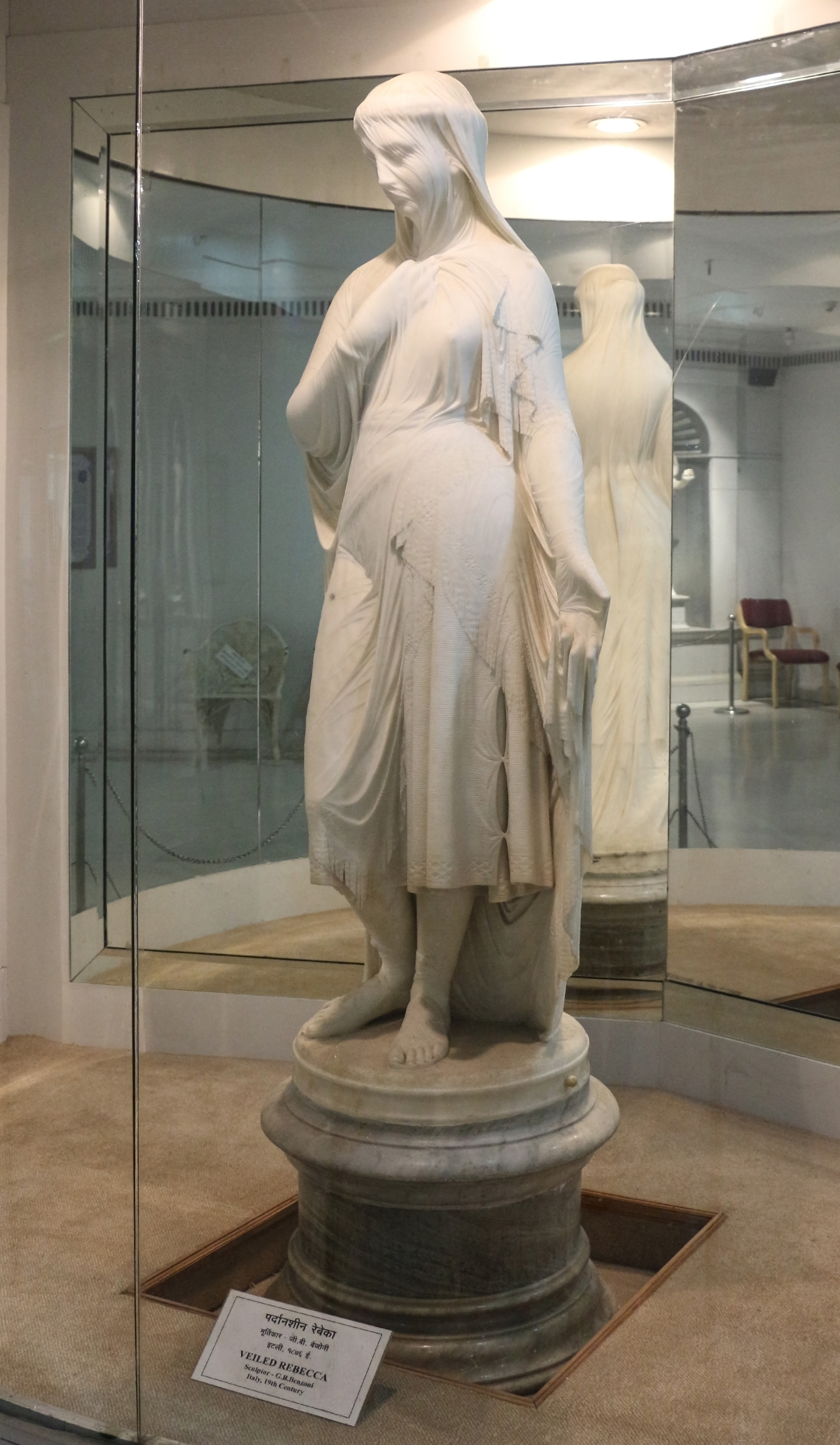
In 1876, on a trip to France the unique "double sculpture", ''[[Mephistopheles and Margaretta]]'' was acquired by [[Salar Jung I]]. He also traveled to Rome, where he purchased a marble statue called ''[[Veiled Rebecca]]''.<ref name="Salar">{{cite news |title=Salar Jung Museum's 'Double Statue' |url=https://www.livehistoryindia.com/story/art-history/salar-jung-museums-double-statue |access-date=10 February 2022 |publisher=Live History India |date=26 July 2019 |archive-date=10 February 2022 |archive-url=https://web.archive.org/web/20220210194255/https://www.livehistoryindia.com/story/art-history/salar-jung-museums-double-statue |url-status=live }}</ref> The Salar Jung family had a history of collecting art, and eventually the collections of Salar Jung I, II and III all ended up in the Salar Jung Museum.<ref name="Ians">{{cite news |last1=Ians |title=Salar Jung museum: How one man's art collection became a national treasure |url=https://www.business-standard.com/article/current-affairs/salar-jung-museum-how-one-man-s-art-collection-became-a-national-treasure-119012000161_1.html |access-date=11 February 2022 |publisher=Business Standard |date=20 January 2019 |archive-date=30 January 2022 |archive-url=https://web.archive.org/web/20220130042925/https://www.business-standard.com/article/current-affairs/salar-jung-museum-how-one-man-s-art-collection-became-a-national-treasure-119012000161_1.html |url-status=live }}</ref> | |||
The furniture collection includes pieces from the time of [[King Louis XIV]] and [[Napoleon]]. Salar Jung III collected about 43,000 | [[Art of Europe|European art]] from [[Art of the United Kingdom|British]], [[French art|French]] and [[Italian art|Italian]] artists are displayed. Among works on show are some by the notable artists [[Canaletto]], [[William-Adolphe Bouguereau]] and [[Francesco Hayez]].<ref name=":1" /><ref name=":0" /> The furniture collection includes pieces from the time of [[King Louis XIV]] and [[Napoleon]]. Salar Jung III collected about 43,000 artefacts and 50,000 books and manuscripts out of which only few are displayed in today's museum.<ref>{{cite news|url=https://timesofindia.indiatimes.com/india/Fire-scare-at-Salar-Jung-museum/articleshow/312804.cms|archive-url=https://web.archive.org/web/20110910011825/http://articles.timesofindia.indiatimes.com/2006-11-04/india/27809952_1_patna-museum-salar-jung-museum-museum-authorities|url-status=live|archive-date=2011-09-10|work=[[The Times of India]]|title=Fire scare at Salar Jung museum|date=2006-11-04}}</ref><ref>{{cite web |url=http://www.metrocitytimes.in/magazine/explo-re-the-belum-beau/ |url-status=dead |archive-url=https://web.archive.org/web/20110622084305/http://www.metrocitytimes.in/magazine/explo-re-the-belum-beau/ |archive-date=22 June 2011 |title=Metro City Times » Blog Archive » Explo re the Belum Beau}}</ref><ref>{{Cite web|url=http://7wondersofhyderabad.com/salarjung-museum/salar-jung-museum-2.html|title=important Exhibits|access-date=18 March 2008|archive-date=2 October 2018|archive-url=https://web.archive.org/web/20181002235643/http://7wondersofhyderabad.com/salarjung-museum/salar-jung-museum-2.html|url-status=live}}</ref> | ||
=== Eastern === | === Eastern === | ||
The Eastern block houses [[Japanese art|Japanese]] artworks, porcelain | The Eastern block houses [[Japanese art|Japanese]] artworks, porcelain pieces, [[samurai sword]]s and sculptures from China, Japan, Tibet and Burma.<ref>{{Cite news|url=https://www.thehindu.com/life-and-style/salar-jung-museum-the-must-go-to-place-for-locals-as-well-as-tourists/article19594340.ece|title=An all-season destination|last=Sripada|first=Krishna|date=2017-08-31|work=The Hindu|access-date=2018-10-18|language=en-IN|issn=0971-751X|archive-date=10 February 2022|archive-url=https://web.archive.org/web/20220210211740/https://www.thehindu.com/life-and-style/salar-jung-museum-the-must-go-to-place-for-locals-as-well-as-tourists/article19594340.ece|url-status=live}}</ref> | ||
=== Quran collections === | === Quran collections === | ||
The museum has a famous [[Quran]] collection, from around the world in different fonts and designs, called the Quran Written with Gold and Silver. There are many more collections of religious books, as well as Arabic Quran.<ref name="Quran_collection">{{cite web| title=events| url=http://www.salarjungmuseum.in/html/events_september.html| publisher=salarjungmuseum.in| year=2008| access-date=13 April 2012}}</ref> | The museum has a famous [[Quran]] collection, from around the world in different fonts and designs, called the Quran Written with Gold and Silver. There are many more collections of religious books, as well as Arabic Quran.<ref name="Quran_collection">{{cite web| title=events| url=http://www.salarjungmuseum.in/html/events_september.html| publisher=salarjungmuseum.in| year=2008| access-date=13 April 2012| archive-date=11 January 2013| archive-url=https://web.archive.org/web/20130111114604/http://www.salarjungmuseum.in/html/events_september.html| url-status=dead}}</ref> | ||
=== | === Clocks === | ||
[[File:The Veiled Rebecca 01.jpg|thumb|upright=0.66|alt= Full height, white marble statue of Veiled Rebecca at Salar Jung Museum|The Veiled Rebecca | [[File:The Veiled Rebecca 01.jpg|thumb|upright=0.66|alt= Full height, white marble statue of Veiled Rebecca at Salar Jung Museum|''[[Veiled Rebecca|The Veiled Rebecca]]'' (1863), by [[Giovanni Maria Benzoni]]]]A variety and array of clocks are in the clock room. There are ancient sundials in the form of obelisks to huge and modern clocks of the twentieth century. Others in the range vary from miniature clocks which need a magnifying glass to view closely, to stately grandfather clocks from place such as France, Germany, Italy, Switzerland and Britain, including the musical clock Salar Jung bought from Cook and Kelvey of England. | ||
The | The variety of clocks includes the bird cage clocks, [[bracket clock]]s, [[grandfather clock]]s, [[skeleton clock]]s, etc. The museum also has examples of the clocks of the contemporary period of Louis XV, Louis XVI, and Napoleon 1st of France. | ||
The [[Parliament of India|Indian Parliament]] has declared the museum an Institution of<!-- Deleted image removed: [[File:salarjung museum musical clock.jpg|thumb|right|The musical clock in the Salar Jung Museum ]] --> National Importance. | The [[Parliament of India|Indian Parliament]] has declared the museum an [[Institutes of National Importance|Institution of<!-- Deleted image removed: [[File:salarjung museum musical clock.jpg|thumb|right|The musical clock in the Salar Jung Museum ]] --> National Importance]]. | ||
=== | |||
There is a collection of about 600 | === Coins === | ||
There is a collection of about 600 coins the from VijayNagar dynasty to Bahmani empire, Moghul empire and Modern India. A few coins are 2300 years old. Some Punch Mark coins from Kushan dynasty are also preserved. The coins are made of silver, copper, lead.<ref name="TOI">{{cite news |last1=Ifthekhar |first1=J.S. |title=New coins gallery to open at Salar Jung Museum |url=https://www.thehindu.com/news/national/new-coins-gallery-to-open-at-salar-jung-museum/article6836365.ece |access-date=10 February 2022 |agency=The Hindu |issue=Hyderabad |publisher=The Hindu Group |date=30 January 2015 |archive-date=10 February 2022 |archive-url=https://web.archive.org/web/20220210115627/https://www.thehindu.com/news/national/new-coins-gallery-to-open-at-salar-jung-museum/article6836365.ece |url-status=live }}</ref> | |||
== Facilities ==<!-- Deleted image removed: [[File:Salarjungmuseum.jpg|thumb|]] --> | == Facilities ==<!-- Deleted image removed: [[File:Salarjungmuseum.jpg|thumb|]] --> | ||
The museum building, semicircular in shape with 38 galleries, spread on two floors, displays only a part of the original collection. The ground floor has 20 galleries and the first floor has 18 galleries. The exhibits on different subjects are displayed in separate galleries. Each gallery is huge and has many | The museum building, semicircular in shape with 38 galleries, spread on two floors, displays only a part of the original collection. The ground floor has 20 galleries and the first floor has 18 galleries. The exhibits on different subjects are displayed in separate galleries. Each gallery is huge and has many artefacts on display including ones dating back to the 4th century. There are plans for a new Islamic Gallery, where Islamic artefacts and manuscripts of the [[Quran|Qur'an]] will be displayed.<ref>{{Cite news|url=https://www.thehindu.com/todays-paper/tp-national/tp-andhrapradesh/indias-first-islamic-art-gallery-soon/article24478533.ece|title=India's first Islamic Art Gallery soon|last=Nanisetti|first=Serish|date=2018-07-21|work=The Hindu|access-date=2018-10-18|language=en-IN|issn=0971-751X|archive-date=9 September 2021|archive-url=https://web.archive.org/web/20210909145119/https://www.thehindu.com/todays-paper/tp-national/tp-andhrapradesh/indias-first-islamic-art-gallery-soon/article24478533.ece|url-status=live}}</ref><ref>{{Cite news|url=https://timesofindia.indiatimes.com/city/hyderabad/salarjung-museums-art-gallery-to-be-worlds-biggest-cradle-of-islamic-legacy-heritage/articleshow/57443152.cms|title=Salarjung Museum's art gallery to be world's biggest cradle of Islamic legacy & heritage - Times of India|last=Akbar|first=Syed|work=The Times of India|access-date=2018-10-18|archive-date=9 November 2018|archive-url=https://web.archive.org/web/20181109040737/https://timesofindia.indiatimes.com/city/hyderabad/salarjung-museums-art-gallery-to-be-worlds-biggest-cradle-of-islamic-legacy-heritage/articleshow/57443152.cms|url-status=live}}</ref> | ||
Apart from the galleries, there is a reference | Apart from the galleries, there is a reference library, reading room, publication and education section, chemical conservation lab, sales counter, cafeteria etc.<ref name=":1" /><ref>{{Cite news|url=https://www.newindianexpress.com/cities/hyderabad/2018/sep/05/salar-jung-museum-impenetrable-1867695.html|title='Salar Jung Museum impenetrable'|work=The New Indian Express|access-date=2018-10-18|archive-date=19 October 2018|archive-url=https://web.archive.org/web/20181019001744/http://www.newindianexpress.com/cities/hyderabad/2018/sep/05/salar-jung-museum-impenetrable-1867695.html|url-status=live}}</ref><ref>{{Cite news|url=https://www.thehindu.com/news/cities/Hyderabad/salar-jung-goes-solar/article4365948.ece|title=Salar Jung goes solar|last=Ifthekhar|first=J. S.|date=2013-02-01|work=The Hindu|access-date=2018-10-18|language=en-IN|issn=0971-751X|archive-date=9 September 2021|archive-url=https://web.archive.org/web/20210909142132/https://www.thehindu.com/news/cities/Hyderabad/salar-jung-goes-solar/article4365948.ece|url-status=live}}</ref> | ||
==Gallery== | ==Gallery== | ||
| Line 97: | Line 124: | ||
File:Salar Jung Museum Hyderabad Front View.jpg|Front view of Salar Jung Museum | File:Salar Jung Museum Hyderabad Front View.jpg|Front view of Salar Jung Museum | ||
File:Salar jung museum hyderabad.jpg|Museum building against cloudy backdrop | File:Salar jung museum hyderabad.jpg|Museum building against cloudy backdrop | ||
File:Salar | File:Musi river and Salar jung Museum.jpg|A view of Salar Jung Museum along with [[Musi River (India)|Musi River]] | ||
File: | File:Eka-Mukha Linga 04.jpg|[[Mukhalinga#One-faced Mukhalinga|Eka-Mukhalinga]], 4th or 5th century CE | ||
File:Nandi - Salar Jung Museum 04.jpg|[[Nandi (bull)|Nandi]] 12th century CE | File:Nandi - Salar Jung Museum 04.jpg|[[Nandi (bull)|Nandi]], 12th century CE | ||
File:MayurPankhi in Ivory 05.jpg|Mayur Pankhi in [[Ivory carving|ivory]] | |||
File:Salar jung museum.JPG|Royal elephant in ivory | |||
File:Arabic caligraphy in Salarjung Museum, Hyderabad, India.jpg|[[Arabic calligraphy]] (from the [[Quran]]) | File:Arabic caligraphy in Salarjung Museum, Hyderabad, India.jpg|[[Arabic calligraphy]] (from the [[Quran]]) | ||
File: | File:Garuda in Anjali-Mudra.jpg|[[Garuda]] in [[Añjali Mudrā|Anjali Mudra]], 18th century CE | ||
File: | File:The Veiled Rebecca 02.jpg|[[Veiled Rebecca|The Veiled Rebecca]]: melody in marble, 1863 | ||
File:Scuola francese, mefistofele e margaretta, dal faust, 1890 ca. 02.jpg|[[Mephistopheles & Margaretta (sculpture)]] | File:Scuola francese, mefistofele e margaretta, dal faust, 1890 ca. 02.jpg|[[Mephistopheles & Margaretta (sculpture)|Mephistopheles and Margaretta]], c. 1876 | ||
File:Salar Jung Museum - Hand Guns & Knives.jpg|[[Dagger|Knives]] and [[War hammer|hammers]] | |||
File: | File:Salar-Jung-Museum-hyderabad 67.jpg|Porcelain collection | ||
File:Salar-Jung-Museum-hyderabad 67.jpg| | |||
File:Salar-Jung-Museum-hyderabad 60.jpg | File:Salar-Jung-Museum-hyderabad 60.jpg | ||
File:Salar-Jung-Museum-hyderabad 57.jpg | File:Salar-Jung-Museum-hyderabad 57.jpg | ||
File:Salar-Jung-Museum-hyderabad 58.jpg | File:Salar-Jung-Museum-hyderabad 58.jpg | ||
File:Hyderabad, salarjung museum, sala francese 01.jpg | File:Hyderabad, salarjung museum, sala francese 01.jpg | ||
File:Hyderabad, salarjung museum, sala francese 02.jpg | File:Hyderabad, salarjung museum, sala francese 02.jpg | ||
| Line 120: | Line 146: | ||
==See also== | ==See also== | ||
{{Portal|Hyderabad}} | |||
* [[List of museums in India]] | * [[List of museums in India]] | ||
* [[List of largest art museums | * [[List of largest art museums]] | ||
* [[Salar Jung III]] | * [[Salar Jung III]] | ||
| Line 129: | Line 155: | ||
==External links== | ==External links== | ||
*{{Commons category inline|Collections of the Salar Jung Museum}} | *{{Commons category-inline|Collections of the Salar Jung Museum}} | ||
*{{Commons category inline|Salar Jung Museum}} | *{{Commons category-inline|Salar Jung Museum}} | ||
* [https://archive.today/20130126112837/http://articles.timesofindia.indiatimes.com/2011-10-21/hyderabad/30306075_1_sjm-state-archives-salar-jung-museum History of its formation after Indian Independence] | * [https://archive.today/20130126112837/http://articles.timesofindia.indiatimes.com/2011-10-21/hyderabad/30306075_1_sjm-state-archives-salar-jung-museum History of its formation after Indian Independence] | ||
*[http://www.india.com.my/hyderabad/salar_jung_museum.htm India Travel & Tour Information Portal] | *[https://web.archive.org/web/20160304185738/http://www.india.com.my/hyderabad/salar_jung_museum.htm India Travel & Tour Information Portal] (archived) | ||
{{Hyderabad topics}} | {{Hyderabad topics}} | ||
| Line 140: | Line 166: | ||
[[Category:Art museums and galleries in India]] | [[Category:Art museums and galleries in India]] | ||
[[Category:Decorative arts museums in India]] | [[Category:Decorative arts museums in India]] | ||
[[Category:Hyderabad | [[Category:History of Hyderabad, India]] | ||
[[Category:Museums in Hyderabad, India]] | [[Category:Museums in Hyderabad, India]] | ||
[[Category:Art museums established in 1951]] | [[Category:Art museums and galleries established in 1951]] | ||
[[Category:1951 establishments in India]] | [[Category:1951 establishments in India]] | ||
[[Category:Salar Jung family]] | [[Category:Salar Jung family]] | ||
[[Category:Tourist attractions in Hyderabad, India]] | [[Category:Tourist attractions in Hyderabad, India]] | ||
[[Category:Salar Jung Museum]] | |||
Latest revision as of 07:15, 19 February 2026
17°22′17″N 78°28′49″E / 17.371426°N 78.480347°E
Infobox | |
 The Salar Jung Museum building | |
| Established | 16 December 1951 |
|---|---|
| Location | Dar-ul-Shifa, Hyderabad, Telangana, India |
| Type | Art Museum |
| Key holdings | Veiled Rebecca |
| Collection size | 1.1 million objects |
| Owner | Government of India |
| Website | www |
The Salar Jung Museum is an art museum located at Dar-ul-Shifa, on the southern bank of the Musi River in the city of Hyderabad, Telangana, India. It is one of the notable National Museums of India.[1] Originally a private art collection of the Salar Jung family, it was endowed to the nation after the death of Salar Jung III. It was inaugurated on 16 December 1951.
It has a collection of sculptures, paintings, carvings, textiles, manuscripts, ceramics, metallic artefacts, carpets, clocks, and furniture from Japan, China, Burma, Nepal, India, Persia, Egypt, Europe, and North America.
History[edit | edit source]

A nobleman of the Salar Jung family of Hyderabad, Nawab Mir Yousuf Ali Khan, Salar Jung III (1889–1949) served as Prime Minister of Hyderabad during the Nizam's rule in Hyderabad state. He spent a substantial amount of his income, over a period of thirty-five years, collecting artefacts from all across the world.
After the Nawab died in 1949, the collections were left behind in his ancestral palace Diwan Devdi. The collection was formerly exhibited there as a private museum, named Salar Jung Museum, which was inaugurated by Jawaharlal Nehru on 16 December 1951.[2][3]
Old timers believe that the present collection constitutes only half of the original art wealth collected by the Nawab. His employees siphoned off part of it, since the Nawab depended upon his staff to keep a vigil.[citation needed]
The state decided to shift the museum to a new building and after a design competition, Mohammed Fayazuddin was selected as the architect of the new building.[4]
The foundation stone was laid by Jawaharlal Nehru in 1963, and in 1968, the museum shifted to its present location at Dar-ul-Shifa, and is administered by a board of trustees with the governor of Telangana as ex officio chairperson under the Salar Jung Museum Act of 1961. Some more art pieces were lost or stolen during the shifting of the museum from Dewan Devdi to the present site.[5]
In 2003, the museum signed a memorandum of understanding with the National Mission for Manuscripts, and was declared a manuscript conservation centre.
In 2006, a fire broke out in an auditorium in the museum premises. However, it was quickly extinguished and none of the artefacts were damaged.[6][7] After the incident, fire safety facilities were upgraded.[8]
Collections[edit | edit source]
Collection at the Salar Jung Museum can be broadly classified into Indian Art, Middle Eastern Art, Far Eastern Art, European Art and Children's Section. Other than this a founder gallery is created which is dedicated to Salar Jung Family.
Indian Art[edit | edit source]
Indian Collection can be categorised into following galleries Indian Bronze, Indian Textile, Indian Sculpture, Minor arts of South India, Miniature Paintings, Ivory Carvings arms and armour, Metal Ware and Jade Carving.
Indian Miniature Painting[edit | edit source]
The history of miniature painting can be traced to 14th century. Before the invention of paper, the art was practised on cloth or certain kinds of leaves. The museum houses manuscripts on leaves from 15th- and 16th-century Gujrat. It holds a range of miniature paintings from Mughal, Rajasthani, Thanjavur, Malwa and Deccan schools.[9]


Notable works of miniature painting are:[9]
- The Birth of the Prince, which captures the spirit of a significant event and depicts both Persian and Indian influence
- From the Mughal school, showing European influence is Madonna with Child, from the 16th century
- An important painting from the Mughal school of the 17th century is Prince with a Hawk. This is among the earliest of Mughal artistic works that depict facial features of Persians
- A Mughal miniature painting which shows the style in full bloom is King with Nobles
The Deccan school with centres at Golconda, Bijapur, Bidar, Gulbarga and Ahmednagar, also produced some fine pieces of miniature painting which were strongly influenced by Mughal and Persian miniature-painting styles. Some noteworthy examples of both paintings and manuscripts in the museum: Bhog Bal, dated from 16th century, is one of the most prominent of the manuscripts; a painting showing Jamshed Quli and Ibrahim Quli in conversation is a good example of Golconda School; an interesting painting from Bijapur School is Elephants in a Fight. There are several paintings of Yoginis and from Ragamala.[9]
Modern Painting[edit | edit source]
Salar Jung III hand acquired few Modern Paintings but majority of the paintings in collection were collected by the museum in 1962. In India Ravi Verma was the pioneer of the Modern School, he worked with oil medium depicting Indian mythology and classic themes. The museum has two of his works, Stolen Interview and The Kerela Beauty. Other masters of the Modern School whose works are presented in the museum are Varma and Abdur Rahman Chughtai,[10] M. F. Husain,[11] K.K. Hebbar, Rabindranath Tagore, Abanidranath Tagore[12] Chugtai and Nandalal Bose[9]
Ivory Carving[edit | edit source]

The Museum contains important examples of ivory carvings in different forms, such as furniture, mats, lamps, handles of daggers, chess and chausars. The chessman and chausar are interesting elements, the pawns being depicted as soldiers, while the king and queen are riding on elephants. These painted pieces belong to North India.[9]
The most notable element is the ivory carved chair gifted to Tipu Sultan by Louis XVI. The backrest of the chair is a fine lattice pattern and the armrest is carved as a lion head. Ivory lamp also deserves a special mention owing to its intricate craftsmanship and is the only ivory carving example from Mysore.[9]
The "Founder's Gallery" houses portraits of Salar Jung III, as well as other members of the Salar Jung family.
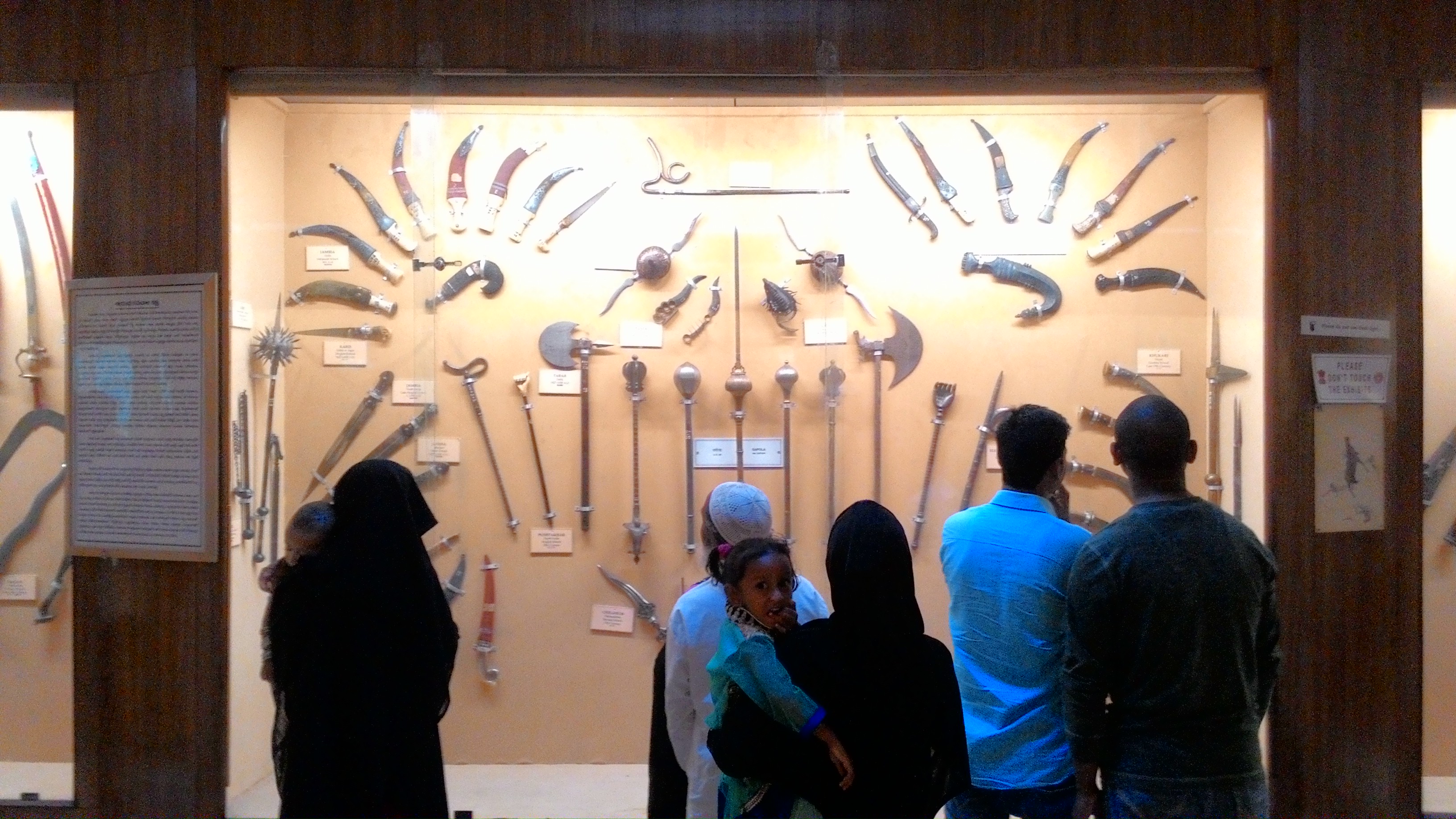
The Indian block includes jade-crafted daggers[13] of Jahangir, Nur Jahan and Shah Jahan; and weapons belonging to Aurangzeb, Tipu Sultan, Muhammad Shah, Bahadur Shah and Abul Hasan Qutb Shah.[14][15]
Indian sculptures from the Gandhara and Chola periods are also displayed.
Jade Collection[edit | edit source]
Salarjung Museum's Jade Collection is one of the largest collection of jade displayed for public in India. The collection as per a publication from 1979 of Salar Jung Museum suggests that there were 984 objects with varying degree of craftsmanship. Most of the artefacts are from the Mughal Empire and some from the Asaf Jah Dynasty.

Western[edit | edit source]
In 1876, on a trip to France the unique "double sculpture", Mephistopheles and Margaretta was acquired by Salar Jung I. He also traveled to Rome, where he purchased a marble statue called Veiled Rebecca.[16] The Salar Jung family had a history of collecting art, and eventually the collections of Salar Jung I, II and III all ended up in the Salar Jung Museum.[17]
European art from British, French and Italian artists are displayed. Among works on show are some by the notable artists Canaletto, William-Adolphe Bouguereau and Francesco Hayez.[12][14] The furniture collection includes pieces from the time of King Louis XIV and Napoleon. Salar Jung III collected about 43,000 artefacts and 50,000 books and manuscripts out of which only few are displayed in today's museum.[18][19][20]
Eastern[edit | edit source]
The Eastern block houses Japanese artworks, porcelain pieces, samurai swords and sculptures from China, Japan, Tibet and Burma.[21]
Quran collections[edit | edit source]
The museum has a famous Quran collection, from around the world in different fonts and designs, called the Quran Written with Gold and Silver. There are many more collections of religious books, as well as Arabic Quran.[22]
Clocks[edit | edit source]

A variety and array of clocks are in the clock room. There are ancient sundials in the form of obelisks to huge and modern clocks of the twentieth century. Others in the range vary from miniature clocks which need a magnifying glass to view closely, to stately grandfather clocks from place such as France, Germany, Italy, Switzerland and Britain, including the musical clock Salar Jung bought from Cook and Kelvey of England.
The variety of clocks includes the bird cage clocks, bracket clocks, grandfather clocks, skeleton clocks, etc. The museum also has examples of the clocks of the contemporary period of Louis XV, Louis XVI, and Napoleon 1st of France.
The Indian Parliament has declared the museum an Institution of National Importance.
Coins[edit | edit source]
There is a collection of about 600 coins the from VijayNagar dynasty to Bahmani empire, Moghul empire and Modern India. A few coins are 2300 years old. Some Punch Mark coins from Kushan dynasty are also preserved. The coins are made of silver, copper, lead.[23]
Facilities[edit | edit source]
The museum building, semicircular in shape with 38 galleries, spread on two floors, displays only a part of the original collection. The ground floor has 20 galleries and the first floor has 18 galleries. The exhibits on different subjects are displayed in separate galleries. Each gallery is huge and has many artefacts on display including ones dating back to the 4th century. There are plans for a new Islamic Gallery, where Islamic artefacts and manuscripts of the Qur'an will be displayed.[24][25]
Apart from the galleries, there is a reference library, reading room, publication and education section, chemical conservation lab, sales counter, cafeteria etc.[12][26][27]
Gallery[edit | edit source]
-
 Front view of Salar Jung Museum
 -
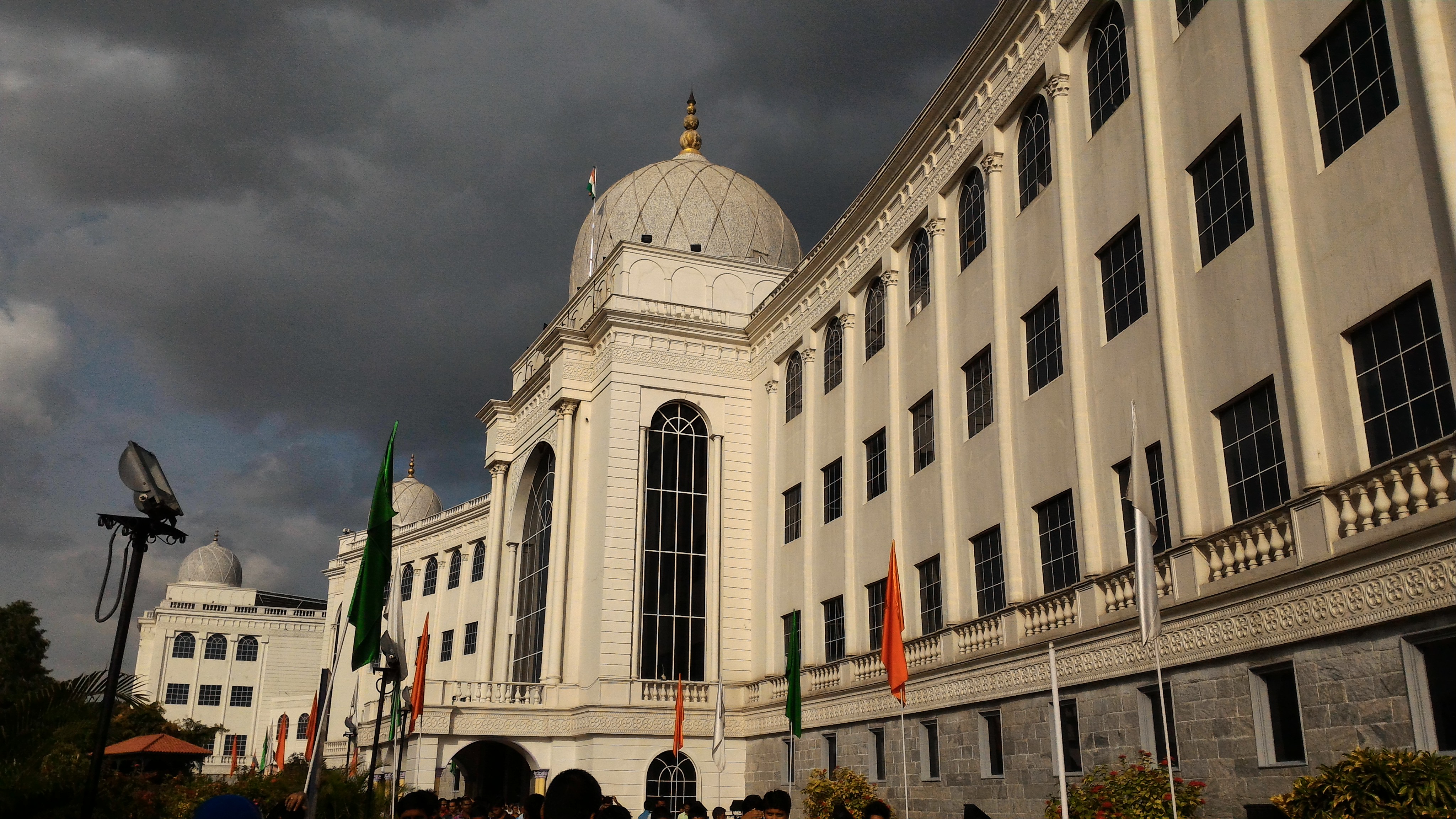 Museum building against cloudy backdrop
 -
 A view of Salar Jung Museum along with Musi River
 -
 Eka-Mukhalinga, 4th or 5th century CE
 -
 Nandi, 12th century CE
 -
 Mayur Pankhi in ivory
 -
 Royal elephant in ivory
 -
 Arabic calligraphy (from the Quran)
 -
 Garuda in Anjali Mudra, 18th century CE
 -
 The Veiled Rebecca: melody in marble, 1863
 -
 Mephistopheles and Margaretta, c. 1876
 -
-
 Porcelain collection
 -

-

-

-

-

-

-

-


See also[edit | edit source]
References[edit | edit source]
- ↑ [Book name: Footprint India By Roma Bradnock,ISBN 978-1-906098-05-6, p-1033]
- ↑ "585 Rani Sarma, Diwan Deodi". www.india-seminar.com. Archived from the original on 8 August 2018. Retrieved 6 August 2018.
- ↑ "Treasures of Salar Jung Museum - Salar Jung Museum". Archived from the original on 20 December 2018. Retrieved 6 August 2018.
- ↑ Khalidi, Omar (2009). A Guide to Architecture in Hyderabad, Deccan, India (PDF). p. 238. Archived from the original (PDF) on 13 March 2020.
- ↑ "Old timer's belief". Archived from the original on 2 October 2018. Retrieved 18 March 2008.
- ↑ "Major Fire Breaks Out in Salar Jung Museum". Arab News. 4 November 2006. Archived from the original on 16 November 2022. Retrieved 18 October 2018.
- ↑ "Fire at world-famous Salarjung Museum - Times of India". The Times of India. Archived from the original on 19 October 2018. Retrieved 18 October 2018.
- ↑ "Latest fire safety system for Salar Jung Museum soon". The Hindu. 2 December 2006. ISSN 0971-751X. Archived from the original on 16 November 2022. Retrieved 18 October 2018.
- ↑ 9.0 9.1 9.2 9.3 9.4 9.5 Reddy, A.K.V.S (1992). Salar Jung Museum Guide (1st ed.). Hyderabad: Salar Jung Museum.
- ↑ "Lady lighting lamp - Abdur Rahman Chugtai - Google Arts & Culture". Google Cultural Institute. Archived from the original on 8 August 2019. Retrieved 26 September 2018.
- ↑ "Seated lady - M.F. Hussain - Google Arts & Culture". Google Cultural Institute. Archived from the original on 9 September 2021. Retrieved 26 September 2018.
- ↑ 12.0 12.1 12.2 "Galleries". Archived from the original on 15 May 2007.
- ↑ Staff Reporter (2 January 2013). "Jade evokes an old-world charm". The Hindu. ISSN 0971-751X. Archived from the original on 9 September 2021. Retrieved 18 October 2018.
- ↑ 14.0 14.1 "Welcome to Salarjung Museum". salarjungmuseum.in. Archived from the original on 10 June 2020. Retrieved 18 October 2018.
- ↑ Kotaiah, B. (7 February 2013). "Salar Jung Museum weaponry: armed to the hilt". The Hindu. ISSN 0971-751X. Archived from the original on 9 September 2021. Retrieved 18 October 2018.
- ↑ "Salar Jung Museum's 'Double Statue'". Live History India. 26 July 2019. Archived from the original on 10 February 2022. Retrieved 10 February 2022.
- ↑ Ians (20 January 2019). "Salar Jung museum: How one man's art collection became a national treasure". Business Standard. Archived from the original on 30 January 2022. Retrieved 11 February 2022.
- ↑ "Fire scare at Salar Jung museum". The Times of India. 4 November 2006. Archived from the original on 10 September 2011.
- ↑ "Metro City Times » Blog Archive » Explo re the Belum Beau". Archived from the original on 22 June 2011.
- ↑ "important Exhibits". Archived from the original on 2 October 2018. Retrieved 18 March 2008.
- ↑ Sripada, Krishna (31 August 2017). "An all-season destination". The Hindu. ISSN 0971-751X. Archived from the original on 10 February 2022. Retrieved 18 October 2018.
- ↑ "events". salarjungmuseum.in. 2008. Archived from the original on 11 January 2013. Retrieved 13 April 2012.
- ↑ Ifthekhar, J.S. (30 January 2015). "New coins gallery to open at Salar Jung Museum". No. Hyderabad. The Hindu Group. The Hindu. Archived from the original on 10 February 2022. Retrieved 10 February 2022.
- ↑ Nanisetti, Serish (21 July 2018). "India's first Islamic Art Gallery soon". The Hindu. ISSN 0971-751X. Archived from the original on 9 September 2021. Retrieved 18 October 2018.
- ↑ Akbar, Syed. "Salarjung Museum's art gallery to be world's biggest cradle of Islamic legacy & heritage - Times of India". The Times of India. Archived from the original on 9 November 2018. Retrieved 18 October 2018.
- ↑ "'Salar Jung Museum impenetrable'". The New Indian Express. Archived from the original on 19 October 2018. Retrieved 18 October 2018.
- ↑ Ifthekhar, J. S. (1 February 2013). "Salar Jung goes solar". The Hindu. ISSN 0971-751X. Archived from the original on 9 September 2021. Retrieved 18 October 2018.