

m Removed empty portal template using script |
No edit summary |
||
| Line 1: | Line 1: | ||
{{Short description|Caves in Madhya Pradesh, India}} | |||
{{Use dmy dates|date=February 2019}} | {{Use dmy dates|date=February 2019}} | ||
{{Use Indian English|date=February 2019}} | {{Use Indian English|date=February 2019}} | ||
| Line 40: | Line 41: | ||
The '''Dhamnar Caves''' are caves located in the village of Dhamnar, located in [[Mandsaur district]] in the state of [[Madhya Pradesh]], [[India]]. This rock cut site consists of 51 caves, [[stupa]]s, [[Chaitya]]s, passages, and compact dwellings, carved in the 7th century CE. The site includes large statues of [[Gautama Buddha]] in sitting and [[Nirvana]] [[Mudra#Common Buddhist mudrās|mudra]].<ref name=Archaeological>{{cite web|last=Archaeological Survey of India, Bhopal Circle|title=Monument >> Mandsaur >> Dhamnar Buddhist caves No. 1 to 51|url=http://www.asibhopal.nic.in/monument/mandsaur_dhamnar_buddhistcavesn.html#des|publisher=Govt of India, Ministry of Culture|accessdate=1 December 2013}}</ref> | The '''Dhamnar Caves''' are caves located in the village of Dhamnar, located in [[Mandsaur district]] in the state of [[Madhya Pradesh]], [[India]]. This rock cut site consists of 51 caves, [[stupa]]s, [[Chaitya]]s, passages, and compact dwellings, carved in the 7th century CE. The site includes large statues of [[Gautama Buddha]] in sitting and [[Nirvana]] [[Mudra#Common Buddhist mudrās|mudra]].<ref name=Archaeological>{{cite web|last=Archaeological Survey of India, Bhopal Circle|title=Monument >> Mandsaur >> Dhamnar Buddhist caves No. 1 to 51|url=http://www.asibhopal.nic.in/monument/mandsaur_dhamnar_buddhistcavesn.html#des|publisher=Govt of India, Ministry of Culture|accessdate=1 December 2013}}</ref> | ||
Fourteen caves on the northern side are considered historically significant, among which ''Bari Kacheri'' (big courthouse) and ''Bhima Bazar'' are the most so. | Fourteen caves on the northern side are considered historically significant, among which ''Bari Kacheri'' (big courthouse) and ''Bhima Bazar'' are the most so. The Bari Kacheri cave measures 20 feet square and includes stupas and chaityas. The porch includes stone railing with the wooden architecture. Bhima Bazar cave is the largest among the group, measuring 115 feet by 80 and including vihara and ''chaityagriha''. It consists of stupas. The roof is in poor condition with the support of wooden architecture.<ref name=Imperial>{{cite journal|title=DHAMPUR TAHSIL|journal=Imperial Gazetteer of India|volume=11|page=283|url=https://dsal.uchicago.edu/reference/gazetteer/text.html?objectid=DS405.1.I34_V11_289.gif|accessdate=1 December 2013}}</ref> | ||
== Architecture == | |||
The Dhamnar caves include 51 rock cut caves containing [[Buddhism|Buddhist]] structures like [[Stupa|stupas]], [[Chaitya|chaityas]], porch and small chambers both of [[Hinayana]] and [[Mahayana]] sects of [[Buddhism]] constructed around 5th-6th centuries AD. | |||
This structure includes colossal seating figure of [[Gautama Buddha|Buddha]] and it also includes [[Brahminical]] rock cut caves (7th-8th century AD) and a single monolithic temple dedicated to Lord [[Vishnu]] (8th-9th century AD). | |||
The structure was crumbling before its restoration by [[Archaeological Survey of India|Archeological Survey of India]] mainly because of being constructed by porous [[laterite]] rocks which got weathered badly over the centuries, destabilizing and weakening the structure.<ref>{{Cite web |date=2015-05-02 |title=MP: Dhamnar caves conservation plan can be replicated, says ASI |url=https://www.hindustantimes.com/bhopal/mp-dhamnar-caves-conservation-plan-can-be-replicated-says-asi/story-gJiCKrQyUKVX8yyJ6moAsK.html |access-date=2022-03-15 |website=Hindustan Times |language=en}}</ref> | |||
== Gallery == | |||
<gallery> | <gallery> | ||
File:ASI Dhamnar Caves plan.jpg|Dhamnar Caves plan | File:ASI Dhamnar Caves plan.jpg|Dhamnar Caves plan | ||
| Line 63: | Line 72: | ||
{{Indian Buddhist Caves}} | {{Indian Buddhist Caves}} | ||
{{Portal|India}} | |||
[[Category:Buddhist monasteries in India]] | [[Category:Buddhist monasteries in India]] | ||
[[Category:Buddhist caves in | [[Category:Buddhist caves in Madhya Pradesh]] | ||
[[Category:Caves of Madhya Pradesh]] | [[Category:Caves of Madhya Pradesh]] | ||
[[Category:Tourist attractions in Mandsaur district]] | [[Category:Tourist attractions in Mandsaur district]] | ||
[[Category: | [[Category:Rock-cut architecture of India]] | ||
[[Category:Colossal Buddha statues]] | [[Category:Colossal Buddha statues in India]] | ||
[[Category:Former populated places in India]] | [[Category:Former populated places in India]] | ||
[[Category:Buddhist pilgrimage sites in India]] | [[Category:Buddhist pilgrimage sites in India]] | ||
[[Category:Architecture | [[Category:Architecture in India]] | ||
[[Category:Caves containing pictograms in India]] | [[Category:Caves containing pictograms in India]] | ||
Latest revision as of 00:11, 1 May 2025
Dhamnar Caves | |
 Overview of the Dhamnar Caves at Chandwasa in Mandsaur district. | |
  Shown within India | |
| Coordinates | 24°11′35″N 75°29′53″E / 24.19306°N 75.49806°E |
|---|---|
| Type | Buddhist caves |
| Pilgrimage to |
| Buddha's Holy Sites |
|---|
 |
| The Four Main Sites |
| Four Additional Sites |
| Other Sites |
| Later Sites |
The Dhamnar Caves are caves located in the village of Dhamnar, located in Mandsaur district in the state of Madhya Pradesh, India. This rock cut site consists of 51 caves, stupas, Chaityas, passages, and compact dwellings, carved in the 7th century CE. The site includes large statues of Gautama Buddha in sitting and Nirvana mudra.[1]
Fourteen caves on the northern side are considered historically significant, among which Bari Kacheri (big courthouse) and Bhima Bazar are the most so. The Bari Kacheri cave measures 20 feet square and includes stupas and chaityas. The porch includes stone railing with the wooden architecture. Bhima Bazar cave is the largest among the group, measuring 115 feet by 80 and including vihara and chaityagriha. It consists of stupas. The roof is in poor condition with the support of wooden architecture.[2]
Architecture[edit | edit source]
The Dhamnar caves include 51 rock cut caves containing Buddhist structures like stupas, chaityas, porch and small chambers both of Hinayana and Mahayana sects of Buddhism constructed around 5th-6th centuries AD.
This structure includes colossal seating figure of Buddha and it also includes Brahminical rock cut caves (7th-8th century AD) and a single monolithic temple dedicated to Lord Vishnu (8th-9th century AD).
The structure was crumbling before its restoration by Archeological Survey of India mainly because of being constructed by porous laterite rocks which got weathered badly over the centuries, destabilizing and weakening the structure.[3]
Gallery[edit | edit source]
-
 Dhamnar Caves plan
 -
 The caves.
 -
 Rock cut Dhamnar caves
 -
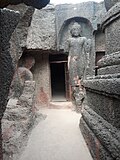 Buddhist sculpture caves
 -
 Dhamnar caves
 -
 Badi Kachahari (Cave-6)
 -
 Dhamnar Caves facade
 -
 Dhamnar Caves stupas


See also[edit | edit source]
Further reading[edit | edit source]
- Jain, Kailash Chand (1972). Malwa Through the Ages, from the Earliest Times to 1305 A.D. Motilal Banarsidass Pub. pp. 426–427. ISBN 812080824X.
- Verma, Archana (2007). Cultural and Visual Flux at Early Historical Bagh in Central India. Archaeopress British Archaeological Reports. p. 11. ISBN 978-1407301518.
Citations[edit | edit source]
- ↑ Archaeological Survey of India, Bhopal Circle. "Monument >> Mandsaur >> Dhamnar Buddhist caves No. 1 to 51". Govt of India, Ministry of Culture. Retrieved 1 December 2013.
- ↑ "DHAMPUR TAHSIL". Imperial Gazetteer of India. 11: 283. Retrieved 1 December 2013.
- ↑ "MP: Dhamnar caves conservation plan can be replicated, says ASI". Hindustan Times. 2 May 2015. Retrieved 15 March 2022.


- Pages using the JsonConfig extension
- Buddhist monasteries in India
- Buddhist caves in Madhya Pradesh
- Caves of Madhya Pradesh
- Tourist attractions in Mandsaur district
- Rock-cut architecture of India
- Colossal Buddha statues in India
- Former populated places in India
- Buddhist pilgrimage sites in India
- Architecture in India
- Caves containing pictograms in India