


m Removing protection template from an unprotected page |
Article updated with improved flow |
||
| Line 1: | Line 1: | ||
{{Short description| | {{Short description|Rajput clan}} | ||
{{About|the tribe|other uses|}} | {{About|the tribe|other uses|}} | ||
{{Distinguish|Bhatti}} | {{Distinguish|Bhatti}} | ||
{{pp|small=yes}} | |||
{{EngvarB|date=July 2017}} | {{EngvarB|date=July 2017}} | ||
{{Use dmy dates|date=June 2020}} | {{Use dmy dates|date=June 2020}} | ||
{{Infobox noble house | |||
[[ | | surname = | ||
| native_name = | |||
| native_name_lang = | |||
| other_name = House of Jaisalmer | |||
| coat of arms = COA of Jaisalmer State.svg | |||
| coat_of_arms_size = 200px | |||
| coat_of_arms_caption = Coat of arms | |||
| image = Jaisalmer Flag.svg | |||
| image_caption = Flag of the Kingdom of Jaisalmer | |||
| type = <!-- Royal house, noble house, etc. --> | |||
| parent house = | |||
| country = [[Kingdom of Jaisalmer]] | |||
| founded = 3rd century | |||
| founder = [[Rao Bhati]] | |||
| current head = Chaitanya Raj Singh | |||
| dissolution = | |||
| final ruler = Maharawal Girdhar Singh | |||
| titles = [[Rawal (title)|Rawal]] (later Maharawal) of [[kingdom of Jaisalmer|Jaisalmer]] | |||
| styles = | |||
| deposition = | |||
| cadet branches = | |||
}} | |||
'''Bhati''' (also [[Romanization|romanised]] as '''Bhattī''') is a [[Rajput]] clan.<ref>{{Cite book |last=Rathore |first=Virendra Singh |url=https://books.google.com/books?id=NvUBEAAAQBAJ&dq=bhati+yaduvanshi&pg=PA54 |title=Prithviraj Chauhan - a Light on the Mist in History |date=2020-09-29 |publisher=Virendra Singh Rathore |isbn=978-1-63640-019-8 |language=en}}</ref> The Bhati clan historically ruled over several cities in present-day [[India]] and [[Pakistan]] with their final capital and kingdom being [[Jaisalmer]], India.<ref>{{Cite book |last=Middleton |first=John |url=https://books.google.com/books?id=R63ACQAAQBAJ&dq=bhati+rajput&pg=PA765 |title=World Monarchies and Dynasties |date=2015-06-01 |publisher=Routledge |isbn=978-1-317-45158-7 |language=en}}</ref><ref>{{Cite book |last=Parihar |first=Vinita |url=https://books.google.com/books?id=zw0cAAAAIAAJ&q=bhati+chandravanshi |title=Society in Transition |date=1989 |publisher=Printwell Publishers |isbn=978-81-7044-152-6 |language=en}}</ref> | |||
==History== | ==History== | ||
The Bhatis reportedly originated in [[Mathura]] through a common ancestor named Bhati, who | The Bhatis of [[Jaisalmer]] belonged to the [[Yadava]] clan of Rajputs.{{Sfn|Habib|Nizami|1970|p=838}}{{Sfn|Kothiyal|2016|pp=18, 55–60, 70}} They reportedly originated in [[Mathura]] through a common ancestor named [[Rao Bhati]], who claimed descent from [[Pradyumna]], a [[Hindu mythology|Hindu mythological]] figure.{{Sfn|Lethbridge|1900|p=112}}{{Sfn|Bond|Wright|2006|p=325}} According to the seventeenth-century ''[[Nainsi ri Khyat]]'', the Bhatis after losing Mathura moved to [[Bhatner]] in Lakhi Jungle, and from there to other locations in western and northwestern India including [[Punjab]]. Rao Bhati conquered and annexed territories from 14 princes in Punjab, including the area of modern-day [[Lahore]].{{Sfn|Yadav|1992|pp=68–71}}{{Sfn|Bond|Wright|2006}} He is also credited with establishing the modern town of [[Bathinda]] in the [[Lakhi Jungle (jungle)|Lakhi jungle]] area in the 3rd century.{{Sfn|Lethbridge|1900|p=112}} The Bhatis also claim descent through Rao Bhati from [[Raja Sálbán]], the legendary founder of [[Sialkot]].[[File:Derawar Fort, Bahawalpur I.jpg|thumb|260px|[[Derawar Fort]], is named after Rawal Devraj Bhati, a 9th-century Bhati ruler, who had his capital at [[Lodhruva]].]]The Bhati ruler of [[Tanot Mata Temple|Tanot]], Rao Tannu-ji, utilized his long reign (until 814 AD) to consolidate the Bhatis' expanding strength in western [[Rajasthan]] and the eastern [[Cholistan]] desert area. He is credited with defeating and destroying the domains of the [[Warya|Varya]] Rajputs and [[Langah Sultanate|Langas]] of Multan. A unified attack against the Tanot Bhatis by the [[Pathans]] led by Hussain Shah, together with tribes such as the Langas, [[Chauhan Dynasty|Khichi]]s, Khokars (Ghakkars), [[Johiya]]s, and others, was successfully driven back under Tannu-ji's leadership.{{Sfn|Hooja|2006|p=551}} In the 10th century, the Bhati rulers near [[Multan]] as well as the Muslim Emir of Multan were eager to assist [[Jayapala]], the [[Hindu Shahis|Hindu Shahi]] ruler of Afghanistan, because of the slave incursions into their territories by the rulers of Ghazni. However, Jayapala was unable to conquer Ghazni, and the alliance he had formed quickly fell apart.{{Sfn|Chandra|2004|p=17}} | ||
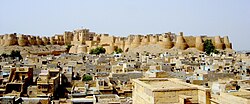
By the 12th-century, [[Rohri]] and [[Sukkur]] in the present-day Sindh, Pakistan as well as [[Pugal]] and [[Chohtan]] in Rajasthan had been incorporated into the dominion of the Bhati Rajputs.{{Sfn|Kothiyal|2016|p=72}} The Muslim chiefs of [[Sindh]] and Multan, as well as other Rajput clans like [[Paramara dynasty|Panwar]], [[Chaulukya dynasty|Solanki]], and [[Sodha]]s, were all at strife with the Bhati rulers by this time.{{Sfn|Kothiyal|2016|p=72}} Jaisalmer had a dynasty with a successful line of rulers and this became their center. Bhatner, Pugal, Bikrampur, Barsalpur, [[Derawar Fort|Deravar]], [[Marot]], [[Kahror Pacca Tehsil|Kehror]], Aasnikot, Tanot, [[Lodhruva]] and Mamanvahan were some of the fortified settlements that were historically ruled by the Bhati clan or subclans. The Bhati ruler [[Vijayrao Lanjo]] ruled a vast empire, He was known as the 'uttara disi bhad kivaad' (the sentinel of the north direction), due to his control over forts and settlements that extended from [[Ghazni]] to [[Gujarat]], leading to several conflicts with the invading Muslim tribes.{{Sfn|Kothiyal|2016|pp=18, 55–60, 70}} According to epigraphic evidence, Vijayarao Lanjo took the large title of ''Parambhattaraka Maharajadhiraja Parameshwara'' (the paramount sovereign, great king of kings, the supreme reality).{{Sfn|Hooja|2006|p=551}} He was succeeded by his son, Bhojde in 1143.{{Sfn|Erskine|1909|pp=11–12}} However, Bhojde's uncle [[Rawal (title)|Rawal]] [[Jaisal Singh]] colluded with the [[Ghaznavid]] chiefs, and Bhojde was killed in the resulting combat. Following Bhojde's death, Jaisal Singh became the head of Bhatis.{{Sfn|Kothiyal|2016|p=73}} In general, the Bhatis' interactions with Islamic powers were not entirely harmonious. They had defeated multiple Islamic attacks by the [[Qarmatians|Qaramithas]], Ghaznavids, and [[Ghurid]]s before the end of the 12th century.<ref>{{Cite book |last=Rathore |first=Virendra Singh |url=https://books.google.com/books?id=NvUBEAAAQBAJ&pg=PA54|title=Prithviraj Chauhan - a Light on the Mist in History |date=2020-09-29 |publisher=Virendra Singh Rathore |isbn=978-1-63640-019-8 |language=en}}</ref>[[File:Rawal Jaisal Singh, the founder and first ruler of the Kingdom of Jaisalmer.jpg|thumb|160px|[[Rawal Jaisal|Maharawal Jaisal Singh]], a notable Bhati Rajput Ruler]][[Timur]] invaded India in 1398, when he held a vast empire in the Middle East and Central Asia. He suffered tough resistance in India only from the Bhati ruler, Rai Dul Chand of Bhatner. Rajputs and Muslims fought together against Timur under him but the [[Bhatner fort]] was ultimately sacked with the city burnt and laid waste.{{Sfn|Pletcher|2010|p=131}}{{Sfn|Mahajan|2007|p=826}} The [[Rathores]], the [[Balochs]], the [[Delhi Sultanate|Dehli Sultans]], and eventually the [[Mughals]] had all clashed with the Bhati kings.{{Sfn|Kothiyal|2016|p=73}} The cities of [[Kapurthala]], [[Ambala]] and [[Batala]] in Punjab are said to be founded by the Bhati Rajputs. ''Rana Kapur'', an immigrant from Jaisalmer founded Kapurthala in the early 11th-century,<ref>{{cite book |last=Punjabi University |first=Department of Punjab Historical Studies |url=https://books.google.com/books?id=ZA9DAAAAYAAJ |title=The Panjab Past and Present Volume 24 |publisher=Department of Punjab Historical Studies, Punjabi University. |year=1990}}</ref> ''Raja Amba'' of [[Taoni]] subclan founded Ambala in the 14th century,<ref>Rajput Qabail by KAMRAN AZAM SOHDAHARVI. p. 200</ref> whereas ''Rai Ram Deo'' founded Batala in 1465.<ref>{{Cite web |url=https://dsal.uchicago.edu/reference/gazetteer/pager.html?objectid=DS405.1.I34_V07_139.gif |title=Batala Town Imperial Gazetteer of India – ''vol.7 pg.133'' |access-date=27 November 2024 |archive-date=22 February 2022 |archive-url=https://web.archive.org/web/20220222105620/https://dsal.uchicago.edu/reference/gazetteer/pager.html?objectid=DS405.1.I34_V07_139.gif |url-status=dead }}</ref> By the same 15th-century, Rao Kelana, a powerful Bhati Rajput ruler of Pugal had expanded his territories up to Bhatinda and [[Abohar]], and was responsible for the death of Rathore ruler [[Chunda of Mandore|Chunda of Marwar]]. Rao Kelana invaded [[Dera Ghazi Khan]] and defeated the Balochs. As part of the peace settlement that followed, Zubeida, the daughter of the Baloch chief Jam Ismail Khan (founder of [[Dera Ismail Khan]]), was married to the Bhati ruler.{{Sfn|Hooja|2006|p=551}} In 1613, [[Kishan Singh of Kishangarh|Raja Kishan Singh]], a Rathore ruler and the founder of [[Kishangarh State]] complained his brother-in-law [[Jahangir]], the [[List of emperors of the Mughal Empire|Mughal emperor]], about a Bhati sardar, Govind Das Bhati, for killing his brother, and thereafter, the Raja, along with his followers, executed the Bhati [[sardar]] as per the direction of Jahangir. As Govind Das Bhati was a noble affiliated with the Rathore ruler [[Sur Singh]], as a consequence his son, [[Gaj Singh of Marwar]], killed Raja Kishan Singh.{{Sfn|Bahadur|1941|pp=155, 156}}[[File:Jaisalmer forteresse.jpg|thumb|right|260px|[[Jaisalmer Fort]] of the Bhati Rajputs]]The historian [[André Wink]] states that prior to the Bhatis' expulsion from the country of [[Zabulistan]], they reportedly inhabited as far as [[Samarkand]] in Uzbekistan.{{Sfn|Wink|1990|p=117}} The Bhatis claim to be the ancestors of the [[Chughtai]] [[Mughal people|Mughals]]. The historian Tanuja Kothiyal notes that a part of such claims may well be justified.{{Sfn|Kothiyal|2016|pp=18, 55–60, 70}} The [[Phulkian dynasty]] claimed direct descent from Rawal Jaisal Singh, the Bhati Rajput founder of the [[Kingdom of Jaisalmer]].{{Sfn|Bond|Wright|2006|pp=232–242}}{{Sfn|Bhatnagar|Dube|2005|p=254}} | |||
== See also == | ==Culture and ethos== | ||
*[[ | |||
The greeting used by Bhati Rajputs is {{Transliteration|sa|Jai Shri Kishan}} ("victory to Lord [[Krishna]]") as opposed to the general Rajput greeting {{Transliteration|sa|Jai Mata Jiri}} ("victory of the Mother Goddess").{{Sfn|Fisher|1997|p=61}} | |||
[[Dulla Bhatti]] was a Punjabi landlord who led a revolt against [[Akbar]], the Mughal emperor.<ref name="dawn">{{cite news|url=https://www.dawn.com/news/1392730|title=Remembering Dulla Bhatti, the landlord who stood up to the mighty Akbar|work=Dawn.com|date=2 March 2018|access-date=18 October 2024}}</ref> He remains Punjab's [[folk hero]] and is made the centrepiece of all [[Lohri]] songs.<ref>{{Cite web |title=Dulla Bhatti: Robinhood of Punjab, centerpiece of all Lohri songs, was hanged by Akbar publicly to set an example - Read full Story |url=https://zeenews.india.com/india/lohri-2023-dulla-bhatti-story-and-significance-january-13-or-14-robinhood-of-punjab-centerpiece-of-all-lohri-songs-was-hanged-by-akbar-publicly-to-set-an-example-read-full-story-2560709.html |access-date=2024-10-18 |website=Zee News |language=en}}</ref> | |||
[[Mehta Kalu]], the father of Guru Nanak, was an employee of [[Rai Bular Bhatti]]. Bhatti was among the first few people who viewed Nanak as someone who was specially gifted by God. The 757 murabas (approx. 18,750 acres) of land he donated to Guru Nanak is now under the control of [[Evacuee Trust Property Board]] of Pakistan.<ref name="Garewal">{{cite news |url=http://www.tribuneindia.com/2007/20070526/saturday/main1.htm |date=26 May 2007 |title=Guru Nanak's estate flourishes in Pakistan |first=Naveen S. |last=Garewal |accessdate=7 September 2025}}</ref> | |||
While the [[Kingdom of Mewar]] came to symbolize Rajput resistance in the nineteenth century—primarily due to its steadfast opposition to Mughal expansion and its inward-looking emphasis on clan orthodoxy—contemporary chroniclers such as Muhnot Nainsi identified Jaisalmer as the true heart of the Rajput world. Unlike Mewar, which defined Rajput identity through rigid genealogical purity and martial defiance, Jaisalmer embodied a more expansive and networked conception of Rajputness. Through its extensive web of alliances with various clans across regions, Jaisalmer played a central role in articulating a broader Rajput political and cultural sphere, where opposition to the Mughals or Turks was just one among many expressions of Rajput identity.{{Sfn|Kothiyal|2016|pp=18, 55–60, 70}} | |||
==See also== | |||
*[[Rathore dynasty]] | |||
*[[Sisodia dynasty]] | |||
*[[Kachhawaha]] | |||
== References == | == References == | ||
{{Reflist}} | {{Reflist}} | ||
== Bibliography == | |||
* {{cite book |last=Chandra |first=Satish |url=https://books.google.com/books?id=L5eFzeyjBTQC&pg=PA17 |title=Medieval India: From Sultanat to the Mughals-Delhi Sultanat (1206–1526) – Part One |publisher=Har-Anand Publications |year=2004 |isbn=978-81-241-1064-5}} | |||
* {{cite book |author=Wink |first=André |author-link=Andre Wink |url=https://books.google.com/books?id=bCVyhH5VDjAC&pg=PA117 |title=Al- Hind: The slave kings and the Islamic conquest |publisher=BRILL |year=1990 |isbn=9789004095090 |volume=1 |page=117}} | |||
* {{cite book |last1=Bahadur |first1=Har Bilas Sarda (Diwan |url=https://archive.org/details/in.ernet.dli.2015.122657/page/n187/mode/2up |title=Ajmer: Historical and Descriptive |date=1941 |publisher=Fine Art Printing Press |pages=155, 156 |language=en |access-date=27 November 2024}} | |||
* {{Cite book |last=Lethbridge |first=Sir Roper |url=https://books.google.com/books?id=zykYAAAAYAAJ |title=The Golden Book of India. A Genealogical and Biographical Dictionary of the Ruling Princes, Chiefs, Nobles, and Other Personages, Titled Or Decorated, of the Indian Empire. With an Appendix for Ceylon |publisher=S. Low, Marston & Company |year=1900 |location=London |page=112 |language=en}} | |||
* {{Cite book |first1=Mohammad |last1=Habib |first2=Khaliq Ahmad |last2=Nizami |url=https://books.google.com/books?id=WzARcgAACAAJ |title=A Comprehensive History of India |volume=5 |publisher=People’s Publishing House |location=New Delhi |year=1970 |pages=838 |quote=Like the Bhatis of Jaisalmer, the chiefs of Karauli also belonged to the Yadava clan of Rajputs.}} | |||
* {{cite book |last1=Bhatnagar |first1=Rashmi Dube |url=https://books.google.com/books?id=kT0s8TXoffsC&pg=PA254 |title=Female Infanticide in India: A Feminist Cultural History |last2=Dube |first2=Reena |publisher=SUNY Press |year=2005 |isbn=978-0-7914-6327-7 |page=254}} | |||
* {{Cite book |last1=Bond |first1=J. W. |url=https://books.google.com/books?id=47sfj8DUwNgC |title=Indian States: A Biographical, Historical, and Administrative Survey |last2=Wright |first2=Arnold |publisher=Asian Educational Services |year=2006 |isbn=978-81-206-1965-4 |location=New Delhi |pages=325 |language=en |access-date=16 July 2024 |archive-url=https://web.archive.org/web/20240620210317/https://www.google.co.in/books/edition/Indian_States/47sfj8DUwNgC?hl=en&gbpv |archive-date=20 June 2024 |url-status=live}} | |||
* {{Cite book |last=Yadav |first=J.N. Singh |url=http://archive.org/details/yadavas-through-the-ages-2 |title=Yadavas Through The Ages |publisher=Sharada Publishing House |year=1992 |volume=II |location=Delhi |pages=68–71}} | |||
* {{Cite book|last=Kothiyal|first=Tanuja|url=https://books.google.com/books?id=be-7CwAAQBAJ&pg=PA78|title=Nomadic Narratives: A History of Mobility and Identity in the Great Indian|publisher=Cambridgre University Press|year=2016|isbn=9781107080317|pages=18, 55–60, 70|quote=the various Hindu Rajput Bhati sub-clans, like Saran, Moodna, Seora as well as Muslim groups like Bhatti, Bhutto...and the trading community of Bhatiya, all link their origins to the Bhatis}} | |||
* {{Cite book |last=Erskine |first=K. D. |url=http://archive.org/details/in.ernet.dli.2015.35749 |title=A Gazetteer Of The Jaisalmer State And Some Statistical Tables. |publisher=Scottish Mission Industries |year=1909 |location=Ajmer |pages=11–12}} | |||
* {{Cite book |last=Fisher |first=R. J. |url=https://books.google.com/books?id=T1B_AAAAMAAJ |title=If Rain Doesn't Come: An Anthropological Study of Drought and Human Ecology in Western Rajasthan |publisher=Manohar |year=1997 |isbn=978-81-7304-184-6 |pages=61}} | |||
* {{cite book |title=The History of India |publisher=The Rosen Publishing Group |year=2010 |isbn=978-1615301225 |editor=Pletcher |editor-first=Kenneth |page=[https://books.google.com/books?id=VsujRFvaHI8C&pg=PA131 131]}} | |||
* {{Cite book |last=Mahajan |first=V.D. |url=https://books.google.com/books?id=nMWSQuf4oSIC |title=History of Medieval India |publisher=S.Chand |year=2007 |isbn=9788121903646 |pages=826}} | |||
* {{cite book |last1=Hooja |first1=Rima |url=https://books.google.com/books?id=tosMAQAAMAAJ&q=Varah |title=A History of Rajasthan |date=2006 |publisher=Rupa & Company |isbn=978-81-291-0890-6 |pages=551 |language=en |access-date=26 October 2024}} | |||
{{Rajput Groups of India}} | {{Rajput Groups of India}} | ||
| Line 22: | Line 76: | ||
[[Category:Rajput clans]] | [[Category:Rajput clans]] | ||
[[Category:Surnames]] | [[Category:Rajput clans of Rajasthan]] | ||
[[Category:Rajput clans of Sindh]] | |||
[[Category:Rajput dynasties]] | |||
[[Category:Dynasties of India]] | |||
[[Category:Lunar dynasty]] | |||
[[Category:Surnames of Indian origin]] | |||
Revision as of 23:02, 7 February 2026
| Bhati House of Jaisalmer | |
|---|---|
 Coat of arms | |
 Flag of the Kingdom of Jaisalmer | |
| Country | Kingdom of Jaisalmer |
| Founded | 3rd century |
| Founder | Rao Bhati |
| Current head | Chaitanya Raj Singh |
| Final ruler | Maharawal Girdhar Singh |
| Titles | Rawal (later Maharawal) of Jaisalmer |
Bhati (also romanised as Bhattī) is a Rajput clan.[1] The Bhati clan historically ruled over several cities in present-day India and Pakistan with their final capital and kingdom being Jaisalmer, India.[2][3]
History
The Bhatis of Jaisalmer belonged to the Yadava clan of Rajputs.[4][5] They reportedly originated in Mathura through a common ancestor named Rao Bhati, who claimed descent from Pradyumna, a Hindu mythological figure.[6][7] According to the seventeenth-century Nainsi ri Khyat, the Bhatis after losing Mathura moved to Bhatner in Lakhi Jungle, and from there to other locations in western and northwestern India including Punjab. Rao Bhati conquered and annexed territories from 14 princes in Punjab, including the area of modern-day Lahore.[8][9] He is also credited with establishing the modern town of Bathinda in the Lakhi jungle area in the 3rd century.[6] The Bhatis also claim descent through Rao Bhati from Raja Sálbán, the legendary founder of Sialkot.

The Bhati ruler of Tanot, Rao Tannu-ji, utilized his long reign (until 814 AD) to consolidate the Bhatis' expanding strength in western Rajasthan and the eastern Cholistan desert area. He is credited with defeating and destroying the domains of the Varya Rajputs and Langas of Multan. A unified attack against the Tanot Bhatis by the Pathans led by Hussain Shah, together with tribes such as the Langas, Khichis, Khokars (Ghakkars), Johiyas, and others, was successfully driven back under Tannu-ji's leadership.[10] In the 10th century, the Bhati rulers near Multan as well as the Muslim Emir of Multan were eager to assist Jayapala, the Hindu Shahi ruler of Afghanistan, because of the slave incursions into their territories by the rulers of Ghazni. However, Jayapala was unable to conquer Ghazni, and the alliance he had formed quickly fell apart.[11] By the 12th-century, Rohri and Sukkur in the present-day Sindh, Pakistan as well as Pugal and Chohtan in Rajasthan had been incorporated into the dominion of the Bhati Rajputs.[12] The Muslim chiefs of Sindh and Multan, as well as other Rajput clans like Panwar, Solanki, and Sodhas, were all at strife with the Bhati rulers by this time.[12] Jaisalmer had a dynasty with a successful line of rulers and this became their center. Bhatner, Pugal, Bikrampur, Barsalpur, Deravar, Marot, Kehror, Aasnikot, Tanot, Lodhruva and Mamanvahan were some of the fortified settlements that were historically ruled by the Bhati clan or subclans. The Bhati ruler Vijayrao Lanjo ruled a vast empire, He was known as the 'uttara disi bhad kivaad' (the sentinel of the north direction), due to his control over forts and settlements that extended from Ghazni to Gujarat, leading to several conflicts with the invading Muslim tribes.[5] According to epigraphic evidence, Vijayarao Lanjo took the large title of Parambhattaraka Maharajadhiraja Parameshwara (the paramount sovereign, great king of kings, the supreme reality).[10] He was succeeded by his son, Bhojde in 1143.[13] However, Bhojde's uncle Rawal Jaisal Singh colluded with the Ghaznavid chiefs, and Bhojde was killed in the resulting combat. Following Bhojde's death, Jaisal Singh became the head of Bhatis.[14] In general, the Bhatis' interactions with Islamic powers were not entirely harmonious. They had defeated multiple Islamic attacks by the Qaramithas, Ghaznavids, and Ghurids before the end of the 12th century.[15]

Timur invaded India in 1398, when he held a vast empire in the Middle East and Central Asia. He suffered tough resistance in India only from the Bhati ruler, Rai Dul Chand of Bhatner. Rajputs and Muslims fought together against Timur under him but the Bhatner fort was ultimately sacked with the city burnt and laid waste.[16][17] The Rathores, the Balochs, the Dehli Sultans, and eventually the Mughals had all clashed with the Bhati kings.[14] The cities of Kapurthala, Ambala and Batala in Punjab are said to be founded by the Bhati Rajputs. Rana Kapur, an immigrant from Jaisalmer founded Kapurthala in the early 11th-century,[18] Raja Amba of Taoni subclan founded Ambala in the 14th century,[19] whereas Rai Ram Deo founded Batala in 1465.[20] By the same 15th-century, Rao Kelana, a powerful Bhati Rajput ruler of Pugal had expanded his territories up to Bhatinda and Abohar, and was responsible for the death of Rathore ruler Chunda of Marwar. Rao Kelana invaded Dera Ghazi Khan and defeated the Balochs. As part of the peace settlement that followed, Zubeida, the daughter of the Baloch chief Jam Ismail Khan (founder of Dera Ismail Khan), was married to the Bhati ruler.[10] In 1613, Raja Kishan Singh, a Rathore ruler and the founder of Kishangarh State complained his brother-in-law Jahangir, the Mughal emperor, about a Bhati sardar, Govind Das Bhati, for killing his brother, and thereafter, the Raja, along with his followers, executed the Bhati sardar as per the direction of Jahangir. As Govind Das Bhati was a noble affiliated with the Rathore ruler Sur Singh, as a consequence his son, Gaj Singh of Marwar, killed Raja Kishan Singh.[21]

The historian André Wink states that prior to the Bhatis' expulsion from the country of Zabulistan, they reportedly inhabited as far as Samarkand in Uzbekistan.[22] The Bhatis claim to be the ancestors of the Chughtai Mughals. The historian Tanuja Kothiyal notes that a part of such claims may well be justified.[5] The Phulkian dynasty claimed direct descent from Rawal Jaisal Singh, the Bhati Rajput founder of the Kingdom of Jaisalmer.[23][24]
Culture and ethos
The greeting used by Bhati Rajputs is Jai Shri Kishan ("victory to Lord Krishna") as opposed to the general Rajput greeting Jai Mata Jiri ("victory of the Mother Goddess").[25]
Dulla Bhatti was a Punjabi landlord who led a revolt against Akbar, the Mughal emperor.[26] He remains Punjab's folk hero and is made the centrepiece of all Lohri songs.[27]
Mehta Kalu, the father of Guru Nanak, was an employee of Rai Bular Bhatti. Bhatti was among the first few people who viewed Nanak as someone who was specially gifted by God. The 757 murabas (approx. 18,750 acres) of land he donated to Guru Nanak is now under the control of Evacuee Trust Property Board of Pakistan.[28]
While the Kingdom of Mewar came to symbolize Rajput resistance in the nineteenth century—primarily due to its steadfast opposition to Mughal expansion and its inward-looking emphasis on clan orthodoxy—contemporary chroniclers such as Muhnot Nainsi identified Jaisalmer as the true heart of the Rajput world. Unlike Mewar, which defined Rajput identity through rigid genealogical purity and martial defiance, Jaisalmer embodied a more expansive and networked conception of Rajputness. Through its extensive web of alliances with various clans across regions, Jaisalmer played a central role in articulating a broader Rajput political and cultural sphere, where opposition to the Mughals or Turks was just one among many expressions of Rajput identity.[5]
See also
References
- ↑ Rathore, Virendra Singh (29 September 2020). Prithviraj Chauhan - a Light on the Mist in History. Virendra Singh Rathore. ISBN 978-1-63640-019-8.
- ↑ Middleton, John (1 June 2015). World Monarchies and Dynasties. Routledge. ISBN 978-1-317-45158-7.
- ↑ Parihar, Vinita (1989). Society in Transition. Printwell Publishers. ISBN 978-81-7044-152-6.
- ↑ Habib & Nizami 1970, p. 838.
- ↑ 5.0 5.1 5.2 5.3 Kothiyal 2016, pp. 18, 55–60, 70.
- ↑ 6.0 6.1 Lethbridge 1900, p. 112.
- ↑ Bond & Wright 2006, p. 325.
- ↑ Yadav 1992, pp. 68–71.
- ↑ Bond & Wright 2006.
- ↑ 10.0 10.1 10.2 Hooja 2006, p. 551.
- ↑ Chandra 2004, p. 17.
- ↑ 12.0 12.1 Kothiyal 2016, p. 72.
- ↑ Erskine 1909, pp. 11–12.
- ↑ 14.0 14.1 Kothiyal 2016, p. 73.
- ↑ Rathore, Virendra Singh (29 September 2020). Prithviraj Chauhan - a Light on the Mist in History. Virendra Singh Rathore. ISBN 978-1-63640-019-8.
- ↑ Pletcher 2010, p. 131.
- ↑ Mahajan 2007, p. 826.
- ↑ Punjabi University, Department of Punjab Historical Studies (1990). The Panjab Past and Present Volume 24. Department of Punjab Historical Studies, Punjabi University.
- ↑ Rajput Qabail by KAMRAN AZAM SOHDAHARVI. p. 200
- ↑ "Batala Town Imperial Gazetteer of India – vol.7 pg.133". Archived from the original on 22 February 2022. Retrieved 27 November 2024.
- ↑ Bahadur 1941, pp. 155, 156.
- ↑ Wink 1990, p. 117.
- ↑ Bond & Wright 2006, pp. 232–242.
- ↑ Bhatnagar & Dube 2005, p. 254.
- ↑ Fisher 1997, p. 61.
- ↑ "Remembering Dulla Bhatti, the landlord who stood up to the mighty Akbar". Dawn.com. 2 March 2018. Retrieved 18 October 2024.
- ↑ "Dulla Bhatti: Robinhood of Punjab, centerpiece of all Lohri songs, was hanged by Akbar publicly to set an example - Read full Story". Zee News. Retrieved 18 October 2024.
- ↑ Garewal, Naveen S. (26 May 2007). "Guru Nanak's estate flourishes in Pakistan". Retrieved 7 September 2025.


Bibliography
- Chandra, Satish (2004). Medieval India: From Sultanat to the Mughals-Delhi Sultanat (1206–1526) – Part One. Har-Anand Publications. ISBN 978-81-241-1064-5.
- Wink, André (1990). Al- Hind: The slave kings and the Islamic conquest. Vol. 1. BRILL. p. 117. ISBN 9789004095090.
- Bahadur, Har Bilas Sarda (Diwan (1941). Ajmer: Historical and Descriptive. Fine Art Printing Press. pp. 155, 156. Retrieved 27 November 2024.
- Lethbridge, Sir Roper (1900). The Golden Book of India. A Genealogical and Biographical Dictionary of the Ruling Princes, Chiefs, Nobles, and Other Personages, Titled Or Decorated, of the Indian Empire. With an Appendix for Ceylon. London: S. Low, Marston & Company. p. 112.
- Habib, Mohammad; Nizami, Khaliq Ahmad (1970). A Comprehensive History of India. Vol. 5. New Delhi: People’s Publishing House. p. 838.
Like the Bhatis of Jaisalmer, the chiefs of Karauli also belonged to the Yadava clan of Rajputs.
- Bhatnagar, Rashmi Dube; Dube, Reena (2005). Female Infanticide in India: A Feminist Cultural History. SUNY Press. p. 254. ISBN 978-0-7914-6327-7.
- Bond, J. W.; Wright, Arnold (2006). Indian States: A Biographical, Historical, and Administrative Survey. New Delhi: Asian Educational Services. p. 325. ISBN 978-81-206-1965-4. Archived from the original on 20 June 2024. Retrieved 16 July 2024.
- Yadav, J.N. Singh (1992). Yadavas Through The Ages. Vol. II. Delhi: Sharada Publishing House. pp. 68–71.
- Kothiyal, Tanuja (2016). Nomadic Narratives: A History of Mobility and Identity in the Great Indian. Cambridgre University Press. pp. 18, 55–60, 70. ISBN 9781107080317.
the various Hindu Rajput Bhati sub-clans, like Saran, Moodna, Seora as well as Muslim groups like Bhatti, Bhutto...and the trading community of Bhatiya, all link their origins to the Bhatis
- Erskine, K. D. (1909). A Gazetteer Of The Jaisalmer State And Some Statistical Tables. Ajmer: Scottish Mission Industries. pp. 11–12.
- Fisher, R. J. (1997). If Rain Doesn't Come: An Anthropological Study of Drought and Human Ecology in Western Rajasthan. Manohar. p. 61. ISBN 978-81-7304-184-6.
- Pletcher, Kenneth, ed. (2010). The History of India. The Rosen Publishing Group. p. 131. ISBN 978-1615301225.
- Mahajan, V.D. (2007). History of Medieval India. S.Chand. p. 826. ISBN 9788121903646.
- Hooja, Rima (2006). A History of Rajasthan. Rupa & Company. p. 551. ISBN 978-81-291-0890-6. Retrieved 26 October 2024.