





No edit summary Tags: Visual edit Mobile edit Mobile web edit |
No edit summary |
||
| Line 1: | Line 1: | ||
{{short description|22nd Jain Tirthankara}} | {{short description|22nd Jain Tirthankara}} | ||
{{distinguish| | {{distinguish|Naminath}} | ||
{{Use dmy dates|date=December 2015}} | {{Use dmy dates|date=December 2015}} | ||
{{Use Indian English|date=December 2015}} | {{Use Indian English|date=December 2015}} | ||
{{Infobox deity | {{Infobox deity | ||
| type = Jain | | type = Jain | ||
| image = Neminath bhagwan.jpg | |||
| image = Neminath | | caption = Idol of Neminath at Girnar Hill, Gujarat | ||
| caption = | | alt = Neminath Bhagwan | ||
| alt = | |||
| venerated_in = [[Jainism]] | | venerated_in = [[Jainism]] | ||
| other_names = | | other_names = Nemi, Nem | ||
| symbol = [[Shankha | | symbol = [[Shankha|Shankha (conch)]] {{sfn|Tandon|2002|p=45}} | ||
| color = [[Black]] | | color = [[Black]] | ||
| father = [[Samudravijaya]] | | father = [[Samudravijaya]] | ||
| mother = | | mother = Śivādevī | ||
| height = 10 bows | | height = 10 [[Dhanusha (unit)|bows]] – {{convert|98|feet|m}}{{sfn|Sarasvati|1970|p=444}} | ||
| age = 1000 | | age = 1000 | ||
| predecessor = [[Naminatha]] | | predecessor = [[Naminatha]] | ||
| successor = [[Parshvanatha]] | | successor = [[Parshvanatha]] | ||
| birth_place = [[ | | birth_place = [[Śaurīpura]] | ||
| | | moksha_place = [[Girnar]] | ||
| | | member_of = [[Tirthankar]], [[Śalākāpuruṣa|Salakapurusha]], [[Arihant (Jainism)|Arihant]] and [[Siddha#Jainism|Siddha]] | ||
| name = Neminath | |||
| gender = Male | |||
| god_of = 22nd [[Tirthankara]] | |||
| dynasty = [[Puru and Yadu Dynasties#Emperor Yadu dynasty|Yaduvaṁśa—Harivaṁśa]] {{sfn|von Glasenapp|1925|p=317}}{{sfn|Doniger|1993|p=225}} | |||
| birth_name = Ariṣṭanemi | |||
}} | |||
{{Jainism}} | {{Jainism}} | ||
''' | '''Neminātha''' ([[Devanagari]]: नेमिनाथ) ([[Sanskrit]]: नेमिनाथः), also known as '''Nemi''' and '''Ariṣṭanemi''' ([[Devanagari]]: अरिष्टनेमि), is the twenty-second [[tirthankara]] of [[Jainism]] in the present age ({{lang|sa|[[Avasarpini]]}}). Neminath lived 84,000 years before the 23rd ''Tirthankar'' Parshvanath. According to traditional accounts, he was born to King [[Samudravijaya]] and Queen Shivadevi of the [[Yadu|Yadu dynasty]] in the north Indian city of [[Sauripura (Dvaraka)|Sauripura]]. His birth date was the fifth day of ''Shravan Shukla'' of the Jain calendar. [[Balarama]] and [[Krishna]], who were the 9th and last [[Śalākāpuruṣa#Triad of Baladeva, Vasudeva and Prativasudeva|Baladeva]] and [[Śalākāpuruṣa#Triad of Baladeva, Vasudeva and Prativasudeva|Vasudeva]] respectively, were his first cousins. | ||
Neminatha | Neminatha, when heard the cries of animals being killed for his marriage feast, freed the animals and renounced his worldly life and became a Jain ascetic. The representatives of this event are popular in [[Jain art]]. He had attained ''[[Moksha (Jainism)|moksha]]'' on [[Girnar Hills]] near [[Junagadh]], and became a [[siddha]], a liberated soul which has destroyed all of its [[Karma in Jainism|karma]]. | ||
Along with [[Mahavira]], [[Parshvanatha]] and [[Rishabhanatha]], Neminath is one of the twenty-four ''Tirthankars'' who attract the most devotional worship among the Jains. His icons include the eponymous deer as his emblem, the [[Ailanthus excelsa|Mahavenu]] tree, ''Sarvanha'' (Digambara) or ''Gomedha'' (Śhvētāmbara) [[Yaksha]], and ''[[Ambika (Jainism)|Ambika]]'' [[Yakshi]]. | |||
==Nomenclature== | ==Nomenclature== | ||
The name Neminatha consists of two [[Sanskrit]] words, ''Nemi'' which means "rim, felly of a wheel" or alternatively "thunderbolt",{{sfn|Monier Williams|p=569}} and ''natha'' which means "lord, patron, protector".{{sfn|Monier Williams|p=534}} According to the Jain text ''[[Uttarapurana]]'', as well as the explanation of [[Hemachandra|Acharya Hemchandra]], it was the ancient Indian deity [[Indra]] who named the 22nd ''[[tirthankara]]'' as Neminatha, because he viewed the ''Jina'' as the "rim of the [[wheel of dharma]]". In ''[[ | The name Neminatha consists of two [[Sanskrit]] words, ''Nemi'' which means "rim, felly of a wheel" or alternatively "thunderbolt",{{sfn|Monier Williams|p=569}} and ''natha'' which means "lord, patron, protector".{{sfn|Monier Williams|p=534}} | ||
According to the Jain text ''[[Uttarapurana]]'', as well as the explanation of [[Hemachandra|Acharya Hemchandra]], it was the ancient Indian deity [[Indra]] who named the 22nd ''[[tirthankara]]'' as Neminatha, because he viewed the ''Jina'' as the "rim of the [[wheel of dharma]]".{{sfn|Umakant P. Shah|1987|p=}} | |||
In ''[[Śvetāmbara]]'' Jain texts, his name ''Aristanemi'' came from a dream his mother had during pregnancy, where she saw a "wheel of ''Arista'' jewels".{{sfn|Umakant P. Shah|1987|pp=164-165}} His full name is mentioned as ''Aristanemi'' which is an epithet of the sun-chariot.{{sfn|Jain|Fischer|1978|p=17}}{{sfn|Zimmer|1953|p=225}} Neminatha's name is spelled close to the 21st ''tirthankara'' [[Naminatha]].{{sfn|von Glasenapp|1925|pp=317-318}} | |||
==Life== | ==Life== | ||
Neminatha was the twenty-second '' | Neminatha was the twenty-second ''Tirthankara'' (ford-maker) of the ''[[avasarpiṇī]]'' (present descending cycle of [[Jain cosmology]]).<ref name=britneminatha>{{cite web | title=Arishtanemi: Jaina saint | website=Encyclopedia Britannica | url=https://www.britannica.com/biography/Arishtanemi | access-date=15 September 2017}}</ref>{{sfn|Zimmer|1953|p=224}}{{sfn|Tukol|1980|p=31}} Jain tradition place him as a contemporary of [[Krishna]], the ninth and last ''vasudev''.{{sfn|Natubhai Shah|2004|p=23}} There was a gap of 581,750 years between the Neminatha and his predecessor, [[Naminatha]] as per traditional beliefs.{{sfn|Zimmer|1953|p=226}}{{sfn|von Glasenapp|1925|pp=317-318}}{{sfn|Finegan|1952|p=190}} He lived approx. 81,000 years before the 23rd ''Tirthankara'', [[Parshvanatha]] as per the ''Trishashtishalakapursusha Charitra'' of [[Acharya]] [[Hemachandra]].{{sfn|Zimmer|1953|p=226}}{{sfn|Finegan|1952|p=190}} | ||
=== Birth | === Birth === | ||
[[File:The birth of Aristanemi, one of the founding teac Wellcome L0031374.jpg|thumb|left|The birth of Aristanemi, [[Kalpa Sūtra]]]] | [[File:The birth of Aristanemi, one of the founding teac Wellcome L0031374.jpg|thumb|left|The birth of Aristanemi, [[Kalpa Sūtra]]]] | ||
Neminatha is mentioned as the youngest son of king [[Samudravijaya]] and queen Shivadevi of the [[Yadu]] lineage,{{sfn|Doniger|1993|p=225}} born at [[Sauripura (Dvaraka)]].{{sfn|Natubhai Shah|2004|p=24}} He believed to have become fond of animals in his early life due to being in a cattle herding family. Jain legends place him in the [[Girnar]]-[[Kathiawad]] (in [[Saurashtra region]] of modern-day [[Gujarat]]).{{sfn|Dhere|2011|pp=193–196}}{{sfn|Upinder Singh|2008|p=313}}{{sfn|Cort|2001|p=23}} His birth date is believed to be the fifth day of ''Shravana Shukla'' of the [[Hindu calendar]].{{sfn|Tukol|1980|p=31 | Neminatha is mentioned as the youngest son of king [[Samudravijaya]] and queen Shivadevi of the [[Yadu]] lineage,{{sfn|von Glasenapp|1925|p=317}}{{sfn|Doniger|1993|p=225}} born at [[Sauripura (Dvaraka)]].{{sfn|Natubhai Shah|2004|p=24}} He is believed to have become fond of animals in his early life due to being in a cattle-herding family. Jain legends place him in the [[Girnar]]-[[Kathiawad]] (in [[Saurashtra region]] of modern-day [[Gujarat]]).{{sfn|Dhere|2011|pp=193–196}}{{sfn|Upinder Singh|2008|p=313}}{{sfn|Cort|2001|p=23}} His birth date is believed to be the fifth day of ''Shravana Shukla'' of the [[Hindu calendar]].{{sfn|Tukol|1980|p=31}} | ||
In one of the legends, on being taunted by [[Satyabhama]], wife of Krishna, Neminatha is depicted to have blown [[Panchajanya]], the mighty [[conch]] of Krishna. | === Life before renunciation === | ||
[[File:Neminath Wedding.JPG|thumb|Depiction of wedding procession of Neminatha. His legend states that he renounced after hearing animal cries while they were being sacrificed to prepare his wedding feast. | |||
{{sfn|Jain|Fischer|1978|pp=16–17}}]] | |||
[[File:Idol of Bhagwan Neminath 20250816 072740505.MP.jpg|thumb|Idol of Bhagwan Neminath at Ancient Jain Basadi, [[Gerusoppa]], [[Karnataka]]]] | |||
He is believed to have been born with a dark-blue skin and complexion,{{sfn|Umakant P. Shah|1987|p=164}} a very handsome but shy young man.{{sfn|Doniger|1993|p=225}}{{sfn|Natubhai Shah|2004|p=24}} His height is mentioned as 10 [[Dhanusha (unit)|dhanusha]].{{sfn|Finegan|1952|p=190}} His father is mentioned as the brother of [[Vasudeva]], Krishna's father, therefore he is mentioned as the cousin of [[Krishna]] in ''Trishashti-salaka-purusha-charitra''.<ref name=britneminatha/>{{sfn|Johnson|1931|pp=1–266}}{{sfn|Jain|Fischer|1978|pp=16–17}}{{sfn|Umakant P. Shah|1987|pp=165-166}}{{sfn|Sangave|2001|p=104}}{{sfn|Gaur|1976|p=46}} Sculptures found in [[Kankali Tila]], [[Mathura]] of Kushana period depicts Krishna and [[Balarama]] as cousins of Neminatha.{{sfn|Vyas|1995|p=19}} | |||
In one of the legends, on being taunted by [[Satyabhama]], wife of Krishna, Neminatha is depicted to have blown [[Panchajanya]], the mighty [[conch]] of Krishna through his nostrils. According to the texts, no one could lift the conch except Krishna, let alone blow it.{{sfn|von Glasenapp|1925|p=318}}{{sfn|Natubhai Shah|2004|p=24}} After this event, the Harivaṃśapurāṇa, as composed by Acharya Jinasena, states that Krishna decided to test Neminatha's strength and challenged him for a friendly duel. Neminatha, being a ''Tirthankara'', is believed to have defeated Krishna easily.{{sfn|Doniger|1993|p=226}} He is also mentioned as spinning a great Chakra with the right leg toe during his childhood.{{sfn|Natubhai Shah|2004|p=24}} | |||
=== As a teacher === | === As a teacher === | ||
In the [[Kurukshetra War|war]] between Krishna and [[Jarasandha]], Neminatha is believed to have participated alongside Krishna.{{sfn|Beck|2012|p=156}} | In the [[Kurukshetra War|war]] between Krishna and [[Jarasandha]], Neminatha is believed to have participated alongside Krishna.{{sfn|Beck|2012|p=156}} This is believed to be the reason for celebrating Krishna-related festivals in Jainism and for intermingling with Hindus, who worship Krishna as one of the incarnations of Vishnu.{{sfn|Long|2009|p=42}} | ||
=== Renunciation | ''[[Chandogya Upanishad]]'', a religious text in Hinduism, mentions Angiras Ghora as the teacher of Krishna.{{sfn|Natubhai Shah|2004|p=23}} He is believed to have taught Krishna the five vows, namely, honesty, asceticism, charity, non-violence and truthfulness. Ghora is identified as Neminatha by some scholars.{{sfn|Natubhai Shah|2004|p=23}} Mahabharata mentions him as the teacher of the path of salvation to [[king Sagara]]. He may also be identified with a Scandinavian or Chinese deity, but such claims are not accepted generally.{{sfn|Natubhai Shah|2004|pp=23-24}} | ||
=== Renunciation === | |||
[[File:Jain temples on Girnar mountain aerial view.jpg|thumb|Neminatha temple complex on Girnar hills near Junagadh, Gujarat.]] | [[File:Jain temples on Girnar mountain aerial view.jpg|thumb|Neminatha temple complex on Girnar hills near Junagadh, Gujarat.]] | ||
Jain tradition holds that the Neminatha's marriage was arranged with Rajulakumari or Rajimati or Rajamati, daughter of [[Ugrasena]].{{sfn|von Glasenapp|1925|p=318}}{{sfn|Natubhai Shah|2004|p=24}} Ugrasena is believed to be the king of [[Dvārakā]] and maternal grandfather of Krishna.{{sfn|Natubhai Shah|2004|p=24}} He is believed to have heard animal cries as they were being slaughtered for the marriage feast. Taken over by sorrow and distress at the sight, he is believed to have given up the desire of getting married, and to have become a [[monk]] and gone to Mount [[Girnar]].<ref name=britneminatha/>{{sfn|Sehdev Kumar|2001|pp=143–145}}{{sfn|Kailash Chand Jain|1991|p=7}}{{sfn|Umakant P. Shah|1987|pp=165-166}}{{sfn|von Glasenapp|1925|pp=317-318}} His bride-to-be Rajulakumari is believed to have followed him, becoming a nun and his brother Rahanemi became a monk, joining his ascetic order.{{sfn|Natubhai Shah|2004|p=24}}{{sfn|Sangave|2001|p=104}}{{sfn|von Glasenapp|1925|p=318}} | |||
According to ''Kalpasutras'', Neminatha led an ascetic life thereby eating only once every three days,{{sfn|Jones|Ryan|2006|p=311}} meditated for 55 days and then obtained omniscience on Mount [[Raivataka]], under a Mahavenu tree.{{sfn|Umakant P. Shah|1987|p=164}} | |||
===Disciples=== | |||
According to Jain texts Neminatha had 11 Gandhara with ''Varadatta Svami'' as the leader of the Neminatha disciples.{{sfn|Umakant P. Shah|1987|p=165}} Neminatha's ''sangha'' (religious order) consisted of 18,000 ''sadhus'' (male monks) and 44,000 ''sadhvis'' (female monks) as per the mentions in ''Kalpa Sutra''.{{sfn|Cort|2001|p=47}} | |||
=== Nirvana === | |||
He is said to have lived 1,000 years{{sfn|Melton|Baumann|2010|p=1551}} and spent many years spreading his knowledge and preaching principles of ''[[Ahimsa in Jainism|ahiṃsā]]'' ([[nonviolence]]) and ''[[aparigraha]]'' (asceticism) in the [[Saurashtra region]].{{sfn|Natubhai Shah|2004|p=25}}{{sfn|Finegan|1952|p=190}} He is said to have attained ''[[Moksha (Jainism)|moksha]]'' (nirvana) on the fifth peak or tonk (Urjayant Parvat) of Mount Girnar.{{sfn|Sangave|2001|p=104}}{{sfn|Umakant P. Shah|1987|p=165}}<ref name=britneminatha/> Of these 1,000 years, he is believed to have spent 300 years as a bachelor, 54 days as an ascetic monk and 700 years as an omniscient being.{{sfn|Jones|Ryan|2006|p=311}} | |||
The ''[[yaksha]]'' and ''[[yakshi]]'' of Neminatha are ''Sarvanha'' (Digambara) or ''Gomedha'' (Śhvētāmbara) [[Yaksha]], and ''[[Ambika (Jainism)|Ambika]]'' [[Yakshi]].{{sfn|Umakant P. Shah|1987|p=165}} | |||
== Legacy == | == Legacy == | ||
=== Worship === | === Worship === | ||
Along with [[Mahavira]], [[Parshvanatha]] and [[Rishabhanatha]], Neminatha is one of the twenty four '' | [[File:Anonymous - Teaching and Liberation of Nemi, from the Kalpa-sutra - 1932.119.19 - Cleveland Museum of Art (cropped).tiff|upright=0.75|thumb|Teaching and Liberation of Neminatha from ''Kalpa-Sutra'' dated {{circa|1500}}]] | ||
Along with [[Mahavira]], [[Parshvanatha]] and [[Rishabhanatha]], Neminatha is one of the twenty-four ''Tirthankaras'' who attract the most devotional worship among the Jains.{{sfn|Dundas|2002|p=40}} Unlike the last two ''tirthankaras'', historians consider Neminatha and all other ''tirthankaras'' to be legendary characters.<ref name=britneminatha/> Scenes from Neminatha's life are popular in [[Jain art]].{{sfn|Umakant P. Shah|1987|p=165}} ''Jinastotrāņi'' is a collection of hymn dedicated to Neminatha along with [[Munisuvrata]], [[Chandraprabha]], [[Shantinatha]], Mahavira, Parshvanatha and Rishabhanatha.{{sfn|Lienhard|1984|p=137}} | |||
The [[yaksha]] and [[yakshi]] of Neminatha are Sarvanha and [[Ambika (Jainism)|Ambika]] according to Digambara tradition and Gomedha and Ambika according to Śhvētāmbara tradition.{{sfn|Umakant P. Shah|1987|p=165}} | |||
[[Samantabhadra (Jain monk)|Samantabhadra's]] ''Svayambhustotra'' praises the twenty-four ''tirthankaras'', and its eight [[shloka]]s (songs) adore Shantinatha.{{sfn|Jain|2015|pp=150–155}} One such ''shloka'' reads: | |||
{{blockquote|O Worshipful Lord! Endowed with supreme accomplishments, you had burnt the karmic fuel with the help of pure concentration; your eyes were broad as open water-lilies. You were the chief of the Hari dynasty and had promulgated the unblemished tradition of reverence, and control of the senses. You were an ocean of right conduct, and ageless. O Most Excellent Lord Ariṣṭanemi! After illuminating the world (the universe and the non-universe) through powerful ways of omniscience, you had attained liberation|Svayambhūstotra (22-1-121){{sfn|Jain|2015|pp=150-151}} }} | |||
=== Literature === | === Literature === | ||
[[File:The Kalpasutra (the heroic deeds of the conquerors) Wellcome L0034141.jpg|thumb|[[Kalpa Sūtra]] recto Neminatha's blowing [[Krishna]]'s conch verso text]] | [[File:The Kalpasutra (the heroic deeds of the conquerors) Wellcome L0034141.jpg|thumb|[[Kalpa Sūtra]] recto Neminatha's blowing [[Krishna]]'s conch verso text]] | ||
The Jain traditions about Neminatha | The Jain traditions about Neminatha are incorporated in the ''[[Harivamsa Purana]]'' of [[Jinasena]].{{sfn|Umakant P. Shah|1987|p=239}}{{sfn|Upinder Singh|2016|p=26}} A palm leaf manuscript on the life of Neminatha, named ''Neminatha-Charitra'', was written in 1198-1142 AD. It is now preserved in ''Shantinatha Bhandara'', [[Khambhat]].{{sfn|Umakant P. Shah|1987|p=253}} The incident where Neminatha is depicted as blowing Krishna's mighty conch is given in ''[[Kalpa Sūtra]]''.{{sfn|Jain|Fischer|1978|p=17}} | ||
Rajul's love for Neminatha is described in the ''Rajal-Barahmasa'' (an early 14th-century poem of Vijayachandrasuri).{{sfn|Kelting|2009|p=117}} The separation of Rajul and Neminatha has been a popular theme among Jain poets who composed [[Gujarati language|Gujarati]] ''[[fagu]]s'', a poetry genre. Some examples are ''Neminatha Fagu'' (1344) by Rajshekhar, ''Neminatha Fagu'' (1375) by Jayashekhar and ''Rangasagara Neminatha Fagu'' (1400) by Somsundar. The poem ''Neminatha Chatushpadika'' (1269) by Vinaychandra depicted the same story.{{sfn|Amaresh Datta|1988|p=1258}}{{sfn|K. K. Shastree|2002|pp=56–57}}{{sfn|Nagendra|1988|pp=282–283}}{{sfn|Jhaveri|1978|pp=14, 242–243}}{{sfn|Parul Shah|1983|pp=134-156}} | |||
''Arddha Nemi'', the "Unfinished Life of Nemi", is an incomplete epic by [[Janna]], one of the most influential Kannada poets of the 13th century.{{sfn|Rice|1982|p=43}}{{sfn|Sastri|2002|pp=358–359}} ''Nemidutam'' composed by [[Acharya Jinasena]], 9th century, is an adoration of Neminatha.{{sfn|Acharya Charantirtha|1973|p=47}} | |||
Neminatha, along with Rishbhanatha and the Śramaṇa tradition, has been mentioned in the [[Rigveda]]. Neminatha is also referred to in [[Yajurveda]].{{sfn|Natubhai Shah|2004|p=269}}{{sfn|Reddy|2023|p=187}} | |||
=== Iconography === | === Iconography === | ||
[[File: | [[File:Neminatha - National Museum, New Delhi.jpg|thumb|[[Tirthankara]] | ||
Neminatha Sculpture, [[National Museum, New Delhi]], 11th Century]] | |||
Neminatha is believed to have had the same dark-bluish colored skin as Krishna.{{sfn|Umakant P. Shah|1987|pp=164-168}} Painting depicting his life stories generally | Neminatha is believed to have had the same dark-bluish-colored skin as Krishna.{{sfn|Umakant P. Shah|1987|pp=164-168}} Painting depicting his life stories generally identifies him as dark-coloured. His iconographic identifier is a conch carved or stamped below his statues. Sometimes, as with Vishnu's iconography, a [[chakra]] is also shown near him, as in the 6th-century sculpture found at the archaeological site near Padhavali ([[Madhya Pradesh]]).{{sfn|Umakant P. Shah|1987|pp=164-170}} Artworks showing Neminatha sometimes include [[Ambika (Jainism)|Ambika]] ''[[yakshi]]'', but her colour varies from golden to greenish to dark-blue, by region.{{sfn|Umakant P. Shah|1987|pp=264-265}} | ||
The earliest known image of Neminatha was found in [[Kankali Tila]] dating back to c. 18 CE.{{sfn|Umakant P. Shah|1987|p=166}} | |||
<gallery> | <gallery> | ||
File:Neminatha Jain Tirthankara in Buddha style from Shreyansh giri site, now stored near sculpture shed Parvati and Mahadeva temples, Nachna Madhya Pradesh.jpg|Neminatha Jain statue (c. 475 CE), in Buddha style from Shreyansh giri | |||
File:043 Cave 11, Relief (33969644505).jpg|Neminatha, [[Nasik Caves]], 6th century | File:043 Cave 11, Relief (33969644505).jpg|Neminatha, [[Nasik Caves]], 6th century | ||
File: | File:MET DP161523.jpg|[[Akota Bronzes]], [[Metropolitan Museum of Art|MET museum]], 7th century | ||
File:Neminath Bhagwan.jpg|[[Pandavleni]] | File:Neminath Bhagwan.jpg|[[Pandavleni]] | ||
File: | File:Maharaja Chhatrasal Museum Dhubela Exhibit Item (4).JPG|Image at [[Maharaja Chhatrasal Museum]], 12th century | ||
File:Jain Tirthankara Neminath - Circa 12th Century CE - ACCN 00-B-77 - Government Museum - Mathura 2013-02-23 5079.jpg|Neminath idol, [[Government Museum, Mathura]], 12th Century | File:Jain Tirthankara Neminath - Circa 12th Century CE - ACCN 00-B-77 - Government Museum - Mathura 2013-02-23 5079.jpg|Neminath idol, [[Government Museum, Mathura]], 12th Century | ||
File:Neminatha - Parshvanath temple, Tijara.jpg|Depiction of Neminatha on Naag as bed, chakra on foot finger and conch played by nose at [[Tijara Jain temple|Parshvanath temple, Tijara]] | File:Neminatha - Parshvanath temple, Tijara.jpg|Depiction of Neminatha on Naag as bed, chakra on foot finger and conch played by nose at [[Tijara Jain temple|Parshvanath temple, Tijara]] | ||
| Line 82: | Line 121: | ||
=== Temples === | === Temples === | ||
[[File: | [[File:TEMPLE OF NEMINATHA ON MOUNT GIRNAR.jpg|[[Neminath temple, Girnar]] in 1911, from northeast|thumb]] | ||
Neminatha is one of the five most devotionally revered Tirthankaras, along with Mahavira, Rishabhanatha, Parshvanatha and Shantinatha.{{sfn|Dundas|2002|p=40}} Various Jain temple complexes across India feature him, and these are important pilgrimage sites in Jainism. Mount [[Girnar Jain Temple|Girnar]] of [[Gujarat]], for example, which is believed to have been a place where Neminatha is believed to have achieved [[Moksha (Jainism)|nirvana]].{{sfn|Cort|2001|p=229}} | |||
''Luna Vasahi'' in [[Dilwara Temples]], built in 1230 by two [[Porwad]] brothers - [[Vastupala]] and Tejpal, considered famous for ellaborate architecture and intricate carvings.{{sfn|Ching|Jarzombek|Prakash|2010|p=336}} The ceilings of the temple depicts scenes of the life of Neminatha with image of ''Rajmathi'' (who was to marry Neminatha){{Sfn|Umakant P. Shah|1987|p=169}} and [[Krishna]].{{Sfn|Titze|Bruhn|1998|p=253}}{{Sfn|Umakant P. Shah|1987|p=165}} [[Shanka Basadi]] in [[Lakshmeshwara]], built in 7th century, is considered one of the most important temple built by [[Kalyani Chalukyas]].{{sfn|Chugh|2016|p=300}} The temple derives its name from the image of Neminatha in ''[[kayotsarga]]'' posture standing on a large ''[[shankha]]'' (conch shell).{{sfn|Umakant P. Shah|1987|p=169}} The unique feature of this temple is a monolithic pillar with the carving of 1008 Tirthankaras known as ''Sahasrakuta Jinabimba''.{{sfn|Chugh|2016|p=295}}{{sfn|Chugh|2016|pp=305–306}} [[Adikavi Pampa]] wrote ''[[Ādi purāṇa]]'', seated in this [[basadi]] (temple) during 9th century.{{sfn|Azer|2011}}{{sfn|Chugh|2016|p=437}} | |||
Important Neminatha temple complexes include [[Tirumalai (Jain complex)]], [[Kulpakji]], [[Arahanthgiri Jain Math]], [[Nemgiri]], [[Bhand Dewal]], [[Bhand Dewal]] in [[Arang]] and [[Odegal basadi]]. | |||
<gallery> | <gallery> | ||
| Line 100: | Line 134: | ||
File:Upper Temple Complex at Tirumalai.jpg|[[Arahanthgiri Jain Math]] | File:Upper Temple Complex at Tirumalai.jpg|[[Arahanthgiri Jain Math]] | ||
File:Chavundaraya Basadi on Chandragiri hill at Shravanabelagola.jpg|[[Chavundaraya Basadi]] in [[Shravanabelagola]] | File:Chavundaraya Basadi on Chandragiri hill at Shravanabelagola.jpg|[[Chavundaraya Basadi]] in [[Shravanabelagola]] | ||
File:9th century Bhand Deul Jain brick temple, Arang Chhattisgarh.jpg|[[Bhand Dewal]] | File:9th century Bhand Deul Jain brick temple, Arang Chhattisgarh.jpg|[[Bhand Dewal]], [[Arang]] | ||
File:Old jain temple belgaum (1).jpg|[[Kamal Basadi]] | File:Old jain temple belgaum (1).jpg|[[Kamal Basadi]] | ||
File:Kumbhariya Jain Derasar complex, Ambaji Gujarat 240.jpg|[[Neminatha temple, Kumbharia]] | |||
</gallery> | </gallery> | ||
==See also== | ==See also== | ||
{{commons | {{commons category}} | ||
* [[God in Jainism]] | * [[God in Jainism]] | ||
* [[Arihant (Jainism)]] | * [[Arihant (Jainism)]] | ||
| Line 113: | Line 148: | ||
===Citations=== | ===Citations=== | ||
{{reflist|23em}} | |||
{{reflist| | |||
===Sources=== | ===Sources=== | ||
==== Books ==== | |||
* {{citation |last=Beck |first=Guy L. | {{refbegin|30em}} | ||
* {{citation |last=Beck |first=Guy L. |title=Alternative Krishnas: Regional and Vernacular Variations on a Hindu Deity |url=https://books.google.com/books?id=K0XqbG0LKBUC |publisher=[[SUNY Press]] |date=1 February 2012 |isbn=978-0-7914-6415-1 }} | |||
* {{citation |last=Cort |first=John E. |author-link=John E. Cort |title=Jains in the World: Religious Values and Ideology in India |url=https://books.google.com/books?id=PZk-4HOMzsoC |year=2001 |publisher=[[Oxford University Press]] |isbn=978-0-19-803037-9 }} | * {{citation |last=Cort |first=John E. |author-link=John E. Cort |title=Jains in the World: Religious Values and Ideology in India |url=https://books.google.com/books?id=PZk-4HOMzsoC |year=2001 |publisher=[[Oxford University Press]] |isbn=978-0-19-803037-9 }} | ||
* {{citation |last=Datta |first=Amaresh |title=Encyclopaedia of Indian Literature |url=https://books.google.com/books?id=zB4n3MVozbUC |year=1988 |publisher=Sahitya Akademi |isbn=978-81-260-1194-0 |ref={{sfnref|Amaresh Datta|1988}} }} | * {{citation |last1=Ching |first1=Francis D. K. |author-link1=Frank Ching |last2=Jarzombek |first2=Mark M. |author-link2=Mark Jarzombek |last3=Prakash |first3=Vikramaditya |title=A Global History of Architecture |url={{Google books|isuTDpkqdk8C|page=336|keywords=|text=|plainurl=yes}} |date=2010 |orig-year=1934 |publisher=[[John Wiley & Sons]] |isbn=978-0-471-26892-5 }} | ||
* {{citation |last=Dhere |first=Ramchandra C |author-link=Ramchandra | * {{cite book | last=Chugh | first=Lalit | title=Karnataka's Rich Heritage - Art and Architecture | url={{Google books|JpnoCwAAQBAJ|page=|keywords=|text=|plainurl=yes}} | edition=From Prehistoric Times to the Hoysala Period | publisher=[[Notion Press]] | location=[[Chennai]] | year=2016 | isbn=978-93-5206-825-8 }} | ||
* {{cite book |author=Acharya Charantirtha |title=Meghadutam of Mahakavi Kalidas |url={{Google books|EY0qrYmJcPYC|page=47|keywords=|text=|plainurl=yes}} |year=1973 |publisher=Chaukhamba Surbharati Prakashan |series=Chaukhamba Sanskrit Series |location=Varanasi }} | |||
* {{citation |last=Datta |first=Amaresh |author-link=Amaresh Datta |title=Encyclopaedia of Indian Literature |url=https://books.google.com/books?id=zB4n3MVozbUC |year=1988 |publisher=[[Sahitya Akademi]] |isbn=978-81-260-1194-0 |ref={{sfnref|Amaresh Datta|1988}} }} | |||
* {{citation |last=Dhere |first=Ramchandra C. |author-link=Ramchandra Chintaman Dhere |title=Rise of a Folk God: Vitthal of Pandharpur |url=https://books.google.com/books?id=6tnARaLBZmEC |year=2011 |publisher=Oxford University Press |isbn=978-0-19-977759-4 }} | |||
* {{citation |last=Dundas |first=Paul |author-link=Paul Dundas |title=The Jains |url=https://books.google.com/books?id=X8iAAgAAQBAJ |edition=Second |date=2002 |orig-year=1992 |publisher=[[Routledge]] |isbn=0-415-26605-X }} | * {{citation |last=Dundas |first=Paul |author-link=Paul Dundas |title=The Jains |url=https://books.google.com/books?id=X8iAAgAAQBAJ |edition=Second |date=2002 |orig-year=1992 |publisher=[[Routledge]] |isbn=0-415-26605-X }} | ||
* {{citation|last=Doniger|first=Wendy|author-link=Wendy Doniger|title=Purana Perennis: Reciprocity and Transformation in Hindu and Jaina Texts|url=https://books.google.com/books?id=-kZFzHCuiFAC|publisher=[[SUNY Press]]|date=1993|isbn=0-7914-1381-0}} | * {{citation |last=Doniger |first=Wendy |author-link=Wendy Doniger |title=Purana Perennis: Reciprocity and Transformation in Hindu and Jaina Texts |url=https://books.google.com/books?id=-kZFzHCuiFAC |publisher=[[SUNY Press]] |date=1993 |isbn=0-7914-1381-0 }} | ||
* {{citation |last1=Jain |first1=Jyotindra |author-link=Jyotindra Jain |last2=Fischer |first2=Eberhard |author-link2=Eberhard Fischer |title=Jaina Iconography |url=https://books.google.com/books?id=gFZ7vQ2jwlEC |date=1978 |publisher=[[Brill Publishers]] |volume=12 |isbn=978-90-04-05259-8 }} | * {{citation |last=Finegan |first=Jack |url=https://books.google.com/books?id=Ae4nAAAAYAAJ |title=The archeology of world religions |publisher=[[Princeton University Press]] |year=1952 }} | ||
* {{citation |last=Jain |first=Kailash Chand |title=Lord Mahāvīra and His Times |url=https://books.google.com/books?id=8-TxcO9dfrcC |date=1991 |publisher=[[Motilal Banarsidass]] |isbn=978-81-208-0805-8 |ref={{sfnref|Kailash Chand Jain|1991}}}} | * {{citation |last1=Jain |first1=Jyotindra |author-link=Jyotindra Jain |last2=Fischer |first2=Eberhard |author-link2=Eberhard Fischer (art historian) |title=Jaina Iconography |url=https://books.google.com/books?id=gFZ7vQ2jwlEC |date=1978 |publisher=[[Brill Publishers]] |volume=12 |isbn=978-90-04-05259-8 }} | ||
* {{citation |last=Jhaveri |first=Mansukhlal |title=History of Gujarati Literature |url=http://www.dli.ernet.in/handle/2015/460465 |year=1978 |publisher=Sahitya Akademi |url-status=dead|archive-url=https://web.archive.org/web/20161220031359/http://www.dli.ernet.in/handle/2015/460465|archive-date=20 December 2016|df=dmy-all}} | * {{citation |last=Jain |first=Kailash Chand |title=Lord Mahāvīra and His Times |url=https://books.google.com/books?id=8-TxcO9dfrcC |date=1991 |publisher=[[Motilal Banarsidass]] |isbn=978-81-208-0805-8 |ref={{sfnref|Kailash Chand Jain|1991}} }} | ||
* {{citation |last=Johnson |first=Helen M. | * {{citation |last=Jain |first=Vijay K. |title=Acarya Samantabhadra's Svayambhustotra: Adoration of The Twenty-four Tirthankara |year=2015 |publisher=Vikalp Printer |isbn=9788190363976 |url={{Google books|4QFAEAAAQBAJ|page=150|plainurl=yes}} |quote=Non-Copyright }} | ||
* {{citation |last1=Jones |first1=Constance |last2=Ryan |first2=James D. |title=Encyclopedia of Hinduism|url=https://books.google.com/books?id=OgMmceadQ3gC |year=2006|publisher=Infobase Publishing|isbn=978-0-8160-7564-5 }} | * {{citation |last=Jhaveri |first=Mansukhlal |author-link=Mansukhlal Jhaveri |title=History of Gujarati Literature |url=http://www.dli.ernet.in/handle/2015/460465 |year=1978 |publisher=[[Sahitya Akademi]] |url-status=dead |archive-url=https://web.archive.org/web/20161220031359/http://www.dli.ernet.in/handle/2015/460465 |archive-date=20 December 2016 |df=dmy-all }} | ||
* {{citation |last=Kelting |first=M. Whitney | * {{citation |last=Johnson |first=Helen M. |title=Neminathacaritra (Book 8 of the Trishashti Shalaka Purusha Caritra) |url=https://www.wisdomlib.org/jainism/book/trishashti-shalaka-purusha-caritra/d/doc215207.html |publisher=[[Maharaja Sayajirao University of Baroda#Oriental Institute|Baroda Oriental Institute]] |date=1931 }} | ||
* {{citation |last=Kumar |first=Sehdev |title=A Thousand Petalled Lotus: Jain Temples of Rajasthan : Architecture & Iconography|url=https://books.google.com/books?id=nSDACkmA_ukC |year=2001|publisher=Abhinav Publications|isbn=978-81-7017-348-9 |ref={{sfnref|Sehdev Kumar|2001}} }} | * {{citation |last1=Jones |first1=Constance |last2=Ryan |first2=James D. |title=Encyclopedia of Hinduism |url=https://books.google.com/books?id=OgMmceadQ3gC |year=2006 |publisher=Infobase Publishing |isbn=978-0-8160-7564-5 }} | ||
* {{citation |last=Long |first=Jeffery D. |title=Jainism: An Introduction|url=https://books.google.com/books?id=JmRlAgAAQBAJ |year= 2009| author-link=Jeffery D. Long| publisher =I. B. Tauris|isbn= 978-1-84511-625-5 }} | * {{citation |last=Kelting |first=M. Whitney |title=Heroic Wives Rituals, Stories and the Virtues of Jain Wifehood |url=https://books.google.com/books?id=-txAd-dK0tEC |publisher=[[Oxford University Press]] |date=2009 |isbn=978-0-19-538964-7 }} | ||
* {{citation |editor-last=Melton |editor-first=J. Gordon |editor-link=J. Gordon Melton |editor-last2=Baumann |editor-first2=Martin | * {{citation |last=Kumar |first=Sehdev |title=A Thousand Petalled Lotus: Jain Temples of Rajasthan : Architecture & Iconography |url=https://books.google.com/books?id=nSDACkmA_ukC |year=2001 |publisher=Abhinav Publications |isbn=978-81-7017-348-9 |ref={{sfnref|Sehdev Kumar|2001}} }} | ||
* {{citation |last=Long |first=Jeffery D. |title=Jainism: An Introduction |url=https://books.google.com/books?id=JmRlAgAAQBAJ |year=2009 |author-link=Jeffery D. Long |publisher=I. B. Tauris |isbn=978-1-84511-625-5 }} | |||
* {{citation | last=Lienhard | first=Siegfried | author-link=Siegfried Lienhard | title=A History of Classical Poetry: Sanskrit, Pali, Prakrit | url={{Google books|JmRlAgAAQBAJ|page=137|keywords=|text=|plainurl=yes}} | volume=1 | series=A history of Indian literature: Classical Sanskrit literature | year=1984 | publisher=[[Harrassowitz Verlag]] | isbn=978-1-84511-625-5 }} | |||
* {{citation |editor-last=Melton |editor-first=J. Gordon |editor-link=J. Gordon Melton |editor-last2=Baumann |editor-first2=Martin |title=Religions of the World: A Comprehensive Encyclopedia of Beliefs and Practices |url=https://books.google.com/books?id=v2yiyLLOj88C |edition=Second |volume=One: A-B |publisher=[[ABC-CLIO]] |date=2010 |isbn=978-1-59884-204-3 }} | |||
* {{citation |last=Nagendra |title=Indian Literature |url=https://books.google.com/books?id=dqGojPpe8DIC |year=1988 |publisher=Prabhat Prakashan }} | * {{citation |last=Nagendra |title=Indian Literature |url=https://books.google.com/books?id=dqGojPpe8DIC |year=1988 |publisher=Prabhat Prakashan }} | ||
*{{cite book |last=Rice|first= E.P.|title=A History of Kanarese Literature|url={{Google books|2fhCH-NRatUC|page=43|keywords=|text=|plainurl=yes}}|orig-year=1921|year=1982|publisher= Asian Educational Services|location= New Delhi|isbn= 81-206-0063-0}} | *{{cite book|last=Rice|first=E.P.|title=A History of Kanarese Literature|url={{Google books|2fhCH-NRatUC|page=43|keywords=|text=|plainurl=yes}}|orig-year=1921|year=1982|publisher=[[Asian Educational Services]]|location=[[New Delhi]]|isbn=81-206-0063-0}} | ||
* {{cite book |last=Reddy |first=P. Chenny |author-link=P. Chenna Reddy |title=Kalyana Mitra: A treasure house of history, culture and archaeological studies |volume=5 |url={{Google books|prCqEAAAQBAJ|page=187|plainurl=yes}} |publisher=Blue Rose Publishers |year=2023 |isbn=978-93-5741-111-0 }} | |||
* {{citation |last=Sangave |first=Vilas Adinath |author-link=Vilas Adinath Sangave |title=Facets of Jainology: Selected Research Papers on Jain Society, Religion, and Culture |url=https://books.google.com/books?id=QzEQJHWUwXQC |date=2001 |publisher=[[Popular Prakashan]] |location=[[Mumbai]] |isbn=978-81-7154-839-2 }} | * {{citation |last=Sangave |first=Vilas Adinath |author-link=Vilas Adinath Sangave |title=Facets of Jainology: Selected Research Papers on Jain Society, Religion, and Culture |url=https://books.google.com/books?id=QzEQJHWUwXQC |date=2001 |publisher=[[Popular Prakashan]] |location=[[Mumbai]] |isbn=978-81-7154-839-2 }} | ||
* {{citation|last=Sarasvati|first=Swami Dayananda|title=An English translation of the Satyarth Prakash|url=https://books.google.com/books?id=hy-vBgAAQBAJ|year=1970|publisher=Swami Dayananda Sarasvati}} | * {{citation|last=Sarasvati|first=Swami Dayananda|title=An English translation of the Satyarth Prakash|url=https://books.google.com/books?id=hy-vBgAAQBAJ|year=1970|publisher=Swami Dayananda Sarasvati}}{{Dead link|date=August 2023 |bot=InternetArchiveBot |fix-attempted=yes }} | ||
* {{citation |last=Shah |first=Natubhai |title=Jainism: The World of Conquerors |url=https://books.google.com/books?id=qLNQKGcDIhsC |volume=1 | * {{citation |last=Shah |first=Natubhai |title=Jainism: The World of Conquerors |url=https://books.google.com/books?id=qLNQKGcDIhsC |volume=1 |publisher=[[Motilal Banarsidass]] |year=2004 |isbn=9788120819382 |ref={{sfnref|Natubhai Shah|2004}} }} | ||
* {{citation |last=Shah |first=Parul |title= The rasa dance of Gujarata |volume=1 |type= Ph.D. |chapter= 5 |date= 31 August 1983 |publisher= Department of Dance, Maharaja Sayajirao University of Baroda |hdl=10603/59446 |ref={{sfnref|Parul Shah|1983}} }} | * {{citation |last=Shah |first=Parul |title= The rasa dance of Gujarata |volume=1 |type= Ph.D. |chapter= 5 |date= 31 August 1983 |publisher= Department of Dance, Maharaja Sayajirao University of Baroda |hdl=10603/59446 |ref={{sfnref|Parul Shah|1983}} }} | ||
* {{citation |last=Shastree |first=K. K. |title=Gujarat Darsana: The Literary History |publisher=Darshan Trust, Ahmedabad |year=2002 |ref={{sfnref|K. K. Shastree|2002}} }} | * {{citation |last=Shastree |first=K. K. |title=Gujarat Darsana: The Literary History |publisher=Darshan Trust, Ahmedabad |year=2002 |ref={{sfnref|K. K. Shastree|2002}} }} | ||
* {{citation |last=Singh |first=Upinder |author-link=Upinder Singh |title=A History of Ancient and Early Medieval India: From the Stone Age to the 12th Century |url=https://books.google.com/books?id=Pq2iCwAAQBAJ |publisher=[[Pearson Education]] |date=2016 |isbn=978-93-325-6996-6 |ref={{sfnref|Upinder Singh|2016}} }} | * {{citation |last=Singh |first=Upinder |author-link=Upinder Singh |title=A History of Ancient and Early Medieval India: From the Stone Age to the 12th Century |url=https://books.google.com/books?id=Pq2iCwAAQBAJ |publisher=[[Pearson Education]] |date=2016 |isbn=978-93-325-6996-6 |ref={{sfnref|Upinder Singh|2016}} }} | ||
* {{citation |last=Shah |first=Umakant Premanand |author-link=Umakant Premanand Shah |title=Jaina-rūpa-maṇḍana: Jaina iconography |url=https://books.google.com/books?id=m_y_P4duSXsC |date=1987 |publisher= | * {{citation |last=Shah |first=Umakant Premanand |author-link=Umakant Premanand Shah |title=Jaina-rūpa-maṇḍana: Jaina iconography |url=https://books.google.com/books?id=m_y_P4duSXsC |date=1987 |publisher=Abhinav Publications |isbn=81-7017-208-X |ref={{sfnref|Umakant P. Shah|1987}} }} | ||
*{{cite book |last=Sastri|first= K.A. Nilakanta|title=A history of South India from prehistoric times to the fall of Vijayanagar|orig-year=1955|year=2002|publisher= Indian Branch, Oxford University Press|location= New Delhi|isbn= 0-19-560686-8}} | *{{cite book |last=Sastri|first= K.A. Nilakanta|title=A history of South India from prehistoric times to the fall of Vijayanagar|orig-year=1955|year=2002|publisher= Indian Branch, Oxford University Press|location= New Delhi|isbn= 0-19-560686-8}} | ||
* {{citation |last=Singh |first=Upinder |author-link=Upinder Singh |title=A history of ancient and early medieval India : from the Stone Age to the 12th century |date=2008 |publisher=[[Pearson Education]] |location=[[New Delhi]] |isbn=978-81-317-1120-0|url=https://books.google.com/books?id=GW5Gx0HSXKUC |ref={{sfnref|Upinder Singh|2008}} }} | * {{citation |last=Singh |first=Upinder |author-link=Upinder Singh |title=A history of ancient and early medieval India : from the Stone Age to the 12th century |date=2008 |publisher=[[Pearson Education]] |location=[[New Delhi]] |isbn=978-81-317-1120-0 |url=https://books.google.com/books?id=GW5Gx0HSXKUC |ref={{sfnref|Upinder Singh|2008}} }} | ||
* {{citation |last=Tandon |first=Om Prakash |title=Jaina Shrines in India |publisher=Publications Division, [[Ministry of Information and Broadcasting (India)|Ministry of Information and Broadcasting]], [[Government of India]] |isbn=81-230-1013-3 |date=2002 |orig-year=1968 |edition=1 |location=[[New Delhi]] }} | * {{citation |last=Tandon |first=Om Prakash |title=Jaina Shrines in India |publisher=Publications Division, [[Ministry of Information and Broadcasting (India)|Ministry of Information and Broadcasting]], [[Government of India]] |isbn=81-230-1013-3 |date=2002 |orig-year=1968 |edition=1 |location=[[New Delhi]] }} | ||
* {{citation |last=Tukol |first=T. K. |title=Compendium of Jainism |publisher=[[University of Karnataka]] |year=1980 |location=[[Dharwad]] }} | * {{cite book |last1=Titze |first1=Kurt |last2=Bruhn |first2=Klaus |title=Jainism: A Pictorial Guide to the Religion of Non-Violence |url={{Google books|loQkEIf8z5wC|plainurl=yes}} |publisher=[[Motilal Banarsidass]] |edition=2 |date=1998 |isbn=978-81-208-1534-6 }} | ||
* {{citation |last=von Glasenapp |first=Helmuth |author-link=Helmuth von Glasenapp |others=Shridhar B. Shrotri (trans.) |title=Jainism: An Indian Religion of Salvation |year=1925| publisher=[[Motilal Banarsidass]] (Reprint: 1999) |url=https://books.google.com/books?id=WzEzXDk0v6sC |isbn=81-208-1376-6 |trans-title=Der Jainismus: Eine Indische Erlosungsreligion }} | * {{citation |last=Tukol |first=T. K. | author-link=T. K. Tukol |title=Compendium of Jainism |publisher=[[University of Karnataka]] |year=1980 |location=[[Dharwad]] }} | ||
* {{citation |last=von Glasenapp |first=Helmuth |author-link=Helmuth von Glasenapp |others=Shridhar B. Shrotri (trans.) |title=Jainism: An Indian Religion of Salvation |year=1925 |publisher=[[Motilal Banarsidass]] (Reprint: 1999) |url=https://books.google.com/books?id=WzEzXDk0v6sC |isbn=81-208-1376-6 |trans-title=Der Jainismus: Eine Indische Erlosungsreligion }} | |||
* {{citation |editor-last=Vyas |editor-first=Dr. R. T. |author-link=R.T. Vyas |url={{Google books|fETebHcHKogC|plainurl=yes}} |title=Studies in Jaina Art and Iconography and Allied Subjects |publisher=The Director, Oriental Institute, on behalf of the Registrar, M.S. University of Baroda, Vadodara |year=1995 |isbn=81-7017-316-7 }} | |||
* {{citation |last=Williams |first=Monier |author-link=Monier Monier-Williams |url=http://www.ibiblio.org/sripedia/ebooks/mw/index.html |title=Nemi - Sanskrit English Dictionary with Etymology |publisher=Oxford University Press |ref={{sfnref|Monier Williams}} }} | * {{citation |last=Williams |first=Monier |author-link=Monier Monier-Williams |url=http://www.ibiblio.org/sripedia/ebooks/mw/index.html |title=Nemi - Sanskrit English Dictionary with Etymology |publisher=Oxford University Press |ref={{sfnref|Monier Williams}} }} | ||
* {{citation |last=Zimmer |first=Heinrich |author-link=Heinrich Zimmer |title=Philosophies Of India |date=1953 |orig-year=April 1952 |editor-first=Joseph |editor-last=Campbell |editor-link=Joseph Campbell |publisher=[[Routledge]] & Kegan Paul Ltd |location=[[London]] | * {{citation |last=Zimmer |first=Heinrich |author-link=Heinrich Zimmer |title=Philosophies Of India |date=1953 |orig-year=April 1952 |editor-first=Joseph |editor-last=Campbell |editor-link=Joseph Campbell |publisher=[[Routledge]] & Kegan Paul Ltd |location=[[London]] |url=https://archive.org/details/Philosophy.of.India.by.Heinrich.Zimmer |isbn=978-81-208-0739-6 |quote={{PD-notice}} }} | ||
{{refend}} | |||
==== Web ==== | |||
{{refbegin|30em}} | |||
* {{cite journal | last=Gaur | first=R. C. | title=Vedoc Chronology | journal=Proceedings of the Indian History Congress | publisher=[[Indian History Congress]] | volume=37 | year=1976 | pages=46–49 | jstor=44138897 |url=http://www.jstor.org/stable/44138897 | access-date=11 February 2023}} | |||
* {{cite news | last=Azer | first=Rahman | url=https://www.deccanherald.com/content/171942/lakshmeshwar-melting-pot-cultures.html | title=Lakshmeshwar, a melting pot of cultures | publisher=[[Deccan Herald]] | date=27 June 2011 | access-date=9 May 2021 }} | |||
{{refend}} | |||
{{Jain Gods}} | {{Jain Gods}} | ||
| Line 156: | Line 207: | ||
[[Category:Neminatha]] | [[Category:Neminatha]] | ||
[[Category:Tirthankaras]] | [[Category:Tirthankaras]] | ||
[[Category: | [[Category:Longevity myths]] | ||
[[Category:Indian Jain monks]] | [[Category:Indian Jain monks]] | ||
Latest revision as of 07:51, 7 December 2025
| Neminath | |
|---|---|
22nd Tirthankara | |
| Member of Tirthankar, Salakapurusha, Arihant and Siddha | |
 Idol of Neminath at Girnar Hill, Gujarat | |
| Other names | Nemi, Nem |
| Venerated in | Jainism |
| Predecessor | Naminatha |
| Successor | Parshvanatha |
| Symbol | Shankha (conch) [1] |
| Height | 10 bows – 98 feet (30 m)[2] |
| Age | 1000 |
| Color | Black |
| Gender | Male |
| Personal information | |
| Born | Ariṣṭanemi |
| Died | |
| Parents |
|
| Dynasty | Yaduvaṁśa—Harivaṁśa [3][4] |
| Part of a series on |
| Jainism |
|---|
 |
Neminātha (Devanagari: नेमिनाथ) (Sanskrit: नेमिनाथः), also known as Nemi and Ariṣṭanemi (Devanagari: अरिष्टनेमि), is the twenty-second tirthankara of Jainism in the present age (Avasarpini). Neminath lived 84,000 years before the 23rd Tirthankar Parshvanath. According to traditional accounts, he was born to King Samudravijaya and Queen Shivadevi of the Yadu dynasty in the north Indian city of Sauripura. His birth date was the fifth day of Shravan Shukla of the Jain calendar. Balarama and Krishna, who were the 9th and last Baladeva and Vasudeva respectively, were his first cousins.
Neminatha, when heard the cries of animals being killed for his marriage feast, freed the animals and renounced his worldly life and became a Jain ascetic. The representatives of this event are popular in Jain art. He had attained moksha on Girnar Hills near Junagadh, and became a siddha, a liberated soul which has destroyed all of its karma.
Along with Mahavira, Parshvanatha and Rishabhanatha, Neminath is one of the twenty-four Tirthankars who attract the most devotional worship among the Jains. His icons include the eponymous deer as his emblem, the Mahavenu tree, Sarvanha (Digambara) or Gomedha (Śhvētāmbara) Yaksha, and Ambika Yakshi.
Nomenclature[edit | edit source]
The name Neminatha consists of two Sanskrit words, Nemi which means "rim, felly of a wheel" or alternatively "thunderbolt",[5] and natha which means "lord, patron, protector".[6]
According to the Jain text Uttarapurana, as well as the explanation of Acharya Hemchandra, it was the ancient Indian deity Indra who named the 22nd tirthankara as Neminatha, because he viewed the Jina as the "rim of the wheel of dharma".[7]
In Śvetāmbara Jain texts, his name Aristanemi came from a dream his mother had during pregnancy, where she saw a "wheel of Arista jewels".[8] His full name is mentioned as Aristanemi which is an epithet of the sun-chariot.[9][10] Neminatha's name is spelled close to the 21st tirthankara Naminatha.[11]
Life[edit | edit source]
Neminatha was the twenty-second Tirthankara (ford-maker) of the avasarpiṇī (present descending cycle of Jain cosmology).[12][13][14] Jain tradition place him as a contemporary of Krishna, the ninth and last vasudev.[15] There was a gap of 581,750 years between the Neminatha and his predecessor, Naminatha as per traditional beliefs.[16][11][17] He lived approx. 81,000 years before the 23rd Tirthankara, Parshvanatha as per the Trishashtishalakapursusha Charitra of Acharya Hemachandra.[16][17]
Birth[edit | edit source]

Neminatha is mentioned as the youngest son of king Samudravijaya and queen Shivadevi of the Yadu lineage,[3][4] born at Sauripura (Dvaraka).[18] He is believed to have become fond of animals in his early life due to being in a cattle-herding family. Jain legends place him in the Girnar-Kathiawad (in Saurashtra region of modern-day Gujarat).[19][20][21] His birth date is believed to be the fifth day of Shravana Shukla of the Hindu calendar.[14]
Life before renunciation[edit | edit source]


He is believed to have been born with a dark-blue skin and complexion,[23] a very handsome but shy young man.[4][18] His height is mentioned as 10 dhanusha.[17] His father is mentioned as the brother of Vasudeva, Krishna's father, therefore he is mentioned as the cousin of Krishna in Trishashti-salaka-purusha-charitra.[12][24][22][25][26][27] Sculptures found in Kankali Tila, Mathura of Kushana period depicts Krishna and Balarama as cousins of Neminatha.[28]
In one of the legends, on being taunted by Satyabhama, wife of Krishna, Neminatha is depicted to have blown Panchajanya, the mighty conch of Krishna through his nostrils. According to the texts, no one could lift the conch except Krishna, let alone blow it.[29][18] After this event, the Harivaṃśapurāṇa, as composed by Acharya Jinasena, states that Krishna decided to test Neminatha's strength and challenged him for a friendly duel. Neminatha, being a Tirthankara, is believed to have defeated Krishna easily.[30] He is also mentioned as spinning a great Chakra with the right leg toe during his childhood.[18]
As a teacher[edit | edit source]
In the war between Krishna and Jarasandha, Neminatha is believed to have participated alongside Krishna.[31] This is believed to be the reason for celebrating Krishna-related festivals in Jainism and for intermingling with Hindus, who worship Krishna as one of the incarnations of Vishnu.[32]
Chandogya Upanishad, a religious text in Hinduism, mentions Angiras Ghora as the teacher of Krishna.[15] He is believed to have taught Krishna the five vows, namely, honesty, asceticism, charity, non-violence and truthfulness. Ghora is identified as Neminatha by some scholars.[15] Mahabharata mentions him as the teacher of the path of salvation to king Sagara. He may also be identified with a Scandinavian or Chinese deity, but such claims are not accepted generally.[33]
Renunciation[edit | edit source]

Jain tradition holds that the Neminatha's marriage was arranged with Rajulakumari or Rajimati or Rajamati, daughter of Ugrasena.[29][18] Ugrasena is believed to be the king of Dvārakā and maternal grandfather of Krishna.[18] He is believed to have heard animal cries as they were being slaughtered for the marriage feast. Taken over by sorrow and distress at the sight, he is believed to have given up the desire of getting married, and to have become a monk and gone to Mount Girnar.[12][34][35][25][11] His bride-to-be Rajulakumari is believed to have followed him, becoming a nun and his brother Rahanemi became a monk, joining his ascetic order.[18][26][29]
According to Kalpasutras, Neminatha led an ascetic life thereby eating only once every three days,[36] meditated for 55 days and then obtained omniscience on Mount Raivataka, under a Mahavenu tree.[23]
Disciples[edit | edit source]
According to Jain texts Neminatha had 11 Gandhara with Varadatta Svami as the leader of the Neminatha disciples.[37] Neminatha's sangha (religious order) consisted of 18,000 sadhus (male monks) and 44,000 sadhvis (female monks) as per the mentions in Kalpa Sutra.[38]
Nirvana[edit | edit source]
He is said to have lived 1,000 years[39] and spent many years spreading his knowledge and preaching principles of ahiṃsā (nonviolence) and aparigraha (asceticism) in the Saurashtra region.[40][17] He is said to have attained moksha (nirvana) on the fifth peak or tonk (Urjayant Parvat) of Mount Girnar.[26][37][12] Of these 1,000 years, he is believed to have spent 300 years as a bachelor, 54 days as an ascetic monk and 700 years as an omniscient being.[36]
The yaksha and yakshi of Neminatha are Sarvanha (Digambara) or Gomedha (Śhvētāmbara) Yaksha, and Ambika Yakshi.[37]
Legacy[edit | edit source]
Worship[edit | edit source]
Along with Mahavira, Parshvanatha and Rishabhanatha, Neminatha is one of the twenty-four Tirthankaras who attract the most devotional worship among the Jains.[41] Unlike the last two tirthankaras, historians consider Neminatha and all other tirthankaras to be legendary characters.[12] Scenes from Neminatha's life are popular in Jain art.[37] Jinastotrāņi is a collection of hymn dedicated to Neminatha along with Munisuvrata, Chandraprabha, Shantinatha, Mahavira, Parshvanatha and Rishabhanatha.[42]
The yaksha and yakshi of Neminatha are Sarvanha and Ambika according to Digambara tradition and Gomedha and Ambika according to Śhvētāmbara tradition.[37]
Samantabhadra's Svayambhustotra praises the twenty-four tirthankaras, and its eight shlokas (songs) adore Shantinatha.[43] One such shloka reads:
O Worshipful Lord! Endowed with supreme accomplishments, you had burnt the karmic fuel with the help of pure concentration; your eyes were broad as open water-lilies. You were the chief of the Hari dynasty and had promulgated the unblemished tradition of reverence, and control of the senses. You were an ocean of right conduct, and ageless. O Most Excellent Lord Ariṣṭanemi! After illuminating the world (the universe and the non-universe) through powerful ways of omniscience, you had attained liberation
— Svayambhūstotra (22-1-121)[44]
Literature[edit | edit source]
_Wellcome_L0034141.jpg)
The Jain traditions about Neminatha are incorporated in the Harivamsa Purana of Jinasena.[45][46] A palm leaf manuscript on the life of Neminatha, named Neminatha-Charitra, was written in 1198-1142 AD. It is now preserved in Shantinatha Bhandara, Khambhat.[47] The incident where Neminatha is depicted as blowing Krishna's mighty conch is given in Kalpa Sūtra.[9]
Rajul's love for Neminatha is described in the Rajal-Barahmasa (an early 14th-century poem of Vijayachandrasuri).[48] The separation of Rajul and Neminatha has been a popular theme among Jain poets who composed Gujarati fagus, a poetry genre. Some examples are Neminatha Fagu (1344) by Rajshekhar, Neminatha Fagu (1375) by Jayashekhar and Rangasagara Neminatha Fagu (1400) by Somsundar. The poem Neminatha Chatushpadika (1269) by Vinaychandra depicted the same story.[49][50][51][52][53]
Arddha Nemi, the "Unfinished Life of Nemi", is an incomplete epic by Janna, one of the most influential Kannada poets of the 13th century.[54][55] Nemidutam composed by Acharya Jinasena, 9th century, is an adoration of Neminatha.[56]
Neminatha, along with Rishbhanatha and the Śramaṇa tradition, has been mentioned in the Rigveda. Neminatha is also referred to in Yajurveda.[57][58]
Iconography[edit | edit source]

Neminatha is believed to have had the same dark-bluish-colored skin as Krishna.[59] Painting depicting his life stories generally identifies him as dark-coloured. His iconographic identifier is a conch carved or stamped below his statues. Sometimes, as with Vishnu's iconography, a chakra is also shown near him, as in the 6th-century sculpture found at the archaeological site near Padhavali (Madhya Pradesh).[60] Artworks showing Neminatha sometimes include Ambika yakshi, but her colour varies from golden to greenish to dark-blue, by region.[61]
The earliest known image of Neminatha was found in Kankali Tila dating back to c. 18 CE.[62]
-
 Neminatha Jain statue (c. 475 CE), in Buddha style from Shreyansh giri
 -
 Neminatha, Nasik Caves, 6th century
 -
 Akota Bronzes, MET museum, 7th century
 -

-
 Image at Maharaja Chhatrasal Museum, 12th century
 -
 Neminath idol, Government Museum, Mathura, 12th Century
 -
 Depiction of Neminatha on Naag as bed, chakra on foot finger and conch played by nose at Parshvanath temple, Tijara

.jpg)


.JPG)


Temples[edit | edit source]

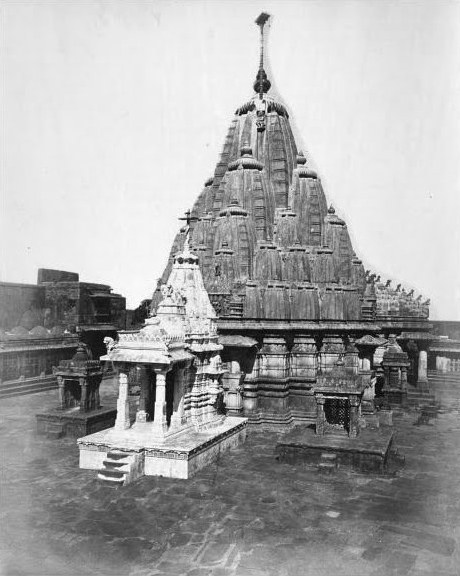
Neminatha is one of the five most devotionally revered Tirthankaras, along with Mahavira, Rishabhanatha, Parshvanatha and Shantinatha.[41] Various Jain temple complexes across India feature him, and these are important pilgrimage sites in Jainism. Mount Girnar of Gujarat, for example, which is believed to have been a place where Neminatha is believed to have achieved nirvana.[63]
Luna Vasahi in Dilwara Temples, built in 1230 by two Porwad brothers - Vastupala and Tejpal, considered famous for ellaborate architecture and intricate carvings.[64] The ceilings of the temple depicts scenes of the life of Neminatha with image of Rajmathi (who was to marry Neminatha)[65] and Krishna.[66][37] Shanka Basadi in Lakshmeshwara, built in 7th century, is considered one of the most important temple built by Kalyani Chalukyas.[67] The temple derives its name from the image of Neminatha in kayotsarga posture standing on a large shankha (conch shell).[65] The unique feature of this temple is a monolithic pillar with the carving of 1008 Tirthankaras known as Sahasrakuta Jinabimba.[68][69] Adikavi Pampa wrote Ādi purāṇa, seated in this basadi (temple) during 9th century.[70][71]
Important Neminatha temple complexes include Tirumalai (Jain complex), Kulpakji, Arahanthgiri Jain Math, Nemgiri, Bhand Dewal, Bhand Dewal in Arang and Odegal basadi.


.jpg)

See also[edit | edit source]
References[edit | edit source]
Citations[edit | edit source]
- ↑ Tandon 2002, p. 45.
- ↑ Sarasvati 1970, p. 444.
- ↑ 3.0 3.1 von Glasenapp 1925, p. 317.
- ↑ 4.0 4.1 4.2 Doniger 1993, p. 225.
- ↑ Monier Williams, p. 569.
- ↑ Monier Williams, p. 534.
- ↑ Umakant P. Shah 1987.
- ↑ Umakant P. Shah 1987, pp. 164-165.
- ↑ 9.0 9.1 Jain & Fischer 1978, p. 17.
- ↑ Zimmer 1953, p. 225.
- ↑ 11.0 11.1 11.2 von Glasenapp 1925, pp. 317-318.
- ↑ 12.0 12.1 12.2 12.3 12.4 "Arishtanemi: Jaina saint". Encyclopedia Britannica. Retrieved 15 September 2017.
- ↑ Zimmer 1953, p. 224.
- ↑ 14.0 14.1 Tukol 1980, p. 31.
- ↑ 15.0 15.1 15.2 Natubhai Shah 2004, p. 23.
- ↑ 16.0 16.1 Zimmer 1953, p. 226.
- ↑ 17.0 17.1 17.2 17.3 Finegan 1952, p. 190.
- ↑ 18.0 18.1 18.2 18.3 18.4 18.5 18.6 Natubhai Shah 2004, p. 24.
- ↑ Dhere 2011, pp. 193–196.
- ↑ Upinder Singh 2008, p. 313.
- ↑ Cort 2001, p. 23.
- ↑ 22.0 22.1 Jain & Fischer 1978, pp. 16–17.
- ↑ 23.0 23.1 Umakant P. Shah 1987, p. 164.
- ↑ Johnson 1931, pp. 1–266.
- ↑ 25.0 25.1 Umakant P. Shah 1987, pp. 165-166.
- ↑ 26.0 26.1 26.2 Sangave 2001, p. 104.
- ↑ Gaur 1976, p. 46.
- ↑ Vyas 1995, p. 19.
- ↑ 29.0 29.1 29.2 von Glasenapp 1925, p. 318.
- ↑ Doniger 1993, p. 226.
- ↑ Beck 2012, p. 156.
- ↑ Long 2009, p. 42.
- ↑ Natubhai Shah 2004, pp. 23-24.
- ↑ Sehdev Kumar 2001, pp. 143–145.
- ↑ Kailash Chand Jain 1991, p. 7.
- ↑ 36.0 36.1 Jones & Ryan 2006, p. 311.
- ↑ 37.0 37.1 37.2 37.3 37.4 37.5 Umakant P. Shah 1987, p. 165.
- ↑ Cort 2001, p. 47.
- ↑ Melton & Baumann 2010, p. 1551.
- ↑ Natubhai Shah 2004, p. 25.
- ↑ 41.0 41.1 Dundas 2002, p. 40.
- ↑ Lienhard 1984, p. 137.
- ↑ Jain 2015, pp. 150–155.
- ↑ Jain 2015, pp. 150-151.
- ↑ Umakant P. Shah 1987, p. 239.
- ↑ Upinder Singh 2016, p. 26.
- ↑ Umakant P. Shah 1987, p. 253.
- ↑ Kelting 2009, p. 117.
- ↑ Amaresh Datta 1988, p. 1258.
- ↑ K. K. Shastree 2002, pp. 56–57.
- ↑ Nagendra 1988, pp. 282–283.
- ↑ Jhaveri 1978, pp. 14, 242–243.
- ↑ Parul Shah 1983, pp. 134-156.
- ↑ Rice 1982, p. 43.
- ↑ Sastri 2002, pp. 358–359.
- ↑ Acharya Charantirtha 1973, p. 47.
- ↑ Natubhai Shah 2004, p. 269.
- ↑ Reddy 2023, p. 187.
- ↑ Umakant P. Shah 1987, pp. 164-168.
- ↑ Umakant P. Shah 1987, pp. 164-170.
- ↑ Umakant P. Shah 1987, pp. 264-265.
- ↑ Umakant P. Shah 1987, p. 166.
- ↑ Cort 2001, p. 229.
- ↑ Ching, Jarzombek & Prakash 2010, p. 336.
- ↑ 65.0 65.1 Umakant P. Shah 1987, p. 169.
- ↑ Titze & Bruhn 1998, p. 253.
- ↑ Chugh 2016, p. 300.
- ↑ Chugh 2016, p. 295.
- ↑ Chugh 2016, pp. 305–306.
- ↑ Azer 2011.
- ↑ Chugh 2016, p. 437.
Sources[edit | edit source]
Books[edit | edit source]
- Beck, Guy L. (1 February 2012), Alternative Krishnas: Regional and Vernacular Variations on a Hindu Deity, SUNY Press, ISBN 978-0-7914-6415-1
- Cort, John E. (2001), Jains in the World: Religious Values and Ideology in India, Oxford University Press, ISBN 978-0-19-803037-9
- Ching, Francis D. K.; Jarzombek, Mark M.; Prakash, Vikramaditya (2010) [1934], A Global History of Architecture, John Wiley & Sons, ISBN 978-0-471-26892-5
- Chugh, Lalit (2016). Karnataka's Rich Heritage - Art and Architecture (From Prehistoric Times to the Hoysala Period ed.). Chennai: Notion Press. ISBN 978-93-5206-825-8.
- Acharya Charantirtha (1973). Meghadutam of Mahakavi Kalidas. Chaukhamba Sanskrit Series. Varanasi: Chaukhamba Surbharati Prakashan.
- Datta, Amaresh (1988), Encyclopaedia of Indian Literature, Sahitya Akademi, ISBN 978-81-260-1194-0
- Dhere, Ramchandra C. (2011), Rise of a Folk God: Vitthal of Pandharpur, Oxford University Press, ISBN 978-0-19-977759-4
- Dundas, Paul (2002) [1992], The Jains (Second ed.), Routledge, ISBN 0-415-26605-X
- Doniger, Wendy (1993), Purana Perennis: Reciprocity and Transformation in Hindu and Jaina Texts, SUNY Press, ISBN 0-7914-1381-0
- Finegan, Jack (1952), The archeology of world religions, Princeton University Press
- Jain, Jyotindra; Fischer, Eberhard (1978), Jaina Iconography, vol. 12, Brill Publishers, ISBN 978-90-04-05259-8
- Jain, Kailash Chand (1991), Lord Mahāvīra and His Times, Motilal Banarsidass, ISBN 978-81-208-0805-8
- Jain, Vijay K. (2015), Acarya Samantabhadra's Svayambhustotra: Adoration of The Twenty-four Tirthankara, Vikalp Printer, ISBN 9788190363976,
Non-Copyright
- Jhaveri, Mansukhlal (1978), History of Gujarati Literature, Sahitya Akademi, archived from the original on 20 December 2016
- Johnson, Helen M. (1931), Neminathacaritra (Book 8 of the Trishashti Shalaka Purusha Caritra), Baroda Oriental Institute
- Jones, Constance; Ryan, James D. (2006), Encyclopedia of Hinduism, Infobase Publishing, ISBN 978-0-8160-7564-5
- Kelting, M. Whitney (2009), Heroic Wives Rituals, Stories and the Virtues of Jain Wifehood, Oxford University Press, ISBN 978-0-19-538964-7
- Kumar, Sehdev (2001), A Thousand Petalled Lotus: Jain Temples of Rajasthan : Architecture & Iconography, Abhinav Publications, ISBN 978-81-7017-348-9
- Long, Jeffery D. (2009), Jainism: An Introduction, I. B. Tauris, ISBN 978-1-84511-625-5
- Lienhard, Siegfried (1984), A History of Classical Poetry: Sanskrit, Pali, Prakrit, A history of Indian literature: Classical Sanskrit literature, vol. 1, Harrassowitz Verlag, ISBN 978-1-84511-625-5
- Melton, J. Gordon; Baumann, Martin, eds. (2010), Religions of the World: A Comprehensive Encyclopedia of Beliefs and Practices, vol. One: A-B (Second ed.), ABC-CLIO, ISBN 978-1-59884-204-3
- Nagendra (1988), Indian Literature, Prabhat Prakashan
- Rice, E.P. (1982) [1921]. A History of Kanarese Literature. New Delhi: Asian Educational Services. ISBN 81-206-0063-0.
- Reddy, P. Chenny (2023). Kalyana Mitra: A treasure house of history, culture and archaeological studies. Vol. 5. Blue Rose Publishers. ISBN 978-93-5741-111-0.
- Sangave, Vilas Adinath (2001), Facets of Jainology: Selected Research Papers on Jain Society, Religion, and Culture, Mumbai: Popular Prakashan, ISBN 978-81-7154-839-2
- Sarasvati, Swami Dayananda (1970), An English translation of the Satyarth Prakash, Swami Dayananda Sarasvati[permanent dead link]
- Shah, Natubhai (2004), Jainism: The World of Conquerors, vol. 1, Motilal Banarsidass, ISBN 9788120819382
- Shah, Parul (31 August 1983), "5", The rasa dance of Gujarata (Ph.D.), vol. 1, Department of Dance, Maharaja Sayajirao University of Baroda, hdl:10603/59446
- Shastree, K. K. (2002), Gujarat Darsana: The Literary History, Darshan Trust, Ahmedabad
- Singh, Upinder (2016), A History of Ancient and Early Medieval India: From the Stone Age to the 12th Century, Pearson Education, ISBN 978-93-325-6996-6
- Shah, Umakant Premanand (1987), Jaina-rūpa-maṇḍana: Jaina iconography, Abhinav Publications, ISBN 81-7017-208-X
- Sastri, K.A. Nilakanta (2002) [1955]. A history of South India from prehistoric times to the fall of Vijayanagar. New Delhi: Indian Branch, Oxford University Press. ISBN 0-19-560686-8.
- Singh, Upinder (2008), A history of ancient and early medieval India : from the Stone Age to the 12th century, New Delhi: Pearson Education, ISBN 978-81-317-1120-0
- Tandon, Om Prakash (2002) [1968], Jaina Shrines in India (1 ed.), New Delhi: Publications Division, Ministry of Information and Broadcasting, Government of India, ISBN 81-230-1013-3
- Titze, Kurt; Bruhn, Klaus (1998). Jainism: A Pictorial Guide to the Religion of Non-Violence (2 ed.). Motilal Banarsidass. ISBN 978-81-208-1534-6.
- Tukol, T. K. (1980), Compendium of Jainism, Dharwad: University of Karnataka
- von Glasenapp, Helmuth (1925), Jainism: An Indian Religion of Salvation [Der Jainismus: Eine Indische Erlosungsreligion], Shridhar B. Shrotri (trans.), Motilal Banarsidass (Reprint: 1999), ISBN 81-208-1376-6
- Vyas, Dr. R. T., ed. (1995), Studies in Jaina Art and Iconography and Allied Subjects, The Director, Oriental Institute, on behalf of the Registrar, M.S. University of Baroda, Vadodara, ISBN 81-7017-316-7
- Williams, Monier, Nemi - Sanskrit English Dictionary with Etymology, Oxford University Press
- Zimmer, Heinrich (1953) [April 1952], Campbell, Joseph (ed.), Philosophies Of India, London: Routledge & Kegan Paul Ltd, ISBN 978-81-208-0739-6,
 This article incorporates text from this source, which is in the public domain.
Web[edit | edit source]
- Gaur, R. C. (1976). "Vedoc Chronology". Proceedings of the Indian History Congress. 37. Indian History Congress: 46–49. JSTOR 44138897. Retrieved 11 February 2023.
- Azer, Rahman (27 June 2011). "Lakshmeshwar, a melting pot of cultures". Deccan Herald. Retrieved 9 May 2021.
| Gods | |||||
|---|---|---|---|---|---|
| Philosophy | |||||
| Branches |
| ||||
| Practices | |||||
| Literature | |||||
| Symbols |
| ||||
| Ascetics | |||||
| Scholars | |||||
| Community | |||||
| Jainism in |
| ||||
| Jainism and | |||||
| Dynasties and empires | |||||
| Related | |||||
| Lists | |||||
| Navboxes | |||||
