



ImportMaster (talk | contribs) robot: Create/update articles in Category:Hindu gods. |
content update |
||
| Line 1: | Line 1: | ||
{{short description|Divine dance of Radha Krishna with Gopis}} | |||
{{About||the 1975 film|Rasaleela (1975 film)|the 2012 film|Rasaleela (2012 film)}} | {{About||the 1975 film|Rasaleela (1975 film)|the 2012 film|Rasaleela (2012 film)}} | ||
{{Use dmy dates|date= | {{other uses|Rasaleela (disambiguation)|Krishna Leela (disambiguation)}} | ||
{{Use dmy dates|date=April 2024}} | |||
[[File:Krishna and Radha dancing the Rasalila, Jaipur, 19th century.jpg|thumb|[[Krishna]] and [[Radha]] dancing the rasalila, a 19th-century painting, Rajasthan]] | |||
The '''Raslila''' ({{Langx|sa|रासलीला|translit=Rāsalīlā}}),<ref>{{Cite web |last=wisdomlib.org |date=1970-01-01 |title=Rasalila, Rāsalīlā, Rasa-lila: 1 definition |url=https://www.wisdomlib.org/definition/rasalila |access-date=2022-12-23 |website=wisdomlib.org}}</ref><ref>{{Cite book |last1=Bryant |first1=Edwin |url=https://books.google.com/books?id=mBMxPdgrBhoC&dq=rasalila+krishna&pg=PA445 |title=The Hare Krishna Movement: The Postcharismatic Fate of a Religious Transplant |last2=Ekstrand |first2=Maria |date=2004-06-23 |publisher=Columbia University Press |isbn=978-0-231-50843-8 |pages=445}}</ref> also rendered the '''Rasalila''' or the '''Ras dance''', is part of a traditional story described in Hindu texts such as the [[Bhagavata Purana]] and [[Gita Govinda]], where Krishna dances with [[Radha]] and the [[gopi]]s of [[Braj]]. Rasalila has also been a popular theme for other India classical dances including [[Bharatanatyam]], [[Odissi]], [[Manipuri Raas Leela]], [[Kuchipudi]], and [[Kathak]].<ref>{{Cite book |last=Mohapatra |first=J. |url=https://books.google.com/books?id=UdpzAgAAQBAJ&dq=worship+radha&pg=PA164 |title=Wellness in Indian Festivals & Rituals |date=2013 |publisher=Partridge Publishing |isbn=978-1-4828-1690-7 |pages=164}}</ref> | |||
The [[Indian classical dance]] of ''Kathak'' and ''Manipuri'' rasalila are evolved from the rasalila of Braj. Kathak, also known as ''Natwari Nritya'', was revived in the 1960s by the Kathak dancer, [[Uma Sharma]].<ref>{{cite book |title=Indian theatre: traditions of performance|last=Richmond |first=Farley P. |author2=Darius L. Swann|author3=Phillip B. Zarrilli|year=1993 |publisher=Motilal Banarsidass|isbn=81-208-0981-5|page=197 |url=https://books.google.com/books?id=3HIh7oPkvAMC&q=Uma+Sharma&pg=PA198 }}</ref> | |||
==Etymology== | ==Etymology== | ||
The term | The term ''raslila'' is derived from the Sanskrit words ''ras'' which means "nectar", "emotion" or "sweet taste" and ''[[lila (Hinduism)|lila]]'' meaning "act," "play" or "dance." Thus, it is more broadly defined as the "Dance of Divine Love" or "Sweet act of Krishna."<ref name=":0">{{cite book |author=Schweig |first=G.M |title=Dance of divine love: The Rasa Lila of Krishna from the Bhagavata Purana, India's classic sacred love story |publisher=Princeton University Press |year=2005 |isbn=0-691-11446-3 |location=New York}}</ref> | ||
{{Vaishnavism}} | |||
== Legend == | == Legend == | ||
The rasalila takes place one night when the [[gopi]]s of [[Vrindavan]]a, upon hearing the sound of Krishna's [[Bansuri|flute]], sneak away from their households and families to the forest to dance with Krishna throughout the night, which Krishna supernaturally stretches to the length of one [[Kalpa (aeon)|kalpa]], a [[Hindu units of time|Hindu unit of time]] lasting approximately 4.32 billion years. In the Krishna [[Bhakti]] traditions, the rasalila is considered to be one most beautiful depiction of soulful love. In these traditions, romantic love between human beings in the [[Maya (illusion)#Maya in Hindu philosophy|material world]] is seen as a reflection of the soul's original, ecstatic spiritual love of Krishna, in his spiritual world, [[Goloka]].{{Citation needed|date=April 2023}} | |||
The rasalila takes place one night when the [[gopi]]s of [[Vrindavan]]a, upon hearing the sound of Krishna's [[Bansuri|flute]], sneak away from their households and families to the forest to dance with Krishna throughout the night, which Krishna supernaturally stretches to the length of one [[Kalpa (aeon)|kalpa]], a [[Hindu units of time|Hindu unit of time]] lasting approximately 4.32 billion years. In the Krishna [[Bhakti]] traditions, the | |||
In the Bhagavata Purana it is stated that whoever faithfully hears or describes the rasalila attains Krishna's ''pure loving devotion'' ([[Suddha-bhakti]]).<ref>[http://vedabase.net/sb/10/33/39/en2 Bhag-P 10.33.39] {{webarchive|url=https://web.archive.org/web/20080618004341/http://vedabase.net/sb/10/33/39/en2|date=2008-06-18}}</ref> The rasalila is considered to be the "ultimate message" of the Bhagavata Purana.<ref name=":0" />{{rp|1}} The story starts in Vraja, where Krishna is inspired to play music on his flute. Hearing the music, the gopis leave their homes and families and make it to Krishna. When they came closer, Krishna playfully disappears and reappears. Krishna talks about love and performs rasalila with each of the gopis, assuming numerous forms. The story ends with the gopis reluctantly going back to their homes after refreshing in a nearby river.<ref name=":0" />{{rp|2}} | |||
Graham Schweig observes that a closer reading of the story leads one to see the story as a symbol of "intense devotion to God" and not a "display of worldly lust". Verse 10.33.40 of the Bhagavata states that, "the person who has heard this story will attain high devotion to the Lord, and then, sobered, he will quickly throw off lust, the disease of the heart."<ref>{{Cite book |last=Schweig |first=Graham M. |url=https://muse.jhu.edu/pub/267/monograph/book/60996 |title=Dance of Divine Love: India's Classic Sacred Love Story: The Rasa Lila of Krishna |date=2018 |publisher=Princeton University Press |isbn=978-0-691-19017-4 |location=Princeton |pages=xvi}}</ref> | |||
Schweig argues for an appreciation of the "unique vision" presented in the text in which God is "an adorable, eternally youthful cowherd boy who plays the flute and delights in amorous dalliance with his dearest devotees".<ref name=":0" />{{rp|3}} Schweig compares the rasalila to the "Song of Songs". He argues that just as the Song of Solomon has been ascribed the highest status in relation to other books of the Bible by mystics of the Jewish and Christian traditions, the rasalila has been considered by [[Vaishnavism|Vaishnava]] traditions to be the "crown-jewel of all acts of God".<ref name=":0" />{{rp|8}} | |||
Just as a child plays at its own will with its reflection in a mirror, with the help of his [[Yogamaya]], Krishna sported with the gopis, who are regarded to have been shadows of his own form.<ref name="golove">{{cite book |last=Hanumanprasad |first=Poddar |title=Gopīs' Love for Śrī Kṛṣṇa |publisher=Gita Press |year=1941 |location=Gorakhpur}}</ref> | Just as a child plays at its own will with its reflection in a mirror, with the help of his [[Yogamaya]], Krishna sported with the gopis, who are regarded to have been shadows of his own form.<ref name="golove">{{cite book |last=Hanumanprasad |first=Poddar |title=Gopīs' Love for Śrī Kṛṣṇa |publisher=Gita Press |year=1941 |location=Gorakhpur}}</ref> Krishna's yogamaya intensifies devotion because it causes devotees to forget his majesty and form an initimate connection.<ref>{{Cite book |last=Gupta |first=Gopal K. |title=Māyā in the Bhāgavata Purāna: human suffering and divine play |date=2020 |publisher=Oxford university press |isbn=978-0-19-885699-3 |series=Oxford theology and religion monographs |location=Oxford New York (N.Y.) |pages=114}}</ref> | ||
==Performance== | ==Performance== | ||
Rasalila has been a popular theme in [[Kathak]], [[Bharatanatyam]],<ref>{{Cite web|last=Performing Arts|first=Ahalya|date=22 December 2016|title=Rasa Lila / Rasakreeda Bharata Natyam Performance|url=https://www.youtube.com/watch?v=qsQroDxqrCk |archive-url=https://ghostarchive.org/varchive/youtube/20211221/qsQroDxqrCk |archive-date=2021-12-21 |url-status=live|access-date=29 June 2020|website=Ahalya Performing Arts}}{{cbignore}}</ref> [[Odissi]], [[Bishnupriya Manipuri people|Manipuri]], and [[Kuchipudi]] dance forms. | Rasalila has been a popular theme in [[Kathak]], [[Bharatanatyam]],<ref>{{Cite web|last=Performing Arts|first=Ahalya|date=22 December 2016|title=Rasa Lila / Rasakreeda Bharata Natyam Performance|url=https://www.youtube.com/watch?v=qsQroDxqrCk |archive-url=https://ghostarchive.org/varchive/youtube/20211221/qsQroDxqrCk |archive-date=2021-12-21 |url-status=live|access-date=29 June 2020|website=Ahalya Performing Arts}}{{cbignore}}</ref> [[Odissi]], [[Bishnupriya Manipuri people|Manipuri]], and [[Kuchipudi]] dance forms. Rasalila is a popular form of folk theatre in the regions of [[Mathura, Uttar Pradesh|Mathura]], [[Vrindavan]]a in [[Uttar Pradesh]], [[Nathdwara]] amongst various followers of [[Pushtimarg]] or the [[Vallabh sect]] and other sects in the regions of India. It is also seen in [[gaudiya vaishnavism|Gaudiya Vaishnavism]] in [[Nadia]] a district of West Bengal which is also known for Raas Utsava. Vanga Raas of Santipur is the main festival of this town, [[Nabadwip]] also has Shakta Raas.{{Citation needed|date=April 2023}} | ||
The | The raslila is also observed as one of the State Festivals of [[Assam]] which usually is celebrated during late November or early December. During Raas Mahotsava, several thousand devotees visit the holy temples and [[Satra (Ekasarana Dharma)|satra]]s of Assam every year. The Raas Mahotsav of Majuli, Nalbari and of Howly are noteworthy.{{Citation needed|date=April 2023}} | ||
[[File:Nagaon Raasleela 6.jpg|thumb|Krishna and Radha during Raslila in Assam]] | |||
[[File:Rasa Lila in Manipuri dance style.jpg|thumb|left|''Raas Leela'' in Manipuri classical Indian dance style]] | [[File:Rasa Lila in Manipuri dance style.jpg|thumb|left|''Raas Leela'' in Manipuri classical Indian dance style]] | ||
In the tradition of [[Vaishnavism of Manipur]] | In the tradition of [[Vaishnavism of Manipur]] rasa-lila is depicted within [[Manipuri dance|Manipuri classical Indian dance]] and revolves around the story of love between Krishna and [[Radha]], his divine beloved. This form of dance was started by [[Bhagya Chandra]] in 1779 and in some parts of India is still performed every year on [[Krishna Janmashtami]] (the festival to celebrate Krishna's ''birthday''). According to different traditions, the rasa-lila is performed either by boys and girls, or by girls only. The dance is performed holding ''dandi'' (sticks) and is often accompanied with folk songs and [[Bhajan|devotional music]].{{Citation needed|date=April 2023}} | ||
The traditional rasalila performances in Vrindavan are famous throughout the Vaishnava world as an experience of the spiritual world. | The traditional rasalila performances in Vrindavan are famous throughout the Vaishnava world as an experience of the spiritual world. Rasalila performance was started by Swami Sri Uddhavaghamanda Devacharya in the early 15th Century CE at Vamshivata in Vrindavan, [[Mathura, Uttar Pradesh|Mathura]]. He was a prominent saint of the [[Nimbarka Sampradaya]], and disciple of the [[Harivyasa devacharya|Swami Sri Harivyasa Devacharya]]. The Vani literature of Vraja is the transcription of the songs that were heard by Swami Harivyasa Devacarya and his Guru, Swami Shri Shribhatta as they meditated on the Nitya Lila of [[Radha]] [[Krishna]]. These songs describe the eternal spiritual abode of [[Radha]] [[Krishna]], the Sakhis and Nitya Vrindavana Dham - or Nikunja Dham. [[File:Nagaon Raasleela 9.jpg|thumb|[[Radha]] & [[Krishna]] along with other gopis dance during the raas celebration in [[Nagaon]] district of Assam.]] It became more prominent utsava in 16th and 17th century, when Mahaprabhu Shri [[Vallabhacharya]] and [[Vitthalanatha]] gusaiji made it more popular.{{Citation needed|date=April 2023}} | ||
==References== | ==References== | ||
{{reflist}} | {{reflist}} | ||
==Further reading== | ==Further reading== | ||
* ''Music in traditional Indian theatre: special reference to Raas Leela'', by Rani Balbir Kaur. Shubhi Publications, 2006. {{ISBN|978-81-87226-99-4}}. | * ''Music in traditional Indian theatre: special reference to Raas Leela'', by Rani Balbir Kaur. Shubhi Publications, 2006. {{ISBN|978-81-87226-99-4}}. | ||
| Line 32: | Line 43: | ||
==Bibliography== | ==Bibliography== | ||
*''Dance of Divine Love: The rasalila of Krishna from the Bhagavata Purana, India's classic sacred love story'', by Graham M. Schweig. Princeton University Press, Princeton, NJ; 2005 ({{ISBN|0-691-11446-3}}). | *''Dance of Divine Love: The rasalila of Krishna from the Bhagavata Purana, India's classic sacred love story'', by Graham M. Schweig. Princeton University Press, Princeton, NJ; 2005 ({{ISBN|0-691-11446-3}}). | ||
*''Rasa - Love Relationships in Transcendence'', by | *''Rasa - Love Relationships in Transcendence'', by Swami B.V. Tripurari ({{ISBN|978-1-886069-10-7}}) | ||
*''Theatre and Religion on Krishna's Stage'', by David Mason, New York: Palgrave, 2009 | *''Theatre and Religion on Krishna's Stage'', by David Mason, New York: Palgrave, 2009 | ||
*"Essays on Indo-Aryan Mythology", by Narayan Aiyangar, 1898 ({{ISBN|1-104-83270-4}}) ({{ISBN|978-1-104-83270-4}}) | *"Essays on Indo-Aryan Mythology", by Narayan Aiyangar, 1898 ({{ISBN|1-104-83270-4}}) ({{ISBN|978-1-104-83270-4}}) | ||
| Line 39: | Line 50: | ||
{{commons category|Rasa Lila}} | {{commons category|Rasa Lila}} | ||
* [http://www.britannica.com/eb/article-9062739/raslila rasalila] at [[Encyclopædia Britannica]] | * [http://www.britannica.com/eb/article-9062739/raslila rasalila] at [[Encyclopædia Britannica]] | ||
* [http://haribhakt.com/what-is-raas-lila/ What is rasalila] | * [http://haribhakt.com/what-is-raas-lila/ What is rasalila] {{Webarchive|url=https://web.archive.org/web/20131127082149/http://haribhakt.com/what-is-raas-lila |date=27 November 2013 }} | ||
{{Dance in India}} | {{Dance in India}} | ||
| Line 45: | Line 56: | ||
{{DEFAULTSORT:Rasa Lila}} | {{DEFAULTSORT:Rasa Lila}} | ||
[[Category:Vaishnavism]] | [[Category:Vaishnavism]] | ||
[[Category:Culture of Manipur]] | [[Category:Culture of Manipur]] | ||
| Line 51: | Line 61: | ||
[[Category:Culture of Uttar Pradesh]] | [[Category:Culture of Uttar Pradesh]] | ||
[[Category:Krishna]] | [[Category:Krishna]] | ||
[[Category:Theatre | [[Category:Theatre of India]] | ||
[[Category:Musical theatre]] | [[Category:Musical theatre]] | ||
[[Category:Religious vernacular drama]] | [[Category:Religious vernacular drama]] | ||
[[Category:Festivals in Assam]] | [[Category:Festivals in Assam]] | ||
[[Category:Meitei theatre]] | |||
[[Category:Meitei cultural plays]] | |||
Latest revision as of 04:46, 31 January 2026

The Raslila (Sanskrit: रासलीला, romanized: Rāsalīlā),[1][2] also rendered the Rasalila or the Ras dance, is part of a traditional story described in Hindu texts such as the Bhagavata Purana and Gita Govinda, where Krishna dances with Radha and the gopis of Braj. Rasalila has also been a popular theme for other India classical dances including Bharatanatyam, Odissi, Manipuri Raas Leela, Kuchipudi, and Kathak.[3]
The Indian classical dance of Kathak and Manipuri rasalila are evolved from the rasalila of Braj. Kathak, also known as Natwari Nritya, was revived in the 1960s by the Kathak dancer, Uma Sharma.[4]
Etymology[edit | edit source]
The term raslila is derived from the Sanskrit words ras which means "nectar", "emotion" or "sweet taste" and lila meaning "act," "play" or "dance." Thus, it is more broadly defined as the "Dance of Divine Love" or "Sweet act of Krishna."[5]
| Part of a series on |
| Vaishnavism |
|---|
 |
 Hinduism portal Hinduism portal |
Legend[edit | edit source]
The rasalila takes place one night when the gopis of Vrindavana, upon hearing the sound of Krishna's flute, sneak away from their households and families to the forest to dance with Krishna throughout the night, which Krishna supernaturally stretches to the length of one kalpa, a Hindu unit of time lasting approximately 4.32 billion years. In the Krishna Bhakti traditions, the rasalila is considered to be one most beautiful depiction of soulful love. In these traditions, romantic love between human beings in the material world is seen as a reflection of the soul's original, ecstatic spiritual love of Krishna, in his spiritual world, Goloka.[citation needed]
In the Bhagavata Purana it is stated that whoever faithfully hears or describes the rasalila attains Krishna's pure loving devotion (Suddha-bhakti).[6] The rasalila is considered to be the "ultimate message" of the Bhagavata Purana.[5]:1 The story starts in Vraja, where Krishna is inspired to play music on his flute. Hearing the music, the gopis leave their homes and families and make it to Krishna. When they came closer, Krishna playfully disappears and reappears. Krishna talks about love and performs rasalila with each of the gopis, assuming numerous forms. The story ends with the gopis reluctantly going back to their homes after refreshing in a nearby river.[5]:2
Graham Schweig observes that a closer reading of the story leads one to see the story as a symbol of "intense devotion to God" and not a "display of worldly lust". Verse 10.33.40 of the Bhagavata states that, "the person who has heard this story will attain high devotion to the Lord, and then, sobered, he will quickly throw off lust, the disease of the heart."[7]
Schweig argues for an appreciation of the "unique vision" presented in the text in which God is "an adorable, eternally youthful cowherd boy who plays the flute and delights in amorous dalliance with his dearest devotees".[5]:3 Schweig compares the rasalila to the "Song of Songs". He argues that just as the Song of Solomon has been ascribed the highest status in relation to other books of the Bible by mystics of the Jewish and Christian traditions, the rasalila has been considered by Vaishnava traditions to be the "crown-jewel of all acts of God".[5]:8
Just as a child plays at its own will with its reflection in a mirror, with the help of his Yogamaya, Krishna sported with the gopis, who are regarded to have been shadows of his own form.[8] Krishna's yogamaya intensifies devotion because it causes devotees to forget his majesty and form an initimate connection.[9]
Performance[edit | edit source]
Rasalila has been a popular theme in Kathak, Bharatanatyam,[10] Odissi, Manipuri, and Kuchipudi dance forms. Rasalila is a popular form of folk theatre in the regions of Mathura, Vrindavana in Uttar Pradesh, Nathdwara amongst various followers of Pushtimarg or the Vallabh sect and other sects in the regions of India. It is also seen in Gaudiya Vaishnavism in Nadia a district of West Bengal which is also known for Raas Utsava. Vanga Raas of Santipur is the main festival of this town, Nabadwip also has Shakta Raas.[citation needed]
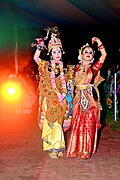
The raslila is also observed as one of the State Festivals of Assam which usually is celebrated during late November or early December. During Raas Mahotsava, several thousand devotees visit the holy temples and satras of Assam every year. The Raas Mahotsav of Majuli, Nalbari and of Howly are noteworthy.[citation needed]


In the tradition of Vaishnavism of Manipur rasa-lila is depicted within Manipuri classical Indian dance and revolves around the story of love between Krishna and Radha, his divine beloved. This form of dance was started by Bhagya Chandra in 1779 and in some parts of India is still performed every year on Krishna Janmashtami (the festival to celebrate Krishna's birthday). According to different traditions, the rasa-lila is performed either by boys and girls, or by girls only. The dance is performed holding dandi (sticks) and is often accompanied with folk songs and devotional music.[citation needed]
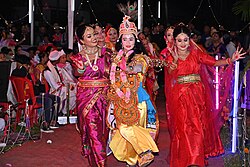
The traditional rasalila performances in Vrindavan are famous throughout the Vaishnava world as an experience of the spiritual world. Rasalila performance was started by Swami Sri Uddhavaghamanda Devacharya in the early 15th Century CE at Vamshivata in Vrindavan, Mathura. He was a prominent saint of the Nimbarka Sampradaya, and disciple of the Swami Sri Harivyasa Devacharya. The Vani literature of Vraja is the transcription of the songs that were heard by Swami Harivyasa Devacarya and his Guru, Swami Shri Shribhatta as they meditated on the Nitya Lila of Radha Krishna. These songs describe the eternal spiritual abode of Radha Krishna, the Sakhis and Nitya Vrindavana Dham - or Nikunja Dham.

It became more prominent utsava in 16th and 17th century, when Mahaprabhu Shri Vallabhacharya and Vitthalanatha gusaiji made it more popular.[citation needed]
References[edit | edit source]
- ↑ wisdomlib.org (1 January 1970). "Rasalila, Rāsalīlā, Rasa-lila: 1 definition". wisdomlib.org. Retrieved 23 December 2022.
- ↑ Bryant, Edwin; Ekstrand, Maria (23 June 2004). The Hare Krishna Movement: The Postcharismatic Fate of a Religious Transplant. Columbia University Press. p. 445. ISBN 978-0-231-50843-8.
- ↑ Mohapatra, J. (2013). Wellness in Indian Festivals & Rituals. Partridge Publishing. p. 164. ISBN 978-1-4828-1690-7.
- ↑ Richmond, Farley P.; Darius L. Swann; Phillip B. Zarrilli (1993). Indian theatre: traditions of performance. Motilal Banarsidass. p. 197. ISBN 81-208-0981-5.
- ↑ 5.0 5.1 5.2 5.3 5.4 Schweig, G.M (2005). Dance of divine love: The Rasa Lila of Krishna from the Bhagavata Purana, India's classic sacred love story. New York: Princeton University Press. ISBN 0-691-11446-3.
- ↑ Bhag-P 10.33.39 Archived 2008-06-18 at the Wayback Machine
- ↑ Schweig, Graham M. (2018). Dance of Divine Love: India's Classic Sacred Love Story: The Rasa Lila of Krishna. Princeton: Princeton University Press. pp. xvi. ISBN 978-0-691-19017-4.
- ↑ Hanumanprasad, Poddar (1941). Gopīs' Love for Śrī Kṛṣṇa. Gorakhpur: Gita Press.
- ↑ Gupta, Gopal K. (2020). Māyā in the Bhāgavata Purāna: human suffering and divine play. Oxford theology and religion monographs. Oxford New York (N.Y.): Oxford university press. p. 114. ISBN 978-0-19-885699-3.
- ↑ Performing Arts, Ahalya (22 December 2016). "Rasa Lila / Rasakreeda Bharata Natyam Performance". Ahalya Performing Arts. Archived from the original on 21 December 2021. Retrieved 29 June 2020.
Further reading[edit | edit source]
- Music in traditional Indian theatre: special reference to Raas Leela, by Rani Balbir Kaur. Shubhi Publications, 2006. ISBN 978-81-87226-99-4.
Bibliography[edit | edit source]
- Dance of Divine Love: The rasalila of Krishna from the Bhagavata Purana, India's classic sacred love story, by Graham M. Schweig. Princeton University Press, Princeton, NJ; 2005 (ISBN 0-691-11446-3).
- Rasa - Love Relationships in Transcendence, by Swami B.V. Tripurari (ISBN 978-1-886069-10-7)
- Theatre and Religion on Krishna's Stage, by David Mason, New York: Palgrave, 2009
- "Essays on Indo-Aryan Mythology", by Narayan Aiyangar, 1898 (ISBN 1-104-83270-4) (ISBN 978-1-104-83270-4)
External links[edit | edit source]
- rasalila at Encyclopædia Britannica
- What is rasalila Archived 27 November 2013 at the Wayback Machine
| Forms |  | |
|---|---|---|
| Consorts | ||
| Other relatives | ||
| Worship | ||
| Holy sites | ||
| Epigraphy | ||
| Texts | ||
| See also | ||