

No edit summary |
m improve article per sources as per guidelines |
||
| Line 1: | Line 1: | ||
{{Short description|Rose-like flowering plant}} | |||
{{Redirect|Moss rose|other uses|Moss Rose (disambiguation)}} | |||
{{Distinguish|Portulaca umbraticola|Vietnam Rose}} | |||
{{Speciesbox | |||
|image = PortulacaGrandiflora.jpg | |||
|genus = Portulaca | |||
|species = grandiflora | |||
|authority = [[William Jackson Hooker|Hook.]] | |||
|synonyms = | |||
{{Plainlist | style = margin-left: 1em; text-indent: -1em; | | |||
* ''Portulaca hilaireana'' <small>G. Don</small> | |||
* ''Portulaca immersostellulata'' <small>Poelln.</small> | |||
* ''Portulaca mendocinensis'' <small>Gillies ex Hook.</small> | |||
* ''Portulaca multistaminata'' <small>Poelln.</small> | |||
}} | |||
|synonyms_ref = <ref>{{cite web | |||
|url=http://www.theplantlist.org/tpl1.1/record/kew-2573991 | |||
|title=The Plant List: A Working List of All Plant Species | |||
|access-date=21 June 2015}}</ref> | |||
}} | |||
[[File:松葉牡丹 20190403191249.jpg|thumb|Portulaca Grandiflora]] | |||
It is also seen in | '''''Portulaca grandiflora''''' is a [[Succulent plant|succulent]] [[flowering plant]] in the purslane family [[Portulacaceae]], native to southern [[Brazil]], [[Argentina]], and [[Uruguay]] and often cultivated in gardens.<ref name=rhs>Huxley, A., ed. (1992). ''New RHS Dictionary of Gardening''. Macmillan {{ISBN|0-333-47494-5}}.</ref><ref name=GRIN>{{GRIN | accessdate = 10 January 2018}}</ref> It has many [[common name]]s, including '''rose moss''',<ref>{{PLANTS|id=POGR7|taxon=Portulaca grandiflora|accessdate=31 January 2016}}</ref> '''eleven o'clock''',<ref name=GRIN/> '''Mexican rose''',<ref name=GRIN/> '''moss rose''',<ref name=GRIN/> '''sun rose''',<ref | ||
name=GRIN/> '''rose Jepun''',<ref name=Mitchell>{{cite book |author=Mitchell, H. |year=2003 |title=The Essential Earthman: Henry Mitchell on Gardening |publisher=Indiana University Press |isbn=9780253215857 |url=https://books.google.com/books?id=O5fRmqDualkC |page=113}}</ref> '''table rose''',{{citation needed|date=September 2023}} '''rock rose''',<ref name=Mitchell/> and '''moss-rose [[purslane]]'''. Despite these names and the superficial resemblance of some cultivars' flowers to [[rose]]s, it is not a true rose, nor even a part of the [[Rosaceae|rose family]] or [[Rosids|rosid]] group; rather, it is much more closely related to [[carnation]]s and [[cactus|cacti]]. | |||
It is also seen in South Asia and widely spread in most of the cities with old 18th- and 19th-century architecture in the [[Balkans]]. | |||
==Description== | |||
It is a small, but fast-growing [[annual plant]] growing to 30 cm tall, though usually less. However, if it is cultivated properly, it can easily reach this height. The [[leaf|leaves]] are thick and fleshy, up to 2.5 cm long, arranged alternately or in small clusters. The [[flower]]s are 2.5–3 cm diameter with five petals, variably red, orange, pink, white, and yellow.<ref name=rhs/> Their upright, or ascending, long shoots branch usually near the base. The spreading 20-to-25-millimeters-long and 2-to-3-millimeters-wide leaves are almost or completely stalk-shaped, and taper towards the tip. | |||
The [[Axillary (botany)|axillary]] leaves have few to numerous whitish, woolly hairs which are usually shorter than the sheets. The compressed [[inflorescence]]s are surrounded by eight to ten leaves. The large flowers reach a diameter of up to 4 centimetres. The five bright [[magenta]]-coloured petals are [[obovate]] and 15 to 26 millimeters long. Around the [[Ovary (botany)|ovary]] with four to nine whitish scars are about 50 [[stamens]]. [[Capsule (fruit)|Capsule]]s and [[seed]]s are not visible.<ref>Urs Eggli (ed.): Succulent Encyclopedia. Dicots (dicotyledons). Eugen Ulmer, Stuttgart 2001, {{ISBN|3-8001-3662-7}}, pp. 437-438 .</ref> | |||
''P. grandiflora'' is one of the few plants that is a {{c4}}/CAM intermediate, utilizing both [[C4 carbon fixation|{{c4}} carbon fixation]] and [[Crassulacean acid metabolism]] pathways in different cells for photosynthesis.<ref>{{Cite journal|last1=Guralnick|first1=Lonnie|last2=Gilbert|first2=Kate|last3=Denio|first3=Diana|last4=Antico|first4=Nicholas|date=2020-01-01|title=The Development of Crassulacean Acid Metabolism (CAM) Photosynthesis in Cotyledons of the C4 Species, Portulaca grandiflora (Portulacaceae)|url=https://docs.rwu.edu/fcas_fp/401|journal= Plants|volume=9|issue=1|page=55|doi=10.3390/plants9010055|pmid=31906418|pmc=7020464|doi-access=free}}</ref> | |||
==Cultivation and uses== | |||
Numerous [[cultivar]]s have been selected for double flowers with additional petals, and for variation in flower colour, plain or variegated.<ref name=rhs/> It is widely grown in temperate climates as an [[ornamental plant]] for annual bedding or as a container plant. It requires ample sunlight and well-drained soils. It requires almost no attention and spreads itself very easily. In places with old architecture it can grow between the stones of the road or sidewalk. Seeds are often sold as mixtures, such as ''Double Flowering Mixture'' (see illustrations). It grows on sandy soils. In countries with a frost-free climate, it is wild.<ref>Blumea. Tijdschrift voor de Systematiek en Geography of the Plants. Volume 17, No. 2, p. 297, Leiden 1969</ref><ref>Botanical Magazine; or, Flower-Garden Displayed. Volume 56, Plate 2885. London 1829</ref> | |||
Unlike ''[[Portulaca oleracea|P. oleracea]]'' and ''[[Portulaca umbraticola|P. umbraticola]]'', it is not edible because of its bitter taste. There are hybrids of ''P. grandiflora'' with ''P. oleracea'', ''umbraticola'' and ''villosa''. | |||
It is visited by [[Honey bee|honeybees]] for its [[pollen]] and [[nectar]].<ref>{{Cite web|url=http://www.florabeilles.org/serie/portulaca-grandiflora_apis-mellifera|title=Portulaca grandiflora & Apis mellifera|date=2012-09-09|website=Florabeilles|language=fr|access-date=2019-07-08}}</ref> | |||
==Gallery== | |||
<gallery> | |||
File:Portulaca in Kadavoor.jpg|Bicoloured | |||
File:Portulaca grandiflora at Kadavoor.jpg|In India | |||
File:Portulaca.jpg|Traditional Brazilian flower | |||
File:Portulaca grandiflora 26032014.jpg|Single leaves | |||
File:松葉牡丹 20191005155847.jpg|Cultivar with double flowers | |||
</gallery> | |||
==References== | ==References== | ||
{{Wikispecies}} | |||
{{Commons}} | |||
{{Reflist}} | {{Reflist}} | ||
{{ | {{Taxonbar|from=Q159547}} | ||
{{Authority control}} | |||
[[Category:Portulaca|grandiflora]] | [[Category:Portulaca|grandiflora]] | ||
[[Category:Flora of | [[Category:Flora of Southern America]] | ||
Latest revision as of 06:39, 25 March 2026
| Portulaca grandiflora | |
|---|---|

| |
Scientific classification 
| |
| : | [[Template:Taxonomy/Portulaca]] |
| Species: | Template:Taxonomy/PortulacaP. grandiflora
|
| Binomial name | |
| Template:Taxonomy/PortulacaPortulaca grandiflora | |
| Synonyms[1] | |
| |

Portulaca grandiflora is a succulent flowering plant in the purslane family Portulacaceae, native to southern Brazil, Argentina, and Uruguay and often cultivated in gardens.[2][3] It has many common names, including rose moss,[4] eleven o'clock,[3] Mexican rose,[3] moss rose,[3] sun rose,[3] rose Jepun,[5] table rose,[citation needed] rock rose,[5] and moss-rose purslane. Despite these names and the superficial resemblance of some cultivars' flowers to roses, it is not a true rose, nor even a part of the rose family or rosid group; rather, it is much more closely related to carnations and cacti.
It is also seen in South Asia and widely spread in most of the cities with old 18th- and 19th-century architecture in the Balkans.
Description[edit | edit source]
It is a small, but fast-growing annual plant growing to 30 cm tall, though usually less. However, if it is cultivated properly, it can easily reach this height. The leaves are thick and fleshy, up to 2.5 cm long, arranged alternately or in small clusters. The flowers are 2.5–3 cm diameter with five petals, variably red, orange, pink, white, and yellow.[2] Their upright, or ascending, long shoots branch usually near the base. The spreading 20-to-25-millimeters-long and 2-to-3-millimeters-wide leaves are almost or completely stalk-shaped, and taper towards the tip.
The axillary leaves have few to numerous whitish, woolly hairs which are usually shorter than the sheets. The compressed inflorescences are surrounded by eight to ten leaves. The large flowers reach a diameter of up to 4 centimetres. The five bright magenta-coloured petals are obovate and 15 to 26 millimeters long. Around the ovary with four to nine whitish scars are about 50 stamens. Capsules and seeds are not visible.[6]
P. grandiflora is one of the few plants that is a Template:C4/CAM intermediate, utilizing both [[C4 carbon fixation|Template:C4 carbon fixation]] and Crassulacean acid metabolism pathways in different cells for photosynthesis.[7]
Cultivation and uses[edit | edit source]
Numerous cultivars have been selected for double flowers with additional petals, and for variation in flower colour, plain or variegated.[2] It is widely grown in temperate climates as an ornamental plant for annual bedding or as a container plant. It requires ample sunlight and well-drained soils. It requires almost no attention and spreads itself very easily. In places with old architecture it can grow between the stones of the road or sidewalk. Seeds are often sold as mixtures, such as Double Flowering Mixture (see illustrations). It grows on sandy soils. In countries with a frost-free climate, it is wild.[8][9]
Unlike P. oleracea and P. umbraticola, it is not edible because of its bitter taste. There are hybrids of P. grandiflora with P. oleracea, umbraticola and villosa.
It is visited by honeybees for its pollen and nectar.[10]
Gallery[edit | edit source]
-
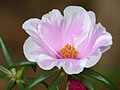 Bicoloured
 -
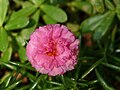 In India
 -
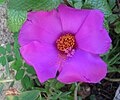 Traditional Brazilian flower
 -
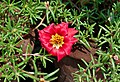 Single leaves
 -
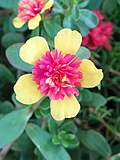 Cultivar with double flowers


References[edit | edit source]
- ↑ "The Plant List: A Working List of All Plant Species". Retrieved 21 June 2015.
- ↑ 2.0 2.1 2.2 Huxley, A., ed. (1992). New RHS Dictionary of Gardening. Macmillan ISBN 0-333-47494-5.
- ↑ 3.0 3.1 3.2 3.3 3.4 [{{#property:P1421|}} "{{#Property:P225}}"]. Germplasm Resources Information Network (GRIN). Agricultural Research Service (ARS), United States Department of Agriculture (USDA). Retrieved 10 January 2018.
{{citation}}: Check|url=value (help) - ↑ NRCS. "Portulaca grandiflora". PLANTS Database. United States Department of Agriculture (USDA). Retrieved 31 January 2016.
- ↑ 5.0 5.1 Mitchell, H. (2003). The Essential Earthman: Henry Mitchell on Gardening. Indiana University Press. p. 113. ISBN 9780253215857.
- ↑ Urs Eggli (ed.): Succulent Encyclopedia. Dicots (dicotyledons). Eugen Ulmer, Stuttgart 2001, ISBN 3-8001-3662-7, pp. 437-438 .
- ↑ Guralnick, Lonnie; Gilbert, Kate; Denio, Diana; Antico, Nicholas (2020-01-01). "The Development of Crassulacean Acid Metabolism (CAM) Photosynthesis in Cotyledons of the C4 Species, Portulaca grandiflora (Portulacaceae)". Plants. 9 (1): 55. doi:10.3390/plants9010055. PMC 7020464. PMID 31906418.
- ↑ Blumea. Tijdschrift voor de Systematiek en Geography of the Plants. Volume 17, No. 2, p. 297, Leiden 1969
- ↑ Botanical Magazine; or, Flower-Garden Displayed. Volume 56, Plate 2885. London 1829
- ↑ "Portulaca grandiflora & Apis mellifera". Florabeilles (in français). 2012-09-09. Retrieved 2019-07-08.