


expand details for accuracy and corrected details |
|||
| Line 1: | Line 1: | ||
{{ | {{Short description|Species of bird}} | ||
{{Speciesbox | |||
| name = White-breasted waterhen | | name = White-breasted waterhen | ||
| status = LC | | status = LC | ||
| status_system = IUCN3.1 | | status_system = IUCN3.1 | ||
| status_ref = <ref>{{cite iucn | | status_ref = <ref name=iucn>{{cite iucn |title=''Amaurornis phoenicurus'' |author=BirdLife International |date=2016 |article-number=e.T22692640A95217833 |doi=10.2305/IUCN.UK.2016-3.RLTS.T22692640A95217833.en |access-date=19 November 2021}}</ref> | ||
| image = Amaurornis phoenicurus - Singapore Botanic Gardens.jpg | | image = Amaurornis phoenicurus - Singapore Botanic Gardens.jpg | ||
| image_caption = Adult in [[Singapore]] | | image_caption = Adult in [[Singapore]] | ||
| Line 10: | Line 11: | ||
| genus = Amaurornis | | genus = Amaurornis | ||
| species = phoenicurus | | species = phoenicurus | ||
| authority = [[Thomas Pennant|Pennant]], 1769 | | authority = ([[Thomas Pennant|Pennant]], 1769) | ||
| synonyms = ''Erythra phoenicura'' | | synonyms = ''Erythra phoenicura'' | ||
|range_map = White-breasted Waterhen.JPG | |range_map = White-breasted Waterhen.JPG | ||
|range_map_caption = {{legend0|#C6514A|approximate range|outline=gray}} | |range_map_caption = {{legend0|#C6514A|approximate range|outline=gray}} | ||
}} | }} | ||
== | The '''white-breasted waterhen''' ('''''Amaurornis phoenicurus''''') is a waterbird of the rail and crake family, [[Rallidae]], that is widely distributed across [[South Asia|South]] and [[Southeast Asia]]. They are dark slaty birds with a clean white face, breast and belly. They are somewhat bolder than most other rails and are often seen stepping slowly with their tail cocked upright in open marshes or even drains near busy roads. They are largely [[crepuscular]] in activity and during the breeding season, just after the first rains, make loud and repetitive croaking calls.<ref>{{cite web | url = http://voices.nationalgeographic.com/2012/10/07/top-25-wild-bird-photographs-of-the-week-23/ | archive-url = https://web.archive.org/web/20170507220612/http://voices.nationalgeographic.com/2012/10/07/top-25-wild-bird-photographs-of-the-week-23/ | archive-date = May 7, 2017 | first = S. | last = Boyes | title = Top 25 Wild Bird Photographs of the Week #23 | date =2012 | work = National Geographic Voices | publisher = National Geographic Society | access-date = July 15, 2017}}</ref> | ||
==Description== | |||
[[File:AmaurornisPhoenicurusGould.jpg|thumb|left|Amaurornis phoenicurus]] | |||
Adult white-breasted waterhens have mainly dark grey upperparts and flanks, and a white face, neck and breast. The lower belly and undertail are cinnamon or white coloured. The body is flattened laterally to allow easier passage through the reeds or undergrowth. They have long toes, a short tail and a yellow bill and legs. Sexes are similar but females measure slightly smaller. Immature birds are much duller versions of the adults. The downy chicks are black, as with all [[Rallidae|rails]]. | |||
[[ | Several subspecies are named for the populations that are widely distributed. The nominate subspecies is described from Sri Lanka but is often widened to include ''chinensis'' of mainland India and adjoining regions in Asia, west to Arabia and east nearly to Japan. The remaining subspecies are those from islands and include ''insularis'' of the Andaman and Nicobar Islands, ''midnicobaricus'' of the central Nicobars, ''leucocephala'' of Car Nicobar, ''maldivus'' of the Maldives, ''javanicus'' of Java and ''leucomelanus'' of Sulawesi and the Lesser Sundas.<ref name=pcr>{{cite book|author1=Rasmussen, P.C. |author2=Anderton, J.C. |name-list-style=amp |year=2005| title= Birds of South Asia. The Ripley Guide |volume=2 |publisher=Smithsonian Institution & Lynx Edicions|page=142}}</ref><ref>{{cite journal|author=Abdulali, H. |year=1964 |title=Four new races of birds from the Andaman and Nicobar Islands| journal=Journal of the Bombay Natural History Society |volume= 61| issue=2| pages=410–417 |url=https://www.biodiversitylibrary.org/page/48072973}}</ref> | ||
[[ | |||
[[ | ==Distribution and habitat== | ||
[[Category: | Their breeding habitat is [[marsh]]es across tropical [[Asia]] from [[Pakistan]] east to [[Indonesia]]. They are mainly seen in the plains but have been known from the higher hills such as in Nainital (1300m) and the High Range (1500m) in Kerala.<ref>{{cite journal|author=Robertson, A. |year=1990| title= Some altitudinal records of birds from the High Range, Kerala| journal=Journal of the Bombay Natural History Society |volume= 87|issue=3|page=456|url=https://www.biodiversitylibrary.org/page/48807184}}</ref><ref>{{cite journal|author=Smetacek, V. |year=1974| title= On the increasing occurrence of typically plains-birds in the Kumaon hills| journal=Journal of the Bombay Natural History Society |volume=71| issue=2|pages=299–302|url=https://www.biodiversitylibrary.org/page/48286499}}</ref> These large {{cvt|32|cm}} long rails are permanent residents throughout their range. They make short distance movements and are known to colonize new areas. They have been noted as some of the early colonizers on the volcanic island of [[Rakata]].<ref>{{cite journal|doi=10.1007/BF00177240|title=The birds of Anak Krakatau: the assembly of an avian community |year=1992 |last1=Zann|first1=R.A.|last2=Darjono|journal=GeoJournal|volume=28|issue=2|page=261 |bibcode=1992GeoJo..28..261Z |s2cid=84431557 }}</ref><ref>{{cite journal|journal=The Wilson Journal of Ornithology |volume= 122| issue=4| pages=784–788| year=2010| doi= 10.1676/10-012.1| title=Range Expansion of the White-breasted Waterhen (''Amaurornis phoenicurus'') into Micronesia |author1=Buden, D.W. |author2=Retogral, S. |s2cid= 86755225|name-list-style=amp }}</ref> Although most often found near freshwater, they are also found near brackish water and even the seashore when there is no freshwater as on the volcanic Barren Island in the Andamans.<ref name=hbk/> | ||
==Behaviour and ecology== | |||
[[File:White-breasted Waterhen (Immature) I Picture 171.jpg|thumb|Immatures have only traces of white on the front]] | |||
These birds are usually seen singly or in pairs as they forage slowly along the edge of a waterbody mainly on the ground but sometimes clambering up low vegetation. The tail is held up and jerked as they walk. They probe with their bill in mud or shallow water, also picking up food by sight. They mainly eat [[insect]]s (large numbers of beetles have been recorded<ref name=hbk/>), small [[fish]] (which are often carefully washed in water), aquatic invertebrates and grains or [[seed]]s such as those of ''[[Pithecellobium dulce|Pithecolobium dulce]]''.<ref>{{cite journal|author1=Relton, A. |author2=Moses, A. A. |author3=Wesley, H.D. |year=1991 |title= Addition to the dietary of Whitebreasted Waterhen ''Amaurornis phoenicurus'' (Pennant)| journal=Journal of the Bombay Natural History Society |volume=88 |issue=2 |page=282 |url=https://www.biodiversitylibrary.org/page/48673704}}</ref><ref>{{cite book| title =Memoirs of the Department of Agriculture in India. Volume 3. The food of birds in India|author= Mason, C.W. |editor=Maxwell-Lefroy, H. | year=1911| publisher=Imperial Department of Agriculture in India|url=https://archive.org/stream/foodofbirdsinind00masorich#page/252/mode/1up|page=252}}</ref> They may sometimes feed in deeper water in the manner of a moorhen.<ref>{{cite journal |author1=Sugathan, R. |author2=Rajan, S.A. |year=1988|title= Notes on feeding behaviour of ''Amaurornis phoenicurus'' at Point Calimere |journal=Journal of the Bombay Natural History Society |volume=85 |issue=1 |page=191|url=https://www.biodiversitylibrary.org/page/48804714}}</ref><ref>{{cite journal|author=Balachandran, S. |year=1988 |title= Some observations on unusual feeding behaviour of Whitebreasted Waterhen (''Amaurornis phoenicurus'')| journal=Journal of the Bombay Natural History Society |volume=85 |issue=3|pages=615–616|url=https://www.biodiversitylibrary.org/page/48804714}}</ref><ref>{{cite book|url=https://archive.org/stream/BakerFbiBirds6/BakerFBI6#page/n59/mode/1up|pages=23–25|author= Baker, E.C.S. |year=1929| title= Fauna of British India |volume=Birds. Volume 6 |edition=Second| place= London| publisher=Taylor and Francis}}</ref><ref>{{cite book| pages=173–174|url=https://archive.org/stream/birdsindia04oaterich#page/173/mode/1up |author= Blanford, W.T. |year=1898| title= Fauna of British India |volume=Birds. Volume 4 |place=London |publisher=Taylor and Francis}}</ref> | |||
The nesting season is mainly June to October but varies locally. They nest in a dry location on the ground in marsh vegetation, laying 6-7 [[Egg (biology)|eggs]]. Courtship involves bowing, billing and nibbling. The eggs hatch in about 19 days.<ref>{{cite journal|author1=Dhindsa, Manjit S. |author2=Sandhu, P.S. |author3=Toor, H.S. |year=1983 | title= Some observations on the breeding of the Chinese Whitebreasted Waterhen ''Amaurornis phoenicurus chinensis'' (Boddaert)| journal=Journal of the Bombay Natural History Society |volume=80|issue=1|pages=213–214|url=https://www.biodiversitylibrary.org/page/48743803}}</ref> Both sexes incubate the eggs and take care of the chicks. Chicks often dive underwater to escape predation.<ref name=hbk/> Adults are said to build a roost or brood nest where young chicks and the adults roost.<ref>{{cite book|editor1=Sengupta, M. |editor2=Dalwani, R. |year=2008| chapter=Loss of wetland breeding habitats and population decline of White-breasted Waterhen, ''Amaurornis phoenicurus phoenicurus'' (Pennant) - A case study|title=Proceedings of Taal 2007: The 12th World Lake Conference|pages=529–536|author1=Gopakumar, P.S. |author2=Kaimal, P.P. |name-list-style=amp}}</ref> | |||
[[File:White-breasted Waterhen.ogv|thumb|Singapore, Oct 1994]] | |||
Many rails are very secretive, but white-breasted waterhens are often seen out in the open. They can be noisy especially at dawn and dusk, with loud croaky calls. The Andamans population ''insularis'' is said to make duck like ''quack'' calls.<ref name=hbk>{{cite book|title= Handbook of the Birds of India and Pakistan |volume=2 |edition=Second |year=1980 |author1=Ali, S. |author2=Ripley, S.D. |name-list-style=amp | pages=169–172|publisher= Oxford University Press| place=New Delhi}}</ref> | |||
==In culture== | |||
Local names of this bird are often formed by [[onomatopoeia]] (based on the sound it makes), for example ''ruak-ruak'' in [[Malay language|Malay]] and {{transliteration|si|korawakka}} (කොරවක්කා) in [[Sinhala language|Sinhala]].;<ref>{{cite journal|title=Vernacular Names of the Birds of the Indian Subcontinent |journal=Buceros |author=Anonymous|year=1998|volume=3|issue=1|url=http://www.bnhsenvis.nic.in/pdf/vol%203%20(1).pdf |pages=53–109}}</ref> although differently formed local names are also not uncommon, such as "Dahuk" in Bengali (used in Bangladesh and the Bengali-speaking areas of India), "Dauk" (ডাউক) in Assamese, "Gur-gu-aa" in Boro, "Vo-kurwak" in Karbi, and "Keruwak" in Iban and Sarawakian Malay. In [[Odisha]] it is called as {{lang|or|ଡାହୁକ}} "Daahuka" in [[Odia language|Odia]]. In Maharashtra it is called as {{lang|mr|पाणकोंबडी}} ''pankombadi'' or {{lang|mr|कुवाक कोंबडी}} ''kuak kombadi'' in [[Marathi language|Marathi]]. In [[Malayalam]] they are called {{lang|ml|കുളക്കോഴി}} ''kulakozhi''. They are called "Kanbili" in the Maldives.<ref>{{cite book |url=http://saruna.mnu.edu.mv/jspui/handle/123456789/4017 |title=Field Guide to Maldivian Birds and Beach Ecosystems |publisher=UNICEF and Education Development Centre, Maldives |year=2008 |page=11}}</ref> In [[Kannada]] they are called 'hundukoli' ([[ಹುಂಡುಕೋಳಿ]]). In [[Tamil language|Tamil]], they are called {{lang|taa|கானாங்கோழி}} ''kaanaangkozi''.<ref>{{cite book |date=2013 |author=Jeganathan, P. |author2=Asai |title=க்ரியா பதிப்பகம். சென்னை. பக்கங்கள் |trans-title=A photographic field guide on birds |language=Tamil |publisher=Cre-A |place=Chennai |page=184}}</ref> | |||
In [[Cebuano language|Cebuano]], it is known as ''tikúgas'', it has [[cognates]] in several [[Formosan languages|related languages]] in [[Taiwan]] which refer to the [[Taiwan bamboo partridge]] (e.g. ''tikolac'' in [[Amis language|Amis]]).<ref>{{cite web|url=https://acd.clld.org/cognatesets/30013#5/15.974/122.648|title=*tikuRas: a bird, the Formosan bamboo partridge|last1=Blust|first1=Robert|last2=Trussel|first2=Stephen|website=Austronesian Comparative Dictionary|date=2010|publisher=Max Planck Institute for Evolutionary Anthropology|access-date=8 November 2022}}</ref> | |||
The naturalist writer ''[[Edward Hamilton Aitken|Eha]]'' humorously describes the call of this species:<ref>{{cite book|author=Whistler, H. |title=Popular handbook of Indian Birds |publisher= Gurney and Jackson|year=2007 |orig-year=1st Pub. 1949| pages=437–438| url=https://archive.org/stream/popularhandbooko033226mbp#page/n485/mode/2up/ |isbn=1-4067-4576-6}}</ref> | |||
"''It began with loud harsh roars which might have been elicited from a bear by roasting it slowly over a large fire, then suddenly changed to a clear note repeated like the coo of a dove.''" | |||
==Gallery== | |||
<gallery> | |||
File:White-breasted Waterhen AMSM4814.jpg|White-breasted Waterhen carrying a mollusc, Kaziranga National Park, Assam, India | |||
File:White-breasted-water-hen-agra.jpg|A White Breasted Waterhen scouting for insects in a small garden pond in Agra, Uttar pradesh, India | |||
</gallery> | |||
==References== | |||
{{Reflist}} | |||
==External links== | |||
{{Commons category|Amaurornis phoenicurus}} | |||
{{Wikispecies|Amaurornis phoenicurus}} | |||
* [http://www.naturia.per.sg/buloh/birds/Amaurornis_phoenicurus.htm White-breasted waterhen in Sungei Buloh Nature Park, Singapore] | |||
* [http://ibc.lynxeds.com/species/white-breasted-waterhen-amaurornis-phoenicurus Photos and videos] | |||
{{Taxonbar|from=Q862825}} | |||
[[Category:Amaurornis|white-breasted waterhen]] | |||
[[Category:Birds of Indomalaya]] | |||
[[Category:Birds described in 1769|white-breasted waterhen]] | |||
[[Category:Articles containing video clips]] | |||
[[Category:Taxa named by Thomas Pennant]] | |||
Latest revision as of 03:00, 22 January 2026
| White-breasted waterhen | |
|---|---|

| |
| Adult in Singapore | |
| Call at dusk, Bangalore | |
Scientific classification 
| |
| : | [[Template:Taxonomy/Amaurornis]] |
| Species: | Template:Taxonomy/AmaurornisA. phoenicurus
|
| Binomial name | |
| Template:Taxonomy/AmaurornisAmaurornis phoenicurus (Pennant, 1769)
| |

| |
| Template:Legend0 | |
| Synonyms | |
|
Erythra phoenicura | |
The white-breasted waterhen (Amaurornis phoenicurus) is a waterbird of the rail and crake family, Rallidae, that is widely distributed across South and Southeast Asia. They are dark slaty birds with a clean white face, breast and belly. They are somewhat bolder than most other rails and are often seen stepping slowly with their tail cocked upright in open marshes or even drains near busy roads. They are largely crepuscular in activity and during the breeding season, just after the first rains, make loud and repetitive croaking calls.[2]
Description[edit | edit source]

Adult white-breasted waterhens have mainly dark grey upperparts and flanks, and a white face, neck and breast. The lower belly and undertail are cinnamon or white coloured. The body is flattened laterally to allow easier passage through the reeds or undergrowth. They have long toes, a short tail and a yellow bill and legs. Sexes are similar but females measure slightly smaller. Immature birds are much duller versions of the adults. The downy chicks are black, as with all rails.
Several subspecies are named for the populations that are widely distributed. The nominate subspecies is described from Sri Lanka but is often widened to include chinensis of mainland India and adjoining regions in Asia, west to Arabia and east nearly to Japan. The remaining subspecies are those from islands and include insularis of the Andaman and Nicobar Islands, midnicobaricus of the central Nicobars, leucocephala of Car Nicobar, maldivus of the Maldives, javanicus of Java and leucomelanus of Sulawesi and the Lesser Sundas.[3][4]
Distribution and habitat[edit | edit source]
Their breeding habitat is marshes across tropical Asia from Pakistan east to Indonesia. They are mainly seen in the plains but have been known from the higher hills such as in Nainital (1300m) and the High Range (1500m) in Kerala.[5][6] These large 32 cm (13 in) long rails are permanent residents throughout their range. They make short distance movements and are known to colonize new areas. They have been noted as some of the early colonizers on the volcanic island of Rakata.[7][8] Although most often found near freshwater, they are also found near brackish water and even the seashore when there is no freshwater as on the volcanic Barren Island in the Andamans.[9]
Behaviour and ecology[edit | edit source]
_I_Picture_171.jpg)
These birds are usually seen singly or in pairs as they forage slowly along the edge of a waterbody mainly on the ground but sometimes clambering up low vegetation. The tail is held up and jerked as they walk. They probe with their bill in mud or shallow water, also picking up food by sight. They mainly eat insects (large numbers of beetles have been recorded[9]), small fish (which are often carefully washed in water), aquatic invertebrates and grains or seeds such as those of Pithecolobium dulce.[10][11] They may sometimes feed in deeper water in the manner of a moorhen.[12][13][14][15]
The nesting season is mainly June to October but varies locally. They nest in a dry location on the ground in marsh vegetation, laying 6-7 eggs. Courtship involves bowing, billing and nibbling. The eggs hatch in about 19 days.[16] Both sexes incubate the eggs and take care of the chicks. Chicks often dive underwater to escape predation.[9] Adults are said to build a roost or brood nest where young chicks and the adults roost.[17]
Many rails are very secretive, but white-breasted waterhens are often seen out in the open. They can be noisy especially at dawn and dusk, with loud croaky calls. The Andamans population insularis is said to make duck like quack calls.[9]
In culture[edit | edit source]
Local names of this bird are often formed by onomatopoeia (based on the sound it makes), for example ruak-ruak in Malay and korawakka (කොරවක්කා) in Sinhala.;[18] although differently formed local names are also not uncommon, such as "Dahuk" in Bengali (used in Bangladesh and the Bengali-speaking areas of India), "Dauk" (ডাউক) in Assamese, "Gur-gu-aa" in Boro, "Vo-kurwak" in Karbi, and "Keruwak" in Iban and Sarawakian Malay. In Odisha it is called as ଡାହୁକ "Daahuka" in Odia. In Maharashtra it is called as पाणकोंबडी pankombadi or कुवाक कोंबडी kuak kombadi in Marathi. In Malayalam they are called കുളക്കോഴി kulakozhi. They are called "Kanbili" in the Maldives.[19] In Kannada they are called 'hundukoli' (ಹುಂಡುಕೋಳಿ). In Tamil, they are called கானாங்கோழி kaanaangkozi.[20]
In Cebuano, it is known as tikúgas, it has cognates in several related languages in Taiwan which refer to the Taiwan bamboo partridge (e.g. tikolac in Amis).[21]
The naturalist writer Eha humorously describes the call of this species:[22] "It began with loud harsh roars which might have been elicited from a bear by roasting it slowly over a large fire, then suddenly changed to a clear note repeated like the coo of a dove."
Gallery[edit | edit source]
-
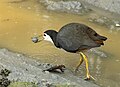 White-breasted Waterhen carrying a mollusc, Kaziranga National Park, Assam, India
 -
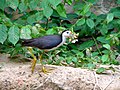 A White Breasted Waterhen scouting for insects in a small garden pond in Agra, Uttar pradesh, India


References[edit | edit source]
- ↑ BirdLife International (2016). "Amaurornis phoenicurus". IUCN Red List of Threatened Species. 2016 e.T22692640A95217833. doi:10.2305/IUCN.UK.2016-3.RLTS.T22692640A95217833.en. Retrieved 19 November 2021.
- ↑ Boyes, S. (2012). "Top 25 Wild Bird Photographs of the Week #23". National Geographic Voices. National Geographic Society. Archived from the original on May 7, 2017. Retrieved July 15, 2017.
- ↑ Rasmussen, P.C. & Anderton, J.C. (2005). Birds of South Asia. The Ripley Guide. Vol. 2. Smithsonian Institution & Lynx Edicions. p. 142.
- ↑ Abdulali, H. (1964). "Four new races of birds from the Andaman and Nicobar Islands". Journal of the Bombay Natural History Society. 61 (2): 410–417.
- ↑ Robertson, A. (1990). "Some altitudinal records of birds from the High Range, Kerala". Journal of the Bombay Natural History Society. 87 (3): 456.
- ↑ Smetacek, V. (1974). "On the increasing occurrence of typically plains-birds in the Kumaon hills". Journal of the Bombay Natural History Society. 71 (2): 299–302.
- ↑ Zann, R.A.; Darjono (1992). "The birds of Anak Krakatau: the assembly of an avian community". GeoJournal. 28 (2): 261. Bibcode:1992GeoJo..28..261Z. doi:10.1007/BF00177240. S2CID 84431557.
- ↑ Buden, D.W. & Retogral, S. (2010). "Range Expansion of the White-breasted Waterhen (Amaurornis phoenicurus) into Micronesia". The Wilson Journal of Ornithology. 122 (4): 784–788. doi:10.1676/10-012.1. S2CID 86755225.
- ↑ 9.0 9.1 9.2 9.3 Ali, S. & Ripley, S.D. (1980). Handbook of the Birds of India and Pakistan. Vol. 2 (Second ed.). New Delhi: Oxford University Press. pp. 169–172.
- ↑ Relton, A.; Moses, A. A.; Wesley, H.D. (1991). "Addition to the dietary of Whitebreasted Waterhen Amaurornis phoenicurus (Pennant)". Journal of the Bombay Natural History Society. 88 (2): 282.
- ↑ Mason, C.W. (1911). Maxwell-Lefroy, H. (ed.). Memoirs of the Department of Agriculture in India. Volume 3. The food of birds in India. Imperial Department of Agriculture in India. p. 252.
- ↑ Sugathan, R.; Rajan, S.A. (1988). "Notes on feeding behaviour of Amaurornis phoenicurus at Point Calimere". Journal of the Bombay Natural History Society. 85 (1): 191.
- ↑ Balachandran, S. (1988). "Some observations on unusual feeding behaviour of Whitebreasted Waterhen (Amaurornis phoenicurus)". Journal of the Bombay Natural History Society. 85 (3): 615–616.
- ↑ Baker, E.C.S. (1929). Fauna of British India. Vol. Birds. Volume 6 (Second ed.). London: Taylor and Francis. pp. 23–25.
- ↑ Blanford, W.T. (1898). Fauna of British India. Vol. Birds. Volume 4. London: Taylor and Francis. pp. 173–174.
- ↑ Dhindsa, Manjit S.; Sandhu, P.S.; Toor, H.S. (1983). "Some observations on the breeding of the Chinese Whitebreasted Waterhen Amaurornis phoenicurus chinensis (Boddaert)". Journal of the Bombay Natural History Society. 80 (1): 213–214.
- ↑ Gopakumar, P.S. & Kaimal, P.P. (2008). "Loss of wetland breeding habitats and population decline of White-breasted Waterhen, Amaurornis phoenicurus phoenicurus (Pennant) - A case study". In Sengupta, M. & Dalwani, R. (eds.). Proceedings of Taal 2007: The 12th World Lake Conference. pp. 529–536.
- ↑ Anonymous (1998). "Vernacular Names of the Birds of the Indian Subcontinent" (PDF). Buceros. 3 (1): 53–109.
- ↑ Field Guide to Maldivian Birds and Beach Ecosystems. UNICEF and Education Development Centre, Maldives. 2008. p. 11.
- ↑ Jeganathan, P.; Asai (2013). க்ரியா பதிப்பகம். சென்னை. பக்கங்கள் [A photographic field guide on birds] (in Tamil). Chennai: Cre-A. p. 184.
{{cite book}}: CS1 maint: unrecognized language (link) - ↑ Blust, Robert; Trussel, Stephen (2010). "*tikuRas: a bird, the Formosan bamboo partridge". Austronesian Comparative Dictionary. Max Planck Institute for Evolutionary Anthropology. Retrieved 8 November 2022.
- ↑ Whistler, H. (2007) [1st Pub. 1949]. Popular handbook of Indian Birds. Gurney and Jackson. pp. 437–438. ISBN 1-4067-4576-6.