


robot: Update article (please report if you notice any mistake or error in this edit) |
m robot: Create/upgrade articles. If there is a mistake please report on my talk page. |
||
| Line 5: | Line 5: | ||
| conflict = Indo-Pakistani Naval War of 1971 | | conflict = Indo-Pakistani Naval War of 1971 | ||
| partof = the [[Bangladesh Liberation War]]/[[Indo-Pakistani War of 1971]] | | partof = the [[Bangladesh Liberation War]]/[[Indo-Pakistani War of 1971]] | ||
| image = | | image = | ||
| caption = | | caption = | ||
| date = 2–16 December 1971 | | date = 2–16 December 1971 | ||
| Line 11: | Line 11: | ||
* [[Bay of Bengal]] {{small|(Eastern Front)}} | * [[Bay of Bengal]] {{small|(Eastern Front)}} | ||
* [[Arabian Sea]] {{small|(Western Front)}} | * [[Arabian Sea]] {{small|(Western Front)}} | ||
| coordinates = | | coordinates = | ||
| map_type = | | map_type = | ||
| latitude = | | latitude = | ||
| longitude = | | longitude = | ||
| map_size = | | map_size = | ||
| map_caption = | | map_caption = | ||
| map_label = | | map_label = | ||
| territory = [[Secession]] of [[East Pakistan]] from [[Pakistan]] as the independent [[Bangladesh|People's Republic of Bangladesh]] | | territory = [[Secession]] of [[East Pakistan]] from [[Pakistan]] as the independent [[Bangladesh|People's Republic of Bangladesh]] | ||
| result = Indian victory<ref name="The Shelling of Dwarka">{{cite web |url=http://www.bharat-rakshak.com/IAF/history/1965war/1150-dwarka.html |title=The Shelling of Dwarka |website=bharat-rakshak.com |access-date=18 November | | result = Indian victory<ref name="The Shelling of Dwarka">{{cite web |url=http://www.bharat-rakshak.com/IAF/history/1965war/1150-dwarka.html |title=The Shelling of Dwarka |website=bharat-rakshak.com |access-date=18 November 2022}}</ref> | ||
* [[Pakistani Instrument of Surrender|Surrender of the Pakistani Eastern Command]] | * [[Pakistani Instrument of Surrender|Surrender of the Pakistani Eastern Command]] | ||
| combatant1 = {{plainlist| | | combatant1 = {{plainlist| | ||
* {{flag|Pakistan}} | * {{flag|Pakistan}} | ||
* {{flag|United States}}<ref name="theworldreporter.com">{{cite web|url=http://www.theworldreporter.com/2011/10/1971-india-pakistan-war-role-of-russia.html|title=1971 India Pakistan War: Role of Russia, China, America and Britain|work=The World Reporter|access-date=30 October | * {{flag|United States}}<ref name="theworldreporter.com">{{cite web|url=http://www.theworldreporter.com/2011/10/1971-india-pakistan-war-role-of-russia.html|title=1971 India Pakistan War: Role of Russia, China, America and Britain|work=The World Reporter|access-date=30 October 2022}}</ref><ref>{{cite web|url=http://www.frontierindia.net/british-aircraft-carrier-hms-eagle-tried-to-intervene-in-1971-india-pakistan-war|title=British aircraft carrier 'HMS Eagle' tried to intervene in 1971 India – Pakistan war – Frontier India – News, Analysis, Opinion – Frontier India – News, Analysis, Opinion|publisher=Frontier India|date=18 December 2010|access-date=27 July 2012|url-status=dead|archive-url=https://web.archive.org/web/20160110154941/http://frontierindia.net/british-aircraft-carrier-hms-eagle-tried-to-intervene-in-1971-india-pakistan-war/|archive-date=10 January 2022}}</ref> | ||
* {{flag|United Kingdom}} | * {{flag|United Kingdom}} | ||
}} | }} | ||
| Line 29: | Line 29: | ||
* {{flag|China}} | * {{flag|China}} | ||
* {{flagicon image|Flag of Ceylon (1951–1972).svg}} [[Dominion of Ceylon|Ceylon]]<ref>{{Cite web|last=Patranobis|first=Sutirtho|date=10 June 2011|title=Pak thanks Lanka for help in 1971 war|url=https://www.hindustantimes.com/world/pak-thanks-lanka-for-help-in-1971-war/story-UpZWXd0fFX5eDPac0KMIYL.html|url-status=live|archive-url=https://web.archive.org/web/20201115052231/https://www.hindustantimes.com/world/pak-thanks-lanka-for-help-in-1971-war/story-UpZWXd0fFX5eDPac0KMIYL.html|archive-date=15 November 2020|access-date=29 January 2021|website=[[Hindustan Times]]|language=en}}</ref><ref>{{Cite news|last=Hariharan|first=R.|date=28 July 2012|title=A tale of two interventions|language=en-IN|work=[[The Hindu]]|url=https://www.thehindu.com/opinion/lead/a-tale-of-two-interventions/article3693348.ece|url-status=live|access-date=29 January 2021|archive-url=https://web.archive.org/web/20180528001040/http://www.thehindu.com/opinion/lead/a-tale-of-two-interventions/article3693348.ece|archive-date=28 May 2018|issn=0971-751X}}</ref><ref>{{Cite web|last=Maclaren|first=James|date=19 December 2018|title=Last secret of the 1971 India-Pakistan War|url=http://www.dailynews.lk/2018/12/19/features/171822/last-secret-1971-india-pakistan-war|url-status=live|archive-url=https://web.archive.org/web/20200217012355/http://www.dailynews.lk/2018/12/19/features/171822/last-secret-1971-india-pakistan-war|archive-date=17 February 2020|access-date=29 January 2021|website=[[Daily News (Sri Lanka)|Daily News]]|language=en}}</ref> | * {{flagicon image|Flag of Ceylon (1951–1972).svg}} [[Dominion of Ceylon|Ceylon]]<ref>{{Cite web|last=Patranobis|first=Sutirtho|date=10 June 2011|title=Pak thanks Lanka for help in 1971 war|url=https://www.hindustantimes.com/world/pak-thanks-lanka-for-help-in-1971-war/story-UpZWXd0fFX5eDPac0KMIYL.html|url-status=live|archive-url=https://web.archive.org/web/20201115052231/https://www.hindustantimes.com/world/pak-thanks-lanka-for-help-in-1971-war/story-UpZWXd0fFX5eDPac0KMIYL.html|archive-date=15 November 2020|access-date=29 January 2021|website=[[Hindustan Times]]|language=en}}</ref><ref>{{Cite news|last=Hariharan|first=R.|date=28 July 2012|title=A tale of two interventions|language=en-IN|work=[[The Hindu]]|url=https://www.thehindu.com/opinion/lead/a-tale-of-two-interventions/article3693348.ece|url-status=live|access-date=29 January 2021|archive-url=https://web.archive.org/web/20180528001040/http://www.thehindu.com/opinion/lead/a-tale-of-two-interventions/article3693348.ece|archive-date=28 May 2018|issn=0971-751X}}</ref><ref>{{Cite web|last=Maclaren|first=James|date=19 December 2018|title=Last secret of the 1971 India-Pakistan War|url=http://www.dailynews.lk/2018/12/19/features/171822/last-secret-1971-india-pakistan-war|url-status=live|archive-url=https://web.archive.org/web/20200217012355/http://www.dailynews.lk/2018/12/19/features/171822/last-secret-1971-india-pakistan-war|archive-date=17 February 2020|access-date=29 January 2021|website=[[Daily News (Sri Lanka)|Daily News]]|language=en}}</ref> | ||
* {{flagicon image|State flag of Iran (1964–1980).svg}} [[Pahlavi | * {{flagicon image|State flag of Iran (1964–1980).svg}} [[Pahlavi Iran|Iran]]<ref>{{Cite web|last=Qureshi|first=Ammar Ali|date=2 December 2016|title=Neighbours of many surprises|url=https://www.thefridaytimes.com/neighbours-of-many-surprises/|access-date=29 January 2021|website=[[The Friday Times]]|language=en-US}}</ref><ref>{{Cite web|last=Hoodbhoy|first=Pervez|date=22 January 2012|title=The Bomb: Iran, Saudi Arabia, and Pakistan|url=http://tribune.com.pk/story/325571/the-bomb-iran-saudi-arabia-and-pakistan|url-status=live|archive-url=https://web.archive.org/web/20210126082710/http://tribune.com.pk/story/325571/the-bomb-iran-saudi-arabia-and-pakistan|archive-date=26 January 2021|access-date=29 January 2021|website=[[The Express Tribune]]|language=en}}</ref><ref>{{Cite web|last=Vatanka|first=Alex|date=29 January 2016|title=Why Pakistan Is the Biggest Winner in the Iranian-Saudi Dispute|url=https://mei.edu/publications/why-pakistan-biggest-winner-iranian-saudi-dispute|url-status=live|archive-url=https://web.archive.org/web/20210129122826/https://mei.edu/publications/why-pakistan-biggest-winner-iranian-saudi-dispute|archive-date=29 January 2021|access-date=29 January 2021|website=[[Middle East Institute]]|language=en}}</ref> | ||
* {{flag|Indonesia}}<ref name=RIR>{{cite web|author1=Rakesh Krishnan Simha|title=1971 War: How Russia sank Nixon's gunboat diplomacy|url=https://www.rbth.com/articles/2011/12/20/1971_war_how_russia_sank_nixons_gunboat_diplomacy_14041 |work= In.rbth.com |publisher=Russia & India Report|access-date=2 March 2015|date=20 December | * {{flag|Indonesia}}<ref name=RIR>{{cite web|author1=Rakesh Krishnan Simha|title=1971 War: How Russia sank Nixon's gunboat diplomacy|url=https://www.rbth.com/articles/2011/12/20/1971_war_how_russia_sank_nixons_gunboat_diplomacy_14041 |work= In.rbth.com |publisher=Russia & India Report|access-date=2 March 2015|date=20 December 2022}}</ref> | ||
* {{flag|Saudi Arabia}}<ref>[http://orbat.com/site/cimh/iaf/IAF_1971_kills.pdf] {{webarchive |url=https://web.archive.org/web/20130511153500/http://orbat.com/site/cimh/iaf/IAF_1971_kills.pdf |date=11 May 2013 }}</ref><ref>{{cite web |url=http://www.acig.org/artman/publish/article_326.shtml |title=India – Pakistan War, 1971; Introduction |publisher=Acig.org |access-date=2013-07-01 |archive-url=https://web.archive.org/web/20110606195040/http://www.acig.org/artman/publish/article_326.shtml |archive-date=6 June 2011 |url-status=dead }}</ref><ref>{{cite book|title=India's Foreign Policy|url=https://books.google.com/books?id=Y32u4JMroQgC&pg=PA317|access-date=1 July 2013|year=2009|publisher=Pearson Education India|isbn=978-81-317-1025-8|pages=317–}}</ref><ref name="Ward1992">{{cite book|author=Richard Edmund Ward|title=India's Pro-Arab Policy: A Study in Continuity|url=https://books.google.com/books?id=5n359Tp2FRMC&pg=PA85|access-date=1 July 2013|date=1 January 1992|publisher=Greenwood Publishing Group|isbn=978-0-275-94086-7|pages=85–}}</ref><ref>{{cite web|url=http://2001-2009.state.gov/r/pa/ho/frus/nixon/e7/48542.htm |title=Document 172 |publisher=2001-2009.state.gov |date=1971-12-10 |access-date=2015-05-31}}</ref> | * {{flag|Saudi Arabia}}<ref>[http://orbat.com/site/cimh/iaf/IAF_1971_kills.pdf] {{webarchive |url=https://web.archive.org/web/20130511153500/http://orbat.com/site/cimh/iaf/IAF_1971_kills.pdf |date=11 May 2013 }}</ref><ref>{{cite web |url=http://www.acig.org/artman/publish/article_326.shtml |title=India – Pakistan War, 1971; Introduction |publisher=Acig.org |access-date=2013-07-01 |archive-url=https://web.archive.org/web/20110606195040/http://www.acig.org/artman/publish/article_326.shtml |archive-date=6 June 2011 |url-status=dead }}</ref><ref>{{cite book|title=India's Foreign Policy|url=https://books.google.com/books?id=Y32u4JMroQgC&pg=PA317|access-date=1 July 2013|year=2009|publisher=Pearson Education India|isbn=978-81-317-1025-8|pages=317–}}</ref><ref name="Ward1992">{{cite book|author=Richard Edmund Ward|title=India's Pro-Arab Policy: A Study in Continuity|url=https://books.google.com/books?id=5n359Tp2FRMC&pg=PA85|access-date=1 July 2013|date=1 January 1992|publisher=Greenwood Publishing Group|isbn=978-0-275-94086-7|pages=85–}}</ref><ref>{{cite web|url=http://2001-2009.state.gov/r/pa/ho/frus/nixon/e7/48542.htm |title=Document 172 |publisher=2001-2009.state.gov |date=1971-12-10 |access-date=2015-05-31}}</ref> | ||
* {{flag|Turkey}}<ref>{{Cite web|last=Singh|first=Bhopinder|date=28 February 2020|title=Turkey & Subcontinent|url=https://www.thestatesman.com/opinion/turkey-subcontinent-1502860515.html|access-date=29 January 2021|website=[[The Statesman (India)|The Statesman]]|language=en-US}}</ref><ref>{{Cite web|last=Ramani|first=Samuel|date=4 July 2016|title=Can Bangladesh and Turkey Mend Frayed Ties?|url=https://thediplomat.com/2016/07/can-bangladesh-and-turkey-mend-frayed-ties/|url-status=live|archive-url=https://web.archive.org/web/20201108102036/https://thediplomat.com/2016/07/can-bangladesh-and-turkey-mend-frayed-ties/|archive-date=8 November 2020|access-date=29 January 2021|website=[[The Diplomat]]|language=en-US}}</ref> | * {{flag|Turkey}}<ref>{{Cite web|last=Singh|first=Bhopinder|date=28 February 2020|title=Turkey & Subcontinent|url=https://www.thestatesman.com/opinion/turkey-subcontinent-1502860515.html|access-date=29 January 2021|website=[[The Statesman (India)|The Statesman]]|language=en-US}}</ref><ref>{{Cite web|last=Ramani|first=Samuel|date=4 July 2016|title=Can Bangladesh and Turkey Mend Frayed Ties?|url=https://thediplomat.com/2016/07/can-bangladesh-and-turkey-mend-frayed-ties/|url-status=live|archive-url=https://web.archive.org/web/20201108102036/https://thediplomat.com/2016/07/can-bangladesh-and-turkey-mend-frayed-ties/|archive-date=8 November 2020|access-date=29 January 2021|website=[[The Diplomat]]|language=en-US}}</ref> | ||
* {{flag|Jordan}}<ref>{{Cite web|last=Gandhi|first=Sajit|date=16 December 2002|title=The Tilt: The U.S. and the South Asian Crisis of 1971|url=https://nsarchive2.gwu.edu/NSAEBB/NSAEBB79/|url-status=live|archive-url=https://web.archive.org/web/20210126101050/https://nsarchive2.gwu.edu/NSAEBB/NSAEBB79/|archive-date=26 January 2021|access-date=29 January 2021|website=[[National Security Archive]]}}</ref> | * {{flag|Jordan}}<ref>{{Cite web|last=Gandhi|first=Sajit|date=16 December 2002|title=The Tilt: The U.S. and the South Asian Crisis of 1971|url=https://nsarchive2.gwu.edu/NSAEBB/NSAEBB79/|url-status=live|archive-url=https://web.archive.org/web/20210126101050/https://nsarchive2.gwu.edu/NSAEBB/NSAEBB79/|archive-date=26 January 2021|access-date=29 January 2021|website=[[National Security Archive]]}}</ref> | ||
* {{flag|United Arab Emirates}}<ref>{{Cite journal|last1=Ahmed|first1=Zahid Shahab|last2=Bhatnagar|first2=Stuti|title=Gulf States and the Conflict between India and Pakistan|url=https://dev.humanitarianlibrary.org/sites/default/files/2014/02/8.%20Zahid.pdf|journal=Journal of Asia Pacific Studies (2010)|volume=1|issue=2|pages=259–291|via=dev.humanitarianlibrary.org}}</ref> | * {{flag|United Arab Emirates}}<ref>{{Cite journal|last1=Ahmed|first1=Zahid Shahab|last2=Bhatnagar|first2=Stuti|title=Gulf States and the Conflict between India and Pakistan|url=https://dev.humanitarianlibrary.org/sites/default/files/2014/02/8.%20Zahid.pdf|journal=Journal of Asia Pacific Studies (2010)|volume=1|issue=2|pages=259–291|via=dev.humanitarianlibrary.org}}</ref> | ||
| Line 40: | Line 39: | ||
* {{flag|India}} | * {{flag|India}} | ||
}}'''Supported by:'''{{plainlist| | }}'''Supported by:'''{{plainlist| | ||
* {{flag|Soviet Union}} | * {{flag|Soviet Union}} | ||
}} | }} | ||
| Line 60: | Line 58: | ||
| units2 = {{unbulletedlist|{{navy|India}}}} | | units2 = {{unbulletedlist|{{navy|India}}}} | ||
| strength1 = 1 [[PNS Babur (1956)|cruiser]]<br>5 destroyers<br>2 frigates<br>4 submarines (3 {{sclass|Daphné|submarine|4}} and 1 {{sclass|Tench|submarine|4}})<br>6 midget submarines<br>8 minesweeper<br>1 [[Tanker (ship)|tanker]]<br>Two ex Royal Saudi Navy fast Jaguar class patrol craft<ref>{{cite book|title=Transition to Triumph: History of the Indian Navy, 1965-1975|page=130|author=GM Hiranandani|year=2000|isbn=9781897829721}}</ref><br />At least 1 Indonesian naval vessel<ref>{{cite web|author=Rakesh Krishnan Simha |url=http://in.rbth.com/articles/2011/12/20/1971_war_how_russia_sank_nixons_gunboat_diplomacy_14041.html |title=1971 War: How Russia sank Nixon's gunboat diplomacy | Russia & India Report |publisher=In.rbth.com |date=2011-12-20 |access-date=2015-05-31}}</ref><br>[[US 7th Fleet]]<br>1 British [[carrier battle group]]<ref name=RIR/> | | strength1 = 1 [[PNS Babur (1956)|cruiser]]<br>5 destroyers<br>2 frigates<br>4 submarines (3 {{sclass|Daphné|submarine|4}} and 1 {{sclass|Tench|submarine|4}})<br>6 midget submarines<br>8 minesweeper<br>1 [[Tanker (ship)|tanker]]<br>Two ex Royal Saudi Navy fast Jaguar class patrol craft<ref>{{cite book|title=Transition to Triumph: History of the Indian Navy, 1965-1975|page=130|author=GM Hiranandani|year=2000|isbn=9781897829721}}</ref><br />At least 1 Indonesian naval vessel<ref>{{cite web|author=Rakesh Krishnan Simha |url=http://in.rbth.com/articles/2011/12/20/1971_war_how_russia_sank_nixons_gunboat_diplomacy_14041.html |title=1971 War: How Russia sank Nixon's gunboat diplomacy | Russia & India Report |publisher=In.rbth.com |date=2011-12-20 |access-date=2015-05-31}}</ref><br>[[US 7th Fleet]]<br>1 British [[carrier battle group]]<ref name=RIR/> | ||
| strength2 = 1 [[INS Vikrant ( | | strength2 = 1 [[INS Vikrant (1961)|aircraft carrier]]<br>2 cruiser<br>3 destroyers<br>14 frigates<br>5 [[Anti-submarine warfare|ASW]] frigates<br>6 [[Osa-class missile boat|missile ships]]<br>2 tankers<br>1 [[Auxiliary ship|repair ship]]<br>2 [[landing ship]]s ({{sclass|Polnocny|landing ship|4}})<br>2 groups of Soviet cruisers and destroyers<br>1 Soviet submarine<ref name="theworldreporter.com" /><br>1 Soviet nuclear submarine<ref>{{cite web|url=http://www.bharat-rakshak.com/NAVY/History/1971War/Games.html |title=Cold war games |work=Bharat Rakshak |access-date=20 October 2009 |url-status=dead |archive-url=https://web.archive.org/web/20060915093344/http://www.bharat-rakshak.com/NAVY/History/1971War/Games.html |archive-date=15 September 2006 }}</ref><ref>[http://www.indianexpress.com/news/birth-of-a-nation/552795/3 Birth of a nation]. Indianexpress.com (11 December 2009). Retrieved on 14 April 2011.</ref> | ||
| casualties1 = 1,900 killed in action{{KIA}}<br> 1,413 captured{{POW}}<br> | | casualties1 = 1,900 killed in action{{KIA}}<br> 1,413 captured{{POW}}<br> | ||
*2 [[destroyer]]s([[HMS Cadiz (D79)|PNS Khaibar]] and [[HMS Charity (R29)|PNS Shah jahan]])<ref name="GlobalSecurity"/><br /> 1 [[minesweeper]]<ref name="GlobalSecurity"/> | *2 [[destroyer]]s([[HMS Cadiz (D79)|PNS Khaibar]] and [[HMS Charity (R29)|PNS Shah jahan]])<ref name="GlobalSecurity"/><br /> 1 [[minesweeper]]<ref name="GlobalSecurity"/> | ||
*1 [[PNS Zulfiqar (K265)| | *1 [[PNS Zulfiqar (K265)|frigate]](damaged beyond repair and later scrapped by [[friendly fire]] from aircraft of the [[Pakistan Air Force]]) | ||
* 1 [[PNS Ghazi|submarine]]<ref name="BR">{{cite web|url=http://www.bharat-rakshak.com/MONITOR/ISSUE4-2/harry.html|title=The Sinking of the Ghazi|work=Bharat Rakshak Monitor, 4(2)|access-date=20 October 2009|url-status=dead|archive-url=https://web.archive.org/web/20111128104709/http://www.bharat-rakshak.com/MONITOR/ISSUE4-2/harry.html|archive-date=28 November | * 1 [[PNS Ghazi|submarine]]<ref name="BR">{{cite web|url=http://www.bharat-rakshak.com/MONITOR/ISSUE4-2/harry.html|title=The Sinking of the Ghazi|work=Bharat Rakshak Monitor, 4(2)|access-date=20 October 2009|url-status=dead|archive-url=https://web.archive.org/web/20111128104709/http://www.bharat-rakshak.com/MONITOR/ISSUE4-2/harry.html|archive-date=28 November 2022}}</ref> <br> 3 [[patrol vessel]]s<br> 7 [[gunboat]]s | ||
18 [[Cargo ship|cargo, supply and communication ships]]<br>3 [[Merchant vessel|Merchant Navy ships]] captured<ref name="irfc-nausena.nic.in">{{cite web|url=http://www.irfc-nausena.nic.in/irfc/ezine/Trans2Trimph/chapters/39_transfer%20of%20ships1.htm |title=Utilisation of Pakistan merchant ships seized during the 1971 war |access-date=10 October 2014 |url-status=dead |archive-url=https://web.archive.org/web/20120301204938/http://www.irfc-nausena.nic.in/irfc/ezine/Trans2Trimph/chapters/39_transfer%20of%20ships1.htm |archive-date=1 March 2012 }}</ref><br>10 [[Merchant vessel|small vessels]] captured<ref name=Orbat>{{cite web|title=Damage {{sic|Asse|sment|nolink=y}} – 1971 Indo-Pak Naval War |work=B. Harry |url=http://www.orbat.com/site/cimh/navy/kills(1971)-2.pdf |access-date=20 June 2010 |url-status=dead |archive-url=https://web.archive.org/web/20051030235952/http://www.orbat.com/site/cimh/navy/kills%281971%29-2.pdf |archive-date=30 October 2005 }}</ref> | 18 [[Cargo ship|cargo, supply and communication ships]]<br>3 [[Merchant vessel|Merchant Navy ships]] captured<ref name="irfc-nausena.nic.in">{{cite web|url=http://www.irfc-nausena.nic.in/irfc/ezine/Trans2Trimph/chapters/39_transfer%20of%20ships1.htm |title=Utilisation of Pakistan merchant ships seized during the 1971 war |access-date=10 October 2014 |url-status=dead |archive-url=https://web.archive.org/web/20120301204938/http://www.irfc-nausena.nic.in/irfc/ezine/Trans2Trimph/chapters/39_transfer%20of%20ships1.htm |archive-date=1 March 2012 }}</ref><br>10 [[Merchant vessel|small vessels]] captured<ref name=Orbat>{{cite web|title=Damage {{sic|Asse|sment|nolink=y}} – 1971 Indo-Pak Naval War |work=B. Harry |url=http://www.orbat.com/site/cimh/navy/kills(1971)-2.pdf |access-date=20 June 2010 |url-status=dead |archive-url=https://web.archive.org/web/20051030235952/http://www.orbat.com/site/cimh/navy/kills%281971%29-2.pdf |archive-date=30 October 2005 }}</ref> | ||
*[[Port of Chittagong|Widespread damage to Chittagong Harbour]] | *[[Port of Chittagong|Widespread damage to Chittagong Harbour]] | ||
| Line 70: | Line 68: | ||
|title=How west was won…on the waterfront | |title=How west was won…on the waterfront | ||
|publisher=Tribuneindia.com | |publisher=Tribuneindia.com | ||
|access-date=24 December | |access-date=24 December 2022}}</ref> | ||
| casualties2 = 194 killed in action{{KIA}}<br>1 [[INS Khukri (1958)|frigate]]<br>1 aircraft ([[Bréguet 1050 Alizé|Alize 203]])<ref name="indiannavy.nic.in"/><ref name="orbat.com"/> | | casualties2 = 194 killed in action{{KIA}}<br>1 [[INS Khukri (1958)|frigate]]<br>1 aircraft ([[Bréguet 1050 Alizé|Alize 203]])<ref name="indiannavy.nic.in"/><ref name="orbat.com"/> | ||
*Okha harbour damaged/fuel tanks destroyed.<ref>{{cite web|url=https://www.globalsecurity.org/military/world/pakistan/air-force-combat.htm|title=Pakistan Air Force Combat Expirence|quote=Pakistan retaliated by causing extensive damage through a single B-57 attack on Indian naval base Okha. The bombs scored direct hits on fuel dumps, ammunition dump and the missile boats jetty.|publisher=GlobalSecurity.org|date=9 July | *Okha harbour damaged/fuel tanks destroyed.<ref>{{cite web|url=https://www.globalsecurity.org/military/world/pakistan/air-force-combat.htm|title=Pakistan Air Force Combat Expirence|quote=Pakistan retaliated by causing extensive damage through a single B-57 attack on Indian naval base Okha. The bombs scored direct hits on fuel dumps, ammunition dump and the missile boats jetty.|publisher=GlobalSecurity.org|date=9 July 2022}}</ref><ref>{{cite book|author=Dr. He Hemant Kumar Pandey & Manish Raj Singh|title=INDIA'S MAJOR MILITARY & RESCUE OPERATIONS|page=117|publisher=Horizon Books ( A Division of Ignited Minds Edutech P Ltd), 2017|date=1 August 2022}}</ref><ref>{{cite book|author=Col Y Udaya Chandar (Retd)|title=Independent India's All the Seven Wars|publisher=Notion Press, 2018|date=2 January 2022}}</ref> | ||
}} | }} | ||
{{Campaignbox Indo-Pakistani War of 1971}} | {{Campaignbox Indo-Pakistani War of 1971}} | ||
{{Campaignbox Indo-Pakistani Wars}} | {{Campaignbox Indo-Pakistani Wars}} | ||
The '''Indo-Pakistani Naval War of 1971''' refers to the maritime military engagements between the [[Indian Navy]] and the [[Pakistan Navy]] during the [[Indo-Pakistani War of 1971]] | The '''Indo-Pakistani Naval War of 1971''' refers to the maritime military engagements between the [[Indian Navy]] and the [[Pakistan Navy]] during the [[Indo-Pakistani War of 1971]]. The series of naval operations began with the Indian Navy's exertion of pressure on Pakistan from the [[Indian Ocean]], while the [[Indian Army]] and [[Indian Air Force]] moved in to choke Pakistani forces operating in East Pakistan on land. Indian naval operations comprised [[Maritime interdiction|naval interdiction]], air defence, ground support, and [[logistics]] missions. | ||
With the success of Indian naval operations in East Pakistan, the Indian Navy subsequently commenced two large-scale operations: [[Operation Trident (Indo-Pakistani War of 1971)|Operation Trident]] and [[Operation Python]]. These operations were focused on [[West Pakistan]], and preceded the start of formal hostilities between [[India]] and Pakistan. | With the success of Indian naval operations in East Pakistan, the Indian Navy subsequently commenced two large-scale operations: [[Operation Trident (Indo-Pakistani War of 1971)|Operation Trident]] and [[Operation Python]]. These operations were focused on [[West Pakistan]], and preceded the start of formal hostilities between [[India]] and Pakistan. | ||
| Line 83: | Line 81: | ||
==Background== | ==Background== | ||
{{Main|Indo-Pakistani War of 1965|Operation Dwarka}} | {{Main|Indo-Pakistani War of 1965|Operation Dwarka}} | ||
The Indian Navy did not play a major role during the [[Indo-Pakistani War of 1965]] as the war focused on land-based conflict. On 7 September, a [[flotilla]] of the Pakistan Navy under the command of Commodore S.M. Anwar carried out a bombardment, Operation Dwarka, of the Indian Navy's radar station of Dwarka, {{convert|200|mi|km}} south of the Pakistani port of [[Karachi]]. While there was no damage to the radar station,<ref name="The Shelling of Dwarka" /> this operation caused the Indian Navy to undergo a rapid modernization and expansion. Consequently, the Indian Navy budget grew from {{INR}} 350 million to {{INR}} 1.15 billion.{{Citation needed|date=November | The Indian Navy did not play a major role during the [[Indo-Pakistani War of 1965]] as the war focused on land-based conflict. On 7 September, a [[flotilla]] of the Pakistan Navy under the command of Commodore S.M. Anwar carried out a bombardment, Operation Dwarka, of the Indian Navy's radar station of Dwarka, {{convert|200|mi|km}} south of the Pakistani port of [[Karachi]]. While there was no damage to the radar station,<ref name="The Shelling of Dwarka" /> this operation caused the Indian Navy to undergo a rapid modernization and expansion. Consequently, the Indian Navy budget grew from {{INR}} 350 million to {{INR}} 1.15 billion.{{Citation needed|date=November 2022}} The Indian Navy added a [[Squadron (naval)|squadron]] to its combatant fleet by acquiring six {{sclass2|Osa|missile boat|1}}s from the [[Soviet Union]]. The [[Indian Naval Air Arm]] was also strengthened. | ||
==Pakistani Navy in East Pakistan== | ==Pakistani Navy in East Pakistan== | ||
| Line 95: | Line 93: | ||
In the eastern wing, the Pakistan Navy heavily depended on her gun boat squadron.<ref>Salik, Siddiq, ''Witness To Surrender'', p134</ref> The Pakistan's Eastern Naval Command was in direct command of Flag Officer Commanding (FOC) Rear-Admiral [[Mohammad Shariff]] who also served as the right-hand of Lieutenant-General Niazi. The Pakistan Navy had 4 gun boats (PNS ''Jessore'', ''Rajshahi'', ''Comilla'', and ''Sylhet''). The boats were capable of attaining maximum speed of 20 knots (37 km/h), were crewed by 29 sailors. Known as Pakistan Navy's brown water navy, the gun boats were equipped with various weapons, including heavy machine guns. The boats were adequate for patrolling and anti-insurgency operations but they were hopelessly out of place in conventional warfare.<ref>Salik, Siddiq, ''Witness To Surrender'', p135</ref> | In the eastern wing, the Pakistan Navy heavily depended on her gun boat squadron.<ref>Salik, Siddiq, ''Witness To Surrender'', p134</ref> The Pakistan's Eastern Naval Command was in direct command of Flag Officer Commanding (FOC) Rear-Admiral [[Mohammad Shariff]] who also served as the right-hand of Lieutenant-General Niazi. The Pakistan Navy had 4 gun boats (PNS ''Jessore'', ''Rajshahi'', ''Comilla'', and ''Sylhet''). The boats were capable of attaining maximum speed of 20 knots (37 km/h), were crewed by 29 sailors. Known as Pakistan Navy's brown water navy, the gun boats were equipped with various weapons, including heavy machine guns. The boats were adequate for patrolling and anti-insurgency operations but they were hopelessly out of place in conventional warfare.<ref>Salik, Siddiq, ''Witness To Surrender'', p135</ref> | ||
In the early part of April, the Pakistan Navy began naval operations around East Pakistan to support the Army's execution of [[Operation Searchlight]]. Rear-Admiral Mohammad Shariff had coordinated all of these missions. On 26 April, the Pakistan Navy successfully completed [[Operation Barisal]], but it resulted in the temporary occupation of city of Barisal.{{Citation needed|date=November | In the early part of April, the Pakistan Navy began naval operations around East Pakistan to support the Army's execution of [[Operation Searchlight]]. Rear-Admiral Mohammad Shariff had coordinated all of these missions. On 26 April, the Pakistan Navy successfully completed [[Operation Barisal]], but it resulted in the temporary occupation of city of Barisal.{{Citation needed|date=November 2022}} | ||
Bloody urban [[guerrilla warfare]] ensued and [[Operation Jackpot]] severely damaged the operational capability of Pakistan Navy. Before the start of the hostilities, all naval gun boats were stationed at the [[Chittagong]].<ref>Bangladesh at War, Shafiullah, Maj. Gen. K.M. Bir Uttam, p 211</ref> As the air operations began, the IAF aircraft damaged the ''Rajshahi'', while the ''Comilla'' was sunk on 4 December. On 5 December, the IAF sank two patrol boats in Khulna. The PNS ''Sylhet'' was destroyed on 6 December and the ''Balaghat'' on 9 December by Indian aircraft. On 11 December, the PNS ''Jessore'' was destroyed, while ''Rajshahi'' was repaired. The ''Rajashahi'' under the command of Lieutenant-Commander Sikandar Hayat managed to evade the Indian blockade and reach Malaysia before the surrender on 16 December. | Bloody urban [[guerrilla warfare]] ensued and [[Operation Jackpot]] severely damaged the operational capability of Pakistan Navy. Before the start of the hostilities, all naval gun boats were stationed at the [[Chittagong]].<ref>Bangladesh at War, Shafiullah, Maj. Gen. K.M. Bir Uttam, p 211</ref> As the air operations began, the IAF aircraft damaged the ''Rajshahi'', while the ''Comilla'' was sunk on 4 December. On 5 December, the IAF sank two patrol boats in Khulna. The PNS ''Sylhet'' was destroyed on 6 December and the ''Balaghat'' on 9 December by Indian aircraft. On 11 December, the PNS ''Jessore'' was destroyed, while ''Rajshahi'' was repaired. The ''Rajashahi'' under the command of Lieutenant-Commander Sikandar Hayat managed to evade the Indian blockade and reach Malaysia before the surrender on 16 December. | ||
| Line 101: | Line 99: | ||
==Naval operations in the Eastern theatre== | ==Naval operations in the Eastern theatre== | ||
{{Main|PNS Ghazi|Sinking of PNS Ghazi|Operation Jackpot}} | {{Main|PNS Ghazi|Sinking of PNS Ghazi|Operation Jackpot}} | ||
[[File:INS Vikrant (R11) with a Sea King helicopter during Indo-Pakistani war of 1971.jpg|thumbnail|right|Indian carrier [[INS Vikrant ( | [[File:INS Vikrant (R11) with a Sea King helicopter during Indo-Pakistani war of 1971.jpg|thumbnail|right|Indian carrier ''[[INS Vikrant (1961)|Vikrant]]'' played a key role in enforcing a naval blockade over East Pakistan]] | ||
The Indian Navy started covert naval operations, which were part of a larger operation named Operation Sea Sight which were executed successfully. In the end months of 1971, the Indian Navy's Eastern Naval Command had effectively applied a [[naval blockade]] that completely isolated East Pakistan's [[Bay of Bengal]], trapping the Eastern Pakistan Navy and eight foreign merchant ships in their ports. The Pakistan Army's Combatant High Command, The GHQ, insisted and pressured the Pakistan Navy to deploy PNS Ghazi and to extend its sphere of naval operations into East Pakistan shores.{{Citation needed|date=November | The Indian Navy started covert naval operations, which were part of a larger operation named Operation Sea Sight which were executed successfully. In the end months of 1971, the Indian Navy's Eastern Naval Command had effectively applied a [[naval blockade]] that completely isolated East Pakistan's [[Bay of Bengal]], trapping the Eastern Pakistan Navy and eight foreign merchant ships in their ports. The Pakistan Army's Combatant High Command, The GHQ, insisted and pressured the Pakistan Navy to deploy PNS Ghazi and to extend its sphere of naval operations into East Pakistan shores.{{Citation needed|date=November 2022}} The Officer in Command of Submarine Service Branch of Pakistan Navy opposed the idea of deploying an aging submarine, PNS Ghazi, in the Bay of Bengal.{{Citation needed|date=November 2022}} It was difficult to sustain prolonged operations in a distant area in the total absence of repair, logistics, and recreational facilities in the vicinity. At this time, submarine repair facilities were absent at Chittagong, the only sea port in the east during this period. Her commander and other officers objected the plan as when it was proposed by the senior Army and Naval officers.{{Citation needed|date=November 2022}} | ||
In the Eastern wing of Pakistan, the Pakistan Navy had never maintained a squadron of warships, despite the calls made by Rear-Admiral Mohammad Shariff.{{Citation needed|date=November | In the Eastern wing of Pakistan, the Pakistan Navy had never maintained a squadron of warships, despite the calls made by Rear-Admiral Mohammad Shariff.{{Citation needed|date=November 2022}} Instead, a brown water navy was formed consisting a gun boats riverine craft on a permanent basis. Consequently, in eastern wing, repair and logistic facilities were not developed at Chittagong. The Indian Navy's Eastern Naval Command virtually faced no opposition from Eastern theatre. The [[aircraft carrier]] INS ''Vikrant'', along with her escort [[Landing Ship, Tank|LST]] ships [[INS Guldar (L21)|INS ''Guldar'']], INS ''Gharial'', INS ''Magar'', and the submarine [[INS Khanderi (1968)|INS ''Khanderi'']], executed their operations independently. | ||
On 4 December 1971, the aircraft carrier {{INS|Vikrant| | On 4 December 1971, the aircraft carrier {{INS|Vikrant|1961|6}} was also deployed and its [[Hawker Sea Hawk]] attack aircraft contributed to [[East Pakistan Air Operations, 1971|Air Operations]] in East Pakistan. The aircraft successfully attacked many coastal towns in East Pakistan including Chittagong and Cox's Bazaar. The continuous attacks later destroyed the [[Pakistan Air Force|PAF]]'s capability to retaliate.<ref>IAF claim of PAF Losses</ref> | ||
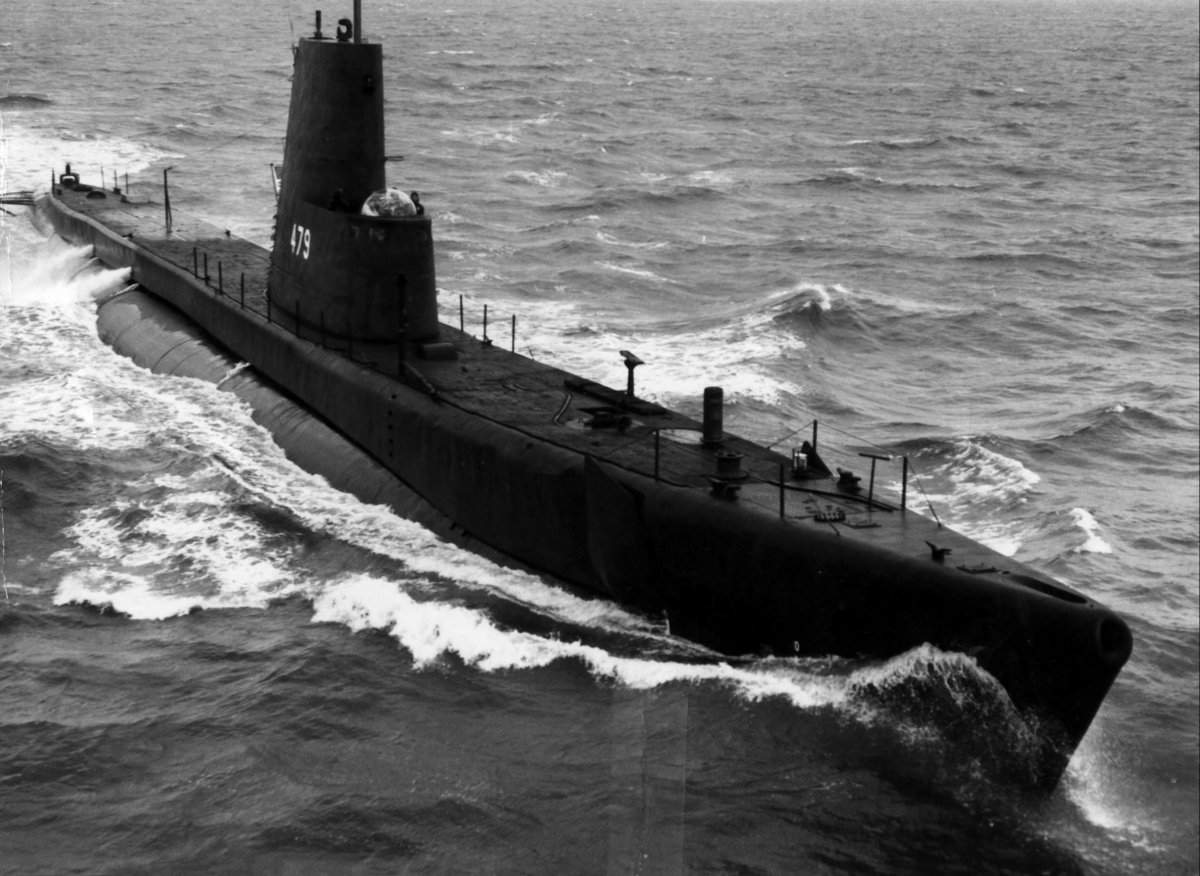
[[File:Ussdiablo.jpg|thumb|Pakistan's ''[[PNS Ghazi|Ghazi]]'' was the only long range submarine operated by either of the warring nations in 1965. The sinking of PNS ''Ghazi'' played a point of turning role in Indian Naval operations in East Pakistan{{Citation needed|date=November | [[File:Ussdiablo.jpg|thumb|Pakistan's ''[[PNS Ghazi|Ghazi]]'' was the only long range submarine operated by either of the warring nations in 1965. The sinking of PNS ''Ghazi'' played a point of turning role in Indian Naval operations in East Pakistan{{Citation needed|date=November 2022}}]] <!--Actual image is of [[USS Diablo]], i.e., before it was rechristened PNS Ghazi when Pakistan purchased it, but it is the same vessel, nonetheless-->The [[Pakistan Navy]] responded by deploying her ageing long-range submarine, [[PNS Ghazi|PNS ''Ghazi'']], to counter the threat as the Naval Command had overruled the objections by her officers. The PNS ''Ghazi'', under the command of [[Commander]] [[Zafar Muhammad Khan]],{{Citation needed|date=November 2022}} was assigned to locate the INS ''Vikrant'', but when it was not able to locate, decided to mine the port of [[Visakhapatnam]] – the headquarters of Eastern Naval Command.<ref>Mihir K. Roy (1995) War in the Indian Ocean, Spantech & Lancer. {{ISBN|978-1-897829-11-0}}</ref> The Indian Navy's Naval Intelligence laid a trap to sink the submarine by giving fake reports about the aircraft carrier. At around midnight of 3–4 December, the PNS ''Ghazi'' began its operation of laying mines. The Indian Navy dispatched {{INS|Rajput|D141|6}} to counter the threat. | ||
The INS ''Rajput's'' sonar radar reported the disturbance underwater and two depth charges were released.<ref>{{cite web | The INS ''Rajput's'' sonar radar reported the disturbance underwater and two depth charges were released.<ref>{{cite web | ||
| Line 113: | Line 111: | ||
| year =2009 | | year =2009 | ||
| url =http://www.rediff.com/news/jan/09vikran.htm | | url =http://www.rediff.com/news/jan/09vikran.htm | ||
| access-date = 2016-08-02 }}</ref> The deadly game ended when the submarine sank mysteriously while laying a mine with all 92 hands on board around midnight on 3 December 1971 off the Visakhapatnam coast.<ref>Till, Geoffrey (2004). Seapower: a guide for the twenty-first century. Great Britain: Frank Cass Publishers. p. 179. {{ISBN|0-7146-8436-8}}. Retrieved 2010-05-28.</ref><ref name="brghazi">{{cite web| last =Harry| first =B.| title =The Sinking of PNS Ghazi: The bait is taken.| publisher =Bharat Rakhsak| year =2001| url =http://www.bharat-rakshak.com/MONITOR/ISSUE4-2/harry.html| url-status =dead| archive-url =https://web.archive.org/web/20111128104709/http://www.bharat-rakshak.com/MONITOR/ISSUE4-2/harry.html| archive-date =28 November | | access-date = 2016-08-02 }}</ref> The deadly game ended when the submarine sank mysteriously while laying a mine with all 92 hands on board around midnight on 3 December 1971 off the Visakhapatnam coast.<ref>Till, Geoffrey (2004). Seapower: a guide for the twenty-first century. Great Britain: Frank Cass Publishers. p. 179. {{ISBN|0-7146-8436-8}}. Retrieved 2010-05-28.</ref><ref name="brghazi">{{cite web| last =Harry| first =B.| title =The Sinking of PNS Ghazi: The bait is taken.| publisher =Bharat Rakhsak| year =2001| url =http://www.bharat-rakshak.com/MONITOR/ISSUE4-2/harry.html| url-status =dead| archive-url =https://web.archive.org/web/20111128104709/http://www.bharat-rakshak.com/MONITOR/ISSUE4-2/harry.html| archive-date =28 November 2022}}</ref> | ||
The [[Sinking of PNS Ghazi|sinking]] of ''Ghazi'' turned out to be a major blow and setback for Pakistani naval operations in East Pakistan.<ref>Shariff, Admiral (retired) Mohammad, Admiral's Diary, pp140</ref> It diminished the possibility of Pakistan carrying out large scale of naval operations in the Bay of Bengal. It also eliminated the threat posed by the Pakistan Navy to Indian Eastern Naval Command. On reconnaissance mission, the ''Ghazi'' was ordered to report back to her garrison on 26 November, and admitted a report Naval Combatant Headquarter, NHQ. However, it was failed to return to her garrison. Anxiety grew day by day at the NHQ and NHQ had pressed frantic efforts to establish communications with the submarine failed to produce results. By 3 December prior to starting of the war, the doubts about the fate of submarine had already begun to agitate the commanders at the Naval Headquarter (NHQ).{{Citation needed|date=November | The [[Sinking of PNS Ghazi|sinking]] of ''Ghazi'' turned out to be a major blow and setback for Pakistani naval operations in East Pakistan.<ref>Shariff, Admiral (retired) Mohammad, Admiral's Diary, pp140</ref> It diminished the possibility of Pakistan carrying out large scale of naval operations in the Bay of Bengal. It also eliminated the threat posed by the Pakistan Navy to Indian Eastern Naval Command. On reconnaissance mission, the ''Ghazi'' was ordered to report back to her garrison on 26 November, and admitted a report Naval Combatant Headquarter, NHQ. However, it was failed to return to her garrison. Anxiety grew day by day at the NHQ and NHQ had pressed frantic efforts to establish communications with the submarine failed to produce results. By 3 December prior to starting of the war, the doubts about the fate of submarine had already begun to agitate the commanders at the Naval Headquarter (NHQ).{{Citation needed|date=November 2022}} | ||
On 5/6 December 1971, naval air operations were carried out Chittagong, Khulna, and Mangla harbours, and at ships in the Pussur river. The oil installations were destroyed at Chittagong, and the Greek merchant ship ''Thetic Charlie'' was sunk at the outer anchorage.{{Citation needed|date=November | On 5/6 December 1971, naval air operations were carried out Chittagong, Khulna, and Mangla harbours, and at ships in the Pussur river. The oil installations were destroyed at Chittagong, and the Greek merchant ship ''Thetic Charlie'' was sunk at the outer anchorage.{{Citation needed|date=November 2022}} On 7/8 December, the airfields of PAF were destroyed, and the campaign continued until 9 December. On 12 December, Pakistan Navy laid mines on amphibious landing approaches to [[Chittagong]]. This proved a useful trap for some time, and it had denied any direct access to Chittagong port for a long time, even after the instrument of surrender had been signed. The Indian Navy therefore decided to carry out an amphibious landing at [[Cox's Bazar]] with the aim cutting off the line of retreat for Pakistan Army troops. On 12 December, additional amphibious battalion was aboard on INS Vishwa Vijaya was sailed from Calcutta port. On the night of 15/16 December, the amphibious landing was carried out, immediately after IAF bombardment of the beach a day earlier. After fighting for days, the human cost was very high for Pakistani forces, and no opposition or resistance was offered by Pakistani forces to Indian forces. During this episode Eastern theatre Indian forces suffered only 2 deaths in the operation. Meanwhile, Pakistani forces were reported to have suffered hundreds of deaths. By the dawn of 17 December, the Indian Navy was free to operate at will in the Bay of Bengal.{{Citation needed|date=November 2022}} | ||
Furthermore, the successful Indian Air Operations and Operation Jackpot, led by the Bengali units with the support of Indian Army, undermined the operational capability of Pakistan Navy. Many naval officers (mostly Bengalis) had defected from the Navy and fought against the Pakistan Navy.<ref>Operation Jackpot, Mahmud, Sezan, p 14</ref> By the time Pakistan Defence Forces surrendered, the Navy had suffered heavy damage as almost all of the gun boats, destroyer (PNS ''Sylhet''), and the long-range submarine, PNS ''Ghazi'', were lost in the conflict, including their officers. | Furthermore, the successful Indian Air Operations and Operation Jackpot, led by the Bengali units with the support of Indian Army, undermined the operational capability of Pakistan Navy. Many naval officers (mostly Bengalis) had defected from the Navy and fought against the Pakistan Navy.<ref>Operation Jackpot, Mahmud, Sezan, p 14</ref> By the time Pakistan Defence Forces surrendered, the Navy had suffered heavy damage as almost all of the gun boats, destroyer (PNS ''Sylhet''), and the long-range submarine, PNS ''Ghazi'', were lost in the conflict, including their officers. | ||
| Line 131: | Line 129: | ||
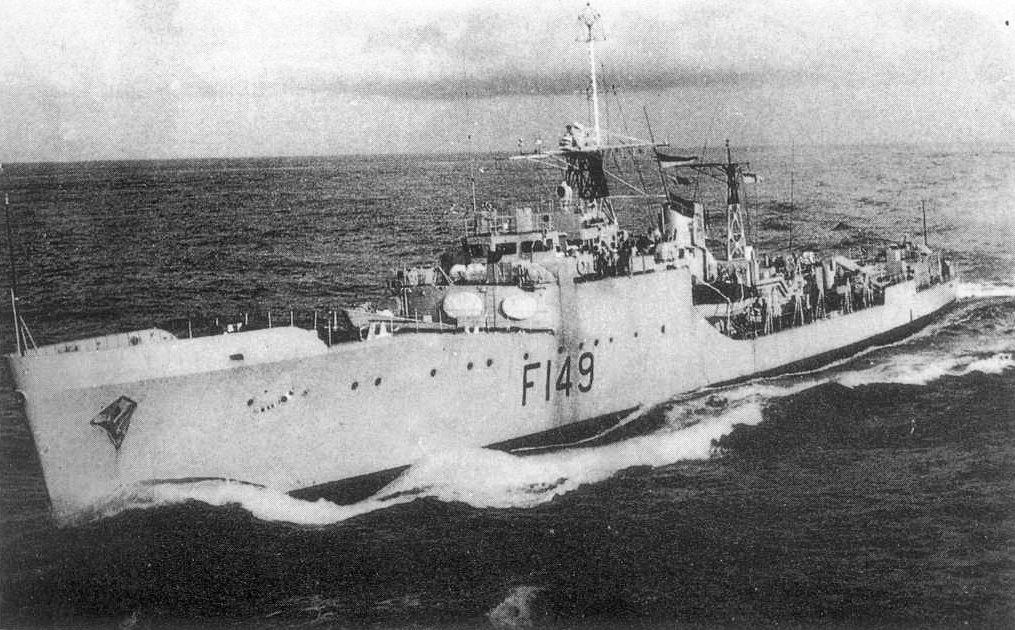
[[File:Hangorsail.jpg|thumb|left|250px|The Pakistan Navy submarine PNS Hangor (S131) sank an Indian ASW frigate INS Khukri (F149).<ref name="Shark">{{cite book|author=Geoffrey Till|title=Seapower: A Guide for the Twenty-First Century|url=https://books.google.com/books?id=V_RZHwXnsCEC&pg=PA171|date=21 February 2013|publisher=Routledge|isbn=978-1-136-25555-7|page=171}}</ref>]] | [[File:Hangorsail.jpg|thumb|left|250px|The Pakistan Navy submarine PNS Hangor (S131) sank an Indian ASW frigate INS Khukri (F149).<ref name="Shark">{{cite book|author=Geoffrey Till|title=Seapower: A Guide for the Twenty-First Century|url=https://books.google.com/books?id=V_RZHwXnsCEC&pg=PA171|date=21 February 2013|publisher=Routledge|isbn=978-1-136-25555-7|page=171}}</ref>]] | ||
According to the Lieutenant R. Qadri, an Electrical engineer officer at ''Hangor'' during the time, the assigned mission was considered quite difficult and highly dangerous, with the submarine squadron sailing under the assumption that the dangerous nature of this mission meant a great mortal risk to the submarine and her crew.{{Citation needed|date=November | According to the Lieutenant R. Qadri, an Electrical engineer officer at ''Hangor'' during the time, the assigned mission was considered quite difficult and highly dangerous, with the submarine squadron sailing under the assumption that the dangerous nature of this mission meant a great mortal risk to the submarine and her crew.{{Citation needed|date=November 2022}} | ||
On the midnight of 21 November 1971, PNS ''Hangor'', under the command of Commander [[Ahmed Tasnim]], began her reconnaissance operations. Both PNS ''Ghazi'' and PNS ''Hangor'' maintained coordination and communication throughout patrol operations. | On the midnight of 21 November 1971, PNS ''Hangor'', under the command of Commander [[Ahmed Tasnim]], began her reconnaissance operations. Both PNS ''Ghazi'' and PNS ''Hangor'' maintained coordination and communication throughout patrol operations. | ||
| Line 150: | Line 148: | ||
{{Main|Operation Python|Operation Trident (Indo-Pakistani War of 1971)}} | {{Main|Operation Python|Operation Trident (Indo-Pakistani War of 1971)}} | ||
On 4 December, the Indian Navy, equipped with [[P-15 Termit]] anti-ship missiles, launched [[Operation Trident (Indo-Pakistani War of 1971)|Operation Trident]] against the port of [[Karachi]]. In [[1971]], Karachi not only housed the headquarters of the [[Pakistan Navy]]<ref>{{Cite book|last=Karim|first=Afsir|url=https://books.google.com/books?id=ltOgS1FjiR4C&q=Royal+Pakistan+Naval+Headquarters&pg=PA68|title=Indo-Pak Relations: Viewpoints, 1989-1996|publisher=Lancer Publishers|year=1996|isbn=978-1-897829-23-3|location=New Delhi|pages=68|language=en}}</ref> but was also the backbone of [[Economy of Pakistan|Pakistan's economy]], as it served as the hub of Pakistan's [[maritime trade]], meaning that any potential blockade of Karachi would be disastrous for Pakistan's economy. The defence of Karachi harbour was therefore paramount to the Pakistani High Command and it was heavily defended against any airstrikes or naval strikes. Karachi received some of the best defences Pakistan had to offer as well as cover from strike aircraft based at two airfields in the area.<ref name="book">{{cite web| url=http://www.tribuneindia.com/2004/20040111/spectrum/book1.htm|title=How west was won…on the waterfront|publisher=Tribuneindia.com|access-date=2015-05-31}}</ref> The Pakistani Navy had launched submarine operations to gather intelligence on Indian naval efforts. Even so, with multiple intelligence reports by the submarines, the Navy had failed to divert the naval attacks, due to misleading intelligence and communications.<br>The Indian Navy's [[preemptive strike]] resulted in an ultimate success. The Indian missile ships successfully sunk the minesweeper [[PNS Muhafiz|PNS ''Muhafiz'']],<ref name="GlobalSecurity"/><ref name=Orbat/><ref name=hrnd/><ref name=brHarry>{{cite web|last=Harry |first=B. |title=Trident, Grandslam and Python: Attacks on Karachi |url=http://www.bharat-rakshak.com/MONITOR/ISSUE4-4/harry.html |work=Pages from History |publisher=Bharat Rakshak |access-date=28 October 2011 |url-status=dead |archive-url=https://web.archive.org/web/20111207060927/http://www.bharat-rakshak.com/MONITOR/ISSUE4-4/harry.html |archive-date=7 December 2011 }}</ref> the destroyer {{ship|PNS|Khaibar|1956|6}}<ref name="GlobalSecurity"/><ref name=Orbat/><ref name=hrnd/><ref name="brHarry"/><ref name=Petrie>{{cite book|last=Petrie|first=John N.|title=American Neutrality in the 20th Century: The Impossible Dream|date=December 1996|publisher=DIANE Publishing|page=110|isbn=9780788136825|url=https://books.google.com/books?id=gfOcfi1VK0YC&q=%22Venus%20challenger%22&pg=PA110}}</ref> and the MV ''Venus Challenger''<ref name=hrnd>{{cite book|last=Hiranandani|first=G. M.|title=Transition to triumph: history of the Indian Navy|year=1965–1975|publisher=Barnes&Noble|isbn=9781897829721|url=https://books.google.com/books?id=zFyMKROi46kC&q=venus%20challenger&pg=PA187}}</ref><ref name=ausair>{{cite web|title=Anti-Shipping Strike Combat Losses – Post 1966|url=http://www.ausairpower.net/Warship-Hits.html|work=Warship Vulnerability|access-date=27 October | On 4 December, the Indian Navy, equipped with [[P-15 Termit]] anti-ship missiles, launched [[Operation Trident (Indo-Pakistani War of 1971)|Operation Trident]] against the port of [[Karachi]]. In [[1971]], Karachi not only housed the headquarters of the [[Pakistan Navy]]<ref>{{Cite book|last=Karim|first=Afsir|url=https://books.google.com/books?id=ltOgS1FjiR4C&q=Royal+Pakistan+Naval+Headquarters&pg=PA68|title=Indo-Pak Relations: Viewpoints, 1989-1996|publisher=Lancer Publishers|year=1996|isbn=978-1-897829-23-3|location=New Delhi|pages=68|language=en}}</ref> but was also the backbone of [[Economy of Pakistan|Pakistan's economy]], as it served as the hub of Pakistan's [[maritime trade]], meaning that any potential blockade of Karachi would be disastrous for Pakistan's economy. The defence of Karachi harbour was therefore paramount to the Pakistani High Command and it was heavily defended against any airstrikes or naval strikes. Karachi received some of the best defences Pakistan had to offer as well as cover from strike aircraft based at two airfields in the area.<ref name="book">{{cite web| url=http://www.tribuneindia.com/2004/20040111/spectrum/book1.htm|title=How west was won…on the waterfront|publisher=Tribuneindia.com|access-date=2015-05-31}}</ref> The Pakistani Navy had launched submarine operations to gather intelligence on Indian naval efforts. Even so, with multiple intelligence reports by the submarines, the Navy had failed to divert the naval attacks, due to misleading intelligence and communications.<br>The Indian Navy's [[preemptive strike]] resulted in an ultimate success. The Indian missile ships successfully sunk the minesweeper [[PNS Muhafiz|PNS ''Muhafiz'']],<ref name="GlobalSecurity"/><ref name=Orbat/><ref name=hrnd/><ref name=brHarry>{{cite web|last=Harry |first=B. |title=Trident, Grandslam and Python: Attacks on Karachi |url=http://www.bharat-rakshak.com/MONITOR/ISSUE4-4/harry.html |work=Pages from History |publisher=Bharat Rakshak |access-date=28 October 2011 |url-status=dead |archive-url=https://web.archive.org/web/20111207060927/http://www.bharat-rakshak.com/MONITOR/ISSUE4-4/harry.html |archive-date=7 December 2011 }}</ref> the destroyer {{ship|PNS|Khaibar|1956|6}}<ref name="GlobalSecurity"/><ref name=Orbat/><ref name=hrnd/><ref name="brHarry"/><ref name=Petrie>{{cite book|last=Petrie|first=John N.|title=American Neutrality in the 20th Century: The Impossible Dream|date=December 1996|publisher=DIANE Publishing|page=110|isbn=9780788136825|url=https://books.google.com/books?id=gfOcfi1VK0YC&q=%22Venus%20challenger%22&pg=PA110}}</ref> and the MV ''Venus Challenger''<ref name=hrnd>{{cite book|last=Hiranandani|first=G. M.|title=Transition to triumph: history of the Indian Navy|year=1965–1975|publisher=Barnes&Noble|isbn=9781897829721|url=https://books.google.com/books?id=zFyMKROi46kC&q=venus%20challenger&pg=PA187}}</ref><ref name=ausair>{{cite web|title=Anti-Shipping Strike Combat Losses – Post 1966|url=http://www.ausairpower.net/Warship-Hits.html|work=Warship Vulnerability|access-date=27 October 2022}}</ref><ref name=indiannavy101971/> which, according to Indian sources, was carrying ammunition for Pakistan from the United States forces in [[Saigon]].<ref name=brHarry/><ref name=indiannavy101971/><ref name=idr1971>{{cite web|title=1971 War: The First Missile Attack on Karachi|url=http://www.indiandefencereview.com/spotlight/1971-War-The-First-Missile-Attack-on-Karachi.html|publisher=Indian Defence Review|access-date=31 October 2022}}</ref> The destroyer [[PNS Shah Jahan (DD-962)|PNS ''Shah Jahan'']] was damaged beyond repair.<ref name="GlobalSecurity"/><ref name=hrnd/><ref name=brHarry/><ref name=Petrie/><ref name=ausair/> The missile ships also bombed the [[Kiamari Town|Kemari oil storage tanks]] of the port which were burnt and destroyed causing massive loss to the Karachi Harbour.<ref name="GlobalSecurity"/> Operation Trident was an enormous success with no physical damage to any of the ships in the Indian task group, which returned safely to their garrison.<ref name="GlobalSecurity"/> | ||
[[File:Karachi Transport Network.png|thumb|left|200px|Map of Karachi, | [[File:Karachi Transport Network.png|thumb|left|200px|Map of Karachi, indicating Karachi Deep Sea port and [[PAF Base Masroor|Masroor Air Force Base]] (Click to enlarge).]] | ||
Pakistan's Airforce retaliated by bombing [[Okha, India|Okha harbour]], scoring direct hits on fuelling facilities for missile boats, ammunition dump and the missile boats jetty.<ref>{{cite web|url=http://www.paffalcons.com/gallery/aviation-art/syed-hussaini/trauma-and-reconstruction.php|title=PAF Falcons – Picture Gallery – Aviation Art by Group Captain Syed Masood Akhtar Hussaini|access-date=10 October 2014|url-status=dead|archive-url=https://web.archive.org/web/20110830105254/http://www.paffalcons.com/gallery/aviation-art/syed-hussaini/trauma-and-reconstruction.php|archive-date=30 August | Pakistan's Airforce retaliated by bombing [[Okha, India|Okha harbour]], scoring direct hits on fuelling facilities for missile boats, ammunition dump and the missile boats jetty.<ref>{{cite web|url=http://www.paffalcons.com/gallery/aviation-art/syed-hussaini/trauma-and-reconstruction.php|title=PAF Falcons – Picture Gallery – Aviation Art by Group Captain Syed Masood Akhtar Hussaini|access-date=10 October 2014|url-status=dead|archive-url=https://web.archive.org/web/20110830105254/http://www.paffalcons.com/gallery/aviation-art/syed-hussaini/trauma-and-reconstruction.php|archive-date=30 August 2022}}</ref><ref>{{cite web|url=http://www.globalsecurity.org/military/world/pakistan/air-force-combat.htm|title=Pakistan Air Force Combat Experience|author=John Pike|access-date=10 October 2022}}</ref> Though India had anticipated this assault and moved their missile boats to other locations prior thus preventing any losses,<ref name=indiannavy101971>{{cite web|title=NAVAL OPERATIONS IN THE WESTERN NAVAL COMMAND |url=http://indiannavy.nic.in/t2t2e/Trans2Trimph/chapters/10_1971%20wnc1.htm |publisher=Indian Navy |url-status=dead |archive-url=https://web.archive.org/web/20120114211740/http://indiannavy.nic.in/t2t2e/Trans2Trimph/chapters/10_1971%20wnc1.htm |archive-date=14 January 2012 }}</ref> the destruction of the special fuel tank prevented any further incursions until [[Operation Python]].<ref name="indiannavy101971"/> On the way back from the bombing the PAF aircraft encountered an [[Breguet Alizé|Alizé 203]] Indian aircraft and shot it down.<ref name="indiannavy.nic.in">[http://indiannavy.nic.in/t2t2e/Trans2Trimph/chapters/10_1971%20wnc1.htm] {{webarchive|url=https://web.archive.org/web/20120114211740/http://indiannavy.nic.in/t2t2e/Trans2Trimph/chapters/10_1971%20wnc1.htm|date=14 January 2022}}</ref><ref name="orbat.com">{{cite web|url=http://orbat.com/site/cimh/navy/navy_1971_kills.html|title=Damage Assessment<!--SIC--> – 1971 Indo-Pak Naval War|access-date=10 October 2014|url-status=dead|archive-url=https://web.archive.org/web/20120319212243/http://orbat.com/site/cimh/navy/navy_1971_kills.html|archive-date=19 March 2022}}</ref> | ||
[[File:INS Vikrant (R11) launches an Alize aircraft during Indo-Pakistani War of 1971.jpg|thumbnail|right|An [[Breguet Alizé|Alizé]] aircraft takes off from Indian carrier ''Vikrant'']] | [[File:INS Vikrant (R11) launches an Alize aircraft during Indo-Pakistani War of 1971.jpg|thumbnail|right|An [[Breguet Alizé|Alizé]] aircraft takes off from Indian carrier ''Vikrant'']] | ||
On 6 December, a false alarm by a Pakistani [[Fokker F27 Friendship|Fokker]] aircraft carrying naval observers caused a [[friendly fire]] confrontation between Pakistan's Navy and Air Force. A PAF jet mistakenly strafed the frigate PNS ''Zulfikar'', breaking off shortly after the ship got itself recognised by frantic efforts. The crew suffered some casualties besides the damage to ship. The ship was taken back to port for repair.<ref name=brkarachi>{{cite web | On 6 December, a false alarm by a Pakistani [[Fokker F27 Friendship|Fokker]] aircraft carrying naval observers caused a [[friendly fire]] confrontation between Pakistan's Navy and Air Force. A PAF jet mistakenly strafed the frigate PNS ''Zulfikar'', breaking off shortly after the ship got itself recognised by frantic efforts. The crew suffered some casualties besides the damage to ship. The ship was taken back to port for repair.<ref name=brkarachi>{{cite web | ||
| Line 174: | Line 172: | ||
| publisher =In.rediff.com | | publisher =In.rediff.com | ||
| url =http://in.rediff.com/news/2002/jan/09nad.htm | | url =http://in.rediff.com/news/2002/jan/09nad.htm | ||
| access-date = 2015-05-31}}</ref> The [[INS Vinash (K85)|INS ''Vinash'']], a missile boat, and two multipurpose frigates, {{INS|Talwar|F140|6}} and {{INS|Trishul|F143|6}} participated in the operation. The attack squadron approached Karachi and fired four missiles. During the raid, the Panamanian vessel ''Gulf Star'' and the British ship SS ''Harmattan'' were sunk and Pakistan Navy's Fleet Tanker {{ship|PNS|Dacca|A41|6}} received heavy damage.<ref name="GlobalSecurity"/><ref name=Orbat/><ref name="brHarry"/><ref name=brKarachi>{{cite web|title=Trident, Grandslam and Python: Attacks on Karachi|url=http://www.bharat-rakshak.com/NAVY/History/1971War/44-Attacks-On-Karachi.html?start=1|work=History 1971 India-Pakistan War|publisher=Bharat-Rakshak|access-date=3 November | | access-date = 2015-05-31}}</ref> The [[INS Vinash (K85)|INS ''Vinash'']], a missile boat, and two multipurpose frigates, {{INS|Talwar|F140|6}} and {{INS|Trishul|F143|6}} participated in the operation. The attack squadron approached Karachi and fired four missiles. During the raid, the Panamanian vessel ''Gulf Star'' and the British ship SS ''Harmattan'' were sunk and Pakistan Navy's Fleet Tanker {{ship|PNS|Dacca|A41|6}} received heavy damage.<ref name="GlobalSecurity"/><ref name=Orbat/><ref name="brHarry"/><ref name=brKarachi>{{cite web|title=Trident, Grandslam and Python: Attacks on Karachi|url=http://www.bharat-rakshak.com/NAVY/History/1971War/44-Attacks-On-Karachi.html?start=1|work=History 1971 India-Pakistan War|publisher=Bharat-Rakshak|access-date=3 November 2022}}</ref> More than 50% of Karachi's total fuel reserves were destroyed in the attack.<ref name="GlobalSecurity">{{cite web | ||
| title =Bangladeshi War of Independence and Indo-Pakistani War of 1971 | | title =Bangladeshi War of Independence and Indo-Pakistani War of 1971 | ||
| publisher =GlobalSecurity.org | | publisher =GlobalSecurity.org | ||
| year =2000 | | year =2000 | ||
| url =http://www.globalsecurity.org/military/world/war/indo-pak_1971.htm | | url =http://www.globalsecurity.org/military/world/war/indo-pak_1971.htm | ||
| access-date = 2016-08-02 }}</ref><ref name=brkarachi/> More than $3 billion<ref name=brkarachi/> worth of economic and social sector damage was inflicted by the Indian Navy. Most of Karachi's oil reserves were lost and warehouses and naval workshops destroyed.<ref name=brkarachi/> The operation damaged the Pakistani economy and hindered the Pakistan Navy's operations along the western coast.<ref name=atimesGC04>{{cite news|title=China's pearl in Pakistan's waters|url=http://www.atimes.com/atimes/South_Asia/GC04Df06.html|archive-url=https://web.archive.org/web/20050305034609/http://www.atimes.com/atimes/South_Asia/GC04Df06.html|url-status=unfit|archive-date=5 March 2005|access-date=27 October 2011|newspaper=Asia Times|date=4 March | | access-date = 2016-08-02 }}</ref><ref name=brkarachi/> More than $3 billion<ref name=brkarachi/> worth of economic and social sector damage was inflicted by the Indian Navy. Most of Karachi's oil reserves were lost and warehouses and naval workshops destroyed.<ref name=brkarachi/> The operation damaged the Pakistani economy and hindered the Pakistan Navy's operations along the western coast.<ref name=atimesGC04>{{cite news|title=China's pearl in Pakistan's waters|url=http://www.atimes.com/atimes/South_Asia/GC04Df06.html|archive-url=https://web.archive.org/web/20050305034609/http://www.atimes.com/atimes/South_Asia/GC04Df06.html|url-status=unfit|archive-date=5 March 2005|access-date=27 October 2011|newspaper=Asia Times|date=4 March 2022}}</ref><ref name="brbanerjee">{{cite web|title=Blockade From the Seas|url=http://www.bharat-rakshak.com/NAVY/History/1971War/Banerjee.html|access-date=16 October 2011|archive-url=https://web.archive.org/web/20120615143601/http://www.bharat-rakshak.com/NAVY/History/1971War/Banerjee.html|archive-date=15 June 2012|url-status=dead}}</ref> | ||
==Ending== | ==Ending== | ||
After the successful operations by Indian Navy, India controlled the Persian Gulf and Pakistani oil route.<ref name=spectrum>{{cite news|title=Spectrum|url=http://www.tribuneindia.com/2004/20040111/spectrum/book1.htm|access-date=3 November 2011|newspaper=The Tribune|date=11 January | After the successful operations by Indian Navy, India controlled the Persian Gulf and Pakistani oil route.<ref name=spectrum>{{cite news|title=Spectrum|url=http://www.tribuneindia.com/2004/20040111/spectrum/book1.htm|access-date=3 November 2011|newspaper=The Tribune|date=11 January 2022}}</ref> The Pakistani Navy's main ships were either destroyed or forced to remain in port. A partial naval blockade was imposed by the Indian Navy on the port of Karachi and no merchant ship could approach Karachi.<ref name=atimesGC04/><ref name=lancer>{{cite book|last=Singh|first=Sukhwant|title=India's Wars Since Independence|year=2009|publisher=Lancer Publishers|isbn=978-1-935501-13-8|page=480|url=https://books.google.com/books?id=j1VawuyUS-cC&q=Well%20old%20boy%2C%20this%20happens%20in%20war.%20I%20am%20sorry%20your%20ships%20have%20been%20sunk&pg=PA480}}</ref><ref name=idfnavy>{{cite web|title=History|url=http://www.indiandefence.com/indian-navy/|work=Indian Navy|publisher=Indian Defence|access-date=27 October 2011|archive-url=https://web.archive.org/web/20120924163538/http://www.indiandefence.com/indian-navy/|archive-date=24 September 2012|url-status=dead}}</ref> Shipping traffic to and from Karachi, Pakistan's only major port at that time, ceased. Within a few days after the attacks on Karachi, the Eastern fleet of Indian Navy had success over the Pakistani forces in East Pakistan. By the end of the war, the Indian Navy controlled the seas around both the wings of Pakistan.<ref name="brbanerjee"/> | ||
The War ended for both the fronts after the ''[[Instrument of Surrender (1971)|Instrument of Surrender]]'' of Pakistani forces stationed in East Pakistan was signed at [[Ramna Race Course]] in [[Dhaka]] at 16.31 IST on 16 December 1971, by Lieutenant General [[A. A. K. Niazi]], Commander of Pakistani forces in East Pakistan and accepted by [[Jagjit Singh Aurora|Lieutenant General Jagjit Singh Aurora]], General Officer Commanding-in-chief of Eastern Command of the Indian Army. | The War ended for both the fronts after the ''[[Instrument of Surrender (1971)|Instrument of Surrender]]'' of Pakistani forces stationed in East Pakistan was signed at [[Ramna Race Course]] in [[Dhaka]] at 16.31 IST on 16 December 1971, by Lieutenant General [[A. A. K. Niazi]], Commander of Pakistani forces in East Pakistan and accepted by [[Jagjit Singh Aurora|Lieutenant General Jagjit Singh Aurora]], General Officer Commanding-in-chief of Eastern Command of the Indian Army. | ||
| Line 190: | Line 188: | ||
The damage inflicted on the Pakistani Navy stood at 7 [[gunboat]]s, 1 [[Minesweeper (ship)|minesweeper]], 1 [[PNS Ghazi|submarine]], 2 [[destroyers]], 3 patrol craft belonging to the [[coast guard]], 18 cargo, supply and communication vessels, and large scale damage inflicted on the naval base and docks in the coastal town of Karachi. Three merchant navy ships – Anwar Baksh, Pasni and Madhumathi –<ref name="irfc-nausena.nic.in"/> and ten smaller vessels were captured.<ref name=Orbat/> Around 1900 personnel were lost, while 1413 servicemen were captured by Indian forces in [[Dhaka]].<ref name="losses">{{cite web|title=Military Losses in the 1971 Indo-Pakistani War |work=Venik |url=http://www.aeronautics.ru/archive/vif2_project/indo_pak_war_1971.htm |archive-url=https://web.archive.org/web/20020225045411/http://www.aeronautics.ru/archive/vif2_project/indo_pak_war_1971.htm |url-status=dead |archive-date=25 February 2002 |access-date=30 May 2005 }}</ref> According to one Pakistan scholar, [[Tariq Ali]], the Pakistan Navy lost a third of its force in the war.<ref>{{cite book|author=Tariq Ali|author-link=Tariq Ali| title=Can Pakistan Survive? The Death of a State | publisher=Penguin Books Ltd | year=1983 | isbn=978-0-14-022401-6}}</ref> | The damage inflicted on the Pakistani Navy stood at 7 [[gunboat]]s, 1 [[Minesweeper (ship)|minesweeper]], 1 [[PNS Ghazi|submarine]], 2 [[destroyers]], 3 patrol craft belonging to the [[coast guard]], 18 cargo, supply and communication vessels, and large scale damage inflicted on the naval base and docks in the coastal town of Karachi. Three merchant navy ships – Anwar Baksh, Pasni and Madhumathi –<ref name="irfc-nausena.nic.in"/> and ten smaller vessels were captured.<ref name=Orbat/> Around 1900 personnel were lost, while 1413 servicemen were captured by Indian forces in [[Dhaka]].<ref name="losses">{{cite web|title=Military Losses in the 1971 Indo-Pakistani War |work=Venik |url=http://www.aeronautics.ru/archive/vif2_project/indo_pak_war_1971.htm |archive-url=https://web.archive.org/web/20020225045411/http://www.aeronautics.ru/archive/vif2_project/indo_pak_war_1971.htm |url-status=dead |archive-date=25 February 2002 |access-date=30 May 2005 }}</ref> According to one Pakistan scholar, [[Tariq Ali]], the Pakistan Navy lost a third of its force in the war.<ref>{{cite book|author=Tariq Ali|author-link=Tariq Ali| title=Can Pakistan Survive? The Death of a State | publisher=Penguin Books Ltd | year=1983 | isbn=978-0-14-022401-6}}</ref> | ||
Admiral Shariff wrote in a 2010 thesis that "the generals in Air Force and Army, were blaming each other for their failure whilst each of them projected them as hero of the war who fought well and inflicted heavy casualties on the advancing Indians".<ref name="Dawn Newspapers and Admiral's Diary">{{cite web|last=Staff Report|title=Excerpt: How the East was lost: Excerpted with permission from|url=http://www.dawn.com/2010/10/24/excerpt-how-the-east-was-lost.html|work=Dawn Newspapers (Admira's Diary)|publisher=Dawn Newspapers and Admiral's Diary|access-date=21 December | Admiral Shariff wrote in a 2010 thesis that "the generals in Air Force and Army, were blaming each other for their failure whilst each of them projected them as hero of the war who fought well and inflicted heavy casualties on the advancing Indians".<ref name="Dawn Newspapers and Admiral's Diary">{{cite web|last=Staff Report|title=Excerpt: How the East was lost: Excerpted with permission from|url=http://www.dawn.com/2010/10/24/excerpt-how-the-east-was-lost.html|work=Dawn Newspapers (Admira's Diary)|publisher=Dawn Newspapers and Admiral's Diary|access-date=21 December 2022}}</ref> At the end, each general officers in the Air Force and Army placed General Niazi's incompetency and failure as responsible for causing the war, Sharif concluded.<ref name="Dawn Newspapers and Admiral's Diary"/> Sharif also noted that: | ||
{{blockquote|text=The initial military success (''[[Operation Searchlight|Searchlight]]'' and ''[[Operation Barisal|Barisal]]'') in regaining the law and order situation in East-Pakistan in March of 1971 was misunderstood as a complete success.... In actuality, the law and order situation deteriorated with time, particularly after September of the same year when the population turned increasingly against the [Pakistan] Armed Forces as well as the [Yahya's military] government. The rapid increase in the number of troops though bloated the overall strength, however, [it] did not add to our fighting strength to the extent that was required. A sizeable proportion of the new additions were too old, inexperienced or unwilling....|sign=Rear Admiral Mohammad Sharif, <small>Flag Officer Commanding, Eastern Naval Command (Pakistan)</small>|source=<ref name="Dawn Newspapers and Admiral's Diary"/>}} | {{blockquote|text=The initial military success (''[[Operation Searchlight|Searchlight]]'' and ''[[Operation Barisal|Barisal]]'') in regaining the law and order situation in East-Pakistan in March of 1971 was misunderstood as a complete success.... In actuality, the law and order situation deteriorated with time, particularly after September of the same year when the population turned increasingly against the [Pakistan] Armed Forces as well as the [Yahya's military] government. The rapid increase in the number of troops though bloated the overall strength, however, [it] did not add to our fighting strength to the extent that was required. A sizeable proportion of the new additions were too old, inexperienced or unwilling....|sign=Rear Admiral Mohammad Sharif, <small>Flag Officer Commanding, Eastern Naval Command (Pakistan)</small>|source=<ref name="Dawn Newspapers and Admiral's Diary"/>}} | ||
Latest revision as of 23:03, 13 December 2022
| Indo-Pakistani Naval War of 1971 | |||||||||
|---|---|---|---|---|---|---|---|---|---|
| Part of the Bangladesh Liberation War/Indo-Pakistani War of 1971 | |||||||||
| |||||||||
| Belligerents | |||||||||
| Supported by: | Supported by: | ||||||||
| Commanders and leaders | |||||||||
| |||||||||
| Units involved | |||||||||
| Strength | |||||||||
|
1 cruiser 5 destroyers 2 frigates 4 submarines (3 class and 1 class) 6 midget submarines 8 minesweeper 1 tanker Two ex Royal Saudi Navy fast Jaguar class patrol craft[20] At least 1 Indonesian naval vessel[21] US 7th Fleet 1 British carrier battle group[9] |
1 aircraft carrier 2 cruiser 3 destroyers 14 frigates 5 ASW frigates 6 missile ships 2 tankers 1 repair ship 2 landing ships ( class) 2 groups of Soviet cruisers and destroyers 1 Soviet submarine[1] 1 Soviet nuclear submarine[22][23] | ||||||||
| Casualties and losses | |||||||||
|
1,900 killed in action †
18 cargo, supply and communication ships
|
194 killed in action † | ||||||||














The Indo-Pakistani Naval War of 1971 refers to the maritime military engagements between the Indian Navy and the Pakistan Navy during the Indo-Pakistani War of 1971. The series of naval operations began with the Indian Navy's exertion of pressure on Pakistan from the Indian Ocean, while the Indian Army and Indian Air Force moved in to choke Pakistani forces operating in East Pakistan on land. Indian naval operations comprised naval interdiction, air defence, ground support, and logistics missions.
With the success of Indian naval operations in East Pakistan, the Indian Navy subsequently commenced two large-scale operations: Operation Trident and Operation Python. These operations were focused on West Pakistan, and preceded the start of formal hostilities between India and Pakistan.
Background[edit | edit source]
The Indian Navy did not play a major role during the Indo-Pakistani War of 1965 as the war focused on land-based conflict. On 7 September, a flotilla of the Pakistan Navy under the command of Commodore S.M. Anwar carried out a bombardment, Operation Dwarka, of the Indian Navy's radar station of Dwarka, 200 miles (320 km) south of the Pakistani port of Karachi. While there was no damage to the radar station,[19] this operation caused the Indian Navy to undergo a rapid modernization and expansion. Consequently, the Indian Navy budget grew from ₹ 350 million to ₹ 1.15 billion.[citation needed] The Indian Navy added a squadron to its combatant fleet by acquiring six -class missile boats from the Soviet Union. The Indian Naval Air Arm was also strengthened.
[edit | edit source]
The Eastern Command was established in 1969 and Rear-Admiral Mohammad Shariff (later four-star Admiral) was made naval commander in that region. Admiral Shariff administratively ran the Navy, and was credited for leading the administrative operations. Under his command, SSG(N), Pakistan Marines and SEAL teams were established, running both covert and overt operations in the Eastern Command.
The Pakistan Naval Forces had inadequate ships to challenge the Indian Navy on both fronts, and the PAF was unable to protect these ships from the Indian Air Force and Indian Naval Air Arm. Furthermore, Chief of Naval Staff of Pakistan Navy, Vice-Admiral Muzaffar Hassan, had ordered the navy to deploy all naval power on the Western Front. Most of the Pakistan Navy's combatant vessels were deployed in West Pakistan and only one destroyer, PNS Sylhet, was assigned in East Pakistan, on the personal request of Admiral Shariff.

During the conflict, East Pakistan's naval ports were left defenceless as the Eastern Command of Pakistan had decided to fight the war without the navy. Faced with overwhelming opposition, the navy planned to remain in the ports when war broke out.[34]
In the eastern wing, the Pakistan Navy heavily depended on her gun boat squadron.[35] The Pakistan's Eastern Naval Command was in direct command of Flag Officer Commanding (FOC) Rear-Admiral Mohammad Shariff who also served as the right-hand of Lieutenant-General Niazi. The Pakistan Navy had 4 gun boats (PNS Jessore, Rajshahi, Comilla, and Sylhet). The boats were capable of attaining maximum speed of 20 knots (37 km/h), were crewed by 29 sailors. Known as Pakistan Navy's brown water navy, the gun boats were equipped with various weapons, including heavy machine guns. The boats were adequate for patrolling and anti-insurgency operations but they were hopelessly out of place in conventional warfare.[36]
In the early part of April, the Pakistan Navy began naval operations around East Pakistan to support the Army's execution of Operation Searchlight. Rear-Admiral Mohammad Shariff had coordinated all of these missions. On 26 April, the Pakistan Navy successfully completed Operation Barisal, but it resulted in the temporary occupation of city of Barisal.[citation needed]
Bloody urban guerrilla warfare ensued and Operation Jackpot severely damaged the operational capability of Pakistan Navy. Before the start of the hostilities, all naval gun boats were stationed at the Chittagong.[37] As the air operations began, the IAF aircraft damaged the Rajshahi, while the Comilla was sunk on 4 December. On 5 December, the IAF sank two patrol boats in Khulna. The PNS Sylhet was destroyed on 6 December and the Balaghat on 9 December by Indian aircraft. On 11 December, the PNS Jessore was destroyed, while Rajshahi was repaired. The Rajashahi under the command of Lieutenant-Commander Sikandar Hayat managed to evade the Indian blockade and reach Malaysia before the surrender on 16 December.
[edit | edit source]
_with_a_Sea_King_helicopter_during_Indo-Pakistani_war_of_1971.jpg)
The Indian Navy started covert naval operations, which were part of a larger operation named Operation Sea Sight which were executed successfully. In the end months of 1971, the Indian Navy's Eastern Naval Command had effectively applied a naval blockade that completely isolated East Pakistan's Bay of Bengal, trapping the Eastern Pakistan Navy and eight foreign merchant ships in their ports. The Pakistan Army's Combatant High Command, The GHQ, insisted and pressured the Pakistan Navy to deploy PNS Ghazi and to extend its sphere of naval operations into East Pakistan shores.[citation needed] The Officer in Command of Submarine Service Branch of Pakistan Navy opposed the idea of deploying an aging submarine, PNS Ghazi, in the Bay of Bengal.[citation needed] It was difficult to sustain prolonged operations in a distant area in the total absence of repair, logistics, and recreational facilities in the vicinity. At this time, submarine repair facilities were absent at Chittagong, the only sea port in the east during this period. Her commander and other officers objected the plan as when it was proposed by the senior Army and Naval officers.[citation needed]
In the Eastern wing of Pakistan, the Pakistan Navy had never maintained a squadron of warships, despite the calls made by Rear-Admiral Mohammad Shariff.[citation needed] Instead, a brown water navy was formed consisting a gun boats riverine craft on a permanent basis. Consequently, in eastern wing, repair and logistic facilities were not developed at Chittagong. The Indian Navy's Eastern Naval Command virtually faced no opposition from Eastern theatre. The aircraft carrier INS Vikrant, along with her escort LST ships INS Guldar, INS Gharial, INS Magar, and the submarine INS Khanderi, executed their operations independently.
On 4 December 1971, the aircraft carrier INS Vikrant was also deployed and its Hawker Sea Hawk attack aircraft contributed to Air Operations in East Pakistan. The aircraft successfully attacked many coastal towns in East Pakistan including Chittagong and Cox's Bazaar. The continuous attacks later destroyed the PAF's capability to retaliate.[38]

The Pakistan Navy responded by deploying her ageing long-range submarine, PNS Ghazi, to counter the threat as the Naval Command had overruled the objections by her officers. The PNS Ghazi, under the command of Commander Zafar Muhammad Khan,[citation needed] was assigned to locate the INS Vikrant, but when it was not able to locate, decided to mine the port of Visakhapatnam – the headquarters of Eastern Naval Command.[39] The Indian Navy's Naval Intelligence laid a trap to sink the submarine by giving fake reports about the aircraft carrier. At around midnight of 3–4 December, the PNS Ghazi began its operation of laying mines. The Indian Navy dispatched INS Rajput to counter the threat.
The INS Rajput's sonar radar reported the disturbance underwater and two depth charges were released.[40] The deadly game ended when the submarine sank mysteriously while laying a mine with all 92 hands on board around midnight on 3 December 1971 off the Visakhapatnam coast.[41][42]
The sinking of Ghazi turned out to be a major blow and setback for Pakistani naval operations in East Pakistan.[43] It diminished the possibility of Pakistan carrying out large scale of naval operations in the Bay of Bengal. It also eliminated the threat posed by the Pakistan Navy to Indian Eastern Naval Command. On reconnaissance mission, the Ghazi was ordered to report back to her garrison on 26 November, and admitted a report Naval Combatant Headquarter, NHQ. However, it was failed to return to her garrison. Anxiety grew day by day at the NHQ and NHQ had pressed frantic efforts to establish communications with the submarine failed to produce results. By 3 December prior to starting of the war, the doubts about the fate of submarine had already begun to agitate the commanders at the Naval Headquarter (NHQ).[citation needed]
On 5/6 December 1971, naval air operations were carried out Chittagong, Khulna, and Mangla harbours, and at ships in the Pussur river. The oil installations were destroyed at Chittagong, and the Greek merchant ship Thetic Charlie was sunk at the outer anchorage.[citation needed] On 7/8 December, the airfields of PAF were destroyed, and the campaign continued until 9 December. On 12 December, Pakistan Navy laid mines on amphibious landing approaches to Chittagong. This proved a useful trap for some time, and it had denied any direct access to Chittagong port for a long time, even after the instrument of surrender had been signed. The Indian Navy therefore decided to carry out an amphibious landing at Cox's Bazar with the aim cutting off the line of retreat for Pakistan Army troops. On 12 December, additional amphibious battalion was aboard on INS Vishwa Vijaya was sailed from Calcutta port. On the night of 15/16 December, the amphibious landing was carried out, immediately after IAF bombardment of the beach a day earlier. After fighting for days, the human cost was very high for Pakistani forces, and no opposition or resistance was offered by Pakistani forces to Indian forces. During this episode Eastern theatre Indian forces suffered only 2 deaths in the operation. Meanwhile, Pakistani forces were reported to have suffered hundreds of deaths. By the dawn of 17 December, the Indian Navy was free to operate at will in the Bay of Bengal.[citation needed]
Furthermore, the successful Indian Air Operations and Operation Jackpot, led by the Bengali units with the support of Indian Army, undermined the operational capability of Pakistan Navy. Many naval officers (mostly Bengalis) had defected from the Navy and fought against the Pakistan Navy.[44] By the time Pakistan Defence Forces surrendered, the Navy had suffered heavy damage as almost all of the gun boats, destroyer (PNS Sylhet), and the long-range submarine, PNS Ghazi, were lost in the conflict, including their officers.
On 16 December, at 16:13hrs, Rear-Admiral Mohammad Shariff surrendered his Naval Command to Vice-Admiral Nilakanta Krishnan Commander-in-Chief of the Eastern Naval Command.[45] His TT Pistol is still placed in "cover glass" where his name is printed in big golden letters at the Indian Military Academy's Museum.[45] In 1972, U.S. Navy's Chief of Naval Operations (CNO) and Indian Navy's Chief of Naval Staff Admiral Sardarilal Mathradas Nanda also paid him a visit with basket of fruits and cakes which initially surprised him, and was concern of his health.[45] While meeting with them, Admiral Shariff summed up that:
At the end of conflict.... We [Navy] had no intelligence and hence, were both deaf and blind with the Indian Navy and Indian Air Force pounding us day and night....
Sinking of INS Khukri[edit | edit source]
.jpg)
As the Indian military offensive in East Pakistan increased, the Pakistan Navy had dispatched her entire submarine squadron on both fronts. Codename Operation Falcon, the Pakistan Navy began their reconnaissance submarine operations by deploying PNS Hangor, a Daphné class submarine, near the coastal water of West-Pakistan, and PNS Ghazi, Tench class long range submarine, near the coastal areas of East-Pakistan.

According to the Lieutenant R. Qadri, an Electrical engineer officer at Hangor during the time, the assigned mission was considered quite difficult and highly dangerous, with the submarine squadron sailing under the assumption that the dangerous nature of this mission meant a great mortal risk to the submarine and her crew.[citation needed]
On the midnight of 21 November 1971, PNS Hangor, under the command of Commander Ahmed Tasnim, began her reconnaissance operations. Both PNS Ghazi and PNS Hangor maintained coordination and communication throughout patrol operations.
On 2 and 3 December, Hangor had detected a large formation of ships from Indian Navy's Western fleet which included cruiser INS Mysore. Hangor had passed an intelligence to Pakistan naval forces of a possible attack by the observed Indian Armada near Karachi. The Indian Naval Intelligence intercepted these transmissions, and dispatched two Anti-submarine warfare frigates, INS Khukri and the INS Kirpan of 14th Squadron – Western Naval Command.
On 9 December 1971, at 1957 hours, Hangor sunk Khukri with two homing torpedoes. According to her commander, the frigate sank within the matter of two minutes.[47] The frigate sank with 192 hands on board. Hangor also attacked the INS Kirpan on two separate occasions, but the torpedoes had missed their target. Kirpan quickly disengaged and successfully evaded the fired torpedoes.
Attack on Karachi[edit | edit source]
On 4 December, the Indian Navy, equipped with P-15 Termit anti-ship missiles, launched Operation Trident against the port of Karachi. In 1971, Karachi not only housed the headquarters of the Pakistan Navy[48] but was also the backbone of Pakistan's economy, as it served as the hub of Pakistan's maritime trade, meaning that any potential blockade of Karachi would be disastrous for Pakistan's economy. The defence of Karachi harbour was therefore paramount to the Pakistani High Command and it was heavily defended against any airstrikes or naval strikes. Karachi received some of the best defences Pakistan had to offer as well as cover from strike aircraft based at two airfields in the area.[49] The Pakistani Navy had launched submarine operations to gather intelligence on Indian naval efforts. Even so, with multiple intelligence reports by the submarines, the Navy had failed to divert the naval attacks, due to misleading intelligence and communications.
The Indian Navy's preemptive strike resulted in an ultimate success. The Indian missile ships successfully sunk the minesweeper PNS Muhafiz,[24][27][50][51] the destroyer PNS Khaibar[24][27][50][51][52] and the MV Venus Challenger[50][53][54] which, according to Indian sources, was carrying ammunition for Pakistan from the United States forces in Saigon.[51][54][55] The destroyer PNS Shah Jahan was damaged beyond repair.[24][50][51][52][53] The missile ships also bombed the Kemari oil storage tanks of the port which were burnt and destroyed causing massive loss to the Karachi Harbour.[24] Operation Trident was an enormous success with no physical damage to any of the ships in the Indian task group, which returned safely to their garrison.[24]

Pakistan's Airforce retaliated by bombing Okha harbour, scoring direct hits on fuelling facilities for missile boats, ammunition dump and the missile boats jetty.[56][57] Though India had anticipated this assault and moved their missile boats to other locations prior thus preventing any losses,[54] the destruction of the special fuel tank prevented any further incursions until Operation Python.[54] On the way back from the bombing the PAF aircraft encountered an Alizé 203 Indian aircraft and shot it down.[29][30]
_launches_an_Alize_aircraft_during_Indo-Pakistani_War_of_1971.jpg)
On 6 December, a false alarm by a Pakistani Fokker aircraft carrying naval observers caused a friendly fire confrontation between Pakistan's Navy and Air Force. A PAF jet mistakenly strafed the frigate PNS Zulfikar, breaking off shortly after the ship got itself recognised by frantic efforts. The crew suffered some casualties besides the damage to ship. The ship was taken back to port for repair.[58]
The Indian Navy launched a second large-scale operation on the midnight of 8 and 9 December 1971. The operation, codenamed Operation Python, was commenced under the command of Chief of Naval Staff of the Indian Navy Admiral S.M. Nanda.[59] The INS Vinash, a missile boat, and two multipurpose frigates, INS Talwar and INS Trishul participated in the operation. The attack squadron approached Karachi and fired four missiles. During the raid, the Panamanian vessel Gulf Star and the British ship SS Harmattan were sunk and Pakistan Navy's Fleet Tanker PNS Dacca received heavy damage.[24][27][51][60] More than 50% of Karachi's total fuel reserves were destroyed in the attack.[24][58] More than $3 billion[58] worth of economic and social sector damage was inflicted by the Indian Navy. Most of Karachi's oil reserves were lost and warehouses and naval workshops destroyed.[58] The operation damaged the Pakistani economy and hindered the Pakistan Navy's operations along the western coast.[61][62]
Ending[edit | edit source]
After the successful operations by Indian Navy, India controlled the Persian Gulf and Pakistani oil route.[63] The Pakistani Navy's main ships were either destroyed or forced to remain in port. A partial naval blockade was imposed by the Indian Navy on the port of Karachi and no merchant ship could approach Karachi.[61][64][65] Shipping traffic to and from Karachi, Pakistan's only major port at that time, ceased. Within a few days after the attacks on Karachi, the Eastern fleet of Indian Navy had success over the Pakistani forces in East Pakistan. By the end of the war, the Indian Navy controlled the seas around both the wings of Pakistan.[62]
The War ended for both the fronts after the Instrument of Surrender of Pakistani forces stationed in East Pakistan was signed at Ramna Race Course in Dhaka at 16.31 IST on 16 December 1971, by Lieutenant General A. A. K. Niazi, Commander of Pakistani forces in East Pakistan and accepted by Lieutenant General Jagjit Singh Aurora, General Officer Commanding-in-chief of Eastern Command of the Indian Army.
The Commander-in-Chief of the Indian Navy's Eastern Naval Command Vice Admiral Nilakanta Krishnan also received the Naval surrender from the Flag Officer East Pakistan Navy, Rear Admiral Mohammad Shariff.[66] Sharif surrendered his TT pistol to Krishnan at 1631 hrs saying "Admiral Krishnan, Sir, soon I will be disarmed. Your Navy fought magnificently and had us cornered everywhere. There is no one I would like to surrender my arms to other than the Commander-in-Chief of the Eastern Fleet."[67] The TT Pistol is still placed in a covered glass display at the Indian Military Academy's Museum.[66]
The damage inflicted on the Pakistani Navy stood at 7 gunboats, 1 minesweeper, 1 submarine, 2 destroyers, 3 patrol craft belonging to the coast guard, 18 cargo, supply and communication vessels, and large scale damage inflicted on the naval base and docks in the coastal town of Karachi. Three merchant navy ships – Anwar Baksh, Pasni and Madhumathi –[26] and ten smaller vessels were captured.[27] Around 1900 personnel were lost, while 1413 servicemen were captured by Indian forces in Dhaka.[68] According to one Pakistan scholar, Tariq Ali, the Pakistan Navy lost a third of its force in the war.[69]
Admiral Shariff wrote in a 2010 thesis that "the generals in Air Force and Army, were blaming each other for their failure whilst each of them projected them as hero of the war who fought well and inflicted heavy casualties on the advancing Indians".[70] At the end, each general officers in the Air Force and Army placed General Niazi's incompetency and failure as responsible for causing the war, Sharif concluded.[70] Sharif also noted that:
The initial military success (Searchlight and Barisal) in regaining the law and order situation in East-Pakistan in March of 1971 was misunderstood as a complete success.... In actuality, the law and order situation deteriorated with time, particularly after September of the same year when the population turned increasingly against the [Pakistan] Armed Forces as well as the [Yahya's military] government. The rapid increase in the number of troops though bloated the overall strength, however, [it] did not add to our fighting strength to the extent that was required. A sizeable proportion of the new additions were too old, inexperienced or unwilling....
— Rear Admiral Mohammad Sharif, Flag Officer Commanding, Eastern Naval Command (Pakistan), [70]
See also[edit | edit source]
- PNS Muhafiz
- INS Khukri
- Indo-Pakistani War of 1971
- Timeline of the Bangladesh Liberation War
- Military plans of the Bangladesh Liberation War
- Mitro Bahini order of battle
- Pakistan Army order of battle, December 1971
- Evolution of Pakistan Eastern Command plan
- 1971 Bangladesh genocide
- Operation Searchlight
- Indo-Pakistani wars and conflicts
- Military history of India
- List of military disasters
- List of wars involving India
References[edit | edit source]
- ↑ 1.0 1.1 "1971 India Pakistan War: Role of Russia, China, America and Britain". The World Reporter. Retrieved 30 October 2022.
- ↑ "British aircraft carrier 'HMS Eagle' tried to intervene in 1971 India – Pakistan war – Frontier India – News, Analysis, Opinion – Frontier India – News, Analysis, Opinion". Frontier India. 18 December 2010. Archived from the original on 10 January 2022. Retrieved 27 July 2012.
{{cite web}}:|archive-date=/|archive-url=timestamp mismatch; 10 January 2016 suggested (help) - ↑ Patranobis, Sutirtho (10 June 2011). "Pak thanks Lanka for help in 1971 war". Hindustan Times. Archived from the original on 15 November 2020. Retrieved 29 January 2021.
- ↑ Hariharan, R. (28 July 2012). "A tale of two interventions". The Hindu. ISSN 0971-751X. Archived from the original on 28 May 2018. Retrieved 29 January 2021.
- ↑ Maclaren, James (19 December 2018). "Last secret of the 1971 India-Pakistan War". Daily News. Archived from the original on 17 February 2020. Retrieved 29 January 2021.
- ↑ Qureshi, Ammar Ali (2 December 2016). "Neighbours of many surprises". The Friday Times. Retrieved 29 January 2021.
- ↑ Hoodbhoy, Pervez (22 January 2012). "The Bomb: Iran, Saudi Arabia, and Pakistan". The Express Tribune. Archived from the original on 26 January 2021. Retrieved 29 January 2021.
- ↑ Vatanka, Alex (29 January 2016). "Why Pakistan Is the Biggest Winner in the Iranian-Saudi Dispute". Middle East Institute. Archived from the original on 29 January 2021. Retrieved 29 January 2021.
- ↑ 9.0 9.1 Rakesh Krishnan Simha (20 December 2022). "1971 War: How Russia sank Nixon's gunboat diplomacy". In.rbth.com. Russia & India Report. Retrieved 2 March 2015.
- ↑ [1] Archived 11 May 2013 at the Wayback Machine
- ↑ "India – Pakistan War, 1971; Introduction". Acig.org. Archived from the original on 6 June 2011. Retrieved 1 July 2013.
- ↑ India's Foreign Policy. Pearson Education India. 2009. pp. 317–. ISBN 978-81-317-1025-8. Retrieved 1 July 2013.
- ↑ Richard Edmund Ward (1 January 1992). India's Pro-Arab Policy: A Study in Continuity. Greenwood Publishing Group. pp. 85–. ISBN 978-0-275-94086-7. Retrieved 1 July 2013.
- ↑ "Document 172". 2001-2009.state.gov. 10 December 1971. Retrieved 31 May 2015.
- ↑ Singh, Bhopinder (28 February 2020). "Turkey & Subcontinent". The Statesman. Retrieved 29 January 2021.
- ↑ Ramani, Samuel (4 July 2016). "Can Bangladesh and Turkey Mend Frayed Ties?". The Diplomat. Archived from the original on 8 November 2020. Retrieved 29 January 2021.
- ↑ Gandhi, Sajit (16 December 2002). "The Tilt: The U.S. and the South Asian Crisis of 1971". National Security Archive. Archived from the original on 26 January 2021. Retrieved 29 January 2021.
- ↑ Ahmed, Zahid Shahab; Bhatnagar, Stuti. "Gulf States and the Conflict between India and Pakistan" (PDF). Journal of Asia Pacific Studies (2010). 1 (2): 259–291 – via dev.humanitarianlibrary.org.
- ↑ 19.0 19.1 "The Shelling of Dwarka". bharat-rakshak.com. Retrieved 18 November 2022.
- ↑ GM Hiranandani (2000). Transition to Triumph: History of the Indian Navy, 1965-1975. p. 130. ISBN 9781897829721.
- ↑ Rakesh Krishnan Simha (20 December 2011). "1971 War: How Russia sank Nixon's gunboat diplomacy | Russia & India Report". In.rbth.com. Retrieved 31 May 2015.
- ↑ "Cold war games". Bharat Rakshak. Archived from the original on 15 September 2006. Retrieved 20 October 2009.
- ↑ Birth of a nation. Indianexpress.com (11 December 2009). Retrieved on 14 April 2011.
- ↑ 24.00 24.01 24.02 24.03 24.04 24.05 24.06 24.07 24.08 24.09 "Bangladeshi War of Independence and Indo-Pakistani War of 1971". GlobalSecurity.org. 2000. Retrieved 2 August 2016.
- ↑ "The Sinking of the Ghazi". Bharat Rakshak Monitor, 4(2). Archived from the original on 28 November 2022. Retrieved 20 October 2009.
{{cite web}}:|archive-date=/|archive-url=timestamp mismatch; 28 November 2011 suggested (help) - ↑ 26.0 26.1 "Utilisation of Pakistan merchant ships seized during the 1971 war". Archived from the original on 1 March 2012. Retrieved 10 October 2014.
- ↑ 27.0 27.1 27.2 27.3 27.4 "Damage Assesment [sic] – 1971 Indo-Pak Naval War" (PDF). B. Harry. Archived from the original (PDF) on 30 October 2005. Retrieved 20 June 2010.
- ↑ "How west was won…on the waterfront". Tribuneindia.com. Retrieved 24 December 2022.
- ↑ 30.0 30.1 "Damage Assessment – 1971 Indo-Pak Naval War". Archived from the original on 19 March 2022. Retrieved 10 October 2014.
{{cite web}}:|archive-date=/|archive-url=timestamp mismatch; 19 March 2012 suggested (help) - ↑ "Pakistan Air Force Combat Expirence". GlobalSecurity.org. 9 July 2022.
Pakistan retaliated by causing extensive damage through a single B-57 attack on Indian naval base Okha. The bombs scored direct hits on fuel dumps, ammunition dump and the missile boats jetty.
- ↑ Dr. He Hemant Kumar Pandey & Manish Raj Singh (1 August 2022). INDIA'S MAJOR MILITARY & RESCUE OPERATIONS. Horizon Books ( A Division of Ignited Minds Edutech P Ltd), 2017. p. 117.
- ↑ Col Y Udaya Chandar (Retd) (2 January 2022). Independent India's All the Seven Wars. Notion Press, 2018.
- ↑ Salik, Siddiq, Witness to Surrender, p 135
- ↑ Salik, Siddiq, Witness To Surrender, p134
- ↑ Salik, Siddiq, Witness To Surrender, p135
- ↑ Bangladesh at War, Shafiullah, Maj. Gen. K.M. Bir Uttam, p 211
- ↑ IAF claim of PAF Losses
- ↑ Mihir K. Roy (1995) War in the Indian Ocean, Spantech & Lancer. ISBN 978-1-897829-11-0
- ↑ "End of an era: INS Vikrant's final farewell". 2009. Retrieved 2 August 2016.
- ↑ Till, Geoffrey (2004). Seapower: a guide for the twenty-first century. Great Britain: Frank Cass Publishers. p. 179. ISBN 0-7146-8436-8. Retrieved 2010-05-28.
- ↑ Harry, B. (2001). "The Sinking of PNS Ghazi: The bait is taken". Bharat Rakhsak. Archived from the original on 28 November 2022.
{{cite web}}:|archive-date=/|archive-url=timestamp mismatch; 28 November 2011 suggested (help) - ↑ Shariff, Admiral (retired) Mohammad, Admiral's Diary, pp140
- ↑ Operation Jackpot, Mahmud, Sezan, p 14
- ↑ 45.0 45.1 45.2 45.3 Roy, Admiral Mihir K. (1995). War in the Indian Ocean. United States: Lancer's Publishers and Distributions. pp. 218–230. ISBN 1-897829-11-6.
- ↑ Geoffrey Till (21 February 2013). Seapower: A Guide for the Twenty-First Century. Routledge. p. 171. ISBN 978-1-136-25555-7.
- ↑ Till, Geoffry (2004). Sea Power: The Indo-Pakistani War of 1971. Frank Class Publishers. p. 179. ISBN 0-7146-5542-2.
- ↑ Karim, Afsir (1996). Indo-Pak Relations: Viewpoints, 1989-1996. New Delhi: Lancer Publishers. p. 68. ISBN 978-1-897829-23-3.
- ↑ "How west was won…on the waterfront". Tribuneindia.com. Retrieved 31 May 2015.
- ↑ 50.0 50.1 50.2 50.3 Hiranandani, G. M. (1965–1975). Transition to triumph: history of the Indian Navy. Barnes&Noble. ISBN 9781897829721.
- ↑ 51.0 51.1 51.2 51.3 51.4 Harry, B. "Trident, Grandslam and Python: Attacks on Karachi". Pages from History. Bharat Rakshak. Archived from the original on 7 December 2011. Retrieved 28 October 2011.
- ↑ 52.0 52.1 Petrie, John N. (December 1996). American Neutrality in the 20th Century: The Impossible Dream. DIANE Publishing. p. 110. ISBN 9780788136825.
- ↑ 53.0 53.1 "Anti-Shipping Strike Combat Losses – Post 1966". Warship Vulnerability. Retrieved 27 October 2022.
- ↑ "1971 War: The First Missile Attack on Karachi". Indian Defence Review. Retrieved 31 October 2022.
- ↑ "PAF Falcons – Picture Gallery – Aviation Art by Group Captain Syed Masood Akhtar Hussaini". Archived from the original on 30 August 2022. Retrieved 10 October 2014.
{{cite web}}:|archive-date=/|archive-url=timestamp mismatch; 30 August 2011 suggested (help) - ↑ John Pike. "Pakistan Air Force Combat Experience". Retrieved 10 October 2022.
- ↑ 58.0 58.1 58.2 58.3 Harry, B. (7 July 2004). "Operation Trident, Grandslam and Python: Attacks on Karachi". History 1971 India-Pakistan War. Bharat Rakhsak. Archived from the original on 26 September 2009.
- ↑ Nadkarni, Admiral (retd) J. G. "Our superiority will prevail". In.rediff.com. Retrieved 31 May 2015.
- ↑ "Trident, Grandslam and Python: Attacks on Karachi". History 1971 India-Pakistan War. Bharat-Rakshak. Retrieved 3 November 2022.
- ↑ 61.0 61.1 "China's pearl in Pakistan's waters". Asia Times. 4 March 2022. Archived from the original on 5 March 2005. Retrieved 27 October 2011.
- ↑ 62.0 62.1 "Blockade From the Seas". Archived from the original on 15 June 2012. Retrieved 16 October 2011.
- ↑ "Spectrum". The Tribune. 11 January 2022. Retrieved 3 November 2011.
- ↑ Singh, Sukhwant (2009). India's Wars Since Independence. Lancer Publishers. p. 480. ISBN 978-1-935501-13-8.
- ↑ 66.0 66.1 Roy, Mihir K. (1995). War in the Indian Ocean. United States: Lancer Publishers. pp. 218–230. ISBN 978-1-897829-11-0.
- ↑ "Touching Naval Surrender" (PDF). pibarchive.nic.in. 18 December 1971.
- ↑ "Military Losses in the 1971 Indo-Pakistani War". Venik. Archived from the original on 25 February 2002. Retrieved 30 May 2005.
- ↑ Tariq Ali (1983). Can Pakistan Survive? The Death of a State. Penguin Books Ltd. ISBN 978-0-14-022401-6.
- ↑ 70.0 70.1 70.2 Staff Report. "Excerpt: How the East was lost: Excerpted with permission from". Dawn Newspapers (Admira's Diary). Dawn Newspapers and Admiral's Diary. Retrieved 21 December 2022.
| Leadership |
| ||||||||||||||||||
|---|---|---|---|---|---|---|---|---|---|---|---|---|---|---|---|---|---|---|---|
| Organisation |
| ||||||||||||||||||
| Personnel |
| ||||||||||||||||||
| Operations | |||||||||||||||||||
| Equipment |
| ||||||||||||||||||
| Other topics | |||||||||||||||||||