

m robot: Update article (please report if you notice any mistake or error in this edit) |
enhance structure further and improved wording |
||
| Line 1: | Line 1: | ||
{{short description|Wells or reservoirs built as part of the temple complex near Indian temples}} | {{short description|Wells or reservoirs built as part of the temple complex near Indian temples}} | ||
{{redirect|Sarovar|the hotel chain|Sarovar Hotels & Resorts}} | |||
{{about|a Temple tank||Tank (disambiguation)}} | {{about|a Temple tank||Tank (disambiguation)}} | ||
[[File:Krishna Pushkarani - Hampi Ruins.jpg|thumb|250px|upright|Temple tank in [[Hampi]], Karnataka.]] | [[File:Krishna Pushkarani - Hampi Ruins.jpg|thumb|250px|upright|Temple tank in [[Hampi]], Karnataka.]] | ||
[[File:Temple tank in Bhoganandishvara group of temples at Chikkaballapur district.JPG|thumb|250px|upright|Temple tank in [[Bhoga Nandeeshwara Temple]] at Chikkaballapur district, Karnataka.]] | [[File:Temple tank in Bhoganandishvara group of temples at Chikkaballapur district.JPG|thumb|250px|upright|Temple tank in [[Bhoga Nandeeshwara Temple]] at Chikkaballapur district, Karnataka.]] | ||
'''Temple tanks''' are [[water well|well]]s or [[reservoir]]s built as part of the temple complex near Indian temples. They are called pushkarini, kalyani, kunda, sarovara, tirtha, talab, pukhuri, ambalakkuḷam, etc. in different languages and regions of [[India]]. Some tanks are said to cure various diseases and maladies when bathed in.<ref>{{cite web | '''Temple tanks''' are [[water well|well]]s or [[reservoir]]s built as part of the temple complex near Indian temples. They are called pushkarini, kalyani, kunda, sarovara, [[Theertham|tirtha]], talab, pukhuri, ambalakkuḷam, etc. in different languages and regions of [[India]]. Some tanks are said to cure various diseases and maladies when bathed in.<ref>{{cite web | ||
|url=http://www.indiantemples.com/suntemple.html | |url=http://www.indiantemples.com/suntemple.html | ||
|title=Sun Temples in India | |title=Sun Temples in India | ||
|access-date=2007-02-24 | |access-date=2007-02-24 | ||
}}</ref> It is possible that these are cultural remnants of structures such as the [[Great Bath, Mohenjo-daro|Great Bath]] of [[Mohenjo-daro]] or [[Dholavira]],<ref name=news>{{Cite journal| | }}</ref> It is possible that these are cultural remnants of structures such as the [[Great Bath, Mohenjo-daro|Great Bath]] of [[Mohenjo-daro]] or [[Dholavira]],<ref name=news>{{Cite journal |author=Shuichi Takezawa |journal=Journal of Architecture and Building Science |volume=117 |issue=1492 |date=August 2002 |page=24 |url=http://news-sv.aij.or.jp/jabs/s1/jabs0208-019.pdf |title=Stepwells – Cosmology of Subterranean Architecture as seen in Adalaj|access-date=2009-11-18}}</ref> which was part of the [[Indus Valley civilization]]. Some are [[stepwell]]s with many steps at the sides. | ||
==Tank design== | ==Tank design== | ||
Since ancient times, the design of water storage has been important in India's temple architecture, especially in western India where dry and monsoon seasons alternate. Temple tank design became an art form in itself.<ref>{{cite web |url=http://www.sscnet.ucla.edu/southasia/Culture/Archit/Stepw.html |title=Architecture - Stepwells |access-date=2007-01-09}}</ref> An example of the art of tank design is the large, geometrically spectacular Stepped Tank at the Royal Center at the ruins of [[Vijayanagara]], the capital of the Vijayanagara Empire, surrounding the modern town of [[Hampi]]. It is lined with green [[diorite]] and has no [[Plumbing fixture#Inlets and drains|drain]]. It was filled by [[aqueduct (water supply)|aqueduct]].<ref>{{cite web | Since ancient times, the design of water storage has been important in India's temple architecture, especially in western India where dry and monsoon seasons alternate. Temple tank design became an art form in itself.<ref>{{cite web |url=http://www.sscnet.ucla.edu/southasia/Culture/Archit/Stepw.html |archive-url=https://web.archive.org/web/19991006065419/http://www.sscnet.ucla.edu/southasia/Culture/Archit/Stepw.html |url-status=dead |archive-date=October 6, 1999 |title=Architecture - Stepwells |access-date=2007-01-09}}</ref> An example of the art of tank design is the large, geometrically spectacular Stepped Tank at the Royal Center at the ruins of [[Vijayanagara]], the capital of the Vijayanagara Empire, surrounding the modern town of [[Hampi]]. It is lined with green [[diorite]] and has no [[Plumbing fixture#Inlets and drains|drain]]. It was filled by [[aqueduct (water supply)|aqueduct]].<ref>{{cite web | ||
|url=http://www.art-and-archaeology.com/india/hampi/lt01.html |title=Great Tank |publisher=art-and-archaeology |access-date=2007-01-13}}</ref> | |url=http://www.art-and-archaeology.com/india/hampi/lt01.html |title=Great Tank |publisher=art-and-archaeology |access-date=2007-01-13}}</ref> | ||
The tanks are used for ritual cleansing and during rites of consecration. The water in the tank is deemed to be sacred water from the [[Ganges River]].<ref>{{cite book | first= Binda| last= Thapar | year= 2004 | title= Introduction to Indian Architecture | publisher= Periplus Editions | location=Singapore | pages= 43 | isbn= 0-7946-0011-5}}</ref> | The tanks are used for ritual cleansing and during rites of consecration. The water in the tank is deemed to be [[Sacred waters|sacred water]] from the [[Ganges River]].<ref>{{cite book | first= Binda| last= Thapar | year= 2004 | title= Introduction to Indian Architecture | publisher= Periplus Editions | location=Singapore | pages= 43 | isbn= 0-7946-0011-5}}</ref> | ||
==Stepwell== | ==Stepwell== | ||
In India, a [[stepwell]] is a deep masonry well with steps going down to the water level in the well. It is called a ''vav'' in west India and a ''baoli'' in north India. Some were built by kings and were richly ornamented.<ref>{{cite web |url=http://www.indoarch.org/arch_glossary.php |title=Architecture of the Indian Subcontinent - glossary |access-date=2006-12-18}}</ref> They often were built by nobility, some being for secular use from | In India, a [[stepwell]] is a deep masonry well with steps going down to the water level in the well. It is called a ''vav'' in west India and a ''baoli'' in north India. Some were built by kings and were richly ornamented.<ref>{{cite web |url=http://www.indoarch.org/arch_glossary.php |archive-url=https://web.archive.org/web/20031121114804/http://www.indoarch.org/arch_glossary.php |url-status=usurped |archive-date=November 21, 2003 |title=Architecture of the Indian Subcontinent - glossary |access-date=2006-12-18}}</ref> They often were built by nobility, some being for secular use from which anyone could obtain water.<ref>{{cite web |url=http://www.rainwaterharvesting.org/Rural/Traditional2.htm#Kere |title= Vav / vavdi / Baoli / Bavadi - Traditional stepwells |access-date=2006-12-19}}</ref> | ||
== Kalyani == | == Kalyani == | ||
'''Kalyani''', also called ''''' | '''Kalyani''', also called '''''pushkarani''''', are ancient [[Hindu]] stepped [[bathing]] wells. | ||
These wells were typically built near [[Hindu temple]]s to accommodate bathing and cleansing activities before prayer. They are also used for immersion of [[Ganesha]] idols during [[Ganesha Chaturthi]]. | These wells were typically built near [[Hindu temple]]s to accommodate bathing and cleansing activities before prayer. They are also used for immersion of [[Ganesha]] idols during [[Ganesha Chaturthi]]. | ||
== | == Sikhism == | ||
In [[Sikhism]] temple tanks are called | In [[Sikhism]], temple tanks are called ''sarovar'' (Punjabi: ਸਰੋਵਰ ''sarōvara'').<ref name="Harban Singh 1998">{{cite book |author=Harban Singh |url=http://www.advancedcentrepunjabi.org/eos/SAROVAR.html |title=Encyclopedia of Sikhism |publisher=Punjabi University |year=1998 |isbn=978-81-7380-530-1 |pages=71}}</ref> They are also known as ''talab''.<ref>{{Cite news |last=Walia |first=Varinder |date=11 July 2005 |title=Frescoes in ancient Hindu temple damaged |url=https://www.tribuneindia.com/2005/20050712/main7.htm |access-date=16 March 2026 |work=The Tribune}}</ref> | ||
==Gallery== | ==Gallery== | ||
<gallery> | <gallery> | ||
File:Sarovar and the Golden Temple.jpg|Sarovar at the [[Sikhism|Sikh]] [[Harmandir Sahib]], the "Golden Temple" at [[Amritsar]], [[Punjab, India|Punjab]] | File:Sarovar and the Golden Temple.jpg|Sarovar at the [[Sikhism|Sikh]] [[Harmandir Sahib]], the "Golden Temple" at [[Amritsar]], [[Punjab, India|Punjab]] | ||
File:Temple tank (kalyani) at the Chennakeshava temple in Belur.jpg|A temple tank at [[Chennakesava Temple]] in [[Belur, Karnataka]]. | File:Temple tank (kalyani) at the Chennakeshava temple in Belur.jpg|A temple tank at [[Chennakeshava Temple, Belur|Chennakesava Temple]] in [[Belur, Karnataka]]. | ||
File:Kusuma Sarovar Ghat.jpg|Kusuma Sarovar Ghat in [[Mathura district]], [[Uttar Pradesh]] | File:Kusuma Sarovar Ghat.jpg|Kusuma Sarovar Ghat in [[Mathura district]], [[Uttar Pradesh]] | ||
File:Hoysala Stepped Well (Pushkarni) at Hulikere.jpg|Hoysala stepped temple tank at Hulikere, [[Karnataka]] | File:Hoysala Stepped Well (Pushkarni) at Hulikere.jpg|Hoysala stepped temple tank at Hulikere, [[Karnataka]] | ||
| Line 57: | Line 43: | ||
File:Kalyani-upper-ahobilam.jpg|Temple tank, [[Andhra Pradesh]] | File:Kalyani-upper-ahobilam.jpg|Temple tank, [[Andhra Pradesh]] | ||
File:Boroli Temple Complex7.jpg|Example of a [[Shiva]] temple in a tank ([[Baroli Temples]]) | File:Boroli Temple Complex7.jpg|Example of a [[Shiva]] temple in a tank ([[Baroli Temples]]) | ||
File:Bhaktapur Garudh Kundal 18.jpg|Garuda Kunda in [[Bhaktapur]], [[Nepal]] | |||
File:Godawari Temple, Godawari Mela1.jpg|Godawari Kunda, [[Godawari, Lalitpur|Godawari]], Nepal | |||
</gallery> | </gallery> | ||
| Line 63: | Line 51: | ||
* [[Ghat]] | * [[Ghat]] | ||
* [[Baray]] | * [[Baray]] | ||
* [[Tank cascade system]] (Sri Lanka) | |||
* [[Sacred waters]] | |||
* [[Stepwell]] | |||
* [[Gauri Kund]] | |||
== | ==References== | ||
{{reflist}} | {{reflist}} | ||
| Line 72: | Line 64: | ||
==External links== | ==External links== | ||
{{commons category|Kalyani (temple tank)}} | {{commons category|Kalyani (temple tank)}} | ||
* ENVIS Centre for Conservation of Ecological Heritage and Sacred Sites of India: ''[http://ecoheritage.cpreec.org/innerpageof.php?$mFJyBfKPkEB Sacred Waterbodies of India]'' | * ENVIS Centre for Conservation of Ecological Heritage and Sacred Sites of India: ''[http://ecoheritage.cpreec.org/innerpageof.php?$mFJyBfKPkEB Sacred Waterbodies of India] {{Webarchive|url=https://web.archive.org/web/20160806022009/http://ecoheritage.cpreec.org/innerpageof.php?$mFJyBfKPkEB |date=2016-08-06 }}'' | ||
{{Worship in Hinduism}} | {{Worship in Hinduism}} | ||
{{Sikhism}} | |||
[[Category:Hindu temple architecture]] | [[Category:Hindu temple architecture]] | ||
[[Category:Temple tanks in India| ]] | [[Category:Temple tanks in India| ]] | ||
[[Category:Water and Hinduism]] | [[Category:Water and Hinduism]] | ||
[[Category:Infrastructure]] | |||
[[Category:Thatched buildings]] | |||
[[Category:Building types]] | |||
[[Category:Buildings and structures by type]] | |||
[[Category:Urban studies and planning terminology]] | |||
Latest revision as of 12:06, 18 March 2026


Temple tanks are wells or reservoirs built as part of the temple complex near Indian temples. They are called pushkarini, kalyani, kunda, sarovara, tirtha, talab, pukhuri, ambalakkuḷam, etc. in different languages and regions of India. Some tanks are said to cure various diseases and maladies when bathed in.[1] It is possible that these are cultural remnants of structures such as the Great Bath of Mohenjo-daro or Dholavira,[2] which was part of the Indus Valley civilization. Some are stepwells with many steps at the sides.
Tank design[edit | edit source]
Since ancient times, the design of water storage has been important in India's temple architecture, especially in western India where dry and monsoon seasons alternate. Temple tank design became an art form in itself.[3] An example of the art of tank design is the large, geometrically spectacular Stepped Tank at the Royal Center at the ruins of Vijayanagara, the capital of the Vijayanagara Empire, surrounding the modern town of Hampi. It is lined with green diorite and has no drain. It was filled by aqueduct.[4]
The tanks are used for ritual cleansing and during rites of consecration. The water in the tank is deemed to be sacred water from the Ganges River.[5]
Stepwell[edit | edit source]
In India, a stepwell is a deep masonry well with steps going down to the water level in the well. It is called a vav in west India and a baoli in north India. Some were built by kings and were richly ornamented.[6] They often were built by nobility, some being for secular use from which anyone could obtain water.[7]
Kalyani[edit | edit source]
Kalyani, also called pushkarani, are ancient Hindu stepped bathing wells.
These wells were typically built near Hindu temples to accommodate bathing and cleansing activities before prayer. They are also used for immersion of Ganesha idols during Ganesha Chaturthi.
Sikhism[edit | edit source]
In Sikhism, temple tanks are called sarovar (Punjabi: ਸਰੋਵਰ sarōvara).[8] They are also known as talab.[9]
Gallery[edit | edit source]
-

-
 A temple tank at Chennakesava Temple in Belur, Karnataka.
 -
 Kusuma Sarovar Ghat in Mathura district, Uttar Pradesh
 -
 Hoysala stepped temple tank at Hulikere, Karnataka
 -
 Tank at Shravanabelagola, Karnataka
 -
 Large kalyani at Mahanandi, Andhra Pradesh
 -
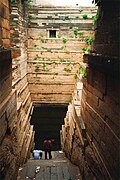 Well at Trikuteshwara temple, Gadag, Karnataka
 -

-
 Temple pond on way to Thiruvalllur, Tamil Nadu
 -
 Tank at Thillai Nataraja Temple, Chidambaram, Tamil Nadu
 -
 Pushkarini at Simhachalam
 -
 Yaganti Tank in Andhra Pradesh
 -
 Temple tank, Andhra Pradesh
 -
 Example of a Shiva temple in a tank (Baroli Temples)
 -

-
 Godawari Kunda, Godawari, Nepal

_at_the_Chennakeshava_temple_in_Belur.jpg)

_at_Hulikere.jpg)


See also[edit | edit source]
References[edit | edit source]
- ↑ "Sun Temples in India". Retrieved 2007-02-24.
- ↑ Shuichi Takezawa (August 2002). "Stepwells – Cosmology of Subterranean Architecture as seen in Adalaj" (PDF). Journal of Architecture and Building Science. 117 (1492): 24. Retrieved 2009-11-18.
- ↑ "Architecture - Stepwells". Archived from the original on October 6, 1999. Retrieved 2007-01-09.
- ↑ "Great Tank". art-and-archaeology. Retrieved 2007-01-13.
- ↑ Thapar, Binda (2004). Introduction to Indian Architecture. Singapore: Periplus Editions. p. 43. ISBN 0-7946-0011-5.
- ↑ "Architecture of the Indian Subcontinent - glossary". Archived from the original on November 21, 2003. Retrieved 2006-12-18.
- ↑ "Vav / vavdi / Baoli / Bavadi - Traditional stepwells". Retrieved 2006-12-19.
- ↑ Harban Singh (1998). Encyclopedia of Sikhism. Punjabi University. p. 71. ISBN 978-81-7380-530-1.
- ↑ Walia, Varinder (11 July 2005). "Frescoes in ancient Hindu temple damaged". The Tribune. Retrieved 16 March 2026.
Further reading[edit | edit source]
- C.P.R. Environmental Education Centre (2002). Sacred tanks of South India. pp. 328.
External links[edit | edit source]
- ENVIS Centre for Conservation of Ecological Heritage and Sacred Sites of India: Sacred Waterbodies of India Archived 2016-08-06 at the Wayback Machine