|
|
| Line 1: |
Line 1: |
| {{Short description|Continent}}
| | {{Infobox continent |
| {{Other uses}}
| |
| {{pp-move-indef}}
| |
| {{pp-semi-indef}}
| |
| | |
| {{Use dmy dates|date=August 2021}}
| |
| {{Use Oxford spelling|date=August 2016}}
| |
| | |
| {{Infobox Continent | |
| |title = Africa | | |title = Africa |
| |image = {{Switcher|[[File:Africa (orthographic projection).svg|frameless]]|Show national borders|[[File:Africa (orthographic projection) blank.svg|frameless]]|Hide national borders|default=1}} | | |image = Africa (orthographic projection).svg |
| |area = {{convert|30370000|km2|sqmi|abbr=on}} ([[List of continents by area|2nd]]) | | |area = {{convert|30,370,000|km2|sqmi|abbr=on}} ([[List of continents by area|2nd]]) |
| |population = {{UN_Population|Africa}}{{UN_Population|ref}} ({{UN_Population|Year}}; [[List of continents by population|2nd]]) | | |population = {{UN_Population|Africa}}{{UN_Population|ref}} ({{UN_Population|Year}}; [[List of continents by population|2nd]]) |
| |density = {{pop density|{{Decomma|{{UN_Population|Africa}}}}|30221532|km2|sqmi|prec=1}} ({{UN Population|Year}}) | | |density = {{pop density|1100000000|30221532|km2|sqmi}} |
| |religions = {{unbulleted list | | |GDP_nominal = $2.45 trillion (2019; [[List of continents by GDP (nominal)|5th]])<ref name=IMF_Data/> |
| | [[Christianity in Africa|Christianity]] (51%)
| | |GDP_PPP = $7.16 trillion (2019; 5th)<ref name=IMF_Data/> |
| | [[Islam in Africa|Islam]] (40%)
| | |GDP_per_capita = $1,930 (2019; [[List of continents by GDP (nominal)#GDP per capita (nominal) by continents|6th]])<ref name=IMF_Data>{{cite web|title=IMF (WEO April 2019 Edition) GDP nominal and PPP data – international dollar|url=https://www.imf.org/external/datamapper/datasets/WEO/1|access-date=2020-04-23|archive-date=2020-11-22|archive-url=https://web.archive.org/web/20201122192835/https://www.imf.org/external/datamapper/datasets/WEO/1|url-status=live}}</ref> |
| | [[African traditional religion|Traditional faiths]] (6%)
| | |demonym = African |
| | [[Irreligion|No religion]] (2%)
| | |countries = 54 (and 2 disputed) |
| | [[Religion in Africa|Others]] (1%)<ref>[https://www.gordonconwell.edu/blog/african-christianity-101/?__cf_chl_jschl_tk__=a1d4c1d931e6c38110d5c3f059ae64bb66bafafa-1590463375-0-AezHrWRbV9jUadPbMq1KCYOzXRnMTcuigdG5X7oahVbSoI1-HbOZFVzICpNQM3DD6h-V4OowV97KMQvA_Z5xrEIueURh3cAjh_JOwgzb_0xJ8ApebiYm1YKfWINm1tpYbvki0LdD6UCp1tdLlxQ9SRwtdKFDMRidCaiTEuKpAgqahxqDYDT9efnF_jaiIEUQu0uIx-pJ0jUDCQtArMqdHTN8eI_S59hxJlvlxrSqBFOFsKFbiRy66EYOzblYbhaniwzQPIxiovSOAM7Yj6fu-5jMYVAPJtBJplpKoRDBlTtl44pnDC6wJInEyJbLw46dPuXcViyFEB57ebEfmUnpcYoJDlysExw35Ay28x7nvUDx3aIEa6ZhJsxwn62dv-R57g Gordon Conwell Theological Seminary, African Christianity, 2020]</ref>}}
| |
| |GDP_PPP = {{nowrap|$8.05 trillion (2022 est; 4th)<ref>{{Cite web|url=https://www.imf.org/external/datamapper/PPPGDP@WEO/OEMDC/ADVEC/WEOWORLD|title=GDP PPP, current prices |publisher=International Monetary Fund|date=2022|access-date=16 January 2022}}</ref>}} | |
| |GDP_nominal = $2.96 trillion (2022 est; [[List of continents by GDP (nominal)|5th]])<ref>{{cite web|title=GDP Nominal, current prices | |
| |url=https://www.imf.org/external/datamapper/NGDPD@WEO/OEMDC/ADVEC/WEOWORLD |publisher=International Monetary Fund|date=2022|access-date=16 January 2022}}</ref> | |
| |GDP_per_capita = $2,180 (2022 est; [[List of continents by GDP (nominal)#GDP per capita (nominal) by continents|6th]])<ref>{{Cite web|url=https://www.imf.org/external/datamapper/NGDPDPC@WEO/OEMDC/ADVEC/WEOWORLD|title=Nominal GDP per capita|publisher=International Monetary Fund|date=2022|access-date=16 January 2022}}</ref>
| |
| |demonym = [[List of ethnic groups of Africa|African]] | |
| |countries = 54+2*+5** (*disputed) (**territories) | |
| |list_countries = List of sovereign states and dependent territories in Africa | | |list_countries = List of sovereign states and dependent territories in Africa |
| |dependencies = {{Collapsible list | | |dependencies = {{Collapsible list |
| |list_style = text-align:left; | | |list_style = text-align:left; |
| |title = [[List of African dependencies#External territories|External]] (5) | | |title = External (1) |
| | 1 = {{flagdeco|Norway}} [[Bouvet Island]] | 2 = {{Flag|British Indian Ocean Territory}} | 3 = {{flag|French Southern and Antarctic Lands|name=French Southern Territories}} | 4 = {{flag|Heard Island and McDonald Islands}} | 5 = {{flag|Saint Helena, Ascension and Tristan da Cunha}} | | | 1 = {{flag|Saint Helena, Ascension and Tristan da Cunha}} |
| }}
| | }} |
| {{Collapsible list
| | {{Collapsible list |
| |list_style = text-align:left; | | |list_style = text-align:left; |
| |title = [[List of African dependencies#Internal territories|Internal]] (6+1 disputed) | | |title = Internal (6) |
| | 1 = {{flag|France}} ''([[Mayotte]] and [[Réunion]])'' | 2 = {{flag|Italy}} ''([[Pantelleria]] and [[Pelagie Islands]])'' | 3 = {{flag|Morocco}} ''([[Southern Provinces]])'' | 4 = {{flag|Portugal}} ''([[Madeira]])'' | 5 = {{flag|Spain}} ''([[Alboran Island]], [[Canary Islands]], [[Ceuta]], [[Melilla]], and [[Plazas de soberanía]])'' | 6 = {{flag|Tanzania}} ''([[Zanzibar]])'' | 7 = {{flag|Yemen}} ''([[Socotra]])'' | | | 1 = {{flag|Canary Islands}} | 2 = {{flag|Ceuta}} |
| }}
| | | 3 = {{flag|Madeira}} | 4 = {{flag|Mayotte}} |
| |languages = [[English language|English]]<br>[[French language|French]]<br>[[Spanish language|Spanish]]<br>[[Portuguese language|Portuguese]]<br>[[Swahili language|Swahili]]<br>[[Arabic language|Arabic]]<br>[[Languages of Africa|1250–3000 native languages]] | | | 5 = {{flag|Melilla}} | 6 = {{flag|Réunion}} |
| | }} |
| | |languages = [[Languages of Africa|1250–3000 native languages]] |
| |time = [[UTC-1]] to [[UTC+4]] | | |time = [[UTC-1]] to [[UTC+4]] |
| |cities = [[List of urban agglomerations in Africa|Largest urban areas]]:<!-- | | |cities = [[List of urban agglomerations in Africa|Largest urban areas]]:<!-- |
| Line 50: |
Line 37: |
| |[[Abidjan]] | | |[[Abidjan]] |
| |[[Alexandria]] | | |[[Alexandria]] |
| |[[Kigali]]
| |
| |[[Nairobi]] | | |[[Nairobi]] |
| |[[Algiers]]}}
| |
| |[[Cape Town]] | | |[[Cape Town]] |
| |[[Kano (city)|Kano]] | | |[[Kano]] |
| |[[Dakar]] | | |[[Dakar]] |
| |[[Casablanca]] | | |[[Casablanca]] |
| |[[Addis Ababa]] | | |[[Addis Ababa]]}} |
| |[[Kampala]]}}
| |
| | |
| '''Africa''' is the world's second-largest and second-most populous [[continent]], after [[Asia]] in both cases. At about 30.3 million km<sup>2</sup> (11.7 million square miles) including adjacent islands, it covers 6% of Earth's total surface area and 20% of its land area.<ref name=Sayre>Sayre, April Pulley (1999), ''Africa'', Twenty-First Century Books. {{ISBN|0-7613-1367-2}}.</ref> With {{#expr:{{formatnum:{{UN_Population|Africa}}|R}}/1e9 round 1}} billion people{{UN_Population|ref}} as of {{UN_Population|Year}}, it accounts for about {{percent|{{UN Population|Africa}}|{{UN Population|World}}}} of the world's [[human population]]. Africa's population is the youngest amongst all the continents;<ref>{{cite news|title=5 ways the world will look dramatically different in 2100|url=https://www.washingtonpost.com/news/wonk/wp/2015/08/17/5-ways-the-world-will-look-dramatically-different-in-2100/|last=Swanson|first=Ana|date=17 August 2015|newspaper=[[The Washington Post]]|access-date=26 September 2017|archive-date=26 September 2017|archive-url=https://web.archive.org/web/20170926194109/https://www.washingtonpost.com/news/wonk/wp/2015/08/17/5-ways-the-world-will-look-dramatically-different-in-2100/|url-status=live}}</ref><ref>{{cite news|last=[[Njideka Harry|Harry]]|first=Njideka U.|date=11 September 2013|title=African Youth, Innovation and the Changing Society|work=Huffington Post|url=http://www.huffingtonpost.com/njideka-u-harry/african-youth-innovation-_b_3904408.html|access-date=27 September 2013|archive-date=20 September 2013|archive-url=https://web.archive.org/web/20130920184934/http://www.huffingtonpost.com/njideka-u-harry/african-youth-innovation-_b_3904408.html|url-status=live}}</ref> the [[median]] age in 2012 was 19.7, when the worldwide median age was 30.4.<ref>{{cite web|title=item,4 of the provisional agenda – General debate on national experience in population matters: adolescents and youth|url=https://www.un.org/esa/population/cpd/cpd2012/Agenda%20item%204/UN%20system%20statements/ECA_Item4.pdf|author=Janneh, Abdoulie|date=April 2012|work=United Nations Economic Commission for Africa|access-date=15 December 2015|archive-date=10 November 2013|archive-url=https://web.archive.org/web/20131110111359/http://www.un.org/esa/population/cpd/cpd2012/Agenda%20item%204/UN%20system%20statements/ECA_Item4.pdf|url-status=live}}</ref> Despite a wide range of [[natural resource]]s, Africa is the least wealthy continent per capita and second-least wealthy by total wealth, behind [[Oceania]]. Scholars have attributed this to different factors including geography, climate, [[tribalism]],<ref name=":1" /> [[Scramble for Africa|colonialism]], the [[Cold War]],{{refn|<ref>{{Cite book|last=Fwatshak|first=S. U.|title=Contemporary Africa|publisher=Springer|year=2014|isbn=978-1-349-49413-2|pages=89–125|chapter=The Cold War and the Emergence of Economic Divergences: Africa and Asia Compared|doi=10.1057/9781137444134_5}}</ref><ref>{{cite journal |last1=Austin |first1=Gareth |title=African Economic Development and Colonial Legacies |journal=Revue internationale de politique de développement |date=1 March 2010 |issue=1 |pages=11–32 |doi=10.4000/poldev.78 }}</ref><ref>{{cite journal |last1=Dunning |first1=Thad |title=Conditioning the Effects of Aid: Cold War Politics, Donor Credibility, and Democracy in Africa |journal=International Organization |date=2004 |volume=58 |issue=2 |pages=409–423 |doi=10.1017/S0020818304582073 |jstor=3877863 |s2cid=154368924 }}</ref><ref>{{cite journal |last1=Alemazung |first1=Joy Asongazoh |title=Post-colonial colonialism: an analysis of international factors and actors marring African socio-economic and political development |journal=Journal of Pan African Studies |date=1 September 2010 |volume=3 |issue=10 |pages=62–85 |id={{GALE|A306596751}} |s2cid=140806396 |url=http://www.jpanafrican.org/docs/vol3no10/3.10Post-Colonial.pdf }}</ref><ref>{{cite journal |last1=Bayeh |first1=Endalcachew |title=The political and economic legacy of colonialism in the post-independence African states |journal=International Journal in Commerce, IT & Social Sciences |date=February 2015 |volume=2 |issue=2 |pages=89–93 |url=https://endbayeh.files.wordpress.com/2015/04/ijciss2513feb7.pdf |s2cid=198939744 }}</ref>}} [[neocolonialism]], lack of democracy, and corruption.<ref name=":1">{{cite journal |last1=Collier |first1=Paul |last2=Gunning |first2=Jan Willem |title=Why Has Africa Grown Slowly? |journal=Journal of Economic Perspectives |date=1 August 1999 |volume=13 |issue=3 |pages=3–22 |doi=10.1257/jep.13.3.3 }}</ref> Despite this low concentration of wealth, recent economic expansion and the large and young population make Africa an important economic market in the broader global context.
| |
| | |
| The continent is surrounded by the [[Mediterranean Sea]] to the north, the [[Isthmus of Suez]] and the [[Red Sea]] to the northeast, the [[Indian Ocean]] to the southeast and the [[Atlantic Ocean]] to the west. The continent includes [[Madagascar]] and various [[archipelago]]s. It contains [[List of sovereign states and dependent territories in Africa|54]] [[diplomatic recognition|fully recognised]] [[sovereign state]]s ([[country|countries]]), eight [[territory|territories]] and two ''de facto'' independent [[List of states with limited recognition|states with limited or no recognition]]. [[Algeria]] is Africa's largest country by area, and [[Nigeria]] is its largest by population. African nations cooperate through the establishment of the [[African Union]], which is headquartered in [[Addis Ababa]].
| |
| | |
| Africa straddles the [[equator]] and the [[prime meridian]]. It is the only continent to stretch from the northern [[temperate]] to southern temperate zones.<ref>{{cite web|title=Africa. General info|url=http://www.visualgeography.com/continents/africa.html|publisher=Visual Geography|url-status=dead|archive-url=https://web.archive.org/web/20110424072430/http://www.visualgeography.com/continents/africa.html|archive-date=24 April 2011|access-date=24 November 2007}}</ref> The majority of the continent and its countries are in the [[Northern Hemisphere]], with a substantial portion and number of countries in the [[Southern Hemisphere]]. Most of the continent lies in the tropics, except for a large part of [[Western Sahara]], [[Algeria]], [[Libya]] and [[Egypt]], the northern tip of [[Mauritania]], the entire territories of [[Morocco]], [[Ceuta]], [[Melilla]], and [[Tunisia]] which in turn are located above the [[tropic of Cancer]], in the [[temperate zone|northern temperate zone]]. In the other extreme of the continent, southern [[Namibia]], southern [[Botswana]], great parts of [[South Africa]], the entire territories of [[Lesotho]] and [[Eswatini]] and the southern tips of [[Mozambique]] and [[Madagascar]] are located below the [[tropic of Capricorn]], in the [[temperate zone|southern temperate zone]].
| |
| | |
| Africa is highly [[biodiverse]]; it is the continent with the largest number of [[megafauna]] species, as it was least affected by the [[Quaternary extinction event#The Pleistocene or Ice Age extinction event|extinction of the Pleistocene megafauna]]. However, Africa also is [[Environmental issues in Africa|heavily affected by a wide range of environmental issues]], including desertification, deforestation, [[water scarcity]], pollution and other issues. These entrenched environmental concerns are expected to worsen as [[Climate change in Africa|climate change impacts Africa]]. The UN [[Intergovernmental Panel on Climate Change]] has identified Africa as the continent most [[Climate change vulnerability|vulnerable to climate change]].<ref>{{cite book|author=Schneider, S.H.|url=http://www.ipcc.ch/publications_and_data/ar4/wg2/en/ch19s19-3-3.html|title=Chapter 19: Assessing Key Vulnerabilities and the Risk from Climate Change|publisher=Print version: CUP. This version: IPCC website|year=2007|isbn=978-0-521-88010-7|editor=Parry, M.L.|series=Climate change 2007: impacts, adaptation, and vulnerability: contribution of Working Group II to the fourth assessment report of the Intergovernmental Panel on Climate Change (IPCC)|location=Cambridge University Press (CUP): Cambridge, UK|contribution=19.3.3 Regional vulnerabilities|display-authors=etal|access-date=15 September 2011|display-editors=etal|archive-url=https://web.archive.org/web/20130312104158/http://www.ipcc.ch/publications_and_data/ar4/wg2/en/ch19s19-3-3.html|archive-date=12 March 2013|url-status=dead}}</ref><ref name=":10Africa">Niang, I., O.C. Ruppel, M.A. Abdrabo, A. Essel, C. Lennard, J. Padgham, and P. Urquhart, 2014: Africa. In: Climate Change 2014: Impacts, Adaptation, and Vulnerability. Part B: Regional Aspects. Contribution of Working Group II to the Fifth Assessment Report of the Intergovernmental Panel on Climate Change [Barros, V.R., C.B. Field, D.J. Dokken et al. (eds.)]. Cambridge University Press, Cambridge, United Kingdom and New York, NY, USA, pp. 1199–1265. https://www.ipcc.ch/site/assets/uploads/2018/02/WGIIAR5-Chap22_FINAL.pdf {{Webarchive|url=https://web.archive.org/web/20200619170833/https://www.ipcc.ch/site/assets/uploads/2018/02/WGIIAR5-Chap22_FINAL.pdf |date=19 June 2020 }}</ref>
| |
| | |
| The [[history of Africa]] is long, complex, and has often been under-appreciated by the global [[African historiography|historical community]].<ref>{{Cite news|date=1 July 2017|title=One of Africa's best kept secrets – its history|language=en-GB|work=BBC News|url=https://www.bbc.com/news/world-africa-40420910|access-date=29 July 2021}}</ref> Africa, particularly [[East Africa|Eastern Africa]], is widely accepted as the place of origin of humans and the [[Hominidae]] [[clade]] ([[great ape]]s). The earliest [[hominids]] and their ancestors have been dated to around 7 million years ago, including ''[[Sahelanthropus tchadensis]]'', ''[[Australopithecus africanus]]'', ''[[Australopithecus afarensis|A. afarensis]]'', ''[[Homo erectus]]'', ''[[Homo habilis|H. habilis]]'' and ''[[Homo ergaster|H. ergaster]]''— the earliest ''[[Homo sapiens]]'' (modern human) remains, found in [[Omo remains|Ethiopia]], [[Florisbad Skull|South Africa]], and [[Jebel Irhoud|Morocco]], date to circa 233,000, 259,000, and 300,000 years ago respectively, and ''Homo sapiens'' is believed to have originated in Africa around 350,000–260,000 years ago.{{refn|<ref>{{Cite web|url=http://web.utah.edu/unews/releases/05/feb/homosapiens.html|archive-url=https://web.archive.org/web/20071024234234/http://web.utah.edu/unews/releases/05/feb/homosapiens.html|url-status=dead|title=Homo sapiens: University of Utah News Release: 16 February 2005|archive-date=24 October 2007}}</ref><ref name="Schlebusch2017">{{cite journal |doi=10.1126/science.aao6266 |pmid=28971970 |title=Southern African ancient genomes estimate modern human divergence to 350,000 to 260,000 years ago |journal=Science |volume=358 |issue=6363 |pages=652–655 |year=2017 |last1=Schlebusch |first1=Carina M |last2=Malmström |first2=Helena |last3=Günther |first3=Torsten |last4=Sjödin |first4=Per |last5=Coutinho |first5=Alexandra |last6=Edlund |first6=Hanna |last7=Munters |first7=Arielle R |last8=Vicente |first8=Mário |last9=Steyn |first9=Maryna |last10=Soodyall |first10=Himla |last11=Lombard |first11=Marlize |last12=Jakobsson |first12=Mattias |bibcode=2017Sci...358..652S |doi-access=free }}</ref><ref name="Guardian">{{cite news|url=https://www.theguardian.com/science/2017/jun/07/oldest-homo-sapiens-bones-ever-found-shake-foundations-of-the-human-story|title=Oldest ''Homo sapiens'' bones ever found shake foundations of the human story|last=Sample|first=Ian|work=The Guardian|date=7 June 2017|access-date=7 June 2017|archive-date=31 October 2019|archive-url=https://web.archive.org/web/20191031005024/https://www.theguardian.com/science/2017/jun/07/oldest-homo-sapiens-bones-ever-found-shake-foundations-of-the-human-story|url-status=live}}</ref><ref name="NYT-20190910">{{cite news |last=Zimmer |first=Carl |author-link=Carl Zimmer |title=Scientists Find the Skull of Humanity's Ancestor — on a Computer – By comparing fossils and CT scans, researchers say they have reconstructed the skull of the last common forebear of modern humans. |url=https://www.nytimes.com/2019/09/10/science/human-ancestor-skull-computer.html |date=10 September 2019 |work=[[The New York Times]] |access-date=10 September 2019 |archive-date=31 December 2019 |archive-url=https://web.archive.org/web/20191231125331/https://www.nytimes.com/2019/09/10/science/human-ancestor-skull-computer.html |url-status=live }}</ref><ref name="NAT-20190910">{{cite journal |last1=Mounier |first1=Aurélien |last2=Lahr |first2=Marta |title=Deciphering African late middle Pleistocene hominin diversity and the origin of our species |journal=[[Nature Communications]] |volume=10 |issue=1 |page=3406 |doi=10.1038/s41467-019-11213-w |pmid=31506422 |pmc=6736881 |year=2019 |bibcode=2019NatCo..10.3406M }}</ref><ref name="Vidal22">{{Cite journal|last1=Vidal|first1=Celine M.|last2=Lane|first2=Christine S.|last3=Asfawrossen|first3=Asrat|display-authors=etal| date=Jan 2022|title=Age of the oldest known Homo sapiens from eastern Africa|journal=Nature|volume=601|issue=7894|pages=579–583|doi=10.1038/s41586-021-04275-8 |pmid=35022610|pmc=8791829|bibcode=2022Natur.601..579V }}</ref>}} Due to being the longest inhabited continent, Africa is also considered by anthropologists to be the most genetically diverse continent on the planet.<ref>{{cite web |title=The genetic diversity in Africa is greater than in any other region in the world |url=https://blogs.bcm.edu/2018/07/19/genetic-diversity-in-africa-is-greater-than-in-any-other-region-in-the-world/}}</ref><ref>{{cite web |title=New study confirms that Africans are the most genetically diverse people on Earth. And it claims to pinpoint our center of origin. |url=https://ksj.mit.edu/tracker-archive/new-study-confirms-africans-are-most-gen/}}</ref><ref>{{cite web |title=Africa is most genetically diverse continent, DNA study shows |date=9 June 2009 |url=https://www.bionews.org.uk/page_91054}}</ref>
| |
| | |
| Early human civilizations, such as [[Ancient Egypt]] and [[Carthage]] emerged in [[History of North Africa|North Africa]]. Following a subsequent [[List of kingdoms in pre-colonial Africa|long and complex history of civilizations]], migration and trade, Africa hosts a large diversity of [[List of ethnic groups of Africa|ethnicities]], [[Culture of Africa|cultures]] and [[Languages of Africa|languages]]. The last 400 years have witnessed an increasing European influence on the continent. Starting in the 16th century, this was driven by trade, including the [[Slavery in Africa|Trans-Atlantic slave trade]], which created large [[African diaspora]] populations in the Americas. From the [[New Imperialism|late 19th century]] to the early 20th century, European nations [[Scramble for Africa|colonized almost all of Africa]], with the exception of [[Ethiopia]] and [[Liberia]]. Most present states in Africa emerged from a process of [[Decolonisation of Africa|decolonisation]] following [[World War II]].
| |
| | |
| ==Etymology==
| |
| [[File:AS17-148-22733 (21516723298).jpg|thumb|The totality of Africa seen by the [[Apollo 17]] crew]]
| |
| ''[[Afri]]'' was a [[Latin]] name used to refer to the inhabitants of then-known northern Africa to the west of the [[Nile]] river, and in its widest sense referred to all lands south of the Mediterranean ([[Ancient Libya]]).<ref>{{cite encyclopedia|last1=Georges|first1=Karl Ernst|editor1-last=Georges|editor1-first=Heinrich|encyclopedia=Ausführliches lateinisch-deutsches Handwörterbuch|date=1913–1918|location=Hannover|edition=8th|url=http://latin_german.deacademic.com/1644|access-date=20 September 2015|language=de|title=Afri|archive-url=https://web.archive.org/web/20160116044500/http://latin_german.deacademic.com/1644|archive-date=16 January 2016|url-status=dead}}</ref><ref>{{cite encyclopedia|last1=Lewis|first1=Charlton T.|last2=Short|first2=Charles|encyclopedia=A Latin Dictionary|date=1879|publisher=Clarendon Press|location=Oxford|url=https://www.perseus.tufts.edu/hopper/text?doc=Perseus%3Atext%3A1999.04.0059%3Aentry%3DAfer|access-date=20 September 2015|title=Afer|archive-date=16 January 2016|archive-url=https://web.archive.org/web/20160116044500/http://www.perseus.tufts.edu/hopper/text?doc=Perseus%3Atext%3A1999.04.0059%3Aentry%3DAfer|url-status=live}}</ref> This name seems to have originally referred to a [[Ancient Libya|native Libyan]] tribe, an ancestor of modern [[Berbers]]; see [[Terence#Biography|Terence]] for discussion. The name had usually been connected with the [[Phoenician language|Phoenician]] word ''{{lang|phn|ʿafar}}'' meaning "dust",<ref>Venter & Neuland, ''NEPAD and the African Renaissance'' (2005), p. 16</ref> but a 1981 hypothesis<ref>{{cite web |url=http://michel-desfayes.org/namesofcountries.html |title=The Names of Countries |last=Desfayes |first=Michel |website=michel-desfayes.org |quote=Africa. From the name of an ancient tribe in Tunisia, the ''Afri'' (adjective: ''Afer''). The name is still extant today as ''Ifira'' and ''Ifri-n-Dellal'' in Greater Kabylia (Algeria). A Berber tribe was called ''Beni-Ifren'' in the Middle Ages and ''Ifurace'' was the name of a Tripolitan people in the 6th century. The name is from the Berber language ''ifri'' 'cave'. Troglodytism was frequent in northern Africa and still occurs today in southern Tunisia. Herodote wrote that the Garamantes, a North African people, used to live in caves. The Ancient Greek called ''troglodytēs'' an African people who lived in caves. ''Africa'' was coined by the Romans and {{'}}''Ifriqiyeh''{{'}} is the arabized Latin name. (Most details from Decret & Fantar, 1981). |date=25 January 2011 |access-date=9 April 2019 |archive-url=https://web.archive.org/web/20190627022921/http://michel-desfayes.org/namesofcountries.html |archive-date=27 June 2019 |url-status=dead }}</ref> has asserted that it stems from the [[Berber languages|Berber]] word ''ifri'' (plural ''ifran'') meaning "cave", in reference to cave dwellers.<ref name="Michell">{{Cite journal|jstor = 714549|title = The Berbers|journal = Journal of the Royal African Society|volume = 2|issue = 6|pages = 161–194|last1 = Babington Michell|first1 = Geo|year = 1903|doi = 10.1093/oxfordjournals.afraf.a093193|url = https://zenodo.org/record/1782363|access-date = 30 August 2020|archive-date = 30 December 2020|archive-url = https://web.archive.org/web/20201230012624/https://zenodo.org/record/1782363|url-status = live}}</ref> The same word<ref name="Michell" /> may be found in the name of the [[Banu Ifran]] from [[Algeria]] and [[Tripolitania]], a Berber tribe originally from [[Yafran]] (also known as ''Ifrane'') in northwestern Libya,<ref>[https://books.google.com/books?id=SLSzNfdcqfoC&pg=PA200 Edward Lipinski, ''Itineraria Phoenicia''] {{Webarchive|url=https://web.archive.org/web/20160116044459/https://books.google.com/books?id=SLSzNfdcqfoC&pg=PA200 |date=16 January 2016 }}, Peeters Publishers, 2004, p. 200. {{ISBN|90-429-1344-4}}</ref> as well as the city of [[Ifrane]] in Morocco.
| |
| | |
| Under [[Roman Empire|Roman]] rule, [[Carthage]] became the capital of the province it then named ''[[Africa Proconsularis]]'', following its defeat of the [[Ancient Carthage|Carthaginians]] in the [[Third Punic War]] in 146 BC, which also included the coastal part of modern [[Libya]].<ref>{{cite web |url=http://www.consultsos.com/pandora/africa.htm |title=Africa African Africanus Africus |publisher=Consultos.com |access-date=14 November 2006 |archive-date=29 January 2009 |archive-url=https://web.archive.org/web/20090129111458/http://www.consultsos.com/pandora/africa.htm |url-status=live }}</ref> The Latin suffix ''[[wikt:-ica#Latin|-ica]]'' can sometimes be used to denote a land (e.g., in ''[[Gallia Celtica|Celtica]]'' from ''[[Celts|Celtae]]'', as used by [[Julius Caesar]]). The later Muslim region of [[Ifriqiya]], following its conquest of the [[Byzantine Empire|Byzantine (Eastern Roman)]] Empire's ''[[Exarchate of Africa|Exarchatus Africae]]'', also preserved a form of the name.
| |
| | |
| According to the Romans, Africa lies to the west of Egypt, while "Asia" was used to refer to [[Anatolia]] and lands to the east. A definite line was drawn between the two continents by the geographer [[Ptolemy]] (85–165 AD), indicating [[Alexandria]] along the [[Prime Meridian]] and making the isthmus of Suez and the [[Red Sea]] the boundary between Asia and Africa. As Europeans came to understand the real extent of the continent, the idea of "Africa" expanded with their knowledge.
| |
| | |
| Other etymological hypotheses have been postulated for the ancient name "Africa":
| |
| * The 1st-century Jewish historian [[Flavius Josephus]] (''Ant. 1.15'') asserted that it was named for [[Epher]], grandson of [[Abraham]] according to Gen. 25:4, whose descendants, he claimed, had invaded Libya.
| |
| * [[Isidore of Seville]] in his 7th-century ''[[Etymologiae]]'' XIV.5.2. suggests "Africa comes from the [[Latin]] ''aprica'', meaning "sunny".
| |
| * Massey, in 1881, stated that Africa is derived from the Egyptian ''af-rui-ka'', meaning "to turn toward the opening of the Ka." The [[Egyptian soul#Ka|Ka]] is the energetic double of every person and the "opening of the Ka" refers to a womb or birthplace. Africa would be, for the Egyptians, "the birthplace."<ref>{{cite web|url=http://gerald-massey.org.uk/massey/cmc_nile_genesis.htm|title=Nile Genesis: the opus of Gerald Massey|publisher=Gerald-massey.org.uk|date=29 October 1907|access-date=18 May 2010|archive-url=https://web.archive.org/web/20100130200159/http://gerald-massey.org.uk/massey/cmc_nile_genesis.htm|archive-date=30 January 2010|url-status=dead}}</ref>
| |
| * Michèle Fruyt in 1976 proposed<ref>{{cite journal|author=Fruyt, M. |title= D'Africus ventus a Africa terrain |journal=Revue de Philologie|volume= 50|year= 1976|pages= 221–38}}</ref> linking the Latin word with ''africus'' "south wind", which would be of Umbrian origin and mean originally "rainy wind".
| |
| * Robert R. Stieglitz of [[Rutgers University]] in 1984 proposed: "The name Africa, derived from the Latin *Aphir-ic-a, is cognate to Hebrew [[Ophir]] ['rich']."<ref>{{cite journal|doi=10.2307/3209914|jstor=3209914|title=Long-Distance Seafaring in the Ancient Near East|journal=The Biblical Archaeologist|volume=47|issue=3|pages=134–142|year=1984|last1=Stieglitz|first1=Robert R.|s2cid=130072563}}</ref>
| |
| * [[Ibn Khallikan]] and some other historians claim that the name of Africa came from a [[Himyarite Kingdom|Himyarite]] king called Afrikin ibn Kais ibn Saifi also called "Afrikus son of Abraham" who subdued Ifriqiya.<ref>{{Cite book|url=https://books.google.com/books?id=3cdLAAAAcAAJ&pg=PA35|title=Kitab Wafayat Ala'yan. Ibn Khallikan's Biographical Dictionary Transl. by (Guillaume) B(aro)n Mac-Guckin de Slane|last=Hallikan|first='Abu-l-'Abbas Sams-al-din 'Ahmad ibn Muhammad Ibn|date=1842|publisher=Benjamin Duprat|language=en|access-date=30 July 2018|archive-date=24 September 2019|archive-url=https://web.archive.org/web/20190924231636/https://books.google.com/books?id=3cdLAAAAcAAJ&pg=PA35|url-status=live}}</ref><ref>{{Cite book|url=https://books.google.com/books?id=mcN7AAAAQBAJ&pg=PA38|title=Science in the Medieval World|last=al-Andalusi|first=Sa'id|year=2010|publisher=University of Texas Press|isbn=9780292792319|language=en|access-date=30 July 2018|archive-date=24 September 2019|archive-url=https://web.archive.org/web/20190924231632/https://books.google.com/books?id=mcN7AAAAQBAJ&pg=PA38|url-status=live}}</ref><ref>{{Cite book|url=https://books.google.com/books?id=pbo5AQAAMAAJ&pg=PA113|title=Travels in the Arabian Desert: With Special Reference to the Arabian Horse and Its Pedigree|last=Upton|first=Roger D.|date=1881|publisher=C.K. Paul & Company|language=en|access-date=30 July 2018|archive-date=24 September 2019|archive-url=https://web.archive.org/web/20190924231639/https://books.google.com/books?id=pbo5AQAAMAAJ&pg=PA113|url-status=live}}</ref>
| |
| * Arabic ''afrīqā'' (feminine noun) and ''ifrīqiyā'', now usually pronounced ''afrīqiyā'' (feminine) 'Africa', from ''‘afara'' [‘ = ''‘ain'', not ''’alif''] 'to be dusty' from ''‘afar'' 'dust, powder' and ''‘afir'' 'dried, dried up by the sun, withered' and ''‘affara'' 'to dry in the sun on hot sand' or 'to sprinkle with dust'.<ref>Modified from Wilhelm Sturmfels and Heinz Bischof: ''Unsere Ortsnamen im ABC erklärt nach Herkunft und Bedeutung'', Bonn, 1961, Ferdinand Dümmlers Verlag.</ref>
| |
| * Possibly Phoenician ''faraqa'' in the sense of 'colony, separation'.<ref>Serge Losique: ''Dictionnaire étymologique des noms de pays et de peuples'', Paris, 1971, Éditions Klincksieck.</ref>
| |
| | |
| ==History==
| |
| {{Main|History of Africa}}
| |
| {{Further|History of North Africa|History of West Africa|History of Central Africa|History of East Africa|History of Southern Africa}}
| |
| | |
| ===Prehistory===
| |
| {{Main|Recent African origin of modern humans}}
| |
| [[File:Lucy blackbg.jpg|thumb|upright=0.7|[[Lucy (Australopithecus)|Lucy]], an ''[[Australopithecus afarensis]]'' skeleton discovered 24 November 1974 in the [[Awash Valley]] of [[Ethiopia]]'s [[Afar Depression]] ]]
| |
| | |
| Africa is considered by most [[paleoanthropology|paleoanthropologists]] to be the [[cradle of Humankind|oldest inhabited territory]] on Earth, with the Human species originating from the continent.<ref name="HerreraGarcia-Bertrand2018">{{cite book|author1=Rene J. Herrera|author2=Ralph Garcia-Bertrand|title=Ancestral DNA, Human Origins, and Migrations|url=https://books.google.com/books?id=ZF1gDwAAQBAJ&pg=PA61|year=2018|publisher=Elsevier Science|isbn=978-0-12-804128-4|pages=61–|access-date=18 October 2020|archive-date=30 March 2021|archive-url=https://web.archive.org/web/20210330032459/https://books.google.com/books?id=ZF1gDwAAQBAJ&pg=PA61|url-status=live}}</ref> During the mid-20th century, [[Anthropology|anthropologists]] discovered many [[fossil]]s and evidence of human occupation perhaps as early as 7 million years ago (BP=before present). Fossil remains of several species of early apelike humans thought to have [[Evolution|evolved]] into modern man, such as ''[[Australopithecus afarensis]]'' ([[Radiometric dating|radiometrically dated]] to approximately 3.9–3.0 million years BP,<ref>Kimbel, William H. and Yoel Rak and Donald C. Johanson. (2004) ''The Skull of Australopithecus Afarensis'', Oxford University Press US. {{ISBN|0-19-515706-0}}</ref> ''[[Paranthropus boisei]]'' (c. 2.3–1.4 million years BP)<ref>Tudge, Colin. (2002) ''The Variety of Life.'', Oxford University Press. {{ISBN|0-19-860426-2}}</ref> and ''[[Homo ergaster]]'' (c. 1.9 million–600,000 years BP) have been discovered.<ref name=Sayre/>
| |
| | |
| After the evolution of ''[[Homo sapiens]]'' approximately 350,000 to 260,000 years BP in Africa,<ref name="Schlebusch2017"/><ref name="Guardian"/><ref name="NYT-20190910"/><ref name="NAT-20190910"/> the continent was mainly populated by groups of [[hunter-gatherer]]s.<ref>Mokhtar, G. (1990) ''UNESCO [[General History of Africa]], Vol. II, Abridged Edition: Ancient Africa'', University of California Press. {{ISBN|0-85255-092-8}}</ref><ref>Eyma, A.K. and C.J. Bennett. (2003) ''Delts-Man in Yebu: Occasional Volume of the Egyptologists' Electronic Forum No. 1'', Universal Publishers. p. 210. {{ISBN|1-58112-564-X}}</ref> These first modern humans left Africa and populated the rest of the globe during the [[Recent African origin of modern humans|Out of Africa II]] migration dated to approximately 50,000 years BP, exiting the continent either across [[Bab-el-Mandeb]] over the [[Red Sea]],<ref>Wells, Spencer (December 2002) [http://news.nationalgeographic.com/news/2002/12/1212_021213_journeyofman.html The Journey of Man] {{Webarchive|url=https://web.archive.org/web/20110427020944/http://news.nationalgeographic.com/news/2002/12/1212_021213_journeyofman.html |date=27 April 2011 }}. ''National Geographic''</ref><ref>Oppenheimer, Stephen. [http://www.bradshawfoundation.com/journey/gates2.html The Gates of Grief] {{Webarchive|url=https://web.archive.org/web/20140530001241/http://www.bradshawfoundation.com/journey/gates2.html |date=30 May 2014 }}. bradshawfoundation.com</ref> the [[Strait of Gibraltar]] in Morocco,<ref>{{Cite web|title=15. Strait of Gibraltar, Atlantic Ocean/Mediterranean Sea|url=https://www.lpi.usra.edu/publications/slidesets/humanimprints/slide_15.html|website=www.lpi.usra.edu|access-date=13 May 2020|archive-date=26 January 2021|archive-url=https://web.archive.org/web/20210126205023/https://www.lpi.usra.edu/publications/slidesets/humanimprints/slide_15.html|url-status=live}}</ref><ref>{{cite journal |last1=Fregel |first1=Rosa |last2=Méndez |first2=Fernando L. |last3=Bokbot |first3=Youssef |last4=Martín-Socas |first4=Dimas |last5=Camalich-Massieu |first5=María D. |last6=Santana |first6=Jonathan |last7=Morales |first7=Jacob |last8=Ávila-Arcos |first8=María C. |last9=Underhill |first9=Peter A. |last10=Shapiro |first10=Beth |last11=Wojcik |first11=Genevieve |last12=Rasmussen |first12=Morten |last13=Soares |first13=André E. R. |last14=Kapp |first14=Joshua |last15=Sockell |first15=Alexandra |last16=Rodríguez-Santos |first16=Francisco J. |last17=Mikdad |first17=Abdeslam |last18=Trujillo-Mederos |first18=Aioze |last19=Bustamante |first19=Carlos D. |title=Ancient genomes from North Africa evidence prehistoric migrations to the Maghreb from both the Levant and Europe |journal=Proceedings of the National Academy of Sciences |date=26 June 2018 |volume=115 |issue=26 |pages=6774–6779 |doi=10.1073/pnas.1800851115 |pmid=29895688 |pmc=6042094 |doi-access=free }}</ref> or the [[Isthmus of Suez]] in Egypt.<ref>{{cite journal|url=http://www.ffzg.unizg.hr/arheo/ska/tekstovi/out_of_africa.pdf|doi=10.1007/s10963-006-9002-z|title=Getting "Out of Africa": Sea Crossings, Land Crossings and Culture in the Hominin Migrations|journal=Journal of World Prehistory|volume=19|issue=2|pages=119–132|year=2005|last1=Derricourt|first1=Robin|s2cid=28059849|access-date=26 December 2013|archive-date=22 February 2012|archive-url=https://web.archive.org/web/20120222031934/http://www.ffzg.unizg.hr/arheo/ska/tekstovi/out_of_africa.pdf|url-status=live}}</ref>
| |
| | |
| Other migrations of modern humans within the African continent have been dated to that time, with evidence of early human settlement found in Southern Africa, Southeast Africa, North Africa, and the [[Sahara]].<ref>{{cite book|author1=Goucher, Candice|author2=Walton, Linda|title=World History: Journeys from Past to Present|url=https://books.google.com/books?id=gY7cAAAAQBAJ|year=2013|publisher=Routledge|isbn=978-1-134-72354-6|pages=2–20|access-date=5 February 2018|archive-date=11 June 2020|archive-url=https://web.archive.org/web/20200611044204/https://books.google.com/books?id=gY7cAAAAQBAJ|url-status=live}}</ref>
| |
| | |
| === Emergence of civilization ===
| |
| {{see|Cradle of civilization#Ancient Egypt}}
| |
| The size of the Sahara has historically been extremely variable, with its area rapidly fluctuating and at times disappearing depending on global climatic conditions.<ref>{{cite book|author=Keenan, Jeremy|title=The Sahara: Past, Present and Future|url=https://books.google.com/books?id=KUKPAQAAQBAJ|year=2013|publisher=Routledge|isbn=978-1-317-97001-9|access-date=5 February 2018|archive-date=28 February 2017|archive-url=https://web.archive.org/web/20170228175639/https://books.google.com/books?id=KUKPAQAAQBAJ|url-status=live}}</ref> At the end of the [[Ice age]]s, estimated to have been around 10,500 BC, the Sahara had again become a green fertile valley, and its African populations returned from the interior and coastal highlands in [[Sub-Saharan Africa]], with [[Saharan rock art|rock art paintings]] depicting a fertile Sahara and large populations discovered in [[Tassili n'Ajjer]] dating back perhaps 10 millennia.<ref>{{cite journal|last1=Mercier|first1=Norbert|display-authors=etal|date=2012|title=OSL dating of quaternary deposits associated with the parietal art of the Tassili-n-Ajjer plateau (Central Sahara)|journal=Quaternary Geochronology|volume=10|pages=367–73|doi=10.1016/j.quageo.2011.11.010}}</ref> However, the warming and drying climate meant that by 5000 BC, the Sahara region was becoming increasingly dry and hostile. Around 3500 BC, due to a tilt in the earth's orbit, the Sahara experienced a period of rapid desertification.<ref>[https://www.sciencedaily.com/releases/1999/07/990712080500.htm "Sahara's Abrupt Desertification Started by Changes in Earth's Orbit, Accelerated by Atmospheric and Vegetation Feedbacks"] {{webarchive|url=https://web.archive.org/web/20140307060153/https://www.sciencedaily.com/releases/1999/07/990712080500.htm|date=7 March 2014 }}, ''Science Daily''</ref> The population trekked out of the Sahara region towards the Nile Valley below the [[Cataracts of the Nile|Second Cataract]] where they made permanent or semi-permanent settlements. A major climatic recession occurred, lessening the heavy and persistent rains in Central and [[East Africa|Eastern Africa]]. Since this time, dry conditions have prevailed in Eastern Africa and, increasingly during the last 200 years, in [[Ethiopia]].
| |
| | |
| The domestication of cattle in Africa preceded agriculture and seems to have existed alongside hunter-gatherer cultures. It is speculated that by 6000 BC, cattle were domesticated in North Africa.<ref>Diamond, Jared. (1999) ''Guns, Germs and Steel: The Fates of Human Societies''. New York: Norton, p. 167. {{ISBN|978-0813498027}}</ref> In the Sahara-Nile complex, people domesticated many animals, including the donkey and a small screw-horned goat which was common from [[Algeria]] to [[Nubia]].
| |
| | |
| Between 10,000 and 9,000 BC, pottery was independently invented in the region of Mali in the savannah of West Africa.<ref name="Pottery">{{cite journal |last1=Jesse |first1=Friederike |title=Early Pottery in Northern Africa – An Overview |issue=2 |pages=219–238 |journal=[[Journal of African Archaeology]]|volume=8 |jstor=43135518 |year=2010 |doi=10.3213/1612-1651-10171 }}</ref><ref name=swissinfo>[http://www.swissinfo.ch/eng/Home/Archive/Swiss_archaeologist_digs_up_West_Africas_past.html?cid=5675736 Simon Bradley, ''A Swiss-led team of archaeologists has discovered pieces of the oldest African pottery in central Mali, dating back to at least 9,400BC''] {{webarchive|url=https://web.archive.org/web/20120306002155/http://www.swissinfo.ch/eng/Home/Archive/Swiss_archaeologist_digs_up_West_Africas_past.html?cid=5675736 |date=6 March 2012 }}, SWI swissinfo.ch – the international service of the Swiss Broadcasting Corporation (SBC), 18 January 2007</ref>
| |
| [[File:Mathendous giraffes.jpg|thumb|[[Saharan rock art]] in the [[Fezzan]]]]
| |
| In the [[steppe]]s and [[savanna]]hs of the [[Sahara]] and [[Sahel]] in Northern West Africa, people possibly ancestral to modern [[Nilo-Saharan]] and [[Mandé]] cultures started to collect wild [[millet]],<ref>{{cite book | chapter-url=https://link.springer.com/chapter/10.1007/978-3-319-89839-1_22 | doi=10.1007/978-3-319-89839-1_22 | chapter=Evidence of Sorghum Cultivation and Possible Pearl Millet in the Second Millennium BC at Kassala, Eastern Sudan | title=Plants and People in the African Past | year=2018 | last1=Beldados | first1=Alemseged | last2=Manzo | first2=Andrea | last3=Murphy | first3=Charlene | last4=Stevens | first4=Chris J. | last5=Fuller | first5=Dorian Q. | pages=503–528 | isbn=978-3-319-89838-4 }}</ref> around 8000 to 6000 BC. Later, [[gourd]]s, [[watermelon]]s, [[castor bean]]s, and [[cotton]] were also collected.<ref>Ehret (2002), pp. 64–75.</ref> Sorghum was first domesticated in Eastern Sudan around 4000 BC, in one of the earliest instances of agriculture in human history. Its cultivation would gradually spread across Africa, before spreading to India around 2000 BC.<ref>{{cite book | chapter-url=https://www.sciencedirect.com/science/article/pii/B9780081018798000024 | doi=10.1016/B978-0-08-101879-8.00002-4 | chapter=Origin, Domestication and Diffusion of Sorghum bicolor | title=Breeding Sorghum for Diverse End Uses | year=2019 | last1=Venkateswaran | first1=Kamala | last2=Elangovan | first2=M. | last3=Sivaraj | first3=N. | pages=15–31 | isbn=9780081018798 | s2cid=135295270 }}</ref><ref>{{cite journal | url=https://www.journals.uchicago.edu/doi/abs/10.1086/693898?journalCode=ca | doi=10.1086/693898 | title=Evidence for Sorghum Domestication in Fourth Millennium BC Eastern Sudan: Spikelet Morphology from Ceramic Impressions of the Butana Group | year=2017 | last1=Winchell | first1=Frank | last2=Stevens | first2=Chris J. | last3=Murphy | first3=Charlene | last4=Champion | first4=Louis | last5=Fuller | first5=Dorianq. | journal=Current Anthropology | volume=58 | issue=5 | pages=673–683 | s2cid=149402650 }}</ref> [[Sorghum]] was first domesticated in the {{clarify|date=June 2022}}. They also started making [[pottery]] and built stone settlements (e.g., [[Tichitt]], [[Oualata]]). Fishing, using bone-tipped [[harpoon]]s, became a major activity in the numerous streams and lakes formed from the increased rains.<ref>{{Cite web|url=http://humanorigins.si.edu/evidence/behavior/getting-food/katanda-bone-harpoon-point|title=Katanda Bone Harpoon Point|date=22 January 2010|website=The Smithsonian Institution's Human Origins Program|language=en|access-date=19 February 2019|archive-date=14 August 2020|archive-url=https://web.archive.org/web/20200814055506/https://humanorigins.si.edu/evidence/behavior/getting-food/katanda-bone-harpoon-point|url-status=live}}</ref> In West Africa, the wet phase ushered in an expanding [[rainforest]] and wooded savanna from [[Senegal]] to [[Cameroon]]. Between 9,000 and 5,000 BC, [[Niger–Congo languages|Niger–Congo speakers]] domesticated the [[Elaeis guineensis|oil palm]] and [[raffia palm]]. [[Black-eyed pea]]s and [[voandzeia]] (African groundnuts), were domesticated, followed by [[okra]] and [[kola nut]]s. Since most of the plants grew in the forest, the Niger–Congo speakers invented polished stone axes for clearing forest.<ref>Ehret (2002), pp. 82–84.</ref>
| |
| | |
| Around 4000 BC, the Saharan climate started to become drier at an exceedingly fast pace.<ref name="O'Brien">O'Brien, Patrick K. ed. (2005) ''Oxford Atlas of World History''. New York: Oxford University Press. pp. 22–23. {{ISBN|9780199746538}}</ref> This climate change caused lakes and rivers to shrink significantly and caused increasing [[desertification]]. This, in turn, decreased the amount of land conducive to settlements and encouraged migrations of farming communities to the more tropical climate of West Africa.<ref name="O'Brien"/> During the first millennium BC, a reduction in wild grain populations related to changing climate conditions facilitated the expansion of farming communities and the rapid adoption of rice cultivation around the Niger River.<ref>{{cite journal | url=https://www.sciencedirect.com/science/article/pii/S0960982218307024 | doi=10.1016/j.cub.2018.05.066 | title=The Rise and Fall of African Rice Cultivation Revealed by Analysis of 246 New Genomes | year=2018 | last1=Cubry | first1=Philippe | last2=Tranchant-Dubreuil | first2=Christine | last3=Thuillet | first3=Anne-Céline | last4=Monat | first4=Cécile | last5=Ndjiondjop | first5=Marie-Noelle | last6=Labadie | first6=Karine | last7=Cruaud | first7=Corinne | last8=Engelen | first8=Stefan | last9=Scarcelli | first9=Nora | last10=Rhoné | first10=Bénédicte | last11=Burgarella | first11=Concetta | last12=Dupuy | first12=Christian | last13=Larmande | first13=Pierre | last14=Wincker | first14=Patrick | last15=François | first15=Olivier | last16=Sabot | first16=François | last17=Vigouroux | first17=Yves | journal=Current Biology | volume=28 | issue=14 | pages=2274–2282.e6 | pmid=29983312 | s2cid=51600014 }}</ref><ref>{{cite journal |url=https://www.researchgate.net/publication/265663363 |title=Searching for the Origins of African Rice Domestication |date=January 2004 |journal=[[Antiquity (journal)|Antiquity]] |issue=78 |author=Shawn Sabrina Murray |via=researchgate.net}}</ref>
| |
| | |
| By the first millennium BC, [[Ferrous metallurgy|ironworking]] had been introduced in Northern Africa. Around that time it also became established in parts of sub-Saharan Africa, either through independent invention there or diffusion from the north<ref>[http://princetonol.com/groups/iad/lessons/middle/history1.htm#Irontechnology Martin and O'Meara, "Africa, 3rd Ed."] {{webarchive|url=https://web.archive.org/web/20071011083356/http://princetonol.com/groups/iad/lessons/middle/history1.htm |date=11 October 2007 }} Indiana: Indiana University Press, 1995</ref><ref name="PB 2014">Breunig, Peter. 2014. Nok: African Sculpture in Archaeological Context: p. 21.</ref> and vanished under unknown circumstances around 500 AD, having lasted approximately 2,000 years,<ref name="FB 1969">Fagg, Bernard. 1969. Recent work in west Africa: New light on the Nok culture. World Archaeology 1(1): 41–50.</ref> and by 500 BC, metalworking began to become commonplace in West Africa. Ironworking was fully established by roughly 500 BC in many areas of East and West Africa, although other regions didn't begin ironworking until the early centuries AD. Copper objects from [[Egypt]], North Africa, Nubia, and Ethiopia dating from around 500 BC have been excavated in West Africa, suggesting that [[Trans-Saharan trade]] networks had been established by this date.<ref name="O'Brien"/>
| |
| | |
| ===Early civilizations===
| |
| {{Main|Ancient African history}}
| |
| [[File:African-civilizations-map-pre-colonial.svg|thumb|upright=1.2|Diachronic map showing [[African empires]] spanning roughly 500 BCE to 1500 CE]]
| |
| | |
| At about 3300 BC, the historical record opens in Northern Africa with the rise of literacy in the [[Pharaoh|Pharaonic]] civilization of [[Ancient Egypt]].<ref>[http://news.bbc.co.uk/1/hi/sci/tech/235724.stm Were Egyptians the first scribes?] {{Webarchive|url=https://web.archive.org/web/20060626190345/http://news.bbc.co.uk/1/hi/sci/tech/235724.stm |date=26 June 2006 }} BBC News (15 December 1998)</ref> One of the world's earliest and longest-lasting civilizations, the Egyptian state continued, with varying levels of influence over other areas, until 343 BC.<ref>Hassan, Fekri A. (2002) ''Droughts, Food and Culture'', Springer. p. 17. {{ISBN|0-306-46755-0}}</ref><ref>McGrail, Sean. (2004) ''Boats of the World'', Oxford University Press. p. 48. {{ISBN|0-19-927186-0}}</ref> Egyptian influence reached deep into modern-day [[Ancient Libya|Libya]] and [[Nubia]], and, according to Martin Bernal, as far north as Crete.<ref>{{cite book|title=History in Black: African-Americans in Search of an Ancient Past|first1=Jacob|last1=Shavit|first2=Yaacov|last2=Shavit|publisher=Taylor & Francis|date=2001|isbn=978-0-7146-8216-7|url=https://books.google.com/books?id=VlNkzTO6IecC&pg=PA77|page=77|access-date=30 August 2020|archive-date=5 April 2015|archive-url=https://web.archive.org/web/20150405133055/http://books.google.com/books?id=VlNkzTO6IecC&pg=PA77|url-status=live}}</ref>
| |
| | |
| An independent centre of [[civilization]] with trading links to [[Phoenicia]] was established by [[Phoenicia]]ns from [[Tyre, Lebanon|Tyre]] on the north-west African coast at [[Carthage]].<ref>Fage, J.D. (1979), ''The Cambridge History of Africa'', Cambridge University Press. {{ISBN|0-521-21592-7}}</ref><ref>{{cite book |doi=10.1017/CHOL9780521215923.004 |chapter=North Africa in the period of Phoenician and Greek colonization, c.800 to 323 BC |title=The Cambridge History of Africa |year=1979 |last1=Law |first1=R. C. C. |pages=87–147 |isbn=978-1-139-05456-0 }}</ref><ref>Oliver, Roland and Anthony Atmore (1994), ''Africa Since 1800'', Cambridge University Press. {{ISBN|0-521-42970-6}}</ref>
| |
| | |
| [[European exploration of Africa]] began with [[Ancient Greeks]] and [[Ancient Rome|Romans]].<ref>{{Cite web|title=The Berlin Conference {{!}} Western Civilization II (HIS 104) – Biel|url=https://courses.lumenlearning.com/suny-fmcc-worldcivilization2-1/chapter/the-berlin-conference/|website=courses.lumenlearning.com|access-date=13 May 2020|archive-date=10 June 2020|archive-url=https://web.archive.org/web/20200610192536/https://courses.lumenlearning.com/suny-fmcc-worldcivilization2-1/chapter/the-berlin-conference/|url-status=live}}</ref><ref>{{Cite web|title=Greeks, Romans and Barbarians|url=https://www.britannica.com/topic/history-of-Europe/Greeks-Romans-and-barbarians|access-date=30 May 2020|archive-date=4 May 2020|archive-url=https://web.archive.org/web/20200504023034/https://www.britannica.com/topic/history-of-Europe/Greeks-Romans-and-barbarians|url-status=live}}</ref> In 332 BC, [[Alexander the Great]] was welcomed as a liberator in [[History of Ptolemaic Egypt|Persian-occupied Egypt]]. He founded [[Alexandria]] in Egypt, which would become the prosperous capital of the [[Ptolemaic dynasty]] after his death.<ref>{{cite web|url=http://www.wsu.edu/~dee/EGYPT/PTOLEMY.HTM |title=Ptolemaic and Roman Egypt: 332 BC – 395 AD |publisher=Wsu.edu |date=6 June 1999 |access-date=18 May 2010 |archive-url=https://web.archive.org/web/20100528152425/http://www.wsu.edu/~dee/EGYPT/PTOLEMY.HTM |archive-date=28 May 2010 |url-status=dead}}</ref>
| |
| | |
| Following the conquest of North Africa's Mediterranean coastline by the [[Roman Empire]], the area was integrated economically and culturally into the Roman system. [[Africa Province|Roman settlement]] occurred in modern Tunisia and elsewhere along the coast. The first [[Roman emperor]] native to North Africa was [[Septimius Severus]], born in [[Leptis Magna]] in present-day Libya—his mother was Italian Roman and his father was [[Punics|Punic]].<ref>{{cite news|title=New exhibition about Roman Emperor Septimius Severus at the Yorkshire Museum|url=http://www.yorkpress.co.uk/features/features/8826893.New_exhibition_about_Roman_Emperor_Septimius_Severus_at_the_Yorkshire_Museum/|access-date=15 December 2013|newspaper=The Press|date=2 February 2011|archive-date=15 December 2013|archive-url=https://web.archive.org/web/20131215152114/http://www.yorkpress.co.uk/features/features/8826893.New_exhibition_about_Roman_Emperor_Septimius_Severus_at_the_Yorkshire_Museum/|url-status=live}}</ref>
| |
| [[File:Aksum, iscrizione di re ezana, in greco, sabeo e ge'ez, 330-350 dc ca. 10.jpg|right|thumb|The [[Ezana Stone]] records King Ezana's conversion to Christianity and his subjugation of various neighboring peoples, including [[Meroë]].]]
| |
| Christianity spread across these areas at an early date, from Judaea via Egypt and beyond the borders of the Roman world into Nubia;<ref>{{cite web|title=The Story of Africa – Christianity|url=https://www.bbc.co.uk/worldservice/africa/features/storyofafrica/index_section8.shtml|work=BBC World Service|publisher=BBC|access-date=15 December 2013|archive-date=9 July 2013|archive-url=https://web.archive.org/web/20130709142011/http://www.bbc.co.uk/worldservice/africa/features/storyofafrica/index_section8.shtml|url-status=live}}</ref> by AD 340 at the latest, it had become the [[state religion]] of the [[Aksumite Empire]]. [[Frumentius|Syro-Greek missionaries]], who arrived by way of the Red Sea, were responsible for this theological development.<ref>{{cite book|author=Tesfagiorgis, Mussie|title=Eritrea|url=https://books.google.com/books?id=f0R7iHoaykoC&pg=PA153|year=2010|publisher=ABC-CLIO|isbn=978-1-59884-232-6|page=153|access-date=14 October 2015|archive-date=11 June 2020|archive-url=https://web.archive.org/web/20200611044525/https://books.google.com/books?id=f0R7iHoaykoC&pg=PA153|url-status=live}}</ref>
| |
| | |
| In the early 7th century, the newly formed Arabian Islamic [[Caliphate]] expanded into Egypt, and then into North Africa. In a short while, the local Berber elite had been integrated into Muslim Arab tribes. When the Umayyad capital Damascus fell in the 8th century, the Islamic centre of the Mediterranean shifted from Syria to [[Qayrawan]] in North Africa. Islamic North Africa had become diverse, and a hub for mystics, scholars, jurists, and philosophers. During the above-mentioned period, Islam spread to sub-Saharan Africa, mainly through trade routes and migration.<ref name =Ayoub>{{cite book|last=Ayoub|first=Mahmoud M.|author-link=Mahmoud M. Ayoub|title=Islam: Faith and History|publisher=Oneworld|date=2004|location=Oxford|pages=76, 92–93, 96–97}}</ref>
| |
| | |
| In West Africa, [[Dhar Tichitt]] and [[Oualata]] in present-day [[Mauritania]] figure prominently among the early urban centers, dated to 2,000 BC. About 500 stone settlements litter the region in the former savannah of the Sahara. Its inhabitants fished and grew millet. It has been found by Augustin Holl that the [[Soninke people|Soninke]] of the [[Mandé peoples]] were likely responsible for constructing such settlements. Around 300 BC the region became more desiccated and the settlements began to decline, most likely relocating to [[Koumbi Saleh]].<ref name="HollA1985">{{cite journal |last1=Holl |first1=Augustin |title=Background to the Ghana empire: Archaeological investigations on the transition to statehood in the Dhar Tichitt region (mauritania) |journal=Journal of Anthropological Archaeology |date=June 1985 |volume=4 |issue=2 |pages=73–115 |doi=10.1016/0278-4165(85)90005-4 }}</ref> Architectural evidence and the comparison of pottery styles suggest that Dhar Tichitt was related to the subsequent [[Ghana Empire]]. [[Djenné-Djenno]] (in present-day [[Mali]]) was settled around 300 BC, and the town grew to house a sizable [[Iron Age]] population, as evidenced by crowded cemeteries. Living structures were made of sun-dried mud. By 250 BC [[Djenné-Djenno]] had become a large, thriving market town.<ref>Iliffe, John (2007). pp. 49–50{{Incomplete short citation|date=October 2021}}</ref><ref>Collins and Burns (2007), p. 78.{{Incomplete short citation|date=October 2021}}</ref>
| |
| | |
| Farther south, in central [[Nigeria]], around 1,500 BC, the [[Nok culture]] developed on the [[Jos Plateau]]. It was a highly centralized community. The Nok people produced lifelike representations in [[terracotta]], including human heads and human figures, elephants, and other animals. By 500 BC, and possibly earlier, they were smelting iron. By 200 AD the Nok culture had vanished.<ref name="PB 2014"/> and vanished under unknown circumstances around 500 AD, having lasted approximately 2,000 years. Based on stylistic similarities with the Nok terracottas, the bronze figurines of the [[Yoruba people|Yoruba]] kingdom of [[Ife]] and those of the [[Bini people|Bini]] kingdom of [[Benin]] are suggested to be continuations of the traditions of the earlier Nok culture.{{sfn|Shillington|2005|p=39}}<ref name="FB 1969"/>
| |
| | |
| ===Ninth to eighteenth centuries===
| |
| | |
| [[File:Bronze ornamental staff head, 9th century, Igbo-Ukwu.JPG|thumb|left|upright|The intricate 9th-century bronzes from [[Archaeology of Igbo-Ukwu|Igbo-Ukwu]], in [[Nigeria]] displayed a level of technical accomplishment that was notably more advanced than European bronze casting of the same period.<ref name=Honour-2005>{{cite book |last1=Honour |first1=Hugh|last2=Fleming|first2=John|title=A world history of art|date=2005|publisher=Laurence King |location=London |isbn=9781856694513 |edition=7th}}</ref>]]
| |
| Pre-colonial Africa possessed perhaps as many as 10,000 different states and polities<ref>{{cite news|url=https://www.washingtonpost.com/wp-dyn/content/discussion/2006/01/11/DI2006011101372.html|title=The Fate of Africa – A Survey of Fifty Years of Independence|access-date=23 July 2007|newspaper=[[The Washington Post]]|first=Martin|last=Meredith|date=20 January 2006|archive-date=2 May 2019|archive-url=https://web.archive.org/web/20190502070029/http://www.washingtonpost.com/wp-dyn/content/discussion/2006/01/11/DI2006011101372.html|url-status=live}}</ref> characterized by many different sorts of political organization and rule. These included small family groups of hunter-gatherers such as the [[San people]] of southern Africa; larger, more structured groups such as the family clan groupings of the [[Bantu languages|Bantu-speaking]] [[Bantu peoples|peoples]] of central, southern, and eastern Africa; heavily structured clan groups in the [[Horn of Africa]]; the large [[Sahelian kingdoms]]; and autonomous city-states and kingdoms such as those of the [[Akan people|Akan]]; [[Kingdom of Benin|Edo]], [[Yoruba people|Yoruba]], and [[Igbo people]] in West Africa; and the [[Swahili people|Swahili]] coastal trading towns of Southeast Africa.
| |
| | |
| By the ninth century AD, a string of dynastic states, including the earliest [[Hausa Kingdoms|Hausa]] states, stretched across the sub-Saharan savannah from the western regions to central Sudan. The most powerful of these states were [[Ghana Empire|Ghana]], [[Gao Region|Gao]], and the [[Kanem Empire|Kanem-Bornu Empire]]. Ghana declined in the eleventh century, but was succeeded by the [[Mali Empire]] which consolidated much of western Sudan in the thirteenth century. Kanem accepted Islam in the eleventh century.
| |
| | |
| In the forested regions of the West African coast, independent kingdoms grew with little influence from the [[Muslim]] north. The [[Kingdom of Nri]] was established around the ninth century and was one of the first. It is also one of the oldest kingdoms in present-day [[Nigeria]] and was ruled by the [[Eze Nri]]. The Nri kingdom is famous for its elaborate [[Igbo-Ukwu#Bronzes|bronzes]], found at the town of [[Igbo-Ukwu]]. The bronzes have been dated from as far back as the ninth century.<ref>{{cite web|url=http://www.metmuseum.org/toah/hd/igbo/hd_igbo.htm|title=Igbo-Ukwu (c. 9th century) | Thematic Essay | Heilbrunn Timeline of Art History | The Metropolitan Museum of Art|publisher=Metmuseum.org|access-date=18 May 2010|archive-date=4 December 2008|archive-url=https://web.archive.org/web/20081204053356/http://www.metmuseum.org/toah/hd/igbo/hd_igbo.htm|url-status=live}}</ref>
| |
| | |
| The [[Ifẹ|Kingdom of Ife]], historically the first of these Yoruba city-states or kingdoms, established government under a priestly [[oba (ruler)|oba]] ('king' or 'ruler' in the [[Yoruba language]]), called the ''Ooni of Ife''. Ife was noted as a major religious and cultural centre in West Africa, and for its unique naturalistic tradition of bronze sculpture. The Ife model of government was adapted at the [[Oyo Empire]], where its obas or kings, called the ''Alaafins of Oyo'', once controlled a large number of other Yoruba and non-Yoruba city-states and kingdoms; the [[Fon people|Fon]] ''Kingdom of [[Dahomey]]'' was one of the non-Yoruba domains under Oyo control.
| |
| [[File:Great Zimbabwe Closeup.jpg|thumb|left|Ruins of [[Great Zimbabwe]] (flourished eleventh to fifteenth centuries)]]
| |
| The [[Almoravid dynasty|Almoravids]] were a [[Berber people|Berber]] dynasty from the [[Sahara]] that spread over a wide area of northwestern Africa and the Iberian peninsula during the eleventh century.<ref>Glick, Thomas F. (2005) ''Islamic And Christian Spain in the Early Middle Ages''. Brill Academic Publishers, p. 37. {{ISBN|9789004147713}}</ref> The [[Banu Hilal]] and [[Maqil|Banu Ma'qil]] were a collection of [[Arab]] [[Bedouin]] tribes from the [[Arabian Peninsula]] who migrated westwards via Egypt between the eleventh and thirteenth centuries. Their [[Human migration|migration]] resulted in the fusion of the Arabs and Berbers, where the locals were [[Arabization|Arabized]],<ref>{{cite web|url=http://countrystudies.us/mauritania/8.htm|title=Mauritania – Arab Invasions|website=countrystudies.us|access-date=25 April 2010|archive-date=23 June 2011|archive-url=https://web.archive.org/web/20110623125418/http://countrystudies.us/mauritania/8.htm|url-status=live}}</ref> and Arab culture absorbed elements of the local culture, under the unifying framework of Islam.<ref>{{cite journal|title=Genetic Evidence for the Expansion of Arabian Tribes into the Southern Levant and North Africa |date=1 April 2010 |pmc=379148 |volume=70|issue=6|pmid=11992266|last1=Nebel|first1=A|display-authors=etal|pages=1594–96 |doi=10.1086/340669 |journal=American Journal of Human Genetics}}</ref>
| |
| | |
| Following the breakup of Mali, a local leader named [[Sonni Ali]] (1464–1492) founded the [[Songhai Empire]] in the region of middle [[Niger]] and the western [[Sudan (region)|Sudan]] and took control of the trans-Saharan trade. Sonni Ali seized [[Timbuktu]] in 1468 and [[Djenné|Jenne]] in 1473, building his regime on trade revenues and the cooperation of Muslim merchants. His successor [[Askia Mohammad I]] (1493–1528) made Islam the official religion, built mosques, and brought to Gao Muslim scholars, including al-Maghili (d.1504), the founder of an important tradition of Sudanic African Muslim scholarship.<ref name="multiple">Lapidus, Ira M. (1988) ''A History of Islamic Societies'', Cambridge.</ref> By the eleventh century, some [[Hausa Kingdoms|Hausa]] states – such as [[Kano (city)|Kano]], [[jigawa]], [[Katsina]], and [[Gobir]] – had developed into walled towns engaging in trade, servicing [[camel train|caravans]], and the manufacture of goods. Until the fifteenth century, these small states were on the periphery of the major Sudanic empires of the era, paying tribute to Songhai to the west and Kanem-Borno to the east.
| |
| | |
| ===Height of the slave trade===
| |
| {{See also|Trans-Saharan slave trade|Atlantic slave trade|Indian Ocean slave trade}}
| |
| [[File:Africa slave Regions.svg|thumb|upright=1.2|right|Major slave trading regions of Africa, 15th–19th centuries.]]
| |
| [[Slavery]] had long been practiced in Africa.<ref>[https://www.britannica.com/blackhistory/article-24157 Historical survey: Slave societies] {{Webarchive|url=https://web.archive.org/web/20071230184609/https://www.britannica.com/blackhistory/article-24157 |date=30 December 2007 }}, ''Encyclopædia Britannica''</ref><ref>[http://www7.nationalgeographic.com/ngm/data/2001/10/01/html/ft_20011001.6.html Swahili Coast] {{Webarchive|url=https://web.archive.org/web/20071206102932/http://www7.nationalgeographic.com/ngm/data/2001/10/01/html/ft_20011001.6.html |date=6 December 2007 }}, National Geographic</ref> Between the 15th and the 19th centuries, the Atlantic slave trade took an estimated 7–12 million slaves to the New World.<ref>[https://www.britannica.com/blackhistory/article-24156 Welcome to Encyclopædia Britannica's Guide to Black History] {{Webarchive|url=https://web.archive.org/web/20070223090720/https://www.britannica.com/blackhistory/article-24156 |date=23 February 2007 }}, ''[[Encyclopædia Britannica]]''</ref><ref>{{Cite news|url=http://news.bbc.co.uk/2/hi/africa/1523100.stm|title=Focus on the slave trade|publisher=BBC News – Africa|work=bbc.co.uk|date=3 September 2001|access-date=28 February 2008|archive-date=28 July 2011|archive-url=https://web.archive.org/web/20110728134034/http://news.bbc.co.uk/2/hi/africa/1523100.stm|url-status=live}}</ref><ref>{{cite book|author=Lovejoy, Paul E. |title=Transformations in Slavery: A History of Slavery in Africa|url=https://archive.org/details/transformationsi0000love|url-access=registration |year=2000|publisher=Cambridge University Press|isbn=978-0-521-78430-6|page=[https://archive.org/details/transformationsi0000love/page/25 25]}}</ref> In addition, more than 1 million Europeans were captured by [[Barbary pirates]] and sold as slaves in North Africa between the 16th and 19th centuries.<ref>Rees Davies, [https://www.bbc.co.uk/history/british/empire_seapower/white_slaves_01.shtml "British Slaves on the Barbary Coast"] {{Webarchive|url=https://web.archive.org/web/20110425235016/http://www.bbc.co.uk/history/british/empire_seapower/white_slaves_01.shtml |date=25 April 2011 }}, [[BBC]], 1 July 2003</ref>
| |
| | |
| In West Africa, the decline of the Atlantic slave trade in the 1820s caused dramatic economic shifts in local polities. The gradual decline of slave-trading, prompted by a lack of demand for slaves in the [[New World]], increasing [[abolitionism|anti-slavery]] legislation in Europe and America, and the [[Royal Navy|British Royal Navy's]] increasing presence off the West African coast, obliged African states to adopt new economies. Between 1808 and 1860, the British [[West Africa Squadron]] seized approximately 1,600 slave ships and freed 150,000 Africans who were aboard.<ref>[https://www.bbc.co.uk/devon/content/articles/2007/03/20/abolition_navy_feature.shtml Jo Loosemore, Sailing against slavery] {{Webarchive|url=https://web.archive.org/web/20081103004954/https://www.bbc.co.uk/devon/content/articles/2007/03/20/abolition_navy_feature.shtml |date=3 November 2008 }}. BBC</ref>
| |
| | |
| Action was also taken against African leaders who refused to agree to British treaties to outlaw the trade, for example against "the usurping King of [[Lagos]]", deposed in 1851. Anti-slavery treaties were signed with over 50 African rulers.<ref>{{cite web|url=http://www.pdavis.nl/Background.htm#WAS|title=The West African Squadron and slave trade|publisher=Pdavis.nl|access-date=18 May 2010|archive-url=https://web.archive.org/web/20100610030306/http://www.pdavis.nl/Background.htm|archive-date=10 June 2010|url-status=live}}</ref> The largest powers of West Africa (the [[Asante Confederacy]], the [[Dahomey|Kingdom of Dahomey]], and the [[Oyo Empire]]) adopted different ways of adapting to the shift. Asante and Dahomey concentrated on the development of "legitimate commerce" in the form of [[palm oil]], [[Cocoa bean|cocoa]], timber and gold, forming the bedrock of West Africa's modern export trade. The Oyo Empire, unable to adapt, collapsed into civil wars.<ref>Simon, Julian L. (1995) ''State of Humanity'', Blackwell Publishing. p. 175. {{ISBN|1-55786-585-X}}</ref>
| |
| | |
| ===Colonialism ===
| |
| {{Main|Colonisation of Africa}}
| |
| [[File:Scramble-for-Africa-1880-1913-v2.png|thumb|350px|Comparison of Africa in the years 1880 and 1913]]{{Excerpt|Scramble for Africa| only=paragraphs}}
| |
| | |
| ===Independence struggles===
| |
| [[File:Map of Africa in 1939.png|thumb|European control in 1939
| |
| {{aligned table |cols=2 |fullwidth=true
| |
| | {{legend|orange|[[Belgian colonial empire|Belgian]]}} | {{legend|#77DD77|[[Italian Empire|Italian]]}}
| |
| | {{legend|#DC143C|[[British Empire|British]]}} | {{legend|#964B00|[[Portuguese Empire|Portuguese]]}}
| |
| | {{legend|#2A52BE|[[French colonial empire|French]]}} | {{legend|#7FFFD4|[[Spanish Empire|Spanish]]}}
| |
| | {{legend|#f6f6f6|Independent}}
| |
| }} | | }} |
| ]]
| |
| Imperial rule by Europeans would continue until after the conclusion of [[World War II]], when almost all remaining colonial territories gradually obtained formal independence. [[African independence movements|Independence movements in Africa]] gained momentum following World War II, which left the major European powers weakened. In 1951, [[Libya]], a former Italian colony, gained independence. In 1956, [[Tunisia]] and [[Morocco]] won their independence from France.<ref>{{cite book|author=Bély, Lucien|title=The History of France|url=https://books.google.com/books?id=Ltzav890zpIC&pg=PA118|year=2001|publisher=Editions Jean-paul Gisserot|isbn=978-2-87747-563-1|page=118|access-date=5 February 2018|archive-date=11 June 2020|archive-url=https://web.archive.org/web/20200611045035/https://books.google.com/books?id=Ltzav890zpIC&pg=PA118|url-status=live}}</ref> [[Ghana]] followed suit the next year (March 1957),<ref>{{cite book|author1=Aryeetey, Ernest|author2=Harrigan, Jane|author3=Nissanke Machiko|title=Economic Reforms in Ghana: The Miracle and the Mirage|url=https://books.google.com/books?id=87V55ZHppSYC&pg=PA5|year=2000|publisher=Africa World Press|isbn=978-0-86543-844-6|page=5|access-date=5 February 2018|archive-date=11 June 2020|archive-url=https://web.archive.org/web/20200611044656/https://books.google.com/books?id=87V55ZHppSYC&pg=PA5|url-status=live}}</ref> becoming the first of the sub-Saharan colonies to be granted independence. Most of the rest of the continent became independent over the next decade.
| |
|
| |
| Portugal's overseas presence in [[Sub-Saharan Africa]] (most notably in [[Portuguese Angola|Angola]], Cape Verde, [[Portuguese Mozambique|Mozambique]], [[Portuguese Guinea|Guinea-Bissau]] and São Tomé and Príncipe) lasted from the 16th century to 1975, after the [[Estado Novo (Portugal)|Estado Novo]] regime was overthrown in [[Carnation Revolution|a military coup in Lisbon]]. [[Rhodesia]] [[Rhodesia's Unilateral Declaration of Independence|unilaterally declared independence]] from the United Kingdom in 1965, under the [[White minority rule|white minority]] government of [[Ian Smith]], but was not internationally recognized as an independent state (as [[Zimbabwe]]) until 1980, when black nationalists gained power after a [[Rhodesian Bush War|bitter guerrilla war]]. Although South Africa was one of the first African countries to gain independence, the state remained under the control of the country's white minority through a system of racial segregation known as [[South Africa under apartheid|apartheid]] until 1994.
| |
|
| |
| ===Post-colonial Africa===
| |
| {{see|Decolonisation of Africa}}
| |
|
| |
| Today, Africa contains 54 sovereign countries, most of which have borders that were drawn during the era of European colonialism. Since independence, African states have frequently been hampered by instability, corruption, violence, and authoritarianism. The vast majority of African states are republics that operate under some form of the [[presidential system]] of rule. However, few of them have been able to sustain democratic governments on a permanent basis—per the criteria laid out by Lührmann et al. (2018), only [[Botswana]] and [[Mauritius]] have been consistently democratic for the entirety of their post-colonial history. Most African countries have experienced several [[Coup d'état|coups]], and/or periods of [[military dictatorship]]. Between 1990 and 2018, though, the continent as a whole has trended towards more democratic governance.<ref>tandfonline.com/doi/full/10.1080/13510347.2019.1613980</ref>
| |
|
| |
| Upon independence an overwhelming majority of Africans lived in [[extreme poverty]]. The continent suffered from the lack of infrastructural or industrial development under colonial rule, along with political instability. With limited financial resources or access to global markets, relatively stable countries such as [[Kenya]] still experienced only very slow economic development. Only a handful of African countries succeeded in obtaining rapid economic growth prior to 1990. Exceptions include Libya and Equatorial Guinea, both of which possess large oil reserves.
| |
|
| |
| Instability throughout the continent after decolonization resulted primarily from [[Institutional racism|marginalization of ethnic groups]], and [[Political corruption|corruption]]. In pursuit of personal [[Divide and rule|political gain]], many leaders deliberately promoted ethnic conflicts, some of which had originated during the colonial period, such as from the grouping of multiple unrelated ethnic groups into a single colony, the splitting of a distinct ethnic group between multiple colonies, or existing conflicts being exacerbated by colonial rule (for instance, the preferential treatment given to ethnic [[Hutu]]s over [[Tutsi]]s in Rwanda during German and Belgian rule).
| |
|
| |
| Faced with increasingly frequent and severe violence, military rule was widely accepted by the population of many countries as means to maintain order, and during the 1970s and 1980s a majority of African countries were controlled by [[military dictatorships]]. Territorial disputes between nations and rebellions by groups seeking independence were also common in independent African states. The most devastating of these was the [[Nigerian Civil War]], fought between government forces and an [[Igbo people|Igbo]] [[Biafra|separatist republic]], which resulted in a famine that killed 1-2 million people. Two civil wars in Sudan, [[First Sudanese Civil War|the first]] lasting from 1955 to 1972 and [[Second Sudanese Civil War|the second]] from 1983 to 2005 collectively killed around 3 million. Both were fought primarily on ethnic and religious lines.
| |
|
| |
| [[Cold War]] conflicts between the United States and the [[Soviet Union]] also contributed to instability. Both the Soviet Union and the United States offered considerable incentives to African political and military leaders who aligned themselves with the superpowers' foreign policy. As an example, during the [[Angolan Civil War]], the Soviet and Cuban aligned [[MPLA]] and the American aligned [[UNITA]] received the vast majority of their military and political support from these countries. Many African countries became highly dependent on foreign aid. The sudden loss of both Soviet and American aid at the end of the Cold War and [[Dissolution of the Soviet Union|fall of the USSR]] resulted in severe economic and political turmoil in the countries most dependent on foreign support.
| |
|
| |
| There was a [[1983–85 famine in Ethiopia|major famine in Ethiopia]] between 1983 and 1985, killing up to 1.2 million people, which most historians attribute primarily to the forced relocation of farmworkers and seizure of grain by communist [[Derg]] government, further exacerbated by the [[Ethiopian Civil War|civil war]].<ref>{{cite news|url=http://news.bbc.co.uk/2/hi/africa/703958.stm|title=BBC: 1984 famine in Ethiopia|date=6 April 2000|access-date=1 January 2010|work=BBC News|archive-date=19 April 2019|archive-url=https://web.archive.org/web/20190419011700/http://news.bbc.co.uk/2/hi/africa/703958.stm|url-status=live}}</ref><ref>Robert G. Patman, ''The Soviet Union in the Horn of Africa'' 1990, {{ISBN|0-521-36022-6}}, pp. 295–96</ref><ref>Steven Varnis, ''Reluctant aid or aiding the reluctant?: U.S. food aid policy and the Ethiopian Famine Relief'' 1990, {{ISBN|0-88738-348-3}}, p. 38</ref><ref>{{cite journal | url=https://www.jstor.org/stable/722691 | jstor=722691 | title=The Consequences of Resettlement in Ethiopia | last1=Woldemeskel | first1=Getachew | journal=African Affairs | year=1989 | volume=88 | issue=352 | pages=359–374 | doi=10.1093/oxfordjournals.afraf.a098187 }}</ref> In 1994 a [[Rwandan genocide|genocide in Rwanda]] resulted in up to 800,000 deaths, added to [[Great Lakes refugee crisis|a severe refugee crisis]] and fueled the rise of militia groups in neighboring countries. This contributed to the outbreak of the [[First Congo War|first]] and [[Second Congo War|second]] Congo Wars, which were the most devastating military conflicts in modern Africa, with up to 5.5 million deaths,<ref>{{cite news|url=https://www.telegraph.co.uk/news/worldnews/africaandindianocean/democraticrepublicofcongo/8792068/Is-your-mobile-phone-helping-fund-war-in-Congo.html|title=Is your mobile phone helping fund war in Congo?|date=27 September 2011|work=The Daily Telegraph|location=London|first=Gordon|last=Rayner|access-date=3 April 2018|archive-date=18 October 2017|archive-url=https://web.archive.org/web/20171018135029/http://www.telegraph.co.uk/news/worldnews/africaandindianocean/democraticrepublicofcongo/8792068/Is-your-mobile-phone-helping-fund-war-in-Congo.html|url-status=live}}</ref> making it by far the deadliest conflict in modern African history and one of the [[List of wars by death toll|costliest wars in human history]].<ref>{{cite news|date=22 January 2008|title=Congo war-driven crisis kills 45,000 a month-study|work=Reuters|url=https://www.reuters.com/article/us-congo-democratic-death-idUSL2280201220080122|url-status=live}}</ref>
| |
|
| |
| <gallery mode="packed" heights="250px">
| |
| File:African nations order of independence 1950-1993.gif|An animated map shows the order of [[Decolonisation of Africa|independence of African nations]], 1950–2011
| |
| File:Africa’s wars and conflicts, 1980–96.svg|Africa's wars and conflicts, 1980–96<br>{{legend|#cc4c02|Major Wars/Conflict (100,000 + Casualties)}}{{legend|#fe9929|Minor Wars/Conflict}}{{legend|#fed98e|Other Conflicts}}
| |
| File:Political Map of Africa.svg|Political map of Africa in 2021
| |
| </gallery>
| |
|
| |
| Various conflicts between various insurgent groups and governments continue. Since 2003 there has been an ongoing [[War in Darfur|conflict in Darfur]] (Sudan) which peaked in intensity from 2003 to 2005 with notable spikes in violence in 2007 and 2013–15, killing around 300,000 people total. The [[Boko Haram Insurgency]] primarily within Nigeria (with considerable fighting in Niger, Chad, and Cameroon as well) has killed around 350,000 people since 2009. Most African conflicts have been reduced to low-intensity conflicts as of 2022. However, the [[Tigray War]] which began in 2020 has killed an estimated 300,000-500,000 people, primarily due to [[Famine in the Tigray War|famine]].
| |
|
| |
| Overall though, violence across Africa has greatly declined in the in the 21st century, with the end of civil wars in [[Angolan Civil War|Angola]], [[Sierra Leone Civil War|Sierra Leone]], and [[Algerian Civil War|Algeria]] in 2002, [[Second Liberian Civil War|Liberia]] in 2003, and [[Second Sudanese Civil War|Sudan]] and [[Burundian Civil War|Burundi]] in 2005. The Second Congo War, which involved 9 countries and several insurgent groups, ended in 2003. This decline in violence coincided with many countries abandoning communist-style command economies and opening up for market reforms, which over the course of the 1990s and 2000s promoted the establishment of permanent, peaceful trade between neighboring countries (see [[Capitalist peace]]).
| |
|
| |
| Improved stability and economic reforms have led to a great increase in foreign investment into many African nations, mainly from China,<ref name=Africa/> which further spurred economic growth. Between 2000 and 2014, annual GDP growth in Sub-Saharan Africa averaged 5.02%, doubling its total GDP from $811 Billion to $1.63 Trillion (Constant 2015 [[USD]]).<ref>{{cite web | url=https://data.worldbank.org/indicator/NY.GDP.MKTP.KD?end=2014&locations=ZG&start=2000 | title=GDP (Constant 2015 US$) - Sub-Saharan Africa | Data }}</ref> North Africa experienced comparable growth rates.<ref>{{cite journal |url=https://www.researchgate.net/publication/344266156_The_African_Continental_Free_Trade_Zone_AFCFTZ_Economic_Tsunami_Or_Development_Opportunities_In_Sub-Sahara_Africa |last1=Onyishi |first1=Augustine |last2=Solomon |first2=Ogbonna |date=2019 |title=The African Continental Free Trade Zone (AFCFTZ): Economic Tsunami Or Development Opportunities In Sub-Sahara Africa |journal=Journal of Development and Administrative Studies. |issue=1 |pages=133-149}}</ref> A significant part of this growth can also be attributed to the facilitated diffusion of information technologies and specifically the mobile telephone.<ref>Jenny Aker, Isaac Mbiti, [https://ssrn.com/abstract=1693963 "Mobile Phones and Economic Development in Africa"] {{Webarchive|url=https://web.archive.org/web/20210330032528/https://papers.ssrn.com/sol3/papers.cfm?abstract_id=1693963 |date=30 March 2021 }} SSRN</ref> While several individuals countries have maintained high growth rates, since 2014 overall growth has considerably slowed, primarily as a result of falling commodity prices, continued lack of [[industrialization]], and epidemics of [[Western African Ebola virus epidemic|Ebola]] and [[COVID-19 pandemic in Africa|COVID-19]].<ref>{{cite web | url=https://academic.oup.com/afraf/article/117/469/543/5038419 | title=Validate User }}</ref><ref>{{cite web | url=https://www.un.org/africarenewal/news/development-prospects-africa-undermined-severe-economic-downturn | title=Development prospects in Africa undermined by a severe economic downturn | date=25 January 2021 }}</ref>
| |
|
| |
| == Geology, geography, ecology and environment ==
| |
| {{Main|Geography of Africa}}
| |
| [[File:Topography of africa.png|thumb|upright=1.2|Topography of Africa]]
| |
| Africa is the largest of the three great southward projections from the largest landmass of the Earth. Separated from Europe by the [[Mediterranean Sea]], it is joined to Asia at its northeast extremity by the [[Suez Canal|Isthmus of Suez]] (transected by the [[Suez Canal]]), {{convert|163|km|mi|abbr=on}} wide.<ref>Drysdale, Alasdair and Gerald H. Blake. (1985) ''The Middle East and North Africa'', Oxford University Press US. {{ISBN|0-19-503538-0}}</ref> ([[Geopolitics|Geopolitically]], [[Egypt]]'s [[Sinai Peninsula]] east of the Suez Canal is often considered part of Africa, as well.)<ref>{{cite web|url=http://www.nationalgeographic.com/xpeditions/atlas/index.html?Parent=africa&Rootmap=&Mode=d|title=Atlas – Xpeditions|publisher=National Geographic Society|date=2003|access-date=1 March 2009|archive-url=https://web.archive.org/web/20090303230811/http://www.nationalgeographic.com/xpeditions/atlas/index.html?Parent=africa&Rootmap=&Mode=d|archive-date=3 March 2009| url-status=live}}</ref>
| |
|
| |
| The coastline is {{convert|26000|km|mi|abbr=on}} long, and the absence of deep indentations of the shore is illustrated by the fact that Europe, which covers only {{convert|10400000|km2|sqmi|abbr=on}} – about a third of the surface of Africa – has a coastline of {{convert|32000|km|mi|abbr=on}}.<ref name=MW/> From the most northerly point, [[Ras ben Sakka]] in Tunisia (37°21' N), to the most southerly point, [[Cape Agulhas]] in South Africa (34°51'15" S), is a distance of approximately {{convert|8,000|km|mi|abbr=on}}.<ref>Lewin, Evans. (1924) ''Africa'', Clarendon press</ref> [[Cap-Vert|Cape Verde]], 17°33'22" W, the westernmost point, is a distance of approximately {{convert|7400|km|mi|abbr=on}} to [[Ras Hafun]], 51°27'52" E, the most easterly projection that neighbours [[Cape Guardafui]], the tip of the Horn of Africa.<ref name=MW>(1998) ''Merriam-Webster's Geographical Dictionary (Index)'', Merriam-Webster, pp. 10–11. {{ISBN|0-87779-546-0}}</ref>
| |
|
| |
| Africa's largest country is [[Algeria]], and its smallest country is [[Seychelles]], an [[archipelago]] off the east coast.<ref name=Hoare>Hoare, Ben. (2002) ''The Kingfisher A–Z Encyclopedia'', Kingfisher Publications. p. 11. {{ISBN|0-7534-5569-2}}</ref> The smallest nation on the continental mainland is [[The Gambia]].
| |
|
| |
| ===African plate===
| |
| {{main|African Plate}}
| |
| [[Image:Motion of Nubia Plate.gif|thumb|upright=1.2|Today, the African Plate is moving over Earth's surface at a speed of 0.292° ± 0.007° per million years, relative to the "average" Earth (NNR-MORVEL56)]]
| |
| The African Plate is a major [[tectonic plate]] straddling the [[equator]] as well as the [[prime meridian]]. It includes much of the [[continent]] of Africa, as well as oceanic crust which lies between the continent and various surrounding ocean ridges. Between {{Mya|60}} and {{Mya|10}}, the [[Somali Plate]] began [[rift]]ing from the African Plate along the [[East African Rift]].<ref>{{cite web | title = Somali Plate | publisher = Ashten Sawitsky | url = http://africa-arabia-plate.weebly.com/somali-plate.html | access-date = 30 June 2015 | archive-date = 20 June 2015 | archive-url = https://web.archive.org/web/20150620140517/http://africa-arabia-plate.weebly.com/somali-plate.html | url-status = live }}</ref> Since the continent of Africa consists of crust from both the African and the Somali plates, some literature refers to the African Plate as the ''Nubian Plate'' to distinguish it from the continent as a whole.<ref>{{Cite journal
| |
| | last1 = Chu | first1 = D.
| |
| | last2 = Gordon | first2 = R.G.
| |
| | title = Evidence for motion between Nubia and Somalia along the Southwest Indian ridge
| |
| | year = 1999 | journal = Nature | volume = 398 | issue = 6722
| |
| | pages = 64–67
| |
| | doi = 10.1038/18014| bibcode = 1999Natur.398...64C| s2cid = 4403043
| |
| }}</ref>
| |
|
| |
| Geologically, Africa includes the [[Arabian Peninsula]]; the [[Zagros Mountains]] of Iran and the [[Anatolian Plateau]] of Turkey mark where the [[African Plate]] collided with Eurasia. The [[Afrotropical realm]] and the [[Saharo-Arabian Region|Saharo-Arabian desert]] to its north unite the region biogeographically, and the [[Afroasiatic languages|Afro-Asiatic]] [[language family]] unites the north linguistically.
| |
|
| |
| === Climate ===
| |
| {{Main|Climate of Africa}}
| |
| The climate of Africa ranges from [[tropical climate|tropical]] to [[Subarctic climate|subarctic]] on its highest peaks. Its northern half is primarily [[desert]], or [[arid]], while its central and southern areas contain both [[savanna]] plains and dense [[jungle]] ([[rainforest]]) regions. In between, there is a convergence, where vegetation patterns such as [[sahel]] and [[steppe]] dominate. Africa is the hottest continent on Earth and 60% of the entire land surface consists of drylands and deserts.<ref name="environmentalatlas">[http://www.africa.upenn.edu/afrfocus/afrfocus061708.html "Africa: Environmental Atlas, 06/17/08."] {{webarchive|url=https://web.archive.org/web/20120105193432/http://www.africa.upenn.edu/afrfocus/afrfocus061708.html |date=5 January 2012 }} [http://www.africa.upenn.edu African Studies Center] {{Webarchive|url=https://web.archive.org/web/20110731143110/http://www.africa.upenn.edu/ |date=31 July 2011 }}, University of Pennsylvania. Accessed June 2011.</ref> The record for the highest-ever recorded temperature, in [[Libya]] in 1922 ({{convert|58|C|F}}), was discredited in 2013.<ref name=newRecord>{{cite journal|last=El Fadli|first=KI|title=World Meteorological Organization Assessment of the Purported World Record 58°C Temperature Extreme at El Azizia, Libya (13 September 1922)|journal=Bulletin of the American Meteorological Society|date=September 2012|doi=10.1175/BAMS-D-12-00093.1|volume=94|issue=2|page=199|display-authors=etal|bibcode=2013BAMS...94..199E|doi-access=free}} (The 136 °F (57.8 °C), claimed by [['Aziziya]], [[Libya]], on 13 September 1922, has been officially deemed invalid by the [[World Meteorological Organization]].)</ref><ref>{{cite web|title=World Meteorological Organization World Weather / Climate Extremes Archive |url=http://wmo.asu.edu/world-highest-temperature |access-date=10 January 2013 |url-status=dead |archive-url=https://web.archive.org/web/20130104143844/http://wmo.asu.edu/world-highest-temperature |archive-date= 4 January 2013}}</ref>
| |
|
| |
| ===Ecology and biodiversity===
| |
| [[File:Vegetation Africa.png|thumb|upright=1.2|The main biomes in Africa.]]
| |
|
| |
| Africa has over 3,000 [[protected area]]s, with 198 marine protected areas, 50 biosphere reserves, and 80 wetlands reserves. Significant habitat destruction, increases in human population and poaching are reducing Africa's biological diversity and [[arable land]]. Human encroachment, civil unrest and the introduction of non-native species threaten biodiversity in Africa. This has been exacerbated by administrative problems, inadequate personnel and funding problems.<ref name="environmentalatlas"/>
| |
|
| |
| [[Deforestation]] is affecting Africa at twice the world rate, according to the United Nations Environment Programme ([[UNEP]]).<ref>[http://www.africanews.com/site/list_messages/18831 Deforestation reaches worrying level – UN] {{webarchive |url=https://web.archive.org/web/20081206051452/http://www.africanews.com/site/list_messages/18831 |date=6 December 2008 }}. AfricaNews. 11 June 2008</ref> According to the University of Pennsylvania African Studies Center, 31% of Africa's pasture lands and 19% of its forests and woodlands are classified as degraded, and Africa is losing over four million hectares of forest per year, which is twice the average deforestation rate for the rest of the world.<ref name="environmentalatlas"/> Some sources claim that approximately 90% of the original, virgin forests in West Africa have been destroyed.<ref>[http://www.afrol.com/features/10278 Forests and deforestation in Africa – the wasting of an immense resource] {{webarchive |url=https://web.archive.org/web/20090520182556/http://www.afrol.com/features/10278 |date=20 May 2009 }}. afrol News</ref> Over 90% of [[Madagascar]]'s original forests have been destroyed since the arrival of humans 2000 years ago.<ref>{{NatGeo ecoregion|id=at0118|name=Madagascar subhumid forests}}</ref> About 65% of Africa's agricultural land suffers from [[soil degradation]].<ref>[https://www.independent.co.uk/news/world/africa/nature-laid-waste-the-destruction-of-africa-844370.html "Nature laid waste: The destruction of Africa"] {{Webarchive|url=https://web.archive.org/web/20171017221918/https://www.independent.co.uk/news/world/africa/nature-laid-waste-the-destruction-of-africa-844370.html |date=17 October 2017 }}, ''The Independent'', 11 June 2008.</ref>
| |
|
| |
| {{see also|Afrotropical realm|Palearctic realm}}
| |
|
| |
| === Environmental issues ===
| |
| {{Excerpt|Environmental issues in Africa|paragraphs=1-2|file=no}}
| |
|
| |
| === Water ===
| |
| [[File:Africa_Precipitation_Map.svg|thumb|Africa Water Precipitation]]
| |
| {{Excerpt|Water in Africa|paragraphs=1-2|file=no}}
| |
|
| |
| === Climate change ===
| |
| {{Excerpt|Climate change in Africa|paragraphs=1-2|file=no}}
| |
|
| |
| ===Fauna===
| |
|
| |
| {{Main|Fauna of Africa}}
| |
| [[File:Zebras, Serengeti savana plains, Tanzania.jpg|thumb|Savanna at [[Ngorongoro Conservation Area]], [[Tanzania]]]]
| |
| Africa boasts perhaps the world's largest combination of density and "range of freedom" of [[wild animal]] populations and diversity, with wild populations of large [[carnivore]]s (such as lions, [[hyena]]s, and cheetahs) and [[herbivore]]s (such as [[African buffalo|buffalo]], elephants, camels, and giraffes) ranging freely on primarily open non-private plains. It is also home to a variety of "jungle" animals including snakes and [[primate]]s and [[aquatic ecosystem|aquatic life]] such as crocodiles and [[amphibian]]s. In addition, Africa has the largest number of [[megafauna]] species, as it was least affected by the [[Quaternary extinction event#The Pleistocene or Ice Age extinction event|extinction of the Pleistocene megafauna]].
| |
|
| |
| ==Politics==
| |
| {{See also|List of political parties in Africa by country}}
| |
|
| |
| === African Union ===
| |
| {{Main|African Union}}
| |
| [[File:Regions of the African Union.png|thumb|[[Regions of the African Union]]:<br />
| |
| {{Color box|#DAA520|'''Northern Region'''
| |
| (Sahara)|border=darkgray}},
| |
| {{Color box|#87CEEB|'''Southern Region'''
| |
| (Kalahari)|border=darkgray}},
| |
| {{Color box|#90EE90|'''Eastern Region'''
| |
| (Nile)|border=darkgray}},
| |
| {{Color box|#FA8072|'''Western Regions A and B'''
| |
| (Niger and Volta Niger)|border=darkgray}},
| |
| {{Color box|#B88FFF|'''Central Region'''
| |
| (Congo) |border=darkgray}}]]
| |
|
| |
| The [[African Union]] (AU) is a [[continental union]] consisting of 55 [[Member states of the African Union|member states]]. The union was formed, with [[Addis Ababa]], [[Ethiopia]], as its headquarters, on 26 June 2001. The union was officially established on 9 July 2002<ref name="African Union 2002">{{cite web|url=http://www.africa-union.org/official_documents/Speeches_&_Statements/HE_Thabo_Mbiki/Launch%20of%20the%20African%20Union,%209%20July%202002.htm |title=Launch of the African Union, 9 July 2002: Address by the chairperson of the AU, President Thabo Mbeki |author=Mbeki, Thabo |date=9 July 2002 |publisher=africa-union.org |location=ABSA Stadium, Durban, South Africa |access-date=8 February 2009 |url-status=dead |archive-url=https://web.archive.org/web/20090503210549/http://www.africa-union.org/official_documents/Speeches_%26_Statements/HE_Thabo_Mbiki/Launch%20of%20the%20African%20Union%2C%209%20July%202002.htm |archive-date= 3 May 2009}}</ref> as a successor to the [[Organisation of African Unity]] (OAU). In July 2004, the African Union's [[Pan-African Parliament]] (PAP) was relocated to [[Midrand]], in South Africa, but the [[African Commission on Human and Peoples' Rights]] remained in Addis Ababa.
| |
|
| |
| The African Union, not to be confused with the [[African Union Commission|AU Commission]], is formed by the [[Constitutive Act of the African Union]], which aims to transform the [[African Economic Community]], a federated commonwealth, into a state under established international conventions. The African Union has a parliamentary government, known as the [[Assembly of the African Union|African Union Government]], consisting of legislative, judicial and executive organs. It is led by the African Union President and Head of State, who is also the President of the [[Pan-African Parliament]]. A person becomes AU President by being elected to the PAP, and subsequently gaining majority support in the PAP. The powers and authority of the President of the African Parliament derive from the Constitutive Act and the [[Pan-African Parliament|Protocol of the Pan-African Parliament]], as well as the inheritance of presidential authority stipulated by African treaties and by international treaties, including those subordinating the Secretary General of the [[Organisation of African Unity|OAU]] Secretariat (AU Commission) to the PAP. The government of the AU consists of all-union, regional, state, and municipal authorities, as well as hundreds of institutions, that together manage the day-to-day affairs of the institution.
| |
|
| |
| Extensive human rights abuses still occur in several parts of Africa, often under the oversight of the state. Most of such violations occur for political reasons, often as a side effect of civil war. Countries where major human rights violations have been reported in recent times include the [[Democratic Republic of the Congo]], [[Sierra Leone]], [[Liberia]], [[Sudan]], [[Zimbabwe]], and [[Ivory Coast]].
| |
|
| |
| ===Boundary conflicts ===
| |
| {{see|List of conflicts in Africa}}
| |
| {{Excerpt|Military history of Africa#Post-colonial|paragraph=1|file=no}}
| |
|
| |
| ==Economy==
| |
|
| |
| {{Main|Economy of Africa|List of African countries by GDP (nominal)|List of African countries by GDP (PPP)}}
| |
| {{See also|Economy of the African Union}}
| |
| [[File:RECs of the AEC.svg|thumb|upright=1.2|Map of the [[African Economic Community]].
| |
| {{legend|#691717|[[Community of Sahel-Saharan States|CEN-SAD]]}}
| |
| {{legend|#4F4FB1|[[Common Market for Eastern and Southern Africa|COMESA]]}}
| |
| {{legend|#E88356|[[East African Community|EAC]]}}
| |
| {{legend|#272759|[[Economic Community of Central African States|ECCAS]]}}
| |
| {{legend|#C43C7F|[[Economic Community of West African States|ECOWAS]]}}
| |
| {{legend|#4DB34D|[[Intergovernmental Authority on Development|IGAD]]}}
| |
| {{legend|#D22E2E|[[Southern African Development Community|SADC]]}}
| |
| {{legend|#7E8000|[[Arab Maghreb Union|UMA]]}}
| |
| ]]
| |
|
| |
| Although it has abundant [[natural resource]]s, Africa remains the world's poorest and [[Human Development Index|least-developed]] continent (other than [[Antarctica]]), the result of a variety of causes that may include [[Corruption Perceptions Index|corrupt governments]] that have often committed serious [[human rights violations]], failed [[central planning]], high levels of [[illiteracy]], low self-esteem, lack of access to foreign capital, legacies of colonialism, the slave trade, and the Cold War, and frequent tribal and military conflict (ranging from [[guerrilla warfare]] to [[genocide]]).<ref>Sandbrook, Richard (1985) ''The Politics of Africa's Economic Stagnation'', Cambridge University Press. passim</ref> Its total nominal GDP remains behind that of the United States, China, Japan, Germany, the United Kingdom, India and France. According to the United Nations' Human Development Report in 2003, the bottom 24 ranked nations (151st to 175th) were all African.<ref>{{cite web|url=http://hdr.undp.org/|title=Human Development Reports – United Nations Development Programme|website=hdr.undp.org|access-date=11 September 2005|archive-date=16 March 2018|archive-url=https://web.archive.org/web/20180316042117/http://hdr.undp.org/|url-status=live}}</ref>
| |
|
| |
| [[Poverty in Africa|Poverty]], illiteracy, [[malnutrition]] and inadequate water supply and sanitation, as well as poor health, affect a large proportion of the people who reside in the African continent. In August 2008, the [[World Bank]]<ref>{{cite web|url=http://econ.worldbank.org/WBSITE/EXTERNAL/EXTDEC/EXTRESEARCH/0,,contentMDK:21882162~pagePK:64165401~piPK:64165026~theSitePK:469382,00.html |title=World Bank Updates Poverty Estimates for the Developing World |publisher=World Bank |date=26 August 2008 |access-date=18 May 2010 |archive-url=https://web.archive.org/web/20100519204804/http://econ.worldbank.org/WBSITE/EXTERNAL/EXTDEC/EXTRESEARCH/0%2C%2CcontentMDK%3A21882162~pagePK%3A64165401~piPK%3A64165026~theSitePK%3A469382%2C00.html |archive-date=19 May 2010 |url-status=dead}}</ref> announced revised global poverty estimates based on a new international poverty line of $1.25 per day (versus the previous measure of $1.00). 81% of the [[Sub-Saharan Africa]] population was living on less than $2.50 (PPP) per day in 2005, compared with 86% for India.<ref>{{cite web|url=http://econ.worldbank.org/external/default/main?pagePK=64165259&piPK=64165421&theSitePK=469372&menuPK=64166093&entityID=000158349_20080826113239|title=The developing world is poorer than we thought, but no less successful in the fight against poverty|publisher=World Bank|access-date=16 April 2009|archive-url=https://web.archive.org/web/20090323214139/http://econ.worldbank.org/external/default/main?pagePK=64165259&piPK=64165421&theSitePK=469372&menuPK=64166093&entityID=000158349_20080826113239|archive-date=23 March 2009|url-status=dead}}</ref>
| |
|
| |
| Sub-Saharan Africa is the least successful region of the world in reducing poverty ($1.25 per day); some 50% of [[Poverty in Africa|the population living in poverty]] in 1981 (200 million people), a figure that rose to 58% in 1996 before dropping to 50% in 2005 (380 million people). The average poor person in sub-Saharan Africa is estimated to live on only 70 cents per day, and was poorer in 2003 than in 1973,<ref>[https://www.un.org/Depts/rcnyo/newsletter/survs/ecasurv2004.doc Economic report on Africa 2004: unlocking Africa's potential in the global economy] {{Webarchive|url=https://web.archive.org/web/20170118033000/http://www.un.org/Depts/rcnyo/newsletter/survs/ecasurv2004.doc |date=18 January 2017 }} (Substantive session 28 June–23 July 2004), United Nations</ref> indicating increasing poverty in some areas. Some of it is attributed to unsuccessful economic liberalization programmes spearheaded by foreign companies and governments, but other studies have cited bad domestic government policies more than external factors.<ref>{{cite web|url=http://www.globalpolitician.com/21498-africa-malawi-poverty |title=Neo-Liberalism and the Economic and Political Future of Africa |publisher=Globalpolitician.com |date=19 December 2005 |access-date=18 May 2010 |url-status=dead |archive-url=https://web.archive.org/web/20100131200200/http://globalpolitician.com/21498-africa-malawi-poverty |archive-date=31 January 2010}}</ref><ref>{{cite web|url=http://science.jrank.org/pages/8526/Capitalism-Africa-Neoliberalism-Structural-Adjustment-African-Reaction.html|title=Capitalism – Africa – Neoliberalism, Structural Adjustment, And The African Reaction|publisher=Science.jrank.org|access-date=18 May 2010|archive-url=https://web.archive.org/web/20100420101742/http://science.jrank.org/pages/8526/Capitalism-Africa-Neoliberalism-Structural-Adjustment-African-Reaction.html|archive-date=20 April 2010|url-status=live}}</ref><ref>{{cite web|url=http://www.turkishweekly.net/news.php?id=58925 |archive-url=https://web.archive.org/web/20080924092909/http://www.turkishweekly.net/news.php?id=58925 |url-status=dead |archive-date=24 September 2008 |title=The Number of the Poor Increasing Worldwide while Sub-Saharan Africa is the Worst of All |publisher=Turkish Weekly |date=29 August 2008 |access-date=7 November 2011 }}</ref>
| |
|
| |
| Africa is now at risk of being in debt once again, particularly in Sub-Saharan African countries. The last debt crisis in 2005 was resolved with help from the heavily indebted poor countries scheme (HIPC). The HIPC resulted in some positive and negative effects on the economy in Africa. About ten years after the 2005 debt crisis in Sub-Saharan Africa was resolved, Zambia fell back into debt. A small reason was due to the fall in copper prices in 2011, but the bigger reason was that a large amount of the money Zambia borrowed was wasted or pocketed by the elite.<ref>{{Cite news|url=https://www.economist.com/leaders/2018/09/15/zambias-looming-debt-crisis-is-a-warning-for-the-rest-of-africa|title=Zambia's looming debt crisis is a warning for the rest of Africa|newspaper=The Economist|access-date=19 September 2018|language=en|archive-date=18 September 2018|archive-url=https://web.archive.org/web/20180918163443/https://www.economist.com/leaders/2018/09/15/zambias-looming-debt-crisis-is-a-warning-for-the-rest-of-africa|url-status=live}}</ref>
| |
|
| |
| From 1995 to 2005, Africa's rate of economic growth increased, averaging 5% in 2005. Some countries experienced still higher growth rates, notably [[Angola]], [[Sudan]] and [[Equatorial Guinea]], all of which had recently begun extracting their petroleum reserves or had expanded their [[oil extraction]] capacity.
| |
|
| |
| In a recently published analysis based on [[World Values Survey]] data, the Austrian political scientist [[Arno Tausch]] maintained that several African countries, most notably [[Ghana]], perform quite well on scales of mass support for democracy and the [[market economy]].<ref>{{cite journal|doi=10.2139/ssrn.3214715|ssrn=3214715|title=Africa on the Maps of Global Values: Comparative Analyses, Based on Recent World Values Survey Data|date=2018|last1=Tausch|first1=Arno|s2cid=158596579|url=https://mpra.ub.uni-muenchen.de/87966/1/MPRA_paper_87966.pdf|journal=|access-date=26 September 2019|archive-date=11 February 2020|archive-url=https://web.archive.org/web/20200211141227/https://mpra.ub.uni-muenchen.de/87966/1/MPRA_paper_87966.pdf|url-status=live}}</ref>
| |
| {{-}}
| |
| {| class="wikitable" style="text-align: right; float:left; border:1px solid #aaa; margin:10px auto 10px auto"
| |
| |- style="background:#dbdbdb;"
| |
| ! Rank
| |
| ! Country
| |
| ! [[List of IMF ranked countries by past and projected GDP (nominal)|GDP]] <small>(nominal, Peak Year)</small><br /><small>millions of [[International dollar|USD]]</small>
| |
| ! Peak Year
| |
| |-
| |
| | 1 ||align=left|{{flag|Nigeria}} ||568,499||2014
| |
| |-
| |
| | 2 ||align=left|{{nowrap|{{flag|South Africa}}}} ||458,708||2011
| |
| |-
| |
| | 3 ||align=left|{{flag|Egypt}}||435,621||2022
| |
| |-
| |
| | 4 ||align=left|{{flag|Algeria}} ||213,810||2014
| |
| |-
| |
| | 5 ||align=left|{{flag|Angola}} ||145,712||2014
| |
| |-
| |
| | 6 ||align=left|{{flag|Morocco}} ||133,062||2022
| |
| |-
| |
| | 7 ||align=left|{{flag|Kenya}} ||114,679||2022
| |
| |-
| |
| | 8 ||align=left|{{flag|Ethiopia}} ||105,325||2022
| |
| |-
| |
| | 9 ||align=left|{{flag|Libya}} ||79,759||2012
| |
| |-
| |
| | 10 ||align=left|{{flag|Tanzania}} ||77,506||2022
| |
| |}
| |
| {| class="wikitable" style="text-align: right; float:right; border:1px solid #aaa; margin:10px"
| |
| |- style="background:#dbdbdb;"
| |
| ! Rank
| |
| ! Country
| |
| ! [[List of countries by past and projected GDP (PPP)|GDP]] <small>(PPP, Peak Year)</small><br /><small>millions of [[International dollar|USD]]</small>
| |
| ! Peak Year
| |
| |-
| |
| | 1 ||align=left|{{flag|Egypt}} ||1,562,377||2022
| |
| |-
| |
| | 2 ||align=left|{{flag|Nigeria}} ||1,268,536||2022
| |
| |-
| |
| | 3 ||align=left|{{nowrap|{{flag|South Africa}}}} ||937,964||2022
| |
| |-
| |
| | 4 ||align=left|{{flag|Algeria}}||586,175||2022
| |
| |-
| |
| | 5 ||align=left|{{flag|Ethiopia}} ||345,138||2022
| |
| |-
| |
| | 6 ||align=left|{{flag|Morocco}} ||331,542||2022
| |
| |-
| |
| | 7 ||align=left|{{flag|Kenya}} ||308,671||2022
| |
| |-
| |
| | 8 ||align=left|{{flag|Angola}} ||242,286||2022
| |
| |-
| |
| | 9 ||align=left|{{flag|Libya}} ||228,452||2007
| |
| |-
| |
| | 10 ||align=left|{{flag|Sudan}} ||220,533||2016
| |
| |}
| |
| {{-}}
| |
| Tausch's global value comparison based on the [[World Values Survey]] derived the following factor analytical scales: 1. The non-violent and law-abiding society 2. Democracy movement 3. Climate of personal non-violence 4. Trust in institutions 5. Happiness, good health 6. No redistributive religious fundamentalism 7. Accepting the market 8. Feminism 9. Involvement in politics 10. Optimism and engagement 11. No welfare mentality, acceptancy of the Calvinist work ethics. The spread in the performance of African countries with complete data, Tausch concluded "is really amazing". While one should be especially hopeful about the development of future democracy and the market economy in [[Ghana]], the article suggests pessimistic tendencies for [[Egypt]] and [[Algeria]], and especially for Africa's leading economy, South Africa. High [[Human Inequality]], as measured by the [[UNDP]]'s [[Human Development Report]]'s [[Index of Human Inequality]], further impairs the development of [[human security]]. Tausch also maintains that the certain recent optimism, corresponding to economic and human rights data, emerging from Africa, is reflected in the development of a [[civil society]].
| |
| [[File:African countries by GDP (PPP) per capita in 2020.png|upright=1.2|thumb|African countries by GDP (PPP) per capita in 2020]]
| |
| The continent is believed to hold 90% of the world's [[cobalt]], 90% of its [[platinum]], 50% of its gold, 98% of its [[chromium]], 70% of its [[tantalite]],<ref>"[http://allafrica.com/stories/200802070635.html Africa: Developed Countries' Leverage On the Continent] {{Webarchive|url=https://web.archive.org/web/20121020072131/http://allafrica.com/stories/200802070635.html |date=20 October 2012 }}". AllAfrica.com. 7 February 2008</ref> 64% of its [[manganese]] and one-third of its [[uranium]].<ref>[http://www.timesonline.co.uk/tol/news/world/africa/article3319909.ece Africa, China's new frontier] {{Webarchive|url=https://web.archive.org/web/20110629123044/http://www.timesonline.co.uk/tol/news/world/africa/article3319909.ece |date=29 June 2011 }}. ''Times Online''. 10 February 2008</ref> The [[Democratic Republic of the Congo]] (DRC) has 70% of the world's [[coltan]], a mineral used in the production of [[tantalum capacitor]]s for electronic devices such as cell phones. The DRC also has more than 30% of the world's diamond reserves.<ref>{{Cite news| url=http://news.bbc.co.uk/2/hi/africa/5209428.stm| title=DR Congo poll crucial for Africa| work=BBC| date=16 November 2006| access-date=10 October 2009| archive-date=2 December 2010| archive-url=https://web.archive.org/web/20101202153903/http://news.bbc.co.uk/2/hi/africa/5209428.stm| url-status=live}}</ref> [[Guinea]] is the world's largest exporter of [[bauxite]].<ref>[http://www.thetimes.co.uk/tto/news/world/africa/article2594373.ece China tightens grip on Africa with $4.4bn lifeline for Guinea junta]. The Times. 13 October 2009 {{subscription required}} {{Webarchive|url=https://web.archive.org/web/20150429071020/http://www.thetimes.co.uk/tto/news/world/africa/article2594373.ece |date=29 April 2015 }}</ref> As the growth in Africa has been driven mainly by services and not manufacturing or agriculture, it has been growth without jobs and without reduction in [[Poverty in Africa|poverty]] levels. In fact, the [[2007–08 world food price crisis|food security crisis of 2008]] which took place on the heels of the global financial crisis pushed 100 million people into food insecurity.<ref>[http://www.strategicforesight.com/african_decade.htm The African Decade?] {{Webarchive|url=https://web.archive.org/web/20100613173905/http://www.strategicforesight.com/african_decade.htm |date=13 June 2010 }}. Ilmas Futehally. Strategic Foresight Group.</ref>
| |
|
| |
| In recent years, the People's Republic of China has built increasingly stronger ties with African nations and is Africa's largest trading partner. In 2007, Chinese companies invested a total of US$1 billion in Africa.<ref name=Africa>[http://www.migrationinformation.org/Feature/display.cfm?id=690 Malia Politzer, "China and Africa: Stronger Economic Ties Mean More Migration"] {{Webarchive|url=https://web.archive.org/web/20140129114909/http://www.migrationinformation.org/Feature/display.cfm?id=690 |date=29 January 2014 }}, ''Migration Information Source''. August 2008</ref>
| |
|
| |
| A Harvard University study led by professor [[Calestous Juma]] showed that Africa could feed itself by making the transition from importer to self-sufficiency. "African agriculture is at the crossroads; we have come to the end of a century of policies that favoured Africa's export of raw materials and importation of food. Africa is starting to focus on agricultural innovation as its new engine for regional trade and prosperity."<ref>[https://www.sciencedaily.com/releases/2010/12/101202124337.htm "Africa Can Feed Itself in a Generation, Experts Say"] {{Webarchive|url=https://web.archive.org/web/20171017221141/https://www.sciencedaily.com/releases/2010/12/101202124337.htm |date=17 October 2017 }}, ''[[Science Daily]]'', 3 December 2010</ref>
| |
|
| |
| ==Demographics==
| |
| {{Main|Demographics of Africa|Genetic history of Africa|Child marriage#Africa{{!}}Child marriage in Africa}}
| |
| {{Pie chart
| |
| | caption= [[List of African countries by population|Proportion of total African population by country]]
| |
| | other = yes
| |
| | label1 = Nigeria
| |
| | value1 = 15.38 | color1=#36A
| |
| | label2 = Ethiopia
| |
| | value2 = 8.37 | color2=#1A9
| |
| | label3 = Egypt
| |
| | value3 = 7.65 | color3=#6A5
| |
| | label4 = Democratic Republic of the Congo
| |
| | value4 = 6.57 | color4=#CC5
| |
| | label5 = Tanzania
| |
| | value5 = 4.55 | color5=#928
| |
| | label6 = South Africa
| |
| | value6 = 4.47 | color6=#E33
| |
| | label7 = Kenya
| |
| | value7 = 3.88 | color7=#E72
| |
| | label8 = Uganda
| |
| | value8 = 3.38 | color8=#FE3
| |
| | label9 = Algeria
| |
| | value9 = 3.36 | color9=#A45
| |
| }}
| |
|
| |
| Africa's population has rapidly increased over the last 40 years, and is consequently relatively young. In some African states, more than half the population is under 25 years of age.<ref>{{cite web|url=http://www.overpopulation.org/Africa.html|title=Africa Population Dynamics|publisher=overpopulation.org|access-date=26 July 2007|archive-date=17 February 2015|archive-url=https://web.archive.org/web/20150217040305/http://www.overpopulation.org/Africa.html|url-status=live}}</ref> The total number of people in Africa increased from 229 million in 1950 to 630 million in 1990.<ref>[http://www.geohive.com/earth/his_proj_africa.aspx Past and future population of Africa] {{webarchive|url=https://web.archive.org/web/20150924044751/http://www.geohive.com/earth/his_proj_africa.aspx |date=24 September 2015 }}. Source: United Nations, Department of Economic and Social Affairs, Population Division (2013)</ref> As of {{UN_Population|Year}}, the population of Africa is estimated at {{#expr:{{replace|{{UN_Population|Africa}}|,|}} / 1e9 round 1}} billion {{UN_Population|ref}}. Africa's total population surpassing other continents is fairly recent; African population surpassed Europe in the 1990s, while the Americas was overtaken sometime around the year 2000; Africa's rapid population growth is expected to overtake the only two nations currently larger than its population, at roughly the same time – India and China's 1.4 billion people each will swap ranking around the year 2022.<ref>{{Cite news|url=https://www.nytimes.com/2015/07/30/world/asia/india-will-be-most-populous-country-sooner-than-thought-un-says.html|title=India Will Be Most Populous Country Sooner Than Thought, U.N. Says|first=Rick|last=Gladstone|date=29 July 2015|newspaper=The New York Times|access-date=14 February 2017|archive-date=1 December 2020|archive-url=https://web.archive.org/web/20201201022241/https://www.nytimes.com/2015/07/30/world/asia/india-will-be-most-populous-country-sooner-than-thought-un-says.html|url-status=live}}</ref> This increase in number of babies born in Africa compared to the rest of the world is expected to reach approximately 37% in the year 2050, an increase of 21% since 1990 alone.<ref>{{Cite news|url=https://www.economist.com/leaders/2018/09/22/what-to-do-about-africas-dangerous-baby-boom|title=What to do about Africa's dangerous baby boom|newspaper=The Economist|access-date=26 September 2018|language=en|archive-date=25 September 2018|archive-url=https://web.archive.org/web/20180925235351/https://www.economist.com/leaders/2018/09/22/what-to-do-about-africas-dangerous-baby-boom|url-status=live}}</ref>
| |
|
| |
| Speakers of [[Bantu languages]] (part of the [[Niger–Congo languages|Niger–Congo]] family) are the majority in southern, central and southeast Africa. The Bantu-speaking peoples from [[the Sahel]] progressively expanded over most of Sub-Saharan Africa.<ref>Luc-Normand Tellier (2009). ''[https://books.google.com/books?id=cXuCjDbxC1YC Urban world history: an economic and geographical perspective] {{Webarchive|url=https://web.archive.org/web/20150924171325/https://books.google.com/books?id=cXuCjDbxC1YC |date=24 September 2015 }}''. PUQ. p. 204. {{ISBN|2-7605-1588-5}}</ref> But there are also several [[Nilotic]] groups in [[South Sudan]] and East Africa, the mixed [[Swahili people]] on the [[Swahili Coast]], and a few remaining [[Indigenous peoples of Africa|indigenous]] Khoisan ("[[Bushmen|San"]] or "Bushmen") and [[Pygmy peoples]] in southern and central Africa, respectively. Bantu-speaking Africans also predominate in Gabon and Equatorial Guinea, and are found in parts of southern Cameroon. In the [[Kalahari Desert]] of Southern Africa, the distinct people known as the Bushmen (also "San", closely related to, but distinct from "[[Khoikhoi|Hottentots]]") have long been present. The San are physically distinct from other Africans and are the indigenous people of southern Africa. Pygmies are the pre-Bantu indigenous peoples of central Africa.<ref>[http://www.timesonline.co.uk/tol/news/world/article402970.ece Pygmies struggle to survive in war zone where abuse is routine] {{Webarchive|url=https://web.archive.org/web/20100525095020/http://www.timesonline.co.uk/tol/news/world/article402970.ece |date=25 May 2010 }}. ''Times Online''. 16 December 2004</ref>
| |
|
| |
| The peoples of West Africa primarily speak [[Niger–Congo languages]], belonging mostly to its non-Bantu branches, though some [[Nilo-Saharan]] and Afro-Asiatic speaking groups are also found. The Niger–Congo-speaking [[Yoruba language|Yoruba]], [[Igbo language|Igbo]], [[Fulani]], [[Akan language|Akan]] and [[Wolof people|Wolof]] ethnic groups are the largest and most influential. In the central Sahara, [[Mandinka people|Mandinka]] or [[Mande languages|Mande]] groups are most significant. Chadic-speaking groups, including the [[Hausa language|Hausa]], are found in more northerly parts of the region nearest to the Sahara, and Nilo-Saharan communities, such as the [[Songhai people|Songhai]], [[Kanuri people|Kanuri]] and [[Zarma people|Zarma]], are found in the eastern parts of West Africa bordering Central Africa.
| |
| [[Image:African_countries_by_HDI_(2019).png|thumb|upright=1.2|left|
| |
| {| width="100%" style="background:transparent;"
| |
| | Map of Africa indicating [[Human Development Index]] (2018).
| |
| |-Africa
| |
| |
| |
| {{Col-begin}}
| |
| {{Col-break}}
| |
| {{Legend|#00C400|0.800–0.849}}
| |
| {{Legend|#00F900|0.750–0.799}}
| |
| {{Legend|#D3FF00|0.700–0.749}}
| |
| {{Legend|#FFFF00|0.650–0.699}}
| |
| {{Legend|#FFD215|0.600–0.649}}
| |
| {{Legend|#FFA83C|0.550–0.599}}
| |
| {{Col-break}}
| |
| {{Legend|#FF852F|0.500–0.549}}
| |
| {{Legend|#FF5B00|0.450–0.499}}
| |
| {{Legend|#FF0000|0.400–0.449}}
| |
| {{Legend|#A70000|≤ 0.399}}
| |
| {{Legend|#D9D9D9|No data}}
| |
| {{Col-end}}
| |
| |}]]
| |
| The peoples of North Africa consist of three main indigenous groups: Berbers in the northwest, Egyptians in the northeast, and Nilo-Saharan-speaking peoples in the east. The [[Arab]]s who arrived in the 7th century AD introduced the Arabic language and Islam to North Africa. The Semitic [[Phoenicia]]ns (who founded [[Carthage]]) and [[Hyksos]], the Indo-Iranian [[Alans]], the Indo- European [[Ancient Greece|Greeks]], [[Ancient Rome|Romans]], and [[Vandals]] settled in North Africa as well. Significant Berber communities remain within [[Morocco]] and [[Algeria]] in the 21st century, while, to a lesser extent, Berber speakers are also present in some regions of Tunisia and Libya.<ref>{{cite news|title=Q&A: The Berbers|url=http://news.bbc.co.uk/2/hi/africa/3509799.stm|access-date=30 December 2013|newspaper=BBC News|date=12 March 2004|archive-date=12 January 2018|archive-url=https://web.archive.org/web/20180112181804/http://news.bbc.co.uk/2/hi/africa/3509799.stm|url-status=live}}</ref> The Berber-speaking [[Tuareg people|Tuareg]] and other often-[[nomad]]ic peoples are the principal inhabitants of the Saharan interior of North Africa. In Mauritania, there is a small but near-extinct Berber community in the north and Niger–Congo-speaking peoples in the south, though in both regions Arabic and Arab culture predominates. In Sudan, although Arabic and Arab culture predominate, it is mostly inhabited by groups that originally spoke Nilo-Saharan, such as the Nubians, Fur, Masalit and Zaghawa, who, over the centuries, have variously intermixed with migrants from the Arabian peninsula. Small communities of Afro-Asiatic-speaking Beja nomads can also be found in Egypt and Sudan.<ref>{{cite book |doi=10.1017/9781108634311.014 |chapter=The Linguistic Prehistory of the Sahara |title=Burials, Migration and Identity in the Ancient Sahara and Beyond |year=2019 |last1=Blench |first1=Roger |pages=431–463 |isbn=978-1-108-63431-1 |s2cid=197854997 }}</ref>
| |
|
| |
| In the [[Horn of Africa]], some Ethiopian and Eritrean groups (like the [[Amhara people|Amhara]] and [[Tigrayans]], collectively known as [[Habesha people|Habesha]]) speak languages from the [[Semitic languages|Semitic]] branch of the [[Afroasiatic languages|Afro-Asiatic]] language family, while the [[Oromo people|Oromo]] and [[Somalis|Somali]] speak languages from the [[Cushitic]] branch of Afro-Asiatic.
| |
|
| |
| Prior to the [[decolonization]] movements of the post-[[World War II]] era, [[Ethnic groups in Europe|Europeans]] were represented in every part of Africa.<ref>[http://www.time.com/time/magazine/article/0,9171,901759-3,00.html "We Want Our Country" (3 of 10)] {{Webarchive|url=https://web.archive.org/web/20130723000220/http://www.time.com/time/magazine/article/0,9171,901759-3,00.html |date=23 July 2013 }}. ''Time'', 5 November 1965</ref> Decolonization during the 1960s and 1970s often resulted in the mass emigration of white settlers – especially from Algeria and Morocco (1.6 million ''[[pieds-noir]]s'' in North Africa),<ref>Raimondo Cagiano De Azevedo (1994). ''[https://books.google.com/books?id=N8VHizsqaH0C&pg=PA25 Migration and development co-operation.] {{Webarchive|url=https://web.archive.org/web/20150906025429/https://books.google.com/books?id=N8VHizsqaH0C&pg=PA25 |date=6 September 2015 }}''. Council of Europe, p. 25. {{ISBN|92-871-2611-9}}</ref> Kenya, Congo,<ref>[http://www.time.com/time/magazine/article/0,9171,826488-4,00.html "Jungle Shipwreck"] {{Webarchive|url=https://web.archive.org/web/20130722210703/http://www.time.com/time/magazine/article/0,9171,826488-4,00.html |date=22 July 2013 }}. ''Time'' 25 July 1960</ref> Rhodesia, Mozambique and Angola.<ref>[http://www.economist.com/world/mideast-africa/displayStory.cfm?story_id=12079340 "Flight from Angola"] {{Webarchive|url=https://web.archive.org/web/20130723131954/http://www.economist.com/node/12079340?story_id=12079340 |date=23 July 2013 }}, ''The Economist '', 16 August 1975</ref> Between 1975 and 1977, over a million colonials returned to Portugal alone.<ref>[http://countrystudies.us/portugal/48.htm Portugal – Emigration] {{Webarchive|url=https://web.archive.org/web/20110629081956/http://countrystudies.us/portugal/48.htm |date=29 June 2011 }}, Eric Solsten, ed. Portugal: A Country Study. Washington: GPO for the Library of Congress, 1993</ref> Nevertheless, [[White Africans of European ancestry|white Africans]] remain an important minority in many African states, particularly [[Zimbabwe]], [[Namibia]], [[Réunion]], and [[South Africa]].<ref>{{Cite book|first=John A.|last=Holm|title=Pidgins and Creoles: References survey|url=https://books.google.com/books?id=PcD7p9y3EIcC&pg=PA394|publisher=Cambridge University Press|date=1989|page=394|isbn=978-0-521-35940-5|access-date=14 October 2015|archive-date=5 September 2015|archive-url=https://web.archive.org/web/20150905192604/https://books.google.com/books?id=PcD7p9y3EIcC&pg=PA394|url-status=live}}</ref> The country with the largest white African population is South Africa.<ref>[https://www.cia.gov/the-world-factbook/countries/south-africa/ South Africa: People: Ethnic Groups.] {{Webarchive|url=https://web.archive.org/web/20210110042951/https://www.cia.gov/the-world-factbook/countries/south-africa |date=10 January 2021 }} CIA World Factbook</ref> [[Dutch people|Dutch]] and [[British diaspora in Africa|British]] [[diaspora]]s represent the largest communities of European ancestry on the continent today.<ref name=World>{{cite encyclopedia|date=1989|title=Africa|encyclopedia=[[World Book Encyclopedia]]|publisher=World Book, Inc.|location=Chicago|isbn=978-0-7166-1289-6|url-access=registration|url=https://archive.org/details/1989worldbookencyclo22worl}}</ref>
| |
|
| |
| European colonization also brought sizable groups of [[Asian people|Asians]], particularly from the [[Indian subcontinent]], to British colonies. Large [[Non-resident Indian and person of Indian origin|Indian communities]] are found in South Africa, and smaller ones are present in Kenya, Tanzania, and some other southern and southeast African countries. The large [[Indians in Uganda|Indian community in Uganda]] was [[expulsion of Asians from Uganda|expelled]] by the dictator [[Idi Amin]] in 1972, though many have since returned. The islands in the Indian Ocean are also populated primarily by people of Asian origin, often mixed with Africans and Europeans. The [[Malagasy people]] of [[Madagascar]] are an [[Austronesian people]], but those along the coast are generally mixed with Bantu, Arab, Indian and European origins. Malay and Indian ancestries are also important components in the group of people known in South Africa as [[Cape Coloureds]] (people with origins in two or more races and continents). During the 20th century, small but economically important communities of [[Demographics of Lebanon#The Lebanese Diaspora|Lebanese]] and [[Overseas Chinese|Chinese]]<ref name="Africa"/> have also developed in the larger coastal cities of [[West Africa|West]] and East Africa, respectively.<ref>[http://www1.voanews.com/english/news/a-13-2007-07-10-voa46.html Naomi Schwarz, "Lebanese Immigrants Boost West African Commerce"] {{Webarchive|url=https://web.archive.org/web/20111224135631/http://www.voanews.com/english/news/a-13-2007-07-10-voa46.html |date=24 December 2011 }}, VOANews.com, 10 July 2007</ref>
| |
|
| |
|
| ===Religion=== | | '''Africa''' is the second largest [[continent]] in the world. It makes up about a fifth of the world's land.<ref name="Sayre">{{cite book| last = Sayre| first = April Pulley| title = Africa| year = 1999| publisher = Twenty-First Century Books| isbn = 978-0-7613-1367-0 }}</ref> It is surrounded by large areas of water. There are 54 fully recognised and independent countries in Africa, and 14.7% (1.216 billion) of the world's population lives there.<ref name=Sayre/> It is thought to be the continent where the first [[human]]s [[Human evolution|evolved]]. |
| [[File:Religion distribution Africa crop.png|A map showing religious distribution in Africa|thumb|upright=1.1]]
| |
| {{Main|Religion in Africa}} {{See also||African divination}}
| |
|
| |
|
| While Africans profess a wide variety of religious beliefs, the majority of the people respect African religions or parts of them. However, in formal surveys or census, most people will identify with major religions that came from outside the continent, mainly through colonisation. There are several reasons for this, the main one being the colonial idea that African religious beliefs and practices are not good enough. Religious beliefs and statistics on religious affiliation are difficult to come by since they are often a sensitive topic for governments with mixed religious populations.<ref name=stanford>{{cite web|url=http://library.stanford.edu/africa/religion.html|title=African Religion on the Internet |archive-url=https://web.archive.org/web/20060902182749/http://library.stanford.edu/africa/religion.html |archive-date=2 September 2006 |url-status=dead |publisher=[[Stanford University]]}}</ref><ref name=NYT>{{cite news|url=https://www.nytimes.com/2001/11/01/world/rising-muslim-power-in-africa-causes-unrest-in-nigeria-and-elsewhere-963950.html|date=1 November 2001|title=Rising Muslim Power in Africa Causing Unrest in Nigeria and Elsewhere|first=Normitsu|last=Onishi|work=The New York Times|access-date=1 March 2009|archive-date=20 November 2010|archive-url=https://web.archive.org/web/20101120221305/http://query.nytimes.com/gst/fullpage.html?res=9C00EEDC1030F932A35752C1A9679C8B63&sec=&spon=|url-status=live}}</ref> According to the ''[[World Book Encyclopedia]]'', [[Islam in Africa|Islam]] and [[Christianity in Africa|Christianity]] are the two largest religions in Africa. According to [[Encyclopædia Britannica]], 45% of the population are Christians, 40% are [[Muslim]]s, and 10% follow [[Traditional African religions|traditional religions]].{{citation needed|date=October 2020}} A small number of Africans are [[Hindu]], [[Buddhist]], [[Confucianist]], [[Baháʼí Faith|Baháʼí]], or [[Judaism in Africa|Jewish]]. There is also a minority of people in Africa who are [[Irreligion in Africa|irreligious]].
| | == History == |
| | [[File:African-civilizations-map-pre-colonial.svg|thumb|Civilizations before European colonization.]] |
| | The [[history]] of Africa begins with the first modern [[humans|human beings]] and continues to its present difficult state as a politically developing [[continent]]. |
|
| |
|
| ===Languages===
| | Africa's [[Ancient history|ancient historic]] period includes the rise of [[Ancient Egypt|Egyptian civilization]]. It also includes the development of other [[Society|societies]] outside the [[Nile|Nile River]] [[Valley]], and the interaction between these societies and [[Civilization|civilizations]] outside of Africa. In the late [[7th century]], [[North Africa|North]] and [[East Africa]] were heavily influenced by the spread of [[Islam]]. That led to the appearance of new [[Culture|cultures]], like the [[Swahili people]] and the [[Mali Empire]], whose [[king]], [[Musa Keita]] I, became one of the richest and most influential people of the early [[14th century]]. This also led to an increase in the [[slave trade]], which had a very bad influence on Africa’s development until the [[19th century]]. |
| {{Main|Languages of Africa}}
| |
| {{See also|Writing systems of Africa#Indigenous writing systems}}
| |
| By most estimates, well over a thousand [[language]]s ([[UNESCO]] has estimated around two thousand) are spoken in Africa.<ref>{{cite web|url=http://portal.unesco.org/ci/en/ev.php-URL_ID=8048&URL_DO=DO_TOPIC&URL_SECTION=201.html |title=Africa |date=2005 |publisher=UNESCO |access-date=1 March 2009 |archive-url=https://web.archive.org/web/20080602050234/http://portal.unesco.org/ci/en/ev.php-URL_ID%3D8048%26URL_DO%3DDO_TOPIC%26URL_SECTION%3D201.html |archive-date= 2 June 2008 |url-status=dead}}</ref> Most are of African origin, though some are of European or Asian origin. Africa is the most [[Multilingualism|multilingual]] continent in the world, and it is not rare for individuals to fluently speak not only multiple African languages, but one or more European ones as well. There are four major [[language family|language families]] indigenous to Africa:
| |
| [[File:Map of African language families.svg|thumb|upright=1.2|A simplistic view of language families spoken in Africa]]
| |
| * The [[Afroasiatic languages|''Afroasiatic'']] languages are a language family of about 240 languages and 285 million people widespread throughout the [[Horn of Africa]], North Africa, the [[Sahel]], and Southwest Asia.
| |
| * The [[Nilo-Saharan languages|''Nilo-Saharan'']] language family consists of more than a hundred languages spoken by 30 million people. Nilo-Saharan languages are spoken by ethnic groups in [[Chad]], [[Ethiopia]], [[Kenya]], [[Nigeria]], [[Sudan]], [[South Sudan]], [[Uganda]], and northern [[Tanzania]].
| |
| * The [[Niger–Congo languages|''Niger-Congo'']] language family covers much of Sub-Saharan Africa. In terms of number of languages, it is the largest language family in Africa and perhaps one of the largest in the world.
| |
| * The [[Khoisan languages|''Khoisan'']] languages number about fifty and are spoken in Southern Africa by approximately 400,000 people.<ref>{{cite web|title=Khoisan Languages|url=http://www.languagesgulper.com/eng/Khoisan.html|website=The Language Gulper|access-date=2 January 2017|archive-date=25 January 2017|archive-url=https://web.archive.org/web/20170125082754/http://languagesgulper.com/eng/Khoisan.html|url-status=live}}</ref> Many of the Khoisan languages are [[endangered language|endangered]]. The [[Khoikhoi|Khoi]] and [[Bushmen|San]] peoples are considered the original inhabitants of this part of Africa.
| |
|
| |
|
| Following the end of [[colonialism]], nearly all African countries adopted [[official language]]s that originated outside the continent, although several countries also granted legal recognition to indigenous languages (such as [[Swahili language|Swahili]], [[Yoruba language|Yoruba]], [[Igbo language|Igbo]] and [[Hausa language|Hausa]]). In numerous countries, English and French (''see [[African French]]'') are used for communication in the public sphere such as government, commerce, education and the media. Arabic, [[Portuguese language|Portuguese]], [[Afrikaans]] and Spanish are examples of languages that trace their origin to outside of Africa, and that are used by millions of Africans today, both in the public and private spheres. Italian is spoken by some in former [[Italian Colonial Empire|Italian colonies]] in Africa. German is spoken in [[Namibia]], as it was a former German protectorate.
| | === Slavery === |
| | {{further|African slave trade|Arab slave trade}} |
| | [[Slavery]] has long been practiced in Africa, just like the rest of the world.<ref>[http://www.britannica.com/blackhistory/article-24157 Historical survey > Slave societies] {{Webarchive|url=https://web.archive.org/web/20141006131931/http://www.britannica.com/blackhistory/article-24157 |date=2014-10-06 }}, Encyclopædia Britannica</ref><ref>[http://www7.nationalgeographic.com/ngm/data/2001/10/01/html/ft_20011001.6.html Swahili Coast] {{Webarchive|url=https://web.archive.org/web/20071206102932/http://www7.nationalgeographic.com/ngm/data/2001/10/01/html/ft_20011001.6.html |date=2007-12-06 }}, National Geographic</ref> But two new [[Slave trade|slave trades]] would create a much bigger and more violent version of slavery. |
|
| |
|
| ===Health===
| | Between the [[7th century|7th]] and [[20th century|20th centuries]], the [[Arab slave trade]] took 18 million slaves from Africa via [[Trans-Saharan trade|trans-Saharan]] routes and the [[Indian Ocean]]. Between the [[15th century|15th]] and [[20th century|20th centuries]] (a period of 500 years), the [[Atlantic slave trade]] took an estimated 7–12 million slaves to [[the Americas]].<ref>[http://www.britannica.com/blackhistory/article-24156 Welcome to Encyclopædia Britannica's Guide to Black History] {{Webarchive|url=https://web.archive.org/web/20070223090720/http://www.britannica.com/blackhistory/article-24156 |date=2007-02-23 }}, ''[[Encyclopædia Britannica]]''</ref><ref>{{cite news|url=http://news.bbc.co.uk/2/hi/africa/1523100.stm|title=Focus on the slave trade|date=3 September 2001|publisher=|via=news.bbc.co.uk|access-date=28 November 2010|archive-date=28 July 2011|archive-url=https://web.archive.org/web/20110728134034/http://news.bbc.co.uk/2/hi/africa/1523100.stm|url-status=live}}</ref><ref>{{cite book| last = Lovejoy| first = Paul E.| title = Transformations in Slavery: A History of Slavery in Africa| url = https://books.google.com/books?id=5t5ERBlosqUC&pg=PA25| year = 2000| publisher = Cambridge University Press| isbn = 978-0-521-78430-6| page = 25| access-date = 2022-02-22| archive-date = 2022-04-09| archive-url = https://web.archive.org/web/20220409202233/https://books.google.com/books?id=5t5ERBlosqUC&pg=PA25| url-status = live}}</ref> While some Africans collaborated with [[Europe|European]] and [[Asia|Asian]] slave traders, many were strongly opposed to slavery and avoided, protested, or fought it violently.<ref>{{Cite journal|last=Inikori|first=Joseph|date=1996|title=Measuring the unmeasured hazards of the Atlantic slave trade : documents relating to the British trade|url=https://www.persee.fr/doc/outre_0300-9513_1996_num_83_312_3457|journal=Outre-Mers. Revue d'histoire|volume=83|issue=312|pages=53–92|doi=10.3406/outre.1996.3457|access-date=2020-11-17|archive-date=2022-04-09|archive-url=https://web.archive.org/web/20220409202232/https://www.persee.fr/doc/outre_0300-9513_1996_num_83_312_3457|url-status=live}}</ref><ref>{{Cite book|url=https://books.google.com/books?id=n0lI5c9trSAC|title=Fighting the Slave Trade: West African Strategies|last=Diouf|first=Sylviane A.|date=2003-10-24|publisher=Ohio University Press|isbn=978-0-8214-1517-7|language=en|access-date=2022-02-22|archive-date=2022-04-09|archive-url=https://web.archive.org/web/20220409202237/https://books.google.com/books?id=n0lI5c9trSAC|url-status=live}}</ref> |
| [[File:HIV in Africa 2011.svg|thumb|upright=1.1|Prevalence of HIV/AIDS in Africa, total (% of population ages 15–49), in 2011 ([[World Bank]]) | |
| {| style="width:100%;" | |
| |- | |
| | valign=top | | |
| {{legend|#2b0000|over 15%}}
| |
| {{legend|#800000|5–15%}}
| |
| {{legend|#d40000|2–5%}} | |
| {{legend|#ff2a2a|1–2%}}
| |
| {{legend|#ff9955|0.5-1%}}
| |
| {{legend|#ffb380|0.1–0.5%}} | |
| {{legend|#b9b9b9|not available}} | |
| |}]]
| |
|
| |
|
| More than 85% of individuals in Africa use traditional medicine as an alternative to often expensive allopathic medical health care and costly pharmaceutical products. The [[Organisation of African Unity|Organization of African Unity]] (OAU) Heads of State and Government declared the 2000s decade as the African Decade on [[African traditional medicine]] in an effort to promote The WHO African Region's adopted resolution for institutionalizing traditional medicine in health care systems across the continent.<ref>{{cite journal |last1=Kofi-Tsekpo |first1=Mawuli |title=Editorial: Institutionalization of African Traditional Medicine in Health Care Systems in Africa |journal=African Journal of Health Sciences |date=11 February 2005 |volume=11 |issue=1 |pages=i-ii |doi=10.4314/ajhs.v11i1.30772 |pmid=17298111 }}</ref> Public policy makers in the region are challenged with consideration of the importance of traditional/indigenous health systems and whether their coexistence with the modern medical and health sub-sector would improve the equitability and accessibility of health care distribution, the health status of populations, and the social-economic development of nations within sub-Saharan Africa.<ref>{{cite journal |last1=Dunlop |first1=David W. |title=Alternatives to 'modern' health delivery systems in Africa: Public policy issues of traditional health systems |journal=Social Science & Medicine |date=November 1975 |volume=9 |issue=11–12 |pages=581–586 |doi=10.1016/0037-7856(75)90171-7 |pmid=817397 }}</ref>
| | Africans who had been captured and sent to the [[France|French]] [[colony]] of [[Haiti|Saint Domingue]] on [[Slave ship|slave ships]] played an important role in ending the Atlantic slave trade. They began the [[Haitian Revolution]], which created [[Haiti]], the first country to permanently ban slavery.<ref>{{Cite news|last=Gaffield|first=Julia|date=|title=Haiti was the first nation to permanently ban slavery|language=en-US|newspaper=Washington Post|url=https://www.washingtonpost.com/outlook/2020/07/12/haiti-was-first-nation-permanently-ban-slavery/|url-status=live|access-date=2020-11-17|issn=0190-8286|archive-date=2021-01-01|archive-url=https://web.archive.org/web/20210101164743/https://www.washingtonpost.com/outlook/2020/07/12/haiti-was-first-nation-permanently-ban-slavery/}}</ref> After this revolution, European [[Empire|empires]] began to reduce slave trading and [[abolitionism]] became more popular. Between 1808 and 1860, the [[British Navy]] captured approximately 1,600 [[Slave ship|slave ships]] and freed 150,000 Africans who were aboard.<ref>[http://www.bbc.co.uk/devon/content/articles/2007/03/20/abolition_navy_feature.shtml Sailing against slavery. By Jo Loosemore] {{Webarchive|url=https://web.archive.org/web/20090108141034/http://www.bbc.co.uk/devon/content/articles/2007/03/20/abolition_navy_feature.shtml |date=2009-01-08 }} BBC</ref> |
|
| |
|
| [[HIV/AIDS in Africa|AIDS in post-colonial Africa]] is a prevalent issue. Although the continent is home to about 15.2 percent of the world's population,<ref>{{cite web|url=http://www.nationsonline.org/oneworld/world_population.htm|title=World Population by continents and countries – Nations Online Project|access-date=18 March 2015|archive-date=5 January 2014|archive-url=https://web.archive.org/web/20140105110631/http://www.nationsonline.org/oneworld/world_population.htm|url-status=live}}</ref> more than two-thirds of the total infected worldwide – some 35 million people – were Africans, of whom 15 million have already died.<ref name=":0">{{Cite book|title=Encyclopedia of Africa| first1 = Anthony | last1 = Appiah | first2 = Henry Louis | last2 = Gates | name-list-style = vanc |publisher=Oxford University Press|year=2010|pages=8}}</ref> [[Sub-Saharan Africa]] alone accounted for an estimated 69 percent of all people living with HIV<ref name="2012 Facts">{{Cite web |url=http://www.unaids.org/en/media/unaids/contentassets/documents/epidemiology/2012/gr2012/20121120_FactSheet_Global_en.pdf |title="Global Fact Sheet", Joint United Nations Programme on HIV and AIDS, 20 November 2012 |access-date=18 October 2020 |archive-date=27 March 2014 |archive-url=https://web.archive.org/web/20140327233932/http://www.unaids.org/en/media/unaids/contentassets/documents/epidemiology/2012/gr2012/20121120_factsheet_global_en.pdf |url-status=live }}</ref> and 70 percent of all AIDS deaths in 2011.<ref name="dUNAIDSi ck 2012">{{cite web|title=UNAIDS Report on the Global AIDS Epidemic 2012 | url=http://www.unaids.org/en/media/unaids//documents/epidemiology/2012/gr2012/20121120_UNAIDS_Global_Report_2012_with_annexes_en.pdf | access-date=13 May 2013}}</ref> In the countries of sub-Saharan Africa most affected, AIDS has raised death rates and lowered life expectancy among adults between the ages of 20 and 49 by about twenty years.<ref name=":0" /> Furthermore, the life expectancy in many parts of Africa is declining, largely as a result of the HIV/AIDS epidemic with life-expectancy in some countries reaching as low as thirty-four years.<ref>{{Cite book|title=The Oxford Encyclopedia of The Modern World|last=Stearns|first=Peter N. | name-list-style = vanc |publisher=Oxford University Press|year=2008|pages=556}}</ref> | | [[File:Colonial Africa 1914 map.png|thumb|left|200px|Areas of Africa under the control or influence of European nations in 1914 (at the outbreak of [[World War I]]).]] |
|
| |
|
| ==Culture== | | === Colonialism === |
| {{Main|Culture of Africa}}
| | In the late [[19th century]], the European powers [[Military occupation|occupied]] much of the continent, creating many [[colony|colonial]] and dependent territories. They left only two fully independent states: [[Liberia]] and [[Ethiopia]] (which the Europeans called “[[Abyssinia]]"). |
|
| |
|
| Some aspects of traditional African cultures have become less practised in recent years as a result of neglect and suppression by colonial and post-colonial regimes. For example, African customs were discouraged, and African languages were prohibited in mission schools.<ref name="pearsonhighered.com">{{Cite web|url=http://www.pearsonhighered.com/assets/hip/us/hip_us_pearsonhighered/samplechapter/0205208606.pdf|archive-url=https://web.archive.org/web/20150501070358/http://www.pearsonhighered.com/assets/hip/us/hip_us_pearsonhighered/samplechapter/0205208606.pdf|url-status=dead|title=Pearsonhighered.com|archive-date=1 May 2015}}</ref> Leopold II of Belgium attempted to "civilize" Africans by discouraging polygamy and witchcraft.<ref name="pearsonhighered.com"/>
| | [[Egypt]] and [[Sudan]] were never formally made a part of any European colonial empire. However, after the British occupation of 1882, Egypt <!-- the fate of Sudan under British rule differed from that of Egypt --> was effectively under British administration until 1922. |
| [[File:Bet Giyorgis church Lalibela 01.jpg|thumb|The rock-hewn [[Church of Saint George, Lalibela|Church of Saint George]] in [[Lalibela]], [[Ethiopia]] is a [[World Heritage Site|UNESCO World Heritage Site]].]]
| |
| Obidoh Freeborn posits that colonialism is one element that has created the character of modern African art.<ref>{{Cite journal|url=http://quod.lib.umich.edu/g/gefame/4761563.0002.103/--crisis-of-appropriating-identity-for-african-art-and-artists?rgn=main;view=fulltext|title=The Crisis of Appropriating Identity for African Art and Artists: The Abayomi Barber School Responsorial Paradigm|journal=Gefame|year=2005|last1=Freeborn|first1=Odiboh|access-date=18 December 2015|archive-date=22 December 2015|archive-url=https://web.archive.org/web/20151222185342/http://quod.lib.umich.edu/g/gefame/4761563.0002.103/--crisis-of-appropriating-identity-for-african-art-and-artists?rgn=main;view=fulltext|url-status=live}}</ref> According to authors Douglas Fraser and Herbert M. Cole, "The precipitous alterations in the power structure wrought by colonialism were quickly followed by drastic iconographic changes in the art."<ref name="books.google.com">{{Cite book|url=https://books.google.com/books?id=sSIxOcgE378C&pg=PA95|title=African Art and Leadership|first1=Douglas|last1=Fraser|first2=Herbert M.|last2=Cole|year=2004|publisher=Univ of Wisconsin Press|isbn=978-0-299-05824-1|page=95|access-date=18 December 2015|archive-date=11 June 2020|archive-url=https://web.archive.org/web/20200611043035/https://books.google.com/books?id=sSIxOcgE378C&pg=PA95|url-status=live}}</ref> Fraser and Cole assert that, in Igboland, some art objects "lack the vigor and careful craftsmanship of the earlier art objects that served traditional functions.<ref name="books.google.com"/> Author Chika Okeke-Agulu states that "the racist infrastructure of British imperial enterprise forced upon the political and cultural guardians of empire a denial and suppression of an emergent sovereign Africa and modernist art."<ref>{{Cite book|url=https://books.google.com/books?id=ojPJBwAAQBAJ&pg=PT63|title=Postcolonial Modernism: Art and Decolonization in Twentieth-Century Nigeria|first=Chika|last=Okeke-Agulu|year=2015|publisher=Duke University Press|isbn=978-0-8223-7630-9|page=63|access-date=18 December 2015|archive-date=11 June 2020|archive-url=https://web.archive.org/web/20200611035844/https://books.google.com/books?id=ojPJBwAAQBAJ&pg=PT63|url-status=live}}</ref> Editors F. Abiola Irele and Simon Gikandi comment that the current identity of African literature had its genesis in the "traumatic encounter between Africa and Europe."<ref>{{cite book |doi=10.1017/CHOL9780521832755.021 |chapter=African literature and the colonial factor |title=The Cambridge History of African and Caribbean Literature |year=2000 |last1=Gikandi |first1=Simon |pages=379–397 |isbn=978-1-139-05463-8 }}</ref> On the other hand, Mhoze Chikowero believes that Africans deployed music, dance, spirituality, and other performative cultures to (re)asset themselves as active agents and indigenous intellectuals, to unmake their colonial marginalization and reshape their own destinies."<ref>{{Cite book|url=https://books.google.com/books?id=o3y9CgAAQBAJ&pg=PA8|page=8|title=African Music, Power, and Being in Colonial Zimbabwe|first=Mhoze|last=Chikowero|year=2015|publisher=Indiana University Press|isbn=9780253018090|access-date=18 December 2015|archive-date=11 June 2020|archive-url=https://web.archive.org/web/20200611043301/https://books.google.com/books?id=o3y9CgAAQBAJ&pg=PA8|url-status=live}}</ref>
| |
|
| |
|
| There is now a resurgence in the attempts to rediscover and revalue African traditional cultures, under such movements as the [[African Renaissance]], led by [[Thabo Mbeki]], [[Afrocentrism]], led by a group of scholars, including [[Molefi Asante]], as well as the increasing recognition of traditional spiritualism through decriminalization of [[West African Vodun|Vodou]] and other forms of spirituality.
| | === Modern history === |
| | African [[independence]] movements had their first success in 1951, when [[Libya]] became the first former [[colony]] to become [[independence|independent]]. Modern African history is full of [[revolution]]s and [[war]]s, as well as the growth of modern African [[Economy|economies]] and [[democracy|democratization]] across the continent. |
|
| |
|
| ===Visual art ===
| | A [[civil war]] in the [[Democratic Republic of the Congo]] (formerly [[Zaire]]) began in 1998. Neighbouring African countries have become involved. Since the conflict began, it has killed an [[Estimation|estimated]] 5.5 million people.<ref>{{cite news |url=https://www.telegraph.co.uk/news/worldnews/africaandindianocean/democraticrepublicofcongo/8792068/Is-your-mobile-phone-helping-fund-war-in-Congo.html |title=Is your mobile phone helping fund war in Congo? |date=27 September 2011 |work=The Daily Telegraph |location=London |first=Gordon |last=Rayner |access-date=1 April 2018 |archive-date=18 October 2017 |archive-url=https://web.archive.org/web/20171018135029/http://www.telegraph.co.uk/news/worldnews/africaandindianocean/democraticrepublicofcongo/8792068/Is-your-mobile-phone-helping-fund-war-in-Congo.html |url-status=live }}</ref> |
| [[File:Nok sculpture Louvre 70-1998-11-1.jpg|thumb|upright=1.1| [[Nok culture|Nok]] figure (5th century BC-5th century AD)]] | |
| {{Excerpt|African art|paragraph=1,2,3,4,5||only=paragraphs}}
| |
|
| |
|
| ===Architecture===
| | Political associations such as the [[African Union]] offer hope for greater co-operation and peace between the continent's many countries. |
| {{Excerpt|Architecture of Africa|paragraph=1,2,3|file=1}}
| |
|
| |
|
| ===Cinema=== | | == Climate == |
| {{Excerpt|Cinema of Africa|paragraphs=1-2|file=1}}
| | [[File:Vegetation Africa.png|thumb|200px|[[Biome]]s of Africa]] |
| | From north to south, Africa has most types of climate. In sequence from the north: |
| | * Alpine and mediterranean climate |
| | * Dry [[sand]]y [[desert]] |
| | * Fairly dry [[savannah]] ([[grassland]]) |
| | * [[Rain forest]] |
| | * More grassland |
| | * More deserts |
| | * [[Table Mountain]] |
|
| |
|
| ===Music ===
| | Running north-east to the south is the [[East Africa]]n [[Great Rift Valley]]. This has mountains, [[volcano]]es, deep [[Rift (geology)|rifts]] and [[valley]]s, rivers and [[lakes]]. |
| [[File:Ke-Nako Music-Performance Vienna2008c.jpg|thumb|upright=0.7|A musician from South Africa]] | |
| {{Excerpt|Music of Africa|paragraph=1,2}}
| |
|
| |
|
| ===Dance===
| | In fact, Africa has examples of most of the Earth's climate types. |
| {{Excerpt|African dance|paragraph=1,2|file=no}}
| |
|
| |
|
| ===Sports=== | | === Rainfall === |
| [[File:World cup african countries best results and hosts.png|thumb|Best results of African men's national football teams at the FIFA World Cup]] | | [[File:Rain shadow.svg|thumb|200px|The rainshadow concept, but with the wind coming from the west.]] |
| | [[File:Africa FebAug.gif|thumb|200px|This picture shows where vegetation is most common in [[February]] and [[August]] (before and after the summer)]] |
| | Much of North Africa is dry and hot: it is dominated by the [[Sahara Desert]] and does not receive much rain. In Saharan Africa, there are few [[rivers]] or other water sources. Underground water sources are very important in the desert. These often form oases. An [[oasis]] is an area of vegetation (plant life) surrounded by desert. |
|
| |
|
| Fifty-four African countries have [[Association football|football]] teams in the [[Confederation of African Football]]. Egypt has won the African Cup seven times, and a record-making three times in a row. Cameroon, Nigeria, Senegal, Ghana, and Algeria have advanced to the knockout stage of recent [[FIFA World Cup]]s. South Africa hosted the [[2010 FIFA World Cup|2010 World Cup tournament]], becoming the first African country to do so.
| | In that part of the world, the wind comes mostly from the east. That does bring rain, but the [[Himalaya]]s and the [[Tibetan Plateau]] block the [[monsoon]] rain and prevent it from getting to North Africa. Also, the [[Atlas Mountains]] near the north coast |
| | of Africa prevent rain from coming in from the north. That is another rain shadow. |
|
| |
|
| In recent years, the continent has made major progress in terms of state-of-the-art [[basketball]] facilities which have been built in cites as diverse as [[Cairo]], [[Dakar]], [[Johannesburg]], [[Kigali]], [[Luanda]] and [[Rades]].<ref>{{cite news |title=Getting to know Africa's flashy basketball arenas |url=https://www.fiba.basketball/news/getting-to-know-africas-flashy-basketball-arenas |access-date=10 December 2020 |work=[[FIBA]] |date=2 September 2019 |archive-date=7 January 2021 |archive-url=https://web.archive.org/web/20210107193242/https://www.fiba.basketball/news/getting-to-know-africas-flashy-basketball-arenas |url-status=live }}</ref> The number of African basketball players who drafted into the [[National Basketball Association|NBA]] has experienced major growth in the 2010s.<ref>{{cite news |first=Lee |last=Nxumalo |title=Basketball's next frontier is Africa |url=https://www.newframe.com/basketballs-next-frontier-is-africa/ |access-date=11 January 2021 |work=New Frame |date=20 December 2020 |archive-date=16 January 2021 |archive-url=https://web.archive.org/web/20210116062357/https://www.newframe.com/basketballs-next-frontier-is-africa/ |url-status=live }}</ref>
| | These two rain shadows are mainly responsible for the Sahara desert. |
|
| |
|
| [[Cricket]] is popular in some African nations. [[South Africa national cricket team|South Africa]] and [[Zimbabwe national cricket team|Zimbabwe]] have [[Test cricket|Test]] status, while [[Kenya national cricket team|Kenya]] is the leading non-test team and previously had [[One Day International|One-Day International cricket]] (ODI) status (from [[President's Cup 1997-98|10 October 1997]], until [[2014 Cricket World Cup Qualifier#Super Six|30 January 2014]]). The three countries jointly hosted the [[2003 Cricket World Cup]]. [[Namibia national cricket team|Namibia]] is the other African country to have played in a World Cup. [[Morocco]] in northern Africa has also hosted the [[2002 Morocco Cup]], but the national team has never qualified for a major tournament.
| | Conditions and winds are different further south, where huge amounts of rainfall near the [[equator]]. The equator runs across the middle of Africa (see red line drawn on map). That means much of Africa is between the two tropics: |
| | * [[Tropic of Cancer]] |
| | * [[Tropic of Capricorn]] |
|
| |
|
| [[Rugby union|Rugby]] is popular in several southern African nations. [[Namibia]] and [[Zimbabwe]] both have appeared on multiple occasions at the [[Rugby World Cup]], while South Africa is the joint-most successful national team (alongside New Zealand) at the Rugby World Cup, having won the tournament on 3 occasions, in 1995, 2007, and 2019.<ref>{{Cite web|url=https://www.rugbyworldcup.com/2023/news/608463/rwc-2023-spotlight-south-africa|title=RWC 2023 Spotlight: South Africa | Rugby World Cup 2023|website=www.rugbyworldcup.com}}</ref> | | == Plants and animals == |
| | [[File:Libyen-oase1.jpg|thumb|200px|This oasis, in [[Libya]], has lots of plants growing around it.]] |
| | Africa has a lot of wildlife.<ref>J.Hofman and S.Colbert 2009. ''The ultimate guide to African mammals''. Libeal House, New Jersey.</ref><ref>J.Dorst and P.Dandelot 1983. ''A field guide to the larger mammals of Africa''. Collins, London.</ref> There are many types of animals there. In particular, it is now the only continent that has many native species of large [[mammal]]s. Some of them occur in very large numbers. There are [[antelope]], [[buffalo]], [[zebra]], [[cheetah]], [[elephant]], [[lion]], [[giraffe]], [[rhinoceros]], [[apes]], [[hyaena]], and a lot more. Over 2,000 types of [[fish]] live in African [[lake]]s and [[river]]s.<ref>N.Myers 1997. The rich diversity of biodiversity issues. (In:''Biodiversity II'', ed. E.O. Wilson ''et al'', National Academy Press.</ref> |
|
| |
|
| ==Territories and regions== | | == Politics == |
| {{Main|List of regions of Africa|List of sovereign states and dependent territories in Africa}}{{-}}
| | The [[African Union]] (AU) is an [[international organisation]]. It aims to transform the [[African Economic Community]], a federated commonwealth, into a state under established international conventions. The African Union has a parliamentary government, known as the [[Assembly of the African Union|African Union Government]], consisting of legislative, judicial, and executive organs. It is led by the African Union President and Head of State, who is also the President of the [[Pan African Parliament]]. A person becomes President of the AU by being elected to the PAP and then gaining majority support in the PAP. |
|
| |
|
| {{center|{{Africa Labelled Map}}}} | | Extensive human rights abuses still occur in several parts of Africa, often under the oversight of the state. Most of such violations occur for political reasons, often as a side effect of civil war. Countries where major human rights violations have been reported in recent times include [[Uganda]],<ref>{{cite web|url=https://www.historycentral.com/nationbynation/Uganda/Human.html|title=Uganda Human Rights|website=www.historycentral.com|access-date=2019-01-20|archive-date=2020-08-03|archive-url=https://web.archive.org/web/20200803155559/https://www.historycentral.com/nationbynation/Uganda/Human.html|url-status=live}}</ref> [[Sierra Leone]],<ref>{{cite web|url=http://www.globalissues.org/article/88/sierra-leone|title=Sierra Leone — Global Issues|website=www.globalissues.org|access-date=2011-03-02|archive-date=2019-03-20|archive-url=https://web.archive.org/web/20190320103656/http://www.globalissues.org/article/88/sierra-leone|url-status=live}}</ref> [[Liberia]], [[Sudan]],<ref>{{cite web|url=https://www.thenation.com/article/genocide-darfur/|title=Genocide in Darfur|first1=Salih|last1=Booker|first2=Ann-Louise|last2=Colgan|date=24 June 2004|publisher=|via=www.thenation.com|access-date=20 January 2019|archive-date=27 December 2018|archive-url=https://web.archive.org/web/20181227082305/https://www.thenation.com/article/genocide-darfur/|url-status=live}}</ref> [[Zimbabwe]],<ref>{{cite web|url=https://www.theguardian.com/world/2006/jan/04/zimbabwe.andrewmeldrum|title=African leaders break silence over Mugabe's human rights abuses|first=Andrew|last=Meldrum|date=4 January 2006|publisher=|via=www.theguardian.com|access-date=20 January 2019|archive-date=6 May 2021|archive-url=https://web.archive.org/web/20210506184306/https://www.theguardian.com/world/2006/jan/04/zimbabwe.andrewmeldrum|url-status=live}}</ref> and [[Côte d'Ivoire]].<ref>{{Cite web |url=http://allafrica.com/stories/201102241028.html |title=AllAfrica.com: Côte d'Ivoire: Human Rights Situation Getting Worse, Says UN Report |access-date=2011-03-02 |archive-date=2011-02-28 |archive-url=https://web.archive.org/web/20110228131027/http://allafrica.com/stories/201102241028.html |url-status=live }}</ref> There are 54 UN member states in Africa. |
|
| |
|
| The countries in this table are categorized according to the [[United Nations geoscheme for Africa|scheme for geographic subregions]] used by the United Nations, and data included are per sources in cross-referenced articles. Where they differ, provisos are clearly indicated.
| | == People == |
| <!--{{editnote | NOTE: If you have arguments or evidence to the contrary, please provide them on the talk page and await until the consensus supports making proposed edits. Thank you!-->
| | Africa was the homeland for the first people. |
| | People who come from Africa are called Africans. People in the north are called North Africans and people in the south are called South Africans. Languages in eastern Africa include [[Swahili language|Swahili]], [[Oromo language|Oromo]] and [[Amharic language|Amharic]]. Languages in western Africa include [[Lingala language|Lingala]], [[Igbo language|Igbo]], [[Hausa]] and [[Fulani language|Fulani]]. The most popular language in Northern Africa is [[Arabic language|Arabic]]. |
| | The most populated country in Africa is [[Nigeria]]. |
|
| |
|
| | == Countries == |
| | <center> |
| <!--begin country info tables--> | | <!--begin country info tables--> |
| {| class="wikitable sortable" style="margin-left:auto; margin-right:auto; border:1px solid #aaa;" | | {|border="1" cellpadding="4" cellspacing="0" style="border:1px solid #aaa; border-collapse:collapse" |
| |- style="background:#ececec;" | | |- style="background:#ececec;" |
| ! class="unsortable" style="width:20px" | [[Coat of arms|Arms]] | | ! Country |
| ! class="unsortable" style="width:20px" | [[Flag]]
| | ! [[List of countries by area|Area]]<br />(km²) |
| ! Name of region<ref>Continental regions as per [[United Nations geoscheme for Africa|UN categorizations/map]].<br></ref> and<br>territory, with [[flag]]
| | ! [[List of countries by population|Population]] |
| ! data-sort-type="number" | [[List of countries and dependencies by area|Area]]<br>(km<sup>2</sup>) | |
| ! data-sort-type="number" | [[List of countries and dependencies by population|Population]]<ref name="uscen">{{cite web|url=https://www.census.gov\/cgi-bin/ipc/idbrank.pl|title=IDB: Countries Ranked by Population|date=28 November 1999|url-status=bot: unknown|archive-url=https://web.archive.org/web/19991128111024/http://www.census.gov/cgi-bin/ipc/idbrank.pl|archive-date=28 November 1999}}</ref> | |
| ! Year | | ! Year |
| ! data-sort-type="number" | [[List of countries and dependencies by population density|Density]]<br>(per km<sup>2</sup>) | | ! [[List of countries by population density|Density]]<br />(per km²) |
| ! Capital
| | ! [[Capital city|Capital]] |
| ! [[Language|Name(s) in official language(s)]] | |
| ! [[ISO 3166-1 alpha-3|ISO 3166-1]]
| |
| |- style="background:#eee;" | | |- style="background:#eee;" |
| |colspan="10" style="text-align:center;"|'''North Africa''' | | |colspan="6" style="text-align:center;"|'''[[Northern Africa]]''' |
| |- | | |- |
| | style="text-align:center" | [[File:Seal of Algeria.svg|25px]]
| | |{{flag|Algeria}} |
| | style="text-align:center" | {{flagicon|Algeria}}
| |
| | [[Algeria]]
| |
| |style="text-align:right;"|2,381,740 | | |style="text-align:right;"|2,381,740 |
| |style="text-align:right;"|34,178,188 | | |style="text-align:right;"|34,178,188 |
| Line 539: |
Line 138: |
| |style="text-align:right;"|14 | | |style="text-align:right;"|14 |
| |[[Algiers]] | | |[[Algiers]] |
| | الجزائر (al-Jazāʾir) / Algérie
| |
| | DZA
| |
| |- | | |- |
| | style="text-align:center" | {{Coat of arms|text=none|Canary Islands}}
| | |{{flag|Canary Islands}} (Spain) |
| | style="text-align:center" | {{flagicon|Canary Islands}}
| |
| |[[Canary Islands]] (Spain)<ref>The Spanish [[Canary Islands]], of which [[Las Palmas de Gran Canaria]] are [[Santa Cruz de Tenerife]] are co-capitals, are often considered part of Northern Africa due to their relative proximity to [[Morocco]] and [[Western Sahara]]; population and area figures are for 2001.<br></ref>
| |
| |style="text-align:right;"|7,492 | | |style="text-align:right;"|7,492 |
| |style="text-align:right;"|2,154,905 | | |style="text-align:right;"|2,118,519 |
| |style="text-align:right;"|2017 | | |style="text-align:right;"|2010 |
| |style="text-align:right;"|226 | | |style="text-align:right;"|226 |
| |[[Las Palmas de Gran Canaria]],<br>[[Santa Cruz de Tenerife]] | | |[[Las Palmas de Gran Canaria]],<br />[[Santa Cruz de Tenerife]] |
| | Canarias
| |
| | IC
| |
| |- | | |- |
| | style="text-align:center" | {{Coat of arms|text=none|Ceuta}}
| | |{{flag|Ceuta}} (Spain) |
| | style="text-align:center" | {{flagicon|Ceuta}}
| |
| |[[Ceuta]] (Spain)<ref>The Spanish [[exclave]] of [[Ceuta]] is surrounded on land by Morocco in Northern Africa; population and area figures are for 2001.<br></ref>
| |
| |style="text-align:right;"|20 | | |style="text-align:right;"|20 |
| |style="text-align:right;"|85,107 | | |style="text-align:right;"|71,505 |
| |style="text-align:right;"|2017 | | |style="text-align:right;"|2001 |
| |style="text-align:right;"|3,575 | | |style="text-align:right;"|3,575 |
| |— | | |— |
| | Ceuta/Sebta/سَبْتَة (Sabtah)
| |
| | EA
| |
| |- | | |- |
| | style="text-align:center" | {{Coat of arms|text=none|Egypt}}
| | |{{flag|Egypt}} |
| | style="text-align:center" | {{flagicon|Egypt}}
| |
| |[[Egypt]]<ref>[[Egypt]] is generally considered a [[List of transcontinental countries|transcontinental country]] in Northern Africa (UN region) and Western Asia; population and area figures are for African portion only, west of the [[Suez Canal]].<br></ref>
| |
| |style="text-align:right;"|1,001,450 | | |style="text-align:right;"|1,001,450 |
| |style="text-align:right;"|82,868,000 | | |style="text-align:right;"|82,868,000 |
| Line 572: |
Line 159: |
| |style="text-align:right;"|83 | | |style="text-align:right;"|83 |
| |[[Cairo]] | | |[[Cairo]] |
| | مِصر (Miṣr)
| |
| | EGY
| |
| |- | | |- |
| | style="text-align:center" | [[File:The emblem on the passport of Libya.svg|25px]]
| | |{{flag|Libya}} |
| | style="text-align:center" | {{flagicon|Libya}}
| |
| |[[Libya]]
| |
| |style="text-align:right;"|1,759,540 | | |style="text-align:right;"|1,759,540 |
| |style="text-align:right;"|6,310,434 | | |style="text-align:right;"|6,310,434 |
| Line 583: |
Line 166: |
| |style="text-align:right;"|4 | | |style="text-align:right;"|4 |
| |[[Tripoli]] | | |[[Tripoli]] |
| | ليبيا (Lībiyā)
| |
| | LBY
| |
| |- | | |- |
| | style="text-align:center" | {{Coat of arms|text=none|Madeira}}
| | |{{flag|Madeira}} (Portugal) |
| | style="text-align:center" | {{flagicon|Madeira}}
| |
| |[[Madeira]] (Portugal)<ref>The Portuguese [[Madeira Islands]] are often considered part of Northern Africa due to their relative proximity to Morocco; population and area figures are for 2001.<br></ref>
| |
| |style="text-align:right;"|797 | | |style="text-align:right;"|797 |
| |style="text-align:right;"|245,000 | | |style="text-align:right;"|245,000 |
| Line 594: |
Line 173: |
| |style="text-align:right;"|307 | | |style="text-align:right;"|307 |
| |[[Funchal]] | | |[[Funchal]] |
| | Melilla
| |
| | PRT-30
| |
| |- | | |- |
| | style="text-align:center" | {{Coat of arms|text=none|Melilla}}
| | |{{flag|Melilla}} (Spain) |
| | style="text-align:center" | {{flagicon|Melilla}}
| |
| |[[Melilla]] (Spain)<ref>The Spanish [[exclave]] of [[Melilla]] is surrounded on land by Morocco in Northern Africa; population and area figures are for 2001.<br></ref>
| |
| |style="text-align:right;"|12 | | |style="text-align:right;"|12 |
| |style="text-align:right;"|85,116 | | |style="text-align:right;"|66,411 |
| |style="text-align:right;"|2017 | | |style="text-align:right;"|2001 |
| |style="text-align:right;"|5,534 | | |style="text-align:right;"|5,534 |
| |— | | |— |
| | Melilla/Mlilt/مليلية
| |
| | EA
| |
| |- | | |- |
| | style="text-align:center" | {{Coat of arms|text=none|Morocco}}
| | |{{flag|Morocco}} |
| | style="text-align:center" | {{flagicon|Morocco}}
| |
| |[[Morocco]]
| |
| |style="text-align:right;"|446,550 | | |style="text-align:right;"|446,550 |
| |style="text-align:right;"|35,740,000 | | |style="text-align:right;"|34,859,364 |
| |style="text-align:right;"|2017 | | |style="text-align:right;"|2009 |
| |style="text-align:right;"|78 | | |style="text-align:right;"|78 |
| |[[Rabat]] | | |[[Rabat]] |
| | المغرب (al-maḡrib)/ⵍⵎⵖⵔⵉⴱ (lmeɣrib)/Maroc
| |
| | MAR
| |
| |- | | |- |
| | style="text-align:center" | {{Coat of arms|text=none|Tunisia}} | | |{{flag|Sudan}} |
| | style="text-align:center" | {{flagicon|Tunisia}} | | |style="text-align:right;"|1,861,484 |
| |[[Tunisia]]
| | |style="text-align:right;"|30,894,000 |
| | |style="text-align:right;"|2008 |
| | |style="text-align:right;"|17 |
| | |[[Khartoum]] |
| | |- |
| | |{{flag|Tunisia}} |
| |style="text-align:right;"|163,610 | | |style="text-align:right;"|163,610 |
| |style="text-align:right;"|10,486,339 | | |style="text-align:right;"|10,486,339 |
| Line 627: |
Line 201: |
| |style="text-align:right;"|64 | | |style="text-align:right;"|64 |
| |[[Tunis]] | | |[[Tunis]] |
| | تونس (Tūnis)/Tunest/Tunisie
| |
| | TUN
| |
| |- | | |- |
| | style="text-align:center" | [[File:Coat of arms of the Sahrawi Arab Democratic Republic.svg|25px]]
| | |{{noflag}} [[Western Sahara]] |
| | style="text-align:center" | {{flagicon|Western Sahara}}
| |
| | [[Western Sahara]]<ref name="Sahrawi Arab Democratic Republic">The territory of [[Western Sahara]] is claimed by the [[Sahrawi Arab Democratic Republic]] and [[Morocco]]. The [[SADR]] is recognized as a sovereign state by the [[African Union]]. [[Morocco]] claims the entirety of the country as its [[Southern Provinces]]. Morocco administers 4/5 of the territory while the SADR controls 1/5. Morocco's annexation of this territory has not been recognized internationally.</ref>
| |
| |style="text-align:right;"|266,000 | | |style="text-align:right;"|266,000 |
| |style="text-align:right;"|405,210 | | |style="text-align:right;"|405,210 |
| Line 638: |
Line 208: |
| |style="text-align:right;"|2 | | |style="text-align:right;"|2 |
| |[[El Aaiún]] | | |[[El Aaiún]] |
| | الصحراء الغربية (aṣ-Ṣaḥrā' al-Gharbiyyah)/Taneẓroft Tutrimt/Sáhara Occidental
| |
| | ESH
| |
| |- style="background:#eee;" | | |- style="background:#eee;" |
| |colspan="10" style="text-align:center;"|'''East Africa''' | | |colspan="6" style="text-align:center;"|'''[[Horn of Africa]]''' |
| |- | | |- |
| | style="text-align:center" | {{Coat of arms|text=none|Burundi}} | | |{{flag|Djibouti}} |
| | style="text-align:center" | {{flagicon|Burundi}}
| |
| | [[Burundi]]
| |
| |style="text-align:right;"|27,830
| |
| |style="text-align:right;"|8,988,091
| |
| |style="text-align:right;"|2009
| |
| |style="text-align:right;"|323
| |
| |[[Gitega]]
| |
| | Uburundi/Burundi/Burundi
| |
| | BDI
| |
| |-
| |
| | style="text-align:center" | [[File:Seal of the Comoros.svg|25px]]
| |
| | style="text-align:center" | {{flagicon|Comoros}}
| |
| | [[Comoros]]
| |
| |style="text-align:right;"|2,170
| |
| |style="text-align:right;"|752,438
| |
| |style="text-align:right;"|2009
| |
| |style="text-align:right;"|347
| |
| |[[Moroni, Comoros|Moroni]]
| |
| | Komori/Comores/جزر القمر (Juzur al-Qumur)
| |
| | COM
| |
| |-
| |
| | style="text-align:center" | [[File:Emblem of Djibouti.svg|25px]]
| |
| | style="text-align:center" | {{flagicon|Djibouti}}
| |
| | [[Djibouti]]
| |
| |style="text-align:right;"|23,000 | | |style="text-align:right;"|23,000 |
| |style="text-align:right;"|828,324 | | |style="text-align:right;"|942,333 |
| |style="text-align:right;"|2015 | | |style="text-align:right;"|2016 |
| |style="text-align:right;"|22 | | |style="text-align:right;"|22 |
| |[[Djibouti (city)|Djibouti]] | | |[[Djibouti (city)|Djibouti]] |
| | Yibuuti/جيبوتي (Jībūtī)/Djibouti/Jabuuti
| |
| | DJI
| |
| |- | | |- |
| | style="text-align:center" | {{Coat of arms|text=none|Eritrea}}
| | |{{flag|Eritrea}} |
| | style="text-align:center" | {{flagicon|Eritrea}}
| |
| | [[Eritrea]]
| |
| |style="text-align:right;"|121,320 | | |style="text-align:right;"|121,320 |
| |style="text-align:right;"|5,647,168 | | |style="text-align:right;"|5,647,168 |
| |style="text-align:right;"|2009 | | |style="text-align:right;"|2016 |
| |style="text-align:right;"|47 | | |style="text-align:right;"|47 |
| |[[Asmara]] | | |[[Asmara]] |
| | Eritrea
| |
| | ERI
| |
| |- | | |- |
| | style="text-align:center" | {{Coat of arms|text=none|Ethiopia}}
| | |{{flag|Ethiopia}} |
| | style="text-align:center" | {{flagicon|Ethiopia}}
| |
| | [[Ethiopia]]
| |
| |style="text-align:right;"|1,127,127 | | |style="text-align:right;"|1,127,127 |
| |style="text-align:right;"|84,320,987 | | |style="text-align:right;"|102,403,196 |
| |style="text-align:right;"|2012 | | |style="text-align:right;"|2016 |
| |style="text-align:right;"|75 | | |style="text-align:right;"|75 |
| |[[Addis Ababa]] | | |[[Addis Ababa]] |
| | ኢትዮጵያ (Ītyōṗṗyā)/Itiyoophiyaa/ኢትዮጵያ/Itoophiyaa/Itoobiya/ኢትዮጵያ
| |
| | ETH
| |
| |- | | |- |
| | style="text-align:center" | {{Coat of arms|text=none|French Southern and Antarctic Lands}} | | |{{flag|Somalia}} |
| | style="text-align:center" | {{flagicon|French Southern and Antarctic Lands}} | | |style="text-align:right;"|637,657 |
| | [[French Southern and Antarctic Lands|French Southern Territories]] (France) | | |style="text-align:right;"|14,317,996 |
| |style="text-align:right;"|439,781 | | |style="text-align:right;"|2017 |
| |style="text-align:right;"|100 | | |style="text-align:right;"|15 |
| |style="text-align:right;"|2019 | | |[[Mogadishu]] |
| |style="text-align:right;"|— | | |- style="background:#eee;" |
| |[[Saint-Pierre, Réunion|Saint Pierre]] | | |colspan="6" style="text-align:center;"|'''[[East Africa]]''' |
| | Terres australes et antarctiques françaises
| | |- |
| | FRA-TF
| | |{{flag|Burundi}} |
| | |style="text-align:right;"|27,830 |
| | |style="text-align:right;"|8,988,091 |
| | |style="text-align:right;"|2009 |
| | |style="text-align:right;"|323 |
| | |[[Gitega]], [[Bujumbura]] |
| | |- |
| | |{{flag|Comoros}} |
| | |style="text-align:right;"|2,170 |
| | |style="text-align:right;"|752,438 |
| | |style="text-align:right;"|2009 |
| | |style="text-align:right;"|347 |
| | |[[Moroni, Comoros|Moroni]] |
| |- | | |- |
| | style="text-align:center" | {{Coat of arms|text=none|Kenya}}
| | |{{flag|Kenya}} |
| | style="text-align:center" | {{flagicon|Kenya}}
| |
| | [[Kenya]]
| |
| |style="text-align:right;"|582,650 | | |style="text-align:right;"|582,650 |
| |style="text-align:right;"|39,002,772 | | |style="text-align:right;"|39,002,772 |
| Line 717: |
Line 261: |
| |style="text-align:right;"|66 | | |style="text-align:right;"|66 |
| |[[Nairobi]] | | |[[Nairobi]] |
| | Kenya
| |
| | KEN
| |
| |- | | |- |
| | style="text-align:center" | [[File:Seal of Madagascar.svg|25px]]
| | |{{flag|Madagascar}} |
| | style="text-align:center" | {{flagicon|Madagascar}}
| |
| | [[Madagascar]]
| |
| |style="text-align:right;"|587,040 | | |style="text-align:right;"|587,040 |
| |style="text-align:right;"|20,653,556 | | |style="text-align:right;"|20,653,556 |
| Line 728: |
Line 268: |
| |style="text-align:right;"|35 | | |style="text-align:right;"|35 |
| |[[Antananarivo]] | | |[[Antananarivo]] |
| | Madagasikara/Madagascar
| |
| | MDG
| |
| |- | | |- |
| | style="text-align:center" | {{Coat of arms|text=none|Malawi}}
| | |{{flag|Malawi}} |
| | style="text-align:center" | {{flagicon|Malawi}}
| |
| |[[Malawi]]
| |
| |style="text-align:right;"|118,480 | | |style="text-align:right;"|118,480 |
| |style="text-align:right;"|14,268,711 | | |style="text-align:right;"|14,268,711 |
| Line 739: |
Line 275: |
| |style="text-align:right;"|120 | | |style="text-align:right;"|120 |
| |[[Lilongwe]] | | |[[Lilongwe]] |
| | Malaŵi/Malaŵi
| |
| | MWI
| |
| |- | | |- |
| | style="text-align:center" | {{Coat of arms|text=none|Mauritius}}
| | |{{flag|Mauritius}} |
| | style="text-align:center" | {{flagicon|Mauritius}}
| |
| |[[Mauritius]]
| |
| |style="text-align:right;"|2,040 | | |style="text-align:right;"|2,040 |
| |style="text-align:right;"|1,284,264 | | |style="text-align:right;"|1,284,264 |
| Line 750: |
Line 282: |
| |style="text-align:right;"|630 | | |style="text-align:right;"|630 |
| |[[Port Louis]] | | |[[Port Louis]] |
| | Maurice/Moris
| |
| | MUS
| |
| |- | | |- |
| | style="text-align:center" | {{Coat of arms|text=none|Mayotte}}
| | |{{flag|Mayotte}} (France) |
| | style="text-align:center" | {{flagicon|Mayotte|local}}
| |
| |[[Mayotte]] (France)
| |
| |style="text-align:right;"|374 | | |style="text-align:right;"|374 |
| |style="text-align:right;"|223,765 | | |style="text-align:right;"|223,765 |
| Line 761: |
Line 289: |
| |style="text-align:right;"|490 | | |style="text-align:right;"|490 |
| |[[Mamoudzou]] | | |[[Mamoudzou]] |
| | Mayotte/Maore/Maiôty
| |
| | MYT
| |
| |- | | |- |
| | style="text-align:center" | [[File:Emblem of Mozambique.svg|25px]]
| | |{{flag|Mozambique}} |
| | style="text-align:center" | {{flagicon|Mozambique}}
| |
| |[[Mozambique]]
| |
| |style="text-align:right;"|801,590 | | |style="text-align:right;"|801,590 |
| |style="text-align:right;"|21,669,278 | | |style="text-align:right;"|21,669,278 |
| Line 772: |
Line 296: |
| |style="text-align:right;"|27 | | |style="text-align:right;"|27 |
| |[[Maputo]] | | |[[Maputo]] |
| | Moçambique/Mozambiki/Msumbiji/Muzambhiki
| |
| | MOZ
| |
| |- | | |- |
| | style="text-align:center" | {{Coat of arms|text=none|Réunion}}
| | | {{flag|Réunion}} (France) |
| | style="text-align:center" | {{flagicon|Réunion}}
| |
| | [[Réunion]] (France)
| |
| |style="text-align:right;"|2,512 | | |style="text-align:right;"|2,512 |
| |style="text-align:right;"|743,981 | | |style="text-align:right;"|743,981 |
| |style="text-align:right;"|2002 | | |style="text-align:right;"|2002 |
| |style="text-align:right;"|296 | | |style="text-align:right;"|296 |
| |[[Saint-Denis, Réunion|Saint Denis]] | | |[[Saint-Denis, Réunion|Saint-Denis]] |
| | La Réunion
| |
| | FRA-RE
| |
| |- | | |- |
| | style="text-align:center" | {{Coat of arms|text=none|Rwanda}}
| | |{{flag|Rwanda}} |
| | style="text-align:center" | {{flagicon|Rwanda}}
| |
| | [[Rwanda]]
| |
| |style="text-align:right;"|26,338 | | |style="text-align:right;"|26,338 |
| |style="text-align:right;"|10,473,282 | | |style="text-align:right;"|10,473,282 |
| Line 794: |
Line 310: |
| |style="text-align:right;"|398 | | |style="text-align:right;"|398 |
| |[[Kigali]] | | |[[Kigali]] |
| | Rwanda
| |
| | RWA
| |
| |- | | |- |
| | style="text-align:center" | {{Coat of arms|text=none|Seychelles}}
| | |{{flag|Seychelles}} |
| | style="text-align:center" | {{flagicon|Seychelles}}
| |
| |[[Seychelles]]
| |
| |style="text-align:right;"|455 | | |style="text-align:right;"|455 |
| |style="text-align:right;"|87,476 | | |style="text-align:right;"|87,476 |
| Line 805: |
Line 317: |
| |style="text-align:right;"|192 | | |style="text-align:right;"|192 |
| |[[Victoria, Seychelles|Victoria]] | | |[[Victoria, Seychelles|Victoria]] |
| | Seychelles/Sesel
| |
| | SYC
| |
| |- | | |- |
| | style="text-align:center" | [[File:Coat of arms of Somalia.svg|25px]]
| | |{{flag|South Sudan}} |
| | style="text-align:center" | {{flagicon|Somalia}}
| |
| |[[Somalia]]
| |
| |style="text-align:right;"|637,657
| |
| |style="text-align:right;"|9,832,017
| |
| |style="text-align:right;"|2009
| |
| |style="text-align:right;"|15
| |
| |[[Mogadishu]]
| |
| | 𐒈𐒝𐒑𐒛𐒐𐒘𐒕𐒖 (Soomaaliya) /الصومال (aṣ-Ṣūmāl)
| |
| | SOM
| |
| |-
| |
| | style="text-align:center" | [[File:Emblem of Somaliland.svg|25px]]
| |
| | style="text-align:center" | {{flagicon|Somaliland}}
| |
| |[[Somaliland]]
| |
| |style="text-align:right;"|176,120
| |
| |style="text-align:right;"|5,708,180
| |
| |style="text-align:right;"|2021
| |
| |style="text-align:right;"|25
| |
| |[[Hargeisa]]
| |
| | Soomaaliland/صوماليلاند (Ṣūmālīlānd)
| |
| |
| |
| |-
| |
| | style="text-align:center" | {{Coat of arms|text=none|South Sudan}}
| |
| | style="text-align:center" | {{flagicon|South Sudan}}
| |
| |[[South Sudan]]
| |
| |style="text-align:right;"|619,745 | | |style="text-align:right;"|619,745 |
| |style="text-align:right;"|8,260,490 | | |style="text-align:right;"|8,260,490 |
| Line 838: |
Line 324: |
| |style="text-align:right;"|13 | | |style="text-align:right;"|13 |
| |[[Juba]] | | |[[Juba]] |
| | South Sudan
| |
| | SSD
| |
| |-
| |
| | style="text-align:center" | {{Coat of arms|text=none|Sudan}}
| |
| | style="text-align:center" | {{flagicon|Sudan}}
| |
| |[[Sudan]]
| |
| |style="text-align:right;"|1,861,484
| |
| |style="text-align:right;"|30,894,000
| |
| |style="text-align:right;"|2008
| |
| |style="text-align:right;"|17
| |
| |[[Khartoum]]
| |
| | Sudan/السودان (as-Sūdān)
| |
| | SDN
| |
| |- | | |- |
| | style="text-align:center" | {{Coat of arms|text=none|Tanzania}}
| | |{{flag|Tanzania}} |
| | style="text-align:center" | {{flagicon|Tanzania}}
| |
| |[[Tanzania]]
| |
| |style="text-align:right;"|945,087 | | |style="text-align:right;"|945,087 |
| |style="text-align:right;"|44,929,002 | | |style="text-align:right;"|44,929,002 |
| Line 860: |
Line 331: |
| |style="text-align:right;"|43 | | |style="text-align:right;"|43 |
| |[[Dodoma]] | | |[[Dodoma]] |
| | Tanzania/Tanzania
| |
| | TZA
| |
| |- | | |- |
| | style="text-align:center" | {{Coat of arms|text=none|Uganda}}
| | |{{flag|Uganda}} |
| | style="text-align:center" | {{flagicon|Uganda}}
| |
| |[[Uganda]]
| |
| |style="text-align:right;"|236,040 | | |style="text-align:right;"|236,040 |
| |style="text-align:right;"|32,369,558 | | |style="text-align:right;"|32,369,558 |
| Line 871: |
Line 338: |
| |style="text-align:right;"|137 | | |style="text-align:right;"|137 |
| |[[Kampala]] | | |[[Kampala]] |
| | Uganda/Yuganda
| |
| | UGA
| |
| |- | | |- |
| | style="text-align:center" | {{Coat of arms|text=none|Zambia}}
| | |{{flag|Zambia}} |
| | style="text-align:center" | {{flagicon|Zambia}}
| |
| |[[Zambia]]
| |
| |style="text-align:right;"|752,614 | | |style="text-align:right;"|752,614 |
| |style="text-align:right;"|11,862,740 | | |style="text-align:right;"|11,862,740 |
| Line 882: |
Line 345: |
| |style="text-align:right;"|16 | | |style="text-align:right;"|16 |
| |[[Lusaka]] | | |[[Lusaka]] |
| | Zambia
| |
| | ZMB
| |
| |- | | |- |
| | style="text-align:center" | {{Coat of arms|text=none|Zimbabwe}} | | |colspan="6" style="background:#eee; text-align:center;"|'''[[Central Africa]]''' |
| | style="text-align:center" | {{flagicon|Zimbabwe}}
| |
| |[[Zimbabwe]]
| |
| |style="text-align:right;"|390,580
| |
| |style="text-align:right;"|11,392,629
| |
| |style="text-align:right;"|2009
| |
| |style="text-align:right;"|29
| |
| |[[Harare]]
| |
| | Zimbabwe
| |
| | ZWE
| |
| |- | | |- |
| |colspan="10" style="background:#eee; text-align:center;"|'''Central Africa'''
| | |{{flag|Angola}} |
| |-
| |
| | style="text-align:center" | [[File:Emblem of Angola.svg|25px]]
| |
| | style="text-align:center" | {{flagicon|Angola}}
| |
| |[[Angola]]
| |
| |style="text-align:right;"|1,246,700 | | |style="text-align:right;"|1,246,700 |
| |style="text-align:right;"|12,799,293 | | |style="text-align:right;"|12,799,293 |
| Line 906: |
Line 354: |
| |style="text-align:right;"|10 | | |style="text-align:right;"|10 |
| |[[Luanda]] | | |[[Luanda]] |
| | Angola
| |
| | AGO
| |
| |- | | |- |
| | style="text-align:center" | {{Coat of arms|text=none|Cameroon}}
| | |{{flag|Cameroon}} |
| | style="text-align:center" | {{flagicon|Cameroon}}
| |
| |[[Cameroon]]
| |
| |style="text-align:right;"|475,440 | | |style="text-align:right;"|475,440 |
| |style="text-align:right;"|18,879,301 | | |style="text-align:right;"|18,879,301 |
| Line 917: |
Line 361: |
| |style="text-align:right;"|40 | | |style="text-align:right;"|40 |
| |[[Yaoundé]] | | |[[Yaoundé]] |
| | Cameroun/Kamerun
| |
| | CMR
| |
| |- | | |- |
| | style="text-align:center" | {{Coat of arms|text=none|Central African Republic}}
| | |{{flag|Central African Republic}} |
| | style="text-align:center" | {{flagicon|Central African Republic}}
| |
| |[[Central African Republic]]
| |
| |style="text-align:right;"|622,984 | | |style="text-align:right;"|622,984 |
| |style="text-align:right;"|4,511,488 | | |style="text-align:right;"|4,511,488 |
| Line 928: |
Line 368: |
| |style="text-align:right;"|7 | | |style="text-align:right;"|7 |
| |[[Bangui]] | | |[[Bangui]] |
| | Ködörösêse tî Bêafrîka/République centrafricaine
| |
| | CAF
| |
| |- | | |- |
| | style="text-align:center" | {{Coat of arms|text=none|Chad}}
| | |{{flag|Chad}} |
| | style="text-align:center" | {{flagicon|Chad}}
| |
| |[[Chad]]
| |
| |style="text-align:right;"|1,284,000 | | |style="text-align:right;"|1,284,000 |
| |style="text-align:right;"|10,329,208 | | |style="text-align:right;"|10,329,208 |
| Line 939: |
Line 375: |
| |style="text-align:right;"|8 | | |style="text-align:right;"|8 |
| |[[N'Djamena]] | | |[[N'Djamena]] |
| | تشاد (Tšād)/Tchad
| |
| | TCD
| |
| |- | | |- |
| | style="text-align:center" | {{Coat of arms|text=none|Republic of the Congo}}
| | |{{flag|Republic of the Congo}} |
| | style="text-align:center" | {{flagicon|Republic of the Congo}}
| |
| |[[Republic of the Congo]]
| |
| |style="text-align:right;"|342,000 | | |style="text-align:right;"|342,000 |
| |style="text-align:right;"|4,012,809 | | |style="text-align:right;"|4,012,809 |
| Line 950: |
Line 382: |
| |style="text-align:right;"|12 | | |style="text-align:right;"|12 |
| |[[Brazzaville]] | | |[[Brazzaville]] |
| | Congo/Kôngo/Kongó | | |- http://en.wikipedia.org/w/index.php?title=Africa& |
| | COG
| | |{{flag|Democratic Republic of the Congo}} |
| |-
| |
| | style="text-align:center" | {{Coat of arms|text=none|Democratic Republic of the Congo}}
| |
| | style="text-align:center" | {{flagicon|Democratic Republic of the Congo}}
| |
| |[[Democratic Republic of the Congo]]
| |
| |style="text-align:right;"|2,345,410 | | |style="text-align:right;"|2,345,410 |
| |style="text-align:right;"|69,575,000 | | |style="text-align:right;"|69,575,000 |
| Line 961: |
Line 389: |
| |style="text-align:right;"|30 | | |style="text-align:right;"|30 |
| |[[Kinshasa]] | | |[[Kinshasa]] |
| | République démocratique du Congo
| |
| | COD
| |
| |- | | |- |
| | style="text-align:center" | [[File:Coat of arms of Equatorial Guinea.svg|25px]]
| | |{{flag|Equatorial Guinea}} |
| | style="text-align:center" | {{flagicon|Equatorial Guinea}}
| |
| |[[Equatorial Guinea]]
| |
| |style="text-align:right;"|28,051 | | |style="text-align:right;"|28,051 |
| |style="text-align:right;"|633,441 | | |style="text-align:right;"|633,441 |
| Line 972: |
Line 396: |
| |style="text-align:right;"|23 | | |style="text-align:right;"|23 |
| |[[Malabo]] | | |[[Malabo]] |
| | Guinea Ecuatorial/Guinée Équatoriale/Guiné Equatorial
| |
| | GNQ
| |
| |- | | |- |
| | style="text-align:center" | {{Coat of arms|text=none|Gabon}}
| | |{{flag|Gabon}} |
| | style="text-align:center" | {{flagicon|Gabon}}
| |
| |[[Gabon]]
| |
| |style="text-align:right;"|267,667 | | |style="text-align:right;"|267,667 |
| |style="text-align:right;"|1,514,993 | | |style="text-align:right;"|1,514,993 |
| Line 983: |
Line 403: |
| |style="text-align:right;"|6 | | |style="text-align:right;"|6 |
| |[[Libreville]] | | |[[Libreville]] |
| | gabonaise
| |
| | GAB
| |
| |- | | |- |
| | style="text-align:center" | [[File:Coat of arms of São Tomé and Príncipe.svg|25px]]
| | |{{flag|São Tomé and Príncipe}} |
| | style="text-align:center" | {{flagicon|São Tomé and Príncipe}}
| |
| | [[São Tomé and Príncipe]]
| |
| |style="text-align:right;"|1,001 | | |style="text-align:right;"|1,001 |
| |style="text-align:right;"|212,679 | | |style="text-align:right;"|212,679 |
| Line 994: |
Line 410: |
| |style="text-align:right;"|212 | | |style="text-align:right;"|212 |
| |[[São Tomé]] | | |[[São Tomé]] |
| | São Tomé e Príncipe
| |
| | STP
| |
| |- style="background:#eee;" | | |- style="background:#eee;" |
| |colspan="10" style="text-align:center;"|'''Southern Africa''' | | |colspan="6" style="text-align:center;"|'''[[Southern Africa]]''' |
| |- | | |- |
| | style="text-align:center" | {{Coat of arms|text=none|Botswana}}
| | |{{flag|Botswana}} |
| | style="text-align:center" | {{flagicon|Botswana}}
| |
| |[[Botswana]]
| |
| |style="text-align:right;"|600,370 | | |style="text-align:right;"|600,370 |
| |style="text-align:right;"|1,990,876 | | |style="text-align:right;"|1,990,876 |
| Line 1,007: |
Line 419: |
| |style="text-align:right;"|3 | | |style="text-align:right;"|3 |
| |[[Gaborone]] | | |[[Gaborone]] |
| | Botswana/Botswana
| |
| | BWA
| |
| |- | | |- |
| | style="text-align:center" | {{Coat of arms|text=none|Eswatini}}
| | |{{flag|Lesotho}} |
| | style="text-align:center" | {{flagicon|Eswatini}}
| |
| |[[Eswatini]]
| |
| |style="text-align:right;"|17,363
| |
| |style="text-align:right;"|1,123,913
| |
| |style="text-align:right;"|2009
| |
| |style="text-align:right;"|65
| |
| |[[Mbabane]]
| |
| | eSwatini/Eswatini
| |
| | SWZ
| |
| |-
| |
| | style="text-align:center" | {{Coat of arms|text=none|Lesotho}}
| |
| | style="text-align:center" | {{flagicon|Lesotho}}
| |
| |[[Lesotho]]
| |
| |style="text-align:right;"|30,355 | | |style="text-align:right;"|30,355 |
| |style="text-align:right;"|2,130,819 | | |style="text-align:right;"|2,130,819 |
| Line 1,029: |
Line 426: |
| |style="text-align:right;"|70 | | |style="text-align:right;"|70 |
| |[[Maseru]] | | |[[Maseru]] |
| | Lesotho/Lesotho
| |
| | LSO
| |
| |- | | |- |
| | style="text-align:center" | {{Coat of arms|text=none|Namibia}}
| | |{{flag|Namibia}} |
| | style="text-align:center" | {{flagicon|Namibia}}
| |
| | [[Namibia]]
| |
| |style="text-align:right;"|825,418 | | |style="text-align:right;"|825,418 |
| |style="text-align:right;"|2,108,665 | | |style="text-align:right;"|2,108,665 |
| Line 1,040: |
Line 433: |
| |style="text-align:right;"|3 | | |style="text-align:right;"|3 |
| |[[Windhoek]] | | |[[Windhoek]] |
| | Namibia
| |
| | NAM
| |
| |- | | |- |
| | style="text-align:center" | {{Coat of arms|text=none|South Africa}}
| | |{{flag|South Africa}} |
| | style="text-align:center" | {{flagicon|South Africa}}
| |
| |[[South Africa]]
| |
| |style="text-align:right;"|1,219,912 | | |style="text-align:right;"|1,219,912 |
| |style="text-align:right;"|51,770,560 | | |style="text-align:right;"|51,770,560 |
| |style="text-align:right;"|2011 | | |style="text-align:right;"|2011 |
| |style="text-align:right;"|42 | | |style="text-align:right;"|42 |
| |[[Bloemfontein]], [[Cape Town]], [[Pretoria]]<ref>[[Bloemfontein]] is the judicial capital of South Africa, while [[Cape Town]] is its legislative seat, and [[Pretoria]] is the country's administrative seat.<br></ref> | | |[[Bloemfontein]], [[Cape Town]], [[Pretoria]] |
| | yaseNingizimu Afrika/yoMzantsi-Afrika/Suid-Afrika/Afrika-Borwa/Aforika Borwa/Afrika Borwa/Afrika Dzonga/yeNingizimu Afrika/Afurika Tshipembe/yeSewula Afrika | | |- |
| | ZAF | | |{{flag|Swaziland}} |
| | |style="text-align:right;"|17,363 |
| | |style="text-align:right;"|1,123,913 |
| | |style="text-align:right;"|2009 |
| | |style="text-align:right;"|65 |
| | |[[Mbabane]] |
| | |- |
| | |{{flag|Zimbabwe}} |
| | |style="text-align:right;"|390,580 |
| | |style="text-align:right;"|11,392,629 |
| | |style="text-align:right;"|2009 |
| | |style="text-align:right;"|29 |
| | |[[Harare]] |
| |- style="background:#eee;" | | |- style="background:#eee;" |
| |colspan="10" style="text-align:center;"|'''West Africa''' | | |colspan="6" style="text-align:center;"|'''[[West Africa]]''' |
| |- | | |- |
| | style="text-align:center" | {{Coat of arms|text=none|Benin}}
| | |{{flag|Benin}} |
| | style="text-align:center" | {{flagicon|Benin}}
| |
| | [[Benin]]
| |
| |style="text-align:right;"|112,620 | | |style="text-align:right;"|112,620 |
| |style="text-align:right;"|8,791,832 | | |style="text-align:right;"|8,791,832 |
| Line 1,064: |
Line 463: |
| |style="text-align:right;"|78 | | |style="text-align:right;"|78 |
| |[[Porto-Novo]] | | |[[Porto-Novo]] |
| | Bénin
| |
| | BEN
| |
| |- | | |- |
| | style="text-align:center" | {{Coat of arms|text=none|Burkina Faso}}
| | |{{flag|Burkina Faso}} |
| | style="text-align:center" | {{flagicon|Burkina Faso}}
| |
| | [[Burkina Faso]]
| |
| |style="text-align:right;"|274,200 | | |style="text-align:right;"|274,200 |
| |style="text-align:right;"|15,746,232 | | |style="text-align:right;"|15,746,232 |
| Line 1,075: |
Line 470: |
| |style="text-align:right;"|57 | | |style="text-align:right;"|57 |
| |[[Ouagadougou]] | | |[[Ouagadougou]] |
| | Burkina Faso
| |
| | BFA
| |
| |- | | |- |
| | style="text-align:center" | [[File:Coat of arms of Cape Verde.svg|25px]]
| | |{{flag|Cape Verde}} |
| | style="text-align:center" | {{flagicon|Cape Verde}}
| |
| | [[Cape Verde]]
| |
| |style="text-align:right;"|4,033 | | |style="text-align:right;"|4,033 |
| |style="text-align:right;"|429,474 | | |style="text-align:right;"|429,474 |
| Line 1,086: |
Line 477: |
| |style="text-align:right;"|107 | | |style="text-align:right;"|107 |
| |[[Praia]] | | |[[Praia]] |
| | Cabo Verde/Kabu Verdi
| |
| | CPV
| |
| |- | | |- |
| | style="text-align:center" | {{Coat of arms|text=none|The Gambia}} | | |{{flag|Côte d'Ivoire}} |
| | style="text-align:center" | {{flagicon|The Gambia}} | | |style="text-align:right;"|322,460 |
| | [[The Gambia]]
| | |style="text-align:right;"|20,617,068 |
| | |style="text-align:right;"|2009 |
| | |style="text-align:right;"|64 |
| | |[[Abidjan]], [[Yamoussoukro]] |
| | |- |
| | |{{flag|Gambia}} |
| |style="text-align:right;"|11,300 | | |style="text-align:right;"|11,300 |
| |style="text-align:right;"|1,782,893 | | |style="text-align:right;"|1,782,893 |
| Line 1,097: |
Line 491: |
| |style="text-align:right;"|158 | | |style="text-align:right;"|158 |
| |[[Banjul]] | | |[[Banjul]] |
| | The Gambia
| |
| | GMB
| |
| |- | | |- |
| | style="text-align:center" | {{Coat of arms|text=none|Ghana}}
| | |{{flag|Ghana}} |
| | style="text-align:center" | {{flagicon|Ghana}}
| |
| | [[Ghana]]
| |
| |style="text-align:right;"|239,460 | | |style="text-align:right;"|239,460 |
| |style="text-align:right;"|23,832,495 | | |style="text-align:right;"|23,832,495 |
| Line 1,108: |
Line 498: |
| |style="text-align:right;"|100 | | |style="text-align:right;"|100 |
| |[[Accra]] | | |[[Accra]] |
| | Ghana
| |
| | GHA
| |
| |- | | |- |
| | style="text-align:center" | [[File:Coat of arms of Guinea-new.svg|25px]]
| | |{{flag|Guinea}} |
| | style="text-align:center" | {{flagicon|Guinea}}
| |
| | [[Guinea]]
| |
| |style="text-align:right;"|245,857 | | |style="text-align:right;"|245,857 |
| |style="text-align:right;"|10,057,975 | | |style="text-align:right;"|10,057,975 |
| Line 1,119: |
Line 505: |
| |style="text-align:right;"|41 | | |style="text-align:right;"|41 |
| |[[Conakry]] | | |[[Conakry]] |
| | Guinée
| |
| | GIN
| |
| |- | | |- |
| | style="text-align:center" | {{Coat of arms|text=none|Guinea-Bissau}}
| | |{{flag|Guinea-Bissau}} |
| | style="text-align:center" | {{flagicon|Guinea-Bissau}}
| |
| | [[Guinea-Bissau]]
| |
| |style="text-align:right;"|36,120 | | |style="text-align:right;"|36,120 |
| |style="text-align:right;"|1,533,964 | | |style="text-align:right;"|1,533,964 |
| Line 1,130: |
Line 512: |
| |style="text-align:right;"|43 | | |style="text-align:right;"|43 |
| |[[Bissau]] | | |[[Bissau]] |
| | Guiné-Bissau
| |
| | GNB
| |
| |- | | |- |
| | style="text-align:center" | {{Coat of arms|text=none|Ivory Coast}}
| | |{{flag|Liberia}} |
| | style="text-align:center" | {{flagicon|Ivory Coast}}
| |
| |[[Ivory Coast]]
| |
| |style="text-align:right;"|322,460
| |
| |style="text-align:right;"|20,617,068
| |
| |style="text-align:right;"|2009
| |
| |style="text-align:right;"|64
| |
| |[[Abidjan]],<ref>[[Yamoussoukro]] is the official capital of [[Ivory Coast]], while [[Abidjan]] is the ''de facto'' seat.</ref> [[Yamoussoukro]]
| |
| | Côte d'Ivoire
| |
| | CIV
| |
| |-
| |
| | style="text-align:center" | {{Coat of arms|text=none|Liberia}}
| |
| | style="text-align:center" | {{flagicon|Liberia}}
| |
| |[[Liberia]]
| |
| |style="text-align:right;"|111,370 | | |style="text-align:right;"|111,370 |
| |style="text-align:right;"|3,441,790 | | |style="text-align:right;"|3,441,790 |
| Line 1,152: |
Line 519: |
| |style="text-align:right;"|31 | | |style="text-align:right;"|31 |
| |[[Monrovia]] | | |[[Monrovia]] |
| | Liberia
| |
| | LBR
| |
| |- | | |- |
| | style="text-align:center" | {{Coat of arms|text=none|Mali}}
| | |{{flag|Mali}} |
| | style="text-align:center" | {{flagicon|Mali}}
| |
| |[[Mali]]
| |
| |style="text-align:right;"|1,240,000 | | |style="text-align:right;"|1,240,000 |
| |style="text-align:right;"|12,666,987 | | |style="text-align:right;"|12,666,987 |
| Line 1,163: |
Line 526: |
| |style="text-align:right;"|10 | | |style="text-align:right;"|10 |
| |[[Bamako]] | | |[[Bamako]] |
| | Mali
| |
| | MLI
| |
| |- | | |- |
| | style="text-align:center" | [[File:Seal of Mauritania (2018).svg|25px]]
| | |{{flag|Mauritania}} |
| | style="text-align:center" | {{flagicon|Mauritania}}
| |
| |[[Mauritania]]
| |
| |style="text-align:right;"|1,030,700 | | |style="text-align:right;"|1,030,700 |
| |style="text-align:right;"|3,129,486 | | |style="text-align:right;"|3,129,486 |
| Line 1,174: |
Line 533: |
| |style="text-align:right;"|3 | | |style="text-align:right;"|3 |
| |[[Nouakchott]] | | |[[Nouakchott]] |
| | موريتانيا (Mūrītānyā)
| |
| | MRT
| |
| |- | | |- |
| | style="text-align:center" | {{Coat of arms|text=none|Niger}}
| | |{{flag|Niger}} |
| | style="text-align:center" | {{flagicon|Niger}}
| |
| |[[Niger]]
| |
| |style="text-align:right;"|1,267,000 | | |style="text-align:right;"|1,267,000 |
| |style="text-align:right;"|15,306,252 | | |style="text-align:right;"|15,306,252 |
| Line 1,185: |
Line 540: |
| |style="text-align:right;"|12 | | |style="text-align:right;"|12 |
| |[[Niamey]] | | |[[Niamey]] |
| | Niger
| |
| | NER
| |
| |- | | |- |
| | style="text-align:center" | {{Coat of arms|text=none|Nigeria}}
| | |{{flag|Nigeria}} |
| | style="text-align:center" | {{flagicon|Nigeria}}
| |
| |[[Nigeria]]
| |
| |style="text-align:right;"|923,768 | | |style="text-align:right;"|923,768 |
| |style="text-align:right;"|166,629,000 | | |style="text-align:right;"|166,629,000 |
| Line 1,196: |
Line 547: |
| |style="text-align:right;"|180 | | |style="text-align:right;"|180 |
| |[[Abuja]] | | |[[Abuja]] |
| | Nigeria
| |
| | NGA
| |
| |- | | |- |
| | style="text-align:center" | {{Coat of arms|text=none|United Kingdom}}
| | |{{flag|Saint Helena, Ascension and Tristan da Cunha}} (United Kingdom) |
| | style="text-align:center" | {{flagicon|Saint Helena, Ascension and Tristan da Cunha}}
| |
| |[[Saint Helena, Ascension and Tristan da Cunha]] (United Kingdom)
| |
| |style="text-align:right;"|420 | | |style="text-align:right;"|420 |
| |style="text-align:right;"|7,728 | | |style="text-align:right;"|7,728 |
| Line 1,207: |
Line 554: |
| |style="text-align:right;"|13 | | |style="text-align:right;"|13 |
| |[[Jamestown, Saint Helena|Jamestown]] | | |[[Jamestown, Saint Helena|Jamestown]] |
| | Saint Helena, Ascension and Tristan da Cunha
| |
| | SHN
| |
| |- | | |- |
| | style="text-align:center" | {{Coat of arms|text=none|Senegal}}
| | |{{flag|Senegal}} |
| | style="text-align:center" | {{flagicon|Senegal}}
| |
| |[[Senegal]]
| |
| |style="text-align:right;"|196,190 | | |style="text-align:right;"|196,190 |
| |style="text-align:right;"|13,711,597 | | |style="text-align:right;"|13,711,597 |
| Line 1,218: |
Line 561: |
| |style="text-align:right;"|70 | | |style="text-align:right;"|70 |
| |[[Dakar]] | | |[[Dakar]] |
| | Sénégal
| |
| | SEN
| |
| |- | | |- |
| | style="text-align:center" | {{Coat of arms|text=none|Sierra Leone}}
| | |{{flag|Sierra Leone}} |
| | style="text-align:center" | {{flagicon|Sierra Leone}}
| |
| |[[Sierra Leone]]
| |
| |style="text-align:right;"|71,740 | | |style="text-align:right;"|71,740 |
| |style="text-align:right;"|6,440,053 | | |style="text-align:right;"|6,440,053 |
| Line 1,229: |
Line 568: |
| |style="text-align:right;"|90 | | |style="text-align:right;"|90 |
| |[[Freetown]] | | |[[Freetown]] |
| | Sierra Leone
| |
| | SLE
| |
| |- | | |- |
| | style="text-align:center" | {{Coat of arms|text=none|Togo}}
| | |{{flag|Togo}} |
| | style="text-align:center" | {{flagicon|Togo}}
| |
| |[[Togo]]
| |
| |style="text-align:right;"|56,785 | | |style="text-align:right;"|56,785 |
| |style="text-align:right;"|6,019,877 | | |style="text-align:right;"|6,019,877 |
| Line 1,240: |
Line 575: |
| |style="text-align:right;"|106 | | |style="text-align:right;"|106 |
| |[[Lomé]] | | |[[Lomé]] |
| | togolaise
| |
| | TGO
| |
| |- style="font-weight:bold; background:#eee;" | | |- style="font-weight:bold; background:#eee;" |
| | colspan="3" | Africa Total | | ||{{noflag}} Africa Total |
| |style="text-align:right;"|30,368,609 | | |style="text-align:right;"|30,368,609 |
| |style="text-align:right;"|1,001,320,281 | | |style="text-align:right;"|1,001,320,281 |
| |style="text-align:right;"|2009 | | |style="text-align:right;"|2009 |
| |style="text-align:right;"|33 | | |style="text-align:right;"|33 |
| ! colspan="3"|
| | |style="background:#eee;"| |
| |} | | |} |
| | </center> |
| <!--end country info table + refs--> | | <!--end country info table + refs--> |
|
| |
|
| ==See also== | | == African diaspora == |
| {{Portal|Africa}} | | {{see also|Black people}} |
| <!-- *[[Bibliography of Africa]] -->
| | Countries with significant African descendents outside Africa: |
| * [[Index of Africa-related articles]] | | * [[Haiti]]: 98% |
| * [[African historiography]] | | * [[Saint Kitts and Nevis]]: 96.9% |
| * [[Outline of Africa]] | | * [[Anguilla]]: 91.4% |
| | * [[Bahamas]]: 86.1% |
| | * [[Barbados]]: 81.1% |
| | * [[Jamaica]]: 76.3% |
| | * [[Dominican Republic]]: 71.1% |
| | * [[Cayman Islands]]: 60.0% |
| | * [[Trinidad and Tobago]]: 39.5% |
| | * [[Cuba]]: 34.9% |
| | * [[Turks and Caicos]]: 34.0% |
| | * [[Belize]]: 29.8% |
| | * [[Venezuela]]: 24.0% |
| | * [[Panama]]: 22.0% |
| | * [[Colombia]]: 21.0% |
| | * [[Brazil]]: 13-19% |
| | * [[United States]]: 12.9% |
| | * [[Puerto Rico]]: 6.9% |
| | * [[Argentina]]: less than 2% |
|
| |
|
| ==References== | | == References == |
| {{reflist}} | | {{Reflist|2}} |
|
| |
|
| ==Sources==
| | == External links == |
| * {{Cite book|last=Malone|first=Jacqui|url= |title=Steppin' on the Blues: the Visible Rhythms of African American Dance|date=1996|publisher=University of Illinois Press|oclc=891842452}}
| | {{commons category|Africa}} |
| * {{Cite book|last=Welsh-Asante|first=Kariamu|url=https://books.google.com/books?id=WrbrTfSO3fwC|title=African Dance|date=2009|publisher=Infobase Publishing|isbn=978-1-4381-2427-8|language=en}}
| |
| * {{cite book |last1=Shillington |first1=Kevin |title=History of Africa |date=2005 |publisher=Palgrave Macmillan |isbn=978-0-333-59957-0 }}
| |
| | |
| ==Further reading==
| |
| {{see also|Africa Bibliography}}
| |
| {{refbegin}}
| |
| * {{cite book|last=Asante|first=Molefi|author-link=Molefi Asante|title=The History of Africa|publisher=Routledge|location=US|date=2007|isbn=978-0-415-77139-9}}
| |
| * {{cite book|last=Clark|first=J. Desmond|author-link=J. Desmond Clark|title=The Prehistory of Africa|publisher=Thames and Hudson|location=London|date=1970|isbn=978-0-500-02069-2}}
| |
| * {{cite book|last=Crowder|first=Michael|title=The Story of Nigeria|publisher=Faber|location=London|date=1978|isbn=978-0-571-04947-9}}
| |
| * {{cite book|last=Davidson|first=Basil|author-link=Basil Davidson|title=The African Past: Chronicles from Antiquity to Modern Times|publisher=Penguin|location=Harmondsworth|date=1966|oclc=2016817}}
| |
| * {{cite book|last=Gordon|first=April A.|author2=Donald L. Gordon|title=Understanding Contemporary Africa|publisher=Lynne Rienner Publishers|location=Boulder|date=1996|isbn=978-1-55587-547-3}}
| |
| * {{cite book|last=Khapoya|first=Vincent B.|title=The African experience: an introduction|publisher=Prentice Hall|location=Upper Saddle River, NJ|date=1998|isbn=978-0-13-745852-3|url=https://archive.org/details/africanexperienc00khap}}
| |
| * Moore, Clark D., and Ann Dunbar (1968). ''Africa Yesterday and Today'', in series, ''The George School Readings on Developing Lands''. New York: Praeger Publishers.
| |
| * [[V. S. Naipaul|Naipaul, V.S.]] ''The Masque of Africa: Glimpses of African Belief''. Picador, 2010. {{ISBN|978-0-330-47205-0}}
| |
| * {{cite journal|last1=Wade|first1=Lizzie|title=Drones and satellites spot lost civilizations in unlikely places|journal=Science|doi=10.1126/science.aaa7864|year=2015|doi-access=free}}
| |
| {{refend}}
| |
| | |
| ==External links== | |
| {{Sister project links|n=Category:Africa|voy=Africa}} | |
| '''General information'''
| |
| * {{curlie|Regional/Africa}}
| |
| * [https://www.loc.gov/rr/amed/ African & Middle Eastern Reading Room] from the United States [[Library of Congress]] | | * [https://www.loc.gov/rr/amed/ African & Middle Eastern Reading Room] from the United States [[Library of Congress]] |
| * [http://www-sul.stanford.edu/depts/ssrg/africa/ Africa South of the Sahara] from [[Stanford University]] | | * [http://www-sul.stanford.edu/depts/ssrg/africa/ Africa South of the Sahara] from [[Stanford University]] |
| Line 1,291: |
Line 620: |
| * [https://web.archive.org/web/20100117005910/http://www.usaraf.army.mil/MAP_INTERACTIVE/INTERACTIVE_MAP.swf Africa Interactive Map] from the [[United States Army Africa]] | | * [https://web.archive.org/web/20100117005910/http://www.usaraf.army.mil/MAP_INTERACTIVE/INTERACTIVE_MAP.swf Africa Interactive Map] from the [[United States Army Africa]] |
|
| |
|
| '''History'''
| | ;History |
| * [https://web.archive.org/web/20190519102901/http://www.africankingdoms.com/ African Kingdoms] | | * [http://www.africankingdoms.com/ African Kingdoms] |
| * [https://www.bbc.co.uk/worldservice/africa/features/storyofafrica/index_section10.shtml The Story of Africa] from [[BBC World Service]] | | * [https://www.bbc.co.uk/worldservice/africa/features/storyofafrica/index_section10.shtml The Story of Africa] from [[BBC World Service]] |
| * [http://www.africa.upenn.edu/Urgent_Action/menu_APIC.html Africa Policy Information Center (APIC)] | | * [http://www.africa.upenn.edu/Urgent_Action/menu_APIC.html Africa Policy Information Center (APIC)] |
| * [https://www.scribd.com/doc/161017303/Hungarian-military-forces-in-Africa-%E2%80%93-past-and-future-Recovering-lost-knowledge-exploiting-cultural-anthropology-resources-creating-a-comprehensive Hungarian military forces in Africa] {{Webarchive|url=https://web.archive.org/web/20131103230525/http://www.scribd.com/doc/161017303/Hungarian-military-forces-in-Africa-%E2%80%93-past-and-future-Recovering-lost-knowledge-exploiting-cultural-anthropology-resources-creating-a-comprehensive |date=3 November 2013 }} | | * [https://www.scribd.com/doc/161017303/Hungarian-military-forces-in-Africa-%E2%80%93-past-and-future-Recovering-lost-knowledge-exploiting-cultural-anthropology-resources-creating-a-comprehensive Hungarian military forces in Africa] {{Webarchive|url=https://web.archive.org/web/20131103230525/http://www.scribd.com/doc/161017303/Hungarian-military-forces-in-Africa-%E2%80%93-past-and-future-Recovering-lost-knowledge-exploiting-cultural-anthropology-resources-creating-a-comprehensive |date=2013-11-03 }} |
|
| |
|
| '''News media'''
| | ;News media |
| * [http://allafrica.com/ allAfrica.com] current news, events and statistics | | * [http://allafrica.com/ allAfrica.com] current news, events and statistics |
| * [https://www.bbc.co.uk/worldservice/africa/features/focus_magazine/index.shtml ''Focus on Africa''] magazine from [[BBC World Service]] | | * [https://www.bbc.co.uk/worldservice/africa/features/focus_magazine/index.shtml Focus on Africa] magazine from [[BBC World Service]] |
|
| |
|
| {{Africa topics}} | | |
| | {{Continents of the world}} |
| {{Africa}} | | {{Africa}} |
| {{Navboxes
| |
| |title = Articles Related to Africa
| |
| |list =
| |
| {{African Trade Agreements}}
| |
| {{Continents of the world}}
| |
| {{Regions of the world}}
| |
| }}
| |
|
| |
| {{Authority control}}
| |
|
| |
|
| [[Category:Africa| ]] | | [[Category:Africa| ]] |
| [[Category:Continents]] | | [[Category:Gondwana]] |
| [[Category:Regions]]
| |


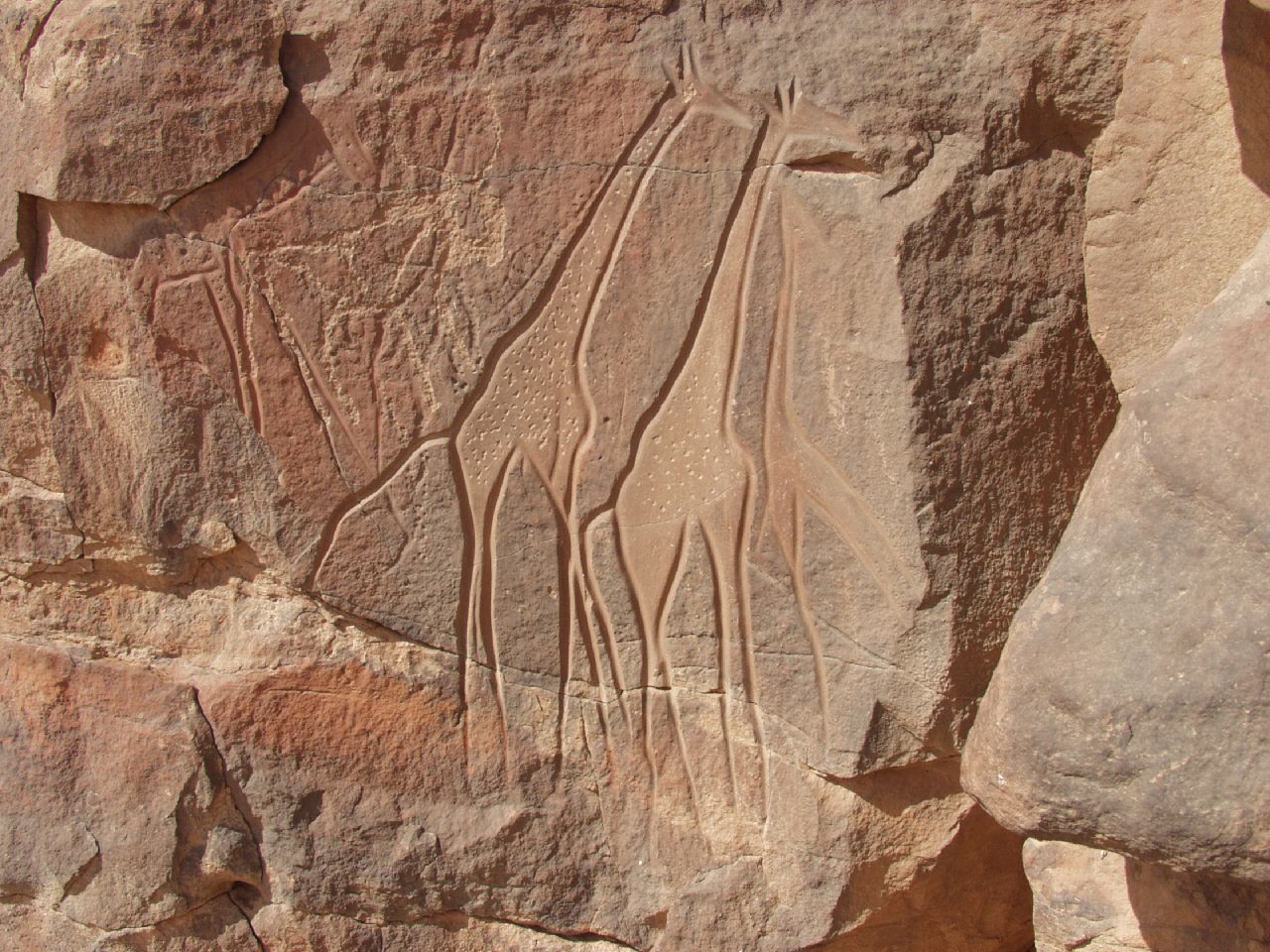
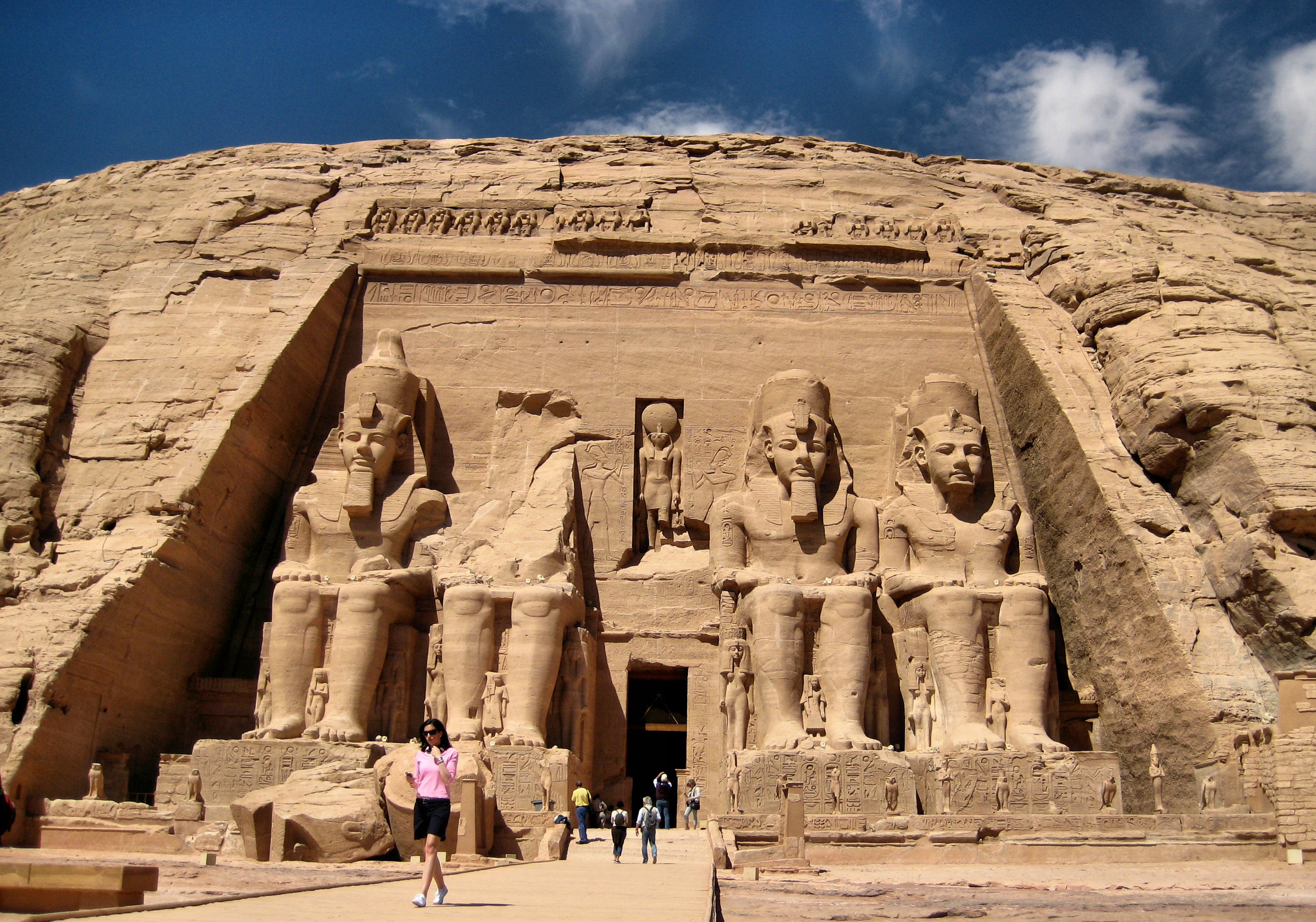
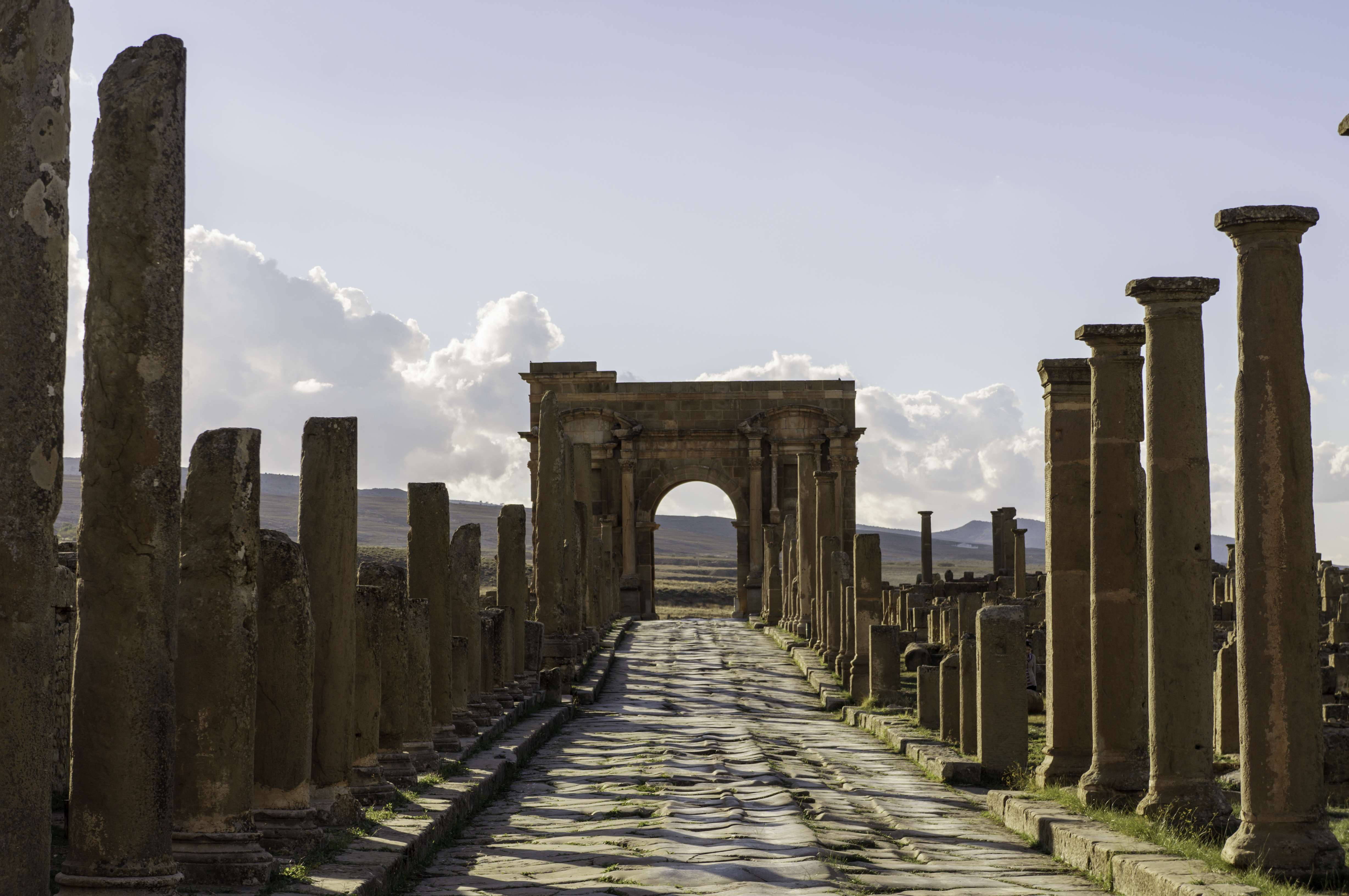


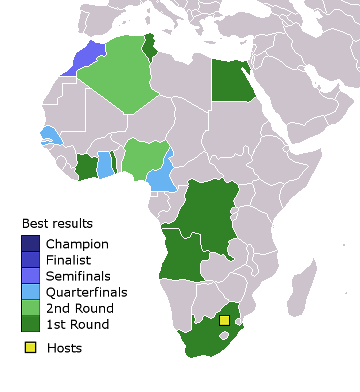


 Algeria
 Egypt
Egypt
 Libya
Libya
 Morocco
 Sudan
Sudan
 Tunisia
 Djibouti
 Eritrea
 Ethiopia
 Somalia
 Burundi
 Comoros
 Kenya
Kenya
 Madagascar
 Malawi
 Mauritius
 Mozambique
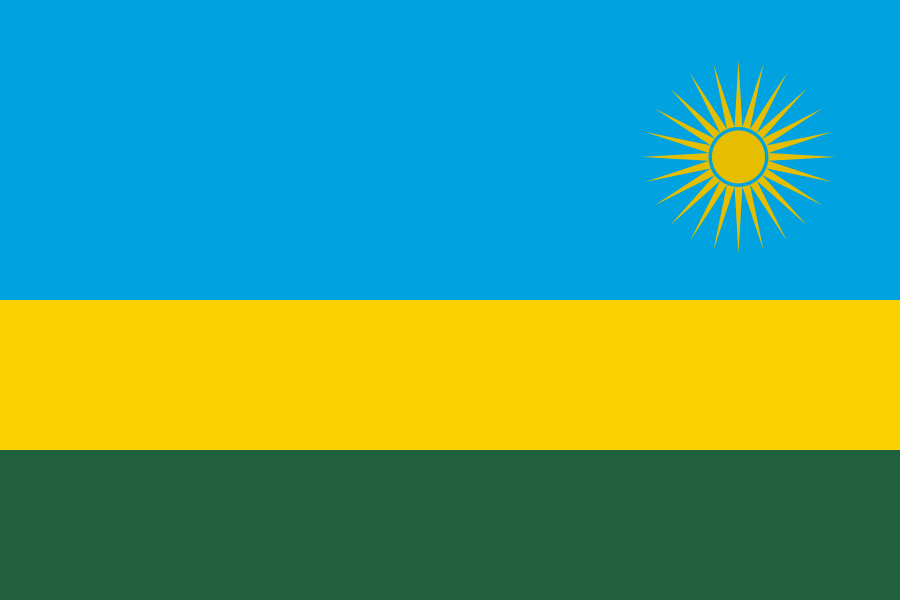 Rwanda
 South Sudan
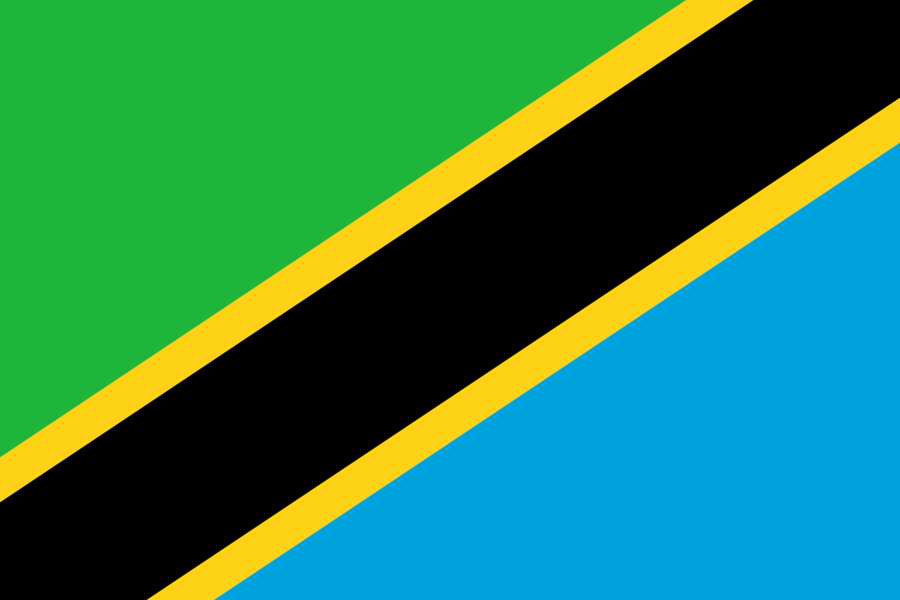 Tanzania
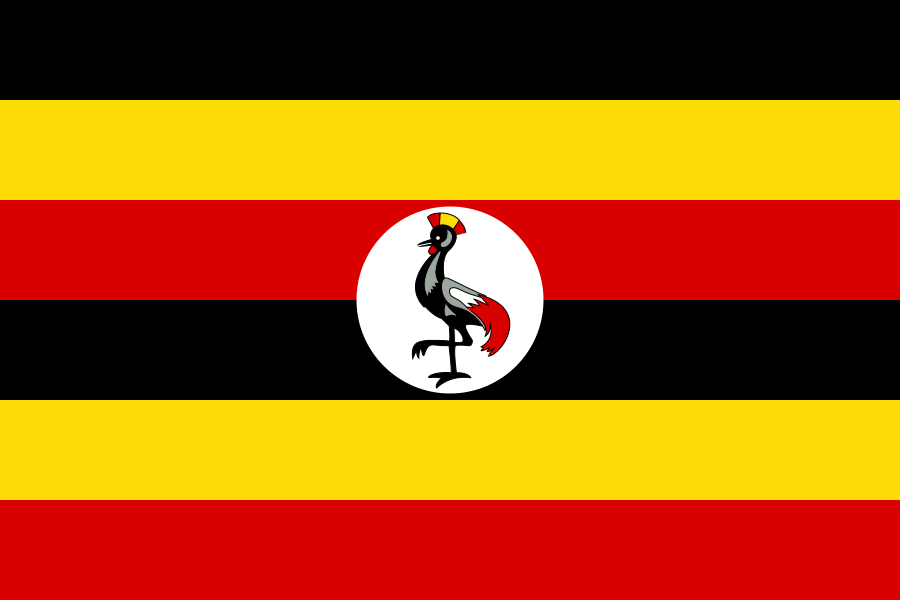 Uganda
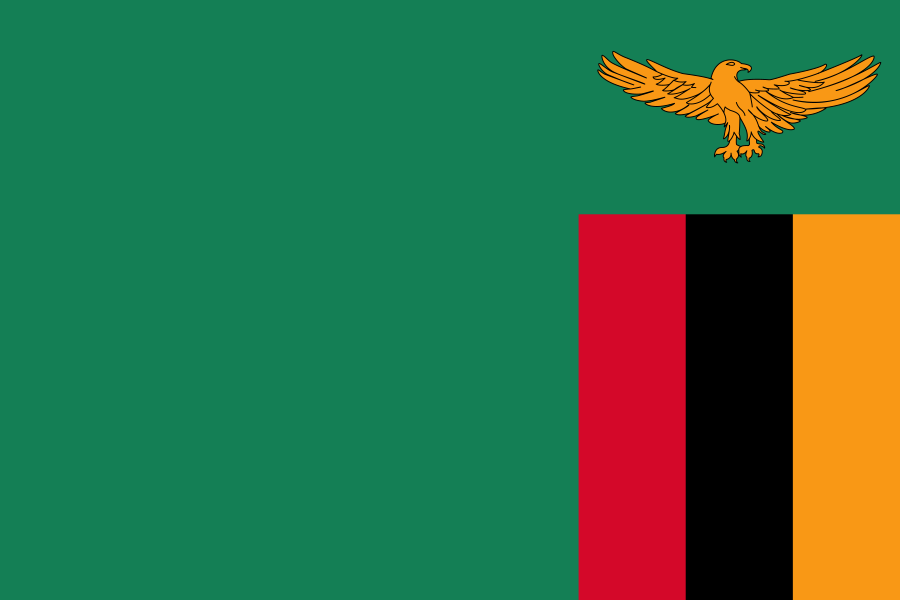 Zambia
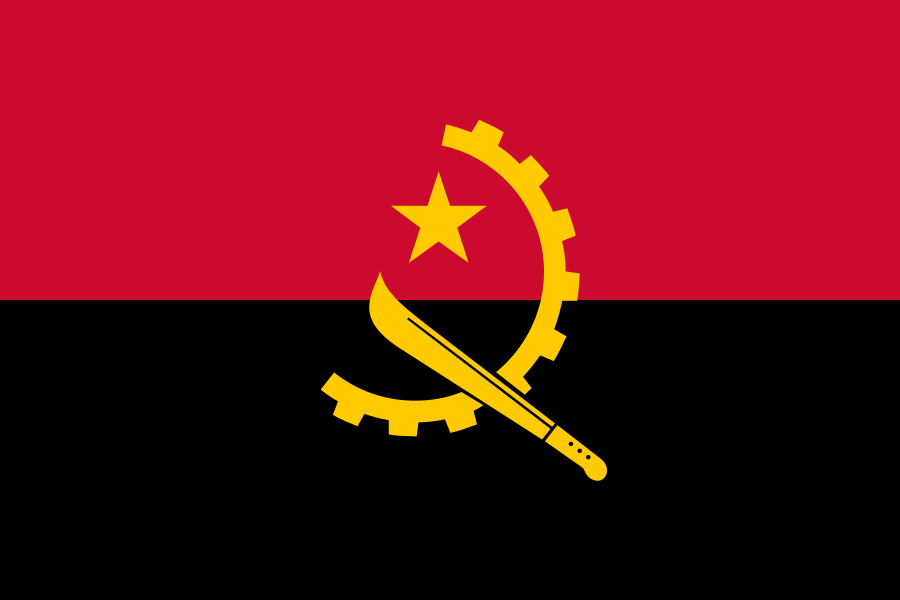 Angola
 Cameroon
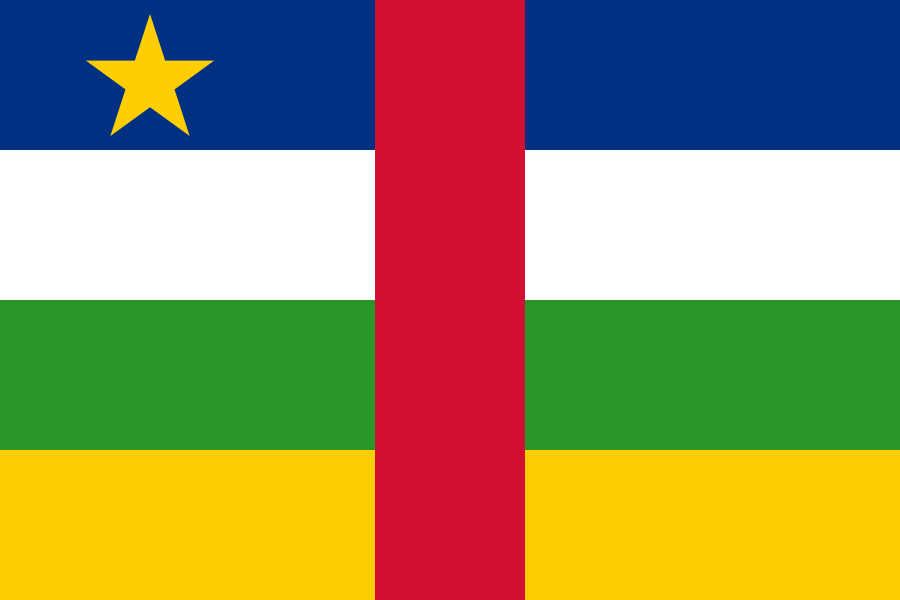 Central African Republic
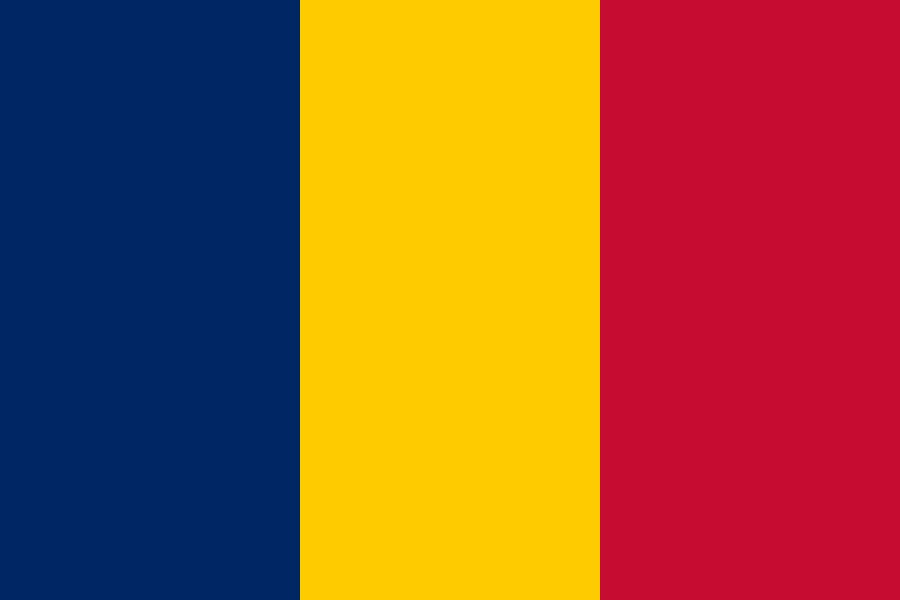 Chad
Chad
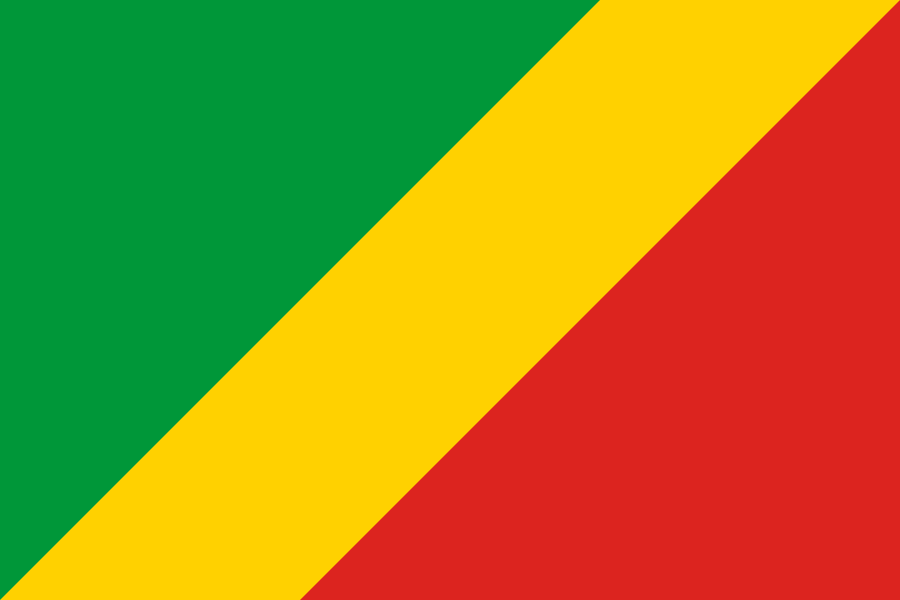 Republic of the Congo
 Democratic Republic of the Congo
 Equatorial Guinea
 Gabon
Gabon
 São Tomé and Príncipe
 Botswana
 Lesotho
 Namibia
 South Africa
 Swaziland
 Zimbabwe
 Benin
Benin
 Burkina Faso
 Côte d'Ivoire
 Gambia
 Ghana
Ghana
 Guinea
 Guinea-Bissau
 Liberia
 Mali
Mali
 Mauritania
 Niger
Niger
 Nigeria
 Senegal
 Sierra Leone
 Togo
Togo

