








m robot: Update article (please report if you notice any mistake or error in this edit) |
adjusted details based on references additionally and updated info |
||
| Line 1: | Line 1: | ||
{{ | {{short description|none}} | ||
<!-- "none" is preferred when the title is sufficiently descriptive; see [[WP:SDNONE]] --> | |||
{{Use dmy dates|date=December 2015}} | {{Use dmy dates|date=December 2015}} | ||
{{Use Indian English|date=December 2015}} | {{Use Indian English|date=December 2015}} | ||
{{Jainism}} | {{Jainism}} | ||
[[Jainism]] is | '''[[Jainism]]''' is an [[ancient India]]n religion belonging to the ''[[Śramaṇa]]'' tradition. Jains trace their history through a lineage of twenty-four ''[[tirthankara]]s'' (ford-makers), revering [[Rishabhanatha]] as the first in the present time-cycle. While tradition considers the dharma eternal, scholarly consensus places its verifiable historical roots in the 9th–8th century BCE, with the last two ''tirthankaras'', [[Parshvanatha]] (c. 9th-8th c. BCE) and [[Mahavira|Mahāvīra]] (c. 6th c. BCE), widely accepted as historical figures. Mahāvīra is viewed by scholars not as a founder, but as a reformer of the pre-existing community established by Parshvanatha. | ||
Following Mahāvīra's ''[[nirvana]]'' (c. 527 BCE, the start of the [[Vira Nirvana Samvat]] era), Jainism spread across [[India]]. Early epigraphic evidence, like the [[Hathigumpha inscription]], attests to royal patronage under figures like King [[Kharavela]] of [[Kalinga (region)|Kalinga]] (c. 2nd-1st c. BCE). Traditional accounts, primarily from the 12th-century ''[[Parishishtaparvan]]'', describe [[Chandragupta Maurya]] embracing Jainism, while [[Maurya Empire|Mauryan emperor]]s like [[Ashoka]] and [[Samprati]] are mentioned in edicts and Jain texts respectively. Archaeological finds at [[Kankali Tila]] ([[Mathura]]) confirm a thriving community with temples, stupas, and a sophisticated artistic tradition under the [[Kushan Empire|Kushana]]s (c. 1st-3rd c. CE), while inscriptions and temples at [[Udayagiri Caves]] ([[Madhya Pradesh]]) and [[Jain temples of Deogarh|Deogarh]] ([[Uttar Pradesh]]) show continued prosperity under the [[Gupta Empire|Gupta]]s (c. 4th-6th c. CE). | |||
The Classical Age (c. 7th–13th c. CE) saw significant patronage, particularly in the [[Deccan]] under dynasties like the [[Chalukya]]s, [[Rashtrakuta]]s, and [[Western Ganga]]s, leading to the creation of major literary works (''[[Adi Purana]]'') and monuments like the [[Gommateshwara statue]] at [[Shravanabelagola]]. In [[Western India]], the [[Chaulukya]]s were notable patrons, supporting scholars like [[Hemachandra]] and ministers who built the [[Dilwara Temples]]. The gradual schism between the two main sects, ''[[Digambara]]'' and ''[[Śvētāmbara]]'', likely began around the 1st century CE and was solidified by the 5th century CE, primarily over differences in ascetic practices (nudity) and scriptural authority. | |||
The | |||
From the 12th century onwards, Jainism faced challenges due to the rise of competing devotional movements like [[Lingayatism]] and persecution during [[Mughal Empire]], leading to the destruction of some temples. However, the community showed resilience, adapting as mercantile classes and influencing rulers like Emperor [[Akbar]], who, advised by the ''Śvetāmbara'' monk [[Hiravijaya]], temporarily banned animal slaughter during ''[[Paryushana]]''. The Modern Period saw interactions with colonial rule, academic recognition spurred by scholars like [[Hermann Jacobi]], monastic revivals led by figures such as [[Acharya Shantisagar]], and the emergence of reform movements. | |||
==Foundations: The Indigenous Civilization (Pre-History – 600 BCE)== | |||
===The Magadhan Context: A Non-Vedic Origin=== | |||
[[File:BahubaliBhagwan-1.jpg|thumb|[[Bahubali]], son of [[Rishabhanatha]] (first Jain {{lang|sa|[[tirthankara]]}}), practicing meditation in standing {{lang|sa|[[Kayotsarga]]}} posture. (Photo: [[Gommateshwara statue]], [[Shravanbelagola]])]] | |||
Recent scholarship, notably by Indologists like [[Johannes Bronkhorst]], situates the origins of Jainism within the cultural sphere of "[[Greater Magadha]]" (modern [[Bihar]] and eastern [[Uttar Pradesh]]), distinct from the [[Vedic culture]] of [[western India]].{{sfn|Bronkhorst|2007|pp=6–10}} In this region, concepts such as {{lang|sa|[[karma]]}}, [[Reincarnation|rebirth]] ({{lang|sa|[[samsara]]}}), and {{lang|sa|[[ahimsa]]}} ([[non-violence]]) evolved as indigenous beliefs of the {{lang|sa|[[Śramaṇa]]}} (ascetic) movements before the arrival of Vedic [[Brahmanism]].{{sfn|Samuel|2008|pp=48–51}}{{sfn|Olivelle|1993|p=12}}{{sfn|Jaini|1998|pp=2–3}} Unlike the Vedic tradition, which focused on sacrifices ({{lang|sa|[[yajna]]}}) to appease deities, the {{lang|sa|Śramaṇa}} traditions—including Jainism, [[Buddhism]], and [[Ājīvika]]—emphasized individual effort, austerity ({{lang|sa|tapas}}), and the internal search for liberation ({{lang|sa|[[moksha]]}}).{{sfn|Olivelle|1993|p=12}}{{sfn|Jaini|1998|pp=2–3}}{{sfn|Flood|1996|p=76}} | |||
The {{lang|sa|[[Atharvaveda]]}} (Book 15) describes a distinct group of ascetics known as the {{lang|sa|Vratyas}}, who existed on the fringes of Vedic society in the [[Magadha]] region.{{sfn|Bhandarkar|1940|p=80}}{{sfn|Chanda|1969|pp=33–38}}{{sfn|Upinder Singh|2024|p=313}} Unlike the Vedic priests, the {{lang|sa|Vratyas}} did not perform fire sacrifices ({{lang|sa|[[agnihotra]]}}) and traveled in groups.{{sfn|Upinder Singh|2024|p=313}} Scholars like [[Ramaprasad Chanda]] and [[D.R. Bhandarkar]] have identified the {{lang|sa|Vratyas}} as the proto-Jain or indigenous {{lang|sa|Śramaṇa}} lineage that predates [[Mahavira]], the 24th {{lang|sa|tirthankara}}.{{sfn|Bhandarkar|1940|p=80}}{{sfn|Chanda|1969|pp=33–38}}{{sfn|Upinder Singh|2024|p=313}} The {{lang|sa|Vratyas}} are described as standing still for long periods in a posture resembling the Jain {{lang|sa|Kayotsarga}} (standing meditation), and their leader is referred to as the {{lang|sa|Ekavratya}} or {{lang|sa|[[Arhant]]}}, terms later central to Jain theology.{{sfn|Bhandarkar|1940|p=80}}{{sfn|Chanda|1969|pp=33–38}} Indologist [[J.C. Heesterman]] suggests that the {{lang|sa|Vratya}} tradition represents the 'pre-classical' roots of the renouncer movements, providing the cultural bridge between the earlier Indus Valley civilization and the later historical Jain {{lang|sa|[[sangha]]}}.{{sfn|Heesterman|1993|pp=168–170}} | |||
[[ | |||
=== Mahavira === | ===Proto-History and Universal Lineage=== | ||
[[File:Yogi seal Mohenjodaro EAMd13.jpg|thumb|Triangular prism sealing from [[Indus Valley Civilisation]], depicting a male cult figure seated in a yogic posture on a throne, a bull-like animal, and five characters in the Indus script. From Mohenjo-daro, Mature Harrapean period, c. 2600-1900 BC. [[Ashmolean Museum]].<ref>{{cite web |title=Ashmolean Museum |url=https://collections.ashmolean.org/collection/browse-9148/object/32662 |website=collections.ashmolean.org}}</ref>]] | |||
Jain tradition posits a lineage of 24 {{lang|sa|[[tirthankaras]]}} who guide humanity across cosmic time cycles.{{sfn|Sangave|2001|pp=104, 129}} While scholarly consensus traces verifiable historical roots to the 9th–8th century BCE,{{sfn|Flugel|2012|p=975}}{{sfn|Dundas|2002|p=17}} the narratives of the earlier {{lang|sa|tirthankaras}} contain significant overlaps with Vedic and Epic literature, suggesting deep antiquity.{{sfn|Zimmer|1953|p=182}} | |||
Some scholars hypothesize that Jain practices originated in the [[Indus Valley Civilisation]] (IVC), pointing to seals depicting figures in meditative postures resembling {{lang|sa|[[kayotsarga]]}} and [[bull]] motifs associated with [[Rishabhanatha]], the first {{lang|sa|tirthankara}}.{{sfn|Larson|1995|p=27}}{{sfn|Beversluis|2000|p=81}}{{sfn|Zimmer|1953|p=59}}{{sfn|Sangave|2001|p=24–25}}{{sfn|Bilimoria|Prabhu|Sharma|2007|p=315}}{{sfn|Possehl|2002|pp=111–112}} Rishabhanatha is also mentioned in the {{lang|sa|[[Rig Veda]]}} and {{lang|sa|[[Bhagavata Purana]]}} as an [[Avadhuta]] king, [[Rishabha (Hinduism)|Rishabha]], who renounced his kingdom.{{sfn|Jaini|1998|pp=32–33}}{{sfn|Prioreschi|1996|p=205}}{{sfn|Dalal|2010|p=88}}{{sfn|Hudson|2008|pp=19–22}}<ref>[http://www.ibiblio.org/sripedia/ebooks/mw/0200/mw__0259.html Rishabha], Monier Monier-Williams, Sanskrit English Dictionary and Etymology, Oxford University Press, page 226, 3rd column</ref>{{efn|For example: '''ऋषभं''' मा समानानां सपत्नानां विषासहिम् । हन्तारं शत्रूणां कृधि विराजं गोपतिं गवाम् ॥१॥ – Rigveda 10.166.1<ref>[https://sa.wikisource.org/wiki/ऋग्वेद:_सूक्तं_१०.१६६ ऋग्वेद: सूक्तं १०.१६६], Rigveda, Wikisource</ref> Other examples of Rishabha appearing in the Vedic literature include verses 6.16.47 of Rigveda, 9.4.14-15 of Atharvaveda, 3.7.5.13 and 4.7.10.1 of Taittiriya Brahmana, etc.{{sfn|Bloomfield|1906|p=293}} }} | |||
The 20th {{lang|sa|tirthankara}}, [[Munisuvrata]], is traditionally placed as a contemporary of [[Rama]].{{sfn|Kulkarni|1990|pp=12–15}} Jain versions of the epic, such as the {{lang|sa|Paumacariya}}, depict the narrative through a Jain lens, emphasizing non-violence over martial valor.{{sfn|Kulkarni|1990|pp=12–15}} | |||
The 22nd {{lang|sa|tirthankara}}, [[Neminatha]], is traditionally linked as a cousin of [[Krishna]], sharing the [[Yadava]] lineage of [[Kathiawar|Saurashtra]].{{sfn|Sangave|2001|p=20-11}}{{sfn|Helen|2009|pp=1–266}}{{sfn|Sangave|2001|pp=104, 129}}{{sfn|Dundas|2002|p=37}} Some historians connect him with "{{lang|sa|Ghora Angirasa}}", a teacher mentioned in the {{lang|sa|Chandogya Upanishad}} who taught Krishna the principle of ahimsa, suggesting a historical interaction between the Jain and Vedic traditions.{{sfn|Sangave|2001|p=20-11}}{{sfn|Helen|2009|pp=1–266}}{{sfn|Sangave|2001|pp=104, 129}}{{sfn|Deo|1956|pp=60–61}} | |||
===Parsvanatha: The Historical "First" Teacher=== | |||
{{Main|Parsvanatha}} | |||
[[File:Jina Parsvanatha, Western India, Gujarat, 8th century AD, brass - Ethnological Museum, Berlin - DSC01581.JPG|thumb|left|An 8th-century CE brass idol of [[Parshvanatha]]. It depicts the 23rd {{lang|sa|[[tirthankara]]}}, the earliest Jain leader accepted by scholars as a historical figure (c. 9th–8th century BCE), and illustrates the later artistic tradition associated with him.]] | |||
[[Parshvanatha]] (c. 9th–8th century BCE), the 23rd {{lang|sa|tirthankara}}, is the earliest Jain leader widely accepted by scholars as a historical figure.{{sfn|Zimmer|1953|pp=182–183}}{{sfn|Jaini|1998|p=10}}{{sfn|Dundas|2002|pp=30–31}}{{sfn|Sangave|2001|p=103}} Born in [[Varanasi]],{{sfn|Jacobi|1964|p=271}} his historicity establishes Jainism as a distinct pre-Buddhist {{lang|sa|Śramaṇa}} tradition.{{sfn|Zimmer|1953|pp=182–183}}{{sfn|Jaini|1998|p=10}}{{sfn|Dundas|2002|pp=30–31}}{{sfn|Sangave|2001|p=103}} Historical analysis suggests his teachings formed the basis for the {{lang|sa|Chaturyama Dharma}} (Four-fold Restraint): non-violence, [[truth]], [[non-stealing]], and [[non-possession]].{{sfn|George|2008|p=319}}{{sfn|Kailash Chand Jain|2010|p=5}}{{sfn|Dundas|2002|pp=30–32}} Traditional accounts place his liberation ({{lang|sa|moksha}}) atop Mount {{lang|sa|Sammeda}} (now {{lang|sa|Sammed [[Shikharji]]}}), which remains a site of paramount importance in Jain pilgrimage.{{sfn|Wiley|2009|p=148}}{{sfn|Dundas|2002|p=221}} | |||
While specific events like the legendary obstruction by [[Kamath]] during meditation (traditionally associated with [[Ahichchhatra]]) are part of hagiography, the sites themselves gained historical significance.{{sfn|Kapoor|2002|p=17}} Ahichchhatra became a major Jain pilgrimage center with temples commemorating Parshvanatha.{{sfn|Lakshmi Jain|2008|p=64}} | |||
Evidence for the continuity of his monastic order is suggested by Śvetāmbara texts, such as the [[Upkeśa Gaccha#Monastic Lineage|''Upkeśa Gaccha Pattavali'']] (a monastic genealogy), which details a lineage of teachers that descended from him.<ref name="auto">{{Cite web|url=http://archive.org/details/dli.calcutta.06227|title=Indian Antiquary: A Journal of Oriental Research, Vol-19, Issue no.-January-December|via=Internet Archive}}</ref><ref>{{Cite web |last=Maharaja |first=Gyansundar |title=Oswal Porwal Aur Shreemal Jatiyo Ka Sachitra Prachin Itihas |url=https://jainqq.org/explore/034569/15 |access-date=2024-06-13 |website=jainqq.org}}</ref>{{efn|After Parshvanatha attained liberation, his disciple Arya Subhadatta became the head of the monks. Arya Subhadatta was succeeded by Arya Haridatta, Arya Samudradatta, [[Kesi (Ganadhara)|Kesi]], [[Swayamprabhasuri]], and [[Ratnaprabhasuri]] and so on.{{sfn|von Glasenapp|1925|p=28}} This monastic order was known as Upkeśa Gaccha. [[Uttaradhyayana]], an ancient Svetambara text, has records of a dialogue between Mahavira's disciple [[Gautama Swami]] and Kesi; Kesi, along with monks of his monastic order, accepted Mahavira as a ''tirthankara'' and merged with his [[Śvetāmbara#The Chaturvidha Sangha|four-fold congregation]] as a result.{{sfn|Kailash Chand Jain|1991|p=15}} }} | |||
==The Magadhan State & The Great Migration (600 BCE – 200 BCE)== | |||
===Mahavira and the Buddhist Relation=== | |||
{{Main|Mahavira}} | {{Main|Mahavira}} | ||
[[File:Mahavir.jpg|thumb|Mahavira, the 24th | [[File:Mahavir.jpg|thumb|A modern depiction of [[Mahavira]]. As a contemporary of the [[Buddha]], Mahavira is a key historical anchor, recognized by scholars as a reformer of the pre-existing {{lang|sa|Nigantha}} community.]] | ||
Mahavira (c. 6th century BCE), the 24th {{lang|sa|tirthankara}}, is recognized by scholars as a reformer of the pre-existing community established by Parshvanatha rather than the founder of a new religion.{{sfn|Dundas|2002|p=19}}{{sfn|Sangave|2001|p=17}} Born in {{lang|sa|Kundagrama}} near [[Vaishali (ancient city)|Vaishali]], he attained [[omniscience]] ({{lang|sa|[[Kevala Jnana]]}}) after 12 years of asceticism.{{sfn|Jaini|1998|pp=32–33}}{{sfn|Pannalal Jain|2015|p=460}}{{sfn|Dundas|2002|p=25}}{{sfn|Doniger|1999|p=682}} | |||
As a contemporary of [[Gautama Buddha]], Mahavira's life provides a crucial anchor point for early Indian chronology.{{sfn|Cort|2010|p=136}}{{sfn|Dundas|2002|pp=30–31}}{{sfn|Dundas|2003a|p=383}}{{sfn|Keown|Prebish|2013|pp=127–130}} Early Buddhist texts frequently refer to him as {{lang|sa|Nigantha Nataputta}} ("The Bondless Son of the {{lang|sa|Nata}} Clan) and describe his followers, the {{lang|sa|Niganthas}}, as a significant, established ascetic community distinct from the Buddhists.{{sfn|Sangave|2001|p=21}}{{sfn|Walshe|1995|p=91}}{{efn|The Buddha tried ascetic methods found in Jainism, abandoned that path and taught the [[Middle Way]] instead.{{sfn|Collins|2000|p=204}} The Buddha disagreed with the Mahavira's concept of soul or self (''jiva''). Similarly, he found the Jain theory of [[karma]] and rebirths incompatible and inflexible with his own ideas for these.{{sfn|Keown|Prebish|2013|pp=127–130}} }} The two communities were prominent competitors for followers and patronage, particularly among the merchant ({{lang|sa|[[vaishya]]}}) groups.{{sfn|Gombrich|2006|p=59}}{{sfn|Hirakawa|1993|pp=4–7}}{{sfn|Dundas|2003b|pp=ix–xi, 151–162}}{{sfn|Neelis|2010|pp=72–76}} Mahavira also faced rivalry from [[Makkhali Gosala]], the founder of the Ājīvika sect, who is described in Jain texts as an early companion of Mahavira before breaking away to preach [[fatalism]].{{sfn|Dundas|2002|p=16}}{{sfn|Basham|1951|pp=34–36}}{{sfn|Hoernle||pp=259-268}} According to {{lang|sa|Svetambara}}, there were eight schisms ({{lang|sa|Nihvana}}) during the time of Mahavira.{{sfn|Dundas|2002|p=46}} The primary archaeological evidence for the Ājīvikas is the [[Barabar Caves]] in Bihar.{{sfn|Basham|1951|pp=150-155}} These are the oldest rock-cut caves in India, dedicated by Emperor Ashoka in the 3rd century BCE.{{sfn|Upinder Singh|2024|p=365}} Their austere design provided a model for later Jain and Buddhist rock-cut monasteries.{{sfn|Huntington|2014|pp=48-49}} | |||
At age 30, he renounced worldly life and undertook intense ascetic practices for over 12 years before attaining omniscience ({{lang|sa|Kevala Jnana}}).{{sfn|George|2008|p=319}}{{sfn|Jain|Upadhye|2000|p=30}} For the next 30 years, he traveled extensively through the Ganges basin, teaching the path to liberation.{{sfn|von Glasenapp|1925|p=327}} His liberation (''moksha'') is traditionally held to have occurred at [[Pawapuri]] (also in Bihar), an event marking the beginning of the Jain ''[[Vira Nirvana Samvat]]'' calendar era.{{sfn|Zimmer|1953|p=222}}{{sfn|Dundas|2002|pp=22–24}}{{sfn|Melton|Baumann|2010|p=897}} The night of his nirvana are commemorated by Jains as [[Diwali (Jainism)|Diwali]] at the same time that Hindus celebrate it.{{sfn|Melton|Baumann|2010|p=897}}{{sfn|Doniger|1999|pp=549–550}} | |||
His chief disciple, [[Indrabhuti Gautama]], is said to have attained omniscience the night that Mahavira achieved nirvana from Pawapuri.{{sfn|von Glasenapp|1925|p=39}} Following Mahavira's death, leadership of the Jain community passed to his ''[[ganadhara]]'' (chief disciple) [[Sudharmaswami]] (d. 600 BCE).{{sfn|von Glasenapp|1925|p=39-40}} He is traditionally regarded as the head of the sangha from whom the entire historical monastic lineage is traced.{{sfn|von Glasenapp|1925|p=39-40}} He was succeeded by [[Jambuswami]] (d. 463 BCE) who is regarded as the last omniscient being by Jain traditions.{{sfn|von Glasenapp|1925|p=39-40}} Traditional Jain accounts also name early kings of the [[Haryanka dynasty]], such as [[Bimbisara]], [[Ajatashatru]] and [[Udayin]], as patrons, though external historical verification for this varies.{{sfn|von Glasenapp|1925|p=41}} | |||
===Archaeological Origins: The Lohanipur Torso & Barli=== | |||
[[File:Patna Museum Lohanipur torso.jpg|thumb|[[Lohanipur torso]], [[Patna Museum]]]] | |||
The earliest potential Jain monumental sculpture is the [[Lohanipur Torso]], a highly polished, naked male torso discovered near [[Patna]], Bihar.{{sfn|Cort|2010|pp=32-37}}{{sfn|Huntington|2014|p=48}} Its distinctive polish dates it to the [[Mauryan era]] (c. 3rd c. BCE).{{sfn|Cort|2010|pp=32-37}}{{sfn|Dundas|2002|pp=56-57}}{{sfn|Balcerowicz|2015|pp=286-287}} The statue's nudity and stiff {{lang|sa|Kayotsarga}} meditation pose are cited by {{lang|sa|Digambara}} scholars as early evidence of the {{lang|sa|Mula Sangh}} (original naked order) existing in Magadha before any schism.{{sfn|Cort|2010|pp=32-37}}{{sfn|Dundas|2002|pp=43}}{{sfn|Balcerowicz|2015|pp=286-287}}{{sfn|Huntington|2014|p=48}} Epigraphic evidence also appears early in [[Rajasthan]].{{sfn|Sircar|1971|p=256}} The [[Barli Inscription]], discovered in 1912 and dated to the 2nd or 1st century BCE, is interpreted by some scholars as a Jain dedication, marking the religion's early spread into western India.{{sfn|Sircar|1965|pp=89–90}}{{sfn|Sircar|1971|p=256}}{{sfn|Kailash Chand Jain|1972|p=152, 249–250}} | |||
===The Great Migration (The Sectarian Divide)=== | |||
A pivotal, albeit debated, event in Jain history is the Great Migration to the South.{{sfn|Mookerji|1988|pp=39–41, 60–64}}{{sfn|Jones|Ryan|2007|p=xxviii}}{{sfn|Bentley|1993|pp=44–46}} According to {{lang|sa|Digambara}} tradition, the monk [[Bhadrabahu]] (d. 298 BCE) predicted a 12-year famine in Magadha.{{sfn|Mookerji|1988|pp=39–41, 60–64}}{{sfn|Habib|Jha|2004|p=20}} To preserve the strict rules of the {{lang|sa|Jina Kalpa}} (which included nudity and specific eating rituals), he led a group of 12,000 monks south to [[Shravanabelagola]] ([[Karnataka]]).{{sfn|Mookerji|1988|pp=39–41, 60–64}}{{sfn|Jones|Ryan|2007|p=xxviii}}{{sfn|Bentley|1993|pp=44–46}} Tradition holds that [[Chandragupta Maurya]] (c. 322–298 BCE), the founder of the [[Mauryan Empire]], abdicated his throne, joined Bhadrabahu as a monk, and ended his life through {{lang|sa|[[Sallekhana]]}} (ritual fasting to death) on [[Chandragiri Hill]].{{sfn|Mookerji|1988|pp=39–41, 60–64}}{{sfn|Jones|Ryan|2007|p=xxviii}}{{sfn|Bentley|1993|pp=44–46}} Later inscriptions at Shravanabelagola (dating from 600 CE onwards) strongly commemorate this event as the foundation of the southern Jain community.{{sfn|Mookerji|1988|p=40}} The monks who stayed behind in Magadha during the famine were forced to relax their vows (such as wearing white cloth) to survive, leading to the {{lang|sa|Śvetāmbara}} deviation.{{sfn|Jaini|1998|pp=4–5}} | |||
{{lang|sa|Śvetāmbara}} reject the specific Bhadrabahu-Chandragupta migration narrative as inauthentic or a later fabrication.{{sfn|Dundas|2002|p=48}}<ref>{{Cite book |last=Dikshitar |first=V. r Ramachandra |url=http://archive.org/details/in.ernet.dli.2015.530078 |title=Mauryan Polity |date=1932 |language=en}}</ref> They maintain that the schism was a gradual process caused by doctrinal differences later in the timeline.{{sfn|Cort|2010|p=142}} Some scholars{{which|date=December 2025}} specifically state that the said lore was developed after 600 CE and is inauthentic.<ref>{{Cite web |last=Jansari |first=Sushma |title=Chandragupta Maurya: The creation of a national hero in India |url=https://discovery.ucl.ac.uk/id/eprint/10170898/1/Chandragupta-Maurya.pdf |page=23}}</ref> | |||
The edicts of Chandragupta's grandson, [[Ashoka]] (c. 273–232 BCE), mention the ''Niganthas'' (Jains) when detailing the duties of his law-authorities (''dhammamahatma''), confirming they were a well-established community.{{sfn|von Glasenapp|1925|p=43}} Ashoka's grandson, [[Samprati]] (c. 224–215 BCE), is described in ''Śvetāmbara'' canonical scriptures as a major patron, or "Jain Ashoka," who was converted by the monk Suhastin and built thousands of Jain temples from his capital in [[Ujjain]].{{sfn|Dundas|2002|p=73}}<ref>{{citation |last=Dundas |first=Paul |date=2013 |title=A Neglected Śvetāmbara Narrative Collection Hemacandrasūri Maladhārin's Upadeśamālāsvopajñavṛtti Part 1 (With an Appendiz on the Funeral of Abhayadevasūri Maladhārin) |url=https://www.soas.ac.uk/sites/default/files/2022-06/A%20Neglected%20%C5%9Avet%C4%81mbara%20Narrative%20Collection%2C%20Hemacandras%C5%ABri%20Maladh%C4%81rin%27s%20Upade%C5%9Bam%C4%81l%C4%81svopaj%C3%B1av%E1%B9%9Btti%20Part%201%20file83323.pdf }}</ref><ref>{{citation |last=Costello |first=Corbett L. |date=2023 |title=Crown-Jewel of the Jain Canon: The Kalpa Sūtra in Mūrtipūjaka Jain Scholastic and Spiritual Life |url=https://digital.lib.washington.edu/server/api/core/bitstreams/877f6c11-9bfb-42f1-ac3d-a6a94121031c/content |page=289}}</ref><ref>{{Cite web |last=Cort |first=John E. |date=2010 |title=In Defense of Icons in Three Languages – The Iconophilic Writings of Yaśovijaya |url=https://www.soas.ac.uk/sites/default/files/2022-06/In%20Defence%20of%20Icons%20in%20Three%20Languages%20-%20The%20Iconophilic%20Writings%20of%20Ya%C5%9Bovijaya%20file58528.pdf |page=31|ref=IJJSCort}}</ref> | |||
The traditional narratives, while not considered the historical cause by most modern scholars, are foundational to each sect's identity and explain their interpretation of the split.{{sfn|Natubhai Shah|2004|p=72}} | |||
* ''Digambara'' Narrative: Recorded in later hagiographies around 10th century CE,{{sfn|Dundas|2002|p=47}} this account places the split in the 4th century BCE.{{sfn|von Glasenapp|1925|p=46}} It states that Acharya [[Bhadrabahu]] predicted a famine in [[Magadha]] and led a migration of monks to the South.{{sfn|von Glasenapp|1925|p=46}}{{sfn|Jaini|1998|p=5}}{{sfn|Dundas|2002|p=47}} The monks who remained, led by [[Sthulabhadra]], adopted the "heretical" practice of wearing robes.{{sfn|von Glasenapp|1925|p=46}}{{sfn|Jaini|1998|p=5}}{{sfn|Dundas|2002|p=47}} The monks who returned from the south, having preserved the original practice of nudity, became the ''Digambaras''.{{sfn|von Glasenapp|1925|p=46}}{{sfn|Jaini|1998|p=5}}{{sfn|Dundas|2002|p=47}} | |||
* ''Śvetāmbara'' Narrative: Recorded in earlier texts like the 5th-century ''Avashyak Bhashya'', this account claims the sangha was unified until 82 CE.{{sfn|Hastings|Selbie|1922|p=124}}{{sfn|Dundas|2002|p=47}} It states a monk named [[Sivabhuti]], in an act of pride, rejected his robes and began teaching the "false doctrine" of obligatory nudity, thereby founding the ''Digambara'' line.{{sfn|Dundas|2002|p=46}}{{sfn|Hastings|Selbie|1922|p=124}}<ref>{{Cite book |url=https://books.google.com/books?id=zXEO2qFLqe8C&dq=%22Sivabhuti%22+-wikipedia&pg=PA655 |title=Journal of the Royal Asiatic Society of Great Britain and Ireland |date=1905 |publisher=Royal Asiatic Society of Great Britain & Ireland |language=en}}</ref><ref>{{Cite book |last=India |first=Archaeological Survey of |url=https://books.google.com/books?id=pdQbAQAAMAAJ&dq=%22Sivabhuti%22+-wikipedia&pg=RA1-PA177 |title=Annual Report |date=1928 |publisher=Superintendent of Government Printing |language=en}}</ref> | |||
===Western Interactions: The Gymnosophists=== | |||
The [[Gymnosophists]] Greek accounts from the campaign of [[Alexander the Great]] (326 BCE) provide the earliest Western descriptions of Jain ascetics, whom they termed Gymnosophists ("Naked Philosophers").{{sfn|Mookerji|1988|p=23–25}}{{sfn|Zimmer|1953|p=210}} The Greeks encountered a group of these ascetics in [[Taxila]] led by a sage named [[Dandamis]] (or Mandanis).{{sfn|Mookerji|1988|p=23–25}} While Dandamis famously refused to meet Alexander, asserting his spiritual independence from any temporal conqueror, his disciple [[Kalanos]] agreed to accompany the Macedonian army to [[Persia]].{{sfn|Mookerji|1988|p=23–25}} While some scholars debate their sectarian identity, their strict adherence to nudity and public penance align with the {{lang|sa|Digambara}} monastic code.{{sfn|Mookerji|1988|p=23–25}} Kalanos later taught Alexander the philosophy of detachment before voluntarily ending his life by immolation at [[Susa]], an event that deeply impacted Greek Stoic philosophy.{{sfn|McEvilley|2002|pp=220–222}}{{sfn|Olivelle|2011|pp=207–208 with footnotes}} | |||
==The Age of Assertion: Art, War & Schism (200 BCE – 200 CE)== | |||
===Royal Patronage in the East: King Kharavela and Hathigumpha Inscription=== | |||
{{Main|Hathigumpha Inscription}} | |||
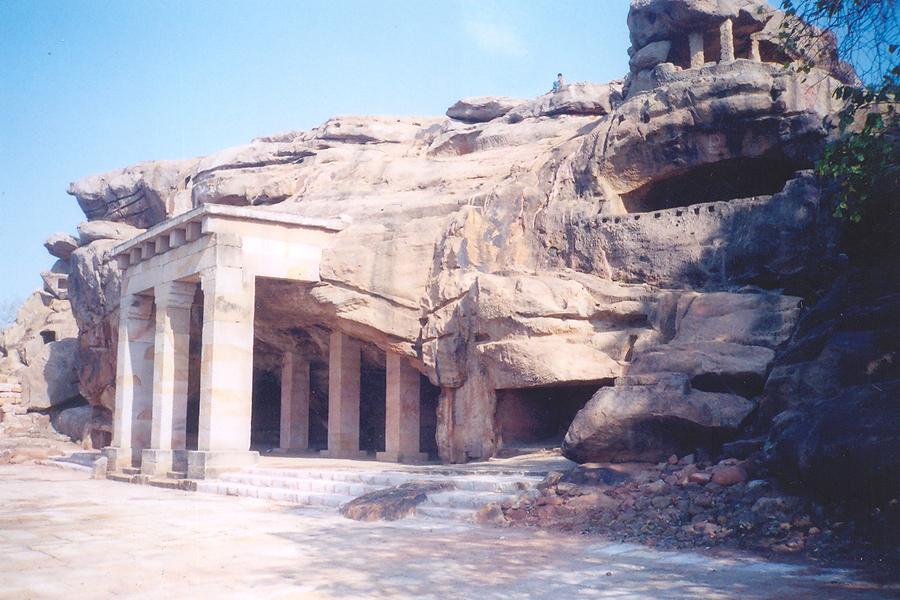
[[File:Hathigumpha.JPG|thumb|Entrance of the [[Hathigumpha]] monument. The pillared front, steps and other structures were added in 19th and 20th centuries to help conserve the monument.]] | |||
The most definitive epigraphic evidence of early royal patronage comes from the [[Hathigumpha inscription]] at [[Udayagiri and Khandagiri Caves]] in [[Odisha]].{{sfn|Sahu|1964|pp=348–350}}{{sfn|Upinder Singh|2024|p=273, 377}}{{sfn|Raychaudhuri|1988|p=13}} Dated to the 2nd or 1st century BCE, it details the reign of Emperor [[Kharavela]] of the [[Mahameghavahana dynasty]].{{sfn|Upinder Singh|2024|p=273, 377}}{{sfn|Raychaudhuri|1988|p=13}} The inscription notably begins with a variation of the {{lang|sa|[[Navkar Mantra]]}} and records Kharavela recovering a "Kalinga Jina" idol that had been taken by the [[Nanda dynasty]], suggesting Jainism was established in Kalinga as early as the 4th century BCE.{{sfn|Sahu|1964|pp=348–350}}{{sfn|Upinder Singh|2024|p=273, 377}}{{sfn|Raychaudhuri|1988|p=13}} The site contains extensive rock-cut monasteries ({{lang|sa|gumphas}}) including the two-storied {{lang|sa|Ranigumpha}} (Queen's Cave), proving that Jainism flourished under state patronage outside the Mauryan sphere.{{sfn|Upinder Singh|2024|p=273, 377}}{{sfn|Raychaudhuri|1988|p=13}} | |||
In [[Odisha]], Jainism continued to flourish after the Kharavela era, particularly under the [[Murunda dynasty]] and later local rulers.{{sfn|Sahu|1964|pp=450-452}} Archaeological evidence includes the later medieval caves at [[Khandagiri]] ([[Cuttack]] district) and the Jain temple complexes at Subai ([[Koraput]] district).{{sfn|Sahu|1964|pp=450-452}} | |||
===The Mathura School: Kankali Tila=== | |||
{{Main|Kankali Tila}} | |||
[[File:Parsvanatha ayagapata, Mathura circa 15 CE.jpg|thumb|An ''[[Parsvanatha ayagapata|ayagapata]]'' (tablet of homage) depicting [[Parshvanatha]], c. 15 CE, found at [[Kankali Tila]], [[Mathura]]. Such tablets, often featuring ''tirthankaras'' or stupas, were common votive offerings during the [[Kushan Empire|Kushan period]].]] | |||
[[File:Kankali Tila (Samvat 95).jpg|thumb|A [[Kushan Empire|Kushan-era]] sculpture (c. 51 CE) from [[Kankali Tila]] depicting the last four ''tirthankaras''. The detailed iconography and dated inscriptions found at [[Mathura]] demonstrate the standardization and flourishing of Jain art under the Kushanas.]] | |||
[[File:Jain Narrative Relief Panel, mid 2nd century BCE.-1st century CE (18.4 x 61.6 cm) Brooklyn Museum 87.188.5.jpg|thumb|A 1st- to 2nd–century CE water tank relief panel showing two {{lang|sa|[[ardhaphalaka]]}} Jain monks carrying {{lang|sa|colapatta}} cloth on their left hand found in the ruins of Mathura ([[Brooklyn Museum]] 87.188.5).{{sfn|Quintanilla|2007|pp=174–176}} This cloth carrying tradition to cover genitalia by ancient Jain monks in principle resembles the beliefs of the Śvetāmbara.{{sfn|Jaini|2018|pp=42–45}}]] | |||
The most extensive archaeological evidence for early Jainism comes from [[Kankali Tila]] in [[Mathura]] ([[Uttar Pradesh]]).{{sfn|Cort|2010|p=30}} Excavations here have revealed a thriving community from the 2nd century BCE to the [[Kushan Empire|Kushan]] period (c. 1st–3rd c. CE).{{sfn|Quintanilla|2007|pp=11–12}} | |||
Unlike modern Jainism, early devotees at Mathura built [[Stupas]] (relic mounds) and worshipped {{lang|sa|[[Ayagapata]]s}} (votive tablets).{{sfn|Cort|2010|p=30}} Tablets like the Parsvanatha {{lang|sa|Ayagapata}} (c. 15 CE) show the transition from symbol worship to image worship.{{sfn|Das|1980|p=171}}{{sfn|Vyas|1995|p=16}} The vast majority of {{lang|sa|tirthankara}} images found at Mathura are nude, which {{lang|sa|Digambaras}} cite as archaeological proof that the original Jain tradition was "sky-clad" ({{lang|sa|Digambara}}).{{sfn|Jaini|1998|p=7}}{{sfn|Cort|2010|p=25}}{{sfn|Vyas|1995|p=16}} | |||
However, some relief panels also depict monks holding a small piece of cloth ({{lang|sa|ardhaphalaka}}) to cover their privates.{{sfn|Dundas|2002|p=49}} Scholars often interpret the {{lang|sa|ardhaphalaka}} monks as a "proto-{{lang|sa|Śvetāmbara}}" stage or a transitional sect.{{sfn|Luders|1961|pp=30–31}} {{lang|sa|Digambara}} tradition views them either as {{lang|sa|Kshullakas}} (junior monks who wear two cloths) or as members of the {{lang|sa|Yapaniya}} sect, a now-extinct group that practiced nudity but held {{lang|sa|Śvetāmbara}}-like doctrinal views.{{sfn|Jaini|2018|pp=28–29}}{{sfn|Quintanilla|2007|pp=174–176}}{{sfn|Jaini|2018|pp=42–45}} | |||
==The Age of Logic & The Early South (200 CE – 600 CE)== | |||
Following the formative era, Jainism entered a "Golden Age" of intellectual development and geographical consolidation. This period was defined by the transition from Prakrit to Sanskrit, the systematization of Jain logic to survive inter-religious debates, and the establishment of regional "subsidiaries" to localize the faith in South India. | |||
===Epigraphic Spread: South and West=== | |||
[[File:Baba Pyra caves.jpg|thumb|[[Bava Pyara caves]] near [[Junagadh]], [[Gujarat]]]] | |||
Epigraphic evidence confirms the traditional narrative of Jainism's spread beyond Magadha.{{sfn|Dundas|2002|p=45}} | |||
The [[Pugalur inscriptions]] (c. 2nd c. CE) near [[Karur]], [[Tamil Nadu]], record the construction of a rock shelter for a Jain monk by a [[Chera]] king.{{sfn|Mahadevan|2003|pp=132}}{{sfn|Upinder Singh|2024|pp=1028-30}} Other [[Tamil-Brahmi]] inscriptions at sites like [[Edakkal Caves]] (c. 3rd c. CE) and [[Arachalur Musical Inscription]] (c. 2nd c. CE) attest to a thriving ascetic culture in the Tamil region.{{sfn|Mahadevan|2003|pp=117–119}}{{sfn|Upinder Singh|2024|pp=1028-1030, 1037}}{{sfn|Himanshu Prabha Ray|1986|p=182}} | |||
Jain tradition, particularly the {{lang|sa|Kalakacharya Katha}} (legends likely compiled 4th-10th c. CE), describes interactions with Saka ([[Indo-Scythian]]) rulers.{{sfn|Dundas|2002|p=129}}{{sfn|Salomon|1998|pp=142-143, 173-185}}{{efn|The narrative tells of the Jain monk Kalaka seeking Saka help against King Gardabhilla of Ujjain (c. 1st c. BCE), who had abducted Kalaka's sister, a nun. The Sakas are depicted defeating Gardabhilla and establishing rule, initially revering Kalaka.{{sfn|von Glasenapp|1925|pp=50-51}} }} Archaeological confirmation comes from the [[Bava Pyara caves]] and [[Talaja Caves]] in [[Gujarat]] (c. 1st–4th c. CE), which show clear evidence of Jain occupation during the Saka-Kshatrapa period.{{sfn|Umakant P. Shah|1987|p=75}}{{sfn|Hegewald|2019|pp=68-73}} King [[Salivahana]] (late 1st century CE), associated with conflicts against the Sakas, is also mentioned in Jain legends as a patron, though this is historically uncertain.{{sfn|Kailash Chand Jain|1972|p=152}} | |||
The [[Son Bhandar Caves]] in [[Rajgir]] contain inscriptions from the 3rd–4th century CE by {{lang|sa|Muni Vairadeva}}, confirming the site remained a center for ascetics well into the [[Gupta period]].{{sfn|Kailash Chand Jain|1972|p=126}}{{sfn|Upinder Singh|2024|p=444}}{{sfn|Asher|1980|pp=29-30}}{{sfn|Michell|2014|p=45}} | |||
===The Philosophical Synthesis=== | |||
This era produced the "Great {{lang|sa|Acharyas}}" whose works defined Jain metaphysics and logic, transitioning the tradition from Prakrit to Sanskrit. | |||
[[Umaswati]] (c. 2nd–5th century CE) authored the {{lang|sa|[[Tattvartha Sutra]]}} ("Manifesto on the Nature of Reality").{{sfn|Vijay K. Jain|2011|p=vi}}{{sfn|Umāsvāti|1994|p=xi–xiii}}{{sfn|Jaini|1998|p=81}} It systematized Jain ontology and remains the only text accepted as authoritative by both the {{lang|sa|Digambara}} and {{lang|sa|Śvetāmbara}} traditions.{{sfn|Cort|2010|p=122}}{{sfn|Jaini|1998|p=82}}{{Sfn|Jones|Ryan|2007|pp=439–440}} | |||
[[Samantabhadra (Jain monk)|Samantabhadra]] (c. 150–250 CE), a {{lang|sa|Digambara}} pontiff from the Tamil region during the time of the [[Cholas]], was a poet, logician, and eulogist credited with spreading Jainism in the south.{{sfn|Natubhai Shah|2004|p=48}} His work {{lang|sa|[[Aptamimamsa]]}} defended the rationality of the {{lang|sa|tirthankaras'}} omniscience.{{sfn|Balcerowicz|2015|p=142}} | |||
[[Siddhasena Divakara]] (c. 5th century CE) formalized the rules of inference in his {{lang|sa|[[Nyayavatara]]}}, equipping Jain monks to debate Buddhist logicians.{{sfn|Long|2013|p=74}} | |||
===The Great Schism: Codification of Canons=== | |||
The divergence between the sects was institutionalized during this period through conflicting councils and literary formalization.{{sfn|Winternitz|1988|p=417}}{{sfn|Dundas|2002|pp=70-73}} | |||
Fearing the loss of oral {{lang|sa|[[Jain Agamas|agamas]]}}, the {{lang|sa|Śvetāmbara}} tradition convened the [[Second Council of Valabhi]] (c. 453 or 466 CE) in Gujarat under the patronage of the [[Maitraka dynasty]] king [[Dhruvasena I]].{{sfn|Cort|2010|p=136}}{{sfn|Price|2010|pp=104–105}}{{sfn|Fohr|2015|pp=21–22}}{{sfn|Winternitz|1988|pp=415–416}}{{sfn|Natubhai Shah|2004|p=11}} Presided over by [[Devardhigani Kshamashramana]], this council committed the canon to writing.{{sfn|Cort|2010|p=136}}{{sfn|Price|2010|pp=104–105}}{{sfn|Fohr|2015|pp=21–22}}{{sfn|Winternitz|1988|pp=415–416}}{{sfn|Natubhai Shah|2004|p=11}} | |||
Rejecting the Valabhi canon, the {{lang|sa|Digambara}} tradition relies on the {{lang|sa|[[Shatkhandagama]]}}.{{sfn|Winternitz|1988|p=417}}{{sfn|Ram Bhushan Prasad Singh|2008|p=444}}{{sfn|Dundas|2002|pp=79-80}} According to tradition, the monk [[Dharasena]] (c. 2nd century CE) summoned monks [[Pushpadanta]] and [[Bhutabali]] to his cave in [[Mount Girnar]] to transmit the remaining fragments of oral knowledge, which they compiled into {{lang|sa|sutra}} form.{{sfn|Jaini|1998|p=50}}{{sfn|Dundas|2002|pp=63–65}} | |||
The split crystallized over five key disagreements: Nudity, the Liberation of Women ({{lang|sa|Stri-mukti}}), the Food of the {{lang|sa|Kevalin}}, Scripture, and Iconography.{{sfn|Jaini|1998|p=5}} A later text summarizing these differences, the {{lang|sa|[[Chaurasi Bol]]}}, was composed by [[Hemraj Pande]] in 1652.{{sfn|Jaini|2018|p=7}}{{sfn|Orsini|Schofield|1981|p=87}} | |||
===Metaphysics and the "Bridge" Sects=== | |||
As the schism hardened, distinct intellectual identities emerged.{{sfn|Winternitz|1988|p=417}} | |||
{{lang|sa|Acharya}} [[Kundakunda]] (dates vary, c. 2nd–8th century CE){{sfn|Dundas|2002|pp=107–108}}{{sfn|Long|2013|pp=65–66}}{{sfn|Natubhai Shah|2004|p=48}}{{sfn|Jayandra Soni|2003|pp=25–26}} defined the sect's identity through works like the {{lang|sa|[[Samayasara]]}}, emphasizing the absolute standpoint ({{lang|sa|nischaya naya}}) of the soul's purity.{{sfn|Dundas|2002|pp=107-108}} This lineage was expanded by [[Pujyapada]] (c. 5th–6th century CE), a grammarian and philosopher.{{sfn|Ali|1976|pp=50–52}}{{sfn|Adiga|2006|p=200}} | |||
{{ | |||
[[ | |||
A third major sect, the {{lang|sa|[[Yapaniya]]}}, flourished in the Deccan ([[Karnataka]]) from the 5th to the 14th century.{{sfn|Dundas|2002|p=123}}{{sfn|Pandurangrao Bhimrao Desai|1957|pp=163–164}} Inscriptions from the [[Kadamba dynasty]] (c. 4th–6th century CE) at sites like [[Halasi]] confirm royal grants to this order.{{sfn|Pandurangrao Bhimrao Desai|1957|pp=163–164}}{{sfn|Kamath|2001|pp=36–37}}{{sfn|Adiga|2006|pp=200, 249–252}} They practiced nudity but accepted {{lang|sa|Śvetāmbara}} scriptures and advocated for the spiritual liberation of women.{{sfn|Jaini|2018|p=32}} They eventually merged into the {{lang|sa|Digambara}} tradition, leaving a legacy visible in the specific rituals of Karnataka's Jain temples today.{{sfn|Jaini|2018|pp=22–25}} | |||
{{ | |||
[[ | |||
=== | ===Material Culture: Art and Temples=== | ||
[[File:Djtradition marhiaji.jpg|thumb|Stela: [[Bhadrabahu]] as the last {{lang|sa|Kevalin}} in {{lang|sa|[[Digambara]]}} tradition]] | |||
Jainism received significant patronage during the [[Gupta Empire]] (c. 4th-6th c. CE), evidenced by a 425 CE inscription at [[Udayagiri Caves]] ([[Madhya Pradesh]]) recording the installation of a {{lang|sa|Parsvanatha}} statue during [[Kumaragupta I]]'s reign.{{sfn|Willis|2009|pp=168–170}} | |||
The | The [[Chausa Hoard]] (Bihar, c. 1st–3rd century CE) represents the earliest Jain bronzes.{{sfn|Ghosh|1974|pp=71-72}}{{sfn|Huntington|2014|pp=138–140, 150}} By the 5th century, the [[Akota Hoard]] ([[Gujarat]]) displays distinct {{lang|sa|Śvetāmbara}} iconography (clothed {{lang|sa|tirthankaras}}).{{sfn|Umakant P. Shah|1987|p=95}}{{sfn|Umakant P. Shah|1959|pp=4–6}}{{sfn|Dundas|2002|p=48}} | ||
In Western India, early rock-cut activity is evident at the [[Dhank Caves]] in Gujarat (c. 4th–7th century CE).{{sfn|Umakant P. Shah|1987|pp=19–20, 98}} The earliest structural [[Jain temples of Deogarh|temple complexes appear at Deogarh]] ([[Uttar Pradesh]]) in the 6th century.{{sfn|Michell|2014|p=50}}{{sfn|Titze|Bruhn|1998|p=102}} | |||
==The Imperial Zenith & Bhakti Conflict (600 CE – 1000 CE)== | |||
The period between the 8th and 13th centuries marked the zenith of Jain institutional power.{{sfn|Dundas|2002|p=112}} No longer just a community of wandering ascetics, Jainism became a religion of royal ministers, colossal monuments, and complex rituals.{{sfn|Dundas|2002|p=112}} This era saw the rise of the great temple complexes and the integration of "Tantric" elements to compete with medieval Hinduism.{{sfn|Dundas|2002|p=112}} | |||
=== | Jainism co-existed with Buddhism and Hinduism in ancient and medieval India. Many of its historic temples were built near Buddhist and Hindu temples in the 1st millennium CE.{{sfn|Pereira|1977|pp=21-24}} The Jain and Hindu communities have often been very close and mutually accepting. Some Hindu temples have included a Jain Tirthankara within its premises in a place of honour.{{sfn|Long|2013|pp=5–6}}<ref>{{cite book|author1=Ramesh Chandra Sharma|author2=Pranati Ghosal|title=Jaina Contribution to Varanasi |url=https://books.google.com/books?id=YoLXAAAAMAAJ |year=2006|publisher=Jnanapravaha|isbn=978-81-246-0341-3|pages=100–103}}</ref> Similarly numerous temple complexes feature both Hindu and Jain monuments, with [[Badami cave temples]] and [[Khajuraho]] among some of the most well known.{{Sfn|Michell|2014|p=38-52, 60-61}}<ref>Trudy King et al., Asia and Oceania: International Dictionary of Historic Places, Routledge, {{ISBN|978-1884964046}}, pages 468-470</ref> | ||
Evidence for a widespread Jain community is also found in material culture, such as the [[Hansi hoard]] (Haryana, c. 8th-9th c. CE), which contained numerous Jain bronze images.{{sfn|Handa|2002|pp=12–15}} | |||
During the subsequent [[Gurjara-Pratihara]] period (c. 8th–11th century CE), Jainism became deeply embedded in the mercantile ethos of Rajasthan.{{sfn|Handa|1984|pp=12–14}} Towns such as [[Osian, Rajasthan|Osian]] became major centers, with the famous Mahavira Temple (built by the Pratihara king [[Vatsaraja]] in 783 CE) serving as the cradle of the [[Oswal]] merchant community.{{sfn|Handa|1984|pp=12–14}} Archaeological evidence from this era, including the [[Vasantgarh Hoard]] (687 CE) and the [[Hansi Hoard]], demonstrates that Jain merchant guilds possessed significant wealth and political influence in the Pratihara feudal structure long before the rise of the [[Chaulukya dynasty]] (c. 950–1300 CE).{{sfn|Umakant P. Shah|1987|p=165}} | |||
== | ===The Digambara South: Rashtrakutas and Gangas=== | ||
[[File:634 CE Aihole inscription by Ravikirti, Meguti Jain temple.jpg|thumb|634 CE [[Aihole inscription]] by [[Ravikirti]], [[Meguti Jain temple]]]] | |||
Early [[Western Chalukya]] patronage is exemplified by the [[Meguti Jain temple]] at [[Aihole]] (7th c.), whose [[Aihole inscription|inscription]] was composed by the Jain poet [[Ravikirti]] in honor of [[Pulakeshin II]].{{sfn|Chatterjee|1955|p=117}}<ref>{{citation |url=https://archive.org/details/dli.calcutta.03149/page/219/mode/1up |title=Annals of the Bhandarkar Oriental Research Institute, Volume XXI |pages=219 |language=English |quote=Pulkesin II patronized the Jaina temple at Aihole, an event immortalized by the poet Ravikirti in an inscription from that place.}}</ref>{{sfn|B. Chaitanya Deva|1989|p=3}}{{sfn|Hampa|2014|pp=30–31}}{{sfn|Munshi|1970|p=412}} Further Chalukya patronage led to the dedication of [[Badami cave temple]] 4, the earliest major Jain rock-cut temple in the Deccan, around the 7th century.{{sfn|Maruti Nandan Prasad Tiwari|1983|pp=15–16}} | |||
[[Rashtrakuta]] dynasty (c. 8th-10th c.) presided over a golden age for Deccan Jainism.{{sfn|Kamath|2001|p=92}}{{sfn|Settar|1989|p=140}} Many rulers were inclined towards Jainism, supporting scholars like [[Virasena]] and [[Jinasena]] (authors of the ''[[Dhavala]]'' and ''[[Adipurana]]'' respectively) and mathematicians like [[Mahavira (mathematician)|Mahaviracharya]].{{sfn|Nagarajaiah|1999|pp=40-44}} King [[Amoghavarsha I]] was particularly noted for his Jain leanings.{{sfn|Manisha Tiwari|2011|pp=55–72}} [[Kumudendu Muni]], in his writing ''[[Siribhoovalaya]]'', claims to be the spirititual teacher of Amoghavarsha and [[Shivamara II]].{{sfn|Manisha Tiwari|2011|pp=55–72}}{{sfn|Nagarajaiah|1999|p=45}} This patronage culminated architecturally in the excavation of the elaborate Jain caves (Caves 30-34) at the UNESCO site of [[Ellora]], including the famous [[Indra Sabha]].{{sfn|Owen|2012|p=6–10}}{{sfn|Pereira|1977|pp=8–11}} This pattern of adding new Jain excavations to older religious sites is also seen at the [[Nasik Caves]], where new Jain caves were excavated under Rashtrakuta patronage in the 9th century.{{sfn|Qureshi|2010|pp=290–293}} The [[Dharashiv Caves]] in [[Maharashtra]] also belong to this period of Rashtrakuta influence.{{sfn|Qureshi|2010|pp=340–345}}{{sfn|Mirashi|1977|pp=226–228}} | |||
[[ | [[File:Shravanabelagola Hillview.jpg|thumb|The [[Gommateshwara statue]] dated 978–993 on [[Vindhyagiri Hill]]]] | ||
[[ | |||
[[ | Loyal feudatories of the Rashtrakutas, the [[Western Ganga]]s were staunch patrons, particularly evident in the construction of monuments at [[Shravanabelagola]] and [[Kambadahalli]].{{sfn|Adiga|2006|pp=263–264}} Minister [[Chavundaraya]] commissioned the colossal [[Gommateshwara statue]] (consecrated 981 CE).{{sfn|Adiga|2006|p=256}} The earlier ruler [[Shivamara I]] also built numerous basadis.{{sfn|Adiga|2006|p=255}} | ||
In the [[Andhra region]], sites like the [[Undavalli Caves]] show a complex history, with scholars suggesting an early Jain or Buddhist foundation (c. 4th-5th c. CE) before their later conversion to Hindu use.{{sfn|Rajan|1981|pp=281–284}} | |||
===Flourishing in Southern and Western India=== | |||
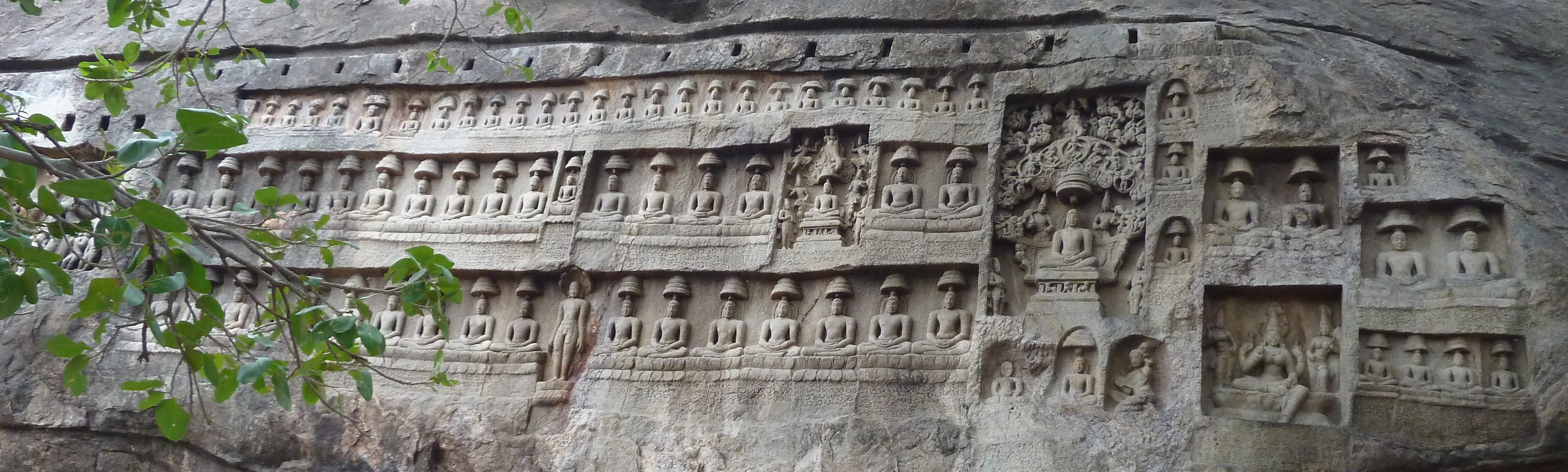
[[File:N-TN-C166 Rock cut Jain Temple Sittannavasal Pudukkottai.jpg|thumb|''Tirthanakara'' images on walls of [[Sittanavasal Cave]]]] | |||
[[File:Jaina abode Kalugumalai.JPG|thumb|[[Kalugumalai Jain Beds]]]] | |||
Further south, Jainism flourished under [[Pandya]] patronage around the 8th-9th centuries in [[Tamil Nadu]].{{cn|date=October 2025}} This era saw the creation of the renowned Jain murals at [[Sittanavasal Cave]], the extensive rock-cut reliefs at [[Kalugumalai Jain Beds|Kalugumalai]], the numerous inscriptions and reliefs at [[Samanar Hills]] near [[Madurai]], and the Jain temple and paintings at [[Armamalai cave]].{{sfn|Joseph|1997|p=151}}{{sfn|Dundas|2002|p=125–126}} Later sites like [[Thirakoil]] (c. 8th c.) and [[Tirumalai (Tamil Nadu)|Tirumalai]] demonstrate continuity with [[Chola]]-era paintings and large sculptures.{{sfn|Ekambaranathan|1987|p=344}} | |||
This architectural development was accompanied by other forms of material culture.{{sfn|Umakant P. Shah|1987|pp=165–168}} The [[Akota]] and [[Vasantgarh bronze hoards]], with images dating from the 5th to 11th centuries, demonstrate a continuous tradition of metal casting.{{sfn|Umakant P. Shah|1987|pp=165–168}} Furthermore, the {{lang|sa|shastra bhandars}} (libraries) of Gujarat from this period preserved the earliest surviving examples of illuminated Jain palm-leaf manuscripts, which are a primary source for the {{lang|sa|Svetambara}} textual and artistic tradition.{{cn|date=October 2025}} | |||
=== | === Ritual Transformation: Tantra and Goddesses === | ||
Between the 6th and 10th centuries, Jainism underwent a significant ritual transformation to compete with the rising popularity of Shaiva and Buddhist esoteric traditions.{{sfn|Qvarnstrom|2000|pp=113–120}} While retaining the core vegetarian ethos, Jain monks incorporated {{lang|sa|Mantra-vada}} (the path of spells) and {{lang|sa|[[Yantra]]}} rituals, fundamentally altering the lay practice.{{sfn|Qvarnstrom|2000|pp=113–120}} | |||
This period saw the elevation of {{lang|sa|Sasanadevis}} (Guardian Goddesses) such as [[Padmāvatī]], [[Ambika (Jainism)|Ambika]], and [[Jwalamalini]].{{sfn|Umakant P. Shah|1987|pp=205–210}} The {{lang|sa|Digambara}} text {{lang|sa|Jvalamalini-kalpa}}, composed by Indranandi in 939 CE under Rashtrakuta patronage, codified rituals for worldly goals—such as subduing rivals and curing disease.{{sfn|Umakant P. Shah|1987|pp=205–210}}{{sfn|Cort|2010|pp=186-187}} Later, the {{lang|sa|Svetambara}} text {{lang|sa|Bhairava-Padmavati-Kalpa}} (c. 11th century) further systematized the worship of Padmavati, blending Jain ethics with {{lang|sa|Tantric}} methodology.{{sfn|Umakant P. Shah|1987|pp=205–210}}{{sfn|Shaw|2006|p=436}} Historian [[Paul Dundas]] notes that this {{lang|sa|Tantricization}} provided a necessary "spiritual safety valve," allowing the lay community to seek worldly protection within the Jain fold rather than converting to other faiths.{{sfn|Dundas|2002|p=214}} | |||
According to | ===The Vedantic Revival and Philosophical Competition=== | ||
According to Jain texts, some of the Hindu gods are blood relatives of legendary ''tirthankara''. Neminatha, the 22nd ''tirthankara'' for example is a cousin of Krishna in Jain Puranas and other texts.{{sfn|Long|2013|p=42}} However, Jain scholars such as [[Haribhadra]] also wrote satires about Hindu gods, mocking them with novel outrageous stories where the gods misbehave and act unethically.{{sfn|Dundas|2002|pp=236–237}}{{sfn|Hinnells|1991|pp=145–146}} The Hindu gods are recorded by some Jain writers as persecuting, tempting, afraid of, or serving a legendary Jina before he gains omniscience. In other stories, the Hindu deities such as [[Vishnu]], or [[Rama]] and [[Sita]] come to pay respect to a Jina at a major Jain pilgrimage site such as Mount Satrunjaya and Mount Sammed Shikhar Ji.{{sfn|Dundas|2002|pp=113–115, 222–223, 236–237}} The languid Hindu scholars rewrote the original pre historic stories into their Hindu versions. According to [[Paul Dundas]], these satires were aimed at the Hindu lay householder community, were means to inculcate piety and subvert the actual religious teachings offered by their Jain neighbors.{{sfn|Dundas|2002|pp=236-237}} True to their origins, Buddhist and Hindu scholars engaged in creating similar satire, mythology and parody-filled fiction targeting the Jains and each other.<ref>{{cite book|author=Naomi Appleton|title=Shared Characters in Jain, Buddhist and Hindu Narrative: Gods, Kings and Other Heroes |url=https://books.google.com/books?id=3QWcDQAAQBAJ |year=2016|publisher=Routledge|isbn=978-1-317-05574-7|pages=17–21, 32–35, 61–69, 86–95, 177}}</ref> The emergence of major philosophical ideas within Hinduism impacted Jainism. According to a 1925 publication by von Glasenapp, around the 8th century CE, [[Adi Shankara]] brought forward the doctrine of [[Advaita]], and either converted Jain temples to Hindu ones or completely destroyed them.{{sfn|Ram Bhushan Prasad Singh|2008|p=81}} The traditions of [[Vaishnavism]] and [[Shaivism]] also began to emerge. This, states von Glasenapp, contributed to a decline of "Jaina church", particularly in South India.{{sfn|von Glasenapp|1925|p=70}} | |||
== | ==The Merchant-State & Marble Age (1000 CE – 1300 CE)== | ||
Jainism | ===The Rise of Guilds and Western Dominance=== | ||
The rapid expansion of Jainism during the Classical Age was driven by a symbiotic relationship between the monastic community ({{lang|sa|Sangha}}) and powerful merchant guilds ({{lang|sa|Srenis}}).{{sfn|Champakalakshmi|1996|pp=206–208, 320–324}} In Western and Southern India, Jain merchants came to dominate trans-regional trade networks, such as the {{lang|sa|Vira Banaju}} and {{lang|sa|Nanadesi}} guilds.{{sfn|Champakalakshmi|1996|pp=206–208, 320–324}} Epigraphic evidence reveals that these guilds frequently levied voluntary taxes (cess) on goods—such as betel leaves, textiles, and precious stones—specifically to fund temple construction and monastic libraries ({{lang|sa|Bhandaras}}).{{sfn|Champakalakshmi|1996|pp=206–208, 320–324}} | |||
= | This economic autonomy translated into immense political leverage, giving rise to the era of the "Merchant-Ministers" ({{lang|sa|Mantris}}).{{sfn|Mukund|1999|pp=26–30}} The most prominent examples were the brothers [[Vastupala]] and Tejapala (ministers to the [[Vaghela dynasty|Vaghela court]]) and the 13th-century shipping magnate [[Jagadu]] Shah.{{sfn|Mukund|1999|pp=26–30}}{{sfn|V. K. Jain|1990|p=238}} These figures utilized their personal wealth to finance state defenses and public works, effectively establishing Jainism as a state-protected religion without needing a Jain monarch on the throne.{{sfn|Mukund|1999|pp=26–30}} Historian [[Kanakalatha Mukund]] notes that this 'Temple Economy' allowed Jain institutions to act as stabilizing financial hubs during feudal conflicts.{{sfn|Mukund|1999|pp=26–30}} | ||
[[ | |||
[[File:Palitana.jpg|thumb|[[Jain temple]]s on [[Shatrunjaya]] hill near [[Palitana]], [[Gujarat]]]] | |||
{{ | In [[Gujarat]] and [[Rajasthan]], this mercantile patronage fueled the "Marble Age," a period characterized by Maru-Gurjara architecture noted for its intricate carving.{{sfn|Cort|1998|p=144}}{{sfn|Umakant P. Shah|1995|p=17}} The [[Dilwara Temples]] at [[Mount Abu]] stand as the primary legacy of this era; the complex includes the [[Vimal Vasahi temple]] (c. 1031 CE) commissioned by Minister [[Vimala Shah]], and the [[Luna Vasahi temple]] (c. 1230 CE) built by Vastupala and Tejapala.{{sfn|Titze|Bruhn|1998|p=143}}{{sfn|Umakant P. Shah|1995|p=17}} Further consolidating this religious infrastructure, the Chaulukya dynasty oversaw the transformation of the [[Shatrunjaya]] hill at [[Palitana]] into a massive "city of temples" and the expansion of the ancient site of [[Girnar]], solidifying the region's status as a primary pilgrimage network ({{lang|sa|tirtha}}).{{sfn|Kailash Chand Jain|2010|p=450}}{{sfn|Dundas|2002|pp=134–135}} This had been noted by the 7th-century Chinese traveler [[Xuanzang]].{{sfn|White|2012|pp=117–18}} | ||
Other dynasties in the region, such as the [[Shilahara dynasty]] (c. 8th–13th century) which ruled the [[Konkan coast]], also served as key patrons, funding temples throughout [[Maharashtra]].{{sfn|Pandurangrao Bhimrao Desai|1957|pp=13–15}}{{sfn|Altekar|1934|pp=204–207}} | |||
{{ | |||
The | ===Influence in Central and Eastern India=== | ||
[[File:Bawanii Gaja of Barwani.jpg|thumb|[[Rishabhanatha]] monolith at [[Bawangaja]]]] | |||
The influence of the merchant community extended well beyond the west, creating a pan-Indian network of artistic patronage.{{sfn|Jaini|1998|p=282}} In the [[Bundelkhand]] region of Central India, the [[Chandela]] rulers commissioned the Jain temples at [[Khajuraho]] (10th–11th century), which share the distinct architectural style of their Hindu counterparts.{{sfn|Jaini|1998|p=282}}{{sfn|Deva|1990|pp=13–15}}{{sfn|Devangana Desai|1996|pp=200–202}} The site of [[Deogarh, Uttar Pradesh|Deogarh]] also remained a vital center, famous for the erection of numerous {{lang|sa|"Sahastrakuta"}} (thousand-Jina) pillars in the 13th century.{{sfn|Jaini|1998|p=283}}{{sfn|Bruhn|1969|pp=9–12}} Further south in the [[Satpura Range]], the faith's prominence is attested by the 12th-century [[Bawangaja]] monolith, an 84-foot statue of Rishabhanatha carved directly into the mountain.{{sfn|Shukla|Kulshreshtha|2019|p=104}}{{sfn|Bond|Wright|2006|p=507}}{{sfn|Titze|Bruhn|1998|p=102, 130}}{{sfn|Kooij|2018|p=160}} | |||
[[File:Views of Shikharji on way to Anantnatha Tonk 3.jpg|thumb|[[Shikharji]] mountain where Jain tradition places {{lang|sa|nirvana}} of 20 out of 24 {{lang|sa|tirthankaras}}]] | |||
This architectural patronage reached Eastern India as well.{{sfn|Kailash Chand Jain|2010|p=452}} In modern [[Jharkhand]], the site of [[Shikharji]] saw the construction of a temple housing twenty {{lang|sa|tirthankara}} idols financed by Vastupala, demonstrating the trans-regional reach of the western merchant-ministers.{{sfn|Kailash Chand Jain|2010|p=452}}{{sfn|Umakant P. Shah|1987|p=98}} | |||
=== | ===Persecution and Resilience=== | ||
While the guilds provided economic stability, the community faced religious and military challenges.{{sfn|Settar|1989|pp=73-74}}{{sfn|Sastri|1976|p=220–221, 358}} In the South, the rise of [[Lingayatism]] and the conversion of the [[Hoysala dynasty|Hoysala king]] [[Vishnuvardhana]] (c. 1108 CE) to [[Vaishnavism]] posed significant threats.{{sfn|Settar|1989|pp=73-74}}{{sfn|Sastri|1976|p=220–221, 358}} However, scholars note that his queen, Shantaladevi, and his general, Gangaraja, remained devout Jains, ensuring continued state patronage despite the monarch's personal conversion.{{sfn|Sastri|1976|pp=220–221}}{{sfn|Kamath|2001|p=125}}{{sfn|Settar|1989|pp=73-74}} Gangaraja, under the guidance of his spiritual teacher Subhachandra, launched campaigns to restore Jain temples, and the era even saw female generals like Jakkiyabbe commanding respect.{{sfn|Tukol|1980|p=31}}{{sfn|Sastri|1976|pp=220–221}}{{sfn|Kamath|2001|p=125}}{{sfn|Settar|1989|pp=73-74}} However, sectarian conflict persisted; British-era scholar [[Helmuth von Glasenapp]] notes that during the 11th century, [[Basava]], a minister to the [[Kalachuris of Kalyani|Kalachuri king]] [[Bijjala II]], converted numerous Jains to Lingayatism, with legends describing the destruction or conversion of Jain temples to [[Shaivite]] use.{{sfn|Zydenbos|2006|p=177}} | |||
Simultaneously, the [[Muslim conquests on the Indian subcontinent|Islamic invasions]] by [[Mahmud Ghazni]] (1001 CE) and [[Mohammad Ghori]] (1175 CE) caused significant disruption, including the destruction of temples and pilgrimage centers.{{sfn|Dundas|2002|pp=124, 145-146}} This existential threat prompted Jain scholars like Jinadatta Suri to reinterpret the doctrine of {{lang|sa|[[Ahimsa]]}} (non-violence), arguing that fighting in self-defense to protect the faith did not constitute a loss of merit.{{sfn|Dundas|2002|pp=162}} Despite these pressures, monastic activity continued in defensible locations, such as the rock-cut caves of [[Mangi-Tungi]] (c. 12th century), which feature a large collection of {{lang|sa|tirthankara}} sculptures.{{sfn|Qureshi|2010|pp=310–312}} Jain monasticism also utilized large natural cave systems, as evidenced by the [[Belum Caves]] in [[Andhra Pradesh]], where archaeological finds confirm a long period of occupation.{{sfn|Jawaharlal|1994|pp=88–92}} | |||
==Diplomacy in the Sultanate & Mughal Era (1300 CE – 1650 CE)== | |||
=== | ===Crisis and Resilience: Gwalior and Ranakpur=== | ||
[[File:The Rock-cut Jain monuments of Gwalior (Urvai Group).jpg|thumb|The Rock-cut Jain monuments of [[Gwalior]]]] | |||
The medieval period was marked by a dual strategy of retreat into fortified locations and the construction of grand architectural statements.{{sfn|Titze|Bruhn|1998|p=106}} The [[Gwalior Fort]] became a major center for {{lang|sa|Digambara}} Jainism, housing nearly 100 rock-cut monuments created between the 14th and 15th centuries.{{sfn|Titze|Bruhn|1998|p=106}} Inscriptions credit the [[Tomaras of Gwalior|Tomara kings]] (1440–1453 CE) for these excavations, which include the massive Siddhachal and [[Gopachal rock-cut Jain monuments|Gopachal]] colossi.{{sfn|Titze|Bruhn|1998|p=106}} While the [[Siddhachal caves]] were completed by 1473 CE, many of these statues were defaced around 1527 on the orders of the [[Mughal emperor]] [[Babur]].{{sfn|Titze|Bruhn|1998|p=101–102, 108}}{{sfn|Kailash Chand Jain|2010|p=535}}{{sfn|Ring|Watson|Schellinger|2012|p=314}} | |||
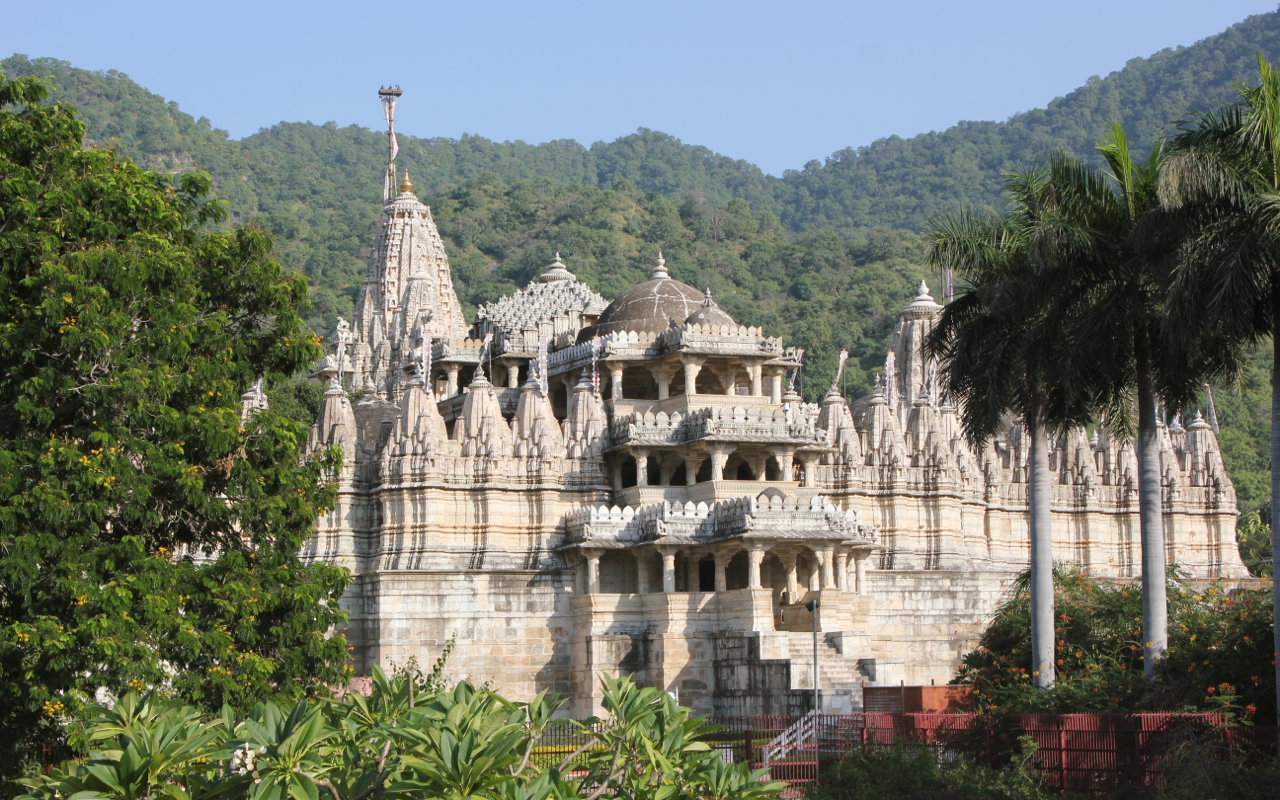
[[File:Chaumukha Jain temple at Ranakpur in Aravalli range near Udaipur Rajasthan India.jpg|thumb|Chaumukha Jain Temple at [[Ranakpur]] in Aravalli range near [[Udaipur]], [[Rajasthan]]]] | |||
In Rajasthan, the community responded to political instability by building the fortress-like [[Ranakpur Jain Temple]] in the [[Aravalli range]].{{sfn|Sehdev Kumar|2001|pp=96–98}} Built in the 15th century under the patronage of [[Dharna Shah]], a wealthy Jain minister, this temple reflects a continuation of the Western Indian style.{{sfn|Sehdev Kumar|2001|pp=96–98}} It features a complex {{lang|sa|Chaumukha}} (four-faced) plan and is renowned for its hall of 1,444 carved pillars, of which no two are identical.{{sfn|Sehdev Kumar|2001|pp=96–98}} | |||
The [[ | === Institutional Survival: The {{lang|sa|Bhattaraka}} Tradition === | ||
During the medieval period, particularly from the 14th century onwards, the {{lang|sa|Digambara}} tradition developed a specialized clerical class known as the {{lang|sa|[[Bhattaraka]]s}}.{{sfn|Dundas|2002|pp=123–125}} Unlike the traditional naked monks ({{lang|sa|Munis}}) who were bound by strict vows of homelessness and non-possession, {{lang|sa|Bhattarakas}} were pontiffs who wore orange robes, resided in permanent monasteries ({{lang|sa|Mathas}}), and managed the community's temporal assets.{{sfn|Dundas|2002|pp=123–125}} | |||
The {{lang|sa|Bhattarakas}} served as the 'Institutional Shield' for the community during the [[Delhi Sultanate]] and Mughal eras.{{sfn|Johrapurkar|1958|pp=12–15}} Because naked ascetics could not legally sign treaties or hold land titles, the {{lang|sa|Bhattarakas}} acted as the legal heads of the religion, negotiating with rulers to protect temples and managing the vast Jain {{lang|sa|Bhandaras}} (libraries).{{sfn|Johrapurkar|1958|pp=12–15}} The seats of the {{lang|sa|Bhattarakas}}, such as at Shravanabelagola, [[Moodabidri]], and Delhi, became centers of literary preservation, ensuring the survival of ancient texts like the {{lang|sa|Shatkhandagama}} and the {{lang|sa|Dhavala}} commentaries.{{sfn|Johrapurkar|1958|pp=12–15}} | |||
The | |||
=== | ===Competition and Persecution=== | ||
Jainism faced persecution during Lingayat movements in Telugu and Kannada speaking territories like [[Wodeyar]] of Mysore and Ummatur (1399–1610), Nayaks of Keladi (1550–1763).{{sfn|von Glasenapp|1925|p=71}} In 1683, they stamped the [[lingam]] symbol in the main temple complex of Jains in [[Halebidu]]. Digambaras were forced to perform Shaiva rites.{{sfn|von Glasenapp|1925|p=72}} | |||
Jainism | After the 12th century, the temples, pilgrimage and ''Digambara'' tradition of Jainism suffered persecution during the Muslim rule, with the exception of [[Akbar]] whose respect for [[Hiravijaya]] and support for Jainism led to a temporary ban on animal killing during the Jain religious festival of [[Paryushana]].{{sfn|Dundas|2002|pp=145-146, 124, 220-221}} Akbar (1542{{nsndns}}1605), influenced by the Śvetāmbara monk Hiravijaya, ordered the release of caged birds and banned the killing of animals during the Jain festival of Paryushana.{{sfn|Dundas|2002|p=146}} Following the reign of Akbar, the community navigated a more volatile political landscape.{{sfn|Dundas|2002|pp=146-149, 220-221}} While Jains faced periods of persecution in the 16th century, their scholars actively engaged in inter-religious dialogue.{{sfn|Dundas|2002|pp=146-149, 220-221}}{{sfn|Dundas|1999|pp=37-38}} The Jain monk Hiravijaya Suri debated religious ideas with Mughal scholars, asserting that while [[Islam]] and Jainism differed, the Jain principle of {{lang|sa|Ahimsa}} (compassion) could complement imperial governance.{{sfn|Truschke|2016|pp=35–37}} Jain texts from this period continue to praise Akbar for his religious tolerance and the issuance of decrees protecting Jain pilgrimage sites.{{sfn|Truschke|2016|pp=35–37}} | ||
===Financial Diplomacy and the Merchant-State=== | |||
Following the reign of Akbar, the community navigated a more volatile political landscape by leveraging the immense economic power of its lay merchants ({{lang|sa|Sravakas}}).{{sfn|Bayly|1983|p=389–390}} This period saw the rise of "Financial Diplomacy," where Jain merchants acted as bankers to the empire, securing religious protection in exchange for economic stability.{{sfn|Makrand Mehta|1991|p=67}} | |||
A noted general and minister, [[Bhamashah]] (1547–1600) was a close aide to [[Maharana Pratap]] of [[Mewar]].{{sfn|G. N. Sharma|1962|p=112}}{{sfn|Sharma|Mathur|1989|p=62}} The financial support provided by him—famously liquidating his private fortune—helped Maharana Pratap to restore his army and reclaim much of his lost territory, establishing the Jain ethos of philanthropic patriotism.{{sfn|G. N. Sharma|1962|pp=114, 120–125}} | |||
Based in [[Surat]], [[Virji Vora]] (c. 1590–1670) was described as the wealthiest merchant of his time, holding a monopoly on the spice trade.{{sfn|Makrand Mehta|1991|p=70}} He frequently financed the British [[East India Company]] and Mughal governors, acting as a stabilizing economic force in Western India.{{sfn|Makrand Mehta|1991|p=70}} | |||
The first {{lang|sa|Nagarsheth}} (City Merchant Chief) of Ahmedabad, [[Shantidas Jhaveri]] (c. 1580–1659) was a jeweler to the Mughal court.{{sfn|Commissariat|1957|p=142}} He utilized his influence with Emperor [[Shah Jahan]] to secure imperial decrees ({{lang|sa|firmans}}) that restored the Chintamani Parsvanath temple and granted Jains control over the pilgrimage site of [[Palitana]].{{sfn|Commissariat|1957|p=142}} | |||
Migrating from Rajasthan to Patna, [[Hiranand Sahu]] laid the foundation for the banking dynasty that would later become known as the House of [[Jagat Seth]], which eventually controlled the imperial mints and treasury of Bengal.{{sfn|Little|1967|p=18}} | |||
==The Reformation & Pre-Modern Identity (1650 CE – 1850 CE)== | |||
===The Internal Reformation: Iconoclasm and Purism=== | |||
By the mid-17th century, the Jain civilization underwent a period of intense internal scrutiny, leading to movements that challenged established ritualism.{{sfn|Dundas|2002|pp=249–253}} In the {{lang|sa|Śvetāmbara}} tradition, a scripturalist movement initiated by the 15th-century scribe [[Lonka Shah]] crystallized into the {{lang|sa|[[Sthanakvasi]]}} sect (c. 1653 CE).{{sfn|Dundas|2002|pp=249–253}} This group rejected idol worship entirely, arguing that temple rituals were later accretions not found in the original {{lang|sa|Agamas}}.{{sfn|Dundas|2002|pp=249–253}} This reformist trend continued with the founding of the {{lang|sa|[[Śvetāmbara Terapanth]]}} sect (c. 1760 CE) by [[Acharya Bhikshu]], who established a strict hierarchical monastic order focused on ascetic discipline rather than temple management.{{sfn|Flugel|2006|pp=319–320}} | |||
Parallel to this, the {{lang|sa|Digambara}} community in North India saw the rise of the {{lang|sa|Adhyatma}} (Spiritual) movement in [[Jaipur]], led by the layman scholar [[Pandit Todarmal]] (1719–1766).{{sfn|Jaini|1998|pp=312–313}} Leading a revolt against the {{lang|sa|Bhattarakas}} (land-owning clerics) whom he accused of corruption and lax conduct, Todarmal advocated for a return to doctrine and direct soul-realization.{{sfn|Jaini|1998|pp=312–313}} His magnum opus, {{lang|sa|Mokshamarga Prakashak}} (Illuminator of the Path to Liberation), remains a foundational text for modern {{lang|sa|Digambara}} theology, emphasizing education over ritual prowess.{{sfn|Jaini|1998|pp=312–313}} | |||
{{ | |||
In | ===Crisis and Diplomacy in the Late Mughal Era=== | ||
In the [[Punjab region]], the community built strategic alliances with the rising Sikh power.{{sfn|Sangat Singh|2001|p=88}} [[Diwan Todar Mal]] (distinct from the Jaipur scholar [[Pandit Todarmal]]) was an {{lang|sa|[[Oswal]] Śvetāmbara}} Jain who served as the {{lang|sa|[[Dewan]]}} in the court of Wazir Khan, the Mughal Governor of [[Sirhind]].{{sfn|Sangat Singh|2001|p=88}} He is revered in [[Sikh history]] for his act of defiance and devotion in 1704 CE following the execution of the [[Sahibzada]]s (the young sons of [[Guru Gobind Singh]]) and the death of [[Mata Gujri]].{{sfn|Sangat Singh|2001|p=88}} | |||
According to | According to tradition, authorities refused to provide land for their cremation unless Todar Mal covered the required ground with gold coins ({{lang|sa|ashrafis}}) placed vertically.{{sfn|Dilgeer|1997|p=192}} He paid this exorbitant price—often cited as the costliest land purchase in history—to perform the last rites.{{sfn|Dilgeer|1997|p=192}} While modern historians note that Todar Mal may have died prior to this event and the act was likely performed by his descendants, the legend remains a potent symbol of Jain-Sikh solidarity.{{sfn|Dilgeer|1997|p=192}} His family eventually lost their status and wealth due to the wrath of Wazir Khan, but their residence ({{lang|sa|haveli}}) was famously spared destruction by [[Banda Singh Bahadur]] and later Sikh rulers out of respect for his sacrifice.{{sfn|Dilgeer|1997|p=192}} | ||
[[ | ===The Financial Zenith: The House of Jagat Seth=== | ||
In the 18th century, the political power of the Jain merchant class peaked with the House of [[Jagat Seth]] (Marwari-Oswal bankers) in Bengal.{{sfn|Dalrymple|2019|pp=74–75, 78–80}} The title Jagat Seth ('Banker of the World') was conferred by the Mughal Emperor, signifying their dominance over the imperial treasury.{{sfn|Dalrymple|2019|pp=74–75, 78–80}} | |||
Historian [[William Dalrymple]] notes that this Jain family controlled the minting of coins and held capital reserves that exceeded those of the [[Bank of England]] at the time.{{sfn|Dalrymple|2019|pp=74–75, 78–80}} Their financial support was pivotal in the rise of the British [[East India Company]].{{sfn|Little|1967|pp=8–12}} The Jagat Seths, alienated by the policies of the [[Nawab of Bengal]], financed the forces of [[Robert Clive]] before the [[Battle of Plassey]] (1757), effectively facilitating the transition from Mughal to [[British rule]] in Eastern India.{{sfn|Dalrymple|2019|pp=120–122}}{{sfn|Little|1967|pp=8–12}}{{sfn|Makrand Mehta|1991|pp=137–139}} | |||
==Modern Renaissance & Law (1850 CE – 1947 CE)== | |||
===Colonial Encounter and the Merchant Princes=== | |||
[[File:Acharya Shantisagar.jpg|thumb|Image of [[Shantisagar]], a {{lang|sa|Digambara}} Jain monk]] | |||
The British colonial rule era, according to von Glasenapp in 1925, allowed Jains to pursue their religion without persecutions they had faced before.{{sfn|von Glasenapp|1925|pp=83-84}} Further, the British government promoted trade, which allowed members of the Jain community to pursue their traditional economic activity.{{sfn|von Glasenapp|1925|pp=83-84}} According to von Glasenapp, Jain businessmen and Jainism thrived during this period, and they used their financial success during the British Raj to rebuild Jain temples.{{sfn|von Glasenapp|1925|pp=83-84}} For example, the Dharmanatha temple was built in Ahmedabad (Gujarat) in 1848.{{sfn|von Glasenapp|1925|pp=83-84}} | |||
This era saw the rise of merchant princes like [[Premchand Roychand]] (1831–1906), the "Cotton King" of Bombay, who founded the [[Bombay Stock Exchange]] and financed the [[University of Mumbai]]'s [[Rajabai Clock Tower]].{{sfn|Dwivedi|2006|pp=35–42}} Similarly, in Central India, [[Seth Hukamchand]] (1874–1959) utilized his industrial wealth to construct the Kanch Mandir in Indore and sponsor the publication of ancient scripture.{{sfn|Kailash Chand Jain|2010|p=535}} | |||
The British census reported a drop in Jain population between 1891 and 1921, from 1.417 million to 1.179 million.{{sfn|Kelting|2001|pp=13–14}}{{sfn|Brown|Foot|2016|pp=2–4}} This may be from the Jain conversions to Hinduism and causes such as famines and epidemics.{{sfn|Kelting|2001|pp=13–14}}{{sfn|Brown|Foot|2016|pp=2–4}} [[M. Whitney Kelting]] in 2001 states, in contrast, that in Gujarat and Maharashtra, British merchants actually took over the trades that Jains traditionally engaged in.{{sfn|Kelting|2001|pp=13–14}} This was in part responsible for major Jain community migrations during the British colonial era.{{sfn|Kelting|2001|pp=13–14}} | |||
The British colonial government in India, as well as Indian princely states, passed laws that made monks roaming naked in streets a crime, one that led to arrest.{{sfn|Flugel|2006|pp=348–349}} This law particularly impacted the {{lang|sa|Digambara}} tradition monks.{{sfn|Flugel|2006|pp=348–349}} The {{lang|sa|Akhil Bharatiya Digambara Jaina Samaj}} opposed this law, and argued that it interfered with the religious rights of {{lang|sa|Digambaras}}. [[Digambara monk]] [[Shantisagar]] entered Bombay (now Mumbai) in 1927, but was forced to cover his body.{{sfn|Flugel|2006|pp=348–349}} He then led an India-wide tour as the naked monk with his followers, to various {{lang|sa|Digambara}} sacred sites, and he was welcomed by kings of the Maharashtra provinces.{{sfn|Flugel|2006|pp=348–349}}{{sfn|Carrithers|Humphrey|1991|pp=200–202}} Shantisagar fasted to oppose the restrictions imposed on {{lang|sa|Digambara}} monks by [[British Raj]] and demanded their discontinuance.{{sfn|Natubhai Shah|2004|p=56}} The colonial-era laws that banned naked monks were abolished only after India gained independence.{{sfn|Flugel|2006|pp=359–360}} | |||
===Academic Recognition=== | |||
[[British Raj|British era]] Christian invaders wrote about Jainism, but typically stereotyping it as "a coldly austere religion of pure asceticism, with no 'heart', preoccupied only with not harming microorganisms".{{sfn|Long|2013|pp=99–100}} The discussion emphasized the ascetic extremes, rather than the values.{{sfn|Long|2013|pp=99–100}} They criticized the Jain theories on non-violence stating that this value is essentially equal to "doing nothing", because it entails not "hurting" other beings, but does not demand the "positive ethic of helping someone suffering".{{sfn|Long|2013|pp=99–100}} According to [[Jeffery D. Long]], these missionary writings were a distortion of Jain theology because Jainism does teach, value and has a historic record of charity, and compassion is an essential value in Jainism for spiritual development.{{sfn|Long|2013|pp=99–100}} | |||
Some Christian writers critiqued Jainism for its cosmology, with extraordinary time scales and cyclic time periods.{{sfn|Long|2013|p=180}} However, Long states, the genesis theories in Christianity and other religions suffer from equivalent issues and they present the world to have been created few thousand years ago, in a short period of time.{{sfn|Long|2013|p=180}} Similarly, historic Christian writers critiqued the lack of "saving grace" in Jainism.{{sfn|Long|2013|p=180}} For example, Sinclair Stevenson wrote in 1915 that the "heart of Jainism was empty because it lacked the saving grace of Jesus".{{sfn|Long|2013|p=180}} | |||
===Industrialization and Nation Building=== | |||
As the independence movement gained momentum, prominent Jain families pivoted from trade to heavy industry and institution building.{{sfn|Piramal|1999|pp=165–170}} [[Walchand Hirachand]] (1882–1953) pioneered India's indigenous shipping ([[Scindia Steam]]), aviation ([[Hindustan Aeronautics Limited]]), and automobile ([[Premier Automobiles Limited]]) sectors, challenging British commercial monopolies.{{sfn|Piramal|1999|pp=165–170}} In Ahmedabad, the [[Sarabhai family|Sarabhai]] and [[Lalbhai]] families, led by [[Ambalal Sarabhai]] and [[Kasturbhai Lalbhai]], played a dual role: they modernized the textile industry while financing national institutions like the [[Indian Institute of Management]] (IIM) and the [[Physical Research Laboratory]] (PRL).{{sfn|Tripathi|2004|pp=280–285}} [[Sahu Shanti Prasad Jain]] (1911–1977) expanded into media, acquiring [[The Times of India]] group and establishing the [[Bharatiya Jnanpith]] to promote Indian literature.{{sfn|Tripathi|2004|p=290}} These figures marked a shift in community philanthropy from traditional charity to building the secular infrastructure of modern India.{{sfn|Tripathi|2004|pp=280–285}} | |||
===Monastic Revivals and Reform Movements=== | |||
[[File:Srimad Rajcandra.jpg|thumb|[[Shrimad Rajchandra]], Jain monk and spiritual teacher of [[Mahatma Gandhi]] in [[Lotus position]]]] | |||
[[Shrimad Rajchandra]] was inspired by works of [[Kundakunda]] and [[Digambara]] mystical tradition. Nominally belonging to the Digambara tradition, his followers sometimes consider his teaching as a new path of Jainism, neither [[Śvetāmbara]] nor [[Digambara]], and revere him as a saint.{{sfn|Prakash Chand Jain|2011|p=7,9}} His path is sometimes referred as ''Raj Bhakta Marg'', ''Kavipanth'', or ''Shrimadiya'', which has mostly lay followers as was Rajchandra himself.<ref>Salter, Emma (2002) ''Raj Bhakta Marg: the path of devotion to Srimad Rajcandra. A Jain community in the twenty first century.'' Doctoral thesis, University of Wales.</ref> His teachings influenced [[Kanji Swami]], [[Dada Bhagwan]],<ref>{{Cite book|url=http://eprints.soas.ac.uk/7438/1/Present_Lord_2003.pdf|title=Present Lord: Simandhara Svami and the Akram Vijnan Movement|last=Flügel|first=Peter|work=The Intimate Other: Love Divine in the Indic Religions|publisher=Orient Longman|year=2005|isbn=9788125028017|editor-last=King|editor-first=Anna S.|location=New Delhi|pages=194–243|editor-last2=Brockington|editor-first2=John}}</ref> [[Rakesh Jhaveri]], [[Saubhagyabhai|Saubhagbhai]], [[Lalluji Muni|Lalluji Maharaj]] (Laghuraj Swami), Atmanandji and several other religious figures. Some of them established temples and institutions in his dedication and to spread his teachings. Such temples often house his pictures and images based on photographs taken in a studio in various meditation postures just a month before his death.<ref name="Jainpedia">{{cite web | title=Rājacandra | website=Jainpedia|first=Jérôme|last=Petit| date=2016 | url=http://www.jainpedia.org/themes/people/studying-jainism/rajacandra.html | access-date=9 January 2017}}</ref> Shrimad Rajchandra's teachings have been popular in the Jain diaspora communities; mostly in [[Jainism in Africa|East Africa]], the [[Jainism in the United Kingdom|United Kingdom]] and [[Jainism in the United States|North America]].{{cn|date=October 2025}} Bauer notes that "[in] recent years there has been a convergence of the Kanji Swami Panth and the Shrimad Rajcandra movement, part of trend toward a more eucumenical and less sectarian Jainism among educated, mobile Jains living overseas."{{sfn|Bauer|2004|p=465}} A special cover featuring him and [[Rabindranath Tagore]] was published by the [[India Post]] on occasion of [[Gandhi Jayanti]] in 2002.<ref>{{cite web | title=Shrimad Rajchandra Archives | website=Indian Stamp Ghar | date=6 April 2014 | url=http://www.indianstampghar.com/tag/shrimad-rajchandra/ | archive-url=https://web.archive.org/web/20170108183533/http://www.indianstampghar.com/tag/shrimad-rajchandra/ | url-status=usurped | archive-date=8 January 2017 | access-date=8 January 2017}}</ref> | |||
{{lang|sa|Kshullak}} [[Ganeshprasad Varni]] (1874–1961) was a foundational figure of the modern {{lang|sa|Digambara}} intellectual revival.{{sfn|Prakash Chand Jain|2011|pp=108–110}} He established several institutions for advanced learning, most notably the {{lang|sa|Syadvad Mahavidyalaya}} at Varanasi in 1905, which reintroduced traditional Jain logic and philosophy into the modern university curriculum.{{sfn|Prakash Chand Jain|2011|pp=108–110}} His efforts, along with those of other reformers, were instrumental in standardizing Jain education in the post-independence era.{{sfn|Cort|2001a|p=229}} | |||
==Post-Independence & Global Diaspora (1947 CE – Present)== | |||
Following the independence of India in 1947, the Jain community transitioned from navigating colonial legal frameworks to establishing a distinct identity within a secular democracy and expanding as a global diaspora. This period is characterized by legal institutionalization, professional scaling of philanthropic networks, and the universalization of Jain ethics. Some of the other prominent monks of modern era include [[Gyansagar]] and [[Acharya Vidyasagar]], [[Tarun Sagar]] and [[Vidyananda]].<ref>{{cite news|url=https://www.indiatoday.in/magazine/religion/story/20021125-aggressive-movement-to-revive-jainism-sweeps-central-india-794269-2002-11-25 |title=Aggressive movement to revive Jainism sweeps central India |first=Neeraj |last=Mishra |newspaper=[[India Today]] |date=25 November 2002 |access-date=24 September 2018 |archive-url=https://web.archive.org/web/20180925025751/https://www.indiatoday.in/magazine/religion/story/20021125-aggressive-movement-to-revive-jainism-sweeps-central-india-794269-2002-11-25 |archive-date=25 September 2018 |url-status=live}}</ref> | |||
===Legal Identity and Constitutional Recognition=== | |||
The post-independence era began with a complex legal negotiation regarding Jain identity within the new Indian state.{{sfn|Long|2013|pp=65–67}}{{sfn|Wiley|2009|pp=138–140}} Under [[Article 25]] of the [[Constitution of India]], Jains were historically grouped with Hindus for personal law purposes, a classification that scholars note created a "legal invisibility" for the distinct religious tradition.{{sfn|Long|2013|pp=65–67}}{{sfn|Wiley|2009|pp=138–140}} This led to a multi-decade political campaign for recognition as a distinct religious minority.{{sfn|Flugel|2012|p=975}}{{sfn|Long|2013|pp=70–72}} Scholarly analysis of the movement highlights that the eventual notification of Jains as a [[National Minority]] in 2014 was not merely a symbolic victory but a strategic acquisition of rights to manage educational institutions and religious trusts independently of state-led "Hindu" boards.{{sfn|Flugel|2012|p=975}}{{sfn|Long|2013|pp=70–72}} | |||
===Global Diaspora and the "{{lang|sa|Samanvaya}}" Model=== | |||
A significant wave of migration starting in the 1960s established robust Jain communities in the United Kingdom, North America, and East Africa.{{sfn|Vallely|2002|pp=12–15}} Sociological studies of these communities observe a strategic shift from the rigid sectarianism of the Indian heartland to a "Non-Sectarian" ({{lang|sa|Samanvaya}}) model.{{sfn|Long|2013|pp=182–184}}{{sfn|Banks|1991|pp=240–245}} This model prioritized community cohesion over {{lang|sa|Digambara}} or {{lang|sa|Śvētāmbara}} distinctions to sustain institutional growth in a foreign context.{{sfn|Long|2013|pp=182–184}}{{sfn|Banks|1991|pp=240–245}} The construction of monumental marble temples abroad, most notably the Jain Centre in [[Leicester]], serves as a primary legacy of this era, acting as a cultural anchor for the second and third generations of the diaspora.{{sfn|Flugel|2012|pp=978–980}} | |||
===Modern Institutional Reform and Digitization=== | |||
The late 20th century saw the professionalization of Jain mercantile influence through international networking bodies.{{sfn|Cort|2001a|pp=188–192}} These organizations applied modern corporate governance and venture capital models to traditional community philanthropy, focusing on economic empowerment and social mobility.{{sfn|Cort|2001a|pp=188–192}} Parallel to this economic scaling, the community initiated a massive technological project to preserve the "Version Control" of its literary heritage.{{sfn|Umakant P. Shah|1987|pp=19–20}}{{sfn|Wiley|2009|pp=145–147}} Scholarly accounts of the "National Mission for Manuscripts" and private initiatives detail the digitization of thousands of palm-leaf and paper documents from ancient {{lang|sa|Bhandaras}}, ensuring the survival of the Jain canon in the digital era.{{sfn|Umakant P. Shah|1987|pp=19–20}}{{sfn|Wiley|2009|pp=145–147}} | |||
===Environmental Ethics and Contemporary Pluralism=== | |||
In the 21st century, Jainism has pivoted toward a global dialogue on ecology and bioethics.{{sfn|Chapple|2002|pp=117–120}}{{sfn|Vallely|2002|pp=192–195}} Scholars of religion have identified the ancient doctrine of {{lang|sa|Parasparopagraho Jivanam}} (interdependence) as a foundational framework for modern "Green Jainism," which promotes sustainability and animal rights as modern iterations of {{lang|sa|Ahimsa}}.{{sfn|Chapple|2002|pp=117–120}}{{sfn|Vallely|2002|pp=192–195}} Furthermore, the doctrine of {{lang|sa|Anekantavada}} (non-absolutism) is increasingly cited in academic circles as a sophisticated philosophical tool for conflict resolution and pluralism.{{sfn|Sethia|2004|pp=123–125}} Contemporary research also explores the intersections between Jain cosmology and modern physics, positioning the tradition's metaphysics as relevant to current scientific and ethical debates.{{sfn|Long|2013|pp=204–206}} | |||
==See also== | ==See also== | ||
{{Portal|History|Religion | |||
}} | |||
* [[Jain cosmology]] | * [[Jain cosmology]] | ||
* [[ | * [[Timeline of Jainism]] | ||
* [[History of Buddhism]] | |||
* [[History of Hinduism]] | |||
==Notes== | ==Notes== | ||
| Line 157: | Line 298: | ||
===Sources=== | ===Sources=== | ||
* {{citation |last=Balcerowicz |first=Piotr |title=Early Asceticism in India: Ājīvikism and Jainism | year=2015 |edition=1st |publisher=[[Routledge]] | url = https://books.google.com/books?id=nfOPCgAAQBAJ |isbn= 9781317538530 }} | {{Refbegin|30em}} | ||
* {{citation |last=Adiga |first=Malini |author-link=Malini Adiga |title=The Making of Southern Karnataka: Society, Polity and Culture in the early medieval period, AD 400–1030 |year=2006 |publisher=Orient Longman |location=Chennai |isbn= 81-250-2912-5 }} | |||
* {{citation |last=Ali |first=B. Sheikh |title=History of the Western Gangas |year=1976 |publisher=University of Mysore }} | |||
* {{citation |last=Altekar |first=Anant Sadashiv |author-link=Anant Sadashiv Altekar |title=The Rashtrakutas And Their Times; being a political, administrative, religious, social, economic and literary history of the Deccan during C. 750 A.D. to C. 1000 A.D |year=1934 |publisher=Oriental Book Agency |location=Poona |oclc=3793499 }} | |||
* {{citation |last=Asher |first=F.M. |title=The Art of Eastern India: 300 - 800 |publisher=University of Minnesota Press |year=1980 |isbn=978-1-4529-1225-7 |url=https://books.google.com/books?id=d-gGxzx6wxIC }} | |||
* {{citation |last=Balcerowicz |first=Piotr |title=Early Asceticism in India: Ājīvikism and Jainism | year=2015 |edition=1st |publisher=[[Routledge]] |url=https://books.google.com/books?id=nfOPCgAAQBAJ |isbn= 9781317538530 }} | |||
* {{citation |last=Banks |first=Marcus |title=Organizing Jainism in India and England |year=1991 |publisher=Clarendon Press |isbn=978-0-19-827388-2 }} | |||
* {{citation |last=Barua |first=Beni Madhab |title=The Ajivikas |url=https://archive.org/details/ajivikas00barurich |date=5 May 2010 |publisher=General Books |isbn=978-1-152-74433-2 }} | * {{citation |last=Barua |first=Beni Madhab |title=The Ajivikas |url=https://archive.org/details/ajivikas00barurich |date=5 May 2010 |publisher=General Books |isbn=978-1-152-74433-2 }} | ||
* {{citation |last=Basham |first=A.L. |title=History and Doctrines of the Ājīvikas | year=1951 |edition=2nd |publisher=Moltilal Banarsidass (Reprint: 2002) |location=Delhi, India | url = https://books.google.com/books?id=BiGQzc5lRGYC |isbn= 81-208-1204-2 |quote=originally published by Luzac & Company Ltd., London, 1951 }} | * {{citation |last=Basham |first=A.L. |title=History and Doctrines of the Ājīvikas | year=1951 |edition=2nd |publisher=Moltilal Banarsidass (Reprint: 2002) |location=Delhi, India |url=https://books.google.com/books?id=BiGQzc5lRGYC |isbn=81-208-1204-2 |quote=originally published by Luzac & Company Ltd., London, 1951 }} | ||
* {{citation |last=Bauer |first=Jerome |title=The Convergence of the Kanji Swami Panth and the Shrimad Rajcandra Movement |year=2001 }} | |||
* {{citation |last=Bayly |first=C.A. |title=Rulers, Townsmen and Bazaars: North Indian Society in the Age of British Expansion |year=1983 |publisher=Cambridge University Press }} | |||
* {{citation |last=Bentley |first=Jerry |author-link=Jerry Bentley |title=Old World Encounters: Cross-Cultural Contacts and Exchanges in Pre-Modern Times |publisher=Oxford University Press |year=1993 }} | |||
* {{citation |last=Beversluis |first=Joel Diederik |title=Sourcebook of the World's Religions: An Interfaith Guide to Religion and Spirituality |year=2000 |publisher=[[New World Library]] |location=Novato, CA |isbn=1-57731-121-3 }} | * {{citation |last=Beversluis |first=Joel Diederik |title=Sourcebook of the World's Religions: An Interfaith Guide to Religion and Spirituality |year=2000 |publisher=[[New World Library]] |location=Novato, CA |isbn=1-57731-121-3 }} | ||
* {{citation |last1=Bilimoria |first1=Puruṣottama |last2=Prabhu |first2=Joseph |last3=Sharma |first3=Renuka M. |title=Indian Ethics: Classical traditions and contemporary challenges |url=https://books.google.com/books?id=g78Cw4xQmsMC |volume=1 |year=2007|publisher=Ashgate Publishing Ltd |isbn=978-0-7546-3301-3 }} | * {{citation |last=Bhandarkar |title=Annals of the Bhandarkar Oriental Research Institute |url=https://books.google.com/books?id=519jAAAAMAAJ |publisher=Bhandarkar Oriental Research Institute |date=1978 }} | ||
* {{citation |last=Bloomfield |first=Maurice |title=A Vedic Concordance: Being an Alphabetic Index to Every Line of Every Stanza of the Published Vedic Literature and to the Liturgical Formulas Thereof|url=https://books.google.com/books?id=W5dEAQAAMAAJ |year=1906|publisher=[[Harvard University Press]] |isbn=9788120806542 }} | * {{citation |last=Bhandarkar |first=D. R. |title=Some Aspects of Ancient Indian Culture |publisher=University of Madras |date=1940 }} | ||
* {{citation | | * {{citation |last1=Bilimoria |first1=Puruṣottama |last2=Prabhu |first2=Joseph |last3=Sharma |first3=Renuka M. |title=Indian Ethics: Classical traditions and contemporary challenges |url=https://books.google.com/books?id=g78Cw4xQmsMC |volume=1 |year=2007 |publisher=Ashgate Publishing Ltd |isbn=978-0-7546-3301-3 }} | ||
* {{citation |last=Bloomfield |first=Maurice |title=A Vedic Concordance: Being an Alphabetic Index to Every Line of Every Stanza of the Published Vedic Literature and to the Liturgical Formulas Thereof|url=https://books.google.com/books?id=W5dEAQAAMAAJ |year=1906 |publisher=[[Harvard University Press]] |isbn=9788120806542 }} | |||
* {{citation |last=Boesche |first=Roger |author-link=Roger Boesche |title=The First Great Political Realist: Kautilya and His Arthashastra |url=https://books.google.com/books?id=K85NA7Rg67wC |year=2003 |publisher=[[Lexington Books]] |isbn=978-0-7391-0607-5 }} | |||
* {{citation |last1=Bond |first1=J. W. |last2=Wright |first2=Arnold |author-link2=Arnold Wright |title=Indian States: A Biographical, Historical, and Administrative Survey |url={{Google books|47sfj8DUwNgC|plainurl=yes}} |year=2006 |orig-year=1922 |publisher=[[Asian Educational Services]] |isbn=978-8120619654 }} | |||
* {{citation |last=Bronkhorst |first=Johannes |title=Greater Magadha: Studies in the Culture of Early India |year=2007 |publisher=BRILL |isbn=978-9004157194 }} | |||
* {{citation |last1=Brown |first1=Judith M. |author-link1=Judith M. Brown |last2=Foot |first2=Rosemary |author-link2=Rosemary Foot (academic) |title=Migration: the Asian Experience |url=https://books.google.com/books?id=SQi_DAAAQBAJ |year=2016 |publisher=Springer |isbn=978-1-349-23678-7 }} | |||
* {{citation |last=Bruhn |first=Klaus |title=The Jina-Images of Deogarh |year=1969 |publisher=BRILL }} | |||
* {{citation |last1=Carrithers |first1=Michael |last2=Humphrey |first2=Caroline |title=The Assembly of Listeners: Jains in Society |year=1991 |publisher=Cambridge University Press }} | |||
* {{citation |last=Champakalakshmi |first=R. |title=Trade, Ideology and Urbanization: South India 300 BC to AD 1300 |year=1996 |publisher=Oxford University Press }} | |||
* {{citation |last=Chanda |first=Ramaprasad |title=Indo-Aryan Races: A Study of the Origin of Indo-Aryan People and Institutions |publisher=Cosmo Publications |year=1969 |orig-year=1916 }} | |||
* {{citation |last=Chapple |first=Christopher Key |title=Jainism and Ecology: Nonviolence in the Web of Life |year=2002 |publisher=Harvard University Press |isbn=978-0-945454-33-5 }} | |||
* {{citation |last=Chatterjee |first=C. D. |title=The Journal of the U.P. Historical Society |url=https://archive.org/details/dli.ministry.15533/page/117/mode/1up |year=1955 |language=English }} | |||
* {{citation |last=Collins |first=Randall |title=The sociology of philosophies: a global theory of intellectual change |year=2000 |publisher=Harvard University Press |isbn=978-0674001879 }} | |||
* {{citation |last=Commissariat |first=M.S. |title=A History of Gujarat |year=1957 |publisher=Longmans }} | |||
* {{citation |editor-last=Cort |editor-first=John E. |editor-link=John E. Cort |title=Open Boundaries: Jain Communities and Cultures in Indian History |url=https://books.google.com/books?id=yoHfm7BgqTgC |publisher=[[SUNY Press]] |year=1998 |isbn=0-7914-3785-X }} | * {{citation |editor-last=Cort |editor-first=John E. |editor-link=John E. Cort |title=Open Boundaries: Jain Communities and Cultures in Indian History |url=https://books.google.com/books?id=yoHfm7BgqTgC |publisher=[[SUNY Press]] |year=1998 |isbn=0-7914-3785-X }} | ||
* {{citation |last=Cort |first=John E. |date=2001a |title=Jains in the World : Religious Values and Ideology in India |url={{Google books|PZk-4HOMzsoC|plainurl=yes}} |publisher=[[Oxford University Press]] |isbn=978-0-19-513234-2 }} | |||
* {{citation |last=Cort |first=John E |year=2001b |editor-last=White |editor-first=David Gordon |title=Tantra in Practice |url={{Google books|hayV4o50eUEC|plainurl=yes}} |publisher=[[Motilal Banarsidass]] |isbn=978-81-208-1778-4 }} | |||
* {{citation |last=Cort |first=John E. |author-link=John E. Cort |title=Framing the Jina: Narratives of Icons and Idols in Jain History |url=https://books.google.com/books?id=MDBpq23-0QoC |publisher=[[Oxford University Press]] |year=2010 |orig-year=1953 |isbn=978-0-19-538502-1 }} | * {{citation |last=Cort |first=John E. |author-link=John E. Cort |title=Framing the Jina: Narratives of Icons and Idols in Jain History |url=https://books.google.com/books?id=MDBpq23-0QoC |publisher=[[Oxford University Press]] |year=2010 |orig-year=1953 |isbn=978-0-19-538502-1 }} | ||
* {{citation |last=Dalal |first=Roshen |title=Hinduism: An Alphabetical Guide|url=https://books.google.com/books?id=DH0vmD8ghdMC |year=2010|publisher=[[Penguin Books]] |isbn=978-0-14-341421-6 }} | * {{citation |last=Dalal |first=Roshen |title=Hinduism: An Alphabetical Guide|url=https://books.google.com/books?id=DH0vmD8ghdMC |year=2010|publisher=[[Penguin Books]] |isbn=978-0-14-341421-6 }} | ||
* {{citation |last=Dalrymple |first=William |title=The Anarchy: The Relentless Rise of the East India Company |year=2019 |publisher=Bloomsbury |isbn=978-1-63557-395-4 }} | |||
* {{citation |last=Das |first=Kalyani |title=Early Inscriptions of Mathurā |url=https://books.google.com/books?id=UuwLAAAAIAAJ |year=1980 }} | |||
* {{citation |last=Deo |first=S.B. |title=History of Jaina Monachism |year=1956 |publisher=Deccan College }} | |||
* {{citation |last=Deva |first=Krishna |title=Temples of Khajuraho |year=1990 |publisher=Archaeological Survey of India |volume=1 }} | |||
* {{citation |last=Desai |first=Devangana |title=The Religious Imagery of Khajuraho |year=1996 |publisher=Franco-Indian Research |ref={{sfnref|Devangana Desai|1996}} }} | |||
* {{citation |last=Desai |first=Pandurangrao Bhimrao |title=Jainism in South India and Some Jaina Epigraphs |publisher=Jaina Samshodhana Sangha |location=Sholapur |year=1957 |url=https://archive.org/details/in.ernet.dli.2015.32030 |access-date=7 August 2025 |ref={{sfnref|Pandurangrao Bhimrao Desai|1957}} }} | |||
* {{citation |last=Dilgeer |first=Harjinder Singh |title=The Sikh Reference Book |year=1997 |publisher=Sikh University Press }} | |||
* {{citation |editor-last=Doniger |editor-first=Wendy |editor-link=Wendy Doniger |title=Encyclopedia of World Religions |year=1999 |url=https://books.google.com/books?id=ZP_f9icf2roC |publisher=[[Merriam-Webster]] |isbn=978-0-87779-044-0 }} | |||
* {{citation |last=Dundas |first=Paul |year=1999 |title=Jain Perceptions of Islam in the Early Modern Period |url=https://www.jstor.org/stable/24663454 |journal=Indo-Iranian Journal |publisher=Brill Academic |volume=42 |issue=1 |pages=35–46 |doi=10.1023/A:1003271015452 |jstor=24663454 }} | |||
* {{citation |last=Dundas |first=Paul |author-link=Paul Dundas |title=The Jains |url=https://books.google.com/books?id=X8iAAgAAQBAJ |edition=Second |year=2002 |orig-year=1992 |publisher=[[Routledge]] |isbn=0-415-26605-X |location=[[London]] and [[New York City]] }} | * {{citation |last=Dundas |first=Paul |author-link=Paul Dundas |title=The Jains |url=https://books.google.com/books?id=X8iAAgAAQBAJ |edition=Second |year=2002 |orig-year=1992 |publisher=[[Routledge]] |isbn=0-415-26605-X |location=[[London]] and [[New York City]] }} | ||
* {{citation |last=Flügel |first=Peter | author-link=Peter Flügel |title=Terapanth Svetambara Jain Tradition (Religions of the World: A Comprehensive Encyclopedia of Beliefs and Practices) |editor-last=Melton |editor-first=J.G. |editor-last2=Baumann |editor-first2=G. |year=2002 |publisher=[[ABC-CLIO]] |isbn=978-1576072233 }} | * {{citation |last=Dundas |first=Paul |author-link=Paul Dundas |title=Jainism and Buddhism |year=2003a |editor-last=Buswell |editor-first=Robert E. |publisher=Macmillan Reference Lib |location=New York |isbn=0028657187 }} | ||
* {{citation |last=Flügel |first=Peter |title=Encyclopedia of Global Studies |year=2012 |editor-last=Anheier |editor-first=Helmut K |editor-last2=Juergensmbneyer |editor-first2=Mark |chapter=Jainism |volume=3 |location=Thousand Oakes |publisher=[[SAGE Publishing|Sage]] }} | * {{citation |last=Dundas |first=Paul |author-link=Paul Dundas |title=Jainism and Early Buddhism: Essays in Honor of Padmanabh S. Jaini |url=https://books.google.com/books?id=5_EdL2FtIqQC |year=2003b |editor-last=Qvarnström |editor-first=Olle |editor-link=Olle Qvarnström |publisher=Jain Publishing Company |isbn=978-0-89581-956-7 }} | ||
* {{citation |last=Dwivedi |first=Sharada |title=Premchand Roychand: His Life and Times |year=2006 |publisher=Eminence Designs }} | |||
* {{citation |last=Ekambaranathan |first=A. |title=Jaina Inscriptions in Tamilnadu: A Topographical List |year=1987 |publisher=Research Foundation for Jainology }} | |||
* {{citation |last=Ekambaranathan |first=A. |title=Jainism in Tamil Nadu: Art and Archaeology |year=2005 |publisher=Jain Humanities Press }} | |||
* {{citation |last=Flood |first=Gavin D. |title=An Introduction to Hinduism |year=1996 |publisher=Cambridge University Press |isbn=978-0-521-43878-0 }} | |||
* {{citation |last=Flügel |first=Peter | author-link=Peter Flügel |title=Terapanth Svetambara Jain Tradition (Religions of the World: A Comprehensive Encyclopedia of Beliefs and Practices) |editor-last=Melton |editor-first=J.G. |editor-last2=Baumann |editor-first2=G. |year=2002 |publisher=[[ABC-CLIO]] |isbn=978-1576072233 |ref={{sfnref|Flugel|2002}} }} | |||
* {{citation |last=Flügel |first=Peter |author-link=Peter Flügel |title=Studies in Jaina History and Culture: Disputes and Dialogues |url=https://books.google.com/books?id=CIgqBgAAQBAJ |year=2006 |publisher=Routledge |isbn=978-1-134-23552-0 |ref={{sfnref|Flugel|2006}} }} | |||
* {{citation |last=Flügel |first=Peter |title=Encyclopedia of Global Studies |year=2012 |editor-last=Anheier |editor-first=Helmut K |editor-last2=Juergensmbneyer |editor-first2=Mark |chapter=Jainism |volume=3 |location=Thousand Oakes |publisher=[[SAGE Publishing|Sage]] |ref={{sfnref|Flugel|2012}} }} | |||
* {{citation |last=Fohr |first=Sherry |title=Jainism: A Guide for the Perplexed|url=https://books.google.com/books?id=iAXsBQAAQBAJ |year=2015|publisher=[[Bloomsbury Publishing]]|isbn=978-1-4742-2756-8 }} | * {{citation |last=Fohr |first=Sherry |title=Jainism: A Guide for the Perplexed|url=https://books.google.com/books?id=iAXsBQAAQBAJ |year=2015|publisher=[[Bloomsbury Publishing]]|isbn=978-1-4742-2756-8 }} | ||
* {{citation |last= | * {{citation |last=Freiberger |first=Oliver |title=Asceticism and Its Critics: Historical Accounts and Comparative Perspectives |url=https://books.google.com/books?id=2cbCr7M4SJ8C |publisher=Oxford University Press |year=2006 |isbn=978-0-1997-1901-3 }} | ||
* {{citation |last=George |first=Vensus A. |title=Paths to the Divine: Ancient and Indian |date=2008 |url=https://books.google.com/books?id=VYaRePV92YwC |volume=XII |publisher=The Council for Research in Values and Philosophy |isbn=978-1-56518-248-6}} | |||
* {{citation |editor-last=Ghosh |editor-first=A. |title=Jaina Art and Architecture |volume=1 |publisher=Bharatiya Jnanpith |year=1974 |isbn= }} | |||
* {{citation |last=Gombrich |first=Richard F. |title=Theravada Buddhism: A Social History |year=2006 |publisher=Routledge |isbn=978-0-415-36509-3 }} | |||
* {{citation |last1=Habib |first1=Irfan |last2=Jha |first2=Vivekanand |title=Mauryan India |series=A People's History of India |url=https://books.google.com/books?id=nUvGQgAACAAJ |year=2004 |publisher=Aligarh Historians Society / [[Tulika Books]] |isbn=978-81-85229-92-8 }} | |||
* {{citation |last=Handa |first=Devendra |title=Osian: History, Archaeology, Art & Architecture |year=1984 |publisher=Sundeep Prakashan }} | |||
* {{citation |last=Handa |first=Devendra |title=Jaina Bronzes from Hansi |year=2002 |publisher=Indian Institute of Advanced Study |isbn=978-81-79860-12-0 }} | |||
* {{citation |last=Heehs |first=Peter |author-link=Peter Heehs|title=Indian Religions: A Historical Reader of Spiritual Expression and Experience|url=https://books.google.com/books?id=Jgsu-aIm3ncC |year=2002|publisher=[[New York University Press]] |isbn=978-0-8147-3650-0}} | * {{citation |last=Heehs |first=Peter |author-link=Peter Heehs|title=Indian Religions: A Historical Reader of Spiritual Expression and Experience|url=https://books.google.com/books?id=Jgsu-aIm3ncC |year=2002|publisher=[[New York University Press]] |isbn=978-0-8147-3650-0}} | ||
* {{citation |last=Heesterman |first=J. C. |title=The Broken World of Sacrifice: An Essay in Ancient Indian Ritual |publisher=University of Chicago Press |year=1993 }} | |||
* {{citation |last=Hegewald |first=Julia |title=Jaina Temple Architecture in India: The Development of a Distinct Language in Space and Ritual |url=https://books.google.com/books?id=GqT7xwEACAAJ |year=2019 |publisher=Hindi Granth Karyalay |isbn=978-81-88769-71-1 }} | |||
* {{citation |last=Helen |first=Johnson |editor=Muni Samvegayashvijay Maharaj |title =Trisastiśalākāpurusacaritra of Hemacandra: The Jain Saga |orig-year=1931 |publisher =Oriental Institute |year=2009 |location=Baroda |language=en |isbn=978-81-908157-0-3 |volume=Part III }} | * {{citation |last=Helen |first=Johnson |editor=Muni Samvegayashvijay Maharaj |title =Trisastiśalākāpurusacaritra of Hemacandra: The Jain Saga |orig-year=1931 |publisher =Oriental Institute |year=2009 |location=Baroda |language=en |isbn=978-81-908157-0-3 |volume=Part III }} | ||
* {{citation |last=Hinnells |first=John R. |title=Who's Who of World Religions |url={{Google books|CDSxCwAAQBAJ|page=PA145|keywords=|text=|plainurl=yes}} |year=1991 |publisher=[[Palgrave Macmillan]] |isbn=978-1-349-09500-1 }} | * {{citation |last=Hinnells |first=John R. |title=Who's Who of World Religions |url={{Google books|CDSxCwAAQBAJ|page=PA145|keywords=|text=|plainurl=yes}} |year=1991 |publisher=[[Palgrave Macmillan]] |isbn=978-1-349-09500-1 }} | ||
* {{citation |first= | * {{citation |last=Hirakawa |first=Akira |author-link=Akira Hirakawa |title=A History of Indian Buddhism: From Śākyamuni to Early Mahāyāna |url=https://books.google.com/books?id=XjjwjC7rcOYC |year=1993 |publisher=Motilal Banarsidass |isbn=978-81-208-0955-0 |language=en }} | ||
* {{citation |last=Hoernle |first=A. |title=Encyclopædia of Religion and Ethics |url={{Google books|uiJBAQAAIAAJ|plainurl=yes}} |volume=1 |editor1=James Hastings |publisher=Charles Scribner & Sons |location=Edinburgh }} | |||
* {{citation |last=Hudson |first=D Dennis |title=The Body of God: An Emperor's Palace for Krishna in Eighth-Century Kanchipuram |url=https://books.google.com/books?id=IMCxbOezDi4C |year=2008 |publisher=Oxford University Press|isbn=978-0-19-970902-1 }} | |||
* {{citation |last=Huntington |first=Susan L. |title=The Art of Ancient India: Buddhist, Hindu, Jain |url=https://books.google.com/books?id=9g_uDwAAQBAJ |year=2014 |orig-year=1985 |location=Delhi |publisher=Motilal Banarsidass Publishers |isbn=978-81-208-3617-4 }} | |||
* {{citation |last=Jacobi |first=Hermann |author-link=Hermann Jacobi |title=Jaina Sutras (Translation) |editor=Max Muller (The Sacred Books of the East Series, Volume XXII) |url=https://archive.org/stream/jainasutrasparti029233mbp#page/n333/mode/2up |date=1964 |publisher=Motilal Banarsidass (Original: Oxford University Press) }} | |||
* {{citation |last1=Jain |first1=Hiralal |author-link1=Hiralal Jain |last2=Upadhye |first2=Adinath Neminath |author-link2=A.N. Upadhye |title=Mahavira, his times and his philosophy of life |date=2000 |url=https://books.google.com/books?id=GHfzERhGUjQC |orig-year=1974 |publisher=[[Bharatiya Jnanpith]] }} | |||
* {{citation |last=Jain |first=Kailash Chand |url={{Google books|_3O7q7cU7k0C|plainurl=yes}} |title=Malwa Through The Ages |date=1972 |publisher=[[Motilal Banarsidass]] |isbn=978-81-208-0824-9 |language=en |ref={{sfnref|Kailash Chand Jain|1972}} }} | |||
* {{citation |last=Jain |first=Kailash Chand |author-link=Kailash Chand Jain |title=Lord Mahāvīra and His Times |url=https://books.google.com/books?id=8-TxcO9dfrcC |date=1991 |publisher=[[Motilal Banarsidass]] |isbn=978-81-208-0805-8 |ref={{sfnref|Kailash Chand Jain|1991}} }} | * {{citation |last=Jain |first=Kailash Chand |author-link=Kailash Chand Jain |title=Lord Mahāvīra and His Times |url=https://books.google.com/books?id=8-TxcO9dfrcC |date=1991 |publisher=[[Motilal Banarsidass]] |isbn=978-81-208-0805-8 |ref={{sfnref|Kailash Chand Jain|1991}} }} | ||
* {{citation |author=Kailash Chand Jain|title=History of Jainism: Jainism before and in the age of Mahāvīra|url=https://books.google.com/books?id=khNPAQAAIAAJ|year=2010|publisher=D.K. Printworld|isbn=978-81-246-0548-6}} | * {{citation |url=http://www.fas.harvard.edu/~pluralsm/affiliates/jainism/article/antiquity.htm |title=Jainism Literature Center – Antiquity of Jainism |first= Kailash Chand |last=Jain }} | ||
* {{citation | | * {{citation |last=Jain |first=Kailash Chand |author-link=Kailash Chand Jain |title=History of Jainism: Jainism before and in the age of Mahāvīra |url=https://books.google.com/books?id=khNPAQAAIAAJ |year=2010 |publisher=D.K. Printworld |isbn=978-81-246-0548-6 |ref={{sfnref|Kailash Chand Jain|2010}} }} | ||
* {{citation |last=Jain |first=Lakshmi |title=Dropout of Girl-child in Schools |url={{Google books|N8ZNPEflZzgC|page=64|plainurl=yes}} |publisher=Northern Book Centre |isbn=9788172112448 |year=2008 |ref={{sfnref|Lakshmi Jain|2008}} }} | |||
* {{citation |last=Jain |first=Pannalal |author-link=Pannalal Jain |title=Uttarapurāṇa of Āchārya Guṇabhadra |year=2015 |publisher=Bhartiya Jnanpith |isbn=978-81-263-1738-7 |ref={{sfnref|Pannalal Jain|2015}} }} | |||
* {{citation |last=Jain |first=Prakash Chand |title=Jains in India and Abroad: A Sociological Introduction |year=2011 |publisher=International School for Jain Studies |ref={{sfnref|Prakash Chand Jain|2011}} }} | |||
* {{citation |last=Jain |first=V. K. |title=Trade and Traders in Western India (AD 1000–1300) |year=1990 |publisher=Munshiram Manoharlal |ref={{sfnref|V. K. Jain|1990}} }} | |||
* {{citation |last=Jain |first=Vijay K. |author-link=Vijay K. Jain |title=Acharya Umasvami's Tattvarthsutra: With Hindi and English Translation |url=https://books.google.com/books?id=zLmx9bvtglkC |year=2011 |publisher=Vikalp Printers |isbn=978-81-903639-2-1 |ref={{sfnref|Vijay K. Jain|2011}} }} | |||
* {{citation |last=Jaini |first=Padmanabh S. |author-link=Padmanabh Jaini |title=The Jaina Path of Purification |url=https://books.google.com/books?id=wE6v6ahxHi8C |date=1998 |orig-year=1979 |publisher=[[Motilal Banarsidass]] |location=[[Delhi]] |isbn=81-208-1578-5 }} | * {{citation |last=Jaini |first=Padmanabh S. |author-link=Padmanabh Jaini |title=The Jaina Path of Purification |url=https://books.google.com/books?id=wE6v6ahxHi8C |date=1998 |orig-year=1979 |publisher=[[Motilal Banarsidass]] |location=[[Delhi]] |isbn=81-208-1578-5 }} | ||
* {{citation |last= | * {{citation |last=Jaini |first=Padmanabh S. |title=Gender and Salvation: Jaina Debates on the Spiritual Liberation of Women |url=https://books.google.com/books?id=abnADwAAQBAJ |year=2018 |orig-year=1991 |publisher=University of California Press |isbn=978-0-520-30296-9 }} | ||
* {{citation |last=Jawaharlal |first=G. |title=Jainism in Andhra: As Depicted in Inscriptions |year=1994 |publisher=Prakrit Bharati Academy }} | |||
* {{citation |last=Johrapurkar |first=V.P. |title=Bhattaraka Sampradaya |year=1958 |publisher=Jaina Samskrti Samrakshaka Sangha }} | |||
* {{citation |last1=Jones |first1=Constance |last2=Ryan |first2=James D. |title=Encyclopedia of Hinduism |url=https://books.google.com/books?id=OgMmceadQ3gC |publisher=Infobase Publishing |year=2007 |isbn=978-0-8160-5458-9 }} | * {{citation |last1=Jones |first1=Constance |last2=Ryan |first2=James D. |title=Encyclopedia of Hinduism |url=https://books.google.com/books?id=OgMmceadQ3gC |publisher=Infobase Publishing |year=2007 |isbn=978-0-8160-5458-9 }} | ||
* {{citation |last=Joseph |first=P. M. |author-link=P. M. Joseph |title=Jainism in South India |url=https://books.google.com/books?id=vHnXAAAAMAAJ |year=1997 |publisher=International School of Dravidian Linguistics |isbn=978-81-85692-23-4 }} | |||
* {{citation |last=Kamath |first=Suryanath U. |author-link=Suryanath U. Kamath |title=A concise history of Karnataka : from pre-historic times to the present |orig-year=1980 |year=2001 |publisher=Jupiter books |location=Bangalore |oclc=7796041 |lccn=80905179 }} | |||
* {{citation |last1=Keown |first1=Damien |author-link1=Damien Keown |last2=Prebish |first2=Charles S. |author-link2=Charles S. Prebish |title=Encyclopedia of Buddhism |url=https://books.google.com/books?id=NFpcAgAAQBAJ |year=2013 |publisher=Routledge |isbn=978-1-136-98588-1 }} | |||
* {{citation |last=Kapoor |first=Subodh |title=Encyclopaedia of Ancient Indian Geography |volume=1 |url={{Google books|43Fzt-G_-XYC|plainurl=yes}} |edition=Second |year=2002 |publisher=Cosmo Publication |isbn=9788177552980 |location=New Delhi }} | |||
* {{citation |last=Kelting |first=M. Whitney |author-link=M. Whitney Kelting |title=Singing to the Jinas: Jain Laywomen, Mandal Singing, and the Negotiations of Jain Devotion |url=https://books.google.com/books?id=elcn1IEJ3CEC |year=2001 |publisher=Oxford University Press |isbn=978-0-19-803211-3 }} | |||
* {{citation |last=Kooij |first=Karen R. Van |title=Abia South & Southeast Asian Art |url={{Google books|9cXADwAAQBAJ|plainurl=yes}} |series=Studies from the [[International Institute for Asian Studies]] |publisher=[[Routledge]] |volume=1 |year=2018 |isbn=978-0-7103-0625-8 }} | |||
* {{citation |last=Kulkarni |first=V.M. |title=The Story of Rama in Jain Literature |year=1990 |publisher=Saraswati Pustak Bhandar }} | |||
* {{citation |last1=Kulke |first1=Hermann |first2=Dietmar |last2=Rothermund|title=A History of India|url=https://books.google.com/books?id=RoW9GuFJ9GIC |year=2004 |publisher=Routledge |isbn=978-0-415-32920-0 }} | |||
* {{citation |last=Kumar |first=Sehdev |title=A Thousand Petalled Lotus: Jain Temples of Rajasthan |year=2001 |publisher=Abhinav Publications |ref={{sfnref|Sehdev Kumar|2001}} }} | |||
* {{citation |last=Larson |first=Gerald James | author-link=Gerald James Larson |year=1995 |title=India's Agony over religion |publisher=SUNY Press |isbn=0-7914-2412-X }} | * {{citation |last=Larson |first=Gerald James | author-link=Gerald James Larson |year=1995 |title=India's Agony over religion |publisher=SUNY Press |isbn=0-7914-2412-X }} | ||
* {{citation |last=Long |first=Jeffery D. | author-link=Jeffery D. Long |title=Jainism: An Introduction|url= | * {{citation |last=Little |first=J.H. |title=House of Jagat Seth |year=1967 |publisher=Calcutta Historical Society }} | ||
* {{citation |last=Masih |first=Y. |title=A Comparative Study of Religions |url=https://books.google.com/books?id=8E-DSnG_8KYC |date=29 August 2000 |publisher=Motilal Banarsidass Publ. |isbn=9788120808157 | | * {{citation |last=Long |first=Jeffery D. |author-link=Jeffery D. Long |title=Jainism: An Introduction |url={{Google books|ajAEBAAAQBAJ|plainurl=yes}} |year=2013 |orig-year=2009 |publisher=I.B. Tauris |isbn=978-0-85771-392-6 }} | ||
* {{ | * {{citation |last=Lüders |first=Heinrich |title=Mathurā Inscriptions |year=1961 |publisher=Vandenhoeck & Ruprecht |ref={{sfnref|Luders|1961}} }} | ||
* {{citation |last=Mahadevan |first=Iravatham |author-link=Iravatham Mahadevan |title=Early Tamil Epigraphy: From the Earliest Times to the Sixth Centuy AD |url=https://www.hup.harvard.edu/books/9780674012271 |publisher=Cre-A and Harvard University |year=2003 |series=Harvard Oriental Series }} | |||
* {{citation |last=Masih |first=Y. |title=A Comparative Study of Religions |url=https://books.google.com/books?id=8E-DSnG_8KYC |date=29 August 2000 |publisher=Motilal Banarsidass Publ. |isbn=9788120808157 }} | |||
* {{citation |last=McEvilley |first=Thomas |title=The Shape of Ancient Thought |year=2002 |publisher=Allworth Press }} | |||
* {{citation |last=Mehta |first=Makrand |title=Indian Merchants and Entrepreneurs in Historical Perspective |year=1991 |publisher=Academic Foundation |ref={{sfnref|Makrand Mehta|1991}} }} | |||
* {{citation |editor-last=Melton |editor-first=J. Gordon |editor-link=J. Gordon Melton |editor-last2=Baumann |editor-first2=Martin |editor-link2=Martin Baumann |title=Religions of the World: A Comprehensive Encyclopedia of Beliefs and Practices |url=https://books.google.com/books?id=v2yiyLLOj88C |date=2010 |volume=One: A–B |edition=Second |publisher=[[ABC-CLIO]] |isbn=978-1-59884-204-3 }} | |||
* {{citation |last=Michell |first=George l |title=Temple Architecture and Art of the Early Chalukyas: Badami, Mahakuta, Aihole, Pattadakal |url=https://books.google.com/books?id=-1TroAEACAAJ |date=15 October 2014 |publisher=Niyogi Books |isbn=978-93-83098-33-0 }} | |||
* {{citation |editor-last=Mirashi |editor-first=V. V. |title=Corpus Inscriptionum Indicarum Vol.6 (inscriptions Of The Silaharas) |url=https://archive.org/details/dli.ernet.108176 |year=1977 |publisher=Archaeological Survey of India, Delhi }} | |||
* {{citation |last=Mookerji |first=Radha Kumud |author-link=Radha Kumud Mukherjee |title=Chandragupta Maurya and his times |url=https://books.google.com/books?id=i-y6ZUheQH8C |edition=4th |year=1988 |orig-year=first published in 1966 |publisher=[[Motilal Banarsidass]] |isbn=81-208-0433-3 }} | * {{citation |last=Mookerji |first=Radha Kumud |author-link=Radha Kumud Mukherjee |title=Chandragupta Maurya and his times |url=https://books.google.com/books?id=i-y6ZUheQH8C |edition=4th |year=1988 |orig-year=first published in 1966 |publisher=[[Motilal Banarsidass]] |isbn=81-208-0433-3 }} | ||
* {{citation |last=Mukund |first=Kanakalatha |title=The Trading World of the Tamil Merchant |year=1999 |publisher=Orient Longman }} | |||
* {{citation |last=Munshi |first=Dr. K. M. |title=India In The Classical Age: History of India In Medieval Era |url=http://archive.org/details/india-in-the-classical-age |year=1970 }} | |||
* {{citation |last=Nagarajaiah |first=Hampa |author-link=Hampa Nagarajaiah |title=Jainism in Southern Karnataka |publisher=Sapna Book House |location=Bangalore |year=1999 |oclc=45166444 }} | |||
* {{citation |last=Neelis |first=Jason |author-link=Jason Neelis |title=Early Buddhist Transmission and Trade Networks: Mobility and Exchange Within and Beyond the Northwestern Borderlands of South Asia |url=https://books.google.com/books?id=GB-JV2eOr2UC |year=2010 |publisher=Brill Academic |isbn=978-90-04-18159-5 }} | |||
* {{citation |last=Olivelle |first=Patrick |author-link=Patrick Olivelle |year=1993 |title=The Aśrama System: The History and Hermeneutics of a Religious Institution |publisher=Oxford University Press| isbn=978-0-19-534478-3 |url-access=limited |url=https://archive.org/details/asramasystemhist00oliv |via=Archive.org }} | |||
* {{citation |last=Olivelle |first=Patrick |author-link=Patrick Olivelle |year=2011 |title=Ascetics and Brahmins: Studies in Ideologies and Institutions |url=https://books.google.com/books?id=TecNS3Vi2F4C |publisher=Anthem Press |isbn=978-0-85728-432-7 }} | |||
* {{citation |editor-last=Orsini |editor-first=Francesca |editor-link=Francesca Orsini |editor-last2=Schofield |editor-first2=Katherine Butler |title=Tellings and Texts: Music, Literature and Performance in North India |url=https://books.google.com/books?id=P0SlCgAAQBAJ |publisher=[[Open Book Publishers]] |year=1981 |isbn=978-1-78374-105-2 }} | * {{citation |editor-last=Orsini |editor-first=Francesca |editor-link=Francesca Orsini |editor-last2=Schofield |editor-first2=Katherine Butler |title=Tellings and Texts: Music, Literature and Performance in North India |url=https://books.google.com/books?id=P0SlCgAAQBAJ |publisher=[[Open Book Publishers]] |year=1981 |isbn=978-1-78374-105-2 }} | ||
* {{citation |first= | * {{citation |last=Owen |first=Lisa |author-link=Lisa Owen |title=Carving Devotion in the Jain Caves at Ellora |url={{Google books|vHK2WE8xAzYC|plainurl=yes}} |year=2012 |publisher=Brill Academic |isbn=978-90-04-20629-8 }} | ||
* {{citation |first= | * {{citation |last=Pereira |first=José |title=Monolithic Jinas |url=https://books.google.com/books?id=LMTgiygj4-oC |year=1977|publisher=Motilal Banarsidass |isbn=978-81-208-2397-6 }} | ||
* {{citation |last=Piramal |first=Gita |title=Business Legends |publisher=Penguin Books India |year=1999 }} | |||
* {{citation |last=Possehl |first=Gregory L |title=The Indus Civilization: A Contemporary Perspective |year=2002 |publisher=AltaMira Press |isbn=978-0-7591-0172-2 }} | |||
* {{citation |last=Price |first=Joan |title=Sacred Scriptures of the World Religions: An Introduction |url=https://books.google.com/books?id=J0eycqQq9U4C |year=2010 |publisher=Bloomsbury Academic |isbn=978-0-8264-2354-2 }} | |||
* {{citation |last=Prioreschi |first=Plinio |title=A History of Medicine: Primitive and ancient medicine|journal=Mellen History of Medicine |url=https://books.google.com/books?id=MJUMhEYGOKsC |year=1996|volume=1 |pages=1–642 | publisher= Horatius|pmid=11639620 |isbn=978-1-888456-01-1 }} | * {{citation |last=Prioreschi |first=Plinio |title=A History of Medicine: Primitive and ancient medicine|journal=Mellen History of Medicine |url=https://books.google.com/books?id=MJUMhEYGOKsC |year=1996|volume=1 |pages=1–642 | publisher= Horatius|pmid=11639620 |isbn=978-1-888456-01-1 }} | ||
* {{citation |first= | * {{citation |last=Qvarnström |first=Olle |title=Stability and Adaptability: A Jain Strategy for Survival and Growth |year=2000 |publisher=Jain Studies |ref={{sfnref|Qvarnstrom|2000}} }} | ||
* {{citation |last=Quintanilla |first=Sonya Rhie |title=History of Early Stone Sculpture at Mathura: Ca. 150 BCE - 100 CE |year=2007 |publisher=Brill |isbn=9789004155374 |url=https://books.google.com/books?id=X7Cb8IkZVSMC |language=en }} | |||
* {{citation |last=Qureshi |first=Dulari |title=The Rock-cut Temples of Western India |url=https://books.google.com/books?id=7GVEAQAAIAAJ |year=2010 |publisher=Bharatiya Kala Prakashan |isbn=978-81-8090-202-4 |language=en }} | |||
* {{citation |last=Rajan |first=K. V. Soundara |title=Cave Temples of the Deccan |year=1981 |publisher=Archaeological Survey of India }} | |||
* {{citation |last=Rajan |first=K. V. Soundara |title=Junagadh |url=https://books.google.com/books?id=bPNEAAAAIAAJ |year=1985 |publisher=Archaeological Survey of India }} | |||
* {{citation |last=Ray |first=Himanshu Prabha |title=Monastery and Guild |year=1986 |publisher=Oxford University Press |ref={{sfnref|Himanshu Prabha Ray|1986}} }} | |||
* {{citation |last=Raychaudhuri |first=H. C. |author-link=Hem Chandra Raychaudhuri |chapter=India in the Age of the Nandas |editor-first=K. A. Nilakanta |editor-last=Sastri |editor-link=K. A. Nilakanta Sastri |title=Age of the Nandas and Mauryas |edition=Second |chapter-url=https://books.google.com/books?id=YoAwor58utYC |year=1988 |orig-year=1967 |publisher=Motilal Banarsidass |location=Delhi |isbn=978-81-208-0466-1 }} | |||
* {{citation |last1=Ring |first1=Trudy |author-link1=Trudy Ring |last2=Watson |first2=Noelle |author-link2=Noelle Watson |last3=Schellinger |first3=Paul |author-link3=Paul Schellinger |title=Asia and Oceania: International Dictionary of Historic Places |url=https://books.google.com/books?id=voerPYsAB5wC |year=2012 |publisher=Routledge |isbn=978-1-136-63979-1 }} | |||
* {{citation |last1=Sahu |first1=Nabin Kumar |title=Utkal University History of Orissa |date=1964 |publisher=The Utkal University |volume=I |language=en }} | |||
* {{citation |last=Salomon |first=Richard |title=Indian Epigraphy: A Guide to the Study of Inscriptions in Sanskrit, Prakrit, and the other Indo-Aryan Languages|url=https://books.google.com/books?id=XYrG07qQDxkC|year=1998|publisher=Oxford University Press|isbn=978-0-19-535666-3 }} | |||
* {{citation |last=Samuel |first=Geoffrey |title=The Origins of Yoga and Tantra |year=2008 |publisher=Cambridge University Press }} | |||
* {{citation |last=Sangave |first=Vilas Adinath |author-link=Vilas Adinath Sangave |title=Facets of Jainology: Selected Research Papers on Jain Society, Religion, and Culture |url=https://books.google.com/books?id=QzEQJHWUwXQC |date=2001 |publisher=[[Popular Prakashan]] |location=[[Mumbai]] |isbn=978-81-7154-839-2 }} | * {{citation |last=Sangave |first=Vilas Adinath |author-link=Vilas Adinath Sangave |title=Facets of Jainology: Selected Research Papers on Jain Society, Religion, and Culture |url=https://books.google.com/books?id=QzEQJHWUwXQC |date=2001 |publisher=[[Popular Prakashan]] |location=[[Mumbai]] |isbn=978-81-7154-839-2 }} | ||
* {{ | * {{citation |last=Sastri |first=K.A. Nilakanta |author-link=K. A. Nilakanta Sastri |title=A History of South India from Prehistoric Times to the Fall of Vijayanagar |year=1976 |orig-year=1955 |publisher= [[Oxford University Press]] |location= New Delhi |url=https://archive.org/details/in.gov.ignca.16035/page/n7/mode/2up |oclc=1035966644 |isbn=978-0-19-560686-7 }} | ||
* {{citation |last=Sethia |first=Tara |title=Ahimsa, Anekanta and Jainism |year=2004 |publisher=Motilal Banarsidass |isbn=978-81-208-2036-4 }} | |||
* {{citation |last=Settar |first=Sadakshara |author-link=Sadakshara Settar |title=Jaina Art and Architecture |volume=2 |publisher=Bharatiya Jnanpith |year=1975 |url=https://archive.org/details/in.ernet.dli.2015.426584 }} | |||
* {{citation |last=Settar |first=Sadakshara |author-link=Sadakshara Settar |title=The Hoysala temples |year=1986 |publisher=Karnatak University |location=Dharwad |isbn= |edition= |url= }} | |||
* {{citation |last=Settar |first=Sadakshara |author-link=Sadakshara Settar |title=Hoysala Heritage |year=1989 |publisher=Karnatak University |location=Dharwad |isbn= |edition= |url= }} | |||
* {{citation |last=Shah |first=Umakant Premanand |author-link=Umakant Premanand Shah |title=Akota Bronzes |date=1959 |publisher=Department of Archaeology, Government of Bombay |isbn= |ref={{sfnref|Umakant P. Shah|1959}} }} | |||
* {{citation |last=Shah |first=Umakant Premanand |author-link=Umakant Premanand Shah |title=Jain-rūpa-maṇḍana: Jain iconography |url={{Google books|m_y_P4duSXsC|plainurl=yes}} |date=1987 |orig-year=1975 |publisher=Abhinav Publications |isbn=978-81-7017-208-6 |ref={{sfnref|Umakant P. Shah|1987}} }} | |||
* {{citation |last=Shah |first=Umakant Premanand |author-link=Umakant Premanand Shah |title=Studies in Jaina Art and Iconography and Allied Subjects in Honour of Dr. U.P. Shah |url={{Google books|fETebHcHKogC|plainurl=yes}} |publisher=Abhinav Publications |year=1995 |isbn=978-81-7017-316-8 |ref={{sfnref|Umakant P. Shah|1995}} }} | |||
* {{citation |last=Shah |first=Natubhai |author-link=Natubhai Shah |title=Jainism: The World of Conquerors |url=https://books.google.com/books?id=qLNQKGcDIhsC |volume=I |date=2004 |orig-year=First published in 1998 |publisher=[[Motilal Banarsidass]] |isbn=81-208-1938-1 |ref={{sfnref|Natubhai Shah|2004}} }} | * {{citation |last=Shah |first=Natubhai |author-link=Natubhai Shah |title=Jainism: The World of Conquerors |url=https://books.google.com/books?id=qLNQKGcDIhsC |volume=I |date=2004 |orig-year=First published in 1998 |publisher=[[Motilal Banarsidass]] |isbn=81-208-1938-1 |ref={{sfnref|Natubhai Shah|2004}} }} | ||
* {{citation | | * {{citation |last=Sharma |first=G.N. |title=Mewar and the Mughal Emperors |year=1962 |orig-year=1954 |publisher=Shiva Lal Agarwala |ref={{sfnref|G. N. Sharma|1962}} }} | ||
* {{citation |first= | * {{citation |last=Sharma |first=Gopi Nath |author-link1=Gopi Nath Sharma |last2=Mathur |first2=M. N. |author-link2=M. N. Mathur |title=Maharana Pratap & his times |publisher=Maharana Pratap Smarak Samiti |year=1989 }} | ||
* {{citation | | * {{citation |last=Shaw |first=Miranda |title=Buddhist Goddesses of India |year=2006 |publisher=Princeton University Press }} | ||
* {{citation |last1=Shukla |first1=U. N. |last2=Kulshreshtha |first2=Sharad Kumar |title=Emerging Trends in Indian Tourism and Hospitality: Transformation and Innovation |url={{Google books|58OkDwAAQBAJ|plainurl=yes}} |year=2019 |publisher=Copal Publishing Group |isbn=9789383419760 }} | |||
* {{citation |last=Singh |first=Ram Bhushan Prasad |title=Jainism in Early Medieval Karnataka |url={{Google books|JtWGm4E4qZIC|plainurl=yes}} |year=2008 |orig-year=1975 |publisher=[[Motilal Banarsidass]] |isbn=978-81-208-3323-4 |ref={{sfnref|Ram Bhushan Prasad Singh|2008}} }} | * {{citation |last=Singh |first=Ram Bhushan Prasad |title=Jainism in Early Medieval Karnataka |url={{Google books|JtWGm4E4qZIC|plainurl=yes}} |year=2008 |orig-year=1975 |publisher=[[Motilal Banarsidass]] |isbn=978-81-208-3323-4 |ref={{sfnref|Ram Bhushan Prasad Singh|2008}} }} | ||
* {{citation |last=Singh |first=Dr. Sangat |title=The Sikhs in History |year=2001 |location=New York |ref={{sfnref|Sangat Singh|2001}} }} | |||
* {{citation |last=Singh |first=Upinder |author-link=Upinder Singh |title=A History of Ancient and Early Medieval India: From the Stone Age to the 12th Century |url=https://books.google.com/books?id=H3lUIIYxWkEC |publisher=[[Pearson Education]] |date=2024 |orig-year=2008 |edition=2nd |location=[[New Delhi]] |isbn=978-93-570-5618-2 |ref={{sfnref|Upinder Singh|2024}} }} | |||
* {{citation |last=Sircar |first=Dinesh Chandra |title=Select Inscriptions Bearing on Indian History and Civilization |year=1965 |publisher=[[University of Calcutta]] |volume=I |isbn=978-81-208-0690-0 }} | |||
* {{citation |last=Sircar |first=Dinesh Chandra |title=Studies in the Geography of Ancient and Medieval India |url={{Google books|AqKw1Mn8WcwC|plainurl=yes}} |year=1971 |publisher=[[Motilal Banarsidass]] |isbn=978-81-208-0690-0 }} | |||
* {{citation |last=Strong |first=John S. |author-link=John S. Strong |title=The Legend of King Aśoka: A Study and Translation of the Aśokāvadāna |url=https://books.google.com/books?id=Kp9uaQTQ8h8C |year=1989 |publisher=Motilal Banarsidass | isbn=978-81-208-0616-0 }} | * {{citation |last=Strong |first=John S. |author-link=John S. Strong |title=The Legend of King Aśoka: A Study and Translation of the Aśokāvadāna |url=https://books.google.com/books?id=Kp9uaQTQ8h8C |year=1989 |publisher=Motilal Banarsidass | isbn=978-81-208-0616-0 }} | ||
* {{citation |first= | * {{citation |last=Thapar |first=Romila |author-link=Romila Thapar |title=Aśoka and the Decline of the Mauryas |url=https://books.google.com/books?id=pwJuAAAAMAAJ |year=1961 |publisher=Oxford University Press }} | ||
* {{citation |last1=Titze |first1=Kurt |author-link1=Kurt Titze |last2=Bruhn |first2=Klaus |author-link2=Klaus Bruhn |title=Jainism: A Pictorial Guide to the Religion of Non-Violence |url={{Google books|loQkEIf8z5wC|plainurl=yes}} |publisher=[[Motilal Banarsidass]] |edition=2 |date=1998 |isbn=978-81-208-1534-6 }} | |||
* {{citation |last=Tiwari |first=Manisha |author-link=Manisha Tiwari |title=Siribhoovalaya: A Multilingual Numerical Manuscript |journal=Journal of South Asian Studies |volume=24 |issue=3 |year=2011 |oclc=820692563 |url=https://www.worldcat.org/oclc/820692563 |access-date=7 August 2025 |ref={{sfnref|Manisha Tiwari|2011}} }} | |||
* {{citation |last=Tiwari |first=Maruti Nandan Prasad |title=Elements of Jaina Iconography |year=1983 |publisher=Indological Book House |ref={{sfnref|Maruti Nandan Prasad Tiwari|1983}} }} | |||
* {{citation |last=Tripathi |first=Dwijendra |title=The Oxford History of Indian Business |year=2004 |publisher=Oxford University Press }} | |||
* {{citation |last=Truschke |first=Audrey |title=Culture of Encounters: Sanskrit at the Mughal Court |year=2016 |publisher=Columbia University Press }} | |||
* {{citation |last=Tukol |first=T. K. |author-link=T.K. Tukol |title=Compendium of Jainism |year=1980 |publisher=Karnataka University }} | |||
* {{citation |last=Umāsvāti |first= Umaswami |title=That which is (Translator: Nathmal Tatia) |url=https://books.google.com/books?id=0Rw4RwN9Q1kC |year=1994 |publisher=Rowman & Littlefield |isbn=978-0-06-068985-8 }} | |||
* {{citation |last=Vallely |first=Anne |title=Guardians of the Transcendent: An Ethnography of a Jain Ascetic Community |year=2002 |publisher=University of Toronto Press |isbn=978-0-8020-8415-6 }} | |||
* {{citation |last=von Glasenapp |first=Helmuth |author-link=Helmuth von Glasenapp |others=Shridhar B. Shrotri (trans.) |title=Jainism: An Indian Religion of Salvation |trans-title=Der Jainismus: Eine Indische Erlosungsreligion |url=https://books.google.com/books?id=WzEzXDk0v6sC |publisher=[[Motilal Banarsidass]] (Reprinted: 1999) |year=1925 |location=[[Delhi]] |isbn=81-208-1376-6 }} | * {{citation |last=von Glasenapp |first=Helmuth |author-link=Helmuth von Glasenapp |others=Shridhar B. Shrotri (trans.) |title=Jainism: An Indian Religion of Salvation |trans-title=Der Jainismus: Eine Indische Erlosungsreligion |url=https://books.google.com/books?id=WzEzXDk0v6sC |publisher=[[Motilal Banarsidass]] (Reprinted: 1999) |year=1925 |location=[[Delhi]] |isbn=81-208-1376-6 }} | ||
* {{ | * {{citation |last=von Stietencron |first=Heinrich |author-link=Heinrich von Stietencron |title=Hindu Myth, Hindu History, Religion, Art, and Politics |url=https://books.google.com/books?id=VFAVpGyo1X0C |year=2005 |publisher=Orient Blackswan |isbn=978-81-7824-122-7 }} | ||
* {{citation |last= | * {{citation |editor-last=Vyas |editor-first=Dr. R. T. |author-link=R.T. Vyas |url={{Google books|fETebHcHKogC|plainurl=yes}} |title=Studies in Jaina Art and Iconography and Allied Subjects |publisher=The Director, Oriental Institute, on behalf of the Registrar, M.S. University of Baroda, Vadodara |year=1995 |isbn=81-7017-316-7 }} | ||
* {{citation |last= | * {{citation |last=Walshe |first=Maurice |title=The Long Discourses of the Buddha: A Translation of the Digha Nikaya |year=1995 |publisher=Wisdom Publications |isbn=978-0-86171-103-1 }} | ||
* {{citation |last=White |first=David Gordon |title=The Alchemical Body: Siddha Traditions in Medieval India |url=https://books.google.com/books?id=pQuqAAAAQBAJ |year=2012 |publisher=University of Chicago Press |isbn=978-0-226-14934-9 |language=en}} | |||
* {{citation |last=Wiley |first=Kristi L. |title=The A to Z of Jainism |url={{Google books|cIhCCwAAQBAJ|page=|keywords=|text=|plainurl=yes}} |date=2009 |orig-year=1949 |volume=38 |publisher=[[Scarecrow Press]] |isbn=978-0-8108-6337-8 }} | |||
* {{citation |last=Willis |first=Michael |title=The Archaeology of Hindu Ritual: temples and the establishment of the gods |date=2009 |publisher=Cambridge University Press |isbn=978-0-521-51874-1 }} | |||
* {{citation |last=Winternitz |first=Maurice |author-link=Moriz Winternitz |title=A History of Indian Literature: Buddhist literature and Jaina literature |url=https://books.google.com/books?id=Lgz1eMhu0JsC |publisher=[[Motilal Banarsidass]] |year=1988 |orig-year=1983 |volume=II |isbn=81-208-0265-9 }} | * {{citation |last=Winternitz |first=Maurice |author-link=Moriz Winternitz |title=A History of Indian Literature: Buddhist literature and Jaina literature |url=https://books.google.com/books?id=Lgz1eMhu0JsC |publisher=[[Motilal Banarsidass]] |year=1988 |orig-year=1983 |volume=II |isbn=81-208-0265-9 }} | ||
* {{citation |last=Zimmer |first=Heinrich |author-link=Heinrich Zimmer |title=Philosophies Of India |date=1953 |orig-year=April 1952 |editor-first=Joseph |editor-last=Campbell |editor-link=Joseph Campbell |publisher=[[Routledge]] & Kegan Paul Ltd |location=[[London]] |url=https://archive.org/details/Philosophy.of.India.by.Heinrich.Zimmer |isbn=978-81-208-0739-6 }} | * {{citation |last=Zimmer |first=Heinrich |author-link=Heinrich Zimmer |title=Philosophies Of India |date=1953 |orig-year=April 1952 |editor-first=Joseph |editor-last=Campbell |editor-link=Joseph Campbell |publisher=[[Routledge]] & Kegan Paul Ltd |location=[[London]] |url=https://archive.org/details/Philosophy.of.India.by.Heinrich.Zimmer |isbn=978-81-208-0739-6 }} | ||
* {{citation |last=Zydenbos |first=Robert J. |title=Jainism and the Definition of Religion |year=2006 }} | |||
{{Refend}} | |||
* {{citation |last= | |||
==External links== | ==External links== | ||
{{ | {{commons category}} | ||
{{Jain history}} | |||
{{Jain Caves in India}} | |||
{{Jainism topics}} | {{Jainism topics}} | ||
{{Authority control}} | {{Authority control}} | ||
[[Category:History of Jainism| ]] | [[Category:History of Jainism| ]] | ||
[[Category:History of religion by religion]] | |||
Latest revision as of 02:30, 5 March 2026
| Part of a series on |
| Jainism |
|---|
 |
Jainism is an ancient Indian religion belonging to the Śramaṇa tradition. Jains trace their history through a lineage of twenty-four tirthankaras (ford-makers), revering Rishabhanatha as the first in the present time-cycle. While tradition considers the dharma eternal, scholarly consensus places its verifiable historical roots in the 9th–8th century BCE, with the last two tirthankaras, Parshvanatha (c. 9th-8th c. BCE) and Mahāvīra (c. 6th c. BCE), widely accepted as historical figures. Mahāvīra is viewed by scholars not as a founder, but as a reformer of the pre-existing community established by Parshvanatha.
Following Mahāvīra's nirvana (c. 527 BCE, the start of the Vira Nirvana Samvat era), Jainism spread across India. Early epigraphic evidence, like the Hathigumpha inscription, attests to royal patronage under figures like King Kharavela of Kalinga (c. 2nd-1st c. BCE). Traditional accounts, primarily from the 12th-century Parishishtaparvan, describe Chandragupta Maurya embracing Jainism, while Mauryan emperors like Ashoka and Samprati are mentioned in edicts and Jain texts respectively. Archaeological finds at Kankali Tila (Mathura) confirm a thriving community with temples, stupas, and a sophisticated artistic tradition under the Kushanas (c. 1st-3rd c. CE), while inscriptions and temples at Udayagiri Caves (Madhya Pradesh) and Deogarh (Uttar Pradesh) show continued prosperity under the Guptas (c. 4th-6th c. CE).
The Classical Age (c. 7th–13th c. CE) saw significant patronage, particularly in the Deccan under dynasties like the Chalukyas, Rashtrakutas, and Western Gangas, leading to the creation of major literary works (Adi Purana) and monuments like the Gommateshwara statue at Shravanabelagola. In Western India, the Chaulukyas were notable patrons, supporting scholars like Hemachandra and ministers who built the Dilwara Temples. The gradual schism between the two main sects, Digambara and Śvētāmbara, likely began around the 1st century CE and was solidified by the 5th century CE, primarily over differences in ascetic practices (nudity) and scriptural authority.
From the 12th century onwards, Jainism faced challenges due to the rise of competing devotional movements like Lingayatism and persecution during Mughal Empire, leading to the destruction of some temples. However, the community showed resilience, adapting as mercantile classes and influencing rulers like Emperor Akbar, who, advised by the Śvetāmbara monk Hiravijaya, temporarily banned animal slaughter during Paryushana. The Modern Period saw interactions with colonial rule, academic recognition spurred by scholars like Hermann Jacobi, monastic revivals led by figures such as Acharya Shantisagar, and the emergence of reform movements.
Foundations: The Indigenous Civilization (Pre-History – 600 BCE)[edit | edit source]
The Magadhan Context: A Non-Vedic Origin[edit | edit source]

Recent scholarship, notably by Indologists like Johannes Bronkhorst, situates the origins of Jainism within the cultural sphere of "Greater Magadha" (modern Bihar and eastern Uttar Pradesh), distinct from the Vedic culture of western India.[1] In this region, concepts such as karma, rebirth (samsara), and ahimsa (non-violence) evolved as indigenous beliefs of the Śramaṇa (ascetic) movements before the arrival of Vedic Brahmanism.[2][3][4] Unlike the Vedic tradition, which focused on sacrifices (yajna) to appease deities, the Śramaṇa traditions—including Jainism, Buddhism, and Ājīvika—emphasized individual effort, austerity (tapas), and the internal search for liberation (moksha).[3][4][5]
The Atharvaveda (Book 15) describes a distinct group of ascetics known as the Vratyas, who existed on the fringes of Vedic society in the Magadha region.[6][7][8] Unlike the Vedic priests, the Vratyas did not perform fire sacrifices (agnihotra) and traveled in groups.[8] Scholars like Ramaprasad Chanda and D.R. Bhandarkar have identified the Vratyas as the proto-Jain or indigenous Śramaṇa lineage that predates Mahavira, the 24th tirthankara.[6][7][8] The Vratyas are described as standing still for long periods in a posture resembling the Jain Kayotsarga (standing meditation), and their leader is referred to as the Ekavratya or Arhant, terms later central to Jain theology.[6][7] Indologist J.C. Heesterman suggests that the Vratya tradition represents the 'pre-classical' roots of the renouncer movements, providing the cultural bridge between the earlier Indus Valley civilization and the later historical Jain sangha.[9]
Proto-History and Universal Lineage[edit | edit source]

Jain tradition posits a lineage of 24 tirthankaras who guide humanity across cosmic time cycles.[11] While scholarly consensus traces verifiable historical roots to the 9th–8th century BCE,[12][13] the narratives of the earlier tirthankaras contain significant overlaps with Vedic and Epic literature, suggesting deep antiquity.[14]
Some scholars hypothesize that Jain practices originated in the Indus Valley Civilisation (IVC), pointing to seals depicting figures in meditative postures resembling kayotsarga and bull motifs associated with Rishabhanatha, the first tirthankara.[15][16][17][18][19][20] Rishabhanatha is also mentioned in the Rig Veda and Bhagavata Purana as an Avadhuta king, Rishabha, who renounced his kingdom.[21][22][23][24][25][lower-alpha 1]
The 20th tirthankara, Munisuvrata, is traditionally placed as a contemporary of Rama.[28] Jain versions of the epic, such as the Paumacariya, depict the narrative through a Jain lens, emphasizing non-violence over martial valor.[28]
The 22nd tirthankara, Neminatha, is traditionally linked as a cousin of Krishna, sharing the Yadava lineage of Saurashtra.[29][30][11][31] Some historians connect him with "Ghora Angirasa", a teacher mentioned in the Chandogya Upanishad who taught Krishna the principle of ahimsa, suggesting a historical interaction between the Jain and Vedic traditions.[29][30][11][32]
Parsvanatha: The Historical "First" Teacher[edit | edit source]

Parshvanatha (c. 9th–8th century BCE), the 23rd tirthankara, is the earliest Jain leader widely accepted by scholars as a historical figure.[33][34][35][36] Born in Varanasi,[37] his historicity establishes Jainism as a distinct pre-Buddhist Śramaṇa tradition.[33][34][35][36] Historical analysis suggests his teachings formed the basis for the Chaturyama Dharma (Four-fold Restraint): non-violence, truth, non-stealing, and non-possession.[38][39][40] Traditional accounts place his liberation (moksha) atop Mount Sammeda (now Sammed Shikharji), which remains a site of paramount importance in Jain pilgrimage.[41][42]
While specific events like the legendary obstruction by Kamath during meditation (traditionally associated with Ahichchhatra) are part of hagiography, the sites themselves gained historical significance.[43] Ahichchhatra became a major Jain pilgrimage center with temples commemorating Parshvanatha.[44]
Evidence for the continuity of his monastic order is suggested by Śvetāmbara texts, such as the Upkeśa Gaccha Pattavali (a monastic genealogy), which details a lineage of teachers that descended from him.[45][46][lower-alpha 2]
The Magadhan State & The Great Migration (600 BCE – 200 BCE)[edit | edit source]
Mahavira and the Buddhist Relation[edit | edit source]

Mahavira (c. 6th century BCE), the 24th tirthankara, is recognized by scholars as a reformer of the pre-existing community established by Parshvanatha rather than the founder of a new religion.[49][50] Born in Kundagrama near Vaishali, he attained omniscience (Kevala Jnana) after 12 years of asceticism.[21][51][52][53]
As a contemporary of Gautama Buddha, Mahavira's life provides a crucial anchor point for early Indian chronology.[54][35][55][56] Early Buddhist texts frequently refer to him as Nigantha Nataputta ("The Bondless Son of the Nata Clan) and describe his followers, the Niganthas, as a significant, established ascetic community distinct from the Buddhists.[57][58][lower-alpha 3] The two communities were prominent competitors for followers and patronage, particularly among the merchant (vaishya) groups.[60][61][62][63] Mahavira also faced rivalry from Makkhali Gosala, the founder of the Ājīvika sect, who is described in Jain texts as an early companion of Mahavira before breaking away to preach fatalism.[64][65][66] According to Svetambara, there were eight schisms (Nihvana) during the time of Mahavira.[67] The primary archaeological evidence for the Ājīvikas is the Barabar Caves in Bihar.[68] These are the oldest rock-cut caves in India, dedicated by Emperor Ashoka in the 3rd century BCE.[69] Their austere design provided a model for later Jain and Buddhist rock-cut monasteries.[70]
At age 30, he renounced worldly life and undertook intense ascetic practices for over 12 years before attaining omniscience (Kevala Jnana).[38][71] For the next 30 years, he traveled extensively through the Ganges basin, teaching the path to liberation.[72] His liberation (moksha) is traditionally held to have occurred at Pawapuri (also in Bihar), an event marking the beginning of the Jain Vira Nirvana Samvat calendar era.[73][74][75] The night of his nirvana are commemorated by Jains as Diwali at the same time that Hindus celebrate it.[75][76]
His chief disciple, Indrabhuti Gautama, is said to have attained omniscience the night that Mahavira achieved nirvana from Pawapuri.[77] Following Mahavira's death, leadership of the Jain community passed to his ganadhara (chief disciple) Sudharmaswami (d. 600 BCE).[78] He is traditionally regarded as the head of the sangha from whom the entire historical monastic lineage is traced.[78] He was succeeded by Jambuswami (d. 463 BCE) who is regarded as the last omniscient being by Jain traditions.[78] Traditional Jain accounts also name early kings of the Haryanka dynasty, such as Bimbisara, Ajatashatru and Udayin, as patrons, though external historical verification for this varies.[79]
Archaeological Origins: The Lohanipur Torso & Barli[edit | edit source]

The earliest potential Jain monumental sculpture is the Lohanipur Torso, a highly polished, naked male torso discovered near Patna, Bihar.[80][81] Its distinctive polish dates it to the Mauryan era (c. 3rd c. BCE).[80][82][83] The statue's nudity and stiff Kayotsarga meditation pose are cited by Digambara scholars as early evidence of the Mula Sangh (original naked order) existing in Magadha before any schism.[80][84][83][81] Epigraphic evidence also appears early in Rajasthan.[85] The Barli Inscription, discovered in 1912 and dated to the 2nd or 1st century BCE, is interpreted by some scholars as a Jain dedication, marking the religion's early spread into western India.[86][85][87]
The Great Migration (The Sectarian Divide)[edit | edit source]
A pivotal, albeit debated, event in Jain history is the Great Migration to the South.[88][89][90] According to Digambara tradition, the monk Bhadrabahu (d. 298 BCE) predicted a 12-year famine in Magadha.[88][91] To preserve the strict rules of the Jina Kalpa (which included nudity and specific eating rituals), he led a group of 12,000 monks south to Shravanabelagola (Karnataka).[88][89][90] Tradition holds that Chandragupta Maurya (c. 322–298 BCE), the founder of the Mauryan Empire, abdicated his throne, joined Bhadrabahu as a monk, and ended his life through Sallekhana (ritual fasting to death) on Chandragiri Hill.[88][89][90] Later inscriptions at Shravanabelagola (dating from 600 CE onwards) strongly commemorate this event as the foundation of the southern Jain community.[92] The monks who stayed behind in Magadha during the famine were forced to relax their vows (such as wearing white cloth) to survive, leading to the Śvetāmbara deviation.[93]
Śvetāmbara reject the specific Bhadrabahu-Chandragupta migration narrative as inauthentic or a later fabrication.[94][95] They maintain that the schism was a gradual process caused by doctrinal differences later in the timeline.[96] Some scholars[which?] specifically state that the said lore was developed after 600 CE and is inauthentic.[97]
The edicts of Chandragupta's grandson, Ashoka (c. 273–232 BCE), mention the Niganthas (Jains) when detailing the duties of his law-authorities (dhammamahatma), confirming they were a well-established community.[98] Ashoka's grandson, Samprati (c. 224–215 BCE), is described in Śvetāmbara canonical scriptures as a major patron, or "Jain Ashoka," who was converted by the monk Suhastin and built thousands of Jain temples from his capital in Ujjain.[99][100][101][102]
The traditional narratives, while not considered the historical cause by most modern scholars, are foundational to each sect's identity and explain their interpretation of the split.[103]
- Digambara Narrative: Recorded in later hagiographies around 10th century CE,[104] this account places the split in the 4th century BCE.[105] It states that Acharya Bhadrabahu predicted a famine in Magadha and led a migration of monks to the South.[105][106][104] The monks who remained, led by Sthulabhadra, adopted the "heretical" practice of wearing robes.[105][106][104] The monks who returned from the south, having preserved the original practice of nudity, became the Digambaras.[105][106][104]
- Śvetāmbara Narrative: Recorded in earlier texts like the 5th-century Avashyak Bhashya, this account claims the sangha was unified until 82 CE.[107][104] It states a monk named Sivabhuti, in an act of pride, rejected his robes and began teaching the "false doctrine" of obligatory nudity, thereby founding the Digambara line.[67][107][108][109]
Western Interactions: The Gymnosophists[edit | edit source]
The Gymnosophists Greek accounts from the campaign of Alexander the Great (326 BCE) provide the earliest Western descriptions of Jain ascetics, whom they termed Gymnosophists ("Naked Philosophers").[110][111] The Greeks encountered a group of these ascetics in Taxila led by a sage named Dandamis (or Mandanis).[110] While Dandamis famously refused to meet Alexander, asserting his spiritual independence from any temporal conqueror, his disciple Kalanos agreed to accompany the Macedonian army to Persia.[110] While some scholars debate their sectarian identity, their strict adherence to nudity and public penance align with the Digambara monastic code.[110] Kalanos later taught Alexander the philosophy of detachment before voluntarily ending his life by immolation at Susa, an event that deeply impacted Greek Stoic philosophy.[112][113]
The Age of Assertion: Art, War & Schism (200 BCE – 200 CE)[edit | edit source]
Royal Patronage in the East: King Kharavela and Hathigumpha Inscription[edit | edit source]

The most definitive epigraphic evidence of early royal patronage comes from the Hathigumpha inscription at Udayagiri and Khandagiri Caves in Odisha.[114][115][116] Dated to the 2nd or 1st century BCE, it details the reign of Emperor Kharavela of the Mahameghavahana dynasty.[115][116] The inscription notably begins with a variation of the Navkar Mantra and records Kharavela recovering a "Kalinga Jina" idol that had been taken by the Nanda dynasty, suggesting Jainism was established in Kalinga as early as the 4th century BCE.[114][115][116] The site contains extensive rock-cut monasteries (gumphas) including the two-storied Ranigumpha (Queen's Cave), proving that Jainism flourished under state patronage outside the Mauryan sphere.[115][116]
In Odisha, Jainism continued to flourish after the Kharavela era, particularly under the Murunda dynasty and later local rulers.[117] Archaeological evidence includes the later medieval caves at Khandagiri (Cuttack district) and the Jain temple complexes at Subai (Koraput district).[117]
The Mathura School: Kankali Tila[edit | edit source]

.jpg)
_Brooklyn_Museum_87.188.5.jpg)
The most extensive archaeological evidence for early Jainism comes from Kankali Tila in Mathura (Uttar Pradesh).[120] Excavations here have revealed a thriving community from the 2nd century BCE to the Kushan period (c. 1st–3rd c. CE).[121]
Unlike modern Jainism, early devotees at Mathura built Stupas (relic mounds) and worshipped Ayagapatas (votive tablets).[120] Tablets like the Parsvanatha Ayagapata (c. 15 CE) show the transition from symbol worship to image worship.[122][123] The vast majority of tirthankara images found at Mathura are nude, which Digambaras cite as archaeological proof that the original Jain tradition was "sky-clad" (Digambara).[124][125][123]
However, some relief panels also depict monks holding a small piece of cloth (ardhaphalaka) to cover their privates.[126] Scholars often interpret the ardhaphalaka monks as a "proto-Śvetāmbara" stage or a transitional sect.[127] Digambara tradition views them either as Kshullakas (junior monks who wear two cloths) or as members of the Yapaniya sect, a now-extinct group that practiced nudity but held Śvetāmbara-like doctrinal views.[128][118][119]
The Age of Logic & The Early South (200 CE – 600 CE)[edit | edit source]
Following the formative era, Jainism entered a "Golden Age" of intellectual development and geographical consolidation. This period was defined by the transition from Prakrit to Sanskrit, the systematization of Jain logic to survive inter-religious debates, and the establishment of regional "subsidiaries" to localize the faith in South India.
Epigraphic Spread: South and West[edit | edit source]

Epigraphic evidence confirms the traditional narrative of Jainism's spread beyond Magadha.[129]
The Pugalur inscriptions (c. 2nd c. CE) near Karur, Tamil Nadu, record the construction of a rock shelter for a Jain monk by a Chera king.[130][131] Other Tamil-Brahmi inscriptions at sites like Edakkal Caves (c. 3rd c. CE) and Arachalur Musical Inscription (c. 2nd c. CE) attest to a thriving ascetic culture in the Tamil region.[132][133][134]
Jain tradition, particularly the Kalakacharya Katha (legends likely compiled 4th-10th c. CE), describes interactions with Saka (Indo-Scythian) rulers.[135][136][lower-alpha 4] Archaeological confirmation comes from the Bava Pyara caves and Talaja Caves in Gujarat (c. 1st–4th c. CE), which show clear evidence of Jain occupation during the Saka-Kshatrapa period.[138][139] King Salivahana (late 1st century CE), associated with conflicts against the Sakas, is also mentioned in Jain legends as a patron, though this is historically uncertain.[140]
The Son Bhandar Caves in Rajgir contain inscriptions from the 3rd–4th century CE by Muni Vairadeva, confirming the site remained a center for ascetics well into the Gupta period.[141][142][143][144]
The Philosophical Synthesis[edit | edit source]
This era produced the "Great Acharyas" whose works defined Jain metaphysics and logic, transitioning the tradition from Prakrit to Sanskrit.
Umaswati (c. 2nd–5th century CE) authored the Tattvartha Sutra ("Manifesto on the Nature of Reality").[145][146][147] It systematized Jain ontology and remains the only text accepted as authoritative by both the Digambara and Śvetāmbara traditions.[148][149][150]
Samantabhadra (c. 150–250 CE), a Digambara pontiff from the Tamil region during the time of the Cholas, was a poet, logician, and eulogist credited with spreading Jainism in the south.[151] His work Aptamimamsa defended the rationality of the tirthankaras' omniscience.[152]
Siddhasena Divakara (c. 5th century CE) formalized the rules of inference in his Nyayavatara, equipping Jain monks to debate Buddhist logicians.[153]
The Great Schism: Codification of Canons[edit | edit source]
The divergence between the sects was institutionalized during this period through conflicting councils and literary formalization.[154][155]
Fearing the loss of oral agamas, the Śvetāmbara tradition convened the Second Council of Valabhi (c. 453 or 466 CE) in Gujarat under the patronage of the Maitraka dynasty king Dhruvasena I.[54][156][157][158][159] Presided over by Devardhigani Kshamashramana, this council committed the canon to writing.[54][156][157][158][159]
Rejecting the Valabhi canon, the Digambara tradition relies on the Shatkhandagama.[154][160][161] According to tradition, the monk Dharasena (c. 2nd century CE) summoned monks Pushpadanta and Bhutabali to his cave in Mount Girnar to transmit the remaining fragments of oral knowledge, which they compiled into sutra form.[162][163]
The split crystallized over five key disagreements: Nudity, the Liberation of Women (Stri-mukti), the Food of the Kevalin, Scripture, and Iconography.[106] A later text summarizing these differences, the Chaurasi Bol, was composed by Hemraj Pande in 1652.[164][165]
Metaphysics and the "Bridge" Sects[edit | edit source]
As the schism hardened, distinct intellectual identities emerged.[154]
Acharya Kundakunda (dates vary, c. 2nd–8th century CE)[166][167][151][168] defined the sect's identity through works like the Samayasara, emphasizing the absolute standpoint (nischaya naya) of the soul's purity.[169] This lineage was expanded by Pujyapada (c. 5th–6th century CE), a grammarian and philosopher.[170][171]
A third major sect, the Yapaniya, flourished in the Deccan (Karnataka) from the 5th to the 14th century.[172][173] Inscriptions from the Kadamba dynasty (c. 4th–6th century CE) at sites like Halasi confirm royal grants to this order.[173][174][175] They practiced nudity but accepted Śvetāmbara scriptures and advocated for the spiritual liberation of women.[176] They eventually merged into the Digambara tradition, leaving a legacy visible in the specific rituals of Karnataka's Jain temples today.[177]
Material Culture: Art and Temples[edit | edit source]

Jainism received significant patronage during the Gupta Empire (c. 4th-6th c. CE), evidenced by a 425 CE inscription at Udayagiri Caves (Madhya Pradesh) recording the installation of a Parsvanatha statue during Kumaragupta I's reign.[178]
The Chausa Hoard (Bihar, c. 1st–3rd century CE) represents the earliest Jain bronzes.[179][180] By the 5th century, the Akota Hoard (Gujarat) displays distinct Śvetāmbara iconography (clothed tirthankaras).[181][182][94]
In Western India, early rock-cut activity is evident at the Dhank Caves in Gujarat (c. 4th–7th century CE).[183] The earliest structural temple complexes appear at Deogarh (Uttar Pradesh) in the 6th century.[184][185]
The Imperial Zenith & Bhakti Conflict (600 CE – 1000 CE)[edit | edit source]
The period between the 8th and 13th centuries marked the zenith of Jain institutional power.[186] No longer just a community of wandering ascetics, Jainism became a religion of royal ministers, colossal monuments, and complex rituals.[186] This era saw the rise of the great temple complexes and the integration of "Tantric" elements to compete with medieval Hinduism.[186]
Jainism co-existed with Buddhism and Hinduism in ancient and medieval India. Many of its historic temples were built near Buddhist and Hindu temples in the 1st millennium CE.[187] The Jain and Hindu communities have often been very close and mutually accepting. Some Hindu temples have included a Jain Tirthankara within its premises in a place of honour.[188][189] Similarly numerous temple complexes feature both Hindu and Jain monuments, with Badami cave temples and Khajuraho among some of the most well known.[190][191]
Evidence for a widespread Jain community is also found in material culture, such as the Hansi hoard (Haryana, c. 8th-9th c. CE), which contained numerous Jain bronze images.[192]
During the subsequent Gurjara-Pratihara period (c. 8th–11th century CE), Jainism became deeply embedded in the mercantile ethos of Rajasthan.[193] Towns such as Osian became major centers, with the famous Mahavira Temple (built by the Pratihara king Vatsaraja in 783 CE) serving as the cradle of the Oswal merchant community.[193] Archaeological evidence from this era, including the Vasantgarh Hoard (687 CE) and the Hansi Hoard, demonstrates that Jain merchant guilds possessed significant wealth and political influence in the Pratihara feudal structure long before the rise of the Chaulukya dynasty (c. 950–1300 CE).[194]
The Digambara South: Rashtrakutas and Gangas[edit | edit source]

Early Western Chalukya patronage is exemplified by the Meguti Jain temple at Aihole (7th c.), whose inscription was composed by the Jain poet Ravikirti in honor of Pulakeshin II.[195][196][197][198][199] Further Chalukya patronage led to the dedication of Badami cave temple 4, the earliest major Jain rock-cut temple in the Deccan, around the 7th century.[200]
Rashtrakuta dynasty (c. 8th-10th c.) presided over a golden age for Deccan Jainism.[201][202] Many rulers were inclined towards Jainism, supporting scholars like Virasena and Jinasena (authors of the Dhavala and Adipurana respectively) and mathematicians like Mahaviracharya.[203] King Amoghavarsha I was particularly noted for his Jain leanings.[204] Kumudendu Muni, in his writing Siribhoovalaya, claims to be the spirititual teacher of Amoghavarsha and Shivamara II.[204][205] This patronage culminated architecturally in the excavation of the elaborate Jain caves (Caves 30-34) at the UNESCO site of Ellora, including the famous Indra Sabha.[206][207] This pattern of adding new Jain excavations to older religious sites is also seen at the Nasik Caves, where new Jain caves were excavated under Rashtrakuta patronage in the 9th century.[208] The Dharashiv Caves in Maharashtra also belong to this period of Rashtrakuta influence.[209][210]

Loyal feudatories of the Rashtrakutas, the Western Gangas were staunch patrons, particularly evident in the construction of monuments at Shravanabelagola and Kambadahalli.[211] Minister Chavundaraya commissioned the colossal Gommateshwara statue (consecrated 981 CE).[212] The earlier ruler Shivamara I also built numerous basadis.[213]
In the Andhra region, sites like the Undavalli Caves show a complex history, with scholars suggesting an early Jain or Buddhist foundation (c. 4th-5th c. CE) before their later conversion to Hindu use.[214]
Flourishing in Southern and Western India[edit | edit source]


Further south, Jainism flourished under Pandya patronage around the 8th-9th centuries in Tamil Nadu.[citation needed] This era saw the creation of the renowned Jain murals at Sittanavasal Cave, the extensive rock-cut reliefs at Kalugumalai, the numerous inscriptions and reliefs at Samanar Hills near Madurai, and the Jain temple and paintings at Armamalai cave.[215][216] Later sites like Thirakoil (c. 8th c.) and Tirumalai demonstrate continuity with Chola-era paintings and large sculptures.[217]
This architectural development was accompanied by other forms of material culture.[218] The Akota and Vasantgarh bronze hoards, with images dating from the 5th to 11th centuries, demonstrate a continuous tradition of metal casting.[218] Furthermore, the shastra bhandars (libraries) of Gujarat from this period preserved the earliest surviving examples of illuminated Jain palm-leaf manuscripts, which are a primary source for the Svetambara textual and artistic tradition.[citation needed]
Ritual Transformation: Tantra and Goddesses[edit | edit source]
Between the 6th and 10th centuries, Jainism underwent a significant ritual transformation to compete with the rising popularity of Shaiva and Buddhist esoteric traditions.[219] While retaining the core vegetarian ethos, Jain monks incorporated Mantra-vada (the path of spells) and Yantra rituals, fundamentally altering the lay practice.[219]
This period saw the elevation of Sasanadevis (Guardian Goddesses) such as Padmāvatī, Ambika, and Jwalamalini.[220] The Digambara text Jvalamalini-kalpa, composed by Indranandi in 939 CE under Rashtrakuta patronage, codified rituals for worldly goals—such as subduing rivals and curing disease.[220][221] Later, the Svetambara text Bhairava-Padmavati-Kalpa (c. 11th century) further systematized the worship of Padmavati, blending Jain ethics with Tantric methodology.[220][222] Historian Paul Dundas notes that this Tantricization provided a necessary "spiritual safety valve," allowing the lay community to seek worldly protection within the Jain fold rather than converting to other faiths.[223]
The Vedantic Revival and Philosophical Competition[edit | edit source]
According to Jain texts, some of the Hindu gods are blood relatives of legendary tirthankara. Neminatha, the 22nd tirthankara for example is a cousin of Krishna in Jain Puranas and other texts.[224] However, Jain scholars such as Haribhadra also wrote satires about Hindu gods, mocking them with novel outrageous stories where the gods misbehave and act unethically.[225][226] The Hindu gods are recorded by some Jain writers as persecuting, tempting, afraid of, or serving a legendary Jina before he gains omniscience. In other stories, the Hindu deities such as Vishnu, or Rama and Sita come to pay respect to a Jina at a major Jain pilgrimage site such as Mount Satrunjaya and Mount Sammed Shikhar Ji.[227] The languid Hindu scholars rewrote the original pre historic stories into their Hindu versions. According to Paul Dundas, these satires were aimed at the Hindu lay householder community, were means to inculcate piety and subvert the actual religious teachings offered by their Jain neighbors.[228] True to their origins, Buddhist and Hindu scholars engaged in creating similar satire, mythology and parody-filled fiction targeting the Jains and each other.[229] The emergence of major philosophical ideas within Hinduism impacted Jainism. According to a 1925 publication by von Glasenapp, around the 8th century CE, Adi Shankara brought forward the doctrine of Advaita, and either converted Jain temples to Hindu ones or completely destroyed them.[230] The traditions of Vaishnavism and Shaivism also began to emerge. This, states von Glasenapp, contributed to a decline of "Jaina church", particularly in South India.[231]
The Merchant-State & Marble Age (1000 CE – 1300 CE)[edit | edit source]
The Rise of Guilds and Western Dominance[edit | edit source]
The rapid expansion of Jainism during the Classical Age was driven by a symbiotic relationship between the monastic community (Sangha) and powerful merchant guilds (Srenis).[232] In Western and Southern India, Jain merchants came to dominate trans-regional trade networks, such as the Vira Banaju and Nanadesi guilds.[232] Epigraphic evidence reveals that these guilds frequently levied voluntary taxes (cess) on goods—such as betel leaves, textiles, and precious stones—specifically to fund temple construction and monastic libraries (Bhandaras).[232]
This economic autonomy translated into immense political leverage, giving rise to the era of the "Merchant-Ministers" (Mantris).[233] The most prominent examples were the brothers Vastupala and Tejapala (ministers to the Vaghela court) and the 13th-century shipping magnate Jagadu Shah.[233][234] These figures utilized their personal wealth to finance state defenses and public works, effectively establishing Jainism as a state-protected religion without needing a Jain monarch on the throne.[233] Historian Kanakalatha Mukund notes that this 'Temple Economy' allowed Jain institutions to act as stabilizing financial hubs during feudal conflicts.[233]

In Gujarat and Rajasthan, this mercantile patronage fueled the "Marble Age," a period characterized by Maru-Gurjara architecture noted for its intricate carving.[235][236] The Dilwara Temples at Mount Abu stand as the primary legacy of this era; the complex includes the Vimal Vasahi temple (c. 1031 CE) commissioned by Minister Vimala Shah, and the Luna Vasahi temple (c. 1230 CE) built by Vastupala and Tejapala.[237][236] Further consolidating this religious infrastructure, the Chaulukya dynasty oversaw the transformation of the Shatrunjaya hill at Palitana into a massive "city of temples" and the expansion of the ancient site of Girnar, solidifying the region's status as a primary pilgrimage network (tirtha).[238][239] This had been noted by the 7th-century Chinese traveler Xuanzang.[240]
Other dynasties in the region, such as the Shilahara dynasty (c. 8th–13th century) which ruled the Konkan coast, also served as key patrons, funding temples throughout Maharashtra.[241][242]
Influence in Central and Eastern India[edit | edit source]

The influence of the merchant community extended well beyond the west, creating a pan-Indian network of artistic patronage.[243] In the Bundelkhand region of Central India, the Chandela rulers commissioned the Jain temples at Khajuraho (10th–11th century), which share the distinct architectural style of their Hindu counterparts.[243][244][245] The site of Deogarh also remained a vital center, famous for the erection of numerous "Sahastrakuta" (thousand-Jina) pillars in the 13th century.[246][247] Further south in the Satpura Range, the faith's prominence is attested by the 12th-century Bawangaja monolith, an 84-foot statue of Rishabhanatha carved directly into the mountain.[248][249][250][251]

This architectural patronage reached Eastern India as well.[252] In modern Jharkhand, the site of Shikharji saw the construction of a temple housing twenty tirthankara idols financed by Vastupala, demonstrating the trans-regional reach of the western merchant-ministers.[252][253]
Persecution and Resilience[edit | edit source]
While the guilds provided economic stability, the community faced religious and military challenges.[254][255] In the South, the rise of Lingayatism and the conversion of the Hoysala king Vishnuvardhana (c. 1108 CE) to Vaishnavism posed significant threats.[254][255] However, scholars note that his queen, Shantaladevi, and his general, Gangaraja, remained devout Jains, ensuring continued state patronage despite the monarch's personal conversion.[256][257][254] Gangaraja, under the guidance of his spiritual teacher Subhachandra, launched campaigns to restore Jain temples, and the era even saw female generals like Jakkiyabbe commanding respect.[258][256][257][254] However, sectarian conflict persisted; British-era scholar Helmuth von Glasenapp notes that during the 11th century, Basava, a minister to the Kalachuri king Bijjala II, converted numerous Jains to Lingayatism, with legends describing the destruction or conversion of Jain temples to Shaivite use.[259]
Simultaneously, the Islamic invasions by Mahmud Ghazni (1001 CE) and Mohammad Ghori (1175 CE) caused significant disruption, including the destruction of temples and pilgrimage centers.[260] This existential threat prompted Jain scholars like Jinadatta Suri to reinterpret the doctrine of Ahimsa (non-violence), arguing that fighting in self-defense to protect the faith did not constitute a loss of merit.[261] Despite these pressures, monastic activity continued in defensible locations, such as the rock-cut caves of Mangi-Tungi (c. 12th century), which feature a large collection of tirthankara sculptures.[262] Jain monasticism also utilized large natural cave systems, as evidenced by the Belum Caves in Andhra Pradesh, where archaeological finds confirm a long period of occupation.[263]
Diplomacy in the Sultanate & Mughal Era (1300 CE – 1650 CE)[edit | edit source]
Crisis and Resilience: Gwalior and Ranakpur[edit | edit source]
.jpg)
The medieval period was marked by a dual strategy of retreat into fortified locations and the construction of grand architectural statements.[264] The Gwalior Fort became a major center for Digambara Jainism, housing nearly 100 rock-cut monuments created between the 14th and 15th centuries.[264] Inscriptions credit the Tomara kings (1440–1453 CE) for these excavations, which include the massive Siddhachal and Gopachal colossi.[264] While the Siddhachal caves were completed by 1473 CE, many of these statues were defaced around 1527 on the orders of the Mughal emperor Babur.[265][266][267]

In Rajasthan, the community responded to political instability by building the fortress-like Ranakpur Jain Temple in the Aravalli range.[268] Built in the 15th century under the patronage of Dharna Shah, a wealthy Jain minister, this temple reflects a continuation of the Western Indian style.[268] It features a complex Chaumukha (four-faced) plan and is renowned for its hall of 1,444 carved pillars, of which no two are identical.[268]
Institutional Survival: The Bhattaraka Tradition[edit | edit source]
During the medieval period, particularly from the 14th century onwards, the Digambara tradition developed a specialized clerical class known as the Bhattarakas.[269] Unlike the traditional naked monks (Munis) who were bound by strict vows of homelessness and non-possession, Bhattarakas were pontiffs who wore orange robes, resided in permanent monasteries (Mathas), and managed the community's temporal assets.[269]
The Bhattarakas served as the 'Institutional Shield' for the community during the Delhi Sultanate and Mughal eras.[270] Because naked ascetics could not legally sign treaties or hold land titles, the Bhattarakas acted as the legal heads of the religion, negotiating with rulers to protect temples and managing the vast Jain Bhandaras (libraries).[270] The seats of the Bhattarakas, such as at Shravanabelagola, Moodabidri, and Delhi, became centers of literary preservation, ensuring the survival of ancient texts like the Shatkhandagama and the Dhavala commentaries.[270]
Competition and Persecution[edit | edit source]
Jainism faced persecution during Lingayat movements in Telugu and Kannada speaking territories like Wodeyar of Mysore and Ummatur (1399–1610), Nayaks of Keladi (1550–1763).[271] In 1683, they stamped the lingam symbol in the main temple complex of Jains in Halebidu. Digambaras were forced to perform Shaiva rites.[272]
After the 12th century, the temples, pilgrimage and Digambara tradition of Jainism suffered persecution during the Muslim rule, with the exception of Akbar whose respect for Hiravijaya and support for Jainism led to a temporary ban on animal killing during the Jain religious festival of Paryushana.[273] Akbar (1542–1605), influenced by the Śvetāmbara monk Hiravijaya, ordered the release of caged birds and banned the killing of animals during the Jain festival of Paryushana.[274] Following the reign of Akbar, the community navigated a more volatile political landscape.[275] While Jains faced periods of persecution in the 16th century, their scholars actively engaged in inter-religious dialogue.[275][276] The Jain monk Hiravijaya Suri debated religious ideas with Mughal scholars, asserting that while Islam and Jainism differed, the Jain principle of Ahimsa (compassion) could complement imperial governance.[277] Jain texts from this period continue to praise Akbar for his religious tolerance and the issuance of decrees protecting Jain pilgrimage sites.[277]
Financial Diplomacy and the Merchant-State[edit | edit source]
Following the reign of Akbar, the community navigated a more volatile political landscape by leveraging the immense economic power of its lay merchants (Sravakas).[278] This period saw the rise of "Financial Diplomacy," where Jain merchants acted as bankers to the empire, securing religious protection in exchange for economic stability.[279]
A noted general and minister, Bhamashah (1547–1600) was a close aide to Maharana Pratap of Mewar.[280][281] The financial support provided by him—famously liquidating his private fortune—helped Maharana Pratap to restore his army and reclaim much of his lost territory, establishing the Jain ethos of philanthropic patriotism.[282]
Based in Surat, Virji Vora (c. 1590–1670) was described as the wealthiest merchant of his time, holding a monopoly on the spice trade.[283] He frequently financed the British East India Company and Mughal governors, acting as a stabilizing economic force in Western India.[283]
The first Nagarsheth (City Merchant Chief) of Ahmedabad, Shantidas Jhaveri (c. 1580–1659) was a jeweler to the Mughal court.[284] He utilized his influence with Emperor Shah Jahan to secure imperial decrees (firmans) that restored the Chintamani Parsvanath temple and granted Jains control over the pilgrimage site of Palitana.[284]
Migrating from Rajasthan to Patna, Hiranand Sahu laid the foundation for the banking dynasty that would later become known as the House of Jagat Seth, which eventually controlled the imperial mints and treasury of Bengal.[285]
The Reformation & Pre-Modern Identity (1650 CE – 1850 CE)[edit | edit source]
The Internal Reformation: Iconoclasm and Purism[edit | edit source]
By the mid-17th century, the Jain civilization underwent a period of intense internal scrutiny, leading to movements that challenged established ritualism.[286] In the Śvetāmbara tradition, a scripturalist movement initiated by the 15th-century scribe Lonka Shah crystallized into the Sthanakvasi sect (c. 1653 CE).[286] This group rejected idol worship entirely, arguing that temple rituals were later accretions not found in the original Agamas.[286] This reformist trend continued with the founding of the Śvetāmbara Terapanth sect (c. 1760 CE) by Acharya Bhikshu, who established a strict hierarchical monastic order focused on ascetic discipline rather than temple management.[287]
Parallel to this, the Digambara community in North India saw the rise of the Adhyatma (Spiritual) movement in Jaipur, led by the layman scholar Pandit Todarmal (1719–1766).[288] Leading a revolt against the Bhattarakas (land-owning clerics) whom he accused of corruption and lax conduct, Todarmal advocated for a return to doctrine and direct soul-realization.[288] His magnum opus, Mokshamarga Prakashak (Illuminator of the Path to Liberation), remains a foundational text for modern Digambara theology, emphasizing education over ritual prowess.[288]
Crisis and Diplomacy in the Late Mughal Era[edit | edit source]
In the Punjab region, the community built strategic alliances with the rising Sikh power.[289] Diwan Todar Mal (distinct from the Jaipur scholar Pandit Todarmal) was an Oswal Śvetāmbara Jain who served as the Dewan in the court of Wazir Khan, the Mughal Governor of Sirhind.[289] He is revered in Sikh history for his act of defiance and devotion in 1704 CE following the execution of the Sahibzadas (the young sons of Guru Gobind Singh) and the death of Mata Gujri.[289]
According to tradition, authorities refused to provide land for their cremation unless Todar Mal covered the required ground with gold coins (ashrafis) placed vertically.[290] He paid this exorbitant price—often cited as the costliest land purchase in history—to perform the last rites.[290] While modern historians note that Todar Mal may have died prior to this event and the act was likely performed by his descendants, the legend remains a potent symbol of Jain-Sikh solidarity.[290] His family eventually lost their status and wealth due to the wrath of Wazir Khan, but their residence (haveli) was famously spared destruction by Banda Singh Bahadur and later Sikh rulers out of respect for his sacrifice.[290]
The Financial Zenith: The House of Jagat Seth[edit | edit source]
In the 18th century, the political power of the Jain merchant class peaked with the House of Jagat Seth (Marwari-Oswal bankers) in Bengal.[291] The title Jagat Seth ('Banker of the World') was conferred by the Mughal Emperor, signifying their dominance over the imperial treasury.[291]
Historian William Dalrymple notes that this Jain family controlled the minting of coins and held capital reserves that exceeded those of the Bank of England at the time.[291] Their financial support was pivotal in the rise of the British East India Company.[292] The Jagat Seths, alienated by the policies of the Nawab of Bengal, financed the forces of Robert Clive before the Battle of Plassey (1757), effectively facilitating the transition from Mughal to British rule in Eastern India.[293][292][294]
Modern Renaissance & Law (1850 CE – 1947 CE)[edit | edit source]
Colonial Encounter and the Merchant Princes[edit | edit source]

The British colonial rule era, according to von Glasenapp in 1925, allowed Jains to pursue their religion without persecutions they had faced before.[295] Further, the British government promoted trade, which allowed members of the Jain community to pursue their traditional economic activity.[295] According to von Glasenapp, Jain businessmen and Jainism thrived during this period, and they used their financial success during the British Raj to rebuild Jain temples.[295] For example, the Dharmanatha temple was built in Ahmedabad (Gujarat) in 1848.[295]
This era saw the rise of merchant princes like Premchand Roychand (1831–1906), the "Cotton King" of Bombay, who founded the Bombay Stock Exchange and financed the University of Mumbai's Rajabai Clock Tower.[296] Similarly, in Central India, Seth Hukamchand (1874–1959) utilized his industrial wealth to construct the Kanch Mandir in Indore and sponsor the publication of ancient scripture.[266]
The British census reported a drop in Jain population between 1891 and 1921, from 1.417 million to 1.179 million.[297][298] This may be from the Jain conversions to Hinduism and causes such as famines and epidemics.[297][298] M. Whitney Kelting in 2001 states, in contrast, that in Gujarat and Maharashtra, British merchants actually took over the trades that Jains traditionally engaged in.[297] This was in part responsible for major Jain community migrations during the British colonial era.[297]
The British colonial government in India, as well as Indian princely states, passed laws that made monks roaming naked in streets a crime, one that led to arrest.[299] This law particularly impacted the Digambara tradition monks.[299] The Akhil Bharatiya Digambara Jaina Samaj opposed this law, and argued that it interfered with the religious rights of Digambaras. Digambara monk Shantisagar entered Bombay (now Mumbai) in 1927, but was forced to cover his body.[299] He then led an India-wide tour as the naked monk with his followers, to various Digambara sacred sites, and he was welcomed by kings of the Maharashtra provinces.[299][300] Shantisagar fasted to oppose the restrictions imposed on Digambara monks by British Raj and demanded their discontinuance.[301] The colonial-era laws that banned naked monks were abolished only after India gained independence.[302]
Academic Recognition[edit | edit source]
British era Christian invaders wrote about Jainism, but typically stereotyping it as "a coldly austere religion of pure asceticism, with no 'heart', preoccupied only with not harming microorganisms".[303] The discussion emphasized the ascetic extremes, rather than the values.[303] They criticized the Jain theories on non-violence stating that this value is essentially equal to "doing nothing", because it entails not "hurting" other beings, but does not demand the "positive ethic of helping someone suffering".[303] According to Jeffery D. Long, these missionary writings were a distortion of Jain theology because Jainism does teach, value and has a historic record of charity, and compassion is an essential value in Jainism for spiritual development.[303]
Some Christian writers critiqued Jainism for its cosmology, with extraordinary time scales and cyclic time periods.[304] However, Long states, the genesis theories in Christianity and other religions suffer from equivalent issues and they present the world to have been created few thousand years ago, in a short period of time.[304] Similarly, historic Christian writers critiqued the lack of "saving grace" in Jainism.[304] For example, Sinclair Stevenson wrote in 1915 that the "heart of Jainism was empty because it lacked the saving grace of Jesus".[304]
Industrialization and Nation Building[edit | edit source]
As the independence movement gained momentum, prominent Jain families pivoted from trade to heavy industry and institution building.[305] Walchand Hirachand (1882–1953) pioneered India's indigenous shipping (Scindia Steam), aviation (Hindustan Aeronautics Limited), and automobile (Premier Automobiles Limited) sectors, challenging British commercial monopolies.[305] In Ahmedabad, the Sarabhai and Lalbhai families, led by Ambalal Sarabhai and Kasturbhai Lalbhai, played a dual role: they modernized the textile industry while financing national institutions like the Indian Institute of Management (IIM) and the Physical Research Laboratory (PRL).[306] Sahu Shanti Prasad Jain (1911–1977) expanded into media, acquiring The Times of India group and establishing the Bharatiya Jnanpith to promote Indian literature.[307] These figures marked a shift in community philanthropy from traditional charity to building the secular infrastructure of modern India.[306]
Monastic Revivals and Reform Movements[edit | edit source]

Shrimad Rajchandra was inspired by works of Kundakunda and Digambara mystical tradition. Nominally belonging to the Digambara tradition, his followers sometimes consider his teaching as a new path of Jainism, neither Śvetāmbara nor Digambara, and revere him as a saint.[308] His path is sometimes referred as Raj Bhakta Marg, Kavipanth, or Shrimadiya, which has mostly lay followers as was Rajchandra himself.[309] His teachings influenced Kanji Swami, Dada Bhagwan,[310] Rakesh Jhaveri, Saubhagbhai, Lalluji Maharaj (Laghuraj Swami), Atmanandji and several other religious figures. Some of them established temples and institutions in his dedication and to spread his teachings. Such temples often house his pictures and images based on photographs taken in a studio in various meditation postures just a month before his death.[311] Shrimad Rajchandra's teachings have been popular in the Jain diaspora communities; mostly in East Africa, the United Kingdom and North America.[citation needed] Bauer notes that "[in] recent years there has been a convergence of the Kanji Swami Panth and the Shrimad Rajcandra movement, part of trend toward a more eucumenical and less sectarian Jainism among educated, mobile Jains living overseas."[312] A special cover featuring him and Rabindranath Tagore was published by the India Post on occasion of Gandhi Jayanti in 2002.[313]
Kshullak Ganeshprasad Varni (1874–1961) was a foundational figure of the modern Digambara intellectual revival.[314] He established several institutions for advanced learning, most notably the Syadvad Mahavidyalaya at Varanasi in 1905, which reintroduced traditional Jain logic and philosophy into the modern university curriculum.[314] His efforts, along with those of other reformers, were instrumental in standardizing Jain education in the post-independence era.[315]
Post-Independence & Global Diaspora (1947 CE – Present)[edit | edit source]
Following the independence of India in 1947, the Jain community transitioned from navigating colonial legal frameworks to establishing a distinct identity within a secular democracy and expanding as a global diaspora. This period is characterized by legal institutionalization, professional scaling of philanthropic networks, and the universalization of Jain ethics. Some of the other prominent monks of modern era include Gyansagar and Acharya Vidyasagar, Tarun Sagar and Vidyananda.[316]
Legal Identity and Constitutional Recognition[edit | edit source]
The post-independence era began with a complex legal negotiation regarding Jain identity within the new Indian state.[317][318] Under Article 25 of the Constitution of India, Jains were historically grouped with Hindus for personal law purposes, a classification that scholars note created a "legal invisibility" for the distinct religious tradition.[317][318] This led to a multi-decade political campaign for recognition as a distinct religious minority.[12][319] Scholarly analysis of the movement highlights that the eventual notification of Jains as a National Minority in 2014 was not merely a symbolic victory but a strategic acquisition of rights to manage educational institutions and religious trusts independently of state-led "Hindu" boards.[12][319]
Global Diaspora and the "Samanvaya" Model[edit | edit source]
A significant wave of migration starting in the 1960s established robust Jain communities in the United Kingdom, North America, and East Africa.[320] Sociological studies of these communities observe a strategic shift from the rigid sectarianism of the Indian heartland to a "Non-Sectarian" (Samanvaya) model.[321][322] This model prioritized community cohesion over Digambara or Śvētāmbara distinctions to sustain institutional growth in a foreign context.[321][322] The construction of monumental marble temples abroad, most notably the Jain Centre in Leicester, serves as a primary legacy of this era, acting as a cultural anchor for the second and third generations of the diaspora.[323]
Modern Institutional Reform and Digitization[edit | edit source]
The late 20th century saw the professionalization of Jain mercantile influence through international networking bodies.[324] These organizations applied modern corporate governance and venture capital models to traditional community philanthropy, focusing on economic empowerment and social mobility.[324] Parallel to this economic scaling, the community initiated a massive technological project to preserve the "Version Control" of its literary heritage.[325][326] Scholarly accounts of the "National Mission for Manuscripts" and private initiatives detail the digitization of thousands of palm-leaf and paper documents from ancient Bhandaras, ensuring the survival of the Jain canon in the digital era.[325][326]
Environmental Ethics and Contemporary Pluralism[edit | edit source]
In the 21st century, Jainism has pivoted toward a global dialogue on ecology and bioethics.[327][328] Scholars of religion have identified the ancient doctrine of Parasparopagraho Jivanam (interdependence) as a foundational framework for modern "Green Jainism," which promotes sustainability and animal rights as modern iterations of Ahimsa.[327][328] Furthermore, the doctrine of Anekantavada (non-absolutism) is increasingly cited in academic circles as a sophisticated philosophical tool for conflict resolution and pluralism.[329] Contemporary research also explores the intersections between Jain cosmology and modern physics, positioning the tradition's metaphysics as relevant to current scientific and ethical debates.[330]
See also[edit | edit source]
Notes[edit | edit source]
- ↑ For example: ऋषभं मा समानानां सपत्नानां विषासहिम् । हन्तारं शत्रूणां कृधि विराजं गोपतिं गवाम् ॥१॥ – Rigveda 10.166.1[26] Other examples of Rishabha appearing in the Vedic literature include verses 6.16.47 of Rigveda, 9.4.14-15 of Atharvaveda, 3.7.5.13 and 4.7.10.1 of Taittiriya Brahmana, etc.[27]
- ↑ After Parshvanatha attained liberation, his disciple Arya Subhadatta became the head of the monks. Arya Subhadatta was succeeded by Arya Haridatta, Arya Samudradatta, Kesi, Swayamprabhasuri, and Ratnaprabhasuri and so on.[47] This monastic order was known as Upkeśa Gaccha. Uttaradhyayana, an ancient Svetambara text, has records of a dialogue between Mahavira's disciple Gautama Swami and Kesi; Kesi, along with monks of his monastic order, accepted Mahavira as a tirthankara and merged with his four-fold congregation as a result.[48]
- ↑ The Buddha tried ascetic methods found in Jainism, abandoned that path and taught the Middle Way instead.[59] The Buddha disagreed with the Mahavira's concept of soul or self (jiva). Similarly, he found the Jain theory of karma and rebirths incompatible and inflexible with his own ideas for these.[56]
- ↑ The narrative tells of the Jain monk Kalaka seeking Saka help against King Gardabhilla of Ujjain (c. 1st c. BCE), who had abducted Kalaka's sister, a nun. The Sakas are depicted defeating Gardabhilla and establishing rule, initially revering Kalaka.[137]
References[edit | edit source]
Citations[edit | edit source]
- ↑ Bronkhorst 2007, pp. 6–10.
- ↑ Samuel 2008, pp. 48–51.
- ↑ 3.0 3.1 Olivelle 1993, p. 12.
- ↑ 4.0 4.1 Jaini 1998, pp. 2–3.
- ↑ Flood 1996, p. 76.
- ↑ 6.0 6.1 6.2 Bhandarkar 1940, p. 80.
- ↑ 7.0 7.1 7.2 Chanda 1969, pp. 33–38.
- ↑ 8.0 8.1 8.2 Upinder Singh 2024, p. 313.
- ↑ Heesterman 1993, pp. 168–170.
- ↑ "Ashmolean Museum". collections.ashmolean.org.
- ↑ 11.0 11.1 11.2 Sangave 2001, pp. 104, 129.
- ↑ 12.0 12.1 12.2 Flugel 2012, p. 975.
- ↑ Dundas 2002, p. 17.
- ↑ Zimmer 1953, p. 182.
- ↑ Larson 1995, p. 27.
- ↑ Beversluis 2000, p. 81.
- ↑ Zimmer 1953, p. 59.
- ↑ Sangave 2001, p. 24–25.
- ↑ Bilimoria, Prabhu & Sharma 2007, p. 315.
- ↑ Possehl 2002, pp. 111–112.
- ↑ 21.0 21.1 Jaini 1998, pp. 32–33.
- ↑ Prioreschi 1996, p. 205.
- ↑ Dalal 2010, p. 88.
- ↑ Hudson 2008, pp. 19–22.
- ↑ Rishabha, Monier Monier-Williams, Sanskrit English Dictionary and Etymology, Oxford University Press, page 226, 3rd column
- ↑ ऋग्वेद: सूक्तं १०.१६६, Rigveda, Wikisource
- ↑ Bloomfield 1906, p. 293.
- ↑ 28.0 28.1 Kulkarni 1990, pp. 12–15.
- ↑ 29.0 29.1 Sangave 2001, p. 20-11.
- ↑ 30.0 30.1 Helen 2009, pp. 1–266.
- ↑ Dundas 2002, p. 37.
- ↑ Deo 1956, pp. 60–61.
- ↑ 33.0 33.1 Zimmer 1953, pp. 182–183.
- ↑ 34.0 34.1 Jaini 1998, p. 10.
- ↑ 35.0 35.1 35.2 Dundas 2002, pp. 30–31.
- ↑ 36.0 36.1 Sangave 2001, p. 103.
- ↑ Jacobi 1964, p. 271.
- ↑ 38.0 38.1 George 2008, p. 319.
- ↑ Kailash Chand Jain 2010, p. 5.
- ↑ Dundas 2002, pp. 30–32.
- ↑ Wiley 2009, p. 148.
- ↑ Dundas 2002, p. 221.
- ↑ Kapoor 2002, p. 17.
- ↑ Lakshmi Jain 2008, p. 64.
- ↑ "Indian Antiquary: A Journal of Oriental Research, Vol-19, Issue no.-January-December" – via Internet Archive.
- ↑ Maharaja, Gyansundar. "Oswal Porwal Aur Shreemal Jatiyo Ka Sachitra Prachin Itihas". jainqq.org. Retrieved 13 June 2024.
- ↑ von Glasenapp 1925, p. 28.
- ↑ Kailash Chand Jain 1991, p. 15.
- ↑ Dundas 2002, p. 19.
- ↑ Sangave 2001, p. 17.
- ↑ Pannalal Jain 2015, p. 460.
- ↑ Dundas 2002, p. 25.
- ↑ Doniger 1999, p. 682.
- ↑ 54.0 54.1 54.2 Cort 2010, p. 136.
- ↑ Dundas 2003a, p. 383.
- ↑ 56.0 56.1 Keown & Prebish 2013, pp. 127–130.
- ↑ Sangave 2001, p. 21.
- ↑ Walshe 1995, p. 91.
- ↑ Collins 2000, p. 204.
- ↑ Gombrich 2006, p. 59.
- ↑ Hirakawa 1993, pp. 4–7.
- ↑ Dundas 2003b, pp. ix–xi, 151–162.
- ↑ Neelis 2010, pp. 72–76.
- ↑ Dundas 2002, p. 16.
- ↑ Basham 1951, pp. 34–36.
- ↑ Hoernle, pp. 259-268.
- ↑ 67.0 67.1 Dundas 2002, p. 46.
- ↑ Basham 1951, pp. 150-155.
- ↑ Upinder Singh 2024, p. 365.
- ↑ Huntington 2014, pp. 48-49.
- ↑ Jain & Upadhye 2000, p. 30.
- ↑ von Glasenapp 1925, p. 327.
- ↑ Zimmer 1953, p. 222.
- ↑ Dundas 2002, pp. 22–24.
- ↑ 75.0 75.1 Melton & Baumann 2010, p. 897.
- ↑ Doniger 1999, pp. 549–550.
- ↑ von Glasenapp 1925, p. 39.
- ↑ 78.0 78.1 78.2 von Glasenapp 1925, p. 39-40.
- ↑ von Glasenapp 1925, p. 41.
- ↑ 80.0 80.1 80.2 Cort 2010, pp. 32-37.
- ↑ 81.0 81.1 Huntington 2014, p. 48.
- ↑ Dundas 2002, pp. 56-57.
- ↑ 83.0 83.1 Balcerowicz 2015, pp. 286-287.
- ↑ Dundas 2002, pp. 43.
- ↑ 85.0 85.1 Sircar 1971, p. 256.
- ↑ Sircar 1965, pp. 89–90.
- ↑ Kailash Chand Jain 1972, p. 152, 249–250.
- ↑ 88.0 88.1 88.2 88.3 Mookerji 1988, pp. 39–41, 60–64.
- ↑ 89.0 89.1 89.2 Jones & Ryan 2007, p. xxviii.
- ↑ 90.0 90.1 90.2 Bentley 1993, pp. 44–46.
- ↑ Habib & Jha 2004, p. 20.
- ↑ Mookerji 1988, p. 40.
- ↑ Jaini 1998, pp. 4–5.
- ↑ 94.0 94.1 Dundas 2002, p. 48.
- ↑ Dikshitar, V. r Ramachandra (1932). Mauryan Polity.
- ↑ Cort 2010, p. 142.
- ↑ Jansari, Sushma. "Chandragupta Maurya: The creation of a national hero in India" (PDF). p. 23.
- ↑ von Glasenapp 1925, p. 43.
- ↑ Dundas 2002, p. 73.
- ↑ Dundas, Paul (2013), A Neglected Śvetāmbara Narrative Collection Hemacandrasūri Maladhārin's Upadeśamālāsvopajñavṛtti Part 1 (With an Appendiz on the Funeral of Abhayadevasūri Maladhārin) (PDF)
- ↑ Costello, Corbett L. (2023), Crown-Jewel of the Jain Canon: The Kalpa Sūtra in Mūrtipūjaka Jain Scholastic and Spiritual Life, p. 289
- ↑ Cort, John E. (2010). "In Defense of Icons in Three Languages – The Iconophilic Writings of Yaśovijaya" (PDF). p. 31.
- ↑ Natubhai Shah 2004, p. 72.
- ↑ 104.0 104.1 104.2 104.3 104.4 Dundas 2002, p. 47.
- ↑ 105.0 105.1 105.2 105.3 von Glasenapp 1925, p. 46.
- ↑ 106.0 106.1 106.2 106.3 Jaini 1998, p. 5.
- ↑ 107.0 107.1 Hastings & Selbie 1922, p. 124.
- ↑ Journal of the Royal Asiatic Society of Great Britain and Ireland. Royal Asiatic Society of Great Britain & Ireland. 1905.
- ↑ India, Archaeological Survey of (1928). Annual Report. Superintendent of Government Printing.
- ↑ 110.0 110.1 110.2 110.3 Mookerji 1988, p. 23–25.
- ↑ Zimmer 1953, p. 210.
- ↑ McEvilley 2002, pp. 220–222.
- ↑ Olivelle 2011, pp. 207–208 with footnotes.
- ↑ 114.0 114.1 Sahu 1964, pp. 348–350.
- ↑ 115.0 115.1 115.2 115.3 Upinder Singh 2024, p. 273, 377.
- ↑ 116.0 116.1 116.2 116.3 Raychaudhuri 1988, p. 13.
- ↑ 117.0 117.1 Sahu 1964, pp. 450-452.
- ↑ 118.0 118.1 Quintanilla 2007, pp. 174–176.
- ↑ 119.0 119.1 Jaini 2018, pp. 42–45.
- ↑ 120.0 120.1 Cort 2010, p. 30.
- ↑ Quintanilla 2007, pp. 11–12.
- ↑ Das 1980, p. 171.
- ↑ 123.0 123.1 Vyas 1995, p. 16.
- ↑ Jaini 1998, p. 7.
- ↑ Cort 2010, p. 25.
- ↑ Dundas 2002, p. 49.
- ↑ Luders 1961, pp. 30–31.
- ↑ Jaini 2018, pp. 28–29.
- ↑ Dundas 2002, p. 45.
- ↑ Mahadevan 2003, pp. 132.
- ↑ Upinder Singh 2024, pp. 1028-30.
- ↑ Mahadevan 2003, pp. 117–119.
- ↑ Upinder Singh 2024, pp. 1028-1030, 1037.
- ↑ Himanshu Prabha Ray 1986, p. 182.
- ↑ Dundas 2002, p. 129.
- ↑ Salomon 1998, pp. 142-143, 173-185.
- ↑ von Glasenapp 1925, pp. 50-51.
- ↑ Umakant P. Shah 1987, p. 75.
- ↑ Hegewald 2019, pp. 68-73.
- ↑ Kailash Chand Jain 1972, p. 152.
- ↑ Kailash Chand Jain 1972, p. 126.
- ↑ Upinder Singh 2024, p. 444.
- ↑ Asher 1980, pp. 29-30.
- ↑ Michell 2014, p. 45.
- ↑ Vijay K. Jain 2011, p. vi.
- ↑ Umāsvāti 1994, p. xi–xiii.
- ↑ Jaini 1998, p. 81.
- ↑ Cort 2010, p. 122.
- ↑ Jaini 1998, p. 82.
- ↑ Jones & Ryan 2007, pp. 439–440.
- ↑ 151.0 151.1 Natubhai Shah 2004, p. 48.
- ↑ Balcerowicz 2015, p. 142.
- ↑ Long 2013, p. 74.
- ↑ 154.0 154.1 154.2 Winternitz 1988, p. 417.
- ↑ Dundas 2002, pp. 70-73.
- ↑ 156.0 156.1 Price 2010, pp. 104–105.
- ↑ 157.0 157.1 Fohr 2015, pp. 21–22.
- ↑ 158.0 158.1 Winternitz 1988, pp. 415–416.
- ↑ 159.0 159.1 Natubhai Shah 2004, p. 11.
- ↑ Ram Bhushan Prasad Singh 2008, p. 444.
- ↑ Dundas 2002, pp. 79-80.
- ↑ Jaini 1998, p. 50.
- ↑ Dundas 2002, pp. 63–65.
- ↑ Jaini 2018, p. 7.
- ↑ Orsini & Schofield 1981, p. 87.
- ↑ Dundas 2002, pp. 107–108.
- ↑ Long 2013, pp. 65–66.
- ↑ Jayandra Soni 2003, pp. 25–26.
- ↑ Dundas 2002, pp. 107-108.
- ↑ Ali 1976, pp. 50–52.
- ↑ Adiga 2006, p. 200.
- ↑ Dundas 2002, p. 123.
- ↑ 173.0 173.1 Pandurangrao Bhimrao Desai 1957, pp. 163–164.
- ↑ Kamath 2001, pp. 36–37.
- ↑ Adiga 2006, pp. 200, 249–252.
- ↑ Jaini 2018, p. 32.
- ↑ Jaini 2018, pp. 22–25.
- ↑ Willis 2009, pp. 168–170.
- ↑ Ghosh 1974, pp. 71-72.
- ↑ Huntington 2014, pp. 138–140, 150.
- ↑ Umakant P. Shah 1987, p. 95.
- ↑ Umakant P. Shah 1959, pp. 4–6.
- ↑ Umakant P. Shah 1987, pp. 19–20, 98.
- ↑ Michell 2014, p. 50.
- ↑ Titze & Bruhn 1998, p. 102.
- ↑ 186.0 186.1 186.2 Dundas 2002, p. 112.
- ↑ Pereira 1977, pp. 21-24.
- ↑ Long 2013, pp. 5–6.
- ↑ Ramesh Chandra Sharma; Pranati Ghosal (2006). Jaina Contribution to Varanasi. Jnanapravaha. pp. 100–103. ISBN 978-81-246-0341-3.
- ↑ Michell 2014, p. 38-52, 60-61.
- ↑ Trudy King et al., Asia and Oceania: International Dictionary of Historic Places, Routledge, ISBN 978-1884964046, pages 468-470
- ↑ Handa 2002, pp. 12–15.
- ↑ 193.0 193.1 Handa 1984, pp. 12–14.
- ↑ Umakant P. Shah 1987, p. 165.
- ↑ Chatterjee 1955, p. 117.
- ↑ Annals of the Bhandarkar Oriental Research Institute, Volume XXI, p. 219,
Pulkesin II patronized the Jaina temple at Aihole, an event immortalized by the poet Ravikirti in an inscription from that place.
- ↑ B. Chaitanya Deva 1989, p. 3.
- ↑ Hampa 2014, pp. 30–31.
- ↑ Munshi 1970, p. 412.
- ↑ Maruti Nandan Prasad Tiwari 1983, pp. 15–16.
- ↑ Kamath 2001, p. 92.
- ↑ Settar 1989, p. 140.
- ↑ Nagarajaiah 1999, pp. 40-44.
- ↑ 204.0 204.1 Manisha Tiwari 2011, pp. 55–72.
- ↑ Nagarajaiah 1999, p. 45.
- ↑ Owen 2012, p. 6–10.
- ↑ Pereira 1977, pp. 8–11.
- ↑ Qureshi 2010, pp. 290–293.
- ↑ Qureshi 2010, pp. 340–345.
- ↑ Mirashi 1977, pp. 226–228.
- ↑ Adiga 2006, pp. 263–264.
- ↑ Adiga 2006, p. 256.
- ↑ Adiga 2006, p. 255.
- ↑ Rajan 1981, pp. 281–284.
- ↑ Joseph 1997, p. 151.
- ↑ Dundas 2002, p. 125–126.
- ↑ Ekambaranathan 1987, p. 344.
- ↑ 218.0 218.1 Umakant P. Shah 1987, pp. 165–168.
- ↑ 219.0 219.1 Qvarnstrom 2000, pp. 113–120.
- ↑ 220.0 220.1 220.2 Umakant P. Shah 1987, pp. 205–210.
- ↑ Cort 2010, pp. 186-187.
- ↑ Shaw 2006, p. 436.
- ↑ Dundas 2002, p. 214.
- ↑ Long 2013, p. 42.
- ↑ Dundas 2002, pp. 236–237.
- ↑ Hinnells 1991, pp. 145–146.
- ↑ Dundas 2002, pp. 113–115, 222–223, 236–237.
- ↑ Dundas 2002, pp. 236-237.
- ↑ Naomi Appleton (2016). Shared Characters in Jain, Buddhist and Hindu Narrative: Gods, Kings and Other Heroes. Routledge. pp. 17–21, 32–35, 61–69, 86–95, 177. ISBN 978-1-317-05574-7.
- ↑ Ram Bhushan Prasad Singh 2008, p. 81.
- ↑ von Glasenapp 1925, p. 70.
- ↑ 232.0 232.1 232.2 Champakalakshmi 1996, pp. 206–208, 320–324.
- ↑ 233.0 233.1 233.2 233.3 Mukund 1999, pp. 26–30.
- ↑ V. K. Jain 1990, p. 238.
- ↑ Cort 1998, p. 144.
- ↑ 236.0 236.1 Umakant P. Shah 1995, p. 17.
- ↑ Titze & Bruhn 1998, p. 143.
- ↑ Kailash Chand Jain 2010, p. 450.
- ↑ Dundas 2002, pp. 134–135.
- ↑ White 2012, pp. 117–18.
- ↑ Pandurangrao Bhimrao Desai 1957, pp. 13–15.
- ↑ Altekar 1934, pp. 204–207.
- ↑ 243.0 243.1 Jaini 1998, p. 282.
- ↑ Deva 1990, pp. 13–15.
- ↑ Devangana Desai 1996, pp. 200–202.
- ↑ Jaini 1998, p. 283.
- ↑ Bruhn 1969, pp. 9–12.
- ↑ Shukla & Kulshreshtha 2019, p. 104.
- ↑ Bond & Wright 2006, p. 507.
- ↑ Titze & Bruhn 1998, p. 102, 130.
- ↑ Kooij 2018, p. 160.
- ↑ 252.0 252.1 Kailash Chand Jain 2010, p. 452.
- ↑ Umakant P. Shah 1987, p. 98.
- ↑ 254.0 254.1 254.2 254.3 Settar 1989, pp. 73-74.
- ↑ 255.0 255.1 Sastri 1976, p. 220–221, 358.
- ↑ 256.0 256.1 Sastri 1976, pp. 220–221.
- ↑ 257.0 257.1 Kamath 2001, p. 125.
- ↑ Tukol 1980, p. 31.
- ↑ Zydenbos 2006, p. 177.
- ↑ Dundas 2002, pp. 124, 145-146.
- ↑ Dundas 2002, pp. 162.
- ↑ Qureshi 2010, pp. 310–312.
- ↑ Jawaharlal 1994, pp. 88–92.
- ↑ 264.0 264.1 264.2 Titze & Bruhn 1998, p. 106.
- ↑ Titze & Bruhn 1998, p. 101–102, 108.
- ↑ 266.0 266.1 Kailash Chand Jain 2010, p. 535.
- ↑ Ring, Watson & Schellinger 2012, p. 314.
- ↑ 268.0 268.1 268.2 Sehdev Kumar 2001, pp. 96–98.
- ↑ 269.0 269.1 Dundas 2002, pp. 123–125.
- ↑ 270.0 270.1 270.2 Johrapurkar 1958, pp. 12–15.
- ↑ von Glasenapp 1925, p. 71.
- ↑ von Glasenapp 1925, p. 72.
- ↑ Dundas 2002, pp. 145-146, 124, 220-221.
- ↑ Dundas 2002, p. 146.
- ↑ 275.0 275.1 Dundas 2002, pp. 146-149, 220-221.
- ↑ Dundas 1999, pp. 37-38.
- ↑ 277.0 277.1 Truschke 2016, pp. 35–37.
- ↑ Bayly 1983, p. 389–390.
- ↑ Makrand Mehta 1991, p. 67.
- ↑ G. N. Sharma 1962, p. 112.
- ↑ Sharma & Mathur 1989, p. 62.
- ↑ G. N. Sharma 1962, pp. 114, 120–125.
- ↑ 283.0 283.1 Makrand Mehta 1991, p. 70.
- ↑ 284.0 284.1 Commissariat 1957, p. 142.
- ↑ Little 1967, p. 18.
- ↑ 286.0 286.1 286.2 Dundas 2002, pp. 249–253.
- ↑ Flugel 2006, pp. 319–320.
- ↑ 288.0 288.1 288.2 Jaini 1998, pp. 312–313.
- ↑ 289.0 289.1 289.2 Sangat Singh 2001, p. 88.
- ↑ 290.0 290.1 290.2 290.3 Dilgeer 1997, p. 192.
- ↑ 291.0 291.1 291.2 Dalrymple 2019, pp. 74–75, 78–80.
- ↑ 292.0 292.1 Little 1967, pp. 8–12.
- ↑ Dalrymple 2019, pp. 120–122.
- ↑ Makrand Mehta 1991, pp. 137–139.
- ↑ 295.0 295.1 295.2 295.3 von Glasenapp 1925, pp. 83-84.
- ↑ Dwivedi 2006, pp. 35–42.
- ↑ 297.0 297.1 297.2 297.3 Kelting 2001, pp. 13–14.
- ↑ 298.0 298.1 Brown & Foot 2016, pp. 2–4.
- ↑ 299.0 299.1 299.2 299.3 Flugel 2006, pp. 348–349.
- ↑ Carrithers & Humphrey 1991, pp. 200–202.
- ↑ Natubhai Shah 2004, p. 56.
- ↑ Flugel 2006, pp. 359–360.
- ↑ 303.0 303.1 303.2 303.3 Long 2013, pp. 99–100.
- ↑ 304.0 304.1 304.2 304.3 Long 2013, p. 180.
- ↑ 305.0 305.1 Piramal 1999, pp. 165–170.
- ↑ 306.0 306.1 Tripathi 2004, pp. 280–285.
- ↑ Tripathi 2004, p. 290.
- ↑ Prakash Chand Jain 2011, p. 7,9.
- ↑ Salter, Emma (2002) Raj Bhakta Marg: the path of devotion to Srimad Rajcandra. A Jain community in the twenty first century. Doctoral thesis, University of Wales.
- ↑ Flügel, Peter (2005). King, Anna S.; Brockington, John (eds.). Present Lord: Simandhara Svami and the Akram Vijnan Movement (PDF). New Delhi: Orient Longman. pp. 194–243. ISBN 9788125028017.
{{cite book}}:|work=ignored (help) - ↑ Petit, Jérôme (2016). "Rājacandra". Jainpedia. Retrieved 9 January 2017.
- ↑ Bauer 2004, p. 465.
- ↑ "Shrimad Rajchandra Archives". Indian Stamp Ghar. 6 April 2014. Archived from the original on 8 January 2017. Retrieved 8 January 2017.
- ↑ 314.0 314.1 Prakash Chand Jain 2011, pp. 108–110.
- ↑ Cort 2001a, p. 229.
- ↑ Mishra, Neeraj (25 November 2002). "Aggressive movement to revive Jainism sweeps central India". India Today. Archived from the original on 25 September 2018. Retrieved 24 September 2018.
- ↑ 317.0 317.1 Long 2013, pp. 65–67.
- ↑ 318.0 318.1 Wiley 2009, pp. 138–140.
- ↑ 319.0 319.1 Long 2013, pp. 70–72.
- ↑ Vallely 2002, pp. 12–15.
- ↑ 321.0 321.1 Long 2013, pp. 182–184.
- ↑ 322.0 322.1 Banks 1991, pp. 240–245.
- ↑ Flugel 2012, pp. 978–980.
- ↑ 324.0 324.1 Cort 2001a, pp. 188–192.
- ↑ 325.0 325.1 Umakant P. Shah 1987, pp. 19–20.
- ↑ 326.0 326.1 Wiley 2009, pp. 145–147.
- ↑ 327.0 327.1 Chapple 2002, pp. 117–120.
- ↑ 328.0 328.1 Vallely 2002, pp. 192–195.
- ↑ Sethia 2004, pp. 123–125.
- ↑ Long 2013, pp. 204–206.
Sources[edit | edit source]
- Adiga, Malini (2006), The Making of Southern Karnataka: Society, Polity and Culture in the early medieval period, AD 400–1030, Chennai: Orient Longman, ISBN 81-250-2912-5
- Ali, B. Sheikh (1976), History of the Western Gangas, University of Mysore
- Altekar, Anant Sadashiv (1934), The Rashtrakutas And Their Times; being a political, administrative, religious, social, economic and literary history of the Deccan during C. 750 A.D. to C. 1000 A.D, Poona: Oriental Book Agency, OCLC 3793499
- Asher, F.M. (1980), The Art of Eastern India: 300 - 800, University of Minnesota Press, ISBN 978-1-4529-1225-7
- Balcerowicz, Piotr (2015), Early Asceticism in India: Ājīvikism and Jainism (1st ed.), Routledge, ISBN 9781317538530
- Banks, Marcus (1991), Organizing Jainism in India and England, Clarendon Press, ISBN 978-0-19-827388-2
- Barua, Beni Madhab (5 May 2010), The Ajivikas, General Books, ISBN 978-1-152-74433-2
- Basham, A.L. (1951), History and Doctrines of the Ājīvikas (2nd ed.), Delhi, India: Moltilal Banarsidass (Reprint: 2002), ISBN 81-208-1204-2,
originally published by Luzac & Company Ltd., London, 1951
- Bauer, Jerome (2001), The Convergence of the Kanji Swami Panth and the Shrimad Rajcandra Movement
- Bayly, C.A. (1983), Rulers, Townsmen and Bazaars: North Indian Society in the Age of British Expansion, Cambridge University Press
- Bentley, Jerry (1993), Old World Encounters: Cross-Cultural Contacts and Exchanges in Pre-Modern Times, Oxford University Press
- Beversluis, Joel Diederik (2000), Sourcebook of the World's Religions: An Interfaith Guide to Religion and Spirituality, Novato, CA: New World Library, ISBN 1-57731-121-3
- Bhandarkar (1978), Annals of the Bhandarkar Oriental Research Institute, Bhandarkar Oriental Research Institute
- Bhandarkar, D. R. (1940), Some Aspects of Ancient Indian Culture, University of Madras
- Bilimoria, Puruṣottama; Prabhu, Joseph; Sharma, Renuka M. (2007), Indian Ethics: Classical traditions and contemporary challenges, vol. 1, Ashgate Publishing Ltd, ISBN 978-0-7546-3301-3
- Bloomfield, Maurice (1906), A Vedic Concordance: Being an Alphabetic Index to Every Line of Every Stanza of the Published Vedic Literature and to the Liturgical Formulas Thereof, Harvard University Press, ISBN 9788120806542
- Boesche, Roger (2003), The First Great Political Realist: Kautilya and His Arthashastra, Lexington Books, ISBN 978-0-7391-0607-5
- Bond, J. W.; Wright, Arnold (2006) [1922], Indian States: A Biographical, Historical, and Administrative Survey, Asian Educational Services, ISBN 978-8120619654
- Bronkhorst, Johannes (2007), Greater Magadha: Studies in the Culture of Early India, BRILL, ISBN 978-9004157194
- Brown, Judith M.; Foot, Rosemary (2016), Migration: the Asian Experience, Springer, ISBN 978-1-349-23678-7
- Bruhn, Klaus (1969), The Jina-Images of Deogarh, BRILL
- Carrithers, Michael; Humphrey, Caroline (1991), The Assembly of Listeners: Jains in Society, Cambridge University Press
- Champakalakshmi, R. (1996), Trade, Ideology and Urbanization: South India 300 BC to AD 1300, Oxford University Press
- Chanda, Ramaprasad (1969) [1916], Indo-Aryan Races: A Study of the Origin of Indo-Aryan People and Institutions, Cosmo Publications
- Chapple, Christopher Key (2002), Jainism and Ecology: Nonviolence in the Web of Life, Harvard University Press, ISBN 978-0-945454-33-5
- Chatterjee, C. D. (1955), The Journal of the U.P. Historical Society
- Collins, Randall (2000), The sociology of philosophies: a global theory of intellectual change, Harvard University Press, ISBN 978-0674001879
- Commissariat, M.S. (1957), A History of Gujarat, Longmans
- Cort, John E., ed. (1998), Open Boundaries: Jain Communities and Cultures in Indian History, SUNY Press, ISBN 0-7914-3785-X
- Cort, John E. (2001a), Jains in the World : Religious Values and Ideology in India, Oxford University Press, ISBN 978-0-19-513234-2
- Cort, John E (2001b), White, David Gordon (ed.), Tantra in Practice, Motilal Banarsidass, ISBN 978-81-208-1778-4
- Cort, John E. (2010) [1953], Framing the Jina: Narratives of Icons and Idols in Jain History, Oxford University Press, ISBN 978-0-19-538502-1
- Dalal, Roshen (2010), Hinduism: An Alphabetical Guide, Penguin Books, ISBN 978-0-14-341421-6
- Dalrymple, William (2019), The Anarchy: The Relentless Rise of the East India Company, Bloomsbury, ISBN 978-1-63557-395-4
- Das, Kalyani (1980), Early Inscriptions of Mathurā
- Deo, S.B. (1956), History of Jaina Monachism, Deccan College
- Deva, Krishna (1990), Temples of Khajuraho, vol. 1, Archaeological Survey of India
- Desai, Devangana (1996), The Religious Imagery of Khajuraho, Franco-Indian Research
- Desai, Pandurangrao Bhimrao (1957), Jainism in South India and Some Jaina Epigraphs, Sholapur: Jaina Samshodhana Sangha, retrieved 7 August 2025
- Dilgeer, Harjinder Singh (1997), The Sikh Reference Book, Sikh University Press
- Doniger, Wendy, ed. (1999), Encyclopedia of World Religions, Merriam-Webster, ISBN 978-0-87779-044-0
- Dundas, Paul (1999), "Jain Perceptions of Islam in the Early Modern Period", Indo-Iranian Journal, 42 (1), Brill Academic: 35–46, doi:10.1023/A:1003271015452, JSTOR 24663454
- Dundas, Paul (2002) [1992], The Jains (Second ed.), London and New York City: Routledge, ISBN 0-415-26605-X
- Dundas, Paul (2003a), Buswell, Robert E. (ed.), Jainism and Buddhism, New York: Macmillan Reference Lib, ISBN 0028657187
- Dundas, Paul (2003b), Qvarnström, Olle (ed.), Jainism and Early Buddhism: Essays in Honor of Padmanabh S. Jaini, Jain Publishing Company, ISBN 978-0-89581-956-7
- Dwivedi, Sharada (2006), Premchand Roychand: His Life and Times, Eminence Designs
- Ekambaranathan, A. (1987), Jaina Inscriptions in Tamilnadu: A Topographical List, Research Foundation for Jainology
- Ekambaranathan, A. (2005), Jainism in Tamil Nadu: Art and Archaeology, Jain Humanities Press
- Flood, Gavin D. (1996), An Introduction to Hinduism, Cambridge University Press, ISBN 978-0-521-43878-0
- Flügel, Peter (2002), Melton, J.G.; Baumann, G. (eds.), Terapanth Svetambara Jain Tradition (Religions of the World: A Comprehensive Encyclopedia of Beliefs and Practices), ABC-CLIO, ISBN 978-1576072233
- Flügel, Peter (2006), Studies in Jaina History and Culture: Disputes and Dialogues, Routledge, ISBN 978-1-134-23552-0
- Flügel, Peter (2012), "Jainism", in Anheier, Helmut K; Juergensmbneyer, Mark (eds.), Encyclopedia of Global Studies, vol. 3, Thousand Oakes: Sage
- Fohr, Sherry (2015), Jainism: A Guide for the Perplexed, Bloomsbury Publishing, ISBN 978-1-4742-2756-8
- Freiberger, Oliver (2006), Asceticism and Its Critics: Historical Accounts and Comparative Perspectives, Oxford University Press, ISBN 978-0-1997-1901-3
- George, Vensus A. (2008), Paths to the Divine: Ancient and Indian, vol. XII, The Council for Research in Values and Philosophy, ISBN 978-1-56518-248-6
- Ghosh, A., ed. (1974), Jaina Art and Architecture, vol. 1, Bharatiya Jnanpith
- Gombrich, Richard F. (2006), Theravada Buddhism: A Social History, Routledge, ISBN 978-0-415-36509-3
- Habib, Irfan; Jha, Vivekanand (2004), Mauryan India, A People's History of India, Aligarh Historians Society / Tulika Books, ISBN 978-81-85229-92-8
- Handa, Devendra (1984), Osian: History, Archaeology, Art & Architecture, Sundeep Prakashan
- Handa, Devendra (2002), Jaina Bronzes from Hansi, Indian Institute of Advanced Study, ISBN 978-81-79860-12-0
- Heehs, Peter (2002), Indian Religions: A Historical Reader of Spiritual Expression and Experience, New York University Press, ISBN 978-0-8147-3650-0
- Heesterman, J. C. (1993), The Broken World of Sacrifice: An Essay in Ancient Indian Ritual, University of Chicago Press
- Hegewald, Julia (2019), Jaina Temple Architecture in India: The Development of a Distinct Language in Space and Ritual, Hindi Granth Karyalay, ISBN 978-81-88769-71-1
- Helen, Johnson (2009) [1931], Muni Samvegayashvijay Maharaj (ed.), Trisastiśalākāpurusacaritra of Hemacandra: The Jain Saga, vol. Part III, Baroda: Oriental Institute, ISBN 978-81-908157-0-3
- Hinnells, John R. (1991), Who's Who of World Religions, Palgrave Macmillan, ISBN 978-1-349-09500-1
- Hirakawa, Akira (1993), A History of Indian Buddhism: From Śākyamuni to Early Mahāyāna, Motilal Banarsidass, ISBN 978-81-208-0955-0
- Hoernle, A., James Hastings (ed.), Encyclopædia of Religion and Ethics, vol. 1, Edinburgh: Charles Scribner & Sons
- Hudson, D Dennis (2008), The Body of God: An Emperor's Palace for Krishna in Eighth-Century Kanchipuram, Oxford University Press, ISBN 978-0-19-970902-1
- Huntington, Susan L. (2014) [1985], The Art of Ancient India: Buddhist, Hindu, Jain, Delhi: Motilal Banarsidass Publishers, ISBN 978-81-208-3617-4
- Jacobi, Hermann (1964), Max Muller (The Sacred Books of the East Series, Volume XXII) (ed.), Jaina Sutras (Translation), Motilal Banarsidass (Original: Oxford University Press)
- Jain, Hiralal; Upadhye, Adinath Neminath (2000) [1974], Mahavira, his times and his philosophy of life, Bharatiya Jnanpith
- Jain, Kailash Chand (1972), Malwa Through The Ages, Motilal Banarsidass, ISBN 978-81-208-0824-9
- Jain, Kailash Chand (1991), Lord Mahāvīra and His Times, Motilal Banarsidass, ISBN 978-81-208-0805-8
- Jain, Kailash Chand, Jainism Literature Center – Antiquity of Jainism
- Jain, Kailash Chand (2010), History of Jainism: Jainism before and in the age of Mahāvīra, D.K. Printworld, ISBN 978-81-246-0548-6
- Jain, Lakshmi (2008), Dropout of Girl-child in Schools, Northern Book Centre, ISBN 9788172112448
- Jain, Pannalal (2015), Uttarapurāṇa of Āchārya Guṇabhadra, Bhartiya Jnanpith, ISBN 978-81-263-1738-7
- Jain, Prakash Chand (2011), Jains in India and Abroad: A Sociological Introduction, International School for Jain Studies
- Jain, V. K. (1990), Trade and Traders in Western India (AD 1000–1300), Munshiram Manoharlal
- Jain, Vijay K. (2011), Acharya Umasvami's Tattvarthsutra: With Hindi and English Translation, Vikalp Printers, ISBN 978-81-903639-2-1
- Jaini, Padmanabh S. (1998) [1979], The Jaina Path of Purification, Delhi: Motilal Banarsidass, ISBN 81-208-1578-5
- Jaini, Padmanabh S. (2018) [1991], Gender and Salvation: Jaina Debates on the Spiritual Liberation of Women, University of California Press, ISBN 978-0-520-30296-9
- Jawaharlal, G. (1994), Jainism in Andhra: As Depicted in Inscriptions, Prakrit Bharati Academy
- Johrapurkar, V.P. (1958), Bhattaraka Sampradaya, Jaina Samskrti Samrakshaka Sangha
- Jones, Constance; Ryan, James D. (2007), Encyclopedia of Hinduism, Infobase Publishing, ISBN 978-0-8160-5458-9
- Joseph, P. M. (1997), Jainism in South India, International School of Dravidian Linguistics, ISBN 978-81-85692-23-4
- Kamath, Suryanath U. (2001) [1980], A concise history of Karnataka : from pre-historic times to the present, Bangalore: Jupiter books, LCCN 80905179, OCLC 7796041
- Keown, Damien; Prebish, Charles S. (2013), Encyclopedia of Buddhism, Routledge, ISBN 978-1-136-98588-1
- Kapoor, Subodh (2002), Encyclopaedia of Ancient Indian Geography, vol. 1 (Second ed.), New Delhi: Cosmo Publication, ISBN 9788177552980
- Kelting, M. Whitney (2001), Singing to the Jinas: Jain Laywomen, Mandal Singing, and the Negotiations of Jain Devotion, Oxford University Press, ISBN 978-0-19-803211-3
- Kooij, Karen R. Van (2018), Abia South & Southeast Asian Art, Studies from the International Institute for Asian Studies, vol. 1, Routledge, ISBN 978-0-7103-0625-8
- Kulkarni, V.M. (1990), The Story of Rama in Jain Literature, Saraswati Pustak Bhandar
- Kulke, Hermann; Rothermund, Dietmar (2004), A History of India, Routledge, ISBN 978-0-415-32920-0
- Kumar, Sehdev (2001), A Thousand Petalled Lotus: Jain Temples of Rajasthan, Abhinav Publications
- Larson, Gerald James (1995), India's Agony over religion, SUNY Press, ISBN 0-7914-2412-X
- Little, J.H. (1967), House of Jagat Seth, Calcutta Historical Society
- Long, Jeffery D. (2013) [2009], Jainism: An Introduction, I.B. Tauris, ISBN 978-0-85771-392-6
- Lüders, Heinrich (1961), Mathurā Inscriptions, Vandenhoeck & Ruprecht
- Mahadevan, Iravatham (2003), Early Tamil Epigraphy: From the Earliest Times to the Sixth Centuy AD, Harvard Oriental Series, Cre-A and Harvard University
- Masih, Y. (29 August 2000), A Comparative Study of Religions, Motilal Banarsidass Publ., ISBN 9788120808157
- McEvilley, Thomas (2002), The Shape of Ancient Thought, Allworth Press
- Mehta, Makrand (1991), Indian Merchants and Entrepreneurs in Historical Perspective, Academic Foundation
- Melton, J. Gordon; Baumann, Martin, eds. (2010), Religions of the World: A Comprehensive Encyclopedia of Beliefs and Practices, vol. One: A–B (Second ed.), ABC-CLIO, ISBN 978-1-59884-204-3
- Michell, George l (15 October 2014), Temple Architecture and Art of the Early Chalukyas: Badami, Mahakuta, Aihole, Pattadakal, Niyogi Books, ISBN 978-93-83098-33-0
- Mirashi, V. V., ed. (1977), Corpus Inscriptionum Indicarum Vol.6 (inscriptions Of The Silaharas), Archaeological Survey of India, Delhi
- Mookerji, Radha Kumud (1988) [first published in 1966], Chandragupta Maurya and his times (4th ed.), Motilal Banarsidass, ISBN 81-208-0433-3
- Mukund, Kanakalatha (1999), The Trading World of the Tamil Merchant, Orient Longman
- Munshi, Dr. K. M. (1970), India In The Classical Age: History of India In Medieval Era
- Nagarajaiah, Hampa (1999), Jainism in Southern Karnataka, Bangalore: Sapna Book House, OCLC 45166444
- Neelis, Jason (2010), Early Buddhist Transmission and Trade Networks: Mobility and Exchange Within and Beyond the Northwestern Borderlands of South Asia, Brill Academic, ISBN 978-90-04-18159-5
- Olivelle, Patrick (1993), The Aśrama System: The History and Hermeneutics of a Religious Institution, Oxford University Press, ISBN 978-0-19-534478-3 – via Archive.org
- Olivelle, Patrick (2011), Ascetics and Brahmins: Studies in Ideologies and Institutions, Anthem Press, ISBN 978-0-85728-432-7
- Orsini, Francesca; Schofield, Katherine Butler, eds. (1981), Tellings and Texts: Music, Literature and Performance in North India, Open Book Publishers, ISBN 978-1-78374-105-2
- Owen, Lisa (2012), Carving Devotion in the Jain Caves at Ellora, Brill Academic, ISBN 978-90-04-20629-8
- Pereira, José (1977), Monolithic Jinas, Motilal Banarsidass, ISBN 978-81-208-2397-6
- Piramal, Gita (1999), Business Legends, Penguin Books India
- Possehl, Gregory L (2002), The Indus Civilization: A Contemporary Perspective, AltaMira Press, ISBN 978-0-7591-0172-2
- Price, Joan (2010), Sacred Scriptures of the World Religions: An Introduction, Bloomsbury Academic, ISBN 978-0-8264-2354-2
- Prioreschi, Plinio (1996), "A History of Medicine: Primitive and ancient medicine", Mellen History of Medicine, 1, Horatius: 1–642, ISBN 978-1-888456-01-1, PMID 11639620
{{citation}}: CS1 maint: work parameter with ISBN (link) - Qvarnström, Olle (2000), Stability and Adaptability: A Jain Strategy for Survival and Growth, Jain Studies
- Quintanilla, Sonya Rhie (2007), History of Early Stone Sculpture at Mathura: Ca. 150 BCE - 100 CE, Brill, ISBN 9789004155374
- Qureshi, Dulari (2010), The Rock-cut Temples of Western India, Bharatiya Kala Prakashan, ISBN 978-81-8090-202-4
- Rajan, K. V. Soundara (1981), Cave Temples of the Deccan, Archaeological Survey of India
- Rajan, K. V. Soundara (1985), Junagadh, Archaeological Survey of India
- Ray, Himanshu Prabha (1986), Monastery and Guild, Oxford University Press
- Raychaudhuri, H. C. (1988) [1967], "India in the Age of the Nandas", in Sastri, K. A. Nilakanta (ed.), Age of the Nandas and Mauryas (Second ed.), Delhi: Motilal Banarsidass, ISBN 978-81-208-0466-1
- Ring, Trudy; Watson, Noelle; Schellinger, Paul (2012), Asia and Oceania: International Dictionary of Historic Places, Routledge, ISBN 978-1-136-63979-1
- Sahu, Nabin Kumar (1964), Utkal University History of Orissa, vol. I, The Utkal University
- Salomon, Richard (1998), Indian Epigraphy: A Guide to the Study of Inscriptions in Sanskrit, Prakrit, and the other Indo-Aryan Languages, Oxford University Press, ISBN 978-0-19-535666-3
- Samuel, Geoffrey (2008), The Origins of Yoga and Tantra, Cambridge University Press
- Sangave, Vilas Adinath (2001), Facets of Jainology: Selected Research Papers on Jain Society, Religion, and Culture, Mumbai: Popular Prakashan, ISBN 978-81-7154-839-2
- Sastri, K.A. Nilakanta (1976) [1955], A History of South India from Prehistoric Times to the Fall of Vijayanagar, New Delhi: Oxford University Press, ISBN 978-0-19-560686-7, OCLC 1035966644
- Sethia, Tara (2004), Ahimsa, Anekanta and Jainism, Motilal Banarsidass, ISBN 978-81-208-2036-4
- Settar, Sadakshara (1975), Jaina Art and Architecture, vol. 2, Bharatiya Jnanpith
- Settar, Sadakshara (1986), The Hoysala temples, Dharwad: Karnatak University
- Settar, Sadakshara (1989), Hoysala Heritage, Dharwad: Karnatak University
- Shah, Umakant Premanand (1959), Akota Bronzes, Department of Archaeology, Government of Bombay
- Shah, Umakant Premanand (1987) [1975], Jain-rūpa-maṇḍana: Jain iconography, Abhinav Publications, ISBN 978-81-7017-208-6
- Shah, Umakant Premanand (1995), Studies in Jaina Art and Iconography and Allied Subjects in Honour of Dr. U.P. Shah, Abhinav Publications, ISBN 978-81-7017-316-8
- Shah, Natubhai (2004) [First published in 1998], Jainism: The World of Conquerors, vol. I, Motilal Banarsidass, ISBN 81-208-1938-1
- Sharma, G.N. (1962) [1954], Mewar and the Mughal Emperors, Shiva Lal Agarwala
- Sharma, Gopi Nath; Mathur, M. N. (1989), Maharana Pratap & his times, Maharana Pratap Smarak Samiti
- Shaw, Miranda (2006), Buddhist Goddesses of India, Princeton University Press
- Shukla, U. N.; Kulshreshtha, Sharad Kumar (2019), Emerging Trends in Indian Tourism and Hospitality: Transformation and Innovation, Copal Publishing Group, ISBN 9789383419760
- Singh, Ram Bhushan Prasad (2008) [1975], Jainism in Early Medieval Karnataka, Motilal Banarsidass, ISBN 978-81-208-3323-4
- Singh, Dr. Sangat (2001), The Sikhs in History, New York
{{citation}}: CS1 maint: location missing publisher (link) - Singh, Upinder (2024) [2008], A History of Ancient and Early Medieval India: From the Stone Age to the 12th Century (2nd ed.), New Delhi: Pearson Education, ISBN 978-93-570-5618-2
- Sircar, Dinesh Chandra (1965), Select Inscriptions Bearing on Indian History and Civilization, vol. I, University of Calcutta, ISBN 978-81-208-0690-0
- Sircar, Dinesh Chandra (1971), Studies in the Geography of Ancient and Medieval India, Motilal Banarsidass, ISBN 978-81-208-0690-0
- Strong, John S. (1989), The Legend of King Aśoka: A Study and Translation of the Aśokāvadāna, Motilal Banarsidass, ISBN 978-81-208-0616-0
- Thapar, Romila (1961), Aśoka and the Decline of the Mauryas, Oxford University Press
- Titze, Kurt; Bruhn, Klaus (1998), Jainism: A Pictorial Guide to the Religion of Non-Violence (2 ed.), Motilal Banarsidass, ISBN 978-81-208-1534-6
- Tiwari, Manisha (2011), "Siribhoovalaya: A Multilingual Numerical Manuscript", Journal of South Asian Studies, 24 (3), OCLC 820692563, retrieved 7 August 2025
- Tiwari, Maruti Nandan Prasad (1983), Elements of Jaina Iconography, Indological Book House
- Tripathi, Dwijendra (2004), The Oxford History of Indian Business, Oxford University Press
- Truschke, Audrey (2016), Culture of Encounters: Sanskrit at the Mughal Court, Columbia University Press
- Tukol, T. K. (1980), Compendium of Jainism, Karnataka University
- Umāsvāti, Umaswami (1994), That which is (Translator: Nathmal Tatia), Rowman & Littlefield, ISBN 978-0-06-068985-8
- Vallely, Anne (2002), Guardians of the Transcendent: An Ethnography of a Jain Ascetic Community, University of Toronto Press, ISBN 978-0-8020-8415-6
- von Glasenapp, Helmuth (1925), Jainism: An Indian Religion of Salvation [Der Jainismus: Eine Indische Erlosungsreligion], Shridhar B. Shrotri (trans.), Delhi: Motilal Banarsidass (Reprinted: 1999), ISBN 81-208-1376-6
- von Stietencron, Heinrich (2005), Hindu Myth, Hindu History, Religion, Art, and Politics, Orient Blackswan, ISBN 978-81-7824-122-7
- Vyas, Dr. R. T., ed. (1995), Studies in Jaina Art and Iconography and Allied Subjects, The Director, Oriental Institute, on behalf of the Registrar, M.S. University of Baroda, Vadodara, ISBN 81-7017-316-7
- Walshe, Maurice (1995), The Long Discourses of the Buddha: A Translation of the Digha Nikaya, Wisdom Publications, ISBN 978-0-86171-103-1
- White, David Gordon (2012), The Alchemical Body: Siddha Traditions in Medieval India, University of Chicago Press, ISBN 978-0-226-14934-9
- Wiley, Kristi L. (2009) [1949], The A to Z of Jainism, vol. 38, Scarecrow Press, ISBN 978-0-8108-6337-8
- Willis, Michael (2009), The Archaeology of Hindu Ritual: temples and the establishment of the gods, Cambridge University Press, ISBN 978-0-521-51874-1
- Winternitz, Maurice (1988) [1983], A History of Indian Literature: Buddhist literature and Jaina literature, vol. II, Motilal Banarsidass, ISBN 81-208-0265-9
- Zimmer, Heinrich (1953) [April 1952], Campbell, Joseph (ed.), Philosophies Of India, London: Routledge & Kegan Paul Ltd, ISBN 978-81-208-0739-6
- Zydenbos, Robert J. (2006), Jainism and the Definition of Religion
External links[edit | edit source]
| Gods | |||||
|---|---|---|---|---|---|
| Philosophy | |||||
| Branches |
| ||||
| Practices | |||||
| Literature | |||||
| Symbols |
| ||||
| Ascetics | |||||
| Scholars | |||||
| Community | |||||
| Jainism in |
| ||||
| Jainism and | |||||
| Dynasties and empires | |||||
| Related | |||||
| Lists | |||||
| Navboxes | |||||
