


No edit summary |
ChristenHii (talk | contribs) m Minor edits and structural improvements |
||
| Line 1: | Line 1: | ||
{{Short description| | {{Short description|Historical kingdom in Western Tibet}} | ||
{{for|the search engine that formerly used the Chinese name "Gu Ge"|Google China}} | {{for multi|the search engine that formerly used the Chinese name "Gu Ge"|Google China|the village in Iran|Gugeh}} | ||
{{Infobox former country | {{Infobox former country | ||
|image_coat = 古格阴霾.jpg | |image_coat = 古格阴霾.jpg | ||
| Line 6: | Line 6: | ||
|coa_size = 290px | |coa_size = 290px | ||
|image_map = | |image_map = | ||
{{ | {{South Asia in 1000|center||{{Annotation|140|52|[[File:Long Rectangle (plain).png|28px]]}}||none}} | ||
|image_map_caption = {{center|Location of Guge and neighbouring polities in the early 1000s.<ref>{{cite book |last1=Chandra |first1=Satish |title=Medieval India: From Sultanat to the Mughals-Delhi Sultanat (1206–1526) – Part One |date=2004 |publisher=Har-Anand Publications |isbn=978-81-241-1064-5 |pages=19–20 |url=https://books.google.com/books?id=L5eFzeyjBTQC&pg=PA19 |language=en|author-link=Satish Chandra (historian)}}</ref>}} | |||
| | |||
| | |||
| | |||
| | |||
{{ | |||
{{ | |||
}} | |||
|conventional_long_name = Guge | |conventional_long_name = Guge | ||
|common_name = Guge | |common_name = Guge | ||
| Line 33: | Line 14: | ||
|year_start = | |year_start = | ||
|year_end = | |year_end = | ||
|religion = Tibetan Buddhism | |religion = [[Tantras (Hinduism)|Tantric Hinduism]], [[Tibetan Buddhism]], [[Shamanism]], [[Bon]] | ||
|p1 = Era of Fragmentation | |p1 = Era of Fragmentation | ||
|s1 = Ladakh | |s1 = Ladakh | ||
| Line 40: | Line 21: | ||
|today = [[China]]; [[India]]; [[Nepal]] | |today = [[China]]; [[India]]; [[Nepal]] | ||
}} | }} | ||
'''Guge''' ({{bo|t=གུ་གེ་|w=gu ge | '''Guge''' ({{bo|t=གུ་གེ་|w=gu ge}}) was an ancient dynastic kingdom in Western [[Tibet]]. The kingdom was centered in present-day [[Zanda County]], [[Ngari Prefecture]], [[Tibet Autonomous Region]]. At various points in history after the 10th century AD, the kingdom held sway over a vast area including south-eastern [[Zanskar]], [[Kinnaur district]], and [[Spiti Valley]], either by conquest or as tributaries. The ruins of the former capital of the Guge kingdom are located at [[Tsaparang]] in the [[Sutlej]] valley, not far from [[Mount Kailash]] and {{convert|1200|mi|km}} west from [[Lhasa]]. | ||
==History== | ==History== | ||
| Line 46: | Line 27: | ||
=== Founding === | === Founding === | ||
Guge was founded in the 10th century. Its capitals were located at [[Tholing]] {{coord|31|28|55|N|79|48|01|E|display=title}} and [[Tsaparang]].<ref>.Snelling, John. (1990). ''The Sacred Mountain: The Complete Guide to Tibet's Mount Kailas''. 1st edition 1983. Revised and enlarged edition, including: Kailas-Manasarovar Travellers' Guide. Forwards by H.H. the Dalai Lama of Tibet and Christmas Humphreys, p. 181. East-West Publications, London and The Hague. {{ISBN|0-85692-173-4}}.</ref> [[Kyide Nyimagon]], a great-grandson of [[Langdarma]], the last monarch of the [[Tibetan Empire]], fled from the insecure conditions in [[Ü-Tsang]] in 910 | Guge was founded in the 10th century. Its capitals were located at [[Tholing]] {{coord|31|28|55|N|79|48|01|E|display=title}} and [[Tsaparang]].<ref>.Snelling, John. (1990). ''The Sacred Mountain: The Complete Guide to Tibet's Mount Kailas''. 1st edition 1983. Revised and enlarged edition, including: Kailas-Manasarovar Travellers' Guide. Forwards by H.H. the Dalai Lama of Tibet and Christmas Humphreys, p. 181. East-West Publications, London and The Hague. {{ISBN|0-85692-173-4}}.</ref> [[Kyide Nyimagon]], a great-grandson of [[Langdarma]], the last monarch of the [[Tibetan Empire]], fled to [[Ngari Prefecture|Ngari]] (West Tibet) from the insecure conditions in [[Ü-Tsang]] in 910. He established a kingdom around 912, annexing [[Burang County|Purang]] and Guge. He established his capital in Guge. | ||
Nyimagon later divided his lands into three parts. The king's eldest son [[Lhachen Palgyigon|Palgyigon]] became ruler of [[Maryul]] ([[Ladakh]]), his second son [[Trashigon]] (''bKra shis mgon'') received Guge-Purang, and the third son [[Detsukgon]] received [[Zanskar]]. | Nyimagon later divided his lands into three parts. The king's eldest son [[Lhachen Palgyigon|Palgyigon]] became ruler of [[Maryul]] ([[Ladakh]]), his second son [[Trashigon]] (''bKra shis mgon'') received Guge-Purang, and the third son [[Detsukgon]] received [[Zanskar]]. | ||
| Line 54: | Line 35: | ||
Trashigon was succeeded by his son ''Srong nge'' or [[Yeshe-Ö]] (''Ye shes 'Od'') (947–1024 or (959–1036), who was a renowned [[Buddhism|Buddhist]] figure. In his time a Tibetan [[lotsawa]] from Guge called [[Rinchen Zangpo]] (958–1055), after having studied in India, returned to his homeland as a monk to promote Buddhism. Together with the zeal of Yeshe-Ö, this marked the beginning of a new diffusion of Buddhist teachings in western Tibet. In 988 Yeshe-Ö took religious vows and left kingship to his younger brother ''Khor re''. | Trashigon was succeeded by his son ''Srong nge'' or [[Yeshe-Ö]] (''Ye shes 'Od'') (947–1024 or (959–1036), who was a renowned [[Buddhism|Buddhist]] figure. In his time a Tibetan [[lotsawa]] from Guge called [[Rinchen Zangpo]] (958–1055), after having studied in India, returned to his homeland as a monk to promote Buddhism. Together with the zeal of Yeshe-Ö, this marked the beginning of a new diffusion of Buddhist teachings in western Tibet. In 988 Yeshe-Ö took religious vows and left kingship to his younger brother ''Khor re''. | ||
According to later historiography, the Turkic [[Karluks]] (''Gar log'') took the | According to later [[historiography]], the Turkic [[Karluks]] (''Gar log'') took the Yeshe-Ö prisoner in a war.<ref name="Beckwith2009">{{cite book |first=Christopher I. |last=Beckwith |title=Empires of the Silk Road: A History of Central Eurasia from the Bronze Age to the Present |url=https://books.google.com/books?id=5jG1eHe3y4EC&pg=PA169 |date=2009 |publisher=Princeton University Press |isbn=978-0-691-13589-2 |pages=169–}}</ref> The episode has a prominent place in Tibetan history writing. The Karluks offered to set him free if he renounced Buddhism, which he refused to do. They then demanded his weight in gold to release him. His junior kinsman ''Byang chub 'Od'' visited him in his prison with a small retinue, but ''Yeshe-Ö'' admonished him not to use the gold at hand for ransom, but rather to invite the renowned [[Mahayana]] sage [[Atiśa]] (982–1054). ''Yeshe-Ö'' eventually died in prison from age and poor treatment.{{sfnp|Shakabpa, Tibet: A Political History|1984|pp=56–57}} The story is historically debated since it contains chronological inconsistencies.{{cn|date=February 2023}} | ||
=== Successions === | === Successions === | ||
[[File:Donor depiction, presumably king Lha lde; mural painting inside the Northwest stupa, Tholing monastery, ca. 1025.jpg|thumb|left|220px|Donor depiction, presumably king Lha lde of Guge. Northwest stupa, [[Tholing Monastery]], ca. 1025 CE.<ref>{{cite journal |last1=Heller |first1=Amy |title=Tibetan Inscriptions at Alchi, Part I Towards a reassessment of the chronology |journal=Tibetan Genealogies: Studies in Memoriam of Guge Tsering Gyalpo ( | [[File:Donor depiction, presumably king Lha lde; mural painting inside the Northwest stupa, Tholing monastery, ca. 1025.jpg|thumb|left|220px|Donor depiction, presumably king Lha lde of Guge. Northwest stupa, [[Tholing Monastery]], ca. 1025 CE.<ref>{{cite journal |last1=Heller |first1=Amy |title=Tibetan Inscriptions at Alchi, Part I Towards a reassessment of the chronology |journal=Tibetan Genealogies: Studies in Memoriam of Guge Tsering Gyalpo (1961–2015), Guntram Hazod and Shen Weirong, Editors, China Tibetology Publishing House |date=1 January 2018 |url=https://www.academia.edu/37803934}}</ref>]] | ||
In 1037, ''Khor re''<nowiki/>'s eldest grandson ''<nowiki/>'Od lde'' was killed in a conflict with the [[Kara-Khanid Khanate]] from Central Asia, who subsequently ravaged Ngari. His brother ''Byang chub 'Od'' (984–1078), a [[bhikkhu|Buddhist monk]], took power as secular ruler. He was responsible for inviting [[Atiśa]] to Tibet in 1040 and thus ushering in the so-called ''Chidar'' (Phyi-dar) phase of Buddhism in Tibet. ''Byang chub 'Od''<nowiki/>'s son ''rTse lde'' was murdered by his nephew in 1088. This event marked the break-up of the Guge-Purang kingdom, since one of his brothers was established as separate king of Purang. The usurping nephew ''dBang lde'' continued the royal dynasty in Guge.<ref>{{harvp|Hoffman, Early and Medieval Tibet|1990|pp=388, 394}}; {{harvp|Petech, Ya-ts'e, Gu-ge, Pu-ran|2003|pp=53–66}}</ref> | In 1037, ''Khor re''<nowiki/>'s eldest grandson ''<nowiki/>'Od lde'' was killed in a conflict with the [[Kara-Khanid Khanate]] from Central Asia, who subsequently ravaged Ngari. His brother ''Byang chub 'Od'' (984–1078), a [[bhikkhu|Buddhist monk]], took power as secular ruler. He was responsible for inviting [[Atiśa]] to Tibet in 1040 and thus ushering in the so-called ''Chidar'' (Phyi-dar) phase of Buddhism in Tibet. ''Byang chub 'Od''<nowiki/>'s son ''rTse lde'' was murdered by his nephew in 1088. This event marked the break-up of the Guge-Purang kingdom, since one of his brothers was established as separate king of Purang. The usurping nephew ''dBang lde'' continued the royal dynasty in Guge.<ref>{{harvp|Hoffman, Early and Medieval Tibet|1990|pp=388, 394}}; {{harvp|Petech, Ya-ts'e, Gu-ge, Pu-ran|2003|pp=53–66}}</ref> | ||
A new Kara-Khanid invasion of Guge took place before 1137 and cost the life of the ruler, ''bKra shis rtse''. Later in the same century the kingdom was temporarily divided. In 1240 the [[Mongol]] khagan, at least nominally, gave authority over the Ngari area to the [[Drigung Monastery]] in Ü-Tsang. | A new Kara-Khanid invasion of Guge took place before 1137 and cost the life of the ruler, ''bKra shis rtse''. Later in the same century the kingdom was temporarily divided. In 1240 the [[Mongol]] khagan, at least nominally, gave authority over the Ngari area to the [[Drigung Monastery]] in Ü-Tsang. | ||
''Grags pa lde'' was an important ruler who united the Guge area around 1265 and subjugated the related [[Khasa kingdom|Ya rtse (Khasa) kingdom]]. After his death in 1277 Guge was dominated by the [[ | ''Grags pa lde'' was an important ruler who united the Guge area around 1265 and subjugated the related [[Khasa kingdom|Ya rtse (Khasa) kingdom]]. After his death in 1277 Guge was dominated by the [[Sakya]] monastic regime. After 1363, with the decline of the Mongol-led [[Yuan dynasty]] and their Sakya protégés, Guge was again strengthened and took over Purang in 1378. Purang was henceforth contested between Guge and [[Upper Mustang|Mustang]], but was finally integrated into the former. Guge also briefly ruled over Ladakh in the late 14th century. From 1499 the Guge king had to acknowledge the [[Rinpungpa]] rulers of Tsang. The 15th and 16th centuries were marked by a considerable Buddhist building activity by the kings, who frequently showed their devotion to the [[Gelug]] leaders later known as the [[Dalai Lama]]s.{{sfnp|Petech, Ya-ts'e, Gu-ge, Pu-ran|2003|pp=42–45, 68–89}} | ||
=== Ladakhi invasions === | === Ladakhi invasions === | ||
| Line 68: | Line 49: | ||
[[File:Tsaparang-ruins of ancient capital of Guge Kingdom 03.JPG|thumb|right|220px|Tsaparang, the ruins of the ancient capital of Guge]] | [[File:Tsaparang-ruins of ancient capital of Guge Kingdom 03.JPG|thumb|right|220px|Tsaparang, the ruins of the ancient capital of Guge]] | ||
The first Westerners to reach Guge were [[António de Andrade]], a [[Society of Jesus|Jesuit]] missionary, and his companion brother [[Manuel Marques (Guge)|Manuel Marques]], in 1624. De Andrade reported seeing irrigation canals and rich crops in what is now a dry and desolate land. Perhaps as evidence of the kingdom's openness, de Andrade's party was allowed to construct a chapel in Tsaparang and instruct the people about [[Christianity]].<ref>{{cite web |first=John |last=McKinnon |title=The Kingdom of Guge, Western Tibet: an account of its history, Western visitors and significance |url=http://www.greenkiwi.co.nz/footprints/frames/gu.htm |website=www.greenkiwi.co.nz |access-date=19 April 2018}}</ref> A letter by De Andrade relates that some military commanders revolted and called the Ladakhis to overthrow the ruler. There had been friction between Guge and Ladakh for many years, and the invitation was heeded in 1630. The Ladakhi forces laid siege to the almost impenetrable Tsaparang. The King's brother, who was chief lama and thus a staunch Buddhist, advised the pro-Christian ruler to surrender against keeping the state as tributary ruler. This treacherous advice was eventually accepted. Tibetan sources suggest that the Guge population was maintained in their old status. The last king Tashi Drakpa De (''Khri bKra shis Grags pa lde'') | The first Westerners to reach Guge were [[António de Andrade]], a [[Society of Jesus|Jesuit]] missionary, and his companion brother [[Manuel Marques (Guge)|Manuel Marques]], in 1624. De Andrade reported seeing irrigation canals and rich crops in what is now a dry and desolate land. Perhaps as evidence of the kingdom's openness, de Andrade's party was allowed to construct a chapel in Tsaparang and instruct the people about [[Catholic Church in Tibet|Catholic Christianity]].<ref>{{cite web |first=John |last=McKinnon |title=The Kingdom of Guge, Western Tibet: an account of its history, Western visitors and significance |url=http://www.greenkiwi.co.nz/footprints/frames/gu.htm |website=www.greenkiwi.co.nz |access-date=19 April 2018}}</ref> A letter by De Andrade relates that some military commanders revolted and called the Ladakhis to overthrow the ruler. There had been friction between Guge and Ladakh for many years, and the invitation was heeded in 1630. The Ladakhi forces laid siege to the almost impenetrable Tsaparang. The King's brother, who was chief lama and thus a staunch Buddhist, advised the pro-Christian ruler to surrender against keeping the state as tributary ruler. This treacherous advice was eventually accepted. Tibetan sources suggest that the Guge population was maintained in their old status. The last king, Tashi Drakpa De, (''Khri bKra shis Grags pa lde'') and his brother and other kin, were deported to Ladakh, where they lived comfortably until their death. The prince married a wife from the Ladakhi royal family.{{sfnp|Petech, The Kingdom of Ladakh|1977|pp=44–45}}{{sfnp|Petech, Ya-ts'e, Gu-ge, Pu-ran|2003|p=44}} | ||
=== Annexation to Central Tibet === | === Annexation to Central Tibet === | ||
| Line 74: | Line 55: | ||
== Historiography == | == Historiography == | ||
Western archeologists heard about Guge again in the 1930s through the work of Italian [[Giuseppe Tucci]]. Tucci's work was mainly about the [[fresco]]es of Guge. Lama Anagarika Govinda and Li Gotami Govinda visited the kingdom of Guge, including Tholing | {{History of Tibet}} | ||
Western archeologists heard about Guge again in the 1930s through the work of Italian [[Giuseppe Tucci]]. Tucci's work was mainly about the [[fresco]]es of Guge. Lama [[Anagarika Govinda]] and [[Li Gotami Govinda]] visited the kingdom of Guge, including Tholing and Tsaparang, in 1947–1949. Their tours of central and western Tibet are recorded in black-and-white photos.<ref>Li Gotami Govinda, Tibet in Pictures (Berkeley, Dharma Publishing, 1979), 2 volumes.</ref> | |||
{{Tibetan Buddhism}} | {{Tibetan Buddhism}} | ||
| Line 81: | Line 63: | ||
A list of rulers of Guge and the related [[Khasa kingdom|Ya rtse]] kingdom has been established by the Tibetologists [[Luciano Petech]] and Roberto Vitali<ref>{{harvp|Petech, Ya-ts'e, Gu-ge, Pu-ran|2003}}; R. Vitali (1996), ''The kingdoms of Gu.ge Pu.hrang''. Dharamsala: Tho.ling gtsug.lag.khang.</ref> | A list of rulers of Guge and the related [[Khasa kingdom|Ya rtse]] kingdom has been established by the Tibetologists [[Luciano Petech]] and Roberto Vitali<ref>{{harvp|Petech, Ya-ts'e, Gu-ge, Pu-ran|2003}}; R. Vitali (1996), ''The kingdoms of Gu.ge Pu.hrang''. Dharamsala: Tho.ling gtsug.lag.khang.</ref> | ||
'''A. Royal ancestors of the Yarlung dynasty | '''A. Royal ancestors of the [[Yarlung dynasty]]''' | ||
* [['Od srungs]] (in Central Tibet 842–905) son of Glang Darma | * [['Od srungs]] (in Central Tibet 842–905) son of Glang Darma | ||
* [[dPal 'Khor btsan]] (in Central Tibet 905–910) son | * [[dPal 'Khor btsan]] (in Central Tibet 905–910) son | ||
| Line 165: | Line 147: | ||
* {{citation |last=Hoffman |first=Helmut |chapter=Early and Medieval Tibet |editor1=Denis Sinor |editor2=Sinor Denis |title=The Cambridge History of Early Inner Asia |chapter-url=https://books.google.com/books?id=ST6TRNuWmHsC&pg=PA394 |year=1990 |publisher=Cambridge University Press |isbn=978-0-521-24304-9 |ref={{sfnref|Hoffman, Early and Medieval Tibet|1990}}}} | * {{citation |last=Hoffman |first=Helmut |chapter=Early and Medieval Tibet |editor1=Denis Sinor |editor2=Sinor Denis |title=The Cambridge History of Early Inner Asia |chapter-url=https://books.google.com/books?id=ST6TRNuWmHsC&pg=PA394 |year=1990 |publisher=Cambridge University Press |isbn=978-0-521-24304-9 |ref={{sfnref|Hoffman, Early and Medieval Tibet|1990}}}} | ||
* {{citation |last=Petech |first=Luciano |title=The Tibetan-Ladakhi Moghul War of 1681-83 |journal=The Indian Historical Quarterly |volume=23 |number=3 |pages=169– |date=September 1947 |url=https://archive.org/details/in.ernet.dli.2015.99772/page/n189/mode/2up?q=Petech |via=archive.org |ref={{sfnref|Petech, The Tibetan-Ladakhi Moghul War|1947}}}} | * {{citation |last=Petech |first=Luciano |title=The Tibetan-Ladakhi Moghul War of 1681-83 |journal=The Indian Historical Quarterly |volume=23 |number=3 |pages=169– |date=September 1947 |url=https://archive.org/details/in.ernet.dli.2015.99772/page/n189/mode/2up?q=Petech |via=archive.org |ref={{sfnref|Petech, The Tibetan-Ladakhi Moghul War|1947}}}} | ||
* {{citation |last=Petech |first=Luciano |authorlink=Luciano Petech |title=The Kingdom of Ladakh, c. 950–1842 A.D. |publisher=Instituto Italiano Per il Medio ed Estremo Oriente |year=1977 |url=https://www.academia.edu/download/48901732/1977_Kingdom_of_Ladakh_c_950-1842_AD_by_Petech_s.pdf |via=academia.edu |ref={{sfnref|Petech, The Kingdom of Ladakh|1977}}}} | * {{citation |last=Petech |first=Luciano |authorlink=Luciano Petech |title=The Kingdom of Ladakh, c. 950–1842 A.D. |publisher=Instituto Italiano Per il Medio ed Estremo Oriente |year=1977 |url=https://www.academia.edu/download/48901732/1977_Kingdom_of_Ladakh_c_950-1842_AD_by_Petech_s.pdf |via=academia.edu |ref={{sfnref|Petech, The Kingdom of Ladakh|1977}}}}{{dead link|date=January 2025|bot=medic}}{{cbignore|bot=medic}} | ||
* {{citation |last=Petech |first=Luciano |chapter=Ya-ts'e, Gu-ge, Pu-ran: A new study |editor=Alex McKay |title=History of Tibet, Volume 2: The Medieval Period: c. | * {{citation |last=Petech |first=Luciano |chapter=Ya-ts'e, Gu-ge, Pu-ran: A new study |editor=Alex McKay |title=History of Tibet, Volume 2: The Medieval Period: c.850–1895 |year=2003 |publisher=Routledge |isbn=0-415-30843-7 |url=https://archive.org/details/thehistoryoftibetvol2alexmckay_151_d |via=archive.org |pages=33–52 |ref={{sfnref|Petech, Ya-ts'e, Gu-ge, Pu-ran|2003}}}} | ||
** {{citation |first=Luciano |last=Petech |title=Ya-ts'e, Gu-ge, Pu-raṅ: A New Study |journal=Central Asiatic Journal |year=1980 |volume=24 |number=1/2 |pages=85–111 |jstor=41927281}} | ** {{citation |first=Luciano |last=Petech |title=Ya-ts'e, Gu-ge, Pu-raṅ: A New Study |journal=Central Asiatic Journal |year=1980 |volume=24 |number=1/2 |pages=85–111 |jstor=41927281}} | ||
* {{citation |last=Shakabpa |first=Tsepon Wangchuk Deden |title=Tibet: A Political History |url=https://books.google.com/books?id=iKziAAAAMAAJ |year=1984 |orig-year=1967| publisher=Potala Publications |location=New York |isbn=0-9611474-0-7|ref={{sfnref|Shakabpa, Tibet: A Political History|1984}}}} | * {{citation |last=Shakabpa |first=Tsepon Wangchuk Deden |title=Tibet: A Political History |url=https://books.google.com/books?id=iKziAAAAMAAJ |year=1984 |orig-year=1967| publisher=Potala Publications |location=New York |isbn=0-9611474-0-7|ref={{sfnref|Shakabpa, Tibet: A Political History|1984}}}} | ||
| Line 180: | Line 162: | ||
{{DEFAULTSORT:Guge}} | {{DEFAULTSORT:Guge}} | ||
[[Category:Former | [[Category:Former kingdoms in Tibet]] | ||
[[Category:Archaeological sites in Himachal Pradesh]] | [[Category:Archaeological sites in Himachal Pradesh]] | ||
[[Category:Archaeological sites in Tibet]] | [[Category:Archaeological sites in Tibet]] | ||
Latest revision as of 08:38, 1 March 2026
Guge | |||||||||
|---|---|---|---|---|---|---|---|---|---|
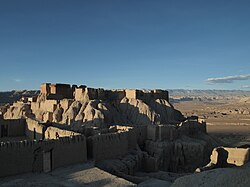
 Ruins of the Guge capital at Tsaparang
| |||||||||
| Template:South Asia in 1000 Location of Guge and neighbouring polities in the early 1000s.[1] | |||||||||
| Capital | Tsaparang | ||||||||
| Religion | Tantric Hinduism, Tibetan Buddhism, Shamanism, Bon | ||||||||
| Government | Monarchy | ||||||||
• c. 910–c. 930 | Kyide Nyimagon (first) | ||||||||
| |||||||||
| Today part of | China; India; Nepal | ||||||||

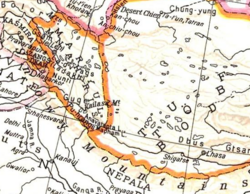
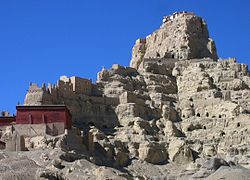
Guge (Tibetan: གུ་གེ་, Wylie: gu ge) was an ancient dynastic kingdom in Western Tibet. The kingdom was centered in present-day Zanda County, Ngari Prefecture, Tibet Autonomous Region. At various points in history after the 10th century AD, the kingdom held sway over a vast area including south-eastern Zanskar, Kinnaur district, and Spiti Valley, either by conquest or as tributaries. The ruins of the former capital of the Guge kingdom are located at Tsaparang in the Sutlej valley, not far from Mount Kailash and 1,200 miles (1,900 km) west from Lhasa.
History[edit | edit source]
Founding[edit | edit source]
Guge was founded in the 10th century. Its capitals were located at Tholing 31°28′55″N 79°48′01″E / 31.48194°N 79.80028°E and Tsaparang.[2] Kyide Nyimagon, a great-grandson of Langdarma, the last monarch of the Tibetan Empire, fled to Ngari (West Tibet) from the insecure conditions in Ü-Tsang in 910. He established a kingdom around 912, annexing Purang and Guge. He established his capital in Guge.
Nyimagon later divided his lands into three parts. The king's eldest son Palgyigon became ruler of Maryul (Ladakh), his second son Trashigon (bKra shis mgon) received Guge-Purang, and the third son Detsukgon received Zanskar.
Second diffusion of Buddhism[edit | edit source]

Trashigon was succeeded by his son Srong nge or Yeshe-Ö (Ye shes 'Od) (947–1024 or (959–1036), who was a renowned Buddhist figure. In his time a Tibetan lotsawa from Guge called Rinchen Zangpo (958–1055), after having studied in India, returned to his homeland as a monk to promote Buddhism. Together with the zeal of Yeshe-Ö, this marked the beginning of a new diffusion of Buddhist teachings in western Tibet. In 988 Yeshe-Ö took religious vows and left kingship to his younger brother Khor re.
According to later historiography, the Turkic Karluks (Gar log) took the Yeshe-Ö prisoner in a war.[3] The episode has a prominent place in Tibetan history writing. The Karluks offered to set him free if he renounced Buddhism, which he refused to do. They then demanded his weight in gold to release him. His junior kinsman Byang chub 'Od visited him in his prison with a small retinue, but Yeshe-Ö admonished him not to use the gold at hand for ransom, but rather to invite the renowned Mahayana sage Atiśa (982–1054). Yeshe-Ö eventually died in prison from age and poor treatment.[4] The story is historically debated since it contains chronological inconsistencies.[citation needed]
Successions[edit | edit source]

In 1037, Khor re's eldest grandson 'Od lde was killed in a conflict with the Kara-Khanid Khanate from Central Asia, who subsequently ravaged Ngari. His brother Byang chub 'Od (984–1078), a Buddhist monk, took power as secular ruler. He was responsible for inviting Atiśa to Tibet in 1040 and thus ushering in the so-called Chidar (Phyi-dar) phase of Buddhism in Tibet. Byang chub 'Od's son rTse lde was murdered by his nephew in 1088. This event marked the break-up of the Guge-Purang kingdom, since one of his brothers was established as separate king of Purang. The usurping nephew dBang lde continued the royal dynasty in Guge.[6]
A new Kara-Khanid invasion of Guge took place before 1137 and cost the life of the ruler, bKra shis rtse. Later in the same century the kingdom was temporarily divided. In 1240 the Mongol khagan, at least nominally, gave authority over the Ngari area to the Drigung Monastery in Ü-Tsang.
Grags pa lde was an important ruler who united the Guge area around 1265 and subjugated the related Ya rtse (Khasa) kingdom. After his death in 1277 Guge was dominated by the Sakya monastic regime. After 1363, with the decline of the Mongol-led Yuan dynasty and their Sakya protégés, Guge was again strengthened and took over Purang in 1378. Purang was henceforth contested between Guge and Mustang, but was finally integrated into the former. Guge also briefly ruled over Ladakh in the late 14th century. From 1499 the Guge king had to acknowledge the Rinpungpa rulers of Tsang. The 15th and 16th centuries were marked by a considerable Buddhist building activity by the kings, who frequently showed their devotion to the Gelug leaders later known as the Dalai Lamas.[7]
Ladakhi invasions[edit | edit source]


The first Westerners to reach Guge were António de Andrade, a Jesuit missionary, and his companion brother Manuel Marques, in 1624. De Andrade reported seeing irrigation canals and rich crops in what is now a dry and desolate land. Perhaps as evidence of the kingdom's openness, de Andrade's party was allowed to construct a chapel in Tsaparang and instruct the people about Catholic Christianity.[8] A letter by De Andrade relates that some military commanders revolted and called the Ladakhis to overthrow the ruler. There had been friction between Guge and Ladakh for many years, and the invitation was heeded in 1630. The Ladakhi forces laid siege to the almost impenetrable Tsaparang. The King's brother, who was chief lama and thus a staunch Buddhist, advised the pro-Christian ruler to surrender against keeping the state as tributary ruler. This treacherous advice was eventually accepted. Tibetan sources suggest that the Guge population was maintained in their old status. The last king, Tashi Drakpa De, (Khri bKra shis Grags pa lde) and his brother and other kin, were deported to Ladakh, where they lived comfortably until their death. The prince married a wife from the Ladakhi royal family.[9][10]
Annexation to Central Tibet[edit | edit source]
Tsaparang and the Guge kingdom were later conquered in 1679–80 by the Lhasa-based Central Tibetan government under the leadership of the 5th Dalai Lama, driving out the Ladakhis.
Historiography[edit | edit source]
Template:History of Tibet Western archeologists heard about Guge again in the 1930s through the work of Italian Giuseppe Tucci. Tucci's work was mainly about the frescoes of Guge. Lama Anagarika Govinda and Li Gotami Govinda visited the kingdom of Guge, including Tholing and Tsaparang, in 1947–1949. Their tours of central and western Tibet are recorded in black-and-white photos.[11]
| Part of a series on |
| Tibetan Buddhism |
|---|
 |
Rulers[edit | edit source]
A list of rulers of Guge and the related Ya rtse kingdom has been established by the Tibetologists Luciano Petech and Roberto Vitali[12]
A. Royal ancestors of the Yarlung dynasty
- 'Od srungs (in Central Tibet 842–905) son of Glang Darma
- dPal 'Khor btsan (in Central Tibet 905–910) son
- Kyide Nyimagon (in Ngari Korsum, c. 912–?) son
- Palgyigon (received Ladakh, 10th century) son
- Detsukgon (received Zanskar, 10th century) brother
B. Kings of Guge and Purang.
- Trashigon (received Guge and Purang, fl. 947) brother
- Yeshe-Ö (?–988 or 959–1036) son
- Nagaraja (religious leader, d. 1023) son
- Devaraja (religious leader, d. 1026) brother
- Khor re (988–996) uncle
- Lha lde (996–1024) son
- 'Od lde btsan (1024–1037) son
- Byang chub 'Od (1037–1057) brother
- Zhi ba 'Od (religious leader, d. 1111) brother
- Che chen tsha rTse lde (1057–1088) son of Byang chub 'od
C. Kings of Ya rtse.
- Naga lde (early 12th century)
- bTsan phyug lde (mid-12th century)
- bKra shis lde (12th century)
- Grags btsan lde (12th century) brother of bTsan phyug lde)
- Grags pa lde (Kradhicalla) (fl. 1225)
- A sog lde (Ashokacalla) (fl. 1255–1278) son
- 'Ji dar sMal (Jitarimalla) (fl. 1287–1293) son
- A nan sMal (Anandamalla) (late 13th century) brother
- Ri'u sMal (Ripumalla) (fl. 1312–1214) son
- San gha sMal (Sangramamalla) (early 14th century) son
- Ajitamalla (1321–1328) son of Jitarimalla
- Kalyanamalla (14th century)
- Pratapamalla (14th century)
- Pu ni sMal (Punyamalla) (fl. 1336–1339) of Purang royalty
- sPri ti sMal (Prthivimalla) (fl. 1354–1358) son
D. Kings of Guge.

- Bar lde (dBang lde) (1088 – c. 1095) nephew of Che chen tsha rTse lde
- bSod nams rtse (c. 1095 – early 12th century) son
- bKra shis rtse (before 1137) son
- Jo bo rGyal po (regent, mid-12th century) brother
- rTse 'bar btsan (12th century) son of bKra shis rtse
- sPyi lde btsan (12th century) son
- rNam lde btsan (12th/13th century) son
- Nyi ma lde (12th/13th century) son
- dGe 'bum (13th century) probably an outsider
- La ga (died c. 1260) of foreign origin
- Chos rgyal Grags pa (c. 1260–1265)
- Grags pa lde (c. 1265–1277) prince from Lho stod
- unknown rulers
- rNam rgyal lde (c. 1396 – 1424) son of a Guge ruler
- Nam mkha'i dBang po Phun tshogs lde (1424–1449) son
- rNam ri Sang rgyas lde (1449–?) son
- bLo bzang Rab brtan (died c. 1485) son
- sTod tsha 'Phags pa lha (c. 1485 – after 1499) son
- Shakya 'od (early 16th century) son
- Jig rten dBang phyug Pad kar lde (fl. 1537–1555) son?
- Ngag gi dBang phyug (16th century) son
- Nam mkha dBang phyug (16th century) son
- Khri Nyi ma dBang phyug (late 16th century) son
- Khri Grags pa'i dBang phyug (c. 1600) son
- Khri Nam rgyal Grags pa lde (fl. 1618) son
- Tashi Drakpa De (before 1622–1630) son
- Kingdom conquered by Ladakh (1630)
- Kingdom later conquered by Tibet under the Fifth Dalai Lama (1679–1680)
See also[edit | edit source]
References[edit | edit source]
Specific references:
- ↑ Chandra, Satish (2004). Medieval India: From Sultanat to the Mughals-Delhi Sultanat (1206–1526) – Part One. Har-Anand Publications. pp. 19–20. ISBN 978-81-241-1064-5.
- ↑ .Snelling, John. (1990). The Sacred Mountain: The Complete Guide to Tibet's Mount Kailas. 1st edition 1983. Revised and enlarged edition, including: Kailas-Manasarovar Travellers' Guide. Forwards by H.H. the Dalai Lama of Tibet and Christmas Humphreys, p. 181. East-West Publications, London and The Hague. ISBN 0-85692-173-4.
- ↑ Beckwith, Christopher I. (2009). Empires of the Silk Road: A History of Central Eurasia from the Bronze Age to the Present. Princeton University Press. pp. 169–. ISBN 978-0-691-13589-2.
- ↑ Shakabpa, Tibet: A Political History (1984), pp. 56–57.
- ↑ Heller, Amy (1 January 2018). "Tibetan Inscriptions at Alchi, Part I Towards a reassessment of the chronology". Tibetan Genealogies: Studies in Memoriam of Guge Tsering Gyalpo (1961–2015), Guntram Hazod and Shen Weirong, Editors, China Tibetology Publishing House.
- ↑ Hoffman, Early and Medieval Tibet (1990), pp. 388, 394; Petech, Ya-ts'e, Gu-ge, Pu-ran (2003), pp. 53–66
- ↑ Petech, Ya-ts'e, Gu-ge, Pu-ran (2003), pp. 42–45, 68–89.
- ↑ McKinnon, John. "The Kingdom of Guge, Western Tibet: an account of its history, Western visitors and significance". www.greenkiwi.co.nz. Retrieved 19 April 2018.
- ↑ Petech, The Kingdom of Ladakh (1977), pp. 44–45.
- ↑ Petech, Ya-ts'e, Gu-ge, Pu-ran (2003), p. 44.
- ↑ Li Gotami Govinda, Tibet in Pictures (Berkeley, Dharma Publishing, 1979), 2 volumes.
- ↑ Petech, Ya-ts'e, Gu-ge, Pu-ran (2003); R. Vitali (1996), The kingdoms of Gu.ge Pu.hrang. Dharamsala: Tho.ling gtsug.lag.khang.
General references:
- Allen, Charles. (1999) The Search for Shangri-La: A Journey into Tibetan History. Little, Brown and Company. Reprint: 2000 Abacus Books, London. ISBN 0-349-11142-1.
Further reading[edit | edit source]
- Bellezza, John Vincent: Zhang Zhung. Foundations of Civilization in Tibet. A Historical and Ethnoarchaeological Study of the Monuments, Rock Art, Texts, and Oral Tradition of the Ancient Tibetan Upland. Denkschriften der phil.-hist. Klasse 368. Beitraege zur Kultur- und Geistesgeschichte Asiens 61, Verlag der Oesterreichischen Akademie der Wissenschaften, Wien 2008.
- Hoffman, Helmut (1990), "Early and Medieval Tibet", in Denis Sinor; Sinor Denis (eds.), The Cambridge History of Early Inner Asia, Cambridge University Press, ISBN 978-0-521-24304-9
- Petech, Luciano (September 1947), "The Tibetan-Ladakhi Moghul War of 1681-83", The Indian Historical Quarterly, 23 (3): 169– – via archive.org
- Petech, Luciano (1977), The Kingdom of Ladakh, c. 950–1842 A.D. (PDF), Instituto Italiano Per il Medio ed Estremo Oriente – via academia.edu[dead link]
- Petech, Luciano (2003), "Ya-ts'e, Gu-ge, Pu-ran: A new study", in Alex McKay (ed.), History of Tibet, Volume 2: The Medieval Period: c.850–1895, Routledge, pp. 33–52, ISBN 0-415-30843-7 – via archive.org
- Shakabpa, Tsepon Wangchuk Deden (1984) [1967], Tibet: A Political History, New York: Potala Publications, ISBN 0-9611474-0-7
- van Ham, Peter. (2017). Guge--Ages of Gold: The West Tibetan Masterpieces. Hirmer Verlag, 390 pages, ISBN 978-3777426686
- Zeisler, Bettina. (2010). "East of the Moon and West of the Sun? Approaches to a Land with Many Names, North of Ancient India and South of Khotan." In: The Tibet Journal, Special issue. Autumn 2009 vol XXXIV n. 3-Summer 2010 vol XXXV n. 2. "The Earth Ox Papers", edited by Roberto Vitali, pp. 371–463.
External links[edit | edit source]
- [1] "Submerged in the Cosmos" by David Shulman, The New York Review of Books, February 24, 2017, retrieved March 2, 2017.
- "Unravelling the mysteries of Guge" by Xiong Lei, China Daily, May 8, 2003, retrieved November 24, 2005