




m robot: Update article |
WikiDwarfBOT (talk | contribs) Cleanup: Spelling fix. |
||
| Line 3: | Line 3: | ||
{{Use dmy dates|date=March 2015}} | {{Use dmy dates|date=March 2015}} | ||
{{Infobox settlement | {{Infobox settlement | ||
| name | | name = Kannauj | ||
| native_name | | native_name = | ||
| native_name_lang | | native_name_lang = | ||
| settlement_type | | settlement_type = City | ||
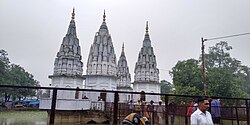
| image_skyline | | image_skyline = Goddess Annapurna Temple ,tirwa town,stateUttar Pradesh.jpg | ||
| image_caption | | image_alt = | ||
| nickname | | image_caption = Annapurna Temple in Tirwa, Kannauj | ||
| map_alt | | nickname = ''Perfume Capital of India'' | ||
| map_caption | | map_alt = | ||
| pushpin_map | | map_caption = | ||
| pushpin_relief | | pushpin_map = India#India Uttar Pradesh | ||
| pushpin_label_position | | pushpin_relief = Yes | ||
| pushpin_map_alt | | pushpin_label_position = right | ||
| pushpin_map_caption | | pushpin_map_alt = | ||
| coordinates | | pushpin_map_caption = | ||
| subdivision_type | | coordinates = {{coord|27.07|N|79.92|E|display=inline,title}} | ||
| subdivision_name | | subdivision_type = Country | ||
| subdivision_type1 | | subdivision_name = {{flag|India}} | ||
| subdivision_type2 | | subdivision_type1 = [[States and territories of India|State]] | ||
| subdivision_name1 | | subdivision_type2 = [[List of districts of India|District]] | ||
| subdivision_name2 | | subdivision_name1 = [[Uttar Pradesh]] | ||
| established_title | | subdivision_name2 = [[Kannauj district|Kannauj]] | ||
| established_date | | established_title = <!-- Established --> | ||
| founder | | established_date = | ||
| named_for | | founder = | ||
| government_type | | named_for = | ||
| governing_body | | government_type = | ||
| unit_pref | | governing_body = | ||
| area_footnotes | | unit_pref = METRIC | ||
| area_total_km2 | | area_footnotes = | ||
| area_rank | | area_total_km2 = | ||
| elevation_footnotes | | area_rank = | ||
| elevation_m | | elevation_footnotes = | ||
| population_total | | elevation_m = 139 | ||
| population_total = 84,862 | |||
| population_as_of | | population_as_of = 2011 | ||
| population_footnotes | | population_footnotes = | ||
| population_density_km2 | | population_density_km2 = AUTO | ||
| population_rank | | population_rank = | ||
| population_demonym | | population_demonym = Kannauji, Kannaujwale | ||
| demographics_type1 | | demographics_type1 = Languages | ||
| demographics1_title1 | | demographics1_title1 = Official | ||
| timezone1 | | language_spoken=Hindi | ||
| utc_offset1 | | demographics1_title2 = Regional | ||
| postal_code_type | | timezone1 = [[Indian Standard Time|IST]] | ||
| postal_code | | utc_offset1 = +5:30 | ||
| registration_plate | | postal_code_type = <!-- [[Postal Index Number|PIN]] --> | ||
<!-- unsupported | Colleges and Universities = [[Government Medical College, Kannauj]], [[Government Engineering College, Kannauj]] --> | | postal_code = 209725 | ||
| website | | registration_plate = UP-74 | ||
| footnotes | <!-- unsupported | Colleges and Universities = [[Government Medical College, Kannauj]], [[Government Engineering College, Kannauj]] -->| website = {{URL|www.kannauj.nic.in}} | ||
| demographics1_info1 | | footnotes = | ||
| demographics1_info1 = [[Hindi language|Hindi]], [[Urdu]] | |||
| demographics1_info2 = [[Kannauji language|Kannauji]] | |||
}} | }} | ||
'''Kannauj''' ([[Hindustani language|Hindustani]] pronunciation: [[Help:IPA/Hindi and Urdu|[kənːɔːd͡ʒ]]]) is a city, administrative headquarters and a [[municipal board]] or [[Nagar palika|Nagar Palika Parishad]] in [[Kannauj district]] in the [[India]]n [[States and territories of India|state]] of [[Uttar Pradesh]]. The city's name is a | '''Kannauj''' ([[Hindustani language|Hindustani]] pronunciation: [[Help:IPA/Hindi and Urdu|[kənːɔːd͡ʒ]]]) is a city, administrative headquarters and a [[municipal board]] or [[Nagar palika|Nagar Palika Parishad]] in [[Kannauj district]] in the [[India]]n [[States and territories of India|state]] of [[Uttar Pradesh]]. The city's name is a corrupted form of the classical name ''Kanyakubja''.<ref>{{cite book|title=History of Kanauj: To the Moslem Conquest|author=Rama Shankar Tripathi|publisher=Motilal Banarsidass Publ|year=1989|url=https://books.google.com/books?id=2Tnh2QjGhMQC&pg=PA2|page=2|isbn=978-81-208-0404-3}}</ref> It was also known as ''Mahodaya'' during the time of [[Mihira Bhoja]].<ref>{{Cite web|url=https://timesofindia.indiatimes.com/blogs/sanjeev-singh-blog/why-gurjara-is-not-gujjar-a-historical-perspective/|title = Why Gurjara is not Gujjar: A historical perspective| website=[[The Times of India]] |date = 7 August 2021}}</ref> It is situated 123 kilometres west of the state capital, [[Lucknow]]. | ||
Kannauj is an ancient city. It is said that the [[Kanyakubja Brahmin]]s who included [[Shandilya]] (teacher of Rishi [[Bharadwaja]]) were held one of the three prominent families originally from Kannauj.<ref name="US_2008">{{cite book |url=https://books.google.com/books?id=H3lUIIYxWkEC&pg=PA381 |title=A History of Ancient and Early Medieval India |author=Upinder Singh |publisher=Pearson Education India |year=2008 |isbn=9788131711200 |page=575 }}</ref> | Kannauj is an ancient city. It is said that the [[Kanyakubja Brahmin]]s who included [[Shandilya]] (teacher of Rishi [[Bharadwaja]]) were held one of the three prominent families originally from Kannauj.<ref name="US_2008">{{cite book |url=https://books.google.com/books?id=H3lUIIYxWkEC&pg=PA381 |title=A History of Ancient and Early Medieval India |author=Upinder Singh |publisher=Pearson Education India |year=2008 |isbn=9788131711200 |page=575 }}</ref> | ||
In [[Classical India]], it served as the center of imperial Indian dynasties. The earliest of these was the [[Maukhari dynasty]], and later, Emperor [[Harsha]] of the [[Vardhana dynasty]].<ref name="Tripathi, p.192">Tripathi, ''History of Kanauj'', p.192</ref> The city later came under the [[Gahadavala|Gahadavala dynasty]], and under the rule of [[Govindachandra (Gahadavala dynasty)|Govindachandra]], the city reached "unprecedented glory". Kannauj was also the main place of war in the [[Tripartite struggle]] between the [[Gurjara-Pratihara]], the [[Pala Empire|Palas]] and the [[Rashtrakuta Empire|Rashtrakutas]]. | In [[Classical India]], it served as the center of imperial Indian dynasties. The earliest of these was the [[Maukhari dynasty]], and later, Emperor [[Harsha]] of the [[Vardhana dynasty]].<ref name="Tripathi, p. 192">Tripathi, ''History of Kanauj'', p. 192</ref> The city later came under the [[Gahadavala|Gahadavala dynasty]], and under the rule of [[Govindachandra (Gahadavala dynasty)|Govindachandra]], the city reached "unprecedented glory". Kannauj was also the main place of war in the [[Tripartite struggle]] between the [[Gurjara-Pratihara]], the [[Pala Empire|Palas]] and the [[Rashtrakuta Empire|Rashtrakutas]]. | ||
However, the "glory of Imperial Kannauj" ended with conquests of the [[Delhi Sultanate]].<ref name=Sen/> | However, the "glory of Imperial Kannauj" ended with conquests of the [[Delhi Sultanate]].<ref name=Sen/> | ||
Kannauj is famous for distilling of scents. It is known as ' | Kannauj is famous for distilling of scents. It is known as "India's perfume capital" and is famous for its traditional [[Kannauj Perfume]], a government protected entity,<ref name=perfume>{{cite news | url=http://www.taipeitimes.com/News/feat/archives/2012/09/20/2003543194 | title=Life: India's perfume capital threatened by scent of modernity | date=20 September 2012 | newspaper=The Taipei Times | access-date=10 February 2016}}</ref> | ||
Kannauj itself has more than 200 perfume distilleries and is a market center for perfume, tobacco and rose water.<ref name=perfume/> It has given its name to a distinct dialect of the [[Hindustani language|Hindustani]] known as [[ | Kannauj itself has more than 200 perfume distilleries and is a market center for perfume, tobacco and rose water.<ref name=perfume/> It has given its name to a distinct dialect of the [[Hindustani language|Hindustani]] known as [[Kannauji language|Kannauji]], which has two different codes or registers. | ||
==History== | ==History== | ||
=== Early history === | ===Early history=== | ||
Archaeological discoveries show that Kannauj was inhabited by the [[Painted Grey Ware]] and [[Northern Black Polished Ware]] cultures,<ref>Dilip K. Chakrabarti (2007), ''Archaeological geography of the Ganga plain: the upper Ganga (Oudh, Rohilkhand, and the Doab)'', p.47</ref> | Archaeological discoveries show that Kannauj was inhabited by the [[Painted Grey Ware]] and [[Northern Black Polished Ware]] cultures,<ref>Dilip K. Chakrabarti (2007), ''Archaeological geography of the Ganga plain: the upper Ganga (Oudh, Rohilkhand, and the Doab)'', p.47</ref> {{Circa|1200}}-600 BCE and {{Circa|700}}-200 BCE, respectively. Under the names of Kuśasthala and Kanyakubja, it is mentioned as a well-known town in the Hindu Epics, the [[Mahabharata]] and the [[Ramayana]], and by the grammarian [[Mahābhāṣya|Patanjali]] ({{Circa|150 BCE}}).<ref>Rama S. Tripathi, ''History of Kanauj: To the Moslem Conquest'' (Motilal Banarsidass, 1964), pp.2,15-16</ref> The [[Pali Canon|early Buddhist literature]] mentions Kannauj as Kannakujja, and refers to its location on the trade route from [[Mathura]] to [[Varanasi]] and [[Rajgir]].<ref>Moti Chandra (1977), ''Trade Routes in Ancient India'' pp.16-18</ref> | ||
Kannauj may have been known to the Greco-Roman civilization under the name of Kanagora or Kanogiza, which appears in ''Geography'' by [[Ptolemy]] ( | Kannauj may have been known to the Greco-Roman civilization under the name of Kanagora or Kanogiza, which appears in ''Geography'' by [[Ptolemy]] ({{Circa|140 CE}}), but this identification is not confirmed. It was also visited by the Chinese Buddhist travellers [[Faxian]] and [[Xuanzang]] in the fifth and seventh centuries CE, respectively.<ref>Tripathi, ''History of Kanauj'', pp. 17-19</ref> | ||
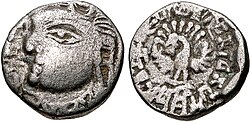
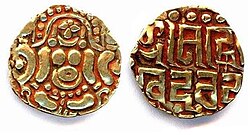
[[File:Maukharis of Kanauj. Isanavarman. Circa AD 535-553.jpg|thumb | [[File:Maukharis of Kanauj. Isanavarman. Circa AD 535-553.jpg|thumb|Coin of the [[Maukhari]]s of Kannauj under Maharaja Isanavarman, circa 535-553 CE]] | ||
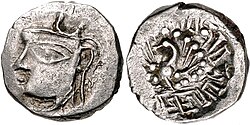
[[File:Harshavardhana Circa AD 606-647.jpg|thumb | [[File:Harshavardhana Circa AD 606-647.jpg|thumb|Coin of [[Harsha|Emperor Harsha]] of the [[Vardhana dynasty]], circa 606–647 CE<ref>{{cite web|url=https://www.cngcoins.com/Coin.aspx?CoinID=261204|title=CNG: eAuction 329. INDIA, Post-Gupta (Ganges Valley). Vardhanas of Thanesar and Kanauj. Harshavardhana. Circa AD 606-647. AR Drachm (13mm, 2.28 g, 1h).|website=www.cngcoins.com}}</ref>]] | ||
Kannauj formed part of the [[Gupta Empire]]. During the decline of the Gupta Empire in the 6th century, the [[Maukhari dynasty]] of Kannauj - who had served as vassal rulers under the Guptas - took advantage of the weakening of central authority, broke away and established control over large areas of northern India.<ref>Tripathi, ''History of Kanauj'', pp.22-24</ref> | Kannauj formed part of the [[Gupta Empire]]. During the decline of the Gupta Empire in the 6th century, the [[Maukhari dynasty]] of Kannauj - who had served as vassal rulers under the Guptas - took advantage of the weakening of central authority, broke away and established control over large areas of northern India.<ref>Tripathi, ''History of Kanauj'', pp. 22-24</ref> | ||
Under the Maukharis, Kannauj continued to grow in importance and prosperity. It became the greatest city of Northern India under Emperor [[Harsha]] (r. 606 to 647 CE) of the [[Vardhana dynasty]], who conquered it and made it his capital.<ref>Tripathi, ''History of Kanauj'', p.147</ref><ref>James Heitzman, ''The City in South Asia'' (Routledge, 2008), p.36</ref> Chinese pilgrim [[Xuanzang]] visited India during the reign of Harsha, and described Kannauj as a large, prosperous city with many Buddhist monasteries.<ref>Heizman, ''The City in South Asia'', pp.36-37</ref> Harsha died with no heir, resulting in a power vacuum until Maharaja [[Yashovarman]] seized power as the ruler of Kannauj.<ref name="Tripathi, p.192"/> | Under the Maukharis, Kannauj continued to grow in importance and prosperity. It became the greatest city of Northern India under Emperor [[Harsha]] (r. 606 to 647 CE) of the [[Vardhana dynasty]], who conquered it and made it his capital.<ref>Tripathi, ''History of Kanauj'', p. 147</ref><ref>James Heitzman, ''The City in South Asia'' (Routledge, 2008), p.36</ref> Chinese pilgrim [[Xuanzang]] visited India during the reign of Harsha, and described Kannauj as a large, prosperous city with many Buddhist monasteries.<ref>Heizman, ''The City in South Asia'', pp.36-37</ref> Harsha died with no heir, resulting in a power vacuum until Maharaja [[Yashovarman]] seized power as the ruler of Kannauj.<ref name="Tripathi, p. 192"/> | ||
=== The Kannauj Triangle === | ===The Kannauj Triangle=== | ||
{{anchor | TKT | | Triangle | Kannauj triangle | Kannauj Triangle | The Kannauj triangle | The Kannauj Triangle }} | {{anchor | TKT | | Triangle | Kannauj triangle | Kannauj Triangle | The Kannauj triangle | The Kannauj Triangle }} | ||
{{see also | Roopkund#Jasdhaval | l1= Raja Jasdhaval at Roopkund }} | {{see also | Roopkund#Jasdhaval | l1= Raja Jasdhaval at Roopkund }} | ||
Kannauj became a focal point for three powerful dynasties, namely the [[Gurjara Pratihara]]s (r. 730-1036 CE), [[Pala Empire|Palas]] (r. 750-1162 CE) and [[Rashtrakuta]]s (r. 753-982 CE), between the 8th and 10th centuries. The conflict between the three dynasties has been referred to as the [[Tripartite struggle]] by many historians.<ref name="Kannauj">{{cite book|title=Pratiyogita Darpan|publisher=Upkar Prakashan|url=https://books.google.com/books?id=K7ZZzk8cXh8C&pg=PA9|page=9}}</ref><ref name="R. C. Majumdar">{{cite book|title=Ancient India|author=R.C. Majumdar|author-link=R.C. Majumdar|publisher=Motilal Banarsidass|year=1994|pages=282–285|isbn=978-81-208-0436-4|url=https://books.google.com/books?id=XNxiN5tzKOgC&pg=PA282}}</ref> | Kannauj became a focal point for three powerful dynasties, namely the [[Gurjara Pratihara]]s (r. 730-1036 CE), [[Pala Empire|Palas]] (r. 750-1162 CE) and [[Rashtrakuta]]s (r. 753-982 CE), between the 8th and 10th centuries. The conflict between the three dynasties has been referred to as the [[Tripartite struggle]] by many historians.<ref name="Kannauj">{{cite book|title=Pratiyogita Darpan|publisher=Upkar Prakashan|url=https://books.google.com/books?id=K7ZZzk8cXh8C&pg=PA9|page=9}}</ref><ref name="R. C. Majumdar">{{cite book|title=Ancient India|author=R.C. Majumdar|author-link=R.C. Majumdar|publisher=Motilal Banarsidass|year=1994|pages=282–285|isbn=978-81-208-0436-4|url=https://books.google.com/books?id=XNxiN5tzKOgC&pg=PA282}}</ref> | ||
[[File:Indian Kanauj triangle map.svg|thumb|left | [[File:Indian Kanauj triangle map.svg|thumb|left|The Kannauj was the focal point of three [[empire]]s: the [[Rashtrakuta]]s of [[Deccan Plateau|Deccan]], the Gurjara Pratiharas of [[Malwa]], and the [[Pala Empire|Palas]] of [[Bengal]].]] | ||
There were initial struggles but ultimately the Gurjara Pratiharas succeeded in retaining the city.<ref name="Kannauj" /> The Gurjara-Pratiharas ruled [[Avanti (India)|Avanti]] (based at [[Ujjain]]), which was bounded to the South by the Rashtrakuta Empire, and the Pala Empire to the East. The Tripartite struggle began with the defeat of Indrayudh at the hands of Gurjara-Pratihara ruler [[Vatsraja|Vatsaraja]] (r. 780-800 CE).<ref name="Kannauj" /> The Pala ruler [[Dharmapala (emperor)|Dharampala]] (~770-821 CE) was also keen to establish his authority at Kannauj, giving rise to a struggle between Vatsaraja and Dharmapala, in which Dharmapala was defeated.<ref>{{cite book|title=Compendium General Knowledge|author=Kumar Sundram|publisher=Upkar Prakashan|year=2007|url=https://books.google.com/books?id=7XliTyOXI5kC&pg=PA195|page=195|isbn=978-81-7482-181-2}}</ref> Taking advantage of the chaos, the Rastrakuta ruler [[Dhruva Dharavarsha]] (r. 780–793 CE) surged northwards, defeated Vatsaraja, and took Kannauj for himself, completing the furthest northern expansion by a South Indian ruler.<ref name="R. C. Majumdar" /><ref>{{cite book|title=Pratiyogita Darpan|publisher=Upkar Prakashan|url=https://books.google.com/books?id=K7ZZzk8cXh8C&pg=PA7}}</ref> | There were initial struggles but ultimately the Gurjara Pratiharas succeeded in retaining the city.<ref name="Kannauj" /> The Gurjara-Pratiharas ruled [[Avanti (India)|Avanti]] (based at [[Ujjain]]), which was bounded to the South by the Rashtrakuta Empire, and the Pala Empire to the East. The Tripartite struggle began with the defeat of Indrayudh at the hands of Gurjara-Pratihara ruler [[Vatsraja|Vatsaraja]] (r. 780-800 CE).<ref name="Kannauj" /> The Pala ruler [[Dharmapala (emperor)|Dharampala]] (~770-821 CE) was also keen to establish his authority at Kannauj, giving rise to a struggle between Vatsaraja and Dharmapala, in which Dharmapala was defeated.<ref>{{cite book|title=Compendium General Knowledge|author=Kumar Sundram|publisher=Upkar Prakashan|year=2007|url=https://books.google.com/books?id=7XliTyOXI5kC&pg=PA195|page=195|isbn=978-81-7482-181-2}}</ref> Taking advantage of the chaos, the Rastrakuta ruler [[Dhruva Dharavarsha]] (r. 780–793 CE) surged northwards, defeated Vatsaraja, and took Kannauj for himself, completing the furthest northern expansion by a South Indian ruler.<ref name="R. C. Majumdar" /><ref>{{cite book|title=Pratiyogita Darpan|publisher=Upkar Prakashan|url=https://books.google.com/books?id=K7ZZzk8cXh8C&pg=PA7}}</ref> | ||
When the Rashtrakuta ruler Dhruva Dharavarsha advanced back to the south, Dharampala was left in control of Kannauj for some time. The struggle between the two northern dynasties of Palas and Gurjara Pratiharas continued: the Pala's vassal [[ | When the Rashtrakuta ruler Dhruva Dharavarsha advanced back to the south, Dharampala was left in control of Kannauj for some time. The struggle between the two northern dynasties of Palas and Gurjara Pratiharas continued: the Pala's vassal [[Dharmapala (emperor)#Chakrayudha|Chakrayudha]] (Dharmapala's nominee for Ujjain) was defeated by the Pratihara [[Nagabhata II]] (r. 805–833 CE), and Kannauj was again occupied by the Gurjara Pratiharas. Dharmapala tried to take control of Kannauj but was defeated badly at [[Munger Fort#Etymology|Moongher]] by the Gurjara Pratiharas.<ref name="Kannauj" /> However, Nagabhata II was in turn soon defeated by the [[Rashtrakuta]] [[Govinda III]] (r. 793–814 CE), who had initiated a second northern surge. An inscription states that Chakrayudha and Dharmapala invited Govinda III to war against the Gurjara Pratiharas, but Dharmapala and Chakrayudh both submitted to the Govinda III, in order to win his sympathy. After this defeat, Pratihara power degenerated for some time. After the death of Dharampala, Nagabhata II regained hold over Kannuaj and made it the capital of the Gurjara Pratihara Empire. During this period, the Rashtrakutas were facing some internal conflicts, and so they, as well as the Pala Empire, did not contest this.<ref name="Kannauj" /> Thus Gurjara Pratiharas became the greatest power in Northern India after occupying Kannauj (9th century CE).<ref name="Kannauj" /> | ||
===Medieval times=== | ===Medieval times=== | ||
Famous Pir-e-Kamil, Hazrat Pir Shah Jewna Al-Naqvi Al-Bokhari was also born in Kannauj in 1493 in the reign of King Sikandar Lodi. He was a descendant of [[Jalaluddin Surkh-Posh Bukhari]] and his father Syed Sadar-ud-din Shah Kabeer Naqvi Al Bukhari was a great saint and was also among the advisors of King Sikandar Lodhi. [[Shah Jewna]] migrated to [[Shah Jeewna]] (a town named after him) now in Pakistan. Shah Jewna’s colonized towns in Kannauj :- Siray- e- | Famous Pir-e-Kamil, Hazrat Pir Shah Jewna Al-Naqvi Al-Bokhari was also born in Kannauj in 1493 in the reign of King [[Sikandar Lodi]]. He was a descendant of [[Jalaluddin Surkh-Posh Bukhari]] and his father Syed Sadar-ud-din Shah Kabeer Naqvi Al Bukhari was a great saint and was also among the advisors of King Sikandar Lodhi. [[Shah Jewna]] migrated to [[Shah Jeewna]] (a town named after him) now in Pakistan. Shah Jewna’s colonized towns in Kannauj :- Siray-e-Miran, Bibiyan Jalalpur, Makhdumpur, Lal Pur (associated with the name of Saint Sayyed Jalaluddin Haider Surkh Posh Bukhari or Lal Bukhari). His descendants still present in various parts of India and Pakistan.<ref>{{Cite web|title=Pir-e-Kamil Hazrat Pir Shah Jewna Al-Naqvi Al-Bokhari|url=https://www.thenews.com.pk/print/469327-pir-e-kamil-hazrat-pir-shah-jewna-al-naqvi-al-bokhari|access-date=2021-01-01|website=www.thenews.com.pk|language=en}}</ref><ref>{{Cite web|date=2012-05-09|title=Hazrat Pir Shah Jewna (RA)|url=https://nation.com.pk/10-May-2012/hazrat-pir-shah-jewna-ra|access-date=2021-01-01|website=The Nation|language=en}}</ref><ref>{{Cite web|title=Indian Journal Of Archaeology|url=http://ijarch.org/CurrentIssue.aspx|access-date=2021-01-01|website=ijarch.org}}</ref><ref>{{Cite web|title=Nazaria-i-Pakistan Trust|url=http://nazariapak.info/Sufism/Pir-Shah-Jewna.php|access-date=2021-01-01|website=nazariapak.info}}</ref> | ||
Sultan [[Mahmud of Ghazni]] captured Kanauj in 1018. [[Chandradeva]] founded the [[Gahadvala]] dynasty with its capital at | Sultan [[Mahmud of Ghazni]] captured Kanauj in 1018. [[Chandradeva]] founded the [[Gahadvala]] dynasty with its capital at Kannauj around 1090. His grandson [[Govindachandra (Gahadavala dynasty)|Govindachandra]] "raised Kannauj to unprecedented glory." [[Muhammad Ghori]] advanced against the city, and in the [[Battle of Chandwar]] of 1193 killed [[Jayachandra]]. | ||
[[Al-Biruni|Alberuni]] has referred to " | [[Al-Biruni|Alberuni]] has referred to "Kannoj" as the key geographical point to explain marching distances to other Indian cities.<ref>(India, Vol 1, from p 199 onwards, Translated by Dr Edward C. Sachau, London 1910).</ref> The "glory of Imperial Kannauj" ended with [[Iltutmish]]'s conquest.<ref name="Sen">Sen, S.N., 2013, A Textbook of Medieval Indian History, Delhi: Primus Books, {{ISBN|9789380607344}}</ref>{{rp|21,32–33}} | ||
[[Sher Shah Suri]] defeated [[Humayun]] at the [[Battle of Kannauj]] on 17 May 1540. | [[Sher Shah Suri]] defeated [[Humayun]] at the [[Battle of Kannauj]] on 17 May 1540. | ||
===Colonial period=== | ===Colonial period=== | ||
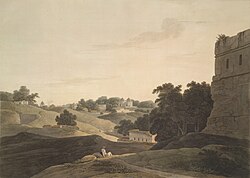
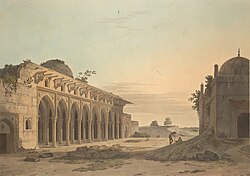
During early English rule in India, the city was spelled '''Cannodge''' by them. The [[iarchive:in.ernet.dli.2015.81794/page/n70/mode/1up/search/Hakim|Nawab Hakim Mehndi Ali Khan]] has been constantly associated with the development of city of | [[File:Ruins at Cannouge - British Library X432 3(7).jpg|thumb|Ruins at Cannouge, an engraving by [[Thomas Daniell]] from 1802]] | ||
During early English rule in India, the city was spelled '''Cannodge''' by them.<ref>{{Cite book |chapter-url=http://www.columbia.edu/itc/mealac/pritchett/00islamlinks/mrsmeerhassanali/letter_19.html |title=Observations on the Mussalmauns of India |author=Mrs. Meer Hassan Ali |chapter=Letter Nineteen |year=1832}}</ref> The [[iarchive:in.ernet.dli.2015.81794/page/n70/mode/1up/search/Hakim|Nawab Hakim Mehndi Ali Khan]] has been constantly associated with the development of city of Kannauj by the travellers and writers of the period. A ghat ([[iarchive:wanderingsofpilg02parluoft/page/16/mode/1up|Mehndighat]]), a Sarai (for the free stay of travellers and merchants) and various metalled roads were built by the Nawab which also bear his name. | |||
Different spellings that are used to refer to Kannauj, apart from the official Kannauj, are: '''Cannodge''', '''Kannauj''', '''Kannoj''', '''Kinnouge''', '''Qannauj''' and '''Qannawj'''. The British who visited Kannauj in the later part of 19th century mostly referred to it as Kanauj (notice the single "n"). [[George Forster (traveller)|George Forster]] spells it Kinnouge. [[Alexander Cunningham|Alexander Cunnigham]] wrote its spelling as Kanoj. | |||
== Geography == | ==Geography== | ||
Kannauj is located at {{Coord|27.07|N|79.92|E|}}.<ref>[http://www.fallingrain.com/world/IN/36/Kannauj.html Falling Rain Genomics, Inc – Kannauj]</ref> It has an average elevation of 139 metres (456 feet). | Kannauj is located at {{Coord|27.07|N|79.92|E|}}.<ref>[http://www.fallingrain.com/world/IN/36/Kannauj.html Falling Rain Genomics, Inc – Kannauj]</ref> It has an average elevation of 139 metres (456 feet). | ||
== Demographics == | ==Demographics== | ||
{{As of|2001}} India [[census]],<ref>{{cite web|url=http://www.censusindia.net/results/town.php?stad=A&state5=999|archive-url=https://web.archive.org/web/20040616075334/http://www.censusindia.net/results/town.php?stad=A&state5=999|archive-date=2004-06-16|title= Census of India 2001: Data from the 2001 Census, including cities, villages and towns (Provisional)|access-date=2008-11-01|publisher= Census Commission of India}}</ref> Kannauj had a population of 71,530. Males constitute 53% of the population and females 47%. Kannauj has an average literacy rate of 58%: male literacy is 64%, and female literacy is 52%. In Kannauj, 15% of the population is under 6 years of age. | {{As of|2001}} India [[census]],<ref>{{cite web|url=http://www.censusindia.net/results/town.php?stad=A&state5=999|archive-url=https://web.archive.org/web/20040616075334/http://www.censusindia.net/results/town.php?stad=A&state5=999|archive-date=2004-06-16|title= Census of India 2001: Data from the 2001 Census, including cities, villages and towns (Provisional)|access-date=2008-11-01|publisher= Census Commission of India}}</ref> Kannauj had a population of 71,530. Males constitute 53% of the population and females 47%. Kannauj has an average literacy rate of 58%: male literacy is 64%, and female literacy is 52%. In Kannauj, 15% of the population is under 6 years of age. | ||
| Line 129: | Line 132: | ||
*[[Mihira Bhoja]], King of North India | *[[Mihira Bhoja]], King of North India | ||
*[[Shah Jewna]], Missionary or Pir | *[[Shah Jewna]], Missionary or Pir | ||
*[[Siddiq Hasan Khan]], Nawab of Bhopal | |||
*[[Sayyid Muhammad Qanauji]], Sufi | *[[Sayyid Muhammad Qanauji]], Sufi | ||
*[[Samyukta]], Princess of Kannauj | *[[Samyukta]], Princess of Kannauj | ||
| Line 136: | Line 140: | ||
*[[Kannauji language]] | *[[Kannauji language]] | ||
== References == | ==References== | ||
{{Reflist}} | {{Reflist}} | ||
==Further reading== | ==Further reading== | ||
*Majumdar, R. C., In Pusalker, A. D., In Majumdar, A. K., & Bharatiya Vidya Bhavan,. (1993). The age of imperial Kanauj. | *Majumdar, R. C., In Pusalker, A. D., In Majumdar, A. K., & Bharatiya Vidya Bhavan,. (1993). The age of imperial Kanauj. | ||
*Kishori Lal, Munshi, [https://www.rekhta.org/ebooks/detail/guldasta-e-qannauj-munshi-kishori-lal-ebooks Guldasta e Qannauj] (1871) | |||
==External links== | |||
* [http://kannauj.nic.in/ District Kannauj Website.] | * [http://kannauj.nic.in/ District Kannauj Website.] | ||
* {{cite news | url=http://travel.cnn.com/mumbai/life/pictures-fading-fragrance-kannauj-indias-perfume-capital-974565 | title= In pictures: Fading fragrance of Kannauj, India's perfume capital | first=Divya | last=Dugar | publisher=CNN | date=7 August 2012 | access-date=1 January 2021 }} | * {{cite news | url=http://travel.cnn.com/mumbai/life/pictures-fading-fragrance-kannauj-indias-perfume-capital-974565 | title= In pictures: Fading fragrance of Kannauj, India's perfume capital | first=Divya | last=Dugar | publisher=CNN | date=7 August 2012 | access-date=1 January 2021 }} | ||
Revision as of 06:27, 22 July 2023
Kannauj | |
|---|---|
City | |
 Annapurna Temple in Tirwa, Kannauj | |
| Nickname: Perfume Capital of India | |
  Kannauj | |
| Coordinates: 27°04′N 79°55′E / 27.07°N 79.92°E | |
| Country |  India India |
| State | Uttar Pradesh |
| District | Kannauj |
| Elevation | 139 m (456 ft) |
| Population (2011) | |
| • Total | 84,862 |
| Demonym(s) | Kannauji, Kannaujwale |
| Languages | |
| • Official | Hindi, Urdu |
| • Regional | Kannauji |
| Time zone | UTC+5:30 (IST) |
| Vehicle registration | UP-74 |
| Website | www |

Kannauj (Hindustani pronunciation: [kənːɔːd͡ʒ]) is a city, administrative headquarters and a municipal board or Nagar Palika Parishad in Kannauj district in the Indian state of Uttar Pradesh. The city's name is a corrupted form of the classical name Kanyakubja.[1] It was also known as Mahodaya during the time of Mihira Bhoja.[2] It is situated 123 kilometres west of the state capital, Lucknow.
Kannauj is an ancient city. It is said that the Kanyakubja Brahmins who included Shandilya (teacher of Rishi Bharadwaja) were held one of the three prominent families originally from Kannauj.[3]
In Classical India, it served as the center of imperial Indian dynasties. The earliest of these was the Maukhari dynasty, and later, Emperor Harsha of the Vardhana dynasty.[4] The city later came under the Gahadavala dynasty, and under the rule of Govindachandra, the city reached "unprecedented glory". Kannauj was also the main place of war in the Tripartite struggle between the Gurjara-Pratihara, the Palas and the Rashtrakutas.
However, the "glory of Imperial Kannauj" ended with conquests of the Delhi Sultanate.[5]
Kannauj is famous for distilling of scents. It is known as "India's perfume capital" and is famous for its traditional Kannauj Perfume, a government protected entity,[6]
Kannauj itself has more than 200 perfume distilleries and is a market center for perfume, tobacco and rose water.[6] It has given its name to a distinct dialect of the Hindustani known as Kannauji, which has two different codes or registers.
History
Early history
Archaeological discoveries show that Kannauj was inhabited by the Painted Grey Ware and Northern Black Polished Ware cultures,[7] c. 1200-600 BCE and c. 700-200 BCE, respectively. Under the names of Kuśasthala and Kanyakubja, it is mentioned as a well-known town in the Hindu Epics, the Mahabharata and the Ramayana, and by the grammarian Patanjali (c. 150 BCE).[8] The early Buddhist literature mentions Kannauj as Kannakujja, and refers to its location on the trade route from Mathura to Varanasi and Rajgir.[9]
Kannauj may have been known to the Greco-Roman civilization under the name of Kanagora or Kanogiza, which appears in Geography by Ptolemy (c. 140 CE), but this identification is not confirmed. It was also visited by the Chinese Buddhist travellers Faxian and Xuanzang in the fifth and seventh centuries CE, respectively.[10]


Kannauj formed part of the Gupta Empire. During the decline of the Gupta Empire in the 6th century, the Maukhari dynasty of Kannauj - who had served as vassal rulers under the Guptas - took advantage of the weakening of central authority, broke away and established control over large areas of northern India.[12]
Under the Maukharis, Kannauj continued to grow in importance and prosperity. It became the greatest city of Northern India under Emperor Harsha (r. 606 to 647 CE) of the Vardhana dynasty, who conquered it and made it his capital.[13][14] Chinese pilgrim Xuanzang visited India during the reign of Harsha, and described Kannauj as a large, prosperous city with many Buddhist monasteries.[15] Harsha died with no heir, resulting in a power vacuum until Maharaja Yashovarman seized power as the ruler of Kannauj.[4]
The Kannauj Triangle
Kannauj became a focal point for three powerful dynasties, namely the Gurjara Pratiharas (r. 730-1036 CE), Palas (r. 750-1162 CE) and Rashtrakutas (r. 753-982 CE), between the 8th and 10th centuries. The conflict between the three dynasties has been referred to as the Tripartite struggle by many historians.[16][17]

There were initial struggles but ultimately the Gurjara Pratiharas succeeded in retaining the city.[16] The Gurjara-Pratiharas ruled Avanti (based at Ujjain), which was bounded to the South by the Rashtrakuta Empire, and the Pala Empire to the East. The Tripartite struggle began with the defeat of Indrayudh at the hands of Gurjara-Pratihara ruler Vatsaraja (r. 780-800 CE).[16] The Pala ruler Dharampala (~770-821 CE) was also keen to establish his authority at Kannauj, giving rise to a struggle between Vatsaraja and Dharmapala, in which Dharmapala was defeated.[18] Taking advantage of the chaos, the Rastrakuta ruler Dhruva Dharavarsha (r. 780–793 CE) surged northwards, defeated Vatsaraja, and took Kannauj for himself, completing the furthest northern expansion by a South Indian ruler.[17][19]
When the Rashtrakuta ruler Dhruva Dharavarsha advanced back to the south, Dharampala was left in control of Kannauj for some time. The struggle between the two northern dynasties of Palas and Gurjara Pratiharas continued: the Pala's vassal Chakrayudha (Dharmapala's nominee for Ujjain) was defeated by the Pratihara Nagabhata II (r. 805–833 CE), and Kannauj was again occupied by the Gurjara Pratiharas. Dharmapala tried to take control of Kannauj but was defeated badly at Moongher by the Gurjara Pratiharas.[16] However, Nagabhata II was in turn soon defeated by the Rashtrakuta Govinda III (r. 793–814 CE), who had initiated a second northern surge. An inscription states that Chakrayudha and Dharmapala invited Govinda III to war against the Gurjara Pratiharas, but Dharmapala and Chakrayudh both submitted to the Govinda III, in order to win his sympathy. After this defeat, Pratihara power degenerated for some time. After the death of Dharampala, Nagabhata II regained hold over Kannuaj and made it the capital of the Gurjara Pratihara Empire. During this period, the Rashtrakutas were facing some internal conflicts, and so they, as well as the Pala Empire, did not contest this.[16] Thus Gurjara Pratiharas became the greatest power in Northern India after occupying Kannauj (9th century CE).[16]
Medieval times
Famous Pir-e-Kamil, Hazrat Pir Shah Jewna Al-Naqvi Al-Bokhari was also born in Kannauj in 1493 in the reign of King Sikandar Lodi. He was a descendant of Jalaluddin Surkh-Posh Bukhari and his father Syed Sadar-ud-din Shah Kabeer Naqvi Al Bukhari was a great saint and was also among the advisors of King Sikandar Lodhi. Shah Jewna migrated to Shah Jeewna (a town named after him) now in Pakistan. Shah Jewna’s colonized towns in Kannauj :- Siray-e-Miran, Bibiyan Jalalpur, Makhdumpur, Lal Pur (associated with the name of Saint Sayyed Jalaluddin Haider Surkh Posh Bukhari or Lal Bukhari). His descendants still present in various parts of India and Pakistan.[20][21][22][23]
Sultan Mahmud of Ghazni captured Kanauj in 1018. Chandradeva founded the Gahadvala dynasty with its capital at Kannauj around 1090. His grandson Govindachandra "raised Kannauj to unprecedented glory." Muhammad Ghori advanced against the city, and in the Battle of Chandwar of 1193 killed Jayachandra.
Alberuni has referred to "Kannoj" as the key geographical point to explain marching distances to other Indian cities.[24] The "glory of Imperial Kannauj" ended with Iltutmish's conquest.[5]:21,32–33
Sher Shah Suri defeated Humayun at the Battle of Kannauj on 17 May 1540.
Colonial period
.jpg)
During early English rule in India, the city was spelled Cannodge by them.[25] The Nawab Hakim Mehndi Ali Khan has been constantly associated with the development of city of Kannauj by the travellers and writers of the period. A ghat (Mehndighat), a Sarai (for the free stay of travellers and merchants) and various metalled roads were built by the Nawab which also bear his name.
Different spellings that are used to refer to Kannauj, apart from the official Kannauj, are: Cannodge, Kannauj, Kannoj, Kinnouge, Qannauj and Qannawj. The British who visited Kannauj in the later part of 19th century mostly referred to it as Kanauj (notice the single "n"). George Forster spells it Kinnouge. Alexander Cunnigham wrote its spelling as Kanoj.
Geography
Kannauj is located at 27°04′N 79°55′E / 27.07°N 79.92°E.[26] It has an average elevation of 139 metres (456 feet).
Demographics
As of 2001[update] India census,[27] Kannauj had a population of 71,530. Males constitute 53% of the population and females 47%. Kannauj has an average literacy rate of 58%: male literacy is 64%, and female literacy is 52%. In Kannauj, 15% of the population is under 6 years of age.
Colleges
Medical College
Government Medical College, Kannauj is a government medical college located in Tirwa of Kannauj, Uttar Pradesh, India. It is affiliated to King George's Medical University, Lucknow.
Engineering College
Government Engineering College, Kannauj is a government engineering college located at Kannauj. It is a constituent college of Dr. A.P.J. Abdul Kalam Technical University (formerly Uttar Pradesh Technical University) in Lucknow. The college is situated at Aher, Tirwa.
Transportation
The city is served by two major railway station Kannauj railway station and Kannauj City railway station. The nearest airport is Kanpur Airport situated about 2 hours drive from the town.
It is situated on GT road(Delhi to Kanpur). It has road transportation Kannauj Depo. under the Uttar Pradesh State Road Transportation Corporation(UPSRTC).
Notable people
- Āma, King of Kannauj
- Malini Awasthi, folk singer
- Mihira Bhoja, King of North India
- Shah Jewna, Missionary or Pir
- Siddiq Hasan Khan, Nawab of Bhopal
- Sayyid Muhammad Qanauji, Sufi
- Samyukta, Princess of Kannauj
- Yashovarman, King of Kannauj
See also
References
- ↑ Rama Shankar Tripathi (1989). History of Kanauj: To the Moslem Conquest. Motilal Banarsidass Publ. p. 2. ISBN 978-81-208-0404-3.
- ↑ "Why Gurjara is not Gujjar: A historical perspective". The Times of India. 7 August 2021.
- ↑ Upinder Singh (2008). A History of Ancient and Early Medieval India. Pearson Education India. p. 575. ISBN 9788131711200.
- ↑ 4.0 4.1 Tripathi, History of Kanauj, p. 192
- ↑ 5.0 5.1 Sen, S.N., 2013, A Textbook of Medieval Indian History, Delhi: Primus Books, ISBN 9789380607344
- ↑ 6.0 6.1 "Life: India's perfume capital threatened by scent of modernity". The Taipei Times. 20 September 2012. Retrieved 10 February 2016.
- ↑ Dilip K. Chakrabarti (2007), Archaeological geography of the Ganga plain: the upper Ganga (Oudh, Rohilkhand, and the Doab), p.47
- ↑ Rama S. Tripathi, History of Kanauj: To the Moslem Conquest (Motilal Banarsidass, 1964), pp.2,15-16
- ↑ Moti Chandra (1977), Trade Routes in Ancient India pp.16-18
- ↑ Tripathi, History of Kanauj, pp. 17-19
- ↑ "CNG: eAuction 329. INDIA, Post-Gupta (Ganges Valley). Vardhanas of Thanesar and Kanauj. Harshavardhana. Circa AD 606-647. AR Drachm (13mm, 2.28 g, 1h)". www.cngcoins.com.
- ↑ Tripathi, History of Kanauj, pp. 22-24
- ↑ Tripathi, History of Kanauj, p. 147
- ↑ James Heitzman, The City in South Asia (Routledge, 2008), p.36
- ↑ Heizman, The City in South Asia, pp.36-37
- ↑ 16.0 16.1 16.2 16.3 16.4 16.5 Pratiyogita Darpan. Upkar Prakashan. p. 9.
- ↑ 17.0 17.1 R.C. Majumdar (1994). Ancient India. Motilal Banarsidass. pp. 282–285. ISBN 978-81-208-0436-4.
- ↑ Kumar Sundram (2007). Compendium General Knowledge. Upkar Prakashan. p. 195. ISBN 978-81-7482-181-2.
- ↑ Pratiyogita Darpan. Upkar Prakashan.
- ↑ "Pir-e-Kamil Hazrat Pir Shah Jewna Al-Naqvi Al-Bokhari". www.thenews.com.pk. Retrieved 1 January 2021.
- ↑ "Hazrat Pir Shah Jewna (RA)". The Nation. 9 May 2012. Retrieved 1 January 2021.
- ↑ "Indian Journal Of Archaeology". ijarch.org. Retrieved 1 January 2021.
- ↑ "Nazaria-i-Pakistan Trust". nazariapak.info. Retrieved 1 January 2021.
- ↑ (India, Vol 1, from p 199 onwards, Translated by Dr Edward C. Sachau, London 1910).
- ↑ Mrs. Meer Hassan Ali (1832). "Letter Nineteen". Observations on the Mussalmauns of India.
- ↑ Falling Rain Genomics, Inc – Kannauj
- ↑ "Census of India 2001: Data from the 2001 Census, including cities, villages and towns (Provisional)". Census Commission of India. Archived from the original on 16 June 2004. Retrieved 1 November 2008.
Further reading
- Majumdar, R. C., In Pusalker, A. D., In Majumdar, A. K., & Bharatiya Vidya Bhavan,. (1993). The age of imperial Kanauj.
- Kishori Lal, Munshi, Guldasta e Qannauj (1871)
External links
- District Kannauj Website.
- Dugar, Divya (7 August 2012). "In pictures: Fading fragrance of Kannauj, India's perfume capital". CNN. Retrieved 1 January 2021.
- History of Kanauj: To the Moslem Conquest By Rama Shankar Tripathi