
CleanupBot (talk | contribs) m →top: robot: remove incorrect protection templates |
robot: Update article (please report if you notice any mistake or error in this edit) |
||
| Line 1: | Line 1: | ||
{{short description|Head of state and head of government of the United States of America}} | {{short description|Head of state and head of government of the United States of America}} | ||
{{redirect|POTUS|the political talk radio channel|P.O.T.U.S. (Sirius XM)|other uses|President of the United States (disambiguation)}} | |||
{{pp-move-indef}} | |||
{{pp-30-500|small=yes}} | |||
{{Use American English|date=March 2021}} | {{Use American English|date=March 2021}} | ||
{{Use mdy dates|date= | {{Use mdy dates|date=October 2021}} | ||
{{Infobox official post | {{Infobox official post | ||
| post = President | | post = President | ||
| body = the<br>United States of America | | body = the<br />United States of America | ||
| insignia = Seal Of The President Of The United States Of America.svg | | insignia = Seal Of The President Of The United States Of America.svg | ||
| insigniasize = | | insigniasize = 100 | ||
| insigniacaption = [[Seal of the President of the United States|Presidential seal]] | | insigniacaption = [[Seal of the President of the United States|Presidential seal]] | ||
| flag = Flag of the President of the United States of America.svg | | flag = Flag of the President of the United States of America.svg | ||
| flagsize = | | flagsize = 125 | ||
| flagborder = yes | | flagborder = yes | ||
| flagcaption = [[Flag of the President of the United States|Presidential flag]] | | flagcaption = [[Flag of the President of the United States|Presidential flag]] | ||
| Line 23: | Line 23: | ||
}} | }} | ||
| style = {{plainlist| | | style = {{plainlist| | ||
* [[Mr. President (title)|Mr. President]]<ref>{{Cite news |url=https://www.nytimes.com/1891/08/02/archives/how-to-address-the-president-he-is-not-your-excellency-or-your.html |work=The Washington Star |title=How To Address The President; He Is Not Your Excellency Or Your Honor, But Mr. President |date=August 2, 1891 |via=The New York Times}}</ref><ref>{{Cite web |url=http://www.usgs.gov/usgs-manual/handbook/hb/431-2-h/chap4.html |title=USGS Correspondence Handbook—Chapter 4 |date=July 18, 2007 |publisher=Usgs.gov |url-status=dead |archive-url=https://web.archive.org/web/20120926000950/http://www.usgs.gov/usgs-manual/handbook/hb/431-2-h/chap4.html |archive-date=September 26, 2012 |access-date=November 15, 2012}}</ref><br>(informal) | * [[Mr. President (title)|Mr. President]]<ref>{{Cite news |url=https://www.nytimes.com/1891/08/02/archives/how-to-address-the-president-he-is-not-your-excellency-or-your.html |work=The Washington Star |title=How To Address The President; He Is Not Your Excellency Or Your Honor, But Mr. President |date=August 2, 1891 |via=The New York Times}}</ref><ref>{{Cite web |url=http://www.usgs.gov/usgs-manual/handbook/hb/431-2-h/chap4.html |title=USGS Correspondence Handbook—Chapter 4 |date=July 18, 2007 |publisher=Usgs.gov |url-status=dead |archive-url=https://web.archive.org/web/20120926000950/http://www.usgs.gov/usgs-manual/handbook/hb/431-2-h/chap4.html |archive-date=September 26, 2012 |access-date=November 15, 2012}}</ref><br />(informal) | ||
* [[The Honourable#United States|The Honorable]]<ref>{{Cite web |url=http://www.ita.doc.gov/ita_sec/Address%20and%20Salutation.htm |title=Models of Address and Salutation |publisher=Ita.doc.gov |url-status=dead |archive-url=https://web.archive.org/web/20100720073107/http://www.ita.doc.gov/ita_sec/Address%20and%20Salutation.htm |archive-date=July 20, 2010 |access-date=September 4, 2010}}</ref><br>(formal) | * [[The Honourable#United States|The Honorable]]<ref>{{Cite web |url=http://www.ita.doc.gov/ita_sec/Address%20and%20Salutation.htm |title=Models of Address and Salutation |publisher=Ita.doc.gov |url-status=dead |archive-url=https://web.archive.org/web/20100720073107/http://www.ita.doc.gov/ita_sec/Address%20and%20Salutation.htm |archive-date=July 20, 2010 |access-date=September 4, 2010}}</ref><br />(formal) | ||
* [[Excellency|His Excellency]]<ref>[https://web.archive.org/web/20120927014351/http://www.un.int/protocol/documents/Hspmfm.pdf Heads of State, Heads of Government, Ministers for Foreign Affairs], Protocol and Liaison Service, [[United Nations]]. Retrieved November 1, 2012.</ref><ref>{{Cite web |url=https://obamawhitehouse.archives.gov/the-press-office/2010/09/01/remarks-president-obama-president-mubarak-his-majesty-king-abdullah-prim |title=Remarks by President Obama, President Mubarak, His Majesty King Abdullah, Prime Minister Netanyahu and President Abbas Before Working Dinner |last=The White House Office of the Press Secretary |date=September 1, 2010 |via=[[NARA|National Archives]] |work=[[whitehouse.gov]] |access-date=July 19, 2011}}</ref><br>(diplomatic) | * [[Excellency|His Excellency]]<ref>[https://web.archive.org/web/20120927014351/http://www.un.int/protocol/documents/Hspmfm.pdf Heads of State, Heads of Government, Ministers for Foreign Affairs], Protocol and Liaison Service, [[United Nations]]. Retrieved November 1, 2012.</ref><ref>{{Cite web |url=https://obamawhitehouse.archives.gov/the-press-office/2010/09/01/remarks-president-obama-president-mubarak-his-majesty-king-abdullah-prim |title=Remarks by President Obama, President Mubarak, His Majesty King Abdullah, Prime Minister Netanyahu and President Abbas Before Working Dinner |last=The White House Office of the Press Secretary |date=September 1, 2010 |via=[[NARA|National Archives]] |work=[[whitehouse.gov]] |access-date=July 19, 2011}}</ref><br />(diplomatic) | ||
}} | }} | ||
| type = {{plainlist| | | type = {{plainlist| | ||
| Line 40: | Line 40: | ||
| residence = [[White House]] | | residence = [[White House]] | ||
| seat = [[Washington, D.C.]] | | seat = [[Washington, D.C.]] | ||
| appointer = [[United States Electoral College|Electoral College]] | | appointer = [[United States Electoral College|Electoral College]] or via succession from [[Vice President of the United States|vice presidency]] | ||
| termlength = [[Twenty-second Amendment to the United States Constitution|Four years, renewable once]] | | termlength = [[Twenty-second Amendment to the United States Constitution|Four years, renewable once]] | ||
| constituting_instrument = [[Constitution of the United States]] | | constituting_instrument = [[Constitution of the United States]] | ||
| formation = {{date and age| | | formation = {{date and age|1789|3|4|p=1|br=1}}<ref name="formation">"The conventions of nine states having adopted the Constitution, Congress, in September or October, 1788, passed a resolution in conformity with the opinions expressed by the Convention and appointed the first Wednesday in March of the ensuing year as the day, and the then seat of Congress as the place, 'for commencing proceedings under the Constitution.'<br><br> "Both governments could not be understood to exist at the same time. The new government did not commence until the old government expired. It is apparent that the government did not commence on the Constitution's being ratified by the ninth state, for these ratifications were to be reported to Congress, whose continuing existence was recognized by the Convention, and who were requested to continue to exercise their powers for the purpose of bringing the new government into operation. In fact, Congress did continue to act as a government until it dissolved on the first of November by the successive disappearance of its members. It existed potentially until 2 March, the day preceding that on which the members of the new Congress were directed to assemble." {{ussc|name=Owings v. Speed|link=supreme.justia.com|volume=18|page=420|pin=422|year=1820|reporter=Wheat|reporter-volume=5}}</ref><ref>{{Cite book |last=Maier |first=Pauline |title=Ratification: The People Debate the Constitution, 1787–1788 |date=2010 |publisher=Simon & Schuster |isbn=978-0-684-86854-7 |location=New York, New York |page=433 |author-link=Pauline Maier}}</ref><ref>{{Cite web |url=https://constitutioncenter.org/blog/march-4-a-forgotten-huge-day-in-american-politics/ |title=March 4: A forgotten huge day in American history |date=March 4, 2013 |publisher=[[National Constitution Center]] |location=Philadelphia |access-date=July 29, 2018}}</ref> | ||
| first = [[George Washington]]<ref>{{Cite web |url=https://www.mountvernon.org/library/digitalhistory/digital-encyclopedia/article/presidential-election-of-1789/ |title=Presidential Election of 1789 |website=Digital Encyclopedia |publisher=Mount Vernon Ladies' Association, George Washington's Mount Vernon |location=Mount Vernon, Virginia |access-date=July 29, 2018}}</ref> | | first = [[George Washington]]<ref>{{Cite web |url=https://www.mountvernon.org/library/digitalhistory/digital-encyclopedia/article/presidential-election-of-1789/ |title=Presidential Election of 1789 |website=Digital Encyclopedia |publisher=Mount Vernon Ladies' Association, George Washington's Mount Vernon |location=Mount Vernon, Virginia |access-date=July 29, 2018}}</ref> | ||
| salary = | | salary = {{wikidata|property|references|Q11696|P3618}} | ||
| website = {{URL|https://www.whitehouse.gov/}} | | website = {{URL|https://www.whitehouse.gov/}} | ||
}} | }} | ||
{{Politics of the United States}} | {{Politics of the United States}} | ||
The '''president of the United States''' ('''POTUS'''){{efn-ua|The informal term POTUS originated in the [[Phillips Code]], a shorthand method created in 1879 by [[Walter P. Phillips]] for the rapid transmission of press reports by telegraph.<ref>{{Cite book |last=Safire |first=William |url=https://books.google.com/books?id=q6ARDAAAQBAJ&pg=PA564 |title=Safire's Political Dictionary |date=2008 |publisher=Oxford University Press |isbn= | The '''president of the United States''' ('''POTUS'''){{efn-ua|The informal term POTUS originated in the [[Phillips Code]], a shorthand method created in 1879 by [[Walter P. Phillips]] for the rapid transmission of press reports by telegraph.<ref>{{Cite book |last=Safire |first=William |url=https://books.google.com/books?id=q6ARDAAAQBAJ&pg=PA564 |title=Safire's Political Dictionary |date=2008 |publisher=Oxford University Press |isbn=978-0-19-534061-7 |page=564 |language=en}}</ref>}} is the [[head of state]] and [[head of government]] of the [[United States of America]]. The president directs the [[Federal government of the United States#Executive branch|executive branch]] of the [[Federal government of the United States|federal government]] and is the [[Powers of the president of the United States#Commander-in-chief|commander-in-chief]] of the [[United States Armed Forces]]. | ||
The power of the presidency has grown substantially | The power of the presidency has grown substantially<ref>{{Cite journal|last=Ford|first=Henry Jones|date=1908|title=The Influence of State Politics in Expanding Federal Power|journal=Proceedings of the American Political Science Association|volume=5|pages=53–63|doi=10.2307/3038511|jstor=3038511}}</ref> since the office's establishment in 1789.<ref name=formation /> While presidential power has ebbed and flowed over time, the presidency has played an increasingly strong role in American political life since the beginning of the 20th century, with a notable expansion during the presidency of [[Franklin D. Roosevelt]]. In contemporary times, the president is also looked upon as one of the world's most powerful political figures as the leader of the only remaining global [[superpower]].<ref>{{Cite magazine|url=https://time.com/4657665/steve-bannon-donald-trump/|title=Is Steve Bannon the Second Most Powerful Man in the World?|last=Von Drehle|first=David|date=February 2, 2017|magazine=[[Time (magazine)|Time]]}}</ref><ref>{{Cite news|url=https://www.theguardian.com/commentisfree/2008/jan/03/uselections2008.world|title=Who should be the world's most powerful person?|date=January 3, 2008|work=The Guardian|location=London}}</ref><ref>{{Cite web|url=https://www.newsweek.com/meacham-history-power-83117|title=Meacham: The History of Power|last=Meacham|first=Jon|date=December 20, 2008|website=[[Newsweek]]|access-date=September 4, 2010}}</ref><ref>{{Cite web|url=https://www.newsweek.com/newsweek-50-barack-obama-83041|title=The Newsweek 50: Barack Obama|last=Zakaria|first=Fareed|date=December 20, 2008|website=[[Newsweek]]|access-date=September 4, 2010}}</ref> As the leader of the nation with the [[List of countries by GDP (nominal)|largest economy by nominal GDP]], the president possesses significant domestic and international [[Hard power|hard]] and [[soft power]]. | ||
[[Article Two of the United States Constitution|Article II of the Constitution]] establishes the executive branch of the federal government and vests the executive power in the president. The power includes the execution and enforcement of federal law and the responsibility to appoint federal executive, diplomatic, regulatory, and judicial officers. Based on constitutional provisions empowering the president to appoint and receive ambassadors and conclude treaties with foreign powers, and on subsequent laws enacted by Congress, the modern presidency has primary responsibility for conducting U.S. foreign policy. The role includes responsibility for directing the world's [[List of countries by military expenditures|most expensive military]], which has the [[List of states with nuclear weapons|second largest nuclear arsenal]]. | [[Article Two of the United States Constitution|Article II of the Constitution]] establishes the executive branch of the federal government and vests the executive power in the president. The power includes the execution and enforcement of federal law and the responsibility to appoint federal executive, diplomatic, regulatory, and judicial officers. Based on constitutional provisions empowering the president to appoint and receive ambassadors and conclude treaties with foreign powers, and on subsequent laws enacted by Congress, the modern presidency has primary responsibility for conducting U.S. foreign policy. The role includes responsibility for directing the world's [[List of countries by military expenditures|most expensive military]], which has the [[List of states with nuclear weapons|second largest nuclear arsenal]]. | ||
The president also plays a leading role in federal legislation and domestic policymaking. | The president also plays a leading role in federal legislation and domestic policymaking. As part of the system of [[Separation of powers under the United States Constitution|checks and balances]], [[Article One of the United States Constitution#Section 7: Bills|Article I, Section{{nbsp}}7]] of the Constitution gives the president the power to sign or [[Veto power in the United States|veto]] federal legislation. Since modern presidents are also typically viewed as the leaders of their political parties, major policymaking is significantly shaped by the outcome of presidential elections, with presidents taking an active role in promoting their policy priorities to members of Congress who are often electorally dependent on the president.<ref>{{Cite journal |last=Pfiffner |first=J. P. |year=1988 |title=The President's Legislative Agenda |journal=Annals of the American Academy of Political and Social Science |volume=499 |pages=22–35 |doi=10.1177/0002716288499001002 |url=https://journals.sagepub.com/doi/10.1177/0002716288499001002 |s2cid=143985489 }}</ref> In recent decades, presidents have also made increasing use of [[executive order]]s, agency regulations, and judicial appointments to shape domestic policy. | ||
The president is [[Indirect election|elected indirectly]] through the [[United States Electoral College|Electoral College]] to a four-year term, along with the [[Vice President of the United States|vice president]]. Under the [[Twenty-second Amendment]], ratified in 1951, no person who has been elected to two presidential terms may be elected to a third. In addition, nine vice presidents have become president by virtue of a [[List of presidents of the United States who died in office|president's intra-term death]] or resignation.{{efn-ua|The nine vice presidents who succeeded to the presidency upon their predecessor's death or resignation and | The president is [[Indirect election|elected indirectly]] through the [[United States Electoral College|Electoral College]] to a four-year term, along with the [[Vice President of the United States|vice president]]. Under the [[Twenty-second Amendment]], ratified in 1951, no person who has been elected to two presidential terms may be elected to a third. In addition, nine vice presidents have become president by virtue of a [[List of presidents of the United States who died in office|president's intra-term death]] or resignation.{{efn-ua|The nine vice presidents who succeeded to the presidency upon their predecessor's death or resignation and served for the remainder of his term are: [[John Tyler]] (1841); [[Millard Fillmore]] (1850); [[Andrew Johnson]] (1865); [[Chester A. Arthur]] (1881); [[Theodore Roosevelt]] (1901); [[Calvin Coolidge]] (1923); [[Harry S. Truman]] (1945); [[Lyndon B. Johnson]] (1963); and [[Gerald Ford]] (1974).}} In all, [[List of presidents of the United States|45 individuals]] have served 46 presidencies spanning 58 full four-year terms.{{efn-ua|[[Grover Cleveland]] served two non-consecutive terms, so he is counted twice, as both the 22nd and 24th president.<ref>{{Cite web |url=https://www.whitehouse.gov/about-the-white-house/presidents/grover-cleveland-24/ |title=Grover Cleveland—24 |publisher=White House}}.</ref>}} | ||
[[Joe Biden]] is the 46th and current president of the United States, having [[Inauguration of Joe Biden|assumed office]] on January 20, 2021. | [[Joe Biden]] is the 46th and current president of the United States, having [[Inauguration of Joe Biden|assumed office]] on January 20, 2021. | ||
| Line 63: | Line 63: | ||
== History and development == | == History and development == | ||
===Origins=== | === Origins === | ||
In July 1776, during the [[American Revolutionary War]], the [[Thirteen Colonies]], acting jointly through the [[Second Continental Congress]], declared themselves to be 13 independent [[sovereign state]]s, no longer under [[Kingdom of Great Britain|British]] rule.<ref name="Milkis">{{Cite book |last1=Milkis |first1=Sidney M. |url=https://books.google.com/books?id=KkUvAAAAYAAJ |title=The American Presidency: Origins and Development |last2=Nelson |first2=Michael |publisher=CQ Press |year=2008 |isbn=978-0-87289-336-8 |edition=5th |location=Washington, D.C. |pages=1–25}}</ref> Recognizing the necessity of closely coordinating their efforts against the British,<ref name="Kelly">{{Cite book |last1=Kelly |first1=Alfred H. |title=The American Constitution: Its Origins and Development |last2=Harbison |first2=Winfred A. |last3=Belz |first3=Herman |publisher=W.W. Norton & Co. |year=1991 |isbn=978-0-393-96056-3 |edition=7th |volume=I |location=New York |pages=76–81}}</ref> the Continental Congress simultaneously began the process of drafting a constitution that would bind the [[U.S. state|states]] together. There were long debates on a number of issues, including representation and voting, and the exact powers to be given the central government.<ref>{{Cite web |url=https://history.state.gov/milestones/1776–1783/articles |title=Articles of Confederation, 1777–1781 |publisher=Office of the Historian, Bureau of Public Affairs, United States Department of State |location=Washington, D.C. |access-date=January 20, 2019 }}{{dead link|date=August 2020|bot=medic}}{{cbignore|bot=medic}}</ref> Congress finished work on the [[Articles of Confederation]] to establish a [[Perpetual Union|perpetual union]] between the states in November 1777 and sent it to the states for [[ratification]].<ref name=Milkis /> | In July 1776, during the [[American Revolutionary War]], the [[Thirteen Colonies]], acting jointly through the [[Second Continental Congress]], declared themselves to be 13 independent [[sovereign state]]s, no longer under [[Kingdom of Great Britain|British]] rule.<ref name="Milkis">{{Cite book |last1=Milkis |first1=Sidney M. |url=https://books.google.com/books?id=KkUvAAAAYAAJ |title=The American Presidency: Origins and Development |last2=Nelson |first2=Michael |publisher=CQ Press |year=2008 |isbn=978-0-87289-336-8 |edition=5th |location=Washington, D.C. |pages=1–25}}</ref> Recognizing the necessity of closely coordinating their efforts against the British,<ref name="Kelly">{{Cite book |last1=Kelly |first1=Alfred H. |title=The American Constitution: Its Origins and Development |last2=Harbison |first2=Winfred A. |last3=Belz |first3=Herman |publisher=W.W. Norton & Co. |year=1991 |isbn=978-0-393-96056-3 |edition=7th |volume=I |location=New York |pages=76–81}}</ref> the Continental Congress simultaneously began the process of drafting a constitution that would bind the [[U.S. state|states]] together. There were long debates on a number of issues, including representation and voting, and the exact powers to be given the central government.<ref>{{Cite web |url=https://history.state.gov/milestones/1776–1783/articles |title=Articles of Confederation, 1777–1781 |publisher=Office of the Historian, Bureau of Public Affairs, United States Department of State |location=Washington, D.C. |access-date=January 20, 2019 }}{{dead link|date=August 2020|bot=medic}}{{cbignore|bot=medic}}</ref> Congress finished work on the [[Articles of Confederation]] to establish a [[Perpetual Union|perpetual union]] between the states in November 1777 and sent it to the states for [[ratification]].<ref name=Milkis /> | ||
| Line 83: | Line 84: | ||
[[Abraham Lincoln]]'s leadership during the [[American Civil War|Civil War]] has led historians to regard him as one of the nation's greatest presidents.{{efn-ua|Nearly all scholars rank Lincoln among the nation's top three presidents, with many placing him first. See [[Historical rankings of presidents of the United States]] for a collection of survey results.}} The circumstances of the war and Republican domination of Congress made the office very powerful,<ref>{{cite news |last1=Williams |first1=Frank |title=Lincoln's War Powers: Part Constitution, Part Trust |url=https://www.abajournal.com/magazine/article/lincolns_war_powers_part_constitution_part_trust |access-date=September 14, 2020 |publisher=American Bar Association |date=April 1, 2011}}</ref><ref>{{cite news |last1=Weber |first1=Jennifer |title=Was Lincoln a Tyrant? |url=https://opinionator.blogs.nytimes.com/2013/03/25/was-lincoln-a-tyrant/ |access-date=September 14, 2020 |publisher=New York Times Opinionator |date=March 25, 2013}}</ref> and Lincoln's re-election in 1864 was the first time a president had been re-elected since Jackson in 1832. After Lincoln's assassination, his successor [[Andrew Johnson]] lost all political support<ref>{{cite web |last1=Varon |first1=Elizabeth |title=Andrew Johnson: Campaigns and Elections |url=https://millercenter.org/president/johnson/campaigns-and-elections |website=University of Virginia, Miller Center |date=October 4, 2016 |access-date=September 14, 2020}}</ref> and was nearly removed from office,<ref>{{cite news |last1=NCC Staff |title=The man whose impeachment vote saved Andrew Johnson |url=https://constitutioncenter.org/blog/the-man-whose-impeachment-vote-saved-andrew-johnson |access-date=September 14, 2020 |publisher=National Constitution Center |date=May 16, 2020}}</ref> with Congress remaining powerful during the two-term presidency of Civil War general [[Ulysses S. Grant]]. After the end of [[Reconstruction era|Reconstruction]], [[Grover Cleveland]] would eventually become the first Democratic president elected since before the war, running in three consecutive elections (1884, 1888, 1892) and winning twice. In 1900, [[William McKinley]] became the first incumbent to win re-election since Grant in 1872. | [[Abraham Lincoln]]'s leadership during the [[American Civil War|Civil War]] has led historians to regard him as one of the nation's greatest presidents.{{efn-ua|Nearly all scholars rank Lincoln among the nation's top three presidents, with many placing him first. See [[Historical rankings of presidents of the United States]] for a collection of survey results.}} The circumstances of the war and Republican domination of Congress made the office very powerful,<ref>{{cite news |last1=Williams |first1=Frank |title=Lincoln's War Powers: Part Constitution, Part Trust |url=https://www.abajournal.com/magazine/article/lincolns_war_powers_part_constitution_part_trust |access-date=September 14, 2020 |publisher=American Bar Association |date=April 1, 2011}}</ref><ref>{{cite news |last1=Weber |first1=Jennifer |title=Was Lincoln a Tyrant? |url=https://opinionator.blogs.nytimes.com/2013/03/25/was-lincoln-a-tyrant/ |access-date=September 14, 2020 |publisher=New York Times Opinionator |date=March 25, 2013}}</ref> and Lincoln's re-election in 1864 was the first time a president had been re-elected since Jackson in 1832. After Lincoln's assassination, his successor [[Andrew Johnson]] lost all political support<ref>{{cite web |last1=Varon |first1=Elizabeth |title=Andrew Johnson: Campaigns and Elections |url=https://millercenter.org/president/johnson/campaigns-and-elections |website=University of Virginia, Miller Center |date=October 4, 2016 |access-date=September 14, 2020}}</ref> and was nearly removed from office,<ref>{{cite news |last1=NCC Staff |title=The man whose impeachment vote saved Andrew Johnson |url=https://constitutioncenter.org/blog/the-man-whose-impeachment-vote-saved-andrew-johnson |access-date=September 14, 2020 |publisher=National Constitution Center |date=May 16, 2020}}</ref> with Congress remaining powerful during the two-term presidency of Civil War general [[Ulysses S. Grant]]. After the end of [[Reconstruction era|Reconstruction]], [[Grover Cleveland]] would eventually become the first Democratic president elected since before the war, running in three consecutive elections (1884, 1888, 1892) and winning twice. In 1900, [[William McKinley]] became the first incumbent to win re-election since Grant in 1872. | ||
After McKinley's assassination, [[Theodore Roosevelt]] became a dominant figure in American politics.<ref>{{cite news |last1=Boissoneault |first1=Lorraine |title=The Debate Over Executive Orders Began With Teddy Roosevelt's Mad Passion for Conservation |url=https://www.smithsonianmag.com/history/how-theodore-roosevelts-executive-orders-reshaped-countryand-presidency-180962908/ |access-date=September 14, 2020 |publisher=Smithsonian Magazine (website) |date=April 17, 2017}}</ref> Historians believe Roosevelt permanently changed the political system by strengthening the presidency,<ref>{{cite news |last1=Posner |first1=Eric |title=The inevitability of the imperial presidency |url=https://www.washingtonpost.com/blogs/political-bookworm/post/the-inevitability-of-the-imperial-presidency/2011/04/22/AFTRBoPE_blog.html |access-date=September 12, 2020 | | After McKinley's assassination, [[Theodore Roosevelt]] became a dominant figure in American politics.<ref>{{cite news |last1=Boissoneault |first1=Lorraine |title=The Debate Over Executive Orders Began With Teddy Roosevelt's Mad Passion for Conservation |url=https://www.smithsonianmag.com/history/how-theodore-roosevelts-executive-orders-reshaped-countryand-presidency-180962908/ |access-date=September 14, 2020 |publisher=Smithsonian Magazine (website) |date=April 17, 2017}}</ref> Historians believe Roosevelt permanently changed the political system by strengthening the presidency,<ref>{{cite news |last1=Posner |first1=Eric |title=The inevitability of the imperial presidency |url=https://www.washingtonpost.com/blogs/political-bookworm/post/the-inevitability-of-the-imperial-presidency/2011/04/22/AFTRBoPE_blog.html |access-date=September 12, 2020 |newspaper=[[The Washington Post]] |date=April 22, 2011}}</ref> with some key accomplishments including breaking up trusts, conservationism, labor reforms, making personal character as important as the issues, and hand-picking his successor, [[William Howard Taft]]. The following decade, [[Woodrow Wilson]] led the nation to victory during [[World War I]], although Wilson's proposal for the [[League of Nations]] was rejected by the Senate.<ref>{{cite news |last1=Glass |first1=Andrew |title=Senate rejects League of Nations, Nov. 19, 2019 |url=https://www.politico.com/story/2014/11/senate-rejects-league-of-nations-nov-19-1919-113006 |access-date=September 14, 2020 |publisher=Politico |date=November 19, 2014}}</ref> [[Warren Harding]], while popular in office, would see his legacy tarnished by scandals, especially [[Teapot Dome]],<ref>{{cite news |last1=Robenalt |first1=James |title=If we weren't so obsessed with Warren G. Harding's sex life, we'd realize he was a pretty good president |url=https://www.washingtonpost.com/posteverything/wp/2015/08/13/if-we-werent-so-obsessed-with-warren-g-hardings-sex-life-wed-realize-he-was-a-pretty-good-president/ |access-date=September 14, 2020 |newspaper=[[The Washington Post]] |date=August 13, 2015}}</ref> and [[Herbert Hoover]] quickly became very unpopular after failing to alleviate the [[Great Depression]].<ref>{{cite journal |last1=Smith |first1=Richard Norton |last2=Walch |first2=Timothy |title=The Ordeal of Herbert Hoover |journal=Prologue Magazine |date=Summer 2004 |volume=36 |issue=2 |url=https://www.archives.gov/publications/prologue/2004/summer/hoover-1.html |publisher=National Archives}}</ref> | ||
=== Imperial Presidency === | === Imperial Presidency === | ||
{{Main|Imperial Presidency}} | {{Main|Imperial Presidency}} | ||
[[File:FDR (Franklin Delano Roosevelt)- radio broadcast LCCN2016894434.tif|thumb|President Roosevelt delivers a radio address, 1933]] | [[File:FDR (Franklin Delano Roosevelt)- radio broadcast LCCN2016894434.tif|thumb|President [[Franklin D. Roosevelt]] delivers a [[Fireside chats|radio address]], 1933]] | ||
The ascendancy of [[Franklin D. Roosevelt]] in the election of 1932 led further toward what historians now describe as the [[Imperial Presidency]].<ref>{{Cite book|url=https://archive.org/details/imperialpresiden00schl|title=The Imperial Presidency|last=Schlesinger|first=Arthur M., Jr.|date=1973|publisher=Houghton Mifflin|others=Frank and Virginia Williams Collection of Lincolniana (Mississippi State University. Libraries)|isbn= | |||
The ascendancy of [[Franklin D. Roosevelt]] in the election of 1932 led further toward what historians now describe as the [[Imperial Presidency]].<ref>{{Cite book|url=https://archive.org/details/imperialpresiden00schl|title=The Imperial Presidency|last=Schlesinger|first=Arthur M., Jr.|date=1973|publisher=Houghton Mifflin|others=Frank and Virginia Williams Collection of Lincolniana (Mississippi State University. Libraries)|isbn=0-395-17713-8|location=Boston|pages=x|oclc=704887|author-link=Arthur M. Schlesinger Jr.|url-access=registration}}</ref> Backed by enormous Democratic majorities in Congress and public support for major change, Roosevelt's [[New Deal]] dramatically increased the size and scope of the federal government, including more executive agencies.<ref name=JohnYooFDR>{{cite journal |last1=Yoo |first1=John |title=Franklin Roosevelt and Presidential Power |journal=Chapman Law Review |date=February 14, 2018 |volume=21 |issue=1 |page=205 |ssrn=3123894 |url=https://papers.ssrn.com/sol3/papers.cfm?abstract_id=3123894}}</ref>{{rp|211–12}} The traditionally small presidential staff was greatly expanded, with the [[Executive Office of the President]] being created in 1939, none of whom require Senate confirmation.<ref name=JohnYooFDR />{{rp|229–231}} Roosevelt's unprecedented re-election to a third and fourth term, the victory of the United States in [[World War II]], and the nation's growing economy all helped established the office as a position of global leadership.<ref name=JohnYooFDR />{{rp|269}} His successors, [[Harry Truman]] and [[Dwight D. Eisenhower]], were each re-elected as the [[Cold War]] led the presidency to be viewed as the "leader of the free world,"<ref>Tierney, Dominic (January 24, 2017). [https://www.theatlantic.com/international/archive/2017/01/trump-free-world-leader/514232/ "What Does It Mean That Trump Is 'Leader of the Free World'?"]. ''[[The Atlantic]]''.</ref> while [[John F. Kennedy]] was a youthful and popular leader who benefitted from the rise of television in the 1960s.<ref>{{cite news |last1=Eschner |first1=Kat |title=A Year Before His Presidential Debate, JFK Foresaw How TV Would Change Politics |url=https://www.smithsonianmag.com/smart-news/what-jfk-had-say-about-tv-politics-180967172/ |access-date=September 12, 2020 |publisher=Smithsonian Magazine |date=November 14, 2017}}</ref><ref>{{cite news |last1=Simon |first1=Ron |title=See How JFK Created a Presidency for the Television Age |url=https://time.com/4795637/jfk-television/ |access-date=September 12, 2020 |publisher=Time |date=May 29, 2017}}</ref> | |||
After [[Lyndon B. Johnson]] lost popular support due to the [[Vietnam War]] and [[Richard Nixon]]'s presidency collapsed in the [[Watergate scandal]], Congress enacted a series of reforms intended to reassert itself.<ref>{{cite news |last1=Wallach |first1=Philip |title=When Congress won the American people's respect: Watergate |url=https://www.legbranch.org/2018-4-25-when-congress-won-the-american-peoples-respect-watergate/ |access-date=September 12, 2020 |publisher=LegBranch.org |date=April 26, 2018}}</ref><ref>{{cite news |last1=Berger |first1=Sam |last2=Tausanovitch |first2=Alex |title=Lessons From Watergate |url=https://www.americanprogress.org/issues/democracy/reports/2018/07/30/454058/lessons-from-watergate/ |access-date=September 12, 2020 |publisher=Center for American Progress |date=July 30, 2018}}</ref> These included the [[War Powers Resolution]], enacted over Nixon's veto in 1973,<ref>{{USStat|87|555}}, 559-560.</ref><ref>{{cite news |last1=Madden |first1=Richard |title=House and Senate Override Veto by Nixon on Curb of War Powers; Backers of Bill Win 3-Year Fight |url=https://www.nytimes.com/1973/11/08/archives/house-and-senate-override-veto-by-nixon-on-curb-of-war-powers.html |access-date=September 12, 2020 |work=[[The New York Times]] |date=November 8, 1973}}</ref> and the [[Congressional Budget and Impoundment Control Act of 1974]] that sought to strengthen congressional fiscal powers.<ref>{{cite news |last1=Glass |first1=Andrew |title=Budget and Impoundment Control Act becomes law, July 12, 1974 |url=https://www.politico.com/story/2017/07/12/budget-and-impoundment-control-act-becomes-law-july-12-1974-240372 |access-date=September 12, 2020 |publisher=Politico |date=July 12, 2017}}</ref> By 1976, [[Gerald Ford]] conceded that "the historic pendulum" had swung toward Congress, raising the possibility of a "disruptive" erosion of his ability to govern.<ref>{{cite news |last1=Shabecoff |first1=Philip |title=Presidency Is Found Weaker Under Ford |url=https://www.nytimes.com/1976/03/28/archives/presidency-is-found-weaker-under-ford-curbs-on-exerting-power-seen.html |access-date=September 9, 2020 |work=[[The New York Times]] |date=March 28, 1976}}</ref> Both Ford and his successor, [[Jimmy Carter]], failed to win re-election. [[Ronald Reagan]], who had been an actor before beginning his political career, used his talent as a communicator to help re-shape the American agenda away from New Deal policies toward more conservative ideology.<ref>{{cite news |last1=Edwards |first1=Lee |title=What Made Reagan a Truly Great Communicator |url=https://www.heritage.org/conservatism/commentary/what-made-reagan-truly-great-communicator |access-date=September 12, 2020 |publisher=The Heritage Foundation |date=February 5, 2018}}</ref><ref>{{cite news |last1=Brands |first1=H. W. |title=What Reagan Learned from FDR |url=https://historynewsnetwork.org/article/159389 |access-date=September 12, 2020 |publisher=History News Network}}</ref> His vice president, [[George H. W. Bush]], would become the first vice president since 1836 to be directly elected to the presidency.<ref>{{cite news |last1=Schmuhl |first1=Robert |title=Bush Enjoyed the Martin Van Buren Comparisons in '88; He Won't |url=https://www.chicagotribune.com/news/ct-xpm-1992-04-26-9202070024-story.html |access-date=September 12, 2020 |publisher=Chicago Tribune |date=April 26, 1992}}</ref> | After [[Lyndon B. Johnson]] lost popular support due to the [[Vietnam War]] and [[Richard Nixon]]'s presidency collapsed in the [[Watergate scandal]], Congress enacted a series of reforms intended to reassert itself.<ref>{{cite news |last1=Wallach |first1=Philip |title=When Congress won the American people's respect: Watergate |url=https://www.legbranch.org/2018-4-25-when-congress-won-the-american-peoples-respect-watergate/ |access-date=September 12, 2020 |publisher=LegBranch.org |date=April 26, 2018}}</ref><ref>{{cite news |last1=Berger |first1=Sam |last2=Tausanovitch |first2=Alex |title=Lessons From Watergate |url=https://www.americanprogress.org/issues/democracy/reports/2018/07/30/454058/lessons-from-watergate/ |access-date=September 12, 2020 |publisher=Center for American Progress |date=July 30, 2018}}</ref> These included the [[War Powers Resolution]], enacted over Nixon's veto in 1973,<ref>{{USStat|87|555}}, 559-560.</ref><ref>{{cite news |last1=Madden |first1=Richard |title=House and Senate Override Veto by Nixon on Curb of War Powers; Backers of Bill Win 3-Year Fight |url=https://www.nytimes.com/1973/11/08/archives/house-and-senate-override-veto-by-nixon-on-curb-of-war-powers.html |access-date=September 12, 2020 |work=[[The New York Times]] |date=November 8, 1973}}</ref> and the [[Congressional Budget and Impoundment Control Act of 1974]] that sought to strengthen congressional fiscal powers.<ref>{{cite news |last1=Glass |first1=Andrew |title=Budget and Impoundment Control Act becomes law, July 12, 1974 |url=https://www.politico.com/story/2017/07/12/budget-and-impoundment-control-act-becomes-law-july-12-1974-240372 |access-date=September 12, 2020 |publisher=Politico |date=July 12, 2017}}</ref> By 1976, [[Gerald Ford]] conceded that "the historic pendulum" had swung toward Congress, raising the possibility of a "disruptive" erosion of his ability to govern.<ref>{{cite news |last1=Shabecoff |first1=Philip |title=Presidency Is Found Weaker Under Ford |url=https://www.nytimes.com/1976/03/28/archives/presidency-is-found-weaker-under-ford-curbs-on-exerting-power-seen.html |access-date=September 9, 2020 |work=[[The New York Times]] |date=March 28, 1976}}</ref> Both Ford and his successor, [[Jimmy Carter]], failed to win re-election. [[Ronald Reagan]], who had been an actor before beginning his political career, used his talent as a communicator to help re-shape the American agenda away from New Deal policies toward more conservative ideology.<ref>{{cite news |last1=Edwards |first1=Lee |title=What Made Reagan a Truly Great Communicator |url=https://www.heritage.org/conservatism/commentary/what-made-reagan-truly-great-communicator |access-date=September 12, 2020 |publisher=The Heritage Foundation |date=February 5, 2018}}</ref><ref>{{cite news |last1=Brands |first1=H. W. |title=What Reagan Learned from FDR |url=https://historynewsnetwork.org/article/159389 |access-date=September 12, 2020 |publisher=History News Network}}</ref> His vice president, [[George H. W. Bush]], would become the first vice president since 1836 to be directly elected to the presidency.<ref>{{cite news |last1=Schmuhl |first1=Robert |title=Bush Enjoyed the Martin Van Buren Comparisons in '88; He Won't |url=https://www.chicagotribune.com/news/ct-xpm-1992-04-26-9202070024-story.html |access-date=September 12, 2020 |publisher=Chicago Tribune |date=April 26, 1992}}</ref> | ||
With the Cold War ending and the United States becoming the world's undisputed leading power,<ref>{{cite journal |last1=Sorensen |first1=Theodore |title=America's First Post-Cold War President |journal=Foreign Affairs |date=Fall 1992 |volume=71 |issue=4 |pages=13–30 |doi=10.2307/20045307 |jstor=20045307 |url=https://www.foreignaffairs.com/articles/1992-09-01/americas-first-post-cold-war-president}}</ref> [[Bill Clinton]], [[George W. Bush]], and [[Barack Obama]] each served two terms as president. Meanwhile, Congress and the nation gradually became more politically polarized, especially following the [[1994 United States elections|1994 mid-term elections]] that saw Republicans control the House for the first time in 40 years, and the rise of routine [[Filibuster in the United States Senate|filibusters]] in the Senate in recent decades.<ref>Barber, Michael; McCarty, Nolan (2013), [https://www.apsanet.org/portals/54/Files/Task%20Force%20Reports/Chapter2Mansbridge.pdf Causes and Consequences of Polarization], American Political Science Association Task Force on Negotiating Agreement in Politics report, at 19-20, 37-38.</ref> Recent presidents have thus increasingly focused on [[executive order]]s, agency regulations, and judicial appointments to implement major policies, at the expense of legislation and congressional power.<ref>{{cite journal |last1=Rudalevige |first1=Andrew |title=The Letter of the Law: Administrative Discretion and Obama's Domestic Unilateralism |journal=The Forum |date=April 1, 2014 |volume=12 |issue=1 |pages=29–59 |doi=10.1515/for-2014-0023 |s2cid=145237493 |url=https://www.degruyter.com/view/journals/for/12/1/article-p29.xml |access-date=September 12, 2020}}</ref> Presidential elections in the 21st century have reflected this continuing polarization, with no candidate except Obama in 2008 winning by more than five percent of the popular vote and two — George W. Bush and [[Donald Trump]] — winning in the Electoral College while losing the popular vote.{{efn-ua|See [[List of United States presidential elections by popular vote margin]].}} Both Clinton and Trump were impeached by a House controlled by the opposition party, but the impeachments did not appear to have long-term effects on their political standing.<ref>{{cite news |last1=DeSilver |first1=Drew |title=Clinton's impeachment barely dented his public support, and it turned off many Americans |url=https://www.pewresearch.org/fact-tank/2019/10/03/clintons-impeachment-barely-dented-his-public-support-and-it-turned-off-many-americans/ |access-date=September 12, 2020 |publisher=Pew Research Center |date=October 3, 2019}}</ref><ref>{{cite news |last1=Olsen |first1=Henry |title=Trump's approval rating has already recovered from its impeachment slump |url=https://www.washingtonpost.com/opinions/2020/01/06/trumps-approval-rating-has-already-recovered-its-impeachment-slump/ |access-date=September 12, 2020 | | With the Cold War ending and the United States becoming the world's undisputed leading power,<ref>{{cite journal |last1=Sorensen |first1=Theodore |title=America's First Post-Cold War President |journal=Foreign Affairs |date=Fall 1992 |volume=71 |issue=4 |pages=13–30 |doi=10.2307/20045307 |jstor=20045307 |url=https://www.foreignaffairs.com/articles/1992-09-01/americas-first-post-cold-war-president}}</ref> [[Bill Clinton]], [[George W. Bush]], and [[Barack Obama]] each served two terms as president. Meanwhile, Congress and the nation gradually became more politically polarized, especially following the [[1994 United States elections|1994 mid-term elections]] that saw Republicans control the House for the first time in 40 years, and the rise of routine [[Filibuster in the United States Senate|filibusters]] in the Senate in recent decades.<ref>Barber, Michael; McCarty, Nolan (2013), [https://www.apsanet.org/portals/54/Files/Task%20Force%20Reports/Chapter2Mansbridge.pdf Causes and Consequences of Polarization], American Political Science Association Task Force on Negotiating Agreement in Politics report, at 19-20, 37-38.</ref> Recent presidents have thus increasingly focused on [[executive order]]s, agency regulations, and judicial appointments to implement major policies, at the expense of legislation and congressional power.<ref>{{cite journal |last1=Rudalevige |first1=Andrew |title=The Letter of the Law: Administrative Discretion and Obama's Domestic Unilateralism |journal=The Forum |date=April 1, 2014 |volume=12 |issue=1 |pages=29–59 |doi=10.1515/for-2014-0023 |s2cid=145237493 |url=https://www.degruyter.com/view/journals/for/12/1/article-p29.xml |access-date=September 12, 2020}}</ref> Presidential elections in the 21st century have reflected this continuing polarization, with no candidate except Obama in 2008 winning by more than five percent of the popular vote and two — George W. Bush and [[Donald Trump]] — winning in the Electoral College while losing the popular vote.{{efn-ua|See [[List of United States presidential elections by popular vote margin]].}} Both Clinton and Trump were impeached by a House controlled by the opposition party, but the impeachments did not appear to have long-term effects on their political standing.<ref>{{cite news |last1=DeSilver |first1=Drew |title=Clinton's impeachment barely dented his public support, and it turned off many Americans |url=https://www.pewresearch.org/fact-tank/2019/10/03/clintons-impeachment-barely-dented-his-public-support-and-it-turned-off-many-americans/ |access-date=September 12, 2020 |publisher=Pew Research Center |date=October 3, 2019}}</ref><ref>{{cite news |last1=Olsen |first1=Henry |title=Trump's approval rating has already recovered from its impeachment slump |url=https://www.washingtonpost.com/opinions/2020/01/06/trumps-approval-rating-has-already-recovered-its-impeachment-slump/ |access-date=September 12, 2020 |newspaper=[[The Washington Post]] |date=January 6, 2020}}</ref> | ||
=== Critics of presidency's evolution === | === Critics of presidency's evolution === | ||
| Line 99: | Line 101: | ||
== Legislative powers == | == Legislative powers == | ||
[[Vesting Clauses|Article I, Section{{nbsp}}1]] of the Constitution vests all [[Right of initiative (legislative)|lawmaking power]] in Congress's hands, and [[Ineligibility Clause|Article 1, Section 6, Clause{{nbsp}}2]] prevents the president (and all other executive branch officers) from simultaneously being a member of Congress. Nevertheless, the modern presidency exerts significant power over legislation, both due to constitutional provisions and historical developments over time. | [[Vesting Clauses|Article I, Section{{nbsp}}1]] of the Constitution vests all [[Right of initiative (legislative)|lawmaking power]] in Congress's hands, and [[Ineligibility Clause|Article 1, Section 6, Clause{{nbsp}}2]] prevents the president (and all other executive branch officers) from simultaneously being a member of Congress. Nevertheless, the modern presidency exerts significant power over legislation, both due to constitutional provisions and historical developments over time. | ||
=== Signing and vetoing bills === | === Signing and vetoing bills === | ||
[[File:Lyndon Johnson signing Civil Rights Act, July 2, 1964.jpg|alt=|thumb|President [[Lyndon B. Johnson]] signs the [[Civil Rights Act of 1964|1964 Civil Rights Act]] as [[Martin Luther King Jr.]] and others look on]] | [[File:Lyndon Johnson signing Civil Rights Act, July 2, 1964.jpg|alt=|thumb|President [[Lyndon B. Johnson]] signs the [[Civil Rights Act of 1964|1964 Civil Rights Act]] as [[Martin Luther King Jr.]] and others look on]] | ||
The president's most significant legislative power derives from the [[Presentment Clause]], which gives the president the power to veto any [[Bill (law)|bill]] passed by [[United States Congress|Congress]]. While Congress can override a presidential veto, it requires a [[Supermajority#Two-thirds vote|two-thirds vote]] of both houses, which is usually very difficult to achieve except for widely supported bipartisan legislation. The framers of the Constitution feared that Congress would seek to increase its power and enable a "tyranny of the majority," so giving the indirectly | The president's most significant legislative power derives from the [[Presentment Clause]], which gives the president the power to veto any [[Bill (law)|bill]] passed by [[United States Congress|Congress]]. While Congress can override a presidential veto, it requires a [[Supermajority#Two-thirds vote|two-thirds vote]] of both houses, which is usually very difficult to achieve except for widely supported bipartisan legislation. The framers of the Constitution feared that Congress would seek to increase its power and enable a "tyranny of the majority," so giving the indirectly elected president a veto was viewed as an important check on the legislative power. While [[George Washington]] believed the veto should only be used in cases where a bill was unconstitutional, it is now routinely used in cases where presidents have policy disagreements with a bill. The veto – or threat of a veto – has thus evolved to make the modern presidency a central part of the American legislative process. | ||
Specifically, under the Presentment Clause, once a bill has been presented by Congress, the president has three options: | Specifically, under the Presentment Clause, once a bill has been presented by Congress, the president has three options: | ||
# Sign the legislation within ten days, excluding Sundays—the bill [[Coming into force|becomes law]]. | # Sign the legislation within ten days, excluding Sundays—the bill [[Coming into force|becomes law]]. | ||
# [[Veto | # [[Veto power in the United States|Veto]] the legislation within the above timeframe and return it to the house of Congress from which it originated, expressing any objections—the bill does not become law, unless both houses of Congress vote to override the veto by a [[Supermajority#Two-thirds vote|two-thirds vote]]. | ||
# Take no action on the legislation within the above timeframe—the bill becomes law, as if the president had signed it, unless Congress is adjourned at the time, in which case it does not become law (a [[pocket veto]]). | # Take no action on the legislation within the above timeframe—the bill becomes law, as if the president had signed it, unless Congress is adjourned at the time, in which case it does not become law (a [[pocket veto]]). | ||
| Line 116: | Line 116: | ||
=== Setting the agenda === | === Setting the agenda === | ||
[[File:Donald Trump State of the Union 2018 (26133528958).jpg|alt=|thumb|President [[Donald Trump]] delivers his [[2018 State of the Union Address]], with [[Vice President of the United States|Vice President]] Mike Pence and [[Speaker of the United States House of Representatives|Speaker of the House]] Paul Ryan]] | [[File:Donald Trump State of the Union 2018 (26133528958).jpg|alt=|thumb|President [[Donald Trump]] delivers his [[2018 State of the Union Address]], with [[Vice President of the United States|Vice President]] Mike Pence and [[Speaker of the United States House of Representatives|Speaker of the House]] Paul Ryan]] | ||
| Line 126: | Line 125: | ||
=== Promulgating regulations === | === Promulgating regulations === | ||
Many laws enacted by Congress do not address every possible detail, and either explicitly or implicitly delegate powers of implementation to an appropriate federal agency. As the head of the executive branch, presidents control a vast array of [[List of federal agencies in the United States|agencies]] that can issue regulations with little oversight from Congress. | Many laws enacted by Congress do not address every possible detail, and either explicitly or implicitly delegate powers of implementation to an appropriate federal agency. As the head of the executive branch, presidents control a vast array of [[List of federal agencies in the United States|agencies]] that can issue regulations with little oversight from Congress. | ||
In the 20th century, critics charged that too many legislative and budgetary powers that should have belonged to Congress had slid into the hands of presidents. One critic charged that presidents could appoint a "virtual army of 'czars'—each wholly unaccountable to Congress yet tasked with spearheading major policy efforts for the White House".<ref name="tws28sep08">{{Cite news |last=Cantor |first=Eric |url=https://www.washingtonpost.com/wp-dyn/content/article/2009/07/29/AR2009072902624.html |title=Obama's 32 Czars |date=July 30, 2009 | | In the 20th century, critics charged that too many legislative and budgetary powers that should have belonged to Congress had slid into the hands of presidents. One critic charged that presidents could appoint a "virtual army of 'czars'—each wholly unaccountable to Congress yet tasked with spearheading major policy efforts for the White House".<ref name="tws28sep08">{{Cite news |last=Cantor |first=Eric |url=https://www.washingtonpost.com/wp-dyn/content/article/2009/07/29/AR2009072902624.html |title=Obama's 32 Czars |date=July 30, 2009 |newspaper=The Washington Post |access-date=September 28, 2009}}</ref> Presidents have been criticized for making [[signing statement]]s when signing congressional legislation about how they understand a bill or plan to execute it.<ref name="tws04oct08">{{Cite news |last=Nelson |first=Dana D. |url=http://www.latimes.com/news/opinion/la-oe-nelson11-2008oct11,0,224216.story |title=The 'unitary executive' question |date=October 11, 2008 |work=Los Angeles Times |access-date=October 4, 2009}}</ref> This practice has been criticized by the [[American Bar Association]] as unconstitutional.<ref name="tws11nov301">{{Cite news |last=Suarez |first=Ray |url=https://www.pbs.org/newshour/bb/white_house/july-dec06/signing_07-24.html |title=President's Use of 'Signing Statements' Raises Constitutional Concerns |date=July 24, 2006 |access-date=November 11, 2009 |url-status=dead |archive-url=https://web.archive.org/web/20070321035900/http://www.pbs.org/newshour/bb/white_house/july-dec06/signing_07-24.html |archive-date=March 21, 2007 |publisher=PBS Online NewsHour |quote=The American Bar Association said President Bush's use of "signing statements", which allow him to sign a bill into law but not enforce certain provisions, disregards the rule of law and the separation of powers. Legal experts discuss the implications. |display-authors=etal}}</ref> Conservative commentator [[George Will]] wrote of an "increasingly swollen executive branch" and "the eclipse of Congress".<ref name="tws28sep">{{Cite news |last=Will |first=George F. |url=https://www.washingtonpost.com/wp-dyn/content/article/2008/12/19/AR2008121902929.html |title=Making Congress Moot |date=December 21, 2008 |newspaper=The Washington Post |access-date=September 28, 2009}}</ref> | ||
=== Convening and adjourning Congress === | === Convening and adjourning Congress === | ||
To allow the government to act quickly in case of a major domestic or international crisis arising when Congress is not in session, the president is empowered by [[Article Two of the United States Constitution#Clause 3: Calling Congress into the extraordinary session; adjourning Congress|Article II, Section{{nbsp}}3]] of the Constitution to call a [[special session]] of one or both houses of Congress. Since [[John Adams]] first did so in 1797, the president has called the full Congress to convene for a special session on 27 occasions. [[Harry S. Truman]] was the most recent to do so in July 1948 (the so-called "[[Turnip Day Session]]"). In addition, prior to ratification of the [[Twentieth Amendment to the United States Constitution|Twentieth Amendment]] in 1933, which brought forward the date on which Congress convenes from December to January, newly [[United States presidential inauguration|inaugurated]] presidents would routinely call the Senate to meet to confirm nominations or ratify treaties. In practice, the power has fallen into disuse in the modern era as Congress now formally remains in session year-round, convening pro forma sessions every three days even when ostensibly in recess. Correspondingly, the president is authorized to adjourn Congress if the House and Senate cannot agree on the time of adjournment; no president has ever had to exercise this power.<ref>{{Cite web |url=https://www.heritage.org/constitution/#!/articles/2/essays/96/convening-of-congress |title=Essays on Article II: Convening of Congress |last=Forte |first=David F. |website=The Heritage Guide to the Constitution |publisher=Heritage Foundation |access-date=April 14, 2019}}</ref><ref>{{Cite | To allow the government to act quickly in case of a major domestic or international crisis arising when Congress is not in session, the president is empowered by [[Article Two of the United States Constitution#Clause 3: Calling Congress into the extraordinary session; adjourning Congress|Article II, Section{{nbsp}}3]] of the Constitution to call a [[special session]] of one or both houses of Congress. Since [[John Adams]] first did so in 1797, the president has called the full Congress to convene for a special session on 27 occasions. [[Harry S. Truman]] was the most recent to do so in July 1948 (the so-called "[[Turnip Day Session]]"). In addition, prior to ratification of the [[Twentieth Amendment to the United States Constitution|Twentieth Amendment]] in 1933, which brought forward the date on which Congress convenes from December to January, newly [[United States presidential inauguration|inaugurated]] presidents would routinely call the Senate to meet to confirm nominations or ratify treaties. In practice, the power has fallen into disuse in the modern era as Congress now formally remains in session year-round, convening pro forma sessions every three days even when ostensibly in recess. Correspondingly, the president is authorized to adjourn Congress if the House and Senate cannot agree on the time of adjournment; no president has ever had to exercise this power.<ref>{{Cite web |url=https://www.heritage.org/constitution/#!/articles/2/essays/96/convening-of-congress |title=Essays on Article II: Convening of Congress |last=Forte |first=David F. |website=The Heritage Guide to the Constitution |publisher=Heritage Foundation |access-date=April 14, 2019}}</ref><ref>{{Cite magazine |last=Steinmetz |first=Katy |date=August 10, 2010 |title=Congressional Special Sessions |url=http://content.time.com/time/politics/article/0,8599,2009480,00.html |magazine=[[Time (magazine)|Time]] |access-date=April 14, 2019}}</ref> | ||
== Executive powers == | == Executive powers == | ||
{{ | {{Main|Powers of the president of the United States}} | ||
{{Quote box|align=right|width=25%|quote=Suffice it to say that the President is made the sole repository of the executive powers of the United States, and the powers entrusted to him as well as the duties imposed upon him are awesome indeed.|source=''[[Nixon v. General Services Administration]]'', '''{{ussc|433|425|1977}}''' ([[William Rehnquist|Rehnquist, J.]], [[Dissenting opinion|dissenting]])}} | {{Quote box|align=right|width=25%|quote=Suffice it to say that the President is made the sole repository of the executive powers of the United States, and the powers entrusted to him as well as the duties imposed upon him are awesome indeed.|source=''[[Nixon v. General Services Administration]]'', '''{{ussc|433|425|1977}}''' ([[William Rehnquist|Rehnquist, J.]], [[Dissenting opinion|dissenting]])}} | ||
| Line 144: | Line 142: | ||
=== Administrative powers === | === Administrative powers === | ||
Presidents make numerous | Presidents make [[List of positions filled by presidential appointment with Senate confirmation|numerous federal appointments]]. An incoming president may make up to 6,000 upon taking office and 8,000 more while serving. [[Ambassador]]s, members of the [[Cabinet of the United States|Cabinet]], and other [[Officer of the United States|officers]], are all appointed by a president with the "[[United States Senate#Checks and balances|advice and consent]]" of a majority of the Senate. When the Senate is in recess for at least ten days, the president may make [[recess appointment]]s.<ref>''[[NLRB v. Noel Canning]]'', 572 U.S. __ (2014).</ref> Recess appointments are temporary and expire at the end of the next session of the Senate. | ||
The power of a president to fire executive officials has long been a contentious political issue. Generally, a president may remove executive officials purely at will.<ref>''Shurtleff v. United States'', {{ussc|189|311|1903}}; ''[[Myers v. United States]]'', {{ussc|272|52|1926}}.</ref> However, Congress can curtail and constrain a president's authority to fire commissioners of independent regulatory agencies and certain inferior executive officers by [[statute]].<ref>''[[Humphrey's Executor v. United States]]'', {{ussc|295|602|1935}} and ''[[Morrison v. Olson]]'', {{ussc|487|654|1988}}, respectively.</ref> | The power of a president to fire executive officials has long been a contentious political issue. Generally, a president may remove executive officials purely at will.<ref>''Shurtleff v. United States'', {{ussc|189|311|1903}}; ''[[Myers v. United States]]'', {{ussc|272|52|1926}}.</ref> However, Congress can curtail and constrain a president's authority to fire commissioners of independent regulatory agencies and certain inferior executive officers by [[statute]].<ref>''[[Humphrey's Executor v. United States]]'', {{ussc|295|602|1935}} and ''[[Morrison v. Olson]]'', {{ussc|487|654|1988}}, respectively.</ref> | ||
| Line 153: | Line 151: | ||
=== Foreign affairs === | === Foreign affairs === | ||
[[File:President George H. W. Bush and Mikhail Gorbachev.jpg|thumb|President George H. W. Bush and Russian President Gorbachev sign the [[1990 Chemical Weapons Accord]] in the White House.]] | [[File:President George H. W. Bush and Mikhail Gorbachev.jpg|thumb|President [[George H. W. Bush]] and Russian President Gorbachev sign the [[1990 Chemical Weapons Accord]] in the White House.]] | ||
[[Article Two of the United States Constitution#Section 3: Presidential responsibilities|Article II, Section 3, Clause 4]] requires the president to "receive Ambassadors." This clause, known as the Reception Clause, has been interpreted to imply that the president possesses broad power over matters of foreign policy,<ref>''[[United States v. Curtiss-Wright Export Corp.]]'', {{ussc|299|304|1936}}, characterized the President as the "sole organ of the nation in its external relations," an interpretation [https://fas.org/sgp/eprint/fisher.pdf criticized] by Louis Fisher of the Library of Congress.</ref> and to provide support for the president's exclusive authority to grant [[diplomatic recognition|recognition]] to a foreign government.<ref>''[[Zivotofsky v. Kerry]]'', {{Ussc|576|___|2015|el=no}}.</ref> The Constitution also empowers the president to appoint United States ambassadors, and to propose and chiefly negotiate agreements between the United States and other countries. Such agreements, upon receiving the advice and consent of the U.S. Senate (by a [[Supermajority|two-thirds majority]] vote), become binding with the force of federal law. | [[Article Two of the United States Constitution#Section 3: Presidential responsibilities|Article II, Section 3, Clause 4]] requires the president to "receive Ambassadors." This clause, known as the Reception Clause, has been interpreted to imply that the president possesses broad power over matters of foreign policy,<ref>''[[United States v. Curtiss-Wright Export Corp.]]'', {{ussc|299|304|1936}}, characterized the President as the "sole organ of the nation in its external relations," an interpretation [https://fas.org/sgp/eprint/fisher.pdf criticized] by Louis Fisher of the Library of Congress.</ref> and to provide support for the president's exclusive authority to grant [[diplomatic recognition|recognition]] to a foreign government.<ref>''[[Zivotofsky v. Kerry]]'', {{Ussc|576|___|2015|el=no}}.</ref> The Constitution also empowers the president to appoint United States ambassadors, and to propose and chiefly negotiate agreements between the United States and other countries. Such agreements, upon receiving the advice and consent of the U.S. Senate (by a [[Supermajority|two-thirds majority]] vote), become binding with the force of federal law. | ||
| Line 159: | Line 158: | ||
=== Commander-in-chief === | === Commander-in-chief === | ||
[[File:Lincoln O-62 by Gardner, 1862-crop.jpg|thumb|upright=.90|[[Abraham Lincoln]], the 16th president of the United States, successfully preserved the [[Union (American Civil War)|Union]] during the [[American Civil War]].]] | [[File:Lincoln O-62 by Gardner, 1862-crop.jpg|thumb|upright=.90|[[Abraham Lincoln]], the 16th president of the United States, successfully preserved the [[Union (American Civil War)|Union]] during the [[American Civil War]].]] | ||
One of the most important of executive powers is the president's role as [[Powers of the president of the United States#Commander-in-chief|commander-in-chief]] of the [[United States Armed Forces]]. The power to declare war is constitutionally vested in Congress, but the president has ultimate responsibility for the direction and disposition of the military. The exact degree of authority that the Constitution grants to the president as commander-in-chief has been the subject of much debate throughout history, with Congress at various times granting the president wide authority and at others attempting to restrict that authority.<ref>{{Cite web |url=https://constitutioncenter.org/interactive-constitution/articles/article-ii/commander-in-chief-clause-ramsey-and-vladeck/clause/25 |title=Common Interpretation: Commander in Chief Clause |last1=Ramsey |first1=Michael |last2=Vladeck |first2=Stephen |website=National Constitution Center Educational Resources (some internal navigation required) |publisher=National Constitution Center |access-date=May 23, 2017}}</ref> The framers of the Constitution took care to limit the president's powers regarding the military; [[Alexander Hamilton]] explained this in [[Federalist No. 69]]:{{ | One of the most important of executive powers is the president's role as [[Powers of the president of the United States#Commander-in-chief|commander-in-chief]] of the [[United States Armed Forces]]. The power to declare war is constitutionally vested in Congress, but the president has ultimate responsibility for the direction and disposition of the military. The exact degree of authority that the Constitution grants to the president as commander-in-chief has been the subject of much debate throughout history, with Congress at various times granting the president wide authority and at others attempting to restrict that authority.<ref>{{Cite web |url=https://constitutioncenter.org/interactive-constitution/articles/article-ii/commander-in-chief-clause-ramsey-and-vladeck/clause/25 |title=Common Interpretation: Commander in Chief Clause |last1=Ramsey |first1=Michael |last2=Vladeck |first2=Stephen |website=National Constitution Center Educational Resources (some internal navigation required) |publisher=National Constitution Center |access-date=May 23, 2017}}</ref> The framers of the Constitution took care to limit the president's powers regarding the military; [[Alexander Hamilton]] explained this in [[Federalist No. 69]]:{{blockquote|The President is to be commander-in-chief of the army and navy of the United States.{{nbsp}}... It would amount to nothing more than the supreme command and direction of the military and naval forces{{nbsp}}... while that [the power] of the [[Monarchy of Great Britain|British king]] extends to the DECLARING of war and to the RAISING and REGULATING of fleets and armies, all [of] which{{nbsp}}... would appertain to the legislature.<ref>[[Alexander Hamilton|Hamilton, Alexander]]. [http://www.constitution.org/fed/federa69.htm ''The Federalist'' #69] (reposting). Retrieved June 15, 2007.</ref> [Emphasis in the original.]|sign=|source=}} | ||
In the modern era, pursuant to the [[War Powers Resolution]], Congress must authorize any troop deployments longer than 60 days, although that process relies on triggering mechanisms that have never been employed, rendering it ineffectual.<ref name="miller-center">{{Cite web |url=http://millercenter.org/policy/commissions/warpowers/report |title=The National War Powers Commission Report |last1=Christopher |first1=James A. |last2=Baker, III |date=July 8, 2008 |publisher=The Miller Center of Public Affairs at the University of Virginia |format=PDF |url-status=dead |archive-url=https://web.archive.org/web/20101126165009/http://millercenter.org/policy/commissions/warpowers/report |archive-date=November 26, 2010 |access-date=December 15, 2010 |quote=No clear mechanism or requirement exists today for the president and Congress to consult. The War Powers Resolution of 1973 contains only vague consultation requirements. Instead, it relies on reporting requirements that, if triggered, begin the clock running for Congress to approve the particular armed conflict. By the terms of the 1973 Resolution, however, Congress need not act to disapprove the conflict; the cessation of all hostilities is required in 60 to 90 days merely if Congress fails to act. Many have criticized this aspect of the Resolution as unwise and unconstitutional, and no president in the past 35 years has filed a report "pursuant" to these triggering provisions.}}</ref> Additionally, Congress provides a check to presidential military power through its control over military spending and regulation. Presidents have historically initiated the process for going to war,<ref name="tws12novef">{{Cite news |url=http://www.time.com/time/magazine/article/0,9171,878290,00.html |archive-url=https://web.archive.org/web/20080107101712/http://www.time.com/time/magazine/article/0,9171,878290,00.html |url-status=dead |archive-date=January 7, 2008 |title=The Law: The President's War Powers |date=June 1, 1970 | | In the modern era, pursuant to the [[War Powers Resolution]], Congress must authorize any troop deployments longer than 60 days, although that process relies on triggering mechanisms that have never been employed, rendering it ineffectual.<ref name="miller-center">{{Cite web |url=http://millercenter.org/policy/commissions/warpowers/report |title=The National War Powers Commission Report |last1=Christopher |first1=James A. |last2=Baker, III |date=July 8, 2008 |publisher=The Miller Center of Public Affairs at the University of Virginia |format=PDF |url-status=dead |archive-url=https://web.archive.org/web/20101126165009/http://millercenter.org/policy/commissions/warpowers/report |archive-date=November 26, 2010 |access-date=December 15, 2010 |quote=No clear mechanism or requirement exists today for the president and Congress to consult. The War Powers Resolution of 1973 contains only vague consultation requirements. Instead, it relies on reporting requirements that, if triggered, begin the clock running for Congress to approve the particular armed conflict. By the terms of the 1973 Resolution, however, Congress need not act to disapprove the conflict; the cessation of all hostilities is required in 60 to 90 days merely if Congress fails to act. Many have criticized this aspect of the Resolution as unwise and unconstitutional, and no president in the past 35 years has filed a report "pursuant" to these triggering provisions.}}</ref> Additionally, Congress provides a check to presidential military power through its control over military spending and regulation. Presidents have historically initiated the process for going to war,<ref name="tws12novef">{{Cite news |url=http://www.time.com/time/magazine/article/0,9171,878290,00.html |archive-url=https://web.archive.org/web/20080107101712/http://www.time.com/time/magazine/article/0,9171,878290,00.html |url-status=dead |archive-date=January 7, 2008 |title=The Law: The President's War Powers |date=June 1, 1970 |magazine=Time |access-date=September 28, 2009}}</ref><ref name="tws8nov102">{{Cite news |last=Mitchell |first=Alison |url=https://www.nytimes.com/1999/05/02/weekinreview/the-world-only-congress-can-declare-war-really-it-s-true.html |title=The World; Only Congress Can Declare War. Really. It's True |date=May 2, 1999 |work=The New York Times |access-date=November 8, 2009 |quote=Presidents have sent forces abroad more than 100 times; Congress has declared war only five times: the War of 1812, the Mexican War, the Spanish–American War, World War I and World War II.}}</ref> but critics have charged that there have been several conflicts in which presidents did not get official declarations, including [[Theodore Roosevelt]]'s military move into [[Panama]] in 1903,<ref name="tws12novef" /> the [[Korean War]],<ref name="tws12novef" /> the [[Vietnam War]],<ref name="tws12novef" /> and the invasions of [[Grenada]] in 1983<ref name="tws8nov101">{{Cite news |last=Mitchell |first=Alison |url=https://www.nytimes.com/1999/05/02/weekinreview/the-world-only-congress-can-declare-war-really-it-s-true.html |title=The World; Only Congress Can Declare War. Really. It's True |date=May 2, 1999 |work=The New York Times |access-date=November 8, 2009 |quote=President Reagan told Congress of the invasion of Grenada two hours after he had ordered the landing. He told Congressional leaders of the bombing of Libya while the aircraft were on their way.}}</ref> and [[Panama]] in 1989.<ref name="tws8nov100">{{Cite news |last=Gordon |first=Michael R. |url=https://www.nytimes.com/learning/general/onthisday/big/1220.html#article |title=U.S. troops move in Panama in effort to seize Noriega; gunfire is heard in capital |date=December 20, 1990 |work=The New York Times |access-date=November 8, 2009 |quote=It was not clear whether the White House consulted with Congressional leaders about the military action, or notified them in advance. Thomas S. Foley, the Speaker of the House, said on Tuesday night that he had not been alerted by the Administration.}}</ref> | ||
The amount of military detail handled personally by the president in wartime has varied greatly.<ref>Andrew J. Polsky, ''Elusive Victories: The American Presidency at War'' (Oxford University Press, 2012) [https://www.h-net.org/reviews/showrev.php?id=37003 online review]</ref> [[George Washington]], the first U.S. president, firmly established [[civilian control of the military|military subordination under civilian authority]]. In 1794, Washington used his constitutional powers to assemble 12,000 militia to quell the [[Whiskey Rebellion]]—a conflict in western Pennsylvania involving armed farmers and distillers who refused to pay an excise tax on spirits. According to historian [[Joseph Ellis]], this was the "first and only time a sitting American president led troops in the field", though [[James Madison]] briefly took control of artillery units in [[Burning of Washington|defense of Washington, D.C.]], during the [[War of 1812]].<ref>{{Cite web |url=http://www.history.org/foundation/journal/summer12/george.cfm |title=George Washington and the Evolution of the American Commander in Chief |publisher=The Colonial Williamsburg Foundation}}</ref> [[Abraham Lincoln]] was deeply involved in overall strategy and in day-to-day operations during the [[American Civil War]], 1861–1865; historians have given Lincoln high praise for his strategic sense and his ability to select and encourage commanders such as [[Ulysses S. Grant]].<ref>James M. McPherson, ''Tried by War: Abraham Lincoln As Commander in Chief'' (2009)</ref> The present-day operational command of the Armed Forces is delegated to the [[United States Department of Defense|Department of Defense]] and is normally exercised through the [[United States Secretary of Defense|secretary of defense]]. The [[chairman of the Joint Chiefs of Staff]] and the [[Combatant Command]]s assist with the operation as outlined in the presidentially approved Unified Command Plan (UCP).<ref name="ucp">{{Cite news |url=http://www.defense.gov/releases/release.aspx?releaseid=14398 |title=DOD Releases Unified Command Plan 2011 |date=April 8, 2011 |work=[[United States Department of Defense]] |access-date=February 25, 2013 |url-status=dead |archive-url=https://web.archive.org/web/20110513070316/http://www.defense.gov/releases/release.aspx?releaseid=14398 |archive-date=May 13, 2011}}</ref><ref>{{USC|10|164}}</ref><ref>[[Joint Chiefs of Staff]]. [https://web.archive.org/web/20090416022040/http://www.jcs.mil/page.aspx?id=2 About the Joint Chiefs of Staff]. Retrieved February 25, 2013.</ref> | The amount of military detail handled personally by the president in wartime has varied greatly.<ref>Andrew J. Polsky, ''Elusive Victories: The American Presidency at War'' (Oxford University Press, 2012) [https://www.h-net.org/reviews/showrev.php?id=37003 online review]</ref> [[George Washington]], the first U.S. president, firmly established [[civilian control of the military|military subordination under civilian authority]]. In 1794, Washington used his constitutional powers to assemble 12,000 militia to quell the [[Whiskey Rebellion]]—a conflict in western Pennsylvania involving armed farmers and distillers who refused to pay an excise tax on spirits. According to historian [[Joseph Ellis]], this was the "first and only time a sitting American president led troops in the field", though [[James Madison]] briefly took control of artillery units in [[Burning of Washington|defense of Washington, D.C.]], during the [[War of 1812]].<ref>{{Cite web |url=http://www.history.org/foundation/journal/summer12/george.cfm |title=George Washington and the Evolution of the American Commander in Chief |publisher=The Colonial Williamsburg Foundation}}</ref> [[Abraham Lincoln]] was deeply involved in overall strategy and in day-to-day operations during the [[American Civil War]], 1861–1865; historians have given Lincoln high praise for his strategic sense and his ability to select and encourage commanders such as [[Ulysses S. Grant]].<ref>James M. McPherson, ''Tried by War: Abraham Lincoln As Commander in Chief'' (2009)</ref> The present-day operational command of the Armed Forces is delegated to the [[United States Department of Defense|Department of Defense]] and is normally exercised through the [[United States Secretary of Defense|secretary of defense]]. The [[chairman of the Joint Chiefs of Staff]] and the [[Combatant Command]]s assist with the operation as outlined in the presidentially approved Unified Command Plan (UCP).<ref name="ucp">{{Cite news |url=http://www.defense.gov/releases/release.aspx?releaseid=14398 |title=DOD Releases Unified Command Plan 2011 |date=April 8, 2011 |work=[[United States Department of Defense]] |access-date=February 25, 2013 |url-status=dead |archive-url=https://web.archive.org/web/20110513070316/http://www.defense.gov/releases/release.aspx?releaseid=14398 |archive-date=May 13, 2011}}</ref><ref>{{USC|10|164}}</ref><ref>[[Joint Chiefs of Staff]]. [https://web.archive.org/web/20090416022040/http://www.jcs.mil/page.aspx?id=2 About the Joint Chiefs of Staff]. Retrieved February 25, 2013.</ref> | ||
| Line 170: | Line 168: | ||
=== Juridical powers and privileges === | === Juridical powers and privileges === | ||
{{For|further information|List of people pardoned or granted clemency by the president of the United States}} | {{For|further information|List of people pardoned or granted clemency by the president of the United States}} | ||
[[File:SCOTUSJusticeSotomayorandObamaatReception.jpg|thumb|President Obama with his Supreme Court appointee Justice Sotomayor, 2009]] | [[File:SCOTUSJusticeSotomayorandObamaatReception.jpg|thumb|President [[Barack Obama]] with his Supreme Court appointee Justice Sotomayor, 2009]] | ||
The president has the power to nominate [[United States federal judge|federal judges]], including members of the [[United States courts of appeals]] and the [[Supreme Court of the United States]]. However, these nominations require [[Advice and consent#United States|Senate confirmation]] before they may take office. Securing Senate approval can provide a major obstacle for presidents who wish to orient the federal judiciary toward a particular ideological stance. When nominating judges to [[United States district court|U.S. district courts]], presidents often respect the long-standing tradition of [[senatorial courtesy]]. Presidents may also grant [[pardon]]s and [[Pardon#Related concepts|reprieves]]. [[Gerald Ford]] pardoned [[Richard Nixon]] a month after taking office. Presidents often grant pardons shortly before leaving office, like when [[Bill Clinton]] pardoned [[Patty Hearst]] on his last day in office; this is often [[Controversy|controversial]].<ref name="tws8nov12">{{Cite news |last=Johnston |first=David |url=https://www.nytimes.com/learning/general/onthisday/big/1224.html |title=Bush Pardons Six in Iran Affair, Aborting a Weinberger Trial; Prosecutor Assails 'Cover-Up' |date=December 24, 1992 |work=The New York Times |access-date=November 8, 2009 |quote=But not since President Gerald R. Ford granted clemency to former President Richard M. Nixon for possible crimes in Watergate has a Presidential pardon so pointedly raised the issue of whether the president was trying to shield officials for political purposes.}}</ref><ref name="tws8nov11">{{Cite news |last=Johnston |first=David |url=https://www.nytimes.com/learning/general/onthisday/big/1224.html |title=Bush Pardons Six in Iran Affair, Aborting a Weinberger Trial; Prosecutor Assails 'Cover-Up' |date=December 24, 1992 |work=The New York Times |access-date=November 8, 2009 |quote=The prosecutor charged that Mr. Weinberger's efforts to hide his notes may have 'forestalled impeachment proceedings against President Reagan' and formed part of a pattern of 'deception and obstruction'.{{nbsp}}... In light of President Bush's own misconduct, we are gravely concerned about his decision to pardon others who lied to Congress and obstructed official investigations.}}</ref><ref name="tws8nov10">{{Cite news |last=Eisler |first=Peter |url=https://www.usatoday.com/news/washington/2008-03-06-clinton-library-foia_N.htm |title=Clinton-papers release blocked |date=March 7, 2008 |work=USA Today |access-date=November 8, 2009 |quote=Former president Clinton issued 140 pardons on his last day in office, including several to controversial figures, such as commodities trader Rich, then a fugitive on tax evasion charges. Rich's ex-wife, Denise, contributed $2,000 in 1999 to Hillary Clinton's Senate campaign; $5,000 to a related political action committee; and $450,000 to a fund set up to build the Clinton library.}}</ref> | The president has the power to nominate [[United States federal judge|federal judges]], including members of the [[United States courts of appeals]] and the [[Supreme Court of the United States]]. However, these nominations require [[Advice and consent#United States|Senate confirmation]] before they may take office. Securing Senate approval can provide a major obstacle for presidents who wish to orient the federal judiciary toward a particular ideological stance. When nominating judges to [[United States district court|U.S. district courts]], presidents often respect the long-standing tradition of [[senatorial courtesy]]. Presidents may also grant [[pardon]]s and [[Pardon#Related concepts|reprieves]]. [[Gerald Ford]] pardoned [[Richard Nixon]] a month after taking office. Presidents often grant pardons shortly before leaving office, like when [[Bill Clinton]] pardoned [[Patty Hearst]] on his last day in office; this is often [[Controversy|controversial]].<ref name="tws8nov12">{{Cite news |last=Johnston |first=David |url=https://www.nytimes.com/learning/general/onthisday/big/1224.html |title=Bush Pardons Six in Iran Affair, Aborting a Weinberger Trial; Prosecutor Assails 'Cover-Up' |date=December 24, 1992 |work=The New York Times |access-date=November 8, 2009 |quote=But not since President Gerald R. Ford granted clemency to former President Richard M. Nixon for possible crimes in Watergate has a Presidential pardon so pointedly raised the issue of whether the president was trying to shield officials for political purposes.}}</ref><ref name="tws8nov11">{{Cite news |last=Johnston |first=David |url=https://www.nytimes.com/learning/general/onthisday/big/1224.html |title=Bush Pardons Six in Iran Affair, Aborting a Weinberger Trial; Prosecutor Assails 'Cover-Up' |date=December 24, 1992 |work=The New York Times |access-date=November 8, 2009 |quote=The prosecutor charged that Mr. Weinberger's efforts to hide his notes may have 'forestalled impeachment proceedings against President Reagan' and formed part of a pattern of 'deception and obstruction'.{{nbsp}}... In light of President Bush's own misconduct, we are gravely concerned about his decision to pardon others who lied to Congress and obstructed official investigations.}}</ref><ref name="tws8nov10">{{Cite news |last=Eisler |first=Peter |url=https://www.usatoday.com/news/washington/2008-03-06-clinton-library-foia_N.htm |title=Clinton-papers release blocked |date=March 7, 2008 |work=USA Today |access-date=November 8, 2009 |quote=Former president Clinton issued 140 pardons on his last day in office, including several to controversial figures, such as commodities trader Rich, then a fugitive on tax evasion charges. Rich's ex-wife, Denise, contributed $2,000 in 1999 to Hillary Clinton's Senate campaign; $5,000 to a related political action committee; and $450,000 to a fund set up to build the Clinton library.}}</ref> | ||
Two doctrines concerning executive power have developed that enable the president to exercise executive power with a degree of autonomy. The first is [[executive privilege]], which allows the president to withhold from disclosure any communications made directly to the president in the performance of executive duties. [[George Washington]] first claimed the privilege when Congress requested to see [[Chief Justice of the United States|Chief Justice]] [[John Jay]]'s notes from an unpopular treaty negotiation with [[Kingdom of Great Britain|Great Britain]]. While not enshrined in the Constitution or any other law, Washington's action created the precedent for the privilege. When [[Richard Nixon|Nixon]] tried to use executive privilege as a reason for not turning over subpoenaed evidence to Congress during the [[Watergate scandal]], the Supreme Court ruled in ''[[United States v. Nixon]]'', {{ussc|418|683|1974}}, that executive privilege did not apply in cases where a president was attempting to avoid criminal prosecution. When Bill Clinton attempted to use executive privilege regarding the [[Clinton–Lewinsky scandal|Lewinsky scandal]], the Supreme Court ruled in ''[[Clinton v. Jones]]'', {{ussc|520|681|1997}}, that the privilege also could not be used in civil suits. These cases established the [[Precedent|legal precedent]] that executive privilege is valid, although the exact extent of the privilege has yet to be clearly defined. Additionally, federal courts have allowed this privilege to radiate outward and protect other executive branch employees, but have weakened that protection for those executive branch communications that do not involve the president.<ref>{{Cite web |url=http://www.americanprogress.org/issues/2010/06/executive_privilege.html |title=Executive Privilege 101 |last=Millhiser, Ian |date=June 1, 2010 |publisher=Center for American Progress |access-date=October 8, 2010}}</ref> | Two doctrines concerning executive power have developed that enable the president to exercise executive power with a degree of autonomy. The first is [[executive privilege]], which allows the president to withhold from disclosure any communications made directly to the president in the performance of executive duties. [[George Washington]] first claimed the privilege when Congress requested to see [[Chief Justice of the United States|Chief Justice]] [[John Jay]]'s notes from an unpopular treaty negotiation with [[Kingdom of Great Britain|Great Britain]]. While not enshrined in the Constitution or any other law, Washington's action created the precedent for the privilege. When [[Richard Nixon|Nixon]] tried to use executive privilege as a reason for not turning over subpoenaed evidence to Congress during the [[Watergate scandal]], the Supreme Court ruled in ''[[United States v. Nixon]]'', {{ussc|418|683|1974}}, that executive privilege did not apply in cases where a president was attempting to avoid criminal prosecution. When Bill Clinton attempted to use executive privilege regarding the [[Clinton–Lewinsky scandal|Lewinsky scandal]], the Supreme Court ruled in ''[[Clinton v. Jones]]'', {{ussc|520|681|1997}}, that the privilege also could not be used in civil suits. These cases established the [[Precedent|legal precedent]] that executive privilege is valid, although the exact extent of the privilege has yet to be clearly defined. Additionally, federal courts have allowed this privilege to radiate outward and protect other executive branch employees, but have weakened that protection for those executive branch communications that do not involve the president.<ref>{{Cite web |url=http://www.americanprogress.org/issues/2010/06/executive_privilege.html |title=Executive Privilege 101 |last=Millhiser, Ian |date=June 1, 2010 |publisher=Center for American Progress |access-date=October 8, 2010 |archive-date=June 9, 2010 |archive-url=https://web.archive.org/web/20100609224239/http://www.americanprogress.org/issues/2010/06/executive_privilege.html |url-status=dead }}</ref> | ||
The [[state secrets privilege]] allows the president and the executive branch to withhold information or documents from [[Discovery (law)|discovery]] in legal proceedings if such release would harm [[national security]]. Precedent for the privilege arose early in the 19th century when [[Thomas Jefferson]] refused to release military documents in the [[treason]] trial of [[Aaron Burr]] and again in ''[[Totten v. United States]]'' {{ussc|92|105|1876}}, when the Supreme Court dismissed a case brought by a former Union spy.<ref>{{ | The [[state secrets privilege]] allows the president and the executive branch to withhold information or documents from [[Discovery (law)|discovery]] in legal proceedings if such release would harm [[national security]]. Precedent for the privilege arose early in the 19th century when [[Thomas Jefferson]] refused to release military documents in the [[treason]] trial of [[Aaron Burr]] and again in ''[[Totten v. United States]]'' {{ussc|92|105|1876}}, when the Supreme Court dismissed a case brought by a former Union spy.<ref>{{cite case |url=https://caselaw.findlaw.com/us-9th-circuit/1537579.html |title=Mohamed v. Jeppesen Dataplan |chapter=Part III |via=FindLaw |access-date=November 29, 2010}}</ref> However, the privilege was not formally recognized by the U.S. Supreme Court until ''[[United States v. Reynolds]]'' {{ussc|345|1|1953}}, where it was held to be a [[common law]] [[Evidence (law)|evidentiary]] privilege.<ref name="ACS">{{Cite web |url=https://www.acslaw.org/issue_brief/briefs-2007-2011/reforming-the-state-secrets-privilege/ |title=Reforming the State Secrets Privilege |last1=Frost |first1=Amanda |last2=Florence |first2=Justin |year=2009 |publisher=[[American Constitution Society]] |access-date=November 9, 2017}}</ref> Before the [[September 11 attacks]], use of the privilege had been rare, but increasing in frequency.<ref>{{Cite journal |last1=Weaver |first1=William G. |last2=Pallitto |first2=Robert M. |year=2005 |title=State Secrets and Executive Power |journal=[[Political Science Quarterly]] |volume=120 |issue=1 |pages=85–112 |doi=10.1002/j.1538-165x.2005.tb00539.x |quote=Use of the state secrets privilege in courts has grown significantly over the last twenty-five years. In the twenty-three years between the decision in Reynolds [1953] and the election of Jimmy Carter, in 1976, there were four reported cases in which the government invoked the privilege. Between 1977 and 2001, there were a total of fifty-one reported cases in which courts ruled on invocation of the privilege. Because reported cases represent only a fraction of the total cases in which the privilege is invoked or implicated, it is unclear precisely how dramatically the use of the privilege has grown. But the increase in reported cases is indicative of greater willingness to assert the privilege than in the past.}}</ref> Since 2001, the government has asserted the privilege in more cases and at earlier stages of the litigation, thus in some instances causing dismissal of the suits before reaching the merits of the claims, as in the [[United States Court of Appeals for the Ninth Circuit|Ninth Circuit]]'s ruling in ''[[Mohamed v. Jeppesen Dataplan, Inc.]]''<ref name="ACS" /><ref>{{Cite news |last=Savage |first=Charlie |url=https://www.nytimes.com/2010/09/09/us/09secrets.html |title=Court Dismisses a Case Asserting Torture by C.I.A. |date=September 8, 2010 |work=[[The New York Times]] |access-date=October 8, 2010}}</ref><ref>{{Cite news |last=Finn |first=Peter |url=https://www.washingtonpost.com/wp-dyn/content/article/2010/09/08/AR2010090807334.html |title=Suit dismissed against firm in CIA rendition case |date=September 9, 2010 |newspaper=[[The Washington Post]] |access-date=October 8, 2010}}</ref> Critics of the privilege claim its use has become a tool for the government to cover up illegal or embarrassing government actions.<ref>{{Cite web |url=http://www.salon.com/news/opinion/glenn_greenwald/2009/02/10/obama |title=The 180-degree reversal of Obama's State Secrets position |last=Glenn Greenwald |author-link=Glenn Greenwald |date=February 10, 2009 |website=Salon |access-date=October 8, 2010}}</ref><ref>{{Cite web |url=https://www.aclu.org/national-security/background-state-secrets-privilege |title=Background on the State Secrets Privilege |date=January 31, 2007 |publisher=[[American Civil Liberties Union]] |access-date=October 8, 2010}}</ref> | ||
The degree to which the president personally has [[absolute immunity]] from court cases is contested and has been the subject of several Supreme Court decisions. ''[[Nixon v. Fitzgerald]]'' (1982) dismissed a civil lawsuit against by-then former president Richard Nixon based on his official actions. ''[[Clinton v. Jones]]'' (1997) decided that a president has no immunity against civil suits for actions taken before becoming president, and ruled that a sexual harassment suit could proceed without delay, even against a sitting president. The 2019 [[Mueller | The degree to which the president personally has [[absolute immunity]] from court cases is contested and has been the subject of several Supreme Court decisions. ''[[Nixon v. Fitzgerald]]'' (1982) dismissed a civil lawsuit against by-then former president Richard Nixon based on his official actions. ''[[Clinton v. Jones]]'' (1997) decided that a president has no immunity against civil suits for actions taken before becoming president, and ruled that a sexual harassment suit could proceed without delay, even against a sitting president. The 2019 [[Mueller report]] on Russian interference in the 2016 presidential election detailed evidence of possible [[obstruction of justice]], but investigators declined to refer [[Donald Trump]] for prosecution based on a [[United States Department of Justice]] policy against indicting an incumbent president. The report noted that [[impeachment]] by Congress was available as a remedy. As of October 2019, a case was pending in the federal courts regarding access to personal tax returns in a criminal case brought against Donald Trump by the [[New York County District Attorney]] alleging violations of New York state law.<ref>{{Cite news|url=https://www.npr.org/2019/10/07/767830713/federal-judge-rules-trump-must-hand-over-8-years-of-tax-returns|title=President Trump Doesn't Need To Release His Tax Returns — For Now|website=[[NPR]]|date=October 7, 2019|access-date=April 28, 2020|last1=Brown|first1=Tanya Ballard}}</ref> | ||
== Leadership roles == | == Leadership roles == | ||
=== Head of state === | === Head of state === | ||
{{listen|filename=Four ruffles and flourishes, hail to the chief (long version).ogg|title=Four ruffles and flourishes and 'Hail to the Chief' (long version)}} | {{listen|filename=Four ruffles and flourishes, hail to the chief (long version).ogg|title=Four ruffles and flourishes and 'Hail to the Chief' (long version)}} | ||
As [[head of state]], the president represents the United States government to its own people, and represents the nation to the rest of the world. For example, during a state visit by a foreign head of state, the president typically hosts a [[State visits to the United States|State Arrival Ceremony]] held on the [[South Lawn (White House)|South Lawn]], a custom was begun by [[John F. Kennedy]] in 1961.<ref>{{Cite book |last1=Abbott |first1=James A. |url=https://archive.org/details/designingcamelot0000abbo |title=Designing Camelot: The Kennedy White House Restoration |last2=Rice |first2=Elaine M. |publisher=Van Nostrand Reinhold |year=1998 |isbn=978-0-442-02532-8 |pages=[https://archive.org/details/designingcamelot0000abbo/page/9 9]–10 |url-access=registration}}</ref> This is followed by a [[state dinner]] given by the president which is held in the [[State Dining Room of the White House|State Dining Room]] later in the evening.<ref name="The White House State Dinner">{{Cite web |url=https://www.whitehousehistory.org/the-white-house-state-dinner |title=The White House State Dinner |website=The White House Historical Association |access-date=November 9, 2017}}</ref> | As [[head of state]], the president represents the United States government to its own people, and represents the nation to the rest of the world. For example, during a state visit by a foreign head of state, the president typically hosts a [[State visits to the United States|State Arrival Ceremony]] held on the [[South Lawn (White House)|South Lawn]], a custom was begun by [[John F. Kennedy]] in 1961.<ref>{{Cite book |last1=Abbott |first1=James A. |url=https://archive.org/details/designingcamelot0000abbo |title=Designing Camelot: The Kennedy White House Restoration |last2=Rice |first2=Elaine M. |publisher=Van Nostrand Reinhold |year=1998 |isbn=978-0-442-02532-8 |pages=[https://archive.org/details/designingcamelot0000abbo/page/9 9]–10 |url-access=registration}}</ref> This is followed by a [[state dinner]] given by the president which is held in the [[State Dining Room of the White House|State Dining Room]] later in the evening.<ref name="The White House State Dinner">{{Cite web |url=https://www.whitehousehistory.org/the-white-house-state-dinner |title=The White House State Dinner |website=The White House Historical Association |access-date=November 9, 2017}}</ref> | ||
[[File:President Ronald Reagan reviews troops during an arrival ceremony at Great Hall of the People in Beijing Peoples Republic of China.jpg|thumb|President Reagan reviews honor guards during a state visit to China, 1984]] | [[File:President Ronald Reagan reviews troops during an arrival ceremony at Great Hall of the People in Beijing Peoples Republic of China.jpg|thumb|President [[Ronald Reagan]] reviews honor guards during a state visit to China, 1984]] | ||
[[File:Wilson opening day 1916.jpg|thumb|President [[Woodrow Wilson]] throws out the ceremonial first ball on [[Opening Day]], 1916]] | [[File:Wilson opening day 1916.jpg|thumb|President [[Woodrow Wilson]] throws out the ceremonial first ball on [[Opening Day]], 1916]] | ||
As a national leader, the president also fulfills many less formal ceremonial duties. For example, [[William Howard Taft]] started the tradition of throwing out the [[ceremonial first pitch]] in 1910 at [[Griffith Stadium]], Washington, D.C., on the [[Minnesota Twins#Washington Nationals/Senators: 1901–1960|Washington Senators's]] [[Opening Day]]. Every president since Taft, except for [[Jimmy Carter]], threw out at least one ceremonial first ball or pitch for Opening Day, the [[Major League Baseball All-Star Game|All-Star Game]], or the [[World Series]], usually with much fanfare.<ref>{{Cite news |last=Duggan |first=Paul |url=https://www.washingtonpost.com/wp-dyn/content/article/2007/04/01/AR2007040101262.html |title=Balking at the First Pitch |date=April 2, 2007 | | As a national leader, the president also fulfills many less formal ceremonial duties. For example, [[William Howard Taft]] started the tradition of throwing out the [[ceremonial first pitch]] in 1910 at [[Griffith Stadium]], Washington, D.C., on the [[Minnesota Twins#Washington Nationals/Senators: 1901–1960|Washington Senators's]] [[Opening Day]]. Every president since Taft, except for [[Jimmy Carter]], threw out at least one ceremonial first ball or pitch for Opening Day, the [[Major League Baseball All-Star Game|All-Star Game]], or the [[World Series]], usually with much fanfare.<ref>{{Cite news |last=Duggan |first=Paul |url=https://www.washingtonpost.com/wp-dyn/content/article/2007/04/01/AR2007040101262.html |title=Balking at the First Pitch |date=April 2, 2007 |newspaper=[[The Washington Post]] |page=A01}}</ref> Every president since [[Theodore Roosevelt]] has served as honorary president of the [[Boy Scouts of America]].<ref>{{Cite web |url=http://www.scouting.org/filestore/pdf/210-531_WB.pdf |title=History of the BSA Fact Sheet |publisher=Boy Scouts of America |url-status=dead |archive-url=https://web.archive.org/web/20140629031545/http://www.scouting.org/filestore/pdf/210-531_WB.pdf |archive-date=June 29, 2014 |access-date=November 9, 2017}}</ref> | ||
Other presidential traditions are associated with American holidays. [[Rutherford B. Hayes]] began in 1878 the first White House [[egg rolling]] for local children.<ref>{{Cite news |last=Grier |first=Peter |url=http://www.csmonitor.com/USA/DC-Decoder/Decoder-Wire/2011/0425/The-not-so-secret-history-of-the-White-House-Easter-Egg-Roll |title=The (not so) secret history of the White House Easter Egg Roll |date=April 25, 2011 |work=[[The Christian Science Monitor]] |access-date=July 30, 2012 |url-status=dead |archive-url=https://archive.today/20120730230856/http://www.csmonitor.com/USA/DC-Decoder/Decoder-Wire/2011/0425/The-not-so-secret-history-of-the-White-House-Easter-Egg-Roll |archive-date=July 30, 2012}}</ref> Beginning in 1947, during the [[Harry S. Truman]] administration, every [[Thanksgiving (United States)|Thanksgiving]] the president is presented with a live domestic turkey during the annual [[National Thanksgiving Turkey Presentation]] held at the White House. Since 1989, when the custom of "pardoning" the turkey was formalized by [[George H. W. Bush]], the turkey has been taken to a farm where it will live out the rest of its natural life.<ref name="Hesse">{{Cite news |last=Hesse |first=Monica |url=https://www.washingtonpost.com/wp-dyn/content/article/2007/11/20/AR2007112002331_4.html |title=Turkey Pardons, The Stuffing of Historic Legend |date=November 21, 2007 | | Other presidential traditions are associated with American holidays. [[Rutherford B. Hayes]] began in 1878 the first White House [[egg rolling]] for local children.<ref>{{Cite news |last=Grier |first=Peter |url=http://www.csmonitor.com/USA/DC-Decoder/Decoder-Wire/2011/0425/The-not-so-secret-history-of-the-White-House-Easter-Egg-Roll |title=The (not so) secret history of the White House Easter Egg Roll |date=April 25, 2011 |work=[[The Christian Science Monitor]] |access-date=July 30, 2012 |url-status=dead |archive-url=https://archive.today/20120730230856/http://www.csmonitor.com/USA/DC-Decoder/Decoder-Wire/2011/0425/The-not-so-secret-history-of-the-White-House-Easter-Egg-Roll |archive-date=July 30, 2012}}</ref> Beginning in 1947, during the [[Harry S. Truman]] administration, every [[Thanksgiving (United States)|Thanksgiving]] the president is presented with a live domestic turkey during the annual [[National Thanksgiving Turkey Presentation]] held at the White House. Since 1989, when the custom of "pardoning" the turkey was formalized by [[George H. W. Bush]], the turkey has been taken to a farm where it will live out the rest of its natural life.<ref name="Hesse">{{Cite news |last=Hesse |first=Monica |url=https://www.washingtonpost.com/wp-dyn/content/article/2007/11/20/AR2007112002331_4.html |title=Turkey Pardons, The Stuffing of Historic Legend |date=November 21, 2007 |newspaper=The Washington Post |access-date=May 14, 2011}}</ref> | ||
Presidential traditions also involve the president's role as head of government. Many outgoing presidents since [[James Buchanan]] traditionally give advice to their successor during the [[United States presidential transition|presidential transition]].<ref>{{Cite news |last=Gibbs |first=Nancy |url=http://www.time.com/time/magazine/article/0,9171,1858896,00.html |archive-url=https://web.archive.org/web/20081121194256/http://www.time.com/time/magazine/article/0,9171,1858896,00.html |url-status=dead |archive-date=November 21, 2008 |title=How Presidents Pass The Torch |date=November 13, 2008 |work=[[Time magazine|Time]] |access-date=May 6, 2011}}</ref> [[Ronald Reagan]] and his successors have also left a private message on the desk of the Oval Office on [[United States presidential inauguration|Inauguration Day]] for the incoming president.<ref>{{Cite news |last=Dorning |first=Mike |url=http://www.cleveland.com/news/plaindealer/index.ssf?/base/news/1232616798110550.xml&coll=2 |title=A note from Bush starts morning in the Oval Office |date=January 22, 2009 |work=[[Chicago Tribune]] |access-date=May 6, 2011 |url-status=dead |archive-url=https://web.archive.org/web/20111228085232/http://www.cleveland.com/news/plaindealer/index.ssf?%2Fbase%2Fnews%2F1232616798110550.xml&coll=2 |archive-date=December 28, 2011}}</ref> | Presidential traditions also involve the president's role as head of government. Many outgoing presidents since [[James Buchanan]] traditionally give advice to their successor during the [[United States presidential transition|presidential transition]].<ref>{{Cite news |last=Gibbs |first=Nancy |url=http://www.time.com/time/magazine/article/0,9171,1858896,00.html |archive-url=https://web.archive.org/web/20081121194256/http://www.time.com/time/magazine/article/0,9171,1858896,00.html |url-status=dead |archive-date=November 21, 2008 |title=How Presidents Pass The Torch |date=November 13, 2008 |work=[[Time magazine|Time]] |access-date=May 6, 2011}}</ref> [[Ronald Reagan]] and his successors have also left a private message on the desk of the Oval Office on [[United States presidential inauguration|Inauguration Day]] for the incoming president.<ref>{{Cite news |last=Dorning |first=Mike |url=http://www.cleveland.com/news/plaindealer/index.ssf?/base/news/1232616798110550.xml&coll=2 |title=A note from Bush starts morning in the Oval Office |date=January 22, 2009 |work=[[Chicago Tribune]] |access-date=May 6, 2011 |url-status=dead |archive-url=https://web.archive.org/web/20111228085232/http://www.cleveland.com/news/plaindealer/index.ssf?%2Fbase%2Fnews%2F1232616798110550.xml&coll=2 |archive-date=December 28, 2011}}</ref> | ||
The modern presidency holds the president as one of the nation's premier celebrities. Some argue that images of the presidency have a tendency to be manipulated by administration [[public relations]] officials as well as by presidents themselves. One critic described the presidency as "propagandized leadership" which has a "mesmerizing power surrounding the office".<ref name="tws11nov304">{{Cite news |last=Dykoski |first=Rachel |url=http://www.tcdailyplanet.net/article/2008/10/29/book-note-presidential-idolatry-quotbad-democracyquot.html?mini=eventcalendar/2009/02/all |title=Book note: Presidential idolatry is "Bad for Democracy" |date=November 1, 2008 |work=Twin Cities Daily Planet |access-date=November 11, 2009 |quote=Dana D. Nelson's book makes the case that we've had 200+ years of propagandized leadership{{nbsp}}...}}</ref> Administration public relations managers staged carefully crafted [[Photo op|photo-ops]] of smiling presidents with smiling crowds for television cameras.<ref name="tws11novjopkl">{{Cite news |last=Neffinger |first=John |url=http://www.huffingtonpost.com/john-neffinger/democrats-vs-science-why-_b_44733.html |title=Democrats vs. ''Science'': Why We're So Damn Good at Losing Elections |date=April 2, 2007 |work=HuffPost |access-date=November 11, 2009 |quote=...{{nbsp}}back in the 1980s, Lesley Stahl of 60 Minutes ran a piece skewering Reagan's policies on the elderly{{nbsp}}... But while her voiceover delivered a scathing critique, the video footage was all drawn from {{Sic |carefully |-}}staged photo-ops of Reagan smiling with seniors and addressing large crowds{{nbsp}}... Deaver thanked{{nbsp}}... Stahl{{nbsp}}... for broadcasting all those images of Reagan looking his best. }}</ref> One critic wrote the image of [[John F. Kennedy]] was described as carefully framed "in rich detail" which "drew on the power of myth" regarding the incident of [[Patrol torpedo boat PT-109|PT 109]]<ref name="tws11novfddxs">{{Cite news |last=Nelson |first=Dana D. |url=https://books.google.com/books?id=qgAWphms5oMC&q=kennedy&pg=PA57 |title=Bad for democracy: how the Presidency undermines the power of the people |access-date=November 11, 2009 |publisher=U of Minnesota Press |year=2008 |isbn=978-0-8166-5677-6 |quote=in rich detail how Kennedy drew on the power of myth as he framed his experience during World War II, when his PT boat was sliced in half by a Japanese{{nbsp}}... |author-link=Dana D. Nelson}}</ref> and wrote that Kennedy understood how to use images to further his presidential ambitions.<ref name="tws11novfyyhhxs">{{Cite news |last=Nelson |first=Dana D. |url=https://books.google.com/books?id=qgAWphms5oMC&q=kennedy |title=Bad for democracy: how the Presidency undermines the power of the people |access-date=November 11, 2009 |publisher=U of Minnesota Press |year=2008 |isbn=978-0-8166-5677-6 |quote=Even before Kennedy ran for Congress, he had become fascinated, through his Hollywood acquaintances and visits, with the idea of the image{{nbsp}}... (p.54)}}</ref> As a result, some political commentators have opined that American voters have unrealistic expectations of presidents: voters expect a president to "drive the economy, vanquish enemies, lead the free world, comfort tornado victims, heal the national soul and protect borrowers from hidden credit-card fees".<ref name="tws9novrfrff">{{Cite news |last=Lexington |url=https://www.economist.com/blogs/lexington/2009/07/the_cult_of_the_presidency.cfm |title=The Cult of the Presidency |date=July 21, 2009 | | The modern presidency holds the president as one of the nation's premier celebrities. Some argue that images of the presidency have a tendency to be manipulated by administration [[public relations]] officials as well as by presidents themselves. One critic described the presidency as "propagandized leadership" which has a "mesmerizing power surrounding the office".<ref name="tws11nov304">{{Cite news |last=Dykoski |first=Rachel |url=http://www.tcdailyplanet.net/article/2008/10/29/book-note-presidential-idolatry-quotbad-democracyquot.html?mini=eventcalendar/2009/02/all |title=Book note: Presidential idolatry is "Bad for Democracy" |date=November 1, 2008 |work=Twin Cities Daily Planet |access-date=November 11, 2009 |quote=Dana D. Nelson's book makes the case that we've had 200+ years of propagandized leadership{{nbsp}}...}}</ref> Administration public relations managers staged carefully crafted [[Photo op|photo-ops]] of smiling presidents with smiling crowds for television cameras.<ref name="tws11novjopkl">{{Cite news |last=Neffinger |first=John |url=http://www.huffingtonpost.com/john-neffinger/democrats-vs-science-why-_b_44733.html |title=Democrats vs. ''Science'': Why We're So Damn Good at Losing Elections |date=April 2, 2007 |work=HuffPost |access-date=November 11, 2009 |quote=...{{nbsp}}back in the 1980s, Lesley Stahl of 60 Minutes ran a piece skewering Reagan's policies on the elderly{{nbsp}}... But while her voiceover delivered a scathing critique, the video footage was all drawn from {{Sic |carefully |-}}staged photo-ops of Reagan smiling with seniors and addressing large crowds{{nbsp}}... Deaver thanked{{nbsp}}... Stahl{{nbsp}}... for broadcasting all those images of Reagan looking his best. }}</ref> One critic wrote the image of [[John F. Kennedy]] was described as carefully framed "in rich detail" which "drew on the power of myth" regarding the incident of [[Patrol torpedo boat PT-109|PT 109]]<ref name="tws11novfddxs">{{Cite news |last=Nelson |first=Dana D. |url=https://books.google.com/books?id=qgAWphms5oMC&q=kennedy&pg=PA57 |title=Bad for democracy: how the Presidency undermines the power of the people |access-date=November 11, 2009 |publisher=U of Minnesota Press |year=2008 |isbn=978-0-8166-5677-6 |quote=in rich detail how Kennedy drew on the power of myth as he framed his experience during World War II, when his PT boat was sliced in half by a Japanese{{nbsp}}... |author-link=Dana D. Nelson}}</ref> and wrote that Kennedy understood how to use images to further his presidential ambitions.<ref name="tws11novfyyhhxs">{{Cite news |last=Nelson |first=Dana D. |url=https://books.google.com/books?id=qgAWphms5oMC&q=kennedy |title=Bad for democracy: how the Presidency undermines the power of the people |access-date=November 11, 2009 |publisher=U of Minnesota Press |year=2008 |isbn=978-0-8166-5677-6 |quote=Even before Kennedy ran for Congress, he had become fascinated, through his Hollywood acquaintances and visits, with the idea of the image{{nbsp}}... (p.54)}}</ref> As a result, some political commentators have opined that American voters have unrealistic expectations of presidents: voters expect a president to "drive the economy, vanquish enemies, lead the free world, comfort tornado victims, heal the national soul and protect borrowers from hidden credit-card fees".<ref name="tws9novrfrff">{{Cite news |last=Lexington |url=https://www.economist.com/blogs/lexington/2009/07/the_cult_of_the_presidency.cfm |title=The Cult of the Presidency |date=July 21, 2009 |newspaper=The Economist |access-date=November 9, 2009 |quote=Gene Healy argues that because voters expect the president to do everything{{nbsp}}... When they inevitably fail to keep their promises, voters swiftly become disillusioned. Yet they never lose their romantic idea that the president should drive the economy, vanquish enemies, lead the free world, comfort tornado victims, heal the national soul and protect borrowers from hidden credit-card fees.}}</ref> | ||
=== Head of party === | === Head of party === | ||
The president is typically considered to be the head of | The president is typically considered to be the head of their political party. Since the entire House of Representatives and at least one-third of the Senate is elected simultaneously with the president, candidates from a political party inevitably have their electoral success intertwined with the performance of the party's presidential candidate. The [[coattail effect]], or lack thereof, will also often impact a party's candidates at state and local levels of government as well. However, there are often tensions between a president and others in the party, with presidents who lose significant support from their party's caucus in Congress generally viewed to be weaker and less effective. | ||
=== Global leader === | === Global leader === | ||
With the rise of the United States as a [[superpower]] in the 20th century, and the United States having the world's largest economy into the 21st century, the president is typically viewed as a global leader, and at times the world's most powerful political figure. The position of the United States as the leading member of [[NATO]], and the country's strong relationships with other wealthy or democratic nations like those comprising the [[European Union]], have led to the moniker that the president is the "[[leader of the free world]]." | With the rise of the United States as a [[superpower]] in the 20th century, and the United States having the world's largest economy into the 21st century, the president is typically viewed as a global leader, and at times the world's most powerful political figure. The position of the United States as the leading member of [[NATO]], and the country's strong relationships with other wealthy or democratic nations like those comprising the [[European Union]], have led to the moniker that the president is the "[[leader of the free world]]." | ||
| Line 210: | Line 209: | ||
[[Article Two of the United States Constitution#Clause 5: Qualifications for office|Article II, Section 1, Clause 5]] of the Constitution sets three qualifications for holding the presidency. To serve as president, one must: | [[Article Two of the United States Constitution#Clause 5: Qualifications for office|Article II, Section 1, Clause 5]] of the Constitution sets three qualifications for holding the presidency. To serve as president, one must: | ||
* be a [[Natural-born-citizen clause|natural-born citizen | * be a [[Natural-born-citizen clause (United States)|natural-born citizen of the United States]]; | ||
* be at least 35 years old; | * be at least 35 years old; | ||
* be a [[Residency (domicile)#United States|resident in the United States]] for at least 14 years.<ref>{{Cite web |url=https://constitutioncenter.org/interactive-constitution/articles/article-ii/article-ii-annenberg/interp/19 |title=Article II. The Executive Branch, Annenberg Classroom |website=The Interactive Constitution |publisher=The National Constitution Center |location=Philadelphia, Pennsylvania |access-date=June 15, 2018}}</ref> | * be a [[Residency (domicile)#United States|resident in the United States]] for at least 14 years.<ref>{{Cite web |url=https://constitutioncenter.org/interactive-constitution/articles/article-ii/article-ii-annenberg/interp/19 |title=Article II. The Executive Branch, Annenberg Classroom |website=The Interactive Constitution |publisher=The National Constitution Center |location=Philadelphia, Pennsylvania |access-date=June 15, 2018}}</ref> | ||
A person who meets the above qualifications would, however, still be disqualified from holding the office of president under any of the following conditions: | A person who meets the above qualifications would, however, still be disqualified from holding the office of president under any of the following conditions: | ||
* Under [[Article One of the United States Constitution#Clause 7: Judgment in cases of impeachment; Punishment on conviction|Article I, Section 3, Clause 7]], having been impeached, convicted and disqualified from holding further public office, although there is some legal debate as to whether the disqualification clause also includes the presidential office: the only previous persons so punished were three federal judges.<ref>{{cite web |last1=Bernstein |first1=Richard D. |title=Lots of People Are Disqualified From Becoming President |url=https://www.theatlantic.com/ideas/archive/2021/02/trump-disqualification-president/617908/ |website=The Atlantic |access-date=1 | * Under [[Article One of the United States Constitution#Clause 7: Judgment in cases of impeachment; Punishment on conviction|Article I, Section 3, Clause 7]], having been impeached, convicted and disqualified from holding further public office, although there is some legal debate as to whether the disqualification clause also includes the presidential office: the only previous persons so punished were three federal judges.<ref>{{cite web |last1=Bernstein |first1=Richard D. |title=Lots of People Are Disqualified From Becoming President |url=https://www.theatlantic.com/ideas/archive/2021/02/trump-disqualification-president/617908/ |website=The Atlantic |access-date=March 1, 2021 |language=en |date=February 4, 2021 |quote=In addition to the list of people who are ineligible for reasons of mere demographic chance, the Constitution adds a category of people who cannot be elected as a result of their misdeeds. This category includes presidents (along with vice presidents and federal “civil officers”) who are impeached, convicted by two-thirds of the Senate, and disqualified for serious misconduct committed while they were in office.}}</ref><ref>{{cite web |last1=Wolfe |first1=Jan |title=Explainer: Impeachment or the 14th Amendment – Can Trump be barred from future office? |url=https://www.reuters.com/article/us-usa-trump-impeachment-explainer-idUSKBN29I356 |website=Reuters |access-date=March 1, 2021 |language=en |date=January 14, 2021}}</ref> | ||
* Under [[Fourteenth Amendment to the United States Constitution#Participants in rebellion|Section 3 of the Fourteenth Amendment]], no person who swore an oath to support the Constitution, and later rebelled against the United States, is eligible to hold any office. However, this disqualification can be lifted by a two-thirds vote of each house of Congress.<ref>{{cite web|last=Moreno|first=Paul|title=Articles on Amendment XIV: Disqualification for Rebellion|url=https://www.heritage.org/constitution/#!/amendments/14/essays/173/disqualification-for-rebellion|website=The Heritage Guide to the Constitution|publisher=The Heritage Foundation|access-date=June 15, 2018}}</ref> There is, again, some debate as to whether the clause as written allows disqualification from the presidential position, or whether it would first require litigation outside of Congress, although there is precedent for use of this amendment outside of the original intended purpose of excluding Confederates from public office after the Civil War.<ref>{{cite web |last1=Vlamis |first1=Kelsey |title=Here's how the 14th Amendment could be used to prevent Trump from running again |url=https://www.businessinsider.com/how-the-14th-amendment-could-prevent-trump-from-office-2021-2 |website=Business Insider |access-date=1 | * Under [[Fourteenth Amendment to the United States Constitution#Participants in rebellion|Section 3 of the Fourteenth Amendment]], no person who swore an oath to support the Constitution, and later rebelled against the United States, is eligible to hold any office. However, this disqualification can be lifted by a two-thirds vote of each house of Congress.<ref>{{cite web|last=Moreno|first=Paul|title=Articles on Amendment XIV: Disqualification for Rebellion|url=https://www.heritage.org/constitution/#!/amendments/14/essays/173/disqualification-for-rebellion|website=The Heritage Guide to the Constitution|publisher=The Heritage Foundation|access-date=June 15, 2018}}</ref> There is, again, some debate as to whether the clause as written allows disqualification from the presidential position, or whether it would first require litigation outside of Congress, although there is precedent for use of this amendment outside of the original intended purpose of excluding Confederates from public office after the Civil War.<ref>{{cite web |last1=Vlamis |first1=Kelsey |title=Here's how the 14th Amendment could be used to prevent Trump from running again |url=https://www.businessinsider.com/how-the-14th-amendment-could-prevent-trump-from-office-2021-2 |website=Business Insider |access-date=March 1, 2021}}</ref> | ||
* Under the [[Twenty-second Amendment to the United States Constitution|Twenty-second Amendment]], no person can be elected president more than twice. The amendment also specifies that if any eligible person serves as president or acting president for more than two years of a term for which some other eligible person was elected president, the former can only be elected president once.<ref>{{cite journal|last1=Peabody|first1=Bruce G.|last2=Gant|first2=Scott E.|date=February 1999|title=The Twice and Future President: Constitutional Interstices and the Twenty-Second Amendment|url=http://alpha.fdu.edu/~peabody/Twice_and_Future_President.html|journal=Minnesota Law Review|volume=83|issue=3|pages=565–635|access-date=June 12, 2015|archive-url=https://web.archive.org/web/20130115121046/http://alpha.fdu.edu/~peabody/Twice_and_Future_President.html|archive-date=January 15, 2013}}</ref><ref>{{cite journal|last=Albert|first=Richard|title=The Evolving Vice Presidency|journal=Temple Law Review|date=Winter 2005|volume=78|issue=4|url=https://lawdigitalcommons.bc.edu/cgi/viewcontent.cgi?referer=https://www.google.com/&httpsredir=1&article=1624&context=lsfp|pages=811–896|access-date=July 31, 2018|via=Digital Commons @ Boston College Law School}}</ref> | * Under the [[Twenty-second Amendment to the United States Constitution|Twenty-second Amendment]], no person can be elected president more than twice. The amendment also specifies that if any eligible person serves as president or acting president for more than two years of a term for which some other eligible person was elected president, the former can only be elected president once.<ref>{{cite journal|last1=Peabody|first1=Bruce G.|last2=Gant|first2=Scott E.|date=February 1999|title=The Twice and Future President: Constitutional Interstices and the Twenty-Second Amendment|url=http://alpha.fdu.edu/~peabody/Twice_and_Future_President.html|journal=Minnesota Law Review|volume=83|issue=3|pages=565–635|access-date=June 12, 2015|archive-url=https://web.archive.org/web/20130115121046/http://alpha.fdu.edu/~peabody/Twice_and_Future_President.html|archive-date=January 15, 2013}}</ref><ref>{{cite journal|last=Albert|first=Richard|title=The Evolving Vice Presidency|journal=Temple Law Review|date=Winter 2005|volume=78|issue=4|url=https://lawdigitalcommons.bc.edu/cgi/viewcontent.cgi?referer=https://www.google.com/&httpsredir=1&article=1624&context=lsfp|pages=811–896|access-date=July 31, 2018|via=Digital Commons @ Boston College Law School}}</ref> | ||
=== Campaigns and nomination === | === Campaigns and nomination === | ||
[[File:Carter Reagan Debate 10-28-80.png|thumb|right|President [[Jimmy Carter]] (left) debates Republican nominee Ronald Reagan on October 28, 1980.]] | |||
[[File: | |||
{{Main|United States presidential primary|United States presidential nominating convention}} | {{Main|United States presidential primary|United States presidential nominating convention}} | ||
{{See also|United States presidential debates}} | {{See also|United States presidential debates}} | ||
| Line 231: | Line 228: | ||
=== Election === | === Election === | ||
[[File:Electoral map 2012-2020.svg|thumb|upright=1.33|Map of the [[United States]] showing the number of electoral votes allocated following the [[2010 United States Census|2010 census]] to each [[U.S. state|state]] and the [[District of Columbia]] for the 2012, 2016 and 2020 presidential elections; it also notes that [[Maine]] and [[Nebraska]] distribute electors by way of the [[Congressional District Method|congressional district method]]. 270 electoral votes are required for a majority out of 538 votes possible.]] | [[File:Electoral map 2012-2020.svg|thumb|upright=1.33|Map of the [[United States]] showing the number of electoral votes allocated following the [[2010 United States Census|2010 census]] to each [[U.S. state|state]] and the [[District of Columbia]] for the 2012, 2016 and 2020 presidential elections; it also notes that [[Maine]] and [[Nebraska]] distribute electors by way of the [[Congressional District Method|congressional district method]]. 270 electoral votes are required for a majority out of 538 votes possible.]] | ||
{{Main|United States presidential election}} | {{Main|United States presidential election}} | ||
| Line 238: | Line 234: | ||
The president is elected indirectly by the voters of each state and the [[Washington, D.C.|District of Columbia]] through the Electoral College, a body of electors formed every four years for the sole purpose of electing the president and vice president to concurrent four-year terms. As prescribed by Article II, Section 1, Clause 2, each state is entitled to a number of electors equal to the size of its total delegation in both houses of Congress. Additionally, the [[Twenty-third Amendment to the United States Constitution|Twenty-third Amendment]] provides that the District of Columbia is entitled to the number it would have if it were a state, but in no case more than that of the least populous state.<ref>{{Cite web|url=http://www.annenbergclassroom.org/page/twenty-third-amendment|title=Twenty-third Amendment|date=March 29, 1961|website=Annenberg Classroom|publisher=The Annenberg Public Policy Center|location=Philadelphia, Pennsylvania|access-date=July 30, 2018}}</ref> Currently, all states and the District of Columbia select their electors based on a popular election.<ref name="CRS2017THN">{{Cite web|url=https://fas.org/sgp/crs/misc/RL32611.pdf|title=The Electoral College: How It Works in Contemporary Presidential Elections|last=Neale|first=Thomas H.|date=May 15, 2017|website=CRS Report for Congress|publisher=Congressional Research Service|location=Washington, D.C.|page=13|access-date=July 29, 2018}}</ref> In all but two states, the party whose presidential–vice presidential [[Ticket (election)|ticket]] receives a [[Plurality (voting)|plurality]] of popular votes in the state has its entire [[Slate (elections)|slate]] of elector nominees chosen as the state's electors.<ref>{{Cite web|url=https://www.archives.gov/federal-register/electoral-college/electors.html|title=About the Electors|website=U.S. Electoral College|publisher=[[National Archives and Records Administration]]|location=Washington, D.C.|access-date=August 2, 2018}}</ref> [[Maine]] and [[Nebraska]] deviate from this {{nowrap|winner-take-all}} practice, awarding two electors to the statewide winner and one to the winner in each [[List of United States congressional districts|congressional district]].<ref>{{Cite web|url=http://www.fairvote.org/maine_nebraska|title=Maine & Nebraska|publisher=FairVote|location=Takoma Park, Maryland|access-date=August 1, 2018}}</ref><ref>{{Cite web|url=https://www.270towin.com/content/split-electoral-votes-maine-and-nebraska/|title=Split Electoral Votes in Maine and Nebraska|website=[[270towin.com]]|access-date=August 1, 2018}}</ref> | The president is elected indirectly by the voters of each state and the [[Washington, D.C.|District of Columbia]] through the Electoral College, a body of electors formed every four years for the sole purpose of electing the president and vice president to concurrent four-year terms. As prescribed by Article II, Section 1, Clause 2, each state is entitled to a number of electors equal to the size of its total delegation in both houses of Congress. Additionally, the [[Twenty-third Amendment to the United States Constitution|Twenty-third Amendment]] provides that the District of Columbia is entitled to the number it would have if it were a state, but in no case more than that of the least populous state.<ref>{{Cite web|url=http://www.annenbergclassroom.org/page/twenty-third-amendment|title=Twenty-third Amendment|date=March 29, 1961|website=Annenberg Classroom|publisher=The Annenberg Public Policy Center|location=Philadelphia, Pennsylvania|access-date=July 30, 2018}}</ref> Currently, all states and the District of Columbia select their electors based on a popular election.<ref name="CRS2017THN">{{Cite web|url=https://fas.org/sgp/crs/misc/RL32611.pdf|title=The Electoral College: How It Works in Contemporary Presidential Elections|last=Neale|first=Thomas H.|date=May 15, 2017|website=CRS Report for Congress|publisher=Congressional Research Service|location=Washington, D.C.|page=13|access-date=July 29, 2018}}</ref> In all but two states, the party whose presidential–vice presidential [[Ticket (election)|ticket]] receives a [[Plurality (voting)|plurality]] of popular votes in the state has its entire [[Slate (elections)|slate]] of elector nominees chosen as the state's electors.<ref>{{Cite web|url=https://www.archives.gov/federal-register/electoral-college/electors.html|title=About the Electors|website=U.S. Electoral College|publisher=[[National Archives and Records Administration]]|location=Washington, D.C.|access-date=August 2, 2018}}</ref> [[Maine]] and [[Nebraska]] deviate from this {{nowrap|winner-take-all}} practice, awarding two electors to the statewide winner and one to the winner in each [[List of United States congressional districts|congressional district]].<ref>{{Cite web|url=http://www.fairvote.org/maine_nebraska|title=Maine & Nebraska|publisher=FairVote|location=Takoma Park, Maryland|access-date=August 1, 2018}}</ref><ref>{{Cite web|url=https://www.270towin.com/content/split-electoral-votes-maine-and-nebraska/|title=Split Electoral Votes in Maine and Nebraska|website=[[270towin.com]]|access-date=August 1, 2018}}</ref> | ||
On the first Monday after the second Wednesday in December, about six weeks after the election, the electors convene in their respective state capitals (and in Washington, D.C.) to vote for president and, on a separate ballot, for vice president. They typically vote for the candidates of the [[Political parties in the United States|party]] that nominated them. While there is no constitutional mandate or federal law requiring them to do so, the District of Columbia and 32 states have laws requiring that their electors vote for the candidates to whom they are [[Promise|pledged]].<ref>{{cite web |title=Faithless Elector State Laws |url=https://www.fairvote.org/faithless_elector_state_laws |website=Fair Vote |access-date=March 4, 2020}}</ref><ref>{{cite web |title=Laws Binding Electors |url=http://presidentialelectorlaws.us |access-date=March 4, 2020}}</ref> The constitutionality of these laws was upheld in ''[[Chiafalo v. Washington]]'' (2020).<ref>{{Cite web|last=Howe|first=Amy|date=July 6, 2020|title=Opinion analysis: Court upholds "faithless elector" laws|url=https://www.scotusblog.com/2020/07/opinion-analysis-court-upholds-faithless-elector-laws/|access-date=July 11, 2020|website=[[SCOTUSblog]]}}</ref> Following the vote, each state then sends a certified record of their electoral votes to Congress. The votes of the electors are opened and counted during a joint session of Congress, held in the first week of January. If a candidate has received an [[Supermajority|absolute majority]] of electoral votes for president (currently 270 of 538), that person is declared the winner. Otherwise, the [[United States House of Representatives|House of Representatives]] must meet to elect a president using a [[contingent election]] procedure in which representatives, voting by state delegation, with each state casting a single vote, choose between the top ''three'' electoral vote-getters for president. For a candidate to win, he or she must receive the votes of an absolute majority of states (currently 26 of 50).<ref name=CRS2017THN/> | On the first Monday after the second Wednesday in December, about six weeks after the election, the electors convene in their respective state capitals (and in Washington, D.C.) to vote for president and, on a separate ballot, for vice president. They typically vote for the candidates of the [[Political parties in the United States|party]] that nominated them. While there is no constitutional mandate or federal law requiring them to do so, the District of Columbia and 32 states have laws requiring that their electors vote for the candidates to whom they are [[Promise|pledged]].<ref>{{cite web |title=Faithless Elector State Laws |url=https://www.fairvote.org/faithless_elector_state_laws |website=Fair Vote |access-date=March 4, 2020}}</ref><ref>{{cite web |title=Laws Binding Electors |url=http://presidentialelectorlaws.us |access-date=March 4, 2020}}</ref> The constitutionality of these laws was upheld in ''[[Chiafalo v. Washington]]'' (2020).<ref>{{Cite web|last=Howe|first=Amy|date=July 6, 2020|title=Opinion analysis: Court upholds "faithless elector" laws|url=https://www.scotusblog.com/2020/07/opinion-analysis-court-upholds-faithless-elector-laws/|access-date=July 11, 2020|website=[[SCOTUSblog]]}}</ref> Following the vote, each state then sends a certified record of their electoral votes to Congress. The votes of the electors are opened and counted during a joint session of Congress, held in the first week of January. If a candidate has received an [[Supermajority|absolute majority]] of electoral votes for president (currently 270 of 538), that person is declared the winner. Otherwise, the [[United States House of Representatives|House of Representatives]] must meet to elect a president using a [[contingent election]] procedure in which representatives, voting by state delegation, with each state casting a single vote, choose between the top ''three'' electoral vote-getters for president. For a candidate to win, he or she must receive the votes of an absolute majority of states (currently 26 of 50).<ref name=CRS2017THN /> | ||
There have been two contingent presidential elections in the nation's history. A 73–73 electoral vote tie between [[Thomas Jefferson]] and fellow Democratic-Republican [[Aaron Burr]] in the [[1800 United States presidential election|election of 1800]] necessitated the first. Conducted under the original procedure established by [[Article Two of the United States Constitution#Clause 3: Electors|Article II, Section 1, Clause{{nbsp}}3]] of the Constitution, which stipulates that if two or three persons received a majority vote and an equal vote, the House of Representatives would choose one of them for president; the {{nowrap|runner-up}} would become vice president.<ref>{{Cite web|url=https://www.heritage.org/constitution/#!/articles/2/essays/80/electoral-college|title=Essays on Article II: Electoral College|last=Kuroda|first=Tadahisa|website=The Heritage Guide to The Constitution|publisher=The Heritage Foundation|access-date=July 27, 2018}}</ref> On February 17, 1801, Jefferson was elected president on the 36th ballot, and Burr elected vice president. Afterward, the system was overhauled through the Twelfth Amendment in time to be used in the [[1804 United States presidential election|1804 election]].<ref name="HF-XII">{{Cite web|url=https://www.heritage.org/constitution/#!/amendments/12/essays/165/electoral-college|title=Essays on Amendment XII: Electoral College|last=Fried|first=Charles|website=The Heritage Guide to the Constitution|publisher=The Heritage Foundation|access-date=February 20, 2018}}</ref> A quarter-century later, the choice for president again devolved to the House when no candidate won an absolute majority of electoral votes (131 of 261) in the [[1824 United States presidential election|election of 1824]]. Under the Twelfth Amendment, the House was required to choose a president from among the top three electoral vote recipients: [[Andrew Jackson]], [[John Quincy Adams]], and [[William H. Crawford]]. Held February 9, 1825, this second and most recent contingent election resulted in John Quincy Adams being elected president on the first ballot.<ref>{{Cite book|last=Boller|first=Paul F.|url=https://books.google.com/books?id=fZ_fSmFIabQC|title=Presidential Campaigns: From George Washington to George W. Bush|publisher=Oxford University Press|year=2004|isbn=978-0-19-516716-0|edition=2nd revised|location=New York, New York|pages=36–39|access-date=August 2, 2018}}</ref> | There have been two contingent presidential elections in the nation's history. A 73–73 electoral vote tie between [[Thomas Jefferson]] and fellow Democratic-Republican [[Aaron Burr]] in the [[1800 United States presidential election|election of 1800]] necessitated the first. Conducted under the original procedure established by [[Article Two of the United States Constitution#Clause 3: Electors|Article II, Section 1, Clause{{nbsp}}3]] of the Constitution, which stipulates that if two or three persons received a majority vote and an equal vote, the House of Representatives would choose one of them for president; the {{nowrap|runner-up}} would become vice president.<ref>{{Cite web|url=https://www.heritage.org/constitution/#!/articles/2/essays/80/electoral-college|title=Essays on Article II: Electoral College|last=Kuroda|first=Tadahisa|website=The Heritage Guide to The Constitution|publisher=The Heritage Foundation|access-date=July 27, 2018}}</ref> On February 17, 1801, Jefferson was elected president on the 36th ballot, and Burr elected vice president. Afterward, the system was overhauled through the Twelfth Amendment in time to be used in the [[1804 United States presidential election|1804 election]].<ref name="HF-XII">{{Cite web|url=https://www.heritage.org/constitution/#!/amendments/12/essays/165/electoral-college|title=Essays on Amendment XII: Electoral College|last=Fried|first=Charles|website=The Heritage Guide to the Constitution|publisher=The Heritage Foundation|access-date=February 20, 2018}}</ref> A quarter-century later, the choice for president again devolved to the House when no candidate won an absolute majority of electoral votes (131 of 261) in the [[1824 United States presidential election|election of 1824]]. Under the Twelfth Amendment, the House was required to choose a president from among the top three electoral vote recipients: [[Andrew Jackson]], [[John Quincy Adams]], and [[William H. Crawford]]. Held February 9, 1825, this second and most recent contingent election resulted in John Quincy Adams being elected president on the first ballot.<ref>{{Cite book|last=Boller|first=Paul F.|url=https://books.google.com/books?id=fZ_fSmFIabQC|title=Presidential Campaigns: From George Washington to George W. Bush|publisher=Oxford University Press|year=2004|isbn=978-0-19-516716-0|edition=2nd revised|location=New York, New York|pages=36–39|access-date=August 2, 2018}}</ref> | ||
=== Inauguration === | === Inauguration === | ||
{{Main|United States presidential inauguration}} | |||
{{ | |||
Pursuant to the [[Twentieth Amendment to the United States Constitution|Twentieth Amendment]], the four-year term of office for both the president and the vice president begins at noon on January 20.<ref>{{Cite web |url=https://constitutioncenter.org/interactive-constitution/amendments/amendment-xx |title=The Twentieth Amendment |last1=Larson |first1=Edward J. |last2=Shesol |first2=Jeff |website=The Interactive Constitution |publisher=The National Constitution Center |location=Philadelphia, Pennsylvania |access-date=June 15, 2018}}</ref> The first presidential and vice presidential terms to begin on this date, known as [[United States presidential inauguration|Inauguration Day]], were the [[Second inauguration of Franklin D. Roosevelt|second terms]] of President [[Franklin D. Roosevelt]] and Vice President [[John Nance Garner]] in 1937.<ref name="HHistory1201937">{{Cite web |url=http://history.house.gov/HistoricalHighlight/Detail/35948?ret=True |title=The First Inauguration after the Lame Duck Amendment: January 20, 1937 |publisher=Office of the Historian, U.S. House of Representatives |location=Washington, D.C. |access-date=July 24, 2018}}</ref> Previously, Inauguration Day was on March 4. As a result of the date change, the first term (1933–37) of both men had been shortened by {{age in days|1937|1|20|1937|3|4}} days.<ref name="GPOCONAN20171021">{{Cite web |url=https://www.congress.gov/content/conan/pdf/GPO-CONAN-2017-10-21.pdf |title=Commencement of the Terms of Office: Twentieth Amendment |website=Constitution of the United States of America: Analysis and Interpretation |publisher=United States Government Printing Office, Library of Congress |location=Washington, D.C. |pages=2297–98 |access-date=July 24, 2018}}</ref> | Pursuant to the [[Twentieth Amendment to the United States Constitution|Twentieth Amendment]], the four-year term of office for both the president and the vice president begins at noon on January 20.<ref>{{Cite web |url=https://constitutioncenter.org/interactive-constitution/amendments/amendment-xx |title=The Twentieth Amendment |last1=Larson |first1=Edward J. |last2=Shesol |first2=Jeff |website=The Interactive Constitution |publisher=The National Constitution Center |location=Philadelphia, Pennsylvania |access-date=June 15, 2018}}</ref> The first presidential and vice presidential terms to begin on this date, known as [[United States presidential inauguration|Inauguration Day]], were the [[Second inauguration of Franklin D. Roosevelt|second terms]] of President [[Franklin D. Roosevelt]] and Vice President [[John Nance Garner]] in 1937.<ref name="HHistory1201937">{{Cite web |url=http://history.house.gov/HistoricalHighlight/Detail/35948?ret=True |title=The First Inauguration after the Lame Duck Amendment: January 20, 1937 |publisher=Office of the Historian, U.S. House of Representatives |location=Washington, D.C. |access-date=July 24, 2018}}</ref> Previously, Inauguration Day was on March 4. As a result of the date change, the first term (1933–37) of both men had been shortened by {{age in days|1937|1|20|1937|3|4}} days.<ref name="GPOCONAN20171021">{{Cite web |url=https://www.congress.gov/content/conan/pdf/GPO-CONAN-2017-10-21.pdf |title=Commencement of the Terms of Office: Twentieth Amendment |website=Constitution of the United States of America: Analysis and Interpretation |publisher=United States Government Printing Office, Library of Congress |location=Washington, D.C. |pages=2297–98 |access-date=July 24, 2018}}</ref> | ||
| Line 250: | Line 245: | ||
Before executing the powers of the office, a president is required to [[Recitation|recite]] the [[Oath of office of the president of the United States|presidential Oath of Office]], found in [[Article Two of the United States Constitution#Clause 8: Oath or affirmation|Article II, Section 1, Clause{{nbsp}}8 of the Constitution]]. This is the only component in the inauguration ceremony mandated by the Constitution: | Before executing the powers of the office, a president is required to [[Recitation|recite]] the [[Oath of office of the president of the United States|presidential Oath of Office]], found in [[Article Two of the United States Constitution#Clause 8: Oath or affirmation|Article II, Section 1, Clause{{nbsp}}8 of the Constitution]]. This is the only component in the inauguration ceremony mandated by the Constitution: | ||
{{ | {{blockquote|I do solemnly swear (or [[Affirmation in law|affirm]]) that I will faithfully execute the Office of President of the United States, and will to the best of my ability, preserve, protect, and defend the Constitution of the United States.<ref name="VK218">{{Cite web |url=https://www.heritage.org/constitution/#!/articles/2/essays/85/oath-of-office |title=Essays on Article II: Oath of Office |last=Kesavan |first=Vasan |website=The Heritage Guide to The Constitution |publisher=The Heritage Foundation |access-date=August 2, 2018}}</ref>}} | ||
Presidents have traditionally placed one hand upon a [[Bible]] while taking the oath, and have added "So help me God" to the end of the oath.<ref>{{Cite web |url=https://constitutioncenter.org/blog/how-presidents-use-bibles-at-inaugurations |title=How Presidents use Bibles at inaugurations |last=NCC Staff |date=January 20, 2017 |website=Constitution Daily |publisher=National Constitution Center |location=Philadelphia, Pennsylvania |access-date=August 3, 2018}}</ref><ref>{{Cite web |url=https://constitutioncenter.org/blog/who-said-that-a-quick-history-of-the-presidential-oath |title=Who said that? A quick history of the presidential oath |last=Munson |first=Holly |date=July 12, 2011 |website=ConstitutionDaily |publisher=National Constitution Center |location=Philadelphia, Pennsylvania |access-date=August 3, 2018}}</ref> Although the oath may be administered by any person authorized by law to administer oaths, presidents are traditionally sworn in by the [[Chief Justice of the United States|chief justice of the United States]].<ref name=VK218/> | Presidents have traditionally placed one hand upon a [[Bible]] while taking the oath, and have added "So help me God" to the end of the oath.<ref>{{Cite web |url=https://constitutioncenter.org/blog/how-presidents-use-bibles-at-inaugurations |title=How Presidents use Bibles at inaugurations |last=NCC Staff |date=January 20, 2017 |website=Constitution Daily |publisher=National Constitution Center |location=Philadelphia, Pennsylvania |access-date=August 3, 2018}}</ref><ref>{{Cite web |url=https://constitutioncenter.org/blog/who-said-that-a-quick-history-of-the-presidential-oath |title=Who said that? A quick history of the presidential oath |last=Munson |first=Holly |date=July 12, 2011 |website=ConstitutionDaily |publisher=National Constitution Center |location=Philadelphia, Pennsylvania |access-date=August 3, 2018}}</ref> Although the oath may be administered by any person authorized by law to administer oaths, presidents are traditionally sworn in by the [[Chief Justice of the United States|chief justice of the United States]].<ref name=VK218 /> | ||
== Incumbency == | == Incumbency == | ||
=== Term limit === | === Term limit === | ||
[[File:FDR 1944 Color Portrait.jpg|alt=|right|thumb|upright=0.85| | [[File:FDR 1944 Color Portrait.jpg|alt=|right|thumb|upright=0.85|Franklin D. Roosevelt won a record four [[United States presidential election|presidential elections]] (1932, 1936, 1940 and 1944), leading to the adoption of a two-term limit.]] | ||
When the first president, George Washington, announced in his ''[[George Washington's Farewell Address|Farewell Address]]'' that he was not running for a third term, he established a "two terms then out" precedent. Precedent became tradition after [[Thomas Jefferson]] publicly embraced the principle a decade later during his second term, as did his two immediate successors, [[James Madison]] and [[James Monroe]].<ref name="TermsTenure">{{Cite web |url=http://www.whitehousetransitionproject.org/wp-content/uploads/2016/04/Terms-Tenure_101909-1.pdf |title=Presidential Terms and Tenure: Perspectives and Proposals for Change |last=Neale |first=Thomas H. |date=October 19, 2009 |publisher=Congressional Research Service |location=Washington, D.C. |access-date=August 3, 2018}}</ref> In spite of the strong two-term tradition, [[Ulysses S. Grant]] | When the first president, George Washington, announced in his ''[[George Washington's Farewell Address|Farewell Address]]'' that he was not running for a third term, he established a "two terms then out" precedent. Precedent became tradition after [[Thomas Jefferson]] publicly embraced the principle a decade later during his second term, as did his two immediate successors, [[James Madison]] and [[James Monroe]].<ref name="TermsTenure">{{Cite web |url=http://www.whitehousetransitionproject.org/wp-content/uploads/2016/04/Terms-Tenure_101909-1.pdf |title=Presidential Terms and Tenure: Perspectives and Proposals for Change |last=Neale |first=Thomas H. |date=October 19, 2009 |publisher=Congressional Research Service |location=Washington, D.C. |access-date=August 3, 2018}}</ref> In spite of the strong two-term tradition, [[Ulysses S. Grant]] sought nomination at the [[1880 Republican National Convention]] for a non-consecutive third term, but was unsuccessful.<ref>{{Cite web |url=https://millercenter.org/president/grant/campaigns-and-elections |title=Ulysses S. Grant: Campaigns and Elections |last=Waugh |first=Joan |date=October 4, 2016 |publisher=Miller Center of Public Affairs, University of Virginia |access-date=August 3, 2018}}</ref> | ||
In 1940, after leading the nation through the [[Great Depression]], Franklin Roosevelt was elected to a third term, breaking the long-standing precedent. Four years later, with the U.S. engaged in [[World War II]], he was re-elected again despite his declining physical health; he died 82 days into his fourth term on April 12, 1945.<ref name="22ndAPPC">{{Cite web |url=http://www.annenbergclassroom.org/page/twenty-second-amendment |title=Twenty-second Amendment |website=Annenberg Classroom |publisher=The Annenberg Public Policy Center |location=Philadelphia, Pennsylvania |access-date=August 2, 2018}}</ref> | In 1940, after leading the nation through the [[Great Depression]], Franklin Roosevelt was elected to a third term, breaking the long-standing precedent. Four years later, with the U.S. engaged in [[World War II]], he was re-elected again despite his declining physical health; he died 82 days into his fourth term on April 12, 1945.<ref name="22ndAPPC">{{Cite web |url=http://www.annenbergclassroom.org/page/twenty-second-amendment |title=Twenty-second Amendment |website=Annenberg Classroom |publisher=The Annenberg Public Policy Center |location=Philadelphia, Pennsylvania |access-date=August 2, 2018}}</ref> | ||
In response to the unprecedented length of Roosevelt's presidency, the [[Twenty-second Amendment to the United States Constitution|Twenty-second Amendment]] was [[ratification|adopted]] in 1951. The amendment bars anyone from being elected president more than twice, or once if that person served more than two years (24 months) of another president's four-year term. [[Harry S. Truman]], president when this [[term limit]] came into force, was exempted from its limitations, and briefly sought a second full term—to which he would have otherwise been ineligible for election, as he had been president for more than two years of Roosevelt's fourth term—before he withdrew from the [[1952 United States presidential election|1952 election]].<ref name=22ndAPPC/> | In response to the unprecedented length of Roosevelt's presidency, the [[Twenty-second Amendment to the United States Constitution|Twenty-second Amendment]] was [[ratification|adopted]] in 1951. The amendment bars anyone from being elected president more than twice, or once if that person served more than two years (24 months) of another president's four-year term. [[Harry S. Truman]], president when this [[term limit]] came into force, was exempted from its limitations, and briefly sought a second full term—to which he would have otherwise been ineligible for election, as he had been president for more than two years of Roosevelt's fourth term—before he withdrew from the [[1952 United States presidential election|1952 election]].<ref name=22ndAPPC /> | ||
Since the amendment's adoption, five presidents have served two full terms: [[Dwight D. Eisenhower]], [[Ronald Reagan]], [[Bill Clinton]], [[George W. Bush]], and [[Barack Obama]]. [[Jimmy Carter]], [[George H. W. Bush]], and [[Donald Trump]] each sought a second term but were defeated. [[Richard Nixon]] was elected to a second term, but resigned before completing it. [[Lyndon B. Johnson]], having held the presidency for one full term in addition to only 14 months of [[John F. Kennedy]]'s unexpired term, was eligible for a second full term in 1968, but he [[1968 Democratic Party presidential primaries#Johnson withdraws|withdrew from the Democratic primary]]. Additionally, [[Gerald Ford]], who served out the last two years and five months of Nixon's second term, sought a full term but was defeated by Jimmy Carter in the [[1976 United States presidential election|1976 election]]. | Since the amendment's adoption, five presidents have served two full terms: [[Dwight D. Eisenhower]], [[Ronald Reagan]], [[Bill Clinton]], [[George W. Bush]], and [[Barack Obama]]. [[Jimmy Carter]], [[George H. W. Bush]], and [[Donald Trump]] each sought a second term but were defeated. [[Richard Nixon]] was elected to a second term, but resigned before completing it. [[Lyndon B. Johnson]], having held the presidency for one full term in addition to only 14 months of [[John F. Kennedy]]'s unexpired term, was eligible for a second full term in 1968, but he [[1968 Democratic Party presidential primaries#Johnson withdraws|withdrew from the Democratic primary]]. Additionally, [[Gerald Ford]], who served out the last two years and five months of Nixon's second term, sought a full term but was defeated by Jimmy Carter in the [[1976 United States presidential election|1976 election]]. | ||
=== Vacancies and succession === | === Vacancies and succession === | ||
[[File:William McKinley and Theodore Roosevelt (3360755866).jpg|thumb|President McKinley and his successor, Theodore Roosevelt]] | [[File:William McKinley and Theodore Roosevelt (3360755866).jpg|thumb|President [[William McKinley]] and his successor, [[Theodore Roosevelt]]]] | ||
Under [[Twenty-fifth Amendment to the United States Constitution#Section 1: Presidential succession|Section{{nbsp}}1 of the Twenty-fifth Amendment]], ratified in 1967, the vice president becomes president upon the [[Impeachment in the United States#Senate trial|removal from office]], death, or resignation of the president. Deaths have occurred a number of times, resignation has occurred only once, and removal from office has never occurred. | Under [[Twenty-fifth Amendment to the United States Constitution#Section 1: Presidential succession|Section{{nbsp}}1 of the Twenty-fifth Amendment]], ratified in 1967, the vice president becomes president upon the [[Impeachment in the United States#Senate trial|removal from office]], death, or resignation of the president. Deaths have occurred a number of times, resignation has occurred only once, and removal from office has never occurred. | ||
The original Constitution, in [[Article Two of the United States Constitution#Clause 6: Vacancy and disability|Article II, Section 1, Clause 6]], stated only that the vice president assumes the "powers and duties" of the presidency in the event of a president's removal, death, resignation, or inability.<ref name="FordhamLaw2011">{{Cite journal |last=Feerick |first=John D. |date=2011 |title=Presidential Succession and Inability: Before and After the Twenty-Fifth Amendment |url=http://ir.lawnet.fordham.edu/cgi/viewcontent.cgi?article=4695&context=flr |journal=Fordham Law Review |location=New York City |publisher=[[Fordham University School of Law]] |volume=79 |issue=3 |pages=907–949 |access-date=December 13, 2018}}</ref> Under this clause, there was ambiguity about whether the vice president would actually become president in the event of a vacancy, or simply [[Acting (law)|act]] as president,<ref name="ArticleIIessays">{{Cite web |url=https://www.heritage.org/constitution/#!/articles/2/essays/83/presidential-succession |title=Essays on Article II: Presidential Succession |last=Feerick |first=John |website=The Heritage Guide to the Constitution |publisher=The Heritage Foundation |access-date=December 13, 2018}}</ref> potentially resulting in a [[special election]]. Upon the death of [[William Henry Harrison]] in 1841, Vice President [[John Tyler]] declared that he had succeeded to the office itself, refusing to accept any papers addressed to the "Acting President," and Congress ultimately accepted it. This established a precedent for future successions, although it was not formally clarified until the Twenty-fifth Amendment was ratified. | The original Constitution, in [[Article Two of the United States Constitution#Clause 6: Vacancy and disability|Article II, Section 1, Clause 6]], stated only that the vice president assumes the "powers and duties" of the presidency in the event of a president's removal, death, resignation, or inability.<ref name="FordhamLaw2011">{{Cite journal |last=Feerick |first=John D. |date=2011 |title=Presidential Succession and Inability: Before and After the Twenty-Fifth Amendment |url=http://ir.lawnet.fordham.edu/cgi/viewcontent.cgi?article=4695&context=flr |journal=Fordham Law Review |location=New York City |publisher=[[Fordham University School of Law]] |volume=79 |issue=3 |pages=907–949 |access-date=December 13, 2018}}</ref> Under this clause, there was ambiguity about whether the vice president would actually become president in the event of a vacancy, or simply [[Acting (law)|act]] as president,<ref name="ArticleIIessays">{{Cite web |url=https://www.heritage.org/constitution/#!/articles/2/essays/83/presidential-succession |title=Essays on Article II: Presidential Succession |last=Feerick |first=John |website=The Heritage Guide to the Constitution |publisher=The Heritage Foundation |access-date=December 13, 2018}}</ref> potentially resulting in a [[special election]]. Upon the death of [[William Henry Harrison]] in 1841, Vice President [[John Tyler]] declared that he had succeeded to the office itself, refusing to accept any papers addressed to the "Acting President," and Congress ultimately accepted it. This established a precedent for future successions, although it was not formally clarified until the Twenty-fifth Amendment was ratified. | ||
In the event of a double vacancy, Article II, Section 1, Clause 6 also authorizes Congress to declare who shall become acting president in the "Case of Removal, Death, Resignation or Inability, both of the president and vice president".<ref name=ArticleIIessays/> The [[Presidential Succession Act | In the event of a double vacancy, Article II, Section 1, Clause 6 also authorizes Congress to declare who shall become acting president in the "Case of Removal, Death, Resignation or Inability, both of the president and vice president".<ref name=ArticleIIessays /> The [[Presidential Succession Act]] of 1947 (codified as {{usc|3|19}}) provides that if both the president and vice president have left office or are both otherwise unavailable to serve during their terms of office, the [[United States presidential line of succession|presidential line of succession]] follows the order of: speaker of the House, then, if necessary, the president pro tempore of the Senate, and then if necessary, the eligible heads of [[United States federal executive departments|federal executive departments]] who form the president's [[Cabinet of the United States|cabinet]]. The cabinet currently has 15 members, of which the secretary of state is first in line; the other Cabinet secretaries follow in the order in which their department (or the department of which their department is the successor) was created. Those individuals who are constitutionally ineligible to be elected to the presidency are also disqualified from assuming the powers and duties of the presidency through succession. No statutory successor has yet been called upon to act as president.<ref>{{Cite news |url=https://www.cnn.com/2013/08/27/us/succession-presidential-and-vice-presidential-fast-facts/index.html |title=Succession: Presidential and Vice Presidential Fast Facts |date=October 24, 2017 |access-date=July 19, 2018 |website=cnn.com}}</ref> | ||
=== Declarations of inability === | === Declarations of inability === | ||
{{ | {{Main|Twenty-fifth Amendment to the United States Constitution}} | ||
Under the Twenty-fifth Amendment, the president may temporarily transfer the presidential powers and duties to the vice president, who then becomes [[Acting president of the United States|acting president]], by transmitting to the [[Speaker of the United States House of Representatives|speaker of the House]] and the [[President pro tempore of the United States Senate|president ''pro tempore'' of the Senate]] a statement that he is unable to discharge his duties. The president resumes his or her powers upon transmitting a second declaration stating that he is again able. The mechanism | Under the Twenty-fifth Amendment, the president may temporarily transfer the presidential powers and duties to the vice president, who then becomes [[Acting president of the United States|acting president]], by transmitting to the [[Speaker of the United States House of Representatives|speaker of the House]] and the [[President pro tempore of the United States Senate|president ''pro tempore'' of the Senate]] a statement that he is unable to discharge his duties. The president resumes his or her powers upon transmitting a second declaration stating that he is again able. The mechanism has been used by [[Ronald Reagan]] (once), [[George W. Bush]] (twice), and [[Joe Biden]] (once), each in anticipation of surgery.<ref>{{cite news| last=Olsen| first=Jillian| title=How many other vice presidents have temporarily taken over presidential powers?| date=November 19, 2021| url=https://www.wtsp.com/article/news/history/presidential-transfer-of-power-biden-bush-reagan/67-17f1fa96-f44a-4050-a53c-593f55e4949f| publisher=[[WTSP]]| location=St. Petersburg, Florida| access-date=May 11, 2022}}</ref><ref>{{cite news|last=Sullivan|first=Kate|title=For 85 minutes, Kamala Harris became the first woman with presidential power|date=November 19, 2021|url=https://www.cnn.com/2021/11/19/politics/kamala-harris-presidential-power/index.html|publisher=CNN|access-date=November 19, 2021}}</ref> | ||
The Twenty-fifth Amendment also provides that the vice president, together with a majority of certain members of the [[Cabinet of the United States|Cabinet]], may transfer the presidential powers and duties to the vice president by transmitting a written declaration, to the speaker of the House and the president ''pro tempore'' of the Senate, to the effect that the president is unable to discharge his or her powers and duties. If the president then declares that no such inability exist, he or she resumes the presidential powers unless the vice president and Cabinet make a second declaration of presidential inability, in which case Congress decides the question. | The Twenty-fifth Amendment also provides that the vice president, together with a majority of certain members of the [[Cabinet of the United States|Cabinet]], may transfer the presidential powers and duties to the vice president by transmitting a written declaration, to the speaker of the House and the president ''pro tempore'' of the Senate, to the effect that the president is unable to discharge his or her powers and duties. If the president then declares that no such inability exist, he or she resumes the presidential powers unless the vice president and Cabinet make a second declaration of presidential inability, in which case Congress decides the question. | ||
=== Removal === | === Removal === | ||
{{ | {{Main|United States presidential impeachment}} | ||
[[Article Two of the United States Constitution#Section 4: Impeachment|Article II, Section 4]] of the Constitution allows for the removal of high federal officials, including the president, from office for "[[treason]], [[bribery]], or other [[high crimes and misdemeanors]]". [[Article One of the United States Constitution#Clause 5: Speaker and other officers; Impeachment|Article I, Section 2, Clause{{nbsp}}5]] authorizes the House of Representatives to serve as a "[[grand jury]]" with the power to [[Impeachment|impeach]] said officials by a majority vote.<ref name="A1essaySBP">{{Cite web |url=https://www.heritage.org/constitution/#!/articles/1/essays/17/trial-of-impeachment |title=Essays on Article I: Impeachment |last=Presser |first=Stephen B. |website=Heritage Guide to the Constitution |publisher=The Heritage Foundation |access-date=August 3, 2018}}</ref> [[Article One of the United States Constitution#Clause 6: Trial of Impeachments|Article I, Section 3, Clause{{nbsp}}6]] authorizes the Senate to serve as a [[court]] with the power to remove impeached officials from office, by a two-thirds vote to convict.<ref>{{Cite web |url=https://www.heritage.org/constitution/#!/articles/1/essays/17/trial-of-impeachment |title=Essays on Article I: Trial of Impeachment |last=Gerhardt |first=Michael J. |website=Heritage Guide to the Constitution |publisher=The Heritage Foundation |access-date=August 3, 2018}}</ref> | [[Article Two of the United States Constitution#Section 4: Impeachment|Article II, Section 4]] of the Constitution allows for the removal of high federal officials, including the president, from office for "[[treason]], [[bribery]], or other [[high crimes and misdemeanors]]". [[Article One of the United States Constitution#Clause 5: Speaker and other officers; Impeachment|Article I, Section 2, Clause{{nbsp}}5]] authorizes the House of Representatives to serve as a "[[grand jury]]" with the power to [[Impeachment|impeach]] said officials by a majority vote.<ref name="A1essaySBP">{{Cite web |url=https://www.heritage.org/constitution/#!/articles/1/essays/17/trial-of-impeachment |title=Essays on Article I: Impeachment |last=Presser |first=Stephen B. |website=Heritage Guide to the Constitution |publisher=The Heritage Foundation |access-date=August 3, 2018}}</ref> [[Article One of the United States Constitution#Clause 6: Trial of Impeachments|Article I, Section 3, Clause{{nbsp}}6]] authorizes the Senate to serve as a [[court]] with the power to remove impeached officials from office, by a two-thirds vote to convict.<ref>{{Cite web |url=https://www.heritage.org/constitution/#!/articles/1/essays/17/trial-of-impeachment |title=Essays on Article I: Trial of Impeachment |last=Gerhardt |first=Michael J. |website=Heritage Guide to the Constitution |publisher=The Heritage Foundation |access-date=August 3, 2018}}</ref> | ||
Three presidents have been impeached by the House of Representatives: Andrew Johnson in [[Impeachment of Andrew Johnson|1868]], Bill Clinton in [[Impeachment of Bill Clinton|1998]], and Donald Trump in [[First impeachment of Donald Trump|2019]] and [[Second impeachment of Donald Trump|2021]]; none have been convicted by the Senate. Additionally, the [[United States House Committee on the Judiciary|House Judiciary Committee]] conducted an impeachment inquiry against Richard Nixon in [[Impeachment process against Richard Nixon|1973–74]]; however, he resigned from office before the | Three presidents have been impeached by the House of Representatives: Andrew Johnson in [[Impeachment of Andrew Johnson|1868]], Bill Clinton in [[Impeachment of Bill Clinton|1998]], and Donald Trump in [[First impeachment of Donald Trump|2019]] and [[Second impeachment of Donald Trump|2021]]; none have been convicted by the Senate. Additionally, the [[United States House Committee on the Judiciary|House Judiciary Committee]] conducted an impeachment inquiry against Richard Nixon in [[Impeachment process against Richard Nixon|1973–74]] and reported three articles of impeachment to the House of Representatives for final action; however, he resigned from office before the House voted on them.<ref name=A1essaySBP /> | ||
=== Compensation === | === Compensation === | ||
| Line 313: | Line 311: | ||
=== Residence === | === Residence === | ||
{{about||the official residences in which President Washington resided|Presidency of George Washington#Residences|the private residences of the various U.S. presidents|List of residences of presidents of the United States}} | {{about||the official residences in which President Washington resided|Presidency of George Washington#Residences|the private residences of the various U.S. presidents|List of residences of presidents of the United States}} | ||
The [[White House]] in [[Washington, D.C.]] is the [[official residence]] of the president. The site was selected by George Washington, and the cornerstone was laid in 1792. Every president since John Adams (in 1800) has lived there. At various times in U.S. history, it has been known as the "President's Palace", the "President's House", and the "Executive Mansion". Theodore Roosevelt officially gave the White House its current name in 1901.<ref>{{Cite web|url=https://www.whitehouse.gov/about-the-white-house/the-white-house/|title=The White House Building|website= | The [[White House]] in [[Washington, D.C.]] is the [[official residence]] of the president. The site was selected by George Washington, and the cornerstone was laid in 1792. Every president since John Adams (in 1800) has lived there. At various times in U.S. history, it has been known as the "President's Palace", the "President's House", and the "Executive Mansion". Theodore Roosevelt officially gave the White House its current name in 1901.<ref>{{Cite web|url=https://www.whitehouse.gov/about-the-white-house/the-white-house/|title=The White House Building|website=[[whitehouse.gov]]|access-date=August 3, 2018}}</ref> The federal government pays for state dinners and other official functions, but the president pays for personal, family, and guest dry cleaning and food.<ref>{{Cite magazine|last=Bulmiller|first=Elisabeth|date=January 2009|title=Inside the Presidency: Few outsiders ever see the President's private enclave|url=https://www.nationalgeographic.com/magazine/2009/01/president/|magazine=[[National Geographic]]|location=Washington, D.C.|publisher=National Geographic Partners|access-date=August 3, 2018}}</ref> | ||
[[Camp David]], officially titled Naval Support Facility Thurmont, a mountain-based military camp in [[Frederick County, Maryland]], is the president's country residence. A place of solitude and tranquility, the site has been used extensively to host foreign dignitaries since the 1940s.<ref>{{Cite web|url=https://www.whitehouse.gov/about-the-white-house/camp-david/|title=The White House Building|website= | [[Camp David]], officially titled Naval Support Facility Thurmont, a mountain-based military camp in [[Frederick County, Maryland]], is the president's country residence. A place of solitude and tranquility, the site has been used extensively to host foreign dignitaries since the 1940s.<ref>{{Cite web|url=https://www.whitehouse.gov/about-the-white-house/camp-david/|title=The White House Building|website=[[whitehouse.gov]]|access-date=August 3, 2018}}</ref> | ||
[[President's Guest House]], located next to the [[Eisenhower Executive Office Building]] at the White House Complex and [[Lafayette Square, Washington, D.C.|Lafayette Park]], serves as the president's official guest house and as a secondary residence for the president if needed. Four interconnected, 19th-century houses—Blair House, Lee House, and 700 and 704 Jackson Place—with a combined floor space exceeding {{convert|70000|sqft|m2}} comprise the property.<ref>{{Cite web|url=https://www.gsa.gov/historic-buildings/presidents-guest-house-includes-lee-house-and-blair-house-washington-dc|title=President's Guest House (includes Lee House and Blair House), Washington, DC|publisher=General Services Administration|location=Washington, D.C.|access-date=November 9, 2017}}</ref> | [[President's Guest House]], located next to the [[Eisenhower Executive Office Building]] at the White House Complex and [[Lafayette Square, Washington, D.C.|Lafayette Park]], serves as the president's official guest house and as a secondary residence for the president if needed. Four interconnected, 19th-century houses—Blair House, Lee House, and 700 and 704 Jackson Place—with a combined floor space exceeding {{convert|70000|sqft|m2}} comprise the property.<ref>{{Cite web|url=https://www.gsa.gov/historic-buildings/presidents-guest-house-includes-lee-house-and-blair-house-washington-dc|title=President's Guest House (includes Lee House and Blair House), Washington, DC|publisher=General Services Administration|location=Washington, D.C.|access-date=November 9, 2017}}</ref> | ||
| Line 329: | Line 326: | ||
=== Travel === | === Travel === | ||
{{Main|Transportation of the president of the United States}} | |||
{{ | |||
The primary means of long-distance air travel for the president is one of two identical [[Boeing VC-25]] aircraft, which are extensively modified [[Boeing 747]] airliners and are referred to as ''[[Air Force One]]'' while the president is on board (although any U.S. Air Force aircraft the president is aboard is designated as "Air Force One" for the duration of the flight). In-country trips are typically handled with just one of the two planes, while overseas trips are handled with both, one primary and one backup. The president also has access to smaller Air Force aircraft, most notably the [[Boeing C-32]], which are used when the president must travel to airports that cannot support a jumbo jet. Any civilian aircraft the president is aboard is designated [[Executive One]] for the flight.<ref name="af1">{{Cite web |url=https://obamawhitehouse.archives.gov/about/air-force-one/ |via=[[NARA|National Archives]] |work=[[whitehouse.gov]] |title=Air Force One |date=March 21, 2015 }}. White House Military Office. Retrieved June 17, 2007.</ref><ref>Any [[United States Air Force|U.S. Air Force]] aircraft carrying the president will use the [[call sign]] "Air Force One". Similarly, "[[Navy One]]", "[[Army One]]", and "[[Coast Guard One]]" are the call signs used if the president is aboard a craft belonging to these services. "[[Executive One]]" becomes the call sign of any civilian aircraft when the president boards.</ref> | The primary means of long-distance air travel for the president is one of two identical [[Boeing VC-25]] aircraft, which are extensively modified [[Boeing 747]] airliners and are referred to as ''[[Air Force One]]'' while the president is on board (although any U.S. Air Force aircraft the president is aboard is designated as "Air Force One" for the duration of the flight). In-country trips are typically handled with just one of the two planes, while overseas trips are handled with both, one primary and one backup. The president also has access to smaller Air Force aircraft, most notably the [[Boeing C-32]], which are used when the president must travel to airports that cannot support a jumbo jet. Any civilian aircraft the president is aboard is designated [[Executive One]] for the flight.<ref name="af1">{{Cite web |url=https://obamawhitehouse.archives.gov/about/air-force-one/ |via=[[NARA|National Archives]] |work=[[whitehouse.gov]] |title=Air Force One |date=March 21, 2015 }}. White House Military Office. Retrieved June 17, 2007.</ref><ref>Any [[United States Air Force|U.S. Air Force]] aircraft carrying the president will use the [[call sign]] "Air Force One". Similarly, "[[Navy One]]", "[[Army One]]", and "[[Coast Guard One]]" are the call signs used if the president is aboard a craft belonging to these services. "[[Executive One]]" becomes the call sign of any civilian aircraft when the president boards.</ref> | ||
| Line 347: | Line 343: | ||
[[File:President Ronald Reagan and Nancy Reagan in The Presidential Limousine During The Inaugural Parade, Washington, DC - DPLA - a8b1ab34a866ace74c6f3161eacbf046.jpg|thumb|President Reagan surrounded by Secret Service]] | [[File:President Ronald Reagan and Nancy Reagan in The Presidential Limousine During The Inaugural Parade, Washington, DC - DPLA - a8b1ab34a866ace74c6f3161eacbf046.jpg|thumb|President Reagan surrounded by Secret Service]] | ||
The [[ | The [[U.S. Secret Service]] is charged with protecting the president and the [[First family of the United States|first family]]. As part of their protection, presidents, [[First Lady of the United States|first ladies]], their children and other immediate family members, and other prominent persons and locations are assigned [[Secret Service codename]]s.<ref name="junior">{{Cite web |url=http://www.nps.gov/archive/eise/secret16.htm |title=Junior Secret Service Program: Assignment 7. Code Names |publisher=[[National Park Service]] |url-status=dead |archive-url=https://web.archive.org/web/20070118215333/http://www.nps.gov/archive/eise/secret16.htm |archive-date=January 18, 2007 |access-date=August 18, 2007}}</ref> The use of such names was originally for security purposes and dates to a time when sensitive electronic communications were not routinely [[Encryption|encrypted]]; today, the names simply serve for purposes of brevity, clarity, and tradition.<ref name="cbs-codenames">{{Cite news |url=http://www.cbsnews.com/stories/2008/09/16/earlyshow/main4452073.shtml?source=RSSattr=Politics_4452073 |title=Candidate Code Names Secret Service Monikers Used on the Campaign Trail |date=September 16, 2008 |access-date=November 12, 2008 |publisher=[[CBS]] |archive-date=October 6, 2008 |archive-url=https://web.archive.org/web/20081006055813/http://www.cbsnews.com/stories/2008/09/16/earlyshow/main4452073.shtml?source=RSSattr=Politics_4452073 |url-status=dead }}</ref> | ||
== Post-presidency == | == Post-presidency == | ||
[[File:Five Presidents Oval Office.jpg|upright=1.2|thumb|right|From left: [[George H. W. Bush]], [[Barack Obama]], [[George W. Bush]], [[Bill Clinton]], and [[Jimmy Carter]]. Photo taken in the [[Oval Office]] on January 7, 2009; Obama formally took office thirteen days later.]] | |||
[[File: | |||
=== Activities === | === Activities === | ||
Some former presidents have had significant careers after leaving office. Prominent examples include [[William Howard Taft]]'s tenure as [[chief justice of the United States]] and [[Herbert Hoover]]'s work on government reorganization after [[World War II]]. [[Grover Cleveland]], whose bid for reelection failed in [[1888 POTUS election|1888]], was elected president again | Some former presidents have had significant careers after leaving office. Prominent examples include [[William Howard Taft]]'s tenure as [[chief justice of the United States]] and [[Herbert Hoover]]'s work on government reorganization after [[World War II]]. [[Grover Cleveland]], whose bid for reelection failed in [[1888 POTUS election|1888]], was elected president again four years later in [[1892 POTUS election|1892]]. Two former presidents served in Congress after leaving the White House: [[John Quincy Adams]] was elected to the House of Representatives, serving there for 17 years, and [[Andrew Johnson]] returned to the Senate in 1875, though he died soon after. Some ex-presidents were very active, especially in international affairs, most notably Theodore Roosevelt;<ref>Edmund Morris, ''Colonel Roosevelt'' (2011)</ref> Herbert Hoover;<ref>Gary Dean Best, ''The Life of Herbert Hoover: Keeper of the Torch, 1933–1964'' (2013)</ref> Richard Nixon;<ref>Kasey S. Pipes, ''After the Fall: The Remarkable Comeback of Richard Nixon'' (2019)</ref> and Jimmy Carter.<ref>Douglas Brinkley. ''The Unfinished Presidency: Jimmy Carter's Journey Beyond the White House'' (1998).</ref><ref>{{cite journal | last1 = John Whiteclay | first1 = Chambers II | year = 1979 | title = Presidents Emeritus | journal = American Heritage | volume = 30 | issue = 4| pages = 16–25 }}</ref> | ||
Presidents may use their predecessors as emissaries to deliver private messages to other nations or as official representatives of the United States to state funerals and other important foreign events.<ref name="apreaction19810331">{{Cite news |url=https://news.google.com/newspapers?id=TE4tAAAAIBAJ&dq=reagan%20assassination%201981&pg=1392%2C4423618 |title=Shock and Anger Flash Throughout the United States |date=March 31, 1981 |access-date=March 11, 2011 |url-status=dead |archive-url=https://web.archive.org/web/20150906144021/https://news.google.com/newspapers?id=TE4tAAAAIBAJ&sjid=bM4FAAAAIBAJ&dq=reagan%20assassination%201981&pg=1392%2C4423618 |archive-date=September 6, 2015 |agency=Associated Press}}</ref><ref name="4presidentsphotos">{{Cite web |url=http://www.reagan.utexas.edu/archives/photographs/four.html |title=Four Presidents |publisher=Reagan Presidential Library, National Archives and Records Administration |access-date=April 3, 2011}}</ref> [[Richard Nixon]] made multiple foreign trips to countries including China and Russia and was lauded as an elder statesman.<ref>{{Cite web |url=https://obamawhitehouse.archives.gov/1600/presidents/richardnixon |work=[[whitehouse.gov]] |title=Biography of Richard M. Nixon |via=[[NARA|National Archives]] |date=December 30, 2014 }}, The White House.</ref> [[Jimmy Carter]] has become a global [[human rights]] campaigner, international arbiter, and election monitor, as well as a recipient of the [[Nobel Peace Prize]]. [[Bill Clinton]] has also worked as an informal ambassador, most recently in the negotiations that led to the release of two American [[journalist]]s, [[Laura Ling]] and [[Euna Lee]], from [[North Korea]]. During his presidency, [[George W. Bush]] called on former Presidents [[George H.W. Bush|Bush]] and [[Bill Clinton|Clinton]] to assist with humanitarian efforts after the [[2004 Indian Ocean earthquake and tsunami]]. President Obama followed suit by asking Presidents [[Bill Clinton|Clinton]] and [[George W. Bush|Bush]] to lead efforts to aid Haiti after an [[2010 Haiti earthquake|earthquake]] devastated that country in 2010. | Presidents may use their predecessors as emissaries to deliver private messages to other nations or as official representatives of the United States to state funerals and other important foreign events.<ref name="apreaction19810331">{{Cite news |url=https://news.google.com/newspapers?id=TE4tAAAAIBAJ&dq=reagan%20assassination%201981&pg=1392%2C4423618 |title=Shock and Anger Flash Throughout the United States |date=March 31, 1981 |access-date=March 11, 2011 |url-status=dead |archive-url=https://web.archive.org/web/20150906144021/https://news.google.com/newspapers?id=TE4tAAAAIBAJ&sjid=bM4FAAAAIBAJ&dq=reagan%20assassination%201981&pg=1392%2C4423618 |archive-date=September 6, 2015 |agency=Associated Press}}</ref><ref name="4presidentsphotos">{{Cite web |url=http://www.reagan.utexas.edu/archives/photographs/four.html |title=Four Presidents |publisher=Reagan Presidential Library, National Archives and Records Administration |access-date=April 3, 2011 |archive-date=May 12, 2011 |archive-url=https://web.archive.org/web/20110512020542/http://www.reagan.utexas.edu/archives/photographs/four.html |url-status=dead }}</ref> [[Richard Nixon]] made multiple foreign trips to countries including China and Russia and was lauded as an elder statesman.<ref>{{Cite web |url=https://obamawhitehouse.archives.gov/1600/presidents/richardnixon |work=[[whitehouse.gov]] |title=Biography of Richard M. Nixon |via=[[NARA|National Archives]] |date=December 30, 2014 }}, The White House.</ref> [[Jimmy Carter]] has become a global [[human rights]] campaigner, international arbiter, and election monitor, as well as a recipient of the [[Nobel Peace Prize]]. [[Bill Clinton]] has also worked as an informal ambassador, most recently in the negotiations that led to the release of two American [[journalist]]s, [[Laura Ling]] and [[Euna Lee]], from [[North Korea]]. During his presidency, [[George W. Bush]] called on former Presidents [[George H.W. Bush|Bush]] and [[Bill Clinton|Clinton]] to assist with humanitarian efforts after the [[2004 Indian Ocean earthquake and tsunami]]. President Obama followed suit by asking Presidents [[Bill Clinton|Clinton]] and [[George W. Bush|Bush]] to lead efforts to aid Haiti after an [[2010 Haiti earthquake|earthquake]] devastated that country in 2010. | ||
Clinton was active politically since his presidential term ended, working with his wife [[Hillary Clinton|Hillary]] on her [[Hillary Clinton 2008 presidential campaign|2008]] and [[Hillary Clinton 2016 presidential campaign|2016]] presidential bids and President Obama on his [[Barack Obama 2012 presidential campaign|2012 reelection campaign]]. Obama was also active politically since his presidential term ended, having worked with his former vice president [[Joe Biden]] on his [[Joe Biden 2020 presidential campaign|2020 election campaign]]. Trump has continued to make appearances in the media and at conventions and rallies since leaving office. | Clinton was active politically since his presidential term ended, working with his wife [[Hillary Clinton|Hillary]] on her [[Hillary Clinton 2008 presidential campaign|2008]] and [[Hillary Clinton 2016 presidential campaign|2016]] presidential bids and President Obama on his [[Barack Obama 2012 presidential campaign|2012 reelection campaign]]. Obama was also active politically since his presidential term ended, having worked with his former vice president [[Joe Biden]] on his [[Joe Biden 2020 presidential campaign|2020 election campaign]]. Trump has continued to make appearances in the media and at conventions and rallies since leaving office. | ||
=== Pension, office, and staff === | === Pension and other benefits === | ||
The [[Former Presidents Act]] (FPA), enacted in 1958, grants lifetime benefits to former presidents and their widows, including a monthly pension, medical care in military facilities, health insurance, and Secret Service protection; also provided is funding for a certain number of staff and for office expenses. The act has been amended several times to provide increases in presidential pensions and in the allowances for office staff. The FPA excludes any president who was removed from office by [[Impeachment in the United States|impeachment]].<ref name="CRS">{{cite web |author1=Stephanie Smith |title=Federal Pension and Retirement Benefits |url=https://fas.org/sgp/crs/misc/98-249.pdf |website=Federation of American Scientists |publisher=Congressional Research Service, The Library of Congress |access-date=10 November 2020 |date=2008-03-18 |archive-date=January 7, 2021 |archive-url=https://web.archive.org/web/20210107170308/https://fas.org/sgp/crs/misc/98-249.pdf |url-status=live }}</ref> | |||
According to a 2008 report by the Congressional Research service:<ref name="CRS" /> | |||
<blockquote>Chief executives leaving office prior to 1958 often entered retirement pursuing various occupations and received no federal assistance. When industrialist Andrew Carnegie announced a plan in 1912 to offer $25,000 annual pensions to former Presidents, many Members of Congress deemed it inappropriate that such a pension would be provided by a private corporation executive. That same year, legislation was first introduced to create presidential pensions, but it was not enacted. In 1955, such legislation was considered by Congress because of former President Harry S. Truman’s financial limitations in hiring an office staff</blockquote> | |||
The pension has increased numerous times with congressional approval. Retired presidents receive a pension based on the salary of the current administration's cabinet secretaries, which was $199,700 per year in 2012.<ref>{{Cite web |url=https://fas.org/sgp/crs/misc/RS20115.pdf |title=President of the United States: Compensation |last=Schwemle |first=Barbara L. |date=October 17, 2012 |publisher=Congressional Research Service |access-date=January 10, 2013}}</ref> Former presidents who served in Congress may also collect [[congressional pension]]s.<ref>{{Cite web |url=http://www.toledoblade.com/Politics/2007/01/07/Former-presidents-cost-U-S-taxpayers-big-bucks-tab-from-1977-to-2000-is-pegged-at-370-million.html |title=Former presidents cost U.S. taxpayers big bucks |date=January 7, 2007 |website=[[The Blade (Toledo)|Toledo Blade]] |access-date=May 22, 2007}}</ref> The act also provides former presidents with travel funds and [[franking]] privileges. | |||
Prior to 1997, all former presidents, their spouses, and their children until age 16 were protected by the Secret Service until the president's death.<ref>{{usc|18|3056}}</ref><ref>{{Cite news |url=https://www.washingtonpost.com/politics/obama-signs-bill-granting-lifetime-secret-service-protection-to-former-presidents-and-spouses/2013/01/10/c4474416-5b5a-11e2-b8b2-0d18a64c8dfa_story.html |title=Obama signs bill granting lifetime Secret Service protection to former presidents and spouses |date=January 10, 2013 |newspaper=The Washington Post |access-date=January 10, 2013 |url-status=dead |archive-url=https://web.archive.org/web/20160823000643/https://www.washingtonpost.com/politics/obama-signs-bill-granting-lifetime-secret-service-protection-to-former-presidents-and-spouses/2013/01/10/c4474416-5b5a-11e2-b8b2-0d18a64c8dfa_story.html |archive-date=August 23, 2016 |agency=Associated Press}}</ref> In 1997, Congress passed legislation limiting Secret Service protection to no more than 10 years from the date a president leaves office.<ref name="secretservice.gov">{{Cite web |url=https://www.secretservice.gov/protection/ |title=United States Secret Service: Protection |publisher=United States Secret Service |access-date=November 9, 2017}}</ref> On January 10, 2013, President Obama signed legislation reinstating lifetime Secret Service protection for him, [[George W. Bush]], and all subsequent presidents.<ref>{{Cite news |url=http://www.washingtontimes.com/news/2013/jan/10/inside-politics-obama-signs-protection-bill-for-fo/?page=all |title=Obama signs protection bill for former presidents |date=January 10, 2013 |work=The Washington Times |access-date=August 14, 2013}}</ref> | |||
A [[First Spouse of the United States|first spouse]] who remarries is no longer eligible for Secret Service protection.<ref name="secretservice.gov" /> | |||
{{As of|2022}}, there were five living former U.S. presidents: [[Jimmy Carter]], [[Bill Clinton]], [[George W. Bush]], [[Barack Obama]], and [[Donald Trump]]. | |||
=== | {{Gallery | ||
{{ | |mode=packed | ||
{{ | |width= | ||
|height= | |||
|align=center | |||
|JimmyCarterPortrait2 (cropped).jpg|'''[[Jimmy Carter]]'''<br />(1977–1981)<br /><small>{{birth date and age|df=yes|1924|10|01}}</small> | |||
|Bill Clinton.jpg|'''[[Bill Clinton]]'''<br />(1993–2001)<br /><small>{{birth date and age|df=yes|1946|08|19}}</small> | |||
|George-W-Bush.jpeg|'''[[George W. Bush]]'''<br />(2001–2009)<br /><small>{{birth date and age|df=yes|1946|07|06}}</small> | |||
|President Barack Obama, 2012 portrait crop.jpg|'''[[Barack Obama]]'''<br />(2009–2017)<br /><small>{{birth date and age|df=yes|1961|08|04}}</small> | |||
|Donald Trump official portrait (cropped).jpg|'''[[Donald Trump]]'''<br />(2017–2021)<br /><small>{{birth date and age|df=yes|1946|06|14}}</small> | |||
}} | |||
The most recent death of a former president was [[George H. W. Bush]] (served from 1989 to 1993), [[Death and state funeral of George H. W. Bush|on 30 November 2018, aged 94]]. | |||
=== Presidential libraries === | === Presidential libraries === | ||
{{Main|Presidential library}} | {{Main|Presidential library}} | ||
[[File:George W. Bush Presidential Center dedication.tif|alt=|thumb|Presidents Barack Obama, George W. Bush, Bill Clinton, George H.W. Bush, and Jimmy Carter at the dedication of the George W. Bush Presidential Library and Museum in Dallas, 2013]] | [[File:George W. Bush Presidential Center dedication.tif|alt=|thumb|Presidents Barack Obama, George W. Bush, Bill Clinton, George H.W. Bush, and Jimmy Carter at the dedication of the George W. Bush Presidential Library and Museum in Dallas, 2013]] | ||
| Line 388: | Line 393: | ||
A number of presidents have lived for many years after leaving office, and several of them have personally overseen the building and opening of their own presidential libraries. Some have even made arrangements for their own burial at the site. Several presidential libraries contain the graves of the president they document, including the [[Dwight D. Eisenhower Presidential Library, Museum and Boyhood Home]] in [[Abilene, Kansas]], [[Richard Nixon Presidential Library and Museum]] in [[Yorba Linda, California]], and the [[Ronald Reagan Presidential Library and Museum|Ronald Reagan Presidential Library]] in [[Simi Valley, California]]. These gravesites are open to the general public. | A number of presidents have lived for many years after leaving office, and several of them have personally overseen the building and opening of their own presidential libraries. Some have even made arrangements for their own burial at the site. Several presidential libraries contain the graves of the president they document, including the [[Dwight D. Eisenhower Presidential Library, Museum and Boyhood Home]] in [[Abilene, Kansas]], [[Richard Nixon Presidential Library and Museum]] in [[Yorba Linda, California]], and the [[Ronald Reagan Presidential Library and Museum|Ronald Reagan Presidential Library]] in [[Simi Valley, California]]. These gravesites are open to the general public. | ||
== Political affiliation == | |||
[[Political parties in the United States|Political parties]] have dominated [[Politics of the United States|American politics]] for most of the nation's history. Though the [[Founding Fathers of the United States|Founding Fathers]] generally spurned political parties as divisive and disruptive, and their rise had not been anticipated when the U.S. Constitution was drafted in 1787, organized political parties developed in the U.S. in the mid-1790s nonetheless. They evolved from [[political faction]]s, which began to appear almost immediately after the Federal government came into existence. Those who supported the [[Presidency of George Washington|Washington administration]] were referred to as "pro-administration" and would eventually form the [[Federalist Party]], while those in opposition joined the emerging [[Democratic-Republican Party]].<ref>{{Cite web|url=https://www.senate.gov/history/partydiv.htm|title=U.S. Senate: Party Division|publisher=U.S. Senate|access-date=January 2, 2017}}</ref> | [[Political parties in the United States|Political parties]] have dominated [[Politics of the United States|American politics]] for most of the nation's history. Though the [[Founding Fathers of the United States|Founding Fathers]] generally spurned political parties as divisive and disruptive, and their rise had not been anticipated when the U.S. Constitution was drafted in 1787, organized political parties developed in the U.S. in the mid-1790s nonetheless. They evolved from [[political faction]]s, which began to appear almost immediately after the Federal government came into existence. Those who supported the [[Presidency of George Washington|Washington administration]] were referred to as "pro-administration" and would eventually form the [[Federalist Party]], while those in opposition joined the emerging [[Democratic-Republican Party]].<ref>{{Cite web|url=https://www.senate.gov/history/partydiv.htm|title=U.S. Senate: Party Division|publisher=U.S. Senate|access-date=January 2, 2017}}</ref> | ||
| Line 401: | Line 404: | ||
! colspan=2| Party | ! colspan=2| Party | ||
! <abbr title="Number of presidents">#</abbr> | ! <abbr title="Number of presidents">#</abbr> | ||
! <abbr title=" | ! <abbr title="Cumulative years in office">Years</abbr> | ||
! Name(s) | ! Name(s) | ||
|- | |- | ||
| style="background-color:{{Republican Party (United States) | | style="background-color:{{party color|Republican Party (United States)}}" | | ||
| [[Republican Party (United States)|Republican]] | | [[Republican Party (United States)|Republican]] | ||
| style="text-align: center;" |19 | | style="text-align: center;" |19 | ||
| Line 410: | Line 413: | ||
| [[Chester A. Arthur]], [[George H. W. Bush]], [[George W. Bush]], [[Calvin Coolidge]], [[Dwight D. Eisenhower]], [[Gerald Ford]], [[James A. Garfield]], [[Ulysses S. Grant]], [[Warren G. Harding]], [[Benjamin Harrison]], [[Rutherford B. Hayes]], [[Herbert Hoover]], [[Abraham Lincoln]],{{Efn-ua|Republican Abraham Lincoln was elected for a second term as part of the [[National Union Party (United States)|National Union Party]] ticket with Democrat Andrew Johnson in 1864.}} [[William McKinley]], [[Richard Nixon]], [[Ronald Reagan]], [[Theodore Roosevelt]], [[William Howard Taft]], and [[Donald Trump]] | | [[Chester A. Arthur]], [[George H. W. Bush]], [[George W. Bush]], [[Calvin Coolidge]], [[Dwight D. Eisenhower]], [[Gerald Ford]], [[James A. Garfield]], [[Ulysses S. Grant]], [[Warren G. Harding]], [[Benjamin Harrison]], [[Rutherford B. Hayes]], [[Herbert Hoover]], [[Abraham Lincoln]],{{Efn-ua|Republican Abraham Lincoln was elected for a second term as part of the [[National Union Party (United States)|National Union Party]] ticket with Democrat Andrew Johnson in 1864.}} [[William McKinley]], [[Richard Nixon]], [[Ronald Reagan]], [[Theodore Roosevelt]], [[William Howard Taft]], and [[Donald Trump]] | ||
|- | |- | ||
| style="background: {{Democratic Party (United States) | | style="background: {{party color|Democratic Party (United States)}};" | | ||
| [[Democratic Party (United States)|Democratic]] | | [[Democratic Party (United States)|Democratic]] | ||
| style="text-align: center;" |15 | | style="text-align: center;" |15 | ||
| style="text-align: center;" | | | style="text-align: center;" |89 | ||
| [[Joe Biden]], [[James Buchanan]], [[Jimmy Carter]], [[Grover Cleveland]], [[Bill Clinton]], [[Andrew Jackson]], [[Lyndon B. Johnson]], [[John F. Kennedy]], [[Barack Obama]], [[Franklin Pierce]], [[James K. Polk]], [[Franklin D. Roosevelt]], [[Harry S. Truman]], [[Martin Van Buren]], and [[Woodrow Wilson]] | | '''[[Joe Biden]] (incumbent)''', [[James Buchanan]], [[Jimmy Carter]], [[Grover Cleveland]], [[Bill Clinton]], [[Andrew Jackson]], [[Lyndon B. Johnson]], [[John F. Kennedy]], [[Barack Obama]], [[Franklin Pierce]], [[James K. Polk]], [[Franklin D. Roosevelt]], [[Harry S. Truman]], [[Martin Van Buren]], and [[Woodrow Wilson]] | ||
|- | |- | ||
| style="background-color:{{Democratic-Republican Party | | style="background-color:{{party color|Democratic-Republican Party}}" | | ||
| [[Democratic-Republican Party|Democratic-Republican]] | | [[Democratic-Republican Party|Democratic-Republican]] | ||
| style="text-align: center;" |4 | | style="text-align: center;" |4 | ||
| Line 422: | Line 425: | ||
| [[John Quincy Adams]], [[Thomas Jefferson]], [[James Madison]], and [[James Monroe]] | | [[John Quincy Adams]], [[Thomas Jefferson]], [[James Madison]], and [[James Monroe]] | ||
|- | |- | ||
| style="background-color:{{Whig Party (United States) | | style="background-color:{{party color|Whig Party (United States)}}" | | ||
| [[Whig Party (United States)|Whig]] | | [[Whig Party (United States)|Whig]] | ||
| style="text-align: center;" |4 | | style="text-align: center;" |4 | ||
| Line 428: | Line 431: | ||
| [[Millard Fillmore]], [[William Henry Harrison]], [[Zachary Taylor]], and [[John Tyler]]{{Efn-ua|Former Democrat John Tyler was elected vice president on the Whig Party ticket with Harrison in 1840. Tyler's policy priorities as president soon proved to be opposed to most of the Whig agenda, and he was expelled from the party in September 1841.}} | | [[Millard Fillmore]], [[William Henry Harrison]], [[Zachary Taylor]], and [[John Tyler]]{{Efn-ua|Former Democrat John Tyler was elected vice president on the Whig Party ticket with Harrison in 1840. Tyler's policy priorities as president soon proved to be opposed to most of the Whig agenda, and he was expelled from the party in September 1841.}} | ||
|- | |- | ||
| style="background-color:{{Federalist Party | | style="background-color:{{party color|Federalist Party}}" | | ||
| [[Federalist Party|Federalist]] | | [[Federalist Party|Federalist]] | ||
| style="text-align: center;" |1 | | style="text-align: center;" |1 | ||
| Line 434: | Line 437: | ||
| [[John Adams]] | | [[John Adams]] | ||
|- | |- | ||
| style="background-color:{{National Union Party (United States) | | style="background-color:{{party color|National Union Party (United States)}}" | | ||
| nowrap | [[National Union Party (United States)|National Union]] | | nowrap | [[National Union Party (United States)|National Union]] | ||
| style="text-align: center;" |1 | | style="text-align: center;" |1 | ||
| Line 447: | Line 450: | ||
|} | |} | ||
== Timeline of presidents == | |||
{{see also|List of presidents of the United States}} | |||
The following [[Bar chart|timeline]] depicts the progression of the presidents and their political affiliation at the time of assuming office. | The following [[Bar chart|timeline]] depicts the progression of the presidents and their political affiliation at the time of assuming office. | ||
| Line 596: | Line 600: | ||
* [[Outline of American politics]] | * [[Outline of American politics]] | ||
==Notes== | == Notes == | ||
{{notelist-ua}} | {{notelist-ua}} | ||
| Line 606: | Line 610: | ||
* Ayton, Mel '' Plotting to Kill the President: Assassination Attempts from Washington to Hoover'' (Potomac Books, 2017), United States | * Ayton, Mel '' Plotting to Kill the President: Assassination Attempts from Washington to Hoover'' (Potomac Books, 2017), United States | ||
* Balogh, Brian and Bruce J. Schulman, eds. ''Recapturing the Oval Office: New Historical Approaches to the American Presidency'' (Cornell University Press, 2015), 311 pp. | * Balogh, Brian and Bruce J. Schulman, eds. ''Recapturing the Oval Office: New Historical Approaches to the American Presidency'' (Cornell University Press, 2015), 311 pp. | ||
* {{cite journal | last1 = Kernell | first1 = Samuel | last2 = Jacobson | first2 = Gary C. | year = 1987 | title = Congress and the Presidency as News in the Nineteenth Century |url=http://pages.ucsd.edu/~skernell/resources/congresspresasnews.pdf | journal = Journal of Politics | volume = 49 | issue = 4| pages = 1016–1035 | doi = 10.2307/2130782 | jstor = 2130782 | s2cid = 154834781 }} | * {{cite journal |last1=Kernell |first1=Samuel |last2=Jacobson |first2=Gary C. |year=1987 |title=Congress and the Presidency as News in the Nineteenth Century |url=http://pages.ucsd.edu/~skernell/resources/congresspresasnews.pdf |journal=Journal of Politics |volume=49 |issue=4 |pages=1016–1035 |doi=10.2307/2130782 |jstor=2130782 |s2cid=154834781}} | ||
* Lang, J. Stephen. ''The Complete Book of Presidential Trivia.'' Pelican Publishing. 2001. {{ISBN|1-56554-877-9}} | * Lang, J. Stephen. ''The Complete Book of Presidential Trivia.'' Pelican Publishing. 2001. {{ISBN|1-56554-877-9}} | ||
* Graff, Henry F., ed. ''The Presidents: A Reference History'' (3rd ed. 2002) [https://www.presidentprofiles.com// online], short scholarly biographies from George Washington to William Clinton. | * Graff, Henry F., ed. ''The Presidents: A Reference History'' (3rd ed. 2002) [https://www.presidentprofiles.com// online], short scholarly biographies from George Washington to William Clinton. | ||
* Greenberg, David. ''Republic of Spin: An Inside History of the American Presidency'' (W. W. Norton & Company, 2015). xx, 540 pp. [http://wp.comminfo.rutgers.edu/dgreenberg/wp-content/uploads/sites/96/2015/11/RoS-Bibliography.pdf bibliography] | * Greenberg, David. ''Republic of Spin: An Inside History of the American Presidency'' (W. W. Norton & Company, 2015). xx, 540 pp. [http://wp.comminfo.rutgers.edu/dgreenberg/wp-content/uploads/sites/96/2015/11/RoS-Bibliography.pdf bibliography] | ||
* Leo, Leonard—Taranto, James—Bennett, William J. ''Presidential Leadership: Rating the Best and the Worst in the White House.'' Simon and Schuster. 2004. {{ISBN|0-7432-5433-3}} | * Leo, Leonard—Taranto, James—Bennett, William J. ''Presidential Leadership: Rating the Best and the Worst in the White House.'' Simon and Schuster. 2004. {{ISBN|0-7432-5433-3}} | ||
* {{cite journal | last1 = Sigelman | first1 = Lee | last2 = Bullock | first2 = David | year = 1991 | title = Candidates, issues, horse races, and hoopla: Presidential campaign coverage, 1888–1988 |url=http://blogs.cornell.edu/bigreddc/files/2013/09/SchoolsAmerican-Politics-Research-1991-Sigelman-5-32.pdf | journal = American Politics Quarterly | volume = 19 | issue = 1| pages = 5–32 | doi = 10.1177/1532673x9101900101 | s2cid = 154283367 }} | * {{cite journal |last1=Sigelman |first1=Lee |last2=Bullock |first2=David |year=1991 |title=Candidates, issues, horse races, and hoopla: Presidential campaign coverage, 1888–1988 |url=http://blogs.cornell.edu/bigreddc/files/2013/09/SchoolsAmerican-Politics-Research-1991-Sigelman-5-32.pdf |journal=American Politics Quarterly |volume=19 |issue=1 |pages=5–32 |doi=10.1177/1532673x9101900101 |s2cid=154283367}} | ||
* Tebbel, John William, and Sarah Miles Watts. ''The Press and the Presidency: From George Washington to Ronald Reagan'' (Oxford University Press, 1985). | * [[John William Tebbel|Tebbel, John William]], and Sarah Miles Watts. ''The Press and the Presidency: From George Washington to Ronald Reagan'' (Oxford University Press, 1985). | ||
* [https://onlinelibrary.wiley.com/journal/17415705 ''Presidential Studies Quarterly''], published by Wiley, is a quarterly academic journal on the presidency. | * [https://onlinelibrary.wiley.com/journal/17415705 ''Presidential Studies Quarterly''], published by Wiley, is a quarterly academic journal on the presidency. | ||
===Historiography and memory=== | === Historiography and memory === | ||
* Greenstein, Fred I. et al. ''Evolution of the Modern President: A Bibliographical Survey'' (1977) annotated bibliography of 2500 scholarly articles and books covering each president. [https://archive.org/details/evolutionofmoder0000gree online] | * Greenstein, Fred I. et al. ''Evolution of the Modern President: A Bibliographical Survey'' (1977) annotated bibliography of 2500 scholarly articles and books covering each president. [https://archive.org/details/evolutionofmoder0000gree online] | ||
===Primary sources=== | === Primary sources === | ||
* Waldman, Michael—Stephanopoulos, George. ''My Fellow Americans: The Most Important Speeches of America's Presidents, from George Washington to George W. Bush.'' Sourcebooks Trade. 2003. {{ISBN|1-4022-0027-7}} | * Waldman, Michael—Stephanopoulos, George. ''My Fellow Americans: The Most Important Speeches of America's Presidents, from George Washington to George W. Bush.'' Sourcebooks Trade. 2003. {{ISBN|1-4022-0027-7}} | ||
{{Refend}} | {{Refend}} | ||
== External links == | == External links == | ||
{{ | {{Sister project links|d=y|wikt=POTUS|voy=y|b=United States Government/The Executive Branch}} | ||
* [https://whitehouse.gov/ White House homepage] | * [https://whitehouse.gov/ White House homepage] | ||
* [[hdl:10079/fa/beinecke.pres|United States Presidents Collection. General Collection]], Beinecke Rare Book and Manuscript Library. | * [[hdl:10079/fa/beinecke.pres|United States Presidents Collection. General Collection]], Beinecke Rare Book and Manuscript Library. | ||
{{US Presidents | {{US Presidents}} | ||
{{Lists of US Presidents and Vice Presidents | {{Lists of US Presidents and Vice Presidents}} | ||
{{US Chief Executives | {{US Chief Executives}} | ||
{{United States presidential elections | {{United States presidential elections}} | ||
{{United States Armed Forces | {{United States Armed Forces}} | ||
{{United States topics | {{United States topics}} | ||
{{Heads of state and government of North America | {{Heads of state and government of North America}} | ||
{{Authority control}} | {{Authority control}} | ||
[[Category:1789 establishments in the United States]] | [[Category:1789 establishments in the United States]] | ||
[[Category:Articles which contain graphical timelines]] | [[Category:Articles which contain graphical timelines]] | ||
[[Category:Presidency of the United States| ]] | |||
[[Category:Presidents of the United States| ]] | [[Category:Presidents of the United States| ]] | ||
[[Category:United States presidential history| ]] | [[Category:United States presidential history| ]] | ||
Revision as of 05:33, 2 July 2022
| President of the United States of America | |
|---|---|
 | |
 | |
| Style |
|
| Type | |
| Abbreviation | POTUS |
| Member of | |
| Residence | White House |
| Seat | Washington, D.C. |
| Appointer | Electoral College or via succession from vice presidency |
| Term length | Four years, renewable once |
| Constituting instrument | Constitution of the United States |
| Formation | Template:Date and age[6][7][8] |
| First holder | George Washington[9] |
| Website | www |

Template:Politics of the United States The president of the United States (POTUS)[upper-alpha 1] is the head of state and head of government of the United States of America. The president directs the executive branch of the federal government and is the commander-in-chief of the United States Armed Forces.
The power of the presidency has grown substantially[11] since the office's establishment in 1789.[6] While presidential power has ebbed and flowed over time, the presidency has played an increasingly strong role in American political life since the beginning of the 20th century, with a notable expansion during the presidency of Franklin D. Roosevelt. In contemporary times, the president is also looked upon as one of the world's most powerful political figures as the leader of the only remaining global superpower.[12][13][14][15] As the leader of the nation with the largest economy by nominal GDP, the president possesses significant domestic and international hard and soft power.
Article II of the Constitution establishes the executive branch of the federal government and vests the executive power in the president. The power includes the execution and enforcement of federal law and the responsibility to appoint federal executive, diplomatic, regulatory, and judicial officers. Based on constitutional provisions empowering the president to appoint and receive ambassadors and conclude treaties with foreign powers, and on subsequent laws enacted by Congress, the modern presidency has primary responsibility for conducting U.S. foreign policy. The role includes responsibility for directing the world's most expensive military, which has the second largest nuclear arsenal.
The president also plays a leading role in federal legislation and domestic policymaking. As part of the system of checks and balances, Article I, Section 7 of the Constitution gives the president the power to sign or veto federal legislation. Since modern presidents are also typically viewed as the leaders of their political parties, major policymaking is significantly shaped by the outcome of presidential elections, with presidents taking an active role in promoting their policy priorities to members of Congress who are often electorally dependent on the president.[16] In recent decades, presidents have also made increasing use of executive orders, agency regulations, and judicial appointments to shape domestic policy.
The president is elected indirectly through the Electoral College to a four-year term, along with the vice president. Under the Twenty-second Amendment, ratified in 1951, no person who has been elected to two presidential terms may be elected to a third. In addition, nine vice presidents have become president by virtue of a president's intra-term death or resignation.[upper-alpha 2] In all, 45 individuals have served 46 presidencies spanning 58 full four-year terms.[upper-alpha 3]
Joe Biden is the 46th and current president of the United States, having assumed office on January 20, 2021.
History and development
Origins
In July 1776, during the American Revolutionary War, the Thirteen Colonies, acting jointly through the Second Continental Congress, declared themselves to be 13 independent sovereign states, no longer under British rule.[18] Recognizing the necessity of closely coordinating their efforts against the British,[19] the Continental Congress simultaneously began the process of drafting a constitution that would bind the states together. There were long debates on a number of issues, including representation and voting, and the exact powers to be given the central government.[20] Congress finished work on the Articles of Confederation to establish a perpetual union between the states in November 1777 and sent it to the states for ratification.[18]
Under the Articles, which took effect on March 1, 1781, the Congress of the Confederation was a central political authority without any legislative power. It could make its own resolutions, determinations, and regulations, but not any laws, and could not impose any taxes or enforce local commercial regulations upon its citizens.[19] This institutional design reflected how Americans believed the deposed British system of Crown and Parliament ought to have functioned with respect to the royal dominion: a superintending body for matters that concerned the entire empire.[19] The states were out from under any monarchy and assigned some formerly royal prerogatives (e.g., making war, receiving ambassadors, etc.) to Congress; the remaining prerogatives were lodged within their own respective state governments. The members of Congress elected a president of the United States in Congress Assembled to preside over its deliberation as a neutral discussion moderator. Unrelated to and quite dissimilar from the later office of president of the United States, it was a largely ceremonial position without much influence.[21]
In 1783, the Treaty of Paris secured independence for each of the former colonies. With peace at hand, the states each turned toward their own internal affairs.[18] By 1786, Americans found their continental borders besieged and weak and their respective economies in crises as neighboring states agitated trade rivalries with one another. They witnessed their hard currency pouring into foreign markets to pay for imports, their Mediterranean commerce preyed upon by North African pirates, and their foreign-financed Revolutionary War debts unpaid and accruing interest.[18] Civil and political unrest loomed.
Following the successful resolution of commercial and fishing disputes between Virginia and Maryland at the Mount Vernon Conference in 1785, Virginia called for a trade conference between all the states, set for September 1786 in Annapolis, Maryland, with an aim toward resolving further-reaching interstate commercial antagonisms. When the convention failed for lack of attendance due to suspicions among most of the other states, Alexander Hamilton led the Annapolis delegates in a call for a convention to offer revisions to the Articles, to be held the next spring in Philadelphia. Prospects for the next convention appeared bleak until James Madison and Edmund Randolph succeeded in securing George Washington's attendance to Philadelphia as a delegate for Virginia.[18][22]
When the Constitutional Convention convened in May 1787, the 12 state delegations in attendance (Rhode Island did not send delegates) brought with them an accumulated experience over a diverse set of institutional arrangements between legislative and executive branches from within their respective state governments. Most states maintained a weak executive without veto or appointment powers, elected annually by the legislature to a single term only, sharing power with an executive council, and countered by a strong legislature.[18] New York offered the greatest exception, having a strong, unitary governor with veto and appointment power elected to a three-year term, and eligible for reelection to an indefinite number of terms thereafter.[18] It was through the closed-door negotiations at Philadelphia that the presidency framed in the U.S. Constitution emerged.
Development

As the nation's first president, George Washington established many norms that would come to define the office.[23][24] His decision to retire after two terms helped address fears that the nation would devolve into monarchy,[25] and established a precedent that would not be broken until 1940 and would eventually be made permanent by the Twenty-Second Amendment. By the end of his presidency, political parties had developed,[26] with John Adams defeating Thomas Jefferson in 1796, the first truly contested presidential election.[27] After Jefferson defeated Adams in 1800, he and his fellow Virginians James Madison and James Monroe would each serve two terms, eventually dominating the nation's politics during the Era of Good Feelings until Adams' son John Quincy Adams won election in 1824 after the Democratic-Republican Party split.
The election of Andrew Jackson in 1828 was a significant milestone, as Jackson was not part of the Virginia and Massachusetts elite that had held the presidency for its first 40 years.[28] Jacksonian democracy sought to strengthen the presidency at the expense of Congress, while broadening public participation as the nation rapidly expanded westward. However, his successor, Martin Van Buren, became unpopular after the Panic of 1837,[29] and the death of William Henry Harrison and subsequent poor relations between John Tyler and Congress led to further weakening of the office.[30] Including Van Buren, in the 24 years between 1837 and 1861, six presidential terms would be filled by eight different men, with none winning re-election.[31] The Senate played an important role during this period, with the Great Triumvirate of Henry Clay, Daniel Webster, and John C. Calhoun playing key roles in shaping national policy in the 1830s and 1840s until debates over slavery began pulling the nation apart in the 1850s.[32][33]
Abraham Lincoln's leadership during the Civil War has led historians to regard him as one of the nation's greatest presidents.[upper-alpha 4] The circumstances of the war and Republican domination of Congress made the office very powerful,[34][35] and Lincoln's re-election in 1864 was the first time a president had been re-elected since Jackson in 1832. After Lincoln's assassination, his successor Andrew Johnson lost all political support[36] and was nearly removed from office,[37] with Congress remaining powerful during the two-term presidency of Civil War general Ulysses S. Grant. After the end of Reconstruction, Grover Cleveland would eventually become the first Democratic president elected since before the war, running in three consecutive elections (1884, 1888, 1892) and winning twice. In 1900, William McKinley became the first incumbent to win re-election since Grant in 1872.
After McKinley's assassination, Theodore Roosevelt became a dominant figure in American politics.[38] Historians believe Roosevelt permanently changed the political system by strengthening the presidency,[39] with some key accomplishments including breaking up trusts, conservationism, labor reforms, making personal character as important as the issues, and hand-picking his successor, William Howard Taft. The following decade, Woodrow Wilson led the nation to victory during World War I, although Wilson's proposal for the League of Nations was rejected by the Senate.[40] Warren Harding, while popular in office, would see his legacy tarnished by scandals, especially Teapot Dome,[41] and Herbert Hoover quickly became very unpopular after failing to alleviate the Great Depression.[42]
Imperial Presidency
File:FDR (Franklin Delano Roosevelt)- radio broadcast LCCN2016894434.tif
The ascendancy of Franklin D. Roosevelt in the election of 1932 led further toward what historians now describe as the Imperial Presidency.[43] Backed by enormous Democratic majorities in Congress and public support for major change, Roosevelt's New Deal dramatically increased the size and scope of the federal government, including more executive agencies.[44]:211–12 The traditionally small presidential staff was greatly expanded, with the Executive Office of the President being created in 1939, none of whom require Senate confirmation.[44]:229–231 Roosevelt's unprecedented re-election to a third and fourth term, the victory of the United States in World War II, and the nation's growing economy all helped established the office as a position of global leadership.[44]:269 His successors, Harry Truman and Dwight D. Eisenhower, were each re-elected as the Cold War led the presidency to be viewed as the "leader of the free world,"[45] while John F. Kennedy was a youthful and popular leader who benefitted from the rise of television in the 1960s.[46][47]
After Lyndon B. Johnson lost popular support due to the Vietnam War and Richard Nixon's presidency collapsed in the Watergate scandal, Congress enacted a series of reforms intended to reassert itself.[48][49] These included the War Powers Resolution, enacted over Nixon's veto in 1973,[50][51] and the Congressional Budget and Impoundment Control Act of 1974 that sought to strengthen congressional fiscal powers.[52] By 1976, Gerald Ford conceded that "the historic pendulum" had swung toward Congress, raising the possibility of a "disruptive" erosion of his ability to govern.[53] Both Ford and his successor, Jimmy Carter, failed to win re-election. Ronald Reagan, who had been an actor before beginning his political career, used his talent as a communicator to help re-shape the American agenda away from New Deal policies toward more conservative ideology.[54][55] His vice president, George H. W. Bush, would become the first vice president since 1836 to be directly elected to the presidency.[56]
With the Cold War ending and the United States becoming the world's undisputed leading power,[57] Bill Clinton, George W. Bush, and Barack Obama each served two terms as president. Meanwhile, Congress and the nation gradually became more politically polarized, especially following the 1994 mid-term elections that saw Republicans control the House for the first time in 40 years, and the rise of routine filibusters in the Senate in recent decades.[58] Recent presidents have thus increasingly focused on executive orders, agency regulations, and judicial appointments to implement major policies, at the expense of legislation and congressional power.[59] Presidential elections in the 21st century have reflected this continuing polarization, with no candidate except Obama in 2008 winning by more than five percent of the popular vote and two — George W. Bush and Donald Trump — winning in the Electoral College while losing the popular vote.[upper-alpha 5] Both Clinton and Trump were impeached by a House controlled by the opposition party, but the impeachments did not appear to have long-term effects on their political standing.[60][61]
Critics of presidency's evolution
The nation's Founding Fathers expected the Congress—which was the first branch of government described in the Constitution—to be the dominant branch of government; they did not expect a strong executive department.[62] However, presidential power has shifted over time, which has resulted in claims that the modern presidency has become too powerful,[63][64] unchecked, unbalanced,[65] and "monarchist" in nature.[66] In 2008 Professor Dana D. Nelson expressed belief that presidents over the previous thirty years worked towards "undivided presidential control of the executive branch and its agencies".[67] She criticized proponents of the Unitary executive theory for expanding "the many existing uncheckable executive powers—such as executive orders, decrees, memorandums, proclamations, national security directives and legislative signing statements—that already allow presidents to enact a good deal of foreign and domestic policy without aid, interference or consent from Congress".[67] Bill Wilson, board member of Americans for Limited Government, opined that the expanded presidency was "the greatest threat ever to individual freedom and democratic rule".[68]
Legislative powers
Article I, Section 1 of the Constitution vests all lawmaking power in Congress's hands, and Article 1, Section 6, Clause 2 prevents the president (and all other executive branch officers) from simultaneously being a member of Congress. Nevertheless, the modern presidency exerts significant power over legislation, both due to constitutional provisions and historical developments over time.
Signing and vetoing bills

The president's most significant legislative power derives from the Presentment Clause, which gives the president the power to veto any bill passed by Congress. While Congress can override a presidential veto, it requires a two-thirds vote of both houses, which is usually very difficult to achieve except for widely supported bipartisan legislation. The framers of the Constitution feared that Congress would seek to increase its power and enable a "tyranny of the majority," so giving the indirectly elected president a veto was viewed as an important check on the legislative power. While George Washington believed the veto should only be used in cases where a bill was unconstitutional, it is now routinely used in cases where presidents have policy disagreements with a bill. The veto – or threat of a veto – has thus evolved to make the modern presidency a central part of the American legislative process.
Specifically, under the Presentment Clause, once a bill has been presented by Congress, the president has three options:
- Sign the legislation within ten days, excluding Sundays—the bill becomes law.
- Veto the legislation within the above timeframe and return it to the house of Congress from which it originated, expressing any objections—the bill does not become law, unless both houses of Congress vote to override the veto by a two-thirds vote.
- Take no action on the legislation within the above timeframe—the bill becomes law, as if the president had signed it, unless Congress is adjourned at the time, in which case it does not become law (a pocket veto).
In 1996, Congress attempted to enhance the president's veto power with the Line Item Veto Act. The legislation empowered the president to sign any spending bill into law while simultaneously striking certain spending items within the bill, particularly any new spending, any amount of discretionary spending, or any new limited tax benefit. Congress could then repass that particular item. If the president then vetoed the new legislation, Congress could override the veto by its ordinary means, a two-thirds vote in both houses. In Clinton v. City of New York, Template:Ussc, the U.S. Supreme Court ruled such a legislative alteration of the veto power to be unconstitutional.
Setting the agenda
.jpg)
For most of American history, candidates for president have sought election on the basis of a promised legislative agenda. Formally, Article II, Section 3, Clause 2 requires the president to recommend such measures to Congress which the president deems "necessary and expedient." This is done through the constitutionally-based State of the Union address, which usually outlines the president's legislative proposals for the coming year, and through other formal and informal communications with Congress.
The president can be involved in crafting legislation by suggesting, requesting, or even insisting that Congress enact laws he believes are needed. Additionally, he can attempt to shape legislation during the legislative process by exerting influence on individual members of Congress.[69] Presidents possess this power because the Constitution is silent about who can write legislation, but the power is limited because only members of Congress can introduce legislation.[70]
The president or other officials of the executive branch may draft legislation and then ask senators or representatives to introduce these drafts into Congress. Additionally, the president may attempt to have Congress alter proposed legislation by threatening to veto that legislation unless requested changes are made.[71]
Promulgating regulations
Many laws enacted by Congress do not address every possible detail, and either explicitly or implicitly delegate powers of implementation to an appropriate federal agency. As the head of the executive branch, presidents control a vast array of agencies that can issue regulations with little oversight from Congress.
In the 20th century, critics charged that too many legislative and budgetary powers that should have belonged to Congress had slid into the hands of presidents. One critic charged that presidents could appoint a "virtual army of 'czars'—each wholly unaccountable to Congress yet tasked with spearheading major policy efforts for the White House".[72] Presidents have been criticized for making signing statements when signing congressional legislation about how they understand a bill or plan to execute it.[73] This practice has been criticized by the American Bar Association as unconstitutional.[74] Conservative commentator George Will wrote of an "increasingly swollen executive branch" and "the eclipse of Congress".[75]
Convening and adjourning Congress
To allow the government to act quickly in case of a major domestic or international crisis arising when Congress is not in session, the president is empowered by Article II, Section 3 of the Constitution to call a special session of one or both houses of Congress. Since John Adams first did so in 1797, the president has called the full Congress to convene for a special session on 27 occasions. Harry S. Truman was the most recent to do so in July 1948 (the so-called "Turnip Day Session"). In addition, prior to ratification of the Twentieth Amendment in 1933, which brought forward the date on which Congress convenes from December to January, newly inaugurated presidents would routinely call the Senate to meet to confirm nominations or ratify treaties. In practice, the power has fallen into disuse in the modern era as Congress now formally remains in session year-round, convening pro forma sessions every three days even when ostensibly in recess. Correspondingly, the president is authorized to adjourn Congress if the House and Senate cannot agree on the time of adjournment; no president has ever had to exercise this power.[76][77]
Executive powers
Nixon v. General Services Administration, Template:Ussc (Rehnquist, J., dissenting)
The president is head of the executive branch of the federal government and is constitutionally obligated to "take care that the laws be faithfully executed".[78] The executive branch has over four million employees, including the military.[79]
Administrative powers
Presidents make numerous federal appointments. An incoming president may make up to 6,000 upon taking office and 8,000 more while serving. Ambassadors, members of the Cabinet, and other officers, are all appointed by a president with the "advice and consent" of a majority of the Senate. When the Senate is in recess for at least ten days, the president may make recess appointments.[80] Recess appointments are temporary and expire at the end of the next session of the Senate.
The power of a president to fire executive officials has long been a contentious political issue. Generally, a president may remove executive officials purely at will.[81] However, Congress can curtail and constrain a president's authority to fire commissioners of independent regulatory agencies and certain inferior executive officers by statute.[82]
To manage the growing federal bureaucracy, presidents have gradually surrounded themselves with many layers of staff, who were eventually organized into the Executive Office of the President of the United States. Within the Executive Office, the president's innermost layer of aides (and their assistants) are located in the White House Office.
The president also possesses the power to manage operations of the federal government by issuing various types of directives, such as presidential proclamation and executive orders. When the president is lawfully exercising one of the constitutionally conferred presidential responsibilities, the scope of this power is broad.[83] Even so, these directives are subject to judicial review by U.S. federal courts, which can find them to be unconstitutional. Moreover, Congress can overturn an executive order via legislation (e.g., Congressional Review Act).
Foreign affairs

Article II, Section 3, Clause 4 requires the president to "receive Ambassadors." This clause, known as the Reception Clause, has been interpreted to imply that the president possesses broad power over matters of foreign policy,[84] and to provide support for the president's exclusive authority to grant recognition to a foreign government.[85] The Constitution also empowers the president to appoint United States ambassadors, and to propose and chiefly negotiate agreements between the United States and other countries. Such agreements, upon receiving the advice and consent of the U.S. Senate (by a two-thirds majority vote), become binding with the force of federal law.
While foreign affairs has always been a significant element of presidential responsibilities, advances in technology since the Constitution's adoption have increased presidential power. Where formerly ambassadors were vested with significant power to independently negotiate on behalf of the United States, presidents now routinely meet directly with leaders of foreign countries.
Commander-in-chief

One of the most important of executive powers is the president's role as commander-in-chief of the United States Armed Forces. The power to declare war is constitutionally vested in Congress, but the president has ultimate responsibility for the direction and disposition of the military. The exact degree of authority that the Constitution grants to the president as commander-in-chief has been the subject of much debate throughout history, with Congress at various times granting the president wide authority and at others attempting to restrict that authority.[86] The framers of the Constitution took care to limit the president's powers regarding the military; Alexander Hamilton explained this in Federalist No. 69:
The President is to be commander-in-chief of the army and navy of the United States. ... It would amount to nothing more than the supreme command and direction of the military and naval forces ... while that [the power] of the British king extends to the DECLARING of war and to the RAISING and REGULATING of fleets and armies, all [of] which ... would appertain to the legislature.[87] [Emphasis in the original.]
In the modern era, pursuant to the War Powers Resolution, Congress must authorize any troop deployments longer than 60 days, although that process relies on triggering mechanisms that have never been employed, rendering it ineffectual.[88] Additionally, Congress provides a check to presidential military power through its control over military spending and regulation. Presidents have historically initiated the process for going to war,[89][90] but critics have charged that there have been several conflicts in which presidents did not get official declarations, including Theodore Roosevelt's military move into Panama in 1903,[89] the Korean War,[89] the Vietnam War,[89] and the invasions of Grenada in 1983[91] and Panama in 1989.[92]
The amount of military detail handled personally by the president in wartime has varied greatly.[93] George Washington, the first U.S. president, firmly established military subordination under civilian authority. In 1794, Washington used his constitutional powers to assemble 12,000 militia to quell the Whiskey Rebellion—a conflict in western Pennsylvania involving armed farmers and distillers who refused to pay an excise tax on spirits. According to historian Joseph Ellis, this was the "first and only time a sitting American president led troops in the field", though James Madison briefly took control of artillery units in defense of Washington, D.C., during the War of 1812.[94] Abraham Lincoln was deeply involved in overall strategy and in day-to-day operations during the American Civil War, 1861–1865; historians have given Lincoln high praise for his strategic sense and his ability to select and encourage commanders such as Ulysses S. Grant.[95] The present-day operational command of the Armed Forces is delegated to the Department of Defense and is normally exercised through the secretary of defense. The chairman of the Joint Chiefs of Staff and the Combatant Commands assist with the operation as outlined in the presidentially approved Unified Command Plan (UCP).[96][97][98]
Juridical powers and privileges

The president has the power to nominate federal judges, including members of the United States courts of appeals and the Supreme Court of the United States. However, these nominations require Senate confirmation before they may take office. Securing Senate approval can provide a major obstacle for presidents who wish to orient the federal judiciary toward a particular ideological stance. When nominating judges to U.S. district courts, presidents often respect the long-standing tradition of senatorial courtesy. Presidents may also grant pardons and reprieves. Gerald Ford pardoned Richard Nixon a month after taking office. Presidents often grant pardons shortly before leaving office, like when Bill Clinton pardoned Patty Hearst on his last day in office; this is often controversial.[99][100][101]
Two doctrines concerning executive power have developed that enable the president to exercise executive power with a degree of autonomy. The first is executive privilege, which allows the president to withhold from disclosure any communications made directly to the president in the performance of executive duties. George Washington first claimed the privilege when Congress requested to see Chief Justice John Jay's notes from an unpopular treaty negotiation with Great Britain. While not enshrined in the Constitution or any other law, Washington's action created the precedent for the privilege. When Nixon tried to use executive privilege as a reason for not turning over subpoenaed evidence to Congress during the Watergate scandal, the Supreme Court ruled in United States v. Nixon, Template:Ussc, that executive privilege did not apply in cases where a president was attempting to avoid criminal prosecution. When Bill Clinton attempted to use executive privilege regarding the Lewinsky scandal, the Supreme Court ruled in Clinton v. Jones, Template:Ussc, that the privilege also could not be used in civil suits. These cases established the legal precedent that executive privilege is valid, although the exact extent of the privilege has yet to be clearly defined. Additionally, federal courts have allowed this privilege to radiate outward and protect other executive branch employees, but have weakened that protection for those executive branch communications that do not involve the president.[102]
The state secrets privilege allows the president and the executive branch to withhold information or documents from discovery in legal proceedings if such release would harm national security. Precedent for the privilege arose early in the 19th century when Thomas Jefferson refused to release military documents in the treason trial of Aaron Burr and again in Totten v. United States Template:Ussc, when the Supreme Court dismissed a case brought by a former Union spy.[103] However, the privilege was not formally recognized by the U.S. Supreme Court until United States v. Reynolds Template:Ussc, where it was held to be a common law evidentiary privilege.[104] Before the September 11 attacks, use of the privilege had been rare, but increasing in frequency.[105] Since 2001, the government has asserted the privilege in more cases and at earlier stages of the litigation, thus in some instances causing dismissal of the suits before reaching the merits of the claims, as in the Ninth Circuit's ruling in Mohamed v. Jeppesen Dataplan, Inc.[104][106][107] Critics of the privilege claim its use has become a tool for the government to cover up illegal or embarrassing government actions.[108][109]
The degree to which the president personally has absolute immunity from court cases is contested and has been the subject of several Supreme Court decisions. Nixon v. Fitzgerald (1982) dismissed a civil lawsuit against by-then former president Richard Nixon based on his official actions. Clinton v. Jones (1997) decided that a president has no immunity against civil suits for actions taken before becoming president, and ruled that a sexual harassment suit could proceed without delay, even against a sitting president. The 2019 Mueller report on Russian interference in the 2016 presidential election detailed evidence of possible obstruction of justice, but investigators declined to refer Donald Trump for prosecution based on a United States Department of Justice policy against indicting an incumbent president. The report noted that impeachment by Congress was available as a remedy. As of October 2019, a case was pending in the federal courts regarding access to personal tax returns in a criminal case brought against Donald Trump by the New York County District Attorney alleging violations of New York state law.[110]
Leadership roles
Head of state

As head of state, the president represents the United States government to its own people, and represents the nation to the rest of the world. For example, during a state visit by a foreign head of state, the president typically hosts a State Arrival Ceremony held on the South Lawn, a custom was begun by John F. Kennedy in 1961.[111] This is followed by a state dinner given by the president which is held in the State Dining Room later in the evening.[112]


As a national leader, the president also fulfills many less formal ceremonial duties. For example, William Howard Taft started the tradition of throwing out the ceremonial first pitch in 1910 at Griffith Stadium, Washington, D.C., on the Washington Senators's Opening Day. Every president since Taft, except for Jimmy Carter, threw out at least one ceremonial first ball or pitch for Opening Day, the All-Star Game, or the World Series, usually with much fanfare.[113] Every president since Theodore Roosevelt has served as honorary president of the Boy Scouts of America.[114]
Other presidential traditions are associated with American holidays. Rutherford B. Hayes began in 1878 the first White House egg rolling for local children.[115] Beginning in 1947, during the Harry S. Truman administration, every Thanksgiving the president is presented with a live domestic turkey during the annual National Thanksgiving Turkey Presentation held at the White House. Since 1989, when the custom of "pardoning" the turkey was formalized by George H. W. Bush, the turkey has been taken to a farm where it will live out the rest of its natural life.[116]
Presidential traditions also involve the president's role as head of government. Many outgoing presidents since James Buchanan traditionally give advice to their successor during the presidential transition.[117] Ronald Reagan and his successors have also left a private message on the desk of the Oval Office on Inauguration Day for the incoming president.[118]
The modern presidency holds the president as one of the nation's premier celebrities. Some argue that images of the presidency have a tendency to be manipulated by administration public relations officials as well as by presidents themselves. One critic described the presidency as "propagandized leadership" which has a "mesmerizing power surrounding the office".[119] Administration public relations managers staged carefully crafted photo-ops of smiling presidents with smiling crowds for television cameras.[120] One critic wrote the image of John F. Kennedy was described as carefully framed "in rich detail" which "drew on the power of myth" regarding the incident of PT 109[121] and wrote that Kennedy understood how to use images to further his presidential ambitions.[122] As a result, some political commentators have opined that American voters have unrealistic expectations of presidents: voters expect a president to "drive the economy, vanquish enemies, lead the free world, comfort tornado victims, heal the national soul and protect borrowers from hidden credit-card fees".[123]
Head of party
The president is typically considered to be the head of their political party. Since the entire House of Representatives and at least one-third of the Senate is elected simultaneously with the president, candidates from a political party inevitably have their electoral success intertwined with the performance of the party's presidential candidate. The coattail effect, or lack thereof, will also often impact a party's candidates at state and local levels of government as well. However, there are often tensions between a president and others in the party, with presidents who lose significant support from their party's caucus in Congress generally viewed to be weaker and less effective.
Global leader
With the rise of the United States as a superpower in the 20th century, and the United States having the world's largest economy into the 21st century, the president is typically viewed as a global leader, and at times the world's most powerful political figure. The position of the United States as the leading member of NATO, and the country's strong relationships with other wealthy or democratic nations like those comprising the European Union, have led to the moniker that the president is the "leader of the free world."
Selection process
Eligibility
Article II, Section 1, Clause 5 of the Constitution sets three qualifications for holding the presidency. To serve as president, one must:
- be a natural-born citizen of the United States;
- be at least 35 years old;
- be a resident in the United States for at least 14 years.[124]
A person who meets the above qualifications would, however, still be disqualified from holding the office of president under any of the following conditions:
- Under Article I, Section 3, Clause 7, having been impeached, convicted and disqualified from holding further public office, although there is some legal debate as to whether the disqualification clause also includes the presidential office: the only previous persons so punished were three federal judges.[125][126]
- Under Section 3 of the Fourteenth Amendment, no person who swore an oath to support the Constitution, and later rebelled against the United States, is eligible to hold any office. However, this disqualification can be lifted by a two-thirds vote of each house of Congress.[127] There is, again, some debate as to whether the clause as written allows disqualification from the presidential position, or whether it would first require litigation outside of Congress, although there is precedent for use of this amendment outside of the original intended purpose of excluding Confederates from public office after the Civil War.[128]
- Under the Twenty-second Amendment, no person can be elected president more than twice. The amendment also specifies that if any eligible person serves as president or acting president for more than two years of a term for which some other eligible person was elected president, the former can only be elected president once.[129][130]
Campaigns and nomination

The modern presidential campaign begins before the primary elections, which the two major political parties use to clear the field of candidates before their national nominating conventions, where the most successful candidate is made the party's presidential nominee. Typically, the party's presidential candidate chooses a vice presidential nominee, and this choice is rubber-stamped by the convention. The most common previous profession of presidents is lawyer.[131]
Nominees participate in nationally televised debates, and while the debates are usually restricted to the Democratic and Republican nominees, third party candidates may be invited, such as Ross Perot in the 1992 debates. Nominees campaign across the country to explain their views, convince voters and solicit contributions. Much of the modern electoral process is concerned with winning swing states through frequent visits and mass media advertising drives.
Election

The president is elected indirectly by the voters of each state and the District of Columbia through the Electoral College, a body of electors formed every four years for the sole purpose of electing the president and vice president to concurrent four-year terms. As prescribed by Article II, Section 1, Clause 2, each state is entitled to a number of electors equal to the size of its total delegation in both houses of Congress. Additionally, the Twenty-third Amendment provides that the District of Columbia is entitled to the number it would have if it were a state, but in no case more than that of the least populous state.[132] Currently, all states and the District of Columbia select their electors based on a popular election.[133] In all but two states, the party whose presidential–vice presidential ticket receives a plurality of popular votes in the state has its entire slate of elector nominees chosen as the state's electors.[134] Maine and Nebraska deviate from this winner-take-all practice, awarding two electors to the statewide winner and one to the winner in each congressional district.[135][136]
On the first Monday after the second Wednesday in December, about six weeks after the election, the electors convene in their respective state capitals (and in Washington, D.C.) to vote for president and, on a separate ballot, for vice president. They typically vote for the candidates of the party that nominated them. While there is no constitutional mandate or federal law requiring them to do so, the District of Columbia and 32 states have laws requiring that their electors vote for the candidates to whom they are pledged.[137][138] The constitutionality of these laws was upheld in Chiafalo v. Washington (2020).[139] Following the vote, each state then sends a certified record of their electoral votes to Congress. The votes of the electors are opened and counted during a joint session of Congress, held in the first week of January. If a candidate has received an absolute majority of electoral votes for president (currently 270 of 538), that person is declared the winner. Otherwise, the House of Representatives must meet to elect a president using a contingent election procedure in which representatives, voting by state delegation, with each state casting a single vote, choose between the top three electoral vote-getters for president. For a candidate to win, he or she must receive the votes of an absolute majority of states (currently 26 of 50).[133]
There have been two contingent presidential elections in the nation's history. A 73–73 electoral vote tie between Thomas Jefferson and fellow Democratic-Republican Aaron Burr in the election of 1800 necessitated the first. Conducted under the original procedure established by Article II, Section 1, Clause 3 of the Constitution, which stipulates that if two or three persons received a majority vote and an equal vote, the House of Representatives would choose one of them for president; the runner-up would become vice president.[140] On February 17, 1801, Jefferson was elected president on the 36th ballot, and Burr elected vice president. Afterward, the system was overhauled through the Twelfth Amendment in time to be used in the 1804 election.[141] A quarter-century later, the choice for president again devolved to the House when no candidate won an absolute majority of electoral votes (131 of 261) in the election of 1824. Under the Twelfth Amendment, the House was required to choose a president from among the top three electoral vote recipients: Andrew Jackson, John Quincy Adams, and William H. Crawford. Held February 9, 1825, this second and most recent contingent election resulted in John Quincy Adams being elected president on the first ballot.[142]
Inauguration
Pursuant to the Twentieth Amendment, the four-year term of office for both the president and the vice president begins at noon on January 20.[143] The first presidential and vice presidential terms to begin on this date, known as Inauguration Day, were the second terms of President Franklin D. Roosevelt and Vice President John Nance Garner in 1937.[144] Previously, Inauguration Day was on March 4. As a result of the date change, the first term (1933–37) of both men had been shortened by 43 days.[145]
Before executing the powers of the office, a president is required to recite the presidential Oath of Office, found in Article II, Section 1, Clause 8 of the Constitution. This is the only component in the inauguration ceremony mandated by the Constitution:
I do solemnly swear (or affirm) that I will faithfully execute the Office of President of the United States, and will to the best of my ability, preserve, protect, and defend the Constitution of the United States.[146]
Presidents have traditionally placed one hand upon a Bible while taking the oath, and have added "So help me God" to the end of the oath.[147][148] Although the oath may be administered by any person authorized by law to administer oaths, presidents are traditionally sworn in by the chief justice of the United States.[146]
Incumbency
Term limit

When the first president, George Washington, announced in his Farewell Address that he was not running for a third term, he established a "two terms then out" precedent. Precedent became tradition after Thomas Jefferson publicly embraced the principle a decade later during his second term, as did his two immediate successors, James Madison and James Monroe.[149] In spite of the strong two-term tradition, Ulysses S. Grant sought nomination at the 1880 Republican National Convention for a non-consecutive third term, but was unsuccessful.[150]
In 1940, after leading the nation through the Great Depression, Franklin Roosevelt was elected to a third term, breaking the long-standing precedent. Four years later, with the U.S. engaged in World War II, he was re-elected again despite his declining physical health; he died 82 days into his fourth term on April 12, 1945.[151]
In response to the unprecedented length of Roosevelt's presidency, the Twenty-second Amendment was adopted in 1951. The amendment bars anyone from being elected president more than twice, or once if that person served more than two years (24 months) of another president's four-year term. Harry S. Truman, president when this term limit came into force, was exempted from its limitations, and briefly sought a second full term—to which he would have otherwise been ineligible for election, as he had been president for more than two years of Roosevelt's fourth term—before he withdrew from the 1952 election.[151]
Since the amendment's adoption, five presidents have served two full terms: Dwight D. Eisenhower, Ronald Reagan, Bill Clinton, George W. Bush, and Barack Obama. Jimmy Carter, George H. W. Bush, and Donald Trump each sought a second term but were defeated. Richard Nixon was elected to a second term, but resigned before completing it. Lyndon B. Johnson, having held the presidency for one full term in addition to only 14 months of John F. Kennedy's unexpired term, was eligible for a second full term in 1968, but he withdrew from the Democratic primary. Additionally, Gerald Ford, who served out the last two years and five months of Nixon's second term, sought a full term but was defeated by Jimmy Carter in the 1976 election.
Vacancies and succession
.jpg)
Under Section 1 of the Twenty-fifth Amendment, ratified in 1967, the vice president becomes president upon the removal from office, death, or resignation of the president. Deaths have occurred a number of times, resignation has occurred only once, and removal from office has never occurred.
The original Constitution, in Article II, Section 1, Clause 6, stated only that the vice president assumes the "powers and duties" of the presidency in the event of a president's removal, death, resignation, or inability.[152] Under this clause, there was ambiguity about whether the vice president would actually become president in the event of a vacancy, or simply act as president,[153] potentially resulting in a special election. Upon the death of William Henry Harrison in 1841, Vice President John Tyler declared that he had succeeded to the office itself, refusing to accept any papers addressed to the "Acting President," and Congress ultimately accepted it. This established a precedent for future successions, although it was not formally clarified until the Twenty-fifth Amendment was ratified.
In the event of a double vacancy, Article II, Section 1, Clause 6 also authorizes Congress to declare who shall become acting president in the "Case of Removal, Death, Resignation or Inability, both of the president and vice president".[153] The Presidential Succession Act of 1947 (codified as Template:Usc) provides that if both the president and vice president have left office or are both otherwise unavailable to serve during their terms of office, the presidential line of succession follows the order of: speaker of the House, then, if necessary, the president pro tempore of the Senate, and then if necessary, the eligible heads of federal executive departments who form the president's cabinet. The cabinet currently has 15 members, of which the secretary of state is first in line; the other Cabinet secretaries follow in the order in which their department (or the department of which their department is the successor) was created. Those individuals who are constitutionally ineligible to be elected to the presidency are also disqualified from assuming the powers and duties of the presidency through succession. No statutory successor has yet been called upon to act as president.[154]
Declarations of inability
Under the Twenty-fifth Amendment, the president may temporarily transfer the presidential powers and duties to the vice president, who then becomes acting president, by transmitting to the speaker of the House and the president pro tempore of the Senate a statement that he is unable to discharge his duties. The president resumes his or her powers upon transmitting a second declaration stating that he is again able. The mechanism has been used by Ronald Reagan (once), George W. Bush (twice), and Joe Biden (once), each in anticipation of surgery.[155][156]
The Twenty-fifth Amendment also provides that the vice president, together with a majority of certain members of the Cabinet, may transfer the presidential powers and duties to the vice president by transmitting a written declaration, to the speaker of the House and the president pro tempore of the Senate, to the effect that the president is unable to discharge his or her powers and duties. If the president then declares that no such inability exist, he or she resumes the presidential powers unless the vice president and Cabinet make a second declaration of presidential inability, in which case Congress decides the question.
Removal
Article II, Section 4 of the Constitution allows for the removal of high federal officials, including the president, from office for "treason, bribery, or other high crimes and misdemeanors". Article I, Section 2, Clause 5 authorizes the House of Representatives to serve as a "grand jury" with the power to impeach said officials by a majority vote.[157] Article I, Section 3, Clause 6 authorizes the Senate to serve as a court with the power to remove impeached officials from office, by a two-thirds vote to convict.[158]
Three presidents have been impeached by the House of Representatives: Andrew Johnson in 1868, Bill Clinton in 1998, and Donald Trump in 2019 and 2021; none have been convicted by the Senate. Additionally, the House Judiciary Committee conducted an impeachment inquiry against Richard Nixon in 1973–74 and reported three articles of impeachment to the House of Representatives for final action; however, he resigned from office before the House voted on them.[157]
Compensation
| Presidential pay history | ||
|---|---|---|
| Year established |
Salary | Salary in 2020 USD |
| 1789 | $25,000 | $736,000 |
| 1873 | $50,000 | $1,080,000 |
| 1909 | $75,000 | $2,135,000 |
| 1949 | $100,000 | $1,089,000 |
| 1969 | $200,000 | $1,412,000 |
| 2001 | $400,000 | $585,000 |
| Sources:[159][160] | ||
Since 2001, the president's annual salary has been $400,000, along with a: $50,000 expense allowance; $100,000 nontaxable travel account, and $19,000 entertainment account. The president's salary is set by Congress, and under Article II, Section 1, Clause 7 of the Constitution, any increase or reduction in presidential salary cannot take effect before the next presidential term of office.[161][162]
Residence
The White House in Washington, D.C. is the official residence of the president. The site was selected by George Washington, and the cornerstone was laid in 1792. Every president since John Adams (in 1800) has lived there. At various times in U.S. history, it has been known as the "President's Palace", the "President's House", and the "Executive Mansion". Theodore Roosevelt officially gave the White House its current name in 1901.[163] The federal government pays for state dinners and other official functions, but the president pays for personal, family, and guest dry cleaning and food.[164]
Camp David, officially titled Naval Support Facility Thurmont, a mountain-based military camp in Frederick County, Maryland, is the president's country residence. A place of solitude and tranquility, the site has been used extensively to host foreign dignitaries since the 1940s.[165]
President's Guest House, located next to the Eisenhower Executive Office Building at the White House Complex and Lafayette Park, serves as the president's official guest house and as a secondary residence for the president if needed. Four interconnected, 19th-century houses—Blair House, Lee House, and 700 and 704 Jackson Place—with a combined floor space exceeding 70,000 square feet (6,500 m2) comprise the property.[166]
- Presidential residences
-
 White House, the official residence
 -
 Camp David, the official retreat
 -
 Blair House, the official guest house


Travel
The primary means of long-distance air travel for the president is one of two identical Boeing VC-25 aircraft, which are extensively modified Boeing 747 airliners and are referred to as Air Force One while the president is on board (although any U.S. Air Force aircraft the president is aboard is designated as "Air Force One" for the duration of the flight). In-country trips are typically handled with just one of the two planes, while overseas trips are handled with both, one primary and one backup. The president also has access to smaller Air Force aircraft, most notably the Boeing C-32, which are used when the president must travel to airports that cannot support a jumbo jet. Any civilian aircraft the president is aboard is designated Executive One for the flight.[167][168]
For short-distance air travel, the president has access to a fleet of U.S. Marine Corps helicopters of varying models, designated Marine One when the president is aboard any particular one in the fleet. Flights are typically handled with as many as five helicopters all flying together and frequently swapping positions as to disguise which helicopter the president is actually aboard to any would-be threats.
For ground travel, the president uses the presidential state car, which is an armored limousine designed to look like a Cadillac sedan, but built on a truck chassis.[169][170] The U.S. Secret Service operates and maintains the fleet of several limousines. The president also has access to two armored motorcoaches, which are primarily used for touring trips.[171]
- Presidential transportation
-
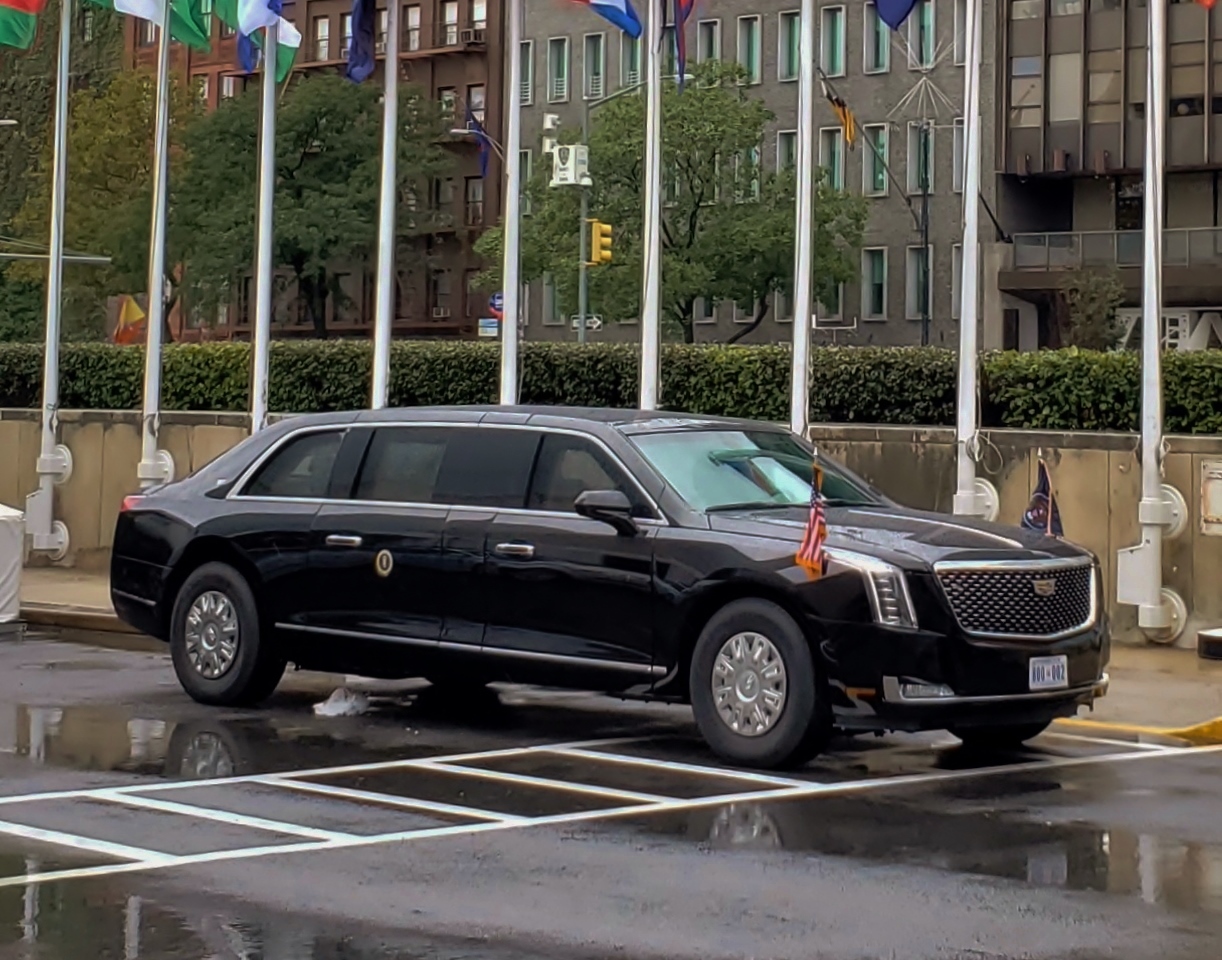
-
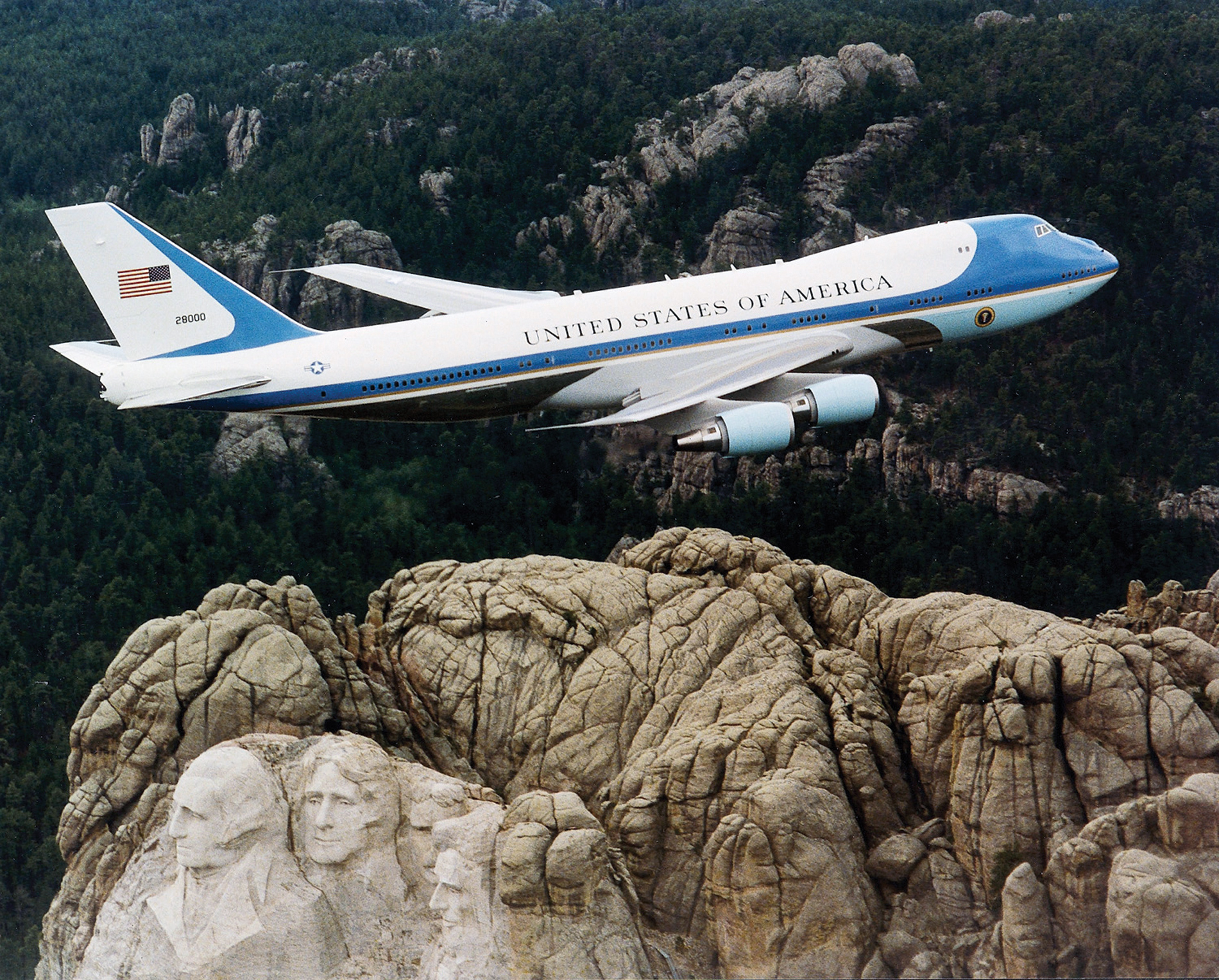 The presidential plane, called Air Force One when the president is on board
 -
 Marine One helicopter, when the president is aboard
.jpg)


Protection

The U.S. Secret Service is charged with protecting the president and the first family. As part of their protection, presidents, first ladies, their children and other immediate family members, and other prominent persons and locations are assigned Secret Service codenames.[172] The use of such names was originally for security purposes and dates to a time when sensitive electronic communications were not routinely encrypted; today, the names simply serve for purposes of brevity, clarity, and tradition.[173]
Post-presidency

Activities
Some former presidents have had significant careers after leaving office. Prominent examples include William Howard Taft's tenure as chief justice of the United States and Herbert Hoover's work on government reorganization after World War II. Grover Cleveland, whose bid for reelection failed in 1888, was elected president again four years later in 1892. Two former presidents served in Congress after leaving the White House: John Quincy Adams was elected to the House of Representatives, serving there for 17 years, and Andrew Johnson returned to the Senate in 1875, though he died soon after. Some ex-presidents were very active, especially in international affairs, most notably Theodore Roosevelt;[174] Herbert Hoover;[175] Richard Nixon;[176] and Jimmy Carter.[177][178]
Presidents may use their predecessors as emissaries to deliver private messages to other nations or as official representatives of the United States to state funerals and other important foreign events.[179][180] Richard Nixon made multiple foreign trips to countries including China and Russia and was lauded as an elder statesman.[181] Jimmy Carter has become a global human rights campaigner, international arbiter, and election monitor, as well as a recipient of the Nobel Peace Prize. Bill Clinton has also worked as an informal ambassador, most recently in the negotiations that led to the release of two American journalists, Laura Ling and Euna Lee, from North Korea. During his presidency, George W. Bush called on former Presidents Bush and Clinton to assist with humanitarian efforts after the 2004 Indian Ocean earthquake and tsunami. President Obama followed suit by asking Presidents Clinton and Bush to lead efforts to aid Haiti after an earthquake devastated that country in 2010.
Clinton was active politically since his presidential term ended, working with his wife Hillary on her 2008 and 2016 presidential bids and President Obama on his 2012 reelection campaign. Obama was also active politically since his presidential term ended, having worked with his former vice president Joe Biden on his 2020 election campaign. Trump has continued to make appearances in the media and at conventions and rallies since leaving office.
Pension and other benefits
The Former Presidents Act (FPA), enacted in 1958, grants lifetime benefits to former presidents and their widows, including a monthly pension, medical care in military facilities, health insurance, and Secret Service protection; also provided is funding for a certain number of staff and for office expenses. The act has been amended several times to provide increases in presidential pensions and in the allowances for office staff. The FPA excludes any president who was removed from office by impeachment.[182]
According to a 2008 report by the Congressional Research service:[182]
Chief executives leaving office prior to 1958 often entered retirement pursuing various occupations and received no federal assistance. When industrialist Andrew Carnegie announced a plan in 1912 to offer $25,000 annual pensions to former Presidents, many Members of Congress deemed it inappropriate that such a pension would be provided by a private corporation executive. That same year, legislation was first introduced to create presidential pensions, but it was not enacted. In 1955, such legislation was considered by Congress because of former President Harry S. Truman’s financial limitations in hiring an office staff
The pension has increased numerous times with congressional approval. Retired presidents receive a pension based on the salary of the current administration's cabinet secretaries, which was $199,700 per year in 2012.[183] Former presidents who served in Congress may also collect congressional pensions.[184] The act also provides former presidents with travel funds and franking privileges.
Prior to 1997, all former presidents, their spouses, and their children until age 16 were protected by the Secret Service until the president's death.[185][186] In 1997, Congress passed legislation limiting Secret Service protection to no more than 10 years from the date a president leaves office.[187] On January 10, 2013, President Obama signed legislation reinstating lifetime Secret Service protection for him, George W. Bush, and all subsequent presidents.[188]
A first spouse who remarries is no longer eligible for Secret Service protection.[187]
As of 2022[update], there were five living former U.S. presidents: Jimmy Carter, Bill Clinton, George W. Bush, Barack Obama, and Donald Trump.
.jpg)


.jpg)
The most recent death of a former president was George H. W. Bush (served from 1989 to 1993), on 30 November 2018, aged 94.
Presidential libraries
File:George W. Bush Presidential Center dedication.tif
Every president since Herbert Hoover has created a repository known as a presidential library for preserving and making available his papers, records, and other documents and materials. Completed libraries are deeded to and maintained by the National Archives and Records Administration (NARA); the initial funding for building and equipping each library must come from private, non-federal sources.[189] There are currently thirteen presidential libraries in the NARA system. There are also presidential libraries maintained by state governments and private foundations and Universities of Higher Education, such as the Abraham Lincoln Presidential Library and Museum, which is run by the State of Illinois; the George W. Bush Presidential Library and Museum, which is run by Southern Methodist University; the George H. W. Bush Presidential Library and Museum, which is run by Texas A&M University; and the Lyndon Baines Johnson Presidential Library and Museum, which is run by the University of Texas at Austin.
A number of presidents have lived for many years after leaving office, and several of them have personally overseen the building and opening of their own presidential libraries. Some have even made arrangements for their own burial at the site. Several presidential libraries contain the graves of the president they document, including the Dwight D. Eisenhower Presidential Library, Museum and Boyhood Home in Abilene, Kansas, Richard Nixon Presidential Library and Museum in Yorba Linda, California, and the Ronald Reagan Presidential Library in Simi Valley, California. These gravesites are open to the general public.
Political affiliation
Political parties have dominated American politics for most of the nation's history. Though the Founding Fathers generally spurned political parties as divisive and disruptive, and their rise had not been anticipated when the U.S. Constitution was drafted in 1787, organized political parties developed in the U.S. in the mid-1790s nonetheless. They evolved from political factions, which began to appear almost immediately after the Federal government came into existence. Those who supported the Washington administration were referred to as "pro-administration" and would eventually form the Federalist Party, while those in opposition joined the emerging Democratic-Republican Party.[190]
Greatly concerned about the very real capacity of political parties to destroy the fragile unity holding the nation together, Washington remained unaffiliated with any political faction or party throughout his eight-year presidency. He was, and remains, the only U.S. president never to be affiliated with a political party.[191][192] Since Washington, every U.S. president has been affiliated with a political party at the time of assuming office.[193][194]
The number of presidents per political party at the time they were sworn into office (arranged in alphabetical order by last name) and the cumulative number of years that each political party has been affiliated with the presidency are:
Timeline of presidents
The following timeline depicts the progression of the presidents and their political affiliation at the time of assuming office.
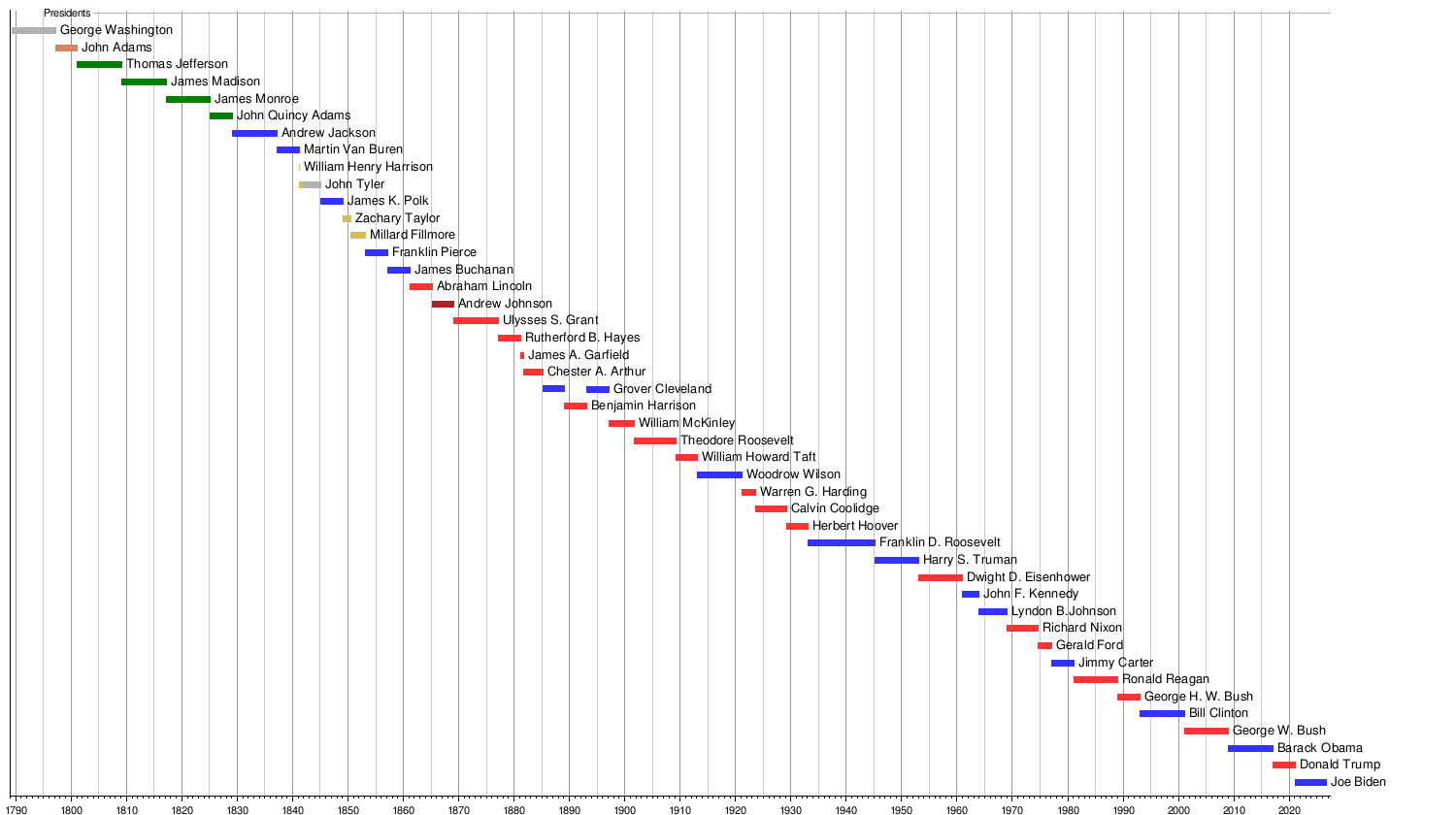
See also
Notes
- ↑ The informal term POTUS originated in the Phillips Code, a shorthand method created in 1879 by Walter P. Phillips for the rapid transmission of press reports by telegraph.[10]
- ↑ The nine vice presidents who succeeded to the presidency upon their predecessor's death or resignation and served for the remainder of his term are: John Tyler (1841); Millard Fillmore (1850); Andrew Johnson (1865); Chester A. Arthur (1881); Theodore Roosevelt (1901); Calvin Coolidge (1923); Harry S. Truman (1945); Lyndon B. Johnson (1963); and Gerald Ford (1974).
- ↑ Grover Cleveland served two non-consecutive terms, so he is counted twice, as both the 22nd and 24th president.[17]
- ↑ Nearly all scholars rank Lincoln among the nation's top three presidents, with many placing him first. See Historical rankings of presidents of the United States for a collection of survey results.
- ↑ See List of United States presidential elections by popular vote margin.
- ↑ Republican Abraham Lincoln was elected for a second term as part of the National Union Party ticket with Democrat Andrew Johnson in 1864.
- ↑ Former Democrat John Tyler was elected vice president on the Whig Party ticket with Harrison in 1840. Tyler's policy priorities as president soon proved to be opposed to most of the Whig agenda, and he was expelled from the party in September 1841.
- ↑ Democrat Andrew Johnson was elected vice president on the National Union Party ticket with Republican Abraham Lincoln in 1864. Later, while president, Johnson tried and failed to build a party of loyalists under the National Union banner. Near the end of his presidency, Johnson rejoined the Democratic Party.
References
- ↑ "How To Address The President; He Is Not Your Excellency Or Your Honor, But Mr. President". The Washington Star. August 2, 1891 – via The New York Times.
- ↑ "USGS Correspondence Handbook—Chapter 4". Usgs.gov. July 18, 2007. Archived from the original on September 26, 2012. Retrieved November 15, 2012.
- ↑ "Models of Address and Salutation". Ita.doc.gov. Archived from the original on July 20, 2010. Retrieved September 4, 2010.
- ↑ Heads of State, Heads of Government, Ministers for Foreign Affairs, Protocol and Liaison Service, United Nations. Retrieved November 1, 2012.
- ↑ The White House Office of the Press Secretary (September 1, 2010). "Remarks by President Obama, President Mubarak, His Majesty King Abdullah, Prime Minister Netanyahu and President Abbas Before Working Dinner". whitehouse.gov. Retrieved July 19, 2011 – via National Archives.
- ↑ 6.0 6.1 "The conventions of nine states having adopted the Constitution, Congress, in September or October, 1788, passed a resolution in conformity with the opinions expressed by the Convention and appointed the first Wednesday in March of the ensuing year as the day, and the then seat of Congress as the place, 'for commencing proceedings under the Constitution.'
"Both governments could not be understood to exist at the same time. The new government did not commence until the old government expired. It is apparent that the government did not commence on the Constitution's being ratified by the ninth state, for these ratifications were to be reported to Congress, whose continuing existence was recognized by the Convention, and who were requested to continue to exercise their powers for the purpose of bringing the new government into operation. In fact, Congress did continue to act as a government until it dissolved on the first of November by the successive disappearance of its members. It existed potentially until 2 March, the day preceding that on which the members of the new Congress were directed to assemble." Template:Ussc - ↑ Maier, Pauline (2010). Ratification: The People Debate the Constitution, 1787–1788. New York, New York: Simon & Schuster. p. 433. ISBN 978-0-684-86854-7.
- ↑ "March 4: A forgotten huge day in American history". Philadelphia: National Constitution Center. March 4, 2013. Retrieved July 29, 2018.
- ↑ "Presidential Election of 1789". Digital Encyclopedia. Mount Vernon, Virginia: Mount Vernon Ladies' Association, George Washington's Mount Vernon. Retrieved July 29, 2018.
- ↑ Safire, William (2008). Safire's Political Dictionary. Oxford University Press. p. 564. ISBN 978-0-19-534061-7.
- ↑ Ford, Henry Jones (1908). "The Influence of State Politics in Expanding Federal Power". Proceedings of the American Political Science Association. 5: 53–63. doi:10.2307/3038511. JSTOR 3038511.
- ↑ Von Drehle, David (February 2, 2017). "Is Steve Bannon the Second Most Powerful Man in the World?". Time.
- ↑ "Who should be the world's most powerful person?". The Guardian. London. January 3, 2008.
- ↑ Meacham, Jon (December 20, 2008). "Meacham: The History of Power". Newsweek. Retrieved September 4, 2010.
- ↑ Zakaria, Fareed (December 20, 2008). "The Newsweek 50: Barack Obama". Newsweek. Retrieved September 4, 2010.
- ↑ Pfiffner, J. P. (1988). "The President's Legislative Agenda". Annals of the American Academy of Political and Social Science. 499: 22–35. doi:10.1177/0002716288499001002. S2CID 143985489.
- ↑ "Grover Cleveland—24". White House..
- ↑ 18.0 18.1 18.2 18.3 18.4 18.5 18.6 Milkis, Sidney M.; Nelson, Michael (2008). The American Presidency: Origins and Development (5th ed.). Washington, D.C.: CQ Press. pp. 1–25. ISBN 978-0-87289-336-8.
- ↑ 19.0 19.1 19.2 Kelly, Alfred H.; Harbison, Winfred A.; Belz, Herman (1991). The American Constitution: Its Origins and Development. Vol. I (7th ed.). New York: W.W. Norton & Co. pp. 76–81. ISBN 978-0-393-96056-3.
- ↑ "Articles of Confederation, 1777–1781". Washington, D.C.: Office of the Historian, Bureau of Public Affairs, United States Department of State. Retrieved January 20, 2019.[dead link]
- ↑ Ellis, Richard J. (1999). Founding the American Presidency. Lanham, Maryland: Rowman & Littlefield. p. 1. ISBN 0-8476-9499-2.
- ↑ Beeman, Richard (2009). Plain, Honest Men: The Making of the American Constitution. New York: Random House. ISBN 978-0-8129-7684-7.
- ↑ Steven, Knott (October 4, 2016). "George Washington: Life in Brief". Miller Center. Archived from the original on February 5, 2018. Retrieved September 14, 2020.
- ↑ Stockwell, Mary. "Presidential Precedents". Mount Vernon, Washington Library, Center for Digital History. Retrieved September 14, 2020.
- ↑ Spalding, Matthew (February 5, 2007). "The Man Who Would Not Be King". The Heritage Foundation. Retrieved September 14, 2020.
- ↑ Feeling, John (February 15, 2016). "How the Rivalry Between Thomas Jefferson and Alexander Hamilton Changed History". Time. Retrieved September 14, 2020.
- ↑ NCC staff (November 4, 2019). "On This Day: The first bitter, contested presidential election takes place". National Constitution Center. Retrieved September 14, 2020.
- ↑ Walsh, Kenneth (August 20, 2008). "The Most Consequential Elections in History: Andrew Jackson and the Election of 1828". U.S. News & World Report. Retrieved September 14, 2020.
- ↑ Bomboy, Scott (December 5, 2017). "Martin Van Buren's legacy: Expert politician, mediocre president". National Constitution Center. Retrieved September 14, 2020.
- ↑ Freehling, William (October 4, 2016). "John Tyler: Impact and Legacy". University of Virginia, Miller Center. Retrieved September 14, 2020.
- ↑ McNamara, Robert (July 3, 2019). "Seven Presidents Served in the 20 Years Before the Civil War". ThoughtCo. Retrieved September 14, 2020.
- ↑ Heidler, David; Heidler, Jeanne. "The Great Triumvirate". Essential Civil War Curriculum. Retrieved September 14, 2020.
- ↑ Winters, Michael Sean (August 4, 2017). "'Do not trust in princes': the limits of politics". National Catholic Reporter. Retrieved September 14, 2020.
- ↑ Williams, Frank (April 1, 2011). "Lincoln's War Powers: Part Constitution, Part Trust". American Bar Association. Retrieved September 14, 2020.
- ↑ Weber, Jennifer (March 25, 2013). "Was Lincoln a Tyrant?". New York Times Opinionator. Retrieved September 14, 2020.
- ↑ Varon, Elizabeth (October 4, 2016). "Andrew Johnson: Campaigns and Elections". University of Virginia, Miller Center. Retrieved September 14, 2020.
- ↑ NCC Staff (May 16, 2020). "The man whose impeachment vote saved Andrew Johnson". National Constitution Center. Retrieved September 14, 2020.
- ↑ Boissoneault, Lorraine (April 17, 2017). "The Debate Over Executive Orders Began With Teddy Roosevelt's Mad Passion for Conservation". Smithsonian Magazine (website). Retrieved September 14, 2020.
- ↑ Posner, Eric (April 22, 2011). "The inevitability of the imperial presidency". The Washington Post. Retrieved September 12, 2020.
- ↑ Glass, Andrew (November 19, 2014). "Senate rejects League of Nations, Nov. 19, 2019". Politico. Retrieved September 14, 2020.
- ↑ Robenalt, James (August 13, 2015). "If we weren't so obsessed with Warren G. Harding's sex life, we'd realize he was a pretty good president". The Washington Post. Retrieved September 14, 2020.
- ↑ Smith, Richard Norton; Walch, Timothy (Summer 2004). "The Ordeal of Herbert Hoover". Prologue Magazine. 36 (2). National Archives.
- ↑ Schlesinger, Arthur M., Jr. (1973). The Imperial Presidency. Frank and Virginia Williams Collection of Lincolniana (Mississippi State University. Libraries). Boston: Houghton Mifflin. pp. x. ISBN 0-395-17713-8. OCLC 704887.
{{cite book}}: CS1 maint: multiple names: authors list (link) - ↑ 44.0 44.1 44.2 Yoo, John (February 14, 2018). "Franklin Roosevelt and Presidential Power". Chapman Law Review. 21 (1): 205. SSRN 3123894.
- ↑ Tierney, Dominic (January 24, 2017). "What Does It Mean That Trump Is 'Leader of the Free World'?". The Atlantic.
- ↑ Eschner, Kat (November 14, 2017). "A Year Before His Presidential Debate, JFK Foresaw How TV Would Change Politics". Smithsonian Magazine. Retrieved September 12, 2020.
- ↑ Simon, Ron (May 29, 2017). "See How JFK Created a Presidency for the Television Age". Time. Retrieved September 12, 2020.
- ↑ Wallach, Philip (April 26, 2018). "When Congress won the American people's respect: Watergate". LegBranch.org. Retrieved September 12, 2020.
- ↑ Berger, Sam; Tausanovitch, Alex (July 30, 2018). "Lessons From Watergate". Center for American Progress. Retrieved September 12, 2020.
- ↑ Template:USStat, 559-560.
- ↑ Madden, Richard (November 8, 1973). "House and Senate Override Veto by Nixon on Curb of War Powers; Backers of Bill Win 3-Year Fight". The New York Times. Retrieved September 12, 2020.
- ↑ Glass, Andrew (July 12, 2017). "Budget and Impoundment Control Act becomes law, July 12, 1974". Politico. Retrieved September 12, 2020.
- ↑ Shabecoff, Philip (March 28, 1976). "Presidency Is Found Weaker Under Ford". The New York Times. Retrieved September 9, 2020.
- ↑ Edwards, Lee (February 5, 2018). "What Made Reagan a Truly Great Communicator". The Heritage Foundation. Retrieved September 12, 2020.
- ↑ Brands, H. W. "What Reagan Learned from FDR". History News Network. Retrieved September 12, 2020.
- ↑ Schmuhl, Robert (April 26, 1992). "Bush Enjoyed the Martin Van Buren Comparisons in '88; He Won't". Chicago Tribune. Retrieved September 12, 2020.
- ↑ Sorensen, Theodore (Fall 1992). "America's First Post-Cold War President". Foreign Affairs. 71 (4): 13–30. doi:10.2307/20045307. JSTOR 20045307.
- ↑ Barber, Michael; McCarty, Nolan (2013), Causes and Consequences of Polarization, American Political Science Association Task Force on Negotiating Agreement in Politics report, at 19-20, 37-38.
- ↑ Rudalevige, Andrew (April 1, 2014). "The Letter of the Law: Administrative Discretion and Obama's Domestic Unilateralism". The Forum. 12 (1): 29–59. doi:10.1515/for-2014-0023. S2CID 145237493. Retrieved September 12, 2020.
- ↑ DeSilver, Drew (October 3, 2019). "Clinton's impeachment barely dented his public support, and it turned off many Americans". Pew Research Center. Retrieved September 12, 2020.
- ↑ Olsen, Henry (January 6, 2020). "Trump's approval rating has already recovered from its impeachment slump". The Washington Post. Retrieved September 12, 2020.
- ↑ Kakutani, Michiko (July 6, 2007). "Unchecked and Unbalanced". The New York Times. Retrieved November 9, 2009.
the founding fathers had "scant affection for strong executives" like England's king, and ... Bush White House's claims are rooted in ideas "about the 'divine' right of kings" ... and that certainly did not find their way into our founding documents, the 1776 Declaration of Independence and the Constitution of 1787.
- ↑ Sirota, David (August 22, 2008). "The Conquest of Presidentialism". HuffPost. Retrieved September 20, 2009.
- ↑ Schimke, David (September–October 2008). "Presidential Power to the People—Author Dana D. Nelson on why democracy demands that the next President be taken down a notch". Utne Reader. Retrieved September 20, 2009.
- ↑ Linker, Ross (September 27, 2007). "Critical of Presidency, Prof. Ginsberg and Crenson unite". The Johns-Hopkins Newsletter. Retrieved November 9, 2017.
Presidents slowly but surely gain more and more power with both the public at large and other political institutions doing nothing to prevent it.
- ↑ Kakutani, Michiko (July 6, 2007). "Unchecked and Unbalanced". The New York Times. Retrieved November 9, 2009.
Unchecked and Unbalanced: Presidential Power in a Time of Terror By Frederick A. O. Schwarz Jr. and Aziz Z. Huq (authors)
- ↑ 67.0 67.1 Nelson, Dana D. (October 11, 2008). "Opinion—The 'unitary executive' question—What do McCain and Obama think of the concept?". Los Angeles Times. Retrieved September 21, 2009.
- ↑ Shane, Scott (September 25, 2009). "A Critic Finds Obama Policies a Perfect Target". The New York Times. Retrieved November 8, 2009.
There is the small, minority-owned firm with deep ties to President Obama's Chicago backers, made eligible by the Federal Reserve to handle potentially lucrative credit deals. "I want to know how these firms are picked and who picked them," Mr. Wilson, the group's president, tells his eager researchers.
- ↑ Pfiffner, James. "Essays on Article II: Recommendations Clause". The Heritage Guide to the Constitution. Heritage Foundation. Retrieved April 14, 2019.
- ↑ "Our Government: The Legislative Branch". www.whitehouse.gov. Washington, D.C.: The White House. Retrieved April 14, 2019.
- ↑ Heitshusen, Valerie (November 15, 2018). "Introduction to the Legislative Process in the U.S. Congress" (PDF). R42843 · Version 14 · updated. Washington, D.C.: Congressional Research Service. Retrieved April 14, 2019.
- ↑ Cantor, Eric (July 30, 2009). "Obama's 32 Czars". The Washington Post. Retrieved September 28, 2009.
- ↑ Nelson, Dana D. (October 11, 2008). "The 'unitary executive' question". Los Angeles Times. Retrieved October 4, 2009.
- ↑ Suarez, Ray; et al. (July 24, 2006). "President's Use of 'Signing Statements' Raises Constitutional Concerns". PBS Online NewsHour. Archived from the original on March 21, 2007. Retrieved November 11, 2009.
The American Bar Association said President Bush's use of "signing statements", which allow him to sign a bill into law but not enforce certain provisions, disregards the rule of law and the separation of powers. Legal experts discuss the implications.
- ↑ Will, George F. (December 21, 2008). "Making Congress Moot". The Washington Post. Retrieved September 28, 2009.
- ↑ Forte, David F. "Essays on Article II: Convening of Congress". The Heritage Guide to the Constitution. Heritage Foundation. Retrieved April 14, 2019.
- ↑ Steinmetz, Katy (August 10, 2010). "Congressional Special Sessions". Time. Retrieved April 14, 2019.
- ↑ "Article II, Section 3, U.S. Constitution". Legal Information Institute. 2012. Retrieved August 7, 2012.
- ↑ "Executive Branch". whitehouse.gov. April 2015. Retrieved January 24, 2020 – via National Archives.
- ↑ NLRB v. Noel Canning, 572 U.S. __ (2014).
- ↑ Shurtleff v. United States, Template:Ussc; Myers v. United States, Template:Ussc.
- ↑ Humphrey's Executor v. United States, Template:Ussc and Morrison v. Olson, Template:Ussc, respectively.
- ↑ Gaziano, Todd (February 21, 2001). "Executive Summary: The Use and Abuse of Executive Orders and Other Presidential Directives". Washington, D.C.: The Heritage Foundation. Retrieved January 23, 2018.
- ↑ United States v. Curtiss-Wright Export Corp., Template:Ussc, characterized the President as the "sole organ of the nation in its external relations," an interpretation criticized by Louis Fisher of the Library of Congress.
- ↑ Zivotofsky v. Kerry, Template:Ussc.
- ↑ Ramsey, Michael; Vladeck, Stephen. "Common Interpretation: Commander in Chief Clause". National Constitution Center Educational Resources (some internal navigation required). National Constitution Center. Retrieved May 23, 2017.
- ↑ Hamilton, Alexander. The Federalist #69 (reposting). Retrieved June 15, 2007.
- ↑ Christopher, James A.; Baker, III (July 8, 2008). "The National War Powers Commission Report". The Miller Center of Public Affairs at the University of Virginia. Archived from the original (PDF) on November 26, 2010. Retrieved December 15, 2010.
No clear mechanism or requirement exists today for the president and Congress to consult. The War Powers Resolution of 1973 contains only vague consultation requirements. Instead, it relies on reporting requirements that, if triggered, begin the clock running for Congress to approve the particular armed conflict. By the terms of the 1973 Resolution, however, Congress need not act to disapprove the conflict; the cessation of all hostilities is required in 60 to 90 days merely if Congress fails to act. Many have criticized this aspect of the Resolution as unwise and unconstitutional, and no president in the past 35 years has filed a report "pursuant" to these triggering provisions.
- ↑ 89.0 89.1 89.2 89.3 "The Law: The President's War Powers". Time. June 1, 1970. Archived from the original on January 7, 2008. Retrieved September 28, 2009.
- ↑ Mitchell, Alison (May 2, 1999). "The World; Only Congress Can Declare War. Really. It's True". The New York Times. Retrieved November 8, 2009.
Presidents have sent forces abroad more than 100 times; Congress has declared war only five times: the War of 1812, the Mexican War, the Spanish–American War, World War I and World War II.
- ↑ Mitchell, Alison (May 2, 1999). "The World; Only Congress Can Declare War. Really. It's True". The New York Times. Retrieved November 8, 2009.
President Reagan told Congress of the invasion of Grenada two hours after he had ordered the landing. He told Congressional leaders of the bombing of Libya while the aircraft were on their way.
- ↑ Gordon, Michael R. (December 20, 1990). "U.S. troops move in Panama in effort to seize Noriega; gunfire is heard in capital". The New York Times. Retrieved November 8, 2009.
It was not clear whether the White House consulted with Congressional leaders about the military action, or notified them in advance. Thomas S. Foley, the Speaker of the House, said on Tuesday night that he had not been alerted by the Administration.
- ↑ Andrew J. Polsky, Elusive Victories: The American Presidency at War (Oxford University Press, 2012) online review
- ↑ "George Washington and the Evolution of the American Commander in Chief". The Colonial Williamsburg Foundation.
- ↑ James M. McPherson, Tried by War: Abraham Lincoln As Commander in Chief (2009)
- ↑ "DOD Releases Unified Command Plan 2011". United States Department of Defense. April 8, 2011. Archived from the original on May 13, 2011. Retrieved February 25, 2013.
- ↑ Template:USC
- ↑ Joint Chiefs of Staff. About the Joint Chiefs of Staff. Retrieved February 25, 2013.
- ↑ Johnston, David (December 24, 1992). "Bush Pardons Six in Iran Affair, Aborting a Weinberger Trial; Prosecutor Assails 'Cover-Up'". The New York Times. Retrieved November 8, 2009.
But not since President Gerald R. Ford granted clemency to former President Richard M. Nixon for possible crimes in Watergate has a Presidential pardon so pointedly raised the issue of whether the president was trying to shield officials for political purposes.
- ↑ Johnston, David (December 24, 1992). "Bush Pardons Six in Iran Affair, Aborting a Weinberger Trial; Prosecutor Assails 'Cover-Up'". The New York Times. Retrieved November 8, 2009.
The prosecutor charged that Mr. Weinberger's efforts to hide his notes may have 'forestalled impeachment proceedings against President Reagan' and formed part of a pattern of 'deception and obstruction'. ... In light of President Bush's own misconduct, we are gravely concerned about his decision to pardon others who lied to Congress and obstructed official investigations.
- ↑ Eisler, Peter (March 7, 2008). "Clinton-papers release blocked". USA Today. Retrieved November 8, 2009.
Former president Clinton issued 140 pardons on his last day in office, including several to controversial figures, such as commodities trader Rich, then a fugitive on tax evasion charges. Rich's ex-wife, Denise, contributed $2,000 in 1999 to Hillary Clinton's Senate campaign; $5,000 to a related political action committee; and $450,000 to a fund set up to build the Clinton library.
- ↑ Millhiser, Ian (June 1, 2010). "Executive Privilege 101". Center for American Progress. Archived from the original on June 9, 2010. Retrieved October 8, 2010.
- ↑ Template:Cite case
- ↑ 104.0 104.1 Frost, Amanda; Florence, Justin (2009). "Reforming the State Secrets Privilege". American Constitution Society. Retrieved November 9, 2017.
- ↑ Weaver, William G.; Pallitto, Robert M. (2005). "State Secrets and Executive Power". Political Science Quarterly. 120 (1): 85–112. doi:10.1002/j.1538-165x.2005.tb00539.x.
Use of the state secrets privilege in courts has grown significantly over the last twenty-five years. In the twenty-three years between the decision in Reynolds [1953] and the election of Jimmy Carter, in 1976, there were four reported cases in which the government invoked the privilege. Between 1977 and 2001, there were a total of fifty-one reported cases in which courts ruled on invocation of the privilege. Because reported cases represent only a fraction of the total cases in which the privilege is invoked or implicated, it is unclear precisely how dramatically the use of the privilege has grown. But the increase in reported cases is indicative of greater willingness to assert the privilege than in the past.
- ↑ Savage, Charlie (September 8, 2010). "Court Dismisses a Case Asserting Torture by C.I.A." The New York Times. Retrieved October 8, 2010.
- ↑ Finn, Peter (September 9, 2010). "Suit dismissed against firm in CIA rendition case". The Washington Post. Retrieved October 8, 2010.
- ↑ Glenn Greenwald (February 10, 2009). "The 180-degree reversal of Obama's State Secrets position". Salon. Retrieved October 8, 2010.
- ↑ "Background on the State Secrets Privilege". American Civil Liberties Union. January 31, 2007. Retrieved October 8, 2010.
- ↑ Brown, Tanya Ballard (October 7, 2019). "President Trump Doesn't Need To Release His Tax Returns — For Now". NPR. Retrieved April 28, 2020.
- ↑ Abbott, James A.; Rice, Elaine M. (1998). Designing Camelot: The Kennedy White House Restoration. Van Nostrand Reinhold. pp. 9–10. ISBN 978-0-442-02532-8.
- ↑ "The White House State Dinner". The White House Historical Association. Retrieved November 9, 2017.
- ↑ Duggan, Paul (April 2, 2007). "Balking at the First Pitch". The Washington Post. p. A01.
- ↑ "History of the BSA Fact Sheet" (PDF). Boy Scouts of America. Archived from the original (PDF) on June 29, 2014. Retrieved November 9, 2017.
- ↑ Grier, Peter (April 25, 2011). "The (not so) secret history of the White House Easter Egg Roll". The Christian Science Monitor. Retrieved July 30, 2012.
{{cite news}}: CS1 maint: deprecated archival service (link) - ↑ Hesse, Monica (November 21, 2007). "Turkey Pardons, The Stuffing of Historic Legend". The Washington Post. Retrieved May 14, 2011.
- ↑ Gibbs, Nancy (November 13, 2008). "How Presidents Pass The Torch". Time. Archived from the original on November 21, 2008. Retrieved May 6, 2011.
- ↑ Dorning, Mike (January 22, 2009). "A note from Bush starts morning in the Oval Office". Chicago Tribune. Archived from the original on December 28, 2011. Retrieved May 6, 2011.
- ↑ Dykoski, Rachel (November 1, 2008). "Book note: Presidential idolatry is "Bad for Democracy"". Twin Cities Daily Planet. Retrieved November 11, 2009.
Dana D. Nelson's book makes the case that we've had 200+ years of propagandized leadership ...
- ↑ Neffinger, John (April 2, 2007). "Democrats vs. Science: Why We're So Damn Good at Losing Elections". HuffPost. Retrieved November 11, 2009.
... back in the 1980s, Lesley Stahl of 60 Minutes ran a piece skewering Reagan's policies on the elderly ... But while her voiceover delivered a scathing critique, the video footage was all drawn from carefully - [sic]staged photo-ops of Reagan smiling with seniors and addressing large crowds ... Deaver thanked ... Stahl ... for broadcasting all those images of Reagan looking his best.
- ↑ Nelson, Dana D. (2008). "Bad for democracy: how the Presidency undermines the power of the people". U of Minnesota Press. ISBN 978-0-8166-5677-6. Retrieved November 11, 2009.
in rich detail how Kennedy drew on the power of myth as he framed his experience during World War II, when his PT boat was sliced in half by a Japanese ...
- ↑ Nelson, Dana D. (2008). "Bad for democracy: how the Presidency undermines the power of the people". U of Minnesota Press. ISBN 978-0-8166-5677-6. Retrieved November 11, 2009.
Even before Kennedy ran for Congress, he had become fascinated, through his Hollywood acquaintances and visits, with the idea of the image ... (p.54)
- ↑ Lexington (July 21, 2009). "The Cult of the Presidency". The Economist. Retrieved November 9, 2009.
Gene Healy argues that because voters expect the president to do everything ... When they inevitably fail to keep their promises, voters swiftly become disillusioned. Yet they never lose their romantic idea that the president should drive the economy, vanquish enemies, lead the free world, comfort tornado victims, heal the national soul and protect borrowers from hidden credit-card fees.
- ↑ "Article II. The Executive Branch, Annenberg Classroom". The Interactive Constitution. Philadelphia, Pennsylvania: The National Constitution Center. Retrieved June 15, 2018.
- ↑ Bernstein, Richard D. (February 4, 2021). "Lots of People Are Disqualified From Becoming President". The Atlantic. Retrieved March 1, 2021.
In addition to the list of people who are ineligible for reasons of mere demographic chance, the Constitution adds a category of people who cannot be elected as a result of their misdeeds. This category includes presidents (along with vice presidents and federal "civil officers") who are impeached, convicted by two-thirds of the Senate, and disqualified for serious misconduct committed while they were in office.
- ↑ Wolfe, Jan (January 14, 2021). "Explainer: Impeachment or the 14th Amendment – Can Trump be barred from future office?". Reuters. Retrieved March 1, 2021.
- ↑ Moreno, Paul. "Articles on Amendment XIV: Disqualification for Rebellion". The Heritage Guide to the Constitution. The Heritage Foundation. Retrieved June 15, 2018.
- ↑ Vlamis, Kelsey. "Here's how the 14th Amendment could be used to prevent Trump from running again". Business Insider. Retrieved March 1, 2021.
- ↑ Peabody, Bruce G.; Gant, Scott E. (February 1999). "The Twice and Future President: Constitutional Interstices and the Twenty-Second Amendment". Minnesota Law Review. 83 (3): 565–635. Archived from the original on January 15, 2013. Retrieved June 12, 2015.
- ↑ Albert, Richard (Winter 2005). "The Evolving Vice Presidency". Temple Law Review. 78 (4): 811–896. Retrieved July 31, 2018 – via Digital Commons @ Boston College Law School.
- ↑ International Law, US Power: The United States' Quest for Legal Security, p 10, Shirley V. Scott—2012
- ↑ "Twenty-third Amendment". Annenberg Classroom. Philadelphia, Pennsylvania: The Annenberg Public Policy Center. March 29, 1961. Retrieved July 30, 2018.
- ↑ 133.0 133.1 Neale, Thomas H. (May 15, 2017). "The Electoral College: How It Works in Contemporary Presidential Elections" (PDF). CRS Report for Congress. Washington, D.C.: Congressional Research Service. p. 13. Retrieved July 29, 2018.
- ↑ "About the Electors". U.S. Electoral College. Washington, D.C.: National Archives and Records Administration. Retrieved August 2, 2018.
- ↑ "Maine & Nebraska". Takoma Park, Maryland: FairVote. Retrieved August 1, 2018.
- ↑ "Split Electoral Votes in Maine and Nebraska". 270towin.com. Retrieved August 1, 2018.
- ↑ "Faithless Elector State Laws". Fair Vote. Retrieved March 4, 2020.
- ↑ "Laws Binding Electors". Retrieved March 4, 2020.
- ↑ Howe, Amy (July 6, 2020). "Opinion analysis: Court upholds "faithless elector" laws". SCOTUSblog. Retrieved July 11, 2020.
- ↑ Kuroda, Tadahisa. "Essays on Article II: Electoral College". The Heritage Guide to The Constitution. The Heritage Foundation. Retrieved July 27, 2018.
- ↑ Fried, Charles. "Essays on Amendment XII: Electoral College". The Heritage Guide to the Constitution. The Heritage Foundation. Retrieved February 20, 2018.
- ↑ Boller, Paul F. (2004). Presidential Campaigns: From George Washington to George W. Bush (2nd revised ed.). New York, New York: Oxford University Press. pp. 36–39. ISBN 978-0-19-516716-0. Retrieved August 2, 2018.
- ↑ Larson, Edward J.; Shesol, Jeff. "The Twentieth Amendment". The Interactive Constitution. Philadelphia, Pennsylvania: The National Constitution Center. Retrieved June 15, 2018.
- ↑ "The First Inauguration after the Lame Duck Amendment: January 20, 1937". Washington, D.C.: Office of the Historian, U.S. House of Representatives. Retrieved July 24, 2018.
- ↑ "Commencement of the Terms of Office: Twentieth Amendment" (PDF). Constitution of the United States of America: Analysis and Interpretation. Washington, D.C.: United States Government Printing Office, Library of Congress. pp. 2297–98. Retrieved July 24, 2018.
- ↑ 146.0 146.1 Kesavan, Vasan. "Essays on Article II: Oath of Office". The Heritage Guide to The Constitution. The Heritage Foundation. Retrieved August 2, 2018.
- ↑ NCC Staff (January 20, 2017). "How Presidents use Bibles at inaugurations". Constitution Daily. Philadelphia, Pennsylvania: National Constitution Center. Retrieved August 3, 2018.
- ↑ Munson, Holly (July 12, 2011). "Who said that? A quick history of the presidential oath". ConstitutionDaily. Philadelphia, Pennsylvania: National Constitution Center. Retrieved August 3, 2018.
- ↑ Neale, Thomas H. (October 19, 2009). "Presidential Terms and Tenure: Perspectives and Proposals for Change" (PDF). Washington, D.C.: Congressional Research Service. Retrieved August 3, 2018.
- ↑ Waugh, Joan (October 4, 2016). "Ulysses S. Grant: Campaigns and Elections". Miller Center of Public Affairs, University of Virginia. Retrieved August 3, 2018.
- ↑ 151.0 151.1 "Twenty-second Amendment". Annenberg Classroom. Philadelphia, Pennsylvania: The Annenberg Public Policy Center. Retrieved August 2, 2018.
- ↑ Feerick, John D. (2011). "Presidential Succession and Inability: Before and After the Twenty-Fifth Amendment". Fordham Law Review. 79 (3). New York City: Fordham University School of Law: 907–949. Retrieved December 13, 2018.
- ↑ 153.0 153.1 Feerick, John. "Essays on Article II: Presidential Succession". The Heritage Guide to the Constitution. The Heritage Foundation. Retrieved December 13, 2018.
- ↑ "Succession: Presidential and Vice Presidential Fast Facts". cnn.com. October 24, 2017. Retrieved July 19, 2018.
- ↑ Olsen, Jillian (November 19, 2021). "How many other vice presidents have temporarily taken over presidential powers?". St. Petersburg, Florida: WTSP. Retrieved May 11, 2022.
- ↑ Sullivan, Kate (November 19, 2021). "For 85 minutes, Kamala Harris became the first woman with presidential power". CNN. Retrieved November 19, 2021.
- ↑ 157.0 157.1 Presser, Stephen B. "Essays on Article I: Impeachment". Heritage Guide to the Constitution. The Heritage Foundation. Retrieved August 3, 2018.
- ↑ Gerhardt, Michael J. "Essays on Article I: Trial of Impeachment". Heritage Guide to the Constitution. The Heritage Foundation. Retrieved August 3, 2018.
- ↑ "Presidential and Vice Presidential Salaries Exclusive of Perquisites". Data from Congressional Quarterly's Guide to the Presidency. University of Michigan. Retrieved July 31, 2020.
- ↑ Williamson, Samuel H. "Seven Ways to Compute the Relative Value of a U.S. Dollar Amount, 1774 to Present". MeasuringWorth. Retrieved July 31, 2020.
- ↑ Longley, Robert (September 1, 2017). "Presidential Pay and Compensation". ThoughtCo. Retrieved July 31, 2018.
- ↑ Elkins, Kathleen (February 19, 2018). "Here's the last time the president of the United States got a raise". CNBC. Retrieved July 31, 2018.
- ↑ "The White House Building". whitehouse.gov. Retrieved August 3, 2018.
- ↑ Bulmiller, Elisabeth (January 2009). "Inside the Presidency: Few outsiders ever see the President's private enclave". National Geographic. Washington, D.C.: National Geographic Partners. Retrieved August 3, 2018.
- ↑ "The White House Building". whitehouse.gov. Retrieved August 3, 2018.
- ↑ "President's Guest House (includes Lee House and Blair House), Washington, DC". Washington, D.C.: General Services Administration. Retrieved November 9, 2017.
- ↑ "Air Force One". whitehouse.gov. March 21, 2015 – via National Archives.. White House Military Office. Retrieved June 17, 2007.
- ↑ Any U.S. Air Force aircraft carrying the president will use the call sign "Air Force One". Similarly, "Navy One", "Army One", and "Coast Guard One" are the call signs used if the president is aboard a craft belonging to these services. "Executive One" becomes the call sign of any civilian aircraft when the president boards.
- ↑ New Presidential Limousine enters Secret Service Fleet U.S. Secret Service Press Release (January 14, 2009) Retrieved on January 20, 2009.
- ↑ Ahlers, Mike M.; Marrapodi, Eric (January 6, 2009). "Obama's wheels: Secret Service to unveil new presidential limo". CNN. Archived from the original on February 2, 2016. Retrieved December 16, 2017.
- ↑ Farley, Robert (August 25, 2011). "Obama's Canadian-American Bus". FactCheck. Retrieved December 16, 2017.
- ↑ "Junior Secret Service Program: Assignment 7. Code Names". National Park Service. Archived from the original on January 18, 2007. Retrieved August 18, 2007.
- ↑ "Candidate Code Names Secret Service Monikers Used on the Campaign Trail". CBS. September 16, 2008. Archived from the original on October 6, 2008. Retrieved November 12, 2008.
- ↑ Edmund Morris, Colonel Roosevelt (2011)
- ↑ Gary Dean Best, The Life of Herbert Hoover: Keeper of the Torch, 1933–1964 (2013)
- ↑ Kasey S. Pipes, After the Fall: The Remarkable Comeback of Richard Nixon (2019)
- ↑ Douglas Brinkley. The Unfinished Presidency: Jimmy Carter's Journey Beyond the White House (1998).
- ↑ John Whiteclay, Chambers II (1979). "Presidents Emeritus". American Heritage. 30 (4): 16–25.
- ↑ "Shock and Anger Flash Throughout the United States". Associated Press. March 31, 1981. Archived from the original on September 6, 2015. Retrieved March 11, 2011.
- ↑ "Four Presidents". Reagan Presidential Library, National Archives and Records Administration. Archived from the original on May 12, 2011. Retrieved April 3, 2011.
- ↑ "Biography of Richard M. Nixon". whitehouse.gov. December 30, 2014 – via National Archives., The White House.
- ↑ 182.0 182.1 Stephanie Smith (March 18, 2008). "Federal Pension and Retirement Benefits" (PDF). Federation of American Scientists. Congressional Research Service, The Library of Congress. Archived (PDF) from the original on January 7, 2021. Retrieved November 10, 2020.
- ↑ Schwemle, Barbara L. (October 17, 2012). "President of the United States: Compensation" (PDF). Congressional Research Service. Retrieved January 10, 2013.
- ↑ "Former presidents cost U.S. taxpayers big bucks". Toledo Blade. January 7, 2007. Retrieved May 22, 2007.
- ↑ Template:Usc
- ↑ "Obama signs bill granting lifetime Secret Service protection to former presidents and spouses". The Washington Post. Associated Press. January 10, 2013. Archived from the original on August 23, 2016. Retrieved January 10, 2013.
- ↑ 187.0 187.1 "United States Secret Service: Protection". United States Secret Service. Retrieved November 9, 2017.
- ↑ "Obama signs protection bill for former presidents". The Washington Times. January 10, 2013. Retrieved August 14, 2013.
- ↑ Template:Usc
- ↑ "U.S. Senate: Party Division". U.S. Senate. Retrieved January 2, 2017.
- ↑ Jamison, Dennis (December 31, 2014). "George Washington's views on political parties in America". The Washington Times. Retrieved July 1, 2016.
- ↑ "Political Parties". Mount Vernon, Virginia: Mount Vernon Ladies' Association. Retrieved March 24, 2019.
- ↑ "The Presidents of the United States of America". Enchanted Learning. Retrieved August 2, 2018.
- ↑ "Political Parties of the Presidents". Presidents USA. Retrieved August 2, 2018.
Further reading
- Ayton, Mel Plotting to Kill the President: Assassination Attempts from Washington to Hoover (Potomac Books, 2017), United States
- Balogh, Brian and Bruce J. Schulman, eds. Recapturing the Oval Office: New Historical Approaches to the American Presidency (Cornell University Press, 2015), 311 pp.
- Kernell, Samuel; Jacobson, Gary C. (1987). "Congress and the Presidency as News in the Nineteenth Century" (PDF). Journal of Politics. 49 (4): 1016–1035. doi:10.2307/2130782. JSTOR 2130782. S2CID 154834781.
- Lang, J. Stephen. The Complete Book of Presidential Trivia. Pelican Publishing. 2001. ISBN 1-56554-877-9
- Graff, Henry F., ed. The Presidents: A Reference History (3rd ed. 2002) online, short scholarly biographies from George Washington to William Clinton.
- Greenberg, David. Republic of Spin: An Inside History of the American Presidency (W. W. Norton & Company, 2015). xx, 540 pp. bibliography
- Leo, Leonard—Taranto, James—Bennett, William J. Presidential Leadership: Rating the Best and the Worst in the White House. Simon and Schuster. 2004. ISBN 0-7432-5433-3
- Sigelman, Lee; Bullock, David (1991). "Candidates, issues, horse races, and hoopla: Presidential campaign coverage, 1888–1988" (PDF). American Politics Quarterly. 19 (1): 5–32. doi:10.1177/1532673x9101900101. S2CID 154283367.
- Tebbel, John William, and Sarah Miles Watts. The Press and the Presidency: From George Washington to Ronald Reagan (Oxford University Press, 1985).
- Presidential Studies Quarterly, published by Wiley, is a quarterly academic journal on the presidency.
Historiography and memory
- Greenstein, Fred I. et al. Evolution of the Modern President: A Bibliographical Survey (1977) annotated bibliography of 2500 scholarly articles and books covering each president. online
Primary sources
- Waldman, Michael—Stephanopoulos, George. My Fellow Americans: The Most Important Speeches of America's Presidents, from George Washington to George W. Bush. Sourcebooks Trade. 2003. ISBN 1-4022-0027-7
External links
- White House homepage
- United States Presidents Collection. General Collection, Beinecke Rare Book and Manuscript Library.
Template:US Presidents Template:Lists of US Presidents and Vice Presidents Template:US Chief Executives Template:United States presidential elections Template:United States Armed Forces Template:United States topics Template:Heads of state and government of North America