

>InternetArchiveBot Rescuing 1 sources and tagging 0 as dead.) #IABot (v2.0.8 |
Adarshatva (talk | contribs) No edit summary Tags: Mobile edit Mobile web edit Advanced mobile edit |
||
| (14 intermediate revisions by 11 users not shown) | |||
| Line 1: | Line 1: | ||
{{ | {{short description|Tropical fruit}} | ||
{{ | {{About|the fruit}} | ||
| name = Mangifera indica | {{good article}} | ||
| | {{pp-move}} | ||
| | {{protection padlock|small=yes}} | ||
| | {{Use dmy dates|date=July 2022}} | ||
| | {{Use Indian English|date=March 2026}} | ||
| | [[File:Mangos - single and halved.jpg|thumb|upright=1.35|Mango fruits – single and halved]] | ||
| | |||
| | A '''mango''' is an edible [[drupe|stone fruit]] produced by the tropical tree ''[[Mangifera indica]]''.<!--<ref name="Morton"/>--> It originated in the northeastern part of the [[Indian subcontinent]], in what is now Bangladesh, [[Northeast India|northeastern India]] and [[Myanmar|Myanmar.]]<!--<ref name=Morton/>--> ''M. indica'' has been cultivated in the [[Indian subcontinent]] and Southeast Asia since ancient times, resulting in two modern mango cultivar lineages: the "Indian" and the "Southeast Asian" types.<!--<ref name="Warschefsky"/>--> Other species in the genus ''[[Mangifera]]'' also produce edible fruits called "mangoes," most of which are found in the [[Malesia]]n ecoregion.<!--<ref name="Sherman"/>--> | ||
| | |||
| | There are several hundred [[List of mango cultivars|cultivars of mango]] worldwide. Depending on the cultivar, mango fruit varies in size, shape, sweetness, skin colour, and flesh colour, which may be pale yellow, gold, green, or orange. Mango is the [[national fruit]] of [[India]], [[Pakistan]], and the [[Philippines]], while the mango tree is the [[List of national trees|national tree]] of Bangladesh.<!--<ref name="bd"/>--> | ||
| | |||
== Etymology == | |||
The English word ''mango'' (plural ''mangoes'' or ''mangos'') originated in the 16th century from the [[Portuguese language|Portuguese]] word {{lang|pt|manga}}, from the [[Malayalam]] {{lang|ms|manga}}, and ultimately from the [[Tamil language|Tamil]] {{lang|ta-Latn|mā}} ({{lang|ta|மா}}, 'mango tree') + {{lang|ta-Latn|kāy}} ({{lang|ta|ங்காய்}}, 'unripe fruit/vegetable').<ref name="oed">{{cite web |title=Mango |url=https://www.etymonline.com/word/mango |publisher=Online Etymology Dictionary |access-date=14 April 2024 |date=2024}}</ref><ref>{{Cite web |last=Fabricius |first=J. P. |date=1972 |title=J. P. Fabricius's Tamil and English dictionary. 4th ed., rev.and enl |url=https://dsal.uchicago.edu/cgi-bin/app/fabricius_query.py?page=230 |access-date=2023-12-15 |website=dsal.uchicago.edu}}</ref><ref name="prakash">{{Cite book |last=Prakash |first=Om |url=https://books.google.com/books?id=UAc_Pp6ahK8C&dq=mango+tamil+manga&pg=PR14 |title=A Tryst with Mango: Retrospect, Aspects, Prospects |date=2005 |publisher=APH Publishing |isbn=978-81-7648-912-6 |pages=xiv |language=en}}</ref><ref name="OxfordED">{{cite web |title=mango ''n.'' (1) |url=https://www.oed.com/view/Entry/113430 |work=[[Oxford English Dictionary#Electronic versions|OED Online]] |url-access=subscription |publisher=[[Oxford University Press]] |date=June 2021}}</ref> The scientific name, ''[[Mangifera indica]],'' can be translated as "a plant bearing mangoes in India".<ref name=prakash/> | |||
== Description == | |||
Mango trees grow to {{convert|30|–|40|m|ft|abbr=off}} tall, with a crown radius of {{convert|10-15|m|ft|abbr=on}}. The trees are long-lived, as some specimens still fruit after 300 years.<ref name=Californiararefruitgrowers>{{cite web |title=Mango |work=California Rare Fruit Growers |url=http://www.crfg.org/pubs/ff/mango.html |access-date=4 November 2015 |archive-date=19 October 2020 |archive-url=https://web.archive.org/web/20201019172713/http://www.crfg.org/pubs/ff/mango.html |url-status=dead}}</ref> | |||
In deep soil, the [[taproot]] descends to a depth of {{convert|6|m|ft|abbr=on}}, with profuse, wide-spreading feeder roots and anchor roots penetrating deeply into the soil. The [[leaves]] are [[evergreen]], alternate, simple, {{convert|15|–|35|cm|in|abbr=off|frac=2}} long, and {{convert|6|–|16|cm|in|abbr=on|frac=2}} broad; when the leaves are young they are orange-pink, rapidly changing to a dark, glossy red, then dark green as they mature. The [[flower]]s are produced in terminal [[panicle]]s {{convert|10|–|40|cm|in|abbr=on|frac=2}} long; each flower is small and white with five petals {{convert|5|–|10|mm|in|frac=16}} long, with a mild, sweet fragrance. Over 500 [[Variety (botany)|varieties]] of mangoes are known,<ref name=Morton/> many of which ripen in summer, while some give a double crop.<ref>{{cite web |url=http://toptropicals.com/html/toptropicals/articles/fruit/varieties_mango.htm |title=Mango (''Mangifera indica'') varieties |website=toptropicals.com |access-date=2 January 2014}}</ref> The fruit takes four to five months from flowering to ripening.<ref name=Morton>{{cite web |last=Morton |first=Julia F |date=1987 |title=Mango. In: Fruits of Warm Climates |publisher=NewCROP, New Crop Resource Online Program, Center for New Crops & Plant Products, Purdue University |pages=221–239 |url=https://www.hort.purdue.edu/newcrop/morton/mango_ars.html |access-date=13 April 2026}}</ref> | |||
The ripe fruit varies according to cultivar in size, shape, colour, sweetness, and eating quality. Depending on the cultivar, fruits are variously yellow, orange, red, or green. The fruit has a single flat, oblong [[Pyrena|pit]] that can be [[fibre|fibrous]] or hairy on the surface and does not separate easily from the pulp. The fruits may be somewhat round, oval, or [[kidney]]-shaped, ranging from {{convert|2|–|10|in|cm|0|order=flip}} in length and from {{convert|5|oz|g|order=flip}} to {{convert|5|lbs|kg|0|order=flip}} in weight per individual fruit. The skin is leather-like, waxy, smooth, and fragrant, with colours ranging from green to yellow, yellow-orange, yellow-red, or blushed with various shades of red, purple, pink, or yellow when fully ripe.<ref name=Morton/> | |||
Ripe intact mangoes give off a distinctive [[resin]]ous, sweet smell.<ref name=Morton/> Inside the [[Pyrena|stone]] with its {{convert|1|–|2|mm|in|abbr=on}} thick woody [[endocarp]] is a single [[seed]], {{convert|4|–|7|cm|in|abbr=on}} long. Mangoes have [[recalcitrant seed]]s which do not survive freezing and drying.<ref name="osu">{{cite web |title=Physiology of Recalcitrant Seeds |url=http://seedbiology.osu.edu/HCS631_files/12B%20Recalcitrant%20Seeds.pdf |last=Marcos-Filho |first=Julio |publisher=Ohio State University |access-date=3 December 2014 |url-status=dead |archive-url=https://web.archive.org/web/20140124220404/http://seedbiology.osu.edu/HCS631_files/12B%20Recalcitrant%20Seeds.pdf |archive-date=24 January 2014}}</ref> Mango trees grow readily from seeds, with [[germination]] success highest when seeds are obtained from mature fruits.<ref name=Morton/> | |||
<gallery class="center" mode="nolines" heights="180" widths="180"> | |||
File:Manguier portant des mangues bien mures.jpg|Tree | |||
MangoImmatureFruits.JPG|Flowers and immature fruits | |||
Mango tree with fruit in Rincón, Puerto Rico.jpg|Unripe mangoes | |||
Mangifera indica pit.jpg|Fruit with single seed, cut open | |||
'Himsagar' mango stone (seed).jpg|[[Pyrena|Stone]] ([[endocarp]], surrounding the seed) | |||
</gallery> | |||
== Taxonomy == | |||
Mangoes originated from the region between northwestern Myanmar, Bangladesh, and northeastern India.<ref name="Warschefsky"/><ref name="Kuhn"/> The mango is considered an [[evolutionary anachronism]], whereby [[seed dispersal]] was once accomplished by a now-[[Extinction|extinct]] evolutionary [[foraging|forager]], such as a [[megafauna]] mammal.<ref>{{cite journal |last=Spengler|first=Robert N. |date=April 2020 |title=Anthropogenic Seed Dispersal: Rethinking the Origins of Plant Domestication |journal=Trends in Plant Science |volume=25 |issue=4 |pages=340–348 |doi=10.1016/j.tplants.2020.01.005 |pmid=32191870 |doi-access=free |bibcode=2020TPS....25..340S |hdl=21.11116/0000-0005-C7E0-D |hdl-access=free}}</ref> | |||
From their center of origin, mangoes diverged into two genetically distinct populations: the subtropical Indian group and the tropical Southeast Asian group. The Indian group is characterized by having [[monoembryonic]] fruits, while the Southeast Asian group is characterized by [[polyembryonic]] fruits.<ref name="Kuhn">{{cite journal |last1=Kuhn |first1=David N. |last2=Bally |first2=Ian S. E. |last3=Dillon |first3=Natalie L. |last4=Innes |first4=David |last5=Groh |first5=Amy M. |last6=Rahaman |first6=Jordon |last7=Ophir |first7=Ron |last8=Cohen |first8=Yuval |last9=Sherman |first9=Amir |title=Genetic Map of Mango: A Tool for Mango Breeding |journal=Frontiers in Plant Science |date=20 April 2017 |volume=8 |article-number=577 |doi=10.3389/fpls.2017.00577 |pmid=28473837 |pmc=5397511 |bibcode=2017FrPS....8..577K |doi-access=free}}</ref><ref name="Warschefsky">{{cite journal |last1=Warschefsky |first1=Emily J. |last2=Wettberg |first2=Eric J. B. |title=Population genomic analysis of mango (''Mangifera indica'') suggests a complex history of domestication |journal=New Phytologist |date=June 2019 |volume=222 |issue=4 |pages=2023–2037 |doi=10.1111/nph.15731 |pmid=30730057 |doi-access=free|bibcode=2019NewPh.222.2023W |hdl=20.500.14849/285 |hdl-access=free }}</ref> | |||
It was previously believed that mangoes originated from a single [[domestication]] event in South Asia before being spread to Southeast Asia, but a 2019 study found no evidence of a center of diversity in India. Instead, it identified a higher unique genetic diversity in Southeast Asian cultivars than in Indian cultivars, indicating that mangoes may have originally been domesticated first in Southeast Asia before being introduced to South Asia. However, the authors cautioned that the diversity in Southeast Asian mangoes might be the result of other reasons (like [[interspecific hybridization]] with other ''[[Mangifera]]'' species native to the [[Malesia]]n ecoregion). Nevertheless, the existence of two distinct genetic populations identified by the study indicates that the domestication of the mango is more complex than previously assumed and would at least indicate multiple domestication events in Southeast Asia and South Asia.<ref name="Kuhn"/><ref name="Warschefsky"/>Other species in the genus ''[[Mangifera]]'' also produce edible fruits called "mangoes," most of which are found in the [[Malesia]]n ecoregion.<!--<ref name="Sherman"/>--><ref name="Sherman">{{cite journal |last1=Sherman |first1=Amir |last2=Rubinstein |first2=Mor |last3=Eshed |first3=Ravit |last4=Benita |first4=Miri |last5=Ish-Shalom |first5=Mazal |last6=Sharabi-Schwager |first6=Michal |last7=Rozen |first7=Ada |last8=Saada |first8=David |last9=Cohen |first9=Yuval |last10=Ophir |first10=Ron |title=Mango (''Mangifera indica'' L.) germplasm diversity based on single nucleotide polymorphisms derived from the transcriptome |journal=BMC Plant Biology |date=December 2015 |volume=15 |issue=1 |pages=277 |doi=10.1186/s12870-015-0663-6 |pmid=26573148 |pmc=4647706 |bibcode=2015BMCPB..15..277S |doi-access=free}}</ref> | |||
=== Cultivars === | |||
{{Main|List of mango cultivars}} | |||
There are hundreds of named mango cultivars. In mango [[orchard]]s, several cultivars are often grown to improve pollination. Many desired cultivars are [[Monoembryony|monoembryonic]] and must be propagated by [[grafting]], or they do not breed true. A common monoembryonic cultivar is [[Alphonso (mango)|'Alphonso']], an important export product, considered "the king of mangoes".<ref name="NYTAllen" /> | |||
Cultivars that excel in one climate may fail elsewhere. For example, Indian cultivars such as 'Julie,' a prolific cultivar in Jamaica, require annual [[fungicide]] treatments to escape the lethal [[fungal disease]] [[anthracnose]] in Florida. Asian mangoes are resistant to anthracnose.<ref>{{cite web |last1=Hunsberger |first1=Adrian |last2=Balerdi |first2=Carlos |title=DOORYARD DISEASE CONTROL FOR MANGOS IN FLORIDA |url=https://sfyl.ifas.ufl.edu/media/sfylifasufledu/miami-dade/documents/insect-pests-amp-diseases/Mango-Disease-Cntrl-HomeownersF.S..pdf |publisher=University of Florida/IFAS Miami-Dade County Extension |access-date=10 March 2023 |date=February 2012 |quote=Mango varieties that are susceptible to anthracnose are: 'Cogshall', 'Graham', 'Haden', 'Irwin', 'Julie', 'Kent', 'Mallika', 'Valencia Pride', 'Zill', and others. Those that are susceptible to powdery mildew are: 'Alphonso', 'Carrie', 'Glenn', 'Haden', 'Keitt', 'Kent', 'Nam Doc Mai', 'Zill' and a few others. These will most likely need to be sprayed with fungicides each year.}}</ref> | |||
The current [[Western world|western]] market is dominated by the cultivar [[Tommy Atkins (mango)|'Tommy Atkins']], a seedling of [[Haden (mango)|'Haden']] that first fruited in 1940 in southern Florida and was initially rejected commercially by Florida researchers.<ref>{{Cite book |last=Susser |first=Allen |title=The Great Mango Book |publisher=[[Ten Speed Press]] |year=2001 |isbn=978-1-58008-204-4 |location=New York}}</ref> Growers and importers worldwide have embraced the cultivar for its excellent productivity and disease resistance, [[shelf life]], transportability, size, and appealing colour.<ref name="star">{{cite news |last=Mintz |first=C. |date=24 May 2008 |title=Sweet news: Ataulfos are in season |url=https://www.thestar.com/life/2008/05/24/sweet_news_ataulfos_are_in_season.html |access-date=1 August 2015 |newspaper=[[Toronto Star]]}}</ref> Although the Tommy Atkins cultivar is commercially successful, other cultivars may be preferred by consumers for eating pleasure, such as Alphonso.<ref name="NYTAllen"/><ref name="star"/> | |||
<gallery class=center mode=nolines widths=180 heights=180> | |||
File:09251jfFilipino foods fruits Bulacan landmarksfvf 37.jpg|[[Carabao mango|'Carabao']], a typical "Southeast Asian type" [[polyembryonic]] cultivar | |||
File:Mango LangraBenarsi Asit fs8.jpg|[[Langra mango|'Langra']], a typical "Indian type" [[monoembryonic]] cultivar | |||
File:Mangoes sold in India.jpg|Many varieties from India | |||
</gallery> | |||
== Distribution and habitat == | |||
From tropical Asia, mangoes were introduced to East Africa by [[Arab]] and [[Persia]]n traders in the ninth to tenth centuries. The 14th-century Moroccan traveler [[Ibn Battuta]] reported it at [[Mogadishu]].<ref name="watson">{{Cite book |last=Watson |first=Andrew J. |author-link=Andrew Watson (historian) |title=Agricultural innovation in the early Islamic world: the diffusion of crops and farming techniques, 700–1100 |publisher=[[Cambridge University Press]] |year=1983 |pages=72–3 |isbn=978-0-521-24711-5}}</ref> It was spread further into other areas around the world during the [[Colonial Era]]. The [[Portuguese Empire]] spread the mango from their colony in [[Goa]] to East and West Africa. From West Africa, they introduced it to Brazil from the 16th to the 17th centuries. From Brazil, it spread northwards to the [[Caribbean]] and eastern Mexico by the mid to late 18th century. The [[Spanish Empire]] also introduced mangoes directly from the Philippines to western Mexico via the [[Manila galleon]]s from at least the 16th century. Mangoes were only introduced to Florida by 1833.<ref name="Warschefsky"/><ref name=pg>{{cite web |url=http://www.plantsciences.ucdavis.edu/gepts/pb143/crop/mango/mango.htm |title=PLB143: Crop of the Day: Mango, ''Mangifera indica'' |last=Gepts |first=P. |work=The Evolution of Crop Plants |publisher=Dept. of Plant Sciences, Sect. of Crop & Ecosystem Sciences, [[University of California, Davis]] |access-date=8 October 2009 |archive-url=https://web.archive.org/web/20131206095819/http://www.plantsciences.ucdavis.edu/gepts/pb143/CROP/MANGO/mango.htm |archive-date=6 December 2013 |url-status=dead}}</ref> | |||
== Cultivation == | |||
The mango is cultivated in most [[frost]]-free tropical and warmer subtropical climates. It is cultivated extensively in South Asia, Southeast Asia, [[East Africa|East]] and West Africa, the tropical and subtropical Americas, and the [[Caribbean]].<ref name="Altendorf">{{cite book |last=Altendorf |first=S. |title=Major Tropical Fruits: Market Review 2018 |date=2019 |publisher=Food and Agriculture Organization of the United Nations |location=Rome |url=http://www.fao.org/3/ca5692en/ca5692en.pdf}}</ref> Mangoes are also grown in [[Andalusia]], Spain (mainly in [[Province of Málaga|Málaga province]]), as its coastal subtropical climate is one of the few places in mainland Europe that permits the growth of tropical plants and fruit trees. The [[Canary Islands]] are another notable Spanish producer of the fruit. Other minor cultivators include North America (in South Florida and the California [[Coachella Valley]]), Hawai'i, and Australia.<ref>{{Cite book |last=Litz |first=Richard E. |title=The Mango: Botany, Production and Uses |year=2009 |isbn=978-1-84593-489-7 |publisher=[[Cambridge University Press]] |location=Wallingford, UK |pages=606–627}}</ref> | |||
Many commercial [[cultivar]]s grown in Europe are grafted onto the cold-hardy rootstock of the ''Gomera-1'' mango cultivar, originally from Cuba. Its root system is well adapted to a coastal Mediterranean climate.<ref>{{cite web |url=http://www.actahort.org/members/showpdf?booknrarnr=820_2 |title=actahort.org |publisher=actahort.org |access-date=31 January 2013 |archive-date=28 February 2021 |archive-url=https://web.archive.org/web/20210228000410/http://www.actahort.org/members/showpdf?booknrarnr=820_2 |url-status=dead}}</ref> | |||
A breakthrough in mango cultivation was the use of [[potassium nitrate]] and [[ethrel]] to induce flowering in mangoes. The discovery was made by [[Filipino people|Filipino]] [[horticulturist]] [[Ramon Barba]] in 1974 and was developed from the unique traditional method of inducing mango flowering using smoke in the Philippines. It allowed mango plantations to induce regular flowering and fruiting year-round. Previously, mangoes were seasonal because they only flowered every 16 to 18 months. The method is now used in most mango-producing countries.<ref>{{cite web |title=The Scientist, the Patent and the Mangoes – Tripling the Mango Yield in the Philippines |url=https://www.wipo.int/ipadvantage/en/details.jsp?id=2516 |website=World Intellectual Property Organization |access-date=9 May 2021}}</ref><ref name="nagao">{{cite book |first1=Mike A. |last1=Nagao |first2= Melvin S. |last2=Nishina |editor1-first=C.L. |editor1-last=Chia |editor2-first=D.O. |editor2-last=Evans |title=Proceedings, Conference on Mango in Hawaii; March 9-11, 1993 |chapter =Use of Potassium Nitrate on Mango Flowering |publisher=University of Hawaii |year=1993 |pages=61–66 |hdl=10125/16493 |url=https://scholarspace.manoa.hawaii.edu/handle/10125/16493}}</ref> | |||
=== Diseases === | |||
Mango trees are subject to [[List of mango diseases|many diseases]], including [[Alternaria alternata|alternaria rot]], [[anthracnose]], [[Xanthomonas campestris<!-- pv. mangiferaeindicae-->|bacterial black spot]], and [[Oidium mangiferae|powdery mildew]].<ref name="Prakash 2004">{{cite book |last=Prakash |first=Om |title=Diseases of Fruits and Vegetables Volume I |chapter=Diseases and Disorders of Mango and their Management |publisher=Springer Netherlands |publication-place=Dordrecht |date=2004 |isbn=978-1-4020-1822-0 |doi=10.1007/1-4020-2606-4_13 |url=https://link.springer.com/10.1007/1-4020-2606-4_13 |access-date=2026-03-06 |page=511–619}}</ref><ref name="Ploetz 2003">{{cite book |last=Ploetz |first=R. C. |title=Diseases of tropical fruit crops |chapter=Diseases of mango. |publisher=CABI Publishing |publication-place=UK |date=2003 |isbn=978-0-85199-390-4 |doi=10.1079/9780851993904.0327 |url=http://www.cabidigitallibrary.org/doi/10.1079/9780851993904.0327 |access-date=2026-03-06 |page=327–363}}</ref> Spongy tissue is a ripening disorder correlated with [[Calcium deficiency (plant disorder)|calcium deficiency]] and characterized by spongy, brown-black flesh beginning near the seeds.<ref>{{cite journal |last1=Ma |first1=Xiaowei |last2=Liu |first2=Bin |last3=Zhang |first3=Yuehua |last4=Su |first4=Muqing |last5=Zheng |first5=Bin |last6=Wang |first6=Songbiao |last7=Wu |first7=Hongxia |title=Unraveling correlations between calcium deficiency and spongy tissue in mango fruit flesh |journal=Scientia Horticulturae |date=2023 |volume=309 |article-number=111694 |doi=10.1016/j.scienta.2022.111694 |bibcode=2023ScHor.30911694M }}</ref> It was estimated in 1989 to affect approximately 30% of Alphonso mangoes.<ref>{{cite journal |last=Katrodia |first=J.S. |date=August 1989 |title=Spongy Tissue in Mango – causes and control measures |url=http://dx.doi.org/10.17660/actahortic.1989.231.49 |journal=Acta Horticulturae |issue=231 |pages=814–826 |doi=10.17660/actahortic.1989.231.49 |url-access=subscription }}</ref> Among the pests of the fruit's cultivation is the [[mango mealybug]]; it sucks sap from inflorescences, causing reduced fruit set and seriously harming crop production.<ref name="Karar Sayyed 2010">{{cite journal |last1=Karar |first1=Haider |last2=Sayyed |first2=Ali H. |last3=Arif |first3=M. Jalal |last4=Ashfaq |first4=M. |last5=Aslam |first5=M. |title=Integration of cultural and mechanical practices for management of the mango mealybug Drosicha mangiferae |journal=Phytoparasitica |volume=38 |issue=3 |date=2010 |doi=10.1007/s12600-010-0094-8 |pages=223–229}}</ref> | |||
<gallery class=center mode=nolines widths=180 heights=180> | |||
File:Bacterial black spot of mango - 9077467185.jpg|[[Xanthomonas campestris<!-- pv. mangiferaeindicae-->|bacterial black spot of mango]] | |||
File:Mango-anthracnose (cropped).jpg|[[Anthracnose]] in fruit | |||
File:Mango anthracnose 1a (cropped).jpg|Anthracnose in inflorescence | |||
File:Mango powdery mildew severe leaf blight with mycelium 1.jpg|[[Oidium mangiferae|Powdery mildew]] causing leaf blight | |||
</gallery> | |||
{|class="wikitable floatright" style="width:12em; text-align:center;" | |||
|+ Mango* production <br>{{small|2023, millions of tonnes}}<br /> | |||
|- | |||
| {{IND}} ||26.2 | |||
|- | |||
| {{IDN}} ||4.1 | |||
|- | |||
| {{CHN}} ||3.9 | |||
|- | |||
| {{MEX}} ||2.7 | |||
|- | |||
| {{PAK}} ||2.6 | |||
|- | |||
| {{BRA}} ||2.3 | |||
|- | |||
| {{MWI}} ||2.1 | |||
|- | |||
| '''World''' || '''61.1''' | |||
|- | |||
|colspan=2|{{small|*Includes mangosteens and guavas; Source: [[FAOSTAT]]<br> of the United Nations<ref name="faostat">{{cite web|url=https://www.fao.org/faostat/en/#data/QCL|title= Production of mangoes, mangosteens, and guavas in 2023, Crops/Regions/World list/Production Quantity/Year (pick lists)|year=2025|publisher=UN Food and Agriculture Organization, Corporate Statistical Database (FAOSTAT)|access-date=14 July 2025}}</ref>}} | |||
|} | |||
== Production == | |||
In 2023, world production of mangoes, [[mangosteen]]s and [[guava]]s was 61 million [[tonne]]s, led by India with 43% of the total, and [[Indonesia]] and China as secondary producers.<ref name="faostat"/> | |||
== Culinary uses == | |||
Mangoes are generally sweet, although the taste and texture of the flesh vary across cultivars; some, such as [[Alphonso (mango)|Alphonso]], have a soft, pulpy, juicy texture similar to an overripe [[plum]], while others, such as [[Tommy Atkins (mango)|Tommy Atkins]], are firmer with a fibrous texture.<ref name="clark">{{cite news |last=Clark |first=Melissa |title=For everything there is a season, even mangoes |url=https://www.nytimes.com/2011/04/06/dining/06appe.html |access-date=24 November 2019 |work=[[The New York Times]] |date=1 April 2011}}</ref> | |||
Mangoes are used in many cuisines. Sour, unripe mangoes are used in side dishes in [[Indian cuisine]] such as [[mango chutney]]<ref>{{cite news |title=Recipe: Raw mango chutney |url=http://timesofindia.indiatimes.com/life-style/food/recipes/Recipe-Raw-mango-chutney/articleshow/13034557.cms |newspaper=[[The Times of India|The Times Of India]] |access-date=6 March 2026}}</ref> and [[Mango pickle|pickles]] such as [[avakaya]].<ref>{{Cite news |url=https://www.newindianexpress.com/cities/bengaluru/2019/mar/18/ode-to-the-humble-garlic-pickle-1952450.html |title=Ode to the humble garlic pickle |date=18 March 2019 |newspaper=[[The New Indian Express]] |first=Hriday |last=Ranjan |access-date=1 September 2019}}</ref> | |||
A summer drink called ''[[aam panna]]'' is made with mangoes.<ref>{{cite web |title=Aam Panna Recipe |url=https://food.ndtv.com/recipe-aam-panna-13 |publisher=NDTV Food |access-date=6 March 2026}}</ref> [[Mango lassi]] is consumed throughout South Asia, prepared by mixing ripe mangoes or mango pulp with [[buttermilk]] and sugar.<ref>{{cite book |last=Kurlansky |first=Mark |author-link=Mark Kurlansky |date=2018 |title=Milk! A 10,000-Year Food Fracas |url={{Google books|6htCDwAAQBAJ|page=PA266|plainurl=yes}} |location=New York |publisher=[[Bloomsbury Publishing]] |isbn=978-1632863829 |page=266}}</ref><ref>{{cite book |last=Shah |first=Niraalee |date=2021 |title=Indian Etiquette: A Glimpse Into India's Culture |url={{Google books|7YdUEAAAQBAJ|page=PT289|plainurl=yes}} |publisher=Notion Press |pages=289}}</ref> | |||
In [[Indonesian cuisine]], unripe mango is processed into ''[[asinan]]'', ''[[rojak|rujak]]'' and ''[[sambal#Indonesia|sambal pencit/mangga muda]]'',<ref>{{cite web |last1=Sendari |first1=Anugerah Ayu |title=8 Resep Olahan Mangga Muda Menyegarkan, dari Manisan Sampai Sambal |url=https://www.liputan6.com/lifestyle/read/5307201/8-resep-olahan-mangga-muda-menyegarkan-dari-manisan-sampai-sambal?page=9 |website=liputan6.com |date=8 June 2023 |access-date=22 August 2024 |language=Indonesian}}</ref> or eaten with [[Salt#Edible salt|edible salt]].<ref>{{cite web |title=7 Khasiat Tidak Terduga Rutin Mengonsumsi Mangga Muda Campur Garam |trans-title=7 Unexpected Benefits of Regularly Consuming Unripe Mangoes Mixed with Salt |url=https://m.jpnn.com/news/7-khasiat-tidak-terduga-rutin-mengonsumsi-mangga-muda-campur-garam |website=jpnn.com |access-date=22 August 2024 |language=Indonesian}}</ref> | |||
Raw green mangoes can be sliced and eaten like a salad.<ref name=":0">{{Cite book |title=The Complete Guide to Edible Wild Plants |publisher=[[Skyhorse Publishing]] |year=2009 |isbn=978-1-60239-692-0 |location=New York |pages=66 |language=en-US |oclc=277203364}}</ref> In most parts of Southeast Asia, they are commonly eaten with [[fish sauce]], vinegar, soy sauce, or with a dash of salt (plain or spicy){{Snd}}a combination usually known as "mango salad" in English.<ref name="Valente">{{cite news |last1=Valente |first1=Anabela |title=Oh, the Fruits in Southeast Asia! |url=https://www.diariesofmagazine.com/fruits-southeast-asia/ |access-date=9 May 2021 |work=Diaries of Travel Inspirations |date=2 April 2020 |archive-date=20 September 2024 |archive-url=https://web.archive.org/web/20240920171831/https://www.diariesofmagazine.com/fruits-southeast-asia/ |url-status=dead }}</ref> In the Philippines, green mangoes are eaten with savory condiments such as ''[[bagoong]]'' (salty [[Seafood|fish]] or [[shrimp paste]]), [[soy sauce]], vinegar, or chilis.<ref>{{cite web |last1=Pedrosa |first1=Kannalyn Joy |title=Green Mangoes and Shrimp Paste (The mouth-watering food tandem) |url=https://thevascollections.co/2020/02/25/green-mangoes-and-shrimp-paste-the-most-salivating-food-tandem/ |website=The VA Collections |date=25 February 2020 |access-date=9 May 2021 |archive-date=9 May 2021 |archive-url=https://web.archive.org/web/20210509050349/https://thevascollections.co/2020/02/25/green-mangoes-and-shrimp-paste-the-most-salivating-food-tandem/ |url-status=dead}}</ref><ref>{{cite web |title=Green Mango & Bagoong |url=http://www.marketmanila.com/archives/green-mango-bagoong |website=Market Manila |date=5 October 2008 |access-date=9 May 2021}}</ref> [[Mango float]] and [[mango cake]], which use slices of ripe mangoes, are eaten in the Philippines.<ref>{{cite web |last1=Tan |first1=Joanne Catherine |title=Top 12 Cakes To Try In The Philippines |website=When in Manila |date=5 June 2015 |url=https://www.wheninmanila.com/top-12-cakes-to-try-in-the-philippines/6/ |access-date=15 May 2019}}</ref> | |||
<gallery class=center mode=nolines heights=160 widths=160> | |||
Carabao mangoes (Philippines).jpg|The "hedgehog" style of preparation on [[Carabao mango]]es | |||
Mango inner.png|Alphonso mango chunks | |||
MANGO SEASON (562892060).jpg|Sliced [[Ataulfo (mango)|Ataulfo]] mangoes | |||
Glass of Mango Juice.jpg|A glass of mango juice | |||
File:Mango Chutney.jpg|Mango [[chutney]] | |||
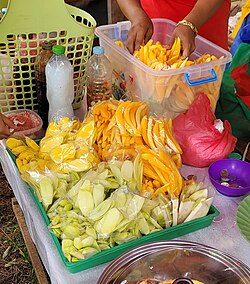
File:Green mangoes with vinegar, chili, salt, and soy sauce (Philippines) 01.jpg|Sour unripe mangoes eaten with [[shrimp paste]], salt, chili, vinegar or [[soy sauce]] in the [[Philippines]] | |||
</gallery> | |||
== Phytochemistry == | |||
[[File:Flavor chemicals of "Alphonso" mango.jpg|thumb|Major flavour chemicals of the 'Alphonso' mango from India]] | |||
Numerous [[phytochemical]]s are present in mango [[peel (fruit)|peel]] and pulp, such as the [[triterpene]] [[lupeol]].<ref>{{Cite journal |last1=Chaturvedi |first1=P.K. |last2=Bhui |first2=K. |last3=Shukla |first3=Y. |year=2008 |title=Lupeol: connotations for chemoprevention |journal=Cancer Lett |volume=263 |issue=1 |pages=1–13 |doi=10.1016/j.canlet.2008.01.047 |pmid=18359153}}</ref> Mango peel pigments under study include [[carotenoid]]s, such as the [[provitamin A]] compound, [[beta-carotene]], [[lutein]] and [[alpha-carotene]],<ref>{{Cite journal |last1=Berardini |first1=N |last2=Fezer |first2=R. |last3=Conrad |first3=J. |year=2005 |title=Screening of mango (''Mangifera indica'' L.) cultivars for their contents of flavonol ''O'' – and xanthone ''C''-glycosides, anthocyanins, and pectin |journal=J Agric Food Chem |volume=53 |issue=5 |pages=1563–1570 |doi=10.1021/jf0484069 |pmid=15740041 |bibcode=2005JAFC...53.1563B }}</ref><ref>{{Cite journal |last1=Gouado |first1=I. |last2=Schweigert |first2=F.J. |last3=Ejoh |first3=R.A. |year=2007 |title=Systemic levels of carotenoids from mangoes and papaya consumed in three forms (juice, fresh and dry slice) |journal=Eur J Clin Nutr |volume=61 |issue=10 |pages=1180–1188 |doi=10.1038/sj.ejcn.1602841 |pmid=17637601 |doi-access=free}}</ref> and [[polyphenols]], such as [[quercetin]], [[kaempferol]], [[gallic acid]], [[caffeic acid]], [[flavan-3-ol|catechins]] and [[tannin]]s.<ref>{{cite journal |last1=Mahattanatawee |first1=K. |last2=Manthey |first2=J.A. |last3=Luzio |first3=G. |year=2006 |title=Total antioxidant activity and fiber content of select Florida-grown tropical fruits |journal=Journal of Agricultural and Food Chemistry |volume=54 |issue=19 |pages=7355–63 |doi=10.1021/jf060566s |pmid=16968105|bibcode=2006JAFC...54.7355M }}</ref><ref>{{cite journal |last1=Singh |first1=U.P. |last2=Singh |first2=D.P. |last3=Singh |first3=M. |year=2004 |title=Characterization of phenolic compounds in some Indian mango cultivars |journal=International Journal of Food Science and Nutrition |volume=55 |issue=2 |pages=163–169 |doi=10.1080/09637480410001666441 |pmid=14985189 |s2cid=22576447}}</ref> Mango contains a unique [[xanthonoid]] called [[mangiferin]].<ref>{{cite journal |last1=Andreu |first1=G.L. |last2=Delgado |first2=R. |last3=Velho |first3=J.A. |year=2005 |title=Mangiferin, a natural occurring glucosyl xanthone, increases susceptibility of rat liver mitochondria to calcium-induced permeability transition |journal=Archives of Biochemistry and Biophysics |volume=439 |issue=2 |pages=184–193 |doi=10.1016/j.abb.2005.05.015 |pmid=15979560}}</ref> | |||
Phytochemical and nutrient content appears to vary across mango [[cultivar]]s.<ref>{{Cite journal |last1=Rocha Ribeiro |first1=S.M. |last2=Queiroz |first2=J.H. |last3=Lopes Ribeiro de Queiroz |first3=M.E. |year=2007 |title=Antioxidant in mango (''Mangifera indica'' L.) pulp |url=http://www.locus.ufv.br/handle/123456789/19301 |journal=Plant Foods Hum Nutr |volume=62 |issue=1 |pages=13–17 |doi=10.1007/s11130-006-0035-3 |pmid=17243011 |bibcode=2007PFHN...62...13R |s2cid=27051096 |url-access=subscription }}</ref> Up to 25 different carotenoids have been isolated from mango pulp, the densest of which was beta-carotene, which accounts for the yellow-orange [[pigmentation]] of most mango cultivars.<ref>{{Cite journal |last1=Chen |first1=J.P. |last2=Tai |first2=C.Y. |last3=Chen |first3=B.H. |year=2004 |title=Improved liquid chromatographic method for determination of carotenoids in Taiwanese mango (''Mangifera indica'' L.) |journal=J Chromatogr A |volume=1054 |issue=1–2 |pages=261–268 |doi=10.1016/S0021-9673(04)01406-2 |pmid=15553152}}</ref> Mango leaves also have significant polyphenol content, including [[xanthonoid]]s, mangiferin and gallic acid.<ref>{{cite journal |last1=Barreto |first1=J.C. |last2=Trevisan |first2=M.T. |last3=Hull |first3=W.E. |year=2008 |title=Characterization and quantitation of polyphenolic compounds in bark, kernel, leaves, and peel of mango (''Mangifera indica'' L.) |journal=J Agric Food Chem |volume=56 |issue=14 |pages=5599–5610 |doi=10.1021/jf800738r |pmid=18558692|bibcode=2008JAFC...56.5599B }}</ref> | |||
=== Flavor === | |||
The [[Flavor (taste)|flavor]] of mango fruits is conferred by several volatile organic chemicals, mainly [[terpene]]s, [[furanone]]s, [[lactone]]s, and [[ester]]s. Different varieties or [[list of mango cultivars|cultivars of mangoes]] can have flavours made up of different volatile chemicals or the same volatile chemicals in different quantities.<ref>{{cite journal |title=Cultivar relationships in mango based on fruit volatile profiles |journal=Food Chemistry |volume=114 |pages=363–372 |doi=10.1016/j.foodchem.2008.09.107 |year=2009 |last1=Pandit |first1=Sagar S. |last2=Chidley |first2=Hemangi G. |last3=Kulkarni |first3=Ram S. |last4=Pujari |first4=Keshav H. |last5=Giri |first5=Ashok P. |last6=Gupta |first6=Vidya S. |issue=1 |bibcode=2009FoodC.114..363P }}</ref> In general, [[New World]] mango cultivars are characterized by the dominance of δ-3-carene, a monoterpene flavorant; whereas, high concentration of other monoterpenes such as (Z)-ocimene and myrcene, as well as the presence of lactones and furanones, is the unique feature of [[Old World]] cultivars.<ref name="culti">Pandit, S.S., Chidley, H.G., Kulkarni, 2009, [http://www.sciencedirect.com/science/article/pii/S0308814608011849/ Cultivar relationships in mango based on fruit volatile profiles], Food Chemistry, 144, 363–372.</ref><ref>Narain, N., Bora, P.S., Narain, R. and Shaw, P.E. (1998). Mango, In: Tropical and Subtropical Fruits, Edt. by Shaw, P.E., Chan, H.T. and Nagy, S. Agscience, Auburndale, Florida, pp. 1–77.</ref> In India, [[Alphonso (mango)|'Alphonso']] is one of the most popular cultivars. In 'Alphonso' mango, the lactones, and furanones are synthesized during ripening, whereas terpenes and the other flavorants are present in both the developing (immature) and ripening fruits.<ref>{{Cite journal |doi=10.1002/jsfa.3692 |title=Changes in volatile composition during fruit development and ripening of 'Alphonso' mango |journal=Journal of the Science of Food and Agriculture |volume=89 |issue=12 |pages=2071–2081 |year=2009 |last1=Pandit |first1=Sagar S. |last2=Kulkarni |first2=Ram S. |last3=Chidley |first3=Hemangi G. |last4=Giri |first4=Ashok P. |last5=Pujari |first5=Keshav H. |last6=Köllner |first6=Tobias G. |last7=Degenhardt |first7=Jörg |last8=Gershenzon |first8=Jonathan |last9=Gupta |first9=Vidya S. |bibcode=2009JSFA...89.2071P}}</ref><ref>Gholap, A. S., Bandyopadhyay, C., 1977. Characterization of green aroma of raw mango (''Mangifera indica'' L.). Journal of the Science of Food and Agriculture 28, 885–888</ref><ref>{{cite journal |title=Geographic variation in the flavour volatiles of Alphonso mango |journal=Food Chemistry |volume=130 |pages=58–66 |doi=10.1016/j.foodchem.2011.06.053 |year=2012 |last1=Kulkarni |first1=Ram S. |last2=Chidley |first2=Hemangi G. |last3=Pujari |first3=Keshav H. |last4=Giri |first4=Ashok P. |last5=Gupta |first5=Vidya S.}}</ref> [[Ethylene]], a ripening-related hormone well known to be involved in ripening of mango fruits, causes changes in the flavor composition of mango fruits upon exogenous application, as well.<ref>Lalel, H.J.D., Singh, Z., Tan, S., 2003, The role of ethylene in mango fruit aroma volatiles biosynthesis, Journal of Horticultural Science and Biotechnology, 78, 485–496.</ref><ref>{{cite journal |title=Spatial and temporal changes in the volatile profile of Alphonso mango upon exogenous ethylene treatment |journal=Food Chemistry |volume=136 |issue=2 |pages=585–594 |doi=10.1016/j.foodchem.2012.08.029 |pmid=23122101 |year=2013 |last1=Chidley |first1=Hemangi G. |last2=Kulkarni |first2=Ram S. |last3=Pujari |first3=Keshav H. |last4=Giri |first4=Ashok P. |last5=Gupta |first5=Vidya S. |s2cid=42523345}}</ref> In contrast to the huge amount of information available on the chemical composition of mango flavour, the biosynthesis of these chemicals has not been studied in depth; only a handful of genes encoding the enzymes of flavour biosynthetic pathways have been characterized to date.<ref>{{cite journal |title=Expression profiling of various genes during the development and ripening of Alphonso mango |journal=Plant Physiology and Biochemistry |volume=48 |issue=6 |pages=426–433 |doi=10.1016/j.plaphy.2010.02.012 |pmid=20363641 |date=June 2010 |last1=Pandit |first1=S. S. |last2=Kulkarni |first2=R. S. |last3=Giri |first3=A. P. |last4=Köllner |first4=T. G. |last5=Degenhardt |first5=J. |last6=Gershenzon |first6=J. |last7=Gupta |first7=V. S. |s2cid=22915293}}</ref><ref>{{cite journal |title=Differential expression of the mango alcohol dehydrogenase gene family during ripening |journal=Phytochemistry |volume=71 |issue=13 |pages=1485–1494 |doi=10.1016/j.phytochem.2010.05.024 |pmid=20598721 |year=2010 |last1=Singh |first1=Rajesh K. |last2=Sane |first2=Vidhu A. |last3=Misra |first3=Aparna |last4=Ali |first4=Sharique A. |last5=Nath |first5=Pravendra |bibcode=2010PChem..71.1485S}}</ref><ref>{{cite journal |title=Characterization of three novel isoprenyl diphosphate synthases from the terpenoid rich mango fruit |journal=Plant Physiology and Biochemistry |volume=71 |pages=121–131 |doi=10.1016/j.plaphy.2013.07.006 |pmid=23911730 |year=2013 |last1=Kulkarni |first1=Ram |last2=Pandit |first2=Sagar |last3=Chidley |first3=Hemangi |last4=Nagel |first4=Raimund |last5=Schmidt |first5=Axel |last6=Gershenzon |first6=Jonathan |last7=Pujari |first7=Keshav |last8=Giri |first8=Ashok |last9=Gupta |first9=Vidya |display-authors=5 |bibcode=2013PlPB...71..121K |s2cid=46320747}}</ref><ref>Kulkarni, R.S., Chidley H.G., Deshpande, A., Schmidt, A., Pujari, K.H., Giri, A.P., Gershenzon, Jonathan, Gupta, V.S., 2013, [http://www.springerplus.com/content/2/1/494 An oxidoreductase from 'Alphonso' mango catalyzing biosynthesis of furaneol and reduction of reactive carbonyls], SpringerPlus, 2, 494.</ref> | |||
{{nutritional value | name=Mango | |||
| kJ=250 | |||
| water=83.5 g | |||
| protein=0.82 g | |||
| fat=0.38 g | |||
| satfat= 0.092 g | |||
| monofat= 0.14 g | |||
| polyfat=0.071 g | |||
| omega3fat=0.051 g | |||
| omega6fat=0.019 g | |||
| carbs=15 g | |||
| fiber=1.6 g | |||
| sugars=13.7 | |||
| calcium_mg=11 | |||
| iron_mg=0.16 | |||
| magnesium_mg=10 | |||
| phosphorus_mg=14 | |||
| potassium_mg=168 | |||
| sodium_mg=1 | |||
| copper_mg=0.111 | |||
| selenium_ug=0.6 | |||
| zinc_mg=0.09 | |||
| manganese_mg=0.063 | |||
| vitC_mg=36.4 | |||
| thiamin_mg=0.028 | |||
| riboflavin_mg=0.038 | |||
| niacin_mg=0.669 | |||
| pantothenic_mg=0.197 | |||
| vitB6_mg=0.119 | |||
| folate_ug=43 | |||
| choline_mg=7.6 | |||
| vitA_ug=54 | |||
| betacarotene_ug=640 | |||
| lutein_ug=23 | |||
| vitE_mg=0.9 | |||
| vitK_ug=4.2 | |||
| note=[https://fdc.nal.usda.gov/food-details/1102670/nutrients Link to USDA Database entry] | |||
}} | }} | ||
===Toxicity=== | |||
[[ | Contact with oils in mango leaves, stems, sap, and skin can cause [[dermatitis]] and [[anaphylaxis]] in susceptible individuals.<ref name="Morton" /><ref name="Sareen">{{cite journal | last1=Sareen | first1=Richa | last2=Shah | first2=Ashok | title=Hypersensitivity manifestations to the fruit mango | journal=Asia Pacific Allergy| volume=1 | issue=1 | pages=43–49 | year=2011 | issn=2233-8276 | doi=10.5415/apallergy.2011.1.1.43 |pmid=22053296 |pmc=3206236}}</ref><ref>{{cite journal |last1=Miell |first1= J. |last2=Papouchado |first2=M. |last3= Marshall |first3=A. |year=1988 |title=Anaphylactic reaction after eating a mango |journal=[[British Medical Journal]] |volume=297 |issue=6664 |pages=1639–1640 |doi=10.1136/bmj.297.6664.1639 |pmc=1838873 |pmid=3147776}}</ref> Those with a history of contact dermatitis induced by [[urushiol]] (an allergen found in [[poison ivy]], [[poison oak]], or [[poison sumac]]) may be most at risk for mango contact dermatitis.<ref>{{Cite journal |last1= Hershko |first1= K. |last2= Weinberg |first2= I. |last3= Ingber |first3= A. |year=2005 |title=Exploring the mango – poison ivy connection: the riddle of discriminative plant dermatitis |journal=Contact Dermatitis |volume=52 |issue=1 |pages=3–5 |doi=10.1111/j.0105-1873.2005.00454.x |pmid=15701120 |s2cid=31162401}}</ref> Other mango compounds potentially responsible for dermatitis or allergic reactions include [[mangiferin]].<ref name="Morton" /> Cross-reactions may occur between mango allergens and urushiol.<ref>{{Cite journal |last1=Oka |first1= K. |last2= Saito |first2= F. |last3= Yasuhara |first3= T. |last4= Sugimoto |first4= A. |year=2004 |title=A study of cross-reactions between mango contact allergens and urushiol |journal=Contact Dermatitis |volume=51 |issue=5–6 |pages=292–296 |doi=10.1111/j.0105-1873.2004.00451.x |pmid=15606656 |s2cid=6115016}}</ref> Sensitized individuals may not be able to eat peeled mangoes or drink mango juice safely.<ref name="Morton" /> | ||
When mango trees are flowering in spring, local people with allergies may experience breathing difficulty, itching of the eyes, or facial swelling, even before flower [[pollen]] becomes airborne. In this case, the irritant is likely to be the [[vapor]]ized [[essential oil]] from flowers. During the primary ripening season of mangoes, contact with mango plant parts – primarily [[sap]], leaves, and fruit skin<ref name="Morton"/> – is the most common cause of plant dermatitis in Hawaii.<ref name="autogenerated365">{{Cite journal |last1=McGovern |first1=T. W. |last2=LaWarre |first2=S. |year=2001 |title=Botanical briefs: the mango tree—''Mangifera indica'' L. |journal=Cutis |volume=67 |issue=5 |pages=365–366 |pmid=11381849}}</ref> | |||
== | ==Nutrition== | ||
A raw mango is 84% water, 15% [[carbohydrate]]s, 1% [[protein (nutrient)|protein]], and has negligible fat (table). In a reference amount of {{cvt|100|g}}, raw mango supplies 60 [[calorie]]s and is a rich source of [[vitamin C]] (40% of the [[Daily Value]], DV) with moderate amounts of [[folate]] (11% DV) and [[Copper in biology|copper]] (12% DV), while other [[micronutrient]]s are low in content (table). | |||
== Culture == | |||
The mango is the [[List of national fruits|national fruit]] of India,<ref>{{cite web | url=http://india.gov.in/knowindia/national_fruit.php | title=National Fruit | work=Know India | publisher=Government of India | access-date=17 August 2010 | archive-url=https://web.archive.org/web/20100820044013/http://india.gov.in/knowindia/national_fruit.php | archive-date=20 August 2010}}</ref><ref>{{cite web |url=http://archive.india.gov.in/knowindia/national_symbols.php?id=13|title=National Fruit|access-date=4 November 2015 |archive-date=20 April 2020 |archive-url=https://web.archive.org/web/20200420013005/https://archive.india.gov.in/knowindia/national_symbols.php?id=13 |url-status=dead}}</ref> [[Pakistan]],<ref>{{cite web |title=Pakistani mango: The king of fruits | date = 13 August 2019 | url = https://www.arabnews.com/node/1539616/world |publisher = ArabNews}}</ref> and the [[Philippines]].<ref>{{cite web |title=Mangoes In The Philippines |url=https://croplife.org/news-views/sharing-the-story/mangoes-from-the-philippines/ |website=CropLife}}</ref>It is the [[List of national trees|national tree]] of Bangladesh.<ref name="bd">{{cite news |work=bdnews24.com |url=https://bdnews24.com/bangladesh/mango-tree-national-tree |title=Mango tree, national tree of Bangladesh |date=15 November 2010 |access-date=16 November 2013}}</ref> In India, the harvesting and sale of mangoes is during March–May and this is annually covered by news agencies.<ref name=NYTAllen>{{cite news |last=Allen |first=Jonathan |date=10 May 2006 |title=Mango Mania in India |url=http://travel.nytimes.com/2006/05/10/travel/10mumbailetter.html?pagewanted=1&_r=0 |newspaper=[[The New York Times]] |access-date=4 September 2013}}</ref> In [[Tamil Nadu]], the mango is one of the three royal fruits, along with [[banana]] and [[jackfruit]], for their sweetness and flavour.<ref>{{cite book |last1=Subrahmanian |first1=N. |last2=Hikosaka |first2=S. |last3=Samuel |first3=G.J. |title=Tamil Social History |year=1997 |page=88 |url={{google books|plainurl=y|id=PXXsAAAAIAAJ}} }}</ref> | |||
The mango has a traditional context in the culture of South Asia. In his [[Edicts of Ashoka|edicts]], the Mauryan emperor [[Ashoka]] references the planting of fruit- and shade-bearing trees along imperial roads in his Major Pillar Edict No.5:<ref name="Inscriptions of Asoka p.119">{{cite book |last1=Hultzsch |first1=Eugen |author-link=Eugen Hultzsch |title=Inscriptions of Asoka. New Edition by E. Hultzsch |date=1925 |publisher=[[Clarendon Press]] |url=https://archive.org/details/InscriptionsOfAsoka.NewEditionByE.Hultzsch |page=119}}</ref> | |||
<blockquote>"On the roads [[banyan]]-trees were caused to be planted by me, (in order that) they might afford shade to cattle and men, (and) mango-groves were caused to be planted."</blockquote> | |||
In medieval India, the Indo-Persian poet [[Amir Khusrau]] termed the mango "''Naghza Tarin Mewa Hindustan''" – "the fairest fruit of Hindustan".<ref>{{cite news |last1=Johar |first1=Roshni |title=The mango reigns supreme |url=https://www.tribuneindia.com/news/musings/the-mango-reigns-supreme-411518/ |access-date=6 March 2026 |work=[[The Tribune (India)|The Tribune]] |date=16 January 2025}}</ref> The Mughal Empire was especially fond of the fruits: the emperor [[Babur]] praises the mango in his ''[[Baburnama]]''.<ref>{{cite news |title=Mangoes, Mughals, Hindu & Buddhist Traditions |url=https://madrascourier.com/insight/mangoes-mughals-hindu-buddhist-traditions/ |work=Madras Courier |date=13 June 2022}}</ref> Mughal emperor [[Akbar]] (1556–1605) is said to have planted a mango orchard of 100,000 trees near [[Darbhanga]], Bihar.<ref name="MJMorgan">{{cite news |last=Morgan |first=Curtis |date=22 June 1995 |title=The Nation Is Discovering What South Floridans Have Long Known: Mango Is the Sexiest Fruit on Earth |newspaper=[[Miami Herald]] |department=Food |page=1E |quote="Mango culture owes much to Akbar, emperor of India's Mogul conquerors from 1556 to 1605, who planted an orchard of 100,000 trees near Darbhanga in Eastern India."}}</ref> Mango flowers and leaves are used in the worship of the [[Hinduism|Hindu]] goddess [[Saraswati]] at the spring festival of [[Vasant Panchami]].<ref>{{cite book |last=Dilipsinh |first=K. S. |chapter=8 The Festival of Spring |title=Kutch in Festival and Custom |publisher=Har-Anand Publications |year=2004 |isbn=978-81-241-0998-4 |page=98}}</ref> The leaves are used as decorations in celebrations of [[Ganesh Chaturthi]] for the elephant-headed god [[Ganesha]].<ref>{{cite book |last=Sami |first=Adnan |display-authors=etal |chapter=Mango: Botany, Importance, and Uses |title=Handbook of Research on Mango Fruit: Postharvest Science, Production, Nutrition, and Processing Technology |publisher=Apple Academic Press |year=2025 |isbn=978-1779643384 |pages=59-88}}</ref> The [[Jain]] goddess [[Ambika (Jainism)|Ambika]] is traditionally represented as sitting under a mango tree.<ref>{{Cite web |url=https://www.exoticindia.com/book/details/ambika-in-jaina-art-and-literature-IDH453/|title=Ambika In Jaina Art And Literature|via=exoticindiaart.com}}</ref> The classical Sanskrit poet [[Kalidasa]] sang the praises of mangoes.<ref>{{cite web |url=http://in.lifestyle.yahoo.com/his-highness--mango-maharaja--an-endless-obsession.html |title=His highness, Mango maharaja: An endless obsession – Yahoo! Lifestyle India |publisher=Yahoo! |date=29 May 2012 |access-date=14 June 2013 |archive-date=16 March 2013 |archive-url=https://web.archive.org/web/20130316215241/http://in.lifestyle.yahoo.com/his-highness--mango-maharaja--an-endless-obsession.html |url-status=dead }}</ref> | |||
[[Paisley (design)|Paisley patterns]], with a teardrop-shaped motif or ''[[boteh]]'' on shawls and [[sari]]s, are named for the unripe mango in languages across the [[Indian subcontinent]], such as ''kalka'' in [[Bengali language|Bengali]],<ref>{{cite book |last=Niaz |first=Zaman |title=The Art of Kantha Embroidery| edition=Second Revised |year=1993 |page=82 |publisher=The University Press |location=Dhaka, Bangladesh |isbn=978-984-05-1228-7}}</ref><ref name="Pathak 2024"/> <!--ਅੰਬੀ--> ''ambi'' in [[Punjabi language|Punjabi]],<ref>{{cite web |url=https://dsal.uchicago.edu/cgi-bin/app/singh_query.py?qs=ambi&matchtype=default |title=The Punjab Dictionary |date=22 January 1895 |access-date=10 March 2026}}</ref> and ''kairi'' in [[Hindi]].<ref name="Pathak 2024">{{cite journal |last=Pathak |first=Anamika |title=Mango-Kairi-Kalka-Paisley: Design in Indian art from architecture to textiles |url=https://www.globalinch.org/article/mango-kairi-kalka-paisley-design-inindian-art-from-architecture-to-textiles/ |journal=Asia InCH |volume=43 |issue=1 |year=2024 |quote='Kairi' (unripe mango) was adopted as design ... first seen as the decorative design in architecture ... later on, it was extensively used in textiles ... Kashmiri shawls.}}</ref> [[E. M. Forster]]'s 1924 novel ''[[A Passage to India]]'' has the character Dr. Aziz suggest to the English character Cyril Fielding "For you I shall arrange a lady with breasts like mangoes".<ref>{{cite book |last1=Forster |first1=E. M. |author1-link=E. M. Forster |title=A Passage to India |date=1924 |publisher=[[Edward Arnold (publisher)|Edward Arnold]] |chapter=11}}</ref> Mangoes were the subject of the [[mango cult]] in China during the [[Cultural Revolution]] as symbols of chairman [[Mao Zedong]]'s love for the people.<ref name="tele_HowC">{{cite news |title=How China came to worship the mango during the Cultural Revolution |last=Moore |first=Malcolm |others=Additional reporting by Valentina Luo |work=[[The Daily Telegraph]] |date=7 March 2013 |access-date=28 September 2015 |url=https://www.telegraph.co.uk/news/worldnews/asia/china/9914895/How-China-came-to-worship-the-mango-during-the-Cultural-Revolution.html |archive-url=https://ghostarchive.org/archive/20220111/https://www.telegraph.co.uk/news/worldnews/asia/china/9914895/How-China-came-to-worship-the-mango-during-the-Cultural-Revolution.html |archive-date=11 January 2022 |url-access=subscription |url-status=live}}{{cbignore}}</ref> | |||
<gallery class=center mode=nolines widths=180 heights=180> | |||
File:Ellora cave34 001.jpg|Image of [[Ambika (Jainism)|Ambika]] under a mango tree in Cave 34 of the [[Ellora Caves]] | |||
File:Paisley pattern BK-NM-3658.jpg|[[Paisley (design)|Paisley patterns]] are named for the mango in languages of the [[Indian subcontinent]]. | |||
</gallery> | |||
== References == | == References == | ||
{{reflist|30em}} | |||
== Further reading == | |||
* {{Cite book |last=Ensminger |first=Audrey H. |title=The Concise Encyclopedia of Foods & Nutrition |publisher=CRC Press |year=1995 |page=[https://archive.org/details/conciseencyclope00ensm/page/651 651] |isbn=978-0-8493-4455-8 |display-authors=etal |url-access=registration |url=https://archive.org/details/conciseencyclope00ensm/page/651 |ref=none}} | |||
* Litz, Richard E. (editor, 2009). ''The Mango: Botany, Production and Uses''. 2nd edition. CABI. {{ISBN|978-1-84593-489-7}} | |||
* Susser, Allen (2001). ''The Great Mango Book: A Guide with Recipes''. Ten Speed Press. {{ISBN|978-1-58008-204-4}} | |||
== External links == | |||
{{Commons and category}} | |||
{{Wikispecies|Mangifera}} | |||
* [http://www.plantnames.unimelb.edu.au/Sorting/Mangifera.html Sorting ''Mangifera'' species] | |||
* [https://web.archive.org/web/20180305150208/http://www.tropicalfruitnursery.com/mango/ Pine Island Nursery's Mango Variety viewer] | |||
{{Authority control}} | |||
{{Mangoes}} | |||
{{Agriculture country lists}} | |||
{{Symbols of Bangladesh}} | {{Symbols of Bangladesh}} | ||
{{ | {{Symbols of India}} | ||
{{ | {{Symbols of the Philippines}} | ||
[[Category: | [[Category:Mangoes| ]] | ||
[[Category: | [[Category:Crops]] | ||
[[Category: | [[Category:Fruits originating in Asia]] | ||
[[Category:Indian spices]] | |||
[[Category:Medicinal plants]] | |||
[[Category:National symbols of Bangladesh]] | |||
[[Category:National symbols of Pakistan]] | [[Category:National symbols of Pakistan]] | ||
[[Category: | [[Category:South Asian cuisine]] | ||
[[Category:Southeast Asian cuisine]] | |||
[[Category:Drupes]] | |||
[[Category:Edible fruits]] | |||
Latest revision as of 16:47, 5 July 2026

A mango is an edible stone fruit produced by the tropical tree Mangifera indica. It originated in the northeastern part of the Indian subcontinent, in what is now Bangladesh, northeastern India and Myanmar. M. indica has been cultivated in the Indian subcontinent and Southeast Asia since ancient times, resulting in two modern mango cultivar lineages: the "Indian" and the "Southeast Asian" types. Other species in the genus Mangifera also produce edible fruits called "mangoes," most of which are found in the Malesian ecoregion.
There are several hundred cultivars of mango worldwide. Depending on the cultivar, mango fruit varies in size, shape, sweetness, skin colour, and flesh colour, which may be pale yellow, gold, green, or orange. Mango is the national fruit of India, Pakistan, and the Philippines, while the mango tree is the national tree of Bangladesh.
Etymology[edit | edit source]
The English word mango (plural mangoes or mangos) originated in the 16th century from the Portuguese word manga, from the Malayalam manga, and ultimately from the Tamil mā (மா, 'mango tree') + kāy (ங்காய், 'unripe fruit/vegetable').[1][2][3][4] The scientific name, Mangifera indica, can be translated as "a plant bearing mangoes in India".[3]
Description[edit | edit source]
Mango trees grow to 30–40 metres (98–131 feet) tall, with a crown radius of 10–15 m (33–49 ft). The trees are long-lived, as some specimens still fruit after 300 years.[5]
In deep soil, the taproot descends to a depth of 6 m (20 ft), with profuse, wide-spreading feeder roots and anchor roots penetrating deeply into the soil. The leaves are evergreen, alternate, simple, 15–35 centimetres (6–14 inches) long, and 6–16 cm (2+1⁄2–6+1⁄2 in) broad; when the leaves are young they are orange-pink, rapidly changing to a dark, glossy red, then dark green as they mature. The flowers are produced in terminal panicles 10–40 cm (4–15+1⁄2 in) long; each flower is small and white with five petals 5–10 millimetres (3⁄16–3⁄8 in) long, with a mild, sweet fragrance. Over 500 varieties of mangoes are known,[6] many of which ripen in summer, while some give a double crop.[7] The fruit takes four to five months from flowering to ripening.[6]
The ripe fruit varies according to cultivar in size, shape, colour, sweetness, and eating quality. Depending on the cultivar, fruits are variously yellow, orange, red, or green. The fruit has a single flat, oblong pit that can be fibrous or hairy on the surface and does not separate easily from the pulp. The fruits may be somewhat round, oval, or kidney-shaped, ranging from 5–25 centimetres (2–10 in) in length and from 140 grams (5 oz) to 2 kilograms (5 lb) in weight per individual fruit. The skin is leather-like, waxy, smooth, and fragrant, with colours ranging from green to yellow, yellow-orange, yellow-red, or blushed with various shades of red, purple, pink, or yellow when fully ripe.[6]
Ripe intact mangoes give off a distinctive resinous, sweet smell.[6] Inside the stone with its 1–2 mm (0.039–0.079 in) thick woody endocarp is a single seed, 4–7 cm (1.6–2.8 in) long. Mangoes have recalcitrant seeds which do not survive freezing and drying.[8] Mango trees grow readily from seeds, with germination success highest when seeds are obtained from mature fruits.[6]
-
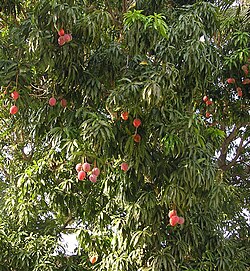 Tree
Tree -
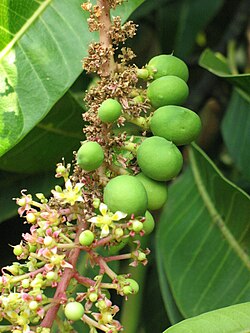 Flowers and immature fruits
 -
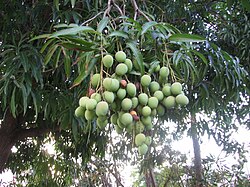 Unripe mangoes
 -
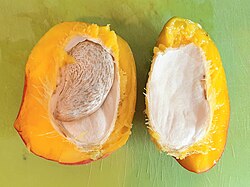 Fruit with single seed, cut open
 -


.jpg)
Taxonomy[edit | edit source]
Mangoes originated from the region between northwestern Myanmar, Bangladesh, and northeastern India.[9][10] The mango is considered an evolutionary anachronism, whereby seed dispersal was once accomplished by a now-extinct evolutionary forager, such as a megafauna mammal.[11]
From their center of origin, mangoes diverged into two genetically distinct populations: the subtropical Indian group and the tropical Southeast Asian group. The Indian group is characterized by having monoembryonic fruits, while the Southeast Asian group is characterized by polyembryonic fruits.[10][9]
It was previously believed that mangoes originated from a single domestication event in South Asia before being spread to Southeast Asia, but a 2019 study found no evidence of a center of diversity in India. Instead, it identified a higher unique genetic diversity in Southeast Asian cultivars than in Indian cultivars, indicating that mangoes may have originally been domesticated first in Southeast Asia before being introduced to South Asia. However, the authors cautioned that the diversity in Southeast Asian mangoes might be the result of other reasons (like interspecific hybridization with other Mangifera species native to the Malesian ecoregion). Nevertheless, the existence of two distinct genetic populations identified by the study indicates that the domestication of the mango is more complex than previously assumed and would at least indicate multiple domestication events in Southeast Asia and South Asia.[10][9]Other species in the genus Mangifera also produce edible fruits called "mangoes," most of which are found in the Malesian ecoregion.[12]
Cultivars[edit | edit source]
There are hundreds of named mango cultivars. In mango orchards, several cultivars are often grown to improve pollination. Many desired cultivars are monoembryonic and must be propagated by grafting, or they do not breed true. A common monoembryonic cultivar is 'Alphonso', an important export product, considered "the king of mangoes".[13]
Cultivars that excel in one climate may fail elsewhere. For example, Indian cultivars such as 'Julie,' a prolific cultivar in Jamaica, require annual fungicide treatments to escape the lethal fungal disease anthracnose in Florida. Asian mangoes are resistant to anthracnose.[14]
The current western market is dominated by the cultivar 'Tommy Atkins', a seedling of 'Haden' that first fruited in 1940 in southern Florida and was initially rejected commercially by Florida researchers.[15] Growers and importers worldwide have embraced the cultivar for its excellent productivity and disease resistance, shelf life, transportability, size, and appealing colour.[16] Although the Tommy Atkins cultivar is commercially successful, other cultivars may be preferred by consumers for eating pleasure, such as Alphonso.[13][16]
-
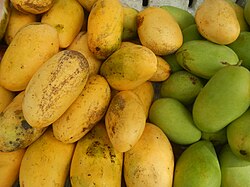 'Carabao', a typical "Southeast Asian type" polyembryonic cultivar
 -
 'Langra', a typical "Indian type" monoembryonic cultivar
 -
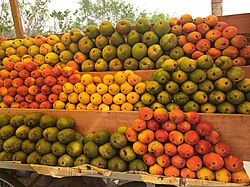 Many varieties from India


Distribution and habitat[edit | edit source]
From tropical Asia, mangoes were introduced to East Africa by Arab and Persian traders in the ninth to tenth centuries. The 14th-century Moroccan traveler Ibn Battuta reported it at Mogadishu.[17] It was spread further into other areas around the world during the Colonial Era. The Portuguese Empire spread the mango from their colony in Goa to East and West Africa. From West Africa, they introduced it to Brazil from the 16th to the 17th centuries. From Brazil, it spread northwards to the Caribbean and eastern Mexico by the mid to late 18th century. The Spanish Empire also introduced mangoes directly from the Philippines to western Mexico via the Manila galleons from at least the 16th century. Mangoes were only introduced to Florida by 1833.[9][18]
Cultivation[edit | edit source]
The mango is cultivated in most frost-free tropical and warmer subtropical climates. It is cultivated extensively in South Asia, Southeast Asia, East and West Africa, the tropical and subtropical Americas, and the Caribbean.[19] Mangoes are also grown in Andalusia, Spain (mainly in Málaga province), as its coastal subtropical climate is one of the few places in mainland Europe that permits the growth of tropical plants and fruit trees. The Canary Islands are another notable Spanish producer of the fruit. Other minor cultivators include North America (in South Florida and the California Coachella Valley), Hawai'i, and Australia.[20]
Many commercial cultivars grown in Europe are grafted onto the cold-hardy rootstock of the Gomera-1 mango cultivar, originally from Cuba. Its root system is well adapted to a coastal Mediterranean climate.[21]
A breakthrough in mango cultivation was the use of potassium nitrate and ethrel to induce flowering in mangoes. The discovery was made by Filipino horticulturist Ramon Barba in 1974 and was developed from the unique traditional method of inducing mango flowering using smoke in the Philippines. It allowed mango plantations to induce regular flowering and fruiting year-round. Previously, mangoes were seasonal because they only flowered every 16 to 18 months. The method is now used in most mango-producing countries.[22][23]
Diseases[edit | edit source]
Mango trees are subject to many diseases, including alternaria rot, anthracnose, bacterial black spot, and powdery mildew.[24][25] Spongy tissue is a ripening disorder correlated with calcium deficiency and characterized by spongy, brown-black flesh beginning near the seeds.[26] It was estimated in 1989 to affect approximately 30% of Alphonso mangoes.[27] Among the pests of the fruit's cultivation is the mango mealybug; it sucks sap from inflorescences, causing reduced fruit set and seriously harming crop production.[28]
-

-
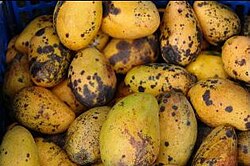 Anthracnose in fruit
 -
 Anthracnose in inflorescence
 -
 Powdery mildew causing leaf blight

.jpg)
.jpg)

 India India |
26.2 |
 Indonesia Indonesia |
4.1 |
 China China |
3.9 |
 Mexico Mexico |
2.7 |
 Pakistan Pakistan |
2.6 |
 Brazil Brazil |
2.3 |
 Malawi Malawi |
2.1 |
| World | 61.1 |
|
*Includes mangosteens and guavas; Source: FAOSTAT | |
Production[edit | edit source]
In 2023, world production of mangoes, mangosteens and guavas was 61 million tonnes, led by India with 43% of the total, and Indonesia and China as secondary producers.[29]
Culinary uses[edit | edit source]
Mangoes are generally sweet, although the taste and texture of the flesh vary across cultivars; some, such as Alphonso, have a soft, pulpy, juicy texture similar to an overripe plum, while others, such as Tommy Atkins, are firmer with a fibrous texture.[30]
Mangoes are used in many cuisines. Sour, unripe mangoes are used in side dishes in Indian cuisine such as mango chutney[31] and pickles such as avakaya.[32]
A summer drink called aam panna is made with mangoes.[33] Mango lassi is consumed throughout South Asia, prepared by mixing ripe mangoes or mango pulp with buttermilk and sugar.[34][35]
In Indonesian cuisine, unripe mango is processed into asinan, rujak and sambal pencit/mangga muda,[36] or eaten with edible salt.[37]
Raw green mangoes can be sliced and eaten like a salad.[38] In most parts of Southeast Asia, they are commonly eaten with fish sauce, vinegar, soy sauce, or with a dash of salt (plain or spicy) – a combination usually known as "mango salad" in English.[39] In the Philippines, green mangoes are eaten with savory condiments such as bagoong (salty fish or shrimp paste), soy sauce, vinegar, or chilis.[40][41] Mango float and mango cake, which use slices of ripe mangoes, are eaten in the Philippines.[42]
-
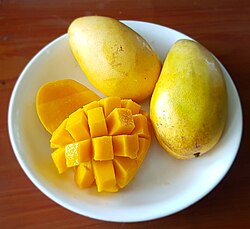 The "hedgehog" style of preparation on Carabao mangoes
 -
Alphonso mango chunks
-
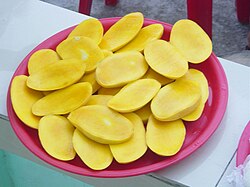 Sliced Ataulfo mangoes
 -
 A glass of mango juice
 -
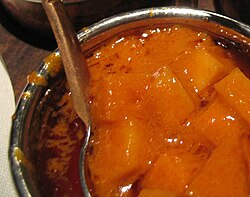 Mango chutney
 -
.jpg)
.jpg)


_01.jpg)
Phytochemistry[edit | edit source]

Numerous phytochemicals are present in mango peel and pulp, such as the triterpene lupeol.[43] Mango peel pigments under study include carotenoids, such as the provitamin A compound, beta-carotene, lutein and alpha-carotene,[44][45] and polyphenols, such as quercetin, kaempferol, gallic acid, caffeic acid, catechins and tannins.[46][47] Mango contains a unique xanthonoid called mangiferin.[48]
Phytochemical and nutrient content appears to vary across mango cultivars.[49] Up to 25 different carotenoids have been isolated from mango pulp, the densest of which was beta-carotene, which accounts for the yellow-orange pigmentation of most mango cultivars.[50] Mango leaves also have significant polyphenol content, including xanthonoids, mangiferin and gallic acid.[51]
Flavor[edit | edit source]
The flavor of mango fruits is conferred by several volatile organic chemicals, mainly terpenes, furanones, lactones, and esters. Different varieties or cultivars of mangoes can have flavours made up of different volatile chemicals or the same volatile chemicals in different quantities.[52] In general, New World mango cultivars are characterized by the dominance of δ-3-carene, a monoterpene flavorant; whereas, high concentration of other monoterpenes such as (Z)-ocimene and myrcene, as well as the presence of lactones and furanones, is the unique feature of Old World cultivars.[53][54] In India, 'Alphonso' is one of the most popular cultivars. In 'Alphonso' mango, the lactones, and furanones are synthesized during ripening, whereas terpenes and the other flavorants are present in both the developing (immature) and ripening fruits.[55][56][57] Ethylene, a ripening-related hormone well known to be involved in ripening of mango fruits, causes changes in the flavor composition of mango fruits upon exogenous application, as well.[58][59] In contrast to the huge amount of information available on the chemical composition of mango flavour, the biosynthesis of these chemicals has not been studied in depth; only a handful of genes encoding the enzymes of flavour biosynthetic pathways have been characterized to date.[60][61][62][63]
Toxicity[edit | edit source]
Contact with oils in mango leaves, stems, sap, and skin can cause dermatitis and anaphylaxis in susceptible individuals.[6][64][65] Those with a history of contact dermatitis induced by urushiol (an allergen found in poison ivy, poison oak, or poison sumac) may be most at risk for mango contact dermatitis.[66] Other mango compounds potentially responsible for dermatitis or allergic reactions include mangiferin.[6] Cross-reactions may occur between mango allergens and urushiol.[67] Sensitized individuals may not be able to eat peeled mangoes or drink mango juice safely.[6]
When mango trees are flowering in spring, local people with allergies may experience breathing difficulty, itching of the eyes, or facial swelling, even before flower pollen becomes airborne. In this case, the irritant is likely to be the vaporized essential oil from flowers. During the primary ripening season of mangoes, contact with mango plant parts – primarily sap, leaves, and fruit skin[6] – is the most common cause of plant dermatitis in Hawaii.[68]
Nutrition[edit | edit source]
A raw mango is 84% water, 15% carbohydrates, 1% protein, and has negligible fat (table). In a reference amount of 100 g (3.5 oz), raw mango supplies 60 calories and is a rich source of vitamin C (40% of the Daily Value, DV) with moderate amounts of folate (11% DV) and copper (12% DV), while other micronutrients are low in content (table).
Culture[edit | edit source]
The mango is the national fruit of India,[69][70] Pakistan,[71] and the Philippines.[72]It is the national tree of Bangladesh.[73] In India, the harvesting and sale of mangoes is during March–May and this is annually covered by news agencies.[13] In Tamil Nadu, the mango is one of the three royal fruits, along with banana and jackfruit, for their sweetness and flavour.[74]
The mango has a traditional context in the culture of South Asia. In his edicts, the Mauryan emperor Ashoka references the planting of fruit- and shade-bearing trees along imperial roads in his Major Pillar Edict No.5:[75]
"On the roads banyan-trees were caused to be planted by me, (in order that) they might afford shade to cattle and men, (and) mango-groves were caused to be planted."
In medieval India, the Indo-Persian poet Amir Khusrau termed the mango "Naghza Tarin Mewa Hindustan" – "the fairest fruit of Hindustan".[76] The Mughal Empire was especially fond of the fruits: the emperor Babur praises the mango in his Baburnama.[77] Mughal emperor Akbar (1556–1605) is said to have planted a mango orchard of 100,000 trees near Darbhanga, Bihar.[78] Mango flowers and leaves are used in the worship of the Hindu goddess Saraswati at the spring festival of Vasant Panchami.[79] The leaves are used as decorations in celebrations of Ganesh Chaturthi for the elephant-headed god Ganesha.[80] The Jain goddess Ambika is traditionally represented as sitting under a mango tree.[81] The classical Sanskrit poet Kalidasa sang the praises of mangoes.[82]
Paisley patterns, with a teardrop-shaped motif or boteh on shawls and saris, are named for the unripe mango in languages across the Indian subcontinent, such as kalka in Bengali,[83][84] ambi in Punjabi,[85] and kairi in Hindi.[84] E. M. Forster's 1924 novel A Passage to India has the character Dr. Aziz suggest to the English character Cyril Fielding "For you I shall arrange a lady with breasts like mangoes".[86] Mangoes were the subject of the mango cult in China during the Cultural Revolution as symbols of chairman Mao Zedong's love for the people.[87]
-
 Image of Ambika under a mango tree in Cave 34 of the Ellora Caves
 -
 Paisley patterns are named for the mango in languages of the Indian subcontinent.


References[edit | edit source]
- ↑ "Mango". Online Etymology Dictionary. 2024. Retrieved 14 April 2024.
- ↑ Fabricius, J. P. (1972). "J. P. Fabricius's Tamil and English dictionary. 4th ed., rev.and enl". dsal.uchicago.edu. Retrieved 15 December 2023.
- ↑ 3.0 3.1 Prakash, Om (2005). A Tryst with Mango: Retrospect, Aspects, Prospects. APH Publishing. pp. xiv. ISBN 978-81-7648-912-6.
- ↑ "mango n. (1)". OED Online. Oxford University Press. June 2021.
- ↑ "Mango". California Rare Fruit Growers. Archived from the original on 19 October 2020. Retrieved 4 November 2015.
- ↑ 6.0 6.1 6.2 6.3 6.4 6.5 6.6 6.7 6.8 Morton, Julia F (1987). "Mango. In: Fruits of Warm Climates". NewCROP, New Crop Resource Online Program, Center for New Crops & Plant Products, Purdue University. pp. 221–239. Retrieved 13 April 2026.
- ↑ "Mango (Mangifera indica) varieties". toptropicals.com. Retrieved 2 January 2014.
- ↑ Marcos-Filho, Julio. "Physiology of Recalcitrant Seeds" (PDF). Ohio State University. Archived from the original (PDF) on 24 January 2014. Retrieved 3 December 2014.
- ↑ 9.0 9.1 9.2 9.3 Warschefsky, Emily J.; Wettberg, Eric J. B. (June 2019). "Population genomic analysis of mango (Mangifera indica) suggests a complex history of domestication". New Phytologist. 222 (4): 2023–2037. Bibcode:2019NewPh.222.2023W. doi:10.1111/nph.15731. hdl:20.500.14849/285. PMID 30730057.
- ↑ 10.0 10.1 10.2 Kuhn, David N.; Bally, Ian S. E.; Dillon, Natalie L.; Innes, David; Groh, Amy M.; Rahaman, Jordon; Ophir, Ron; Cohen, Yuval; Sherman, Amir (20 April 2017). "Genetic Map of Mango: A Tool for Mango Breeding". Frontiers in Plant Science. 8 577. Bibcode:2017FrPS....8..577K. doi:10.3389/fpls.2017.00577. PMC 5397511. PMID 28473837.
- ↑ Spengler, Robert N. (April 2020). "Anthropogenic Seed Dispersal: Rethinking the Origins of Plant Domestication". Trends in Plant Science. 25 (4): 340–348. Bibcode:2020TPS....25..340S. doi:10.1016/j.tplants.2020.01.005. hdl:21.11116/0000-0005-C7E0-D. PMID 32191870.
- ↑ Sherman, Amir; Rubinstein, Mor; Eshed, Ravit; Benita, Miri; Ish-Shalom, Mazal; Sharabi-Schwager, Michal; Rozen, Ada; Saada, David; Cohen, Yuval; Ophir, Ron (December 2015). "Mango (Mangifera indica L.) germplasm diversity based on single nucleotide polymorphisms derived from the transcriptome". BMC Plant Biology. 15 (1): 277. Bibcode:2015BMCPB..15..277S. doi:10.1186/s12870-015-0663-6. PMC 4647706. PMID 26573148.
- ↑ 13.0 13.1 13.2 Allen, Jonathan (10 May 2006). "Mango Mania in India". The New York Times. Retrieved 4 September 2013.
- ↑ Hunsberger, Adrian; Balerdi, Carlos (February 2012). "DOORYARD DISEASE CONTROL FOR MANGOS IN FLORIDA" (PDF). University of Florida/IFAS Miami-Dade County Extension. Retrieved 10 March 2023.
Mango varieties that are susceptible to anthracnose are: 'Cogshall', 'Graham', 'Haden', 'Irwin', 'Julie', 'Kent', 'Mallika', 'Valencia Pride', 'Zill', and others. Those that are susceptible to powdery mildew are: 'Alphonso', 'Carrie', 'Glenn', 'Haden', 'Keitt', 'Kent', 'Nam Doc Mai', 'Zill' and a few others. These will most likely need to be sprayed with fungicides each year.
- ↑ Susser, Allen (2001). The Great Mango Book. New York: Ten Speed Press. ISBN 978-1-58008-204-4.
- ↑ 16.0 16.1 Mintz, C. (24 May 2008). "Sweet news: Ataulfos are in season". Toronto Star. Retrieved 1 August 2015.
- ↑ Watson, Andrew J. (1983). Agricultural innovation in the early Islamic world: the diffusion of crops and farming techniques, 700–1100. Cambridge University Press. pp. 72–3. ISBN 978-0-521-24711-5.
- ↑ Gepts, P. "PLB143: Crop of the Day: Mango, Mangifera indica". The Evolution of Crop Plants. Dept. of Plant Sciences, Sect. of Crop & Ecosystem Sciences, University of California, Davis. Archived from the original on 6 December 2013. Retrieved 8 October 2009.
- ↑ Altendorf, S. (2019). Major Tropical Fruits: Market Review 2018 (PDF). Rome: Food and Agriculture Organization of the United Nations.
- ↑ Litz, Richard E. (2009). The Mango: Botany, Production and Uses. Wallingford, UK: Cambridge University Press. pp. 606–627. ISBN 978-1-84593-489-7.
- ↑ "actahort.org". actahort.org. Archived from the original on 28 February 2021. Retrieved 31 January 2013.
- ↑ "The Scientist, the Patent and the Mangoes – Tripling the Mango Yield in the Philippines". World Intellectual Property Organization. Retrieved 9 May 2021.
- ↑ Nagao, Mike A.; Nishina, Melvin S. (1993). "Use of Potassium Nitrate on Mango Flowering". In Chia, C.L.; Evans, D.O. (eds.). Proceedings, Conference on Mango in Hawaii; March 9-11, 1993. University of Hawaii. pp. 61–66. hdl:10125/16493.
- ↑ Prakash, Om (2004). "Diseases and Disorders of Mango and their Management". Diseases of Fruits and Vegetables Volume I. Dordrecht: Springer Netherlands. p. 511–619. doi:10.1007/1-4020-2606-4_13. ISBN 978-1-4020-1822-0. Retrieved 6 March 2026.
- ↑ Ploetz, R. C. (2003). "Diseases of mango.". Diseases of tropical fruit crops. UK: CABI Publishing. p. 327–363. doi:10.1079/9780851993904.0327. ISBN 978-0-85199-390-4. Retrieved 6 March 2026.
- ↑ Ma, Xiaowei; Liu, Bin; Zhang, Yuehua; Su, Muqing; Zheng, Bin; Wang, Songbiao; Wu, Hongxia (2023). "Unraveling correlations between calcium deficiency and spongy tissue in mango fruit flesh". Scientia Horticulturae. 309 111694. Bibcode:2023ScHor.30911694M. doi:10.1016/j.scienta.2022.111694.
- ↑ Katrodia, J.S. (August 1989). "Spongy Tissue in Mango – causes and control measures". Acta Horticulturae (231): 814–826. doi:10.17660/actahortic.1989.231.49.
- ↑ Karar, Haider; Sayyed, Ali H.; Arif, M. Jalal; Ashfaq, M.; Aslam, M. (2010). "Integration of cultural and mechanical practices for management of the mango mealybug Drosicha mangiferae". Phytoparasitica. 38 (3): 223–229. doi:10.1007/s12600-010-0094-8.
- ↑ 29.0 29.1 "Production of mangoes, mangosteens, and guavas in 2023, Crops/Regions/World list/Production Quantity/Year (pick lists)". UN Food and Agriculture Organization, Corporate Statistical Database (FAOSTAT). 2025. Retrieved 14 July 2025.
- ↑ Clark, Melissa (1 April 2011). "For everything there is a season, even mangoes". The New York Times. Retrieved 24 November 2019.
- ↑ "Recipe: Raw mango chutney". The Times Of India. Retrieved 6 March 2026.
- ↑ Ranjan, Hriday (18 March 2019). "Ode to the humble garlic pickle". The New Indian Express. Retrieved 1 September 2019.
- ↑ "Aam Panna Recipe". NDTV Food. Retrieved 6 March 2026.
- ↑ Kurlansky, Mark (2018). Milk! A 10,000-Year Food Fracas. New York: Bloomsbury Publishing. p. 266. ISBN 978-1632863829.
- ↑ Shah, Niraalee (2021). Indian Etiquette: A Glimpse Into India's Culture. Notion Press. p. 289.
- ↑ Sendari, Anugerah Ayu (8 June 2023). "8 Resep Olahan Mangga Muda Menyegarkan, dari Manisan Sampai Sambal". liputan6.com (in Indonesian). Retrieved 22 August 2024.
{{cite web}}: CS1 maint: unrecognized language (link) - ↑ "7 Khasiat Tidak Terduga Rutin Mengonsumsi Mangga Muda Campur Garam" [7 Unexpected Benefits of Regularly Consuming Unripe Mangoes Mixed with Salt]. jpnn.com (in Indonesian). Retrieved 22 August 2024.
{{cite web}}: CS1 maint: unrecognized language (link) - ↑ The Complete Guide to Edible Wild Plants. New York: Skyhorse Publishing. 2009. p. 66. ISBN 978-1-60239-692-0. OCLC 277203364.
- ↑ Valente, Anabela (2 April 2020). "Oh, the Fruits in Southeast Asia!". Diaries of Travel Inspirations. Archived from the original on 20 September 2024. Retrieved 9 May 2021.
- ↑ Pedrosa, Kannalyn Joy (25 February 2020). "Green Mangoes and Shrimp Paste (The mouth-watering food tandem)". The VA Collections. Archived from the original on 9 May 2021. Retrieved 9 May 2021.
- ↑ "Green Mango & Bagoong". Market Manila. 5 October 2008. Retrieved 9 May 2021.
- ↑ Tan, Joanne Catherine (5 June 2015). "Top 12 Cakes To Try In The Philippines". When in Manila. Retrieved 15 May 2019.
- ↑ Chaturvedi, P.K.; Bhui, K.; Shukla, Y. (2008). "Lupeol: connotations for chemoprevention". Cancer Lett. 263 (1): 1–13. doi:10.1016/j.canlet.2008.01.047. PMID 18359153.
- ↑ Berardini, N; Fezer, R.; Conrad, J. (2005). "Screening of mango (Mangifera indica L.) cultivars for their contents of flavonol O – and xanthone C-glycosides, anthocyanins, and pectin". J Agric Food Chem. 53 (5): 1563–1570. Bibcode:2005JAFC...53.1563B. doi:10.1021/jf0484069. PMID 15740041.
- ↑ Gouado, I.; Schweigert, F.J.; Ejoh, R.A. (2007). "Systemic levels of carotenoids from mangoes and papaya consumed in three forms (juice, fresh and dry slice)". Eur J Clin Nutr. 61 (10): 1180–1188. doi:10.1038/sj.ejcn.1602841. PMID 17637601.
- ↑ Mahattanatawee, K.; Manthey, J.A.; Luzio, G. (2006). "Total antioxidant activity and fiber content of select Florida-grown tropical fruits". Journal of Agricultural and Food Chemistry. 54 (19): 7355–63. Bibcode:2006JAFC...54.7355M. doi:10.1021/jf060566s. PMID 16968105.
- ↑ Singh, U.P.; Singh, D.P.; Singh, M. (2004). "Characterization of phenolic compounds in some Indian mango cultivars". International Journal of Food Science and Nutrition. 55 (2): 163–169. doi:10.1080/09637480410001666441. PMID 14985189. S2CID 22576447.
- ↑ Andreu, G.L.; Delgado, R.; Velho, J.A. (2005). "Mangiferin, a natural occurring glucosyl xanthone, increases susceptibility of rat liver mitochondria to calcium-induced permeability transition". Archives of Biochemistry and Biophysics. 439 (2): 184–193. doi:10.1016/j.abb.2005.05.015. PMID 15979560.
- ↑ Rocha Ribeiro, S.M.; Queiroz, J.H.; Lopes Ribeiro de Queiroz, M.E. (2007). "Antioxidant in mango (Mangifera indica L.) pulp". Plant Foods Hum Nutr. 62 (1): 13–17. Bibcode:2007PFHN...62...13R. doi:10.1007/s11130-006-0035-3. PMID 17243011. S2CID 27051096.
- ↑ Chen, J.P.; Tai, C.Y.; Chen, B.H. (2004). "Improved liquid chromatographic method for determination of carotenoids in Taiwanese mango (Mangifera indica L.)". J Chromatogr A. 1054 (1–2): 261–268. doi:10.1016/S0021-9673(04)01406-2. PMID 15553152.
- ↑ Barreto, J.C.; Trevisan, M.T.; Hull, W.E. (2008). "Characterization and quantitation of polyphenolic compounds in bark, kernel, leaves, and peel of mango (Mangifera indica L.)". J Agric Food Chem. 56 (14): 5599–5610. Bibcode:2008JAFC...56.5599B. doi:10.1021/jf800738r. PMID 18558692.
- ↑ Pandit, Sagar S.; Chidley, Hemangi G.; Kulkarni, Ram S.; Pujari, Keshav H.; Giri, Ashok P.; Gupta, Vidya S. (2009). "Cultivar relationships in mango based on fruit volatile profiles". Food Chemistry. 114 (1): 363–372. Bibcode:2009FoodC.114..363P. doi:10.1016/j.foodchem.2008.09.107.
- ↑ Pandit, S.S., Chidley, H.G., Kulkarni, 2009, Cultivar relationships in mango based on fruit volatile profiles, Food Chemistry, 144, 363–372.
- ↑ Narain, N., Bora, P.S., Narain, R. and Shaw, P.E. (1998). Mango, In: Tropical and Subtropical Fruits, Edt. by Shaw, P.E., Chan, H.T. and Nagy, S. Agscience, Auburndale, Florida, pp. 1–77.
- ↑ Pandit, Sagar S.; Kulkarni, Ram S.; Chidley, Hemangi G.; Giri, Ashok P.; Pujari, Keshav H.; Köllner, Tobias G.; Degenhardt, Jörg; Gershenzon, Jonathan; Gupta, Vidya S. (2009). "Changes in volatile composition during fruit development and ripening of 'Alphonso' mango". Journal of the Science of Food and Agriculture. 89 (12): 2071–2081. Bibcode:2009JSFA...89.2071P. doi:10.1002/jsfa.3692.
- ↑ Gholap, A. S., Bandyopadhyay, C., 1977. Characterization of green aroma of raw mango (Mangifera indica L.). Journal of the Science of Food and Agriculture 28, 885–888
- ↑ Kulkarni, Ram S.; Chidley, Hemangi G.; Pujari, Keshav H.; Giri, Ashok P.; Gupta, Vidya S. (2012). "Geographic variation in the flavour volatiles of Alphonso mango". Food Chemistry. 130: 58–66. doi:10.1016/j.foodchem.2011.06.053.
- ↑ Lalel, H.J.D., Singh, Z., Tan, S., 2003, The role of ethylene in mango fruit aroma volatiles biosynthesis, Journal of Horticultural Science and Biotechnology, 78, 485–496.
- ↑ Chidley, Hemangi G.; Kulkarni, Ram S.; Pujari, Keshav H.; Giri, Ashok P.; Gupta, Vidya S. (2013). "Spatial and temporal changes in the volatile profile of Alphonso mango upon exogenous ethylene treatment". Food Chemistry. 136 (2): 585–594. doi:10.1016/j.foodchem.2012.08.029. PMID 23122101. S2CID 42523345.
- ↑ Pandit, S. S.; Kulkarni, R. S.; Giri, A. P.; Köllner, T. G.; Degenhardt, J.; Gershenzon, J.; Gupta, V. S. (June 2010). "Expression profiling of various genes during the development and ripening of Alphonso mango". Plant Physiology and Biochemistry. 48 (6): 426–433. doi:10.1016/j.plaphy.2010.02.012. PMID 20363641. S2CID 22915293.
- ↑ Singh, Rajesh K.; Sane, Vidhu A.; Misra, Aparna; Ali, Sharique A.; Nath, Pravendra (2010). "Differential expression of the mango alcohol dehydrogenase gene family during ripening". Phytochemistry. 71 (13): 1485–1494. Bibcode:2010PChem..71.1485S. doi:10.1016/j.phytochem.2010.05.024. PMID 20598721.
- ↑ Kulkarni, Ram; Pandit, Sagar; Chidley, Hemangi; Nagel, Raimund; Schmidt, Axel; et al. (2013). "Characterization of three novel isoprenyl diphosphate synthases from the terpenoid rich mango fruit". Plant Physiology and Biochemistry. 71: 121–131. Bibcode:2013PlPB...71..121K. doi:10.1016/j.plaphy.2013.07.006. PMID 23911730. S2CID 46320747.
- ↑ Kulkarni, R.S., Chidley H.G., Deshpande, A., Schmidt, A., Pujari, K.H., Giri, A.P., Gershenzon, Jonathan, Gupta, V.S., 2013, An oxidoreductase from 'Alphonso' mango catalyzing biosynthesis of furaneol and reduction of reactive carbonyls, SpringerPlus, 2, 494.
- ↑ Sareen, Richa; Shah, Ashok (2011). "Hypersensitivity manifestations to the fruit mango". Asia Pacific Allergy. 1 (1): 43–49. doi:10.5415/apallergy.2011.1.1.43. ISSN 2233-8276. PMC 3206236. PMID 22053296.
- ↑ Miell, J.; Papouchado, M.; Marshall, A. (1988). "Anaphylactic reaction after eating a mango". British Medical Journal. 297 (6664): 1639–1640. doi:10.1136/bmj.297.6664.1639. PMC 1838873. PMID 3147776.
- ↑ Hershko, K.; Weinberg, I.; Ingber, A. (2005). "Exploring the mango – poison ivy connection: the riddle of discriminative plant dermatitis". Contact Dermatitis. 52 (1): 3–5. doi:10.1111/j.0105-1873.2005.00454.x. PMID 15701120. S2CID 31162401.
- ↑ Oka, K.; Saito, F.; Yasuhara, T.; Sugimoto, A. (2004). "A study of cross-reactions between mango contact allergens and urushiol". Contact Dermatitis. 51 (5–6): 292–296. doi:10.1111/j.0105-1873.2004.00451.x. PMID 15606656. S2CID 6115016.
- ↑ McGovern, T. W.; LaWarre, S. (2001). "Botanical briefs: the mango tree—Mangifera indica L.". Cutis. 67 (5): 365–366. PMID 11381849.
- ↑ "National Fruit". Know India. Government of India. Archived from the original on 20 August 2010. Retrieved 17 August 2010.
- ↑ "National Fruit". Archived from the original on 20 April 2020. Retrieved 4 November 2015.
- ↑ "Pakistani mango: The king of fruits". ArabNews. 13 August 2019.
- ↑ "Mangoes In The Philippines". CropLife.
- ↑ "Mango tree, national tree of Bangladesh". bdnews24.com. 15 November 2010. Retrieved 16 November 2013.
- ↑ Subrahmanian, N.; Hikosaka, S.; Samuel, G.J. (1997). Tamil Social History. p. 88.
- ↑ Hultzsch, Eugen (1925). Inscriptions of Asoka. New Edition by E. Hultzsch. Clarendon Press. p. 119.
- ↑ Johar, Roshni (16 January 2025). "The mango reigns supreme". The Tribune. Retrieved 6 March 2026.
- ↑ "Mangoes, Mughals, Hindu & Buddhist Traditions". Madras Courier. 13 June 2022.
- ↑ Morgan, Curtis (22 June 1995). "The Nation Is Discovering What South Floridans Have Long Known: Mango Is the Sexiest Fruit on Earth". Food. Miami Herald. p. 1E.
Mango culture owes much to Akbar, emperor of India's Mogul conquerors from 1556 to 1605, who planted an orchard of 100,000 trees near Darbhanga in Eastern India.
- ↑ Dilipsinh, K. S. (2004). "8 The Festival of Spring". Kutch in Festival and Custom. Har-Anand Publications. p. 98. ISBN 978-81-241-0998-4.
- ↑ Sami, Adnan; et al. (2025). "Mango: Botany, Importance, and Uses". Handbook of Research on Mango Fruit: Postharvest Science, Production, Nutrition, and Processing Technology. Apple Academic Press. pp. 59–88. ISBN 978-1779643384.
- ↑ "Ambika In Jaina Art And Literature" – via exoticindiaart.com.
- ↑ "His highness, Mango maharaja: An endless obsession – Yahoo! Lifestyle India". Yahoo!. 29 May 2012. Archived from the original on 16 March 2013. Retrieved 14 June 2013.
- ↑ Niaz, Zaman (1993). The Art of Kantha Embroidery (Second Revised ed.). Dhaka, Bangladesh: The University Press. p. 82. ISBN 978-984-05-1228-7.
- ↑ 84.0 84.1 Pathak, Anamika (2024). "Mango-Kairi-Kalka-Paisley: Design in Indian art from architecture to textiles". Asia InCH. 43 (1).
'Kairi' (unripe mango) was adopted as design ... first seen as the decorative design in architecture ... later on, it was extensively used in textiles ... Kashmiri shawls.
- ↑ "The Punjab Dictionary". 22 January 1895. Retrieved 10 March 2026.
- ↑ Forster, E. M. (1924). "11". A Passage to India. Edward Arnold.
- ↑ Moore, Malcolm (7 March 2013). "How China came to worship the mango during the Cultural Revolution". The Daily Telegraph. Additional reporting by Valentina Luo. Archived from the original on 11 January 2022. Retrieved 28 September 2015.
Further reading[edit | edit source]
- Ensminger, Audrey H.; et al. (1995). The Concise Encyclopedia of Foods & Nutrition. CRC Press. p. 651. ISBN 978-0-8493-4455-8.
- Litz, Richard E. (editor, 2009). The Mango: Botany, Production and Uses. 2nd edition. CABI. ISBN 978-1-84593-489-7
- Susser, Allen (2001). The Great Mango Book: A Guide with Recipes. Ten Speed Press. ISBN 978-1-58008-204-4
External links[edit | edit source]


Template:Agriculture country lists
| Main symbols | (national anthem) (national march) (national flag) (national language) | |
|---|---|---|
| Monuments and Memorials | (1952, martyr monument) (1971, national monument) (1971, martyr monument) (1971, independence monument) | |
| People | (Father of the Nation) (National poet) (National hero) (National crown) | |
| Flora and fauna | (national tree) (national bird) (national flower) (national animal) (national fruit) (national fish) | |
| Other symbols | ||


| Constitutional | (Flag) (National Emblem) (Motto) (National Anthem) (National Song) |   |
|---|---|---|
| Flora and Fauna | (Animal) (Bird) (Flower) (Tree) (Fruit) (Heritage animal) (Aquatic animal) (Reptile) (River) | |
| Days | ||
| Others | ||