



m Movebot moved page Talk:Cynodon dactylon to Cynodon dactylon without leaving a redirect: BP:MOVE |
AAZAMAZEEM (talk | contribs) correct details for clarity further and added references |
||
| (One intermediate revision by one other user not shown) | |||
| Line 1: | Line 1: | ||
[[ | {{Short description|Species of grass}} | ||
{{Use dmy dates|date=June 2025}} | |||
{{Speciesbox | |||
|image = Cynodon dactylon 2.jpg | |||
|genus = Cynodon | |||
|species = dactylon | |||
|authority = ([[L.]]) [[Pers.]] | |||
|synonyms = {{Collapsible list | | |||
{{Plainlist | style = margin-left: 1em; text-indent: -1em; | | |||
*''Agrostis bermudiana'' {{Au|Tussac. ex Kunth}} nom. inval. | |||
*''Agrostis filiformis'' {{Au|J.Koenig ex Kunth}} nom. inval. | |||
*''Agrostis linearis'' {{Au|Retz.}} | |||
*''Agrostis stellata'' {{Au|Willd.}} | |||
*''Capriola dactylon'' {{Au|(L.) Kuntze}} | |||
*''Capriola dactylon'' {{Au|(L.) Hitchc.}} | |||
*''Chloris cynodon'' {{Au|Trin.}} nom. illeg. | |||
*''Chloris maritima'' {{Au|Trin.}} | |||
*''Chloris paytensis'' {{Au|Steud.}} | |||
*''Cynodon affinis'' {{Au|Caro & E.A.Sánchez}} | |||
*''Cynodon aristiglumis'' {{Au|Caro & E.A.Sánchez}} | |||
*''Cynodon aristulatus'' {{Au|Caro & E.A.Sánchez}} | |||
*''Cynodon barberi'' f. ''longifolia'' {{Au|Join}} | |||
*''Cynodon decipiens'' {{Au|Caro & E.A.Sánchez}} | |||
*''Cynodon distichloides'' {{Au|Caro & E.A.Sánchez}} | |||
*''Cynodon erectus'' {{Au|J.Presl}} | |||
*''Cynodon glabratus'' {{Au|Steud.}} | |||
*''Cynodon grandispiculus'' {{Au|Caro & E.A.Sánchez}} nom. inval. | |||
*''Cynodon hirsutissimus'' {{Au|(Litard. & Maire) Caro & E.A.Sánchez}} | |||
*''Cynodon iraquensis'' {{Au|Caro}} | |||
*''Cynodon laeviglumis'' {{Au|Caro & E.A.Sánchez}} | |||
*''Cynodon linearis'' {{Au|Willd.}} | |||
*''Cynodon maritimus'' {{Au|Kunth}} | |||
*''Cynodon mucronatus'' {{Au|Caro & E.A.Sánchez}} | |||
*''Cynodon nitidus'' {{Au|Caro & E.A.Sánchez}} | |||
*''Cynodon occidentalis'' {{Au|Willd. ex Steud.}} nom. inval. | |||
*''Cynodon pascuus'' {{Au|Nees}} | |||
*''Cynodon pedicellatus'' {{Au|Caro}} | |||
*''Cynodon polevansii'' {{Au|Stent}} | |||
*''Cynodon portoricensis'' {{Au|Willd. ex Steud.}} nom. inval. | |||
*''Cynodon repens'' {{Au|Dulac}} nom. illeg. | |||
*''Cynodon sarmentosus'' {{Au|Gray}} nom. illeg. | |||
*''Cynodon scabrifolius'' {{Au|Caro}} | |||
*''Cynodon stellatus'' {{Au|Willd.}} | |||
*''Cynodon tenuis'' {{Au|Trin.}} | |||
*''Cynodon umbellatus'' {{Au|(Lam.) Caro}} | |||
*''Cynosurus dactylon'' {{Au|(L.) Pers.}} | |||
*''Cynosurus uniflorus'' {{Au|Walter}} | |||
*''Dactilon officinale'' {{Au|Vill.}} nom. illeg. | |||
*''Dactylus officinalis'' {{Au|Asch.}} nom. inval. | |||
*''Digitaria ambigua'' {{Au|(Lapeyr. ex DC.) Mérat}} | |||
*''Digitaria dactylon'' {{Au|(L.) Scop.}} | |||
*''Digitaria glumaepatula'' {{Au|(Steud.) Miq.}} | |||
*''Digitaria glumipatula'' {{Au|(Steud.) Miq.}} | |||
*''Digitaria linearis'' {{Au|(L.) Pers.}} | |||
*''Digitaria linearis'' {{Au|(Retz.) Spreng.}} | |||
*''Digitaria littoralis'' {{Au|Salisb.}} nom. illeg. | |||
*''Digitaria maritima'' {{Au|(Kunth) Spreng.}} | |||
*''Digitaria stolonifera'' {{Au|Schrad.}} nom. illeg. | |||
*''Fibichia dactylon'' {{Au|(L.) Beck}} | |||
*''Fibichia umbellata'' {{Au|Koeler}} nom. illeg. | |||
*''Milium dactylon'' {{Au|(L.) Moench}} | |||
*''Panicum ambiguum'' {{Au|(DC.) Le Turq.}} | |||
*''Panicum dactylon'' {{Au|L.}} | |||
*''Panicum glumipatulum'' {{Au|Steud.}} | |||
*''Panicum lineare'' {{Au|L.}} | |||
*''Paspalum ambiguum'' {{Au|DC.}} | |||
*''Paspalum dactylon'' {{Au|(L.) Lam.}} | |||
*''Paspalum umbellatum'' {{Au|Lam.}} | |||
*''Phleum dactylon'' {{Au|(L.) Georgi}} | |||
*''Syntherisma linearis'' {{Au|(L.) Nash}} | |||
*''Vilfa linearis'' {{Au|(Retz.) P.Beauv.}} | |||
*''Vilfa stellata'' {{Au|(Willd.) P.Beauv.}} | |||
}} | |||
}} | |||
|synonyms_ref =<ref>{{cite web|url=http://www.theplantlist.org/tpl/record/kew-406339|title=The Plant List: A Working List of All Plant Species}}</ref> | |||
|}} | |||
'''''Cynodon dactylon''''', commonly known as '''Bermuda grass''' or as '''couch grass''' in [[Australia]] and [[New Zealand]], is a [[Poaceae|grass]] found worldwide. It is native to [[Europe]], [[Africa]], Australia, and much of [[Asia]] and has been introduced to the Americas.<ref>{{Cite web | url=https://powo.science.kew.org/taxon/urn:lsid:ipni.org:names:397065-1 |title = Cynodon dactylon (L.) Pers. {{pipe}} Plants of the World Online {{pipe}} Kew Science}}</ref><ref>{{cite journal |url= https://www.cabi.org/isc/datasheet/17463 |title= CABI Invasive Species Compendium|date= 2014|doi= 10.1079/cabicompendium.17463|last1= Rojas-Sandoval|first1= J.|last2= Acevedo-Rodríguez|first2= P.|journal= CABI Compendium|volume= CABI Compendium|article-number= 17463}}</ref> | |||
Contrary to its common name, ''Cynodon dactylon'' is not native to [[Bermuda]] but is an abundant [[invasive species]] there. In Bermuda, it has been known as '''crabgrass''', also a name for ''[[Digitaria sanguinalis]]''. Other names include '''''dhoob''''', '''''dūrvā'' grass''', '''''ethana'' grass''', '''''dubo''''', '''dog grass''', '''dog's tooth grass''',<ref>{{cite web |title=Iraq |url=http://lntreasures.com/iraq.html |access-date=5 November 2015 |publisher=lntreasures.com}}</ref> '''Bahama grass''', '''devil's grass''', '''couch grass''', '''Indian ''doab''''', '''''arugampul''''', '''grama''', '''wiregrass''', and '''scutch grass'''. | |||
Hybrid species of the grass are [[taxonomically]] known as ''Cynodon dactylon'' × ''transvaalensis''. These [[interspecific hybrids]] are the result of cross-pollination between different cultivars. Hybrid [[cultivars]] of the grass are commonly developed by selecting individual plants with desirable traits from seeded or [[vegetatively propagated]] stands.<ref>{{cite web| last1=Samples| first1=Tom| last2=Sorochan| first2=John| title=Bermudagrass| publisher=University of Tennessee Institute of Agriculture| year=2023| url=https://utia.tennessee.edu/publications/wp-content/uploads/sites/269/2023/10/W159-A.pdf| access-date=4 August 2025}}</ref> These cultivars are typically [[triploids]], meaning they contain three sets of chromosomes.<ref>{{cite web| last=Roche| first=John| title=Characterization of vegetative bermudagrasses (*Cynodon* spp.) for functional turfgrass| publisher=Michigan State University| year=2013| url=https://archive.lib.msu.edu/tic/thesdiss/roche2013.pdf| access-date=4 August 2025}}</ref> | |||
==Description== | |||
[[File:Cynodon dactylon.jpg|thumb|upright=1.1|Growing in [[Honokohau Settlement and Kaloko-Honokohau National Historical Park|Kaloko-Honokohau National Historical Park]] on the [[Island of Hawaiʻi]]]] | |||
The blades are grey-green in color and short, usually {{Convert|2|–|15|cm|abbr=on}} long with rough edges.<ref name="bidgeebush">{{cite book |url=https://books.google.com/books?id=6J1VAQAACAAJ|title=Bidgee bush: an identification guide to common native plant species of the south western slopes of New South Wales |last1=Walker |first1=Karen |last2=Burrows|first2= Geoff|last3= McMahon|first3= Lynne |year=2001 |publisher=Greening Australia |location=Yarralumla, Australian Capital Territory |isbn=978-1-875345-61-8 |page=82 |access-date=21 March 2010}}</ref> The erect stems can grow {{convert|1|–|30|cm|abbr=on}} tall. The stems are slightly flattened, often white or green, and occasionally tinged purple in colour. | |||
The seed heads are produced in a cluster of two to six spikes together at the top of the stem, each spike {{convert|2|–|5|cm|abbr=on}} long.<ref name="bidgeebush" /> | |||
''Cynodon dactylon'' has a deep root system. When grown in penetrable soil under drought conditions, its roots can grow to over {{convert|2|m|ft}} deep, though most of the root mass is less than {{convert|60|cm|in}} under the surface. The grass creeps along the ground with its [[stolons]] and roots wherever a node touches the ground, forming a dense mat. ''C. dactylon'' reproduces through seeds, stolons, and [[rhizome]]s. | |||
The grass starts actively growing at temperatures above {{convert|15|°C|°F|abbr=on}} with ideal growth between {{convert|24|and|37|C|F}}; in winter or in the [[dry season]], the grass becomes [[Dormancy#Plants|dormant]] and turns light brown. Optimal development also occurs in areas of full sun exposure, while dense shade, especially near tree bases, generally suppresses it.{{Citation needed|date=January 2023}} | |||
==Cultivation== | |||
''Cynodon dactylon'' is widely cultivated in warm climates all over the world between about 30° S and 30° N latitude, and in regions that receive between {{convert|625|and|1750|mm|in|abbr=on}} of rainfall a year, or less, if irrigation is available. For example, in the United States, it is grown mostly in the [[Southern United States|southern half]] of the country. | |||
[[File:Tiger striping grass.png|thumb|upright=1.1|Cultivated Bermuda grass with "tiger striping", caused by [[Rayleigh–Bénard convection]] during the first frosts of the fall. The frost regions turn brown after several days, and the frost-free regions remain green.<ref>Ackerson BJ, Beier RA, Martin DL. Ground level air convection produces frost damage patterns in turfgrass. Int J Biometeorol. 2015;59:1655. https://doi.org/10.1007/s00484-015-0972-3</ref> The spatial scale of the pattern is ~20 cm.]] | |||
===Cultivars=== | |||
Hundreds of cultivars have been created specifically for environmental tolerance and stakeholder requirements. New cultivars are released annually.<ref>Shi H, Wang Y, Cheng Z, Ye T, Chan Z. Analysis of natural variation in Bermuda grass (Cynodon dactylon) reveals physiological responses underlying drought tolerance. PLoS ONE. 2012;7(12):e53422.</ref><ref>{{Cite web|url=http://caes2.caes.uga.edu/commodities/turfgrass/grass-breeding/tifway.htm|title=Warm-Season Grass Breeding|website=www.uga.edu|access-date=13 September 2017|archive-date=14 September 2017|archive-url=https://web.archive.org/web/20170914035617/http://caes2.caes.uga.edu/commodities/turfgrass/grass-breeding/tifway.htm}}</ref> | |||
==Uses== | |||
===Religious=== | |||
Commonly known as ''durva'' or ''dūrvāyugma'' in [[India]], this grass is used in the [[Ayurveda]] system of medicine.<ref name="Kandwal&Sharma2011" /> Performing a rite called "the consecration of [[Rudra]] (Sanskrit ''Rudrabhisheka'')" described in the [[Purāṇas]] while offering durva 11 times bestows long life.{{Citation needed|date=June 2025}} | |||
In Hinduism, it is considered important in the worship of Lord [[Ganesha]].<ref>Chavan, T. B., Masal, V. P., & Ghalme, R. L. STUDY ON MEDICINAL AND TRADITIONAL FESTIVAL PLANTS USED IN HINDU RELIGION FROM RATNAGIRI DISTRICT OF MAHARASHTRA.</ref><ref>Singh, R. P. (2023). Symbolism, sacrality, and foodscapes in Hindu pilgrimage system. D. Munro, B. Noel, H. Daniel, & Olsen (Eds.), Food, the pilgrim, and faith-based travel, 121-134.</ref> A clump of 21 shoots of this grass is usually offered during [[Puja (Hinduism)|puja]] (worship).{{Citation needed|date=June 2025}} It has been a part of Hindu rituals since Vedic times.{{Citation needed|date=June 2025}} A unique festival called [[Durga Ashtami]], dedicated to this grass, is celebrated on the eighth day of the Navratri festival.<ref>{{Cite book|last=Majupuria|first=Trilok Chandra|url=https://books.google.com/books?id=wiBPAQAAIAAJ&q=durva+grass|title=Religious & useful plants of Nepal & India: (medicinal plants and flowers as mentioned in religious myths and legends of Hinduism and Buddhism)|date=2009|publisher=Rohit Kumar (Majupuria)|isbn=978-9937-2-0473-6|language=en}}</ref> | |||
It is known as ''arugampull'' in [[Tamil language|Tamil]], ''garikēhullu'' in [[Kannada]] and ''karuka'' in [[Malayalam]], and is part of the [[Dasapushpam|Dashapushpam]] (ten sacred flowers) in [[Kerala]].<ref>{{Cite book|last=Vijayan Namboothiri, Mini|title='Dashapushpam'- through the looking glasses of Science and Religion|isbn=978-620-0-31860-2|oclc=1197284682}}</ref> | |||
[[File:Nepali Hindu Wedding (10).jpg|alt=Groom tying a dubo garland on his bride's neck, in a Nepalese Khas Hindu wedding.|thumb|upright=1.1|A groom tying a dubo garland around the bride's neck in a [[Nepal]]ese [[Hindu]] wedding]] | |||
In [[Nepal]], the grass is known as ''dubo'' and is used by the Hindus. According to Nepalese Hindus, the grass symbolizes long life. The grass is an essential item for the [[Naga Panchami]] festival as well as the [[Gaura (festival)|Gaura festival]].<ref>{{Cite web |title=आज नागपञ्चमी पर्व मनाइँदै, यस्तो छ धार्मिक मान्यता |url=https://www.nepalipatra.com/news/naagpanchami/77727 |access-date=27 October 2022 |website=Nepalipatra}}</ref><ref>{{Cite web |title=सुदूरपश्चिममा गौरा पर्व सुरु |url=https://www.onlinekhabar.com/2021/08/1004781 |access-date=27 October 2022 |website=Online Khabar |language=ne}}</ref><ref>{{Cite web |title=किन नागलाई दूध र दुबो चढाइन्छ ? |url=https://annapurnapost.com/news/kin-naaglaaii-duudh-r-dubo-cddhaainch-184606 |access-date=27 October 2022 |website=किन नागलाई दूध र दुबो चढाइन्छ ? |language=ne}}</ref> In a Nepalese Hindu wedding, a garland made of this grass is worn by both bride and groom.<ref>{{Cite web |date=9 August 2017 |title=Love and Marriage in Nepal |url=https://www.vogue.com/projects/13534534/love-marriage-nepal-wedding |access-date=27 October 2022 |website=Vogue |language=en-US |quote=nd a garland of flowers and dubo or durva grass, a symbol of long life.}}</ref> | |||
This grass is a Yoruba herb used for Esu or Elegba in the [[Ifá]] system of [[orisha]]s.{{Citation needed|date=April 2020}} | |||
===Medicinal value=== | |||
The [[rhizome]]s are reported to act as a [[diuretic]] in humans, and the grass juice can act as an [[astringent]].<ref name="Kandwal&Sharma2011">{{cite journal |last1=Kandwal |first1=Manish K. |last2=Sharma |first2=M. L. |title=Cynodon dactylon (L) Pers.: a self-treatment grass for dogs |journal=Current Science |date=2011 |volume=101 |issue=5 |pages=619–621 |jstor=24078622 }}</ref> | |||
It has been observed that ''Cynodon dactylon'' may be selectively eaten by [[dog]]s to swiftly induce [[vomiting]] when they have gastrointestinal problems. The effect may be due to irritation caused by bristles on the leaf margin.<ref name="Kandwal&Sharma2011" /> | |||
===Other=== | |||
[[File:Cynodon dactylon at Peradeniya Royal Botanical Garden.jpg|thumb|upright=1.1|''Cynodon dactylon'' (foreground, the background grass is a separate species) at Peradeniya Royal Botanical Garden]] | |||
Bermuda grass is fast-growing and tough, making it a popular choice for sports fields because it will recover quickly when damaged. It is a highly desirable turfgrass in warm temperate climates, particularly in hot and dry regions where it will survive while other grass species cannot. | |||
The combination of heat and drought tolerance makes Bermuda grass a frequent choice for [[golf course]]s in the [[Lawns in the United States|southern and southeastern United States]] and [[South Africa]]. Bermuda grass is also commonly used for football and baseball fields. It has a relatively coarse-bladed form with numerous [[cultivar]]s selected for different turf requirements.{{Citation needed|date=August 2024}} | |||
Bermuda grass has been cultivated in [[saline soils]] in [[California]]'s [[Central Valley (California)|Central Valley]], which are too salt-damaged to support agricultural crops; it was successfully [[irrigated]] with saline water and used to graze [[cattle]].<ref> | |||
{{cite journal|last=Kaffka|first=Stephen|year=2009|title=Can feedstock production for biofuels be sustainable in California?|url=http://ucce.ucdavis.edu/files/repositoryfiles/ca6304p202-72959.pdf|journal=California Agriculture|volume=63|issue=4|pages=202–207|doi=10.3733/ca.v063n04p202|archive-url=https://web.archive.org/web/20170813233813/http://ucce.ucdavis.edu/files/repositoryfiles/ca6304p202-72959.pdf|archive-date=13 August 2017|access-date=9 June 2013}} | |||
</ref><ref>{{cite web|url=http://ciwr.ucanr.edu/files/169879.pdf|archive-url=https://web.archive.org/web/20150927125255/http://ciwr.ucanr.edu/files/169879.pdf|archive-date=27 September 2015|title=Bermuda Grass Yield and Quality in Response to Different Salinity and N, Se, Mo, and B Rates in West San Joaquin Valley|author1=Stephen Kaffka|author2=Stephen Grattan|website=UC Center for Water Resources|author3=Dennis Corwi|author4=Maximo Alonso|author5=George E. Brown Jr.}}</ref> | |||
==Ecology== | |||
[[File:Bermuda Grass growing out of a curb.jpg|thumb|236px|''Cynodon dactylon'' growing out of a concrete [[curb]]]] | |||
===Invasive species=== | |||
Bermuda grass can be a highly aggressive [[invasive species]], crowding out most other grasses and invading other habitats, and has become a hard-to-eradicate [[weed]] in some areas. It can be controlled somewhat with [[triclopyr]], [[mesotrione]], [[Fluazifop|fluazifop-p-butyl]], and [[glyphosate]].<ref>{{cite web |year=2011 |url=http://www.lawnsite.com/showthread.php?t=346799 |title=Tenacity and Bermuda Control - LawnSite.com - Lawn Care & Landscaping Business Forum |publisher=Lawnsite.com |access-date=8 June 2013 |archive-date=26 July 2014 |archive-url=https://web.archive.org/web/20140726185545/http://www.lawnsite.com/showthread.php?t=346799 }}</ref><ref>{{cite journal |doi=10.1094/ATS-2005-0119-01-RS |author1=Teuton T.C. |author2=J.B. Unruh |author3=B.J. Brecke |author4=G.L. Miller |year=2005 |title=Hybrid Bermudagrass (''Cynodon dactylon'' (L) Pers. x ''C. transvaalensis'' Burtt-Davy) Control with Glyphosate and Fluazifop-p-butyl |journal=Applied Turfgrass Science |s2cid=221234330 |url=http://www.plantmanagementnetwork.org/pub/ats/research/2005/hybrid |archive-url=https://web.archive.org/web/20110321165942/http://www.plantmanagementnetwork.org/pub/ats/research/2005/hybrid |archive-date=21 March 2011|url-access=subscription }}</ref> | |||
This weedy nature leads some gardeners to give it the name of '''devil grass'''. Bermuda grass is incredibly difficult to control in flower beds, and most herbicides do not work. However, Ornamec, Ornamec 170, Turflon ester (tricyclopyr), and Imazapyr have shown some effectiveness. All of these items are difficult to find in retail stores, as they are primarily marketed to professional landscapers.<ref>{{cite web|url=http://turf.uark.edu/research/research+series/475/BERMUDAGRASS+CONTROL+WITH+ARSENAL.pdf|archive-url=https://web.archive.org/web/20100609203444/http://turf.uark.edu/research/research%20series/475/BERMUDAGRASS%20CONTROL%20WITH%20ARSENAL.pdf|title=BERMUDAGRASS CONTROL WITH ARSENAL |archive-date=9 June 2010|author=John Boyd|author2=Brian N. Rodgers}}</ref> | |||
===Toxicity=== | |||
The [[Hybrid (biology)|hybrid]] variety [[Tifton 85]], like some other grasses (e.g. [[sorghum]]), produces [[cyanide]] under certain conditions,<ref>{{cite web|url=http://soiltesting.tamu.edu/publications/E-543.pdf|title=Nitrates and Prussic Acid in Forages|first1=T. L.|last1=Provin|first2=J. L.|last2=Pitt|publisher=Texas A&M University System|access-date=24 June 2012|archive-date=21 July 2012|archive-url=https://web.archive.org/web/20120721225032/http://soiltesting.tamu.edu/publications/E-543.pdf}}</ref> and has been implicated in several livestock deaths. | |||
==References== | |||
{{Col-begin}} | |||
{{Col-2}} | |||
{{Reflist}} | |||
{{Col-end}} | |||
==External links== | |||
{{commons category}} | |||
*[http://www.fao.org/ag/AGP/AGPC/doc/GBASE/DATA/PF000208.HTM FAO.org factsheet: ''Cynodon dactylon''] {{Webarchive|url=https://web.archive.org/web/20100830111118/http://www.fao.org/ag/AGP/AGPC/doc/GBASE/DATA/PF000208.HTM |date=30 August 2010}} | |||
*[http://www.cimantalya.com Cim Antalya factsheet: ''Bermuda Çim''] | |||
{{Taxonbar|from=Q208705}} | |||
{{Authority control}} | |||
[[Category:Chloridoideae]] | [[Category:Chloridoideae]] | ||
[[Category:Flora of Africa]] | |||
[[Category:Flora of Europe]] | |||
[[Category:Flora of Asia]] | [[Category:Flora of Asia]] | ||
[[Category:Flora of Australasia]] | |||
[[Category:Flora of the Coral Sea Islands Territory]] | |||
[[Category:Forages]] | |||
[[Category:Lawn grasses]] | [[Category:Lawn grasses]] | ||
[[Category: | [[Category:Plants in Hinduism]] | ||
[[Category:Grasses of Lebanon]] | |||
Latest revision as of 11:05, 24 February 2026
| Cynodon dactylon | |
|---|---|

| |
Scientific classification 
| |
| : | [[Template:Taxonomy/Cynodon]] |
| Species: | Template:Taxonomy/CynodonC. dactylon
|
| Binomial name | |
| Template:Taxonomy/CynodonCynodon dactylon | |
| Synonyms[1] | |
|
List
| |
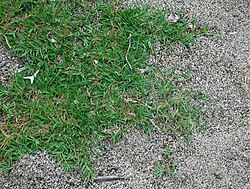
Cynodon dactylon, commonly known as Bermuda grass or as couch grass in Australia and New Zealand, is a grass found worldwide. It is native to Europe, Africa, Australia, and much of Asia and has been introduced to the Americas.[2][3]
Contrary to its common name, Cynodon dactylon is not native to Bermuda but is an abundant invasive species there. In Bermuda, it has been known as crabgrass, also a name for Digitaria sanguinalis. Other names include dhoob, dūrvā grass, ethana grass, dubo, dog grass, dog's tooth grass,[4] Bahama grass, devil's grass, couch grass, Indian doab, arugampul, grama, wiregrass, and scutch grass.
Hybrid species of the grass are taxonomically known as Cynodon dactylon × transvaalensis. These interspecific hybrids are the result of cross-pollination between different cultivars. Hybrid cultivars of the grass are commonly developed by selecting individual plants with desirable traits from seeded or vegetatively propagated stands.[5] These cultivars are typically triploids, meaning they contain three sets of chromosomes.[6]
Description[edit | edit source]

The blades are grey-green in color and short, usually 2–15 cm (0.79–5.91 in) long with rough edges.[7] The erect stems can grow 1–30 cm (0.39–11.81 in) tall. The stems are slightly flattened, often white or green, and occasionally tinged purple in colour.
The seed heads are produced in a cluster of two to six spikes together at the top of the stem, each spike 2–5 cm (0.79–1.97 in) long.[7]
Cynodon dactylon has a deep root system. When grown in penetrable soil under drought conditions, its roots can grow to over 2 metres (6.6 ft) deep, though most of the root mass is less than 60 centimetres (24 in) under the surface. The grass creeps along the ground with its stolons and roots wherever a node touches the ground, forming a dense mat. C. dactylon reproduces through seeds, stolons, and rhizomes.
The grass starts actively growing at temperatures above 15 °C (59 °F) with ideal growth between 24 and 37 °C (75 and 99 °F); in winter or in the dry season, the grass becomes dormant and turns light brown. Optimal development also occurs in areas of full sun exposure, while dense shade, especially near tree bases, generally suppresses it.[citation needed]
Cultivation[edit | edit source]
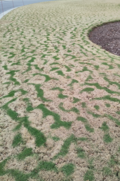
Cynodon dactylon is widely cultivated in warm climates all over the world between about 30° S and 30° N latitude, and in regions that receive between 625 and 1,750 mm (24.6 and 68.9 in) of rainfall a year, or less, if irrigation is available. For example, in the United States, it is grown mostly in the southern half of the country.

Cultivars[edit | edit source]
Hundreds of cultivars have been created specifically for environmental tolerance and stakeholder requirements. New cultivars are released annually.[9][10]
Uses[edit | edit source]
Religious[edit | edit source]
Commonly known as durva or dūrvāyugma in India, this grass is used in the Ayurveda system of medicine.[11] Performing a rite called "the consecration of Rudra (Sanskrit Rudrabhisheka)" described in the Purāṇas while offering durva 11 times bestows long life.[citation needed]
In Hinduism, it is considered important in the worship of Lord Ganesha.[12][13] A clump of 21 shoots of this grass is usually offered during puja (worship).[citation needed] It has been a part of Hindu rituals since Vedic times.[citation needed] A unique festival called Durga Ashtami, dedicated to this grass, is celebrated on the eighth day of the Navratri festival.[14]
It is known as arugampull in Tamil, garikēhullu in Kannada and karuka in Malayalam, and is part of the Dashapushpam (ten sacred flowers) in Kerala.[15]
.jpg)
In Nepal, the grass is known as dubo and is used by the Hindus. According to Nepalese Hindus, the grass symbolizes long life. The grass is an essential item for the Naga Panchami festival as well as the Gaura festival.[16][17][18] In a Nepalese Hindu wedding, a garland made of this grass is worn by both bride and groom.[19]
This grass is a Yoruba herb used for Esu or Elegba in the Ifá system of orishas.[citation needed]
Medicinal value[edit | edit source]
The rhizomes are reported to act as a diuretic in humans, and the grass juice can act as an astringent.[11]
It has been observed that Cynodon dactylon may be selectively eaten by dogs to swiftly induce vomiting when they have gastrointestinal problems. The effect may be due to irritation caused by bristles on the leaf margin.[11]
Other[edit | edit source]

Bermuda grass is fast-growing and tough, making it a popular choice for sports fields because it will recover quickly when damaged. It is a highly desirable turfgrass in warm temperate climates, particularly in hot and dry regions where it will survive while other grass species cannot.
The combination of heat and drought tolerance makes Bermuda grass a frequent choice for golf courses in the southern and southeastern United States and South Africa. Bermuda grass is also commonly used for football and baseball fields. It has a relatively coarse-bladed form with numerous cultivars selected for different turf requirements.[citation needed]
Bermuda grass has been cultivated in saline soils in California's Central Valley, which are too salt-damaged to support agricultural crops; it was successfully irrigated with saline water and used to graze cattle.[20][21]
Ecology[edit | edit source]

Invasive species[edit | edit source]
Bermuda grass can be a highly aggressive invasive species, crowding out most other grasses and invading other habitats, and has become a hard-to-eradicate weed in some areas. It can be controlled somewhat with triclopyr, mesotrione, fluazifop-p-butyl, and glyphosate.[22][23]
This weedy nature leads some gardeners to give it the name of devil grass. Bermuda grass is incredibly difficult to control in flower beds, and most herbicides do not work. However, Ornamec, Ornamec 170, Turflon ester (tricyclopyr), and Imazapyr have shown some effectiveness. All of these items are difficult to find in retail stores, as they are primarily marketed to professional landscapers.[24]
Toxicity[edit | edit source]
The hybrid variety Tifton 85, like some other grasses (e.g. sorghum), produces cyanide under certain conditions,[25] and has been implicated in several livestock deaths.
References[edit | edit source]
|
External links[edit | edit source]
- FAO.org factsheet: Cynodon dactylon Archived 30 August 2010 at the Wayback Machine
- Cim Antalya factsheet: Bermuda Çim