{{Short description|Decentralized digital cryptocurrency}}
{{pp-30-500|small=yes}}
{{for|the colloquial expression for coinage|Bit (money)}}
{{Use dmy dates|date=March 2021}}
{{Redirect-distinguish-text|₿|"฿" for [[Thai baht]]}}
{{pp-extended|small=yes}}
{{Use dmy dates|date=March 2024}}
{{Use American English|date=December 2017}}
{{Use American English|date=December 2017}}
{{infobox cryptocurrency
{{infobox cryptocurrency
| currency_name = Bitcoin
| currency_name = Bitcoin
| image_1 = Bitcoin logo.svg
| image_1 = Bitcoin.svg
| image_2 =
| image_2 =
| image_title_1 = Prevailing bitcoin logo
| image_width_1 = 150
| image_width_2 = 110
| image_title_1 = Commonly used logo of bitcoin
| alt1 = Prevailing bitcoin logo
| alt1 = Prevailing bitcoin logo
| precision = 10<sup>−8</sup>
| precision = 10<sup>−8</sup>
| subunit_ratio_1 = {{frac|1000}}
| subunit_ratio_1 = {{frac|1000}}
| subunit_name_1 = millibitcoin
| subunit_name_1 = millibitcoin
| subunit_ratio_2 = {{frac|{{val|100000000}}}}
| subunit_ratio_2 = {{frac|{{val|1000000}}}}
| subunit_name_2 = {{lang|ja-Latn|satoshi|italic=no}}<ref name="satoshi unit">{{Cite web |last=Mick |first=Jason |date=12 June 2011 |title=Cracking the Bitcoin: Digging Into a $131M USD Virtual Currency |url=http://www.dailytech.com/Cracking+the+Bitcoin+Digging+Into+a+131M+USD+Virtual+Currency/article21878.htm |url-status=dead |archive-url=https://archive.today/20130120051306/http://www.dailytech.com/Cracking+the+Bitcoin+Digging+Into+a+131M+USD+Virtual+Currency/article21878.htm |archive-date=20 January 2013 |access-date=30 September 2012 |publisher=Daily Tech}}</ref>
| subunit_name_2 = microbitcoin
| subunit_ratio_3 = {{frac|{{val|100000000}}}}
| subunit_name_3 = {{lang|ja-Latn|satoshi|italic=no}}{{efn|name=satoshi}}<ref name="satoshi unit">{{Cite journal |last=Bradbury |first=Danny |date=November 2013 |title=The problem with Bitcoin |url=https://linkinghub.elsevier.com/retrieve/pii/S1361372313701015 |journal=Computer Fraud & Security |language=en |volume=2013 |issue=11 |pages=5–8 |doi=10.1016/S1361-3723(13)70101-5 |access-date=25 November 2023 |archive-date=18 January 2023 |archive-url=https://web.archive.org/web/20230118052355/https://linkinghub.elsevier.com/retrieve/pii/S1361372313701015 |url-status=live |issn=1361-3723|url-access=subscription }}</ref>
| plural = bitcoins
| plural = bitcoins
| symbol = ₿ (Unicode: {{unichar|20BF|BITCOIN SIGN|html=}}){{efn|group=infobox|The symbol was encoded in [[Unicode]] version 10.0 at position {{unichar|20BF|BITCOIN SIGN}} in the [[Currency Symbols (Unicode block)|Currency Symbols block]] in June 2017.<ref name="unicode-10">{{Cite web |date=20 June 2017 |title=Unicode 10.0.0 |url=https://www.unicode.org/versions/Unicode10.0.0/ |url-status=live |archive-url=https://web.archive.org/web/20170620130342/http://www.unicode.org/versions/Unicode10.0.0/ |archive-date=20 June 2017 |access-date=20 June 2017 |publisher=Unicode Consortium}}</ref>}}
| symbol = '''₿'''<br/>(Unicode: {{unichar|20BF|BITCOIN SIGN|html=}})<ref name="unicode-10">{{cite web |date=20 June 2017 |title=Unicode 10.0.0 |url=https://www.unicode.org/versions/Unicode10.0.0/ |url-status=live |archive-url=https://web.archive.org/web/20170620130342/http://www.unicode.org/versions/Unicode10.0.0/ |archive-date=20 June 2017 |access-date=20 June 2017 |publisher=Unicode Consortium}}</ref>
| ticker_symbol = BTC, XBT{{efn|group=infobox|Compatible with ISO 4217.}}
| code = BTC
| implementations = Bitcoin Core
| implementations = [[Bitcoin Core]]
| initial_release_version = 0.1.0
| initial_release_version = 0.1.0
| initial_release_date = {{Start date and age|df=yes|2009|1|9|p=y}}
| initial_release_date = {{Start date and age|df=yes|2009|1|9|p=y}}
| latest_release_date = {{Start date and age|df=yes|2021|5|2|p=y}}<ref>{{Cite web |title=Releases - bitcoin/bitcoin |url=https://github.com/bitcoin/bitcoin/releases |access-date=9 May 2021 |via=[[GitHub]]}}</ref>
| latest_release_date = {{Start date and age|df=yes|2026|1|10|p=y}}<ref>{{cite web |title=Bitcoin Core 30.2 |date=10 January 2026 |url=https://bitcoincore.org/bin/bitcoin-core-30.2/ |access-date=14 January 2026}}</ref>
| supply_limit = ₿21,000,000<ref>{{cite web |last=Nakamoto |display-authors=et al |date=1 April 2016 |title=Bitcoin source code - amount constraints |url=https://github.com/bitcoin/bitcoin/blob/08a7316c144f9f2516db8fa62400893f4358c5ae/src/amount.h |url-status=live |archive-url=https://web.archive.org/web/20180701112835/https://github.com/bitcoin/bitcoin/blob/08a7316c144f9f2516db8fa62400893f4358c5ae/src/amount.h |archive-date=1 July 2018}}</ref>{{efn|The supply will approach, but never reach, ₿21 million. Issuance will permanently halt {{circa}} 2140 at ₿20,999,999.9769.<ref name="Antonopoulos2014">{{Cite book |last=Antonopoulos, Andreas M. |title=Mastering Bitcoin: Unlocking Digital Crypto-Currencies |date=April 2014 |publisher=O'Reilly Media |isbn=978-1-4493-7404-4 |author-link=Andreas Antonopoulos}}</ref>{{rp|ch. 8}}}}
| timestamping = [[Proof of work]] (partial hash inversion)
| issuance_schedule = Decentralized (block reward)<br />Initially ₿50 per block, halved every 210,000 blocks<ref name="JSC">{{Cite web |date=19 November 2013 |title=Statement of Jennifer Shasky Calvery, Director Financial Crimes Enforcement Network United States Department of the Treasury Before the United States Senate Committee on Banking, Housing, and Urban Affairs Subcommittee on National Security and International Trade and Finance Subcommittee on Economic Policy |url=https://www.fincen.gov/sites/default/files/2016-08/20131118.pdf |url-status=live |archive-url=https://web.archive.org/web/20161009183700/https://www.fincen.gov/sites/default/files/2016-08/20131118.pdf |archive-date=9 October 2016 |access-date=1 June 2014 |website=fincen.gov |publisher=Financial Crimes Enforcement Network}}</ref>
| issuance_schedule = Decentralized (block reward)<br />Initially ₿50 per block, halved every 210,000 blocks
| block_time = 10 minutes
| block_time = 10 minutes
| block_reward = ₿6.25{{efn|group=infobox|May 2020 to approximately 2024, halved approximately every four years}}
| block_reward = ₿3.125 ({{as of|2025|lc=y}})
| exchange_rate =
| exchange_rate = Floating
| market_cap =
| market_cap = <!--A reliable source is required -->
| footnotes = {{notelist|group=infobox}}
| using_countries =
}}
}}
{{Special characters}}
{{Special characters}}
'''Bitcoin''' (abbreviation: '''BTC'''; [[Currency symbol|sign]]: '''₿''') is the first [[Decentralized application|decentralized]] [[cryptocurrency]]. Based on a [[free-market]] ideology, bitcoin was invented in 2008 when an unknown person published a [[white paper]] under the pseudonym of [[Satoshi Nakamoto]].<ref name="whoissn">{{Cite news |last=S. |first=L. |date=2 November 2015 |title=Who is Satoshi Nakamoto? |newspaper=[[The Economist]] |url=https://www.economist.com/the-economist-explains/2015/11/02/who-is-satoshi-nakamoto |access-date=21 November 2023 |archive-date=22 November 2020 |archive-url=https://web.archive.org/web/20201122172929/https://www.economist.com/the-economist-explains/2015/11/02/who-is-satoshi-nakamoto |url-status=live }}</ref> Use of bitcoin as a [[currency]] began in 2009,<ref name="NY2011">{{Cite magazine |last=Davis |first=Joshua |date=10 October 2011 |title=The Crypto-Currency: Bitcoin and its mysterious inventor |url=https://www.newyorker.com/magazine/2011/10/10/the-crypto-currency |url-status=live |archive-url=https://web.archive.org/web/20141101014157/http://www.newyorker.com/magazine/2011/10/10/the-crypto-currency |archive-date=1 November 2014 |access-date=31 October 2014 |magazine=[[The New Yorker]]}}</ref> with the release of its [[open-source software|open-source implementation]].<ref name="Antonopoulos2014">{{Cite book |last=Antonopoulos |first=Andreas M. |title=Mastering Bitcoin: Unlocking Digital Crypto-Currencies |year=2014 |publisher=O'Reilly Media |isbn=978-1-4493-7404-4 |author-link=Andreas Antonopoulos}}</ref>{{rp|ch. 1}} From 2021 to 2025, [[Bitcoin in El Salvador|El Salvador adopted it as legal tender currency before revoking it]].<ref name="BTCSVSept7FT">{{cite news |title=El Salvador's dangerous gamble on bitcoin |url=https://www.ft.com/content/c257a925-c864-4495-9149-d8956d786310 |date=7 September 2021 |access-date=7 September 2021 |work=[[Financial Times]] |department=The editorial board |archive-date=7 September 2021 |archive-url=https://web.archive.org/web/20210907081627/https://www.ft.com/content/c257a925-c864-4495-9149-d8956d786310 |url-status=live }}</ref><ref name="El Salvador Abandons Bitcoin as Legal Tender" /><ref name="Bitcoin is no longer legal tender in El Salvador" /> As bitcoin is [[pseudonym]]ous, [[Cryptocurrency and crime|its use by criminals]] has attracted the attention of regulators, leading to [[Legality of cryptocurrency by country or territory|its ban by several countries]].<ref name="SunYin2019">{{Cite journal |last1=Sun Yin |first1=Hao Hua |last2=Langenheldt |first2=Klaus |last3=Harlev |first3=Mikkel |last4=Mukkamala |first4=Raghava Rao |last5=Vatrapu |first5=Ravi |date=2 January 2019 |title=Regulating Cryptocurrencies: A Supervised Machine Learning Approach to De-Anonymizing the Bitcoin Blockchain |url=https://www.researchgate.net/publication/332118587 |journal=[[Journal of Management Information Systems]] |language=en |volume=36 |issue=1 |page=65 |doi=10.1080/07421222.2018.1550550 |s2cid=132398387 |issn=0742-1222 |access-date=29 November 2023 |archive-date=21 April 2024 |archive-url=https://web.archive.org/web/20240421113631/https://www.researchgate.net/publication/332118587_Regulating_Cryptocurrencies_A_Supervised_Machine_Learning_Approach_to_De-Anonymizing_the_Bitcoin_Blockchain |url-status=live }}</ref>
'''Bitcoin''' ('''₿''') is a decentralized [[digital currency]], without a [[central bank]] or single administrator, that can be sent from user to user on the [[bitcoin network|peer-to-peer bitcoin network]] without the need for intermediaries.<ref name="JSC" /> Transactions are verified by network [[Node (networking)|nodes]] through [[cryptography]] and recorded in a public [[distributed ledger]] called a [[blockchain]]. The [[cryptocurrency]] was invented in 2008 by an unknown person or group of people using the name [[Satoshi Nakamoto]].<ref name="whoissn">{{Cite news |last=S. |first=L. |date=2 November 2015 |title=Who is Satoshi Nakamoto? |work=The Economist |publisher=The Economist Newspaper Limited |url=https://www.economist.com/blogs/economist-explains/2015/11/economist-explains-1 |url-status=live |access-date=23 September 2016 |archive-url=https://web.archive.org/web/20160821154511/http://www.economist.com/blogs/economist-explains/2015/11/economist-explains-1 |archive-date=21 August 2016}}</ref> The currency began use in 2009<ref name="NY2011">{{Cite magazine |last=Davis |first=Joshua |date=10 October 2011 |title=The Crypto-Currency: Bitcoin and its mysterious inventor |url=https://www.newyorker.com/magazine/2011/10/10/the-crypto-currency |url-status=live |archive-url=https://web.archive.org/web/20141101014157/http://www.newyorker.com/magazine/2011/10/10/the-crypto-currency |archive-date=1 November 2014 |access-date=31 October 2014 |magazine=The New Yorker}}</ref> when its implementation was released as [[open-source software]].<ref name="Antonopoulos2014" />{{rp|ch. 1}}
Bitcoin works through the collaboration of computers, each of which acts as a [[Node (networking)|node]] in the [[peer-to-peer]] [[bitcoin network]]. Each node maintains an independent copy of a public [[distributed ledger]] of transactions, called a [[blockchain]], without central oversight. Transactions are validated through the use of [[cryptography]], preventing one person from spending another person's bitcoin, as long as the owner of the bitcoin keeps certain sensitive data secret.<ref name="Antonopoulos2014" />{{rp|ch. 5}}
Bitcoins are created as a reward for a process known as [[#Mining|mining]]. They can be exchanged for other currencies, products, and services,<ref>{{Cite web |title=What is Bitcoin? |url=https://money.cnn.com/infographic/technology/what-is-bitcoin/ |url-status=live |archive-url=https://web.archive.org/web/20151031113913/https://money.cnn.com/infographic/technology/what-is-bitcoin/ |archive-date=31 October 2015 |access-date=16 November 2015 |website=CNN Money}}</ref> but the real-world value of the coins is extremely volatile.<ref name=":1">{{Cite web|last=GmbH|first=finanzen net|title=Bitcoin's limited real-world use and extreme volatility show its recent surge is still a speculative bubble, UBS Global Wealth Management says|url=https://www.businessinsider.com/bitcoin-limited-real-use-volatility-speculative-bubble-ubs-wealth-management-2021-3|access-date=28 March 2021|website=markets.businessinsider.com|language=en-us}}</ref> Research produced by the [[University of Cambridge]] estimated that in 2017, there were 2.9 to 5.8 million unique users using a [[cryptocurrency wallet]], most of them using bitcoin.<ref name="CU2017">{{Cite web |last1=Hileman |first1=Garrick |last2=Rauchs |first2=Michel |title=Global Cryptocurrency Benchmarking Study |url=https://www.jbs.cam.ac.uk/fileadmin/user_upload/research/centres/alternative-finance/downloads/2017-global-cryptocurrency-benchmarking-study.pdf |url-status=live |archive-url=https://web.archive.org/web/20170410130007/https://www.jbs.cam.ac.uk/fileadmin/user_upload/research/centres/alternative-finance/downloads/2017-global-cryptocurrency-benchmarking-study.pdf |archive-date=10 April 2017 |access-date=14 April 2017 |publisher=Cambridge University}}</ref> Users choose to participate in the digital currency for a number of reasons: ideologies such as commitment to anarchism, decentralization and libertarianism, convenience, using the currency as an investment and pseudonymity of transactions. Increased use has led to a desire among governments for regulation in order to tax, facilitate legal use in trade and for other reasons (such as investigations for [[money laundering]] and [[Market manipulation|price manipulation]]).
[[Consensus (computer science)|Consensus]] between nodes about the content of the blockchain is achieved using a [[Computational complexity|computationally intensive]] process based on [[proof of work]], called [[bitcoin mining|mining]], which is performed by purpose-built computers.<ref name="Antonopoulos2014" />{{rp|ch. 12}} Mining consumes large quantities of electricity and has been criticized for [[environmental impact of bitcoin|its environmental impact]].<ref>{{Cite news |last1=Huang |first1=Jon |last2=O’Neill |first2=Claire |last3=Tabuchi |first3=Hiroko |author3-link=Hiroko Tabuchi |date=3 September 2021 |title=Bitcoin Uses More Electricity Than Many Countries. How Is That Possible? |url=https://www.nytimes.com/interactive/2021/09/03/climate/bitcoin-carbon-footprint-electricity.html |url-status=live |archive-url=https://web.archive.org/web/20230217105559/https://www.nytimes.com/interactive/2021/09/03/climate/bitcoin-carbon-footprint-electricity.html |archive-date=17 February 2023 |access-date=26 October 2022 |work=The New York Times |language=en-US |issn=0362-4331}}</ref>
Bitcoin has been criticized for its use in illegal transactions, the large amount of electricity (and thus [[carbon footprint]]) used by mining, [[Volatility (finance)|price volatility]], and thefts from exchanges. Some economists and commentators have characterized it as a [[speculative bubble]] at various times. Bitcoin has also been used as an investment, although several regulatory agencies have issued investor alerts about bitcoin.{{r|":1"}}<ref name="CFTC bitcoin" /><ref>{{cite web |title=SEC.gov {{!}} INVESTOR ALERT: BITCOIN AND OTHER VIRTUAL CURRENCY-RELATED INVESTMENTS |url=https://www.sec.gov/oiea/investor-alerts-bulletins/investoralertsia_bitcoin.html |url-status=live |archive-url=https://web.archive.org/web/20190603183220/https://www.sec.gov/oiea/investor-alerts-bulletins/investoralertsia_bitcoin.html |archive-date=3 June 2019 |access-date=1 June 2019 |website=www.sec.gov}}</ref>
{{TOC LIMIT|4}}
The word ''bitcoin'' was defined in a [[white paper]] published on 31 October 2008.<ref name="paper"/><ref name="ageofcr">{{Cite book |last1=Vigna |first1=Paul |title=The Age of Cryptocurrency: How Bitcoin and Digital Money Are Challenging the Global Economic Order |last2=Casey |first2=Michael J. |date=January 2015 |publisher=St. Martin's Press |isbn=978-1-250-06563-6 |edition=1 |location=New York}}</ref> It is a [[Compound (linguistics)|compound]] of the words ''[[bit]]'' and ''[[coin]]''.<ref name="btox">{{Cite web |title=bitcoin |url=http://www.oxforddictionaries.com/definition/english/bitcoin |url-status=live |archive-url=https://web.archive.org/web/20150102041748/http://www.oxforddictionaries.com/definition/english/bitcoin |archive-date=2 January 2015 |access-date=28 December 2014 |publisher=[[OxfordDictionaries.com]]}}</ref> No uniform convention for ''bitcoin'' capitalization exists; some sources use ''Bitcoin'', capitalized, to refer to the technology and [[computer network|network]] and ''bitcoin'', lowercase, for the unit of account.<ref name="capitalization">{{Cite magazine |last=Bustillos, Maria |date=2 April 2013 |title=The Bitcoin Boom |url=https://www.newyorker.com/tech/elements/the-bitcoin-boom |url-status=live |archive-url=https://web.archive.org/web/20140727185121/http://www.newyorker.com/tech/elements/the-bitcoin-boom |archive-date=27 July 2014 |access-date=22 December 2013 |magazine=The New Yorker |publisher=Condé Nast |quote=Standards vary, but there seems to be a consensus forming around Bitcoin, capitalized, for the system, the software, and the network it runs on, and bitcoin, lowercase, for the currency itself.}}</ref> ''[[The Wall Street Journal]]'',<ref>{{Cite news |last=Vigna |first=Paul |date=3 March 2014 |title=BitBeat: Is It Bitcoin, or bitcoin? The Orthography of the Cryptography |work=[[Wall Street Journal|WSJ]] |url=https://blogs.wsj.com/moneybeat/2014/03/14/bitbeat-is-it-bitcoin-or-bitcoin-the-orthography-of-the-cryptography |url-status=live |access-date=21 April 2014 |archive-url=https://web.archive.org/web/20140419024119/http://blogs.wsj.com/moneybeat/2014/03/14/bitbeat-is-it-bitcoin-or-bitcoin-the-orthography-of-the-cryptography/ |archive-date=19 April 2014}}</ref> ''[[The Chronicle of Higher Education]]'',<ref>{{Cite web |last=Metcalf |first=Allan |date=14 April 2014 |title=The latest style |url=http://chronicle.com/blogs/linguafranca/2014/04/11/the-latest-style/ |url-status=live |archive-url=https://web.archive.org/web/20140416083920/http://chronicle.com/blogs/linguafranca/2014/04/11/the-latest-style/ |archive-date=16 April 2014 |access-date=19 April 2014 |series=Lingua Franca blog |publisher=The Chronicle of Higher Education (chronicle.com)}}</ref> and the ''[[Oxford English Dictionary]]''{{r|btox}} advocate the use of lowercase ''bitcoin'' in all cases.
==History==
==History==
{{Main|History of bitcoin}}
{{Main|History of bitcoin}}
===Background===
Before bitcoin, several [[digital cash|digital cash technologies]] were released, starting with [[David Chaum]]'s [[ecash]] in the 1980s.<ref name=Narayanan2017/> The idea that solutions to computational puzzles could have some value was first proposed by cryptographers [[Cynthia Dwork]] and [[Moni Naor]] in 1992.<ref>{{citation |last1=Dwork |first1=Cynthia |title=Pricing via Processing or Combatting Junk Mail |date=1993 |work=Advances in Cryptology — CRYPTO’ 92 |volume=740 |pages=139–147 |editor-last=Brickell |editor-first=Ernest F. |url=http://link.springer.com/10.1007/3-540-48071-4_10 |access-date=2025-01-02 |place=Berlin, Heidelberg |publisher=Springer Berlin Heidelberg |language=en |doi=10.1007/3-540-48071-4_10 |isbn=978-3-540-57340-1 |last2=Naor |first2=Moni|url-access=subscription }}</ref><ref name=Narayanan2017/> The concept was [[Multiple discovery|independently rediscovered]] by [[Adam Back]] who developed [[Hashcash]], a [[proof-of-work]] scheme for [[Anti-spam techniques|spam control]] in 1997.<ref name="Narayanan2017" /> The first proposals for distributed digital scarcity-based [[cryptocurrencies]] came from [[cypherpunk]]s [[Wei Dai]] (b-money) and [[Nick Szabo]] ([[bit gold]]) in 1998.<ref>{{Cite journal |last1=Tschorsch |first1=Florian |last2=Scheuermann |first2=Bjorn |date=2 March 2016 |title=Bitcoin and Beyond: A Technical Survey on Decentralized Digital Currencies |journal=IEEE Communications Surveys & Tutorials |volume=18 |issue=3 |pages=2084–2123 |doi=10.1109/COMST.2016.2535718 |s2cid=5115101 |issn=1553-877X }}</ref> In 2004, [[Hal Finney (cypherpunk)|Hal Finney]] developed the first currency based on reusable proof of work.<ref>{{cite book |last1=Judmayer |first1=Aljosha |chapter=History of Cryptographic Currencies |date=2017 |chapter-url=https://link.springer.com/10.1007/978-3-031-02352-1_3 |title=Blocks and Chains |pages=15–18 |publisher=[[Springer Nature|Springer]] |language=en |doi=10.1007/978-3-031-02352-1_3 |isbn=978-3-031-01224-2 |last2=Stifter |first2=Nicholas |last3=Krombholz |first3=Katharina |last4=Weippl |first4=Edgar |series=Synthesis Lectures on Information Security, Privacy, and Trust |url=https://link.springer.com/book/10.1007/978-3-031-02352-1 |access-date=22 November 2023 |archive-date=22 November 2023 |archive-url=https://web.archive.org/web/20231122135006/https://link.springer.com/book/10.1007/978-3-031-02352-1 |url-status=live }}</ref> These various attempts were not successful:<ref name="Narayanan2017" /> Chaum's concept required centralized control and no banks wanted to sign on, Hashcash had no protection against [[double-spending]], while b-money and bit gold were not resistant to [[Sybil attack]]s.<ref name=Narayanan2017>{{Cite journal |last1=Narayanan |first1=Arvind |last2=Clark |first2=Jeremy |date=27 November 2017 |title=Bitcoin's academic pedigree |url=https://queue.acm.org/detail.cfm?id=3136559 |journal=[[Communications of the ACM]] |volume=60 |issue=12 |pages=36–45 |doi=10.1145/3132259 |s2cid=6425116 |issn=0001-0782 |access-date=22 November 2023 |archive-date=14 October 2023 |archive-url=https://web.archive.org/web/20231014120907/https://queue.acm.org/detail.cfm?id=3136559 |url-status=live |url-access=subscription }}</ref>
===Creation===
===2008–2009: Creation===
The domain name ''bitcoin.org'' was registered on 18 August 2008.<ref>{{Cite news |last=Bernard |first=Zoë |date=2 December 2017 |title=Everything you need to know about Bitcoin, its mysterious origins, and the many alleged identities of its creator |work=Business Insider |url=http://www.businessinsider.com/bitcoin-history-cryptocurrency-satoshi-nakamoto-2017-12 |url-status=live |access-date=15 June 2018 |archive-url=https://web.archive.org/web/20180615010015/http://www.businessinsider.com/bitcoin-history-cryptocurrency-satoshi-nakamoto-2017-12 |archive-date=15 June 2018}}</ref> On 31 October 2008, a link to a paper authored by [[Satoshi Nakamoto]] titled ''Bitcoin: A Peer-to-Peer Electronic Cash System''<ref name="paper">{{Cite web |last=Nakamoto |first=Satoshi |date=31 October 2008 |title=Bitcoin: A Peer-to-Peer Electronic Cash System |url=https://bitcoin.org/bitcoin.pdf |url-status=live |archive-url=https://web.archive.org/web/20140320135003/https://bitcoin.org/bitcoin.pdf |archive-date=20 March 2014 |access-date=28 April 2014 |publisher=bitcoin.org}}</ref> was posted to a cryptography mailing list.<ref>{{Cite news |last=Finley |first=Klint |date=31 October 2018 |title=After 10 Years, Bitcoin Has Changed Everything—And Nothing |work=Wired |url=https://www.wired.com/story/after-10-years-bitcoin-changed-everything-nothing/ |url-status=live |access-date=9 November 2018 |archive-url=https://web.archive.org/web/20181105070656/https://www.wired.com/story/after-10-years-bitcoin-changed-everything-nothing/ |archive-date=5 November 2018}}</ref> Nakamoto implemented the bitcoin software as [[open-source software|open-source code]] and released it in January 2009.<ref>{{Cite web |last=Nakamoto, Satoshi |date=3 January 2009 |title=Bitcoin |url=https://sourceforge.net/p/bitcoin/code/HEAD/tree/ |url-status=live |archive-url=https://web.archive.org/web/20170721190347/https://sourceforge.net/p/bitcoin/code/HEAD/tree/ |archive-date=21 July 2017}}</ref><ref>{{Cite web |last=Nakamoto, Satoshi |date=9 January 2009 |title=Bitcoin v0.1 released |url=http://www.mail-archive.com/[email protected]/msg10142.html |url-status=live |archive-url=https://web.archive.org/web/20140326174921/http://www.mail-archive.com/cryptography%40metzdowd.com/msg10142.html |archive-date=26 March 2014}}</ref><ref name="NY2011" /> Nakamoto's identity remains unknown.{{r|whoissn}}
{{external media
| float = right
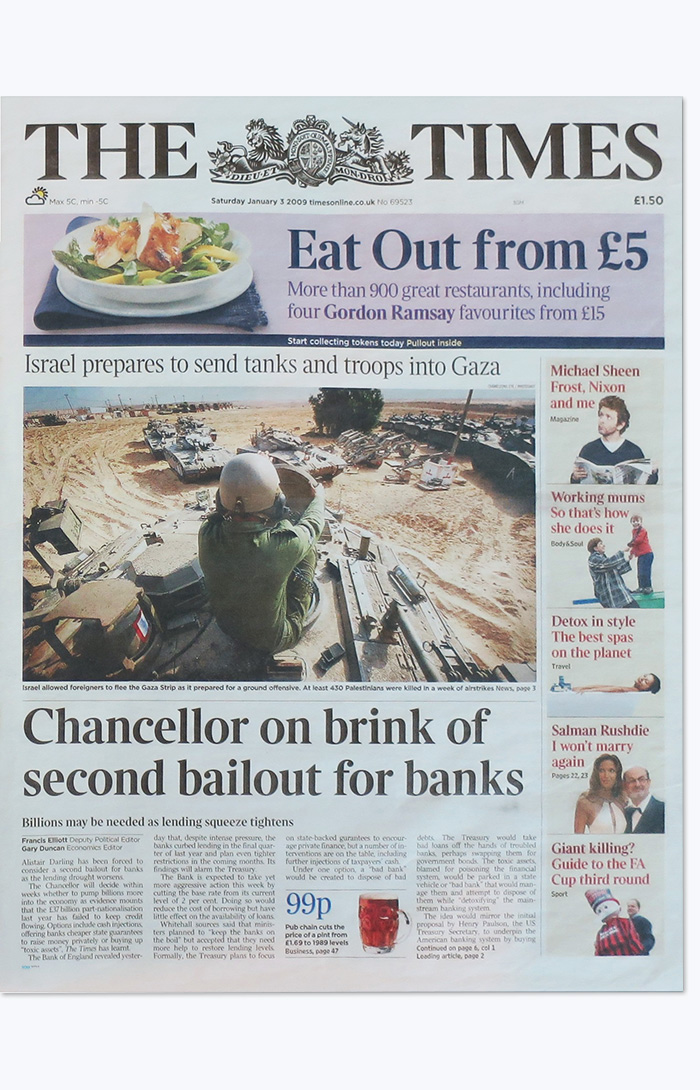
On 3 January 2009, the bitcoin network was created when Nakamoto mined the starting block of the chain, known as the ''[[Genesis (blockchain)|genesis block]]''.<ref name="Wired:RFB">{{Cite magazine |last=Wallace, Benjamin |date=23 November 2011 |title=The Rise and Fall of Bitcoin |url=https://www.wired.com/2011/11/mf-bitcoin/ |url-status=live |magazine=Wired |archive-url=https://web.archive.org/web/20131031043919/http://www.wired.com/magazine/2011/11/mf_bitcoin |archive-date=31 October 2013 |access-date=13 October 2012}}</ref><ref>{{Cite web |title=Block 0 – Bitcoin Block Explorer |url=http://blockexplorer.com/block/000000000019d6689c085ae165831e934ff763ae46a2a6c172b3f1b60a8ce26f |url-status=live |archive-url=https://web.archive.org/web/20131015154613/http://blockexplorer.com/block/000000000019d6689c085ae165831e934ff763ae46a2a6c172b3f1b60a8ce26f |archive-date=15 October 2013}}</ref> Embedded in the [[Bitcoin#Supply|coinbase]] of this block was the text "The Times 03/Jan/2009 Chancellor on brink of second bailout for banks".<ref name="NY2011" /> This note references a headline published by ''[[The Times]]'' and has been interpreted as both a timestamp and a comment on the instability caused by [[fractional-reserve banking]].<ref>{{Cite book |last=Pagliery |first=Jose |url=https://books.google.com/books?id=_-wuBAAAQBAJ |title=Bitcoin: And the Future of Money |date=2014 |publisher=Triumph Books |isbn=9781629370361 |access-date=20 January 2018 |archive-url=https://web.archive.org/web/20180121071329/https://books.google.com.au/books?id=_-wuBAAAQBAJ |archive-date=21 January 2018 |url-status=live}}</ref>{{rp|18}}
| width = 258px
| image1 = [https://www.thetimes03jan2009.com/wp-content/uploads/2015/03/genesis-block-newspaper-bitcoin.jpg Cover page of ''The Times'' 3 January 2009 showing the headline used in the genesis block]
The receiver of the first bitcoin transaction was [[Hal Finney (cypherpunk)|cypherpunk Hal Finney]], who had created the first [[Proof-of-work system#Reusable proof-of-work as e-money|reusable proof-of-work]] system (RPoW) in 2004.<ref>{{Cite web |date=19 May 2013 |title=Here's The Problem with the New Theory That A Japanese Math Professor Is The Inventor of Bitcoin |url=https://www.businessinsider.com/did-shinichi-mochizuki-invent-bitcoin-2013-5 |url-status=live |archive-url=https://web.archive.org/web/20150104063653/http://www.sfgate.com/technology/businessinsider/article/Here-s-The-Problem-With-The-New-Theory-That-A-4529573.php |archive-date=4 January 2015 |access-date=24 February 2015 |website=San Francisco Chronicle}}</ref> Finney downloaded the bitcoin software on its release date, and on 12 January 2009 received ten bitcoins from Nakamoto.<ref>{{Cite news |last=Peterson |first=Andrea |date=3 January 2014 |title=Hal Finney received the first Bitcoin transaction. Here's how he describes it. |work=The Washington Post |url=https://www.washingtonpost.com/blogs/the-switch/wp/2014/01/03/hal-finney-received-the-first-bitcoin-transaction-heres-how-he-describes-it/ |url-status=live |archive-url=https://web.archive.org/web/20150227213647/http://www.washingtonpost.com/blogs/the-switch/wp/2014/01/03/hal-finney-received-the-first-bitcoin-transaction-heres-how-he-describes-it/ |archive-date=27 February 2015}}</ref><ref>{{Cite news |last=Popper |first=Nathaniel |date=30 August 2014 |title=Hal Finney, Cryptographer and Bitcoin Pioneer, Dies at 58 |work=NYTimes |url=https://www.nytimes.com/2014/08/31/business/hal-finney-cryptographer-and-bitcoin-pioneer-dies-at-58.html |url-status=live |access-date=2 September 2014 |archive-url=https://web.archive.org/web/20140903162835/http://www.nytimes.com/2014/08/31/business/hal-finney-cryptographer-and-bitcoin-pioneer-dies-at-58.html |archive-date=3 September 2014}}</ref> Other early cypherpunk supporters were creators of bitcoin predecessors: [[Wei Dai]], creator of b-money, and [[Nick Szabo]], creator of [[bit gold]].<ref name="Wired:RFB" /> In 2010, the first known [[Financial transaction|commercial transaction]] using bitcoin occurred when programmer Laszlo Hanyecz bought two [[Papa John's]] pizzas for ₿10,000.<ref>{{Cite news |last=Kharpal |first=Arjun |date=18 June 2018 |title=Everything you need to know about the blockchain |work=CNBC |url=https://www.cnbc.com/2018/06/18/blockchain-what-is-it-and-how-does-it-work.html |url-status=live |access-date=13 September 2018 |archive-url=https://web.archive.org/web/20180913112144/https://www.cnbc.com/2018/06/18/blockchain-what-is-it-and-how-does-it-work.html |archive-date=13 September 2018}}</ref>
}}
The domain name ''bitcoin.org'' was registered on 18 August 2008.<ref>{{Cite news |last=Bernard |first=Zoë |date=2 December 2017 |title=Everything you need to know about Bitcoin, its mysterious origins, and the many alleged identities of its creator |work=Business Insider |url=http://www.businessinsider.com/bitcoin-history-cryptocurrency-satoshi-nakamoto-2017-12 |url-status=live |access-date=15 June 2018 |archive-url=https://web.archive.org/web/20180615010015/http://www.businessinsider.com/bitcoin-history-cryptocurrency-satoshi-nakamoto-2017-12 |archive-date=15 June 2018}}</ref> On 31 October 2008, a link to a [[white paper]] authored by [[Satoshi Nakamoto]] titled ''Bitcoin: A Peer-to-Peer Electronic Cash System'' was posted to a cryptography mailing list.<ref>{{Cite news |last=Finley |first=Klint |date=31 October 2018 |title=After 10 Years, Bitcoin Has Changed Everything—and Nothing |magazine=Wired |url=https://www.wired.com/story/after-10-years-bitcoin-changed-everything-nothing/ |url-status=live |access-date=9 November 2018 |archive-url=https://web.archive.org/web/20181105070656/https://www.wired.com/story/after-10-years-bitcoin-changed-everything-nothing/ |archive-date=5 November 2018}}</ref> Nakamoto's identity remains unknown.{{r|whoissn}} According to computer scientist [[Arvind Narayanan]], all individual components of bitcoin originated in earlier academic literature.<ref name=Narayanan2017/> Nakamoto's innovation was their complex interplay resulting in the first decentralized, [[Sybil attack|Sybil resistant]], [[Byzantine fault]] tolerant digital cash system, that would eventually be referred to as the first blockchain.<ref name=Narayanan2017/><ref name="te20151031">{{Cite news |last=Economist Staff |date=31 October 2015 |title=Blockchains: The great chain of being sure about things |url=https://www.economist.com/news/briefing/21677228-technology-behind-bitcoin-lets-people-who-do-not-know-or-trust-each-other-build-dependable |url-status=live |newspaper=[[The Economist]] |archive-url=https://web.archive.org/web/20160703000844/http://www.economist.com/news/briefing/21677228-technology-behind-bitcoin-lets-people-who-do-not-know-or-trust-each-other-build-dependable |archive-date=3 July 2016 |access-date=18 June 2016 }}</ref> Nakamoto's paper was not [[peer review]]ed and was initially ignored by academics, who argued that it could not work.<ref name=Narayanan2017/>
[[Blockchain#Blockchain analysis|Blockchain analysts]] estimate that Nakamoto had mined about one million bitcoins<ref>{{Cite news |last=McMillan |first=Robert |title=Who Owns the World's Biggest Bitcoin Wallet? The FBI |work=Wired |publisher=Condé Nast |url=https://www.wired.com/2013/12/fbi-wallet/ |url-status=live |access-date=7 October 2016 |archive-url=https://web.archive.org/web/20161021221609/https://www.wired.com/2013/12/fbi-wallet/ |archive-date=21 October 2016}}</ref> before disappearing in 2010 when he handed the network alert key and control of the code repository over to [[Gavin Andresen]]. Andresen later became lead developer at the [[Bitcoin Foundation]].<ref>{{Cite web |last=Simonite |first=Tom |title=Meet Gavin Andresen, the most powerful person in the world of Bitcoin |url=https://www.technologyreview.com/s/527051/the-man-who-really-built-bitcoin/ |access-date=6 December 2017 |website=MIT Technology Review}}</ref><ref name="governance">{{Cite news |last=Odell |first=Matt |date=21 September 2015 |title=A Solution To Bitcoin's Governance Problem |work=TechCrunch |url=https://techcrunch.com/2015/09/21/a-solution-to-bitcoins-governance-problem/ |url-status=live |access-date=24 January 2016 |archive-url=https://web.archive.org/web/20160126051521/http://techcrunch.com/2015/09/21/a-solution-to-bitcoins-governance-problem/ |archive-date=26 January 2016}}</ref> Andresen then sought to decentralize control. This left opportunity for controversy to develop over the future development path of bitcoin, in contrast to the perceived authority of Nakamoto's contributions.<ref name="breakingup" /><ref name="governance" />
===2011–2012===
After early "[[proof-of-concept]]" transactions, the first major users of bitcoin were [[black market]]s, such as [[Silk Road (marketplace)|Silk Road]]. During its 30 months of existence, beginning in February 2011, Silk Road exclusively accepted bitcoins as payment, transacting 9.9 million in bitcoins, worth about $214 million.<ref name="JEP" />{{rp|222}}
In 2011, the price started at $0.30 per bitcoin, growing to $5.27 for the year. The price rose to $31.50 on 8 June. Within a month, the price fell to $11.00. The next month it fell to $7.80, and in another month to $4.77.<ref name="Odata">{{Cite web |title=Bitcoin Historical Prices |url=https://www.officialdata.org/bitcoin-price |url-status=live |archive-url=https://web.archive.org/web/20180704010212/https://www.officialdata.org/bitcoin-price |archive-date=4 July 2018 |access-date=3 July 2018 |website=OfficialData.org}}</ref>
In 2012, bitcoin prices started at $5.27, growing to $13.30 for the year.<ref name="Odata" /> By 9 January the price had risen to $7.38, but then crashed by 49% to $3.80 over the next 16 days. The price then rose to $16.41 on 17 August, but fell by 57% to $7.10 over the next three days.<ref name="MktWatch09022018">{{Cite news |last=French |first=Sally |date=9 February 2017 |title=Here's proof that this bitcoin crash is far from the worst the cryptocurrency has seen |publisher=Market Watch |url=https://www.marketwatch.com/story/heres-proof-that-this-bitcoin-crash-is-far-from-the-worst-the-cryptocurrency-has-seen-2018-02-09 |url-status=live |access-date=3 July 2018 |archive-url=https://web.archive.org/web/20180703220246/https://www.marketwatch.com/story/heres-proof-that-this-bitcoin-crash-is-far-from-the-worst-the-cryptocurrency-has-seen-2018-02-09 |archive-date=3 July 2018}}</ref>
The Bitcoin Foundation was founded in September 2012 to promote bitcoin's development and uptake.<ref>{{Cite news |last=Bustillos |first=Maria |date=1 April 2013 |title=The Bitcoin Boom |work=The New Yorker |url=https://www.newyorker.com/tech/elements/the-bitcoin-boom |url-status=live |access-date=30 July 2018 |archive-url=https://web.archive.org/web/20180702064450/https://www.newyorker.com/tech/elements/the-bitcoin-boom |archive-date=2 July 2018}}</ref>
On 1 November 2011, the [[reference implementation]] Bitcoin-Qt version 0.5.0 was released. It introduced a [[Front and back ends|front end]] that used the [[Qt (software)|Qt user interface toolkit]].<ref name="bqt">{{Cite web |date=1 November 2011 |title=Bitcoin-Qt version 0.5.0 released |url=https://bitcoin.org/en/release/v0.5.0 |access-date=13 November 2016 |publisher=Bitcoin Project}}</ref> The software previously used [[Berkeley DB]] for database management. Developers switched to [[LevelDB]] in release 0.8 in order to reduce blockchain [[Synchronization (computer science)|synchronization]] time.{{citation needed|date=May 2019}} The update to this release resulted in a minor blockchain fork on 11 March 2013. The fork was resolved shortly afterwards.{{citation needed|date=May 2019}} Seeding nodes through [[Internet Relay Chat|IRC]] was discontinued in version 0.8.2. From version 0.9.0 the software was renamed to Bitcoin Core. Transaction fees were reduced again by a factor of ten as a means to encourage [[micropayment|microtransactions]].{{citation needed|date=May 2019}} Although Bitcoin Core does not use [[OpenSSL]] for the operation of the network, the software did use OpenSSL for remote procedure calls. Version 0.9.1 was released to remove the network's vulnerability to the [[Heartbleed bug]].{{citation needed|date=May 2019}}
===2013–2016===
In 2013, prices started at $13.30 rising to $770 by 1 January 2014.<ref name="Odata" />
In March 2013 the [[blockchain]] temporarily split into two independent chains with different rules due to a bug in version 0.8 of the bitcoin software. The two blockchains operated simultaneously for six hours, each with its own version of the transaction history from the moment of the split. Normal operation was restored when the majority of the network downgraded to version 0.7 of the bitcoin software, selecting the backwards-compatible version of the blockchain. As a result, this blockchain became the longest chain and could be accepted by all participants, regardless of their bitcoin software version.<ref name="bug events">{{Cite web |last=Lee |first=Timothy |date=11 March 2013 |title=Major glitch in Bitcoin network sparks sell-off; price temporarily falls 23% |url=https://arstechnica.com/business/2013/03/major-glitch-in-bitcoin-network-sparks-sell-off-price-temporarily-falls-23/ |url-status=live |archive-url=https://www.webcitation.org/6G4e02Xd1?url=http://arstechnica.com/business/2013/03/major-glitch-in-bitcoin-network-sparks-sell-off-price-temporarily-falls-23/ |archive-date=22 April 2013 |access-date=15 February 2015 |publisher=arstechnica.com}}</ref> During the split, the [[Mt. Gox]] exchange briefly halted bitcoin deposits and the price dropped by 23% to $37<ref name="bug events" /><ref name="VergeFork">{{Cite web |last=Blagdon |first=Jeff |date=12 March 2013 |title=Technical problems cause Bitcoin to plummet from record high, Mt. Gox suspends deposits |url=https://www.theverge.com/2013/3/12/4092898/technical-problems-cause-bitcoin-to-plummet-from-record-high |url-status=live |archive-url=https://www.webcitation.org/6G4e0aImv?url=http://www.theverge.com/2013/3/12/4092898/technical-problems-cause-bitcoin-to-plummet-from-record-high |archive-date=22 April 2013 |access-date=12 March 2013 |website=The Verge}}</ref> before recovering to the previous level of approximately $48 in the following hours.<ref>{{Cite web |title=Bitcoin Charts |url=http://bitcoincharts.com/charts/mtgoxUSD#rg60zczsg2013-03-12zeg2013-03-15ztgSzm1g10zm2g25zv |url-status=live |archive-url=https://web.archive.org/web/20140509133404/http://bitcoincharts.com/charts/mtgoxUSD |archive-date=9 May 2014}}</ref>
The US [[Financial Crimes Enforcement Network]] (FinCEN) established regulatory guidelines for "decentralized virtual currencies" such as bitcoin, classifying American bitcoin miners who sell their generated bitcoins as Money Service Businesses (MSBs), that are subject to registration or other legal obligations.<ref name="ArsFinCEN">{{Cite web |last=Lee |first=Timothy |date=20 March 2013 |title=US regulator Bitcoin Exchanges Must Comply With Money Laundering Laws |url=https://arstechnica.com/tech-policy/2013/03/us-regulator-bitcoin-exchanges-must-comply-with-money-laundering-laws/ |url-status=live |archive-url=https://web.archive.org/web/20131021203745/http://arstechnica.com/tech-policy/2013/03/us-regulator-bitcoin-exchanges-must-comply-with-money-laundering-laws/ |archive-date=21 October 2013 |access-date=28 July 2017 |publisher=Arstechnica |quote=Bitcoin miners must also register if they trade in their earnings for dollars.}}</ref><ref name="Finextra1">{{Cite web |date=19 March 2013 |title=US govt clarifies virtual currency regulatory position |url=http://www.finextra.com/News/FullStory.aspx?newsitemid=24645 |url-status=live |archive-url=https://web.archive.org/web/20140326183202/http://www.finextra.com/News/FullStory.aspx?newsitemid=24645 |archive-date=26 March 2014 |publisher=Finextra}}</ref><ref name="FinCEN1">{{Cite web |title=Application of FinCEN's Regulations to Persons Administering, Exchanging, or Using Virtual Currencies |url=http://www.fincen.gov/statutes_regs/guidance/pdf/FIN-2013-G001.pdf |url-status=dead |archive-url=https://web.archive.org/web/20130328190308/http://fincen.gov/statutes_regs/guidance/pdf/FIN-2013-G001.pdf |archive-date=28 March 2013 |access-date=19 March 2013 |publisher=Department of the Treasury Financial Crimes Enforcement Network}}</ref>
In April, exchanges [[BitInstant]] and Mt. Gox experienced processing delays due to insufficient capacity<ref>Roose, Kevin (8 April 2013) {{Cite web |title=Inside the Bitcoin Bubble: BitInstant's CEO – Daily Intelligencer |url=https://nymag.com/daily/intelligencer/2013/04/inside-the-bitcoin-bubble-bitinstants-ceo.html |url-status=live |archive-url=https://web.archive.org/web/20140409031731/http://nymag.com/daily/intelligencer/2013/04/inside-the-bitcoin-bubble-bitinstants-ceo.html |archive-date=9 April 2014}}. Nymag.com. Retrieved on 20 April 2013.</ref> resulting in the bitcoin price dropping from $266 to $76 before returning to $160 within six hours.<ref>{{Cite web |title=Bitcoin Exchange Rate |url=http://bitcoincharts.com/charts/mtgoxUSD |url-status=live |archive-url=https://www.webcitation.org/68eGWrjWE?url=http://bitcoincharts.com/charts/mtgoxUSD |archive-date=24 June 2012 |access-date=15 August 2013 |publisher=Bitcoinscharts.com}}</ref> The bitcoin price rose to $259 on 10 April, but then crashed by 83% to $45 over the next three days.<ref name="MktWatch09022018" />
On 15 May 2013, US authorities seized accounts associated with Mt. Gox after discovering it had not registered as a [[money transmitter]] with FinCEN in the US.<ref>{{Cite web |last=Dillet |first=Romain |title=Feds Seize Assets From Mt. Gox's Dwolla Account, Accuse It Of Violating Money Transfer Regulations |url=https://techcrunch.com/2013/05/16/mt-gox-dwolla-account-money-seizure/ |url-status=live |archive-url=https://web.archive.org/web/20131009161856/http://techcrunch.com/2013/05/16/mt-gox-dwolla-account-money-seizure/ |archive-date=9 October 2013 |access-date=15 May 2013}}</ref><ref name="ABA FINCEN">{{Cite web |last=Berson |first=Susan A. |year=2013 |title=Some basic rules for using 'bitcoin' as virtual money |url=http://www.abajournal.com/magazine/article/some_basic_rules_for_using_bitcoin_as_virtual_money/ |url-status=live |archive-url=https://web.archive.org/web/20131029185546/http://www.abajournal.com/magazine/article/some_basic_rules_for_using_bitcoin_as_virtual_money/ |archive-date=29 October 2013 |access-date=26 June 2013 |publisher=American Bar Association}}</ref> On 23 June 2013, the US [[Drug Enforcement Administration]] listed ₿11.02 as a seized asset in a [[United States Department of Justice]] seizure notice pursuant to 21 U.S.C. § 881. This marked the first time a government agency had seized bitcoin.<ref>{{Cite news |last=Sampson |first=Tim |year=2013 |title=U.S. government makes its first-ever Bitcoin seizure |work=The Daily Dot |url=http://www.dailydot.com/business/11-bitcoins-seized-government-dea/ |url-status=live |access-date=15 October 2013 |archive-url=https://www.webcitation.org/6Hl0yLbIR?url=http://www.dailydot.com/business/11-bitcoins-seized-government-dea |archive-date=30 June 2013}}</ref> The FBI seized about ₿30,000<ref name="draper">{{Cite web |last=Ember, Sydney |date=2 July 2014 |title=Winner of Bitcoin Auction, Tim Draper, Plans to Expand Currency's Use |url=https://dealbook.nytimes.com/2014/07/02/venture-capitalist-tim-draper-wins-bitcoin-auction/ |url-status=live |archive-url=https://web.archive.org/web/20190828223151/https://dealbook.nytimes.com/2014/07/02/venture-capitalist-tim-draper-wins-bitcoin-auction/ |archive-date=28 August 2019 |access-date=13 June 2019 |website=[[The New York Times]] DealBook}}</ref> in October 2013 from the [[dark web]] website Silk Road, following the arrest of [[Ross William Ulbricht]].<ref>{{Cite web |title=After Silk Road seizure, FBI Bitcoin wallet identified and pranked |url=http://www.zdnet.com/after-silk-road-seizure-fbi-bitcoin-wallet-identified-and-pranked-7000021603/ |url-status=live |archive-url=https://web.archive.org/web/20140405173339/http://www.zdnet.com/after-silk-road-seizure-fbi-bitcoin-wallet-identified-and-pranked-7000021603/ |archive-date=5 April 2014}}</ref><ref>{{Cite web |title=Silkroad Seized Coins |url=http://blockchain.info/address/1F1tAaz5x1HUXrCNLbtMDqcw6o5GNn4xqX |url-status=live |archive-url=https://www.webcitation.org/6MUFj8Kcn?url=http://blockchain.info/address/1F1tAaz5x1HUXrCNLbtMDqcw6o5GNn4xqX |archive-date=9 January 2014 |access-date=2 November 2013}}</ref><ref>{{Cite news |last=Hill |first=Kashmir |title=The FBI's Plan For The Millions Worth Of Bitcoins Seized From Silk Road |work=Forbes |url=https://www.forbes.com/sites/kashmirhill/2013/10/04/fbi-silk-road-bitcoin-seizure/ |url-status=live |archive-url=https://web.archive.org/web/20140502154935/http://www.forbes.com/sites/kashmirhill/2013/10/04/fbi-silk-road-bitcoin-seizure/ |archive-date=2 May 2014}}</ref> These bitcoins were sold at [[First-price sealed-bid auction|blind auction]] by the [[United States Marshals Service]] to venture capital investor [[Tim Draper]].<ref name="draper" /> Bitcoin's price rose to $755 on 19 November and crashed by 50% to $378 the same day. On 30 November 2013, the price reached $1,163 before starting a long-term crash, declining by 87% to $152 in January 2015.<ref name="MktWatch09022018" />
On 5 December 2013, the [[People's Bank of China]] prohibited Chinese financial institutions from using bitcoins.<ref name="ccontrols">{{Cite news |last=Kelion, Leo |date=18 December 2013 |title=Bitcoin sinks after China restricts yuan exchanges |work=bbc.com |publisher=BBC |url=https://www.bbc.co.uk/news/technology-25428866 |url-status=live |access-date=20 December 2013 |archive-url=https://web.archive.org/web/20131219214615/http://www.bbc.co.uk/news/technology-25428866 |archive-date=19 December 2013}}</ref> After the announcement, the value of bitcoins dropped,<ref>{{Cite news |date=6 December 2013 |title=China bans banks from bitcoin transactions |work=[[The Sydney Morning Herald]] |publisher=Reuters |url=https://www.smh.com.au/business/markets/currencies/china-bans-banks-from-bitcoin-transactions-20131206-2yugy.html |url-status=live |access-date=31 October 2014 |archive-url=https://web.archive.org/web/20140323102824/http://www.smh.com.au/business/markets/currencies/china-bans-banks-from-bitcoin-transactions-20131206-2yugy.html |archive-date=23 March 2014}}</ref> and [[Baidu]] no longer accepted bitcoins for certain services.<ref name="bloomberg">{{Cite news |date=7 December 2013 |title=Baidu Stops Accepting Bitcoins After China Ban |work=Bloomberg |location=New York |url=https://www.bloomberg.com/news/2013-12-07/baidu-stops-accepting-bitcoins-after-china-ban.html |url-status=live |access-date=11 December 2013 |archive-url=https://web.archive.org/web/20131210214547/http://www.bloomberg.com/news/2013-12-07/baidu-stops-accepting-bitcoins-after-china-ban.html |archive-date=10 December 2013}}</ref> Buying real-world goods with any virtual currency had been illegal in China since at least 2009.<ref>{{Cite web |date=29 June 2009 |title=China bars use of virtual money for trading in real goods |url=http://english.mofcom.gov.cn/aarticle/newsrelease/commonnews/200906/20090606364208.html |url-status=live |archive-url=https://web.archive.org/web/20131129184312/http://english.mofcom.gov.cn/aarticle/newsrelease/commonnews/200906/20090606364208.html |archive-date=29 November 2013 |access-date=10 January 2014 |publisher=English.mofcom.gov.cn}}</ref>
In 2014, prices started at $770 and fell to $314 for the year.<ref name="Odata" /> On 30 July 2014, the [[Wikimedia Foundation]] started accepting donations of bitcoin.<ref>{{cite web |last=Rayman |first=Noah |date=30 July 2014 |title=You Can Now Donate to Wikipedia in Bitcoin |url=http://time.com/3059325/wikimedia-wikipedia-bitcoin-donations/ |archive-url=https://web.archive.org/web/20140730182422/http://time.com/3059325/wikimedia-wikipedia-bitcoin-donations/ |archive-date=30 July 2014 |access-date=27 April 2019 |website=TIME}}</ref>
In 2015, prices started at $314 and rose to $434 for the year. In 2016, prices rose and climbed up to $998 by 1 January 2017.<ref name="Odata" />
Release 0.10 of the software was made public on 16 February 2015. It introduced a consensus library which gave programmers easy access to the rules governing [[Consensus decision-making|consensus]] on the network. In version 0.11.2 developers added a new feature which allowed transactions to be made unspendable until a specific time in the future.<ref name="v0.11.2">{{Cite web |date=13 November 2015 |title=Bitcoin Core version 0.11.2 released |url=https://bitcoin.org/en/release/v0.11.2 |access-date=14 November 2016 |publisher=Bitcoin Project}}</ref> Bitcoin Core 0.12.1 was released on 15 April 2016, and enabled multiple soft forks to occur concurrently.<ref name="0.12.1rel">{{Cite news |last=Kyle Torpey |date=15 April 2016 |title=Bitcoin Core 0.12.1 Released, Major Step Forward for Scalability |work=Bitcoin Magazine |publisher=NASDAQ.com |url=http://www.nasdaq.com/article/bitcoin-core-0121-released-major-step-forward-for-scalability-cm607209 |access-date=7 November 2016}}</ref> Around 100 contributors worked on Bitcoin Core 0.13.0 which was released on 23 August 2016.
In July 2016, the CheckSequenceVerify soft fork activated.<ref>{{Cite book |last=Antonopoulos |first=Andreas |title=Mastering Bitcoin: Programming the Open Blockchain |publisher=O'Reilly Media |year=2017 |isbn=978-1491954386 |edition=2nd |quote=BIP-68 and BIP-112 were activated in May 2016 as a soft fork upgrade to the consensus rules.}}</ref>
In October 2016, Bitcoin Core's 0.13.1 release featured the "[[Segwit]]" soft fork that included a scaling improvement aiming to optimize the bitcoin blocksize.{{citation needed|date=May 2019}} The patch which was originally finalised in April, and 35 developers were engaged to deploy it.{{citation needed|date=May 2019}} This release featured Segregated Witness ([[SegWit]]) which aimed to place downward pressure on transaction fees as well as increase the maximum transaction capacity of the network.<ref name="rel13.1">{{cite web |title=Bitcoin Core 0.13.1 |url=https://bitcoincore.org/en/releases/0.13.1/ |access-date=25 October 2016 |publisher=Bitcoin Core}}</ref>{{primary source inline|date=May 2019}} The 0.13.1 release endured extensive testing and research leading to some delays in its release date.{{citation needed|date=May 2019}} SegWit prevents various forms of transaction [[malleability (cryptography)|malleability]].<ref name="swb">{{cite web |date=26 January 2016 |title=Segregated Witness Benefits |url=https://bitcoincore.org/en/2016/01/26/segwit-benefits/ |access-date=20 October 2018 |website=Bitcoin Core}}</ref>{{primary source inline|date=May 2019}}
Nakamoto released bitcoin as [[open-source software]].<ref name="Humayun-2018">{{cite book |last1=Humayun |first1=Mariam |last2=Belk |first2=Russell W. |chapter='Satoshi is Dead. Long Live Satoshi': The Curious Case of Bitcoin's Creator |pages=19–35 |doi=10.1108/s0885-211120180000019002 |chapter-url={{GBurl|FxJJDwAAQBAJ|p=19}} |editor1-last=N. N. Cross |editor1-first=Samantha |editor2-last=Ruvalcaba |editor2-first=Cecilia |editor3-last=Venkatesh |editor3-first=Alladi |editor4-last=W. Belk |editor4-first=Russell |title=Consumer Culture Theory |date=2018 |isbn=978-1-78743-907-8 }}</ref> On 3 January 2009, the bitcoin network was created when Nakamoto mined the starting block of the chain, known as the ''[[Genesis (blockchain)|genesis block]]''.<ref name="Wired:RFB">{{Cite magazine |last=Wallace, Benjamin |date=23 November 2011 |title=The Rise and Fall of Bitcoin |url=https://www.wired.com/2011/11/mf-bitcoin/ |url-status=live |magazine=Wired |archive-url=https://web.archive.org/web/20131031043919/http://www.wired.com/magazine/2011/11/mf_bitcoin |archive-date=31 October 2013 |access-date=13 October 2012}}</ref> Embedded in this block was the text "The Times 03/Jan/2009 Chancellor on brink of [[2009 United Kingdom bank rescue package|second bailout for banks]]", which is the date and headline of an issue of ''[[The Times]]'' newspaper.<ref name="NY2011" /> Nine days later, Hal Finney received the first bitcoin transaction: ten bitcoins from Nakamoto.<ref>{{Cite news |last=Popper |first=Nathaniel |date=30 August 2014 |title=Hal Finney, Cryptographer and Bitcoin Pioneer, Dies at 58 |work=[[The New York Times]] |url=https://www.nytimes.com/2014/08/31/business/hal-finney-cryptographer-and-bitcoin-pioneer-dies-at-58.html |url-status=live |access-date=2 September 2014 |archive-url=https://web.archive.org/web/20140903162835/http://www.nytimes.com/2014/08/31/business/hal-finney-cryptographer-and-bitcoin-pioneer-dies-at-58.html |archive-date=3 September 2014}}</ref> Wei Dai and Nick Szabo were also early supporters.<ref name="Wired:RFB" /> On May 22, 2010, the first known [[Financial transaction|commercial transaction]] using bitcoin occurred when programmer Laszlo Hanyecz bought two [[Papa John's]] pizzas for ₿10,000, in what would later be celebrated as "Bitcoin Pizza Day".<ref>{{cite news |last1=Cooper |first1=Anderson |title=Meet the man who spent millions worth of bitcoin on pizza |url=https://www.cbsnews.com/news/meet-the-man-who-spent-millions-worth-of-bitcoin-on-pizza-60-minutes-2019-05-16 |work=[[CBS News]] |date=16 May 2019 |access-date=8 December 2021 |archive-date=8 December 2021 |archive-url=https://web.archive.org/web/20211208180706/https://www.cbsnews.com/news/meet-the-man-who-spent-millions-worth-of-bitcoin-on-pizza-60-minutes-2019-05-16/ |url-status=live }}</ref> Satoshi tasked Finnish developer and early Bitcoin contributor {{ill|Martti Malmi|fi}} with creating content for the bitcoin.org website.<ref>{{Cite magazine |last=Khalili|first=Joel |date=23 February 2024 |title=Bitcoin Royalty Descends on the Satoshi Nakamoto Trial |magazine=Wired |url=https://www.wired.com/story/craig-wright-trial-bitcoin-royalty-testimony/ |url-status=live |access-date=25 August 2025 |archive-url= |archive-date=}}</ref><ref name="DominicFrisby2014">{{Cite book |last=Frisby |first=Dominic |title=Bitcoin: The Future of Money? |year=2014 |publisher=Unbound |isbn=9781783520763 |author-link=}}</ref>
===2017–2019===
===2010–2012: Early growth===
On 15 July 2017, the controversial [[Segregated Witness]] [SegWit] software upgrade was approved ("locked-in"). Segwit was intended to support the [[Lightning Network]] as well as improve scalability.<ref name="wsjsegwit" /> SegWit was subsequently activated on the network on 24 August 2017. The bitcoin price rose almost 50% in the week following SegWit's approval.<ref name="wsjsegwit">{{Cite news |last=Vigna |first=Paul |date=21 July 2017 |title=Bitcoin Rallies Sharply After Vote Resolves Bitter Scaling Debate |work=The Wall Street Journal |url=https://blogs.wsj.com/moneybeat/2017/07/21/bitcoin-rallies-sharply-after-vote-resolves-bitter-scaling-debate/ |url-status=live |access-date=26 January 2020 |archive-url=https://web.archive.org/web/20200126104343/https://blogs.wsj.com/moneybeat/2017/07/21/bitcoin-rallies-sharply-after-vote-resolves-bitter-scaling-debate/ |archive-date=26 January 2020}}</ref> On 21 July 2017, bitcoin was trading at $2,748, up 52% from 14 July 2017's $1,835.<ref name="wsjsegwit" /> Supporters of large blocks who were dissatisfied with the activation of SegWit forked the software on 1 August 2017 to create [[Bitcoin Cash]], becoming one of many [[List of bitcoin forks|forks of bitcoin]] such as [[Bitcoin Gold]].<ref name="bsit">{{Cite news |last=Selena Larson |date=1 August 2017 |title=Bitcoin split in two, here's what that means |work=CNN Tech |publisher=Cable News Network |url=https://money.cnn.com/2017/08/01/technology/business/bitcoin-cash-new-currency/index.html |url-status=live |access-date=2 April 2018 |archive-url=https://web.archive.org/web/20180227214042/https://money.cnn.com/2017/08/01/technology/business/bitcoin-cash-new-currency/index.html |archive-date=27 February 2018}}</ref>
[[Blockchain#Blockchain analysis|Blockchain analysts]] estimate that Nakamoto had mined about one million bitcoins<ref>{{Cite news |last=McMillan |first=Robert |title=Who Owns the World's Biggest Bitcoin Wallet? The FBI |magazine=Wired |url=https://www.wired.com/2013/12/fbi-wallet/ |url-status=live |access-date=7 October 2016 |archive-url=https://web.archive.org/web/20161021221609/https://www.wired.com/2013/12/fbi-wallet/ |archive-date=21 October 2016}}</ref> before disappearing in 2010 when he handed the network alert key and control of the [[Software repository|code repository]] over to [[Gavin Andresen]]. Andresen later became lead developer at the [[Bitcoin Foundation]],<ref>{{cite news |last=Simonite |first=Tom |title=Meet Gavin Andresen, the most powerful person in the world of Bitcoin |date=15 August 2014 |url=https://www.technologyreview.com/2014/08/15/12784/the-man-who-really-built-bitcoin |work=[[MIT Technology Review]] |access-date=22 November 2023 |archive-date=22 November 2023 |archive-url=https://web.archive.org/web/20231122163924/https://www.technologyreview.com/2014/08/15/12784/the-man-who-really-built-bitcoin |url-status=live }}</ref><ref>{{Cite news |last=Odell |first=Matt |date=21 September 2015 |title=A Solution To Bitcoin's Governance Problem |work=TechCrunch |url=https://techcrunch.com/2015/09/21/a-solution-to-bitcoins-governance-problem/ |url-status=live |access-date=24 January 2016 |archive-url=https://web.archive.org/web/20160126051521/http://techcrunch.com/2015/09/21/a-solution-to-bitcoins-governance-problem/ |archive-date=26 January 2016}}</ref> an [[List of bitcoin organizations|organization]] founded in September 2012 to promote bitcoin.<ref>{{Cite news |last=Bustillos |first=Maria |date=1 April 2013 |title=The Bitcoin Boom |magazine=The New Yorker |url=https://www.newyorker.com/tech/elements/the-bitcoin-boom |url-status=live |access-date=30 July 2018 |archive-url=https://web.archive.org/web/20180702064450/https://www.newyorker.com/tech/elements/the-bitcoin-boom |archive-date=2 July 2018}}</ref>
Prices started at $998 in 2017 and rose to $13,412.44 on 1 January 2018,<ref name="Odata" /> after reaching its all-time high of $19,783.06 on 17 December 2017.<ref>{{Cite web |title=Bitcoin Hits a New Record High, But Stops Short of $20,000 |url=http://fortune.com/2017/12/17/bitcoin-record-high-short-of-20000/ |url-status=live |archive-url=https://web.archive.org/web/20181114132600/http://fortune.com/2017/12/17/bitcoin-record-high-short-of-20000/ |archive-date=14 November 2018 |access-date=16 April 2019 |website=Fortune |language=en}}</ref>
After early "[[proof-of-concept]]" transactions, the first major users of bitcoin were [[black market]]s, such as the [[dark web]] [[Silk Road (marketplace)|Silk Road]]. During its 30 months of existence, beginning in February 2011, Silk Road exclusively accepted bitcoins as payment, transacting ₿9.9 million, worth about $214 million.<ref name=JEP/>{{rp|222}}
China banned trading in bitcoin, with first steps taken in September 2017, and a complete ban that started on 1 February 2018. Bitcoin prices then fell from $9,052 to $6,914 on 5 February 2018.<ref name="MktWatch09022018" /> The percentage of bitcoin trading in the Chinese [[renminbi]] fell from over 90% in September 2017 to less than 1% in June 2018.<ref name="rmbXinhua">{{Cite news |date=7 July 2018 |title=RMB Bitcoin trading falls below 1 pct of world total |publisher=Xinhuanet |agency=[[Xinhua]] |url=http://www.xinhuanet.com/english/2018-07/07/c_137308879.htm |url-status=live |access-date=10 July 2018 |archive-url=https://web.archive.org/web/20180710225218/http://www.xinhuanet.com/english/2018-07/07/c_137308879.htm |archive-date=10 July 2018}}</ref>
===2013–2014: First regulatory actions===
In March 2013, the US [[Financial Crimes Enforcement Network]] (FinCEN) established regulatory guidelines for "decentralized virtual currencies" such as bitcoin, classifying American bitcoin miners who sell their generated bitcoins as [[money services business]]es, subject to registration and other legal obligations.<ref>{{cite news |last=Lee |first=Timothy B. |date=19 March 2013 |title=US regulator Bitcoin Exchanges Must Comply With Money Laundering Laws |url=https://arstechnica.com/tech-policy/2013/03/us-regulator-bitcoin-exchanges-must-comply-with-money-laundering-laws/ |url-status=live |archive-url=https://web.archive.org/web/20131021203745/http://arstechnica.com/tech-policy/2013/03/us-regulator-bitcoin-exchanges-must-comply-with-money-laundering-laws/ |archive-date=21 October 2013 |access-date=28 July 2017 |work=[[Ars Technica]]}}</ref> In May 2013, US authorities seized the unregistered [[Cryptocurrency exchange|exchange]] [[Mt. Gox]].<ref>{{cite news |last=Dillet |first=Romain |title=Feds Seize Assets From Mt. Gox's Dwolla Account, Accuse It Of Violating Money Transfer Regulations |url=https://techcrunch.com/2013/05/16/mt-gox-dwolla-account-money-seizure/ |work=[[TechCrunch]] |url-status=live |archive-url=https://web.archive.org/web/20131009161856/http://techcrunch.com/2013/05/16/mt-gox-dwolla-account-money-seizure/ |archive-date=9 October 2013 |access-date=15 May 2013}}</ref> In June 2013, the US [[Drug Enforcement Administration]] seized ₿11.02 from an individual attempting to use them to purchase illicit drugs. This marked the first time a government agency had seized bitcoins.<ref>{{Cite news |last=Sampson |first=Tim |year=2013 |title=U.S. government makes its first-ever Bitcoin seizure |work=The Daily Dot |url=http://www.dailydot.com/business/11-bitcoins-seized-government-dea/ |url-status=live |access-date=15 October 2013 |archive-url=https://web.archive.org/web/20130712010826/http://www.dailydot.com/business/11-bitcoins-seized-government-dea/ |archive-date=12 July 2013}}</ref> The FBI seized about ₿30,000 in October 2013 from Silk Road, following the arrest of its founder [[Ross Ulbricht]].<ref>{{Cite news |last=Hill |first=Kashmir |title=The FBI's Plan For The Millions Worth Of Bitcoins Seized From Silk Road |work=Forbes |url=https://www.forbes.com/sites/kashmirhill/2013/10/04/fbi-silk-road-bitcoin-seizure/ |url-status=live |archive-url=https://web.archive.org/web/20140502154935/http://www.forbes.com/sites/kashmirhill/2013/10/04/fbi-silk-road-bitcoin-seizure/ |archive-date=2 May 2014}}</ref>
Throughout the rest of the first half of 2018, bitcoin's price fluctuated between $11,480 and $5,848. On 1 July 2018, bitcoin's price was $6,343.<ref name="YahooFin" /><ref name="Xpress10072018">{{Cite news |last=Dawkins |first=David |date=10 July 2018 |title=Has CHINA burst the bitcoin BUBBLE? Trading in RMB drops from 90% to 1% |publisher=Express |url=https://www.express.co.uk/finance/city/986552/Bitcoin-price-ripple-cryptocurrency-ethereum-BTC-to-USD-XRP-news-china |url-status=live |access-date=10 July 2018 |archive-url=https://web.archive.org/web/20180710225323/https://www.express.co.uk/finance/city/986552/Bitcoin-price-ripple-cryptocurrency-ethereum-BTC-to-USD-XRP-news-china |archive-date=10 July 2018}}</ref> The price on 1 January 2019 was $3,747, down 72% for 2018 and down 81% since the all-time high.<ref name="YahooFin">{{Cite news |title=Bitcoin USD |publisher=Yahoo Finance! |url=https://finance.yahoo.com/quote/BTC-USD/history/ |url-status=live |access-date=27 January 2019 |archive-url=https://web.archive.org/web/20190128082721/https://finance.yahoo.com/quote/BTC-USD/history/ |archive-date=28 January 2019}}</ref><ref>{{Cite web |date=4 January 2019 |title=Bitcoin turns 10: The obscure technology that became a household name |url=https://www.cnbc.com/2019/01/04/bitcoin-turns-10-the-obscure-technology-that-became-a-household-name.html |url-status=live |archive-url=https://web.archive.org/web/20190119121616/https://www.cnbc.com/2019/01/04/bitcoin-turns-10-the-obscure-technology-that-became-a-household-name.html |archive-date=19 January 2019 |access-date=18 January 2019 |website=CNBC}}</ref>
In December 2013, the [[People's Bank of China]] prohibited Chinese financial institutions from using bitcoin.<ref>{{Cite news |last=Kelion, Leo |date=18 December 2013 |title=Bitcoin sinks after China restricts yuan exchanges |work=BBC News |url=https://www.bbc.co.uk/news/technology-25428866 |url-status=live |access-date=20 December 2013 |archive-url=https://web.archive.org/web/20131219214615/http://www.bbc.co.uk/news/technology-25428866 |archive-date=19 December 2013}}</ref> After the announcement, the value of bitcoin dropped,<ref>{{Cite news |date=6 December 2013 |title=China bans banks from bitcoin transactions |work=[[The Sydney Morning Herald]] |publisher=Reuters |url=https://www.smh.com.au/business/markets/currencies/china-bans-banks-from-bitcoin-transactions-20131206-2yugy.html |url-status=live |access-date=31 October 2014 |archive-url=https://web.archive.org/web/20140323102824/http://www.smh.com.au/business/markets/currencies/china-bans-banks-from-bitcoin-transactions-20131206-2yugy.html |archive-date=23 March 2014}}</ref> and [[Baidu]] no longer accepted bitcoins for certain services.<ref>{{Cite news |date=7 December 2013 |title=Baidu Stops Accepting Bitcoins After China Ban |work=Bloomberg |location=New York |url=https://www.bloomberg.com/news/2013-12-07/baidu-stops-accepting-bitcoins-after-china-ban.html |url-status=live |access-date=11 December 2013 |archive-url=https://web.archive.org/web/20131210214547/http://www.bloomberg.com/news/2013-12-07/baidu-stops-accepting-bitcoins-after-china-ban.html |archive-date=10 December 2013}}</ref> Buying real-world goods with any virtual currency had been illegal in China since at least 2009.<ref>{{cite web |date=29 June 2009 |title=China bars use of virtual money for trading in real goods |url=http://english.mofcom.gov.cn/aarticle/newsrelease/commonnews/200906/20090606364208.html |url-status=live |archive-url=https://web.archive.org/web/20131129184312/http://english.mofcom.gov.cn/aarticle/newsrelease/commonnews/200906/20090606364208.html |archive-date=29 November 2013 |access-date=10 January 2014 |publisher=English.mofcom.gov.cn}}</ref>
In September 2018, an anonymous party discovered and reported an invalid-block denial-of-server vulnerability to developers of Bitcoin Core, Bitcoin ABC and Bitcoin Unlimited. Further analysis by bitcoin developers showed the issue could also allow the creation of blocks violating the 21 million coin limit and {{CVE|2018-17144}} was assigned and the issue resolved.<ref>{{cite news |title=CVE-2018-17144 Full Disclosure |language=en |work=Bitcoin Core |url=https://bitcoincore.org/en/2018/09/20/notice/ |access-date=23 September 2018}}</ref>{{primary source inline|date=May 2019}}
===2015–2019===
Research produced by the [[University of Cambridge]] estimated that in 2017, there were 2.9 to 5.8 million unique users using a [[cryptocurrency wallet]], most of them using bitcoin.<ref>{{cite web |last1=Hileman |first1=Garrick |last2=Rauchs |first2=Michel |title=Global Cryptocurrency Benchmarking Study |url=https://www.jbs.cam.ac.uk/fileadmin/user_upload/research/centres/alternative-finance/downloads/2017-global-cryptocurrency-benchmarking-study.pdf |url-status=live|archive-url=https://web.archive.org/web/20170410130007/https://www.jbs.cam.ac.uk/fileadmin/user_upload/research/centres/alternative-finance/downloads/2017-global-cryptocurrency-benchmarking-study.pdf |archive-date=10 April 2017 |access-date=14 April 2017 |publisher=Cambridge University}}</ref> In August 2017, the [[SegWit]] software upgrade was activated. Segwit was intended to support the [[Lightning Network]] as well as improve [[scalability]].<ref>{{Cite news |last=Vigna |first=Paul |date=21 July 2017 |title=Bitcoin Rallies Sharply After Vote Resolves Bitter Scaling Debate |work=The Wall Street Journal |url=https://www.wsj.com/articles/bitcoin-rallies-sharply-after-vote-resolves-bitter-scaling-debate-1500656084 |access-date=21 November 2023 |archive-date=21 November 2023 |archive-url=https://web.archive.org/web/20231121164350/https://www.wsj.com/articles/bitcoin-rallies-sharply-after-vote-resolves-bitter-scaling-debate-1500656084 |url-status=live }}</ref> SegWit opponents, who supported larger blocks as a scalability solution, [[Fork (blockchain)|forked]] to create [[Bitcoin Cash]], one of many [[List of bitcoin forks|forks of bitcoin]].<ref>{{Cite news |last=Selena Larson |date=1 August 2017 |title=Bitcoin split in two, here's what that means |work=CNN Tech |publisher=Cable News Network |url=https://money.cnn.com/2017/08/01/technology/business/bitcoin-cash-new-currency/index.html |url-status=live |access-date=2 April 2018 |archive-url=https://web.archive.org/web/20180227214042/https://money.cnn.com/2017/08/01/technology/business/bitcoin-cash-new-currency/index.html |archive-date=27 February 2018}}</ref>
Bitcoin prices were negatively affected by several hacks or thefts from cryptocurrency exchanges, including thefts from [[Coincheck]] in January 2018, [[Bithumb]] in June, and Bancor in July. For the first six months of 2018, $761 million worth of cryptocurrencies was reported stolen from exchanges.<ref name="Roy3072018">{{Cite news |last=Chavez-Dreyfuss |first=Gertrude |date=3 July 2018 |title=Cryptocurrency exchange theft surges in first half of 2018: report |work=Reuters |url=https://www.reuters.com/article/us-crypto-currencies-ciphertrace/cryptocurrency-exchange-theft-surges-in-first-half-of-2018-report-idUSKBN1JT1Q5 |url-status=live |access-date=10 July 2018 |archive-url=https://web.archive.org/web/20180704120854/https://www.reuters.com/article/us-crypto-currencies-ciphertrace/cryptocurrency-exchange-theft-surges-in-first-half-of-2018-report-idUSKBN1JT1Q5 |archive-date=4 July 2018}}</ref> Bitcoin's price was affected even though other cryptocurrencies were stolen at Coinrail and Bancor as investors worried about the security of cryptocurrency exchanges.<ref name="BloomFort">{{Cite magazine |date=20 July 2018 |title=Cryptocurrencies Tumble After $32 Million South Korea Exchange Hack |url=http://fortune.com/2018/06/20/south-korea-cryptocurrency-hack/ |url-status=live |magazine=Fortune |archive-url=https://web.archive.org/web/20180711032352/http://fortune.com/2018/06/20/south-korea-cryptocurrency-hack/ |archive-date=11 July 2018 |access-date=10 July 2018 |agency=Bloomberg}}</ref><ref name="CNNhack">{{Cite news |last=Shane |first=Daniel |date=11 June 2018 |title=Billions in cryptocurrency wealth wiped out after hack |publisher=CNN |url=https://money.cnn.com/2018/06/11/investing/coinrail-hack-bitcoin-exchange/index.html |url-status=live |access-date=10 July 2018 |archive-url=https://web.archive.org/web/20180711032051/https://money.cnn.com/2018/06/11/investing/coinrail-hack-bitcoin-exchange/index.html |archive-date=11 July 2018}}</ref><ref name="TCBancor">{{Cite news |last=Russell |first=Jon |date=10 July 2018 |title=The crypto world's latest hack sees Israel's Bancor lose $23.5M |work=TechCrunch |url=https://techcrunch.com/2018/07/10/bancor-loses-23-5m/ |url-status=live |access-date=10 July 2018 |archive-url=https://web.archive.org/web/20180710084932/https://techcrunch.com/2018/07/10/bancor-loses-23-5m/ |archive-date=10 July 2018}}</ref> In September 2019 the [[Intercontinental Exchange#Bakkt|Intercontinental Exchange]] (the owner of the [[NYSE]]) began trading of bitcoin futures on its exchange called Bakkt.<ref name="WSJBakkt">{{Cite news |last=Osipovich |first=Alexander |date=22 September 2019 |title=NYSE Owner Launches Long-Awaited Bitcoin Futures |work=The Wall Street Journal |url=https://www.wsj.com/articles/nyse-owner-to-launch-long-awaited-bitcoin-futures-11569153649 |url-status=live |access-date=24 September 2019 |archive-url=https://web.archive.org/web/20190924021537/https://www.wsj.com/articles/nyse-owner-to-launch-long-awaited-bitcoin-futures-11569153649 |archive-date=24 September 2019}}</ref> Bakkt also announced that it would launch options on bitcoin in December 2019.<ref name="bakkt20191024">{{Cite news |last=Olga Kharif |date=24 October 2019 |title=Bakkt Plans First Regulated Options Contracts on Bitcoin Futures |work=bloomberg.com |publisher=Bloomberg |url=https://www.bloomberg.com/news/articles/2019-10-24/bakkt-plans-first-regulated-options-contracts-on-bitcoin-futures |url-status=live |access-date=5 November 2019 |archive-url=https://web.archive.org/web/20191024192915/https://www.bloomberg.com/news/articles/2019-10-24/bakkt-plans-first-regulated-options-contracts-on-bitcoin-futures |archive-date=24 October 2019}}</ref> In December 2019, [[YouTube]] removed bitcoin and cryptocurrency videos, but later restored the content after judging they had "made the wrong call."<ref name="YoutubeBBC-Block">{{Cite news |date=28 December 2019 |title=YouTube admits error over Bitcoin video purge |work=bbc.com |publisher=BBC |url=https://www.bbc.com/news/technology-50924494 |url-status=live |access-date=28 December 2019 |archive-url=https://web.archive.org/web/20191228003142/https://www.bbc.com/news/technology-50924494 |archive-date=28 December 2019}}</ref>
In December 2017, the first [[futures contract|futures]] on bitcoin was introduced by the [[Chicago Mercantile Exchange]] (CME).<ref>{{Cite web |url=https://www.cnbc.com/2017/12/17/worlds-largest-futures-exchange-set-to-launch-bitcoin-futures-sunday-night.html |title=Bitcoin debuts on the world's largest futures exchange, and prices fall slightly |date=17 December 2017 |access-date=19 January 2024 |website=CNBC |last=Cheng |first=Evelyn |archive-date=18 January 2024 |archive-url=https://web.archive.org/web/20240118182719/https://www.cnbc.com/2017/12/17/worlds-largest-futures-exchange-set-to-launch-bitcoin-futures-sunday-night.html |url-status=live }}</ref>
In February 2019, Canadian cryptocurrency exchange [[Quadriga Fintech Solutions]] failed with approximately $200 million missing.<ref name="Quadriga-Bloomberg">{{Cite news |last=Alexander |first=Doug |date=4 February 2019 |title=Crypto CEO Dies Holding Only Passwords That Can Unlock Millions in Customer Coins |work=bloomberg.com |publisher=Bloomberg |url=https://www.bloomberg.com/news/articles/2019-02-04/crypto-exchange-founder-dies-leaves-behind-200-million-problem |url-status=live |access-date=27 January 2020 |archive-url=https://web.archive.org/web/20191216163149/https://www.bloomberg.com/news/articles/2019-02-04/crypto-exchange-founder-dies-leaves-behind-200-million-problem |archive-date=16 December 2019}}</ref> By June 2019 the price had recovered to $13,000.<ref name="ForbesCorona">{{Cite news |last=del Castillo |first=Michael |date=19 March 2020 |title=Bitcoin's Magic Is Fading, And That's A Good Thing |work=Forbes.com |url=https://www.forbes.com/sites/michaeldelcastillo/2020/03/19/bitcoins-magic-is-fading-and-thats-a-good-thing/ |url-status=live |access-date=21 March 2020 |archive-url=https://web.archive.org/web/20200320174739/https://www.forbes.com/sites/michaeldelcastillo/2020/03/19/bitcoins-magic-is-fading-and-thats-a-good-thing/amp/ |archive-date=20 March 2020}}</ref>
In February 2018, the price crashed after China imposed a complete ban on bitcoin trading.<ref>{{Cite news |last=French |first=Sally |date=9 February 2017 |title=Here's proof that this bitcoin crash is far from the worst the cryptocurrency has seen |publisher=Market Watch |url=https://www.marketwatch.com/story/heres-proof-that-this-bitcoin-crash-is-far-from-the-worst-the-cryptocurrency-has-seen-2018-02-09 |url-status=live |access-date=3 July 2018 |archive-url=https://web.archive.org/web/20180703220246/https://www.marketwatch.com/story/heres-proof-that-this-bitcoin-crash-is-far-from-the-worst-the-cryptocurrency-has-seen-2018-02-09 |archive-date=3 July 2018}}</ref> The percentage of bitcoin trading in the Chinese [[renminbi]] fell from over 90% in September 2017 to less than 1% in June 2018.<ref>{{Cite news |date=7 July 2018 |title=RMB Bitcoin trading falls below 1 pct of world total |publisher=Xinhuanet |agency=[[Xinhua]] |url=http://www.xinhuanet.com/english/2018-07/07/c_137308879.htm |url-status=live |access-date=10 July 2018 |archive-url=https://web.archive.org/web/20180710225218/http://www.xinhuanet.com/english/2018-07/07/c_137308879.htm |archive-date=10 July 2018}}</ref> During the same year, bitcoin prices were negatively affected by several hacks or thefts from cryptocurrency exchanges.<ref>{{Cite news |last=Chavez-Dreyfuss |first=Gertrude |date=3 July 2018 |title=Cryptocurrency exchange theft surges in first half of 2018: report |work=Reuters |url=https://www.reuters.com/article/us-crypto-currencies-ciphertrace/cryptocurrency-exchange-theft-surges-in-first-half-of-2018-report-idUSKBN1JT1Q5 |url-status=live |access-date=10 July 2018 |archive-url=https://web.archive.org/web/20180704120854/https://www.reuters.com/article/us-crypto-currencies-ciphertrace/cryptocurrency-exchange-theft-surges-in-first-half-of-2018-report-idUSKBN1JT1Q5 |archive-date=4 July 2018}}</ref>
===2020–present ===
===2020–present===
On 13 March 2020, bitcoin fell below $4000 during a broad market selloff, after trading above $10,000 in February 2020.<ref>{{cite web |date=13 March 2020 |title=Bitcoin loses half of its value in two-day plunge |url=https://www.cnbc.com/2020/03/13/bitcoin-loses-half-of-its-value-in-two-day-plunge.html |access-date=9 December 2020 |website=CNBC |language=en}}</ref> On 11 March 2020, 281,000 bitcoins were sold, held by owners for only thirty days.<ref name="ForbesCorona" /> This compared to ₿4,131 that had laid dormant for a year or more, indicating that the vast majority of the bitcoin volatility on that day was from recent buyers. During the week of 11 March 2020, cryptocurrency exchange [[Kraken (company)|Kraken]] experienced an 83% increase in the number of account signups over the week of bitcoin's price collapse, a result of buyers looking to capitalize on the low price.<ref name="ForbesCorona" /> These events were attributed to the onset of the [[COVID-19 pandemic]].
[[File:Bitcoin Price.webp|thumb|{{center|'''Bitcoin price'''<ref>{{cite journal |title=Coinbase Bitcoin |journal=[[Coinbase]] |date=4 December 2024 |url=https://fred.stlouisfed.org/graph/?g=1BVJt |access-date=4 December 2024 |publisher=[[Federal Reserve Economic Data]]}}</ref>}} December 1, 2014 – <br> December 4, 2024]]
In 2020, some major companies and institutions started to acquire bitcoin: [[MicroStrategy]] invested $250 million in bitcoin as a [[Treasury management|treasury reserve asset]],<ref>{{Cite news |date=13 September 2021 |title=MicroStrategy buys another $250m worth of bitcoin in hope of 100X price growth |url=https://www.independent.co.uk/tech/microstrategy-bitcoin-crypto-price-prediction-b1919178.html |access-date=22 November 2023 |work=[[The Independent]] |first=Anthony |last=Cuthbertson |language=en |archive-date=22 November 2023 |archive-url=https://web.archive.org/web/20231122163924/https://www.independent.co.uk/tech/microstrategy-bitcoin-crypto-price-prediction-b1919178.html |url-status=live }}</ref> [[Square, Inc.]], $50 million,<ref>{{cite news |author=Oliver Effron |title=Square just bought $50 million in bitcoin |url=https://www.cnn.com/2020/10/08/business/square-bitcoin-crypto-investment/index.html |access-date=22 October 2020 |work=CNN |archive-date=24 October 2020 |archive-url=https://web.archive.org/web/20201024101610/https://www.cnn.com/2020/10/08/business/square-bitcoin-crypto-investment/index.html |url-status=live }}</ref> and [[MassMutual]], $100 million.<ref>{{cite news |url=https://www.bloomberg.com/news/articles/2020-12-10/169-year-old-insurer-massmutual-invests-100-million-in-bitcoin |title=169-Year-Old MassMutual Invests $100 Million in Bitcoin |date=11 December 2020 |work=Bloomberg |access-date=26 December 2020 |author=Olga Kharif |archive-date=19 December 2020 |archive-url=https://web.archive.org/web/20201219220543/https://www.bloomberg.com/news/articles/2020-12-10/169-year-old-insurer-massmutual-invests-100-million-in-bitcoin |url-status=live }}</ref> In November 2020, [[PayPal]] added support for bitcoin in the US.<ref>{{cite news |date=13 November 2020 |title=PayPal says all users in US can now buy, hold and sell cryptocurrencies |url=https://techcrunch.com/2020/11/12/paypal-says-all-users-in-u-s-can-now-buy-hold-and-sell-cryptocurrencies/ |access-date=26 November 2020 |work=Techcrunch |archive-date=24 November 2020 |archive-url=https://web.archive.org/web/20201124050031/https://techcrunch.com/2020/11/12/paypal-says-all-users-in-u-s-can-now-buy-hold-and-sell-cryptocurrencies/ |url-status=live }}</ref>
In August 2020, [[MicroStrategy]] invested $250 million in bitcoin as a treasury reserve asset.<ref>{{cite web |date=11 August 2020 |title=MicroStrategy buys $250M in Bitcoin as CEO says it's superior to cash |url=https://www.bizjournals.com/washington/news/2020/08/11/microstratregy-buys-250m-in-bitcoin.html |access-date=11 August 2020 |website=Washington Business Journal |language=en}}</ref> In October 2020, [[Square, Inc.]] placed approximately 1% of total assets ($50 million) in bitcoin.<ref>{{Cite web |last=Business |first=Oliver Effron, CNN |title=Square just bought $50 million in bitcoin |url=https://www.cnn.com/2020/10/08/business/square-bitcoin-crypto-investment/index.html |access-date=22 October 2020 |website=CNN}}</ref> In November 2020, [[PayPal]] announced that US users could buy, hold, or sell bitcoin.<ref>{{cite web |date=13 November 2020 |title=PayPal says all users in US can now buy, hold and sell cryptocurrencies |url=https://techcrunch.com/2020/11/12/paypal-says-all-users-in-u-s-can-now-buy-hold-and-sell-cryptocurrencies/ |access-date=26 November 2020 |website=Techcrunch |language=en}}</ref> On 30 November 2020, the bitcoin value reached a new all-time high of $19,860, topping the previous high of December 2017.<ref>{{cite web |date=30 November 2020 |title=Bitcoin hits an all-time high of just under $20,000 |url=https://edition.cnn.com/2020/11/30/investing/bitcoin-prices-record-high/index.html |access-date=1 December 2020 |website=CNN |language=en}}</ref> [[Alexander Vinnik]], founder of [[BTC-e]], was convicted and sentenced to five years in prison for money laundering in France while refusing to testify during his trial.<ref name="zdnetfrance">{{Cite news|url=https://www.zdnet.com/article/btc-e-founder-sentenced-to-five-years-in-prison-for-laundering-ransomware-funds/|title=BTC-e founder sentenced to five years in prison for laundering ransomware funds|date=7 December 2020|work=ZDNet|access-date=9 December 2020 |author=Catalin Cimpanu}}</ref> In December 2020 [[Massachusetts Mutual Life Insurance Company]] announced a bitcoin purchase of USD $100 million, or roughly 0.04% of its general investment account.<ref name="MM2020">{{cite news|url=https://www.bloomberg.com/news/articles/2020-12-10/169-year-old-insurer-massmutual-invests-100-million-in-bitcoin |title=169-Year-Old MassMutual Invests $100 Million in Bitcoin|date=11 December 2020|work=Bloomberg|access-date=26 December 2020 |author=Olga Kharif}}</ref>
In February 2021, bitcoin's [[market capitalization]] reached $1 trillion for the first time.<ref>{{Cite news |last1=Chavez-Dreyfuss |first1=Gertrude |last2=Wilson |first2=Tom |date=19 February 2021 |title=Bitcoin hits $1 trillion market cap, surges to fresh all-time peak |language=en-US |work=Reuters |url=https://www.reuters.com.article/idUSKBN2AJ0GC/ |access-date=24 November 2023 }}{{Dead link|date=March 2026 |bot=InternetArchiveBot }}</ref> In November 2021, the [[Taproot (fork)|Taproot]] [[soft-fork]] upgrade was activated, adding support for [[Schnorr signature]]s, improved functionality of [[smart contract]]s and [[Lightning Network]].<ref>{{cite news |last=Sigalos |first=MacKenzie |date=14 November 2021 |title=Bitcoin's biggest upgrade in four years just happened – here's what changes |url=https://www.cnbc.com/2021/11/14/bitcoin-taproot-upgrade-what-it-means-for-investors.html |access-date=15 November 2021 |work=CNBC |archive-date=14 November 2021 |archive-url=https://web.archive.org/web/20211114215032/https://www.cnbc.com/2021/11/14/bitcoin-taproot-upgrade-what-it-means-for-investors.html |url-status=live }}</ref> Before, bitcoin only used a custom [[elliptic curve cryptography|elliptic curve]] with the [[ECDSA]] algorithm to produce [[digital signature|signatures]].<ref>{{Cite book |last1=Van Hijfte |first1=Stijn |title=Blockchain Platforms: A Look at the Underbelly of Distributed Platforms |publisher=Morgan & Claypool Publishers |year=2020 |isbn=978-1681738925}}</ref>{{rp|101}} In September 2021, bitcoin became [[legal tender]] currency [[Bitcoin in El Salvador|in El Salvador]], alongside the US dollar.<ref name=BTCSVSept7FT/> In October 2021, the first bitcoin futures [[exchange-traded fund]] (ETF), called BITO, from [[ProShares]] was approved by the [[U.S. Securities and Exchange Commission|SEC]] and listed on the [[Chicago Mercantile Exchange|CME]].<ref>{{Cite web |url=https://www.wsj.com/articles/a-bitcoin-etf-is-almost-here-what-does-that-mean-for-investors-11634376601 |title=A Bitcoin ETF Is Here. What Does That Mean for Investors? |date=19 October 2021 |access-date=11 January 2024 |website=The Wall Street Journal |last=Wursthorn |first=Michael |url-access=subscription |archive-date=10 January 2024 |archive-url=https://web.archive.org/web/20240110200308/https://www.wsj.com/articles/a-bitcoin-etf-is-almost-here-what-does-that-mean-for-investors-11634376601 |url-status=live }}</ref>
On 19 January 2021, [[Elon Musk]] placed the handle ''#Bitcoin'' in his [[Twitter]] profile, tweeting "In retrospect, it was inevitable", which caused the price to briefly rise about $5000 in an hour to $37,299.<ref name="CNBCMusk">{{Cite news|url=https://www.cnbc.com/2021/01/29/bitcoin-spikes-20percent-after-elon-musk-adds-bitcoin-to-his-twitter-bio.html |title=Bitcoin spikes 20% after Elon Musk adds #bitcoin to his Twitter bio|date=29 January 2021|work=CNBC|access-date=2 February 2021 |author=Ryan Browne}}</ref> On 25 January 2021 Microstrategy announced that it continued to buy bitcoin and as of the same date it had holdings of ₿70,784 worth $2.38 billion.<ref name="BIMS">{{Cite news|url=https://www.businessinsider.com/buy-bitcoin-dip-marathon-patent-group-pours-millions-btc-2021-1 |title=Crypto miner Marathon Patent Group pours $150 million into bitcoin as the token pulls back from record highs|date=26 January 2021|work=Business Insider|access-date=1 February 2021 |author=Will Daniel}}</ref> On 8 February 2021 [[Tesla, Inc.|Tesla's]] announcement of a bitcoin purchase of USD $1.5 billion and the plan to start accepting bitcoin as payment for vehicles, pushed the bitcoin price to $44,141.<ref name="TeslaCNBCbitcoinATH">{{Cite news|url=https://www.cnbc.com/2021/02/08/bitcoin-surges-above-43000-to-a-record-after-elon-musks-tesla-buys-1point5-billion.html |title=Bitcoin surges above $44,000 to record after Elon Musk's Tesla buys $1.5 billion worth|date=8 February 2021|work=CNBC|access-date=9 February 2021 |author=Yun Li}}</ref> On 18 February 2021, Elon Musk stated that "owning bitcoin was only a little better than holding conventional cash, but that the slight difference made it a better asset to hold".<ref>{{Cite news|title=Elon Musk says bitcoin is slightly better than holding cash|work=The Economic Times|url=https://economictimes.indiatimes.com/markets/stocks/news/elon-musk-says-bitcoin-is-slightly-better-than-holding-cash/articleshow/81104000.cms|access-date=19 February 2021}}</ref>
In early 2022, during the [[Canada convoy protest|Canadian trucker protests]] opposing [[COVID-19 vaccine misinformation and hesitancy|COVID-19 vaccine mandates]], organizers turned to bitcoin to receive donations after traditional financial platforms restricted access to funding.<ref>{{Cite web |last=Loh |first=Matthew |title=Canada says it will freeze the bank accounts of 'Freedom Convoy' truckers who continue their anti-vaccine mandate blockades |url=https://www.businessinsider.com/trudeau-canada-freeze-bank-accounts-freedom-convoy-truckers-2022-2 |access-date=2025-01-19 |website=Business Insider |language=en-US}}</ref><ref>{{Cite web |date=2024-12-08 |title=Crypto enthusiasts keep funding convoy protests as traditional banks take action against it – The Globe and Mail |url=https://www.theglobeandmail.com/business/article-crypto-enthusiasts-keep-funding-convoy-protests-as-traditional-banks/ |archive-url=https://web.archive.org/web/20241208224444/https://www.theglobeandmail.com/business/article-crypto-enthusiasts-keep-funding-convoy-protests-as-traditional-banks/ |url-status=dead |archive-date=2024-12-08 |access-date=2025-01-19 |website=The Globe and Mail}}</ref> Proponents highlighted bitcoin's use as a tool for fundraising in situations where access to conventional financial systems may be restricted.<ref>{{Cite web |date=2024-06-20 |title=Meet Greg Foss: A Former Bitcoin Fundraiser For Canada's 'Freedom Convoy' Protest |url=https://www.forbes.com/sites/jasonbrett/2022/02/17/meet-greg-foss-a-former-bitcoin-fundraiser-for-canadas-freedom-convoy-protest/ |archive-url=https://web.archive.org/web/20240620070940/https://www.forbes.com/sites/jasonbrett/2022/02/17/meet-greg-foss-a-former-bitcoin-fundraiser-for-canadas-freedom-convoy-protest/ |url-status=dead |archive-date=2024-06-20 |access-date=2025-01-19 |website=Forbes}}</ref><ref>{{Cite web |date=2022-03-13 |title=Elon Musk–backed 'freedom truckers' in Canada get Bitcoin lifeline after GoFundMe freezes millions in donations |url=https://finance.yahoo.com/news/elon-musk-backed-freedom-truckers-200403223.html |archive-url=https://web.archive.org/web/20220313170541/https://finance.yahoo.com/news/elon-musk-backed-freedom-truckers-200403223.html |url-status=dead |archive-date=2022-03-13 |access-date=2025-01-19 |website=Yahoo! Finance}}</ref> In May and June 2022, the bitcoin price fell following the collapses of [[Terra (blockchain)|TerraUSD]], a [[stablecoin]],<ref>{{cite news|last=Browne|first=Ryan|date=10 May 2022|title=Bitcoin investors are panicking as a controversial crypto experiment unravels|url=https://www.cnbc.com/2022/05/10/bitcoin-btc-investors-panic-as-terrausd-ust-sinks-below-1-peg.html|work=CNBC|access-date=11 May 2022|archive-date=11 May 2022|archive-url=https://web.archive.org/web/20220511021259/https://www.cnbc.com/2022/05/10/bitcoin-btc-investors-panic-as-terrausd-ust-sinks-below-1-peg.html|url-status=live}}</ref> and the [[Celsius Network]], a cryptocurrency loan company.<ref>{{cite news|last1=Milmo|first1=Dan|title=Bitcoin value slumps below $20,000 in cryptocurrencies turmoil|url=https://www.theguardian.com/technology/2022/jun/18/bitcoin-value-falls-cryptocurrency-markets-turmoil|access-date=19 June 2022|work=The Guardian|date=18 June 2022|language=en|archive-date=18 June 2022|archive-url=https://web.archive.org/web/20220618231120/https://www.theguardian.com/technology/2022/jun/18/bitcoin-value-falls-cryptocurrency-markets-turmoil|url-status=live}}</ref><ref>{{cite news|last=Yaffe-Bellany|first=David|date=13 June 2022|title=Celsius Network Leads Crypto Markets Into Another Free Fall|url=https://www.nytimes.com/2022/06/13/technology/bitcoin-ether-price.html|work=The New York Times|access-date=14 June 2022|archive-date=14 June 2022|archive-url=https://web.archive.org/web/20220614030021/https://www.nytimes.com/2022/06/13/technology/bitcoin-ether-price.html|url-status=live}}</ref>
In September 2020, the [[Canton of Zug]], [[Switzerland]], announced to start to accepting tax payments in bitcoin by February 2021.<ref>{{cite web|url=https://www.zg.ch/behoerden/finanzdirektion/direktionssekretariat/aktuell/kanton-zug-akzeptiert-ab-2021-kryptowaehrungen-fuer-steuerzahlungen/medienmitteilungen/press-release-of-september-3rd-2020-english-version/download|title=Canton Zug to accept cryptocurrencies for tax payment beginning in 2021|date=3 September 2020|access-date=24 January 2021|publisher=Canton of Zug}}</ref><ref>{{cite web|url=https://www.srf.ch/news/regional/zentralschweiz/steuern-zahlen-mit-bitcoin-kanton-zug-akzeptiert-kryptowaehrungen-bei-steuern|language=de|title=Kanton Zug akzeptiert Kryptowährungen bei Steuern|publisher=Schweizerischen Radio- und Fernsehgesellschaft|date=3 September 2020|access-date=24 January 2021}}</ref>
In 2023, ordinals—[[non-fungible token]]s (NFTs)—on bitcoin, went live.<ref>{{Cite journal |last=Behrendt |first=Philipp |date=2023 |title=Taxation of the New Age: New Guidance for the World of Digital Assets |url=https://heinonline.org/HOL/Page?handle=hein.journals/jtaxpp25&id=105&div=&collection= |journal=Journal of Tax Practice & Procedure |volume=25 |pages=47 |access-date=21 November 2023 |archive-date=21 November 2023 |archive-url=https://web.archive.org/web/20231121164911/https://heinonline.org/HOL/Page?handle=hein.journals/jtaxpp25&id=105&div=&collection= |url-status=live }}</ref> As of June 2023, River Financial estimated that bitcoin had 81.7 million users, about 1% of the global population.<ref>{{cite web |date=2024-03-01 |title=As banks buy up bitcoins, who else are the 'Bitcoin whales'? |url=https://www.bbc.com/news/technology-68434579 |access-date=2024-03-14 |website=BBC Home}}</ref>
In June 2021, the [[Legislative Assembly of El Salvador]] voted [[Bitcoin Law|legislation]] to make Bitcoin [[legal tender]] in [[El Salvador]].{{efn|According to some reports, the law was approved on 8 June.<ref>{{cite news |last1=Aleman |first1=Marcos |title=El Salvador makes Bitcoin legal tender |url=https://apnews.com/article/caribbean-el-salvador-bitcoin-technology-business-ed51894baf9d47ec1093005602883fd9 |access-date=16 June 2021 |work=Associated Press |date=9 June 2021}}</ref><ref>{{cite news |title=El Salvador aprueba el uso de Bitcoin como moneda de intercambio |url=https://www.efe.com/efe/america/economia/el-salvador-aprueba-uso-de-bitcoin-como-moneda-intercambio/20000011-4557574 |access-date=16 June 2021 |work=Agencia EFE |date=9 June 2021 |language=es}}</ref><ref>{{cite news |title=El Salvador first country to approve bitcoin as legal tender |url=https://news.yahoo.com/el-salvador-first-country-approve-091655155.html |access-date=16 June 2021 |work=Agence France Presse |date=9 June 2021}}</ref> According to others, it was approved on 9 June.<ref name="WSJ Salvador" /><ref>{{cite news|last1=Renteria |first1=Nelson |last2=Wilson |first2=Tom |last3=Strohecker |first3=Karin |title=In a world first, El Salvador makes bitcoin legal tender |url=https://www.reuters.com/world/americas/el-salvador-approves-first-law-bitcoin-legal-tender-2021-06-09/ |access-date=16 June 2021 |work=Reuters |date=9 June 2021}}</ref><ref>{{cite news |last1=Webber |first1=Jude |last2=Szalay |first2=Eva |title=El Salvador becomes first country to adopt bitcoin as legal tender |url=https://www.ft.com/content/7b5b1cc4-50bb-437f-aa16-f106d2dbc1c7 |access-date=16 June 2021 |work=Financial Times |date=9 June 2021}}</ref>}}<ref name="btcsalvador">{{Cite web|last=Jagtiani|first=Sunil|date=9 June 2021|title=El Salvador President Says Nation Adopts Bitcoin as Legal Tender|url=https://www.bloomberg.com/news/articles/2021-06-09/el-salvador-president-says-nation-adopts-bitcoin-as-legal-tender|access-date=2021-06-09|website=Bloomberg}}</ref><ref name="WSJ Salvador">{{Cite news|last=Ostroff|first=Caitlin|date=2021-06-09|title=El Salvador Becomes First Country to Approve Bitcoin as Legal Tender|language=en-US|work=Wall Street Journal|url=https://www.wsj.com/articles/el-salvador-becomes-first-country-to-approve-bitcoin-as-legal-tender-11623234476|access-date=2021-06-09|issn=}}</ref><ref>[https://www.asamblea.gob.sv/node/11282 El Salvador, primer país del mundo en reconocer al Bitcoin como moneda de curso legal], June 9th 2021, [[Legislative Assembly of El Salvador]], "La Asamblea Legislativa decretó este 8 de junio de 2021 un total de 10 artículos como disposiciones generales:"</ref> The law will take effect on September 7.<ref>{{cite news|last1=Renteria|first1=Nelson|title=Bitcoin to become legal tender in El Salvador on Sept 7|url=https://www.reuters.com/technology/bitcoin-become-legal-tender-el-salvador-sept-7-2021-06-25/|access-date=25 June 2021|work=Reuters|date=25 June 2021}}</ref>
In January 2024, the first 11 US [[spot market|spot]] bitcoin [[exchange-traded fund|ETF]]s began trading, offering direct exposure to bitcoin for the first time on American stock exchanges.<ref>{{Cite news |last=Schmitt |first=Will |date=12 January 2024 |title=Bitcoin trading volumes surge after debut of long-awaited US ETFs |url=https://www.ft.com/content/f30ece62-0f1c-492a-8ccd-63ec9730573c |access-date=12 January 2024 |work=Financial Times |archive-date=12 January 2024 |archive-url=https://web.archive.org/web/20240112025105/https://www.ft.com/content/f30ece62-0f1c-492a-8ccd-63ec9730573c |url-status=live }}</ref><ref>{{cite news|last1=Lang|first1=Hannah|title=US bitcoin ETFs see $4.6B in volume in first day of trading|url=https://www.reuters.com/technology/spot-bitcoin-etfs-start-trading-big-boost-crypto-industry-2024-01-11/|access-date=12 January 2024|work=Reuters|date=11 January 2024|language=en}}</ref> In December 2024, bitcoin price reached $100,000 for the first time, as US president-elect [[Donald Trump]] promised to make the US the "crypto capital of the planet" and to stockpile bitcoin.<ref>{{cite news|url=https://www.reuters.com/technology/bitcoin-tops-100000-optimism-over-trump-crypto-plans-2024-12-05/|title=Bitcoin storms above $100,000 as Trump 2.0 fuels crypto euphoria|work=Reuters|date=2024-12-05}}</ref> The same month, [[BlackRock]], the world's largest [[asset manager]], recommended investors to allocate up to 2% of their [[portfolio (finance)|portfolio]] to bitcoin.<ref>{{cite news|url=https://www.reuters.com/markets/us/blackrock-recommends-bitcoin-portfolio-weighting-up-2-interested-investors-2024-12-12/ | title=BlackRock recommends bitcoin portfolio weighting of up to 2% for interested investors|date=2024-12-12|first=Suzanne|last= McGee|work=Reuters}}</ref>
In the same month, a bitcoin network software upgrade called "[[Taproot (fork)|Taproot]]", which adds support for [[Schnorr signature]]s, and improved functionality of [[Smart contract]]s and [[Lightning Network]], was approved with the actual change to the network scheduled for November 2021.<ref>{{Cite news|last=Sigalos|first=MacKenzie|date=2021-06-09|title=Bitcoin just got its first makeover in four years|language=en-US|work=CNBC|url=https://www.cnbc.com/2021/06/12/bitcoin-taproot-upgrade-what-it-means.html|access-date=2021-06-15|issn=}}</ref>
As of 2025, the Salvadoran government continues to describe Bitcoin as legal tender under the 2021 Bitcoin Law; however, a January 2025 reform removed obligations for businesses and the government to accept it, so many analysts regard its legal-tender status as effectively ended in practice.<ref name="El Salvador Abandons Bitcoin as Legal Tender" /><ref name="Bitcoin is no longer legal tender in El Salvador" /> In March 2025, [[President Trump]] signed an [[Executive order (United States)|executive order]] to establish a [[strategic bitcoin reserve]].<ref>{{cite web |last1=Bose |first1=Nandita |last2=Ward |first2=Jasper |title=Trump signs order to establish strategic bitcoin reserve |url=https://www.reuters.com/technology/trump-signs-order-establish-strategic-bitcoin-reserve-white-house-crypto-czar-2025-03-07/ |website=[[Reuters]] |access-date=10 March 2025 |location=[[Washington, D.C.|Washington]] |date=7 March 2025}}</ref> Later that year, some U.S. states, such as [[Texas]] and [[New Hampshire]] also instituted strategic bitcoin reserves,<ref>{{Cite news |date=2025-06-22 |title=Texas Gov. Abbott Signs Bill to Create State Bitcoin Reserve |url=https://news.bgov.com/bloomberg-government-news/texas-gov-abbott-signs-bill-to-create-state-bitcoin-reserve |archive-url=https://web.archive.org/web/20250624034336/https://news.bgov.com/bloomberg-government-news/texas-gov-abbott-signs-bill-to-create-state-bitcoin-reserve |archive-date=2025-06-24 |access-date=2025-07-06 |language=en}}</ref> and the [[Czech National Bank]] bought less than €1 million in a "test portfolio".<ref>{{cite web | title=Czech central bank buys $1 million in bitcoin, other crypto assets for testing | work=Reuters | url=https://www.reuters.com/business/czech-central-bank-buys-1-mln-bitcoin-other-crypto-assets-testing-2025-11-13}}</ref>
==Design==
==Design==
[[File:Secp256k1.png|thumb|Graph of the elliptic curve named secp256k1 in [[real coordinate space]]]]
{{Main|Bitcoin protocol}}
Bitcoin is based on an [[elliptic curve]] called "''secp256k1''" and encrypted with the [[ECDSA]] algorithm. The equation for the Bitcoin secp256k1 curve is <math>y</math><sup>2</sup>=<math>x</math><sup>3</sup>+7.<ref>{{cite journal |last1=Houria |first1=Azine |last2=Mohamed Abdelkader |first2=Bencherif |last3=Abderezzak |first3=Guessoum |title=A comparison between the secp256r1 and the koblitz secp256k1 bitcoin curves |journal=Indonesian Journal of Electrical Engineering and Computer Science |date=2019-03-01 |volume=13 |issue=3 |pages=910 |doi=10.11591/ijeecs.v13.i3.pp910-918}}</ref> Bitcoin has a proposed Bitcoin Improvement Proposal (BIP) that would add support for [[Schnorr signature]]s.<ref name="BP A Look">{{Cite book |last1=Van Hijfte |first1=Stijn |title=Blockchain Platforms: A Look at the Underbelly of Distributed Platforms |publisher=Morgan & Claypool Publishers |year=2020 |isbn=9781681738925}}</ref>{{rp|101}}
===Units and divisibility===
===Units and divisibility===
The [[unit of account]] of the bitcoin system is a ''bitcoin''. [[Ticker symbol]]s used to represent bitcoin are BTC{{efn|name=BTCcode|{{as of | 2014}}, BTC is a commonly used code. It does not conform to [[ISO 4217]] as BT is the country code of Bhutan, and ISO 4217 requires the first letter used in global commodities to be 'X'.}} and XBT.{{efn|name=XBTcode|{{as of | 2014}}, XBT, a code that conforms to ISO 4217 though is not officially part of it, is used by [[Bloomberg L.P.]],<ref>{{Cite news |last=Romain Dillet |date=9 August 2013 |title=Bitcoin Ticker Available On Bloomberg Terminal For Employees |work=[[TechCrunch]] |url=https://techcrunch.com/2013/08/09/bitcoin-ticker-available-on-bloomberg-terminal/ |url-status=live |access-date=2 November 2014 |archive-url=https://web.archive.org/web/20141101232825/http://techcrunch.com/2013/08/09/bitcoin-ticker-available-on-bloomberg-terminal/ |archive-date=1 November 2014}}</ref> [[CNNMoney]],<ref>{{Cite news |title=Bitcoin Composite Quote (XBT) |work=CNN Money |publisher=CNN |url=https://money.cnn.com/quote/quote.html?symb=XBT |url-status=live |access-date=2 November 2014 |archive-url=https://web.archive.org/web/20141027100208/https://money.cnn.com/quote/quote.html?symb=xbt |archive-date=27 October 2014}}</ref> and [[xe.com]].<ref>{{Cite web |title=XBT – Bitcoin |url=http://www.xe.com/currency/xbt-bitcoin |url-status=live |archive-url=https://web.archive.org/web/20141102111801/http://www.xe.com/currency/xbt-bitcoin |archive-date=2 November 2014 |access-date=2 November 2014 |publisher=xe.com}}</ref>}}<ref name="btcregs">{{Cite web |date=January 2014 |title=Regulation of Bitcoin in Selected Jurisdictions |url=https://www.loc.gov/law/help/bitcoin-survey/regulation-of-bitcoin.pdf |url-status=live |archive-url=https://web.archive.org/web/20141014012832/http://www.loc.gov/law/help/bitcoin-survey/regulation-of-bitcoin.pdf |archive-date=14 October 2014 |access-date=26 August 2014 |publisher=The Law Library of Congress, Global Legal Research Center}}</ref>{{rp|2}} Its [[Unicode]] character is ₿.<ref name="unicode-10" /> Small amounts of bitcoin used as alternative units are millibitcoin (mBTC), and ''satoshi'' (sat). Named in homage to bitcoin's creator, a ''satoshi'' is the smallest amount within bitcoin representing {{frac|1|{{val|100000000}}}} bitcoins, one hundred millionth of a bitcoin.<ref name="satoshi unit" /> A millibitcoin equals {{frac|1|1000}} bitcoins; one thousandth of a bitcoin or 100,000 ''satoshis''.<ref>{{Cite news |last1=Katie Pisa |last2=Natasha Maguder |date=9 July 2014 |title=Bitcoin your way to a double espresso |work=cnn.com |publisher=CNN |url=http://edition.cnn.com/2014/06/18/business/bitcoin-your-way-to-a-double-espresso/ |url-status=live |access-date=23 April 2015 |archive-url=https://web.archive.org/web/20150618072429/http://edition.cnn.com/2014/06/18/business/bitcoin-your-way-to-a-double-espresso/ |archive-date=18 June 2015 |name-list-style=amp}}</ref>
===Blockchain===
[[File:Bitcoin Block Data.png|thumb|Data structure of blocks in the ledger.]]
{{multiple image
{{multiple image
|image1=BTC number of transactions per month.svg
| width = 90
|caption1=Number of bitcoin transactions per month, semilogarithmic plot<ref name="Blockchair.com">{{Cite web |title=Blockchair |url=https://blockchair.com |url-status=live |archive-url=https://web.archive.org/web/20191013042308/https://blockchair.com/ |archive-date=13 October 2019 |access-date=13 October 2019 |website=Blockchair.com}}</ref>
| image1 = Bitcoin old.png
|image2=Utxo-count.svg
| image2 = Bitcoin.png
|caption2=Number of [[unspent transaction output]]s<ref name="Blockchain.info" />
| footer = Bitcoin logos made by Satoshi Nakamoto in 2009 (left) and 2010 (right).
}}
}}
{{Broader|Blockchain}}
The [[unit of account]] of the bitcoin system is the ''bitcoin''. It is most commonly represented with the [[currency symbol|symbol]] ₿ designed in 2010<ref name="unicode-10" /> and the [[currency code]] BTC. However, the BTC code does not conform to [[ISO 4217]] as BT is the country code of Bhutan,<ref name="ssrn.3383734">{{Cite journal |last1=Alexander |first1=Carol |last2=Imeraj |first2=Arben |date=2019 |title=Introducing the BITIX: The Bitcoin Fear Gauge |url=https://www.ssrn.com/abstract=3383734 |journal=[[SSRN Electronic Journal]] |language=en |doi=10.2139/ssrn.3383734 |issn=1556-5068|quote=XBT satisfies the norm ‘ISO 4217’ by the International Organisation for Standardisation (ISO) as BTC goes against the name of Bhutan’s currency. In general, transaction instruments that are not national currencies, like gold or silver, begin with an X. However, the symbol XBT is not officially recognised by ISO.|url-access=subscription }}</ref> and ISO 4217 requires the first letter used in global commodities to be 'X'.<ref name="ssrn.3383734"/> XBT, a code that conforms to [[ISO 4217]] though not officially part of it,<ref name="ssrn.3383734"/> is used by [[Bloomberg L.P.]]<ref>{{Cite news |last=Romain Dillet |date=9 August 2013 |title=Bitcoin Ticker Available On Bloomberg Terminal For Employees |work=[[TechCrunch]] |url=https://techcrunch.com/2013/08/09/bitcoin-ticker-available-on-bloomberg-terminal/ |url-status=live |access-date=2 November 2014 |archive-url=https://web.archive.org/web/20141101232825/http://techcrunch.com/2013/08/09/bitcoin-ticker-available-on-bloomberg-terminal/ |archive-date=1 November 2014}}</ref>
The bitcoin [[blockchain]] is a public [[ledger]] that records bitcoin transactions.{{r|econbc}} It is implemented as a chain of ''blocks'', each block containing a hash of the previous block up to the genesis block{{efn|The genesis block is the block number 0. The timestamp of the block is 2009-01-03 18:15:05. This block is unlike all other blocks in that it does not have a previous block to reference.}} of the chain. A [[computer network|network]] of communicating nodes running bitcoin software maintains the blockchain.<ref name="JEP" />{{rp|215–219}} Transactions of the form ''payer X sends Y bitcoins to payee Z'' are [[Broadcasting (networking)|broadcast]] to this network using readily available software applications.
No uniform [[capitalization]] convention exists; some sources use ''Bitcoin'', capitalized, to refer to the technology and [[computer network|network]], and ''bitcoin'', lowercase, for the unit of account.<ref>{{Cite magazine |last=Bustillos, Maria |date=2 April 2013 |title=The Bitcoin Boom |url=https://www.newyorker.com/tech/elements/the-bitcoin-boom |url-status=live |magazine=[[The New Yorker]] |archive-url=https://web.archive.org/web/20140727185121/http://www.newyorker.com/tech/elements/the-bitcoin-boom |archive-date=27 July 2014 |access-date=22 December 2013}}</ref> The ''[[Cambridge Advanced Learner's Dictionary]]'' and the ''[[Oxford Advanced Learner's Dictionary]]'' use the capitalized and lowercase variants without distinction.<ref>[https://www.oxfordlearnersdictionaries.com/definition/english/bitcointm?q=bitcoin Bitcoin], ''[[Oxford Advanced Learner's Dictionary]]''</ref><ref>[https://dictionary.cambridge.org/dictionary/english/bitcoin bitcoin] {{Webarchive|url=https://web.archive.org/web/20220503092252/http://dictionary.cambridge.org/dictionary/english/bitcoin |date=3 May 2022 }}, ''[[Cambridge Advanced Learner's Dictionary]]''</ref>
Network nodes can validate transactions, add them to their copy of the ledger, and then broadcast these ledger additions to other nodes. To achieve independent verification of the chain of ownership each network node stores its own copy of the blockchain.<ref name="f_c2">{{Cite news |last=Sparkes, Matthew |date=9 June 2014 |title=The coming digital anarchy |work=The Daily Telegraph |location=London |url=https://www.telegraph.co.uk/technology/news/10881213/The-coming-digital-anarchy.html |url-status=live |access-date=7 January 2015 |archive-url=https://web.archive.org/web/20150123190900/http://www.telegraph.co.uk/technology/news/10881213/The-coming-digital-anarchy.html |archive-date=23 January 2015}}</ref> At varying intervals of time averaging to every 10 minutes, a new group of accepted transactions, called a block, is created, added to the blockchain, and quickly published to all nodes, without requiring central oversight. This allows bitcoin software to determine when a particular bitcoin was spent, which is needed to prevent [[double-spending]]. A conventional ledger records the transfers of actual [[Banknote|bills]] or [[promissory note]]s that exist apart from it, but the blockchain is the only place that bitcoins can be said to exist in the form of [[unspent outputs of transactions]].<ref name="Antonopoulos2014" />{{rp|ch. 5}}
One bitcoin is divisible to eight decimal places.<ref name="Antonopoulos2014" />{{rp|ch. 5}} Units for smaller amounts of bitcoin are the millibitcoin (mBTC), equal to {{frac|1|1000}} bitcoin, and the satoshi{{efn|name=satoshi|Named after [[Satoshi Nakamoto]]}} (sat), representing {{frac|1|{{val|100000000}}}} (one hundred millionth) bitcoin, the smallest amount possible.<ref name="satoshi unit" /> 100,000 satoshis are one mBTC.<ref>{{Cite news |last1=Katie Pisa |last2=Natasha Maguder |date=9 July 2014 |title=Bitcoin your way to a double espresso |work=CNN |url=https://edition.cnn.com/2014/06/18/business/bitcoin-your-way-to-a-double-espresso/ |url-status=live |access-date=23 April 2015 |archive-url=https://web.archive.org/web/20150618072429/http://edition.cnn.com/2014/06/18/business/bitcoin-your-way-to-a-double-espresso/ |archive-date=18 June 2015 }}</ref>
Individual blocks, public addresses and transactions within blocks can be examined using a blockchain explorer.{{cn|date=April 2021}}
===Blockchain===
{{further|Blockchain#Structure and design}}
As a [[Decentralization|decentralized]] system, bitcoin operates without a central authority or single administrator,<ref name=Gervais2014>{{Cite journal |last1=Gervais |first1=Arthur |last2=Karame |first2=Ghassan O. |last3=Capkun |first3=Vedran |last4=Capkun |first4=Srdjan |date=May 2014 |title=Is Bitcoin a Decentralized Currency? |journal=[[IEEE Security & Privacy]] |volume=12 |issue=3 |pages=54–60 |doi=10.1109/MSP.2014.49 |bibcode=2014ISPri..12c..54G |s2cid=13948781 |issn=1540-7993 }}</ref> so that anyone can create a new bitcoin address and transact without needing any approval.{{r|Antonopoulos2014|page=ch. 1}} This is accomplished through a specialized [[distributed ledger]] called a ''[[blockchain]]'' that records bitcoin transactions.{{r|econbc}}
===Supply===
The blockchain is implemented as an ordered list of ''blocks''. Each block contains a [[SHA-256]] [[Cryptographic hash function|hash]] of the previous block,<ref name="econbc" /> chaining them in chronological order.<ref name="Antonopoulos2014" />{{rp|ch. 7}}<ref name="econbc" /> The blockchain is maintained by a [[peer-to-peer]] network.<ref name=JEP/>{{rp|215–219}} Individual blocks, public addresses, and transactions within blocks are public information, and can be examined using a blockchain explorer.<ref>{{Cite web| url=https://nvlpubs.nist.gov/nistpubs/ir/2021/NIST.IR.8301.pdf| publisher=National Institute of Standards Technology (NIST)| access-date=29 December 2022| title=Blockchain Networks: Token Design and Management Overview| page=32| archive-date=24 December 2022| archive-url=https://web.archive.org/web/20221224003108/https://nvlpubs.nist.gov/nistpubs/ir/2021/NIST.IR.8301.pdf| url-status=live}}</ref>
[[File:Total-bitcoins.svg|thumb|Total bitcoins in circulation.<ref name="Blockchain.info" />]]
The successful miner finding the new block is allowed by the rest of the network to reward themselves with newly created bitcoins and transaction fees.<ref name="bloombergvance111413">{{Cite magazine |last=Ashlee Vance |date=14 November 2013 |title=2014 Outlook: Bitcoin Mining Chips, a High-Tech Arms Race |url=http://www.businessweek.com/articles/2013-11-14/2014-outlook-bitcoin-mining-chips-a-high-tech-arms-race |url-status=live |magazine=Businessweek |archive-url=https://web.archive.org/web/20131121225123/http://www.businessweek.com/articles/2013-11-14/2014-outlook-bitcoin-mining-chips-a-high-tech-arms-race |archive-date=21 November 2013 |access-date=24 November 2013}}</ref> {{as of|2020|05|11}}, the reward amounted to 6.25 newly created bitcoins per block added to the blockchain, plus any transaction fees from payments processed by the block.<ref name=CNBCHalving>{{cite news |last1=Browne |first1=Ryan |title=Bitcoin investors are bracing for a key technical event — here's what you need to know |url=https://www.cnbc.com/2020/05/11/bitcoin-halving-heres-what-you-need-to-know.html |work=CNBC |date=2020-05-11 |language=en}}</ref> To mine half of the supply of bitcoins took four years but the remainder will take another 120 years, because of an artificial process called "bitcoin halving" according to which miners are compensated by fewer BTC as time goes on.<ref name=CNBCHalving></ref> To claim the reward, a special transaction called a ''coinbase'' is included with the processed payments.<ref name="Antonopoulos2014" />{{rp|ch. 8}} All bitcoins in existence have been created in such coinbase transactions. The [[bitcoin protocol]] specifies that the reward for adding a block will be halved every 210,000 blocks (approximately every four years). Eventually, the reward will decrease to zero, and the limit of 21 million bitcoins{{efn|The exact number is 20,999,999.9769 bitcoins.{{r|Antonopoulos2014|page=ch. 8}}}} will be reached {{circa}} 2140; the record keeping will then be rewarded solely by transaction fees.<ref name="KWY">{{Cite web |last1=Ritchie S. King |last2=Sam Williams |last3=David Yanofsky |date=17 December 2013 |title=By reading this article, you're mining bitcoins |url=http://qz.com/154877/by-reading-this-page-you-are-mining-bitcoins/ |url-status=live |archive-url=https://web.archive.org/web/20131217221429/http://qz.com/154877/by-reading-this-page-you-are-mining-bitcoins/ |archive-date=17 December 2013 |access-date=17 December 2013 |website=qz.com |publisher=Atlantic Media Co}}</ref>
Nodes validate and broadcast transactions, each maintaining a copy of the blockchain for ownership verification.<ref>{{Cite news |last=Sparkes, Matthew |date=9 June 2014 |title=The coming digital anarchy |work=The Daily Telegraph |url=https://www.telegraph.co.uk/technology/news/10881213/The-coming-digital-anarchy.html |url-status=live |access-date=7 January 2015 |archive-url=https://web.archive.org/web/20150123190900/http://www.telegraph.co.uk/technology/news/10881213/The-coming-digital-anarchy.html |archive-date=23 January 2015}}</ref> A new block is created every 10 minutes on average, updating the blockchain across all nodes without central oversight. This process tracks bitcoin spending, ensuring each bitcoin is [[double-spending|spent only once]]. Unlike a traditional ledger that tracks physical currency, bitcoins exist digitally as [[unspent outputs of transactions]].<ref name="Antonopoulos2014" />{{rp|ch. 5}}
In other words, Nakamoto set a [[monetary policy]] based on [[artificial scarcity]] at bitcoin's inception that the total number of bitcoins could never exceed 21 million. New bitcoins are created roughly every ten minutes and the rate at which they are generated drops by half about every four years until all will be in [[Circulation (currency)|circulation]].<ref>{{Cite news |last=Shin |first=Laura |date=24 May 2016 |title=Bitcoin Production Will Drop By Half In July, How Will That Affect The Price? |work=Forbes |url=https://www.forbes.com/sites/laurashin/2016/05/24/bitcoin-production-will-drop-by-half-in-july-how-will-that-affect-the-price/ |url-status=live |access-date=13 July 2016 |archive-url=https://web.archive.org/web/20160524141916/http://www.forbes.com/sites/laurashin/2016/05/24/bitcoin-production-will-drop-by-half-in-july-how-will-that-affect-the-price/ |archive-date=24 May 2016}}</ref>
===Addresses and transactions===
[[File:Bitcoin Transaction Visual.svg|thumb|Simplified chain of ownership. In practice, a transaction can have more than one input and more than one output.<ref name="EconOfBTC" />]]
In the blockchain, bitcoins are linked to specific [[string (computer science)|string]]s called addresses. Most often, an address encodes a [[hash (cryptography)|hash]] of a single [[public key]]. Creating such an address involves generating a random private key and then computing the corresponding address. This process is almost instant, but the reverse (finding the private key for a given address) is nearly impossible.<ref name="Antonopoulos2014" />{{rp|ch. 4}} Publishing such a bitcoin address does not risk its private key, and it is extremely unlikely to accidentally generate a used key with funds. To use bitcoins, owners need their private key to [[digital signature|digitally sign]] transactions, which are verified by the network using the public key, keeping the private key secret.<ref name="Antonopoulos2014" />{{rp|ch. 5}} An address may encode the hash of a bitcoin script that specifies more complex requirements to spend the funds. One common example is "multisig", in which multiple distinct private keys must mutually sign any transaction that attempts to spend the funds.<ref name="Antonopoulos2014" />{{rp|ch. 7}}
===Transactions===
Bitcoin transactions use a [[Forth (programming language)|Forth]]-like [[scripting language]],{{r|Antonopoulos2014|p=ch. 5}} involving one or more inputs and outputs. When sending bitcoins, a user specifies the recipients' addresses and the amount for each output. This allows sending bitcoins to several recipients in a single transaction. To prevent double-spending, each input must refer to a previous unspent output in the blockchain.<ref name="EconOfBTC">{{Cite conference |last1=Kroll |first1=Joshua A. |last2=Davey |first2=Ian C. |last3=Felten |first3=E. |title=The Economics of Bitcoin Mining, or Bitcoin in the Presence of Adversaries |conference=The Twelfth Workshop on the Economics of Information Security (WEIS 2013) |location=Washington, DC|date= 11–12 June 2013|s2cid=2794725 }}</ref> Using multiple inputs is similar to using multiple coins in a cash transaction. As in a cash transaction, the sum of inputs can exceed the intended sum of payments. In such a case, an additional output can return the change back to the payer.<ref name="EconOfBTC" /> Unallocated input satoshis in the transaction become the transaction fee.<ref name="EconOfBTC" />
{{See also|Bitcoin network}}
Transactions are defined using a [[Forth (programming language)|Forth]]-like scripting language.{{r|Antonopoulos2014|p=ch. 5}} Transactions consist of one or more ''inputs'' and one or more ''outputs''. When a user sends bitcoins, the user designates each address and the amount of bitcoin being sent to that address in an output. To prevent double spending, each input must refer to a previous unspent output in the blockchain.<ref name="EconOfBTC">{{Cite web |last1=Joshua A. Kroll |last2=Ian C. Davey |last3=Edward W. Felten |date=11–12 June 2013 |title=The Economics of Bitcoin Mining, or Bitcoin in the Presence of Adversaries |url=http://www.econinfosec.org/archive/weis2013/papers/KrollDaveyFeltenWEIS2013.pdf |url-status=live |archive-url=https://web.archive.org/web/20160509053819/http://www.econinfosec.org/archive/weis2013/papers/KrollDaveyFeltenWEIS2013.pdf |archive-date=9 May 2016 |access-date=26 April 2016 |website=The Twelfth Workshop on the Economics of Information Security (WEIS 2013) |quote=A transaction fee is like a tip or gratuity left for the miner.}}</ref> The use of multiple inputs corresponds to the use of multiple coins in a cash transaction. Since transactions can have multiple outputs, users can send bitcoins to multiple recipients in one transaction. As in a cash transaction, the sum of inputs (coins used to pay) can exceed the intended sum of payments. In such a case, an additional output is used, returning the change back to the payer.<ref name="EconOfBTC" /> Any input ''satoshis'' not accounted for in the transaction outputs become the transaction fee.<ref name="EconOfBTC" />
Losing a private key means losing access to the bitcoins, with no other proof of ownership accepted by the [[bitcoin protocol|protocol]].<ref name=JEP/> For instance, in 2013, a user lost ₿7,500, valued at US$7.5 million, by accidentally discarding a [[Hard disk drive|hard drive]] with the private key.<ref>{{Cite news |date=29 November 2013 |title=Man Throws Away 7,500 Bitcoins, Now Worth $7.5 Million |work=CBS DC |url=http://washington.cbslocal.com/2013/11/29/man-throws-away-7500-bitcoins-now-worth-7-5-million/ |url-status=live |access-date=23 January 2014 |archive-url=https://web.archive.org/web/20140115062630/http://washington.cbslocal.com/2013/11/29/man-throws-away-7500-bitcoins-now-worth-7-5-million/ |archive-date=15 January 2014}}</ref> It is estimated that around 20% of all bitcoins are lost.<ref>{{Cite news |last=Krause |first=Elliott |date=5 July 2018 |title=A Fifth of All Bitcoin Is Missing. These Crypto Hunters Can Help |work=The Wall Street Journal |url=https://www.wsj.com/articles/a-fifth-of-all-bitcoin-is-missing-these-crypto-hunters-can-help-1530798731 |url-status=live |access-date=8 July 2018 |archive-url=https://web.archive.org/web/20180709010939/https://www.wsj.com/articles/a-fifth-of-all-bitcoin-is-missing-these-crypto-hunters-can-help-1530798731 |archive-date=9 July 2018}}</ref> The private key must also be kept secret as its exposure, such as through a [[data breach]], can lead to theft of the associated bitcoins.<ref name="Antonopoulos2014" />{{rp|ch. 10}}<ref>{{cite news |last=Jeffries |first=Adrianne |date=19 December 2013 |title=How to steal Bitcoin in three easy steps |work=The Verge |url=https://www.theverge.com/2013/12/19/5183356/how-to-steal-bitcoin-in-three-easy-steps |url-status=live |access-date=17 January 2014 |archive-url=https://web.archive.org/web/20190727141228/https://www.theverge.com/2013/12/19/5183356/how-to-steal-bitcoin-in-three-easy-steps |archive-date=27 July 2019}}</ref> {{As of|2017|12}}, approximately ₿980,000 had been stolen from [[cryptocurrency exchange]]s.<ref>{{Cite news |last1=Harney |first1=Alexandra |last2=Stecklow |first2=Steve |date=16 November 2017 |title=Twice burned – How Mt. Gox's bitcoin customers could lose again |work=Reuters |url=https://www.reuters.com/investigates/special-report/bitcoin-gox/ |url-status=live |access-date=6 September 2018 |archive-url=https://web.archive.org/web/20190829052101/https://www.reuters.com/investigates/special-report/bitcoin-gox/|archive-date=29 August 2019}}</ref>
Though transaction fees are optional, miners can choose which transactions to process and prioritize those that pay higher fees.<ref name="EconOfBTC" /> Miners may choose transactions based on the fee paid relative to their storage size, not the absolute amount of money paid as a fee. These fees are generally measured in ''satoshis per byte (sat/b)''. The size of transactions is dependent on the number of inputs used to create the transaction, and the number of outputs.<ref name="Antonopoulos2014" />{{rp|ch. 8}}
===Mining===
{{See also|Bitcoin protocol#Mining}}
[[File:Argo Blockchain Mirabel Facility.jpg|thumb|Bitcoin mining [[Data center|facility]] with large amounts of mining hardware]]
Miners don't directly act as nodes, but do communicate with nodes. The mining process is primarily intended to prevent [[double-spending]] and get all nodes to agree on the content of the blockchain, but it also has desirable side-effects such as making it infeasible for adversaries to stifle valid transactions or alter the historical record of transactions, since doing so generally requires the adversary to have access to more mining power than the rest of the network combined.<ref name="Antonopoulos2014" />{{rp|ch. 12}}
The blocks in the blockchain were originally limited to 32 [[megabyte]]s in size. The block size limit of one [[megabyte]] was introduced by Satoshi Nakamoto in 2010. Eventually the block size limit of one megabyte created [[Bitcoin scalability problem|problems]] for transaction processing, such as increasing transaction fees and delayed processing of transactions.<ref>{{Cite news |last=Orcutt |first=Mike |date=19 May 2015 |title=Leaderless Bitcoin Struggles to Make Its Most Crucial Decision |work=MIT Technology Review |url=https://www.technologyreview.com/s/537486/leaderless-bitcoin-struggles-to-make-its-most-crucial-decision/ |url-status=live |access-date=22 June 2017 |archive-url=https://wayback.archive-it.org/all/20171018075515/https://www.technologyreview.com/s/537486/leaderless-bitcoin-struggles-to-make-its-most-crucial-decision/ |archive-date=18 October 2017}}</ref> [[Andreas Antonopoulos]] has stated [[Lightning Network]] is a potential scaling solution and referred to lightning as a second layer routing network.<ref name="Antonopoulos2014">{{Cite book |last=Antonopoulos, Andreas M. |title=Mastering Bitcoin: Unlocking Digital Crypto-Currencies |date=April 2014 |publisher=O'Reilly Media |isbn=978-1-4493-7404-4 |author-link=Andreas Antonopoulos}}</ref>{{rp|ch. 8}}
The mining process in bitcoin involves maintaining the blockchain through computer [[processing power]]. Miners group and broadcast new transactions into blocks, which are then verified by the network.<ref name="econbc">{{Cite news |date=31 October 2015 |title=The great chain of being sure about things |newspaper=The Economist |url=https://www.economist.com/briefing/2015/10/31/the-great-chain-of-being-sure-about-things |access-date=22 November 2023 |archive-date=4 December 2023 |archive-url=https://web.archive.org/web/20231204154941/https://www.economist.com/briefing/2015/10/31/the-great-chain-of-being-sure-about-things |url-status=live }}</ref> Each block must contain a proof of work (PoW) to be accepted,<ref name="econbc" /> involving finding a [[cryptographic nonce|nonce]] number that, combined with the block content, produces a [[cryptographic hash|hash]] numerically smaller than the network's ''difficulty target''.<ref name="Antonopoulos2014" />{{rp|ch. 8}} This PoW is simple to verify but hard to generate, requiring many attempts.<ref name="Antonopoulos2014" />{{rp|ch. 8}} PoW forms the basis of bitcoin's [[Consensus (computer science)|consensus mechanism]].<ref name="Mingxiao2017">{{Cite conference |last1=Mingxiao |first1=Du |last2=Xiaofeng |first2=Ma |last3=Zhe |first3=Zhang |last4=Xiangwei |first4=Wang |last5=Qijun |first5=Chen |date=5–8 October 2017 |title=A review on consensus algorithm of blockchain |publisher=IEEE |pages=2567–2572 |doi=10.1109/SMC.2017.8123011 |isbn=978-1-5386-1645-1 |conference=2017 IEEE International Conference on Systems, Man, and Cybernetics (SMC) |location=Banff, AB, Canada }}</ref>
===Ownership===
The difficulty of generating a block is [[Deterministic algorithm|deterministically adjusted]] based on the [[Hashrate|mining power on the network]] by changing the difficulty target, which is recalibrated every 2,016 blocks (approximately two weeks) to maintain an average time of ten minutes between new blocks. The process requires significant computational power and specialized [[Computer hardware|hardware]].<ref name="Antonopoulos2014" />{{rp|ch. 8}}<ref>{{cite news |date=4 January 2014 |url=http://www.taipeitimes.com/News/biz/archives/2014/01/04/2003580449 |title=Bitcoin boom benefiting TSMC: report |newspaper=[[Taipei Times]] |access-date=22 October 2021 |archive-date=29 January 2023 |archive-url=https://web.archive.org/web/20230129102127/https://www.taipeitimes.com/News/biz/archives/2014/01/04/2003580449 |url-status=live }}</ref>
[[File:Bitcoin Transaction Visual.svg|thumb|Simplified chain of ownership as illustrated in the bitcoin whitepaper.<ref name="paper" /> In practice, a transaction can have more than one input and more than one output.<ref name="EconOfBTC" />]]
In the blockchain, bitcoins are registered to bitcoin addresses. Creating a bitcoin address requires nothing more than picking a random valid private key and computing the corresponding bitcoin address. This computation can be done in a split second. But the reverse, computing the private key of a given bitcoin address, is practically unfeasible.<ref name="Antonopoulos2014" />{{rp|ch. 4}} Users can tell others or make public a bitcoin address without compromising its corresponding private key. Moreover, the number of valid private keys is so vast that it is extremely unlikely someone will compute a key-pair that is already in use and has funds. The vast number of valid private keys makes it unfeasible that brute force could be used to compromise a private key. To be able to spend their bitcoins, the owner must know the corresponding [[private key]] and [[digital signature|digitally sign]] the transaction. The network verifies the signature using the [[public key]]; the private key is never revealed.<ref name="Antonopoulos2014" />{{rp|ch. 5}}
Miners who successfully create a new block with a valid nonce can collect transaction fees from the included transactions and a fixed reward in bitcoins.<ref name="bloombergvance111413">{{Cite magazine |last=Ashlee |first= Vance |author-link=Ashlee Vance |date=14 November 2013 |title=2014 Outlook: Bitcoin Mining Chips, a High-Tech Arms Race |url=http://www.businessweek.com/articles/2013-11-14/2014-outlook-bitcoin-mining-chips-a-high-tech-arms-race |url-status=dead |magazine=[[BusinessWeek]] |archive-url=https://web.archive.org/web/20131121225123/http://www.businessweek.com/articles/2013-11-14/2014-outlook-bitcoin-mining-chips-a-high-tech-arms-race |archive-date=21 November 2013 |access-date=24 November 2013}}</ref> To claim this reward, a special transaction called a ''coinbase'' is included in the block, with the miner as the payee. All bitcoins in existence have been created through this type of transaction.<ref name="Antonopoulos2014" />{{rp|ch. 8}} This reward is halved every 210,000 blocks until ₿21 million{{efn|name=supply|The exact number is ₿20,999,999.9769.{{r|Antonopoulos2014|page=ch. 8}}}} have been issued in total, which is expected to occur around the year 2140. Afterward, miners will only earn from transaction fees. These fees are determined by the transaction's size and the amount of data stored, measured in satoshis per byte.<ref>{{cite news |first1=Ritchie S. |last1=King |first2=Sam |last2=Williams |first3=David |last3=Yanofsky |date=17 December 2013 |title=By reading this article, you're mining bitcoins |url=http://qz.com/154877/by-reading-this-page-you-are-mining-bitcoins |work=[[Quartz (publication)|Quartz]] |access-date=17 December 2013 |archive-date=17 December 2013 |archive-url=https://web.archive.org/web/20131217221429/http://qz.com/154877/by-reading-this-page-you-are-mining-bitcoins/ |url-status=live }}</ref><ref name="EconOfBTC" /><ref name="Antonopoulos2014" />{{rp|ch. 8}}
If the private key is lost, the [[bitcoin network]] will not recognize any other evidence of ownership;<ref name="JEP" /> the coins are then unusable, and effectively lost. For example, in 2013 one user claimed to have lost 7,500 bitcoins, worth $7.5 million at the time, when he accidentally discarded a hard drive containing his private key.<ref>{{Cite news |date=29 November 2013 |title=Man Throws Away 7,500 Bitcoins, Now Worth $7.5 Million |work=CBS DC |url=http://washington.cbslocal.com/2013/11/29/man-throws-away-7500-bitcoins-now-worth-7-5-million/ |url-status=live |access-date=23 January 2014 |archive-url=https://web.archive.org/web/20140115062630/http://washington.cbslocal.com/2013/11/29/man-throws-away-7500-bitcoins-now-worth-7-5-million/ |archive-date=15 January 2014}}</ref> About 20% of all bitcoins are believed to be lost -they would have had a market value of about $20 billion at July 2018 prices.<ref name="wsjlost">{{Cite news |last=Krause |first=Elliott |date=5 July 2018 |title=A Fifth of All Bitcoin Is Missing. These Crypto Hunters Can Help |work=The Wall Street Journal |url=https://www.wsj.com/articles/a-fifth-of-all-bitcoin-is-missing-these-crypto-hunters-can-help-1530798731 |url-status=live |access-date=8 July 2018 |archive-url=https://web.archive.org/web/20180709010939/https://www.wsj.com/articles/a-fifth-of-all-bitcoin-is-missing-these-crypto-hunters-can-help-1530798731 |archive-date=9 July 2018}}</ref>
The proof of work system and the chaining of blocks make blockchain modifications very difficult, as altering one block requires changing all subsequent blocks. As more blocks are added, modifying older blocks becomes increasingly challenging.<ref>{{Cite news |last=Hampton |first=Nikolai |date=5 September 2016 |title=Understanding the blockchain hype: Why much of it is nothing more than snake oil and spin |work=[[Computerworld]] |url=http://www.computerworld.com.au/article/606253/understanding-blockchain-hype-why-much-it-nothing-more-than-snake-oil-spin/ |url-status=live |access-date=5 September 2016 |archive-url=https://web.archive.org/web/20160906171838/http://www.computerworld.com.au/article/606253/understanding-blockchain-hype-why-much-it-nothing-more-than-snake-oil-spin/ |archive-date=6 September 2016}}</ref><ref name="econbc" /> In case of disagreement, nodes trust the longest chain, which required the greatest amount of effort to produce.<ref name=Mingxiao2017/> To tamper or censor the ledger, one needs to control the majority of the global [[hashrate]].<ref name=Mingxiao2017/> The high cost required to reach this level of computational power [[Computer security|secures]] the bitcoin blockchain.<ref name=Mingxiao2017/>
To ensure the security of bitcoins, the private key must be kept secret.<ref name="Antonopoulos2014" />{{rp|ch. 10}} If the private key is revealed to a third party, e.g. through a [[data breach]], the third party can use it to [[Cryptocurrency and security#Bitcoin|steal any associated bitcoins]].<ref>{{Cite news |last=Jeffries |first=Adrianne |date=19 December 2013 |title=How to steal Bitcoin in three easy steps |work=The Verge |url=https://www.theverge.com/2013/12/19/5183356/how-to-steal-bitcoin-in-three-easy-steps |url-status=live |access-date=17 January 2014 |archive-url=https://web.archive.org/web/20190727141228/https://www.theverge.com/2013/12/19/5183356/how-to-steal-bitcoin-in-three-easy-steps |archive-date=27 July 2019}}</ref> {{Asof|2017|12}}, around 980,000 bitcoins have been stolen from [[cryptocurrency exchange]]s.<ref name="harney">{{Cite news |last1=Harney |first1=Alexandra |last2=Stecklow |first2=Steve |date=16 November 2017 |title=Twice burned - How Mt. Gox's bitcoin customers could lose again |language=en |work=Reuters |url=https://www.reuters.com/investigates/special-report/bitcoin-gox/ |url-status=live |access-date=6 September 2018 |archive-url=https://web.archive.org/web/20190829052101/https://www.reuters.com/investigates/special-report/bitcoin-gox/ |archive-date=29 August 2019}}</ref>
The [[environmental impact of bitcoin mining]] is controversial and has attracted the attention of regulators, [[Legality of cryptocurrency by country or territory|leading to restrictions or incentives in various jurisdictions]].<ref name=Stoll2023>{{Cite report |jstor=resrep51839 |title=Climate Impacts of Bitcoin Mining in the U.S. |last1=Stoll |first1=Christian |last2=Klaaßen |first2=Lena |date=June 2023 |publisher=MIT Center for Energy and Environmental Policy Research |last3=Gallersdörfer |first3=Ulrich |last4=Neumüller |first4=Alexander |series=Working Paper Series }}</ref> {{As of|2025}}, a [[non-peer-reviewed]] study by the [[Cambridge Centre for Alternative Finance]] (CCAF) estimated that bitcoin mining represented {{sigfig|0.54|1}}% of [[World energy supply and consumption|global electricity consumption]] and {{sigfig|0.08|1}}% of world [[greenhouse gas emissions]], comparable to Slovakia's emissions.<ref>{{Cite web |title=Cambridge Digital Mining Industry Report: Global Operations, Sentiment, and Energy Use – CCAF publications |url=https://www.jbs.cam.ac.uk/faculty-research/centres/alternative-finance/publications/cambridge-digital-mining-industry-report/ |access-date=2025-04-29 |website=Cambridge Judge Business School |language=en-GB}}</ref> About half of the electricity used is generated through [[fossil fuel]]s.<ref name=NYT20220116>{{Cite news |last1=Huang |first1=Jon |last2=O'Neill |first2=Claire |last3=Tabuchi |first3=Hiroko |date=3 September 2021 |title=Bitcoin Uses More Electricity Than Many Countries. How Is That Possible? |work=[[The New York Times]] |url=https://www.nytimes.com/interactive/2021/09/03/climate/bitcoin-carbon-footprint-electricity.html |issn=0362-4331 |access-date=16 January 2022 |archive-date=17 February 2023 |archive-url=https://web.archive.org/web/20230217105559/https://www.nytimes.com/interactive/2021/09/03/climate/bitcoin-carbon-footprint-electricity.html |url-status=live }}</ref> Moreover, mining hardware's short lifespan results in [[electronic waste]].<ref name="deVries2021">{{Cite journal |last1=de Vries |first1=Alex |last2=Stoll |first2=Christian |date=December 2021 |title=Bitcoin's growing e-waste problem |journal=Resources, Conservation and Recycling |volume=175 |article-number=105901 |bibcode=2021RCR...17505901D |doi=10.1016/j.resconrec.2021.105901 }}</ref> In October 2025, the US was the largest mining country with 38% of the global bitcoin mining market share, followed by Russia (16%) and China (14%, despite all cryptocurrency trading and mining being banned there in 2021).<ref>{{cite news|url=https://www.reuters.com/world/asia-pacific/bitcoin-mining-china-rebounds-defying-2021-ban-2025-11-24/|website=Reuters|title=Bitcoin mining in China rebounds, defying 2021 ban|date=26 November 2025}}</ref><ref>{{Cite web |date=2025-10-06 |title=Global Hashrate Heatmap Update: Q4 2025 |url=https://hashrateindex.com/blog/global-hashrate-heatmap-update-q4-2025/ |access-date=2025-11-26 |website=Hashrate Index |language=en}}</ref>
Regarding ownership distribution, as of 16 March 2018, 0.5% of bitcoin wallets own 87% of all bitcoins ever mined.<ref>{{Cite news |last=Martindale |first=Jon |date=16 March 2018 |title=Who owns all the Bitcoin? A few billionaire whales in a small pond |work=Digital Trends |url=https://www.digitaltrends.com/computing/who-owns-all-the-bitcoin/ |url-status=live |access-date=1 July 2019 |archive-url=https://web.archive.org/web/20190630234800/https://www.digitaltrends.com/computing/who-owns-all-the-bitcoin/ |archive-date=30 June 2019}}</ref>
===Privacy and fungibility===
Bitcoin is [[pseudonym]]ous, with funds linked to addresses, not real-world identities. While the owners of these addresses are not directly identified, all transactions are public on the blockchain. Patterns of use, like spending coins from multiple inputs, can hint at a common owner. Public data can sometimes be matched with known address owners.<ref>{{cite news |last=Simonite |first=Tom |date=5 September 2013 |title=Mapping the Bitcoin Economy Could Reveal Users' Identities |url=https://www.technologyreview.com/2013/09/05/176558/mapping-the-bitcoin-economy-could-reveal-users-identities/ |access-date=2 April 2014 |work=[[MIT Technology Review]] |archive-date=27 September 2020 |archive-url=https://web.archive.org/web/20200927062235/https://www.technologyreview.com/2013/09/05/176558/mapping-the-bitcoin-economy-could-reveal-users-identities/ |url-status=live }}</ref> [[List of bitcoin companies|Bitcoin exchanges]] might also need to collect personal data as per legal requirements.<ref>{{Cite news |last=Lee, Timothy |date=21 August 2013 |title=Five surprising facts about Bitcoin |newspaper=The Washington Post |url=https://www.washingtonpost.com/news/the-switch/wp/2013/08/21/five-surprising-facts-about-bitcoin-2 |access-date=21 November 2023 |archive-date=9 July 2022 |archive-url=https://web.archive.org/web/20220709135222/https://www.washingtonpost.com/news/the-switch/wp/2013/08/21/five-surprising-facts-about-bitcoin-2/ |url-status=live }}</ref> For enhanced [[Privacy and blockchain|privacy]], users can generate a new address for each transaction.<ref>{{Cite magazine |last=McMillan, Robert |date=6 June 2013 |title=How Bitcoin lets you spy on careless companies |url=https://www.wired.com/2013/06/bitcoin-retai/ |url-status=live |archive-url=https://web.archive.org/web/20140209202222/http://www.wired.co.uk/news/archive/2013-06/06/bitcoin-retail |archive-date=9 February 2014 |access-date=3 April 2020 |magazine=[[Wired UK]] }}</ref>
===Mining===
{{See also|Bitcoin network#Mining}}
{{multiple image
|total_width=480
|image1=Minage de crypto-monnaie (2).jpg
|caption1=Early bitcoin miners used [[graphics processing unit|GPUs]] for mining, as they were better suited to the [[proof-of-work]] algorithm than [[central processing unit|CPUs]].<ref>{{Cite web |title=Bitcoin mania is hurting PC gamers by pushing up GPU prices |date=30 January 2018 |url=https://www.theverge.com/2018/1/30/16949550/bitcoin-graphics-cards-pc-prices-surge |url-status=live |archive-url=https://web.archive.org/web/20180202070911/https://www.theverge.com/2018/1/30/16949550/bitcoin-graphics-cards-pc-prices-surge |archive-date=2 February 2018 |access-date=2 February 2018}}</ref>
|image2=USB Erupter.jpg
|caption2=Later amateurs mined bitcoins with specialized [[Field-programmable gate array|FPGA]] and [[Application-specific integrated circuit|ASIC]] chips. The chips pictured have become obsolete due to increasing difficulty.
|image3=Cryptocurrency Mining Farm.jpg
|caption3=Today, bitcoin mining companies dedicate facilities to housing and operating large amounts of high-performance mining hardware.<ref>{{Cite web |date=26 January 2018 |title=Cryptocurrency mining operation launched by Iron Bridge Resources |url=http://www.worldoil.com/news/2018/1/26/cryptocurrency-mining-operation-launched-by-iron-bridge-resources |url-status=live |archive-url=https://web.archive.org/web/20180130091353/http://www.worldoil.com/news/2018/1/26/cryptocurrency-mining-operation-launched-by-iron-bridge-resources |archive-date=30 January 2018 |website=World Oil}}</ref>
}}
[[File:History of Bitcoin difficulty.svg|thumb|[[Semi-log plot]] of relative mining difficulty{{efn|Relative mining difficulty is defined as the ratio of the difficulty target on 9 January 2009 to the current difficulty target.}}<ref name="Blockchain.info">{{Cite web |title=Charts |url=https://blockchain.info/charts |url-status=live |archive-url=https://web.archive.org/web/20141103020741/http://blockchain.info/charts |archive-date=3 November 2014 |access-date=2 November 2014 |publisher=[[Blockchain.info]]}}</ref>]]
''Mining'' is a record-keeping service done through the use of computer [[processing power]].{{efn|It is misleading to think that there is an analogy between gold mining and bitcoin mining. The fact is that gold miners are rewarded for producing gold, while bitcoin miners are not rewarded for producing bitcoins; they are rewarded for their record-keeping services.<ref name="Andolfatto2014-03">{{Cite web |last=Andolfatto, David |date=31 March 2014 |title=Bitcoin and Beyond: The Possibilities and Pitfalls of Virtual Currencies |url=http://www.stlouisfed.org/dialogue-with-the-fed/assets/Bitcoin-3-31-14.pdf |url-status=live |archive-url=https://web.archive.org/web/20140409044505/http://www.stlouisfed.org/dialogue-with-the-fed/assets/Bitcoin-3-31-14.pdf |archive-date=9 April 2014 |access-date=16 April 2014 |website=Dialogue with the Fed |publisher=Federal Reserve Bank of St. Louis}}</ref>}} Miners keep the blockchain consistent, complete, and unalterable by repeatedly grouping newly broadcast transactions into a ''block'', which is then broadcast to the network and verified by recipient nodes.<ref name="econbc">{{Cite news |date=31 October 2015 |title=The great chain of being sure about things |work=The Economist |publisher=The Economist Newspaper Limited |url=https://www.economist.com/news/briefing/21677228-technology-behind-bitcoin-lets-people-who-do-not-know-or-trust-each-other-build-dependable |url-status=live |access-date=3 July 2016 |archive-url=https://web.archive.org/web/20160703000844/http://www.economist.com/news/briefing/21677228-technology-behind-bitcoin-lets-people-who-do-not-know-or-trust-each-other-build-dependable |archive-date=3 July 2016}}</ref> Each block contains a [[SHA-256]] [[cryptographic hash]] of the previous block,<ref name="econbc" /> thus linking it to the previous block and giving the blockchain its name.<ref name="Antonopoulos2014" />{{rp|ch. 7}}<ref name="econbc" />
To be accepted by the rest of the network, a new block must contain a ''[[Proof-of-work system#Bitcoin-type proof of work|proof-of-work]]'' (PoW).<ref name="econbc" /> The system used is based on [[Adam Back]]'s 1997 anti-[[email spam|spam]] scheme, [[Hashcash]].<ref>{{cite journal |last1=Sherman |first1=Alan |last2=Javani |first2=Farid |last3=Golaszewski |first3=Enis |date=25 March 2019 |title=On the Origins and Variations of Blockchain Technologies |journal=IEEE Security and Policy |volume=17 |issue=1 |pages=72–77 |arxiv=1810.06130 |doi=10.1109/MSEC.2019.2893730 |s2cid=53114747}}</ref>{{failed verification|reason=the source confirms that the white paper cites Back's article, not the formulation used here|date=July 2019}}<ref name="paper" /> The PoW requires miners to find a number called a ''[[cryptographic nonce|nonce]]'', such that when the block content is [[cryptographic hash|hashed]] along with the nonce, the result is numerically smaller than the network's difficulty target.<ref name="Antonopoulos2014" />{{rp|ch. 8}} This proof is easy for any node in the network to verify, but extremely time-consuming to generate, as for a secure cryptographic hash, miners must try many different nonce values (usually the sequence of tested values is the ascending natural numbers: 0, 1, 2, 3, ...<ref name="Antonopoulos2014" />{{rp|ch. 8}}) before meeting the difficulty target.
Every 2,016 blocks (approximately 14 days at roughly 10 min per block), the difficulty target is adjusted based on the network's recent performance, with the aim of keeping the average time between new blocks at ten minutes. In this way the system automatically adapts to the total amount of mining power on the network.<ref name="Antonopoulos2014" />{{rp|ch. 8}} Between 1 March 2014 and 1 March 2015, the average number of nonces miners had to try before creating a new block increased from 16.4 quintillion to 200.5 quintillion.<ref name="diffhistory">{{Cite web |title=Difficulty History |url=https://blockchain.info/charts/difficulty?timespan=all&showDataPoints=false&daysAverageString=1&show_header=true&scale=0&address= |url-status=live |archive-url=https://web.archive.org/web/20150408212548/https://blockchain.info/charts/difficulty?timespan=all&showDataPoints=false&daysAverageString=1&show_header=true&scale=0&address= |archive-date=8 April 2015 |access-date=26 March 2015 |publisher=Blockchain.info |type=The ratio of all hashes over valid hashes is D x 4,295,032,833, where D is the published "Difficulty" figure.}}</ref>
The proof-of-work system, alongside the chaining of blocks, makes modifications of the blockchain extremely hard, as an attacker must modify all subsequent blocks in order for the modifications of one block to be accepted.<ref>{{Cite news |last=Hampton |first=Nikolai |date=5 September 2016 |title=Understanding the blockchain hype: Why much of it is nothing more than snake oil and spin |work=Computerworld |publisher=IDG |url=http://www.computerworld.com.au/article/606253/understanding-blockchain-hype-why-much-it-nothing-more-than-snake-oil-spin/ |url-status=live |access-date=5 September 2016 |archive-url=https://web.archive.org/web/20160906171838/http://www.computerworld.com.au/article/606253/understanding-blockchain-hype-why-much-it-nothing-more-than-snake-oil-spin/ |archive-date=6 September 2016}}</ref> As new blocks are mined all the time, the difficulty of modifying a block increases as time passes and the number of subsequent blocks (also called ''confirmations'' of the given block) increases.<ref name="econbc" />
Computing power is often bundled together by a [[Mining pool]] to reduce variance in miner income. Individual mining rigs often have to wait for long periods to confirm a block of transactions and receive payment. In a pool, all participating miners get paid every time a participating server solves a block. This payment depends on the amount of work an individual miner contributed to help find that block.<ref name="Techcrunch12">{{Cite web |last=Biggs |first=John |date=8 April 2013 |title=How To Mine Bitcoins |url=https://techcrunch.com/2013/04/08/how-to-mine-bitcoins/ |url-status=live |archive-url=https://web.archive.org/web/20170706132517/https://techcrunch.com/2013/04/08/how-to-mine-bitcoins/ |archive-date=6 July 2017 |publisher=Techcrunch}}</ref>
In the bitcoin network, each bitcoin is treated equally, ensuring basic [[fungibility]]. However, users and applications can choose to differentiate between bitcoins. While wallets and software treat all bitcoins the same, each bitcoin's transaction history is recorded on the blockchain. This public record allows for [[Blockchain analysis|chain analysis]], where users can identify and potentially reject bitcoins from controversial sources.<ref>{{Cite book |last1=Anderson |first1=Ross |last2=Shumailov |first2=Ilia |last3=Ahmed |first3=Mansoor |title=Security Protocols XXVI |chapter=Making Bitcoin Legal |series=Lecture Notes in Computer Science |date=24 November 2018 |volume=11286 |chapter-url=https://www.research.ed.ac.uk/en/publications/making-bitcoin-legal |language=en |publisher=Springer |pages=243–253 |doi=10.1007/978-3-030-03251-7_29 |isbn=978-3-030-03250-0 |editor-last=Matyáš |editor-first=Vashek |editor2-last=Švenda |editor2-first=Petr |editor3-last=Stajano |editor3-first=Frank |editor4-last=Christianson |editor4-first=Bruce |access-date=24 November 2023 |archive-date=24 November 2023 |archive-url=https://web.archive.org/web/20231124165246/https://www.research.ed.ac.uk/en/publications/making-bitcoin-legal |url-status=live }}</ref> For example, in 2012, Mt. Gox froze accounts containing bitcoins identified as stolen.<ref>{{Cite conference |last1=Möser |first1=Malte |last2=Böhme |first2=Rainer |last3=Breuker |first3=Dominic |year=2013 |title=An Inquiry into Money Laundering Tools in the Bitcoin Ecosystem |url=https://maltemoeser.de/paper/money-laundering.pdf |conference=2013 APWG eCrime Researchers Summit |publisher=[[Institute of Electrical and Electronics Engineers|IEEE]] |isbn=978-1-4799-1158-5 |archive-url=https://web.archive.org/web/20180626110754/https://maltemoeser.de/paper/money-laundering.pdf |archive-date=26 June 2018 |access-date=19 June 2019 |url-status=live}}</ref>
===Wallets===
===Wallets===
{{Broader|Cryptocurrency wallet}}
{{Broader|Cryptocurrency wallet}}
{{multiple image
{{multiple image
| total_width = 416
| total_width = 600
| image1 = Screenshot of Bitcoin-qt-0.5.2.png
| align = center
| caption1 = Bitcoin Core, a full client
| image1 = Bitcoin-core-v0.10.0.png
| image2 = Electrum Bitcoin Wallet.png
| caption1 = Screenshot of [[Bitcoin Core]]
| caption2 = Electrum, a lightweight client
| image2 = Sample Bitcoin paper wallet.png
| align =
| caption2 = A paper wallet with the address as a [[QR code]] while the private key is hidden
| direction =
| image3 = 10elqpi.jpg
| alt1 =
| caption3 = A hardware wallet which processes bitcoin transactions without exposing private keys
}}
The first wallet program, simply named ''Bitcoin'', and sometimes referred to as the ''Satoshi client'', was released in 2009 by Satoshi Nakamoto as [[open-source software]].<ref name="NY2011" /> In version 0.5 the client moved from the [[wxWidgets]] user interface toolkit to [[Qt (software)|Qt]], and the whole bundle was referred to as ''Bitcoin-Qt''.<ref name="Bitcoin Clients">{{Cite thesis |last=Skudnov |first=Rostislav |title=Bitcoin Clients |publisher=[[Turku University of Applied Sciences]] |url=http://publications.theseus.fi/bitstream/handle/10024/47166/Skudnov_Rostislav.pdf?sequence=1 |type=Bachelor's Thesis |year=2012 |access-date=16 January 2014 |url-status=live |archive-url=https://web.archive.org/web/20140118104507/http://publications.theseus.fi/bitstream/handle/10024/47166/Skudnov_Rostislav.pdf?sequence=1 |archive-date=18 January 2014}}</ref> After the release of version 0.9, the software bundle was renamed ''Bitcoin Core'' to distinguish itself from the underlying network.<ref>{{Cite web |title=Bitcoin Core version 0.9.0 released |url=https://bitcoin.org/en/release/v0.9.0 |url-status=live |archive-url=https://web.archive.org/web/20150227213613/https://bitcoin.org/en/release/v0.9.0 |archive-date=27 February 2015 |access-date=8 January 2015 |website=bitcoin.org}}</ref><ref>{{Cite news |last=Metz |first=Cade |date=19 August 2015 |title=The Bitcoin Schism Shows the Genius of Open Source |work=Wired |publisher=Condé Nast |url=https://www.wired.com/2015/08/bitcoin-schism-shows-genius-open-source/ |url-status=live |access-date=3 July 2016 |archive-url=https://web.archive.org/web/20160630230101/http://www.wired.com/2015/08/bitcoin-schism-shows-genius-open-source |archive-date=30 June 2016}}</ref> Bitcoin Core is, perhaps, the best known implementation or client. Alternative clients ([[fork (software development)|forks]] of Bitcoin Core) exist, such as [[Bitcoin XT]], [[Bitcoin Unlimited]],<ref name="breakingup">{{Cite news |last=Vigna |first=Paul |date=17 January 2016 |title=Is Bitcoin Breaking Up? |work=The Wall Street Journal |url=https://www.wsj.com/articles/is-bitcoin-breaking-up-1453044493 |url-status=live |access-date=8 November 2016 |archive-url=https://web.archive.org/web/20160820144312/http://www.wsj.com/articles/is-bitcoin-breaking-up-1453044493 |archive-date=20 August 2016}}</ref> and Parity Bitcoin.<ref>{{Cite news |last=Allison |first=Ian |date=28 April 2017 |title=Ethereum co-founder Dr Gavin Wood and company release Parity Bitcoin |work=International Business Times |url=http://www.ibtimes.co.uk/ethereum-co-founder-dr-gavin-wood-company-release-parity-bitcoin-1619025 |url-status=live |access-date=28 April 2017 |archive-url=https://web.archive.org/web/20170428032027/http://www.ibtimes.co.uk/ethereum-co-founder-dr-gavin-wood-company-release-parity-bitcoin-1619025 |archive-date=28 April 2017}}</ref>
A wallet stores the information necessary to transact bitcoins. While wallets are often described as a place to hold<ref>{{Cite web |last1=Adam Serwer |last2=Dana Liebelson |date=10 April 2013 |title=Bitcoin, Explained |url=https://www.motherjones.com/politics/2013/04/what-is-bitcoin-explained |url-status=live |archive-url=https://web.archive.org/web/20140427022315/https://www.motherjones.com/politics/2013/04/what-is-bitcoin-explained |archive-date=27 April 2014 |access-date=26 April 2014 |website=motherjones.com |publisher=Mother Jones |name-list-style=amp}}</ref> or store bitcoins, due to the nature of the system, bitcoins are inseparable from the blockchain transaction ledger. A wallet is more correctly defined as something that "stores the digital credentials for your bitcoin holdings" and allows one to access (and spend) them.{{r|Antonopoulos2014|p=ch. 1, glossary}} Bitcoin uses [[public-key cryptography]], in which two cryptographic keys, one public and one private, are generated.<ref name="Economist113013Pressure">{{Cite news |date=30 November 2013 |title=Bitcoin: Bitcoin under pressure |work=The Economist |url=https://www.economist.com/news/technology-quarterly/21590766-virtual-currency-it-mathematically-elegant-increasingly-popular-and-highly |url-status=live |access-date=30 November 2013 |archive-url=https://web.archive.org/web/20131130032403/http://www.economist.com/news/technology-quarterly/21590766-virtual-currency-it-mathematically-elegant-increasingly-popular-and-highly |archive-date=30 November 2013}}</ref> At its most basic, a wallet is a collection of these keys.
There are several modes which wallets can operate in. They have an inverse relationship with regards to trustlessness and computational requirements.
* ''Full clients'' verify transactions directly by downloading a full copy of the blockchain (over 150 GB {{as of|2018|January|lc=y}}).<ref>{{Cite web |title=Blockchain Size |url=https://blockchain.info/charts/blocks-size |url-status=live |archive-url=https://web.archive.org/web/20170527050820/https://blockchain.info/charts/blocks-size |archive-date=27 May 2017 |access-date=16 January 2018 |website=Blockchain.info}}</ref> They are the most secure and reliable way of using the network, as trust in external parties is not required. Full clients check the validity of mined blocks, preventing them from transacting on a chain that breaks or alters network rules.{{r|Antonopoulos2014|p=ch. 1}} Because of its size and complexity, downloading and verifying the entire blockchain is not suitable for all computing devices.
* ''Lightweight clients'' consult full nodes to send and receive transactions without requiring a local copy of the entire blockchain (see ''[[Bitcoin network#Payment verification|simplified payment verification]]'' – ''SPV''). This makes lightweight clients much faster to set up and allows them to be used on low-power, low-bandwidth devices such as smartphones. When using a lightweight wallet, however, the user must trust full nodes, as it can report faulty values back to the user. Lightweight clients follow the longest blockchain and do not ensure it is valid, requiring trust in full nodes.<ref name="LBC">{{Cite web |last1=Gervais |first1=Arthur |last2=O. Karame |first2=Ghassan |last3=Gruber |first3=Damian |last4=Capkun |first4=Srdjan |title=On the Privacy Provisions of Bloom Filters in Lightweight Bitcoin Clients |url=https://eprint.iacr.org/2014/763.pdf |url-status=live |archive-url=https://web.archive.org/web/20161005045518/https://eprint.iacr.org/2014/763.pdf |archive-date=5 October 2016 |access-date=3 September 2016}}</ref>
Third-party internet services called ''online wallets'' offer similar functionality but may be easier to use. In this case, credentials to access funds are stored with the online wallet provider rather than on the user's hardware.<ref>{{Cite news |last=Bill Barhydt |date=4 June 2014 |title=3 reasons Wall Street can't stay away from bitcoin |publisher=NBCUniversal |url=https://www.cnbc.com/id/101711220 |url-status=live |access-date=2 April 2015 |archive-url=https://web.archive.org/web/20150403052101/https://www.cnbc.com/id/101711220 |archive-date=3 April 2015}}</ref> As a result, the user must have complete trust in the online wallet provider. A malicious provider or a breach in server security may cause entrusted bitcoins to be stolen. An example of such a security breach occurred with Mt. Gox in 2011.<ref name="mtgoxdetails">{{Cite web |date=4 March 2014 |title=MtGox gives bankruptcy details |url=https://www.bbc.com/news/technology-26420932 |url-status=live |archive-url=https://web.archive.org/web/20140312001338/http://www.bbc.com/news/technology-26420932 |archive-date=12 March 2014 |access-date=13 March 2014 |website=bbc.com |publisher=BBC}}</ref>
{{multiple image
|total_width=416
|perrow=2
|image1=Bitcoin paper wallet generated at bitaddress.jpg
|caption1=A paper wallet with a [[banknote]]-like design. Both the private key and the address are visible in [[human-readable medium|text form]] and as [[2D barcode]]s.
|image2=Sample Bitcoin paper wallet.png
|caption2=A paper wallet with the address visible for adding or checking stored funds. The part of the page containing the private key is folded over and sealed.
|image3=Casascius_coin.jpg
|caption3=A brass [[token coin|token]] with a private key hidden beneath a [[tamper-evident technology#Seals and signatures|tamper-evident]] [[security hologram]]. A part of the address is visible through a transparent part of the hologram.
|image4=10elqpi.jpg
|caption4=A hardware wallet [[peripheral]] which processes bitcoin payments without exposing any credentials to the computer.
}}
}}
Physical wallets store the credentials necessary to spend bitcoins offline and can be as simple as a paper printout of the private key:{{r|Antonopoulos2014|page=ch. 10}} a ''paper wallet'' or more advanced such as a ''hardware wallet''. A paper wallet is created with a keypair generated on a [[Air gap (networking)|computer with no internet connection]]; the private key is written or printed onto the paper{{efn|The private key can be printed as a [[human-readable medium|series of letters and numbers]], a [[passphrase|seed phrase]], or a [[2D barcode]]. Usually, the public key or bitcoin address is also printed, so that a holder of a paper wallet can check or add funds without exposing the private key to a device.}} and then erased from the computer. The paper wallet can then be stored in a safe physical location for later retrieval. Bitcoins stored using a paper wallet are said to be in ''cold storage''.<ref name="befuddled">{{Cite book |last1=Barski |first1=Conrad |title=Bitcoin for the Befuddled |last2=Wilmer |first2=Chris |publisher=[[No Starch Press]] |year=2015 |isbn=978-1-59327-573-0}}</ref>{{rp|39}}
Bitcoin wallets were the first [[cryptocurrency wallet]]s, enabling users to store the information necessary to transact bitcoins.<ref>{{cite news |first1=Adam |last1=Serwer |first2=Dana|last2= Liebelson |date=10 April 2013 |title=Bitcoin, Explained |url=https://www.motherjones.com/politics/2013/04/what-is-bitcoin-explained |url-status=live |archive-url=https://web.archive.org/web/20140427022315/https://www.motherjones.com/politics/2013/04/what-is-bitcoin-explained |archive-date=27 April 2014 |access-date=26 April 2014 |work=[[Mother Jones (magazine)|Mother Jones]]}}</ref>{{r|Antonopoulos2014|p=ch. 1, glossary}} The first wallet program, simply named ''Bitcoin'', and sometimes referred to as the ''Satoshi client'', was released in 2009 by Nakamoto as [[open-source software]].<ref name="Humayun-2018" /> [[Bitcoin Core]] is among the best known [[Client (computing)|clients]]. [[fork (software development)|Forks]] of Bitcoin Core exist such as [[Bitcoin Unlimited]].<ref>{{Cite news |last=Vigna |first=Paul |date=17 January 2016 |title=Is Bitcoin Breaking Up? |work=The Wall Street Journal |url=https://www.wsj.com/articles/is-bitcoin-breaking-up-1453044493 |url-status=live |access-date=8 November 2016 |archive-url=https://web.archive.org/web/20160820144312/http://www.wsj.com/articles/is-bitcoin-breaking-up-1453044493 |archive-date=20 August 2016}}</ref> Wallets can be full clients, with a full copy of the blockchain to check the validity of mined blocks,{{r|Antonopoulos2014|p=ch. 1}} or lightweight clients, just to send and receive transactions without a local copy of the entire blockchain.<ref>{{Cite book |last1=Gervais |first1=Arthur |last2=Capkun |first2=Srdjan |last3=Karame |first3=Ghassan O. |last4=Gruber |first4=Damian |title=Proceedings of the 30th Annual Computer Security Applications Conference |chapter=On the privacy provisions of Bloom filters in lightweight bitcoin clients |date=8 December 2014 |chapter-url=https://doi.org/10.1145/2664243.2664267 |series=ACSAC '14 |location=New York, NY, USA |publisher=Association for Computing Machinery |pages=326–335 |doi=10.1145/2664243.2664267 |isbn=978-1-4503-3005-3 |s2cid=9161497 |access-date=22 November 2023 |archive-date=21 April 2024 |archive-url=https://web.archive.org/web/20240421113526/https://consent.cookiebot.com/uc.js |url-status=live }}</ref> Third-party internet services, called online wallets or [[Digital wallet|hot wallets]], store users' credentials on their servers, making them susceptible of hacks.<ref>{{Cite news |first=Bill |last=Barhydt |date=4 June 2014 |title=3 reasons Wall Street can't stay away from bitcoin |publisher=CNBC |url=https://www.cnbc.com/2014/06/04/3-reasons-wall-street-cant-stay-away-from-bitcoin.html |access-date=22 November 2023 |archive-date=4 December 2023 |archive-url=https://web.archive.org/web/20231204140256/https://www.cnbc.com/2014/06/04/3-reasons-wall-street-cant-stay-away-from-bitcoin.html |url-status=live }}</ref> [[Cold wallet|Cold storage]] protects bitcoins from such hacks by keeping private keys offline, either through specialized hardware wallets or paper printouts.<ref>{{Cite news |last=Roberts |first=Daniel |date=15 December 2017 |title=How to send bitcoin to a hardware wallet |work=Yahoo Finance |url=https://finance.yahoo.com/news/send-bitcoin-hardware-wallet-140141385.html |url-status=live |access-date=17 February 2018 |archive-url=https://web.archive.org/web/20180217142235/https://finance.yahoo.com/news/send-bitcoin-hardware-wallet-140141385.html |archive-date=17 February 2018}}</ref><ref name="Antonopoulos2014" />{{rp|ch. 4}}
[[Cameron Winklevoss|Cameron]] and [[Tyler Winklevoss]], the founders of the [[Gemini (company)|Gemini Trust Co.]] exchange, reported that they had cut their paper wallets into pieces and stored them in envelopes distributed to safe deposit boxes across the United States.<ref>{{Cite web |last=Popper |first=Nathaniel |date=19 December 2017 |title=How the Winklevoss Twins Found Vindication in a Bitcoin Fortune |url=https://www.nytimes.com/2017/12/19/technology/bitcoin-winklevoss-twins.html |url-status=live |archive-url=https://web.archive.org/web/20190620045721/https://www.nytimes.com/2017/12/19/technology/bitcoin-winklevoss-twins.html |archive-date=20 June 2019 |access-date=19 June 2019 |website=The New York Times}}</ref> Through this system, the theft of one envelope would neither allow the thief to steal any bitcoins nor deprive the rightful owners of their access to them.<ref name="alexander">{{Cite web |last=Alexander |first=Doug |date=15 February 2019 |title=Quadriga's late founder used to store clients' Bitcoin passwords on paper so they wouldn't get lost |url=https://business.financialpost.com/technology/blockchain/quadrigas-late-founder-used-to-store-clients-bitcoin-passwords-on-paper-so-they-wouldnt-get-lost |url-status=live |archive-url=https://web.archive.org/web/20190620035814/https://business.financialpost.com/technology/blockchain/quadrigas-late-founder-used-to-store-clients-bitcoin-passwords-on-paper-so-they-wouldnt-get-lost |archive-date=20 June 2019 |access-date=19 June 2019 |website=Bloomberg News |publisher=Financial Post}}</ref>
Physical wallets can also take the form of metal [[token coin]]s<ref name="theverge">{{Cite web |last=Staff |first=Verge |date=13 December 2013 |title=Casascius, maker of shiny physical bitcoins, shut down by Treasury Department |url=https://www.theverge.com/2013/12/13/5207256/casascius-maker-of-shiny-physical-bitcoins-shut-down-by-treasury |url-status=live |archive-url=https://web.archive.org/web/20140110010445/http://www.theverge.com/2013/12/13/5207256/casascius-maker-of-shiny-physical-bitcoins-shut-down-by-treasury |archive-date=10 January 2014 |access-date=10 January 2014 |website=The Verge}}</ref> with a private key accessible under a [[security hologram]] in a recess struck on the [[obverse and reverse|reverse side]].<ref name="Ahonen2016">{{Cite book |last1=Ahonen |first1=Elias |title=Encyclopedia of Physical Bitcoins and Crypto-Currencies |last2=Rippon |first2=Matthew J. |last3=Kesselman |first3=Howard |date=15 April 2016 |isbn=978-0-9950-8990-7}}</ref>{{rp|38}} The security hologram [[tamper-evident technology|self-destructs when removed]] from the token, showing that the private key has been accessed.<ref>{{Cite web |last=Mack |first=Eric |date=25 October 2011 |title=Are physical Bitcoins legal? |url=https://www.cnet.com/news/are-physical-bitcoins-legal/ |url-status=live |archive-url=https://web.archive.org/web/20190626215256/https://www.cnet.com/news/are-physical-bitcoins-legal/ |archive-date=26 June 2019 |access-date=19 May 2019 |website=[[CNET]]}}</ref> Originally, these tokens were struck in brass and other [[base metal]]s, but later used [[precious metal]]s as bitcoin grew in value and popularity.{{r|Ahonen2016|page=80}} Coins with stored face value as high as ₿1000 have been struck in gold.{{r|Ahonen2016|page=102–104}} The [[British Museum]]'s [[British Museum Department of Coins and Medals|coin collection]] includes four specimens from the earliest series{{r|Ahonen2016|page=83}} of funded bitcoin tokens; one is currently on display in the museum's money gallery.<ref>{{Cite web |last=British Museum |author-link=British Museum |year=2012 |title=Bitcoin token with digital code for bitcoin currency |url=https://www.britishmuseum.org/research/collection_online/collection_object_details.aspx?objectId=3451294&partId=1&people=185966&peoA=185966-3-9&page=1 |access-date=17 May 2019}}</ref> In 2013, a [[Utah]]n manufacturer of these tokens was ordered by the [[Financial Crimes Enforcement Network]] (FinCEN) to register as a [[money services business]] before producing any more funded bitcoin tokens.<ref name="theverge" />{{r|Ahonen2016|page=80}}
Another type of physical wallet called a ''hardware wallet'' keeps credentials offline while facilitating transactions.<ref>{{Cite news |last=Roberts |first=Daniel |date=15 December 2017 |title=How to send bitcoin to a hardware wallet |work=Yahoo Finance |url=https://finance.yahoo.com/news/send-bitcoin-hardware-wallet-140141385.html |url-status=live |access-date=17 February 2018 |archive-url=https://web.archive.org/web/20180217142235/https://finance.yahoo.com/news/send-bitcoin-hardware-wallet-140141385.html |archive-date=17 February 2018}}</ref> The hardware wallet acts as a computer [[peripheral]] and signs transactions as requested by the user, who must press a button on the wallet to confirm that they intended to make the transaction. Hardware wallets never expose their private keys, keeping bitcoins in cold storage even when used with computers that may be compromised by malware.{{r|befuddled|page=42–45}}
===Decentralization===
Bitcoin is decentralized thus:{{r|JSC}}
* Bitcoin does not have a central authority.{{r|JSC}}
* There is no central server; the bitcoin network is peer-to-peer.{{r|NY2011}}
* There is no central storage; the bitcoin ledger is distributed.<ref name="DLT">{{Cite news |last=Meola |first=Andrew |date=5 October 2017 |title=How distributed ledger technology will change the way the world works |work=Business Insider |url=https://www.businessinsider.com/blockchain-distributed-ledgers-2017-10 |url-status=live |access-date=26 July 2018 |archive-url=https://web.archive.org/web/20180427142806/http://www.businessinsider.com/blockchain-distributed-ledgers-2017-10 |archive-date=27 April 2018}}</ref>
* The ledger is public; anybody can store it on their computer.{{r|Antonopoulos2014|page=ch. 1}}
* There is no single administrator;{{r|JSC}} the ledger is maintained by a network of equally privileged miners.{{r|Antonopoulos2014|page=ch. 1}}
* Anybody can become a miner.{{r|Antonopoulos2014|page=ch. 1}}
* The additions to the ledger are maintained through competition. Until a new block is added to the ledger, it is not known which miner will create the block.{{r|Antonopoulos2014|page=ch. 1}}
* The issuance of bitcoins is decentralized. They are issued as a reward for the creation of a new block.{{r|bloombergvance111413}}
* Anybody can create a new bitcoin address (a bitcoin counterpart of a bank account) without needing any approval.{{r|Antonopoulos2014|page=ch. 1}}
* Anybody can send a transaction to the network without needing any approval; the network merely confirms that the transaction is legitimate.<ref name="primer">{{Cite web |last1=Jerry Brito |last2=Andrea Castillo |year=2013 |title=Bitcoin: A Primer for Policymakers |url=http://mercatus.org/sites/default/files/Brito_BitcoinPrimer.pdf |url-status=live |archive-url=https://web.archive.org/web/20130921060724/http://mercatus.org/sites/default/files/Brito_BitcoinPrimer.pdf |archive-date=21 September 2013 |access-date=22 October 2013 |website=Mercatus Center |publisher=[[George Mason University]] |name-list-style=amp}}</ref>{{rp|32}}
Conversely, researchers have pointed out at a "trend towards centralization". Although bitcoin can be sent directly from user to user, in practice intermediaries are widely used.{{r|JEP|page=220–222}} Bitcoin miners join large [[mining pool]]s to minimize the variance of their income.<ref name="JEP">{{Cite journal |last1=Rainer Böhme |last2=Nicolas Christin |last3=Benjamin Edelman |last4=Tyler Moore |year=2015 |title=Bitcoin: Economics, Technology, and Governance |journal=[[Journal of Economic Perspectives]] |volume=29 |issue=2 |pages=213–238 |doi=10.1257/jep.29.2.213 |doi-access=free}}</ref>{{rp|215, 219–222}}<ref name="ieeesurvey">{{Cite journal |last1=Tschorsch |first1=Florian |last2=Scheuermann |first2=Björn |year=2016 |title=Bitcoin and Beyond: A Technical Survey on Decentralized Digital Currencies |journal=IEEE Communications Surveys & Tutorials |volume=18 |issue=3 |pages=2084–2123 |doi=10.1109/comst.2016.2535718 |s2cid=5115101}}</ref>{{rp|3}}<ref>{{Cite book |last1=Beikverdi |first1=A. |title=Trend of centralization in Bitcoin's distributed network |last2=Song |first2=J. |date=June 2015 |work=2015 IEEE/ACIS 16th International Conference on Software Engineering, Artificial Intelligence, Networking and Parallel/Distributed Computing (SNPD) |isbn=978-1-4799-8676-7 |pages=1–6 |doi=10.1109/SNPD.2015.7176229 |s2cid=15516195}}</ref> Because transactions on the network are confirmed by miners, decentralization of the network requires that no single miner or mining pool obtains 51% of the hashing power, which would allow them to [[double-spending|double-spend]] coins, prevent certain transactions from being verified and prevent other miners from earning income.<ref name=":0" /> {{as of|2013}} just six mining pools controlled 75% of overall bitcoin hashing power.<ref name=":0" /> In 2014 mining pool [[Ghash.io]] obtained 51% hashing power which raised significant controversies about the safety of the network. The pool has voluntarily capped their hashing power at 39.99% and requested other pools to act responsibly for the benefit of the whole network.<ref>{{Cite news |last=Wilhelm |first=Alex |title=Popular Bitcoin Mining Pool Promises To Restrict Its Compute Power To Prevent Feared '51%' Fiasco |work=TechCrunch |url=https://techcrunch.com/2014/07/16/popular-bitcoin-mining-pool-promises-to-restrict-its-compute-power-to-prevent-feared-51-fiasco/ |url-status=live |access-date=25 January 2018 |archive-url=https://web.archive.org/web/20171205042008/https://techcrunch.com/2014/07/16/popular-bitcoin-mining-pool-promises-to-restrict-its-compute-power-to-prevent-feared-51-fiasco/ |archive-date=5 December 2017}}</ref> Around the year 2017, over 70% of the hashing power and 90% of transactions were operating from China.<ref>{{Cite web |last=Chan |first=Edwin |title=China Plans to Ban Cryptocurrency Mining in Renewed Clampdown |url=https://www.bloomberg.com/news/articles/2019-04-09/china-plans-to-ban-cryptocurrency-mining-in-renewed-clampdown |url-status=live |archive-url=https://web.archive.org/web/20191218152525/https://www.bloomberg.com/news/articles/2019-04-09/china-plans-to-ban-cryptocurrency-mining-in-renewed-clampdown |archive-date=18 December 2019 |access-date=10 April 2019 |website=www.bloomberg.com |quote=While China was once home to about 70 percent of Bitcoin mining and 90 percent of trades, authorities have waged a nearly two-year campaign to shrink the crypto industry amid concerns over speculative bubbles, fraud and wasteful energy consumption.}}</ref>
According to researchers, other parts of the ecosystem are also "controlled by a small set of entities", notably the maintenance of the client software, online wallets and simplified payment verification (SPV) clients.<ref name=":0">{{Cite web |last1=Gervais |first1=Arthur |last2=Karame |first2=Ghassan O. |last3=Capkun |first3=Vedran |last4=Capkun |first4=Srdjan |title=Is Bitcoin a Decentralized Currency? |url=https://www.infoq.com/articles/is-bitcoin-a-decentralized-currency/ |url-status=live |archive-url=https://web.archive.org/web/20161010042659/https://www.infoq.com/articles/is-bitcoin-a-decentralized-currency/ |archive-date=10 October 2016 |access-date=11 October 2016 |website=InfoQ |publisher=InfoQ & [[IEEE Computer Society]]}}</ref>
===Privacy and fungibility===
Bitcoin is [[pseudonym]]ous, meaning that funds are not tied to real-world entities but rather bitcoin addresses. Owners of bitcoin addresses are not explicitly identified, but all transactions on the blockchain are public. In addition, transactions can be linked to individuals and companies through "idioms of use" (e.g., transactions that spend coins from multiple inputs indicate that the inputs may have a common owner) and corroborating public transaction data with known information on owners of certain addresses.<ref>{{Cite web |last=Simonite, Tom |date=5 September 2013 |title=Mapping the Bitcoin Economy Could Reveal Users' Identities |url=https://www.technologyreview.com/2013/09/05/176558/mapping-the-bitcoin-economy-could-reveal-users-identities/ |access-date=2 April 2014 |website=MIT Technology Review}}</ref> Additionally, bitcoin exchanges, where bitcoins are traded for traditional currencies, may be required by law to collect personal information.<ref name="5facts">{{Cite news |last=Lee, Timothy |date=21 August 2013 |title=Five surprising facts about Bitcoin |work=The Washington Post |url=https://www.washingtonpost.com/blogs/the-switch/wp/2013/08/21/five-surprising-facts-about-bitcoin-2/ |url-status=live |access-date=2 April 2014 |archive-url=https://web.archive.org/web/20131012035053/http://www.washingtonpost.com/blogs/the-switch/wp/2013/08/21/five-surprising-facts-about-bitcoin-2/ |archive-date=12 October 2013}}</ref> To heighten financial privacy, a new bitcoin address can be generated for each transaction.<ref>{{Cite journal |last=McMillan, Robert |date=6 June 2013 |title=How Bitcoin lets you spy on careless companies |url=https://www.wired.com/2013/06/bitcoin-retai/ |url-status=live |archive-url=https://web.archive.org/web/20140209202222/http://www.wired.co.uk/news/archive/2013-06/06/bitcoin-retail |archive-date=9 February 2014 |access-date=3 April 2020 |journal=Wired |publisher=Conde Nast}}</ref>
Wallets and similar software technically handle all bitcoins as equivalent, establishing the basic level of [[fungibility]]. Researchers have pointed out that the history of each bitcoin is registered and publicly available in the blockchain ledger, and that some users may refuse to accept bitcoins coming from controversial transactions, which would harm bitcoin's fungibility.<ref>{{Cite web |last1=Ben-Sasson |first1=Eli |last2=Chiesa |first2=Alessandro |last3=Garman |first3=Christina |last4=Green |first4=Matthew |last5=Miers |first5=Ian |last6=Tromer |first6=Eran |last7=Virza |first7=Madars |date=2014 |title=Zerocash: Decentralized Anonymous Payments from Bitcoin |url=http://zerocash-project.org/media/pdf/zerocash-oakland2014.pdf |url-status=live |archive-url=https://web.archive.org/web/20141014012438/http://zerocash-project.org/media/pdf/zerocash-oakland2014.pdf |archive-date=14 October 2014 |access-date=31 October 2014 |website=2014 IEEE Symposium on Security and Privacy |publisher=IEEE computer society}}</ref> For example, in 2012, Mt. Gox froze accounts of users who deposited bitcoins that were known to have just been stolen.<ref>{{Cite conference |last1=Möser |first1=Malte |last2=Böhme |first2=Rainer |last3=Breuker |first3=Dominic |year=2013 |title=An Inquiry into Money Laundering Tools in the Bitcoin Ecosystem |url=https://maltemoeser.de/paper/money-laundering.pdf |conference=2013 APWG eCrime Researchers Summit |publisher=[[Institute of Electrical and Electronics Engineers|IEEE]] |isbn=978-1-4799-1158-5 |archive-url=https://web.archive.org/web/20180626110754/https://maltemoeser.de/paper/money-laundering.pdf |archive-date=26 June 2018 |access-date=19 June 2019 |url-status=live}}</ref>
==Ideology==
Satoshi Nakamoto stated in his white paper that: "The root problem with conventional currencies is all the trust that's required to make it work. The central bank must be trusted not to debase the currency, but the history of fiat currencies is full of breaches of that trust."<ref name="BitIdeo">{{cite news |last=Feuer |first=Alan |date=14 December 2013 |title=The Bitcoin Ideology |work=The New York Times |url=https://www.nytimes.com/2013/12/15/sunday-review/the-bitcoin-ideology.html |url-status=live |access-date=1 July 2018 |archive-url=https://web.archive.org/web/20180701222302/https://www.nytimes.com/2013/12/15/sunday-review/the-bitcoin-ideology.html |archive-date=1 July 2018}}</ref>
===Austrian economics roots===
According to the [[European Central Bank]], the decentralization of money offered by bitcoin has its theoretical roots in the [[Austrian school of economics]], especially with [[Friedrich von Hayek]] in his book ''Denationalisation of Money: The Argument Refined'',<ref>{{cite book |last=Friedrich von Hayek |url=https://archive.org/details/denationalisatio0000haye |title=Denationalisation of Money: The Argument Refined |date=October 1976 |publisher=The institute of economic affairs |isbn=978-0-255-36239-9 |location=2 Lord North Street, Westminster, London SWIP 3LB |author-link=Friedrich von Hayek |access-date=10 September 2015 |archive-url=https://web.archive.org/web/20200111013930/https://archive.org/details/denationalisatio0000haye |archive-date=11 January 2020 |url-status=live}}</ref> in which Hayek advocates a complete [[free market]] in the production, distribution and management of money to end the monopoly of [[central banks]].<ref name="ECB">{{cite book |last=European Central Bank |url=http://www.ecb.europa.eu/pub/pdf/other/virtualcurrencyschemes201210en.pdf |title=Virtual Currency Schemes |date=October 2012 |publisher=European Central Bank |isbn=978-92-899-0862-7 |location=Frankfurt am Main |archive-url=https://web.archive.org/web/20121106053452/http://www.ecb.europa.eu/pub/pdf/other/virtualcurrencyschemes201210en.pdf |archive-date=6 November 2012 |url-status=live}}</ref>{{rp|22}}
===Anarchism and libertarianism===
{{More|Crypto-anarchism}}
According to ''[[The New York Times]]'', [[libertarian]]s and [[anarchist]]s were attracted to the philosophical idea behind bitcoin. Early bitcoin supporter [[Roger Ver]] said: "At first, almost everyone who got involved did so for philosophical reasons. We saw bitcoin as a great idea, as a way to separate money from the state."<ref name="BitIdeo" /> ''[[The Economist]]'' describes bitcoin as "a techno-anarchist project to create an online version of cash, a way for people to transact without the possibility of interference from malicious governments or banks".<ref name="30082018Economist" /> Economist [[Paul Krugman]] argues that cryptocurrencies like bitcoin are "something of a cult" based in "paranoid fantasies" of government power.{{r|Krugman}}
{{external media | width = 210px | float = right | video1 = [https://www.youtube.com/watch?v=XQqZ9b0S0BY The Declaration Of Bitcoin's Independence], BraveTheWorld, 4:38<ref name="DecInd" />| accessdate =1 July 2018 }} Nigel Dodd argues in ''The Social Life of Bitcoin'' that the essence of the bitcoin ideology is to remove money from social, as well as governmental, control.<ref name="DoddLSE">{{Cite web |last=Dodd |first=Nigel |date=2017 |title=The social life of Bitcoin |url=http://eprints.lse.ac.uk/69229/1/Dodd_The%20social%20life%20of%20Bitcoin_author_2017%20LSERO.pdf |url-status=live |archive-url=https://web.archive.org/web/20180701222330/http://eprints.lse.ac.uk/69229/1/Dodd_The%20social%20life%20of%20Bitcoin_author_2017%20LSERO.pdf |archive-date=1 July 2018 |access-date=1 July 2018 |website=LSE Research Online}}</ref> Dodd quotes a [[YouTube]] video, with [[Roger Ver]], [[Jeff Berwick]], [[Charlie Shrem]], [[Andreas Antonopoulos]], [[Gavin Wood]], Trace Meyer and other proponents of bitcoin reading ''The Declaration of Bitcoin's Independence.'' The declaration includes a message of crypto-anarchism with the words: "Bitcoin is inherently anti-establishment, anti-system, and anti-state. Bitcoin undermines governments and disrupts institutions because bitcoin is fundamentally humanitarian."<ref name="DoddLSE" /><ref name="DecInd">{{Cite web |last=Tourianski |first=Julia |title=The Declaration Of Bitcoin's Independence |url=https://archive.org/details/DECLARATION_201508 |url-status=live |archive-url=https://web.archive.org/web/20190323085106/https://archive.org/details/DECLARATION_201508 |archive-date=23 March 2019 |access-date=1 July 2018 |website=Archive.org|date=13 August 2014 }}</ref>
David Golumbia says that the ideas influencing bitcoin advocates emerge from right-wing extremist movements such as the [[Liberty Lobby]] and the [[John Birch Society]] and their anti-Central Bank rhetoric, or, more recently, [[Ron Paul]] and [[Tea Party movement|Tea Party]]-style libertarianism.<ref name="Golumbia1">{{Cite book |last=Golumbia |first=David |title=Bitcoin as Politics: Distributed Right-Wing Extremism |date=2015 |publisher=Institute of Network Cultures, Amsterdam |isbn=978-90-822345-5-8 |editor-last=Lovink |editor-first=Geert |pages=117–131 |ssrn=2589890}}</ref> [[Steve Bannon]], who owns a "good stake" in bitcoin, considers it to be "disruptive populism. It takes control back from central authorities. It's revolutionary."<ref name="NYTBannon">{{Cite news |last1=Peters |first1=Jeremy W. |last2=Popper |first2=Nathaniel |date=14 June 2018 |title=Stephen Bannon Buys Into Bitcoin |work=The New York Times |url=https://www.nytimes.com/2018/06/14/technology/steve-bannon-bitcoin.html |url-status=live |access-date=1 July 2018 |archive-url=https://web.archive.org/web/20180701015803/https://www.nytimes.com/2018/06/14/technology/steve-bannon-bitcoin.html |archive-date=1 July 2018}}</ref>
=== Scalability and decentralization challenges ===
{{Main|Bitcoin scalability problem}}
Nakamoto limited the block size to one [[megabyte]].<ref>{{Cite news |last=Mike Orcutt |date=19 May 2015 |title=Leaderless Bitcoin Struggles to Make Its Most Crucial Decision |work=MIT Technology Review |url=https://www.technologyreview.com/s/537486/leaderless-bitcoin-struggles-to-make-its-most-crucial-decision/ |access-date=15 November 2016 |archive-date=18 October 2017 |archive-url=https://wayback.archive-it.org/all/20171018075515/https://www.technologyreview.com/s/537486/leaderless-bitcoin-struggles-to-make-its-most-crucial-decision/ |url-status=live }}</ref> The limited block size and frequency can lead to delayed processing of transactions, increased fees and a bitcoin scalability problem.<ref>{{Cite news |last=Orcutt |first=Mike |date=19 May 2015 |title=Leaderless Bitcoin Struggles to Make Its Most Crucial Decision |work=MIT Technology Review |url=https://www.technologyreview.com/s/537486/leaderless-bitcoin-struggles-to-make-its-most-crucial-decision/ |url-status=live |access-date=22 June 2017 |archive-url=https://wayback.archive-it.org/all/20171018075515/https://www.technologyreview.com/s/537486/leaderless-bitcoin-struggles-to-make-its-most-crucial-decision/ |archive-date=18 October 2017}}</ref> The [[Lightning Network]], [[Abstraction layer|second-layer]] [[routing]] network, is a potential scaling solution.<ref name="Antonopoulos2014" />{{rp|ch. 8}}
A 2014 study of [[Google Trends]] data found correlations between bitcoin-related searches and ones related to computer programming and illegal activity, but not libertarianism or investment topics.<ref name=uok />
Research shows a trend towards centralization in bitcoin as miners join [[Mining pool|pools]] for stable income.<ref name="JEP">{{Cite journal |last1=Rainer Böhme |last2=Nicolas Christin |last3=Benjamin Edelman |last4=Tyler Moore |year=2015 |title=Bitcoin: Economics, Technology, and Governance |journal=[[Journal of Economic Perspectives]] |volume=29 |issue=2 |pages=213–238 |doi=10.1257/jep.29.2.213 |doi-access=free |issn=0895-3309}}</ref>{{rp|215, 219–222}}<ref>{{Cite journal |last1=Tschorsch |first1=Florian |last2=Scheuermann |first2=Björn |year=2016 |title=Bitcoin and Beyond: A Technical Survey on Decentralized Digital Currencies |journal=[[IEEE Communications Surveys and Tutorials]] |volume=18 |issue=3 |pages=2084–2123 |doi=10.1109/comst.2016.2535718 |s2cid=5115101}}</ref>{{rp|3}} If a single miner or pool controls more than 50% of the [[Hashrate|hashing power]], it would allow them to censor transactions and double-spend coins.<ref name=Gervais2014/> In 2014, mining pool [[Ghash.io]] reached 51% mining power, causing safety concerns, but later voluntarily capped its power at 39.99% for the benefit of the whole network.<ref>{{Cite news |last=Wilhelm |first=Alex |title=Popular Bitcoin Mining Pool Promises To Restrict Its Compute Power To Prevent Feared '51%' Fiasco |work=TechCrunch |url=https://techcrunch.com/2014/07/16/popular-bitcoin-mining-pool-promises-to-restrict-its-compute-power-to-prevent-feared-51-fiasco/ |url-status=live |access-date=25 January 2018 |archive-url=https://web.archive.org/web/20171205042008/https://techcrunch.com/2014/07/16/popular-bitcoin-mining-pool-promises-to-restrict-its-compute-power-to-prevent-feared-51-fiasco/ |archive-date=5 December 2017}}</ref> A few entities also dominate other parts of the ecosystem such as the client software, online wallets, and simplified payment verification (SPV) clients.<ref name=Gervais2014/>
==Economics==
==Economics and usage==
{{Main|Economics of bitcoin}}
{{Main|Economics of bitcoin}}
[[File:Estimated-transaction-volume-usd.svg|thumb|[[Market liquidity|Liquidity]],{{efn|name=LinUSD|Liquidity is estimated by a 365-day running sum of transaction outputs in USD.}} semilogarithmic plot.<ref name="Blockchain.info" />]]
===Bitcoin's theoretical roots and ideology===
Bitcoin is a [[digital asset]] designed to work in peer-to-peer transactions as a [[currency]].{{r|paper|Monetarists}} Bitcoins have three qualities useful in a currency, according to ''The Economist'' in January 2015: they are "hard to earn, limited in supply and easy to verify."<ref name="ec1305">{{Cite news |date=13 January 2015 |title=The magic of mining |work=[[The Economist]] |url=https://www.economist.com/news/business/21638124-minting-digital-currency-has-become-big-ruthlessly-competitive-business-magic |url-status=live |access-date=13 January 2015 |archive-url=https://web.archive.org/web/20150112165531/http://www.economist.com/news/business/21638124-minting-digital-currency-has-become-big-ruthlessly-competitive-business-magic |archive-date=12 January 2015}}</ref> Per some researchers, {{asof|2015|lc=yes}}, bitcoin functions more as a [[payment system]] than as a currency.<ref name="JEP" />
According to the [[European Central Bank]], the decentralization of money offered by bitcoin has its theoretical roots in the [[Austrian school of economics]], especially with [[Friedrich Hayek]]'s ''[[The Denationalisation of Money]]'', in which he advocates a complete [[free market]] in the production, distribution and management of money to end the monopoly of [[central banks]].<ref>{{cite book |author=European Central Bank |url=http://www.ecb.europa.eu/pub/pdf/other/virtualcurrencyschemes201210en.pdf |title=Virtual Currency Schemes |year=2012 |publisher=[[European Central Bank]] |isbn=978-92-899-0862-7 |archive-url=https://web.archive.org/web/20121106053452/http://www.ecb.europa.eu/pub/pdf/other/virtualcurrencyschemes201210en.pdf |archive-date=6 November 2012 |url-status=live|oclc=1044382974|doi=10.2866/47380 }}</ref>{{rp|22}} Sociologist [[Nigel Dodd]] argues that the essence of the bitcoin ideology is to remove money from social, as well as governmental, control.<ref>{{cite journal |last1=Dodd |first1=Nigel |date=May 2018 |title=The Social Life of Bitcoin |url=https://eprints.lse.ac.uk/69229/1/Dodd_The%20social%20life%20of%20Bitcoin_author_2017%20LSERO.pdf |journal=Theory, Culture & Society |volume=35 |issue=3 |pages=35–56 |doi=10.1177/0263276417746464 |s2cid=51914607 |issn=0263-2764 |authorlink1=Nigel Dodd |access-date=22 November 2023 |archive-date=22 November 2023 |archive-url=https://web.archive.org/web/20231122163925/https://eprints.lse.ac.uk/69229/1/Dodd_The%20social%20life%20of%20Bitcoin_author_2017%20LSERO.pdf |url-status=live }}</ref> ''[[The Economist]]'' describes bitcoin as "a [[techno-anarchist]] project to create an online version of cash, a way for people to transact without the possibility of interference from malicious governments or banks".<ref name="30082018Economist" /> These philosophical ideas initially attracted [[libertarian]]s and [[anarchist]]s.<ref>{{cite news |last=Feuer |first=Alan |date=14 December 2013 |title=The Bitcoin Ideology |work=The New York Times |url=https://www.nytimes.com/2013/12/15/sunday-review/the-bitcoin-ideology.html |url-status=live |access-date=1 July 2018 |archive-url=https://web.archive.org/web/20180701222302/https://www.nytimes.com/2013/12/15/sunday-review/the-bitcoin-ideology.html |archive-date=1 July 2018}}</ref>
Economists define [[money]] as serving the following three purposes: a [[store of value]], a [[medium of exchange]], and a [[unit of account]].<ref name="econ315">{{Cite news |date=15 March 2014 |title=Free Exchange. Money from nothing. Chronic deflation may keep Bitcoin from displacing its rivals. |work=The Economist |url=https://www.economist.com/news/finance-and-economics/21599053-chronic-deflation-may-keep-bitcoin-displacing-its-fiat-rivals-money |url-status=live |access-date=25 March 2014 |archive-url=https://web.archive.org/web/20140325085119/http://www.economist.com/news/finance-and-economics/21599053-chronic-deflation-may-keep-bitcoin-displacing-its-fiat-rivals-money |archive-date=25 March 2014}}</ref> According to ''The Economist'' in 2014, bitcoin functions best as a medium of exchange.<ref name=econ315 /> However, this is debated, and a 2018 assessment by ''The Economist'' stated that cryptocurrencies met none of these three criteria.<ref name="30082018Economist">{{Cite news |date=30 August 2018 |title=Bitcoin and other cryptocurrencies are useless |work=The Economist |url=https://www.economist.com/leaders/2018/08/30/bitcoin-and-other-cryptocurrencies-are-useless |url-status=live |access-date=4 September 2018 |archive-url=https://web.archive.org/web/20180904040905/https://www.economist.com/leaders/2018/08/30/bitcoin-and-other-cryptocurrencies-are-useless |archive-date=4 September 2018 |quote=Lack of adoption and loads of volatility mean that cryptocurrencies satisfy none of those criteria.}}</ref>
Yale economist [[Robert J. Shiller]] writes that bitcoin has potential as a unit of account for measuring the relative value of goods, as with Chile's [[Unidad de Fomento]], but that "Bitcoin in its present form [...] doesn't really solve any sensible economic problem".{{r|Shiller}}
According to research by [[Cambridge University]], between 2.9 million and 5.8 million unique users used a [[cryptocurrency wallet]] in 2017, most of them for bitcoin. The number of users has grown significantly since 2013, when there were 300,000–1.3 million users.<ref name="CU2017" />
===Acceptance by merchants===
The overwhelming majority of bitcoin transactions take place on a [[cryptocurrency exchange]], rather than being used in transactions with merchants.<ref name="FT08062018" /> Delays processing payments through the blockchain of about ten minutes make bitcoin use very difficult in a retail setting. Prices are not usually quoted in units of bitcoin and many trades involve one, or sometimes two, conversions into conventional currencies.<ref name="JEP" /> Merchants that do accept bitcoin payments may use payment service providers to perform the conversions.<ref>{{Cite web |last=Karkaria |first=Urvaksh |date=23 September 2014 |title=Atlanta-based BitPay hooks up with PayPal to expand bitcoin adoption |url=http://www.bizjournals.com/atlanta/blog/atlantech/2014/09/atlanta-based-bitpay-hooks-up-with-paypal-to.html |url-status=live |archive-url=https://web.archive.org/web/20141026224207/http://www.bizjournals.com/atlanta/blog/atlantech/2014/09/atlanta-based-bitpay-hooks-up-with-paypal-to.html |archive-date=26 October 2014 |website=Atlanta Business Chronicle}}</ref>
In 2017 and 2018 bitcoin's acceptance among major online retailers included only three of the top 500 U.S. online merchants, down from five in 2016.<ref name="FT08062018">{{Cite news |last=Murphy |first=Hannah |date=8 June 2018 |title=Who really owns bitcoin now? |work=Financial Times |url=https://www.ft.com/content/29259448-69b3-11e8-b6eb-4acfcfb08c11 |url-status=live |access-date=10 June 2018 |archive-url=https://web.archive.org/web/20180610051316/https://www.ft.com/content/29259448-69b3-11e8-b6eb-4acfcfb08c11 |archive-date=10 June 2018}}</ref> Reasons for this decline include high transaction fees due to bitcoin's scalability issues and long transaction times.<ref>{{Cite web |last=Katz |first=Lily |date=12 July 2017 |title=Bitcoin Acceptance Among Retailers Is Low and Getting Lower |url=https://www.bloomberg.com/news/articles/2017-07-12/bitcoin-acceptance-among-retailers-is-low-and-getting-lower |url-status=live |archive-url=https://web.archive.org/web/20180125204553/https://www.bloomberg.com/news/articles/2017-07-12/bitcoin-acceptance-among-retailers-is-low-and-getting-lower |archive-date=25 January 2018 |access-date=25 January 2018 |publisher=Bloomberg}}</ref>
''Bloomberg'' reported that the largest 17 crypto merchant-processing services handled $69 million in June 2018, down from $411 million in September 2017. Bitcoin is "not actually usable" for retail transactions because of high costs and the inability to process [[chargeback]]s, according to Nicholas Weaver, a researcher quoted by ''Bloomberg''. High price volatility and transaction fees make paying for small retail purchases with bitcoin impractical, according to economist Kim Grauer. However, bitcoin continues to be used for large-item purchases on sites such as [[Overstock.com]], and for cross-border payments to [[freelancer]]s and other vendors.<ref name="impractical">{{Cite news |last=Kharif |first=Olga |date=1 August 2018 |title=Bitcoin's Use in Commerce Keeps Falling Even as Volatility Eases |publisher=Bloomberg |url=https://www.bloomberg.com/news/articles/2018-08-01/bitcoin-s-use-in-commerce-keeps-falling-even-as-volatility-eases |url-status=live |access-date=2 August 2018 |archive-url=https://web.archive.org/web/20180802073219/https://www.bloomberg.com/news/articles/2018-08-01/bitcoin-s-use-in-commerce-keeps-falling-even-as-volatility-eases |archive-date=2 August 2018}}</ref>
===Financial institutions===
Bitcoins can be bought on [[digital currency exchange]]s.
Per researchers, "there is little sign of bitcoin use" in international remittances despite high fees charged by banks and [[Western Union]] who compete in this market.<ref name="JEP" /> The ''[[South China Morning Post]]'', however, mentions the use of bitcoin by Hong Kong workers to transfer money home.<ref>{{Cite news |last=Chan |first=Bernice |date=16 January 2015 |title=Bitcoin transactions cut the cost of international money transfers |work=[[South China Morning Post]] |url=https://www.scmp.com/lifestyle/technology/article/1679904/bitcoin-transactions-cut-cost-international-money-transfers |url-status=live |access-date=31 May 2019 |archive-url=https://web.archive.org/web/20190531060301/https://www.scmp.com/lifestyle/technology/article/1679904/bitcoin-transactions-cut-cost-international-money-transfers |archive-date=31 May 2019}}</ref>
In 2014, the [[National Australia Bank]] closed accounts of businesses with ties to bitcoin,<ref>{{Cite web |date=10 April 2014 |title=Bitcoin firms dumped by National Australia Bank as 'too risky' |url=https://www.theguardian.com/world/2014/apr/10/bitcoin-dumped-by-national-australia-bank-as-too-risky |url-status=live |archive-url=https://web.archive.org/web/20150223011000/http://www.theguardian.com/world/2014/apr/10/bitcoin-dumped-by-national-australia-bank-as-too-risky |archive-date=23 February 2015 |access-date=23 February 2015 |website=The Guardian |agency=Australian Associated Press}}</ref> and [[HSBC]] refused to serve a hedge fund with links to bitcoin.<ref>{{Cite web |last=Weir, Mike |date=1 December 2014 |title=HSBC severs links with firm behind Bitcoin fund |url=https://www.bbc.com/news/world-europe-jersey-30261976 |url-status=live |archive-url=https://web.archive.org/web/20150203210318/http://www.bbc.com/news/world-europe-jersey-30261976 |archive-date=3 February 2015 |access-date=9 January 2015 |website=bbc.com |publisher=BBC}}</ref> Australian banks in general have been reported as closing down bank accounts of operators of businesses involving the currency.<ref name="afr.com">{{Cite web |title=ACCC investigating why banks are closing bitcoin companies' accounts |url=http://www.afr.com/technology/accc-investigating-why-banks-are-closing-bitcoin-companies-accounts-20151018-gkc5iv |url-status=live |archive-url=https://web.archive.org/web/20160211070834/http://www.afr.com/technology/accc-investigating-why-banks-are-closing-bitcoin-companies-accounts-20151018-gkc5iv |archive-date=11 February 2016 |access-date=28 January 2016 |website=Financial Review|date=19 October 2015 }}</ref>
On 10 December 2017, the [[Chicago Board Options Exchange]] started trading bitcoin futures,<ref>{{Cite news |date=11 December 2017 |title=Bitcoin futures surge in first day of trading |work=CBS News |url=https://www.cbsnews.com/news/bitcoin-futures-price-surge-in-first-day-of-trading/ |url-status=live |access-date=31 May 2019 |archive-url=https://web.archive.org/web/20190531054558/https://www.cbsnews.com/news/bitcoin-futures-price-surge-in-first-day-of-trading/ |archive-date=31 May 2019}}</ref> followed by the [[Chicago Mercantile Exchange]], which started trading bitcoin futures on 17 December 2017.<ref>{{Cite news |date=18 December 2017 |title=Chicago Mercantile Exchange jumps into bitcoin futures |work=CBS News |url=https://www.cbsnews.com/news/chicago-mercantile-exchange-jumps-into-bitcoin-futures/ |url-status=live |access-date=31 May 2019 |archive-url=https://web.archive.org/web/20190531054602/https://www.cbsnews.com/news/chicago-mercantile-exchange-jumps-into-bitcoin-futures/ |archive-date=31 May 2019}}</ref>
In September 2019 the [[Central Bank of Venezuela]], at the request of [[PDVSA]], ran tests to determine if bitcoin and [[Ethereum|ether]] could be held in central bank's reserves. The request was motivated by oil company's goal to pay its suppliers.<ref>{{Cite news |date=26 September 2019 |title=Venezuela Has Bitcoin Stash and Doesn't Know What to Do With It |work=Bloomberg |url=https://www.bloomberg.com/news/articles/2019-09-26/venezuela-has-bitcoin-stash-and-doesn-t-know-what-to-do-with-it |url-status=live |access-date=26 September 2019 |archive-url=https://web.archive.org/web/20190926180923/https://www.bloomberg.com/news/articles/2019-09-26/venezuela-has-bitcoin-stash-and-doesn-t-know-what-to-do-with-it |archive-date=26 September 2019}}</ref>
===As an investment===
The Winklevoss twins have purchased bitcoin. In 2013, ''The Washington Post'' reported a claim that they owned 1% of all the bitcoins in existence at the time.<ref>{{Cite news |last=Lee |first=Timothy B. |title=The $11 million in bitcoins the Winklevoss brothers bought is now worth $32 million |work=The Switch |publisher=The Washington Post |url=https://www.washingtonpost.com/news/the-switch/wp/2013/11/09/the-11-million-in-bitcoins-the-winklevoss-brothers-bought-is-now-worth-32-million/ |url-status=live |access-date=11 August 2017 |archive-url=https://web.archive.org/web/20170706111658/https://www.washingtonpost.com/news/the-switch/wp/2013/11/09/the-11-million-in-bitcoins-the-winklevoss-brothers-bought-is-now-worth-32-million/ |archive-date=6 July 2017}}</ref>
Other methods of investment are bitcoin funds. The first regulated bitcoin fund was established in [[Jersey]] in July 2014 and approved by the Jersey Financial Services Commission.<ref name="BitcoinJersey">{{Cite news |date=10 July 2014 |title=Jersey approve Bitcoin fund launch on island |work=BBC news |url=https://www.bbc.com/news/world-europe-jersey-28247796 |url-status=live |access-date=10 July 2014 |archive-url=https://web.archive.org/web/20140710211917/http://www.bbc.com/news/world-europe-jersey-28247796 |archive-date=10 July 2014}}</ref>
''Forbes'' named bitcoin the best investment of 2013.<ref>{{Cite news |last=Hill |first=Kashmir |title=How You Should Have Spent $100 In 2013 (Hint: Bitcoin) |work=Forbes |url=https://www.forbes.com/sites/kashmirhill/2013/12/26/how-you-should-have-spent-100-in-2013-hint-bitcoin/ |url-status=live |access-date=16 February 2015 |archive-url=https://web.archive.org/web/20150219043444/http://www.forbes.com/sites/kashmirhill/2013/12/26/how-you-should-have-spent-100-in-2013-hint-bitcoin/ |archive-date=19 February 2015}}</ref> In 2014, Bloomberg named bitcoin one of its worst investments of the year.<ref name="worst">{{Cite news |last=Steverman, Ben |date=23 December 2014 |title=The Best and Worst Investments of 2014 |work=bloomberg.com |publisher=Bloomberg LP |url=https://www.bloomberg.com/news/2014-12-22/the-best-and-worst-investments-of-2014.html |url-status=live |access-date=9 January 2015 |archive-url=https://web.archive.org/web/20150109122649/http://www.bloomberg.com/news/2014-12-22/the-best-and-worst-investments-of-2014.html |archive-date=9 January 2015}}</ref> In 2015, bitcoin topped Bloomberg's currency tables.<ref>{{Cite news |last=Gilbert |first=Mark |date=29 December 2015 |title=Bitcoin Won 2015. Apple ... Did Not |publisher=Bloomberg |url=http://www.bloombergview.com/articles/2015-12-29/bitcoin-won-in-2015-but-apple-lost-big |url-status=live |access-date=29 December 2015 |archive-url=https://web.archive.org/web/20151229200002/http://www.bloombergview.com/articles/2015-12-29/bitcoin-won-in-2015-but-apple-lost-big |archive-date=29 December 2015}}</ref>
According to bitinfocharts.com, in 2017 there are 9,272 bitcoin wallets with more than $1 million worth of bitcoins.<ref>{{Cite web |title=Top 100 Richest Bitcoin Addresses and Bitcoin distribution |url=https://bitinfocharts.com/top-100-richest-bitcoin-addresses.html |url-status=live |archive-url=https://web.archive.org/web/20171015082601/https://bitinfocharts.com/top-100-richest-bitcoin-addresses.html |archive-date=15 October 2017 |access-date=14 October 2017 |website=bitinfocharts.com}}</ref> The exact number of bitcoin millionaires is uncertain as a single person can have more than one bitcoin wallet.
In August 2020, [[MicroStrategy]] invested in Bitcoin.<ref>{{cite web|url=https://www.benzinga.com/markets/cryptocurrency/20/12/18663624/microstrategy-buys-50-million-worth-of-bitcoin-topping-up-holdings-to-766m|title=MicroStrategy Buys $50 Million Worth Of Bitcoin, Topping Up Holdings To $766M|date=5 December 2020}}</ref><ref>{{Cite web |date=11 August 2020 |title=MicroStrategy buys $250M in Bitcoin as CEO says it's superior to cash |url=https://www.bizjournals.com/washington/news/2020/08/11/microstratregy-buys-250m-in-bitcoin.html |access-date=11 August 2020 |website=Washington Business Journal |language=en}}</ref>
In May 2021, the Bitcoin's market share on exchanges dropped from 70% to 45% as investors pursued altcoins.<ref>{{Cite web|url=https://www.reuters.com/article/us-crypto-currency-altcoins/buyers-beware-as-altcoin-frenzy-bruises-bitcoin-idUSKCN2CZ1N6|title=Buyers beware as "altcoin" frenzy bruises bitcoin|date=18 May 2021|access-date=19 May 2021|website=Reuters|last=Wilson|first=Tom}}</ref>
===Venture capital===
[[Peter Thiel]]'s [[Founders Fund]] invested {{currency|3|USD}} million in [[BitPay]].<ref name="mtr20130612">{{cite news |last=Simonite, Tom |date=12 June 2013 |title=Bitcoin Millionaires Become Investing Angels |work=Computing News |publisher=[[MIT Technology Review]] |url=https://www.technologyreview.com/2013/06/12/15919/bitcoin-millionaires-become-investing-angels/ |access-date=13 June 2013}}</ref> In 2012, an incubator for bitcoin-focused start-ups was founded by Adam Draper, with financing help from his father, venture capitalist [[Timothy C. Draper|Tim Draper]], one of the largest bitcoin holders after winning an auction of 30,000 bitcoins,<ref name="wsj1214">{{cite news |last=Robin Sidel |date=1 December 2014 |title=Ten-hut! Bitcoin Recruits Snap To |work=The Wall Street Journal |publisher=Dow Jones & Company |url=https://www.wsj.com/news/articles/SB21659981523255993497704580305120918936264 |access-date=9 December 2014}} {{dead link|date=May 2020|bot=medic}}{{cbignore|bot=medic}}</ref> at the time called "mystery buyer".<ref name="guard714">{{cite news |last=Alex Hern |date=1 July 2014 |title=Silk Road's legacy 30,000 bitcoin sold at auction to mystery buyers |work=The Guardian |url=https://www.theguardian.com/technology/2014/jul/01/silk-road-bitcoin-auction |url-status=live |access-date=31 October 2014 |archive-url=https://web.archive.org/web/20141023190952/http://www.theguardian.com/technology/2014/jul/01/silk-road-bitcoin-auction |archive-date=23 October 2014}}</ref> The company's goal is to fund 100 bitcoin businesses within 2–3 years with $10,000 to $20,000 for a 6% stake.<ref name="wsj1214" /> Investors also invest in bitcoin mining.<ref>{{cite news |date=24 January 2014 |title=CoinSeed raises $7.5m, invests $5m in Bitcoin mining hardware – Investment Round Up |work=Red Herring |url=http://www.redherring.com/finance/coinseed-raises-7-5m-invests-5m-in-bitcoin-mining-hardware-investment-round-up/ |url-status=live |access-date=9 March 2014 |archive-url=https://web.archive.org/web/20140309042510/http://www.redherring.com/finance/coinseed-raises-7-5m-invests-5m-in-bitcoin-mining-hardware-investment-round-up/ |archive-date=9 March 2014}}</ref> According to a 2015 study by Paolo Tasca, bitcoin startups raised almost $1 billion in three years (Q1 2012 – Q1 2015).<ref name="Tasca">{{citation |last=Tasca |first=Paolo |date=7 September 2015 |title=Digital Currencies: Principles, Trends, Opportunities, and Risks |publisher=Social Science Research Network |ssrn=2657598}}</ref>
===Price and volatility===
{{multiple image
|total_width=416
|image1=Bitcoin price and volatility.svg
|caption1=Price in US$, semilogarithmic plot.<ref name="Blockchain.info" />
The price of bitcoins has gone through cycles of appreciation and depreciation referred to by some as [[Economic bubble|bubbles]] and busts.<ref>{{Cite web |last=Moore, Heidi |date=3 April 2013 |title=Confused about Bitcoin? It's 'the Harlem Shake of currency' |url=https://www.theguardian.com/commentisfree/2013/apr/03/bitcoin-currency-bubble-crash-not-rocking-financial-markets |url-status=live |archive-url=https://web.archive.org/web/20140301083816/http://www.theguardian.com/commentisfree/2013/apr/03/bitcoin-currency-bubble-crash-not-rocking-financial-markets |archive-date=1 March 2014 |access-date=2 May 2014 |website=The Guardian}}</ref> In 2011, the value of one bitcoin rapidly rose from about US$0.30 to US$32 before returning to US$2.<ref name="Leebubble">{{Cite news |last=Lee, Timothy |date=5 November 2013 |title=When will the people who called Bitcoin a bubble admit they were wrong |work=The Washington Post |url=https://www.washingtonpost.com/news/the-switch/wp/2013/11/05/when-will-the-people-who-called-bitcoin-a-bubble-admit-they-were-wrong/?variant=116ae929826d1fd3 |url-status=live |access-date=10 January 2014 |archive-url=https://web.archive.org/web/20140111011839/http://www.washingtonpost.com/blogs/the-switch/wp/2013/11/05/when-will-the-people-who-called-bitcoin-a-bubble-admit-they-were-wrong/ |archive-date=11 January 2014}}</ref> In the latter half of 2012 and during the [[2012–13 Cypriot financial crisis]], the bitcoin price began to rise,<ref>{{Cite web |last=Liu |first=Alec |date=19 March 2013 |title=When Governments Take Your Money, Bitcoin Looks Really Good |url=https://www.vice.com/en/article/ypp9v5/cyprus-spain-when-governments-take-your-money-bitcoin-looks-really-good |url-status=live |archive-url=https://web.archive.org/web/20140207194506/http://motherboard.vice.com/blog/cyprus-spain-when-governments-take-your-money-bitcoin-looks-really-good |archive-date=7 February 2014 |access-date=7 January 2014 |publisher=Motherboard}}</ref> reaching a high of US$266 on 10 April 2013, before crashing to around US$50. On 29 November 2013, the cost of one bitcoin rose to a peak of US$1,242.<ref>{{Cite news |last=Ben Rooney |date=29 November 2013 |title=Bitcoin worth almost as much as gold |publisher=CNN |url=https://money.cnn.com/2013/11/29/investing/bitcoin-gold/index.html |url-status=live |access-date=31 October 2014 |archive-url=https://web.archive.org/web/20141026213248/https://money.cnn.com/2013/11/29/investing/bitcoin-gold/index.html |archive-date=26 October 2014}}</ref> In 2014, the price fell sharply, and as of April remained depressed at little more than half 2013 prices. {{As of|2014|August}} it was under US$600.<ref>{{cite web |date=August 2014 |title=Bitcoin prices remain below $600 amid bearish chart signals |url=http://www.nasdaq.com/article/bitcoin-prices-remain-below-600-amid-bearish-chart-signals-cm376685 |url-status=live |archive-url=https://web.archive.org/web/20141014012642/http://www.nasdaq.com/article/bitcoin-prices-remain-below-600-amid-bearish-chart-signals-cm376685 |archive-date=14 October 2014 |access-date=31 October 2014 |publisher=nasdaq.com}}.</ref>
According to [[Mark T. Williams]], {{as of|2014|9|30|lc=y}}, bitcoin has [[volatility (finance)|volatility]] seven times greater than gold, eight times greater than the [[S&P 500]], and 18 times greater than the US dollar.<ref>{{Cite web |last=Williams, Mark T. |date=21 October 2014 |title=Virtual Currencies – Bitcoin Risk |url=http://management.bu.edu/files/2014/10/Wlliams-World-Bank-10-21-2014.pdf |url-status=live |archive-url=https://web.archive.org/web/20141111095526/http://management.bu.edu/files/2014/10/Wlliams-World-Bank-10-21-2014.pdf |archive-date=11 November 2014 |access-date=11 November 2014 |website=World Bank Conference Washington DC |publisher=[[Boston University]]}}</ref> Hodl is a meme created in reference to holding (as opposed to selling) during periods of volatility. Unusual for an asset, bitcoin weekend trading during December 2020 was higher than for weekdays.<ref>{{cite web |last1=Irrera |first1=Tom Wilson, Anna |title=Analysis: Cancel your weekends! Bitcoin doesn't rest, and neither can you |url=https://www.reuters.com/article/us-crypto-currencies-analysis-idUSKBN29G0DV |website=Reuters |archive-url=https://web.archive.org/web/20210206170123/https://www.reuters.com/article/us-crypto-currencies-analysis-idUSKBN29G0DV |archive-date=6 February 2021 |language=en |date=11 January 2021 |quote=Trading volumes across six major cryptocurrency exchanges have been 10% higher at weekends than weekdays in that period |url-status=live}}</ref> [[Hedge fund]]s (using high [[Leverage (finance)|leverage]] and [[Derivative (finance)|derivates]])<ref>{{cite web |last1=Zaki |first1=Myret |title=Bitcoin: The Derivative Bomb |url=https://themarket.ch/meinung/bitcoin-the-derivative-bomb-ld.3398 |website=The Market |archive-url=https://web.archive.org/web/20210115081742/https://themarket.ch/meinung/bitcoin-the-derivative-bomb-ld.3398 |archive-date=15 January 2021 |language=de |date=14 January 2021 |quote=the lion’s share of institutional trading in bitcoin is being done without owning any single bitcoin. The bitcoin derivative boom was encouraged by the fact that you can get 2 to 3 times leverage on the CME, and more than 100 x leverage on native crypto derivative exchanges. In 2020, the ratio between bitcoin futures and spot volumes has increased from 2,3 to 4,6 in 2019 |url-status=live}}</ref> have attempted to use the volatility to [[Short (finance)|profit from downward price movements]]. At the end of January 2021, such positions were over $1 billion, their highest of all time.<ref>{{cite web |last1=Bambrough |first1=Billy |title=Data Reveals Bitcoin Could Be About To Become The New GameStop After Huge Price Spike |url=https://www.forbes.com/sites/billybambrough/2021/01/30/bitcoin-price-data-reveals-bitcoin-could-be-about-to-become-the-new-gamestop/ |website=[[Forbes]] |archive-url=https://web.archive.org/web/20210209100159/https://www.forbes.com/sites/billybambrough/2021/01/30/bitcoin-price-data-reveals-bitcoin-could-be-about-to-become-the-new-gamestop/ |archive-date=9 February 2021 |language=en |date=30 January 2021 |quote=The net short position in bitcoin futures is now the biggest it has ever been, according to the CFTC's latest Traders in Financial Futures report. .. hedge funds increasingly bet against the bitcoin price |url-status=dead |access-date=9 February 2021 }}</ref><ref>{{cite web |title=CFTC Commitments of Traders Short Report - Financial Traders in Markets (Futures Only) |url=https://cftc.gov/dea/futures/financial_lf.htm |website=cftc.gov |publisher=[[Commodity Futures Trading Commission]] (CFTC) |archive-url= https://web.archive.org/web/20210208113707/https://cftc.gov/dea/futures/financial_lf.htm |archive-date=8 February 2021 |date=2-5 February 2021 |url-status=live |quote=BITCOIN - CHICAGO MERCANTILE EXCHANGE, CFTC Code #133741}}</ref>
{{As of|2021|2|08}}, the closing price of bitcoin equals US$44,797.<ref>{{Cite web |title=WSJ Markets Bitcoin USD |url=https://www.wsj.com/market-data/quotes/fx/BTCUSD/historical-prices |access-date=8 February 2021}}</ref>
==Legal status, tax and regulation==
{{Further|Legality of bitcoin by country or territory}}
Because of bitcoin's decentralized nature and its trading on online exchanges located in many countries, regulation of bitcoin has been difficult. However, the use of bitcoin can be criminalized, and shutting down exchanges and the peer-to-peer economy in a given country would constitute a [[de facto]] ban.<ref>{{Cite web |title=China May Be Gearing Up to Ban Bitcoin |url=https://www.pastemagazine.com/articles/2017/09/china-may-be-gearing-up-to-ban-bitcoin.html |url-status=live |archive-url=https://web.archive.org/web/20171003224721/https://www.pastemagazine.com/articles/2017/09/china-may-be-gearing-up-to-ban-bitcoin.html |archive-date=3 October 2017 |access-date=6 October 2017 |website=pastemagazine.com |date=18 September 2017 |quote=The decentralized nature of bitcoin is such that it is impossible to "ban" the cryptocurrency, but if you shut down exchanges and the peer-to-peer economy running on bitcoin, it's a de facto ban.}}</ref> The legal status of bitcoin varies substantially from country to country and is still undefined or changing in many of them. Regulations and bans that apply to bitcoin probably extend to similar cryptocurrency systems.<ref name="Tasca" />
According to the [[Library of Congress]], an "absolute ban" on trading or using cryptocurrencies applies in nine countries: Algeria, Bolivia, Egypt, Iraq, Morocco, Nepal, Pakistan, Vietnam, and the United Arab Emirates. An "implicit ban" applies in another 15 countries, which include Bahrain, Bangladesh, China, Colombia, the Dominican Republic, Indonesia, Kuwait, Lesotho, Lithuania, Macau, Oman, Qatar, Saudi Arabia and Taiwan.<ref name="RCAWJune2018LOC">{{cite web |date=June 2018 |title=Regulation of Cryptocurrency Around the World |url=https://www.loc.gov/law/help/cryptocurrency/cryptocurrency-world-survey.pdf |url-status=live |archive-url=https://web.archive.org/web/20180814071440/https://www.loc.gov/law/help/cryptocurrency/cryptocurrency-world-survey.pdf |archive-date=14 August 2018 |access-date=15 August 2018 |website=Library of Congress |publisher=The Law Library of Congress, Global Legal Research Center |pages=4–5}}</ref>
In October 2020, the [[Islamic Republic News Agency]] announced pending regulations that would require bitcoin miners in Iran to sell bitcoin to the [[Central Bank of Iran]], and the central bank would use it for imports.<ref name="aawsat202011">{{Cite web |date=31 October 2020 |title=Iran: New Crypto Law Requires Selling Bitcoin Directly to Central Bank to Fund Imports |url=https://english.aawsat.com/home/article/2596686/iran-new-crypto-law-requires-selling-bitcoin-directly-central-bank-fund-imports |access-date=1 November 2020 |website=aawsat.com}}</ref> Iran, as of October 2020, had issued over 1,000 bitcoin mining licenses.<ref name="aawsat202011" /> The Iranian government initially took a stance against cryptocurrency, but later changed it after seeing that digital currency could be used to circumvent sanctions.<ref name="ViceIran">{{Cite web |date=3 November 2020 |title=Iran Is Pivoting to Bitcoin |url=https://www.vice.com/en/article/qjppx3/iran-bitcoin-us-sanctions |access-date=10 November 2020 |website=vice.com}}</ref> The US [[Office of Foreign Assets Control]] listed two Iranians and their bitcoin addresses as part of its [[Specially Designated Nationals and Blocked Persons List]] for their role in the [[2018 Atlanta cyberattack]] whose ransom was paid in bitcoin.<ref name="FPIran">{{Cite web |date=24 January 2020 |title=Iran Has a Bitcoin Strategy to Beat Trump |url=https://foreignpolicy.com/2020/01/24/iran-bitcoin-strategy-cryptocurrency-blockchain-sanctions/ |access-date=10 November 2020 |website=foreignpolicy.com}}</ref>
===Regulatory warnings===
The [[U.S. Commodity Futures Trading Commission]] has issued four "Customer Advisories" for bitcoin and related investments.<ref name="CFTC bitcoin">{{Cite web |title=Bitcoin |url=https://cftc.gov/Bitcoin/index.htm |url-status=live |archive-url=https://web.archive.org/web/20180701150718/https://www.cftc.gov/Bitcoin/index.htm |archive-date=1 July 2018 |access-date=17 July 2018 |website=U.S. Commodity Futures Trading Commission}}</ref> A July 2018 warning emphasized that trading in any cryptocurrency is often [[Speculation|speculative]], and there is a risk of theft from hacking, and fraud.<ref name="JulyCFTC">{{Cite web |title=Customer Advisory: Use Caution When Buying Digital Coins or Tokens |url=https://www.cftc.gov/sites/default/files/2018-07/customeradvisory_tokens0718.pdf |url-status=live |archive-url=https://web.archive.org/web/20180717071031/https://www.cftc.gov/sites/default/files/2018-07/customeradvisory_tokens0718.pdf |archive-date=17 July 2018 |access-date=17 July 2018 |website=U.S.Commodity Futures Trading Commission}}</ref> In May 2014 the [[U.S. Securities and Exchange Commission]] warned that investments involving bitcoin might have high rates of fraud, and that investors might be solicited on social media sites.<ref name="SECMay2014">{{Cite web |date=7 May 2014 |title=Investor Alert: Bitcoin and Other Virtual Currency-related Investments |url=https://www.investor.gov/additional-resources/news-alerts/alerts-bulletins/investor-alert-bitcoin-other-virtual-currency |url-status=live |archive-url=https://web.archive.org/web/20180630224256/https://www.investor.gov/additional-resources/news-alerts/alerts-bulletins/investor-alert-bitcoin-other-virtual-currency |archive-date=30 June 2018 |access-date=17 July 2018 |website=Investor.gov |publisher=[[U.S. Securities and Exchange Commission]]}}</ref> An earlier "Investor Alert" warned about the use of bitcoin in [[Ponzi scheme]]s.<ref name="SEC2">{{Cite web |title=Ponzi schemes Using virtual Currencies |url=https://www.sec.gov/investor/alerts/ia_virtualcurrencies.pdf |url-status=live |archive-url=https://web.archive.org/web/20180616111648/https://www.sec.gov/investor/alerts/ia_virtualcurrencies.pdf |archive-date=16 June 2018 |access-date=17 July 2018 |website=sec.gov |publisher=[[U.S. Securities and Exchange Commission]]}}</ref>
The [[European Banking Authority]] issued a warning in 2013 focusing on the lack of regulation of bitcoin, the chance that exchanges would be hacked, the volatility of bitcoin's price, and general fraud.<ref name="ebawarn">{{cite web |date=12 December 2013 |title=Warning to consumers on virtual currencies |url=http://www.eba.europa.eu/documents/10180/16136/EBA+Warning+on+Virtual+Currencies.pdf |url-status=dead |archive-url=https://www.webcitation.org/6MCBOsSXG?url=http://www.eba.europa.eu/documents/10180/16136/EBA+Warning+on+Virtual+Currencies.pdf |archive-date=28 December 2013 |access-date=23 December 2013 |publisher=European Banking Authority}}</ref> [[FINRA]] and the [[North American Securities Administrators Association]] have both issued investor alerts about bitcoin.<ref>{{cite web |date=21 December 2017 |title=Investor Alerts Don't Fall for Cryptocurrency-Related Stock Scams |url=http://www.finra.org/investors/alerts/dont-fall-cryptocurrency-related-stock-scams |url-status=live |archive-url=https://web.archive.org/web/20180701195236/http://www.finra.org/investors/alerts/dont-fall-cryptocurrency-related-stock-scams |archive-date=1 July 2018 |access-date=23 July 2018 |website=FINRA.org |publisher=Financial Industry Regulatory Authority}}</ref><ref>{{cite web |date=April 2018 |title=Informed Investor Advisory: Cryptocurrencies |url=http://www.nasaa.org/44848/informed-investor-advisory-cryptocurrencies/ |url-status=live |archive-url=https://web.archive.org/web/20180723182210/http://www.nasaa.org/44848/informed-investor-advisory-cryptocurrencies/ |archive-date=23 July 2018 |access-date=23 July 2018 |publisher=North American Securities Administrators Association}}</ref>
===Price manipulation investigation===
An official investigation into bitcoin traders was reported in May 2018.<ref name="Times05252018">{{Cite news |last=Dean |first=James |date=25 May 2018 |title=Bitcoin investigation to focus on British traders, US officials examine manipulation of cryptocurrency prices |work=The Times |url=https://www.thetimes.co.uk/article/bitcoin-investigation-to-focus-on-british-traders-c58brwn60 |url-status=live |access-date=25 May 2018 |archive-url=https://web.archive.org/web/20180525101341/https://www.thetimes.co.uk/article/bitcoin-investigation-to-focus-on-british-traders-c58brwn60 |archive-date=25 May 2018}}</ref> The U.S. Justice Department launched an investigation into possible price manipulation, including the techniques of [[spoofing (finance)|spoofing]] and [[wash trade]]s.<ref name="chloeFT">{{Cite news |last=Cornish |first=Chloe |date=24 May 2018 |title=Bitcoin slips again on reports of US DoJ investigation |work=Financial Times |url=https://www.ft.com/content/5d8f06f2-5f3a-11e8-9334-2218e7146b04 |url-status=live |access-date=24 May 2018 |archive-url=https://web.archive.org/web/20180524222527/https://www.ft.com/content/5d8f06f2-5f3a-11e8-9334-2218e7146b04 |archive-date=24 May 2018}}</ref><ref name="Bloom052418">{{Cite news |last1=Robinson |first1=Matt |last2=Schoenberg |first2=Tom |date=24 May 2018 |title=U.S. Launches Criminal Probe into Bitcoin Price Manipulation |publisher=Bloomberg |url=https://www.bloomberg.com/news/articles/2018-05-24/bitcoin-manipulation-is-said-to-be-focus-of-u-s-criminal-probe |url-status=live |access-date=24 May 2018 |archive-url=https://web.archive.org/web/20180524082123/https://www.bloomberg.com/news/articles/2018-05-24/bitcoin-manipulation-is-said-to-be-focus-of-u-s-criminal-probe |archive-date=24 May 2018}}</ref><ref name="USAT05242018">{{Cite news |last=McCoy |first=Kevin |date=24 May 2018 |title=Bitcoin value gyrates amid report of Department of Justice manipulation investigation |work=[[USA Today]] |url=https://www.usatoday.com/story/money/2018/05/24/bitcoin-value-gyrates-after-report-department-justice-probe/640289002/ |url-status=live |access-date=25 May 2018 |archive-url=https://web.archive.org/web/20180524205443/https://www.usatoday.com/story/money/2018/05/24/bitcoin-value-gyrates-after-report-department-justice-probe/640289002/ |archive-date=24 May 2018}}</ref>
The U.S. federal investigation was prompted by concerns of possible manipulation during futures settlement dates. The final settlement price of CME bitcoin futures is determined by prices on four exchanges, [[Bitstamp]], [[Coinbase]], itBit and [[Kraken (bitcoin exchange)|Kraken]]. Following the first delivery date in January 2018, the CME requested extensive detailed trading information but several of the exchanges refused to provide it and later provided only limited data. The [[Commodity Futures Trading Commission]] then subpoenaed the data from the exchanges.<ref name="MWmanipulation">{{Cite web |last1=Rubin |first1=Gabriel T. |last2=Michaels |first2=Dave |last3=Osipovich |first3=Alexander |date=8 June 2018 |title=U.S. regulators demand trading data from bitcoin exchanges in manipulation probe |url=https://www.marketwatch.com/story/us-regulators-demand-trading-data-from-bitcoin-exchanges-in-manipulation-probe-2018-06-08 |url-status=live |archive-url=https://web.archive.org/web/20180608214458/https://www.marketwatch.com/story/us-regulators-demand-trading-data-from-bitcoin-exchanges-in-manipulation-probe-2018-06-08 |archive-date=8 June 2018 |access-date=9 June 2018 |website=MarketWatch}} Note:this is a short open access version of a Wall Street Journal article</ref><ref name="WSJmanipulation">{{Cite news |last1=Rubin |first1=Gabriel T. |last2=Michaels |first2=Dave |last3=Osipovich |first3=Alexander |date=8 June 2018 |title=U.S. regulators demand trading data from bitcoin exchanges in manipulation probe |work=The Wall Street Journal |url=https://www.wsj.com/articles/u-s-regulators-demand-trading-data-from-bitcoin-exchanges-in-manipulation-probe-1528492835 |url-status=live |access-date=9 June 2018 |archive-url=https://web.archive.org/web/20180608233342/https://www.wsj.com/articles/u-s-regulators-demand-trading-data-from-bitcoin-exchanges-in-manipulation-probe-1528492835 |archive-date=8 June 2018}} (paywalled)</ref>
State and provincial securities regulators, coordinated through the [[North American Securities Administrators Association]], are investigating "bitcoin scams" and [[Initial coin offering|ICOs]] in 40 jurisdictions.<ref name="WaPo52118">{{Cite news |last=Fung |first=Brian |date=21 May 2018 |title=State regulators unveil nationwide crackdown on suspicious cryptocurrency investment schemes |work=The Washington Post |url=https://www.washingtonpost.com/news/the-switch/wp/2018/05/21/state-regulators-unveil-nationwide-crackdown-on-suspicious-cryptocurrency-investment-schemes/ |url-status=live |access-date=27 May 2018 |archive-url=https://web.archive.org/web/20180527081727/https://www.washingtonpost.com/news/the-switch/wp/2018/05/21/state-regulators-unveil-nationwide-crackdown-on-suspicious-cryptocurrency-investment-schemes/ |archive-date=27 May 2018}}</ref>
Academic research published in the ''[[Journal of Monetary Economics]]'' concluded that price manipulation occurred during the Mt Gox bitcoin theft and that the market remains vulnerable to manipulation.<ref name="JME">{{cite journal |last1=Gandal |first1=Neil |last2=Hamrick |first2=J.T. |last3=Moore |first3=Tyler |last4=Oberman |first4=Tali |date=May 2018 |title=Price manipulation in the Bitcoin ecosystem |journal=[[Journal of Monetary Economics]] |volume=95 |pages=86–96 |doi=10.1016/j.jmoneco.2017.12.004 |s2cid=26358036}}</ref> The history of hacks, fraud and theft involving bitcoin dates back to at least 2011.<ref>{{cite web |last=Lee |first=Tim |date=12 December 2017 |title=A brief history of Bitcoin hacks and frauds |url=https://arstechnica.com/tech-policy/2017/12/a-brief-history-of-bitcoin-hacks-and-frauds/ |url-status=live |archive-url=https://web.archive.org/web/20180528051930/https://arstechnica.com/tech-policy/2017/12/a-brief-history-of-bitcoin-hacks-and-frauds/ |archive-date=28 May 2018 |access-date=27 May 2018 |website=Ars Technica}}</ref>
Research by John M. Griffin and Amin Shams in 2018 suggests that trading associated with increases in the amount of the [[Tether (cryptocurrency)|Tether cryptocurrency]] and associated trading at the [[Bitfinex]] exchange account for about half of the price increase in bitcoin in late 2017.<ref name="untethered">{{Cite journal |last1=Griffin |first1=John M. |last2=Shams |first2=Amin |date=13 June 2018 |title=Is Bitcoin Really Un-Tethered? |journal=Social Science Research Network |ssrn=3195066}}</ref><ref name="Artynyt">{{Cite news |last=Popper |first=Nathaniel |date=13 June 2018 |title=Bitcoin's Price Was Artificially Inflated Last Year, Researchers Say |work=The New York Times |url=https://www.nytimes.com/2018/06/13/technology/bitcoin-price-manipulation.html |url-status=live |access-date=13 June 2018 |archive-url=https://web.archive.org/web/20180613100732/https://www.nytimes.com/2018/06/13/technology/bitcoin-price-manipulation.html |archive-date=13 June 2018}}</ref>
J.L. van der Velde, CEO of both Bitfinex and Tether, denied the claims of price manipulation: "Bitfinex nor Tether is, or has ever, engaged in any sort of market or price manipulation. Tether issuances cannot be used to prop up the price of bitcoin or any other coin/token on Bitfinex."<ref name="WaPoVdV">{{Cite news |last=Shaban |first=Hamza |date=14 June 2018 |title=Bitcoin's astronomical rise last year was buoyed by market manipulation, researchers say |work=The Washington Post |url=https://www.washingtonpost.com/news/the-switch/wp/2018/06/14/bitcoins-astronomical-rise-last-year-was-buoyed-by-market-manipulation-researchers-say/ |url-status=live |access-date=14 June 2018 |archive-url=https://web.archive.org/web/20180615111336/https://www.washingtonpost.com/news/the-switch/wp/2018/06/14/bitcoins-astronomical-rise-last-year-was-buoyed-by-market-manipulation-researchers-say/ |archive-date=15 June 2018}}</ref>
==Analysis==
{{external media | width = 210px | float = right | video1 = [https://www.youtube.com/watch?v=vo6s1mUjxQQ Cryptocurrencies: looking beyond the hype], [[Hyun Song Shin]], [[Bank for International Settlements]], 2:48<ref name="bis report" /> }}
The [[Bank for International Settlements]] summarized several criticisms of bitcoin in Chapter V of their 2018 annual report. The criticisms include the lack of stability in bitcoin's price, the high energy consumption, high and variable transactions costs, the poor security and fraud at cryptocurrency exchanges, vulnerability to debasement (from forking), and the influence of miners.<ref name="bis report">{{cite news |last=Janda |first=Michael |date=18 June 2018 |title=Cryptocurrencies like bitcoin cannot replace money, says Bank for International Settlements |publisher=ABC (Australia) |url=http://www.abc.net.au/news/2018-06-18/cryptocurrencies-cannot-replace-money-bis/9879448 |url-status=live |access-date=18 June 2018 |archive-url=https://web.archive.org/web/20180618072225/http://www.abc.net.au/news/2018-06-18/cryptocurrencies-cannot-replace-money-bis/9879448 |archive-date=18 June 2018}}</ref><ref name="chapterV">{{Cite web |last=Hyun Song Shin |date=June 2018 |title=Chapter V. Cryptocurrencies: looking beyond the hype |url=https://www.bis.org/publ/arpdf/ar2018e5.pdf |url-status=live |archive-url=https://web.archive.org/web/20180618080358/https://www.bis.org/publ/arpdf/ar2018e5.pdf |archive-date=18 June 2018 |access-date=19 June 2018 |website=BIS 2018 Annual Economic Report |publisher=Bank for International Settlements |quote=Put in the simplest terms, the quest for decentralised trust has quickly become an environmental disaster.}}</ref><ref name="LATHiltzik">{{Cite news |last=Hiltzik |first=Michael |date=18 June 2018 |title=Is this scathing report the death knell for bitcoin? |work=Los Angeles Times |url=https://www.latimes.com/business/hiltzik/la-fi-hiltzik-bitcoin-bank-20180618-story.html |url-status=live |access-date=19 June 2018 |archive-url=https://web.archive.org/web/20180618233532/http://www.latimes.com/business/hiltzik/la-fi-hiltzik-bitcoin-bank-20180618-story.html |archive-date=18 June 2018}}</ref>
François R. Velde, Senior Economist at the [[Chicago Fed]], described bitcoin as "an elegant solution to the problem of creating a digital currency".<ref>{{Cite web |last=Velde |first=François |date=December 2013 |title=Bitcoin: A primer |url=https://www.chicagofed.org/digital_assets/publications/chicago_fed_letter/2013/cfldecember2013_317.pdf |url-status=live |archive-url=https://web.archive.org/web/20141026065254/http://www.chicagofed.org/digital_assets/publications/chicago_fed_letter/2013/cfldecember2013_317.pdf |archive-date=26 October 2014 |access-date=3 September 2016 |website=Chicago Fed letter |publisher=[[Federal Reserve Bank of Chicago]] |page=4 |issue=317}}</ref> David Andolfatto, Vice President at the [[Federal Reserve Bank of St. Louis]], stated that bitcoin is a threat to the establishment, which he argues is a good thing for the [[Federal Reserve System]] and other [[central bank]]s, because it prompts these institutions to operate sound policies.<ref name="Andolfatto2014-03" />{{rp|33}}<ref>{{Cite web |last=Wile, Rob |date=6 April 2014 |title=St. Louis Fed Economist: Bitcoin Could Be A Good Threat To Central Banks |url=http://www.businessinsider.com/interview-with-david-andolfatto-2014-4 |url-status=live |archive-url=https://web.archive.org/web/20150924095030/http://www.businessinsider.com/interview-with-david-andolfatto-2014-4 |archive-date=24 September 2015 |access-date=16 April 2014 |website=businessinsider.com |publisher=Business Insider}}</ref><ref>{{Cite web |last=Andolfatto, David |date=24 December 2013 |title=In gold we trust? |url=http://andolfatto.blogspot.com/2013/12/in-gold-we-trust.html |url-status=live |archive-url=https://web.archive.org/web/20170412053554/http://andolfatto.blogspot.com/2013/12/in-gold-we-trust.html |archive-date=12 April 2017 |access-date=17 April 2014 |website=MacroMania |publisher=David Andolfatto |quote=Also, note that I am not against gold or bitcoin (or whatever) as a currency. In fact, I think that the threat that they pose as alternate currency can serve as a useful check on a central bank.}}</ref>
===Economic concerns===
{{Further|Cryptocurrency bubble|Economics of bitcoin}}
[[File:Bitcoin-bubble-chart-history-2017.png|thumb|Bitcoin price bubbles in 2011, 2013 and 2017]]
Bitcoin, along with other cryptocurrencies, has been described as an [[economic bubble]] by at least eight [[Nobel Memorial Prize in Economic Sciences]] laureates at various times, including [[Robert Shiller]] on 1 March 2014,<ref name="Shiller">{{Cite news |last=Shiller |first=Robert |date=1 March 2014 |title=In Search of a Stable Electronic Currency |work=The New York Times |url=https://www.nytimes.com/2014/03/02/business/in-search-of-a-stable-electronic-currency.html |url-status=live |archive-url=https://web.archive.org/web/20141024120222/http://www.nytimes.com/2014/03/02/business/in-search-of-a-stable-electronic-currency.html |archive-date=24 October 2014}}</ref> [[Joseph Stiglitz]] on 29 November 2017,<ref name="Stiglitz">{{Cite news |last=Costelloe |first=Kevin |date=29 November 2017 |title=Bitcoin 'Ought to Be Outlawed,' Nobel Prize Winner Stiglitz Says |publisher=Bloomberg |url=https://www.bloomberg.com/news/articles/2017-11-29/bitcoin-ought-to-be-outlawed-nobel-prize-winner-stiglitz-says-jal10hxd |url-status=live |access-date=5 June 2018 |archive-url=https://web.archive.org/web/20180612224313/https://www.bloomberg.com/news/articles/2017-11-29/bitcoin-ought-to-be-outlawed-nobel-prize-winner-stiglitz-says-jal10hxd |archive-date=12 June 2018 |quote=It doesn't serve any socially useful function.}}</ref> and [[Richard Thaler]] on 21 December 2017.<ref name="Thaler">{{Cite news |date=22 January 2018 |title=Economics Nobel prize winner, Richard Thaler: "The market that looks most like a bubble to me is Bitcoin and its brethren" |publisher=ECO Portuguese Economy |url=https://econews.pt/2018/01/22/economics-nobel-prize-winner-richard-thaler-the-market-that-looks-most-like-a-bubble-to-me-is-bitcoin-and-its-brethren/ |url-status=live |access-date=7 June 2018 |archive-url=https://web.archive.org/web/20180612140603/https://econews.pt/2018/01/22/economics-nobel-prize-winner-richard-thaler-the-market-that-looks-most-like-a-bubble-to-me-is-bitcoin-and-its-brethren/ |archive-date=12 June 2018}}</ref><ref name="4Nobels">{{Cite news |last=Wolff-Mann |first=Ethan |date=27 April 2018 |title='Only good for drug dealers': More Nobel prize winners snub bitcoin |work=Yahoo Finance |url=https://finance.yahoo.com/news/good-drug-dealers-nobel-prize-winners-snub-bitcoin-184903784.html |url-status=live |access-date=7 June 2018 |archive-url=https://web.archive.org/web/20180612141128/https://finance.yahoo.com/news/good-drug-dealers-nobel-prize-winners-snub-bitcoin-184903784.html |archive-date=12 June 2018}}</ref> On 29 January 2018, a noted Keynesian economist [[Paul Krugman]] has described bitcoin as "a bubble wrapped in techno-mysticism inside a cocoon of libertarian ideology",<ref name="Krugman">{{Cite news |last=Krugman |first=Paul |date=29 January 2018 |title=Bubble, Bubble, Fraud and Trouble |work=The New York Times |url=https://www.nytimes.com/2018/01/29/opinion/bitcoin-bubble-fraud.html |url-status=live |archive-url=https://web.archive.org/web/20180604124251/https://www.nytimes.com/2018/01/29/opinion/bitcoin-bubble-fraud.html |archive-date=4 June 2018}}</ref> on 2 February 2018, professor [[Nouriel Roubini]] of New York University has called bitcoin the "mother of all bubbles",<ref>{{Cite web |title=Bitcoin biggest bubble in history, says economist who predicted 2008 crash |date=2 February 2018 |url=https://www.theguardian.com/technology/2018/feb/02/bitcoin-biggest-bubble-in-history-says-economist-who-predicted-2008-crash |url-status=live |archive-url=https://web.archive.org/web/20180612141424/https://www.theguardian.com/technology/2018/feb/02/bitcoin-biggest-bubble-in-history-says-economist-who-predicted-2008-crash |archive-date=12 June 2018}}</ref> and on 27 April 2018, a University of Chicago economist [[James Heckman]] has compared it to the 17th-century [[tulip mania]].<ref name="4Nobels" />
Journalists, economists, investors, and the [[Bank of Estonia|central bank of Estonia]] have voiced concerns that bitcoin is a [[Ponzi scheme]].<ref>{{Cite news |last=Braue |first=David |date=11 March 2014 |title=Bitcoin confidence game is a Ponzi scheme for the 21st century |work=ZDNet |url=http://www.zdnet.com/article/bitcoin-confidence-game-is-a-ponzi-scheme-for-the-21st-century/ |url-status=live |access-date=5 October 2016 |archive-url=https://web.archive.org/web/20161006050933/http://www.zdnet.com/article/bitcoin-confidence-game-is-a-ponzi-scheme-for-the-21st-century/ |archive-date=6 October 2016}}</ref><ref>{{Cite web |last=Clinch, Matt |date=10 March 2014 |title=Roubini launches stinging attack on bitcoin |url=https://www.cnbc.com/id/101479123 |url-status=live |archive-url=https://web.archive.org/web/20141006074352/https://www.cnbc.com/id/101479123 |archive-date=6 October 2014 |access-date=2 July 2014 |publisher=[[CNBC]]}}</ref><ref>{{Cite web |title=This Billionaire Just Called Bitcoin a 'Pyramid Scheme' |url=http://fortune.com/2017/07/27/howard-marks-bitcoin-pyramid-scheme/ |url-status=live |archive-url=https://web.archive.org/web/20170924045918/http://fortune.com/2017/07/27/howard-marks-bitcoin-pyramid-scheme/ |archive-date=24 September 2017 |access-date=23 September 2017}}</ref><ref name="Ott Ummelas and Milda Seputyte">{{Cite news |last1=Ott Ummelas |last2=Milda Seputyte |date=31 January 2014 |title=Bitcoin 'Ponzi' Concern Sparks Warning From Estonia Bank |work=bloomberg.com |publisher=Bloomberg |url=https://www.bloomberg.com/news/2014-01-30/bitcoin-ponzi-scheme-worry-sparks-estonia-central-bank-caution.html |url-status=live |access-date=1 April 2014 |archive-url=https://web.archive.org/web/20140329214501/http://www.bloomberg.com/news/2014-01-30/bitcoin-ponzi-scheme-worry-sparks-estonia-central-bank-caution.html |archive-date=29 March 2014 |name-list-style=amp}}</ref> In April 2013, [[Eric Posner]], a law professor at the [[University of Chicago]], stated that "a real Ponzi scheme takes fraud; bitcoin, by contrast, seems more like a collective delusion."<ref name="Posner, Eric">{{Cite web |last=Posner, Eric |author-link=Eric Posner |date=11 April 2013 |title=Fool's Gold: Bitcoin is a Ponzi scheme—the Internet's favorite currency will collapse. |url=https://www.slate.com/articles/news_and_politics/view_from_chicago/2013/04/bitcoin_is_a_ponzi_scheme_the_internet_currency_will_collapse.html |url-status=live |archive-url=https://web.archive.org/web/20140326185128/https://www.slate.com/articles/news_and_politics/view_from_chicago/2013/04/bitcoin_is_a_ponzi_scheme_the_internet_currency_will_collapse.html |archive-date=26 March 2014 |access-date=1 April 2014 |website=Slate}}</ref> A July 2014 report by the [[World Bank]] concluded that bitcoin was not a deliberate Ponzi scheme.<ref>{{Cite web |last=Kaushik Basu |date=July 2014 |title=Ponzis: The Science and Mystique of a Class of Financial Frauds |url=http://www-wds.worldbank.org/external/default/WDSContentServer/WDSP/IB/2014/07/16/000112742_20140716115536/Rendered/PDF/WPS6967.pdf |url-status=live |archive-url=https://web.archive.org/web/20141031043236/http://www-wds.worldbank.org/external/default/WDSContentServer/WDSP/IB/2014/07/16/000112742_20140716115536/Rendered/PDF/WPS6967.pdf |archive-date=31 October 2014 |access-date=30 October 2014 |publisher=[[World Bank Group]]}}</ref>{{rp|7}} In June 2014, the [[Federal Council (Switzerland)|Swiss Federal Council]] examined concerns that bitcoin might be a pyramid scheme, and concluded that "since in the case of bitcoin the typical promises of profits are lacking, it cannot be assumed that bitcoin is a pyramid scheme."<ref name="FC20140625">{{Cite web |date=25 June 2014 |title=Federal Council report on virtual currencies in response to the Schwaab (13.3687) and Weibel (13.4070) postulates |url=http://www.news.admin.ch/NSBSubscriber/message/attachments/35355.pdf |url-status=live |archive-url=https://web.archive.org/web/20141205182453/http://www.news.admin.ch/NSBSubscriber/message/attachments/35355.pdf |archive-date=5 December 2014 |access-date=28 November 2014 |website=[[Federal Council (Switzerland)]] |publisher=[[Swiss Confederation]]}}</ref>{{rp|21}}
===Energy consumption and carbon footprint===
[[File:Bitcoin electricity consumption.png|512px|thumb|right|alt=Bitcoin electricity consumption|Electricity consumption of the bitcoin network since 2016 (annualized) and comparison with the electricity consumption of various countries in 2019. The upper and lower bounds (grey traces) are based on worst-case and best-case scenario assumptions, respectively. The red trace indicates an intermediate best-guess estimate. (data sources: [https://cbeci.org/ Cambridge Bitcoin Electricity Consumption Index], [https://www.eia.gov/international/data/world/electricity/electricity-consumption?pd=2&p=0000002&u=0&f=A&v=mapbubble&a=-&i=none&vo=value&t=C&g=00000000000000000000000000000000000000000000000001&l=249-ruvvvvvfvtvnvv1vrvvvvfvvvvvvfvvvou20evvvvvvvvvvnvvvs0008&s=315532800000&e=1546300800000& US Energy Information Administration]; for details, see [https://cbeci.org/cbeci/methodology methodology])]]
Bitcoin has been criticized for the amount of electricity consumed by mining.
{{as of|2015}}, estimated combined electricity consumption attributed to mining was 166.7 megawatts and by 2017, was estimated to be between one and four gigawatts of electricity.<ref>{{Cite news |last1=Mooney |first1=Chris |last2=Mufson |first2=Steven |date=19 December 2017 |title=Why the bitcoin craze is using up so much energy |work=The Washington Post |url=https://www.washingtonpost.com/news/energy-environment/wp/2017/12/19/why-the-bitcoin-craze-is-using-up-so-much-energy |url-status=live |access-date=11 January 2018 |archive-url=https://web.archive.org/web/20180109212301/https://www.washingtonpost.com/news/energy-environment/wp/2017/12/19/why-the-bitcoin-craze-is-using-up-so-much-energy/ |archive-date=9 January 2018 |quote=several experts told The Washington Post that bitcoin probably uses as much as 1 to 4 gigawatts, or billion watts, of electricity, roughly the output of one to three nuclear reactors.}}</ref><ref name=ec1305 /> In 2018, bitcoin was estimated by to use 2.55 to 3.572 [[gigawatt|GW]], or around 6% of the total power consumed by the global banking sector.<ref name="politico201804">{{Cite news |last=Roberts |first=Paul |date=9 March 2018 |title=This Is What Happens When Bitcoin Miners Take Over Your Town - Eastern Washington had cheap power and tons of space. Then the suitcases of cash started arriving. |work=Politico |url=https://www.politico.com/magazine/story/2018/03/09/bitcoin-mining-energy-prices-smalltown-feature-217230 |url-status=live |access-date=16 March 2018 |archive-url=https://web.archive.org/web/20180309124201/https://www.politico.com/magazine/story/2018/03/09/bitcoin-mining-energy-prices-smalltown-feature-217230 |archive-date=9 March 2018}}</ref><ref>{{Cite journal |last=de Vries |first=Alex |date=May 2018 |title=Bitcoin's Growing Energy Problem |journal=Joule |volume=2 |issue=5 |pages=801–805 |doi=10.1016/j.joule.2018.04.016 |doi-access=free}}</ref><ref name="Kohler">{{Cite journal |last1=Köhler |first1=Susanne |last2=Pizzol |first2=Massimo |date=20 November 2019 |title=Life Cycle Assessment of Bitcoin Mining |journal=Environmental Science & Technology |volume=53 |issue=23 |pages=13598–13606 |bibcode=2019EnST...5313598K |doi=10.1021/acs.est.9b05687 |pmid=31746188|doi-access=free }}</ref> In July 2019 BBC reported bitcoin consumes about 7 gigawatts, 0.2% of the global total, or equivalent to that of Switzerland.<ref>{{Cite web |last=Baraniuk |first=Chris |date=3 July 2019 |title=Bitcoin's global energy use 'equals Switzerland' |url=https://www.bbc.com/news/technology-48853230 |url-status=live |archive-url=https://web.archive.org/web/20200116160730/https://www.bbc.com/news/technology-48853230 |archive-date=16 January 2020 |access-date=2 February 2020 |website=BBC News}}</ref> A 2021 estimate from the [[University of Cambridge]] suggests bitcoin consumes more than 178 (TWh) annually, ranking it in the top 30 energy consumers if it were a country.<ref name="Independent">{{Cite web |date=12 February 2021 |title=How bad is Bitcoin for the environment really? |url=https://www.independent.co.uk/life-style/gadgets-and-tech/bitcoin-environment-mining-energy-cryptocurrency-b1800938.html |access-date=15 February 2021 |website=[[The Independent|Independent]] |quote=requires nearly as much energy as the entire country of Argentina}}</ref>
Bitcoin is mined in places like Iceland where [[geothermal energy]] is cheap and cooling [[Arctic]] air is free.<ref name="dh150613">{{Cite news |last=O'Brien |first=Matt |date=13 June 2015 |title=The scam called Bitcoin |work=Daily Herald |url=http://www.dailyherald.com/article/20150613/business/150619551/ |url-status=live |access-date=20 September 2016 |archive-url=https://web.archive.org/web/20150616000405/http://www.dailyherald.com/article/20150613/business/150619551 |archive-date=16 June 2015}}</ref> Bitcoin miners are known to use [[hydroelectric power]] in [[Tibet]], [[Quebec]], [[Washington (state)]], and [[Austria]] to reduce electricity costs.<ref name="politico201804" /><ref name="verge20171221">{{Cite news |last=Potenza |first=Alessandra |date=21 December 2017 |title=Can renewable power offset bitcoin's massive energy demands? |work=TheVerge News |url=https://www.theverge.com/2017/12/21/16806772/bitcoin-cryptocurrency-energy-consumption-renewables-climate-change |url-status=live |access-date=12 January 2018 |archive-url=https://web.archive.org/web/20180112155940/https://www.theverge.com/2017/12/21/16806772/bitcoin-cryptocurrency-energy-consumption-renewables-climate-change |archive-date=12 January 2018}}</ref> Miners are attracted to suppliers such as [[Hydro Quebec]] that have energy surpluses.<ref name="hydro2018">{{Cite news |last=Lampert |first=Allison |date=12 January 2018 |title=Chinese bitcoin miners eye sites in energy-rich Canada |work=Reuters |url=https://www.reuters.com/article/us-canada-bitcoin-china/chinese-bitcoin-miners-eye-sites-in-energy-rich-canada-idUSKBN1F10BU |url-status=live |access-date=14 January 2018 |archive-url=https://web.archive.org/web/20180114001018/https://www.reuters.com/article/us-canada-bitcoin-china/chinese-bitcoin-miners-eye-sites-in-energy-rich-canada-idUSKBN1F10BU |archive-date=14 January 2018}}</ref>
According to a [[University of Cambridge]] study, much of bitcoin mining is done in China, where electricity is subsidized by the government.<ref>{{Cite news |date=6 December 2017 |title=Bitcoin is literally ruining the earth, claim experts |work=The Independent |url=https://www.independent.co.uk/life-style/gadgets-and-tech/news/bitcoin-environment-green-energy-power-global-warming-climate-change-a8094661.html |url-status=live |access-date=23 January 2018 |archive-url=https://web.archive.org/web/20180119145633/http://www.independent.co.uk/life-style/gadgets-and-tech/news/bitcoin-environment-green-energy-power-global-warming-climate-change-a8094661.html |archive-date=19 January 2018}}</ref><ref>{{Cite news |date=15 December 2017 |title=The Hard Math Behind Bitcoin's Global Warming Problem |work=WIRED |url=https://www.wired.com/story/bitcoin-global-warming/ |url-status=live |access-date=23 January 2018 |archive-url=https://web.archive.org/web/20180121095259/https://www.wired.com/story/bitcoin-global-warming/ |archive-date=21 January 2018}}</ref> A significant part of Bitcoin mining is powered by cheap electricity in [[Xinjiang]], which mostly comes from [[coal power]].<ref name=Ponciano/><ref>{{cite news |last1=Murtaugh |first1=Dan |title=The Possible Xinjiang Coal Link in Tesla's Bitcoin Binge |url=https://www.bloomberg.com/news/articles/2021-02-09/tesla-s-bitcoin-binge-spells-overtime-for-xinjiang-coal-miners |access-date=24 April 2021 |work=Bloomberg.com |date=9 February 2021 |language=en}}</ref> In April 2021 a coal mine explosion in the province coincided with a 35% drop in hashing power and a [[flash crash]] in price.<ref name="fortuneChina2021">{{Cite web|title=Commentary: How much Bitcoin comes from dirty coal? A flooded mine in China just spotlighted the issue|url=https://fortune.com/2021/04/20/bitcoin-mining-coal-china-environment-pollution/|first1=Shawn|last1=Tully|access-date=23 April 2021|date=20 April 2021|website=Fortune|language=en}}</ref><ref name=Ponciano>{{cite news |last1=Ponciano |first1=Jonathan |title=Crypto Flash Crash Wiped Out $300 Billion In Less Than 24 Hours, Spurring Massive Bitcoin Liquidations |url=https://www.forbes.com/sites/jonathanponciano/2021/04/18/crypto-flash-crash-wiped-out-300-billion-in-less-than-24-hours-spurring-massive-bitcoin-liquidations/ |access-date=24 April 2021 |work=Forbes <!-- Staff --> |date=18 April 2021 |language=en}}</ref> In other provinces, such as [[Hunan]] and [[Sichuan]], mining farms use more [[hydropower]], however these account for at most 4% of hash power. According to Alex de Vries, renewable energy is not a good match for Bitcoin mining as 24/7 operations are best for [[Return on investment|ROI]] on mining devices.<ref name="fortuneChina2021"/> In 2021, a US company purchased the Greenidge coal power plant and converted it to burn natural gas for the sole purpose of mining bitcoin, which has proven to be highly profitable, in spite of protests of local residents against [[air pollution]] and [[thermal pollution]].<ref>{{Cite web|last=Chant|first=Tim De|date=10 May 2021|title=Private-equity firm revives zombie fossil-fuel power plant to mine bitcoin|url=https://arstechnica.com/tech-policy/2021/05/private-equity-firm-revives-zombie-fossil-fuel-power-plant-to-mine-bitcoin/|access-date=10 May 2021|website=Ars Technica|language=en-us}}</ref>
Concerns about bitcoin's environmental impact relate bitcoin's energy consumption to carbon emissions.<ref>{{Cite news |last=Hern |first=Alex |date=17 January 2018 |title=Bitcoin's energy usage is huge – we can't afford to ignore it |work=The Guardian |url=https://www.theguardian.com/technology/2018/jan/17/bitcoin-electricity-usage-huge-climate-cryptocurrency |url-status=live |access-date=18 September 2019 |archive-url=https://web.archive.org/web/20180123061505/https://www.theguardian.com/technology/2018/jan/17/bitcoin-electricity-usage-huge-climate-cryptocurrency |archive-date=23 January 2018}}</ref><ref>{{Cite news |last=Ethan |first=Lou |date=17 January 2019 |title=Bitcoin as big oil: the next big environmental fight? |work=The Guardian |url=https://www.theguardian.com/commentisfree/2019/jan/17/bitcoin-big-oil-environment-energy |url-status=live |access-date=18 September 2019 |archive-url=https://web.archive.org/web/20190829190224/https://www.theguardian.com/commentisfree/2019/jan/17/bitcoin-big-oil-environment-energy |archive-date=29 August 2019}}</ref> The difficulty of translating the energy consumption into carbon emissions lies in the decentralized nature of bitcoin impeding the localization of miners to examine the electricity mix used. The results of recent studies analyzing bitcoin's carbon footprint vary.<ref>{{Cite journal |last=Foteinis |first=Spyros |date=2018 |title=Bitcoin's alarming carbon footprint |journal=Nature |volume=554 |issue=7691 |page=169 |bibcode=2018Natur.554..169F |doi=10.1038/d41586-018-01625-x |doi-access=free}}</ref><ref>{{Cite journal |last1=Krause |first1=Max J. |last2=Tolaymat |first2=Thabet |date=2018 |title=Quantification of energy and carbon costs for mining cryptocurrencies |journal=Nature Sustainability |volume=1 |issue=11 |pages=711–718 |doi=10.1038/s41893-018-0152-7 |s2cid=169170289}}</ref><ref name="Mora">{{Cite journal |last=Mora |first=Camilo |display-authors=etal |date=2018 |title=Bitcoin emissions alone could push global warming above 2°C |journal=Nature Climate Change |volume=8 |issue=11 |pages=931–933 |bibcode=2018NatCC...8..931M |doi=10.1038/s41558-018-0321-8 |s2cid=91491182}}</ref><ref name="Stoll">{{Cite journal |last1=Stoll |first1=Christian |last2=Klaaßen |first2=Lena |last3=Gallersdörfer |first3=Ulrich |date=2019 |title=The Carbon Footprint of Bitcoin |journal=Joule |volume=3 |issue=7 |pages=1647–1661 |doi=10.1016/j.joule.2019.05.012 |doi-access=free}}</ref> A study published in ''[[Nature Climate Change]]'' in 2018 claims that bitcoin "could alone produce enough {{CO2}} emissions to push warming above 2 °C within less than three decades."<ref name="Mora" /> However, other researchers criticized this analysis, arguing the underlying scenarios were inadequate, leading to overestimations.<ref>{{Cite journal |last=Masanet |first=Eric |display-authors=etal |date=2019 |title=Implausible projections overestimate near-term Bitcoin {{CO2}} emissions |journal=Nature Climate Change |volume=9 |issue=9 |pages=653–654 |doi=10.1038/s41558-019-0535-4 |bibcode=2019NatCC...9..653M |hdl-access=free |hdl=2066/207817|osti=1561950 }}</ref><ref>{{Cite journal |last1=Dittmar |first1=Lars |last2=Praktiknjo |first2=Aaron |date=2019 |title=Could Bitcoin emissions push global warming above 2°C? |journal=Nature Climate Change |volume=9 |issue=9 |pages=656–657 |bibcode=2019NatCC...9..656D |doi=10.1038/s41558-019-0534-5}}</ref><ref>{{Cite journal |last=Houy |first=Nicolas |date=2019 |title=Rational mining limits Bitcoin emissions |journal=Nature Climate Change |volume=9 |issue=9 |pages=655 |bibcode=2019NatCC...9..655H |doi=10.1038/s41558-019-0533-6 |doi-access=free}}</ref> According to studies published in ''Joule'' and ''[[American Chemical Society]]'' in 2019, bitcoin's annual energy consumption results in annual carbon emission ranging from 17<ref name=Kohler/> to 22.9 Mt{{CO2}} which is comparable to the level of emissions of countries as [[Jordan]] and [[Sri Lanka]] or [[Kansas City, Missouri|Kansas City]].<ref name="Stoll" /> George Kamiya, writing for the [[International Energy Agency]], says that "predictions about bitcoin consuming the entire world's electricity" are sensational, but that the area "requires careful monitoring and rigorous analysis".<ref>{{Cite web |last=Kamiya |first=George |title=Commentary: Bitcoin energy use - mined the gap |url=https://www.iea.org/commentaries/bitcoin-energy-use-mined-the-gap |url-status=live |archive-url=https://web.archive.org/web/20200303170408/https://www.iea.org/commentaries/bitcoin-energy-use-mined-the-gap |archive-date=3 March 2020 |access-date=5 December 2019 |website=iea.org}}</ref>
===Use in illegal transactions===
{{Further|Cryptocurrency and crime|Bitcoin network#Alleged criminal activity}}
Bitcoin held at exchanges are vulnerable to theft through [[phishing]], [[scamming]], and [[Security hacker|hacking]]. {{Asof|2017|12}}, around 980,000 bitcoins have been stolen from [[cryptocurrency exchange]]s.<ref name="harney" />
The use of bitcoin by criminals has attracted the attention of financial regulators, legislative bodies, law enforcement, and the media.<ref name="Lavin, Tim">{{Cite news |last=Lavin, Tim |date=8 August 2013 |title=The SEC Shows Why Bitcoin Is Doomed |work=bloomberg.com |publisher=Bloomberg LP |url=http://www.bloombergview.com/articles/2013-08-08/did-the-sec-just-validate-bitcoin-no- |url-status=live |access-date=20 October 2013 |archive-url=https://web.archive.org/web/20140325214514/http://www.bloombergview.com/articles/2013-08-08/did-the-sec-just-validate-bitcoin-no- |archive-date=25 March 2014}}</ref> Bitcoin gained early notoriety for its use on the [[Silk Road (marketplace)|Silk Road]]. The [[United States Senate|U.S. Senate]] held a hearing on virtual currencies in November 2013.<ref name="USoff">{{Cite news |last=Lee |first=Timothy B. |date=21 November 2013 |title=Here's how Bitcoin charmed Washington |work=The Washington Post |url=https://www.washingtonpost.com/news/the-switch/wp/2013/11/21/heres-how-bitcoin-charmed-washington/ |url-status=live |access-date=10 October 2016 |archive-url=https://web.archive.org/web/20170101144528/https://www.washingtonpost.com/news/the-switch/wp/2013/11/21/heres-how-bitcoin-charmed-washington/ |archive-date=1 January 2017}}</ref> The U.S. government claimed that bitcoin was used to facilitate payments related to [[Russian interference in the 2016 United States elections]].<ref name="nytspy2018">{{Cite news |last=Popper |first=Nathaniel |date=13 July 2018 |title=How Russian Spies Hid Behind Bitcoin in Hacking Campaign |publisher=NYT |url=https://www.nytimes.com/2018/07/13/technology/bitcoin-russian-hacking.html |url-status=live |access-date=14 July 2018 |archive-url=https://web.archive.org/web/20180714110954/https://www.nytimes.com/2018/07/13/technology/bitcoin-russian-hacking.html |archive-date=14 July 2018}}</ref> However, a 2021 study led by former [[CIA]] director [[Michael Morell]] showed that broad generalizations about the use of bitcoin in illicit finance are significantly overstated and that blockchain analysis is an effective crime fighting and intelligence gathering tool.<ref>{{cite web |last1=Ehrlich |first1=Steven |title=Janet Yellen, Bitcoin And Crypto Fearmongers Get Pushback From Former CIA Director |url=https://www.forbes.com/sites/stevenehrlich/2021/04/13/janet-yellen-bitcoin-and-crypto-fearmongers-get-pushback-from-former-cia-director/?sh=1741bd89bb7a |website=Forbes |language=en}}</ref>
Several news outlets have asserted that the popularity of bitcoins hinges on the ability to use them to purchase illegal goods.<ref name="Monetarists">{{Cite news |date=29 September 2012 |title=Monetarists Anonymous |work=The Economist |publisher=The Economist Newspaper Limited |url=http://www.economist.com/node/21563752 |url-status=live |access-date=21 October 2013 |archive-url=https://web.archive.org/web/20131020192331/http://www.economist.com/node/21563752 |archive-date=20 October 2013}}</ref><ref>{{Cite web |last=Ball, James |date=22 March 2013 |title=Silk Road: the online drug marketplace that officials seem powerless to stop |url=https://www.theguardian.com/world/2013/mar/22/silk-road-online-drug-marketplace |url-status=live |archive-url=https://web.archive.org/web/20131012012106/http://www.theguardian.com/world/2013/mar/22/silk-road-online-drug-marketplace |archive-date=12 October 2013 |access-date=20 October 2013 |website=theguardian.com |publisher=Guardian News and Media Limited}}</ref> Nobel-prize winning economist Joseph Stiglitz says that bitcoin's anonymity encourages money laundering and other crimes.<ref name="Hammer">{{Cite news |last=Montag |first=Ali |date=9 July 2018 |title=Nobel-winning economist: Authorities will bring down 'hammer' on bitcoin |publisher=CNBC |url=https://www.cnbc.com/2018/07/09/nobel-prize-winning-economist-joseph-stiglitz-criticizes-bitcoin.html |url-status=live |access-date=11 July 2018 |archive-url=https://web.archive.org/web/20180711200915/https://www.cnbc.com/2018/07/09/nobel-prize-winning-economist-joseph-stiglitz-criticizes-bitcoin.html |archive-date=11 July 2018}}</ref><ref name="FN">{{Cite news |last=Newlands |first=Chris |date=9 July 2018 |title=Stiglitz, Roubini and Rogoff lead joint attack on bitcoin |publisher=[[Financial News]] |url=https://www.fnlondon.com/articles/stiglitz-roubini-and-rogoff-lead-joint-attack-on-bitcoin-20180709 |url-status=live |access-date=11 July 2018 |archive-url=https://web.archive.org/web/20180711200500/https://www.fnlondon.com/articles/stiglitz-roubini-and-rogoff-lead-joint-attack-on-bitcoin-20180709 |archive-date=11 July 2018}}</ref>
In 2014, researchers at the [[University of Kentucky]] found "robust evidence that computer programming enthusiasts and illegal activity drive interest in bitcoin, and find limited or no support for political and investment motives".<ref name="uok">{{cite journal |last1=Matthew Graham Wilson |last2=Aaron Yelowitz |date=November 2014 |title=Characteristics of Bitcoin Users: An Analysis of Google Search Data |journal=Social Science Research Network |volume=Working Papers Series |ssrn=2518603 |name-list-style=amp}}</ref> Australian researchers have estimated that 25% of all bitcoin users and 44% of all bitcoin transactions are associated with illegal activity {{as of|2017|April|lc=y}}. There were an estimated 24 million bitcoin users primarily using bitcoin for illegal activity. They held $8 billion worth of bitcoin, and made 36 million transactions valued at $72 billion.<ref name="SDB1">{{Cite news |last1=Foley |first1=Sean |last2=Karlsen |first2=Jonathan R. |last3=Putniņš |first3=Tālis J. |date=19 February 2018 |title=Sex, drugs, and bitcoin: How much illegal activity is financed through cryptocurrencies? |publisher=University of Oxford Faculty of Law |agency=Oxford Business Law Blog |url=https://www.law.ox.ac.uk/business-law-blog/blog/2018/02/sex-drugs-and-bitcoin-how-much-illegal-activity-financed-through |url-status=live |access-date=11 June 2018 |archive-url=https://web.archive.org/web/20180610034340/https://www.law.ox.ac.uk/business-law-blog/blog/2018/02/sex-drugs-and-bitcoin-how-much-illegal-activity-financed-through |archive-date=10 June 2018}}</ref><ref name="SDB2">{{Cite journal |last1=Foley |first1=Sean |last2=Karlsen |first2=Jonathan R. |last3=Putniņš |first3=Tālis J. |date=30 January 2018 |title=Sex, Drugs, and Bitcoin: How Much Illegal Activity Is Financed Through Cryptocurrencies? |journal=Social Science Research Network |ssrn=3102645}}</ref>
==Software implementation==
=== Recognition as a currency and legal status ===
{{Infobox software
{{Legal status of bitcoin|300px}}
| name = Bitcoin Core
[[Money]] serves three purposes: a [[store of value]], a [[medium of exchange]], and a [[unit of account]].<ref name="econ315">{{Cite news |date=15 March 2014 |title=Free Exchange. Money from nothing. Chronic deflation may keep Bitcoin from displacing its rivals. |newspaper=The Economist |url=https://www.economist.com/news/finance-and-economics/21599053-chronic-deflation-may-keep-bitcoin-displacing-its-fiat-rivals-money |url-status=live |access-date=25 March 2014 |archive-url=https://web.archive.org/web/20140325085119/http://www.economist.com/news/finance-and-economics/21599053-chronic-deflation-may-keep-bitcoin-displacing-its-fiat-rivals-money |archive-date=25 March 2014}}</ref> According to ''The Economist'' in 2014, bitcoin functions best as a medium of exchange.<ref name=econ315 /> In 2015, ''The Economist'' noted that bitcoins had three qualities useful in a currency: they are "hard to earn, limited in supply and easy to verify".<ref>{{Cite news |date=13 January 2015 |title=The magic of mining |newspaper=[[The Economist]] |url=https://www.economist.com/news/business/21638124-minting-digital-currency-has-become-big-ruthlessly-competitive-business-magic |url-status=live |access-date=13 January 2015 |archive-url=https://web.archive.org/web/20150112165531/http://www.economist.com/news/business/21638124-minting-digital-currency-has-become-big-ruthlessly-competitive-business-magic |archive-date=12 January 2015}}</ref> However, a 2018 assessment by ''The Economist'' stated that cryptocurrencies met none of these three criteria.<ref name="30082018Economist">{{Cite news |date=30 August 2018 |title=Bitcoin and other cryptocurrencies are useless |newspaper=The Economist |url=https://www.economist.com/leaders/2018/08/30/bitcoin-and-other-cryptocurrencies-are-useless |url-status=live |access-date=4 September 2018 |archive-url=https://web.archive.org/web/20180904040905/https://www.economist.com/leaders/2018/08/30/bitcoin-and-other-cryptocurrencies-are-useless |archive-date=4 September 2018 }}</ref> Per some researchers, {{as of|2015|lc=yes}}, bitcoin functions more as a [[payment system]] than as a currency.<ref name=JEP/> In 2014, economist [[Robert J. Shiller]] wrote that bitcoin has potential as a unit of account for measuring the relative value of goods, as with Chile's [[Unidad de Fomento]], but that "Bitcoin in its present form... doesn't really solve any sensible economic problem".<ref name="Shiller">{{Cite news |last=Shiller |first=Robert |date=1 March 2014 |title=In Search of a Stable Electronic Currency |work=The New York Times |url=https://www.nytimes.com/2014/03/02/business/in-search-of-a-stable-electronic-currency.html |url-status=live |archive-url=https://web.archive.org/web/20141024120222/http://www.nytimes.com/2014/03/02/business/in-search-of-a-stable-electronic-currency.html |archive-date=24 October 2014}}</ref> In 2017, François Velde, senior economist at the [[Chicago Fed]], described bitcoin as "unlikely by itself to replace monies in well-functioning monetary systems."<ref>{{cite report | last = Velde | first = François R. | title = Technological Change and the Future of Cash | publisher = SUERF – The European Money and Finance Forum | series = SUERF Policy Note | issue = 15 | date = August 2017 | url = https://www.suerf.org/publications/suerf-policy-notes-and-briefs/technological-change-and-the-future-of-cash/ | access-date = 21 October 2025}}</ref>
| logo =
| screenshot = Bitcoin-core-v0.10.0.png
| caption = The start screen under [[Fedora (operating system)|Fedora]]
''Bitcoin Core'' is [[free and open-source software]] that serves as a bitcoin [[Node (networking)|node]] (the set of which form the [[bitcoin network]]) and provides a [[Bitcoin#Wallets|bitcoin wallet]] which fully verifies payments. It is considered to be bitcoin's [[reference implementation]].<ref name="Antonopoulos">{{Cite book |last=Antonopoulos |first=Andreas |title=Mastering Bitcoin: Programming the Open Blockchain |publisher=O'Reilly Media |year=2017 |isbn=978-1491954386 |edition=2nd |chapter=3 |quote=Bitcoin Core is the reference implementation of the bitcoin system, meaning that it is the authoritative reference on how each part of the technology should be implemented. Bitcoin Core implements all aspects of bitcoin, including wallets, a transaction and block validation engine, and a full network node in the peer-to-peer bitcoin network.}}</ref> Initially, the software was published by [[Satoshi Nakamoto]] under the name "Bitcoin", and later renamed to "Bitcoin Core" to distinguish it from the [[bitcoin network|network]].<ref>{{Cite web |date=19 March 2014 |title=Bitcoin Core version 0.9.0 released |url=https://bitcoin.org/en/release/v0.9.0#rebranding-to-bitcoin-core |access-date=21 October 2018 |website=Bitcoin Core}}</ref> It is also known as the ''Satoshi client''.<ref name="mastbit">{{Cite book |last=Antonopoulos |first=Andreas M. |url=https://books.google.com/books?id=IXmrBQAAQBAJ |title=Mastering Bitcoin: Unlocking Digital Cryptocurrencies |publisher=O'Reilly Media, Inc. |year=2014 |isbn=978-1491902646 |pages=31–32 |access-date=6 November 2016}}</ref>
The [[Legality of cryptocurrency by country or territory|legal status of bitcoin]] varies substantially from one jurisdiction to another. Because of its decentralized nature and its global presence, regulating bitcoin is difficult. However, the use of bitcoin can be criminalized, and shutting down exchanges and the peer-to-peer economy in a given country would constitute a [[de facto]] ban.<ref>{{cite news |first=Jacob |last=Weindling |date=18 September 2017 |title=China May Be Gearing Up to Ban Bitcoin |url=https://www.pastemagazine.com/politics/bitcoin/china-may-be-gearing-up-to-ban-bitcoin |work=[[Paste (magazine)|Paste]] |access-date=22 November 2023 |archive-date=22 November 2023 |archive-url=https://web.archive.org/web/20231122163924/https://www.pastemagazine.com/politics/bitcoin/china-may-be-gearing-up-to-ban-bitcoin |url-status=live }}</ref> The [[Cryptocurrency and crime|use of bitcoin by criminals]] has attracted the attention of financial regulators, legislative bodies, and law enforcement.<ref>{{Cite news |last=Lavin|first= Tim |date=8 August 2013 |title=The SEC Shows Why Bitcoin Is Doomed |work=[[Bloomberg News]] |url=http://www.bloombergview.com/articles/2013-08-08/did-the-sec-just-validate-bitcoin-no- |url-status=live |access-date=20 October 2013 |archive-url=https://web.archive.org/web/20140325214514/http://www.bloombergview.com/articles/2013-08-08/did-the-sec-just-validate-bitcoin-no- |archive-date=25 March 2014}}</ref> Nobel-prize winning economist [[Joseph Stiglitz]] says that bitcoin's anonymity encourages [[money laundering]] and other crimes.<ref>{{Cite news |last=Montag |first=Ali |date=9 July 2018 |title=Nobel-winning economist: Authorities will bring down 'hammer' on bitcoin |publisher=CNBC |url=https://www.cnbc.com/2018/07/09/nobel-prize-winning-economist-joseph-stiglitz-criticizes-bitcoin.html |url-status=live |access-date=11 July 2018 |archive-url=https://web.archive.org/web/20180711200915/https://www.cnbc.com/2018/07/09/nobel-prize-winning-economist-joseph-stiglitz-criticizes-bitcoin.html |archive-date=11 July 2018}}</ref> This is the main justification behind bitcoin bans.<ref name=SunYin2019/> {{As of|2021|11}}, nine countries applied an absolute ban (Algeria, Bangladesh, China, Egypt, Iraq, Morocco, Nepal, Qatar, and Tunisia) while another 42 countries had an implicit ban.<ref name=LOC2021>{{cite web |title=Regulation of Cryptocurrency Around the World: November 2021 Update |url=https://tile.loc.gov/storage-services/service/ll/llglrd/2021687419/2021687419.pdf |publisher=United States Library of Congress |access-date=28 December 2022 |archive-date=24 December 2021 |archive-url=https://web.archive.org/web/20211224043203/https://tile.loc.gov/storage-services/service/ll/llglrd/2021687419/2021687419.pdf |url-status=live }}</ref>{{Update inline|reason=Many things have changed since Nov 2021.|date=November 2023}}
The [[Massachusetts Institute of Technology|MIT]] Digital Currency Initiative funds some of the development of Bitcoin Core.<ref name="blad">{{Cite web |date=29 March 2016 |title=MIT Announces $900,000 Bitcoin Developer Fund |url=https://www.inc.com/ilan-mochari/mit-media-lab-bitcoin-developer-fund.html |access-date=21 October 2018 |website=Inc}}</ref> The project also maintains the cryptography library libsecp256k1.<ref name="about" />
=== Use for payments ===
[[File:De Waag Bitcoin.jpg|thumb|Café in [[Delft]] accepting Bitcoin]]
According to Harvard Professor [[Kenneth Rogoff]] {{As of|2025|lc=y}}, bitcoin is rarely used in regular transactions with merchants, but is popular in the [[informal economy]] and for criminal activities.<ref name=RogoffEconomist>{{Cite news |title=This time really is different for the dollar, writes Kenneth Rogoff |url=https://www.economist.com/by-invitation/2025/05/05/this-time-really-is-different-for-the-dollar-writes-kenneth-rogoff |access-date=2025-05-25 |newspaper=The Economist |issn=0013-0613}}</ref><ref name=RogoffBloomberg>[https://www.bloomberg.com/news/articles/2025-05-24/crypto-is-infiltrating-the-dollar-s-hegemony-says-ken-rogoff Ken Rogoff on How Crypto Is Cutting Into the Dollar’s Hegemony], Vildana Hajric, Bloomberg, May 24, 2025</ref> Bitcoin has been used by refugees as a means of transferring wealth across borders during displacement. As of 2025, approximately 329,000 refugees had used it for this purpose, a figure projected to reach 7.5 million by 2035.<ref>{{Cite web |last=Sigalos |first=MacKenzie |date=2022-03-23 |title=Ukrainian refugee flees to Poland with $2,000 in bitcoin on a USB drive |url=https://www.cnbc.com/2022/03/23/ukrainian-flees-to-poland-with-2000-in-bitcoin-on-usb-drive.html |access-date=2026-03-24 |website=CNBC |language=en}}</ref><ref>{{Cite web |title=Bring Only What You Can Carry |url=https://www.da-ri.org/articles/bring-only-what-you-can-carry |access-date=2026-03-24 |website=www.da-ri.org |language=en}}</ref> Prices are not usually quoted in bitcoin and trades involve conversions into [[Fiat money|fiat]] currencies.<ref name=JEP/> Commonly cited reasons for not using bitcoin include high costs, the inability to process [[chargeback]]s, high [[Volatility (finance)|price volatility]], long transaction times, and [[Transaction cost|transaction fees]] (especially for small purchases).<ref name="FT08062018">{{Cite news |last=Murphy |first=Hannah |date=8 June 2018 |title=Who really owns bitcoin now? |work=Financial Times |url=https://www.ft.com/content/29259448-69b3-11e8-b6eb-4acfcfb08c11 |url-status=live |access-date=10 June 2018 |archive-url=https://web.archive.org/web/20180610051316/https://www.ft.com/content/29259448-69b3-11e8-b6eb-4acfcfb08c11 |archive-date=10 June 2018}}</ref><ref>{{cite news |last=Katz |first=Lily |date=12 July 2017 |title=Bitcoin Acceptance Among Retailers Is Low and Getting Lower |url=https://www.bloomberg.com/news/articles/2017-07-12/bitcoin-acceptance-among-retailers-is-low-and-getting-lower |url-status=live |archive-url=https://web.archive.org/web/20180125204553/https://www.bloomberg.com/news/articles/2017-07-12/bitcoin-acceptance-among-retailers-is-low-and-getting-lower |archive-date=25 January 2018 |access-date=25 January 2018 |work=Bloomberg News}}</ref> ''[[Bloomberg News|Bloomberg]]'' reported that bitcoin was being used for large-item purchases on the site [[Overstock.com]] and for cross-border payments to [[freelancer]]s.<ref>{{Cite news |last=Kharif |first=Olga |date=1 August 2018 |title=Bitcoin's Use in Commerce Keeps Falling Even as Volatility Eases |work=Bloomberg News|url=https://www.bloomberg.com/news/articles/2018-08-01/bitcoin-s-use-in-commerce-keeps-falling-even-as-volatility-eases |url-status=live |access-date=2 August 2018 |archive-url=https://web.archive.org/web/20180802073219/https://www.bloomberg.com/news/articles/2018-08-01/bitcoin-s-use-in-commerce-keeps-falling-even-as-volatility-eases |archive-date=2 August 2018}}</ref> {{As of|2015}}, there was little sign of bitcoin use in international [[remittance]]s despite high fees charged by banks and [[Western Union]].<ref name=JEP/><ref>{{Cite news |last=Chan |first=Bernice |date=16 January 2015 |title=Bitcoin transactions cut the cost of international money transfers |work=[[South China Morning Post]] |url=https://www.scmp.com/lifestyle/technology/article/1679904/bitcoin-transactions-cut-cost-international-money-transfers |url-status=live |access-date=31 May 2019 |archive-url=https://web.archive.org/web/20190531060301/https://www.scmp.com/lifestyle/technology/article/1679904/bitcoin-transactions-cut-cost-international-money-transfers |archive-date=31 May 2019}}</ref>
Bitcoin Core includes a transaction verification engine and connects to the bitcoin network as a full [[node (networking)|node]].<ref name="mastbit" /> Moreover, a [[cryptocurrency wallet]], which can be used to transfer funds, is included by default.<ref name="about">{{Cite web |title=About |url=https://bitcoincore.org/en/about/ |access-date=21 October 2018 |website=Bitcoin Core}}</ref> The wallet allows for the sending and receiving of bitcoins. It does not facilitate the buying or selling of bitcoin. It allows users to generate [[QR codes]] to receive payment.
From September 2021 until January 2025, the [[Bitcoin Law]] made bitcoin a [[legal tender]] currency in [[El Salvador]], alongside the US dollar.<ref name=BTCSVSept7FT/> The adoption had been criticized internationally and within El Salvador.<ref name=BTCSVSept7FT/><ref>{{cite news |date=2 September 2021 |title=Majority of Salvadorans do not want bitcoin, poll shows |url=https://www.reuters.com/technology/majority-salvadorans-do-not-want-bitcoin-poll-shows-2021-09-02/ |access-date=30 November 2021 |work=Reuters |archive-date=30 November 2021 |archive-url=https://web.archive.org/web/20211130154620/https://www.reuters.com/technology/majority-salvadorans-do-not-want-bitcoin-poll-shows-2021-09-02/ |url-status=live }}</ref> In 2022, the [[International Monetary Fund]] (IMF) urged El Salvador to reverse its decision.<ref>{{cite news |date=26 January 2022 |title=IMF urges El Salvador to remove Bitcoin as legal tender |work=BBC News |url=https://www.bbc.co.uk/news/world-latin-america-60135552 |access-date=26 January 2022 |archive-date=26 January 2022 |archive-url=https://web.archive.org/web/20220126154241/https://www.bbc.co.uk/news/world-latin-america-60135552 |url-status=live }}</ref> {{As of|2022}}, the use of [[Bitcoin in El Salvador]] remained low: 80% of businesses refused to accept it.<ref>{{cite report |title=Are Cryptocurrencies Currencies? Bitcoin as Legal Tender in El Salvador |last1=Alvarez |first1=Fernando |last2=Argente |first2=David |publisher=National Bureau of Economic Research |doi=10.3386/w29968 |page= |last3=Van Patten |first3=Diana |doi-access=free |publication-place=Cambridge, MA |year=2022}}</ref> In 2025, El Salvador's government revoked bitcoin's status as legal tender currency in order to comply with conditions set by the IMF for a loan. El Salvador still describes bitcoin as "legal tender", but its acceptance is no longer obligitory (as it is with the US dollar) and the El Salvador government no longer accepts bitcoin for payment of taxes or fees.<ref name="El Salvador Abandons Bitcoin as Legal Tender">{{cite news |title=El Salvador Abandons Bitcoin as Legal Tender After Failed Experiment |url=https://ticotimes.net/2025/02/02/el-salvador-abandons-bitcoin-as-legal-tender-after-failed-experiment |access-date=10 October 2025 |work=The Tico Times |agency= [[Agence France-Presse|AFP]] |date=2 February 2025}}</ref><ref name="Bitcoin is no longer legal tender in El Salvador">{{cite news |title=Bitcoin is no longer legal tender in El Salvador |url=https://dig.watch/updates/bitcoin-is-no-longer-legal-tender-in-el-salvador |access-date=10 October 2025 |work=Dig.watch |publisher=[[DiploFoundation]] |date=7 February 2025}}</ref>
The software validates the entire [[Blockchain (database)|blockchain]], which includes all bitcoin transactions ever. This [[distributed ledger]] which has reached more than 235 gigabytes in size as of Jan 2019, must be downloaded or synchronized before full participation of the client may occur.<ref name="mastbit" /> Although the complete blockchain is not needed all at once since it is possible to run in pruning mode. A [[Command-line interface|command line]]-based [[Daemon (computing)|daemon]] with a [[JSON-RPC]] interface, bitcoind, is bundled with Bitcoin Core. It also provides access to testnet, a global testing environment that imitates the bitcoin main network using an alternative blockchain where valueless "test bitcoins" are used. Regtest or Regression Test Mode creates a private blockchain which is used as a local testing environment.<ref name="bde">{{Cite web |title=Bitcoin Developer Examples |url=https://bitcoin.org/en/developer-examples#testing-applications |access-date=21 October 2018 |publisher=Bitcoin}}</ref> Finally, bitcoin-cli, a simple program which allows users to send [[Remote procedure call|RPC]] commands to bitcoind, is also included.
In April 2022, the [[Central African Republic]] (CAR) adopted bitcoin as legal tender alongside the [[CFA franc]],<ref>{{Cite news |date=28 April 2022 |title=Bitcoin Declared Legal Currency in Central African Republic |work=Bloomberg |url=https://www.bloomberg.com/news/articles/2022-04-28/bitcoin-is-declared-a-legal-currency-in-central-african-republic-l2isppnb |access-date=28 April 2022 |archive-date=28 April 2022 |archive-url=https://web.archive.org/web/20220428141222/https://www.bloomberg.com/news/articles/2022-04-28/bitcoin-is-declared-a-legal-currency-in-central-african-republic-l2isppnb |url-status=live }}</ref> but repealed the reform one year later.<ref>{{Cite web |title=Frequently Asked Questions on Central African Republic |url=https://www.imf.org/en/Countries/CAF/central-african-republic-qandas |access-date=11 August 2023 |website=International Monetary Fund |language=en |archive-date=11 August 2023 |archive-url=https://web.archive.org/web/20230811002905/https://www.imf.org/en/Countries/CAF/central-african-republic-qandas |url-status=live }}</ref>
Checkpoints which have been hard coded into the client are used only to prevent Denial of Service attacks against nodes which are initially syncing the chain. For this reason the checkpoints included are only as of several years ago.<ref name="check">{{Cite web |title=checkpoints.cpp |url=https://github.com/bitcoin/bitcoin/blob/master/src/checkpoints.cpp |access-date=13 November 2016 |website=Repository source code |publisher=GitHub, Inc.}}</ref><ref>{{cite web |title=bitcoin/chainparams.cpp |url=https://github.com/bitcoin/bitcoin/blob/master/src/chainparams.cpp |access-date=21 October 2018 |website=GitHub}}</ref>{{failed verification|date=December 2019}} A one megabyte block size limit was added in 2010 by Satoshi Nakamoto. This limited the maximum network capacity to about three transactions per second.<ref name="leadbit">{{Cite news |last=Mike Orcutt |date=19 May 2015 |title=Leaderless Bitcoin Struggles to Make Its Most Crucial Decision |work=MIT Technology Review |url=https://www.technologyreview.com/s/537486/leaderless-bitcoin-struggles-to-make-its-most-crucial-decision/ |access-date=15 November 2016}}</ref> Since then, network capacity has been improved incrementally both through block size increases and improved wallet behavior. A network alert system was included by Satoshi Nakamoto as a way of informing users of important news regarding bitcoin.<ref name="asr">{{Cite web |date=1 November 2016 |title=Alert System Retirement |url=https://bitcoin.org/en/alert/2016-11-01-alert-retirement |access-date=16 November 2016 |publisher=Bitcoin Project}}</ref> In November 2016 it was retired. It had become obsolete as news on bitcoin is now widely disseminated.
Bitcoin is also used by some governments. For instance, the [[Government of Iran|Iranian government]] initially opposed cryptocurrencies, but later began using them to circumvent [[Sanctions against Iran|sanctions]].<ref>{{cite news |date=3 November 2020 |title=Iran Is Pivoting to Bitcoin |url=https://www.vice.com/en/article/iran-bitcoin-us-sanctions/ |work=[[Vice (magazine)|Vice]] |last=Rasool |first=Mohammed |access-date=10 November 2020 |archive-date=3 November 2020 |archive-url=https://web.archive.org/web/20201103235640/https://www.vice.com/en/article/qjppx3/iran-bitcoin-us-sanctions |url-status=live }}</ref> Since 2020, Iran has required local bitcoin miners to sell bitcoin to the [[Central Bank of Iran]], allowing the central bank to use it for imports.<ref name="aawsat202011">{{cite news |date=31 October 2020 |title=Iran: New Crypto Law Requires Selling Bitcoin Directly to Central Bank to Fund Imports |url=https://english.aawsat.com/home/article/2596686/iran-new-crypto-law-requires-selling-bitcoin-directly-central-bank-fund-imports |work=[[Asharq Al-Awsat]] |access-date=31 October 2020 |archive-date=31 October 2020 |archive-url=https://web.archive.org/web/20201031235032/https://english.aawsat.com/home/article/2596686/iran-new-crypto-law-requires-selling-bitcoin-directly-central-bank-fund-imports |url-status=live }}</ref> Some [[constituent state]]s and [[local government]]s also accept tax payments in bitcoin, including [[Colorado]] in the US<ref>{{Cite news |date=21 September 2022 |title=Colorado accepts cryptocurrency to pay taxes, moving the state "tech forward" |url=https://www.denverpost.com/2022/09/21/colorado-accepts-cryptocurrency-taxes/ |first=Judith |last=Kohler |work=[[The Denver Post]] |language=en-US |access-date=29 December 2022 |archive-date=29 December 2022 |archive-url=https://web.archive.org/web/20221229090417/https://www.denverpost.com/2022/09/21/colorado-accepts-cryptocurrency-taxes/ |url-status=live }}</ref> and [[Canton of Zug|Zug]] and [[Lugano]] in Switzerland.<ref>{{Cite news |date=3 September 2020 |title='Crypto Valley' canton to accept Bitcoin for tax payments |url=https://www.swissinfo.ch/eng/business/-crypto-valley--canton-to-accept-bitcoin-for-tax-payments/46010364 |work=[[SWI swissinfo]] |language=en |access-date=22 November 2023 |archive-date=22 November 2023 |archive-url=https://web.archive.org/web/20231122163924/https://www.swissinfo.ch/eng/business/-crypto-valley--canton-to-accept-bitcoin-for-tax-payments/46010364 |url-status=live }}</ref><ref>{{Cite web |last=swissinfo.ch |first=S. W. I. |date=2023-12-05 |title=Lugano accepts bitcoin and tether payments for all city invoices |url=https://www.swissinfo.ch/eng/business/lugano-accepts-bitcoin-and-tether-payments-for-all-city-invoices/49032696 |access-date=2025-10-21 |website=SWI swissinfo.ch |language=en}}</ref> As of 2023, the US government owned more than $5 billion worth of seized bitcoin.<ref>{{Cite news |last=Huang |first=Vicky Ge |title=Why the U.S. Government Has $5 Billion in Bitcoin |url=https://www.wsj.com/finance/currencies/federal-government-bitcoin-5-billion-78ce0938 |date=15 October 2023 |work=[[The Wall Street Journal]] |language=en-US |access-date=20 February 2024 |archive-date=20 February 2024 |archive-url=https://web.archive.org/web/20240220023509/https://www.wsj.com/finance/currencies/federal-government-bitcoin-5-billion-78ce0938 |url-status=live }}</ref><ref>{{Cite news |last=Castillo |first=Michael del |title=U.S. Government Owns Way More Bitcoin Than Any Other Country–So Why Aren't They Selling It? |url=https://www.forbes.com/sites/michaeldelcastillo/2023/06/16/us-government-owns-way-more-bitcoin-than-any-other-countryso-why-arent-they-selling-it |date=16 June 2023 |website=[[Forbes]] |language=en |access-date=21 February 2024 |archive-date=21 February 2024 |archive-url=https://web.archive.org/web/20240221155659/https://www.forbes.com/sites/michaeldelcastillo/2023/06/16/us-government-owns-way-more-bitcoin-than-any-other-countryso-why-arent-they-selling-it/ |url-status=live }}</ref>
Bitcoin Core includes a scripting language inspired by [[Forth (programming language)|Forth]] that can define transactions and specify parameters.<ref name="mpapi">{{cite web |last=Antonopoulos |first=Andreas |date=29 May 2013 |title=Bitcoin is a money platform with many APIs |url=http://radar.oreilly.com/2013/05/bitcoin-is-a-money-platform-with-many-apis.html#more-57340 |access-date=19 November 2016 |website=Radar |publisher=O'Reilly}}</ref> ScriptPubKey is used to "lock" transactions based on a set of future conditions. scriptSig is used to meet these conditions or "unlock" a transaction. [[Instruction set|Operations]] on the data are performed by various OP_Codes. Two [[stack (abstract data type)|stacks]] are used - main and alt. [[Control flow#Loops|Looping]] is forbidden.
===Use for investment and status as an economic bubble ===
{{Further|Cryptocurrency bubble}}
[[File:El Salvador Bitcoin reserves.png|thumb|Government website with El Salvador reserves]]
{{As of|2018}}, the overwhelming majority of bitcoin transactions took place on [[cryptocurrency exchange]]s.<ref name="FT08062018" /> Since 2014, regulated bitcoin funds also allow [[Market exposure|exposure]] to the asset or to [[Futures contract|futures]] as an investment.<ref>{{Cite news |date=10 July 2014 |title=Jersey approve Bitcoin fund launch on island |work=BBC News |url=https://www.bbc.com/news/world-europe-jersey-28247796 |url-status=live |access-date=10 July 2014 |archive-url=https://web.archive.org/web/20140710211917/http://www.bbc.com/news/world-europe-jersey-28247796 |archive-date=10 July 2014}}</ref><ref>{{Cite news |date=18 December 2017 |title=Chicago Mercantile Exchange jumps into bitcoin futures |work=CBS News |url=https://www.cbsnews.com/news/chicago-mercantile-exchange-jumps-into-bitcoin-futures/ |url-status=live |access-date=31 May 2019 |archive-url=https://web.archive.org/web/20190531054602/https://www.cbsnews.com/news/chicago-mercantile-exchange-jumps-into-bitcoin-futures/ |archive-date=31 May 2019}}</ref> Bitcoin is used as a [[store of value]]:<ref>{{Cite news |date=2021-10-25 |title=Gold or Bitcoin? Store-of-value debate rages as Bitcoin grows |url=https://www.bloomberg.com/professional/insights/trading/gold-or-bitcoin-store-of-value-debate-rages-as-bitcoin-grows/ |access-date=2024-10-02 |work=Bloomberg Professional Services |language=en-US}}</ref><ref>{{cite news|url=https://www.reuters.com/business/finance/goldman-sachs-says-bitcoin-will-compete-with-gold-store-value-2022-01-05/|title=Goldman Sachs says bitcoin will compete with gold as "store of value"|website=Reuters|date=2022-01-05}}</ref> individuals and companies such as the [[Winklevoss Capital Management|Winklevoss twins]]<ref>{{Cite news |last=Lee |first=Timothy B. |title=The $11 million in bitcoins the Winklevoss brothers bought is now worth $32 million |newspaper=The Washington Post |url=https://www.washingtonpost.com/news/the-switch/wp/2013/11/09/the-11-million-in-bitcoins-the-winklevoss-brothers-bought-is-now-worth-32-million/ |url-status=live |access-date=11 August 2017 |archive-url=https://web.archive.org/web/20170706111658/https://www.washingtonpost.com/news/the-switch/wp/2013/11/09/the-11-million-in-bitcoins-the-winklevoss-brothers-bought-is-now-worth-32-million/ |archive-date=6 July 2017}}</ref> and [[Elon Musk]]'s companies [[SpaceX]] and [[Tesla, Inc.|Tesla]] have each bought and sold hundreds of millions of dollars worth of bitcoin.<ref>{{cite news |title=Tesla Sells 75% of Its Bitcoin Purchases |url=https://www.wsj.com/livecoverage/tesla-earnings-q2-2022-elon-musk-live/card/tesla-sells-75-of-its-bitcoin-purchases-tgkMdMf1EHDvdniqHu8S |access-date=23 November 2025 |work=The Wall Street Journal |archive-url=https://archive.today/20220720221842/https://www.wsj.com/livecoverage/tesla-earnings-q2-2022-elon-musk-live/card/tesla-sells-75-of-its-bitcoin-purchases-tgkMdMf1EHDvdniqHu8S |archive-date=20 Jul 2022 |url-access=subscription |url-status=live}}</ref><ref>{{cite news |last1=Maidenberg |first1=Micah |last2=Driebusch |first2=Corrie |last3=Jin |first3=Berber |title=A Rare Look Into the Finances of Elon Musk's Secretive SpaceX |url=https://www.wsj.com/tech/behind-the-curtain-of-elon-musks-secretive-spacex-revenue-growth-and-rising-costs-2c828e2b |access-date=19 November 2023 |work=The Wall Street Journal |date=17 August 2023 |url-access=subscription |archive-date=17 August 2023 |archive-url=https://archive.today/20230817224420/https://www.wsj.com/tech/behind-the-curtain-of-elon-musks-secretive-spacex-revenue-growth-and-rising-costs-2c828e2b |url-status=live }}</ref><ref>{{Cite news |last1=Ostroff |first1=Caitlin |last2=Elliott |first2=Rebecca |date=8 February 2021 |title=Tesla Buys $1.5 Billion in Bitcoin |language=en-US |work=[[The Wall Street Journal]] |url=https://www.wsj.com/articles/tesla-buys-1-5-billion-in-bitcoin-11612791688 |access-date=22 November 2023 |issn=0099-9660 |url-access=subscription |archive-date=6 January 2024 |archive-url=https://web.archive.org/web/20240106160013/https://www.wsj.com/articles/tesla-buys-1-5-billion-in-bitcoin-11612791688 |url-status=live }}</ref> Bitcoin wealth is highly concentrated, with 0.01% holding 27% of in-circulation currency, as of 2021.<ref>{{Cite news |last1=Vigna |first1=Paul |title=Bitcoin's 'One Percent' Controls Lion's Share of the Cryptocurrency's Wealth |work=[[Wall Street Journal]] |date=20 December 2021 |url=https://www.wsj.com/articles/bitcoins-one-percent-controls-lions-share-of-the-cryptocurrencys-wealth-11639996204 |issn=0099-9660 |url-access=subscription |access-date=22 December 2021 |archive-date=22 December 2021 |archive-url=https://web.archive.org/web/20211222180909/https://www.wsj.com/articles/bitcoins-one-percent-controls-lions-share-of-the-cryptocurrencys-wealth-11639996204 |url-status=live }}</ref>
Bitcoin Core uses [[OpenTimestamps]] to timestamp merge commits.<ref>{{cite web |title=Bitcoin Core devtools README - Create and verify timestamps of merge commits |url=https://github.com/bitcoin/bitcoin/blob/ebd786b72a2a15143d7ef4ea2229fef121bd8f12/contrib/devtools/README.md#create-and-verify-timestamps-of-merge-commits |access-date=5 May 2018 |website=GitHub}}</ref>
As of March 2025, El Salvador had $550 million worth of bitcoin in its [[Foreign exchange reserves|international reserves]], about 6,102 coins.<ref>{{Cite web |last=Renteria |first=Nelson |date=March 5, 2025 |title=El Salvador announces more bitcoin purchases, gives IMF assurances |url=https://www.reuters.com/technology/el-salvador-announces-more-bitcoin-purchases-gives-imf-assurances-2025-03-05/}}</ref>
The original creator of the bitcoin client has described their approach to the software's authorship as it being written first to prove to themselves that the concept of purely peer-to-peer electronic cash was valid and that a paper with solutions could be written. The lead developer is Wladimir J. van der Laan, who took over the role on 8 April 2014.<ref name="hunt" /> [[Gavin Andresen]] was the former lead maintainer for the software client. Andresen left the role of lead developer for bitcoin to work on the strategic development of its technology.<ref name="hunt">{{cite book |last1=Preukschat |first1=Alex |url=https://play.google.com/store/books/details?id=438FCwAAQBAJ |title=Bitcoin: The Hunt of Satoshi Nakamoto |last2=Josep Busquet |publisher=Europe Comics |year=2015 |isbn=9791032800201 |page=87 |access-date=16 November 2016}}</ref> Bitcoin Core in 2015 was central to a dispute with [[Bitcoin XT]], a competing client that sought to increase the blocksize.<ref name="NewYorker">{{cite news |last=Maria Bustillos |date=25 August 2015 |title=Inside the Fight Over Bitcoin's Future |work=New Yorker |url=https://www.newyorker.com/business/currency/inside-the-fight-over-bitcoins-future |access-date=29 June 2020}}</ref> Over a dozen different companies and industry groups fund the development of Bitcoin Core.
In 2018, research published in the ''[[Journal of Monetary Economics]]'' concluded that [[Market manipulation|price manipulation]] occurred during the [[Mt. Gox]] bitcoin theft and that the market remained vulnerable to manipulation.<ref>{{cite journal |last1=Gandal |first1=Neil |last2=Hamrick |first2=J.T. |last3=Moore |first3=Tyler |last4=Oberman |first4=Tali |date=May 2018 |title=Price manipulation in the Bitcoin ecosystem |journal=[[Journal of Monetary Economics]] |volume=95 |pages=86–96 |doi=10.1016/j.jmoneco.2017.12.004 |s2cid=26358036 |doi-access=free}}</ref> Research published in ''[[The Journal of Finance]]'' also suggested that trading associated with increases in the amount of the [[Tether (cryptocurrency)|Tether cryptocurrency]] and associated trading at the [[Bitfinex]] exchange accounted for about half of the price increase in bitcoin in late 2017.<ref>{{Cite journal |last1=Griffin |first1=John M. |last2=Shams |first2=Amin |date=August 2020 |title=Is Bitcoin Really Untethered? |url= |journal=[[The Journal of Finance]] |language=en |volume=75 |issue=4 |pages=1913–1964 |doi=10.1111/jofi.12903 |doi-access=free|s2cid=229576274 |issn=0022-1082}}</ref><ref>{{Cite news |last=Popper |first=Nathaniel |date=13 June 2018 |title=Bitcoin's Price Was Artificially Inflated Last Year, Researchers Say |work=The New York Times |url=https://www.nytimes.com/2018/06/13/technology/bitcoin-price-manipulation.html |url-status=live |access-date=13 June 2018 |archive-url=https://web.archive.org/web/20180613100732/https://www.nytimes.com/2018/06/13/technology/bitcoin-price-manipulation.html |archive-date=13 June 2018}}</ref>
==In popular culture==
Bitcoin, along with other cryptocurrencies, has been described as an [[economic bubble]] by several economists, including [[Nobel Memorial Prize in Economic Sciences|Nobel Prize in Economics]] laureates, such as [[Joseph Stiglitz]],<ref name="Stiglitz">{{Cite news |last=Costelloe |first=Kevin |date=29 November 2017 |title=Bitcoin 'Ought to Be Outlawed,' Nobel Prize Winner Stiglitz Says |work=Bloomberg News |url=https://www.bloomberg.com/news/articles/2017-11-29/bitcoin-ought-to-be-outlawed-nobel-prize-winner-stiglitz-says-jal10hxd |url-status=live |access-date=5 June 2018 |archive-url=https://web.archive.org/web/20180612224313/https://www.bloomberg.com/news/articles/2017-11-29/bitcoin-ought-to-be-outlawed-nobel-prize-winner-stiglitz-says-jal10hxd |archive-date=12 June 2018 |quote=It doesn't serve any socially useful function. |url-access=subscription}}</ref> [[James Heckman]],<ref name="4Nobels">{{Cite news |last=Wolff-Mann |first=Ethan |date=27 April 2018 |title='Only good for drug dealers': More Nobel prize winners snub bitcoin |url=https://finance.yahoo.com/news/good-drug-dealers-nobel-prize-winners-snub-bitcoin-184903784.html |url-status=live |archive-url=https://web.archive.org/web/20180612141128/https://finance.yahoo.com/news/good-drug-dealers-nobel-prize-winners-snub-bitcoin-184903784.html |archive-date=12 June 2018 |access-date=7 June 2018 |work=Yahoo Finance}}</ref> and [[Paul Krugman]].<ref name=Krugman>{{Cite news |last=Mohamed |first=Theron |title=Nobel economist Paul Krugman slams crypto as mostly useless, after saying it's hugely overpriced and helps criminals |url=https://markets.businessinsider.com/news/currencies/paul-krugman-crypto-bitcoin-price-bubble-crime-cbdc-desantis-banks-2023-5 |date=30 May 2023 |website=[[Business Insider]] |language=en-US |access-date=23 November 2023 |archive-date=23 November 2023 |archive-url=https://web.archive.org/web/20231123131322/https://markets.businessinsider.com/news/currencies/paul-krugman-crypto-bitcoin-price-bubble-crime-cbdc-desantis-banks-2023-5 |url-status=live }}</ref> Another recipient of the prize, [[Robert Shiller]], argues that bitcoin is rather a [[fad]] that may become an [[Asset classes|asset class]]. He describes its price growth as an "epidemic", driven by [[Social contagion|contagious narratives]].<ref>{{Cite news |date=9 June 2021 |title=Don't Call Bitcoin a Bubble. It's an Epidemic |language=en |work=Bloomberg.com |url=https://www.bloomberg.com/opinion/articles/2021-06-09/don-t-call-bitcoin-a-bubble-it-s-an-epidemic |first=John |last=Authers|author-link=John Authers|archive-url=https://web.archive.org/web/20210610021335/https://www.bloomberg.com/opinion/articles/2021-06-09/don-t-call-bitcoin-a-bubble-it-s-an-epidemic |archive-date=10 June 2021 |url-status=live |url-access=subscription}}</ref> In 2024, [[Jean Tirole]], also Nobel laureate, described bitcoin as a "pure bubble" as its [[Intrinsic value (finance)|intrinsic value]] is zero. According to him, some bubbles are long-lasting such as gold and fiat currencies, and that it was impossible to predict whether it would implode like other financial bubbles or become an alternative to gold.<ref>{{Cite news |date=2024-02-01 |title=Cryptocurrencies: an economist's view |url=https://www.tse-fr.eu/cryptocurrencies-economists-view |access-date=2024-11-15 |language=en | first1=Jean|last1=Tirole|author-link1=Jean Tirole|work=La Jaune et la Rouge|issue=792|volume=February 2024}}</ref> The same year, [[Chair of the Federal Reserve|Federal Reserve Chair]] [[Jerome Powell]] described bitcoin as a digital competitor to gold but not to the dollar as he argued it is a highly volatile [[Speculation|speculative]] asset not used as a form of payment.<ref>{{Cite news |author= |date= |title=Bitcoin breaks $100,000 barrier amid post-election cryptocurrency surge |url=https://www.washingtonpost.com/business/2024/12/04/bitcoin-price-100k-crypto-trump/ |access-date=5 December 2024 |newspaper=Washington Post |quote=“People use bitcoin as a speculative asset. It’s like gold, it’s just like gold, only it’s virtual, it’s digital. People are not using it as a form of payment or a store of value,” he said. “It’s highly volatile. It’s not a competitor for the dollar; it’s really a competitor for gold.”}}</ref> In 2025, [[Kenneth Rogoff]] claimed that Krugman was wrong and that Bitcoin had value as it is competing with the dollar to become the [[means of exchange]] of the [[Informal economy|underground economy]] which represents 20% of the world's [[Gross domestic product|GDP]].<ref name="RogoffEconomist" /><ref name="RogoffBloomberg" />
===Term "HODL"===
According to research published in the ''[[International Review of Financial Analysis]]'' in 2018, bitcoin as an asset is highly volatile and does not behave like any other conventional asset.<ref>{{Cite journal |last1=Klein |first1=Tony |last2=Pham Thu |first2=Hien |last3=Walther |first3=Thomas |date=October 2018 |title=Bitcoin is not the New Gold – A comparison of volatility, correlation, and portfolio performance |url=https://pureadmin.qub.ac.uk/ws/files/155247201/crypto_V2.pdf |journal=International Review of Financial Analysis |language=en |volume=59 |pages=105–116 |doi=10.1016/j.irfa.2018.07.010 |s2cid=158400153 |doi-access= |access-date=24 November 2023 |archive-date=25 November 2023 |archive-url=https://web.archive.org/web/20231125164037/https://pureadmin.qub.ac.uk/ws/files/155247201/crypto_V2.pdf |url-status=live }}</ref> According to one 2022 analysis published in ''[[The Journal of Alternative Investments]]'', bitcoin was less volatile than [[Price of oil|oil]], [[Silver as an investment|silver]], [[United States Treasury security|US Treasuries]], and 190 stocks in the [[S&P 500]] during and after the [[2020 stock market crash]].<ref>{{Cite journal |last=Mazur |first=Mieszko |date=31 March 2022 |title=Misperceptions of Bitcoin Volatility |url= |journal=The Journal of Alternative Investments |language=en |volume=24 |issue=4 |pages=33–44 |doi=10.3905/jai.2022.1.153 |s2cid=247843794 |issn=1520-3255 |doi-access=}}</ref> The term {{wikt-lang|en|hodl}} was created in December 2013 for [[Buy and hold|holding]] bitcoin rather than selling it during periods of volatility.<ref>{{cite news |last1=Montag |first1=Ali |title='HODL,' 'whale' and 5 other cryptocurrency slang terms explained |url=https://www.cnbc.com/2018/01/23/what-hodl-whale-and-other-cryptocurrency-slang-terms-mean.html |work=CNBC |date=26 August 2018 |access-date=16 March 2021 |archive-date=12 January 2022 |archive-url=https://web.archive.org/web/20220112091630/https://www.cnbc.com/2018/01/23/what-hodl-whale-and-other-cryptocurrency-slang-terms-mean.html |url-status=live }}</ref><ref>{{Cite news |url=https://www.bloomberg.com/news/articles/2020-11-19/what-the-heck-is-hodl-bitcoin-lingo-for-crypto-noobs-quicktake |title=All the Bitcoin Lingo You Need to Know as Crypto Heats Up |last=Hajric |first=Vildana |date=19 November 2020 |work=Bloomberg |access-date=1 December 2020 |url-access=subscription |archive-date=29 November 2020 |archive-url=https://web.archive.org/web/20201129234847/https://www.bloomberg.com/news/articles/2020-11-19/what-the-heck-is-hodl-bitcoin-lingo-for-crypto-noobs-quicktake |url-status=live }}</ref>
Hodl ({{IPAc-en|ˈ|h|ɒ|d|əl}} {{respell|HOD|əl}}; often written '''HODL''') is slang in the [[cryptocurrency]] community for [[Buy and hold|holding]] a cryptocurrency rather than selling it.<ref>{{Cite news|url=https://www.forbes.com/sites/laurashin/2017/12/19/bitcoin-and-taxes-if-not-hodling-consider-donating|title=Bitcoin And Taxes: If Not HODLing, Consider Donating|last=Shin|first=Laura|work=Forbes|access-date=22 December 2017|language=en|url-status=live|archive-url=https://web.archive.org/web/20171222124446/https://www.forbes.com/sites/laurashin/2017/12/19/bitcoin-and-taxes-if-not-hodling-consider-donating/|archive-date=22 December 2017}}</ref> A person who does this is known as a Hodler. It originated in a December 2013 post on the Bitcoin Forum message board by an apparently inebriated user who posted with a typo in the subject, "I AM HODLING."<ref>{{Cite web|url=https://ftalphaville.ft.com/2017/12/22/2197074/the-hodl/|title=The HODL|last=Kaminska|first=Izabella|date=22 December 2017|website=Financial Times|language=en|access-date=21 November 2018}}</ref> It is often humorously suggested to be a [[backronym]] to "hold on for dear life".<ref>{{cite web |last1=Montag |first1=Ali |title='HODL,' 'whale' and 5 other cryptocurrency slang terms explained |url=https://www.cnbc.com/2018/01/23/what-hodl-whale-and-other-cryptocurrency-slang-terms-mean.html |website=CNBC |access-date=12 November 2020 |language=en |date=26 August 2018}}</ref> In 2017, [[Quartz (publication)|''Quartz'']] listed it as one of the essential slang terms in Bitcoin culture, and described it as a stance, "to stay invested in bitcoin and not to capitulate in the face of plunging prices."<ref>{{Cite news|url=https://qz.com/878728/buy-and-hodl-just-dont-get-rekt-the-slang-that-gets-you-taken-seriously-as-a-bitcoin-trader/|title=Buy and hodl, just don't get #rekt: The slang that gets you taken seriously as a bitcoin trader|last=Wong|first=Joon Ian|work=Quartz|access-date=22 December 2017|language=en-US|url-status=live|archive-url=https://web.archive.org/web/20171222220057/https://qz.com/878728/buy-and-hodl-just-dont-get-rekt-the-slang-that-gets-you-taken-seriously-as-a-bitcoin-trader/|archive-date=22 December 2017}}</ref> ''[[TheStreet.com]]'' referred to it as the "favorite mantra" of Bitcoin holders.<ref>{{Cite news|url=https://www.thestreet.com/story/14429339/1/bitcoin-fans-chant-hodl-as-price-plunges.html|title=As Bitcoin plunges, cryptocurrency fans chant 'HODL' for comfort|last=Akhtar|first=Tanzeel|date=22 December 2017|work=TheStreet|access-date=22 December 2017|language=en-US|url-status=live|archive-url=https://web.archive.org/web/20171223102117/https://www.thestreet.com/story/14429339/1/bitcoin-fans-chant-hodl-as-price-plunges.html|archive-date=23 December 2017}}</ref> [[Bloomberg News]] referred to it as a "mantra" for holders during market routs.<ref>{{Cite news|url=https://www.bloomberg.com/news/articles/2020-11-19/what-the-heck-is-hodl-bitcoin-lingo-for-crypto-noobs-quicktake
|title=All the Bitcoin Lingo You Need to Know as Crypto Heats Up|last=Hajric|first=Vildana |date=19 November 2020|work=Bloomberg|access-date=1 December 2020|language=en-US}}</ref>
===Literature===
In 2014, economist [[Nouriel Roubini]] described bitcoin as a [[Ponzi scheme]].<ref>{{cite news |last=Clinch |first=Matt |date=10 March 2014 |title=Roubini launches stinging attack on bitcoin |url=https://www.cnbc.com/2014/03/10/nches-stinging-attack-on-bitcoin.html |publisher=[[CNBC]] |access-date=22 November 2023 |archive-date=9 July 2022 |archive-url=https://web.archive.org/web/20220709232801/https://www.cnbc.com/2014/03/10/nches-stinging-attack-on-bitcoin.html |url-status=live }}</ref> Legal scholar [[Eric Posner]] disagrees, however, as "a real Ponzi scheme takes fraud; bitcoin, by contrast, seems more like a collective [[delusion]]".<ref>{{Cite news |last=Posner |first=Eric |author-link=Eric Posner |date=11 April 2013 |title=Fool's Gold |language=en-US |work=Slate |url=https://slate.com/news-and-politics/2013/04/bitcoin-is-a-ponzi-scheme-the-internet-currency-will-collapse.html |access-date=22 November 2023 |issn=1091-2339 |archive-date=8 July 2022 |archive-url=https://web.archive.org/web/20220708202651/https://slate.com/news-and-politics/2013/04/bitcoin-is-a-ponzi-scheme-the-internet-currency-will-collapse.html |url-status=live }}</ref> A 2014 [[World Bank]] report also concluded that bitcoin was not a deliberate Ponzi scheme.<ref>{{Cite book |last1=Davradakis |first1=Emmanouil |last2=Santos |first2=Ricardo |url=https://data.europa.eu/doi/10.2867/11329 |title=Blockchain, FinTechs and their relevance for international financial institutions |date=2019 |publisher=[[European Investment Bank]] |doi=10.2867/11329 |isbn=978-92-861-4184-3 |access-date=24 November 2023 |archive-date=21 April 2024 |archive-url=https://web.archive.org/web/20240421113801/https://op.europa.eu/en/publication-detail/-/publication/ae472145-237a-11e9-8d04-01aa75ed71a1/language-en |url-status=live }}</ref>
In [[Charles Stross]]' 2013 science fiction novel, ''[[Neptune's Brood]]'', the universal [[Interstellar travel|interstellar]] payment system is known as "bitcoin" and operates using cryptography.<ref>{{cite book |last=Stross |first=Charles |url=https://archive.org/details/neptunesbrood0000stro |title=Neptune's Brood |date=2013 |publisher=Penguin Group USA |isbn=978-0-425-25677-0 |edition=First |location=New York |quote=It's theft-proof too – for each bitcoin is cryptographically signed by the mind of its owner.}}</ref> Stross later blogged that the reference was intentional, saying "I wrote ''Neptune's Brood'' in 2011. Bitcoin was obscure back then, and I figured had just enough name recognition to be a useful term for an interstellar currency: it'd clue people in that it was a networked digital currency."<ref>{{Cite web |title=Crib Sheet: Neptune's Brood – Charlie's Diary |url=http://www.antipope.org/charlie/blog-static/2014/09/crib-sheet-neptunes-brood.html |url-status=live |archive-url=https://web.archive.org/web/20170614175136/http://www.antipope.org/charlie/blog-static/2014/09/crib-sheet-neptunes-brood.html |archive-date=14 June 2017 |access-date=5 December 2017 |website=www.antipope.org |quote=I wrote Neptune's Brood in 2011. Bitcoin was obscure back then, and I figured had just enough name recognition to be a useful term for an interstellar currency: it'd clue people in that it was a networked digital currency.}}</ref>
===Film===
=== Market characteristics ===
The 2014 documentary ''[[The Rise and Rise of Bitcoin]]'' portrays the diversity of motives behind the use of bitcoin by interviewing people who use it. These include a computer programmer and a drug dealer.<ref>{{Cite news |last=Kenigsberg, Ben |date=2 October 2014 |title=Financial Wild West |work=The New York Times |url=https://www.nytimes.com/2014/10/03/movies/the-rise-and-rise-of-bitcoin-from-nicholas-mross.html |url-status=live |access-date=8 May 2015 |archive-url=https://web.archive.org/web/20150518232516/http://www.nytimes.com/2014/10/03/movies/the-rise-and-rise-of-bitcoin-from-nicholas-mross.html |archive-date=18 May 2015}}</ref> The 2016 documentary ''Banking on Bitcoin'' is an introduction to the beginnings of bitcoin and the ideas behind cryptocurrency today.<ref>{{Cite web |last=Michel |first=Lincoln |date=16 December 2017 |title=What the Hell Is Bitcoin? Let This Documentary on Netflix Explain |url=https://www.gq.com/story/what-the-hell-is-bitcoin-let-this-documentary-on-netflix-explain |url-status=live |archive-url=https://web.archive.org/web/20181118220511/https://www.gq.com/story/what-the-hell-is-bitcoin-let-this-documentary-on-netflix-explain |archive-date=18 November 2018 |access-date=10 October 2018 |website=GQ |language=en}}</ref>
Bitcoin markets operate 24 hours a day, seven days a week, contrasting with traditional financial markets that have fixed trading hours. Bitcoin prices show much higher volatility and respond strongly to both regulatory changes and market events.<ref>{{Cite journal |last1=Feng |first1=Wenjun |last2=Wang |first2=Yiming |last3=Zhang |first3=Zhengjun |date=2018-09-01 |title=Informed trading in the Bitcoin market |journal=Finance Research Letters |volume=26 |pages=63–70 |doi=10.1016/j.frl.2017.11.009 |issn=1544-6123|doi-access=free }}</ref>
===Academia===
The volume of bitcoin trading can fluctuate considerably among various exchanges and geographic regions. The daily transaction volume of bitcoin across all exchanges typically reaches $50 billion as of 2025.<ref>{{Cite news |date=2025-05-08 |title=Bitcoin set to break records and shatter the $100K barrier |url=https://economictimes.indiatimes.com/news/international/us/bitcoin-set-to-break-records-and-shatter-the-100k-barrier/articleshow/120988931.cms |access-date=2025-05-20 |work=The Economic Times |issn=0013-0389}}</ref>
In September 2015, the establishment of the [[peer-reviewed]] [[academic journal]] ''[[Ledger (journal)|Ledger]]'' ({{ISSN|2379-5980}}) was announced. It covers studies of cryptocurrencies and related technologies, and is published by the [[University of Pittsburgh]].<ref>{{Cite web |title=Introducing Ledger, the First Bitcoin-Only Academic Journal |url=http://motherboard.vice.com/read/introducing-ledger-the-first-bitcoin-only-academic-journal |url-status=live |archive-url=https://web.archive.org/web/20170110172807/http://motherboard.vice.com/read/introducing-ledger-the-first-bitcoin-only-academic-journal |archive-date=10 January 2017 |website=Motherboard}}</ref> The journal encourages authors to [[Digital signature|digitally sign]] a [[Hash function|file hash]] of submitted papers, which will then be [[Trusted timestamping|timestamped]] into the bitcoin [[blockchain]]. Authors are also asked to include a personal bitcoin address in the first page of their papers.<ref>{{Cite web |title=Editorial Policies |url=https://www.ledgerjournal.org/ojs/ledger/about |url-status=live |archive-url=https://web.archive.org/web/20161223135741/http://www.ledgerjournal.org/ojs/index.php/ledger/about/editorialPolicies#custom-0 |archive-date=23 December 2016 |access-date=10 January 2017 |website=ledgerjournal.org}}</ref><ref>{{Cite journal |date=2015 |title=How to Write and Format an Article for Ledger |url=http://ledger.pitt.edu/ojs/public/journals/1/AuthorGuide.pdf |url-status=live |journal=[[Ledger (journal)|Ledger]] |doi=10.5195/LEDGER.2015.1 |doi-broken-date=31 May 2021 |archive-url=https://web.archive.org/web/20150922190603/http://ledger.pitt.edu/ojs/public/journals/1/AuthorGuide.pdf |archive-date=22 September 2015}}</ref>
==See also==
==See also==
*{{anl|Alternative currency}}
{{Div col}}
*{{anl|List of cryptocurrencies}}
* [[Alternative currency]]
* [[Base58]]
* [[Crypto-anarchism]]
* [[List of bitcoin companies]]
* [[List of bitcoin organizations]]
* [[List of SHA-256 crypto currencies|SHA-256 crypto currencies]]
* [[Virtual currency law in the United States]]
{{Div col end}}
{{Portal bar|Business and economics|Free and open-source software|Internet|Numismatics|Money}}
==Notes==
==Notes==
{{Notelist|30em}}
{{Notelist|2}}
==References==
==References==
{{Reflist|30em}}
{{Reflist}}
==Further reading==
*{{cite web|last=Nakamoto|first=Satoshi|date=31 October 2008|title=Bitcoin: A Peer-to-Peer Electronic Cash System|url=https://bitcoin.org/bitcoin.pdf|url-status=dead|archive-url=https://web.archive.org/web/20140320135003/https://bitcoin.org/bitcoin.pdf|archive-date=20 March 2014|access-date=28 April 2014|publisher=bitcoin.org}}
* [https://github.com/bitcoin/bitcoin Code repository on Github ]
{{Bitcoin|state=expanded}}
{{Bitcoin}}
{{Cryptocurrencies}}
{{Cryptocurrencies}}
{{Currency symbols}}
{{Currency symbols}}
{{Authority control}}
{{Authority control}}
{{Subject bar|commons=Bitcoin|portal1=Business and economics|portal2=Free and open-source software|portal3=Internet|portal4=Numismatics|portal5=Money}}
[[Category:Bitcoin| ]]
[[Category:Bitcoin| ]]
[[Category:2009 software]]
[[Category:Application layer protocols]]
[[Category:Computer-related introductions in 2009]]
[[Category:Cryptocurrencies]]
[[Category:Cryptocurrencies]]
[[Category:Currencies introduced in 2009]]
[[Category:Currencies introduced in 2009]]
[[Category:Digital currencies]]
[[Category:Private currencies]]
[[Category:Currency symbols]]
[[Category:Elliptic curve cryptography]]
Latest revision as of 01:36, 25 March 2026
Decentralized digital cryptocurrency
For the colloquial expression for coinage, see Bit (money).
Bitcoin works through the collaboration of computers, each of which acts as a node in the peer-to-peerbitcoin network. Each node maintains an independent copy of a public distributed ledger of transactions, called a blockchain, without central oversight. Transactions are validated through the use of cryptography, preventing one person from spending another person's bitcoin, as long as the owner of the bitcoin keeps certain sensitive data secret.[6]:ch. 5
The domain name bitcoin.org was registered on 18 August 2008.[16] On 31 October 2008, a link to a white paper authored by Satoshi Nakamoto titled Bitcoin: A Peer-to-Peer Electronic Cash System was posted to a cryptography mailing list.[17] Nakamoto's identity remains unknown.[4] According to computer scientist Arvind Narayanan, all individual components of bitcoin originated in earlier academic literature.[12] Nakamoto's innovation was their complex interplay resulting in the first decentralized, Sybil resistant, Byzantine fault tolerant digital cash system, that would eventually be referred to as the first blockchain.[12][18] Nakamoto's paper was not peer reviewed and was initially ignored by academics, who argued that it could not work.[12]
Nakamoto released bitcoin as open-source software.[19] On 3 January 2009, the bitcoin network was created when Nakamoto mined the starting block of the chain, known as the genesis block.[20] Embedded in this block was the text "The Times 03/Jan/2009 Chancellor on brink of second bailout for banks", which is the date and headline of an issue of The Times newspaper.[5] Nine days later, Hal Finney received the first bitcoin transaction: ten bitcoins from Nakamoto.[21] Wei Dai and Nick Szabo were also early supporters.[20] On May 22, 2010, the first known commercial transaction using bitcoin occurred when programmer Laszlo Hanyecz bought two Papa John's pizzas for ₿10,000, in what would later be celebrated as "Bitcoin Pizza Day".[22] Satoshi tasked Finnish developer and early Bitcoin contributor Martti Malmi [fi] with creating content for the bitcoin.org website.[23][24]
After early "proof-of-concept" transactions, the first major users of bitcoin were black markets, such as the dark webSilk Road. During its 30 months of existence, beginning in February 2011, Silk Road exclusively accepted bitcoins as payment, transacting ₿9.9 million, worth about $214 million.[29]:222
In March 2013, the US Financial Crimes Enforcement Network (FinCEN) established regulatory guidelines for "decentralized virtual currencies" such as bitcoin, classifying American bitcoin miners who sell their generated bitcoins as money services businesses, subject to registration and other legal obligations.[30] In May 2013, US authorities seized the unregistered exchangeMt. Gox.[31] In June 2013, the US Drug Enforcement Administration seized ₿11.02 from an individual attempting to use them to purchase illicit drugs. This marked the first time a government agency had seized bitcoins.[32] The FBI seized about ₿30,000 in October 2013 from Silk Road, following the arrest of its founder Ross Ulbricht.[33]
In December 2013, the People's Bank of China prohibited Chinese financial institutions from using bitcoin.[34] After the announcement, the value of bitcoin dropped,[35] and Baidu no longer accepted bitcoins for certain services.[36] Buying real-world goods with any virtual currency had been illegal in China since at least 2009.[37]
In February 2018, the price crashed after China imposed a complete ban on bitcoin trading.[42] The percentage of bitcoin trading in the Chinese renminbi fell from over 90% in September 2017 to less than 1% in June 2018.[43] During the same year, bitcoin prices were negatively affected by several hacks or thefts from cryptocurrency exchanges.[44]
In early 2022, during the Canadian trucker protests opposing COVID-19 vaccine mandates, organizers turned to bitcoin to receive donations after traditional financial platforms restricted access to funding.[54][55] Proponents highlighted bitcoin's use as a tool for fundraising in situations where access to conventional financial systems may be restricted.[56][57] In May and June 2022, the bitcoin price fell following the collapses of TerraUSD, a stablecoin,[58] and the Celsius Network, a cryptocurrency loan company.[59][60]
In 2023, ordinals—non-fungible tokens (NFTs)—on bitcoin, went live.[61] As of June 2023, River Financial estimated that bitcoin had 81.7 million users, about 1% of the global population.[62]
In January 2024, the first 11 US spot bitcoin ETFs began trading, offering direct exposure to bitcoin for the first time on American stock exchanges.[63][64] In December 2024, bitcoin price reached $100,000 for the first time, as US president-elect Donald Trump promised to make the US the "crypto capital of the planet" and to stockpile bitcoin.[65] The same month, BlackRock, the world's largest asset manager, recommended investors to allocate up to 2% of their portfolio to bitcoin.[66]
As of 2025, the Salvadoran government continues to describe Bitcoin as legal tender under the 2021 Bitcoin Law; however, a January 2025 reform removed obligations for businesses and the government to accept it, so many analysts regard its legal-tender status as effectively ended in practice.[8][9] In March 2025, President Trump signed an executive order to establish a strategic bitcoin reserve.[67] Later that year, some U.S. states, such as Texas and New Hampshire also instituted strategic bitcoin reserves,[68] and the Czech National Bank bought less than €1 million in a "test portfolio".[69]
Bitcoin logos made by Satoshi Nakamoto in 2009 (left) and 2010 (right).
The unit of account of the bitcoin system is the bitcoin. It is most commonly represented with the symbol ₿ designed in 2010[1] and the currency code BTC. However, the BTC code does not conform to ISO 4217 as BT is the country code of Bhutan,[70] and ISO 4217 requires the first letter used in global commodities to be 'X'.[70] XBT, a code that conforms to ISO 4217 though not officially part of it,[70] is used by Bloomberg L.P.[71]
One bitcoin is divisible to eight decimal places.[6]:ch. 5 Units for smaller amounts of bitcoin are the millibitcoin (mBTC), equal to 1⁄1000 bitcoin, and the satoshi[lower-alpha 1] (sat), representing 1⁄100000000 (one hundred millionth) bitcoin, the smallest amount possible.[2] 100,000 satoshis are one mBTC.[75]
As a decentralized system, bitcoin operates without a central authority or single administrator,[76] so that anyone can create a new bitcoin address and transact without needing any approval.[6]:ch. 1 This is accomplished through a specialized distributed ledger called a blockchain that records bitcoin transactions.[77]
The blockchain is implemented as an ordered list of blocks. Each block contains a SHA-256hash of the previous block,[77] chaining them in chronological order.[6]:ch. 7[77] The blockchain is maintained by a peer-to-peer network.[29]:215–219 Individual blocks, public addresses, and transactions within blocks are public information, and can be examined using a blockchain explorer.[78]
Nodes validate and broadcast transactions, each maintaining a copy of the blockchain for ownership verification.[79] A new block is created every 10 minutes on average, updating the blockchain across all nodes without central oversight. This process tracks bitcoin spending, ensuring each bitcoin is spent only once. Unlike a traditional ledger that tracks physical currency, bitcoins exist digitally as unspent outputs of transactions.[6]:ch. 5
Simplified chain of ownership. In practice, a transaction can have more than one input and more than one output.[80]
In the blockchain, bitcoins are linked to specific strings called addresses. Most often, an address encodes a hash of a single public key. Creating such an address involves generating a random private key and then computing the corresponding address. This process is almost instant, but the reverse (finding the private key for a given address) is nearly impossible.[6]:ch. 4 Publishing such a bitcoin address does not risk its private key, and it is extremely unlikely to accidentally generate a used key with funds. To use bitcoins, owners need their private key to digitally sign transactions, which are verified by the network using the public key, keeping the private key secret.[6]:ch. 5 An address may encode the hash of a bitcoin script that specifies more complex requirements to spend the funds. One common example is "multisig", in which multiple distinct private keys must mutually sign any transaction that attempts to spend the funds.[6]:ch. 7
Bitcoin transactions use a Forth-like scripting language,[6]:ch. 5 involving one or more inputs and outputs. When sending bitcoins, a user specifies the recipients' addresses and the amount for each output. This allows sending bitcoins to several recipients in a single transaction. To prevent double-spending, each input must refer to a previous unspent output in the blockchain.[80] Using multiple inputs is similar to using multiple coins in a cash transaction. As in a cash transaction, the sum of inputs can exceed the intended sum of payments. In such a case, an additional output can return the change back to the payer.[80] Unallocated input satoshis in the transaction become the transaction fee.[80]
Losing a private key means losing access to the bitcoins, with no other proof of ownership accepted by the protocol.[29] For instance, in 2013, a user lost ₿7,500, valued at US$7.5 million, by accidentally discarding a hard drive with the private key.[81] It is estimated that around 20% of all bitcoins are lost.[82] The private key must also be kept secret as its exposure, such as through a data breach, can lead to theft of the associated bitcoins.[6]:ch. 10[83] As of December 2017[update], approximately ₿980,000 had been stolen from cryptocurrency exchanges.[84]
Bitcoin mining facility with large amounts of mining hardware
Miners don't directly act as nodes, but do communicate with nodes. The mining process is primarily intended to prevent double-spending and get all nodes to agree on the content of the blockchain, but it also has desirable side-effects such as making it infeasible for adversaries to stifle valid transactions or alter the historical record of transactions, since doing so generally requires the adversary to have access to more mining power than the rest of the network combined.[6]:ch. 12
The mining process in bitcoin involves maintaining the blockchain through computer processing power. Miners group and broadcast new transactions into blocks, which are then verified by the network.[77] Each block must contain a proof of work (PoW) to be accepted,[77] involving finding a nonce number that, combined with the block content, produces a hash numerically smaller than the network's difficulty target.[6]:ch. 8 This PoW is simple to verify but hard to generate, requiring many attempts.[6]:ch. 8 PoW forms the basis of bitcoin's consensus mechanism.[85]
The difficulty of generating a block is deterministically adjusted based on the mining power on the network by changing the difficulty target, which is recalibrated every 2,016 blocks (approximately two weeks) to maintain an average time of ten minutes between new blocks. The process requires significant computational power and specialized hardware.[6]:ch. 8[86]
Miners who successfully create a new block with a valid nonce can collect transaction fees from the included transactions and a fixed reward in bitcoins.[87] To claim this reward, a special transaction called a coinbase is included in the block, with the miner as the payee. All bitcoins in existence have been created through this type of transaction.[6]:ch. 8 This reward is halved every 210,000 blocks until ₿21 million[lower-alpha 2] have been issued in total, which is expected to occur around the year 2140. Afterward, miners will only earn from transaction fees. These fees are determined by the transaction's size and the amount of data stored, measured in satoshis per byte.[88][80][6]:ch. 8
The proof of work system and the chaining of blocks make blockchain modifications very difficult, as altering one block requires changing all subsequent blocks. As more blocks are added, modifying older blocks becomes increasingly challenging.[89][77] In case of disagreement, nodes trust the longest chain, which required the greatest amount of effort to produce.[85] To tamper or censor the ledger, one needs to control the majority of the global hashrate.[85] The high cost required to reach this level of computational power secures the bitcoin blockchain.[85]
Bitcoin is pseudonymous, with funds linked to addresses, not real-world identities. While the owners of these addresses are not directly identified, all transactions are public on the blockchain. Patterns of use, like spending coins from multiple inputs, can hint at a common owner. Public data can sometimes be matched with known address owners.[96]Bitcoin exchanges might also need to collect personal data as per legal requirements.[97] For enhanced privacy, users can generate a new address for each transaction.[98]
In the bitcoin network, each bitcoin is treated equally, ensuring basic fungibility. However, users and applications can choose to differentiate between bitcoins. While wallets and software treat all bitcoins the same, each bitcoin's transaction history is recorded on the blockchain. This public record allows for chain analysis, where users can identify and potentially reject bitcoins from controversial sources.[99] For example, in 2012, Mt. Gox froze accounts containing bitcoins identified as stolen.[100]
A paper wallet with the address as a QR code while the private key is hidden
A hardware wallet which processes bitcoin transactions without exposing private keys
Bitcoin wallets were the first cryptocurrency wallets, enabling users to store the information necessary to transact bitcoins.[101][6]:ch. 1, glossary The first wallet program, simply named Bitcoin, and sometimes referred to as the Satoshi client, was released in 2009 by Nakamoto as open-source software.[19]Bitcoin Core is among the best known clients. Forks of Bitcoin Core exist such as Bitcoin Unlimited.[102] Wallets can be full clients, with a full copy of the blockchain to check the validity of mined blocks,[6]:ch. 1 or lightweight clients, just to send and receive transactions without a local copy of the entire blockchain.[103] Third-party internet services, called online wallets or hot wallets, store users' credentials on their servers, making them susceptible of hacks.[104]Cold storage protects bitcoins from such hacks by keeping private keys offline, either through specialized hardware wallets or paper printouts.[105][6]:ch. 4
Scalability and decentralization challenges[edit | edit source]
Nakamoto limited the block size to one megabyte.[106] The limited block size and frequency can lead to delayed processing of transactions, increased fees and a bitcoin scalability problem.[107] The Lightning Network, second-layerrouting network, is a potential scaling solution.[6]:ch. 8
Research shows a trend towards centralization in bitcoin as miners join pools for stable income.[29]:215, 219–222[108]:3 If a single miner or pool controls more than 50% of the hashing power, it would allow them to censor transactions and double-spend coins.[76] In 2014, mining pool Ghash.io reached 51% mining power, causing safety concerns, but later voluntarily capped its power at 39.99% for the benefit of the whole network.[109] A few entities also dominate other parts of the ecosystem such as the client software, online wallets, and simplified payment verification (SPV) clients.[76]
Bitcoin's theoretical roots and ideology[edit | edit source]
According to the European Central Bank, the decentralization of money offered by bitcoin has its theoretical roots in the Austrian school of economics, especially with Friedrich Hayek's The Denationalisation of Money, in which he advocates a complete free market in the production, distribution and management of money to end the monopoly of central banks.[110]:22 Sociologist Nigel Dodd argues that the essence of the bitcoin ideology is to remove money from social, as well as governmental, control.[111]The Economist describes bitcoin as "a techno-anarchist project to create an online version of cash, a way for people to transact without the possibility of interference from malicious governments or banks".[112] These philosophical ideas initially attracted libertarians and anarchists.[113]
Recognition as a currency and legal status[edit | edit source]
Template:Legal status of bitcoinMoney serves three purposes: a store of value, a medium of exchange, and a unit of account.[114] According to The Economist in 2014, bitcoin functions best as a medium of exchange.[114] In 2015, The Economist noted that bitcoins had three qualities useful in a currency: they are "hard to earn, limited in supply and easy to verify".[115] However, a 2018 assessment by The Economist stated that cryptocurrencies met none of these three criteria.[112] Per some researchers, as of 2015[update], bitcoin functions more as a payment system than as a currency.[29] In 2014, economist Robert J. Shiller wrote that bitcoin has potential as a unit of account for measuring the relative value of goods, as with Chile's Unidad de Fomento, but that "Bitcoin in its present form... doesn't really solve any sensible economic problem".[116] In 2017, François Velde, senior economist at the Chicago Fed, described bitcoin as "unlikely by itself to replace monies in well-functioning monetary systems."[117]
The legal status of bitcoin varies substantially from one jurisdiction to another. Because of its decentralized nature and its global presence, regulating bitcoin is difficult. However, the use of bitcoin can be criminalized, and shutting down exchanges and the peer-to-peer economy in a given country would constitute a de facto ban.[118] The use of bitcoin by criminals has attracted the attention of financial regulators, legislative bodies, and law enforcement.[119] Nobel-prize winning economist Joseph Stiglitz says that bitcoin's anonymity encourages money laundering and other crimes.[120] This is the main justification behind bitcoin bans.[10] As of November 2021[update], nine countries applied an absolute ban (Algeria, Bangladesh, China, Egypt, Iraq, Morocco, Nepal, Qatar, and Tunisia) while another 42 countries had an implicit ban.[121][needs update]
According to Harvard Professor Kenneth Rogoff as of 2025[update], bitcoin is rarely used in regular transactions with merchants, but is popular in the informal economy and for criminal activities.[122][123] Bitcoin has been used by refugees as a means of transferring wealth across borders during displacement. As of 2025, approximately 329,000 refugees had used it for this purpose, a figure projected to reach 7.5 million by 2035.[124][125] Prices are not usually quoted in bitcoin and trades involve conversions into fiat currencies.[29] Commonly cited reasons for not using bitcoin include high costs, the inability to process chargebacks, high price volatility, long transaction times, and transaction fees (especially for small purchases).[126][127]Bloomberg reported that bitcoin was being used for large-item purchases on the site Overstock.com and for cross-border payments to freelancers.[128] As of 2015[update], there was little sign of bitcoin use in international remittances despite high fees charged by banks and Western Union.[29][129]
From September 2021 until January 2025, the Bitcoin Law made bitcoin a legal tender currency in El Salvador, alongside the US dollar.[7] The adoption had been criticized internationally and within El Salvador.[7][130] In 2022, the International Monetary Fund (IMF) urged El Salvador to reverse its decision.[131] As of 2022[update], the use of Bitcoin in El Salvador remained low: 80% of businesses refused to accept it.[132] In 2025, El Salvador's government revoked bitcoin's status as legal tender currency in order to comply with conditions set by the IMF for a loan. El Salvador still describes bitcoin as "legal tender", but its acceptance is no longer obligitory (as it is with the US dollar) and the El Salvador government no longer accepts bitcoin for payment of taxes or fees.[8][9]
Bitcoin is also used by some governments. For instance, the Iranian government initially opposed cryptocurrencies, but later began using them to circumvent sanctions.[135] Since 2020, Iran has required local bitcoin miners to sell bitcoin to the Central Bank of Iran, allowing the central bank to use it for imports.[136] Some constituent states and local governments also accept tax payments in bitcoin, including Colorado in the US[137] and Zug and Lugano in Switzerland.[138][139] As of 2023, the US government owned more than $5 billion worth of seized bitcoin.[140][141]
Use for investment and status as an economic bubble[edit | edit source]
Bitcoin, along with other cryptocurrencies, has been described as an economic bubble by several economists, including Nobel Prize in Economics laureates, such as Joseph Stiglitz,[155]James Heckman,[156] and Paul Krugman.[157] Another recipient of the prize, Robert Shiller, argues that bitcoin is rather a fad that may become an asset class. He describes its price growth as an "epidemic", driven by contagious narratives.[158] In 2024, Jean Tirole, also Nobel laureate, described bitcoin as a "pure bubble" as its intrinsic value is zero. According to him, some bubbles are long-lasting such as gold and fiat currencies, and that it was impossible to predict whether it would implode like other financial bubbles or become an alternative to gold.[159] The same year, Federal Reserve ChairJerome Powell described bitcoin as a digital competitor to gold but not to the dollar as he argued it is a highly volatile speculative asset not used as a form of payment.[160] In 2025, Kenneth Rogoff claimed that Krugman was wrong and that Bitcoin had value as it is competing with the dollar to become the means of exchange of the underground economy which represents 20% of the world's GDP.[122][123]
In 2014, economist Nouriel Roubini described bitcoin as a Ponzi scheme.[165] Legal scholar Eric Posner disagrees, however, as "a real Ponzi scheme takes fraud; bitcoin, by contrast, seems more like a collective delusion".[166] A 2014 World Bank report also concluded that bitcoin was not a deliberate Ponzi scheme.[167]
Bitcoin markets operate 24 hours a day, seven days a week, contrasting with traditional financial markets that have fixed trading hours. Bitcoin prices show much higher volatility and respond strongly to both regulatory changes and market events.[168]
The volume of bitcoin trading can fluctuate considerably among various exchanges and geographic regions. The daily transaction volume of bitcoin across all exchanges typically reaches $50 billion as of 2025.[169]
↑ 70.070.170.2Alexander, Carol; Imeraj, Arben (2019). "Introducing the BITIX: The Bitcoin Fear Gauge". SSRN Electronic Journal. doi:10.2139/ssrn.3383734. ISSN1556-5068. XBT satisfies the norm 'ISO 4217' by the International Organisation for Standardisation (ISO) as BTC goes against the name of Bhutan's currency. In general, transaction instruments that are not national currencies, like gold or silver, begin with an X. However, the symbol XBT is not officially recognised by ISO.
↑Sparkes, Matthew (9 June 2014). "The coming digital anarchy". The Daily Telegraph. Archived from the original on 23 January 2015. Retrieved 7 January 2015.
↑ 80.080.180.280.380.4Kroll, Joshua A.; Davey, Ian C.; Felten, E. (11–12 June 2013). The Economics of Bitcoin Mining, or Bitcoin in the Presence of Adversaries. The Twelfth Workshop on the Economics of Information Security (WEIS 2013). Washington, DC. S2CID2794725.
↑ 85.085.185.285.3Mingxiao, Du; Xiaofeng, Ma; Zhe, Zhang; Xiangwei, Wang; Qijun, Chen (5–8 October 2017). A review on consensus algorithm of blockchain. 2017 IEEE International Conference on Systems, Man, and Cybernetics (SMC). Banff, AB, Canada: IEEE. pp. 2567–2572. doi:10.1109/SMC.2017.8123011. ISBN978-1-5386-1645-1.
↑Stoll, Christian; Klaaßen, Lena; Gallersdörfer, Ulrich; Neumüller, Alexander (June 2023). Climate Impacts of Bitcoin Mining in the U.S. (Report). Working Paper Series. MIT Center for Energy and Environmental Policy Research. JSTORresrep51839.
↑Anderson, Ross; Shumailov, Ilia; Ahmed, Mansoor (24 November 2018). "Making Bitcoin Legal". In Matyáš, Vashek; Švenda, Petr; Stajano, Frank; Christianson, Bruce (eds.). Security Protocols XXVI. Lecture Notes in Computer Science. Vol. 11286. Springer. pp. 243–253. doi:10.1007/978-3-030-03251-7_29. ISBN978-3-030-03250-0. Archived from the original on 24 November 2023. Retrieved 24 November 2023.
↑Vigna, Paul (17 January 2016). "Is Bitcoin Breaking Up?". The Wall Street Journal. Archived from the original on 20 August 2016. Retrieved 8 November 2016.
↑Velde, François R. (August 2017). Technological Change and the Future of Cash (Report). SUERF Policy Note. SUERF – The European Money and Finance Forum. Retrieved 21 October 2025.
↑Alvarez, Fernando; Argente, David; Van Patten, Diana (2022). Are Cryptocurrencies Currencies? Bitcoin as Legal Tender in El Salvador (Report). Cambridge, MA: National Bureau of Economic Research. doi:10.3386/w29968.
↑"Bitcoin breaks $100,000 barrier amid post-election cryptocurrency surge". Washington Post. Retrieved 5 December 2024. "People use bitcoin as a speculative asset. It's like gold, it's just like gold, only it's virtual, it's digital. People are not using it as a form of payment or a store of value," he said. "It's highly volatile. It's not a competitor for the dollar; it's really a competitor for gold."


 Cover page of The Times 3 January 2009 showing the headline used in the genesis block