


robot: Update article (please report if you notice any mistake or error in this edit) |
improved citations for accuracy |
||
| (One intermediate revision by one other user not shown) | |||
| Line 1: | Line 1: | ||
{{short description|Bengali poet, writer, and editor (1887–1923)}} | {{short description|Bengali poet, writer, and editor (1887–1923)}} | ||
{{ | {{redirect|Sukumar Roy|the West Bengal politician|Sukumar Roy (politician)}} | ||
{{Use British English|date=August 2014}} | |||
{{Use dmy dates|date=August 2014}} | {{Use dmy dates|date=August 2014}} | ||
{{Infobox writer | {{Infobox writer | ||
| image | | image = Sukumar Ray.jpg | ||
| caption | | caption = | ||
| birth_name | | birth_name = | ||
| birth_date | | birth_date = {{Birth date|1887|10|30|df=yes}} | ||
| birth_place | | birth_place = Calcutta, [[Bengal Presidency|Bengal]], [[British Raj|British India]]<ref name="ODNB">{{Cite ODNB |id=107500 |title=Ray, Sukumar}}</ref><ref name="BP">{{Banglapedia|Roy,_Sukumar|Roy, Sukumar}}. "Roy, Sukumar (1887-1923) children's writer, was born in Kolkata on 30 October 1887.".</ref> | ||
| death_date | | death_date = {{Death date and age|1923|09|10|1887|10|30|df=yes}} | ||
| death_place | | death_place = [[Calcutta]], [[Bengal Presidency|Bengal]], [[British Raj|British India]] | ||
| language | | language = [[Bengali language|Bengali]] | ||
| period | | period = [[Bengal Renaissance]] | ||
| occupation | | occupation = Writer, poet, editor | ||
| subject | | subject = | ||
| | | notable_works = {{Unbulleted list|''[[Abol Tabol]]''|''[[Pagla Dashu]]''|''[[HaJaBaRaLa]]''}} | ||
| alma_mater | | alma_mater = {{ubl|[[Presidency University, Kolkata]]|[[London College of Communication]]}} | ||
| relatives | | relatives = {{ubl|[[Dwarkanath Ganguly]]|[[Kadambini Ganguly]]}} | ||
| spouse | | spouse = Suprabha Devi | ||
| children | | children = [[Satyajit Ray]] (son) | ||
| awards | | awards = | ||
| signature | | signature = | ||
| parents | | parents = [[Upendrakishore Ray Chowdhury]] (father) | ||
}} | }} | ||
'''Sukumar Ray''' ({{Audio|Bn-সুকুমার রায়.oga|''Sukumār Rāẏ''}}; 30 October 1887 – 10 September 1923)<ref name="RayChatterjee">{{cite book|author1=Ray|author2=Sukumar (tr. Chatterjee|author3=Sampurna)|title=Wordygurdyboom!|date=September 2016|url=https://books.google.com/books?id=ohsA1rdovbwC&pg=PA177|access-date=3 October 2012|publisher=Penguin Books India|isbn=978-0-14-333078-3|pages=177–}}</ref> was a [[Bengali people|Bengali]] writer and poet from | '''Sukumar Ray''' {{post-nominals|country=GBR|FRPS}} ({{Audio|Bn-সুকুমার রায়.oga|''Sukumār Rāẏ''}}; 30 October 1887 – 10 September 1923)<ref name="RayChatterjee">{{cite book |author1=Ray |author2=Sukumar (tr. Chatterjee |author3=Sampurna) |title=Wordygurdyboom! |date=September 2016 |url=https://books.google.com/books?id=ohsA1rdovbwC&pg=PA177 |access-date=3 October 2012 |publisher=Penguin Books India |isbn=978-0-14-333078-3 |pages=177–}}</ref> was a [[Bengali people|Bengali]] writer and poet from [[British Raj|British India]]. He is remembered mainly for his writings for children. He was the son of children's story writer [[Upendrakishore Ray Chowdhury]] and the father of Indian filmmaker [[Satyajit Ray]]. | ||
==Family history== | ==Family history== | ||
According to the history of the Ray family, one of their ancestors, Ramsunder Deo (Deb), was a native of [[Chakdaha|Chakdah]] village in [[Nadia district]] of present-day [[West Bengal]], India. In search of fortune he migrated to Sherpur in East Bengal. There he met Raja Gunichandra, the zamindar of Jashodal, at the zamindar house of Sherpur. King Gunichandra was immediately impressed by Ramsunder's stately appearance and sharp intellect and took Ramsunder with him to his zamindari estate. He made Ramsunder his son-in-law and granted him some property in Jashodal. From then on Ramsunder started living in Jashodal. His descendants migrated from there and settled down in the village of Masua in Katiadi | According to the history of the Ray family, one of their ancestors, Ramsunder Deo (Deb), was a native of [[Chakdaha|Chakdah]] village in [[Nadia district]] of present-day [[West Bengal]], India. In search of fortune, he migrated to the town of [[Sherpur Upazila|Sherpur]], Sherpur district, in East Bengal. There he met Raja Gunichandra, the zamindar of Jashodal, at the zamindar house of Sherpur. King Gunichandra was immediately impressed by Ramsunder's stately appearance and sharp intellect and took Ramsunder with him to his zamindari estate. He made Ramsunder his son-in-law and granted him some property in Jashodal. From then on, Ramsunder started living in Jashodal. His descendants migrated from there and settled down in the village of Masua in what is now [[Katiadi Upazila]] of [[Kishoreganj District]].<ref name = "sukumar1">''Sukumar Samagra Rachanabali 1'', 1960, Asia Publishing Company, p 1</ref><ref>''Sukumar Ray: Jibankatha (Bengali Ed.)'', Hemanta Kumar Adhya, Pustak Bipani, Kolkata, 1990, p. 6</ref> | ||
[[File:Sukumar Ray Bengali writer and poet.jpg|thumb|Sukumar Ray, Bengali writer and poet]] | |||
==Early years== | ==Early years== | ||
[[File:Upendrakishore Ray Chauduri, His wife and six childrens.jpg|thumb|left|Sukumar Ray with his father [[Upendrakishore Ray Chowdhury|Upendrakishore Ray]], mother Bidhumukhi and five siblings | [[File:Upendrakishore Ray Chauduri, His wife and six childrens.jpg|thumb|left|Sukumar Ray with his father, [[Upendrakishore Ray Chowdhury|Upendrakishore Ray]], mother Bidhumukhi, and five siblings]] | ||
Sukumar Ray was born into a [[Brahmo]] family in [[Calcutta]] on 30 October 1887.<ref name="ODNB"/><ref name="BP"/> His family hailed from Masua village of [[Kishorganj]] division of Eastern Bengal in British India (presently in [[Bangladesh]]).<ref name="birthdate">{{cite book |last1=Raychowdhury |first1=Hitendra Kishore |title=Upendra Kishore O Moshua - Ray Poribaarer Golposholpo |date=1984 |publisher=Firma KLM Private Limited |page=1}}</ref> Sukumar's father, [[Upendrakishore Ray Chowdhury|Upendrakishore Ray]], was a famous [[Bengali language|Bengali]] writer, painter, violinist, and composer, technologist, amateur astronomer, and entrepreneur.<ref name="satyajit">{{cite book |year=1987 |editor1-first=Satyajit |editor1-last=Ray |editor2-first=Partha |editor2-last=Basu |title=Sukumar Sahitya Samagra Centenary Edition |publisher=Ananda Publishers Ltd.}}</ref> Sukumar's mother, Bidhumukhi Devi, was the daughter of reformer [[Dwarkanath Ganguly]].<ref name= sangsad >{{cite book |editor-last1=Sengupta |editor-first1=Subodh Chandra |editor-last2=Basu |editor-first2=Anjali |date=1998 |orig-year=First published 1976 |edition=4th |title=Sangsad Bāṅgālī Charitābhidhāna |type=Biographical dictionary |language=bn |page=67 |publisher=Sahitya Samsad |isbn=81-85626-65-0}}</ref> | |||
Born in the era | Born in the era that can be called the pinnacle of the [[Bengal Renaissance]], he grew up in an environment that fostered his literary talents. He befriended the likes of Jagdish Chandra Bose, Acharya Prafulla Chandra Ray, and one of his biggest influencers, his father's friend, Rabindranath Tagore.[https://www.indiatoday.in/education-today/gk-current-affairs/story/sukumar-ray-life-1079327-2017-10-30] His father was a writer of stories and popular science; painter and illustrator; musician and composer of songs; a technologist and hobbyist astronomer. Upendrakishore was also a close friend of [[Rabindranath Tagore]], who directly influenced Sukumar. Among other family friends were scientists [[Jagadish Chandra Bose]], [[Prafulla Chandra Ray]], composer [[Atul Prasad Sen]] etc. Upendrakishore studied the technology of blockmaking, conducted experiments, and set up a business of making blocks. The firm M/s U. Ray & Sons, where Sukumar and his younger brother Subinay were involved. His sister, [[Shukhalata Rao]], became a social worker and children's book author. Like his father, Ray also had a close acquaintance with Rabindranath Tagore.<ref name="bpedia">{{cite book |last=Sarker |first=Sushanta |year=2012 |chapter=Rao, Shukhalata |chapter-url=http://en.banglapedia.org/index.php?title=Rao,_Shukhalata |editor1-last=Islam |editor1-first=Sirajul |editor1-link=Sirajul Islam |editor2-last=Jamal |editor2-first=Ahmed A. |title=Banglapedia: National Encyclopedia of Bangladesh |edition=Second |publisher=[[Asiatic Society of Bangladesh]]}}</ref> | ||
==Education and profession== | ==Education and profession== | ||
[[File:Atul Prasad Sen a group photo.jpg|thumb|A group photo of Monday Club founded by [[Sukumar Roy]]<br />First row sitting from left: Subinoy Ray, [[Prasanta Chandra Mahalanobis]], [[Atul Prasad Sen]], Shishir Kumar Datta, Sukumar Ray <br /> Middle row from left: [[Bagha Jatin|Jatindranath Mukhopadhyay]], Amal Home, [[Suniti Kumar Chatterji|Suniti Kumar Chattopadhyay]], Jibanmoy Roy <br /> Standing from left: Hiran Sanyal, Ajit Kumar Chakrabarty, [[Kalidas Nag]], Pravat Chandra | [[File:Atul Prasad Sen a group photo.jpg|thumb|A group photo of the Monday Club, founded by [[Sukumar Roy]]<br />First row sitting from left: Subinoy Ray, [[Prasanta Chandra Mahalanobis]], [[Atul Prasad Sen]], Shishir Kumar Datta, Sukumar Ray <br /> Middle row from left: [[Bagha Jatin|Jatindranath Mukhopadhyay]], Amal Home, [[Suniti Kumar Chatterji|Suniti Kumar Chattopadhyay]], Jibanmoy Roy <br /> Standing from left: Hiran Sanyal, Ajit Kumar Chakrabarty, [[Kalidas Nag]], Pravat Chandra Gangopadhyay, Dr. Dwijendranath Maitra, Satish Chandra Chattopadhyay, Shrish Chandra Sen, Girija Shankar Roy Choudhury]] | ||
[[File:Sukumar Ray and his wife.jpg|223x223px|thumb|Sukumar Ray with his wife Suprabha Ray (1914)|alt=|left]]In 1906, Ray graduated with double Honours in | [[File:Sukumar Ray and his wife.jpg|223x223px|thumb|Sukumar Ray with his wife Suprabha Ray (1914)|alt=|left]]In 1906, Ray graduated with double Honours in physics and chemistry from the [[Presidency College, Kolkata|Presidency College]], then affiliated with the [[University of Calcutta]]. Before that, he attended City College School, Surya Sen Street along with his classmate who inspired his famous funny character "Pagla Dashu", which appeared in several of his penned stories. He was trained in photography and printing technology in England at the [[London College of Communication|School of Photo-Engraving and Lithography, London]],<ref>{{cite web |url=http://www8.open.ac.uk/researchprojects/makingbritain/content/sukumar-ray |title=Sukumar Ray | |publisher=.open.ac.uk |access-date=3 October 2012}}</ref> and was a pioneer of photography and [[lithography]] in India. While in England, he also delivered lectures about the songs of Rabindranath before Tagore won the Nobel Prize. Meanwhile, Sukumar had also drawn acclaim as an illustrator. As a technologist, he also developed new methods of halftone blockmaking, and technical articles about this were published in journals in England. The ''Penrose Annual'' published two articles by Ray. While in the United Kingdom, he joined the [[Royal Photographic Society]] in 1912 and remained a member until his death, gaining his Fellowship in 1922.{{citation needed|date=February 2021}} | ||
Upendrakishore started a publishing firm, ''U. Ray and Sons'', which Sukumar and Subinay helped to run. While Sukumar went to England to learn printing technology, Upendrakishore purchased land, constructed a building, and set up a printing press with facilities for high-quality halftone | Upendrakishore started a publishing firm, ''U. Ray and Sons'', which Sukumar and Subinay helped to run. While Sukumar went to England to learn printing technology, Upendrakishore purchased land, constructed a building, and set up a printing press with facilities for high-quality halftone color blockmaking and printing. He launched the children's magazine, ''[[Sandesh (magazine)|Sandesh]]'', in May 1913.<ref name="RayChatterjee" /> Very soon after Sukumar's return from England, his writings and sketches started appearing in Sandesh. After Upendrakishore died on 20 December 1915, Sukumar ran the printing and publishing businesses and the ''Sandesh'' for about eight years. His younger brother Subinoy helped him, and many relatives pitched in writing for "Sandesh".<ref name="satyajit" /> | ||
[[File:100 A Garpar Road Kolkata Heritage Building Tag by KMC.jpg|thumb|House Sukumar Ray at 100 A, Garpar Road Kolkata - Heritage Building Tag by KMC]] | [[File:100 A Garpar Road Kolkata Heritage Building Tag by KMC.jpg|thumb|House Sukumar Ray at 100 A, Garpar Road, Kolkata - Heritage Building Tag by KMC]] | ||
==Contribution in literature== | ==Contribution in literature== | ||
Sukumar Ray pioneered the genre of [[literary nonsense]] in [[Bengali literature]]. His works appealed to both children and adults, because of their sense of humor, keen observational skills, sharp wit, and command of word selection. His son Satyajit Ray, in the preface of the first edition of the compilation of Sukumar Ray's complete works in his centenary year, ''Sukumar Sahitya Samagra'', wrote: {{blockquote|"উপেন্দ্রকিশোরের সম্পাদনাকালে সন্দেশে প্রকাশিত সুকুমারের কয়েকটি রচনায় তাঁর সাহিত্যিক বৈশিষ্ট্যের স্পষ্ট ইঙ্গিত পাওয়া যায়। ১৯১৪ সালে বেরোল আবোল তাবোল শ্রেনীর প্রথম কবিতা "খিচুড়ি"। এই প্রথম সুকুমার সাহিত্যে উদ্ভট প্রানীর আবির্ভাব। এখানে প্রানীর সৃষ্টি হয়েছে ভাষার কারসাজিতে - | |||
হাঁস ছিল সজারুও, (ব্যাকরণ মানিনা) <br /> | |||
হয়ে গেল '''হাঁসজারু''' কেমনে তা জানিনা। | |||
এই উদ্ভট সন্ধির নিযমেই সৃষ্টি হল বকচ্ছপ, মোরগরু,গিরগিটিয়া, সিংহরিণ, হাতিমি।<ref name=satyajit />" | |||
'''English Translation:''' "During Upendrakishore's editorial tenure, in several writings of Sukumar published in Sandesh, clear indications of his literary characteristics can be found. In 1914, the first poem of the Berol Abol Tabol series, "Khichuri," was released. Here, for the first time, the appearance of strange creatures in Sukumar's literature occurs. Here, the creatures are created through the tricks of language— | |||
The goose was sojaru, | |||
it became hansjaru, how that happened, I do not know. | |||
In accordance with this strange evening's rules, Bakchhop, Morgoru, Girgitiya, Singhorin, Hatimi were created." | |||
}} | |||
After his father's death in 1915, Sukumar had to take over responsibility for the publication of "''Sandesh''", and his creativity reached its pinnacle. The 45 limericks in ''Abol Tabol'' and many other creations published in ''Sandesh'' still amuse the readers of all ages. He created many characters in his prose and poems. Kaath Buro, Tash Goru, Huko Mukho Hangla, Kumro Potash, etc. were fictitious characters, though they were very close to our known world. He himself described his works as the product of ''Kheyal Ros''<ref name=satyajit /> (হঠাৎ ইচ্ছা;ঝোঁক/Wish; Whims; Freak; Fancy). | |||
==Gallery== | |||
Sketches of characters created by Roy. | |||
<gallery mode="nolines"> | <gallery mode="nolines"> | ||
File:Kumropatash.gif|Kumropatash in ''Abol Tabol'' | File:Kumropatash.gif|Kumropatash in ''Abol Tabol'' | ||
| Line 60: | Line 81: | ||
File:Hajabarala1.gif| The CAT in ''HaJaBaRaLa'' | File:Hajabarala1.gif| The CAT in ''HaJaBaRaLa'' | ||
</gallery> | </gallery> | ||
==Bibliography== | |||
==Bibliography== | |||
* ''[[Abol Tabol]]'' (The Weird and the Absurd) | * ''[[Abol Tabol]]'' (The Weird and the Absurd) | ||
* ''[[Pagla Dashu]]'' (Crazy Dashu)<ref name="Datta1987">{{cite book |author=Amaresh Datta |title=Encyclopaedia of Indian Literature: A-Devo |url=https://books.google.com/books?id=ObFCT5_taSgC&pg=PA694 |access-date=3 October 2012 |year=1987 |publisher=Sahitya Akademi |isbn=978-81-260-1803-1 |pages=694–}}</ref> | |||
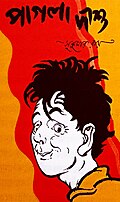
* ''[[Pagla Dashu]]'' (Crazy Dashu)<ref name="Datta1987">{{cite book|author=Amaresh Datta|title=Encyclopaedia of Indian Literature: A-Devo|url=https://books.google.com/books?id=ObFCT5_taSgC&pg=PA694|access-date=3 October 2012|year=1987|publisher=Sahitya Akademi|isbn=978-81-260-1803-1|pages=694–}}</ref> | [[File:পাগলা দাশু.jpg|thumb|Pagla Dashu]] | ||
[[File: | |||
* ''Khai-Khai'' (Eat-Eat) | * ''Khai-Khai'' (Eat-Eat) | ||
* ''Heshoram Hushiyarer Diary'' (The diary of Heshoram Hushiyar) (early science fiction parody)<ref>[http://www.lehigh.edu/~amsp/2006/05/early-bengali-science-fiction.html Early Bengali science fiction], ''''Amardeep Singh,'''' lehigh.edu</ref> | * ''Heshoram Hushiyarer Diary'' (The diary of Heshoram Hushiyar) (early science fiction parody)<ref>[http://www.lehigh.edu/~amsp/2006/05/early-bengali-science-fiction.html Early Bengali science fiction], ''''Amardeep Singh,'''' lehigh.edu</ref> | ||
* ''[[HaJaBaRaLa]]'' (Mumbo-Jumbo) | * ''[[HaJaBaRaLa]]'' (Mumbo-Jumbo) | ||
* ''Jhalapala O Onanyo Natok'' (Cacophony and Other Plays) | * ''Jhalapala O Onanyo Natok'' (Cacophony and Other Plays) | ||
* '' | * ''Lokkhoner Shoktishel'' (Lokkhon Shellshocked) | ||
* ''Chalachittachanchari'' | * ''Chalachittachanchari'' | ||
* ''Shabdakalpadrum'' | * ''Shabdakalpadrum'' | ||
* ''Bohurupi'' ( | * ''Bohurupi'' (Chameleon) | ||
* ''Abak Jalpan'' ( | * ''Abak Jalpan'' (A Strange Drink of Water 1914) | ||
* ''Bhasar Atyachar'' (Torture of Language 1915) | * ''Bhasar Atyachar'' (Torture of Language 1915) | ||
*''Barnamalatatva'' | * ''Barnamalatatva'' (Theory of Alphabet) | ||
* ''Desh-Bidesher Golpo'' (Tales from Many Lands) | * ''Desh-Bidesher Golpo'' (Tales from Many Lands) | ||
* | * ''Jiboner Hisab'' (Bidye bojhai babumoshai) | ||
==See also== | ==See also== | ||
| Line 100: | Line 107: | ||
==External links== | ==External links== | ||
* {{Internet Archive author}} | * {{Internet Archive author}} | ||
* [http://sukumarray.freehostia.com/ Complete Sukumar Ray] | * [http://sukumarray.freehostia.com/ Complete Sukumar Ray] | ||
* [http://cafeirreal.alicewhittenburg.com/sukumar_ray.htm "Drighangchu" by Sukumar Ray] translation of short story in ''[[The Cafe Irreal]]'' | * [http://cafeirreal.alicewhittenburg.com/sukumar_ray.htm "Drighangchu" by Sukumar Ray] translation of short story in ''[[The Cafe Irreal]]'' | ||
| Line 116: | Line 123: | ||
[[Category:1887 births]] | [[Category:1887 births]] | ||
[[Category:1923 deaths]] | [[Category:1923 deaths]] | ||
[[Category:Alumni of the London College of Printing]] | |||
[[Category:Bengali Hindus]] | |||
[[Category:20th-century Bengali people]] | |||
[[Category:19th-century Bengali people]] | |||
[[Category:20th-century Bengali poets]] | |||
[[Category:Bengali male poets]] | [[Category:Bengali male poets]] | ||
[[Category:Writers from Kolkata]] | [[Category:Writers from Kolkata]] | ||
[[Category:Bengali-language writers]] | [[Category:Bengali-language writers]] | ||
[[Category:Bengali-language science fiction writers]] | [[Category:Bengali-language science fiction writers]] | ||
| Line 124: | Line 135: | ||
[[Category:Culture of Kolkata]] | [[Category:Culture of Kolkata]] | ||
[[Category:Indian children's writers]] | [[Category:Indian children's writers]] | ||
[[Category:Indian illustrators]] | [[Category:20th-century Indian illustrators]] | ||
[[Category:Indian children's book illustrators]] | [[Category:Indian children's book illustrators]] | ||
[[Category:Brahmos]] | [[Category:Brahmos]] | ||
[[Category: | [[Category:20th-century Indian photographers]] | ||
[[Category:Presidency University, Kolkata alumni]] | [[Category:Presidency University, Kolkata alumni]] | ||
[[Category:University of Calcutta alumni]] | [[Category:University of Calcutta alumni]] | ||
[[Category:Deaths from leishmaniasis]] | [[Category:Deaths from leishmaniasis]] | ||
[[Category:Indian male poets]] | |||
[[Category:20th-century Indian poets]] | [[Category:20th-century Indian poets]] | ||
[[Category:Indian humorous poets]] | |||
[[Category:Indian novelists]] | |||
[[Category:Indian male novelists]] | |||
[[Category:20th-century Indian novelists]] | [[Category:20th-century Indian novelists]] | ||
[[Category:20th-century Indian | [[Category:Indian magazine editors]] | ||
[[Category:20th-century Indian male writers]] | |||
[[Category:Photographers from West Bengal]] | [[Category:Photographers from West Bengal]] | ||
[[Category:Novelists from West Bengal]] | [[Category:Novelists from West Bengal]] | ||
[[Category:Poets from West Bengal]] | [[Category:Poets from West Bengal]] | ||
[[Category:Indian science fiction writers]] | |||
[[Category:Indian comedy writers]] | |||
[[Category:Indian male dramatists and playwrights]] | |||
[[Category:20th-century Indian dramatists and playwrights]] | |||
[[Category:Indian male essayists]] | |||
[[Category:20th-century Indian essayists]] | |||
[[Category:Indian lithographers]] | |||
[[Category:Indian printers]] | |||
[[Category:Indian male painters]] | |||
[[Category:20th-century Indian painters]] | |||
[[Category:Indian publishers (people)]] | |||
[[Category:Indian book publishers (people)]] | |||
[[Category:20th-century Indian male artists]] | |||
[[Category:Satyajit Ray]] | |||
Latest revision as of 18:18, 12 December 2025
Sukumar Ray | |
|---|---|
 | |
| Born | 30 October 1887 Calcutta, Bengal, British India[1][2] |
| Died | 10 September 1923 (aged 35) Calcutta, Bengal, British India |
| Occupation | Writer, poet, editor |
| Language | Bengali |
| Alma mater | |
| Period | Bengal Renaissance |
| Notable works | |
| Spouse | Suprabha Devi |
| Children | Satyajit Ray (son) |
| Parents | Upendrakishore Ray Chowdhury (father) |
| Relatives | |
Sukumar Ray FRPS ( Sukumār Rāẏ (help·info); 30 October 1887 – 10 September 1923)[3] was a Bengali writer and poet from British India. He is remembered mainly for his writings for children. He was the son of children's story writer Upendrakishore Ray Chowdhury and the father of Indian filmmaker Satyajit Ray.
Family history[edit | edit source]
According to the history of the Ray family, one of their ancestors, Ramsunder Deo (Deb), was a native of Chakdah village in Nadia district of present-day West Bengal, India. In search of fortune, he migrated to the town of Sherpur, Sherpur district, in East Bengal. There he met Raja Gunichandra, the zamindar of Jashodal, at the zamindar house of Sherpur. King Gunichandra was immediately impressed by Ramsunder's stately appearance and sharp intellect and took Ramsunder with him to his zamindari estate. He made Ramsunder his son-in-law and granted him some property in Jashodal. From then on, Ramsunder started living in Jashodal. His descendants migrated from there and settled down in the village of Masua in what is now Katiadi Upazila of Kishoreganj District.[4][5]

Early years[edit | edit source]

Sukumar Ray was born into a Brahmo family in Calcutta on 30 October 1887.[1][2] His family hailed from Masua village of Kishorganj division of Eastern Bengal in British India (presently in Bangladesh).[6] Sukumar's father, Upendrakishore Ray, was a famous Bengali writer, painter, violinist, and composer, technologist, amateur astronomer, and entrepreneur.[7] Sukumar's mother, Bidhumukhi Devi, was the daughter of reformer Dwarkanath Ganguly.[8]
Born in the era that can be called the pinnacle of the Bengal Renaissance, he grew up in an environment that fostered his literary talents. He befriended the likes of Jagdish Chandra Bose, Acharya Prafulla Chandra Ray, and one of his biggest influencers, his father's friend, Rabindranath Tagore.[1] His father was a writer of stories and popular science; painter and illustrator; musician and composer of songs; a technologist and hobbyist astronomer. Upendrakishore was also a close friend of Rabindranath Tagore, who directly influenced Sukumar. Among other family friends were scientists Jagadish Chandra Bose, Prafulla Chandra Ray, composer Atul Prasad Sen etc. Upendrakishore studied the technology of blockmaking, conducted experiments, and set up a business of making blocks. The firm M/s U. Ray & Sons, where Sukumar and his younger brother Subinay were involved. His sister, Shukhalata Rao, became a social worker and children's book author. Like his father, Ray also had a close acquaintance with Rabindranath Tagore.[9]
Education and profession[edit | edit source]

First row sitting from left: Subinoy Ray, Prasanta Chandra Mahalanobis, Atul Prasad Sen, Shishir Kumar Datta, Sukumar Ray
Middle row from left: Jatindranath Mukhopadhyay, Amal Home, Suniti Kumar Chattopadhyay, Jibanmoy Roy
Standing from left: Hiran Sanyal, Ajit Kumar Chakrabarty, Kalidas Nag, Pravat Chandra Gangopadhyay, Dr. Dwijendranath Maitra, Satish Chandra Chattopadhyay, Shrish Chandra Sen, Girija Shankar Roy Choudhury

In 1906, Ray graduated with double Honours in physics and chemistry from the Presidency College, then affiliated with the University of Calcutta. Before that, he attended City College School, Surya Sen Street along with his classmate who inspired his famous funny character "Pagla Dashu", which appeared in several of his penned stories. He was trained in photography and printing technology in England at the School of Photo-Engraving and Lithography, London,[10] and was a pioneer of photography and lithography in India. While in England, he also delivered lectures about the songs of Rabindranath before Tagore won the Nobel Prize. Meanwhile, Sukumar had also drawn acclaim as an illustrator. As a technologist, he also developed new methods of halftone blockmaking, and technical articles about this were published in journals in England. The Penrose Annual published two articles by Ray. While in the United Kingdom, he joined the Royal Photographic Society in 1912 and remained a member until his death, gaining his Fellowship in 1922.[citation needed]
Upendrakishore started a publishing firm, U. Ray and Sons, which Sukumar and Subinay helped to run. While Sukumar went to England to learn printing technology, Upendrakishore purchased land, constructed a building, and set up a printing press with facilities for high-quality halftone color blockmaking and printing. He launched the children's magazine, Sandesh, in May 1913.[3] Very soon after Sukumar's return from England, his writings and sketches started appearing in Sandesh. After Upendrakishore died on 20 December 1915, Sukumar ran the printing and publishing businesses and the Sandesh for about eight years. His younger brother Subinoy helped him, and many relatives pitched in writing for "Sandesh".[7]

Contribution in literature[edit | edit source]
Sukumar Ray pioneered the genre of literary nonsense in Bengali literature. His works appealed to both children and adults, because of their sense of humor, keen observational skills, sharp wit, and command of word selection. His son Satyajit Ray, in the preface of the first edition of the compilation of Sukumar Ray's complete works in his centenary year, Sukumar Sahitya Samagra, wrote:
"উপেন্দ্রকিশোরের সম্পাদনাকালে সন্দেশে প্রকাশিত সুকুমারের কয়েকটি রচনায় তাঁর সাহিত্যিক বৈশিষ্ট্যের স্পষ্ট ইঙ্গিত পাওয়া যায়। ১৯১৪ সালে বেরোল আবোল তাবোল শ্রেনীর প্রথম কবিতা "খিচুড়ি"। এই প্রথম সুকুমার সাহিত্যে উদ্ভট প্রানীর আবির্ভাব। এখানে প্রানীর সৃষ্টি হয়েছে ভাষার কারসাজিতে -
হাঁস ছিল সজারুও, (ব্যাকরণ মানিনা)
হয়ে গেল হাঁসজারু কেমনে তা জানিনা।এই উদ্ভট সন্ধির নিযমেই সৃষ্টি হল বকচ্ছপ, মোরগরু,গিরগিটিয়া, সিংহরিণ, হাতিমি।[7]"
English Translation: "During Upendrakishore's editorial tenure, in several writings of Sukumar published in Sandesh, clear indications of his literary characteristics can be found. In 1914, the first poem of the Berol Abol Tabol series, "Khichuri," was released. Here, for the first time, the appearance of strange creatures in Sukumar's literature occurs. Here, the creatures are created through the tricks of language—
The goose was sojaru, it became hansjaru, how that happened, I do not know.
In accordance with this strange evening's rules, Bakchhop, Morgoru, Girgitiya, Singhorin, Hatimi were created."
After his father's death in 1915, Sukumar had to take over responsibility for the publication of "Sandesh", and his creativity reached its pinnacle. The 45 limericks in Abol Tabol and many other creations published in Sandesh still amuse the readers of all ages. He created many characters in his prose and poems. Kaath Buro, Tash Goru, Huko Mukho Hangla, Kumro Potash, etc. were fictitious characters, though they were very close to our known world. He himself described his works as the product of Kheyal Ros[7] (হঠাৎ ইচ্ছা;ঝোঁক/Wish; Whims; Freak; Fancy).
Gallery[edit | edit source]
Sketches of characters created by Roy.
-
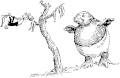 Kumropatash in Abol Tabol
 -
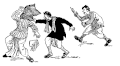 Dashur Kirti
 -
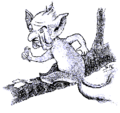 Huko Mukho Hangla
 -
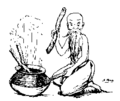 Kaath Buro
 -
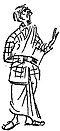 Abujh
Abujh -
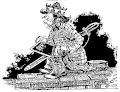 The King


-
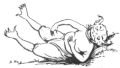 Hijibijbij in HaJaBaRaLa
 -
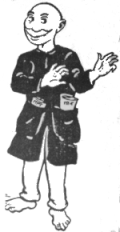 Nyara in HaJaBaRaLa
 -
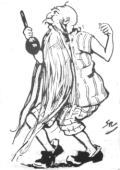 Udo in HaJaBaRaLa
 -
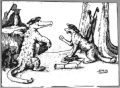 The Court Room in HaJaBaRaLa
 -
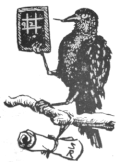 Shri Kakeswar Kuchkuche in HaJaBaRaLa
 -
 The CAT in HaJaBaRaLa


Bibliography[edit | edit source]
- Abol Tabol (The Weird and the Absurd)
- Pagla Dashu (Crazy Dashu)[11]

- Khai-Khai (Eat-Eat)
- Heshoram Hushiyarer Diary (The diary of Heshoram Hushiyar) (early science fiction parody)[12]
- HaJaBaRaLa (Mumbo-Jumbo)
- Jhalapala O Onanyo Natok (Cacophony and Other Plays)
- Lokkhoner Shoktishel (Lokkhon Shellshocked)
- Chalachittachanchari
- Shabdakalpadrum
- Bohurupi (Chameleon)
- Abak Jalpan (A Strange Drink of Water 1914)
- Bhasar Atyachar (Torture of Language 1915)
- Barnamalatatva (Theory of Alphabet)
- Desh-Bidesher Golpo (Tales from Many Lands)
- Jiboner Hisab (Bidye bojhai babumoshai)
See also[edit | edit source]
References[edit | edit source]
- ↑ 1.0 1.1 "Ray, Sukumar". Oxford Dictionary of National Biography (online ed.). Oxford University Press. doi:10.1093/ref:odnb/107500. Template:ODNBsub
- ↑ 2.0 2.1 Roy, Sukumar at Banglapedia. "Roy, Sukumar (1887-1923) children's writer, was born in Kolkata on 30 October 1887.".
- ↑ 3.0 3.1 Ray; Sukumar (tr. Chatterjee; Sampurna) (September 2016). Wordygurdyboom!. Penguin Books India. pp. 177–. ISBN 978-0-14-333078-3. Retrieved 3 October 2012.
- ↑ Sukumar Samagra Rachanabali 1, 1960, Asia Publishing Company, p 1
- ↑ Sukumar Ray: Jibankatha (Bengali Ed.), Hemanta Kumar Adhya, Pustak Bipani, Kolkata, 1990, p. 6
- ↑ Raychowdhury, Hitendra Kishore (1984). Upendra Kishore O Moshua - Ray Poribaarer Golposholpo. Firma KLM Private Limited. p. 1.
- ↑ 7.0 7.1 7.2 7.3 Ray, Satyajit; Basu, Partha, eds. (1987). Sukumar Sahitya Samagra Centenary Edition. Ananda Publishers Ltd.
- ↑ Sengupta, Subodh Chandra; Basu, Anjali, eds. (1998) [First published 1976]. Sangsad Bāṅgālī Charitābhidhāna (Biographical dictionary) (in Bengali) (4th ed.). Sahitya Samsad. p. 67. ISBN 81-85626-65-0.
- ↑ Sarker, Sushanta (2012). "Rao, Shukhalata". In Islam, Sirajul; Jamal, Ahmed A. (eds.). Banglapedia: National Encyclopedia of Bangladesh (Second ed.). Asiatic Society of Bangladesh.
- ↑ "Sukumar Ray |". .open.ac.uk. Retrieved 3 October 2012.
- ↑ Amaresh Datta (1987). Encyclopaedia of Indian Literature: A-Devo. Sahitya Akademi. pp. 694–. ISBN 978-81-260-1803-1. Retrieved 3 October 2012.
- ↑ Early Bengali science fiction, 'Amardeep Singh,' lehigh.edu
External links[edit | edit source]
- Works by or about Sukumar Ray at Internet Archive
- Complete Sukumar Ray
- "Drighangchu" by Sukumar Ray translation of short story in The Cafe Irreal

- Sukumar Ray
- 1887 births
- 1923 deaths
- Alumni of the London College of Printing
- Bengali Hindus
- 20th-century Bengali people
- 19th-century Bengali people
- 20th-century Bengali poets
- Bengali male poets
- Writers from Kolkata
- Bengali-language writers
- Bengali-language science fiction writers
- Bengali zamindars
- Culture of Kolkata
- Indian children's writers
- 20th-century Indian illustrators
- Indian children's book illustrators
- Brahmos
- 20th-century Indian photographers
- Presidency University, Kolkata alumni
- University of Calcutta alumni
- Deaths from leishmaniasis
- Indian male poets
- 20th-century Indian poets
- Indian humorous poets
- Indian novelists
- Indian male novelists
- 20th-century Indian novelists
- Indian magazine editors
- 20th-century Indian male writers
- Photographers from West Bengal
- Novelists from West Bengal
- Poets from West Bengal
- Indian science fiction writers
- Indian comedy writers
- Indian male dramatists and playwrights
- 20th-century Indian dramatists and playwrights
- Indian male essayists
- 20th-century Indian essayists
- Indian lithographers
- Indian printers
- Indian male painters
- 20th-century Indian painters
- Indian publishers (people)
- Indian book publishers (people)
- 20th-century Indian male artists
- Satyajit Ray