










Created page with "{{short description|Country in North America}} {{about|the federal republic in North America}} {{Redirect|United Mexican States|the historical states|First Mexican Republic|an..." |
refined article further and improved wording as per guidelines |
||
| (4 intermediate revisions by 2 users not shown) | |||
| Line 1: | Line 1: | ||
{{short description|Country in North America}} | {{short description|Country in North America}} | ||
{{about|the | {{about|the country}} | ||
{{pp-sock|small=yes}} | {{pp-sock|small=yes}} | ||
{{Use American English|date= | {{Use American English|date=March 2022}} | ||
{{Use dmy dates|date=February | {{Use dmy dates|date=February 2026}} | ||
{{Infobox country | {{Infobox country | ||
| conventional_long_name = United Mexican States | | conventional_long_name = United Mexican States | ||
| common_name | | common_name = Mexico | ||
| native_name | | native_name = {{lang|es|Estados Unidos Mexicanos}} | ||
| image_flag | | image_flag = Flag of Mexico.svg | ||
| image_flag2 | | image_flag2 = <!--not officialMexican States Standard.svg//--> | ||
| image_coat | | image_coat = Coat of arms of Mexico.svg | ||
| alt_coat | | alt_coat = | ||
| symbol_type | | symbol_type = Coat of arms | ||
| national_anthem | | national_anthem = <br />{{Lang|es|[[Mexican National Anthem|Himno Nacional Mexicano]]}}<br />({{Langx|en|Mexican National Anthem}})[[File:Himno Nacional Mexicano instrumental.ogg]]<br />{{center|}} | ||
| other_symbol_type = | |||
| other_symbol_type | | other_symbol = | ||
| other_symbol | | image_map = {{switcher|[[File:Mexico (orthographic projection).svg|frameless]]|Mexico in the Western Hemisphere|[[File:Mexico states map w names.png|frameless]]|Mexico and its states|Default=1}} | ||
| image_map | | map_width = | ||
| map_width | | capital = [[Mexico City]] | ||
| capital | | coordinates = {{Coord|19|26|N|99|8|W|type:city}} | ||
| coordinates | | largest_city = Mexico City | ||
| largest_city | | languages_type = Official language | ||
| | | languages = [[Mexican Spanish|Spanish]]{{ref label|iboxb|b}} | ||
| | | languages2_type = Co-official languages | ||
| ethnic_groups | | languages2 = 68 [[Languages of Mexico|Indigenous languages]]{{ref label|iboxa|a}} | ||
| religion | | ethnic_groups = ''[[#Ethnicity and race|See below]]'' | ||
| 88.9% [[Christianity]] | | ethnic_groups_year = | ||
| ethnic_groups_ref = | |||
| religion = {{unbulleted list|item_style=white-space:nowrap; | |||
| | |{{Tree list}} | ||
| | * 88.9% [[Christianity in Mexico|Christianity]] | ||
| 0. | ** 77.7% [[Catholic Church in Mexico|Catholicism]] | ||
}} | ** 11.2% [[Protestantism in Mexico|Protestantism]] | ||
{{Tree list/end}} | |||
| religion_ref = <ref name="2020 Census"/> | |8.1% [[Irreligion in Mexico|Irreligion]] | ||
| | |2.4% [[Religion in Mexico|other religion]] | ||
|0.5% prefer not to say}} | |||
| demonym | | religion_ref = <ref name="2020 Census"/> | ||
| government_type | | religion_year = 2020 | ||
| leader_title1 | | demonym = [[Mexicans|Mexican]] | ||
| leader_name1 | | government_type = Federal [[Presidential system|presidential republic]]<ref>{{cite web |location=MX Q|url=http://www.scjn.gob.mx/SiteCollectionDocuments/PortalSCJN/RecJur/BibliotecaDigitalSCJN/PublicacionesSupremaCorte/Political_constitucion_of_the_united_Mexican_states_2008.pdf |archive-url=https://web.archive.org/web/20110511194922/http://www.scjn.gob.mx/SiteCollectionDocuments/PortalSCJN/RecJur/BibliotecaDigitalSCJN/PublicacionesSupremaCorte/Political_constitucion_of_the_united_Mexican_states_2008.pdf |archive-date=11 May 2011 |title=Political Constitution of the United Mexican States, title 2, article 40 |publisher=SCJN |access-date=14 August 2010}}</ref> | ||
| leader_title2 | | leader_title1 = [[President of Mexico|President]] | ||
| leader_name2 | | leader_name1 = [[Claudia Sheinbaum]] | ||
| leader_title3 | | leader_title2 = [[President of the Senate (Mexico)|President of the Senate]] | ||
| leader_name3 | | leader_name2 = [[Laura Itzel Castillo]] | ||
| legislature | | leader_title3 = [[President of the Chamber of Deputies (Mexico)|President of the Chamber of Deputies]] | ||
| upper_house | | leader_name3 = [[Kenia López Rabadán]] | ||
| lower_house | | leader_title4 = [[Supreme Court of Mexico#Presidents|Chief Justice]] | ||
| sovereignty_type | | leader_name4 = [[Hugo Aguilar Ortiz]] | ||
| sovereignty_note | | legislature = [[Congress of the Union|Congress]] | ||
| established_event1 | | upper_house = [[Senate of the Republic (Mexico)|Senate]] | ||
| established_date1 | | lower_house = [[Chamber of Deputies (Mexico)|Chamber of Deputies]] | ||
| established_event2 | | sovereignty_type = [[Mexican War of Independence|Independence]] | ||
| established_date2 | | sovereignty_note = from [[Spain]] | ||
| established_event3 | | established_event1 = [[Cry of Dolores|Start of War of Independence]] | ||
| established_date3 | | established_date1 = 16 September 1810 | ||
| established_event4 | | established_event2 = [[Declaration of Independence of the Mexican Empire|Declared]] | ||
| established_date4 | | established_date2 = 27 September 1821 | ||
| established_event5 | | established_event3 = [[Spanish American wars of independence#New Spain and Central America|Recognized]] | ||
| established_date5 | | established_date3 = 28 December 1836 | ||
| established_event6 | | established_event4 = [[1824 Constitution of Mexico|First constitution]] | ||
| established_date6 | | established_date4 = 4 October 1824 | ||
| area | | established_event5 = [[Federal Constitution of the United Mexican States of 1857|Second constitution]] | ||
| today | | established_date5 = 5 February 1857 | ||
| area_km2 | | established_event6 = [[Constitution of Mexico|Current constitution]] | ||
| area_footnote | | established_date6 = 5 February 1917 | ||
| area_rank | | area = | ||
| area_sq_mi | | today = | ||
| percent_water = 1.58 (as of 2015)<ref>{{cite web|title=Surface water and surface water change|access-date=11 October 2020|publisher=Organisation for Economic Co-operation and Development (OECD) |url=https://stats.oecd.org/Index.aspx?DataSetCode=SURFACE_WATER | | area_km2 = 1,972,550 | ||
| population_census | | area_footnote = | ||
| | | area_rank = 13th | ||
| | | area_sq_mi = 761,606 | ||
| population_density_km2 | | percent_water = 1.58 (as of 2015)<ref>{{cite web|title=Surface water and surface water change|access-date=11 October 2020|publisher=Organisation for Economic Co-operation and Development (OECD)|url=https://stats.oecd.org/Index.aspx?DataSetCode=SURFACE_WATER|archive-date=24 March 2021|archive-url=https://web.archive.org/web/20210324133453/https://stats.oecd.org/Index.aspx?DataSetCode=SURFACE_WATER|url-status=live}}</ref> | ||
| population_estimate = {{IncreaseNeutral}} 131,946,900<ref name="Total population by sex: Mexico">{{cite web |title=Total population by sex: Mexico |url=https://population.un.org/dataportal/data/indicators/49/locations/484/start/2024/end/2025/table/pivotbylocation?df=89ae8967-12de-4efa-81d2-417484e8a9ef |website=United Nations Population Division |access-date=1 January 2025}}</ref> | |||
| population_census = 126,014,024<ref>{{cite web |title=Census of Population and Housing 2020 |url=https://en.www.inegi.org.mx/programas/ccpv/2020/ |website=[[National Institute of Statistics and Geography|INEGI]] |access-date=1 January 2025}}</ref> | |||
| population_estimate_year = 2025 | |||
| population_estimate_rank = 10th | |||
| population_census_year = 2020 | |||
| population_density_km2 = 61 | |||
| population_density_sq_mi = 157 | | population_density_sq_mi = 157 | ||
| population_density_rank | | population_density_rank = 142nd | ||
| GDP_PPP | | GDP_PPP = {{increase}} $3.396 trillion<ref name="IMFWEO.MX">{{cite web |url=https://www.imf.org/en/Publications/WEO/weo-database/2025/april/weo-report?c=273,&s=NGDPD,PPPGDP,NGDPDPC,PPPPC,&sy=2023&ey=2030&ssm=0&scsm=1&scc=0&ssd=1&ssc=0&sic=0&sort=country&ds=.&br=1 |title=World Economic Outlook Database, April 2025 Edition. (Mexico) |publisher=[[International Monetary Fund]] |website=www.imf.org |date=22 April 2025 |access-date=26 May 2025}}</ref> | ||
| GDP_PPP_year | | GDP_PPP_year = 2025 | ||
| GDP_PPP_rank | | GDP_PPP_rank = 13th | ||
| GDP_PPP_per_capita | | GDP_PPP_per_capita = {{increase}} $25,463<ref name="IMFWEO.MX" /> | ||
| GDP_PPP_per_capita_rank | | GDP_PPP_per_capita_rank = 77th | ||
| GDP_nominal | | GDP_nominal = {{decrease}} $1.693 trillion<ref name="IMFWEO.MX" /> | ||
| GDP_nominal_year | | GDP_nominal_year = 2025 | ||
| GDP_nominal_rank | | GDP_nominal_rank = 13th | ||
| GDP_nominal_per_capita | | GDP_nominal_per_capita = {{decrease}} $12,692<ref name="IMFWEO.MX" /> | ||
| GDP_nominal_per_capita_rank | | GDP_nominal_per_capita_rank = 75th | ||
| Gini | | Gini = 40.2 <!--number only--> | ||
| Gini_year | | Gini_year = 2022 | ||
| Gini_change | | Gini_change = decrease <!--increase/decrease/steady--> | ||
| Gini_ref | | Gini_ref = <ref>{{cite web|url= https://www.inegi.org.mx/contenidos/saladeprensa/boletines/2023/ENIGH/ENIGH2022.pdf|title=El Inegi da a conocer los resultados de la Encuesta Nacional de Ingresos y Gastos de los Hogares (ENIGH) 2022|date=26 July 2023|access-date=20 September 2024|page=15}}</ref> | ||
| Gini_rank | | Gini_rank = | ||
| HDI | | HDI = 0.789 | ||
| HDI_year | | HDI_year = 2023<!-- Please use the year to which the data refers, not the publication year. --> | ||
| HDI_change | | HDI_change = increase | ||
| HDI_ref | | HDI_ref = <ref name="UNHDR">{{Cite web |date=6 May 2025 |title=Human Development Report 2025 |url=https://hdr.undp.org/system/files/documents/global-report-document/hdr2025reporten.pdf|url-status=live |archive-url=https://web.archive.org/web/20250506051232/https://hdr.undp.org/system/files/documents/global-report-document/hdr2025reporten.pdf |archive-date=6 May 2025 |access-date=6 May 2025 |publisher=[[United Nations Development Programme]]}}</ref> | ||
| HDI_rank | | HDI_rank = 81st | ||
| currency | | currency = [[Mexican peso]] | ||
| currency_code | | currency_code = MXN | ||
| time_zone | | time_zone = ''See'' [[Time in Mexico]] | ||
| utc_offset | | utc_offset = −8 to −5 | ||
| utc_offset_DST | | utc_offset_DST = −7 to −5 | ||
| DST_note | | DST_note = | ||
| time_zone_DST | | time_zone_DST = varies | ||
| antipodes | | antipodes = | ||
| date_format | | date_format = dd/mm/yyyy | ||
| drives_on | | drives_on = right | ||
| calling_code | | calling_code = [[Telephone numbers in Mexico|+52]] | ||
| cctld | | cctld = [[.mx]] | ||
| footnote_a | | footnote_a = {{note|iboxa}}Article 4 of the [[General Law of Linguistic Rights of the Indigenous Peoples]]<ref>{{cite web |url=http://www.inali.gob.mx/pdf/LGDLPI.pdf |title=General Law of Linguistic Rights of the Indigenous Peoples |author=INALI |date=13 March 2003 |access-date=13 March 2026 |archive-date=3 August 2016 |archive-url=https://web.archive.org/web/20160803160009/http://www.inali.gob.mx/pdf/LGDLPI.pdf |url-status=dead }}</ref><ref>{{cite web |url=http://www.inali.gob.mx/clin-inali/ |title=Catálogo de las lenguas indígenas nacionales: Variantes lingüísticas de México con sus autodenominaciones y referencias geoestadísticas |publisher=Inali.gob.mx |access-date=18 July 2014 |archive-date=8 July 2014 |archive-url=https://web.archive.org/web/20140708121506/http://www.inali.gob.mx/clin-inali/ |url-status=live }}</ref> | ||
| footnote_b | | footnote_b = {{note|iboxb}}Spanish is the ''[[de facto]]'' official language in the Mexican federal government. | ||
}} | }} | ||
'''Mexico''' | |||
'''Mexico''',{{efn|{{langx|es|México}} or {{lang|es|Méjico}}, pronunciation: {{IPA|es|ˈmexiko||es-mx-México.ogg}}; [[Nahuatl]]: ''Mēxihko''; {{langx|yua|Meejikoo}}}}{{efn|Usually, in Spanish, the name of the country is spelled {{lang|es|México}}; however, in [[Peninsular Spanish|Peninsular (European) Spanish]], the variant {{lang|es|Méjico}} is used alongside the usual version. According to the {{lang|es|[[Diccionario panhispánico de dudas]]}} by the [[Royal Spanish Academy]] and [[Association of Academies of the Spanish Language]], the version with J is also correct; however, the spelling with X is recommended, as it is the one used in Mexico.<ref>{{lang|es|México}} in {{lang|es|[[Diccionario panhispánico de dudas]]}} by [[Royal Spanish Academy]] and [[Association of Academies of the Spanish Language]], Madrid: Santillana. 2005. ISBN 978-8-429-40623-8.</ref>}} officially the '''United Mexican States''',{{efn|{{langx|es|Estados Unidos Mexicanos}} ({{IPA|es|esˈtaðos uˈniðos mexiˈkanos||Es-mx-Estados Unidos Mexicanos.ogg}}); [[Nahuatl]]: ''Mexika Sentik Wexteyowalko'', {{Literal translation|Mexican United States}}; [[Yucatec Maya]]: ''U Múuchꞌ Péetluꞌumiloꞌob México'', {{Literal translation|United States of Mexico}}}}<!-- Note: The only official name found in documents is "Estados Unidos Mexicanos" NOT "Estados Unidos de México" (which is not formally recognized); they do not mean the same thing so please don't add it. --> is a country in [[North America]]. It is the northernmost country in [[Latin America]] and borders the [[United States|United States of America]] to the north, and [[Guatemala]] and [[Belize]] to the southeast; while having [[maritime boundary|maritime boundaries]] with the [[Pacific Ocean]] to the west, the [[Caribbean Sea]] to the southeast, and the [[Gulf of Mexico]] to the east. Mexico covers 1,972,550 km<sup>2</sup> (761,610 sq mi),<ref name="cia.gov">{{cite web |url=https://www.cia.gov/the-world-factbook/countries/mexico/ |title=Mexico |archive-url=https://web.archive.org/web/20210126164719/https://www.cia.gov/the-world-factbook/countries/mexico |archive-date=26 January 2021 |work=[[The World Factbook]] |publisher=[[Central Intelligence Agency]]|url-status=dead}}</ref> and is the [[List of countries by area|thirteenth-largest country]] in the world by land area. With a population exceeding 130 million, Mexico is the [[List of countries by population|tenth-most populous country]] in the world and is home to the [[Hispanophone#Countries|largest number of native Spanish speakers]] as of 2020.<ref name="2020 Census">{{cite web |title=Censo Población y Vivienda 2020 |url=https://www.inegi.org.mx/programas/ccpv/2020/ |url-status=live |archive-url=https://web.archive.org/web/20220214192634/https://www.inegi.org.mx/programas/ccpv/2020/ |archive-date=14 February 2022 |access-date=26 January 2021 |website=inegi.org.mx |publisher=INEGI}}</ref> [[Mexico City]] is the capital and [[List of cities in Mexico|largest city in Mexico]], which ranks among the [[List of cities by population|most populous metropolitan areas]] in the world. | |||
<!-- Brief history --> | <!-- Brief history --> | ||
Human presence in Mexico dates back to at least 8,000 BC. [[Mesoamerica]], considered a [[cradle of civilization]], was home to numerous advanced societies, including the [[Olmecs]], [[Maya civilization|Maya]], [[Zapotec civilization|Zapotecs]], [[Teotihuacan]] civilization, and [[Purépecha Empire|Purépecha]]. [[Spanish colonization of the Americas|Spanish colonization]] began in 1521 with an alliance that [[Spanish conquest of the Aztec Empire|defeated]] the [[Aztec Empire]], establishing the colony of [[New Spain]] with its capital at [[Tenochtitlan]], now Mexico City. New Spain became a major center of the transoceanic economy during the [[Age of Discovery]], fueled by [[Camino Real de Tierra Adentro|silver mining]] and its position as a [[Manila galleon|hub between Europe and Asia]]. This gave rise to one of the largest multiracial populations in the world. The [[Peninsular War]] led to the 1810–1821 [[Mexican War of Independence]], which ended Peninsular rule and led to the creation of the [[First Mexican Empire]], which quickly collapsed into the short-lived [[First Mexican Republic]]. In 1848, Mexico [[Territorial evolution of Mexico|lost nearly half its territory]] to the [[Mexican–American War|American invasion]]. [[La Reforma|Liberal reforms]] set in the [[Constitution of 1857]] led to [[Reform War|civil war]] and [[Second French intervention in Mexico|French intervention]], culminating in the establishment of the [[Second Mexican Empire]] under [[Maximilian I of Mexico|Emperor Maximilian I of Austria]], who was overthrown by Republican forces led by [[Benito Juárez]]. The late 19th century saw [[Porfiriato|the long dictatorship]] of [[Porfirio Díaz]], whose modernization policies came at the cost of severe social unrest. The 1910–1920 [[Mexican Revolution]] led to the overthrow of Díaz and the adoption of the [[Constitution of Mexico|1917 Constitution]]. Mexico experienced [[Mexican Miracle|rapid industrialization and economic growth]] in the 1940s–1970s, amidst [[electoral fraud]], the [[Tlatelolco massacre]], and economic crises. The late 20th century saw a shift towards [[neoliberalism]], marked by the signing of the [[North American Free Trade Agreement]] (NAFTA) in 1994, amidst [[Chiapas conflict|unrest in Chiapas]]. | |||
<!-- Politics and economy and stats --> | <!-- Politics and economy and stats --> | ||
Mexico is a [[ | Mexico is a [[federal republic]] with a [[President of Mexico|presidential system of government]], characterized by a democratic framework and the separation of powers into three branches: [[Executive (government)|executive]], legislative, and judicial. The federal legislature consists of the [[Bicameralism|bicameral]] [[Congress of the Union]], comprising the [[Chamber of Deputies (Mexico)|Chamber of Deputies]], which represents the population, and the [[Senate of the Republic (Mexico)|Senate]], which provides equal representation for each state. The Constitution establishes three levels of government: the federal Union, the state governments, and the municipal governments. Mexico's federal structure grants autonomy to its 32 states, and its political system is deeply influenced by indigenous traditions and [[European Enlightenment]] ideals. | ||
Mexico ranks [[List of World Heritage Sites in Mexico|first in the Americas and seventh in the world]] | Mexico is a [[Newly industrialized country|newly industrialized]] and [[developing country]],<ref name="Globalization2">{{Cite book |author=Paweł Bożyk |title=Globalization and the Transformation of Foreign Economic Policy |publisher=Ashgate Publishing |year=2006 |isbn=978-0-7546-4638-9 |page=164 |chapter=Newly Industrialized Countries |access-date=23 July 2018 |chapter-url=https://books.google.com/books?id=iuHsIuez5qoC |archive-url=https://web.archive.org/web/20231104053417/https://books.google.com/books?id=iuHsIuez5qoC |archive-date=4 November 2023 |url-status=live}}</ref> with the world's [[List of countries by GDP (nominal)|15th-largest economy by nominal GDP]] and the [[List of countries by GDP (PPP)|13th-largest by purchasing power parity (PPP)]]. It ranks [[List of World Heritage Sites in Mexico|first in the Americas and seventh in the world]] by the number of [[UNESCO]] [[World Heritage Site]]s.<ref>[https://whc.unesco.org/en.list] {{Webarchive|url=https://web.archive.org/web/20240204185708/https://whc.unesco.org/en.list|date=4 February 2024}} UNESCO World Heritage sites, accessed 9 May 2022</ref> It is one of the world's 17 [[megadiverse countries]], ranking fifth in natural [[biodiversity]].<ref>{{cite web|url=https://www.biodiversidad.gob.mx/v_ingles/country/whatismegcountry.html|website=Mexican biodiversity|title=What is a mega-diverse country?|access-date=13 July 2019|archive-date=7 September 2019|archive-url=https://web.archive.org/web/20190907204954/https://www.biodiversidad.gob.mx/v_ingles/country/whatismegcountry.html}}</ref> It is a major tourist destination: as of 2022, it is the [[World Tourism rankings|sixth most-visited country in the world]], with 42.2 million international arrivals.<ref>{{cite web|url=https://expansion.mx/economia/2018/08/27/mexico-ocupa-el-sexto-lugar-en-turismo-a-nivel-mundial|title=México ocupa el sexto lugar en turismo a nivel mundial|website=www.expansion.mx|publisher=CNN Expansión|access-date=8 January 2019|date=28 August 2018|archive-date=23 December 2019|archive-url=https://web.archive.org/web/20191223165346/https://expansion.mx/economia/2018/08/27/mexico-ocupa-el-sexto-lugar-en-turismo-a-nivel-mundial|url-status=live}}</ref> Mexico's large economy and population, global cultural influence, and steady [[democratization]] make it a [[regional power|regional]] and [[middle power]],<ref>{{cite web |author1=James Scott |author2=Matthias vom Hau |author3=David Hulme |title=Beyond the BICs: Strategies of influence |url=https://www.escholar.manchester.ac.uk/api/datastream?publicationPid=uk-ac-man-scw:105725&datastreamId=SUPPLEMENTARY-1.DOC&ei=fMKFT7SMKIye8gS71NHACA&usg=AFQjCNHKPFxJk5bu6Qs5R2SKSUs8IwidWw&sig2=_lt4YNVT-1ECYQBh61EWgA |archive-url=https://web.archive.org/web/20170525012832/https://www.escholar.manchester.ac.uk/api/datastream?publicationPid=uk-ac-man-scw:105725&datastreamId=SUPPLEMENTARY-1.DOC&ei=fMKFT7SMKIye8gS71NHACA&usg=AFQjCNHKPFxJk5bu6Qs5R2SKSUs8IwidWw&sig2=_lt4YNVT-1ECYQBh61EWgA |archive-date=25 May 2017 |access-date=11 April 2012 |publisher=The University of Manchester}}</ref><ref>{{cite journal |last1=Nolte |first1=Detlef |date=October 2010 |title=How to compare regional powers: analytical concepts and research topics |url=http://www.ssoar.info/ssoar/handle/document/38289 |url-status=live |journal=Review of International Studies |volume=36 |issue=4 |pages=881–901 |doi=10.1017/S026021051000135X |jstor=40961959 |s2cid=13809794 |id={{ProQuest|873500719}} |archive-url=https://web.archive.org/web/20210302015428/https://www.ssoar.info/ssoar/handle/document/38289 |archive-date=2 March 2021 |access-date=17 November 2020| issn = 0260-2105 }}</ref><ref>{{cite web |title=Oxford Analytica |url=http://www.oxanstore.com/displayfree.php?NewsItemID=130098 |archive-url=https://web.archive.org/web/20070424211219/http://www.oxanstore.com/displayfree.php?NewsItemID=130098 |archive-date=24 April 2007 |access-date=17 July 2013}}</ref> increasingly identifying as an [[emerging power]].<ref>{{cite web |date=5 June 2007 |title=G8: Despite Differences, Mexico Comfortable as Emerging Power |url=http://ipsnews.net/news.asp?idnews=38056 |archive-url=https://web.archive.org/web/20080816044329/http://www.ipsnews.net/news.asp?idnews=38056 |archive-date=16 August 2008 |access-date=30 May 2010 |publisher=ipsnews.net}}</ref><ref name="Limits2">{{Cite book |author=Mauro F. Guillén |author-link=Mauro F. Guillén |title=The Limits of Convergence |publisher=Princeton University Press |year=2003 |isbn=978-0-691-11633-4 |page=126 (table 5.1) |chapter=Multinationals, Ideology, and Organized Labor |access-date=23 July 2018 |chapter-url=https://books.google.com/books?id=CweHgfPIceYC |archive-url=https://web.archive.org/web/20240221140236/https://books.google.com/books?id=CweHgfPIceYC |archive-date=21 February 2024 |url-status=live}}</ref><ref name="AIA2">{{Cite book |author=David Waugh |title=Geography, An Integrated Approach |publisher=Nelson Thornes |year=2000 |isbn=978-0-17-444706-1 |edition=3rd |pages=563, 576–579, 633, and 640 |chapter=Manufacturing industries (chapter 19), World development (chapter 22) |access-date=23 July 2018 |chapter-url=https://books.google.com/books?id=7GH0KZZthGoC |archive-url=https://web.archive.org/web/20240204185659/https://books.google.com/books?id=7GH0KZZthGoC |archive-date=4 February 2024 |url-status=live}}</ref><ref name="Principles2">{{Cite book |author=N. Gregory Mankiw |url=https://books.google.com/books?id=3ojsWuqmorEC |title=Principles of Economics |publisher=Thomson/South-Western |year=2007 |isbn=978-0-324-22472-6 |edition=4th |location=Mason, Ohio |access-date=23 July 2018 |archive-url=https://web.archive.org/web/20240204185536/https://books.google.com/books?id=3ojsWuqmorEC |archive-date=4 February 2024 |url-status=live}}</ref> As with much of Latin America, [[Poverty in Mexico|poverty]], [[Corruption in Mexico|systemic corruption]], and [[Crime in Mexico|crime]] remain widespread.<ref>{{cite web |title=Global Peace Index 2019: Measuring Peace in a Complex World |url=http://visionofhumanity.org/app/uploads/2019/06/GPI-2019-web003.pdf |website=Vision of Humanity |publisher=Institute for Economics & Peace |access-date=4 June 2020 |location=Sydney |date=June 2019 |archive-date=27 August 2019 |archive-url=https://web.archive.org/web/20190827155045/http://visionofhumanity.org/app/uploads/2019/06/GPI-2019-web003.pdf }}</ref> Since 2006, approximately 127,000 deaths have been caused by [[Mexican drug war|ongoing conflict]] between [[drug trafficking]] syndicates.<ref>{{Cite web |date=31 May 2024 |title=UCDP - Uppsala Conflict Data Program 2023 |url=https://ucdp.uu.se/year/2023 |url-status=live |archive-url=https://web.archive.org/web/20240531212552/https://ucdp.uu.se/year/2023 |archive-date=31 May 2024 |access-date=18 June 2024 |website=ucdp.uu.se}}</ref><ref>{{cite web |title=Mexico |url=https://ucdp.uu.se/country/70 |access-date=16 June 2021 |publisher=UCDP – Uppsala Conflict Data Program |website=ucdp.uu.se |archive-date=27 March 2022 |archive-url=https://web.archive.org/web/20220327051423/https://ucdp.uu.se/country/70 |url-status=live }}</ref><ref>{{cite news|title=Opinión: Una guerra inventada y 350,000 muertos en México|date=14 June 2021|url=https://www.washingtonpost.com/es/post-opinion/2021/06/14/mexico-guerra-narcotrafico-calderon-homicidios-desaparecidos/|newspaper=Washington Post|access-date=15 December 2023|archive-date=9 May 2022|archive-url=https://web.archive.org/web/20220509091109/https://www.washingtonpost.com/es/post-opinion/2021/06/14/mexico-guerra-narcotrafico-calderon-homicidios-desaparecidos/|url-status=live}}</ref> Mexico is a member of [[United Nations]], the [[G20]], the [[Organisation for Economic Co-operation and Development]] (OECD), the [[Coffee Club]], the [[World Trade Organization]] (WTO), the [[Asia-Pacific Economic Cooperation]] (APEC) forum, the [[Organization of American States]] (OAS), the [[Community of Latin American and Caribbean States]] (CELAC), the [[Organization of Ibero-American States]] (OEI), and has an observer status at the [[Council of Europe]].<ref name="gob.mx">{{cite web | title=Mexico and the Council of Europe establish a Strategic Partnership | url=https://www.gob.mx/sre/prensa/mexico-and-the-council-of-europe-establish-a-strategic-partnership }}</ref> | ||
==Etymology== | ==Etymology== | ||
<!--linked--> | <!--linked--> | ||
{{Main|Name of Mexico}} | {{Main|Name of Mexico}} | ||
{{lang|nah|[[Name of Mexico|Mēxihko]]}} is the [[Nahuatl]] term for the heartland of the [[Aztec Empire]], namely the [[Valley of Mexico]] and surrounding territories, with its people being known as the [[Mexica]]. It is generally believed that the [[toponym]] for the valley was the origin of the primary [[ethnonym]] for the [[Aztec Triple Alliance]], but it may have been the other way around.<ref name="Bright2004">{{cite book|author=William Bright|title=Native American Placenames of the United States|url=https://books.google.com/books?id=5XfxzCm1qa4C&pg=PA281|year=2004|publisher=University of Oklahoma Press|isbn=978-0-8061-3598-4|page=281}}</ref> In the colonial era (1521–1821) when Mexico was known as [[New Spain]], this central region became the Intendency of Mexico. After New Spain achieved independence from the [[Spanish Empire]] in 1821 and became a sovereign state, the Intendency came to be known as the [[State of Mexico]], with the new country being named after its capital, [[Mexico City]]. | |||
The country's official name has changed as the [[form of government]] has changed. The declaration of independence signed on 6 November 1813 by the deputies of the [[Congress of Anáhuac]] called the territory {{lang|es|[[Solemn Act of the Declaration of Independence of Northern America|América Septentrional]]}} (Northern America). The 1821 [[Plan of Iguala]] also used {{lang|es|América Septentrional}}. On two occasions (1821–1823 and 1863–1867), the country was known as {{lang|es|Imperio Mexicano}} ([[Mexican Empire (disambiguation)|Mexican Empire]]). All three federal constitutions (1824, 1857, and 1917, the current constitution) used the name {{lang|es|Estados Unidos Mexicanos}}<ref>{{cite web|url=http://ierd.prd.org.mx/coy128/hlb.htm|archive-url=https://web.archive.org/web/20081101110558/http://ierd.prd.org.mx/coy128/hlb.htm|archive-date=1 November 2008 |title=El cambio de la denominación de "Estados Unidos Mexicanos" por la de "México" en la Constitución Federal |language=es|publisher=ierd.prd.org.mx |access-date=4 November 2009}}</ref>—or the variant {{lang|es|Estados-Unidos Mexicanos}},<ref>{{cite web |url=http://www.tlahui.com/politic/politi99/politi8/con1857.htm |title=Constitución Mexicana de 1857 |language=es |publisher=www.tlahui.com |access-date=30 May 2010 |archive-date=5 October 2018 |archive-url=https://web.archive.org/web/20181005022104/http://www.tlahui.com/politic/politi99/politi8/con1857.htm |url-status=live }}</ref> all of which have been translated as "United Mexican States". The phrase {{lang|es|República Mexicana}}, "Mexican Republic", was used in the 1836 [[Siete Leyes|Constitutional Laws]].<ref>{{cite web |url=http://www.cervantesvirtual.com/servlet/SirveObras/01361697524573725088802/p0000001.htm |archive-url=https://web.archive.org/web/20130823173543/http://www.cervantesvirtual.com/servlet/SirveObras/01361697524573725088802/p0000001.htm |archive-date=23 August 2013 |title=Leyes Constitucionales de 1836 |language=es |publisher=Cervantesvirtual.com |date=29 November 2010 |access-date=17 July 2013 }}</ref> In the Nahuatl version of the current constitution,<ref>{{cite web|access-date=29 November 2022 |language=nah |title=TLANEJNEUILYOTL TLEN SENTIKMASEUALMEJ {{!}} Pan motlajtol ni Ueyi Mexko Amatlanauatili |url=https://www.inali.gob.mx/bicen/pdf/CPEUM_nahuatl_huasteca_potosina.pdf |website=inali.gob.mx}}<!-- auto-translated from Spanish by Module:CS1 translator --></ref> the official name is ''Mexika Sentik Wexteyowalko'',<ref>{{cite web|title=Glosario de términos jurídicos empleados en la traducción de la Constitución Política de los Estados Unidos Mexicanos al náhuatl de la Huasteca Potosina |url=https://www.inali.gob.mx/bicen/pdf/GLOSARIO_nahuatl_huasteca_potosina.pdf}}<!-- auto-translated from Spanish by Module:CS1 translator --></ref> and in its [[Yucatec Maya language|Yucatec Maya]] version, ''U Múuchꞌ Péetluꞌumiloꞌob México''.<ref>{{cite web|access-date=29 November 2022 |title=U ALMEJEN NOJ AꞋALMAJTꞋAANIL U MÚUCHꞋ PÉETLUꞋUMILOꞋOB MÉXICO {{!}} U Noj Aꞌalmajtꞌaanil México ichil a tꞌaan |url=https://www.inali.gob.mx/bicen/pdf/CPEUM_maya.pdf |website=inali.gob.mx}}<!-- auto-translated from Spanish by Module:CS1 translator --></ref> In fact, by virtue of the legal equality of Spanish with the 68 indigenous languages of the country, all have their own translation of the official name. | |||
==History== | ==History== | ||
{{Main|History of Mexico}} | {{Main|History of Mexico}} | ||
===Indigenous civilizations=== | {{See also|History of the Catholic Church in Mexico|Economic history of Mexico|Military history of Mexico}} | ||
===Indigenous civilizations before European contact (pre-1519)=== | |||
{{main|Pre-Columbian Mexico|Mesoamerican chronology}} | {{main|Pre-Columbian Mexico|Mesoamerican chronology}} | ||
[[File:Off-center_view_of_Pyramid_of_the_Sun_from_Pyramid_of_the_Moon,_Teotihuacan.jpg|thumb|[[Teotihuacan]] was the 6th largest city in the world at its peak, 1 AD to 500 AD]] | |||
[[File:Chichen Itza 3.jpg|thumb|[[El Castillo, Chichen Itza|Temple of Kukulcán (El Castillo)]] in the [[Maya city]] of [[Chichen Itza]]]] | |||
[[File:Painting_of_Tenochtitlan-Tlatelolco_on_Lake_Texcoco_(9755215791).jpg|thumb|An artistic depiction of [[Tenochtitlan|Mexico-Tenochtitlan]], the [[Aztec]] capital and [[Largest cities in the Americas|largest city in the Americas]] at the time. The city was completely destroyed in the 1521 [[siege of Tenochtitlan]] and rebuilt as [[Mexico City]].]] | |||
[[ | The earliest human artifacts in Mexico are chips of [[stone tool]]s found in the Valley of Mexico, dated to circa 10,000 years ago.{{sfn|Werner|2001|pp=386–}} Mexico is the site of the domestication of maize, tomato, and [[phaseolus|beans]], which produced an agricultural surplus. This enabled the transition from [[Paleo-Indians|paleo-Indian]] hunter-gatherers to sedentary agricultural villages beginning around 5000 BC.<ref name="EvansWebster2013">{{cite book|author1=Susan Toby Evans|author2=David L. Webster|title=Archaeology of Ancient Mexico and Central America: An Encyclopedia|url=https://books.google.com/books?id=6ba_AAAAQBAJ&pg=PT54|year=2013|publisher=Routledge|isbn=978-1-136-80186-0|page=54}}</ref> The formative period of Mesoamerica is one of the six independent [[cradles of civilization]], this era saw the origin of distinct cultural traits such as religious and symbolic traditions, maize cultivation, artistic and architectural complexes as well as a [[vigesimal]] (base 20) numeric system<ref>{{cite book |last1=Diehl |first1=Richard A. |title=The Olmecs: America's First Civilization |date=2004 |publisher=Thames & Hudson |isbn=978-0-500-02119-4 |pages=9–25 }}</ref> that spread from Mexican cultures to the rest of [[Mesoamerica]]. Villages became more densely populated, socially stratified with an artisan class, and developed into [[chiefdom]]s. The most powerful rulers had religious and political power, organizing the construction of ceremonial centers.<ref>{{cite book |last1=Carmack |first1=Robert M. |last2=Gasco |first2=Janine L. |last3=Gossen |first3=Gary H. |title=The Legacy of Mesoamerica: History and Culture of a Native American Civilization |date=2016 |publisher=Routledge |isbn=978-1-317-34678-4 }}{{page needed|date=December 2020}}</ref> | ||
The earliest complex civilization | The earliest complex civilization was the [[Olmec]] culture, which flourished on the Gulf Coast from around 1500 BC. Olmec cultural traits diffused through Mexico into other formative-era cultures in Chiapas, Oaxaca, and the Valley of Mexico.<ref name="MacLachlan">{{cite book|author=Colin M. MacLachlan|title=Imperialism and the Origins of Mexican Culture|url=https://books.google.com/books?id=fqdKCAAAQBAJ&pg=PT38|publisher=Harvard University Press|isbn=978-0-674-28643-6|page=38|date=13 April 2015}}</ref> In the [[Mesoamerican chronology|pre-classical period]], the [[Maya civilization|Maya]] and [[Zapotec civilization|Zapotec]] civilizations developed complex centers. The first true [[Mesoamerican writing systems]] were developed in the [[Epi-Olmec culture|Epi-Olmec]] and Zapotec cultures. The Mesoamerican writing tradition reached its height in the Classic [[Maya Script|Maya Hieroglyphic script]], the earliest written histories date from then. The tradition of writing was important after Spanish conquest in 1521, with indigenous scribes learning to write their languages in alphabetic letters, while continuing to create pictorial texts.<ref>[[Matthew Restall|Restall, Matthew]], "A History of the New Philology and the New Philology in History", ''Latin American Research Review'' - Volume 38, Number 1, 2003, pp.113–134</ref><ref>{{cite book |last1=Sampson |first1=Geoffrey |title=Writing Systems: A Linguistic Introduction |date=1985 |publisher=Stanford University Press |isbn=978-0-8047-1756-4 }}{{page needed|date=December 2020}}</ref> | ||
In Central Mexico, the height of the classic period saw the ascendancy of [[Teotihuacan|Teotihuacán]], which formed a military and commercial empire | In Central Mexico, the height of the classic period saw the ascendancy of [[Teotihuacan|Teotihuacán]], which formed a military and commercial empire. Teotihuacan, with a population of more than 150,000, had some of the largest [[Mesoamerican pyramid|pyramidal structures]] in the pre-Columbian Americas.<ref>{{cite journal |last1=Cowgill |first1=George L. |title=State and Society at Teotihuacan, Mexico |journal=Annual Review of Anthropology |date=21 October 1997 |volume=26 |issue=1 |pages=129–161 |doi=10.1146/annurev.anthro.26.1.129 |bibcode=1997ARAnt..26..129C |oclc=202300854 |s2cid=53663189 |s2cid-access=free }}</ref> After the collapse of Teotihuacán around 600 AD, competition ensued between political centers in such as [[Xochicalco]] and [[Cholula (Mesoamerican site)|Cholula]]. During the Epi-Classic, [[Nahua people]]s began moving south into Mesoamerica, and became politically and culturally dominant in central Mexico. During 1000–1519 AD, central Mexico was dominated by the [[Toltec]] culture, [[Oaxaca]] by the [[Mixtec civilization|Mixtec]], and the lowland Maya area had centers at [[Chichén Itzá]] and [[Mayapán]]. Toward the end of the post-Classic period, the [[Aztecs]] established dominance, establishing a [[Aztec Empire|political and economic empire]] based in [[Tenochtitlan]] (modern [[Mexico City]]), extending from central Mexico to Guatemala.<ref>{{cite web |website=Ancient Civilizations World |title=Ancient Civilizations of Mexico |url=https://ancientcivilizationsworld.com/mexico/ |date=12 January 2017 |access-date=14 July 2019 |archive-date=12 July 2019 |archive-url=https://web.archive.org/web/20190712161602/https://ancientcivilizationsworld.com/mexico/ |url-status=live }}</ref> | ||
===Spanish conquest and colonial era (1519–1821)=== | |||
{{Main|Spanish conquest of Mexico|New Spain}} | |||
Although the [[Spanish Empire]] established colonies in the [[Caribbean]] in 1493, it first learned of Mexico during the [[Juan de Grijalva]] expedition of 1518. The [[Spanish conquest of the Aztec Empire]] began in 1519 when [[Hernán Cortés]] founded [[Veracruz, Veracruz|Veracruz]]. The 1521 [[capture of Tenochtitlan]] and posterior founding of [[Mexico City]] on its ruins, was the beginning of a 300-year colonial era, during which Mexico was known as {{lang|es|Nueva España}} ([[New Spain]]). Two factors made Mexico a jewel in the Empire: the existence of large, hierarchically organized Mesoamerican populations that rendered tribute and performed obligatory labor, and discovery of silver deposits in north Mexico.<ref>[[James Lockhart (historian)|Lockhart, James]] and [[Stuart B. Schwartz]]. ''Early Latin America''. Cambridge: Cambridge University Press 1983, 59</ref> | |||
[[File:Guanajuato_Skyline.jpg|thumb|[[Guanajuato (city)|Guanajuato]] was one of the richest and most opulent cities in [[New Spain]]]] | |||
The Aztec empire | The [[Kingdom of New Spain]] was created from the remnants of the Aztec empire. The two pillars of Spanish rule were the State and Church, both under the authority of the Spanish crown. In 1493 the pope granted [[Patronato real|sweeping powers]] to the Spanish monarchy for its overseas empire, with the proviso it spread Christianity. In 1524, [[Charles V, Holy Roman Emperor|King Charles I]] created the [[Council of the Indies]] based in Spain to oversee State power in its colonies. The crown established a high court in Mexico City, the {{lang|es|[[Real Audiencia]]}} ('royal audience'). In 1535, the crown created the [[Viceroyalty of New Spain]], the highest official of the State. The Diocese of Mexico was created in 1530 and elevated to the [[Archdiocese of Mexico]] in 1546, with the archbishop as head. Castilian Spanish was the language of the rulers. Catholic faith was the only one permitted, with non-Catholics and Catholics, excluding Indians, holding unorthodox views being subject to the [[Mexican Inquisition]].<ref>Chuchiak, John F. IV, "Inquisition" in ''Encyclopedia of Mexico''. Chicago: Fitzroy Dearborn 1997, pp. 704–708</ref> | ||
Spanish military forces, sometimes accompanied by native allies, led expeditions to conquer territory or quell rebellions. Notable Amerindian revolts include the [[Chichimeca War]] (1576–1606),<ref>{{cite web |website=Latino LA: Comunidad |title=The Indigenous People of Zacatecas |url=http://latinola.com/story.php?story=1109 |date=17 July 2003 |access-date=14 July 2019 |last=Schmal |first=John P. |archive-date=14 March 2016 |archive-url=https://web.archive.org/web/20160314015134/http://latinola.com/story.php?story=1109}}</ref> the [[Tepehuán Revolt]] (1616–20),<ref>{{cite journal |title=The Tepehuan Revolt of 1616: Militarism, Evangelism, and Colonialism in Seventeenth-Century Nueva Vizcaya |journal=The Americas |volume=58 |issue=2 |pages=302–303 |author=Charlotte M. Gradie |location=Salt Lake City |publisher=University of Utah Press |year=2000 |doi=10.1353/tam.2001.0109 |s2cid=144896113 }}</ref> and [[Pueblo Revolt]] (1680). Most rebellions were small-scale, posing no major threat to the elites.<ref>{{cite book |last1=Taylor |first1=William B. |title=Drinking, Homicide, and Rebellion in Colonial Mexican Villages |date=1 June 1979 |publisher=Stanford University Press |location=Stanford |isbn=978-0-8047-1112-8 |edition=1st }}</ref> To protect Mexico from the attacks of English, French, and Dutch [[pirate]]s and the Crown's monopoly of revenue, only two ports were open to foreign trade—Veracruz on the Atlantic, connecting to Spain, and Acapulco on the Pacific, connecting to the [[Philippines]]. Pirate attacks included the 1663 [[Sack of Campeche (1663)|Sack of Campeche]]<ref>{{cite web |website=In Search of Lost Places |title=Campeche, Mexico – largest pirate attack in history, now UNESCO listed |date=31 January 2017 |access-date=14 July 2019 |last=White |first=Benjamin |url=http://insearchoflostplaces.com/2017/01/campeche-mexico/ |archive-date=15 July 2019 |archive-url=https://web.archive.org/web/20190715021345/http://insearchoflostplaces.com/2017/01/campeche-mexico/ |url-status=live }}</ref> and 1683 [[Attack on Veracruz]].<ref>{{cite web |website=University of Rochester Newsletter |title=The mysterious aftermath of an infamous pirate raid |url=https://www.rochester.edu/newscenter/pablo-sierra-silva-mysterious-aftermath-infamous-pirate-raid-287352/ |date=13 December 2017 |access-date=14 July 2019 |first=Sandra |last=Knispel |archive-date=15 July 2019 |archive-url=https://web.archive.org/web/20190715021337/https://www.rochester.edu/newscenter/pablo-sierra-silva-mysterious-aftermath-infamous-pirate-raid-287352/ |url-status=live }}</ref> | |||
=== | Of greater concern to the crown was the issue of invasion, especially after Britain seized [[Havana]] and [[Manila]] in 1762, during the [[Seven Years' War]]. It created a standing military, increased coastal fortifications, and expanded the northern [[presidio]]s and [[Spanish missions in California|missions]] into [[Alta California]]. The volatility of the urban poor in Mexico City was evident in the 1692 riot over the price of maize. It escalated to a full-scale attack on the seats of power, with the viceregal palace and archbishop's residence attacked.<ref name="Cope, R. Douglas 1994">{{cite book |last=Cope |first=R. Douglas |title=The Limits of Racial Domination: Plebeian Society in Colonial Mexico City, 1660–1720 |location=[[Madison, Wisconsin|Madison, Wis.]] |publisher=[[University of Wisconsin–Madison|University of Wisconsin]] |date=1994 }}</ref> | ||
===Independence era (1808–1855)=== | |||
{{Main|Mexican War of Independence|First Mexican Empire|First Mexican Republic|Centralist Republic of Mexico|Mexican–American War}} | |||
[[File:Plaza de Dolores.JPG|thumb|[[Miguel Hidalgo y Costilla]]'s [[Cry of Dolores]] on 16 September 1810, by J.J. del Moral. The call to arms marks the beginning of Mexico's War of Independence against Spanish colonial rule.]] | |||
In 1810, [[Secular clergy|secular priest]] [[Miguel Hidalgo y Costilla]] declared against "bad government" in [[Dolores Hidalgo|Dolores]], Guanajuato. Known as the [[Cry of Dolores]] ({{langx|es|Grito de Dolores}}) it is commemorated each year, on 16 September, as Mexico's independence day.<ref>{{cite encyclopedia |url=https://www.britannica.com/event/Grito-de-Dolores |title=Grito de Dolores |encyclopedia=[[Encyclopaedia Britannica]] |access-date=12 September 2018 |archive-date=11 September 2018 |archive-url=https://web.archive.org/web/20180911171102/https://www.britannica.com/event/Grito-de-Dolores |url-status=live }}</ref> The upheaval in the Empire, that resulted in the independence of most of its New World territories, was due to [[Napoleon]]'s invasion of Spain in 1808. Hidalgo and some of his soldiers were [[execution by firing squad|executed by firing squad]] in 1811. The first 35 years after Mexico's independence were marked by instability and changing of the Mexican state from a [[First Mexican Empire|transient monarchy]] to a fragile federated republic.<ref>Van Young, ''Stormy Passage'', 179–226</ref> There were military coups, foreign invasions, ideological conflict between [[Conservative Party (Mexico)|Conservatives]] and [[Liberal Party (Mexico)|Liberals]], and [[economic history of Mexico|economic stagnation]]. | |||
[[File:Batalla de la Alhóndiga de Granaditas.jpg|thumb|The [[capture of Alhóndiga de Granaditas]] in Guanajuato by [[Miguel Hidalgo y Costilla|Hidalgo]]'s army on 28 September 1810, by José Díaz del Castillo]] | |||
[[File:Generales del Trigarante.jpg|thumb|The entry of the [[Army of the Three Guarantees]] into Mexico City on 27 September 1821]] | |||
Former Royal Army General [[Agustín de Iturbide]] became regent, as newly independent Mexico sought a [[first Mexican Empire|constitutional monarch]] from Europe. When no member of a European royal house desired the position, Iturbide himself was declared Emperor Agustín I. The US was the first country to recognize Mexico's independence, sending a message to Europe via the [[Monroe Doctrine]] not to intervene in Mexico. The emperor's rule was short (1822–23), he was overthrown by army officers in the [[Plan of Casa Mata]].<ref>{{cite journal |author-link=Nettie Lee Benson |last=Benson |first=Nettie Lee |title=The Plan of Casa Mata |journal=[[Hispanic American Historical Review]] |volume=25 |date=February 1945 |pages=45–56 |doi=10.1215/00182168-25.1.45 }}</ref> Central America and [[Chiapas]] left the union to form the [[Federal Republic of Central America]]. | |||
[[ | |||
In 1824, the [[First Mexican Republic]] was established. Former insurgent General [[Guadalupe Victoria]] became the first president — the first of many generals to hold the presidency. In 1829, former insurgent general and fierce Liberal [[Vicente Guerrero]], a signatory of the [[Plan of Iguala]] that achieved independence, became president in a disputed election. During his term, from April to December 1829, he abolished slavery.<ref>{{Cite book |author-link=Charles A. Hale |last=Hale |first=Charles A. |title=Mexican Liberalism in the Age of Mora |location=[[New Haven, Connecticut|New Haven]] |publisher=[[Yale University Press]] |date=1968 |page=224 }}</ref> His Conservative vice president, former Royalist General [[Anastasio Bustamante]], led a coup against him and Guerrero was [[judicial murder|judicially murdered]].<ref>{{cite encyclopedia |url=https://www.britannica.com/blackhistory/article-24160 |title=Ways of ending slavery |encyclopedia=[[Encyclopædia Britannica]] |access-date=23 June 2022 |archive-date=16 October 2014 |archive-url=https://web.archive.org/web/20141016025606/http://www.britannica.com/blackhistory/article-24160 |url-status=live }}</ref> | |||
Mexico's ability to maintain its independence and establish a viable government was in question. Spain [[Spanish attempts to reconquer Mexico|attempted to reconquer]] it during the 1820s, but eventually recognized its independence. France attempted to recoup losses it claimed for its citizens during Mexico's unrest and blockaded the Gulf Coast during the so-called [[Pastry War]] of 1838–39.<ref>{{cite encyclopedia |last=Costeloe |first=Michael P. |chapter=Pastry War |title=[[Encyclopedia of Latin American History and Culture]] |volume=4 |page=318 }}</ref> General [[Antonio López de Santa Anna]] emerged as a national hero because of his role in these conflicts; Santa Anna came to dominate politics for the next 25 years, often known as the "Age of Santa Anna", until his overthrow in 1855.<ref>Van Young, ''Stormy Passage'', "The Age of Santa Anna", 227–270</ref> | |||
[[File:FalloftheAlamo.jpg|thumb|The 1836 [[Battle of the Alamo|Battle of El Álamo]] between the Mexican army led by President [[Antonio López de Santa Anna]] and American troops.]] | |||
Mexico contended with indigenous groups that controlled the territory that Mexico claimed in the north. For example, the [[Comanche]] controlled a [[comancheria|huge territory]] in sparsely populated central and northern Texas.<ref name="ReferenceA">Weber, David J., ''The Mexican Frontier, 1821–1846: The American Southwest under Mexico,'' University of New Mexico Press, 1982</ref> Wanting to stabilize and develop that area — and as few from central Mexico had chosen to resettle to this remote and hostile territory — the Mexican government encouraged [[Anglo-Americans|Anglo-American]] immigration into present-day Texas, a region that bordered the US. Mexico by law was a Catholic country; the Anglo-Americans were primarily Protestant English speakers from the southern US. Some brought their black slaves, which after 1829 was contrary to Mexican law.<ref name="ReferenceA"/> | |||
[[ | In 1835, Santa Anna sought to centralize government rule in Mexico, suspending the 1824 constitution and promulgating the [[Siete Leyes|Seven Laws]], which placed power in his hands. As a result, civil war spread. Three new governments declared independence: the [[Republic of Texas]], the [[Republic of the Rio Grande]] and the [[Republic of Yucatán]].<ref name="miranda">{{cite book |author=Angel Miranda Basurto |title=La Evolucíon de Mėxico |publisher=Editorial Porrúa |year=2002 |location=Mexico City |edition=6th |isbn=970-07-3678-4 |page=358 |language=es |trans-title=The Evolution of Mexico }}</ref>{{rp|129–137}} The largest blow to Mexico was the US invasion in 1846 in the [[Mexican–American War]]. Mexico lost much of its northern territory, sealed in the 1848 [[Treaty of Guadalupe Hidalgo]]. Despite this, Santa Anna returned to the presidency, but was ousted and exiled during the Liberal [[Revolution of Ayutla]]. | ||
===Liberal era (1855–1911)=== | |||
{{Main|Second Mexican Republic|La Reforma|Second Mexican Empire|Restored Republic (Mexico)|Porfiriato}} | |||
[[File:Photograph_of_Benito_Juarez.jpg|thumb|upright=.8|left|Liberal President [[Benito Juárez]]. Known for his efforts to modernize Mexico, defend its sovereignty, and promote liberal reforms, especially during the mid-19th century.]] | |||
The | The overthrow of Santa Anna, and establishment of a civilian government by liberals, allowed them to enact laws they considered vital for development. [[La Reforma]] attempted to modernize the economy and institutions along liberal principles. They promulgated a new [[constitution|Constitution of 1857]], separating Church and State, stripping the Church and military of privileges ({{lang|es|[[fueros]]}}); mandating the sale of Church-owned property and indigenous community lands, and secularizing education.<ref>{{cite encyclopedia |last=Britton |first=John A. |chapter=Liberalism |title=[[Encyclopedia of Mexico]] |page=739 }}</ref> Conservatives revolted, touching off the [[Reform War]] between Liberal and Conservative governments (1858–61). | ||
The Liberals defeated the Conservative army on the battlefield, but Conservatives sought to gain power via intervention by the French, asking Emperor [[Napoleon III]] to place a European monarch as head of state in Mexico. The French Army defeated the Mexicans and placed [[Maximilian I of Mexico|Maximilian Habsburg]] on the [[second Mexican Empire|newly established throne]], supported by Mexican Conservatives.<ref name="Hamnett 719–20">{{cite encyclopedia |last=Hamnett |first=Brian |chapter=Benito Juárez |title=[[Encyclopedia of Mexico]] |pages=719–20 }}</ref> The Liberal Republic under [[Benito Juárez]] was a government in internal exile, but with the end of the US Civil War in 1865, the US government began aiding the Mexican Republic. The French Army withdrew its support, but Maximilian remained in Mexico; Republican forces executed him. The "Restored Republic" saw the return of Juárez, "the personification of the embattled republic,"<ref name="Hamnett 719–20"/> as president. | |||
[[ | The Conservatives had been defeated militarily and discredited politically, for their collaboration with the French, and liberalism became synonymous with patriotism.<ref>Britton, "Liberalism" p. 740.</ref> The Mexican Army that had its roots in the colonial royal army, then the army of the early republic, was destroyed, and new military leaders emerged from the Reform War and conflict with the French. Notable was [[Porfirio Díaz]], a hero of the {{lang|es|[[Battle of Puebla|Cinco de Mayo]]}}, who sought civilian power and challenged Juárez on his re-election in 1867.<ref name="Sullivan 736–38">{{cite encyclopedia |last=Sullivan |first=Paul |chapter=Sebastián Lerdo de Tejada |title=[[Encyclopedia of Mexico]] |pages=736–38 }}</ref> Díaz then rebelled but was crushed by Juárez. Having won re-election, Juárez died in office in 1872. Liberal [[Sebastián Lerdo de Tejada]] became president, declaring a "religion of the state" for the rule of law, peace, and order. When Lerdo ran for re-election, Díaz rebelled against the civilian president, issuing the [[Plan of Tuxtepec]]. Díaz had more support and waged guerrilla war against Lerdo. On the verge of Díaz's victory on the battlefield, Lerdo fled from office into exile.<ref name="Sullivan 736–38"/> | ||
[[File:Edouard Manet 022.jpg|thumb|''[[The Execution of Emperor Maximilian]]'', June 1867. Gen. [[Tomás Mejía]], left; Maximiian, center; Gen. [[Miguel Miramón]], right. Painting by [[Édouard Manet]] 1868]] | |||
After the turmoil of 1810 to 1876, the 35-year rule of Liberal General [[Porfirio Díaz]] (1876–1911) allowed Mexico to modernize in a period described one of "order and progress". The [[Porfiriato]] was characterized by economic stability and growth, foreign investment and influence, an expansion of the [[rail transport in Mexico|rail network]] and telecommunications, and investments in the arts and sciences.<ref>{{cite web |website=Inside Mexico.com |url=https://www.inside-mexico.com/el-porfiriato-en-mexico/ |title=El Porfiriato en Mexico |date=2 February 2018 |access-date=18 July 2019 |author=Adela M. Olvera |language=es |trans-title=The Porfirio Era in Mexico |archive-date=26 March 2019 |archive-url=https://web.archive.org/web/20190326165321/https://www.inside-mexico.com/el-porfiriato-en-mexico/ |url-status=live }}</ref> Díaz ruled with a group of advisors that became known as the {{lang|es|[[científico]]s}} ('scientists').<ref>{{cite encyclopedia |last=Buchenau |first=Jürgen |chapter=Científicos |title=[[Encyclopedia of Mexico]] |pages=260–265 }}</ref> The regime was influenced by [[positivism]].<ref name="cientifico">{{cite encyclopedia |chapter=cientifico |chapter-url=https://www.britannica.com/topic/cientifico |title=[[Encyclopædia Britannica]] |access-date=7 February 2017 |language=en |archive-date=7 February 2017 |archive-url=https://web.archive.org/web/20170207113443/https://www.britannica.com/topic/cientifico |url-status=live }}</ref> They rejected theology and [[idealism]] in favor of scientific methods applied towards development. An integral aspect was secular education. The Díaz government led a protracted [[Yaqui Wars|conflict against the Yaqui]] that culminated with the forced relocation of [[Yaqui]] to Yucatán and Oaxaca. Díaz gave an [[James Creelman|interview]] where he said he was not going to run in the 1910 elections, when he would be 80. Opposition had been suppressed and there were few avenues for new leaders. His announcement set off a frenzy of activity, including the unlikely candidacy of the son of a rich landowning family, [[Francisco I. Madero]]. Madero won a surprising amount of support when Díaz changed his mind and ran in the election, jailing Madero. | |||
===Mexican Revolution (1910–20)=== | |||
{{Main|Mexican Revolution}} | |||
[[File:Francisco_I_Madero.jpg|thumb|upright=.8|left|[[Francisco I. Madero]], who challenged Díaz in the fraudulent 1910 election and was elected president when Díaz was forced to resign in May 1911]] | |||
[[File: | |||
The Mexican Revolution was a decade-long transformational conflict,<ref>Benjamin, Thomas. ''La Revolución: Mexico's Great Revolution as Memory, Myth, and History''. Austin: University of Texas Press 2000</ref> the "wind that swept Mexico."<ref>{{cite book |last1=Brenner |first1=Anita |title=The Wind that Swept Mexico: The History of the Mexican Revolution of 1910–1942 |date=1 January 1984 |publisher=University of Texas Press |isbn=978-0-292-79024-7 |edition=New }}</ref> It began with uprisings against Díaz after the fraudulent 1910 election, his resignation in May 1911, demobilization of rebel forces, an interim presidency and the democratic election of Madero in fall 1911. In [[Ten Tragic Days|February 1913]], a military coup overthrew Madero's government, with the support of the US, resulting in Madero's murder by agents of [[Federal Army]] General [[Victoriano Huerta]]. The US administration of [[William Howard Taft|Taft]] supported the Huerta coup, but when Democrat [[Woodrow Wilson]] was inaugurated as president in March 1913, Wilson refused to recognize Huerta's regime and allowed arms sales to the Constitutionalists. Wilson ordered troops to [[United States occupation of Veracruz|occupy the strategic port of Veracruz]] in 1914.<ref>{{cite web|website=Library of Congress|title=The Mexican Revolution and the United States in the Collections of the Library of Congress, U.S. Involvement Before 1913|url=http://www.loc.gov/exhibits/mexican-revolution-and-the-united-states/us-involvement-before-1913.html|access-date=18 July 2019|archive-date=19 July 2019|archive-url=https://web.archive.org/web/20190719051634/http://www.loc.gov/exhibits/mexican-revolution-and-the-united-states/us-involvement-before-1913.html|url-status=live}}</ref> A coalition of anti-Huerta forces in the North, the [[Constitutional Army]] led by [[Governor of Coahuila]] [[Venustiano Carranza]], and a peasant army in the South under [[Emiliano Zapata]] defeated the Federal Army in 1914, leaving only revolutionary forces.<ref name="Matute"/> | |||
[[ | Following the revolutionaries' victory against Huerta, they sought to broker a political solution, but the coalition splintered, plunging Mexico again into civil war. Constitutionalist general [[Pancho Villa]] broke with Carranza and allied with Zapata. Carranza's best general [[Alvaro Obregón]] defeated Villa, his former comrade, in the [[Battle of Celaya]] in 1915, and Villa's forces melted away. Carranza became president, and the US recognized his government<ref name="Matute"/> while Zapata's forces in the south reverted to guerrilla war. After Villa was defeated by revolutionary forces in 1915, he led an incursion raid into [[Columbus, New Mexico]], prompting the US to send [[Pancho Villa Expedition|10,000 troops]] in an unsuccessful attempt to capture Villa. Carranza pushed back against US troops being in northern Mexico. The expeditionary forces withdrew as the US entered World War I.<ref>{{cite web|website=U.S. Department of State archive|date=20 January 2009|access-date=18 July 2019|title=Punitive Expedition in Mexico, 1916–1917|url=https://2001-2009.state.gov/r/pa/ho/time/wwi/108653.htm|archive-date=15 June 2023|archive-url=https://web.archive.org/web/20230615184624/https://2001-2009.state.gov/r/pa/ho/time/wwi/108653.htm|url-status=live}}</ref> Although often viewed as internal, the revolution had international elements:<ref>[[Friedich Katz|Katz, Friedrich]]. ''The Secret War in Mexico''. Chicago: University of Chicago Press.</ref> Germany attempted to get Mexico to side with it, sending a coded [[Zimmermann Telegram|telegram]] in 1917 to incite war between the US and Mexico, with Mexico to regain the territory it lost in the Mexican-American War<ref>{{cite web|website=The National WWI Museum and Memorial|url=https://www.theworldwar.org/explore/centennial-commemoration/us-enters-war/zimmermann-telegram|title=ZIMMERMANN TELEGRAM|access-date=18 July 2019|date=2 March 2017|archive-date=19 July 2019|archive-url=https://web.archive.org/web/20190719051644/https://www.theworldwar.org/explore/centennial-commemoration/us-enters-war/zimmermann-telegram|url-status=live}}</ref> but Mexico remained neutral in the conflict. | ||
[[File:Urbina,_Villa_y_Zapata_en_Palacio,_Museo_de_la_Ciudad_de_México,_México_D.F.,_México,_2013-10-16,_DD_138.JPG|thumb|[[Tomás Urbina]], [[Pancho Villa]] and [[Emiliano Zapata]] in the [[National Palace (Mexico)|National Palace]] during the [[Mexican Revolution]], 1914]] | |||
In 1916, the winners of the Mexican revolution met at a constitutional convention to draft the [[Constitution of 1917]], ratified in February 1917. The Constitution empowered the government to expropriate resources including land, gave rights to labor, and strengthened anticlerical provisions.<ref name="Matute">Matute, Alvaro. "Mexican Revolution: May 1917 – December 1920" in ''[[Encyclopedia of Mexico]]'', 862–864.</ref> It remains the governing document of Mexico. The revolutionary war killed 900,000 out of Mexico's 15 million population.<ref>{{cite web |url=https://www.pbs.org/opb/historydetectives/feature/mexican-revolution/ |title=The Mexican Revolution |publisher=Public Broadcasting Service |date=20 November 1910 |access-date=17 July 2013 |archive-date=14 May 2011 |archive-url=https://web.archive.org/web/20110514205614/http://www.pbs.org/opb/historydetectives/investigations/505_mexicanrevolution.html |url-status=live }}</ref><ref>{{cite web |url=http://www.hist.umn.edu/~rmccaa/missmill/ |title=Missing millions: the human cost of the Mexican Revolution |author=Robert McCaa |publisher=University of Minnesota Population Center |access-date=17 July 2013 |archive-date=2 April 2016 |archive-url=https://web.archive.org/web/20160402165542/http://www.hist.umn.edu/~rmccaa/missmill/ |url-status=live }}</ref> Consolidating power, Carranza had Zapata assassinated in 1919. Carranza had gained the support of the peasantry, but once in power, he did little to institute land reform, which had motivated many to fight. Carranza returned some confiscated land to their original owners. Carranza's best general, Obregón, served in his administration, but returned to his home state Sonora to position himself to run in the 1920 election. Since Carranza could not run for re-election, he chose a civilian to succeed him, intending to remain in power behind the presidency. Obregón and two other Sonoran revolutionary generals drew up the [[Plan of Agua Prieta]], overthrowing Carranza. General [[Adolfo de la Huerta]] became interim president, followed by the election of General [[Álvaro Obregón]]. | |||
=== | ===Political consolidation and one-party rule (1920–2000)=== | ||
{{ | {{Further|Maximato|Institutional Revolutionary Party}} | ||
[[File: | [[File:General_PE_Calles_(cropped).jpg|thumb|upright=.8|[[Plutarco Elías Calles]], the ruler of the ''[[Maximato]]'' and the founder of the [[Institutional Revolutionary Party]], that held uninterrupted power in Mexico from 1929 to 2000]] | ||
The | The post-revolutionary period (1920–46) was characterized by revolutionary generals serving as presidents, including [[Álvaro Obregón]] (1920–24), [[Plutarco Elías Calles]] (1924–28), [[Lázaro Cárdenas]] (1934–40), and [[Manuel Avila Camacho]] (1940–46). The government sought to bring order, end military intervention in politics, and create organizations of interest groups. Workers, peasants, office workers, and even the army for a short period, were incorporated as sectors of the single party that dominated politics from its founding in 1929. Obregón instigated land reform and strengthened organized labor. He gained recognition from the US and [[American-Mexican Claims Commission|settled claims]] with companies and individuals that lost property during the Revolution. He imposed his fellow revolutionary general, Calles, as his successor. Calles provoked a [[Cristero War|major conflict]] with the [[Catholic Church in Mexico|Catholic Church]] and Catholic guerrilla armies when he enforced anticlerical articles of the constitution, which ended with an agreement. Although the constitution prohibited the reelection of the president, Obregón wished to run again and the constitution was amended to allow non-consecutive re-election. He won the 1928 elections but was assassinated by a Catholic activist, causing a succession crisis. Calles could not become president again, so he sought to set up a structure to manage succession, founding the [[Institutional Revolutionary Party]], which dominated Mexico for the rest of the 20th century.<ref>{{cite web |website=Instituto Nacional de Estudios Historicos de las Revoluciones de Mexico |url=https://inehrm.gob.mx/es/inehrm/Articulo_85_aniversario_de_la_Fundacion_del_Partido_Nacional_Revolucionario_PNR |title=85º Aniversario de la Fundación del Partido Nacional Revolucionario (PNR) |access-date=18 July 2019 |language=es |trans-title=85th anniversary of the founding of the National Revolutionary Party (PRN) |author=Rafael Hernández Ángeles |archive-date=19 July 2019 |archive-url=https://web.archive.org/web/20190719051635/https://inehrm.gob.mx/es/inehrm/Articulo_85_aniversario_de_la_Fundacion_del_Partido_Nacional_Revolucionario_PNR }}</ref> Despite not holding the presidency, Calles remained the key politician during the period known as the [[Maximato]] (1929–34), that ended during the presidency of [[Lázaro Cárdenas]], who expelled Calles and implemented economic and social reforms. This included the [[Mexican oil expropriation]] in 1938, which nationalized the U.S. and Anglo-Dutch oil company known as the [[Mexican Eagle Petroleum Company]], which would result in the creation of the state-owned [[Pemex]].<ref name="auto">{{cite web |title=The Mexican Miracle: 1940–1968 |work=World History from 1500 |publisher=Emayzine |url=http://www.emayzine.com/lectures/mex9.html |archive-url=https://web.archive.org/web/20070403000322/http://www.emayzine.com/lectures/mex9.html |archive-date=3 April 2007 |access-date=30 September 2007}}</ref> | ||
Cárdenas's successor, [[Manuel Ávila Camacho]] (1940–46) was moderate, and relations between the US and Mexico improved during World War II, when Mexico was a significant ally. From 1946 the election of [[Miguel Alemán Valdés|Miguel Alemán]], the first civilian president in the post-revolutionary period, Mexico embarked on a program of development, known as the [[Mexican miracle]], characterized by industrialization, urbanization, and increased inequality between urban and rural areas.<ref name="auto"/> The [[Green Revolution]], a technological movement that led to worldwide increases in crop production, began in the [[Yaqui Valley]] in the middle of the 20th century.<ref>{{cite web |last1=Staff |first1=M. N. D. |title=He left India for Mexico to solve global hunger: Meet Ravi Singh |url=https://mexiconewsdaily.com/india/he-left-india-for-mexico-to-solve-global-hunger-meet-ravi-singh/ |website=Mexico News Daily |access-date=14 March 2024 |date=13 March 2024 |quote=...specifically the Yaqui Valley in Sonora... is considered the birthplace of the Green Revolution. |archive-date=14 March 2024 |archive-url=https://web.archive.org/web/20240314062320/https://mexiconewsdaily.com/india/he-left-india-for-mexico-to-solve-global-hunger-meet-ravi-singh/ |url-status=live }}</ref> | |||
[[File:Exèrcit al Zócalo-28 d'agost.jpg|thumb|Armored cars in the [[Zócalo]] during the [[Tlatelolco massacre|protests of 1968]]]] | |||
With robust growth, Mexico sought to showcase itself by hosting the [[1968 Summer Olympics]]. The government poured resources into new facilities, prompting unrest among students and others. Demonstrations in Mexico City went on for weeks before the opening of the games, with the government of [[Gustavo Díaz Ordaz]] cracking down. The culmination was the [[Tlatelolco Massacre]],<ref name=MMex>{{Cite book |title=Massacre in Mexico |author=Elena Poniatowska |publisher=Viking, New York |year=1975 |isbn=978-0-8262-0817-0 |url=https://books.google.com/books?id=CmnDdj7eP-wC |author-link=Elena Poniatowska|access-date=23 July 2018 |archive-date=4 February 2024 |archive-url=https://web.archive.org/web/20240204185551/https://books.google.com/books?id=CmnDdj7eP-wC |url-status=live }}</ref> which killed 300-800 protesters.<ref>{{cite news |last=Kennedy |first=Duncan |url=https://news.bbc.co.uk/2/hi/programmes/from_our_own_correspondent/7513651.stm |title=Mexico's long forgotten dirty war |work=BBC News |date=19 July 2008 |access-date=17 July 2013 |archive-date=29 June 2017 |archive-url=https://web.archive.org/web/20170629110724/http://news.bbc.co.uk/2/hi/programmes/from_our_own_correspondent/7513651.stm |url-status=live }}</ref> Although the economy continued to flourish for some, [[distribution of wealth|inequality]] remained a factor of discontent. PRI rule became authoritarian and oppressive in the [[Mexican Dirty War]].<ref>{{cite magazine |last=Krauze |first=Enrique |title=Furthering Democracy in Mexico |date=January–February 2006 |magazine=[[Foreign Affairs]] |url=http://www.foreignaffairs.org/20060101faessay85106/enrique-krauze/furthering-democracy-in-mexico.html? |archive-url=https://web.archive.org/web/20060110074536/http://www.foreignaffairs.org/20060101faessay85106/enrique-krauze/furthering-democracy-in-mexico.html |archive-date=10 January 2006 |access-date=7 October 2007 }}</ref> | |||
== | In the 1980s the first cracks emerged in the PRI's political dominance. In [[Baja California]], the [[Ernesto Ruffo Appel|PAN candidate]] was elected governor. When De la Madrid chose [[Carlos Salinas de Gortari]] as the candidate for the PRI, and therefore a foregone presidential victor, [[Cuauhtémoc Cárdenas]], son of former President [[Lázaro Cárdenas]], broke with the PRI and challenged Salinas in the 1988 elections. In 1988 there was [[electoral fraud]], with results showing that Salinas had won the election by the narrowest percentage ever. There were protests in Mexico City over the stolen election. Salinas took the oath of office in December 1988.<ref>{{cite web |url=http://www.photius.com/countries/mexico/government/mexico_government_the_1988_elections.html |title="Mexico The 1988 Elections" (Sources: The Library of the Congress Country Studies, CIA World Factbook) |publisher=Photius Coutsoukis |access-date=30 May 2010 |archive-date=15 September 2018 |archive-url=https://web.archive.org/web/20180915102322/https://www.photius.com/countries/mexico/government/mexico_government_the_1988_elections.html |url-status=dead }}</ref> In 1990 the PRI was described by [[Mario Vargas Llosa]] as the "perfect dictatorship", but there had been major challenges to the PRI's hegemony.<ref>{{cite web |url=http://theconversation.com/massacres-disappearances-and-1968-mexicans-remember-the-victims-of-a-perfect-dictatorship-104196 |last=Gomez Romero |first=Luis |title=Massacres, disappearances and 1968: Mexicans remember the victims of a 'perfect dictatorship' |date=5 October 2018 |website=The Conversation |access-date=12 May 2019 |archive-date=12 May 2019 |archive-url=https://web.archive.org/web/20190512234050/http://theconversation.com/massacres-disappearances-and-1968-mexicans-remember-the-victims-of-a-perfect-dictatorship-104196 |url-status=live }}</ref><ref>{{cite news |url=https://elpais.com/diario/1990/09/01/cultura/652140001_850215.html |title=Vargas Llosa: "México es la dictadura perfecta" |date=1 September 1990 |newspaper=El País |access-date=12 May 2019 |archive-date=24 October 2011 |archive-url=https://web.archive.org/web/20111024235439/http://www.elpais.com/articulo/cultura/AZUA/_FELIX_DE/TRIAS/_EUGENIO/VARGAS_LLOSA/_MARIO/MARSE/_JUAN_/ESCRITOR/PAZ/_OCTAVIO/SARAMAGO/elpepicul/19900901elpepicul_1/Tes |url-status=live }}</ref><ref>{{cite journal |last=Reding |first=Andrew |year=1991 |title=Mexico: The Crumbling of the "Perfect Dictatorship" |jstor=40209208 |journal=World Policy Journal |volume=8 |issue=2 |pages=255–284}}</ref> | ||
[[ | |||
Salinas embarked on a program of [[neoliberalism|neoliberal]] reforms that fixed the exchange rate, controlled inflation, opened Mexico to foreign investment, and began talks with the US and Canada to join their [[free-trade agreement]], which culminated in the [[North American Free Trade Agreement]] (NAFTA) on 1 January 1994; the same day, the [[Zapatista Army of National Liberation]] (EZLN) in Chiapas began armed rebellion against the federal government, which captured towns and brought world attention. The armed conflict was short-lived and continues as a non-violent opposition movement against neoliberalism and [[globalization]]. In 1994, following the assassination of the PRI's presidential candidate [[Luis Donaldo Colosio]], Salinas was succeeded by victorious PRI candidate [[Ernesto Zedillo]]. Salinas left Zedillo's government to deal with the [[Mexican peso crisis]], requiring a $50 billion [[International Monetary Fund|IMF]] bailout. Macroeconomic reforms were started by Zedillo, and the economy recovered and growth peaked at 7% by 1999.<ref>{{cite web |last=Cruz Vasconcelos |first=Gerardo |title=Desempeño Histórico 1914–2004 |url=http://www.imef.org.mx/NR/rdonlyres/F722BEDD-A8DE-49BA-AF4F-1A00889CE618/1192/CAPITULOI1.pdf |access-date=17 February 2007 |archive-url=https://web.archive.org/web/20060703181721/http://www.imef.org.mx/NR/rdonlyres/F722BEDD-A8DE-49BA-AF4F-1A00889CE618/1192/CAPITULOI1.pdf |archive-date=3 July 2006 |language=es }}</ref> | |||
In 1994, following the assassination of the PRI's presidential candidate [[Luis Donaldo Colosio]], Salinas was succeeded by | |||
===Contemporary Mexico=== | ===Contemporary Mexico=== | ||
[[File:Vicente Fox flag (cropped).jpg|thumb| | {{See also|Mexican drug war}} | ||
[[File:Vicente Fox flag (cropped).jpg|thumb|upright|[[Vicente Fox]] won the [[2000 Mexican general election|2000 general election]] and became the first president not from the [[Institutional Revolutionary Party|PRI]] since 1929, and the first elected from an opposition party since [[Francisco I. Madero]] in 1911.]] | |||
[[File:Fuerza_del_Estado_Michoacán.jpg|thumb|A confrontation in [[Apatzingán]] during [[Operation Michoacán]] in August 2007.]] | |||
After | After 71 years of rule, the incumbent PRI lost the [[2000 Mexican general election|2000 presidential election]] to [[Vicente Fox]] of the opposing conservative [[National Action Party (Mexico)|National Action Party]] (PAN). In the [[2006 Mexican general election|2006 presidential election]], [[Felipe Calderón]] from the PAN was declared the winner, with a narrow margin (0.6%) over leftist politician [[Andrés Manuel López Obrador]] of the [[Party of the Democratic Revolution]] (PRD).<ref>{{cite journal |last1=Valles Ruiz |first1=Rosa María |title=Elecciones presidenciales 2006 en México. La perspectiva de la prensa escrita |trans-title=2006 presidential Elections in Mexico. The Perspective of the Press |language=es |journal=Revista mexicana de opinión pública |date=June 2016 |issue=20 |pages=31–51 |url=http://www.scielo.org.mx/scielo.php?script=sci_arttext&pid=S2448-49112016000100031 |access-date=12 July 2019 |archive-date=21 March 2020 |archive-url=https://web.archive.org/web/20200321091207/http://www.scielo.org.mx/scielo.php?script=sci_arttext&pid=S2448-49112016000100031 |url-status=live }}</ref> López Obrador, however, [[Controversies of the 2006 Mexican general election|contested the election]] and pledged to create an "alternative government".<ref>{{cite journal|last=Reséndiz|first=Francisco|title=Rinde AMLO protesta como "presidente legítimo"|journal=El Universal|year=2006|url=http://www.eluniversal.com.mx/notas/389114.html|language=es|access-date=1 October 2007|archive-date=18 January 2012|archive-url=https://web.archive.org/web/20120118162332/http://www.eluniversal.com.mx/notas/389114.html}}</ref> In the [[2012 Mexican general election|2012 presidential election]], the PRI again won the presidency with the election of [[Enrique Peña Nieto]]. However, he won with a plurality of around 38% and did not have a legislative majority.<ref>{{cite news|url=https://www.telegraph.co.uk/news/worldnews/centralamericaandthecaribbean/mexico/9369278/Enrique-Pena-Nieto-wins-Mexican-presidential-election.html |archive-url=https://ghostarchive.org/archive/20220110/https://www.telegraph.co.uk/news/worldnews/centralamericaandthecaribbean/mexico/9369278/Enrique-Pena-Nieto-wins-Mexican-presidential-election.html |archive-date=10 January 2022 |url-access=subscription |url-status=live|title=Enrique Pena Nieto wins Mexican presidential election|date=2 July 2012|work=The Telegraph|access-date=25 August 2015}}{{cbignore}}</ref> | ||
Mexico has contended with [[Crime in Mexico|high crime rates]], | During the 21st century, Mexico has contended with [[Crime in Mexico|high crime rates]], [[Corruption in Mexico|bureaucratic corruption]], [[Mexican drug war|narcotrafficking]], and a stagnant economy. Many state-owned enterprises were privatized starting in the 1990s with neoliberal reforms. [[Pemex]], the state-owned petroleum company is being privatized, with exploration licenses being issued.<ref>{{cite news |last1=Sharma |first1=Gaurav |title=Mexico's Oil And Gas Industry Privatization Efforts Nearing Critical Phase |url=https://www.forbes.com/sites/gauravsharma/2018/05/10/mexicos-oil-and-gas-industry-privatization-efforts-nearing-critical-phase/ |access-date=4 June 2020 |work=Forbes |date=10 May 2018 |archive-date=4 June 2020 |archive-url=https://web.archive.org/web/20200604081840/https://www.forbes.com/sites/gauravsharma/2018/05/10/mexicos-oil-and-gas-industry-privatization-efforts-nearing-critical-phase/ |url-status=live }}</ref> In a push against corruption, the ex-CEO of Pemex, [[Emilio Lozoya Austin]], was arrested in 2020.<ref>{{cite news |last1=Barrera Diaz |first1=Cyntia |last2=Villamil |first2=Justin |last3=Still |first3=Amy |title=Pemex Ex-CEO Arrest Puts AMLO in Delicate Situation |url=https://www.rigzone.com/news/wire/pemex_exceo_arrest_puts_amlo_in_delicate_situation-14-feb-2020-161099-article/ |access-date=4 June 2020 |work=Rigzone |agency=Bloomberg |date=14 February 2020 |archive-date=27 May 2020 |archive-url=https://web.archive.org/web/20200527071038/https://www.rigzone.com/news/wire/pemex_exceo_arrest_puts_amlo_in_delicate_situation-14-feb-2020-161099-article/ |url-status=live }}</ref> | ||
After founding the new political party [[National Regeneration Movement|MORENA]], Andrés Manuel López Obrador (known as AMLO) won the 2018 election with over 50%. His coalition, led by his left-wing party founded after the 2012 elections, included parties from across the spectrum. The coalition won a majority in the upper and lower Congress chambers. His success is attributed to opposing political forces exhausting their chances, as well as AMLO's adoption of moderate discourse focused on reconciliation.<ref>{{cite news |last=Sieff |first=Kevin |title=López Obrador, winner of Mexican election, given broad mandate |url=https://www.washingtonpost.com/world/the_americas/lopez-obrador-a-leftist-wins-sweeping-mandate-in-mexican-presidential-election/2018/07/02/4c5e1de4-7be3-11e8-ac4e-421ef7165923_story.html |url-status=live |archive-url=https://web.archive.org/web/20180702170755/https://www.washingtonpost.com/world/the_americas/lopez-obrador-a-leftist-wins-sweeping-mandate-in-mexican-presidential-election/2018/07/02/4c5e1de4-7be3-11e8-ac4e-421ef7165923_story.html |archive-date=2 July 2018 |access-date=2 July 2018 |newspaper=Washington Post}}</ref> The first confirmed case of [[COVID-19 pandemic in Mexico|COVID-19 in Mexico]] occurred in February 2020, and [[COVID-19 vaccination in Mexico]] began in December. [[Claudia Sheinbaum]], AMLO's successor, won the [[2024 Mexican general election|2024 presidential election]] in a landslide and became the first woman to lead Mexico.<ref name="france24.com">{{Cite web |url=https://www.france24.com/en/americas/20240603-sheinbaum-set-to-win-mexico-election-becoming-first-female-president |title=Ruling leftist party candidate Sheinbaum elected Mexico's first female president |date=3 June 2024 |access-date=3 June 2024 |archive-date=3 June 2024 |archive-url=https://web.archive.org/web/20240603063457/https://www.france24.com/en/americas/20240603-sheinbaum-set-to-win-mexico-election-becoming-first-female-president |url-status=live }}</ref> She was sworn in on 1 October 2024.<ref>{{cite news |title=Claudia Sheinbaum sworn in as 1st female president of Mexico |url=https://apnews.com/article/mexico-president-claudia-sheinbaum-7d3599b39a7298df46e7eda34d80afee |work=AP News |date=1 October 2024 |language=en}}</ref> | |||
==Geography== | ==Geography== | ||
{{Main|Geography of Mexico}} | {{Main|Geography of Mexico}} | ||
Mexico is located between latitudes [[14th parallel north|14°]] and [[33rd parallel north|33°N]], and longitudes [[86th meridian west|86°]] and [[119th meridian west|119°W]] in the southern portion of North America. Almost all of Mexico lies in the [[North American Plate]], with small parts of the [[Baja California peninsula]] on the [[Pacific Plate|Pacific]] and [[Cocos Plate]]s. [[Geophysics|Geophysically]], some geographers include the territory east of the [[Isthmus of Tehuantepec]] (around 12% of the total) within Central America.<ref>{{cite web|url=http://www.grec.cat/ |archive-url=http://arquivo.pt/wayback/20160515192216/http://www.grec.cat/ | [[File:Mexico topo.jpg|thumb|A [[topographic map]] of Mexico]] | ||
[[File:Mexico map.svg|thumb|Mexico map of [[List of states of Mexico|states]] and capitals]] | |||
[[File:Pico de Orizaba desde Hidalgo, Puebla.jpg|thumb|[[Pico de Orizaba]], the highest mountain in Mexico]] | |||
Mexico is located between latitudes [[14th parallel north|14°]] and [[33rd parallel north|33°N]], and longitudes [[86th meridian west|86°]] and [[119th meridian west|119°W]] in the southern portion of North America, with a total area of {{convert|1972550|km2|sqmi|0|abbr=on}}, is the [[List of countries and outlying territories by total area|13th largest country by total area]]. It has coastlines on the [[Pacific Ocean]] and [[Gulf of California]], as well as the [[Gulf of Mexico]] and [[Caribbean Sea]], the latter two forming part of the [[Atlantic Ocean]].<ref>{{cite book |url=https://books.google.com/books?id=MuN7xR6wR-4C&pg=PA405 |page=405 |last=Vargas |first=Jorge A. |title=Mexico and the Law of the Sea: Contributions and Compromises |year=2011 |publisher=Martinus Nijhoff Publishers |isbn=978-90-04-20620-5 |access-date=25 September 2020 |archive-date=4 February 2024 |archive-url=https://web.archive.org/web/20240204185531/https://books.google.com/books?id=MuN7xR6wR-4C&pg=PA405#v=onepage&q&f=false |url-status=live }}</ref> Within these seas are about {{convert|6000|km2|sqmi|0|abbr=on}} of islands. Almost all of Mexico lies in the [[North American Plate]], with small parts of the [[Baja California peninsula]] on the [[Pacific Plate|Pacific]] and [[Cocos Plate]]s. [[Geophysics|Geophysically]], some geographers include the territory east of the [[Isthmus of Tehuantepec]] (around 12% of the total) within Central America.<ref>{{cite web|url=http://www.grec.cat/ |archive-url=http://arquivo.pt/wayback/20160515192216/http://www.grec.cat/ |archive-date=15 May 2016 |title=Nord-Amèrica, in Gran Enciclopèdia Catalana |publisher=Grec.cat |access-date=17 July 2013 }}</ref> [[Geopolitics|Geopolitically]], Mexico is entirely considered part of North America.<ref>{{cite book |last=Parsons |first=Alan |author2=Jonathan Schaffer |title=Geopolitics of oil and natural gas |publisher=U.S. Department of State |series=Economic Perspectives |date=May 2004}}</ref> | |||
Mexico | The majority of Mexican central and northern territories are located at high altitudes, and as such the highest elevations are found at the [[Trans-Mexican Volcanic Belt]] which crosses Mexico east to west: [[Pico de Orizaba]] ({{convert|5700|m|ft|0|disp=or|abbr=on}}), [[Popocatépetl]] ({{convert|5462|m|ft|0|disp=or|abbr=on}}) and [[Iztaccihuatl]] ({{convert|5286|m|ft|0|disp=or|abbr=on}}) and the [[Nevado de Toluca]] ({{convert|4577|m|ft|0|disp=or|abbr=on}}). Two mountain ranges known as [[Sierra Madre Oriental]] and [[Sierra Madre Occidental]], which are the extension of the [[Rocky Mountains]] from northern North America crossed the country from north to south and a fourth mountain range, the [[Sierra Madre del Sur]], runs from [[Michoacán]] to [[Oaxaca]]. The Mexican territory is prone to [[volcanism]].<ref name="ciageo"/> | ||
Mexico has nine distinct regions: [[Baja California]], the Pacific Coastal Lowlands, the [[Mexican Plateau]], the [[Sierra Madre Oriental]], the [[Sierra Madre Occidental]], the [[Cordillera Neovolcánica]], the [[Gulf Coastal Plain]], the Southern Highlands, and the [[Yucatán Peninsula]].<ref>[https://www.britannica.com/place/Mexico Fact Book] {{Webarchive|url=https://web.archive.org/web/20231013082328/https://www.britannica.com/place/Mexico |date=13 October 2023 }} Mexico. Accessed 4 May 2022</ref> An important geologic feature of the Yucatán peninsula is the [[Chicxulub crater]], the scientific consensus is that the [[Chicxulub impactor]] was responsible for the [[Cretaceous–Paleogene extinction event]]. Although Mexico is large (a little over {{convert|2000|mi|km|0|abbr=on}} in length from its farthest land points), much of its land mass is incompatible with agriculture due to aridity, soil, or terrain.<ref name="ciageo"/> | |||
Mexico is | In 2018, an estimated 54.9% of land was agricultural; 11.8% was arable; 1.4% was in permanent crops; 41.7% was permanent pasture; and 33.3% was forest.<ref name="ciageo">{{Cite CIA World Factbook|country=Mexico|section=Geography|access-date=6 May 2022}}</ref> Mexico is irrigated by several rivers, with the longest being the [[Rio Grande]], which serves as a natural eastern border with the United States.<ref name="NATIVENAMES">{{cite web |last1=Monforti |first1=Jessica Lavariega |last2=Graham |first2=Margaret A. |title=The Rio Grande |url=https://www.oxfordbibliographies.com/display/document/obo-9780199913701/obo-9780199913701-0134.xml |website=obo |access-date=5 June 2024 |language=en}}</ref> The [[Usumacinta River]] serves as a natural southern border between Mexico and Guatemala.<ref name="Usumacinta">[https://www.britannica.com/place/Usumacinta-River "Usumacinta River | Yucatan, Guatemala, Belize, & Map"] "Brittanica", retrieved on 16 October 2024.</ref> | ||
===Climate=== | |||
{{Main|Climate of Mexico|Climate change in Mexico}} | |||
The climate of Mexico is varied due to the country's size and topography. The [[Tropic of Cancer]] effectively divides the country into temperate and tropical zones. Land north of the Tropic of Cancer experiences cooler temperatures during the winter months. South of the Tropic of Cancer, temperatures are fairly constant year-round and vary solely as a function of elevation. This gives Mexico one of the world's most diverse weather systems.<ref name="Climate"/> | |||
Maritime air masses bring seasonal precipitation from May until August. Many parts of Mexico, particularly the north, have a dry climate with only sporadic rainfall, while parts of the tropical lowlands in the south average more than {{convert|2000|mm|in|1|abbr=on}} of annual precipitation. For example, many cities in the north like [[Monterrey]], [[Hermosillo]], and [[Mexicali]] experience temperatures of {{convert|40|C|F}} or more in summer. In the [[Sonoran Desert]] temperatures reach {{convert|50|C|F}} or more.<ref name="Climate"/> | |||
{{ | |||
There are 7 major climate types in Mexico<ref name="Clima">[https://gisviewer.semarnat.gob.mx/aplicaciones/Atlas2015/atm_climas.html "ATLAS / ATMOSFERA"] "SEMARNAT", retrieved on 10 October 2024.</ref> with warm sub-humid climate being coastal up to 900 meters found mostly in the southern region of Mexico; dry and desertic climates being found in the northern half of the country; temperate humid and sub-humid being found mostly on pastures at an elevation of 1,800 meters and higher in central Mexico and cold climate usually found at an elevation of 3,500 meters and beyond. Most of the country's territory has a temperate to dry climate.<ref name="Clima" /> | |||
Areas south of the Tropic of Cancer with elevations up to {{convert|1000|m|ft|0|abbr=on}}, the southern parts of both coastal plains as well as the [[Yucatán Peninsula]], have a yearly median temperature between {{convert|24|and|28|C|F|1}}. Temperatures here remain high throughout the year, with only a {{convert|5|C-change|0}} difference between winter and summer median temperatures. The Pacific coast is subject to natural hazards such as tsunamis and both Mexican coasts with the exception of the south coast of the [[Bay of Campeche]] and northern Baja California are vulnerable to serious [[tropical cyclone|hurricanes]] during the summer and fall. Although low-lying areas north of the Tropic of Cancer are hot and humid during the summer, they generally have lower yearly temperature averages (from {{convert|20|to|24|C|F|1|disp=or}}) because of more moderate conditions during the winter.<ref name="Climate">{{cite encyclopedia |chapter-url=https://www.britannica.com/place/Mexico/drainage |chapter=Drainage |archive-url=https://web.archive.org/web/20220701220713/https://www.britannica.com/place/Mexico/Drainage |archive-date=1 July 2022 |encyclopedia=[[Encyclopedia Britannica]] Mexico |access-date=6 May 2022 |title=Mexico | History, Map, Flag, Population, & Facts | Britannica }}</ref> | |||
[[File:Flooding in Mexico (837).jpg|thumb|A flash flood in Mexico]] | |||
[[Climate change in Mexico]] is causing widespread impacts including rising temperatures, altered precipitation patterns, intensified hurricanes, and sea-level rise in coastal regions.<ref>{{Cite web |last=UNDP |date=16 December 2024 |title=Mexico {{!}} UNDP Climate Change Adaptation |url=https://www.adaptation-undp.org/explore/latin-america-and-caribbean/mexico |access-date=5 March 2025 |website=www.adaptation-undp.org |language=en}}</ref> These changes pose threats to water resources and agriculture (particularly for rural and smallholder farmers),<ref name=":02">{{Cite web |last=Godoy |first=Emilio |date=14 December 2017 |title=Climate Change Threatens Mexican Agriculture - Mexico |url=https://reliefweb.int/report/mexico/climate-change-threatens-mexican-agriculture |access-date=28 September 2019 |website=ReliefWeb |language=en}}</ref><ref name="link.springer.com">{{Cite journal |last1=Estrada |first1=Francisco |last2=Mendoza-Ponce |first2=Alma |last3=Calderón-Bustamante |first3=Oscar |last4=Botzen |first4=Wouter |date=18 October 2022 |title=Impacts and economic costs of climate change on Mexican agriculture |url=https://link.springer.com/article/10.1007/s10113-022-01986-0 |journal=Regional Environmental Change |language=en |volume=22 |issue=4 |page=126 |doi=10.1007/s10113-022-01986-0 |bibcode=2022REnvC..22..126E |issn=1436-378X}}</ref> and affect crops including maize and coffee, contributing to economic insecurity.<ref>{{Cite journal |last1=Torres Castillo |first1=Nora E. |last2=Melchor-Martínez |first2=Elda M. |last3=Ochoa Sierra |first3=Jhosseph S. |last4=Ramirez-Mendoza |first4=Ricardo A. |last5=Parra-Saldívar |first5=Roberto |last6=Iqbal |first6=Hafiz M. N. |date=10 October 2020 |title=Impact of climate change and early development of coffee rust - An overview of control strategies to preserve organic cultivars in Mexico |journal=The Science of the Total Environment |volume=738 |article-number=140225 |doi=10.1016/j.scitotenv.2020.140225 |issn=1879-1026 |pmid=32806380}}</ref><ref name="link.springer.com"/> [[Climate change]] is impacting Mexicans' health,<ref>{{Cite journal |last1=Riojas-Rodríguez |first1=Horacio |last2=Quezada-Jiménez |first2=María Laura |last3=Zúñiga-Bello |first3=Pamela |last4=Hurtado-Díaz |first4=Magali |date=2018 |title=Climate Change and Potential Health Effects in Mexican Children |journal=Annals of Global Health |language=en |volume=84 |issue=2 |pages=281–284 |doi=10.29024/aogh.915 |pmid=30873791 |pmc=6748264 |issn=2214-9996 }}</ref> exacerbating human migration,<ref>{{Cite web |date=15 February 2013 |title=Climate Change and Migration in Mexico: A Report Launch |url=https://www.wilsoncenter.org/event/climate-change-and-migration-mexico-report-launch |access-date=28 September 2019 |website=Wilson Center |language=en}}</ref><ref>{{Cite web |last=Wirtz |first=Nic |date=16 October 2017 |title=Climate change and migration in Mexico: Fifth in our series |url=https://theglobalamericans.org/2017/10/climate-change-migration-mexico-fifth-series/ |access-date=28 September 2019 |website=Global Americans |language=en-US |archive-date=27 April 2021 |archive-url=https://web.archive.org/web/20210427203702/https://theglobalamericans.org/2017/10/climate-change-migration-mexico-fifth-series/ }}</ref><ref>{{Cite journal |last1=Zhu |first1=Julia Li |last2=Chau |first2=Nancy |last3=Rodewald |first3=Amanda D. |last4=Garip |first4=Filiz |date=12 November 2024 |title=Weather deviations linked to undocumented migration and return between Mexico and the United States |journal=Proceedings of the National Academy of Sciences |volume=121 |issue=46 |article-number=e2400524121 |doi=10.1073/pnas.2400524121|pmid=39495908 |pmc=11572974 |bibcode=2024PNAS..12100524Z }}</ref> and increasing [[extinction]] risk for Mexico's [[biodiversity]], as protected areas are expected to face warming temperatures and decreased precipitation.<ref>{{cite journal|last1=Esperon-Rodriguez|first1=Manuel|last2=Beaumont|first2=Linda J.|last3=Lenoir|first3=Jonathan|last4=Baumgartner|first4=John B.|last5=McGowan|first5=Jennifer|last6=Correa-Metrio|first6=Alexander|last7=Camac|first7=James S.|date=December 2019|title=Climate change threatens the most biodiverse regions of Mexico|url=https://hal.archives-ouvertes.fr/hal-02357035/file/Esper%C3%B3n-Rodr%C3%ADguez_al_Accepted_BiolC.pdf|journal=Biological Conservation|language=en|volume=240|article-number=108215|doi=10.1016/j.biocon.2019.108215|bibcode=2019BCons.24008215E |s2cid=209561310 }}</ref> | |||
===Biodiversity=== | ===Biodiversity=== | ||
[[File:Mexican wolf lounging.jpg|thumb|[[Mexican wolf | {{See also|Wildlife of Mexico}} | ||
[[File:Mexican wolf lounging.jpg|thumb|A [[Mexican wolf]]]] | |||
Mexico ranks fourth<ref>{{cite web|title=Ocupa México cuarto lugar mundial de biodiversidad|url=http://eleconomista.com.mx/sociedad/2011/11/05/ocupa-mexico-cuarto-lugar-mundial-biodiversidad|website=El Economista|access-date=5 February 2017|language=es}}</ref> in the world in biodiversity and is one of the 17 [[megadiverse countries]]. With over 200,000 | Mexico ranks fourth<ref>{{cite web|title=Ocupa México cuarto lugar mundial de biodiversidad|url=http://eleconomista.com.mx/sociedad/2011/11/05/ocupa-mexico-cuarto-lugar-mundial-biodiversidad|website=El Economista|access-date=5 February 2017|language=es|archive-date=6 February 2017|archive-url=https://web.archive.org/web/20170206104728/http://eleconomista.com.mx/sociedad/2011/11/05/ocupa-mexico-cuarto-lugar-mundial-biodiversidad|url-status=live |author1=Notimex }}</ref> in the world in biodiversity and is one of the 17 [[megadiverse countries]]. With over 200,000 species, Mexico is home of 10–12% of the world's biodiversity.<ref name="SEMARNAT">{{cite web|title=Biodiversidad de México |publisher=SEMARNAT |url=http://cruzadabosquesagua.semarnat.gob.mx/iii.html |access-date=7 October 2007 |archive-url=https://web.archive.org/web/20071007045210/http://cruzadabosquesagua.semarnat.gob.mx/iii.html |archive-date=7 October 2007}}</ref> Mexico ranks first in biodiversity in [[reptile]]s with 707 known species, [[List of mammals of Mexico|second in mammals with 438 species]], fourth in [[amphibian]]s with 290 species, and fourth in flora, with 26,000 species.<ref>{{cite web|title=Biodiversidad en México|publisher=CONEVYT|url=http://oregon.conevyt.org.mx/actividades/diversidad/lectura_biodiversidad.htm|archive-url=https://web.archive.org/web/20071007013648/http://oregon.conevyt.org.mx/actividades/diversidad/lectura_biodiversidad.htm|archive-date=7 October 2007|access-date=7 October 2007}}</ref> Mexico is also considered the second country in the world in [[ecosystem]]s and fourth in overall species.<ref name="SNIB"/> About 2,500 species are protected by Mexican legislation.<ref name="SNIB">{{cite web|title=Sistema Nacional sobre la Biodiversidad en México|publisher=CONABIO|url=http://www.conabio.gob.mx/institucion/snib/doctos/acerca.html|access-date=7 October 2007|archive-date=12 October 2007|archive-url=https://web.archive.org/web/20071012020717/http://www.conabio.gob.mx/institucion/snib/doctos/acerca.html|url-status=live}}</ref> | ||
In 2002, Mexico had the second fastest rate of deforestation in the world, second only to Brazil.<ref name="autogenerated2002">{{cite news |url=https://news.bbc.co.uk/1/hi/world/americas/1854188.stm |title=Mexico's 'devastating' forest loss |work=BBC News |date=4 March 2002 |access-date=8 August 2011 |archive-date=16 January 2018 |archive-url=https://web.archive.org/web/20180116232007/http://news.bbc.co.uk/2/hi/americas/1854188.stm |url-status=live }}</ref> It had a 2019 [[Forest Landscape Integrity Index]] mean score of 6.82/10, ranking it 63rd globally out of 172 countries.<ref name="FLII-Supplementary">{{cite journal |last1=Grantham |first1=H. S. |last2=Duncan |first2=A. |last3=Evans |first3=T. D. |last4=Jones |first4=K. R. |last5=Beyer |first5=H. L. |last6=Schuster |first6=R. |last7=Walston |first7=J. |last8=Ray |first8=J. C. |last9=Robinson |first9=J. G. |last10=Callow |first10=M. |last11=Clements |first11=T. |last12=Costa |first12=H. M. |last13=DeGemmis |first13=A. |last14=Elsen |first14=P. R. |last15=Ervin |first15=J. |last16=Franco |first16=P. |last17=Goldman |first17=E. |last18=Goetz |first18=S. |last19=Hansen |first19=A. |last20=Hofsvang |first20=E. |last21=Jantz |first21=P. |last22=Jupiter |first22=S. |last23=Kang |first23=A. |last24=Langhammer |first24=P. |last25=Laurance |first25=W. F. |last26=Lieberman |first26=S. |last27=Linkie |first27=M. |last28=Malhi |first28=Y. |last29=Maxwell |first29=S. |last30=Mendez |first30=M. |last31=Mittermeier |first31=R. |last32=Murray |first32=N. J. |last33=Possingham |first33=H. |last34=Radachowsky |first34=J. |last35=Saatchi |first35=S. |last36=Samper |first36=C. |last37=Silverman |first37=J. |last38=Shapiro |first38=A. |last39=Strassburg |first39=B. |last40=Stevens |first40=T. |last41=Stokes |first41=E. |last42=Taylor |first42=R. |last43=Tear |first43=T. |last44=Tizard |first44=R. |last45=Venter |first45=O. |last46=Visconti |first46=P. |last47=Wang |first47=S. |last48=Watson |first48=J. E. M. |title=Anthropogenic modification of forests means only 40% of remaining forests have high ecosystem integrity |journal=Nature Communications |date=8 December 2020 |volume=11 |issue=1 |page=5978 |doi=10.1038/s41467-020-19493-3 |pmid=33293507 |pmc=7723057 |bibcode=2020NatCo..11.5978G }}</ref> According to SGI there is [[Deforestation]] and [[soil erosion]] especially in rural areas of Mexico. In the 2022 report it was noted environmental protection laws have improved in major cities but remain unenforced or unregulated in rural regions.<ref>{{cite web | url=https://www.sgi-network.org/2022/Mexico/Environmental_Policies#:~:text=Mexico%20faces%20a%20number%20of,of%20the%20most%20pressing%20problems. | title=SGI 2022 | Mexico | Environmental Policies | access-date=18 April 2024 | archive-date=18 April 2024 | archive-url=https://web.archive.org/web/20240418114421/https://www.sgi-network.org/2022/Mexico/Environmental_Policies#:~:text=Mexico%20faces%20a%20number%20of,of%20the%20most%20pressing%20problems. | url-status=live }}</ref> | |||
In Mexico, {{convert|170000|km2|sqmi|0}} are considered "Protected Natural Areas". These include 34 biosphere reserves | In Mexico, {{convert|170000|km2|sqmi|0|sp=us}} are considered "Protected Natural Areas". These include 34 biosphere reserves, 67 [[List of national parks of Mexico|national parks]], 4 natural monuments, 26 areas of protected flora and fauna, 4 areas for natural resource protection and 17 sanctuaries (zones rich in diverse species).<ref name="SEMARNAT"/> Some of Mexico's native [[culinary art|culinary]] ingredients include maize, tomato, beans, squash, chocolate, [[vanilla]], [[avocado]], [[guava]], [[chayote]], [[Dysphania ambrosioides|epazote]], [[Sweet potato|camote]], [[jícama]], [[nopal]], [[zucchini]], [[Crataegus mexicana|tejocote]], [[Corn smut|huitlacoche]], [[sapote]], [[mamey sapote]], and a great variety of [[chili pepper|chiles]], such as the [[habanero]] and the [[jalapeño]]. [[Tequila]], the distilled alcoholic drink made from cultivated [[agave]] cacti is a major industry. Because of its high biodiversity Mexico has also been a frequent site of [[bioprospecting]] by international research bodies.<ref>Hayden, Cori. 2003. ''When Nature Goes Public: The Making and Unmaking of Bioproscpecting in Mexico''. Princeton University Press.</ref> | ||
{{Clear}} | |||
==Government and politics== | |||
{{Main|Politics of Mexico|Federal government of Mexico}} | |||
{{Multiple image | |||
| direction = horizontal | |||
| align = right | |||
| caption_align = center | |||
| total_width = 330 | |||
| image1 = Claudia Sheinbaum in 2025 (3x4 cropped).jpg | |||
| caption1 = [[Claudia Sheinbaum]]<br /><small>[[President of Mexico|President]] </small> | |||
| image2 = Rosa Icela en la conferencia mañanera del 25 de marzo 2025 (cropped).jpg | |||
| caption2 = [[Rosa Icela Rodríguez]]<br /><small>[[Secretariat of the Interior|Secretary of the Interior]] </small> | |||
}} | |||
[[File:Bandera Mexicana - panoramio - cz354x (3).jpg|thumb|The [[National Palace (Mexico)|National Palace]] on the east side of [[Plaza de la Constitución]] or ''[[Zócalo]]'', the main square of Mexico City; it was the residence of [[List of viceroys of New Spain|viceroys]] and [[Presidents of Mexico]] and now the seat of the Mexican government.]] | |||
[[File:Mexico Chamber of Deputies_backdrop.jpg|thumb|[[Chamber of Deputies (Mexico)|Chamber of Deputies]], the lower house of the [[Congress of Mexico]]]] | |||
The United Mexican States is a [[federation]] whose government is [[Representative democracy|representative]], democratic, and [[republicanism|republican]] based on a presidential system according to the [[Constitution of Mexico|1917 Constitution]]. The Constitution establishes three levels of government: the federal Union, the state governments, and the municipal governments. | |||
The federal [[legislature]] is the [[Bicameralism|bicameral]] [[Congress of the Union]], composed of the [[Senate of the Republic (Mexico)|Senate of the Republic]] and the [[Chamber of Deputies (Mexico)|Chamber of Deputies]]. The Congress makes [[federal law]], declares war, imposes taxes, approves the national budget and international treaties, and ratifies diplomatic appointments.<ref name="congress">{{cite web|title=Articles 50 to 79|work=Political Constitution of the United Mexican States|publisher=Congress of the Union of the United Mexican States|url=http://constitucion.gob.mx/index.php?idseccion=12|archive-url=https://web.archive.org/web/20061113175736/http://constitucion.gob.mx/index.php?idseccion=12|archive-date=13 November 2006|access-date=3 October 2007}}</ref> The federal Congress, as well as the state legislatures, are elected by a system of [[parallel voting]] that includes plurality and [[proportional representation]].<ref name="COFIPE_congreso"/> The Chamber of Deputies has 500 deputies. Of these, 300 are elected by [[Plurality voting system|plurality vote]] in [[single-member district]]s (the [[Federal electoral districts of Mexico|federal electoral districts]]) and 200 are elected by proportional representation with [[closed list|closed party lists]]<ref name="COFIPE_congreso">{{cite web|title=Third Title, First Chapter, About Electoral systems, Article 11–1 |work=Código Federal de Instituciones y Procedimientos Electorales (Federal Code of Electoral Institutions and Procedures) |date=15 August 1990 |publisher=Congress of the Union of the United Mexican States |url=http://normateca.ife.org.mx/normanet/files_otros/COFIPE/cofipe.pdf |access-date=3 October 2007 |language=es |archive-url=https://web.archive.org/web/20071025020343/http://normateca.ife.org.mx/normanet/files_otros/COFIPE/cofipe.pdf |archive-date=25 October 2007}}</ref> for which the country is divided into five electoral constituencies.<ref name="COFIPE_congreso"/> The Senate comprises 128 senators: 64 (two for each state and two for Mexico City) are elected by plurality vote in pairs, 32 are the first minority or first-runner-up (one for each state and one for Mexico City), and 32 are elected by proportional representation from national closed party lists.<ref name="COFIPE_congreso"/> | |||
The United Mexican States | |||
The | The [[Executive (government)|executive]] is the [[President of Mexico|President of the United Mexican States]], who is the [[head of state]] and [[head of government|government]], as well as the [[commander-in-chief]] of the Mexican military forces. The President also appoints the [[Mexican Executive Cabinet|Cabinet]] and other officers. The President is responsible for executing and enforcing the law and has the power to [[veto]] bills.<ref name="congress"/> | ||
The | The highest organ of the [[Judiciary|judicial branch]] of government is the [[National Supreme Court of Justice|Supreme Court of Justice]], the national [[supreme court]]. Judges, pre-selected by Congress, are elected by popular vote. The nine members of the Supreme Court are elected for a single twelve-year term. The first judicial election occurred in [[2025 Mexican judicial elections|2025]]. The Supreme Court of Justice interprets laws and judges cases of federal competency. Other institutions of the judiciary are the [[Federal Electoral Tribunal]], collegiate, unitary, and district tribunals, and the Judicial Disciplinary Tribunal.<ref name="congress"/><ref>{{Cite web |title=Mexico president signs contested law to elect all judges – DW – 09/16/2024 |url=https://www.dw.com/en/mexico-president-signs-contested-law-to-elect-all-judges/a-70223638 |access-date=13 October 2024 |website=dw.com |language=en}}</ref><ref>{{Cite web |title=Mexico ushers in a new era for its justice system with a judiciary elected by popular vote – EL PAIS – 09/2/2025 |url=https://english.elpais.com/international/2025-09-02/mexico-ushers-in-a-new-era-for-its-justice-system-with-a-judiciary-elected-by-popular-vote.html |access-date=13 October 2025 |website=english.elpais.com |date=2 September 2025 |language=en}}</ref> | ||
Three parties have historically been the dominant parties in Mexican politics: the [[Institutional Revolutionary Party]] (PRI), a [[catch-all party]]<ref>{{cite book |editor=Niko Vorobyov |title=Dopeworld: Adventures in Drug Lands |url=https://books.google.com/books?id=lHUKBAAAQBAJ&q=taiwan+far-right+NP&pg=PA44 |quote=... Mexico spent most of the twentieth century governed by the Institutional Revolutionary Party or PRI, a bigtent, catch-all alliance that included everyone ... |date=2019 |publisher=[[Hachette UK]] |isbn=978-1-317-75509-8 |access-date=19 January 2021 |archive-date=1 April 2023 |archive-url=https://web.archive.org/web/20230401070104/https://books.google.com/books?id=lHUKBAAAQBAJ&q=taiwan+far-right+NP&pg=PA44 |url-status=live }}</ref> and member of the [[Socialist International]]<ref>{{cite web|url=http://www.pri.org.mx/PriistasTrabajando/saladeprensa/comunicados/noticia.aspx?x=1485|archive-url=https://web.archive.org/web/20081217142341/http://www.pri.org.mx/PriistasTrabajando/saladeprensa/comunicados/noticia.aspx?x=1485|archive-date=17 December 2008 |title=Entrevista a la Lic. Beatriz Paredes Rangel, Presidenta dle Comité Ejecutivo Nacional del PRI |date=17 December 2008 |access-date=17 July 2013}}</ref> that was founded in 1929 to unite all the factions of the [[Mexican Revolution]] and held an almost hegemonic power in Mexican politics since then; the [[National Action Party (Mexico)|National Action Party]] (PAN), a conservative party founded in 1939 and belonging to the [[Christian Democrat Organization of America]];<ref>{{cite web |url=http://www.odca.org.mx/miembros.html|archive-url=https://web.archive.org/web/20080714033103/http://www.odca.org.mx/miembros.html|archive-date=14 July 2008 |title=Miembros Titulares |publisher=ODCA |date=14 July 2008 |access-date=17 July 2013}}</ref> and the [[Party of the Democratic Revolution]] (PRD), a left-wing party<ref>{{cite web|url=http://www.prd.org.mx/portal/documentos/estatuto_xi.pdf |title=Estatuto del Partido de la Revolución Democrática |access-date=17 July 2013 |archive-url=https://web.archive.org/web/20130116235928/http://www.prd.org.mx/portal/documentos/estatuto_xi.pdf |archive-date=16 January 2013}}</ref> founded in 1989 as the successor of the coalition of socialists and liberal parties. The [[National Regeneration Movement]] (Morena), a [[Left-wing populism|left-wing populist]] party, has been the ruling party since [[2018 Mexican general election|2018]], and it won a second term in the [[2024 Mexican general election|2024 general election]].<ref>{{cite web | url=https://www.ine.mx/actores-politicos/partidos-politicos-nacionales/padron-afiliados/ | title=Padrón de afiliados }}</ref> | |||
[[ | [[Democratic backsliding]] starting around 2019 was found by the [[V-Dem Institute#Democracy Report|V-Dem Democracy Report]].<ref name="j496">{{cite web | title=Democracy Report 2026, Unraveling The Democratic Era? | url=https://v-dem.net/documents/75/V-Dem_Institute_Democracy_Report_2026_lowres.pdf | access-date=2026-03-17}}</ref> | ||
=== | ===Administrative divisions=== | ||
{{Main| | {{Main|Administrative divisions of Mexico}} | ||
{{Further|States of Mexico|Municipalities of Mexico}} | |||
{{See also|List of Mexican state legislatures}} | |||
The boundaries and constituent units of Mexico evolved from its colonial-era origins. Central America peacefully separated from Mexico after independence in 1821. Yucatán was briefly an independent republic. Texas separated in the [[Texas Revolution]] and when it was annexed to the U.S. in 1845, it set the stage for the [[Mexican–American War]] and major territorial loss to the U.S. The sale of northern territory known in the U.S. as the [[Gadsden Purchase]] was the last loss of Mexican territory. The United Mexican States is a federation of 31 free and sovereign states, which form a union that exercises a degree of jurisdiction over [[Mexico City]].<ref name="thought">{{cite web|publisher=Thought.Co.|title=Mexico's 31 States and One Federal District|url=https://www.thoughtco.com/states-of-mexico-1435213|author=Amanda Briney|date=8 October 2018|access-date=15 July 2019|archive-date=15 July 2019|archive-url=https://web.archive.org/web/20190715171654/https://www.thoughtco.com/states-of-mexico-1435213|url-status=live}}</ref> Each state has its constitution, [[congress]], and a judiciary, and its citizens elect by [[direct vote|direct voting]] a [[List of Mexican state governors|governor]] for a six-year term, and representatives to their respective unicameral state congresses for three-year terms.<ref name="congress"/> | |||
Mexico City is a special political division that belongs to the federation as a whole and not to a particular state.<ref name="thought" /> Formerly known as the Federal District, its autonomy was previously limited relative to that of the states.<ref name="congress"/> It dropped this designation in 2016 and is in the process of achieving greater political autonomy by becoming a federal entity with [[Constitutional Assembly of Mexico City|its constitution]] and congress.<ref>{{cite web |title=Federal District is now officially Mexico City: The change brings more autonomy for the country's capital |date=30 January 2016 |work=Mexico News Daily |url=http://mexiconewsdaily.com/news/federal-district-is-now-officially-mexico-city/ |access-date=5 January 2018 |archive-date=21 July 2017 |archive-url=https://web.archive.org/web/20170721155716/http://mexiconewsdaily.com/news/federal-district-is-now-officially-mexico-city }}</ref> The states are divided into [[Municipalities of Mexico|municipalities]], the smallest administrative political entity in the country, governed by a [[mayor|mayor or municipal president]] ({{lang|es|presidente municipal}}), elected by its residents by plurality.<ref name="congress"/> | |||
{{Mexico labeled map|width=700|float=center}} | |||
===Foreign relations=== | ===Foreign relations=== | ||
{{Main|Foreign relations of Mexico}} | {{Main|Foreign relations of Mexico}} | ||
[[File:Edificio_Tlatelolco_(S.R.E).JPG|thumb|Headquarters of the [[Secretariat of Foreign Affairs (Mexico)|Secretariat of Foreign Affairs]]]] | |||
Mexico | The foreign relations of Mexico are directed by the [[President of Mexico]]<ref name="CPEUM89"/> and managed through the [[Ministry of Foreign Affairs (Mexico)|Ministry of Foreign Affairs]].<ref name="SRE">{{cite web|author=Internal Rules of the Ministry of Foreign Affairs |title=Article 2, Section 1 |date=10 August 2001 |publisher=Ministry of Foreign Affairs |url=http://www.sre.gob.mx/acerca/marco_normativo/reglamento.htm |access-date=28 March 2009 |archive-url=https://web.archive.org/web/20080611012801/http://www.sre.gob.mx/acerca/marco_normativo/reglamento.htm |archive-date=11 June 2008|language=es}}</ref> The principles of the [[foreign policy]] are constitutionally recognized in the Article 89, Section 10, which include: respect for [[international law]] and [[Sovereign state|legal equality of states]], their [[sovereignty]] and [[independence]], trend to [[non-interventionism]] in the domestic affairs of other countries, [[Dispute resolution|peaceful resolution of conflicts]], and promotion of [[international security|collective security]] through active participation in [[international organizations]].<ref name="CPEUM89">{{cite web|author=Political Constitution of the United Mexican States |title=Article 89, Section 10 |date=5 February 1917 |publisher=Chamber of Deputies |url=http://www.cddhcu.gob.mx/LeyesBiblio/pdf/1.pdf |access-date=28 March 2009 |archive-url=https://web.archive.org/web/20070825041639/http://www.cddhcu.gob.mx/LeyesBiblio/pdf/1.pdf |archive-date=25 August 2007|language=es}}</ref> Since the 1930s, the [[Estrada Doctrine]] has served as a crucial complement to these principles.<ref name=estradadoctrine>{{cite web|last=Palacios Treviño |first=Jorge |title=La Doctrina Estrada y el Principio de la No-Intervención |url=http://www.diplomaticosescritores.org/obras/DOCTRINAESTRADA.pdf |access-date=4 April 2009 |language=es |archive-url=https://web.archive.org/web/20090206085102/http://diplomaticosescritores.org/obras/DOCTRINAESTRADA.pdf |archive-date=6 February 2009 }}</ref> | ||
Mexico is | Mexico is a founding member of several international organizations, most notably the United Nations,<ref>{{cite web|author=UN |title=United Nations Member States |date=7 November 1945 |publisher=UN official website |url=https://www.un.org/members/list.shtml#m |access-date=6 April 2009 |archive-url=https://web.archive.org/web/20090417145758/http://www.un.org/members/list.shtml |archive-date=17 April 2009 }}</ref> the [[Organization of American States]],<ref name="Velázquez Flores 2007, p. 145">Velázquez Flores (2007), p. 145.</ref> the [[Organization of Ibero-American States]],<ref>{{cite web |author=Organization of Ibero-American States |title=Members |publisher=OEI official website |url=http://www.oei.es/acercaoei.htm |access-date=6 April 2009 |language=es |archive-date=16 December 2022 |archive-url=https://web.archive.org/web/20221216083900/https://www.oei.es/acercaoei.htm |url-status=live }}</ref> the [[OPANAL]]<ref>{{cite web|author=OPANAL |title=Members |publisher=OPANAL official website |url=http://www.opanal.org/opanal/about/about-i.htm |access-date=6 April 2009 |archive-url=https://web.archive.org/web/20090814205200/http://opanal.org/opanal/about/about-i.htm |archive-date=14 August 2009 }}</ref> and the [[Community of Latin American and Caribbean States|CELAC]].<ref>{{cite web|author=Ministry of Foreign Affairs |title=El Presidente Felipe Calderón Hinojosa en la Ceremonia de Entrega de la Secretaría Pro Témpore del Grupo de Río |date=7 March 2007 |publisher=Gobierno Federal |url=http://portal2.sre.gob.mx/gruporio/index.php?option=com_content&task=view&id=2&Itemid=2 |archive-url=https://web.archive.org/web/20090823035712/http://portal2.sre.gob.mx/gruporio/index.php?option=com_content&task=view&id=2&Itemid=2 |archive-date=23 August 2009 |access-date=6 April 2009|language=es}}</ref> In 2008, Mexico contributed over 40 million [[American dollar|dollars]] to the United Nations regular budget.<ref name="unbudget">{{cite web |author=United Nations |title=Regular Budget Payments of Largest Payers |year=2008 |publisher=Global Policy |url=http://www.globalpolicy.org/finance/tables/reg-budget/large08.htm |access-date=4 April 2009 |archive-date=16 December 2022 |archive-url=https://web.archive.org/web/20221216083915/https://www.globalpolicy.org/finance/tables/reg-budget/large08.htm |url-status=live }}</ref> In addition, it was the only Latin American member of the [[Organisation for Economic Co-operation and Development]] since it joined in 1994 until [[Chile]] gained full membership in 2010.<ref>{{cite web |author=Organisation for Economic Co-operation and Development |title=Members |date=18 May 1994 |publisher=OECD official website |url=http://www.oecd.org/document/58/0,3343,en_2649_201185_1889402_1_1_1_1,00.html |access-date=6 April 2009 |archive-date=5 February 2012 |archive-url=https://web.archive.org/web/20120205075153/http://www.oecd.org/document/58/0,3343,en_2649_201185_1889402_1_1_1_1,00.html |url-status=live }}</ref><ref>{{cite web |title=Chile joins the OECD's Economic Club |date=12 January 2010 |work=BBC News |url=https://www.bbc.co.uk/worldservice/business/2010/01/100112_chile_oecd_biz.shtml |access-date=23 April 2010 |archive-date=9 February 2010 |archive-url=https://web.archive.org/web/20100209231717/http://www.bbc.co.uk/worldservice/business/2010/01/100112_chile_oecd_biz.shtml }}</ref> | ||
Mexico is considered a [[regional power]]<ref name="regionalpower">{{cite web|title=Japan's Regional Diplomacy, Latin America and the Caribbean|publisher=Ministry of Foreign Affairs of Japan|url=http://www.mofa.go.jp/policy/other/bluebook/2006/05.pdf|access-date=4 April 2009|archive-date=16 March 2023|archive-url=https://web.archive.org/web/20230316232649/http://www.mofa.go.jp/policy/other/bluebook/2006/05.pdf|url-status=live}}</ref><ref name="regionalpower2">{{cite web|title=Latin America: Region is losing ground to competitors|publisher=Oxford Analytica|url=http://www.oxanstore.com/displayfree.php?NewsItemID=130098 |access-date=4 April 2009 |archive-url=https://web.archive.org/web/20071024190633/http://www.oxanstore.com/displayfree.php?NewsItemID=130098 |archive-date=24 October 2007}}</ref> hence its presence in major economic groups such as the [[G8+5]] and the [[G-20 major economies|G-20]]. Since the 1990s Mexico has sought a [[Reform of the United Nations Security Council|reform of the United Nations Security Council and its working methods]]<ref name="Foreign Affairs 2005 p. 215">Ministry of Foreign Affairs (2005), p. 215.</ref> with the support of Canada, Italy, Pakistan and other nine countries, which form a group informally called the [[Coffee Club]].<ref name="coffeeclub">{{cite news |author=Maggie Farley |title=Mexico, Canada Introduce Third Plan to Expand Security Council |date=22 July 2005 |work=Los Angeles Times |url=https://www.latimes.com/archives/la-xpm-2005-jul-22-fg-unreform22-story.html |access-date=4 April 2009 |archive-date=6 December 2010 |archive-url=https://web.archive.org/web/20101206141851/http://articles.latimes.com/2005/jul/22/world/fg-unreform22 |url-status=live }}</ref> | |||
It has an observer status at the [[Council of Europe]]<ref name="gob.mx"/> | |||
===Military=== | ===Military=== | ||
{{Main|Mexican Armed Forces | {{Main|Mexican Armed Forces|Military history of Mexico}} | ||
The Mexican Armed Forces | [[File:From the front, ARM USUMACINTA, ARM BENITO JUAREZ, and JS IZUMO during the Japan-Mexico goodwill exercise.jpg|left|thumb|From foreground to background: [[Newport-class tank landing ship|Papaloapan-class]] Usumacinta, Mexican-Dutch-made Reformador-class [[ARM Benito Juárez (POLA-101)|Benito Juárez]] and Japananese [[Izumo-class destroyer|Izumo-class]] carrier, 2022]] | ||
[[File:S-45 BAALAM.png|left|thumb|Mexican-made S-45 BAALAM [[Unmanned aerial vehicle|UAV]] by [[Hydra Technologies]], 2022]] | |||
The Mexican Armed Forces are administered by the [[Secretariat of National Defense]] ({{lang|es|Secretaria de Defensa Nacional}}, SEDENA). There are two branches: the [[Mexican Army]] (which includes the [[Mexican Air Force]]) and [[Mexican Navy]]. The [[National Guard (Mexico)|National Guard]], which was formed in 2019 from the disbanded Federal Police and military police of the Army and Navy, functions as a [[gendarmerie]]; while responsible for law enforcement, it is placed under military command.<ref>{{Cite web |date=25 September 2024 |title=Mexico's Congress puts National Guard under military command despite criticism. Why does it matter? |url=https://apnews.com/article/mexico-congress-national-guard-military-b31ab1b6aa165f87012fb93845922b9a |access-date=24 December 2024 |website=AP News |language=en}}</ref><ref>{{Cite web |date=14 January 2025 |title=The Structural Redesign of Security in Mexico |url=https://www.wilsoncenter.org/article/structural-redesign-security-mexico |access-date=24 December 2024 |website=www.wilsoncenter.org |language=en}}</ref> Figures vary, but as of 2024, there are approximately 220,000 armed forces personnel: 160,000 Army; 10,000 Air Force; and 50,000 Navy, including about 20,000 marines. The National Guard has roughly 110,000 personnel. Military expenditures are a small fraction of GDP, at around 0.6% as of 2023.<ref name="ciamil">{{Cite CIA World Factbook|country=Mexico|section=Military and Security|access-date=4 May 2022}}</ref> | |||
The Mexican Armed Forces maintain significant infrastructure, including facilities for the design, research, and testing of weapons, vehicles, aircraft, naval vessels, defense systems and electronics; military industry manufacturing centers for building such systems; and advanced naval dockyards that build heavy military vessels and advanced missile technologies. Since the 1990s, when the military escalated its role in the [[Mexican Drug War|war on drugs]], increasing importance has been placed on acquiring airborne surveillance platforms, aircraft, [[helicopters]], digital war-fighting technologies,<ref name="impreso.milenio.com">{{cite web|author=Loke |url=http://impreso.milenio.com/node/8696274 |title=Capacitarán a militares en combates con rifles láser | Ediciones Impresas Milenio |publisher=Impreso.milenio.com |access-date=30 May 2010 |archive-url=https://web.archive.org/web/20100514075604/http://impreso.milenio.com/node/8696274 |archive-date=14 May 2010}}</ref> urban warfare equipment and rapid troop transport.<ref>{{cite web |url=http://www.strategicstudiesinstitute.army.mil/pdffiles/pub638.pdf |title=Strategy on recent equipment purchases: The Mexican Armed Forces in Transition |access-date=17 July 2013 |archive-date=25 January 2017 |archive-url=https://web.archive.org/web/20170125104336/https://www.strategicstudiesinstitute.army.mil/pdffiles/pub638.pdf }}</ref> Mexico has the capabilities to manufacture nuclear weapons, but abandoned this possibility with the [[Treaty of Tlatelolco]] in 1968, pledging to use its nuclear technology only for peaceful purposes.<ref>{{cite web|url=http://www.opanal.org/opanal/Tlatelolco/Tlatelolco-i.htm |title=Text of the Treaty of Tlatelolco |publisher=Opanal.org |date=27 November 1963 |access-date=9 March 2011 |archive-url=https://web.archive.org/web/20110430200457/http://www.opanal.org/opanal/Tlatelolco/Tlatelolco-i.htm |archive-date=30 April 2011}}</ref> Mexico signed the UN treaty on the [[Treaty on the Prohibition of Nuclear Weapons|Prohibition of Nuclear Weapons]].<ref>{{cite web |url=https://treaties.un.org/Pages/ViewDetails.aspx?src=TREATY&mtdsg_no=XXVI-9&chapter=26&clang=_en |title=Chapter XXVI: Disarmament – No. 9 Treaty on the Prohibition of Nuclear Weapons |publisher=United Nations Treaty Collection |date=7 July 2017 |access-date=9 August 2019 |archive-date=6 August 2019 |archive-url=https://web.archive.org/web/20190806220546/https://treaties.un.org/Pages/ViewDetails.aspx?src=TREATY&mtdsg_no=XXVI-9&chapter=26&clang=_en |url-status=live }}</ref> | |||
Mexico has | Historically, Mexico has remained neutral in international conflicts,<ref>{{cite web |language=es |author=Gustavo Iruegas |title=Adiós a la neutralidad |date=27 April 2007 |work=[[La Jornada]] |url=http://www.jornada.unam.mx/2007/04/27/index.php?section=opinion&article=023a2pol |access-date=4 April 2009 |archive-date=27 February 2018 |archive-url=https://web.archive.org/web/20180227154140/http://www.jornada.unam.mx/2007/04/27/index.php?section=opinion&article=023a2pol |url-status=live }}</ref> [[Mexico in World War II|with the exception of World War II]]. However, in recent years some political parties have proposed an amendment of the [[Constitution of Mexico|Constitution]] to allow the Mexican Army, Air Force or Navy to collaborate with the United Nations in [[peacekeeping|peacekeeping missions]], or to provide military help to countries that officially ask for it.<ref name="neutral">{{cite web |author1=Ricardo Gómez |author2=Andrea Merlos |name-list-style=amp |title=Diputados, en Favor de Derogar Neutralidad en Guerras |date=20 April 2007 |work=[[El Universal (Mexico City)|El Universal]] |url=http://www.eluniversal.com.mx/nacion/150273.html |access-date=4 April 2009 |language=es |archive-date=15 October 2013 |archive-url=https://web.archive.org/web/20131015201504/http://www.eluniversal.com.mx/nacion/150273.html }}</ref> | ||
===Law enforcement and human rights=== | |||
{{main|Law enforcement in Mexico|Crime in Mexico}} | |||
{{Further|Mexican Drug War|Human trafficking in Mexico|Femicide in Mexico}} | |||
{{ | [[File:Día_del_Policía_Federal.jpg|thumb|[[Mexican Federal Police]] celebration]] | ||
[[File: | [[File:Ayotz1napa ohs202.jpg|thumb|Demonstration on 26 September 2015, in the first anniversary of the [[2014 Iguala mass kidnapping|disappearance of the 43 students]] in the Mexican town of [[Iguala]]]] | ||
The [[Mexican Federal Police]] was dissolved in 2019 by a constitutional amendment during the administration of President López Obrador, being replaced by the [[National Guard (Mexico)|National Guard]], a national [[gendarmerie]] formed from units and assets of the Federal Police, Military Police, and Naval Police.<ref>{{cite news |title=A Look At Mexico's New National Guard |url=https://www.npr.org/2019/07/13/741391138/a-look-at-mexicos-new-national-guard |access-date=14 May 2022 |work=NPR |date=13 July 2019 |language=en |archive-date=28 June 2022 |archive-url=https://web.archive.org/web/20220628134718/https://www.npr.org/2019/07/13/741391138/a-look-at-mexicos-new-national-guard |url-status=live }}</ref> As of 2022, the National Guard numbered 110,000 personnel. López Obrador had increasingly used military forces for domestic law enforcement, particularly against drug cartels.<ref>{{Cite CIA World Factbook|country=Mexico|access-date=14 May 2022}}</ref> There have been serious abuses of power reported in security operations in the southern part of the country and in indigenous communities and poor urban neighborhoods. The National Human Rights Commission has had little impact in reversing this trend, engaging mostly in documentation but failing to use its powers to issue public condemnations to the officials who ignore its recommendations.<ref>{{cite news |url=https://www.economist.com/world/la/displaystory.cfm?story_id=10696136 |title=Big, expensive and weirdly spineless |publisher=The Economist |date=14 February 2008 |access-date=17 July 2013 |archive-date=21 April 2008 |archive-url=https://web.archive.org/web/20080421203502/http://www.economist.com/world/la/displaystory.cfm?story_id=10696136 |url-status=live }}</ref> Most Mexicans have low confidence in the police or the judicial system, and therefore, few crimes are actually reported by the citizens.<ref name=brit-mex>{{cite web |url=https://www.britannica.com/EBchecked/topic/379167/Mexico |title=Mexico |publisher=Britannica Online Encyclopedia |access-date=6 March 2011 |archive-date=17 March 2011 |archive-url=https://web.archive.org/web/20110317221559/http://www.britannica.com/EBchecked/topic/379167/Mexico |url-status=live }}</ref> There have been public demonstrations of outrage against what is considered a culture of [[impunity]].<ref>[https://www.nytimes.com/2022/04/27/world/americas/debanhi-escobar-mexico.html "A Woman's Haunting Disappearance Sparks Outrage in Mexico Over Gender Violence"] {{Webarchive|url=https://web.archive.org/web/20220517172820/https://www.nytimes.com/2022/04/27/world/americas/debanhi-escobar-mexico.html |date=17 May 2022 }} [[New York Times]] accessed 17 May 2022.</ref> | |||
Mexico has fully recognized [[Same-sex marriage in Mexico|same-sex marriage]] since 2022,<ref>{{cite web |title=Same-Sex Marriage Around the World |url=https://www.pewresearch.org/religion/fact-sheet/gay-marriage-around-the-world/ |website=[[Pew Research Center]] |access-date=11 September 2023 |archive-date=16 January 2023 |archive-url=https://web.archive.org/web/20230116174657/https://www.pewresearch.org/religion/fact-sheet/gay-marriage-around-the-world/ |url-status=live }}</ref> and anti-discrimination laws regarding sexual orientation have existed in the nation since 2003.<ref name="Federal Law">{{cite web | author=International Gay and Lesbian Human Rights Commission | title=Mexico protects its gay and lesbian citizens with new law | date=23 April 2003 | url=http://www.thefreelibrary.com/Mexico+protects+its+gay+and+lesbian+citizens+with+new+law.-a0108149079 | access-date=27 November 2009 | archive-date=21 February 2014 | archive-url=https://web.archive.org/web/20140221202108/http://www.thefreelibrary.com/403.htm | url-status=live }}</ref> However, hate crimes towards the [[LGBT rights in Mexico|LGBT community]] remain an issue in Mexico.<ref>{{cite web |title=STONEWALL GLOBAL WORKPLACE BRIEFINGS 2018 MEXICO |url=https://www.stonewall.org.uk/system/files/mexico_global_workplace_briefing_2018.pdf |website=[[Stonewall (charity)|Stonewall]] |access-date=11 September 2023 |archive-date=4 October 2023 |archive-url=https://web.archive.org/web/20231004145321/https://www.stonewall.org.uk/system/files/mexico_global_workplace_briefing_2018.pdf |url-status=live }}</ref><ref>{{cite web |last1=Lopez |first1=Oscar |title=Mexico sees deadliest year for LGBT+ people in five years |url=https://www.reuters.com/article/us-mexico-lgbt-murders-trfn-idUSKBN22R37Y |website=Reuters |date=15 May 2020 |access-date=11 September 2023 |archive-date=4 October 2023 |archive-url=https://web.archive.org/web/20231004145319/https://www.reuters.com/article/us-mexico-lgbt-murders-trfn-idUSKBN22R37Y |url-status=live }}</ref> Other crime and human rights violations in Mexico have been criticized, including enforced disappearances (kidnappings), abuses against migrants, extrajudicial killings, gender-based violence, especially [[femicide]], and attacks on journalists and human rights advocates.<ref>{{cite book|title=World Report, Mexico 2022|chapter=Mexico: Events of 2021|chapter-url=https://www.hrw.org/world-report/2022/country-chapters/mexico?gclid=Cj0KCQjwpv2TBhDoARIsALBnVnlVHMbJ-Wc9gl98yizh3SmWhLJqcpoBeBZvdQkK92NKBgsbfpf8YAYaAhY-EALw_wcB|via=Human Rights Watch.org|date=10 December 2021|publisher=[[Human Rights Watch]]|access-date=14 May 2022|archive-date=12 August 2022|archive-url=https://web.archive.org/web/20220812221207/https://www.hrw.org/world-report/2022/country-chapters/mexico?gclid=Cj0KCQjwpv2TBhDoARIsALBnVnlVHMbJ-Wc9gl98yizh3SmWhLJqcpoBeBZvdQkK92NKBgsbfpf8YAYaAhY-EALw_wcB|url-status=live}}</ref> A 2020 report by the [[British Broadcasting Company|BBC]] gives statistics on crime in Mexico, with 10.7 million households with at least one victim of crime.<ref>[https://www.bbc.com/news/av/world-latin-america-30053745 "Mexico crime and violence in numbers"] {{Webarchive|url=https://web.archive.org/web/20220508184955/https://www.bbc.com/news/av/world-latin-america-30053745 |date=8 May 2022 }} [[BBC News]], accessed 8 May 2022</ref> | |||
As of May 2022, 100,000 people are officially listed as missing, most since 2007 when President Calderón attempted to stop the drug cartels.<ref>[https://www.bbc.com/news/world-latin-america-61477704 "Mexico disappearances reach record high of 100,000 amid impunity"] {{Webarchive|url=https://web.archive.org/web/20240108211845/https://www.bbc.com/news/world-latin-america-61477704 |date=8 January 2024 }} [[BBC News]] accessed 17 May 2022.</ref> Drug cartels remain a major issue in Mexico, with a proliferation of smaller cartels when larger ones are broken up and increasingly the use of more sophisticated military equipment and tactics.<ref>[https://www.nytimes.com/2022/05/04/world/americas/mexico-cartels-michoacan.html] {{Webarchive|url=https://web.archive.org/web/20220814102457/https://www.nytimes.com/2022/05/04/world/americas/mexico-cartels-michoacan.html|date=14 August 2022}} "In Mexico, One Cartel Is Cleared, but Others Storm In" [[New York Times]], accessed 8 May 2022</ref><ref>[https://www.insightcrime.org/news/how-mexicos-cartel-have-learned-military-tactics/] {{Webarchive|url=https://web.archive.org/web/20220527114615/https://insightcrime.org/news/how-mexicos-cartel-have-learned-military-tactics/|date=27 May 2022}} "How Mexico's Cartels Have Learned Military Tactics", accessed 8 May 2022</ref> | |||
=== | [[Mexican Drug War|Mexico's drug war]], ongoing since 2006, has left over 120,000 dead and perhaps another 37,000 missing.<ref name=cfrdeaths>{{cite news|url=https://www.cfr.org/backgrounder/mexicos-drug-war|title=Mexico's Drug War|work=Council on Foreign Relations|date=24 January 2019|access-date=19 July 2019|author1=Brianna Lee|author2=Danielle Renwick|author3=Rocio Cara Labrador|archive-date=16 July 2019|archive-url=https://web.archive.org/web/20190716001309/https://www.cfr.org/backgrounder/mexicos-drug-war|url-status=live}}</ref> Mexico's [[Instituto Nacional de Estadística y Geografía|National Geography and Statistics Institute]] estimated that in 2014, one-fifth of Mexicans were victims of some sort of crime.<ref>{{cite news |last1=Franco |first1=Yanira |title=Uno de cada cinco, víctima de algún delito: Inegi |trans-title=One in five, victim of a crime: Inegi |url=https://www.milenio.com/policia/uno-de-cada-cinco-victima-de-algun-delito-inegi |access-date=4 June 2020 |work=Milenio |date=1 October 2015 |location=Mexico City |language=es |archive-date=4 June 2020 |archive-url=https://web.archive.org/web/20200604081837/https://www.milenio.com/policia/uno-de-cada-cinco-victima-de-algun-delito-inegi |url-status=live }}</ref> The [[2014 Iguala mass kidnapping|mass kidnapping of 43 students]] in [[Iguala]] on 26 September 2014 triggered nationwide protests against the government's weak response to the disappearances and widespread corruption that gives free rein to criminal organizations.<ref>{{cite news |last1=Tuckman |first1=Jo |title=Mexicans in biggest protest yet over missing students |url=https://www.theguardian.com/world/2014/nov/21/mexicans-protesting-about-missing-students-scuffle-with-police |access-date=4 June 2020 |work=The Guardian |date=21 November 2014 |location=Mexico City |archive-date=8 May 2020 |archive-url=https://web.archive.org/web/20200508062121/https://www.theguardian.com/world/2014/nov/21/mexicans-protesting-about-missing-students-scuffle-with-police |url-status=live }}</ref> More than 100 journalists and [[List of journalists and media workers killed in Mexico|media workers have been killed or disappeared]] since 2000, and most of these crimes remained unsolved, improperly investigated, and with few perpetrators arrested and convicted.<ref>{{cite web|title=Freedom of Expression in Mexico|url=http://www.pen.org/campaign/freedom-expression-mexico|publisher=[[PEN American Center]]|archive-url=https://web.archive.org/web/20130723210845/http://www.pen.org/campaign/freedom-expression-mexico|archive-date=23 July 2013}}</ref><ref>{{cite news|last1=Alcázar|first1=Jesús|title=Más de 100 periodistas asesinados en México desde el año 2000|url=http://www.elmundo.es/internacional/2014/06/17/53a089ccca47415c528b45a4.html|agency=[[EFE]]|publisher=[[El Mundo (Spain)]]|date=17 July 2014|language=es|access-date=3 March 2018|archive-date=24 September 2015|archive-url=https://web.archive.org/web/20150924171324/http://www.elmundo.es/internacional/2014/06/17/53a089ccca47415c528b45a4.html|url-status=live}}</ref> In August 2025, demonstrations were held all around Mexico, in protest over the 130,000 people who have disappeared and considered missing since 2007.<ref>{{Cite web |date=31 August 2025 |title=Mexico disappearances: Thousands march for the 130,000 missing |url=https://www.bbc.com/news/articles/ckg4rnr720yo |access-date=31 August 2025 |website=www.bbc.com |language=en-GB}}</ref> | ||
{{ | |||
==Economy== | |||
{{Main|Economy of Mexico}} | |||
{{Main| | |||
{{See also|Economic history of Mexico}} | {{See also|Economic history of Mexico}} | ||
[[File: | [[File:Mexico_City_(2018)_-_508.jpg|thumb|[[Mexican Stock Exchange]] building, in [[Mexico City]]]] | ||
[[File:Plaza_Carso_Mexico.jpg|thumb|Headquarters of [[América Móvil]] in [[Mexico City]], the [[List of mobile network operators|largest mobile network operator outside Asia]]]] | |||
[[File:Paronama_de_San_Pedro_Garza_García.jpg|thumb|[[Skyscraper]]s in [[San Pedro Garza García]], [[Nuevo León]]]] | |||
[[ | As of April 2025, Mexico has the [[List of countries by GDP (PPP)|13th largest]] economy by [[purchasing power parity]] (PPP) (US$3.4 trillion), and a GDP per capita of US$26,000.<ref name="IMFWEO.MX"/> The World Bank reported in 2023 that the country's [[gross national income]] in was the second highest in Latin America after [[Brazil]] at US$1.7 trillion.<ref>{{cite web |title=GNI (current US$) |publisher=World Bank |url=https://data.worldbank.org/indicator/NY.GNP.MKTP.CD |access-date=8 October 2024}}</ref> | ||
Mexico has the sixth largest electronics industry after China, the US, Japan, [[South Korea]], and [[Taiwan]]. Mexico is the second-largest exporter of electronics to the US where it exported $71 billion worth of electronics in 2011. Electronics exports grew 73% between 2002 and 2012. The manufactured value-added sector, which electronics is part of, accounted for 18% of GDP.<ref name="Entrada">[https://www.entradagroup.com/wp-content/uploads/2018/09/Whitepaper_Electronics-Whitepaper_pdf.pdf "Mexico, A New Hub For Electronic Manufacturing."] {{Webarchive|url=https://web.archive.org/web/20241215234343/https://www.entradagroup.com/wp-content/uploads/2018/09/Whitepaper_Electronics-Whitepaper_pdf.pdf |date=15 December 2024 }}, page 2, retrieved on 8 November 2024.</ref> | |||
Mexico produces the most automobiles of any North American nation.<ref>{{cite web |url=http://www.upi.com/Business_News/2008/12/11/Mexico_tops_US_Canadian_car_makers/UPI-17741229011704/ |title=Mexico tops U.S., Canadian car makers |publisher=Upi.com |date=11 December 2008 |access-date=30 May 2010 |archive-date=31 August 2019 |archive-url=https://web.archive.org/web/20190831183233/https://www.upi.com/Business_News/2008/12/11/Mexico_tops_US_Canadian_car_makers/UPI-17741229011704/ |url-status=live }}</ref> The industry produces technologically complex components and engages in research and development.<ref name="Gereffi">{{Cite book |last1=Gereffi |first1=G |last2=Martínez |first2=M |chapter=Mexico's Economic Transformation under NAFTA |editor-last=Crandall |editor-first=R |editor2-last=Paz |editor2-first=G |editor3-last=Roett |editor3-first=R |title=Mexico's Democracy at Work: Political and Economic Dynamics |publisher=Lynne Reiner Publishers |publication-date=30 September 2004 |isbn=978-1-58826-300-1 |chapter-url=https://books.google.com/books?id=KlPiswEACAAJ |year=2005 |url=https://archive.org/details/mexicosdemocracy0000unse }}</ref> The "Big Three" ([[General Motors]], [[Ford Motor Company|Ford]] and [[Chrysler]]) have been operating in Mexico since the 1930s, while [[Volkswagen]] and [[Nissan]] built their plants in the 1960s.<ref name="Hufbauer Auto">{{Cite book |last1=Hufbauer |first1=G.C. |last2=Schott |first2=J.J. |contribution=Chapter 6, The Automotive Sector |contribution-url=http://www.iie.com/publications/chapters_preview/332/06iie3349.pdf |title=NAFTA Revisited: Achievements and Challenges |place=Washington, D.C. |publisher=Institute for International Economics |publication-date=October 2005 |pages=[https://archive.org/details/naftarevisitedac00hufb/page/1 1–78] |isbn=978-0-88132-334-4 |url=https://archive.org/details/naftarevisitedac00hufb/page/1 |date=1 January 2005 }}</ref> In [[Puebla, Puebla|Puebla]] alone, 70 industrial part-makers cluster around Volkswagen.<ref name="Gereffi"/> In 2016 [[Kia]] opened a $1 billion factory in [[Nuevo León]],<ref>{{cite news |last1=García |first1=Daniela |title=Inauguran Kia Motors en Pesquería |trans-title=Kia Motors launched in Pesquería |url=https://www.milenio.com/estados/inauguran-kia-motors-en-pesqueria |access-date=4 June 2020 |work=Milenio |date=7 September 2016 |location=Pesquería |language=es |archive-date=4 June 2020 |archive-url=https://web.archive.org/web/20200604081837/https://www.milenio.com/estados/inauguran-kia-motors-en-pesqueria |url-status=live }}</ref> with Audi also opening an assembling plant in Puebla the same year.<ref>{{cite news |title=Audi inaugura planta automotriz en Puebla |trans-title=Audi opens automotive plant in Puebla |url=http://www.autoexplora.com/autoexplora-drive-style/noticias/nacionales/audi-inaugura-planta-automotriz-en-puebla/ |access-date=4 June 2020 |work=Autoexplora |date=30 September 2016 |language=es |archive-date=27 September 2020 |archive-url=https://web.archive.org/web/20200927002505/http://www.autoexplora.com/autoexplora-drive-style/noticias/nacionales/audi-inaugura-planta-automotriz-en-puebla/ }}</ref> [[BMW]], [[Mercedes-Benz]] and [[Nissan]] currently have plants in construction.<ref name="KiaMexico">{{cite news|title=Automaker Kia plans $1 bn assembly plant in Mexico|url=http://www.mexiconews.net/index.php/sid/225153337|date=28 August 2014|access-date=28 August 2014|publisher=Mexico News.Net|archive-date=3 September 2014|archive-url=https://web.archive.org/web/20140903092239/http://www.mexiconews.net/index.php/sid/225153337|url-status=live}}</ref> The domestic car industry is represented by [[DINA S.A.]], which has built buses and trucks since 1962,<ref>{{cite web |url=http://www.dina.com.mx/history.html |title=History |author=DINA Camiones Company |access-date=15 April 2009 |archive-url=https://web.archive.org/web/20110513110559/http://www.dina.com.mx/history.html |archive-date=13 May 2011}}</ref> and the new [[Mastretta]] company that builds the high-performance [[Mastretta MXT]] sports car.<ref>{{cite web|url=http://www.autoblog.com/2008/07/25/london-2008-mastretta-mxt-will-be-mexicos-first-homegrown-car/|title=London 2008: Mastretta MXT will be Mexico's first homegrown car|author=Jeremy Korzeniewski|date=25 July 2008 |access-date=30 July 2008|archive-date=20 February 2019|archive-url=https://web.archive.org/web/20190220122614/https://www.autoblog.com/2008/07/25/london-2008-mastretta-mxt-will-be-mexicos-first-homegrown-car/|url-status=live}}</ref> In 2006, trade with the US and Canada accounted for almost 50% of Mexico's exports and 45% of its imports.<ref name="cia.gov"/> | |||
During the first three quarters of 2010, the United States had a $46 billion [[trade deficit]] with Mexico.<ref>{{cite web |url=http://www.koreauspartnership.org/pdf/Koreas%20Balance%20of%20Payments.pdf |title=Korea's Balance of Payments |access-date=9 March 2011 |archive-url=https://web.archive.org/web/20110501111207/http://www.koreauspartnership.org/pdf/Koreas%20Balance%20of%20Payments.pdf |archive-date=1 May 2011 }}</ref> The remittances from Mexican citizens working in the US are significant; after dipping during the 2008 [[Great Recession]] and the [[COVID-19 pandemic]] in 2021 they are topping other sources of foreign income.<ref>[https://data.worldbank.org/indicator/BX.TRF.PWKR.CD.DT?locations=MX] {{Webarchive|url=https://web.archive.org/web/20220511185705/https://data.worldbank.org/indicator/BX.TRF.PWKR.CD.DT?locations=MX|date=11 May 2022}} "Personal Remittances Received, Mexico", [[World Bank]] accessed 11 May 2022</ref><ref>[https://www.nbcnews.com/news/latino/remittances-mexico-soar-covid-pandemic-rcna13638] {{Webarchive|url=https://web.archive.org/web/20220511185113/https://www.nbcnews.com/news/latino/remittances-mexico-soar-covid-pandemic-rcna13638|date=11 May 2022}} "Latino Remittances from Mexico Soar". [[NBC News]] accessed 11 May 2022</ref> Remittances are directed to Mexico by direct links from a U.S. government banking program.<ref>[https://www.judicialwatch.org/most-of-the-33-billion-in-remittances-to-mexico-flow-via-u-s-govt-banking-program/] {{Webarchive|url=https://web.archive.org/web/20220518171346/https://www.judicialwatch.org/most-of-the-33-billion-in-remittances-to-mexico-flow-via-u-s-govt-banking-program/|date=18 May 2022}} "Most of the $33 Billion in Remittances to Mexico Flow Via U.S. Govt. Banking Program", [[Judicial Watch]], accessed 12 May 2022</ref> | |||
The | Although multiple international organizations coincide and classify Mexico as an upper middle income country, or a middle class country,<ref>{{cite news|newspaper=The Mazatlan Post|date=11 April 2019|access-date=15 July 2019|title=How much should you earn in Mexico to belong to the middle or upper class?|url=https://themazatlanpost.com/2019/04/11/how-much-should-you-earn-in-mexico-to-belong-to-the-middle-or-upper-class/|archive-date=15 July 2019|archive-url=https://web.archive.org/web/20190715181153/https://themazatlanpost.com/2019/04/11/how-much-should-you-earn-in-mexico-to-belong-to-the-middle-or-upper-class/|url-status=live}}</ref><ref name=BloombergEcon>{{cite news |last1=Smith |first1=Noah |title=Mexico Is Solidly Middle Class (No Matter What Trump Says) |url=https://www.bloomberg.com/opinion/articles/2019-08-26/mexico-s-economic-growth-lifts-it-into-middle-class-status |work=Bloomberg |date=26 August 2019 |access-date=27 September 2019 |archive-date=8 January 2024 |archive-url=https://web.archive.org/web/20240108212012/https://ad.doubleclick.net/ddm/adi/N1395.273558.BLOOMBERG/B6753675.346299363;dc_ver=99.292;dc_eid=40004000;sz=970x250;u_sd=1;gdpr=0;dc_adk=4266363305;ord=dv8zb7;click=https%3A%2F%2Fadclick.g.doubleclick.net%2Fpcs%2Fclick%3Fxai%3DAKAOjsvOwLbc3X0f5-M_Rg6ujiM1V3fon_a4FrpB3nmGk76dwL2PhUj3LdDd44KnL2QzTd7-VQX4U3f8Fk1AKAU-xLGePQhPVk4VcXqFTpMldaMoC0nxcJyYVG5dp9K23ItSU1OQjhmjOZ7TqAC_2gcGTizlAABgCRzqdWGX90bNUWfkM013c6uKGfvwMyeglNa6el7tsGk1789Jagk3dUQRic8z-RCogjfsdQxIeX6MiateHjK6RWLMcEQib0kRO_y0dSd0DupeBM_8dGuLjTJ81noNf10XtvpE6OA8BbIEUK6hKAI1nSDuo0isKsihz7Kd8a7Yz5tbv9llCiezNtOLvWVc75gsD14-36LrZGY8WI3_rYS8G4h640XeF78Pjg%26sai%3DAMfl-YR5c4kVVCtILCebOcX745E_3v6caGOo7I0-wrSYNL3tfMALASqA_56hmnB-wyOCNiDJfNiCS6NU0Ot-fkgfGhCNl8eiKFHFzVRwdXbB6vJzNCxaMMrFSD5fPawqtRI%26sig%3DCg0ArKJSzGs1rAg5i3MeEAE%26fbs_aeid%3D%255Bgw_fbsaeid%255D%26urlfix%3D1%26adurl%3D;dc_rfl=1,https%3A%2F%2Fwww.bloomberg.com%2Fview%2Farticles%2F2019-08-26%2Fmexico-s-economic-growth-lifts-it-into-middle-class-status$0;xdt=0;crlt=Pg9O1pn3Gi;cmpl=8;gcsr=m;stc=1;sttr=114;prcl=s |url-status=live }}</ref> Mexico's [[National Council for the Evaluation of Social Development Policy (CONEVAL)|National Council for the Evaluation of Social Development Policy]] (CONEVAL), reports that much of Mexico's population lives in poverty. From 2006 to 2010 the portion who live in poverty rose from 19%<ref>{{cite web |title=Human Development Report 2009 |url=http://hdr.undp.org/sites/default/files/reports/269/hdr_2009_en_complete.pdf |website=United Nations Development Programme |publisher=United Nations |access-date=4 June 2020 |page=118 |archive-date=8 June 2020 |archive-url=https://web.archive.org/web/20200608105942/http://hdr.undp.org/sites/default/files/reports/269/hdr_2009_en_complete.pdf |url-status=live }}</ref> to 46% (52 million people).<ref name="CONEVAL">{{cite web |url=http://web.coneval.gob.mx/Informes/Evaluaci%C3%B3n%202011/Informe%20de%20Evaluaci%C3%B3n%20de%20la%20Pol%C3%ADtica%20de%20Desarrollo%20Social%202011/Informe_de_evaluacion_de_politica_social_2011.pdf |title=CONEVAL Informe 2011 |access-date=31 March 2012 |archive-url=https://web.archive.org/web/20131021025820/http://web.coneval.gob.mx/Informes/Evaluaci%C3%B3n%202011/Informe%20de%20Evaluaci%C3%B3n%20de%20la%20Pol%C3%ADtica%20de%20Desarrollo%20Social%202011/Informe_de_evaluacion_de_politica_social_2011.pdf |archive-date=21 October 2013 }}</ref> Despite this, CONEVAL reported in 2023 that the poverty rate had decreased, between 2018 and 2022, a 6% decrease, from 42% to 36% (from 52 to 47 million people), though [[extreme poverty]] rose by 0.1% (410 thousand people), to 7% (9 million people), and those lacking access to healthcare has significantly increased, from 16% to 39% (50 million),<ref>{{cite news|first=Carolina|last=Gómez Mena|title=Reducción de casi 9 millones de personas en pobreza entre 2020-2022: Coneval|trans-title=Decrease of nearly 9 million people in poverty between 2020-2022: Coneval|work=[[La Jornada]]|date=10 August 2023|language=es|url=https://www.jornada.com.mx/notas/2023/08/10/sociedad/entre-2020-y-2022-se-redujo-en-casi-9-millones-cifra-de-personas-en-pobreza-coneval/|access-date=11 December 2023|archive-date=12 December 2023|archive-url=https://web.archive.org/web/20231212072125/https://www.jornada.com.mx/notas/2023/08/10/sociedad/entre-2020-y-2022-se-redujo-en-casi-9-millones-cifra-de-personas-en-pobreza-coneval/|url-status=live}}</ref><ref>{{cite journal|first=Valeria|last=Moy|title=Buenas y malas en la reducción de la pobreza|trans-title=Good and bad news regarding the decrease in poverty|journal=[[El Universal (Mexico City)|El Universal]]|date=15 August 2023|language=es|url=https://www.eluniversal.com.mx/opinion/valeria-moy/buenas-y-malas-en-la-reduccion-de-la-pobreza/|access-date=11 December 2023|archive-date=12 December 2023|archive-url=https://web.archive.org/web/20231212072125/https://www.eluniversal.com.mx/opinion/valeria-moy/buenas-y-malas-en-la-reduccion-de-la-pobreza/|url-status=live}}</ref> though some specialists expressed doubt regarding the accuracy of these rates.<ref>{{cite news|first=Dulce|last=Soto|title=Expertos y ONG dudan que pobreza en México haya disminuido como reportó Coneval|trans-title=Experts and NGO doubt that poverty in Mexico has decreased as Coneval reported|work=Expansión Política|date=25 September 2023|language=es|url=https://politica.expansion.mx/mexico/2023/09/25/expertos-y-ong-dudan-que-pobreza-en-mexico-haya-disminuido-como-reporto-coneval|access-date=11 December 2023|archive-date=12 December 2023|archive-url=https://web.archive.org/web/20231212072125/https://politica.expansion.mx/mexico/2023/09/25/expertos-y-ong-dudan-que-pobreza-en-mexico-haya-disminuido-como-reporto-coneval|url-status=live}}</ref> According to the [[Organisation for Economic Co-operation and Development|OECD]]'s poverty line (defined as the percentage of the population who earns 60%<ref>{{cite news |url=https://news.bbc.co.uk/1/hi/magazine/8177864.stm |title=Just what is poor? |access-date=27 August 2019 |author=Michael Blastland |work=BBC News |date=31 July 2009}} The "economic distance" concept, and a level of income set at 60% of the median household income</ref> or less of the national median income) 20% of Mexico's population lived in poverty in 2019.<ref>{{cite web |title=Under Pressure: The Squeezed Middle Class |url=https://www.oecd.org/els/soc/OECD-middle-class-2019-main-findings.pdf |publisher=OECD Publishing |access-date=4 June 2020 |location=Paris |date=2019 |archive-date=1 July 2020 |archive-url=https://web.archive.org/web/20200701060002/https://www.oecd.org/els/soc/OECD-middle-class-2019-main-findings.pdf |url-status=live }}</ref> | ||
Among OECD countries, Mexico has the second-highest degree of inequality between the extremely poor and rich, after Chile – though it is one of few countries in which this has been falling.<ref>{{cite book |chapter-url=http://www.oecd-ilibrary.org/sites/soc_glance-2011-en/06/01/index.html?contentType=&itemId=/content/chapter/soc_glance-2011-16-en&containerItemId=/content/serial/19991290&accessItemIds=/content/book/soc_glance-2011-en&mimeType=text/html |chapter=Income inequality |title=Society at a Glance 2011: Social Indicators |publisher=OECD |isbn=978-92-64-09852-7 |date=12 April 2011 |archive-date=10 October 2017 |archive-url=https://web.archive.org/web/20171010161819/http://www.oecd-ilibrary.org/sites/soc_glance-2011-en/06/01/index.html?contentType=&itemId=/content/chapter/soc_glance-2011-16-en&containerItemId=/content/serial/19991290&accessItemIds=/content/book/soc_glance-2011-en&mimeType=text/html }}</ref> The bottom ten percent in the income hierarchy disposes of 1.4% of the country's resources, whereas the upper ten percent dispose of 36%. The OECD notes that Mexico's budgeted expenses for poverty alleviation and social development are only about a third of the OECD average.<ref name="OECDREFORMA">{{cite web |url=http://www.oecd.org/dataoecd/35/8/49363879.pdf |title=Perspectivas OCDE: México; Reformas para el Cambio |pages=35–36 |publisher=OECD |date=January 2012 |access-date=17 July 2013 |archive-date=22 May 2012 |archive-url=https://web.archive.org/web/20120522205932/http://www.oecd.org/dataoecd/35/8/49363879.pdf |url-status=live }}</ref> This is also reflected in infant mortality in Mexico, which is three times higher than the OECD average, whereas its literacy is in the median range. According to a 2008 report the average income in an urban area of Mexico was $27,000, while in rural areas just miles away was, it only $8,000.<ref>{{Cite journal|title=Sobresale Nuevo León por su alto nivel de vida|journal=El Norte|year=2006|url=http://busquedas.gruporeforma.com/utilerias/imdservicios3w.dll?JPrintS&file=mty/norte01/00393/00393608.htm&palabra=|language=es|access-date=22 January 2007|archive-date=8 January 2024|archive-url=https://web.archive.org/web/20240108211851/https://www.gruporeforma.com/utilerias/imdservicios3w.dll?JPrintS&file=mty/norte01/00393/00393608.htm&palabra=|url-status=live}}</ref> Daily minimum wages are set annually; it was set at $248.93 [[Mexican peso]]s (US$13.24) in 2024 ($375 in the country's northern border), making it comparable to [[Uruguay]], [[Chile]], and [[Ecuador]]. This rapidly increased, as it was set at 88 pesos in 2018.<ref>{{cite news|first=Karina|last=Suárez|title=El salario mínimo en México aumentará un 20% en 2024|trans-title=The Mexican minimum wage will increase by 20% in 2024|work=[[El País]]|date=1 December 2023|language=es|url=https://elpais.com/mexico/2023-12-01/el-salario-minimo-en-mexico-aumentara-un-20-en-2024.html|access-date=11 December 2023|archive-date=8 January 2024|archive-url=https://web.archive.org/web/20240108211902/https://elpais.com/mexico/2023-12-01/el-salario-minimo-en-mexico-aumentara-un-20-en-2024.html|url-status=live}}</ref> | |||
===Communications=== | ===Communications=== | ||
{{Main| | {{Main|Mass media in Mexico}} | ||
The | [[File:Mexico_City_2015_081.jpg|thumb|upright|[[Telmex]] Tower in Mexico City]] | ||
The telecommunications industry is mostly dominated by [[Telmex]] ({{lang|es|Teléfonos de México}}), previously a government monopoly privatized in 1990. By 2006, Telmex had expanded its operations to Colombia, Peru, Chile, Argentina, Brazil, Uruguay, and the United States. Other players are [[Axtel]], Maxcom, Alestra, Marcatel, AT&T Mexico.<ref name="budde">{{cite web|website=Budde.com|title=Mexico – Telecoms Infrastructure, Operators, Regulations – Statistics and Analyses|url=https://www.budde.com.au/Research/Mexico-Telecoms-Infrastructure-Operators-Regulations-Statistics-and-Analyses|year=2019|access-date=15 July 2019|archive-date=15 July 2019|archive-url=https://web.archive.org/web/20190715182621/https://www.budde.com.au/Research/Mexico-Telecoms-Infrastructure-Operators-Regulations-Statistics-and-Analyses|url-status=live}}</ref> Because of Mexican [[orography]], providing a landline telephone service at remote mountainous areas is expensive, and the penetration of line-phones per capita is low compared to other Latin American countries, at 52% percent; however, 81% of Mexican households have internet connection and 81% over the age of 6 have a mobile phone.<ref name=endutih>[https://www.inegi.org.mx/contenidos/saladeprensa/boletines/2024/ENDUTIH/ENDUTIH_23.pdf "Encuesta Nacional sobre Disponibilidad y Uso de Tecnologías de la Información en los Hogares"] page 1 & 15, retrieved on 3 October 2024.</ref> Mobile telephony has the advantage of reaching all areas at a lower cost, and the total number of mobile lines is almost two times that of landlines, with an estimation of 97 million lines.<ref name=endutih /> The telecommunication industry is regulated by the government through [[Cofetel]] ({{lang|es|Comisión Federal de Telecomunicaciones}}). | |||
Major players in | The satellite system is domestic and operates 120 earth stations. There is extensive microwave radio relay network and considerable use of fiber-optic and coaxial cable.<ref name=ciacom>{{cite web |url=https://www.cia.gov/the-world-factbook/countries/mexico/ |title=Communications |publisher=CIA Factbook |access-date=17 July 2013 |archive-date=26 January 2021 |archive-url=https://web.archive.org/web/20210126164719/https://www.cia.gov/the-world-factbook/countries/mexico |url-status=dead}}</ref> Mexican satellites are operated by {{lang|es|Satélites Mexicanos}} ([[Satmex]]), a private company, leader in Latin America and servicing North and South America.<ref>{{cite web|url=http://www.satmex.com.mx/english/?opcion=0|archive-url=https://web.archive.org/web/20090915211310/http://www.satmex.com.mx/english/?opcion=0|archive-date=15 September 2009 |title=Satmex. Linking the Americas |date=15 September 2009 |access-date=17 July 2013}}</ref> It offers broadcast, telephone, and telecommunication services to 37 countries in the Americas, from Canada to [[Argentina]]. Through business partnerships Satmex provides high-speed connectivity to ISPs and Digital Broadcast Services.<ref>{{cite web |author=Source: Arianespace |url=http://www.spaceref.com/news/viewpr.html?pid=7420 |title=Mexican Operator Satmex Has Chosen Arianespace to Launch Its New Satmex 6 Satellite |publisher=Spaceref.com |date=14 February 2002 |access-date=8 August 2011 |archive-date=11 March 2023 |archive-url=https://web.archive.org/web/20230311130432/https://spaceref.com/press-release/mexican-operator-satmex-has-chosen-arianespace-to-launch-its-new-satmex-6-satellite/ }}</ref> Satmex maintains its satellite fleet with most of the fleet being designed and built in Mexico. Major players in broadcasting are [[Televisa]], the largest Mexican media company in the Spanish-speaking world,<ref name=autogenerated2>{{cite web|url=http://www.snellwilcox.com/news_events/press_releases/203|archive-url=https://web.archive.org/web/20071214054201/http://www.snellwilcox.com/news_events/press_releases/203|archive-date=14 December 2007 |title=Televisa Brings 2006 FIFA World Cup to Mexico in HD With Snell & Wilcox Kahuna SD/HD Production Switcher |publisher=Snellwilcox.com |access-date=30 May 2010}}</ref> [[TV Azteca]] and [[Imagen Televisión]]. | ||
===Energy=== | ===Energy=== | ||
{{See also|Electricity sector in Mexico}} | {{See also|Electricity sector in Mexico}} | ||
[[File:Inauguración de Central Eólica Sureste I, Fase II.jpg|thumb|The Central Eólica Sureste I, Fase II in | [[File:Inauguración de Central Eólica Sureste I, Fase II.jpg|thumb|left|The Central Eólica Sureste I, Fase II in [[Oaxaca]]]] | ||
Energy production | Energy production is managed by the state-owned companies [[Comisión Federal de Electricidad|Federal Commission of Electricity]] and [[Pemex]]. Pemex, the public company in charge of exploration, extraction, transportation, and marketing of crude oil and natural gas, as well as the refining and distribution of petroleum products and petrochemicals, is one of the largest companies in the world by revenue, making US$86 billion sales per year.<ref>{{cite web|url=http://www.americaeconomia.com/PLT_WRITE-PAGE.asp?SessionId=&Language=0&Modality=0&DateView=&NamePage=SearchResultArti&Section=1&Content=28380&Style=15624|title=Top 500 Companies in Latin America |access-date=16 February 2007 |author=América Economia |format=Requires subscription}} {{dead link|date=July 2019|bot=medic}}{{cbignore|bot=medic}}</ref><ref name=fortune>{{cite news |url=https://money.cnn.com/magazines/fortune/global500/2010/snapshots/6385.html |title=Fortune Global 500 2010: 64. Pemex |work=Fortune |access-date=26 July 2010 |archive-date=10 April 2014 |archive-url=https://web.archive.org/web/20140410072733/http://money.cnn.com/magazines/fortune/global500/2010/snapshots/6385.html |url-status=live }}</ref><ref>{{cite news|url=https://www.ft.com/content/5de6ef96-8b95-11db-a61f-0000779e2340|archive-url=https://ghostarchive.org/archive/20221211181250/https://www.ft.com/content/5de6ef96-8b95-11db-a61f-0000779e2340|archive-date=11 December 2022|url-access=subscription|url-status=live|title=FT Non-Public 150 – the full list|newspaper=Financial Times|date=14 December 2006|access-date=26 July 2010}}</ref> Mexico is the sixth-largest oil producer, with 3.7 million barrels per day.<ref>{{cite web|url=http://www.eia.doe.gov/emeu/cabs/topworldtables1_2.html|archive-url=https://web.archive.org/web/20070216112638/http://www.eia.doe.gov/emeu/cabs/topworldtables1_2.html|archive-date=16 February 2007 |title=Top World Oil Net Exporters and Producers |access-date=16 February 2007 |author=Energy Information Administration}}</ref> In 1980 oil exports accounted for 62% of total exports; by 2000 it was only 7%.<ref name="Gereffi"/> Mexico owns 7 [[oil refinery|oil refineries]] on its territory, with the newest built in 2022<ref name="economista">{{cite news |access-date=31 May 2021 |author=Karol García |date=18 October 2020 |location=México |periodical=El Economista |title=Refinería de Dos Bocas se inaugurará el 1 de julio de 2022, asegura AMLO |url=https://www.eleconomista.com.mx/empresas/Refineria-de-Dos-Bocas-se-inauguro-el-1-de-julio-de-2022-asegura-AMLO-20201018-0094.html |archive-date=1 July 2022 |archive-url=https://web.archive.org/web/20220701232101/https://www.eleconomista.com.mx/empresas/Refineria-de-Dos-Bocas-se-inauguro-el-1-de-julio-de-2022-asegura-AMLO-20201018-0094.html }}<!-- auto-translated from Spanish by Module:CS1 translator --></ref> and [[Pemex Deer Park|another refinery]] within the US.<ref>{{cite web |url=https://www.shell.com/media/news-and-media-releases/2022/shell-completes-sale-of-interest-in-deer-park-refinery-to-partner-pemex.html |title=Shell completes sale of interest in Deer Park refinery to partner Pemex |date=20 January 2022 |access-date=28 January 2022 |website=www.shell.com |language=en}}</ref> Mexico has 60 hydroelectric power plants which generate 12% of the country's electricity,<ref name="cfe">[https://app.cfe.mx/Aplicaciones/OTROS/Boletines/boletin%3Fi%3D2482 "hidroeléctricas, energía limpia y confiable para la población"], retrieved on 28 September 2024.</ref> the largest is the 2,400 MW [[Chicoasén Dam|Manuel Moreno Torres Dam]] on the [[Grijalva River]], the world's fourth most productive hydroelectric plant.<ref name="EIA">{{cite web|url=http://www.eia.doe.gov/emeu/cabs/Mexico/Background.html|archive-url=https://web.archive.org/web/20060309021853/http://www.eia.doe.gov/emeu/cabs/Mexico/Background.html|archive-date=9 March 2006 |title=EIA |publisher=Eia.doe.gov |access-date=30 October 2010}}</ref> | ||
Pemex, the public company in charge of exploration, extraction, transportation and marketing of crude oil and natural gas, as well as the refining and distribution of petroleum products and petrochemicals, is one of the largest companies in the world by revenue, making US$86 billion | |||
Mexico | Mexico has the third-largest [[Solar power in Mexico|solar power potential]]<ref name="S&G">Sener & GTZ 2006</ref> estimated at 5kWh/m<sup>2</sup> daily, which corresponds to 50 times the national electricity generation.<ref name="ER">{{cite web |url=http://cec.org/files/PDF/ECONOMY/Pres-Elvira-RenEnergyMeeting_es.pdf |archive-url=https://wayback.archive-it.org/all/20081003033523/http://cec.org/files/PDF/ECONOMY/Pres-Elvira-RenEnergyMeeting_es.pdf |archive-date=3 October 2008 |title=Perspectiva Del Mercado De La Energía Renovable En México |access-date=30 October 2010 }}</ref> There is over 1 million square meters of [[solar thermal]] panels<ref name="SENER 2009b">SENER 2009b</ref> installed, while in 2005 there were only 115,000 square meters of [[solar PV]] (photo-voltaic) panels.<ref name="SENER 2009b" /> The project [[SEGH-CFE 1]] located in Puerto Libertad, Sonora in the Northwest of Mexico was completed in 2018 and has a capacity of 46.8 MW from an array of 187,200 solar panels,<ref>{{Cite web|url=https://www.acciona.com/pressroom/news/2019/january/acciona-completes-assembly-405-mwp-photovoltaic-plant-mexico-installing-one-million-panels-two-months/|title=ACCIONA completes the assembly of a 405 MWp photovoltaic plant in Mexico, installing over one million panels in two months|website=acciona.com|language=en|access-date=11 January 2019}}</ref> all of its generated electricity is sold directly to the CFE and absorbed into the utility's transmission system.<ref name="Sonora Energy Group Hermosillo">[[Sonora Energy Group Hermosillo]]</ref> The Villanueva solar park in Coahuila which opened in 2019, is the largest solar power plant in the Americas with a capacity of 828 MW.<ref>{{cite web|access-date=22 January 2019 |first=Secretaría de |language=es |last=Energía |title=Se inaugura la Planta Solar Villanueva en Coahuila |url=http://www.gob.mx/sener/articulos/se-inaugura-la-planta-solar-villanueva-en-coahuila |website=gob.mx}}<!-- auto-translated from Spanish by Module:CS1 translator --></ref> Mexico has one [[nuclear power|nuclear power plant]], the [[Laguna Verde Nuclear Power Station]] located in the state of Veracruz<ref name="world-nuclear">[http://www.world-nuclear.org/info/Country-Profiles/Countries-G-N/Mexico/ "Nuclear Power in Mexico"] {{Webarchive|url=https://web.archive.org/web/20150407223454/http://www.world-nuclear.org/info/Country-Profiles/Countries-G-N/Mexico/ |date=7 April 2015 }}, retrieved on 28 September 2024.</ref> and numerous wind farms,<ref name="ineel">[https://transicionenergetica.ineel.mx/Revista.mvc/R1n2v3 "Energía eólica"], retrieved on 30 September 2024.</ref> with the [[Eurus Wind Farm|largest wind farm]] in Latin America located in Oaxaca.<ref>[http://www.laht.com/article.asp?ArticleId=347873&CategoryId=12394 Acciona Completes Assembly of LatAm's Largest Wind Farm] {{Webarchive|url=https://web.archive.org/web/20120302175705/http://www.laht.com/article.asp?ArticleId=347873&CategoryId=12394 |date=2 March 2012 }} ''Latin American Herald Tribune''.</ref> | ||
Although Mexico has increased its renewable electricity generation from wind and solar sources, it is still dependent on [[fossil fuel]]s for most of its energy.<ref>{{Cite web |title=Mexico - Countries & Regions |url=https://www.iea.org/countries/mexico |access-date=5 March 2025 |website=IEA |language=en-GB}}</ref> In 2023 Mexico was in the top 15 highest [[greenhouse gas]] emitters, contributing over 5 million tonnes, or 1.4% of the global total.<ref>{{Citation |last1=Jones |first1=Matthew W. |title=National contributions to climate change due to historical emissions of carbon dioxide, methane and nitrous oxide |date=13 November 2024 |url=https://zenodo.org/records/14054503 |access-date=5 March 2025 |doi=10.5281/zenodo.14054503 |last2=Peters |first2=Glen P. |last3=Gasser |first3=Thomas |last4=Andrew |first4=Robbie M. |last5=Schwingshackl |first5=Clemens |last6=Gütschow |first6=Johannes |last7=Houghton |first7=Richard A. |last8=Friedlingstein |first8=Pierre |last9=Pongratz |first9=Julia }}</ref> Mexico has committed to reducing [[greenhouse gas emissions]] by 35% by 2030, with an increased target of 40% conditional upon external support. The country aims to cut [[black carbon]] emissions by 51% unconditionally and 70% with additional support by 2030 and has committed to [[Net-zero emissions|net zero]] by 2050.<ref>{{Cite web |title=Mexico Climate Change Data {{!}} Emissions and Policies |url=https://www.climatewatchdata.org/countries/MEX?end_year=2021&start_year=1990 |access-date=5 March 2025 |website=www.climatewatchdata.org}}</ref> | |||
===Science and technology=== | ===Science and technology=== | ||
{{ | {{Further|History of science and technology in Mexico}} | ||
[[File: | [[File:GTM imagen.JPG|thumb|[[Large Millimeter Telescope]] in [[Puebla]]]] | ||
The [[National Autonomous University of Mexico]] was officially established in 1910,<ref>{{cite book |first1=Don M. |last1=Coerver |first2=Suzanne B. |last2=Pasztor |first3=Robert |last3=Buffington |title=Mexico: An Encyclopedia of Contemporary Culture and History |url=https://books.google.com/books?id=YSred4NyOKoC&pg=PA161 |year=2004 |publisher=ABC-CLIO |isbn=978-1-57607-132-8 |page=161 }}</ref> and the university became one of the most important institutes of higher learning in Mexico.<ref>Summerfield, Devine & Levi (1998), p. 285{{full citation needed|date=December 2020}}</ref> UNAM provides world class education in science, medicine, and engineering.<ref>Summerfield, Devine & Levi (1998), p. 286{{full citation needed|date=December 2020}}</ref> Many scientific institutes and new institutes of higher learning, such as [[National Polytechnic Institute]] | The [[National Autonomous University of Mexico]] was officially established in 1910,<ref>{{cite book |first1=Don M. |last1=Coerver |first2=Suzanne B. |last2=Pasztor |first3=Robert |last3=Buffington |title=Mexico: An Encyclopedia of Contemporary Culture and History |url=https://books.google.com/books?id=YSred4NyOKoC&pg=PA161 |year=2004 |publisher=ABC-CLIO |isbn=978-1-57607-132-8 |page=161 |access-date=20 December 2020 |archive-date=8 January 2024 |archive-url=https://web.archive.org/web/20240108211844/https://books.google.com/books?id=YSred4NyOKoC&pg=PA161 |url-status=live }}</ref> and the university became one of the most important institutes of higher learning in Mexico.<ref>Summerfield, Devine & Levi (1998), p. 285{{full citation needed|date=December 2020}}</ref> UNAM provides world class education in science, medicine, and engineering.<ref>Summerfield, Devine & Levi (1998), p. 286{{full citation needed|date=December 2020}}</ref> Many scientific institutes and new institutes of higher learning, such as [[National Polytechnic Institute]],<ref>Forest & Altbach (2006), p. 882{{full citation needed|date=December 2020}}</ref> were established during the first half of the 20th century. Most of the new research institutes were created within UNAM. Twelve institutes were integrated into UNAM from 1929 to 1973.<ref>Fortes & Lomnitz (1990), p. 18{{full citation needed|date=December 2020}}</ref> In 1959, the [[Mexican Academy of Sciences]] was created to coordinate scientific efforts between academics. | ||
In 1995, the Mexican chemist [[Mario J. Molina]] shared the [[Nobel Prize in Chemistry]] with [[Paul J. Crutzen]] and [[F. Sherwood Rowland]] for their work in atmospheric chemistry, particularly concerning the formation and decomposition of ozone.<ref>{{cite web|url=http://nobelprize.org/nobel_prizes/chemistry/laureates/1995/index.html |title=The Nobel Prize in Chemistry 1995 |access-date=2 January 2009 |work=Nobelprize.org |publisher=[[Nobel Foundation]]}}</ref> Molina, an alumnus of UNAM, became the first Mexican citizen to win the Nobel Prize in science.<ref>{{cite web|url=http://web.mit.edu/newsoffice/1995/molina-1018.html |title=Molina wins Nobel Prize for ozone work |access-date=2 January 2009 |author=Thomson, Elizabeth A. |date=18 October 1995 |publisher=[[Massachusetts Institute of Technology]]}}</ref> | In 1995, the Mexican chemist [[Mario J. Molina]] shared the [[Nobel Prize in Chemistry]] with [[Paul J. Crutzen]] and [[F. Sherwood Rowland]] for their work in atmospheric chemistry, particularly concerning the formation and decomposition of ozone.<ref>{{cite web |url=http://nobelprize.org/nobel_prizes/chemistry/laureates/1995/index.html |title=The Nobel Prize in Chemistry 1995 |access-date=2 January 2009 |work=Nobelprize.org |publisher=[[Nobel Foundation]] |archive-date=26 December 2018 |archive-url=https://web.archive.org/web/20181226095935/https://www.nobelprize.org/prizes/chemistry/1995/summary/ |url-status=live }}</ref> Molina, an alumnus of UNAM, became the first Mexican citizen to win the Nobel Prize in science.<ref>{{cite web |url=http://web.mit.edu/newsoffice/1995/molina-1018.html |title=Molina wins Nobel Prize for ozone work |access-date=2 January 2009 |author=Thomson, Elizabeth A. |date=18 October 1995 |publisher=[[Massachusetts Institute of Technology]] |archive-date=9 January 2014 |archive-url=https://web.archive.org/web/20140109160659/http://web.mit.edu/newsoffice/1995/molina-1018.html |url-status=live }}</ref> | ||
The largest scientific project being developed in Mexico was the construction of the [[Large Millimeter Telescope]] (Gran Telescopio Milimétrico, GMT), the world's largest and most sensitive single-aperture telescope in its frequency range.<ref>{{cite book |doi=10.1007/978-1-4020-6118-9_79 |chapter=Unravelling unidentified γ-ray sources with the large millimeter telescope |chapter-url=https://books.google.com/books?id=_U9jCFy5hTUC&pg=PA527 |title=The Multi-Messenger Approach to High-Energy Gamma-Ray Sources |year=2007 |last1=Carramiñana |first1=Alberto |pages=527–530 |isbn=978-1-4020-6117-2 |access-date=20 December 2020 |archive-date=8 January 2024 |archive-url=https://web.archive.org/web/20240108211849/https://books.google.com/books?id=_U9jCFy5hTUC&pg=PA527#v=onepage&q&f=false |url-status=live }}</ref> It was designed to observe regions of space obscured by stellar dust. Mexico was ranked 58th in the [[Global Innovation Index]] in 2025.<ref>{{Cite web |title=GII Innovation Ecosystems & Data Explorer 2025 |url=https://www.wipo.int/gii-ranking/en/mexico |access-date=16 October 2025 |website=WIPO}}</ref><ref>{{Cite book |last1=Dutta |first1=Soumitra |url=https://www.wipo.int/web-publications/global-innovation-index-2025/en/index.html |title=Global Innovation Index 2025: Innovation at a Crossroads |last2=Lanvin |first2=Bruno |publisher=[[World Intellectual Property Organization]] |year=2025 |isbn=978-92-805-3797-0 |page=19 |language=en |doi=10.34667/tind.58864 |access-date=17 October 2025}}</ref> | |||
===Tourism=== | ===Tourism=== | ||
{{Main|Tourism in Mexico}} | {{Main|Tourism in Mexico}} | ||
[[File:Cancun_aerial_photo_by_safa.jpg|thumb|left|The resort town of [[Cancún]], May 2008]] | |||
As of 2017, Mexico was the 6th most visited country. It had the 15th highest income from tourism and highest in Latin America.<ref name="WTO Tourism Highlights 2018 Edition">{{cite book |title=UNWTO Tourism Highlights |year=2017 |publisher=World Tourism Organization (UNWTO) |isbn=978-92-844-1902-9 |doi=10.18111/9789284419029 |last1=Magalhães |first1=Bianca dos Santos |url=https://tede.ufrrj.br/jspui/handle/jspui/5202 |access-date=4 March 2023 |archive-date=4 April 2023 |archive-url=https://web.archive.org/web/20230404213946/https://tede.ufrrj.br/jspui/handle/jspui/5202 |url-status=live }}{{page needed|date=December 2020}}</ref> The vast majority of tourists come from the US and Canada, followed by Europe and Asia. A smaller number come from other Latin American countries.<ref>{{cite web| url=http://www.sectur.gob.mx/wb/sectur/sect_Estadisticas_del_Sector| title=Turismo de internación 2001–2005, Visitantes internacionales hacia México |publisher=Secretaría de Turismo (SECTUR) |access-date=26 July 2008|year=2006|language=es |archive-url=https://web.archive.org/web/20080610233248/http://www.sectur.gob.mx/wb/sectur/sect_Estadisticas_del_Sector |archive-date=10 June 2008}} pp. 5</ref> In the 2017 [[Travel and Tourism Competitiveness Report]], Mexico was ranked 22nd in the world, and 3rd in the Americas.<ref>{{cite web |title=The Travel & Tourism Competitiveness Report 2017 |publisher=World Economic Forum |url=http://www3.weforum.org/docs/WEF_TTCR_2017_web_0401.pdf |date=April 2017 |access-date=16 October 2017 |archive-date=25 May 2017 |archive-url=https://web.archive.org/web/20170525161433/http://www3.weforum.org/docs/WEF_TTCR_2017_web_0401.pdf |url-status=live }}</ref> | |||
On the [[ | The coastlines are rich in sunny stretches of beach. According to the [[Constitution of Mexico#Article 27|Constitution of Mexico Article 27]], the entirety of the coastlines is under federal ownership. On the Yucatán peninsula, one of the most popular beach destinations is the [[resort town]] of [[Cancún]], especially among [[university]] students during [[spring break]]. To the south of Cancun is the coastal strip called [[Riviera Maya]] which includes the beach town of [[Playa del Carmen]] and the ecological parks of [[Xcaret]] and [[Xel-Há]]. To the south of Cancún is the town of Tulum, notable for its ruins of [[Maya civilization]]. Other tourist destinations include [[Acapulco]] with crowded beaches and multi-story hotels on the shores. At the southern tip of the [[Baja California peninsula]] is the resort town of [[Cabo San Lucas]], noted for its [[marlin]] [[fishing]].<ref>{{cite web|url=http://icabo.com/what-to-do/cabo-fishing.aspx |title=Cabo Fishing Information - Sport Fishing in Los Cabos |publisher=icabo.com |access-date=23 April 2014 |archive-url=https://web.archive.org/web/20130502144017/http://icabo.com/what-to-do/cabo-fishing.aspx |archive-date=2 May 2013}}</ref> Closer to the US border is the weekend draw of [[San Felipe, Baja California]].<ref>{{Cite web|url=https://www.offroadxtreme.com/event-coverage/off-road-events/2022-score-san-felipe-250-everything-you-need-to-know/|title=2022 SCORE San Felipe 250: Everything You Need To Know|first=Micah|last=Anderson|date=30 March 2022|website=Off Road Xtreme}}</ref> | ||
In Mexican cities along the [[Mexico–United States border]], the most lucrative [[hospitality industry]] is now [[medical tourism]], with remnants of the traditional motivations that drove tourists to Mexico's northern borderlands for nearly a century. Dominant medical tourism for tourism planning are the purchase of [[medication]], [[dentistry]], [[elective surgery]], [[optometry]], and [[chiropractic]].<ref>{{Cite book|title= Handbook of Globalisation and Tourism | editor1=Dallen J. Timothy |publisher= Edward Elgar Publishing |year=2019 |isbn=978-1-78643-129-5 | page=327}}</ref> | |||
===Transportation=== | ===Transportation=== | ||
{{Main|Transportation in Mexico}} | {{Main|Transportation in Mexico}} | ||
[[File:Puente Baluarte 03.jpg|thumb|[[Baluarte Bridge]], the highest bridge in the Americas.]] | |||
Despite its difficult topography, Mexico's roadway is extensive and most areas are covered. The road network has an extent of {{convert|366,095|km|mi|abbr=on}},<ref name=sctroad>{{cite web|url=https://www.cia.gov/the-world-factbook/countries/mexico/|title=CIA World Factbook|publisher=CIA|access-date=20 December 2010|archive-date=26 January 2021|archive-url=https://web.archive.org/web/20210126164719/https://www.cia.gov/the-world-factbook/countries/mexico|url-status=dead}}</ref> of which {{convert|116,802|km|mi|abbr=on}} are paved,<ref name=sctroad-2>{{cite web|url=http://dgaf.sct.gob.mx/fileadmin/EST_BASICA/EST_BASICA_2005/EST2005_12INFRA.pdf |title=Infraestructura Carretera |work=dgaf.sct.gob.mx |publisher=Secretaría de Comunicaciones y Transportes |place=México |access-date=13 January 2007 |archive-url=https://web.archive.org/web/20070716114353/http://dgaf.sct.gob.mx/fileadmin/EST_BASICA/EST_BASICA_2005/EST2005_12INFRA.pdf |archive-date=16 July 2007}}</ref> making it [[List of countries by road network size|9th largest]] of any country.<ref>{{Cite web |last=Transporte |first=Instituto Mexicano del |title=Red Nacional de Caminos |url=http://www.gob.mx/imt/acciones-y-programas/red-nacional-de-caminos |access-date=6 July 2023 |website=gob.mx |language=es |archive-date=3 May 2023 |archive-url=https://web.archive.org/web/20230503030240/https://www.gob.mx/imt/acciones-y-programas/red-nacional-de-caminos |url-status=live }}</ref> Of these, {{convert|10,474|km|mi|abbr=on}} are multi-lane [[Controlled-access highway|expressways]]: {{convert|9,544|km|mi|abbr=on}} are four-lane highways and the rest have 6 or more lanes.<ref name=sctroad-2/> | |||
Mexico | Mexico was one of the first Latin American countries to promote railway development,<ref name=brit-mex/> and the network covers {{convert|30,952|km|mi|abbr=on}}. The [[Secretariat of Communications and Transportation (Mexico)|Secretary of Communications and Transport]] of Mexico proposed a high-speed rail link that will transport its passengers from [[Mexico City]] to [[Guadalajara]], [[Jalisco]].<ref name="azcentral.com">{{cite web |url=https://www.azcentral.com/arizonarepublic/business/articles/0106mextrain06.html |title=Mexico reviving travel by train |publisher=Azcentral.com |date=6 January 2006 |access-date=30 October 2010 |archive-date=16 April 2007 |archive-url=https://web.archive.org/web/20070416153240/http://www.azcentral.com/arizonarepublic/business/articles/0106mextrain06.html }}</ref><ref>{{cite web|url=http://guadalajarareporter.com/news-mainmenu-82/regional-mainmenu-85/3249-bullet-train-to-mexico-city-looks-to-be-back-on-track-.html|archive-url=https://web.archive.org/web/20110430022112/http://guadalajarareporter.com/news-mainmenu-82/regional-mainmenu-85/3249-bullet-train-to-mexico-city-looks-to-be-back-on-track-.html|archive-date=30 April 2011 |title=Bullet Train To Mexico City Looks To Be Back On Track ? |work=Guadalajara Reporter |date=17 October 2003 |url-status=usurped|access-date=30 October 2010}}</ref> The train, which will travel at {{convert|300|km/h|abbr=off|sp=us}},<ref name="systra.com">{{cite web|url=http://www.systra.com/Project-for-a-Mexico-City-Guadalajara-High-Speed-Line?lang=fr |title=Project for a Mexico City – Guadalajara High Speed Line. Rail transport engineering, public transport engineering |publisher=Systra |access-date=30 October 2010 |archive-url=https://web.archive.org/web/20110501154553/http://www.systra.com/Project-for-a-Mexico-City-Guadalajara-High-Speed-Line?lang=fr |archive-date=1 May 2011}}</ref> will allow passengers to travel from Mexico City to Guadalajara in just 2 hours.<ref name="systra.com"/> The whole project was projected to cost 240 billion [[MXN|pesos]], or about 25 billion US$<ref name="azcentral.com"/> and is being paid for jointly by the Mexican government and the local private sector including one of the wealthiest men in the world, Mexico's billionaire business tycoon [[Carlos Slim]].<ref>{{cite news|url=http://www.accessmylibrary.com/article-1G1-127506564/slim-invest-santa-cruz.html |work=The America's Intelligence Wire |title=Slim to invest in Santa Cruz |date=21 January 2005 |archive-url=https://web.archive.org/web/20120118011900/http://www.accessmylibrary.com/article-1G1-127506564/slim-invest-santa-cruz.html |archive-date=18 January 2012}}</ref> The federal government has also been funding the construction of an [[Tren Maya|inter city railway line]] connecting cities such as [[Cozumel]], [[Mérida, Yucatán|Mérida]], [[Chichen Itza]], Cancún and [[Palenque, Chiapas|Palenque]];<ref name="BBCM">{{cite news |last=Fuentes |first=Yngrid |date=15 November 2018 |title=Tren Maya: así es el ambicioso proyecto que propone AMLO y tiene un costo de miles de millones de dólares para México |language=es |url=https://www.bbc.com/mundo/noticias-america-latina-45254080 |publisher=[[BBC Mundo]] |access-date=23 February 2019}}</ref> [[El Insurgente|another inter city train]] connecting the city of Toluca and Mexico City<ref>{{Cite web|url=https://www.eleconomista.com.mx/empresas/Tren-Mexico-Toluca-funcionaria-a-finales-del-2022-20190716-0040.html|title=Tren México-Toluca funcionaría a finales del 2022|last=Rosa|first=Alejandro de la|website=El Economista|date=16 July 2019 |access-date=23 July 2019}}</ref> and has restored the [[Tren Interoceánico|Interoceanic train corridor]], which connects the Pacific and Atlantic oceans.<ref>{{cite web |title=De 70 a 100 kilómetros por hora tiene el tren del Istmo de Tehuantepec |url=https://www.presencia.mx/nota.aspx?id=199793&s=4 |website=Presencia.MX |access-date=5 January 2024 |language=es-es |date=19 September 2023}}</ref> | ||
Mexico has 233 airports with paved runways; of these, 10 carry 72% of national cargo and 97% of international cargo.<ref name=Transporteaereo>[https://imt.mx/resumen-boletines.html%3FIdArticulo%3D157%26IdBoletin%3D52 "El transporte aéreo de carga en México"] retrieved on 22 September 2024.</ref> The [[Mexico City International Airport]] remains the busiest in Latin America and the 36th busiest in the world<ref>{{cite web|url=http://www.aicm.com.mx/acercadelaicm/Estadisticas/index.php?Publicacion=169|archive-url=https://web.archive.org/web/20080531064833/http://www.aicm.com.mx/acercadelaicm/Estadisticas/index.php?Publicacion=169|archive-date=31 May 2008 |title=Acerca del AICM. Posicionamiento del Aeropuerto Internacional de la Ciudad de México (AICM) con los 50 aeropuertos más importantes del mundo |publisher=AICM |access-date=30 May 2010}}</ref> transporting 45 million passengers a year.<ref name="aicmstats">{{cite web|url=https://www.aicm.com.mx/acercadelaicm/archivos/files/Estadisticas/Estadisticas2017_En.pdf|title=Statistics Mexico City airport|publisher=Mexico City International Airport|access-date=12 January 2018|archive-url=https://web.archive.org/web/20180114021902/https://www.aicm.com.mx/acercadelaicm/archivos/files/Estadisticas/Estadisticas2017_En.pdf|archive-date=14 January 2018}}</ref> Two additional airports operate simultaneously to help relieve congestion from the Mexico City International Airport: the [[Toluca International Airport]] and the [[Felipe Ángeles International Airport]].<ref>{{cite news|url=https://themexicocitypost.com/2022/02/20/the-three-runways-at-the-amlos-general-felipe-angeles-airport-will-begin-to-operate/|title=On March 21, the three runways at the AMLO's General Felipe Ángeles Airport will begin to operate|work=Mexico City Post|date=20 February 2022}}</ref> | |||
[ | |||
==Demographics== | ==Demographics== | ||
{{Main|Demographics of Mexico}} | {{Main|Demographics of Mexico}} | ||
[[File:Mexico Population Density, 2000 (5457623058).jpg|thumb|A map of Mexico's population density]] | |||
In 2022, Mexico's estimated population was 129,150,971 people, per the [[Instituto Nacional de Estadística y Geografía|National Geography and Statistics Institute]].<ref>[https://www.inegi.org.mx/contenidos/saladeprensa/aproposito/2023/EAP_DMPO23.pdf Estadísticas a propósito del día mundial de la población] "INEGI", July 2023. Retrieved on 20 September 2024.</ref> In 2025, Mexico's population was estimated by the UN to have grown to 131,946,900 people.<ref name="Total population by sex: Mexico"/> Since at least the 1970s, Mexico has been the most populous Spanish-speaking country in the world.<ref name="Spanishhistory">{{cite web|title=Spanish Language History|publisher=Today Translations|url=http://www.todaytranslations.com/index.asp-Q-Page-E-Spanish-Language-History--13053095|archive-url=https://web.archive.org/web/20050417234656/http://www.todaytranslations.com/index.asp-Q-Page-E-Spanish-Language-History--13053095|archive-date=17 April 2005|access-date=1 October 2007}}</ref> | |||
Throughout the 19th century, the population of Mexico barely doubled. This trend continued in the first two decades of the 20th century. In 1900, the Mexican population was a little more than 13 million.<ref name="POBLACIÓN">[https://apps1.semarnat.gob.mx:8443/dgeia/informe_resumen/01_poblacion/cap1.html "POBLACIÓN"] "SEMARNAT", retrieved on 4 October 2024.</ref> The Mexican Revolution ({{circa}} 1910–1920) greatly impacted population growth, with the 1921 census reporting a loss of about 1 million inhabitants.<ref name="POBLACIÓN"/> | |||
The growth rate increased dramatically between the 1930s and the 1980s. Mexico had growth rates of over 3% between 1950 and 1980. The Mexican population doubled in twenty years, and at that rate, it was expected that by 2000 there would be 120 million people living in Mexico. Mexico's population grew from 70 million in 1982<ref>{{Cite web|url=https://data.worldbank.org/indicator/SP.POP.TOTL?end=2018&locations=MX&name_desc=true&start=1982|title=Population, total {{!}} Data|website=data.worldbank.org|date=2022|access-date=6 June 2023|archive-date=6 June 2023|archive-url=https://web.archive.org/web/20230606130811/https://data.worldbank.org/indicator/SP.POP.TOTL?end=2018&locations=MX&name_desc=true&start=1982|url-status=live}}</ref> to 123.5 million inhabitants in 2017.<ref>{{cite news |title=México cuenta con 123.5 millones de habitantes |trans-title=Mexico has 123.5 million inhabitants |url=https://www.eleconomista.com.mx/politica/Mexico-cuenta-con-123.5-millones-de-habitantes-20170710-0116.html |access-date=4 June 2020 |work=El Economista |agency=Notimex |date=10 July 2017 |language=es |archive-date=19 September 2017 |archive-url=https://web.archive.org/web/20170919231325/http://eleconomista.com.mx/sociedad/2017/07/10/mexico-cuenta-1235-millones-habitantes |url-status=live }}</ref> Life expectancy increased from 36 years in 1895, to 75 years in 2020.<ref name="2020 Census"/> | |||
===Urban areas=== | |||
{{Main|Metropolitan areas of Mexico}} | |||
{{See also|List of cities in Mexico}} | |||
In 2020, there were 48 metropolitan areas in Mexico, in which close to 53% of Mexico's population lives.<ref name=metro>[https://www.gob.mx/sedatu/documentos/metropolis-de-mexico-2020%3Fstate%3Dpublished "Metropolis de México 2020"] Retrieved 7 September 2024.</ref> The most populous metropolitan area in Mexico is the ''Metropolitan Area of the Valley of Mexico'', or [[Greater Mexico City]], which in 2020 had a population of 21.8 million, or around 18% of the nation's population. The next four largest metropolitan areas are [[Monterrey Metropolitan area|Greater Monterrey]] (5.3 million), [[Guadalajara Metropolitan Area|Greater Guadalajara]] (5.2 million), [[Metropolitan area of Puebla|Greater Puebla]] (3.2 million) and [[Greater Toluca]] (2.3 million).<ref name="census2020" /> Urban areas contain 76.81% of Mexico's population.<ref name=programa>[https://www.gob.mx/cms/uploads/attachment/file/643102/PNOTDU_VERSION_FINAL_28.05.2021-comprimido.pdf "Programa Nacional de Ordenamiento Territorial y Urbano"] page 27, retrieved on 28 August 2024.</ref> | |||
{{Largest metropolitan areas of Mexico|class=info}} | |||
===Ethnicity and race=== | ===Ethnicity and race=== | ||
{{Main|Mexicans}} | |||
Mexico's population is diverse, and ethnic research has historically felt the impact of nationalist discourses on identity.<ref name="Knight, Alan 1990. pp. 78">Knight, Alan. 1990. "Racism, Revolution and ''indigenismo'': Mexico 1910–1940". Chapter 4 in ''The Idea of Race in Latin America, 1870–1940''. Richard Graham (ed.) pp. 78–85</ref><ref name="autogenerated115">Wimmer, Andreas, 2002. ''Nationalist Exclusion and Ethnic Conflict: Shadows of Modernity'', Cambridge University Press page 115</ref> Social stratification and [[racism in Mexico]] have remained in the contemporary era. Although phenotype is not as important as culture, European features and lighter skin tone are favored by middle- and upper-class groups.<ref name="Ayala"/>{{rp|75}} | |||
Starting with the Royal Decree of 1503 and the [[Laws of Burgos]] of 1512, the Spanish crown influenced by the [[School of Salamanca]] recognized the freedom of the [[indigenous peoples of the Americas]], while simultaneously importing African slaves. {{ill|Indian republics in New Spain|lt= Indian republics|es|República de indios (Derecho indiano)}} were granted some degree of autonomy,<ref>{{Cite web |last=RAE |title=Definición de república de indios - Diccionario panhispánico del español jurídico - RAE |url=https://dpej.rae.es/lema/rep%C3%BAblica-de-indios |access-date=10 August 2025 |website=Diccionario panhispánico del español jurídico - Real Academia Española |language=es}}</ref> and full assimilation of Spaniards and Indians was ordained.<ref>{{Cite journal |last=Domingo |first=Rafael Sanchez |date=2012 |title=Las Leyes de Burgos de 1512 y la Doctrina Juridica de la Conquista |url=https://heinonline.org/HOL/Page?handle=hein.journals/rvjcasle31&id=205&div=&collection= |journal=Revista Juridica de Castilla y Leon |volume=28 |pages=1/55}}</ref><ref>{{Cite web |title="Cásense españoles con indias, e indios con española" – Diario Digital de Zamora |date=24 September 2024 |url=https://www.zamoradigital24horas.com/casense-espanoles-con-indias-e-indios-con-espanola/ |access-date=10 August 2025 |language=es}}</ref> In practice, the Spanish often occupied the administrative positions, and maintained a fluid and complicated [[caste system|caste-like system]] which favored Europeans over other groups. This social stratification offered some degree of social mobility, as [[Afro-Mexicans]] and indigenous people [[Cultural assimilation|assimilated]] to the ''[[mestizo]]'' (mixed) caste, and even pure Spaniards could also fall off the economic ladder. Slavery was abolished twice by the insurgent movements of [[Miguel Hidalgo y Costilla|Hidalgo]] and [[José María Morelos|Morelos]] in 1810,<ref>{{Cite book |title=Historia general de México: versión 2000 |date=2017 |publisher=El Colegio de México, A.C |isbn=978-968-12-0969-8 |editor-last=Bernal |editor-first=Ignacio |edition=Primera edición electrónica |location=Mexico City|editor-last2=Colegio de México}}</ref><ref>{{Cite book |last1=Herrejón Peredo |first1=Carlos |title=Morelos |last2=Zerón-Medina |first2=Fausto |date=1996 |publisher=Clío |isbn=978-968-6932-43-0 |edition=1a |series=La antorcha encendida |location=México}}</ref> and again by the independent government of [[Vicente Guerrero]] in 1829, an Afro-Mexican.<ref>{{Cite book |last=Green |first=Stanley C. |title=The Mexican Republic: the first decade, 1823-1832 |date=1987 |publisher=University of Pittsburgh Press |others=University of Pittsburgh |isbn=978-0-8229-8567-9 |series=Pitt Latin American series |location=Pittsburgh, Pa}}</ref> | |||
[[ | |||
After Mexico gained [[Mexican War of Independence|independence from Spain in 1821]], any traces of the colonial caste system were abandoned, with race being omitted from public documents.<ref name="Ayala">{{cite book |last1=Ayala |first1=María Isabel |chapter=The Demography of Race and Ethnicity of Mexico |title=The International Handbook of the Demography of Race and Ethnicity |series=International Handbooks of Population |date=2015 |volume=4 |pages=73–90 |doi=10.1007/978-90-481-8891-8_4 |isbn=978-90-481-8890-1 }}</ref>{{rp|74–75}} Near the end of the 1800s, the government led by [[Porfirio Díaz]] adopted policies of selective immigration from Europe and persecuted certain indigenous groups, as it was believed it would help to modernize the country.<ref name="Ayala"/>{{rp|75}} | |||
After the [[Mexican Revolution]] and during the 1930s, in an attempt to unify the country under a single national identity, Mexico's government promoted the views of academics such as [[José Vasconcelos]], who asserted that all Mexicans belonged to a mixed race, being distinguished only culturally by residence in or outside of an [[Indigenous peoples of Mexico|indigenous community]], degree of fluency in an indigenous language, and degree of adherence to indigenous customs.<ref name="EL MESTIZAJE Y LAS CULTURAS REGIONALES">{{Cite web|url=http://www.nacionmulticultural.unam.mx/Portal/Izquierdo/BANCO/Mxmulticultural/Elmestizajeylasculturas-elmestizaje.html|archive-url=https://web.archive.org/web/20130823015618/http://www.nacionmulticultural.unam.mx/Portal/Izquierdo/BANCO/Mxmulticultural/Elmestizajeylasculturas-elmestizaje.html|title=en el censo de 1930 el gobierno mexicano dejó de clasificar a la población del país en tres categorías raciales, blanco, mestizo e indígena, y adoptó una nueva clasificación étnica que distinguía a los hablantes de lenguas indígenas del resto de la población, es decir de los hablantes de español.|archive-date=23 August 2013}}</ref><ref name=redalyc>{{cite web|url=http://www.redalyc.org/pdf/105/10503808.pdf |title=Al respecto no debe olvidarse que en estos países buena parte de las personas consideradas biológicamente blancas son mestizas en el aspecto cultural, el que aquí nos interesa (p. 196) |publisher=Redalyc.org |date=16 March 2005 |access-date=27 June 2013 |archive-url=https://web.archive.org/web/20131022220348/http://www.redalyc.org/pdf/105/10503808.pdf |archive-date=22 October 2013 }}</ref> While people of mixed ancestry form the most prominent ethnic group in contemporary Mexico, the subjective and ever-changing definition of this category means that precise estimates are impossible.<ref>{{Cite journal |doi=10.1007/s12394-010-0074-7|title = "The Map of the Mexican's Genome": Overlapping national identity, and population genomics|journal = Identity in the Information Society|volume = 3|issue = 3|pages = 489–514|year = 2010|last1 = Schwartz-Marín|first1 = Ernesto|last2 = Silva-Zolezzi|first2 = Irma|hdl = 10871/33766|doi-access = free|hdl-access = free}}</ref><ref name=mestizajeenmexico>{{cite web |title=El mestizaje en Mexico |language=es |trans-title=The miscegenation in Mexico |first=Federico |last=Navarrete Linares |url=http://enp4.unam.mx/amc/libro_munioz_cota/libro/cap4/lec10_federiconavarreteelmestizaje.pdf |access-date=31 July 2017|archive-url=https://web.archive.org/web/20170801102632/http://enp4.unam.mx/amc/libro_munioz_cota/libro/cap4/lec10_federiconavarreteelmestizaje.pdf |archive-date=1 August 2017}}</ref> | |||
= | During Mexican Revolution, and again during the Cárdenas presidency, government efforts were made to decrease social and economic inequality among indigenous Mexicans.<ref name="Ayala"/>{{rp|76–77}} In 1992, the [[Constitution of Mexico#Article 2|Article 2 of the Constitution of Mexico]] was amended to define Mexico as a pluricultural country and specifically to emphasize the role of indigenous Mexicans. This new legal framework preceded the [[Zapatista Army of National Liberation]]'s push against the mestizaje ideology that led to the 1996 [[San Andrés Accords]] which granted autonomy, recognition, and rights to the indigenous population of Mexico.<ref name="Ayala"/>{{rp|78}} | ||
{{ | |||
[[ | At Mexico's 2020 census, 19.4% of the population identified as indigenous and 6.1% of Mexico's population speaks an Indigenous language.<ref name="2020 Census"/> Since the 1960s there has been a cultural and academic re-evaluation of the role of [[Afro-Mexicans]] in Mexico, dispelling the misconception that they had assimilated into the mestizo identity.<ref name="Ayala"/>{{rp|77}} At the 2020 census, Afro-Mexicans were 2.04% of Mexico's population.<ref>{{cite journal |last1=Lewis |first1=Laura A. |title=Blacks, Black Indians, Afromexicans: The Dynamics of Race, Nation, and Identity in a Mexican "moreno" Community (Guerrero) |journal=American Ethnologist |date=2000 |volume=27 |issue=4 |pages=898–926 |doi=10.1525/ae.2000.27.4.898 |jstor=647400 |issn=0094-0496}}</ref><ref name="2020 Census"/> In 2020, Asians and Middle Easterners were around 1% of the population each.<ref name="2020 Census"/> | ||
===Emigration and immigration=== | |||
{{main|Emigration from Mexico|Immigration to Mexico}} | |||
[[File:Border USA Mexico.jpg|thumb|The [[Mexico–United States barrier]] between [[San Diego]]'s border patrol offices in [[California]], US (left) and [[Tijuana]], Mexico (right)]] | |||
In 2019, an estimated 11.7 million Mexicans lived outside Mexico, in addition to 13.5 million born abroad and another 12 million descendants. The vast majority of this combined population (98–99%) are in the U.S.<ref>{{Cite web |title=Seminar: "Statistical Information of the Mexican Population Abroad" |url=https://en.www.inegi.org.mx/eventos/2023/innametra/ |access-date=4 June 2024 |website=en.www.inegi.org.mx |archive-date=22 March 2024 |archive-url=https://web.archive.org/web/20240322092937/https://en.www.inegi.org.mx/eventos/2023/innametra/ |url-status=live }}</ref> The largest Mexican communities outside Mexico are in the metropolitan areas of [[Los Angeles metropolitan area|Los Angeles]], [[Chicago metropolitan area|Chicago]], [[Greater Houston|Houston]] and [[Dallas–Fort Worth metroplex|Dallas–Fort Worth]].<ref>{{cite web | url=https://www.migrationpolicy.org/article/mexican-immigrants-united-states | title=Mexican Migrants in the United States | publisher=Migration Policy Institute | date=17 March 2016 | access-date=9 September 2018 | archive-date=3 July 2020 | archive-url=https://web.archive.org/web/20200703035905/https://www.migrationpolicy.org/article/mexican-immigrants-united-states/ | url-status=live }}</ref> Between 1965 and 2015, more than 16 million Mexicans migrated to the United States alone—by far the top destination for both temporary and permanent migration—representing one of the largest mass migrations in modern history.<ref name=":3">{{Cite web |last=Gonzalez-Barrera |first=Ana |date=9 July 2021 |title=Before COVID-19, more Mexicans came to the U.S. than left for Mexico for the first time in years |url=https://www.pewresearch.org/short-reads/2021/07/09/before-covid-19-more-mexicans-came-to-the-u-s-than-left-for-mexico-for-the-first-time-in-years/ |access-date=4 June 2024 |website=Pew Research Center |language=en-US |archive-date=5 April 2024 |archive-url=https://web.archive.org/web/20240405004839/https://www.pewresearch.org/short-reads/2021/07/09/before-covid-19-more-mexicans-came-to-the-u-s-than-left-for-mexico-for-the-first-time-in-years/ |url-status=live }}</ref> As a result of these major migration flows in recent decades, an estimated 37.2 million U.S. residents, or 11.2% of the US population, identified as being of full or partial Mexican ancestry.<ref>{{cite web |date=2016 |title=Hispanic or Latino Origin by Specific Origin |url=https://factfinder.census.gov/faces/tableservices/jsf/pages/productview.xhtml?pid=ACS_16_1YR_B03001&prodType=table |archive-url=https://web.archive.org/web/20180819090429/https://factfinder.census.gov/faces/tableservices/jsf/pages/productview.xhtml?pid=ACS_16_1YR_B03001&prodType=table |archive-date=19 August 2018 |access-date=9 September 2018 |publisher=U.S. Census Bureau}}</ref><ref>[https://www.pewresearch.org/race-and-ethnicity/fact-sheet/us-hispanics-facts-on-mexican-origin-latinos/#:~:text=Mexicans%20are%20the%20largest%20population,20.9%20million%20to%2037.2%20million. Facts on Hispanics of Mexican origin in the United States, 2021] {{Webarchive|url=https://web.archive.org/web/20240604173813/https://www.pewresearch.org/race-and-ethnicity/fact-sheet/us-hispanics-facts-on-mexican-origin-latinos/#:~:text=Mexicans%20are%20the%20largest%20population,20.9%20million%20to%2037.2%20million. |date=4 June 2024 }} | Pew Research Center</ref> | |||
In 2018, among the remaining 2% of Mexican expatriates not residing in the U.S., the most popular destinations are [[Canada]] (86,780), primarily the provinces of [[Ontario]] and [[Quebec]],<ref>{{cite web | url=https://www12.statcan.gc.ca/nhs-enm/2011/dp-pd/dt-td/Ap-eng.cfm?LANG=E&APATH=5&DETAIL=0&DIM=0&FL=A&FREE=0&GC=01&GID=0&GK=1&GRP=0&PID=105411&PRID=0&PTYPE=105277&S=0&SHOWALL=0&SUB=0&Temporal=2013&THEME=95&VID=0&VNAMEE=&VNAMEF= | title=2011 National Household Survey | publisher=Statistics Canada | date=8 May 2013 | access-date=9 September 2018 | archive-date=15 July 2017 | archive-url=https://web.archive.org/web/20170715072024/http://www12.statcan.gc.ca/nhs-enm/2011/dp-pd/dt-td/Ap-eng.cfm?LANG=E&APATH=5&DETAIL=0&DIM=0&FL=A&FREE=0&GC=01&GID=0&GK=1&GRP=0&PID=105411&PRID=0&PTYPE=105277&S=0&SHOWALL=0&SUB=0&Temporal=2013&THEME=95&VID=0&VNAMEE=&VNAMEF= | url-status=live }}</ref> followed by [[Spain]] and [[Germany]]. The latter two countries account for two-thirds of all Mexicans living in Europe.<ref name="Migration Yearbook">{{cite web | url=https://www.bbvaresearch.com/wp-content/uploads/2018/09/1809_AnuarioMigracionRemesas_2018.pdf | title=Yearbook of Migration and Remittances: Mexico 2018 | publisher=[[BBVA Bancomer|BBVA Research]] | date=2018 | access-date=9 September 2018 | archive-date=10 September 2018 | archive-url=https://web.archive.org/web/20180910061234/https://www.bbvaresearch.com/wp-content/uploads/2018/09/1809_AnuarioMigracionRemesas_2018.pdf | url-status=live }}</ref> In 2018, it was estimated that 69,000 Mexicans live in Latin America, led by [[Guatemala]] (18,870) followed by [[Bolivia]] (10,610), [[Chile]] (10,560), and [[Panama]] (5,000).<ref name="Migration Yearbook" /> | |||
=== | Historically, and relative to other countries in the Western Hemisphere, Mexico has not been a destination of mass migration.<ref name=":4" /> In 2020, an estimated 1.2 million foreigners settled in Mexico,<ref name="UN2017">{{cite web |title=Table 1: Total migrant stock at mid-year by origin and by major area, region, country or area of destination, 2017 |url=http://www.un.org/en/development/desa/population/migration/data/estimates2/data/UN_MigrantStockByOriginAndDestination_2017.xlsx |publisher=[[United Nations Department of Economic and Social Affairs]], Population Division |access-date=9 September 2018 |archive-date=23 August 2018 |archive-url=https://web.archive.org/web/20180823213849/http://www.un.org/en/development/desa/population/migration/data/estimates2/data/UN_MigrantStockByOriginAndDestination_2017.xlsx |url-status=live }}</ref> up from nearly 1 million in 2010.<ref>{{cite web |title=Principales resultados de la Encuesta Intercensal 2015 Estados Unidos Mexicanos |url=http://www.inegi.org.mx/est/contenidos/proyectos/encuestas/hogares/especiales/ei2015/doc/eic2015_resultados.pdf |publisher=[[INEGI]] |access-date=9 September 2018 |page=1 |archive-url=https://web.archive.org/web/20151210212235/http://www.inegi.org.mx/est/contenidos/proyectos/encuestas/hogares/especiales/ei2015/doc/eic2015_resultados.pdf |archive-date=10 December 2015 | df=mdy}}</ref> In 2021, Mexico officially received 68,000 new immigrants, a 16% increase from the prior year.<ref>{{Cite web |title=International Migration Outlook 2023 {{!}} Mexico |url=https://www.oecd-ilibrary.org/sites/08d19fb4-en/index.html?itemId=/content/component/08d19fb4-en |access-date=4 June 2024 |website=www.oecd-ilibrary.org |language=en}}</ref> The overall number of migrants, including those unauthorized to enter or stay in the country, may be higher than official figures.<ref name=":4">{{Cite web |last1=González |first1=Alex |last2=Ormerod |title=A New Wave of Migration Is Changing Mexico |url=https://www.americasquarterly.org/article/a-new-wave-of-migration-is-changing-mexico/ |access-date=4 June 2024 |website=Americas Quarterly |language=en-US |archive-date=4 June 2024 |archive-url=https://web.archive.org/web/20240604191810/https://www.americasquarterly.org/article/a-new-wave-of-migration-is-changing-mexico/ |url-status=live }}</ref> | ||
{{ | |||
{{ | The vast majority of migrants in Mexico come from the United States (900,000), making Mexico the top destination for [[American immigration to Mexico|U.S. citizens abroad]].<ref>{{cite web |url=https://www.overseasvotefoundation.org/files/counting%20american%20civilians%20abroad.pdf |title=These are our Numbers: Civilian Americans Overseas and Voter Turnout |last1=Smith |first1=Dr. Claire M. |date=August 2010 |work=OVF Research Newsletter |publisher=[[Overseas Vote Foundation]] |access-date=9 September 2018 |quote=Previous research indicates that the number of U.S. Americans living in Mexico is around 1 million, with 600,000 of those living in Mexico City. |archive-url=https://web.archive.org/web/20131024051944/https://www.overseasvotefoundation.org/files/counting%20american%20civilians%20abroad.pdf |archive-date=24 October 2013 }}</ref> The second largest group comes from neighboring [[Guatemala]] (54,500), followed by [[Spain]] (27,600).<ref name="UN2017" /> Other major sources of migration are fellow Latin American countries, which include [[Colombia]] (20,600), [[Argentina]] (19,200) and [[Cuba]] (18,100).<ref name="UN2017" /> Communities descended from the [[Lebanese Mexicans|Lebanese diaspora]] and [[Mennonites in Mexico|German-born Mennonites]] have had an outsized impact in Mexico's culture, particularly in its cuisine and traditional music.<ref name="Garcia 2005">{{cite web |url=https://confines.mty.itesm.mx/articulos2/GarciaRE.pdf |title=Los árabes de México. Asimilación y herencia cultural |trans-title=The Arabs of Mexico: Assimilation and cultural heritage |date=December 2005 |language=es |access-date=17 April 2010 |url-status=live |archive-url=https://web.archive.org/web/20090327124211/https://confines.mty.itesm.mx/articulos2/GarciaRE.pdf |archive-date=27 March 2009}}</ref><ref>{{cite web |url=http://www.fundacionunam.org.mx/arte-y-cultura/los-menonitas-en-mexico/ |title=Los Menonitas en México |trans-title=The Menonnites in Mexico |publisher=Fundación [[UNAM]] | date=28 August 2013 |access-date=9 September 2018 |archive-url=https://web.archive.org/web/20180910094730/http://www.fundacionunam.org.mx/arte-y-cultura/los-menonitas-en-mexico/ |archive-date=10 September 2018 }}</ref> | ||
=== | ===Languages=== | ||
{{ | {{Main|Languages of Mexico}} | ||
}} | |||
[[Spanish language|Spanish]] is the ''[[de facto]]'' national language spoken by the vast majority of the population, making Mexico the world's most populous [[Hispanophone]] country.<ref>{{Ethnologue18|spa|Spanish → Mexico}}</ref><ref name=Spanishhistory/> [[Mexican Spanish]] refers to the [[Variety (linguistics)|varieties]] of Spanish spoken in Mexico, which differs from one region to another in sound, structure, and vocabulary.{{sfn|Werner|2001|pp=443, 444, 445}} | |||
[[File:Mapa de lenguas de México + 100 000.png|thumb|The distribution of indigenous languages in Mexico, with more than 100,000 speakers]] | |||
[[ | The federal government recognizes [[Languages of Mexico#Indigenous languages|sixty-eight linguistic groups and 364 varieties of indigenous languages]].<ref>{{cite journal | author=INALI [Instituto Nacional de Lenguas Indígenas] | author-link=Instituto Nacional de Lenguas Indígenas | date=14 January 2008 | title=Catálogo de las lenguas indígenas nacionales: Variantes lingüísticas de México con sus autodenominaciones y referencias geoestadísticas | url=http://www.inali.gob.mx/pdf/CLIN_completo.pdf | format=PDF online facsimile | journal=[[Diario Oficial de la Federación]] | location=Mexico City | volume=652 | issue=9 | pages=22–78 (first section), 1–96 (second section), 1–112 (third section) | oclc=46461036 | language=es | access-date=22 July 2011 | archive-date=16 October 2011 | archive-url=https://web.archive.org/web/20111016174101/http://www.inali.gob.mx/pdf/CLIN_completo.pdf | url-status=live }}</ref> In 2015, an estimated 8.3 million citizens spoke these languages.<ref name="Indigenous Languages">{{cite web | url=http://cuentame.inegi.org.mx/hipertexto/todas_lenguas.htm | title=Indigenous Languages in Mexico: Speakers Aged Three or Older | publisher=National Institute of Statistics and Geography | date=2015 | access-date=11 September 2018 | archive-date=3 March 2016 | archive-url=https://web.archive.org/web/20160303165419/http://cuentame.inegi.org.mx/hipertexto/todas_lenguas.htm | url-status=live }}</ref> [[Nahuatl]] is spoken by more than 1.7 million, followed by [[Yucatec Maya language|Yucatec Maya]], used daily by nearly 850,000 people. [[Tzeltal language|Tzeltal]] and [[Tzotzil language|Tzotzil]], two other [[Mayan languages]], are spoken by around half a million people each, primarily in the southern state of [[Chiapas]].<ref name="Indigenous Languages"/> [[Mixtec languages|Mixtec]] and [[Zapotec languages|Zapotec]], with an estimated 500,000 native speakers each, are two other prominent language groups.<ref name="Indigenous Languages"/><ref>{{Cite web |last=Cultura |first=Secretaría de |title=Mexihko, ik chikome tlalli in kanin onka nepapan tlahtolli ipan nochi totlaltikpak |url=http://www.gob.mx/cultura/prensa/mexihko-ik-chikome-tlalli-in-kanin-onka-nepapan-tlahtolli-ipan-nochi-totlaltikpak |access-date=20 December 2025 |website=gob.mx |language=nah}}</ref> | ||
Since its creation in March 2003, the [[Instituto Nacional de Lenguas Indígenas|National Indigenous Languages Institute]] has been in charge of promoting and protecting the use of Mexico's indigenous languages, through the [[General Law on the Linguistic Rights of Indigenous Peoples]], which recognizes them ''[[de jure]]'' as "national languages" with status equal to that of Spanish.<ref>{{cite web |url=http://www.nacionmulticultural.unam.mx/Edespig/diagnostico_y_perspectivas/leyes_declaraciones/2%20LENGUA%20Y%20CULTURA/Ley%20general%20de%20derechos%20linguisticos.pdf |title=Ley General de Derechos Lingüísticos de los Pueblos Indígenas |access-date=3 August 2017 |date=2003 |language=es |archive-url=https://web.archive.org/web/20130921054016/http://www.nacionmulticultural.unam.mx/Edespig/diagnostico_y_perspectivas/leyes_declaraciones/2%20LENGUA%20Y%20CULTURA/Ley%20general%20de%20derechos%20linguisticos.pdf |archive-date=21 September 2013}}</ref> That notwithstanding, in practice, indigenous peoples often face discrimination and do not have full access to public services such as education and healthcare, or to the justice system, as Spanish is the prevailing language.<ref>{{cite web | url=https://site.inali.gob.mx/pdf/MODELO_DE_ACREDITACION_Y_CERTIFICACION_EN_MATERIA_DE_LENGUAS_INDIGENAS.pdf | title=Model of Accreditation and Certification of Indigenous Languages | publisher=National Indigenous Languages Institute | date=October 2012 | page=7 | language=es | access-date=11 September 2018 | archive-date=13 November 2018 | archive-url=https://web.archive.org/web/20181113062348/https://site.inali.gob.mx/pdf/MODELO_DE_ACREDITACION_Y_CERTIFICACION_EN_MATERIA_DE_LENGUAS_INDIGENAS.pdf | url-status=live }}</ref> | |||
Aside from indigenous languages, there are several minority languages spoken in Mexico due to international migration, such as [[Low German]] by the 80,000-strong [[Mennonites in Mexico|Mennonite population]], primarily settled in the northern states, fueled by the tolerance of the federal government towards this community by allowing them to set their educational system compatible with their customs and traditions.<ref>{{cite web|url=http://www.hshs.mb.ca/mennonite_old_colony_vision.pdf|archive-url=https://web.archive.org/web/20070205052716/http://www.hshs.mb.ca/mennonite_old_colony_vision.pdf|archive-date=5 February 2007|title=The Mennonite Old Colony Vision: Under siege in Mexico and the Canadian Connection|access-date=11 September 2018}}</ref> The [[Chipilo Venetian dialect|Chipilo dialect]], a variant of the [[Venetian language]], is spoken in the town of [[Chipilo]], located in the central state of [[Puebla]], by around 2,500 people, mainly descendants of Venetians that migrated to the area in the late 19th century.<ref>{{e18|vec|Venetian (Mexico)}}</ref> | |||
[[ | [[English as a second or foreign language|English]] is the most commonly taught foreign language in Mexico. It is estimated that nearly 24 million, or around a fifth of the population, study English through public schools, private institutions, or self-access channels.<ref>{{cite web | url=https://ei.britishcouncil.org/sites/default/files/latin-america-research/English%20in%20Mexico.pdf | title=English in Mexico: An examination of policy, perceptions and influencing factors | publisher=British Council | date=May 2015 | access-date=11 September 2018 | archive-date=13 November 2018 | archive-url=https://web.archive.org/web/20181113062412/https://ei.britishcouncil.org/sites/default/files/latin-america-research/English%20in%20Mexico.pdf | url-status=live }}</ref> However, in 2015, a high level of English proficiency was limited to 5% of the population.<ref>{{cite web | url=http://www.elfinanciero.com.mx/economia/en-mexico-solo-de-la-poblacion-habla-ingles-imco.html | title=En México sólo 5% de la población habla inglés: IMCO | last=Becerril | first=Isabel | publisher=El Financiero | language=es | date=27 April 2015 | access-date=11 September 2018 | archive-date=12 September 2018 | archive-url=https://web.archive.org/web/20180912092135/http://www.elfinanciero.com.mx/economia/en-mexico-solo-de-la-poblacion-habla-ingles-imco.html | url-status=live }}</ref> [[French language|French]] is the second most widely taught foreign language. Every year, between 200,000 and 250,000 Mexican students enroll in French language courses.<ref>{{cite web | url=https://www.francophonie.org/IMG/pdf/2e.pdf | title=Une Langue Pour Apprendre | page=132 | publisher=Organisation internationale de la Francophonie | date=6 September 2010 | language=fr | access-date=11 September 2018 | archive-url=https://web.archive.org/web/20181113062358/https://www.francophonie.org/IMG/pdf/2e.pdf | archive-date=13 November 2018 }}</ref><ref>{{cite web | url=https://mx.ambafrance.org/Cours-de-francais,6567 | title=Cours de français | publisher=Ambassade de France à Mexico | language=fr | date=19 March 2013 | access-date=11 September 2018 | archive-date=19 August 2017 | archive-url=https://web.archive.org/web/20170819021740/https://mx.ambafrance.org/Cours-de-francais,6567 | url-status=live }}</ref><ref>{{cite web | url=http://loutardeliberee.com/mexique-lacteur-monte-francophonie-damerique/ | title=Le Mexique, l'acteur qui monte dans la francophonie d'Amérique | last=Simon-Clerc | first=Nathalie | publisher=L'Outarde Libérée | language=fr | date=2 November 2016 | access-date=11 September 2018 | archive-date=12 September 2018 | archive-url=https://web.archive.org/web/20180912092219/http://loutardeliberee.com/mexique-lacteur-monte-francophonie-damerique/ | url-status=live }}</ref> | ||
===Religion=== | |||
{{Main|Religion in Mexico}} | |||
{{Pie chart | |||
|caption =Religion in Mexico, 2020 census.<ref name="2020-census">{{cite web |url=https://www.inegi.org.mx/temas/religion/#Tabulados |title=Censo de Población y Vivienda 2020 – Cuestionario básico |publisher=INEGI |access-date=18 May 2022 |archive-date=19 December 2023 |archive-url=https://web.archive.org/web/20231219183810/https://www.inegi.org.mx/temas/religion/#Tabulados |url-status=live }}</ref> | |||
|thumb=right | |||
|label1 = [[Catholic Church in Mexico|Catholicism]] | |||
|color1 = Purple | |||
|value1 = 77.8 | |||
|label2 = [[Protestantism in Mexico|Protestantism]] | |||
|color2 = Blue | |||
|value2 = 11.2 | |||
|label3 = Unaffiliated | |||
|color3 = Salmon | |||
|value3 = 2.5 | |||
|label4 = Other religions | |||
|color4 = Yellow | |||
|value4 = 0.2 | |||
|label5 = [[Irreligion in Mexico|No religion]] | |||
|color5 = Green | |||
|value5 = 8.1 | |||
}} | |||
Although the [[Constitution of 1857|Constitutions of 1857]] and [[Constitution of 1917|1917]] put limits on the role of the [[Catholic Church]] in Mexico, Catholicism remains Mexico's dominant religious affiliation. In the 2020 census, 77.8% (97,864,218) of [[Catholic Church in Mexico|the population were Catholic]]. 11.2% (14,095,307) belong to Protestant/Evangelical Christian denominations—including Other [[Christians]] (6,778,435), [[Evangelicals]] (2,387,133), [[Pentecostals]] (1,179,415), [[Jehovah's Witnesses]] (1,530,909), [[Seventh-day Adventist Church|Seventh-day Adventists]] (791,109), and members of [[the Church of Jesus Christ of Latter-day Saints]] (337,998). 8.1% (9,488,671) of the population declared having [[Irreligion in Mexico|no religion]]. 0.4% (491,814) were unspecified.<ref name="2020 Census"/><ref name=religion2020>{{cite web|url=https://www.milenio.com/politica/comunidad/catolicismo-pierde-creyentes-censo-inegi-2021|first1=Graciela|last1=Olvera|first2=Armando|last2=Martínez|date=25 January 2021|language=es|title=Catolicismo y otras religiones pierden creyentes en México|work=Milenio|access-date=25 March 2021|archive-date=30 March 2021|archive-url=https://web.archive.org/web/20210330112031/https://www.milenio.com/politica/comunidad/catolicismo-pierde-creyentes-censo-inegi-2021|url-status=live}}</ref> | |||
= | The 97,864,218<ref name="2020 Census"/> Catholics of Mexico constitute in absolute terms the second largest Catholic community in the world, after [[Brazil]]'s.<ref>{{cite web |url=http://www.adherents.com/largecom/com_romcath.html |archive-url=https://web.archive.org/web/20071112104651/http://www.adherents.com/largecom/com_romcath.html |url-status=usurped |archive-date=12 November 2007 |title=The Largest Catholic Communities |access-date=10 November 2007 |publisher=Adherents.com }}</ref> In 1997, 47% percent of them attended church services weekly.<ref>{{cite web|title=Church attendance |work=Study of worldwide rates of religiosity |year=1997 |publisher=University of Michigan |url=http://www.ns.umich.edu/htdocs/releases/print.php?Releases/1997/Dec97/chr121097a |archive-url=https://web.archive.org/web/20060901122224/http://www.ns.umich.edu/htdocs/releases/print.php?Releases%2F1997%2FDec97%2Fchr121097a |archive-date=1 September 2006 |access-date=3 January 2007 }}</ref> [[Pentecostalism]] is the second Christian creed in Mexico, with more than 1.3 million adherents. Migratory phenomena have led to the spread of different aspects of Christianity, including branches Protestants, [[Eastern Catholic Churches]] and [[Eastern Orthodox Church]].<ref name="cristianismosorientales">[https://www.iis.unam.mx/blog/cristianismos-orientales-persecucion-muerte-migracion-y-cambio/ "Cristianismos orientales: persecución, muerte, migración y cambio – Resonancias – Instituto de Investigaciones Sociales"] {{Webarchive|url=https://web.archive.org/web/20201021161144/https://www.iis.unam.mx/blog/cristianismos-orientales-persecucion-muerte-migracion-y-cambio/ |date=21 October 2020 }}, "UNAM", Mexico DF, 29 November 2019. Retrieved on 28 November 2020.</ref> | ||
In the 2020 census, there were 58,876 Jews in Mexico.<ref name="2020 Census"/> The presence of [[History of the Jews in Mexico|Jews in Mexico]] dates back to the 16th century when Spaniards arrived in the Americas. The modern Jewish Community began to be formed in the late 19th and early 20th century when Jews from Europe and the Ottoman Empire immigrated to Mexico due to instability and antisemitism.<ref name=MexicanJewish>{{cite web|url=https://embamex.sre.gob.mx/israel/index.php/en/community/mexican-jewish-community|language=en|title=Mexican Jewish Community |publisher=Embamex.sre.gob.mx}}</ref> [[Islam in Mexico]], with 7,982 members, is practiced mostly by [[Arab Mexican]]s.<ref name="2020 Census"/> In the 2020 census, 36,764 Mexicans belonged to a spiritualist religion,<ref name="2020 Census"/> a category which includes a tiny [[Buddhism in Mexico|Buddhist]] population. About 74,000 people practiced religions with "ethnic roots", religions of mostly African and indigenous origin.<ref name="2020 Census"/> | |||
There is often a [[syncretism]] between [[shamanism]] and Catholic traditions. Another religion of popular syncretism in Mexico, especially in recent years, is [[Santería]], mainly due to the large number of Cubans who settled in Mexico after the [[Cuban Revolution]].<ref>{{Cite book | author = Jacobo Grinberg Zylberbaum | title = Los chamanes de México | date = 1989 | publisher = UNAM School of Psychology | location = Mexico City | isbn = 968-6022-01-5 | edition = University of Texas | url = https://books.google.com/books?id=1QVZAAAAMAAJ&q=chamanes+en+M%C3%A9xico | access-date = 19 August 2019 | archive-date = 21 February 2024 | archive-url = https://web.archive.org/web/20240221140237/https://books.google.com/books?id=1QVZAAAAMAAJ&q=chamanes+en+M%C3%A9xico | url-status = live }}</ref> One of the most exemplary cases of popular religiosity is the cult of [[Santa Muerte|Holy Dead]] (Santa Muerte). Other examples are the representations of the [[Stations of the Cross|Passion of Christ]] and the celebration of [[Day of the Dead]], which take place within the framework of the Catholic Christian imagery, but under a very particular reinterpretation.<ref>{{cite journal |last1=Castells Ballarin |first1=Pilar |title=La Santa Muerte y la cultura de los derechos humanos |journal=LiminaR |date=June 2008 |volume=6 |issue=1 |pages=13–25 |doi=10.29043/liminar.v6i1.263 |doi-access=free }}</ref> | |||
===Education=== | ===Education=== | ||
{{Main|Education in Mexico}} | {{Main|Education in Mexico}} | ||
[[File:-_panoramio_(2288).jpg|thumb|The [[Central Library (UNAM)|Central Library]] of the [[National Autonomous University of Mexico]]]] | |||
In 2020, the literacy rate in Mexico was 95.25%, a slight increase from 94.86% in 2018, and significantly higher than 82.99% in 1980.<ref>{{Cite web|url=https://www.macrotrends.net/countries/MEX/mexico/literacy-rate|title=Mexico Literacy Rate 1980-2021|website=www.macrotrends.net}}</ref> Literacy between males and females is relatively equal. | |||
According to most rankings, the publicly funded [[National Autonomous University of Mexico]] (UNAM) is the best university in the country. Other prominent public universities include the [[Instituto Politécnico Nacional|National Polytechnic Institute]], the [[Universidad Autónoma Metropolitana|Metropolitan Autonomous University]], the [[University of Guadalajara]] and the [[Autonomous University of Nuevo León]] and [[El Colegio de México]].<ref name=":0">{{Cite web |title=2019 Mexico Rankings |url=https://www.topuniversities.com/university-rankings/rankings-by-location/mexico/2019 |access-date=6 July 2023 |website=Top Universities |language=en}}</ref><ref name=":1">{{Cite web |title=University Rankings - Mexico 2023 |url=https://www.scimagoir.com/rankings.php?sector=Higher+educ.&country=MEX |access-date=6 July 2023 |website=www.scimagoir.com}}</ref><ref name=":2">{{Cite web |title=Mexico {{!}} Ranking Web of Universities: Webometrics ranks 30000 institutions |url=https://www.webometrics.info/en/North_america/Mexico |access-date=6 July 2023 |website=www.webometrics.info}}</ref><ref>{{Cite web |title=URAP - University Ranking by Academic Academic Performance |url=https://urapcenter.org/Rankings/2020-2021/World_Ranking_2020-2021 |access-date=6 July 2023 |website=urapcenter.org}}</ref> | |||
[[ | |||
In terms of private academic institutions, among the most highly ranked is the [[Monterrey Institute of Technology and Higher Education]]. Other prominent private universities include {{Lang|es|[[Universidad Iberoamericana]]|italic=no}}, [[Panamerican University|Universidad Panamericana]], [[Instituto Tecnológico Autónomo de México|ITAM]] and [[Universidad Anáhuac México|Universidad Anáhuac]].<ref name=":0" /><ref name=":1" /><ref name=":2" /> | |||
===Health=== | |||
{{Main|Healthcare in Mexico}} | |||
[[File:Secretaría de Salud, México D.F., México, 2013-10-13, DD 12.jpg|thumb|The [[Secretariat of Health (Mexico)|Secretariat of Health]], Mexico City, Mexico]] | |||
In the 1930s, Mexico made a commitment to [[rural health|rural health care]], mandating that mostly urban medical students receive training in it and to make them agents of the state to assess marginal areas.<ref>[[Gabriela Soto Laveaga|Soto Laveaga, Gabriela]]. "Bringing the Revolution to| Medical School: Social Service and a Rural Health Emphasis." [[Mexican Studies|Mexican Studies/Estudios Mexicanos]] vol. 29 (2) summer 2013, 397–427.</ref> Since the early 1990s, Mexico entered a transitional stage in the health of its population and some indicators such as mortality patterns are identical to those found in highly developed countries like Germany or Japan.<ref>{{cite web|url=http://countrystudies.us/mexico/63.htm |title=Mexico – Health Care and Social Security |publisher=Countrystudies.us |access-date=30 May 2010}}</ref> Mexico's medical infrastructure is highly rated for the most part and is usually excellent in major cities.<ref name="Health Care in Mexico">{{cite web|url=http://www.expatforum.com/articles/health/health-care-in-mexico.html |title=Health Care in Mexico |date=8 August 2009 |publisher=Expatforum.com |access-date=30 May 2010}}</ref><ref>{{cite web |url=http://globerove.com/mexico/health-care-issues-mexico/695 |title=Health Care Issues Mexico |publisher=Kwintessential.co.uk |access-date=4 November 2009 |archive-url=https://web.archive.org/web/20130813094826/http://globerove.com/mexico/health-care-issues-mexico/695 |archive-date=13 August 2013 }}</ref> Rural communities still lack equipment for advanced medical procedures, forcing patients in those locations to travel to the closest urban areas to get specialized medical care.<ref name=brit-mex/> [[Social determinants of health in Mexico|Social determinants of health]] can be used to evaluate the state of health in Mexico. | |||
State-funded institutions such as [[Mexican Social Security Institute]] (IMSS) and the [[Institute for Social Security and Services for State Workers]] (ISSSTE) play a major role in health and social security. Private health services are also very important and account for 13% of all medical units in the country.<ref>{{cite web|url=http://sinais.salud.gob.mx/medicinaprivada/index.html |title=Sistema Nacional de Información en Salud – Infraestructura |publisher=Sinais.salud.gob.mx |access-date=30 May 2010 |archive-url=https://web.archive.org/web/20100609031712/http://www.sinais.salud.gob.mx/medicinaprivada/index.html |archive-date=9 June 2010 }}</ref> Medical training is done mostly at public universities, with many specializations done in vocational or internship settings. Some public universities in Mexico, such as the [[University of Guadalajara]], have signed agreements with the U.S. to receive and train American students in medicine. Health care costs in private institutions and prescription drugs in Mexico are on average lower than that of its North American economic partners.<ref name="Health Care in Mexico"/> | |||
==Culture== | ==Culture== | ||
{{Main|Culture of Mexico}} | {{Main|Culture of Mexico}} | ||
The | [[File:211-ANIVERSARIO-DEL-GRITO-DE-INDEPENDENCIA_(3).jpg|thumb|right|The [[Cry of Dolores]]. Every year on the eve of Independence Day, the President of Mexico re-enacts the cry from the balcony of the National Palace in Mexico City. ]] | ||
Mexican culture reflects a [[History of Mexico|long and complex history]] of [[Cultural amalgamation|interactions]] between various peoples through migration, conquest, and trade. Three centuries of Spanish rule resulted in the blending of [[culture of Spain|Spanish culture]] with those of different indigenous groups. Efforts to [[Cultural assimilation|assimilate]] the native population into Christian European culture during the colonial era were only partially successful, with many pre-Columbian customs, traditions, and norms persisting regionally (particularly in rural areas) or becoming [[Syncretism|syncretized]]; conversely, many Spanish settlers integrated into local communities through [[acculturation]] or intermarriage. However, a high degree of stratification along the lines of class, ethnicity, and race perpetuated distinct subcultures.<ref>{{Cite web |title=Mexico - Health, Welfare, Poverty {{!}} Britannica |url=https://www.britannica.com/place/Mexico/Health-and-welfare |access-date=4 June 2024 |website=www.britannica.com |language=en}}</ref> | |||
=== | The Porfirian era (''[[Porfiriato|el Porfiriato]]'') (1876–1911), which brought relative peace after four decades of civil unrest and war, saw the development of philosophy and art, often with government support. Since that time, as accentuated during the [[Mexican Revolution]], the government adopted and promoted the ''mestizo'' ideology to create a unified Mexican identity, characterized by the blending of different races and cultures.<ref name="fnavarrete">{{cite web |url= http://www.nacionmulticultural.unam.mx/Portal/Izquierdo/BANCO/Mxmulticultural/Elmestizajeylasculturas-elmestizaje.html |archive-url= https://web.archive.org/web/20130823015618/http://www.nacionmulticultural.unam.mx/Portal/Izquierdo/BANCO/Mxmulticultural/Elmestizajeylasculturas-elmestizaje.html |archive-date= 23 August 2013 |title=El mestizaje y las culturas |first=Federico |last=Navarrete |work=México Multicultural |publisher=[[UNAM]] |location=Mexico |language=es |trans-title=Mixed race and cultures |access-date=19 July 2011 }}</ref> | ||
In light of the ethnicities that formed the Mexican people, [[José Vasconcelos]] in ''[[La raza cósmica|La Raza Cósmica]]'' (The Cosmic Race) (1925) defined Mexico and Latin America to be the melting pot of all races (thus extending the definition of the ''mestizo'') not only biologically but culturally as well.<ref name="vasconcelos160">{{Cite book|last=Vasconcelos|first=José|others=Didier T. Jaén (translator)|title=La Raza Cósmica (The Cosmic Race)|publisher=The Johns Hopkins University Press|year=1997|isbn=978-0-8018-5655-6|page=[https://archive.org/details/cosmicracebiling00vasc/page/160 160]|url=https://archive.org/details/cosmicracebiling00vasc/page/160|url-access=registration}}</ref> Other Mexican intellectuals grappled with the idea of ''Lo Mexicano'', which seeks "to discover the national ethos of Mexican culture."<ref>{{cite journal |last1=Phelan |first1=John Leddy |title=México y lo Mexicano |journal=Hispanic American Historical Review |date=1 August 1956 |volume=36 |issue=3 |pages=309–318 |doi=10.1215/00182168-36.3.309 |jstor=2509215 |doi-access=free }}</ref> [[Nobel laureate]] [[Octavio Paz]] explores the notion of a Mexican national character in ''[[The Labyrinth of Solitude]]''. | |||
=== Art === | |||
{{Main|Mexican art}} | {{Main|Mexican art}} | ||
[[File:Diego_Rivera_and_Frida_Kahlo.jpg|thumb|upright|[[Diego Rivera]] and [[Frida Kahlo]], two of the most famous Mexican artists]] | |||
[[Painting]] is one of the oldest arts in Mexico. Cave painting in Mexican territory is about 7,500 years old and has been found in the caves of the [[Baja California Peninsula]].<ref>[http://www.elmundo.es/2002/12/12/ciencia/1292233.html Descubierta en una cueva de México la pintura rupestre más Antigua de América / EL MUNDO] {{webarchive |url=https://web.archive.org/web/20090213061450/http://www.elmundo.es/2002/12/12/ciencia/1292233.html |date=13 February 2009 }}</ref> Pre-Columbian Mexican art is present in buildings and caves, in [[Aztec codices]], in [[ceramics]], in garments, etc.; examples of this are the [[Maya civilization|Maya]] mural paintings of [[Bonampak]] or the murals found in [[Teotihuacán]], [[Cacaxtla]] and [[Monte Albán]].<ref name="MacLachlan" /> Mural painting with Christian religious themes had an important flowering during the 16th century, early colonial era in newly constructed churches and monasteries. Examples can be found in [[Acolman]], [[Actopan, Hidalgo|Actopan]], [[Huejotzingo]], [[Tecamachalco, Puebla|Tecamachalco]] and [[Zinacantepec]].<ref name="mexorg">{{cite web |url=http://www.mexicanarchitecture.org/glossary/index.php?detail=121 |last=Ekland |first=Charlotte |title=Mexican Colonial Architecture |publisher=Mexican Architecture |access-date=29 November 2011 |archive-url=https://web.archive.org/web/20120526112024/http://www.mexicanarchitecture.org/glossary/index.php?detail=121 |archive-date=26 May 2012 }}</ref> | |||
As with most art during the early modern era in the West, colonial-era Mexican art was religious during the sixteenth and seventeenth centuries. Starting in the late seventeenth century, and, most prominently in the eighteenth century, secular portraits and images of racial types, so-called [[casta|''casta'' painting]] appeared.<ref>Katzew, Ilona. ''Casta Painting: Images of Race in Eighteenth-Century Mexico''. New Haven: Yale University Press 2005</ref> Important painters of the late colonial period were [[Juan Correa]], [[Cristóbal de Villalpando]] and [[Miguel Cabrera (painter)|Miguel Cabrera]]. In early post-independence Mexico, nineteenth-century painting had a marked romantic influence; landscapes and portraits were the greatest expressions of this era. [[Hermenegildo Bustos]] is one of the most appreciated painters of the [[historiography]] of Mexican art. Other painters include {{ill|Santiago Rebull|es}}, [[Félix Parra]], [[Eugenio Landesio]], and his noted pupil, the landscape artist [[José María Velasco Gómez|José María Velasco]].<ref>Widdiefield, Stacie G. ''The Embodiment of the National in Late Nineteenth-Century Mexican Painting''. Tucson: University of Arizona Press 1996</ref> | |||
[[File:Murales Rivera - Markt in Tlatelolco 3.jpg|thumb|A mural by [[Diego Rivera]] showing the pre-Columbian [[Aztec]] city of [[Tenochtitlán]]. In the [[National Palace (Mexico)|Palacio Nacional]] in [[Mexico City]].]] | |||
In the 20th century artists such as [[Diego Rivera]], [[David Alfaro Siqueiros]], and [[José Clemente Orozco]], the so-called "Big Three" of [[Mexican muralism]] achieved worldwide recognition. They were commissioned by the Mexican government to paint large-scale historical murals on the walls of public buildings, which helped shape popular perceptions of the Mexican Revolution and Mexican cultural identity.<ref>Anreus, Robin Adèle Greeley, and Leonard Folgarait, eds. ''Mexican Muralism: A Critical History''. Berkeley and Los Angeles: University of California Press 2012.</ref> [[Frida Kahlo]]'s largely personal portraiture is considered by many as the most important historical work by a female artist.<ref>Lozano, Luis-Martin, ed. ''Frida Kahlo: The Complete Paintings''. Taschen 2021.{{ISBN|978-3-8365-7420-4}}</ref> | |||
In the 21st century, Mexico City became home to the highest concentration of art museums in the world. Institutions like the [[Museo Jumex]], the largest collection of its kind, founded by collector [[Eugenio López Alonso]] and bolstered by art advisor [[Esthella Provas]], changed the notion of contemporary art in Latin America.<ref>{{Cite news |last=Amadour |first=Ricky |date=28 April 2022 |title=Urs Fischer Spotlights Pluralistic Notions of Love |language=en |work=Frieze |issue=228 |url=https://www.frieze.com/article/urs-fischer-lovers-2022-review |access-date=1 January 2024 |issn=0962-0672}}</ref><ref>{{Cite book |last1=Greet |first1=Michele |url=https://books.google.com/books?id=DQpQDwAAQBAJ&dq=esthella+provas+and+eugenio+lopez&pg=PT220 |title=Art Museums of Latin America: Structuring Representation |last2=Tarver |first2=Gina McDaniel |date=8 March 2018 |publisher=Routledge |isbn=978-1-351-77790-2 |language=en}}</ref> The [[Museo Tamayo Arte Contemporaneo]]us founded by [[Rufino Tamayo]] is also considered a preeminent institution and introduced foreign artists to a wider population.<ref>{{Cite web |date=11 June 2023 |title=Museo Tamayo celebrates contemporary art in Mexico City - The Yucatan Times |work=The Yucatan Times |url=https://www.theyucatantimes.com/2023/06/museo-tamayo-celebrates-contemporary-art-in-mexico-city/ |access-date=1 January 2024 |language=en-US}}</ref> The country is also an epicenter for International art galleries including [[Kurimanzutto]] and [[FF Projects]],<ref>{{Cite web |last=Kinsella |first=Eileen |date=3 May 2018 |title=Mexico City's kurimanzutto Gallery Opens a New York Outpost With a Scrappy Ode to the Big Apple |url=https://news.artnet.com/market/mexico-city-manhattan-kurimanzutto-gallery-opens-new-york-1277855 |access-date=1 January 2024 |website=Artnet News |language=en-US}}</ref><ref>{{Cite web |last=Kinsella |first=Eileen |date=23 November 2020 |title=Latin American Galleries Missing Out on Miami Beach Have Banded Together to Form Their Own Version of Art Basel in Mexico City |url=https://news.artnet.com/market/art-basel-miami-beach-in-mexico-city-1925437 |access-date=1 January 2024 |website=Artnet News |language=en-US}}</ref> and leading artists including [[Gabriel Orozco]], [[Bosco Sodi]], [[Stefan Brüggemann]], and [[Mario García Torres]].<ref>{{Cite web |last=Davison |first=Tamara |date=1 August 2018 |title=Gabriel Orozco: The pioneer of Mexico's modern art movement |url=https://ec2-18-118-37-10.us-east-2.compute.amazonaws.com/gabriel-orozco/1147/ |access-date=1 January 2024 |website=Aztec Reports |language=en |archive-date=1 January 2024 |archive-url=https://web.archive.org/web/20240101011820/https://ec2-18-118-37-10.us-east-2.compute.amazonaws.com/gabriel-orozco/1147/ }}</ref> | |||
=== | |||
{{ | |||
=== Architecture === | === Architecture === | ||
{{Main|Architecture of Mexico}} | {{Main|Architecture of Mexico}} | ||
[[ | [[File:Bellas Artes 01.jpg|thumb|The [[Palacio de Bellas Artes]] (Palace of Fine Arts), with murals, artworks and a major performance space]] | ||
The architecture of [[Mesoamerica|Mesoamerican civilizations]] evolved in style from simple to complex. Teotihuacan, designated a UNESCO World Heritage Site in 1987, is one of the foremost examples of ancient pyramid construction. The cities of the Maya stand out to modern architects as examples of integration between large urban centers (with elaborate stone construction) and a thick jungle, generally with a complex network of roads. Pre-Columbian Mesoamerica also saw distinctive architectural influences from the [[Olmec]], the [[Puuc]] and [[Oasisamerica|oasiamerican]] peoples.<ref name="MacLachlan" /> | |||
[[ | |||
With the arrival of the Spanish, architectural theories of the [[Classical order|Greco-Latin order]] with [[Arab architecture|Arab influences]] were introduced. In the first few decades of Spanish presence in the continent, the high level of Christian missionary activity, especially by mendicant orders like the Dominicans or Franciscans, meant the construction of many [[Mendicant monasteries in Mexico|monasteries]], often with Romanesque, Gothic or Mudéjar elements. The interaction between Spaniards and Indigenous people gave rise to artistic styles such as the ''[[tequitqui]]'', from the Nahuatl term for worker or builder.<ref name="mexorg" /> | |||
[[ | Years later, [[Baroque]] and [[Mannerism|Mannerist]] styles prevailed in large cathedrals and civil buildings. In rural areas, ''haciendas'' or stately estates with [[Mozarabic architecture|Mozarabic]] tendencies were built.<ref name="mexorg" /> In the 19th century, the neoclassical movement arose as the country gained independence and sought to establish itself as a republic. A famous example is the [[Hospicio Cabañas]], an orphanage and hospital complex completed in 1829. The ''art nouveau'', and the ''art deco'' were styles introduced into the design of the [[Palacio de Bellas Artes]] to mark the identity of the Mexican nation with Greek-Roman and pre-Columbian symbols.<ref name="lonely">{{cite web |url=http://www.lonelyplanet.com/mexico/mexico-city/sights/376019 |title=Palacio de Bellas Artes |publisher=Lonely Planet Guides |access-date=18 February 2010 |archive-url=https://web.archive.org/web/20140313200055/http://www.lonelyplanet.com/mexico/mexico-city/sights/376019 |archive-date=13 March 2014 }}</ref> | ||
The | [[File:Ciudad_de_Mexico_-_1194_-_Auditorio_Nacional.jpg|thumb|[[Auditorio Nacional (Mexico)|The National Auditorium]]]] | ||
As a new sense of nationalism developed in the 20th century, a strengthened central government issued formal policies that sought to use architecture to show Mexico's modernity and differentiation from other nations. The development of Mexican modernist architecture was especially manifested in the mid-1950s construction of the [[Ciudad Universitaria, Mexico City]], the main campus of the [[National Autonomous University of Mexico]]. Designed by the most prestigious architects of the era, including [[Mario Pani]], [[Eugenio Peschard]], and [[Enrique del Moral]], the buildings feature murals by artists [[Diego Rivera]], [[David Alfaro Siqueiros]], and [[José Chávez Morado]]. It has since been recognized as a [[UNESCO World Heritage Site]].<ref>{{cite web|author=UNESCO World Heritage Centre |url=https://whc.unesco.org/en/news/364 |title=UNESCO |publisher=Whc.unesco.org |date=29 June 2007 |access-date=17 August 2013}}</ref> | |||
[[Juan O'Gorman]] was one of the first environmental architects in modern Mexico to develop the "organic" theory, trying to integrate buildings onto the landscape within the same approaches of [[Frank Lloyd Wright]].<ref>{{cite web|url=http://www.arqhys.com/arquitectura-mexicana.html|title=Arquitectura mexicana|website=www.arqhys.com|date=21 July 2016 |access-date=15 January 2018|archive-date=15 October 2017|archive-url=https://web.archive.org/web/20171015150356/http://www.arqhys.com/arquitectura-mexicana.html}}</ref> In the search for a new architecture that does not resemble the styles of the past, it achieves a joint manifestation with the mural painting and the [[landscaping]]. [[Luis Barragán]] combined the shape of the space with forms of rural vernacular architecture of Mexico and Mediterranean countries (Spain-Morocco), integrating color that handles light and shade in different tones and opens a look at the international [[minimalism]]. He won the 1980 [[Pritzker Prize]], the highest award in architecture.<ref name=eighty>{{Cite web|url=http://www.sfgate.com/cgi-bin/article.cgi?f=/c/a/2006/10/14/HOG51LMROS1.DTL|title=The Mexican garden revisited|access-date=26 June 2009|date=14 October 2006|first=Katherine|last=Endicott|work=San Francisco Chronicle|url-status=dead|archive-url=https://web.archive.org/web/20110919002659/http://www.sfgate.com/cgi-bin/article.cgi?f=%2Fc%2Fa%2F2006%2F10%2F14%2FHOG51LMROS1.DTL|archive-date=19 September 2011}}</ref> | |||
===Literature=== | ===Literature=== | ||
{{Main|Mexican | {{Main|Mexican literature}} | ||
[[File: | |||
[[File:Octavio_Paz_-_1988_Malmö.jpg|thumb|upright|[[Octavio Paz]], the only Mexican awarded with the [[Nobel Prize in Literature]]]] | |||
Mexican literature has its antecedents in the literature of the indigenous settlements of Mesoamerica. Poetry had a rich cultural tradition in pre-Columbian Mexico, being divided into two broad categories—secular and religious. Aztec poetry was sung, chanted, or spoken, often to the accompaniment of a drum or a harp. While Tenochtitlan was the political capital, [[Texcoco (altepetl)|Texcoco]] was the cultural center; the Texcocan language was considered the most melodious and refined. The best well-known pre-Columbian poet is [[Nezahualcoyotl (tlatoani)|Nezahualcoyotl]].<ref>{{cite web|website=Aztecs at Mexicolore|first=John|last=Curl|access-date=14 July 2019|date=20 August 2009 |title=Aztec Poetry (1): Introduction |url=https://www.mexicolore.co.uk/aztecs/home/aztec-poetry-1-intro}}</ref> | Mexican literature has its antecedents in the literature of the indigenous settlements of Mesoamerica. Poetry had a rich cultural tradition in pre-Columbian Mexico, being divided into two broad categories—secular and religious. Aztec poetry was sung, chanted, or spoken, often to the accompaniment of a drum or a harp. While Tenochtitlan was the political capital, [[Texcoco (altepetl)|Texcoco]] was the cultural center; the Texcocan language was considered the most melodious and refined. The best well-known pre-Columbian poet is [[Nezahualcoyotl (tlatoani)|Nezahualcoyotl]].<ref>{{cite web|website=Aztecs at Mexicolore|first=John|last=Curl|access-date=14 July 2019|date=20 August 2009 |title=Aztec Poetry (1): Introduction |url=https://www.mexicolore.co.uk/aztecs/home/aztec-poetry-1-intro}}</ref> | ||
There are historical chronicles of the conquest of the Aztec Empire by participants, and, later, by historians. [[Bernal Díaz del Castillo]]'s ''[[Historia verdadera de la conquista de la Nueva España|True History of the Conquest of the New Spain]]'' is still widely read today. Spanish-born poet [[Bernardo de Balbuena]] extolled the virtues of Mexico in ''Grandeza mexicana'' (Mexican Grandeur) (1604). [[Baroque literature]] flourished in the 17th century; the most notable writers of this period were [[Juan Ruiz de Alarcón]] and [[Juana Inés de la Cruz]]. Sor Juana was famous in her own time, called the "Ten Muse".<ref name="Britannica">{{citation|encyclopedia=Encyclopaedia Britannica|title=Latin American literature|last1=González Echevarría|first1=Roberto|first2=Ruth |last2=Hill|url=https://www.britannica.com/art/Latin-American-literature|access-date=14 July 2019}}</ref> | |||
Nineteenth-century liberal of Nahua origin [[Ignacio Manuel Altamirano]] is an important writer of the era, along with [[Vicente Riva Palacio]], the grandson of Mexican hero of independence [[Vicente Guerrero]], who authored a series of historical novels as well as poetry. The late colonial-era novel by [[José Joaquín Fernández de Lizardi]], ''[[The Mangy Parrot]]'' ("El Periquillo Sarniento"), is said to be the first Latin American novel.<ref name="Britannica"/> In the modern era, the novel of the [[Mexican Revolution]] by [[Mariano Azuela]] (''Los de abajo'', translated to English as ''[[The Underdogs (novel)|The Underdogs]]'') is noteworthy. Poet and Nobel Laureate [[Octavio Paz]], novelist [[Carlos Fuentes]], [[Alfonso Reyes]], [[Renato Leduc]], essayist [[Carlos Monsiváis]], journalist and public intellectual [[Elena Poniatowska]], [[Juan Rulfo]] (''[[Pedro Páramo]]''), [[Martín Luis Guzmán]], and [[Nellie Campobello]] (''[[Cartucho]]'') are other important Mexican writers. | |||
===Cinema=== | ===Cinema=== | ||
{{Main|Cinema of Mexico}} | {{Main|Cinema of Mexico}} | ||
More recently, films such as ''[[Like Water for Chocolate (film)|Como agua para chocolate]]'' (1992), ''[[Sexo, pudor y lágrimas|Sex, Shame, and Tears]] (1999), ''[[Y tu mamá también]]'' (2001), and ''[[El crimen del Padre Amaro|The Crime of Father Amaro]]'' (2002) have been successful in creating universal stories about contemporary subjects, and were internationally recognized | [[File:Alfonso_Cuarón,_President_jury_Venezia_72_(25805089406)_(cropped).jpg|thumb|right|upright|[[Alfonso Cuarón]], the first Mexican filmmaker to win the [[Academy Award for Best Director]]]] | ||
[[Cinema of Mexico|Mexican films]] from the ''[[Golden Age of Mexican cinema|Golden Age]]'' in the 1940s and 1950s are the greatest examples of Latin American cinema, with a huge industry comparable to the Hollywood of those years. Mexican films were exported and exhibited in all of Latin America and Europe. ''[[María Candelaria]]'' (1943) by [[Emilio Fernández]], was one of the first films awarded a {{lang|fr|[[Palme d'Or]]|italic=no}} at the [[Cannes Film Festival]] in 1946, the first time the event was held after World War II. The famous Spanish-born director [[Luis Buñuel]] realized in Mexico between 1947 and 1965 some of his masterpieces like ''[[Los Olvidados]]'' (1949) and ''[[Viridiana]]'' (1961). Famous actors and actresses from this period include [[María Félix]], [[Pedro Infante]], [[Dolores del Río]], [[Jorge Negrete]] and the comedian [[Cantinflas]]. | |||
More recently, films such as ''[[Like Water for Chocolate (film)|Como agua para chocolate]]'' (1992), ''[[Sexo, pudor y lágrimas|Sex, Shame, and Tears]]'' (1999), ''[[Y tu mamá también]]'' (2001), and ''[[El crimen del Padre Amaro|The Crime of Father Amaro]]'' (2002) have been successful in creating universal stories about contemporary subjects, and were internationally recognized. Mexican directors [[Alejandro González Iñárritu]] (''[[Babel (film)|Babel]]'', ''[[Birdman (film)|Birdman]]'', ''[[The Revenant (2015 film)|The Revenant]]'', ''[[Bardo, False Chronicle of a Handful of Truths]]''), [[Alfonso Cuarón]] (''[[A Little Princess (1995 film)|A Little Princess]]'', ''[[Harry Potter and the Prisoner of Azkaban (film)|Harry Potter and the Prisoner of Azkaban]]'', ''[[Gravity (2013 film)|Gravity]]'', ''[[Roma (2018 film)|Roma]]''), [[Guillermo del Toro]] (''[[Pan's Labyrinth]]'', ''[[Crimson Peak]]'', ''[[The Shape of Water]]'', ''[[Nightmare Alley (2021 film)|Nightmare Alley]]''), screenwriter [[Guillermo Arriaga]] and photographer [[Emmanuel Lubezki]] are some of the most known present-day film makers. | |||
===Music and dance=== | |||
{{Main|Music of Mexico|Folk dance of Mexico}} | |||
[[File:Pedro Infante in Habana, Cuba, c.1950s.jpg|thumb|alt=A black and white portrait of a middle aged man wearing a dark suit, glasses and looking down.|upright|[[Pedro Infante]] was one of the best [[ranchera]] singers.]] | |||
Mexico has a long tradition of music from the prehispanic era to the present. Much of the music from the colonial era was composed for religious purposes.<ref>Stevenson, Robert M. ''Music in Mexico: A Historical Survey''. New York: Thomas Y. Crowell 1952</ref><ref>Russell, Craig. "Music: Mesoamerica through Seventeenth Century", ''[[Encyclopedia of Mexico]]'', 976–980</ref> | |||
Although the traditions of European opera and especially [[Italian opera]] had initially dominated the Mexican music conservatories and strongly influenced native opera composers (in both style and subject matter), elements of Mexican nationalism had already appeared by the latter part of the 19th century with operas such as [[Aniceto Ortega del Villar]]'s 1871 ''[[Guatimotzin]]'', a romanticized account of the defense of Mexico by its last [[Aztec]] ruler, [[Cuauhtémoc]]. The most well-known Mexican composer of the twentieth century is [[Carlos Chávez]] (1899–1978), who composed six symphonies with indigenous themes, and rejuvenated Mexican music, founding the Orquesta Sinfónica Nacional.<ref>Hess, Carol A. "Carlos Antonio de Padua Chávez y Ramírez", ''[[Encyclopedia of Mexico]]'', 242–43</ref> | |||
Traditional Mexican music includes [[mariachi]], [[banda music|banda]], [[Norteño (music)|norteño]], [[ranchera]], and [[corrido]]s. Corridos were particularly popular during the Mexican Revolution (1910–20) and in the present era include [[narcocorridos]]. The embrace of rock and roll by young Mexicans in the 1960s and 1970s brought Mexico into the transnational, counterculture movement of the era. In Mexico, the native rock culture merged into the larger countercultural and political movement of the late 1960s, culminating in the 1968 protests and redirected into counterculture rebellion, ''[[La Onda]]'' (the wave).<ref>Zolov, Eric. "Counterculture", ''[[Encyclopedia of Mexico]]'', 363–368</ref><ref>Zolov, Eric. ''Refried Elvis: The Rise of Mexican Counterculture''. Berkeley and Los Angeles: University of California Press 1999.</ref> | |||
[[ | |||
On an everyday basis most Mexicans listen to contemporary music such as [[Mexican pop music|pop]], [[Rock music in Mexico|rock]], and others in both English and Spanish. [[Folk dance of Mexico]] along with its music is both deeply regional and traditional. Founded in 1952, the [[Ballet Folklórico de México]] performs music and dance of the prehispanic period through the Mexican Revolution in regional attire in the [[Palacio de Bellas Artes]].<ref>"An Introduction to the Ballet Folklórico de México" ([https://theculturetrip.com/north-america/mexico/articles/an-introduction-to-the-ballet-folklorico-de-mexico/] {{Webarchive|url=https://web.archive.org/web/20211002071831/https://theculturetrip.com/north-america/mexico/articles/an-introduction-to-the-ballet-folklorico-de-mexico/|date=2 October 2021}}). Accessed 15 May 2022.</ref> | |||
Some example of international success from Mexico [[Los Lobos]], [[Maná]], and [[Carlos Santana]] where is it in [[Rock and Roll Hall of Fame]]. | |||
=== | ===Media=== | ||
{{ | {{Further|Mexican television|List of newspapers in Mexico|List of Mexican magazines}} | ||
[[File: | [[File:TELEVISA_CHAPULTEPEC.jpg|thumb|The [[Televisa]] headquarters in [[Mexico City]]]] | ||
Mexico | |||
''[[Telenovela]]s'', or [[soap operas]], are very traditional in Mexico and are translated to many languages and seen all over the world. Mexico was a pioneer in [[edutainment]], with TV producer [[Miguel Sabido]] creating in 1970s "soap operas for social change". The "Sabido method" has been adopted in many other countries subsequently, including India, Peru, Kenya, and China.<ref>Hanna Rosin, "Life Lessons: How Soap Operas Can Change the World", ''The New Yorker'', 5 June 2006, pp. 40–45.</ref> The Mexican government successfully used a telenovela to promote family planning in the 1970s to curb the country's high birth rate.<ref>[[Gabriela Soto Laveaga|Soto Laveaga, Gabriela]], "'Let's become fewer': Soap operas, contraception, and nationalizing the Mexican family in an overpopulated world." ''Sexuality Research and Social Policy''. September 2007, vol. 4, no. 3 pp. 19–33.</ref> | |||
Bilingual government radio stations broadcasting in Spanish and indigenous languages were a tool for indigenous education (1958–65) and since 1979 the [[Instituto Nacional Indigenista]] has established a national network of bilingual radio stations.<ref>Dillingham, A.S. ''Oaxaca Resurgent: Indigeneity, Development, and Inequality in Twentieth-Century Mexico''. Stanford: Stanford University Press 2021, 47–49, 69–70. {{ISBN|978-1-5036-2784-0}}</ref> | |||
[[ | There was a major reform of the telecommunications industry in 2013, with the creation of new broadcast television channels. There had been a longstanding limitation on the number of networks, with [[Televisa]], with a virtual monopoly; [[TV Azteca]], and [[Imagen Television]]. New technology has allowed the entry of foreign satellite and cable companies. Mexico became the first Latin American country to transition from analog to all digital transmissions.<ref>{{Cite CIA World Factbook|country=Mexico|access-date=4 May 2022}}</ref> | ||
===Cuisine=== | |||
{{Main|Mexican cuisine}} | |||
{{See also|Mexican wine|List of restaurants in Mexico}} | |||
[[File:Comida en la Feria del Mole 2014 12.JPG|thumb|''[[Mole sauce]]'', which has dozens of varieties across the Republic, is seen as a symbol of ''Mexicanidad''<ref name="Mole">{{cite web|title=El mole símbolo de la mexicanidad|url=http://www.cultura.gob.mx/turismocultural/cuadernos/pdf12/articulo4.pdf|publisher=CONACULTA|access-date=27 September 2016}}</ref> and is considered Mexico's national dish.<ref name="Mole"/>]] | |||
The origin of the current Mexican cuisine was established during the Spanish colonial era, a mixture of the foods of [[Spain]] with native indigenous ingredients.<ref>{{cite web| url = http://projects.ups.edu/jlago/spring2003/250a/jlkeller/ | title = History and influences of Mexican food. | author = University of Puget Sound | archive-url = https://web.archive.org/web/20111208232651/http://projects.ups.edu/jlago/spring2003/250a/jlkeller/ | archive-date = 8 December 2011}}</ref> Foods indigenous to Mexico include [[corn]], [[capsicum|pepper vegetables]], [[calabaza]]s, [[avocado]]s, [[sweet potato]], [[Turkey as food|turkey]], many [[bean]]s, and other fruits and spices. Similarly, some cooking techniques used today are inherited from pre-Columbian peoples, such as the [[nixtamalization]] of corn, the cooking of food in ovens at ground level, grinding in [[molcajete]] and [[metate]]. With the Spaniards came the pork, beef and chicken meats; [[Piper (plant)|peppercorn]], sugar, milk and all its derivatives, wheat and rice, citrus fruits and another constellation of ingredients that are part of the daily diet of Mexicans. | |||
[[ | From this meeting of two millennia old culinary traditions, were born [[pozole]], [[mole sauce]], [[barbacoa]] and [[tamale]] in its current forms, [[chocolate]], a large range of [[Mexican breads|bread]]s, [[taco]]s, and the broad repertoire of [[Mexican street food]]s. Beverages such as [[atole]], [[champurrado]], milk chocolate and [[aguas frescas]] were born; desserts such as [[acitrón]] and the full range of crystallized sweets, [[rompope]], [[cajeta]], [[jericaya]] and the wide repertoire of delights created in the convents of nuns in all parts of the country. | ||
In 2005, Mexico presented the candidature of its gastronomy for [[World Heritage Site]] of UNESCO, the first time a country had presented its gastronomic tradition for this purpose.<ref>{{cite web|author=La Crónica de Hoy|date=20 September 2005|title=Presentan en París candidatura de gastronomía mexicana|url=http://www.cronica.com.mx/nota.php?id_nota=203109|access-date=19 January 2018|archive-date=23 October 2012|archive-url=https://web.archive.org/web/20121023074402/http://www.cronica.com.mx/nota.php?id_nota=203109}}</ref> The result was negative, because the committee did not place the proper emphasis on the importance of [[corn]] in Mexican cuisine.<ref>{{cite web|author=esmas.com|date=25 November 2005|title=Cocina mexicana, fuera de la UNESCO|url=http://www.esmas.com/noticierostelevisa/mexico/492975.html|archive-url=https://web.archive.org/web/20121023074402/http://www.esmas.com/noticierostelevisa/mexico/492975.html|archive-date=23 October 2012}}</ref> In November 2010, Mexican gastronomy was recognized as [[Intangible cultural heritage]] by [[UNESCO]].<ref name="GastronomiaPatrimonio">{{citation|title=Cocina, fiesta y cantos mexicanos reconocidos por UNESCO|date=16 November 2010|url=http://www.eluniversal.com.mx/notas/723787.html|publisher=[[El Universal (Mexico City)]] (newspaper)|access-date=19 January 2018|archive-date=24 October 2013|archive-url=https://web.archive.org/web/20131024140247/http://www.eluniversal.com.mx/notas/723787.html}}</ref> In April 2019, [[Daniela Soto-Innes]] was named the best female chef in the world by ''The World's Best 50 Restaurants'' and [[Elena Reygadas]] in 2023.<ref>{{citation|title=Latina chef Daniela Soto-Innes is youngest to be named 'World's Best Female Chef'|date=26 April 2019|url=https://www.nbcnews.com/news/latino/latina-chef-daniela-soto-innes-youngest-be-named-world-s-n998946|website=NBC News|access-date=12 July 2019}}</ref> | |||
===Sports=== | ===Sports=== | ||
{{Main|Sport in Mexico}} | {{Main|Sport in Mexico}} | ||
[[File:Sobrevuelos_CDMX_IMG_5971_(25513748117).jpg|thumb|[[Estadio Azteca|Azteca Stadium]], Mexico City]] | |||
Organized sport in Mexico largely dates from the late nineteenth century, with only [[bullfighting]] having a long history dating to the early colonial era. Once the political turmoil of the early republic was replaced by the stability of the [[Porfiriato]] did organized sport become public diversions, with structured and ordered play governed by rules and authorities. Baseball was introduced from the United States and also via Cuba in the 1880s and organized teams were created. After the Mexican Revolution, the government sponsored sports to counter the international image of political turmoil and violence.<ref name="Baker"/> Mexico's most popular sport is association football. | |||
Mexico City hosted the [[1968 Summer Olympics|XIX Olympic Games]] in 1968, making it the first Latin American city to do so.<ref>{{cite web|title=2016 Binational Olympics|date=December 2003|publisher=San Diego Metropolitan|url=http://www.sandiegometro.com/2003/dec/coverstory2.html|access-date=7 October 2007 |archive-url=https://web.archive.org/web/20070930043448/http://www.sandiegometro.com/2003/dec/coverstory2.html |archive-date=30 September 2007}}</ref> | The bid to host the [[1968 Summer Olympics]] was to burnish Mexico's stature internationally. The government spent abundantly on sporting facilities and other infrastructure to make the games a success, but those expenditures helped fuel public discontent with the government's lack of spending on social programs.<ref name="Baker">Baker, Shannon L. and William H. Beezley, "Sports", ''[[Encyclopedia of Mexico]]'', 1370-1372</ref> Mexico City hosted the [[1968 Summer Olympics|XIX Olympic Games]] in 1968, making it the first Latin American city to do so.<ref>{{cite web|title=2016 Binational Olympics|date=December 2003|publisher=San Diego Metropolitan|url=http://www.sandiegometro.com/2003/dec/coverstory2.html|access-date=7 October 2007 |archive-url=https://web.archive.org/web/20070930043448/http://www.sandiegometro.com/2003/dec/coverstory2.html |archive-date=30 September 2007}}</ref> Mexico hosted the [[1970 FIFA World Cup]] and the [[1986 FIFA World Cup]]<ref>{{cite web|title=About CONCACAF|publisher=The Confederation of North, Central American and Caribbean Association Football (CONCACAF)|url=http://www.concacaf.com/about.asp|access-date=7 October 2007 |archive-url=https://web.archive.org/web/20071006070253/http://www.concacaf.com/about.asp |archive-date=6 October 2007}}</ref> and will co-host, along with Canada and the United States, the [[2026 FIFA World Cup]]. With its past hosting of the 1970 and 1986 tournaments, Mexico will become the first country to host or co-host the men's World Cup three times.<ref>{{cite news |last=Wamsley |first=Laurel |date=16 June 2022 |title=The U.S. cities hosting the 2026 World Cup are announced |url=https://www.npr.org/2022/06/16/1105562734/us-cities-hosting-2026-world-cup-announcement |publisher=[[NPR]] |access-date=16 April 2023}}</ref> | ||
[[Image:100_años_del_natalicio_del_Santo_-i---i-_(36184746106).jpg|thumb|[[El Santo]], one of the most iconic Mexican ''[[Lucha libre|luchadores]]'']] | |||
Mexico is an international power in [[professional boxing]].<ref name="sports">{{citation|website=Marca Claro |url=https://www.marca.com/claro-mx/otros-deportes/2018/10/12/5bc012eb46163f49598b45b1.html|title=Los mejores deportistas mexicanos de la historia|date=12 October 2018|access-date=11 July 2019|language=es|trans-title=The best Mexican athletes in history}}</ref> Fourteen [[Mexico at the Olympics|Olympic boxing medals]] have been won by Mexico.<ref>{{citation|website=Caliente.mx|url=https://mexico.as.com/mexico/2016/08/16/album/1471303609_523251.html|title=Los medallistas que ha tenido el Box Olímpico mexicano|language=es|trans-title=The Mexican Olympic boxing medal winners|access-date=11 July 2019|date=15 August 2016}}</ref> The Mexican professional baseball league is named the [[Liga Mexicana de Beisbol]]. While usually not as strong as the United States, the Caribbean countries and Japan, [[Mexico national baseball team|Mexico]] has nonetheless achieved several international baseball titles.<ref>{{citation|website=Medio Tiempo|url=https://www.mediotiempo.com/beisbol/mexico-historia-exito-serie-mundial-ligas-menores|title=México, una historia de éxito en la Serie Mundial de Ligas Menores|language=es|trans-title=Mexico, a history of success in the Minor League World Series|date=25 August 2010|access-date=12 July 2019}}</ref><ref>{{citation|website=Medio Tiempo|url=https://www.mediotiempo.com/beisbol/mexico-es-campeon-en-el-mundial-sub-23-de-beisbol|title=México es Campeón en el Mundial Sub-23 de beisbol|language=es|trans-title=Mexico is the World Baseball Champion in the Under-23 bracket|date=29 October 2018|access-date=12 July 2019}}</ref> ''[[Lucha Libre]]'' (freestyle professional wrestling) is also major crowd draw with national promotions such as [[Lucha Libre AAA World Wide|AAA]], [[Consejo Mundial de Lucha Libre|CMLL]] and others.<ref name="sports"/> | |||
Bullfighting is a popular sport in the country, and almost all large cities have bullrings. [[Plaza México]] in Mexico City, which seats 45,000 people, is the largest bullring in the world.<ref>{{citation|website=Don Quijote|title=LOS TOROS EN MÉXICO|language=es|trans-title=Bullfighting in Mexico|access-date=11 July 2019|url=https://www.donquijote.org/es/cultura-mexicana/tradiciones/toros/}}</ref> | |||
== See also == | == See also == | ||
*[[ | {{portal |Mexico}} | ||
*[[ | * [[Outline of Mexico]] | ||
* [[Mexican War of Independence]] | |||
* [[Culture of Mexico|Mexican culture]] | |||
==Notes== | ==Notes== | ||
{{ | {{Notelist}} | ||
==References== | ==References== | ||
{{reflist}} | {{reflist}} | ||
== | ==Further reading== | ||
{{Refbegin|30em}} | {{Refbegin|30em}} | ||
* Camp, Roderic | * Anna, Timothy. ''Forging Mexico, 1821-1835''. Lincoln: University of Nebraska Press 1998. | ||
* Adams, Richard E.W. ''Prehispanic Mesoamerica''. 3rd. ed. Norman: University of Oklahoma Press 2005. | |||
* Beezley, William H., ed. ''A Companion to Mexican History and Culture''. Blackwell 2011. {{ISBN|978-1-4051-9057-2}} | |||
* Bulmer-Thomas, Victor, [[John H. Coatsworth]], and Roberto Cortés Conde, eds. ''The Cambridge Economic History of Latin America. Vol. 1, The Colonial Era and the Short Nineteenth Century''. Cambridge: Cambridge University Press 2006. | |||
* [[Roderic Ai Camp|Camp, Roderic Ai]]. ''Politics in Mexico: Democratic Consolidation or Decline?'' (Oxford University Press, 2014) | |||
* Coerver, Don M., Suzanne B. Pasztor, and Robert M. Buffington. ''Mexico: An Encyclopedia of Contemporary Culture and History''. Santa Barbara: ABCClio 2004. {{ISBN|1-57607-132-4}} | |||
* Davis, Diane. ''Urban Leviathan: Mexico City in the Twentieth Century'' (Temple University Press, 2010) | * Davis, Diane. ''Urban Leviathan: Mexico City in the Twentieth Century'' (Temple University Press, 2010) | ||
* | * [[Charles A. Hale|Hale, Charles A.]] ''The Transformation of Mexican Liberalism in Late Nineteenth-Century Mexico''. Princeton: Princeton University Press 1989. | ||
* | * Hamnett, Brian R. ''Roots of Insurgency: Mexican Regions 1750-1824''. Cambridge: Cambridge University Press 1985. | ||
* Kirkwood, Burton. ''The History of Mexico'' (Greenwood, 2000) [https://www.questia.com/PM.qst?a=o&d=15456726 online edition] | * Kirkwood, Burton. ''The History of Mexico'' (Greenwood, 2000) [https://www.questia.com/PM.qst?a=o&d=15456726 online edition] {{Webarchive|url=https://web.archive.org/web/20091224124206/http://www.questia.com/PM.qst?a=o&d=15456726 |date=24 December 2009 }} | ||
* [[Alan Knight (historian)|Knight, Alan]]. ''The Mexican Revolution''. 2 vols. Cambridge: Cambridge University Press 1986. | |||
* {{cite book|first=Enrique|last=Krauze|author-link=Enrique Krauze|title=Mexico: Biography of Power: A history of Modern Mexico 1810–1996|publisher=Harper Perennial|location=New York|year=1998|isbn=978-0-06-092917-6|page=896|url=https://books.google.com/books?id=ZuuPAAZcKtYC}} | * {{cite book|first=Enrique|last=Krauze|author-link=Enrique Krauze|title=Mexico: Biography of Power: A history of Modern Mexico 1810–1996|publisher=Harper Perennial|location=New York|year=1998|isbn=978-0-06-092917-6|page=896|url=https://books.google.com/books?id=ZuuPAAZcKtYC}} | ||
* Levy, Santiago. ''Good intentions, bad outcomes: Social policy, informality, and economic growth in Mexico'' (Brookings Institution Press, 2010). | |||
* Levy, Santiago. ''Good intentions, bad outcomes: Social policy, informality, and economic growth in Mexico'' (Brookings Institution Press, 2010) | * Merrill, Tim and Ramón Miró. ''Mexico: a country study'' (Library of Congress. Federal Research Division, 1996) US government document; not copyright [https://archive.org/details/mexicocountrystu00merr_0 online free] | ||
* {{cite book|editor1-first=Michael C.|editor1-last=Meyer|editor2-first=William H.|editor2-last=Beezley|title=The Oxford History of Mexico|publisher=Oxford University Press|year=2000|isbn=978-0-19-511228-3|page=[https://archive.org/details/isbn_9780195112283/page/n149 736]|url=https://archive.org/details/isbn_9780195112283|url-access=registration}} | * {{cite book|editor1-first=Michael C.|editor1-last=Meyer|editor2-first=William H.|editor2-last=Beezley|title=The Oxford History of Mexico|publisher=Oxford University Press|year=2000|isbn=978-0-19-511228-3|page=[https://archive.org/details/isbn_9780195112283/page/n149 736]|url=https://archive.org/details/isbn_9780195112283|url-access=registration}} | ||
* Meyer, Michael C., William L. Sherman, and Susan M. Deeds. ''The Course of Mexican History'' (7th ed.) (Oxford University Press, 2002) [https://www.questia.com/PM.qst?a=o&d=113260662 online edition] | * Meyer, Michael C., William L. Sherman, and Susan M. Deeds. ''The Course of Mexican History'' (7th ed.) (Oxford University Press, 2002) [https://www.questia.com/PM.qst?a=o&d=113260662 online edition] {{Webarchive|url=https://web.archive.org/web/20110202103530/http://www.questia.com/PM.qst?a=o&d=113260662 |date=2 February 2011 }} | ||
* Rugeley, Terry. ''Epic Mexico: A History from Earliest Times''. Norman: University of Oklahoma Press 2020. {{ISBN|978-0-8061-6707-7}} | |||
* | * [[Eric Van Young|Van Young, Eric]]. ''Stormy Passage: Mexico from Colony to Republic, 1750-1850''. Lanham MD: Rowman and Littlefield 2022. {{ISBN|978-1-4422-0901-5}} | ||
* Werner, Michael S. ed. ''Encyclopedia of Mexico: History, Society & Culture'' (2 vol 1997) 1440pp [https://www.questia.com/PM.qst?a=o&d=98882479 online edition] | * Vinson, Ben, III. ''Before Mestizaje: The Frontiers of Race and Caste in Colonial Mexico''. New York: Cambridge University Press 2018. | ||
* {{cite book|last=Werner |first=Michael S. |title=Concise Encyclopedia of Mexico |url=https://books.google.com/books?id=Qxp-GWiDPioC&pg=PA386 |date=January 2001 |publisher=Taylor & Francis |isbn=978-1-57958-337-8}} | * Werner, Michael S. ed. ''Encyclopedia of Mexico: History, Society & Culture'' (2 vol 1997) 1440pp [https://www.questia.com/PM.qst?a=o&d=98882479 online edition] {{Webarchive|url=https://web.archive.org/web/20100124111608/http://www.questia.com/PM.qst?a=o&d=98882479 |date=24 January 2010 }} | ||
* {{cite book |last=Werner |first=Michael S. |title=Concise Encyclopedia of Mexico |url=https://books.google.com/books?id=Qxp-GWiDPioC&pg=PA386 |date=January 2001 |publisher=Taylor & Francis |isbn=978-1-57958-337-8 }} | |||
{{Refend}} | {{Refend}} | ||
==External links== | ==External links== | ||
{{Sister project links| | {{Sister project links|auto=yes}} | ||
'''Government''' | '''Government''' | ||
* {{Official website|https://www.gob.mx/|name=The Government of Mexico}} | * {{Official website|https://www.gob.mx/|name=The Government of Mexico}} | ||
* [https:// | * [https://visitmexico.com/en Visit Mexico] – Official tourism website | ||
'''General information''' | '''General information''' | ||
* | * {{Cite CIA World Factbook|country=Mexico}} | ||
* U.S.-Mexico foreign trade balance. [https://www.census.gov/foreign-trade/balance/c2010.html/ Mexico]. | |||
* [https://news.bbc.co.uk/2/hi/americas/country_profiles/1205074.stm Mexico] from [[BBC News]] | |||
* [ | * [https://www.britannica.com/EBchecked/topic/379167/Mexico Mexico] at ''[[Encyclopædia Britannica]]'' | ||
* [ | |||
* {{Wikiatlas|Mexico}} | * {{Wikiatlas|Mexico}} | ||
* [http://www.ifs.du.edu/ifs/frm_CountryProfile.aspx?Country=MX Key Development Forecasts for Mexico] from [[International Futures]] | * [http://www.ifs.du.edu/ifs/frm_CountryProfile.aspx?Country=MX Key Development Forecasts for Mexico] from [[International Futures]] | ||
| Line 786: | Line 691: | ||
{{Countries of North America}} | {{Countries of North America}} | ||
{{Authority control}} | {{Authority control}} | ||
[[Category:Mexico| ]]<!-- | {{Coord|23|N|102|W|display=title}} | ||
[[Category:Mexico| ]]<!--Please leave the empty space as standard.--> | |||
[[Category:Countries in North America]] | [[Category:Countries in North America]] | ||
[[Category:Federal constitutional republics]] | [[Category:Federal constitutional republics]] | ||
[[Category:Former Spanish colonies]] | [[Category:Former Spanish colonies]] | ||
[[Category:G15 nations]] | [[Category:G15 nations]] | ||
[[Category:G20 | [[Category:G20 members]] | ||
[[Category:Member states of the United Nations]] | [[Category:Member states of the United Nations]] | ||
[[Category: | [[Category:OECD members]] | ||
[[Category: | [[Category:Countries and territories where Spanish is an official language]] | ||
[[Category:States and territories established in 1810]] | [[Category:States and territories established in 1810]] | ||
[[Category:1810 establishments in | [[Category:1810 establishments in New Spain]] | ||
Latest revision as of 02:15, 28 March 2026
United Mexican States Estados Unidos Mexicanos | |
|---|---|
 Flag
 Coat of arms
| |
| Anthem: Himno Nacional Mexicano (English: Mexican National Anthem) | |
.svg)  | |
| Capital and largest city | Mexico City 19°26′N 99°8′W / 19.433°N 99.133°W |
| Official language | Spanish[b] |
| Co-official languages | 68 Indigenous languages[a] |
| Ethnic groups | See below |
| Religion (2020)[1] |
|
| Demonym | Mexican |
| Government | Federal presidential republic[2] |
| Claudia Sheinbaum | |
| Laura Itzel Castillo | |
| Kenia López Rabadán | |
| Hugo Aguilar Ortiz | |
| Legislature | Congress |
| Senate | |
| Chamber of Deputies | |
| Independence from Spain | |
| 16 September 1810 | |
• Declared | 27 September 1821 |
| 28 December 1836 | |
| 4 October 1824 | |
| 5 February 1857 | |
| 5 February 1917 | |
| Area | |
• Total | 1,972,550 km2 (761,610 sq mi) (13th) |
• Water (%) | 1.58 (as of 2015)[3] |
| Population | |
• 2025 estimate |  131,946,900[4] (10th) 131,946,900[4] (10th) |
• 2020 census | 126,014,024[5] |
• Density | 61/km2 (158.0/sq mi) (142nd) |
| GDP (PPP) | 2025 estimate |
• Total |  $3.396 trillion[6] (13th) $3.396 trillion[6] (13th) |
• Per capita | $25,463[6] (77th) |
| GDP (nominal) | 2025 estimate |
• Total |  $1.693 trillion[6] (13th) $1.693 trillion[6] (13th) |
• Per capita | $12,692[6] (75th) |
| Gini (2022) |  40.2[7] 40.2[7]medium inequality |
| HDI (2023) | 0.789[8] high (81st) |
| Currency | Mexican peso (MXN) |
| Time zone | UTC−8 to −5 (See Time in Mexico) |
• Summer (DST) | UTC−7 to −5 (varies) |
| Date format | dd/mm/yyyy |
| Calling code | +52 |
| ISO 3166 code | MX |
| Internet TLD | .mx |
Mexico,[lower-alpha 1][lower-alpha 2] officially the United Mexican States,[lower-alpha 3] is a country in North America. It is the northernmost country in Latin America and borders the United States of America to the north, and Guatemala and Belize to the southeast; while having maritime boundaries with the Pacific Ocean to the west, the Caribbean Sea to the southeast, and the Gulf of Mexico to the east. Mexico covers 1,972,550 km2 (761,610 sq mi),[12] and is the thirteenth-largest country in the world by land area. With a population exceeding 130 million, Mexico is the tenth-most populous country in the world and is home to the largest number of native Spanish speakers as of 2020.[1] Mexico City is the capital and largest city in Mexico, which ranks among the most populous metropolitan areas in the world.
Human presence in Mexico dates back to at least 8,000 BC. Mesoamerica, considered a cradle of civilization, was home to numerous advanced societies, including the Olmecs, Maya, Zapotecs, Teotihuacan civilization, and Purépecha. Spanish colonization began in 1521 with an alliance that defeated the Aztec Empire, establishing the colony of New Spain with its capital at Tenochtitlan, now Mexico City. New Spain became a major center of the transoceanic economy during the Age of Discovery, fueled by silver mining and its position as a hub between Europe and Asia. This gave rise to one of the largest multiracial populations in the world. The Peninsular War led to the 1810–1821 Mexican War of Independence, which ended Peninsular rule and led to the creation of the First Mexican Empire, which quickly collapsed into the short-lived First Mexican Republic. In 1848, Mexico lost nearly half its territory to the American invasion. Liberal reforms set in the Constitution of 1857 led to civil war and French intervention, culminating in the establishment of the Second Mexican Empire under Emperor Maximilian I of Austria, who was overthrown by Republican forces led by Benito Juárez. The late 19th century saw the long dictatorship of Porfirio Díaz, whose modernization policies came at the cost of severe social unrest. The 1910–1920 Mexican Revolution led to the overthrow of Díaz and the adoption of the 1917 Constitution. Mexico experienced rapid industrialization and economic growth in the 1940s–1970s, amidst electoral fraud, the Tlatelolco massacre, and economic crises. The late 20th century saw a shift towards neoliberalism, marked by the signing of the North American Free Trade Agreement (NAFTA) in 1994, amidst unrest in Chiapas.
Mexico is a federal republic with a presidential system of government, characterized by a democratic framework and the separation of powers into three branches: executive, legislative, and judicial. The federal legislature consists of the bicameral Congress of the Union, comprising the Chamber of Deputies, which represents the population, and the Senate, which provides equal representation for each state. The Constitution establishes three levels of government: the federal Union, the state governments, and the municipal governments. Mexico's federal structure grants autonomy to its 32 states, and its political system is deeply influenced by indigenous traditions and European Enlightenment ideals.
Mexico is a newly industrialized and developing country,[13] with the world's 15th-largest economy by nominal GDP and the 13th-largest by purchasing power parity (PPP). It ranks first in the Americas and seventh in the world by the number of UNESCO World Heritage Sites.[14] It is one of the world's 17 megadiverse countries, ranking fifth in natural biodiversity.[15] It is a major tourist destination: as of 2022, it is the sixth most-visited country in the world, with 42.2 million international arrivals.[16] Mexico's large economy and population, global cultural influence, and steady democratization make it a regional and middle power,[17][18][19] increasingly identifying as an emerging power.[20][21][22][23] As with much of Latin America, poverty, systemic corruption, and crime remain widespread.[24] Since 2006, approximately 127,000 deaths have been caused by ongoing conflict between drug trafficking syndicates.[25][26][27] Mexico is a member of United Nations, the G20, the Organisation for Economic Co-operation and Development (OECD), the Coffee Club, the World Trade Organization (WTO), the Asia-Pacific Economic Cooperation (APEC) forum, the Organization of American States (OAS), the Community of Latin American and Caribbean States (CELAC), the Organization of Ibero-American States (OEI), and has an observer status at the Council of Europe.[28]
Etymology[edit | edit source]
Mēxihko is the Nahuatl term for the heartland of the Aztec Empire, namely the Valley of Mexico and surrounding territories, with its people being known as the Mexica. It is generally believed that the toponym for the valley was the origin of the primary ethnonym for the Aztec Triple Alliance, but it may have been the other way around.[29] In the colonial era (1521–1821) when Mexico was known as New Spain, this central region became the Intendency of Mexico. After New Spain achieved independence from the Spanish Empire in 1821 and became a sovereign state, the Intendency came to be known as the State of Mexico, with the new country being named after its capital, Mexico City.
The country's official name has changed as the form of government has changed. The declaration of independence signed on 6 November 1813 by the deputies of the Congress of Anáhuac called the territory América Septentrional (Northern America). The 1821 Plan of Iguala also used América Septentrional. On two occasions (1821–1823 and 1863–1867), the country was known as Imperio Mexicano (Mexican Empire). All three federal constitutions (1824, 1857, and 1917, the current constitution) used the name Estados Unidos Mexicanos[30]—or the variant Estados-Unidos Mexicanos,[31] all of which have been translated as "United Mexican States". The phrase República Mexicana, "Mexican Republic", was used in the 1836 Constitutional Laws.[32] In the Nahuatl version of the current constitution,[33] the official name is Mexika Sentik Wexteyowalko,[34] and in its Yucatec Maya version, U Múuchꞌ Péetluꞌumiloꞌob México.[35] In fact, by virtue of the legal equality of Spanish with the 68 indigenous languages of the country, all have their own translation of the official name.
History[edit | edit source]
Indigenous civilizations before European contact (pre-1519)[edit | edit source]


.jpg)
The earliest human artifacts in Mexico are chips of stone tools found in the Valley of Mexico, dated to circa 10,000 years ago.[36] Mexico is the site of the domestication of maize, tomato, and beans, which produced an agricultural surplus. This enabled the transition from paleo-Indian hunter-gatherers to sedentary agricultural villages beginning around 5000 BC.[37] The formative period of Mesoamerica is one of the six independent cradles of civilization, this era saw the origin of distinct cultural traits such as religious and symbolic traditions, maize cultivation, artistic and architectural complexes as well as a vigesimal (base 20) numeric system[38] that spread from Mexican cultures to the rest of Mesoamerica. Villages became more densely populated, socially stratified with an artisan class, and developed into chiefdoms. The most powerful rulers had religious and political power, organizing the construction of ceremonial centers.[39]
The earliest complex civilization was the Olmec culture, which flourished on the Gulf Coast from around 1500 BC. Olmec cultural traits diffused through Mexico into other formative-era cultures in Chiapas, Oaxaca, and the Valley of Mexico.[40] In the pre-classical period, the Maya and Zapotec civilizations developed complex centers. The first true Mesoamerican writing systems were developed in the Epi-Olmec and Zapotec cultures. The Mesoamerican writing tradition reached its height in the Classic Maya Hieroglyphic script, the earliest written histories date from then. The tradition of writing was important after Spanish conquest in 1521, with indigenous scribes learning to write their languages in alphabetic letters, while continuing to create pictorial texts.[41][42]
In Central Mexico, the height of the classic period saw the ascendancy of Teotihuacán, which formed a military and commercial empire. Teotihuacan, with a population of more than 150,000, had some of the largest pyramidal structures in the pre-Columbian Americas.[43] After the collapse of Teotihuacán around 600 AD, competition ensued between political centers in such as Xochicalco and Cholula. During the Epi-Classic, Nahua peoples began moving south into Mesoamerica, and became politically and culturally dominant in central Mexico. During 1000–1519 AD, central Mexico was dominated by the Toltec culture, Oaxaca by the Mixtec, and the lowland Maya area had centers at Chichén Itzá and Mayapán. Toward the end of the post-Classic period, the Aztecs established dominance, establishing a political and economic empire based in Tenochtitlan (modern Mexico City), extending from central Mexico to Guatemala.[44]
Spanish conquest and colonial era (1519–1821)[edit | edit source]
Although the Spanish Empire established colonies in the Caribbean in 1493, it first learned of Mexico during the Juan de Grijalva expedition of 1518. The Spanish conquest of the Aztec Empire began in 1519 when Hernán Cortés founded Veracruz. The 1521 capture of Tenochtitlan and posterior founding of Mexico City on its ruins, was the beginning of a 300-year colonial era, during which Mexico was known as Nueva España (New Spain). Two factors made Mexico a jewel in the Empire: the existence of large, hierarchically organized Mesoamerican populations that rendered tribute and performed obligatory labor, and discovery of silver deposits in north Mexico.[45]

The Kingdom of New Spain was created from the remnants of the Aztec empire. The two pillars of Spanish rule were the State and Church, both under the authority of the Spanish crown. In 1493 the pope granted sweeping powers to the Spanish monarchy for its overseas empire, with the proviso it spread Christianity. In 1524, King Charles I created the Council of the Indies based in Spain to oversee State power in its colonies. The crown established a high court in Mexico City, the Real Audiencia ('royal audience'). In 1535, the crown created the Viceroyalty of New Spain, the highest official of the State. The Diocese of Mexico was created in 1530 and elevated to the Archdiocese of Mexico in 1546, with the archbishop as head. Castilian Spanish was the language of the rulers. Catholic faith was the only one permitted, with non-Catholics and Catholics, excluding Indians, holding unorthodox views being subject to the Mexican Inquisition.[46]
Spanish military forces, sometimes accompanied by native allies, led expeditions to conquer territory or quell rebellions. Notable Amerindian revolts include the Chichimeca War (1576–1606),[47] the Tepehuán Revolt (1616–20),[48] and Pueblo Revolt (1680). Most rebellions were small-scale, posing no major threat to the elites.[49] To protect Mexico from the attacks of English, French, and Dutch pirates and the Crown's monopoly of revenue, only two ports were open to foreign trade—Veracruz on the Atlantic, connecting to Spain, and Acapulco on the Pacific, connecting to the Philippines. Pirate attacks included the 1663 Sack of Campeche[50] and 1683 Attack on Veracruz.[51]
Of greater concern to the crown was the issue of invasion, especially after Britain seized Havana and Manila in 1762, during the Seven Years' War. It created a standing military, increased coastal fortifications, and expanded the northern presidios and missions into Alta California. The volatility of the urban poor in Mexico City was evident in the 1692 riot over the price of maize. It escalated to a full-scale attack on the seats of power, with the viceregal palace and archbishop's residence attacked.[52]
Independence era (1808–1855)[edit | edit source]

In 1810, secular priest Miguel Hidalgo y Costilla declared against "bad government" in Dolores, Guanajuato. Known as the Cry of Dolores (Spanish: Grito de Dolores) it is commemorated each year, on 16 September, as Mexico's independence day.[53] The upheaval in the Empire, that resulted in the independence of most of its New World territories, was due to Napoleon's invasion of Spain in 1808. Hidalgo and some of his soldiers were executed by firing squad in 1811. The first 35 years after Mexico's independence were marked by instability and changing of the Mexican state from a transient monarchy to a fragile federated republic.[54] There were military coups, foreign invasions, ideological conflict between Conservatives and Liberals, and economic stagnation.


Former Royal Army General Agustín de Iturbide became regent, as newly independent Mexico sought a constitutional monarch from Europe. When no member of a European royal house desired the position, Iturbide himself was declared Emperor Agustín I. The US was the first country to recognize Mexico's independence, sending a message to Europe via the Monroe Doctrine not to intervene in Mexico. The emperor's rule was short (1822–23), he was overthrown by army officers in the Plan of Casa Mata.[55] Central America and Chiapas left the union to form the Federal Republic of Central America.
In 1824, the First Mexican Republic was established. Former insurgent General Guadalupe Victoria became the first president — the first of many generals to hold the presidency. In 1829, former insurgent general and fierce Liberal Vicente Guerrero, a signatory of the Plan of Iguala that achieved independence, became president in a disputed election. During his term, from April to December 1829, he abolished slavery.[56] His Conservative vice president, former Royalist General Anastasio Bustamante, led a coup against him and Guerrero was judicially murdered.[57]
Mexico's ability to maintain its independence and establish a viable government was in question. Spain attempted to reconquer it during the 1820s, but eventually recognized its independence. France attempted to recoup losses it claimed for its citizens during Mexico's unrest and blockaded the Gulf Coast during the so-called Pastry War of 1838–39.[58] General Antonio López de Santa Anna emerged as a national hero because of his role in these conflicts; Santa Anna came to dominate politics for the next 25 years, often known as the "Age of Santa Anna", until his overthrow in 1855.[59]

Mexico contended with indigenous groups that controlled the territory that Mexico claimed in the north. For example, the Comanche controlled a huge territory in sparsely populated central and northern Texas.[60] Wanting to stabilize and develop that area — and as few from central Mexico had chosen to resettle to this remote and hostile territory — the Mexican government encouraged Anglo-American immigration into present-day Texas, a region that bordered the US. Mexico by law was a Catholic country; the Anglo-Americans were primarily Protestant English speakers from the southern US. Some brought their black slaves, which after 1829 was contrary to Mexican law.[60]
In 1835, Santa Anna sought to centralize government rule in Mexico, suspending the 1824 constitution and promulgating the Seven Laws, which placed power in his hands. As a result, civil war spread. Three new governments declared independence: the Republic of Texas, the Republic of the Rio Grande and the Republic of Yucatán.[61]:129–137 The largest blow to Mexico was the US invasion in 1846 in the Mexican–American War. Mexico lost much of its northern territory, sealed in the 1848 Treaty of Guadalupe Hidalgo. Despite this, Santa Anna returned to the presidency, but was ousted and exiled during the Liberal Revolution of Ayutla.
Liberal era (1855–1911)[edit | edit source]

The overthrow of Santa Anna, and establishment of a civilian government by liberals, allowed them to enact laws they considered vital for development. La Reforma attempted to modernize the economy and institutions along liberal principles. They promulgated a new Constitution of 1857, separating Church and State, stripping the Church and military of privileges (fueros); mandating the sale of Church-owned property and indigenous community lands, and secularizing education.[62] Conservatives revolted, touching off the Reform War between Liberal and Conservative governments (1858–61).
The Liberals defeated the Conservative army on the battlefield, but Conservatives sought to gain power via intervention by the French, asking Emperor Napoleon III to place a European monarch as head of state in Mexico. The French Army defeated the Mexicans and placed Maximilian Habsburg on the newly established throne, supported by Mexican Conservatives.[63] The Liberal Republic under Benito Juárez was a government in internal exile, but with the end of the US Civil War in 1865, the US government began aiding the Mexican Republic. The French Army withdrew its support, but Maximilian remained in Mexico; Republican forces executed him. The "Restored Republic" saw the return of Juárez, "the personification of the embattled republic,"[63] as president.
The Conservatives had been defeated militarily and discredited politically, for their collaboration with the French, and liberalism became synonymous with patriotism.[64] The Mexican Army that had its roots in the colonial royal army, then the army of the early republic, was destroyed, and new military leaders emerged from the Reform War and conflict with the French. Notable was Porfirio Díaz, a hero of the Cinco de Mayo, who sought civilian power and challenged Juárez on his re-election in 1867.[65] Díaz then rebelled but was crushed by Juárez. Having won re-election, Juárez died in office in 1872. Liberal Sebastián Lerdo de Tejada became president, declaring a "religion of the state" for the rule of law, peace, and order. When Lerdo ran for re-election, Díaz rebelled against the civilian president, issuing the Plan of Tuxtepec. Díaz had more support and waged guerrilla war against Lerdo. On the verge of Díaz's victory on the battlefield, Lerdo fled from office into exile.[65]

After the turmoil of 1810 to 1876, the 35-year rule of Liberal General Porfirio Díaz (1876–1911) allowed Mexico to modernize in a period described one of "order and progress". The Porfiriato was characterized by economic stability and growth, foreign investment and influence, an expansion of the rail network and telecommunications, and investments in the arts and sciences.[66] Díaz ruled with a group of advisors that became known as the científicos ('scientists').[67] The regime was influenced by positivism.[68] They rejected theology and idealism in favor of scientific methods applied towards development. An integral aspect was secular education. The Díaz government led a protracted conflict against the Yaqui that culminated with the forced relocation of Yaqui to Yucatán and Oaxaca. Díaz gave an interview where he said he was not going to run in the 1910 elections, when he would be 80. Opposition had been suppressed and there were few avenues for new leaders. His announcement set off a frenzy of activity, including the unlikely candidacy of the son of a rich landowning family, Francisco I. Madero. Madero won a surprising amount of support when Díaz changed his mind and ran in the election, jailing Madero.
Mexican Revolution (1910–20)[edit | edit source]

The Mexican Revolution was a decade-long transformational conflict,[69] the "wind that swept Mexico."[70] It began with uprisings against Díaz after the fraudulent 1910 election, his resignation in May 1911, demobilization of rebel forces, an interim presidency and the democratic election of Madero in fall 1911. In February 1913, a military coup overthrew Madero's government, with the support of the US, resulting in Madero's murder by agents of Federal Army General Victoriano Huerta. The US administration of Taft supported the Huerta coup, but when Democrat Woodrow Wilson was inaugurated as president in March 1913, Wilson refused to recognize Huerta's regime and allowed arms sales to the Constitutionalists. Wilson ordered troops to occupy the strategic port of Veracruz in 1914.[71] A coalition of anti-Huerta forces in the North, the Constitutional Army led by Governor of Coahuila Venustiano Carranza, and a peasant army in the South under Emiliano Zapata defeated the Federal Army in 1914, leaving only revolutionary forces.[72]
Following the revolutionaries' victory against Huerta, they sought to broker a political solution, but the coalition splintered, plunging Mexico again into civil war. Constitutionalist general Pancho Villa broke with Carranza and allied with Zapata. Carranza's best general Alvaro Obregón defeated Villa, his former comrade, in the Battle of Celaya in 1915, and Villa's forces melted away. Carranza became president, and the US recognized his government[72] while Zapata's forces in the south reverted to guerrilla war. After Villa was defeated by revolutionary forces in 1915, he led an incursion raid into Columbus, New Mexico, prompting the US to send 10,000 troops in an unsuccessful attempt to capture Villa. Carranza pushed back against US troops being in northern Mexico. The expeditionary forces withdrew as the US entered World War I.[73] Although often viewed as internal, the revolution had international elements:[74] Germany attempted to get Mexico to side with it, sending a coded telegram in 1917 to incite war between the US and Mexico, with Mexico to regain the territory it lost in the Mexican-American War[75] but Mexico remained neutral in the conflict.

In 1916, the winners of the Mexican revolution met at a constitutional convention to draft the Constitution of 1917, ratified in February 1917. The Constitution empowered the government to expropriate resources including land, gave rights to labor, and strengthened anticlerical provisions.[72] It remains the governing document of Mexico. The revolutionary war killed 900,000 out of Mexico's 15 million population.[76][77] Consolidating power, Carranza had Zapata assassinated in 1919. Carranza had gained the support of the peasantry, but once in power, he did little to institute land reform, which had motivated many to fight. Carranza returned some confiscated land to their original owners. Carranza's best general, Obregón, served in his administration, but returned to his home state Sonora to position himself to run in the 1920 election. Since Carranza could not run for re-election, he chose a civilian to succeed him, intending to remain in power behind the presidency. Obregón and two other Sonoran revolutionary generals drew up the Plan of Agua Prieta, overthrowing Carranza. General Adolfo de la Huerta became interim president, followed by the election of General Álvaro Obregón.
Political consolidation and one-party rule (1920–2000)[edit | edit source]
.jpg)
The post-revolutionary period (1920–46) was characterized by revolutionary generals serving as presidents, including Álvaro Obregón (1920–24), Plutarco Elías Calles (1924–28), Lázaro Cárdenas (1934–40), and Manuel Avila Camacho (1940–46). The government sought to bring order, end military intervention in politics, and create organizations of interest groups. Workers, peasants, office workers, and even the army for a short period, were incorporated as sectors of the single party that dominated politics from its founding in 1929. Obregón instigated land reform and strengthened organized labor. He gained recognition from the US and settled claims with companies and individuals that lost property during the Revolution. He imposed his fellow revolutionary general, Calles, as his successor. Calles provoked a major conflict with the Catholic Church and Catholic guerrilla armies when he enforced anticlerical articles of the constitution, which ended with an agreement. Although the constitution prohibited the reelection of the president, Obregón wished to run again and the constitution was amended to allow non-consecutive re-election. He won the 1928 elections but was assassinated by a Catholic activist, causing a succession crisis. Calles could not become president again, so he sought to set up a structure to manage succession, founding the Institutional Revolutionary Party, which dominated Mexico for the rest of the 20th century.[78] Despite not holding the presidency, Calles remained the key politician during the period known as the Maximato (1929–34), that ended during the presidency of Lázaro Cárdenas, who expelled Calles and implemented economic and social reforms. This included the Mexican oil expropriation in 1938, which nationalized the U.S. and Anglo-Dutch oil company known as the Mexican Eagle Petroleum Company, which would result in the creation of the state-owned Pemex.[79]
Cárdenas's successor, Manuel Ávila Camacho (1940–46) was moderate, and relations between the US and Mexico improved during World War II, when Mexico was a significant ally. From 1946 the election of Miguel Alemán, the first civilian president in the post-revolutionary period, Mexico embarked on a program of development, known as the Mexican miracle, characterized by industrialization, urbanization, and increased inequality between urban and rural areas.[79] The Green Revolution, a technological movement that led to worldwide increases in crop production, began in the Yaqui Valley in the middle of the 20th century.[80]

With robust growth, Mexico sought to showcase itself by hosting the 1968 Summer Olympics. The government poured resources into new facilities, prompting unrest among students and others. Demonstrations in Mexico City went on for weeks before the opening of the games, with the government of Gustavo Díaz Ordaz cracking down. The culmination was the Tlatelolco Massacre,[81] which killed 300-800 protesters.[82] Although the economy continued to flourish for some, inequality remained a factor of discontent. PRI rule became authoritarian and oppressive in the Mexican Dirty War.[83]
In the 1980s the first cracks emerged in the PRI's political dominance. In Baja California, the PAN candidate was elected governor. When De la Madrid chose Carlos Salinas de Gortari as the candidate for the PRI, and therefore a foregone presidential victor, Cuauhtémoc Cárdenas, son of former President Lázaro Cárdenas, broke with the PRI and challenged Salinas in the 1988 elections. In 1988 there was electoral fraud, with results showing that Salinas had won the election by the narrowest percentage ever. There were protests in Mexico City over the stolen election. Salinas took the oath of office in December 1988.[84] In 1990 the PRI was described by Mario Vargas Llosa as the "perfect dictatorship", but there had been major challenges to the PRI's hegemony.[85][86][87]
Salinas embarked on a program of neoliberal reforms that fixed the exchange rate, controlled inflation, opened Mexico to foreign investment, and began talks with the US and Canada to join their free-trade agreement, which culminated in the North American Free Trade Agreement (NAFTA) on 1 January 1994; the same day, the Zapatista Army of National Liberation (EZLN) in Chiapas began armed rebellion against the federal government, which captured towns and brought world attention. The armed conflict was short-lived and continues as a non-violent opposition movement against neoliberalism and globalization. In 1994, following the assassination of the PRI's presidential candidate Luis Donaldo Colosio, Salinas was succeeded by victorious PRI candidate Ernesto Zedillo. Salinas left Zedillo's government to deal with the Mexican peso crisis, requiring a $50 billion IMF bailout. Macroeconomic reforms were started by Zedillo, and the economy recovered and growth peaked at 7% by 1999.[88]
Contemporary Mexico[edit | edit source]
.jpg)

After 71 years of rule, the incumbent PRI lost the 2000 presidential election to Vicente Fox of the opposing conservative National Action Party (PAN). In the 2006 presidential election, Felipe Calderón from the PAN was declared the winner, with a narrow margin (0.6%) over leftist politician Andrés Manuel López Obrador of the Party of the Democratic Revolution (PRD).[89] López Obrador, however, contested the election and pledged to create an "alternative government".[90] In the 2012 presidential election, the PRI again won the presidency with the election of Enrique Peña Nieto. However, he won with a plurality of around 38% and did not have a legislative majority.[91]
During the 21st century, Mexico has contended with high crime rates, bureaucratic corruption, narcotrafficking, and a stagnant economy. Many state-owned enterprises were privatized starting in the 1990s with neoliberal reforms. Pemex, the state-owned petroleum company is being privatized, with exploration licenses being issued.[92] In a push against corruption, the ex-CEO of Pemex, Emilio Lozoya Austin, was arrested in 2020.[93]
After founding the new political party MORENA, Andrés Manuel López Obrador (known as AMLO) won the 2018 election with over 50%. His coalition, led by his left-wing party founded after the 2012 elections, included parties from across the spectrum. The coalition won a majority in the upper and lower Congress chambers. His success is attributed to opposing political forces exhausting their chances, as well as AMLO's adoption of moderate discourse focused on reconciliation.[94] The first confirmed case of COVID-19 in Mexico occurred in February 2020, and COVID-19 vaccination in Mexico began in December. Claudia Sheinbaum, AMLO's successor, won the 2024 presidential election in a landslide and became the first woman to lead Mexico.[95] She was sworn in on 1 October 2024.[96]
Geography[edit | edit source]


Mexico is located between latitudes 14° and 33°N, and longitudes 86° and 119°W in the southern portion of North America, with a total area of 1,972,550 km2 (761,606 sq mi), is the 13th largest country by total area. It has coastlines on the Pacific Ocean and Gulf of California, as well as the Gulf of Mexico and Caribbean Sea, the latter two forming part of the Atlantic Ocean.[97] Within these seas are about 6,000 km2 (2,317 sq mi) of islands. Almost all of Mexico lies in the North American Plate, with small parts of the Baja California peninsula on the Pacific and Cocos Plates. Geophysically, some geographers include the territory east of the Isthmus of Tehuantepec (around 12% of the total) within Central America.[98] Geopolitically, Mexico is entirely considered part of North America.[99]
The majority of Mexican central and northern territories are located at high altitudes, and as such the highest elevations are found at the Trans-Mexican Volcanic Belt which crosses Mexico east to west: Pico de Orizaba (5,700 m or 18,701 ft), Popocatépetl (5,462 m or 17,920 ft) and Iztaccihuatl (5,286 m or 17,343 ft) and the Nevado de Toluca (4,577 m or 15,016 ft). Two mountain ranges known as Sierra Madre Oriental and Sierra Madre Occidental, which are the extension of the Rocky Mountains from northern North America crossed the country from north to south and a fourth mountain range, the Sierra Madre del Sur, runs from Michoacán to Oaxaca. The Mexican territory is prone to volcanism.[100]
Mexico has nine distinct regions: Baja California, the Pacific Coastal Lowlands, the Mexican Plateau, the Sierra Madre Oriental, the Sierra Madre Occidental, the Cordillera Neovolcánica, the Gulf Coastal Plain, the Southern Highlands, and the Yucatán Peninsula.[101] An important geologic feature of the Yucatán peninsula is the Chicxulub crater, the scientific consensus is that the Chicxulub impactor was responsible for the Cretaceous–Paleogene extinction event. Although Mexico is large (a little over 2,000 mi (3,219 km) in length from its farthest land points), much of its land mass is incompatible with agriculture due to aridity, soil, or terrain.[100]
In 2018, an estimated 54.9% of land was agricultural; 11.8% was arable; 1.4% was in permanent crops; 41.7% was permanent pasture; and 33.3% was forest.[100] Mexico is irrigated by several rivers, with the longest being the Rio Grande, which serves as a natural eastern border with the United States.[102] The Usumacinta River serves as a natural southern border between Mexico and Guatemala.[103]
Climate[edit | edit source]
The climate of Mexico is varied due to the country's size and topography. The Tropic of Cancer effectively divides the country into temperate and tropical zones. Land north of the Tropic of Cancer experiences cooler temperatures during the winter months. South of the Tropic of Cancer, temperatures are fairly constant year-round and vary solely as a function of elevation. This gives Mexico one of the world's most diverse weather systems.[104]
Maritime air masses bring seasonal precipitation from May until August. Many parts of Mexico, particularly the north, have a dry climate with only sporadic rainfall, while parts of the tropical lowlands in the south average more than 2,000 mm (78.7 in) of annual precipitation. For example, many cities in the north like Monterrey, Hermosillo, and Mexicali experience temperatures of 40 °C (104 °F) or more in summer. In the Sonoran Desert temperatures reach 50 °C (122 °F) or more.[104]
There are 7 major climate types in Mexico[105] with warm sub-humid climate being coastal up to 900 meters found mostly in the southern region of Mexico; dry and desertic climates being found in the northern half of the country; temperate humid and sub-humid being found mostly on pastures at an elevation of 1,800 meters and higher in central Mexico and cold climate usually found at an elevation of 3,500 meters and beyond. Most of the country's territory has a temperate to dry climate.[105]
Areas south of the Tropic of Cancer with elevations up to 1,000 m (3,281 ft), the southern parts of both coastal plains as well as the Yucatán Peninsula, have a yearly median temperature between 24 and 28 °C (75.2 and 82.4 °F). Temperatures here remain high throughout the year, with only a 5 °C (9 °F) difference between winter and summer median temperatures. The Pacific coast is subject to natural hazards such as tsunamis and both Mexican coasts with the exception of the south coast of the Bay of Campeche and northern Baja California are vulnerable to serious hurricanes during the summer and fall. Although low-lying areas north of the Tropic of Cancer are hot and humid during the summer, they generally have lower yearly temperature averages (from 20 to 24 °C or 68.0 to 75.2 °F) because of more moderate conditions during the winter.[104]
.jpg)
Climate change in Mexico is causing widespread impacts including rising temperatures, altered precipitation patterns, intensified hurricanes, and sea-level rise in coastal regions.[106] These changes pose threats to water resources and agriculture (particularly for rural and smallholder farmers),[107][108] and affect crops including maize and coffee, contributing to economic insecurity.[109][108] Climate change is impacting Mexicans' health,[110] exacerbating human migration,[111][112][113] and increasing extinction risk for Mexico's biodiversity, as protected areas are expected to face warming temperatures and decreased precipitation.[114]
Biodiversity[edit | edit source]

Mexico ranks fourth[115] in the world in biodiversity and is one of the 17 megadiverse countries. With over 200,000 species, Mexico is home of 10–12% of the world's biodiversity.[116] Mexico ranks first in biodiversity in reptiles with 707 known species, second in mammals with 438 species, fourth in amphibians with 290 species, and fourth in flora, with 26,000 species.[117] Mexico is also considered the second country in the world in ecosystems and fourth in overall species.[118] About 2,500 species are protected by Mexican legislation.[118]
In 2002, Mexico had the second fastest rate of deforestation in the world, second only to Brazil.[119] It had a 2019 Forest Landscape Integrity Index mean score of 6.82/10, ranking it 63rd globally out of 172 countries.[120] According to SGI there is Deforestation and soil erosion especially in rural areas of Mexico. In the 2022 report it was noted environmental protection laws have improved in major cities but remain unenforced or unregulated in rural regions.[121]
In Mexico, 170,000 square kilometers (65,637 sq mi) are considered "Protected Natural Areas". These include 34 biosphere reserves, 67 national parks, 4 natural monuments, 26 areas of protected flora and fauna, 4 areas for natural resource protection and 17 sanctuaries (zones rich in diverse species).[116] Some of Mexico's native culinary ingredients include maize, tomato, beans, squash, chocolate, vanilla, avocado, guava, chayote, epazote, camote, jícama, nopal, zucchini, tejocote, huitlacoche, sapote, mamey sapote, and a great variety of chiles, such as the habanero and the jalapeño. Tequila, the distilled alcoholic drink made from cultivated agave cacti is a major industry. Because of its high biodiversity Mexico has also been a frequent site of bioprospecting by international research bodies.[122]
Government and politics[edit | edit source]
.jpg)
.jpg)
.jpg)

The United Mexican States is a federation whose government is representative, democratic, and republican based on a presidential system according to the 1917 Constitution. The Constitution establishes three levels of government: the federal Union, the state governments, and the municipal governments.
The federal legislature is the bicameral Congress of the Union, composed of the Senate of the Republic and the Chamber of Deputies. The Congress makes federal law, declares war, imposes taxes, approves the national budget and international treaties, and ratifies diplomatic appointments.[123] The federal Congress, as well as the state legislatures, are elected by a system of parallel voting that includes plurality and proportional representation.[124] The Chamber of Deputies has 500 deputies. Of these, 300 are elected by plurality vote in single-member districts (the federal electoral districts) and 200 are elected by proportional representation with closed party lists[124] for which the country is divided into five electoral constituencies.[124] The Senate comprises 128 senators: 64 (two for each state and two for Mexico City) are elected by plurality vote in pairs, 32 are the first minority or first-runner-up (one for each state and one for Mexico City), and 32 are elected by proportional representation from national closed party lists.[124]
The executive is the President of the United Mexican States, who is the head of state and government, as well as the commander-in-chief of the Mexican military forces. The President also appoints the Cabinet and other officers. The President is responsible for executing and enforcing the law and has the power to veto bills.[123]
The highest organ of the judicial branch of government is the Supreme Court of Justice, the national supreme court. Judges, pre-selected by Congress, are elected by popular vote. The nine members of the Supreme Court are elected for a single twelve-year term. The first judicial election occurred in 2025. The Supreme Court of Justice interprets laws and judges cases of federal competency. Other institutions of the judiciary are the Federal Electoral Tribunal, collegiate, unitary, and district tribunals, and the Judicial Disciplinary Tribunal.[123][125][126]
Three parties have historically been the dominant parties in Mexican politics: the Institutional Revolutionary Party (PRI), a catch-all party[127] and member of the Socialist International[128] that was founded in 1929 to unite all the factions of the Mexican Revolution and held an almost hegemonic power in Mexican politics since then; the National Action Party (PAN), a conservative party founded in 1939 and belonging to the Christian Democrat Organization of America;[129] and the Party of the Democratic Revolution (PRD), a left-wing party[130] founded in 1989 as the successor of the coalition of socialists and liberal parties. The National Regeneration Movement (Morena), a left-wing populist party, has been the ruling party since 2018, and it won a second term in the 2024 general election.[131]
Democratic backsliding starting around 2019 was found by the V-Dem Democracy Report.[132]
Administrative divisions[edit | edit source]
The boundaries and constituent units of Mexico evolved from its colonial-era origins. Central America peacefully separated from Mexico after independence in 1821. Yucatán was briefly an independent republic. Texas separated in the Texas Revolution and when it was annexed to the U.S. in 1845, it set the stage for the Mexican–American War and major territorial loss to the U.S. The sale of northern territory known in the U.S. as the Gadsden Purchase was the last loss of Mexican territory. The United Mexican States is a federation of 31 free and sovereign states, which form a union that exercises a degree of jurisdiction over Mexico City.[133] Each state has its constitution, congress, and a judiciary, and its citizens elect by direct voting a governor for a six-year term, and representatives to their respective unicameral state congresses for three-year terms.[123] Mexico City is a special political division that belongs to the federation as a whole and not to a particular state.[133] Formerly known as the Federal District, its autonomy was previously limited relative to that of the states.[123] It dropped this designation in 2016 and is in the process of achieving greater political autonomy by becoming a federal entity with its constitution and congress.[134] The states are divided into municipalities, the smallest administrative political entity in the country, governed by a mayor or municipal president (presidente municipal), elected by its residents by plurality.[123]
Foreign relations[edit | edit source]
.JPG)
The foreign relations of Mexico are directed by the President of Mexico[135] and managed through the Ministry of Foreign Affairs.[136] The principles of the foreign policy are constitutionally recognized in the Article 89, Section 10, which include: respect for international law and legal equality of states, their sovereignty and independence, trend to non-interventionism in the domestic affairs of other countries, peaceful resolution of conflicts, and promotion of collective security through active participation in international organizations.[135] Since the 1930s, the Estrada Doctrine has served as a crucial complement to these principles.[137]
Mexico is a founding member of several international organizations, most notably the United Nations,[138] the Organization of American States,[139] the Organization of Ibero-American States,[140] the OPANAL[141] and the CELAC.[142] In 2008, Mexico contributed over 40 million dollars to the United Nations regular budget.[143] In addition, it was the only Latin American member of the Organisation for Economic Co-operation and Development since it joined in 1994 until Chile gained full membership in 2010.[144][145]
Mexico is considered a regional power[146][147] hence its presence in major economic groups such as the G8+5 and the G-20. Since the 1990s Mexico has sought a reform of the United Nations Security Council and its working methods[148] with the support of Canada, Italy, Pakistan and other nine countries, which form a group informally called the Coffee Club.[149]
It has an observer status at the Council of Europe[28]
Military[edit | edit source]


The Mexican Armed Forces are administered by the Secretariat of National Defense (Secretaria de Defensa Nacional, SEDENA). There are two branches: the Mexican Army (which includes the Mexican Air Force) and Mexican Navy. The National Guard, which was formed in 2019 from the disbanded Federal Police and military police of the Army and Navy, functions as a gendarmerie; while responsible for law enforcement, it is placed under military command.[150][151] Figures vary, but as of 2024, there are approximately 220,000 armed forces personnel: 160,000 Army; 10,000 Air Force; and 50,000 Navy, including about 20,000 marines. The National Guard has roughly 110,000 personnel. Military expenditures are a small fraction of GDP, at around 0.6% as of 2023.[152]
The Mexican Armed Forces maintain significant infrastructure, including facilities for the design, research, and testing of weapons, vehicles, aircraft, naval vessels, defense systems and electronics; military industry manufacturing centers for building such systems; and advanced naval dockyards that build heavy military vessels and advanced missile technologies. Since the 1990s, when the military escalated its role in the war on drugs, increasing importance has been placed on acquiring airborne surveillance platforms, aircraft, helicopters, digital war-fighting technologies,[153] urban warfare equipment and rapid troop transport.[154] Mexico has the capabilities to manufacture nuclear weapons, but abandoned this possibility with the Treaty of Tlatelolco in 1968, pledging to use its nuclear technology only for peaceful purposes.[155] Mexico signed the UN treaty on the Prohibition of Nuclear Weapons.[156]
Historically, Mexico has remained neutral in international conflicts,[157] with the exception of World War II. However, in recent years some political parties have proposed an amendment of the Constitution to allow the Mexican Army, Air Force or Navy to collaborate with the United Nations in peacekeeping missions, or to provide military help to countries that officially ask for it.[158]
Law enforcement and human rights[edit | edit source]


The Mexican Federal Police was dissolved in 2019 by a constitutional amendment during the administration of President López Obrador, being replaced by the National Guard, a national gendarmerie formed from units and assets of the Federal Police, Military Police, and Naval Police.[159] As of 2022, the National Guard numbered 110,000 personnel. López Obrador had increasingly used military forces for domestic law enforcement, particularly against drug cartels.[160] There have been serious abuses of power reported in security operations in the southern part of the country and in indigenous communities and poor urban neighborhoods. The National Human Rights Commission has had little impact in reversing this trend, engaging mostly in documentation but failing to use its powers to issue public condemnations to the officials who ignore its recommendations.[161] Most Mexicans have low confidence in the police or the judicial system, and therefore, few crimes are actually reported by the citizens.[162] There have been public demonstrations of outrage against what is considered a culture of impunity.[163]
Mexico has fully recognized same-sex marriage since 2022,[164] and anti-discrimination laws regarding sexual orientation have existed in the nation since 2003.[165] However, hate crimes towards the LGBT community remain an issue in Mexico.[166][167] Other crime and human rights violations in Mexico have been criticized, including enforced disappearances (kidnappings), abuses against migrants, extrajudicial killings, gender-based violence, especially femicide, and attacks on journalists and human rights advocates.[168] A 2020 report by the BBC gives statistics on crime in Mexico, with 10.7 million households with at least one victim of crime.[169] As of May 2022, 100,000 people are officially listed as missing, most since 2007 when President Calderón attempted to stop the drug cartels.[170] Drug cartels remain a major issue in Mexico, with a proliferation of smaller cartels when larger ones are broken up and increasingly the use of more sophisticated military equipment and tactics.[171][172]
Mexico's drug war, ongoing since 2006, has left over 120,000 dead and perhaps another 37,000 missing.[173] Mexico's National Geography and Statistics Institute estimated that in 2014, one-fifth of Mexicans were victims of some sort of crime.[174] The mass kidnapping of 43 students in Iguala on 26 September 2014 triggered nationwide protests against the government's weak response to the disappearances and widespread corruption that gives free rein to criminal organizations.[175] More than 100 journalists and media workers have been killed or disappeared since 2000, and most of these crimes remained unsolved, improperly investigated, and with few perpetrators arrested and convicted.[176][177] In August 2025, demonstrations were held all around Mexico, in protest over the 130,000 people who have disappeared and considered missing since 2007.[178]
Economy[edit | edit source]
_-_508.jpg)


As of April 2025, Mexico has the 13th largest economy by purchasing power parity (PPP) (US$3.4 trillion), and a GDP per capita of US$26,000.[6] The World Bank reported in 2023 that the country's gross national income in was the second highest in Latin America after Brazil at US$1.7 trillion.[179]
Mexico has the sixth largest electronics industry after China, the US, Japan, South Korea, and Taiwan. Mexico is the second-largest exporter of electronics to the US where it exported $71 billion worth of electronics in 2011. Electronics exports grew 73% between 2002 and 2012. The manufactured value-added sector, which electronics is part of, accounted for 18% of GDP.[180]
Mexico produces the most automobiles of any North American nation.[181] The industry produces technologically complex components and engages in research and development.[182] The "Big Three" (General Motors, Ford and Chrysler) have been operating in Mexico since the 1930s, while Volkswagen and Nissan built their plants in the 1960s.[183] In Puebla alone, 70 industrial part-makers cluster around Volkswagen.[182] In 2016 Kia opened a $1 billion factory in Nuevo León,[184] with Audi also opening an assembling plant in Puebla the same year.[185] BMW, Mercedes-Benz and Nissan currently have plants in construction.[186] The domestic car industry is represented by DINA S.A., which has built buses and trucks since 1962,[187] and the new Mastretta company that builds the high-performance Mastretta MXT sports car.[188] In 2006, trade with the US and Canada accounted for almost 50% of Mexico's exports and 45% of its imports.[12]
During the first three quarters of 2010, the United States had a $46 billion trade deficit with Mexico.[189] The remittances from Mexican citizens working in the US are significant; after dipping during the 2008 Great Recession and the COVID-19 pandemic in 2021 they are topping other sources of foreign income.[190][191] Remittances are directed to Mexico by direct links from a U.S. government banking program.[192]
Although multiple international organizations coincide and classify Mexico as an upper middle income country, or a middle class country,[193][194] Mexico's National Council for the Evaluation of Social Development Policy (CONEVAL), reports that much of Mexico's population lives in poverty. From 2006 to 2010 the portion who live in poverty rose from 19%[195] to 46% (52 million people).[196] Despite this, CONEVAL reported in 2023 that the poverty rate had decreased, between 2018 and 2022, a 6% decrease, from 42% to 36% (from 52 to 47 million people), though extreme poverty rose by 0.1% (410 thousand people), to 7% (9 million people), and those lacking access to healthcare has significantly increased, from 16% to 39% (50 million),[197][198] though some specialists expressed doubt regarding the accuracy of these rates.[199] According to the OECD's poverty line (defined as the percentage of the population who earns 60%[200] or less of the national median income) 20% of Mexico's population lived in poverty in 2019.[201]
Among OECD countries, Mexico has the second-highest degree of inequality between the extremely poor and rich, after Chile – though it is one of few countries in which this has been falling.[202] The bottom ten percent in the income hierarchy disposes of 1.4% of the country's resources, whereas the upper ten percent dispose of 36%. The OECD notes that Mexico's budgeted expenses for poverty alleviation and social development are only about a third of the OECD average.[203] This is also reflected in infant mortality in Mexico, which is three times higher than the OECD average, whereas its literacy is in the median range. According to a 2008 report the average income in an urban area of Mexico was $27,000, while in rural areas just miles away was, it only $8,000.[204] Daily minimum wages are set annually; it was set at $248.93 Mexican pesos (US$13.24) in 2024 ($375 in the country's northern border), making it comparable to Uruguay, Chile, and Ecuador. This rapidly increased, as it was set at 88 pesos in 2018.[205]
Communications[edit | edit source]

The telecommunications industry is mostly dominated by Telmex (Teléfonos de México), previously a government monopoly privatized in 1990. By 2006, Telmex had expanded its operations to Colombia, Peru, Chile, Argentina, Brazil, Uruguay, and the United States. Other players are Axtel, Maxcom, Alestra, Marcatel, AT&T Mexico.[206] Because of Mexican orography, providing a landline telephone service at remote mountainous areas is expensive, and the penetration of line-phones per capita is low compared to other Latin American countries, at 52% percent; however, 81% of Mexican households have internet connection and 81% over the age of 6 have a mobile phone.[207] Mobile telephony has the advantage of reaching all areas at a lower cost, and the total number of mobile lines is almost two times that of landlines, with an estimation of 97 million lines.[207] The telecommunication industry is regulated by the government through Cofetel (Comisión Federal de Telecomunicaciones).
The satellite system is domestic and operates 120 earth stations. There is extensive microwave radio relay network and considerable use of fiber-optic and coaxial cable.[208] Mexican satellites are operated by Satélites Mexicanos (Satmex), a private company, leader in Latin America and servicing North and South America.[209] It offers broadcast, telephone, and telecommunication services to 37 countries in the Americas, from Canada to Argentina. Through business partnerships Satmex provides high-speed connectivity to ISPs and Digital Broadcast Services.[210] Satmex maintains its satellite fleet with most of the fleet being designed and built in Mexico. Major players in broadcasting are Televisa, the largest Mexican media company in the Spanish-speaking world,[211] TV Azteca and Imagen Televisión.
Energy[edit | edit source]

Energy production is managed by the state-owned companies Federal Commission of Electricity and Pemex. Pemex, the public company in charge of exploration, extraction, transportation, and marketing of crude oil and natural gas, as well as the refining and distribution of petroleum products and petrochemicals, is one of the largest companies in the world by revenue, making US$86 billion sales per year.[212][213][214] Mexico is the sixth-largest oil producer, with 3.7 million barrels per day.[215] In 1980 oil exports accounted for 62% of total exports; by 2000 it was only 7%.[182] Mexico owns 7 oil refineries on its territory, with the newest built in 2022[216] and another refinery within the US.[217] Mexico has 60 hydroelectric power plants which generate 12% of the country's electricity,[218] the largest is the 2,400 MW Manuel Moreno Torres Dam on the Grijalva River, the world's fourth most productive hydroelectric plant.[219]
Mexico has the third-largest solar power potential[220] estimated at 5kWh/m2 daily, which corresponds to 50 times the national electricity generation.[221] There is over 1 million square meters of solar thermal panels[222] installed, while in 2005 there were only 115,000 square meters of solar PV (photo-voltaic) panels.[222] The project SEGH-CFE 1 located in Puerto Libertad, Sonora in the Northwest of Mexico was completed in 2018 and has a capacity of 46.8 MW from an array of 187,200 solar panels,[223] all of its generated electricity is sold directly to the CFE and absorbed into the utility's transmission system.[224] The Villanueva solar park in Coahuila which opened in 2019, is the largest solar power plant in the Americas with a capacity of 828 MW.[225] Mexico has one nuclear power plant, the Laguna Verde Nuclear Power Station located in the state of Veracruz[226] and numerous wind farms,[227] with the largest wind farm in Latin America located in Oaxaca.[228]
Although Mexico has increased its renewable electricity generation from wind and solar sources, it is still dependent on fossil fuels for most of its energy.[229] In 2023 Mexico was in the top 15 highest greenhouse gas emitters, contributing over 5 million tonnes, or 1.4% of the global total.[230] Mexico has committed to reducing greenhouse gas emissions by 35% by 2030, with an increased target of 40% conditional upon external support. The country aims to cut black carbon emissions by 51% unconditionally and 70% with additional support by 2030 and has committed to net zero by 2050.[231]
Science and technology[edit | edit source]

The National Autonomous University of Mexico was officially established in 1910,[232] and the university became one of the most important institutes of higher learning in Mexico.[233] UNAM provides world class education in science, medicine, and engineering.[234] Many scientific institutes and new institutes of higher learning, such as National Polytechnic Institute,[235] were established during the first half of the 20th century. Most of the new research institutes were created within UNAM. Twelve institutes were integrated into UNAM from 1929 to 1973.[236] In 1959, the Mexican Academy of Sciences was created to coordinate scientific efforts between academics.
In 1995, the Mexican chemist Mario J. Molina shared the Nobel Prize in Chemistry with Paul J. Crutzen and F. Sherwood Rowland for their work in atmospheric chemistry, particularly concerning the formation and decomposition of ozone.[237] Molina, an alumnus of UNAM, became the first Mexican citizen to win the Nobel Prize in science.[238]
The largest scientific project being developed in Mexico was the construction of the Large Millimeter Telescope (Gran Telescopio Milimétrico, GMT), the world's largest and most sensitive single-aperture telescope in its frequency range.[239] It was designed to observe regions of space obscured by stellar dust. Mexico was ranked 58th in the Global Innovation Index in 2025.[240][241]
Tourism[edit | edit source]

As of 2017, Mexico was the 6th most visited country. It had the 15th highest income from tourism and highest in Latin America.[242] The vast majority of tourists come from the US and Canada, followed by Europe and Asia. A smaller number come from other Latin American countries.[243] In the 2017 Travel and Tourism Competitiveness Report, Mexico was ranked 22nd in the world, and 3rd in the Americas.[244]
The coastlines are rich in sunny stretches of beach. According to the Constitution of Mexico Article 27, the entirety of the coastlines is under federal ownership. On the Yucatán peninsula, one of the most popular beach destinations is the resort town of Cancún, especially among university students during spring break. To the south of Cancun is the coastal strip called Riviera Maya which includes the beach town of Playa del Carmen and the ecological parks of Xcaret and Xel-Há. To the south of Cancún is the town of Tulum, notable for its ruins of Maya civilization. Other tourist destinations include Acapulco with crowded beaches and multi-story hotels on the shores. At the southern tip of the Baja California peninsula is the resort town of Cabo San Lucas, noted for its marlin fishing.[245] Closer to the US border is the weekend draw of San Felipe, Baja California.[246]
In Mexican cities along the Mexico–United States border, the most lucrative hospitality industry is now medical tourism, with remnants of the traditional motivations that drove tourists to Mexico's northern borderlands for nearly a century. Dominant medical tourism for tourism planning are the purchase of medication, dentistry, elective surgery, optometry, and chiropractic.[247]
Transportation[edit | edit source]

Despite its difficult topography, Mexico's roadway is extensive and most areas are covered. The road network has an extent of 366,095 km (227,481 mi),[248] of which 116,802 km (72,577 mi) are paved,[249] making it 9th largest of any country.[250] Of these, 10,474 km (6,508 mi) are multi-lane expressways: 9,544 km (5,930 mi) are four-lane highways and the rest have 6 or more lanes.[249]
Mexico was one of the first Latin American countries to promote railway development,[162] and the network covers 30,952 km (19,233 mi). The Secretary of Communications and Transport of Mexico proposed a high-speed rail link that will transport its passengers from Mexico City to Guadalajara, Jalisco.[251][252] The train, which will travel at 300 kilometers per hour (190 miles per hour),[253] will allow passengers to travel from Mexico City to Guadalajara in just 2 hours.[253] The whole project was projected to cost 240 billion pesos, or about 25 billion US$[251] and is being paid for jointly by the Mexican government and the local private sector including one of the wealthiest men in the world, Mexico's billionaire business tycoon Carlos Slim.[254] The federal government has also been funding the construction of an inter city railway line connecting cities such as Cozumel, Mérida, Chichen Itza, Cancún and Palenque;[255] another inter city train connecting the city of Toluca and Mexico City[256] and has restored the Interoceanic train corridor, which connects the Pacific and Atlantic oceans.[257]
Mexico has 233 airports with paved runways; of these, 10 carry 72% of national cargo and 97% of international cargo.[258] The Mexico City International Airport remains the busiest in Latin America and the 36th busiest in the world[259] transporting 45 million passengers a year.[260] Two additional airports operate simultaneously to help relieve congestion from the Mexico City International Airport: the Toluca International Airport and the Felipe Ángeles International Airport.[261]
Demographics[edit | edit source]
.jpg)
In 2022, Mexico's estimated population was 129,150,971 people, per the National Geography and Statistics Institute.[262] In 2025, Mexico's population was estimated by the UN to have grown to 131,946,900 people.[4] Since at least the 1970s, Mexico has been the most populous Spanish-speaking country in the world.[263]
Throughout the 19th century, the population of Mexico barely doubled. This trend continued in the first two decades of the 20th century. In 1900, the Mexican population was a little more than 13 million.[264] The Mexican Revolution (c. 1910–1920) greatly impacted population growth, with the 1921 census reporting a loss of about 1 million inhabitants.[264]
The growth rate increased dramatically between the 1930s and the 1980s. Mexico had growth rates of over 3% between 1950 and 1980. The Mexican population doubled in twenty years, and at that rate, it was expected that by 2000 there would be 120 million people living in Mexico. Mexico's population grew from 70 million in 1982[265] to 123.5 million inhabitants in 2017.[266] Life expectancy increased from 36 years in 1895, to 75 years in 2020.[1]
Urban areas[edit | edit source]
In 2020, there were 48 metropolitan areas in Mexico, in which close to 53% of Mexico's population lives.[267] The most populous metropolitan area in Mexico is the Metropolitan Area of the Valley of Mexico, or Greater Mexico City, which in 2020 had a population of 21.8 million, or around 18% of the nation's population. The next four largest metropolitan areas are Greater Monterrey (5.3 million), Greater Guadalajara (5.2 million), Greater Puebla (3.2 million) and Greater Toluca (2.3 million).[268] Urban areas contain 76.81% of Mexico's population.[269] Template:Largest metropolitan areas of Mexico
Ethnicity and race[edit | edit source]
Mexico's population is diverse, and ethnic research has historically felt the impact of nationalist discourses on identity.[270][271] Social stratification and racism in Mexico have remained in the contemporary era. Although phenotype is not as important as culture, European features and lighter skin tone are favored by middle- and upper-class groups.[272]:75
Starting with the Royal Decree of 1503 and the Laws of Burgos of 1512, the Spanish crown influenced by the School of Salamanca recognized the freedom of the indigenous peoples of the Americas, while simultaneously importing African slaves. Indian republics were granted some degree of autonomy,[273] and full assimilation of Spaniards and Indians was ordained.[274][275] In practice, the Spanish often occupied the administrative positions, and maintained a fluid and complicated caste-like system which favored Europeans over other groups. This social stratification offered some degree of social mobility, as Afro-Mexicans and indigenous people assimilated to the mestizo (mixed) caste, and even pure Spaniards could also fall off the economic ladder. Slavery was abolished twice by the insurgent movements of Hidalgo and Morelos in 1810,[276][277] and again by the independent government of Vicente Guerrero in 1829, an Afro-Mexican.[278]
After Mexico gained independence from Spain in 1821, any traces of the colonial caste system were abandoned, with race being omitted from public documents.[272]:74–75 Near the end of the 1800s, the government led by Porfirio Díaz adopted policies of selective immigration from Europe and persecuted certain indigenous groups, as it was believed it would help to modernize the country.[272]:75
After the Mexican Revolution and during the 1930s, in an attempt to unify the country under a single national identity, Mexico's government promoted the views of academics such as José Vasconcelos, who asserted that all Mexicans belonged to a mixed race, being distinguished only culturally by residence in or outside of an indigenous community, degree of fluency in an indigenous language, and degree of adherence to indigenous customs.[279][280] While people of mixed ancestry form the most prominent ethnic group in contemporary Mexico, the subjective and ever-changing definition of this category means that precise estimates are impossible.[281][282]
During Mexican Revolution, and again during the Cárdenas presidency, government efforts were made to decrease social and economic inequality among indigenous Mexicans.[272]:76–77 In 1992, the Article 2 of the Constitution of Mexico was amended to define Mexico as a pluricultural country and specifically to emphasize the role of indigenous Mexicans. This new legal framework preceded the Zapatista Army of National Liberation's push against the mestizaje ideology that led to the 1996 San Andrés Accords which granted autonomy, recognition, and rights to the indigenous population of Mexico.[272]:78
At Mexico's 2020 census, 19.4% of the population identified as indigenous and 6.1% of Mexico's population speaks an Indigenous language.[1] Since the 1960s there has been a cultural and academic re-evaluation of the role of Afro-Mexicans in Mexico, dispelling the misconception that they had assimilated into the mestizo identity.[272]:77 At the 2020 census, Afro-Mexicans were 2.04% of Mexico's population.[283][1] In 2020, Asians and Middle Easterners were around 1% of the population each.[1]
Emigration and immigration[edit | edit source]

In 2019, an estimated 11.7 million Mexicans lived outside Mexico, in addition to 13.5 million born abroad and another 12 million descendants. The vast majority of this combined population (98–99%) are in the U.S.[284] The largest Mexican communities outside Mexico are in the metropolitan areas of Los Angeles, Chicago, Houston and Dallas–Fort Worth.[285] Between 1965 and 2015, more than 16 million Mexicans migrated to the United States alone—by far the top destination for both temporary and permanent migration—representing one of the largest mass migrations in modern history.[286] As a result of these major migration flows in recent decades, an estimated 37.2 million U.S. residents, or 11.2% of the US population, identified as being of full or partial Mexican ancestry.[287][288]
In 2018, among the remaining 2% of Mexican expatriates not residing in the U.S., the most popular destinations are Canada (86,780), primarily the provinces of Ontario and Quebec,[289] followed by Spain and Germany. The latter two countries account for two-thirds of all Mexicans living in Europe.[290] In 2018, it was estimated that 69,000 Mexicans live in Latin America, led by Guatemala (18,870) followed by Bolivia (10,610), Chile (10,560), and Panama (5,000).[290]
Historically, and relative to other countries in the Western Hemisphere, Mexico has not been a destination of mass migration.[291] In 2020, an estimated 1.2 million foreigners settled in Mexico,[292] up from nearly 1 million in 2010.[293] In 2021, Mexico officially received 68,000 new immigrants, a 16% increase from the prior year.[294] The overall number of migrants, including those unauthorized to enter or stay in the country, may be higher than official figures.[291]
The vast majority of migrants in Mexico come from the United States (900,000), making Mexico the top destination for U.S. citizens abroad.[295] The second largest group comes from neighboring Guatemala (54,500), followed by Spain (27,600).[292] Other major sources of migration are fellow Latin American countries, which include Colombia (20,600), Argentina (19,200) and Cuba (18,100).[292] Communities descended from the Lebanese diaspora and German-born Mennonites have had an outsized impact in Mexico's culture, particularly in its cuisine and traditional music.[296][297]
Languages[edit | edit source]
Spanish is the de facto national language spoken by the vast majority of the population, making Mexico the world's most populous Hispanophone country.[298][263] Mexican Spanish refers to the varieties of Spanish spoken in Mexico, which differs from one region to another in sound, structure, and vocabulary.[299]

The federal government recognizes sixty-eight linguistic groups and 364 varieties of indigenous languages.[300] In 2015, an estimated 8.3 million citizens spoke these languages.[301] Nahuatl is spoken by more than 1.7 million, followed by Yucatec Maya, used daily by nearly 850,000 people. Tzeltal and Tzotzil, two other Mayan languages, are spoken by around half a million people each, primarily in the southern state of Chiapas.[301] Mixtec and Zapotec, with an estimated 500,000 native speakers each, are two other prominent language groups.[301][302]
Since its creation in March 2003, the National Indigenous Languages Institute has been in charge of promoting and protecting the use of Mexico's indigenous languages, through the General Law on the Linguistic Rights of Indigenous Peoples, which recognizes them de jure as "national languages" with status equal to that of Spanish.[303] That notwithstanding, in practice, indigenous peoples often face discrimination and do not have full access to public services such as education and healthcare, or to the justice system, as Spanish is the prevailing language.[304]
Aside from indigenous languages, there are several minority languages spoken in Mexico due to international migration, such as Low German by the 80,000-strong Mennonite population, primarily settled in the northern states, fueled by the tolerance of the federal government towards this community by allowing them to set their educational system compatible with their customs and traditions.[305] The Chipilo dialect, a variant of the Venetian language, is spoken in the town of Chipilo, located in the central state of Puebla, by around 2,500 people, mainly descendants of Venetians that migrated to the area in the late 19th century.[306]
English is the most commonly taught foreign language in Mexico. It is estimated that nearly 24 million, or around a fifth of the population, study English through public schools, private institutions, or self-access channels.[307] However, in 2015, a high level of English proficiency was limited to 5% of the population.[308] French is the second most widely taught foreign language. Every year, between 200,000 and 250,000 Mexican students enroll in French language courses.[309][310][311]
Religion[edit | edit source]
- Catholicism (77.8%)
- Protestantism (11.2%)
- Unaffiliated (2.50%)
- Other religions (0.20%)
- No religion (8.10%)
Although the Constitutions of 1857 and 1917 put limits on the role of the Catholic Church in Mexico, Catholicism remains Mexico's dominant religious affiliation. In the 2020 census, 77.8% (97,864,218) of the population were Catholic. 11.2% (14,095,307) belong to Protestant/Evangelical Christian denominations—including Other Christians (6,778,435), Evangelicals (2,387,133), Pentecostals (1,179,415), Jehovah's Witnesses (1,530,909), Seventh-day Adventists (791,109), and members of the Church of Jesus Christ of Latter-day Saints (337,998). 8.1% (9,488,671) of the population declared having no religion. 0.4% (491,814) were unspecified.[1][313]
The 97,864,218[1] Catholics of Mexico constitute in absolute terms the second largest Catholic community in the world, after Brazil's.[314] In 1997, 47% percent of them attended church services weekly.[315] Pentecostalism is the second Christian creed in Mexico, with more than 1.3 million adherents. Migratory phenomena have led to the spread of different aspects of Christianity, including branches Protestants, Eastern Catholic Churches and Eastern Orthodox Church.[316]
In the 2020 census, there were 58,876 Jews in Mexico.[1] The presence of Jews in Mexico dates back to the 16th century when Spaniards arrived in the Americas. The modern Jewish Community began to be formed in the late 19th and early 20th century when Jews from Europe and the Ottoman Empire immigrated to Mexico due to instability and antisemitism.[317] Islam in Mexico, with 7,982 members, is practiced mostly by Arab Mexicans.[1] In the 2020 census, 36,764 Mexicans belonged to a spiritualist religion,[1] a category which includes a tiny Buddhist population. About 74,000 people practiced religions with "ethnic roots", religions of mostly African and indigenous origin.[1]
There is often a syncretism between shamanism and Catholic traditions. Another religion of popular syncretism in Mexico, especially in recent years, is Santería, mainly due to the large number of Cubans who settled in Mexico after the Cuban Revolution.[318] One of the most exemplary cases of popular religiosity is the cult of Holy Dead (Santa Muerte). Other examples are the representations of the Passion of Christ and the celebration of Day of the Dead, which take place within the framework of the Catholic Christian imagery, but under a very particular reinterpretation.[319]
Education[edit | edit source]
.jpg)
In 2020, the literacy rate in Mexico was 95.25%, a slight increase from 94.86% in 2018, and significantly higher than 82.99% in 1980.[320] Literacy between males and females is relatively equal.
According to most rankings, the publicly funded National Autonomous University of Mexico (UNAM) is the best university in the country. Other prominent public universities include the National Polytechnic Institute, the Metropolitan Autonomous University, the University of Guadalajara and the Autonomous University of Nuevo León and El Colegio de México.[321][322][323][324]
In terms of private academic institutions, among the most highly ranked is the Monterrey Institute of Technology and Higher Education. Other prominent private universities include Universidad Iberoamericana, Universidad Panamericana, ITAM and Universidad Anáhuac.[321][322][323]
Health[edit | edit source]

In the 1930s, Mexico made a commitment to rural health care, mandating that mostly urban medical students receive training in it and to make them agents of the state to assess marginal areas.[325] Since the early 1990s, Mexico entered a transitional stage in the health of its population and some indicators such as mortality patterns are identical to those found in highly developed countries like Germany or Japan.[326] Mexico's medical infrastructure is highly rated for the most part and is usually excellent in major cities.[327][328] Rural communities still lack equipment for advanced medical procedures, forcing patients in those locations to travel to the closest urban areas to get specialized medical care.[162] Social determinants of health can be used to evaluate the state of health in Mexico.
State-funded institutions such as Mexican Social Security Institute (IMSS) and the Institute for Social Security and Services for State Workers (ISSSTE) play a major role in health and social security. Private health services are also very important and account for 13% of all medical units in the country.[329] Medical training is done mostly at public universities, with many specializations done in vocational or internship settings. Some public universities in Mexico, such as the University of Guadalajara, have signed agreements with the U.S. to receive and train American students in medicine. Health care costs in private institutions and prescription drugs in Mexico are on average lower than that of its North American economic partners.[327]
Culture[edit | edit source]
.jpg)
Mexican culture reflects a long and complex history of interactions between various peoples through migration, conquest, and trade. Three centuries of Spanish rule resulted in the blending of Spanish culture with those of different indigenous groups. Efforts to assimilate the native population into Christian European culture during the colonial era were only partially successful, with many pre-Columbian customs, traditions, and norms persisting regionally (particularly in rural areas) or becoming syncretized; conversely, many Spanish settlers integrated into local communities through acculturation or intermarriage. However, a high degree of stratification along the lines of class, ethnicity, and race perpetuated distinct subcultures.[330]
The Porfirian era (el Porfiriato) (1876–1911), which brought relative peace after four decades of civil unrest and war, saw the development of philosophy and art, often with government support. Since that time, as accentuated during the Mexican Revolution, the government adopted and promoted the mestizo ideology to create a unified Mexican identity, characterized by the blending of different races and cultures.[331]
In light of the ethnicities that formed the Mexican people, José Vasconcelos in La Raza Cósmica (The Cosmic Race) (1925) defined Mexico and Latin America to be the melting pot of all races (thus extending the definition of the mestizo) not only biologically but culturally as well.[332] Other Mexican intellectuals grappled with the idea of Lo Mexicano, which seeks "to discover the national ethos of Mexican culture."[333] Nobel laureate Octavio Paz explores the notion of a Mexican national character in The Labyrinth of Solitude.
Art[edit | edit source]

Painting is one of the oldest arts in Mexico. Cave painting in Mexican territory is about 7,500 years old and has been found in the caves of the Baja California Peninsula.[334] Pre-Columbian Mexican art is present in buildings and caves, in Aztec codices, in ceramics, in garments, etc.; examples of this are the Maya mural paintings of Bonampak or the murals found in Teotihuacán, Cacaxtla and Monte Albán.[40] Mural painting with Christian religious themes had an important flowering during the 16th century, early colonial era in newly constructed churches and monasteries. Examples can be found in Acolman, Actopan, Huejotzingo, Tecamachalco and Zinacantepec.[335]
As with most art during the early modern era in the West, colonial-era Mexican art was religious during the sixteenth and seventeenth centuries. Starting in the late seventeenth century, and, most prominently in the eighteenth century, secular portraits and images of racial types, so-called casta painting appeared.[336] Important painters of the late colonial period were Juan Correa, Cristóbal de Villalpando and Miguel Cabrera. In early post-independence Mexico, nineteenth-century painting had a marked romantic influence; landscapes and portraits were the greatest expressions of this era. Hermenegildo Bustos is one of the most appreciated painters of the historiography of Mexican art. Other painters include Santiago Rebull, Félix Parra, Eugenio Landesio, and his noted pupil, the landscape artist José María Velasco.[337]

In the 20th century artists such as Diego Rivera, David Alfaro Siqueiros, and José Clemente Orozco, the so-called "Big Three" of Mexican muralism achieved worldwide recognition. They were commissioned by the Mexican government to paint large-scale historical murals on the walls of public buildings, which helped shape popular perceptions of the Mexican Revolution and Mexican cultural identity.[338] Frida Kahlo's largely personal portraiture is considered by many as the most important historical work by a female artist.[339]
In the 21st century, Mexico City became home to the highest concentration of art museums in the world. Institutions like the Museo Jumex, the largest collection of its kind, founded by collector Eugenio López Alonso and bolstered by art advisor Esthella Provas, changed the notion of contemporary art in Latin America.[340][341] The Museo Tamayo Arte Contemporaneous founded by Rufino Tamayo is also considered a preeminent institution and introduced foreign artists to a wider population.[342] The country is also an epicenter for International art galleries including Kurimanzutto and FF Projects,[343][344] and leading artists including Gabriel Orozco, Bosco Sodi, Stefan Brüggemann, and Mario García Torres.[345]
Architecture[edit | edit source]

The architecture of Mesoamerican civilizations evolved in style from simple to complex. Teotihuacan, designated a UNESCO World Heritage Site in 1987, is one of the foremost examples of ancient pyramid construction. The cities of the Maya stand out to modern architects as examples of integration between large urban centers (with elaborate stone construction) and a thick jungle, generally with a complex network of roads. Pre-Columbian Mesoamerica also saw distinctive architectural influences from the Olmec, the Puuc and oasiamerican peoples.[40]
With the arrival of the Spanish, architectural theories of the Greco-Latin order with Arab influences were introduced. In the first few decades of Spanish presence in the continent, the high level of Christian missionary activity, especially by mendicant orders like the Dominicans or Franciscans, meant the construction of many monasteries, often with Romanesque, Gothic or Mudéjar elements. The interaction between Spaniards and Indigenous people gave rise to artistic styles such as the tequitqui, from the Nahuatl term for worker or builder.[335]
Years later, Baroque and Mannerist styles prevailed in large cathedrals and civil buildings. In rural areas, haciendas or stately estates with Mozarabic tendencies were built.[335] In the 19th century, the neoclassical movement arose as the country gained independence and sought to establish itself as a republic. A famous example is the Hospicio Cabañas, an orphanage and hospital complex completed in 1829. The art nouveau, and the art deco were styles introduced into the design of the Palacio de Bellas Artes to mark the identity of the Mexican nation with Greek-Roman and pre-Columbian symbols.[346]

As a new sense of nationalism developed in the 20th century, a strengthened central government issued formal policies that sought to use architecture to show Mexico's modernity and differentiation from other nations. The development of Mexican modernist architecture was especially manifested in the mid-1950s construction of the Ciudad Universitaria, Mexico City, the main campus of the National Autonomous University of Mexico. Designed by the most prestigious architects of the era, including Mario Pani, Eugenio Peschard, and Enrique del Moral, the buildings feature murals by artists Diego Rivera, David Alfaro Siqueiros, and José Chávez Morado. It has since been recognized as a UNESCO World Heritage Site.[347]
Juan O'Gorman was one of the first environmental architects in modern Mexico to develop the "organic" theory, trying to integrate buildings onto the landscape within the same approaches of Frank Lloyd Wright.[348] In the search for a new architecture that does not resemble the styles of the past, it achieves a joint manifestation with the mural painting and the landscaping. Luis Barragán combined the shape of the space with forms of rural vernacular architecture of Mexico and Mediterranean countries (Spain-Morocco), integrating color that handles light and shade in different tones and opens a look at the international minimalism. He won the 1980 Pritzker Prize, the highest award in architecture.[349]
Literature[edit | edit source]

Mexican literature has its antecedents in the literature of the indigenous settlements of Mesoamerica. Poetry had a rich cultural tradition in pre-Columbian Mexico, being divided into two broad categories—secular and religious. Aztec poetry was sung, chanted, or spoken, often to the accompaniment of a drum or a harp. While Tenochtitlan was the political capital, Texcoco was the cultural center; the Texcocan language was considered the most melodious and refined. The best well-known pre-Columbian poet is Nezahualcoyotl.[350]
There are historical chronicles of the conquest of the Aztec Empire by participants, and, later, by historians. Bernal Díaz del Castillo's True History of the Conquest of the New Spain is still widely read today. Spanish-born poet Bernardo de Balbuena extolled the virtues of Mexico in Grandeza mexicana (Mexican Grandeur) (1604). Baroque literature flourished in the 17th century; the most notable writers of this period were Juan Ruiz de Alarcón and Juana Inés de la Cruz. Sor Juana was famous in her own time, called the "Ten Muse".[351]
Nineteenth-century liberal of Nahua origin Ignacio Manuel Altamirano is an important writer of the era, along with Vicente Riva Palacio, the grandson of Mexican hero of independence Vicente Guerrero, who authored a series of historical novels as well as poetry. The late colonial-era novel by José Joaquín Fernández de Lizardi, The Mangy Parrot ("El Periquillo Sarniento"), is said to be the first Latin American novel.[351] In the modern era, the novel of the Mexican Revolution by Mariano Azuela (Los de abajo, translated to English as The Underdogs) is noteworthy. Poet and Nobel Laureate Octavio Paz, novelist Carlos Fuentes, Alfonso Reyes, Renato Leduc, essayist Carlos Monsiváis, journalist and public intellectual Elena Poniatowska, Juan Rulfo (Pedro Páramo), Martín Luis Guzmán, and Nellie Campobello (Cartucho) are other important Mexican writers.
Cinema[edit | edit source]
_(cropped).jpg)
Mexican films from the Golden Age in the 1940s and 1950s are the greatest examples of Latin American cinema, with a huge industry comparable to the Hollywood of those years. Mexican films were exported and exhibited in all of Latin America and Europe. María Candelaria (1943) by Emilio Fernández, was one of the first films awarded a Palme d'Or at the Cannes Film Festival in 1946, the first time the event was held after World War II. The famous Spanish-born director Luis Buñuel realized in Mexico between 1947 and 1965 some of his masterpieces like Los Olvidados (1949) and Viridiana (1961). Famous actors and actresses from this period include María Félix, Pedro Infante, Dolores del Río, Jorge Negrete and the comedian Cantinflas.
More recently, films such as Como agua para chocolate (1992), Sex, Shame, and Tears (1999), Y tu mamá también (2001), and The Crime of Father Amaro (2002) have been successful in creating universal stories about contemporary subjects, and were internationally recognized. Mexican directors Alejandro González Iñárritu (Babel, Birdman, The Revenant, Bardo, False Chronicle of a Handful of Truths), Alfonso Cuarón (A Little Princess, Harry Potter and the Prisoner of Azkaban, Gravity, Roma), Guillermo del Toro (Pan's Labyrinth, Crimson Peak, The Shape of Water, Nightmare Alley), screenwriter Guillermo Arriaga and photographer Emmanuel Lubezki are some of the most known present-day film makers.
Music and dance[edit | edit source]

Mexico has a long tradition of music from the prehispanic era to the present. Much of the music from the colonial era was composed for religious purposes.[352][353]
Although the traditions of European opera and especially Italian opera had initially dominated the Mexican music conservatories and strongly influenced native opera composers (in both style and subject matter), elements of Mexican nationalism had already appeared by the latter part of the 19th century with operas such as Aniceto Ortega del Villar's 1871 Guatimotzin, a romanticized account of the defense of Mexico by its last Aztec ruler, Cuauhtémoc. The most well-known Mexican composer of the twentieth century is Carlos Chávez (1899–1978), who composed six symphonies with indigenous themes, and rejuvenated Mexican music, founding the Orquesta Sinfónica Nacional.[354]
Traditional Mexican music includes mariachi, banda, norteño, ranchera, and corridos. Corridos were particularly popular during the Mexican Revolution (1910–20) and in the present era include narcocorridos. The embrace of rock and roll by young Mexicans in the 1960s and 1970s brought Mexico into the transnational, counterculture movement of the era. In Mexico, the native rock culture merged into the larger countercultural and political movement of the late 1960s, culminating in the 1968 protests and redirected into counterculture rebellion, La Onda (the wave).[355][356]
On an everyday basis most Mexicans listen to contemporary music such as pop, rock, and others in both English and Spanish. Folk dance of Mexico along with its music is both deeply regional and traditional. Founded in 1952, the Ballet Folklórico de México performs music and dance of the prehispanic period through the Mexican Revolution in regional attire in the Palacio de Bellas Artes.[357]
Some example of international success from Mexico Los Lobos, Maná, and Carlos Santana where is it in Rock and Roll Hall of Fame.
Media[edit | edit source]

Telenovelas, or soap operas, are very traditional in Mexico and are translated to many languages and seen all over the world. Mexico was a pioneer in edutainment, with TV producer Miguel Sabido creating in 1970s "soap operas for social change". The "Sabido method" has been adopted in many other countries subsequently, including India, Peru, Kenya, and China.[358] The Mexican government successfully used a telenovela to promote family planning in the 1970s to curb the country's high birth rate.[359]
Bilingual government radio stations broadcasting in Spanish and indigenous languages were a tool for indigenous education (1958–65) and since 1979 the Instituto Nacional Indigenista has established a national network of bilingual radio stations.[360]
There was a major reform of the telecommunications industry in 2013, with the creation of new broadcast television channels. There had been a longstanding limitation on the number of networks, with Televisa, with a virtual monopoly; TV Azteca, and Imagen Television. New technology has allowed the entry of foreign satellite and cable companies. Mexico became the first Latin American country to transition from analog to all digital transmissions.[361]
Cuisine[edit | edit source]

The origin of the current Mexican cuisine was established during the Spanish colonial era, a mixture of the foods of Spain with native indigenous ingredients.[363] Foods indigenous to Mexico include corn, pepper vegetables, calabazas, avocados, sweet potato, turkey, many beans, and other fruits and spices. Similarly, some cooking techniques used today are inherited from pre-Columbian peoples, such as the nixtamalization of corn, the cooking of food in ovens at ground level, grinding in molcajete and metate. With the Spaniards came the pork, beef and chicken meats; peppercorn, sugar, milk and all its derivatives, wheat and rice, citrus fruits and another constellation of ingredients that are part of the daily diet of Mexicans.
From this meeting of two millennia old culinary traditions, were born pozole, mole sauce, barbacoa and tamale in its current forms, chocolate, a large range of breads, tacos, and the broad repertoire of Mexican street foods. Beverages such as atole, champurrado, milk chocolate and aguas frescas were born; desserts such as acitrón and the full range of crystallized sweets, rompope, cajeta, jericaya and the wide repertoire of delights created in the convents of nuns in all parts of the country.
In 2005, Mexico presented the candidature of its gastronomy for World Heritage Site of UNESCO, the first time a country had presented its gastronomic tradition for this purpose.[364] The result was negative, because the committee did not place the proper emphasis on the importance of corn in Mexican cuisine.[365] In November 2010, Mexican gastronomy was recognized as Intangible cultural heritage by UNESCO.[366] In April 2019, Daniela Soto-Innes was named the best female chef in the world by The World's Best 50 Restaurants and Elena Reygadas in 2023.[367]
Sports[edit | edit source]
.jpg)
Organized sport in Mexico largely dates from the late nineteenth century, with only bullfighting having a long history dating to the early colonial era. Once the political turmoil of the early republic was replaced by the stability of the Porfiriato did organized sport become public diversions, with structured and ordered play governed by rules and authorities. Baseball was introduced from the United States and also via Cuba in the 1880s and organized teams were created. After the Mexican Revolution, the government sponsored sports to counter the international image of political turmoil and violence.[368] Mexico's most popular sport is association football.
The bid to host the 1968 Summer Olympics was to burnish Mexico's stature internationally. The government spent abundantly on sporting facilities and other infrastructure to make the games a success, but those expenditures helped fuel public discontent with the government's lack of spending on social programs.[368] Mexico City hosted the XIX Olympic Games in 1968, making it the first Latin American city to do so.[369] Mexico hosted the 1970 FIFA World Cup and the 1986 FIFA World Cup[370] and will co-host, along with Canada and the United States, the 2026 FIFA World Cup. With its past hosting of the 1970 and 1986 tournaments, Mexico will become the first country to host or co-host the men's World Cup three times.[371]
.jpg)
Mexico is an international power in professional boxing.[372] Fourteen Olympic boxing medals have been won by Mexico.[373] The Mexican professional baseball league is named the Liga Mexicana de Beisbol. While usually not as strong as the United States, the Caribbean countries and Japan, Mexico has nonetheless achieved several international baseball titles.[374][375] Lucha Libre (freestyle professional wrestling) is also major crowd draw with national promotions such as AAA, CMLL and others.[372]
Bullfighting is a popular sport in the country, and almost all large cities have bullrings. Plaza México in Mexico City, which seats 45,000 people, is the largest bullring in the world.[376]
See also[edit | edit source]
Notes[edit | edit source]
- ↑ Spanish: México or Méjico, pronunciation: [ˈmexiko]
 [[:Media:es-mx-México.ogg|]] (help·info); Nahuatl: Mēxihko; Yucatec Maya: Meejikoo
- ↑ Usually, in Spanish, the name of the country is spelled México; however, in Peninsular (European) Spanish, the variant Méjico is used alongside the usual version. According to the Diccionario panhispánico de dudas by the Royal Spanish Academy and Association of Academies of the Spanish Language, the version with J is also correct; however, the spelling with X is recommended, as it is the one used in Mexico.[11]
- ↑ Spanish: Estados Unidos Mexicanos ([esˈtaðos uˈniðos mexiˈkanos] [[:Media:Es-mx-Estados Unidos Mexicanos.ogg|]] (help·info)); Nahuatl: Mexika Sentik Wexteyowalko, lit. 'Mexican United States'; Yucatec Maya: U Múuchꞌ Péetluꞌumiloꞌob México, lit. 'United States of Mexico'
References[edit | edit source]
- ↑ 1.00 1.01 1.02 1.03 1.04 1.05 1.06 1.07 1.08 1.09 1.10 1.11 "Censo Población y Vivienda 2020". inegi.org.mx. INEGI. Archived from the original on 14 February 2022. Retrieved 26 January 2021.
- ↑ "Political Constitution of the United Mexican States, title 2, article 40" (PDF). MX Q: SCJN. Archived from the original (PDF) on 11 May 2011. Retrieved 14 August 2010.
- ↑ "Surface water and surface water change". Organisation for Economic Co-operation and Development (OECD). Archived from the original on 24 March 2021. Retrieved 11 October 2020.
- ↑ 4.0 4.1 "Total population by sex: Mexico". United Nations Population Division. Retrieved 1 January 2025.
- ↑ "Census of Population and Housing 2020". INEGI. Retrieved 1 January 2025.
- ↑ 6.0 6.1 6.2 6.3 6.4 "World Economic Outlook Database, April 2025 Edition. (Mexico)". www.imf.org. International Monetary Fund. 22 April 2025. Retrieved 26 May 2025.
- ↑ "El Inegi da a conocer los resultados de la Encuesta Nacional de Ingresos y Gastos de los Hogares (ENIGH) 2022" (PDF). 26 July 2023. p. 15. Retrieved 20 September 2024.
- ↑ "Human Development Report 2025" (PDF). United Nations Development Programme. 6 May 2025. Archived (PDF) from the original on 6 May 2025. Retrieved 6 May 2025.
- ↑ INALI (13 March 2003). "General Law of Linguistic Rights of the Indigenous Peoples" (PDF). Archived from the original (PDF) on 3 August 2016. Retrieved 13 March 2026.
- ↑ "Catálogo de las lenguas indígenas nacionales: Variantes lingüísticas de México con sus autodenominaciones y referencias geoestadísticas". Inali.gob.mx. Archived from the original on 8 July 2014. Retrieved 18 July 2014.
- ↑ México in Diccionario panhispánico de dudas by Royal Spanish Academy and Association of Academies of the Spanish Language, Madrid: Santillana. 2005. ISBN 978-8-429-40623-8.
- ↑ 12.0 12.1 "Mexico". The World Factbook. Central Intelligence Agency. Archived from the original on 26 January 2021.
- ↑ Paweł Bożyk (2006). "Newly Industrialized Countries". Globalization and the Transformation of Foreign Economic Policy. Ashgate Publishing. p. 164. ISBN 978-0-7546-4638-9. Archived from the original on 4 November 2023. Retrieved 23 July 2018.
- ↑ [1] Archived 4 February 2024 at the Wayback Machine UNESCO World Heritage sites, accessed 9 May 2022
- ↑ "What is a mega-diverse country?". Mexican biodiversity. Archived from the original on 7 September 2019. Retrieved 13 July 2019.
- ↑ "México ocupa el sexto lugar en turismo a nivel mundial". www.expansion.mx. CNN Expansión. 28 August 2018. Archived from the original on 23 December 2019. Retrieved 8 January 2019.
- ↑ James Scott; Matthias vom Hau; David Hulme. "Beyond the BICs: Strategies of influence". The University of Manchester. Archived from the original on 25 May 2017. Retrieved 11 April 2012.
- ↑ Nolte, Detlef (October 2010). "How to compare regional powers: analytical concepts and research topics". Review of International Studies. 36 (4): 881–901. doi:10.1017/S026021051000135X. ISSN 0260-2105. JSTOR 40961959. S2CID 13809794. ProQuest 873500719. Archived from the original on 2 March 2021. Retrieved 17 November 2020.
- ↑ "Oxford Analytica". Archived from the original on 24 April 2007. Retrieved 17 July 2013.
- ↑ "G8: Despite Differences, Mexico Comfortable as Emerging Power". ipsnews.net. 5 June 2007. Archived from the original on 16 August 2008. Retrieved 30 May 2010.
- ↑ Mauro F. Guillén (2003). "Multinationals, Ideology, and Organized Labor". The Limits of Convergence. Princeton University Press. p. 126 (table 5.1). ISBN 978-0-691-11633-4. Archived from the original on 21 February 2024. Retrieved 23 July 2018.
- ↑ David Waugh (2000). "Manufacturing industries (chapter 19), World development (chapter 22)". Geography, An Integrated Approach (3rd ed.). Nelson Thornes. pp. 563, 576–579, 633, and 640. ISBN 978-0-17-444706-1. Archived from the original on 4 February 2024. Retrieved 23 July 2018.
- ↑ N. Gregory Mankiw (2007). Principles of Economics (4th ed.). Mason, Ohio: Thomson/South-Western. ISBN 978-0-324-22472-6. Archived from the original on 4 February 2024. Retrieved 23 July 2018.
- ↑ "Global Peace Index 2019: Measuring Peace in a Complex World" (PDF). Vision of Humanity. Sydney: Institute for Economics & Peace. June 2019. Archived from the original (PDF) on 27 August 2019. Retrieved 4 June 2020.
- ↑ "UCDP - Uppsala Conflict Data Program 2023". ucdp.uu.se. 31 May 2024. Archived from the original on 31 May 2024. Retrieved 18 June 2024.
- ↑ "Mexico". ucdp.uu.se. UCDP – Uppsala Conflict Data Program. Archived from the original on 27 March 2022. Retrieved 16 June 2021.
- ↑ "Opinión: Una guerra inventada y 350,000 muertos en México". Washington Post. 14 June 2021. Archived from the original on 9 May 2022. Retrieved 15 December 2023.
- ↑ 28.0 28.1 "Mexico and the Council of Europe establish a Strategic Partnership".
- ↑ William Bright (2004). Native American Placenames of the United States. University of Oklahoma Press. p. 281. ISBN 978-0-8061-3598-4.
- ↑ "El cambio de la denominación de "Estados Unidos Mexicanos" por la de "México" en la Constitución Federal" (in español). ierd.prd.org.mx. Archived from the original on 1 November 2008. Retrieved 4 November 2009.
- ↑ "Constitución Mexicana de 1857" (in español). www.tlahui.com. Archived from the original on 5 October 2018. Retrieved 30 May 2010.
- ↑ "Leyes Constitucionales de 1836" (in español). Cervantesvirtual.com. 29 November 2010. Archived from the original on 23 August 2013. Retrieved 17 July 2013.
- ↑ "TLANEJNEUILYOTL TLEN SENTIKMASEUALMEJ | Pan motlajtol ni Ueyi Mexko Amatlanauatili" (PDF). inali.gob.mx (in Nāhuatl). Retrieved 29 November 2022.
- ↑ "Glosario de términos jurídicos empleados en la traducción de la Constitución Política de los Estados Unidos Mexicanos al náhuatl de la Huasteca Potosina" (PDF).
- ↑ "U ALMEJEN NOJ AꞋALMAJTꞋAANIL U MÚUCHꞋ PÉETLUꞋUMILOꞋOB MÉXICO | U Noj Aꞌalmajtꞌaanil México ichil a tꞌaan" (PDF). inali.gob.mx. Retrieved 29 November 2022.
- ↑ Werner 2001, pp. 386–.
- ↑ Susan Toby Evans; David L. Webster (2013). Archaeology of Ancient Mexico and Central America: An Encyclopedia. Routledge. p. 54. ISBN 978-1-136-80186-0.
- ↑ Diehl, Richard A. (2004). The Olmecs: America's First Civilization. Thames & Hudson. pp. 9–25. ISBN 978-0-500-02119-4.
- ↑ Carmack, Robert M.; Gasco, Janine L.; Gossen, Gary H. (2016). The Legacy of Mesoamerica: History and Culture of a Native American Civilization. Routledge. ISBN 978-1-317-34678-4.[page needed]
- ↑ 40.0 40.1 40.2 Colin M. MacLachlan (13 April 2015). Imperialism and the Origins of Mexican Culture. Harvard University Press. p. 38. ISBN 978-0-674-28643-6.
- ↑ Restall, Matthew, "A History of the New Philology and the New Philology in History", Latin American Research Review - Volume 38, Number 1, 2003, pp.113–134
- ↑ Sampson, Geoffrey (1985). Writing Systems: A Linguistic Introduction. Stanford University Press. ISBN 978-0-8047-1756-4.[page needed]
- ↑ Cowgill, George L. (21 October 1997). "State and Society at Teotihuacan, Mexico". Annual Review of Anthropology. 26 (1): 129–161. Bibcode:1997ARAnt..26..129C. doi:10.1146/annurev.anthro.26.1.129. OCLC 202300854. S2CID 53663189.
- ↑ "Ancient Civilizations of Mexico". Ancient Civilizations World. 12 January 2017. Archived from the original on 12 July 2019. Retrieved 14 July 2019.
- ↑ Lockhart, James and Stuart B. Schwartz. Early Latin America. Cambridge: Cambridge University Press 1983, 59
- ↑ Chuchiak, John F. IV, "Inquisition" in Encyclopedia of Mexico. Chicago: Fitzroy Dearborn 1997, pp. 704–708
- ↑ Schmal, John P. (17 July 2003). "The Indigenous People of Zacatecas". Latino LA: Comunidad. Archived from the original on 14 March 2016. Retrieved 14 July 2019.
- ↑ Charlotte M. Gradie (2000). "The Tepehuan Revolt of 1616: Militarism, Evangelism, and Colonialism in Seventeenth-Century Nueva Vizcaya". The Americas. 58 (2). Salt Lake City: University of Utah Press: 302–303. doi:10.1353/tam.2001.0109. S2CID 144896113.
- ↑ Taylor, William B. (1 June 1979). Drinking, Homicide, and Rebellion in Colonial Mexican Villages (1st ed.). Stanford: Stanford University Press. ISBN 978-0-8047-1112-8.
- ↑ White, Benjamin (31 January 2017). "Campeche, Mexico – largest pirate attack in history, now UNESCO listed". In Search of Lost Places. Archived from the original on 15 July 2019. Retrieved 14 July 2019.
- ↑ Knispel, Sandra (13 December 2017). "The mysterious aftermath of an infamous pirate raid". University of Rochester Newsletter. Archived from the original on 15 July 2019. Retrieved 14 July 2019.
- ↑ Cope, R. Douglas (1994). The Limits of Racial Domination: Plebeian Society in Colonial Mexico City, 1660–1720. Madison, Wis.: University of Wisconsin.
- ↑ "Grito de Dolores". Encyclopaedia Britannica. Archived from the original on 11 September 2018. Retrieved 12 September 2018.
- ↑ Van Young, Stormy Passage, 179–226
- ↑ Benson, Nettie Lee (February 1945). "The Plan of Casa Mata". Hispanic American Historical Review. 25: 45–56. doi:10.1215/00182168-25.1.45.
- ↑ Hale, Charles A. (1968). Mexican Liberalism in the Age of Mora. New Haven: Yale University Press. p. 224.
- ↑ "Ways of ending slavery". Encyclopædia Britannica. Archived from the original on 16 October 2014. Retrieved 23 June 2022.
- ↑ Costeloe, Michael P. "Pastry War". Encyclopedia of Latin American History and Culture. Vol. 4. p. 318.
- ↑ Van Young, Stormy Passage, "The Age of Santa Anna", 227–270
- ↑ 60.0 60.1 Weber, David J., The Mexican Frontier, 1821–1846: The American Southwest under Mexico, University of New Mexico Press, 1982
- ↑ Angel Miranda Basurto (2002). La Evolucíon de Mėxico [The Evolution of Mexico] (in español) (6th ed.). Mexico City: Editorial Porrúa. p. 358. ISBN 970-07-3678-4.
- ↑ Britton, John A. "Liberalism". Encyclopedia of Mexico. p. 739.
- ↑ 63.0 63.1 Hamnett, Brian. "Benito Juárez". Encyclopedia of Mexico. pp. 719–20.
- ↑ Britton, "Liberalism" p. 740.
- ↑ 65.0 65.1 Sullivan, Paul. "Sebastián Lerdo de Tejada". Encyclopedia of Mexico. pp. 736–38.
- ↑ Adela M. Olvera (2 February 2018). "El Porfiriato en Mexico" [The Porfirio Era in Mexico]. Inside Mexico.com (in español). Archived from the original on 26 March 2019. Retrieved 18 July 2019.
- ↑ Buchenau, Jürgen. "Científicos". Encyclopedia of Mexico. pp. 260–265.
- ↑ "cientifico". Encyclopædia Britannica. Archived from the original on 7 February 2017. Retrieved 7 February 2017.
- ↑ Benjamin, Thomas. La Revolución: Mexico's Great Revolution as Memory, Myth, and History. Austin: University of Texas Press 2000
- ↑ Brenner, Anita (1 January 1984). The Wind that Swept Mexico: The History of the Mexican Revolution of 1910–1942 (New ed.). University of Texas Press. ISBN 978-0-292-79024-7.
- ↑ "The Mexican Revolution and the United States in the Collections of the Library of Congress, U.S. Involvement Before 1913". Library of Congress. Archived from the original on 19 July 2019. Retrieved 18 July 2019.
- ↑ 72.0 72.1 72.2 Matute, Alvaro. "Mexican Revolution: May 1917 – December 1920" in Encyclopedia of Mexico, 862–864.
- ↑ "Punitive Expedition in Mexico, 1916–1917". U.S. Department of State archive. 20 January 2009. Archived from the original on 15 June 2023. Retrieved 18 July 2019.
- ↑ Katz, Friedrich. The Secret War in Mexico. Chicago: University of Chicago Press.
- ↑ "ZIMMERMANN TELEGRAM". The National WWI Museum and Memorial. 2 March 2017. Archived from the original on 19 July 2019. Retrieved 18 July 2019.
- ↑ "The Mexican Revolution". Public Broadcasting Service. 20 November 1910. Archived from the original on 14 May 2011. Retrieved 17 July 2013.
- ↑ Robert McCaa. "Missing millions: the human cost of the Mexican Revolution". University of Minnesota Population Center. Archived from the original on 2 April 2016. Retrieved 17 July 2013.
- ↑ Rafael Hernández Ángeles. "85º Aniversario de la Fundación del Partido Nacional Revolucionario (PNR)" [85th anniversary of the founding of the National Revolutionary Party (PRN)]. Instituto Nacional de Estudios Historicos de las Revoluciones de Mexico (in español). Archived from the original on 19 July 2019. Retrieved 18 July 2019.
- ↑ 79.0 79.1 "The Mexican Miracle: 1940–1968". World History from 1500. Emayzine. Archived from the original on 3 April 2007. Retrieved 30 September 2007.
- ↑ Staff, M. N. D. (13 March 2024). "He left India for Mexico to solve global hunger: Meet Ravi Singh". Mexico News Daily. Archived from the original on 14 March 2024. Retrieved 14 March 2024.
...specifically the Yaqui Valley in Sonora... is considered the birthplace of the Green Revolution.
- ↑ Elena Poniatowska (1975). Massacre in Mexico. Viking, New York. ISBN 978-0-8262-0817-0. Archived from the original on 4 February 2024. Retrieved 23 July 2018.
- ↑ Kennedy, Duncan (19 July 2008). "Mexico's long forgotten dirty war". BBC News. Archived from the original on 29 June 2017. Retrieved 17 July 2013.
- ↑ Krauze, Enrique (January–February 2006). "Furthering Democracy in Mexico". Foreign Affairs. Archived from the original on 10 January 2006. Retrieved 7 October 2007.
- ↑ ""Mexico The 1988 Elections" (Sources: The Library of the Congress Country Studies, CIA World Factbook)". Photius Coutsoukis. Archived from the original on 15 September 2018. Retrieved 30 May 2010.
- ↑ Gomez Romero, Luis (5 October 2018). "Massacres, disappearances and 1968: Mexicans remember the victims of a 'perfect dictatorship'". The Conversation. Archived from the original on 12 May 2019. Retrieved 12 May 2019.
- ↑ "Vargas Llosa: "México es la dictadura perfecta"". El País. 1 September 1990. Archived from the original on 24 October 2011. Retrieved 12 May 2019.
- ↑ Reding, Andrew (1991). "Mexico: The Crumbling of the "Perfect Dictatorship"". World Policy Journal. 8 (2): 255–284. JSTOR 40209208.
- ↑ Cruz Vasconcelos, Gerardo. "Desempeño Histórico 1914–2004" (PDF) (in español). Archived from the original (PDF) on 3 July 2006. Retrieved 17 February 2007.
- ↑ Valles Ruiz, Rosa María (June 2016). "Elecciones presidenciales 2006 en México. La perspectiva de la prensa escrita" [2006 presidential Elections in Mexico. The Perspective of the Press]. Revista mexicana de opinión pública (in español) (20): 31–51. Archived from the original on 21 March 2020. Retrieved 12 July 2019.
- ↑ Reséndiz, Francisco (2006). "Rinde AMLO protesta como "presidente legítimo"". El Universal (in español). Archived from the original on 18 January 2012. Retrieved 1 October 2007.
- ↑ "Enrique Pena Nieto wins Mexican presidential election". The Telegraph. 2 July 2012. Archived from the original on 10 January 2022. Retrieved 25 August 2015.
- ↑ Sharma, Gaurav (10 May 2018). "Mexico's Oil And Gas Industry Privatization Efforts Nearing Critical Phase". Forbes. Archived from the original on 4 June 2020. Retrieved 4 June 2020.
- ↑ Barrera Diaz, Cyntia; Villamil, Justin; Still, Amy (14 February 2020). "Pemex Ex-CEO Arrest Puts AMLO in Delicate Situation". Rigzone. Bloomberg. Archived from the original on 27 May 2020. Retrieved 4 June 2020.
- ↑ Sieff, Kevin. "López Obrador, winner of Mexican election, given broad mandate". Washington Post. Archived from the original on 2 July 2018. Retrieved 2 July 2018.
- ↑ "Ruling leftist party candidate Sheinbaum elected Mexico's first female president". 3 June 2024. Archived from the original on 3 June 2024. Retrieved 3 June 2024.
- ↑ "Claudia Sheinbaum sworn in as 1st female president of Mexico". AP News. 1 October 2024.
- ↑ Vargas, Jorge A. (2011). Mexico and the Law of the Sea: Contributions and Compromises. Martinus Nijhoff Publishers. p. 405. ISBN 978-90-04-20620-5. Archived from the original on 4 February 2024. Retrieved 25 September 2020.
- ↑ "Nord-Amèrica, in Gran Enciclopèdia Catalana". Grec.cat. Archived from the original on 15 May 2016. Retrieved 17 July 2013.
- ↑ Parsons, Alan; Jonathan Schaffer (May 2004). Geopolitics of oil and natural gas. Economic Perspectives. U.S. Department of State.
- ↑ 100.0 100.1 100.2 "Mexico § Geography". The World Factbook (2022 ed.). Central Intelligence Agency. Retrieved 6 May 2022.
- ↑ Fact Book Archived 13 October 2023 at the Wayback Machine Mexico. Accessed 4 May 2022
- ↑ Monforti, Jessica Lavariega; Graham, Margaret A. "The Rio Grande". obo. Retrieved 5 June 2024.
- ↑ "Usumacinta River | Yucatan, Guatemala, Belize, & Map" "Brittanica", retrieved on 16 October 2024.
- ↑ 104.0 104.1 104.2 "Drainage". Mexico | History, Map, Flag, Population, & Facts | Britannica. Encyclopedia Britannica Mexico. Archived from the original on 1 July 2022. Retrieved 6 May 2022.
- ↑ 105.0 105.1 "ATLAS / ATMOSFERA" "SEMARNAT", retrieved on 10 October 2024.
- ↑ UNDP (16 December 2024). "Mexico | UNDP Climate Change Adaptation". www.adaptation-undp.org. Retrieved 5 March 2025.
- ↑ Godoy, Emilio (14 December 2017). "Climate Change Threatens Mexican Agriculture - Mexico". ReliefWeb. Retrieved 28 September 2019.
- ↑ 108.0 108.1 Estrada, Francisco; Mendoza-Ponce, Alma; Calderón-Bustamante, Oscar; Botzen, Wouter (18 October 2022). "Impacts and economic costs of climate change on Mexican agriculture". Regional Environmental Change. 22 (4): 126. Bibcode:2022REnvC..22..126E. doi:10.1007/s10113-022-01986-0. ISSN 1436-378X.
- ↑ Torres Castillo, Nora E.; Melchor-Martínez, Elda M.; Ochoa Sierra, Jhosseph S.; Ramirez-Mendoza, Ricardo A.; Parra-Saldívar, Roberto; Iqbal, Hafiz M. N. (10 October 2020). "Impact of climate change and early development of coffee rust - An overview of control strategies to preserve organic cultivars in Mexico". The Science of the Total Environment. 738 140225. doi:10.1016/j.scitotenv.2020.140225. ISSN 1879-1026. PMID 32806380.
- ↑ Riojas-Rodríguez, Horacio; Quezada-Jiménez, María Laura; Zúñiga-Bello, Pamela; Hurtado-Díaz, Magali (2018). "Climate Change and Potential Health Effects in Mexican Children". Annals of Global Health. 84 (2): 281–284. doi:10.29024/aogh.915. ISSN 2214-9996. PMC 6748264. PMID 30873791.
- ↑ "Climate Change and Migration in Mexico: A Report Launch". Wilson Center. 15 February 2013. Retrieved 28 September 2019.
- ↑ Wirtz, Nic (16 October 2017). "Climate change and migration in Mexico: Fifth in our series". Global Americans. Archived from the original on 27 April 2021. Retrieved 28 September 2019.
- ↑ Zhu, Julia Li; Chau, Nancy; Rodewald, Amanda D.; Garip, Filiz (12 November 2024). "Weather deviations linked to undocumented migration and return between Mexico and the United States". Proceedings of the National Academy of Sciences. 121 (46) e2400524121. Bibcode:2024PNAS..12100524Z. doi:10.1073/pnas.2400524121. PMC 11572974. PMID 39495908.
- ↑ Esperon-Rodriguez, Manuel; Beaumont, Linda J.; Lenoir, Jonathan; Baumgartner, John B.; McGowan, Jennifer; Correa-Metrio, Alexander; Camac, James S. (December 2019). "Climate change threatens the most biodiverse regions of Mexico" (PDF). Biological Conservation. 240 108215. Bibcode:2019BCons.24008215E. doi:10.1016/j.biocon.2019.108215. S2CID 209561310.
- ↑ Notimex. "Ocupa México cuarto lugar mundial de biodiversidad". El Economista (in español). Archived from the original on 6 February 2017. Retrieved 5 February 2017.
- ↑ 116.0 116.1 "Biodiversidad de México". SEMARNAT. Archived from the original on 7 October 2007. Retrieved 7 October 2007.
- ↑ "Biodiversidad en México". CONEVYT. Archived from the original on 7 October 2007. Retrieved 7 October 2007.
- ↑ 118.0 118.1 "Sistema Nacional sobre la Biodiversidad en México". CONABIO. Archived from the original on 12 October 2007. Retrieved 7 October 2007.
- ↑ "Mexico's 'devastating' forest loss". BBC News. 4 March 2002. Archived from the original on 16 January 2018. Retrieved 8 August 2011.
- ↑ Grantham, H. S.; Duncan, A.; Evans, T. D.; Jones, K. R.; Beyer, H. L.; Schuster, R.; Walston, J.; Ray, J. C.; Robinson, J. G.; Callow, M.; Clements, T.; Costa, H. M.; DeGemmis, A.; Elsen, P. R.; Ervin, J.; Franco, P.; Goldman, E.; Goetz, S.; Hansen, A.; Hofsvang, E.; Jantz, P.; Jupiter, S.; Kang, A.; Langhammer, P.; Laurance, W. F.; Lieberman, S.; Linkie, M.; Malhi, Y.; Maxwell, S.; Mendez, M.; Mittermeier, R.; Murray, N. J.; Possingham, H.; Radachowsky, J.; Saatchi, S.; Samper, C.; Silverman, J.; Shapiro, A.; Strassburg, B.; Stevens, T.; Stokes, E.; Taylor, R.; Tear, T.; Tizard, R.; Venter, O.; Visconti, P.; Wang, S.; Watson, J. E. M. (8 December 2020). "Anthropogenic modification of forests means only 40% of remaining forests have high ecosystem integrity". Nature Communications. 11 (1): 5978. Bibcode:2020NatCo..11.5978G. doi:10.1038/s41467-020-19493-3. PMC 7723057. PMID 33293507.
- ↑ "SGI 2022 | Mexico | Environmental Policies". Archived from the original on 18 April 2024. Retrieved 18 April 2024.
- ↑ Hayden, Cori. 2003. When Nature Goes Public: The Making and Unmaking of Bioproscpecting in Mexico. Princeton University Press.
- ↑ 123.0 123.1 123.2 123.3 123.4 123.5 "Articles 50 to 79". Political Constitution of the United Mexican States. Congress of the Union of the United Mexican States. Archived from the original on 13 November 2006. Retrieved 3 October 2007.
- ↑ 124.0 124.1 124.2 124.3 "Third Title, First Chapter, About Electoral systems, Article 11–1" (PDF). Código Federal de Instituciones y Procedimientos Electorales (Federal Code of Electoral Institutions and Procedures) (in español). Congress of the Union of the United Mexican States. 15 August 1990. Archived from the original (PDF) on 25 October 2007. Retrieved 3 October 2007.
- ↑ "Mexico president signs contested law to elect all judges – DW – 09/16/2024". dw.com. Retrieved 13 October 2024.
- ↑ "Mexico ushers in a new era for its justice system with a judiciary elected by popular vote – EL PAIS – 09/2/2025". english.elpais.com. 2 September 2025. Retrieved 13 October 2025.
- ↑ Niko Vorobyov, ed. (2019). Dopeworld: Adventures in Drug Lands. Hachette UK. ISBN 978-1-317-75509-8. Archived from the original on 1 April 2023. Retrieved 19 January 2021.
... Mexico spent most of the twentieth century governed by the Institutional Revolutionary Party or PRI, a bigtent, catch-all alliance that included everyone ...
- ↑ "Entrevista a la Lic. Beatriz Paredes Rangel, Presidenta dle Comité Ejecutivo Nacional del PRI". 17 December 2008. Archived from the original on 17 December 2008. Retrieved 17 July 2013.
- ↑ "Miembros Titulares". ODCA. 14 July 2008. Archived from the original on 14 July 2008. Retrieved 17 July 2013.
- ↑ "Estatuto del Partido de la Revolución Democrática" (PDF). Archived from the original (PDF) on 16 January 2013. Retrieved 17 July 2013.
- ↑ "Padrón de afiliados".
- ↑ "Democracy Report 2026, Unraveling The Democratic Era?" (PDF). Retrieved 17 March 2026.
- ↑ 133.0 133.1 Amanda Briney (8 October 2018). "Mexico's 31 States and One Federal District". Thought.Co. Archived from the original on 15 July 2019. Retrieved 15 July 2019.
- ↑ "Federal District is now officially Mexico City: The change brings more autonomy for the country's capital". Mexico News Daily. 30 January 2016. Archived from the original on 21 July 2017. Retrieved 5 January 2018.
- ↑ 135.0 135.1 Political Constitution of the United Mexican States (5 February 1917). "Article 89, Section 10" (PDF) (in español). Chamber of Deputies. Archived from the original (PDF) on 25 August 2007. Retrieved 28 March 2009.
- ↑ Internal Rules of the Ministry of Foreign Affairs (10 August 2001). "Article 2, Section 1" (in español). Ministry of Foreign Affairs. Archived from the original on 11 June 2008. Retrieved 28 March 2009.
- ↑ Palacios Treviño, Jorge. "La Doctrina Estrada y el Principio de la No-Intervención" (PDF) (in español). Archived from the original (PDF) on 6 February 2009. Retrieved 4 April 2009.
- ↑ UN (7 November 1945). "United Nations Member States". UN official website. Archived from the original on 17 April 2009. Retrieved 6 April 2009.
- ↑ Velázquez Flores (2007), p. 145.
- ↑ Organization of Ibero-American States. "Members" (in español). OEI official website. Archived from the original on 16 December 2022. Retrieved 6 April 2009.
- ↑ OPANAL. "Members". OPANAL official website. Archived from the original on 14 August 2009. Retrieved 6 April 2009.
- ↑ Ministry of Foreign Affairs (7 March 2007). "El Presidente Felipe Calderón Hinojosa en la Ceremonia de Entrega de la Secretaría Pro Témpore del Grupo de Río" (in español). Gobierno Federal. Archived from the original on 23 August 2009. Retrieved 6 April 2009.
- ↑ United Nations (2008). "Regular Budget Payments of Largest Payers". Global Policy. Archived from the original on 16 December 2022. Retrieved 4 April 2009.
- ↑ Organisation for Economic Co-operation and Development (18 May 1994). "Members". OECD official website. Archived from the original on 5 February 2012. Retrieved 6 April 2009.
- ↑ "Chile joins the OECD's Economic Club". BBC News. 12 January 2010. Archived from the original on 9 February 2010. Retrieved 23 April 2010.
- ↑ "Japan's Regional Diplomacy, Latin America and the Caribbean" (PDF). Ministry of Foreign Affairs of Japan. Archived (PDF) from the original on 16 March 2023. Retrieved 4 April 2009.
- ↑ "Latin America: Region is losing ground to competitors". Oxford Analytica. Archived from the original on 24 October 2007. Retrieved 4 April 2009.
- ↑ Ministry of Foreign Affairs (2005), p. 215.
- ↑ Maggie Farley (22 July 2005). "Mexico, Canada Introduce Third Plan to Expand Security Council". Los Angeles Times. Archived from the original on 6 December 2010. Retrieved 4 April 2009.
- ↑ "Mexico's Congress puts National Guard under military command despite criticism. Why does it matter?". AP News. 25 September 2024. Retrieved 24 December 2024.
- ↑ "The Structural Redesign of Security in Mexico". www.wilsoncenter.org. 14 January 2025. Retrieved 24 December 2024.
- ↑ "Mexico § Military and Security". The World Factbook (2022 ed.). Central Intelligence Agency. Retrieved 4 May 2022.
- ↑ Loke. "Capacitarán a militares en combates con rifles láser | Ediciones Impresas Milenio". Impreso.milenio.com. Archived from the original on 14 May 2010. Retrieved 30 May 2010.
- ↑ "Strategy on recent equipment purchases: The Mexican Armed Forces in Transition" (PDF). Archived from the original (PDF) on 25 January 2017. Retrieved 17 July 2013.
- ↑ "Text of the Treaty of Tlatelolco". Opanal.org. 27 November 1963. Archived from the original on 30 April 2011. Retrieved 9 March 2011.
- ↑ "Chapter XXVI: Disarmament – No. 9 Treaty on the Prohibition of Nuclear Weapons". United Nations Treaty Collection. 7 July 2017. Archived from the original on 6 August 2019. Retrieved 9 August 2019.
- ↑ Gustavo Iruegas (27 April 2007). "Adiós a la neutralidad". La Jornada (in español). Archived from the original on 27 February 2018. Retrieved 4 April 2009.
- ↑ Ricardo Gómez & Andrea Merlos (20 April 2007). "Diputados, en Favor de Derogar Neutralidad en Guerras". El Universal (in español). Archived from the original on 15 October 2013. Retrieved 4 April 2009.
- ↑ "A Look At Mexico's New National Guard". NPR. 13 July 2019. Archived from the original on 28 June 2022. Retrieved 14 May 2022.
- ↑ "Mexico". The World Factbook (2022 ed.). Central Intelligence Agency. Retrieved 14 May 2022.
- ↑ "Big, expensive and weirdly spineless". The Economist. 14 February 2008. Archived from the original on 21 April 2008. Retrieved 17 July 2013.
- ↑ 162.0 162.1 162.2 "Mexico". Britannica Online Encyclopedia. Archived from the original on 17 March 2011. Retrieved 6 March 2011.
- ↑ "A Woman's Haunting Disappearance Sparks Outrage in Mexico Over Gender Violence" Archived 17 May 2022 at the Wayback Machine New York Times accessed 17 May 2022.
- ↑ "Same-Sex Marriage Around the World". Pew Research Center. Archived from the original on 16 January 2023. Retrieved 11 September 2023.
- ↑ International Gay and Lesbian Human Rights Commission (23 April 2003). "Mexico protects its gay and lesbian citizens with new law". Archived from the original on 21 February 2014. Retrieved 27 November 2009.
- ↑ "STONEWALL GLOBAL WORKPLACE BRIEFINGS 2018 MEXICO" (PDF). Stonewall. Archived (PDF) from the original on 4 October 2023. Retrieved 11 September 2023.
- ↑ Lopez, Oscar (15 May 2020). "Mexico sees deadliest year for LGBT+ people in five years". Reuters. Archived from the original on 4 October 2023. Retrieved 11 September 2023.
- ↑ "Mexico: Events of 2021". World Report, Mexico 2022. Human Rights Watch. 10 December 2021. Archived from the original on 12 August 2022. Retrieved 14 May 2022 – via Human Rights Watch.org.
- ↑ "Mexico crime and violence in numbers" Archived 8 May 2022 at the Wayback Machine BBC News, accessed 8 May 2022
- ↑ "Mexico disappearances reach record high of 100,000 amid impunity" Archived 8 January 2024 at the Wayback Machine BBC News accessed 17 May 2022.
- ↑ [2] Archived 14 August 2022 at the Wayback Machine "In Mexico, One Cartel Is Cleared, but Others Storm In" New York Times, accessed 8 May 2022
- ↑ [3] Archived 27 May 2022 at the Wayback Machine "How Mexico's Cartels Have Learned Military Tactics", accessed 8 May 2022
- ↑ Brianna Lee; Danielle Renwick; Rocio Cara Labrador (24 January 2019). "Mexico's Drug War". Council on Foreign Relations. Archived from the original on 16 July 2019. Retrieved 19 July 2019.
- ↑ Franco, Yanira (1 October 2015). "Uno de cada cinco, víctima de algún delito: Inegi" [One in five, victim of a crime: Inegi]. Milenio (in español). Mexico City. Archived from the original on 4 June 2020. Retrieved 4 June 2020.
- ↑ Tuckman, Jo (21 November 2014). "Mexicans in biggest protest yet over missing students". The Guardian. Mexico City. Archived from the original on 8 May 2020. Retrieved 4 June 2020.
- ↑ "Freedom of Expression in Mexico". PEN American Center. Archived from the original on 23 July 2013.
- ↑ Alcázar, Jesús (17 July 2014). "Más de 100 periodistas asesinados en México desde el año 2000" (in español). El Mundo (Spain). EFE. Archived from the original on 24 September 2015. Retrieved 3 March 2018.
- ↑ "Mexico disappearances: Thousands march for the 130,000 missing". www.bbc.com. 31 August 2025. Retrieved 31 August 2025.
- ↑ "GNI (current US$)". World Bank. Retrieved 8 October 2024.
- ↑ "Mexico, A New Hub For Electronic Manufacturing." Archived 15 December 2024 at the Wayback Machine, page 2, retrieved on 8 November 2024.
- ↑ "Mexico tops U.S., Canadian car makers". Upi.com. 11 December 2008. Archived from the original on 31 August 2019. Retrieved 30 May 2010.
- ↑ 182.0 182.1 182.2 Gereffi, G; Martínez, M (2005). "Mexico's Economic Transformation under NAFTA". In Crandall, R; Paz, G; Roett, R (eds.). Mexico's Democracy at Work: Political and Economic Dynamics. Lynne Reiner Publishers (published 30 September 2004). ISBN 978-1-58826-300-1.
- ↑ Hufbauer, G.C.; Schott, J.J. (1 January 2005). "Chapter 6, The Automotive Sector" (PDF). NAFTA Revisited: Achievements and Challenges. Washington, D.C.: Institute for International Economics (published October 2005). pp. 1–78. ISBN 978-0-88132-334-4.
- ↑ García, Daniela (7 September 2016). "Inauguran Kia Motors en Pesquería" [Kia Motors launched in Pesquería]. Milenio (in español). Pesquería. Archived from the original on 4 June 2020. Retrieved 4 June 2020.
- ↑ "Audi inaugura planta automotriz en Puebla" [Audi opens automotive plant in Puebla]. Autoexplora (in español). 30 September 2016. Archived from the original on 27 September 2020. Retrieved 4 June 2020.
- ↑ "Automaker Kia plans $1 bn assembly plant in Mexico". Mexico News.Net. 28 August 2014. Archived from the original on 3 September 2014. Retrieved 28 August 2014.
- ↑ DINA Camiones Company. "History". Archived from the original on 13 May 2011. Retrieved 15 April 2009.
- ↑ Jeremy Korzeniewski (25 July 2008). "London 2008: Mastretta MXT will be Mexico's first homegrown car". Archived from the original on 20 February 2019. Retrieved 30 July 2008.
- ↑ "Korea's Balance of Payments" (PDF). Archived from the original (PDF) on 1 May 2011. Retrieved 9 March 2011.
- ↑ [4] Archived 11 May 2022 at the Wayback Machine "Personal Remittances Received, Mexico", World Bank accessed 11 May 2022
- ↑ [5] Archived 11 May 2022 at the Wayback Machine "Latino Remittances from Mexico Soar". NBC News accessed 11 May 2022
- ↑ [6] Archived 18 May 2022 at the Wayback Machine "Most of the $33 Billion in Remittances to Mexico Flow Via U.S. Govt. Banking Program", Judicial Watch, accessed 12 May 2022
- ↑ "How much should you earn in Mexico to belong to the middle or upper class?". The Mazatlan Post. 11 April 2019. Archived from the original on 15 July 2019. Retrieved 15 July 2019.
- ↑ Smith, Noah (26 August 2019). "Mexico Is Solidly Middle Class (No Matter What Trump Says)". Bloomberg. Archived from the original on 8 January 2024. Retrieved 27 September 2019.
- ↑ "Human Development Report 2009" (PDF). United Nations Development Programme. United Nations. p. 118. Archived (PDF) from the original on 8 June 2020. Retrieved 4 June 2020.
- ↑ "CONEVAL Informe 2011" (PDF). Archived from the original (PDF) on 21 October 2013. Retrieved 31 March 2012.
- ↑ Gómez Mena, Carolina (10 August 2023). "Reducción de casi 9 millones de personas en pobreza entre 2020-2022: Coneval" [Decrease of nearly 9 million people in poverty between 2020-2022: Coneval]. La Jornada (in español). Archived from the original on 12 December 2023. Retrieved 11 December 2023.
- ↑ Moy, Valeria (15 August 2023). "Buenas y malas en la reducción de la pobreza" [Good and bad news regarding the decrease in poverty]. El Universal (in español). Archived from the original on 12 December 2023. Retrieved 11 December 2023.
- ↑ Soto, Dulce (25 September 2023). "Expertos y ONG dudan que pobreza en México haya disminuido como reportó Coneval" [Experts and NGO doubt that poverty in Mexico has decreased as Coneval reported]. Expansión Política (in español). Archived from the original on 12 December 2023. Retrieved 11 December 2023.
- ↑ Michael Blastland (31 July 2009). "Just what is poor?". BBC News. Retrieved 27 August 2019. The "economic distance" concept, and a level of income set at 60% of the median household income
- ↑ "Under Pressure: The Squeezed Middle Class" (PDF). Paris: OECD Publishing. 2019. Archived (PDF) from the original on 1 July 2020. Retrieved 4 June 2020.
- ↑ "Income inequality". Society at a Glance 2011: Social Indicators. OECD. 12 April 2011. ISBN 978-92-64-09852-7. Archived from the original on 10 October 2017.
- ↑ "Perspectivas OCDE: México; Reformas para el Cambio" (PDF). OECD. January 2012. pp. 35–36. Archived (PDF) from the original on 22 May 2012. Retrieved 17 July 2013.
- ↑ "Sobresale Nuevo León por su alto nivel de vida". El Norte (in español). 2006. Archived from the original on 8 January 2024. Retrieved 22 January 2007.
- ↑ Suárez, Karina (1 December 2023). "El salario mínimo en México aumentará un 20% en 2024" [The Mexican minimum wage will increase by 20% in 2024]. El País (in español). Archived from the original on 8 January 2024. Retrieved 11 December 2023.
- ↑ "Mexico – Telecoms Infrastructure, Operators, Regulations – Statistics and Analyses". Budde.com. 2019. Archived from the original on 15 July 2019. Retrieved 15 July 2019.
- ↑ 207.0 207.1 "Encuesta Nacional sobre Disponibilidad y Uso de Tecnologías de la Información en los Hogares" page 1 & 15, retrieved on 3 October 2024.
- ↑ "Communications". CIA Factbook. Archived from the original on 26 January 2021. Retrieved 17 July 2013.
- ↑ "Satmex. Linking the Americas". 15 September 2009. Archived from the original on 15 September 2009. Retrieved 17 July 2013.
- ↑ Source: Arianespace (14 February 2002). "Mexican Operator Satmex Has Chosen Arianespace to Launch Its New Satmex 6 Satellite". Spaceref.com. Archived from the original on 11 March 2023. Retrieved 8 August 2011.
- ↑ "Televisa Brings 2006 FIFA World Cup to Mexico in HD With Snell & Wilcox Kahuna SD/HD Production Switcher". Snellwilcox.com. Archived from the original on 14 December 2007. Retrieved 30 May 2010.
- ↑ América Economia. "Top 500 Companies in Latin America" (Requires subscription). Retrieved 16 February 2007. [dead link]
- ↑ "Fortune Global 500 2010: 64. Pemex". Fortune. Archived from the original on 10 April 2014. Retrieved 26 July 2010.
- ↑ "FT Non-Public 150 – the full list". Financial Times. 14 December 2006. Archived from the original on 11 December 2022. Retrieved 26 July 2010.
- ↑ Energy Information Administration. "Top World Oil Net Exporters and Producers". Archived from the original on 16 February 2007. Retrieved 16 February 2007.
- ↑ Karol García (18 October 2020). "Refinería de Dos Bocas se inaugurará el 1 de julio de 2022, asegura AMLO". El Economista. México. Archived from the original on 1 July 2022. Retrieved 31 May 2021.
- ↑ "Shell completes sale of interest in Deer Park refinery to partner Pemex". www.shell.com. 20 January 2022. Retrieved 28 January 2022.
- ↑ "hidroeléctricas, energía limpia y confiable para la población", retrieved on 28 September 2024.
- ↑ "EIA". Eia.doe.gov. Archived from the original on 9 March 2006. Retrieved 30 October 2010.
- ↑ Sener & GTZ 2006
- ↑ "Perspectiva Del Mercado De La Energía Renovable En México" (PDF). Archived from the original (PDF) on 3 October 2008. Retrieved 30 October 2010.
- ↑ 222.0 222.1 SENER 2009b
- ↑ "ACCIONA completes the assembly of a 405 MWp photovoltaic plant in Mexico, installing over one million panels in two months". acciona.com. Retrieved 11 January 2019.
- ↑ Sonora Energy Group Hermosillo
- ↑ Energía, Secretaría de. "Se inaugura la Planta Solar Villanueva en Coahuila". gob.mx (in español). Retrieved 22 January 2019.
- ↑ "Nuclear Power in Mexico" Archived 7 April 2015 at the Wayback Machine, retrieved on 28 September 2024.
- ↑ "Energía eólica", retrieved on 30 September 2024.
- ↑ Acciona Completes Assembly of LatAm's Largest Wind Farm Archived 2 March 2012 at the Wayback Machine Latin American Herald Tribune.
- ↑ "Mexico - Countries & Regions". IEA. Retrieved 5 March 2025.
- ↑ Jones, Matthew W.; Peters, Glen P.; Gasser, Thomas; Andrew, Robbie M.; Schwingshackl, Clemens; Gütschow, Johannes; Houghton, Richard A.; Friedlingstein, Pierre; Pongratz, Julia (13 November 2024), National contributions to climate change due to historical emissions of carbon dioxide, methane and nitrous oxide, doi:10.5281/zenodo.14054503, retrieved 5 March 2025
- ↑ "Mexico Climate Change Data | Emissions and Policies". www.climatewatchdata.org. Retrieved 5 March 2025.
- ↑ Coerver, Don M.; Pasztor, Suzanne B.; Buffington, Robert (2004). Mexico: An Encyclopedia of Contemporary Culture and History. ABC-CLIO. p. 161. ISBN 978-1-57607-132-8. Archived from the original on 8 January 2024. Retrieved 20 December 2020.
- ↑ Summerfield, Devine & Levi (1998), p. 285[full citation needed]
- ↑ Summerfield, Devine & Levi (1998), p. 286[full citation needed]
- ↑ Forest & Altbach (2006), p. 882[full citation needed]
- ↑ Fortes & Lomnitz (1990), p. 18[full citation needed]
- ↑ "The Nobel Prize in Chemistry 1995". Nobelprize.org. Nobel Foundation. Archived from the original on 26 December 2018. Retrieved 2 January 2009.
- ↑ Thomson, Elizabeth A. (18 October 1995). "Molina wins Nobel Prize for ozone work". Massachusetts Institute of Technology. Archived from the original on 9 January 2014. Retrieved 2 January 2009.
- ↑ Carramiñana, Alberto (2007). "Unravelling unidentified γ-ray sources with the large millimeter telescope". The Multi-Messenger Approach to High-Energy Gamma-Ray Sources. pp. 527–530. doi:10.1007/978-1-4020-6118-9_79. ISBN 978-1-4020-6117-2. Archived from the original on 8 January 2024. Retrieved 20 December 2020.
- ↑ "GII Innovation Ecosystems & Data Explorer 2025". WIPO. Retrieved 16 October 2025.
- ↑ Dutta, Soumitra; Lanvin, Bruno (2025). Global Innovation Index 2025: Innovation at a Crossroads. World Intellectual Property Organization. p. 19. doi:10.34667/tind.58864. ISBN 978-92-805-3797-0. Retrieved 17 October 2025.
- ↑ Magalhães, Bianca dos Santos (2017). UNWTO Tourism Highlights. World Tourism Organization (UNWTO). doi:10.18111/9789284419029. ISBN 978-92-844-1902-9. Archived from the original on 4 April 2023. Retrieved 4 March 2023.[page needed]
- ↑ "Turismo de internación 2001–2005, Visitantes internacionales hacia México" (in español). Secretaría de Turismo (SECTUR). 2006. Archived from the original on 10 June 2008. Retrieved 26 July 2008. pp. 5
- ↑ "The Travel & Tourism Competitiveness Report 2017" (PDF). World Economic Forum. April 2017. Archived (PDF) from the original on 25 May 2017. Retrieved 16 October 2017.
- ↑ "Cabo Fishing Information - Sport Fishing in Los Cabos". icabo.com. Archived from the original on 2 May 2013. Retrieved 23 April 2014.
- ↑ Anderson, Micah (30 March 2022). "2022 SCORE San Felipe 250: Everything You Need To Know". Off Road Xtreme.
- ↑ Dallen J. Timothy, ed. (2019). Handbook of Globalisation and Tourism. Edward Elgar Publishing. p. 327. ISBN 978-1-78643-129-5.
- ↑ "CIA World Factbook". CIA. Archived from the original on 26 January 2021. Retrieved 20 December 2010.
- ↑ 249.0 249.1 "Infraestructura Carretera" (PDF). dgaf.sct.gob.mx. México: Secretaría de Comunicaciones y Transportes. Archived from the original (PDF) on 16 July 2007. Retrieved 13 January 2007.
- ↑ Transporte, Instituto Mexicano del. "Red Nacional de Caminos". gob.mx (in español). Archived from the original on 3 May 2023. Retrieved 6 July 2023.
- ↑ 251.0 251.1 "Mexico reviving travel by train". Azcentral.com. 6 January 2006. Archived from the original on 16 April 2007. Retrieved 30 October 2010.
- ↑ "Bullet Train To Mexico City Looks To Be Back On Track ?". Guadalajara Reporter. 17 October 2003. Archived from the original on 30 April 2011. Retrieved 30 October 2010.
- ↑ 253.0 253.1 "Project for a Mexico City – Guadalajara High Speed Line. Rail transport engineering, public transport engineering". Systra. Archived from the original on 1 May 2011. Retrieved 30 October 2010.
- ↑ "Slim to invest in Santa Cruz". The America's Intelligence Wire. 21 January 2005. Archived from the original on 18 January 2012.
- ↑ Fuentes, Yngrid (15 November 2018). "Tren Maya: así es el ambicioso proyecto que propone AMLO y tiene un costo de miles de millones de dólares para México" (in español). BBC Mundo. Retrieved 23 February 2019.
- ↑ Rosa, Alejandro de la (16 July 2019). "Tren México-Toluca funcionaría a finales del 2022". El Economista. Retrieved 23 July 2019.
- ↑ "De 70 a 100 kilómetros por hora tiene el tren del Istmo de Tehuantepec". Presencia.MX (in español). 19 September 2023. Retrieved 5 January 2024.
- ↑ "El transporte aéreo de carga en México" retrieved on 22 September 2024.
- ↑ "Acerca del AICM. Posicionamiento del Aeropuerto Internacional de la Ciudad de México (AICM) con los 50 aeropuertos más importantes del mundo". AICM. Archived from the original on 31 May 2008. Retrieved 30 May 2010.
- ↑ "Statistics Mexico City airport" (PDF). Mexico City International Airport. Archived from the original (PDF) on 14 January 2018. Retrieved 12 January 2018.
- ↑ "On March 21, the three runways at the AMLO's General Felipe Ángeles Airport will begin to operate". Mexico City Post. 20 February 2022.
- ↑ Estadísticas a propósito del día mundial de la población "INEGI", July 2023. Retrieved on 20 September 2024.
- ↑ 263.0 263.1 "Spanish Language History". Today Translations. Archived from the original on 17 April 2005. Retrieved 1 October 2007.
- ↑ 264.0 264.1 "POBLACIÓN" "SEMARNAT", retrieved on 4 October 2024.
- ↑ "Population, total | Data". data.worldbank.org. 2022. Archived from the original on 6 June 2023. Retrieved 6 June 2023.
- ↑ "México cuenta con 123.5 millones de habitantes" [Mexico has 123.5 million inhabitants]. El Economista (in español). Notimex. 10 July 2017. Archived from the original on 19 September 2017. Retrieved 4 June 2020.
- ↑ "Metropolis de México 2020" Retrieved 7 September 2024.
- ↑ Cite error: Invalid
<ref>tag; no text was provided for refs namedcensus2020 - ↑ "Programa Nacional de Ordenamiento Territorial y Urbano" page 27, retrieved on 28 August 2024.
- ↑ Knight, Alan. 1990. "Racism, Revolution and indigenismo: Mexico 1910–1940". Chapter 4 in The Idea of Race in Latin America, 1870–1940. Richard Graham (ed.) pp. 78–85
- ↑ Wimmer, Andreas, 2002. Nationalist Exclusion and Ethnic Conflict: Shadows of Modernity, Cambridge University Press page 115
- ↑ 272.0 272.1 272.2 272.3 272.4 272.5 Ayala, María Isabel (2015). "The Demography of Race and Ethnicity of Mexico". The International Handbook of the Demography of Race and Ethnicity. International Handbooks of Population. Vol. 4. pp. 73–90. doi:10.1007/978-90-481-8891-8_4. ISBN 978-90-481-8890-1.
- ↑ RAE. "Definición de república de indios - Diccionario panhispánico del español jurídico - RAE". Diccionario panhispánico del español jurídico - Real Academia Española (in español). Retrieved 10 August 2025.
- ↑ Domingo, Rafael Sanchez (2012). "Las Leyes de Burgos de 1512 y la Doctrina Juridica de la Conquista". Revista Juridica de Castilla y Leon. 28: 1/55.
- ↑ ""Cásense españoles con indias, e indios con española" – Diario Digital de Zamora" (in español). 24 September 2024. Retrieved 10 August 2025.
- ↑ Bernal, Ignacio; Colegio de México, eds. (2017). Historia general de México: versión 2000 (Primera edición electrónica ed.). Mexico City: El Colegio de México, A.C. ISBN 978-968-12-0969-8.
- ↑ Herrejón Peredo, Carlos; Zerón-Medina, Fausto (1996). Morelos. La antorcha encendida (1a ed.). México: Clío. ISBN 978-968-6932-43-0.
- ↑ Green, Stanley C. (1987). The Mexican Republic: the first decade, 1823-1832. Pitt Latin American series. University of Pittsburgh. Pittsburgh, Pa: University of Pittsburgh Press. ISBN 978-0-8229-8567-9.
- ↑ "en el censo de 1930 el gobierno mexicano dejó de clasificar a la población del país en tres categorías raciales, blanco, mestizo e indígena, y adoptó una nueva clasificación étnica que distinguía a los hablantes de lenguas indígenas del resto de la población, es decir de los hablantes de español". Archived from the original on 23 August 2013.
- ↑ "Al respecto no debe olvidarse que en estos países buena parte de las personas consideradas biológicamente blancas son mestizas en el aspecto cultural, el que aquí nos interesa (p. 196)" (PDF). Redalyc.org. 16 March 2005. Archived from the original (PDF) on 22 October 2013. Retrieved 27 June 2013.
- ↑ Schwartz-Marín, Ernesto; Silva-Zolezzi, Irma (2010). ""The Map of the Mexican's Genome": Overlapping national identity, and population genomics". Identity in the Information Society. 3 (3): 489–514. doi:10.1007/s12394-010-0074-7. hdl:10871/33766.
- ↑ Navarrete Linares, Federico. "El mestizaje en Mexico" [The miscegenation in Mexico] (PDF) (in español). Archived from the original (PDF) on 1 August 2017. Retrieved 31 July 2017.
- ↑ Lewis, Laura A. (2000). "Blacks, Black Indians, Afromexicans: The Dynamics of Race, Nation, and Identity in a Mexican "moreno" Community (Guerrero)". American Ethnologist. 27 (4): 898–926. doi:10.1525/ae.2000.27.4.898. ISSN 0094-0496. JSTOR 647400.
- ↑ "Seminar: "Statistical Information of the Mexican Population Abroad"". en.www.inegi.org.mx. Archived from the original on 22 March 2024. Retrieved 4 June 2024.
- ↑ "Mexican Migrants in the United States". Migration Policy Institute. 17 March 2016. Archived from the original on 3 July 2020. Retrieved 9 September 2018.
- ↑ Gonzalez-Barrera, Ana (9 July 2021). "Before COVID-19, more Mexicans came to the U.S. than left for Mexico for the first time in years". Pew Research Center. Archived from the original on 5 April 2024. Retrieved 4 June 2024.
- ↑ "Hispanic or Latino Origin by Specific Origin". U.S. Census Bureau. 2016. Archived from the original on 19 August 2018. Retrieved 9 September 2018.
- ↑ Facts on Hispanics of Mexican origin in the United States, 2021 Archived 4 June 2024 at the Wayback Machine | Pew Research Center
- ↑ "2011 National Household Survey". Statistics Canada. 8 May 2013. Archived from the original on 15 July 2017. Retrieved 9 September 2018.
- ↑ 290.0 290.1 "Yearbook of Migration and Remittances: Mexico 2018" (PDF). BBVA Research. 2018. Archived (PDF) from the original on 10 September 2018. Retrieved 9 September 2018.
- ↑ 291.0 291.1 González, Alex; Ormerod. "A New Wave of Migration Is Changing Mexico". Americas Quarterly. Archived from the original on 4 June 2024. Retrieved 4 June 2024.
- ↑ 292.0 292.1 292.2 "Table 1: Total migrant stock at mid-year by origin and by major area, region, country or area of destination, 2017". United Nations Department of Economic and Social Affairs, Population Division. Archived from the original on 23 August 2018. Retrieved 9 September 2018.
- ↑ "Principales resultados de la Encuesta Intercensal 2015 Estados Unidos Mexicanos" (PDF). INEGI. p. 1. Archived from the original (PDF) on 10 December 2015. Retrieved 9 September 2018.
- ↑ "International Migration Outlook 2023 | Mexico". www.oecd-ilibrary.org. Retrieved 4 June 2024.
- ↑ Smith, Dr. Claire M. (August 2010). "These are our Numbers: Civilian Americans Overseas and Voter Turnout" (PDF). OVF Research Newsletter. Overseas Vote Foundation. Archived from the original (PDF) on 24 October 2013. Retrieved 9 September 2018.
Previous research indicates that the number of U.S. Americans living in Mexico is around 1 million, with 600,000 of those living in Mexico City.
- ↑ "Los árabes de México. Asimilación y herencia cultural" [The Arabs of Mexico: Assimilation and cultural heritage] (PDF) (in español). December 2005. Archived (PDF) from the original on 27 March 2009. Retrieved 17 April 2010.
- ↑ "Los Menonitas en México" [The Menonnites in Mexico]. Fundación UNAM. 28 August 2013. Archived from the original on 10 September 2018. Retrieved 9 September 2018.
- ↑ Spanish → Mexico at Ethnologue (18th ed., 2015)
- ↑ Werner 2001, pp. 443, 444, 445.
- ↑ INALI [Instituto Nacional de Lenguas Indígenas] (14 January 2008). "Catálogo de las lenguas indígenas nacionales: Variantes lingüísticas de México con sus autodenominaciones y referencias geoestadísticas" (PDF online facsimile). Diario Oficial de la Federación (in español). 652 (9). Mexico City: 22–78 (first section), 1–96 (second section), 1–112 (third section). OCLC 46461036. Archived (PDF) from the original on 16 October 2011. Retrieved 22 July 2011.
- ↑ 301.0 301.1 301.2 "Indigenous Languages in Mexico: Speakers Aged Three or Older". National Institute of Statistics and Geography. 2015. Archived from the original on 3 March 2016. Retrieved 11 September 2018.
- ↑ Cultura, Secretaría de. "Mexihko, ik chikome tlalli in kanin onka nepapan tlahtolli ipan nochi totlaltikpak". gob.mx (in Nāhuatl). Retrieved 20 December 2025.
- ↑ "Ley General de Derechos Lingüísticos de los Pueblos Indígenas" (PDF) (in español). 2003. Archived from the original (PDF) on 21 September 2013. Retrieved 3 August 2017.
- ↑ "Model of Accreditation and Certification of Indigenous Languages" (PDF) (in español). National Indigenous Languages Institute. October 2012. p. 7. Archived (PDF) from the original on 13 November 2018. Retrieved 11 September 2018.
- ↑ "The Mennonite Old Colony Vision: Under siege in Mexico and the Canadian Connection" (PDF). Archived from the original (PDF) on 5 February 2007. Retrieved 11 September 2018.
- ↑ Template:E18
- ↑ "English in Mexico: An examination of policy, perceptions and influencing factors" (PDF). British Council. May 2015. Archived (PDF) from the original on 13 November 2018. Retrieved 11 September 2018.
- ↑ Becerril, Isabel (27 April 2015). "En México sólo 5% de la población habla inglés: IMCO" (in español). El Financiero. Archived from the original on 12 September 2018. Retrieved 11 September 2018.
- ↑ "Une Langue Pour Apprendre" (PDF) (in français). Organisation internationale de la Francophonie. 6 September 2010. p. 132. Archived from the original (PDF) on 13 November 2018. Retrieved 11 September 2018.
- ↑ "Cours de français" (in français). Ambassade de France à Mexico. 19 March 2013. Archived from the original on 19 August 2017. Retrieved 11 September 2018.
- ↑ Simon-Clerc, Nathalie (2 November 2016). "Le Mexique, l'acteur qui monte dans la francophonie d'Amérique" (in français). L'Outarde Libérée. Archived from the original on 12 September 2018. Retrieved 11 September 2018.
- ↑ "Censo de Población y Vivienda 2020 – Cuestionario básico". INEGI. Archived from the original on 19 December 2023. Retrieved 18 May 2022.
- ↑ Olvera, Graciela; Martínez, Armando (25 January 2021). "Catolicismo y otras religiones pierden creyentes en México". Milenio (in español). Archived from the original on 30 March 2021. Retrieved 25 March 2021.
- ↑ "The Largest Catholic Communities". Adherents.com. Archived from the original on 12 November 2007. Retrieved 10 November 2007.
- ↑ "Church attendance". Study of worldwide rates of religiosity. University of Michigan. 1997. Archived from the original on 1 September 2006. Retrieved 3 January 2007.
- ↑ "Cristianismos orientales: persecución, muerte, migración y cambio – Resonancias – Instituto de Investigaciones Sociales" Archived 21 October 2020 at the Wayback Machine, "UNAM", Mexico DF, 29 November 2019. Retrieved on 28 November 2020.
- ↑ "Mexican Jewish Community". Embamex.sre.gob.mx.
- ↑ Jacobo Grinberg Zylberbaum (1989). Los chamanes de México (University of Texas ed.). Mexico City: UNAM School of Psychology. ISBN 968-6022-01-5. Archived from the original on 21 February 2024. Retrieved 19 August 2019.
- ↑ Castells Ballarin, Pilar (June 2008). "La Santa Muerte y la cultura de los derechos humanos". LiminaR. 6 (1): 13–25. doi:10.29043/liminar.v6i1.263.
- ↑ "Mexico Literacy Rate 1980-2021". www.macrotrends.net.
- ↑ 321.0 321.1 "2019 Mexico Rankings". Top Universities. Retrieved 6 July 2023.
- ↑ 322.0 322.1 "University Rankings - Mexico 2023". www.scimagoir.com. Retrieved 6 July 2023.
- ↑ 323.0 323.1 "Mexico | Ranking Web of Universities: Webometrics ranks 30000 institutions". www.webometrics.info. Retrieved 6 July 2023.
- ↑ "URAP - University Ranking by Academic Academic Performance". urapcenter.org. Retrieved 6 July 2023.
- ↑ Soto Laveaga, Gabriela. "Bringing the Revolution to| Medical School: Social Service and a Rural Health Emphasis." Mexican Studies/Estudios Mexicanos vol. 29 (2) summer 2013, 397–427.
- ↑ "Mexico – Health Care and Social Security". Countrystudies.us. Retrieved 30 May 2010.
- ↑ 327.0 327.1 "Health Care in Mexico". Expatforum.com. 8 August 2009. Retrieved 30 May 2010.
- ↑ "Health Care Issues Mexico". Kwintessential.co.uk. Archived from the original on 13 August 2013. Retrieved 4 November 2009.
- ↑ "Sistema Nacional de Información en Salud – Infraestructura". Sinais.salud.gob.mx. Archived from the original on 9 June 2010. Retrieved 30 May 2010.
- ↑ "Mexico - Health, Welfare, Poverty | Britannica". www.britannica.com. Retrieved 4 June 2024.
- ↑ Vasconcelos, José (1997). La Raza Cósmica (The Cosmic Race). Didier T. Jaén (translator). The Johns Hopkins University Press. p. 160. ISBN 978-0-8018-5655-6.
- ↑ Phelan, John Leddy (1 August 1956). "México y lo Mexicano". Hispanic American Historical Review. 36 (3): 309–318. doi:10.1215/00182168-36.3.309. JSTOR 2509215.
- ↑ Descubierta en una cueva de México la pintura rupestre más Antigua de América / EL MUNDO Archived 13 February 2009 at the Wayback Machine
- ↑ 335.0 335.1 335.2 Ekland, Charlotte. "Mexican Colonial Architecture". Mexican Architecture. Archived from the original on 26 May 2012. Retrieved 29 November 2011.
- ↑ Katzew, Ilona. Casta Painting: Images of Race in Eighteenth-Century Mexico. New Haven: Yale University Press 2005
- ↑ Widdiefield, Stacie G. The Embodiment of the National in Late Nineteenth-Century Mexican Painting. Tucson: University of Arizona Press 1996
- ↑ Anreus, Robin Adèle Greeley, and Leonard Folgarait, eds. Mexican Muralism: A Critical History. Berkeley and Los Angeles: University of California Press 2012.
- ↑ Lozano, Luis-Martin, ed. Frida Kahlo: The Complete Paintings. Taschen 2021.ISBN 978-3-8365-7420-4
- ↑ Amadour, Ricky (28 April 2022). "Urs Fischer Spotlights Pluralistic Notions of Love". Frieze. No. 228. ISSN 0962-0672. Retrieved 1 January 2024.
- ↑ Greet, Michele; Tarver, Gina McDaniel (8 March 2018). Art Museums of Latin America: Structuring Representation. Routledge. ISBN 978-1-351-77790-2.
- ↑ "Museo Tamayo celebrates contemporary art in Mexico City - The Yucatan Times". The Yucatan Times. 11 June 2023. Retrieved 1 January 2024.
- ↑ Kinsella, Eileen (3 May 2018). "Mexico City's kurimanzutto Gallery Opens a New York Outpost With a Scrappy Ode to the Big Apple". Artnet News. Retrieved 1 January 2024.
- ↑ Kinsella, Eileen (23 November 2020). "Latin American Galleries Missing Out on Miami Beach Have Banded Together to Form Their Own Version of Art Basel in Mexico City". Artnet News. Retrieved 1 January 2024.
- ↑ Davison, Tamara (1 August 2018). "Gabriel Orozco: The pioneer of Mexico's modern art movement". Aztec Reports. Archived from the original on 1 January 2024. Retrieved 1 January 2024.
- ↑ "Palacio de Bellas Artes". Lonely Planet Guides. Archived from the original on 13 March 2014. Retrieved 18 February 2010.
- ↑ UNESCO World Heritage Centre (29 June 2007). "UNESCO". Whc.unesco.org. Retrieved 17 August 2013.
- ↑ "Arquitectura mexicana". www.arqhys.com. 21 July 2016. Archived from the original on 15 October 2017. Retrieved 15 January 2018.
- ↑ Endicott, Katherine (14 October 2006). "The Mexican garden revisited". San Francisco Chronicle. Archived from the original on 19 September 2011. Retrieved 26 June 2009.
- ↑ Curl, John (20 August 2009). "Aztec Poetry (1): Introduction". Aztecs at Mexicolore. Retrieved 14 July 2019.
- ↑ 351.0 351.1 González Echevarría, Roberto; Hill, Ruth, "Latin American literature", Encyclopaedia Britannica, retrieved 14 July 2019
- ↑ Stevenson, Robert M. Music in Mexico: A Historical Survey. New York: Thomas Y. Crowell 1952
- ↑ Russell, Craig. "Music: Mesoamerica through Seventeenth Century", Encyclopedia of Mexico, 976–980
- ↑ Hess, Carol A. "Carlos Antonio de Padua Chávez y Ramírez", Encyclopedia of Mexico, 242–43
- ↑ Zolov, Eric. "Counterculture", Encyclopedia of Mexico, 363–368
- ↑ Zolov, Eric. Refried Elvis: The Rise of Mexican Counterculture. Berkeley and Los Angeles: University of California Press 1999.
- ↑ "An Introduction to the Ballet Folklórico de México" ([7] Archived 2 October 2021 at the Wayback Machine). Accessed 15 May 2022.
- ↑ Hanna Rosin, "Life Lessons: How Soap Operas Can Change the World", The New Yorker, 5 June 2006, pp. 40–45.
- ↑ Soto Laveaga, Gabriela, "'Let's become fewer': Soap operas, contraception, and nationalizing the Mexican family in an overpopulated world." Sexuality Research and Social Policy. September 2007, vol. 4, no. 3 pp. 19–33.
- ↑ Dillingham, A.S. Oaxaca Resurgent: Indigeneity, Development, and Inequality in Twentieth-Century Mexico. Stanford: Stanford University Press 2021, 47–49, 69–70. ISBN 978-1-5036-2784-0
- ↑ "Mexico". The World Factbook (2022 ed.). Central Intelligence Agency. Retrieved 4 May 2022.
- ↑ 362.0 362.1 "El mole símbolo de la mexicanidad" (PDF). CONACULTA. Retrieved 27 September 2016.
- ↑ University of Puget Sound. "History and influences of Mexican food". Archived from the original on 8 December 2011.
- ↑ La Crónica de Hoy (20 September 2005). "Presentan en París candidatura de gastronomía mexicana". Archived from the original on 23 October 2012. Retrieved 19 January 2018.
- ↑ esmas.com (25 November 2005). "Cocina mexicana, fuera de la UNESCO". Archived from the original on 23 October 2012.
- ↑ Cocina, fiesta y cantos mexicanos reconocidos por UNESCO, El Universal (Mexico City) (newspaper), 16 November 2010, archived from the original on 24 October 2013, retrieved 19 January 2018
- ↑ "Latina chef Daniela Soto-Innes is youngest to be named 'World's Best Female Chef'", NBC News, 26 April 2019, retrieved 12 July 2019
- ↑ 368.0 368.1 Baker, Shannon L. and William H. Beezley, "Sports", Encyclopedia of Mexico, 1370-1372
- ↑ "2016 Binational Olympics". San Diego Metropolitan. December 2003. Archived from the original on 30 September 2007. Retrieved 7 October 2007.
- ↑ "About CONCACAF". The Confederation of North, Central American and Caribbean Association Football (CONCACAF). Archived from the original on 6 October 2007. Retrieved 7 October 2007.
- ↑ Wamsley, Laurel (16 June 2022). "The U.S. cities hosting the 2026 World Cup are announced". NPR. Retrieved 16 April 2023.
- ↑ 372.0 372.1 "Los mejores deportistas mexicanos de la historia" [The best Mexican athletes in history], Marca Claro (in español), 12 October 2018, retrieved 11 July 2019
- ↑ "Los medallistas que ha tenido el Box Olímpico mexicano" [The Mexican Olympic boxing medal winners], Caliente.mx (in español), 15 August 2016, retrieved 11 July 2019
- ↑ "México, una historia de éxito en la Serie Mundial de Ligas Menores" [Mexico, a history of success in the Minor League World Series], Medio Tiempo (in español), 25 August 2010, retrieved 12 July 2019
- ↑ "México es Campeón en el Mundial Sub-23 de beisbol" [Mexico is the World Baseball Champion in the Under-23 bracket], Medio Tiempo (in español), 29 October 2018, retrieved 12 July 2019
- ↑ "LOS TOROS EN MÉXICO" [Bullfighting in Mexico], Don Quijote (in español), retrieved 11 July 2019
Further reading[edit | edit source]
- Anna, Timothy. Forging Mexico, 1821-1835. Lincoln: University of Nebraska Press 1998.
- Adams, Richard E.W. Prehispanic Mesoamerica. 3rd. ed. Norman: University of Oklahoma Press 2005.
- Beezley, William H., ed. A Companion to Mexican History and Culture. Blackwell 2011. ISBN 978-1-4051-9057-2
- Bulmer-Thomas, Victor, John H. Coatsworth, and Roberto Cortés Conde, eds. The Cambridge Economic History of Latin America. Vol. 1, The Colonial Era and the Short Nineteenth Century. Cambridge: Cambridge University Press 2006.
- Camp, Roderic Ai. Politics in Mexico: Democratic Consolidation or Decline? (Oxford University Press, 2014)
- Coerver, Don M., Suzanne B. Pasztor, and Robert M. Buffington. Mexico: An Encyclopedia of Contemporary Culture and History. Santa Barbara: ABCClio 2004. ISBN 1-57607-132-4
- Davis, Diane. Urban Leviathan: Mexico City in the Twentieth Century (Temple University Press, 2010)
- Hale, Charles A. The Transformation of Mexican Liberalism in Late Nineteenth-Century Mexico. Princeton: Princeton University Press 1989.
- Hamnett, Brian R. Roots of Insurgency: Mexican Regions 1750-1824. Cambridge: Cambridge University Press 1985.
- Kirkwood, Burton. The History of Mexico (Greenwood, 2000) online edition Archived 24 December 2009 at the Wayback Machine
- Knight, Alan. The Mexican Revolution. 2 vols. Cambridge: Cambridge University Press 1986.
- Krauze, Enrique (1998). Mexico: Biography of Power: A history of Modern Mexico 1810–1996. New York: Harper Perennial. p. 896. ISBN 978-0-06-092917-6.
- Levy, Santiago. Good intentions, bad outcomes: Social policy, informality, and economic growth in Mexico (Brookings Institution Press, 2010).
- Merrill, Tim and Ramón Miró. Mexico: a country study (Library of Congress. Federal Research Division, 1996) US government document; not copyright online free
- Meyer, Michael C.; Beezley, William H., eds. (2000). The Oxford History of Mexico. Oxford University Press. p. 736. ISBN 978-0-19-511228-3.
- Meyer, Michael C., William L. Sherman, and Susan M. Deeds. The Course of Mexican History (7th ed.) (Oxford University Press, 2002) online edition Archived 2 February 2011 at the Wayback Machine
- Rugeley, Terry. Epic Mexico: A History from Earliest Times. Norman: University of Oklahoma Press 2020. ISBN 978-0-8061-6707-7
- Van Young, Eric. Stormy Passage: Mexico from Colony to Republic, 1750-1850. Lanham MD: Rowman and Littlefield 2022. ISBN 978-1-4422-0901-5
- Vinson, Ben, III. Before Mestizaje: The Frontiers of Race and Caste in Colonial Mexico. New York: Cambridge University Press 2018.
- Werner, Michael S. ed. Encyclopedia of Mexico: History, Society & Culture (2 vol 1997) 1440pp online edition Archived 24 January 2010 at the Wayback Machine
- Werner, Michael S. (January 2001). Concise Encyclopedia of Mexico. Taylor & Francis. ISBN 978-1-57958-337-8.
External links[edit | edit source]
Government
- www
.gob .mx - Visit Mexico – Official tourism website
General information
- "Mexico". The World Factbook (2025 ed.). Central Intelligence Agency.
- U.S.-Mexico foreign trade balance. Mexico.
- Mexico from BBC News
- Mexico at Encyclopædia Britannica
 Wikimedia Atlas of Mexico
- Key Development Forecasts for Mexico from International Futures
Template:Mexico topics Template:World Heritage Sites in Mexico
| Sovereign states |
| 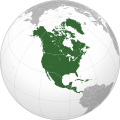 | |||||||||||
|---|---|---|---|---|---|---|---|---|---|---|---|---|---|
| Dependencies |
| ||||||||||||
- Articles containing Spanish-language text
- Pages with Spanish IPA
- Articles containing Yucatec Maya-language text
- CS1 foreign language sources (ISO 639-2)
- Articles containing French-language text
- Mexico
- Countries in North America
- Federal constitutional republics
- Former Spanish colonies
- G15 nations
- G20 members
- Member states of the United Nations
- OECD members
- Countries and territories where Spanish is an official language
- States and territories established in 1810
- 1810 establishments in New Spain