

Added Consequences |
DelorisQha (talk | contribs) No edit summary |
||
| (One intermediate revision by one other user not shown) | |||
| Line 1: | Line 1: | ||
{{Short description| | {{Short description|1798–99 conflict in the Kingdom of Mysore}} | ||
{{Use dmy dates|date=June 2017}}{{Use Indian English|date=June 2017}} | {{Use dmy dates|date=June 2017}}{{Use Indian English|date=June 2017}} | ||
{{Infobox military conflict | {{Infobox military conflict | ||
| conflict | | conflict = Fourth Anglo-Mysore War | ||
| partof | | partof = the [[Anglo-Mysore Wars]] | ||
| image | | image = Anglo-Mysore War 4.png | ||
| image_size | | image_size = 300 | ||
| caption | | caption = A map of the war thereafter | ||
| date | | date = 1798 – 4 May 1799 | ||
| place | | place = [[Deccan Plateau|Western Deccan region]], [[South India]], [[Indian subcontinent]] | ||
| result | | result = British victory | ||
| combatant1 | | combatant1 = {{flagicon image|Flag of Mysore Hyder Ali & TipuSultan.png}} [[Kingdom of Mysore|Mysore State]] | ||
| combatant2 = {{Ubl|{{flagicon|Great Britain}} [[Great Britain]] | |||
| commander1 | *{{flagicon|East India Company}} [[East India Company]]}} | ||
| | [[File:Flag of the Maratha Empire.svg|22px]] [[Maratha Empire]]<br/>[[File:Flag of the State of Hyderabad (18th century-1900).svg|22px]] [[Hyderabad State]] | ||
| strength1 | | commander1 = {{plainlist| | ||
| strength2 | *{{flagicon image|Flag of Mysore Hyder Ali & TipuSultan.png}} [[Tipu Sultan]]{{KIA}} | ||
| campaignbox = {{Campaignbox Fourth Anglo-Mysore War}} | *{{flagicon image|Flag of Mysore Hyder Ali & TipuSultan.png}} [[Purnaiah]] | ||
*{{flagicon image|Flag of Mysore Hyder Ali & TipuSultan.png}} [[Ghulam Muhammad Khan|Ghulam Khan]] | |||
*{{flagicon image|Flag of Mysore Hyder Ali & TipuSultan.png}} Sipahsalar Sahib | |||
*{{flagicon image|Flag of Mysore Hyder Ali & TipuSultan.png}} Mir Hussain | |||
*{{flagicon image|Flag of Mysore Hyder Ali & TipuSultan.png}} Mohomed Miran | |||
}} | |||
| commander2 = {{plainlist| | |||
*{{flagicon|East India Company}} [[George Harris, 1st Baron Harris|George Harris]] | |||
*{{flagicon|East India Company}} [[Sir David Baird, 1st Baronet|David Baird]] | |||
*{{flagicon|East India Company}} [[James Stuart (British Army general)|James Stuart]] | |||
*{{flagicon|East India Company}} James Dalrymple{{sfnp|Dalrymple|2003|p=180}} | |||
*{{flagdeco|East India Company|1707}} [[Arthur Wellesley, 1st Duke of Wellington|Arthur Wellesley]]{{WIA}} | |||
*[[File:Flag of the Maratha Empire.svg|22px]] [[Baji Rao II|Bajirao II]] | |||
*[[File:Flag of the Maratha Empire.svg|22px]] [[Nana Fadnavis]] | |||
*[[File:Flag of the Maratha Empire.svg|22px]] [[Shahu II]] | |||
*[[File:Flag of the State of Hyderabad (18th century-1900).svg|22px]] [[Nizam Ali Khan, Asaf Jah II|Asaf Jah II]] | |||
*[[File:Flag of the State of Hyderabad (18th century-1900).svg|22px]] [[Mir Alam]] | |||
*[[File:Flag of the State of Hyderabad (18th century-1900).svg|22px]] [[Renuka Das Bhalerao|Renuka Bhalerao]]{{sfnp|Dalrymple|2003|p=179}} | |||
*{{flagicon image|Flag of Mysore Hyder Ali & TipuSultan.png}} [[Mir Sadiq]][[Defected|(D)]]{{KIA}}<ref name="Sunderlal 2018 p. 364">{{cite book | last=Sunderlal | first=Pandit | title=How India Lost Her Freedom | publisher=SAGE Publications | year=2018 | isbn=978-93-5280-642-3 | url=https://books.google.com/books?id=E4lIDwAAQBAJ&pg=PA364 | access-date=20 January 2022 | page=364}}</ref> | |||
}} | |||
| strength1 = {{circa}} 37,000{{sfnp|Dalrymple|2003|p=191}} | |||
| strength2 = {{flagicon|East India Company}} 60,000<br>[[File:Flag of the Maratha Empire.svg|22px]] (supportive alliance)<br>[[File:Flag of the State of Hyderabad (18th century-1900).svg|22px]] 10,480{{sfnp|Dalrymple|2003|p=179}}{{sfnp|Dalrymple|2003|p=180}} | |||
| units1 = | |||
| units2 = | |||
| casualties1 = | |||
| casualties2 = | |||
| campaignbox = {{Campaignbox Fourth Anglo-Mysore War}} | |||
{{Campaignbox Anglo-Mysore Wars}} | {{Campaignbox Anglo-Mysore Wars}} | ||
}} | }} | ||
The '''Fourth | The '''Fourth Anglo-Mysore War''' was a conflict in [[South India]] between the [[Kingdom of Mysore|Mysore State]] against the [[East India Company]], [[Maratha Empire]] and the [[Hyderabad State]] in 1798–99.<ref name="Kohn2013">{{cite book|last=Kohn|first=George Childs |year=2013|title=Dictionary of Wars|url=https://books.google.com/books?id=qTDfAQAAQBAJ&pg=PA322 |edition=Revised|location=London and New York|publisher=Routledge |pages=322–323 |isbn=978-1-135-95494-9}}</ref> | ||
This was the | This was the last of the four [[Anglo-Mysore Wars]]. Although the Marathas had promised the land of [[Uttara Kannada]] to Mysore, they sided with the Company at the last moment which lead to the capture of the capital city Mysore by Company and the death of the ruler [[Tipu Sultan]] in the battle. Britain took indirect control of Mysore, restoring the [[Wadiyar dynasty]] to the Mysore throne (with a British commissioner to advise him on all issues), along with the Marathas. Tipu Sultan's young heir, Fateh Ali, was sent into exile. The Kingdom of Mysore became a [[princely state]] in a [[subsidiary alliance]] with East India Company covering parts of present day [[Kerala]]–[[Karnataka]] and ceded [[Coimbatore district|Coimbatore]], [[Dakshina Kannada]] and Uttara Kannada to the British. | ||
==Background== | ==Background== | ||
[[ | [[Napoleon Bonaparte]]'s [[French campaign in Egypt and Syria|landing]] in [[Ottoman Egypt]] in 1798 was intended to further the capture of the [[British possessions]] in India, and the Kingdom of Mysore was a key to that next step, as the ruler of Mysore, Tipu Sultan, sought [[French First Republic|France]] as an ally and his letter to Napoleon resulted in the following reply, "You have already been informed of my arrival on the borders of the [[Red Sea]], with an innumerable and invincible army, full of the desire of releasing and relieving you from the iron yoke of England." Additionally, General [[Anne Joseph Hippolyte de Maurès, Comte de Malartic|Malartic]], French Governor of [[Isle de France (Mauritius)|Mauritius]], issued the Malartic Proclamation seeking volunteers to assist Tipu. [[Horatio Nelson, 1st Viscount Nelson|Horatio Nelson]] ended any possibility of help from Napoleon after the [[Battle of the Nile]]. However, Lord [[Richard Wellesley, 1st Marquess Wellesley|Mornington]] had already set in motion a response to prevent any alliance between Tipu Sultan and France.Maratha leadership under Peshwa Baji Rao II and Nana Fadnavis maintained a position of strategic neutrality throughout the 1799 campaign. Despite this lack of active combat participation, the British utilized the alliance to isolate Tipu Sultan diplomatically. <ref name=":0">{{Cite book |last=Duff |first=James Grant |title=History of the Mahrattas, Vol. 3 |publisher=Legare Street Press |year=2023 |isbn=978-1019600306 |language=English}}</ref><ref name=Naravane>{{Cite book |last=Naravane|first=M. S.|year=2014|title=Battles of the Honourable East India Company: Making of the Raj |location=New Delhi|publisher=A.P.H. Publishing Corporation |pages=178–181|isbn=978-81-313-0034-3}}</ref> | ||
== | ==Invasion and British victory== | ||
Three armies | Three armies, [[Bombay Army|one from Bombay]] and two British (one of which contained a division that was commanded by Colonel [[Arthur Wellesley, 1st Duke of Wellington|Arthur Wellesley]], the future 1st [[Duke of Wellington (title)|Duke of Wellington]]), marched into Mysore in 1799 and besieged the capital, [[Srirangapatnam]], after some engagements with Tipu. On 8 March, a forward force managed to hold off an advance by Tipu at the [[Battle of Seedaseer]].{{fact|date=November 2025}} | ||
One notable military advance championed by Tipu Sultan was the use of mass attacks with iron-cased [[rocket]] brigades in the army. The effect of the [[Mysorean rockets]] on the British during the [[Third Anglo-Mysore War|Third]] and Fourth Mysore Wars was sufficiently impressive to inspire [[Sir William Congreve, 2nd Baronet|William Congreve]] to develop the [[Congreve rocket]]s for [[Napoleonic Wars]].<ref name=Narasimha>{{cite web |url=https://www.researchgate.net/publication/37179995 |url-status=dead |archive-url=https://web.archive.org/web/20110727034357/https://www.nal.res.in/pdf/pdfrocket.pdf |title=Rockets in Mysore and Britain, 1750–1850 A.D. |last=Narasimha |first=Roddam |date=27 July 2011 |archive-date=27 July 2011 |publisher=National Aeronautical Laboratory and Indian Institute of Science.}}</ref> | |||
One | During the war, rockets were used on several occasions. One of these involved Colonel Wellesley. At the [[Battle of Sultanpet Tope]], Wellesley's assault on the first day was soundly repulsed by Tipu's Diwan, [[Purnaiah]]. Quoting Forrest, | ||
<blockquote>At this point (near the village of Sultanpet, Figure 5) there was a large tope, or grove, which gave shelter to Tipu's rocketmen and had obviously to be cleaned out before the siege could be pressed closer to Srirangapattana island. The commander chosen for this operation was Col. Wellesley, but advancing towards the tope after dark on the 5 April 1799, he was set upon with rockets and musket-fires, lost his way and, as Beatson politely puts it, had to "postpone the attack" until a more favourable opportunity should offer.<ref>{{cite book|last=Forrest |first=Denys |year=1970 |title=Tiger of Mysore: The Life and Death of Tipu Sultan |location=London|publisher=Chatto & Windus|isbn=0-7011-1581-5}}</ref>{{page needed|date=October 2021}}</blockquote> | |||
The following day, Wellesley launched a fresh attack with a larger force, and took the whole position without losing a single man.<ref>{{cite book|last=Holmes|first=Richard|author-link=Richard Holmes (military historian)|year=2003|title=Wellington: The Iron Duke|location=London |publisher=[[HarperCollins]]|pages=58|isbn=0-00-713750-8}}</ref> On 22 April 1799, twelve days before the main battle, rocketeers worked their way around to the rear of the British encampment, then "threw a great number of rockets at the same instant" to signal the beginning of an assault by 6,000 Indian infantry and a corps of Frenchmen, all directed by Mir Golam Hussain and Mohomed Hulleen Mir Miran. The rockets had a range of about 1,000 yards. Some burst in the air like shells. Others, called ground rockets, would rise again on striking the ground and bound along in a serpentine motion until their force was spent. According to one British observer, a young English officer named Bayly: "So pestered were we with the rocket boys that there was no moving without danger from the destructive missiles ...". {{citation needed|date=July 2025}} He continued: | |||
<blockquote>The rockets and musketry from 20,000 of the enemy were incessant. No hail could be thicker. Every illumination of blue lights was accompanied by a shower of rockets, some of which entered the head of the column, passing through to the rear, causing death, wounds, and dreadful lacerations from the long bamboos of twenty or thirty feet which are invariably attached to them.</blockquote> | |||
=== | During the decisive British [[Siege of Seringapatam (1799)|attack on Seringapatam]] on 2 May 1799, with the help of [[Maratha Empire|Marathas]] and [[Nizam Ali Khan, Asaf Jah II|the Nizam]], a British shot struck a magazine of rockets within Tipu Sultan's fort, causing it to explode and send a towering cloud of black smoke with cascades of exploding white light rising up from the battlements. On the afternoon of 4 May, when the final attack on the fort was led by Sir [[Sir David Baird, 1st Baronet|David Baird]], he was met by "furious musket and rocket fire", but this did not help much; in about an hour's time, the fort was taken; perhaps within another hour Tipu had been shot (the precise time of his death is not known), and the war was effectively over.<ref>{{cite book|last=Narasimha|first=Roddam |author-link=Roddam Narasimha |date=May 1985 |url=http://www.nal.res.in/pdf/pdfrocket.pdf |title=Rockets in Mysore and Britain, 1750–1850 A.D. |place=Bangalore, India |publisher=National Aeronautical Laboratory and Indian Institute of Science|archive-url=https://web.archive.org/web/20120303205010/http://www.nal.res.in/pdf/pdfrocket.pdf |archive-date=3 March 2012 }}</ref> When the British were on the verge of victory, the French allies reportedly told Tipu to flee, but Tipu refused and famously said "Better to live one day as a tiger than a thousand years as a sheep".<ref>http://www.oxfordreference.com/view/10.1093/acref/9780199539536.001.0001/acref-9780199539536-e-156, Tipu Sultan's world-famous quote, "Better to live one day as a tiger than a thousand years as a sheep" on oxfordreference.com website, Retrieved 14 February 2017</ref> The death of Tipu Sultan led British General George Harris to exclaim "now India is ours".<ref name="Moienuddin2000">{{cite book | author =Mohammad Moienuddin | title =Sunset at Srirangapatam: After the Death of Tipu Sultan | year =2000 | publisher =Sangam Books | isbn =978-0-86311-850-0 | oclc =48995204 | url =https://books.google.com/books?id=tBFWAAAAYAAJ&q=exclaim}}</ref> | ||
== | == Aftermath == | ||
{{ | The victors, rather than partitioning the country, forced Tipu's family into exile and restored control of Mysore to the [[Wadiyar dynasty|Wadiyars]].{{fact|date=November 2025}} | ||
Many members of the East India Company believed that [[Umdat ul-Umara]], the [[Nawab of Carnatic]], secretly provided assistance to Tipu Sultan during the Fourth Anglo-Mysore War; and they immediately sought his deposition after the end of the conflict.{{fact|date=November 2025}} | |||
The | The territory of the [[Nawab of Savanur]] was split among the British and Maratha forces.{{fact|date=November 2025}} | ||
The spot where Tipu's body was discovered under the eastern gate has been fenced off by the [[Archaeological Survey of India]], and a plaque erected. The gate was later demolished during the 19th century to lay a wide road. After Tipu Sultan was defeated and killed, the British offered a portion of the conquered Mysore territory to the Marathas as a gesture of "goodwill" for their technical alliance. However, the Marathas rejected the offer because it came with the condition that they accept a British Resident at their court and a British subsidiary force.<ref name=":0" />{{fact|date=November 2025}} | |||
==In popular culture== | ==In popular culture== | ||
The war, specifically the [[Battle of Mallavelly]] and the | The war, specifically the [[Battle of Mallavelly]] and the siege of Seringapatam, with many of the key protagonists, is covered in the historical novel ''[[Sharpe's Tiger]]'' by [[Bernard Cornwell]].<ref>{{cite web|last=Cornwell|first=Bernard |author-link=Bernard Cornwell|title=Title: Sharpe's Tiger |website=bernardcornwell.net |url=http://bernardcornwell.net/index.cfm?page=2&BookId=1|archive-url=https://web.archive.org/web/20070202120215/http://bernardcornwell.net/index.cfm?page=2&BookId=1|url-status=dead|archive-date=2 February 2007|access-date=26 May 2019}}</ref> | ||
==Gallery== | ==Gallery== | ||
<gallery caption="Fall of | <gallery caption="Fall of Tipu Sultan (1799)" widths="200px" heights="150px" perrow="4"> | ||
File:The storming of Seringapatam - John Vendramini, 1802 - BL P779.jpg| | File:The storming of Seringapatam - John Vendramini, 1802 - BL P779.jpg|''The Storming of Seringapatam'' by [[Giovanni Vendramini]], 1802 | ||
File:The Last Effort of Tippu Sahib at Seringapatam p.334.jpg|The Last Effort of | File:The Last Effort of Tippu Sahib at Seringapatam p.334.jpg|''The Last Effort of Tippoo Saib at Seringapatam'' by B. Clayton, 1840<ref name=Corner>{{cite book|last=Corner|first=Julia|author-link=Julia Corner|title=The History of China & India, Pictorial & Descriptive|date=1840|publisher=Dean & Co., Threadneedle St.|location=London|page=[https://archive.org/details/historyofchinain00corn/page/n419/mode/2up 334]}}</ref> | ||
File:Tipu death.jpg|''The Last Effort and Fall of | File:Tipu death.jpg|''[[The Last Effort and Fall of Tippoo Sultaun]]'' by [[Henry Singleton (painter)|Henry Singleton]], {{circa|1800}} | ||
File:Finding the body of Tippoo Sultan - Samuel William Reynolds, 1800 - BL P428.jpg| | File:Finding the body of Tippoo Sultan - Samuel William Reynolds, 1800 - BL P428.jpg|''Finding of the Body of Tippoo Sultaun'' by [[Samuel William Reynolds]], 1800 | ||
File:Sir David Baird Discovering Body of | File:General Sir David Baird Discovering the Body of Sultan Tippoo Sahib.jpg|''[[Sir David Baird Discovering the Body of Sultan Tipoo Sahib]]'' by [[David Wilkie (artist)|David Wilkie]], 1839 | ||
File:P 229.jpg|British Marker showing the location where Tipu's body was found | File:P 229.jpg|British Marker showing the location where Tipu's body was found | ||
</gallery> | </gallery> | ||
==References== | ==References== | ||
| Line 75: | Line 92: | ||
=== Works cited === | === Works cited === | ||
{{Refbegin}} | {{Refbegin}} | ||
* {{cite book| last = Dalrymple| first = William |author-link=William Dalrymple (historian)| title = White Mughals: | * {{cite book |last=Dalrymple |first=William |author-link=William Dalrymple (historian) |year=2003 |orig-year=2002 |title=[[White Mughals|White Mughals: Love & Betrayal in Eighteenth-Century India]] |publisher=Flamingo |isbn=978-0-00-655096-9}} | ||
{{Refend}} | {{Refend}} | ||
==Further reading== | ==Further reading== | ||
*{{ | *{{cite book|ref=none |first=John Clark |last=Marshman |author-link=John Clark Marshman |year=1867 |chapter=Chapter XIX: Lord Wellesley's Administration—Fourth and Last Mysore War, 1798, 1799 |title=The History of India, From the Earliest Period to the Close of Lord Dalhousie's Administration |volume=II |location=London |publisher=Longmans, Green, Reader & Dyer |pages=[https://archive.org/details/historyofindiafr02marsiala/page/71/mode/2up 71]–[https://archive.org/details/historyofindiafr02marsiala/page/102/mode/2up 102]}} | ||
*{{ | *{{cite book|ref=none |last=Carter |first=Thomas |author-link=Thomas Carter (writer) |year=1861 |chapter=The Mysore War and Siege of Seringapatam |title=Medals of the British Army, and How They Were Won |location=London |publisher=Groombridge and Sons |pages=[https://archive.org/details/medalsbritishar02cartgoog/page/n18/mode/2up 2]–[https://archive.org/details/medalsbritishar02cartgoog/page/n22/mode/2up 6]}} | ||
*{{ | *{{cite book |ref=none |last1=Mill |first1=James |author-link1=James Mill |last2=Wilson |first2=Horace Hayman |author-link2=Horace Hayman Wilson |year=1858 |chapter=Chapter VIII: Lord Mornington Governor-General.—Agents of Tippoo at the Isle of France.—Governor-General resolves on immediate War.—Import of the Circumstances.—Opinions in India.—Nizam Ali receives more English Troops and dismisses the French.—Unfruitful Negotiations at Poonah.—Progression of Governor-General's Demands.—War begins.—Plan of the Campaign.—March of the Army.—Siege of Seringapatam.—Alarming Situation of the British Army in regard to Food.—Seringapatam taken, and the Sultan killed.—Division and Settlement of the conquered Country|title=[[The History of British India]] |volume=VI |edition=5th |location=London |publisher=James Madden; Piper, Stephenson and Spence |pages=[https://books.google.com/books?id=zVQIAAAAQAAJ&pg=PA50 50]–[https://books.google.com/books?id=zVQIAAAAQAAJ&pg=PA121 121]}} | ||
{{s-start}} | |||
{{succession box|title=[[Anglo-Mysore Wars]]|years=|before=[[Third Anglo-Mysore War]]|after=None}} | |||
{{succession box|title=Indo-British conflicts|years=|before=[[Third Anglo-Mysore War]]|after=[[Second Anglo-Maratha War]]}} | |||
{{s-end}} | |||
{{British colonial campaigns}} | {{British colonial campaigns}} | ||
{{Indian Independence Movement}} | |||
{{Authority control}} | {{Authority control}} | ||
{{DEFAULTSORT:Anglo-Mysore War 04}} | {{DEFAULTSORT:Anglo-Mysore War 04}} | ||
[[Category:1798 in India]] | |||
[[Category:1799 in India]] | |||
[[Category:Conflicts in 1798]] | [[Category:Conflicts in 1798]] | ||
[[Category:Conflicts in 1799]] | [[Category:Conflicts in 1799]] | ||
[[Category:Wars involving British India]] | [[Category:Wars involving British India]] | ||
[[Category:Wars involving the Kingdom of Great Britain]] | |||
[[Category:Wars involving the Maratha Empire]] | |||
[[Category:Wars involving the Kingdom of Mysore]] | [[Category:Wars involving the Kingdom of Mysore]] | ||
Latest revision as of 13:39, 29 March 2026
| Fourth Anglo-Mysore War | |||||||
|---|---|---|---|---|---|---|---|
| Part of the Anglo-Mysore Wars | |||||||
 A map of the war thereafter | |||||||
| |||||||
| Belligerents | |||||||
 Mysore State Mysore State |
 Maratha Empire Maratha Empire.svg) Hyderabad State Hyderabad State | ||||||
| Commanders and leaders | |||||||
| |||||||
| Strength | |||||||
| c. 37,000[4] |
 60,000 (supportive alliance) 10,480[2][1] 60,000 (supportive alliance) 10,480[2][1] | ||||||


The Fourth Anglo-Mysore War was a conflict in South India between the Mysore State against the East India Company, Maratha Empire and the Hyderabad State in 1798–99.[5]
This was the last of the four Anglo-Mysore Wars. Although the Marathas had promised the land of Uttara Kannada to Mysore, they sided with the Company at the last moment which lead to the capture of the capital city Mysore by Company and the death of the ruler Tipu Sultan in the battle. Britain took indirect control of Mysore, restoring the Wadiyar dynasty to the Mysore throne (with a British commissioner to advise him on all issues), along with the Marathas. Tipu Sultan's young heir, Fateh Ali, was sent into exile. The Kingdom of Mysore became a princely state in a subsidiary alliance with East India Company covering parts of present day Kerala–Karnataka and ceded Coimbatore, Dakshina Kannada and Uttara Kannada to the British.
Background[edit | edit source]
Napoleon Bonaparte's landing in Ottoman Egypt in 1798 was intended to further the capture of the British possessions in India, and the Kingdom of Mysore was a key to that next step, as the ruler of Mysore, Tipu Sultan, sought France as an ally and his letter to Napoleon resulted in the following reply, "You have already been informed of my arrival on the borders of the Red Sea, with an innumerable and invincible army, full of the desire of releasing and relieving you from the iron yoke of England." Additionally, General Malartic, French Governor of Mauritius, issued the Malartic Proclamation seeking volunteers to assist Tipu. Horatio Nelson ended any possibility of help from Napoleon after the Battle of the Nile. However, Lord Mornington had already set in motion a response to prevent any alliance between Tipu Sultan and France.Maratha leadership under Peshwa Baji Rao II and Nana Fadnavis maintained a position of strategic neutrality throughout the 1799 campaign. Despite this lack of active combat participation, the British utilized the alliance to isolate Tipu Sultan diplomatically. [6][7]
Invasion and British victory[edit | edit source]
Three armies, one from Bombay and two British (one of which contained a division that was commanded by Colonel Arthur Wellesley, the future 1st Duke of Wellington), marched into Mysore in 1799 and besieged the capital, Srirangapatnam, after some engagements with Tipu. On 8 March, a forward force managed to hold off an advance by Tipu at the Battle of Seedaseer.[citation needed]
One notable military advance championed by Tipu Sultan was the use of mass attacks with iron-cased rocket brigades in the army. The effect of the Mysorean rockets on the British during the Third and Fourth Mysore Wars was sufficiently impressive to inspire William Congreve to develop the Congreve rockets for Napoleonic Wars.[8]
During the war, rockets were used on several occasions. One of these involved Colonel Wellesley. At the Battle of Sultanpet Tope, Wellesley's assault on the first day was soundly repulsed by Tipu's Diwan, Purnaiah. Quoting Forrest,
At this point (near the village of Sultanpet, Figure 5) there was a large tope, or grove, which gave shelter to Tipu's rocketmen and had obviously to be cleaned out before the siege could be pressed closer to Srirangapattana island. The commander chosen for this operation was Col. Wellesley, but advancing towards the tope after dark on the 5 April 1799, he was set upon with rockets and musket-fires, lost his way and, as Beatson politely puts it, had to "postpone the attack" until a more favourable opportunity should offer.[9][page needed]
The following day, Wellesley launched a fresh attack with a larger force, and took the whole position without losing a single man.[10] On 22 April 1799, twelve days before the main battle, rocketeers worked their way around to the rear of the British encampment, then "threw a great number of rockets at the same instant" to signal the beginning of an assault by 6,000 Indian infantry and a corps of Frenchmen, all directed by Mir Golam Hussain and Mohomed Hulleen Mir Miran. The rockets had a range of about 1,000 yards. Some burst in the air like shells. Others, called ground rockets, would rise again on striking the ground and bound along in a serpentine motion until their force was spent. According to one British observer, a young English officer named Bayly: "So pestered were we with the rocket boys that there was no moving without danger from the destructive missiles ...". [citation needed] He continued:
The rockets and musketry from 20,000 of the enemy were incessant. No hail could be thicker. Every illumination of blue lights was accompanied by a shower of rockets, some of which entered the head of the column, passing through to the rear, causing death, wounds, and dreadful lacerations from the long bamboos of twenty or thirty feet which are invariably attached to them.
During the decisive British attack on Seringapatam on 2 May 1799, with the help of Marathas and the Nizam, a British shot struck a magazine of rockets within Tipu Sultan's fort, causing it to explode and send a towering cloud of black smoke with cascades of exploding white light rising up from the battlements. On the afternoon of 4 May, when the final attack on the fort was led by Sir David Baird, he was met by "furious musket and rocket fire", but this did not help much; in about an hour's time, the fort was taken; perhaps within another hour Tipu had been shot (the precise time of his death is not known), and the war was effectively over.[11] When the British were on the verge of victory, the French allies reportedly told Tipu to flee, but Tipu refused and famously said "Better to live one day as a tiger than a thousand years as a sheep".[12] The death of Tipu Sultan led British General George Harris to exclaim "now India is ours".[13]
Aftermath[edit | edit source]
The victors, rather than partitioning the country, forced Tipu's family into exile and restored control of Mysore to the Wadiyars.[citation needed]
Many members of the East India Company believed that Umdat ul-Umara, the Nawab of Carnatic, secretly provided assistance to Tipu Sultan during the Fourth Anglo-Mysore War; and they immediately sought his deposition after the end of the conflict.[citation needed]
The territory of the Nawab of Savanur was split among the British and Maratha forces.[citation needed]
The spot where Tipu's body was discovered under the eastern gate has been fenced off by the Archaeological Survey of India, and a plaque erected. The gate was later demolished during the 19th century to lay a wide road. After Tipu Sultan was defeated and killed, the British offered a portion of the conquered Mysore territory to the Marathas as a gesture of "goodwill" for their technical alliance. However, the Marathas rejected the offer because it came with the condition that they accept a British Resident at their court and a British subsidiary force.[6][citation needed]
In popular culture[edit | edit source]
The war, specifically the Battle of Mallavelly and the siege of Seringapatam, with many of the key protagonists, is covered in the historical novel Sharpe's Tiger by Bernard Cornwell.[14]
Gallery[edit | edit source]
- Fall of Tipu Sultan (1799)
-
 The Storming of Seringapatam by Giovanni Vendramini, 1802
 -
![The Last Effort of Tippoo Saib at Seringapatam by B. Clayton, 1840[15]](/w/images/smartcommons/thumbs/commons/a/af/The_Last_Effort_of_Tippu_Sahib_at_Seringapatam_p.334.jpg/200px-The_Last_Effort_of_Tippu_Sahib_at_Seringapatam_p.334.jpg) The Last Effort of Tippoo Saib at Seringapatam by B. Clayton, 1840[15]
The Last Effort of Tippoo Saib at Seringapatam by B. Clayton, 1840[15] -
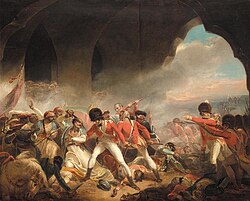
-
 Finding of the Body of Tippoo Sultaun by Samuel William Reynolds, 1800
 -
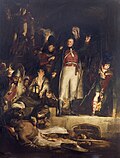
-
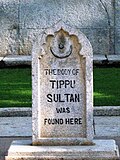 British Marker showing the location where Tipu's body was found

![The Last Effort of Tippoo Saib at Seringapatam by B. Clayton, 1840[15]](/wiki/File:The_Last_Effort_of_Tippu_Sahib_at_Seringapatam_p.334.jpg)


References[edit | edit source]
- ↑ 1.0 1.1 Dalrymple (2003), p. 180.
- ↑ 2.0 2.1 Dalrymple (2003), p. 179.
- ↑ Sunderlal, Pandit (2018). How India Lost Her Freedom. SAGE Publications. p. 364. ISBN 978-93-5280-642-3. Retrieved 20 January 2022.
- ↑ Dalrymple (2003), p. 191.
- ↑ Kohn, George Childs (2013). Dictionary of Wars (Revised ed.). London and New York: Routledge. pp. 322–323. ISBN 978-1-135-95494-9.
- ↑ 6.0 6.1 Duff, James Grant (2023). History of the Mahrattas, Vol. 3. Legare Street Press. ISBN 978-1019600306.
- ↑ Naravane, M. S. (2014). Battles of the Honourable East India Company: Making of the Raj. New Delhi: A.P.H. Publishing Corporation. pp. 178–181. ISBN 978-81-313-0034-3.
- ↑ Narasimha, Roddam (27 July 2011). "Rockets in Mysore and Britain, 1750–1850 A.D." (PDF). National Aeronautical Laboratory and Indian Institute of Science. Archived from the original on 27 July 2011.
- ↑ Forrest, Denys (1970). Tiger of Mysore: The Life and Death of Tipu Sultan. London: Chatto & Windus. ISBN 0-7011-1581-5.
- ↑ Holmes, Richard (2003). Wellington: The Iron Duke. London: HarperCollins. p. 58. ISBN 0-00-713750-8.
- ↑ Narasimha, Roddam (May 1985). Rockets in Mysore and Britain, 1750–1850 A.D. (PDF). Bangalore, India: National Aeronautical Laboratory and Indian Institute of Science. Archived from the original (PDF) on 3 March 2012.
- ↑ http://www.oxfordreference.com/view/10.1093/acref/9780199539536.001.0001/acref-9780199539536-e-156, Tipu Sultan's world-famous quote, "Better to live one day as a tiger than a thousand years as a sheep" on oxfordreference.com website, Retrieved 14 February 2017
- ↑ Mohammad Moienuddin (2000). Sunset at Srirangapatam: After the Death of Tipu Sultan. Sangam Books. ISBN 978-0-86311-850-0. OCLC 48995204.
- ↑ Cornwell, Bernard. "Title: Sharpe's Tiger". bernardcornwell.net. Archived from the original on 2 February 2007. Retrieved 26 May 2019.
- ↑ Corner, Julia (1840). The History of China & India, Pictorial & Descriptive. London: Dean & Co., Threadneedle St. p. 334.
Works cited[edit | edit source]
- Dalrymple, William (2003) [2002]. White Mughals: Love & Betrayal in Eighteenth-Century India. Flamingo. ISBN 978-0-00-655096-9.
Further reading[edit | edit source]
- Marshman, John Clark (1867). "Chapter XIX: Lord Wellesley's Administration—Fourth and Last Mysore War, 1798, 1799". The History of India, From the Earliest Period to the Close of Lord Dalhousie's Administration. Vol. II. London: Longmans, Green, Reader & Dyer. pp. 71–102.
- Carter, Thomas (1861). "The Mysore War and Siege of Seringapatam". Medals of the British Army, and How They Were Won. London: Groombridge and Sons. pp. 2–6.
- Mill, James; Wilson, Horace Hayman (1858). "Chapter VIII: Lord Mornington Governor-General.—Agents of Tippoo at the Isle of France.—Governor-General resolves on immediate War.—Import of the Circumstances.—Opinions in India.—Nizam Ali receives more English Troops and dismisses the French.—Unfruitful Negotiations at Poonah.—Progression of Governor-General's Demands.—War begins.—Plan of the Campaign.—March of the Army.—Siege of Seringapatam.—Alarming Situation of the British Army in regard to Food.—Seringapatam taken, and the Sultan killed.—Division and Settlement of the conquered Country". The History of British India. Vol. VI (5th ed.). London: James Madden; Piper, Stephenson and Spence. pp. 50–121.
| Preceded by Third Anglo-Mysore War |
Anglo-Mysore Wars | Succeeded by None |
| Preceded by Third Anglo-Mysore War |
Indo-British conflicts | Succeeded by Second Anglo-Maratha War |