

>Harfarhs Improved citation; added link; improved phrasing and punctuation |
rework page further and improved wording |
||
| (One intermediate revision by one other user not shown) | |||
| Line 1: | Line 1: | ||
{{Short description|Cylindrical cigar without a filter}} | |||
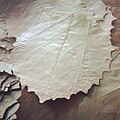
[[File:Cheroot making leaves or cheroot leaves 2013-07-03 11-19.jpg|thumbnail|Cheroot-making leaves or cheroot leaves]] | [[File:Cheroot making leaves or cheroot leaves 2013-07-03 11-19.jpg|thumbnail|Cheroot-making leaves or cheroot leaves]] | ||
The '''cheroot''' is a filterless cylindrical [[cigar]] with both ends clipped during manufacture. Since cheroots do not taper, they are inexpensive to roll mechanically, and their low cost makes them popular. | The '''cheroot''' is a filterless cylindrical [[cigar]] with both ends clipped during manufacture.<ref>{{Cite web |title=Terms Every Cigar Smoker Should Know |url=https://www.smokingpipes.com/smokingpipesblog/single.cfm/post/terms-every-cigar-smoker-should-know |access-date=2026-01-02 |website=www.smokingpipes.com |language=en}}</ref> Since cheroots do not taper, they are inexpensive to roll mechanically, and their low cost makes them popular. | ||
The word 'cheroot' probably comes via [[Portuguese language|Portuguese]] ''charuto'',<ref>{{cite web |title=cheroot (n.) |url=https://www.etymonline.com/search?q=cheroot |website=etymonline.com |accessdate=December 5, 2019}}</ref> originally from [[Tamil language|Tamil]] ''curuttu/churuttu/shuruttu'' (சுருட்டு), "roll of tobacco". This word could have been absorbed into the French language from Tamil during the 18th century, when the French were trying to stamp their presence in [[South India]]. The word could have then been absorbed into [[English language|English]] from French.<ref>{{cite web |url=http://www.wmich.edu/dialogues/themes/indianwords.htm#links |url-status=dead |title=Etymology of Selected Words of Indian Language Origin |publisher=Wmich.edu |access-date=2004-06-22 |archive-url=https://web.archive.org/web/20140220033539/http://www.wmich.edu/dialogues/themes/indianwords.htm#links |archive-date=2014-02-20}}</ref> Cheroots originated in [[Tamil Nadu]] | The word 'cheroot' probably comes via [[Portuguese language|Portuguese]] ''charuto'',<ref>{{cite web |title=cheroot (n.) |url=https://www.etymonline.com/search?q=cheroot |website=etymonline.com |accessdate=December 5, 2019}}</ref> originally from [[Tamil language|Tamil]] ''curuttu/churuttu/shuruttu'' (சுருட்டு), "roll of tobacco". This word could have been absorbed into the French language from Tamil during the 18th century, when the French were trying to stamp their presence in [[South India]]. The word could have then been absorbed into [[English language|English]] from French.<ref>{{cite web |url=http://www.wmich.edu/dialogues/themes/indianwords.htm#links |url-status=dead |title=Etymology of Selected Words of Indian Language Origin |publisher=Wmich.edu |access-date=2004-06-22 |archive-url=https://web.archive.org/web/20140220033539/http://www.wmich.edu/dialogues/themes/indianwords.htm#links |archive-date=2014-02-20}}</ref> Cheroots are originated from the city of [[Tiruchirappalli]] in the [[South India|South Indian]] state of [[Tamil Nadu]]. Cheroot are longer than another filter-less Indian-origin product, the [[beedi]]. | ||
==Asia== | ==Asia== | ||
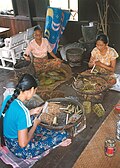
[[Image:InleCheroot.jpg|thumb|180px|Preparation of cheroots, [[Inle Lake]], | [[Image:InleCheroot.jpg|thumb|180px|Preparation of cheroots, [[Inle Lake]], Myanmar]] | ||
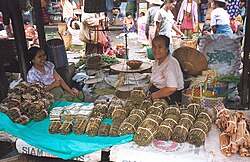
[[Image:NyaungshweCheroot.jpg|240px|thumb|Cheroots sold in the market at [[Nyaungshwe]], | [[Image:NyaungshweCheroot.jpg|240px|thumb|Cheroots sold in the market at [[Nyaungshwe]], Myanmar]] | ||
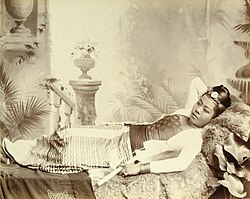
<!--[[File:A Burmese Girl Watts and Skeen, Burma Albumen print 1890.jpg|thumb|A Burmese Girl Holding a Cheroot, Watts and Skeen, Burma Albumen print1890]]--> | <!--[[File:A Burmese Girl Watts and Skeen, Burma Albumen print 1890.jpg|thumb|A Burmese Girl Holding a Cheroot, Watts and Skeen, Burma Albumen print1890]]--> | ||
Cheroots are traditional in [[ | Cheroots are traditional in [[Myanmar]] and [[India]], and consequently were popular among the British during the days of the [[British Empire]]. They are often associated with Myanmar in literature: | ||
{{quote|<poem>'Er petticoat was yaller an' 'er little cap was green, | {{quote|<poem>'Er petticoat was yaller an' 'er little cap was green, | ||
An' 'er name was [[Supayalat|Supi-yaw-lat]] – jes' the same as [[Thibaw Min|Theebaw]]'s Queen, | An' 'er name was [[Supayalat|Supi-yaw-lat]] – jes' the same as [[Thibaw Min|Theebaw]]'s Queen, | ||
An' I seed her first a-smokin' of a whackin' white cheroot, | An' I seed her first a-smokin' of a whackin' white cheroot, | ||
An' a-wastin' Christian kisses on an 'eathen [[Cult image|idol's]] foot:</poem>|[[Rudyard Kipling]]| (1892)<ref>{{cite web |last=Kipling |first=Rudyard |authorlink=Rudyard Kipling |title=Barrack-Room Ballads |url=https://www.gutenberg.org/files/2819/2819-h/2819-h.htm#2H_4_0014 |location=Mandalay}}</ref> "[[ | An' a-wastin' Christian kisses on an 'eathen [[Cult image|idol's]] foot:</poem>|[[Rudyard Kipling]]| (1892)<ref>{{cite web |last=Kipling |first=Rudyard |authorlink=Rudyard Kipling |title=Barrack-Room Ballads |url=https://www.gutenberg.org/files/2819/2819-h/2819-h.htm#2H_4_0014 |location=Mandalay}}</ref> "[[Mandalay (poem)|Mandalay]]", from ''[[Barrack-room Ballads]]''}} | ||
{{quote|My brother was unlike us in some things, [[Sahib#Colonial and modern use|Sahib]]. He was fond of the ''[[Wine|sharab]]'' called '[[Whisky]]' and of dogs; he drank smoke from the cheroot after the fashion of the Sahib-log and not from the [[hookah]] nor the ''[[beedi|bidi]]''; he wore boots; he struck with the clenched fist when angered; and never did he [[Squatting position|squat]] down upon his heels nor sit cross-legged upon the ground. Yet he was true [[Pashtun people|Pathan]] in many ways during his life, and he died as a Pathan should, concerning his honour (and a woman). Yea—and in his last fight, ere he was hanged, he killed more men with his long [[pesh-kabz|Khyber knife]], single-handed against a mob, than ever did lone man before with cold steel in fair fight.|Captain [[P. C. Wren|Percival Christopher Wren]], I.A.R.|1912, ''Driftwood Spars''}} | {{quote|My brother was unlike us in some things, [[Sahib#Colonial and modern use|Sahib]]. He was fond of the ''[[Wine|sharab]]'' called '[[Whisky]]' and of dogs; he drank smoke from the cheroot after the fashion of the Sahib-log and not from the [[hookah]] nor the ''[[beedi|bidi]]''; he wore boots; he struck with the clenched fist when angered; and never did he [[Squatting position|squat]] down upon his heels nor sit cross-legged upon the ground. Yet he was true [[Pashtun people|Pathan]] in many ways during his life, and he died as a Pathan should, concerning his honour (and a woman). Yea—and in his last fight, ere he was hanged, he killed more men with his long [[pesh-kabz|Khyber knife]], single-handed against a mob, than ever did lone man before with cold steel in fair fight.|Captain [[P. C. Wren|Percival Christopher Wren]], I.A.R.|1912, ''Driftwood Spars''}} | ||
| Line 22: | Line 23: | ||
{{quote|A final thing strikes me as I re-read the pages of the Diary that follows is that I seem to have spent much of my time falling ill. I attribute this to the fact that in those days I was a non-smoker. Since I took to the cheroot, I have not had a single attack of malaria, and my health improved enormously in later years."|''Leaves from the Jungle: Life in a Gond Village'', [[Oxford University Press]], 1992, p.xxix}} | {{quote|A final thing strikes me as I re-read the pages of the Diary that follows is that I seem to have spent much of my time falling ill. I attribute this to the fact that in those days I was a non-smoker. Since I took to the cheroot, I have not had a single attack of malaria, and my health improved enormously in later years."|''Leaves from the Jungle: Life in a Gond Village'', [[Oxford University Press]], 1992, p.xxix}} | ||
Although a cheroot is defined as cylindrical, home-rolled cheroots in | Although a cheroot is defined as cylindrical, home-rolled cheroots in Myanmar are sometimes conical.<ref>{{cite web|url=http://travel2photograph.wordpress.com/2011/03/04/cigars-and-cheroots-a-burmese-facial-feature/|title=Cigars and Cheroots|website=Travel2photograph.wordpress.com|date=4 March 2011 }}</ref> | ||
==See also== | ==See also== | ||
| Line 33: | Line 34: | ||
==External links== | ==External links== | ||
{{Wiktionary|cheroot|stogie}} | {{Wiktionary|cheroot|stogie}} | ||
*[https://web.archive.org/web/20060320121140/http://www.smokemag.com/0698/america.htm Making cheroots] | *[https://web.archive.org/web/20060320121140/http://www.smokemag.com/0698/america.htm Making cheroots] | ||
{{Cigarettes}} | |||
{{Alcohol in India}} | |||
{{Social issues in India}} | |||
[[Category:Cigars]] | [[Category:Cigars]] | ||
[[Category:Tobacco in India]] | |||
[[Category:Smoking in India]] | |||
Latest revision as of 20:22, 2 January 2026

The cheroot is a filterless cylindrical cigar with both ends clipped during manufacture.[1] Since cheroots do not taper, they are inexpensive to roll mechanically, and their low cost makes them popular.
The word 'cheroot' probably comes via Portuguese charuto,[2] originally from Tamil curuttu/churuttu/shuruttu (சுருட்டு), "roll of tobacco". This word could have been absorbed into the French language from Tamil during the 18th century, when the French were trying to stamp their presence in South India. The word could have then been absorbed into English from French.[3] Cheroots are originated from the city of Tiruchirappalli in the South Indian state of Tamil Nadu. Cheroot are longer than another filter-less Indian-origin product, the beedi.
Asia[edit | edit source]


Cheroots are traditional in Myanmar and India, and consequently were popular among the British during the days of the British Empire. They are often associated with Myanmar in literature:
'Er petticoat was yaller an' 'er little cap was green,
An' 'er name was Supi-yaw-lat – jes' the same as Theebaw's Queen,
An' I seed her first a-smokin' of a whackin' white cheroot,
An' a-wastin' Christian kisses on an 'eathen idol's foot:
My brother was unlike us in some things, Sahib. He was fond of the sharab called 'Whisky' and of dogs; he drank smoke from the cheroot after the fashion of the Sahib-log and not from the hookah nor the bidi; he wore boots; he struck with the clenched fist when angered; and never did he squat down upon his heels nor sit cross-legged upon the ground. Yet he was true Pathan in many ways during his life, and he died as a Pathan should, concerning his honour (and a woman). Yea—and in his last fight, ere he was hanged, he killed more men with his long Khyber knife, single-handed against a mob, than ever did lone man before with cold steel in fair fight.
— Captain Percival Christopher Wren, I.A.R., 1912, Driftwood Spars
Apparently, cheroot smoking was also associated with resistance against tropical disease in India. Verrier Elwin wrote in a foreword (1957) to Leaves from the Jungle: Life in a Gond Village:
A final thing strikes me as I re-read the pages of the Diary that follows is that I seem to have spent much of my time falling ill. I attribute this to the fact that in those days I was a non-smoker. Since I took to the cheroot, I have not had a single attack of malaria, and my health improved enormously in later years."
— Leaves from the Jungle: Life in a Gond Village, Oxford University Press, 1992, p.xxix
Although a cheroot is defined as cylindrical, home-rolled cheroots in Myanmar are sometimes conical.[5]
See also[edit | edit source]
References[edit | edit source]
- ↑ "Terms Every Cigar Smoker Should Know". www.smokingpipes.com. Retrieved 2026-01-02.
- ↑ "cheroot (n.)". etymonline.com. Retrieved December 5, 2019.
- ↑ "Etymology of Selected Words of Indian Language Origin". Wmich.edu. Archived from the original on 2014-02-20. Retrieved 2004-06-22.
- ↑ Kipling, Rudyard. "Barrack-Room Ballads". Mandalay.
- ↑ "Cigars and Cheroots". Travel2photograph.wordpress.com. 4 March 2011.