



>SunDawn m Reverted edits by 93.77.52.194 (talk): unexplained content removal (HG) (3.4.10) |
adjusted information per sources and added references per sources |
||
| Line 1: | Line 1: | ||
{{Short description| | {{Short description|5th–6th-century Central Asian tribes that invaded India}} | ||
{{use dmy dates|date=November 2016}} | {{use dmy dates|date=November 2016}} | ||
{{use Indian English|date=November 2016}} | {{use Indian English|date=November 2016}} | ||
{{ | {{Infobox caste | ||
| caste_name = Hunas | |||
| region = [[Madhya Pradesh]], [[Uttar Pradesh]], [[Punjab]], [[Rajasthan]], [[Gujarat]], [[Himachal Pradesh]], [[Haryana]], [[Jammu and Kashmir (union territory)|Jammu and Kashmir]], [[Bihar]], [[Sindh]], [[Gilgit-Baltistan]], [[Nuristan]], [[Khyber Pakhtunkhwa]], [[Balochistan]], [[Maharashtra]], [[Delhi]] | |||
| languages = | |||
| religions = | |||
| image = | |||
{{Location map+ | {{Location map+ | ||
| | |South Asia | ||
|float = | |float = center | ||
|width = 300 | |width = 300 | ||
|caption = [[ | |border = none | ||
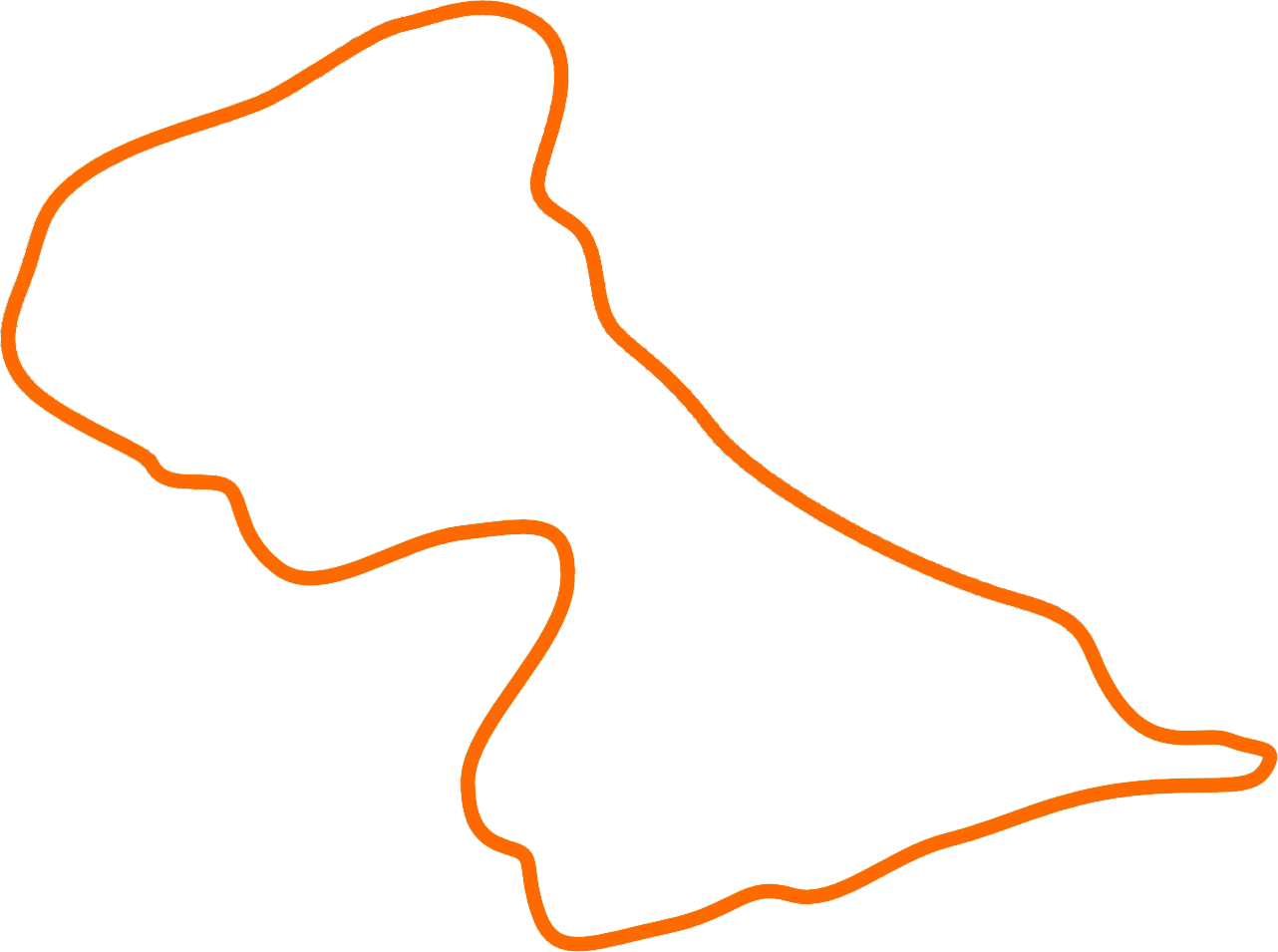
|caption = Approximate extent of the [[Alchon Huns]], and [[find spot]]s of inscriptions related to their local control (map of the [[Indian subcontinent]])<ref>[[Hans Bakker]] [https://zenodo.org/record/377032/files/Bakker%202016.pdf 24th Gonda lecture]</ref> | |||
|nodiv = 1 | |nodiv = 1 | ||
|mini = 1 | |mini = 1 | ||
|relief=yes | |relief=yes | ||
|places = | |places = | ||
{{location map~ | | {{location map~ |South Asia |lat=26|N |long=76|E |label=|position= |label_size=0|mark=Alchon border.png|marksize=170 }} | ||
{{location map~ | | {{location map~ |South Asia |lat=23.83|N |long=74.25|E |label=[[Sanjeli inscriptions|Sanjeli]]|position=left |label_size=80 }} | ||
{{location map~ | | {{location map~ |South Asia |lat=24.09|N |long=78.16|E |label=[[Eran]] |position=right |label_size=80}} | ||
{{location map~ | | {{location map~ |South Asia |lat=26.22|N |long=78.17|E |label=[[Gwalior inscription of Mihirakula|Gwalior]] |position=top |label_size=80 }} | ||
{{location map~ | | {{location map~ |South Asia |lat=24.07|N |long=75.08|E |label=[[Mandsaur|Sondani]]|position=bottom |label_size=80}} | ||
{{location map~ | | {{location map~ |South Asia |lat=24.38|N |long=74.70|E |label=[[Choti Sadri]]|position=top |label_size=80}} | ||
{{location map~ | | {{location map~ |South Asia |lat=32.40|N |long=72.47|E |label=[[Salt Range|Kura]]|position=top |label_size=80}} | ||
{{location map~ | | {{location map~ |South Asia |lat=25.33|N |long=81.39|E |label=Sack of [[Kausambi]]|position=right |label_size=80|mark=Capital mark.svg}} | ||
{{location map~ |South Asia |lat=22.32|N |long=75.3033907|E |label=[[Rīsthal inscription|Rīsthal]]|position=bottom |label_size=80|mark=1000x1.png|marksize=0}} | |||
}} | }} | ||
'''Hunas''' or '''Huna''' (Middle [[Brahmi]] script: [[File:Gupta ashoka huu.jpg|14px]][[File:Gupta allahabad nnaa.jpg|14px]] ''Hūṇā'') was the name given by the [[ancient India]]ns to a group of [[Central Asia]]n tribes who, via the [[Khyber Pass]], entered the [[Indian | }} | ||
'''Hunas''' or '''Huna''' (Middle [[Brahmi]] script: [[File:Gupta ashoka huu.jpg|14px]][[File:Gupta allahabad nnaa.jpg|14px]] ''Hūṇā'') was the name given by the [[ancient India]]ns to a group of [[Central Asia]]n tribes who, via the [[Khyber Pass]], entered the [[Indian subcontinent]] at the end of the 5th or early 6th century. The Hunas occupied areas as far south as [[Eran]] and [[Kausambi]], greatly weakening the [[Gupta Empire]].<ref>India: A History by John Keay p.158</ref> The Hunas were ultimately defeated by a coalition of Indian princes<ref name=":0" /> that included an Indian king Yasodharman and the Gupta emperor, [[Narasimhagupta]]. They defeated a Huna army and their ruler [[Mihirakula]] in 528 CE and drove them out of India.<ref>{{Cite book|last=Dani|first=Ahmad Hasan|title=History of Civilizations of Central Asia: The crossroads of civilizations: A.D. 250 to 750|publisher=Motilal Banarsidass Publ.|year=1999|isbn=9788120815407|pages=175}}</ref> The Guptas are thought to have played only a minor role in this campaign.<ref name=":0">{{Cite book|last=Haywood|first=John|title=Historical Atlas of the Classical World 500BC-600AD|publisher=Barnes & Noble Books|year=2002|isbn=0-7607-1973-X|location=New York|pages=2.23}}</ref> | |||
The Hunas are thought to have included the [[ | The Hunas are thought to have included the [[Xionite]] and/or [[Hephthalite]], the [[Kidarites]], the [[Alchon Huns]] (also known as the Alxon, Alakhana, Walxon etc.) and the [[Nezak Huns]]. Such names, along with that of the [[Harahunas]] (also known as the Halahunas or Harahuras) mentioned in Hindu texts, have sometimes been used for the Hunas in general; while these groups (and the [[Iranian Huns]]) appear to have been a component of the Hunas, such names were not necessarily synonymous. Some authors suggest that the Hunas were [[Hephthalite Huns]] from Central Asia.<ref name=":0" /> The relationship, of the Hunas to the [[Huns]], a Central Asian people who invaded Europe during the same period, is under research. | ||
In its farthest geographical extent in India, the territories controlled by the Hunas covered the region up to [[Malwa]] in [[central India]].<ref>{{cite web |url=http://www.diss.fu-berlin.de/diss/servlets/MCRFileNodeServlet/FUDISS_derivate_000000007165/01_Text.pdf |title=The Hephthalites: Archaeological and Historical Analysis |last=Kurbanov |first=Aydogdy |author-link=Aydogdy Kurbanov |page=24 |year=2010 |access-date=17 January 2013 |quote=The Hūnas controlled an area that extended from Malwa in central India to Kashmir.}}</ref> Their repeated invasions and war losses were the main reason for the decline of the Gupta Empire.<ref name="larson">{{cite book|author=Gerald James Larson|title=India's Agony Over Religion|url=https://books.google.com/books?id=MuT-6200wdEC |year=1995|publisher=State University of New York Press|isbn=978-1-4384-1014-2 |pages=78–79 }}</ref> | |||
In its farthest geographical extent in India, the territories controlled by the Hunas covered the region up to [[Malwa]] in central India.<ref>{{cite web |url=http://www.diss.fu-berlin.de/diss/servlets/MCRFileNodeServlet/FUDISS_derivate_000000007165/01_Text.pdf |title=The Hephthalites: Archaeological and Historical Analysis |last=Kurbanov |first=Aydogdy |author-link=Aydogdy Kurbanov |page=24 |year=2010 |access-date=17 January 2013 |quote=The Hūnas controlled an area that extended from Malwa in central India to Kashmir.}}</ref> Their repeated invasions and war losses were the main reason for the decline of the Gupta Empire.<ref name="larson">{{cite book|author=Gerald James Larson|title=India's Agony Over Religion|url=https://books.google.com/books?id=MuT-6200wdEC |year=1995|publisher=State University of New York Press|isbn=978-1-4384-1014-2 |pages=78–79 }}</ref> | |||
==History== | ==History== | ||
{{see also|Origin of the Huns}}<!-- The Hunas were, in part, Hepthalites. The Kidarites were part of the Hunas. So the use here of Alxon, Hepthalites and Hunas interchangeably is not correct. Commented out the following paragraph. According to Litvinsky, the initial Huna or Alxon raids on Gandhara took place in the late 5th and early 6th century AD, upon the death of the Gupta ruler, [[Skandagupta]] (455–470), presumably led by the Tegin [[ | {{see also|Origin of the Huns}} | ||
[[File:Risthal inscription line 12 Huunnaa.jpg|thumb|The Indian word "Huna" ([[File:Gupta ashoka huu.jpg|14px]][[File:Gupta allahabad nnaa.jpg|14px]] ''Hūṇā'') in line 12 (Verse 16) of the [[Rīsthal inscription]], 6th century CE.<ref name="SPR">{{cite book |last1=Tewari |first1=S.P. |last2=Ramesh |first2=K.V. |title=JOURNAL OF THE EPIGRAPHICAL SOCIETY OF INDIA VOL 10 |date=1983 |publisher=THE EPIGRAPHICAL SOCIETY OF INDIA, DHARWAR |pages=[https://archive.org/details/journaloftheepig014921mbp/page/n105 98]-99 |url=https://archive.org/details/journaloftheepig014921mbp}}</ref>]] | |||
<!-- The Hunas were, in part, Hepthalites. The Kidarites were part of the Hunas. So the use here of Alxon, Hepthalites and Hunas interchangeably is not correct. Commented out the following paragraph. According to Litvinsky, the initial Huna or Alxon raids on Gandhara took place in the late 5th and early 6th century AD, upon the death of the Gupta ruler, [[Skandagupta]] (455–470), presumably led by the Tegin [[Khingila]]. M. Chakravarty, based on Chinese and Persian histories believes that the Hunas conquered Gandhara from the Ki-to-lo (Kidarites) in c. 475 AD. Gandhara had been occupied by various Kidarite principalities from the early 4th century AD, but it is still a subject of debate as to whether rule was transferred from the Kidarites directly to the Hephthalites. It is known that the Huns invaded Gandhara and the Punjab from the Kabul valley after vanquishing the Kidarite principalities. | |||
The Hunas minted coins inspired by Sassanian designs.<ref>[http://www.anythinganywhere.com/commerce/coins/coinpics/indi-heph.htm Source]</ref> --> | The Hunas minted coins inspired by Sassanian designs.<ref>[http://www.anythinganywhere.com/commerce/coins/coinpics/indi-heph.htm Source]</ref> --> | ||
Chinese sources link the [[Central Asia]]n tribes comprising the Hunas to both the [[Xiongnu]] of north east Asia and the [[Huns]] who later invaded and settled in Europe.<ref>Hyun Jin Kim, ''The Huns'', Abingdon, Routledge, ''passim''.</ref> Similarly, Gerald Larson suggests that the Hunas were a [[Turkic people|Turkic]]-[[ | Chinese sources link the [[Central Asia]]n tribes comprising the Hunas to both the [[Xiongnu]] of north east Asia and the [[Huns]] who later invaded and settled in Europe.<ref>[[Hyun Jin Kim]], ''The Huns'', Abingdon, Routledge, ''passim''.</ref> Similarly, Gerald Larson suggests that the Hunas were a [[Turkic people|Turkic]]-[[Mongolic peoples|Mongolic]] grouping from Central Asia.<ref name="larson"/> The works of [[Ptolemy]] (2nd century) are among the first European texts to mention the Huns, followed by the texts by Marcellinus and Priscus. They too suggest that the Huns were an [[inner Asia]]n people.<ref>{{cite book|author=Joseph Kitagawa|title=The Religious Traditions of Asia: Religion, History, and Culture|url=https://books.google.com/books?id=kfyzAAAAQBAJ |year=2013|publisher=Routledge |isbn=978-1-136-87597-7 |pages=229 }}</ref> | ||
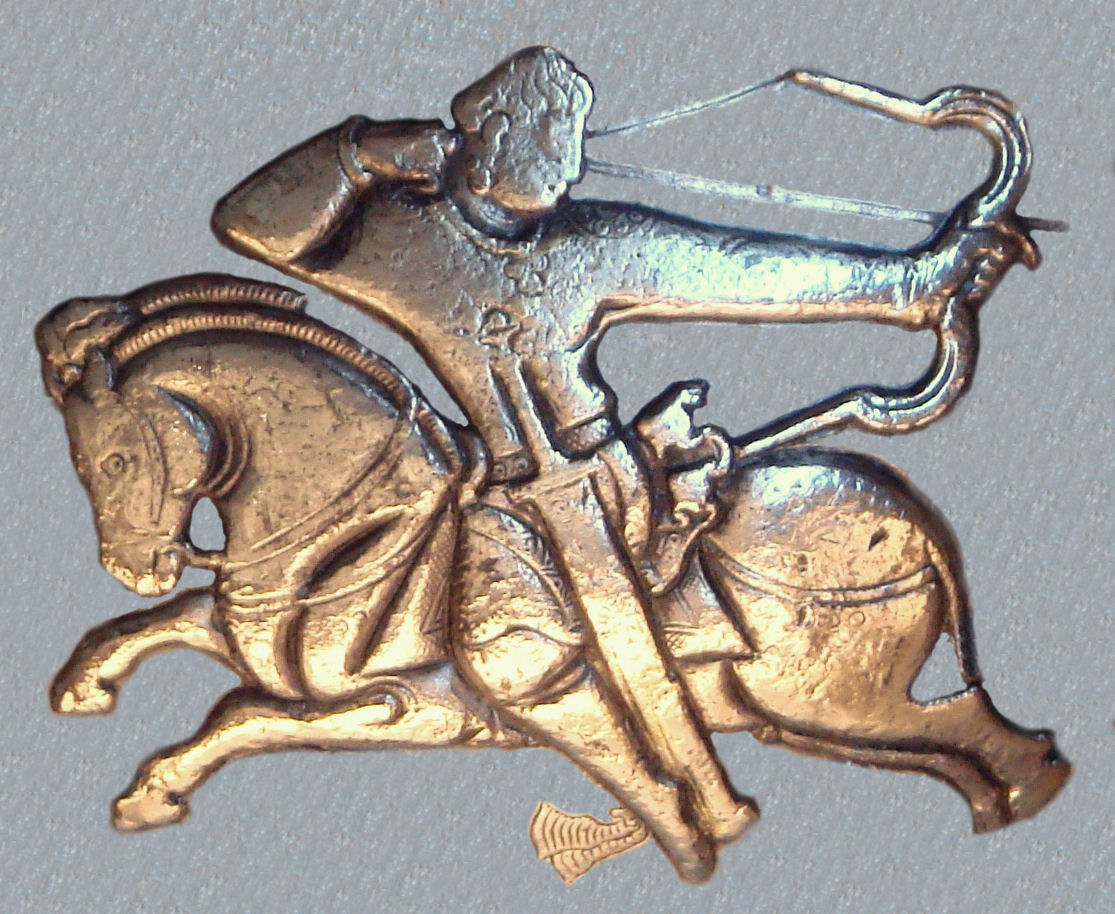
[[File:Hephthalite horseman on British Museum bowl 460-479 CE.jpg|thumb|[[Hephthalites|Hephthalite]] horseman on [[British Museum]] bowl, 460–479 CE.<ref>[http://www.britishmuseum.org/research/collection_online/collection_object_details.aspx?objectId=247021&partId=1 British Museum notice]</ref> According to [[ | [[File:Hephthalite horseman on British Museum bowl 460-479 CE.jpg|thumb|[[Hephthalites|Hephthalite]] horseman on [[British Museum]] bowl, 460–479 CE.<ref>[http://www.britishmuseum.org/research/collection_online/collection_object_details.aspx?objectId=247021&partId=1 British Museum notice]</ref> According to [[Procopius of Caesarea]], they were of the same stock as European Huns "in fact as well as in name", but sedentary and white-skinned.]] | ||
The 6th-century [[Byzantine|Roman]] historian [[ | The 6th-century [[Byzantine|Roman]] historian [[Procopius of Caesarea]] (Book I. ch. 3), related the Huns of Europe with the [[Hephthalites]] or "White Huns" who subjugated the [[Sassanids]] and invaded northwestern [[India]], stating that they were of the same stock, "in fact as well as in name", although he contrasted the Huns with the Hephthalites, in that the Hephthalites were sedentary, white-skinned, and possessed "not ugly" features:<ref>Procopius of Caesarea: Tyranny, History, and Philosophy at the End of Antiquity, Anthony Kaldellis, University of Pennsylvania Press, 2012, [https://books.google.com/books?id=Ag0mUQiLb7kC&pg=PA70 p.70]</ref><ref>Staying Roman: Conquest and Identity in Africa and the Mediterranean, 439–700, Jonathan Conant | ||
Cambridge University Press, 2012 [https://books.google.com/books?id=wJEgAwAAQBAJ&pg=PA259 p.259]</ref> | Cambridge University Press, 2012 [https://books.google.com/books?id=wJEgAwAAQBAJ&pg=PA259 p.259]</ref> | ||
{{ | {{blockquote|The Ephthalitae Huns, who are called White Huns [...] The Ephthalitae are of the stock of the Huns in fact as well as in name, however they do not mingle with any of the Huns known to us, for they occupy a land neither adjoining nor even very near to them; but their territory lies immediately to the north of Persia [...] They are not nomads like the other Hunnic peoples, but for a long period have been established in a goodly land... They are the only ones among the Huns who have white bodies and countenances which are not ugly. It is also true that their manner of living is unlike that of their kinsmen, nor do they live a savage life as they do; but they are ruled by one king, and since they possess a lawful constitution, they observe right and justice in their dealings both with one another and with their neighbours, in no degree less than the Romans and the Persians<ref>[[s:History of the Wars/Book I|Procopius, ''History of the Wars''. Book I, Ch. III, "The Persian War"]]</ref>}} | ||
The [[Kidarites]], who invaded Bactria in the second half of the 4th century,<ref name="HCCE 119">History of Civilizations of Central Asia, Ahmad Hasan Dani, B. A. Litvinsky, [[Unesco]] [https://books.google.com/books?id=883OZBe2sMYC&pg=PA119 p.119 sq]</ref> are generally regarded as the first wave of Hunas to enter Indian Subcontinent. | The [[Kidarites]], who invaded Bactria in the second half of the 4th century,<ref name="HCCE 119">History of Civilizations of Central Asia, Ahmad Hasan Dani, B. A. Litvinsky, [[Unesco]] [https://books.google.com/books?id=883OZBe2sMYC&pg=PA119 p.119 sq]</ref> are generally regarded as the first wave of Hunas to enter Indian Subcontinent. | ||
The Gupta empire under [[Skandagupta]] in the 5th century had successfully repulsed one Hun attack in the northwest in 460 CE. However, over the period of the next several years, the Hunas under successive kings were able to make inroads into the subcontinent. | The Gupta empire under [[Skandagupta]] in the 5th century had successfully repulsed one Hun attack in the northwest in 460 CE. However, over the period of the next several years, the Hunas under successive kings were able to make inroads into the subcontinent. | ||
They were initially based in the [[Oxus]] basin in Central Asia and established their control over Gandhara in the northwestern part of the Indian subcontinent by about 465 CE.<ref>{{cite book|author=Atreyi Biswas|url=https://books.google.com/books?id=ohwdAAAAMAAJ|title=The Political History of the Hūṇas in India|date=1971|publisher=Munshiram Manoharlal Publishers}}</ref> From there, they fanned out into various parts of northern, western, and central [[India]]. The Hūṇas are mentioned in several ancient texts such as the [[ | They were initially based in the [[Oxus]] basin in Central Asia and established their control over Gandhara in the northwestern part of the Indian subcontinent by about 465 CE.<ref>{{cite book|author=Atreyi Biswas|url=https://books.google.com/books?id=ohwdAAAAMAAJ|title=The Political History of the Hūṇas in India|date=1971|publisher=Munshiram Manoharlal Publishers|isbn = 9780883863015}}</ref> From there, they fanned out into various parts of northern, western, and central [[India]]. The Hūṇas are mentioned in several ancient texts such as the [[Rāmāyaṇa]], [[Mahābhārata]], [[Purāṇas]], and Kalidasa's [[Raghuvaṃśa]].<ref>{{cite book|author=Upendra Thakur|url=https://archive.org/download/dli.ernet.429146|title=The Hūṇas in India|date=1967|publisher=Chowkhamba Prakashan|pages=52–55}}</ref> | ||
In 528 CE, another campaign led by a coalition of Indian kings finally defeated king [[Mihirakula]] and his Huna army. The victory was inscribed on a stone pillar and erected in honor of (and in praise for) one of the leaders of the coalition, king Yashodharman, in [[Mandasor Pillar Inscriptions of Yasodharman|Mandasaur]] in Central India. Huna kings in this inscription are described as 'rude and cruel'. They were also responsible for the destruction of Buddhist monasteries and centers of learning in the Northwest regions of the country. | |||
The Mongolian-Tibetan historian [[:de:Sumpa Yeshe Peljor|Sumpa Yeshe Peljor]] (writing in the 18th century) lists the Hunas alongside other peoples found in Central Asia since antiquity, including the [[Yavanas]] (Greeks), [[Kambojas]], [[Tukharas]], [[Khasas]] and [[Daradas]].<ref>[[Sumpa Yeshe Peljor]]'s 18th century work ''Dpag-bsam-ljon-bzah'' (Tibetan title) may be translated as "The Excellent [[Kalpavriksha]]"): "Tho-gar yul dań yabana dań Kambodza dań Khasa [sic] dań Huna dań Darta dań..." </ref><ref>Pag-Sam-Jon-Zang (1908), I.9, Sarat Chandra Das; Ancient Kamboja, 1971, p 66, [[H. W. Bailey]].</ref> | The Mongolian-Tibetan historian [[:de:Sumpa Yeshe Peljor|Sumpa Yeshe Peljor]] (writing in the 18th century) lists the Hunas alongside other peoples found in Central Asia since antiquity, including the [[Yavanas]] (Greeks), [[Kambojas]], [[Tukharas]], [[Khasas]] and [[Daradas]].<ref>[[Sumpa Yeshe Peljor]]'s 18th century work ''Dpag-bsam-ljon-bzah'' (Tibetan title) may be translated as "The Excellent [[Kalpavriksha]]"): "Tho-gar yul dań yabana dań Kambodza dań Khasa [sic] dań Huna dań Darta dań..."</ref><ref>Pag-Sam-Jon-Zang (1908), I.9, Sarat Chandra Das; Ancient Kamboja, 1971, p 66, [[H. W. Bailey]].</ref> | ||
===Gurjara-Pratiharas=== | |||
[[File:Pratihara_bhoja.JPG|thumb|[[Gurjara-Pratihara]] coinage of [[Mihira Bhoja]], King of [[Kanauj]].<ref>{{cite book |last1=Smith |first1=Vincent Arthur |last2=Edwardes |first2=Stephen Meredyth |authorlink2=Stephen Edwardes |title=The early history of India : from 600 B.C. to the Muhammadan conquest, including the invasion of Alexander the Great |date=1924 |publisher=Oxford : Clarendon Press |page=Plate 2 |url=https://archive.org/details/earlyhistoryofi00smit/page/76}}</ref><ref name="HPR164">{{cite book |last1=Ray |first1=Himanshu Prabha |title=Negotiating Cultural Identity: Landscapes in Early Medieval South Asian History |date=2019 |publisher=Taylor & Francis |isbn=9781000227932 |pages=164 |url=https://books.google.com/books?id=qkyfDwAAQBAJ&pg=PT162 |language=en}}</ref>]] | |||
The [[Gurjara-Pratiharas]] suddenly emerged as a political power in north India around sixth century CE, shortly after the [[Hunas]] invasion of that region.{{sfn|Puri|1957|p=2}} The Gujara-Pratihara were "likely" formed from a fusion of the [[Alchon Huns]] ("White Huns") and native Indian elements, and can probably be considered as a [[Huns|Hunnic]] state, although its precise origins remain unclear.<ref name="HJK">{{cite book |last1=Kim |first1=Hyun Jin |author-link=Hyun Jin Kim|title=The Huns |date=19 November 2015 |publisher=Routledge |isbn=978-1-317-34091-1 |pages=62–64 |url=https://books.google.com/books?id=bnv4CgAAQBAJ&pg=PA62 |language=en|quote="Although it is not certain, it also seems likely that the formidable Gurjara Pratihara regime (ruled from the seventh-eleventh centuries AD) of northern India, had a powerful [[Hephthalite|White Hunnic]] element. The Gurjara Pratiharas who were likely created from a fusion of White Hunnic and native Indian elements, ruled a vast Empire in northern India, and they also halted Arab Muslim expansion in India through Sind for centuries..."}}</ref><ref name="BRILL">{{cite book |last1=Wink |first1=André |title=Al-hind: The Making of the Indo-islamic World |date=1991 |publisher=BRILL |isbn=978-90-04-09249-5 |page=279 |url=https://books.google.com/books?id=bCVyhH5VDjAC&pg=PA279 |language=en}}</ref> In [[Banabhatta|Bana]]'s ''[[Harshacharita]]'' (7th century CE), the [[Gurjar]]as are associated with the Hunas.<ref name="BRILL"/> | |||
Some of the Hunas may also have contributed to the formation of the warlike [[Rajputs]].<ref name="HJK"/> | |||
==Religion== | ==Religion== | ||
The religious beliefs of the Hunas | The religious beliefs of the Hunas are unknown, and believed to be a combination of ancestor worship, [[totem]]ism and [[animism]].<ref>{{cite book|author1=Mircea Eliade|author2=Charles J. Adams|title=The Encyclopedia of religion|url=https://archive.org/details/encyclopediaofre06elia |url-access=registration|year=1987|publisher=Macmillan|isbn= 978-0-02-909750-2|pages=[https://archive.org/details/encyclopediaofre06elia/page/530 530]–532 }}</ref> | ||
[[ | [[Songyun (monk)|Songyun]] and [[Huisheng (monk)|Huisheng]], who visited the chief of the [[Hephthalite]] nomads at his summer residence in [[Badakshan]] and later in [[Gandhara]], observed that they had no belief in the [[Buddhist]] law and served a large number of divinities."<ref>{{cite web |url=http://www.silk-road.com/artl/heph.shtml |title=The White Huns – The Hephthalites |publisher=Silkroad Foundation |access-date=11 January 2013}}</ref> | ||
==Gallery== | ==Gallery== | ||
| Line 63: | Line 74: | ||
File:Sondani.jpg|Victory pillar of [[Yashodharman]] at Sondani, [[Mandsaur]] claiming victory over the Huns. | File:Sondani.jpg|Victory pillar of [[Yashodharman]] at Sondani, [[Mandsaur]] claiming victory over the Huns. | ||
File:Asia 500ad.jpg|Asia in 500 CE, showing the Huna domain at its greatest extent. | File:Asia 500ad.jpg|Asia in 500 CE, showing the Huna domain at its greatest extent. | ||
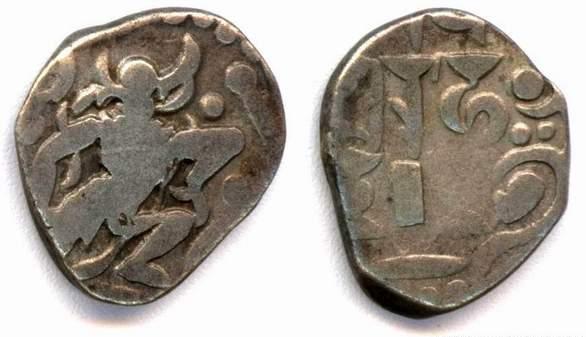
File:HunCoinDerivedFromSassanianDesign5thCE.JPG|[[Alchon Huns]] king [[Khingila]].<ref> | File:HunCoinDerivedFromSassanianDesign5thCE.JPG|[[Alchon Huns]] king [[Khingila]].<ref>[https://www.cngcoins.com/Coin.aspx?CoinID=156854 CNG Coins]</ref> | ||
File:HunaKing.JPG|[[Nezak Huns]] king [[Napki Malka]]. | File:HunaKing.JPG|[[Nezak Huns]] king [[Napki Malka]]. | ||
File:SilverBowlNFPPakistan5-6thcenturyCE.JPG|The "[[Hephthalite bowl]]", NFP [[Pakistan]], 5th or 6th century CE. [[British Museum]].<ref>Iaroslav Lebedynsky, "Les Nomades", p172.</ref> | File:SilverBowlNFPPakistan5-6thcenturyCE.JPG|The "[[Hephthalite bowl]]", NFP [[Pakistan]], 5th or 6th century CE. [[British Museum]].<ref>Iaroslav Lebedynsky, "Les Nomades", p172.</ref> | ||
| Line 70: | Line 81: | ||
==See also== | ==See also== | ||
* [[Kushan Empire]] | * [[Kushan Empire]] | ||
* [[Gurjar]]as | |||
* [[Gurjara-Pratihara dynasty|Gurjara pratihara dynasty]] | |||
* [[36 royal races]] | * [[36 royal races]] | ||
* [[Ancient India and Central Asia]] | * [[Ancient India and Central Asia]] | ||
* [[ | * [[Alchon Huns]] | ||
==Notes== | ==Notes== | ||
| Line 79: | Line 92: | ||
==References== | ==References== | ||
* [[Iaroslav Lebedynsky]], "Les Nomades", Paris 2007, {{ISBN|978-2-87772-346-6}} | * [[Iaroslav Lebedynsky]], "Les Nomades", Paris 2007, {{ISBN|978-2-87772-346-6}} | ||
* {{citation |first=Baij Nath |last=Puri |author-link=Baij Nath Puri |title=The history of the Gurjara-Pratihāras |url=https://books.google.com/books?id=szkhAAAAMAAJ |year=1957 |publisher=Munshiram Manoharlal}} | |||
{{Huns}} | {{Huns}} | ||
{{DEFAULTSORT:Huna People}} | {{DEFAULTSORT:Huna People}} | ||
[[Category:Ancient peoples of India]] | [[Category:Ancient peoples of India]] | ||
[[Category:Ancient peoples of Pakistan]] | [[Category:Ancient peoples of Pakistan]] | ||
[[Category: | [[Category:Huns]] | ||
[[Category:Historical Iranian peoples]] | [[Category:Historical Iranian peoples]] | ||
[[Category:Nomadic groups in Eurasia]] | [[Category:Nomadic groups in Eurasia]] | ||
Latest revision as of 22:53, 20 January 2026
| Hunas | |
|---|---|
Approximate extent of the Alchon Huns, and find spots of inscriptions related to their local control (map of the Indian subcontinent)[1] | |
| Region | Madhya Pradesh, Uttar Pradesh, Punjab, Rajasthan, Gujarat, Himachal Pradesh, Haryana, Jammu and Kashmir, Bihar, Sindh, Gilgit-Baltistan, Nuristan, Khyber Pakhtunkhwa, Balochistan, Maharashtra, Delhi |



Hunas or Huna (Middle Brahmi script: 
 Hūṇā) was the name given by the ancient Indians to a group of Central Asian tribes who, via the Khyber Pass, entered the Indian subcontinent at the end of the 5th or early 6th century. The Hunas occupied areas as far south as Eran and Kausambi, greatly weakening the Gupta Empire.[2] The Hunas were ultimately defeated by a coalition of Indian princes[3] that included an Indian king Yasodharman and the Gupta emperor, Narasimhagupta. They defeated a Huna army and their ruler Mihirakula in 528 CE and drove them out of India.[4] The Guptas are thought to have played only a minor role in this campaign.[3]
The Hunas are thought to have included the Xionite and/or Hephthalite, the Kidarites, the Alchon Huns (also known as the Alxon, Alakhana, Walxon etc.) and the Nezak Huns. Such names, along with that of the Harahunas (also known as the Halahunas or Harahuras) mentioned in Hindu texts, have sometimes been used for the Hunas in general; while these groups (and the Iranian Huns) appear to have been a component of the Hunas, such names were not necessarily synonymous. Some authors suggest that the Hunas were Hephthalite Huns from Central Asia.[3] The relationship, of the Hunas to the Huns, a Central Asian people who invaded Europe during the same period, is under research.
In its farthest geographical extent in India, the territories controlled by the Hunas covered the region up to Malwa in central India.[5] Their repeated invasions and war losses were the main reason for the decline of the Gupta Empire.[6]
History[edit | edit source]
 Hūṇā) in line 12 (Verse 16) of the Rīsthal inscription, 6th century CE.[7]
Chinese sources link the Central Asian tribes comprising the Hunas to both the Xiongnu of north east Asia and the Huns who later invaded and settled in Europe.[8] Similarly, Gerald Larson suggests that the Hunas were a Turkic-Mongolic grouping from Central Asia.[6] The works of Ptolemy (2nd century) are among the first European texts to mention the Huns, followed by the texts by Marcellinus and Priscus. They too suggest that the Huns were an inner Asian people.[9]

The 6th-century Roman historian Procopius of Caesarea (Book I. ch. 3), related the Huns of Europe with the Hephthalites or "White Huns" who subjugated the Sassanids and invaded northwestern India, stating that they were of the same stock, "in fact as well as in name", although he contrasted the Huns with the Hephthalites, in that the Hephthalites were sedentary, white-skinned, and possessed "not ugly" features:[11][12]
The Ephthalitae Huns, who are called White Huns [...] The Ephthalitae are of the stock of the Huns in fact as well as in name, however they do not mingle with any of the Huns known to us, for they occupy a land neither adjoining nor even very near to them; but their territory lies immediately to the north of Persia [...] They are not nomads like the other Hunnic peoples, but for a long period have been established in a goodly land... They are the only ones among the Huns who have white bodies and countenances which are not ugly. It is also true that their manner of living is unlike that of their kinsmen, nor do they live a savage life as they do; but they are ruled by one king, and since they possess a lawful constitution, they observe right and justice in their dealings both with one another and with their neighbours, in no degree less than the Romans and the Persians[13]
The Kidarites, who invaded Bactria in the second half of the 4th century,[14] are generally regarded as the first wave of Hunas to enter Indian Subcontinent.
The Gupta empire under Skandagupta in the 5th century had successfully repulsed one Hun attack in the northwest in 460 CE. However, over the period of the next several years, the Hunas under successive kings were able to make inroads into the subcontinent.
They were initially based in the Oxus basin in Central Asia and established their control over Gandhara in the northwestern part of the Indian subcontinent by about 465 CE.[15] From there, they fanned out into various parts of northern, western, and central India. The Hūṇas are mentioned in several ancient texts such as the Rāmāyaṇa, Mahābhārata, Purāṇas, and Kalidasa's Raghuvaṃśa.[16]
In 528 CE, another campaign led by a coalition of Indian kings finally defeated king Mihirakula and his Huna army. The victory was inscribed on a stone pillar and erected in honor of (and in praise for) one of the leaders of the coalition, king Yashodharman, in Mandasaur in Central India. Huna kings in this inscription are described as 'rude and cruel'. They were also responsible for the destruction of Buddhist monasteries and centers of learning in the Northwest regions of the country.
The Mongolian-Tibetan historian Sumpa Yeshe Peljor (writing in the 18th century) lists the Hunas alongside other peoples found in Central Asia since antiquity, including the Yavanas (Greeks), Kambojas, Tukharas, Khasas and Daradas.[17][18]
Gurjara-Pratiharas[edit | edit source]

The Gurjara-Pratiharas suddenly emerged as a political power in north India around sixth century CE, shortly after the Hunas invasion of that region.[21] The Gujara-Pratihara were "likely" formed from a fusion of the Alchon Huns ("White Huns") and native Indian elements, and can probably be considered as a Hunnic state, although its precise origins remain unclear.[22][23] In Bana's Harshacharita (7th century CE), the Gurjaras are associated with the Hunas.[23]
Some of the Hunas may also have contributed to the formation of the warlike Rajputs.[22]
Religion[edit | edit source]
The religious beliefs of the Hunas are unknown, and believed to be a combination of ancestor worship, totemism and animism.[24]
Songyun and Huisheng, who visited the chief of the Hephthalite nomads at his summer residence in Badakshan and later in Gandhara, observed that they had no belief in the Buddhist law and served a large number of divinities."[25]
Gallery[edit | edit source]
-
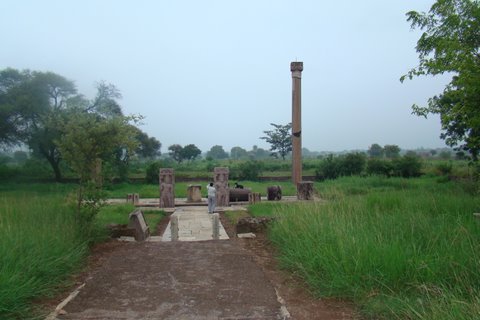 Victory pillar of Yashodharman at Sondani, Mandsaur claiming victory over the Huns.
 -
 Asia in 500 CE, showing the Huna domain at its greatest extent.
 -
![Alchon Huns king Khingila.[26]](/wiki/Special:SmartCommonsOriginal/commons/HunCoinDerivedFromSassanianDesign5thCE.JPG)
-
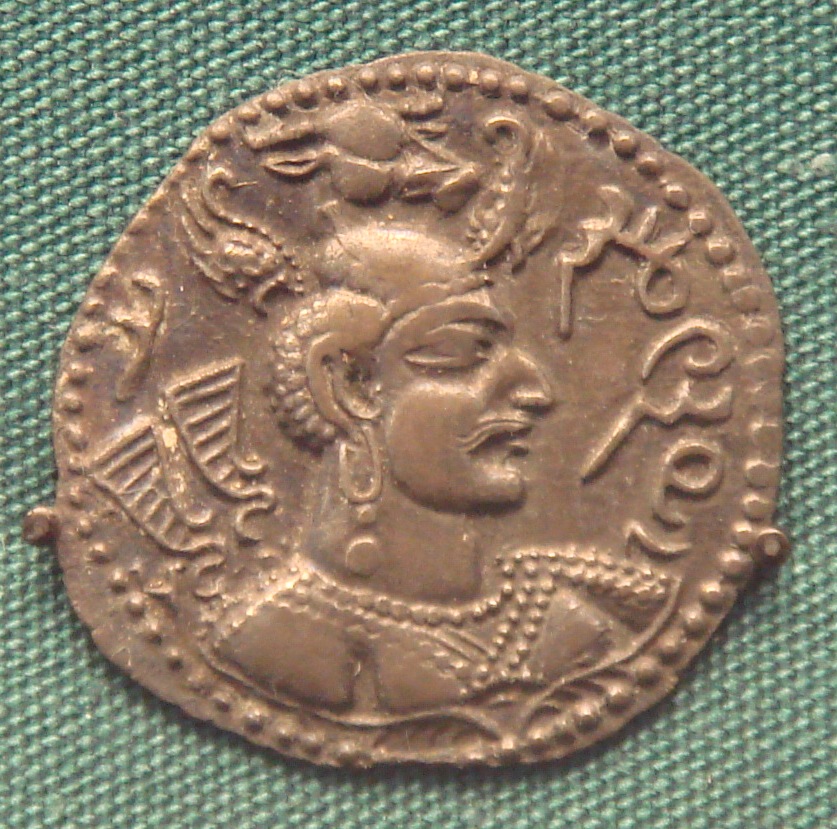 Nezak Huns king Napki Malka.
 -
![The "Hephthalite bowl", NFP Pakistan, 5th or 6th century CE. British Museum.[27]](/wiki/Special:SmartCommonsOriginal/commons/SilverBowlNFPPakistan5-6thcenturyCE.JPG)


![Alchon Huns king Khingila.[26]](/wiki/File:HunCoinDerivedFromSassanianDesign5thCE.JPG)

![The "Hephthalite bowl", NFP Pakistan, 5th or 6th century CE. British Museum.[27]](/wiki/File:SilverBowlNFPPakistan5-6thcenturyCE.JPG)
See also[edit | edit source]
- Kushan Empire
- Gurjaras
- Gurjara pratihara dynasty
- 36 royal races
- Ancient India and Central Asia
- Alchon Huns
Notes[edit | edit source]
- ↑ Hans Bakker 24th Gonda lecture
- ↑ India: A History by John Keay p.158
- ↑ 3.0 3.1 3.2 Haywood, John (2002). Historical Atlas of the Classical World 500BC-600AD. New York: Barnes & Noble Books. p. 2.23. ISBN 0-7607-1973-X.
- ↑ Dani, Ahmad Hasan (1999). History of Civilizations of Central Asia: The crossroads of civilizations: A.D. 250 to 750. Motilal Banarsidass Publ. p. 175. ISBN 9788120815407.
- ↑ Kurbanov, Aydogdy (2010). "The Hephthalites: Archaeological and Historical Analysis" (PDF). p. 24. Retrieved 17 January 2013.
The Hūnas controlled an area that extended from Malwa in central India to Kashmir.
- ↑ 6.0 6.1 Gerald James Larson (1995). India's Agony Over Religion. State University of New York Press. pp. 78–79. ISBN 978-1-4384-1014-2.
- ↑ Tewari, S.P.; Ramesh, K.V. (1983). JOURNAL OF THE EPIGRAPHICAL SOCIETY OF INDIA VOL 10. THE EPIGRAPHICAL SOCIETY OF INDIA, DHARWAR. pp. 98-99.
- ↑ Hyun Jin Kim, The Huns, Abingdon, Routledge, passim.
- ↑ Joseph Kitagawa (2013). The Religious Traditions of Asia: Religion, History, and Culture. Routledge. p. 229. ISBN 978-1-136-87597-7.
- ↑ British Museum notice
- ↑ Procopius of Caesarea: Tyranny, History, and Philosophy at the End of Antiquity, Anthony Kaldellis, University of Pennsylvania Press, 2012, p.70
- ↑ Staying Roman: Conquest and Identity in Africa and the Mediterranean, 439–700, Jonathan Conant Cambridge University Press, 2012 p.259
- ↑ Procopius, History of the Wars. Book I, Ch. III, "The Persian War"
- ↑ History of Civilizations of Central Asia, Ahmad Hasan Dani, B. A. Litvinsky, Unesco p.119 sq
- ↑ Atreyi Biswas (1971). The Political History of the Hūṇas in India. Munshiram Manoharlal Publishers. ISBN 9780883863015.
- ↑ Upendra Thakur (1967). The Hūṇas in India. Chowkhamba Prakashan. pp. 52–55.
- ↑ Sumpa Yeshe Peljor's 18th century work Dpag-bsam-ljon-bzah (Tibetan title) may be translated as "The Excellent Kalpavriksha"): "Tho-gar yul dań yabana dań Kambodza dań Khasa [sic] dań Huna dań Darta dań..."
- ↑ Pag-Sam-Jon-Zang (1908), I.9, Sarat Chandra Das; Ancient Kamboja, 1971, p 66, H. W. Bailey.
- ↑ Smith, Vincent Arthur; Edwardes, Stephen Meredyth (1924). The early history of India : from 600 B.C. to the Muhammadan conquest, including the invasion of Alexander the Great. Oxford : Clarendon Press. p. Plate 2.
{{cite book}}: CS1 maint: publisher location (link) - ↑ Ray, Himanshu Prabha (2019). Negotiating Cultural Identity: Landscapes in Early Medieval South Asian History. Taylor & Francis. p. 164. ISBN 9781000227932.
- ↑ Puri 1957, p. 2.
- ↑ 22.0 22.1 Kim, Hyun Jin (19 November 2015). The Huns. Routledge. pp. 62–64. ISBN 978-1-317-34091-1.
Although it is not certain, it also seems likely that the formidable Gurjara Pratihara regime (ruled from the seventh-eleventh centuries AD) of northern India, had a powerful White Hunnic element. The Gurjara Pratiharas who were likely created from a fusion of White Hunnic and native Indian elements, ruled a vast Empire in northern India, and they also halted Arab Muslim expansion in India through Sind for centuries...
- ↑ 23.0 23.1 Wink, André (1991). Al-hind: The Making of the Indo-islamic World. BRILL. p. 279. ISBN 978-90-04-09249-5.
- ↑ Mircea Eliade; Charles J. Adams (1987). The Encyclopedia of religion. Macmillan. pp. 530–532. ISBN 978-0-02-909750-2.
- ↑ "The White Huns – The Hephthalites". Silkroad Foundation. Retrieved 11 January 2013.
- ↑ CNG Coins
- ↑ Iaroslav Lebedynsky, "Les Nomades", p172.
References[edit | edit source]
- Iaroslav Lebedynsky, "Les Nomades", Paris 2007, ISBN 978-2-87772-346-6
- Puri, Baij Nath (1957), The history of the Gurjara-Pratihāras, Munshiram Manoharlal